Cambridge IGCSE Sanskrit 0499 — 2022 May/June Paper 2 · Variant 1
0499/21/M/J/22 · 4 questions · 90 marks · ≈101 min
The question paper and its mark scheme, free to read here and free to download. This is Cambridge’s own paper, exactly as it was sat.
Question paper8 pages


Mark scheme6 pages
Answers below. Sit the paper first if you are practising.
Questions as text
Q1 · Mahābhārata (adapted text) Read the following Sanskrit passage
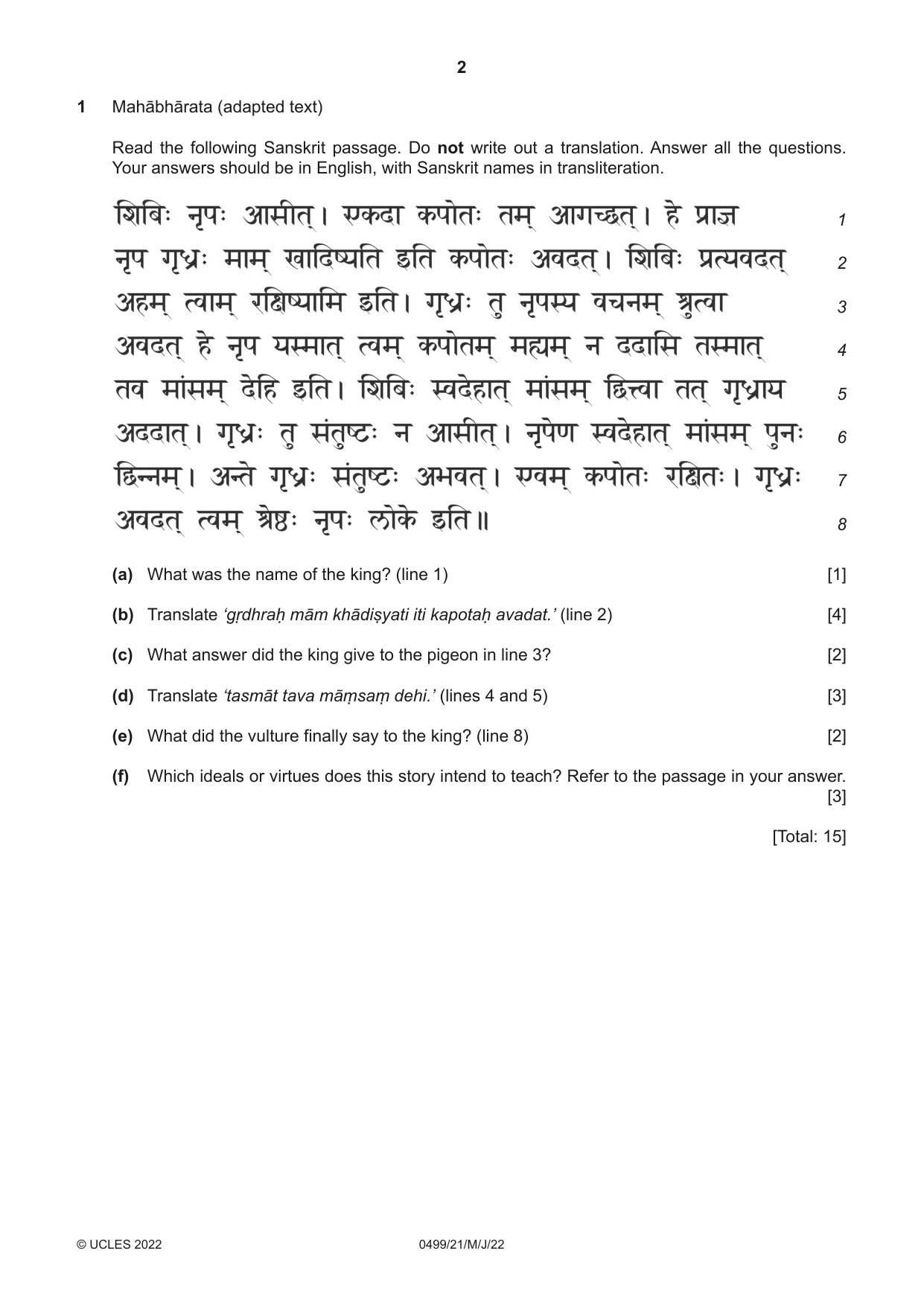
1 Mahābhārata (adapted text) Read the following Sanskrit passage. Do not write out a translation. Answer all the questions. Your answers should be in English, with Sanskrit names in transliteration. 1 2 3 4 5 6 7 8 (a) What was the name of the king? (line 1) [1] (b) Translate ‘gṛdhraḥ mām khādiṣyati iti kapotaḥ avadat.’ (line 2) [4] (c) What answer did the king give to the pigeon in line 3? [2] (d) Translate ‘tasmāt tava māṃsaṃ dehi.’ (lines 4 and 5) [3] (e) What did the vulture finally say to the king? (line 8) [2] (f) Which ideals or virtues does this story intend to teach? Refer to the passage in your answer. [3] [Total: 15]
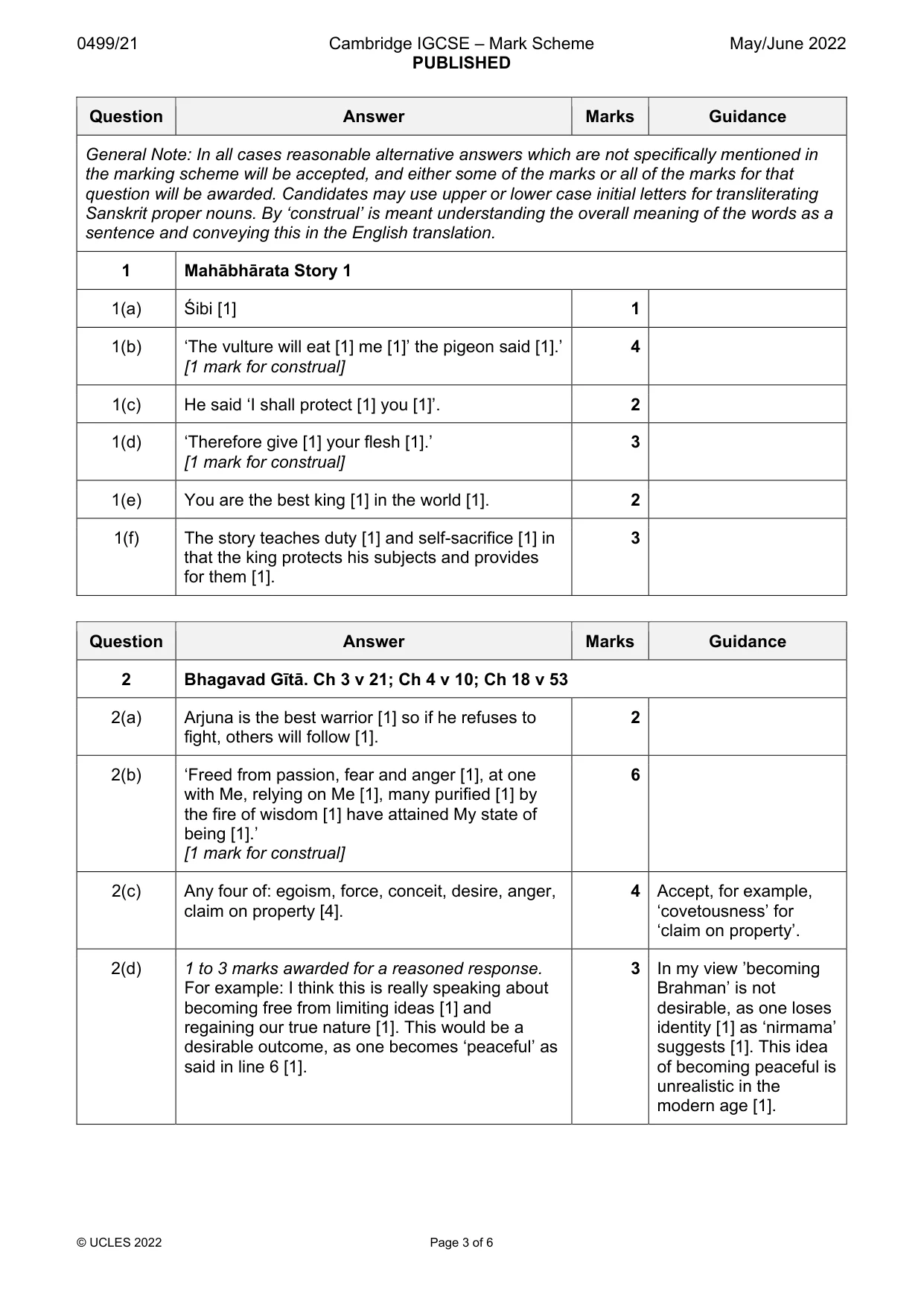
Mark scheme: Question Answer Marks Guidance General Note: In all cases reasonable alternative answers which are not specifically mentioned in the marking scheme will be accepted, and either some of the marks or all of the marks for that question will be awarded. Candidates may use upper or lower case initial letters for transliterating Sanskrit proper nouns. By ‘construal’ is meant understanding the overall meaning of the words as a sentence and conveying this in the English translation. 1 Mahābhārata Story 1 1(a) Śibi [1] 1 1(b) ‘The vulture will eat [1] me [1]’ the pigeon said [1].’ 4 [1 mark for construal] 1(c) He said ‘I shall protect [1] you [1]’. 2 1(d) ‘Therefore give [1] your flesh [1].’ 3 [1 mark for construal] 1(e) You are the best king [1] in the world [1]. 2 1(f) The story teaches duty [1] and self-sacrifice [1] in 3 that the king protects his subjects and provides for them [1].
Q2 · Mahābhārata – Bhagavad Gītā Read the following Sanskrit verses
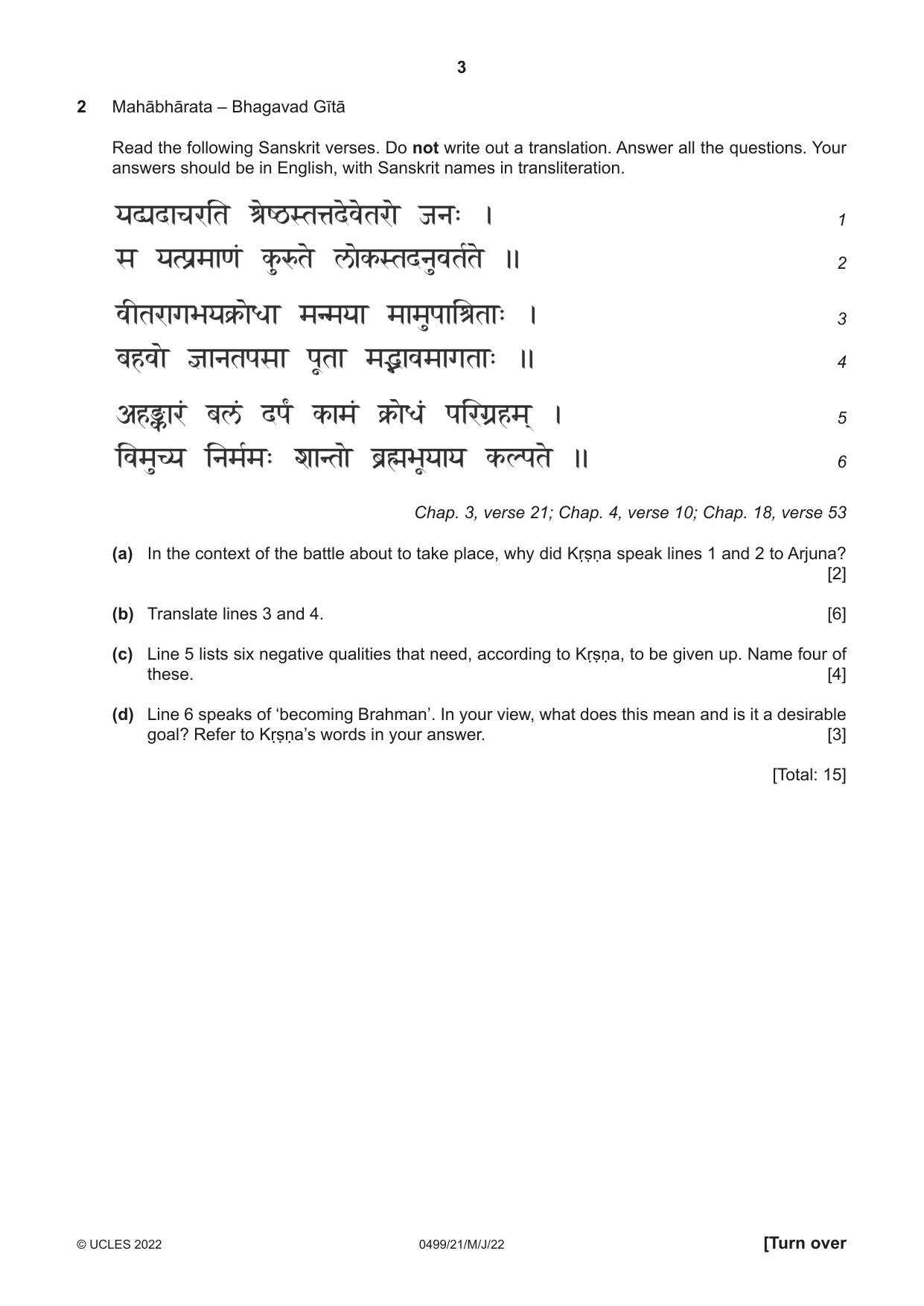
2 Mahābhārata – Bhagavad Gītā Read the following Sanskrit verses. Do not write out a translation. Answer all the questions. Your answers should be in English, with Sanskrit names in transliteration. 1 2 3 4 5 6 Chap. 3, verse 21; Chap. 4, verse 10; Chap. 18, verse 53 (a) In the context of the battle about to take place, why did Kṛṣṇa speak lines 1 and 2 to Arjuna? [2] (b) Translate lines 3 and 4. [6] (c) Line 5 lists six negative qualities that need, according to Kṛṣṇa, to be given up. Name four of these. [4] (d) Line 6 speaks of ‘becoming Brahman’. In your view, what does this mean and is it a desirable goal? Refer to Kṛṣṇa’s words in your answer. [3] [Total: 15]
Mark scheme: 2(a) Arjuna is the best warrior [1] so if he refuses to 2 fight, others will follow [1]. 2(b) ‘Freed from passion, fear and anger [1], at one 6 with Me, relying on Me [1], many purified [1] by the fire of wisdom [1] have attained My state of being [1].’ [1 mark for construal] 2(c) Any four of: egoism, force, conceit, desire, anger, 4 Accept, for example, claim on property [4]. ‘covetousness’ for ‘claim on property’. 2(d) 1 to 3 marks awarded for a reasoned response. 3 In my view ’becoming For example: I think this is really speaking about Brahman’ is not becoming free from limiting ideas [1] and desirable, as one loses regaining our true nature [1]. This would be a identity [1] as ‘nirmama’ desirable outcome, as one becomes ‘peaceful’ as suggests [1]. This idea said in line 6 [1]. of becoming peaceful is unrealistic in the modern age [1].
Q3 · Sanskrit Epic Civilisation (a) Briefly explain each of the following concepts: (i) puruṣa…
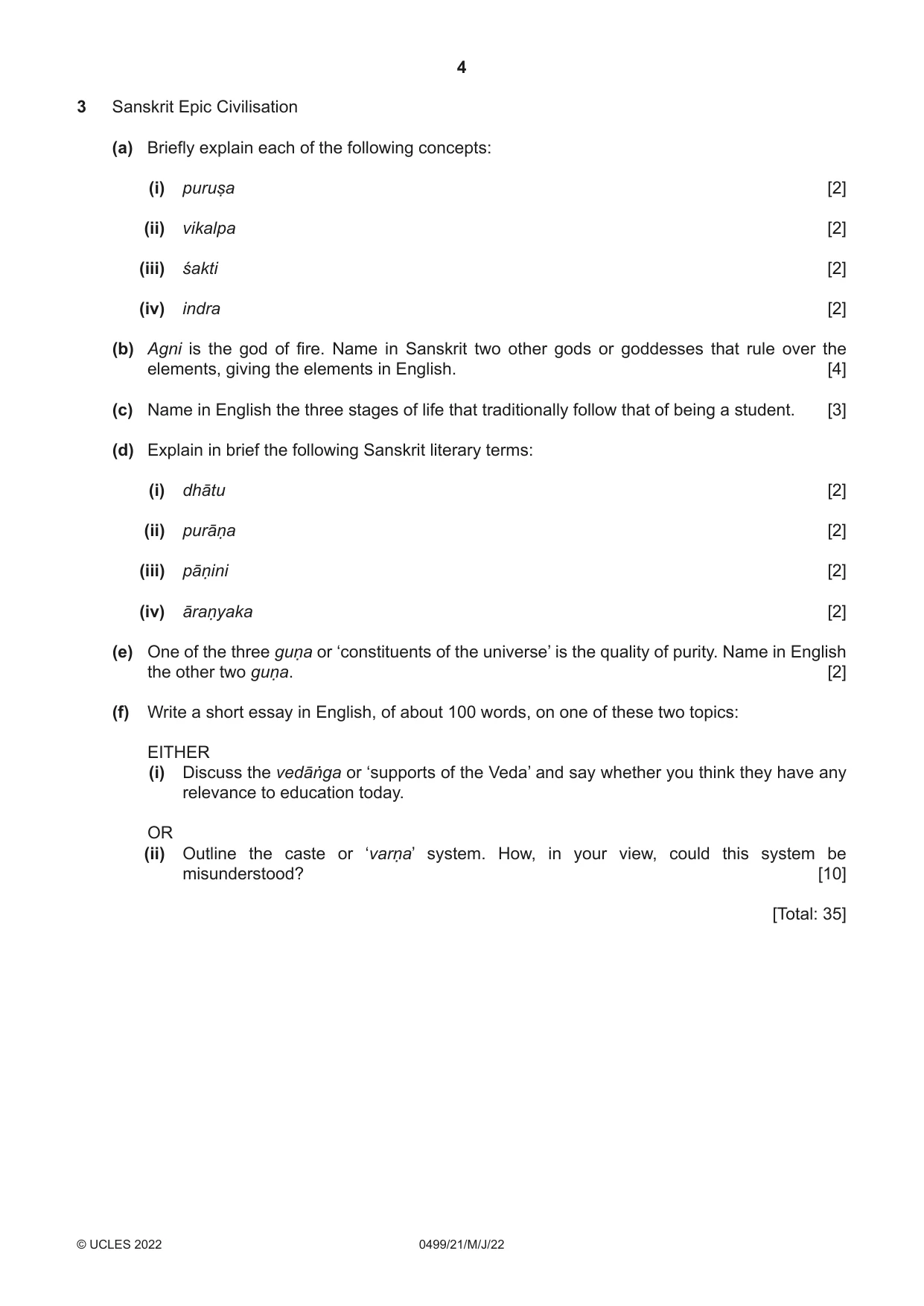
3 Sanskrit Epic Civilisation (a) Briefly explain each of the following concepts: (i) puruṣa [2] (ii) vikalpa [2] (iii) śakti [2] (iv) indra [2] (b) Agni is the god of fire. Name in Sanskrit two other gods or goddesses that rule over the elements, giving the elements in English. [4] (c) Name in English the three stages of life that traditionally follow that of being a student. [3] (d) Explain in brief the following Sanskrit literary terms: (i) dhātu [2] (ii) purāṇa [2] (iii) pāṇini [2] (iv) āraṇyaka [2] (e) One of the three guṇa or ‘constituents of the universe’ is the quality of purity. Name in English the other two guṇa. [2] (f) Write a short essay in English, of about 100 words, on one of these two topics: EITHER (i) Discuss the vedāṅga or ‘supports of the Veda’ and say whether you think they have any relevance to education today. OR (ii) Outline the caste or ‘varṇa’ system. How, in your view, could this system be misunderstood? [10] [Total: 35]
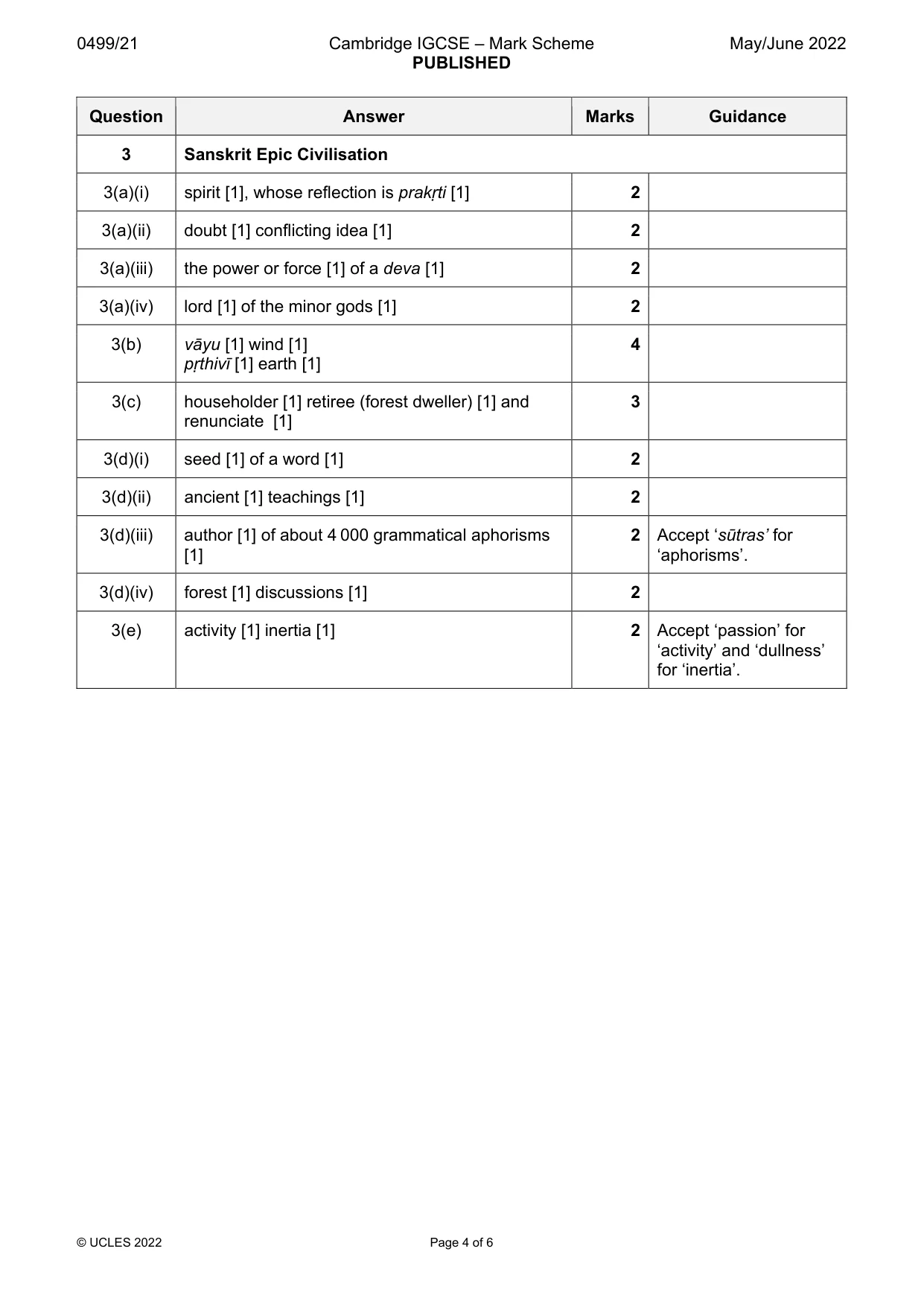
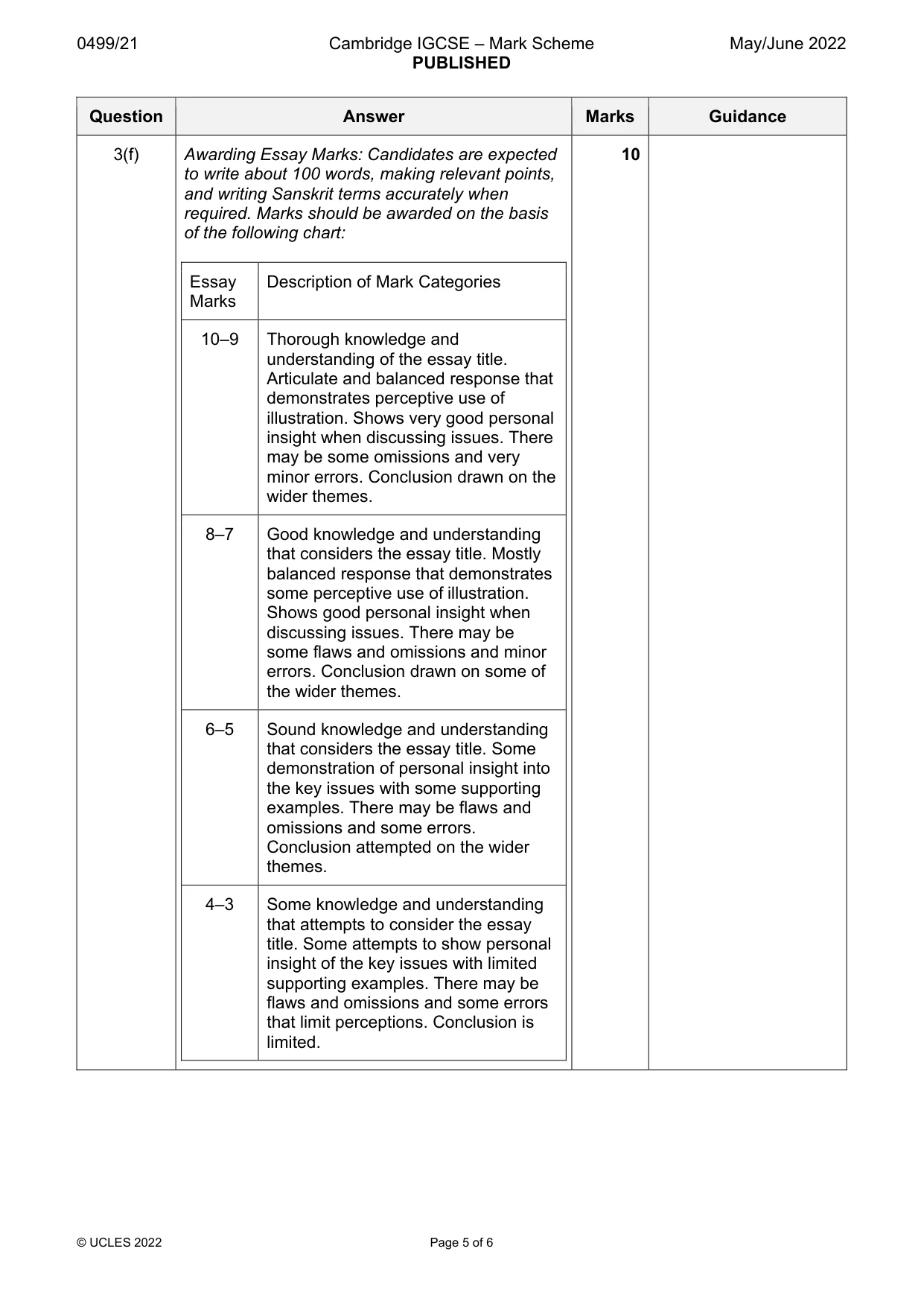
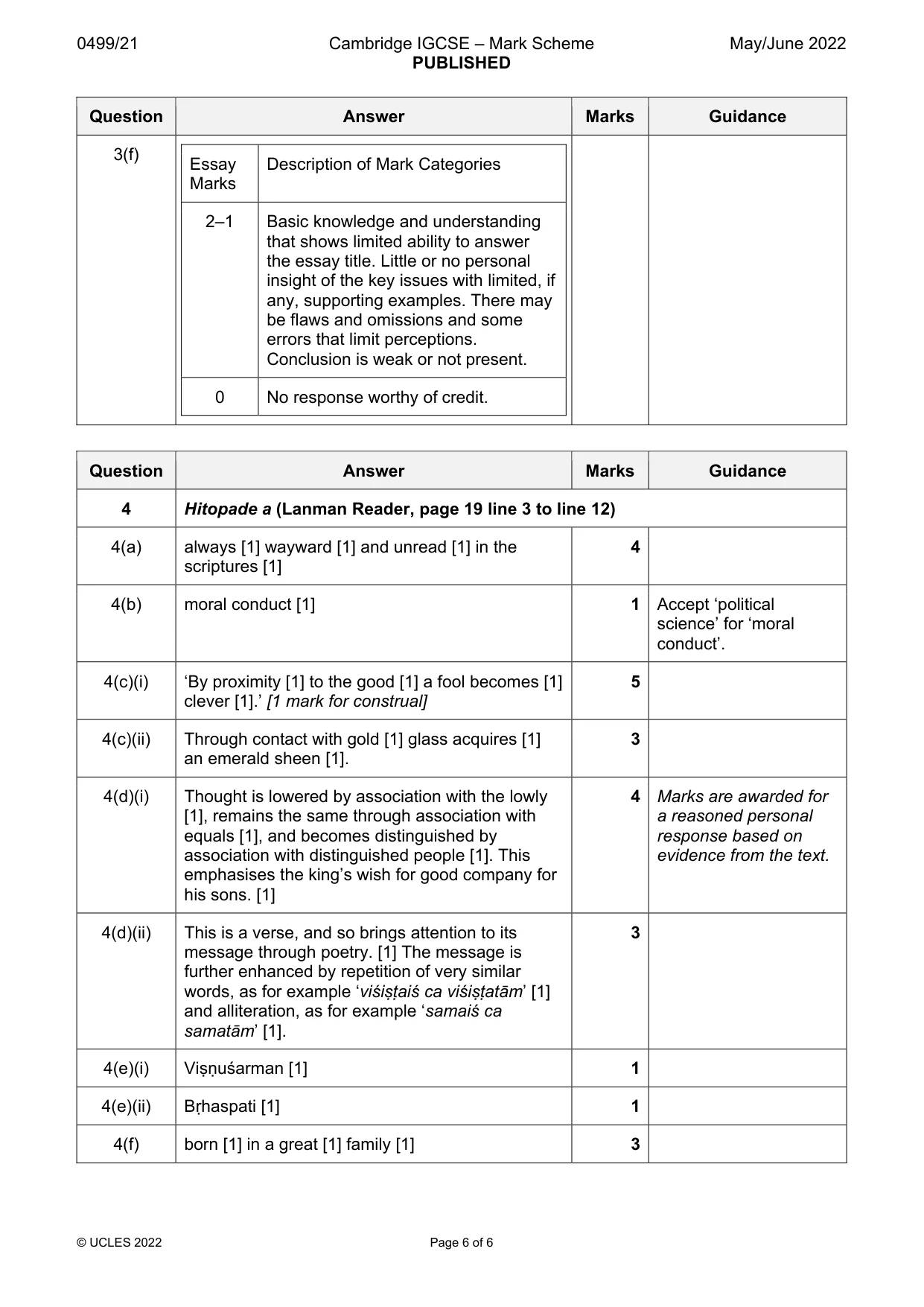
Mark scheme: 3(a)(i) spirit [1], whose reflection is prakṛti [1] 2 3(a)(ii) doubt [1] conflicting idea [1] 2 3(a)(iii) the power or force [1] of a deva [1] 2 3(a)(iv) lord [1] of the minor gods [1] 2 3(b) vāyu [1] wind [1] 4 pṛthivī [1] earth [1] 3(c) householder [1] retiree (forest dweller) [1] and 3 renunciate [1] 3(d)(i) seed [1] of a word [1] 2 3(d)(ii) ancient [1] teachings [1] 2 3(d)(iii) author [1] of about 4 000 grammatical aphorisms 2 Accept ‘sūtras’ for [1] ‘aphorisms’. 3(d)(iv) forest [1] discussions [1] 2 3(e) activity [1] inertia [1] 2 Accept ‘passion’ for ‘activity’ and ‘dullness’ for ‘inertia’. 3(f) Awarding Essay Marks: Candidates are expected 10 to write about 100 words, making relevant points, and writing Sanskrit terms accurately when required. Marks should be awarded on the basis of the following chart: Essay Description of Mark Categories Marks 10–9 Thorough knowledge and understanding of the essay title. Articulate and balanced response that demonstrates perceptive use of illustration. Shows very good personal insight when discussing issues. There may be some omissions and very minor errors. Conclusion drawn on the wider themes. 8–7 Good knowledge and understanding that considers the essay title. Mostly balanced response that demonstrates some perceptive use of illustration. Shows good personal insight when discussing issues. There may be some flaws and omissions and minor errors. Conclusion drawn on some of the wider themes. 6–5 Sound knowledge and understanding that considers the essay title. Some demonstration of personal insight into the key issues with some supporting examples. There may be flaws and omissions and some errors. Conclusion attempted on the wider themes. 4–3 Some knowledge and understanding that attempts to consider the essay title. Some attempts to show personal insight of the key issues with limited supporting examples. There may be flaws and omissions and some errors that limit perceptions. Conclusion is limited. 3(f) Essay Description of Mark Categories Marks 2–1 Basic knowledge and understanding that shows limited ability to answer the essay title. Little or no personal insight of the key issues with limited, if any, supporting examples. There may be flaws and omissions and some errors that limit perceptions. Conclusion is weak or not present. 0 No response worthy of credit.
Q4 · Hitopadeśa Read the following Sanskrit passage
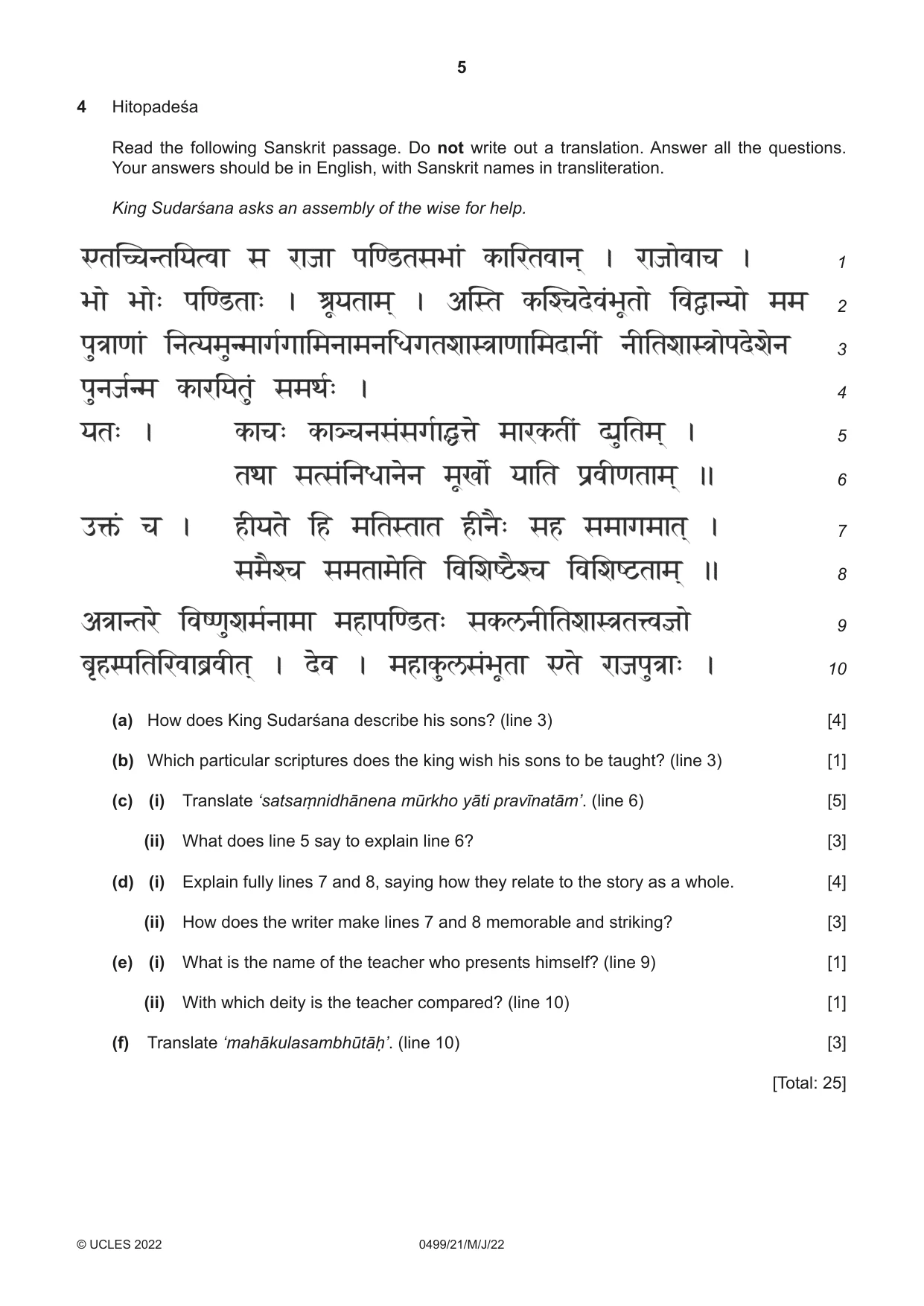
4 Hitopadeśa Read the following Sanskrit passage. Do not write out a translation. Answer all the questions. Your answers should be in English, with Sanskrit names in transliteration. King Sudarśana asks an assembly of the wise for help. 1 2 3 4 5 6 7 8 9 10 (a) How does King Sudarśana describe his sons? (line 3) [4] (b) Which particular scriptures does the king wish his sons to be taught? (line 3) [1] (c) (i) Translate ‘satsaṃnidhānena mūrkho yāti pravīnatām’. (line 6) [5] (ii) What does line 5 say to explain line 6? [3] (d) (i) Explain fully lines 7 and 8, saying how they relate to the story as a whole. [4] (ii) How does the writer make lines 7 and 8 memorable and striking? [3] (e) (i) What is the name of the teacher who presents himself? (line 9) [1] (ii) With which deity is the teacher compared? (line 10) [1] (f) Translate ‘mahākulasambhūtāḥ’. (line 10) [3] [Total: 25]
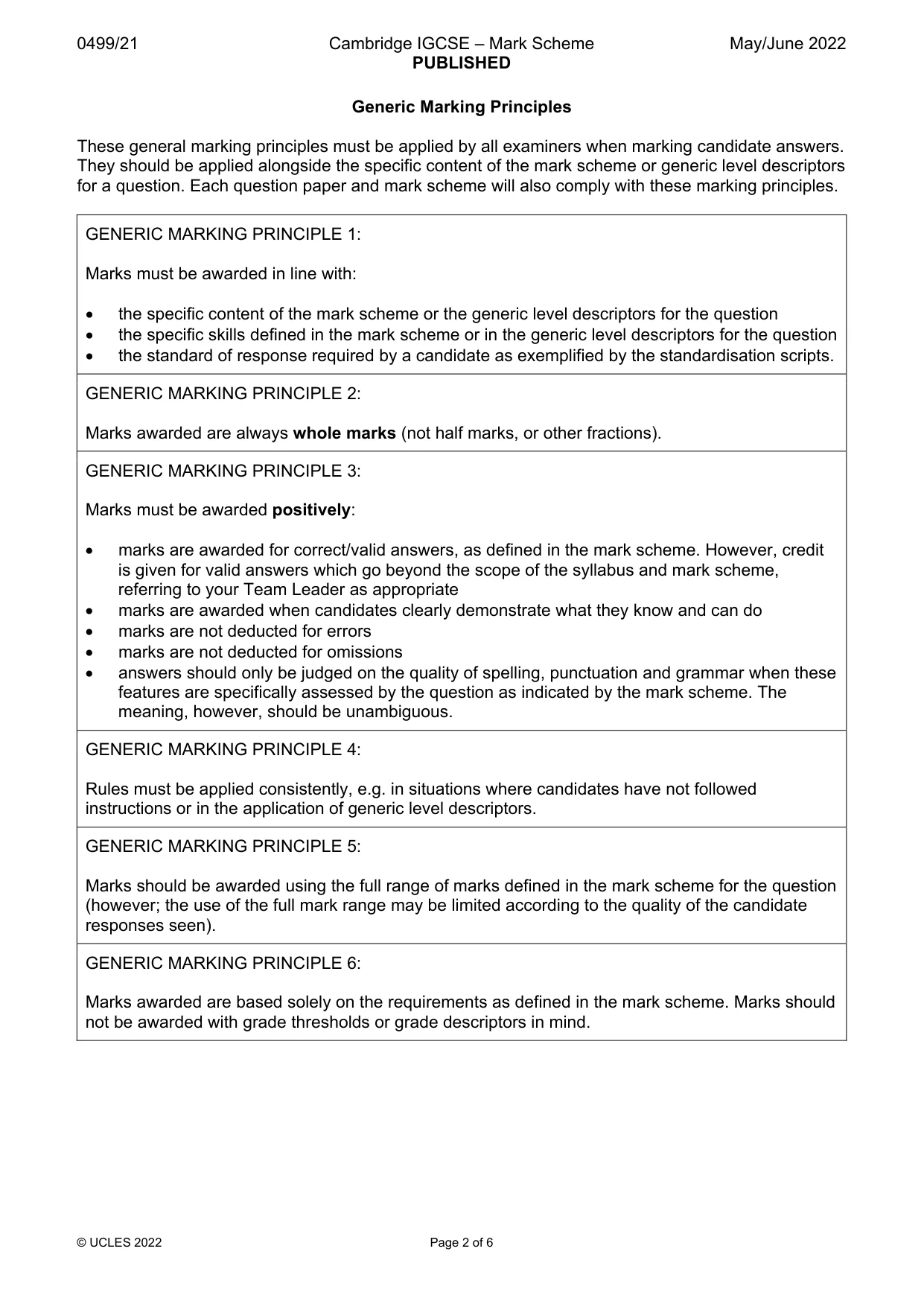
Mark scheme: 4(a) always [1] wayward [1] and unread [1] in the 4 scriptures [1] 4(b) moral conduct [1] 1 Accept ‘political science’ for ‘moral conduct’. 4(c)(i) ‘By proximity [1] to the good [1] a fool becomes [1] 5 clever [1].’ [1 mark for construal] 4(c)(ii) Through contact with gold [1] glass acquires [1] 3 an emerald sheen [1]. 4(d)(i) Thought is lowered by association with the lowly 4 Marks are awarded for [1], remains the same through association with a reasoned personal equals [1], and becomes distinguished by response based on association with distinguished people [1]. This evidence from the text. emphasises the king’s wish for good company for his sons. [1] 4(d)(ii) This is a verse, and so brings attention to its 3 message through poetry. [1] The message is further enhanced by repetition of very similar words, as for example ‘viśiṣṭaiś ca viśiṣṭatām’ [1] and alliteration, as for example ‘samaiś ca samatām’ [1]. 4(e)(i) Viṣṇuśarman [1] 1 4(e)(ii) Bṛhaspati [1] 1 4(f) born [1] in a great [1] family [1] 3
What you needed in this session
Cambridge’s own grade thresholds for 2022 May/June, Paper 2 · Variant 1. A higher threshold means an easier paper — the bar moves with how the cohort did.