Cambridge IGCSE Portuguese - First Language 0504 — 2019 May/June Paper 1 · Variant 1
0504/11/M/J/19 · 50 marks · ≈56 min
The question paper and its mark scheme, free to read here and free to download. This is Cambridge’s own paper, exactly as it was sat.
Question paper8 pages
Mark scheme9 pages
Answers below. Sit the paper first if you are practising.
Paper as text
Question paper, page 1
This document consists of 6 printed pages, 2 blank pages and 1 Insert. DC (SC) 163066/2 © UCLES 2019 [Turn over Cambridge Assessment International Education Cambridge International General Certificate of Secondary Education * 6 6 1 5 0 1 6 8 4 5 * FIRST LANGUAGE PORTUGUESE 0504/01 Paper 1 Reading May/June 2019 2 hours Candidates answer on the Question Paper. No Additional Materials are required. READ THESE INSTRUCTIONS FIRST Write your centre number, candidate number and name in the spaces at the top of this page. Write in dark blue or black pen. Do not use staples, paper clips, glue or correction fluid. DO NOT WRITE IN ANY BARCODES. Answer all questions in Portuguese in the spaces provided. Dictionaries are not permitted. The Insert contains the reading passages. The Insert is not assessed by the Examiner. The number of marks is given in brackets [ ] at the end of each question or part question. PRIMEIRO LEIA ESTAS INSTRUÇÕES Escreva o número do seu centro, o número de candidato e o seu nome nos espaços designados na parte superior desta página. Escreva com uma caneta de tinta azul escura ou preta. Não utilize grampos/agrafos, clipes/prende-papéis, cola ou líquido corretivo. NÃO ESCREVA EM NENHUM CÓDIGO DE BARRAS. Responda a todas as perguntas em português nos espaços designados. Não é permitido o uso de dicionários. O caderno de leitura contém os textos. O caderno de leitura não será avaliado pelo Examinador. O número de pontos está indicado entre colchetes [ ] no fim de cada pergunta ou parte de pergunta.
Question paper, page 2
2 0504/01/M/J/19 © UCLES 2019 Leia o texto A no caderno de leitura e responda às perguntas. Use as suas próprias palavras tanto quanto for possível. Além dos vinte pontos para o conteúdo das respostas, cinco pontos estão disponíveis para a qualidade de expressão. 1 (a) Quais são os ingredientes que contribuem para um excelente festival de música em Portugal? Dê dois exemplos. … … … [2] (b) Explique o significado da expressão: “enfrentarem quilómetros de asfalto que ainda têm pela frente” (linhas 6–7). … … [1] (c) De acordo com o texto, para além de apreciar música, mencione três outras atividades nas quais os festivaleiros podem participar. … … … … [3] (d) Como é que o estilo do Festival Vilar de Mouros evoluiu ao longo do tempo? … … … [2] (e) O que é que o Turismo de Portugal quer dizer com o país ser um “destino de eleição” para os fãs de música ao vivo (linhas 24–25)? Por quê? … … … … [3]
Question paper, page 3
3 0504/01/M/J/19 © UCLES 2019 [Turn over (f) Descreva o típico festivaleiro mencionado no texto. … … … [2] (g) Mencione duas regras que alguns destes festivais têm. … … … [2] (h) Por que é que na opinião do autor uma garrafa de água pode ser ao mesmo tempo maçadora e essencial? … … … … [3] (i) O que é que o autor do texto quer dizer com a frase: “entrem no espírito dos festivais” (linha 39)? … … … [2] [Total: 25]
Question paper, page 4
4 0504/01/M/J/19 © UCLES 2019 Leia o texto B e responda à Pergunta 2. Para além de quinze pontos para o conteúdo das respostas, estão disponíveis dez pontos para a qualidade de expressão. 2 Tendo em conta os pontos referidos nos dois textos, saliente de que forma é que a música e os festivais podem influenciar a vida de cada um e de um país. Escreva de 200 a 250 palavras. [25] … … … … … … … … … … … … … … … … … … … … … … … …
Question paper, page 5
5 0504/01/M/J/19 © UCLES 2019 [Turn over … … … … … … … … … … … … … … … … … … … … … … … … … … … …
Question paper, page 6
6 0504/01/M/J/19 © UCLES 2019 … … … … … … … … … … … … … … … … … … … … … … … … … … … …
Question paper, page 7
7 0504/01/M/J/19 © UCLES 2019 BLANK PAGE
Question paper, page 8
8 0504/01/M/J/19 © UCLES 2019 Permission to reproduce items where third-party owned material protected by copyright is included has been sought and cleared where possible. Every reasonable effort has been made by the publisher (UCLES) to trace copyright holders, but if any items requiring clearance have unwittingly been included, the publisher will be pleased to make amends at the earliest possible opportunity. To avoid the issue of disclosure of answer-related information to candidates, all copyright acknowledgements are reproduced online in the Cambridge Assessment International Education Copyright Acknowledgements Booklet. This is produced for each series of examinations and is freely available to download at www.cambridgeinternational.org after the live examination series. Cambridge Assessment International Education is part of the Cambridge Assessment Group. Cambridge Assessment is the brand name of the University of Cambridge Local Examinations Syndicate (UCLES), which itself is a department of the University of Cambridge. BLANK PAGE
Mark scheme, page 1
This document consists of 9 printed pages. © UCLES 2019 [Turn over Cambridge Assessment International Education Cambridge International General Certificate of Secondary Education FIRST LANGUAGE PORTUGUESE 0504/01 Paper 1 Reading May/June 2019 MARK SCHEME Maximum Mark: 50 Published This mark scheme is published as an aid to teachers and candidates, to indicate the requirements of the examination. It shows the basis on which Examiners were instructed to award marks. It does not indicate the details of the discussions that took place at an Examiners’ meeting before marking began, which would have considered the acceptability of alternative answers. Mark schemes should be read in conjunction with the question paper and the Principal Examiner Report for Teachers. Cambridge International will not enter into discussions about these mark schemes. Cambridge International is publishing the mark schemes for the May/June 2019 series for most Cambridge IGCSE™, Cambridge International A and AS Level and Cambridge Pre-U components, and some Cambridge O Level components.
Mark scheme, page 2
0504/01 Cambridge IGCSE – Mark Scheme PUBLISHED May/June 2019 © UCLES 2019 Page 2 of 9 Generic Marking Principles These general marking principles must be applied by all examiners when marking candidate answers. They should be applied alongside the specific content of the mark scheme or generic level descriptors for a question. Each question paper and mark scheme will also comply with these marking principles. GENERIC MARKING PRINCIPLE 1: Marks must be awarded in line with: • the specific content of the mark scheme or the generic level descriptors for the question • the specific skills defined in the mark scheme or in the generic level descriptors for the question • the standard of response required by a candidate as exemplified by the standardisation scripts. GENERIC MARKING PRINCIPLE 2: Marks awarded are always whole marks (not half marks, or other fractions). GENERIC MARKING PRINCIPLE 3: Marks must be awarded positively: • marks are awarded for correct/valid answers, as defined in the mark scheme. However, credit is given for valid answers which go beyond the scope of the syllabus and mark scheme, referring to your Team Leader as appropriate • marks are awarded when candidates clearly demonstrate what they know and can do • marks are not deducted for errors • marks are not deducted for omissions • answers should only be judged on the quality of spelling, punctuation and grammar when these features are specifically assessed by the question as indicated by the mark scheme. The meaning, however, should be unambiguous. GENERIC MARKING PRINCIPLE 4: Rules must be applied consistently e.g. in situations where candidates have not followed instructions or in the application of generic level descriptors.
Mark scheme, page 3
0504/01 Cambridge IGCSE – Mark Scheme PUBLISHED May/June 2019 © UCLES 2019 Page 3 of 9 GENERIC MARKING PRINCIPLE 5: Marks should be awarded using the full range of marks defined in the mark scheme for the question (however; the use of the full mark range may be limited according to the quality of the candidate responses seen). GENERIC MARKING PRINCIPLE 6: Marks awarded are based solely on the requirements as defined in the mark scheme. Marks should not be awarded with grade thresholds or grade descriptors in mind.
Mark scheme, page 4
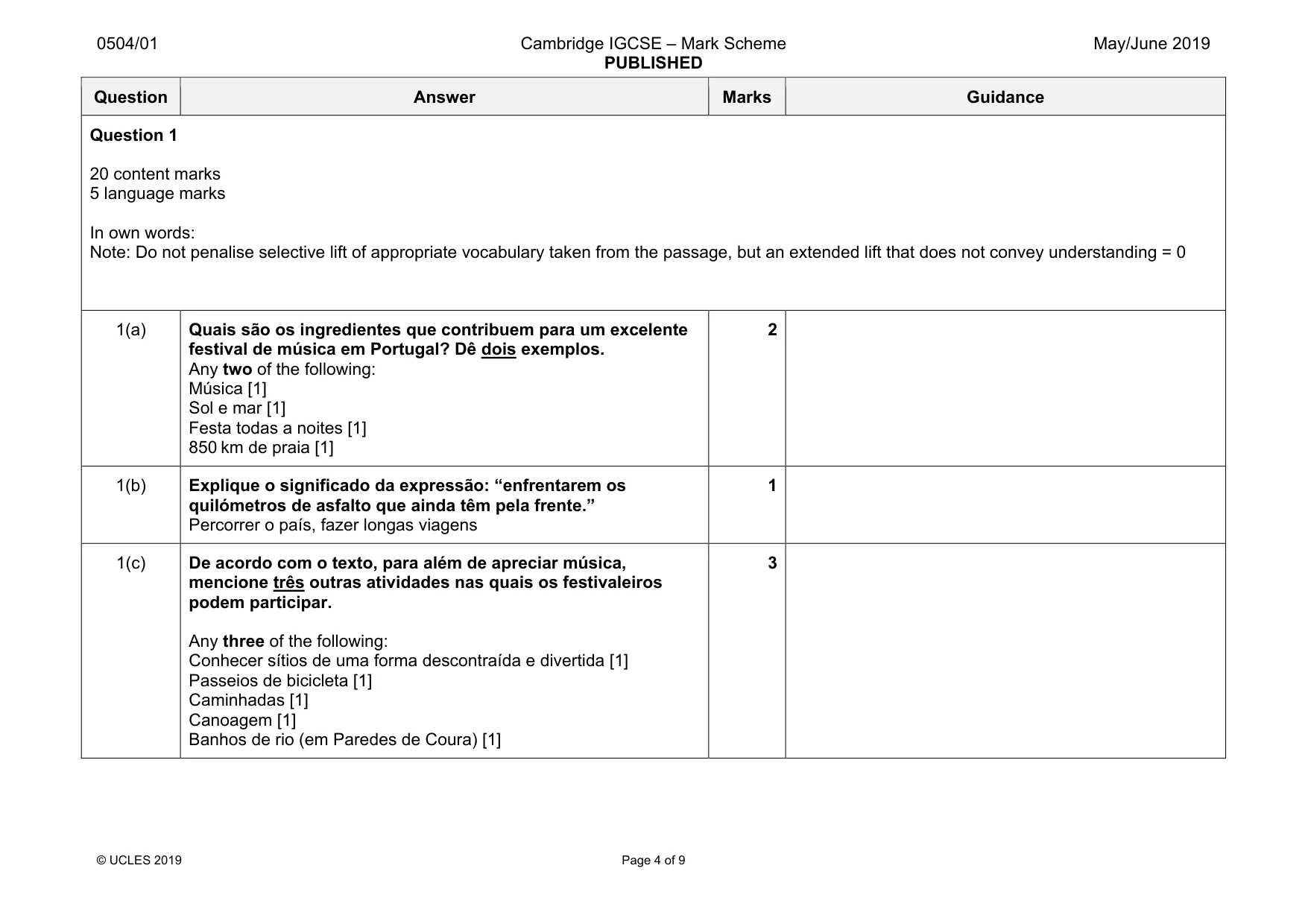
0504/01 Cambridge IGCSE – Mark Scheme PUBLISHED May/June 2019 © UCLES 2019 Page 4 of 9 Question Answer Marks Guidance Question 1 20 content marks 5 language marks In own words: Note: Do not penalise selective lift of appropriate vocabulary taken from the passage, but an extended lift that does not convey understanding = 0 1(a) Quais são os ingredientes que contribuem para um excelente festival de música em Portugal? Dê dois exemplos. Any two of the following: Música [1] Sol e mar [1] Festa todas a noites [1] 850 km de praia [1] 2 1(b) Explique o significado da expressão: “enfrentarem os quilómetros de asfalto que ainda têm pela frente.” Percorrer o país, fazer longas viagens 1 1(c) De acordo com o texto, para além de apreciar música, mencione três outras atividades nas quais os festivaleiros podem participar. Any three of the following: Conhecer sítios de uma forma descontraída e divertida [1] Passeios de bicicleta [1] Caminhadas [1] Canoagem [1] Banhos de rio (em Paredes de Coura) [1] 3
Mark scheme, page 5
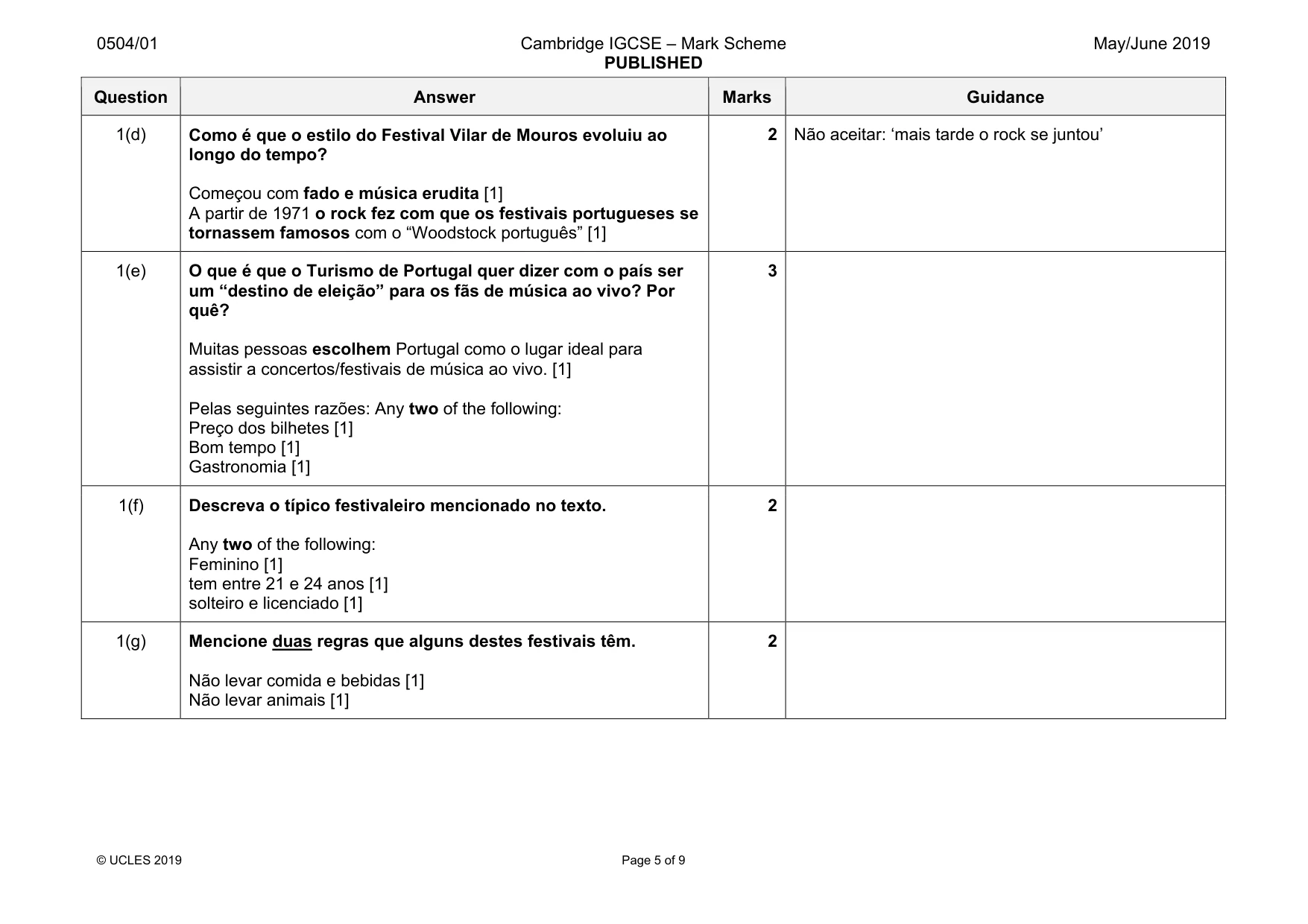
0504/01 Cambridge IGCSE – Mark Scheme PUBLISHED May/June 2019 © UCLES 2019 Page 5 of 9 Question Answer Marks Guidance 1(d) Como é que o estilo do Festival Vilar de Mouros evoluiu ao longo do tempo? Começou com fado e música erudita [1] A partir de 1971 o rock fez com que os festivais portugueses se tornassem famosos com o “Woodstock português” [1] 2 Não aceitar: ‘mais tarde o rock se juntou’ 1(e) O que é que o Turismo de Portugal quer dizer com o país ser um “destino de eleição” para os fãs de música ao vivo? Por quê? Muitas pessoas escolhem Portugal como o lugar ideal para assistir a concertos/festivais de música ao vivo. [1] Pelas seguintes razões: Any two of the following: Preço dos bilhetes [1] Bom tempo [1] Gastronomia [1] 3 1(f) Descreva o típico festivaleiro mencionado no texto. Any two of the following: Feminino [1] tem entre 21 e 24 anos [1] solteiro e licenciado [1] 2 1(g) Mencione duas regras que alguns destes festivais têm. Não levar comida e bebidas [1] Não levar animais [1] 2
Mark scheme, page 6
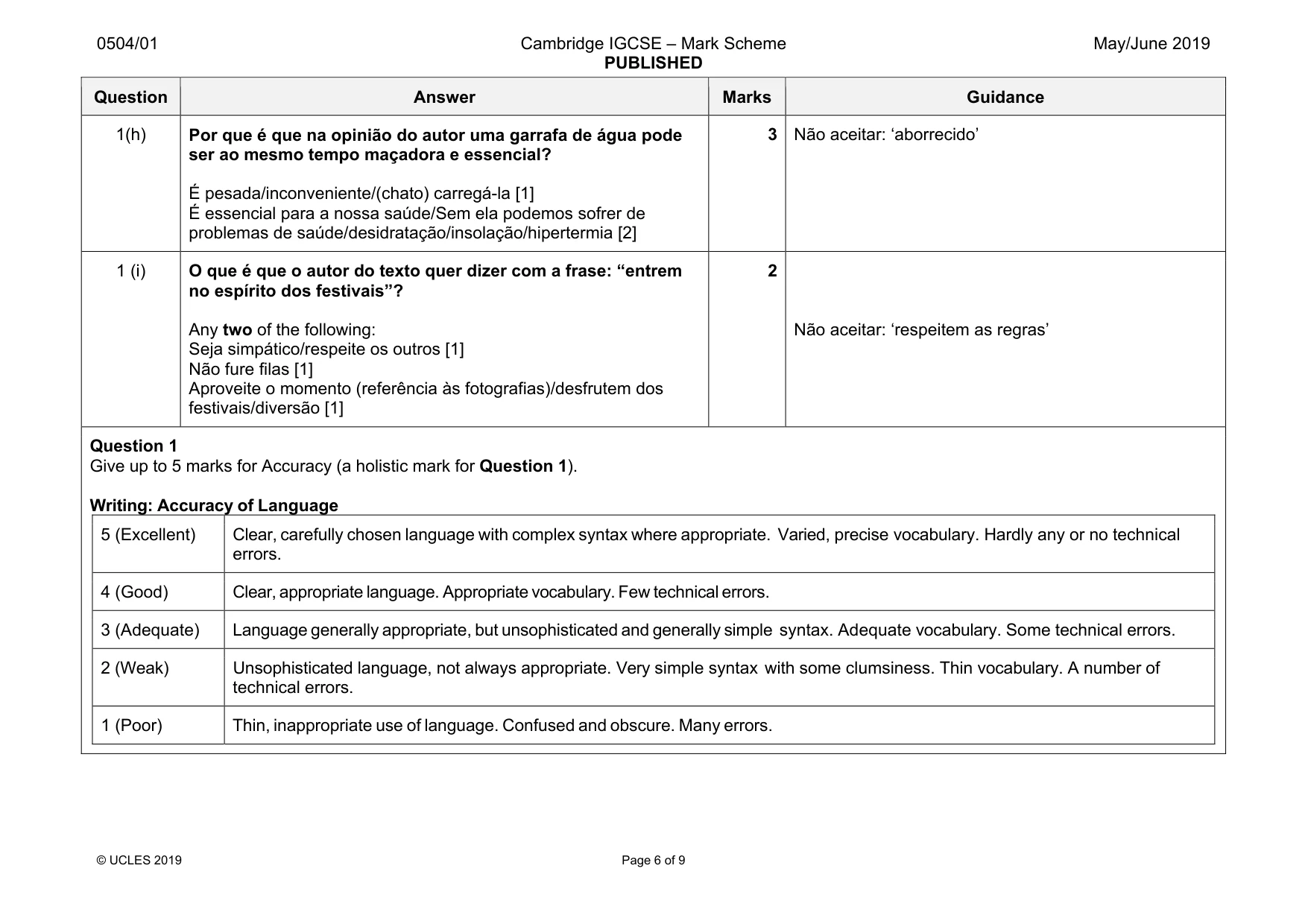
0504/01 Cambridge IGCSE – Mark Scheme PUBLISHED May/June 2019 © UCLES 2019 Page 6 of 9 Question Answer Marks Guidance 1(h) Por que é que na opinião do autor uma garrafa de água pode ser ao mesmo tempo maçadora e essencial? É pesada/inconveniente/(chato) carregá-la [1] É essencial para a nossa saúde/Sem ela podemos sofrer de problemas de saúde/desidratação/insolação/hipertermia [2] 3 Não aceitar: ‘aborrecido’ 1 (i) O que é que o autor do texto quer dizer com a frase: “entrem no espírito dos festivais”? Any two of the following: Seja simpático/respeite os outros [1] Não fure filas [1] Aproveite o momento (referência às fotografias)/desfrutem dos festivais/diversão [1] 2 Não aceitar: ‘respeitem as regras’ Question 1 Give up to 5 marks for Accuracy (a holistic mark for Question 1). Writing: Accuracy of Language 5 (Excellent) Clear, carefully chosen language with complex syntax where appropriate. Varied, precise vocabulary. Hardly any or no technical errors. 4 (Good) Clear, appropriate language. Appropriate vocabulary. Few technical errors. 3 (Adequate) Language generally appropriate, but unsophisticated and generally simple syntax. Adequate vocabulary. Some technical errors. 2 (Weak) Unsophisticated language, not always appropriate. Very simple syntax with some clumsiness. Thin vocabulary. A number of technical errors. 1 (Poor) Thin, inappropriate use of language. Confused and obscure. Many errors.
Mark scheme, page 7
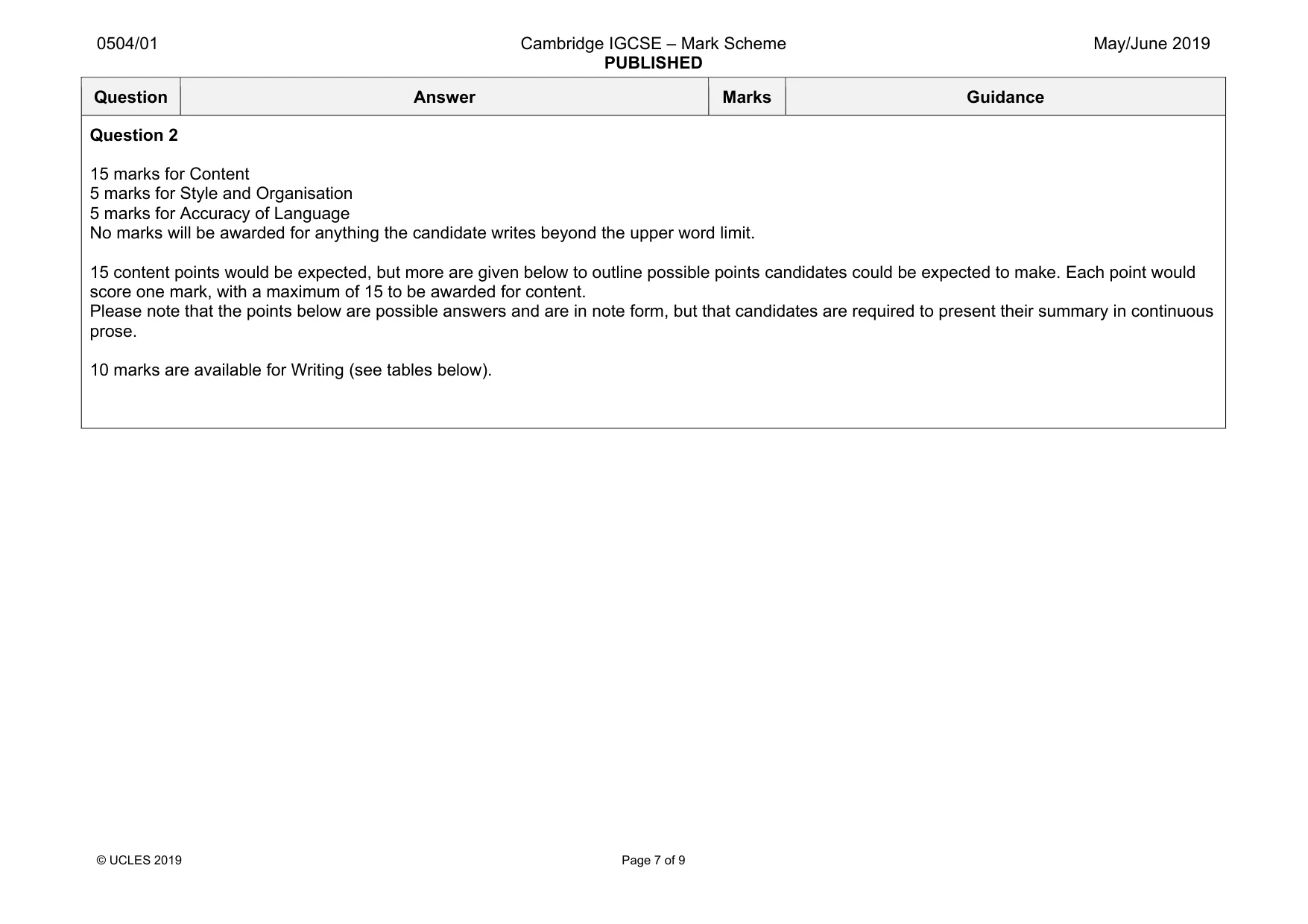
0504/01 Cambridge IGCSE – Mark Scheme PUBLISHED May/June 2019 © UCLES 2019 Page 7 of 9 Question Answer Marks Guidance Question 2 15 marks for Content 5 marks for Style and Organisation 5 marks for Accuracy of Language No marks will be awarded for anything the candidate writes beyond the upper word limit. 15 content points would be expected, but more are given below to outline possible points candidates could be expected to make. Each point would score one mark, with a maximum of 15 to be awarded for content. Please note that the points below are possible answers and are in note form, but that candidates are required to present their summary in continuous prose. 10 marks are available for Writing (see tables below).
Mark scheme, page 8
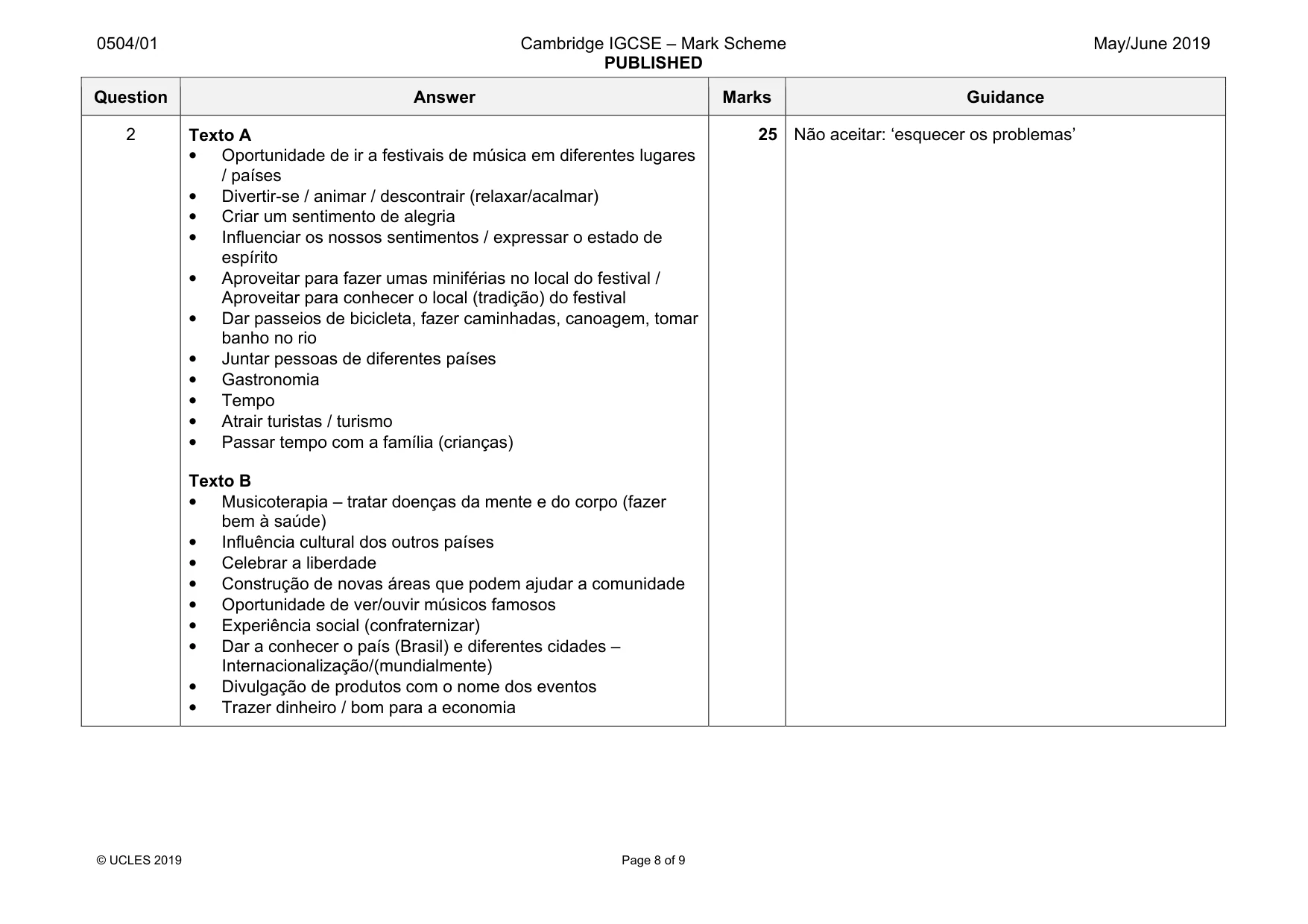
0504/01 Cambridge IGCSE – Mark Scheme PUBLISHED May/June 2019 © UCLES 2019 Page 8 of 9 Question Answer Marks Guidance 2 Texto A • Oportunidade de ir a festivais de música em diferentes lugares / países • Divertir-se / animar / descontrair (relaxar/acalmar) • Criar um sentimento de alegria • Influenciar os nossos sentimentos / expressar o estado de espírito • Aproveitar para fazer umas miniférias no local do festival / Aproveitar para conhecer o local (tradição) do festival • Dar passeios de bicicleta, fazer caminhadas, canoagem, tomar banho no rio • Juntar pessoas de diferentes países • Gastronomia • Tempo • Atrair turistas / turismo • Passar tempo com a família (crianças) Texto B • Musicoterapia – tratar doenças da mente e do corpo (fazer bem à saúde) • Influência cultural dos outros países • Celebrar a liberdade • Construção de novas áreas que podem ajudar a comunidade • Oportunidade de ver/ouvir músicos famosos • Experiência social (confraternizar) • Dar a conhecer o país (Brasil) e diferentes cidades – Internacionalização/(mundialmente) • Divulgação de produtos com o nome dos eventos • Trazer dinheiro / bom para a economia 25 Não aceitar: ‘esquecer os problemas’
Mark scheme, page 9
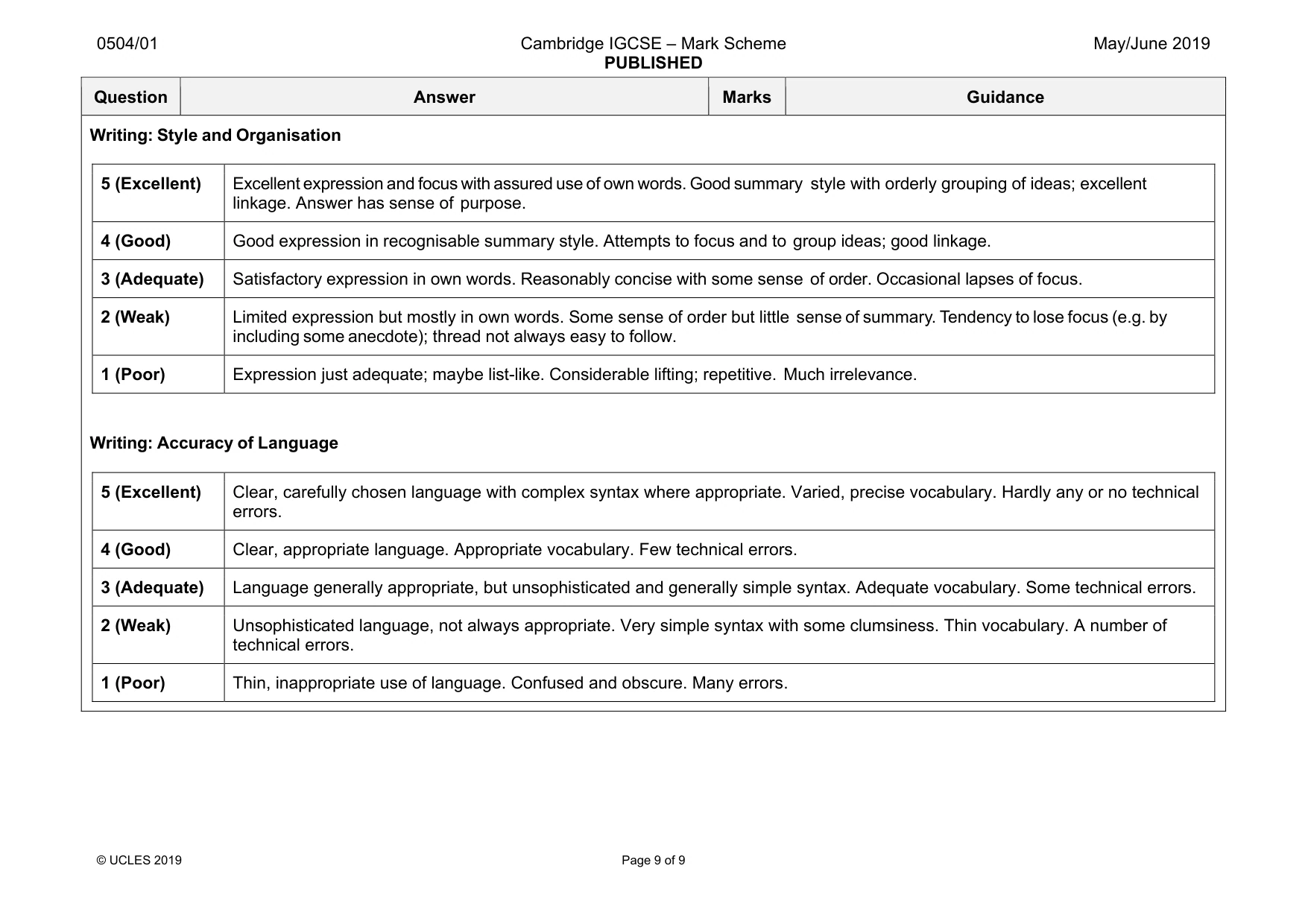
0504/01 Cambridge IGCSE – Mark Scheme PUBLISHED May/June 2019 © UCLES 2019 Page 9 of 9 Question Answer Marks Guidance Writing: Style and Organisation 5 (Excellent) Excellent expression and focus with assured use of own words. Good summary style with orderly grouping of ideas; excellent linkage. Answer has sense of purpose. 4 (Good) Good expression in recognisable summary style. Attempts to focus and to group ideas; good linkage. 3 (Adequate) Satisfactory expression in own words. Reasonably concise with some sense of order. Occasional lapses of focus. 2 (Weak) Limited expression but mostly in own words. Some sense of order but little sense of summary. Tendency to lose focus (e.g. by including some anecdote); thread not always easy to follow. 1 (Poor) Expression just adequate; maybe list-like. Considerable lifting; repetitive. Much irrelevance. Writing: Accuracy of Language 5 (Excellent) Clear, carefully chosen language with complex syntax where appropriate. Varied, precise vocabulary. Hardly any or no technical errors. 4 (Good) Clear, appropriate language. Appropriate vocabulary. Few technical errors. 3 (Adequate) Language generally appropriate, but unsophisticated and generally simple syntax. Adequate vocabulary. Some technical errors. 2 (Weak) Unsophisticated language, not always appropriate. Very simple syntax with some clumsiness. Thin vocabulary. A number of technical errors. 1 (Poor) Thin, inappropriate use of language. Confused and obscure. Many errors.
What you needed in this session
Cambridge’s own grade thresholds for 2019 May/June, Paper 1 · Variant 1. A higher threshold means an easier paper — the bar moves with how the cohort did.