Questions as text
Q1 · The electromotive force (e.m.f.) of a rechargeable battery is 6.0 V 0972/21 May/June 2018
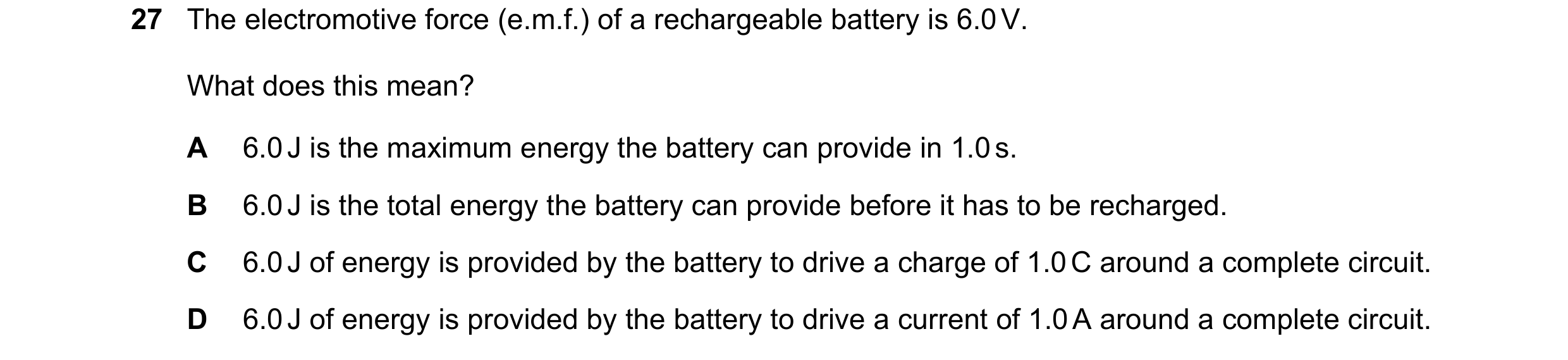
27 The electromotive force (e.m.f.) of a rechargeable battery is 6.0 V. What does this mean? A 6.0 J is the maximum energy the battery can provide in 1.0 s. B 6.0 J is the total energy the battery can provide before it has to be recharged. C 6.0 J of energy is provided by the battery to drive a charge of 1.0 C around a complete circuit. D 6.0 J of energy is provided by the battery to drive a current of 1.0 A around a complete circuit.
1 marks
Answer: C
This question in 0972/21 May/June 2018
Q2 · A student measures the potential difference across a device and the current in the device 0972/21 May/June 2018
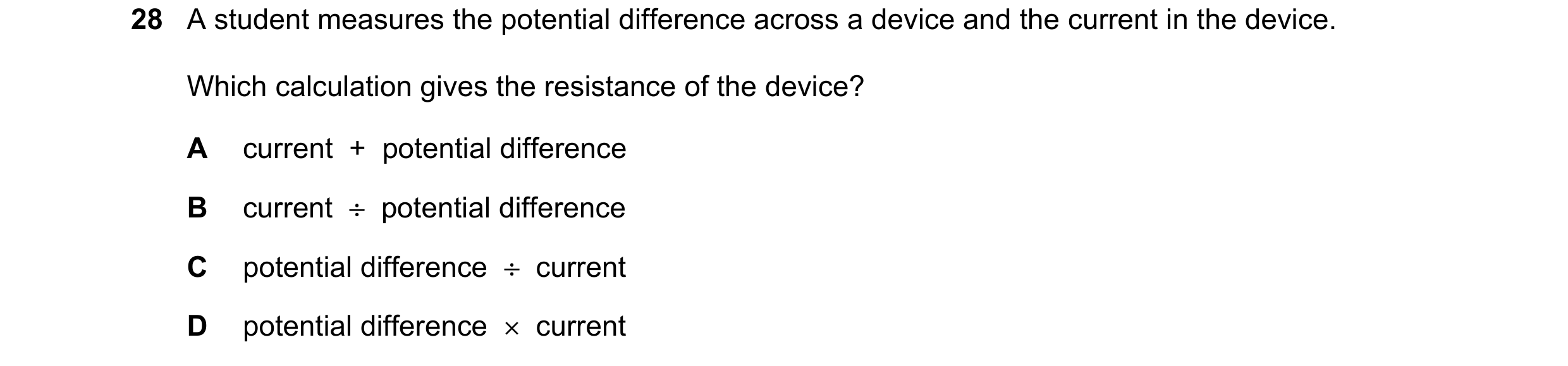
28 A student measures the potential difference across a device and the current in the device. Which calculation gives the resistance of the device? A current + potential difference B current ÷ potential difference C potential difference ÷ current D potential difference × current
1 marks
Answer: C
This question in 0972/21 May/June 2018
Q3 · A water heater is connected to a 230 V supply and there is a current of 26 A in the heater 0972/21 May/June 2018
29 A water heater is connected to a 230 V supply and there is a current of 26 A in the heater. It takes 20 minutes to heat the water to the required temperature. How much energy is supplied by the heater? A 6.0 × 10³ J B 1.0 × 10⁴ J C 1.2 × 10⁵ J D 7.2 × 10⁶ J
1 marks
Answer: D
This question in 0972/21 May/June 2018
Q4 · The diagram shows emissions from a source passing into the electric field between two… 0972/21 May/June 2018
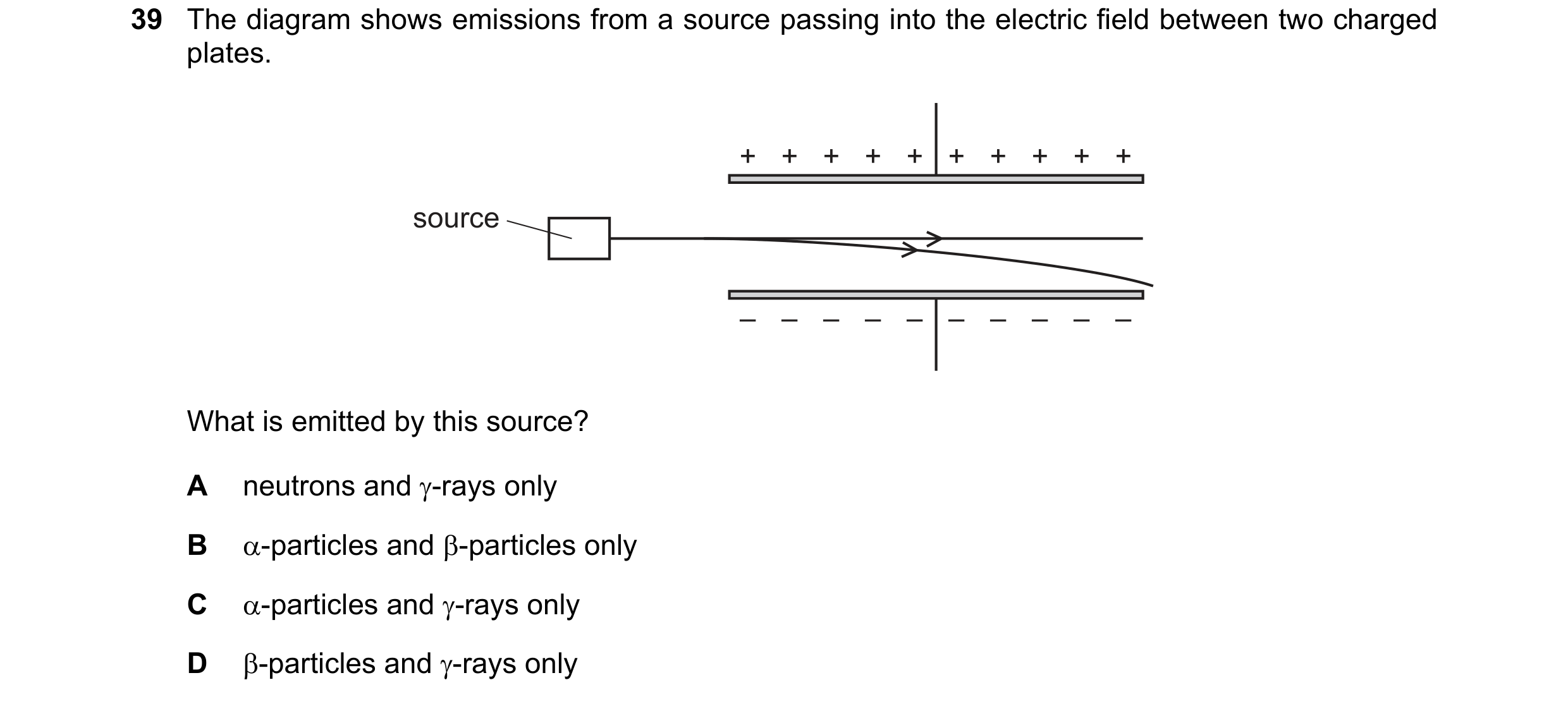
39 The diagram shows emissions from a source passing into the electric field between two charged plates. + + + + + + + + + + source – – – – – – – – – – What is emitted by this source? A neutrons and γ-rays only B α-particles and β-particles only C α-particles and γ-rays only D β-particles and γ-rays only
1 marks
Answer: C
This question in 0972/21 May/June 2018
Q5 · The diagrams represent two different electric fields 0972/21 Oct/Nov 2018
28 The diagrams represent two different electric fields. field 1 field 2 A single electron is located in each of the fields. Which row gives the correct direction of the force on the electron and the field in which there is a larger force on it? direction of larger force the force A ↓ field 1 B ↓ field 2 C ↑ field 1 D ↑ field 2
1 marks
Answer: A
This question in 0972/21 Oct/Nov 2018
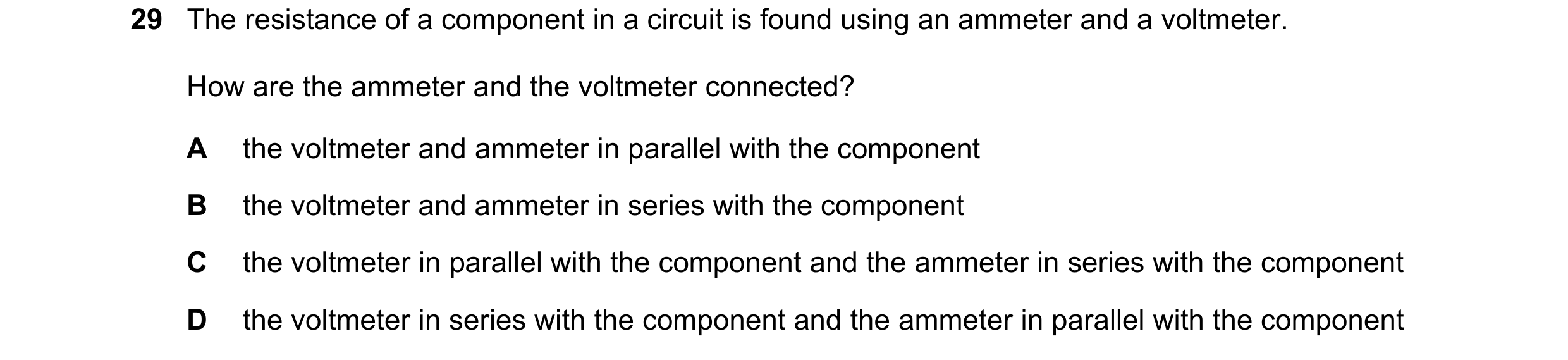
Q6 · The resistance of a component in a circuit is found using an ammeter and a voltmeter 0972/21 Oct/Nov 2018
29 The resistance of a component in a circuit is found using an ammeter and a voltmeter. How are the ammeter and the voltmeter connected? A the voltmeter and ammeter in parallel with the component B the voltmeter and ammeter in series with the component C the voltmeter in parallel with the component and the ammeter in series with the component D the voltmeter in series with the component and the ammeter in parallel with the component
1 marks
Answer: C
This question in 0972/21 Oct/Nov 2018
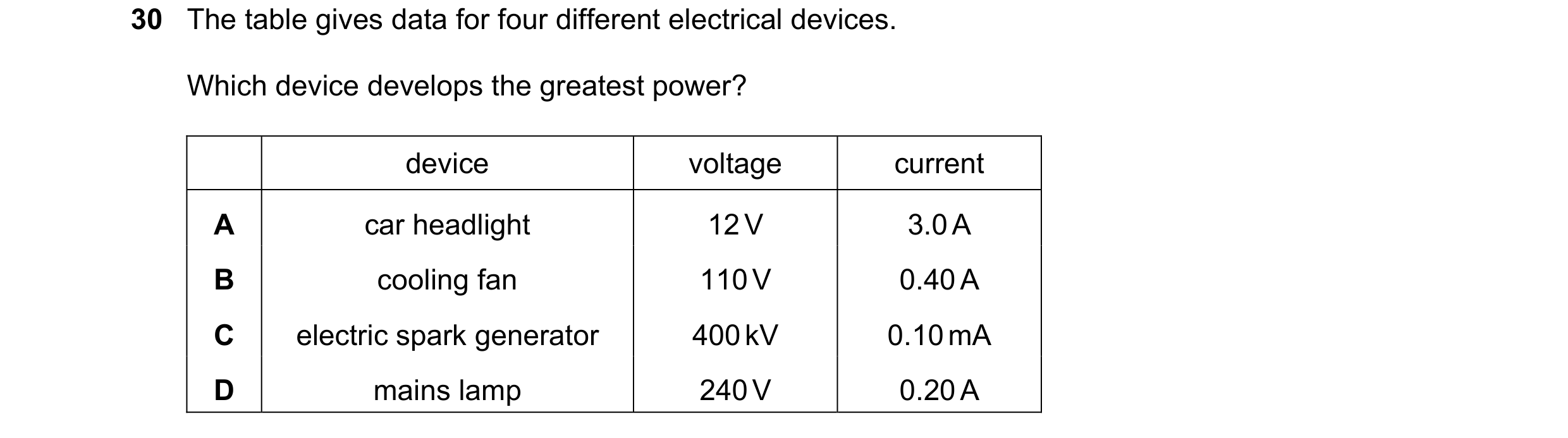
Q7 · The table gives data for four different electrical devices 0972/21 Oct/Nov 2018
30 The table gives data for four different electrical devices. Which device develops the greatest power? device voltage current A car headlight 12 V 3.0 A B cooling fan 110 V 0.40 A C electric spark generator 400 kV 0.10 mA D mains lamp 240 V 0.20 A
1 marks
Answer: D
This question in 0972/21 Oct/Nov 2018
Q8 · The circuit diagram shows a fixed resistor R and a thermistor T used in a potential… 0972/21 Oct/Nov 2018
31 The circuit diagram shows a fixed resistor R and a thermistor T used in a potential divider circuit. T R VR and VT are the potential differences across R and T respectively. What happens to VR and to VT as the temperature of the thermistor decreases? VR VT A decreases increases B increases decreases C stays the same decreases D stays the same increases
1 marks
Answer: A
This question in 0972/21 Oct/Nov 2018
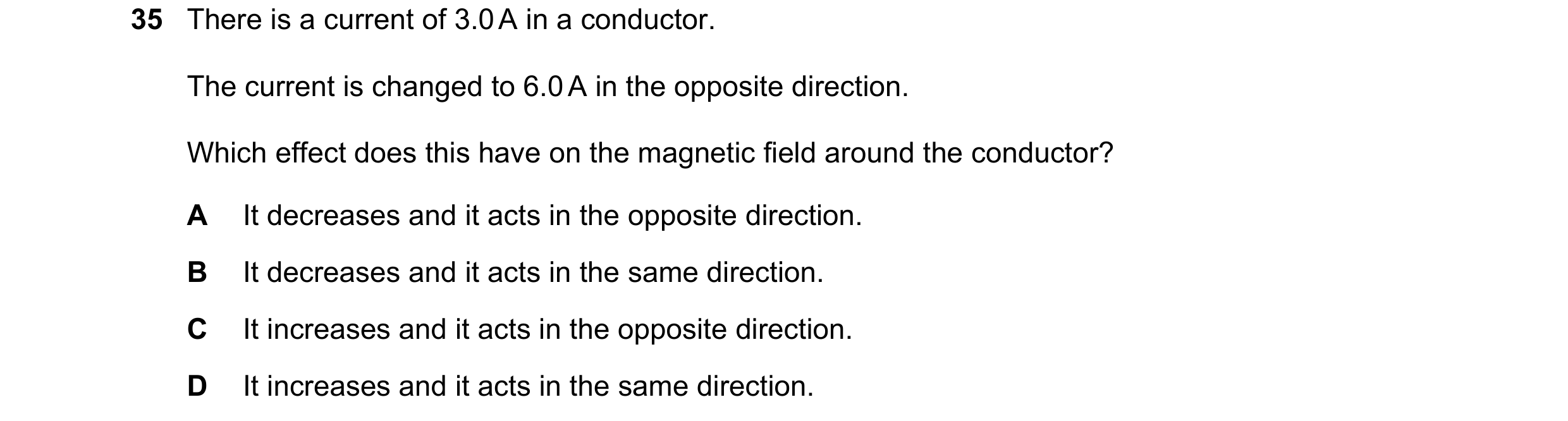
Q9 · There is a current of 3.0 A in a conductor 0972/21 Oct/Nov 2018
35 There is a current of 3.0 A in a conductor. The current is changed to 6.0 A in the opposite direction. Which effect does this have on the magnetic field around the conductor? A It decreases and it acts in the opposite direction. B It decreases and it acts in the same direction. C It increases and it acts in the opposite direction. D It increases and it acts in the same direction.
1 marks
Answer: C
This question in 0972/21 Oct/Nov 2018
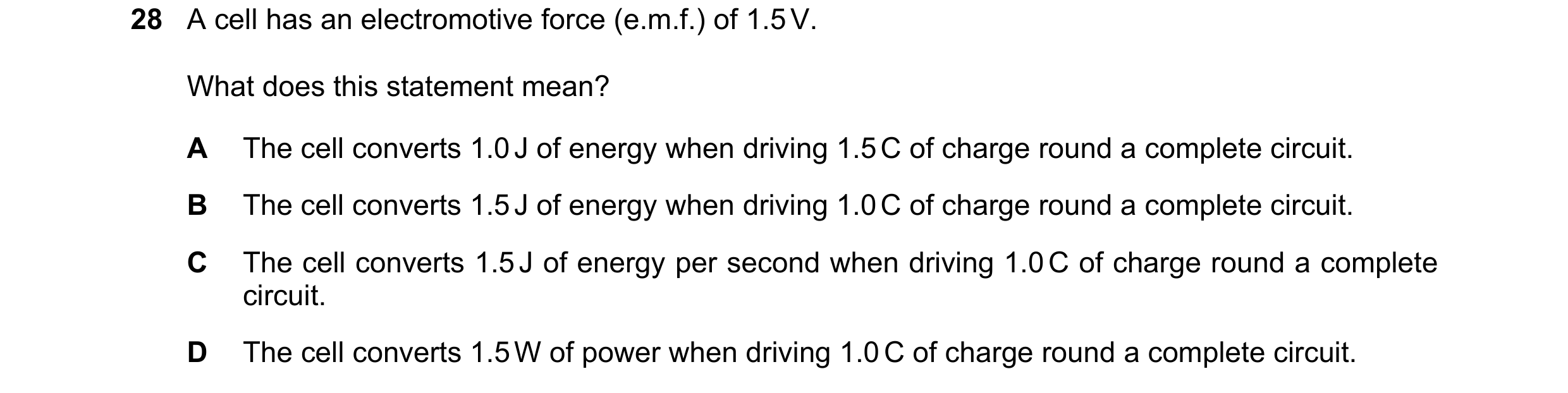
Q10 · A cell has an electromotive force (e.m.f.) of 1.5 V 0972/21 May/June 2019
28 A cell has an electromotive force (e.m.f.) of 1.5 V. What does this statement mean? A The cell converts 1.0 J of energy when driving 1.5 C of charge round a complete circuit. B The cell converts 1.5 J of energy when driving 1.0 C of charge round a complete circuit. C The cell converts 1.5 J of energy per second when driving 1.0 C of charge round a complete circuit. D The cell converts 1.5 W of power when driving 1.0 C of charge round a complete circuit.
1 marks
Answer: B
This question in 0972/21 May/June 2019
Q11 · Which two changes to a metal wire both increase resistance? 0972/21 May/June 2019
29 Which two changes to a metal wire both increase resistance? A decreasing its length and increasing its temperature B increasing its length and decreasing its temperature C decreasing its thickness and increasing its temperature D increasing its thickness and decreasing its temperature
1 marks
Answer: C
This question in 0972/21 May/June 2019
Q12 · A cell has an electromotive force (e.m.f.) of 1.5 V 0972/22 May/June 2019
28 A cell has an electromotive force (e.m.f.) of 1.5 V. What does this statement mean? A The cell converts 1.0 J of energy when driving 1.5 C of charge round a complete circuit. B The cell converts 1.5 J of energy when driving 1.0 C of charge round a complete circuit. C The cell converts 1.5 J of energy per second when driving 1.0 C of charge round a complete circuit. D The cell converts 1.5 W of power when driving 1.0 C of charge round a complete circuit.
1 marks
Answer: B
This question in 0972/22 May/June 2019
Q13 · A metal wire of length 100 cm and cross-sectional area 0.20 mm2 has a resistance of 8.0 Ω 0972/22 May/June 2019
29 A metal wire of length 100 cm and cross-sectional area 0.20 mm2 has a resistance of 8.0 Ω. What is the resistance of a wire of the same metal of length 50 cm and cross-sectional area of 0.40 mm2? A 2.0 Ω B 8.0 Ω C 16 Ω D 32 Ω
1 marks
Answer: A
This question in 0972/22 May/June 2019
Q14 · A circuit contains a cell of electromotive force (e.m.f.) of 2.0 V 0972/21 Oct/Nov 2019
28 A circuit contains a cell of electromotive force (e.m.f.) of 2.0 V. The current in the circuit is 2.0 A. How much energy is converted by the cell in 2.0 minutes? A 2.0 J B 4.0 J C 8.0 J D 480 J
1 marks
Answer: D
This question in 0972/21 Oct/Nov 2019
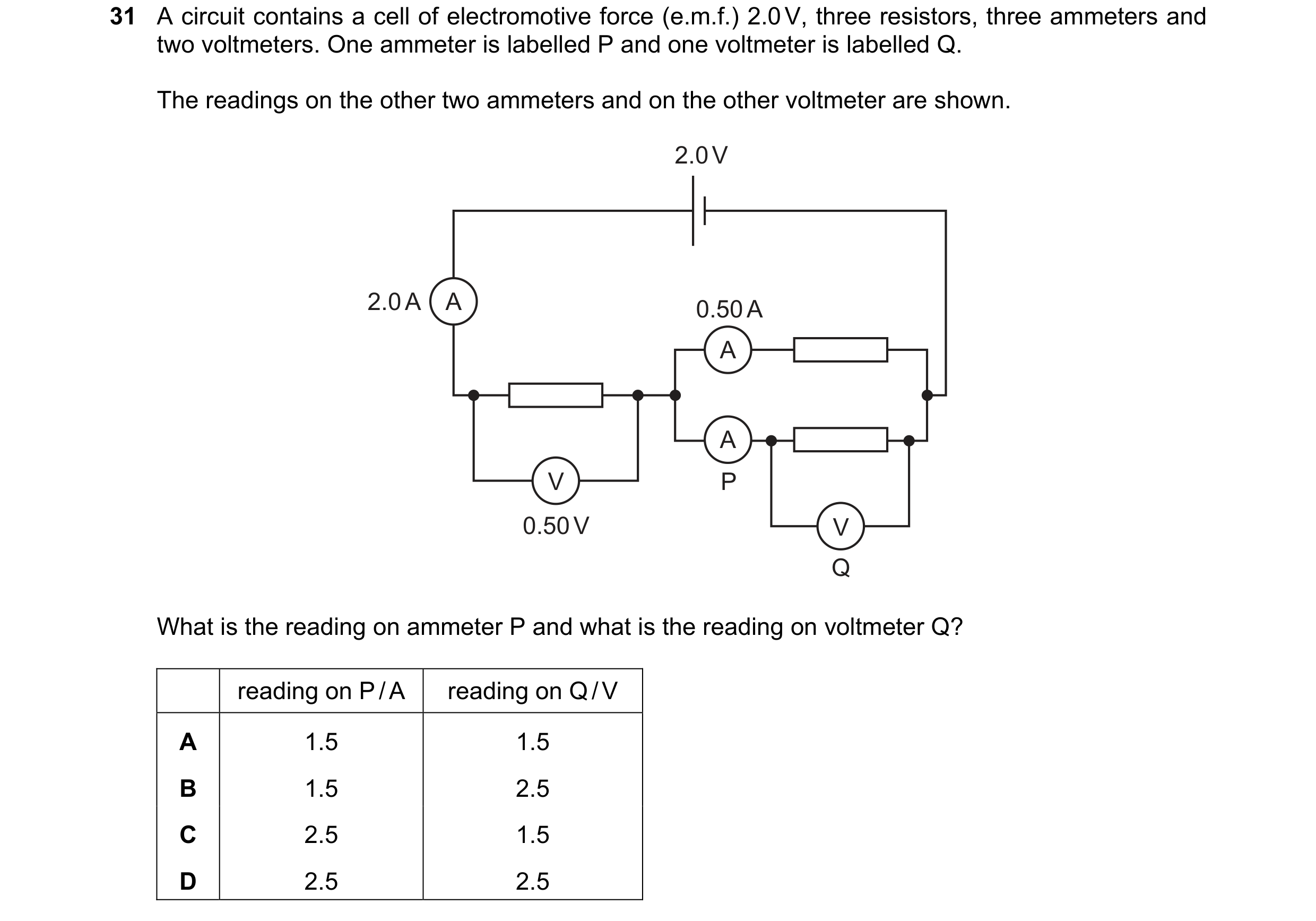
Q15 · A circuit contains a cell of electromotive force (e.m.f.) 2.0 V, three resistors, three… 0972/21 Oct/Nov 2019
31 A circuit contains a cell of electromotive force (e.m.f.) 2.0 V, three resistors, three ammeters and two voltmeters. One ammeter is labelled P and one voltmeter is labelled Q. The readings on the other two ammeters and on the other voltmeter are shown. 2.0 V 2.0 A A 0.50 A A A V P 0.50 V V Q What is the reading on ammeter P and what is the reading on voltmeter Q? reading on P / A reading on Q / V A 1.5 1.5 B 1.5 2.5 C 2.5 1.5 D 2.5 2.5
1 marks
Answer: A
This question in 0972/21 Oct/Nov 2019
Q16 · A student uses the circuit shown to determine the resistance of two identical resistors 0972/21 May/June 2020
28 A student uses the circuit shown to determine the resistance of two identical resistors. A V The voltmeter reading is 2.2 V and the ammeter reading is 0.25 A. What is the resistance of each resistor? A 0.275 Ω B 0.55 Ω C 4.4 Ω D 8.8 Ω
1 marks
Answer: C
This question in 0972/21 May/June 2020
Q17 · An electric fire is connected to a 240 V supply and transfers energy at a rate of 1.0 kW 0972/21 May/June 2020
29 An electric fire is connected to a 240 V supply and transfers energy at a rate of 1.0 kW. How much charge passes through the fire in 1.0 h? A 42 C B 250 C C 1.5 × 10⁴ C D 2.4 × 10⁵ C
1 marks
Answer: C
This question in 0972/21 May/June 2020
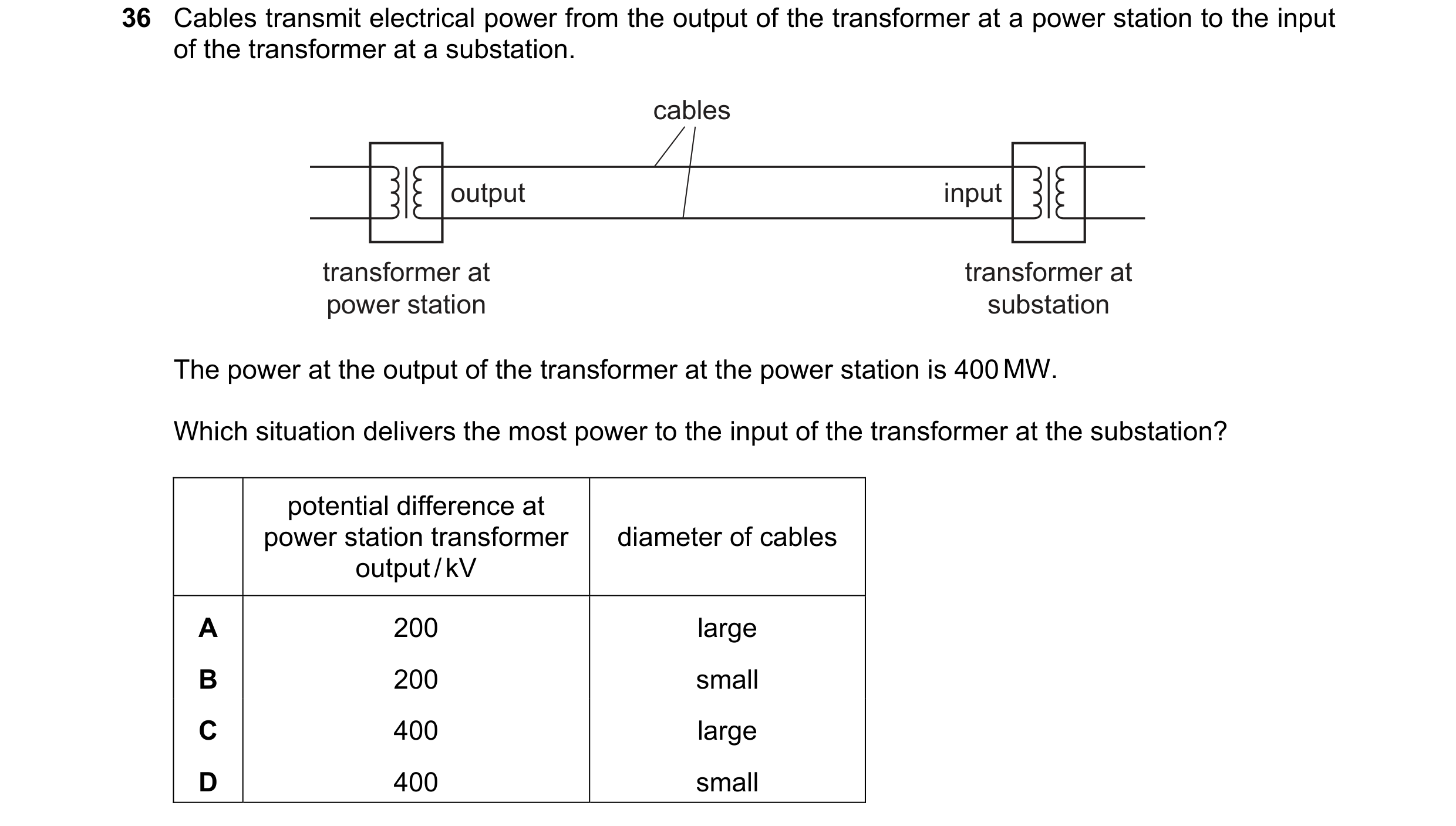
Q18 · Cables transmit electrical power from the output of the transformer at a power station to… 0972/21 May/June 2020
36 Cables transmit electrical power from the output of the transformer at a power station to the input of the transformer at a substation. cables output input transformer at transformer at power station substation The power at the output of the transformer at the power station is 400 MW. Which situation delivers the most power to the input of the transformer at the substation? potential difference at power station transformer diameter of cables output / kV A 200 large B 200 small C 400 large D 400 small
1 marks
Answer: C
This question in 0972/21 May/June 2020
Q19 · A cloth is used to rub an uncharged plastic rod 0972/22 May/June 2020
28 A cloth is used to rub an uncharged plastic rod. Both the rod and the cloth become charged. Why does the plastic rod become negatively charged and the cloth become positively charged? A The rod gains electrons and the cloth gains positive charges. B The rod gains electrons and the cloth loses electrons. C The rod loses electrons and the cloth gains electrons. D The rod loses electrons and the cloth loses positive charges.
1 marks
Answer: B
This question in 0972/22 May/June 2020
Q20 · A student uses the circuit shown to determine the resistance of two identical resistors 0972/22 May/June 2020
29 A student uses the circuit shown to determine the resistance of two identical resistors. A V The voltmeter reading is 2.2 V and the ammeter reading is 0.25 A. What is the resistance of each resistor? A 0.275 Ω B 0.55 Ω C 4.4 Ω D 8.8 Ω
1 marks
Answer: C
This question in 0972/22 May/June 2020
Q21 · A cell passes a current of 2.0 A in a circuit for 30 s 0972/22 May/June 2020
30 A cell passes a current of 2.0 A in a circuit for 30 s. In this time the cell transfers 120 J of energy. What is the electromotive force (e.m.f.) of the cell? A 0.50 V B 1.5 V C 2.0 V D 8.0 V
1 marks
Answer: C
This question in 0972/22 May/June 2020
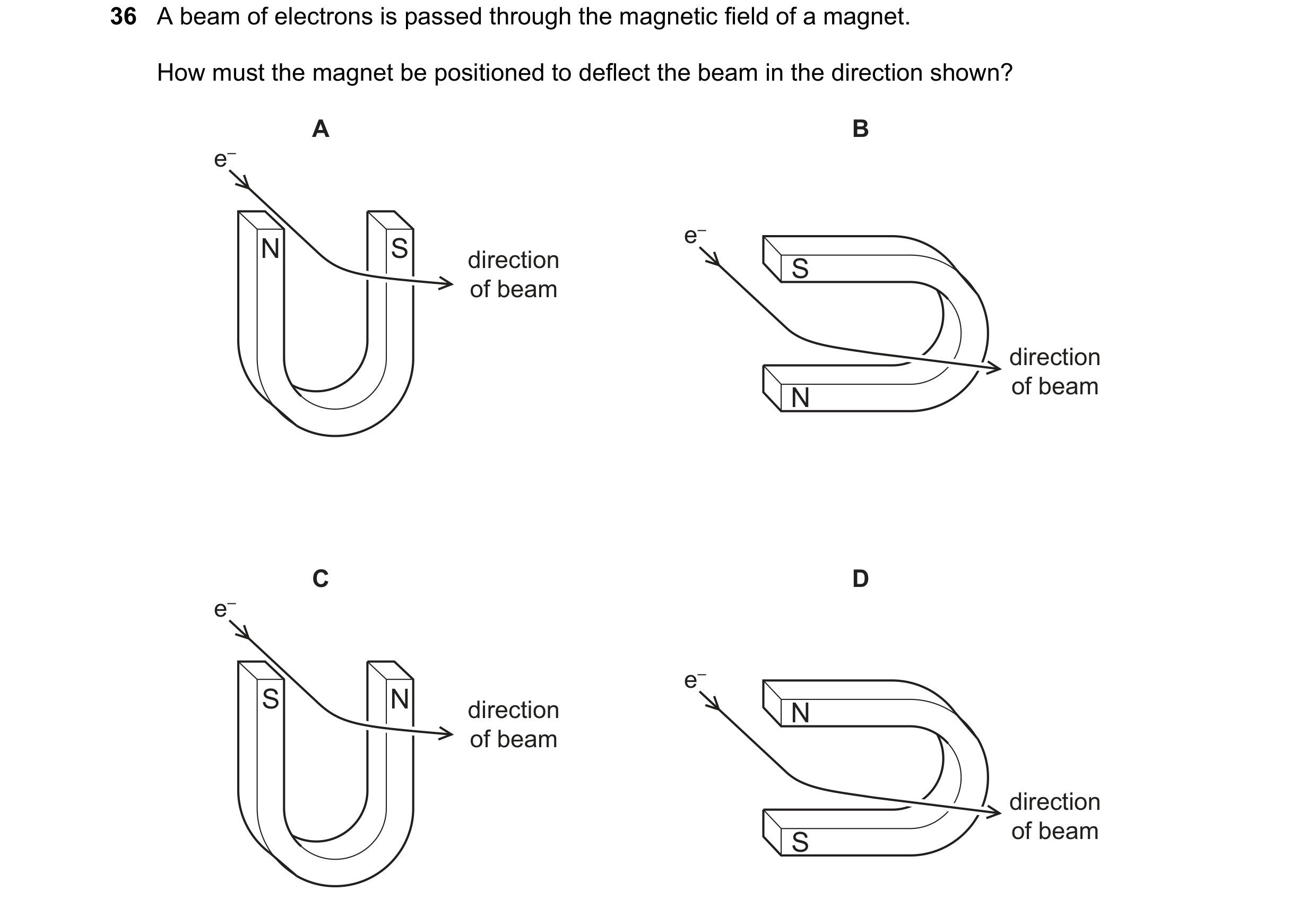
Q22 · A beam of electrons is passed through the magnetic field of a magnet 0972/22 May/June 2020
36 A beam of electrons is passed through the magnetic field of a magnet. How must the magnet be positioned to deflect the beam in the direction shown? A B e– e– N S direction S of beam direction N of beam C D e– e– S N direction N of beam direction S of beam
1 marks
Answer: B
This question in 0972/22 May/June 2020
Q23 · Α-particles, β-particles and γ-rays are emitted by radioactive nuclei when they decay 0972/22 May/June 2020
40 α-particles, β-particles and γ-rays are emitted by radioactive nuclei when they decay. Which emissions can be deflected by an electric field? A α-particles and β-particles only B β-particles and γ-rays only C γ-rays and α-particles only D α-particles, β-particles and γ-rays
1 marks
Answer: A
This question in 0972/22 May/June 2020
Q24 · A negatively charged plastic rod is brought near to an uncharged metal sphere and held… 0972/21 Oct/Nov 2020
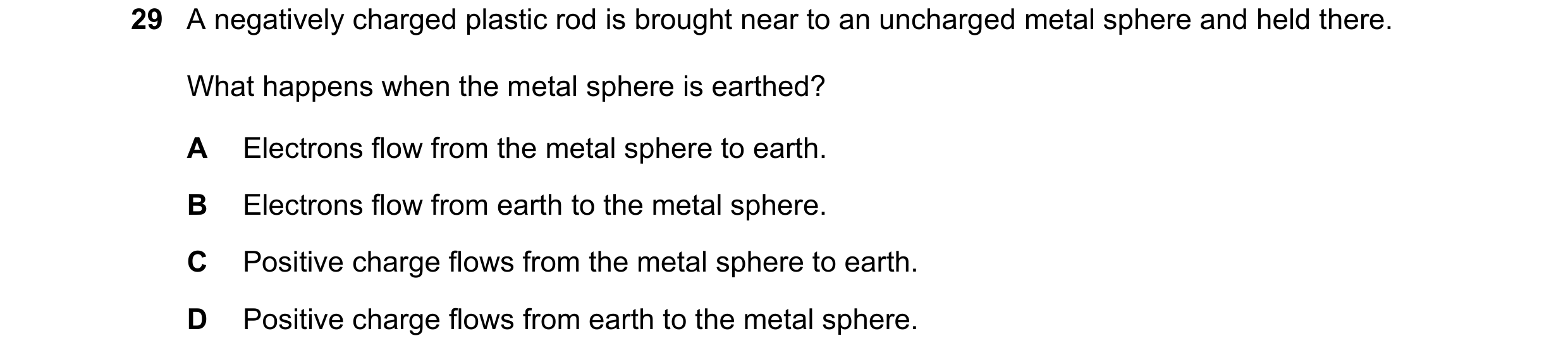
29 A negatively charged plastic rod is brought near to an uncharged metal sphere and held there. What happens when the metal sphere is earthed? A Electrons flow from the metal sphere to earth. B Electrons flow from earth to the metal sphere. C Positive charge flows from the metal sphere to earth. D Positive charge flows from earth to the metal sphere.
1 marks
Answer: A
This question in 0972/21 Oct/Nov 2020
Q25 · Which statement defines the electromotive force (e.m.f.) of a cell? 0972/21 Oct/Nov 2020
30 Which statement defines the electromotive force (e.m.f.) of a cell? A the current in the cell when 1.0 C of charge flows in 1.0 s B the current supplied by the cell to drive 1.0 C of charge around a complete circuit C the energy supplied by the cell to drive 1.0 C of charge around a complete circuit D the energy supplied by the cell to drive 1.0 A of current around a complete circuit
1 marks
Answer: C
This question in 0972/21 Oct/Nov 2020
Q26 · Two beams of radiation, P and Q, enter an electric field as shown 0972/21 Oct/Nov 2020
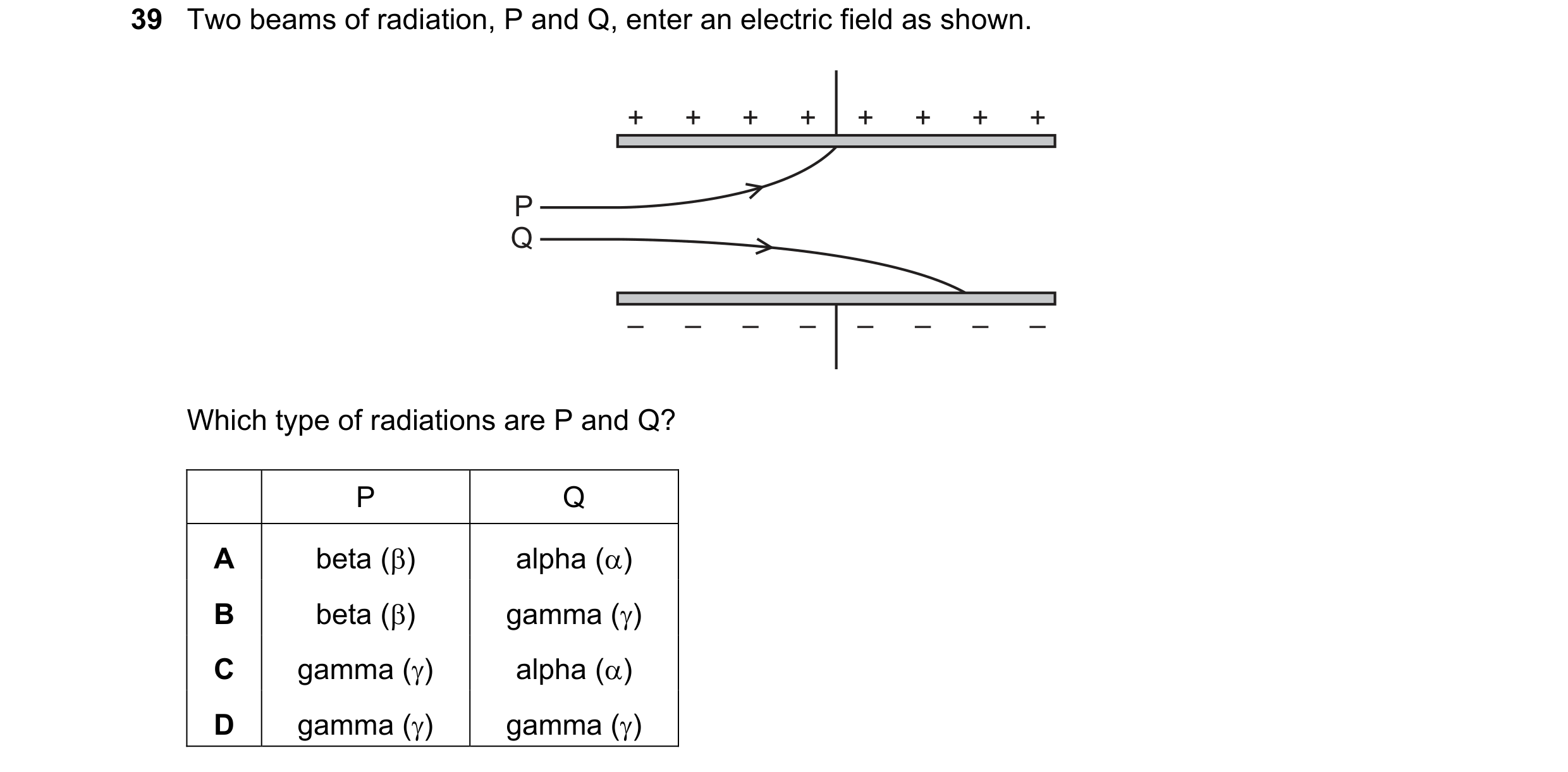
39 Two beams of radiation, P and Q, enter an electric field as shown. + + + + + + + + P Q – – – – – – – – Which type of radiations are P and Q? P Q A beta () alpha () B beta () gamma () C gamma () alpha () D gamma () gamma ()
1 marks
Answer: A
This question in 0972/21 Oct/Nov 2020
Q27 · In which circuit is the ammeter measuring the flow of charge through the lamp? 0972/21 Oct/Nov 2021
26 In which circuit is the ammeter measuring the flow of charge through the lamp? A B C D A A A A
1 marks
Answer: B
This question in 0972/21 Oct/Nov 2021
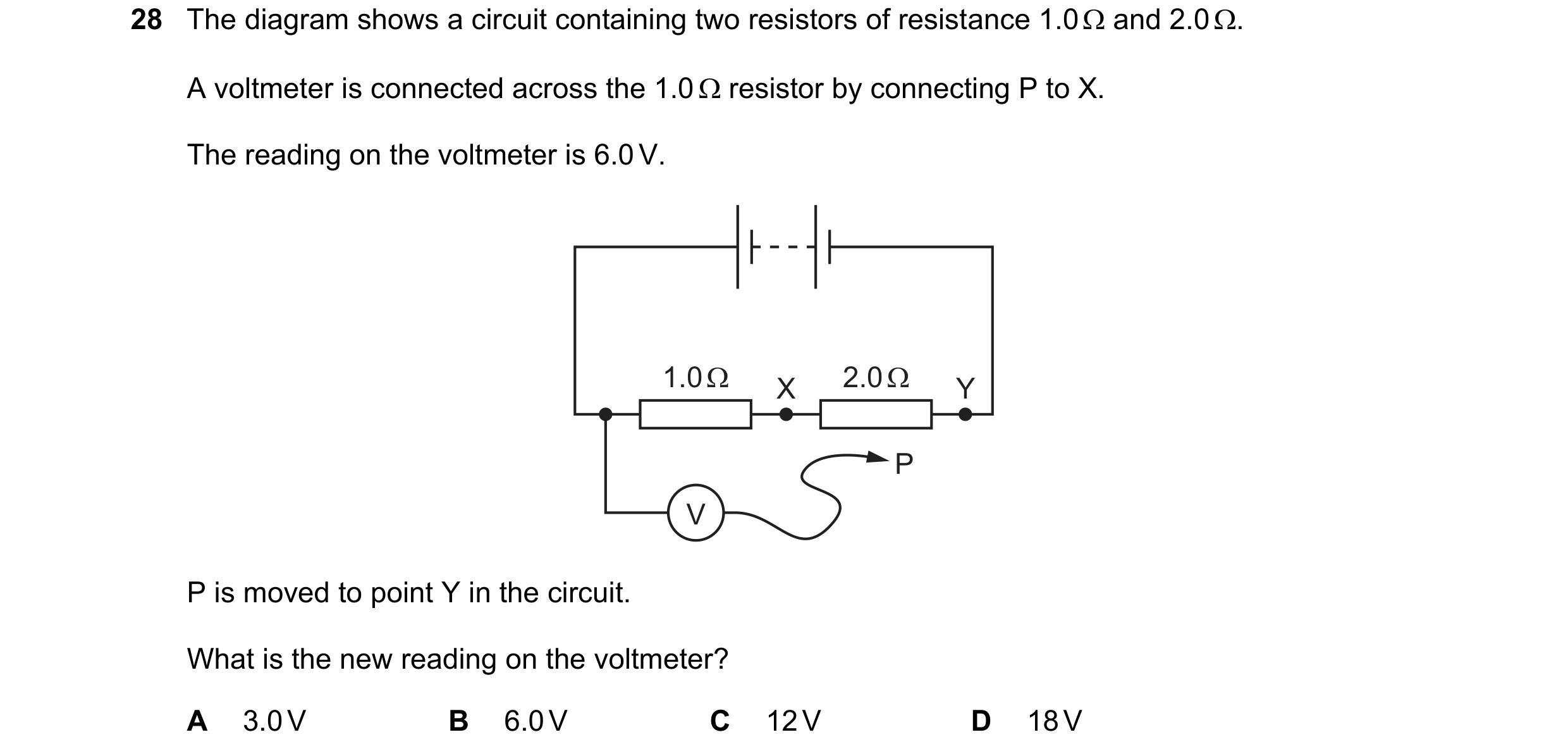
Q28 · The diagram shows a circuit containing two resistors of resistance 1.0 and 2.0 0972/21 Oct/Nov 2021
28 The diagram shows a circuit containing two resistors of resistance 1.0 and 2.0 . A voltmeter is connected across the 1.0 resistor by connecting P to X. The reading on the voltmeter is 6.0 V. 1.0 Ω X 2.0 Ω Y P V P is moved to point Y in the circuit. What is the new reading on the voltmeter? A 3.0 V B 6.0 V C 12 V D 18 V
1 marks
Answer: D
This question in 0972/21 Oct/Nov 2021
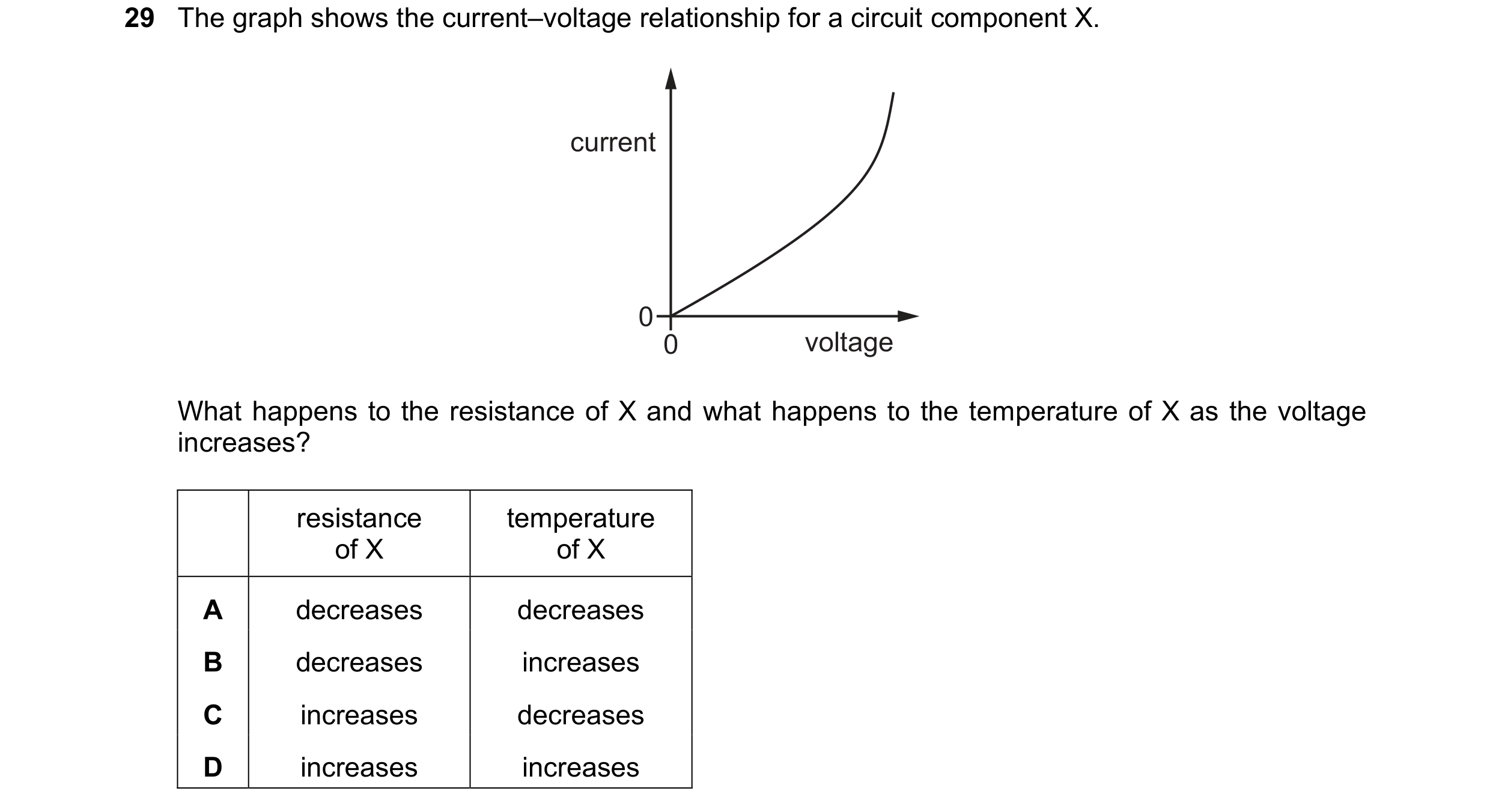
Q29 · The graph shows the current–voltage relationship for a circuit component X 0972/21 Oct/Nov 2021
29 The graph shows the current–voltage relationship for a circuit component X. current 0 0 voltage What happens to the resistance of X and what happens to the temperature of X as the voltage increases? resistance temperature of X of X A decreases decreases B decreases increases C increases decreases D increases increases
1 marks
Answer: B
This question in 0972/21 Oct/Nov 2021
Q30 · Two resistors, with resistances R1 and R2, are connected in parallel 0972/21 Oct/Nov 2021
32 Two resistors, with resistances R1 and R2, are connected in parallel. The resistance R1 is greater than the resistance R2. R1 R2 What is the resistance of the parallel combination? A less than either R1 or R2 B equal to R1 C equal to R2 D the average of R1 and R2
1 marks
Answer: A
This question in 0972/21 Oct/Nov 2021
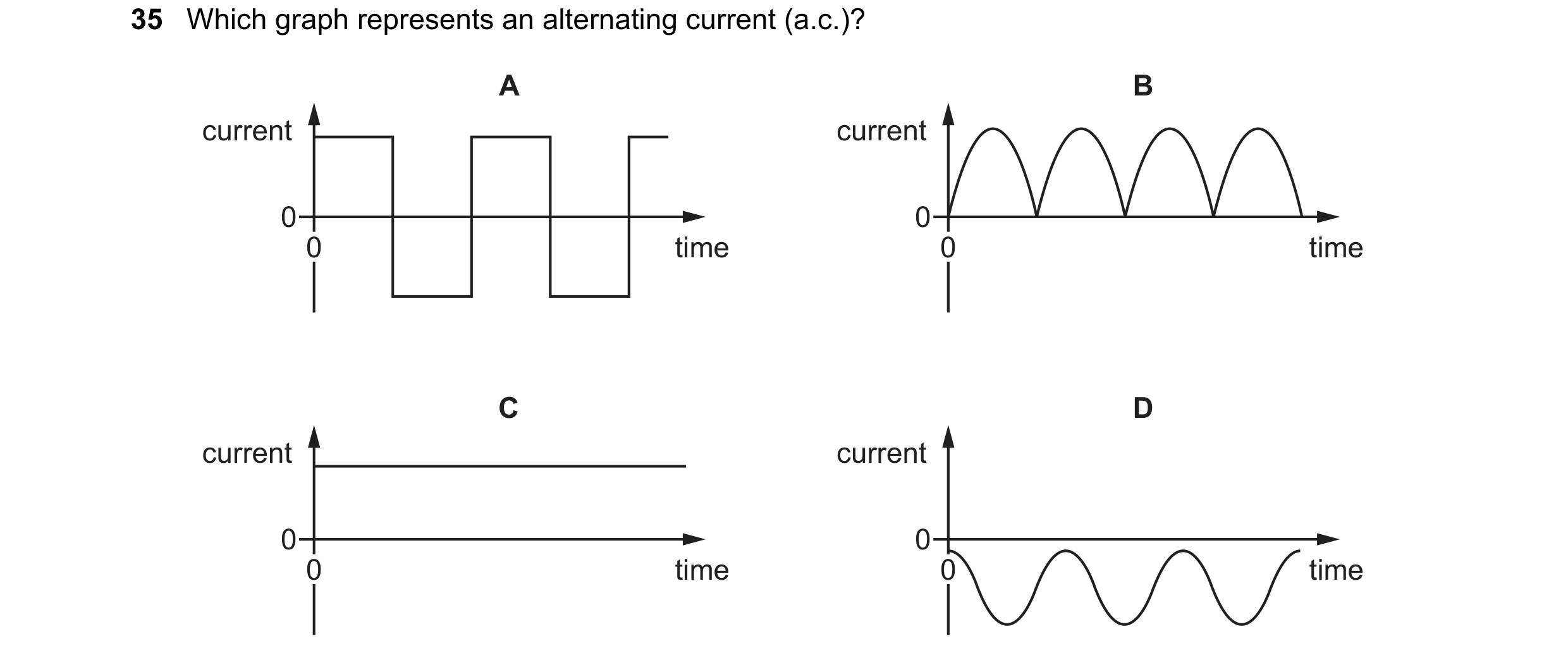
Q31 · Which graph represents an alternating current (a.c.)? 0972/21 Oct/Nov 2021
35 Which graph represents an alternating current (a.c.)? A B current current 0 0 0 time 0 time C D current current 0 0 0 time 0 time
1 marks
Answer: A
This question in 0972/21 Oct/Nov 2021
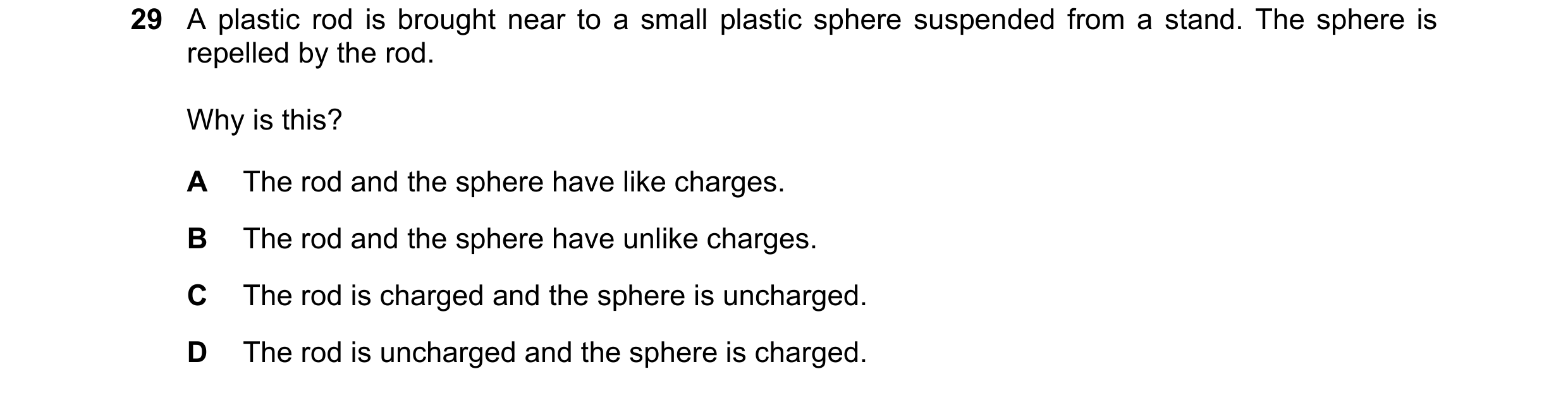
Q32 · A plastic rod is brought near to a small plastic sphere suspended from a stand 0972/21 May/June 2022
29 A plastic rod is brought near to a small plastic sphere suspended from a stand. The sphere is repelled by the rod. Why is this? A The rod and the sphere have like charges. B The rod and the sphere have unlike charges. C The rod is charged and the sphere is uncharged. D The rod is uncharged and the sphere is charged.
1 marks
Answer: A
This question in 0972/21 May/June 2022
Q33 · Which unit is equivalent to a volt (V)? 0972/21 May/June 2022
30 Which unit is equivalent to a volt (V)? A A / B J / C C J / s D W / C
1 marks
Answer: B
This question in 0972/21 May/June 2022
Q34 · A resistor converts 360 J of energy when there is a current of 3.0 A in it 0972/21 May/June 2022
31 A resistor converts 360 J of energy when there is a current of 3.0 A in it. The potential difference across the resistor is 6.0 V. For how long is there this current in the resistor? A 0.05 s B 20 s C 180 s D 720 s
1 marks
Answer: B
This question in 0972/21 May/June 2022
Q35 · Which transformer can change a 240 V a.c 0972/21 May/June 2022
36 Which transformer can change a 240 V a.c. input into a 15 V a.c. output? A B 800 turns 40 turns 1000 turns 25 turns C D 2400 turns 15 turns 1200 turns 75 turns
1 marks
Answer: D
This question in 0972/21 May/June 2022
Q36 · A resistor has a potential difference (p.d.) of 12 V across it and a current of 0.60 A in… 0972/22 May/June 2022
30 A resistor has a potential difference (p.d.) of 12 V across it and a current of 0.60 A in it. What is the resistance of the resistor? A 0.050 B 2.0 C 7.2 D 20
1 marks
Answer: D
This question in 0972/22 May/June 2022
Q37 · There is a current I in a resistor of resistance R for a time t 0972/22 May/June 2022
31 There is a current I in a resistor of resistance R for a time t. The potential difference (p.d.) across the resistor is V. Which equation gives the power P dissipated in the resistor? I V A P = IR B P = It C P = IV D P = t
1 marks
Answer: C
This question in 0972/22 May/June 2022
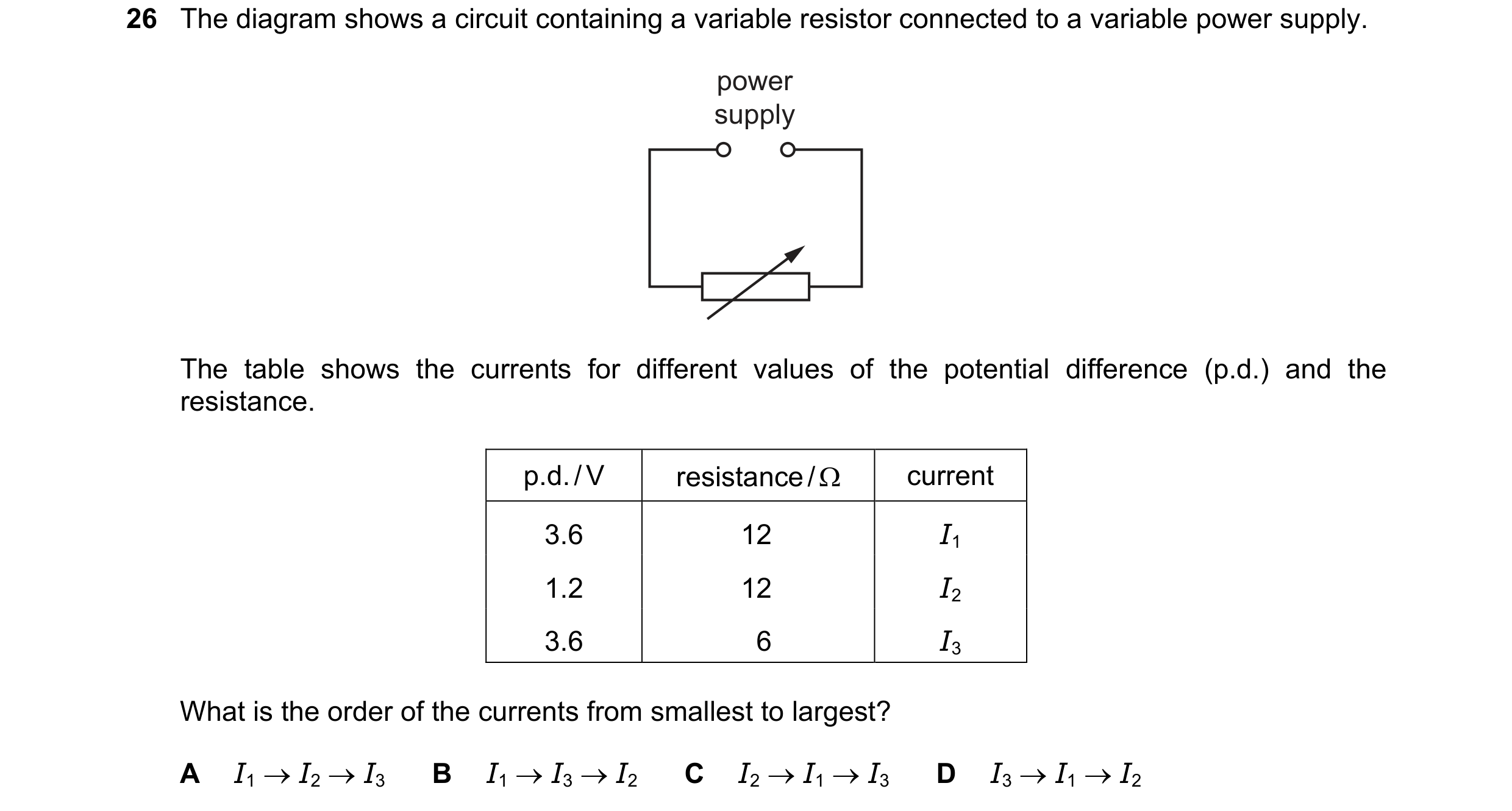
Q38 · The diagram shows a circuit containing a variable resistor connected to a variable power… 0972/21 Oct/Nov 2022
26 The diagram shows a circuit containing a variable resistor connected to a variable power supply. power supply The table shows the currents for different values of the potential difference (p.d.) and the resistance. p.d. / V resistance / Ω current 3.6 12 I1 1.2 12 I2 3.6 6 I3 What is the order of the currents from smallest to largest? A I1 → I2 → I3 B I1 → I3 → I2 C I2 → I1 → I3 D I3 → I1 → I2
1 marks
Answer: C
This question in 0972/21 Oct/Nov 2022
Q39 · Which diagram shows the electric field pattern around a positive charge? 0972/21 Oct/Nov 2022
27 Which diagram shows the electric field pattern around a positive charge? A B C D + + + +
1 marks
Answer: A
This question in 0972/21 Oct/Nov 2022
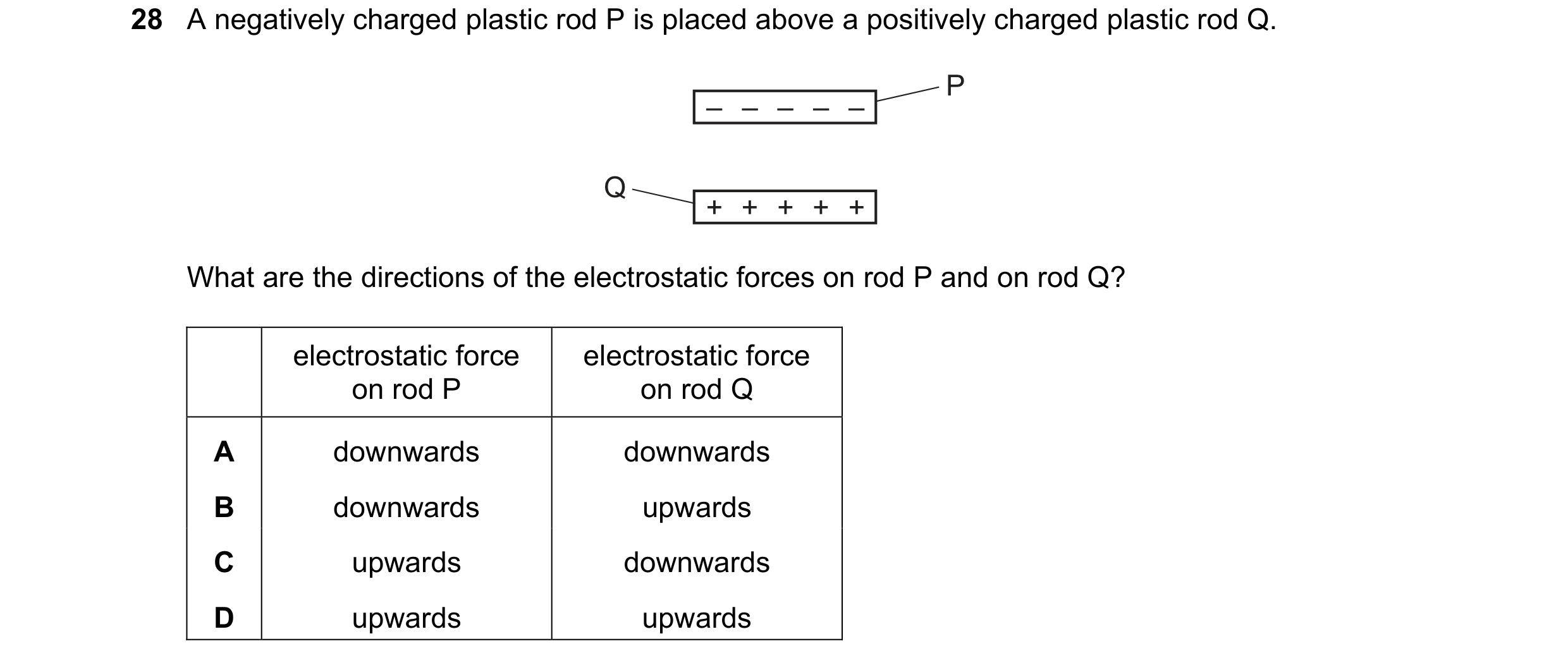
Q40 · A negatively charged plastic rod P is placed above a positively charged plastic rod Q 0972/21 Oct/Nov 2022
28 A negatively charged plastic rod P is placed above a positively charged plastic rod Q. P – – – – – Q + + + + + What are the directions of the electrostatic forces on rod P and on rod Q? electrostatic force electrostatic force on rod P on rod Q A downwards downwards B downwards upwards C upwards downwards D upwards upwards
1 marks
Answer: B
This question in 0972/21 Oct/Nov 2022
Q41 · A lamp rated 12 V, 2.0 A is switched on for one minute 0972/21 Oct/Nov 2022
29 A lamp rated 12 V, 2.0 A is switched on for one minute. How much energy is transferred by the lamp? A 6.0 J B 24 J C 360 J D 1440 J
1 marks
Answer: D
This question in 0972/21 Oct/Nov 2022
Q42 · A plastic rod is rubbed with a cloth 0972/21 May/June 2023
24 A plastic rod is rubbed with a cloth. plastic rod cloth The rod and the cloth both become charged as electrons move between them. The rod becomes negatively charged. Which diagram shows how the rod becomes negatively charged and shows the final charge on the cloth? A B electron electron – – movement – – – movement – – – – – + + – – + + – – + – – + – ++ + + – ++ + + + + final charge + + final charge on the cloth on the cloth C D electron electron – – – movement – – – movement – – – – – – – – – – – – – – – – – –– – – – –– – – – – final charge – – final charge on the cloth on the cloth
1 marks
Answer: B
This question in 0972/21 May/June 2023
Q43 · A wire has a uniform circular cross-sectional area 0972/21 May/June 2023
25 A wire has a uniform circular cross-sectional area. Which statement is correct? A The resistance of the wire is directly proportional to its cross-sectional area and inversely proportional to its diameter. B The resistance of the wire is directly proportional to its cross-sectional area and inversely proportional to its length. C The resistance of the wire is directly proportional to its length and inversely proportional to its cross-sectional area. D The resistance of the wire is directly proportional to its length and inversely proportional to its diameter.
1 marks
Answer: C
This question in 0972/21 May/June 2023
Q44 · The diagram shows the current–voltage graph for a metal wire 0972/21 May/June 2023
26 The diagram shows the current–voltage graph for a metal wire. current 0 0 voltage What can be deduced from the graph? A As voltage increases, the temperature of the wire increases. B As voltage increases, the temperature of the wire decreases. C As voltage increases, the resistance of the wire increases. D As voltage increases, the resistance of the wire remains constant.
1 marks
Answer: D
This question in 0972/21 May/June 2023
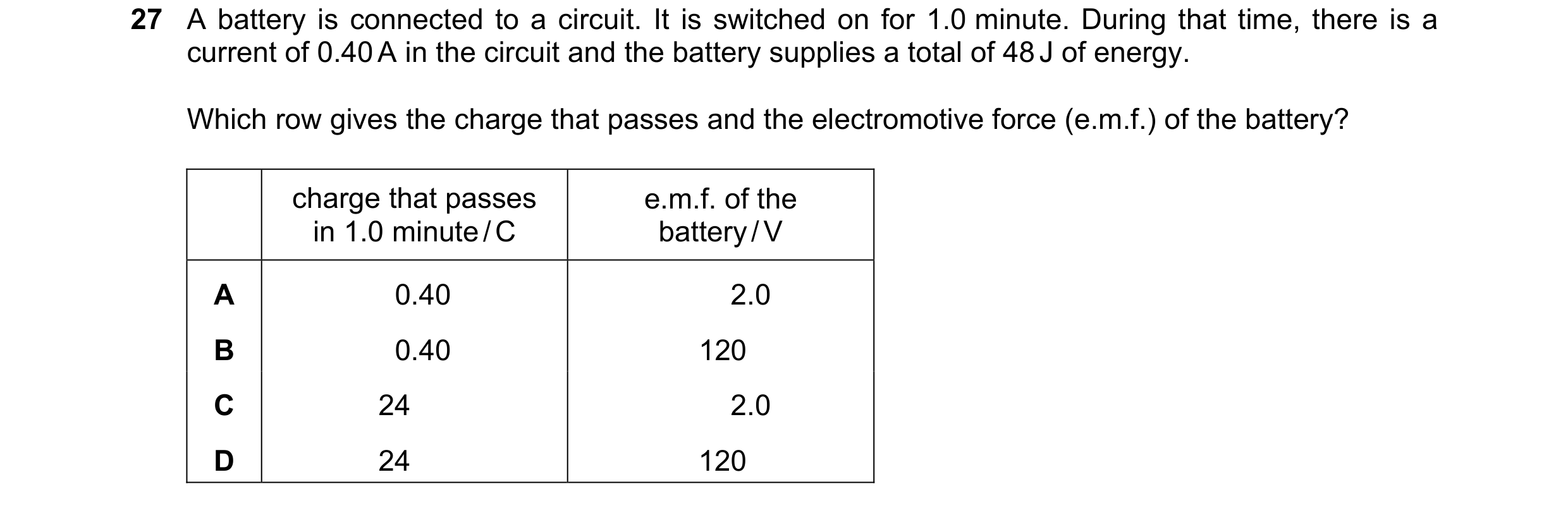
Q45 · A battery is connected to a circuit 0972/21 May/June 2023
27 A battery is connected to a circuit. It is switched on for 1.0 minute. During that time, there is a current of 0.40 A in the circuit and the battery supplies a total of 48 J of energy. Which row gives the charge that passes and the electromotive force (e.m.f.) of the battery? charge that passes e.m.f. of the in 1.0 minute / C battery / V A 0.40 2.0 B 0.40 120 C 24 2.0 D 24 120
1 marks
Answer: C
This question in 0972/21 May/June 2023
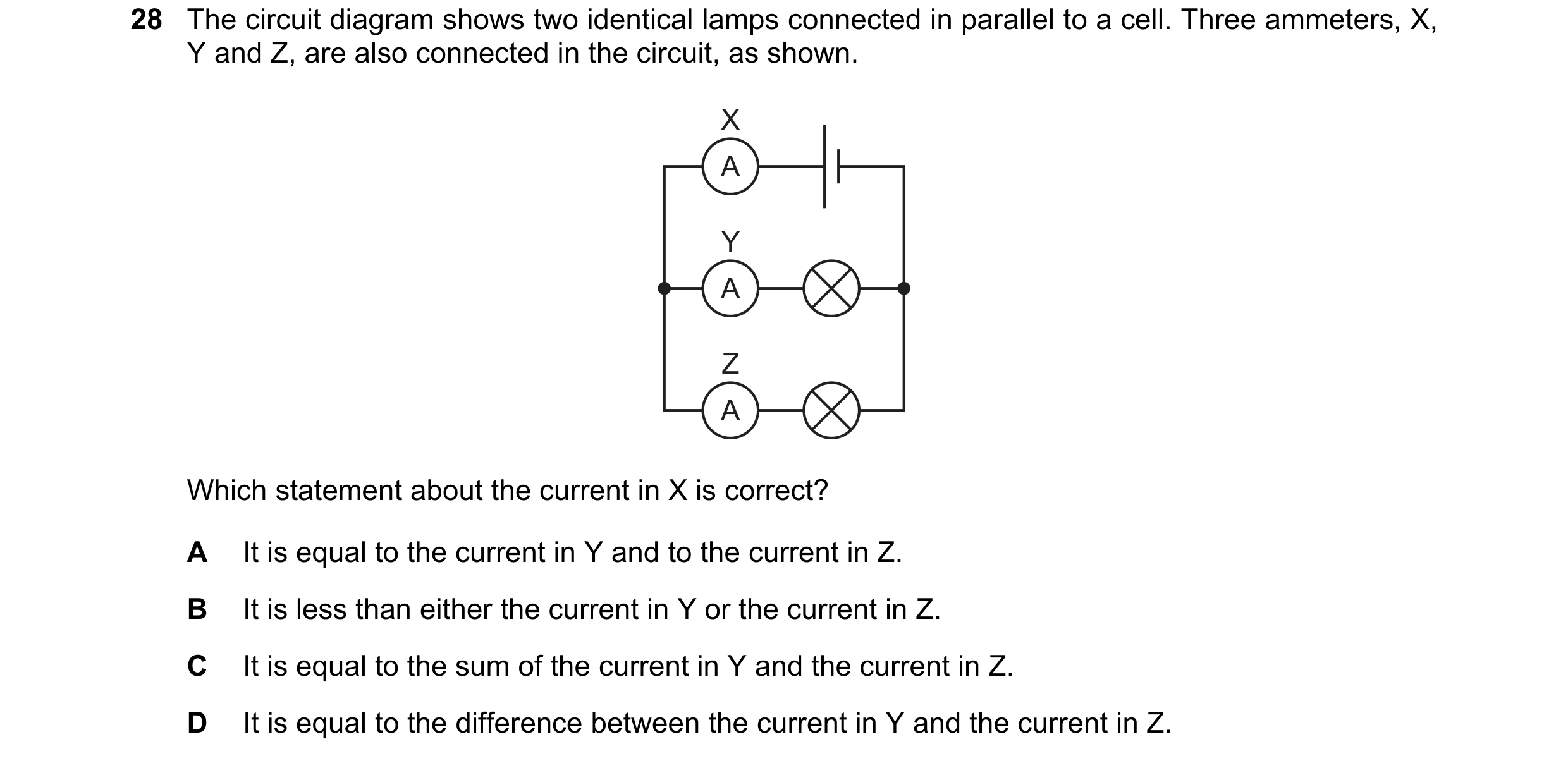
Q46 · The circuit diagram shows two identical lamps connected in parallel to a cell 0972/21 May/June 2023
28 The circuit diagram shows two identical lamps connected in parallel to a cell. Three ammeters, X, Y and Z, are also connected in the circuit, as shown. X A Y A Z A Which statement about the current in X is correct? A It is equal to the current in Y and to the current in Z. B It is less than either the current in Y or the current in Z. C It is equal to the sum of the current in Y and the current in Z. D It is equal to the difference between the current in Y and the current in Z.
1 marks
Answer: C
This question in 0972/21 May/June 2023
Q47 · How are positive and negative ions formed from atoms? 0972/21 May/June 2023
33 How are positive and negative ions formed from atoms? positive ion negative ion A add positive charge to the nucleus add an electron to the atom B add positive charge to the nucleus remove positive charge from the nucleus C remove an electron from the atom add an electron to the atom D remove an electron from the atom remove positive charge from the nucleus 56 26X
1 marks
Answer: C
This question in 0972/21 May/June 2023
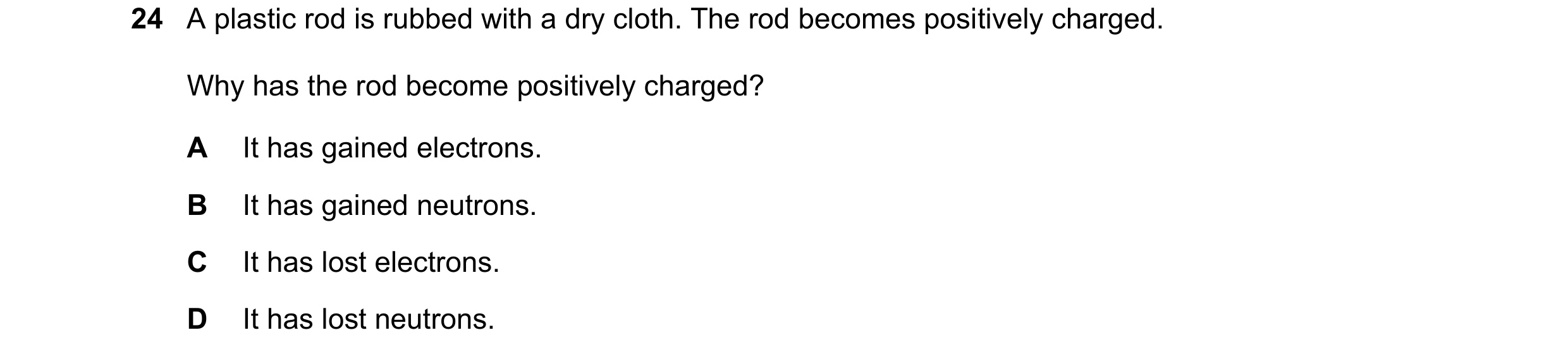
Q48 · A plastic rod is rubbed with a dry cloth 0972/22 May/June 2023
24 A plastic rod is rubbed with a dry cloth. The rod becomes positively charged. Why has the rod become positively charged? A It has gained electrons. B It has gained neutrons. C It has lost electrons. D It has lost neutrons.
1 marks
Answer: C
This question in 0972/22 May/June 2023
Q49 · Which statement about electric current in a conductor is correct? 0972/22 May/June 2023
25 Which statement about electric current in a conductor is correct? A In a d.c. circuit, the electric current gradually decreases along the conductor. B In a d.c. circuit, the free electrons flow back and forth. C In an a.c. circuit, the electric current remains exactly the same all the time. D In an a.c. circuit, the flow of charge changes direction continually.
1 marks
Answer: D
This question in 0972/22 May/June 2023
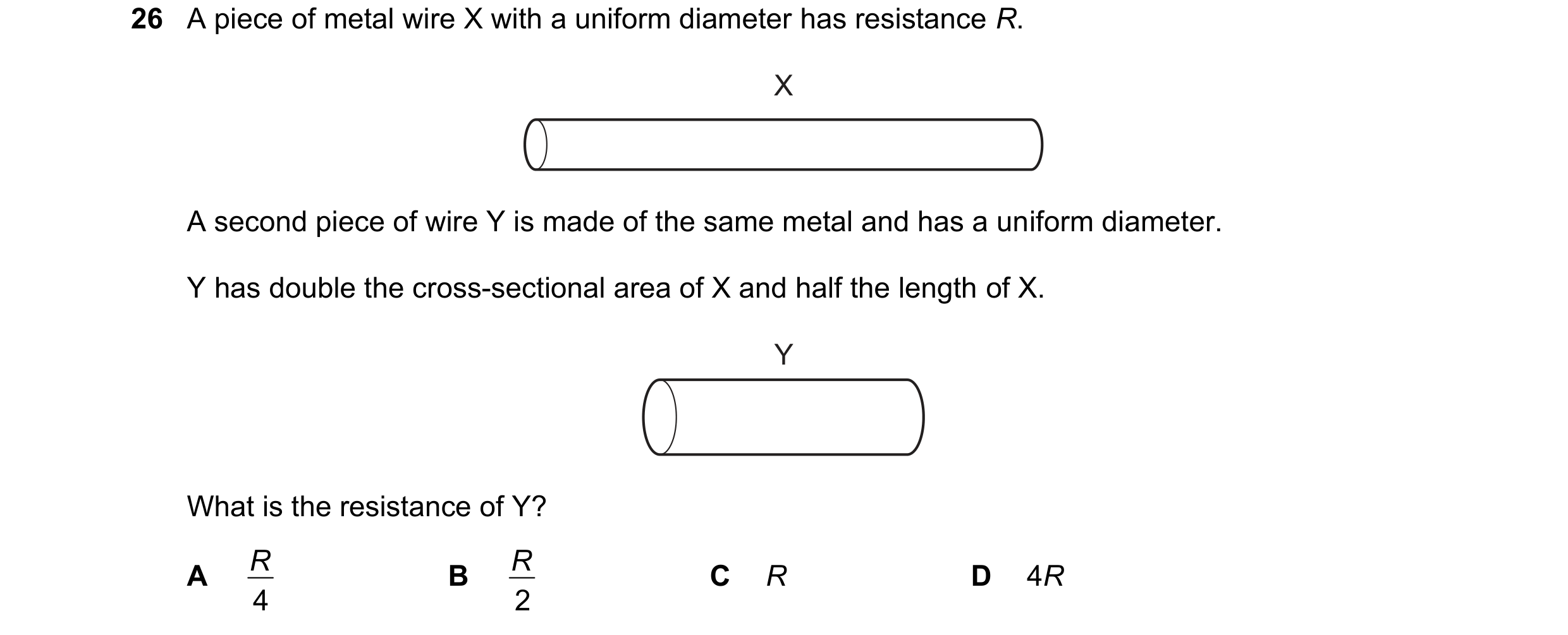
Q50 · A piece of metal wire X with a uniform diameter has resistance R 0972/22 May/June 2023
26 A piece of metal wire X with a uniform diameter has resistance R. X A second piece of wire Y is made of the same metal and has a uniform diameter. Y has double the cross-sectional area of X and half the length of X. Y What is the resistance of Y? R R A B C R D 4R 4 2
1 marks
Answer: A
This question in 0972/22 May/June 2023
Q51 · An electric fire is connected to a 240 V supply and transfers energy at a rate of 1.0 kW 0972/22 May/June 2023
27 An electric fire is connected to a 240 V supply and transfers energy at a rate of 1.0 kW. How much charge passes through the fire in 1.0 h? A 42 C B 250 C C 1.5 104 C D 2.4 105 C
1 marks
Answer: C
This question in 0972/22 May/June 2023
Q52 · In which device is the magnetic effect of a current not used? 0972/22 May/June 2023
32 In which device is the magnetic effect of a current not used? A electromagnet B loudspeaker C potential divider D relay
1 marks
Answer: C
This question in 0972/22 May/June 2023
Q53 · Which statement describes the direction of an electric field at a point? 0972/21 Oct/Nov 2023
25 Which statement describes the direction of an electric field at a point? A the direction of the force on a negative charge B the direction of the force on an N pole C the direction of the force on a positive charge D the direction of the force on an S pole
1 marks
Answer: C
This question in 0972/21 Oct/Nov 2023
Q54 · Which statement about a voltmeter is correct? 0972/21 Oct/Nov 2023
26 Which statement about a voltmeter is correct? A It has a scale which is marked in amperes (A). B It must be connected in series in a circuit. C It measures potential difference (p.d.). D It must have three terminals.
1 marks
Answer: C
This question in 0972/21 Oct/Nov 2023
Q55 · A wire has a resistance of 8.0 0972/21 Oct/Nov 2023
27 A wire has a resistance of 8.0 . A second wire of the same material has twice the length and twice the cross-sectional area. What is the resistance of the second wire? A 4.0 B 8.0 C 16 D 32
1 marks
Answer: B
This question in 0972/21 Oct/Nov 2023
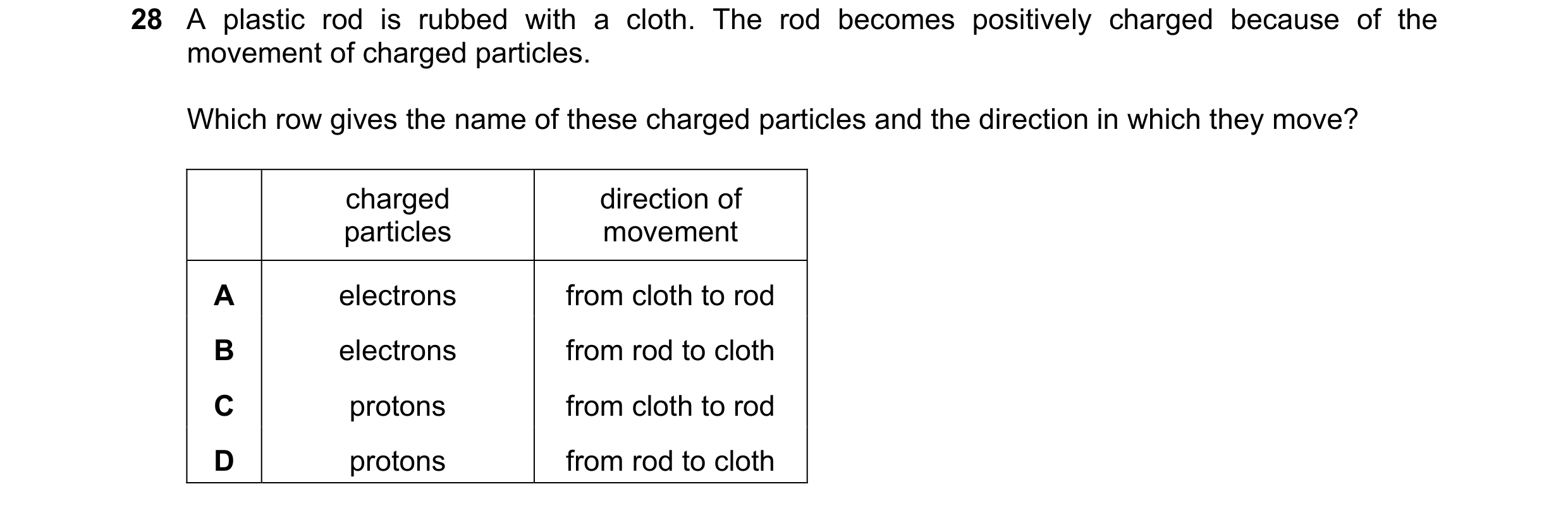
Q56 · A plastic rod is rubbed with a cloth 0972/21 Oct/Nov 2023
28 A plastic rod is rubbed with a cloth. The rod becomes positively charged because of the movement of charged particles. Which row gives the name of these charged particles and the direction in which they move? charged direction of particles movement A electrons from cloth to rod B electrons from rod to cloth C protons from cloth to rod D protons from rod to cloth
1 marks
Answer: B
This question in 0972/21 Oct/Nov 2023
Q57 · -particles, -particles and -rays are emitted by radioactive nuclei when they decay 0972/21 Oct/Nov 2023
35 -particles, -particles and -rays are emitted by radioactive nuclei when they decay. Which emissions can be deflected by an electric field? A -particles, -particles and -rays B -particles and -particles only C -particles and -rays only D -rays and -particles only
1 marks
Answer: B
This question in 0972/21 Oct/Nov 2023
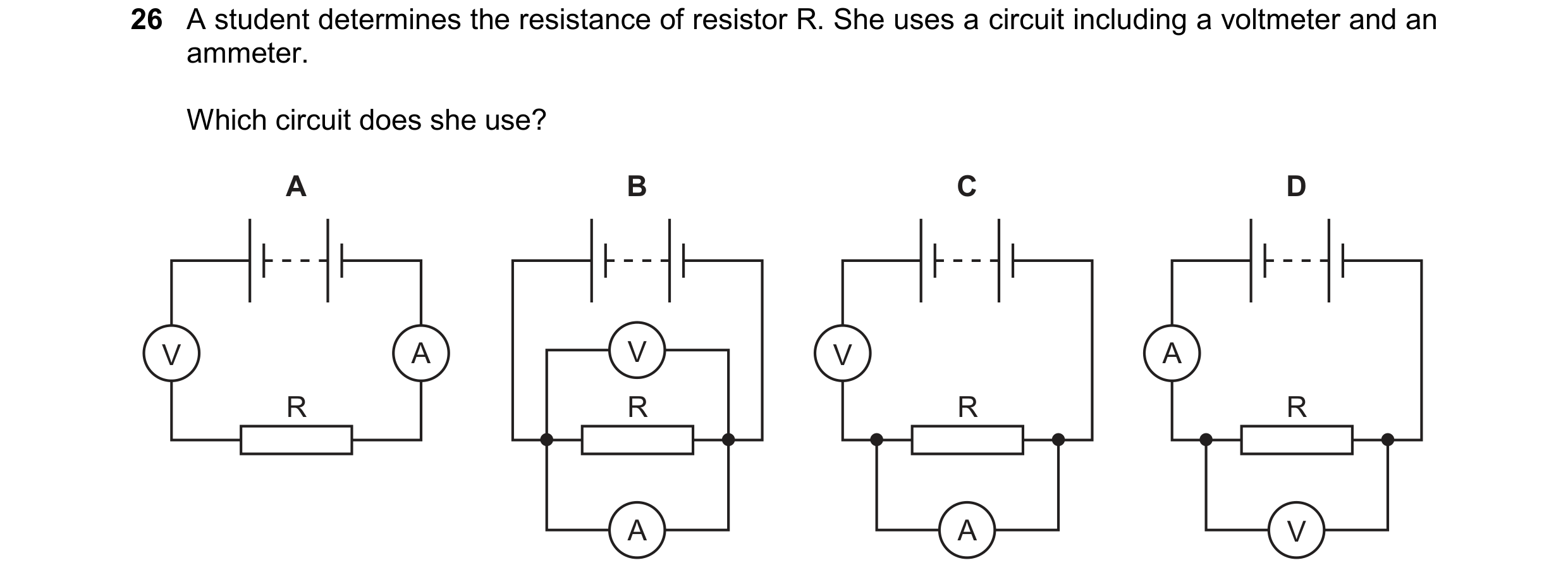
Q58 · A student determines the resistance of resistor R 0972/21 May/June 2024
26 A student determines the resistance of resistor R. She uses a circuit including a voltmeter and an ammeter. Which circuit does she use? A B C D V A V V A R R R R A A V
1 marks
Answer: D
This question in 0972/21 May/June 2024
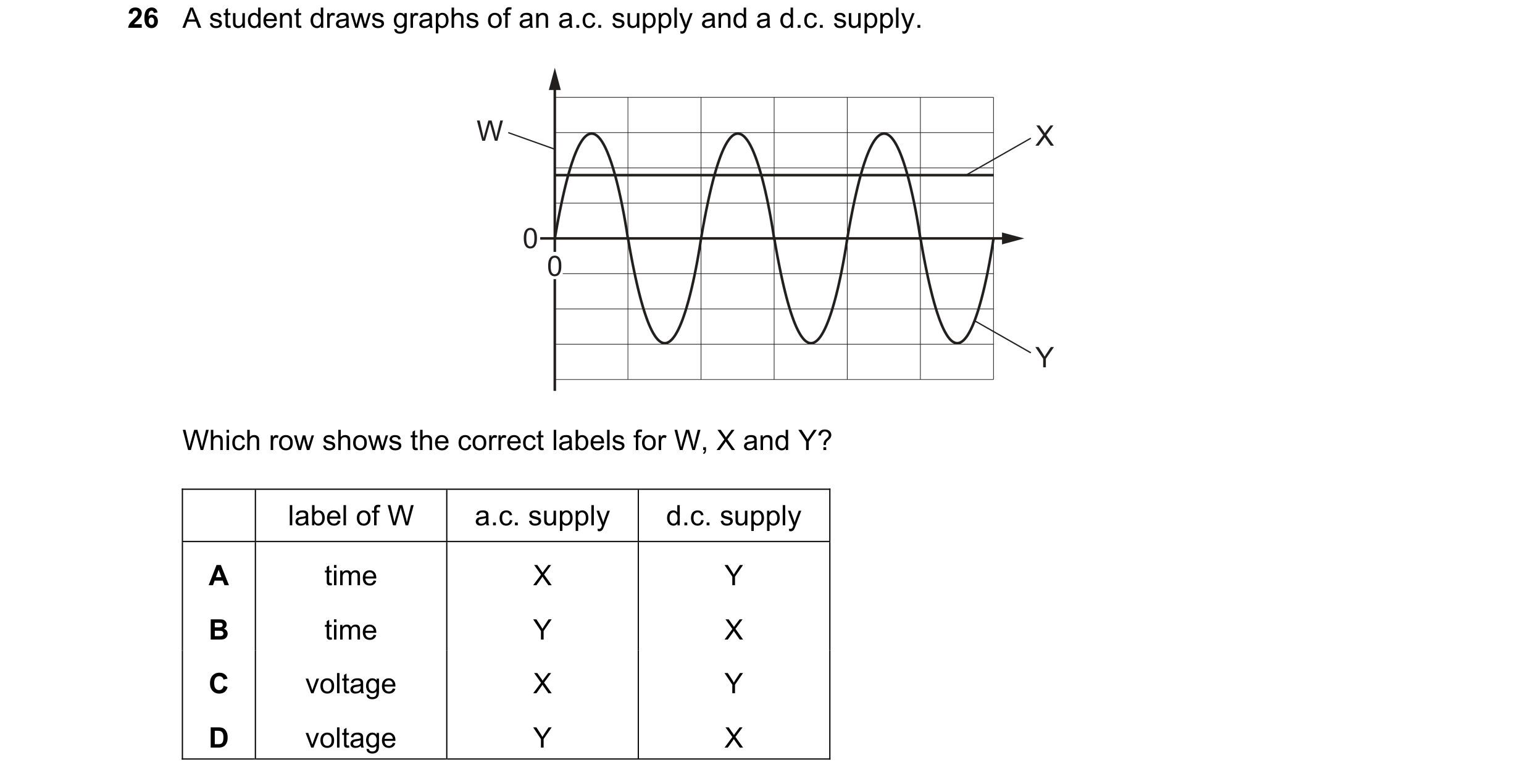
Q59 · A student draws graphs of an a.c 0972/22 May/June 2024
26 A student draws graphs of an a.c. supply and a d.c. supply. W X 0 0 Y Which row shows the correct labels for W, X and Y? label of W a.c. supply d.c. supply A time X Y B time Y X C voltage X Y D voltage Y X
1 marks
Answer: D
This question in 0972/22 May/June 2024
Q60 · A resistor transfers 100 J of energy when a charge of 10 C flows through it 0972/22 May/June 2024
27 A resistor transfers 100 J of energy when a charge of 10 C flows through it. What is the potential difference across the resistor? A 0.10 V B 10 V C 10 W D 1000 W
1 marks
Answer: B
This question in 0972/22 May/June 2024
Q61 · Wire X and wire Y are made from the same metal 0972/22 May/June 2024
28 Wire X and wire Y are made from the same metal. The table gives information about the two wires. length cross-sectional resistance / m area / mm2 / wire X 1.0 0.40 2.0 wire Y 1.3 0.30 What is the resistance of wire Y? A 0.31 B 0.78 C 2.1 D 3.5
1 marks
Answer: D
This question in 0972/22 May/June 2024
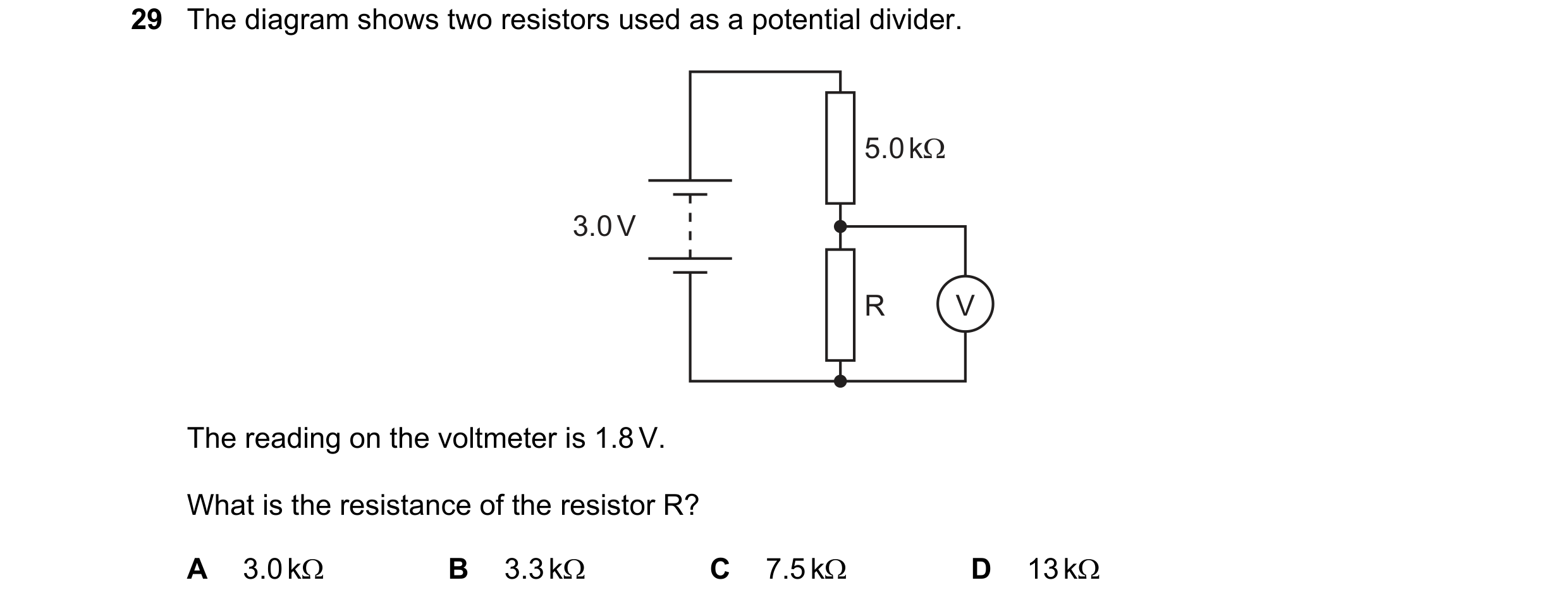
Q62 · The diagram shows two resistors used as a potential divider 0972/22 May/June 2024
29 The diagram shows two resistors used as a potential divider.
The reading on the voltmeter is 1.8 V.
What is the resistance of the resistor R?
A 3.0kQ B 3.3kQ C 7.5kQ D 13kQ
1 marks
Answer: C
This question in 0972/22 May/June 2024
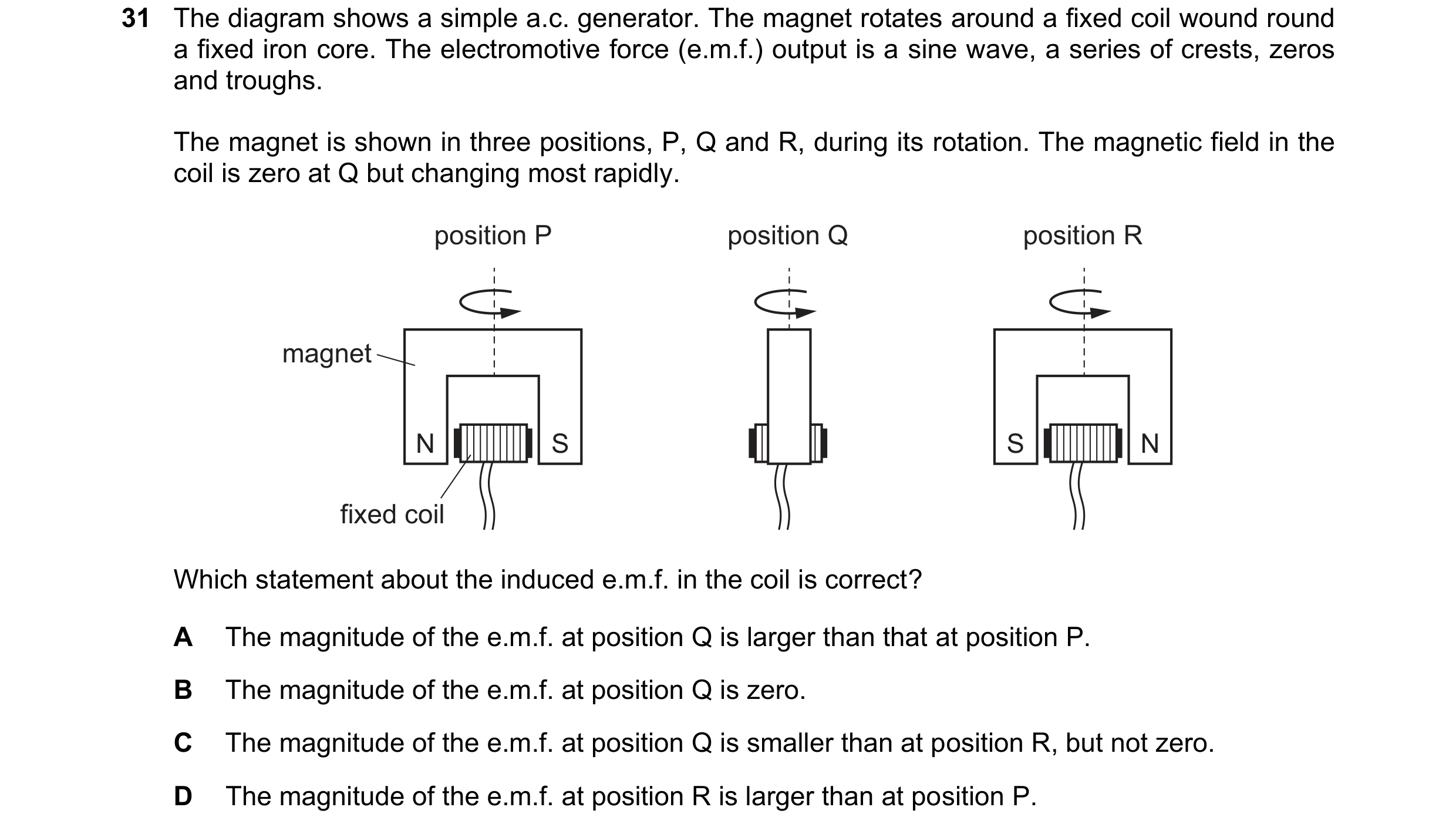
Q63 · The diagram shows a simple a.c 0972/22 May/June 2024
31 The diagram shows a simple a.c. generator. The magnet rotates around a fixed coil wound round a fixed iron core. The electromotive force (e.m.f.) output is a sine wave, a series of crests, zeros and troughs. The magnet is shown in three positions, P, Q and R, during its rotation. The magnetic field in the coil is zero at Q but changing most rapidly. position P position Q position R magnet N S S N fixed coil Which statement about the induced e.m.f. in the coil is correct? A The magnitude of the e.m.f. at position Q is larger than that at position P. B The magnitude of the e.m.f. at position Q is zero. C The magnitude of the e.m.f. at position Q is smaller than at position R, but not zero. D The magnitude of the e.m.f. at position R is larger than at position P.
1 marks
Answer: A
This question in 0972/22 May/June 2024
Q64 · There is a current of 0.60 A in a closed circuit 0972/21 Oct/Nov 2024
25 There is a current of 0.60 A in a closed circuit. How much charge passes a point in the circuit in 2.5 min? A 0.24 C B 1.5 C C 90 C D 5400 C
1 marks
Answer: C
This question in 0972/21 Oct/Nov 2024
Q65 · Which two physical quantities have the unit J / C? 0972/21 Oct/Nov 2024
26 Which two physical quantities have the unit J / C? A charge and energy B charge and potential difference (p.d.) C electromotive force (e.m.f.) and p.d. D e.m.f. and charge
1 marks
Answer: C
This question in 0972/21 Oct/Nov 2024
Q66 · A copper wire is placed in an electrical circuit and its resistance is measured 0972/21 Oct/Nov 2024
27 A copper wire is placed in an electrical circuit and its resistance is measured. The wire is then replaced with a second copper wire with twice the length and a quarter of the diameter. What is the ratio of the resistance for the two wires? A 1 : 2 B 1 : 4 C 1 : 8 D 1 : 32
1 marks
Answer: D
This question in 0972/21 Oct/Nov 2024
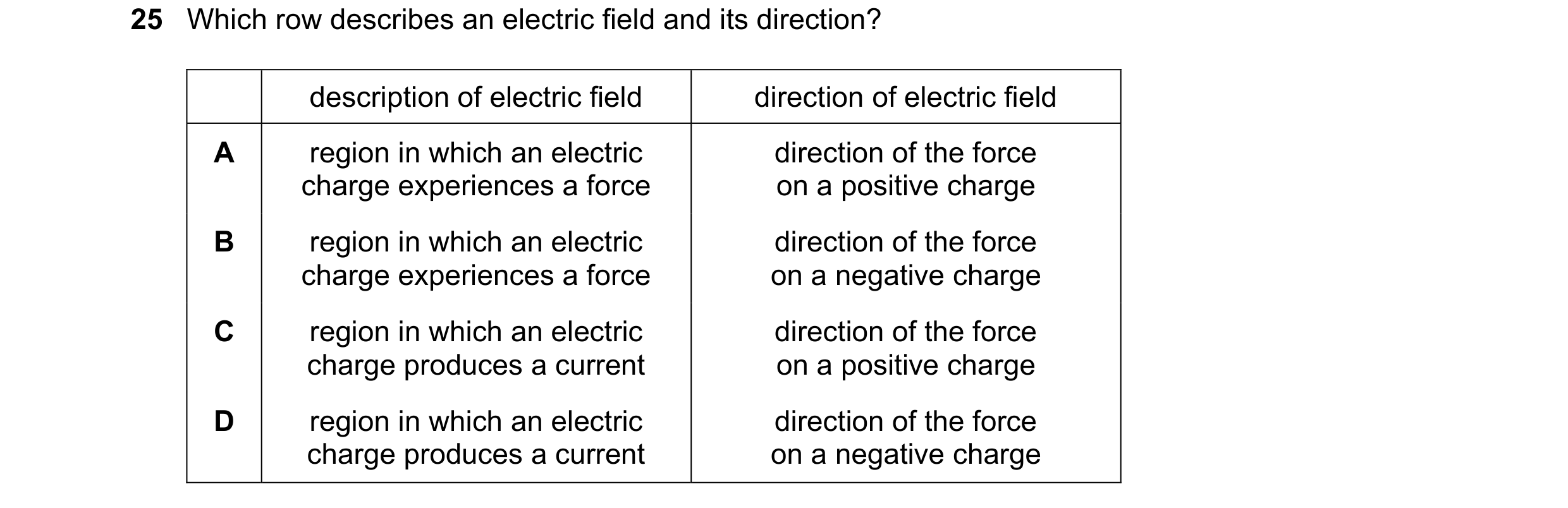
Q67 · Which row describes an electric field and its direction? 0972/21 May/June 2025
25 Which row describes an electric field and its direction? description of electric field direction of electric field A region in which an electric direction of the force charge experiences a force on a positive charge B region in which an electric direction of the force charge experiences a force on a negative charge C region in which an electric direction of the force charge produces a current on a positive charge D region in which an electric direction of the force charge produces a current on a negative charge
1 marks
Answer: A
This question in 0972/21 May/June 2025
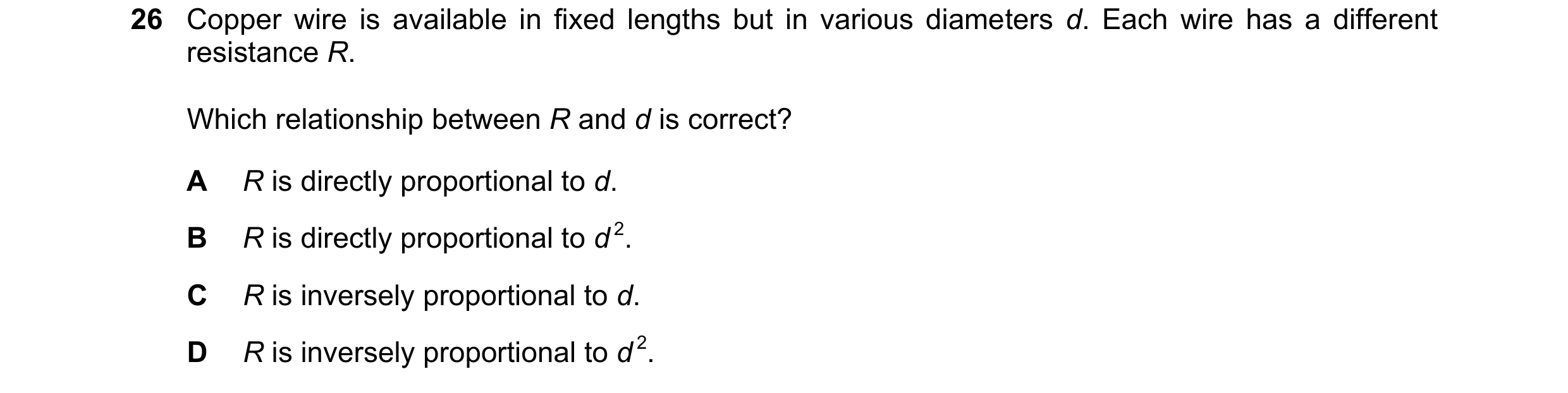
Q68 · Copper wire is available in fixed lengths but in various diameters d 0972/21 May/June 2025
26 Copper wire is available in fixed lengths but in various diameters d. Each wire has a different resistance R. Which relationship between R and d is correct? A R is directly proportional to d. B R is directly proportional to d 2. C R is inversely proportional to d. D R is inversely proportional to d 2.
1 marks
Answer: D
This question in 0972/21 May/June 2025
Q69 · The diagram shows three 20 resistors, R1, R2 and R3, and a switch S connected to a d.c 0972/21 May/June 2025
27 The diagram shows three 20 resistors, R1, R2 and R3, and a switch S connected to a d.c. power supply. R1 S R3 R2 Switch S is open. The potential difference (p.d.) across R3 is 9.0 V. What is the p.d. across R3 when switch S is closed? A 3.0 V B 6.0 V C 12 V D 27 V
1 marks
Answer: C
This question in 0972/21 May/June 2025
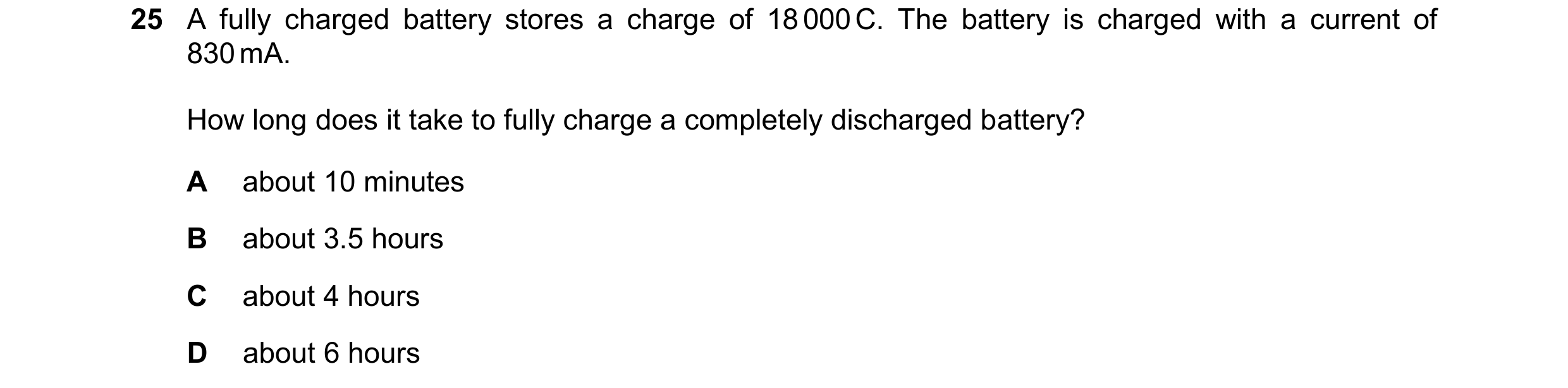
Q70 · A fully charged battery stores a charge of 18 000 C 0972/21 Oct/Nov 2025
25 A fully charged battery stores a charge of 18 000 C. The battery is charged with a current of 830 mA. How long does it take to fully charge a completely discharged battery? A about 10 minutes B about 3.5 hours C about 4 hours D about 6 hours
1 marks
Answer: D
This question in 0972/21 Oct/Nov 2025
Q71 · What is the definition of electromotive force? 0972/21 Oct/Nov 2025
26 What is the definition of electromotive force? A the electrical work done by a source in moving a unit charge around a complete circuit B the electrical work done by a unit charge passing through a component C the mechanical work done by a source in moving a unit charge around a complete circuit D the mechanical work done by a unit charge passing through a component
1 marks
Answer: A
This question in 0972/21 Oct/Nov 2025
Q72 · A cell passes a current of 2.0 A in a circuit for 30 s 0972/21 Oct/Nov 2025
27 A cell passes a current of 2.0 A in a circuit for 30 s. In this time, the cell transfers 120 J of energy. What is the electromotive force (e.m.f.) of the cell? A 0.50 V B 1.5 V C 2.0 V D 8.0 V
1 marks
Answer: C
This question in 0972/21 Oct/Nov 2025
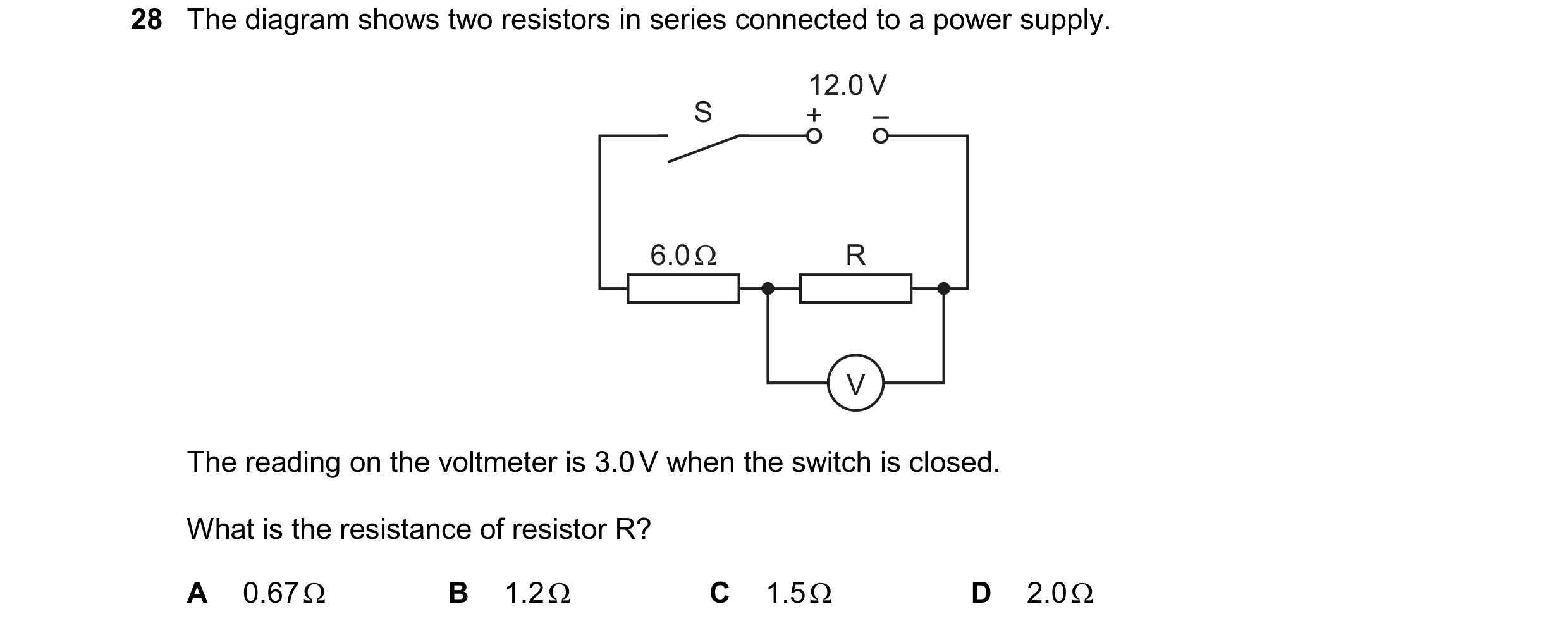
Q73 · The diagram shows two resistors in series connected to a power supply 0972/21 Oct/Nov 2025
28 The diagram shows two resistors in series connected to a power supply.
12.0V
S) t+ =
—
6.09 R
The reading on the voltmeter is 3.0V when the switch is closed.
What is the resistance of resistor R?
A 0.679 Bo 1.2Q C 1.509 D 2.0Q
1 marks
Answer: D
This question in 0972/21 Oct/Nov 2025

 1 / 20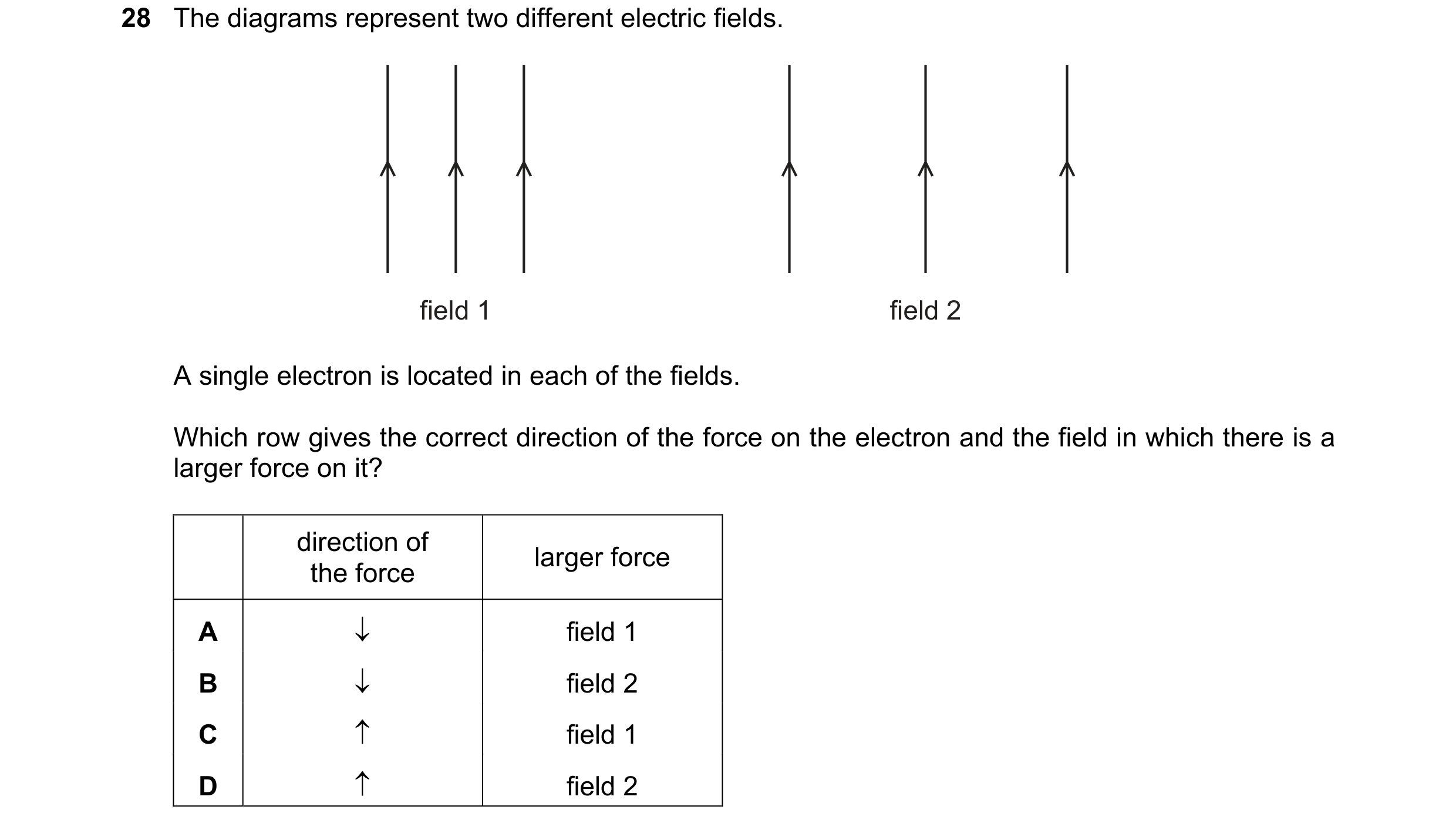
 2 / 20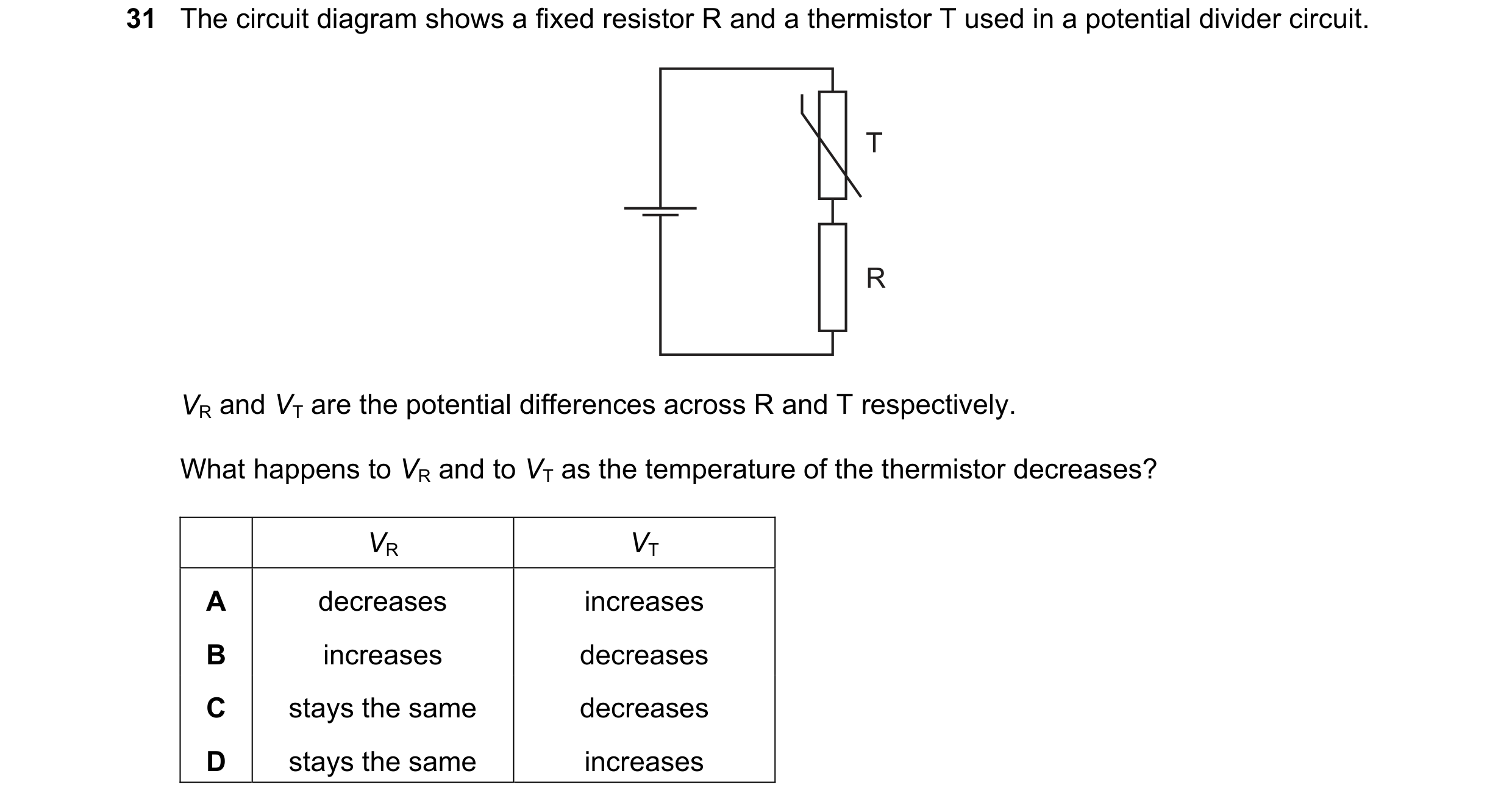
 3 / 20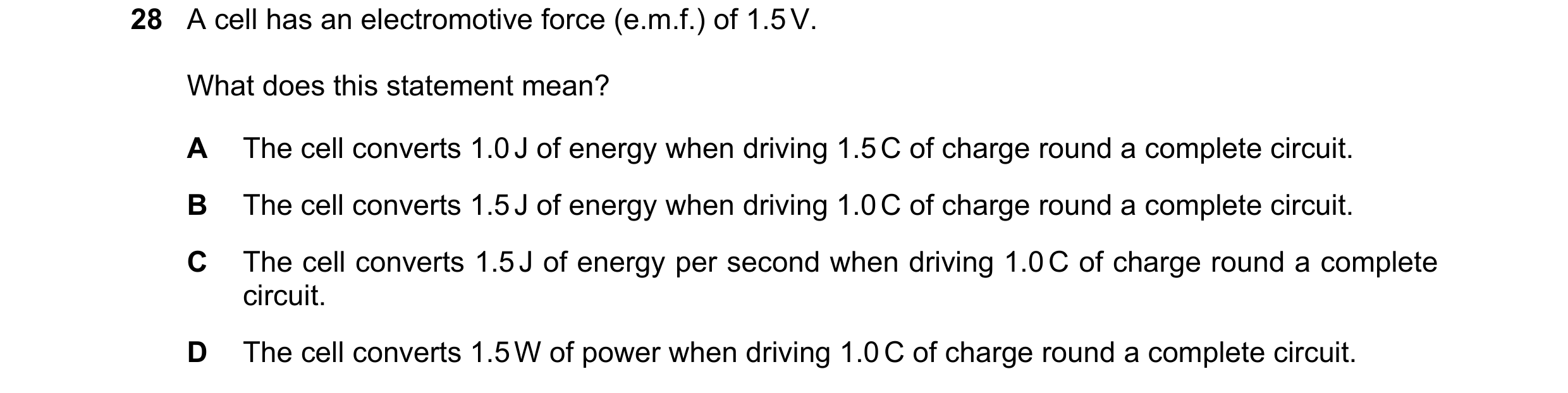


 4 / 20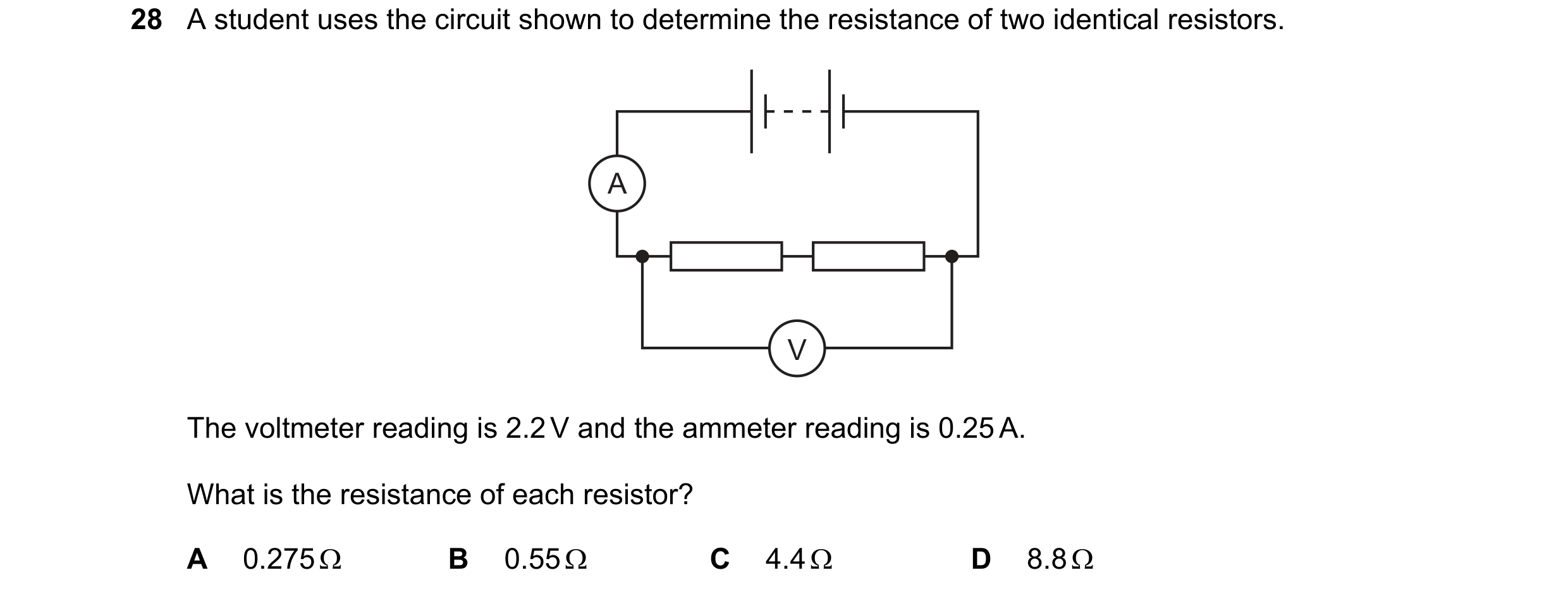

 5 / 20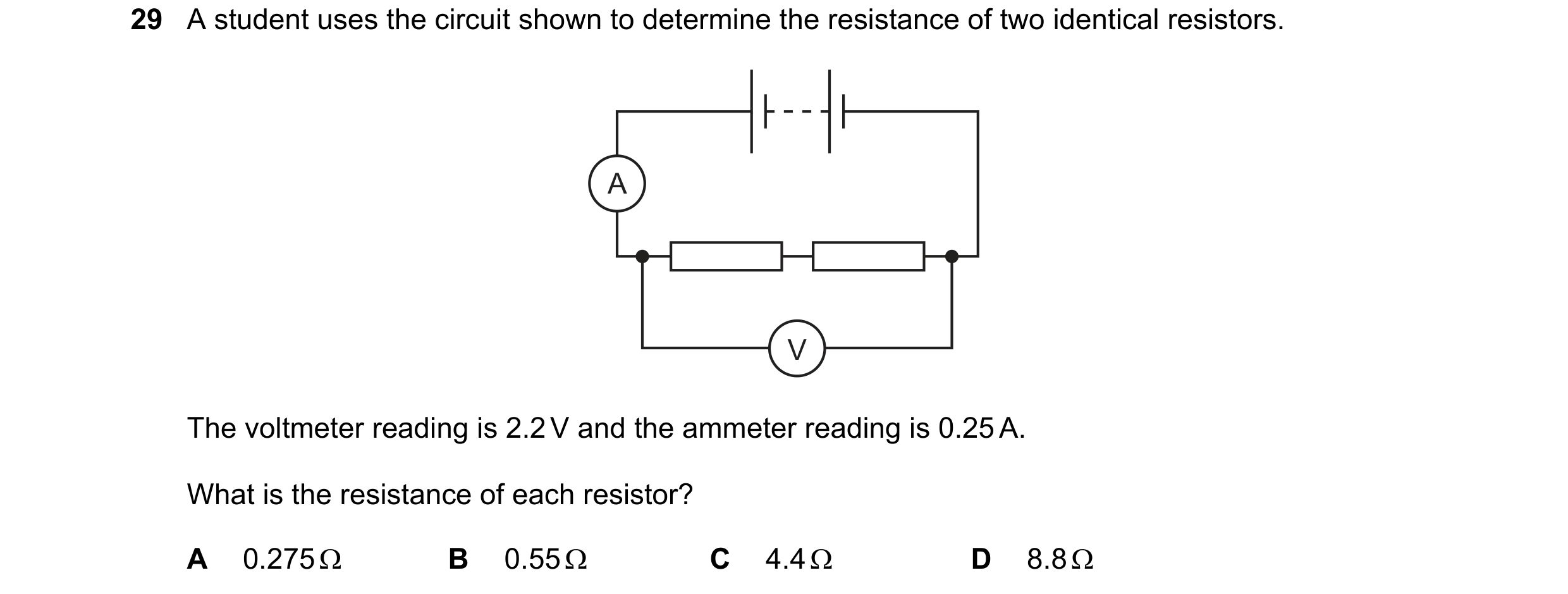

 6 / 20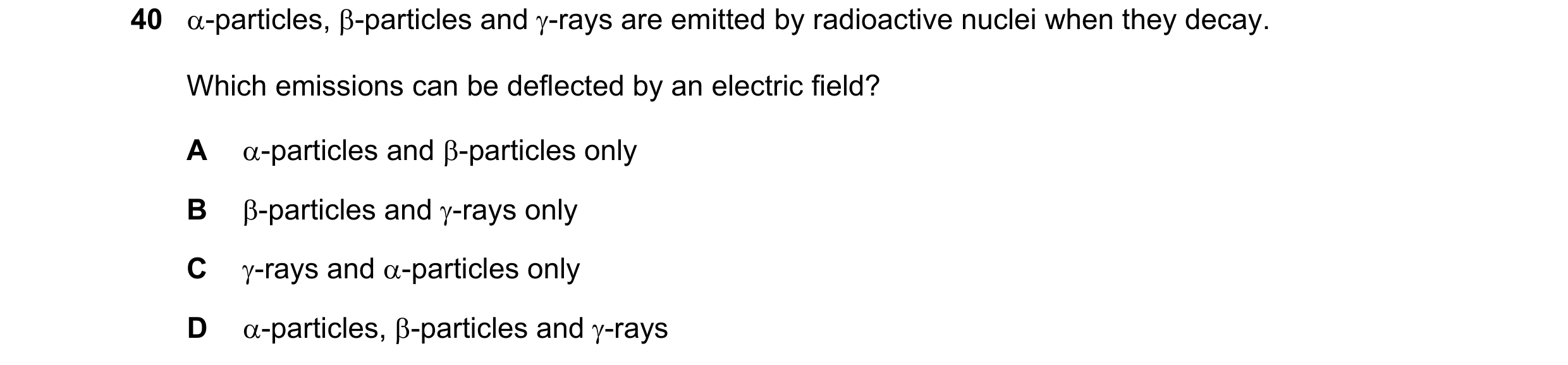

 7 / 20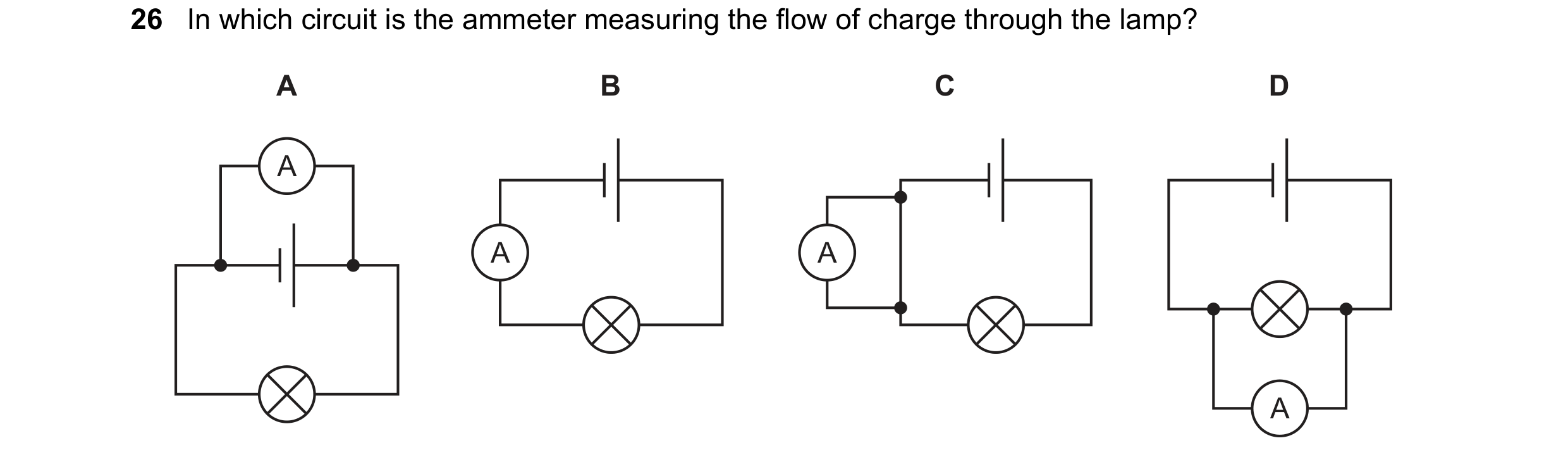
 8 / 20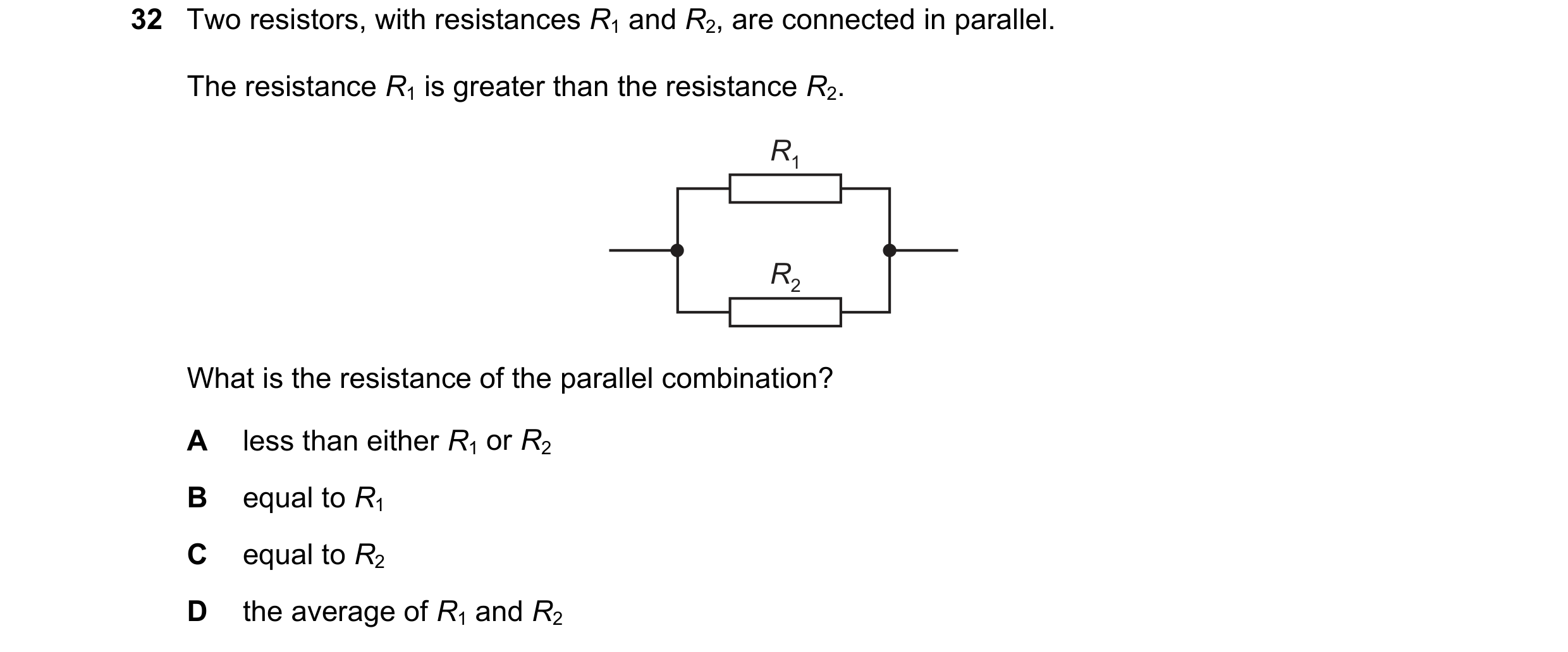

 9 / 20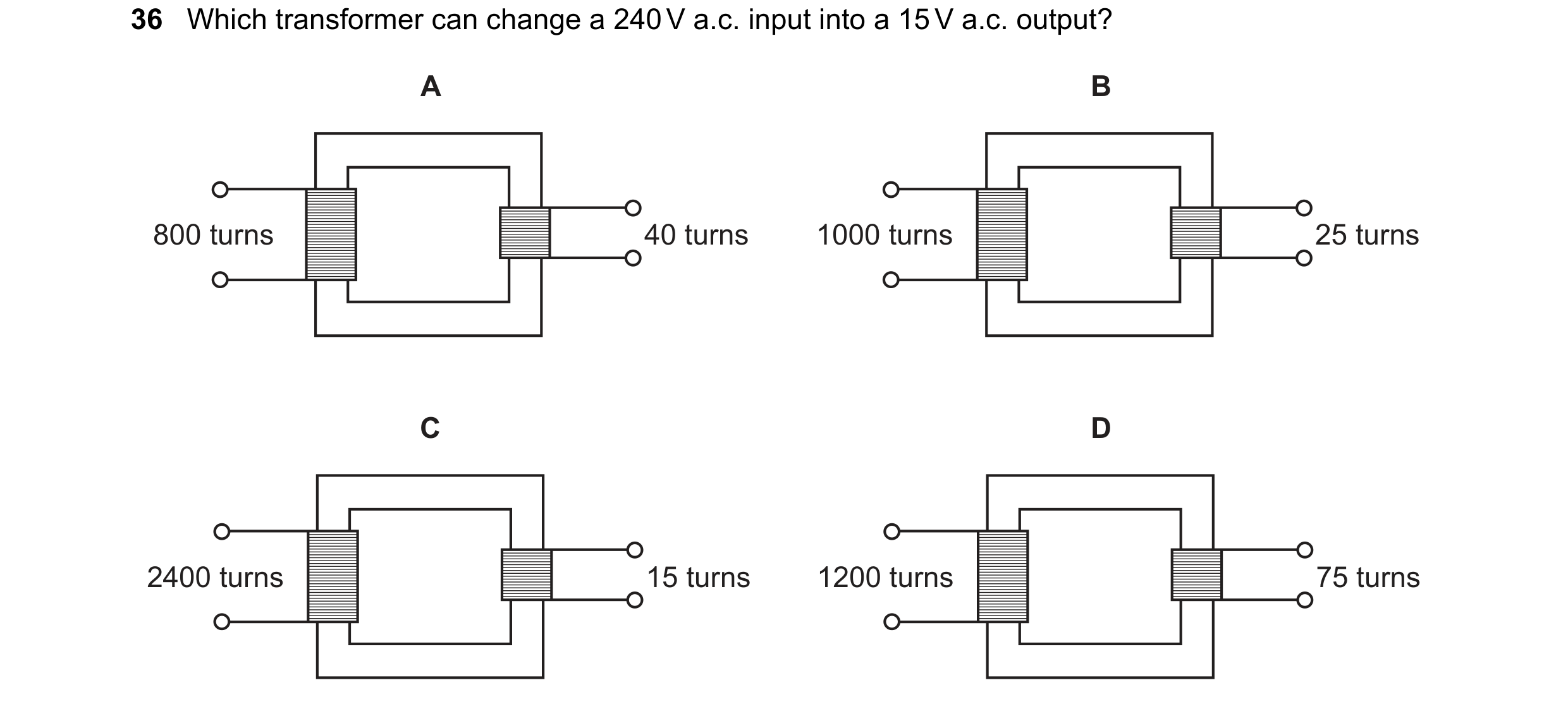


 10 / 20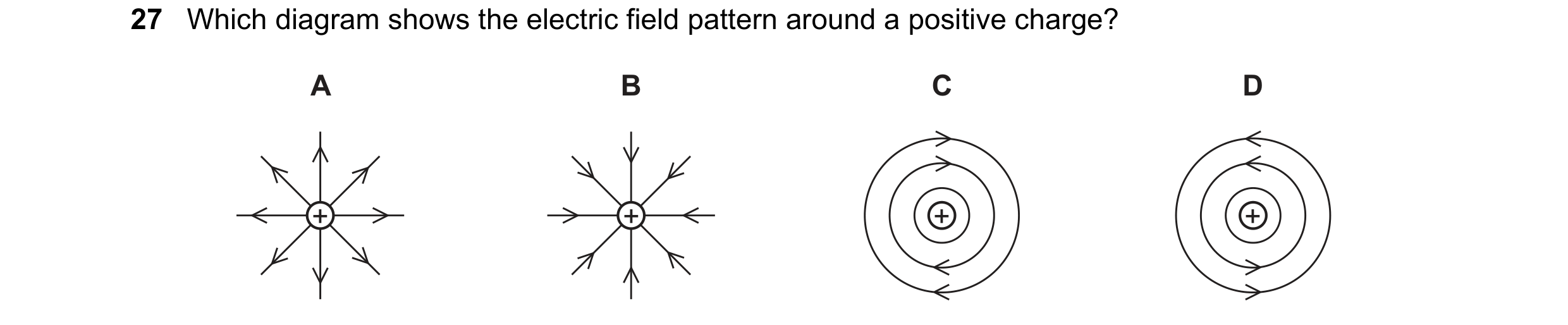
 11 / 20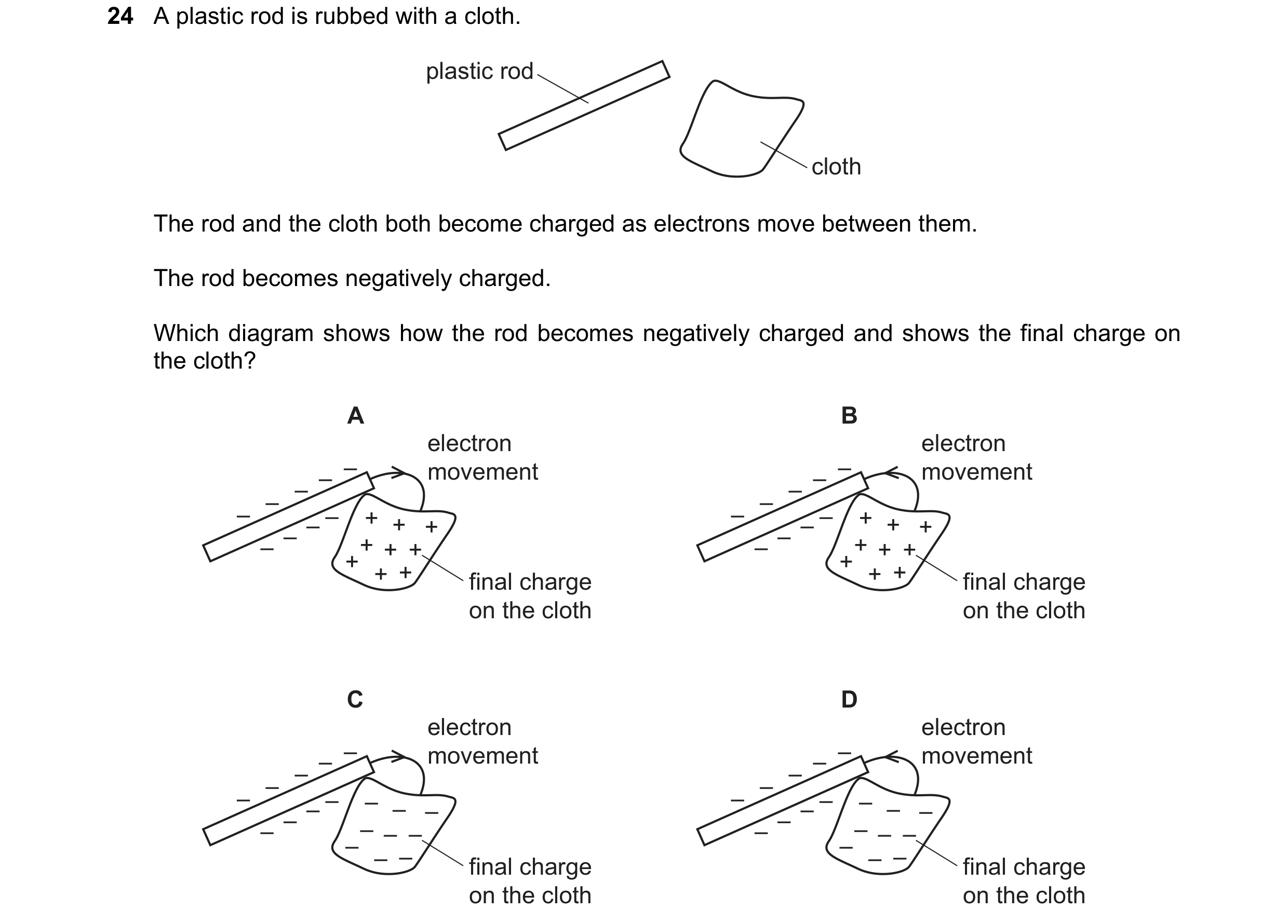
 12 / 20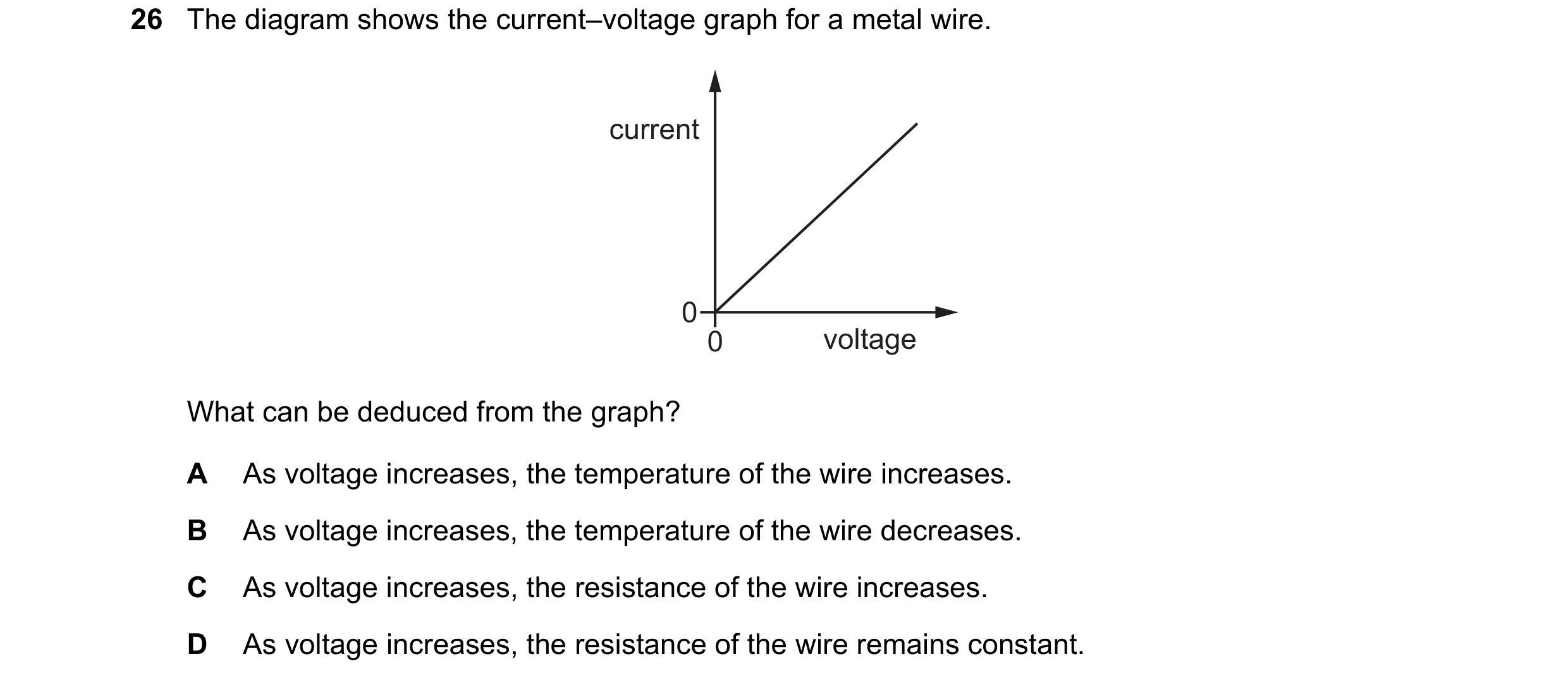
 13 / 20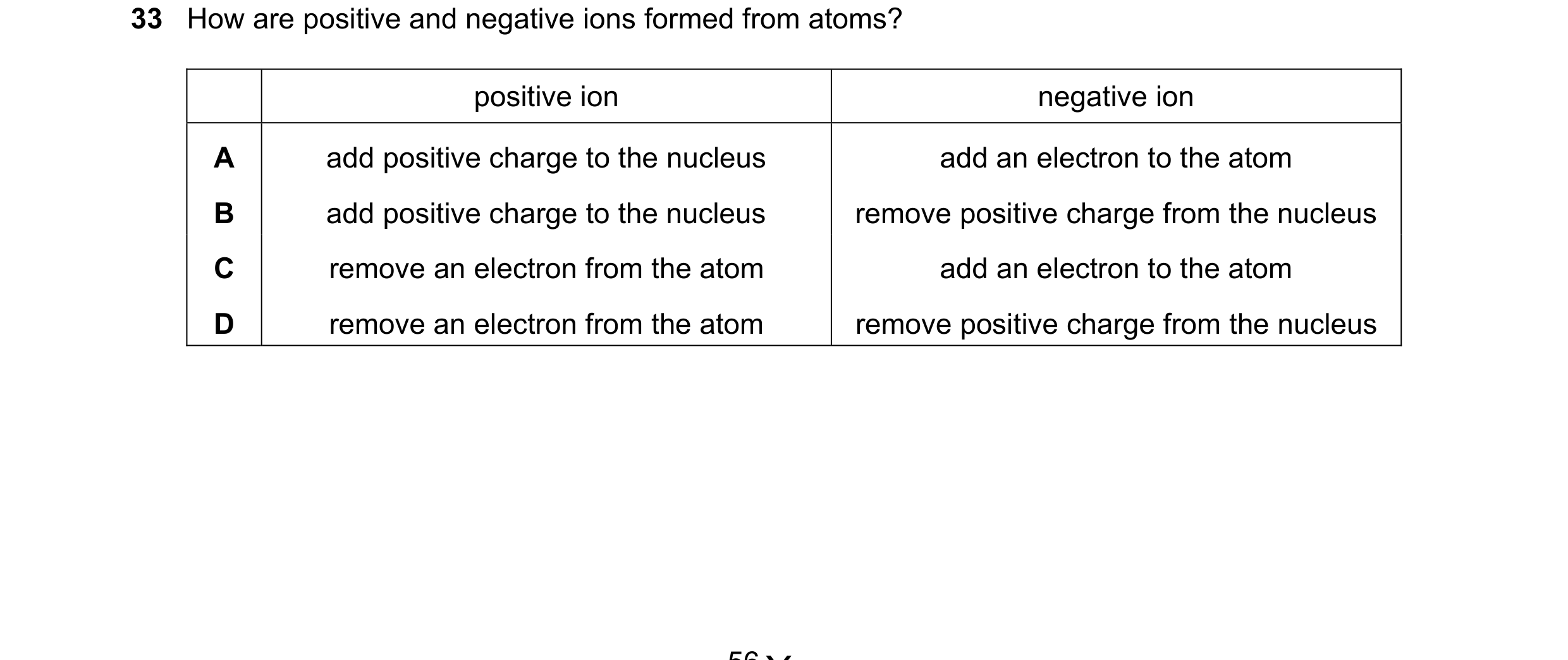

 14 / 20




 15 / 20
 16 / 20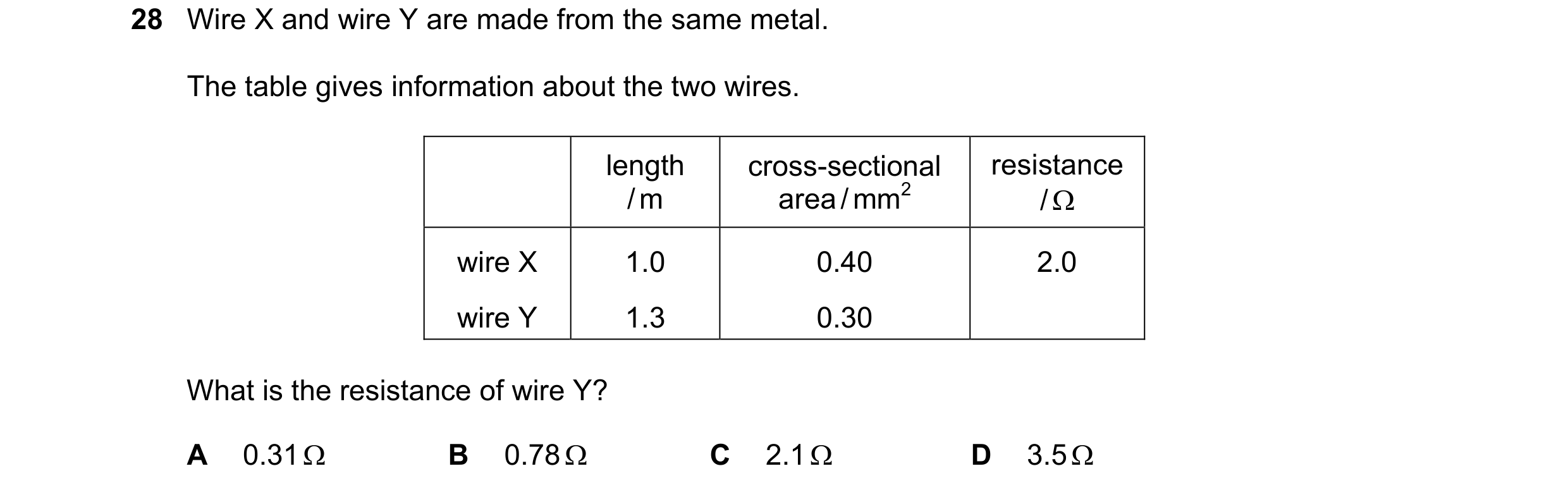
 17 / 20


 18 / 20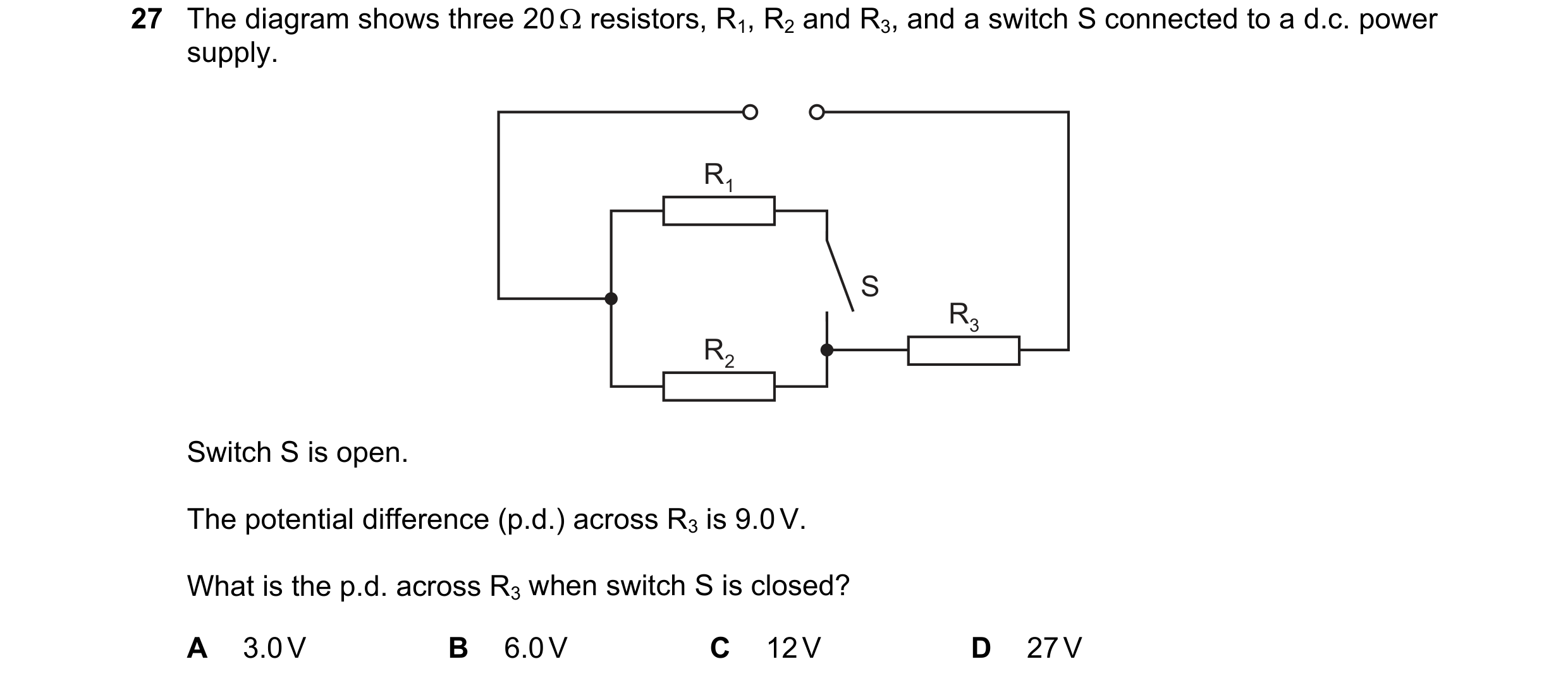

 19 / 20
 20 / 20