Questions as text
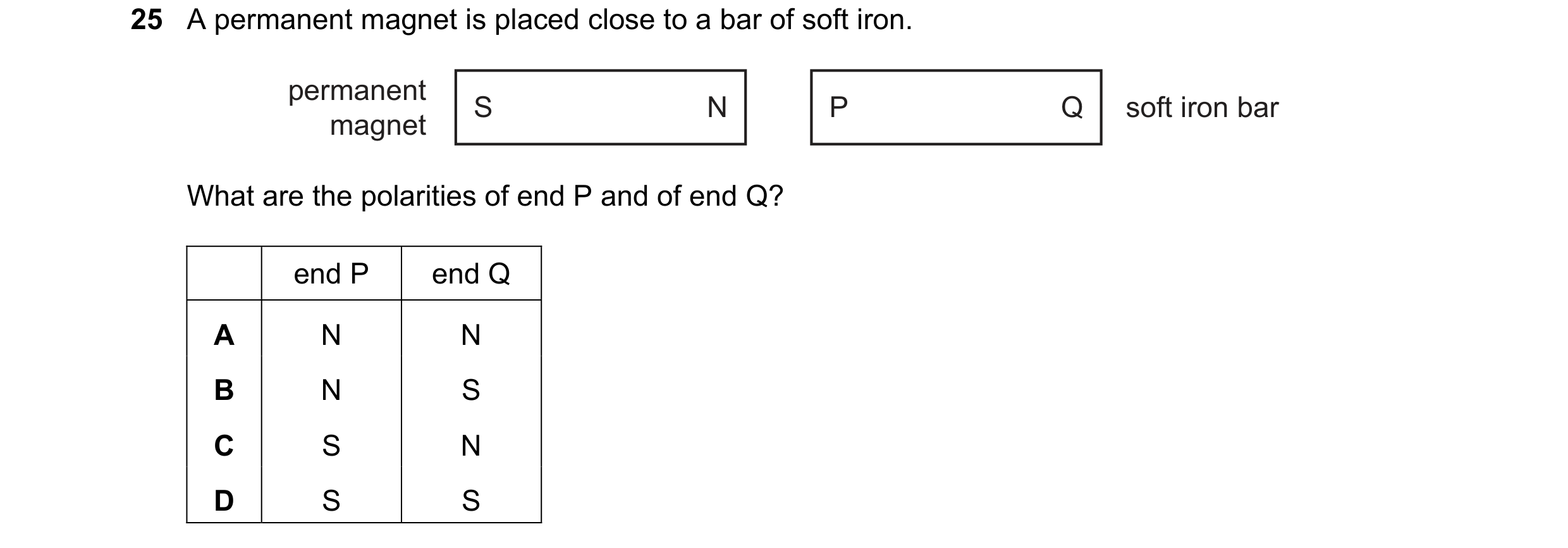
Q1 · A permanent magnet is placed close to a bar of soft iron 0972/21 May/June 2018
25 A permanent magnet is placed close to a bar of soft iron. permanent S N P Q soft iron bar magnet What are the polarities of end P and of end Q? end P end Q A N N B N S C S N D S S
1 marks
Answer: C
This question in 0972/21 May/June 2018
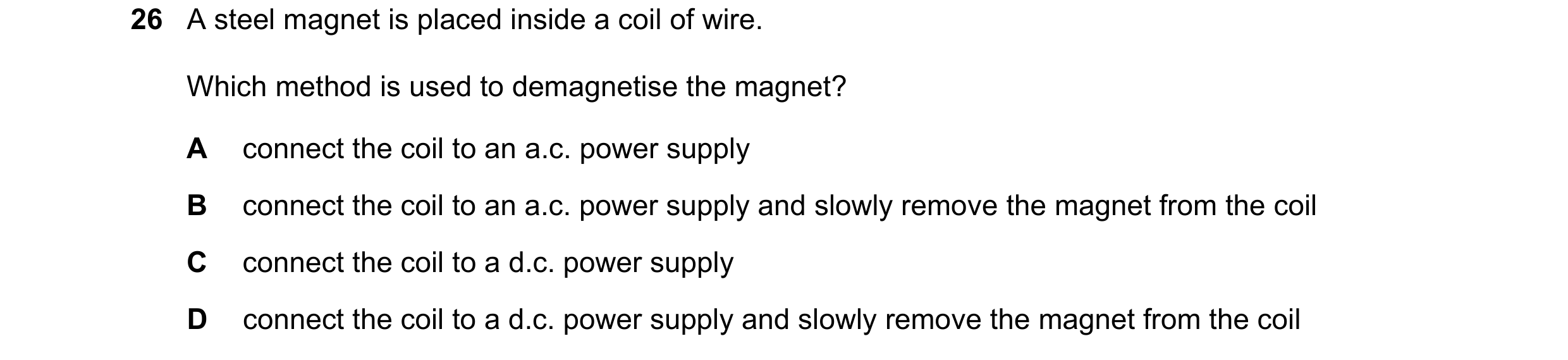
Q2 · A steel magnet is placed inside a coil of wire 0972/21 May/June 2018
26 A steel magnet is placed inside a coil of wire. Which method is used to demagnetise the magnet? A connect the coil to an a.c. power supply B connect the coil to an a.c. power supply and slowly remove the magnet from the coil C connect the coil to a d.c. power supply D connect the coil to a d.c. power supply and slowly remove the magnet from the coil
1 marks
Answer: B
This question in 0972/21 May/June 2018
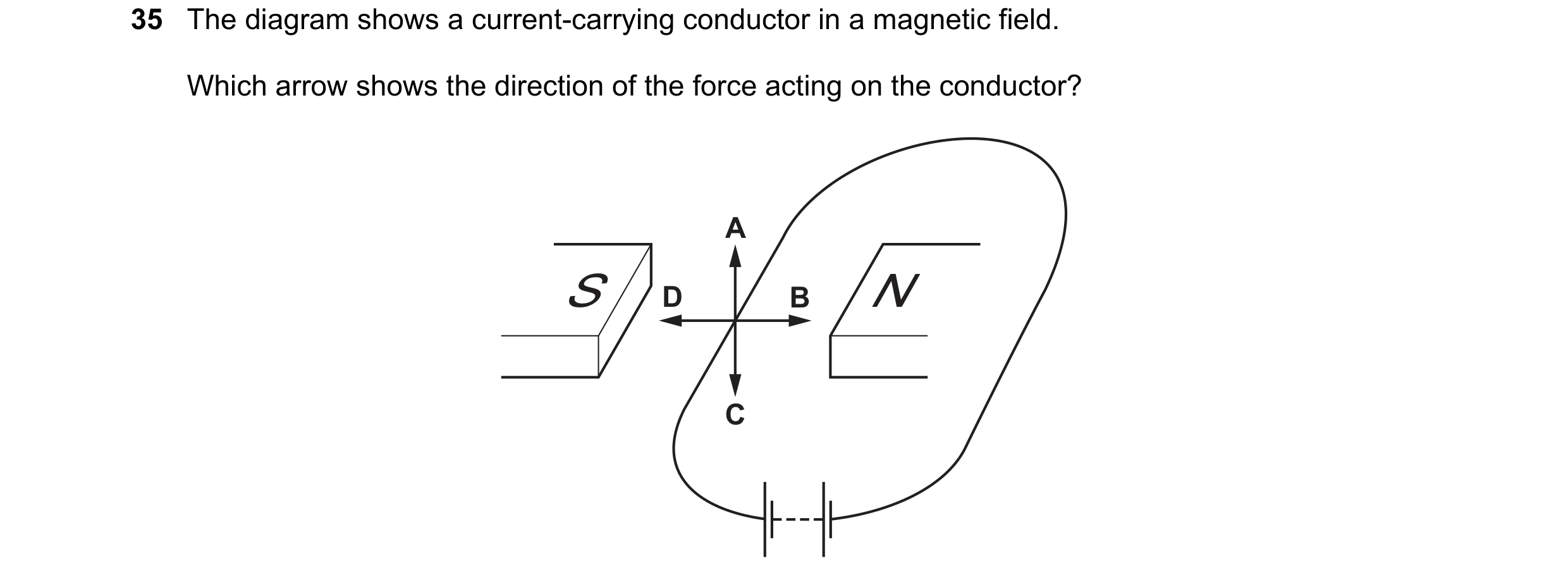
Q3 · The diagram shows a current-carrying conductor in a magnetic field 0972/21 May/June 2018
35 The diagram shows a current-carrying conductor in a magnetic field. Which arrow shows the direction of the force acting on the conductor? A S N D B C
1 marks
Answer: A
This question in 0972/21 May/June 2018
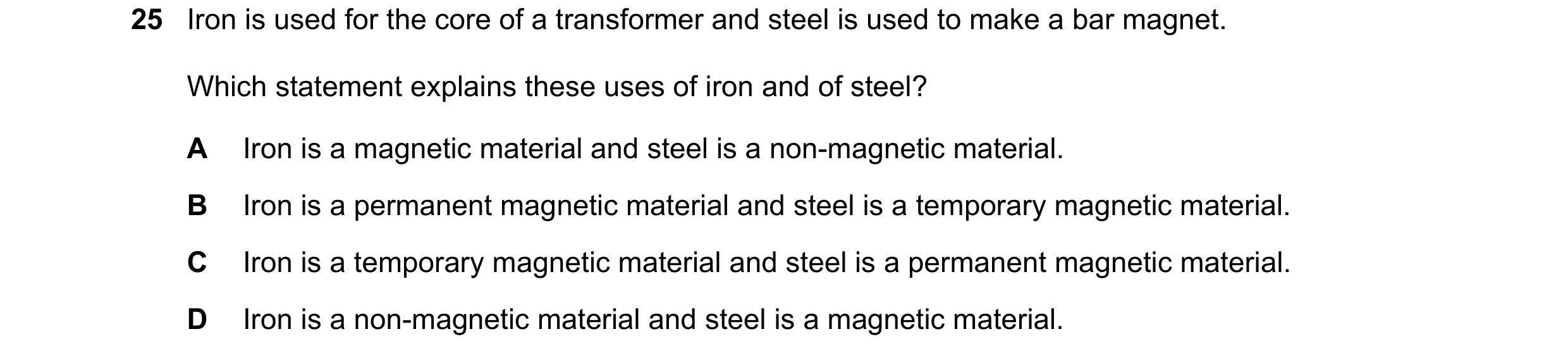
Q4 · Iron is used for the core of a transformer and steel is used to make a bar magnet 0972/21 Oct/Nov 2018
25 Iron is used for the core of a transformer and steel is used to make a bar magnet. Which statement explains these uses of iron and of steel? A Iron is a magnetic material and steel is a non-magnetic material. B Iron is a permanent magnetic material and steel is a temporary magnetic material. C Iron is a temporary magnetic material and steel is a permanent magnetic material. D Iron is a non-magnetic material and steel is a magnetic material.
1 marks
Answer: C
This question in 0972/21 Oct/Nov 2018
Q5 · A bar magnet is placed inside a current-carrying coil 0972/21 Oct/Nov 2018
27 A bar magnet is placed inside a current-carrying coil. The diagram shows four different experiments. 1 2 magnet slowly magnet slowly removed removed + – 3 4 current in coil current in coil slowly reduced slowly reduced + – In which experiments is the magnet demagnetised? A 1 and 2 B 1 and 3 C 2 and 4 D 3 and 4
1 marks
Answer: B
This question in 0972/21 Oct/Nov 2018
Q6 · Why is soft iron used for the core of an electromagnet? 0972/21 May/June 2019
26 Why is soft iron used for the core of an electromagnet? A Soft iron easily becomes a permanent magnet. B Soft iron is a good electrical conductor. C Soft iron is a poor thermal conductor. D Soft iron loses its magnetism when the current in the coil is switched off.
1 marks
Answer: D
This question in 0972/21 May/June 2019
Q7 · Two thin, uncharged strips of plastic 0972/21 May/June 2019
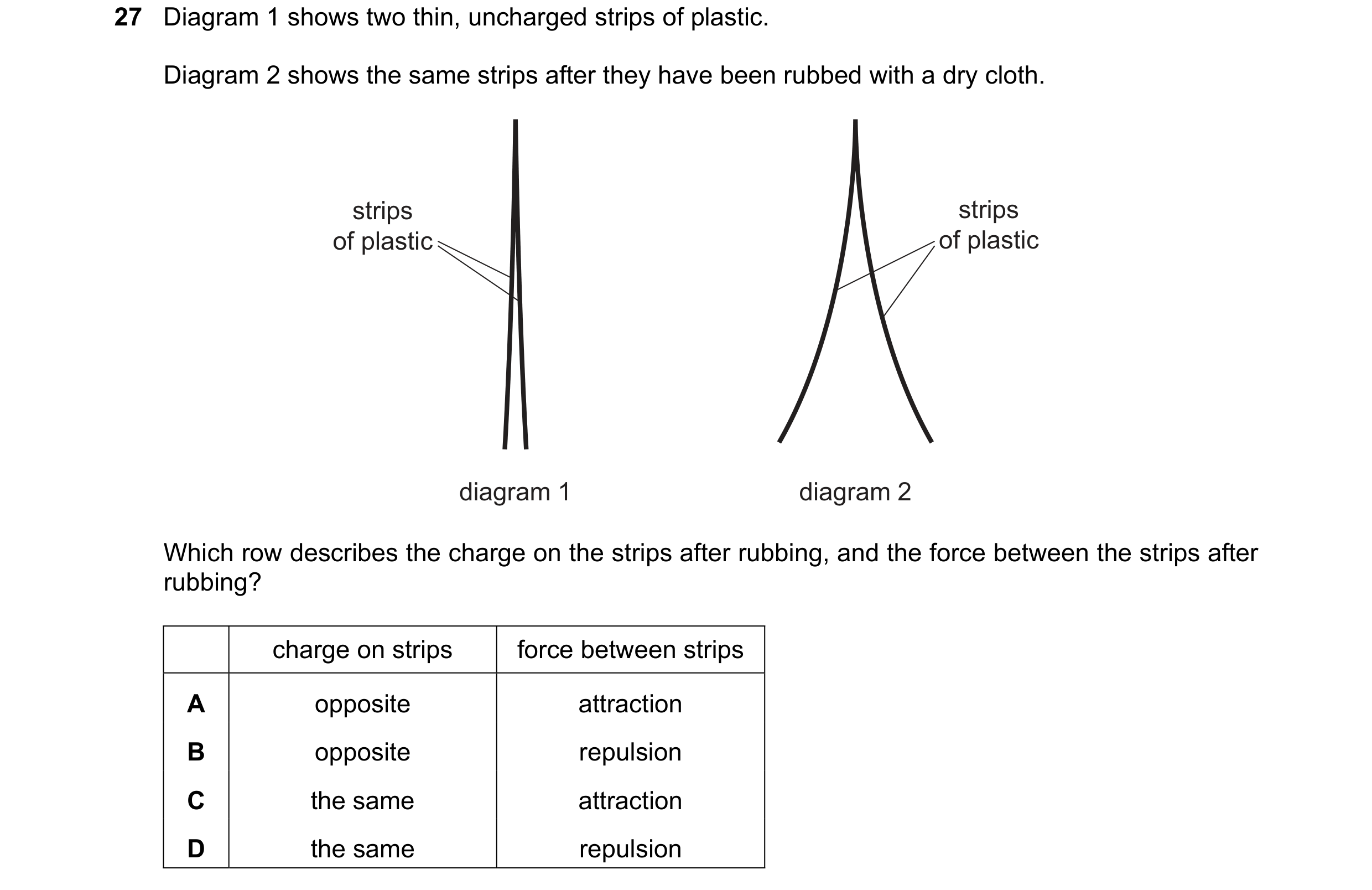
27 Diagram 1 shows two thin, uncharged strips of plastic. Diagram 2 shows the same strips after they have been rubbed with a dry cloth. strips strips of plastic of plastic diagram 1 diagram 2 Which row describes the charge on the strips after rubbing, and the force between the strips after rubbing? charge on strips force between strips A opposite attraction B opposite repulsion C the same attraction D the same repulsion
1 marks
Answer: D
This question in 0972/21 May/June 2019
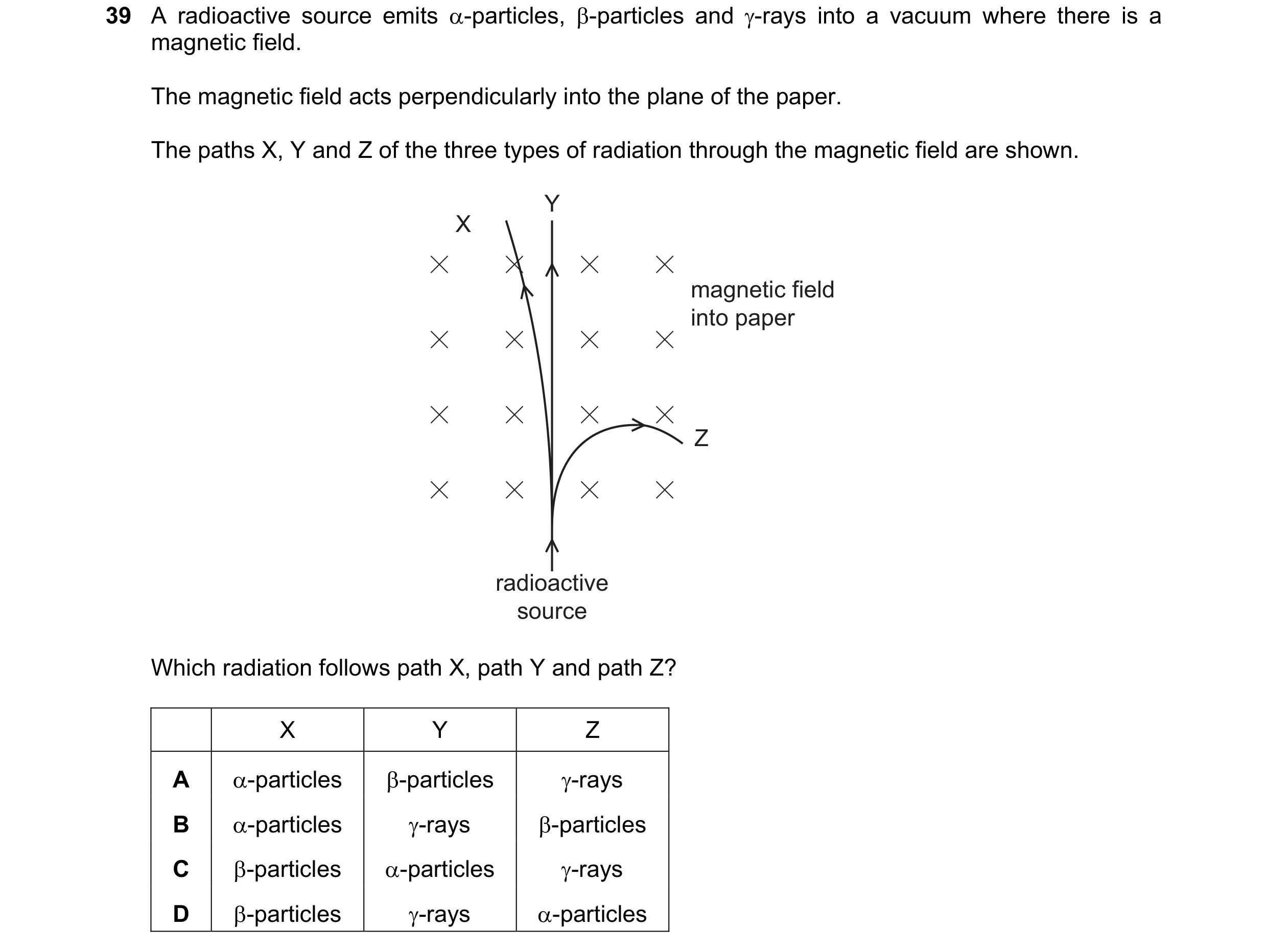
Q8 · A radioactive source emits α-particles, β-particles and γ-rays into a vacuum where there… 0972/21 May/June 2019
39 A radioactive source emits α-particles, β-particles and γ-rays into a vacuum where there is a magnetic field. The magnetic field acts perpendicularly into the plane of the paper. The paths X, Y and Z of the three types of radiation through the magnetic field are shown. Y X magnetic field into paper Z radioactive source Which radiation follows path X, path Y and path Z? X Y Z A α-particles β-particles γ-rays B α-particles γ-rays β-particles C β-particles α-particles γ-rays D β-particles γ-rays α-particles
1 marks
Answer: B
This question in 0972/21 May/June 2019
Q9 · A soft iron bar is a long way from any magnetic field 0972/22 May/June 2019
26 A soft iron bar is a long way from any magnetic field. How can the material of the bar be described? A It is magnetic and strongly magnetised. B It is magnetic and unmagnetised. C It is non-magnetic and strongly magnetised. D It is non-magnetic and unmagnetised.
1 marks
Answer: B
This question in 0972/22 May/June 2019
Q10 · Two thin, uncharged strips of plastic 0972/22 May/June 2019
27 Diagram 1 shows two thin, uncharged strips of plastic. Diagram 2 shows the same strips after they have been rubbed with a dry cloth. strips strips of plastic of plastic diagram 1 diagram 2 Which row describes the charge on the strips after rubbing, and the force between the strips after rubbing? charge on strips force between strips A opposite attraction B opposite repulsion C the same attraction D the same repulsion
1 marks
Answer: D
This question in 0972/22 May/June 2019
Q11 · The diagram shows a current-carrying wire placed between two magnetic poles 0972/22 May/June 2019
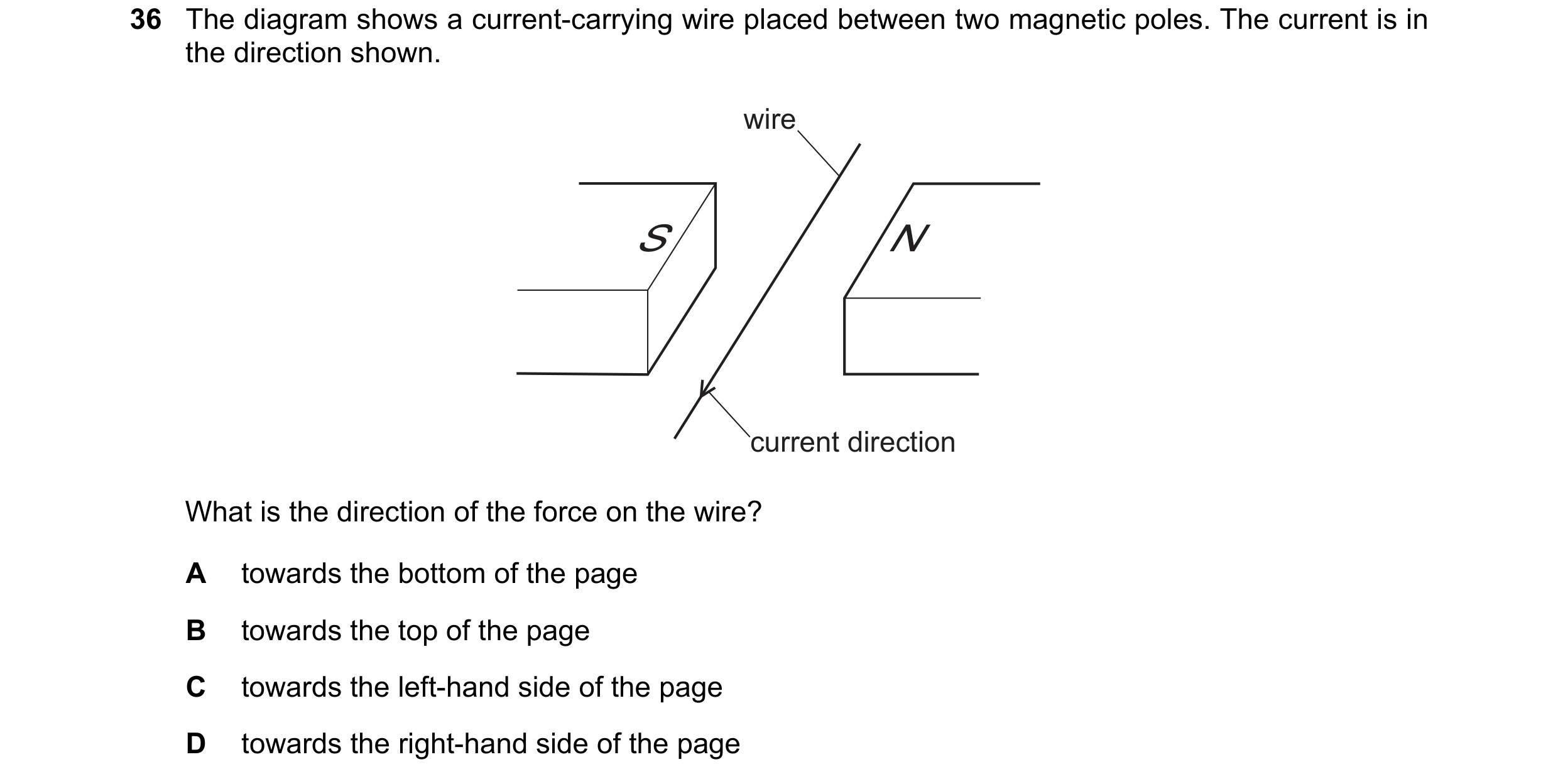
36 The diagram shows a current-carrying wire placed between two magnetic poles. The current is in the direction shown. wire S N current direction What is the direction of the force on the wire? A towards the bottom of the page B towards the top of the page C towards the left-hand side of the page D towards the right-hand side of the page
1 marks
Answer: A
This question in 0972/22 May/June 2019
Q12 · A steel bar is placed in an East-West direction for it to be demagnetised 0972/21 Oct/Nov 2019
26 A steel bar is placed in an East-West direction for it to be demagnetised. No other magnet is nearby. Which method is not suitable? A Hammering the bar. B Heating the bar to a very high temperature. C Slowly taking the bar out of a coil that carries an alternating current. D Slowly taking the bar out of a coil that carries a direct current.
1 marks
Answer: D
This question in 0972/21 Oct/Nov 2019
Q13 · A plastic rod is rubbed with a dry cloth 0972/21 Oct/Nov 2019
27 A plastic rod is rubbed with a dry cloth. The rod becomes positively charged. Why has the rod become positively charged? A It has gained electrons. B It has gained neutrons. C It has lost electrons. D It has lost neutrons.
1 marks
Answer: C
This question in 0972/21 Oct/Nov 2019
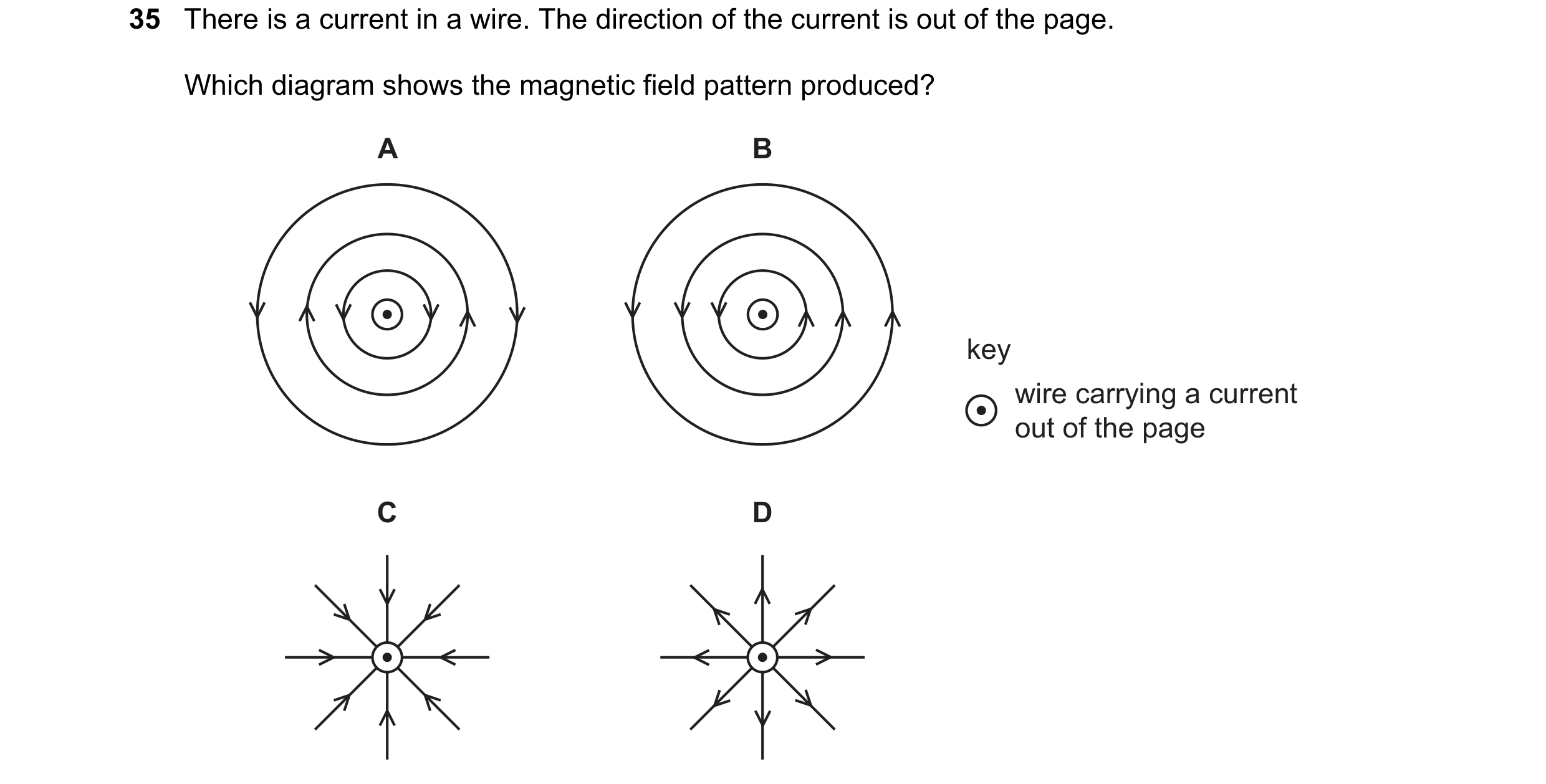
Q14 · There is a current in a wire 0972/21 Oct/Nov 2019
35 There is a current in a wire. The direction of the current is out of the page. Which diagram shows the magnetic field pattern produced? A B key wire carrying a current out of the page C D
1 marks
Answer: B
This question in 0972/21 Oct/Nov 2019
Q15 · Four nails A, B, C and D are tested to find which makes the strongest permanent magnet 0972/21 May/June 2020
26 Four nails A, B, C and D are tested to find which makes the strongest permanent magnet. One of the nails is placed against a bar magnet and the number of paper clips which the nail can support is recorded. nail N S bar magnet paper clips The bar magnet is then removed and the number of paper clips remaining attached to the nail is recorded. Each nail is tested individually. Which nail becomes the strongest permanent magnet? number of paper clips attached to the nail bar magnet present bar magnet removed A 2 0 B 2 1 C 4 3 D 5 2
1 marks
Answer: C
This question in 0972/21 May/June 2020
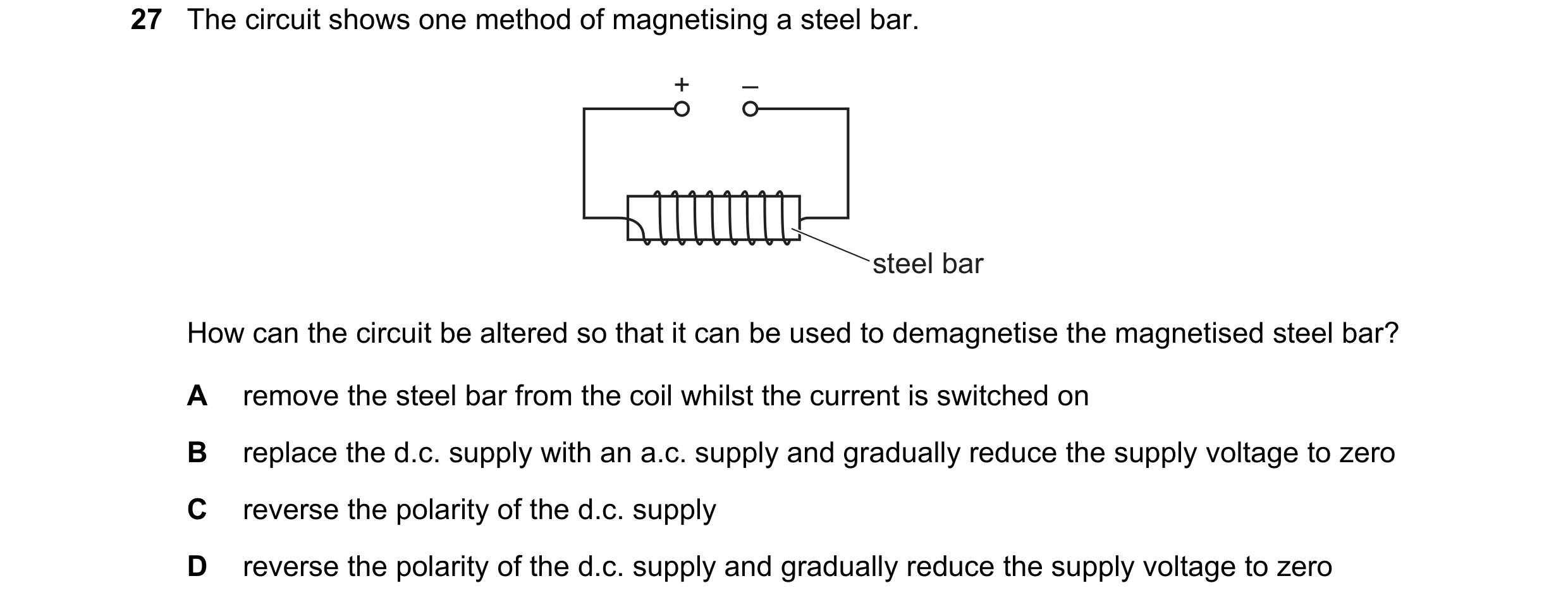
Q16 · The circuit shows one method of magnetising a steel bar 0972/21 May/June 2020
27 The circuit shows one method of magnetising a steel bar. + – steel bar How can the circuit be altered so that it can be used to demagnetise the magnetised steel bar? A remove the steel bar from the coil whilst the current is switched on B replace the d.c. supply with an a.c. supply and gradually reduce the supply voltage to zero C reverse the polarity of the d.c. supply D reverse the polarity of the d.c. supply and gradually reduce the supply voltage to zero
1 marks
Answer: B
This question in 0972/21 May/June 2020
Q17 · Four nails A, B, C and D are tested to find which makes the strongest permanent magnet 0972/22 May/June 2020
26 Four nails A, B, C and D are tested to find which makes the strongest permanent magnet. One of the nails is placed against a bar magnet and the number of paper clips which the nail can support is recorded. nail N S bar magnet paper clips The bar magnet is then removed and the number of paper clips remaining attached to the nail is recorded. Each nail is tested individually. Which nail becomes the strongest permanent magnet? number of paper clips attached to the nail bar magnet present bar magnet removed A 2 0 B 2 1 C 4 3 D 5 2
1 marks
Answer: C
This question in 0972/22 May/June 2020
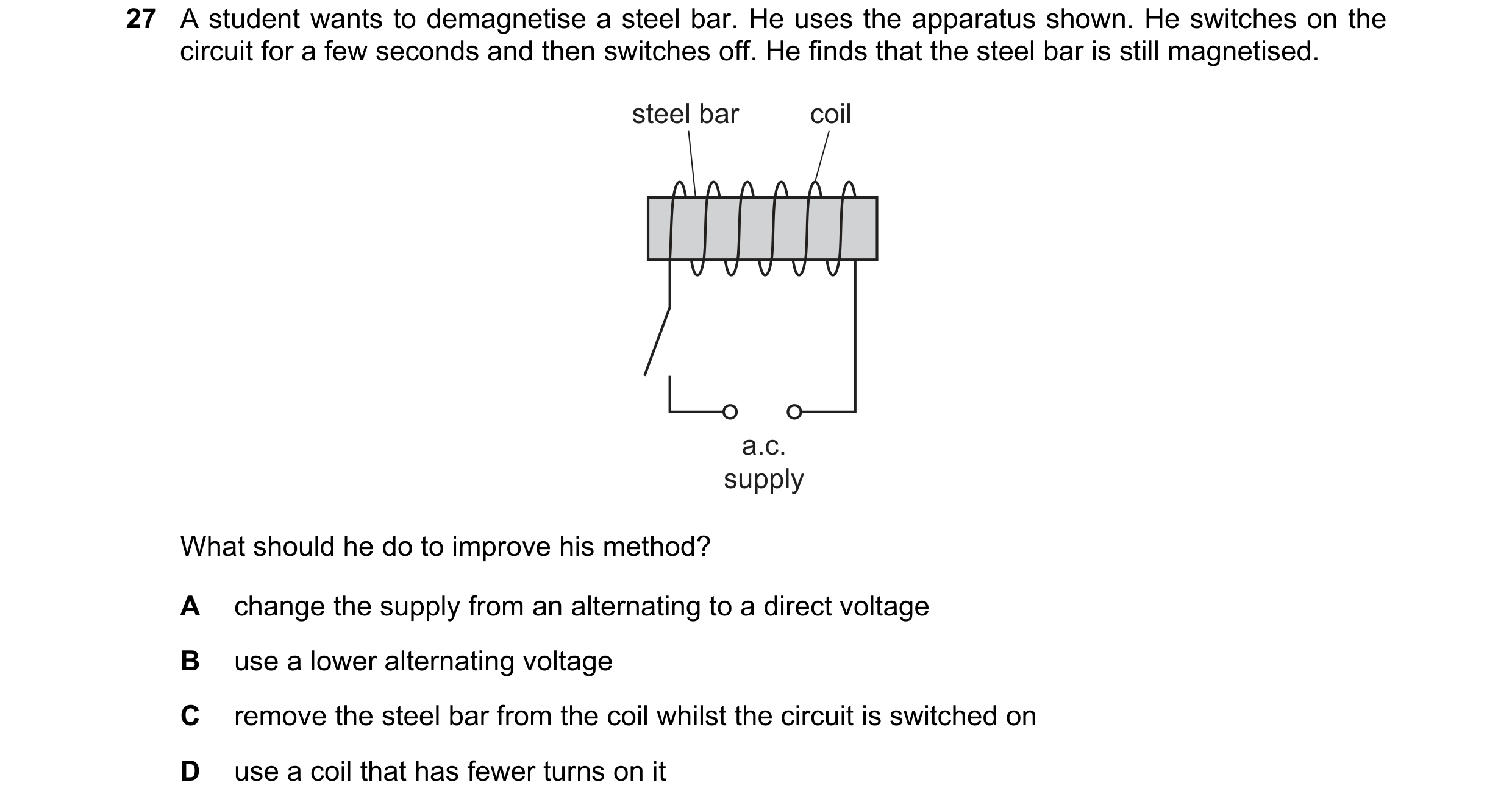
Q18 · A student wants to demagnetise a steel bar 0972/22 May/June 2020
27 A student wants to demagnetise a steel bar. He uses the apparatus shown. He switches on the circuit for a few seconds and then switches off. He finds that the steel bar is still magnetised. steel bar coil a.c. supply What should he do to improve his method? A change the supply from an alternating to a direct voltage B use a lower alternating voltage C remove the steel bar from the coil whilst the circuit is switched on D use a coil that has fewer turns on it
1 marks
Answer: C
This question in 0972/22 May/June 2020
Q19 · The diagram shows the magnetic field due to a current in a solenoid 0972/22 May/June 2020
35 The diagram shows the magnetic field due to a current in a solenoid. Where is the magnetic field the strongest? A D B C
1 marks
Answer: C
This question in 0972/22 May/June 2020
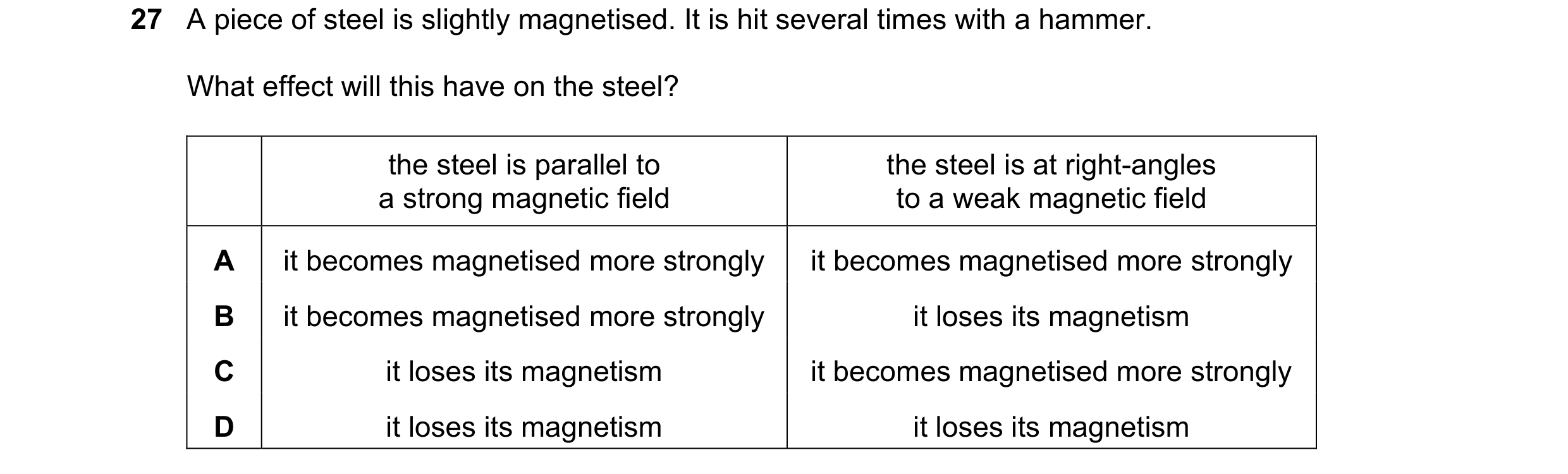
Q20 · A piece of steel is slightly magnetised 0972/21 Oct/Nov 2020
27 A piece of steel is slightly magnetised. It is hit several times with a hammer. What effect will this have on the steel? the steel is parallel to the steel is at right-angles a strong magnetic field to a weak magnetic field A it becomes magnetised more strongly it becomes magnetised more strongly B it becomes magnetised more strongly it loses its magnetism C it loses its magnetism it becomes magnetised more strongly D it loses its magnetism it loses its magnetism
1 marks
Answer: B
This question in 0972/21 Oct/Nov 2020
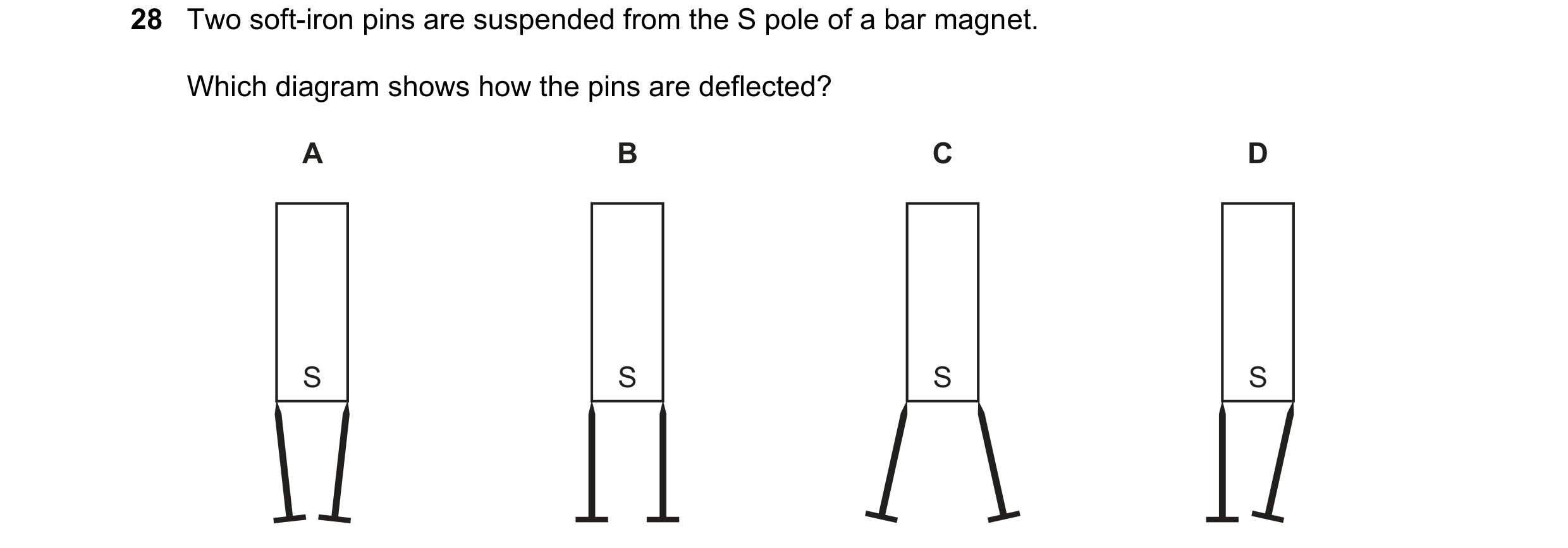
Q21 · Two soft-iron pins are suspended from the S pole of a bar magnet 0972/21 Oct/Nov 2020
28 Two soft-iron pins are suspended from the S pole of a bar magnet. Which diagram shows how the pins are deflected? A B C D S S S S
1 marks
Answer: C
This question in 0972/21 Oct/Nov 2020
Q22 · An uncharged, metal sphere is placed on an insulating support 0972/21 Oct/Nov 2021
25 An uncharged, metal sphere is placed on an insulating support. A positively charged rod is brought close to the sphere, but does not touch it. + + + + + + How do the charges in the sphere move and what is now the charge on the sphere? movement of charges charge on sphere A negative charges move positive to the right of the sphere B negative charges move neutral to the right of the sphere C positive charges move positive to the left of the sphere D positive charges move neutral to the left of the sphere
1 marks
Answer: B
This question in 0972/21 Oct/Nov 2021
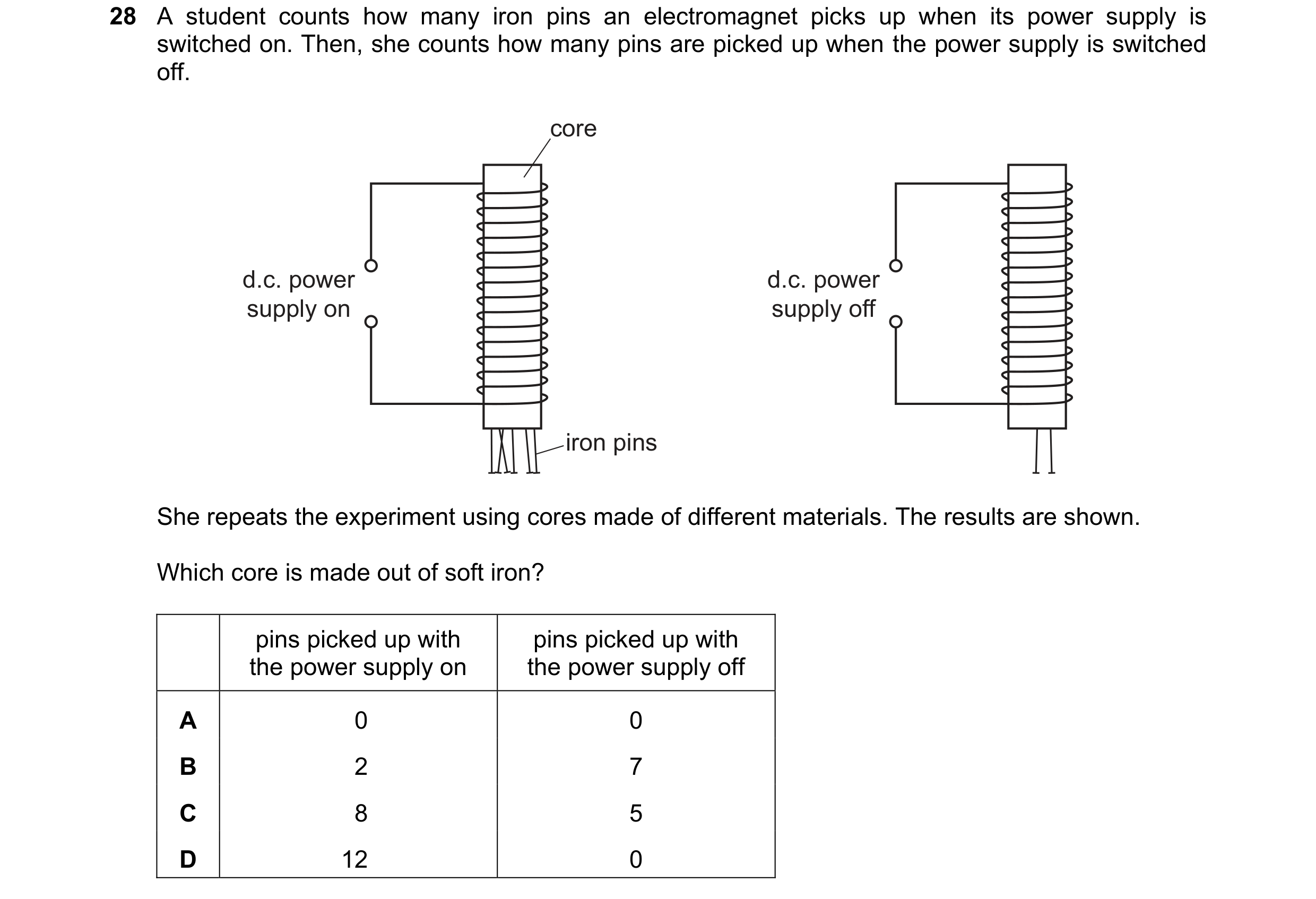
Q23 · A student counts how many iron pins an electromagnet picks up when its power supply is… 0972/21 May/June 2022
28 A student counts how many iron pins an electromagnet picks up when its power supply is switched on. Then, she counts how many pins are picked up when the power supply is switched off. core d.c. power d.c. power supply on supply off iron pins She repeats the experiment using cores made of different materials. The results are shown. Which core is made out of soft iron? pins picked up with pins picked up with the power supply on the power supply off A 0 0 B 2 7 C 8 5 D 12 0
1 marks
Answer: D
This question in 0972/21 May/June 2022
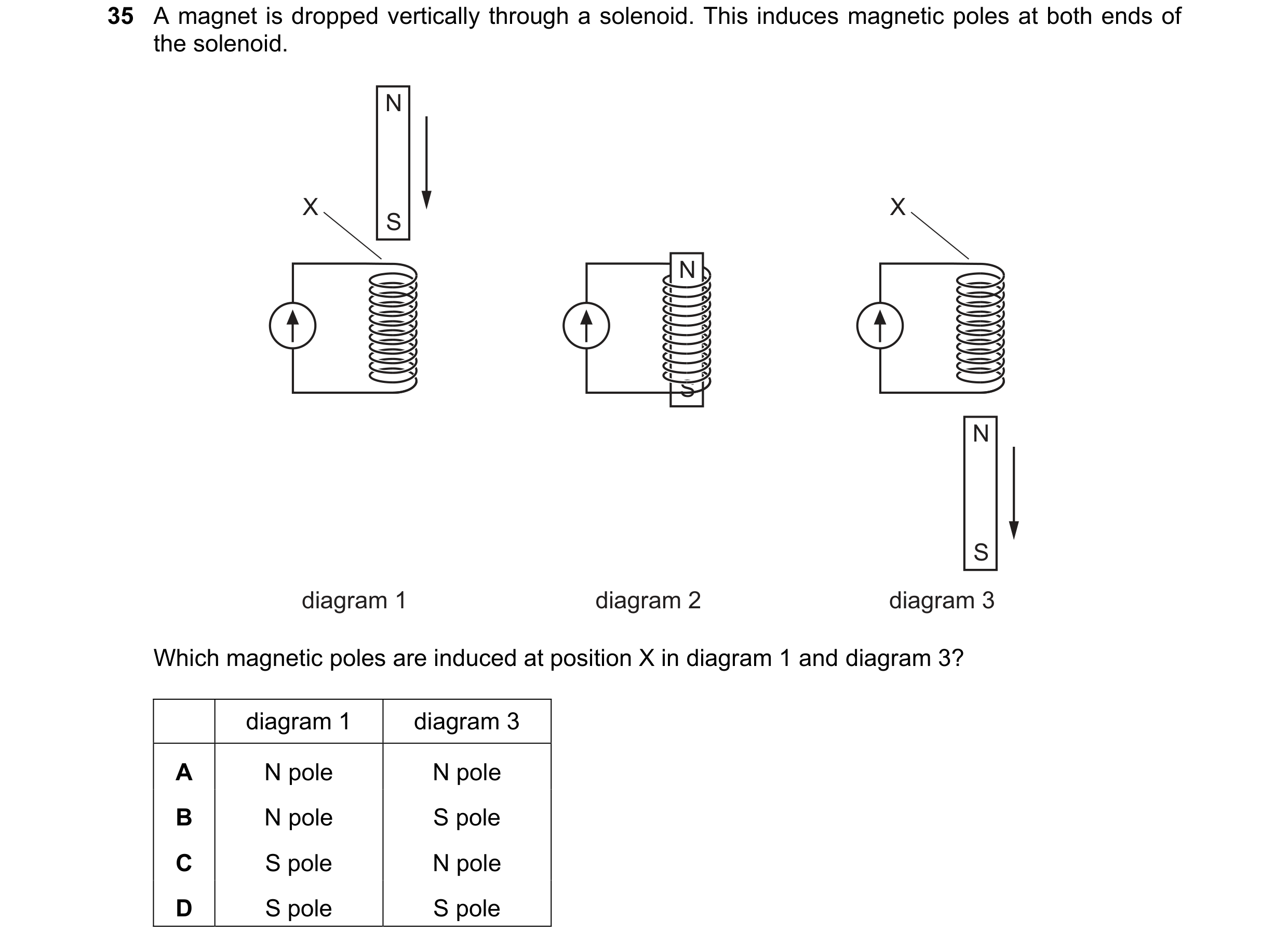
Q24 · A magnet is dropped vertically through a solenoid 0972/21 May/June 2022
35 A magnet is dropped vertically through a solenoid. This induces magnetic poles at both ends of the solenoid. N X X S N S N S diagram 1 diagram 2 diagram 3 Which magnetic poles are induced at position X in diagram 1 and diagram 3? diagram 1 diagram 3 A N pole N pole B N pole S pole C S pole N pole D S pole S pole
1 marks
Answer: C
This question in 0972/21 May/June 2022
Q25 · The diagram shows the magnetic fields around three objects, P, Q and R, placed close to… 0972/22 May/June 2022
28 The diagram shows the magnetic fields around three objects, P, Q and R, placed close to each other. P Q R Which row shows the nature of each of the objects? P Q R permanent magnet permanent magnet A copper rod N S N S permanent magnet permanent magnet B copper rod N S S N permanent magnet permanent magnet C iron rod N S N S permanent magnet permanent magnet D iron rod N S S N
1 marks
Answer: B
This question in 0972/22 May/June 2022
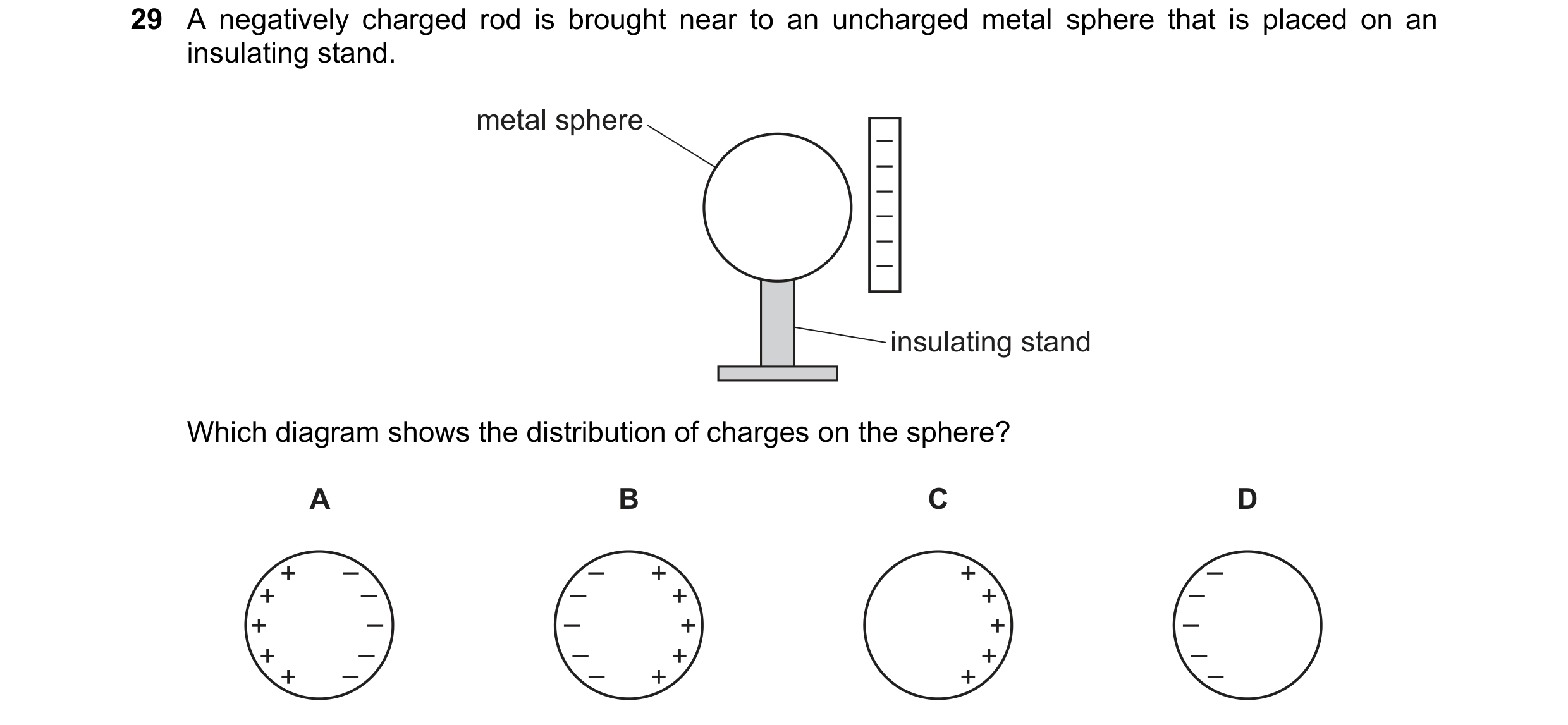
Q26 · A negatively charged rod is brought near to an uncharged metal sphere that is placed on… 0972/22 May/June 2022
29 A negatively charged rod is brought near to an uncharged metal sphere that is placed on an insulating stand. metal sphere – – – – – – insulating stand Which diagram shows the distribution of charges on the sphere? A B C D + – – + + – + – – + + – + – – + + – + –– –– + + –– + + +
1 marks
Answer: B
This question in 0972/22 May/June 2022
Q27 · Which statement is not a method for magnetising an iron bar? 0972/21 Oct/Nov 2022
25 Which statement is not a method for magnetising an iron bar? A Place the bar next to a magnet and hammer the bar. B Place the bar inside a solenoid. Switch on an alternating current (a.c.) in the coil and gradually reduce the current. C Place the bar inside a solenoid. Switch on a direct current (d.c.) in the coil and gradually reduce the current. D Stroke the bar repeatedly with a magnet.
1 marks
Answer: B
This question in 0972/21 Oct/Nov 2022
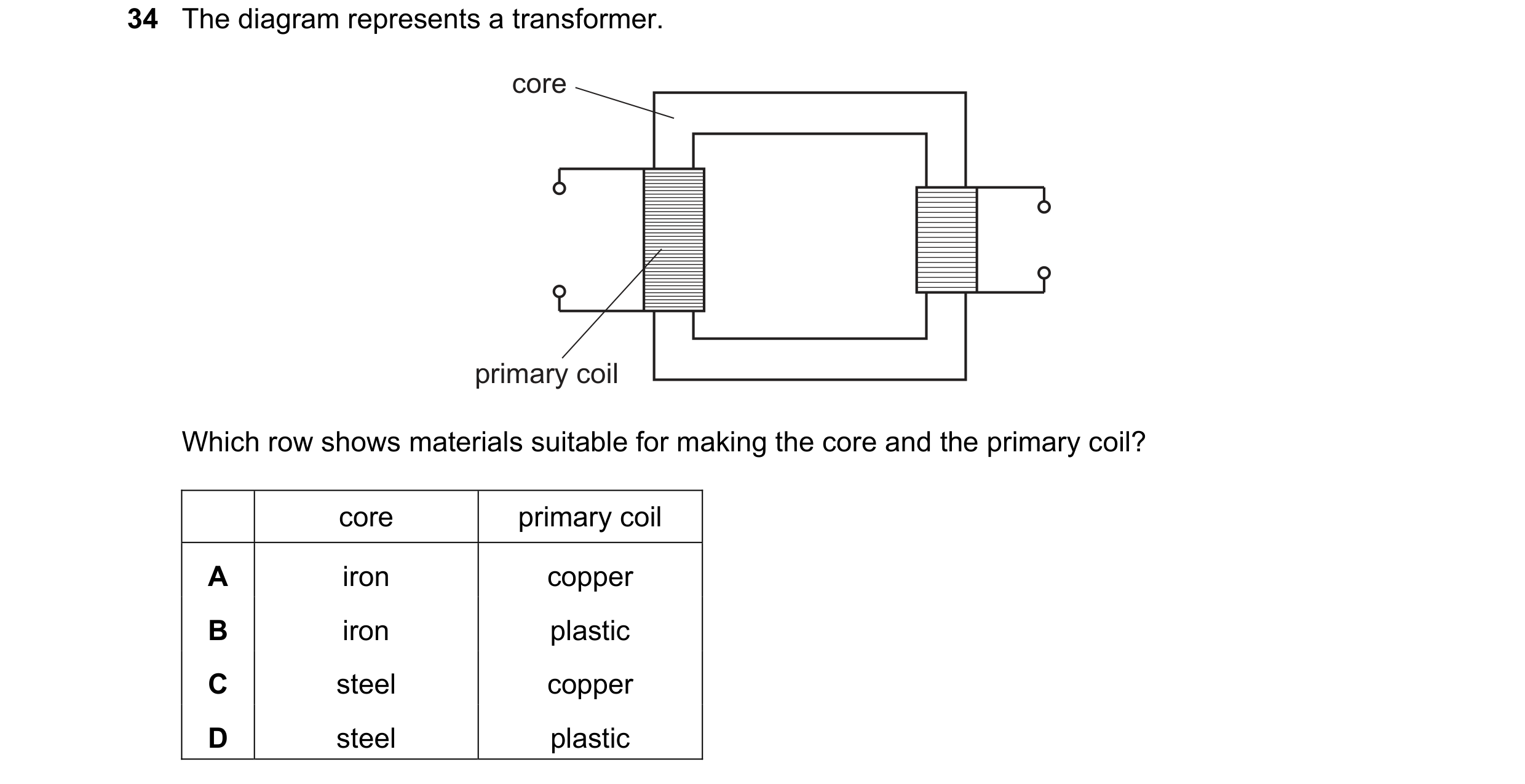
Q28 · The diagram represents a transformer 0972/21 Oct/Nov 2022
34 The diagram represents a transformer. core primary coil Which row shows materials suitable for making the core and the primary coil? core primary coil A iron copper B iron plastic C steel copper D steel plastic
1 marks
Answer: A
This question in 0972/21 Oct/Nov 2022
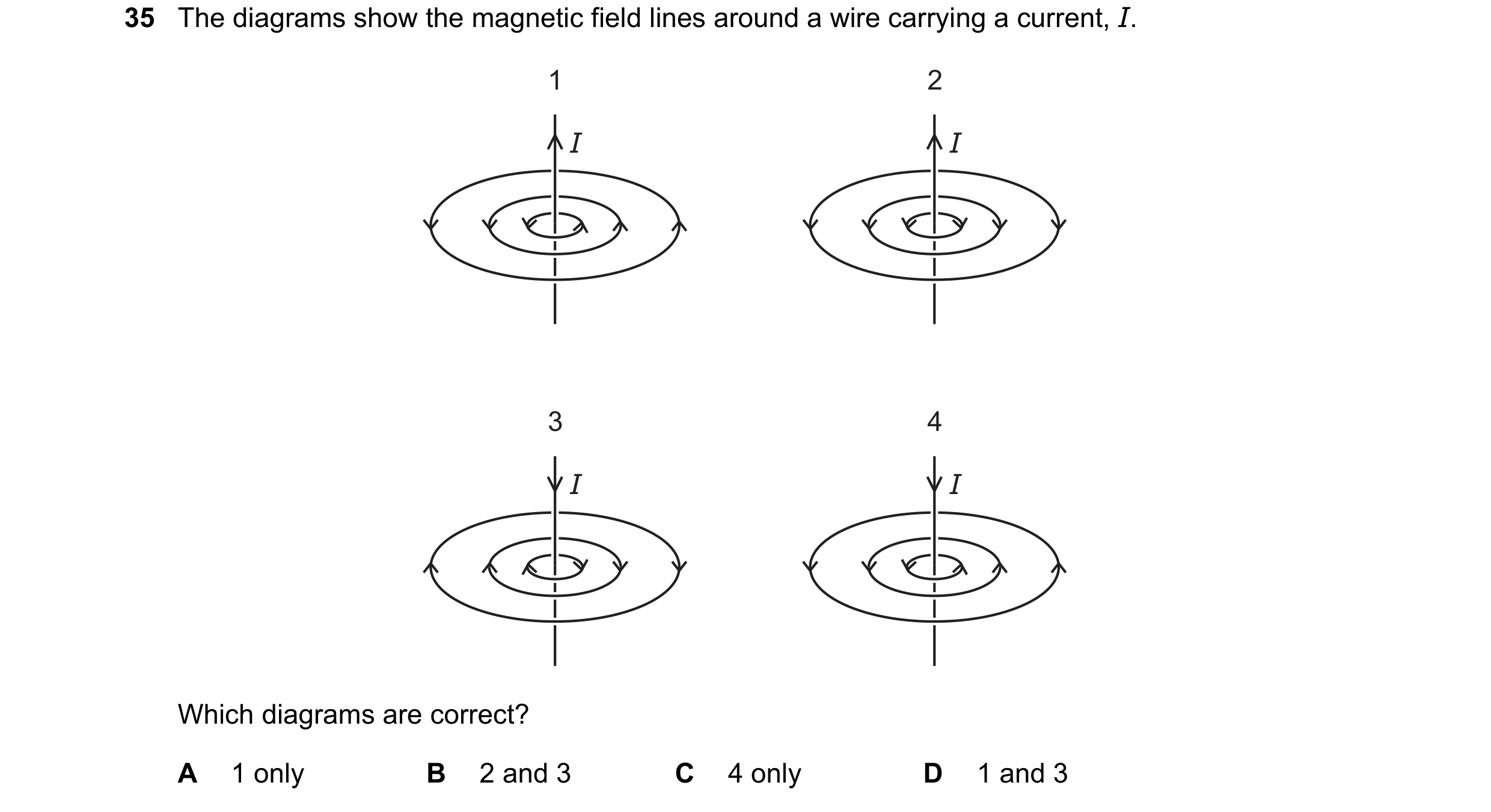
Q29 · The diagrams show the magnetic field lines around a wire carrying a current, I 0972/21 Oct/Nov 2022
35 The diagrams show the magnetic field lines around a wire carrying a current, I. 1 2 I I 3 4 I I Which diagrams are correct? A 1 only B 2 and 3 C 4 only D 1 and 3
1 marks
Answer: D
This question in 0972/21 Oct/Nov 2022
Q30 · An unmagnetised piece of soft iron is placed close to a strong permanent magnet, as shown 0972/21 May/June 2023
23 An unmagnetised piece of soft iron is placed close to a strong permanent magnet, as shown. S N X permanent soft iron magnet What is the induced polarity of end X of the soft iron and in which direction does the magnetic force act on the soft iron? direction of force polarity of end X on the soft iron A N to the left B N to the right C S to the left D S to the right
1 marks
Answer: C
This question in 0972/21 May/June 2023
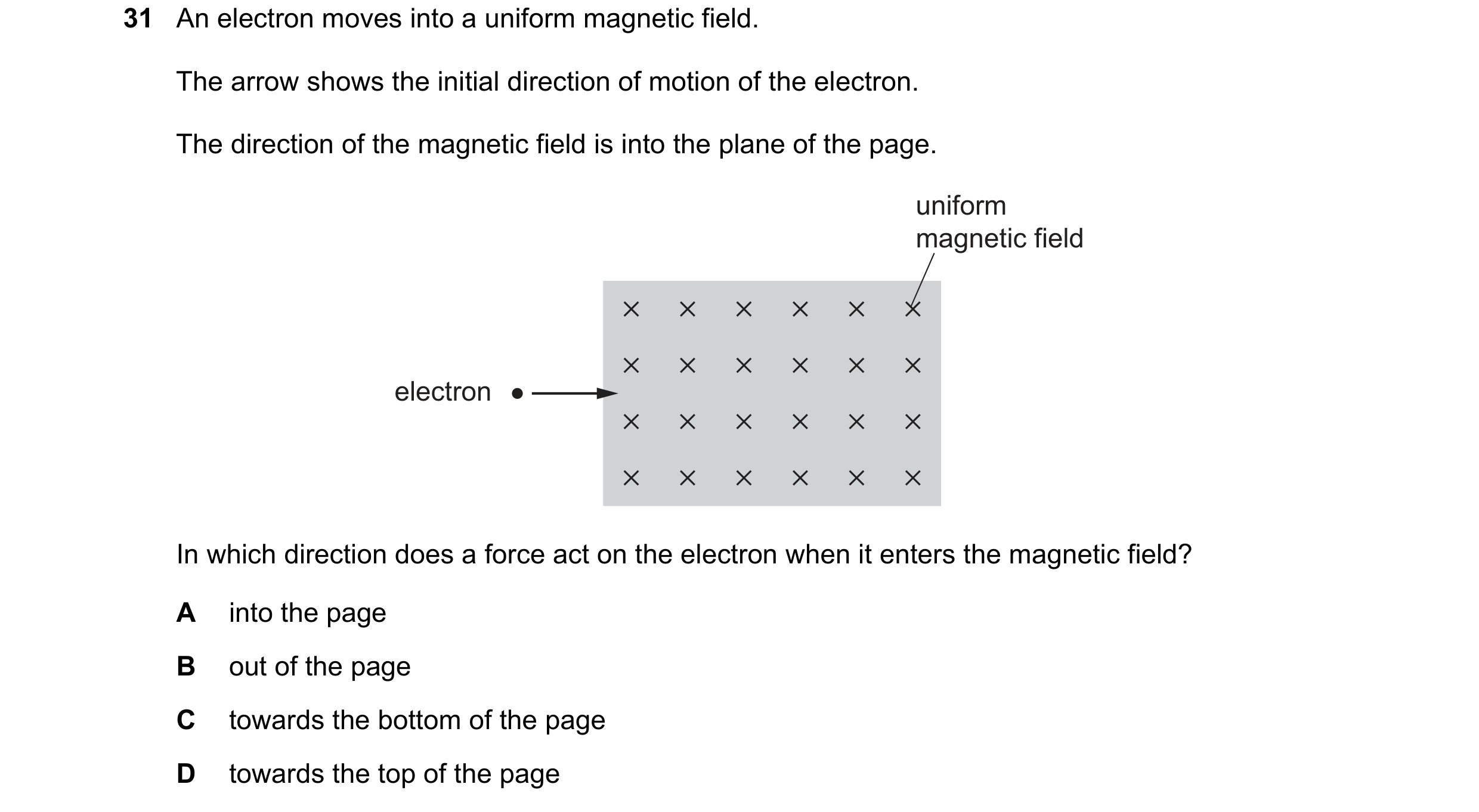
Q31 · An electron moves into a uniform magnetic field 0972/21 May/June 2023
31 An electron moves into a uniform magnetic field. The arrow shows the initial direction of motion of the electron. The direction of the magnetic field is into the plane of the page. uniform magnetic field electron In which direction does a force act on the electron when it enters the magnetic field? A into the page B out of the page C towards the bottom of the page D towards the top of the page
1 marks
Answer: C
This question in 0972/21 May/June 2023
Q32 · The magnetic field of a bar magnet can be represented by magnetic field lines 0972/22 May/June 2023
23 The magnetic field of a bar magnet can be represented by magnetic field lines. Which diagram shows two magnetic field lines correctly? A B C D N S N S N S N S
1 marks
Answer: A
This question in 0972/22 May/June 2023
Q33 · The diagram shows the pattern of the magnetic field due to the current I in a straight… 0972/22 May/June 2023
31 The diagram shows the pattern of the magnetic field due to the current I in a straight wire. I Y Q P X Which row is correct? relative direction of field strength of field A X greater at P than Q B Y greater at P than Q C X greater at Q than P D Y greater at Q than P
1 marks
Answer: D
This question in 0972/22 May/June 2023
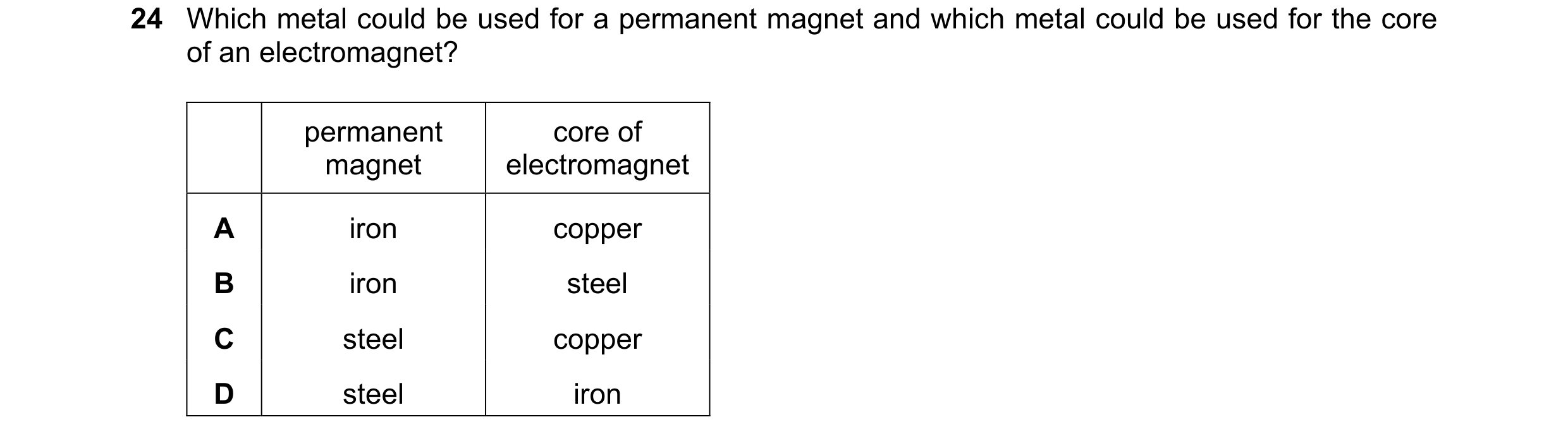
Q34 · Which metal could be used for a permanent magnet and which metal could be used for the… 0972/21 Oct/Nov 2023
24 Which metal could be used for a permanent magnet and which metal could be used for the core of an electromagnet? permanent core of magnet electromagnet A iron copper B iron steel C steel copper D steel iron
1 marks
Answer: D
This question in 0972/21 Oct/Nov 2023
Q35 · A current in a solenoid produces a uniform magnetic field inside the solenoid 0972/21 Oct/Nov 2023
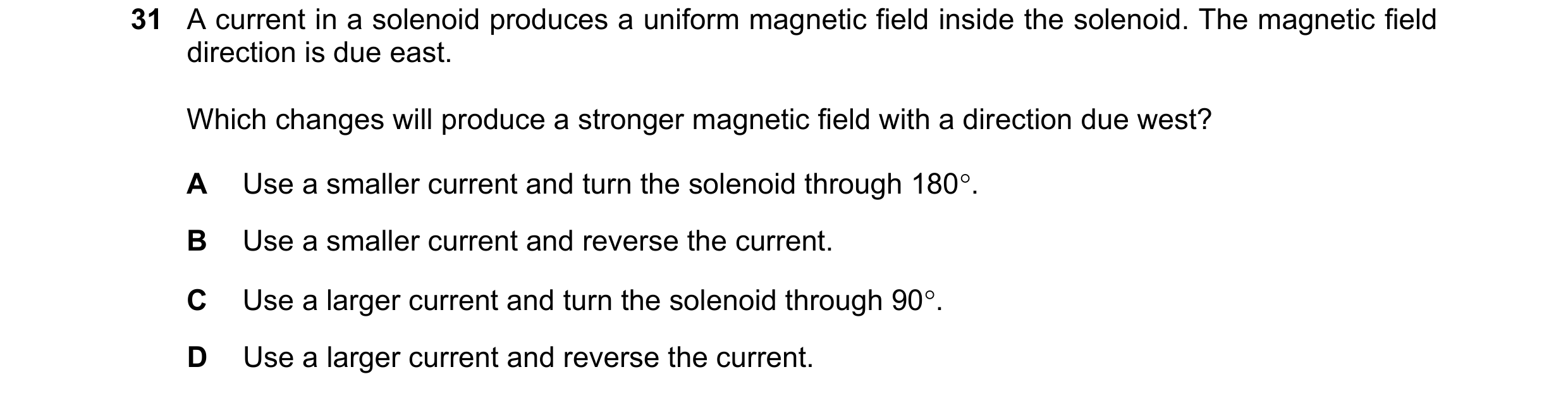
31 A current in a solenoid produces a uniform magnetic field inside the solenoid. The magnetic field direction is due east. Which changes will produce a stronger magnetic field with a direction due west? A Use a smaller current and turn the solenoid through 180. B Use a smaller current and reverse the current. C Use a larger current and turn the solenoid through 90. D Use a larger current and reverse the current.
1 marks
Answer: D
This question in 0972/21 Oct/Nov 2023
Q36 · Which row describes suitable materials for use in a temporary magnet and in a permanent… 0972/21 May/June 2024
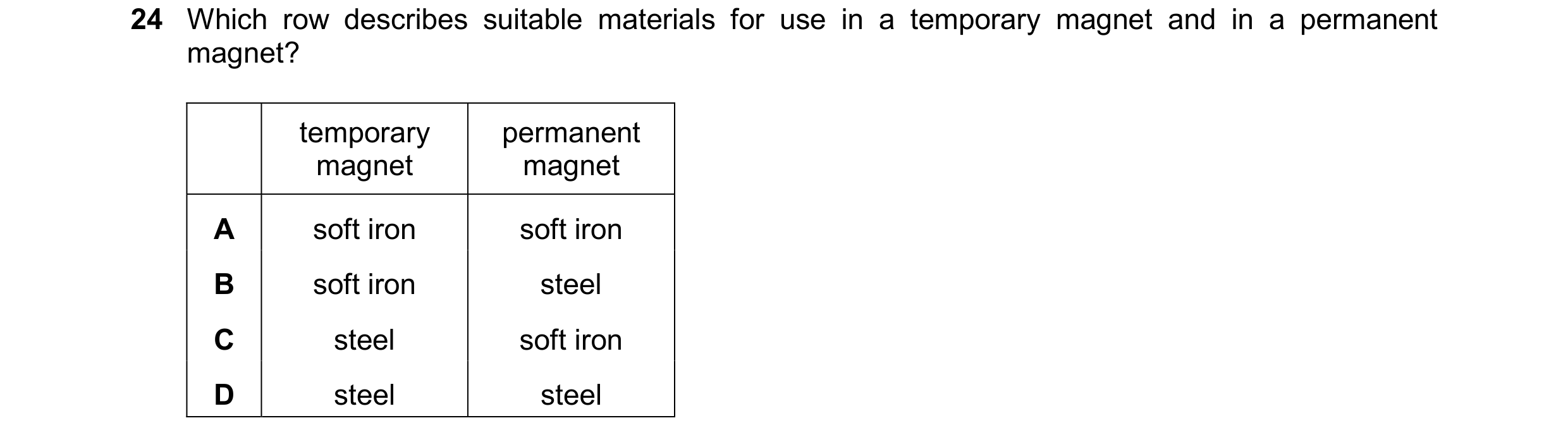
24 Which row describes suitable materials for use in a temporary magnet and in a permanent magnet? temporary permanent magnet magnet A soft iron soft iron B soft iron steel C steel soft iron D steel steel
1 marks
Answer: B
This question in 0972/21 May/June 2024
Q37 · A magnetic field is represented in the diagram by magnetic field lines 0972/21 May/June 2024
25 A magnetic field is represented in the diagram by magnetic field lines. At which point is the magnetic field strongest? B A C D
1 marks
Answer: A
This question in 0972/21 May/June 2024
Q38 · The diagram shows a solenoid carrying an electric current 0972/21 May/June 2024
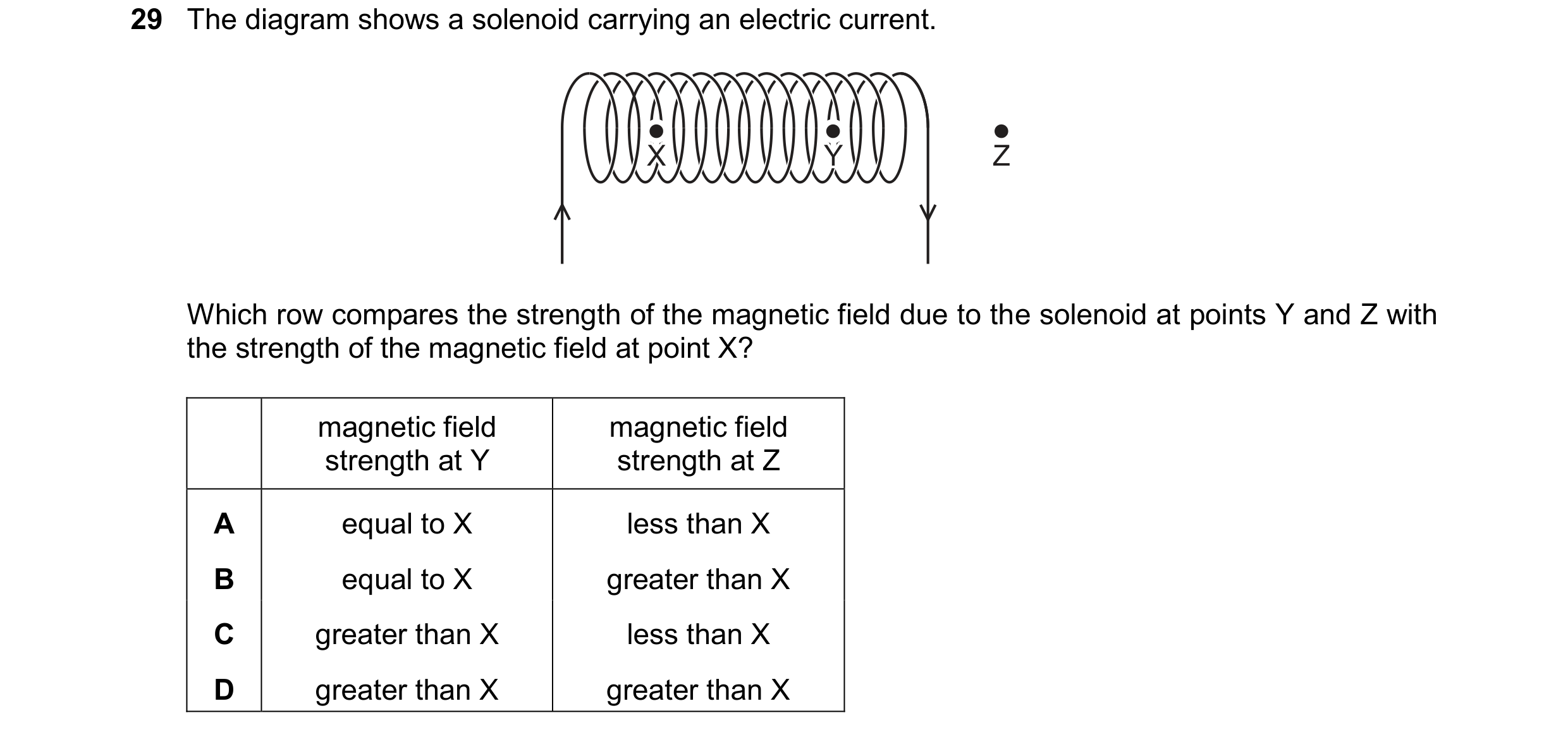
29 The diagram shows a solenoid carrying an electric current. X X Y Y Z Z Which row compares the strength of the magnetic field due to the solenoid at points Y and Z with the strength of the magnetic field at point X? magnetic field magnetic field strength at Y strength at Z A equal to X less than X B equal to X greater than X C greater than X less than X D greater than X greater than X
1 marks
Answer: A
This question in 0972/21 May/June 2024
Q39 · Which statement about the direction of a magnetic field at a point is correct? 0972/22 May/June 2024
25 Which statement about the direction of a magnetic field at a point is correct? A It is the direction of the force on an N pole placed at that point. B It is the direction of the force on an S pole placed at that point. C It is the direction of the force on a positive charge placed at that point. D It is the direction of the force on a negative charge placed at that point.
1 marks
Answer: A
This question in 0972/22 May/June 2024
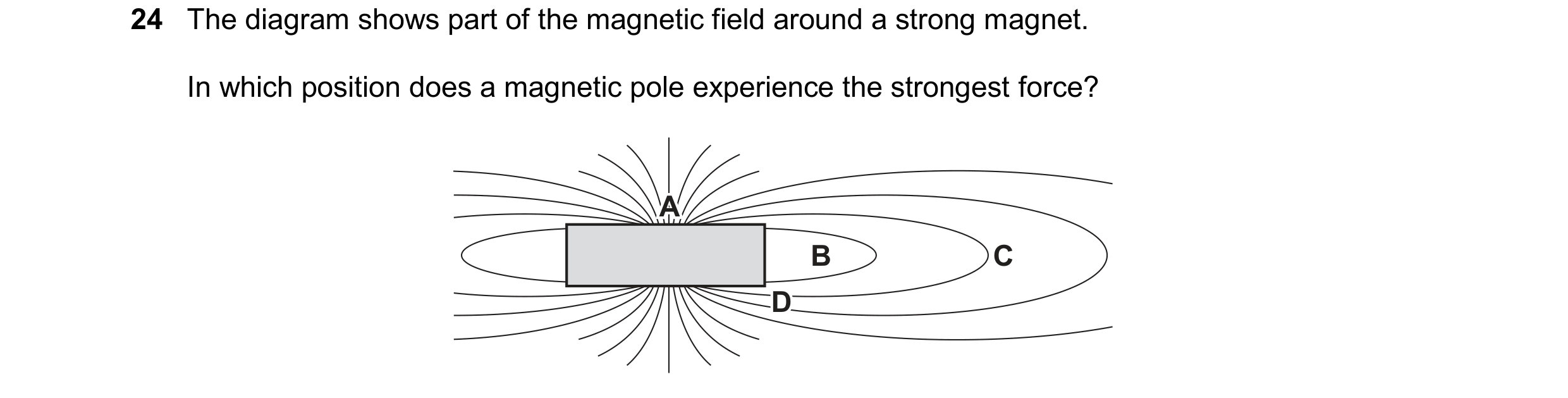
Q40 · The diagram shows part of the magnetic field around a strong magnet 0972/21 Oct/Nov 2024
24 The diagram shows part of the magnetic field around a strong magnet. In which position does a magnetic pole experience the strongest force? A B C D
1 marks
Answer: A
This question in 0972/21 Oct/Nov 2024
Q41 · The diagram shows a bracelet containing two magnets 0972/21 May/June 2025
24 The diagram shows a bracelet containing two magnets. The arrows represent the pattern and the direction of the magnetic field due to the magnets. X Y J K Which row identifies the magnetic pole at J, the magnetic pole at K and where the magnetic field is the strongest? magnetic magnetic where the magnetic pole at J pole at K field is the strongest A N N X B N N Y C S S X D S S Y
1 marks
Answer: A
This question in 0972/21 May/June 2025
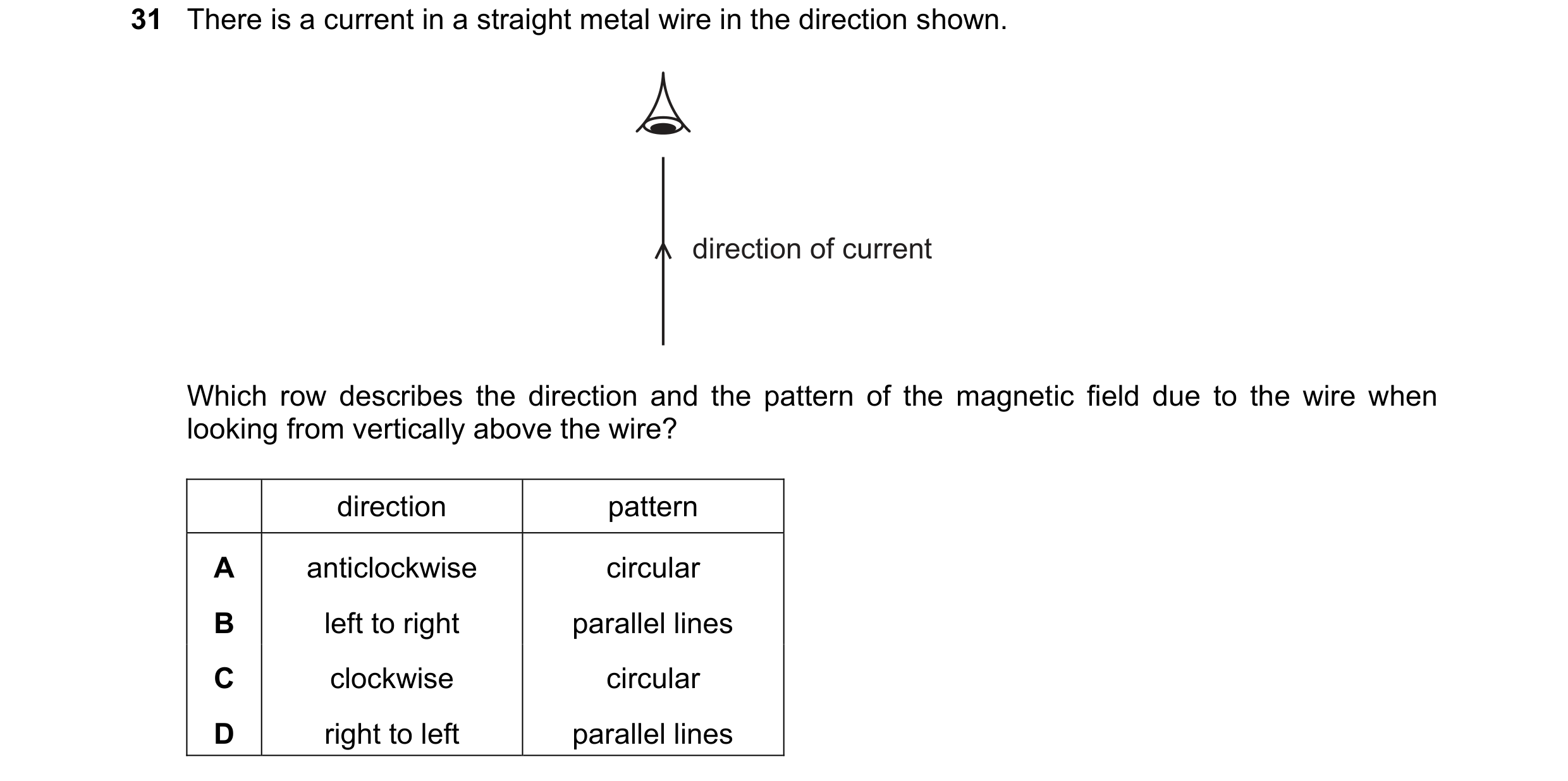
Q42 · There is a current in a straight metal wire in the direction shown 0972/21 May/June 2025
31 There is a current in a straight metal wire in the direction shown. direction of current Which row describes the direction and the pattern of the magnetic field due to the wire when looking from vertically above the wire? direction pattern A anticlockwise circular B left to right parallel lines C clockwise circular D right to left parallel lines
1 marks
Answer: A
This question in 0972/21 May/June 2025
Q43 · A simple transformer contains an iron core 0972/21 May/June 2025
32 A simple transformer contains an iron core. What is the function of the iron core in the transformer? A to conduct current from the primary coil to the secondary coil B to enable the secondary coil to act as an electromagnet C to ensure there is a high voltage between the primary coil and the secondary coil D to link the magnetic field in the primary coil to the secondary coil
1 marks
Answer: D
This question in 0972/21 May/June 2025
Q44 · The diagram shows part of the magnetic field around two magnets 0972/21 Oct/Nov 2025
24 The diagram shows part of the magnetic field around two magnets. Q P P S N R N S Which list gives the order of magnetic field strengths at the positions P, Q and R, from weakest to strongest? A P Q R B P R Q C Q P R D R Q P
1 marks
Answer: D
This question in 0972/21 Oct/Nov 2025
Q45 · A current-carrying coil in the magnetic field between the poles of two magnets… 0972/21 Oct/Nov 2025
31 A current-carrying coil in the magnetic field between the poles of two magnets experiences a turning effect. Which change would decrease the turning effect? A decreasing the distance between the magnets B increasing the current in the coil C using stronger magnets D decreasing the number of turns on the coil
1 marks
Answer: D
This question in 0972/21 Oct/Nov 2025
 1 / 17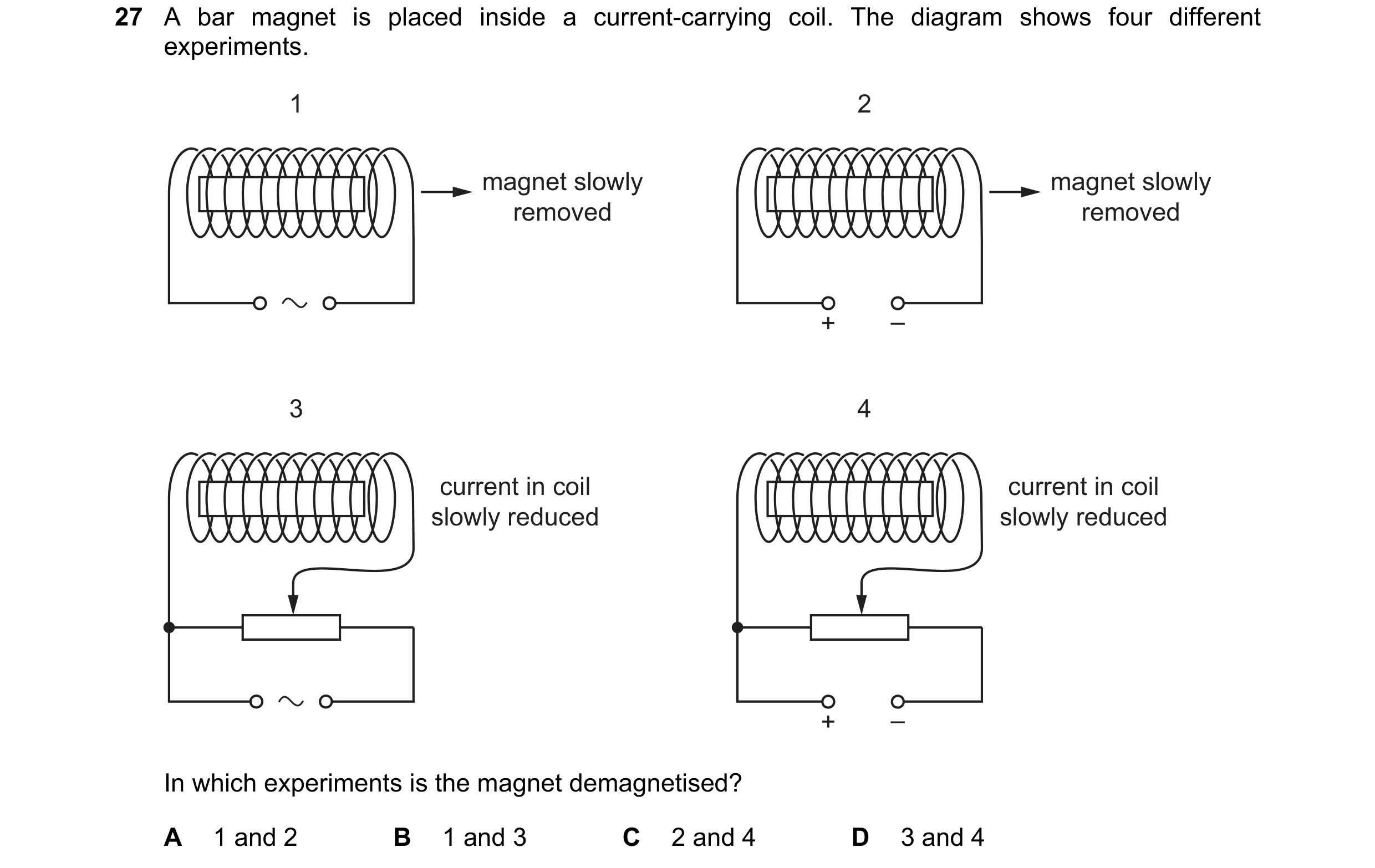
 2 / 17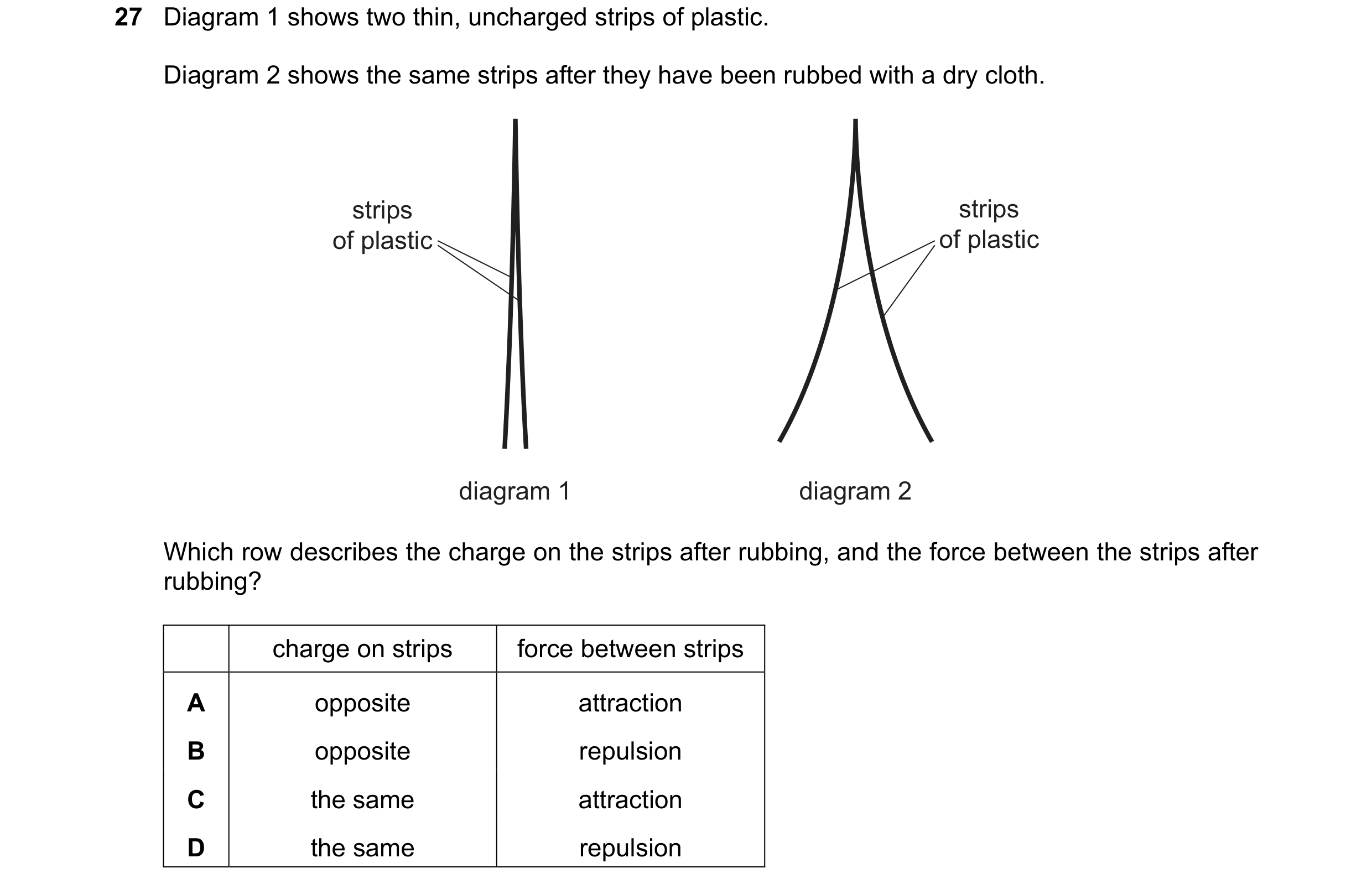
 3 / 17
 4 / 17
 5 / 17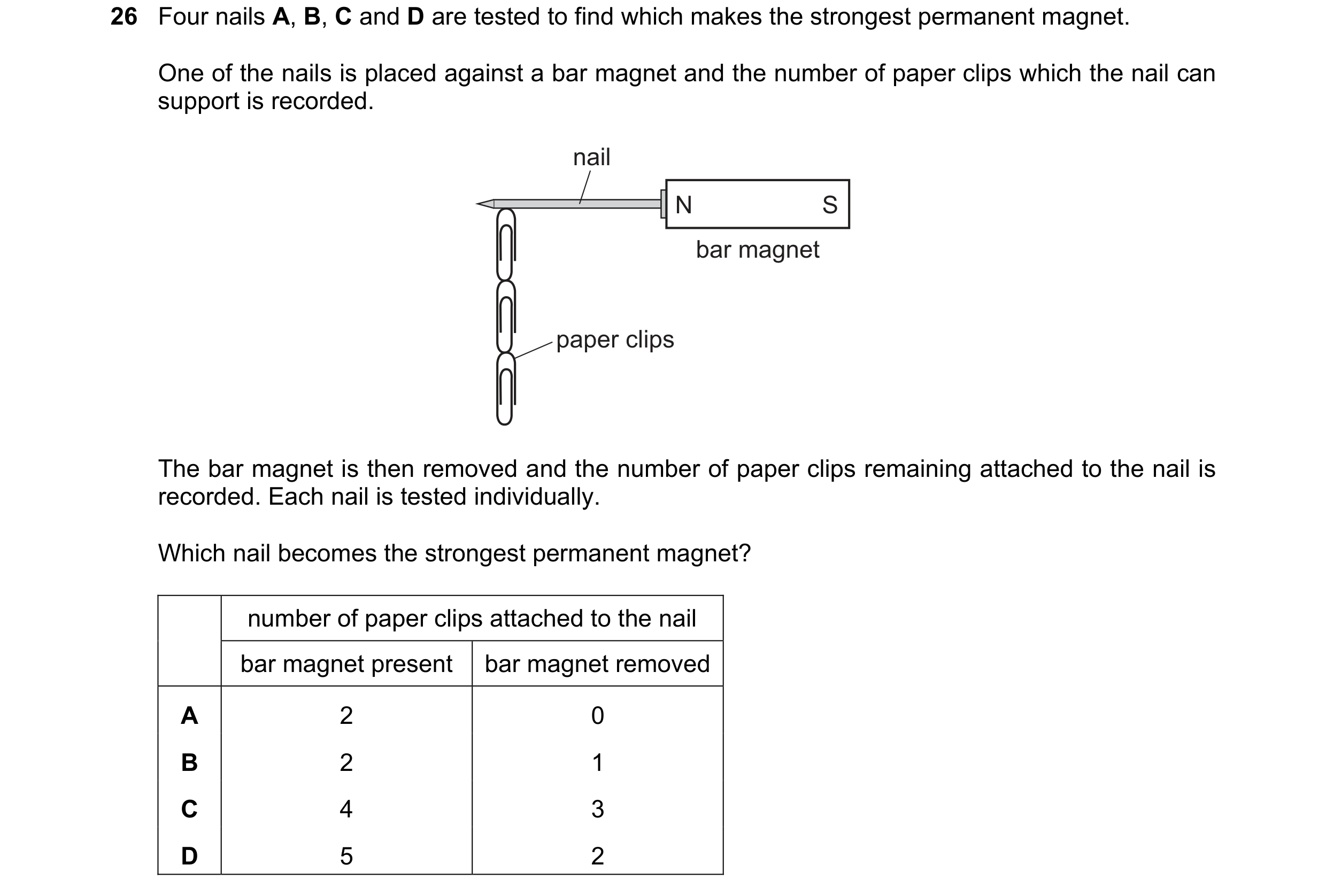
 6 / 17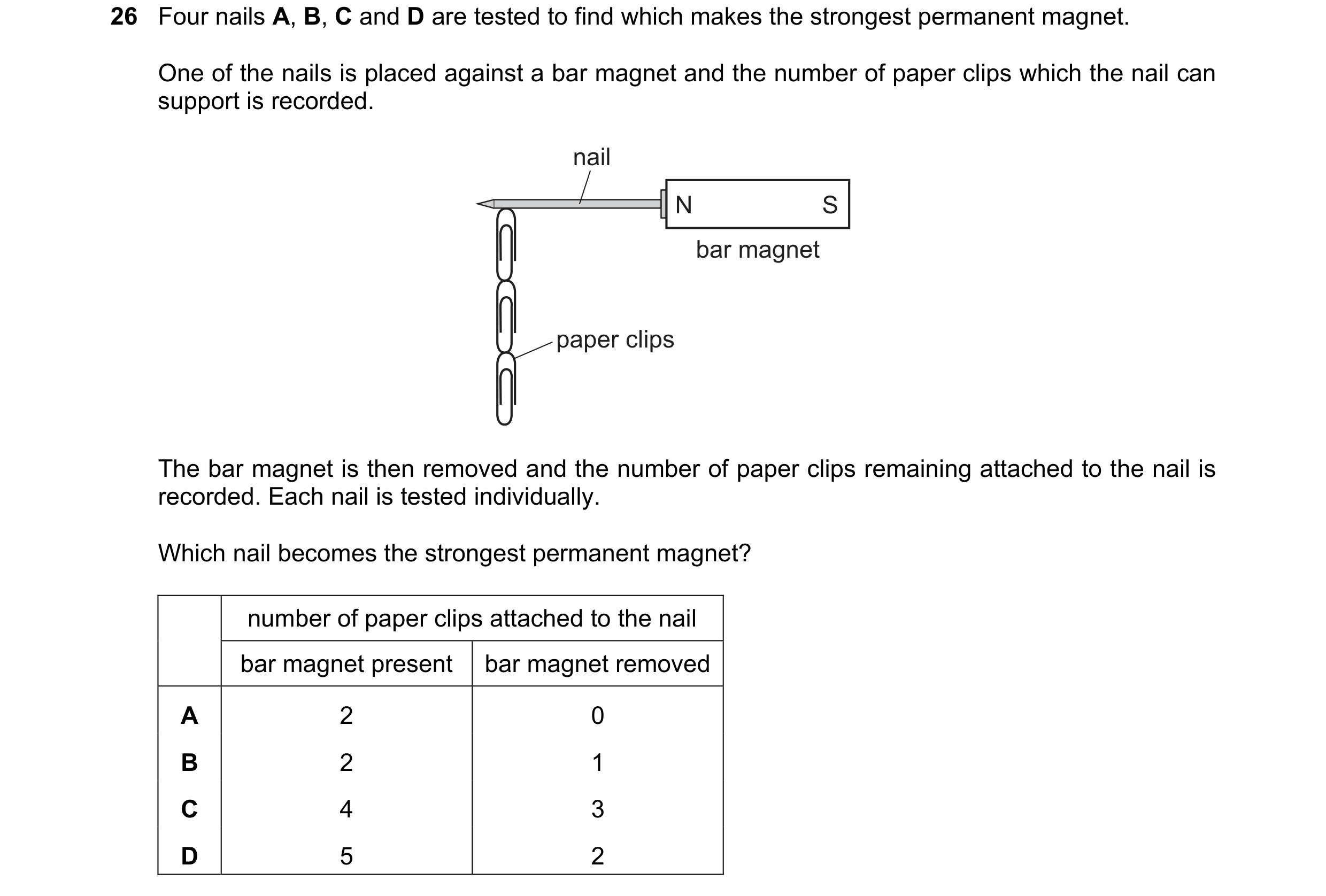
 7 / 17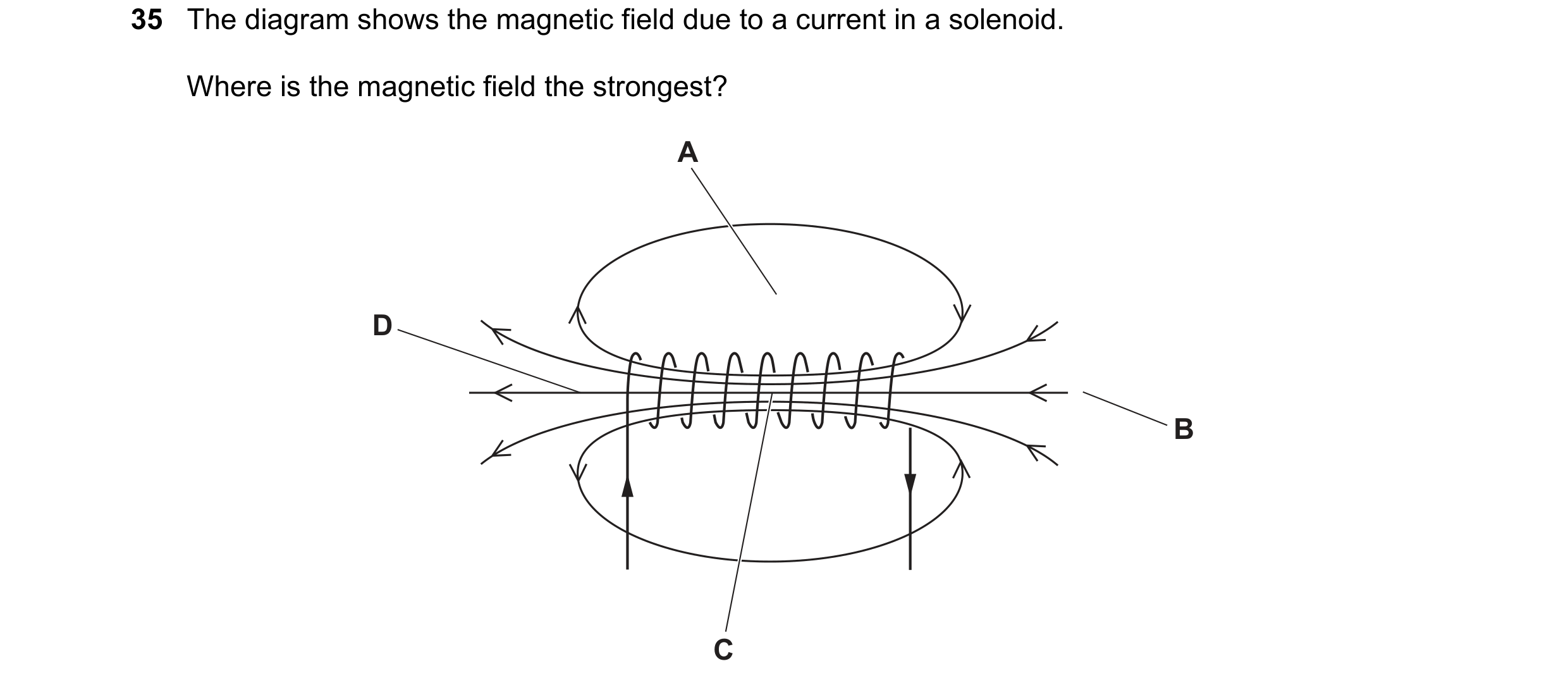
 8 / 17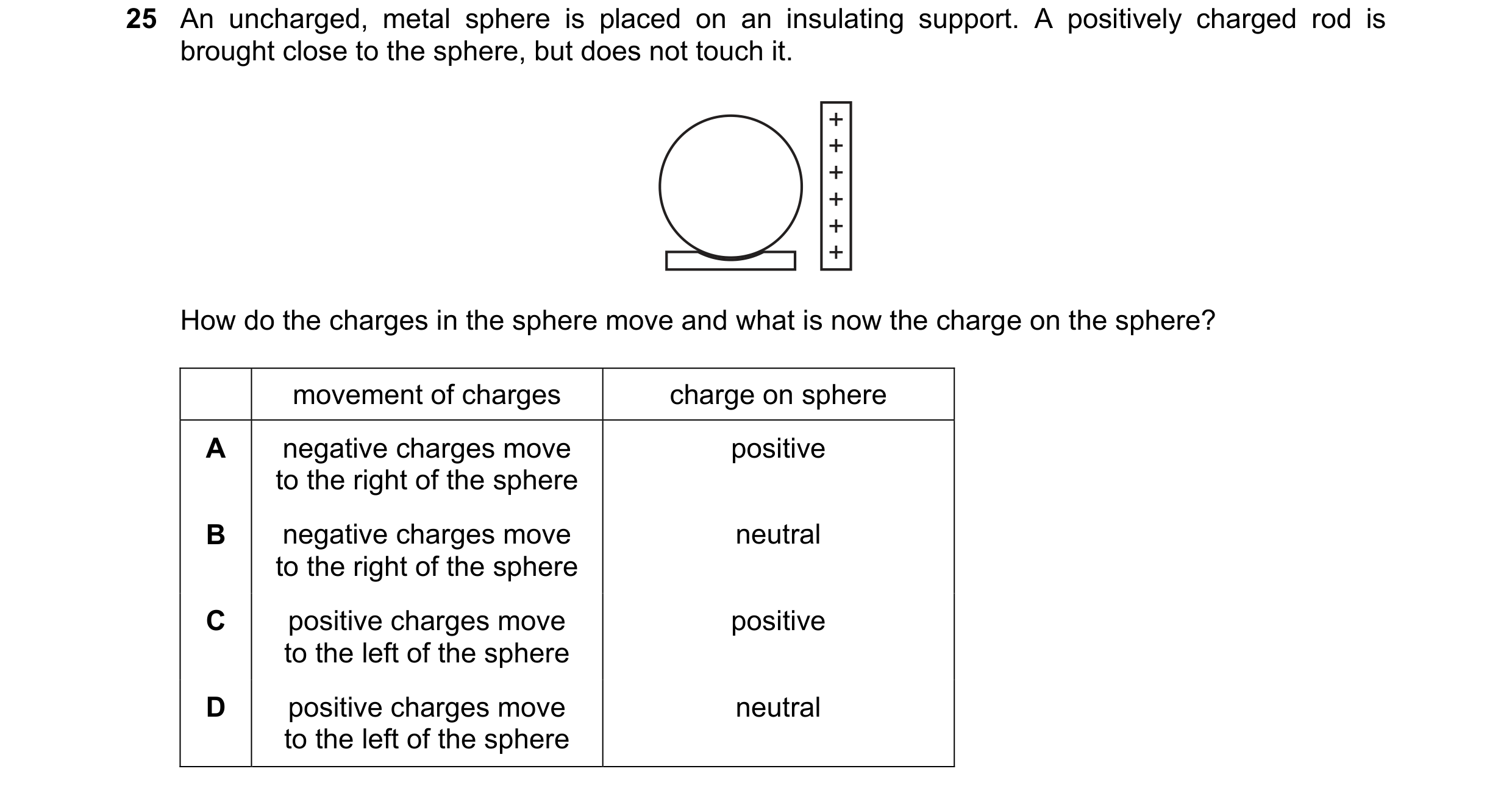
 9 / 17
 10 / 17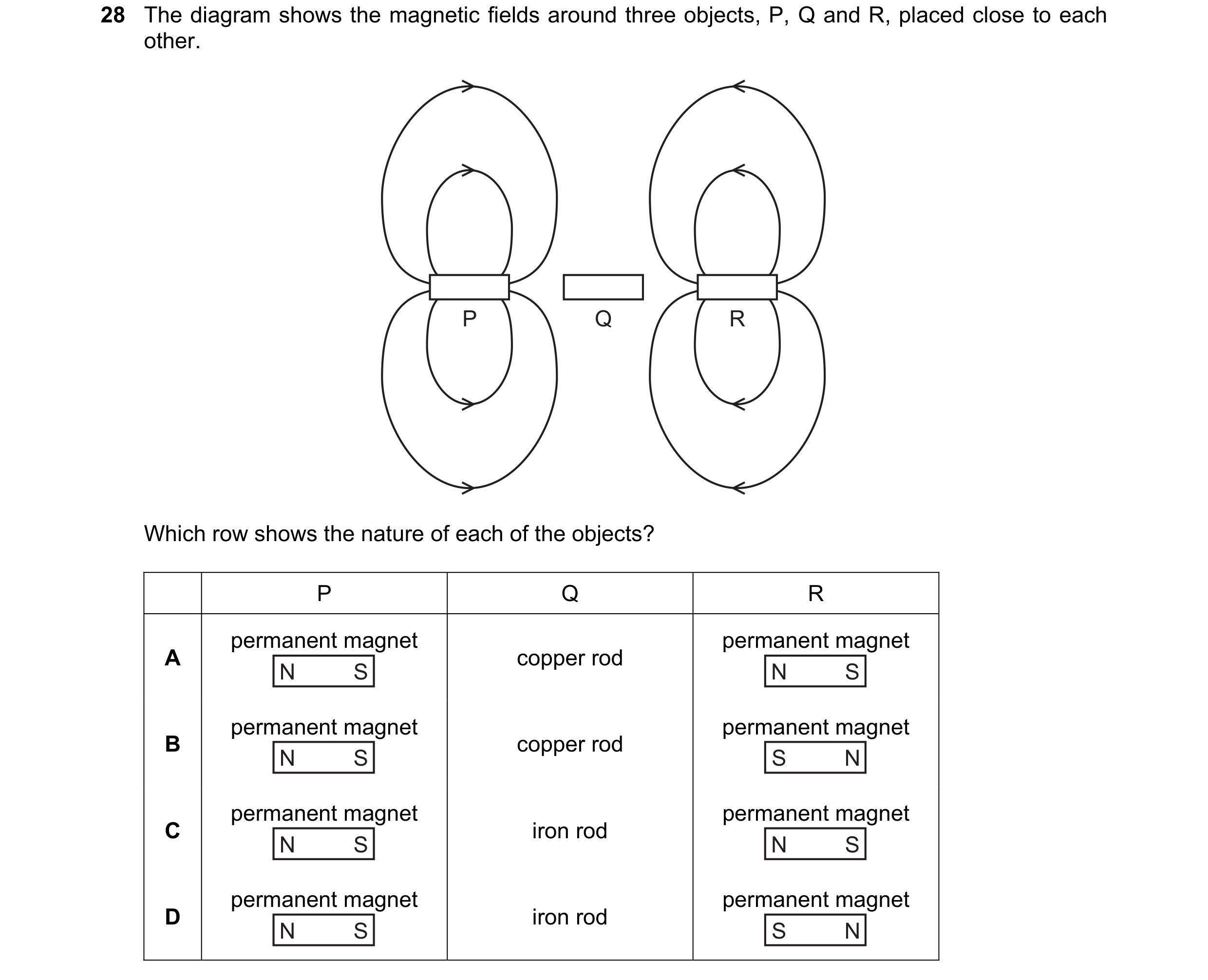
 11 / 17
 12 / 17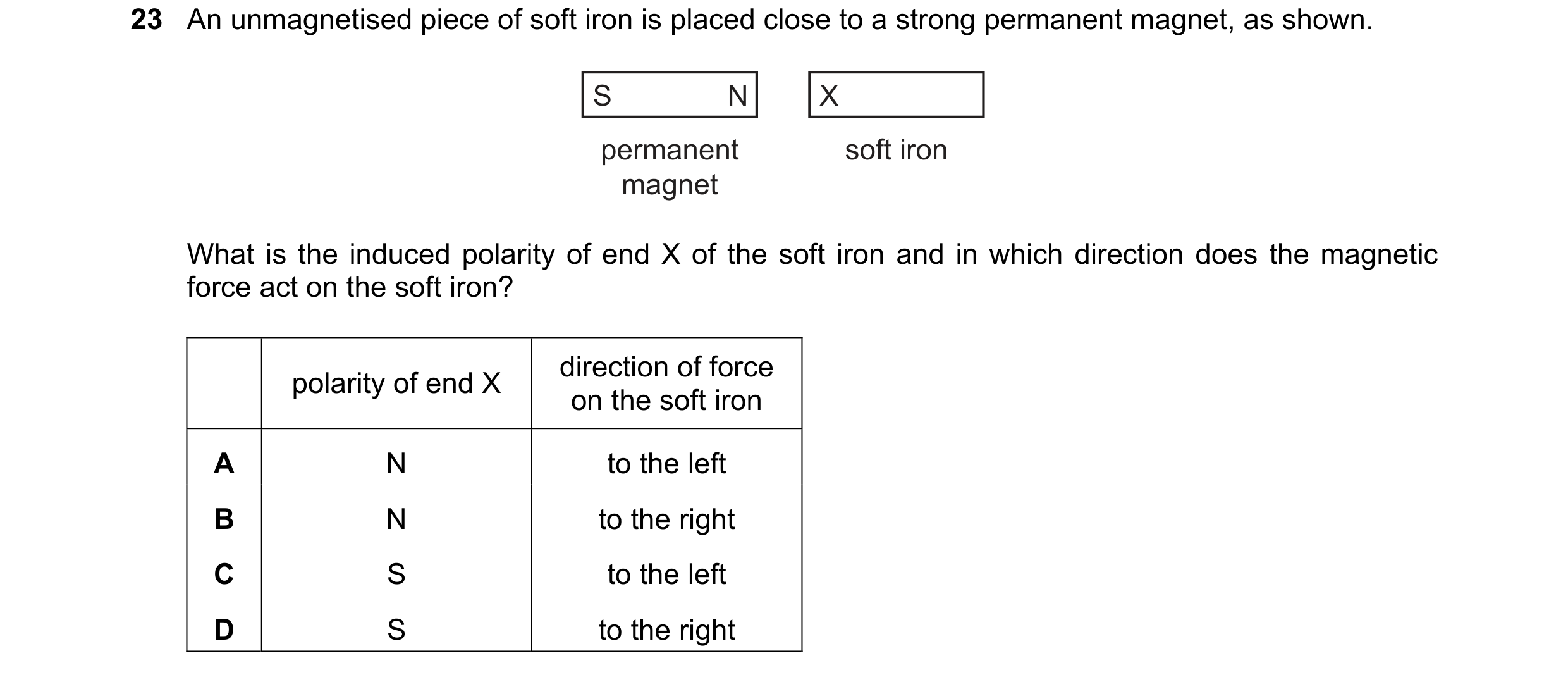
 13 / 17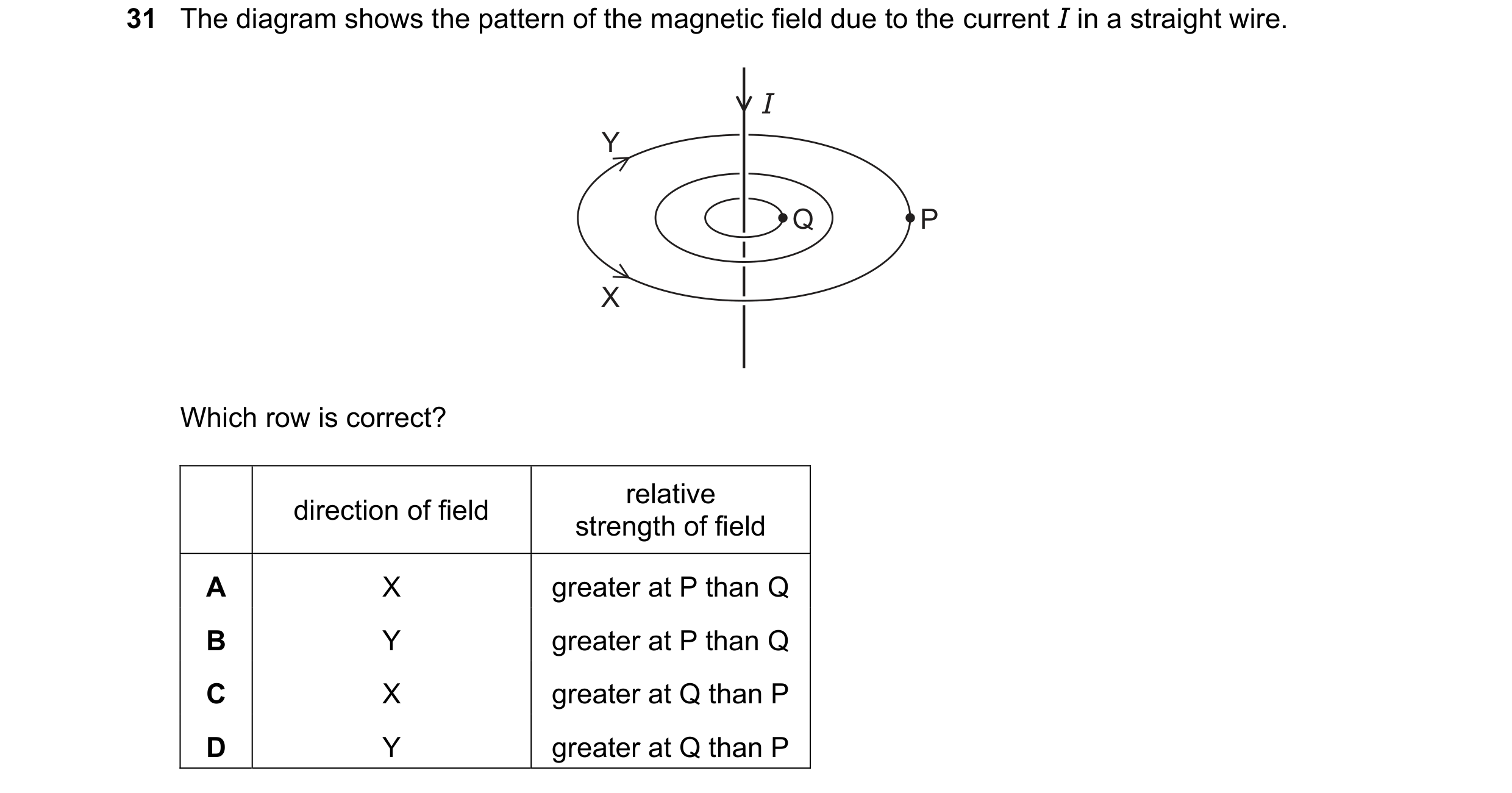
 14 / 17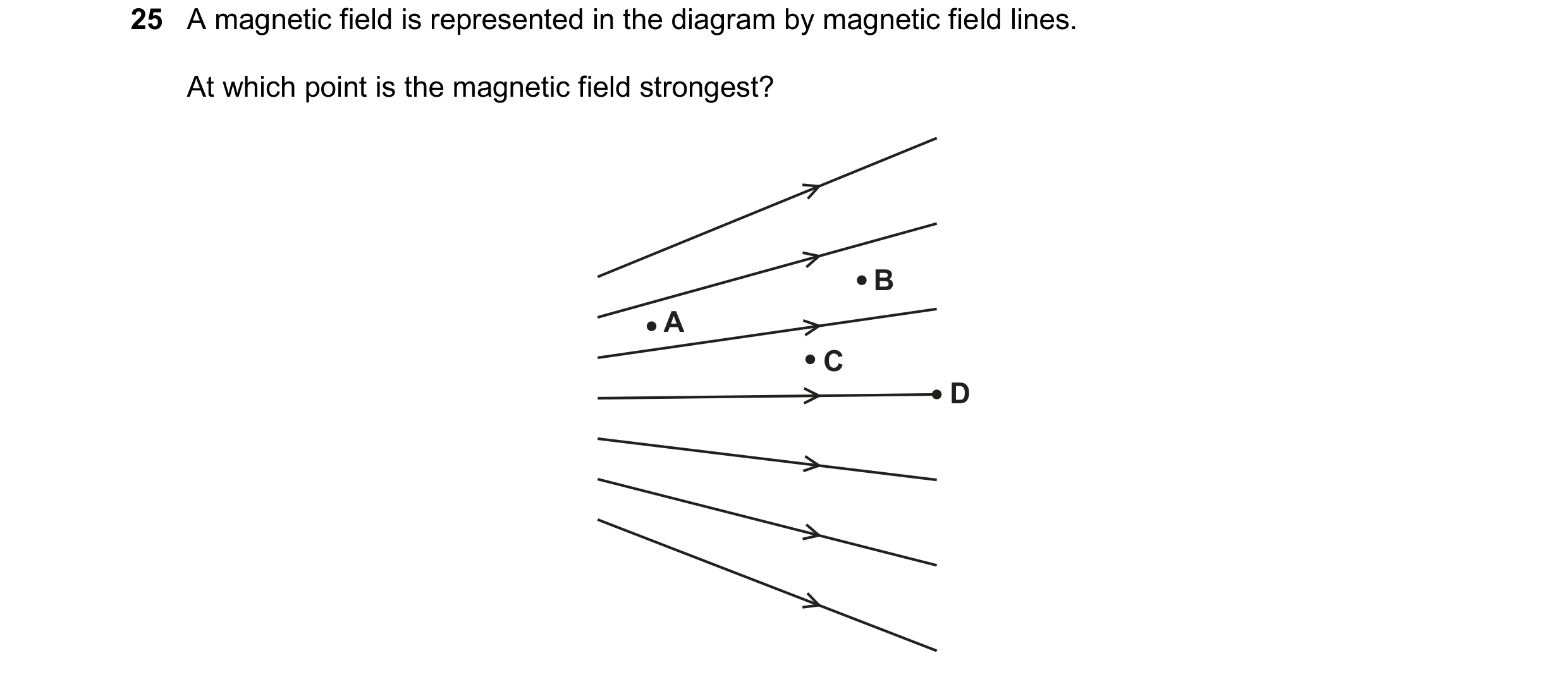

 15 / 17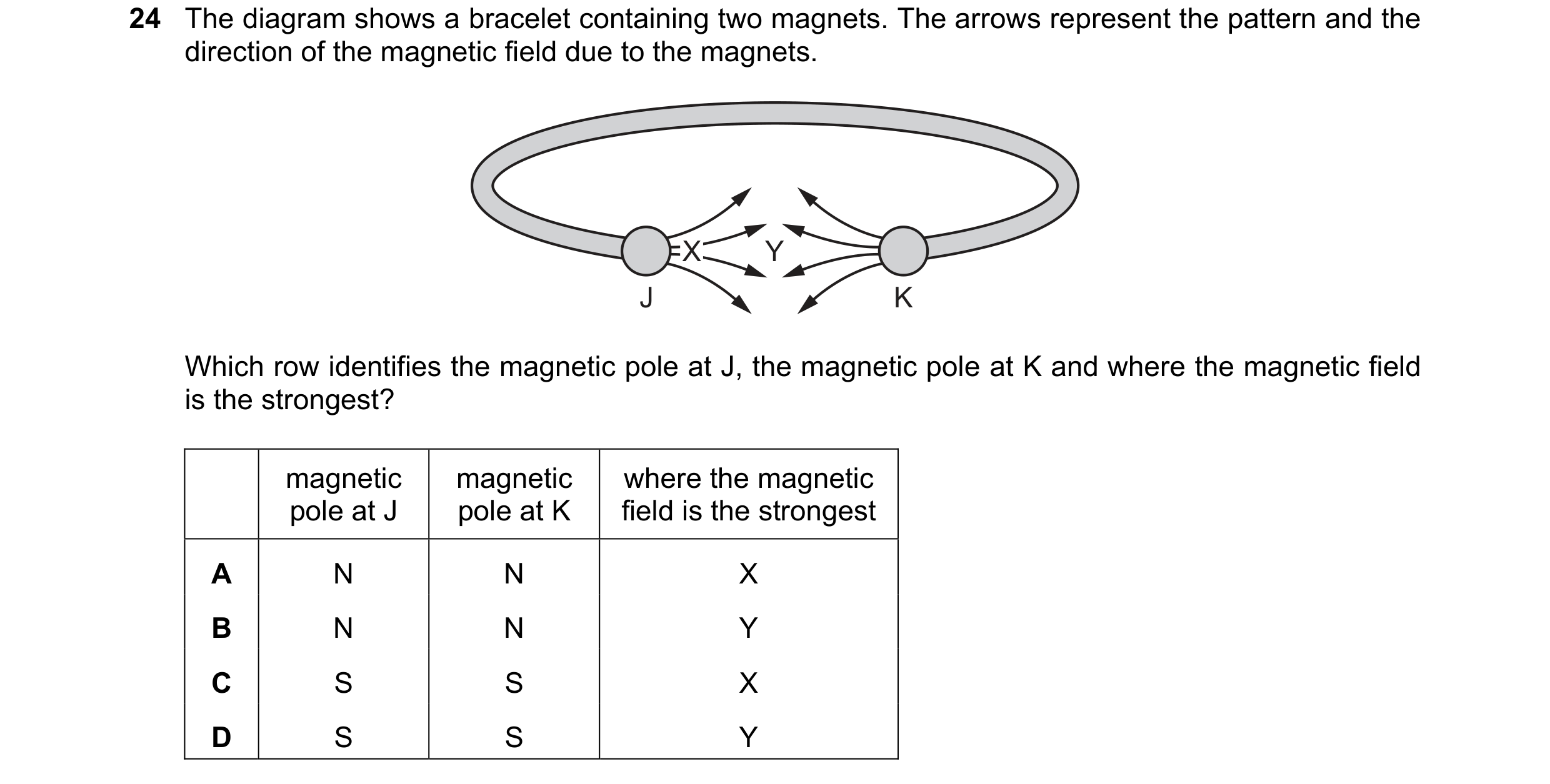
 16 / 17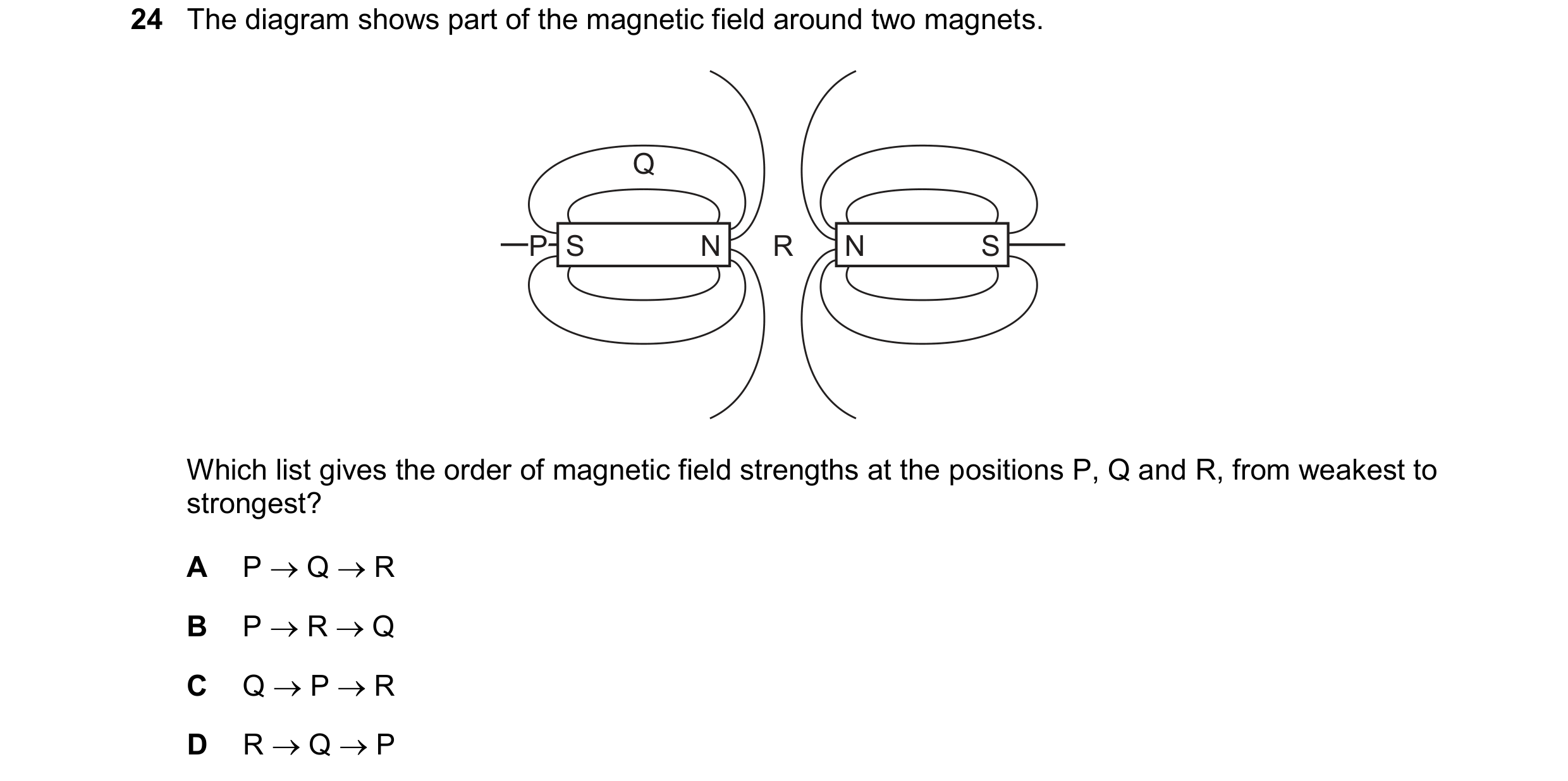
 17 / 17