Questions as text
Q1 · Light travels at a speed of 2.0 × 10⁸ m / s in a glass block 0972/21 May/June 2018
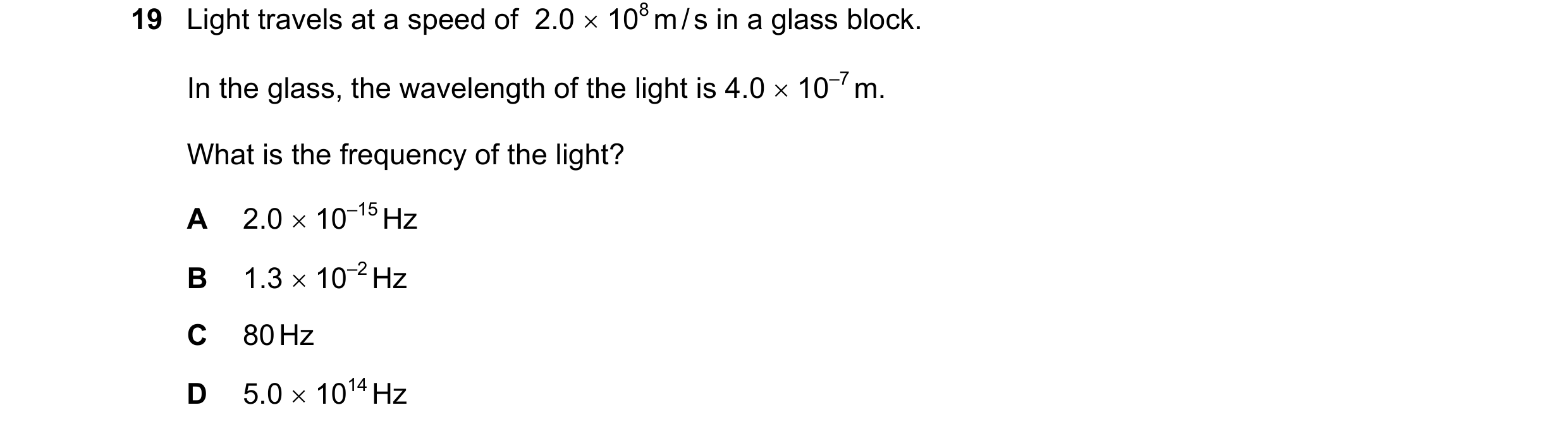
19 Light travels at a speed of 2.0 × 10⁸ m / s in a glass block. In the glass, the wavelength of the light is 4.0 × 10⁻⁷ m. What is the frequency of the light? A 2.0 × 10⁻¹⁵ Hz B 1.3 × 10⁻² Hz C 80 Hz D 5.0 × 10¹⁴ Hz
1 marks
Answer: D
This question in 0972/21 May/June 2018
Q2 · Scout P signals to scout Q on the other side of a valley by using a mirror to reflect the… 0972/21 May/June 2018
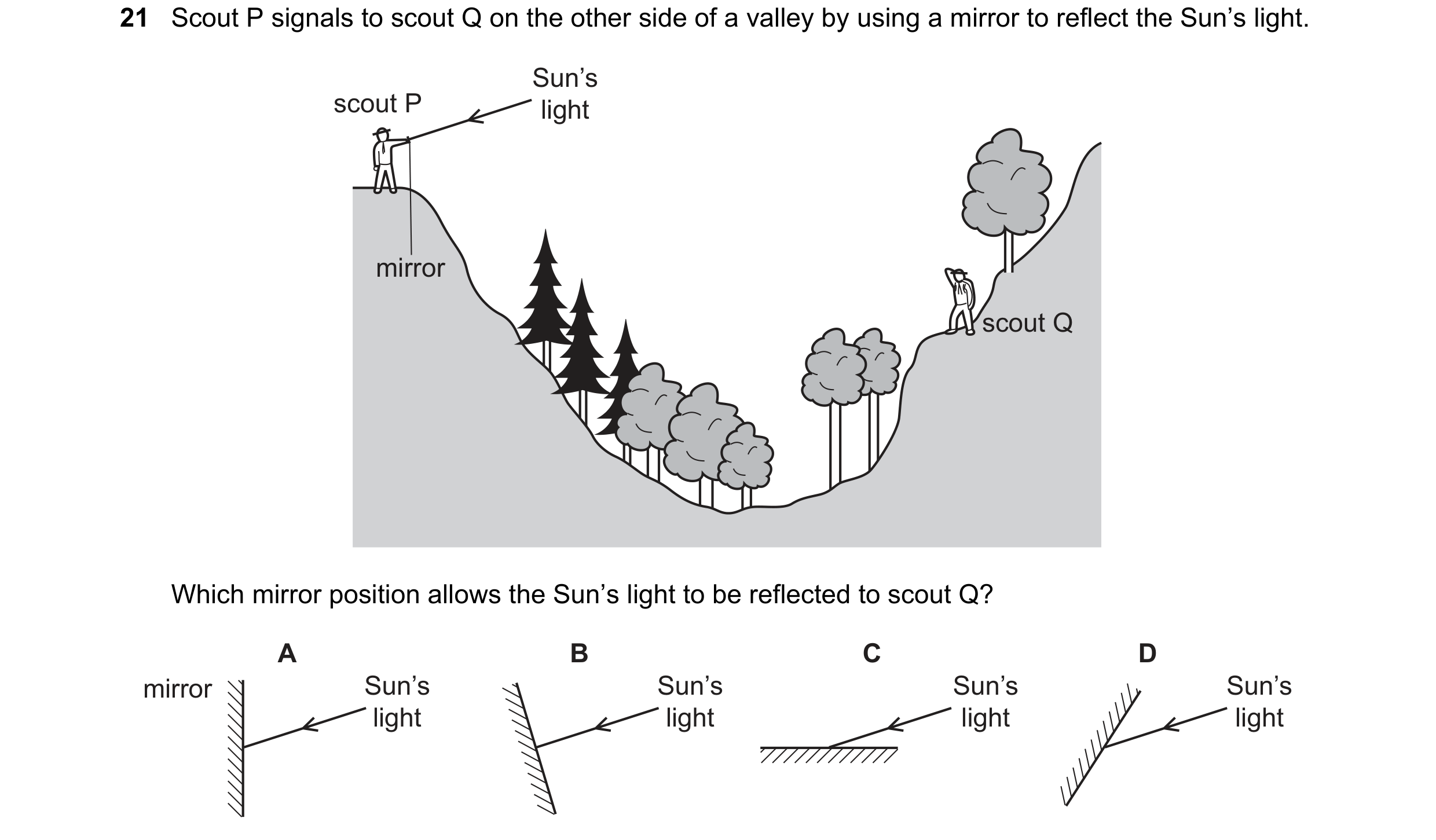
21 Scout P signals to scout Q on the other side of a valley by using a mirror to reflect the Sun’s light. Sun’s scout P light mirror scout Q Which mirror position allows the Sun’s light to be reflected to scout Q? A B C D mirror Sun’s Sun’s Sun’s Sun’s light light light light
1 marks
Answer: A
This question in 0972/21 May/June 2018
Q3 · A prism is made from transparent plastic 0972/21 May/June 2018
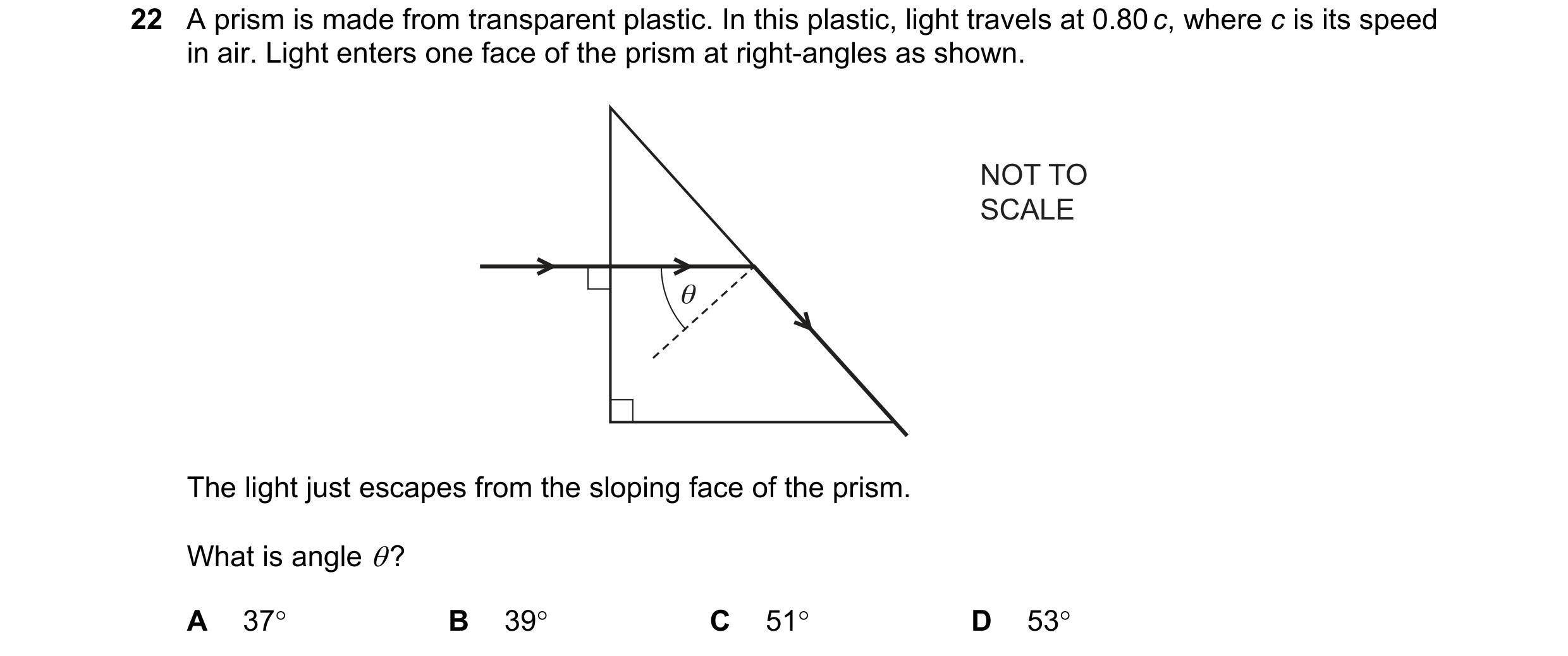
22 A prism is made from transparent plastic. In this plastic, light travels at 0.80 c, where c is its speed in air. Light enters one face of the prism at right-angles as shown. NOT TO SCALE θ The light just escapes from the sloping face of the prism. What is angle θ ? A 37° B 39° C 51° D 53°
1 marks
Answer: D
This question in 0972/21 May/June 2018
Q4 · The Sun emits infra-red radiation and light 0972/21 May/June 2018
23 The Sun emits infra-red radiation and light. Light from the Sun reaches the Earth in 8 minutes. Which row gives correct information about the infra-red radiation? wavelength of time taken for infra-red infra-red radiation radiation to reach Earth A longer than wavelength of light 8 minutes B longer than wavelength of light much less than 8 minutes C shorter than wavelength of light 8 minutes D shorter than wavelength of light much more than 8 minutes
1 marks
Answer: A
This question in 0972/21 May/June 2018
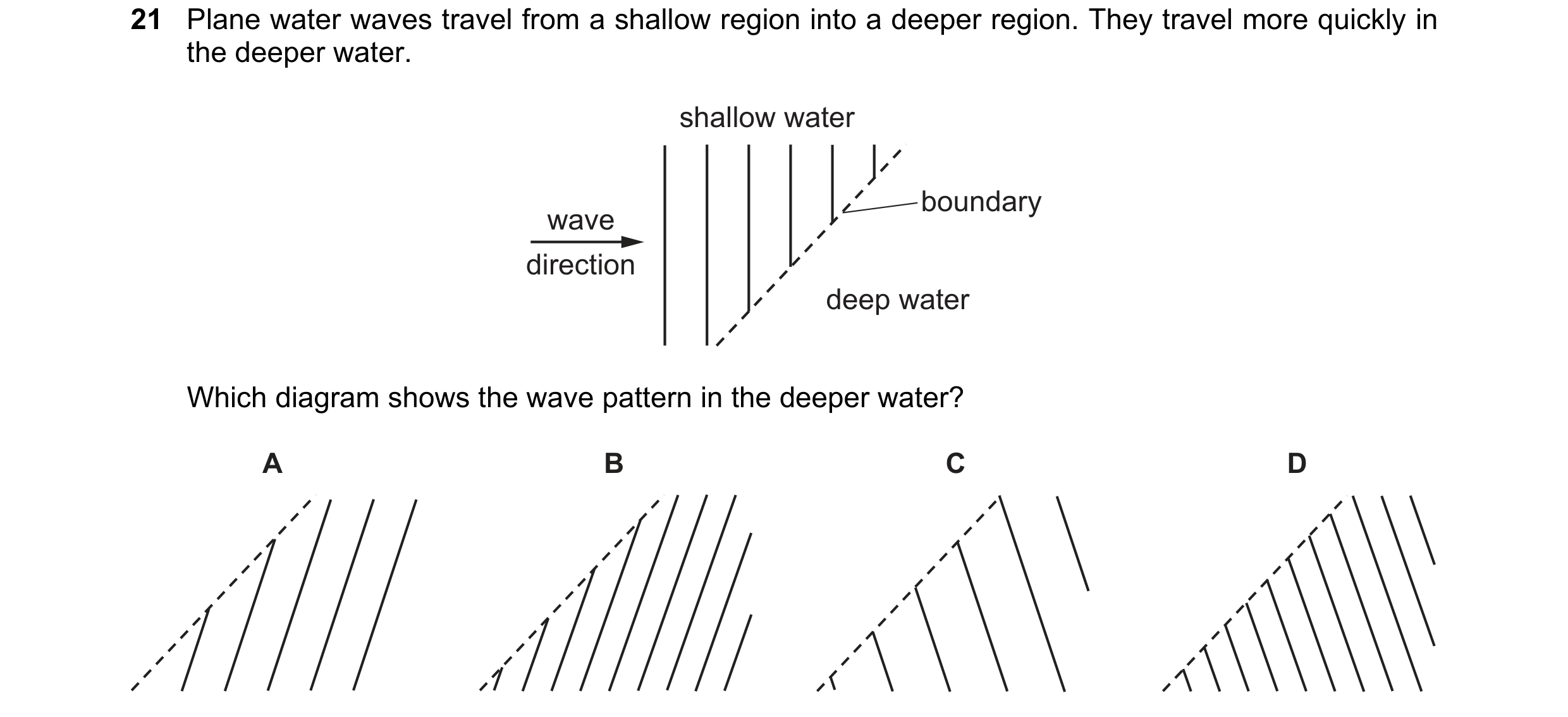
Q5 · Plane water waves travel from a shallow region into a deeper region 0972/21 Oct/Nov 2018
21 Plane water waves travel from a shallow region into a deeper region. They travel more quickly in the deeper water. shallow water boundary wave direction deep water Which diagram shows the wave pattern in the deeper water? A B C D
1 marks
Answer: C
This question in 0972/21 Oct/Nov 2018
Q6 · Which statement about the image formed by a plane mirror is correct? 0972/21 Oct/Nov 2018
22 Which statement about the image formed by a plane mirror is correct? A The image is larger than the object. B The image is smaller than the object. C The image is twice as far from the mirror as the object. D The image is virtual.
1 marks
Answer: D
This question in 0972/21 Oct/Nov 2018
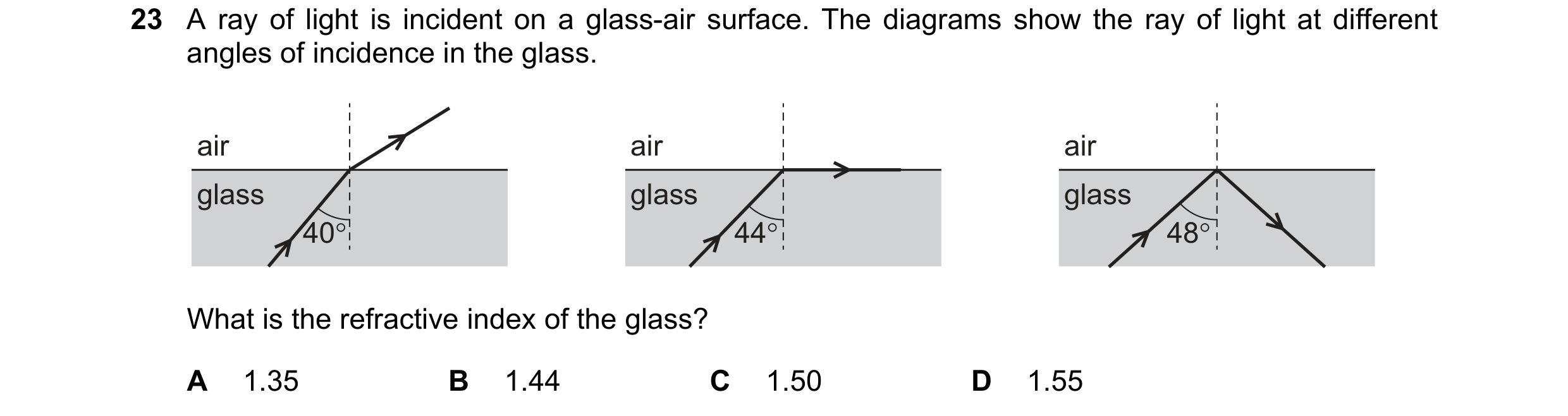
Q7 · A ray of light is incident on a glass-air surface 0972/21 Oct/Nov 2018
23 A ray of light is incident on a glass-air surface. The diagrams show the ray of light at different angles of incidence in the glass. air air air glass glass glass 40° 44° 48° What is the refractive index of the glass? A 1.35 B 1.44 C 1.50 D 1.55
1 marks
Answer: B
This question in 0972/21 Oct/Nov 2018
Q8 · An object is placed 30 cm in front of a plane mirror 0972/21 May/June 2019
21 An object is placed 30 cm in front of a plane mirror. Which statement describes the image of the object? A The image is the same size and 30 cm from the object. B The image is the same size and 60 cm from the object. C The image is smaller and 30 cm from the object. D The image is smaller and 60 cm from the object.
1 marks
Answer: B
This question in 0972/21 May/June 2019
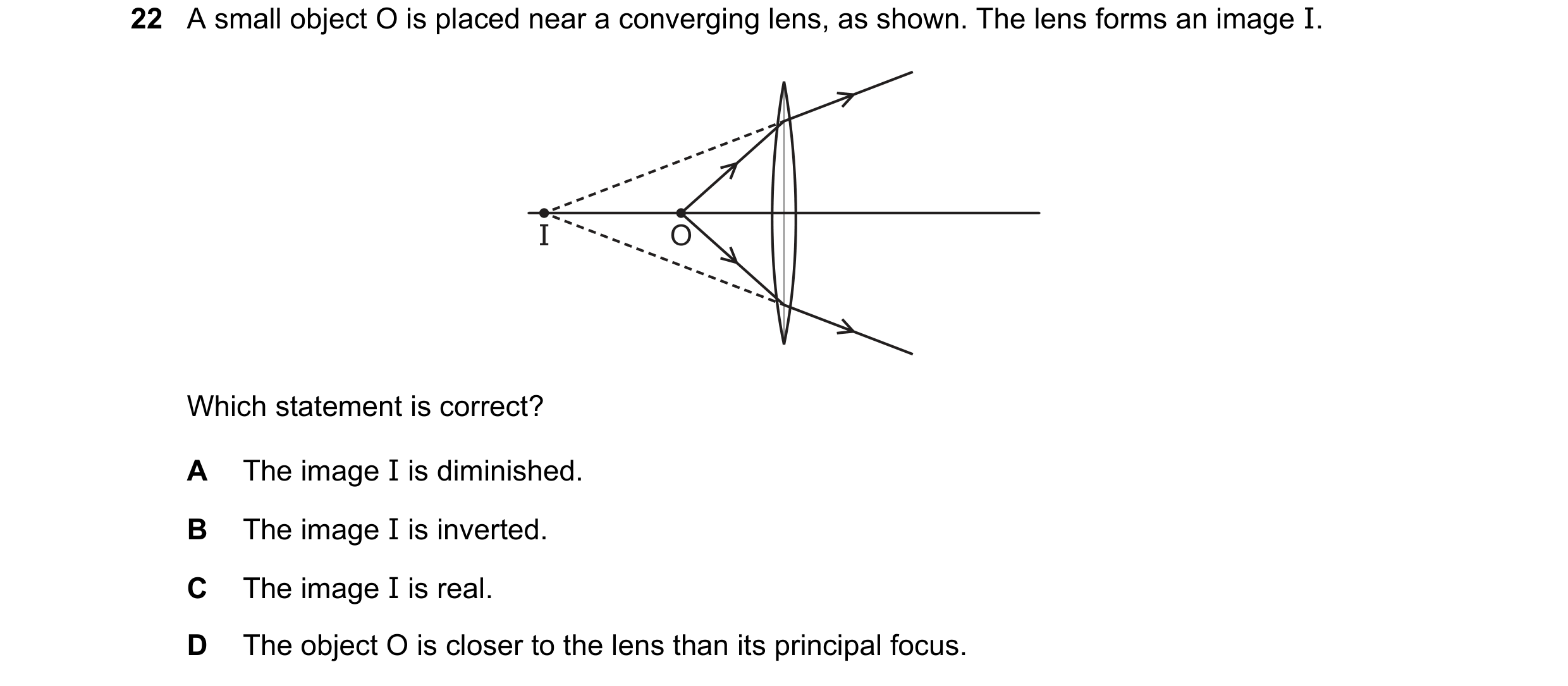
Q9 · A small object O is placed near a converging lens, as shown 0972/21 May/June 2019
22 A small object O is placed near a converging lens, as shown. The lens forms an image I. I O Which statement is correct? A The image I is diminished. B The image I is inverted. C The image I is real. D The object O is closer to the lens than its principal focus.
1 marks
Answer: D
This question in 0972/21 May/June 2019
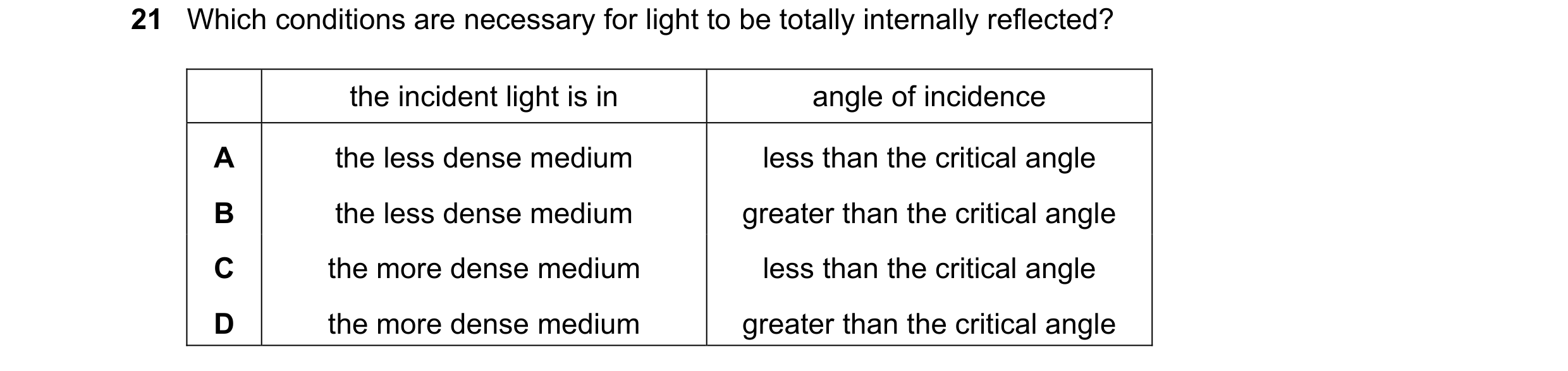
Q10 · Which conditions are necessary for light to be totally internally reflected? 0972/22 May/June 2019
21 Which conditions are necessary for light to be totally internally reflected? the incident light is in angle of incidence A the less dense medium less than the critical angle B the less dense medium greater than the critical angle C the more dense medium less than the critical angle D the more dense medium greater than the critical angle
1 marks
Answer: D
This question in 0972/22 May/June 2019
Q11 · Light is travelling through air 0972/22 May/June 2019
22 Light is travelling through air. It strikes a glass block at an angle of incidence of 45°. The glass has a refractive index of 1.4. What is the angle of refraction of the light as it enters the glass? A 29° B 30° C 32° D 82°
1 marks
Answer: B
This question in 0972/22 May/June 2019
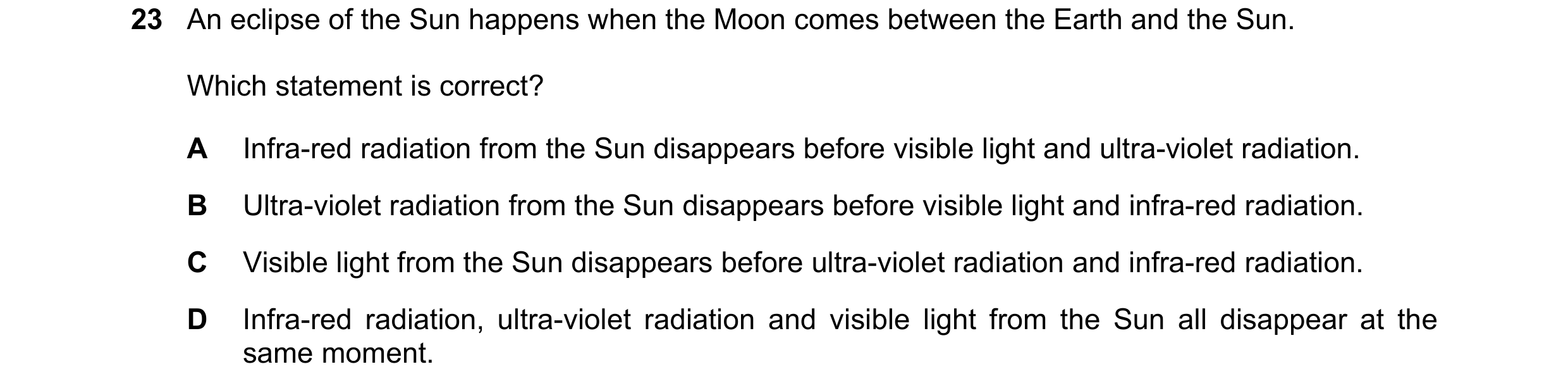
Q12 · An eclipse of the Sun happens when the Moon comes between the Earth and the Sun 0972/22 May/June 2019
23 An eclipse of the Sun happens when the Moon comes between the Earth and the Sun. Which statement is correct? A Infra-red radiation from the Sun disappears before visible light and ultra-violet radiation. B Ultra-violet radiation from the Sun disappears before visible light and infra-red radiation. C Visible light from the Sun disappears before ultra-violet radiation and infra-red radiation. D Infra-red radiation, ultra-violet radiation and visible light from the Sun all disappear at the same moment.
1 marks
Answer: D
This question in 0972/22 May/June 2019
Q13 · An observer stands at the finish line of a 100 m race 0972/22 May/June 2019
25 An observer stands at the finish line of a 100 m race. He wants to time the winner’s run. He starts his stop-watch as soon as he sees the smoke from the starting gun instead of when he hears the bang. What is the reason for doing this? A Light travels much faster than sound. B There is a risk he might respond to an echo from a wall. C Humans react slower to sound than to light. D Humans react more quickly to sound than to light.
1 marks
Answer: A
This question in 0972/22 May/June 2019
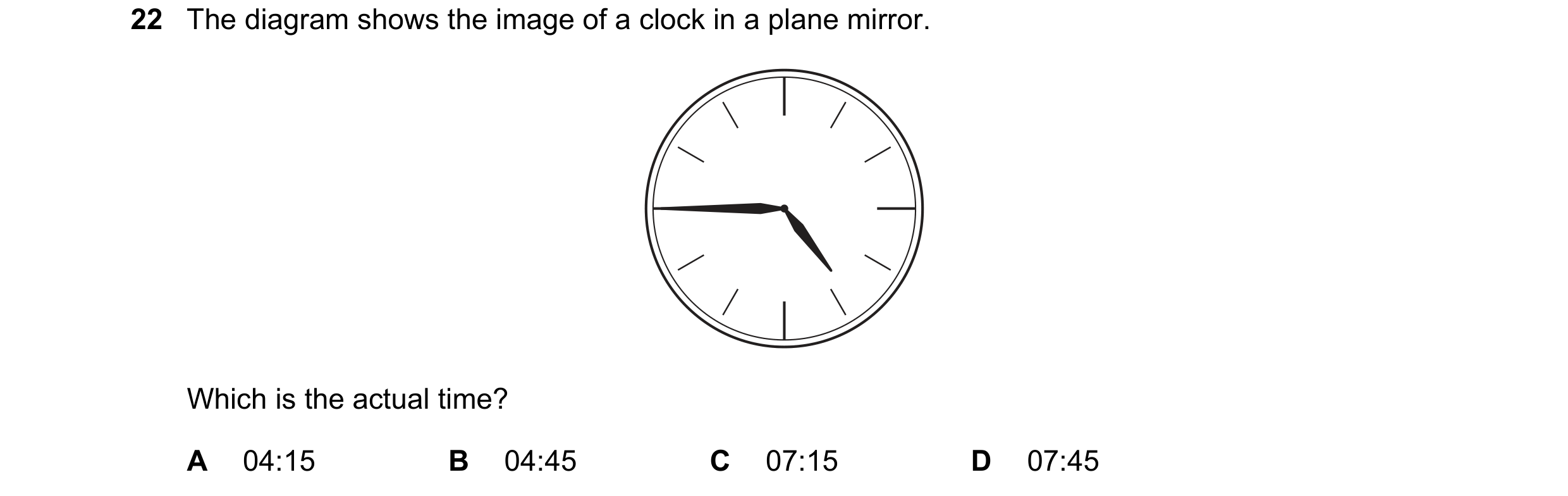
Q14 · The diagram shows the image of a clock in a plane mirror 0972/21 Oct/Nov 2019
22 The diagram shows the image of a clock in a plane mirror. Which is the actual time? A 04:15 B 04:45 C 07:15 D 07:45
1 marks
Answer: C
This question in 0972/21 Oct/Nov 2019
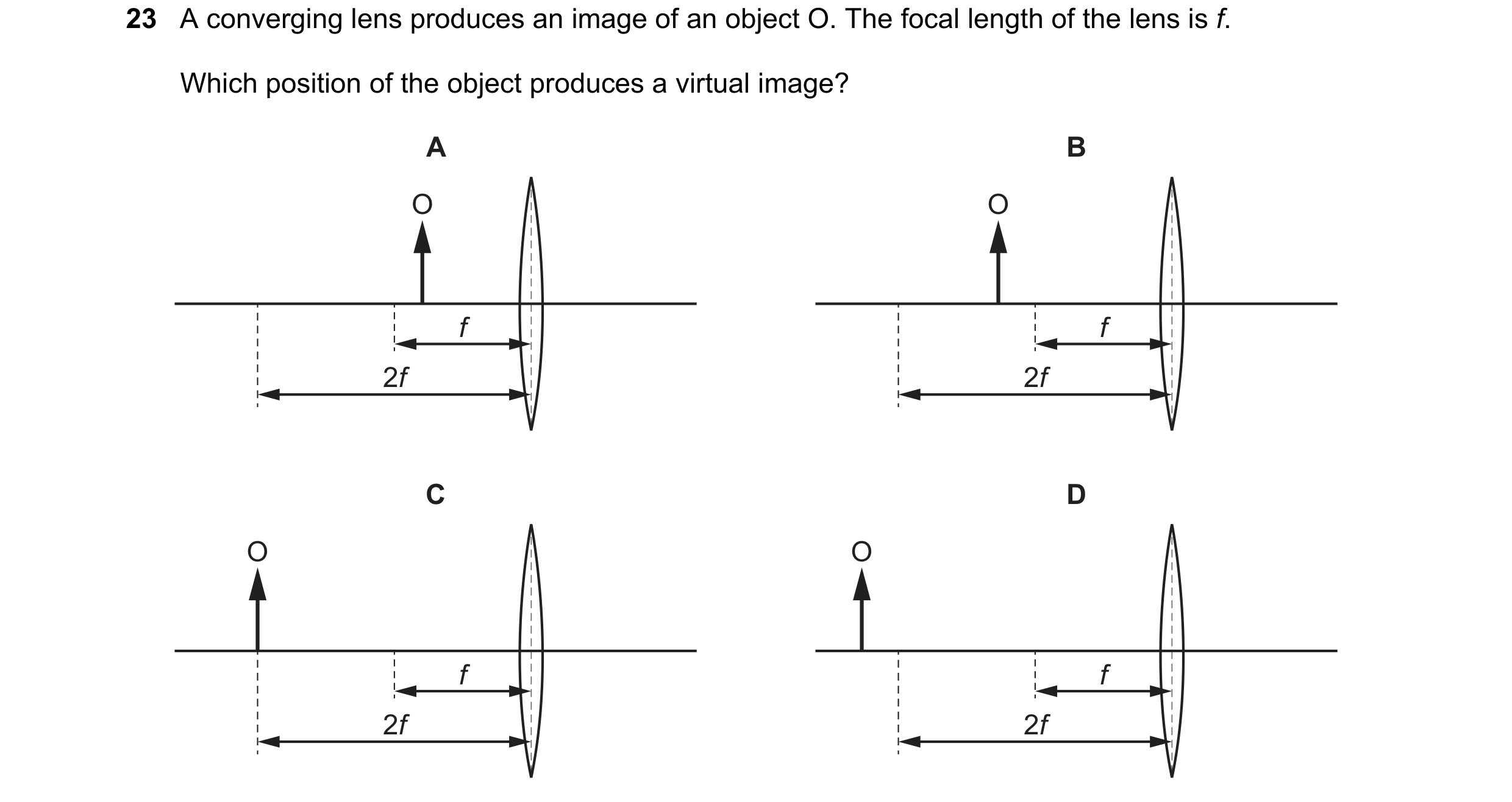
Q15 · A converging lens produces an image of an object O 0972/21 Oct/Nov 2019
23 A converging lens produces an image of an object O. The focal length of the lens is f. Which position of the object produces a virtual image? A B O O f f 2f 2f C D O O f f 2f 2f
1 marks
Answer: A
This question in 0972/21 Oct/Nov 2019
Q16 · Which statement is correct? 0972/21 May/June 2020
22 Which statement is correct? A The speed of light in glass is equal to the speed of light in a vacuum multiplied by the refractive index of glass. B The incident angle of a light ray at an air-glass surface is the angle between the ray and the glass surface. C The sine of the critical angle at an air-glass surface is equal to 1 . refractive index of glass D The angle of refraction for light passing through an air-glass surface is proportional to the angle of incidence at that surface.
1 marks
Answer: C
This question in 0972/21 May/June 2020
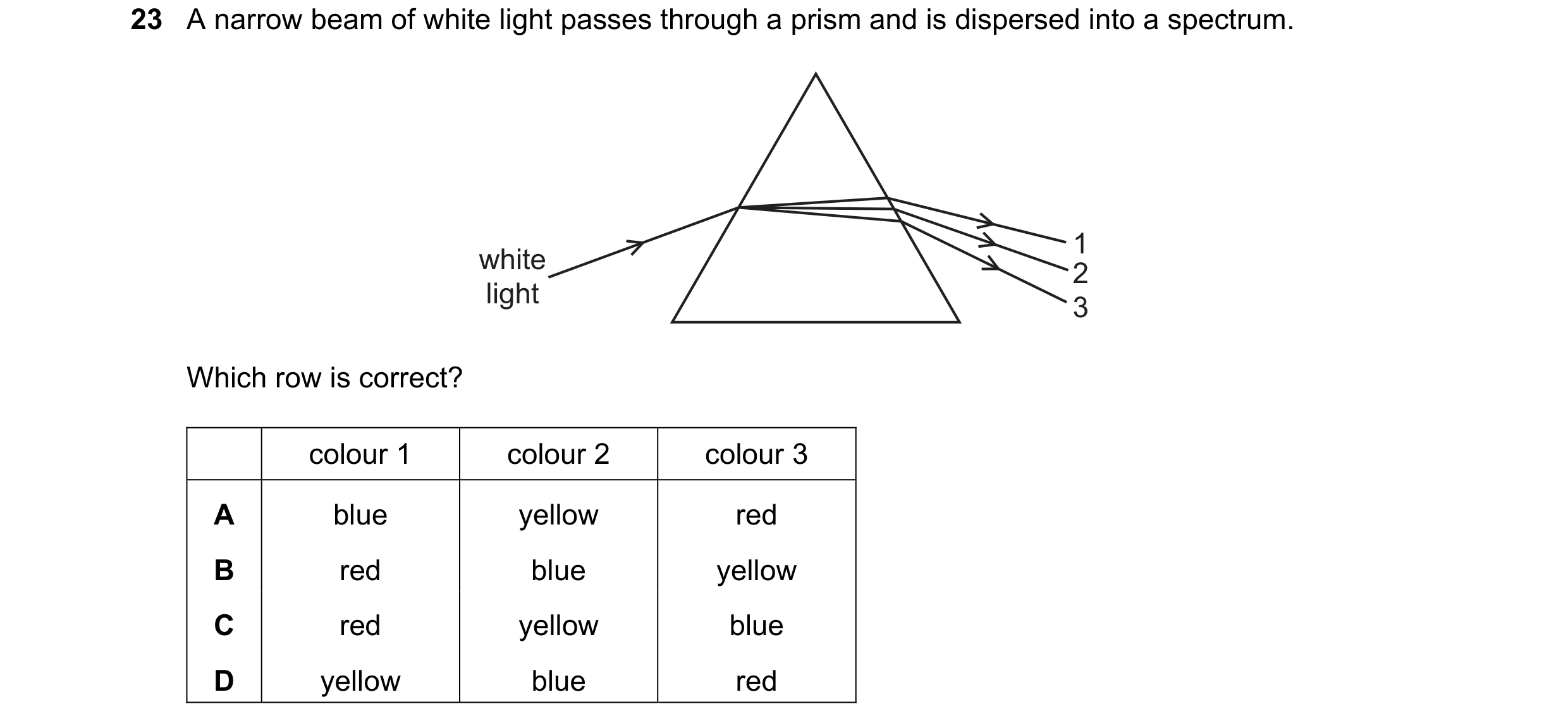
Q17 · A narrow beam of white light passes through a prism and is dispersed into a spectrum 0972/21 May/June 2020
23 A narrow beam of white light passes through a prism and is dispersed into a spectrum. 1 white 2 light 3 Which row is correct? colour 1 colour 2 colour 3 A blue yellow red B red blue yellow C red yellow blue D yellow blue red
1 marks
Answer: C
This question in 0972/21 May/June 2020
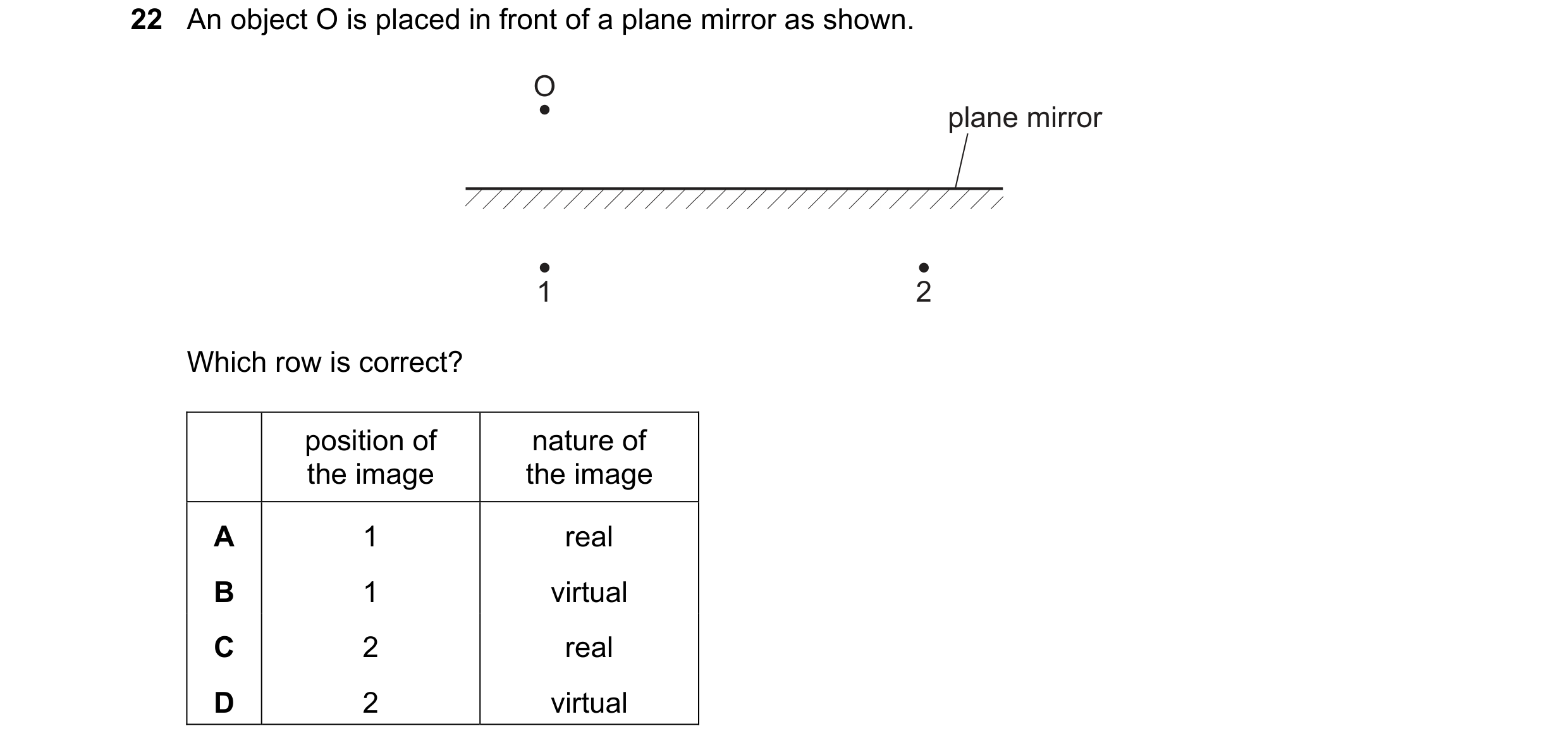
Q18 · An object O is placed in front of a plane mirror as shown 0972/22 May/June 2020
22 An object O is placed in front of a plane mirror as shown. O plane mirror 1 2 Which row is correct? position of nature of the image the image A 1 real B 1 virtual C 2 real D 2 virtual
1 marks
Answer: B
This question in 0972/22 May/June 2020
Q19 · Which statement is correct? 0972/22 May/June 2020
23 Which statement is correct? A The speed of light in glass is equal to the speed of light in a vacuum multiplied by the refractive index of glass. B The incident angle of a light ray at an air-glass surface is the angle between the ray and the glass surface. C The sine of the critical angle at an air-glass surface is equal to 1 . refractive index of glass D The angle of refraction for light passing through an air-glass surface is proportional to the angle of incidence at that surface.
1 marks
Answer: C
This question in 0972/22 May/June 2020
Q20 · Which statement about a thin converging lens is correct? 0972/21 Oct/Nov 2020
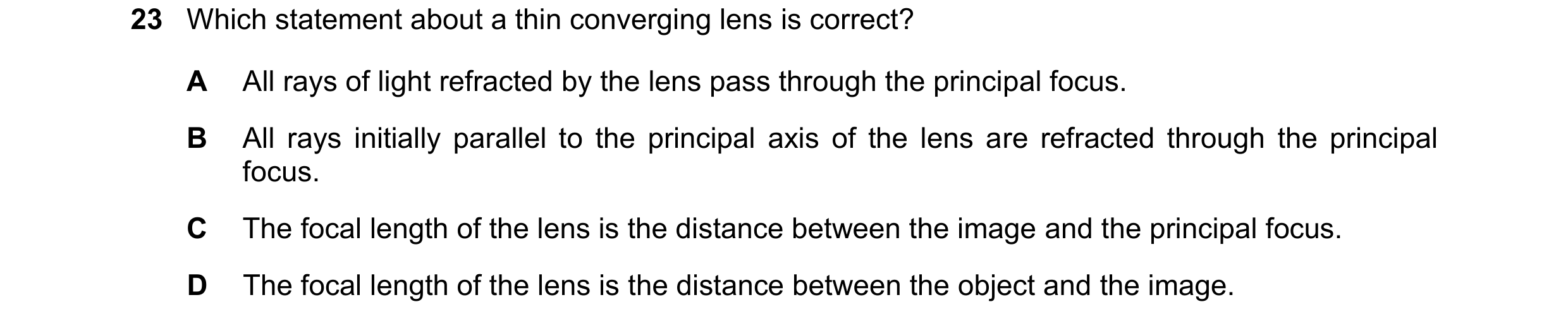
23 Which statement about a thin converging lens is correct? A All rays of light refracted by the lens pass through the principal focus. B All rays initially parallel to the principal axis of the lens are refracted through the principal focus. C The focal length of the lens is the distance between the image and the principal focus. D The focal length of the lens is the distance between the object and the image.
1 marks
Answer: B
This question in 0972/21 Oct/Nov 2020
Q21 · The diagram shows white light passing through a prism 0972/21 Oct/Nov 2020
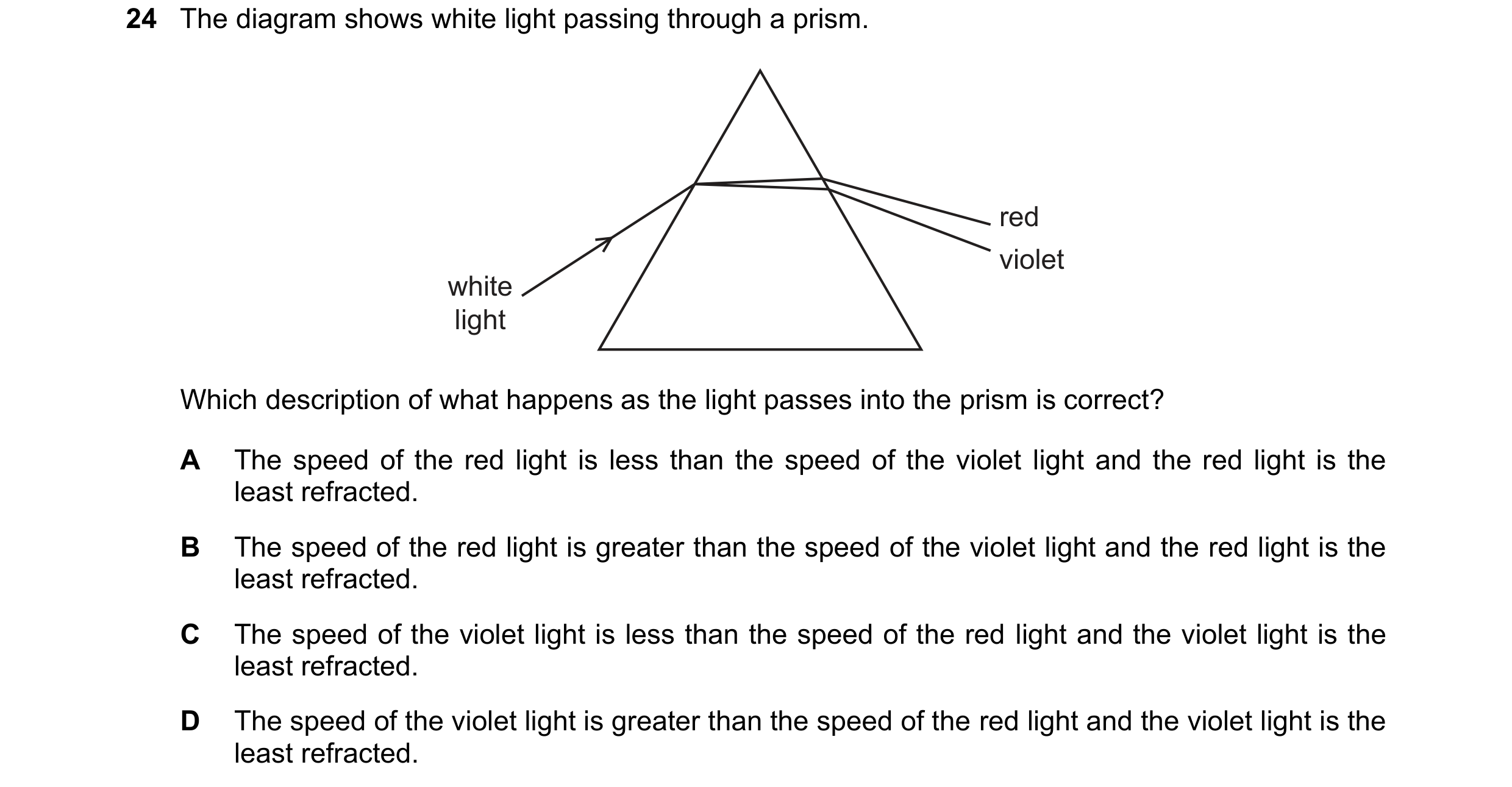
24 The diagram shows white light passing through a prism. red violet white light Which description of what happens as the light passes into the prism is correct? A The speed of the red light is less than the speed of the violet light and the red light is the least refracted. B The speed of the red light is greater than the speed of the violet light and the red light is the least refracted. C The speed of the violet light is less than the speed of the red light and the violet light is the least refracted. D The speed of the violet light is greater than the speed of the red light and the violet light is the least refracted.
1 marks
Answer: B
This question in 0972/21 Oct/Nov 2020
Q22 · Two beams of light are both the same colour of red 0972/21 Oct/Nov 2021
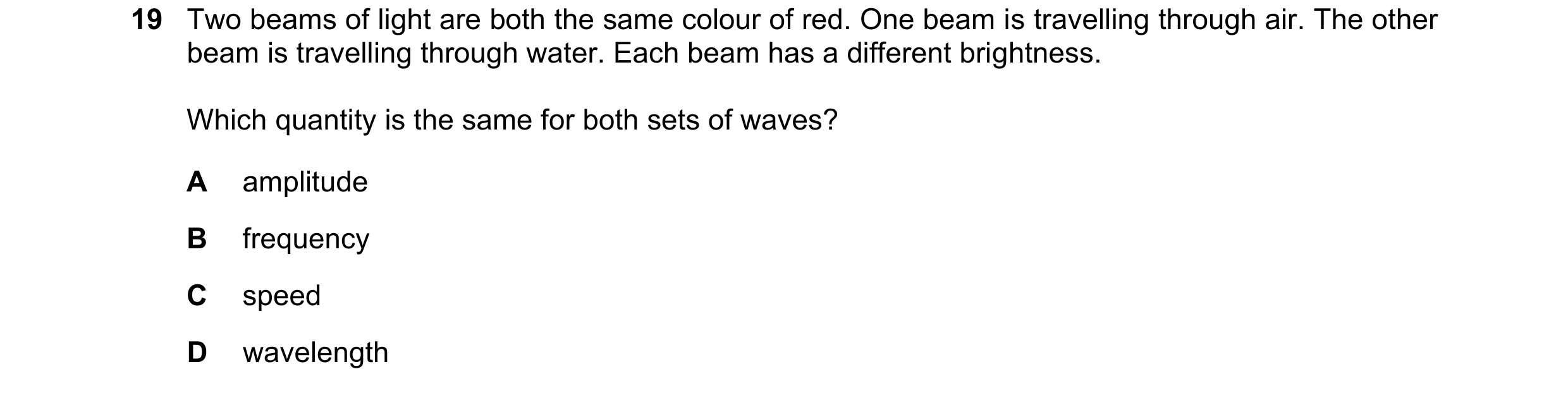
19 Two beams of light are both the same colour of red. One beam is travelling through air. The other beam is travelling through water. Each beam has a different brightness. Which quantity is the same for both sets of waves? A amplitude B frequency C speed D wavelength
1 marks
Answer: B
This question in 0972/21 Oct/Nov 2021
Q23 · The diagram shows a ray of light in air incident on a glass block 0972/21 Oct/Nov 2021
20 The diagram shows a ray of light in air incident on a glass block. Some of the light is refracted and some of the light is reflected. Two angles, p and q, are marked on the diagram. ray of light q air p glass Which row gives the angle of incidence and states whether total internal reflection occurs? angle of total internal incidence reflection A p no B p yes C q no D q yes
1 marks
Answer: C
This question in 0972/21 Oct/Nov 2021
Q24 · The diagram shows a ray of light in glass incident on the surface between the glass and… 0972/21 Oct/Nov 2021
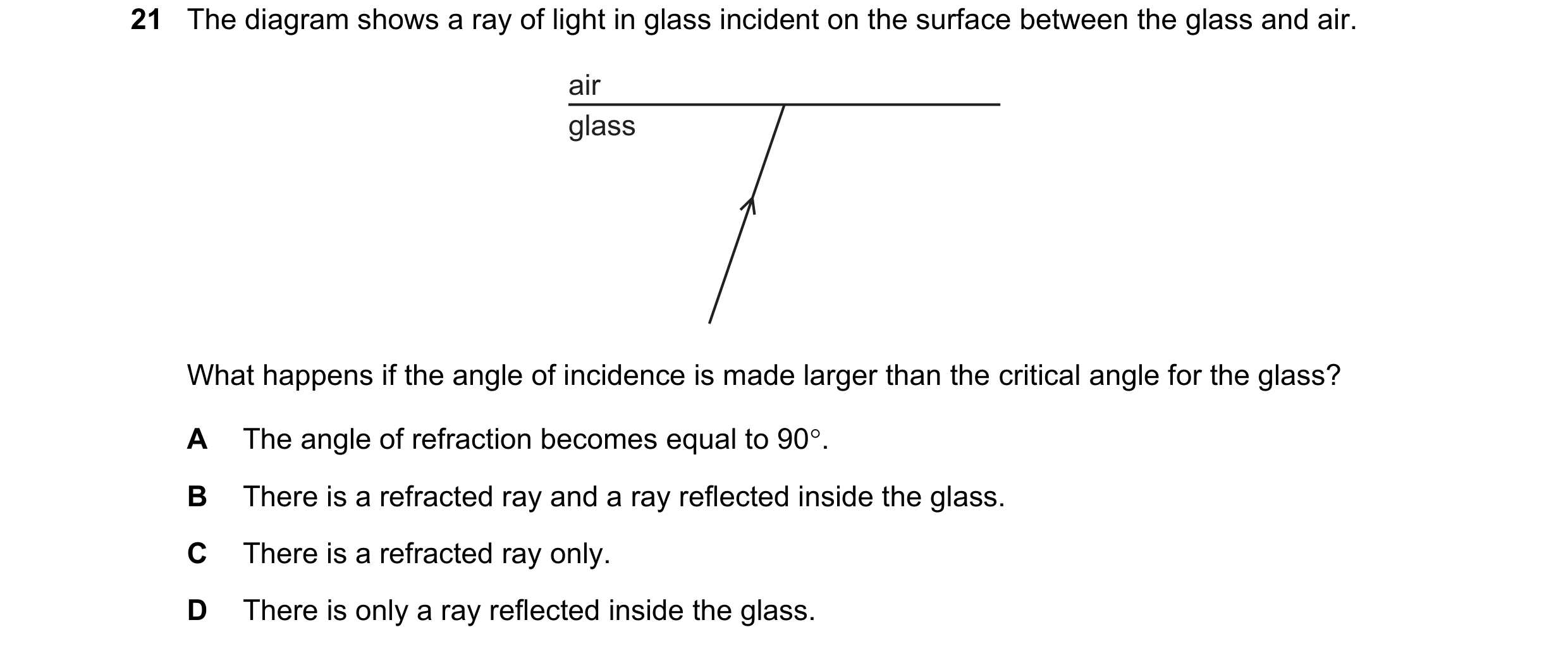
21 The diagram shows a ray of light in glass incident on the surface between the glass and air. air glass What happens if the angle of incidence is made larger than the critical angle for the glass? A The angle of refraction becomes equal to 90. B There is a refracted ray and a ray reflected inside the glass. C There is a refracted ray only. D There is only a ray reflected inside the glass.
1 marks
Answer: D
This question in 0972/21 Oct/Nov 2021
Q25 · The Sun emits infrared radiation and light 0972/21 Oct/Nov 2021
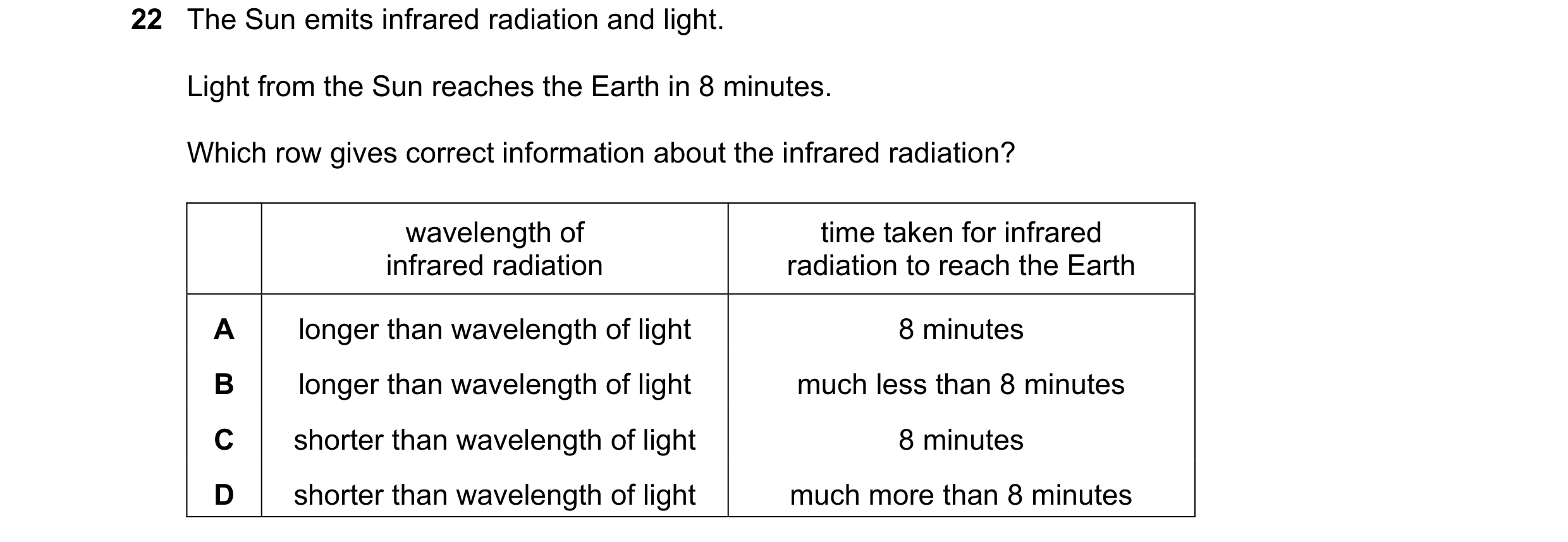
22 The Sun emits infrared radiation and light. Light from the Sun reaches the Earth in 8 minutes. Which row gives correct information about the infrared radiation? wavelength of time taken for infrared infrared radiation radiation to reach the Earth A longer than wavelength of light 8 minutes B longer than wavelength of light much less than 8 minutes C shorter than wavelength of light 8 minutes D shorter than wavelength of light much more than 8 minutes
1 marks
Answer: A
This question in 0972/21 Oct/Nov 2021
Q26 · A card is placed in front of a plane mirror so that its label is facing the mirror, as… 0972/21 May/June 2022
23 A card is placed in front of a plane mirror so that its label is facing the mirror, as shown. plane mirror label card observer The label is shown. How does the image of the label formed by the mirror appear to the observer? A B C D
1 marks
Answer: C
This question in 0972/21 May/June 2022
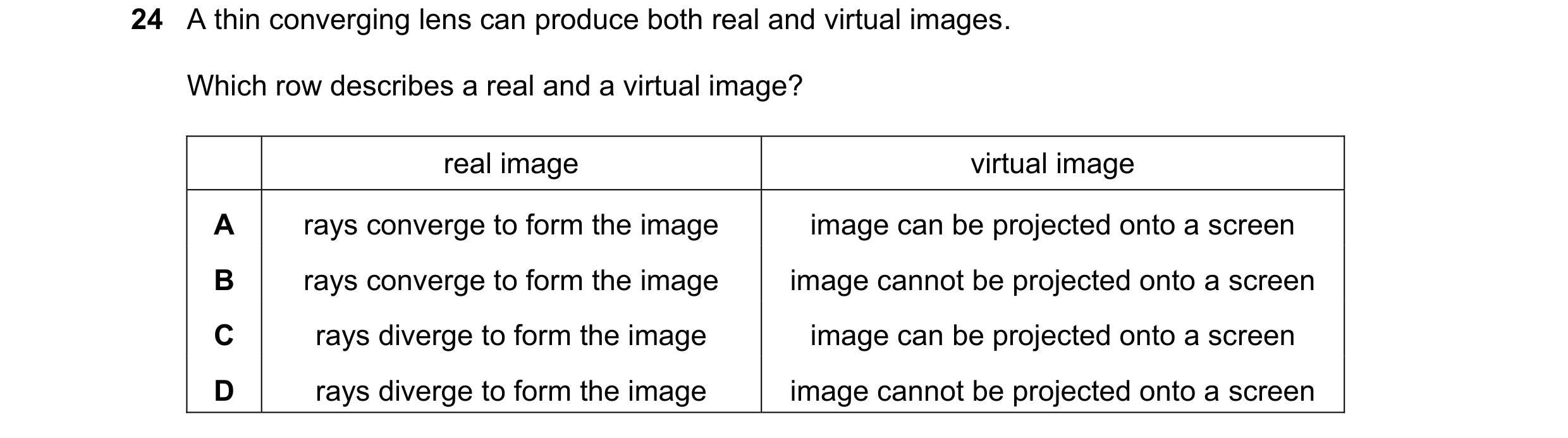
Q27 · A thin converging lens can produce both real and virtual images 0972/21 May/June 2022
24 A thin converging lens can produce both real and virtual images. Which row describes a real and a virtual image? real image virtual image A rays converge to form the image image can be projected onto a screen B rays converge to form the image image cannot be projected onto a screen C rays diverge to form the image image can be projected onto a screen D rays diverge to form the image image cannot be projected onto a screen
1 marks
Answer: B
This question in 0972/21 May/June 2022
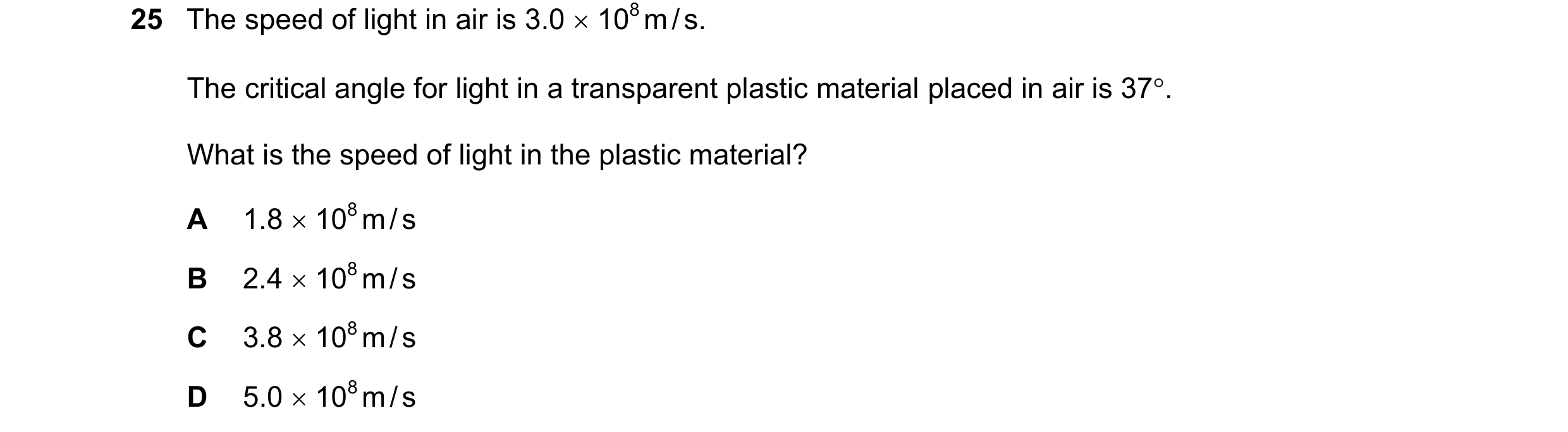
Q28 · The speed of light in air is 3.0 108 m / s 0972/21 May/June 2022
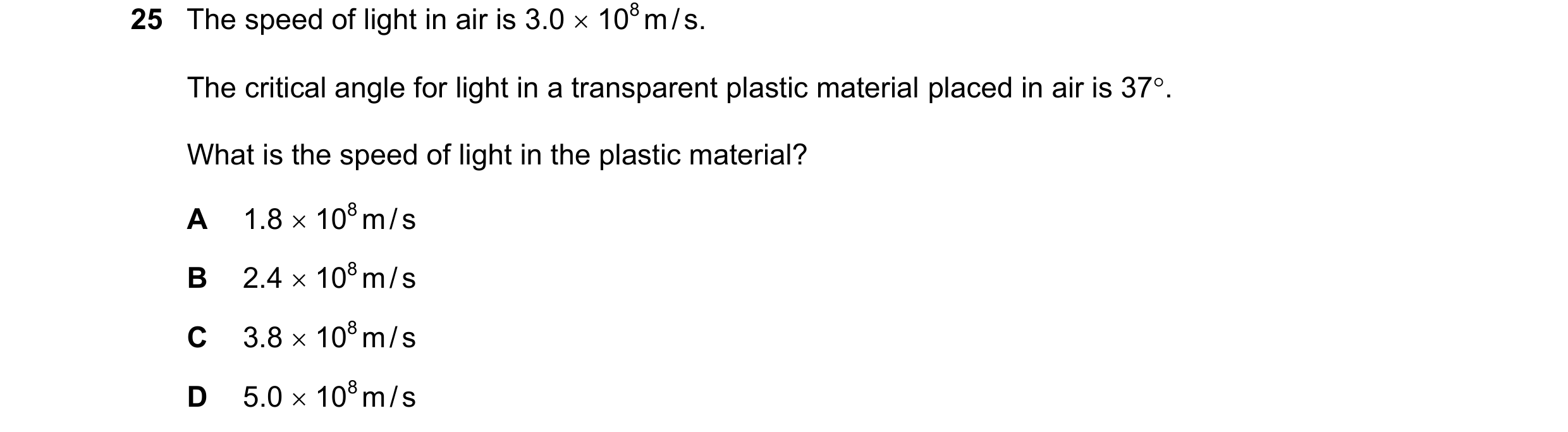
25 The speed of light in air is 3.0 108 m / s. The critical angle for light in a transparent plastic material placed in air is 37. What is the speed of light in the plastic material? A 1.8 108 m / s B 2.4 108 m / s C 3.8 108 m / s D 5.0 108 m / s
1 marks
Answer: A
This question in 0972/21 May/June 2022
Q29 · A student uses one eye to look at images in a plane mirror 0972/22 May/June 2022
23 A student uses one eye to look at images in a plane mirror. plane mirror P Q R E S T U X Y Objects are placed on the line XY. Which objects give rise to images that can be seen by the eye at E? A P, Q, R, S, T and U B Q, R, S and T only C P and U only D R and S only
1 marks
Answer: B
This question in 0972/22 May/June 2022
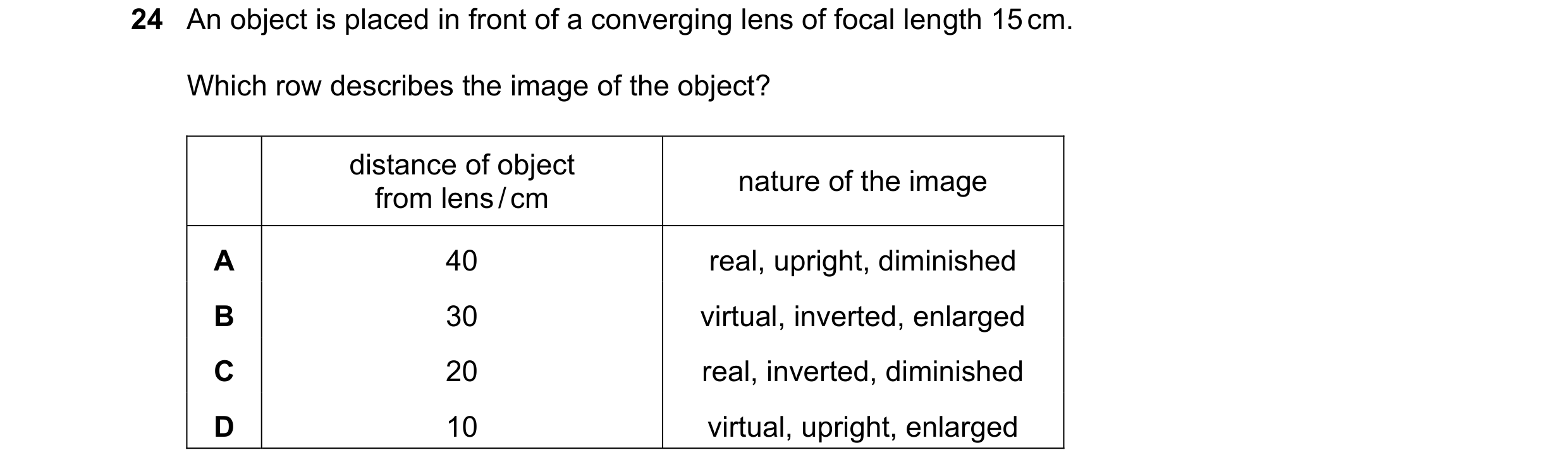
Q30 · An object is placed in front of a converging lens of focal length 15 cm 0972/22 May/June 2022
24 An object is placed in front of a converging lens of focal length 15 cm. Which row describes the image of the object? distance of object nature of the image from lens / cm A 40 real, upright, diminished B 30 virtual, inverted, enlarged C 20 real, inverted, diminished D 10 virtual, upright, enlarged
1 marks
Answer: D
This question in 0972/22 May/June 2022
Q31 · The speed of light in air is 3.0 108 m / s 0972/22 May/June 2022
25 The speed of light in air is 3.0 108 m / s. The critical angle for light in a transparent plastic material placed in air is 37. What is the speed of light in the plastic material? A 1.8 108 m / s B 2.4 108 m / s C 3.8 108 m / s D 5.0 108 m / s
1 marks
Answer: A
This question in 0972/22 May/June 2022
Q32 · A composite block is made by joining together three transparent materials 0972/21 Oct/Nov 2022
19 A composite block is made by joining together three transparent materials. The diagram shows a ray of light passing through the composite block. material 1 material 2 material 3 Which list gives the three materials in order of the speeds of light in the materials, from slowest to fastest? A 1 → 2 → 3 B 1 → 3 → 2 C 2 → 1 → 3 D 2 → 3 → 1
1 marks
Answer: C
This question in 0972/21 Oct/Nov 2022
Q33 · An object is placed 30 cm in front of a plane mirror 0972/21 Oct/Nov 2022
20 An object is placed 30 cm in front of a plane mirror. Which statement describes the image of the object? A The image is the same size and 30 cm from the object. B The image is the same size and 60 cm from the object. C The image is smaller and 30 cm from the object. D The image is smaller and 60 cm from the object.
1 marks
Answer: B
This question in 0972/21 Oct/Nov 2022
Q34 · A ray of light is shone onto the surface of a mirror 0972/21 Oct/Nov 2022
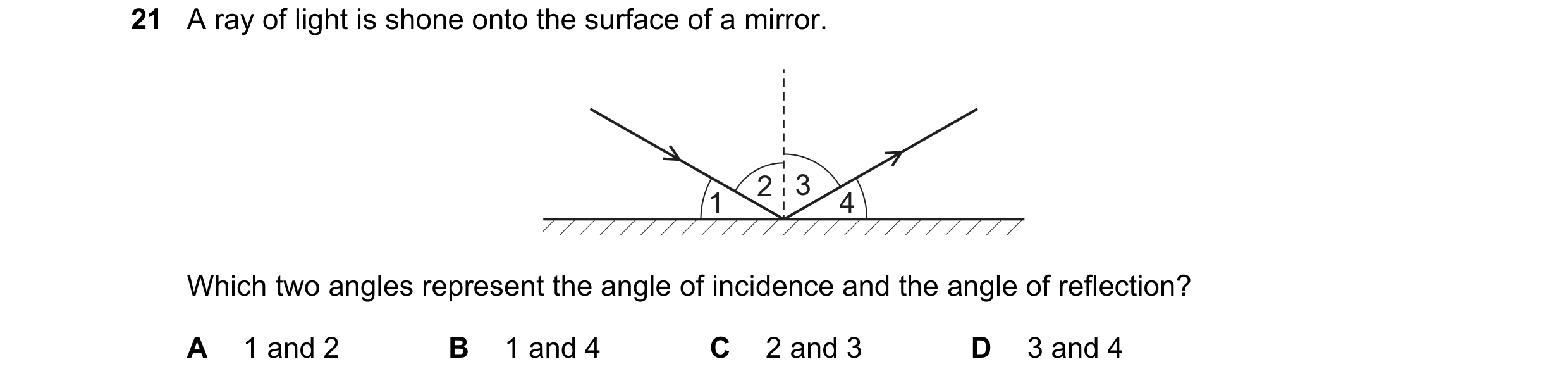
21 A ray of light is shone onto the surface of a mirror. 2 3 1 4 Which two angles represent the angle of incidence and the angle of reflection? A 1 and 2 B 1 and 4 C 2 and 3 D 3 and 4
1 marks
Answer: C
This question in 0972/21 Oct/Nov 2022
Q35 · An observer stands at the finish line of a 100 m race 0972/21 Oct/Nov 2022
24 An observer stands at the finish line of a 100 m race. He wants to time the winner’s run. He starts his stop-watch as soon as he sees the smoke from the starting gun instead of when he hears the bang. What is the reason for doing this? A Light travels much faster than sound. B There is a risk he might respond to an echo from a wall. C Humans react slower to sound than to light. D Humans react more quickly to sound than to light.
1 marks
Answer: A
This question in 0972/21 Oct/Nov 2022
Q36 · The diagram shows a ray of light entering a glass block 0972/21 May/June 2023
18 The diagram shows a ray of light entering a glass block.
air
50°
Which calculation gives the refractive index of the glass?
sin 40° B sin 40° Cc sin 50° D sin 50°
sin 25° sin 65° sin 25° sin 65°
1 marks
Answer: A
This question in 0972/21 May/June 2023
Q37 · An object O is placed at point P near to a thin converging lens 0972/21 May/June 2023
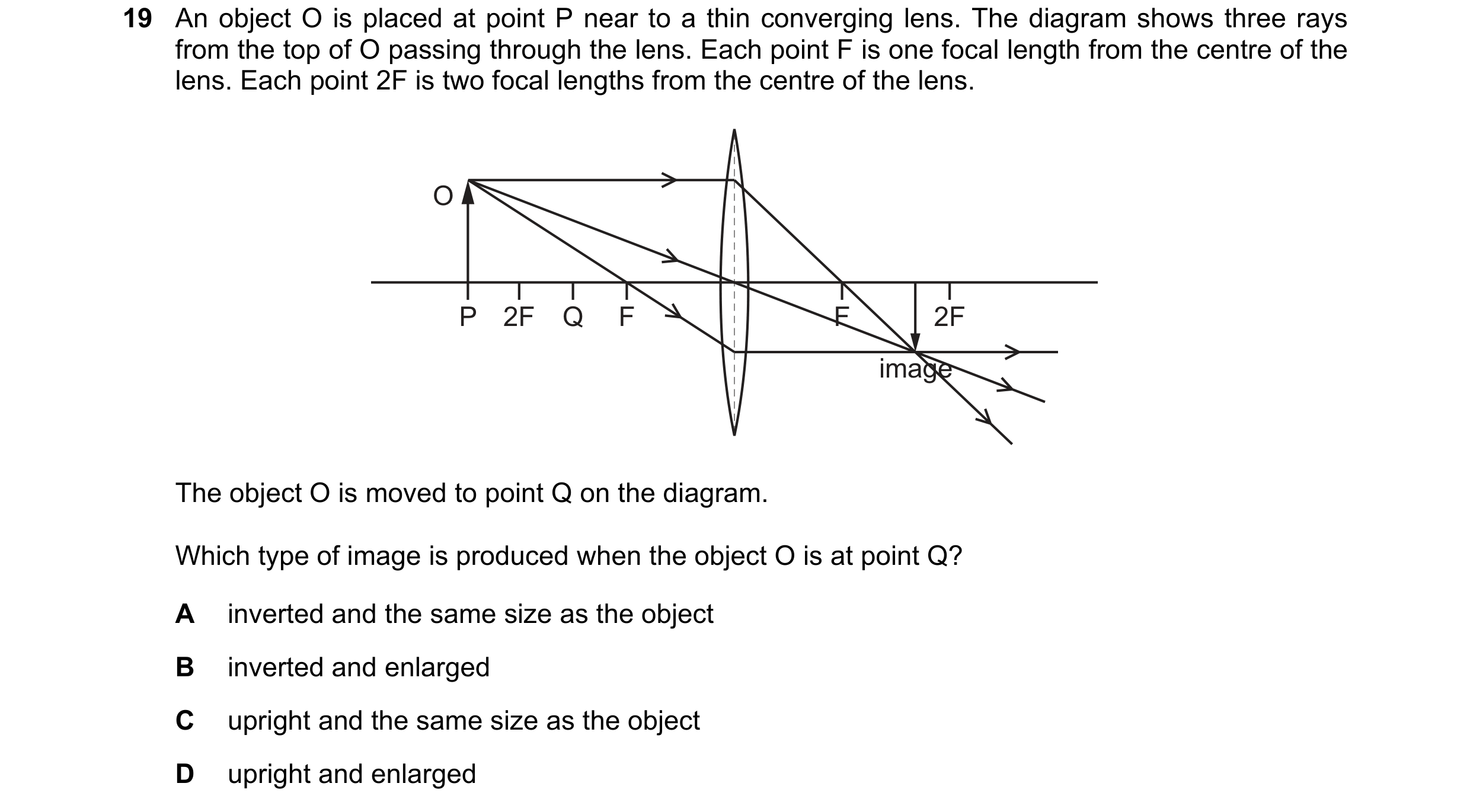
19 An object O is placed at point P near to a thin converging lens. The diagram shows three rays from the top of O passing through the lens. Each point F is one focal length from the centre of the lens. Each point 2F is two focal lengths from the centre of the lens. O P 2F Q F F 2F image The object O is moved to point Q on the diagram. Which type of image is produced when the object O is at point Q? A inverted and the same size as the object B inverted and enlarged C upright and the same size as the object D upright and enlarged
1 marks
Answer: B
This question in 0972/21 May/June 2023
Q38 · Which diagram shows the dispersion of white light by a glass prism? 0972/21 May/June 2023
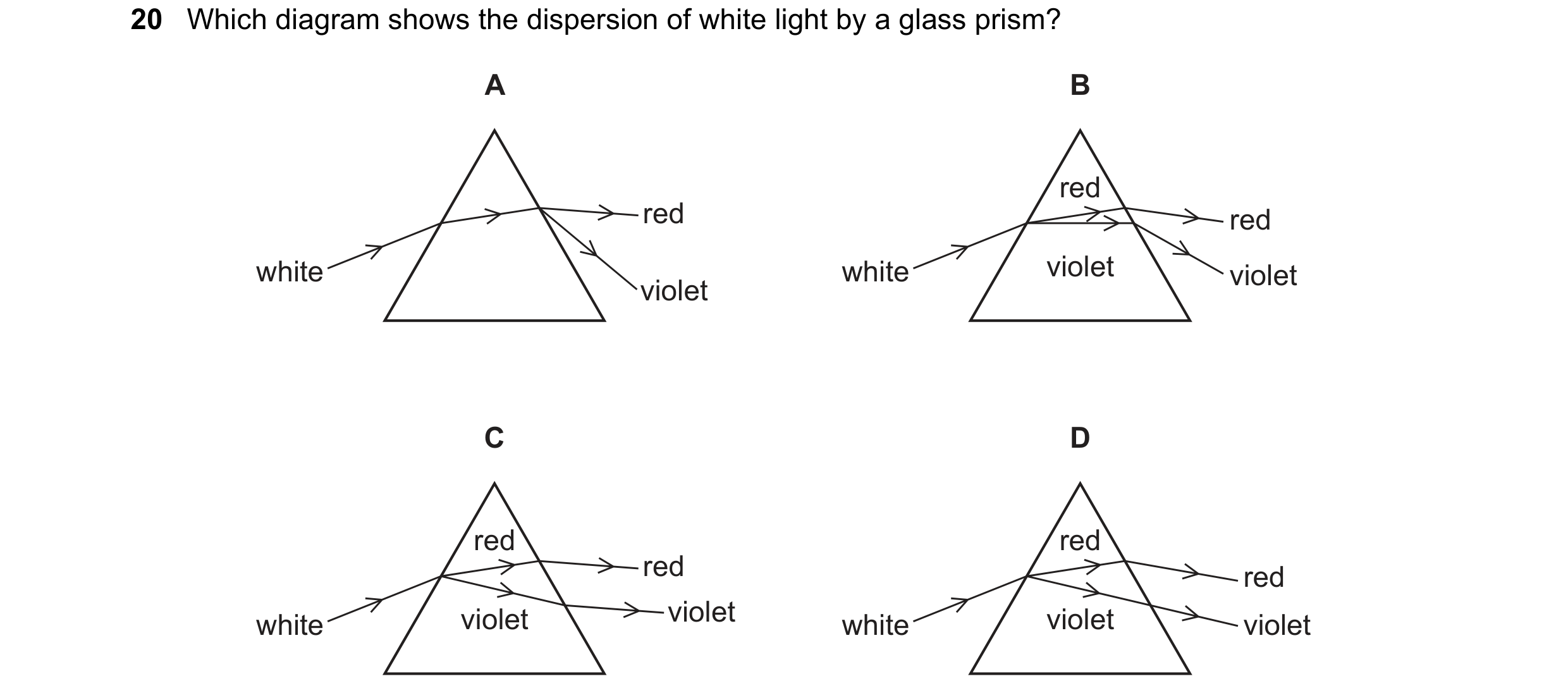
20 Which diagram shows the dispersion of white light by a glass prism? A B red red red white white violet violet violet C D red red red red white violet violet white violet violet
1 marks
Answer: B
This question in 0972/21 May/June 2023
Q39 · Optical fibres are used to transmit digital signals using infrared radiation 0972/22 May/June 2023
18 Optical fibres are used to transmit digital signals using infrared radiation. The average refractive index of the fibres is 1.50. Which row describes a digital signal and gives the speed of infrared radiation in the fibres? speed of infrared radiation in the fibres digital signal m / s A a signal that consists 2.0 108 of only two values B a signal that consists 4.5 108 of only two values C a signal that consists of 2.0 108 a continuous range of values D a signal that consists of 4.5 108 a continuous range of values
1 marks
Answer: A
This question in 0972/22 May/June 2023
Q40 · Which statement describes monochromatic light? 0972/22 May/June 2023
19 Which statement describes monochromatic light? A light of a single frequency B light transmitted by a transparent prism C visible light D white light
1 marks
Answer: A
This question in 0972/22 May/June 2023
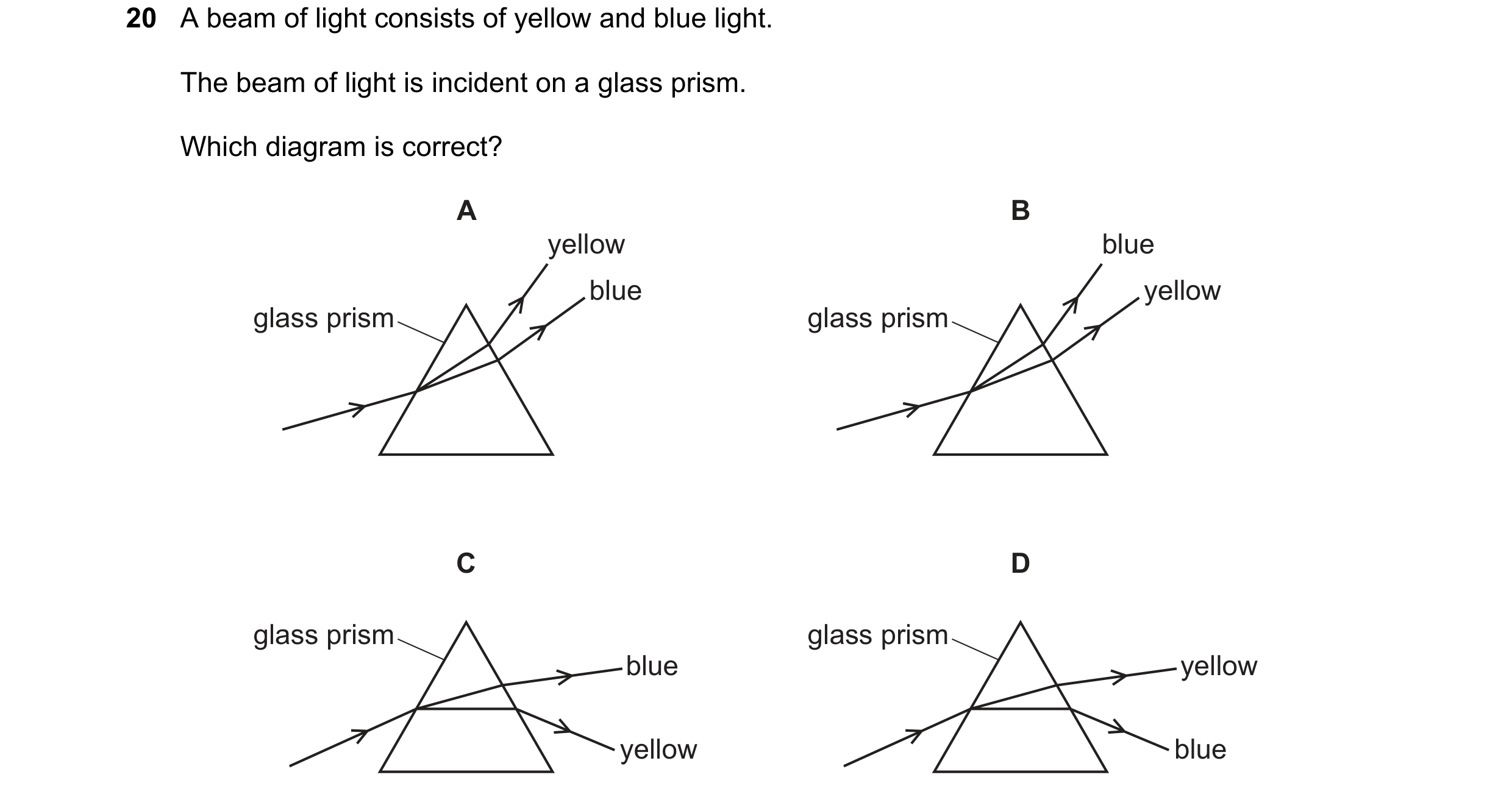
Q41 · A beam of light consists of yellow and blue light 0972/22 May/June 2023
20 A beam of light consists of yellow and blue light. The beam of light is incident on a glass prism. Which diagram is correct? A B yellow blue blue yellow glass prism glass prism C D glass prism glass prism blue yellow yellow blue
1 marks
Answer: D
This question in 0972/22 May/June 2023
Q42 · Two men, P and Q, stand close to a gap in a wall, as shown 0972/21 Oct/Nov 2023
17 Two men, P and Q, stand close to a gap in a wall, as shown. Man P cannot see man Q but man P can hear man Q speaking. P Q gap Which statement explains this? A Light waves do not diffract at all because they are electromagnetic waves. B Light waves have a range of frequencies but sound has just one frequency. C Sound waves are of a higher frequency than light waves. D Sound waves diffract a lot because their wavelength is a similar size to the width of the gap.
1 marks
Answer: D
This question in 0972/21 Oct/Nov 2023
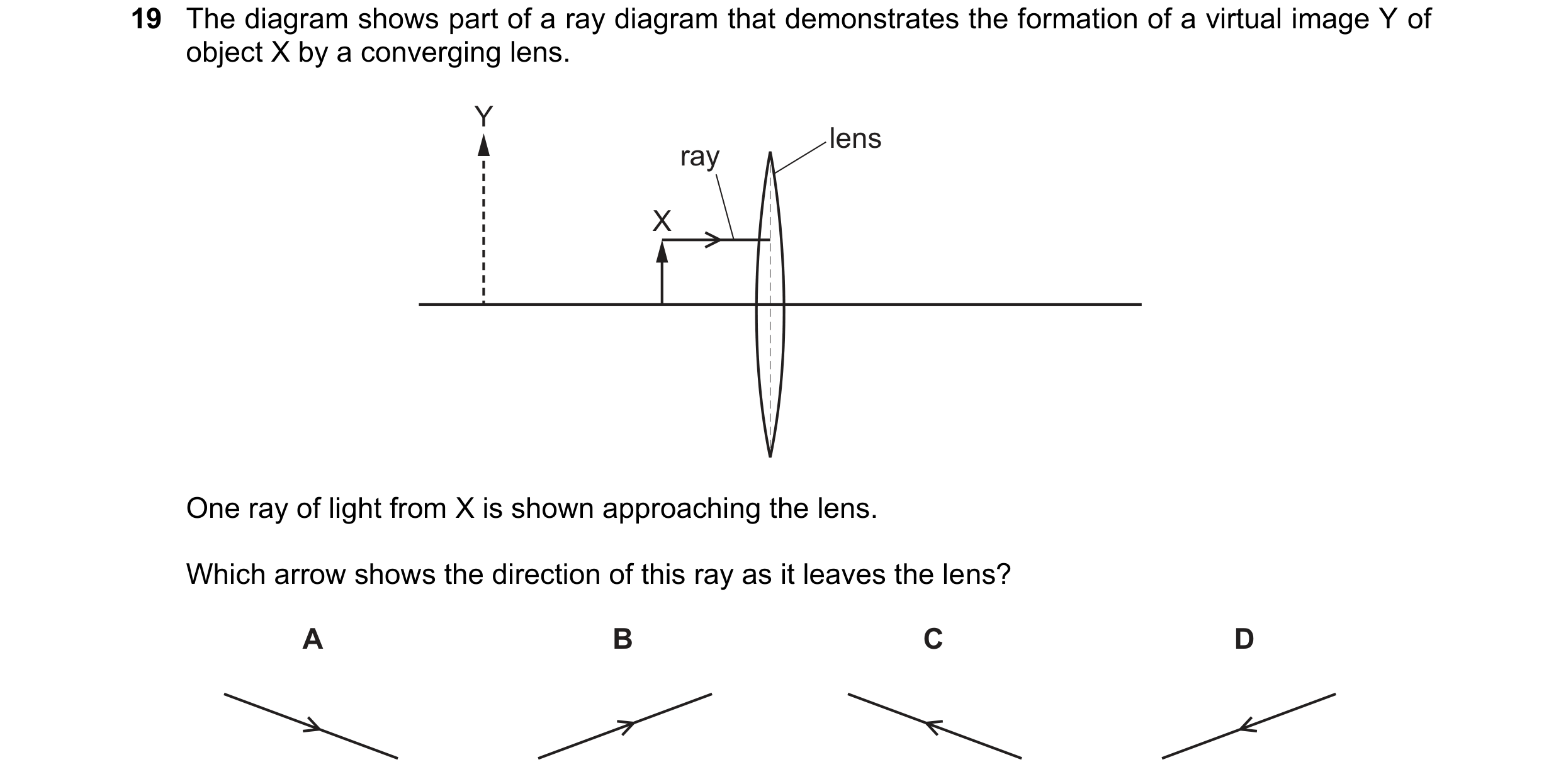
Q43 · The diagram shows part of a ray diagram that demonstrates the formation of a virtual… 0972/21 Oct/Nov 2023
19 The diagram shows part of a ray diagram that demonstrates the formation of a virtual image Y of object X by a converging lens. Y lens ray X One ray of light from X is shown approaching the lens. Which arrow shows the direction of this ray as it leaves the lens? A B C D
1 marks
Answer: A
This question in 0972/21 Oct/Nov 2023
Q44 · A ray of light is reflected by a plane mirror 0972/21 Oct/Nov 2023
20 A ray of light is reflected by a plane mirror. Q R P S Which row shows the angle of incidence and the angle of reflection? angle of angle of incidence reflection A P Q B P S C Q R D R S
1 marks
Answer: C
This question in 0972/21 Oct/Nov 2023
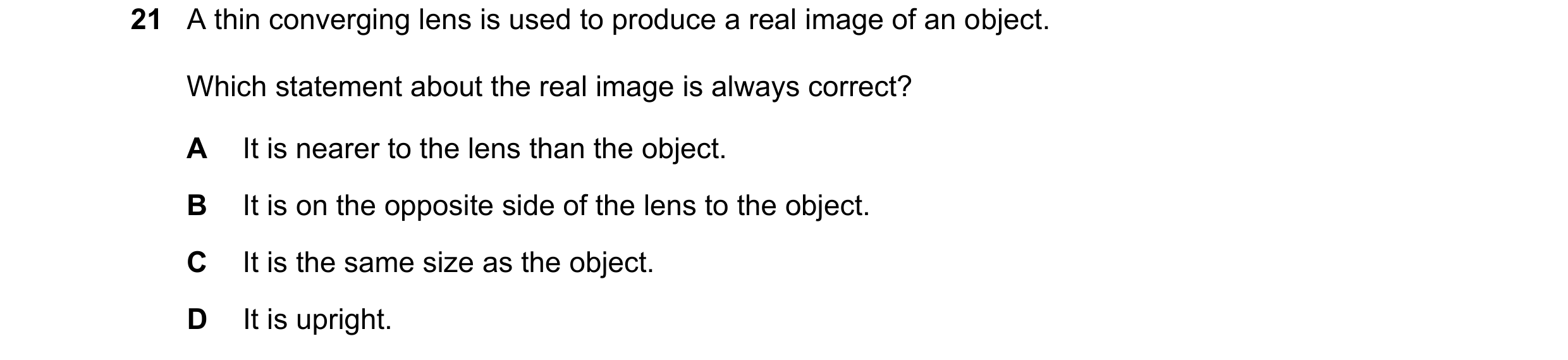
Q45 · A thin converging lens is used to produce a real image of an object 0972/21 Oct/Nov 2023
21 A thin converging lens is used to produce a real image of an object. Which statement about the real image is always correct? A It is nearer to the lens than the object. B It is on the opposite side of the lens to the object. C It is the same size as the object. D It is upright.
1 marks
Answer: B
This question in 0972/21 Oct/Nov 2023
Q46 · The angle of incidence of a ray of light incident on a plane mirror is gradually increased 0972/21 May/June 2024
17 The angle of incidence of a ray of light incident on a plane mirror is gradually increased. To the nearest degree, what is the maximum possible angle between the incident and reflected rays? A 0 B 45 C 90 D 180
1 marks
Answer: D
This question in 0972/21 May/June 2024
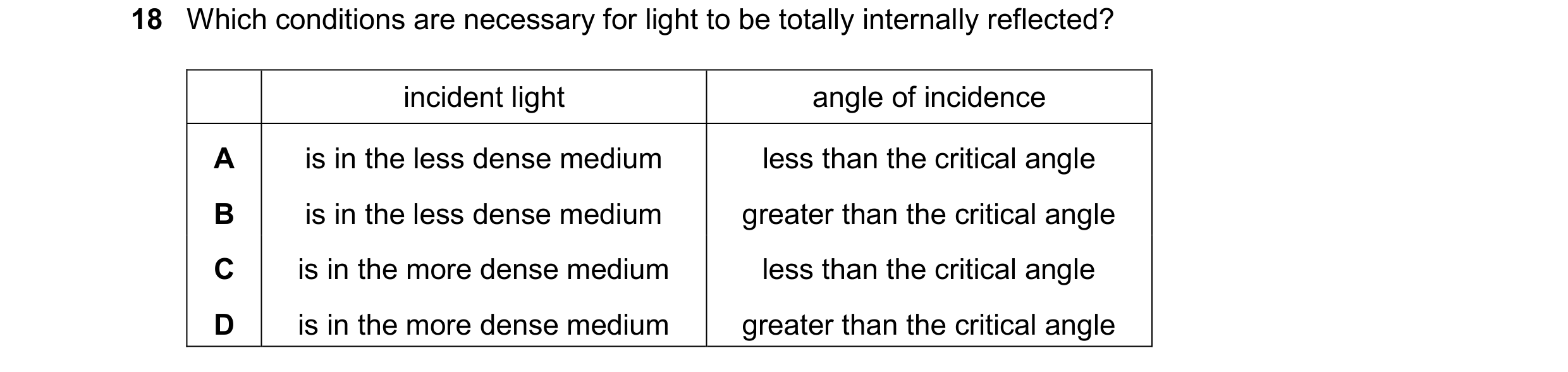
Q47 · Which conditions are necessary for light to be totally internally reflected? 0972/21 May/June 2024
18 Which conditions are necessary for light to be totally internally reflected? incident light angle of incidence A is in the less dense medium less than the critical angle B is in the less dense medium greater than the critical angle C is in the more dense medium less than the critical angle D is in the more dense medium greater than the critical angle
1 marks
Answer: D
This question in 0972/21 May/June 2024
Q48 · The diagram shows a ray of light passing from air into a transparent substance 0972/21 May/June 2024
19 The diagram shows a ray of light passing from air into a transparent substance.
transparent
substance
What is the refractive index of the transparent substance?
A 1.33 B 1.29 C 0.778 D 0.750
1 marks
Answer: B
This question in 0972/21 May/June 2024
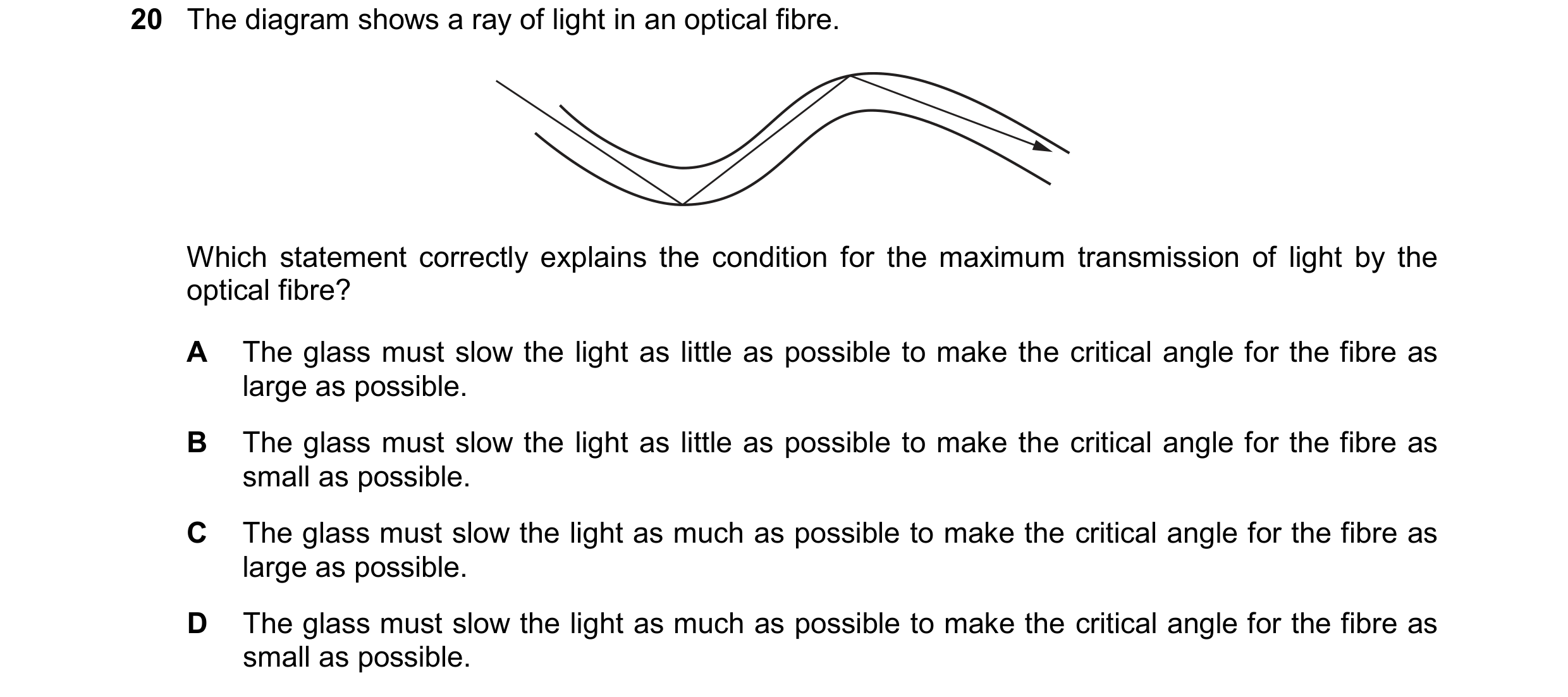
Q49 · The diagram shows a ray of light in an optical fibre 0972/21 May/June 2024
20 The diagram shows a ray of light in an optical fibre. Which statement correctly explains the condition for the maximum transmission of light by the optical fibre? A The glass must slow the light as little as possible to make the critical angle for the fibre as large as possible. B The glass must slow the light as little as possible to make the critical angle for the fibre as small as possible. C The glass must slow the light as much as possible to make the critical angle for the fibre as large as possible. D The glass must slow the light as much as possible to make the critical angle for the fibre as small as possible.
1 marks
Answer: D
This question in 0972/21 May/June 2024
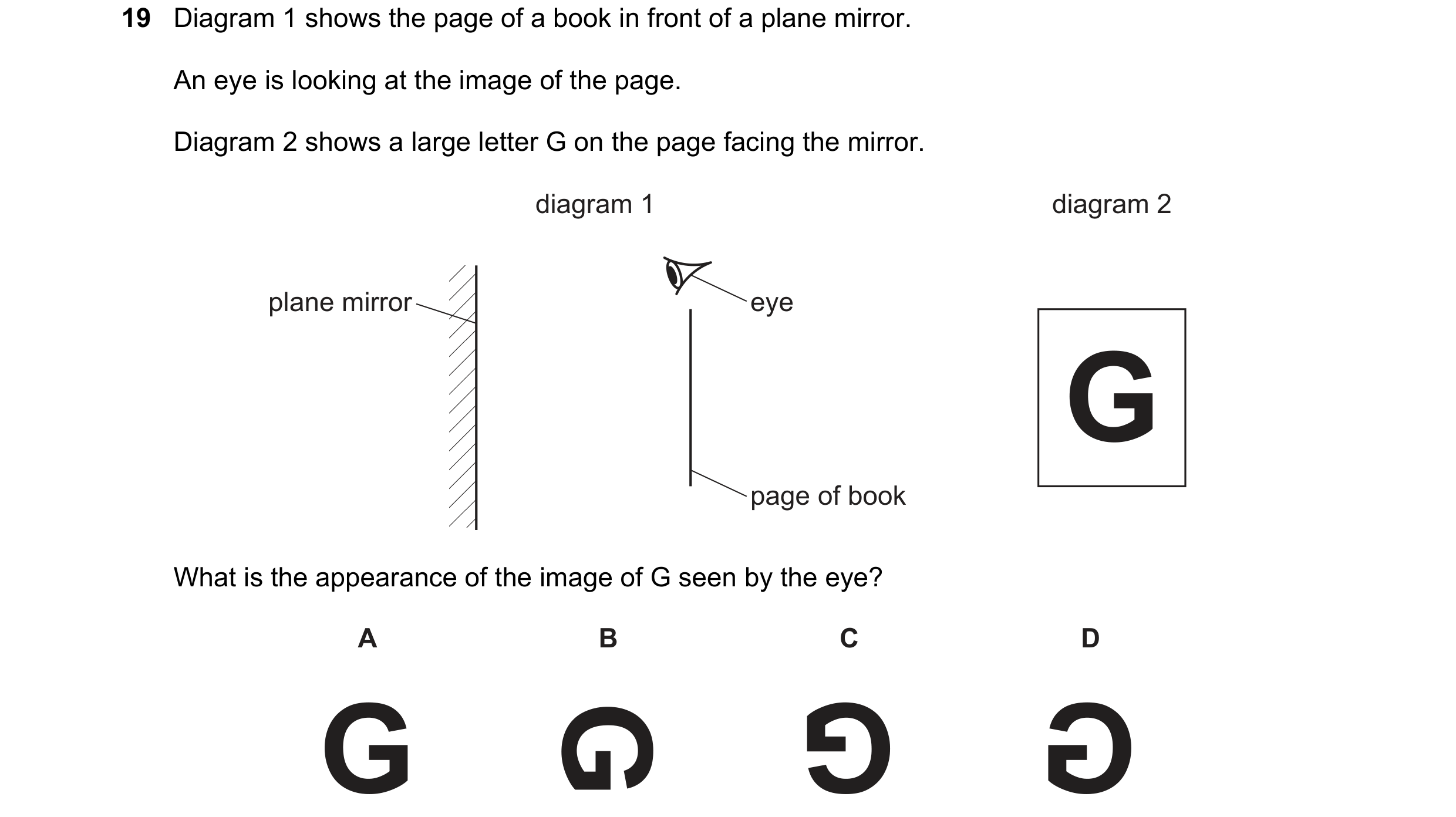
Q50 · The page of a book in front of a plane mirror 0972/22 May/June 2024
19 Diagram 1 shows the page of a book in front of a plane mirror. An eye is looking at the image of the page. Diagram 2 shows a large letter G on the page facing the mirror. diagram 1 diagram 2 plane mirror eye page of book What is the appearance of the image of G seen by the eye? A B C D
1 marks
Answer: D
This question in 0972/22 May/June 2024
Q51 · The diagram shows a ray of light passing from air into diamond 0972/22 May/June 2024
20 The diagram shows a ray of light passing from air into diamond.
60°
air
diamond
18°
What is the refractive index of the diamond?
A 0.89 B 1.1 C 24 D 2.5
1 marks
Answer: C
This question in 0972/22 May/June 2024
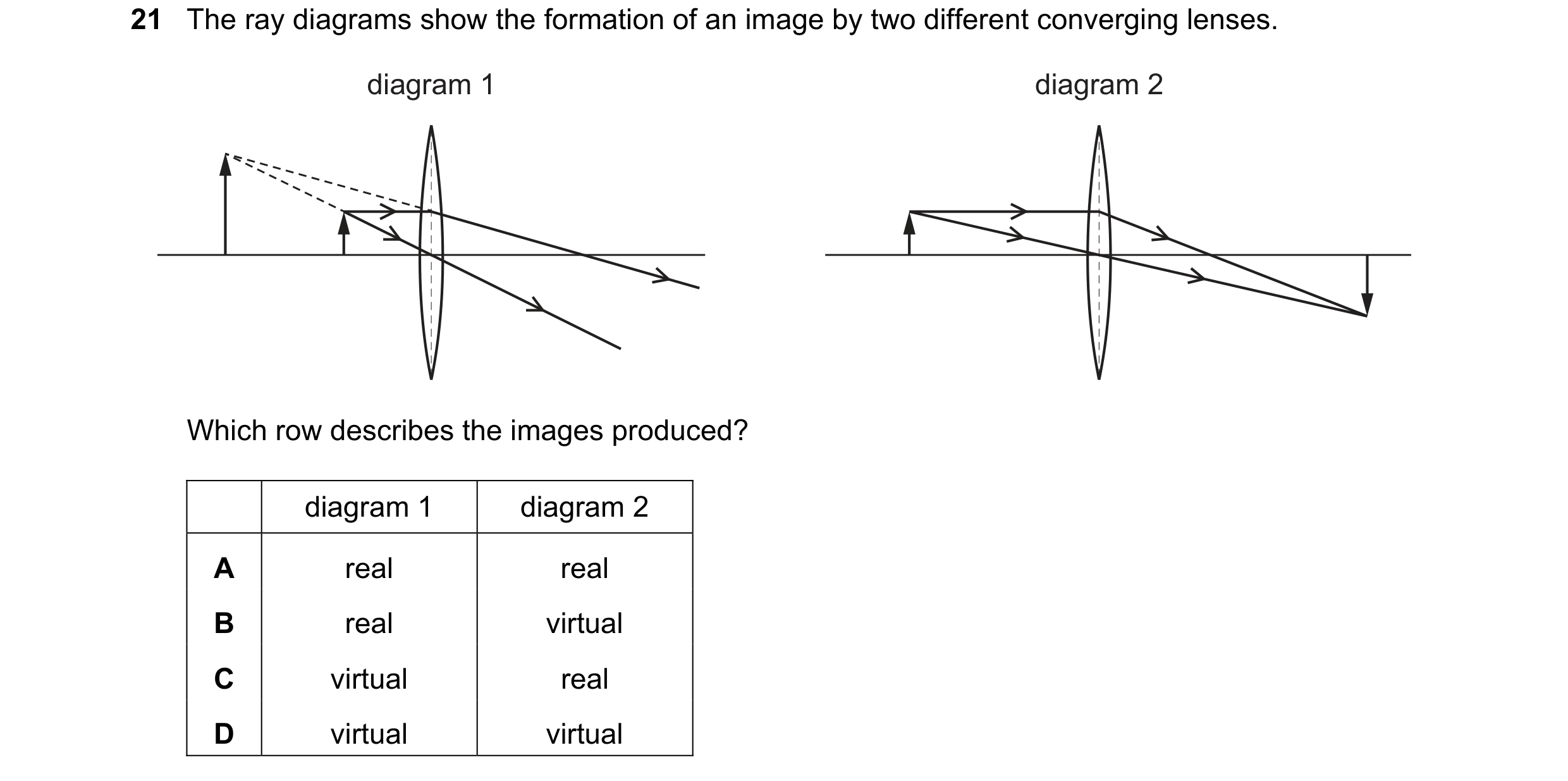
Q52 · The ray diagrams show the formation of an image by two different converging lenses 0972/22 May/June 2024
21 The ray diagrams show the formation of an image by two different converging lenses. diagram 1 diagram 2 Which row describes the images produced? diagram 1 diagram 2 A real real B real virtual C virtual real D virtual virtual
1 marks
Answer: C
This question in 0972/22 May/June 2024
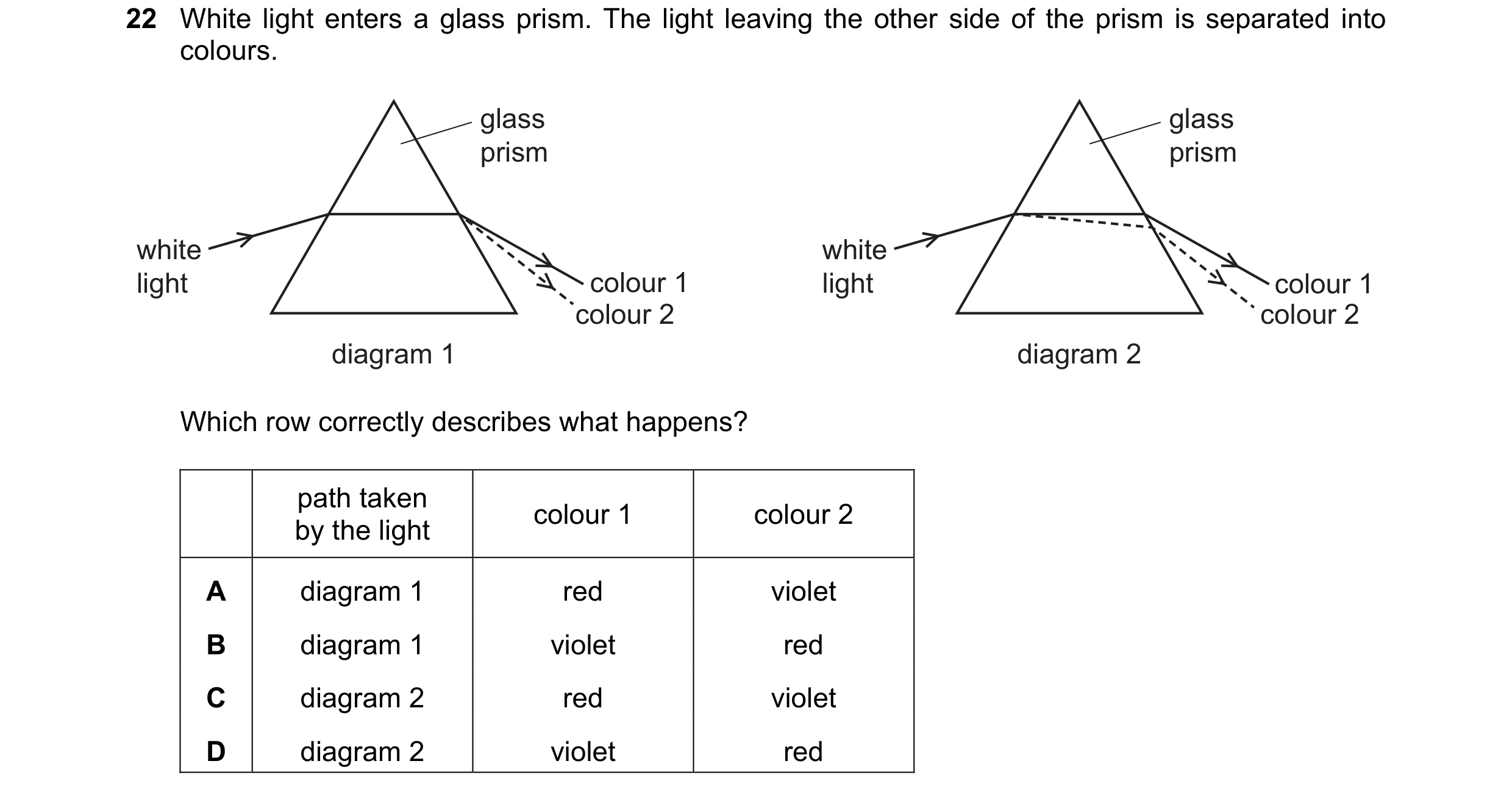
Q53 · White light enters a glass prism 0972/22 May/June 2024
22 White light enters a glass prism. The light leaving the other side of the prism is separated into colours. glass glass prism prism white white light colour 1 light colour 1 colour 2 colour 2 diagram 1 diagram 2 Which row correctly describes what happens? path taken colour 1 colour 2 by the light A diagram 1 red violet B diagram 1 violet red C diagram 2 red violet D diagram 2 violet red
1 marks
Answer: C
This question in 0972/22 May/June 2024
Q54 · Water waves are reflected at a plane surface 0972/21 Oct/Nov 2024
17 Water waves are reflected at a plane surface. Which property of the waves is changed by the reflection? A direction of propagation B frequency C speed D wavelength
1 marks
Answer: A
This question in 0972/21 Oct/Nov 2024
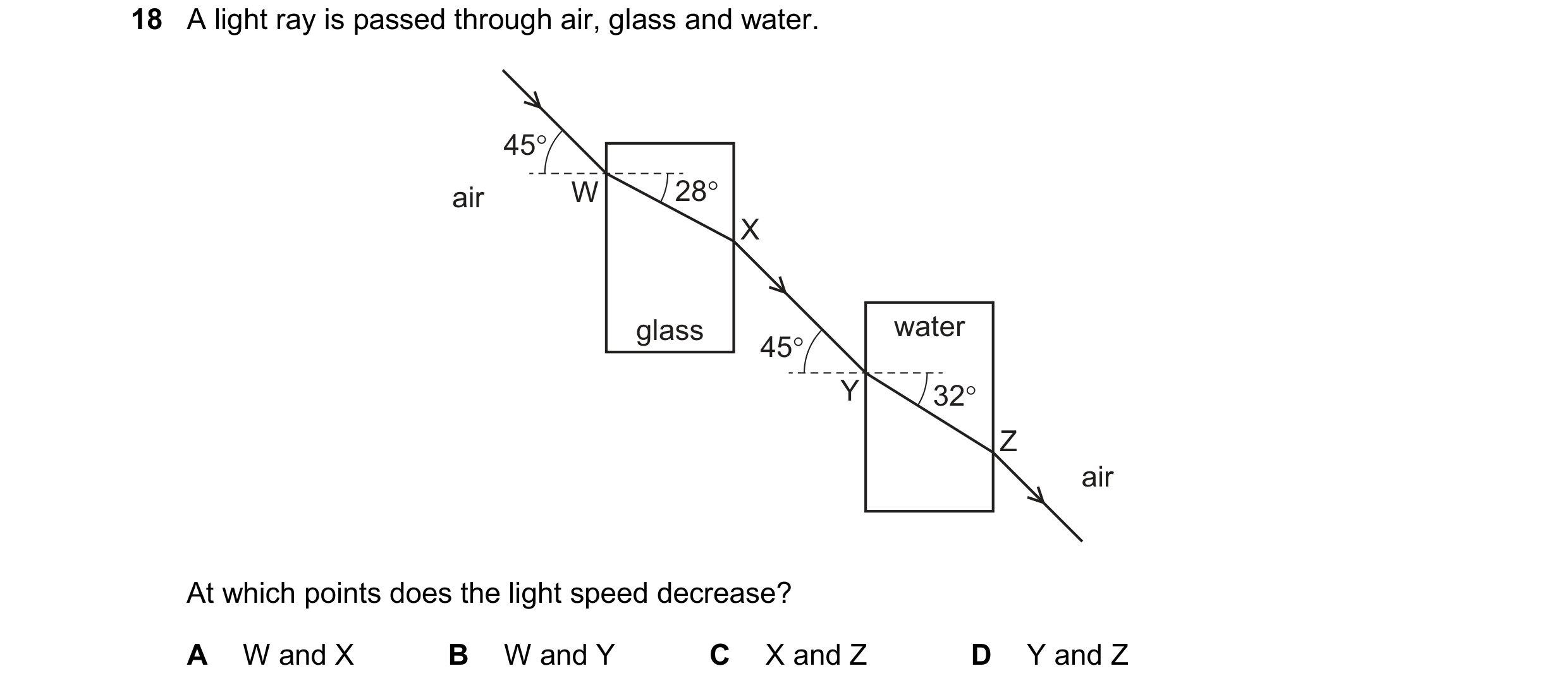
Q55 · A light ray is passed through air, glass and water 0972/21 Oct/Nov 2024
18 A light ray is passed through air, glass and water.
air
At which points does the light speed decrease?
A Wand xX B WandyY C XandZ D YandZ
1 marks
Answer: B
This question in 0972/21 Oct/Nov 2024
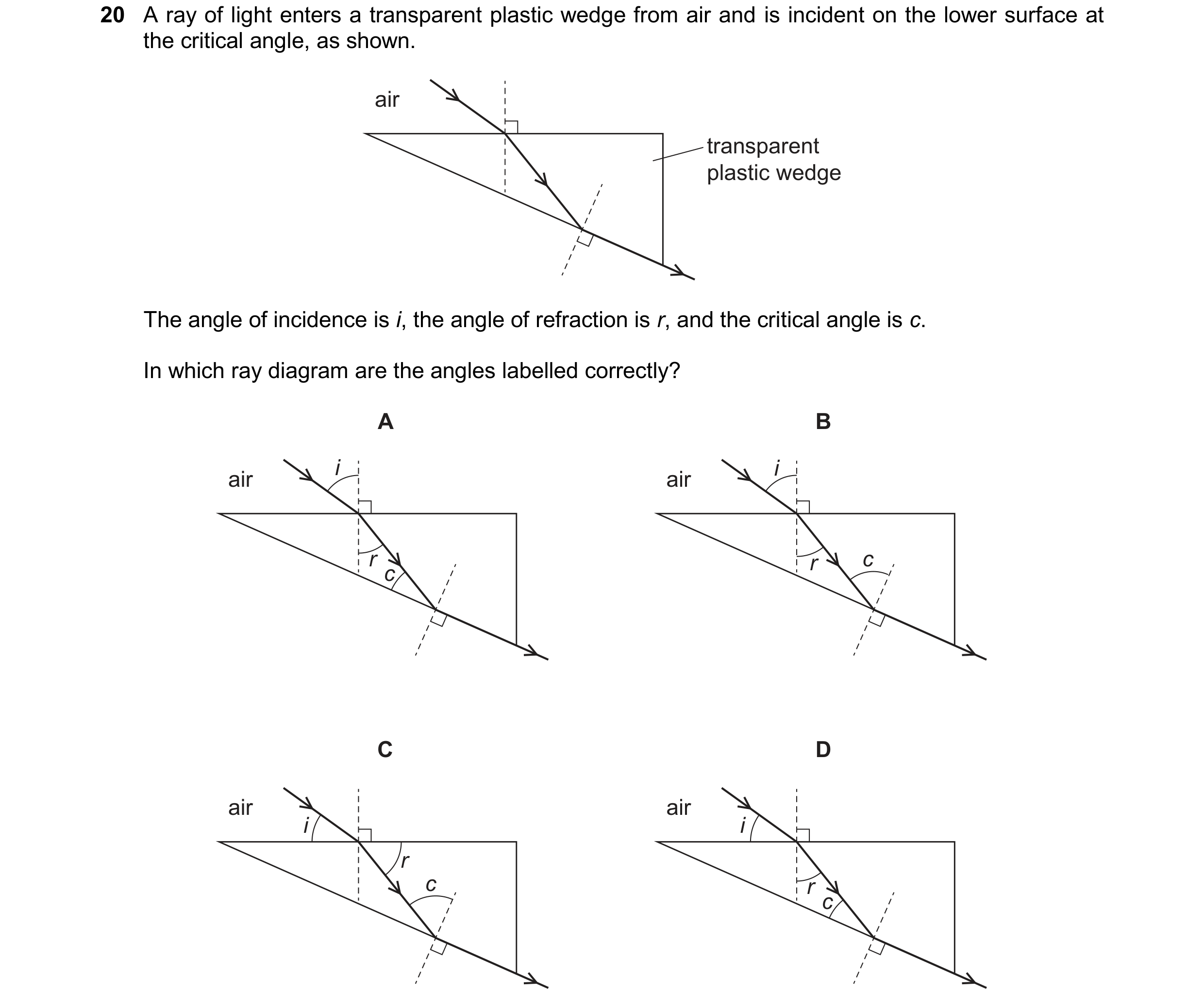
Q56 · A ray of light enters a transparent plastic wedge from air and is incident on the lower… 0972/21 Oct/Nov 2024
20 A ray of light enters a transparent plastic wedge from air and is incident on the lower surface at the critical angle, as shown. air transparent plastic wedge The angle of incidence is i, the angle of refraction is r, and the critical angle is c. In which ray diagram are the angles labelled correctly? A B i i air air r c r c C D air air i i r c r c
1 marks
Answer: B
This question in 0972/21 Oct/Nov 2024
Q57 · An object is placed 20 cm in front of a thin converging lens 0972/21 Oct/Nov 2024
21 An object is placed 20 cm in front of a thin converging lens. The scale diagram shows how the lens forms a real, inverted image. object image scale 5.0 cm Which row gives the focal length of the lens and the distance of the image from the lens? focal length distance of image of lens / cm from lens / cm A 4.0 5.0 B 5.0 4.0 C 8.0 10.0 D 10.0 8.0
1 marks
Answer: A
This question in 0972/21 Oct/Nov 2024
Q58 · A thin converging lens is used as a magnifying glass 0972/21 May/June 2025
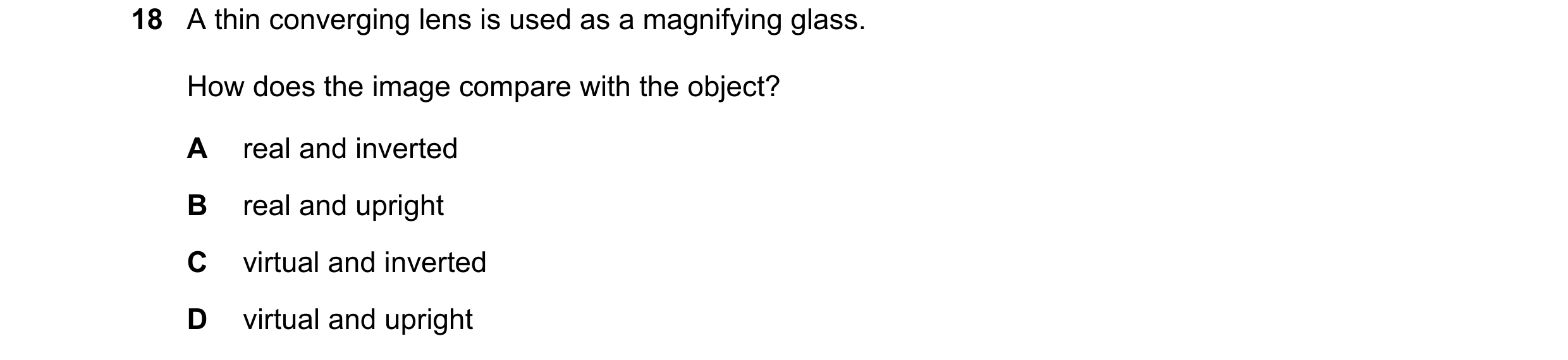
18 A thin converging lens is used as a magnifying glass. How does the image compare with the object? A real and inverted B real and upright C virtual and inverted D virtual and upright
1 marks
Answer: D
This question in 0972/21 May/June 2025
Q59 · The diagram shows two plane mirrors at 90° to each other 0972/21 May/June 2025
19 The diagram shows two plane mirrors at 90° to each other. A ray of light is incident on one of the mirrors. The ray reflects off both mirrors before reaching a screen. At which labelled point does the ray reach the screen? screen A B C D ray of light
1 marks
Answer: B
This question in 0972/21 May/June 2025
Q60 · The speed of light in a material is 50% of the speed of light in air 0972/21 May/June 2025
20 The speed of light in a material is 50% of the speed of light in air. What is the refractive index of the material? A 0.5 B 2.0 C 6.0 108 D 1.5 108
1 marks
Answer: B
This question in 0972/21 May/June 2025
Q61 · A beam of white light is split into a spectrum of seven colours 0972/21 May/June 2025
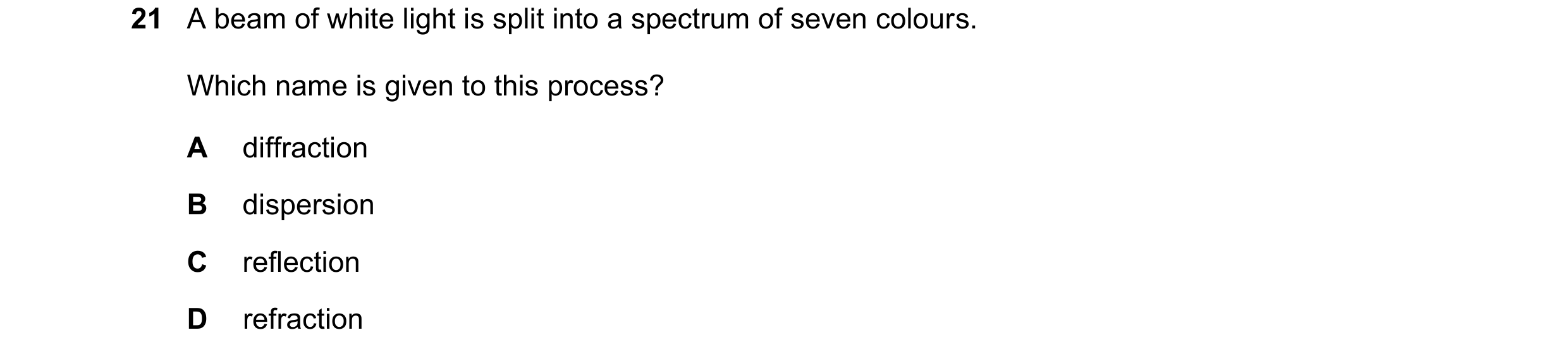
21 A beam of white light is split into a spectrum of seven colours. Which name is given to this process? A diffraction B dispersion C reflection D refraction
1 marks
Answer: B
This question in 0972/21 May/June 2025
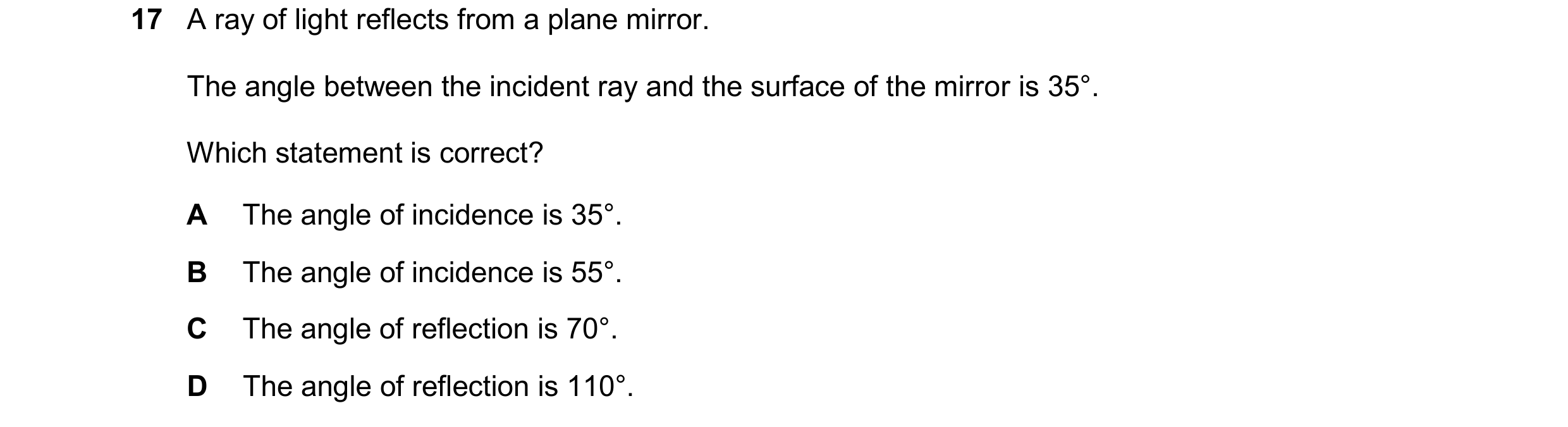
Q62 · A ray of light reflects from a plane mirror 0972/21 Oct/Nov 2025
17 A ray of light reflects from a plane mirror. The angle between the incident ray and the surface of the mirror is 35°. Which statement is correct? A The angle of incidence is 35°. B The angle of incidence is 55°. C The angle of reflection is 70°. D The angle of reflection is 110°.
1 marks
Answer: B
This question in 0972/21 Oct/Nov 2025
Q63 · A beam of light passes through a vacuum and then enters a transparent liquid 0972/21 Oct/Nov 2025
19 A beam of light passes through a vacuum and then enters a transparent liquid. The diagram shows the path it takes. 40° vacuum liquid 25° The light travels through the vacuum at a speed of 3.0 108 m / s. What is the speed of light in the liquid? A 1.9 108 m / s B 2.0 108 m / s C 4.6 108 m / s D 4.8 108 m / s
1 marks
Answer: B
This question in 0972/21 Oct/Nov 2025
Q64 · Which statement about a thin converging lens is correct? 0972/21 Oct/Nov 2025
20 Which statement about a thin converging lens is correct? A All rays of light refracted by the lens pass through the principal focus. B All rays initially parallel to the principal axis of the lens are refracted through the principal focus. C The focal length of the lens is the distance between the image and the principal focus. D The focal length of the lens is the distance between the object and the image.
1 marks
Answer: B
This question in 0972/21 Oct/Nov 2025
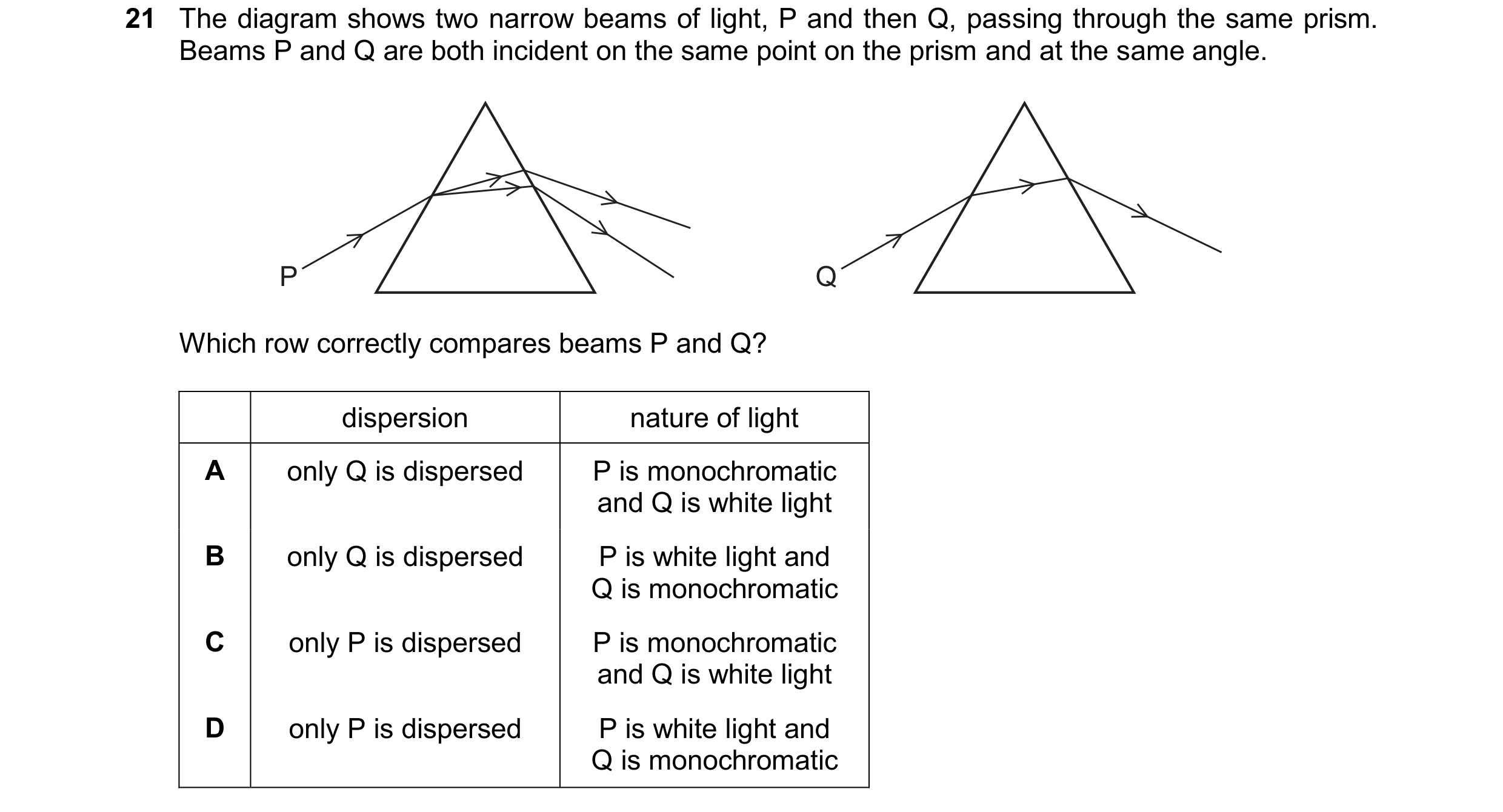
Q65 · The diagram shows two narrow beams of light, P and then Q, passing through the same prism 0972/21 Oct/Nov 2025
21 The diagram shows two narrow beams of light, P and then Q, passing through the same prism. Beams P and Q are both incident on the same point on the prism and at the same angle. P Q Which row correctly compares beams P and Q? dispersion nature of light A only Q is dispersed P is monochromatic and Q is white light B only Q is dispersed P is white light and Q is monochromatic C only P is dispersed P is monochromatic and Q is white light D only P is dispersed P is white light and Q is monochromatic
1 marks
Answer: D
This question in 0972/21 Oct/Nov 2025
 1 / 21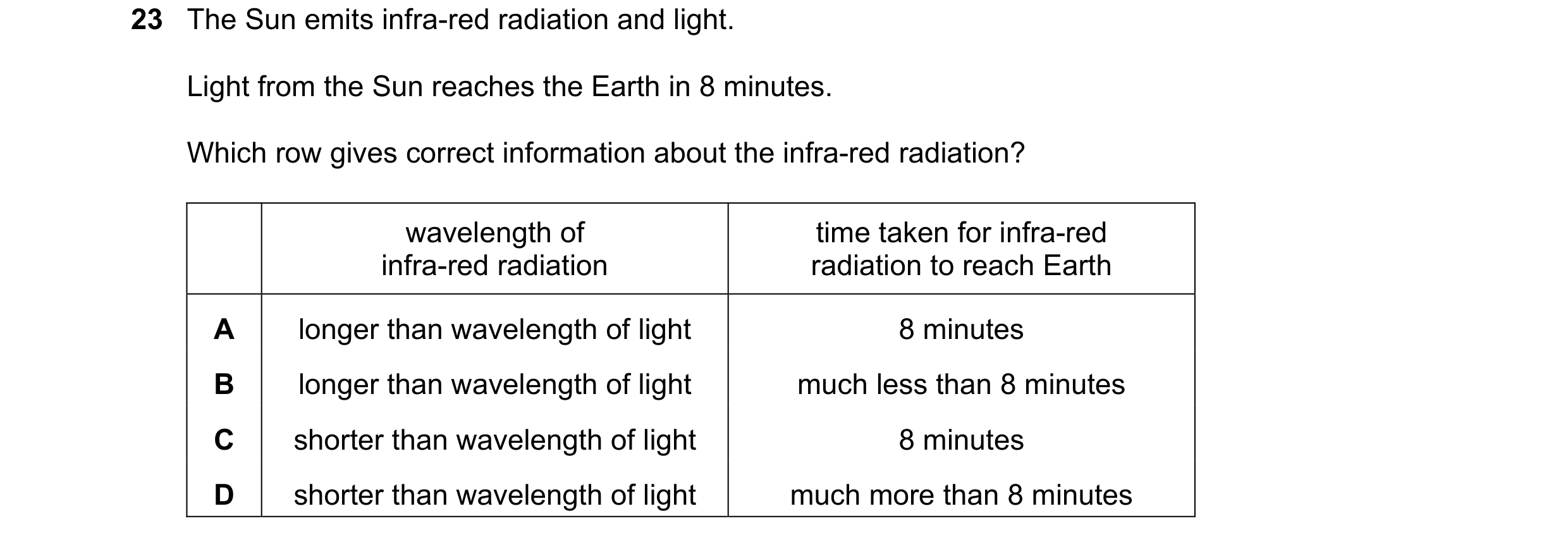

 2 / 21

 3 / 21
 4 / 21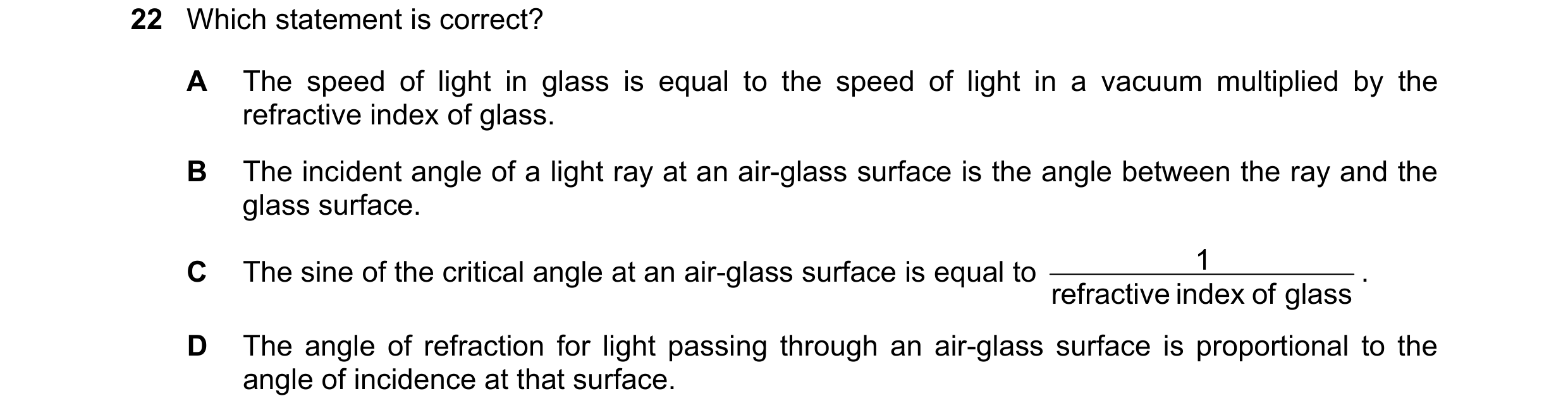
 5 / 21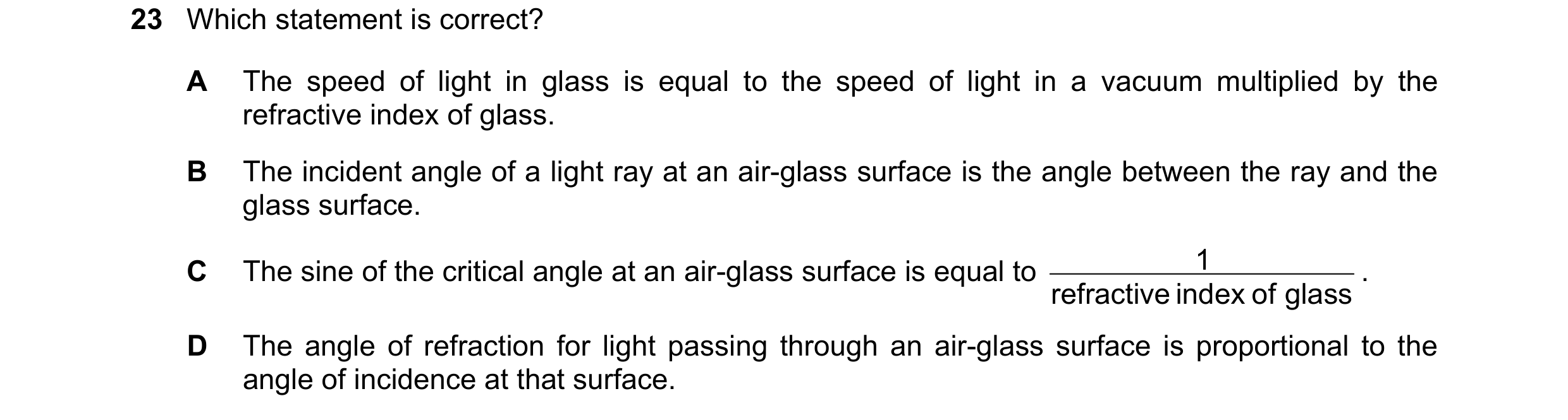
 6 / 21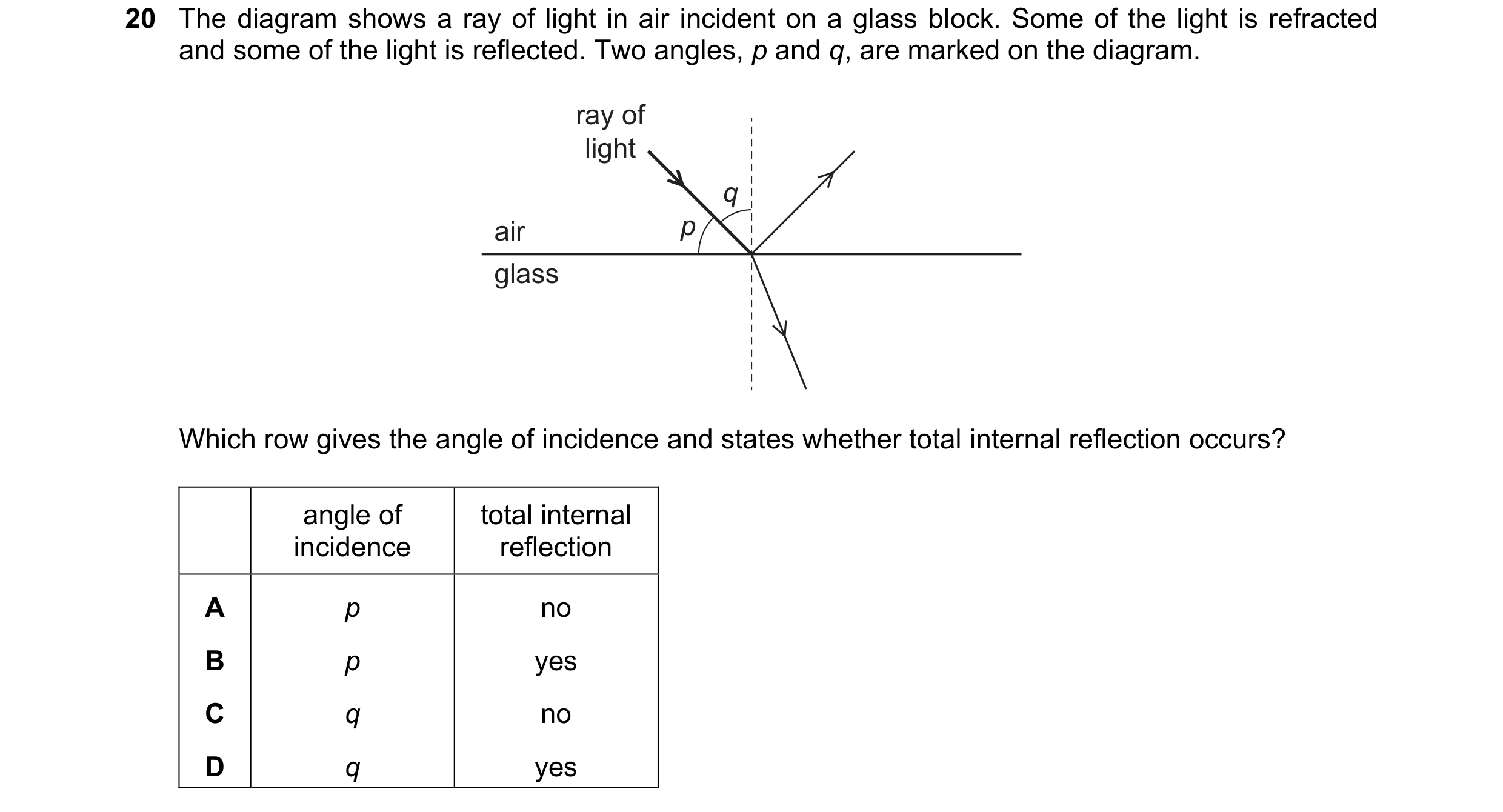
 7 / 21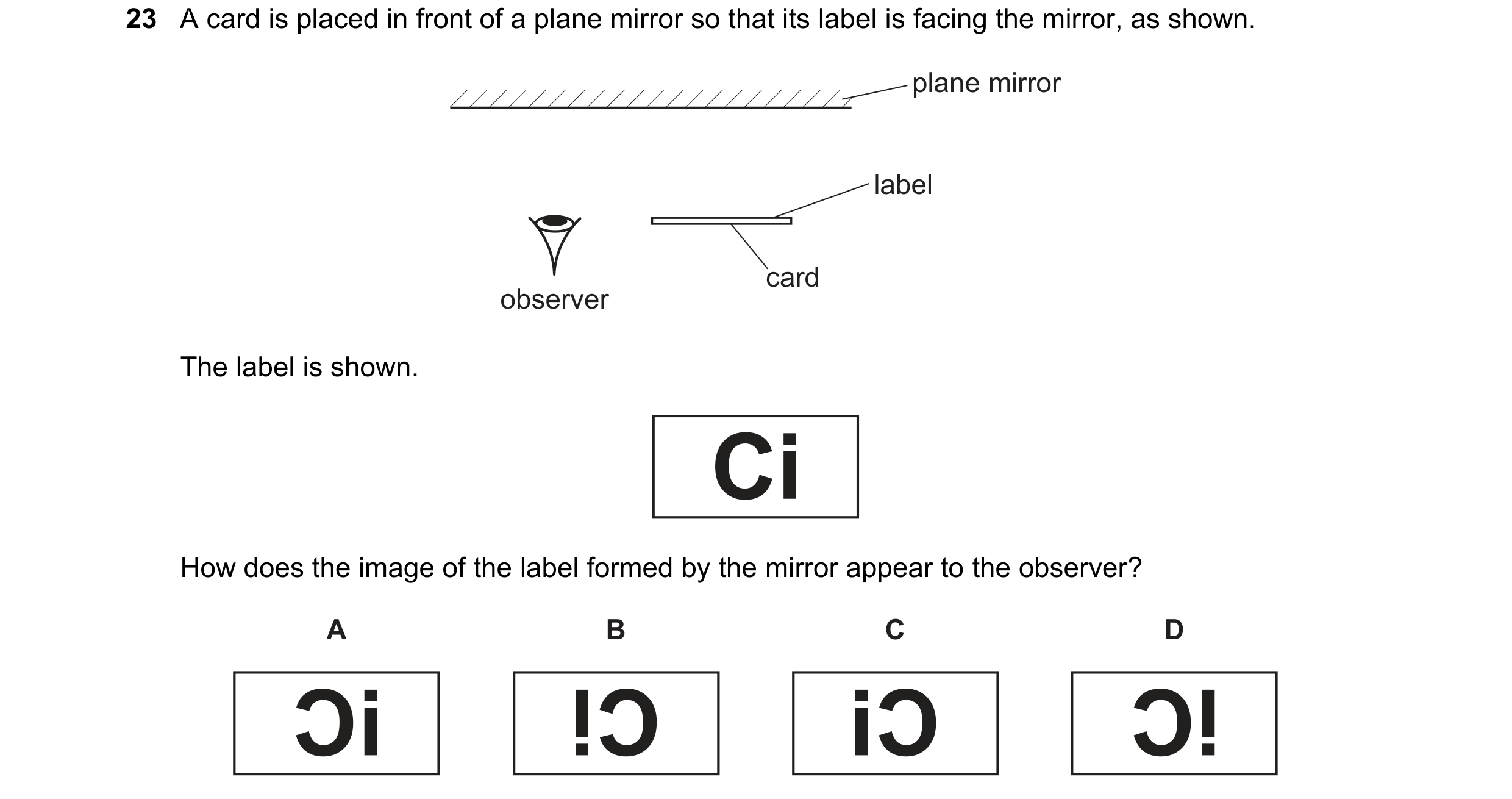
 8 / 21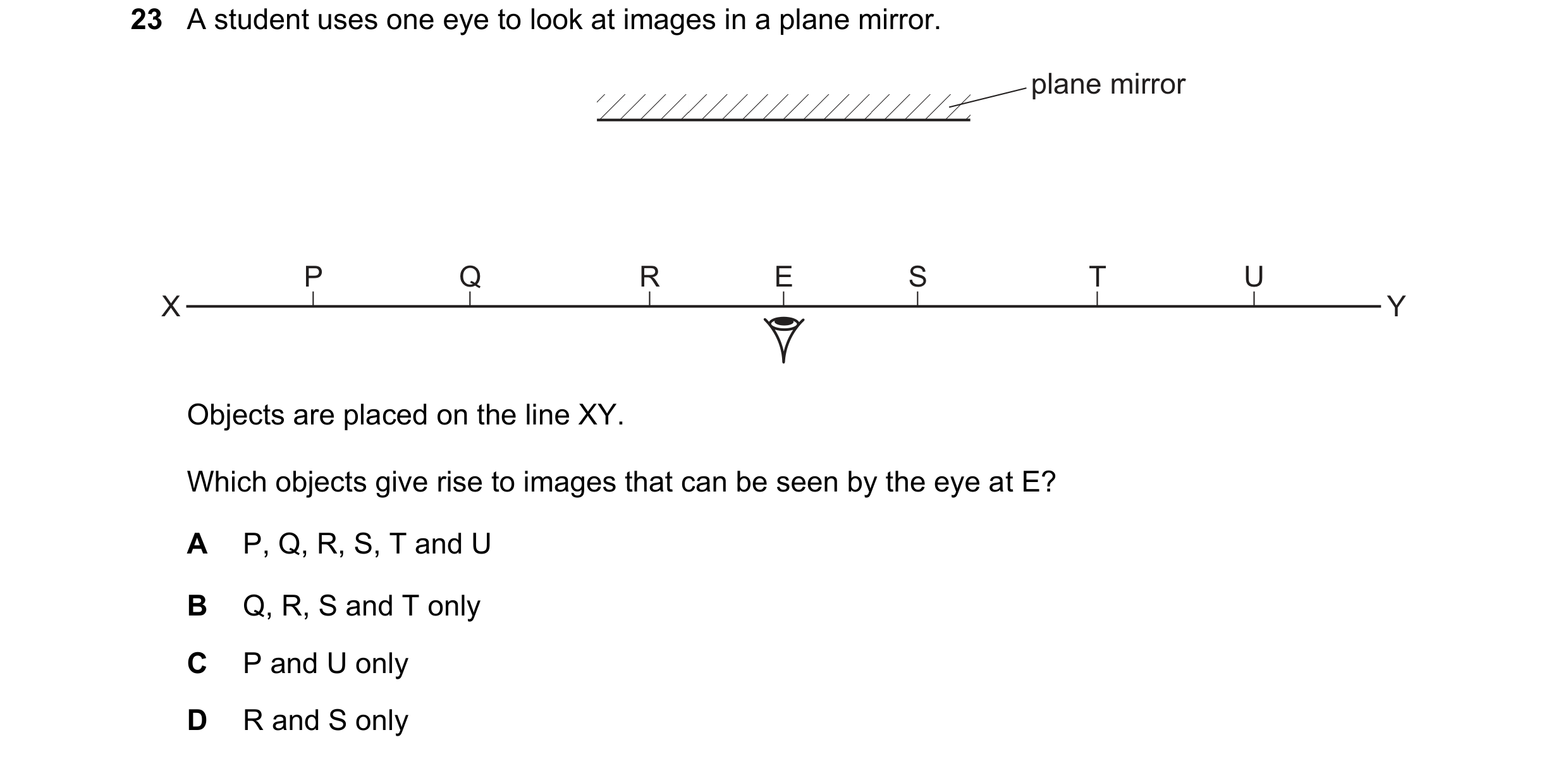
 9 / 21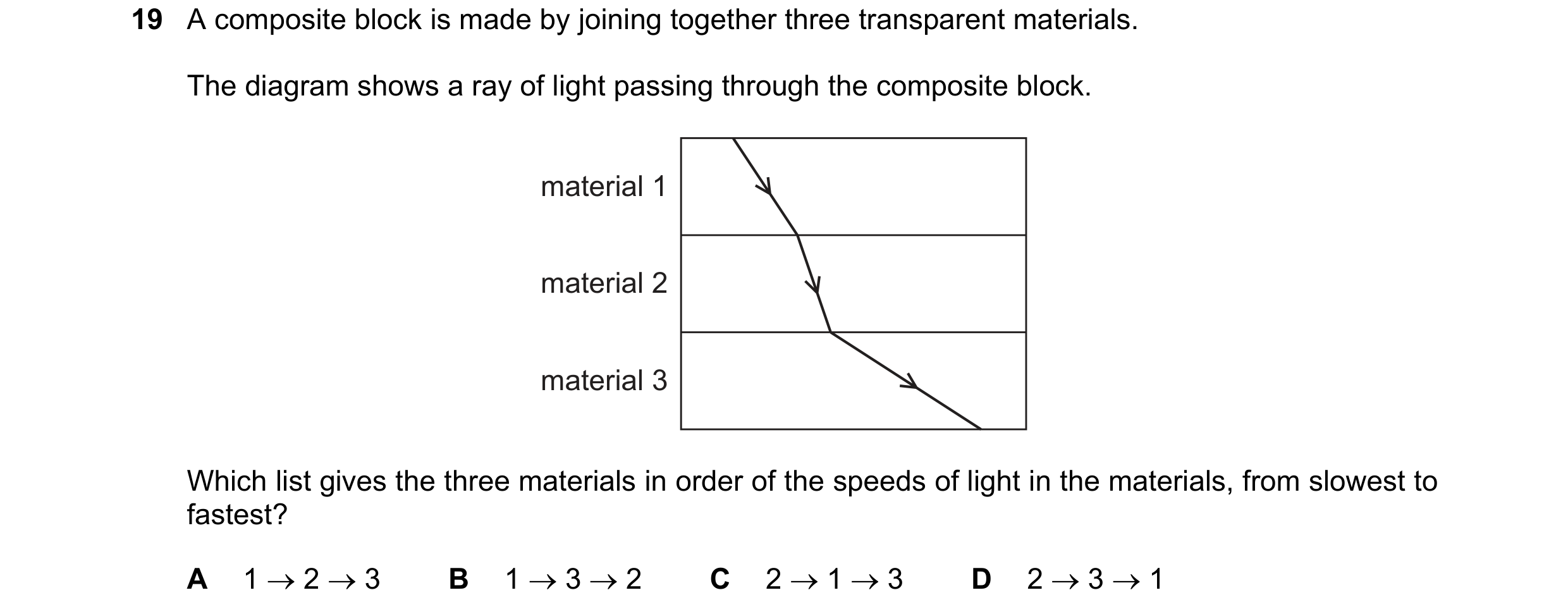
 10 / 21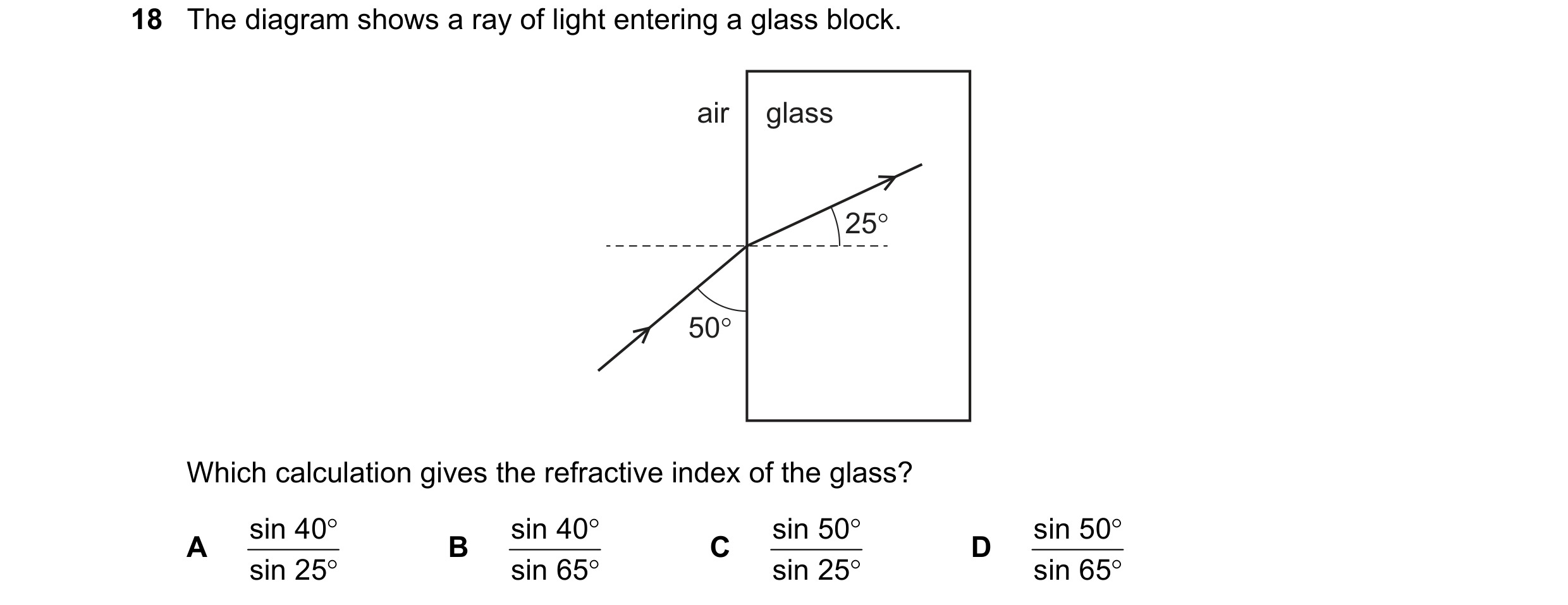
 11 / 21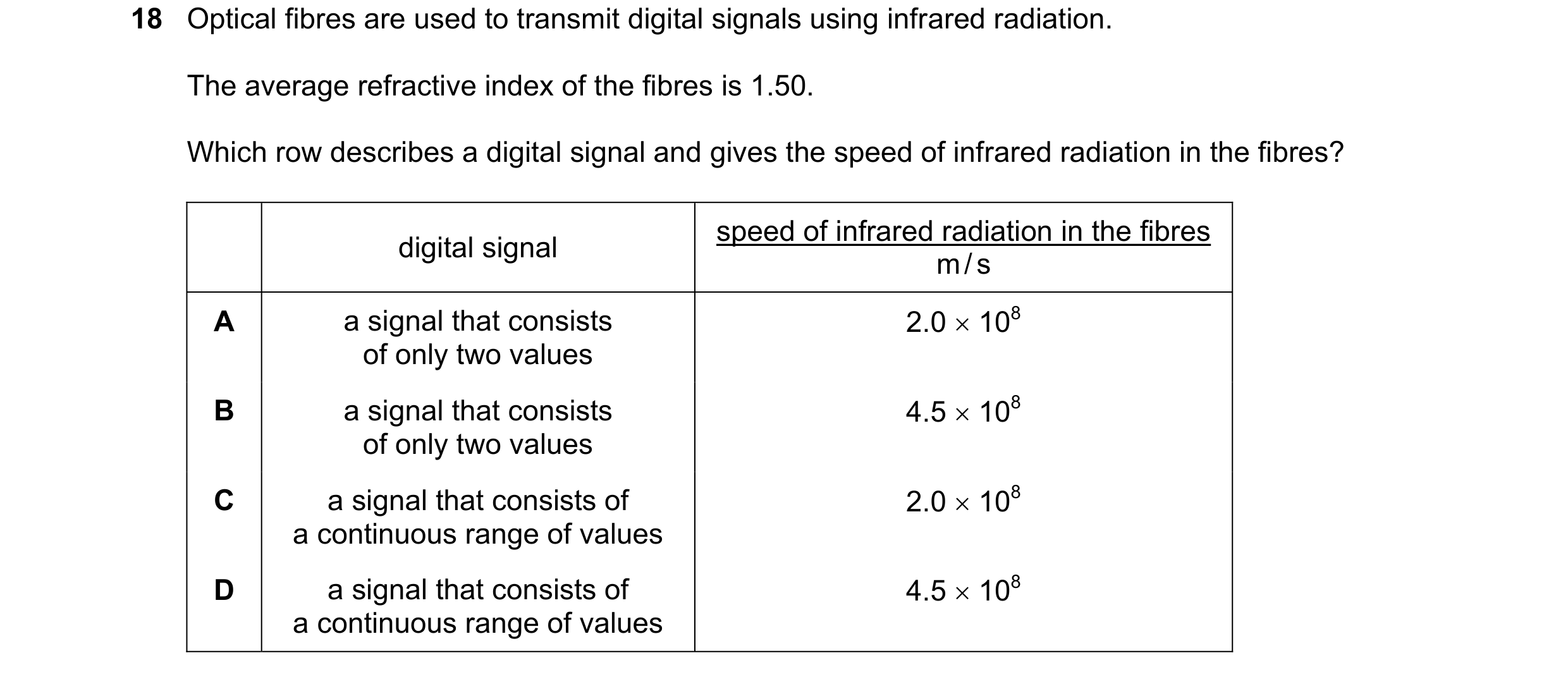

 12 / 21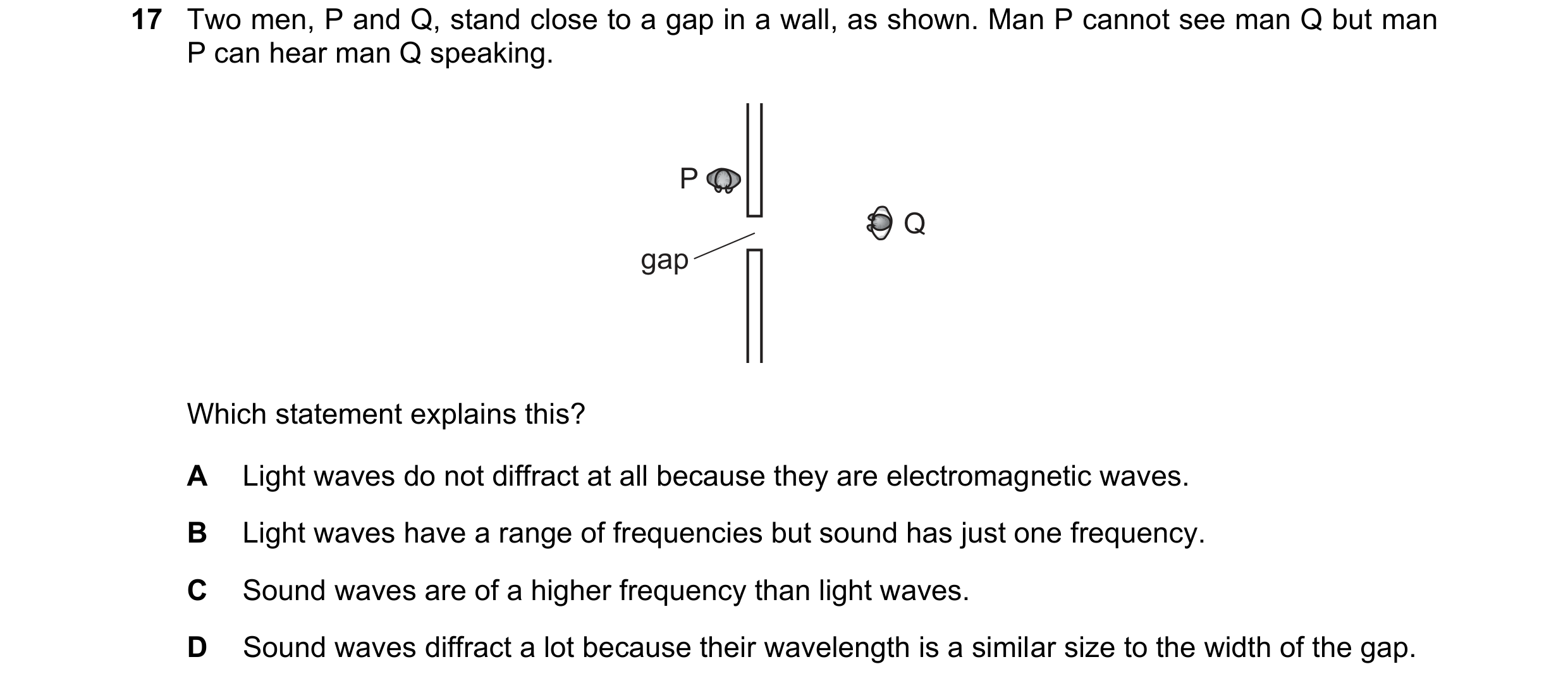
 13 / 21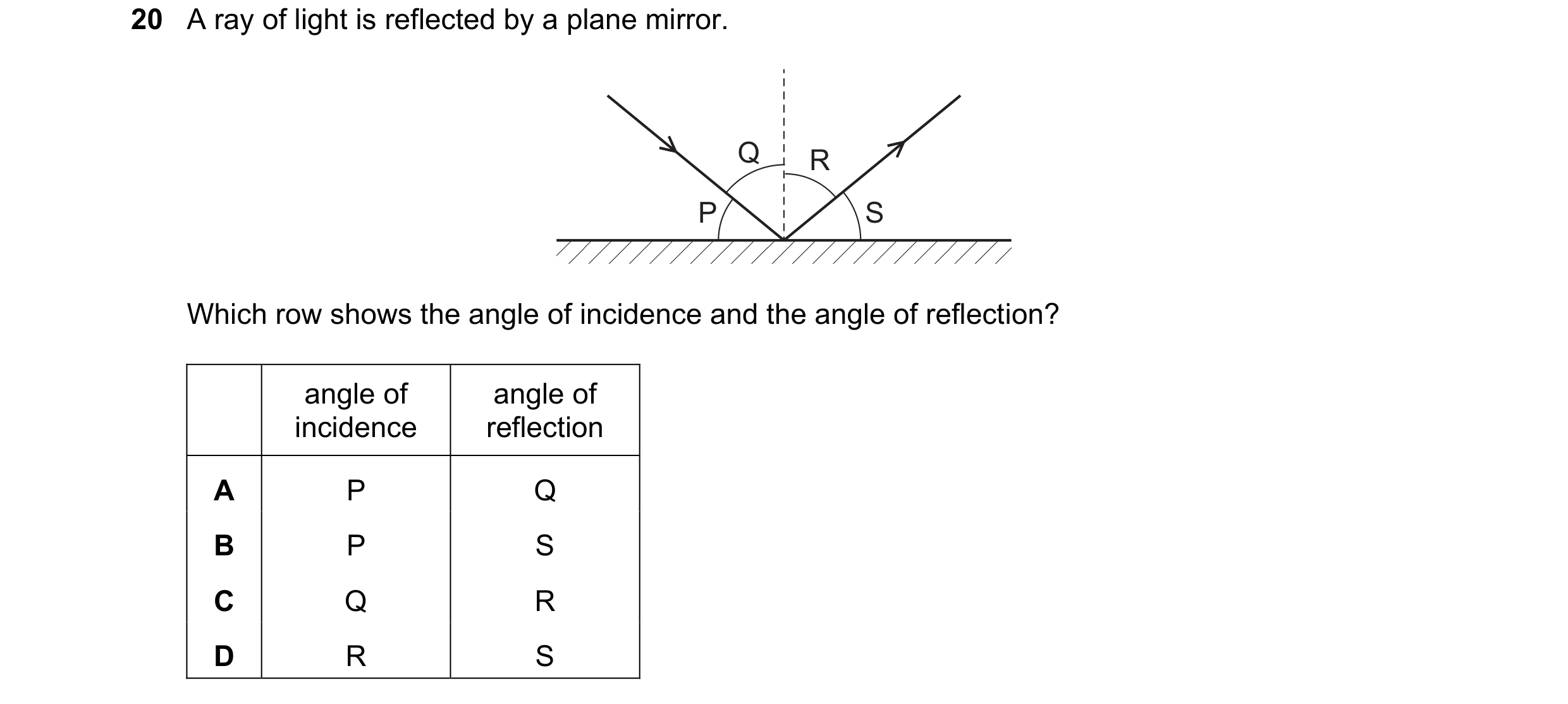

 14 / 21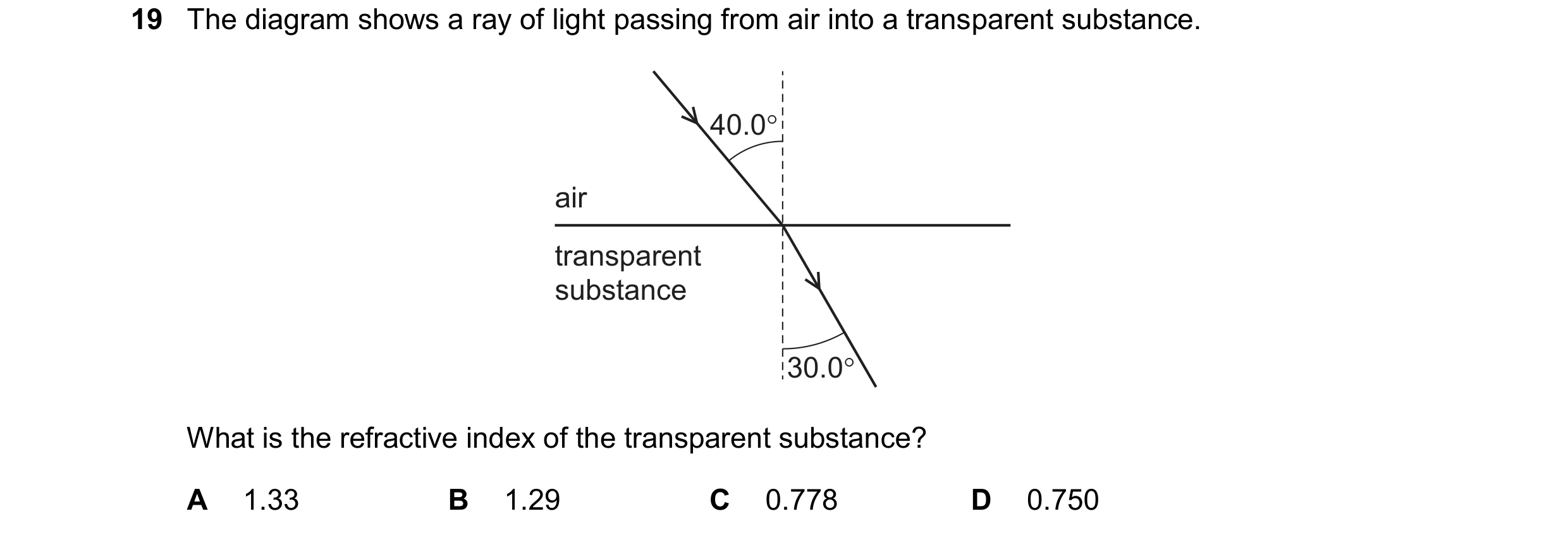
 15 / 21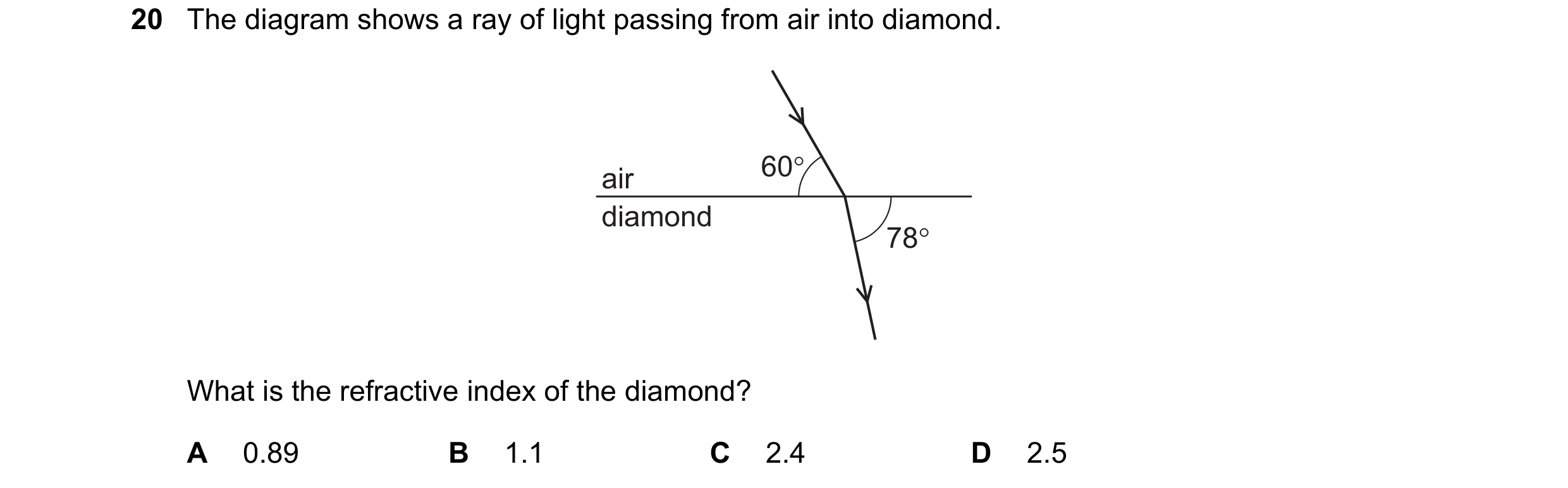
 16 / 21
 17 / 21
 18 / 21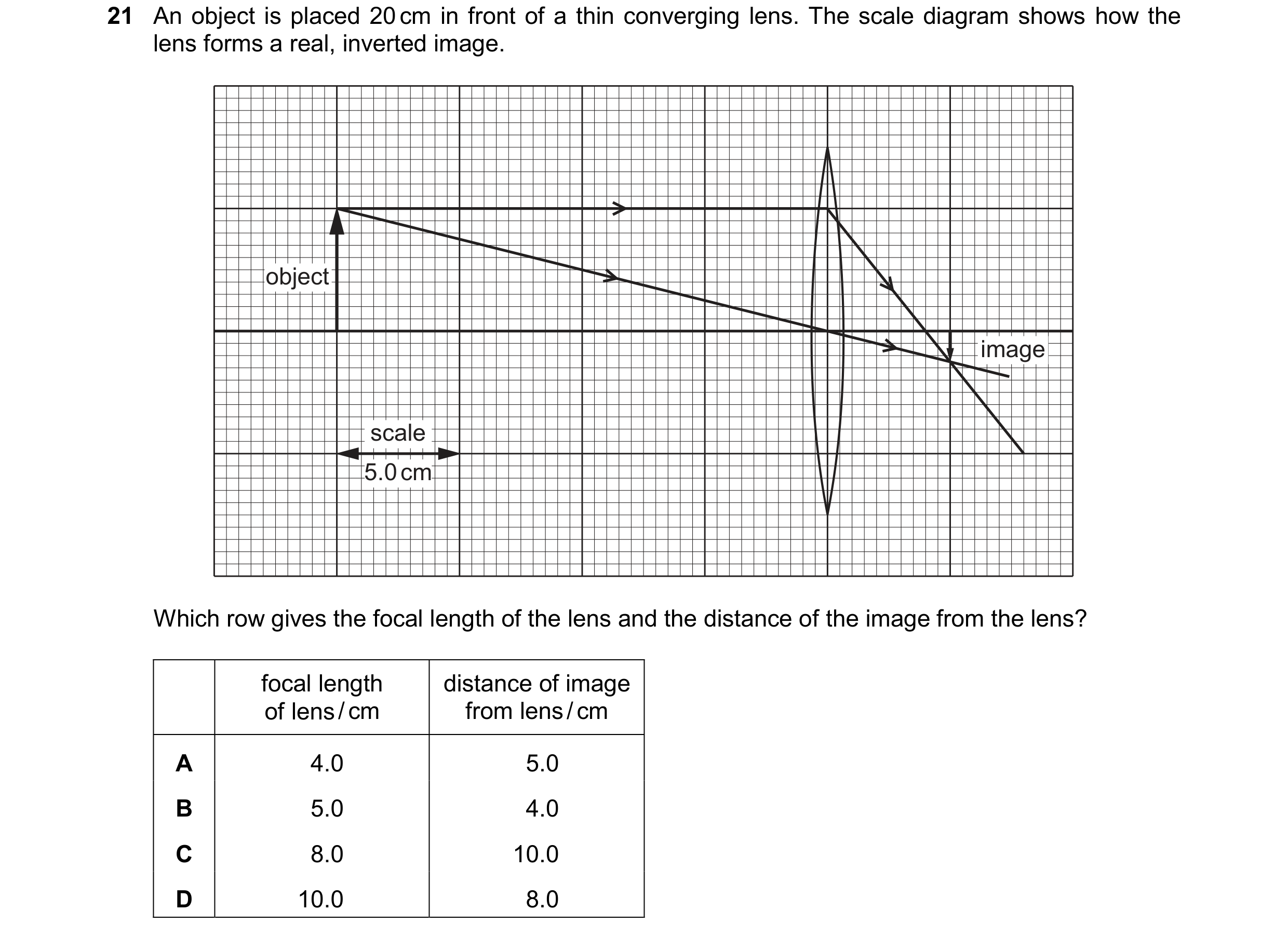
 19 / 21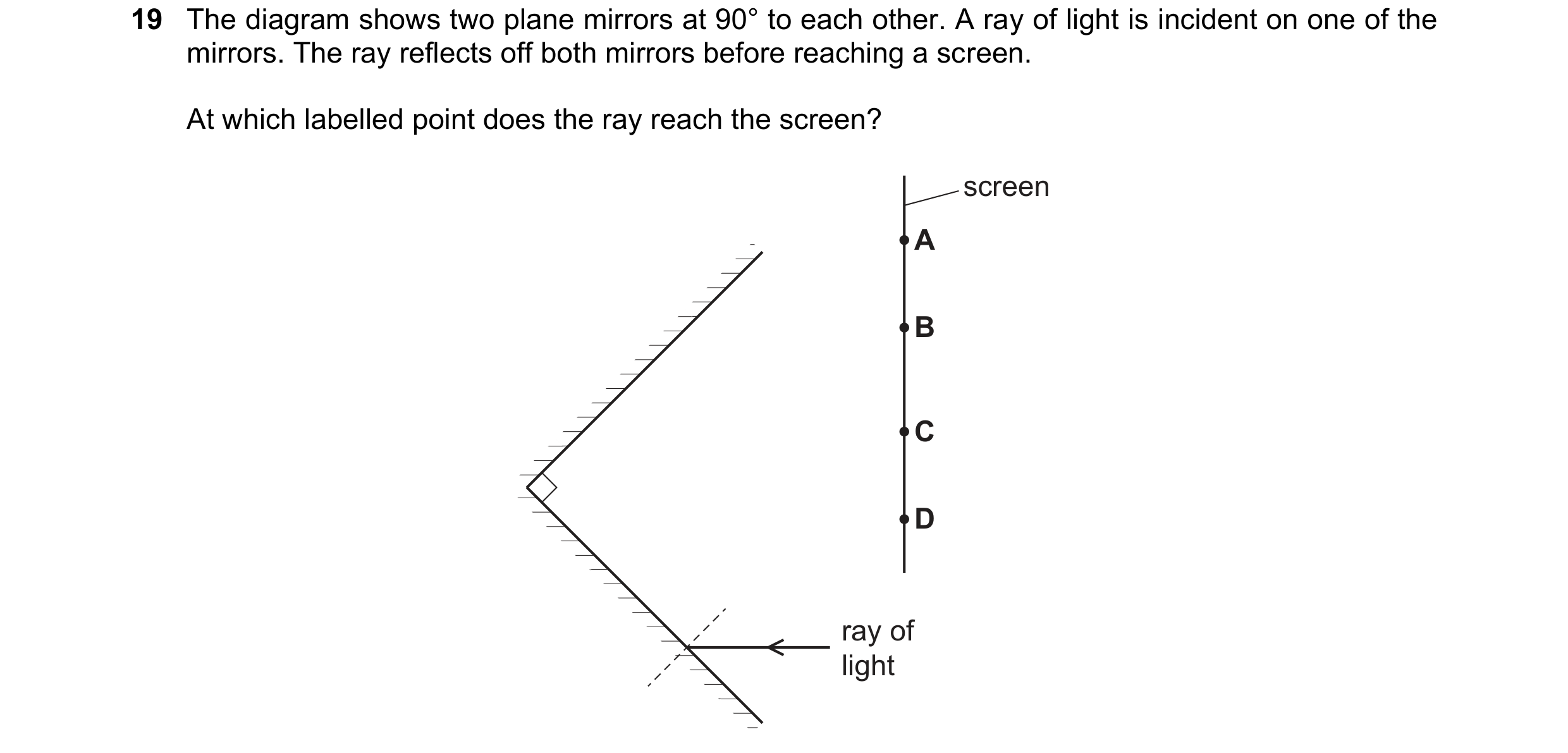

 20 / 21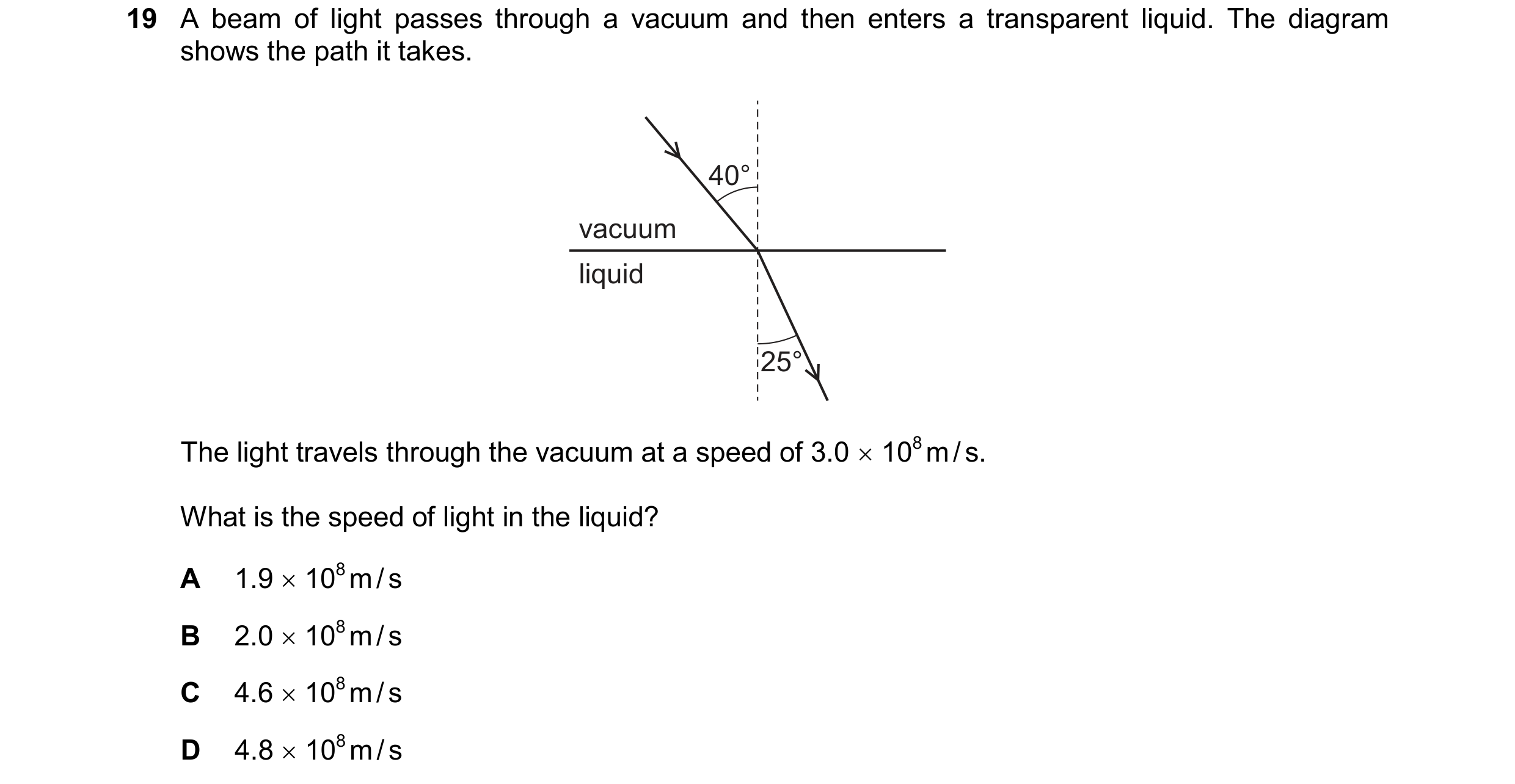
 21 / 21