Questions as text
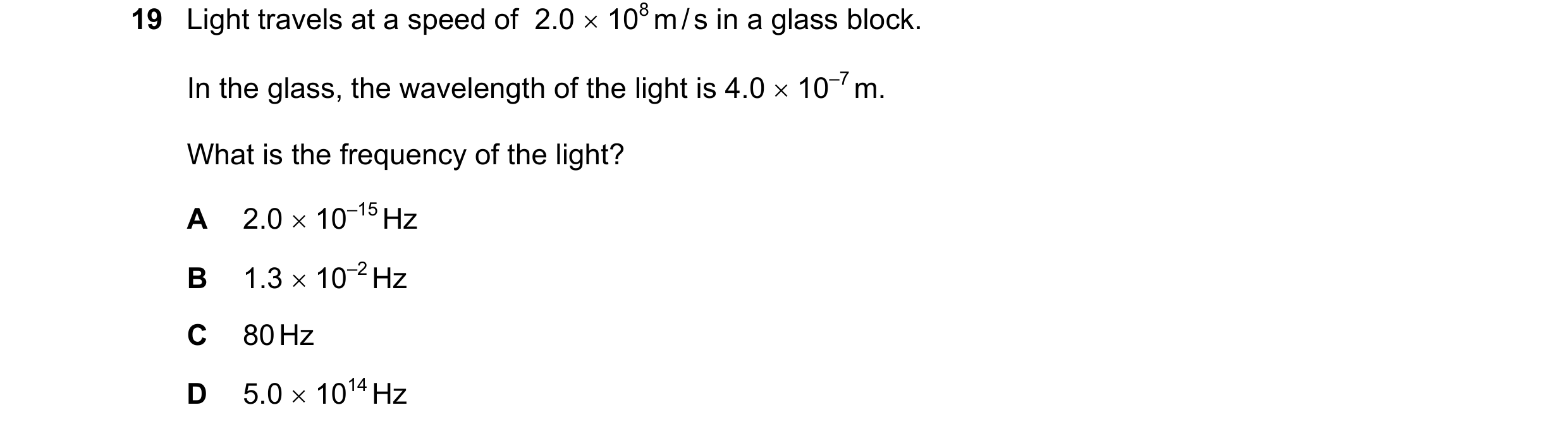
Q1 · Light travels at a speed of 2.0 × 10⁸ m / s in a glass block 0972/21 May/June 2018
19 Light travels at a speed of 2.0 × 10⁸ m / s in a glass block. In the glass, the wavelength of the light is 4.0 × 10⁻⁷ m. What is the frequency of the light? A 2.0 × 10⁻¹⁵ Hz B 1.3 × 10⁻² Hz C 80 Hz D 5.0 × 10¹⁴ Hz
1 marks
Answer: D
This question in 0972/21 May/June 2018
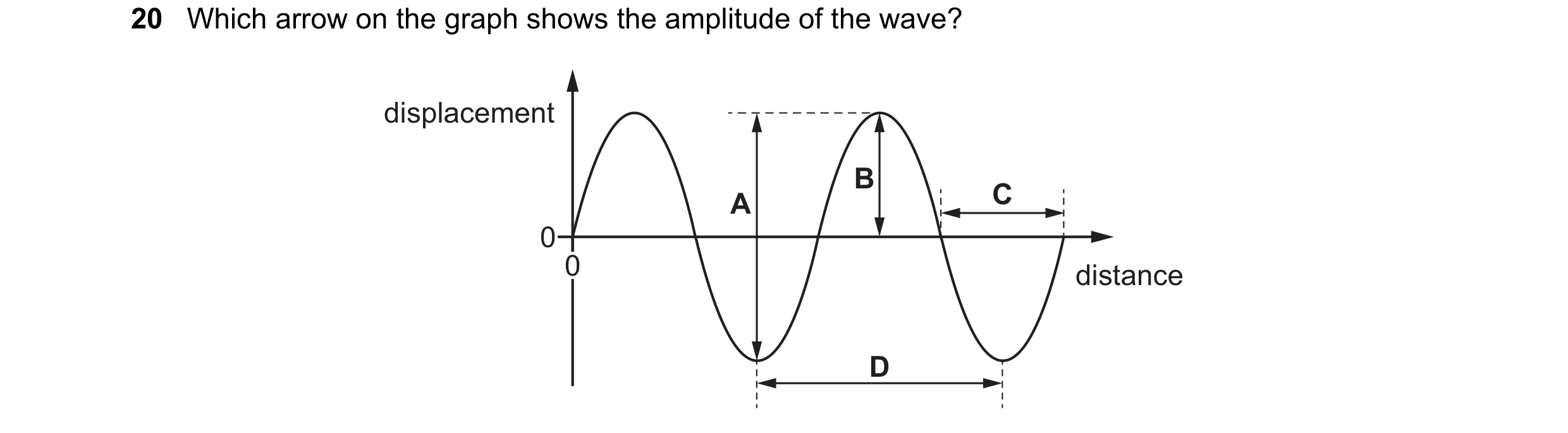
Q2 · Which arrow on the graph shows the amplitude of the wave? 0972/21 May/June 2018
20 Which arrow on the graph shows the amplitude of the wave? displacement B A C 0 0 distance D
1 marks
Answer: B
This question in 0972/21 May/June 2018
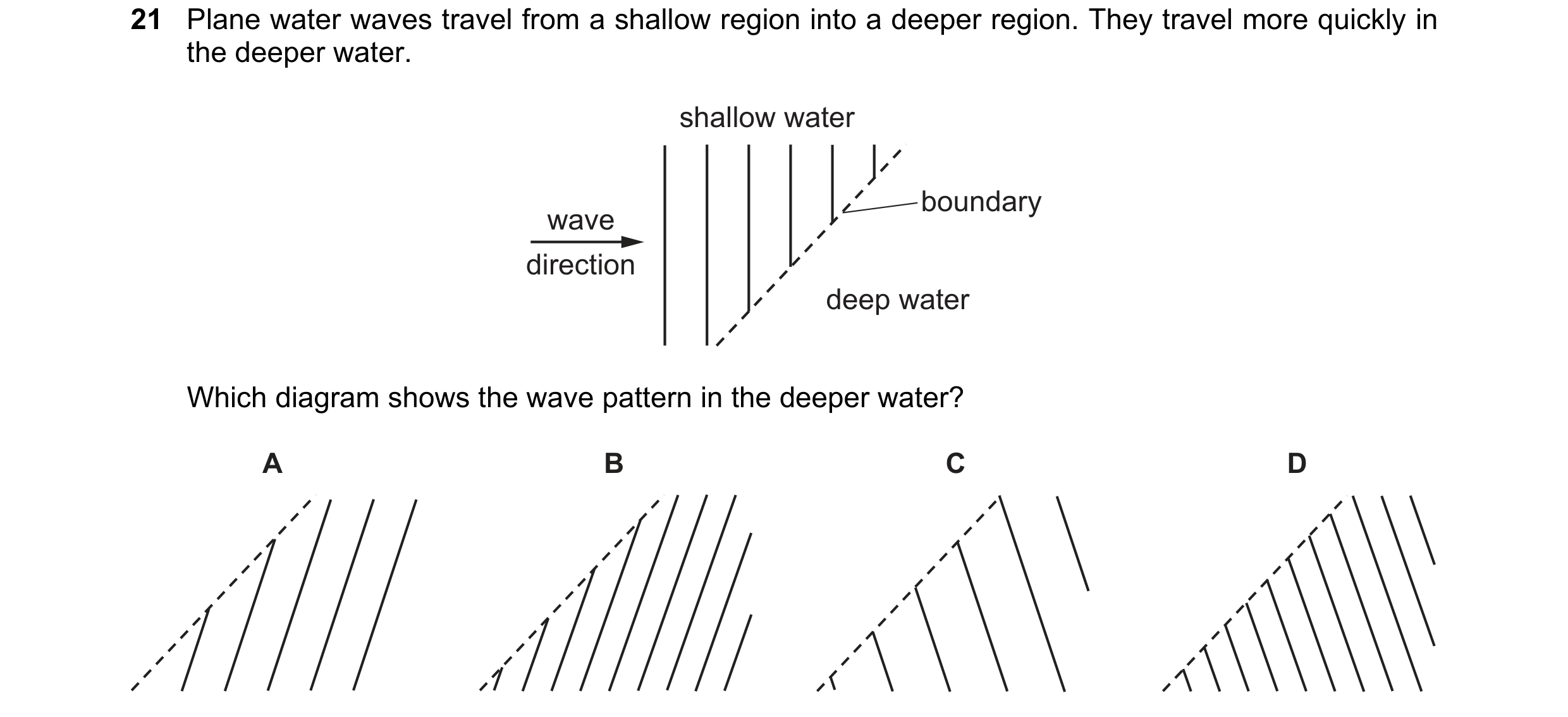
Q3 · Plane water waves travel from a shallow region into a deeper region 0972/21 Oct/Nov 2018
21 Plane water waves travel from a shallow region into a deeper region. They travel more quickly in the deeper water. shallow water boundary wave direction deep water Which diagram shows the wave pattern in the deeper water? A B C D
1 marks
Answer: C
This question in 0972/21 Oct/Nov 2018
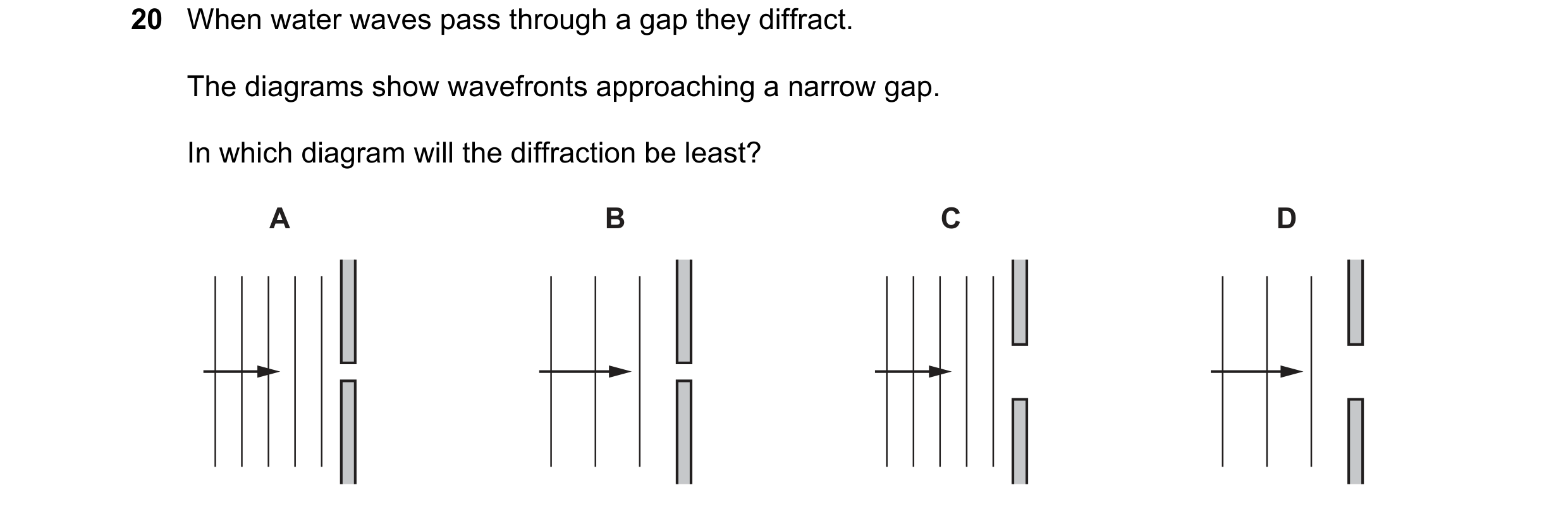
Q4 · When water waves pass through a gap they diffract 0972/21 May/June 2019
20 When water waves pass through a gap they diffract. The diagrams show wavefronts approaching a narrow gap. In which diagram will the diffraction be least? A B C D
1 marks
Answer: C
This question in 0972/21 May/June 2019
Q5 · When water waves pass through a gap they diffract 0972/22 May/June 2019
20 When water waves pass through a gap they diffract. The diagrams show wavefronts approaching a narrow gap. In which diagram will the diffraction be least? A B C D
1 marks
Answer: C
This question in 0972/22 May/June 2019
Q6 · A large hill blocks the direct path between a transmitter of radio waves and a receiver… 0972/21 Oct/Nov 2019
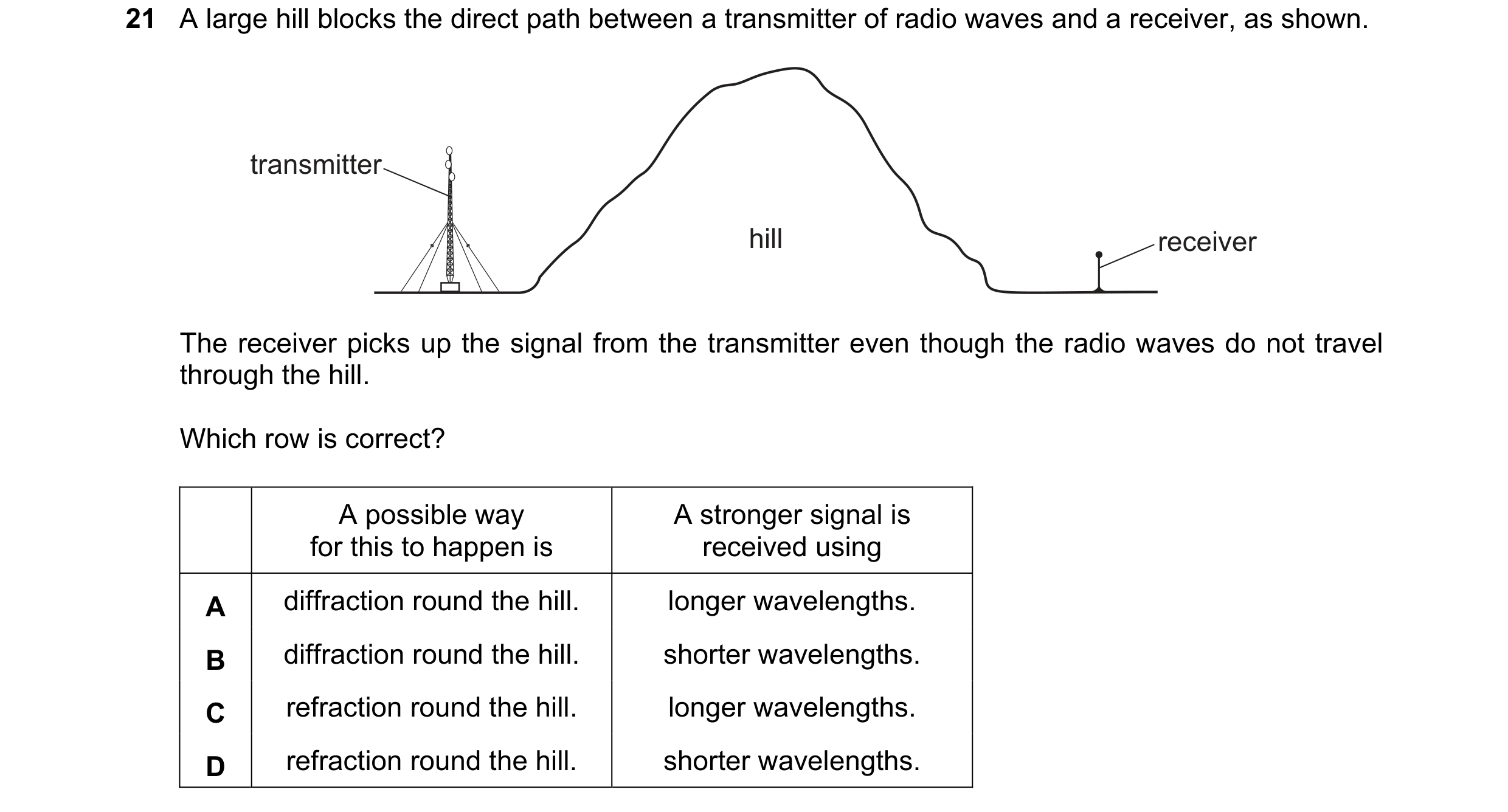
21 A large hill blocks the direct path between a transmitter of radio waves and a receiver, as shown. transmitter hill receiver The receiver picks up the signal from the transmitter even though the radio waves do not travel through the hill. Which row is correct? A possible way A stronger signal is for this to happen is received using A diffraction round the hill. longer wavelengths. B diffraction round the hill. shorter wavelengths. C refraction round the hill. longer wavelengths. D refraction round the hill. shorter wavelengths.
1 marks
Answer: A
This question in 0972/21 Oct/Nov 2019
Q7 · The diagram shows the electromagnetic spectrum 0972/21 Oct/Nov 2019
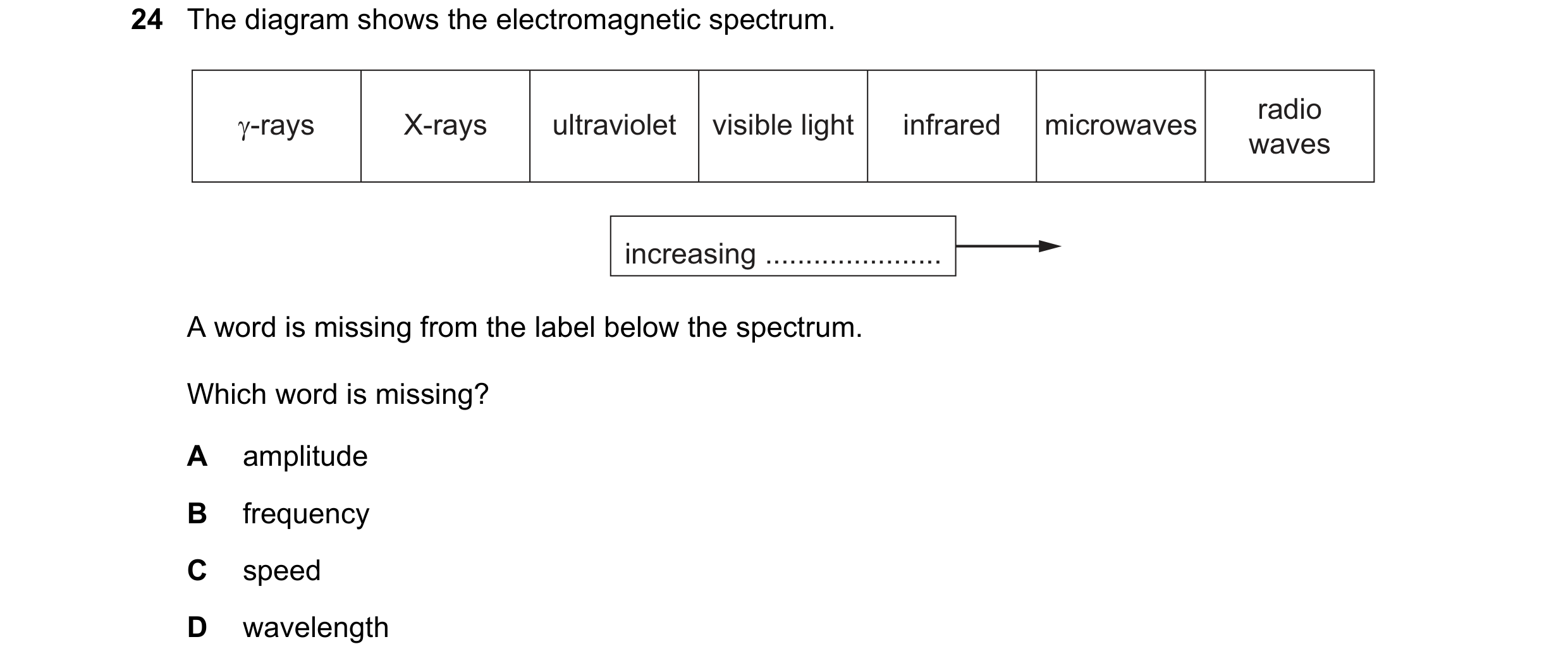
24 The diagram shows the electromagnetic spectrum. radio γ-rays X-rays ultraviolet visible light infrared microwaves waves increasing … A word is missing from the label below the spectrum. Which word is missing? A amplitude B frequency C speed D wavelength
1 marks
Answer: D
This question in 0972/21 Oct/Nov 2019
Q8 · A wave of frequency 6600 Hz travels 1320 m in 4.0 s 0972/21 May/June 2020
20 A wave of frequency 6600 Hz travels 1320 m in 4.0 s. What is the wavelength? A 0.050 m B 0.80 m C 1.3 m D 20 m
1 marks
Answer: A
This question in 0972/21 May/June 2020
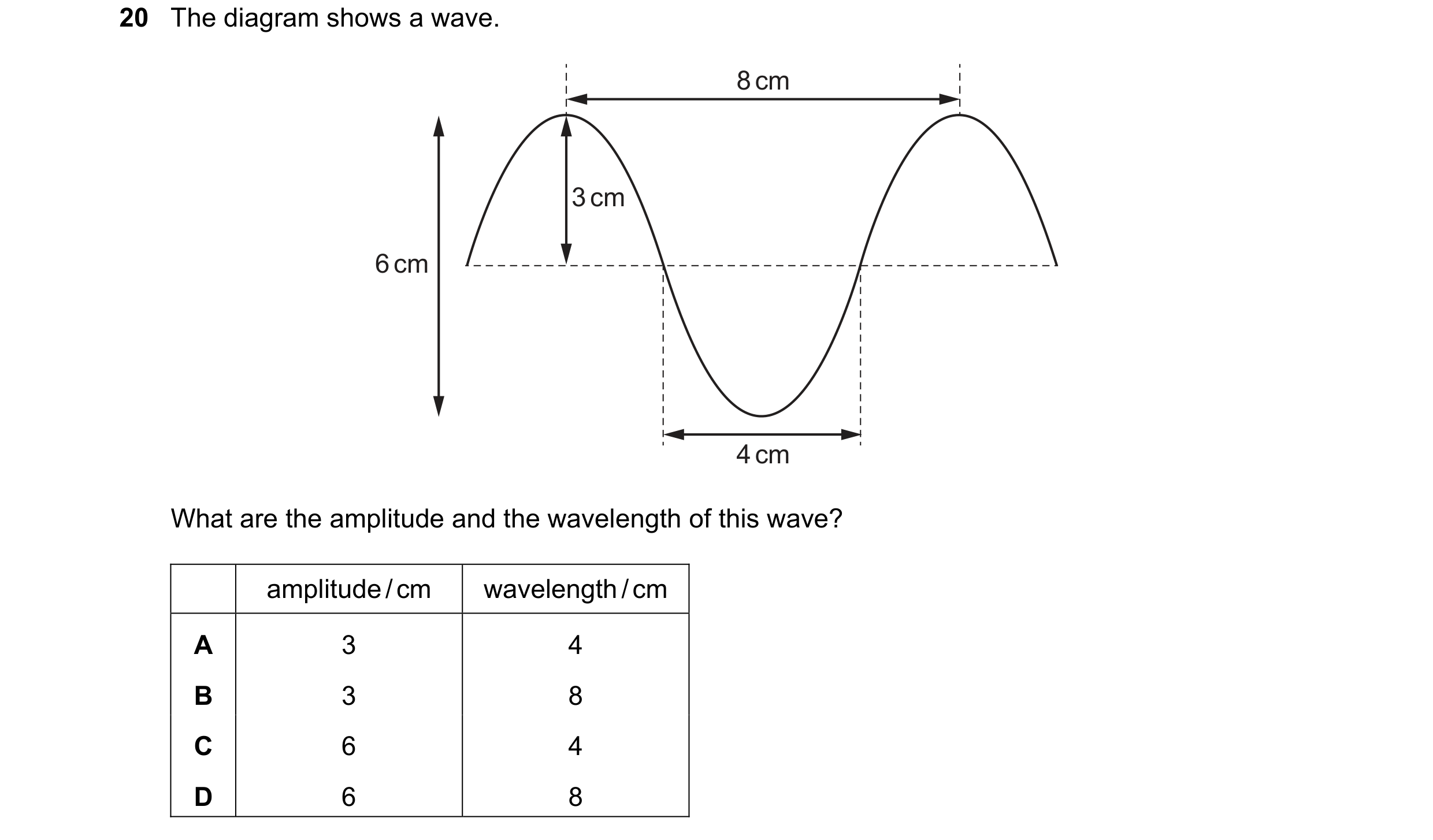
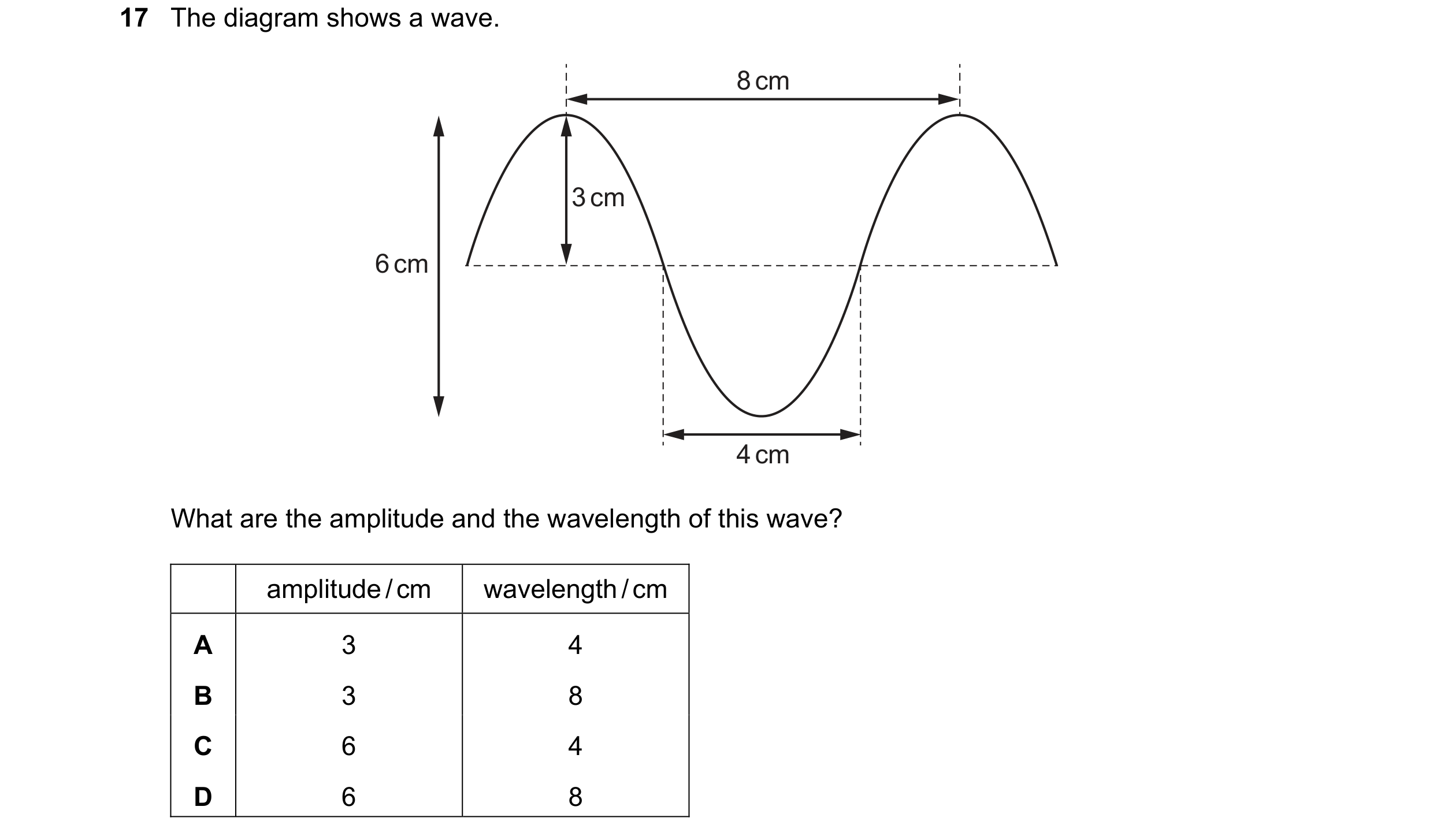
Q9 · The diagram shows a wave 0972/21 May/June 2020
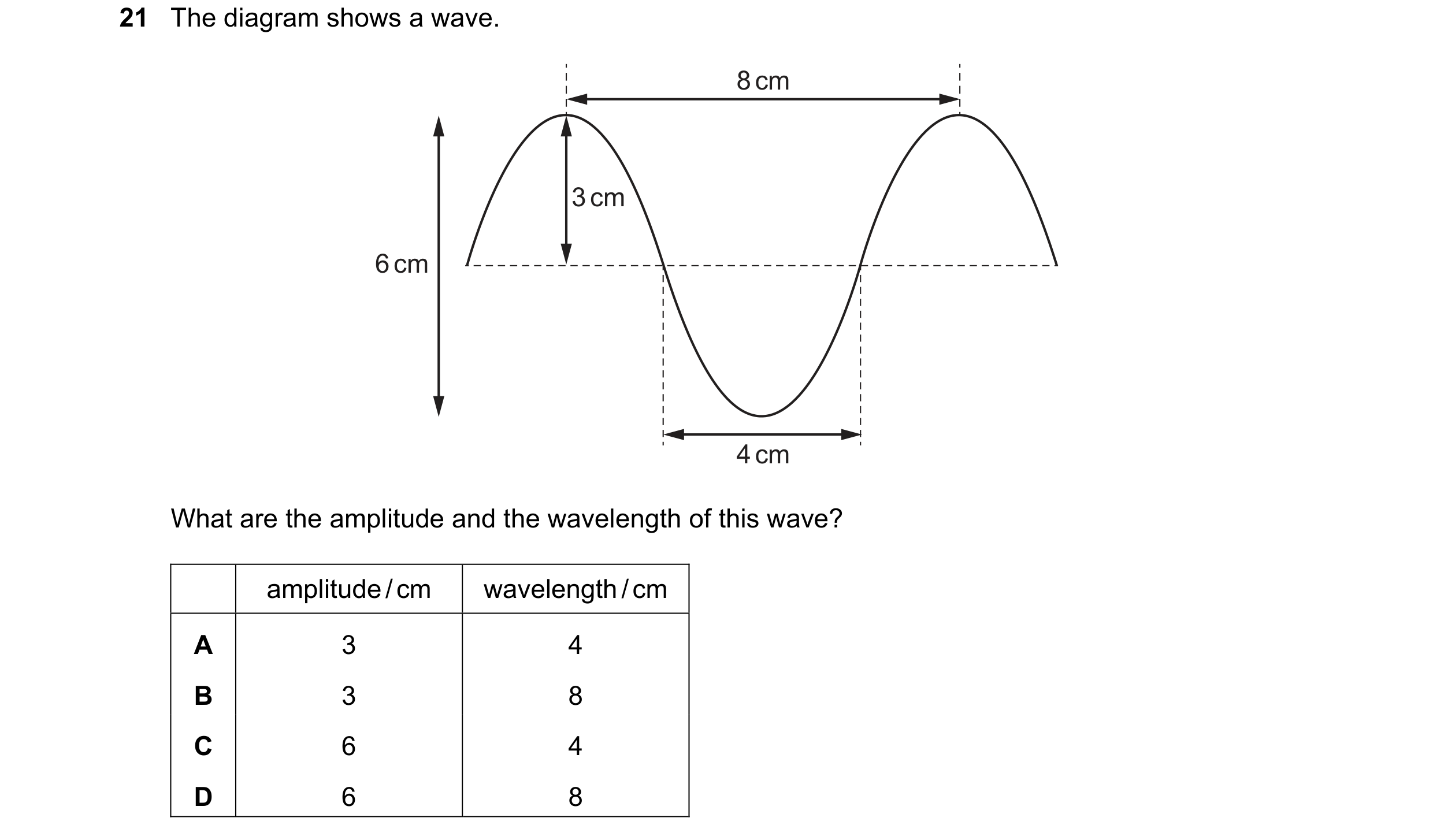
21 The diagram shows a wave. 8 cm 3 cm 6 cm 4 cm What are the amplitude and the wavelength of this wave? amplitude / cm wavelength / cm A 3 4 B 3 8 C 6 4 D 6 8
1 marks
Answer: B
This question in 0972/21 May/June 2020
Q10 · The diagram shows a wave 0972/22 May/June 2020
20 The diagram shows a wave. 8 cm 3 cm 6 cm 4 cm What are the amplitude and the wavelength of this wave? amplitude / cm wavelength / cm A 3 4 B 3 8 C 6 4 D 6 8
1 marks
Answer: B
This question in 0972/22 May/June 2020
Q11 · The frequency of the microwaves used in a microwave oven is 2400 MHz 0972/22 May/June 2020
21 The frequency of the microwaves used in a microwave oven is 2400 MHz. What is the wavelength of these microwaves? A 0.125 m B 8.00 m C 125 m D 7200 m
1 marks
Answer: A
This question in 0972/22 May/June 2020
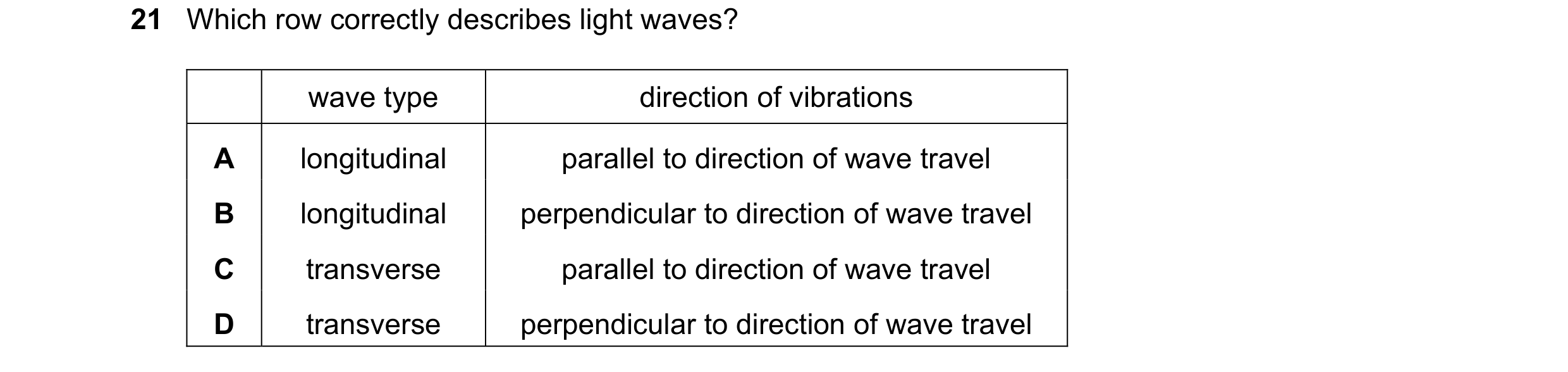
Q12 · Which row correctly describes light waves? 0972/21 Oct/Nov 2020
21 Which row correctly describes light waves? wave type direction of vibrations A longitudinal parallel to direction of wave travel B longitudinal perpendicular to direction of wave travel C transverse parallel to direction of wave travel D transverse perpendicular to direction of wave travel
1 marks
Answer: D
This question in 0972/21 Oct/Nov 2020
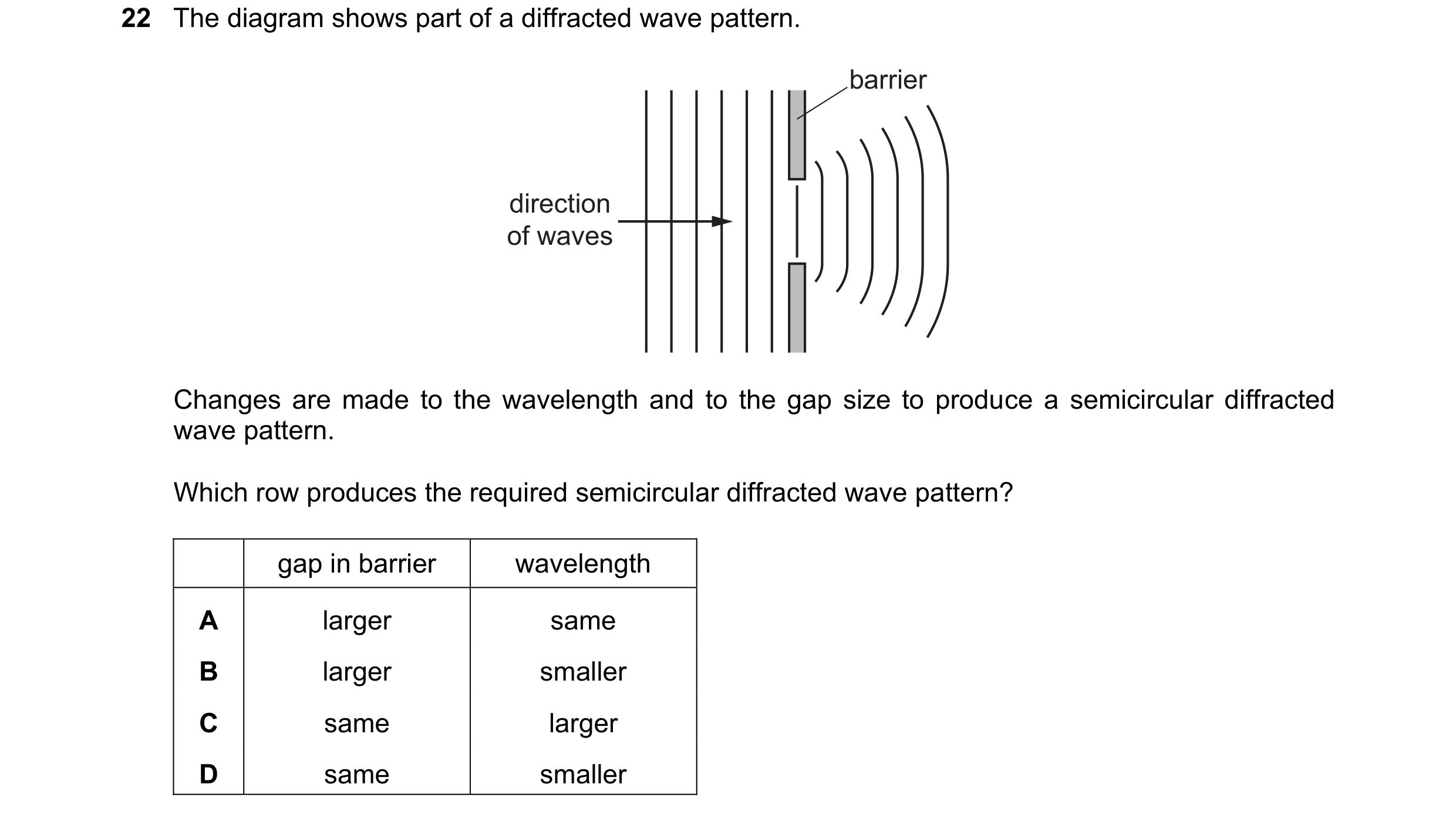
Q13 · The diagram shows part of a diffracted wave pattern 0972/21 Oct/Nov 2020
22 The diagram shows part of a diffracted wave pattern. barrier direction of waves Changes are made to the wavelength and to the gap size to produce a semicircular diffracted wave pattern. Which row produces the required semicircular diffracted wave pattern? gap in barrier wavelength A larger same B larger smaller C same larger D same smaller
1 marks
Answer: C
This question in 0972/21 Oct/Nov 2020
Q14 · The diagram shows waves in a ripple tank containing water 0972/21 Oct/Nov 2021
17 The diagram shows waves in a ripple tank containing water. The waves approach a barrier and pass through the gap in the barrier. The size of the gap is about the same size as the wavelength of the ripples. The gap size is increased. What happens to the ripple pattern to the right of the barrier? A The ripples are closer together. B The ripples are further apart. C The ripples are more curved. D The ripples are less curved.
1 marks
Answer: D
This question in 0972/21 Oct/Nov 2021
Q15 · The diagram shows a wave 0972/21 Oct/Nov 2021
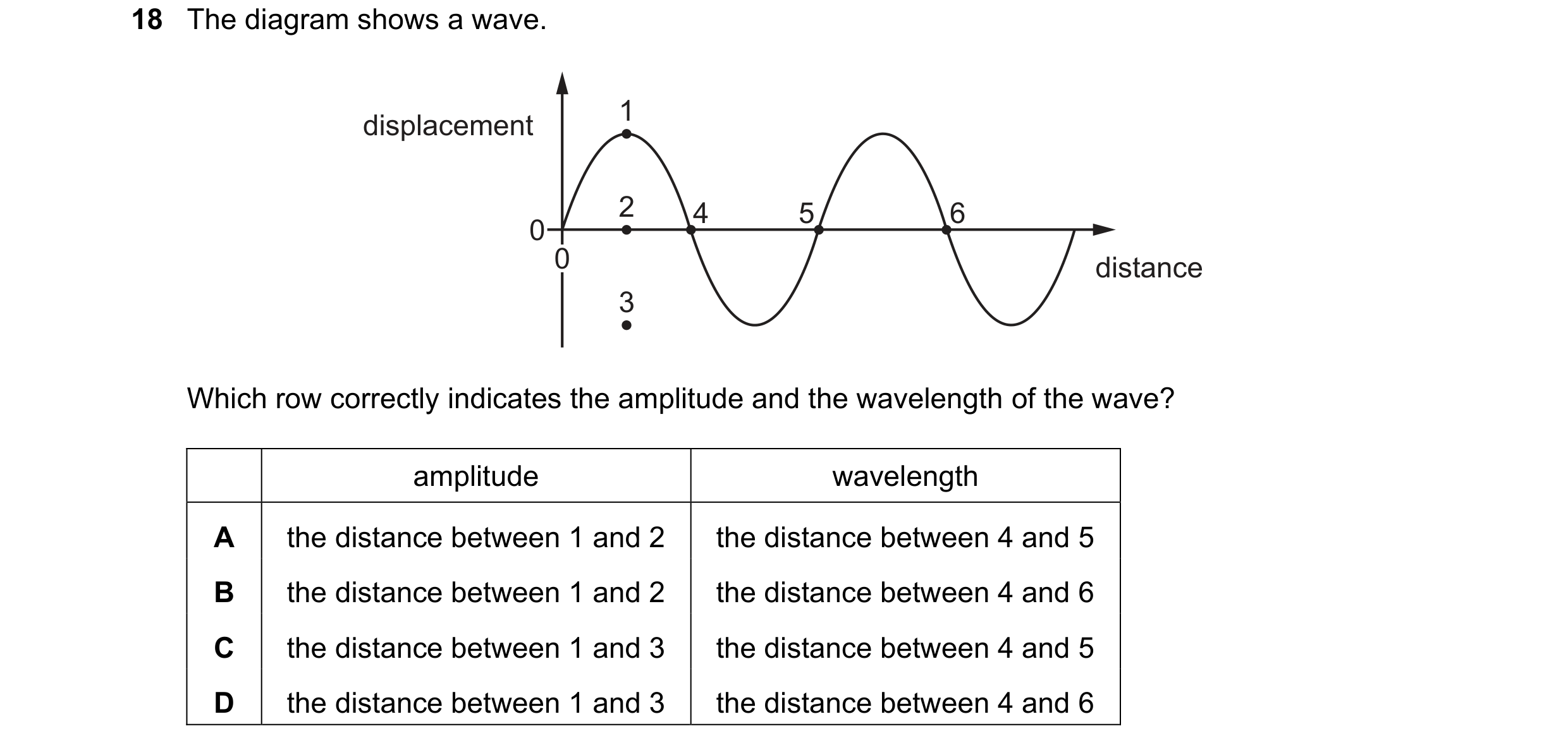
18 The diagram shows a wave. 1 displacement 2 4 5 6 0 0 distance 3 Which row correctly indicates the amplitude and the wavelength of the wave? amplitude wavelength A the distance between 1 and 2 the distance between 4 and 5 B the distance between 1 and 2 the distance between 4 and 6 C the distance between 1 and 3 the distance between 4 and 5 D the distance between 1 and 3 the distance between 4 and 6
1 marks
Answer: B
This question in 0972/21 Oct/Nov 2021
Q16 · Two beams of light are both the same colour of red 0972/21 Oct/Nov 2021
19 Two beams of light are both the same colour of red. One beam is travelling through air. The other beam is travelling through water. Each beam has a different brightness. Which quantity is the same for both sets of waves? A amplitude B frequency C speed D wavelength
1 marks
Answer: B
This question in 0972/21 Oct/Nov 2021
Question 17 0972/21 Oct/Nov 2021
24 What is ultrasound? A sound waves that are so loud that they damage human hearing B sound waves that are too high-pitched for humans to hear C sound waves that are too low-pitched for humans to hear D sound waves that are too quiet for humans to hear
1 marks
Answer: B
This question in 0972/21 Oct/Nov 2021
Q18 · The diagram shows a wave 0972/21 May/June 2022
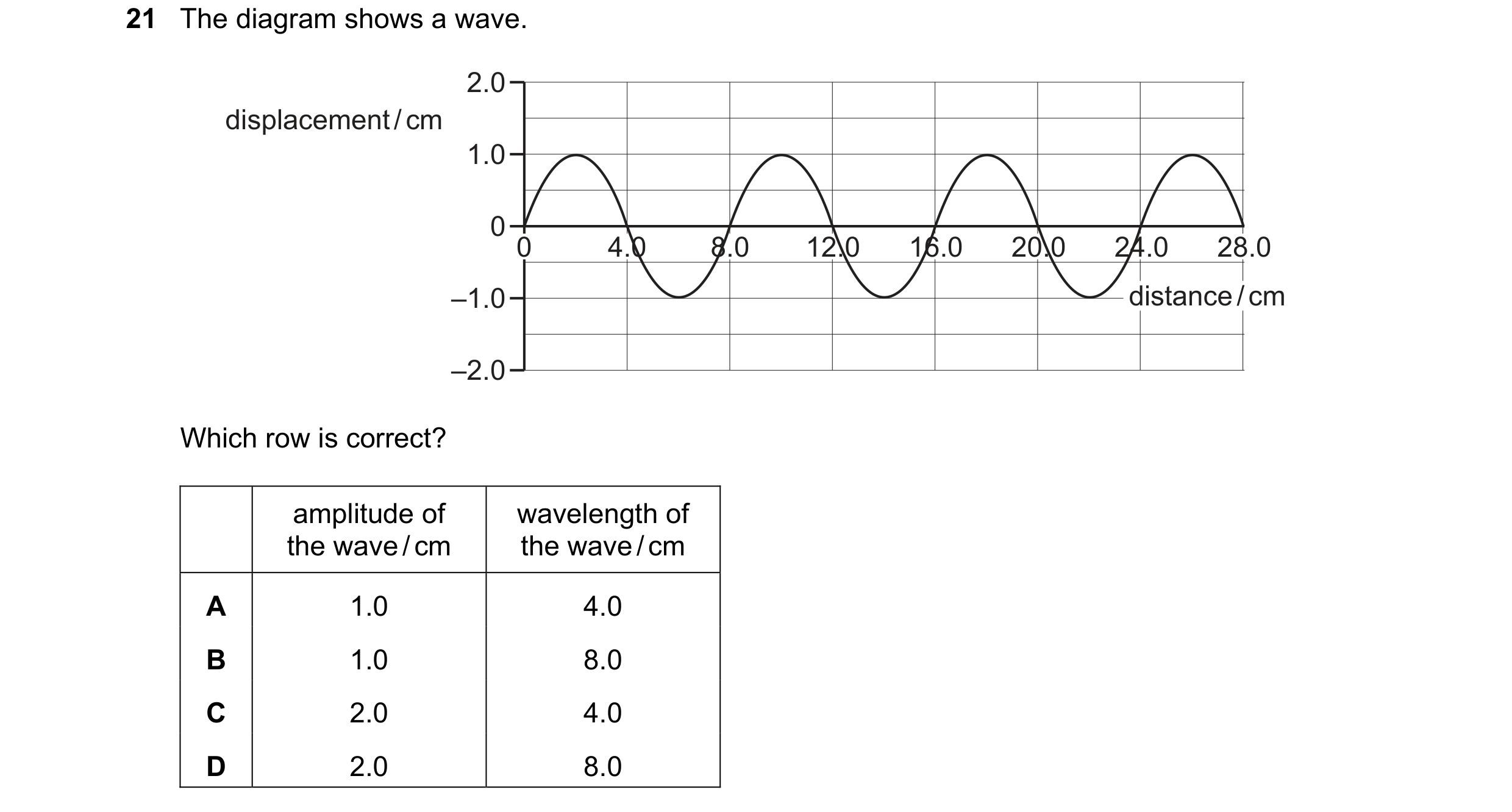
21 The diagram shows a wave. 2.0 displacement / cm 1.0 0 0 4.0 8.0 12.0 16.0 20.0 24.0 28.0 –1.0 distance / cm –2.0 Which row is correct? amplitude of wavelength of the wave / cm the wave / cm A 1.0 4.0 B 1.0 8.0 C 2.0 4.0 D 2.0 8.0
1 marks
Answer: B
This question in 0972/21 May/June 2022
Q19 · A sound wave is created by a loudspeaker that vibrates backwards and forwards 96 000… 0972/21 May/June 2022
22 A sound wave is created by a loudspeaker that vibrates backwards and forwards 96 000 times per minute. The speed of sound is 320 m / s. What is the wavelength of the sound wave? A 0.20 m B 5.0 m C 300 m D 18 000 m
1 marks
Answer: A
This question in 0972/21 May/June 2022
Q20 · The diagram shows a wave 0972/22 May/June 2022
21 The diagram shows a wave. 2.0 displacement / cm 1.0 0 0 4.0 8.0 12.0 16.0 20.0 24.0 28.0 –1.0 distance / cm –2.0 Which row is correct? amplitude of wavelength of the wave / cm the wave / cm A 1.0 4.0 B 1.0 8.0 C 2.0 4.0 D 2.0 8.0
1 marks
Answer: B
This question in 0972/22 May/June 2022
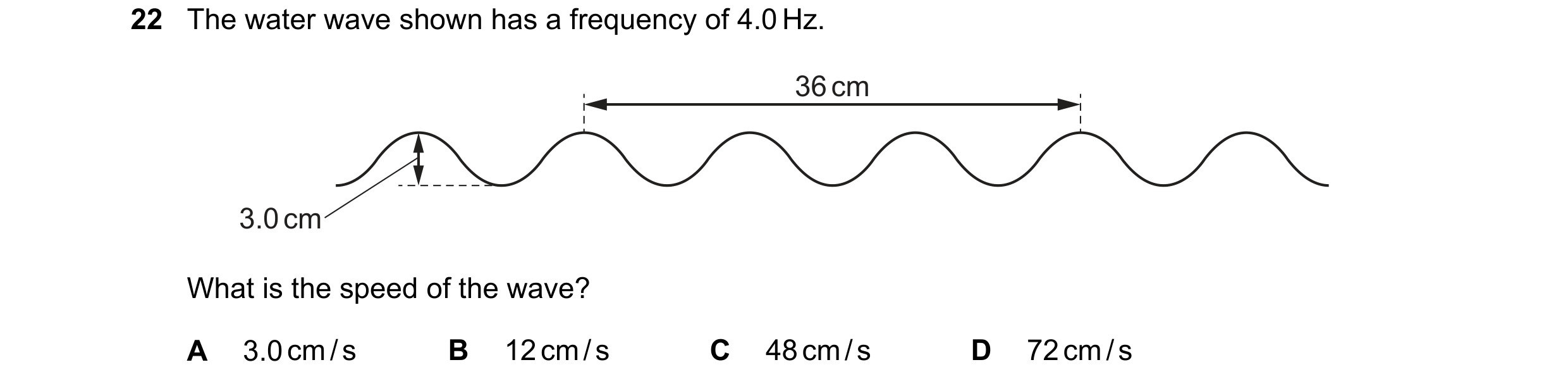
Q21 · The water wave shown has a frequency of 4.0 Hz 0972/22 May/June 2022
22 The water wave shown has a frequency of 4.0 Hz. 36 cm 3.0 cm What is the speed of the wave? A 3.0 cm / s B 12 cm / s C 48 cm / s D 72 cm / s
1 marks
Answer: C
This question in 0972/22 May/June 2022
Q22 · A wave source produces 3000 crests every minute 0972/21 Oct/Nov 2022
17 A wave source produces 3000 crests every minute. The wave has a speed of 300 m / s. What is the wavelength of the wave? A 0.10 m B 0.17 m C 6.0 m D 10.0 m
1 marks
Answer: C
This question in 0972/21 Oct/Nov 2022
Q23 · The diagrams show two sets of wavefronts in a ripple tank 0972/21 Oct/Nov 2022
18 The diagrams show two sets of wavefronts in a ripple tank. wave wave direction direction barrier shallow water A student makes two statements about the waves. 1 When the waves reflect from the barrier the direction changes but the wavelength remains the same. 2 When the waves refract as they enter the shallow water the direction remains the same, but the wavelength changes. Which statements are correct? A statement 1 and statement 2 B statement 1 only C statement 2 only D neither statement 1 nor statement 2
1 marks
Answer: B
This question in 0972/21 Oct/Nov 2022
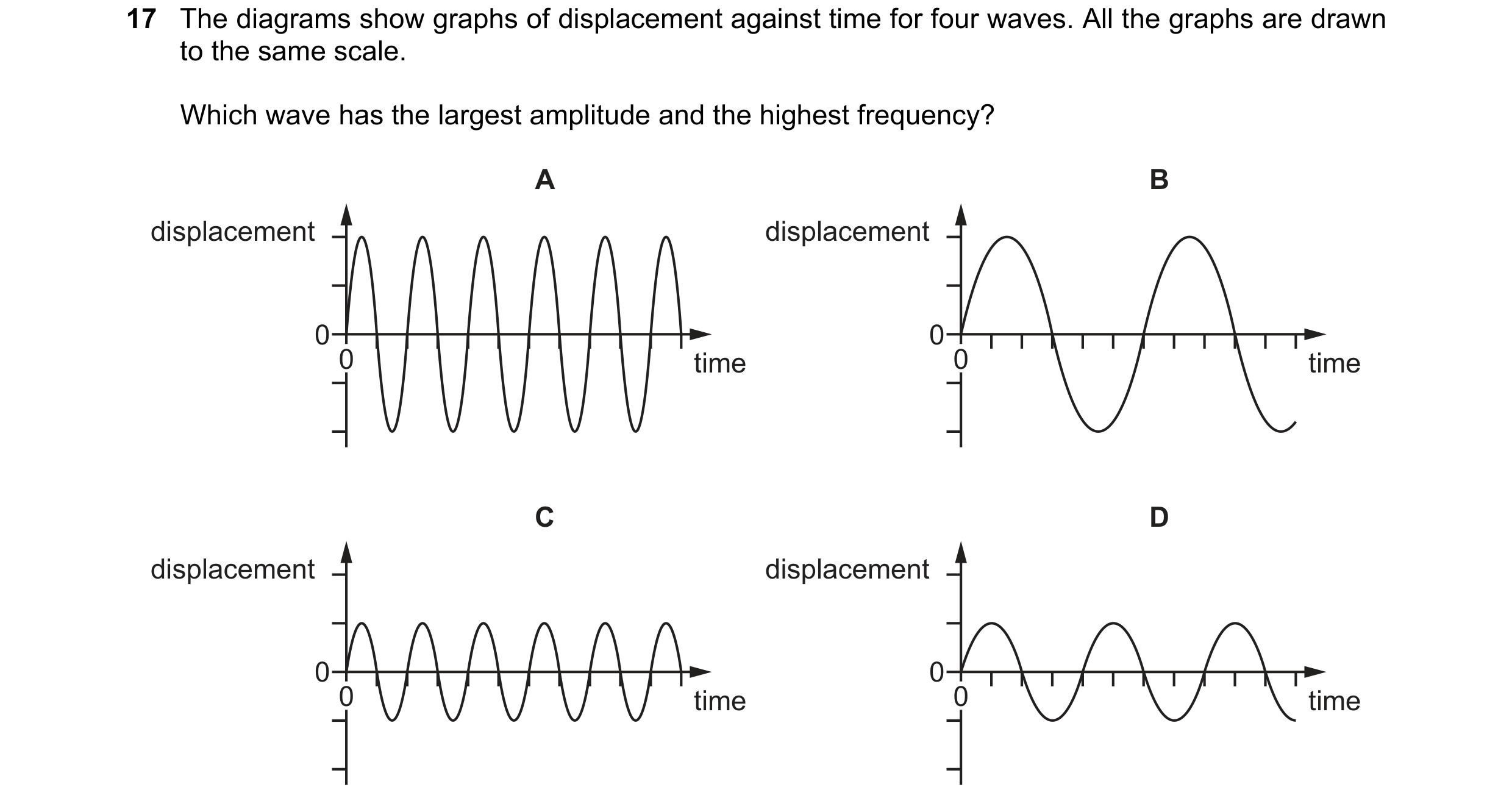
Q24 · The diagrams show graphs of displacement against time for four waves 0972/21 May/June 2023
17 The diagrams show graphs of displacement against time for four waves. All the graphs are drawn to the same scale. Which wave has the largest amplitude and the highest frequency? A B displacement displacement 0 0 0 time 0 time C D displacement displacement 0 0 0 time 0 time
1 marks
Answer: A
This question in 0972/21 May/June 2023
Q25 · Visible light has wavelengths in the range 4.0 × 10⁻⁷ m to 7.0 × 10⁻⁷ m 0972/21 May/June 2023
21 Visible light has wavelengths in the range 4.0 × 10⁻⁷ m to 7.0 × 10⁻⁷ m. What is the range of the frequencies of visible light? A 0.12 Hz to 0.21 Hz B 120 Hz to 210 Hz C 4.3 × 10¹¹ Hz to 7.5 × 10¹¹ Hz D 4.3 × 10¹⁴ Hz to 7.5 × 10¹⁴ Hz
1 marks
Answer: D
This question in 0972/21 May/June 2023
Q26 · The diagram shows a wave 0972/22 May/June 2023
17 The diagram shows a wave. 8 cm 3 cm 6 cm 4 cm What are the amplitude and the wavelength of this wave? amplitude / cm wavelength / cm A 3 4 B 3 8 C 6 4 D 6 8
1 marks
Answer: B
This question in 0972/22 May/June 2023
Q27 · A radio station broadcasts a signal with a frequency of 89 MHz 0972/22 May/June 2023
21 A radio station broadcasts a signal with a frequency of 89 MHz. What is the wavelength of this signal? A 3.7 m B 3.4 m C 3.7 km D 3.4 Mm
1 marks
Answer: B
This question in 0972/22 May/June 2023
Q28 · Two men, P and Q, stand close to a gap in a wall, as shown 0972/21 Oct/Nov 2023
17 Two men, P and Q, stand close to a gap in a wall, as shown. Man P cannot see man Q but man P can hear man Q speaking. P Q gap Which statement explains this? A Light waves do not diffract at all because they are electromagnetic waves. B Light waves have a range of frequencies but sound has just one frequency. C Sound waves are of a higher frequency than light waves. D Sound waves diffract a lot because their wavelength is a similar size to the width of the gap.
1 marks
Answer: D
This question in 0972/21 Oct/Nov 2023
Q29 · Which quantities relating to a wave on the surface of water can both be measured in… 0972/21 Oct/Nov 2023
18 Which quantities relating to a wave on the surface of water can both be measured in metres? A amplitude and frequency B amplitude and wavelength C amplitude and wave speed D frequency and wavelength
1 marks
Answer: B
This question in 0972/21 Oct/Nov 2023
Q30 · A radio transmitter broadcasts at a frequency of 200 kHz 0972/21 Oct/Nov 2023
22 A radio transmitter broadcasts at a frequency of 200 kHz. What is the wavelength of these radio waves? A 6.7 10– 4 m B 1.5 m C 1.5 103 m D 1.5 106 m
1 marks
Answer: C
This question in 0972/21 Oct/Nov 2023
Q31 · Which statement about waves is correct? 0972/21 May/June 2024
16 Which statement about waves is correct? A Waves do not transfer either energy or matter. B Waves transfer both energy and matter. C Waves transfer energy without transferring matter. D Waves transfer matter without transferring energy.
1 marks
Answer: C
This question in 0972/21 May/June 2024
Q32 · A sound wave travels at 330 m / s 0972/21 May/June 2024
22 A sound wave travels at 330 m / s. The distance between the centre of a compression and the centre of the nearest rarefaction in the sound wave is 2.5 cm. What is the frequency of the sound wave? A 66 Hz B 130 Hz C 6600 Hz D 13 000 Hz
1 marks
Answer: C
This question in 0972/21 May/June 2024
Q33 · In which type of wave is the direction of vibration parallel to the direction of travel? 0972/22 May/June 2024
17 In which type of wave is the direction of vibration parallel to the direction of travel? A electromagnetic waves B seismic P-waves C seismic S-waves D water waves
1 marks
Answer: B
This question in 0972/22 May/June 2024
Q34 · Waves in a ripple tank are diffracted as they pass through a narrow gap 0972/22 May/June 2024
18 Waves in a ripple tank are diffracted as they pass through a narrow gap. What can be done to make the spreading due to diffraction greater? A Decrease the frequency of the waves and keep the speed constant. B Decrease the speed of the waves and keep the frequency constant. C Increase the frequency of the waves and keep the speed constant. D Increase the frequency of the waves and decrease the speed.
1 marks
Answer: A
This question in 0972/22 May/June 2024
Q35 · Water waves are reflected at a plane surface 0972/21 Oct/Nov 2024
17 Water waves are reflected at a plane surface. Which property of the waves is changed by the reflection? A direction of propagation B frequency C speed D wavelength
1 marks
Answer: A
This question in 0972/21 Oct/Nov 2024
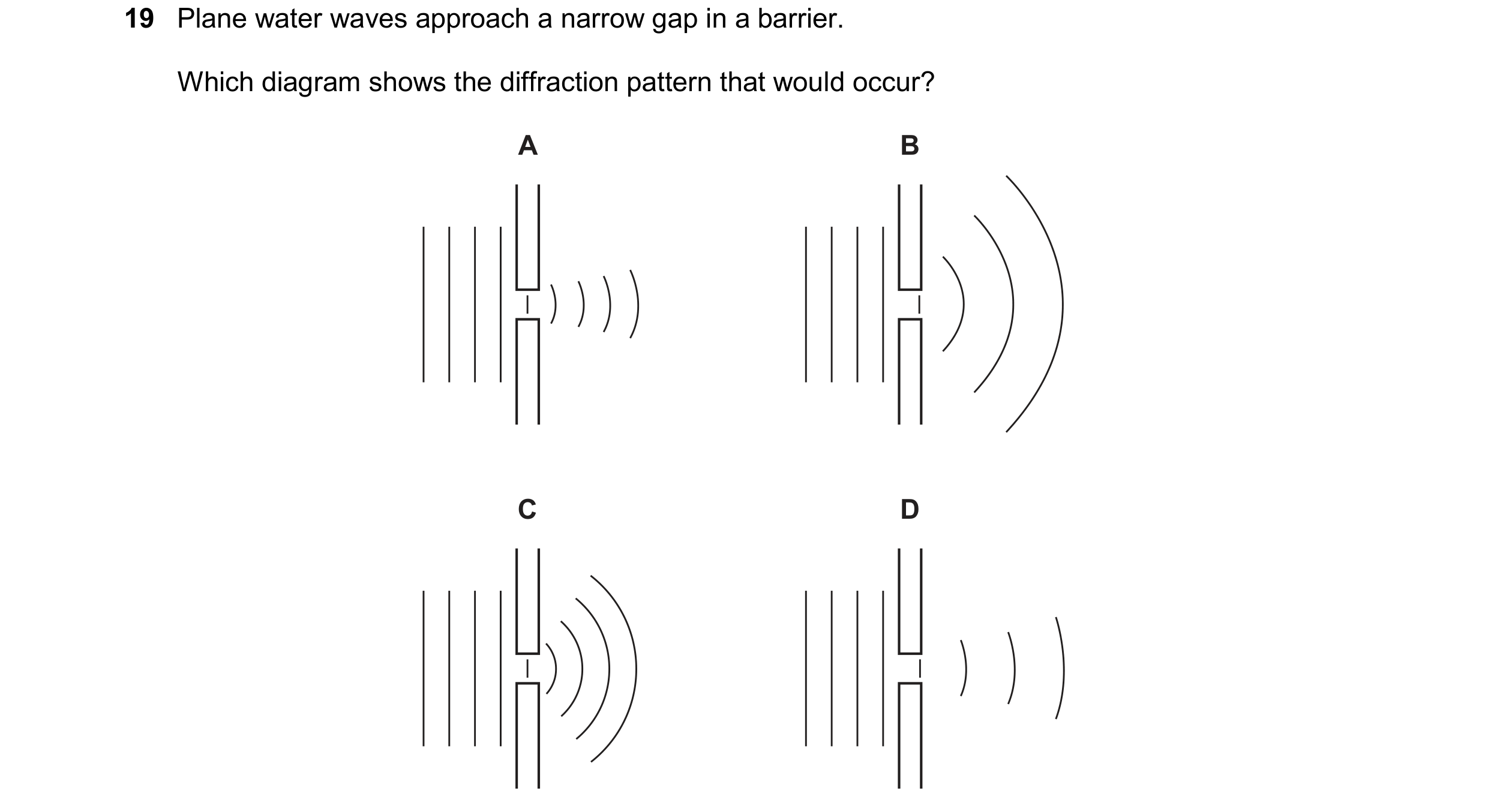
Q36 · Plane water waves approach a narrow gap in a barrier 0972/21 Oct/Nov 2024
19 Plane water waves approach a narrow gap in a barrier. Which diagram shows the diffraction pattern that would occur? A B C D
1 marks
Answer: C
This question in 0972/21 Oct/Nov 2024
Q37 · Radio waves are electromagnetic waves 0972/21 Oct/Nov 2024
22 Radio waves are electromagnetic waves. What is the wavelength of a radio wave of frequency 2.0 105 Hz? A 0.00067 m B 0.0015 m C 670 m D 1500 m
1 marks
Answer: D
This question in 0972/21 Oct/Nov 2024
Q38 · A candle flame is placed in front of a loudspeaker 0972/21 Oct/Nov 2024
23 A candle flame is placed in front of a loudspeaker. The loudspeaker produces a sound wave that causes air particles to vibrate. The vibrating air particles make the candle flame vibrate in the same direction as the air particles. candle flame loudspeaker Which row shows the direction of vibration of the candle flame and the nature of sound waves? direction of nature of vibration sound waves A longitudinal B transverse C longitudinal D transverse
1 marks
Answer: C
This question in 0972/21 Oct/Nov 2024
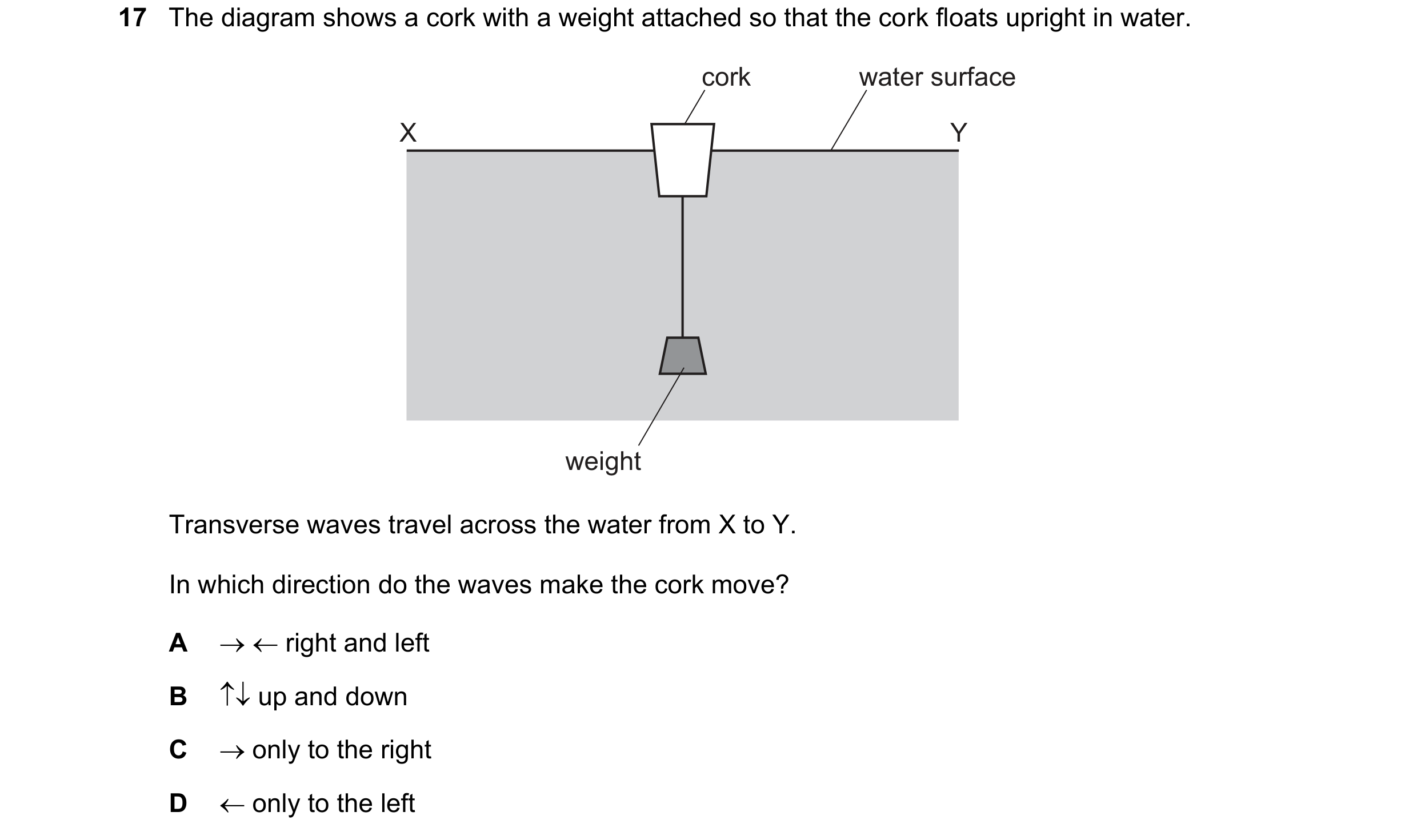
Q39 · The diagram shows a cork with a weight attached so that the cork floats upright in water 0972/21 May/June 2025
17 The diagram shows a cork with a weight attached so that the cork floats upright in water. cork water surface X Y weight Transverse waves travel across the water from X to Y. In which direction do the waves make the cork move? A right and left B up and down C only to the right D only to the left
1 marks
Answer: B
This question in 0972/21 May/June 2025
Q40 · A sound wave travels through the air and strikes a solid block of steel 0972/21 May/June 2025
23 A sound wave travels through the air and strikes a solid block of steel. Some of the sound is reflected from the steel, and some is transmitted through the steel. How does the speed and the wavelength of the sound in steel compare to the speed and the wavelength of the sound in air? speed in steel wavelength in steel A less than in air less than in air B less than in air greater than in air C greater than in air less than in air D greater than in air greater than in air
1 marks
Answer: D
This question in 0972/21 May/June 2025
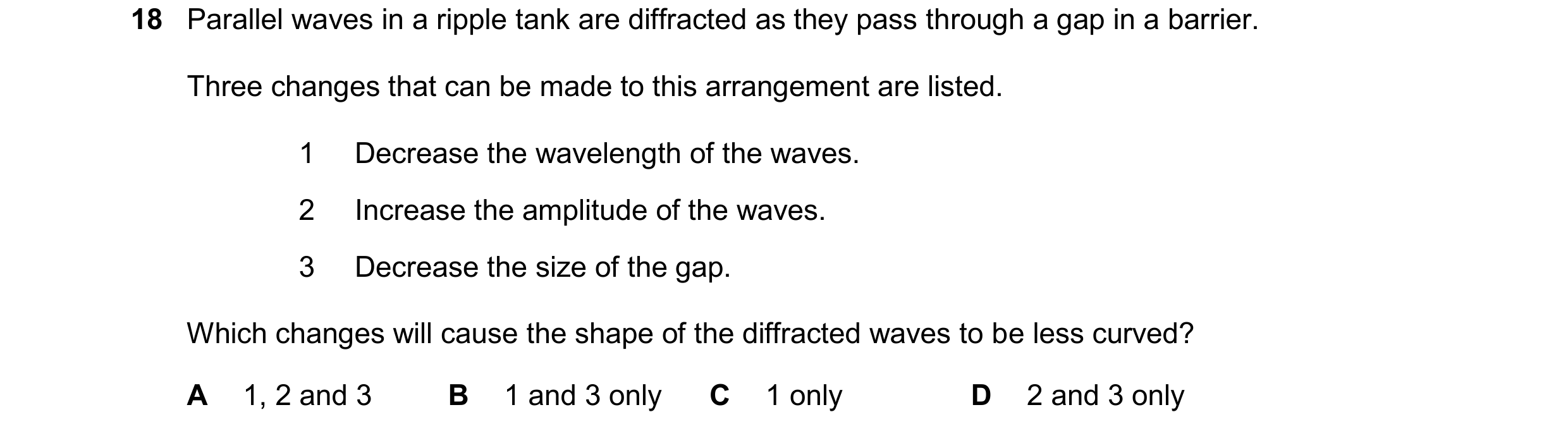
Q41 · Parallel waves in a ripple tank are diffracted as they pass through a gap in a barrier 0972/21 Oct/Nov 2025
18 Parallel waves in a ripple tank are diffracted as they pass through a gap in a barrier. Three changes that can be made to this arrangement are listed. 1 Decrease the wavelength of the waves. 2 Increase the amplitude of the waves. 3 Decrease the size of the gap. Which changes will cause the shape of the diffracted waves to be less curved? A 1, 2 and 3 B 1 and 3 only C 1 only D 2 and 3 only
1 marks
Answer: C
This question in 0972/21 Oct/Nov 2025
 1 / 13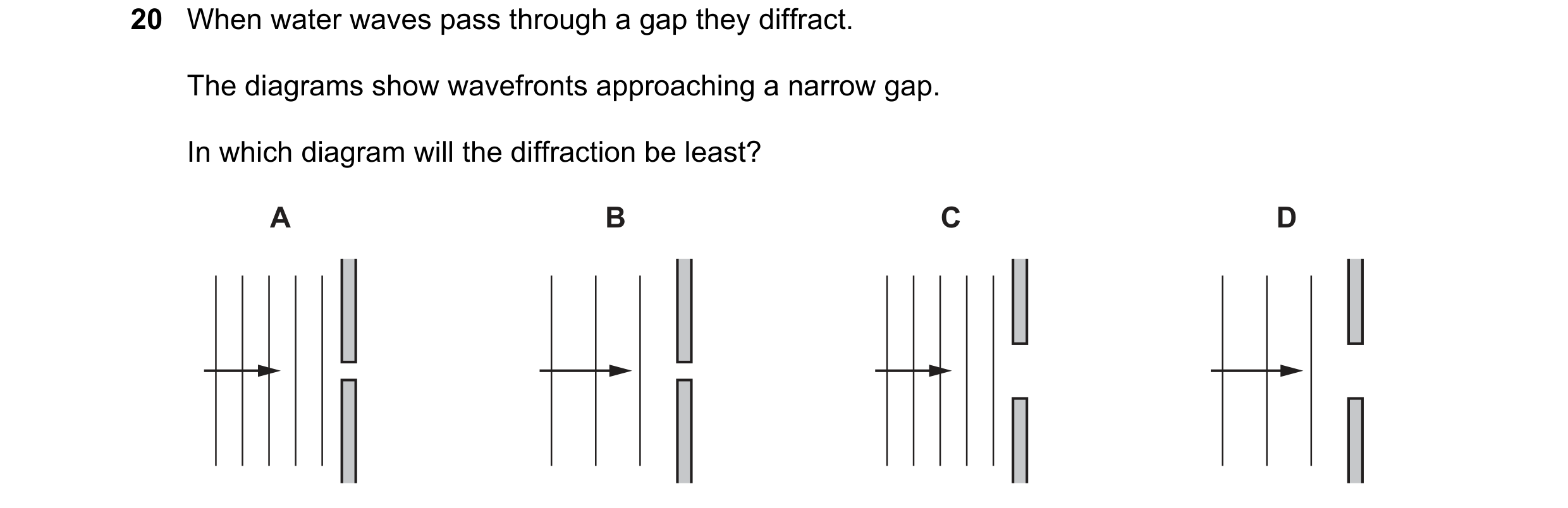
 2 / 13
 3 / 13
 4 / 13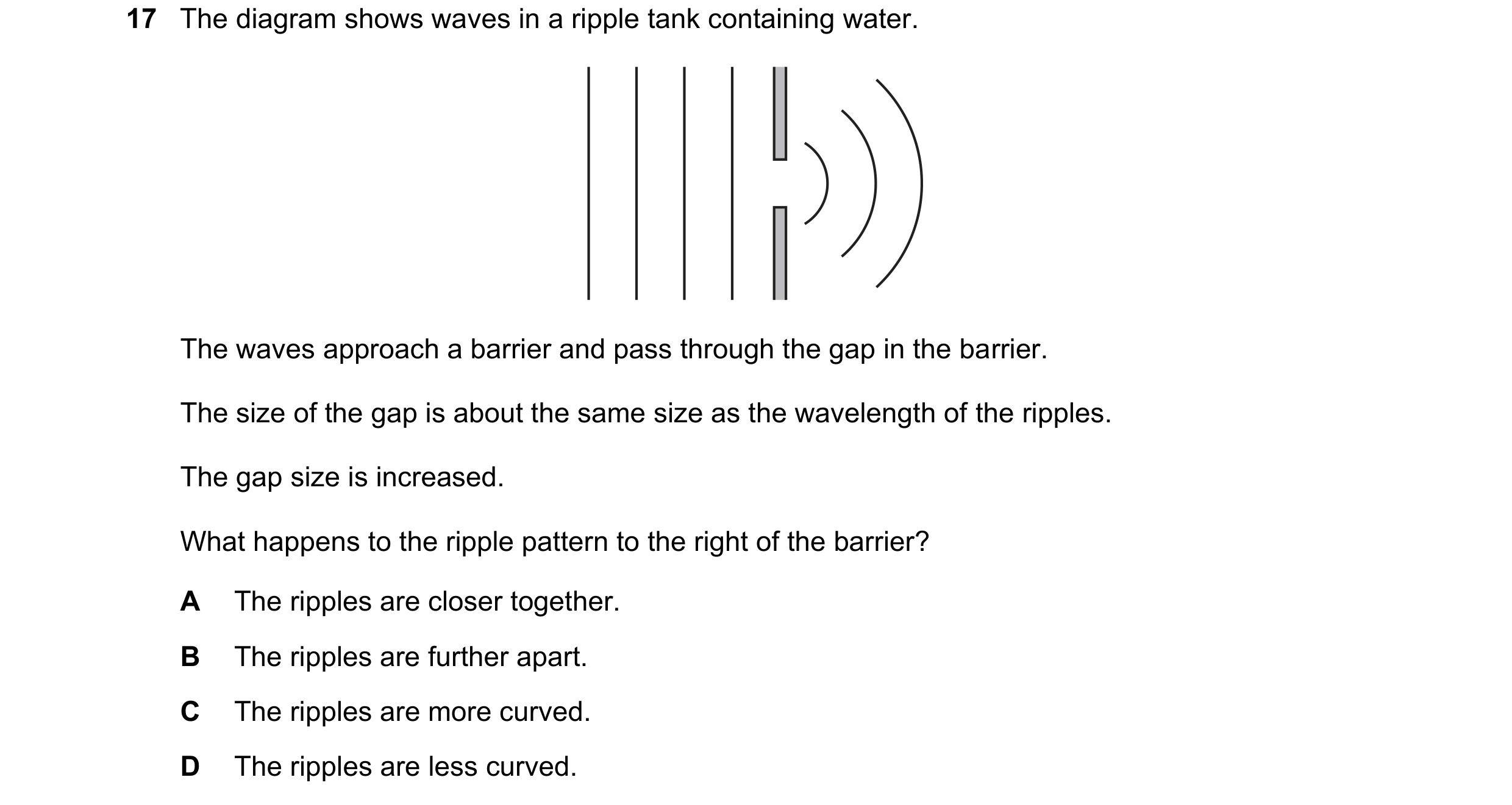
 5 / 13
 6 / 13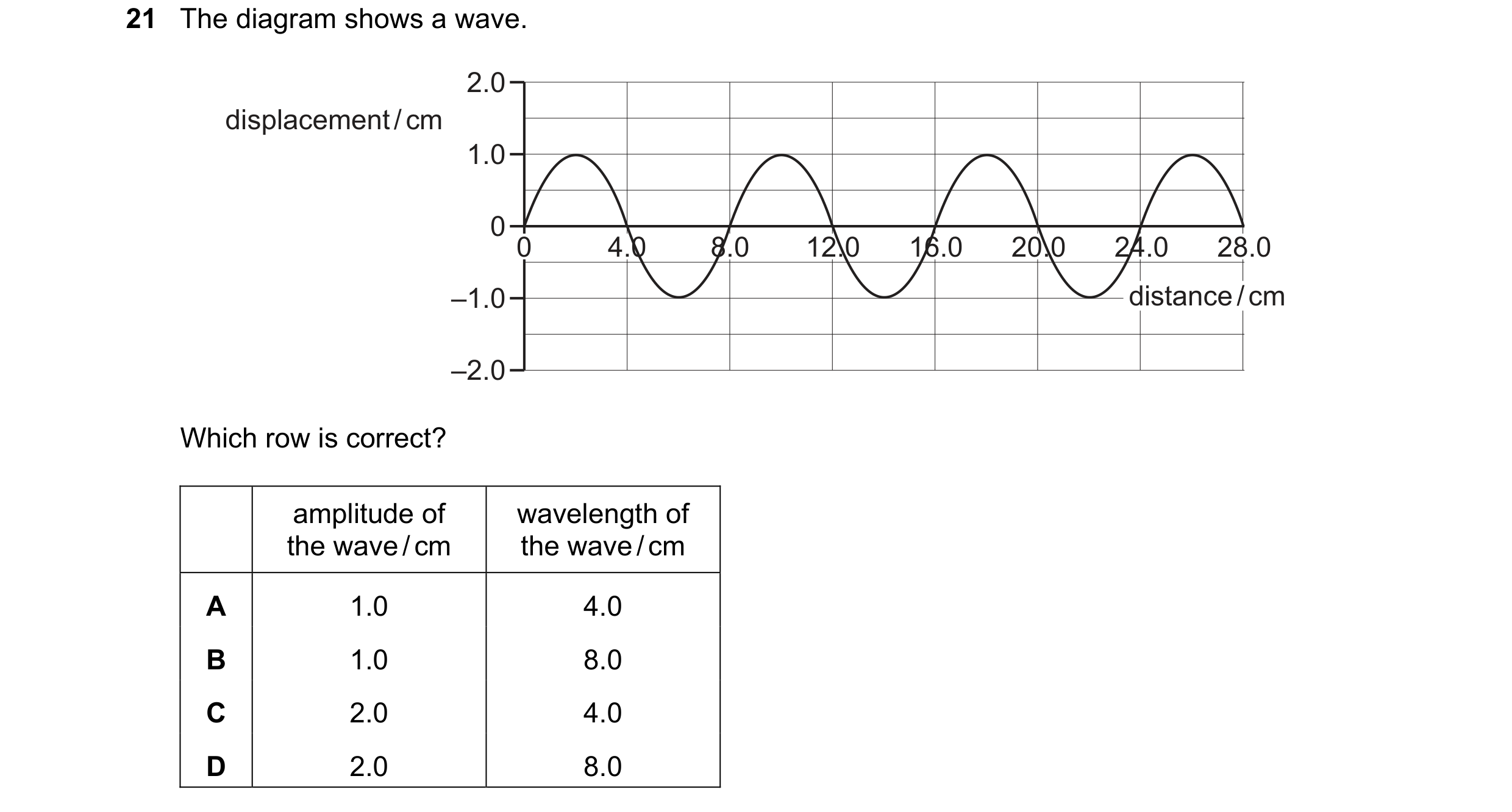
 7 / 13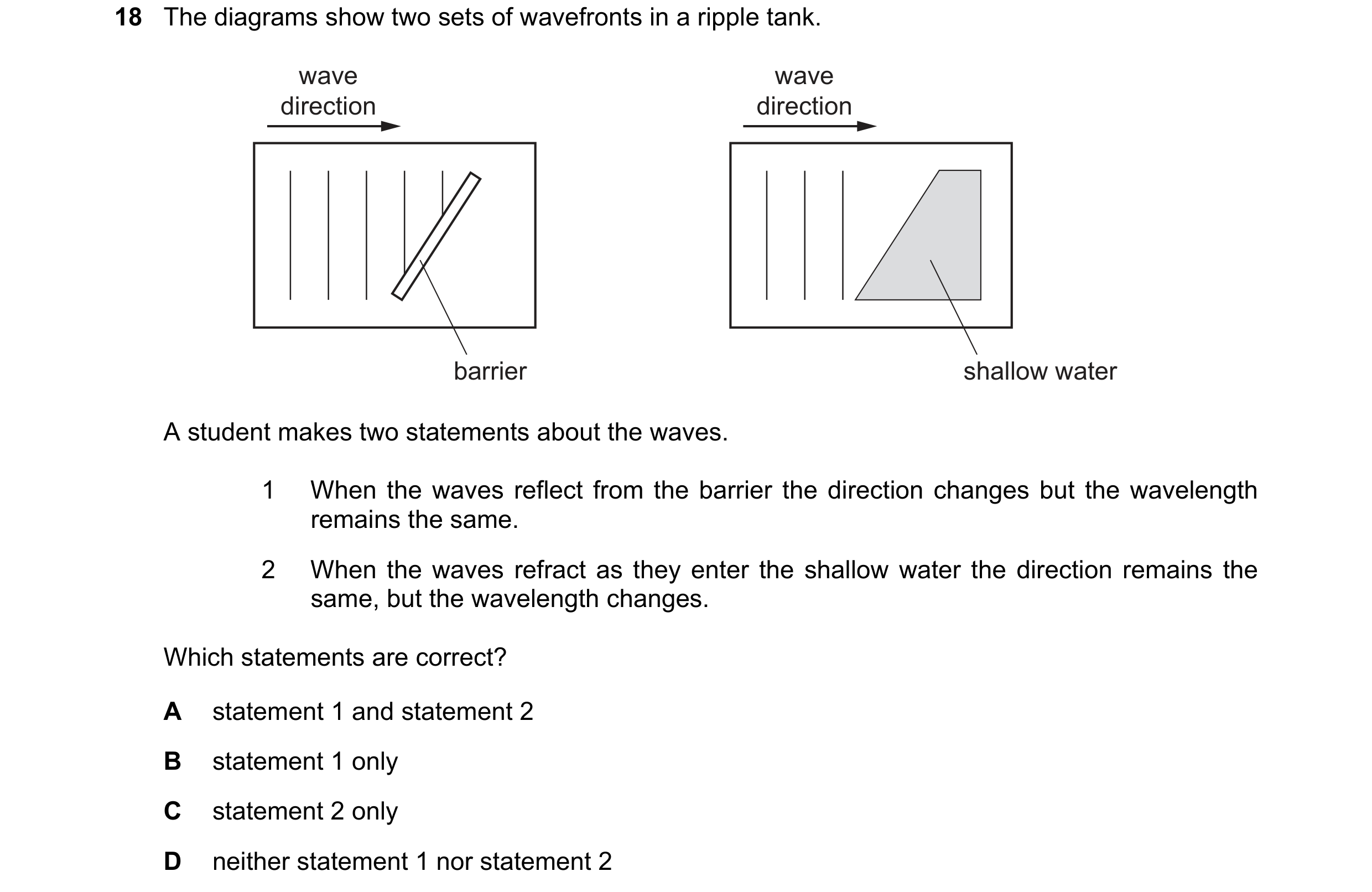
 8 / 13
 9 / 13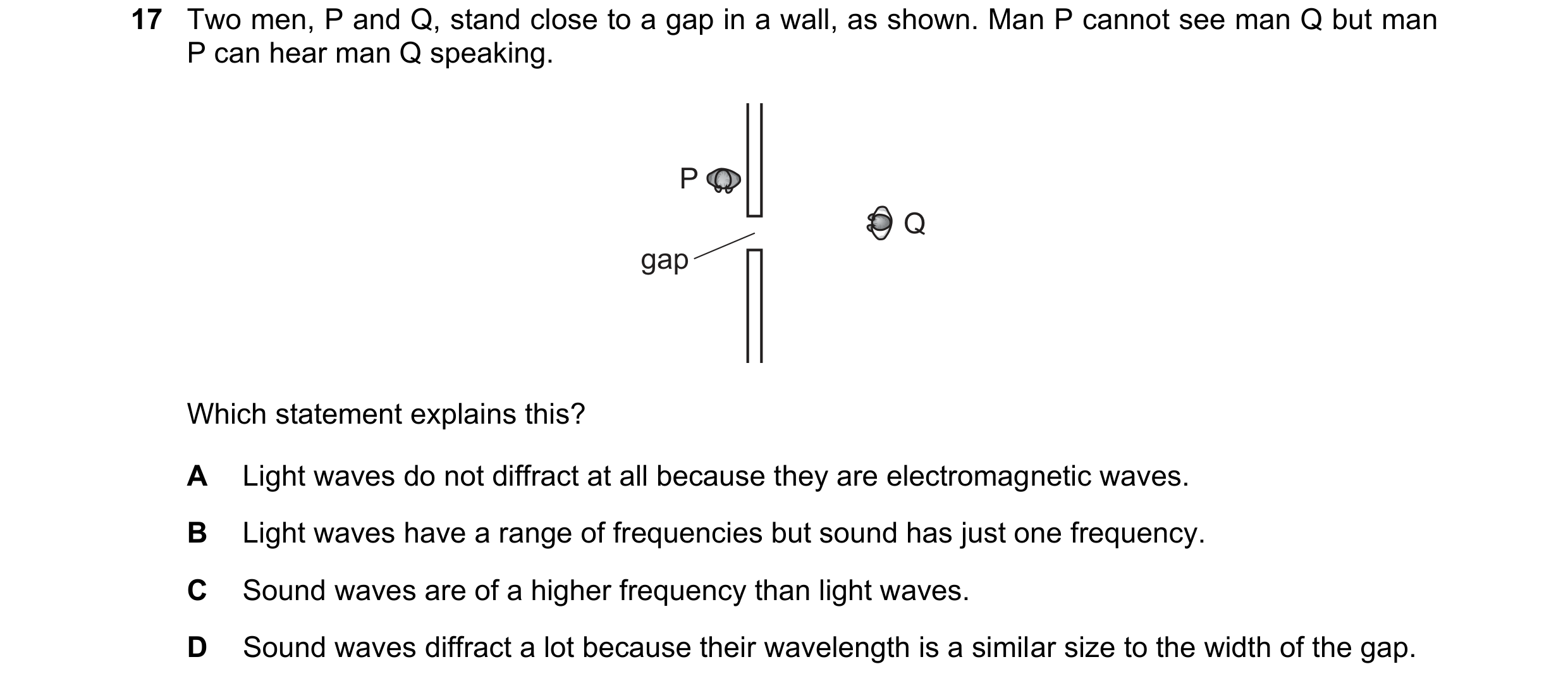




 10 / 13
 11 / 13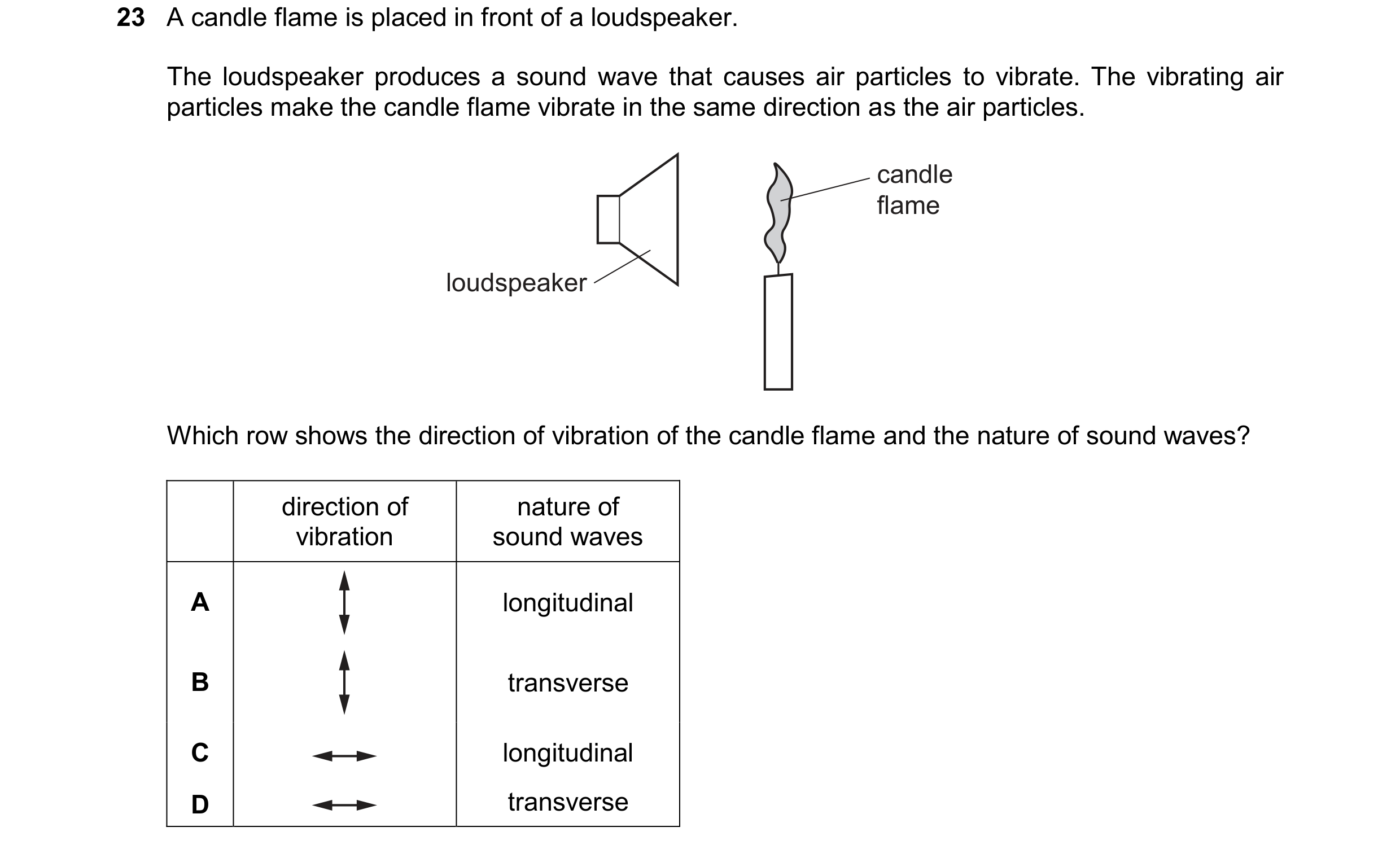
 12 / 13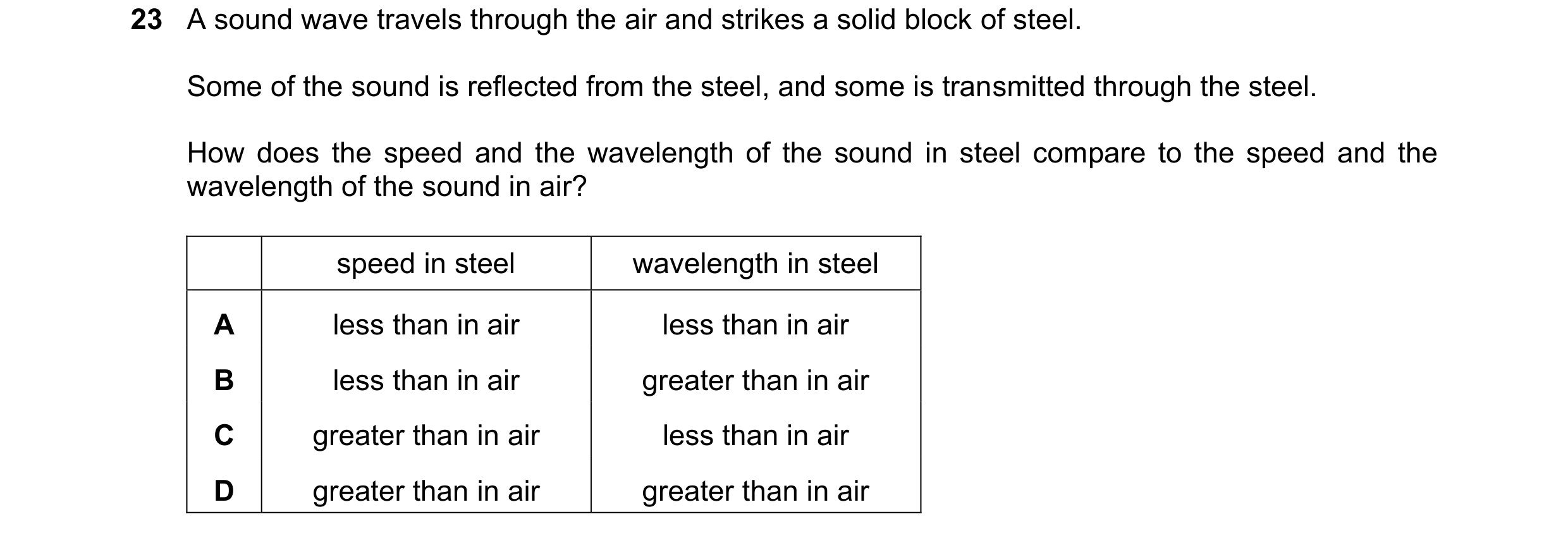
 13 / 13