Questions as text
Q1 · When does an object falling vertically through the air reach terminal velocity? 0972/21 May/June 2018
2 When does an object falling vertically through the air reach terminal velocity? A when the acceleration of the object becomes negative B when the acceleration of the object is equal to g C when the air resistance equals the weight of the object D when the air resistance is greater than the weight of the object
1 marks
Answer: C
This question in 0972/21 May/June 2018
Question 2 0972/21 May/June 2018
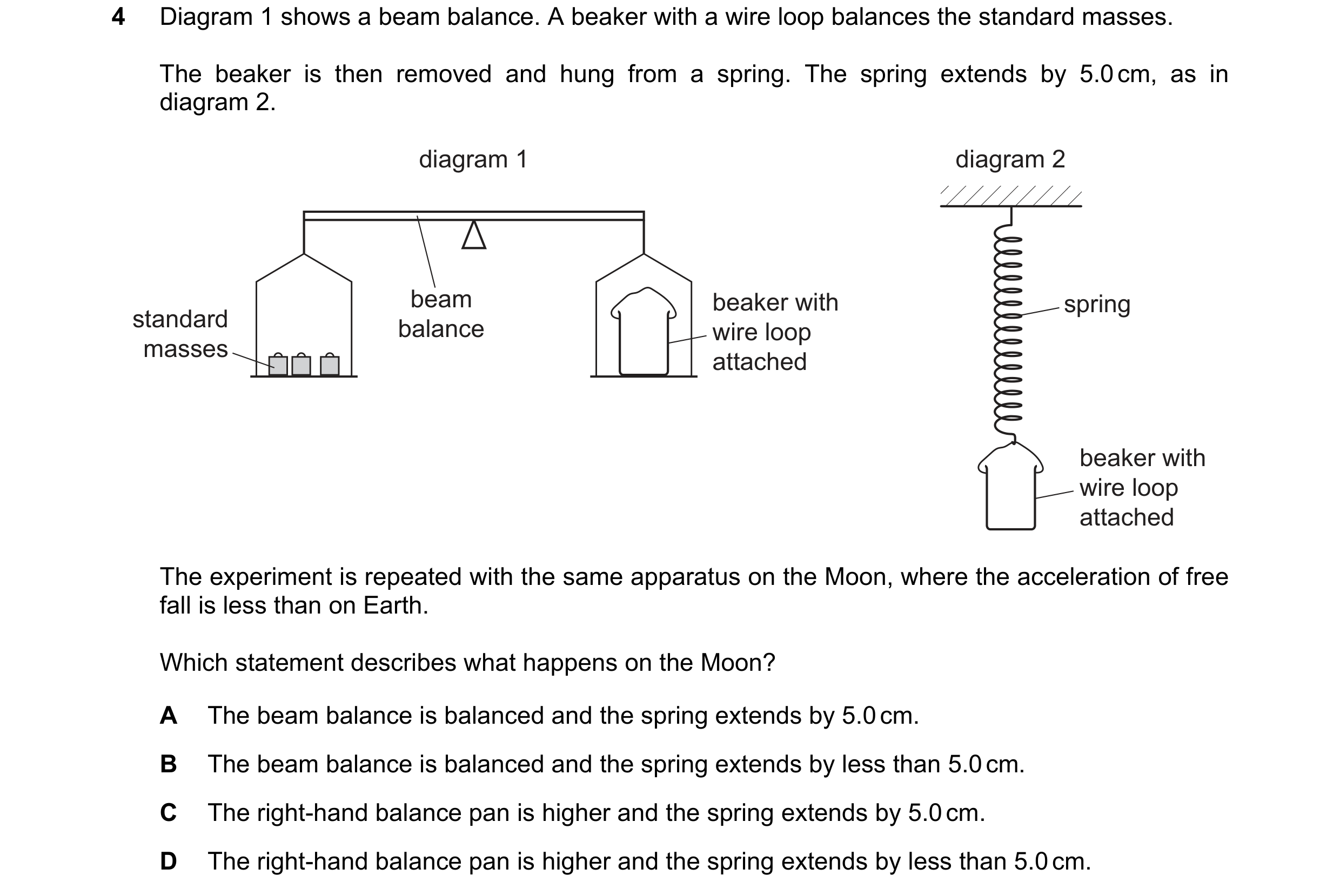
4 Diagram 1 shows a beam balance. A beaker with a wire loop balances the standard masses. The beaker is then removed and hung from a spring. The spring extends by 5.0 cm, as in diagram 2. diagram 1 diagram 2 beam beaker with spring standard balance wire loop masses attached beaker with wire loop attached The experiment is repeated with the same apparatus on the Moon, where the acceleration of free fall is less than on Earth. Which statement describes what happens on the Moon? A The beam balance is balanced and the spring extends by 5.0 cm. B The beam balance is balanced and the spring extends by less than 5.0 cm. C The right-hand balance pan is higher and the spring extends by 5.0 cm. D The right-hand balance pan is higher and the spring extends by less than 5.0 cm.
1 marks
Answer: B
This question in 0972/21 May/June 2018
Q3 · An object always has mass but does not always have weight 0972/21 May/June 2018
5 An object always has mass but does not always have weight. What must be present and acting on the mass for it to have weight? A a gravitational field B a set of scales C displaced water D friction due to air resistance
1 marks
Answer: A
This question in 0972/21 May/June 2018
Q4 · A helium balloon is tied to a top-pan balance 0972/21 Oct/Nov 2018
4 A helium balloon is tied to a top-pan balance. A metal block of mass 100 g is placed on the balance. The reading on the balance is 91 g. helium balloon metal block 91 g Which statement can be deduced from this experiment? A The balloon exerts a downward force of 0.09 N on the top-pan balance. B The helium has a mass of –9 g. C The helium has a mass of +9 g. D The resultant downward force on the top-pan balance is 0.91 N.
1 marks
Answer: D
This question in 0972/21 Oct/Nov 2018
Q5 · A man climbs a ladder 0972/21 Oct/Nov 2018
11 A man climbs a ladder. Which two quantities can be used to calculate the useful power of the man? A the weight of the man and the time taken only B the weight of the man and the vertical distance moved only C the work done by the man and the time taken only D the work done by the man and the vertical distance moved only
1 marks
Answer: C
This question in 0972/21 Oct/Nov 2018
Q6 · An object of mass 800 g and specific heat capacity 250 J / (kg °C) is heated 0972/21 Oct/Nov 2018
18 An object of mass 800 g and specific heat capacity 250 J / (kg °C) is heated. It absorbs 5300 J of energy. What is the increase in temperature of the object? A 0.027 °C B 17 °C C 27 °C D 17 000 °C
1 marks
Answer: C
This question in 0972/21 Oct/Nov 2018
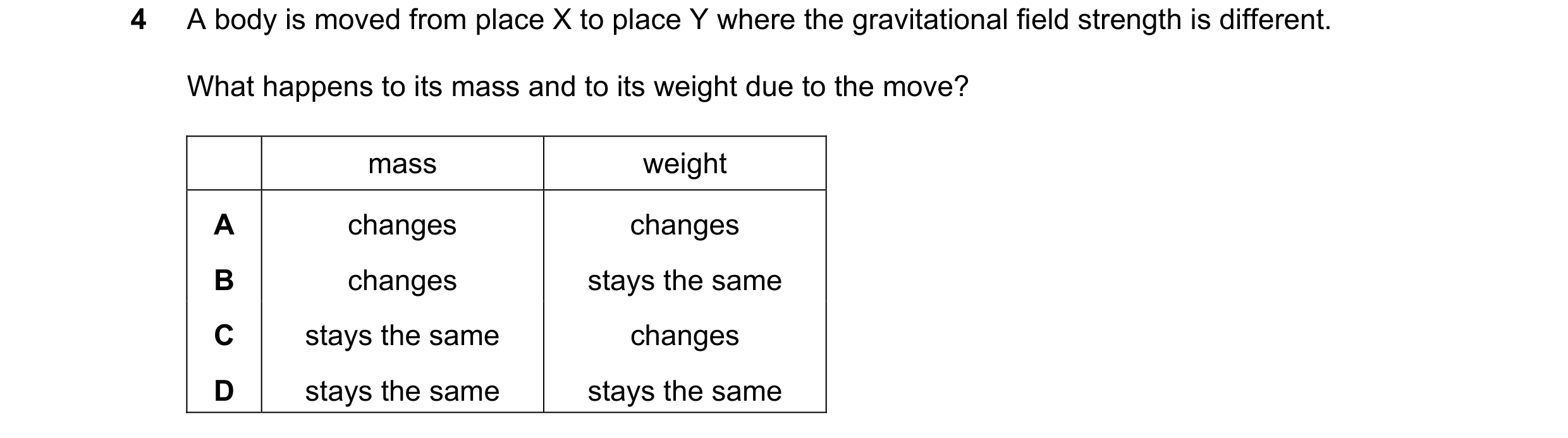
Q7 · A body is moved from place X to place Y where the gravitational field strength is… 0972/21 May/June 2019
4 A body is moved from place X to place Y where the gravitational field strength is different. What happens to its mass and to its weight due to the move? mass weight A changes changes B changes stays the same C stays the same changes D stays the same stays the same
1 marks
Answer: C
This question in 0972/21 May/June 2019
Q8 · Four students make statements about the mass of an object 0972/22 May/June 2019
4 Four students make statements about the mass of an object. Which statement is correct? A The mass of an object depends on the gravitational field which acts on the object. B The mass of an object divided by its weight is equal to the acceleration with which it falls freely. C The mass of an object increases when the temperature of the object increases. D The mass of an object resists change in motion of the object.
1 marks
Answer: D
This question in 0972/22 May/June 2019
Q9 · Which quantity is a force due to a gravitational field? 0972/21 Oct/Nov 2019
4 Which quantity is a force due to a gravitational field? A density B mass C weight D volume
1 marks
Answer: C
This question in 0972/21 Oct/Nov 2019
Q10 · The density of air is 1.2 kg / m3 0972/21 Oct/Nov 2019
5 The density of air is 1.2 kg / m3. A room has dimensions 5.0 m × 4.0 m × 3.0 m. What is the mass of the air in the room? A 0.02 kg B 0.10 kg C 50 kg D 72 kg
1 marks
Answer: D
This question in 0972/21 Oct/Nov 2019
Q11 · A man carries 20 tiles from the ground to the roof of a house 0972/21 Oct/Nov 2019
11 A man carries 20 tiles from the ground to the roof of a house. Each tile has a mass of 1.2 kg. The roof of the house is 15 m above the ground. How much work does the man do against gravity on the tiles in carrying them to the roof? A 36 J B 180 J C 360 J D 3600 J
1 marks
Answer: D
This question in 0972/21 Oct/Nov 2019
Q12 · A mass of 6.0 kg rests on the surface of a planet 0972/21 May/June 2020
5 A mass of 6.0 kg rests on the surface of a planet. On this planet, g = 20 N / kg. What is the weight of the object? A 0.30 N B 0.60 N C 60 N D 120 N
1 marks
Answer: D
This question in 0972/21 May/June 2020
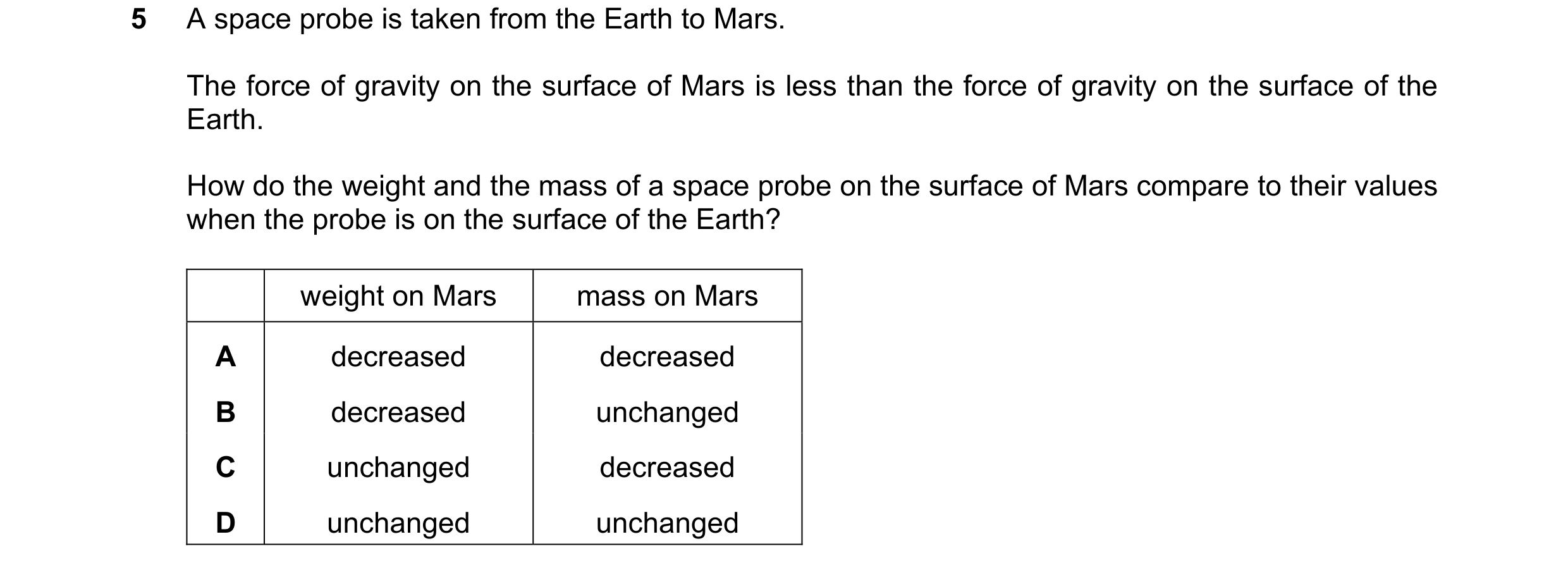
Q13 · A space probe is taken from the Earth to Mars 0972/22 May/June 2020
5 A space probe is taken from the Earth to Mars. The force of gravity on the surface of Mars is less than the force of gravity on the surface of the Earth. How do the weight and the mass of a space probe on the surface of Mars compare to their values when the probe is on the surface of the Earth? weight on Mars mass on Mars A decreased decreased B decreased unchanged C unchanged decreased D unchanged unchanged
1 marks
Answer: B
This question in 0972/22 May/June 2020
Q14 · Which quantity is weight an example of? 0972/21 Oct/Nov 2020
4 Which quantity is weight an example of? A acceleration B force C mass D pressure
1 marks
Answer: B
This question in 0972/21 Oct/Nov 2020
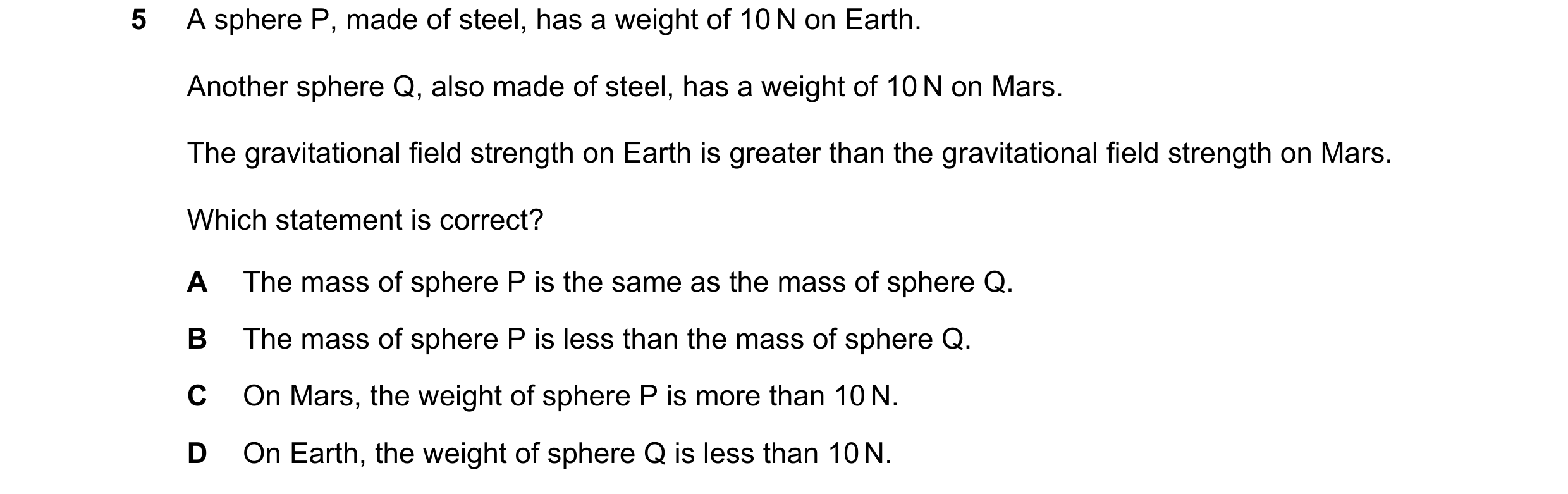
Q15 · A sphere P, made of steel, has a weight of 10 N on Earth 0972/21 Oct/Nov 2020
5 A sphere P, made of steel, has a weight of 10 N on Earth. Another sphere Q, also made of steel, has a weight of 10 N on Mars. The gravitational field strength on Earth is greater than the gravitational field strength on Mars. Which statement is correct? A The mass of sphere P is the same as the mass of sphere Q. B The mass of sphere P is less than the mass of sphere Q. C On Mars, the weight of sphere P is more than 10 N. D On Earth, the weight of sphere Q is less than 10 N.
1 marks
Answer: B
This question in 0972/21 Oct/Nov 2020
Q16 · A stone is dropped from rest at a height of 2.0 m above the surface of a planet 0972/21 Oct/Nov 2020
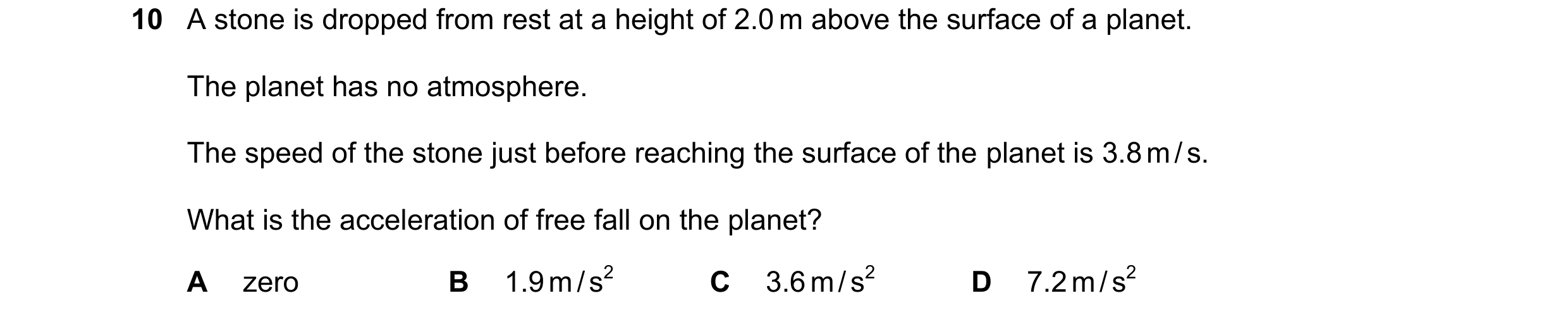
10 A stone is dropped from rest at a height of 2.0 m above the surface of a planet. The planet has no atmosphere. The speed of the stone just before reaching the surface of the planet is 3.8 m / s. What is the acceleration of free fall on the planet? A zero B 1.9 m / s2 C 3.6 m / s2 D 7.2 m / s2
1 marks
Answer: C
This question in 0972/21 Oct/Nov 2020
Q17 · An object has a weight of 6.4 N on the Earth where the gravitational field strength is 10… 0972/21 Oct/Nov 2021
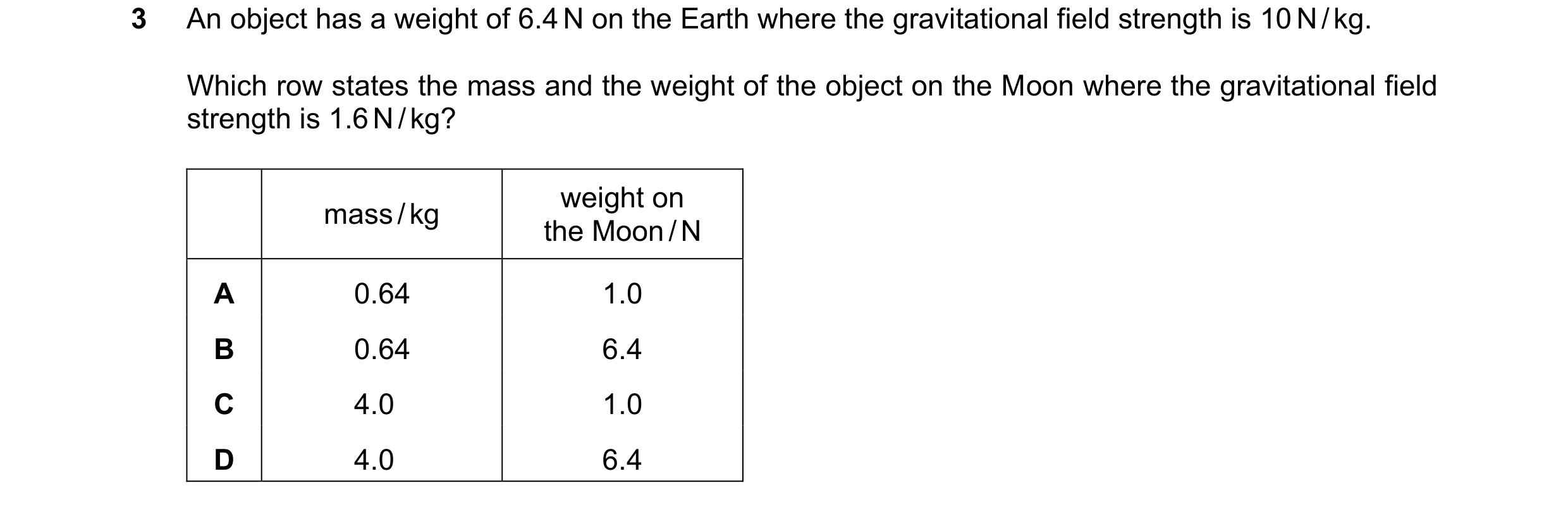
3 An object has a weight of 6.4 N on the Earth where the gravitational field strength is 10 N / kg. Which row states the mass and the weight of the object on the Moon where the gravitational field strength is 1.6 N / kg? weight on mass / kg the Moon / N A 0.64 1.0 B 0.64 6.4 C 4.0 1.0 D 4.0 6.4
1 marks
Answer: A
This question in 0972/21 Oct/Nov 2021
Q18 · On the Moon, all objects fall with the same acceleration 0972/21 May/June 2022
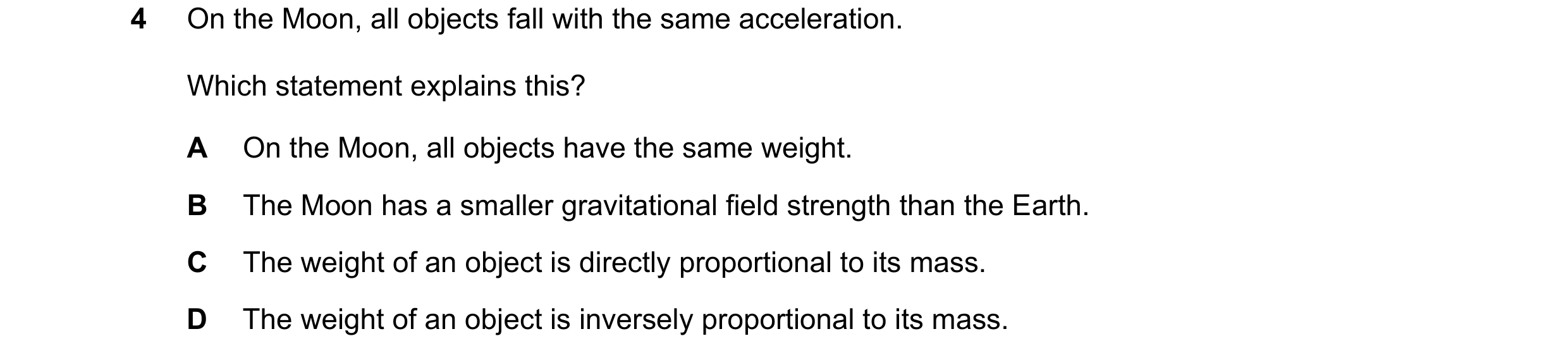
4 On the Moon, all objects fall with the same acceleration. Which statement explains this? A On the Moon, all objects have the same weight. B The Moon has a smaller gravitational field strength than the Earth. C The weight of an object is directly proportional to its mass. D The weight of an object is inversely proportional to its mass.
1 marks
Answer: C
This question in 0972/21 May/June 2022
Q19 · On the Moon, all objects fall with the same acceleration 0972/22 May/June 2022
4 On the Moon, all objects fall with the same acceleration. Which statement explains this? A On the Moon, all objects have the same weight. B The Moon has a smaller gravitational field strength than the Earth. C The weight of an object is directly proportional to its mass. D The weight of an object is inversely proportional to its mass.
1 marks
Answer: C
This question in 0972/22 May/June 2022
Q20 · Which property of an object is a consequence of the effect of a gravitational field… 0972/21 Oct/Nov 2022
3 Which property of an object is a consequence of the effect of a gravitational field acting on it? A density B mass C volume D weight
1 marks
Answer: D
This question in 0972/21 Oct/Nov 2022
Q21 · On the Earth, a spring stretches by 5.0 cm when a mass of 3.0 kg is suspended from one end 0972/21 May/June 2023
4 On the Earth, a spring stretches by 5.0 cm when a mass of 3.0 kg is suspended from one end. The gravitational field strength on the Moon is 1 6 of that on the Earth. Which mass, on the Moon, would stretch the spring by the same extension? A 0.50 kg B 3.0 kg C 5.0 kg D 18 kg
1 marks
Answer: D
This question in 0972/21 May/June 2023
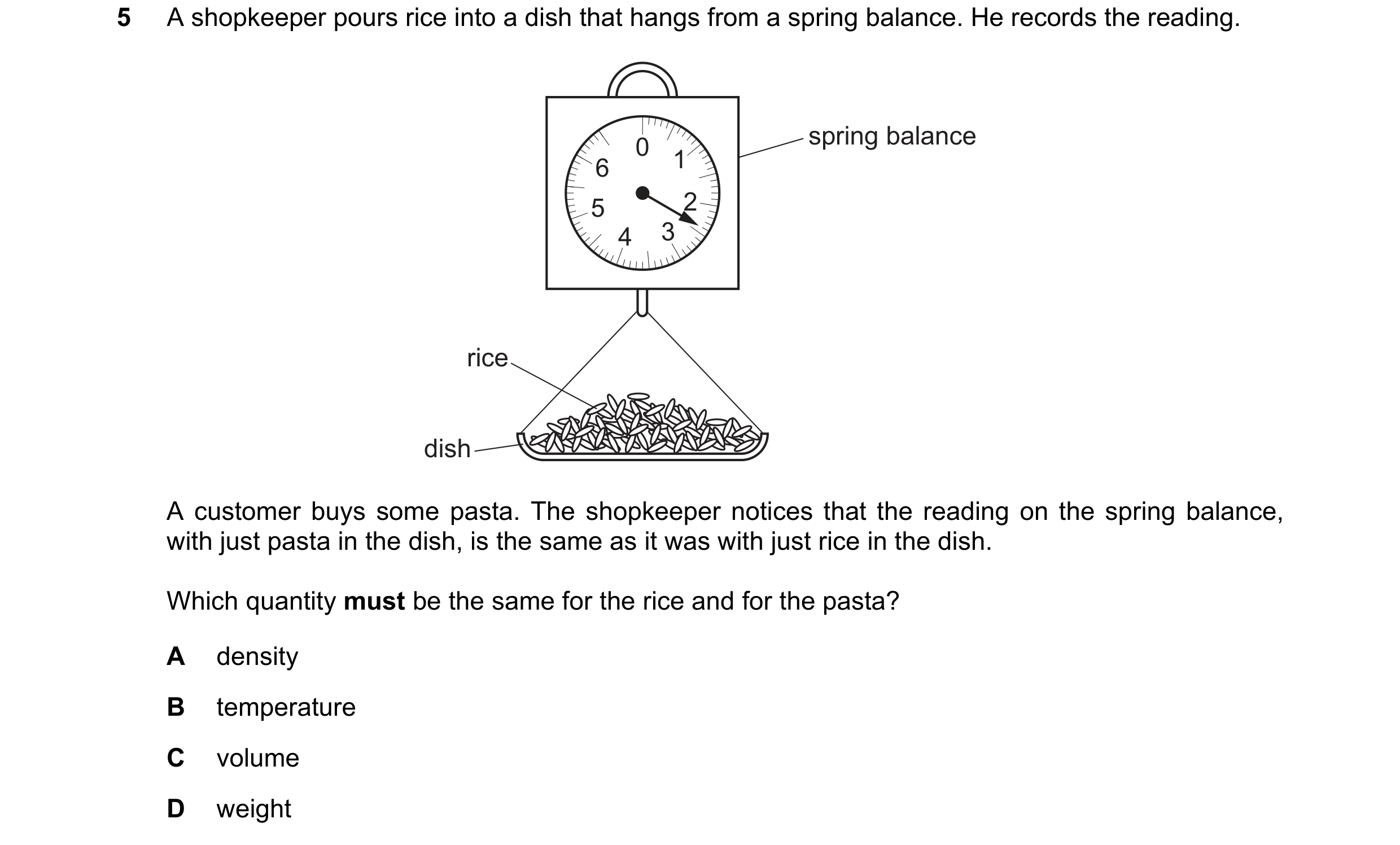
Q22 · A shopkeeper pours rice into a dish that hangs from a spring balance 0972/21 May/June 2023
5 A shopkeeper pours rice into a dish that hangs from a spring balance. He records the reading. 0 spring balance 6 1 5 2 4 3 rice dish A customer buys some pasta. The shopkeeper notices that the reading on the spring balance, with just pasta in the dish, is the same as it was with just rice in the dish. Which quantity must be the same for the rice and for the pasta? A density B temperature C volume D weight
1 marks
Answer: D
This question in 0972/21 May/June 2023
Q23 · Which statement about mass or weight is not correct? 0972/22 May/June 2023
4 Which statement about mass or weight is not correct? A Masses can be compared using a balance. B Mass is a force. C Weights can be compared using a balance. D Weight is a force.
1 marks
Answer: B
This question in 0972/22 May/June 2023
Q24 · A sphere P, made of steel, has a weight of 10 N on Earth 0972/22 May/June 2023
5 A sphere P, made of steel, has a weight of 10 N on Earth. Another sphere Q, also made of steel, has a weight of 10 N on Mars. The gravitational field strength on Earth is greater than the gravitational field strength on Mars. Which statement is correct? A The mass of sphere P is the same as the mass of sphere Q. B The mass of sphere P is less than the mass of sphere Q. C On Mars, the weight of sphere P is the same as the weight of sphere Q. D On Earth, the weight of sphere Q is less than 10 N.
1 marks
Answer: B
This question in 0972/22 May/June 2023
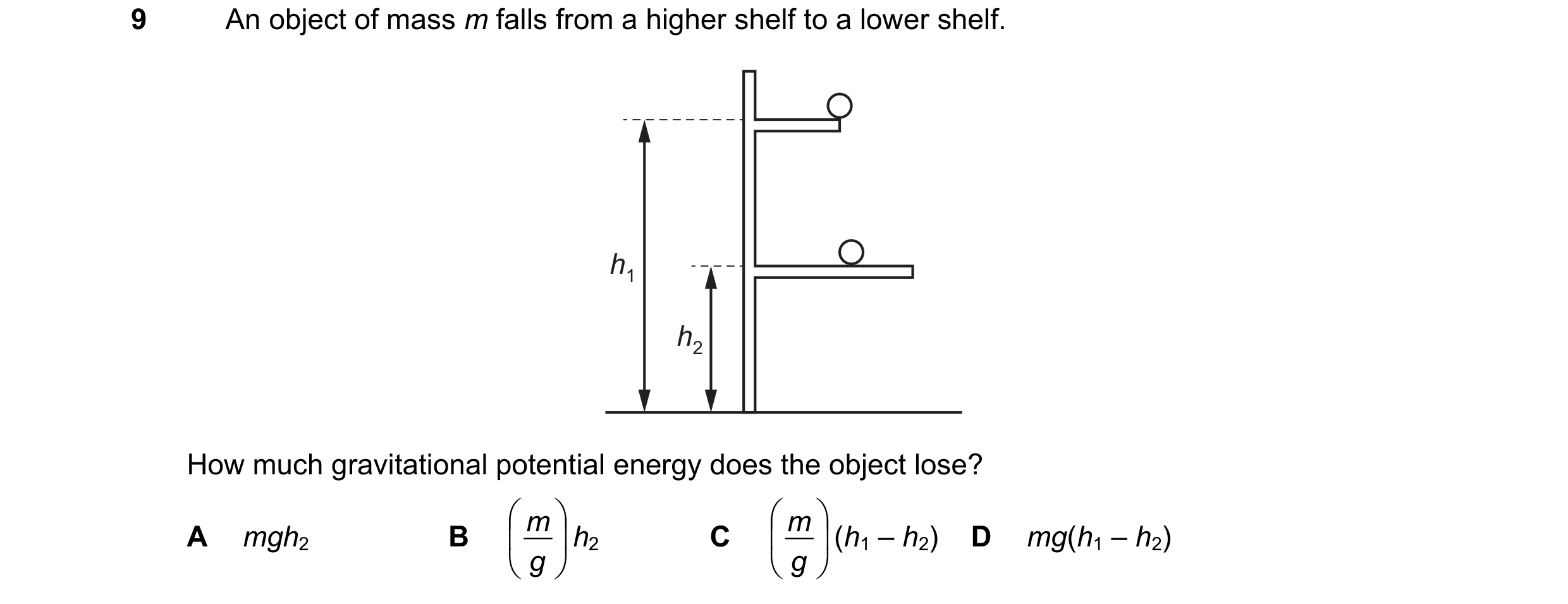
Q25 · An object of mass m falls from a higher shelf to a lower shelf 0972/21 Oct/Nov 2023
9 An object of mass m falls from a higher shelf to a lower shelf. h1 h2 How much gravitational potential energy does the object lose? m h2 m (h1 – h2) A mgh2 B C D mg(h1 – h2) g g
1 marks
Answer: D
This question in 0972/21 Oct/Nov 2023
Q26 · Which name is given to the quantity of matter in an object? 0972/21 May/June 2024
2 Which name is given to the quantity of matter in an object? A density B mass C volume D weight
1 marks
Answer: B
This question in 0972/21 May/June 2024
Q27 · A body is moved from place X to place Y where the gravitational field strength is… 0972/21 May/June 2024
3 A body is moved from place X to place Y where the gravitational field strength is different. What happens to its mass and to its weight due to the move? mass weight A changes changes B changes stays the same C stays the same changes D stays the same stays the same
1 marks
Answer: C
This question in 0972/21 May/June 2024
Q28 · An astronaut of mass 80 kg is standing on a planet with gravitational field strength g =… 0972/22 May/June 2024
3 An astronaut of mass 80 kg is standing on a planet with gravitational field strength g = 3.8 N / kg. What is the weight of the astronaut on this planet? A 780 N B 300 N C 210 N D 21 N
1 marks
Answer: B
This question in 0972/22 May/June 2024
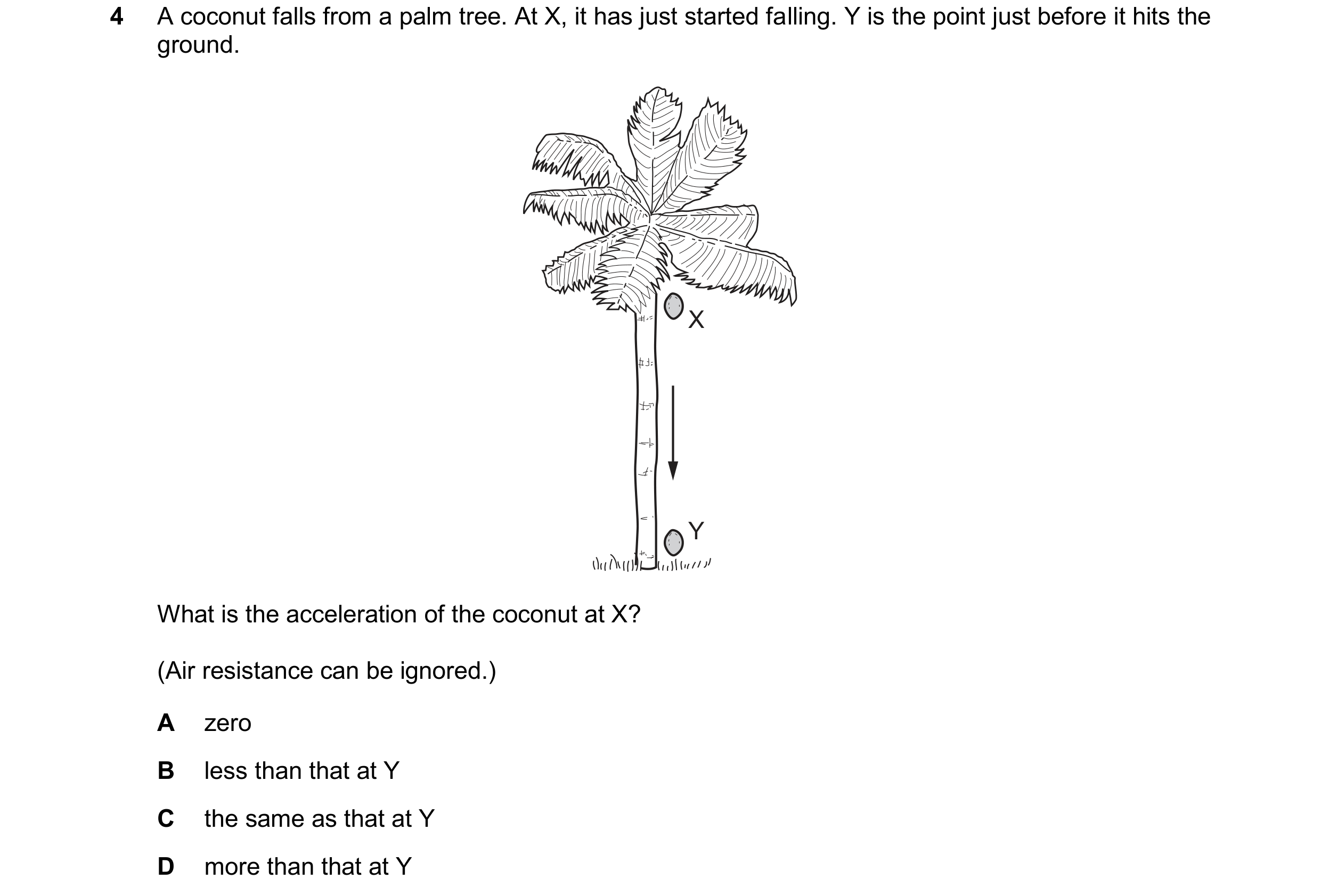
Q29 · A coconut falls from a palm tree 0972/21 Oct/Nov 2024
4 A coconut falls from a palm tree. At X, it has just started falling. Y is the point just before it hits the ground. X Y What is the acceleration of the coconut at X? (Air resistance can be ignored.) A zero B less than that at Y C the same as that at Y D more than that at Y
1 marks
Answer: C
This question in 0972/21 Oct/Nov 2024
Q30 · An elephant of weight 45 000 N stands with all four feet on the floor 0972/21 Oct/Nov 2024
11 An elephant of weight 45 000 N stands with all four feet on the floor. The average pressure on the floor due to the elephant foot in contact with it is 34 000 Pa. What is the area of each foot of the elephant? A 0.19 m2 B 0.33 m2 C 0.76 m2 D 1.3 m2
1 marks
Answer: B
This question in 0972/21 Oct/Nov 2024
Q31 · The diagrams show two metal blocks, X and Y, suspended from identical force meters 0972/21 May/June 2025
3 The diagrams show two metal blocks, X and Y, suspended from identical force meters. X and Y have identical dimensions. N N 0 0 1 1 2 2 3 3 4 4 5 5 6 6 X Y Which statement about X and Y is correct? A They have different volumes and different weights. B They have different volumes and equal weights. C They have equal volumes and equal weights. D They have equal volumes and different weights.
1 marks
Answer: D
This question in 0972/21 May/June 2025
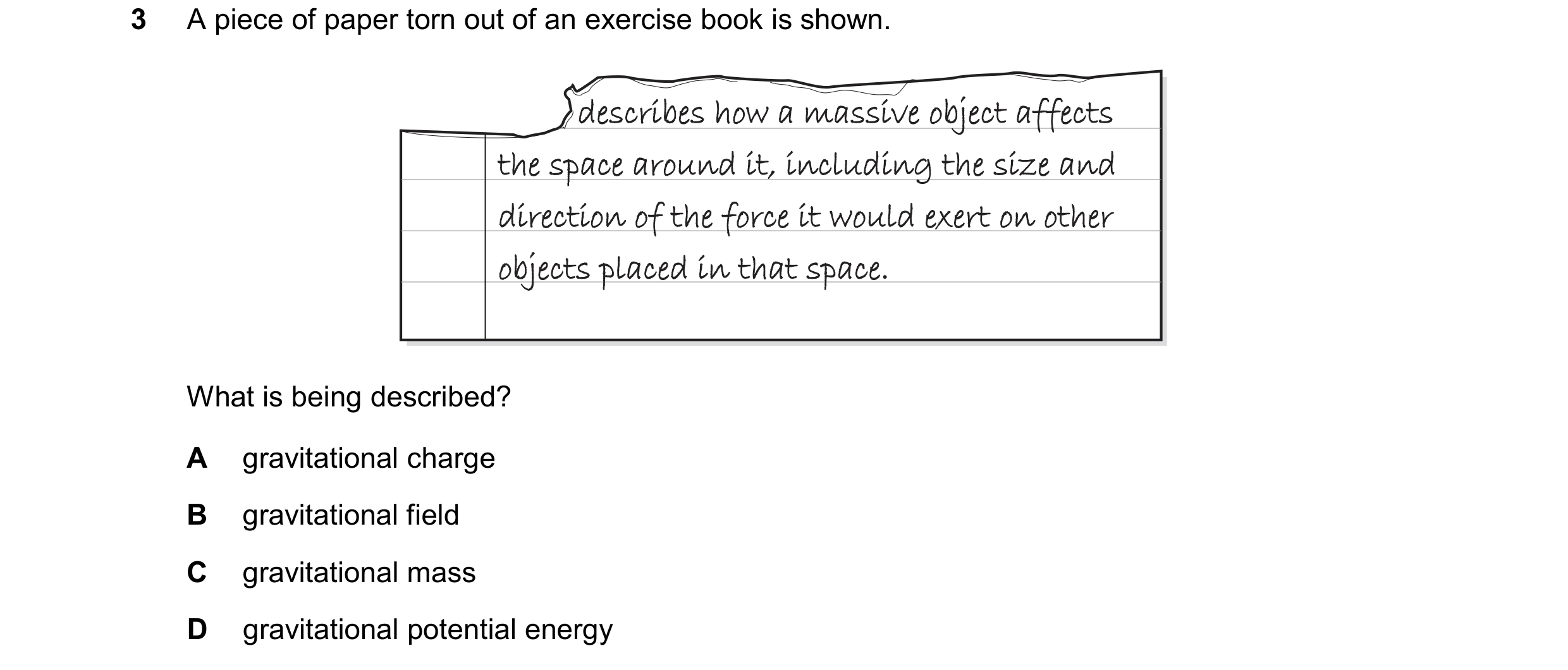
Q32 · A piece of paper torn out of an exercise book is shown 0972/21 Oct/Nov 2025
3 A piece of paper torn out of an exercise book is shown. What is being described? A gravitational charge B gravitational field C gravitational mass D gravitational potential energy
1 marks
Answer: B
This question in 0972/21 Oct/Nov 2025

 1 / 8
1 / 8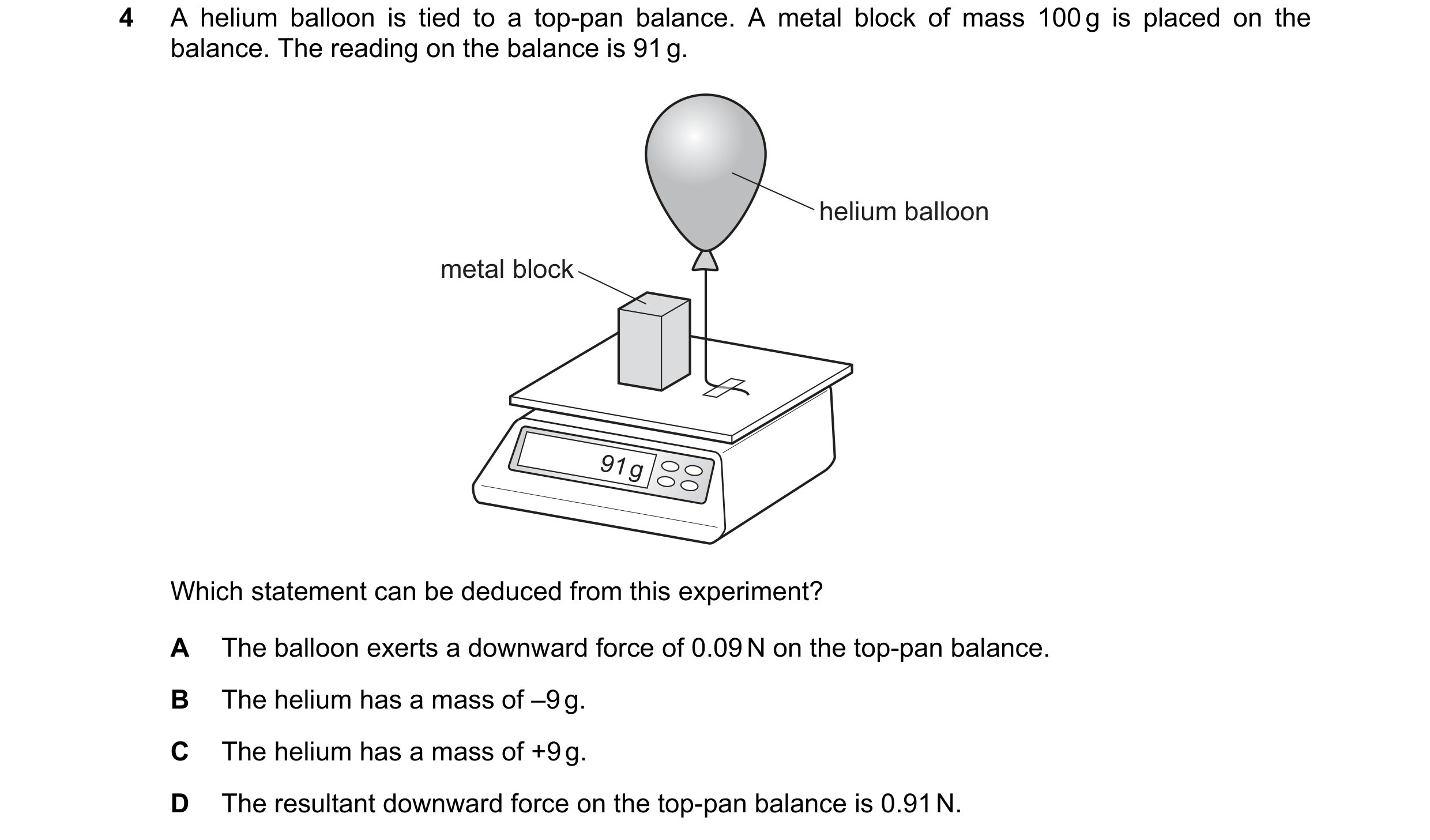

 2 / 8
2 / 8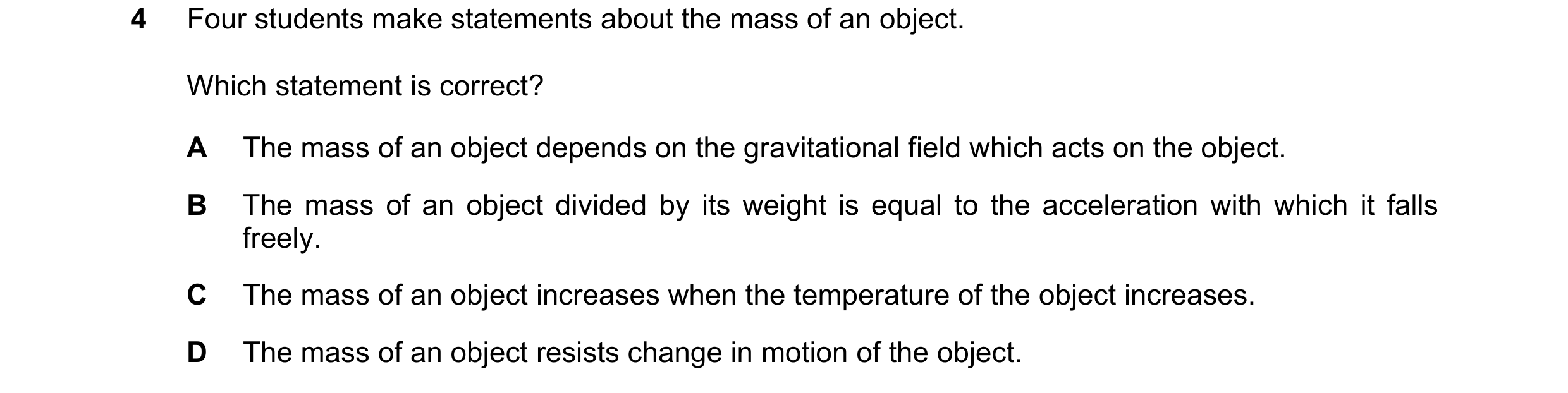




 3 / 8
3 / 8
 4 / 8
4 / 8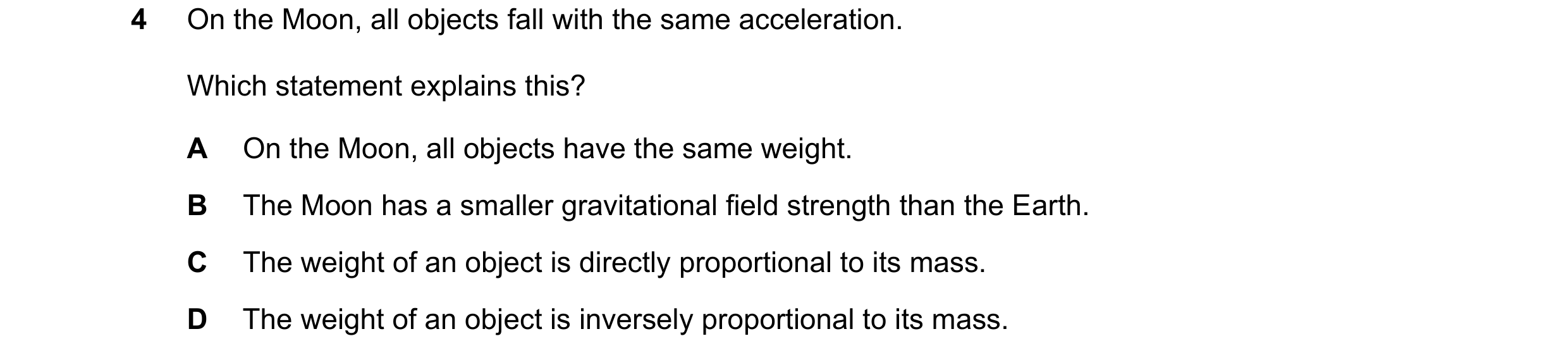


 5 / 8
5 / 8
 6 / 8
6 / 8

 7 / 8
7 / 8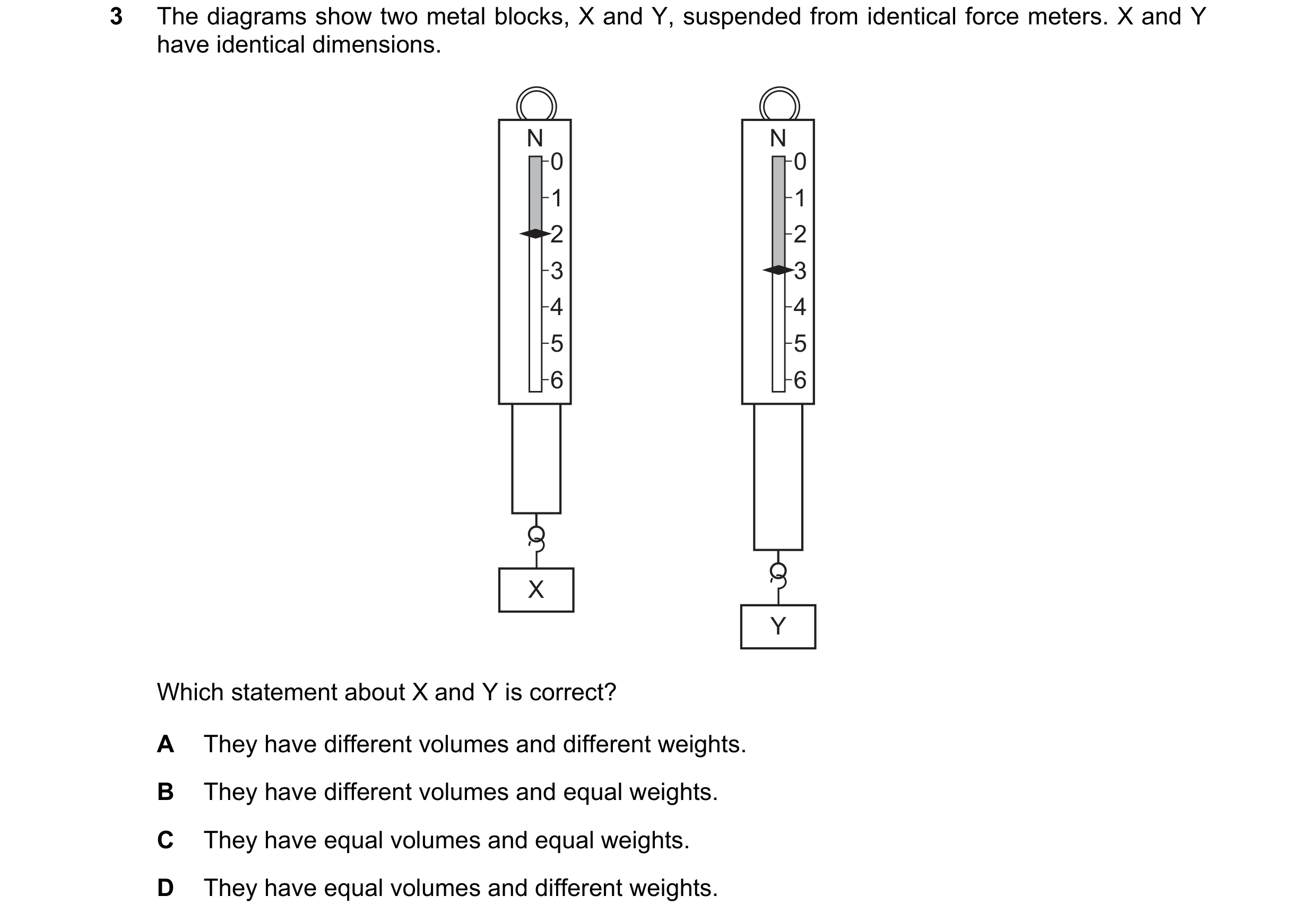
 8 / 8
8 / 8