Cambridge IGCSE Physics 0625 — 2021 May/June Paper 1 · Variant 3
0625/13/M/J/21 · 40 marks · ≈45 min
The question paper and its mark scheme, free to read here and free to download. This is Cambridge’s own paper, exactly as it was sat.
Question paper20 pages

Mark scheme3 pages
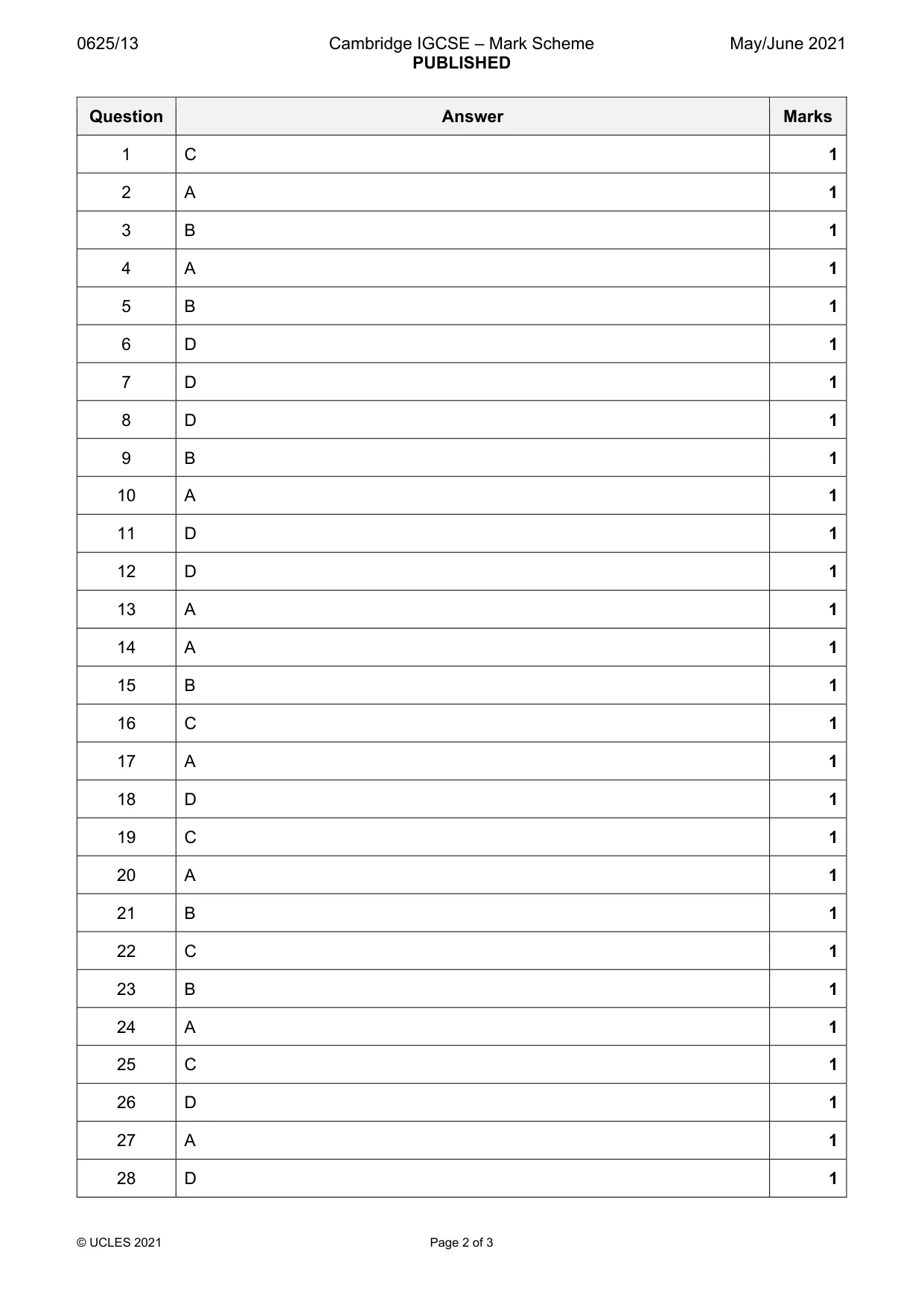
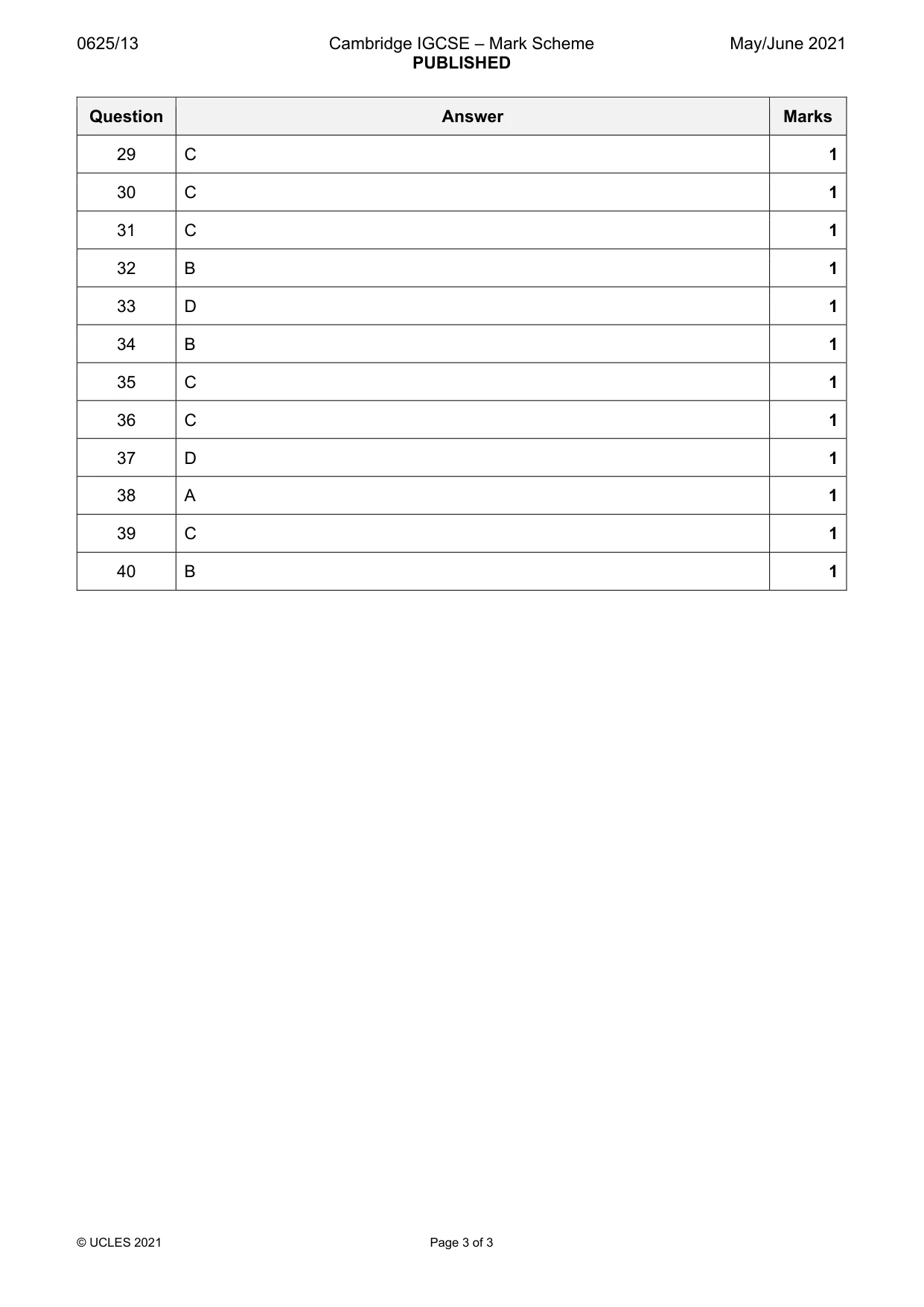
Answers below. Sit the paper first if you are practising.
Paper as text
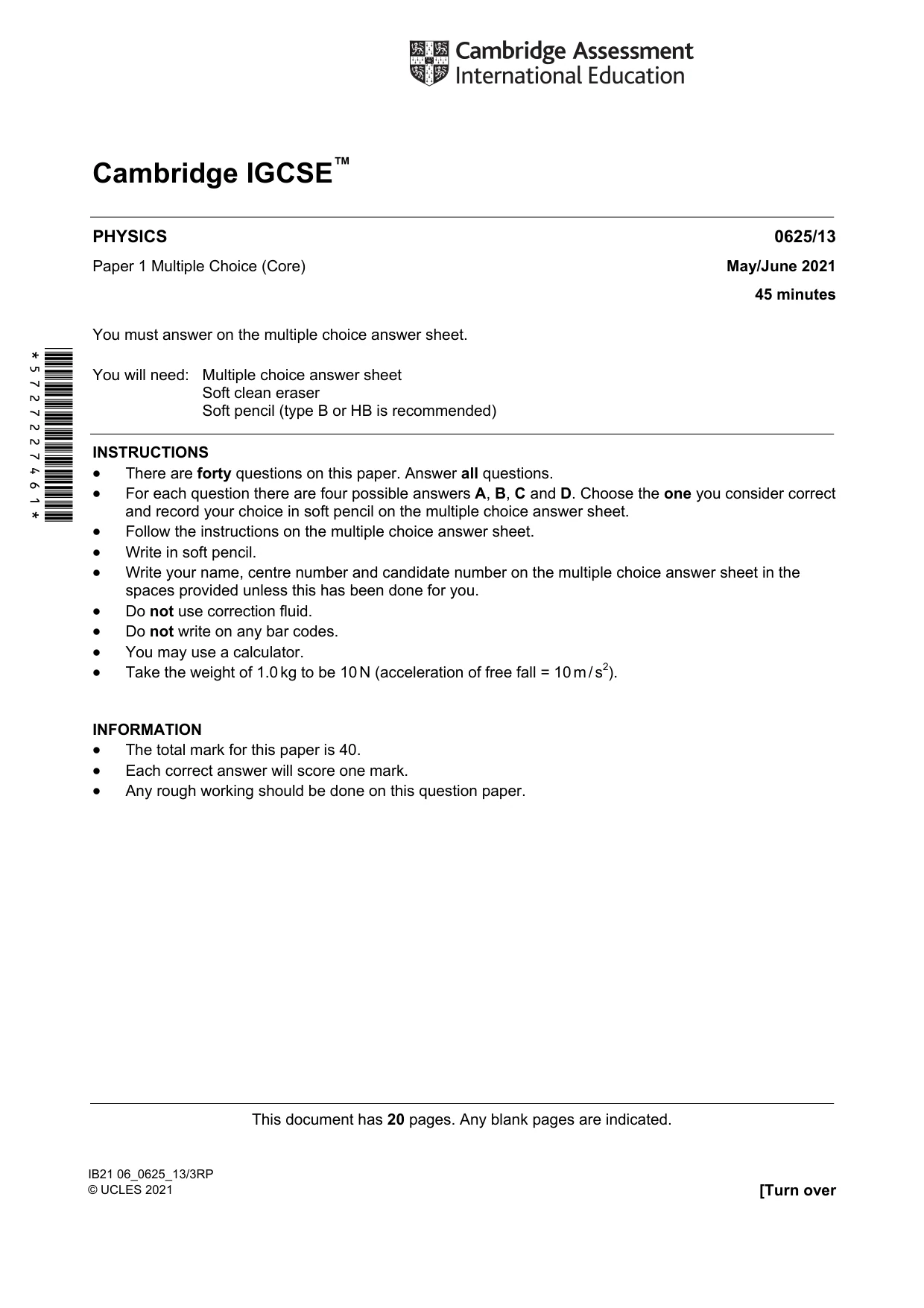
Question paper, page 1
This document has 20 pages. Any blank pages are indicated. IB21 06_0625_13/3RP © UCLES 2021 [Turn over *5727227461* Cambridge IGCSE™ PHYSICS 0625/13 Paper 1 Multiple Choice (Core) May/June 2021 45 minutes You must answer on the multiple choice answer sheet. You will need: Multiple choice answer sheet Soft clean eraser Soft pencil (type B or HB is recommended) INSTRUCTIONS There are forty questions on this paper. Answer all questions. For each question there are four possible answers A, B, C and D. Choose the one you consider correct and record your choice in soft pencil on the multiple choice answer sheet. Follow the instructions on the multiple choice answer sheet. Write in soft pencil. Write your name, centre number and candidate number on the multiple choice answer sheet in the spaces provided unless this has been done for you. Do not use correction fluid. Do not write on any bar codes. You may use a calculator. Take the weight of 1.0 kg to be 10 N (acceleration of free fall = 10 m / s2). INFORMATION The total mark for this paper is 40. Each correct answer will score one mark. Any rough working should be done on this question paper.
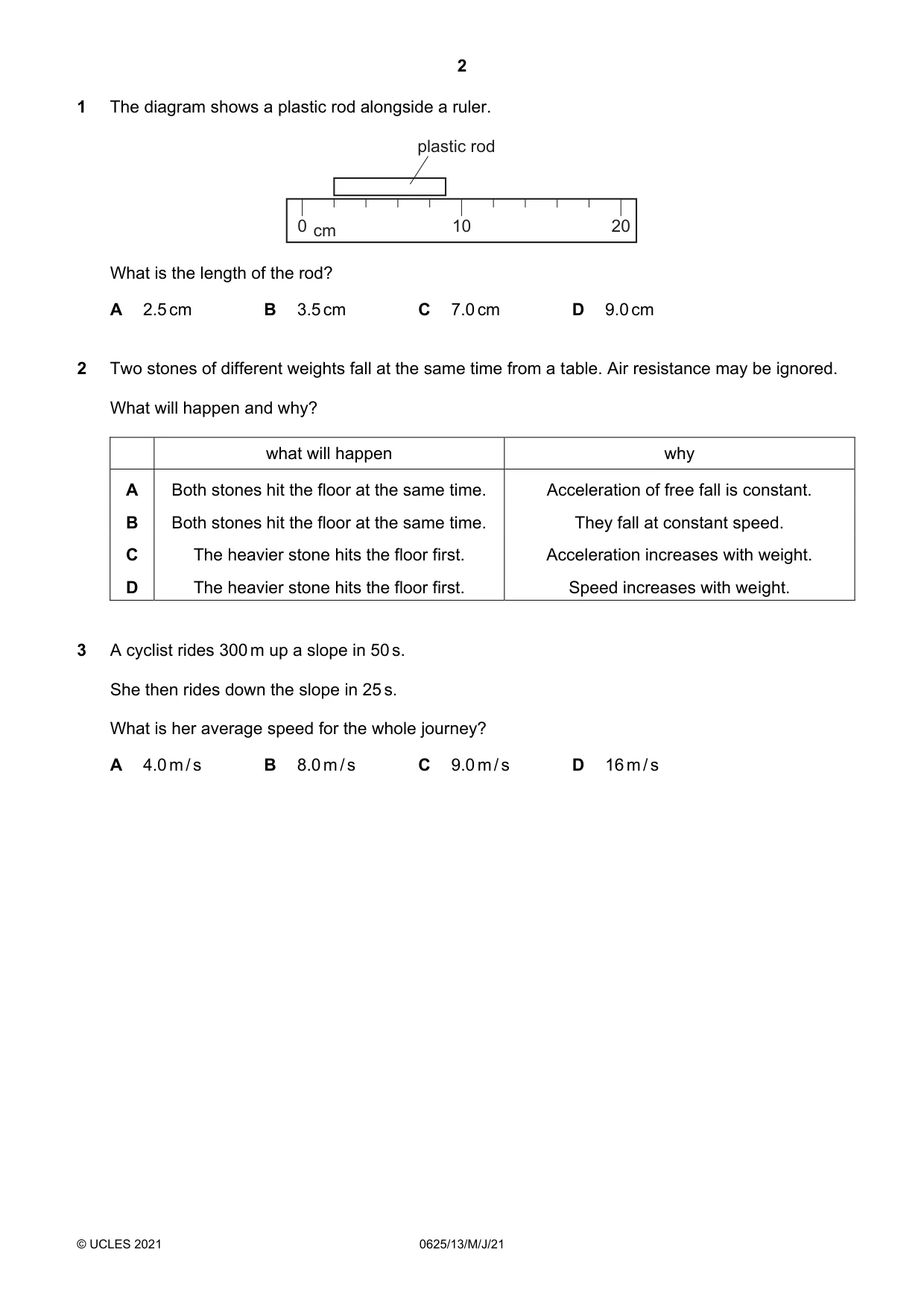
Question paper, page 2
2 © UCLES 2021 0625/13/M/J/21 1 The diagram shows a plastic rod alongside a ruler. 0 10 20 cm plastic rod What is the length of the rod? A 2.5 cm B 3.5 cm C 7.0 cm D 9.0 cm 2 Two stones of different weights fall at the same time from a table. Air resistance may be ignored. What will happen and why? what will happen why A Both stones hit the floor at the same time. Acceleration of free fall is constant. B Both stones hit the floor at the same time. They fall at constant speed. C The heavier stone hits the floor first. Acceleration increases with weight. D The heavier stone hits the floor first. Speed increases with weight. 3 A cyclist rides 300 m up a slope in 50 s. She then rides down the slope in 25 s. What is her average speed for the whole journey? A 4.0 m / s B 8.0 m / s C 9.0 m / s D 16 m / s
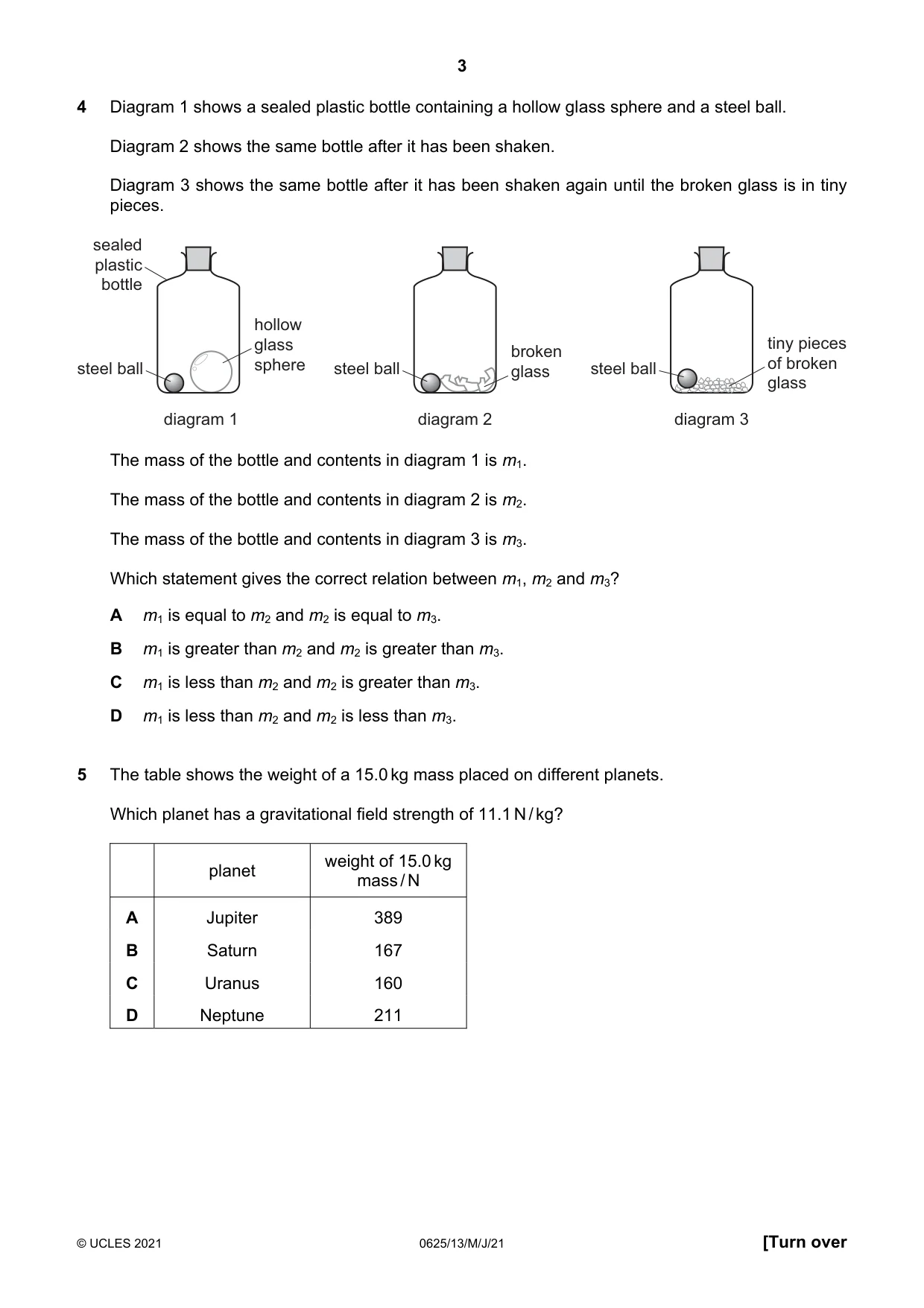
Question paper, page 3
3 © UCLES 2021 0625/13/M/J/21 [Turn over 4 Diagram 1 shows a sealed plastic bottle containing a hollow glass sphere and a steel ball. Diagram 2 shows the same bottle after it has been shaken. Diagram 3 shows the same bottle after it has been shaken again until the broken glass is in tiny pieces. sealed plastic bottle steel ball hollow glass sphere steel ball broken glass steel ball tiny pieces of broken glass diagram 1 diagram 2 diagram 3 The mass of the bottle and contents in diagram 1 is m1. The mass of the bottle and contents in diagram 2 is m2. The mass of the bottle and contents in diagram 3 is m3. Which statement gives the correct relation between m1, m2 and m3? A m1 is equal to m2 and m2 is equal to m3. B m1 is greater than m2 and m2 is greater than m3. C m1 is less than m2 and m2 is greater than m3. D m1 is less than m2 and m2 is less than m3. 5 The table shows the weight of a 15.0 kg mass placed on different planets. Which planet has a gravitational field strength of 11.1 N / kg? planet weight of 15.0 kg mass / N A Jupiter 389 B Saturn 167 C Uranus 160 D Neptune 211
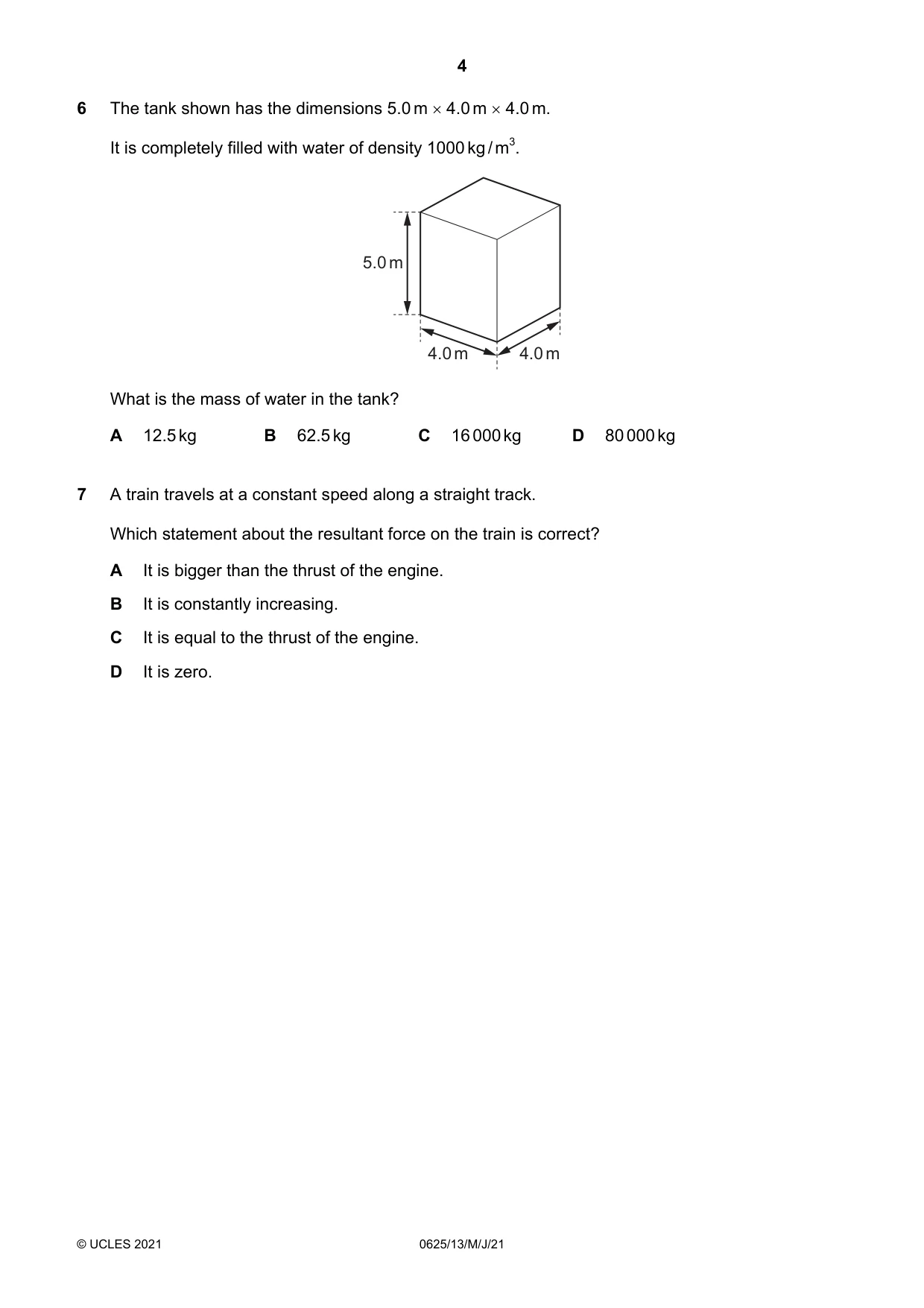
Question paper, page 4
4 © UCLES 2021 0625/13/M/J/21 6 The tank shown has the dimensions 5.0 m 4.0 m 4.0 m. It is completely filled with water of density 1000 kg / m3. 5.0 m 4.0 m 4.0 m What is the mass of water in the tank? A 12.5 kg B 62.5 kg C 16 000 kg D 80 000 kg 7 A train travels at a constant speed along a straight track. Which statement about the resultant force on the train is correct? A It is bigger than the thrust of the engine. B It is constantly increasing. C It is equal to the thrust of the engine. D It is zero.
Question paper, page 5
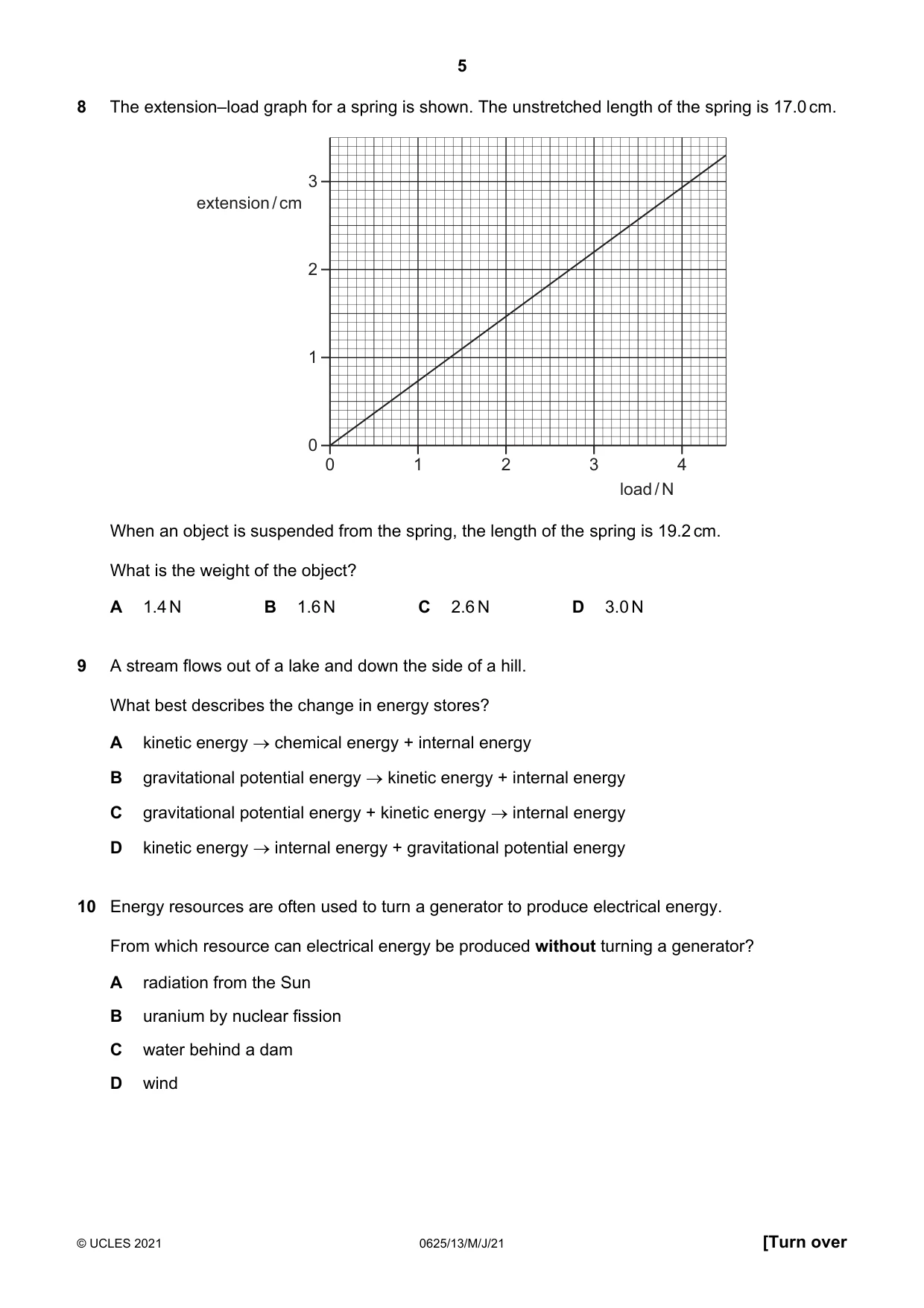
5 © UCLES 2021 0625/13/M/J/21 [Turn over 8 The extension–load graph for a spring is shown. The unstretched length of the spring is 17.0 cm. 3 2 1 0 0 1 2 3 4 load / N extension / cm When an object is suspended from the spring, the length of the spring is 19.2 cm. What is the weight of the object? A 1.4 N B 1.6 N C 2.6 N D 3.0 N 9 A stream flows out of a lake and down the side of a hill. What best describes the change in energy stores? A kinetic energy chemical energy + internal energy B gravitational potential energy kinetic energy + internal energy C gravitational potential energy + kinetic energy internal energy D kinetic energy internal energy + gravitational potential energy 10 Energy resources are often used to turn a generator to produce electrical energy. From which resource can electrical energy be produced without turning a generator? A radiation from the Sun B uranium by nuclear fission C water behind a dam D wind
Question paper, page 6
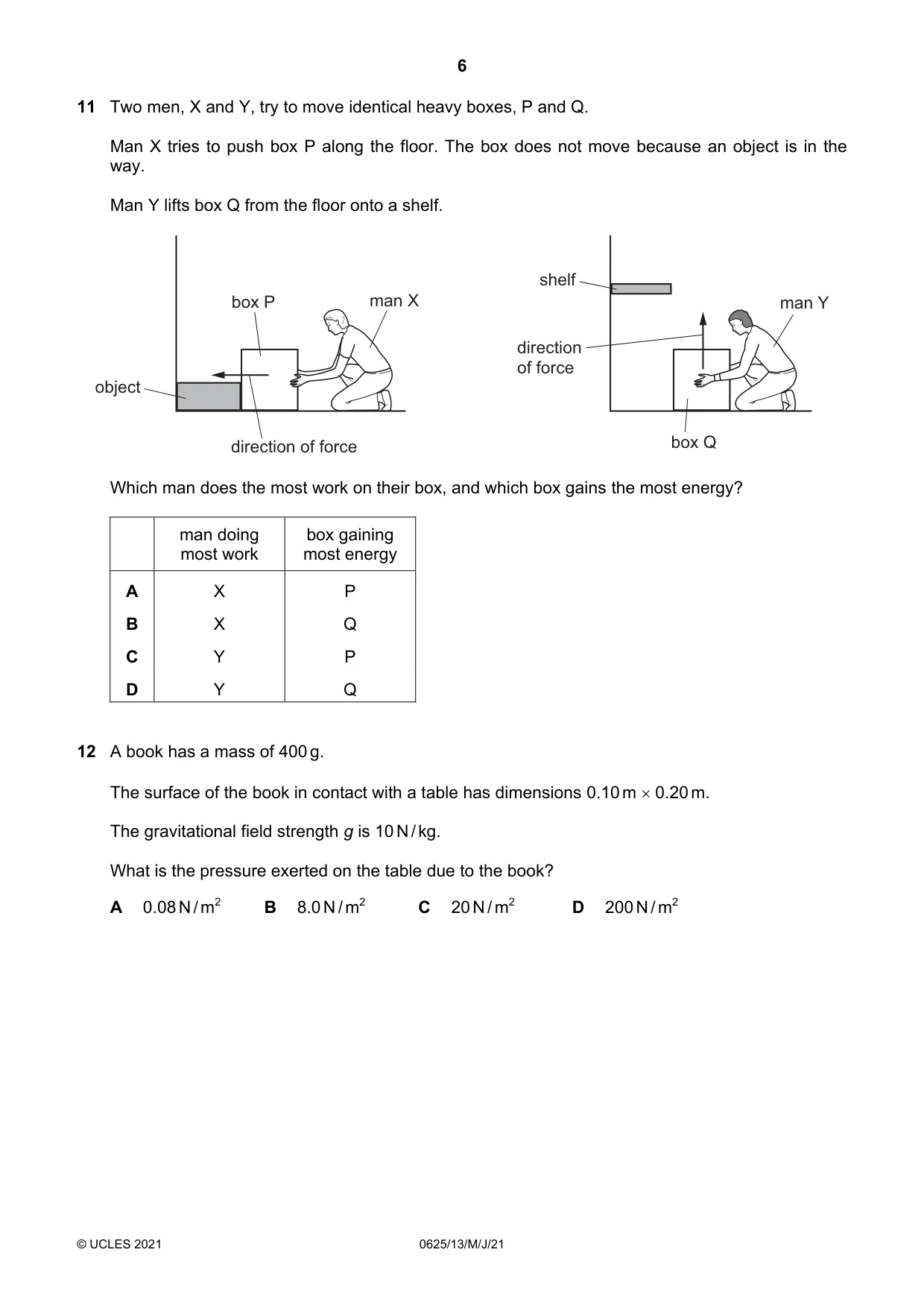
6 © UCLES 2021 0625/13/M/J/21 11 Two men, X and Y, try to move identical heavy boxes, P and Q. Man X tries to push box P along the floor. The box does not move because an object is in the way. Man Y lifts box Q from the floor onto a shelf. box P box Q man X man Y direction of force direction of force object shelf Which man does the most work on their box, and which box gains the most energy? man doing most work box gaining most energy A X P B X Q C Y P D Y Q 12 A book has a mass of 400 g. The surface of the book in contact with a table has dimensions 0.10 m 0.20 m. The gravitational field strength g is 10 N / kg. What is the pressure exerted on the table due to the book? A 0.08 N / m2 B 8.0 N / m2 C 20 N / m2 D 200 N / m2
Question paper, page 7
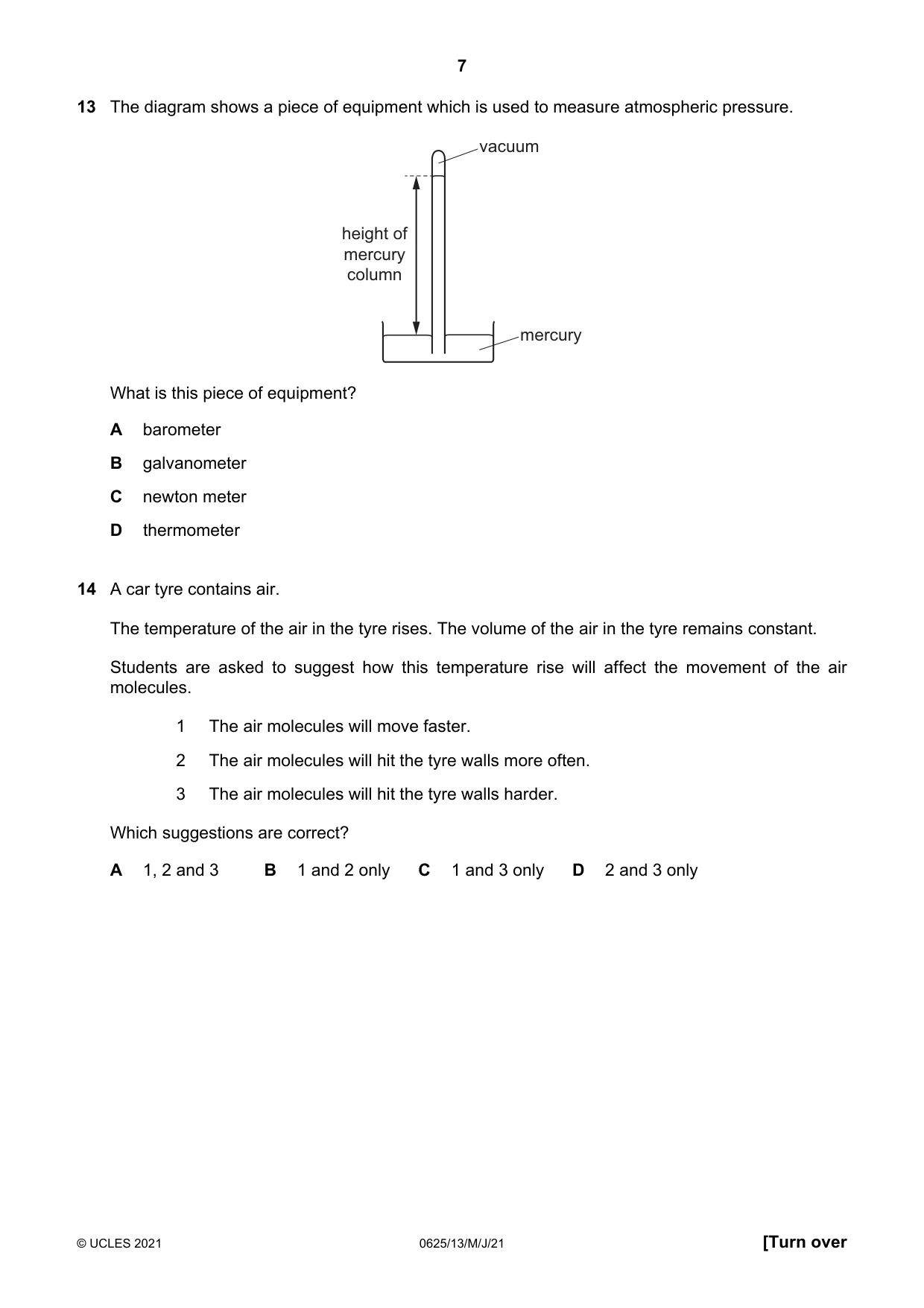
7 © UCLES 2021 0625/13/M/J/21 [Turn over 13 The diagram shows a piece of equipment which is used to measure atmospheric pressure. height of mercury column vacuum mercury What is this piece of equipment? A barometer B galvanometer C newton meter D thermometer 14 A car tyre contains air. The temperature of the air in the tyre rises. The volume of the air in the tyre remains constant. Students are asked to suggest how this temperature rise will affect the movement of the air molecules. 1 The air molecules will move faster. 2 The air molecules will hit the tyre walls more often. 3 The air molecules will hit the tyre walls harder. Which suggestions are correct? A 1, 2 and 3 B 1 and 2 only C 1 and 3 only D 2 and 3 only
Question paper, page 8
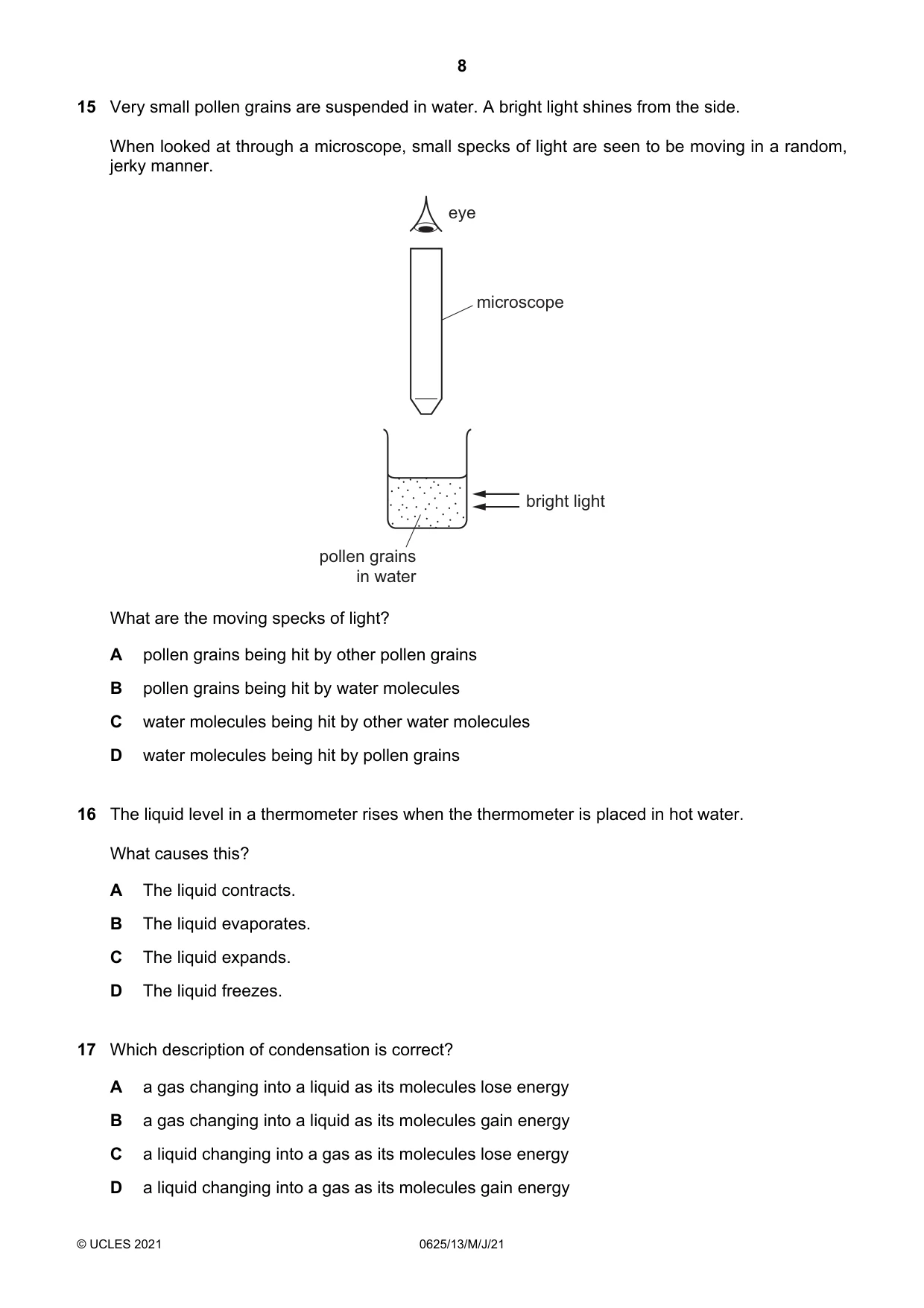
8 © UCLES 2021 0625/13/M/J/21 15 Very small pollen grains are suspended in water. A bright light shines from the side. When looked at through a microscope, small specks of light are seen to be moving in a random, jerky manner. bright light pollen grains in water microscope eye What are the moving specks of light? A pollen grains being hit by other pollen grains B pollen grains being hit by water molecules C water molecules being hit by other water molecules D water molecules being hit by pollen grains 16 The liquid level in a thermometer rises when the thermometer is placed in hot water. What causes this? A The liquid contracts. B The liquid evaporates. C The liquid expands. D The liquid freezes. 17 Which description of condensation is correct? A a gas changing into a liquid as its molecules lose energy B a gas changing into a liquid as its molecules gain energy C a liquid changing into a gas as its molecules lose energy D a liquid changing into a gas as its molecules gain energy
Question paper, page 9
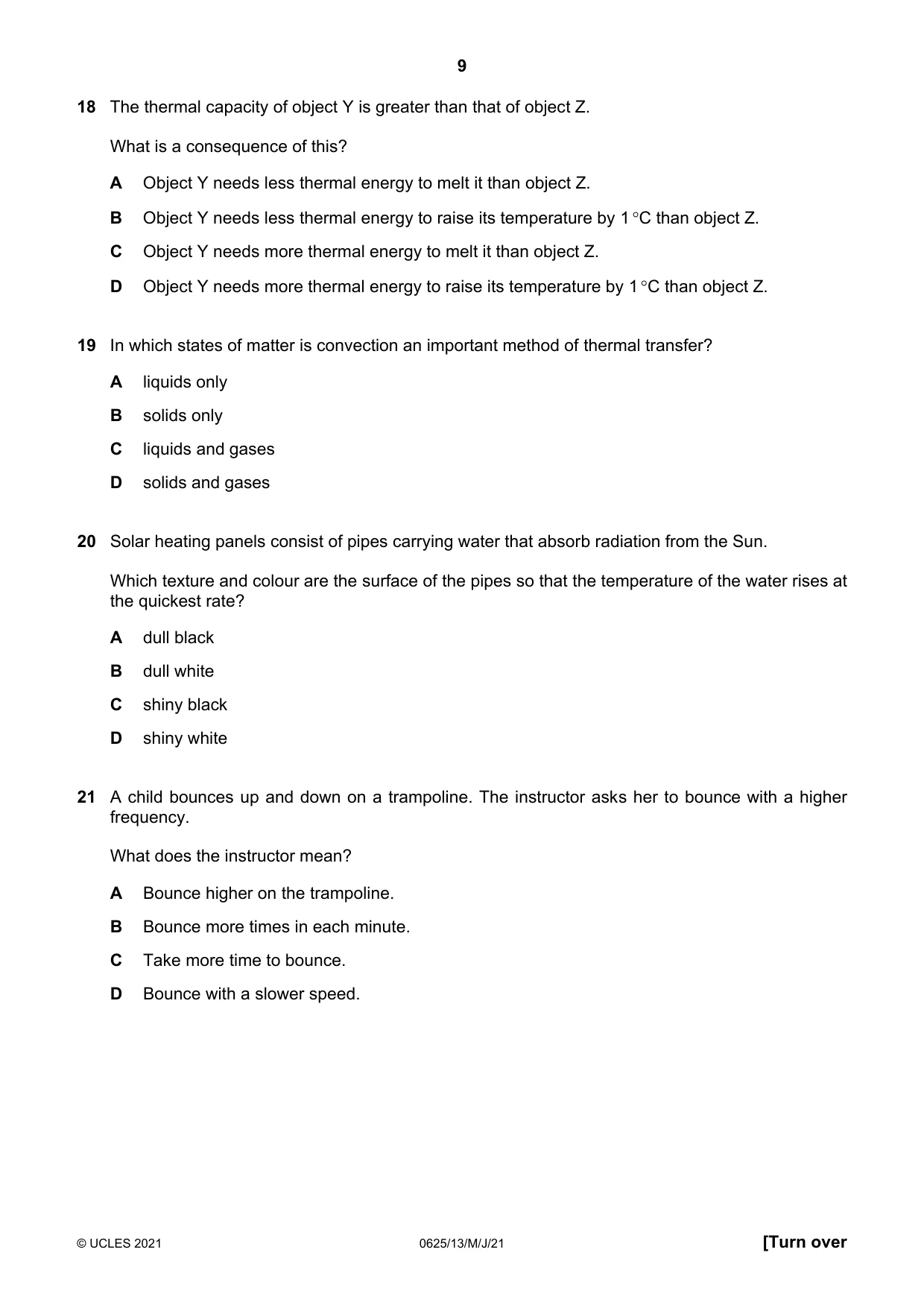
9 © UCLES 2021 0625/13/M/J/21 [Turn over 18 The thermal capacity of object Y is greater than that of object Z. What is a consequence of this? A Object Y needs less thermal energy to melt it than object Z. B Object Y needs less thermal energy to raise its temperature by 1 C than object Z. C Object Y needs more thermal energy to melt it than object Z. D Object Y needs more thermal energy to raise its temperature by 1 C than object Z. 19 In which states of matter is convection an important method of thermal transfer? A liquids only B solids only C liquids and gases D solids and gases 20 Solar heating panels consist of pipes carrying water that absorb radiation from the Sun. Which texture and colour are the surface of the pipes so that the temperature of the water rises at the quickest rate? A dull black B dull white C shiny black D shiny white 21 A child bounces up and down on a trampoline. The instructor asks her to bounce with a higher frequency. What does the instructor mean? A Bounce higher on the trampoline. B Bounce more times in each minute. C Take more time to bounce. D Bounce with a slower speed.
Question paper, page 10
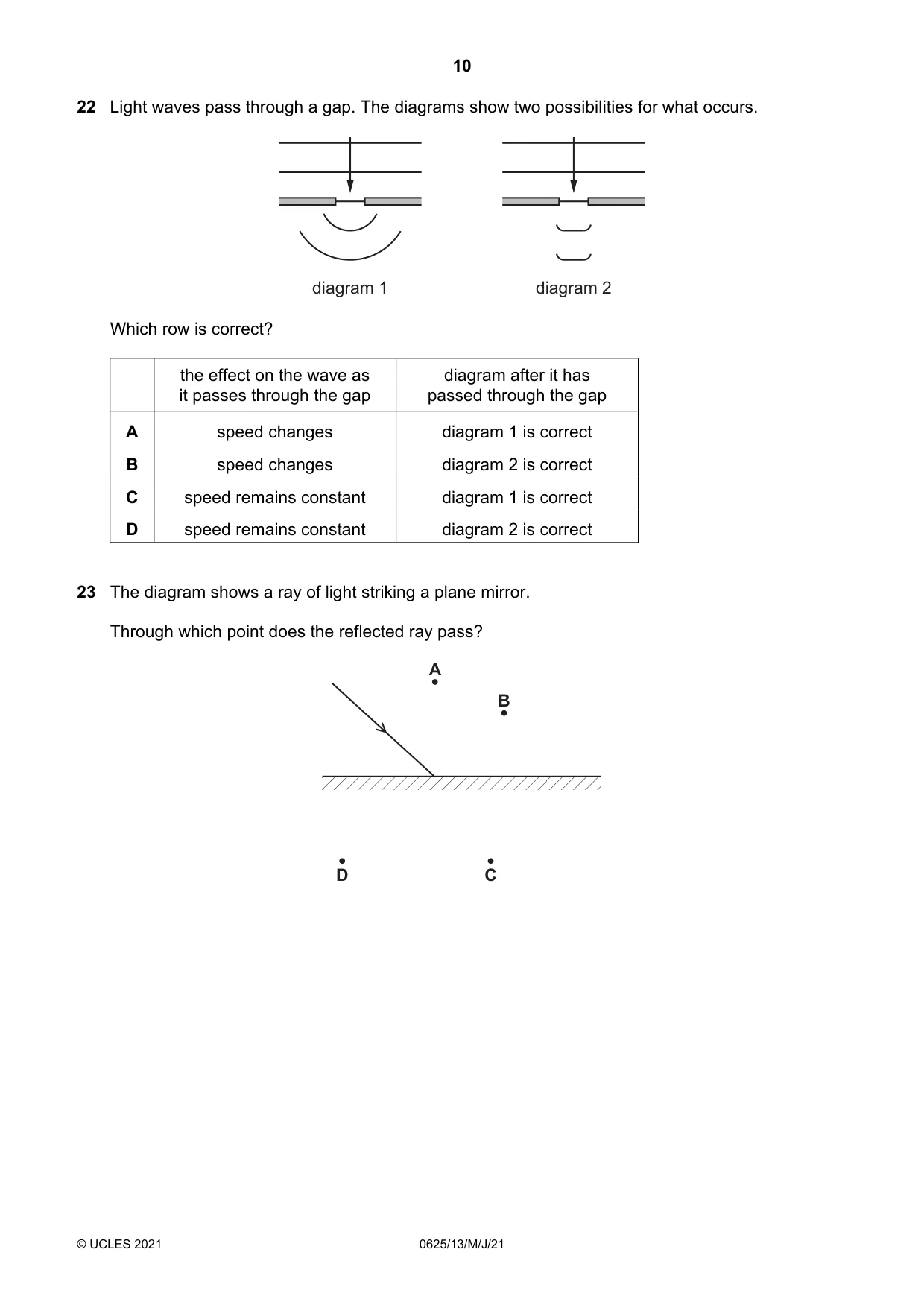
10 © UCLES 2021 0625/13/M/J/21 22 Light waves pass through a gap. The diagrams show two possibilities for what occurs. diagram 1 diagram 2 Which row is correct? the effect on the wave as it passes through the gap diagram after it has passed through the gap A speed changes diagram 1 is correct B speed changes diagram 2 is correct C speed remains constant diagram 1 is correct D speed remains constant diagram 2 is correct 23 The diagram shows a ray of light striking a plane mirror. Through which point does the reflected ray pass? A B C D
Question paper, page 11
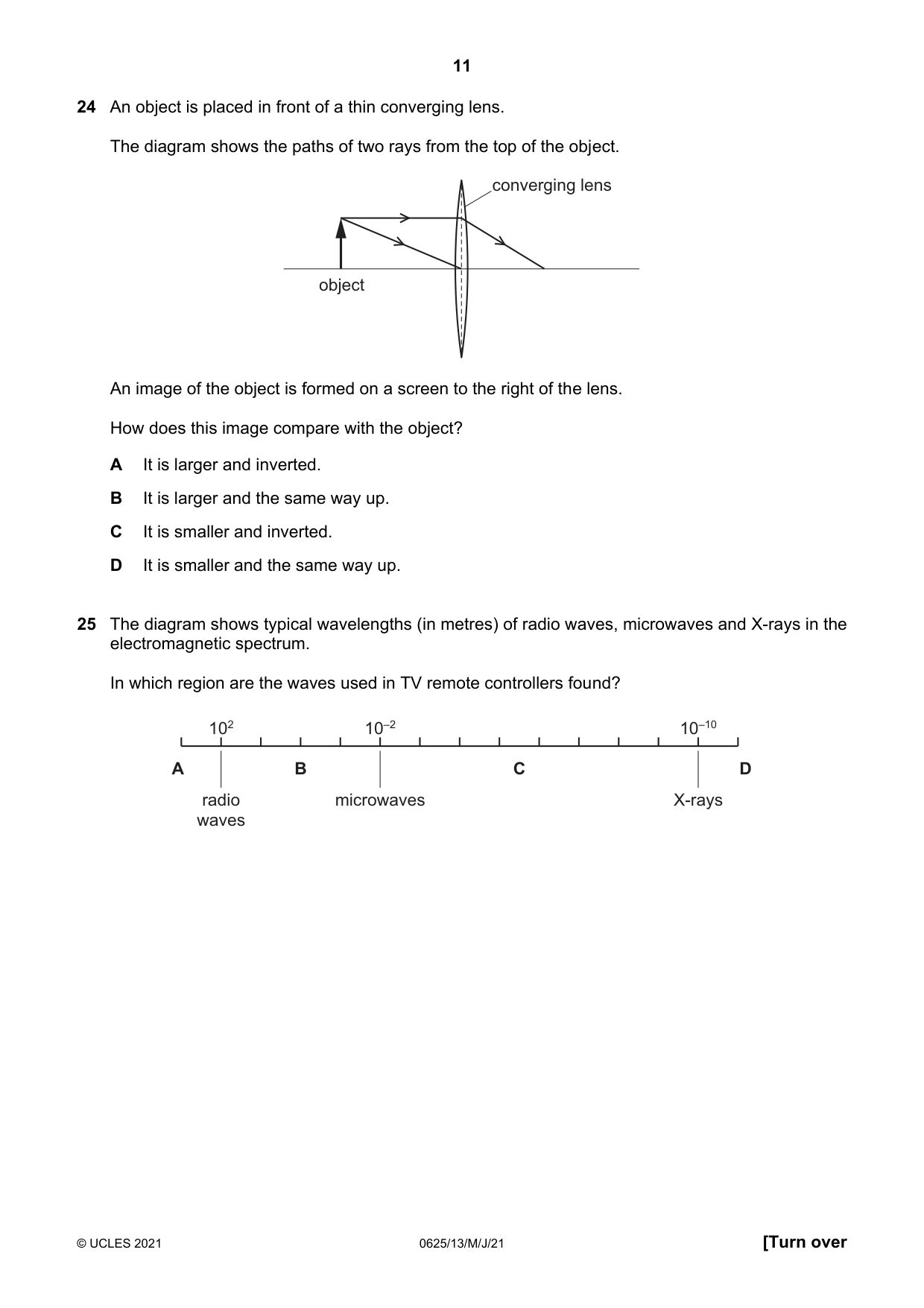
11 © UCLES 2021 0625/13/M/J/21 [Turn over 24 An object is placed in front of a thin converging lens. The diagram shows the paths of two rays from the top of the object. object converging lens An image of the object is formed on a screen to the right of the lens. How does this image compare with the object? A It is larger and inverted. B It is larger and the same way up. C It is smaller and inverted. D It is smaller and the same way up. 25 The diagram shows typical wavelengths (in metres) of radio waves, microwaves and X-rays in the electromagnetic spectrum. In which region are the waves used in TV remote controllers found? 102 10–2 10–10 A B C D radio waves microwaves X-rays
Question paper, page 12
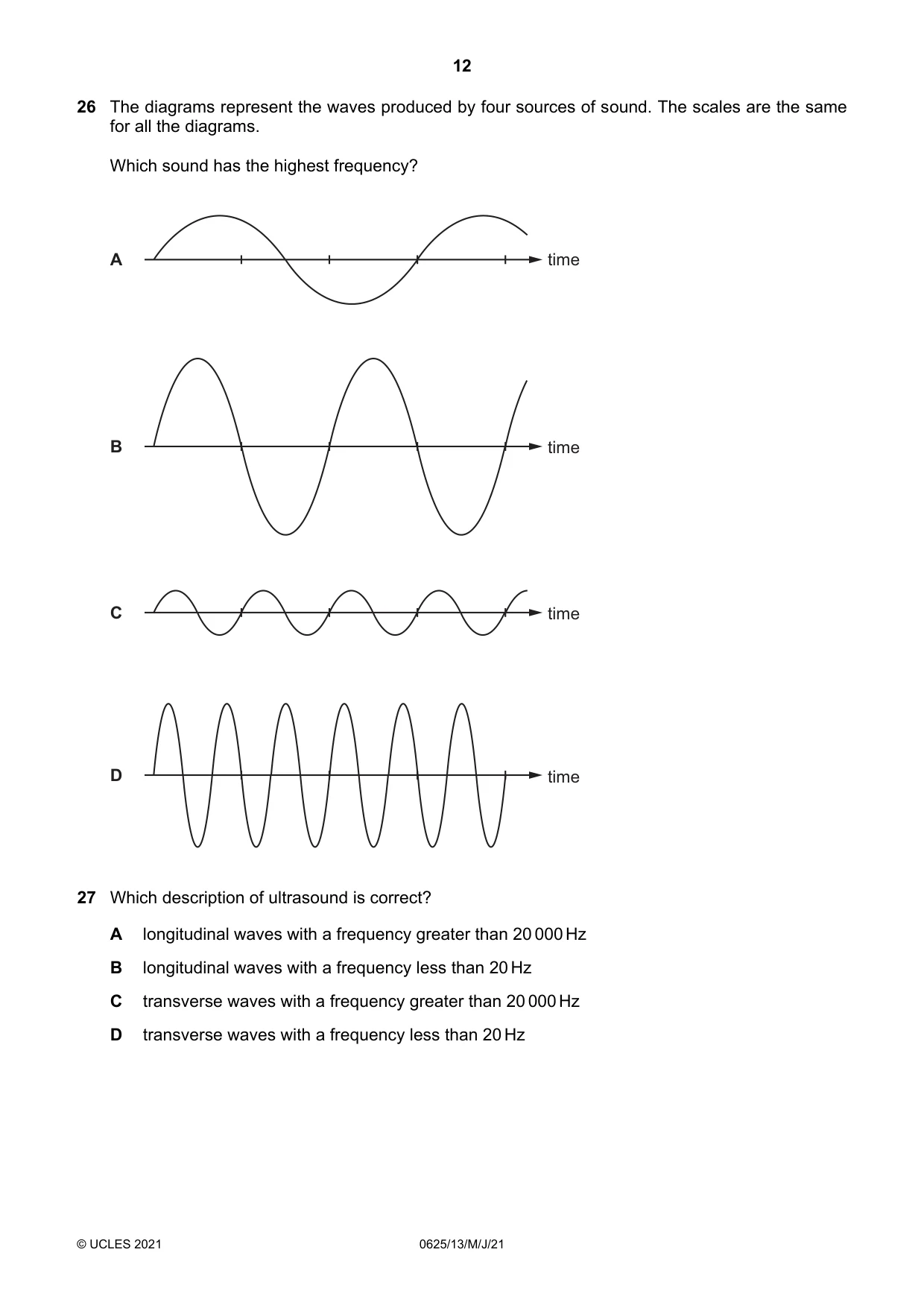
12 © UCLES 2021 0625/13/M/J/21 26 The diagrams represent the waves produced by four sources of sound. The scales are the same for all the diagrams. Which sound has the highest frequency? A B C D time time time time 27 Which description of ultrasound is correct? A longitudinal waves with a frequency greater than 20 000 Hz B longitudinal waves with a frequency less than 20 Hz C transverse waves with a frequency greater than 20 000 Hz D transverse waves with a frequency less than 20 Hz
Question paper, page 13
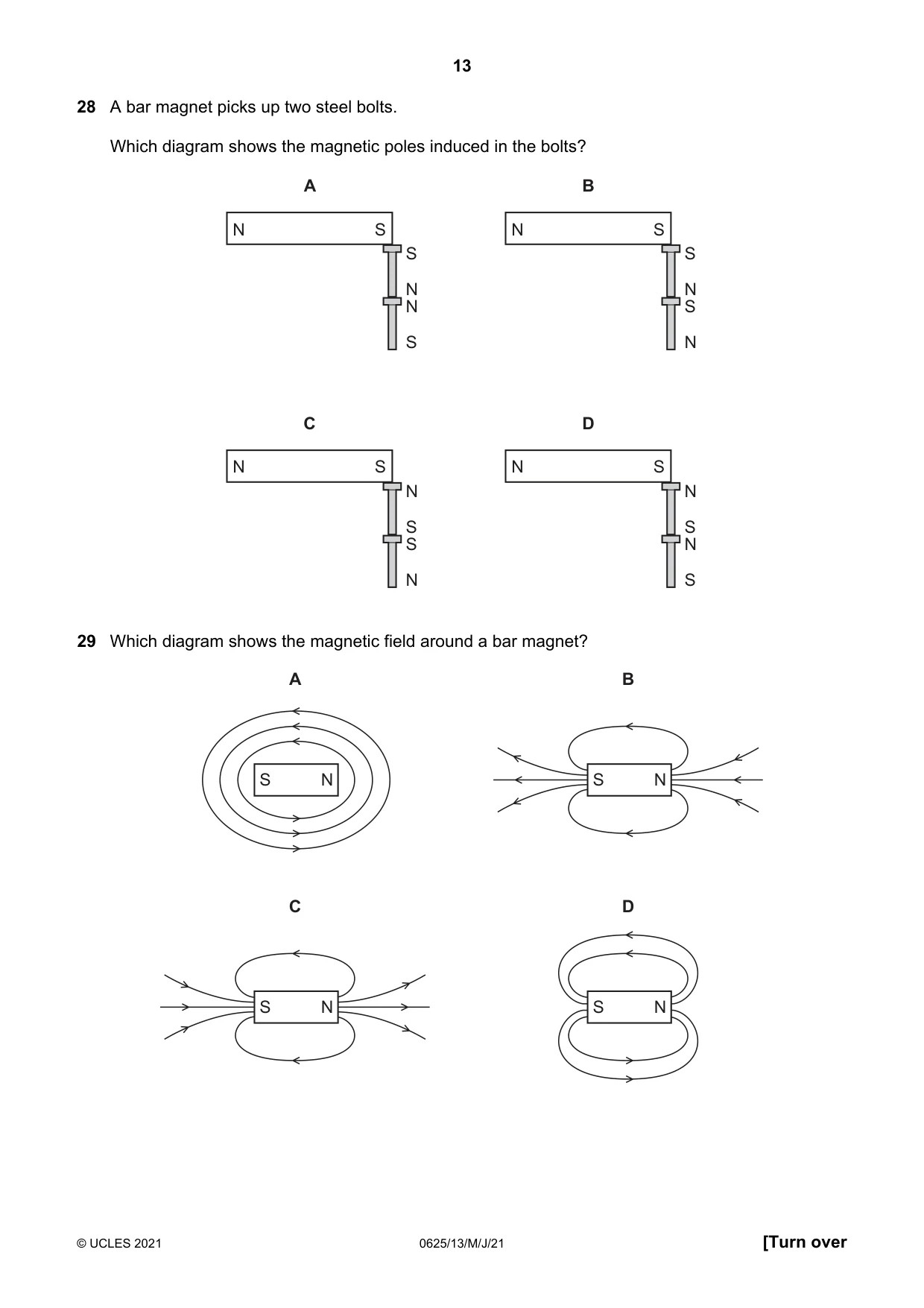
13 © UCLES 2021 0625/13/M/J/21 [Turn over 28 A bar magnet picks up two steel bolts. Which diagram shows the magnetic poles induced in the bolts? N S A S N N S N S B S N S N N S C N S S N N S D N S N S 29 Which diagram shows the magnetic field around a bar magnet? S B N S D N S A N S C N
Question paper, page 14
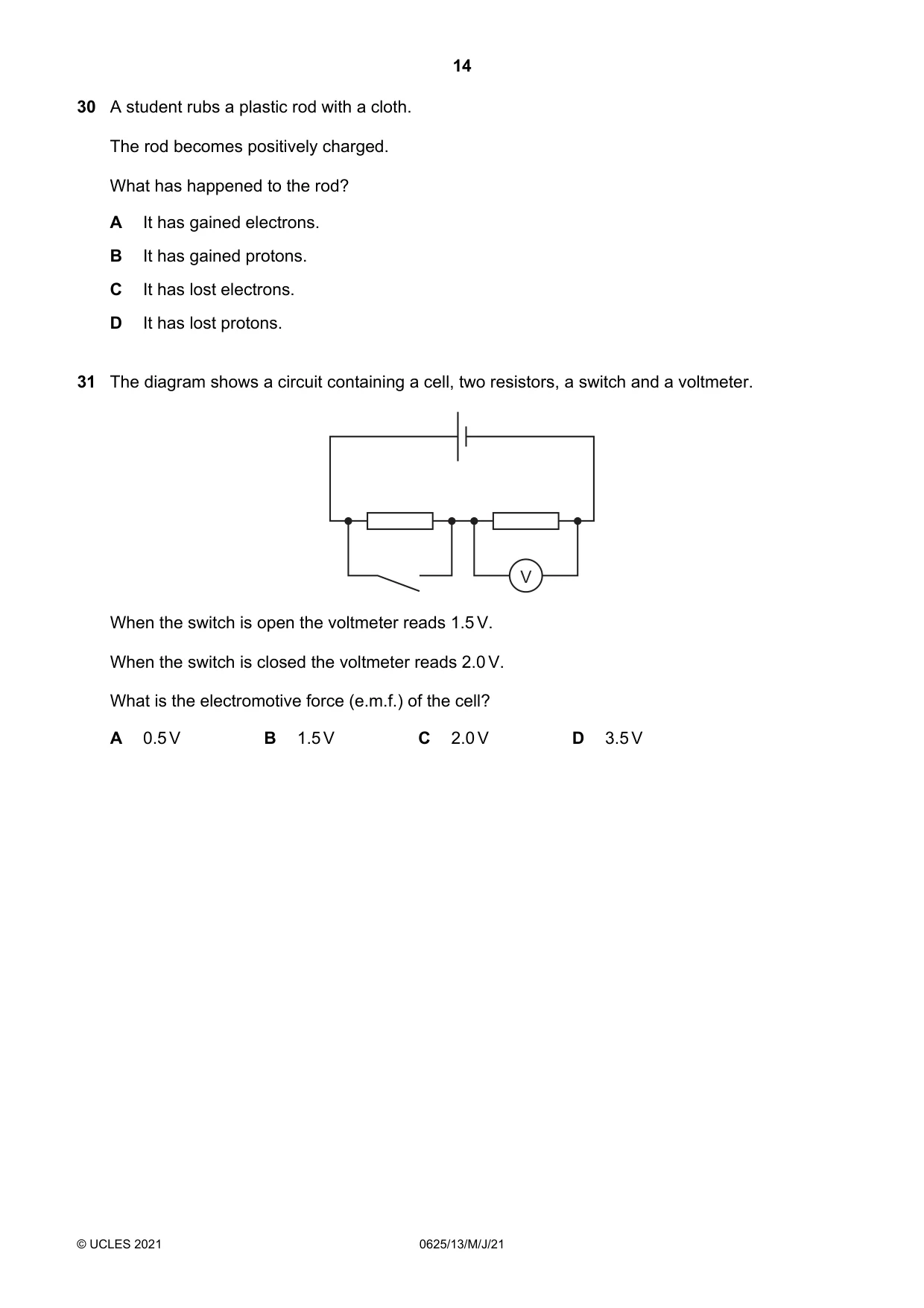
14 © UCLES 2021 0625/13/M/J/21 30 A student rubs a plastic rod with a cloth. The rod becomes positively charged. What has happened to the rod? A It has gained electrons. B It has gained protons. C It has lost electrons. D It has lost protons. 31 The diagram shows a circuit containing a cell, two resistors, a switch and a voltmeter. V When the switch is open the voltmeter reads 1.5 V. When the switch is closed the voltmeter reads 2.0 V. What is the electromotive force (e.m.f.) of the cell? A 0.5 V B 1.5 V C 2.0 V D 3.5 V
Question paper, page 15
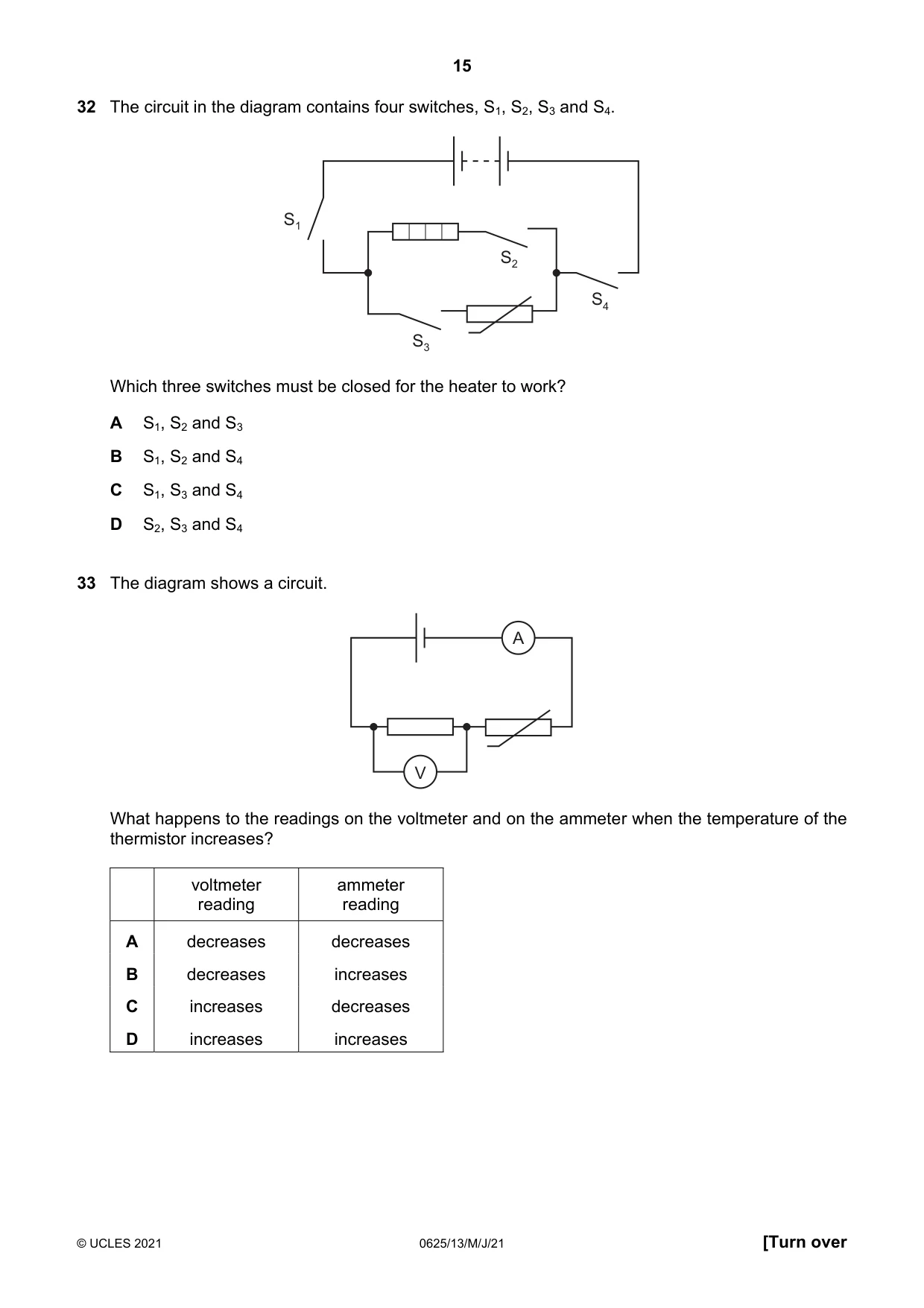
15 © UCLES 2021 0625/13/M/J/21 [Turn over 32 The circuit in the diagram contains four switches, S1, S2, S3 and S4. S1 S2 S3 S4 Which three switches must be closed for the heater to work? A S1, S2 and S3 B S1, S2 and S4 C S1, S3 and S4 D S2, S3 and S4 33 The diagram shows a circuit. A V What happens to the readings on the voltmeter and on the ammeter when the temperature of the thermistor increases? voltmeter reading ammeter reading A decreases decreases B decreases increases C increases decreases D increases increases
Question paper, page 16
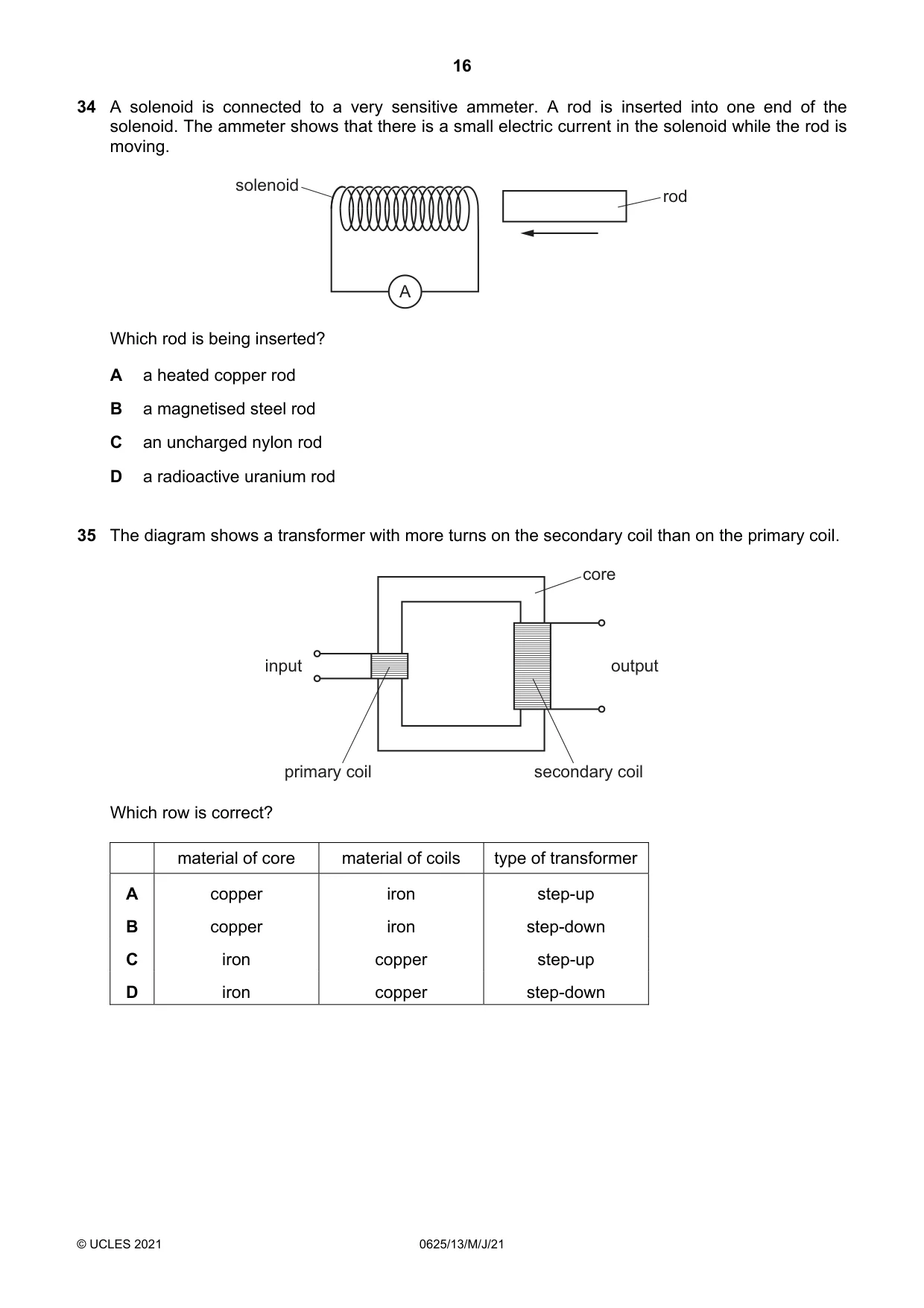
16 © UCLES 2021 0625/13/M/J/21 34 A solenoid is connected to a very sensitive ammeter. A rod is inserted into one end of the solenoid. The ammeter shows that there is a small electric current in the solenoid while the rod is moving. solenoid rod A Which rod is being inserted? A a heated copper rod B a magnetised steel rod C an uncharged nylon rod D a radioactive uranium rod 35 The diagram shows a transformer with more turns on the secondary coil than on the primary coil. primary coil secondary coil input output core Which row is correct? material of core material of coils type of transformer A copper iron step-up B copper iron step-down C iron copper step-up D iron copper step-down
Question paper, page 17
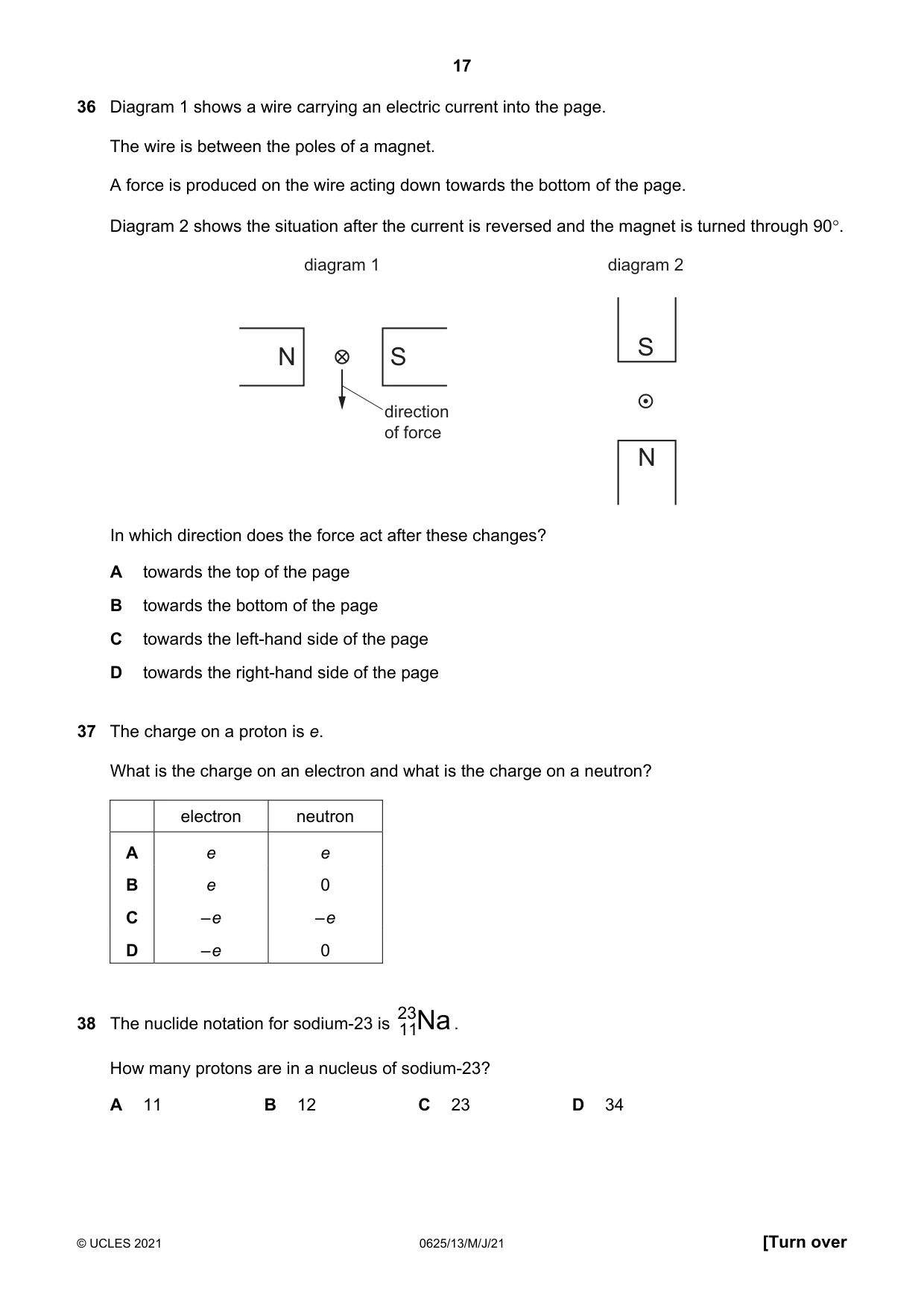
17 © UCLES 2021 0625/13/M/J/21 [Turn over 36 Diagram 1 shows a wire carrying an electric current into the page. The wire is between the poles of a magnet. A force is produced on the wire acting down towards the bottom of the page. Diagram 2 shows the situation after the current is reversed and the magnet is turned through 90. N S N S diagram 1 diagram 2 direction of force In which direction does the force act after these changes? A towards the top of the page B towards the bottom of the page C towards the left-hand side of the page D towards the right-hand side of the page 37 The charge on a proton is e. What is the charge on an electron and what is the charge on a neutron? electron neutron A e e B e 0 C – e – e D – e 0 38 The nuclide notation for sodium-23 is 23 11Na . How many protons are in a nucleus of sodium-23? A 11 B 12 C 23 D 34
Question paper, page 18
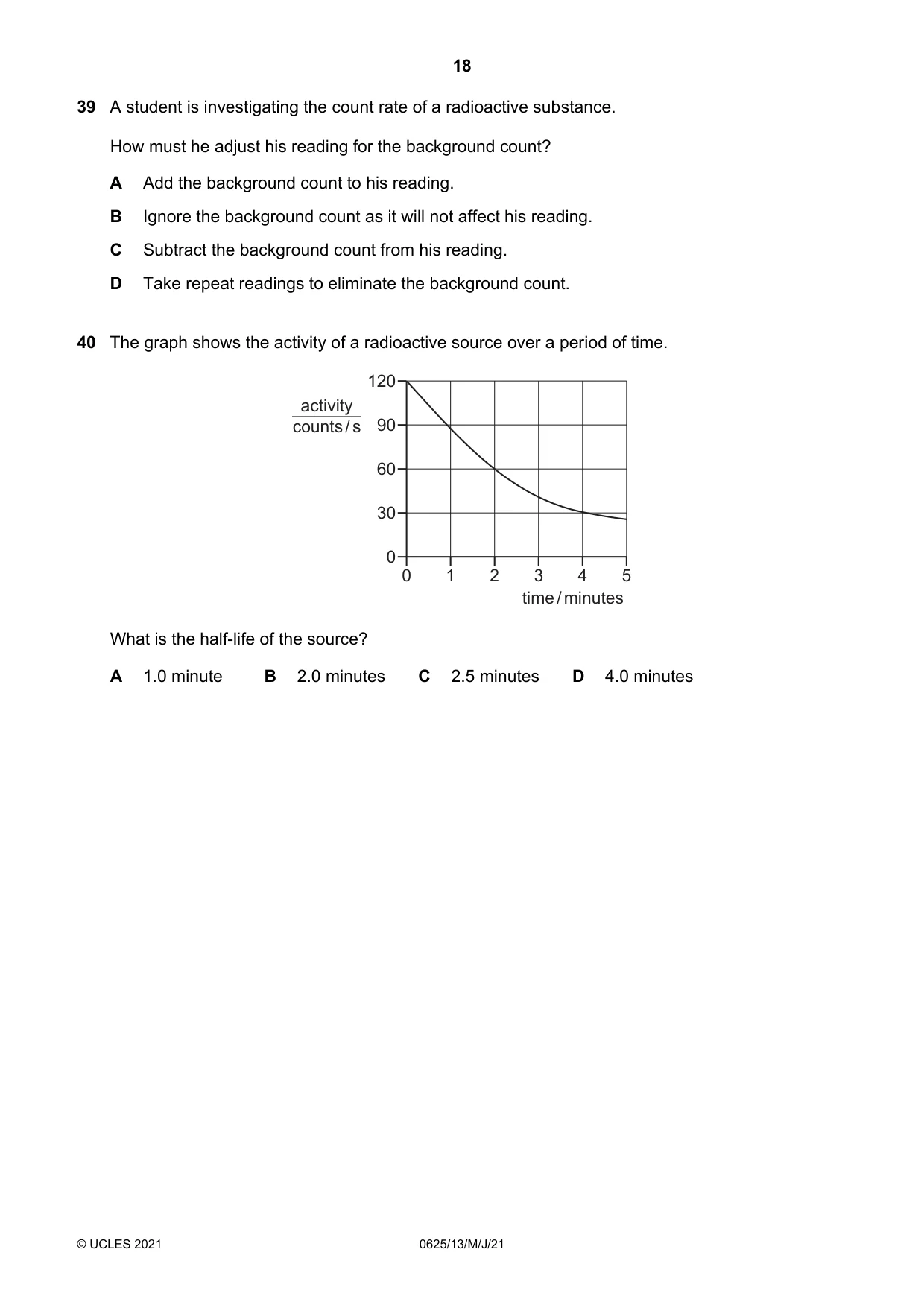
18 © UCLES 2021 0625/13/M/J/21 39 A student is investigating the count rate of a radioactive substance. How must he adjust his reading for the background count? A Add the background count to his reading. B Ignore the background count as it will not affect his reading. C Subtract the background count from his reading. D Take repeat readings to eliminate the background count. 40 The graph shows the activity of a radioactive source over a period of time. 120 90 60 30 0 0 1 2 3 4 5 activity counts / s time / minutes What is the half-life of the source? A 1.0 minute B 2.0 minutes C 2.5 minutes D 4.0 minutes
Question paper, page 19
19 © UCLES 2021 0625/13/M/J/21 BLANK PAGE
Question paper, page 20
20 Permission to reproduce items where third-party owned material protected by copyright is included has been sought and cleared where possible. Every reasonable effort has been made by the publisher (UCLES) to trace copyright holders, but if any items requiring clearance have unwittingly been included, the publisher will be pleased to make amends at the earliest possible opportunity. To avoid the issue of disclosure of answer-related information to candidates, all copyright acknowledgements are reproduced online in the Cambridge Assessment International Education Copyright Acknowledgements Booklet. This is produced for each series of examinations and is freely available to download at www.cambridgeinternational.org after the live examination series. Cambridge Assessment International Education is part of the Cambridge Assessment Group. Cambridge Assessment is the brand name of the University of Cambridge Local Examinations Syndicate (UCLES), which itself is a department of the University of Cambridge. © UCLES 2021 0625/13/M/J/21 BLANK PAGE
Mark scheme, page 1
This document consists of 3 printed pages. © UCLES 2021 [Turn over Cambridge IGCSE™ PHYSICS 0625/13 Paper 1 Multiple Choice (Core) May/June 2021 MARK SCHEME Maximum Mark: 40 Published This mark scheme is published as an aid to teachers and candidates, to indicate the requirements of the examination. Mark schemes should be read in conjunction with the question paper and the Principal Examiner Report for Teachers. Cambridge International will not enter into discussions about these mark schemes. Cambridge International is publishing the mark schemes for the May/June 2021 series for most Cambridge IGCSE™, Cambridge International A and AS Level components and some Cambridge O Level components.
Mark scheme, page 2
0625/13 Cambridge IGCSE – Mark Scheme PUBLISHED May/June 2021 © UCLES 2021 Page 2 of 3 Question Answer Marks 1 C 1 2 A 1 3 B 1 4 A 1 5 B 1 6 D 1 7 D 1 8 D 1 9 B 1 10 A 1 11 D 1 12 D 1 13 A 1 14 A 1 15 B 1 16 C 1 17 A 1 18 D 1 19 C 1 20 A 1 21 B 1 22 C 1 23 B 1 24 A 1 25 C 1 26 D 1 27 A 1 28 D 1
Mark scheme, page 3
0625/13 Cambridge IGCSE – Mark Scheme PUBLISHED May/June 2021 © UCLES 2021 Page 3 of 3 Question Answer Marks 29 C 1 30 C 1 31 C 1 32 B 1 33 D 1 34 B 1 35 C 1 36 C 1 37 D 1 38 A 1 39 C 1 40 B 1
What you needed in this session
Cambridge’s own grade thresholds for 2021 May/June, Paper 1 · Variant 3. A higher threshold means an easier paper — the bar moves with how the cohort did.