Cambridge IGCSE Physics 0625 — 2016 May/June Paper 6 · Variant 1
0625/61/M/J/16 · 5 questions · 40 marks · ≈45 min
The question paper and its mark scheme, free to read here and free to download. This is Cambridge’s own paper, exactly as it was sat.
Question paper12 pages
Mark scheme6 pages
Answers below. Sit the paper first if you are practising.
Questions as text
Q1 · A student is determining the weight of a metre rule using a balancing method
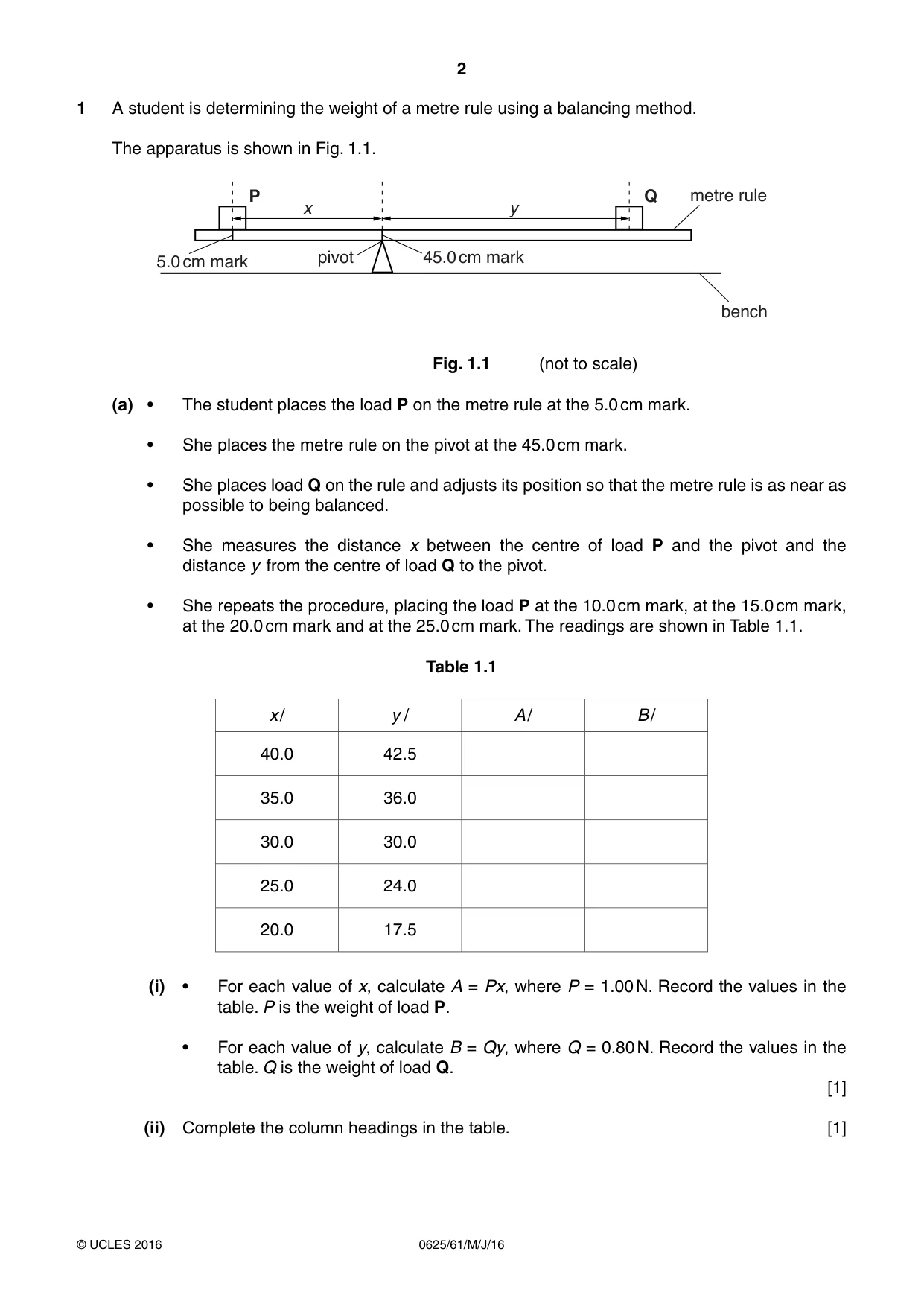
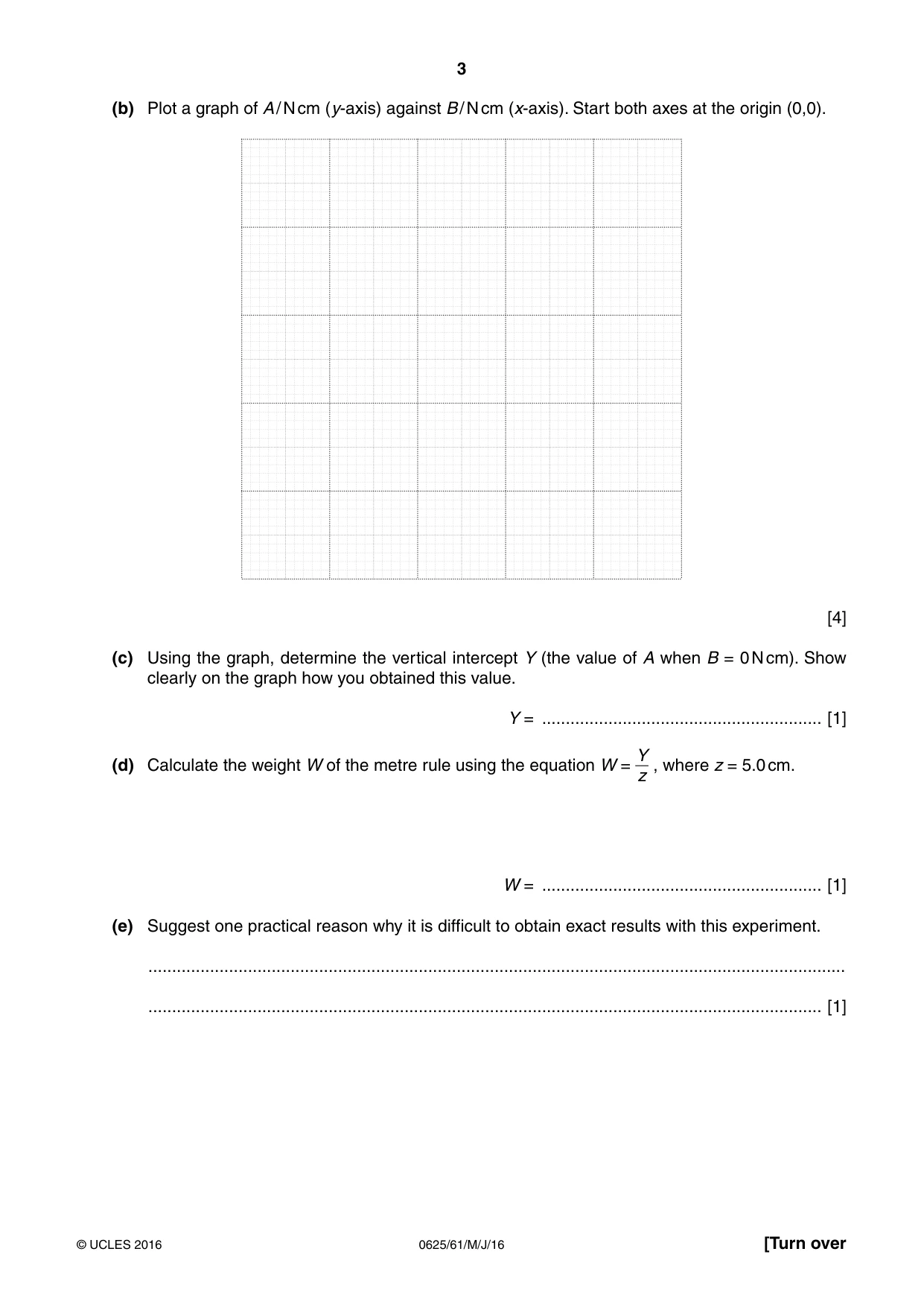
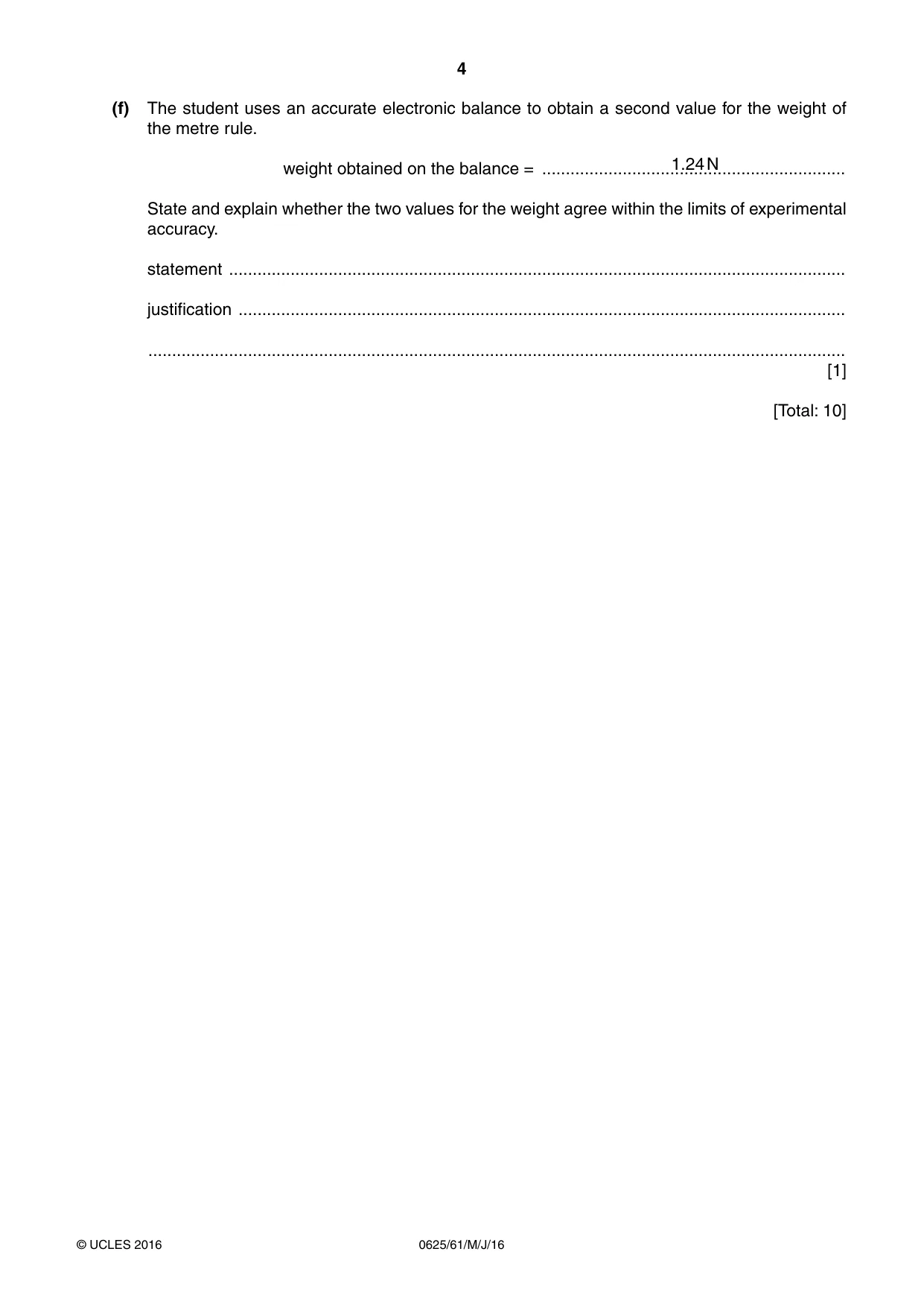
1 A student is determining the weight of a metre rule using a balancing method. The apparatus is shown in Fig. 1.1. P Q metre rule x y 5.0 cm mark pivot 45.0 cm mark bench Fig. 1.1 (not to scale) (a) • The student places the load P on the metre rule at the 5.0 cm mark. • She places the metre rule on the pivot at the 45.0 cm mark. • She places load Q on the rule and adjusts its position so that the metre rule is as near as possible to being balanced. • She measures the distance x between the centre of load P and the pivot and the distance y from the centre of load Q to the pivot. • She repeats the procedure, placing the load P at the 10.0 cm mark, at the 15.0 cm mark, at the 20.0 cm mark and at the 25.0 cm mark. The readings are shown in Table 1.1. Table 1.1 x / y / A / B / 40.0 42.5 35.0 36.0 30.0 30.0 25.0 24.0 20.0 17.5 (i) • For each value of x, calculate A = Px, where P = 1.00 N. Record the values in the table. P is the weight of load P. • For each value of y, calculate B = Qy, where Q = 0.80 N. Record the values in the table. Q is the weight of load Q. [1] (ii) Complete the column headings in the table. [1] (b) Plot a graph of A / N cm (y-axis) against B / N cm (x-axis). Start both axes at the origin (0,0). [4] (c) Using the graph, determine the vertical intercept Y (the value of A when B = 0 N cm). Show clearly on the graph how you obtained this value. Y = ........................................................... [1] Y (d) Calculate the weight W of the metre rule using the equation W = , where z = 5.0 cm. z W = ........................................................... [1] (e) Suggest one practical reason why it is difficult to obtain exact results with this experiment. ................................................................................................................................................... .............................................................................................................................................. [1] (f) The student uses an accurate electronic balance to obtain a second value for the weight of the metre rule. weight obtained on the balance = ................................................................1.24 N State and explain whether the two values for the weight agree within the limits of experimental accuracy. statement .................................................................................................................................. justification ................................................................................................................................ ................................................................................................................................................... [1] [Total: 10]
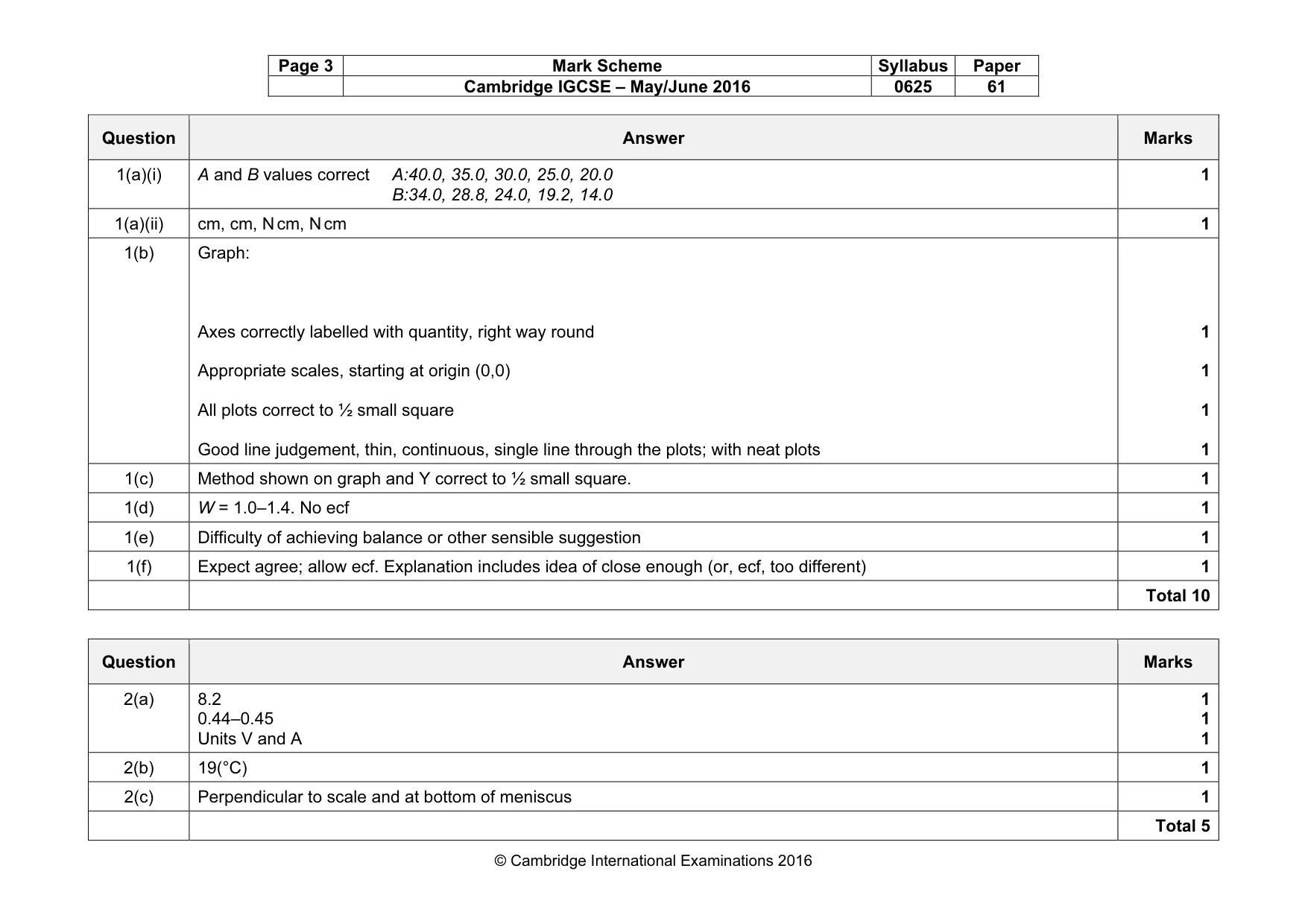
Mark scheme: 1(a)(i) B:34.0, 28.8, 24.0, 19.2, 14.0 1 1(a)(ii) cm, cm, N cm, N cm 1 1(b) Graph: Axes correctly labelled with quantity, right way round Appropriate scales, starting at origin (0,0) All plots correct to ½ small square Good line judgement, thin, continuous, single line through the plots; with neat plots 1 1 1 1 1(c) Method shown on graph and Y correct to ½ small square. 1 1(d) W = 1.0–1.4. No ecf 1 1(e) Difficulty of achieving balance or other sensible suggestion 1 1(f) Expect agree; allow ecf. Explanation includes idea of close enough (or, ecf, too different) 1 Total 10
Q2 · A student is heating water in a beaker using an electrical heater
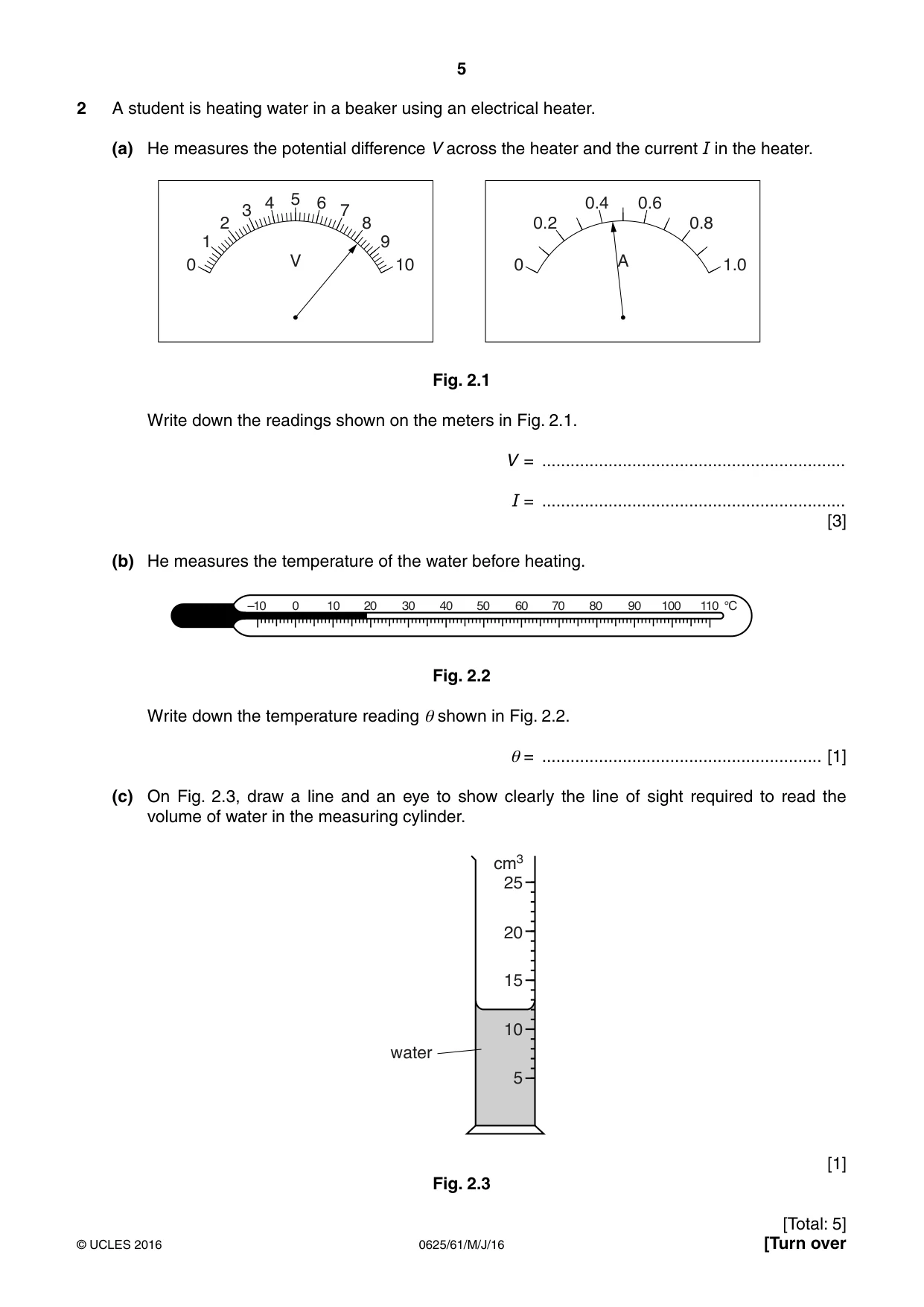
2 A student is heating water in a beaker using an electrical heater. (a) He measures the potential difference V across the heater and the current I in the heater. 4 5 6 0.4 0.6 3 7 2 8 0.2 0.8 1 9 0 V 10 0 A 1.0 Fig. 2.1 Write down the readings shown on the meters in Fig. 2.1. V = ................................................................ I = ................................................................ [3] (b) He measures the temperature of the water before heating. –10 0 10 20 30 40 50 60 70 80 90 100 110 °C Fig. 2.2 Write down the temperature reading θ shown in Fig. 2.2. θ = ........................................................... [1] (c) On Fig. 2.3, draw a line and an eye to show clearly the line of sight required to read the volume of water in the measuring cylinder. cm3 25 20 15 10 water 5 [1] Fig. 2.3 [Total: 5]
Mark scheme: 2(a) 8.2 0.44–0.45 Units V and A 1 1 1 2(b) 19(°C) 1 2(c) Perpendicular to scale and at bottom of meniscus 1 Total 5
Q3 · A student is investigating the resistance of a lamp filament
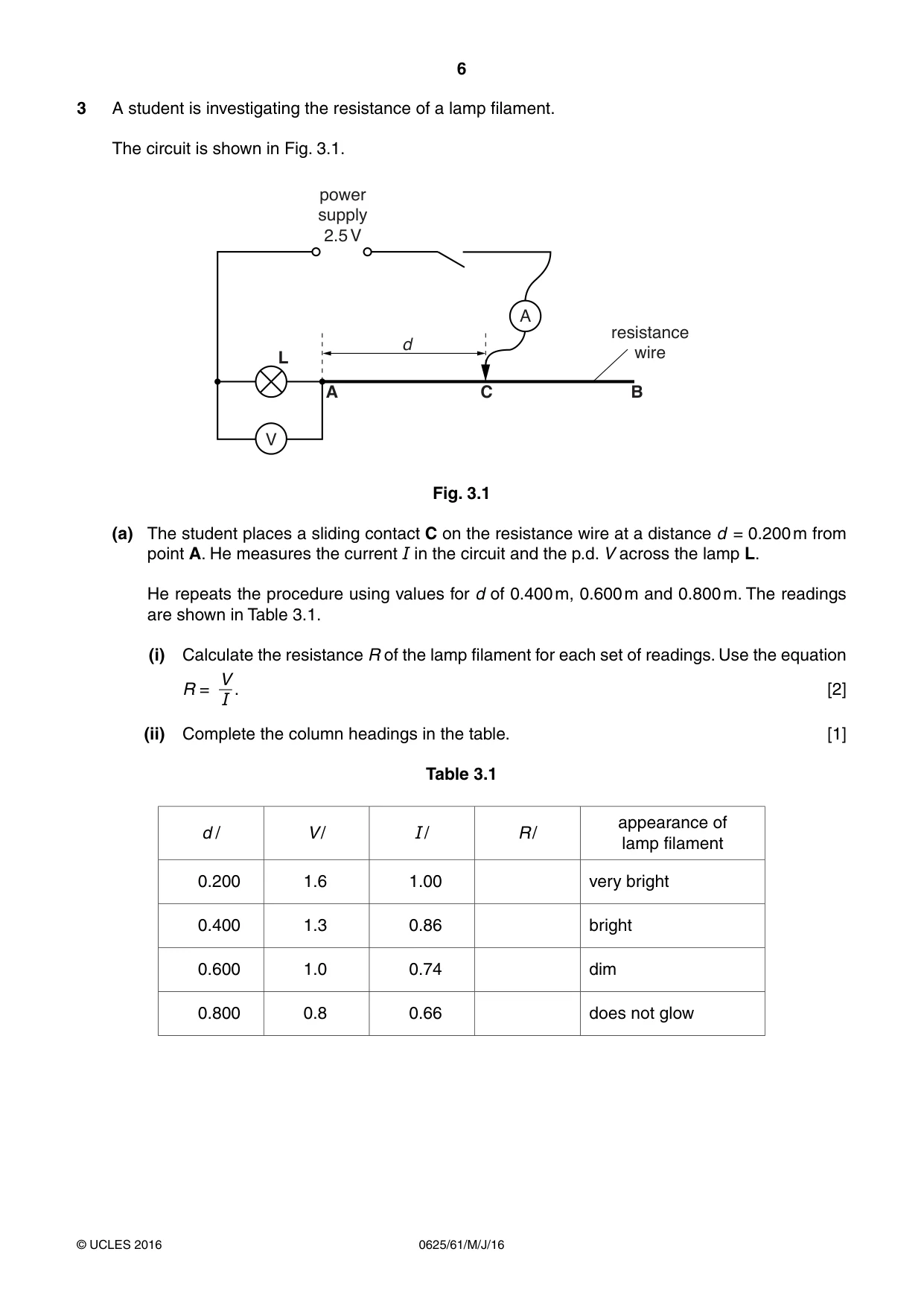
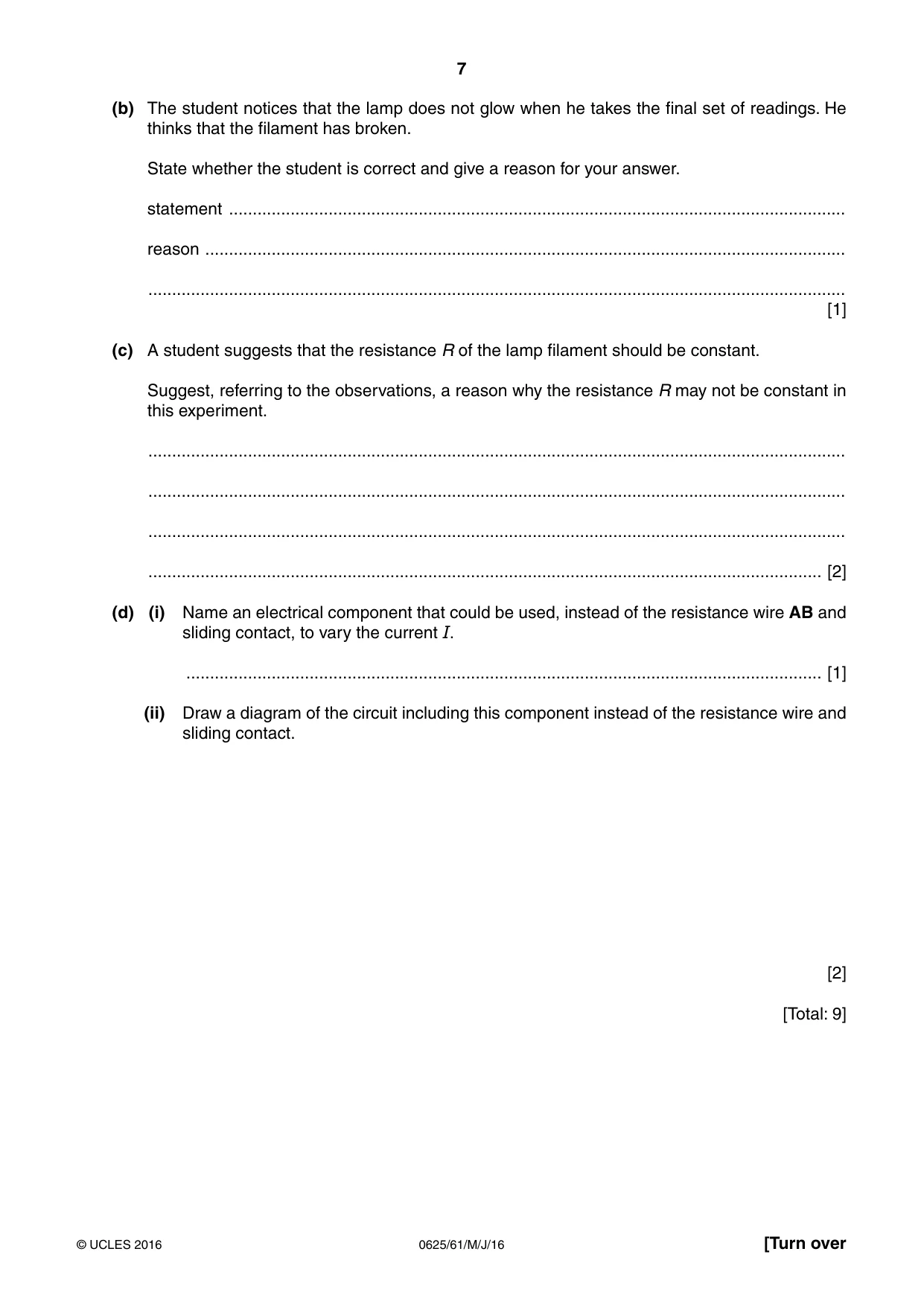
3 A student is investigating the resistance of a lamp filament. The circuit is shown in Fig. 3.1. power supply 2.5 V A resistance d wire L A C B V Fig. 3.1 (a) The student places a sliding contact C on the resistance wire at a distance d = 0.200 m from point A. He measures the current I in the circuit and the p.d. V across the lamp L. He repeats the procedure using values for d of 0.400 m, 0.600 m and 0.800 m. The readings are shown in Table 3.1. (i) Calculate the resistance R of the lamp filament for each set of readings. Use the equation V R = . [2] I (ii) Complete the column headings in the table. [1] Table 3.1 appearance of d / V / I / R / lamp filament 0.200 1.6 1.00 very bright 0.400 1.3 0.86 bright 0.600 1.0 0.74 dim 0.800 0.8 0.66 does not glow (b) The student notices that the lamp does not glow when he takes the final set of readings. He thinks that the filament has broken. State whether the student is correct and give a reason for your answer. statement .................................................................................................................................. reason ....................................................................................................................................... ................................................................................................................................................... [1] (c) A student suggests that the resistance R of the lamp filament should be constant. Suggest, referring to the observations, a reason why the resistance R may not be constant in this experiment. ................................................................................................................................................... ................................................................................................................................................... ................................................................................................................................................... .............................................................................................................................................. [2] (d) (i) Name an electrical component that could be used, instead of the resistance wire AB and sliding contact, to vary the current I. ...................................................................................................................................... [1] (ii) Draw a diagram of the circuit including this component instead of the resistance wire and sliding contact. [2] [Total: 9]
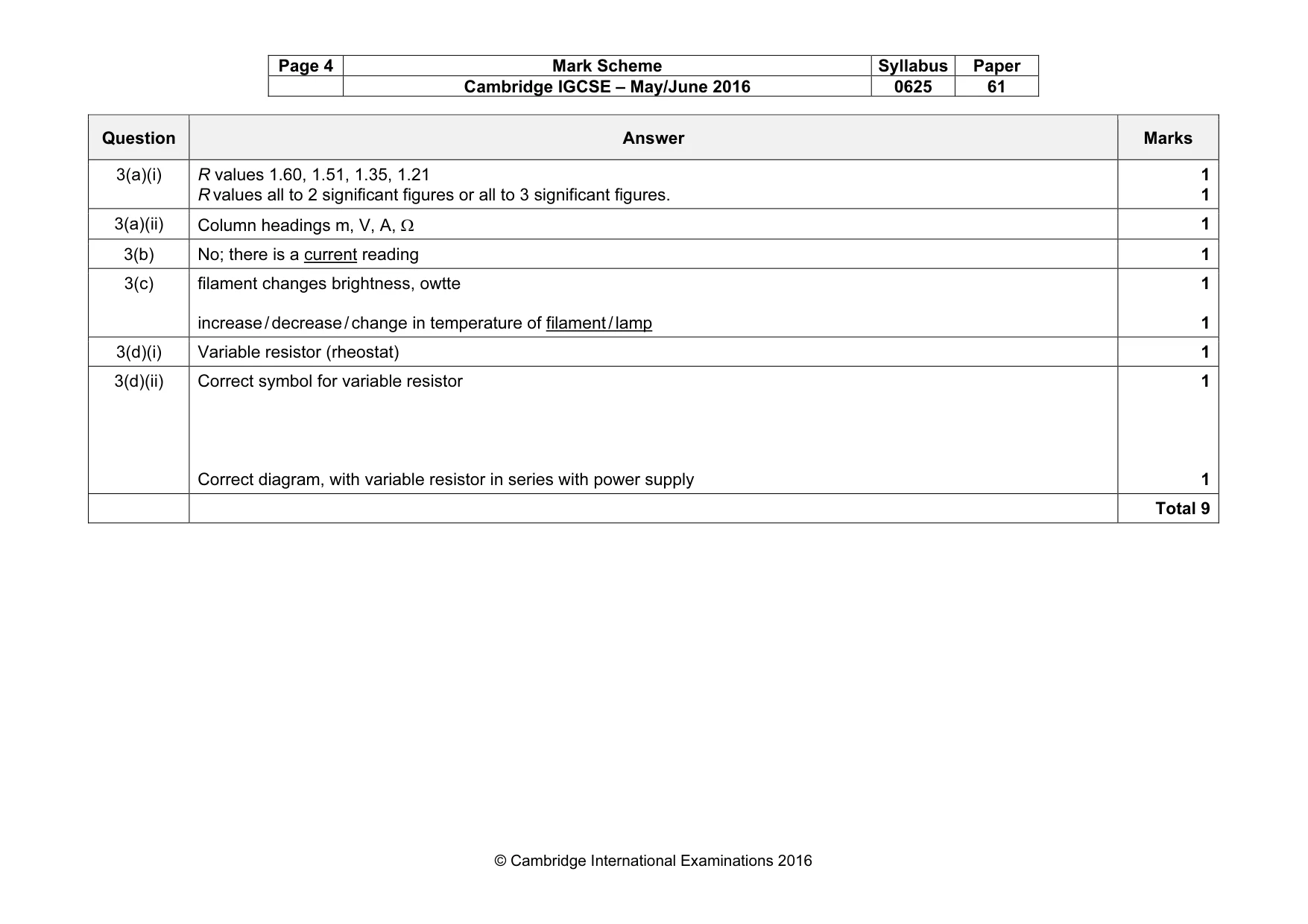
Mark scheme: 3(a)(i) R values all to 2 significant figures or all to 3 significant figures. 1 1 3(a)(ii) Column headings m, V, A, Ω 1 3(b) No; there is a current reading 1 3(c) filament changes brightness, owtte increase / decrease / change in temperature of filament / lamp 1 1 3(d)(i) Variable resistor (rheostat) 1 3(d)(ii) Correct symbol for variable resistor Correct diagram, with variable resistor in series with power supply 1 1 Total 9
Q4 · A student is investigating the effect of insulation on the rate of cooling of hot water…
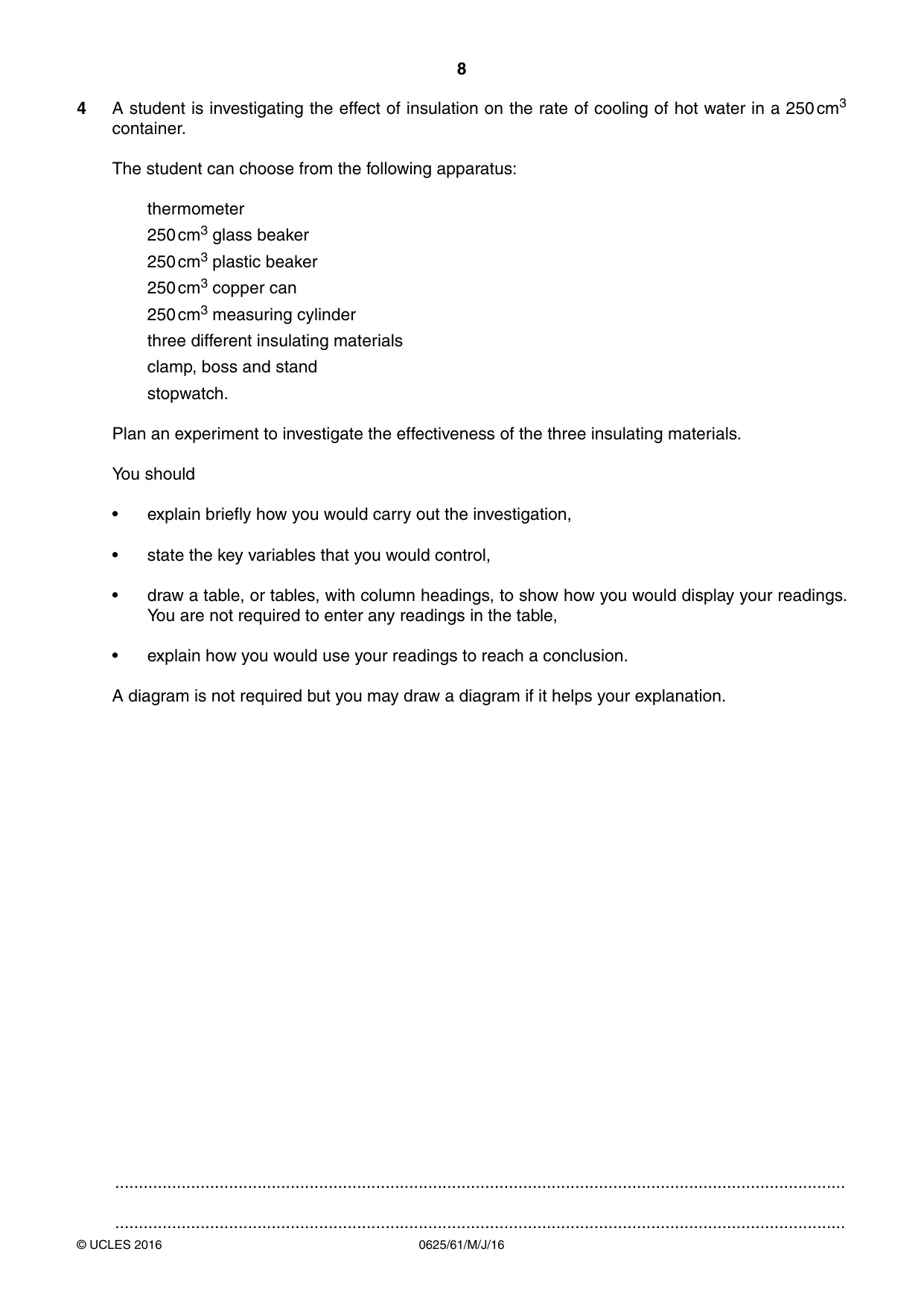
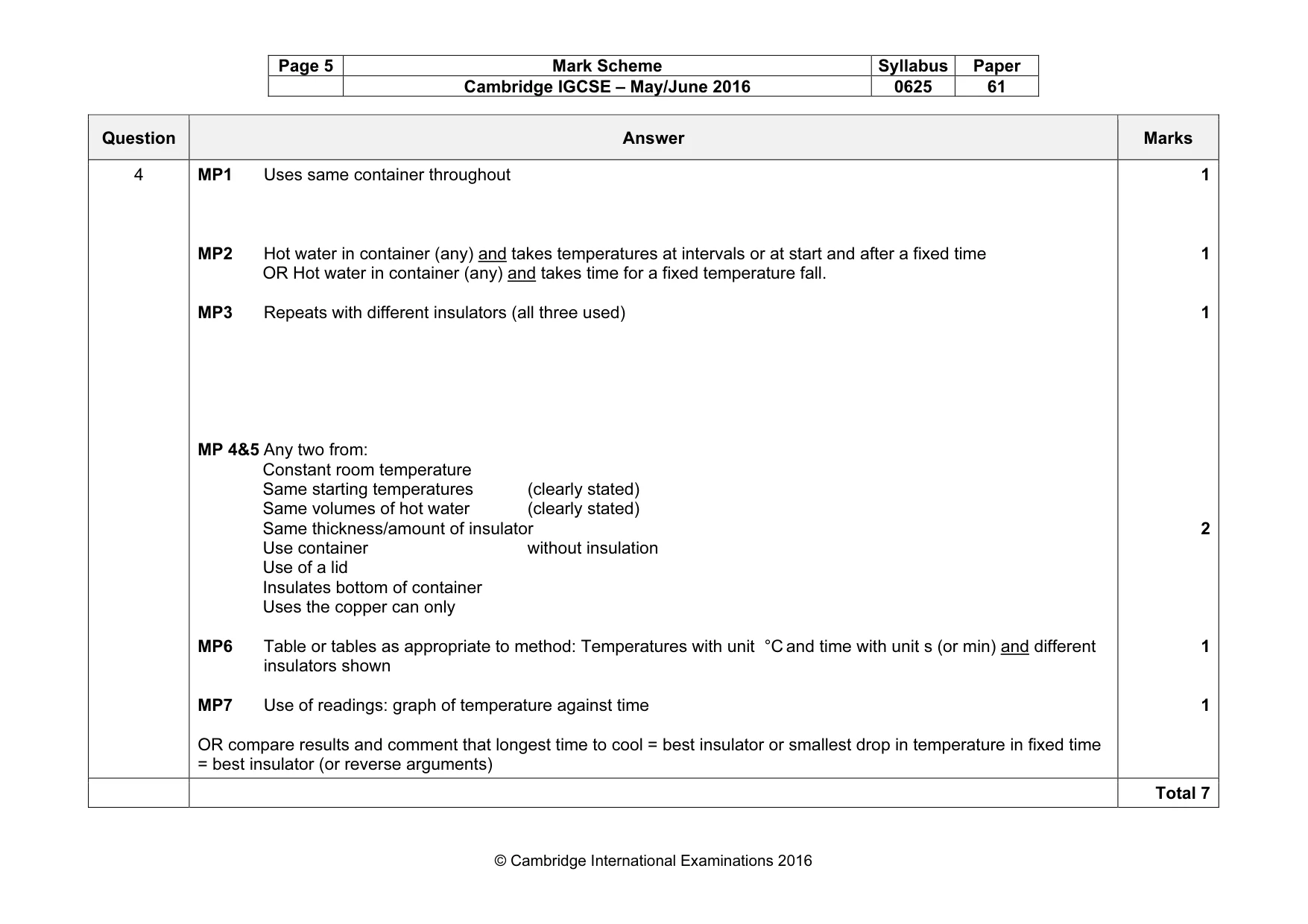
4 A student is investigating the effect of insulation on the rate of cooling of hot water in a 250 cm3 container. The student can choose from the following apparatus: thermometer 250 cm3 glass beaker 250 cm3 plastic beaker 250 cm3 copper can 250 cm3 measuring cylinder three different insulating materials clamp, boss and stand stopwatch. Plan an experiment to investigate the effectiveness of the three insulating materials. You should • explain briefly how you would carry out the investigation, • state the key variables that you would control, • draw a table, or tables, with column headings, to show how you would display your readings. You are not required to enter any readings in the table, • explain how you would use your readings to reach a conclusion. A diagram is not required but you may draw a diagram if it helps your explanation. .......................................................................................................................................................... .......................................................................................................................................................... .......................................................................................................................................................... .......................................................................................................................................................... .......................................................................................................................................................... .......................................................................................................................................................... .......................................................................................................................................................... .......................................................................................................................................................... .......................................................................................................................................................... .......................................................................................................................................................... .......................................................................................................................................................... .......................................................................................................................................................... .......................................................................................................................................................... .......................................................................................................................................................... .......................................................................................................................................................... .......................................................................................................................................................... .......................................................................................................................................................... .......................................................................................................................................................... .......................................................................................................................................................... .......................................................................................................................................................... .......................................................................................................................................................... .......................................................................................................................................................... .......................................................................................................................................................... .......................................................................................................................................................... .......................................................................................................................................................... .......................................................................................................................................................... .......................................................................................................................................................... .......................................................................................................................................................... ..................................................................................................................................................... [7] [Total: 7]
Mark scheme: 4 MP1 Uses same container throughout MP2 Hot water in container (any) and takes temperatures at intervals or at start and after a fixed time OR Hot water in container (any) and takes time for a fixed temperature fall. MP3 Repeats with different insulators (all three used) MP 4&5 Any two from: Constant room temperature Same starting temperatures (clearly stated) Same volumes of hot water (clearly stated) Same thickness/amount of insulator Use container without insulation Use of a lid Insulates bottom of container Uses the copper can only MP6 Table or tables as appropriate to method: Temperatures with unit °C and time with unit s (or min) and different insulators shown MP7 Use of readings: graph of temperature against time OR compare results and comment that longest time to cool = best insulator or smallest drop in temperature in fixed time = best insulator (or reverse arguments) 1 1 1 2 1 1 Total 7
Q5 · A student determines the focal length of a lens
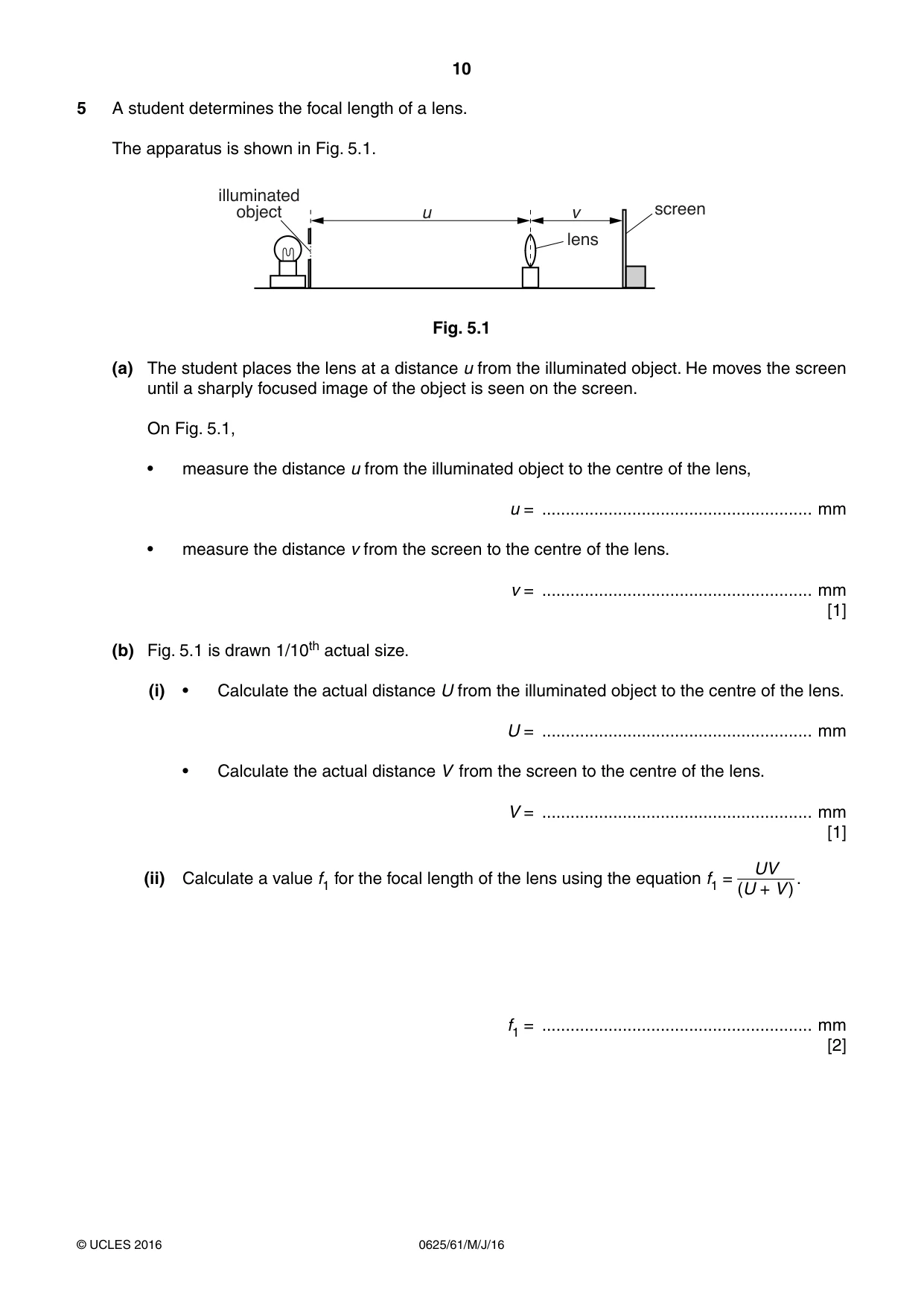
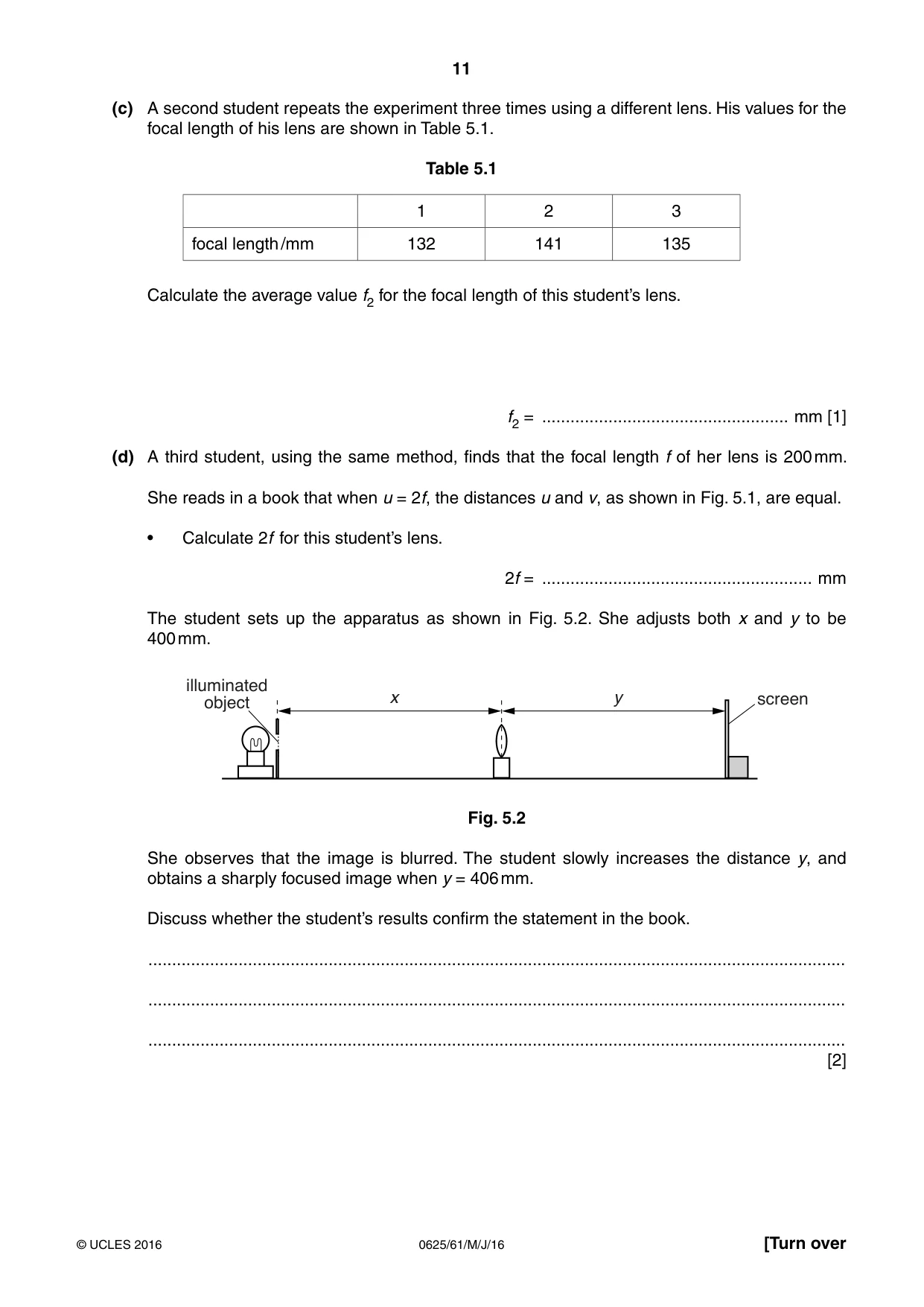
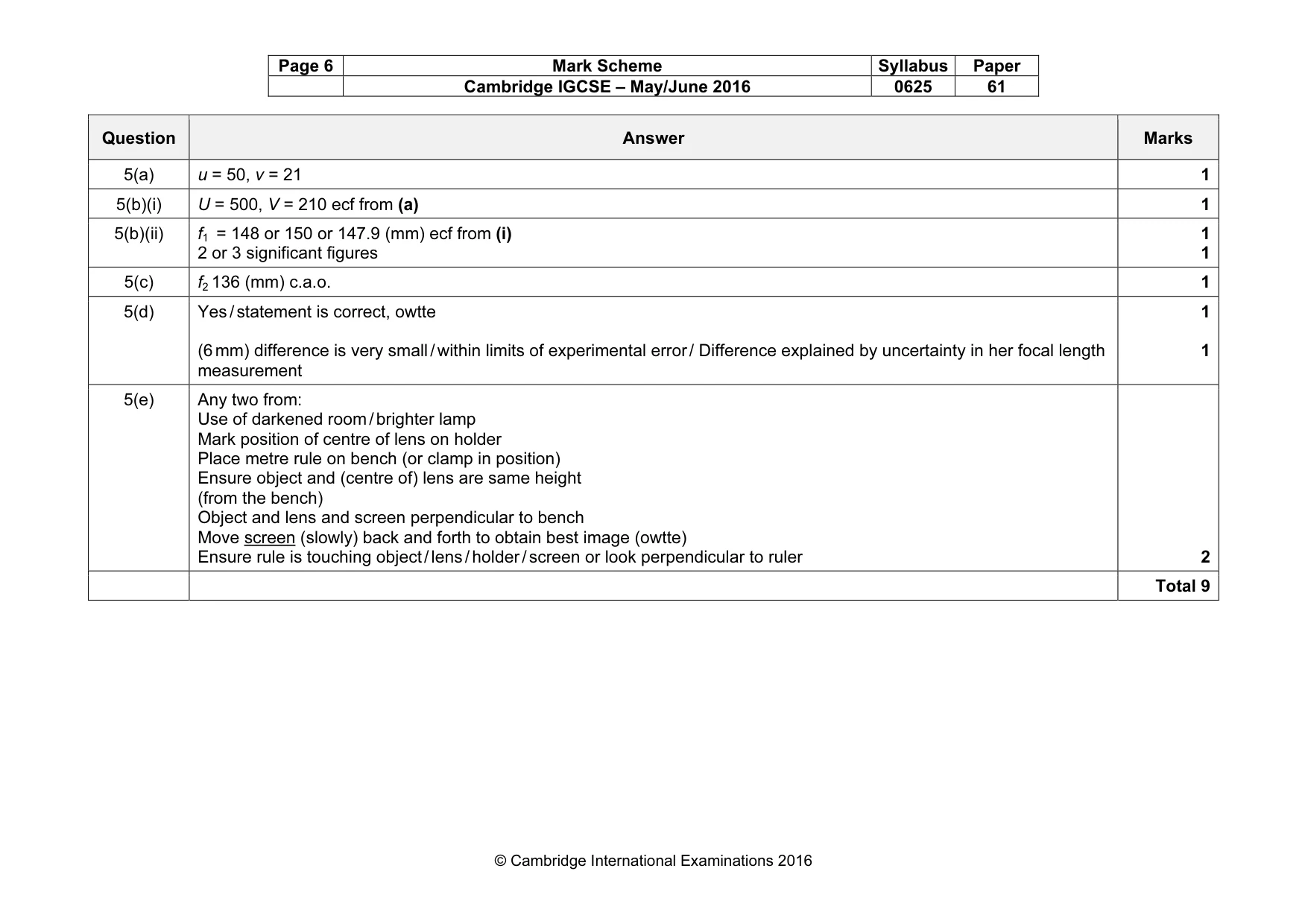
5 A student determines the focal length of a lens. The apparatus is shown in Fig. 5.1. illuminated object u v screen lens Fig. 5.1 (a) The student places the lens at a distance u from the illuminated object. He moves the screen until a sharply focused image of the object is seen on the screen. On Fig. 5.1, • measure the distance u from the illuminated object to the centre of the lens, u = ......................................................... mm • measure the distance v from the screen to the centre of the lens. v = ......................................................... mm [1] (b) Fig. 5.1 is drawn 1/10th actual size. (i) • Calculate the actual distance U from the illuminated object to the centre of the lens. U = ......................................................... mm • Calculate the actual distance V from the screen to the centre of the lens. V = ......................................................... mm [1] UV (ii) Calculate a value f1 for the focal length of the lens using the equation f1 = . (U + V) f1 = ......................................................... mm [2] (c) A second student repeats the experiment three times using a different lens. His values for the focal length of his lens are shown in Table 5.1. Table 5.1 1 2 3 focal length /mm 132 141 135 Calculate the average value f2 for the focal length of this student’s lens. f2 = .................................................... mm [1] (d) A third student, using the same method, finds that the focal length f of her lens is 200 mm. She reads in a book that when u = 2f, the distances u and v, as shown in Fig. 5.1, are equal. • Calculate 2f for this student’s lens. 2f = ......................................................... mm The student sets up the apparatus as shown in Fig. 5.2. She adjusts both x and y to be 400 mm. illuminated x y screen object Fig. 5.2 She observes that the image is blurred. The student slowly increases the distance y, and obtains a sharply focused image when y = 406 mm. Discuss whether the student’s results confirm the statement in the book. ................................................................................................................................................... ................................................................................................................................................... ................................................................................................................................................... [2] (e) Suggest two precautions that you would take in this investigation in order to obtain reliable results. 1. .............................................................................................................................................. ................................................................................................................................................... 2. .............................................................................................................................................. ................................................................................................................................................... [2] [Total: 9]
Mark scheme: 5(a) 1 5(b)(i) U = 500, V = 210 ecf from (a) 1 5(b)(ii) f1 = 148 or 150 or 147.9 (mm) ecf from (i) 2 or 3 significant figures 1 1 5(c) f2 136 (mm) c.a.o. 1 5(d) Yes / statement is correct, owtte (6 mm) difference is very small / within limits of experimental error / Difference explained by uncertainty in her focal length measurement 1 1 5(e) Any two from: Use of darkened room / brighter lamp Mark position of centre of lens on holder Place metre rule on bench (or clamp in position) Ensure object and (centre of) lens are same height (from the bench) Object and lens and screen perpendicular to bench Move screen (slowly) back and forth to obtain best image (owtte) Ensure rule is touching object / lens / holder / screen or look perpendicular to ruler 2 Total 9
What was in this paper
The subtopics covered by these 5 questions, and how many questions each got. Open one in a new tab to see every Cambridge question on it.
What you needed in this session
Cambridge’s own grade thresholds for 2016 May/June, Paper 6 · Variant 1. A higher threshold means an easier paper — the bar moves with how the cohort did.