Cambridge IGCSE Physics 0625 — 2006 Oct/Nov Paper 1 · Variant 1
0625/11/O/N/06 · 40 marks · ≈45 min
The question paper and its mark scheme, free to read here and free to download. This is Cambridge’s own paper, exactly as it was sat.
Question paper20 pages
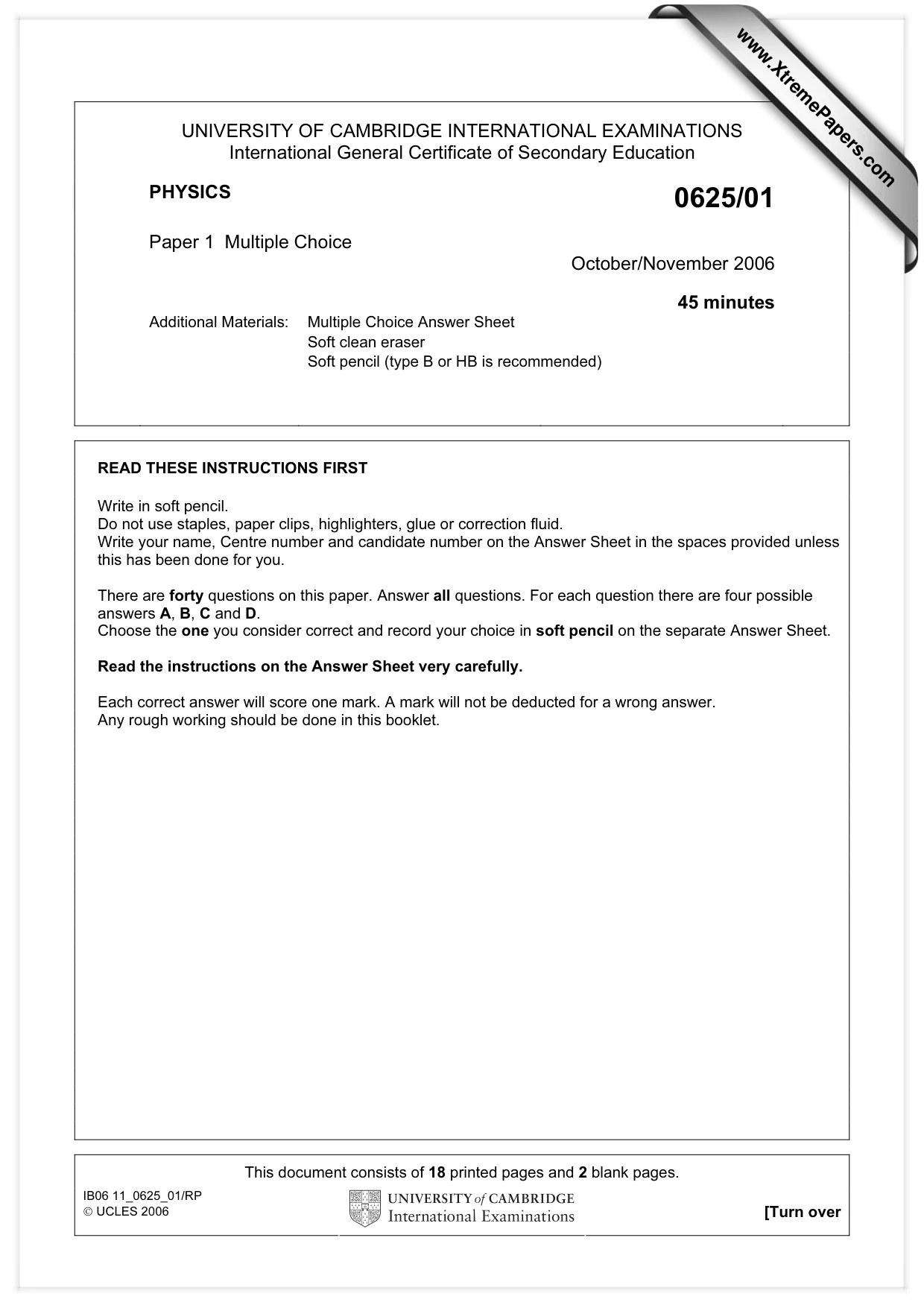

Mark scheme2 pages
Answers below. Sit the paper first if you are practising.
Paper as text
Question paper, page 1
UNIVERSITY OF CAMBRIDGE INTERNATIONAL EXAMINATIONS International General Certificate of Secondary Education PHYSICS 0625/01 Paper 1 Multiple Choice October/November 2006 45 minutes Additional Materials: Multiple Choice Answer Sheet Soft clean eraser Soft pencil (type B or HB is recommended) READ THESE INSTRUCTIONS FIRST Write in soft pencil. Do not use staples, paper clips, highlighters, glue or correction fluid. Write your name, Centre number and candidate number on the Answer Sheet in the spaces provided unless this has been done for you. There are forty questions on this paper. Answer all questions. For each question there are four possible answers A, B, C and D. Choose the one you consider correct and record your choice in soft pencil on the separate Answer Sheet. Read the instructions on the Answer Sheet very carefully. Each correct answer will score one mark. A mark will not be deducted for a wrong answer. Any rough working should be done in this booklet. This document consists of 18 printed pages and 2 blank pages. IB06 11_0625_01/RP UCLES 2006 [Turn over www.XtremePapers.com
Question paper, page 2
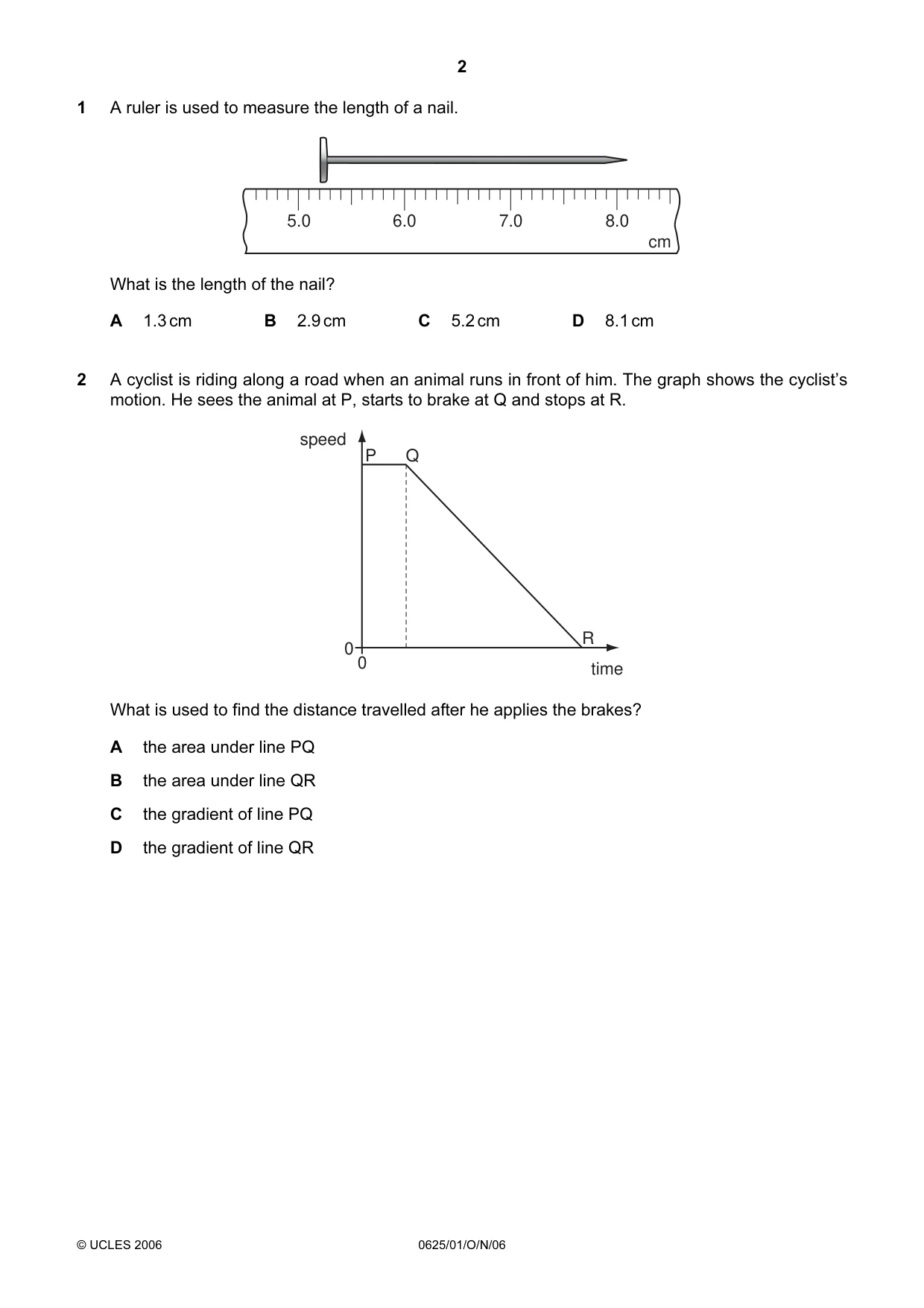
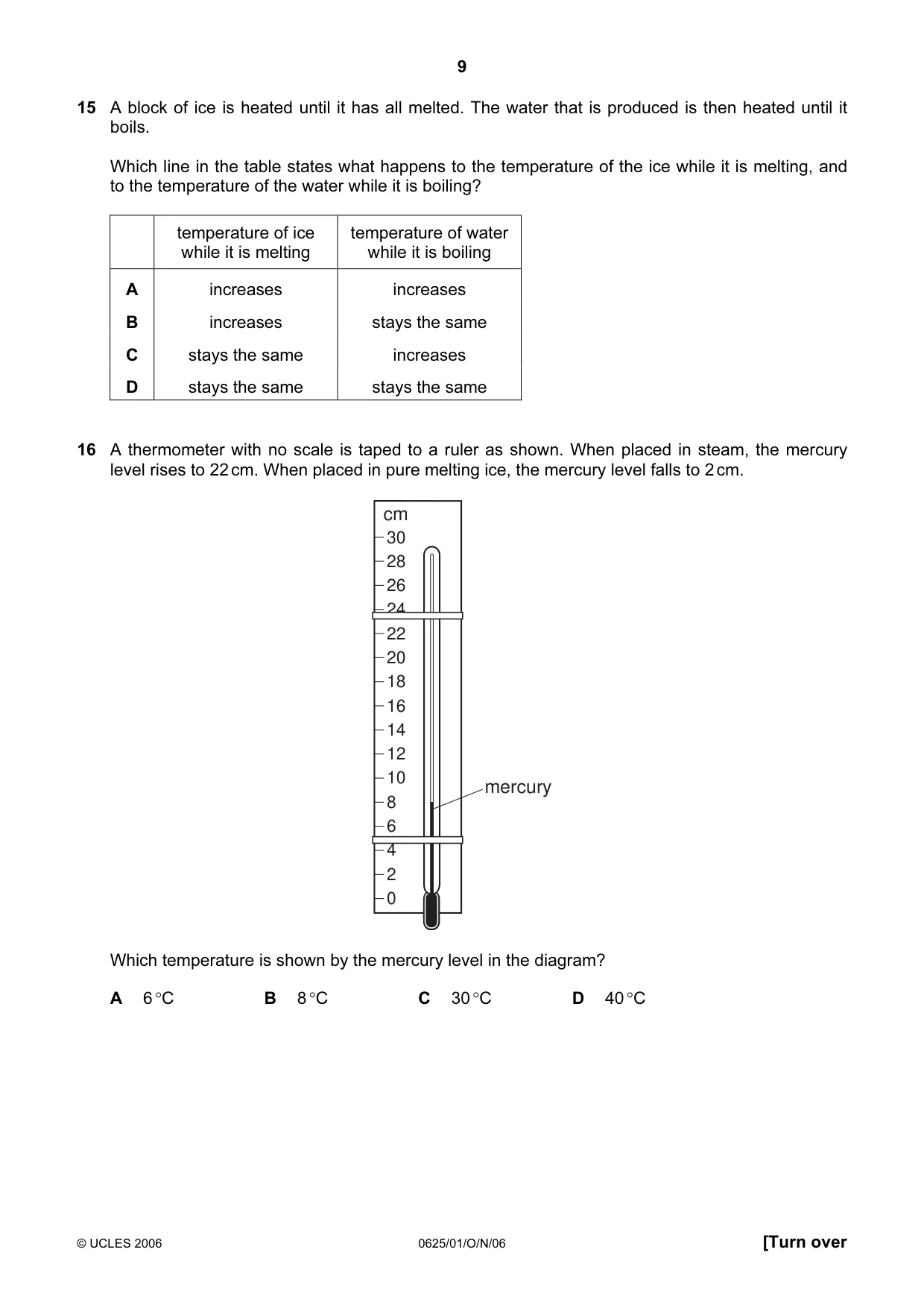
2 © UCLES 2006 0625/01/O/N/06 1 A ruler is used to measure the length of a nail. 5.0 6.0 7.0 8.0 cm What is the length of the nail? A 1.3 cm B 2.9 cm C 5.2 cm D 8.1 cm 2 A cyclist is riding along a road when an animal runs in front of him. The graph shows the cyclist’s motion. He sees the animal at P, starts to brake at Q and stops at R. 0 0 P Q R speed time What is used to find the distance travelled after he applies the brakes? A the area under line PQ B the area under line QR C the gradient of line PQ D the gradient of line QR
Question paper, page 3
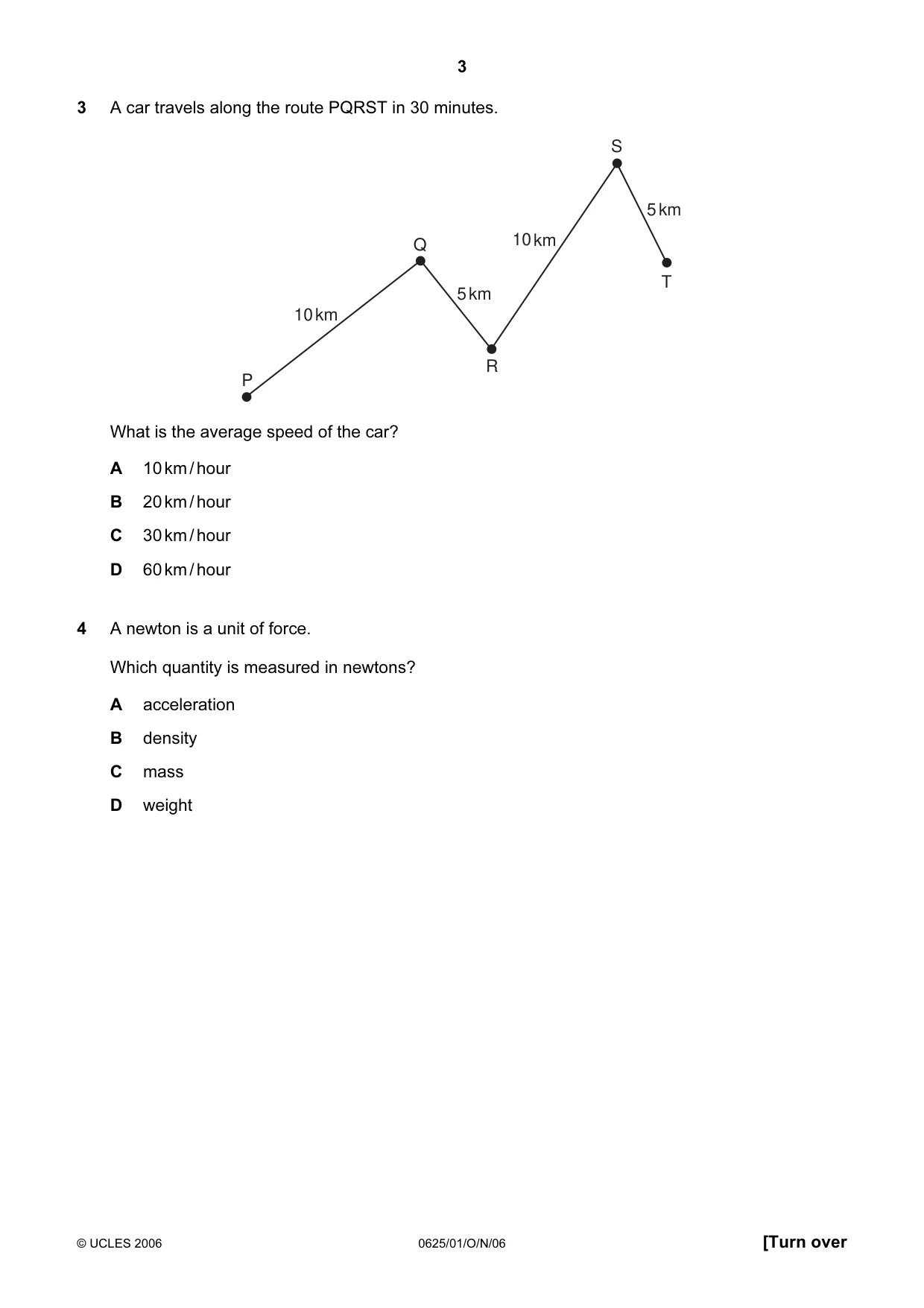
3 © UCLES 2006 0625/01/O/N/06 [Turn over 3 A car travels along the route PQRST in 30 minutes. P Q R S T 10 km 5 km 5 km 10 km What is the average speed of the car? A 10 km / hour B 20 km / hour C 30 km / hour D 60 km / hour 4 A newton is a unit of force. Which quantity is measured in newtons? A acceleration B density C mass D weight
Question paper, page 4
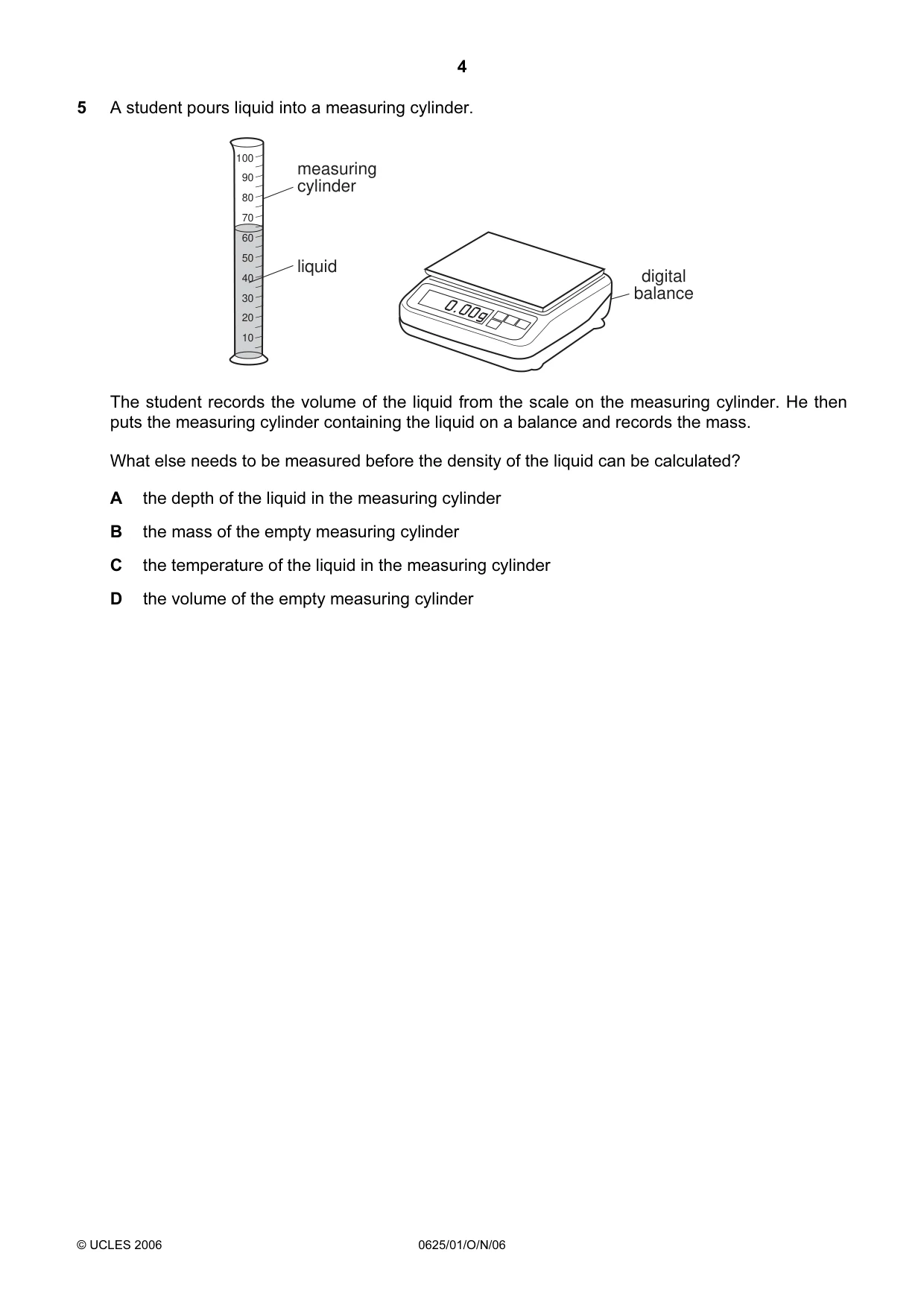
4 © UCLES 2006 0625/01/O/N/06 5 A student pours liquid into a measuring cylinder. digital balance 100 90 80 70 60 50 40 30 20 10 measuring cylinder liquid The student records the volume of the liquid from the scale on the measuring cylinder. He then puts the measuring cylinder containing the liquid on a balance and records the mass. What else needs to be measured before the density of the liquid can be calculated? A the depth of the liquid in the measuring cylinder B the mass of the empty measuring cylinder C the temperature of the liquid in the measuring cylinder D the volume of the empty measuring cylinder
Question paper, page 5
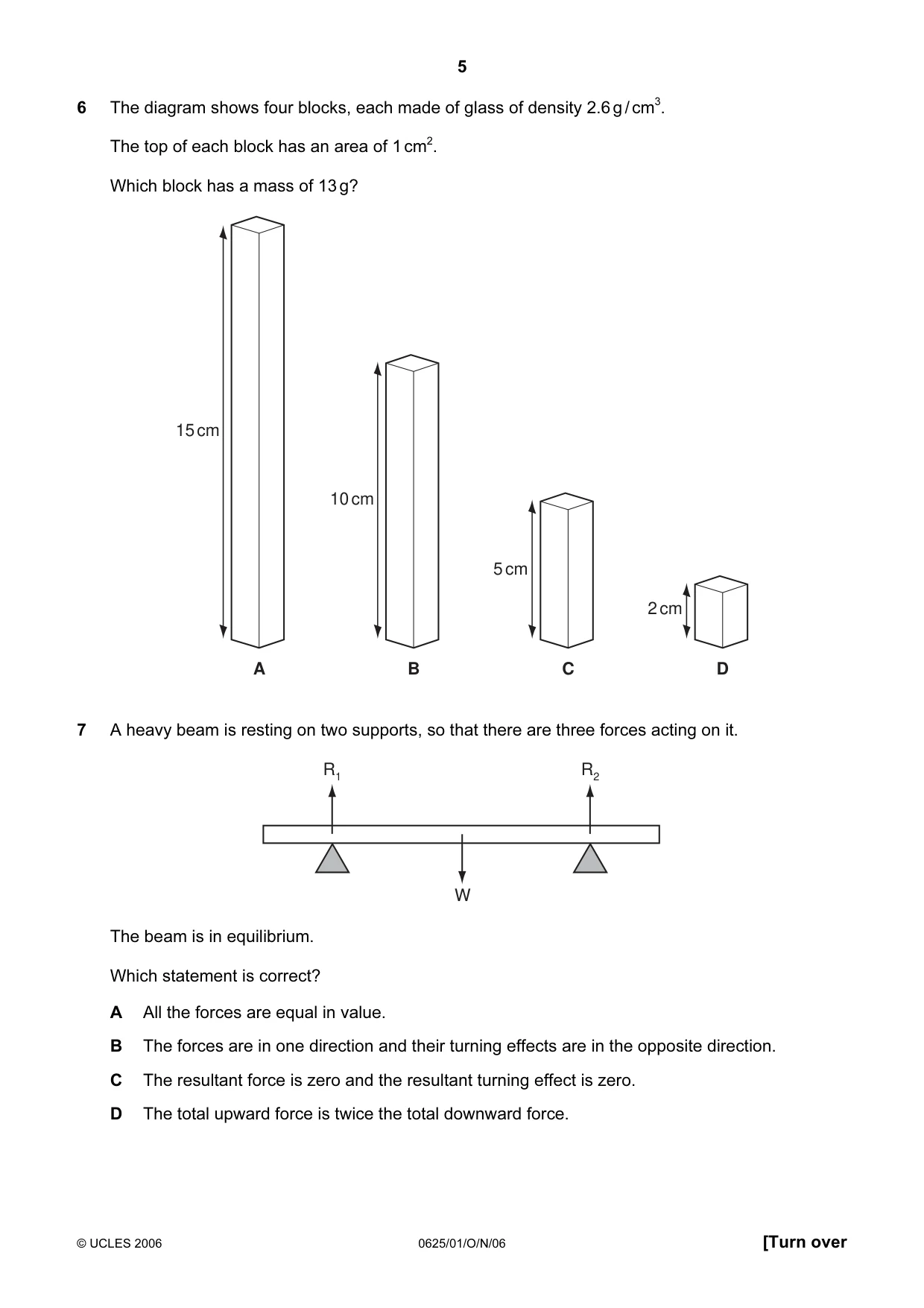
5 © UCLES 2006 0625/01/O/N/06 [Turn over 6 The diagram shows four blocks, each made of glass of density 2.6 g / cm3. The top of each block has an area of 1 cm2. Which block has a mass of 13 g? 2 cm D 5 cm C 10 cm B 15 cm A 7 A heavy beam is resting on two supports, so that there are three forces acting on it. R1 R2 W The beam is in equilibrium. Which statement is correct? A All the forces are equal in value. B The forces are in one direction and their turning effects are in the opposite direction. C The resultant force is zero and the resultant turning effect is zero. D The total upward force is twice the total downward force.
Question paper, page 6
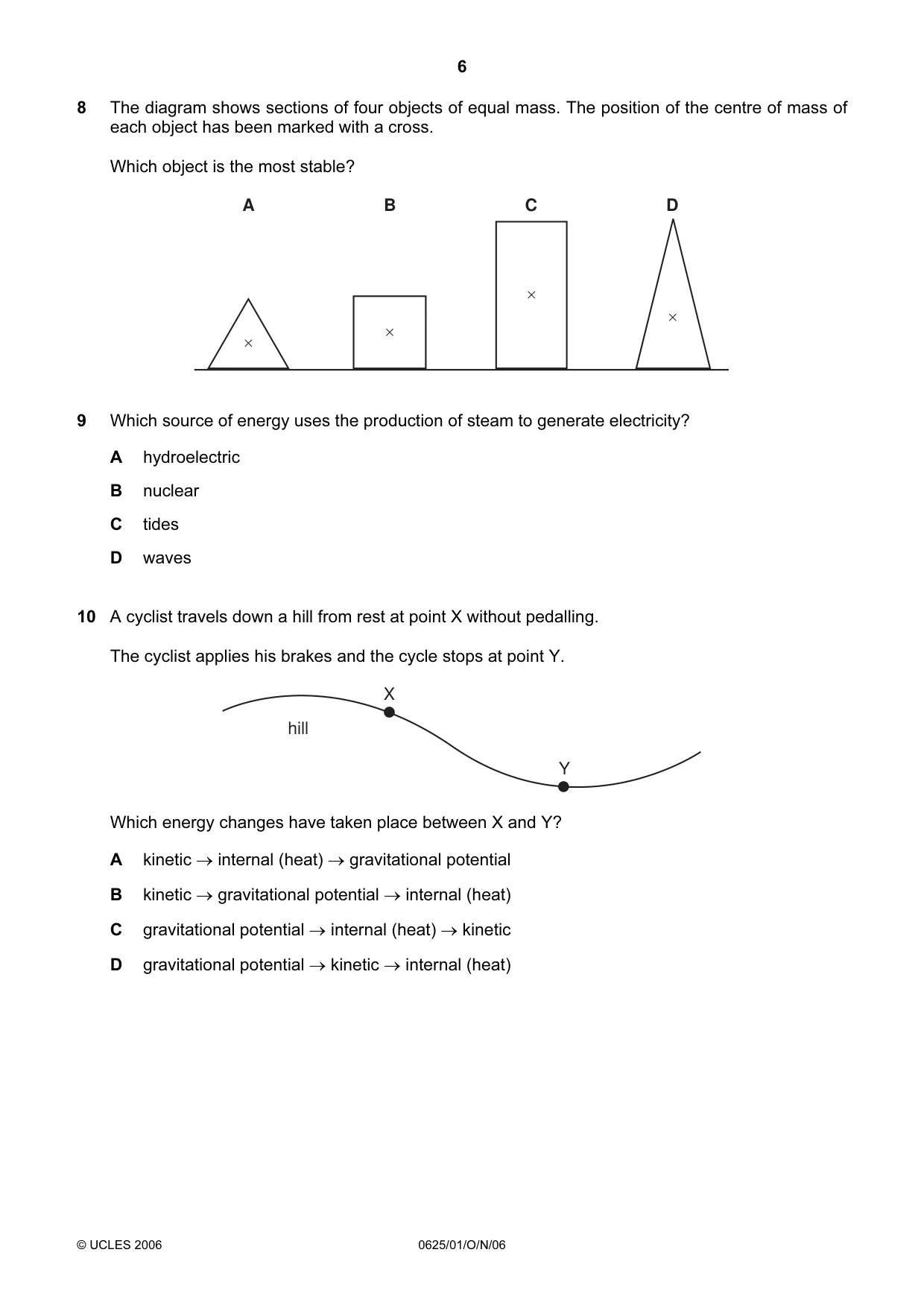
6 © UCLES 2006 0625/01/O/N/06 8 The diagram shows sections of four objects of equal mass. The position of the centre of mass of each object has been marked with a cross. Which object is the most stable? A B C D 9 Which source of energy uses the production of steam to generate electricity? A hydroelectric B nuclear C tides D waves 10 A cyclist travels down a hill from rest at point X without pedalling. The cyclist applies his brakes and the cycle stops at point Y. X Y hill Which energy changes have taken place between X and Y? A kinetic → internal (heat) → gravitational potential B kinetic → gravitational potential → internal (heat) C gravitational potential → internal (heat) → kinetic D gravitational potential → kinetic → internal (heat)
Question paper, page 7
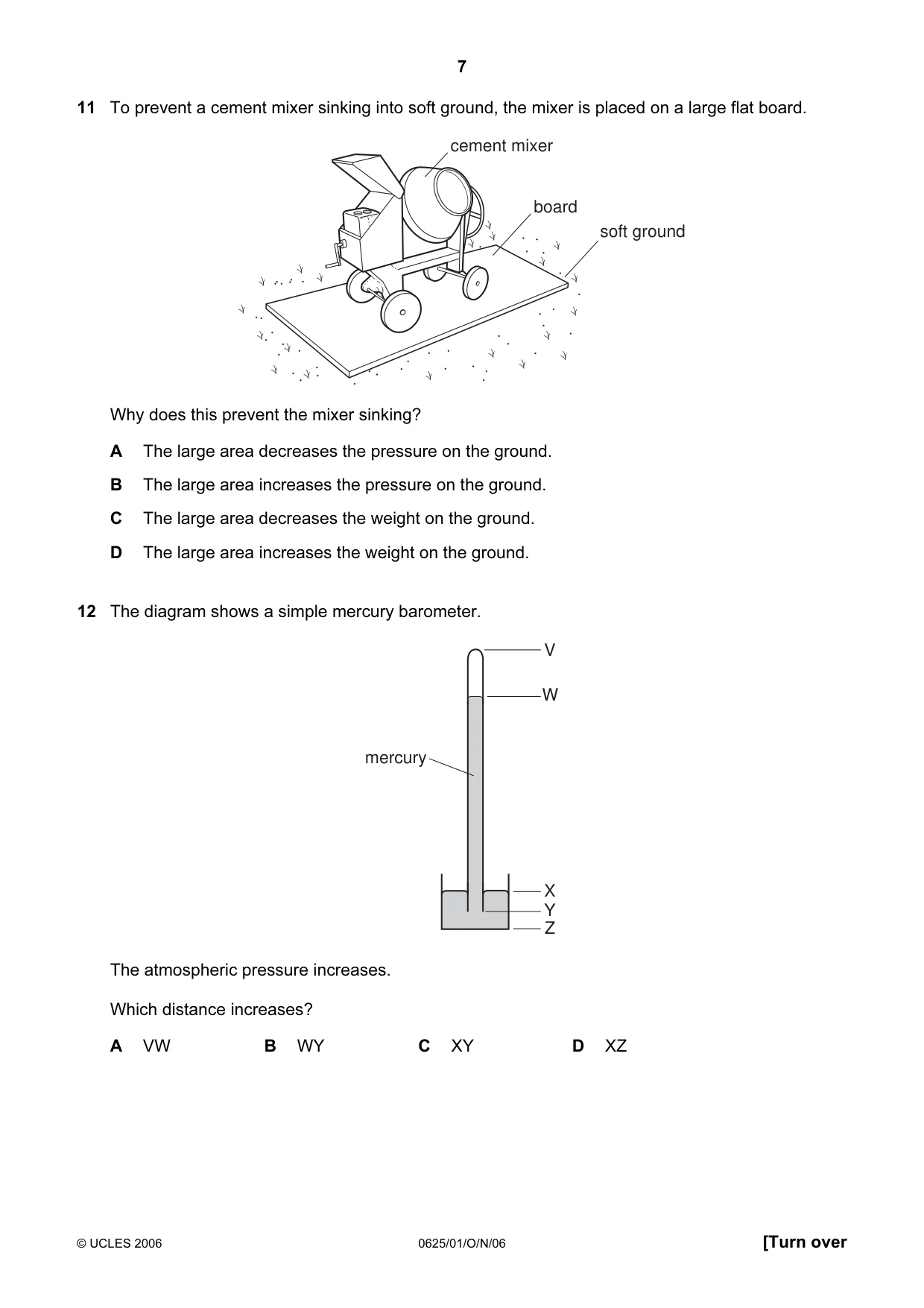
7 © UCLES 2006 0625/01/O/N/06 [Turn over 11 To prevent a cement mixer sinking into soft ground, the mixer is placed on a large flat board. board soft ground cement mixer Why does this prevent the mixer sinking? A The large area decreases the pressure on the ground. B The large area increases the pressure on the ground. C The large area decreases the weight on the ground. D The large area increases the weight on the ground. 12 The diagram shows a simple mercury barometer. V W X Y Z mercury The atmospheric pressure increases. Which distance increases? A VW B WY C XY D XZ
Question paper, page 8
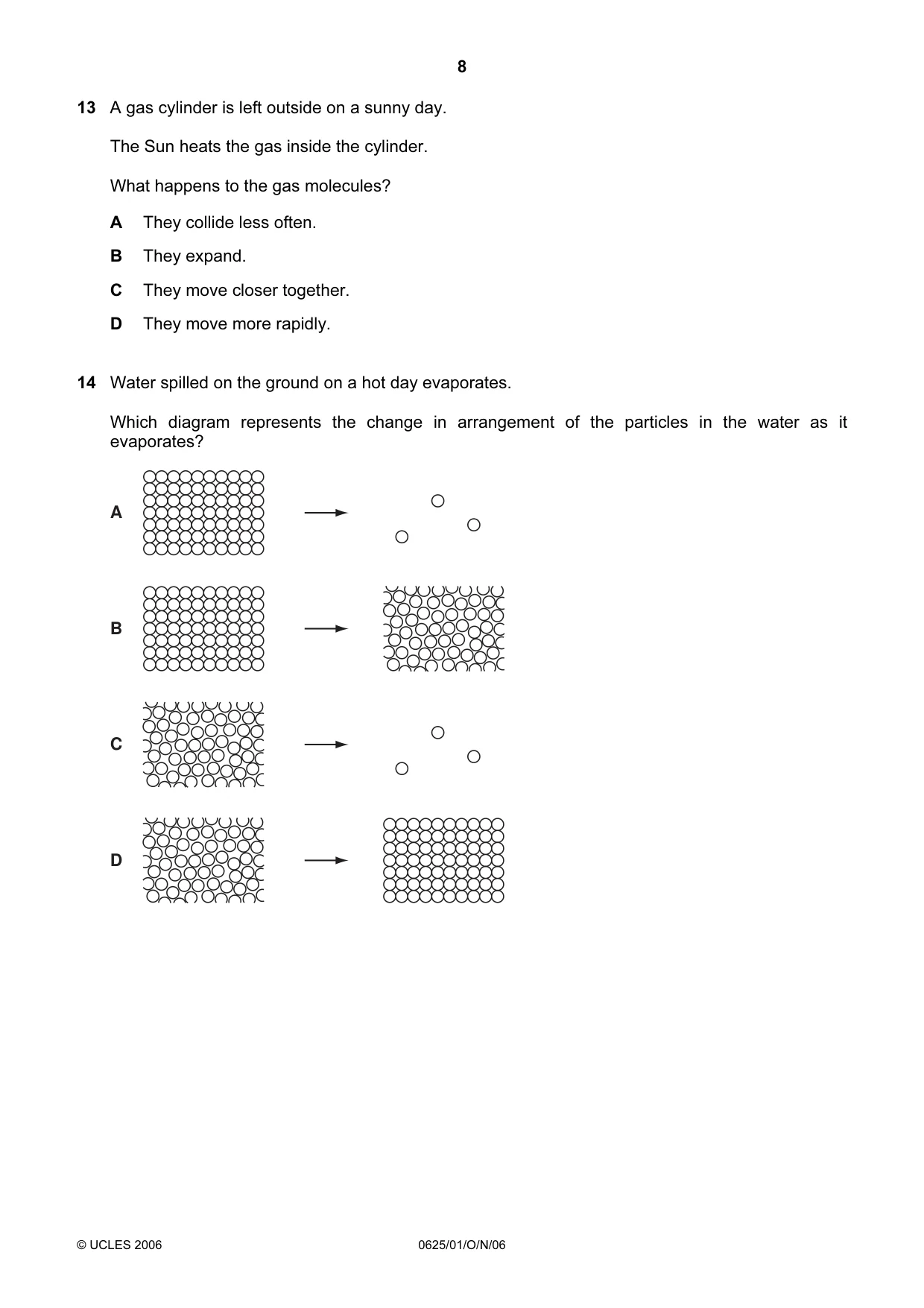
8 © UCLES 2006 0625/01/O/N/06 13 A gas cylinder is left outside on a sunny day. The Sun heats the gas inside the cylinder. What happens to the gas molecules? A They collide less often. B They expand. C They move closer together. D They move more rapidly. 14 Water spilled on the ground on a hot day evaporates. Which diagram represents the change in arrangement of the particles in the water as it evaporates? A B C D
Question paper, page 9
9 © UCLES 2006 0625/01/O/N/06 [Turn over 15 A block of ice is heated until it has all melted. The water that is produced is then heated until it boils. Which line in the table states what happens to the temperature of the ice while it is melting, and to the temperature of the water while it is boiling? temperature of ice while it is melting temperature of water while it is boiling A increases increases B increases stays the same C stays the same increases D stays the same stays the same 16 A thermometer with no scale is taped to a ruler as shown. When placed in steam, the mercury level rises to 22 cm. When placed in pure melting ice, the mercury level falls to 2 cm. 30 28 26 24 22 20 18 16 14 12 10 8 6 4 2 0 cm mercury Which temperature is shown by the mercury level in the diagram? A 6 °C B 8 °C C 30 °C D 40 °C
Question paper, page 10
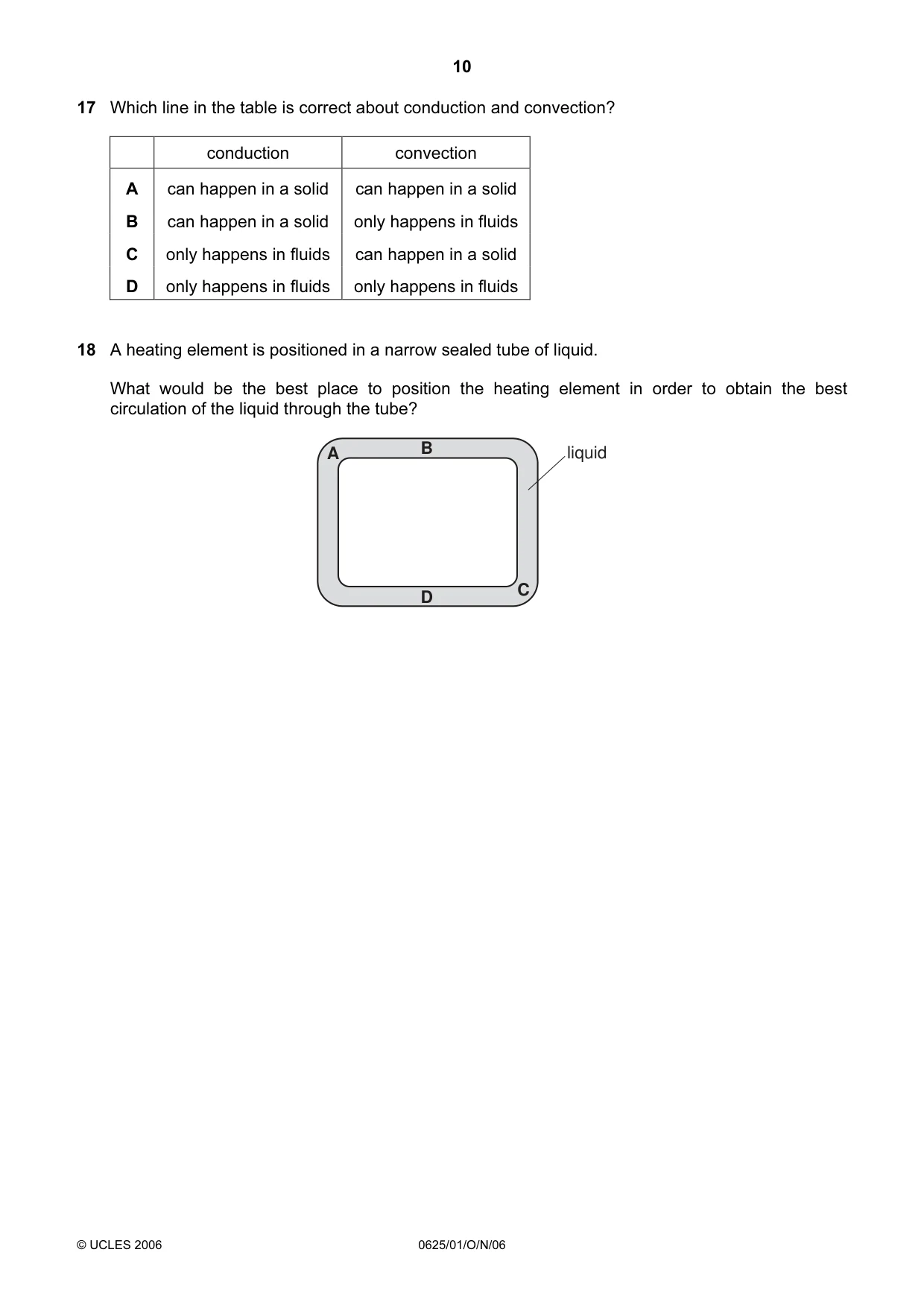
10 © UCLES 2006 0625/01/O/N/06 17 Which line in the table is correct about conduction and convection? conduction convection A can happen in a solid can happen in a solid B can happen in a solid only happens in fluids C only happens in fluids can happen in a solid D only happens in fluids only happens in fluids 18 A heating element is positioned in a narrow sealed tube of liquid. What would be the best place to position the heating element in order to obtain the best circulation of the liquid through the tube? liquid A D B C
Question paper, page 11
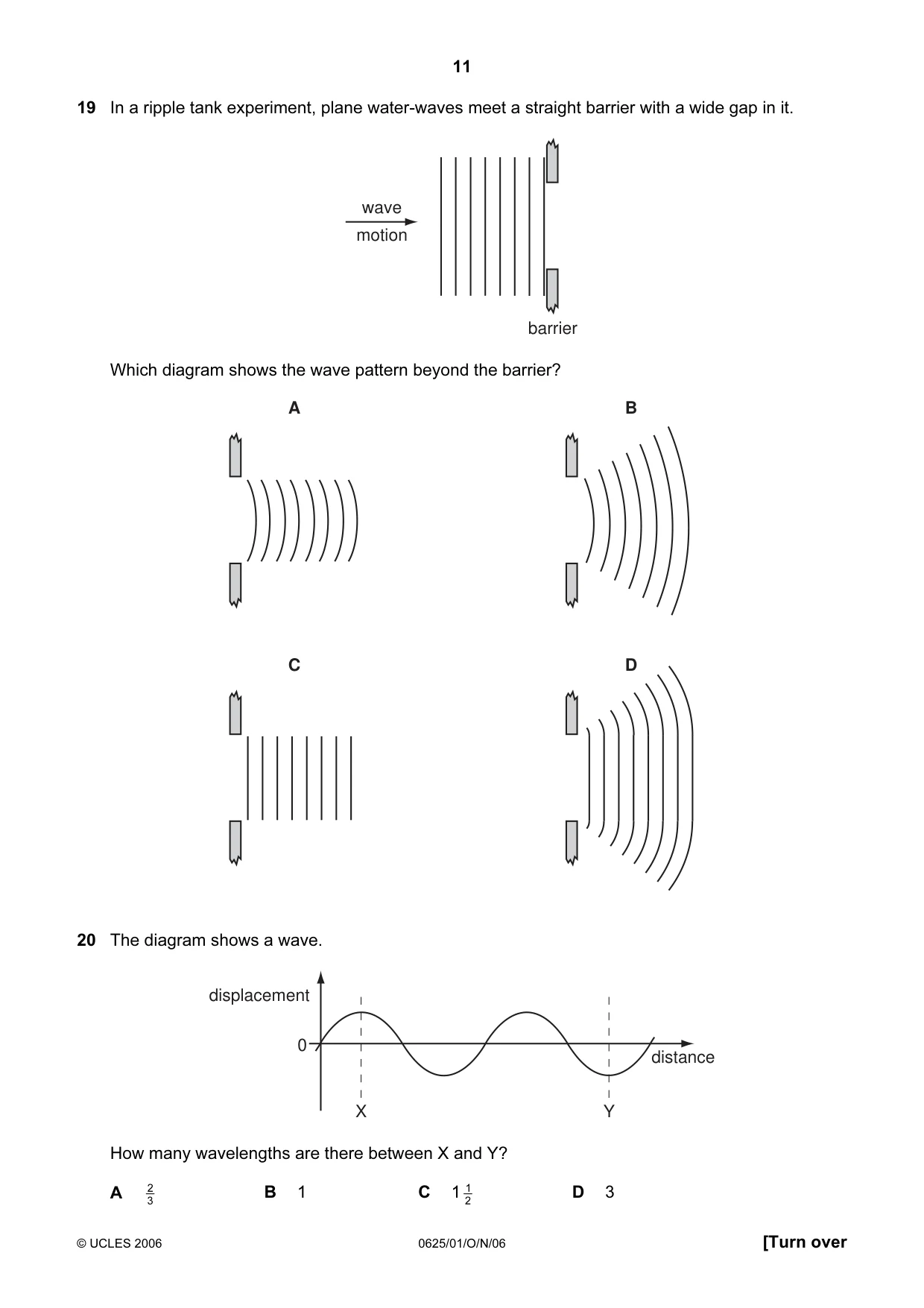
11 © UCLES 2006 0625/01/O/N/06 [Turn over 19 In a ripple tank experiment, plane water-waves meet a straight barrier with a wide gap in it. wave motion barrier Which diagram shows the wave pattern beyond the barrier? A B C D 20 The diagram shows a wave. X Y distance displacement 0 How many wavelengths are there between X and Y? A 3 2 B 1 C 1 2 1 D 3
Question paper, page 12
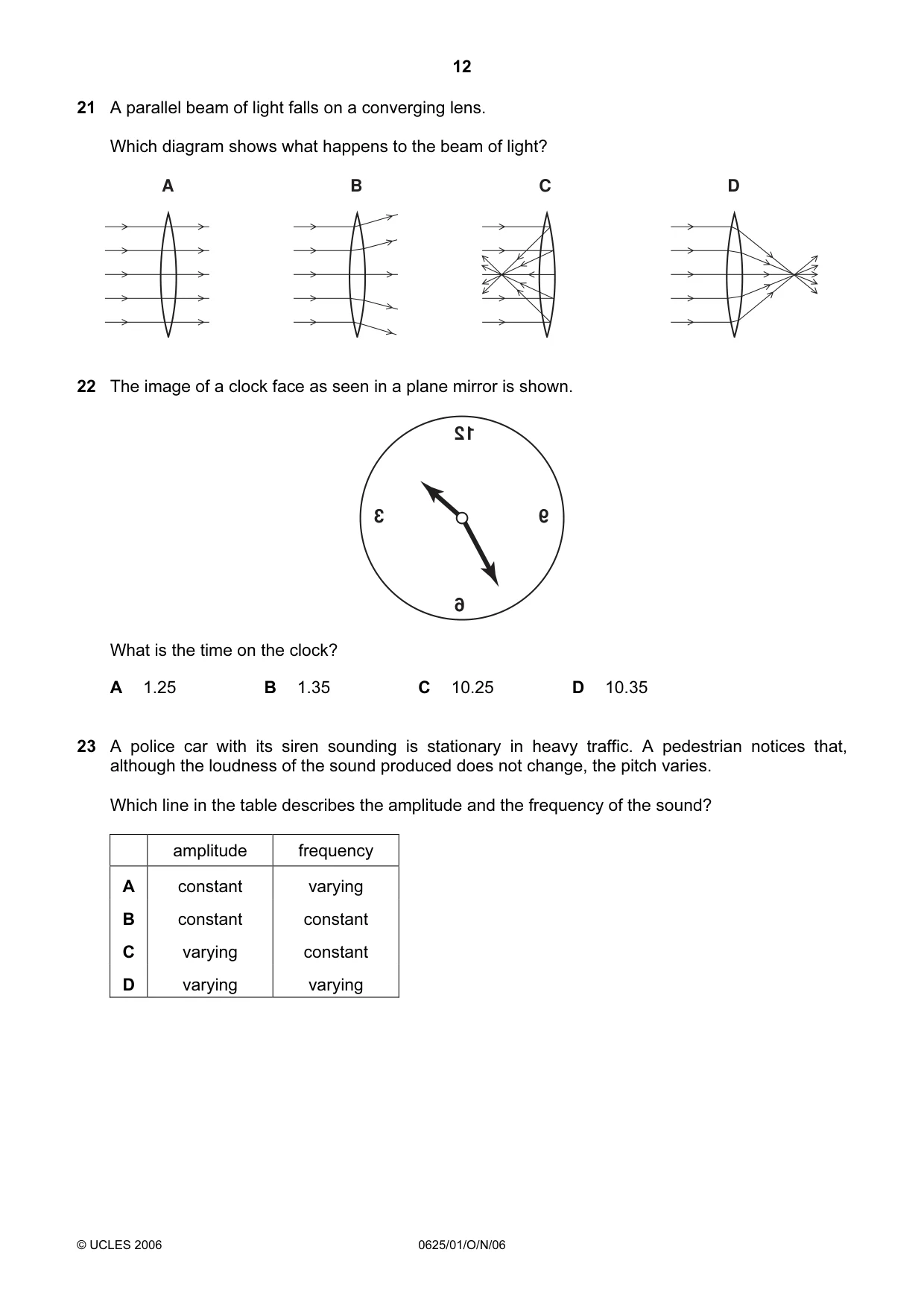
12 © UCLES 2006 0625/01/O/N/06 21 A parallel beam of light falls on a converging lens. Which diagram shows what happens to the beam of light? A B C D 22 The image of a clock face as seen in a plane mirror is shown. 12 6 3 9 What is the time on the clock? A 1.25 B 1.35 C 10.25 D 10.35 23 A police car with its siren sounding is stationary in heavy traffic. A pedestrian notices that, although the loudness of the sound produced does not change, the pitch varies. Which line in the table describes the amplitude and the frequency of the sound? amplitude frequency A constant varying B constant constant C varying constant D varying varying
Question paper, page 13
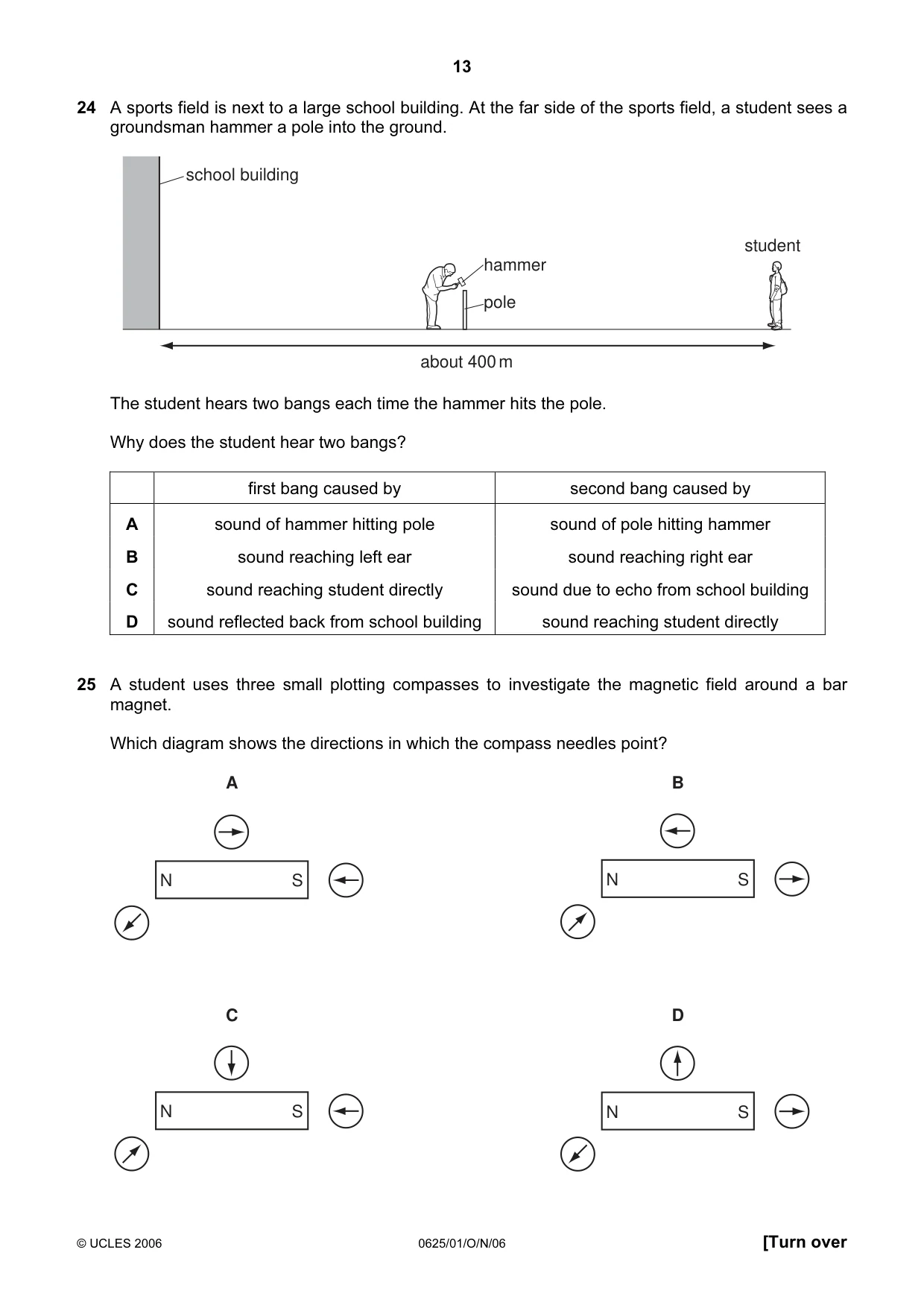
13 © UCLES 2006 0625/01/O/N/06 [Turn over 24 A sports field is next to a large school building. At the far side of the sports field, a student sees a groundsman hammer a pole into the ground. school building hammer pole about 400 m student The student hears two bangs each time the hammer hits the pole. Why does the student hear two bangs? first bang caused by second bang caused by A sound of hammer hitting pole sound of pole hitting hammer B sound reaching left ear sound reaching right ear C sound reaching student directly sound due to echo from school building D sound reflected back from school building sound reaching student directly 25 A student uses three small plotting compasses to investigate the magnetic field around a bar magnet. Which diagram shows the directions in which the compass needles point? S N A S N B S N C S N D
Question paper, page 14
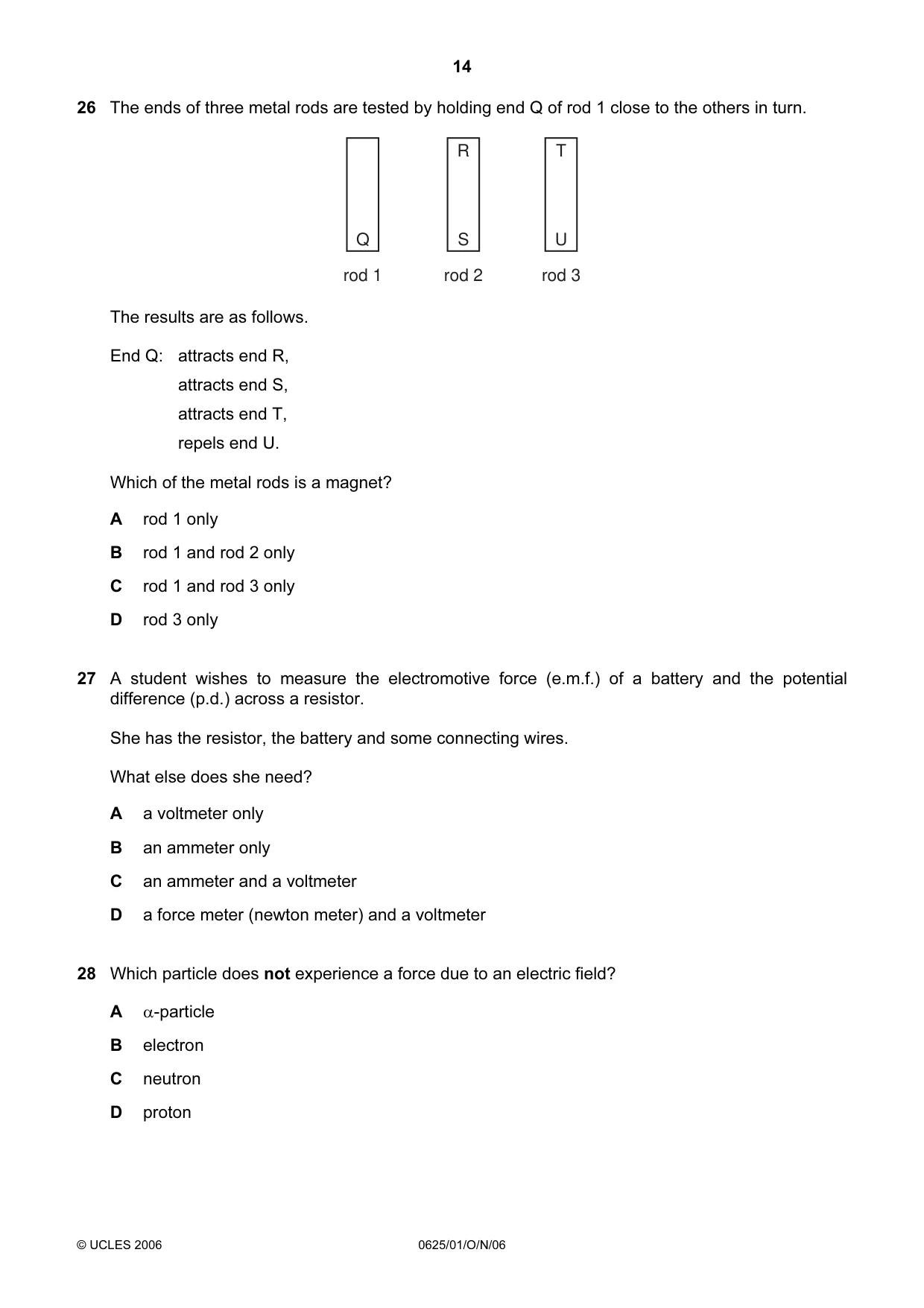
14 © UCLES 2006 0625/01/O/N/06 26 The ends of three metal rods are tested by holding end Q of rod 1 close to the others in turn. rod 1 rod 2 rod 3 Q R S T U The results are as follows. End Q: attracts end R, attracts end S, attracts end T, repels end U. Which of the metal rods is a magnet? A rod 1 only B rod 1 and rod 2 only C rod 1 and rod 3 only D rod 3 only 27 A student wishes to measure the electromotive force (e.m.f.) of a battery and the potential difference (p.d.) across a resistor. She has the resistor, the battery and some connecting wires. What else does she need? A a voltmeter only B an ammeter only C an ammeter and a voltmeter D a force meter (newton meter) and a voltmeter 28 Which particle does not experience a force due to an electric field? A α-particle B electron C neutron D proton
Question paper, page 15
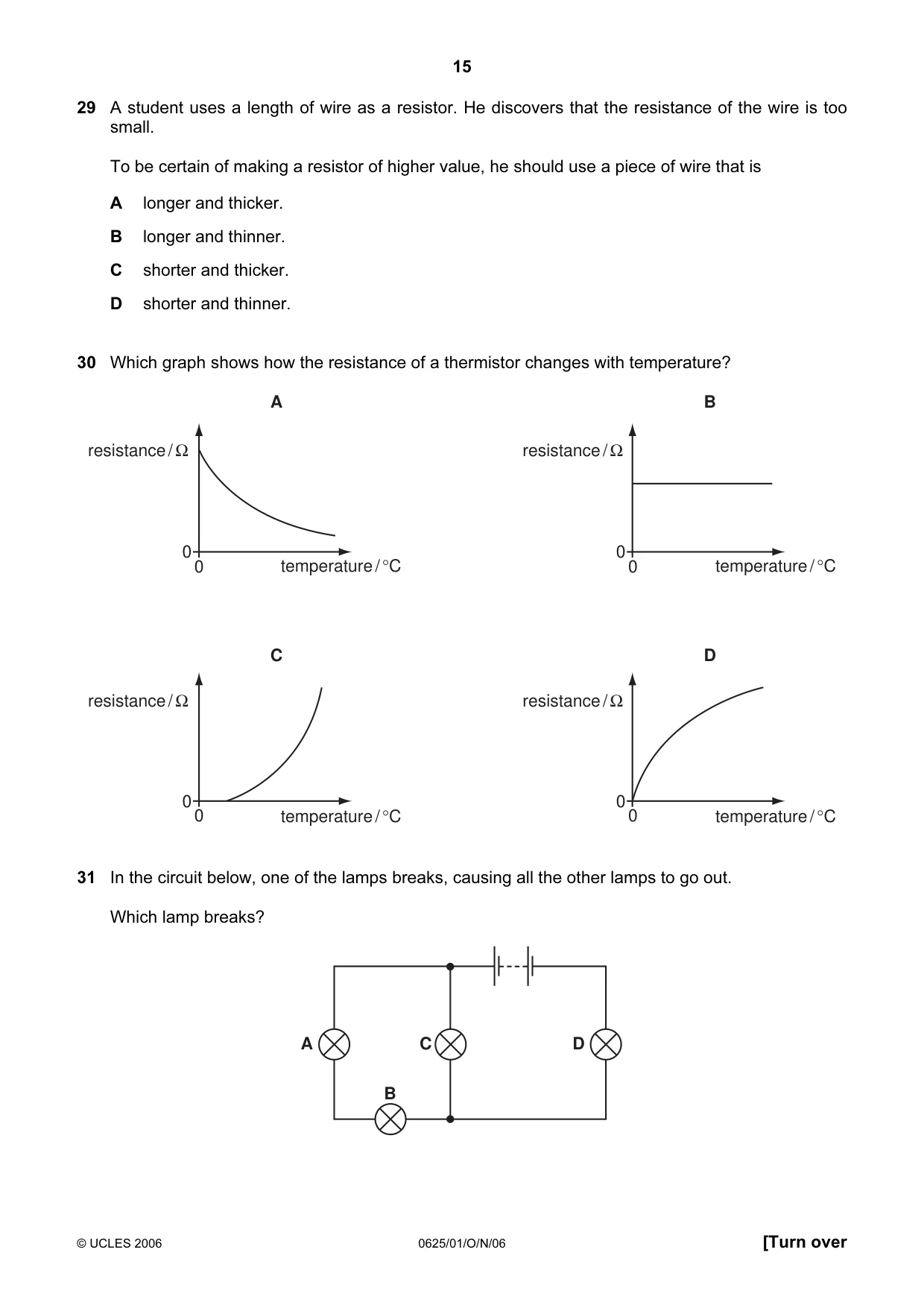
15 © UCLES 2006 0625/01/O/N/06 [Turn over 29 A student uses a length of wire as a resistor. He discovers that the resistance of the wire is too small. To be certain of making a resistor of higher value, he should use a piece of wire that is A longer and thicker. B longer and thinner. C shorter and thicker. D shorter and thinner. 30 Which graph shows how the resistance of a thermistor changes with temperature? A B C D 0 0 temperature / °C resistance / Ω temperature / °C resistance / Ω temperature / °C resistance / Ω temperature / °C resistance / Ω 0 0 0 0 0 0 31 In the circuit below, one of the lamps breaks, causing all the other lamps to go out. Which lamp breaks? A C D B
Question paper, page 16
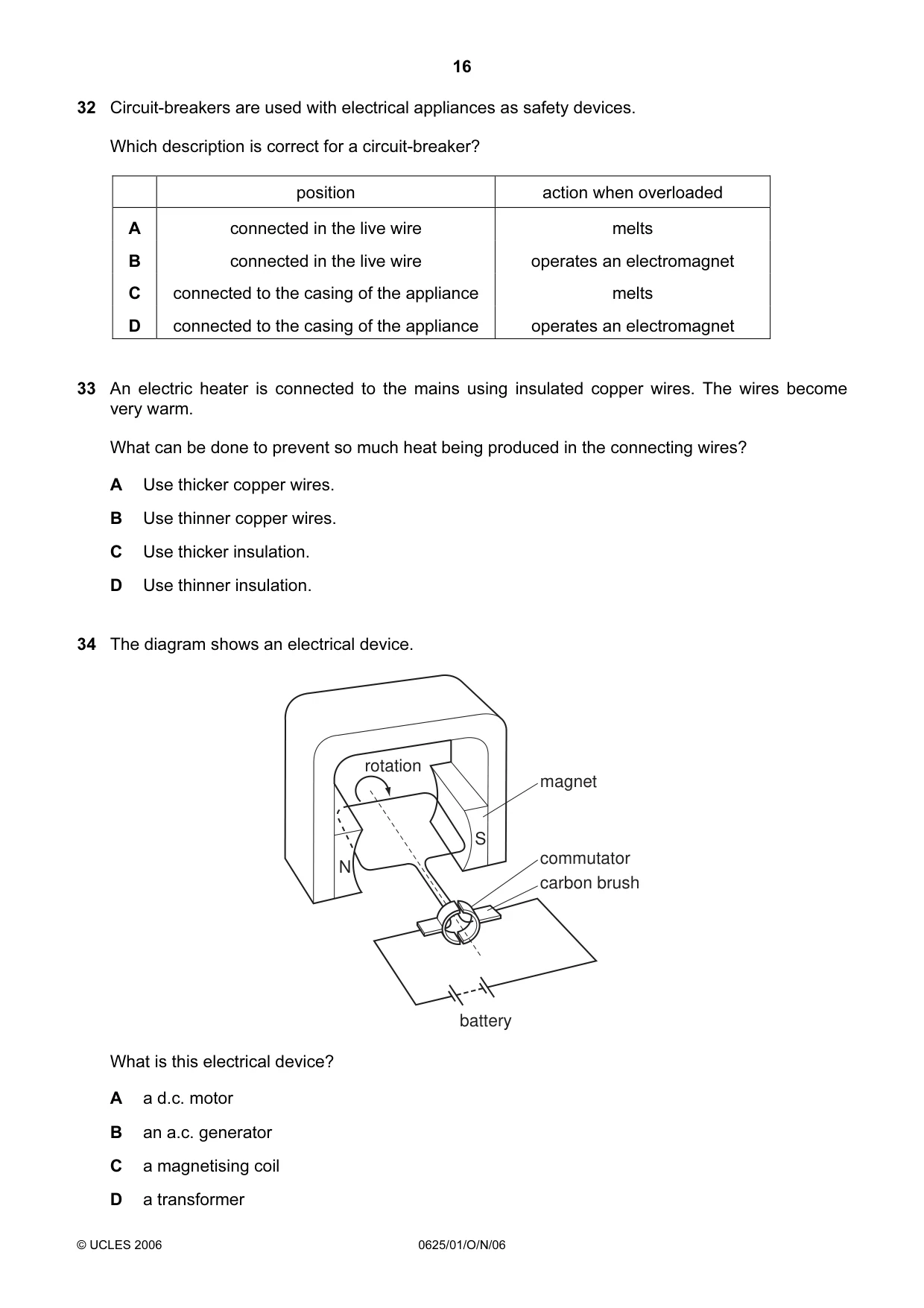
16 © UCLES 2006 0625/01/O/N/06 32 Circuit-breakers are used with electrical appliances as safety devices. Which description is correct for a circuit-breaker? position action when overloaded A connected in the live wire melts B connected in the live wire operates an electromagnet C connected to the casing of the appliance melts D connected to the casing of the appliance operates an electromagnet 33 An electric heater is connected to the mains using insulated copper wires. The wires become very warm. What can be done to prevent so much heat being produced in the connecting wires? A Use thicker copper wires. B Use thinner copper wires. C Use thicker insulation. D Use thinner insulation. 34 The diagram shows an electrical device. rotation N S magnet commutator carbon brush battery What is this electrical device? A a d.c. motor B an a.c. generator C a magnetising coil D a transformer
Question paper, page 17
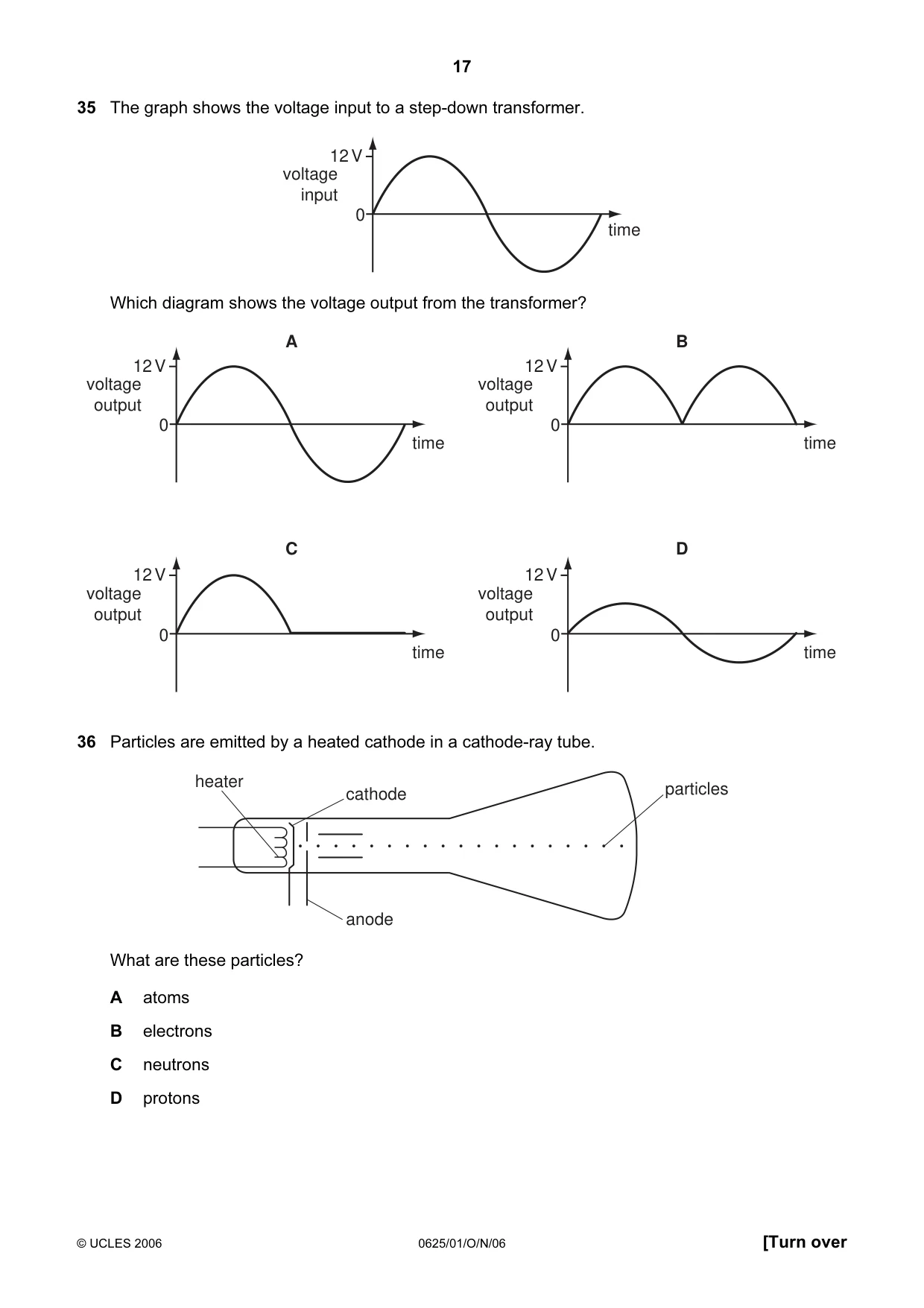
17 © UCLES 2006 0625/01/O/N/06 [Turn over 35 The graph shows the voltage input to a step-down transformer. 0 time voltage input 12 V Which diagram shows the voltage output from the transformer? A B C D 0 time voltage output 0 time voltage output 0 time voltage output 0 time voltage output 12 V 12 V 12 V 12 V 36 Particles are emitted by a heated cathode in a cathode-ray tube. particles cathode heater anode What are these particles? A atoms B electrons C neutrons D protons
Question paper, page 18
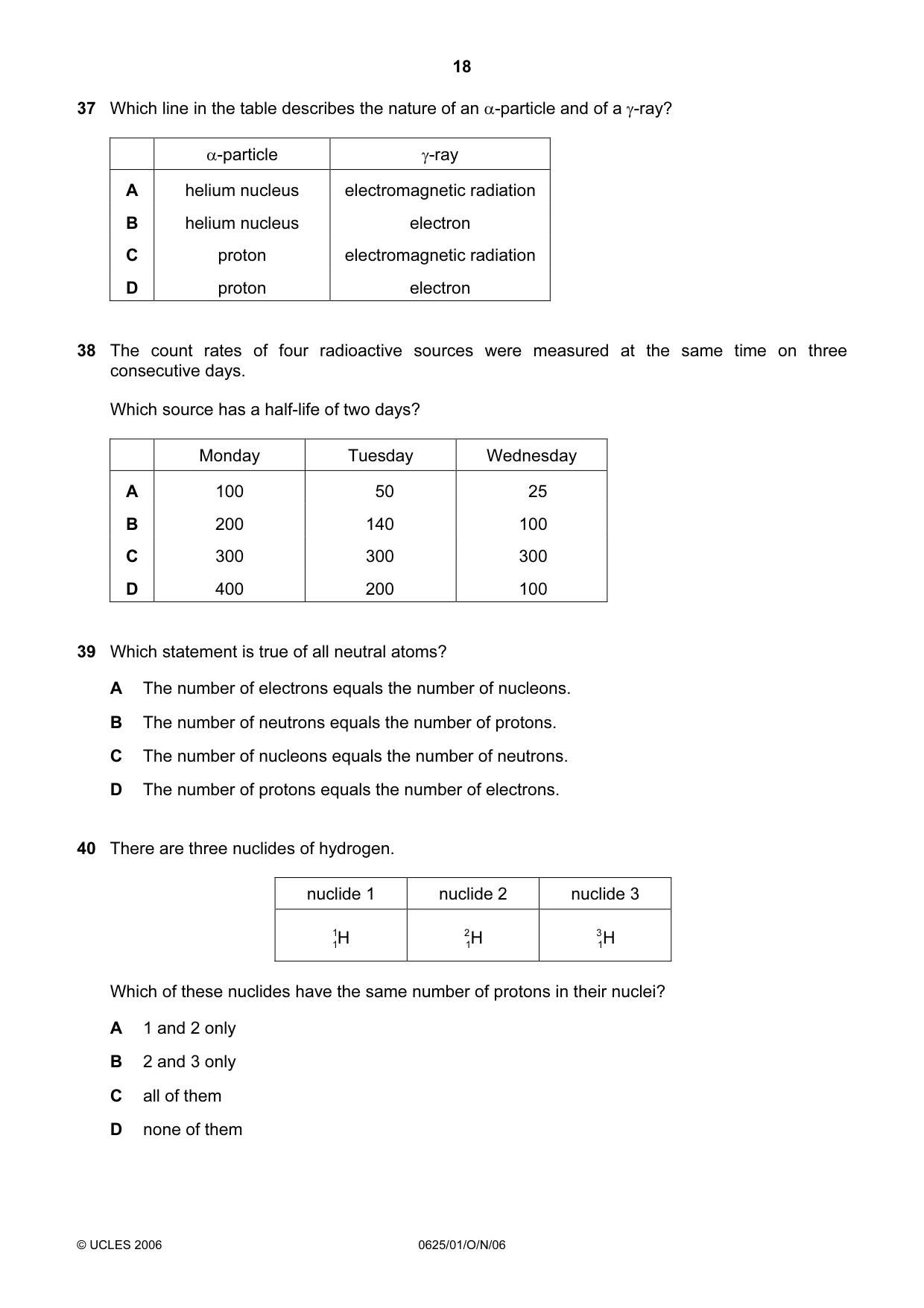
18 © UCLES 2006 0625/01/O/N/06 37 Which line in the table describes the nature of an α-particle and of a γ-ray? α-particle γ-ray A helium nucleus electromagnetic radiation B helium nucleus electron C proton electromagnetic radiation D proton electron 38 The count rates of four radioactive sources were measured at the same time on three consecutive days. Which source has a half-life of two days? Monday Tuesday Wednesday A 100 50 25 B 200 140 100 C 300 300 300 D 400 200 100 39 Which statement is true of all neutral atoms? A The number of electrons equals the number of nucleons. B The number of neutrons equals the number of protons. C The number of nucleons equals the number of neutrons. D The number of protons equals the number of electrons. 40 There are three nuclides of hydrogen. nuclide 1 nuclide 2 nuclide 3 1 1H 2 1H 3 1H Which of these nuclides have the same number of protons in their nuclei? A 1 and 2 only B 2 and 3 only C all of them D none of them
Question paper, page 20
20 Permission to reproduce items where third-party owned material protected by copyright is included has been sought and cleared where possible. Every reasonable effort has been made by the publisher (UCLES) to trace copyright holders, but if any items requiring clearance have unwittingly been included, the publisher will be pleased to make amends at the earliest possible opportunity. University of Cambridge International Examinations is part of the University of Cambridge Local Examinations Syndicate (UCLES), which is itself a department of the University of Cambridge. 0625/01/O/N/06 BLANK PAGE
Mark scheme, page 1
UNIVERSITY OF CAMBRIDGE INTERNATIONAL EXAMINATIONS GCE Advanced Subsidiary Level and GCE Advanced Level MARK SCHEME for the October/November 2006 question paper 0625 PHYSICS 0625/01 Paper 1 (Multiple Choice), maximum raw mark 40 Mark schemes must be read in conjunction with the question papers and the report on the examination. The grade thresholds for various grades are published in the report on the examination for most IGCSE, GCE Advanced Level and Advanced Subsidiary Level syllabuses. • CIE will not enter into discussions or correspondence in connection with these mark schemes. CIE is publishing the mark schemes for the October/November 2006 question papers for most IGCSE, GCE Advanced Level and Advanced Subsidiary Level syllabuses and some Ordinary Level syllabuses. www.XtremePapers.com
Mark scheme, page 2
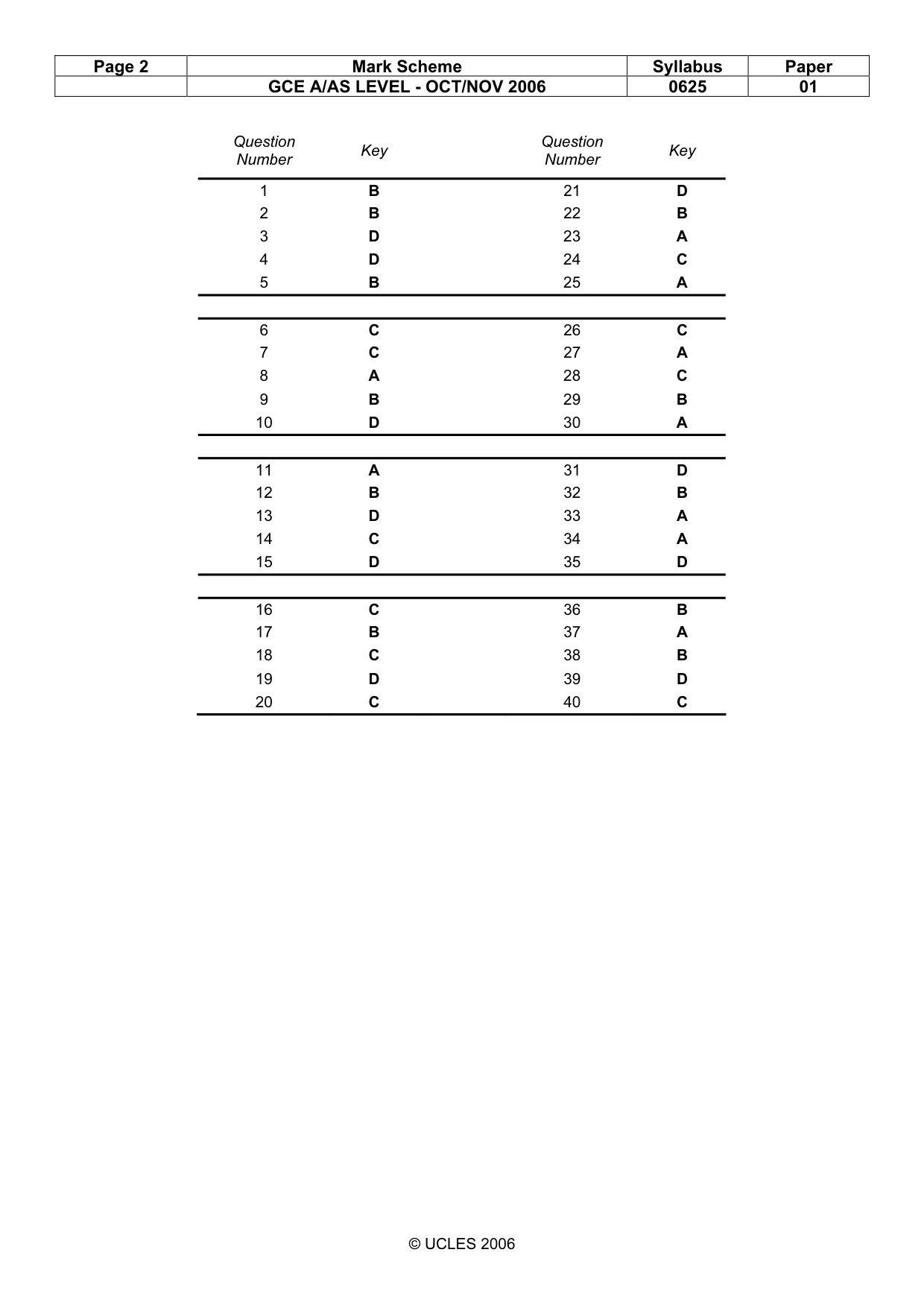
Page 2 Mark Scheme Syllabus Paper GCE A/AS LEVEL - OCT/NOV 2006 0625 01 © UCLES 2006 Question Number Key Question Number Key 1 B 21 D 2 B 22 B 3 D 23 A 4 D 24 C 5 B 25 A 6 C 26 C 7 C 27 A 8 A 28 C 9 B 29 B 10 D 30 A 11 A 31 D 12 B 32 B 13 D 33 A 14 C 34 A 15 D 35 D 16 C 36 B 17 B 37 A 18 C 38 B 19 D 39 D 20 C 40 C
What you needed in this session
Cambridge’s own grade thresholds for 2006 Oct/Nov, Paper 1 · Variant 1. A higher threshold means an easier paper — the bar moves with how the cohort did.