Cambridge IGCSE Physics 0625 — 2004 Oct/Nov Paper 1 · Variant 1
0625/11/O/N/04
The question paper and its mark scheme, free to read here and free to download. This is Cambridge’s own paper, exactly as it was sat.
Question paper16 pages

Mark scheme4 pages
Answers below. Sit the paper first if you are practising.
Paper as text
Question paper, page 1
UNIVERSITY OF CAMBRIDGE INTERNATIONAL EXAMINATIONS International General Certificate of Secondary Education PHYSICS 0625/01 Paper 1 Multiple Choice October/November 2004 45 minutes Additional Materials: Multiple Choice Answer Sheet Soft clean eraser Soft pencil (type B or HB is recommended) READ THESE INSTRUCTIONS FIRST Write in soft pencil. Do not use staples, paper clips, highlighters, glue or correction fluid. Write your name, Centre number and candidate number on the Answer Sheet in the spaces provided unless this has been done for you. There are forty questions on this paper. Answer all questions. For each question there are four possible answers A, B, C, and D. Choose the one you consider correct and record your choice in soft pencil on the separate Answer Sheet. Read the instructions on the Answer Sheet very carefully. Each correct answer will score one mark. A mark will not be deducted for a wrong answer. Any rough working should be done in this booklet. This document consists of 14 printed pages and 2 blank pages. IB04 11_0625_01/2RP UCLES 2004 [Turn over www.XtremePapers.com
Question paper, page 2
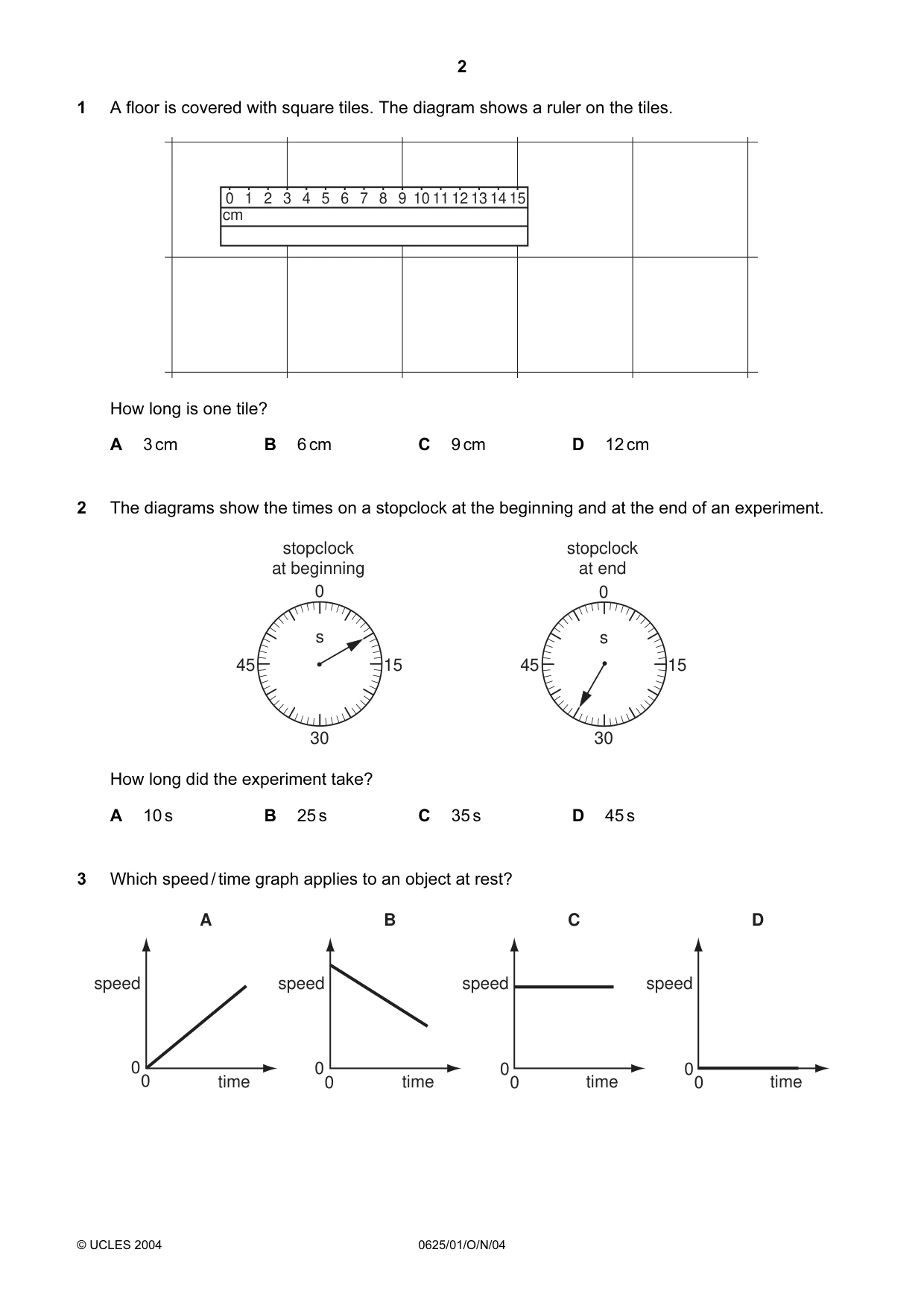
2 © UCLES 2004 0625/01/O/N/04 1 A floor is covered with square tiles. The diagram shows a ruler on the tiles. 0 cm 2 4 6 8 10 12 14 1 3 5 7 9 11 13 15 How long is one tile? A 3 cm B 6 cm C 9 cm D 12 cm 2 The diagrams show the times on a stopclock at the beginning and at the end of an experiment. stopclock at beginning stopclock at end 0 s 30 45 15 0 s 30 45 15 How long did the experiment take? A 10 s B 25 s C 35 s D 45 s 3 Which speed / time graph applies to an object at rest? speed time A speed time B speed time C speed time D 0 0 0 0 0 0 0 0
Question paper, page 3
3 © UCLES 2004 0625/01/O/N/04 [Turn over 4 A racing car is fitted with an on-board computer. Every time the car passes the starting line, the computer records the distance travelled in the next 2 seconds. Which set of data shows that the car is increasing in speed during the 2 seconds? A B time / s distance travelled / m time / s distance travelled / m 0 0 0 0 1 100 1 90 2 200 2 180 C D time / s distance travelled / m time / s distance travelled / m 0 0 0 0 1 80 1 100 2 190 2 180 5 A spring is stretched by hanging a piece of metal from it. spring metal What is the name given to the force that stretches the spring? A friction B mass C pressure D weight
Question paper, page 4
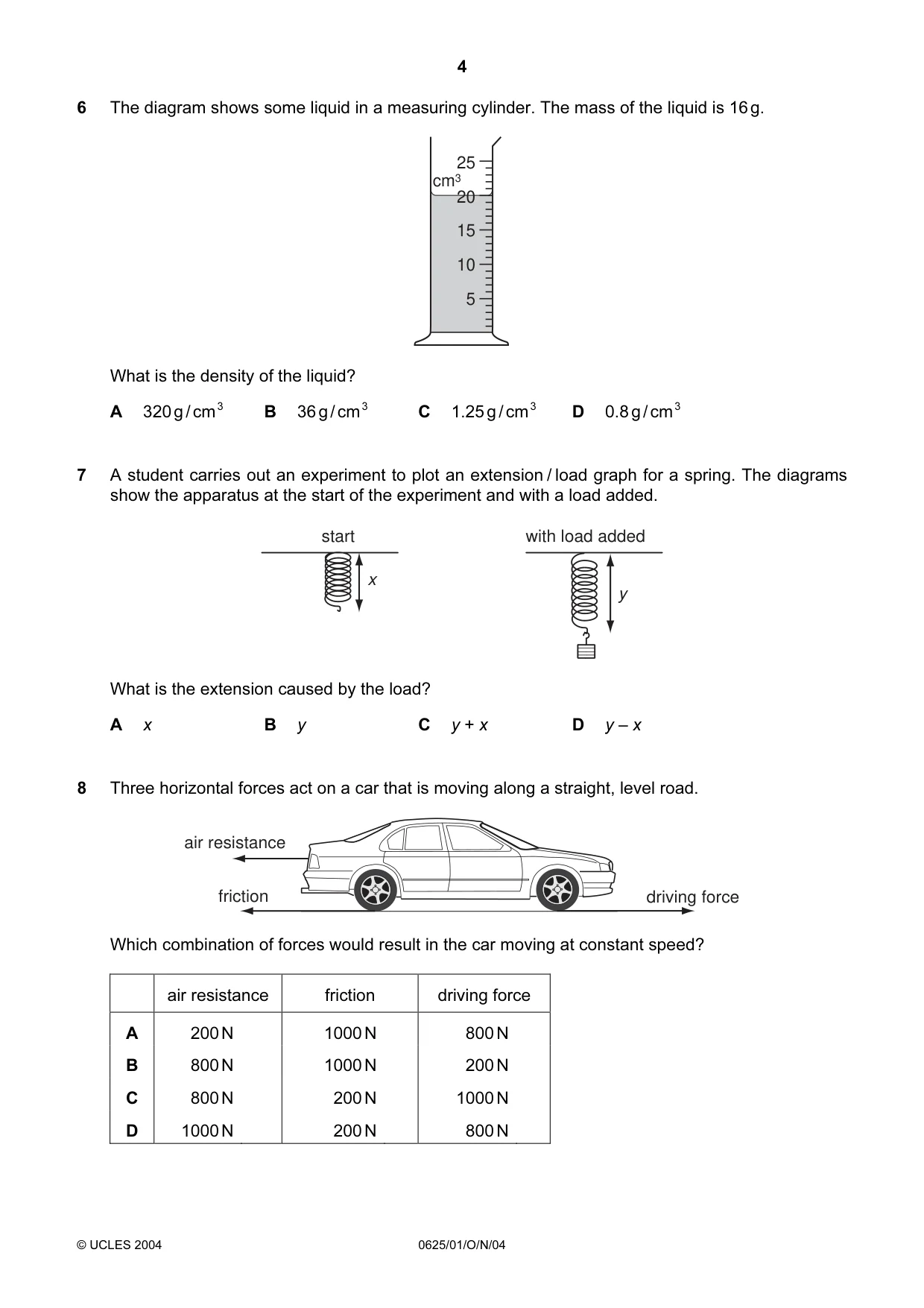
4 © UCLES 2004 0625/01/O/N/04 6 The diagram shows some liquid in a measuring cylinder. The mass of the liquid is 16 g. 25 20 15 10 5 cm3 What is the density of the liquid? A 320 g / cm 3 B 36 g / cm 3 C 1.25 g / cm 3 D 0.8 g / cm 3 7 A student carries out an experiment to plot an extension / load graph for a spring. The diagrams show the apparatus at the start of the experiment and with a load added. start x y with load added What is the extension caused by the load? A x B y C y + x D y – x 8 Three horizontal forces act on a car that is moving along a straight, level road. air resistance friction driving force Which combination of forces would result in the car moving at constant speed? air resistance friction driving force A 200 N 1000 N 800 N B 800 N 1000 N 200 N C 800 N 200 N 1000 N D 1000 N 200 N 800 N
Question paper, page 5
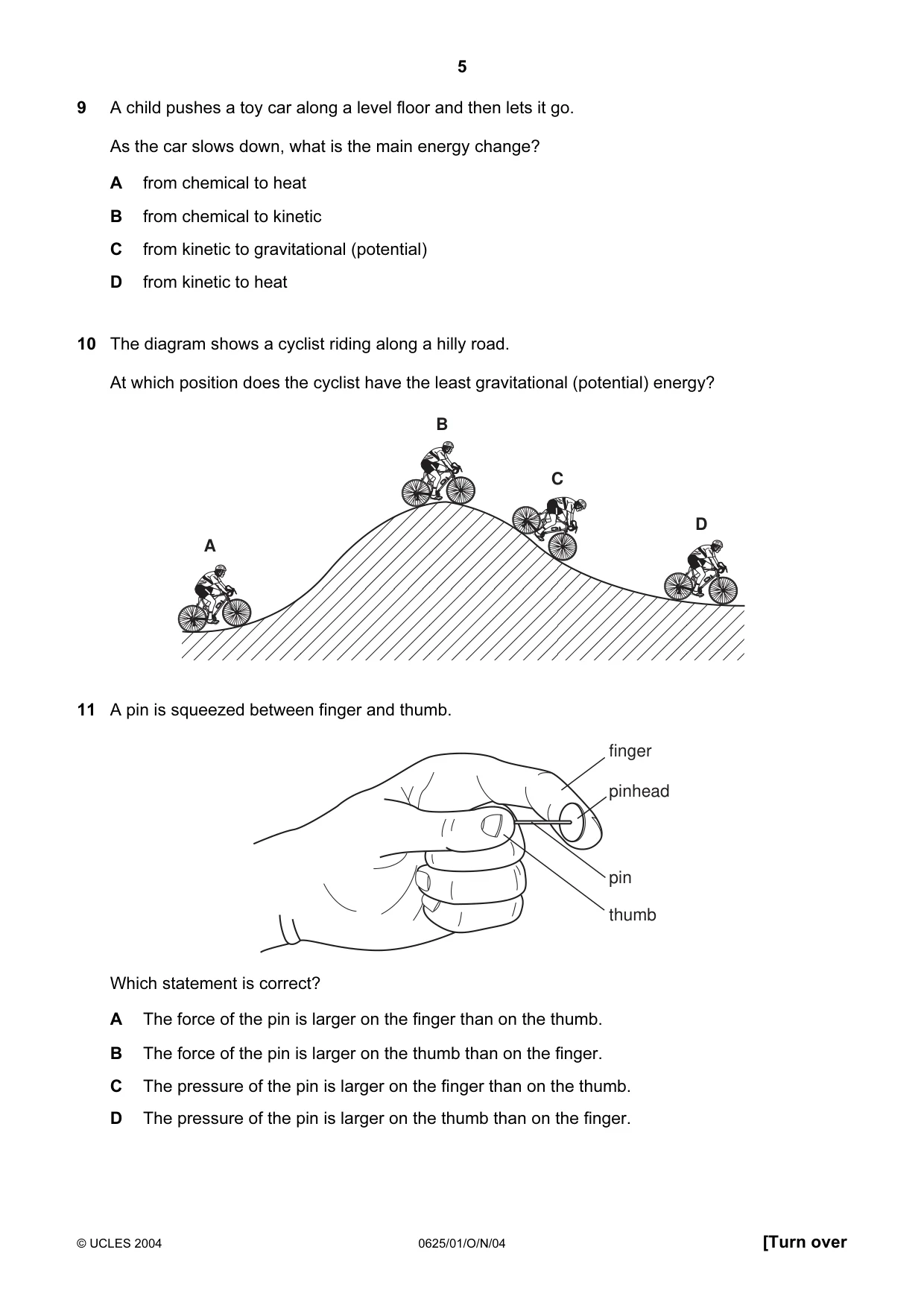
5 © UCLES 2004 0625/01/O/N/04 [Turn over 9 A child pushes a toy car along a level floor and then lets it go. As the car slows down, what is the main energy change? A from chemical to heat B from chemical to kinetic C from kinetic to gravitational (potential) D from kinetic to heat 10 The diagram shows a cyclist riding along a hilly road. At which position does the cyclist have the least gravitational (potential) energy? A B C D 11 A pin is squeezed between finger and thumb. finger pinhead pin thumb Which statement is correct? A The force of the pin is larger on the finger than on the thumb. B The force of the pin is larger on the thumb than on the finger. C The pressure of the pin is larger on the finger than on the thumb. D The pressure of the pin is larger on the thumb than on the finger.
Question paper, page 6
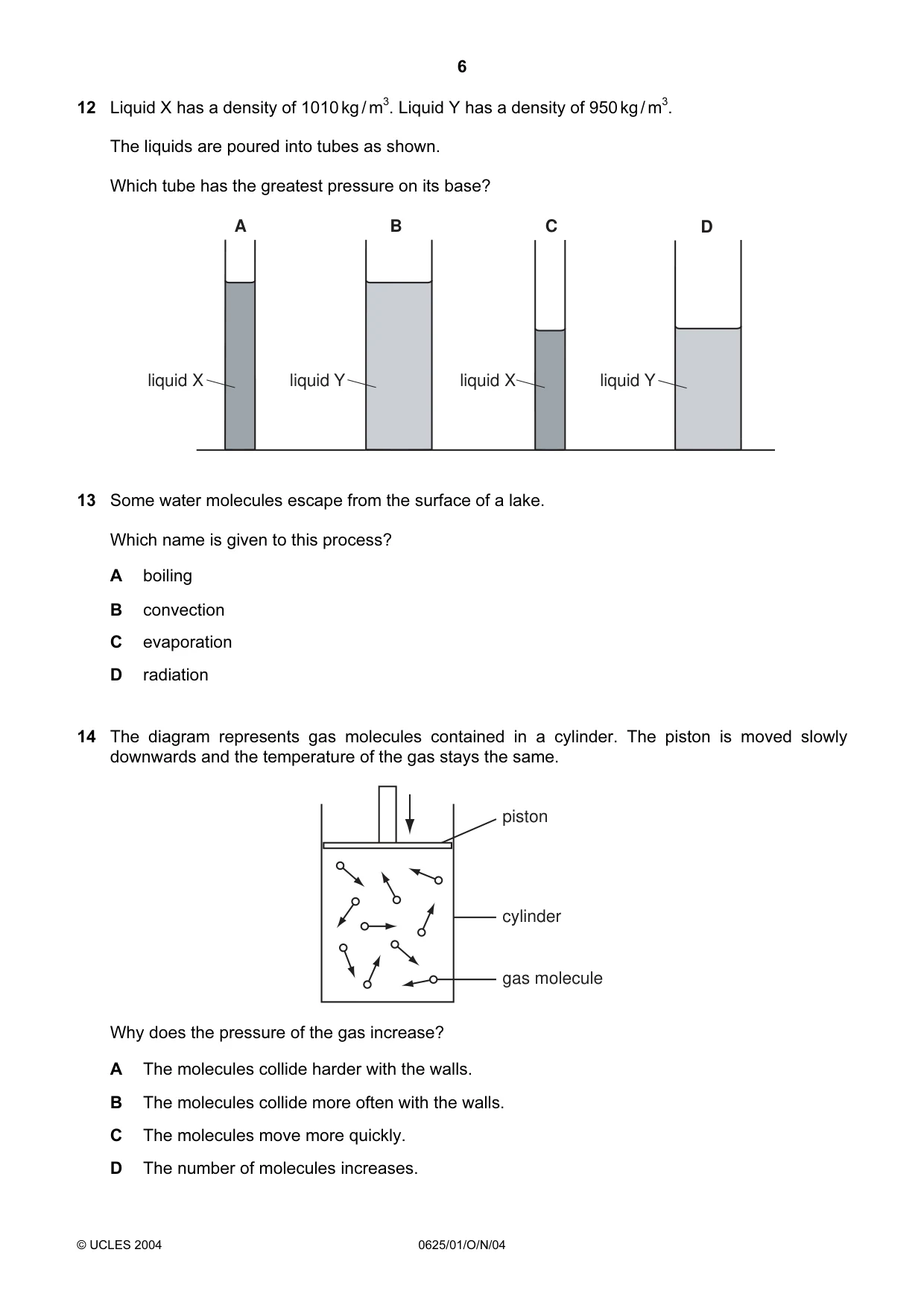
6 © UCLES 2004 0625/01/O/N/04 12 Liquid X has a density of 1010 kg / m3. Liquid Y has a density of 950 kg / m3. The liquids are poured into tubes as shown. Which tube has the greatest pressure on its base? A liquid X B liquid Y C liquid X D liquid Y 13 Some water molecules escape from the surface of a lake. Which name is given to this process? A boiling B convection C evaporation D radiation 14 The diagram represents gas molecules contained in a cylinder. The piston is moved slowly downwards and the temperature of the gas stays the same. piston cylinder gas molecule Why does the pressure of the gas increase? A The molecules collide harder with the walls. B The molecules collide more often with the walls. C The molecules move more quickly. D The number of molecules increases.
Question paper, page 7
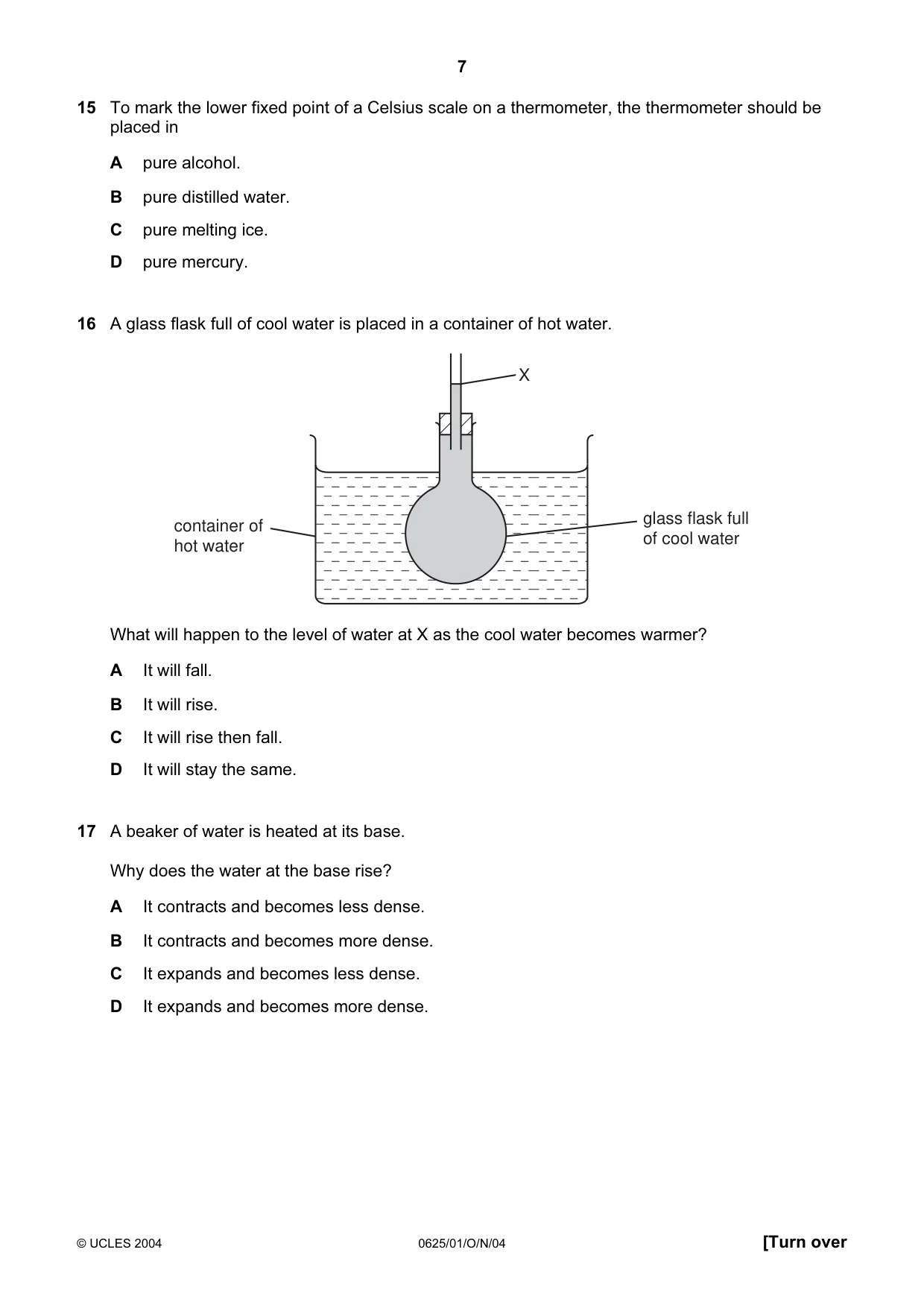
7 © UCLES 2004 0625/01/O/N/04 [Turn over 15 To mark the lower fixed point of a Celsius scale on a thermometer, the thermometer should be placed in A pure alcohol. B pure distilled water. C pure melting ice. D pure mercury. 16 A glass flask full of cool water is placed in a container of hot water. container of hot water glass flask full of cool water X What will happen to the level of water at X as the cool water becomes warmer? A It will fall. B It will rise. C It will rise then fall. D It will stay the same. 17 A beaker of water is heated at its base. Why does the water at the base rise? A It contracts and becomes less dense. B It contracts and becomes more dense. C It expands and becomes less dense. D It expands and becomes more dense.
Question paper, page 8
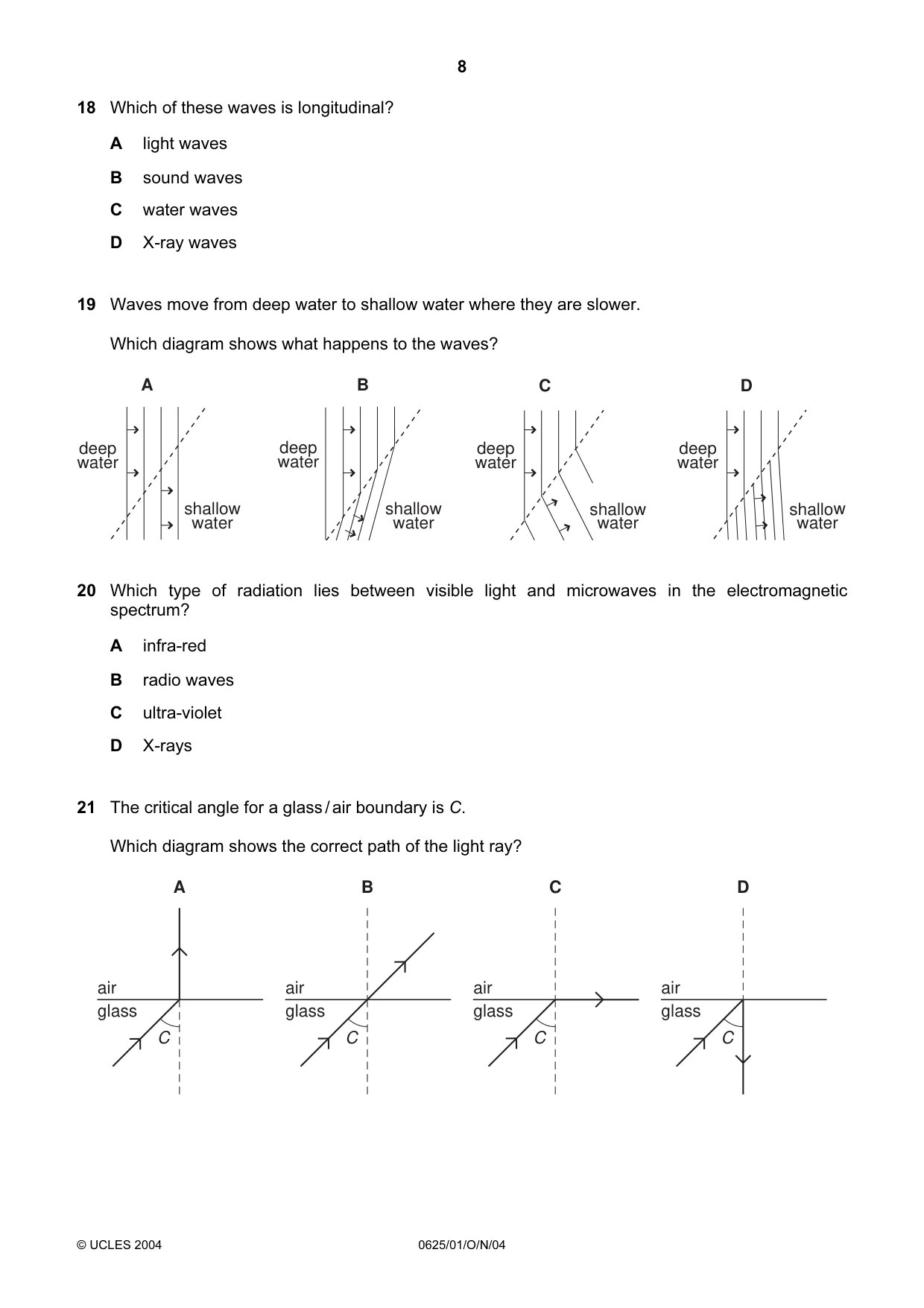
8 © UCLES 2004 0625/01/O/N/04 18 Which of these waves is longitudinal? A light waves B sound waves C water waves D X-ray waves 19 Waves move from deep water to shallow water where they are slower. Which diagram shows what happens to the waves? D deep water shallow water C deep water shallow water B deep water shallow water deep water A shallow water 20 Which type of radiation lies between visible light and microwaves in the electromagnetic spectrum? A infra-red B radio waves C ultra-violet D X-rays 21 The critical angle for a glass / air boundary is C. Which diagram shows the correct path of the light ray? air glass C A air glass C B air glass C C air glass C D
Question paper, page 9
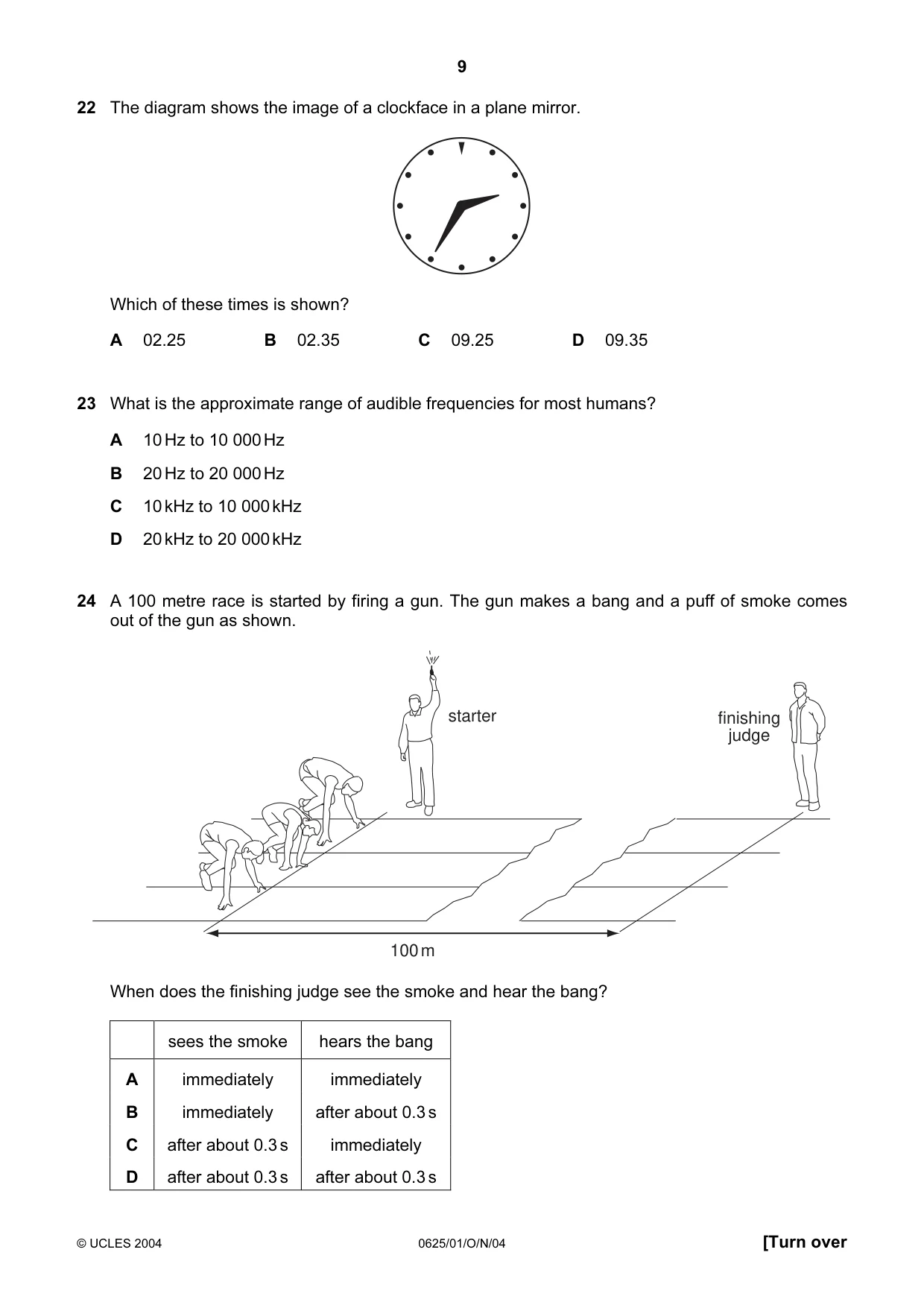
9 © UCLES 2004 0625/01/O/N/04 [Turn over 22 The diagram shows the image of a clockface in a plane mirror. Which of these times is shown? A 02.25 B 02.35 C 09.25 D 09.35 23 What is the approximate range of audible frequencies for most humans? A 10 Hz to 10 000 Hz B 20 Hz to 20 000 Hz C 10 kHz to 10 000 kHz D 20 kHz to 20 000 kHz 24 A 100 metre race is started by firing a gun. The gun makes a bang and a puff of smoke comes out of the gun as shown. starter finishing judge 100 m When does the finishing judge see the smoke and hear the bang? sees the smoke hears the bang A immediately immediately B immediately after about 0.3 s C after about 0.3 s immediately D after about 0.3 s after about 0.3 s
Question paper, page 10
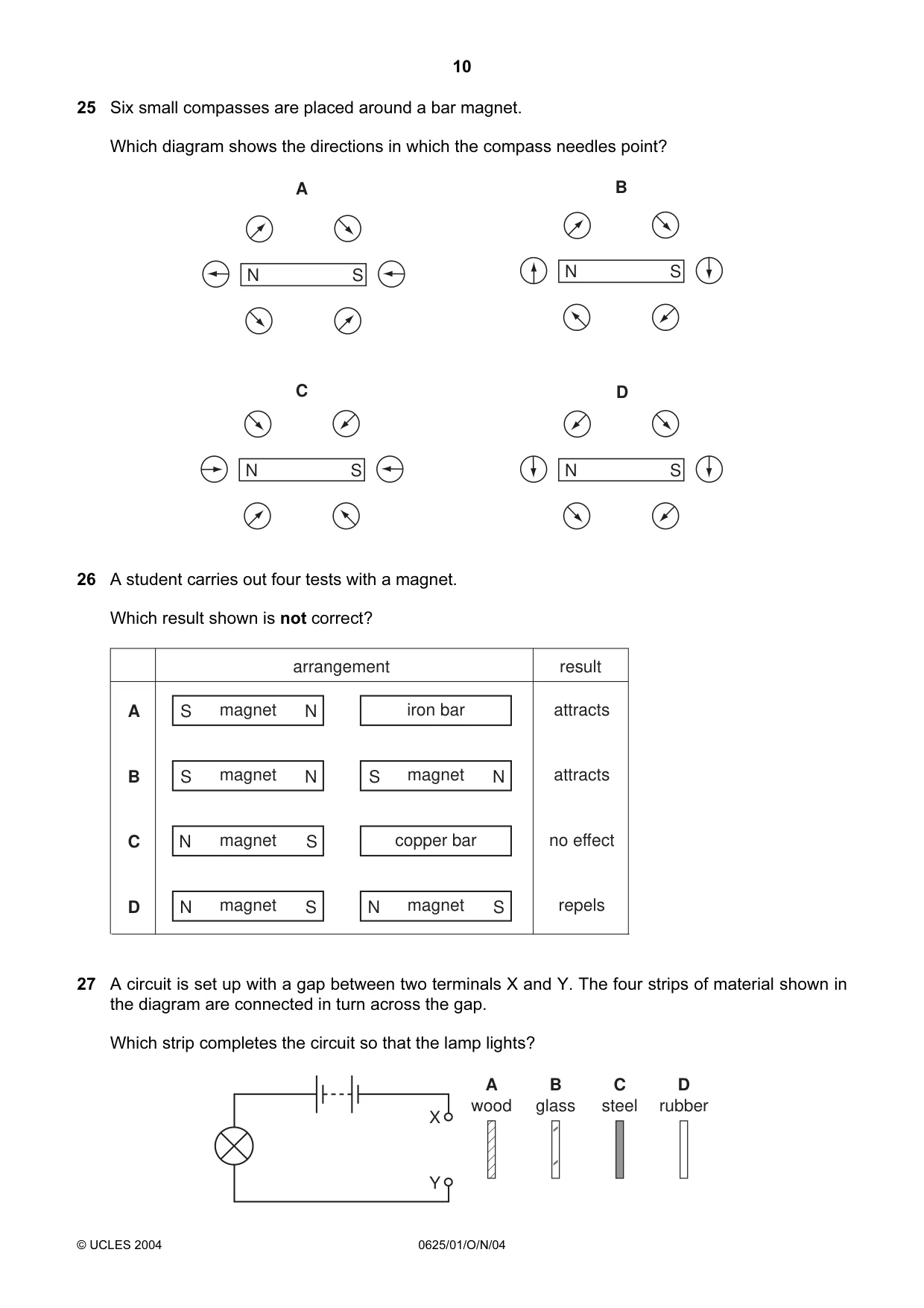
10 © UCLES 2004 0625/01/O/N/04 25 Six small compasses are placed around a bar magnet. Which diagram shows the directions in which the compass needles point? N S N S N S N S A C B D 26 A student carries out four tests with a magnet. Which result shown is not correct? magnet iron bar attracts N S A magnet magnet attracts N N S S B magnet copper bar no effect N S C magnet magnet repels S N S N D arrangement result 27 A circuit is set up with a gap between two terminals X and Y. The four strips of material shown in the diagram are connected in turn across the gap. Which strip completes the circuit so that the lamp lights? wood A steel C rubber D X Y glass B
Question paper, page 11
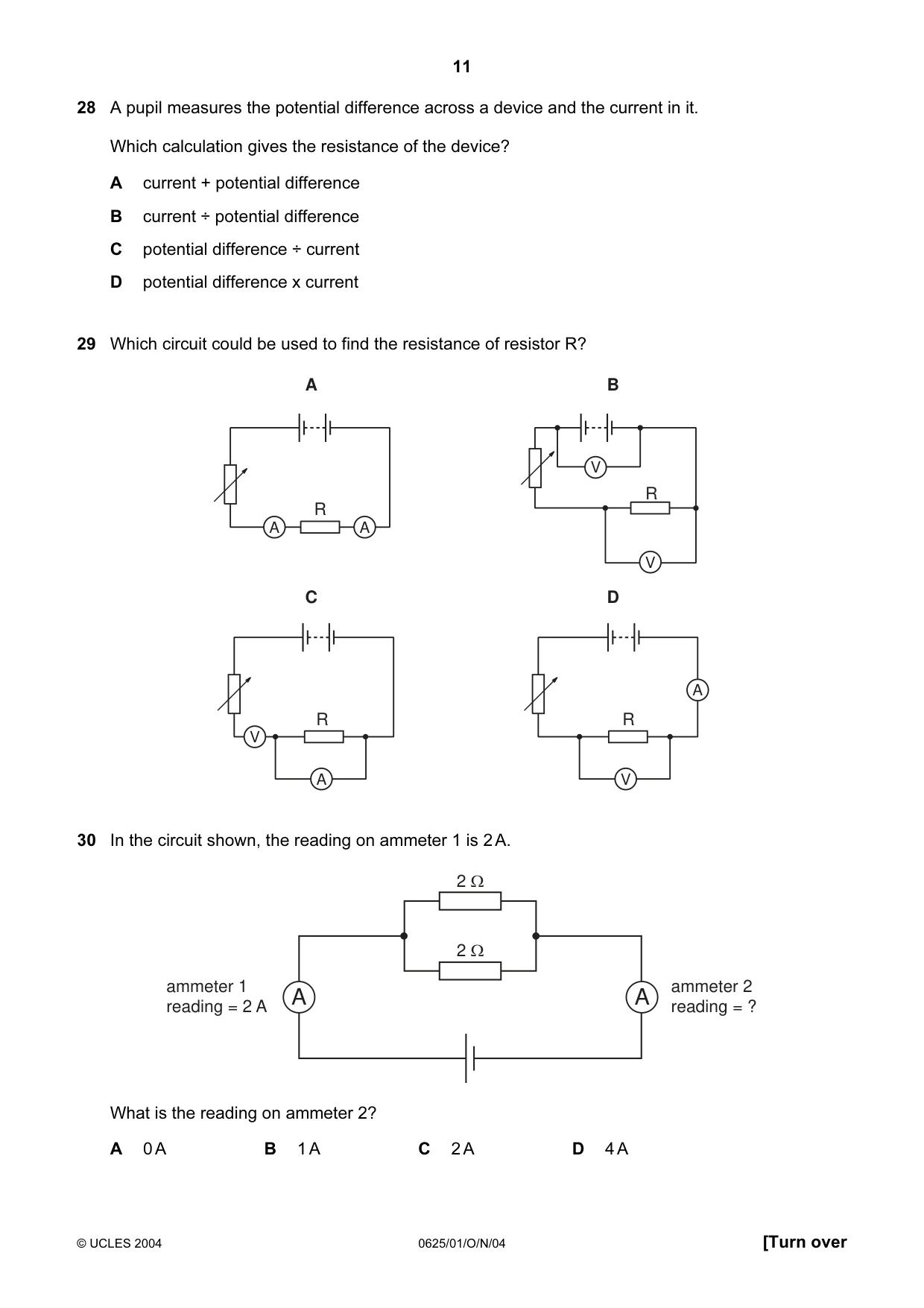
11 © UCLES 2004 0625/01/O/N/04 [Turn over 28 A pupil measures the potential difference across a device and the current in it. Which calculation gives the resistance of the device? A current + potential difference B current ÷ potential difference C potential difference ÷ current D potential difference x current 29 Which circuit could be used to find the resistance of resistor R? B V V R A A A R C A V R D A R V 30 In the circuit shown, the reading on ammeter 1 is 2 A. 2 Ω 2 Ω ammeter 1 reading = 2 A ammeter 2 reading = ? A A What is the reading on ammeter 2? A 0 A B 1 A C 2 A D 4 A
Question paper, page 12
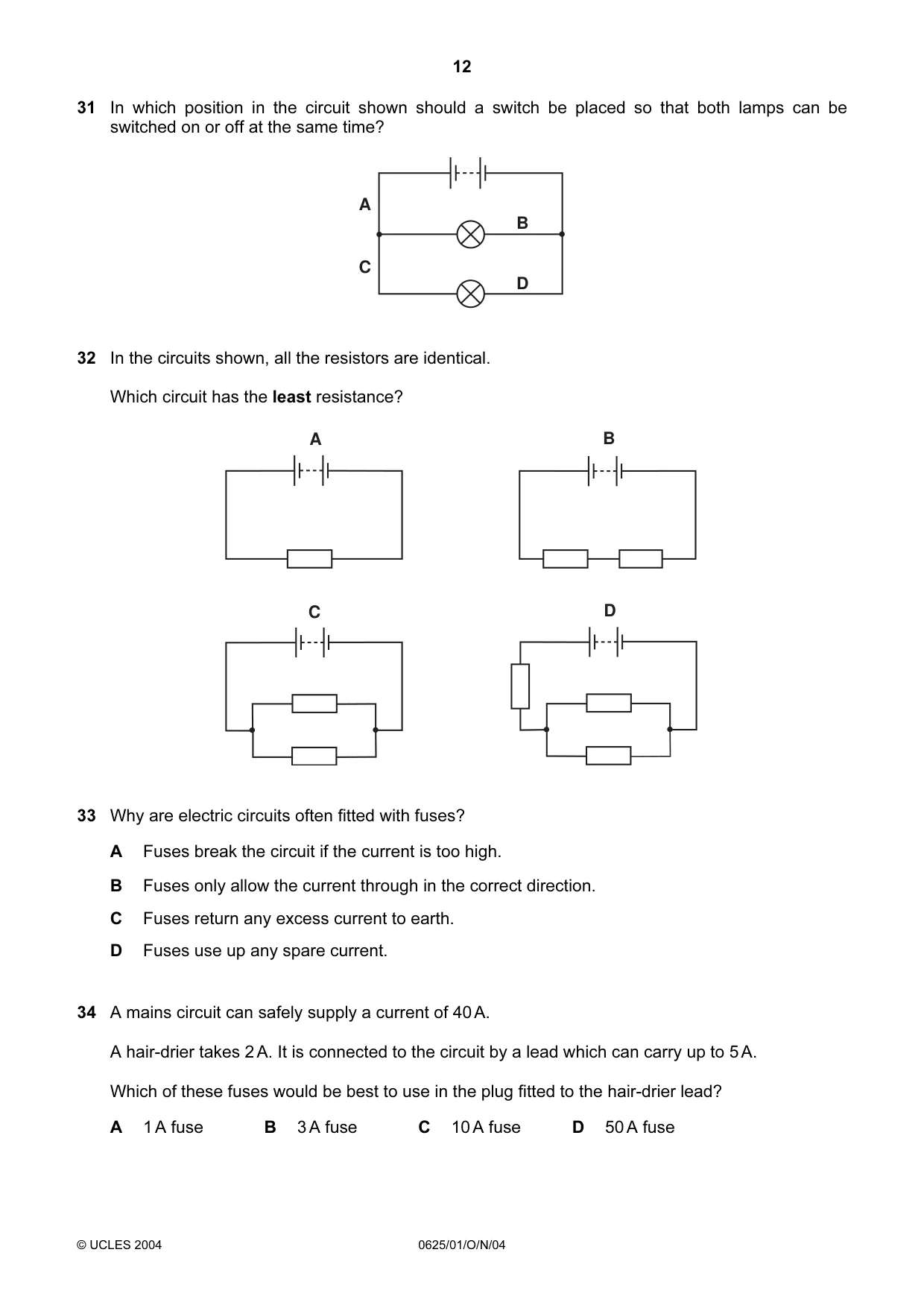
12 © UCLES 2004 0625/01/O/N/04 31 In which position in the circuit shown should a switch be placed so that both lamps can be switched on or off at the same time? A C D B 32 In the circuits shown, all the resistors are identical. Which circuit has the least resistance? A B C D 33 Why are electric circuits often fitted with fuses? A Fuses break the circuit if the current is too high. B Fuses only allow the current through in the correct direction. C Fuses return any excess current to earth. D Fuses use up any spare current. 34 A mains circuit can safely supply a current of 40 A. A hair-drier takes 2 A. It is connected to the circuit by a lead which can carry up to 5 A. Which of these fuses would be best to use in the plug fitted to the hair-drier lead? A 1 A fuse B 3 A fuse C 10 A fuse D 50 A fuse
Question paper, page 13
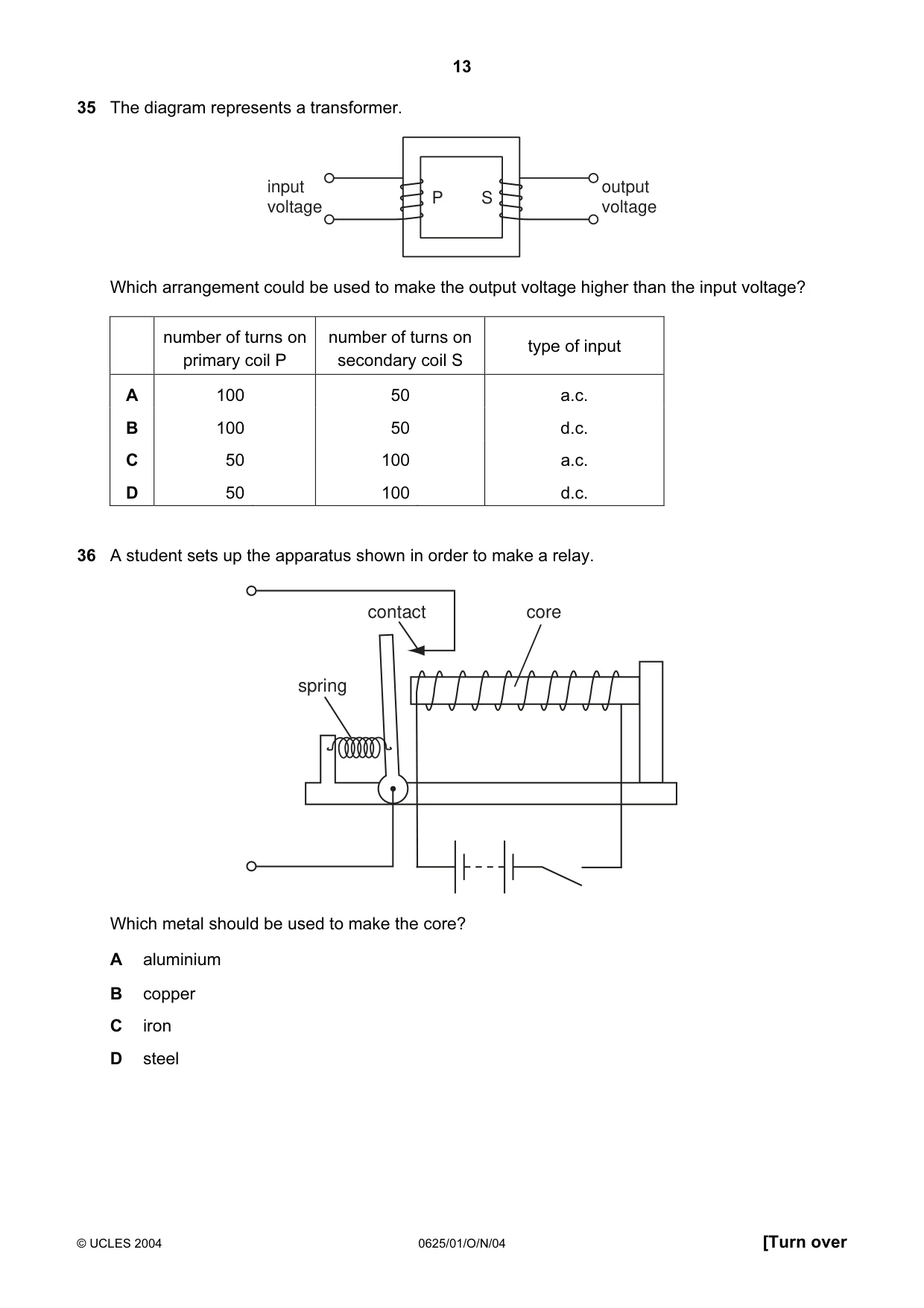
13 © UCLES 2004 0625/01/O/N/04 [Turn over 35 The diagram represents a transformer. input voltage P S output voltage Which arrangement could be used to make the output voltage higher than the input voltage? number of turns on primary coil P number of turns on secondary coil S type of input A 100 50 a.c. B 100 50 d.c. C 50 100 a.c. D 50 100 d.c. 36 A student sets up the apparatus shown in order to make a relay. core spring contact Which metal should be used to make the core? A aluminium B copper C iron D steel
Question paper, page 14
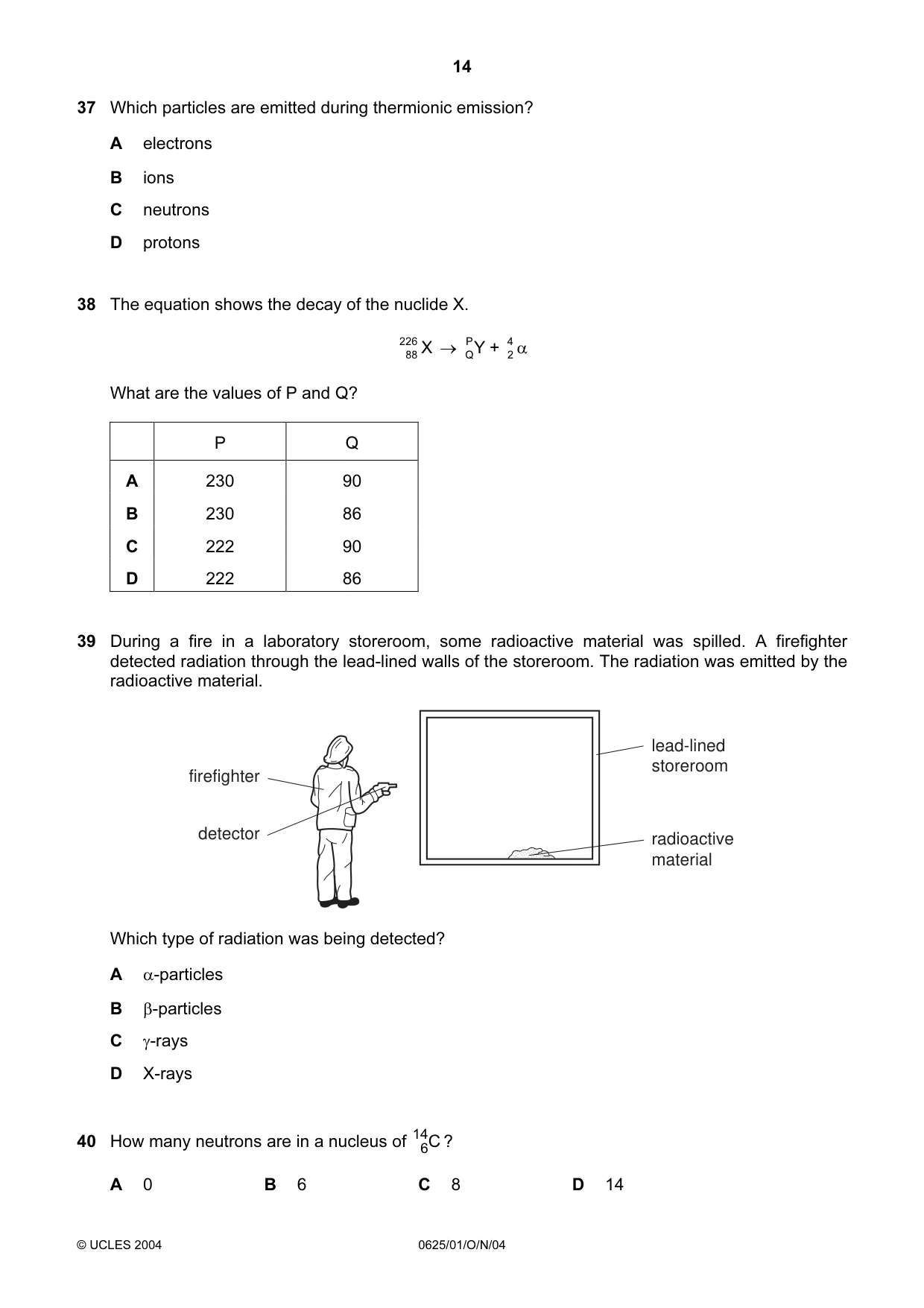
14 © UCLES 2004 0625/01/O/N/04 37 Which particles are emitted during thermionic emission? A electrons B ions C neutrons D protons 38 The equation shows the decay of the nuclide X. X 226 88 → Y P Q + 4 2 α What are the values of P and Q? P Q A 230 90 B 230 86 C 222 90 D 222 86 39 During a fire in a laboratory storeroom, some radioactive material was spilled. A firefighter detected radiation through the lead-lined walls of the storeroom. The radiation was emitted by the radioactive material. lead-lined storeroom radioactive material detector firefighter Which type of radiation was being detected? A α-particles B β-particles C γ-rays D X-rays 40 How many neutrons are in a nucleus of C 14 6 ? A 0 B 6 C 8 D 14
Question paper, page 16
16 Every reasonable effort has been made to trace all copyright holders where the publishers (i.e. UCLES) are aware that third-party material has been reproduced. The publishers would be pleased to hear from anyone whose rights they have unwittingly infringed. University of Cambridge International Examinations is part of the University of Cambridge Local Examinations Syndicate (UCLES), which is itself a department of the University of Cambridge. 0625/01/O/N/04 BLANK PAGE
Mark scheme, page 1
UNIVERSITY OF CAMBRIDGE INTERNATIONAL EXAMINATIONS International General Certificate of Secondary Education MARK SCHEME for the November 2004 question paper 0625 PHYSICS 0625/01 Paper 1 (Multiple Choice), maximum mark 40 This mark scheme is published as an aid to teachers and students, to indicate the requirements of the examination. It shows the basis on which Examiners were initially instructed to award marks. It does not indicate the details of the discussions that took place at an Examiners’ meeting before marking began. Any substantial changes to the mark scheme that arose from these discussions will be recorded in the published Report on the Examination. All Examiners are instructed that alternative correct answers and unexpected approaches in candidates’ scripts must be given marks that fairly reflect the relevant knowledge and skills demonstrated. Mark schemes must be read in conjunction with the question papers and the Report on the Examination. • CIE will not enter into discussion or correspondence in connection with these mark schemes. CIE is publishing the mark schemes for the November 2004 question papers for most IGCSE and GCE Advanced Level syllabuses. www.XtremePapers.com
Mark scheme, page 2
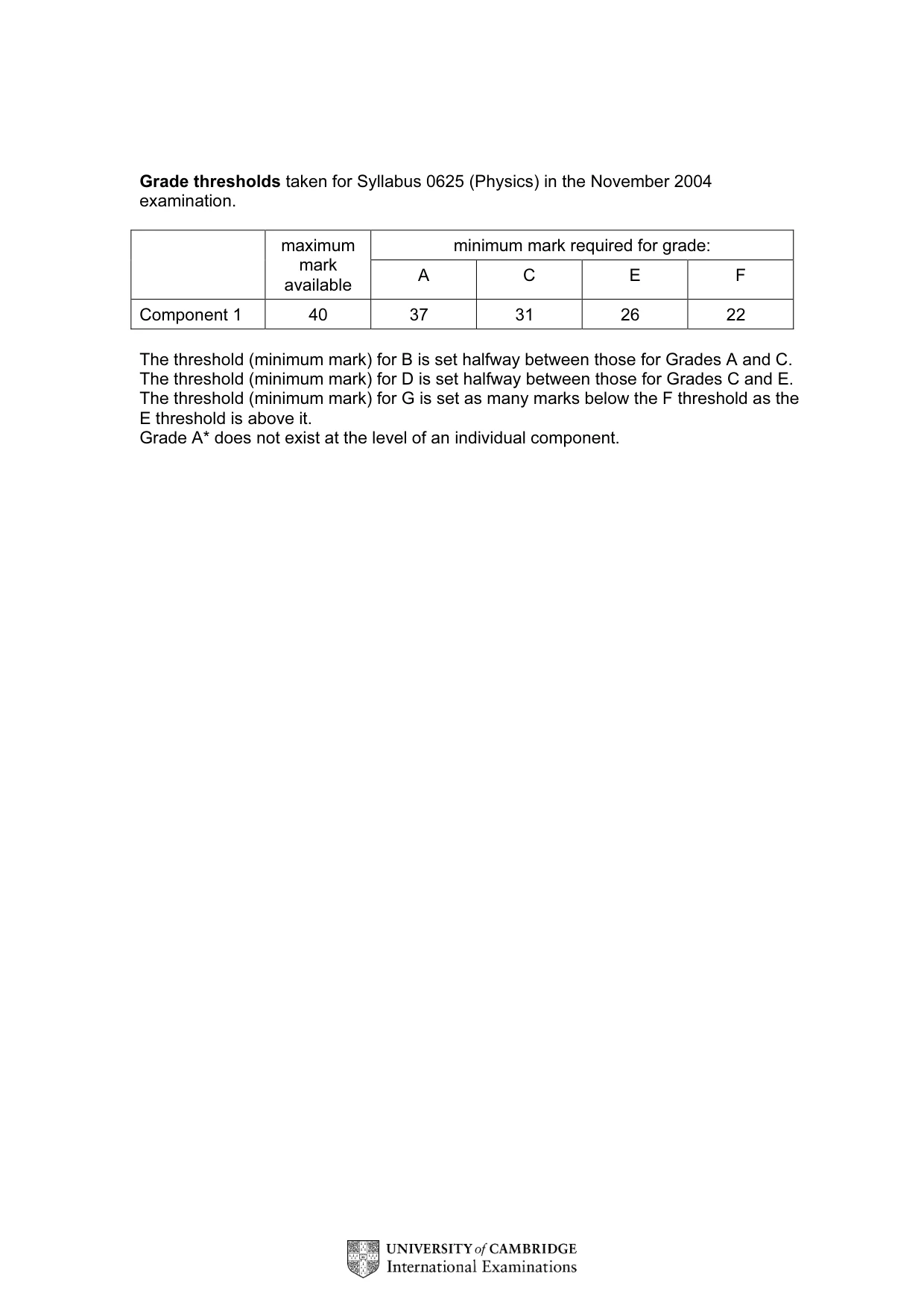
Grade thresholds taken for Syllabus 0625 (Physics) in the November 2004 examination. minimum mark required for grade: maximum mark available A C E F Component 1 40 37 31 26 22 The threshold (minimum mark) for B is set halfway between those for Grades A and C. The threshold (minimum mark) for D is set halfway between those for Grades C and E. The threshold (minimum mark) for G is set as many marks below the F threshold as the E threshold is above it. Grade A* does not exist at the level of an individual component.
Mark scheme, page 3
November 2004 INTERNATIONAL GCSE MARK SCHEME MAXIMUM MARK: 40 SYLLABUS/COMPONENT: 0625/01 PHYSICS Multiple Choice
Mark scheme, page 4
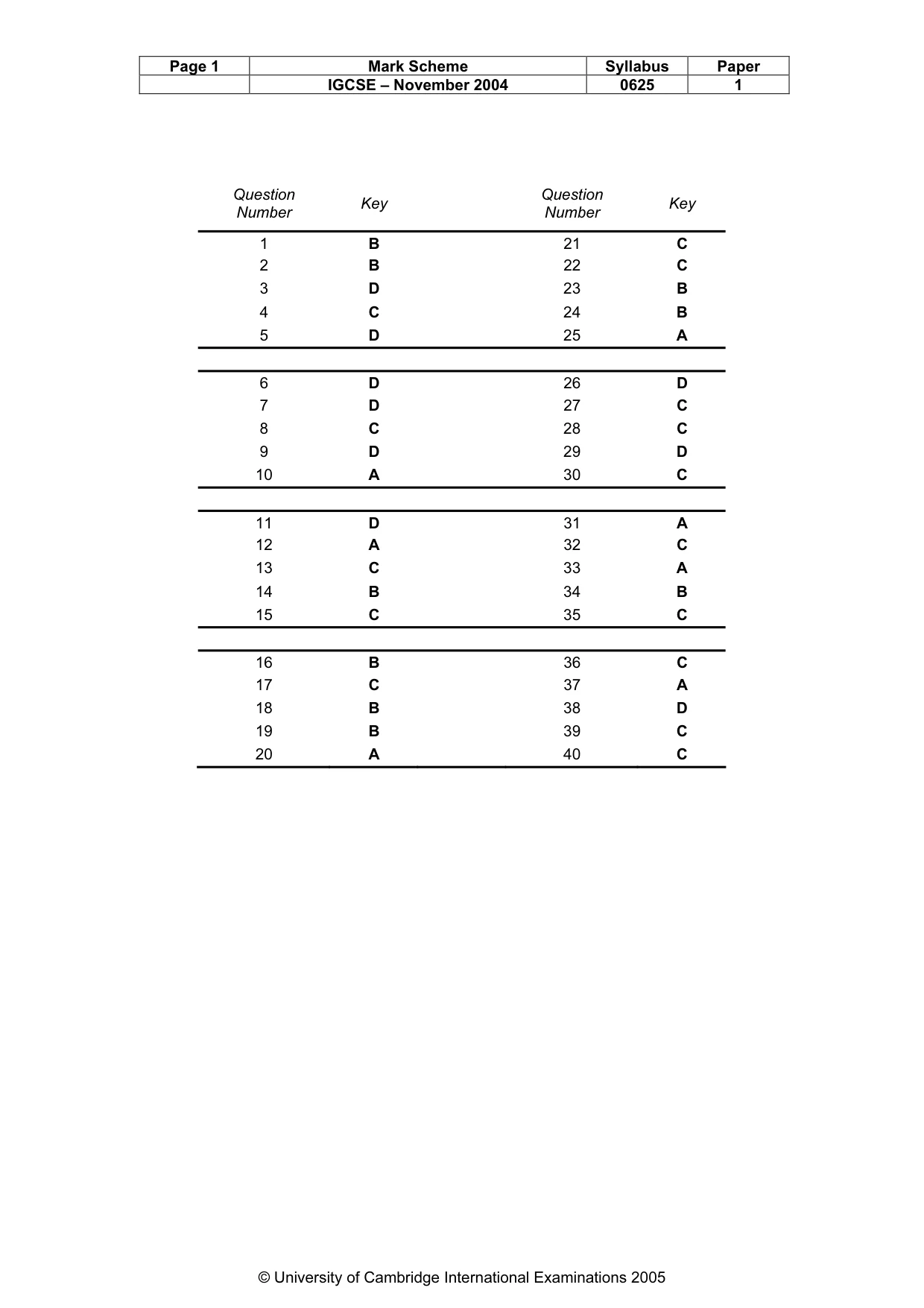
Page 1 Mark Scheme Syllabus Paper IGCSE – November 2004 0625 1 © University of Cambridge International Examinations 2005 Question Number Key Question Number Key 1 B 21 C 2 B 22 C 3 D 23 B 4 C 24 B 5 D 25 A 6 D 26 D 7 D 27 C 8 C 28 C 9 D 29 D 10 A 30 C 11 D 31 A 12 A 32 C 13 C 33 A 14 B 34 B 15 C 35 C 16 B 36 C 17 C 37 A 18 B 38 D 19 B 39 C 20 A 40 C