Cambridge IGCSE Physical Science 0652 — 2003 Oct/Nov Paper 5 · Variant 1
0652/51/O/N/03
The question paper and its mark scheme, free to read here and free to download. This is Cambridge’s own paper, exactly as it was sat.
Question paper8 pages

Mark scheme
No mark scheme is in the library for this paper.
Paper as text
Question paper, page 1
This document consists of 7 printed pages and 1 blank page. SP (CW/KN) S54565/1 © UCLES 2003 [Turn over CAMBRIDGE INTERNATIONAL EXAMINATIONS International General Certificate of Secondary Education PHYSICAL SCIENCE 0652/05 Paper 5 Practical Test October/November 2003 1 hour 30 minutes Candidates answer on the Question Paper. Additional Materials: As listed in Instructions to Supervisors READ THESE INSTRUCTIONS FIRST Write your Centre number, candidate number and name on all the work you hand in. Write in dark blue or black pen in the spaces provided on the Question Paper. You may use a soft pencil for any diagrams, graphs, tables or rough working. Do not use staples, paper clips, highlighters, glue or correction fluid. Answer all questions. At the end of the examination, fasten all your work securely together. The number of marks is given in brackets [ ] at the end of each question or part question. Chemistry practical notes for this paper are printed on page 8. Centre Number Candidate Number Name If you have been given a label, look at the details. If any details are incorrect or missing, please fill in your correct details in the space given at the top of this page. Stick your personal label here, if provided. For Examiner’s Use 1 2 Total www.XtremePapers.com
Question paper, page 2
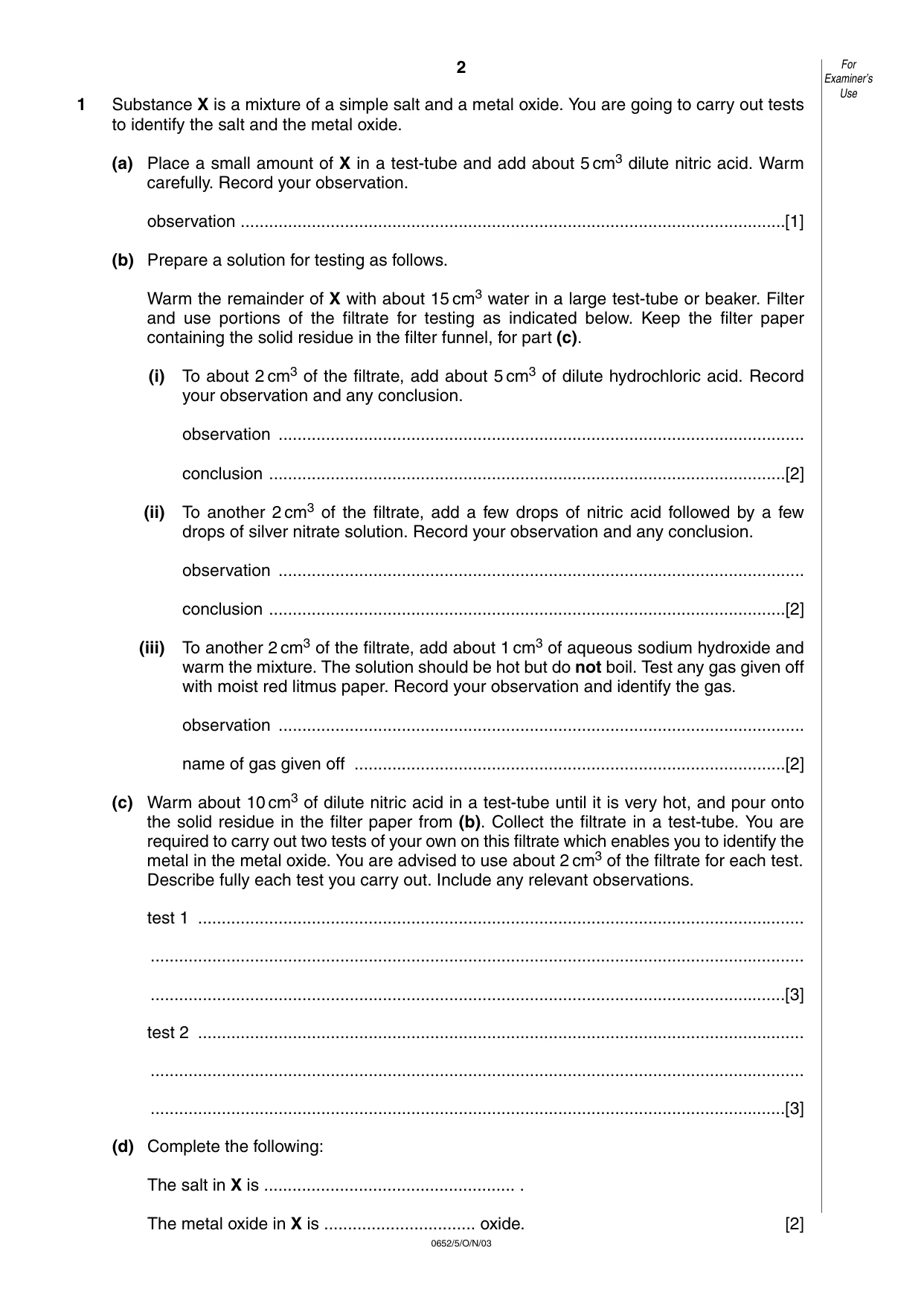
2 0652/5/O/N/03 For Examiner’s Use 1 Substance X is a mixture of a simple salt and a metal oxide. You are going to carry out tests to identify the salt and the metal oxide. (a) Place a small amount of X in a test-tube and add about 5 cm3 dilute nitric acid. Warm carefully. Record your observation. observation …[1] (b) Prepare a solution for testing as follows. Warm the remainder of X with about 15 cm3 water in a large test-tube or beaker. Filter and use portions of the filtrate for testing as indicated below. Keep the filter paper containing the solid residue in the filter funnel, for part (c). (i) To about 2 cm3 of the filtrate, add about 5 cm3 of dilute hydrochloric acid. Record your observation and any conclusion. observation … conclusion …[2] (ii) To another 2 cm3 of the filtrate, add a few drops of nitric acid followed by a few drops of silver nitrate solution. Record your observation and any conclusion. observation … conclusion …[2] (iii) To another 2 cm3 of the filtrate, add about 1 cm3 of aqueous sodium hydroxide and warm the mixture. The solution should be hot but do not boil. Test any gas given off with moist red litmus paper. Record your observation and identify the gas. observation … name of gas given off …[2] (c) Warm about 10 cm3 of dilute nitric acid in a test-tube until it is very hot, and pour onto the solid residue in the filter paper from (b). Collect the filtrate in a test-tube. You are required to carry out two tests of your own on this filtrate which enables you to identify the metal in the metal oxide. You are advised to use about 2 cm3 of the filtrate for each test. Describe fully each test you carry out. Include any relevant observations. test 1 … … …[3] test 2 … … …[3] (d) Complete the following: The salt in X is … . The metal oxide in X is … oxide. [2]
Question paper, page 3
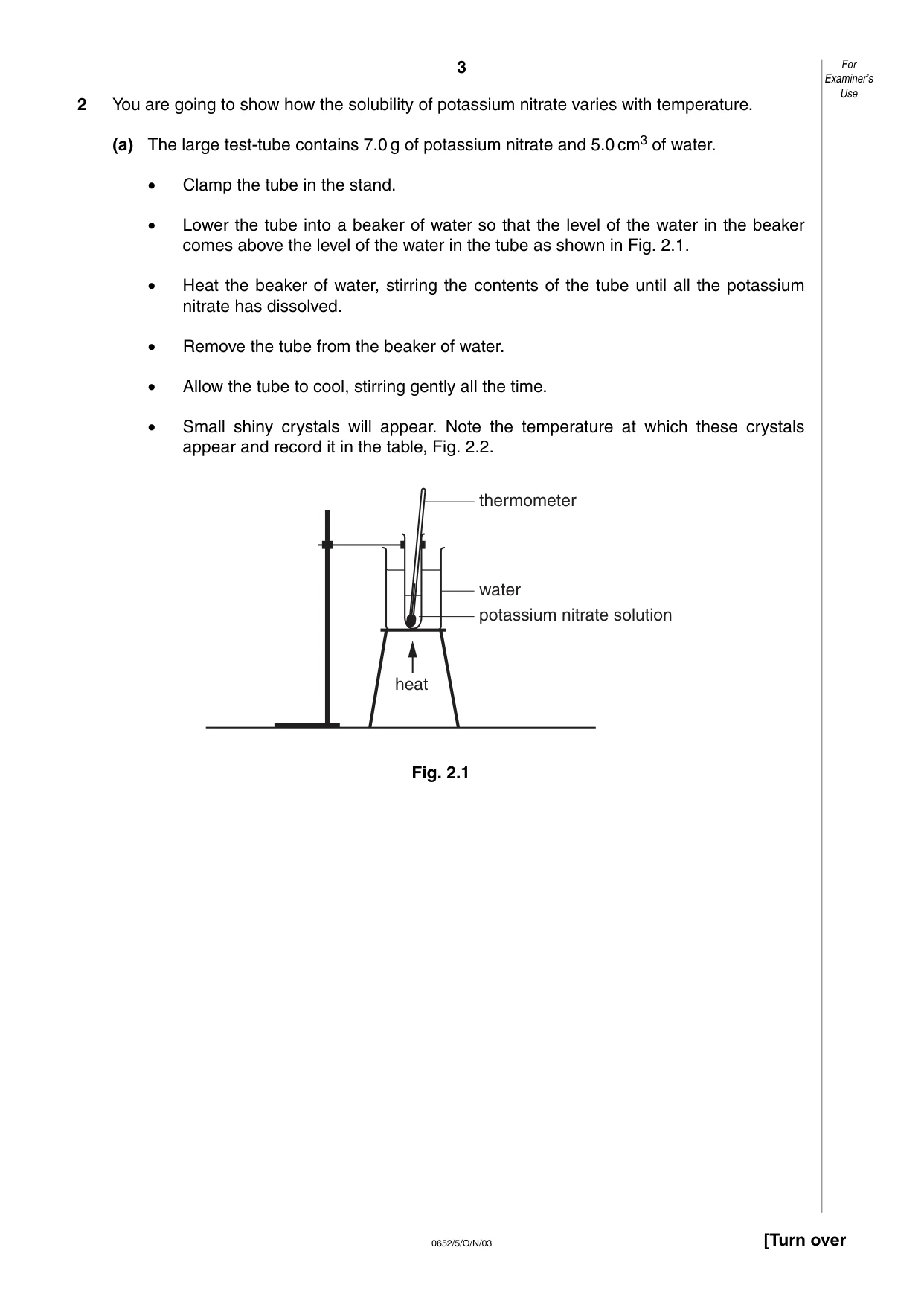
3 0652/5/O/N/03 2 You are going to show how the solubility of potassium nitrate varies with temperature. (a) The large test-tube contains 7.0 g of potassium nitrate and 5.0 cm3 of water. • Clamp the tube in the stand. • Lower the tube into a beaker of water so that the level of the water in the beaker comes above the level of the water in the tube as shown in Fig. 2.1. • Heat the beaker of water, stirring the contents of the tube until all the potassium nitrate has dissolved. • Remove the tube from the beaker of water. • Allow the tube to cool, stirring gently all the time. • Small shiny crystals will appear. Note the temperature at which these crystals appear and record it in the table, Fig. 2.2. Fig. 2.1 heat water thermometer potassium nitrate solution For Examiner’s Use [Turn over
Question paper, page 4
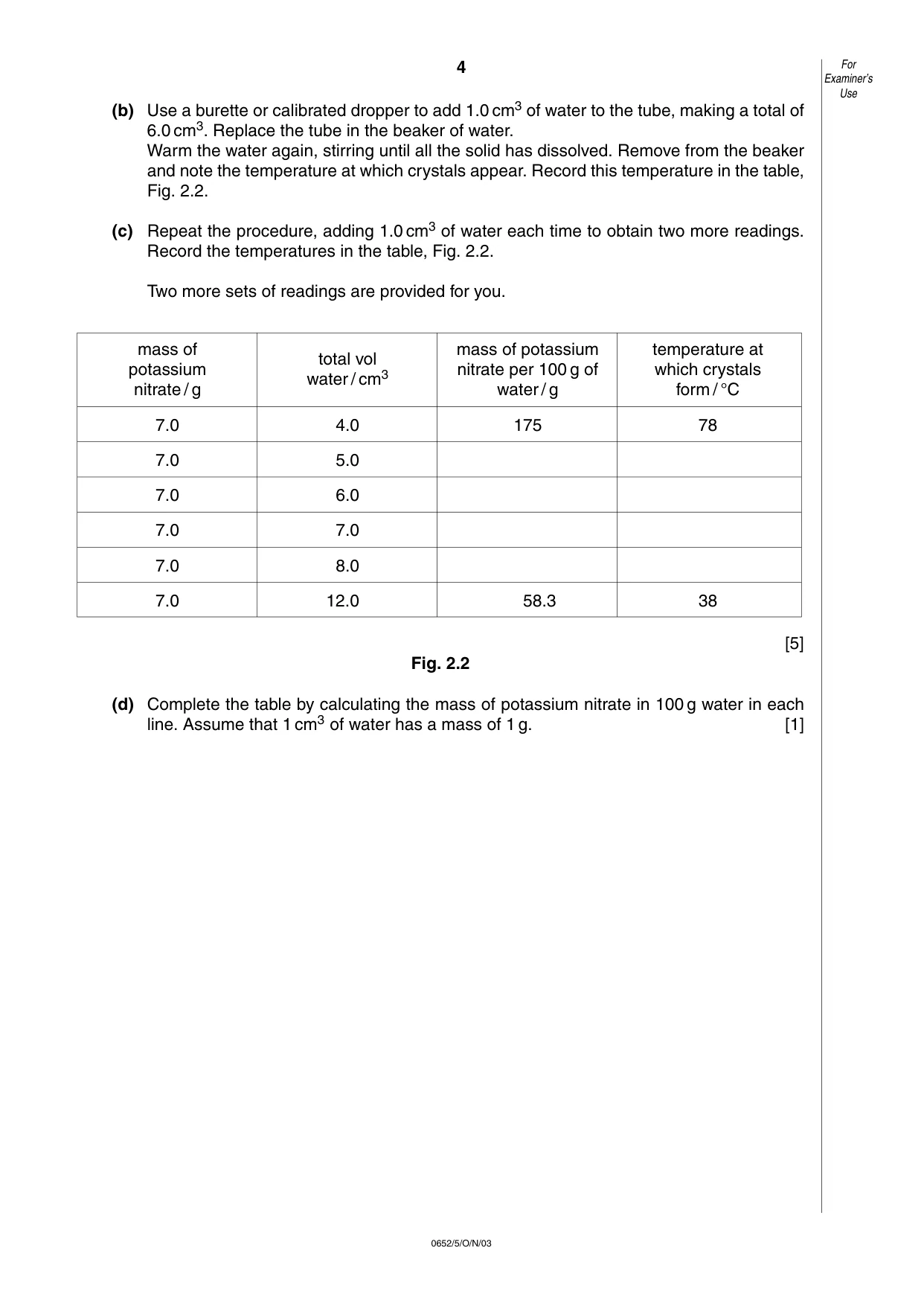
4 0652/5/O/N/03 (b) Use a burette or calibrated dropper to add 1.0 cm3 of water to the tube, making a total of 6.0 cm3. Replace the tube in the beaker of water. Warm the water again, stirring until all the solid has dissolved. Remove from the beaker and note the temperature at which crystals appear. Record this temperature in the table, Fig. 2.2. (c) Repeat the procedure, adding 1.0 cm3 of water each time to obtain two more readings. Record the temperatures in the table, Fig. 2.2. Two more sets of readings are provided for you. [5] Fig. 2.2 (d) Complete the table by calculating the mass of potassium nitrate in 100 g water in each line. Assume that 1 cm3 of water has a mass of 1 g. [1] For Examiner’s Use mass of total vol mass of potassium temperature at potassium water / cm3 nitrate per 100 g of which crystals nitrate / g water / g form / °C 7.0 4.0 175 78 7.0 5.0 7.0 6.0 7.0 7.0 7.0 8.0 7.0 12.0 58.3 38
Question paper, page 5
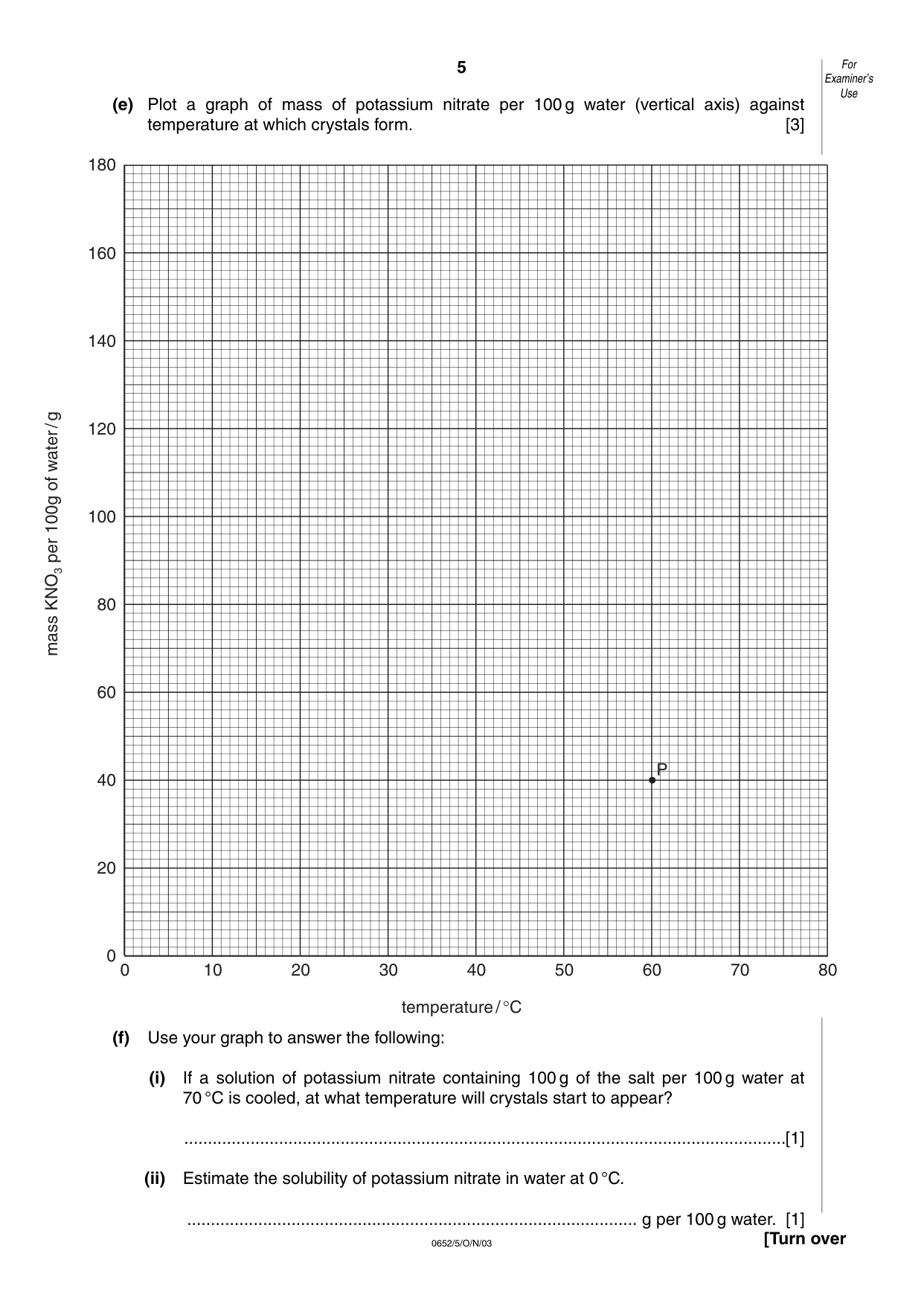
5 0652/5/O/N/03 [Turn over (e) Plot a graph of mass of potassium nitrate per 100 g water (vertical axis) against temperature at which crystals form. [3] (f) Use your graph to answer the following: (i) If a solution of potassium nitrate containing 100 g of the salt per 100 g water at 70 °C is cooled, at what temperature will crystals start to appear? …[1] (ii) Estimate the solubility of potassium nitrate in water at 0 °C. … g per 100 g water. [1] For Examiner’s Use 0 10 20 30 40 50 60 70 80 0 20 40 60 80 100 120 140 160 180 temperature/°C mass KNO3 per 100g of water/g P
Question paper, page 6
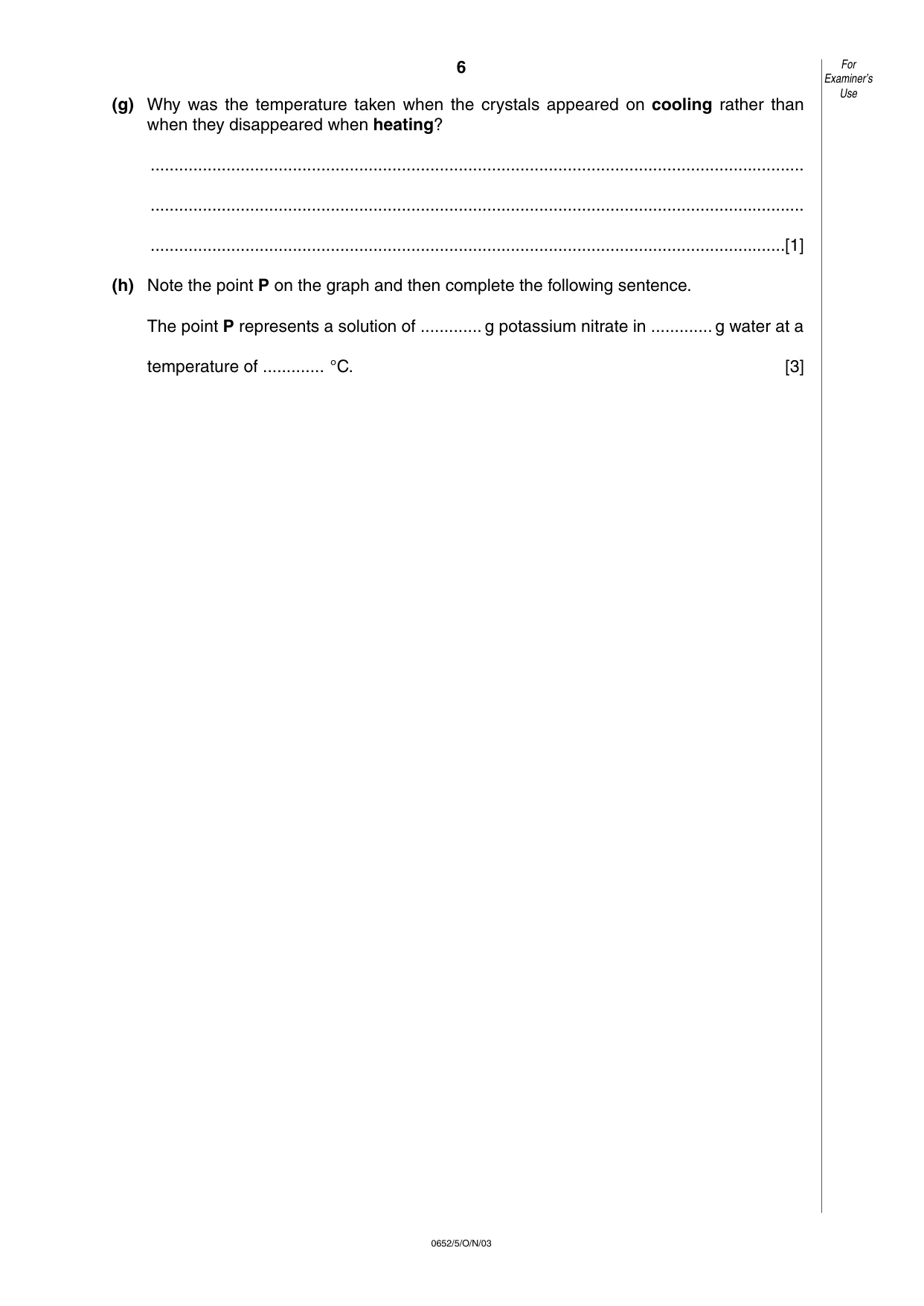
6 0652/5/O/N/03 (g) Why was the temperature taken when the crystals appeared on cooling rather than when they disappeared when heating? … … …[1] (h) Note the point P on the graph and then complete the following sentence. The point P represents a solution of … g potassium nitrate in … g water at a temperature of … °C. [3] For Examiner’s Use
Question paper, page 8
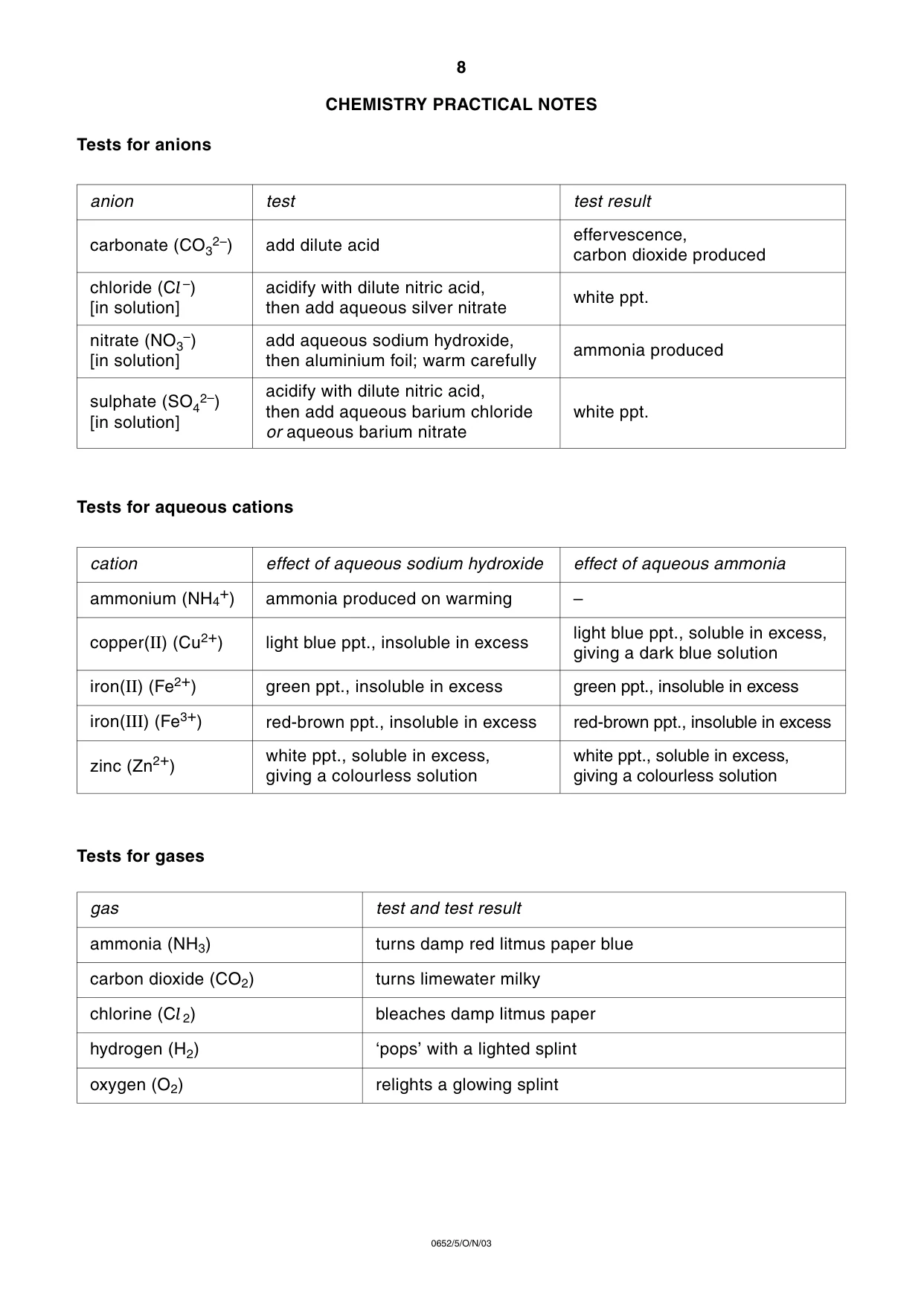
8 0652/5/O/N/03 CHEMISTRY PRACTICAL NOTES Tests for anions Tests for aqueous cations Tests for gases anion test add dilute acid acidify with dilute nitric acid, then add aqueous silver nitrate add aqueous sodium hydroxide, then aluminium foil; warm carefully acidify with dilute nitric acid, then add aqueous barium chloride or aqueous barium nitrate test result effervescence, carbon dioxide produced white ppt. ammonia produced white ppt. carbonate (CO32–) chloride (Cl –) [in solution] nitrate (NO3–) [in solution] sulphate (SO42–) [in solution] cation ammonium (NH4+) copper(II) (Cu2+) iron(II) (Fe2+) iron(III) (Fe3+) zinc (Zn2+) effect of aqueous sodium hydroxide ammonia produced on warming light blue ppt., insoluble in excess green ppt., insoluble in excess red-brown ppt., insoluble in excess white ppt., soluble in excess, giving a colourless solution effect of aqueous ammonia – light blue ppt., soluble in excess, giving a dark blue solution green ppt., insoluble in excess red-brown ppt., insoluble in excess white ppt., soluble in excess, giving a colourless solution gas test and test result turns damp red litmus paper blue turns limewater milky bleaches damp litmus paper ‘pops’ with a lighted splint relights a glowing splint ammonia (NH3) carbon dioxide (CO2) chlorine (Cl 2) hydrogen (H2) oxygen (O2)