Cambridge IGCSE Physical Science 0652 — 2002 Oct/Nov Paper 5 · Variant 1
0652/51/O/N/02
The question paper and its mark scheme, free to read here and free to download. This is Cambridge’s own paper, exactly as it was sat.
Question paper8 pages

Mark scheme3 pages
Answers below. Sit the paper first if you are practising.
Paper as text
Question paper, page 1
TIME 1 hour 30 minutes INSTRUCTIONS TO CANDIDATES Write your name, Centre number and candidate number in the spaces at the top of this page. Answer all questions. Write your answers in the spaces provided on the question paper. INFORMATION FOR CANDIDATES The number of marks is given in brackets [ ] at the end of each question or part question. Chemistry practical notes for this paper are printed on page 8. International General Certificate of Secondary Education CAMBRIDGE INTERNATIONAL EXAMINATIONS PHYSICAL SCIENCE 0652/5 PAPER 5 Practical Test OCTOBER/NOVEMBER SESSION 2002 1 hour 30 minutes Candidates answer on the question paper. Additional materials: As listed in Instructions to Supervisors. This question paper consists of 7 printed pages and 1 blank page. (NH) S30570/1 © CIE 2002 [Turn over Candidate Centre Number Number Candidate Name FOR EXAMINER’S USE 1 2 TOTAL www.XtremePapers.com
Question paper, page 2
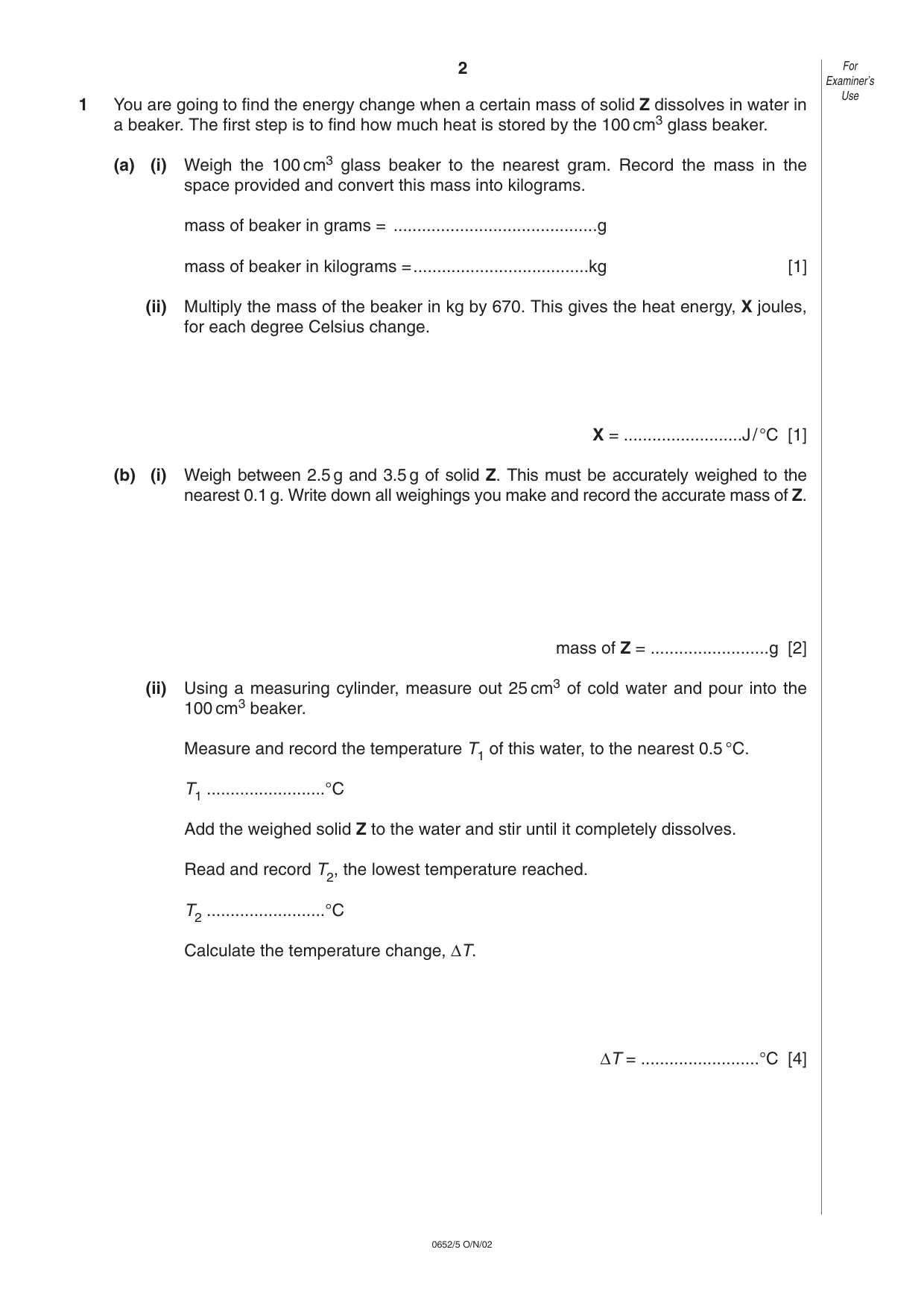
2 0652/5 O/N/02 1 You are going to find the energy change when a certain mass of solid Z dissolves in water in a beaker. The first step is to find how much heat is stored by the 100 cm3 glass beaker. (a) (i) Weigh the 100 cm3 glass beaker to the nearest gram. Record the mass in the space provided and convert this mass into kilograms. mass of beaker in grams = …g mass of beaker in kilograms =…kg [1] (ii) Multiply the mass of the beaker in kg by 670. This gives the heat energy, X joules, for each degree Celsius change. X = …J/°C [1] (b) (i) Weigh between 2.5 g and 3.5 g of solid Z. This must be accurately weighed to the nearest 0.1 g. Write down all weighings you make and record the accurate mass of Z. mass of Z = …g [2] (ii) Using a measuring cylinder, measure out 25 cm3 of cold water and pour into the 100 cm3 beaker. Measure and record the temperature T1 of this water, to the nearest 0.5 °C. T1 …°C Add the weighed solid Z to the water and stir until it completely dissolves. Read and record T2, the lowest temperature reached. T2 …°C Calculate the temperature change, ∆T. ∆T = …°C [4] For Examiner’s Use
Question paper, page 3
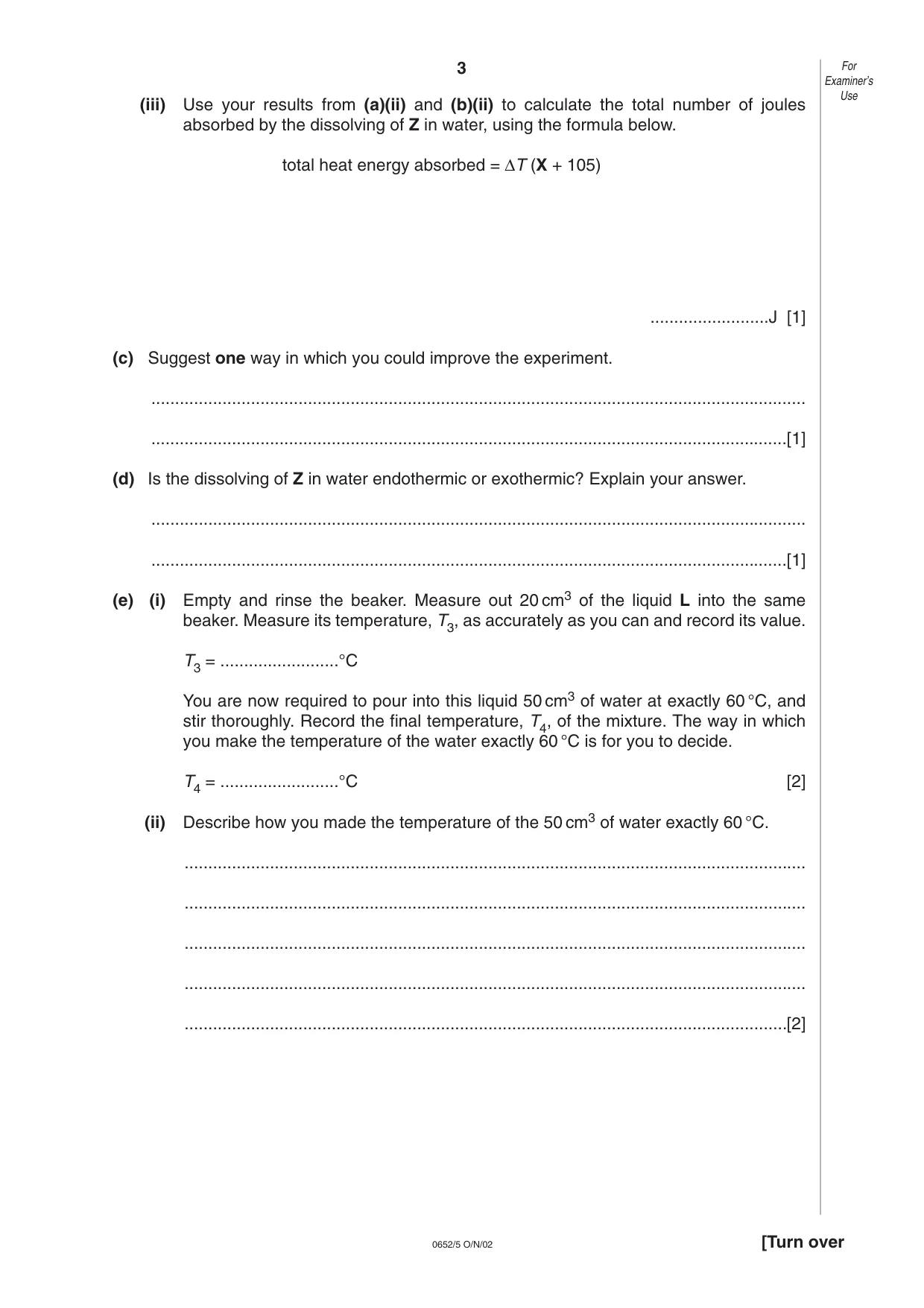
3 0652/5 O/N/02 [Turn over (iii) Use your results from (a)(ii) and (b)(ii) to calculate the total number of joules absorbed by the dissolving of Z in water, using the formula below. total heat energy absorbed = ∆T (X + 105) …J [1] (c) Suggest one way in which you could improve the experiment. … …[1] (d) Is the dissolving of Z in water endothermic or exothermic? Explain your answer. … …[1] (e) (i) Empty and rinse the beaker. Measure out 20 cm3 of the liquid L into the same beaker. Measure its temperature, T3, as accurately as you can and record its value. T3 = …°C You are now required to pour into this liquid 50 cm3 of water at exactly 60 °C, and stir thoroughly. Record the final temperature, T4, of the mixture. The way in which you make the temperature of the water exactly 60 °C is for you to decide. T4 = …°C [2] (ii) Describe how you made the temperature of the 50 cm3 of water exactly 60 °C. … … … … …[2] For Examiner’s Use
Question paper, page 4
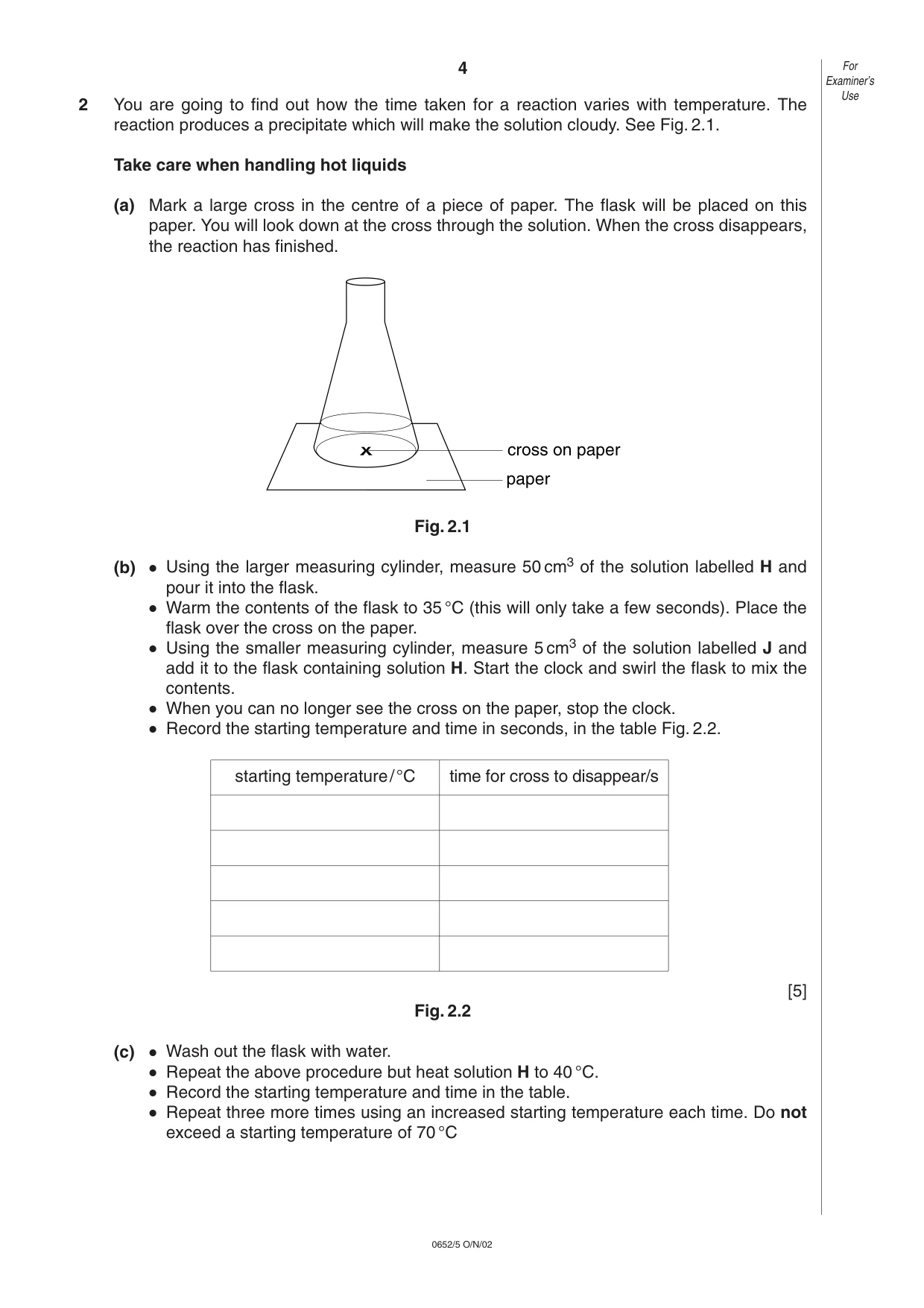
4 0652/5 O/N/02 2 You are going to find out how the time taken for a reaction varies with temperature. The reaction produces a precipitate which will make the solution cloudy. See Fig. 2.1. Take care when handling hot liquids (a) Mark a large cross in the centre of a piece of paper. The flask will be placed on this paper. You will look down at the cross through the solution. When the cross disappears, the reaction has finished. Fig. 2.1 (b) • Using the larger measuring cylinder, measure 50 cm3 of the solution labelled H and pour it into the flask. • Warm the contents of the flask to 35 °C (this will only take a few seconds). Place the flask over the cross on the paper. • Using the smaller measuring cylinder, measure 5 cm3 of the solution labelled J and add it to the flask containing solution H. Start the clock and swirl the flask to mix the contents. • When you can no longer see the cross on the paper, stop the clock. • Record the starting temperature and time in seconds, in the table Fig. 2.2. [5] Fig. 2.2 (c) • Wash out the flask with water. • Repeat the above procedure but heat solution H to 40 °C. • Record the starting temperature and time in the table. • Repeat three more times using an increased starting temperature each time. Do not exceed a starting temperature of 70 °C cross on paper paper For Examiner’s Use starting temperature/°C time for cross to disappear/s
Question paper, page 5
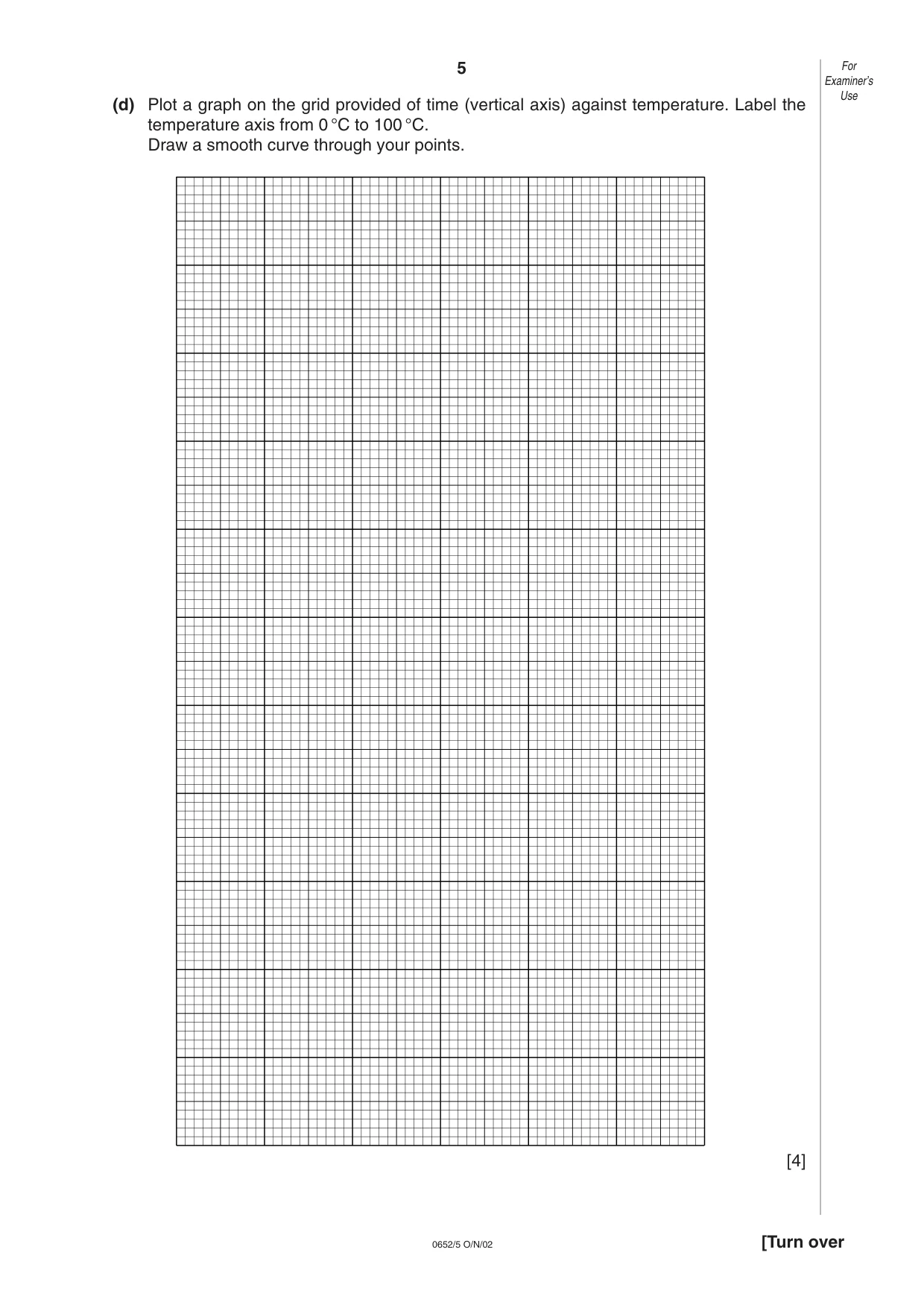
5 0652/5 O/N/02 [Turn over (d) Plot a graph on the grid provided of time (vertical axis) against temperature. Label the temperature axis from 0 °C to 100 °C. Draw a smooth curve through your points. [4] For Examiner’s Use
Question paper, page 6
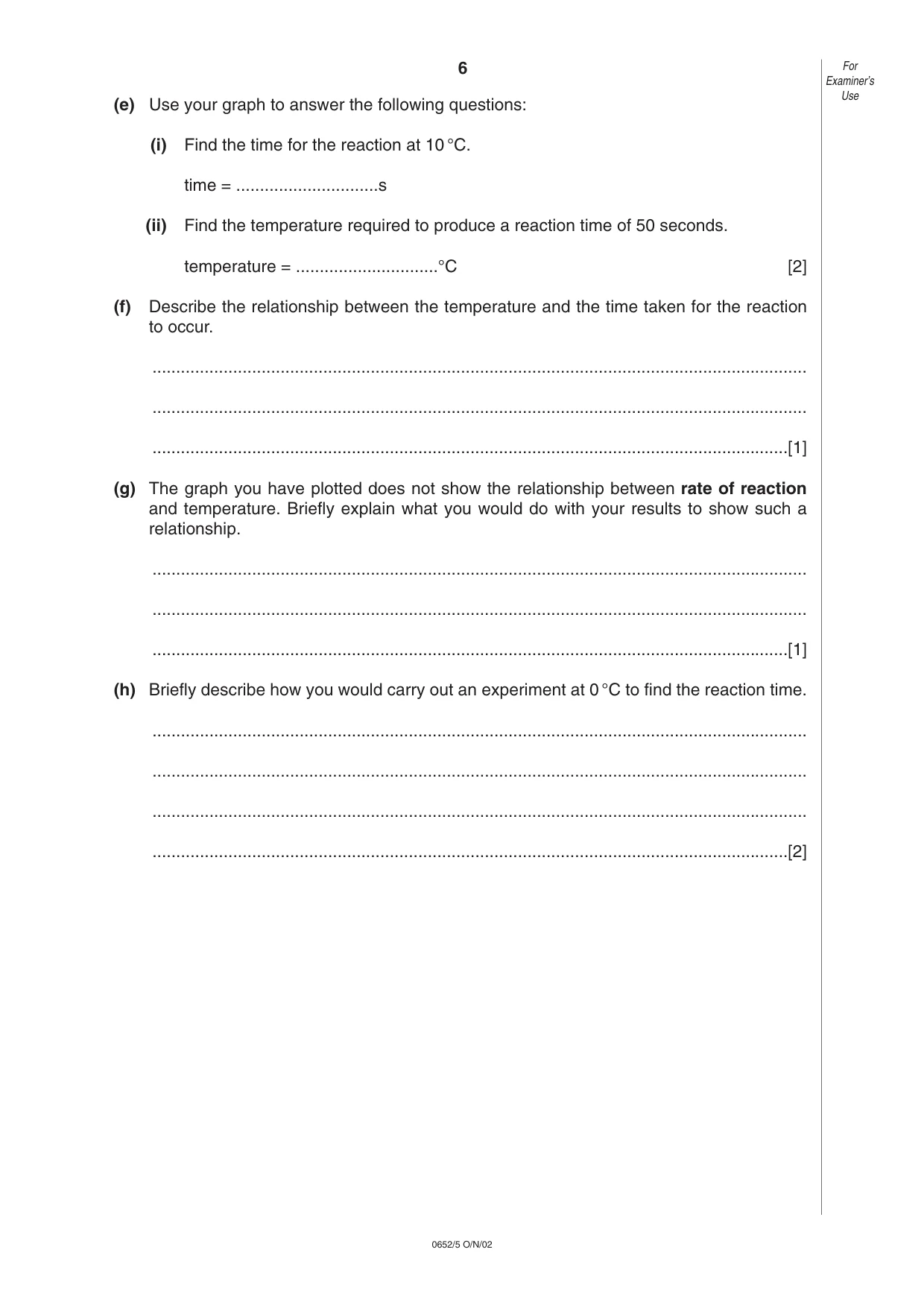
6 0652/5 O/N/02 (e) Use your graph to answer the following questions: (i) Find the time for the reaction at 10 °C. time = …s (ii) Find the temperature required to produce a reaction time of 50 seconds. temperature = …°C [2] (f) Describe the relationship between the temperature and the time taken for the reaction to occur. … … …[1] (g) The graph you have plotted does not show the relationship between rate of reaction and temperature. Briefly explain what you would do with your results to show such a relationship. … … …[1] (h) Briefly describe how you would carry out an experiment at 0 °C to find the reaction time. … … … …[2] For Examiner’s Use
Question paper, page 8
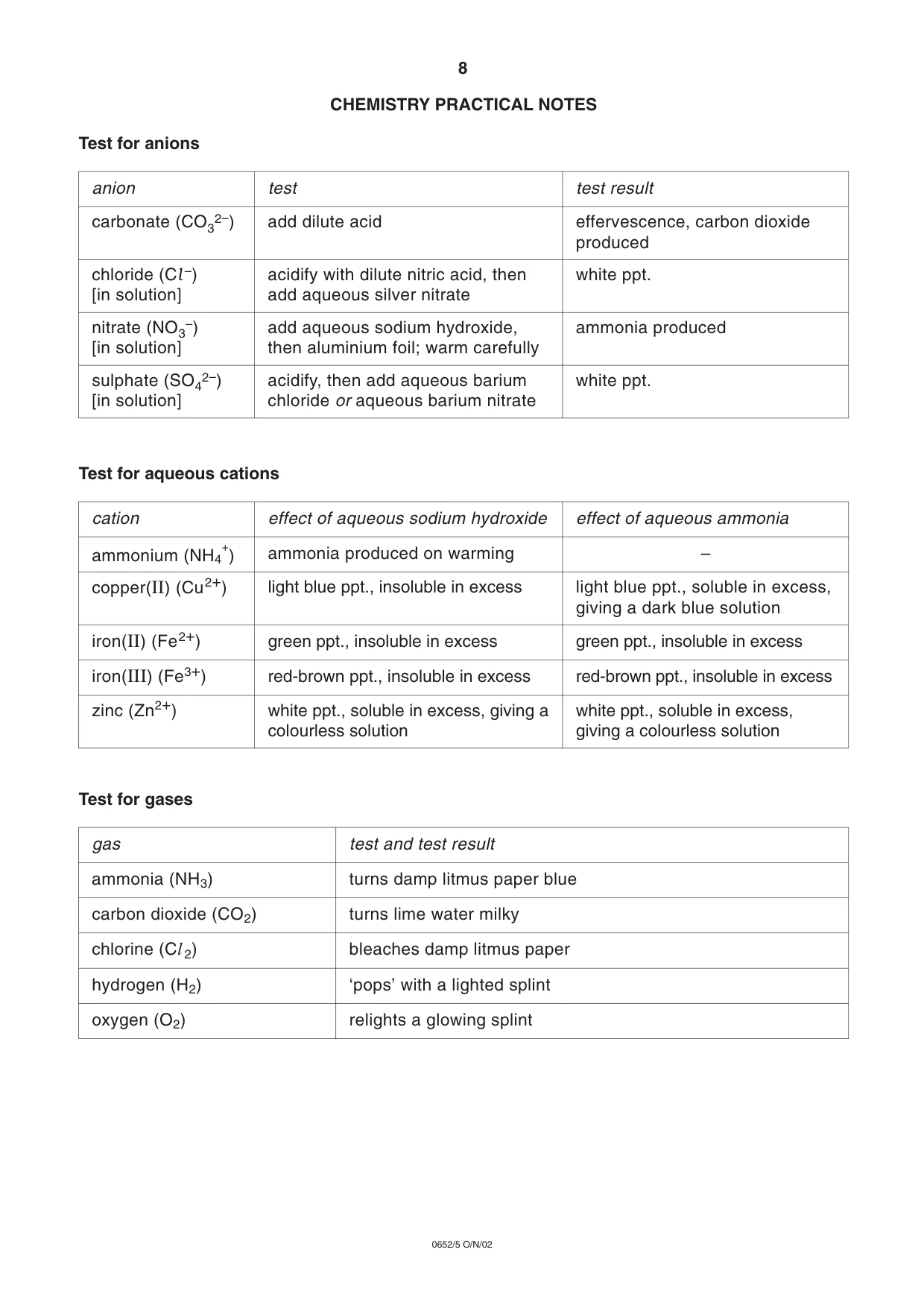
8 0652/5 O/N/02 CHEMISTRY PRACTICAL NOTES anion test add dilute acid acidify with dilute nitric acid, then add aqueous silver nitrate add aqueous sodium hydroxide, then aluminium foil; warm carefully acidify, then add aqueous barium chloride or aqueous barium nitrate test result effervescence, carbon dioxide produced white ppt. ammonia produced white ppt. carbonate (CO32–) chloride (Cl –) [in solution] nitrate (NO3–) [in solution] sulphate (SO42–) [in solution] Test for anions Test for gases Test for aqueous cations cation ammonium (NH4 +) zinc (Zn2+) copper(II) (Cu2+) iron(II) (Fe2+) iron(III) (Fe3+) effect of aqueous sodium hydroxide ammonia produced on warming light blue ppt., insoluble in excess green ppt., insoluble in excess red-brown ppt., insoluble in excess white ppt., soluble in excess, giving a colourless solution white ppt., soluble in excess, giving a colourless solution effect of aqueous ammonia – light blue ppt., soluble in excess, giving a dark blue solution green ppt., insoluble in excess red-brown ppt., insoluble in excess gas test and test result turns damp litmus paper blue turns lime water milky bleaches damp litmus paper ‘pops’ with a lighted splint relights a glowing splint ammonia (NH3) carbon dioxide (CO2) chlorine (Cl 2) hydrogen (H2) oxygen (O2)
Mark scheme, page 1
CAMBRIDGE INTERNATIONAL EXAMINATIONS NOVEMBER 2002 INTERNATIONAL GCSE UNIVERSITY of CAMBRIDGE Local Examinations Syndicate
Mark scheme, page 2
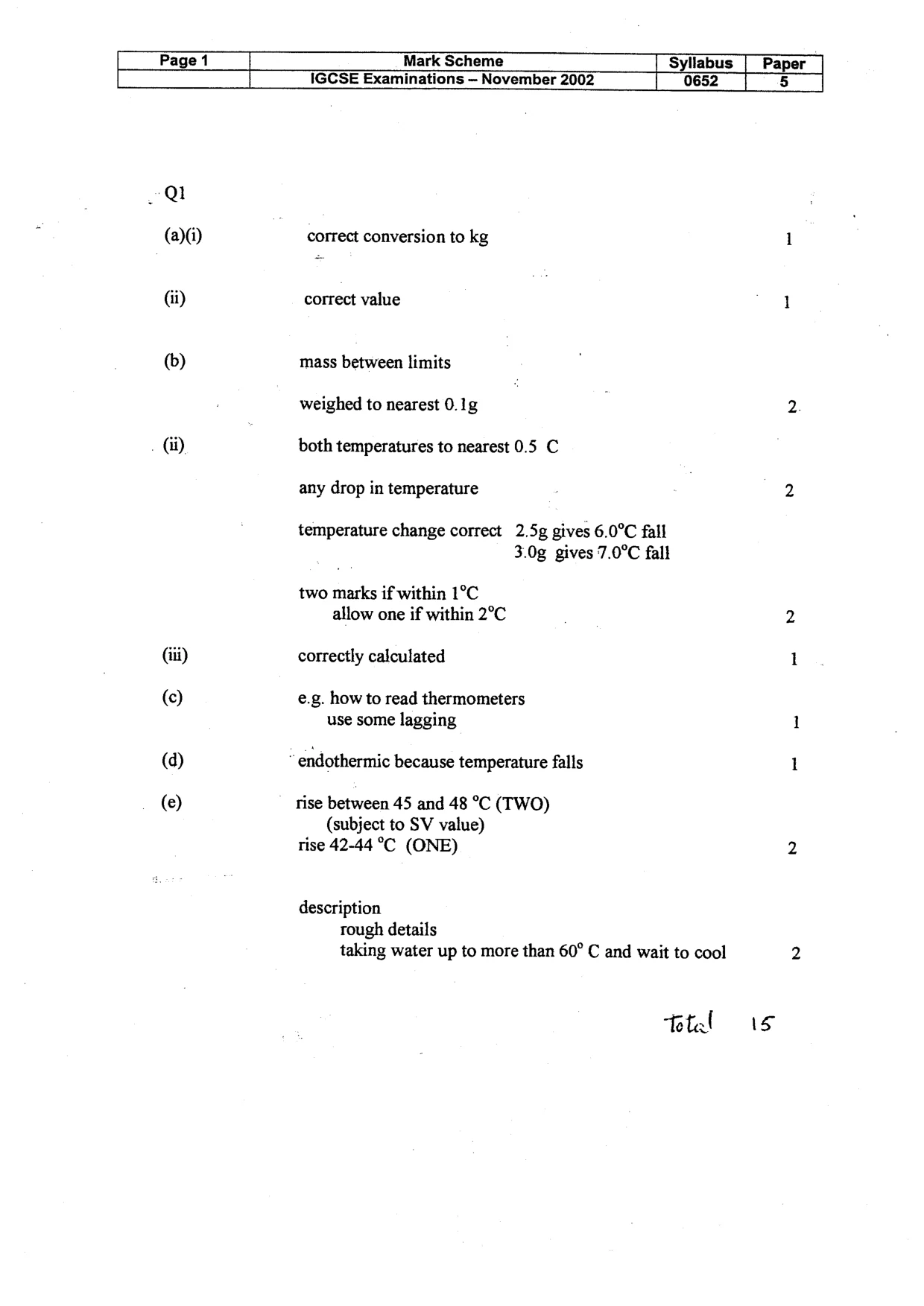
Page 1 Mark Scheme Syllabus | Paper IGCSE Examinations — November 2002 0652 5 Ql (a)(i) correct conversion to kg 1 (ii) correct value 1 (b) mass between limits weighed to nearest 0.1g 2 (ii) both temperatures to nearest 0.5 C any drop in temperature 2 temperature change correct 2.5g gives 6.0°C fall 3.0g gives 7.0°C fall two marks if within 1°C allow one if within 2°C 2 (iii) correctly calculated 1 (c) e.g. how to read thermometers use some lagging 1 (d) ” endothermic because temperature falls 1 (e) rise between 45 and 48 °C (TWO) (subject to SV value) Tise 42-44 °C_ (ONE) 2 description Tough details taking water up to more than 60° C and wait to cool 2 Tetel 15
Mark scheme, page 3
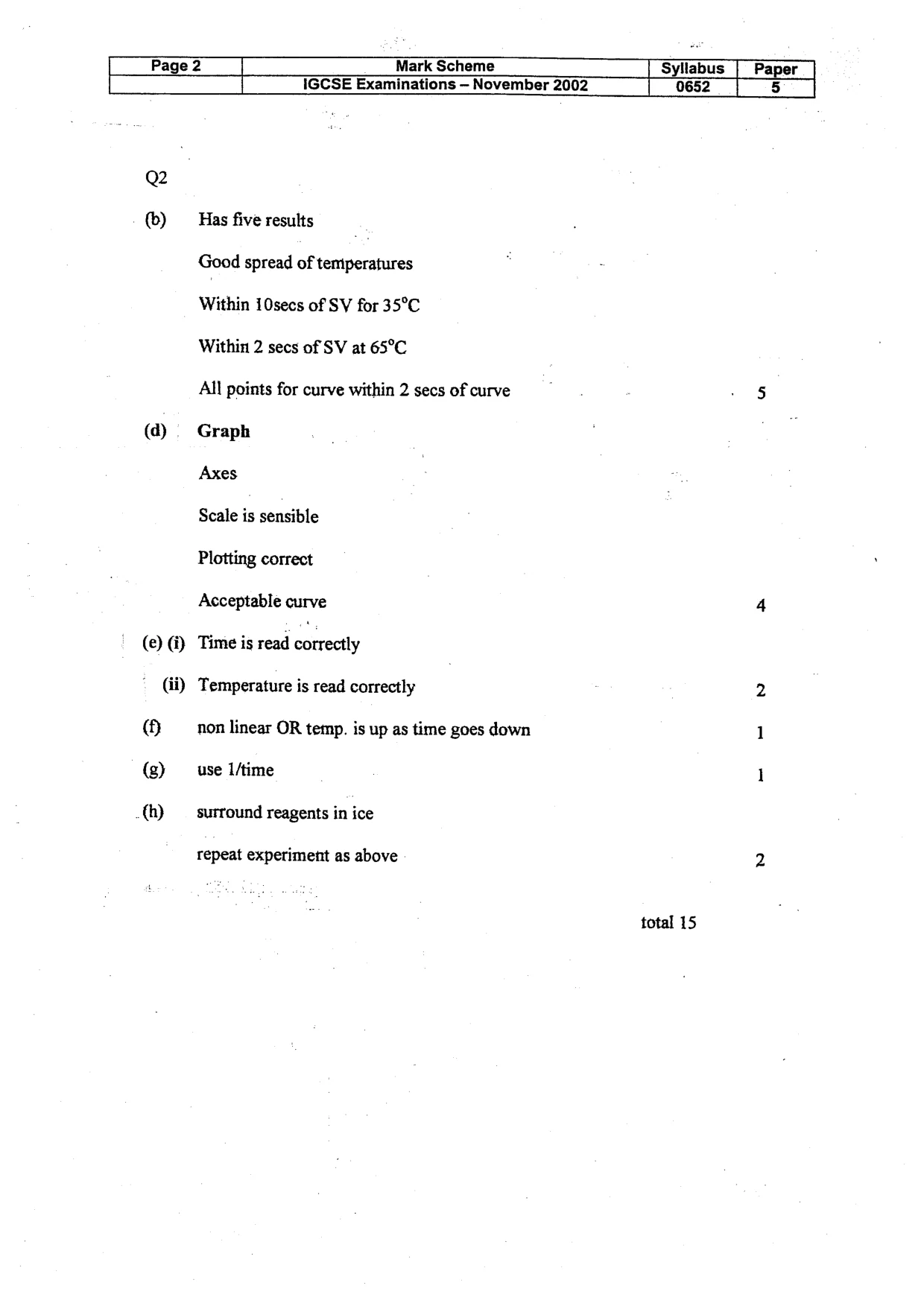
Page 2 Mark Scheme IGCSE Examinations — November 2002 0652 5 Syllabus | Paper | Q @) @) ©@ Gi) © (g) (h) Has five results Good spread of temperatures Within 10secs of SV for 35°C Within 2 secs of SV at 65°C All points for curve within 2 secs of curve Graph Axes Scale is sensible Plotting correct Acceptable curve Time is read correctly Temperature is read correctly non linear OR temp. is up as time goes down use I/time surround reagents in ice repeat experiment as above total 15