Cambridge IGCSE Mathematics (with coursework) 0581 — 2011 Oct/Nov Paper 4 · Variant 2
0581/42/O/N/11 · 130 marks · ≈146 min
The question paper and its mark scheme, free to read here and free to download. This is Cambridge’s own paper, exactly as it was sat.
Question paper20 pages
Mark scheme7 pages
Answers below. Sit the paper first if you are practising.
Paper as text
Question paper, page 1
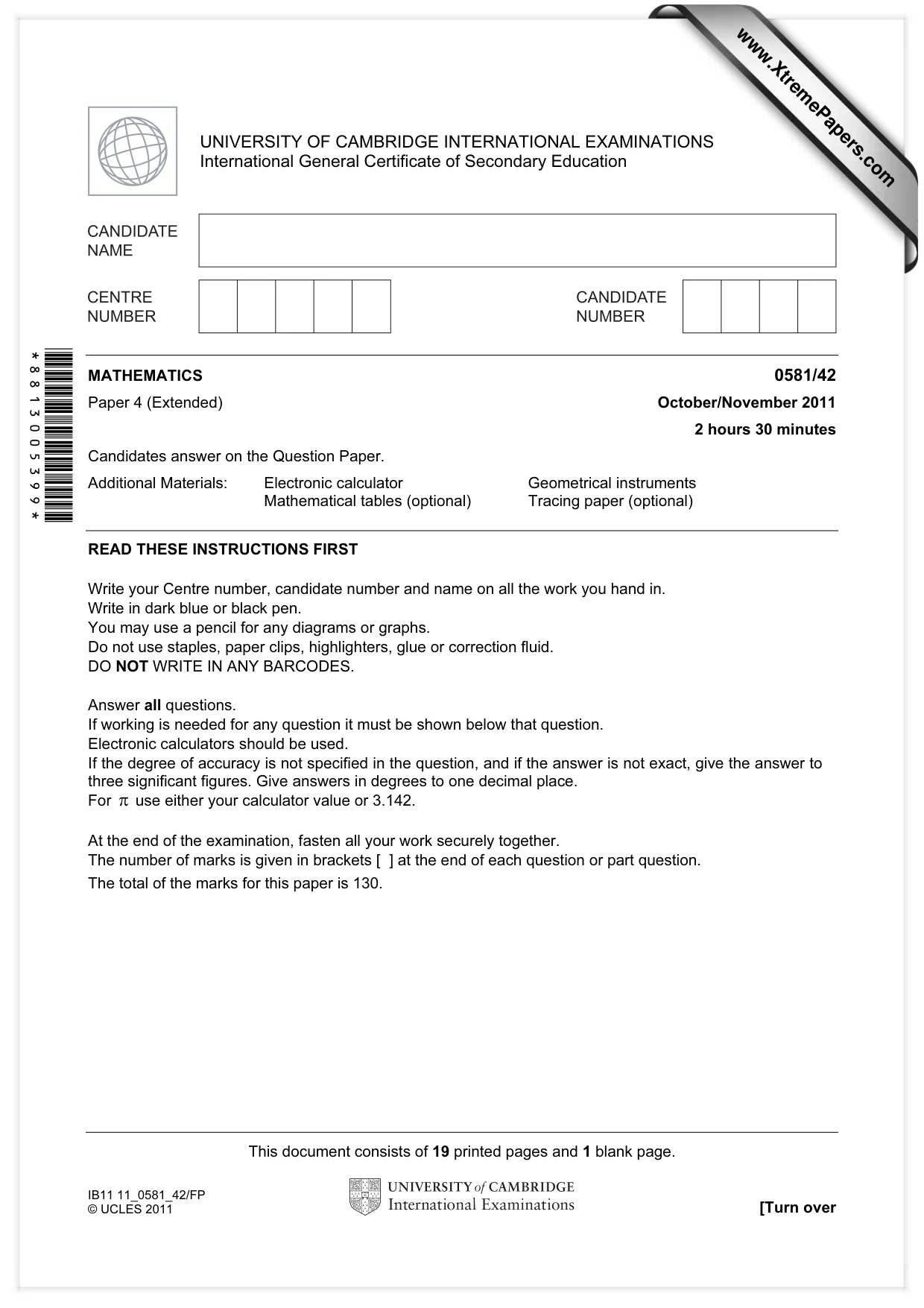
This document consists of 19 printed pages and 1 blank page. IB11 11_0581_42/FP © UCLES 2011 [Turn over *8813005399* UNIVERSITY OF CAMBRIDGE INTERNATIONAL EXAMINATIONS International General Certificate of Secondary Education MATHEMATICS 0581/42 Paper 4 (Extended) October/November 2011 2 hours 30 minutes Candidates answer on the Question Paper. Additional Materials: Electronic calculator Geometrical instruments Mathematical tables (optional) Tracing paper (optional) READ THESE INSTRUCTIONS FIRST Write your Centre number, candidate number and name on all the work you hand in. Write in dark blue or black pen. You may use a pencil for any diagrams or graphs. Do not use staples, paper clips, highlighters, glue or correction fluid. DO NOT WRITE IN ANY BARCODES. Answer all questions. If working is needed for any question it must be shown below that question. Electronic calculators should be used. If the degree of accuracy is not specified in the question, and if the answer is not exact, give the answer to three significant figures. Give answers in degrees to one decimal place. For π use either your calculator value or 3.142. At the end of the examination, fasten all your work securely together. The number of marks is given in brackets [ ] at the end of each question or part question. The total of the marks for this paper is 130. www.XtremePapers.com
Question paper, page 2
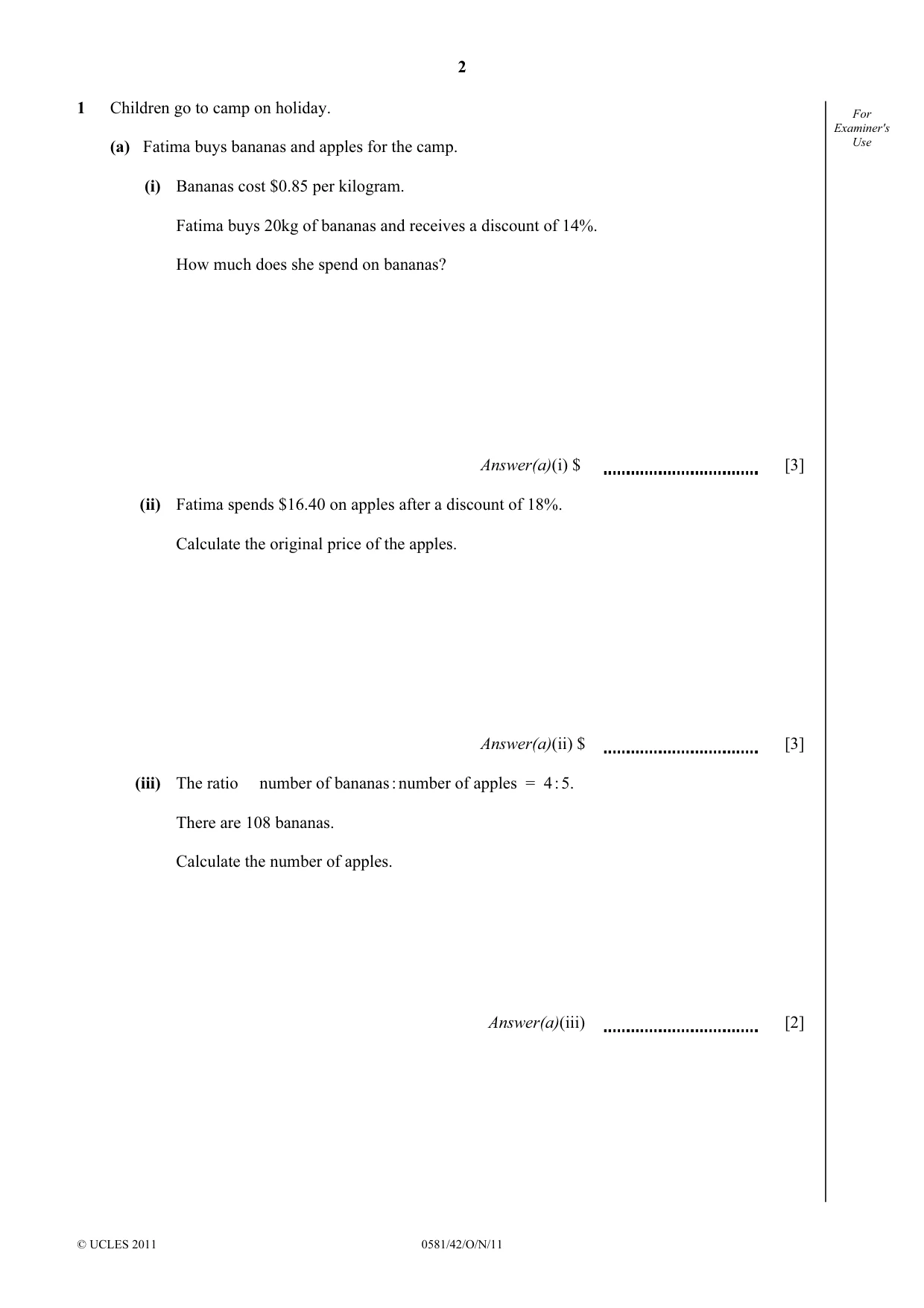
2 © UCLES 2011 0581/42/O/N/11 For Examiner's Use 1 Children go to camp on holiday. (a) Fatima buys bananas and apples for the camp. (i) Bananas cost $0.85 per kilogram. Fatima buys 20kg of bananas and receives a discount of 14%. How much does she spend on bananas? Answer(a)(i) $ [3] (ii) Fatima spends $16.40 on apples after a discount of 18%. Calculate the original price of the apples. Answer(a)(ii) $ [3] (iii) The ratio number of bananas : number of apples = 4 : 5. There are 108 bananas. Calculate the number of apples. Answer(a)(iii) [2]
Question paper, page 3
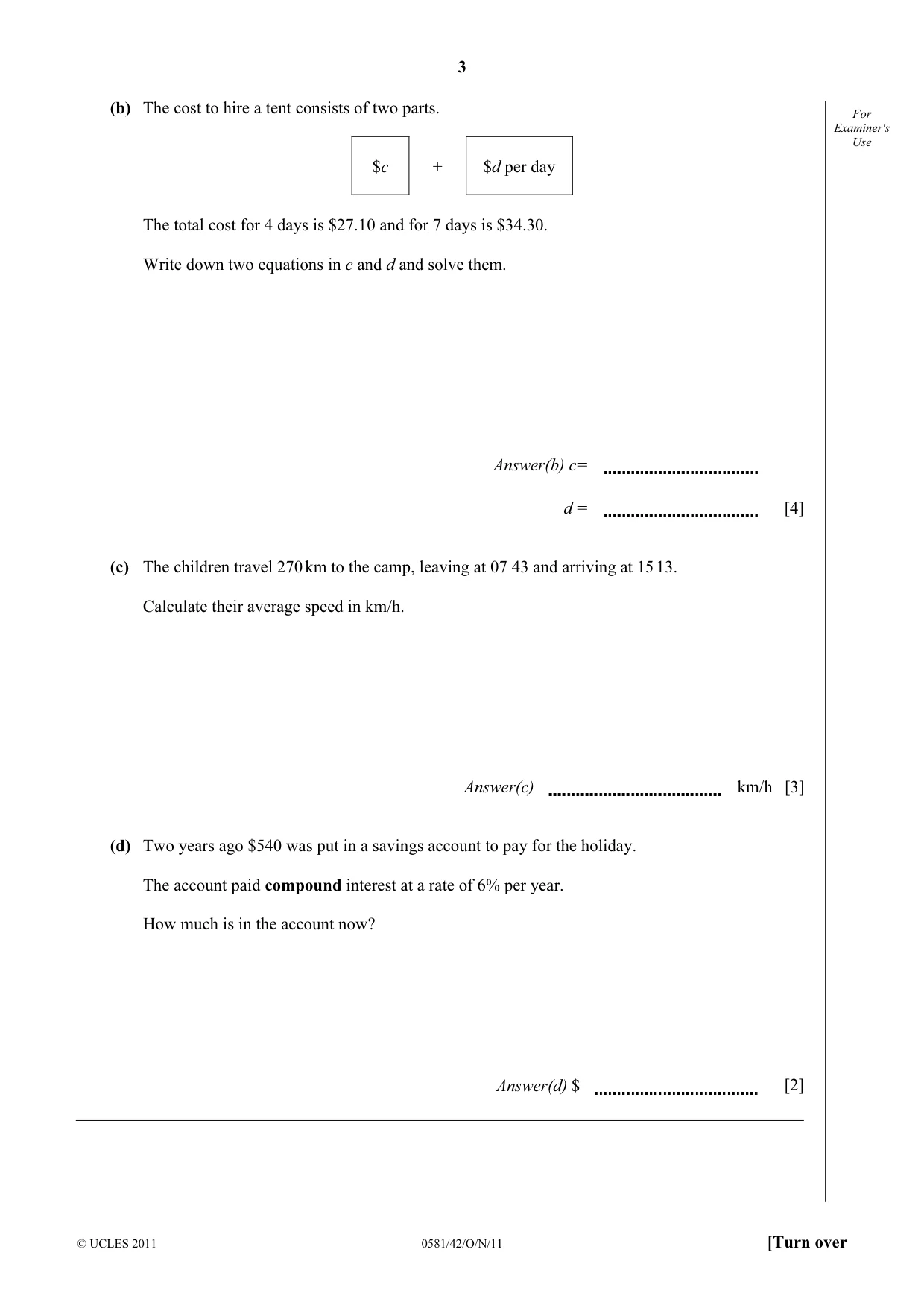
3 © UCLES 2011 0581/42/O/N/11 [Turn over For Examiner's Use (b) The cost to hire a tent consists of two parts. $c + $d per day The total cost for 4 days is $27.10 and for 7 days is $34.30. Write down two equations in c and d and solve them. Answer(b) c= d = [4] (c) The children travel 270 km to the camp, leaving at 07 43 and arriving at 15 13. Calculate their average speed in km/h. Answer(c) km/h [3] (d) Two years ago $540 was put in a savings account to pay for the holiday. The account paid compound interest at a rate of 6% per year. How much is in the account now? Answer(d) $ [2]
Question paper, page 4
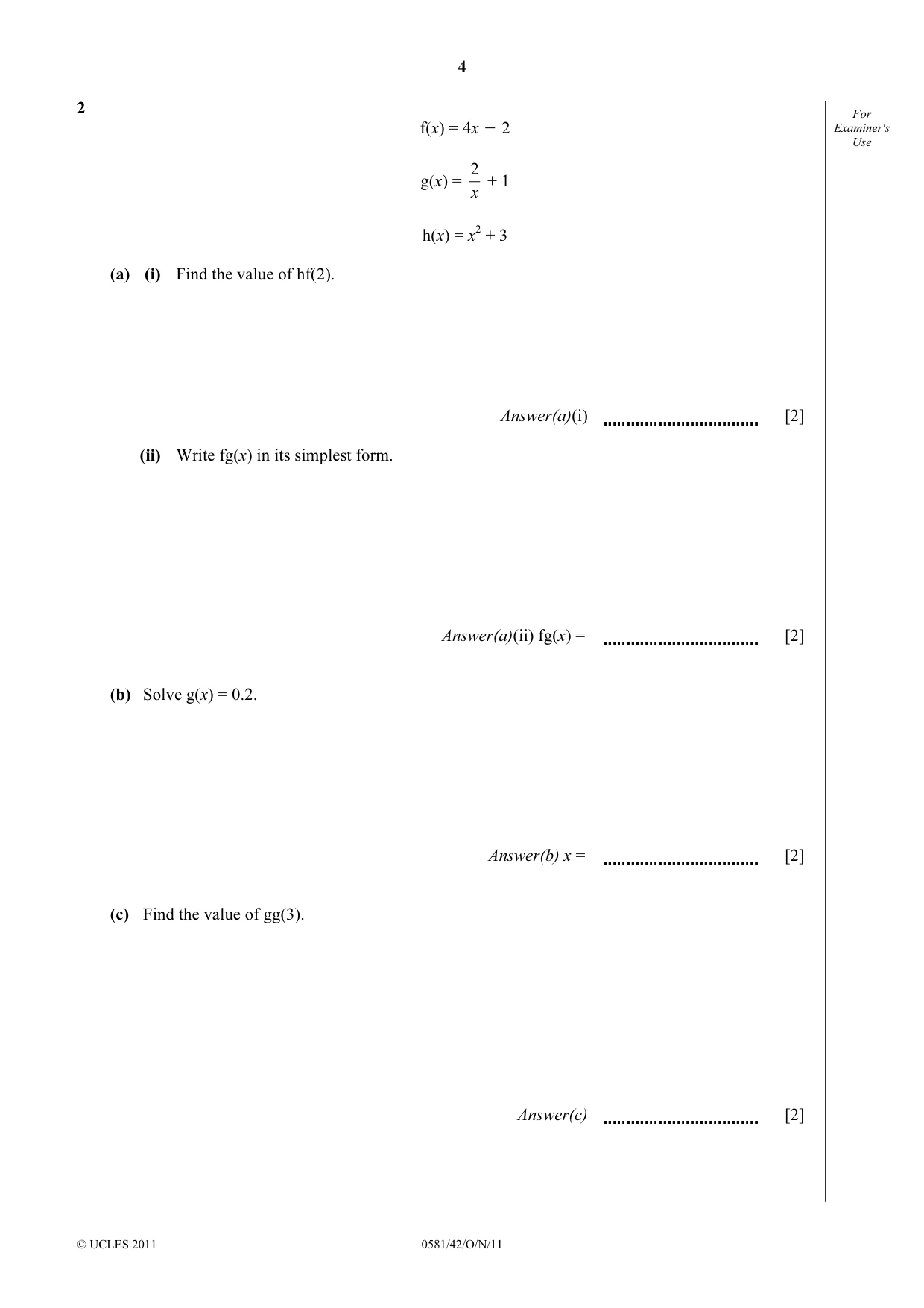
4 © UCLES 2011 0581/42/O/N/11 For Examiner's Use 2 f(x) = 4x O 2 g(x) = x 2 + 1 h(x) = x2 + 3 (a) (i) Find the value of hf(2). Answer(a)(i) [2] (ii) Write fg(x) in its simplest form. Answer(a)(ii) fg(x) = [2] (b) Solve g(x) = 0.2. Answer(b) x = [2] (c) Find the value of gg(3). Answer(c) [2]
Question paper, page 5
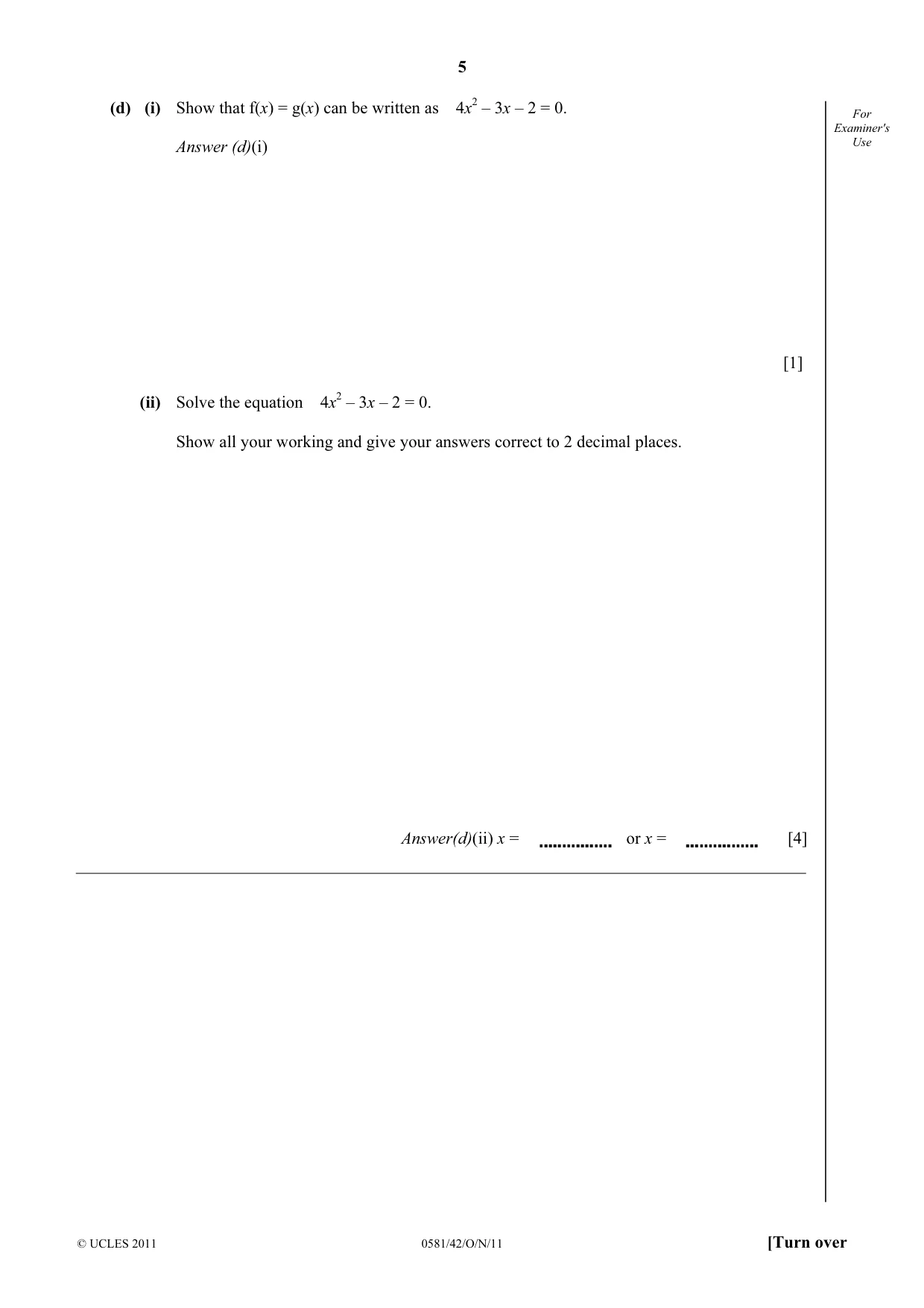
5 © UCLES 2011 0581/42/O/N/11 [Turn over For Examiner's Use (d) (i) Show that f(x) = g(x) can be written as 4x2 – 3x – 2 = 0. Answer (d)(i) [1] (ii) Solve the equation 4x2 – 3x – 2 = 0. Show all your working and give your answers correct to 2 decimal places. Answer(d)(ii) x = or x = [4]
Question paper, page 6
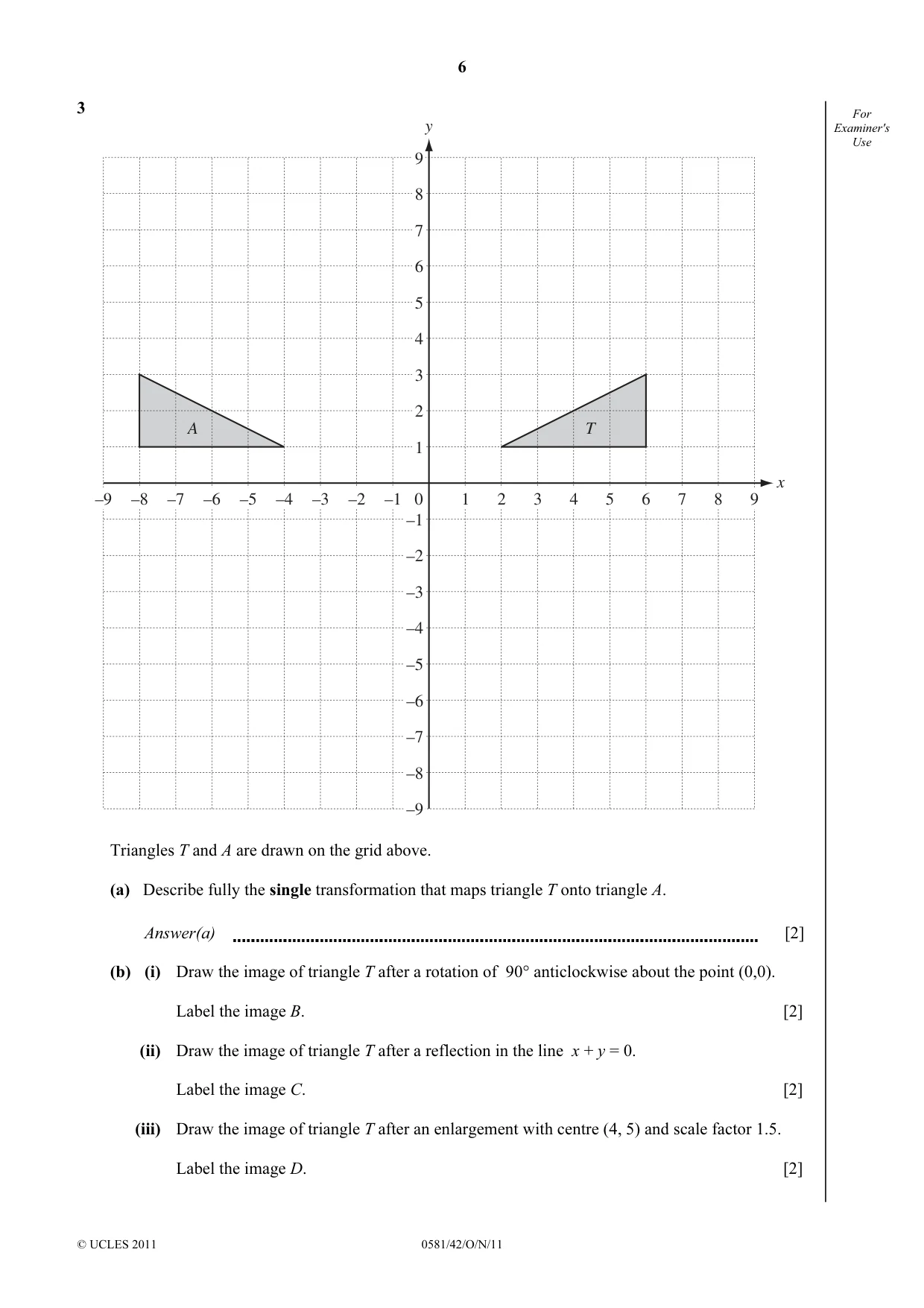
6 © UCLES 2011 0581/42/O/N/11 For Examiner's Use 3 T A y x 9 8 7 6 5 4 3 2 1 –1 –2 –3 –4 –5 –6 –7 –8 –9 –1 0 1 2 3 4 5 6 7 8 9 –2 –3 –4 –5 –6 –7 –8 –9 Triangles T and A are drawn on the grid above. (a) Describe fully the single transformation that maps triangle T onto triangle A. Answer(a) [2] (b) (i) Draw the image of triangle T after a rotation of 90° anticlockwise about the point (0,0). Label the image B. [2] (ii) Draw the image of triangle T after a reflection in the line x + y = 0. Label the image C. [2] (iii) Draw the image of triangle T after an enlargement with centre (4, 5) and scale factor 1.5. Label the image D. [2]
Question paper, page 7
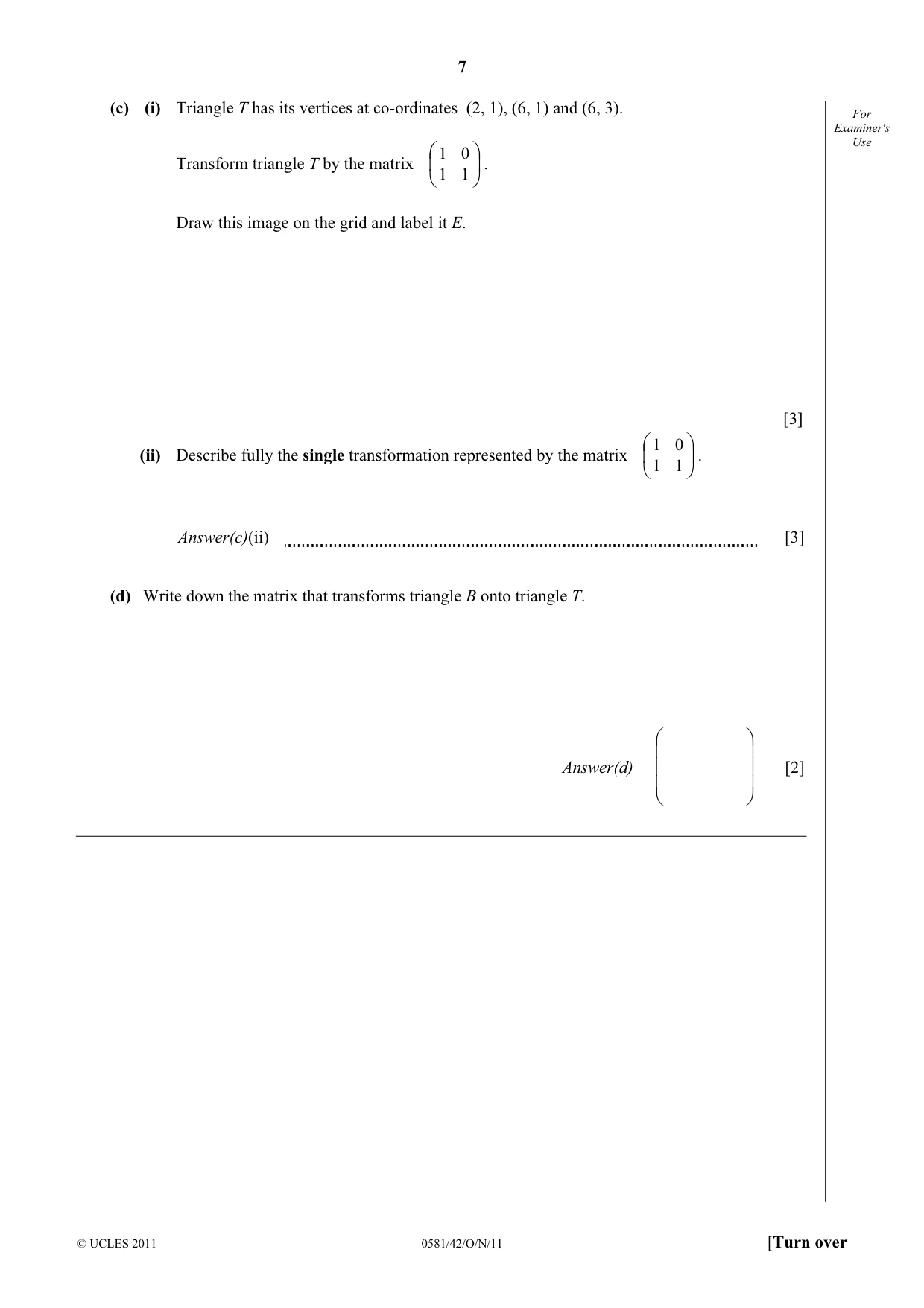
7 © UCLES 2011 0581/42/O/N/11 [Turn over For Examiner's Use (c) (i) Triangle T has its vertices at co-ordinates (2, 1), (6, 1) and (6, 3). Transform triangle T by the matrix 1 1 0 1 . Draw this image on the grid and label it E. [3] (ii) Describe fully the single transformation represented by the matrix 1 1 0 1 . Answer(c)(ii) [3] (d) Write down the matrix that transforms triangle B onto triangle T. Answer(d) [2]
Question paper, page 8
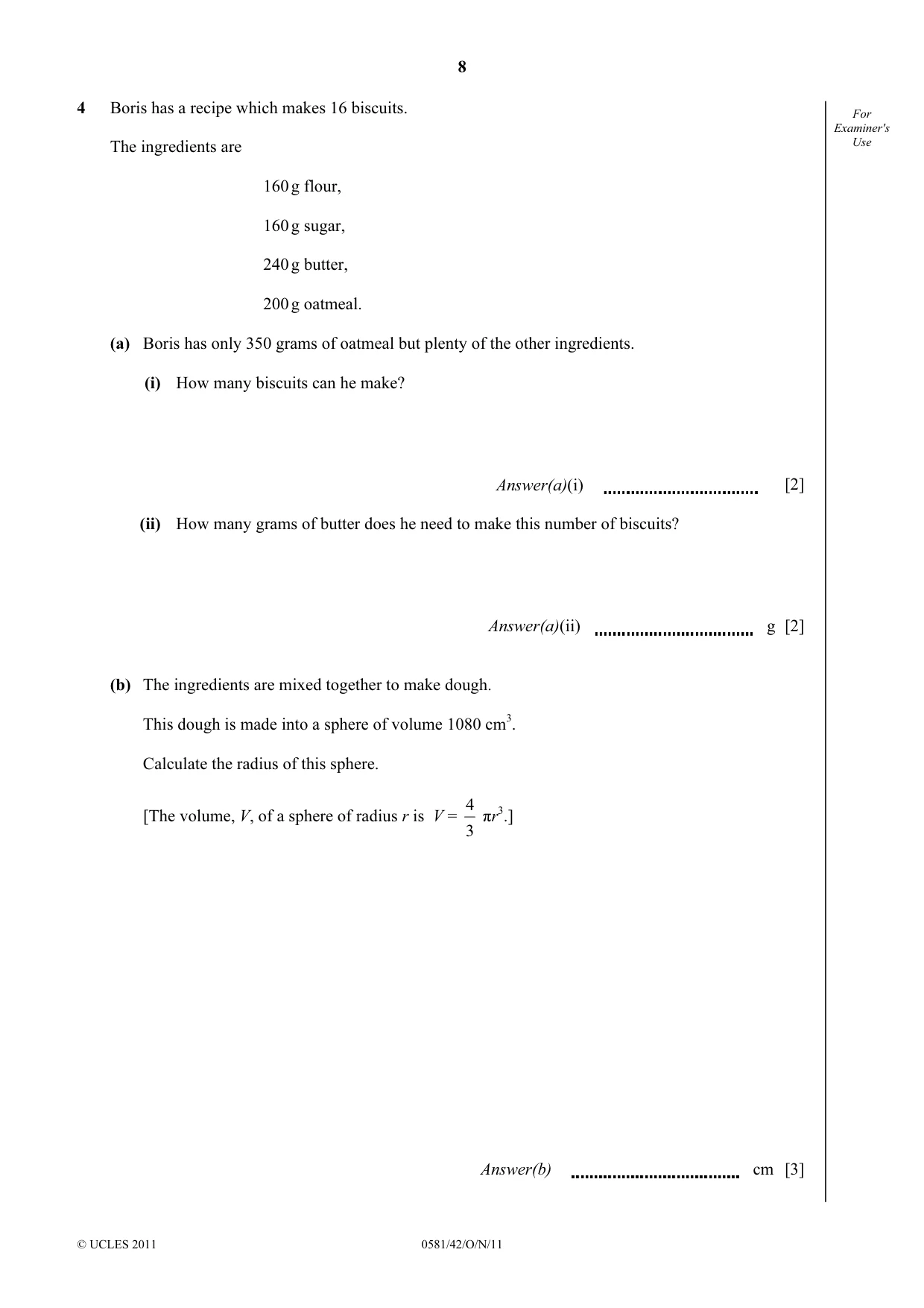
8 © UCLES 2011 0581/42/O/N/11 For Examiner's Use 4 Boris has a recipe which makes 16 biscuits. The ingredients are 160 g flour, 160 g sugar, 240 g butter, 200 g oatmeal. (a) Boris has only 350 grams of oatmeal but plenty of the other ingredients. (i) How many biscuits can he make? Answer(a)(i) [2] (ii) How many grams of butter does he need to make this number of biscuits? Answer(a)(ii) g [2] (b) The ingredients are mixed together to make dough. This dough is made into a sphere of volume 1080 cm3. Calculate the radius of this sphere. [The volume, V, of a sphere of radius r is V = 3 4 πr3.] Answer(b) cm [3]
Question paper, page 9
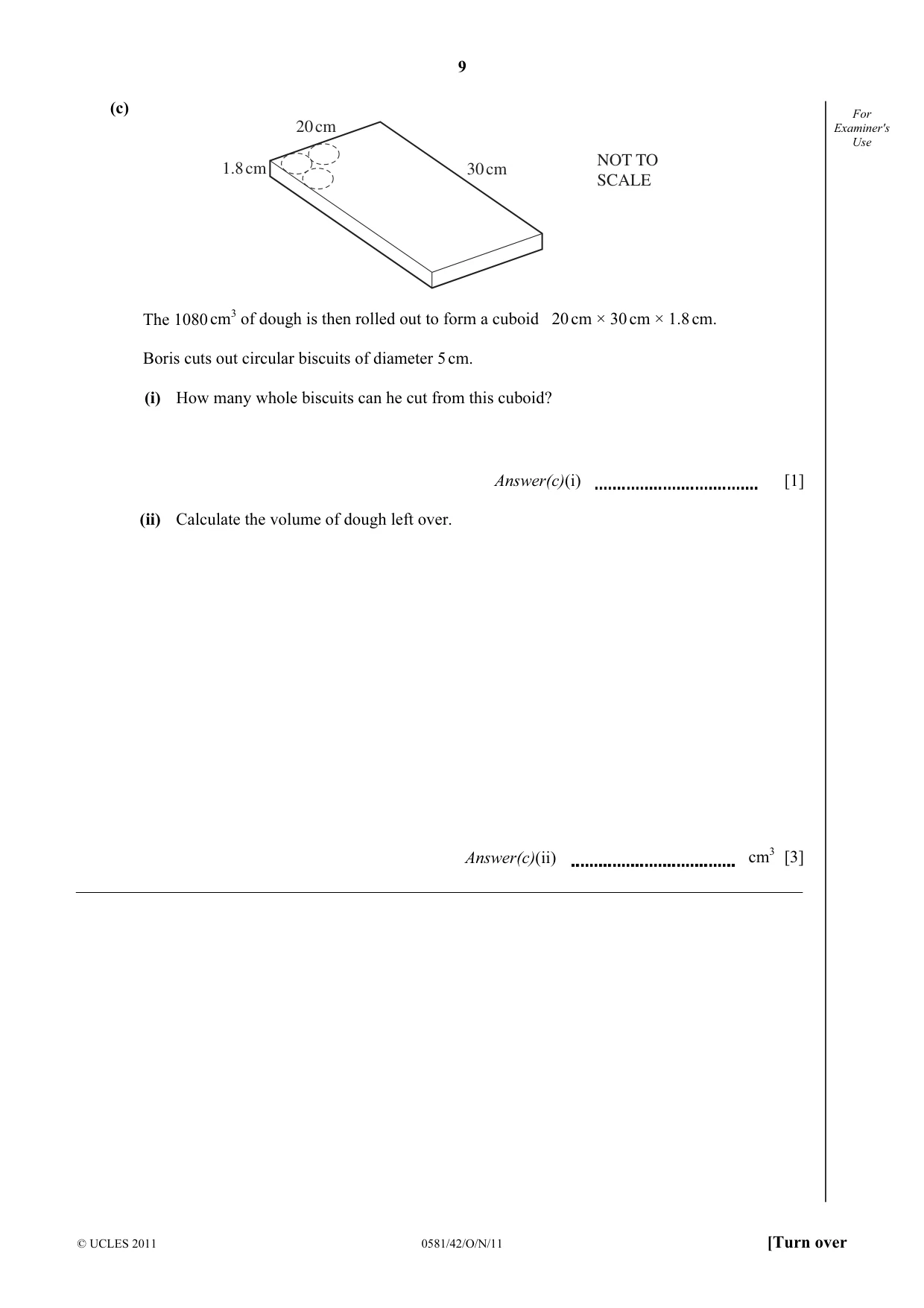
9 © UCLES 2011 0581/42/O/N/11 [Turn over For Examiner's Use (c) NOT TO SCALE 20 cm 30 cm 1.8 cm The 1080 cm3 of dough is then rolled out to form a cuboid 20 cm × 30 cm × 1.8 cm. Boris cuts out circular biscuits of diameter 5 cm. (i) How many whole biscuits can he cut from this cuboid? Answer(c)(i) [1] (ii) Calculate the volume of dough left over. Answer(c)(ii) cm3 [3]
Question paper, page 10
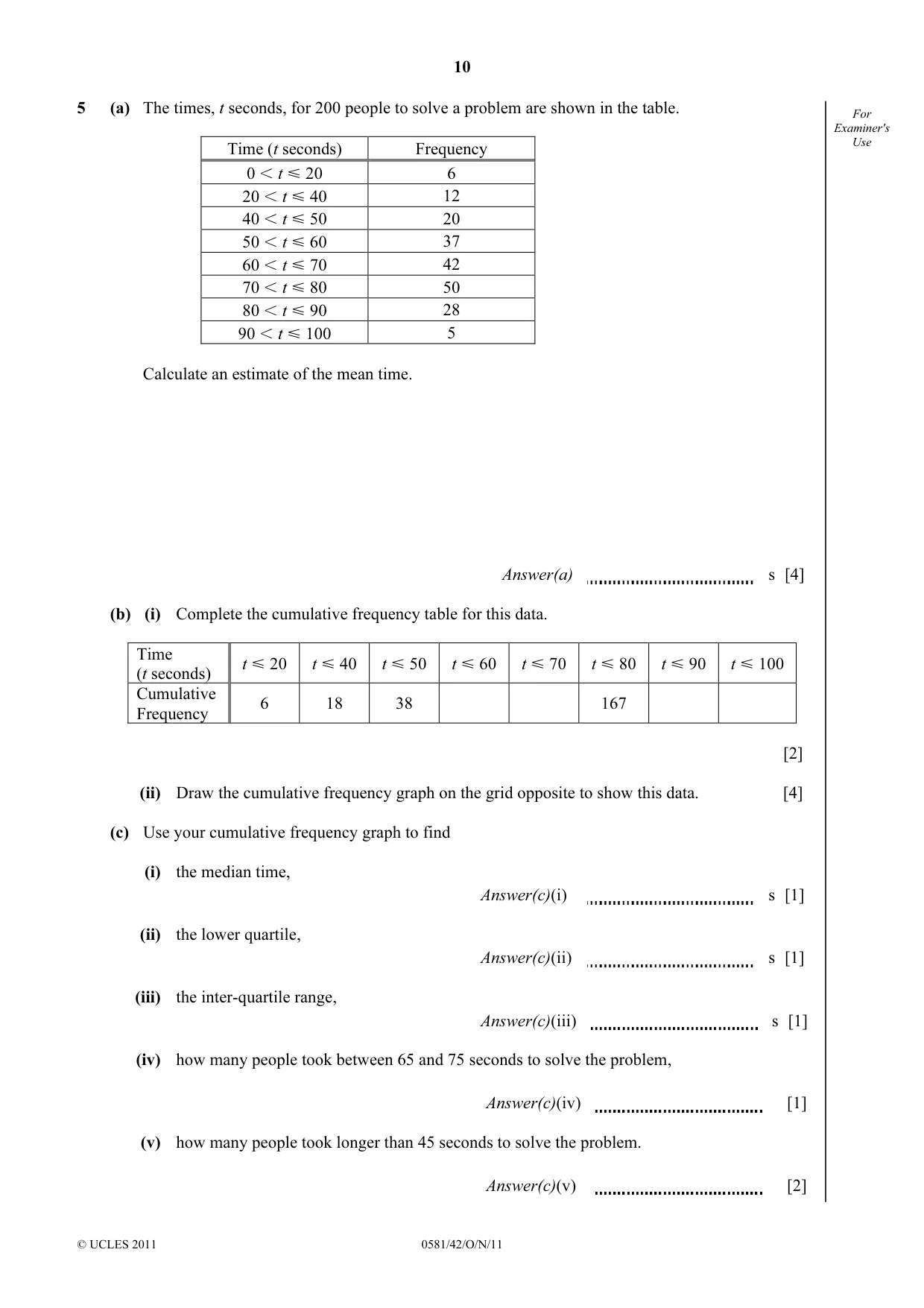
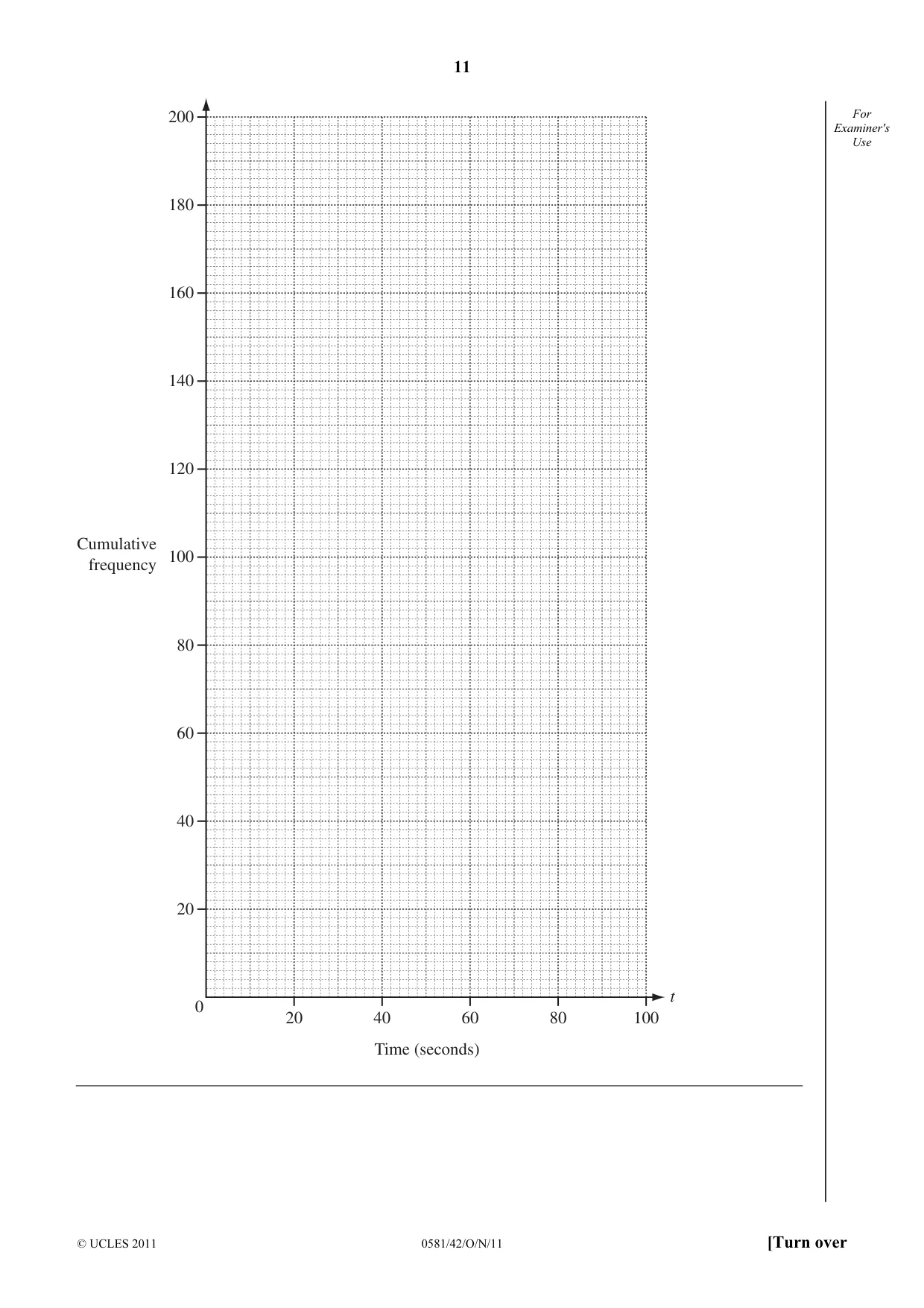
10 © UCLES 2011 0581/42/O/N/11 For Examiner's Use 5 (a) The times, t seconds, for 200 people to solve a problem are shown in the table. Time (t seconds) Frequency 0 I t Y 20 6 20 I t Y 40 12 40 I t Y 50 20 50 I t Y 60 37 60 I t Y 70 42 70 I t Y 80 50 80 I t Y 90 28 90 I t Y 100 5 Calculate an estimate of the mean time. Answer(a) s [4] (b) (i) Complete the cumulative frequency table for this data. Time (t seconds) t Y 20 t Y 40 t Y 50 t Y 60 t Y 70 t Y 80 t Y 90 t Y 100 Cumulative Frequency 6 18 38 167 [2] (ii) Draw the cumulative frequency graph on the grid opposite to show this data. [4] (c) Use your cumulative frequency graph to find (i) the median time, Answer(c)(i) s [1] (ii) the lower quartile, Answer(c)(ii) s [1] (iii) the inter-quartile range, Answer(c)(iii) s [1] (iv) how many people took between 65 and 75 seconds to solve the problem, Answer(c)(iv) [1] (v) how many people took longer than 45 seconds to solve the problem. Answer(c)(v) [2]
Question paper, page 11
11 © UCLES 2011 0581/42/O/N/11 [Turn over For Examiner's Use 200 180 160 140 120 100 80 60 40 20 0 20 40 60 80 100 Cumulative frequency Time (seconds) t
Question paper, page 12
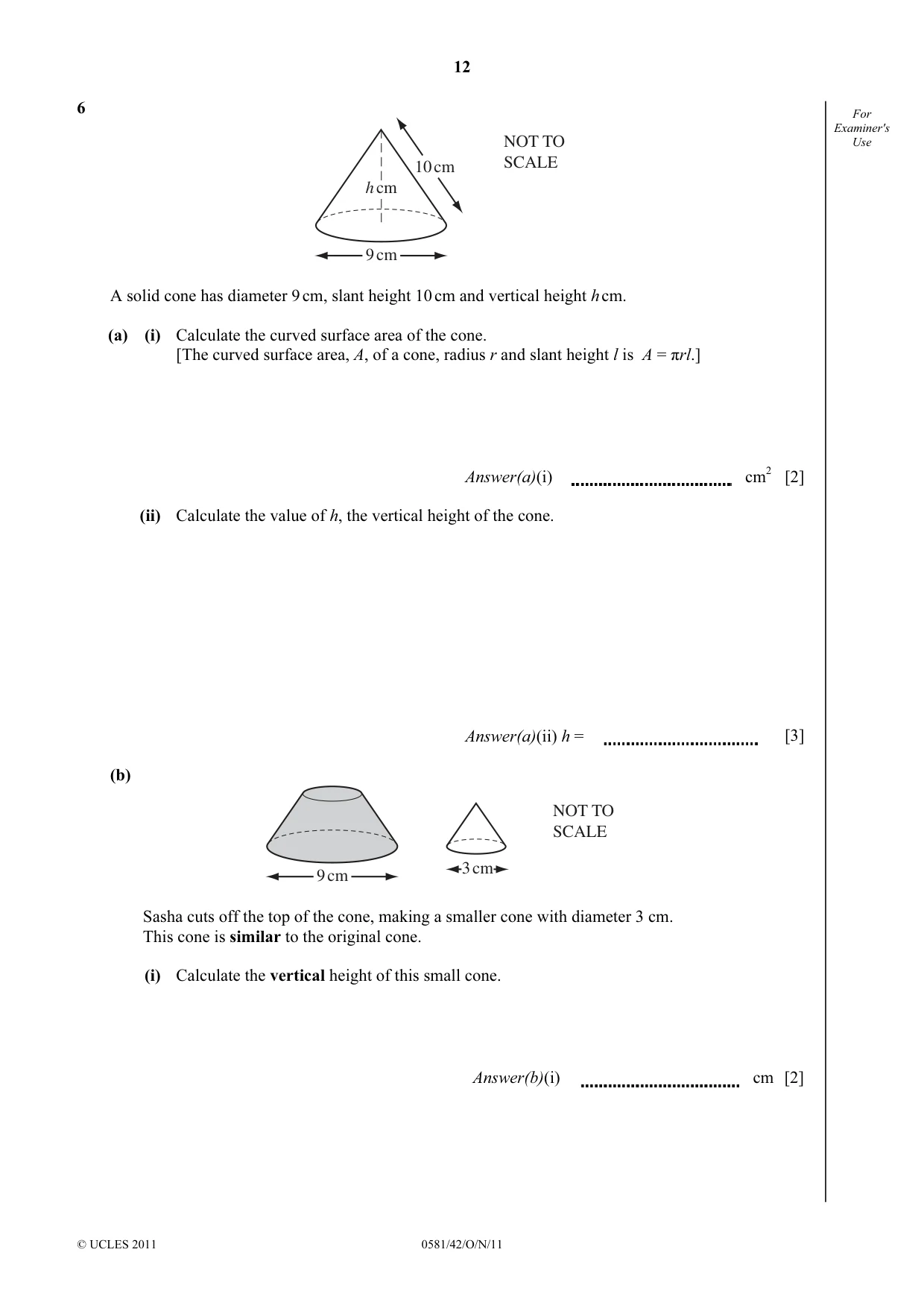
12 © UCLES 2011 0581/42/O/N/11 For Examiner's Use 6 h cm 9 cm 10 cm NOT TO SCALE A solid cone has diameter 9 cm, slant height 10 cm and vertical height h cm. (a) (i) Calculate the curved surface area of the cone. [The curved surface area, A, of a cone, radius r and slant height l is A = πrl.] Answer(a)(i) cm2 [2] (ii) Calculate the value of h, the vertical height of the cone. Answer(a)(ii) h = [3] (b) 9 cm 3 cm NOT TO SCALE Sasha cuts off the top of the cone, making a smaller cone with diameter 3 cm. This cone is similar to the original cone. (i) Calculate the vertical height of this small cone. Answer(b)(i) cm [2]
Question paper, page 13
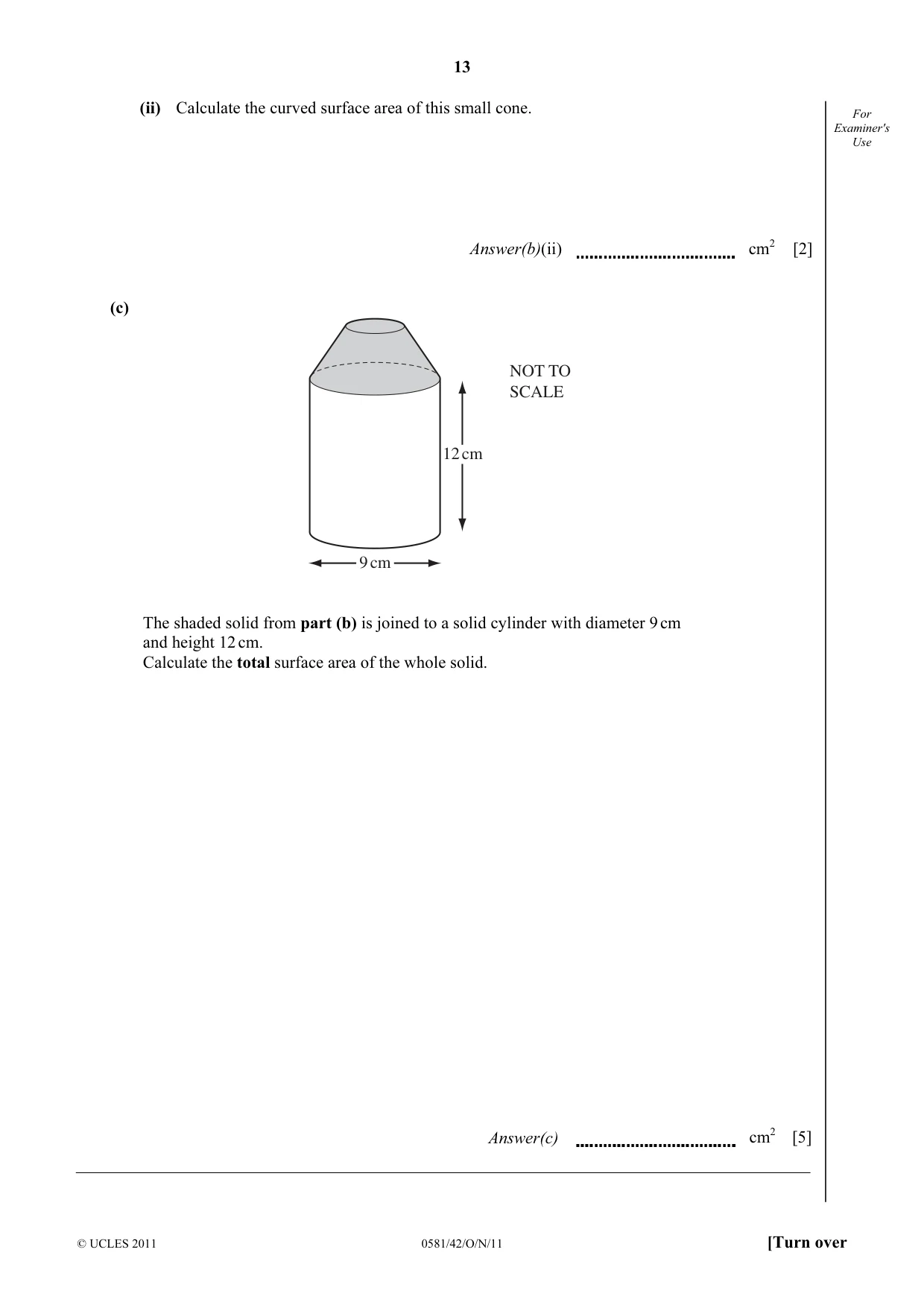
13 © UCLES 2011 0581/42/O/N/11 [Turn over For Examiner's Use (ii) Calculate the curved surface area of this small cone. Answer(b)(ii) cm2 [2] (c) 9 cm 12 cm NOT TO SCALE The shaded solid from part (b) is joined to a solid cylinder with diameter 9 cm and height 12 cm. Calculate the total surface area of the whole solid. Answer(c) cm2 [5]
Question paper, page 14
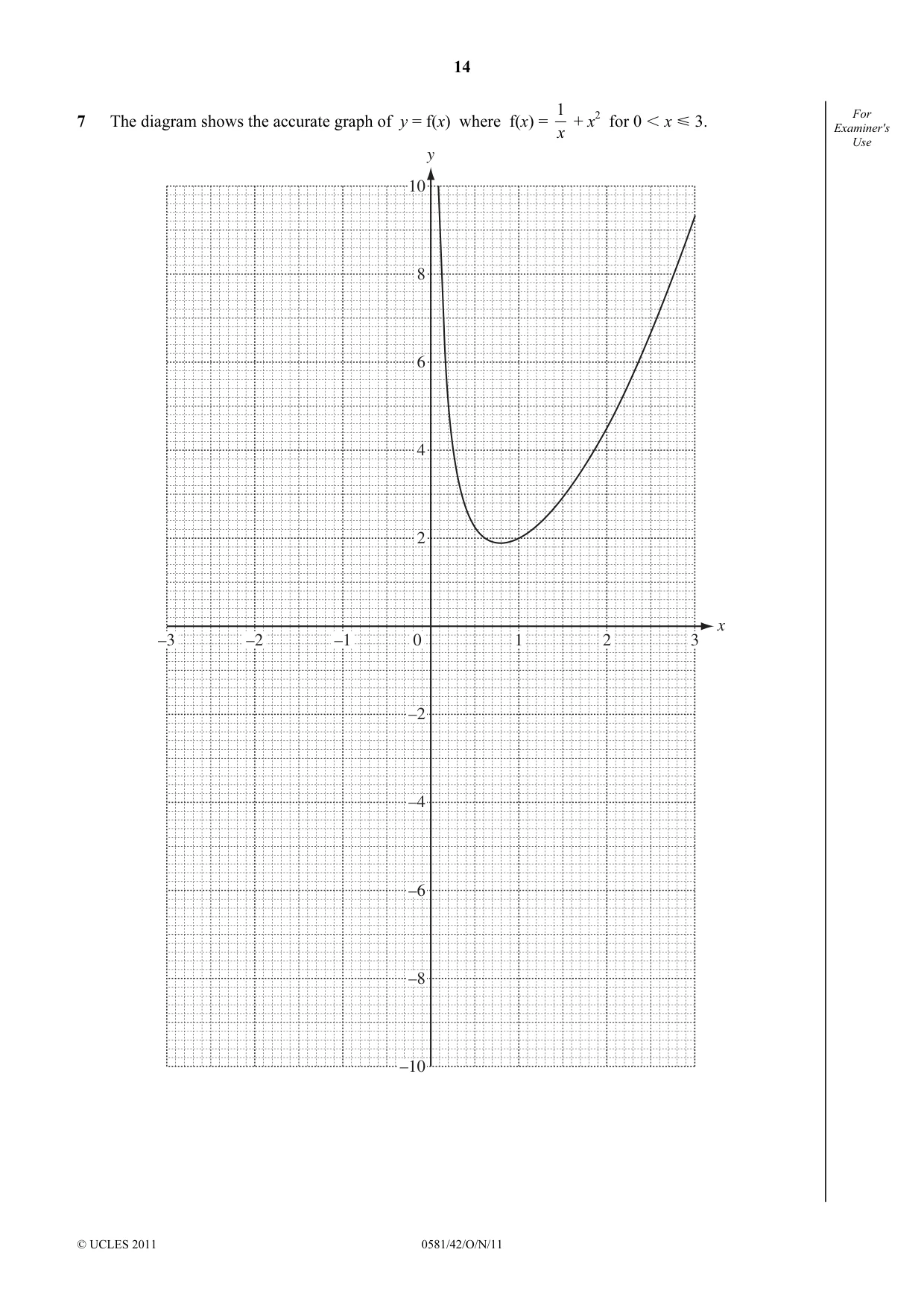
14 © UCLES 2011 0581/42/O/N/11 For Examiner's Use 7 The diagram shows the accurate graph of y = f(x) where f(x) = x 1 + x2 for 0 I x Y 3. y x 1 0 –1 –2 –3 2 3 10 8 6 4 2 –2 –4 –6 –8 –10
Question paper, page 15
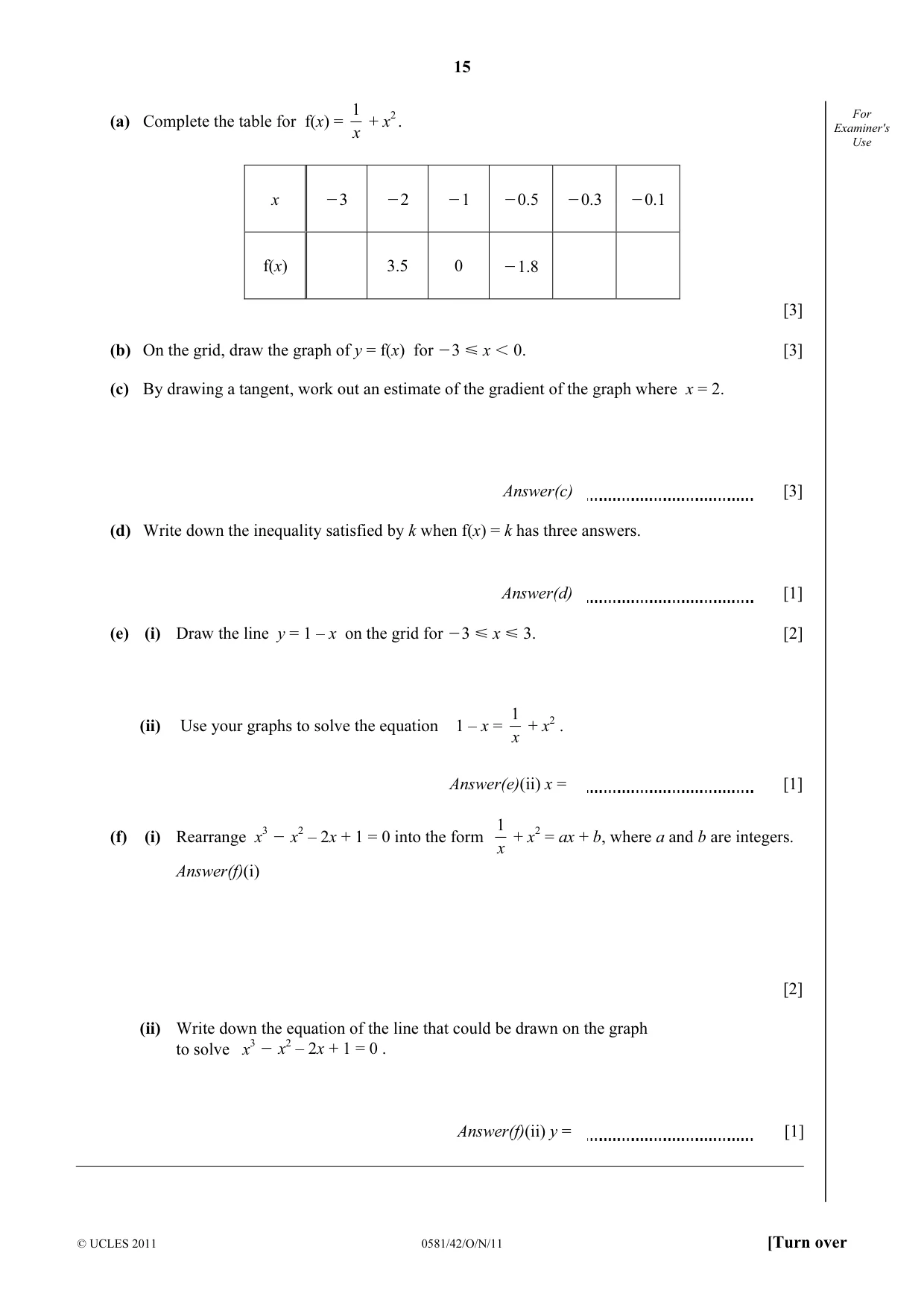
15 © UCLES 2011 0581/42/O/N/11 [Turn over For Examiner's Use (a) Complete the table for f(x) = x 1 + x2 . x O3 O2 O1 O0.5 O0.3 O0.1 f(x) 3.5 0 O1.8 [3] (b) On the grid, draw the graph of y = f(x) for O3 Y x I 0. [3] (c) By drawing a tangent, work out an estimate of the gradient of the graph where x = 2. Answer(c) [3] (d) Write down the inequality satisfied by k when f(x) = k has three answers. Answer(d) [1] (e) (i) Draw the line y = 1 – x on the grid for O3 Y x Y 3. [2] (ii) Use your graphs to solve the equation 1 – x = x 1 + x2 . Answer(e)(ii) x = [1] (f) (i) Rearrange x3 O x2 – 2x + 1 = 0 into the form x 1 + x2 = ax + b, where a and b are integers. Answer(f)(i) [2] (ii) Write down the equation of the line that could be drawn on the graph to solve x3 O x2 – 2x + 1 = 0 . Answer(f)(ii) y = [1]
Question paper, page 16
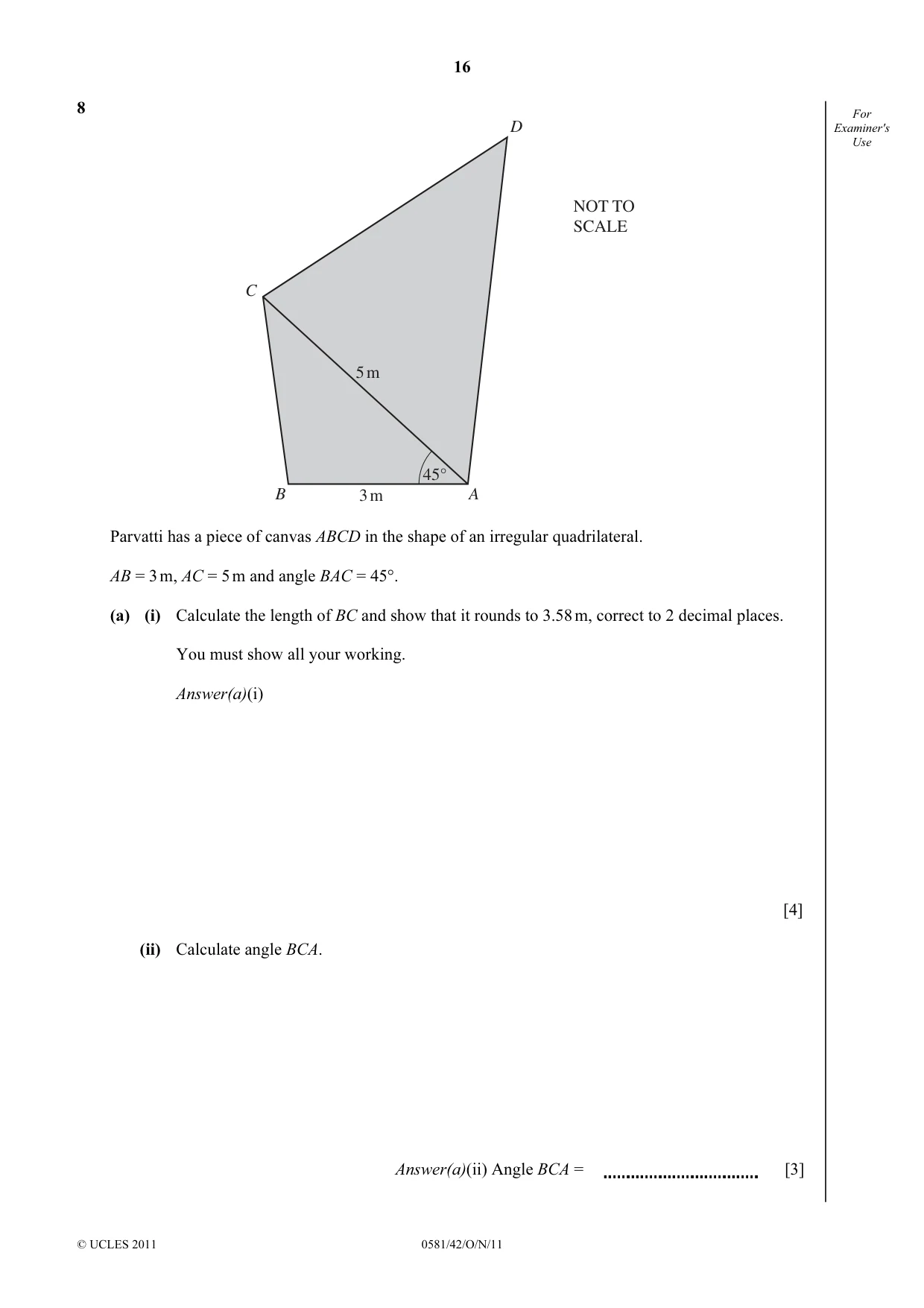
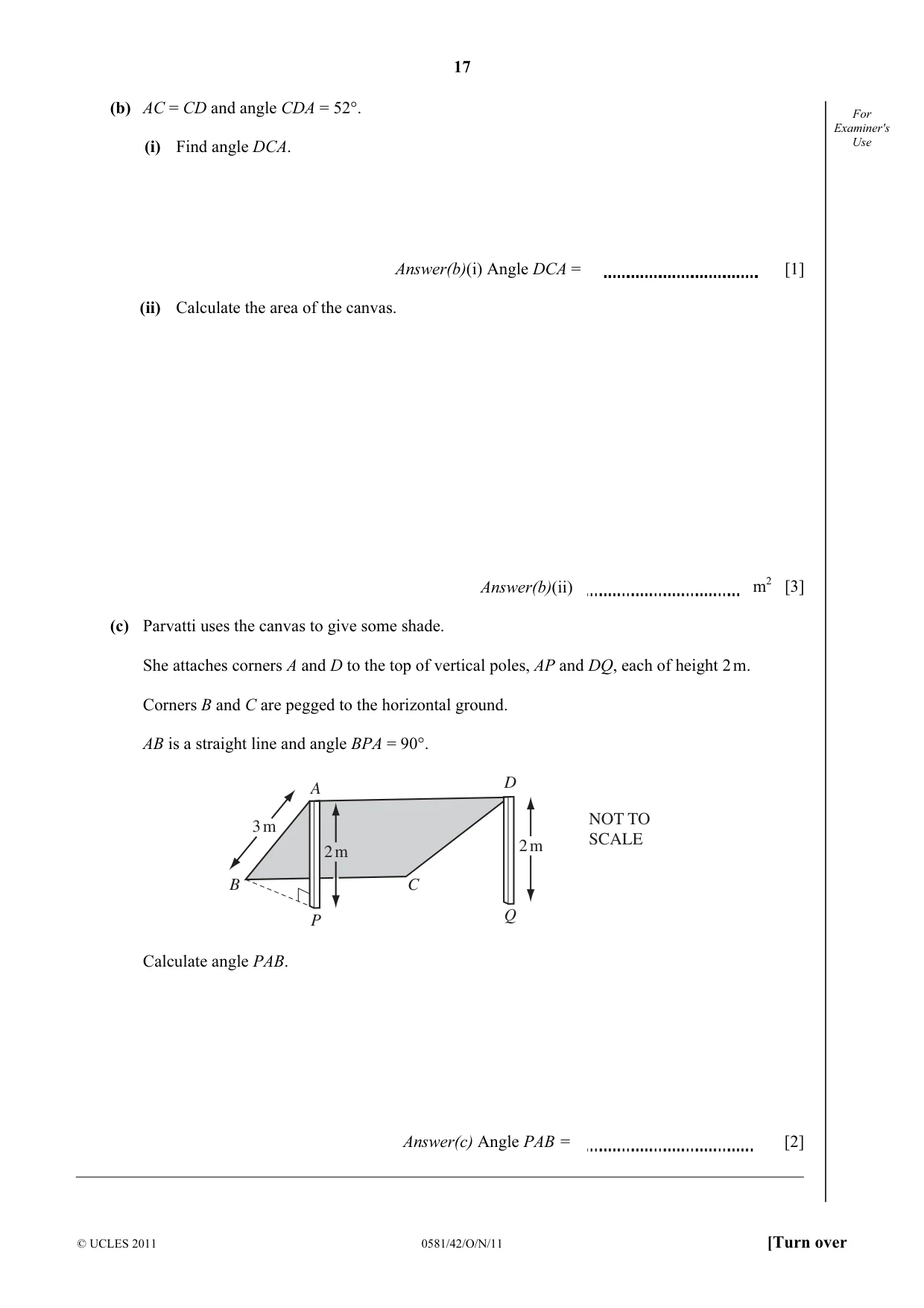
16 © UCLES 2011 0581/42/O/N/11 For Examiner's Use 8 C B A D 5 m 3 m 45° NOT TO SCALE Parvatti has a piece of canvas ABCD in the shape of an irregular quadrilateral. AB = 3 m, AC = 5 m and angle BAC = 45°. (a) (i) Calculate the length of BC and show that it rounds to 3.58 m, correct to 2 decimal places. You must show all your working. Answer(a)(i) [4] (ii) Calculate angle BCA. Answer(a)(ii) Angle BCA = [3]
Question paper, page 17
17 © UCLES 2011 0581/42/O/N/11 [Turn over For Examiner's Use (b) AC = CD and angle CDA = 52°. (i) Find angle DCA. Answer(b)(i) Angle DCA = [1] (ii) Calculate the area of the canvas. Answer(b)(ii) m2 [3] (c) Parvatti uses the canvas to give some shade. She attaches corners A and D to the top of vertical poles, AP and DQ, each of height 2 m. Corners B and C are pegged to the horizontal ground. AB is a straight line and angle BPA = 90°. 3 m 2 m 2 m B P A Q D C NOT TO SCALE Calculate angle PAB. Answer(c) Angle PAB = [2]
Question paper, page 18
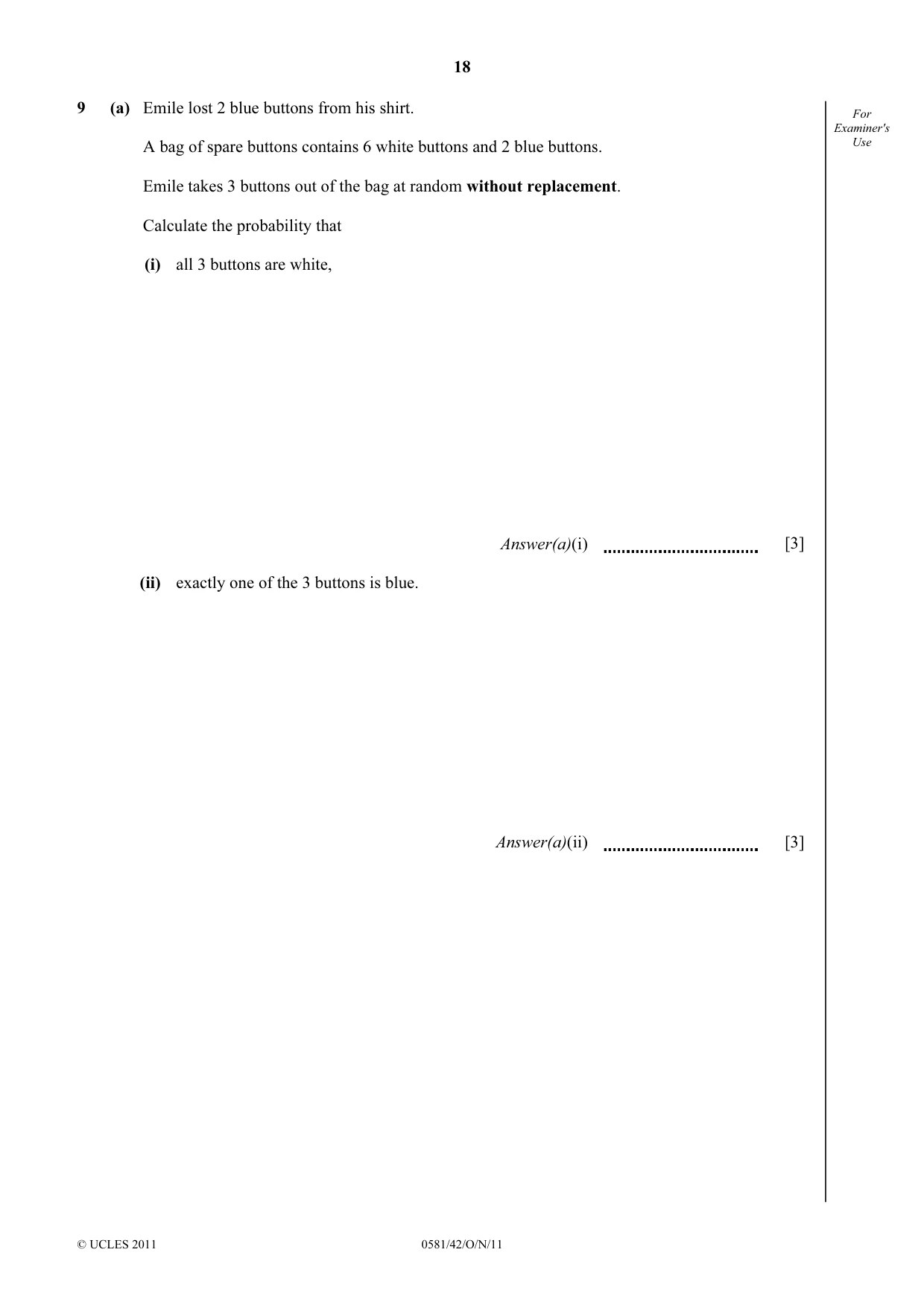
18 © UCLES 2011 0581/42/O/N/11 For Examiner's Use 9 (a) Emile lost 2 blue buttons from his shirt. A bag of spare buttons contains 6 white buttons and 2 blue buttons. Emile takes 3 buttons out of the bag at random without replacement. Calculate the probability that (i) all 3 buttons are white, Answer(a)(i) [3] (ii) exactly one of the 3 buttons is blue. Answer(a)(ii) [3]
Question paper, page 19
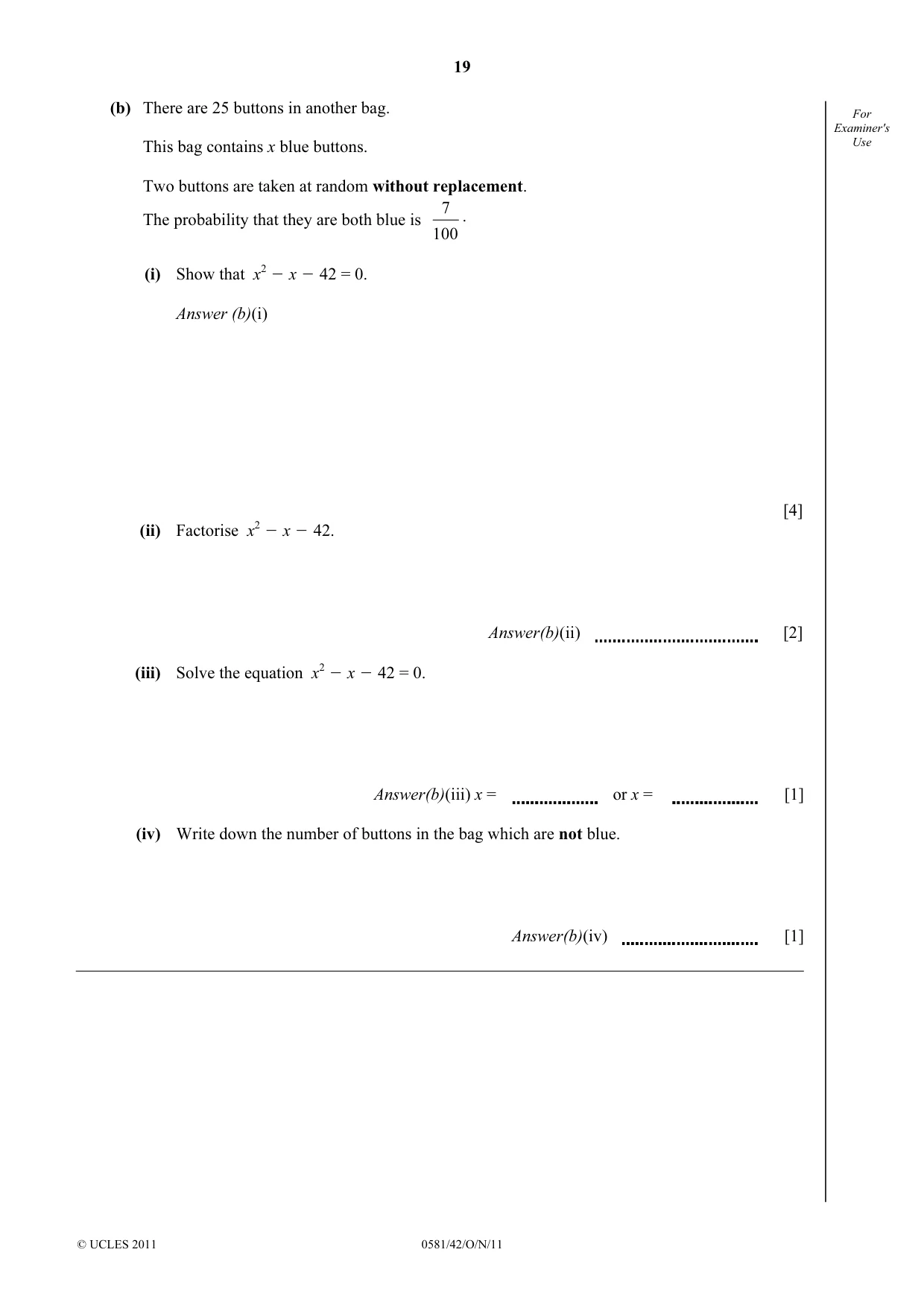
19 © UCLES 2011 0581/42/O/N/11 For Examiner's Use (b) There are 25 buttons in another bag. This bag contains x blue buttons. Two buttons are taken at random without replacement. The probability that they are both blue is 100 7 . (i) Show that x2 O x O 42 = 0. Answer (b)(i) [4] (ii) Factorise x2 O x O 42. Answer(b)(ii) [2] (iii) Solve the equation x2 O x O 42 = 0. Answer(b)(iii) x = or x = [1] (iv) Write down the number of buttons in the bag which are not blue. Answer(b)(iv) [1]
Question paper, page 20
20 Permission to reproduce items where third-party owned material protected by copyright is included has been sought and cleared where possible. Every reasonable effort has been made by the publisher (UCLES) to trace copyright holders, but if any items requiring clearance have unwittingly been included, the publisher will be pleased to make amends at the earliest possible opportunity. University of Cambridge International Examinations is part of the Cambridge Assessment Group. Cambridge Assessment is the brand name of University of Cambridge Local Examinations Syndicate (UCLES), which is itself a department of the University of Cambridge. © UCLES 2011 0581/42/O/N/11 BLANK PAGE
Mark scheme, page 1
UNIVERSITY OF CAMBRIDGE INTERNATIONAL EXAMINATIONS International General Certificate of Secondary Education MARK SCHEME for the October/November 2011 question paper for the guidance of teachers 0581 MATHEMATICS 0581/42 Paper 4 (Extended), maximum raw mark 130 This mark scheme is published as an aid to teachers and candidates, to indicate the requirements of the examination. It shows the basis on which Examiners were instructed to award marks. It does not indicate the details of the discussions that took place at an Examiners’ meeting before marking began, which would have considered the acceptability of alternative answers. Mark schemes must be read in conjunction with the question papers and the report on the examination. • Cambridge will not enter into discussions or correspondence in connection with these mark schemes. Cambridge is publishing the mark schemes for the October/November 2011 question papers for most IGCSE, GCE Advanced Level and Advanced Subsidiary Level syllabuses and some Ordinary Level syllabuses. www.XtremePapers.com
Mark scheme, page 2
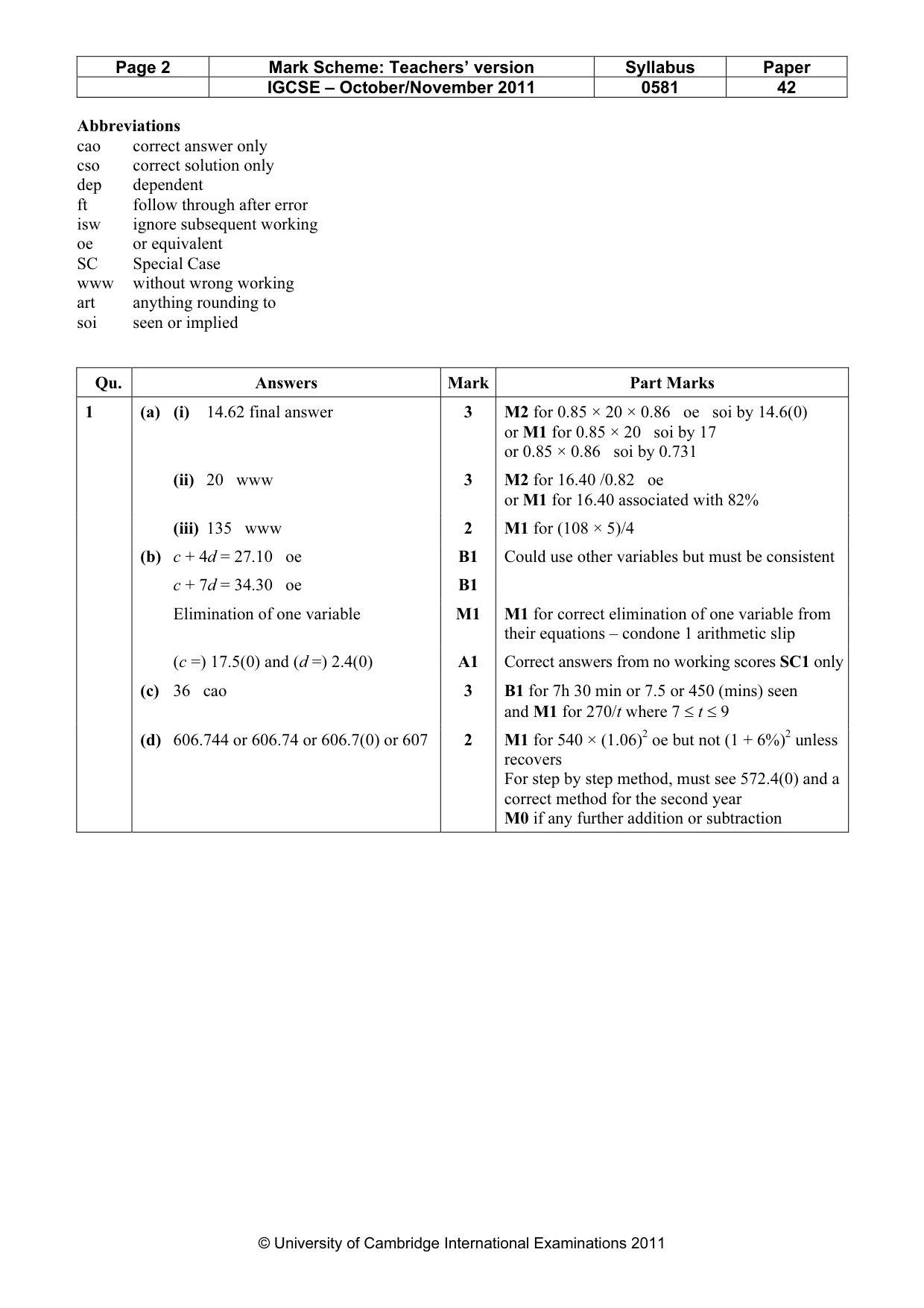
Page 2 Mark Scheme: Teachers’ version Syllabus Paper IGCSE – October/November 2011 0581 42 © University of Cambridge International Examinations 2011 Abbreviations cao correct answer only cso correct solution only dep dependent ft follow through after error isw ignore subsequent working oe or equivalent SC Special Case www without wrong working art anything rounding to soi seen or implied Qu. Answers Mark Part Marks 1 (a) (i) 14.62 final answer 3 M2 for 0.85 × 20 × 0.86 oe soi by 14.6(0) or M1 for 0.85 × 20 soi by 17 or 0.85 × 0.86 soi by 0.731 (ii) 20 www 3 M2 for 16.40 /0.82 oe or M1 for 16.40 associated with 82% (iii) 135 www 2 M1 for (108 × 5)/4 (b) c + 4d = 27.10 oe B1 Could use other variables but must be consistent c + 7d = 34.30 oe B1 Elimination of one variable M1 M1 for correct elimination of one variable from their equations – condone 1 arithmetic slip (c =) 17.5(0) and (d =) 2.4(0) A1 Correct answers from no working scores SC1 only (c) 36 cao 3 B1 for 7h 30 min or 7.5 or 450 (mins) seen and M1 for 270/t where 7 ≤ t ≤ 9 (d) 606.744 or 606.74 or 606.7(0) or 607 2 M1 for 540 × (1.06)2 oe but not (1 + 6%)2 unless recovers For step by step method, must see 572.4(0) and a correct method for the second year M0 if any further addition or subtraction
Mark scheme, page 3
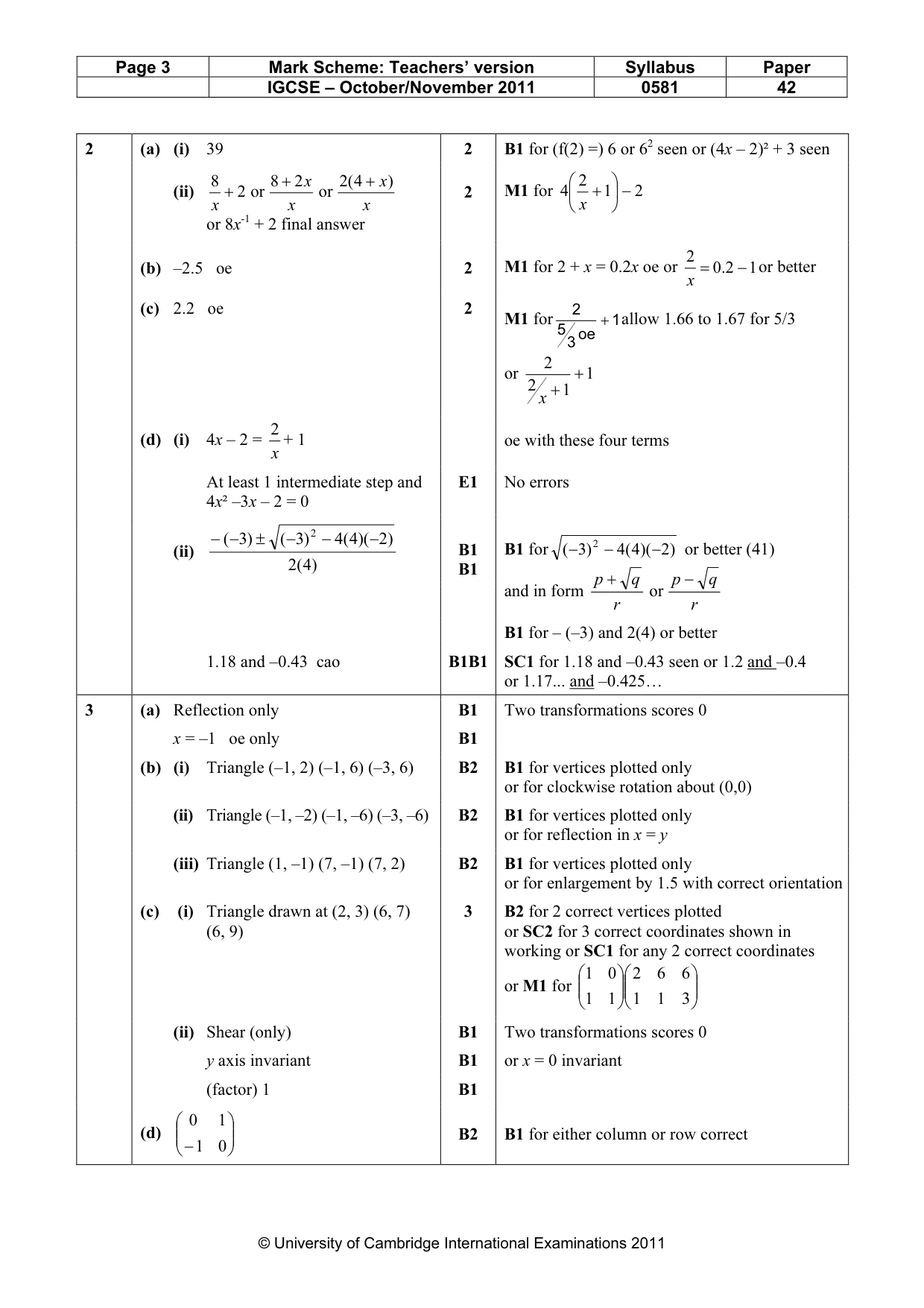
Page 3 Mark Scheme: Teachers’ version Syllabus Paper IGCSE – October/November 2011 0581 42 © University of Cambridge International Examinations 2011 2 (a) (i) 39 2 B1 for (f(2) =) 6 or 62 seen or (4x – 2)² + 3 seen (ii) 2 8 + x or x x 2 8 + or x x) 4 ( 2 + or 8x-1 + 2 final answer 2 M1 for 2 1 2 4 − + x (b) –2.5 oe 2 M1 for 2 + x = 0.2x oe or 1 2.0 2 − = x or better (c) 2.2 oe 2 M1 for 1 oe 3 5 2 + allow 1.66 to 1.67 for 5/3 or 1 1 2 2 + + x (d) (i) 4x – 2 = x 2 + 1 oe with these four terms At least 1 intermediate step and 4x² –3x – 2 = 0 E1 No errors (ii) ) 4 ( 2 ) 2 )( 4 ( 4 ) 3 ( ) 3 ( 2 − − − ± − − B1 B1 B1 for ) 2 )( 4 ( 4 ) 3 ( 2 − − − or better (41) and in form r q p + or r q p − B1 for – (–3) and 2(4) or better 1.18 and –0.43 cao B1B1 SC1 for 1.18 and –0.43 seen or 1.2 and –0.4 or 1.17... and –0.425… 3 (a) Reflection only B1 Two transformations scores 0 x = –1 oe only B1 (b) (i) Triangle (–1, 2) (–1, 6) (–3, 6) B2 B1 for vertices plotted only or for clockwise rotation about (0,0) (ii) Triangle (–1, –2) (–1, –6) (–3, –6) B2 B1 for vertices plotted only or for reflection in x = y (iii) Triangle (1, –1) (7, –1) (7, 2) B2 B1 for vertices plotted only or for enlargement by 1.5 with correct orientation (c) (i) Triangle drawn at (2, 3) (6, 7) (6, 9) 3 B2 for 2 correct vertices plotted or SC2 for 3 correct coordinates shown in working or SC1 for any 2 correct coordinates or M1 for 3 6 1 1 6 2 1 1 0 1 (ii) Shear (only) B1 Two transformations scores 0 y axis invariant B1 or x = 0 invariant (factor) 1 B1 (d) − 0 1 1 0 B2 B1 for either column or row correct
Mark scheme, page 4
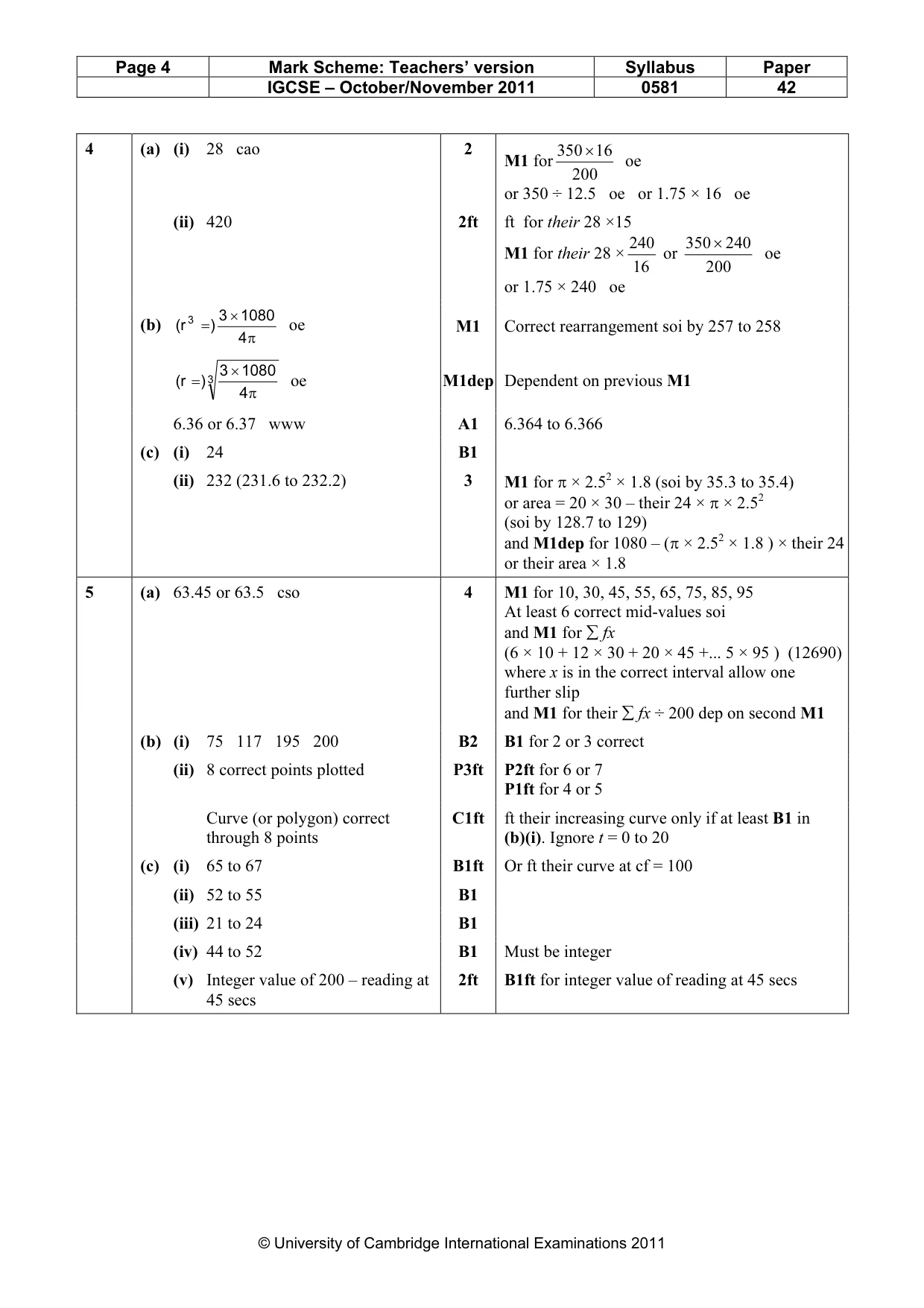
Page 4 Mark Scheme: Teachers’ version Syllabus Paper IGCSE – October/November 2011 0581 42 © University of Cambridge International Examinations 2011 4 (a) (i) 28 cao 2 M1 for 200 16 350× oe or 350 ÷ 12.5 oe or 1.75 × 16 oe (ii) 420 2ft ft for their 28 ×15 M1 for their 28 × 16 240 or 200 240 350× oe or 1.75 × 240 oe (b) π × = 4 1080 3 ) r( 3 oe M1 Correct rearrangement soi by 257 to 258 3 4 1080 3 ) r( π × = oe M1dep Dependent on previous M1 6.36 or 6.37 www A1 6.364 to 6.366 (c) (i) 24 B1 (ii) 232 (231.6 to 232.2) 3 M1 for π × 2.52 × 1.8 (soi by 35.3 to 35.4) or area = 20 × 30 – their 24 × π × 2.52 (soi by 128.7 to 129) and M1dep for 1080 – (π × 2.52 × 1.8 ) × their 24 or their area × 1.8 5 (a) 63.45 or 63.5 cso 4 M1 for 10, 30, 45, 55, 65, 75, 85, 95 At least 6 correct mid-values soi and M1 for ∑ fx (6 × 10 + 12 × 30 + 20 × 45 +... 5 × 95 ) (12690) where x is in the correct interval allow one further slip and M1 for their ∑ fx ÷ 200 dep on second M1 (b) (i) 75 117 195 200 B2 B1 for 2 or 3 correct (ii) 8 correct points plotted P3ft P2ft for 6 or 7 P1ft for 4 or 5 Curve (or polygon) correct through 8 points C1ft ft their increasing curve only if at least B1 in (b)(i). Ignore t = 0 to 20 (c) (i) 65 to 67 B1ft Or ft their curve at cf = 100 (ii) 52 to 55 B1 (iii) 21 to 24 B1 (iv) 44 to 52 B1 Must be integer (v) Integer value of 200 – reading at 45 secs 2ft B1ft for integer value of reading at 45 secs
Mark scheme, page 5
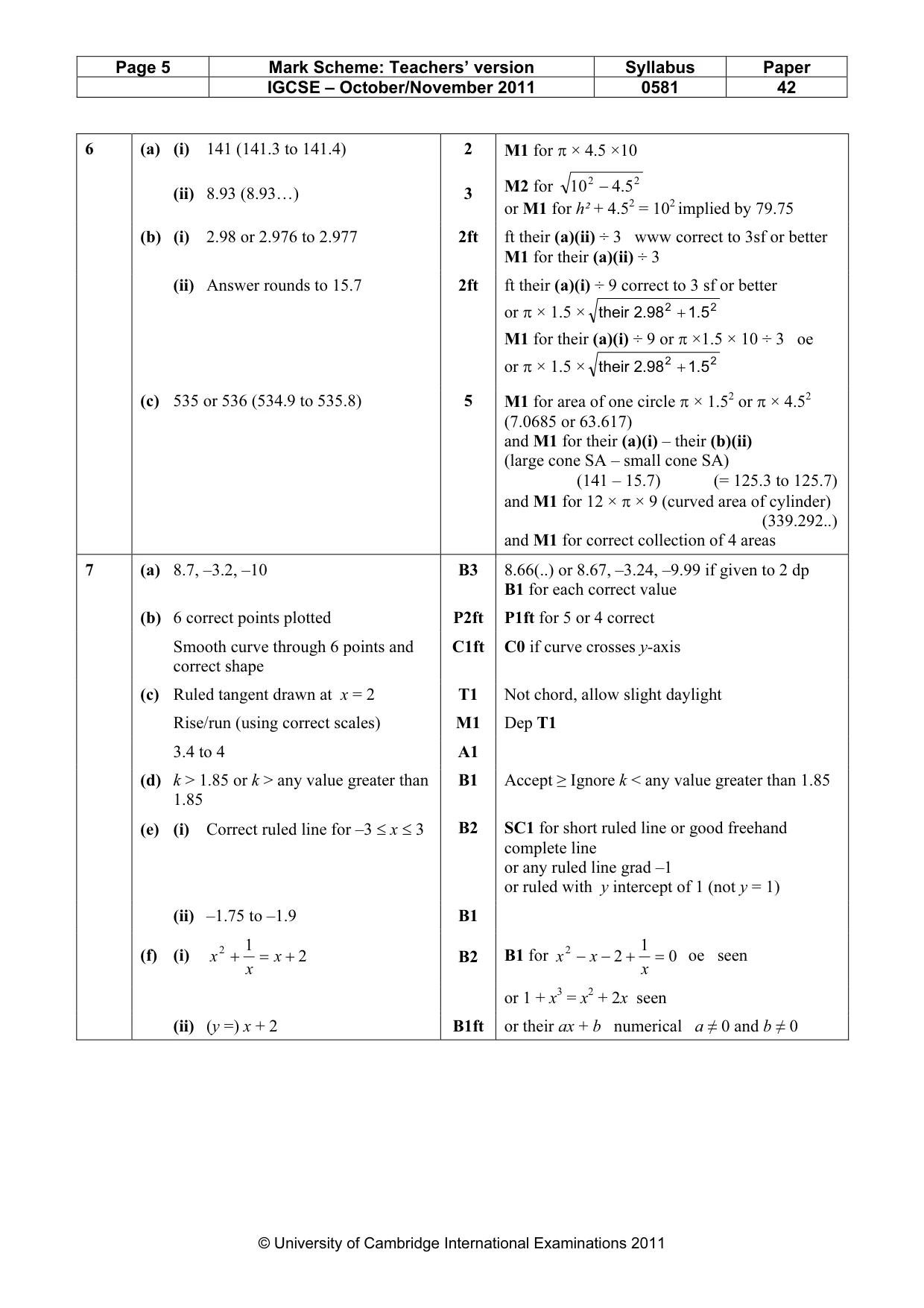
Page 5 Mark Scheme: Teachers’ version Syllabus Paper IGCSE – October/November 2011 0581 42 © University of Cambridge International Examinations 2011 6 (a) (i) 141 (141.3 to 141.4) 2 M1 for π × 4.5 ×10 (ii) 8.93 (8.93…) 3 M2 for 2 2 5.4 10 − or M1 for h² + 4.52 = 102 implied by 79.75 (b) (i) 2.98 or 2.976 to 2.977 2ft ft their (a)(ii) ÷ 3 www correct to 3sf or better M1 for their (a)(ii) ÷ 3 (ii) Answer rounds to 15.7 2ft ft their (a)(i) ÷ 9 correct to 3 sf or better or π × 1.5 × 2 2 5 . 1 98 . 2 their + M1 for their (a)(i) ÷ 9 or π ×1.5 × 10 ÷ 3 oe or π × 1.5 × 2 2 5 . 1 98 . 2 their + (c) 535 or 536 (534.9 to 535.8) 5 M1 for area of one circle π × 1.52 or π × 4.52 (7.0685 or 63.617) and M1 for their (a)(i) – their (b)(ii) (large cone SA – small cone SA) (141 – 15.7) (= 125.3 to 125.7) and M1 for 12 × π × 9 (curved area of cylinder) (339.292..) and M1 for correct collection of 4 areas 7 (a) 8.7, –3.2, –10 B3 8.66(..) or 8.67, –3.24, –9.99 if given to 2 dp B1 for each correct value (b) 6 correct points plotted P2ft P1ft for 5 or 4 correct Smooth curve through 6 points and correct shape C1ft C0 if curve crosses y-axis (c) Ruled tangent drawn at x = 2 T1 Not chord, allow slight daylight Rise/run (using correct scales) M1 Dep T1 3.4 to 4 A1 (d) k > 1.85 or k > any value greater than 1.85 B1 Accept ≥ Ignore k < any value greater than 1.85 (e) (i) Correct ruled line for –3 ≤ x ≤ 3 B2 SC1 for short ruled line or good freehand complete line or any ruled line grad –1 or ruled with y intercept of 1 (not y = 1) (ii) –1.75 to –1.9 B1 (f) (i) 2 1 2 + = + x x x B2 B1 for 0 1 2 2 = + − − x x x oe seen or 1 + x3 = x2 + 2x seen (ii) (y =) x + 2 B1ft or their ax + b numerical a ≠ 0 and b ≠ 0
Mark scheme, page 6
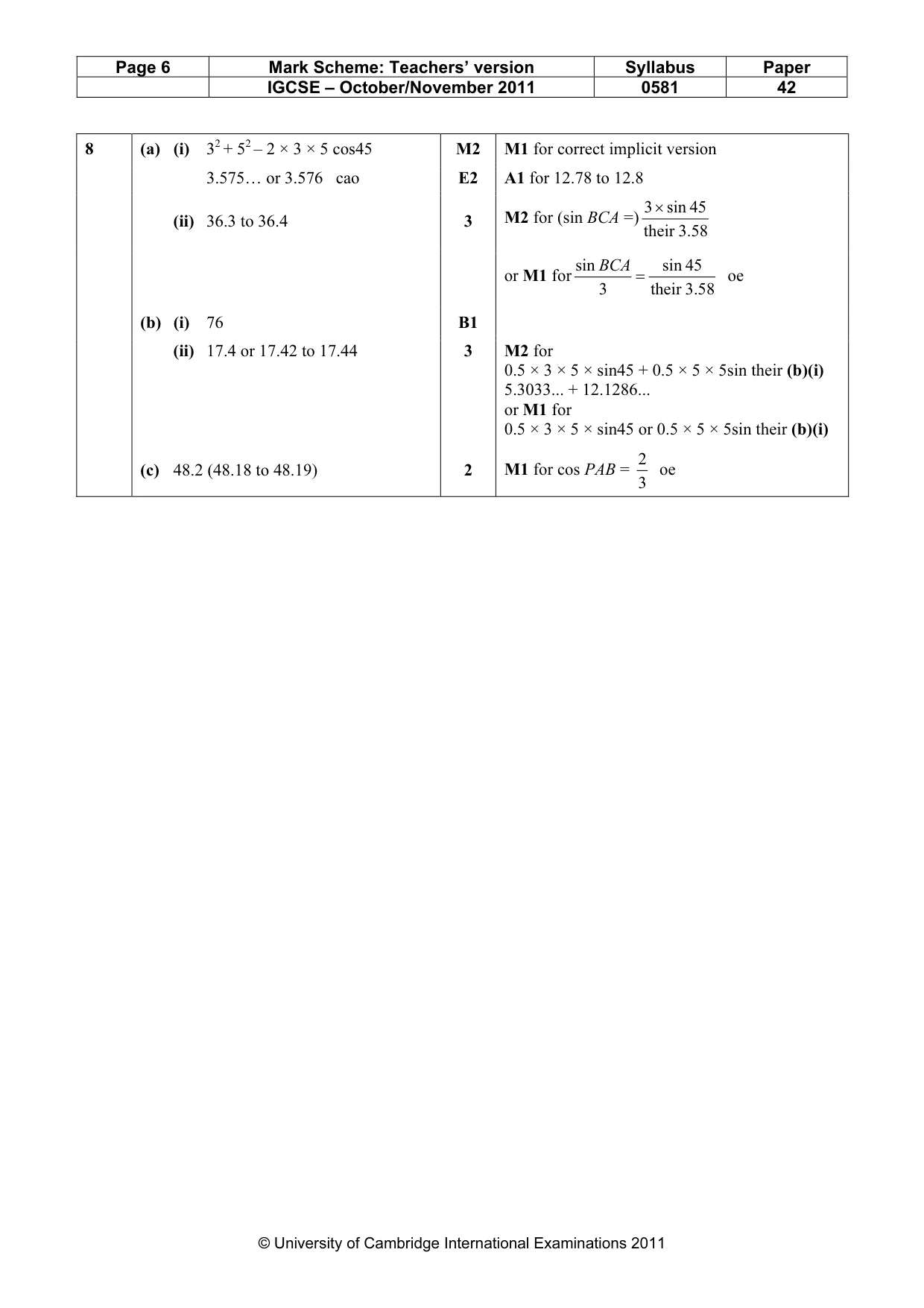
Page 6 Mark Scheme: Teachers’ version Syllabus Paper IGCSE – October/November 2011 0581 42 © University of Cambridge International Examinations 2011 8 (a) (i) 32 + 52 – 2 × 3 × 5 cos45 M2 M1 for correct implicit version 3.575… or 3.576 cao E2 A1 for 12.78 to 12.8 (ii) 36.3 to 36.4 3 M2 for (sin BCA =) 58 .3 their 45 sin 3× or M1 for 58 .3 their 45 sin 3 sin = BCA oe (b) (i) 76 B1 (ii) 17.4 or 17.42 to 17.44 3 M2 for 0.5 × 3 × 5 × sin45 + 0.5 × 5 × 5sin their (b)(i) 5.3033... + 12.1286... or M1 for 0.5 × 3 × 5 × sin45 or 0.5 × 5 × 5sin their (b)(i) (c) 48.2 (48.18 to 48.19) 2 M1 for cos PAB = 3 2 oe
Mark scheme, page 7
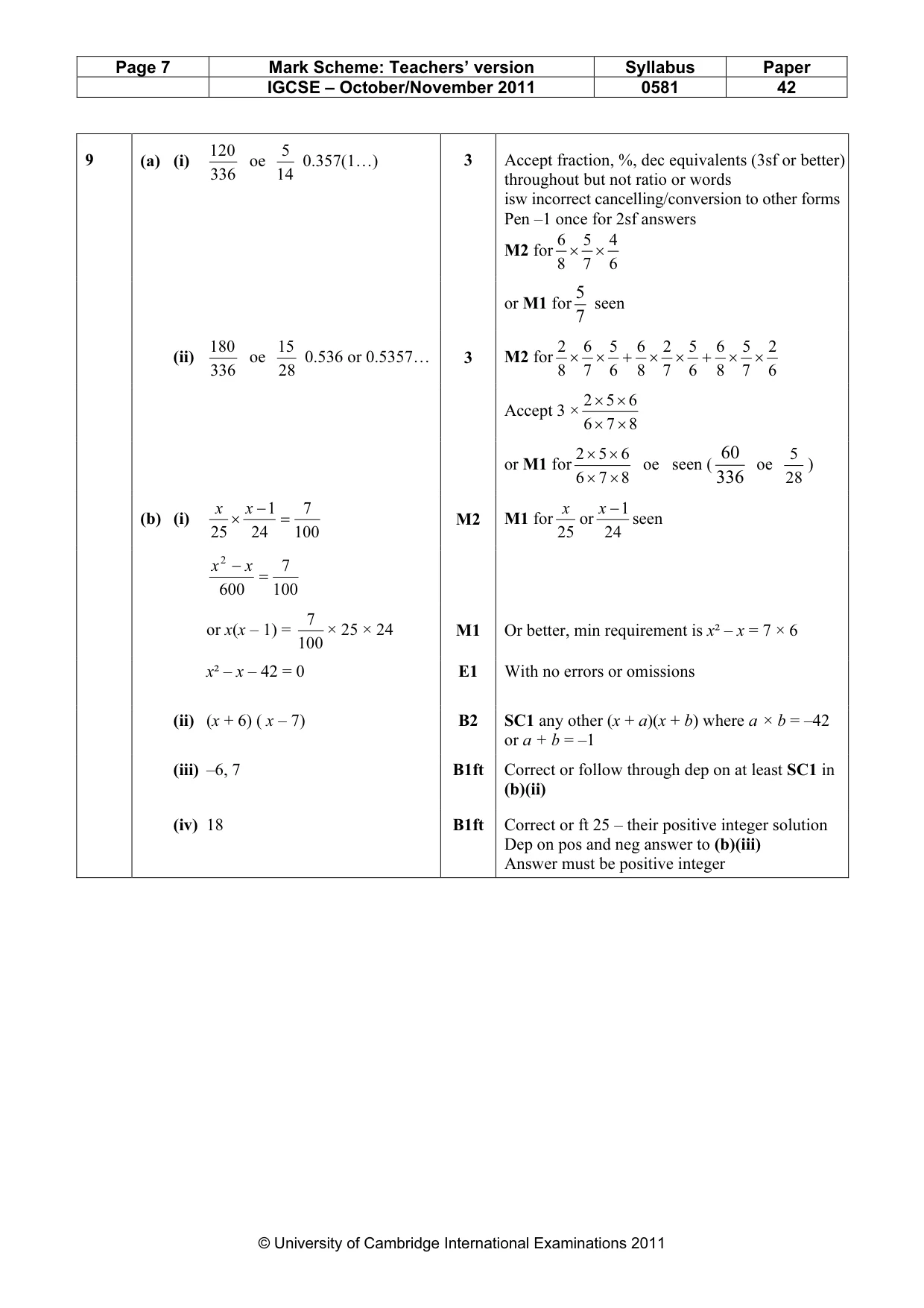
Page 7 Mark Scheme: Teachers’ version Syllabus Paper IGCSE – October/November 2011 0581 42 © University of Cambridge International Examinations 2011 9 (a) (i) 336 120 oe 14 5 0.357(1…) 3 Accept fraction, %, dec equivalents (3sf or better) throughout but not ratio or words isw incorrect cancelling/conversion to other forms Pen –1 once for 2sf answers M2 for 6 4 7 5 8 6 × × or M1 for 7 5 seen (ii) 336 180 oe 28 15 0.536 or 0.5357… 3 M2 for 6 2 7 5 8 6 6 5 7 2 8 6 6 5 7 6 8 2 × × + × × + × × Accept 3 × 8 7 6 6 5 2 × × × × or M1 for 8 7 6 6 5 2 × × × × oe seen ( 336 60 oe 28 5 ) (b) (i) 100 7 24 1 25 = − × x x M2 M1 for 25 x or 24 1 − x seen 100 7 600 2 = −x x or x(x – 1) = 100 7 × 25 × 24 M1 Or better, min requirement is x² – x = 7 × 6 x² – x – 42 = 0 E1 With no errors or omissions (ii) (x + 6) ( x – 7) B2 SC1 any other (x + a)(x + b) where a × b = –42 or a + b = –1 (iii) –6, 7 B1ft Correct or follow through dep on at least SC1 in (b)(ii) (iv) 18 B1ft Correct or ft 25 – their positive integer solution Dep on pos and neg answer to (b)(iii) Answer must be positive integer
What you needed in this session
Cambridge’s own grade thresholds for 2011 Oct/Nov, Paper 4 · Variant 2. A higher threshold means an easier paper — the bar moves with how the cohort did.