Cambridge IGCSE Mathematics (with coursework) 0581 — 2011 May/June Paper 4 · Variant 2
0581/42/M/J/11 · 130 marks · ≈146 min
The question paper and its mark scheme, free to read here and free to download. This is Cambridge’s own paper, exactly as it was sat.
Question paper16 pages
Mark scheme7 pages
Answers below. Sit the paper first if you are practising.
Paper as text
Question paper, page 1
This document consists of 15 printed pages and 1 blank page. IB11 06_0581_42/FP © UCLES 2011 [Turn over *4959433735* UNIVERSITY OF CAMBRIDGE INTERNATIONAL EXAMINATIONS International General Certificate of Secondary Education MATHEMATICS 0581/42 Paper 4 (Extended) May/June 2011 2 hours 30 minutes Candidates answer on the Question Paper. Additional Materials: Electronic calculator Geometrical instruments Mathematical tables (optional) Tracing paper (optional) READ THESE INSTRUCTIONS FIRST Write your Centre number, candidate number and name on all the work you hand in. Write in dark blue or black pen. You may use a pencil for any diagrams or graphs. Do not use staples, paper clips, highlighters, glue or correction fluid. DO NOT WRITE IN ANY BARCODES. Answer all questions. If working is needed for any question it must be shown below that question. Electronic calculators should be used. If the degree of accuracy is not specified in the question, and if the answer is not exact, give the answer to three significant figures. Give answers in degrees to one decimal place. For π use either your calculator value or 3.142. At the end of the examination, fasten all your work securely together. The number of marks is given in brackets [ ] at the end of each question or part question. The total of the marks for this paper is 130. www.XtremePapers.com
Question paper, page 2
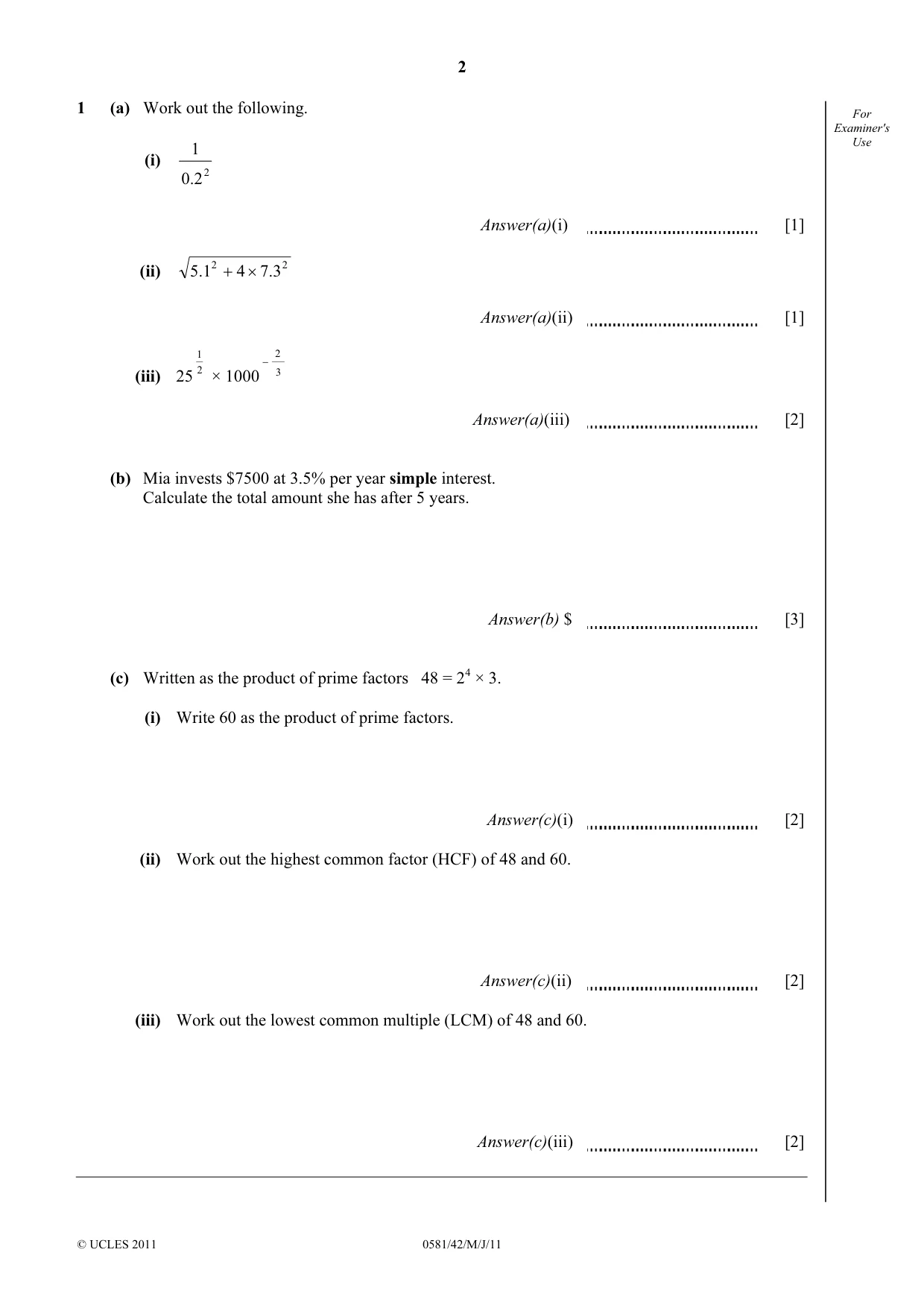
2 © UCLES 2011 0581/42/M/J/11 For Examiner's Use 1 (a) Work out the following. (i) 2 0.2 1 Answer(a)(i) [1] (ii) 2 2 7.3 4 5.1 × + Answer(a)(ii) [1] (iii) 25 2 1 × 1000 3 2 − Answer(a)(iii) [2] (b) Mia invests $7500 at 3.5% per year simple interest. Calculate the total amount she has after 5 years. Answer(b) $ [3] (c) Written as the product of prime factors 48 = 24 × 3. (i) Write 60 as the product of prime factors. Answer(c)(i) [2] (ii) Work out the highest common factor (HCF) of 48 and 60. Answer(c)(ii) [2] (iii) Work out the lowest common multiple (LCM) of 48 and 60. Answer(c)(iii) [2]
Question paper, page 3
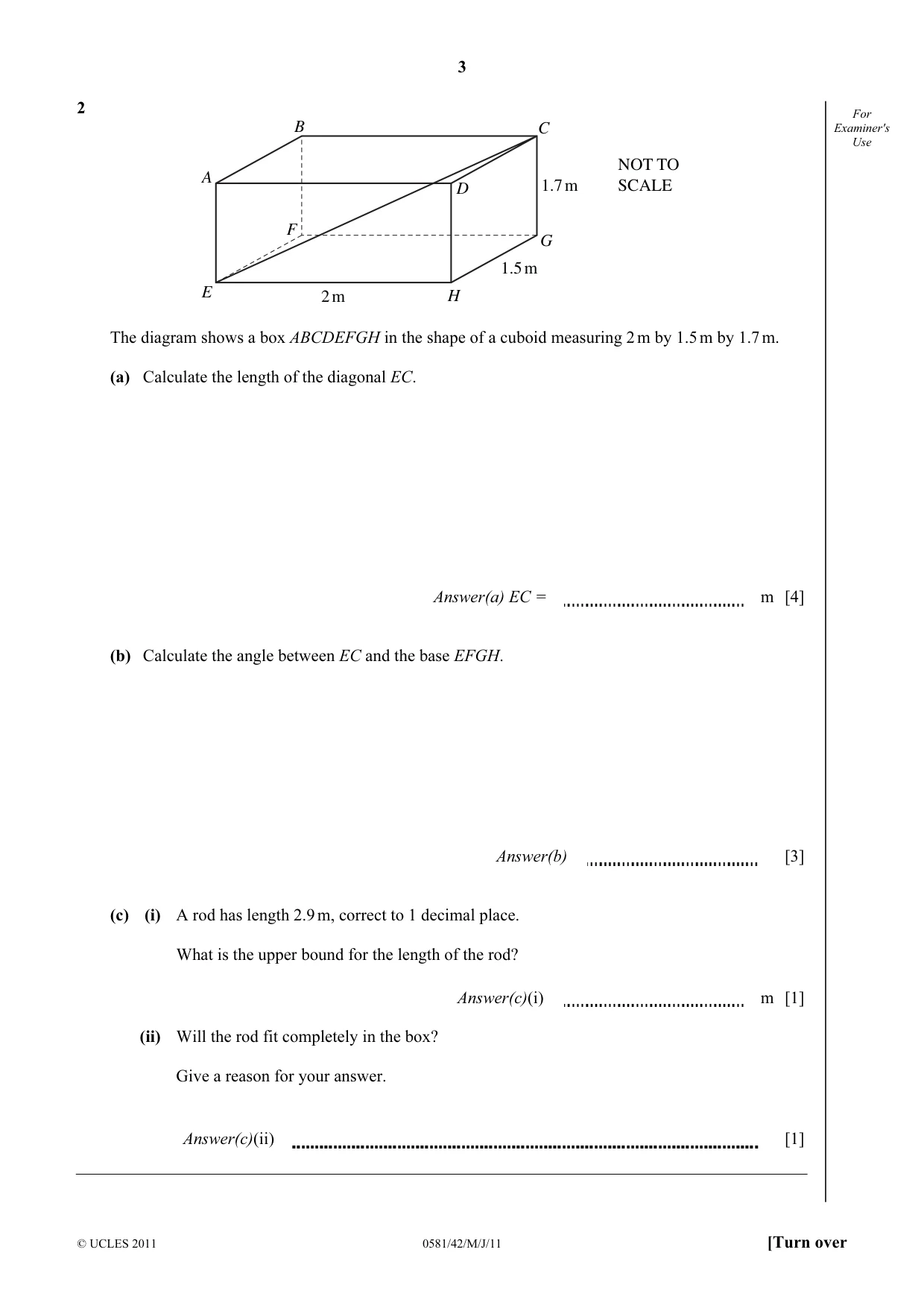
3 © UCLES 2011 0581/42/M/J/11 [Turn over For Examiner's Use 2 A E H G C B F D 2 m 1.7 m 1.5 m NOT TO SCALE The diagram shows a box ABCDEFGH in the shape of a cuboid measuring 2 m by 1.5 m by 1.7 m. (a) Calculate the length of the diagonal EC. Answer(a) EC = m [4] (b) Calculate the angle between EC and the base EFGH. Answer(b) [3] (c) (i) A rod has length 2.9 m, correct to 1 decimal place. What is the upper bound for the length of the rod? Answer(c)(i) m [1] (ii) Will the rod fit completely in the box? Give a reason for your answer. Answer(c)(ii) [1]
Question paper, page 4
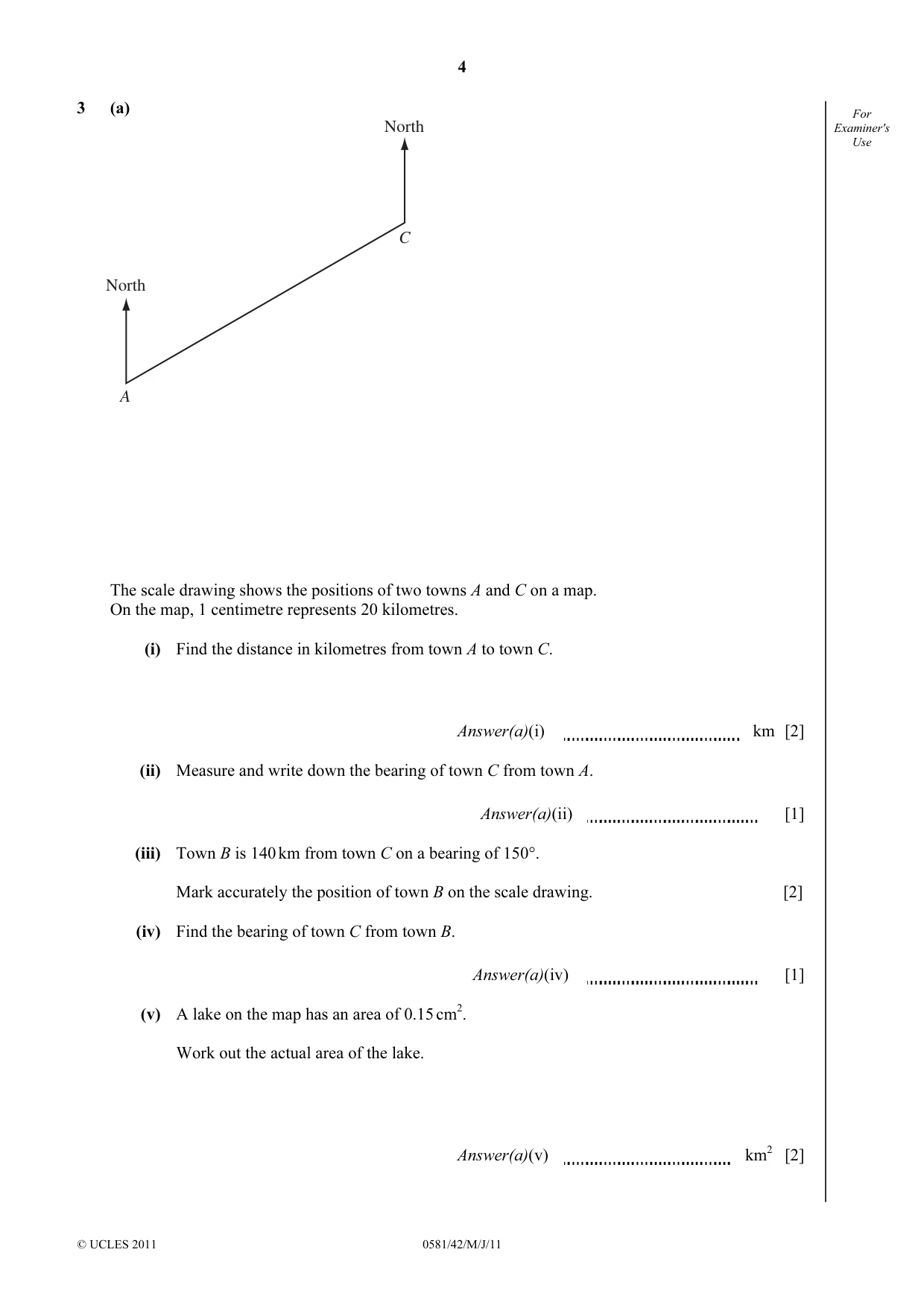
4 © UCLES 2011 0581/42/M/J/11 For Examiner's Use 3 (a) North North A C The scale drawing shows the positions of two towns A and C on a map. On the map, 1 centimetre represents 20 kilometres. (i) Find the distance in kilometres from town A to town C. Answer(a)(i) km [2] (ii) Measure and write down the bearing of town C from town A. Answer(a)(ii) [1] (iii) Town B is 140 km from town C on a bearing of 150°. Mark accurately the position of town B on the scale drawing. [2] (iv) Find the bearing of town C from town B. Answer(a)(iv) [1] (v) A lake on the map has an area of 0.15 cm2. Work out the actual area of the lake. Answer(a)(v) km2 [2]
Question paper, page 5
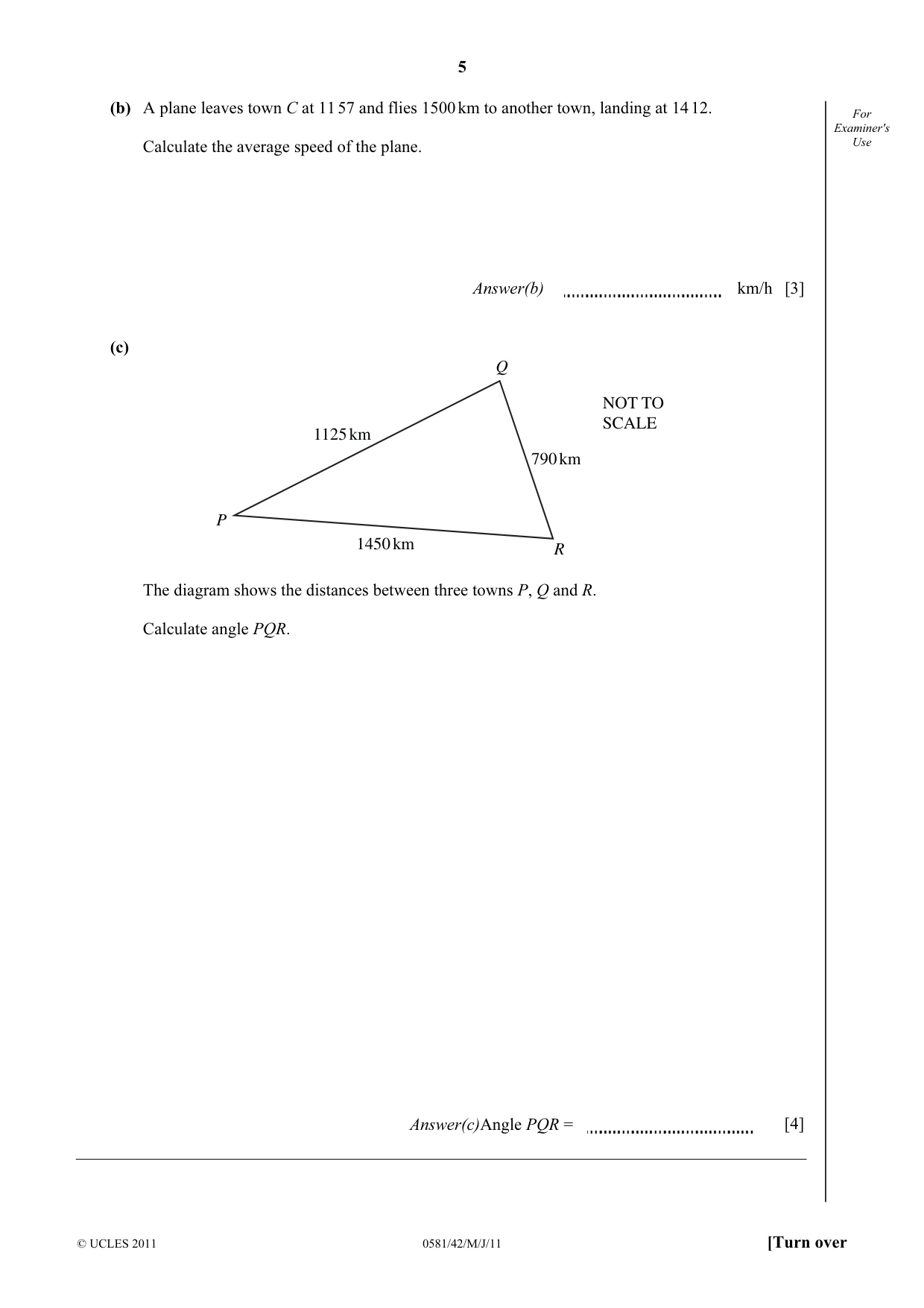
5 © UCLES 2011 0581/42/M/J/11 [Turn over For Examiner's Use (b) A plane leaves town C at 11 57 and flies 1500 km to another town, landing at 14 12. Calculate the average speed of the plane. Answer(b) km/h [3] (c) Q P R 1450 km 1125 km 790 km NOT TO SCALE The diagram shows the distances between three towns P, Q and R. Calculate angle PQR. Answer(c)Angle PQR = [4]
Question paper, page 6
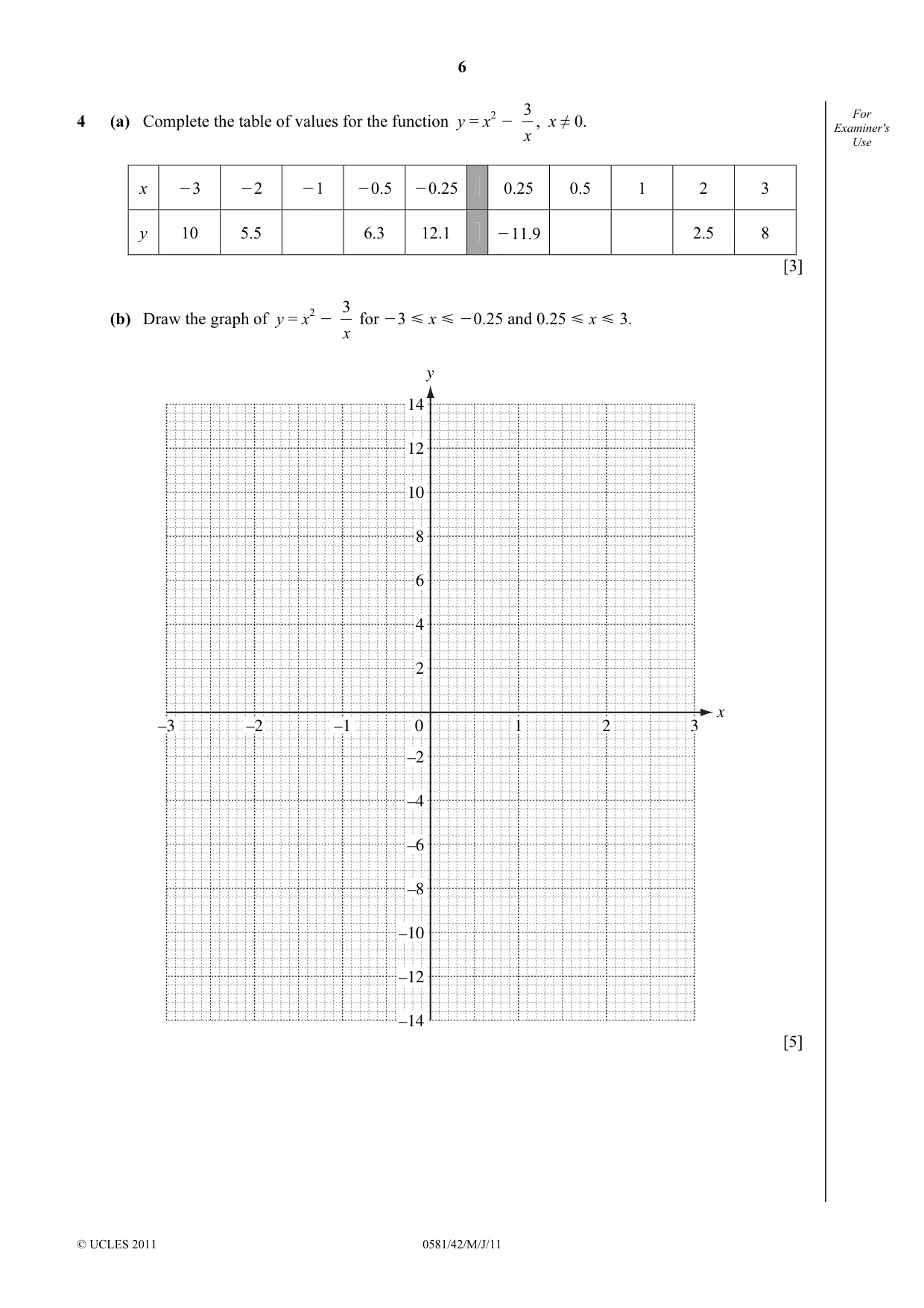
6 © UCLES 2011 0581/42/M/J/11 For Examiner's Use 4 (a) Complete the table of values for the function y = x2 O x 3 , x ≠ 0. x O3 O2 O1 O0.5 O0.25 0.25 0.5 1 2 3 y 10 5.5 6.3 12.1 O11.9 2.5 8 [3] (b) Draw the graph of y = x2 O x 3 for O3 Y x Y O0.25 and 0.25 Y x Y 3. 14 12 10 8 6 4 2 –2 –4 –6 –8 –10 –12 –14 y –3 –2 –1 1 0 2 3 x [5]
Question paper, page 7
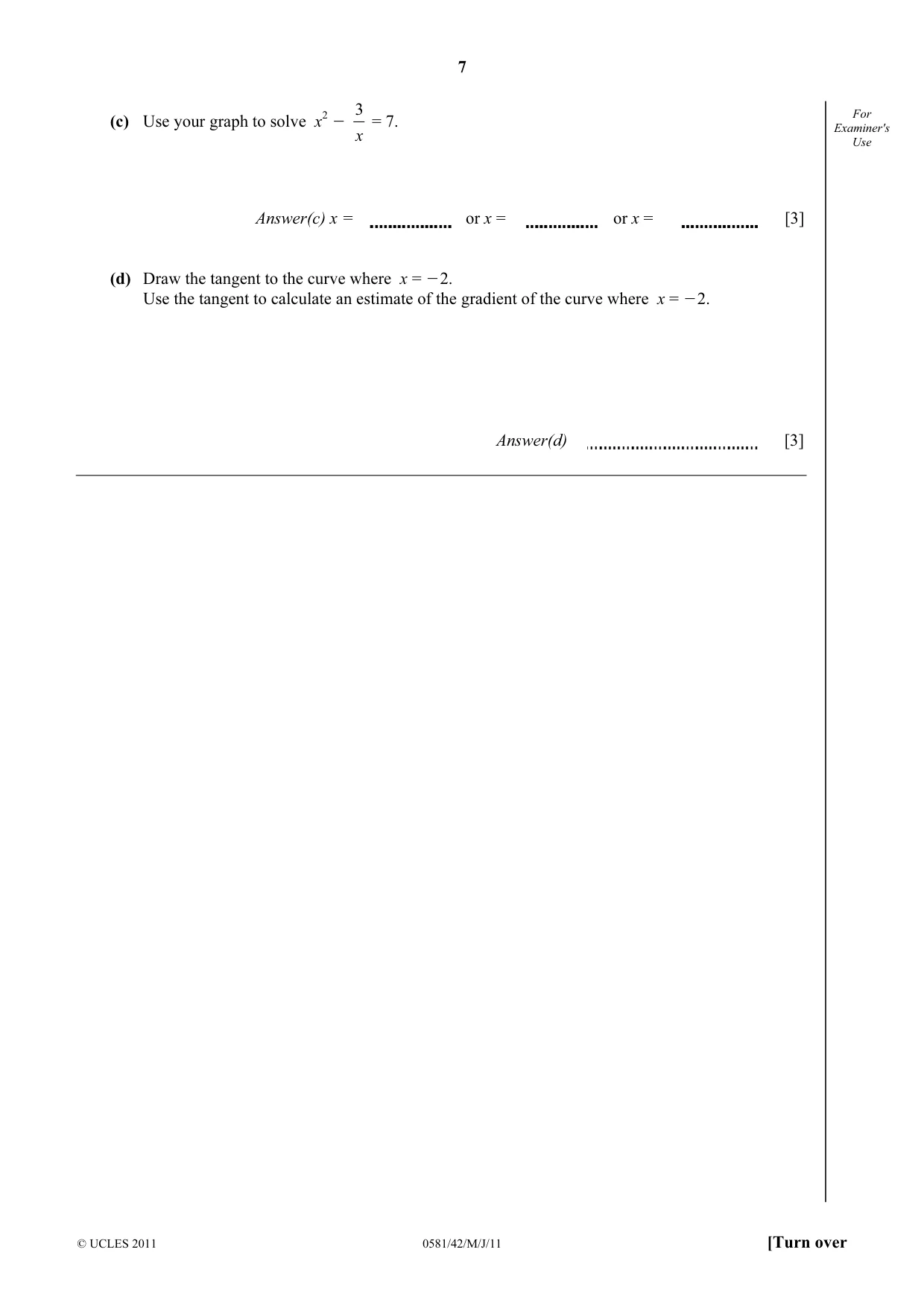
7 © UCLES 2011 0581/42/M/J/11 [Turn over For Examiner's Use (c) Use your graph to solve x2 O x 3 = 7. Answer(c) x = or x = or x = [3] (d) Draw the tangent to the curve where x = O2. Use the tangent to calculate an estimate of the gradient of the curve where x = O2. Answer(d) [3]
Question paper, page 8
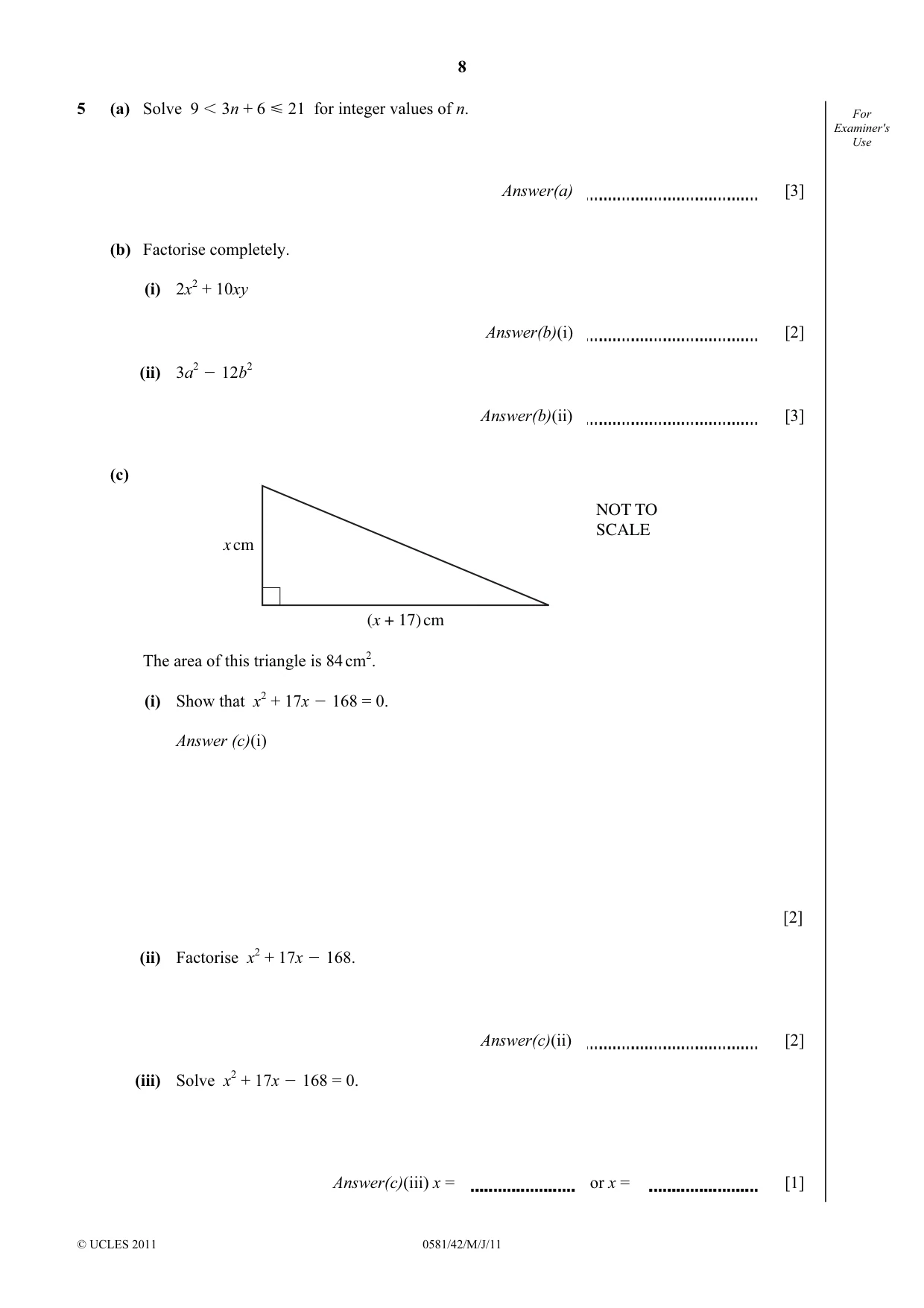
8 © UCLES 2011 0581/42/M/J/11 For Examiner's Use 5 (a) Solve 9 I 3n + 6 Y 21 for integer values of n. Answer(a) [3] (b) Factorise completely. (i) 2x2 + 10xy Answer(b)(i) [2] (ii) 3a2 O 12b2 Answer(b)(ii) [3] (c) NOT TO SCALE (x + 17) cm x cm The area of this triangle is 84 cm2. (i) Show that x2 + 17x O 168 = 0. Answer (c)(i) [2] (ii) Factorise x2 + 17x O 168. Answer(c)(ii) [2] (iii) Solve x2 + 17x O 168 = 0. Answer(c)(iii) x = or x = [1]
Question paper, page 9
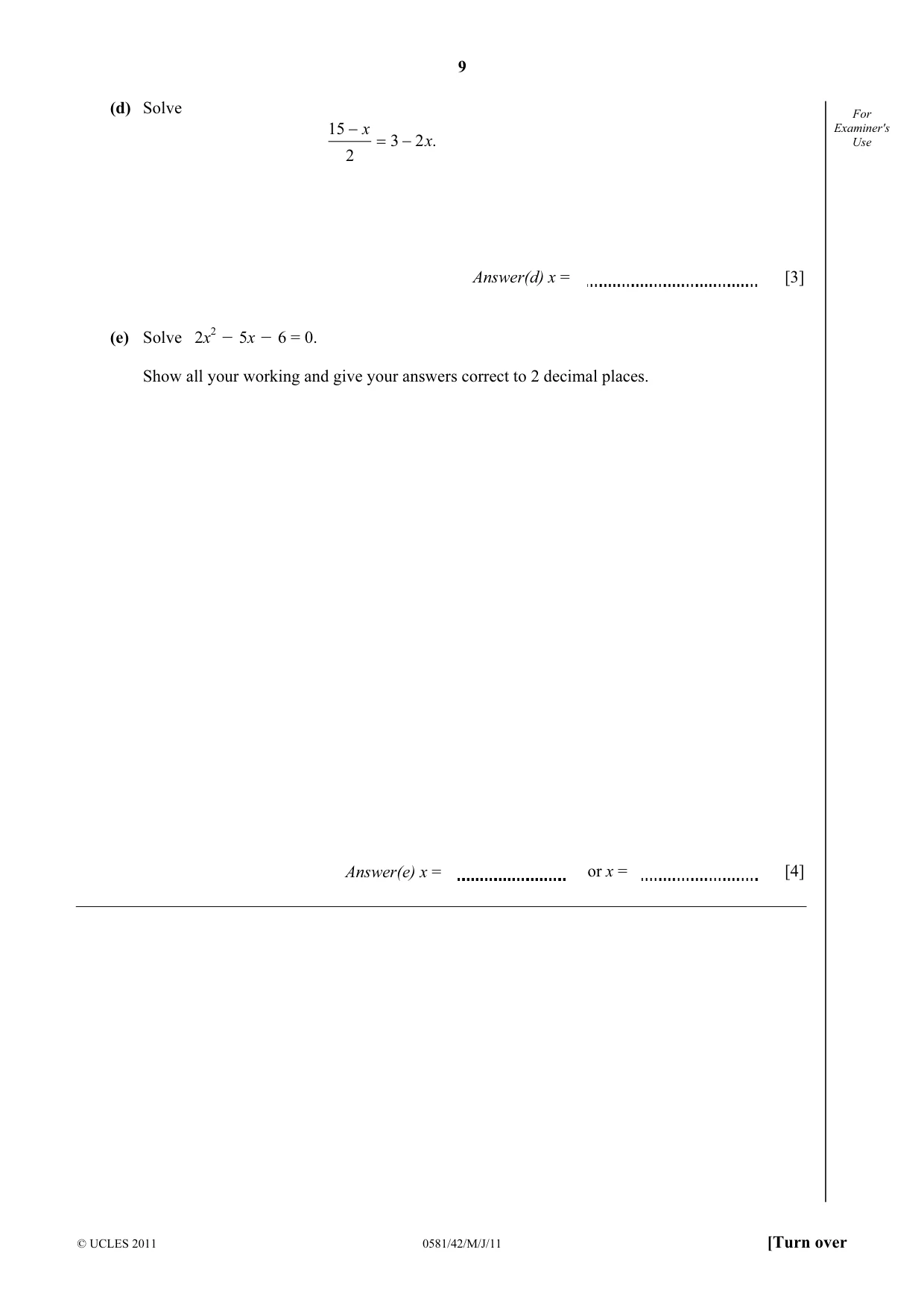
9 © UCLES 2011 0581/42/M/J/11 [Turn over For Examiner's Use (d) Solve . 2 3 2 15 x x − = − Answer(d) x = [3] (e) Solve 2x2 O 5x O 6 = 0. Show all your working and give your answers correct to 2 decimal places. Answer(e) x = or x = [4]
Question paper, page 10
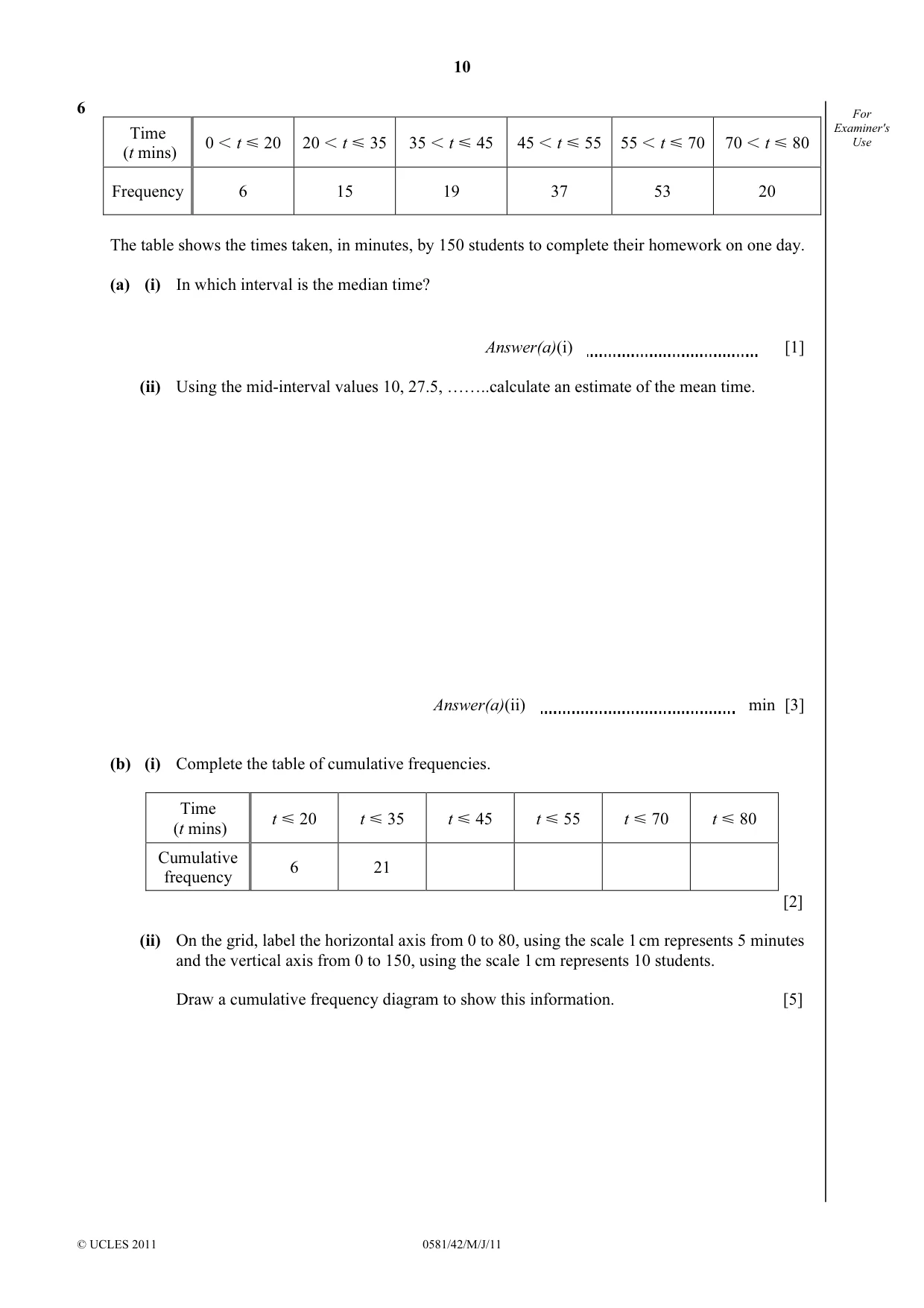
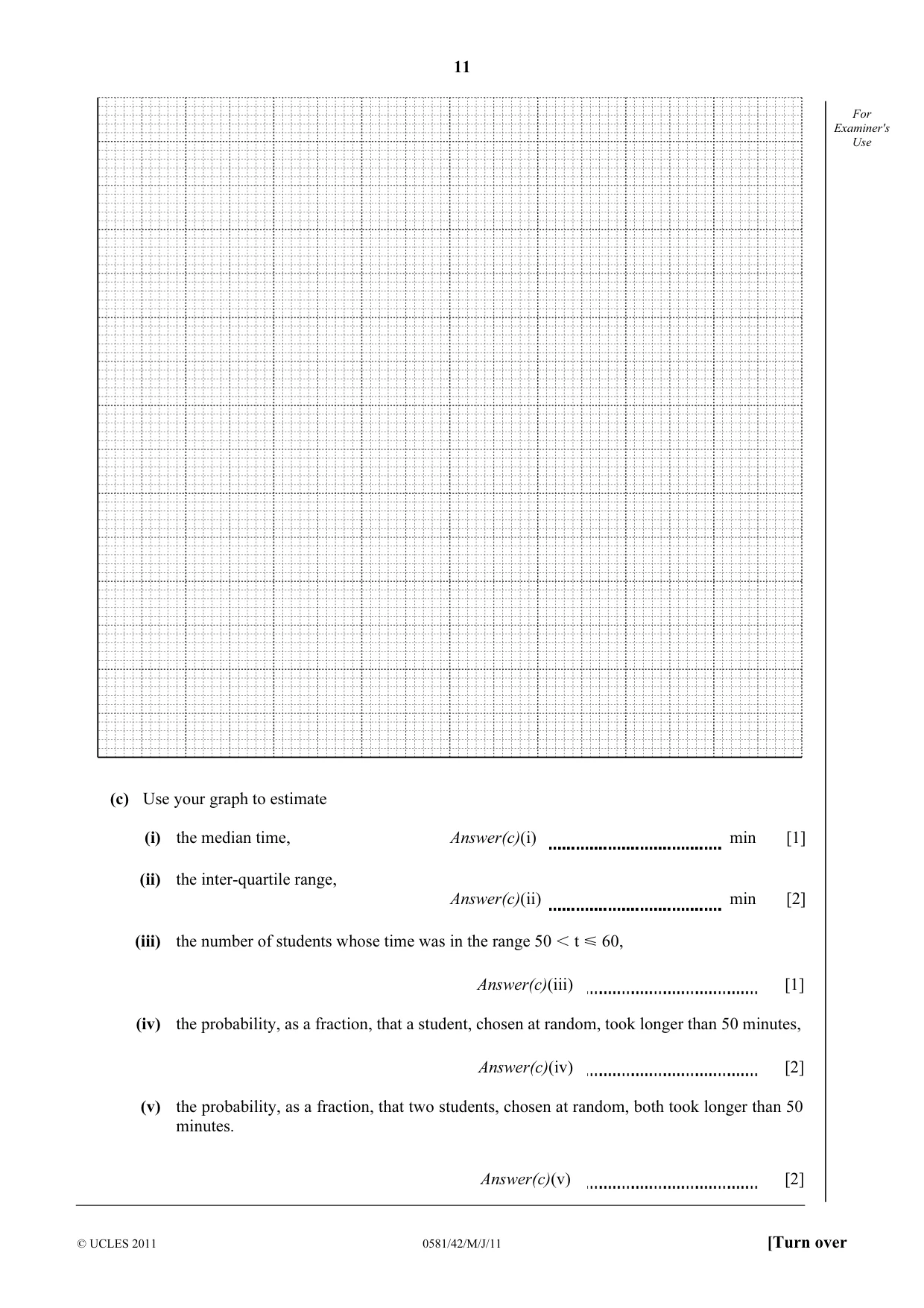
10 © UCLES 2011 0581/42/M/J/11 For Examiner's Use 6 Time (t mins) 0 I t Y 20 20 I t Y 35 35 I t Y 45 45 I t Y 55 55 I t Y 70 70 I t Y 80 Frequency 6 15 19 37 53 20 The table shows the times taken, in minutes, by 150 students to complete their homework on one day. (a) (i) In which interval is the median time? Answer(a)(i) [1] (ii) Using the mid-interval values 10, 27.5, ……..calculate an estimate of the mean time. Answer(a)(ii) min [3] (b) (i) Complete the table of cumulative frequencies. Time (t mins) t Y 20 t Y 35 t Y 45 t Y 55 t Y 70 t Y 80 Cumulative frequency 6 21 [2] (ii) On the grid, label the horizontal axis from 0 to 80, using the scale 1 cm represents 5 minutes and the vertical axis from 0 to 150, using the scale 1 cm represents 10 students. Draw a cumulative frequency diagram to show this information. [5]
Question paper, page 11
11 © UCLES 2011 0581/42/M/J/11 [Turn over For Examiner's Use (c) Use your graph to estimate (i) the median time, Answer(c)(i) min [1] (ii) the inter-quartile range, Answer(c)(ii) min [2] (iii) the number of students whose time was in the range 50 I t Y 60, Answer(c)(iii) [1] (iv) the probability, as a fraction, that a student, chosen at random, took longer than 50 minutes, Answer(c)(iv) [2] (v) the probability, as a fraction, that two students, chosen at random, both took longer than 50 minutes. Answer(c)(v) [2]
Question paper, page 12
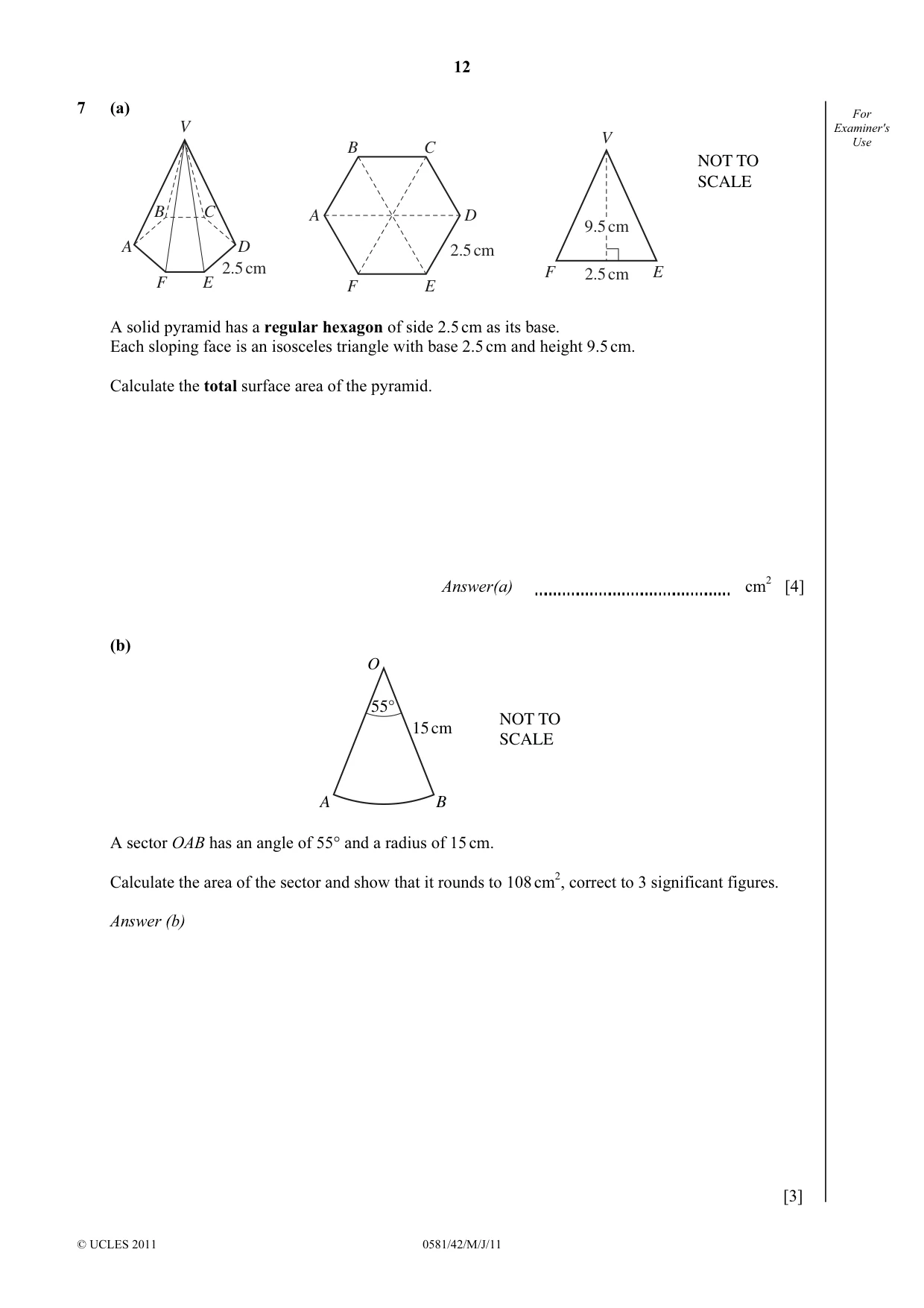
12 © UCLES 2011 0581/42/M/J/11 For Examiner's Use 7 (a) C F E A D B 2.5 cm V D A E F B C 2.5 cm E F V 2.5 cm 9.5 cm NOT TO SCALE A solid pyramid has a regular hexagon of side 2.5 cm as its base. Each sloping face is an isosceles triangle with base 2.5 cm and height 9.5 cm. Calculate the total surface area of the pyramid. Answer(a) cm2 [4] (b) 55° O 15 cm A B NOT TO SCALE A sector OAB has an angle of 55° and a radius of 15 cm. Calculate the area of the sector and show that it rounds to 108 cm2, correct to 3 significant figures. Answer (b) [3]
Question paper, page 13
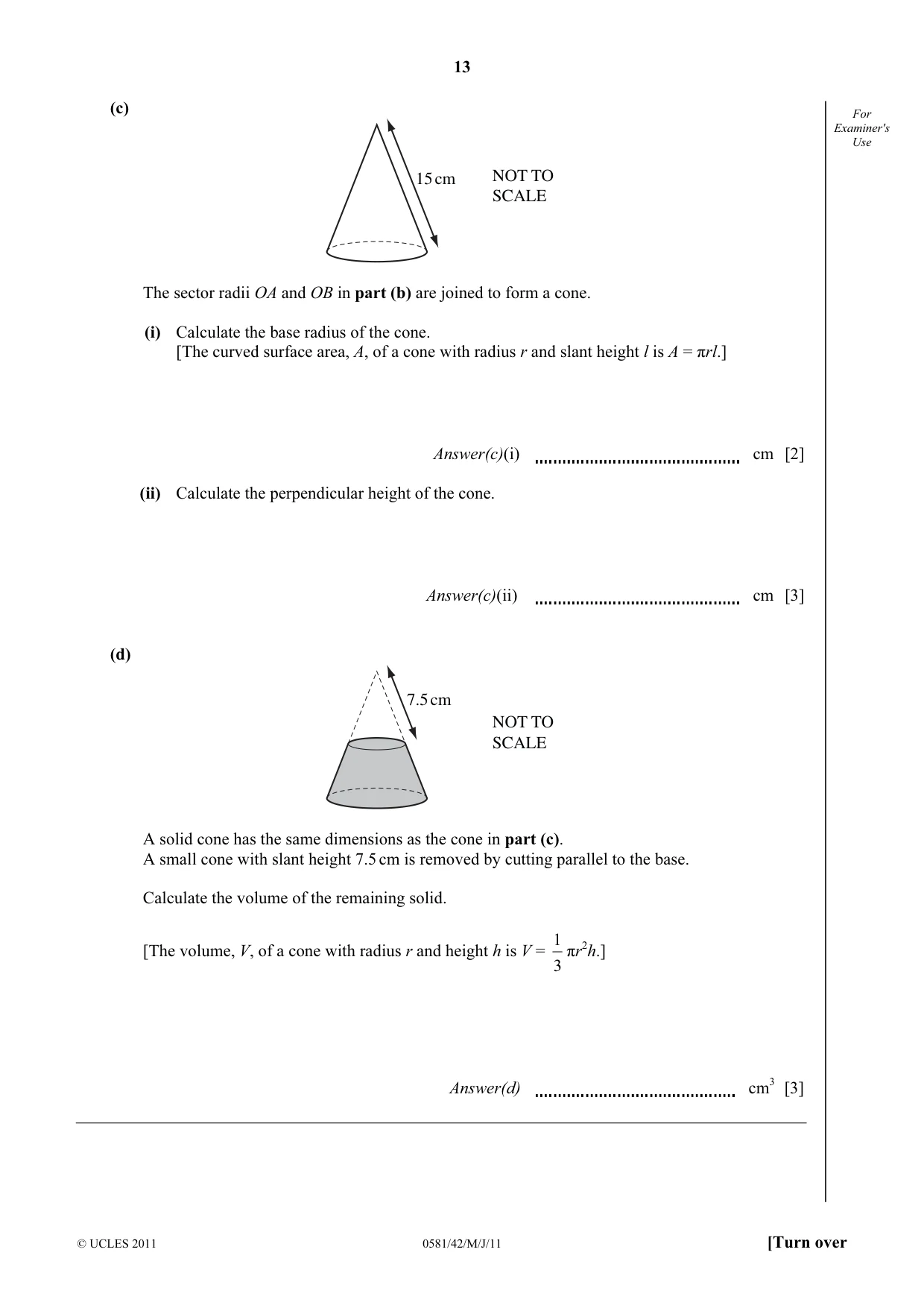
13 © UCLES 2011 0581/42/M/J/11 [Turn over For Examiner's Use (c) 15 cm NOT TO SCALE The sector radii OA and OB in part (b) are joined to form a cone. (i) Calculate the base radius of the cone. [The curved surface area, A, of a cone with radius r and slant height l is A = πrl.] Answer(c)(i) cm [2] (ii) Calculate the perpendicular height of the cone. Answer(c)(ii) cm [3] (d) 7.5 cm NOT TO SCALE A solid cone has the same dimensions as the cone in part (c). A small cone with slant height 7.5 cm is removed by cutting parallel to the base. Calculate the volume of the remaining solid. [The volume, V, of a cone with radius r and height h is V = 3 1 πr2h.] Answer(d) cm3 [3]
Question paper, page 14
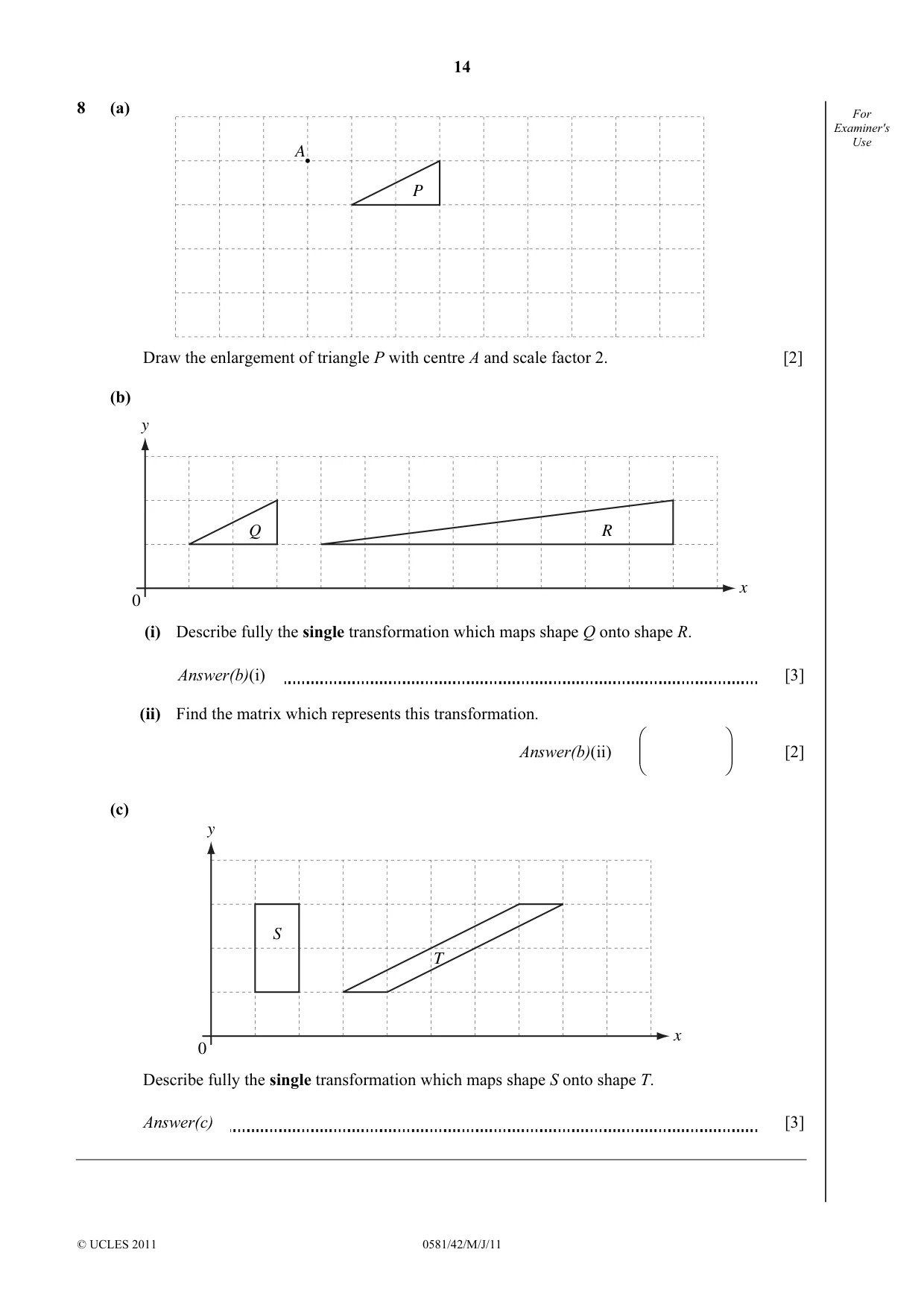
14 © UCLES 2011 0581/42/M/J/11 For Examiner's Use 8 (a) P A Draw the enlargement of triangle P with centre A and scale factor 2. [2] (b) Q R y x 0 (i) Describe fully the single transformation which maps shape Q onto shape R. Answer(b)(i) [3] (ii) Find the matrix which represents this transformation. Answer(b)(ii) [2] (c) S T y x 0 Describe fully the single transformation which maps shape S onto shape T. Answer(c) [3]
Question paper, page 15
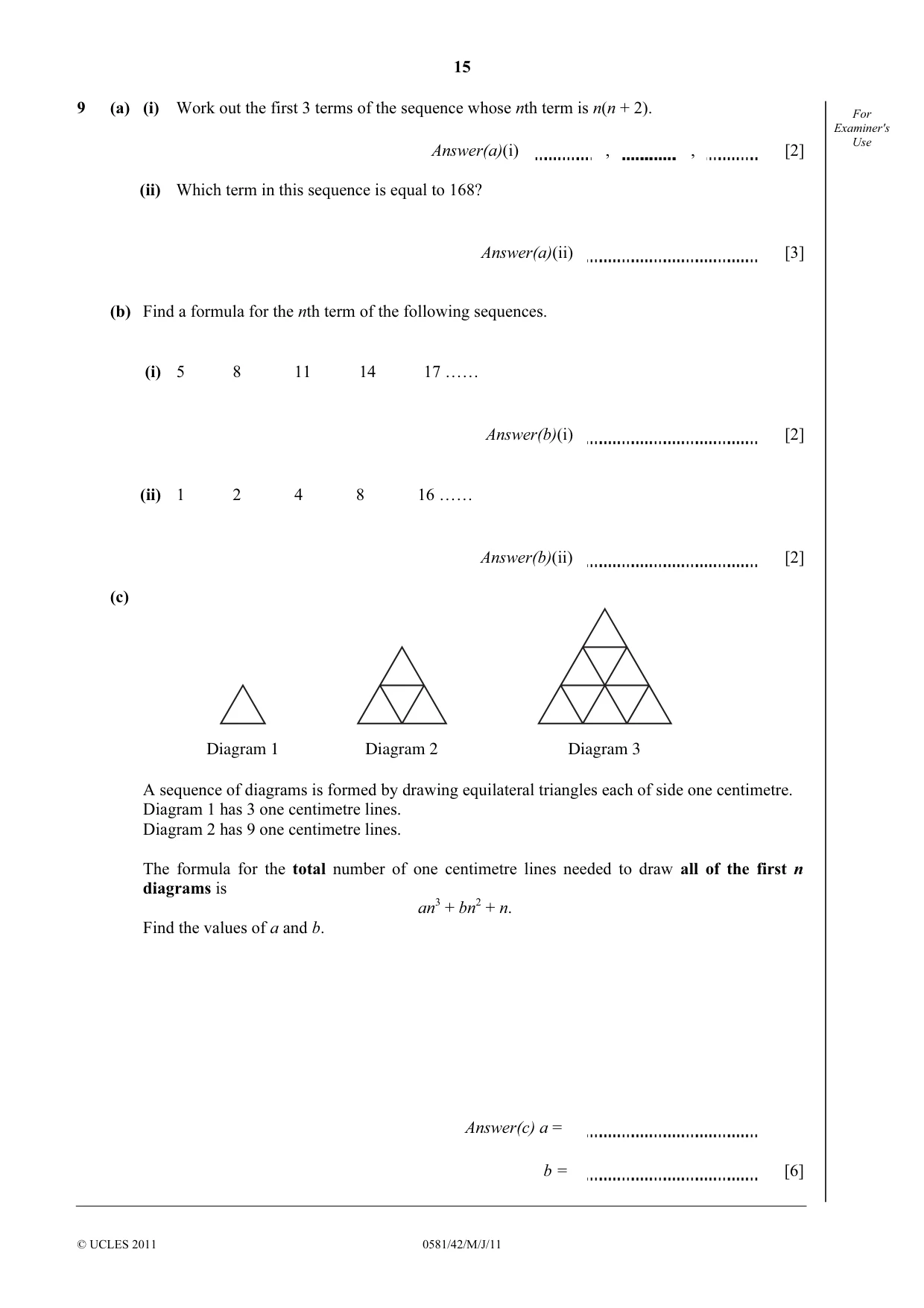
15 © UCLES 2011 0581/42/M/J/11 For Examiner's Use 9 (a) (i) Work out the first 3 terms of the sequence whose nth term is n(n + 2). Answer(a)(i) , , [2] (ii) Which term in this sequence is equal to 168? Answer(a)(ii) [3] (b) Find a formula for the nth term of the following sequences. (i) 5 8 11 14 17 …… Answer(b)(i) [2] (ii) 1 2 4 8 16 …… Answer(b)(ii) [2] (c) Diagram 1 Diagram 2 Diagram 3 A sequence of diagrams is formed by drawing equilateral triangles each of side one centimetre. Diagram 1 has 3 one centimetre lines. Diagram 2 has 9 one centimetre lines. The formula for the total number of one centimetre lines needed to draw all of the first n diagrams is an3 + bn2 + n. Find the values of a and b. Answer(c) a = b = [6]
Question paper, page 16
16 Permission to reproduce items where third-party owned material protected by copyright is included has been sought and cleared where possible. Every reasonable effort has been made by the publisher (UCLES) to trace copyright holders, but if any items requiring clearance have unwittingly been included, the publisher will be pleased to make amends at the earliest possible opportunity. University of Cambridge International Examinations is part of the Cambridge Assessment Group. Cambridge Assessment is the brand name of University of Cambridge Local Examinations Syndicate (UCLES), which is itself a department of the University of Cambridge. © UCLES 2011 0581/42/M/J/11 BLANK PAGE
Mark scheme, page 1
UNIVERSITY OF CAMBRIDGE INTERNATIONAL EXAMINATIONS International General Certificate of Secondary Education MARK SCHEME for the May/June 2011 question paper for the guidance of teachers 0581 MATHEMATICS 0581/42 Paper 4 (Extended), maximum raw mark 130 This mark scheme is published as an aid to teachers and candidates, to indicate the requirements of the examination. It shows the basis on which Examiners were instructed to award marks. It does not indicate the details of the discussions that took place at an Examiners’ meeting before marking began, which would have considered the acceptability of alternative answers. Mark schemes must be read in conjunction with the question papers and the report on the examination. • Cambridge will not enter into discussions or correspondence in connection with these mark schemes. Cambridge is publishing the mark schemes for the May/June 2011 question papers for most IGCSE, GCE Advanced Level and Advanced Subsidiary Level syllabuses and some Ordinary Level syllabuses. www.XtremePapers.com
Mark scheme, page 2
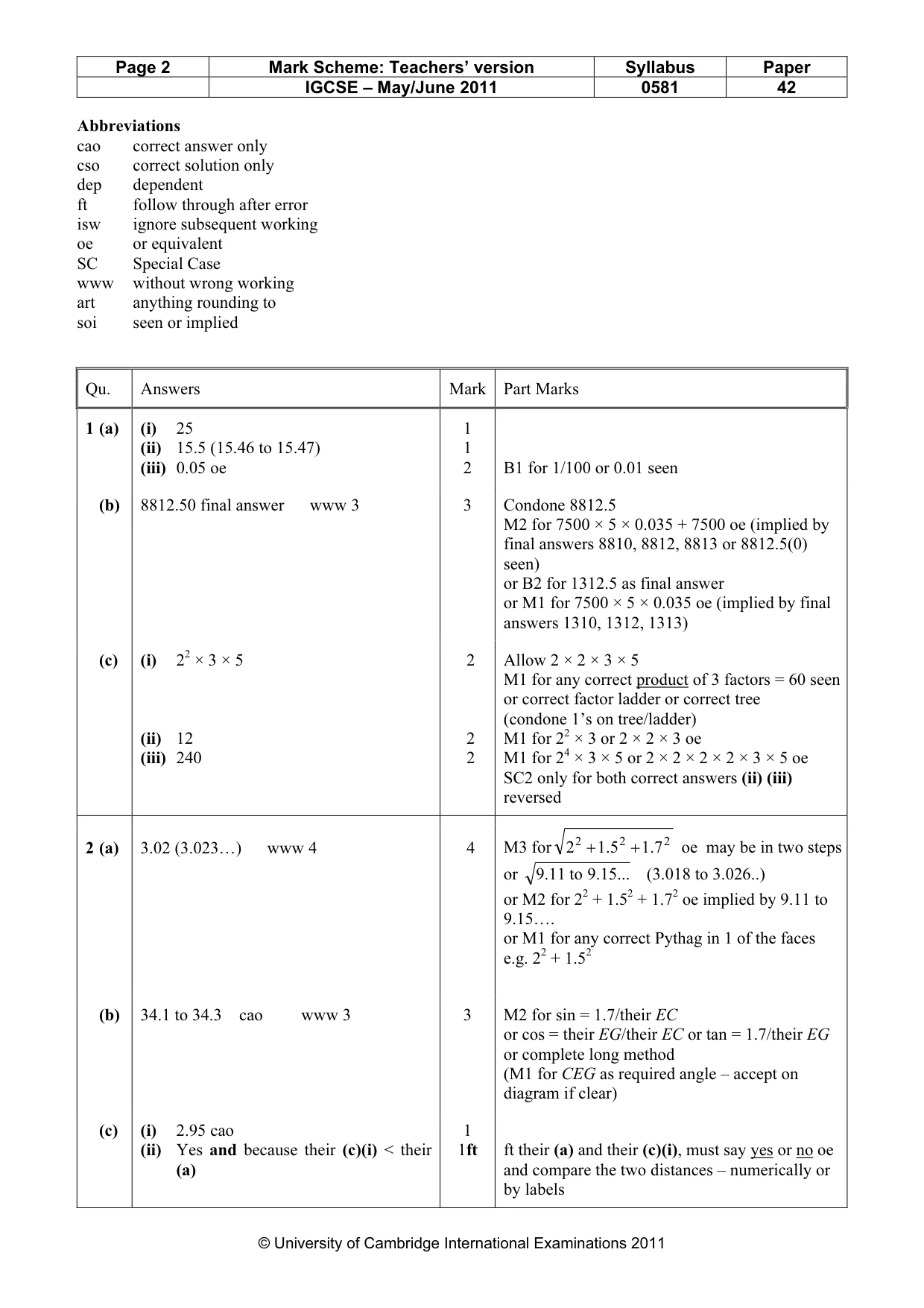
Page 2 Mark Scheme: Teachers’ version Syllabus Paper IGCSE – May/June 2011 0581 42 © University of Cambridge International Examinations 2011 Abbreviations cao correct answer only cso correct solution only dep dependent ft follow through after error isw ignore subsequent working oe or equivalent SC Special Case www without wrong working art anything rounding to soi seen or implied Qu. Answers Mark Part Marks 1 (a) (i) 25 (ii) 15.5 (15.46 to 15.47) (iii) 0.05 oe 1 1 2 B1 for 1/100 or 0.01 seen (b) 8812.50 final answer www 3 3 Condone 8812.5 M2 for 7500 × 5 × 0.035 + 7500 oe (implied by final answers 8810, 8812, 8813 or 8812.5(0) seen) or B2 for 1312.5 as final answer or M1 for 7500 × 5 × 0.035 oe (implied by final answers 1310, 1312, 1313) (c) (i) 22 × 3 × 5 (ii) 12 (iii) 240 2 2 2 Allow 2 × 2 × 3 × 5 M1 for any correct product of 3 factors = 60 seen or correct factor ladder or correct tree (condone 1’s on tree/ladder) M1 for 22 × 3 or 2 × 2 × 3 oe M1 for 24 × 3 × 5 or 2 × 2 × 2 × 2 × 3 × 5 oe SC2 only for both correct answers (ii) (iii) reversed 2 (a) 3.02 (3.023…) www 4 4 M3 for 2 2 2 1.7 1.5 2 + + oe may be in two steps or 9.15... to 9.11 (3.018 to 3.026..) or M2 for 22 + 1.52 + 1.72 oe implied by 9.11 to 9.15…. or M1 for any correct Pythag in 1 of the faces e.g. 22 + 1.52 (b) 34.1 to 34.3 cao www 3 3 M2 for sin = 1.7/their EC or cos = their EG/their EC or tan = 1.7/their EG or complete long method (M1 for CEG as required angle – accept on diagram if clear) (c) (i) 2.95 cao (ii) Yes and because their (c)(i) < their (a) 1 1ft ft their (a) and their (c)(i), must say yes or no oe and compare the two distances – numerically or by labels
Mark scheme, page 3
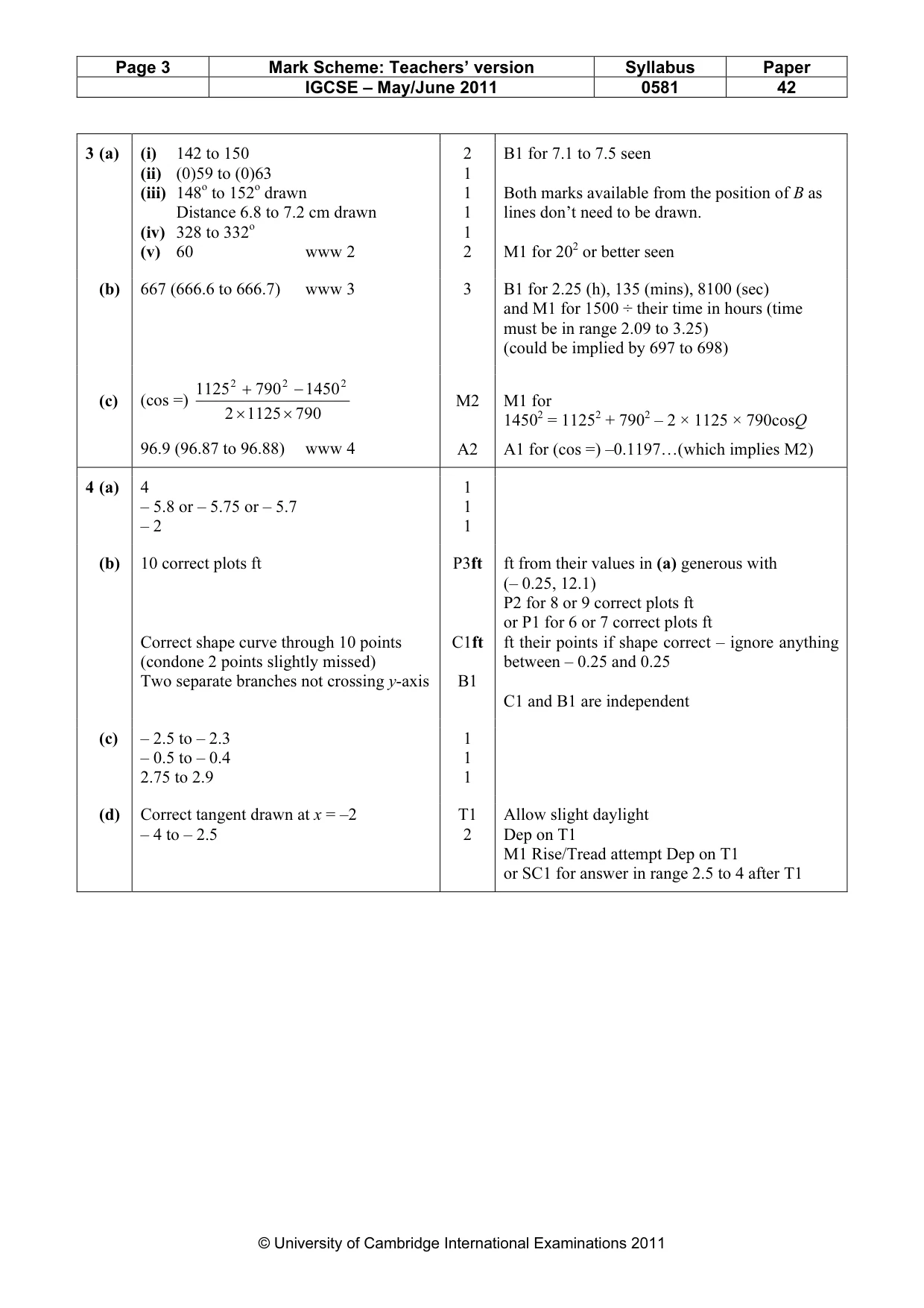
Page 3 Mark Scheme: Teachers’ version Syllabus Paper IGCSE – May/June 2011 0581 42 © University of Cambridge International Examinations 2011 3 (a) (i) 142 to 150 (ii) (0)59 to (0)63 (iii) 148o to 152o drawn Distance 6.8 to 7.2 cm drawn (iv) 328 to 332o (v) 60 www 2 2 1 1 1 1 2 B1 for 7.1 to 7.5 seen Both marks available from the position of B as lines don’t need to be drawn. M1 for 202 or better seen (b) 667 (666.6 to 666.7) www 3 3 B1 for 2.25 (h), 135 (mins), 8100 (sec) and M1 for 1500 ÷ their time in hours (time must be in range 2.09 to 3.25) (could be implied by 697 to 698) (c) (cos =) 790 1125 2 1450 790 1125 2 2 2 × × − + 96.9 (96.87 to 96.88) www 4 M2 A2 M1 for 14502 = 11252 + 7902 – 2 × 1125 × 790cosQ A1 for (cos =) –0.1197…(which implies M2) 4 (a) 4 – 5.8 or – 5.75 or – 5.7 – 2 1 1 1 (b) 10 correct plots ft Correct shape curve through 10 points (condone 2 points slightly missed) Two separate branches not crossing y-axis P3ft C1ft B1 ft from their values in (a) generous with (– 0.25, 12.1) P2 for 8 or 9 correct plots ft or P1 for 6 or 7 correct plots ft ft their points if shape correct – ignore anything between – 0.25 and 0.25 C1 and B1 are independent (c) – 2.5 to – 2.3 – 0.5 to – 0.4 2.75 to 2.9 1 1 1 (d) Correct tangent drawn at x = –2 – 4 to – 2.5 T1 2 Allow slight daylight Dep on T1 M1 Rise/Tread attempt Dep on T1 or SC1 for answer in range 2.5 to 4 after T1
Mark scheme, page 4
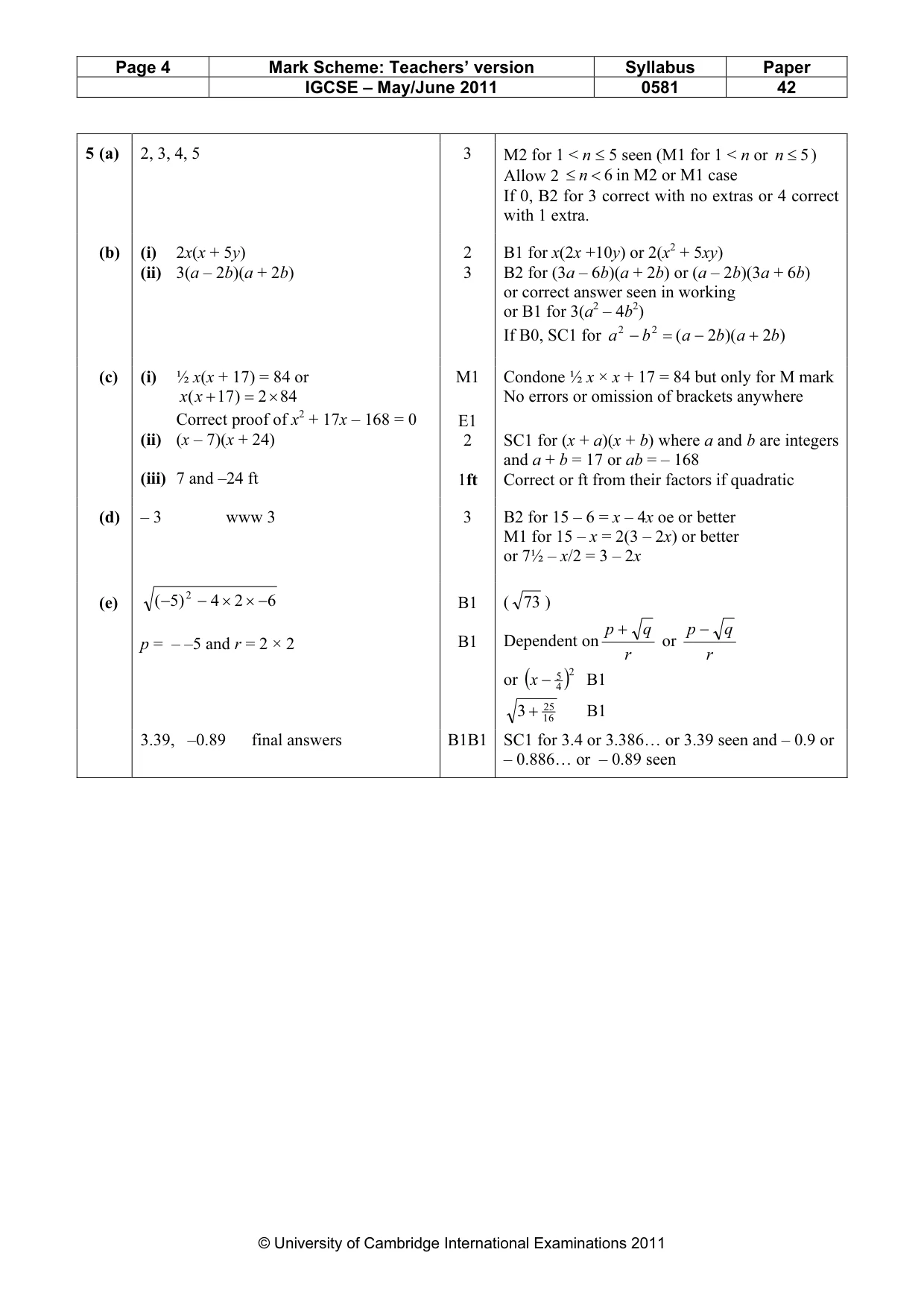
Page 4 Mark Scheme: Teachers’ version Syllabus Paper IGCSE – May/June 2011 0581 42 © University of Cambridge International Examinations 2011 5 (a) 2, 3, 4, 5 3 M2 for 1 < n ≤ 5 seen (M1 for 1 < n or 5 ≤ n ) Allow 2 6 < ≤n in M2 or M1 case If 0, B2 for 3 correct with no extras or 4 correct with 1 extra. (b) (i) 2x(x + 5y) (ii) 3(a – 2b)(a + 2b) 2 3 B1 for x(2x +10y) or 2(x2 + 5xy) B2 for (3a – 6b)(a + 2b) or (a – 2b)(3a + 6b) or correct answer seen in working or B1 for 3(a2 – 4b2) If B0, SC1 for ) 2 )( 2 ( 2 2 b a b a b a + − = − (c) (i) ½ x(x + 17) = 84 or 84 2 ) 17 ( × = + x x Correct proof of x2 + 17x – 168 = 0 (ii) (x – 7)(x + 24) (iii) 7 and –24 ft M1 E1 2 1ft Condone ½ x × x + 17 = 84 but only for M mark No errors or omission of brackets anywhere SC1 for (x + a)(x + b) where a and b are integers and a + b = 17 or ab = – 168 Correct or ft from their factors if quadratic (d) – 3 www 3 3 B2 for 15 – 6 = x – 4x oe or better M1 for 15 – x = 2(3 – 2x) or better or 7½ – x/2 = 3 – 2x (e) 6 2 4 5) ( 2 − × × − − p = – –5 and r = 2 × 2 B1 B1 ( 73 ) Dependent on r q p + or r q p − or ( ) 2 4 5 − x B1 16 25 3 + B1 3.39, –0.89 final answers B1B1 SC1 for 3.4 or 3.386… or 3.39 seen and – 0.9 or – 0.886… or – 0.89 seen
Mark scheme, page 5
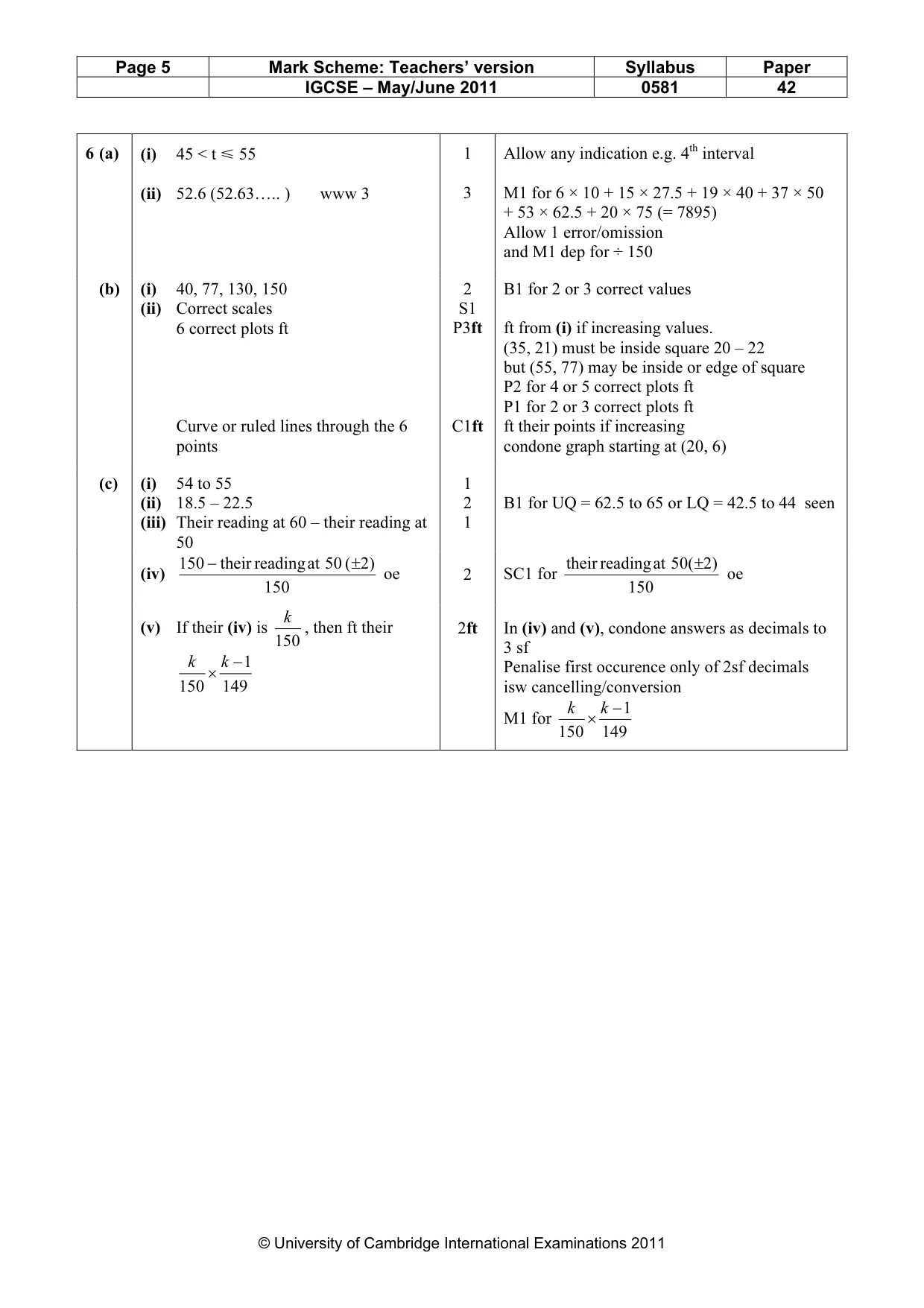
Page 5 Mark Scheme: Teachers’ version Syllabus Paper IGCSE – May/June 2011 0581 42 © University of Cambridge International Examinations 2011 6 (a) (i) 45 < t Y 55 (ii) 52.6 (52.63….. ) www 3 1 3 Allow any indication e.g. 4th interval M1 for 6 × 10 + 15 × 27.5 + 19 × 40 + 37 × 50 + 53 × 62.5 + 20 × 75 (= 7895) Allow 1 error/omission and M1 dep for ÷ 150 (b) (i) 40, 77, 130, 150 (ii) Correct scales 6 correct plots ft Curve or ruled lines through the 6 points 2 S1 P3ft C1ft B1 for 2 or 3 correct values ft from (i) if increasing values. (35, 21) must be inside square 20 – 22 but (55, 77) may be inside or edge of square P2 for 4 or 5 correct plots ft P1 for 2 or 3 correct plots ft ft their points if increasing condone graph starting at (20, 6) (c) (i) 54 to 55 (ii) 18.5 – 22.5 (iii) Their reading at 60 – their reading at 50 1 2 1 B1 for UQ = 62.5 to 65 or LQ = 42.5 to 44 seen (iv) 150 ) 2 ( 50 at reading their 150 ± − oe 2 SC1 for 150 2) 50( at reading their ± oe (v) If their (iv) is 150 k , then ft their 149 1 150 − × k k 2ft In (iv) and (v), condone answers as decimals to 3 sf Penalise first occurence only of 2sf decimals isw cancelling/conversion M1 for 149 1 150 − × k k
Mark scheme, page 6
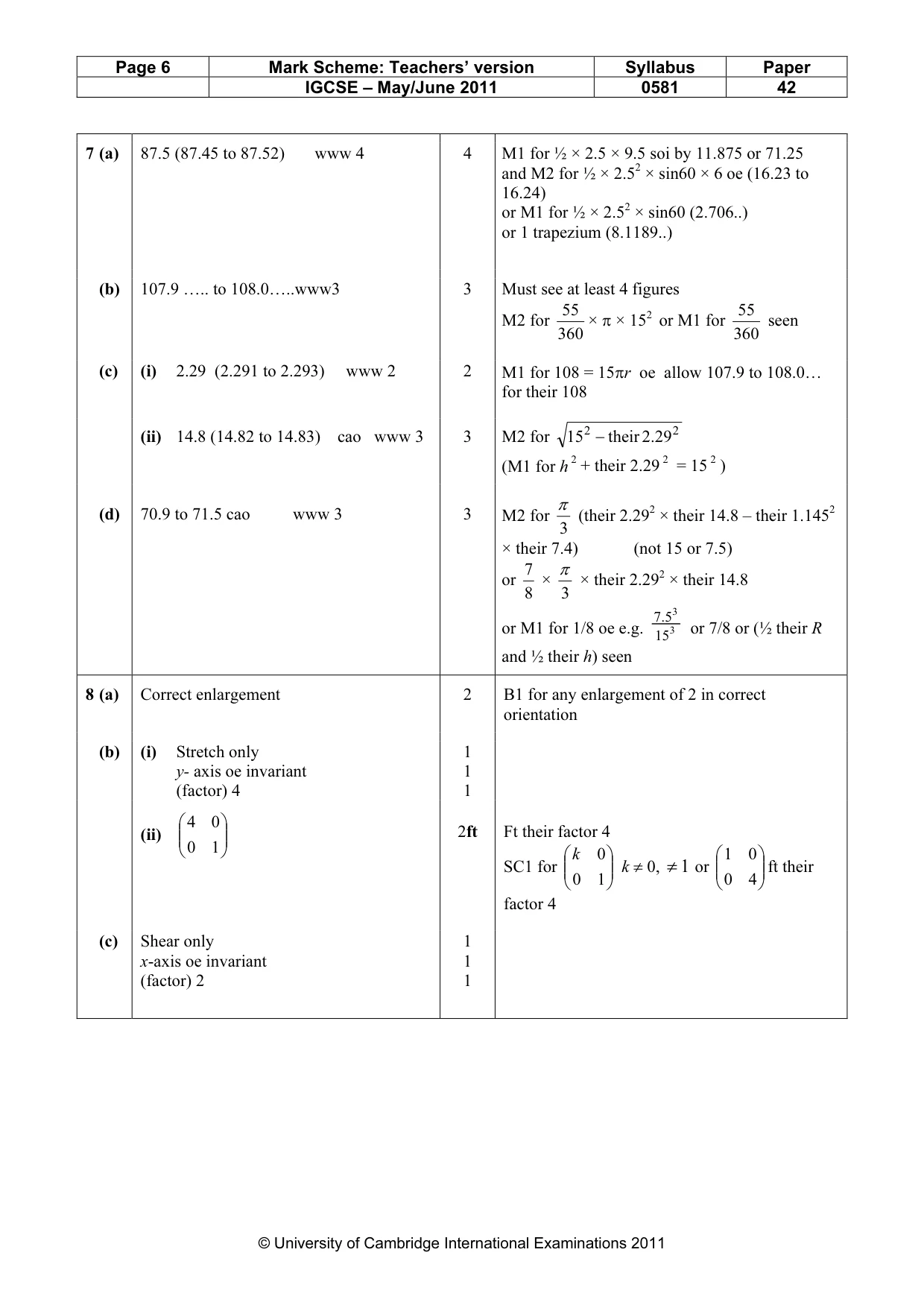
Page 6 Mark Scheme: Teachers’ version Syllabus Paper IGCSE – May/June 2011 0581 42 © University of Cambridge International Examinations 2011 7 (a) 87.5 (87.45 to 87.52) www 4 4 M1 for ½ × 2.5 × 9.5 soi by 11.875 or 71.25 and M2 for ½ × 2.52 × sin60 × 6 oe (16.23 to 16.24) or M1 for ½ × 2.52 × sin60 (2.706..) or 1 trapezium (8.1189..) (b) 107.9 ….. to 108.0…..www3 3 Must see at least 4 figures M2 for 360 55 × π × 152 or M1 for 360 55 seen (c) (i) 2.29 (2.291 to 2.293) www 2 2 M1 for 108 = 15πr oe allow 107.9 to 108.0… for their 108 (ii) 14.8 (14.82 to 14.83) cao www 3 3 M2 for 2 2 2.29 their 15 − (M1 for h 2 + their 2.29 2 = 15 2 ) (d) 70.9 to 71.5 cao www 3 3 M2 for 3 π (their 2.292 × their 14.8 – their 1.1452 × their 7.4) (not 15 or 7.5) or 8 7 × 3 π × their 2.292 × their 14.8 or M1 for 1/8 oe e.g. 3 3 15 5.7 or 7/8 or (½ their R and ½ their h) seen 8 (a) Correct enlargement 2 B1 for any enlargement of 2 in correct orientation (b) (i) Stretch only y- axis oe invariant (factor) 4 1 1 1 (ii) 1 0 0 4 2ft Ft their factor 4 SC1 for 1 0 0 k k ≠ 0, 1 ≠ or 4 0 0 1 ft their factor 4 (c) Shear only x-axis oe invariant (factor) 2 1 1 1
Mark scheme, page 7
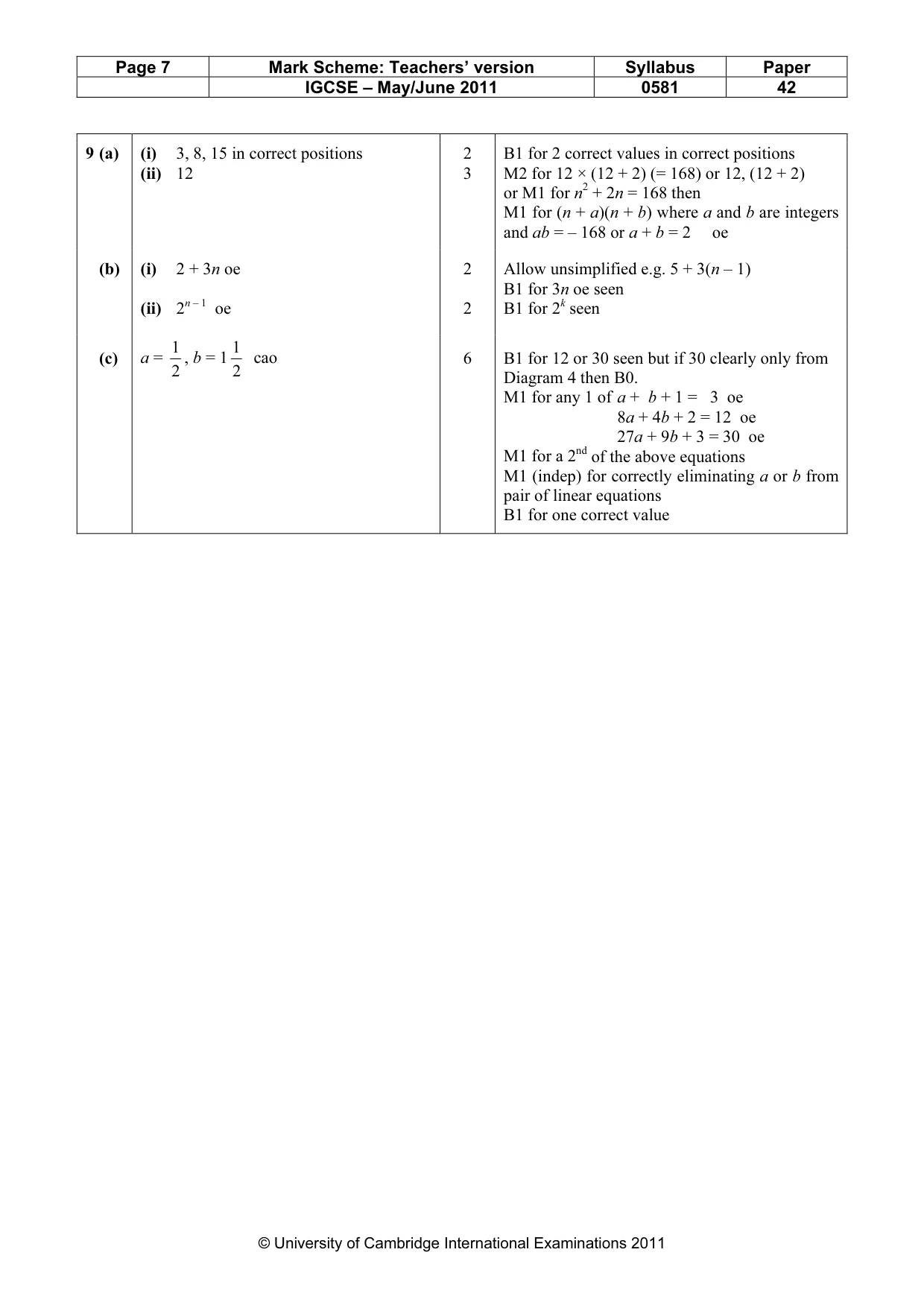
Page 7 Mark Scheme: Teachers’ version Syllabus Paper IGCSE – May/June 2011 0581 42 © University of Cambridge International Examinations 2011 9 (a) (i) 3, 8, 15 in correct positions (ii) 12 2 3 B1 for 2 correct values in correct positions M2 for 12 × (12 + 2) (= 168) or 12, (12 + 2) or M1 for n2 + 2n = 168 then M1 for (n + a)(n + b) where a and b are integers and ab = – 168 or a + b = 2 oe (b) (i) 2 + 3n oe (ii) 2n – 1 oe 2 2 Allow unsimplified e.g. 5 + 3(n – 1) B1 for 3n oe seen B1 for 2k seen (c) a = 2 1 , b = 1 2 1 cao 6 B1 for 12 or 30 seen but if 30 clearly only from Diagram 4 then B0. M1 for any 1 of a + b + 1 = 3 oe 8a + 4b + 2 = 12 oe 27a + 9b + 3 = 30 oe M1 for a 2nd of the above equations M1 (indep) for correctly eliminating a or b from pair of linear equations B1 for one correct value
What you needed in this session
Cambridge’s own grade thresholds for 2011 May/June, Paper 4 · Variant 2. A higher threshold means an easier paper — the bar moves with how the cohort did.