Cambridge IGCSE Mathematics (with coursework) 0581 — 2012 May/June Paper 4 · Variant 1
0581/41/M/J/12 · 130 marks · ≈146 min
The question paper and its mark scheme, free to read here and free to download. This is Cambridge’s own paper, exactly as it was sat.
Question paper16 pages
Mark scheme6 pages
Answers below. Sit the paper first if you are practising.
Paper as text
Question paper, page 1
This document consists of 16 printed pages. IB12 06_0581_41/RP © UCLES 2012 [Turn over *4955034164* UNIVERSITY OF CAMBRIDGE INTERNATIONAL EXAMINATIONS International General Certificate of Secondary Education MATHEMATICS 0581/41 Paper 4 (Extended) May/June 2012 2 hours 30 minutes Candidates answer on the Question Paper. Additional Materials: Electronic calculator Geometrical instruments Mathematical tables (optional) Tracing paper (optional) READ THESE INSTRUCTIONS FIRST Write your Centre number, candidate number and name on all the work you hand in. Write in dark blue or black pen. You may use a pencil for any diagrams or graphs. Do not use staples, paper clips, highlighters, glue or correction fluid. DO NOT WRITE IN ANY BARCODES. Answer all questions. If working is needed for any question it must be shown below that question. Electronic calculators should be used. If the degree of accuracy is not specified in the question, and if the answer is not exact, give the answer to three significant figures. Give answers in degrees to one decimal place. For π use either your calculator value or 3.142. At the end of the examination, fasten all your work securely together. The number of marks is given in brackets [ ] at the end of each question or part question. The total of the marks for this paper is 130. www.XtremePapers.com
Question paper, page 2
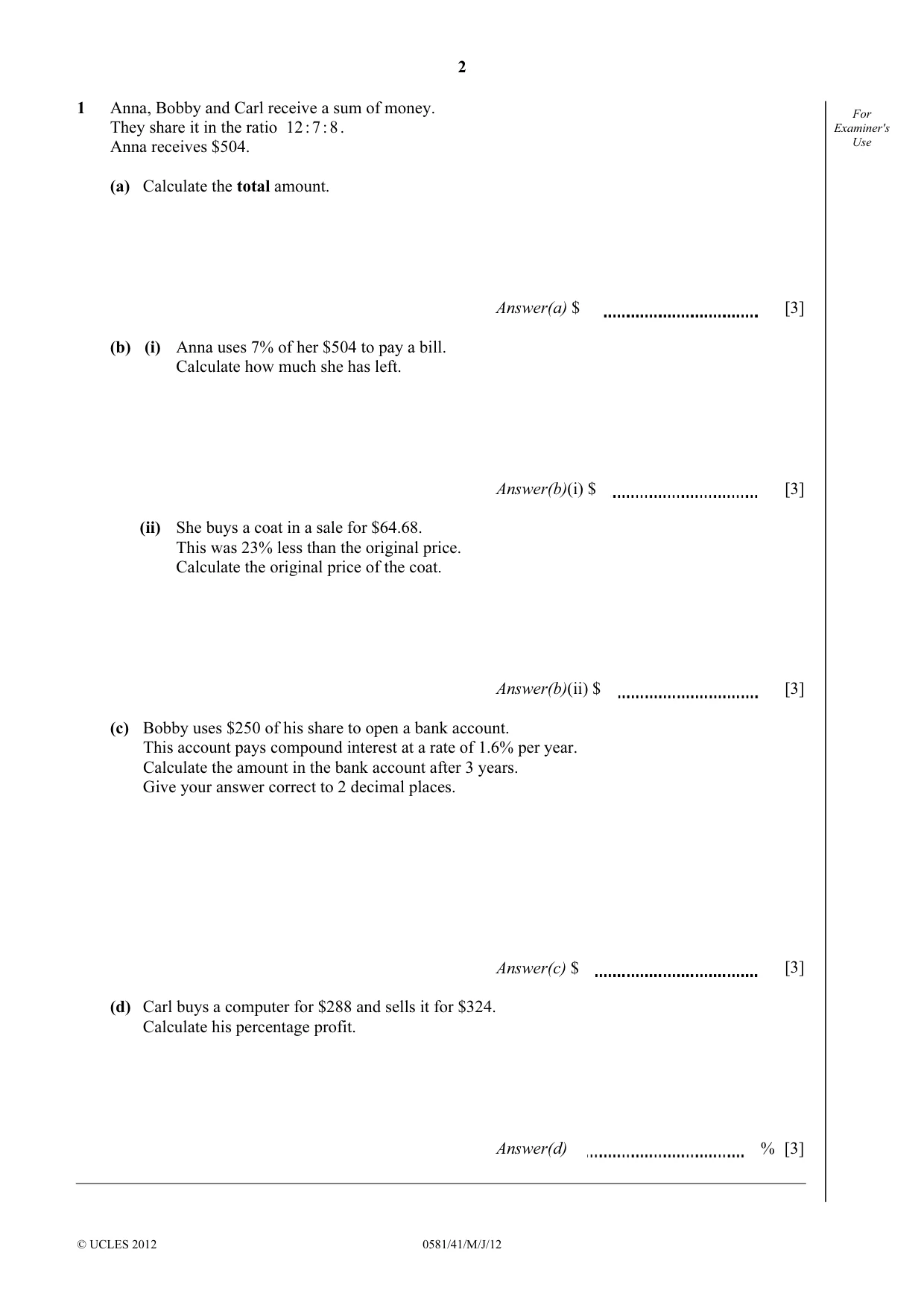
2 © UCLES 2012 0581/41/M/J/12 For Examiner's Use 1 Anna, Bobby and Carl receive a sum of money. They share it in the ratio 12 : 7 : 8 . Anna receives $504. (a) Calculate the total amount. Answer(a) $ [3] (b) (i) Anna uses 7% of her $504 to pay a bill. Calculate how much she has left. Answer(b)(i) $ [3] (ii) She buys a coat in a sale for $64.68. This was 23% less than the original price. Calculate the original price of the coat. Answer(b)(ii) $ [3] (c) Bobby uses $250 of his share to open a bank account. This account pays compound interest at a rate of 1.6% per year. Calculate the amount in the bank account after 3 years. Give your answer correct to 2 decimal places. Answer(c) $ [3] (d) Carl buys a computer for $288 and sells it for $324. Calculate his percentage profit. Answer(d) % [3]
Question paper, page 3
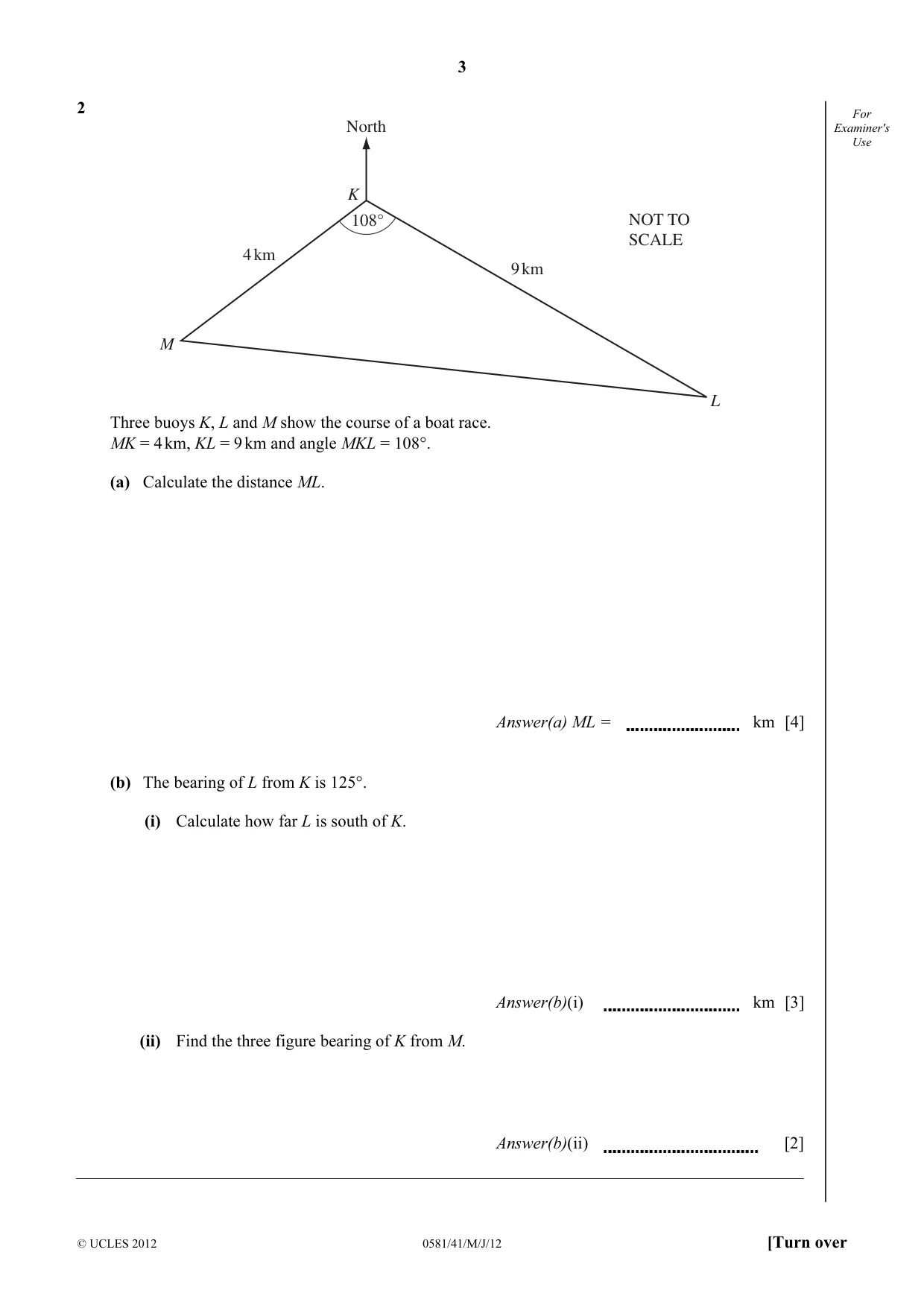
3 © UCLES 2012 0581/41/M/J/12 [Turn over For Examiner's Use 2 108° North K M L 9 km 4 km NOT TO SCALE Three buoys K, L and M show the course of a boat race. MK = 4 km, KL = 9 km and angle MKL = 108°. (a) Calculate the distance ML. Answer(a) ML = km [4] (b) The bearing of L from K is 125°. (i) Calculate how far L is south of K. Answer(b)(i) km [3] (ii) Find the three figure bearing of K from M. Answer(b)(ii) [2]
Question paper, page 4
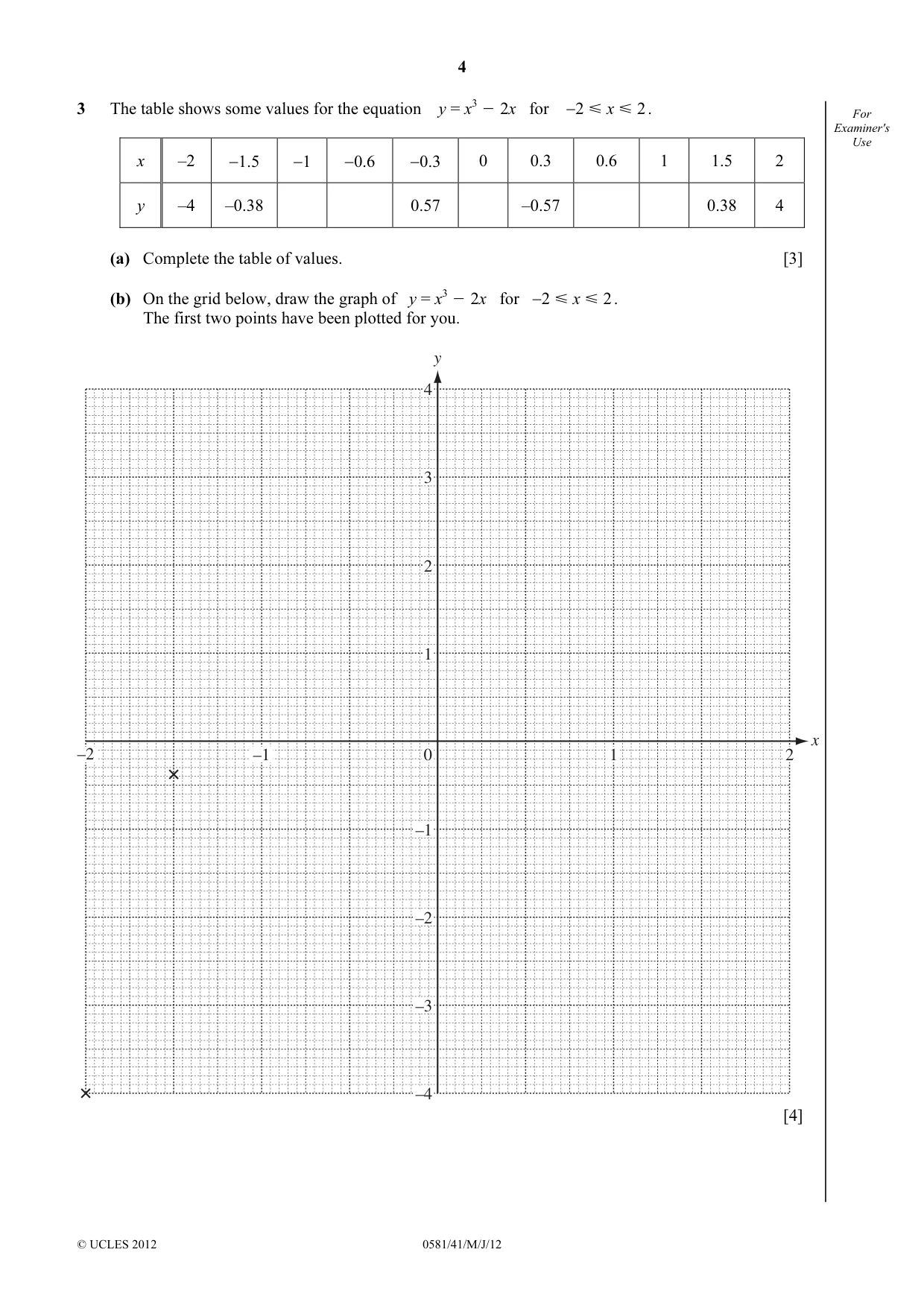
4 © UCLES 2012 0581/41/M/J/12 For Examiner's Use 3 The table shows some values for the equation y = x3 O 2x for −2 Y x Y 2 . x –2 −1.5 −1 −0.6 −0.3 0 0.3 0.6 1 1.5 2 y –4 –0.38 0.57 –0.57 0.38 4 (a) Complete the table of values. [3] (b) On the grid below, draw the graph of y = x3 O 2x for −2 Y x Y 2 . The first two points have been plotted for you. x y 4 3 2 1 –1 –2 –3 –4 1 2 0 –1 –2 [4]
Question paper, page 5
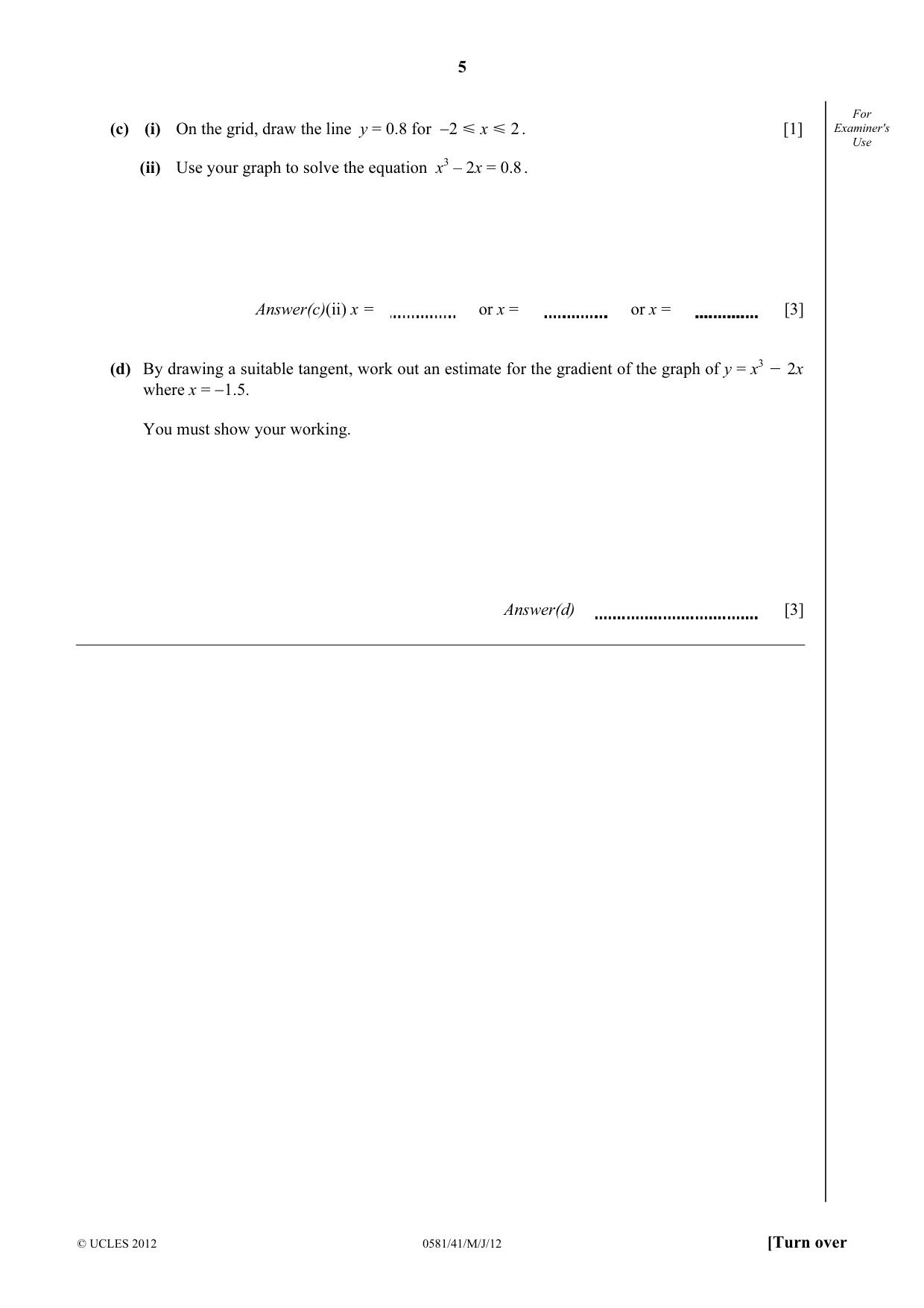
5 © UCLES 2012 0581/41/M/J/12 [Turn over For Examiner's Use (c) (i) On the grid, draw the line y = 0.8 for −2 Y x Y 2 . [1] (ii) Use your graph to solve the equation x3 – 2x = 0.8 . Answer(c)(ii) x = or x = or x = [3] (d) By drawing a suitable tangent, work out an estimate for the gradient of the graph of y = x3 O 2x where x = −1.5. You must show your working. Answer(d) [3]
Question paper, page 6
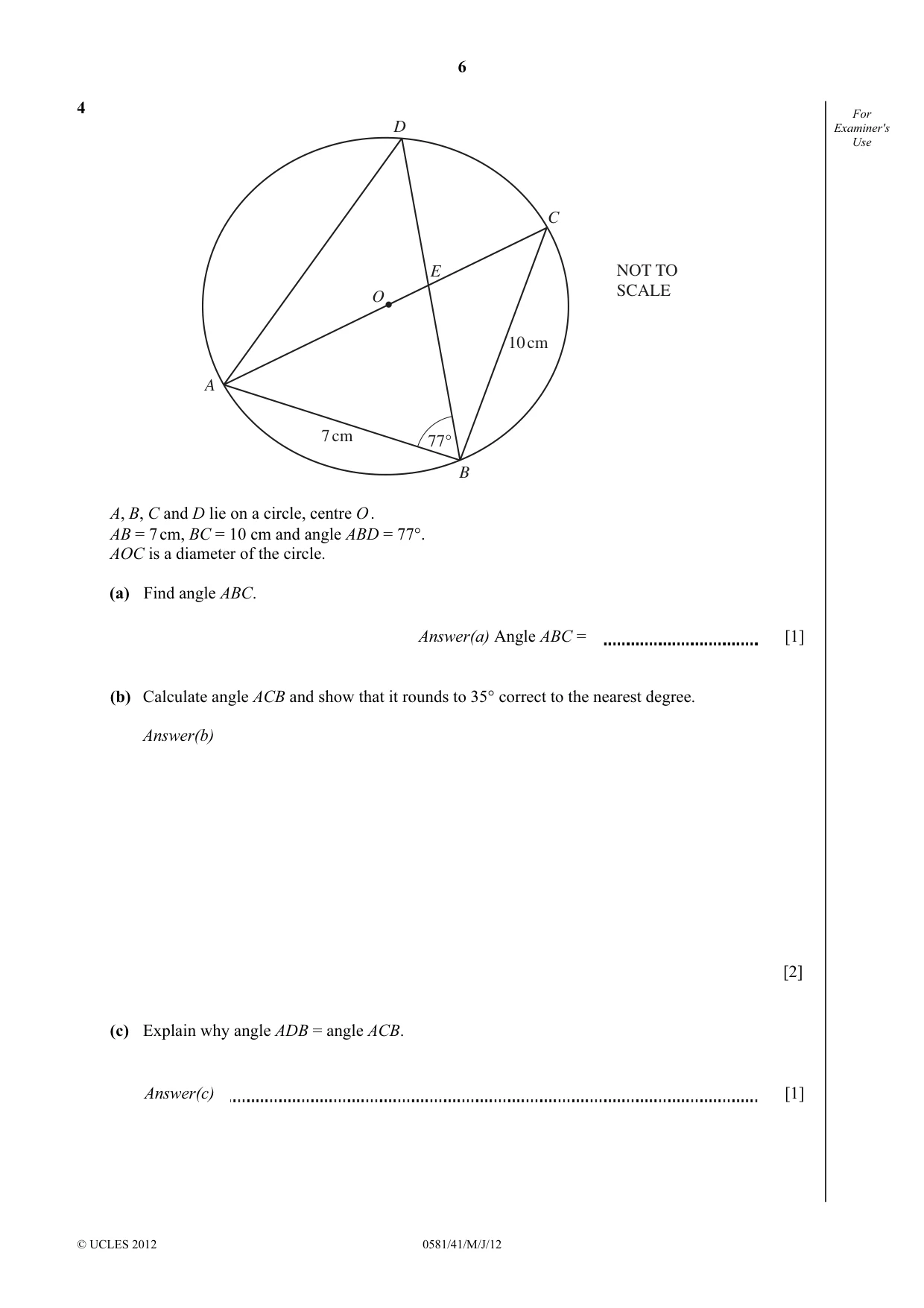
6 © UCLES 2012 0581/41/M/J/12 For Examiner's Use 4 77° A B C D E O 7 cm 10 cm NOT TO SCALE A, B, C and D lie on a circle, centre O . AB = 7 cm, BC = 10 cm and angle ABD = 77°. AOC is a diameter of the circle. (a) Find angle ABC. Answer(a) Angle ABC = [1] (b) Calculate angle ACB and show that it rounds to 35° correct to the nearest degree. Answer(b) [2] (c) Explain why angle ADB = angle ACB. Answer(c) [1]
Question paper, page 7
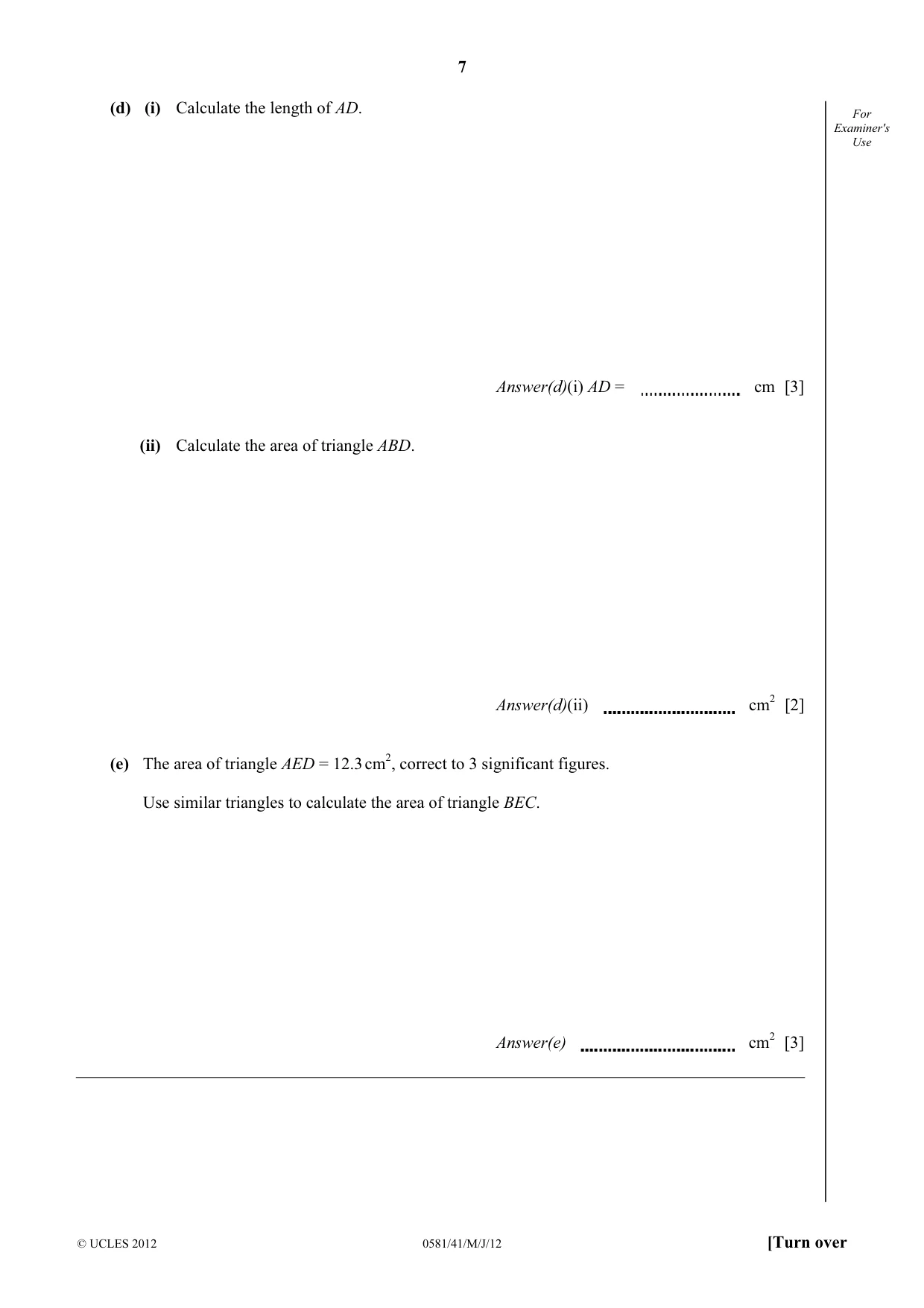
7 © UCLES 2012 0581/41/M/J/12 [Turn over For Examiner's Use (d) (i) Calculate the length of AD. Answer(d)(i) AD = cm [3] (ii) Calculate the area of triangle ABD. Answer(d)(ii) cm2 [2] (e) The area of triangle AED = 12.3 cm2, correct to 3 significant figures. Use similar triangles to calculate the area of triangle BEC. Answer(e) cm2 [3]
Question paper, page 8
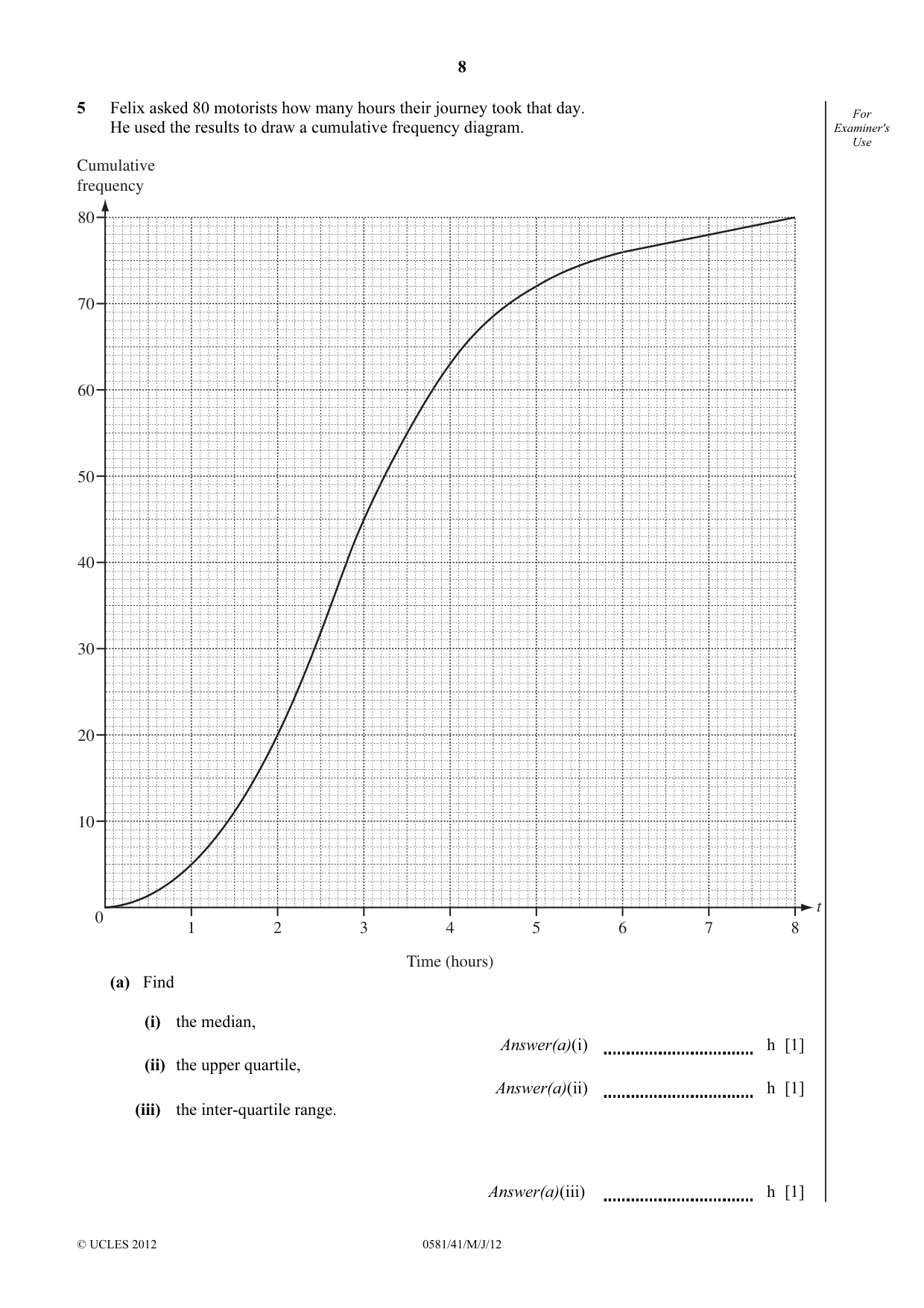
8 © UCLES 2012 0581/41/M/J/12 For Examiner's Use 5 Felix asked 80 motorists how many hours their journey took that day. He used the results to draw a cumulative frequency diagram. Cumulative frequency t 80 70 60 50 40 30 20 10 0 1 2 3 4 5 6 7 8 Time (hours) (a) Find (i) the median, Answer(a)(i) h [1] (ii) the upper quartile, Answer(a)(ii) h [1] (iii) the inter-quartile range. Answer(a)(iii) h [1]
Question paper, page 9
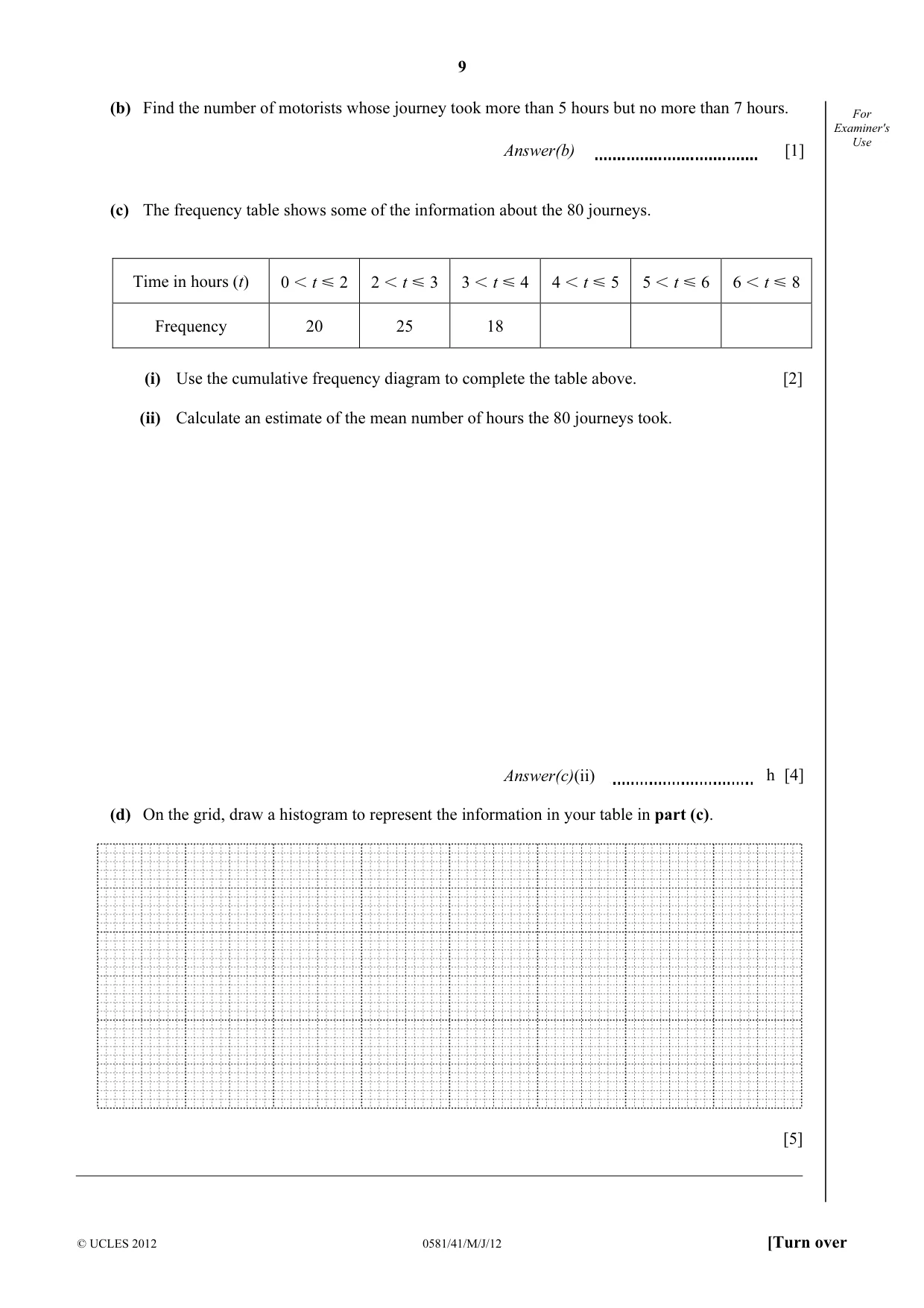
9 © UCLES 2012 0581/41/M/J/12 [Turn over For Examiner's Use (b) Find the number of motorists whose journey took more than 5 hours but no more than 7 hours. Answer(b) [1] (c) The frequency table shows some of the information about the 80 journeys. Time in hours (t) 0 I t Y 2 2 I t Y 3 3 I t Y 4 4 I t Y 5 5 I t Y 6 6 I t Y 8 Frequency 20 25 18 (i) Use the cumulative frequency diagram to complete the table above. [2] (ii) Calculate an estimate of the mean number of hours the 80 journeys took. Answer(c)(ii) h [4] (d) On the grid, draw a histogram to represent the information in your table in part (c). [5]
Question paper, page 10
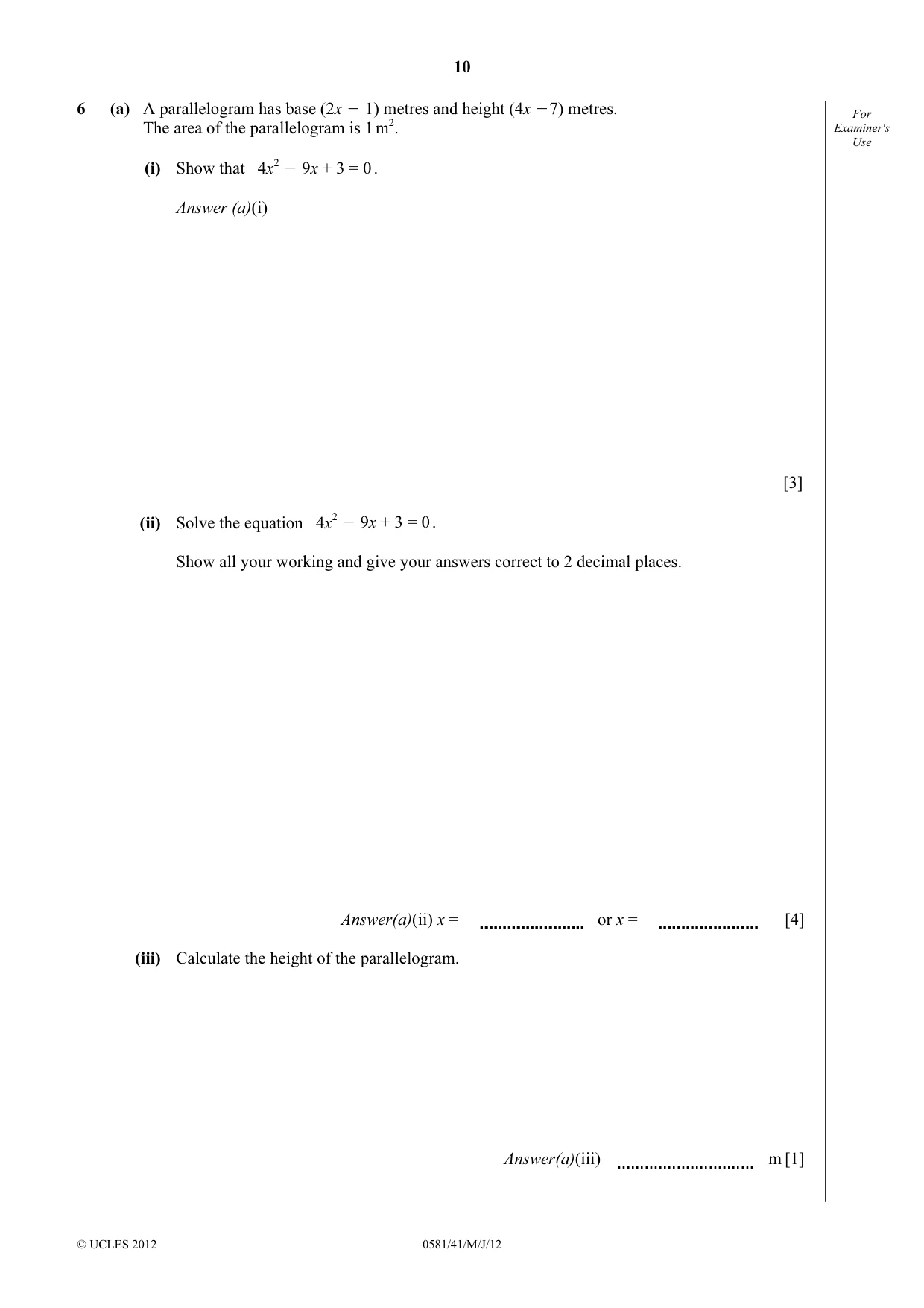
10 © UCLES 2012 0581/41/M/J/12 For Examiner's Use 6 (a) A parallelogram has base (2x O 1) metres and height (4x O7) metres. The area of the parallelogram is 1 m2. (i) Show that 4x2 O 9x + 3 = 0 . Answer (a)(i) [3] (ii) Solve the equation 4x2 O 9x + 3 = 0 . Show all your working and give your answers correct to 2 decimal places. Answer(a)(ii) x = or x = [4] (iii) Calculate the height of the parallelogram. Answer(a)(iii) m [1]
Question paper, page 11
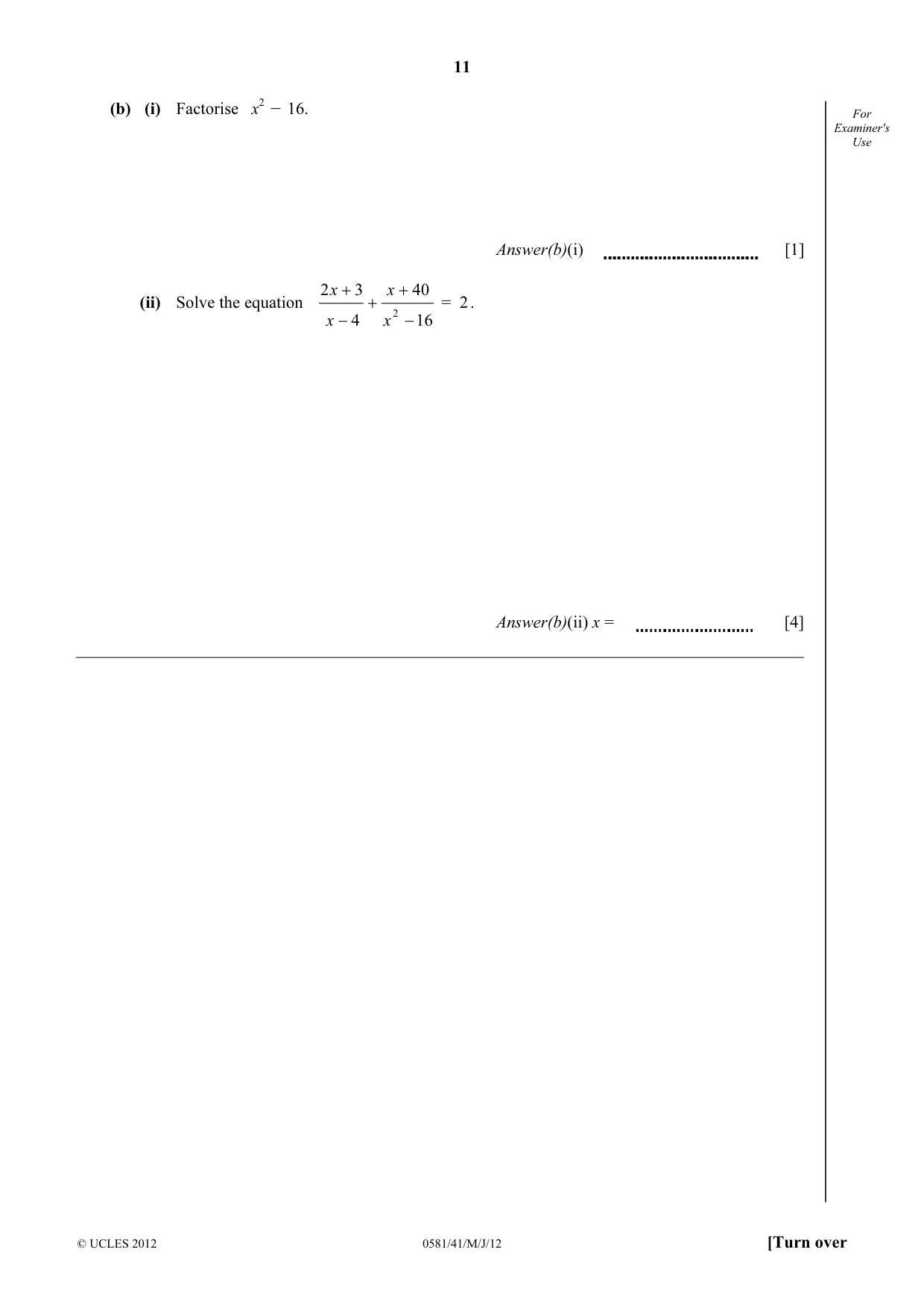
11 © UCLES 2012 0581/41/M/J/12 [Turn over For Examiner's Use (b) (i) Factorise x2 O 16. Answer(b)(i) [1] (ii) Solve the equation 16 40 4 3 2 2 − + + − + x x x x = 2 . Answer(b)(ii) x = [4]
Question paper, page 12
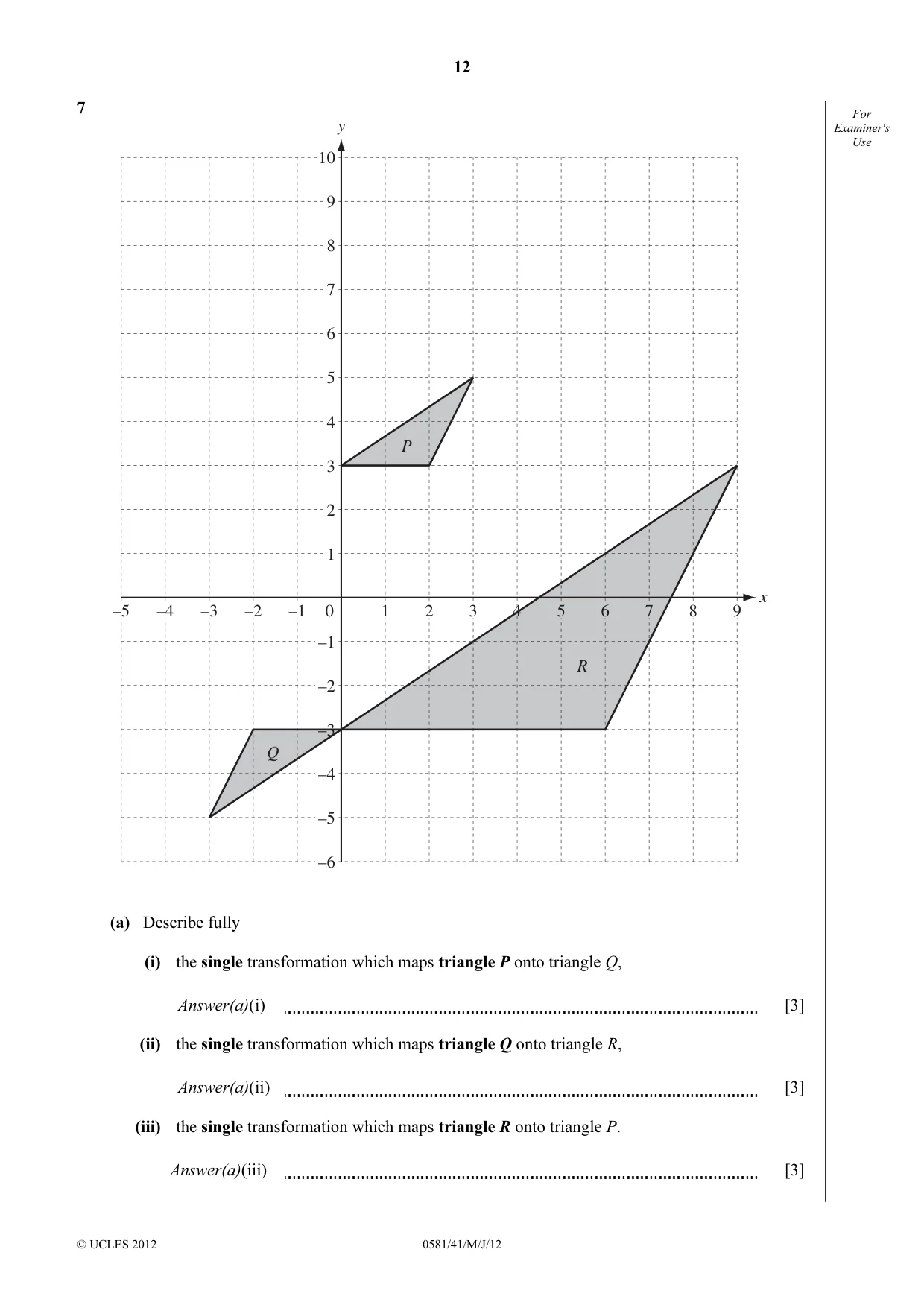
12 © UCLES 2012 0581/41/M/J/12 For Examiner's Use 7 y x 0 1 2 3 4 5 6 7 8 9 –1 –2 –3 –4 –5 10 9 8 7 6 5 4 3 2 1 –1 –2 –3 –4 –5 –6 P R Q (a) Describe fully (i) the single transformation which maps triangle P onto triangle Q, Answer(a)(i) [3] (ii) the single transformation which maps triangle Q onto triangle R, Answer(a)(ii) [3] (iii) the single transformation which maps triangle R onto triangle P. Answer(a)(iii) [3]
Question paper, page 13
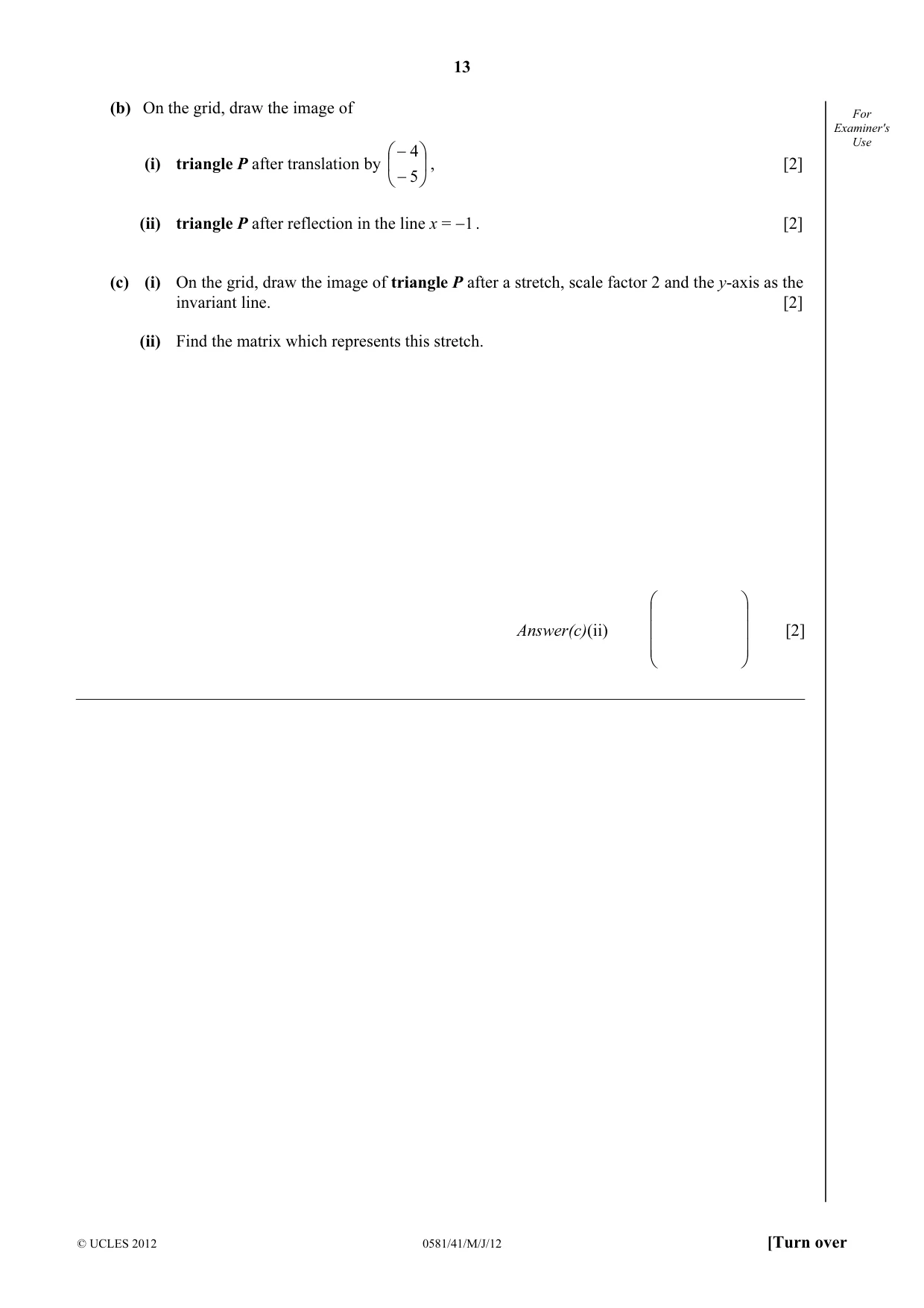
13 © UCLES 2012 0581/41/M/J/12 [Turn over For Examiner's Use (b) On the grid, draw the image of (i) triangle P after translation by − − 5 4 , [2] (ii) triangle P after reflection in the line x = −1 . [2] (c) (i) On the grid, draw the image of triangle P after a stretch, scale factor 2 and the y-axis as the invariant line. [2] (ii) Find the matrix which represents this stretch. Answer(c)(ii) [2]
Question paper, page 14
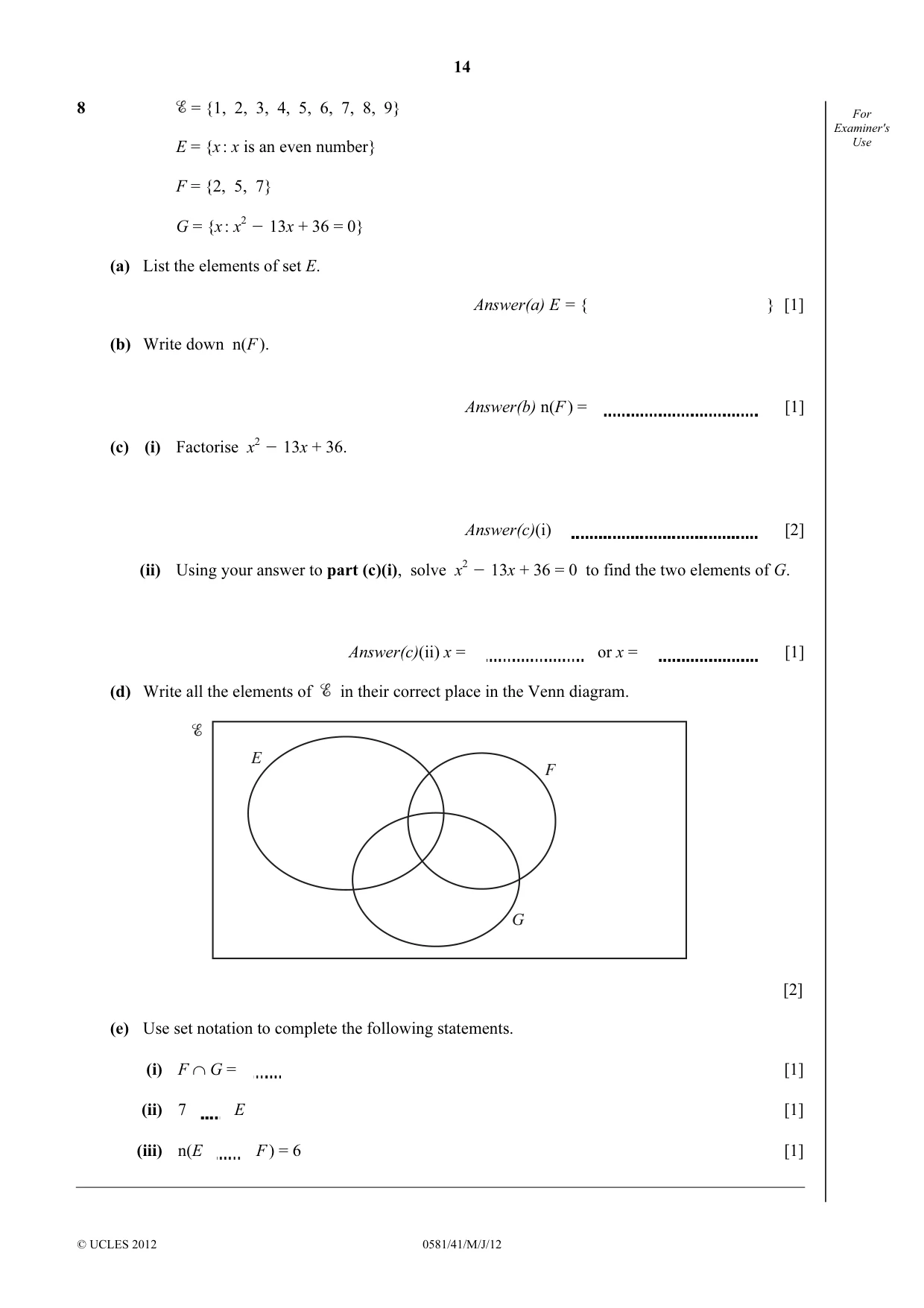
14 © UCLES 2012 0581/41/M/J/12 For Examiner's Use 8 = {1, 2, 3, 4, 5, 6, 7, 8, 9} E = {x : x is an even number} F = {2, 5, 7} G = {x : x2 O 13x + 36 = 0} (a) List the elements of set E. Answer(a) E = { } [1] (b) Write down n(F ). Answer(b) n(F ) = [1] (c) (i) Factorise x2 O 13x + 36. Answer(c)(i) [2] (ii) Using your answer to part (c)(i), solve x2 O 13x + 36 = 0 to find the two elements of G. Answer(c)(ii) x = or x = [1] (d) Write all the elements of in their correct place in the Venn diagram. E F G [2] (e) Use set notation to complete the following statements. (i) F ∩ G = [1] (ii) 7 E [1] (iii) n(E F ) = 6 [1]
Question paper, page 15
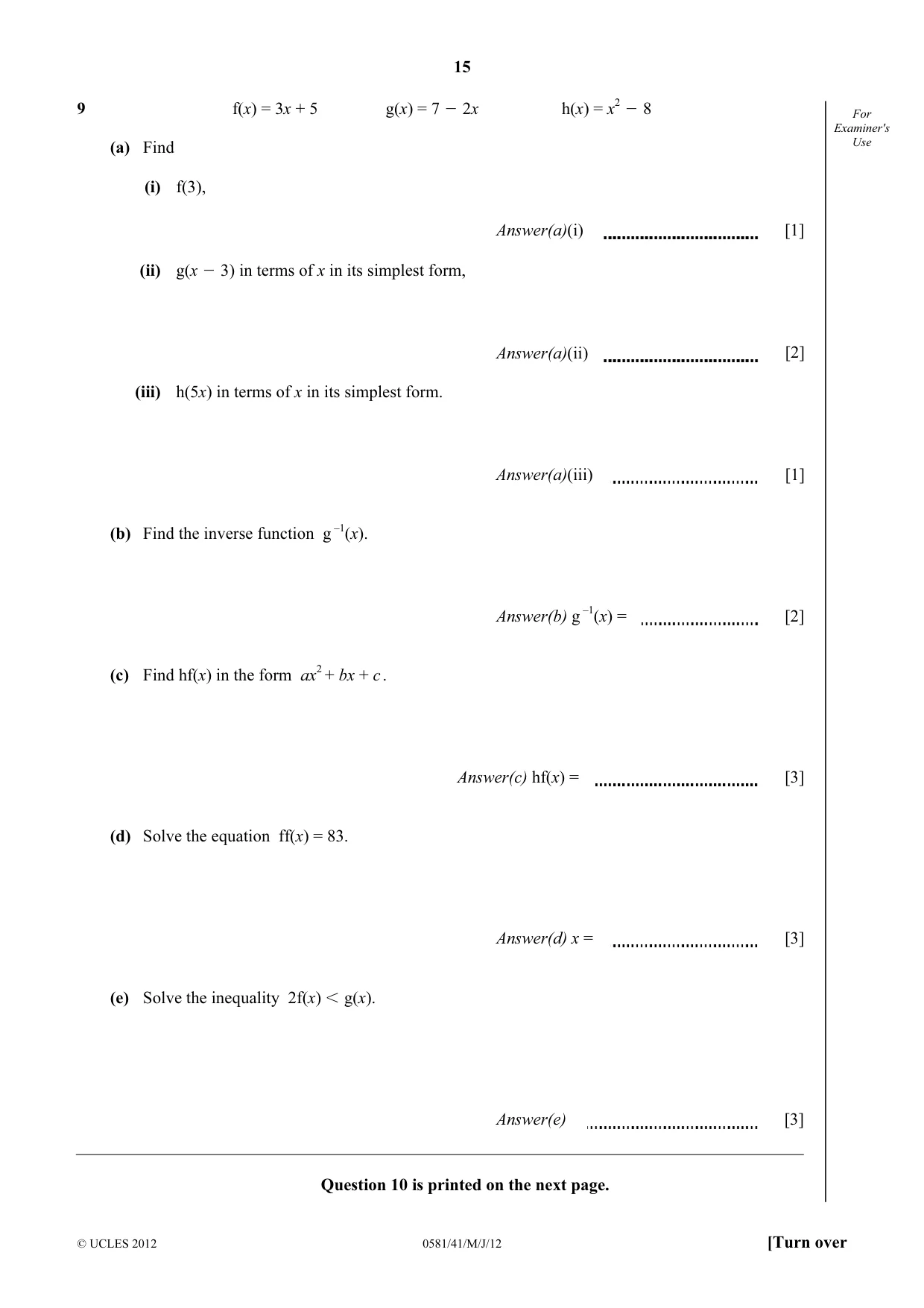
15 © UCLES 2012 0581/41/M/J/12 [Turn over For Examiner's Use 9 f(x) = 3x + 5 g(x) = 7 O 2x h(x) = x2 O 8 (a) Find (i) f(3), Answer(a)(i) [1] (ii) g(x O 3) in terms of x in its simplest form, Answer(a)(ii) [2] (iii) h(5x) in terms of x in its simplest form. Answer(a)(iii) [1] (b) Find the inverse function g –1(x). Answer(b) g –1(x) = [2] (c) Find hf(x) in the form ax2 + bx + c . Answer(c) hf(x) = [3] (d) Solve the equation ff(x) = 83. Answer(d) x = [3] (e) Solve the inequality 2f(x) I g(x). Answer(e) [3] Question 10 is printed on the next page.
Question paper, page 16
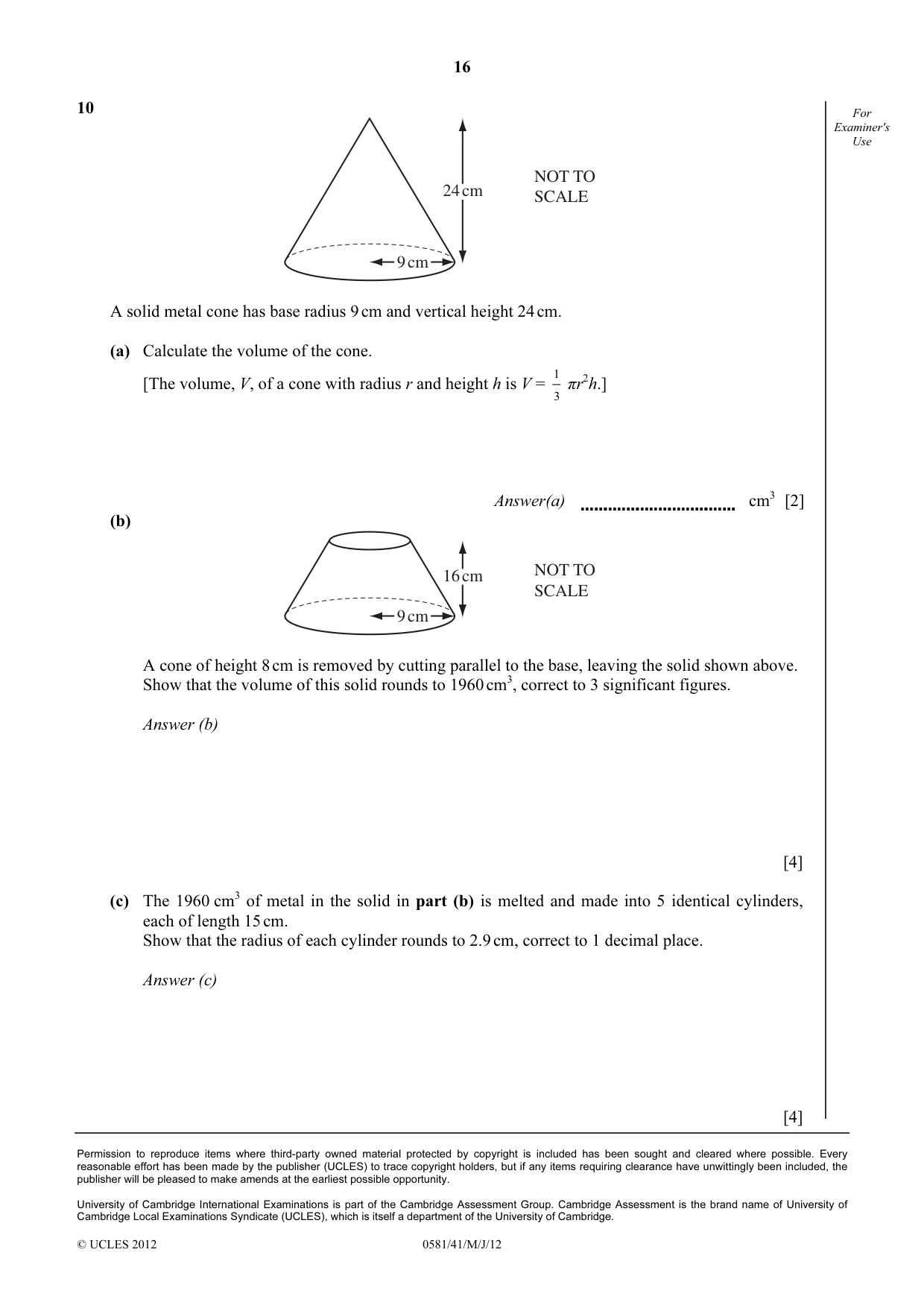
16 Permission to reproduce items where third-party owned material protected by copyright is included has been sought and cleared where possible. Every reasonable effort has been made by the publisher (UCLES) to trace copyright holders, but if any items requiring clearance have unwittingly been included, the publisher will be pleased to make amends at the earliest possible opportunity. University of Cambridge International Examinations is part of the Cambridge Assessment Group. Cambridge Assessment is the brand name of University of Cambridge Local Examinations Syndicate (UCLES), which is itself a department of the University of Cambridge. © UCLES 2012 0581/41/M/J/12 For Examiner's Use 10 24 cm 9 cm NOT TO SCALE A solid metal cone has base radius 9 cm and vertical height 24 cm. (a) Calculate the volume of the cone. [The volume, V, of a cone with radius r and height h is V = 3 1 πr2h.] Answer(a) cm3 [2] (b) 16 cm 9 cm NOT TO SCALE A cone of height 8 cm is removed by cutting parallel to the base, leaving the solid shown above. Show that the volume of this solid rounds to 1960 cm3, correct to 3 significant figures. Answer (b) [4] (c) The 1960 cm3 of metal in the solid in part (b) is melted and made into 5 identical cylinders, each of length 15 cm. Show that the radius of each cylinder rounds to 2.9 cm, correct to 1 decimal place. Answer (c) [4]
Mark scheme, page 1
UNIVERSITY OF CAMBRIDGE INTERNATIONAL EXAMINATIONS International General Certificate of Secondary Education MARK SCHEME for the May/June 2012 question paper for the guidance of teachers 0581 MATHEMATICS 0581/41 Paper 4 (Extended), maximum raw mark 130 This mark scheme is published as an aid to teachers and candidates, to indicate the requirements of the examination. It shows the basis on which Examiners were instructed to award marks. It does not indicate the details of the discussions that took place at an Examiners’ meeting before marking began, which would have considered the acceptability of alternative answers. Mark schemes must be read in conjunction with the question papers and the report on the examination. • Cambridge will not enter into discussions or correspondence in connection with these mark schemes. Cambridge is publishing the mark schemes for the May/June 2012 question papers for most IGCSE, GCE Advanced Level and Advanced Subsidiary Level syllabuses and some Ordinary Level syllabuses. www.XtremePapers.com
Mark scheme, page 2
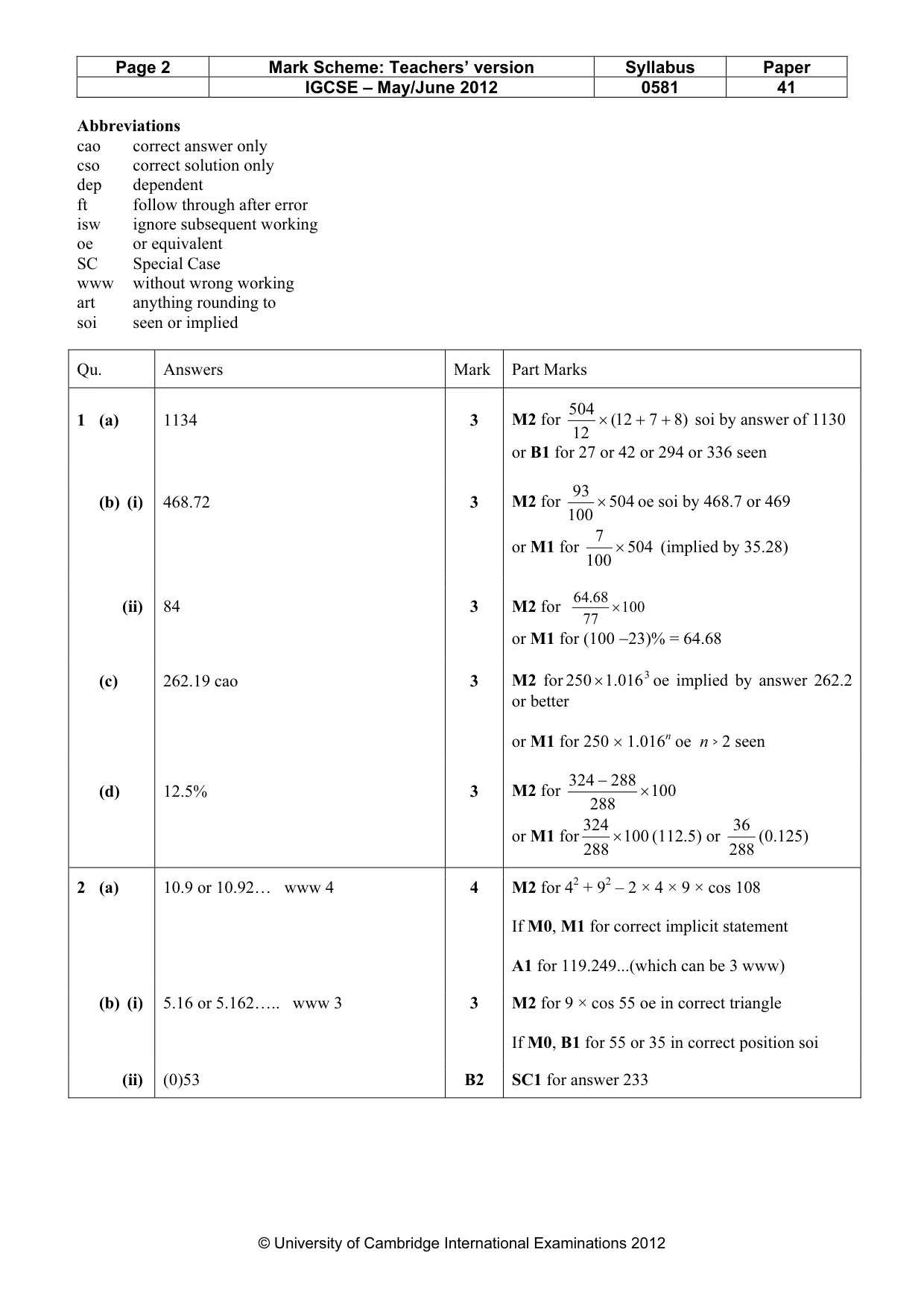
Page 2 Mark Scheme: Teachers’ version Syllabus Paper IGCSE – May/June 2012 0581 41 © University of Cambridge International Examinations 2012 Abbreviations cao correct answer only cso correct solution only dep dependent ft follow through after error isw ignore subsequent working oe or equivalent SC Special Case www without wrong working art anything rounding to soi seen or implied Qu. Answers Mark Part Marks 1 (a) 1134 3 M2 for ) 8 7 12 ( 12 504 + + × soi by answer of 1130 or B1 for 27 or 42 or 294 or 336 seen (b) (i) 468.72 3 M2 for 504 100 93 × oe soi by 468.7 or 469 or M1 for 504 100 7 × (implied by 35.28) (ii) 84 3 M2 for 100 77 68 . 64 × or M1 for (100 −23)% = 64.68 (c) 262.19 cao 3 M2 for 3 016 .1 250× oe implied by answer 262.2 or better or M1 for 250 × 1.016n oe n > 2 seen (d) 12.5% 3 M2 for 100 288 288 324 × − or M1 for 100 288 324 × (112.5) or 288 36 (0.125) 2 (a) 10.9 or 10.92… www 4 4 M2 for 42 + 92 – 2 × 4 × 9 × cos 108 If M0, M1 for correct implicit statement A1 for 119.249...(which can be 3 www) (b) (i) 5.16 or 5.162….. www 3 3 M2 for 9 × cos 55 oe in correct triangle If M0, B1 for 55 or 35 in correct position soi (ii) (0)53 B2 SC1 for answer 233
Mark scheme, page 3
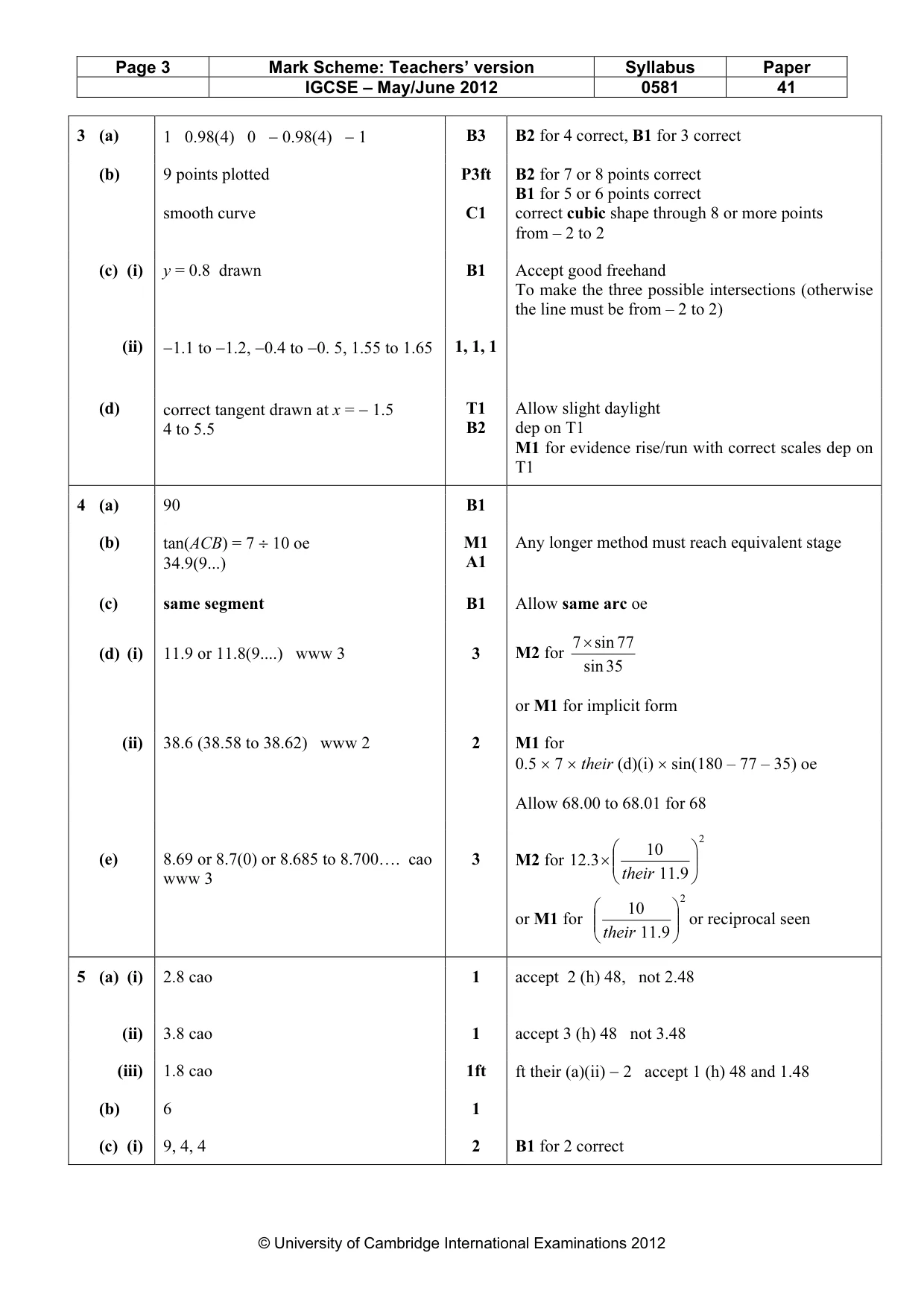
Page 3 Mark Scheme: Teachers’ version Syllabus Paper IGCSE – May/June 2012 0581 41 © University of Cambridge International Examinations 2012 3 (a) 1 0.98(4) 0 − 0.98(4) − 1 B3 B2 for 4 correct, B1 for 3 correct (b) 9 points plotted smooth curve P3ft C1 B2 for 7 or 8 points correct B1 for 5 or 6 points correct correct cubic shape through 8 or more points from – 2 to 2 (c) (i) y = 0.8 drawn B1 Accept good freehand To make the three possible intersections (otherwise the line must be from – 2 to 2) (ii) −1.1 to −1.2, −0.4 to −0. 5, 1.55 to 1.65 1, 1, 1 (d) correct tangent drawn at x = − 1.5 4 to 5.5 T1 B2 Allow slight daylight dep on T1 M1 for evidence rise/run with correct scales dep on T1 4 (a) 90 B1 (b) tan(ACB) = 7 ÷ 10 oe 34.9(9...) M1 A1 Any longer method must reach equivalent stage (c) same segment B1 Allow same arc oe (d) (i) 11.9 or 11.8(9…) www 3 3 M2 for 35 sin 77 sin 7× or M1 for implicit form (ii) 38.6 (38.58 to 38.62) www 2 2 M1 for 0.5 × 7 × their (d)(i) × sin(180 – 77 – 35) oe Allow 68.00 to 68.01 for 68 (e) 8.69 or 8.7(0) or 8.685 to 8.700…. cao www 3 3 M2 for 2 9. 11 10 3. 12 × their or M1 for 2 9. 11 10 their or reciprocal seen 5 (a) (i) 2.8 cao 1 accept 2 (h) 48, not 2.48 (ii) 3.8 cao 1 accept 3 (h) 48 not 3.48 (iii) 1.8 cao 1ft ft their (a)(ii) − 2 accept 1 (h) 48 and 1.48 (b) 6 1 (c) (i) 9, 4, 4 2 B1 for 2 correct
Mark scheme, page 4
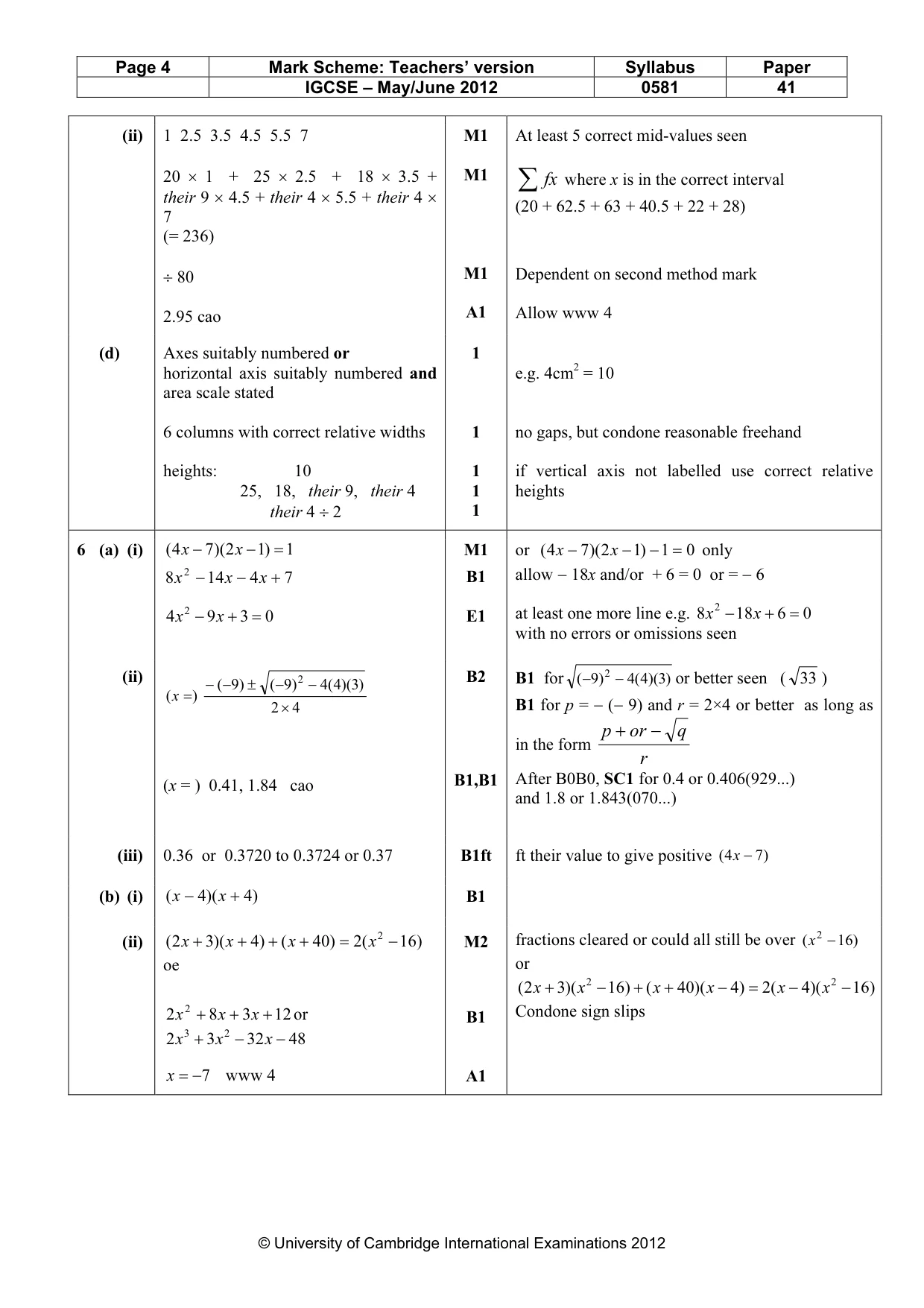
Page 4 Mark Scheme: Teachers’ version Syllabus Paper IGCSE – May/June 2012 0581 41 © University of Cambridge International Examinations 2012 (ii) 1 2.5 3.5 4.5 5.5 7 20 × 1 + 25 × 2.5 + 18 × 3.5 + their 9 × 4.5 + their 4 × 5.5 + their 4 × 7 (= 236) ÷ 80 2.95 cao M1 M1 M1 A1 At least 5 correct mid-values seen ∑fx where x is in the correct interval (20 + 62.5 + 63 + 40.5 + 22 + 28) Dependent on second method mark Allow www 4 (d) Axes suitably numbered or horizontal axis suitably numbered and area scale stated 6 columns with correct relative widths heights: 10 25, 18, their 9, their 4 their 4 ÷ 2 1 1 1 1 1 e.g. 4cm2 = 10 no gaps, but condone reasonable freehand if vertical axis not labelled use correct relative heights 6 (a) (i) 1 )1 2 )( 7 4 ( = − − x x 7 4 14 8 2 + − − x x x 0 3 9 4 2 = + −x x M1 B1 E1 or 0 1 )1 2 )( 7 4 ( = − − − x x only allow − 18x and/or + 6 = 0 or = − 6 at least one more line e.g. 0 6 18 8 2 = + − x x with no errors or omissions seen (ii) 4 2 ) 3 )( 4 ( 4 ) 9 ( ) 9 ( ) ( 2 × − − ± − − = x (x = ) 0.41, 1.84 cao B2 B1,B1 B1 for ) 3 )( 4 ( 4 ) 9 ( 2 − − or better seen ( 33 ) B1 for p = − (− 9) and r = 2×4 or better as long as in the form r q or p − + After B0B0, SC1 for 0.4 or 0.406(929...) and 1.8 or 1.843(070...) (iii) 0.36 or 0.3720 to 0.3724 or 0.37 B1ft ft their value to give positive ) 7 4 ( − x (b) (i) ) 4 )( 4 ( + − x x B1 (ii) ) 16 ( 2 ) 40 ( ) 4 )( 3 2 ( 2 − = + + + + x x x x oe 12 3 8 2 2 + + + x x x or 48 32 3 2 2 3 − − + x x x 7 − = x www 4 M2 B1 A1 fractions cleared or could all still be over ) 16 ( 2 − x or ) 16 )( 4 ( 2 ) 4 )( 40 ( ) 16 )( 3 2 ( 2 2 − − = − + + − + x x x x x x Condone sign slips
Mark scheme, page 5
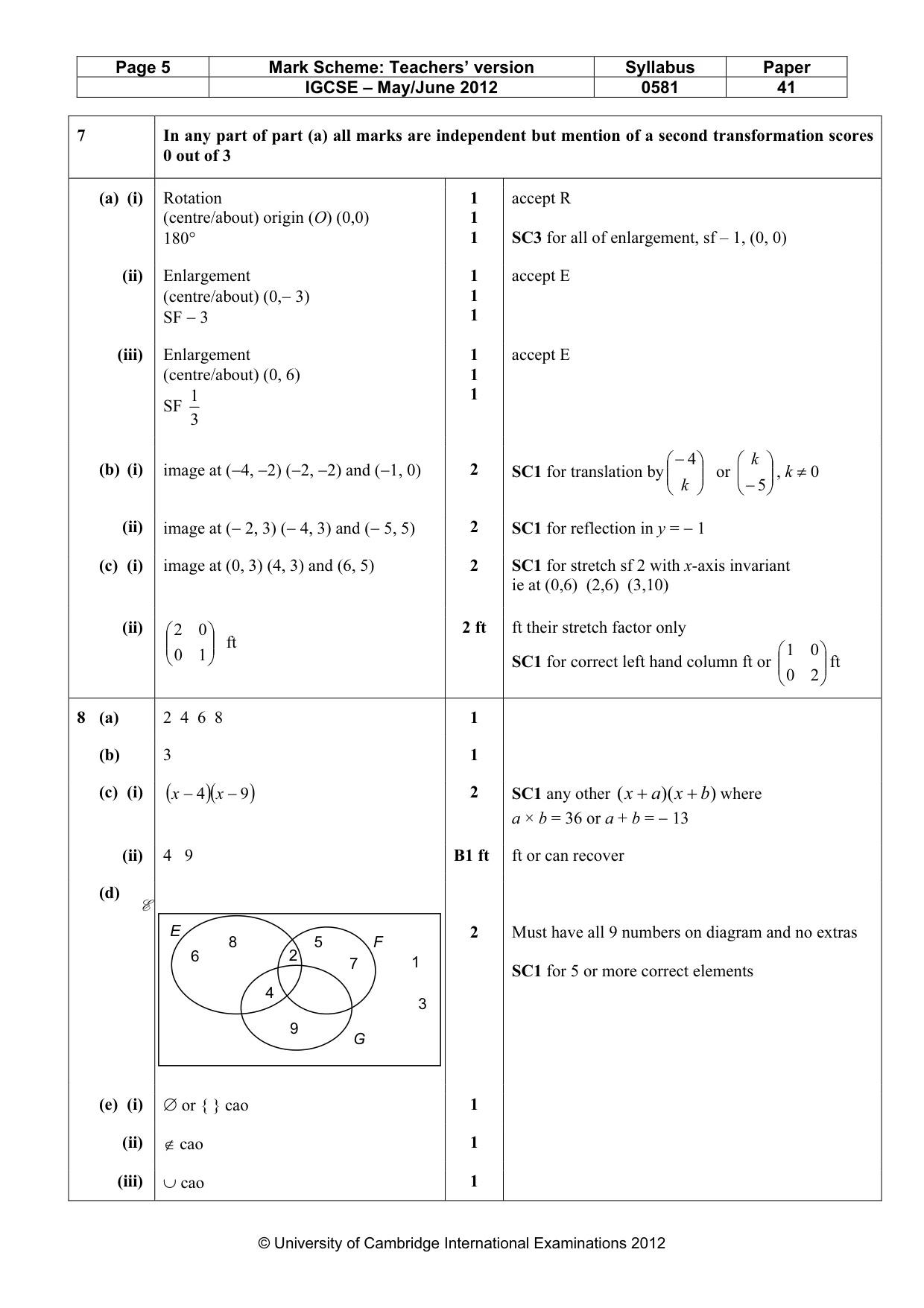
Page 5 Mark Scheme: Teachers’ version Syllabus Paper IGCSE – May/June 2012 0581 41 © University of Cambridge International Examinations 2012 7 In any part of part (a) all marks are independent but mention of a second transformation scores 0 out of 3 (a) (i) Rotation (centre/about) origin (O) (0,0) 180° 1 1 1 accept R SC3 for all of enlargement, sf – 1, (0, 0) (ii) Enlargement (centre/about) (0,− 3) SF − 3 1 1 1 accept E (iii) Enlargement (centre/about) (0, 6) SF 3 1 1 1 1 accept E (b) (i) image at (−4, −2) (−2, −2) and (−1, 0) 2 SC1 for translation by − k 4 or −5 k , k ≠ 0 (ii) image at (− 2, 3) (− 4, 3) and (− 5, 5) 2 SC1 for reflection in y = − 1 (c) (i) image at (0, 3) (4, 3) and (6, 5) 2 SC1 for stretch sf 2 with x-axis invariant ie at (0,6) (2,6) (3,10) (ii) 1 0 0 2 ft 2 ft ft their stretch factor only SC1 for correct left hand column ft or 2 0 0 1 ft 8 (a) 2 4 6 8 1 (b) 3 1 (c) (i) ( )( ) 9 4 − − x x 2 SC1 any other ) )( ( b x a x + + where a × b = 36 or a + b = − 13 (ii) 4 9 B1 ft ft or can recover (d) 2 Must have all 9 numbers on diagram and no extras SC1 for 5 or more correct elements (e) (i) ∅ or { } cao 1 (ii) ∉ cao 1 (iii) ∪ cao 1 E E F G 1 3 2 6 8 4 9 5 7
Mark scheme, page 6
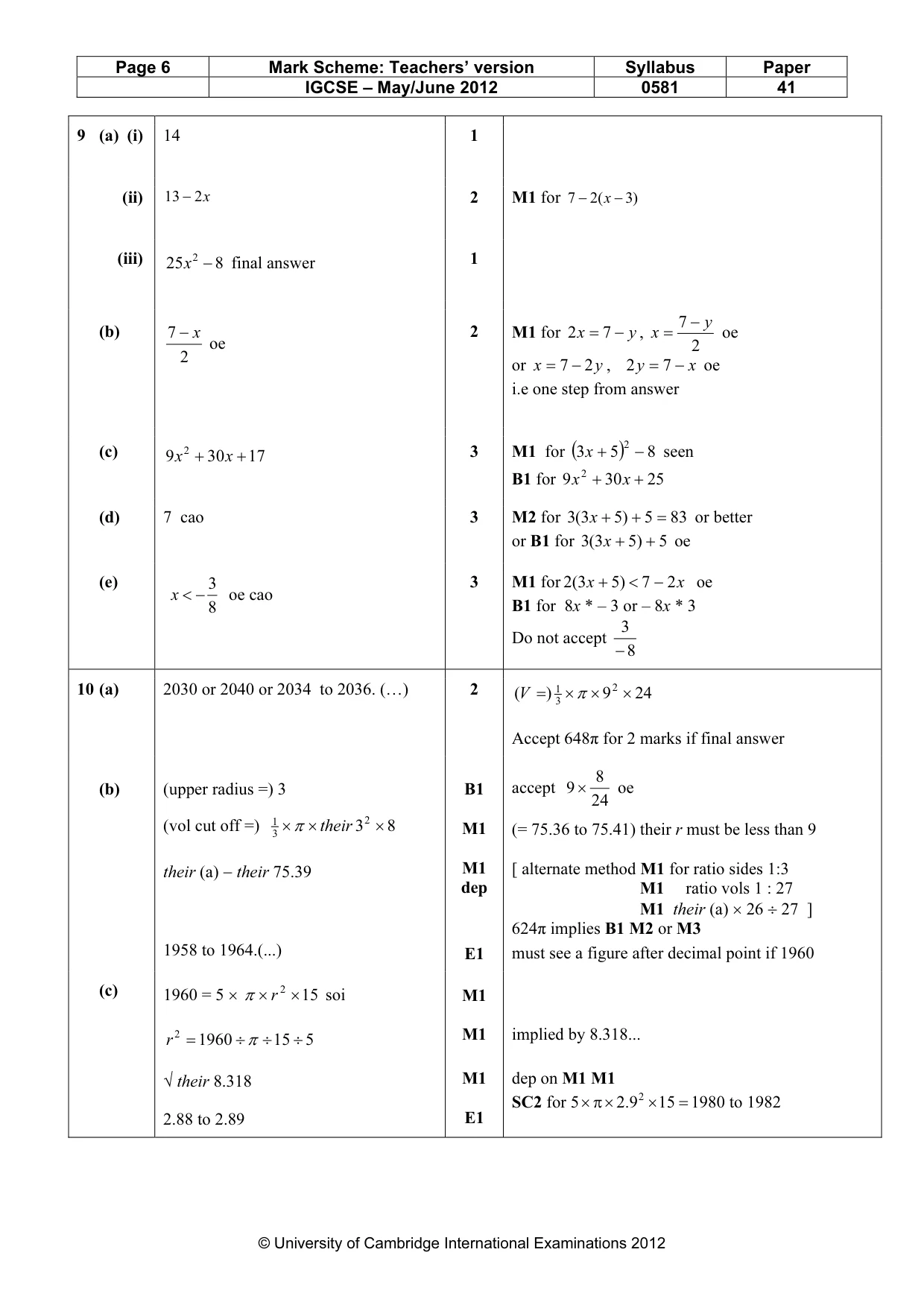
Page 6 Mark Scheme: Teachers’ version Syllabus Paper IGCSE – May/June 2012 0581 41 © University of Cambridge International Examinations 2012 9 (a) (i) 14 1 (ii) x 2 13 − 2 M1 for ) 3 ( 2 7 − − x (iii) 8 25 2 − x final answer 1 (b) 2 7 x − oe 2 M1 for y x − = 7 2 , 2 7 y x − = oe or y x 2 7 − = , x y − = 7 2 oe i.e one step from answer (c) 17 30 9 2 + + x x 3 M1 for ( ) 8 5 3 2 − + x seen B1 for 25 30 9 2 + + x x (d) 7 cao 3 M2 for 83 5 ) 5 3 ( 3 = + + x or better or B1 for 5 ) 5 3 ( 3 + + x oe (e) 8 3 − < x oe cao 3 M1 for x x 2 7 ) 5 3 ( 2 − < + oe B1 for 8x * – 3 or – 8x * 3 Do not accept 8 3 − 10 (a) 2030 or 2040 or 2034 to 2036. (…) 2 24 9 ) ( 2 3 1 × × × = π V Accept 648π for 2 marks if final answer (b) (upper radius =) 3 (vol cut off =) 8 32 3 1 × × × their π their (a) − their 75.39 1958 to 1964.(...) B1 M1 M1 dep E1 accept 24 8 9× oe (= 75.36 to 75.41) their r must be less than 9 [ alternate method M1 for ratio sides 1:3 M1 ratio vols 1 : 27 M1 their (a) × 26 ÷ 27 ] 624π implies B1 M2 or M3 must see a figure after decimal point if 1960 (c) 1960 = 5 × 15 2 × × r π soi 5 15 1960 2 ÷ ÷ ÷ = π r √ their 8.318 2.88 to 2.89 M1 M1 M1 E1 implied by 8.318... dep on M1 M1 SC2 for 5 = × × π × 15 9.2 2 1980 to 1982
What you needed in this session
Cambridge’s own grade thresholds for 2012 May/June, Paper 4 · Variant 1. A higher threshold means an easier paper — the bar moves with how the cohort did.