Cambridge IGCSE Mathematics (with coursework) 0581 — 2012 May/June Paper 3 · Variant 2
0581/32/M/J/12 · 104 marks · ≈117 min
The question paper and its mark scheme, free to read here and free to download. This is Cambridge’s own paper, exactly as it was sat.
Question paper16 pages
Mark scheme4 pages
Answers below. Sit the paper first if you are practising.
Paper as text
Question paper, page 1
This document consists of 16 printed pages. IB12 06_0581_32/RP © UCLES 2012 [Turn over *8366760345* UNIVERSITY OF CAMBRIDGE INTERNATIONAL EXAMINATIONS International General Certificate of Secondary Education MATHEMATICS 0581/32 Paper 3 (Core) May/June 2012 2 hours Candidates answer on the Question Paper. Additional Materials: Electronic calculator Geometrical instruments Mathematical tables (optional) Tracing paper (optional) READ THESE INSTRUCTIONS FIRST Write your Centre number, candidate number and name on all the work you hand in. Write in dark blue or black pen. You may use a pencil for any diagrams or graphs. Do not use staples, paper clips, highlighters, glue or correction fluid. DO NOT WRITE IN ANY BARCODES. Answer all questions. If working is needed for any question it must be shown below that question. Electronic calculators should be used. If the degree of accuracy is not specified in the question, and if the answer is not exact, give the answer to three significant figures. Give answers in degrees to one decimal place. For π , use either your calculator value or 3.142. At the end of the examination, fasten all your work securely together. The number of marks is given in brackets [ ] at the end of each question or part question. The total of the marks for this paper is 104. www.XtremePapers.com
Question paper, page 2
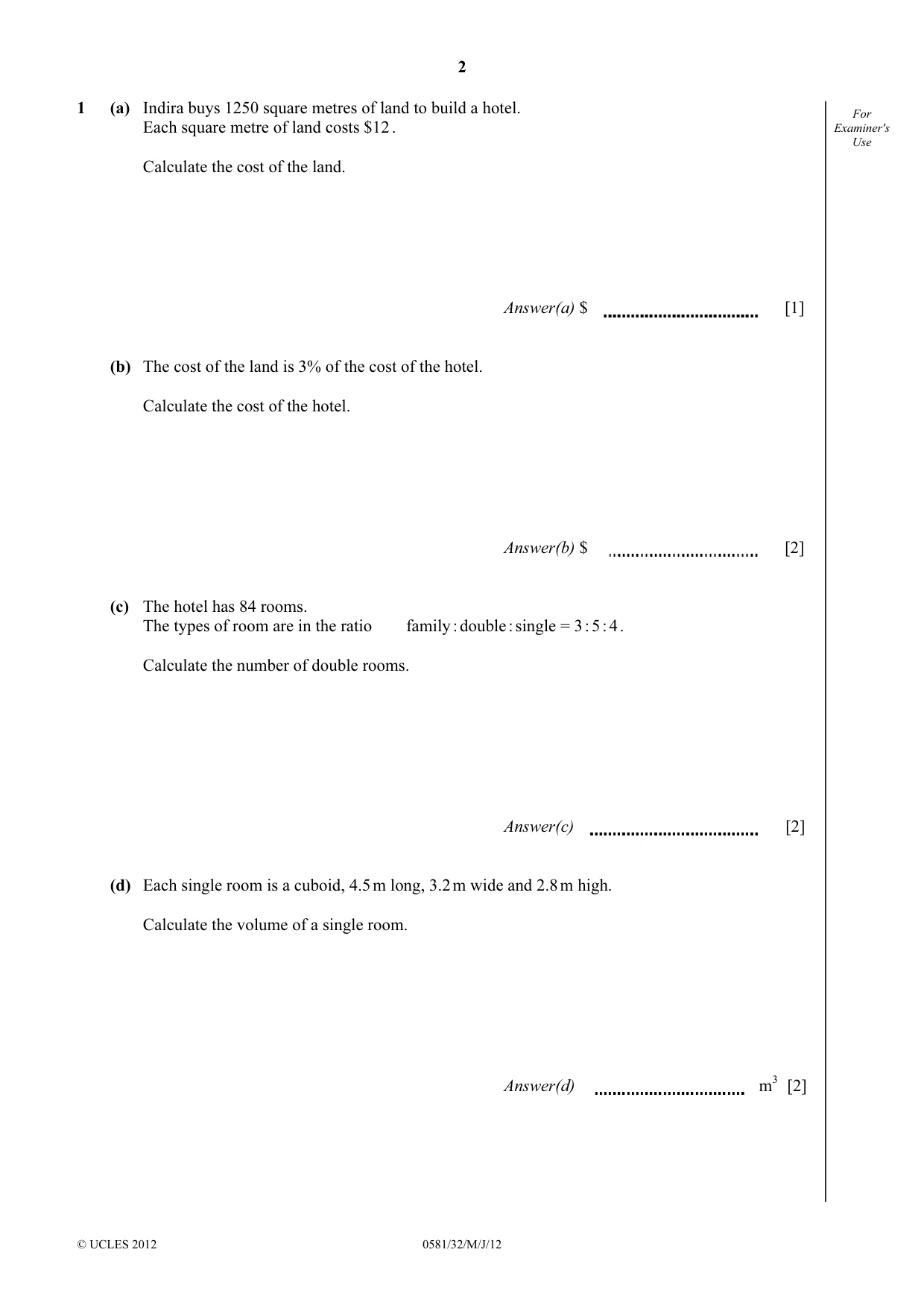
2 © UCLES 2012 0581/32/M/J/12 For Examiner's Use 1 (a) Indira buys 1250 square metres of land to build a hotel. Each square metre of land costs $12 . Calculate the cost of the land. Answer(a) $ [1] (b) The cost of the land is 3% of the cost of the hotel. Calculate the cost of the hotel. Answer(b) $ [2] (c) The hotel has 84 rooms. The types of room are in the ratio family : double : single = 3 : 5 : 4 . Calculate the number of double rooms. Answer(c) [2] (d) Each single room is a cuboid, 4.5 m long, 3.2 m wide and 2.8 m high. Calculate the volume of a single room. Answer(d) m3 [2]
Question paper, page 3
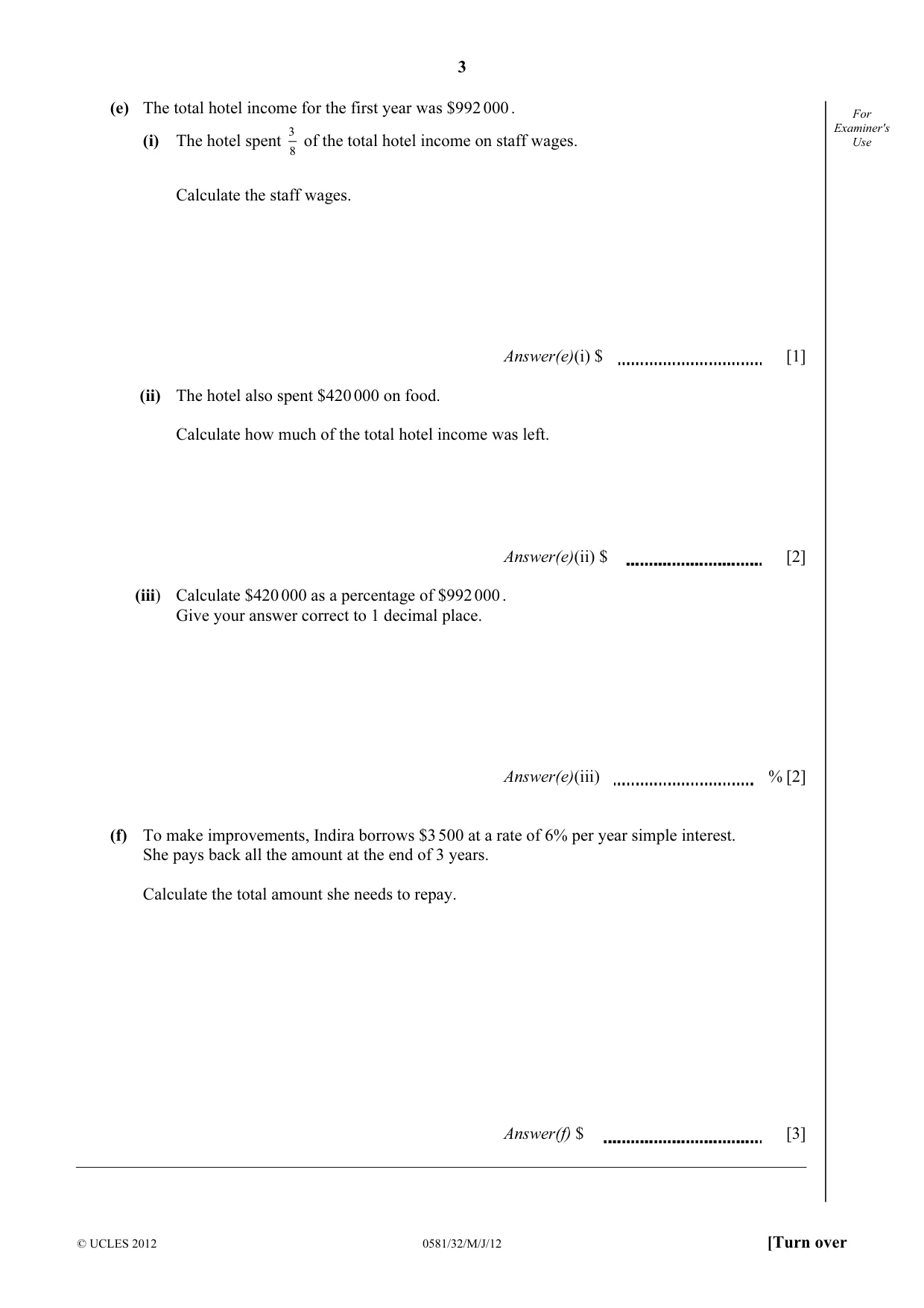
3 © UCLES 2012 0581/32/M/J/12 [Turn over For Examiner's Use (e) The total hotel income for the first year was $992 000 . (i) The hotel spent 8 3 of the total hotel income on staff wages. Calculate the staff wages. Answer(e)(i) $ [1] (ii) The hotel also spent $420 000 on food. Calculate how much of the total hotel income was left. Answer(e)(ii) $ [2] (iii) Calculate $420 000 as a percentage of $992 000 . Give your answer correct to 1 decimal place. Answer(e)(iii) % [2] (f) To make improvements, Indira borrows $3 500 at a rate of 6% per year simple interest. She pays back all the amount at the end of 3 years. Calculate the total amount she needs to repay. Answer(f) $ [3]
Question paper, page 4
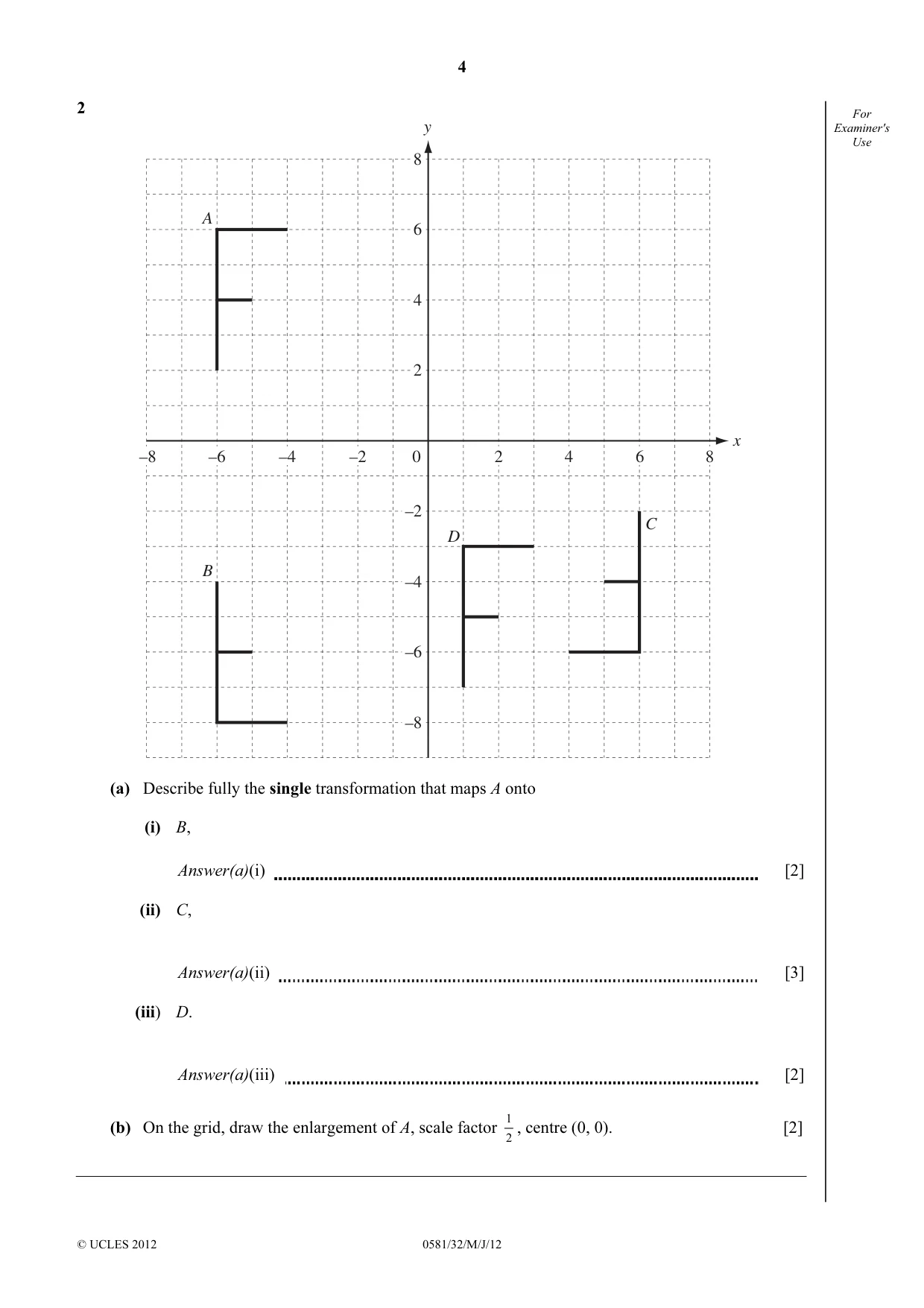
4 © UCLES 2012 0581/32/M/J/12 For Examiner's Use 2 8 6 4 2 –2 –4 –6 –8 –2 2 0 4 6 8 –4 –6 –8 y x A B C D (a) Describe fully the single transformation that maps A onto (i) B, Answer(a)(i) [2] (ii) C, Answer(a)(ii) [3] (iii) D. Answer(a)(iii) [2] (b) On the grid, draw the enlargement of A, scale factor 2 1 , centre (0, 0). [2]
Question paper, page 5
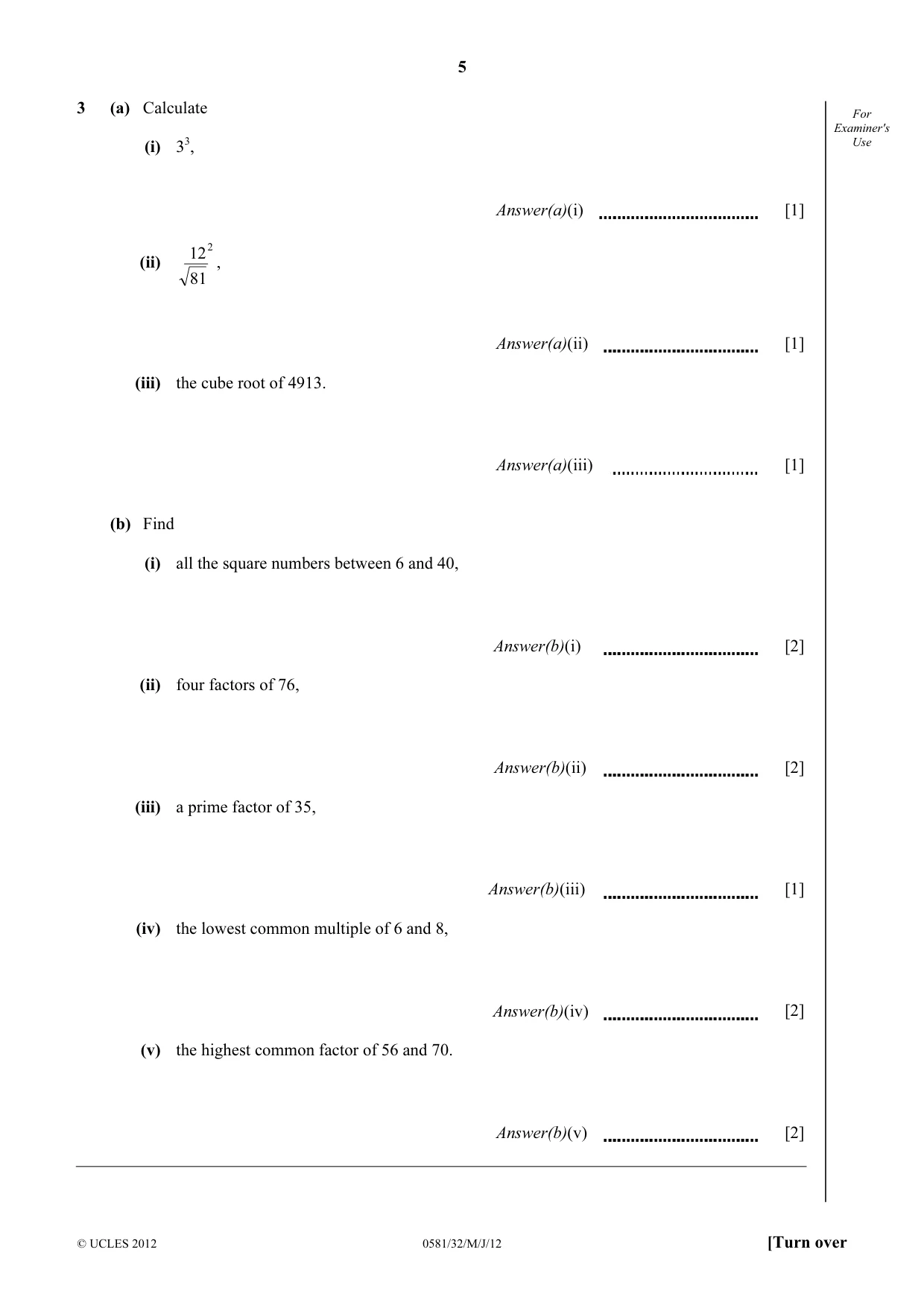
5 © UCLES 2012 0581/32/M/J/12 [Turn over For Examiner's Use 3 (a) Calculate (i) 33, Answer(a)(i) [1] (ii) 2 12 81 , Answer(a)(ii) [1] (iii) the cube root of 4913. Answer(a)(iii) [1] (b) Find (i) all the square numbers between 6 and 40, Answer(b)(i) [2] (ii) four factors of 76, Answer(b)(ii) [2] (iii) a prime factor of 35, Answer(b)(iii) [1] (iv) the lowest common multiple of 6 and 8, Answer(b)(iv) [2] (v) the highest common factor of 56 and 70. Answer(b)(v) [2]
Question paper, page 6
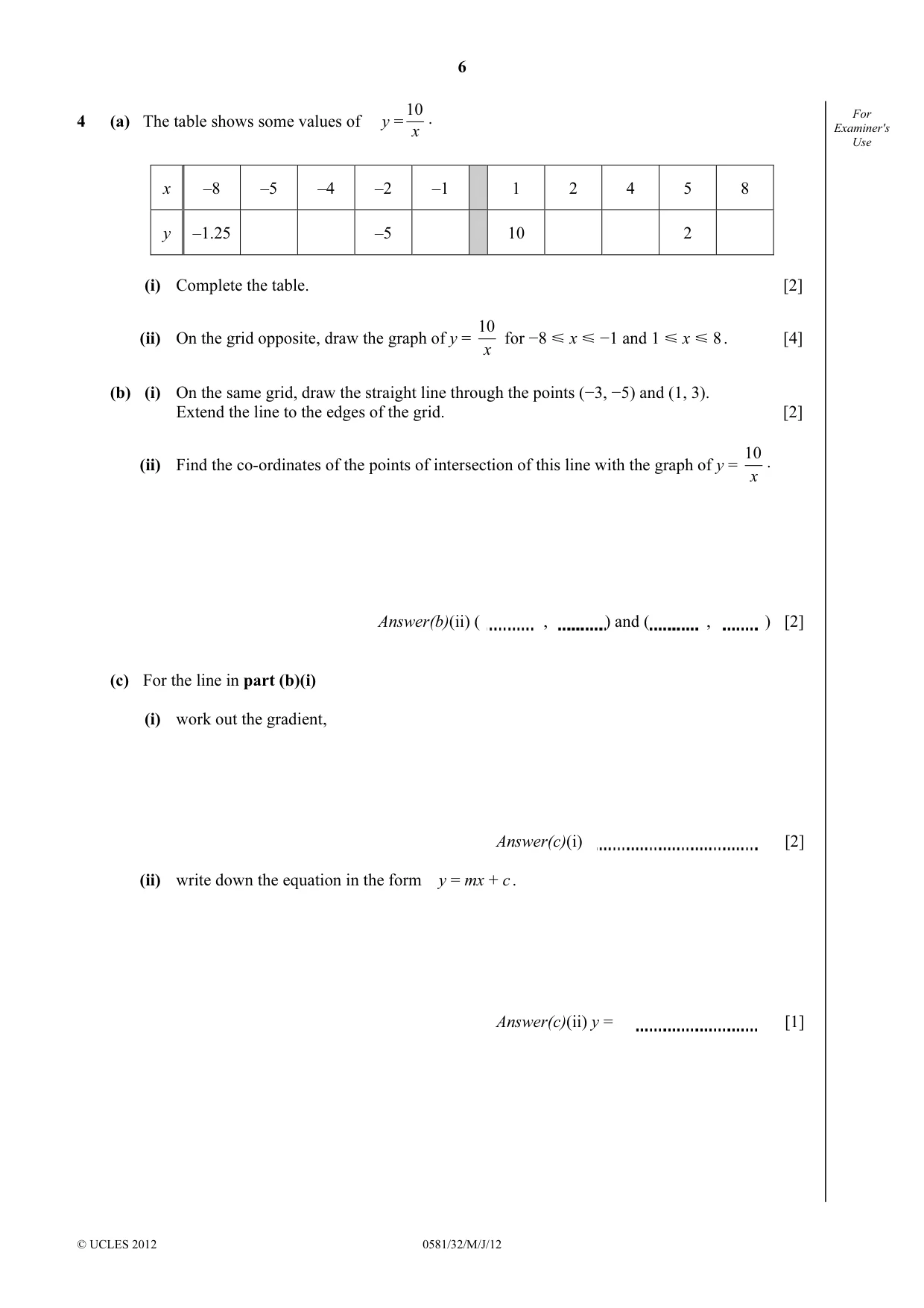
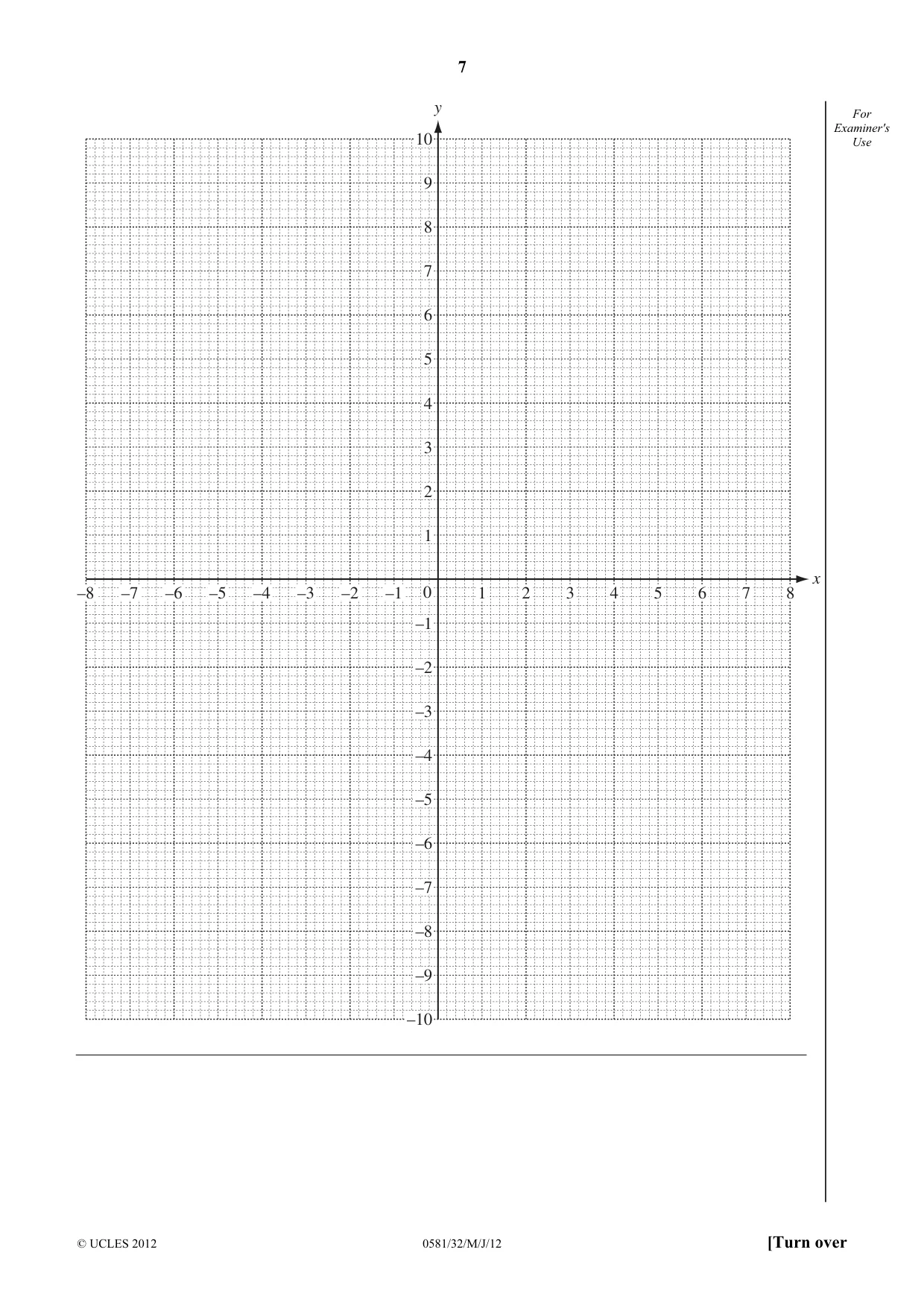
6 © UCLES 2012 0581/32/M/J/12 For Examiner's Use 4 (a) The table shows some values of y = x 10 . x –8 –5 –4 –2 –1 1 2 4 5 8 y –1.25 –5 10 2 (i) Complete the table. [2] (ii) On the grid opposite, draw the graph of y = x 10 for −8 Y x Y −1 and 1 Y x Y=8 . [4] (b) (i) On the same grid, draw the straight line through the points (−3, −5) and (1, 3). Extend the line to the edges of the grid. [2] (ii) Find the co-ordinates of the points of intersection of this line with the graph of y = x 10 . Answer(b)(ii) ( , ) and ( , ) [2] (c) For the line in part (b)(i) (i) work out the gradient, Answer(c)(i) [2] (ii) write down the equation in the form y = mx + c . Answer(c)(ii) y = [1]
Question paper, page 7
7 © UCLES 2012 0581/32/M/J/12 [Turn over For Examiner's Use y x 10 9 8 7 6 5 4 3 2 1 –1 –2 –3 –4 –5 –6 –7 –8 –9 –10 –1 –2 –3 –4 –5 –6 –7 –8 8 7 6 5 4 3 2 1 0
Question paper, page 8
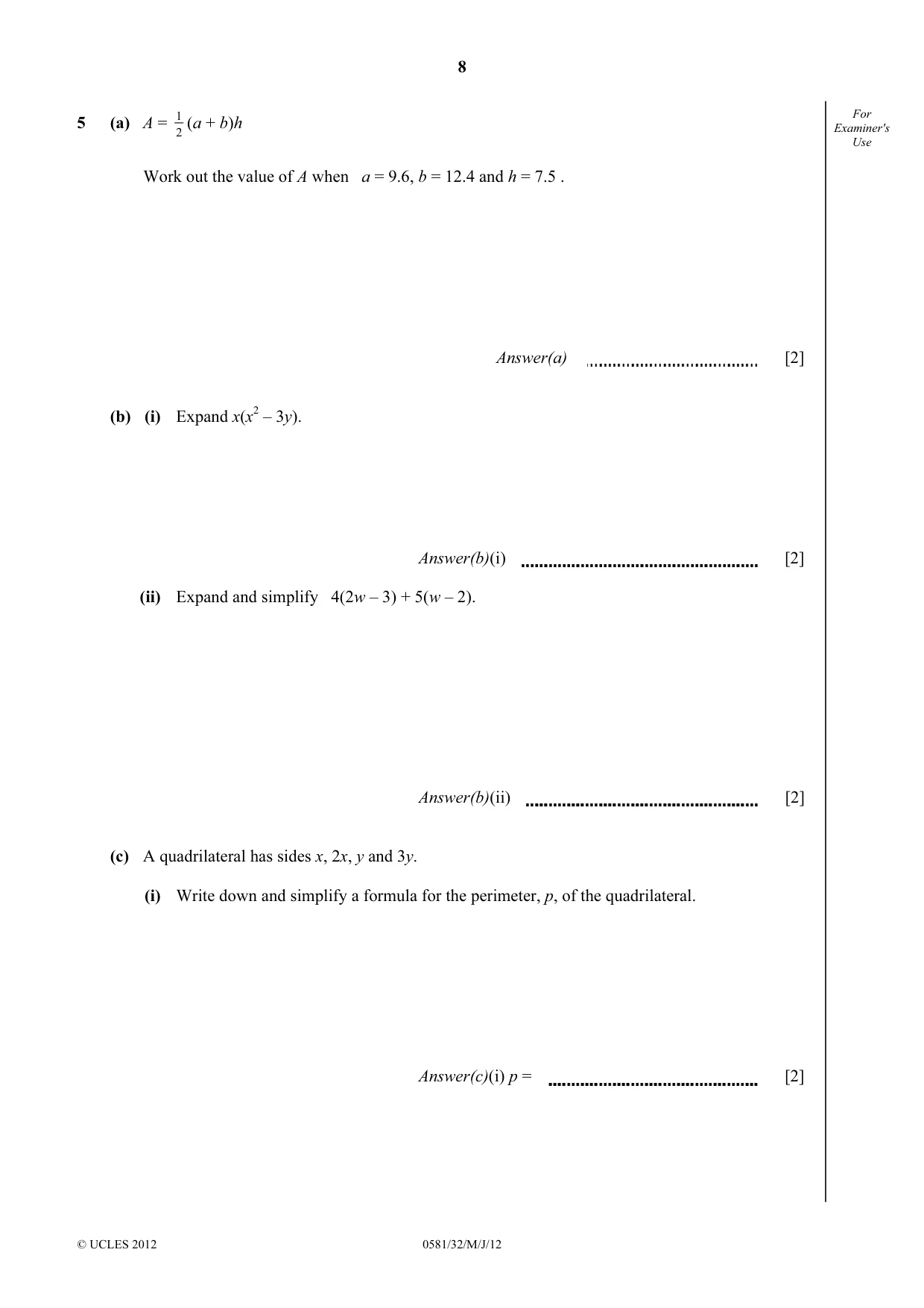
8 © UCLES 2012 0581/32/M/J/12 For Examiner's Use 5 (a) A = 2 1 (a + b)h Work out the value of A when a = 9.6, b = 12.4 and h = 7.5 . Answer(a) [2] (b) (i) Expand x(x2 – 3y). Answer(b)(i) [2] (ii) Expand and simplify 4(2w – 3) + 5(w – 2). Answer(b)(ii) [2] (c) A quadrilateral has sides x, 2x, y and 3y. (i) Write down and simplify a formula for the perimeter, p, of the quadrilateral. Answer(c)(i) p = [2]
Question paper, page 9
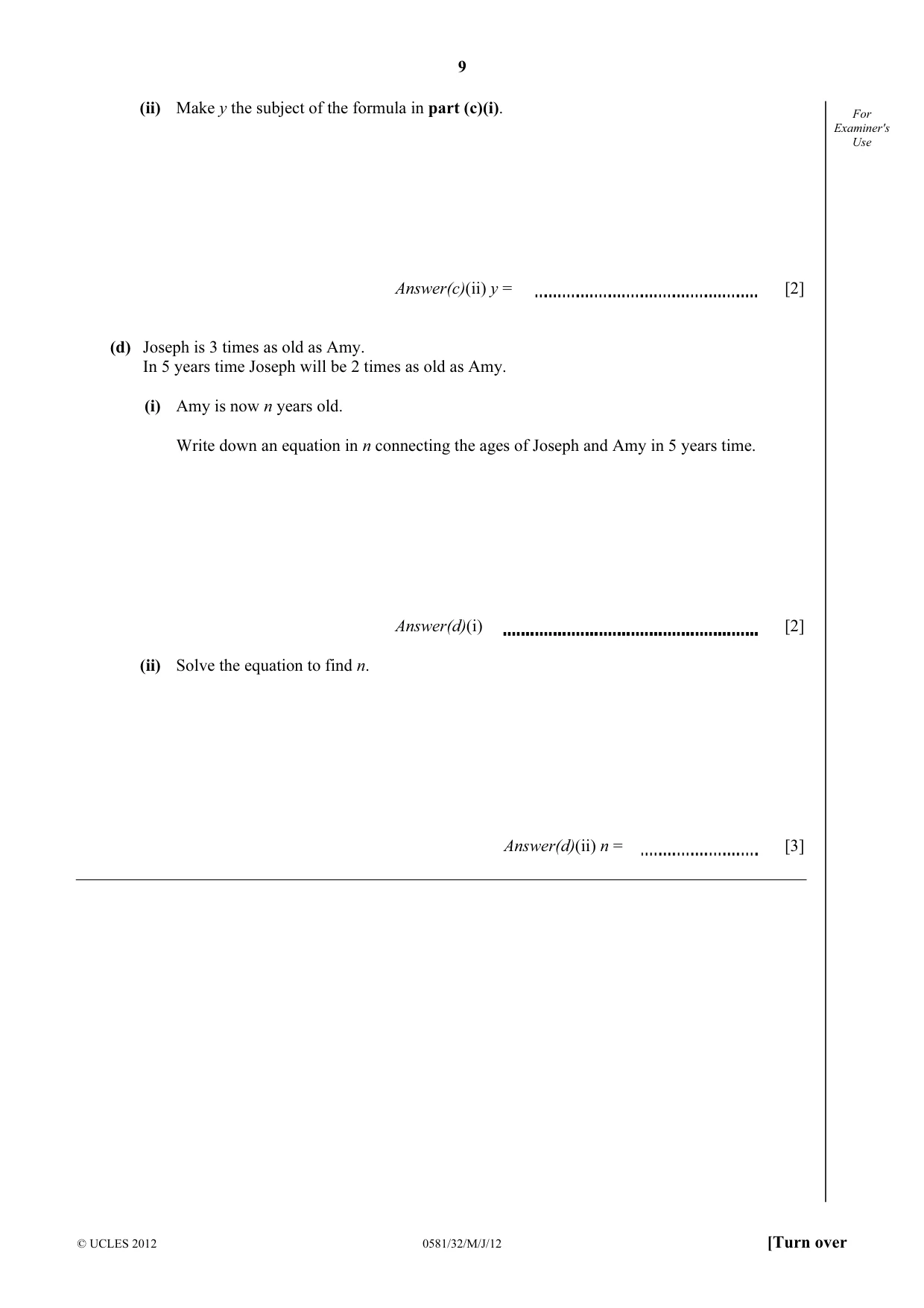
9 © UCLES 2012 0581/32/M/J/12 [Turn over For Examiner's Use (ii) Make y the subject of the formula in part (c)(i). Answer(c)(ii) y = [2] (d) Joseph is 3 times as old as Amy. In 5 years time Joseph will be 2 times as old as Amy. (i) Amy is now n years old. Write down an equation in n connecting the ages of Joseph and Amy in 5 years time. Answer(d)(i) [2] (ii) Solve the equation to find n. Answer(d)(ii) n = [3]
Question paper, page 10
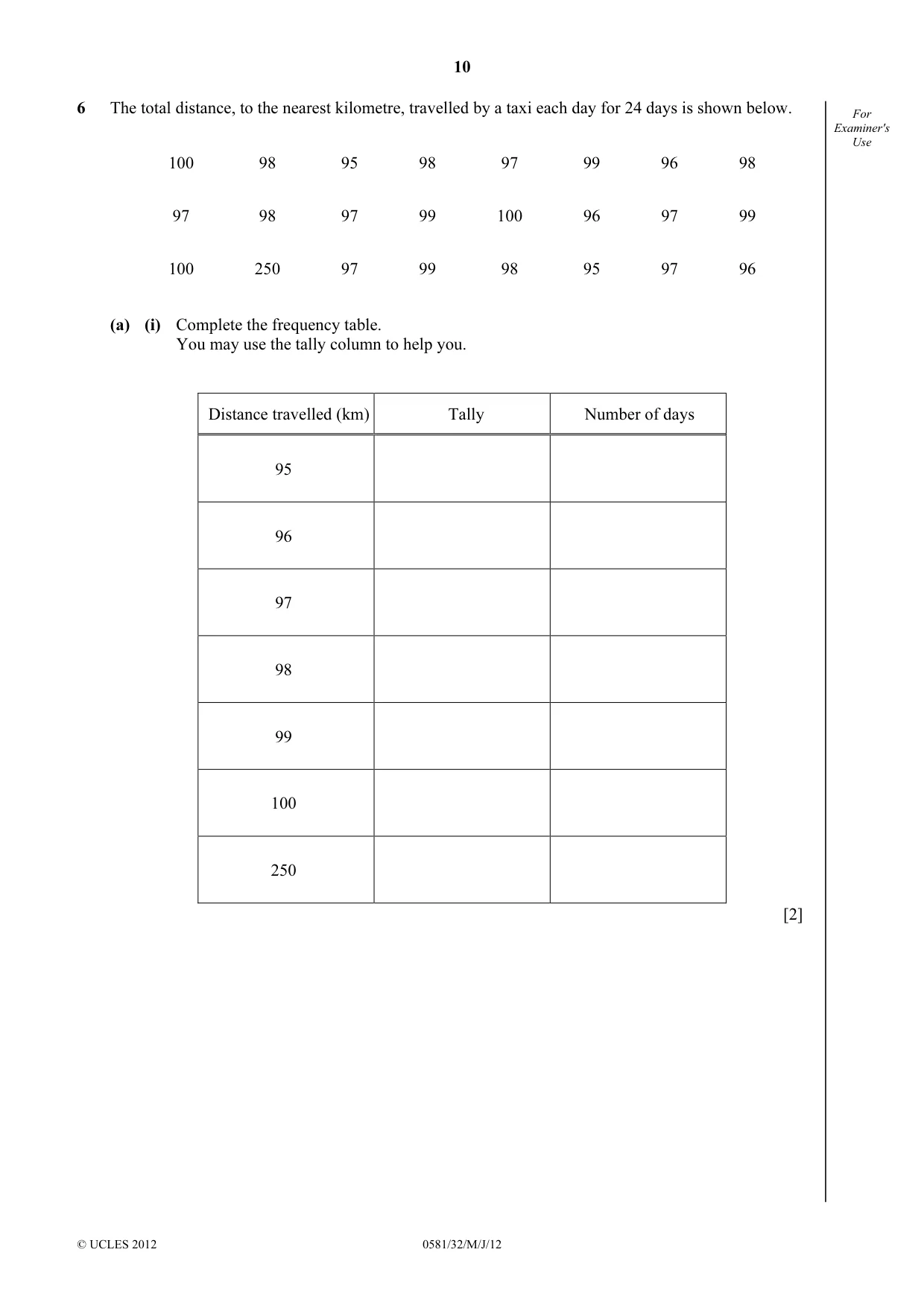
10 © UCLES 2012 0581/32/M/J/12 For Examiner's Use 6 The total distance, to the nearest kilometre, travelled by a taxi each day for 24 days is shown below. 100 98 95 98 97 99 96 98 97 98 97 99 100 96 97 99 100 250 97 99 98 95 97 96 (a) (i) Complete the frequency table. You may use the tally column to help you. Distance travelled (km) Tally Number of days 95 96 97 98 99 100 250 [2]
Question paper, page 11
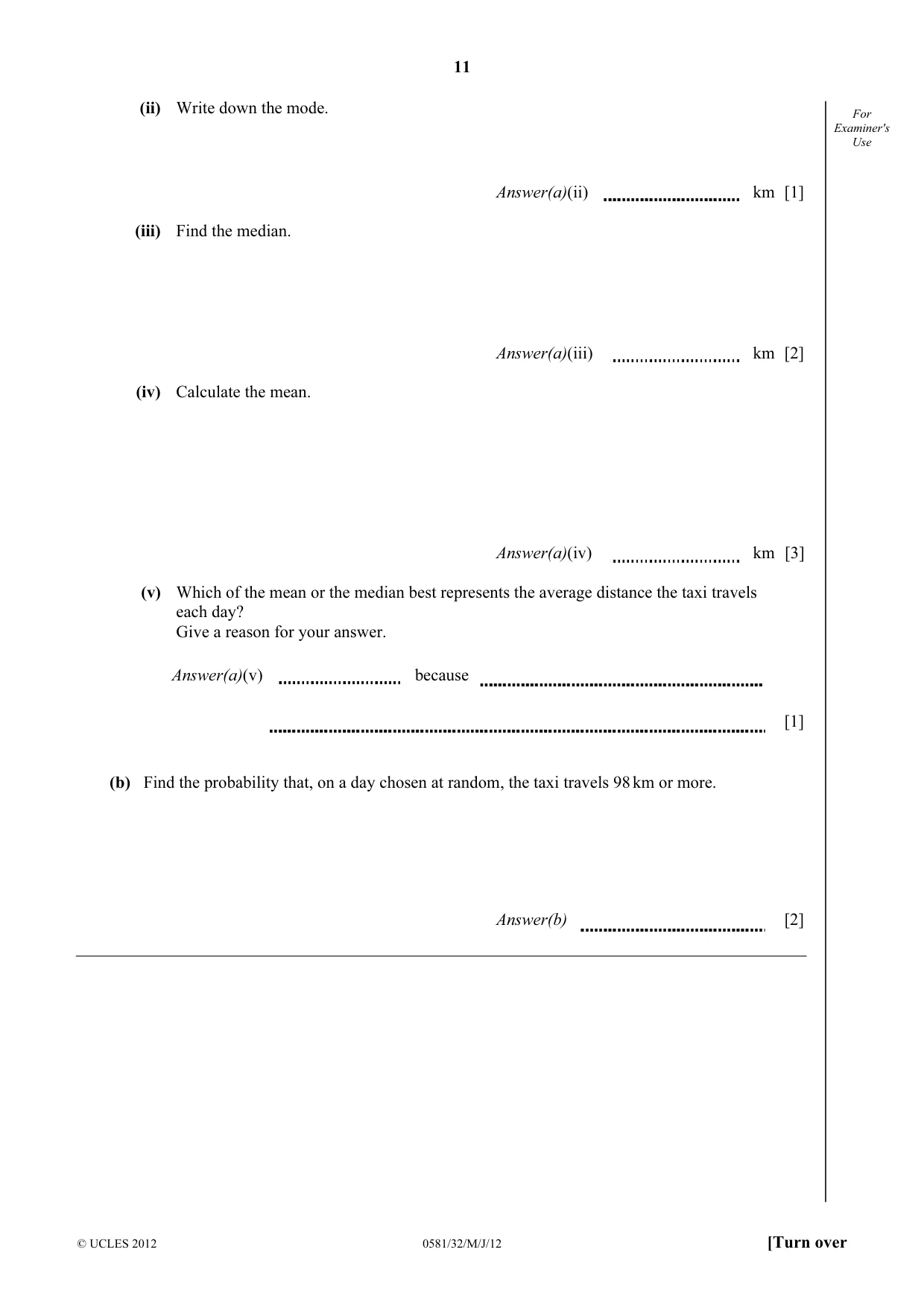
11 © UCLES 2012 0581/32/M/J/12 [Turn over For Examiner's Use (ii) Write down the mode. Answer(a)(ii) km [1] (iii) Find the median. Answer(a)(iii) km [2] (iv) Calculate the mean. Answer(a)(iv) km [3] (v) Which of the mean or the median best represents the average distance the taxi travels each day? Give a reason for your answer. Answer(a)(v) because [1] (b) Find the probability that, on a day chosen at random, the taxi travels 98 km or more. Answer(b) [2]
Question paper, page 12
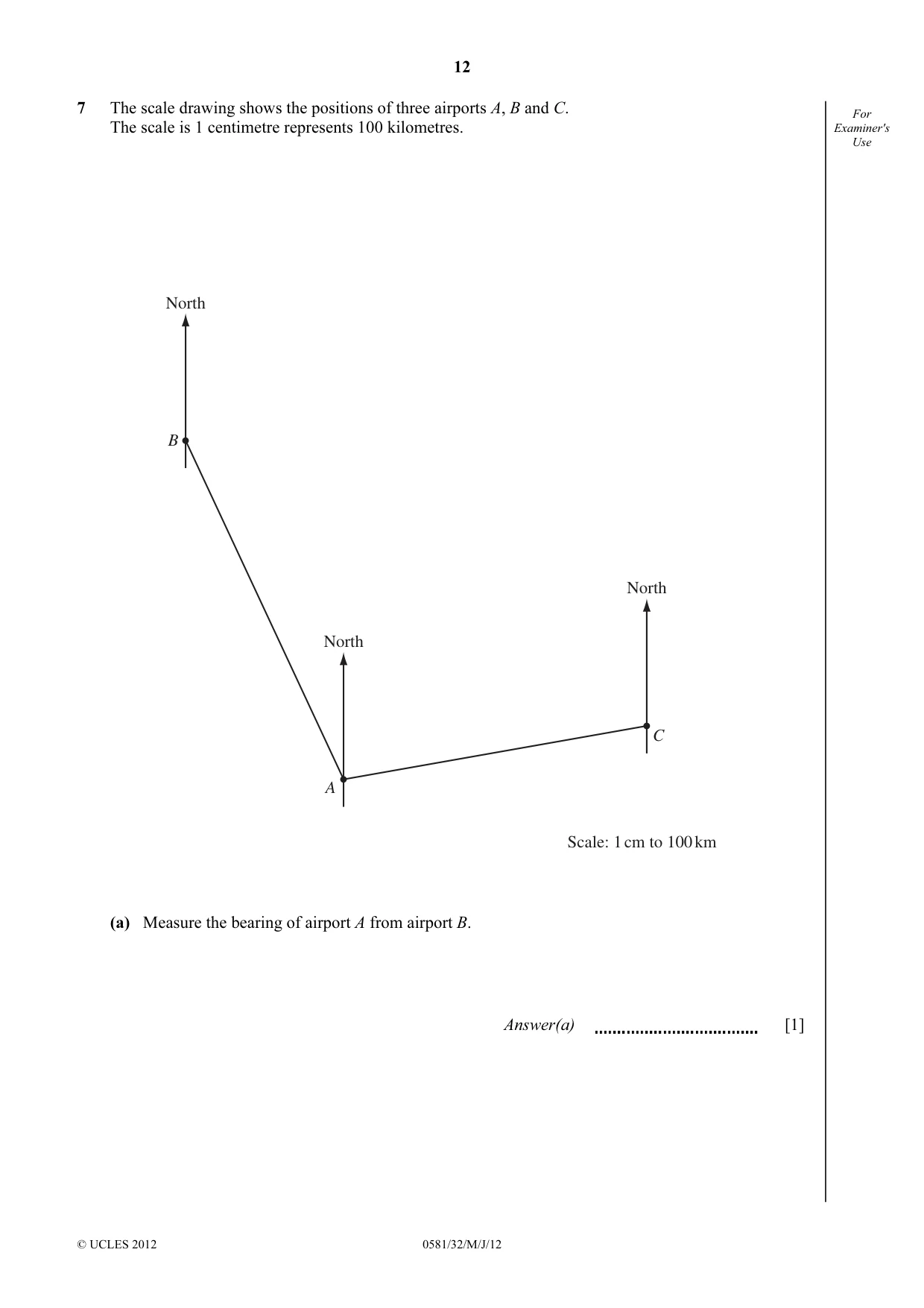
12 © UCLES 2012 0581/32/M/J/12 For Examiner's Use 7 The scale drawing shows the positions of three airports A, B and C. The scale is 1 centimetre represents 100 kilometres. North North North B A C Scale: 1 cm to 100 km (a) Measure the bearing of airport A from airport B. Answer(a) [1]
Question paper, page 13
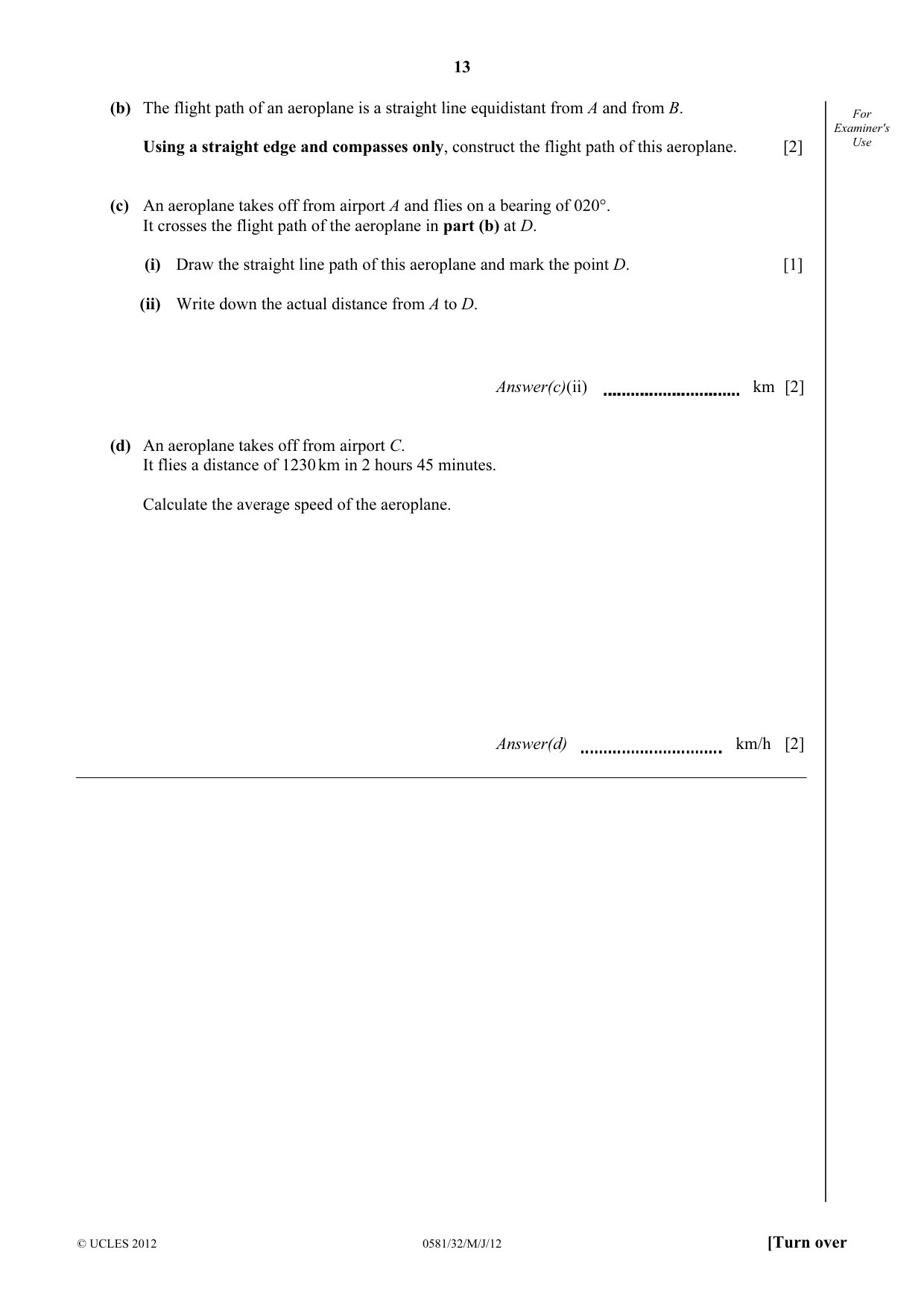
13 © UCLES 2012 0581/32/M/J/12 [Turn over For Examiner's Use (b) The flight path of an aeroplane is a straight line equidistant from A and from B. Using a straight edge and compasses only, construct the flight path of this aeroplane. [2] (c) An aeroplane takes off from airport A and flies on a bearing of 020°. It crosses the flight path of the aeroplane in part (b) at D. (i) Draw the straight line path of this aeroplane and mark the point D. [1] (ii) Write down the actual distance from A to D. Answer(c)(ii) km [2] (d) An aeroplane takes off from airport C. It flies a distance of 1230 km in 2 hours 45 minutes. Calculate the average speed of the aeroplane. Answer(d) km/h [2]
Question paper, page 14
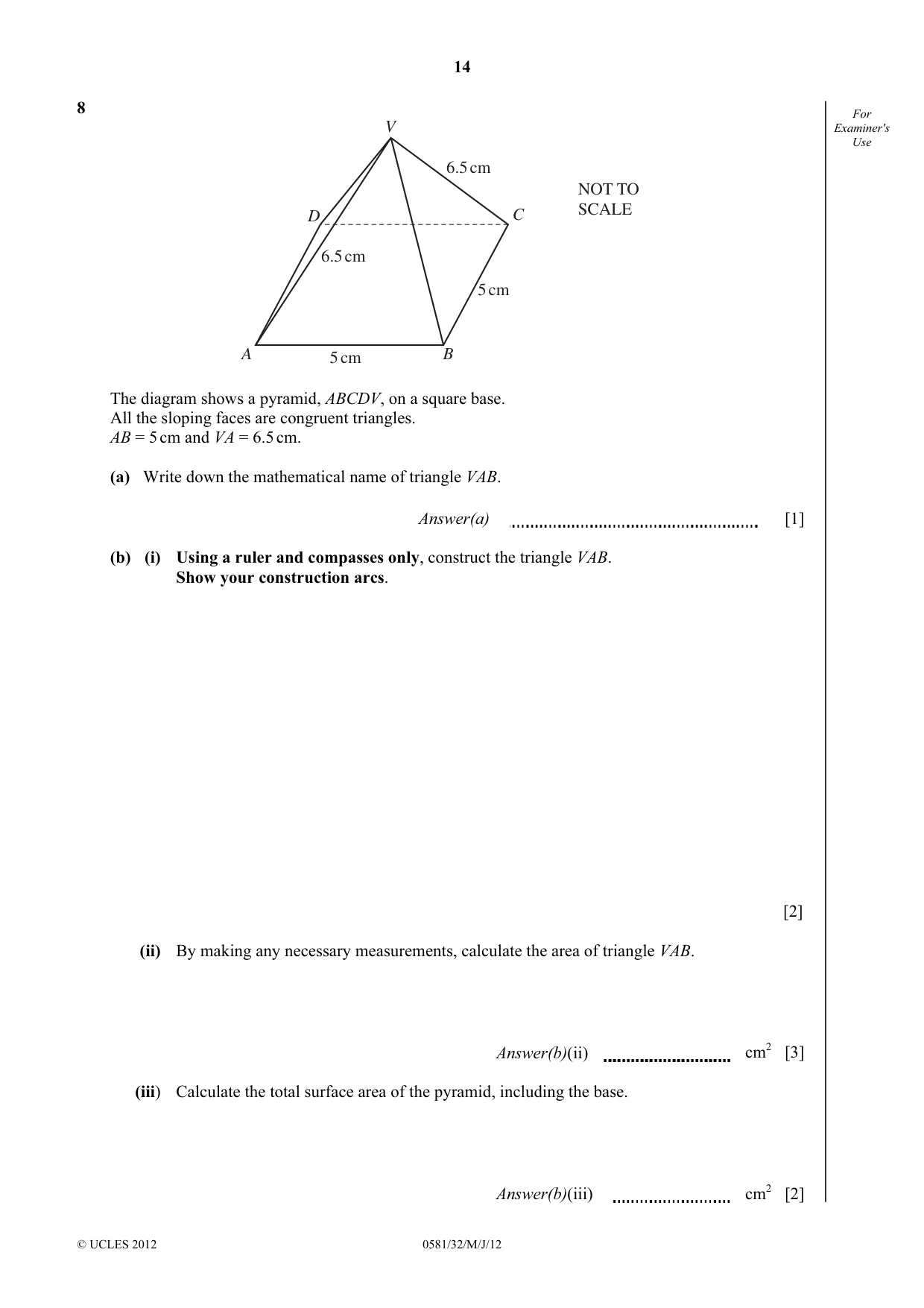
14 © UCLES 2012 0581/32/M/J/12 For Examiner's Use 8 D C A B V 6.5 cm 6.5 cm 5 cm 5 cm NOT TO SCALE The diagram shows a pyramid, ABCDV, on a square base. All the sloping faces are congruent triangles. AB = 5 cm and VA = 6.5 cm. (a) Write down the mathematical name of triangle VAB. Answer(a) [1] (b) (i) Using a ruler and compasses only, construct the triangle VAB. Show your construction arcs. [2] (ii) By making any necessary measurements, calculate the area of triangle VAB. Answer(b)(ii) cm2 [3] (iii) Calculate the total surface area of the pyramid, including the base. Answer(b)(iii) cm2 [2]
Question paper, page 15
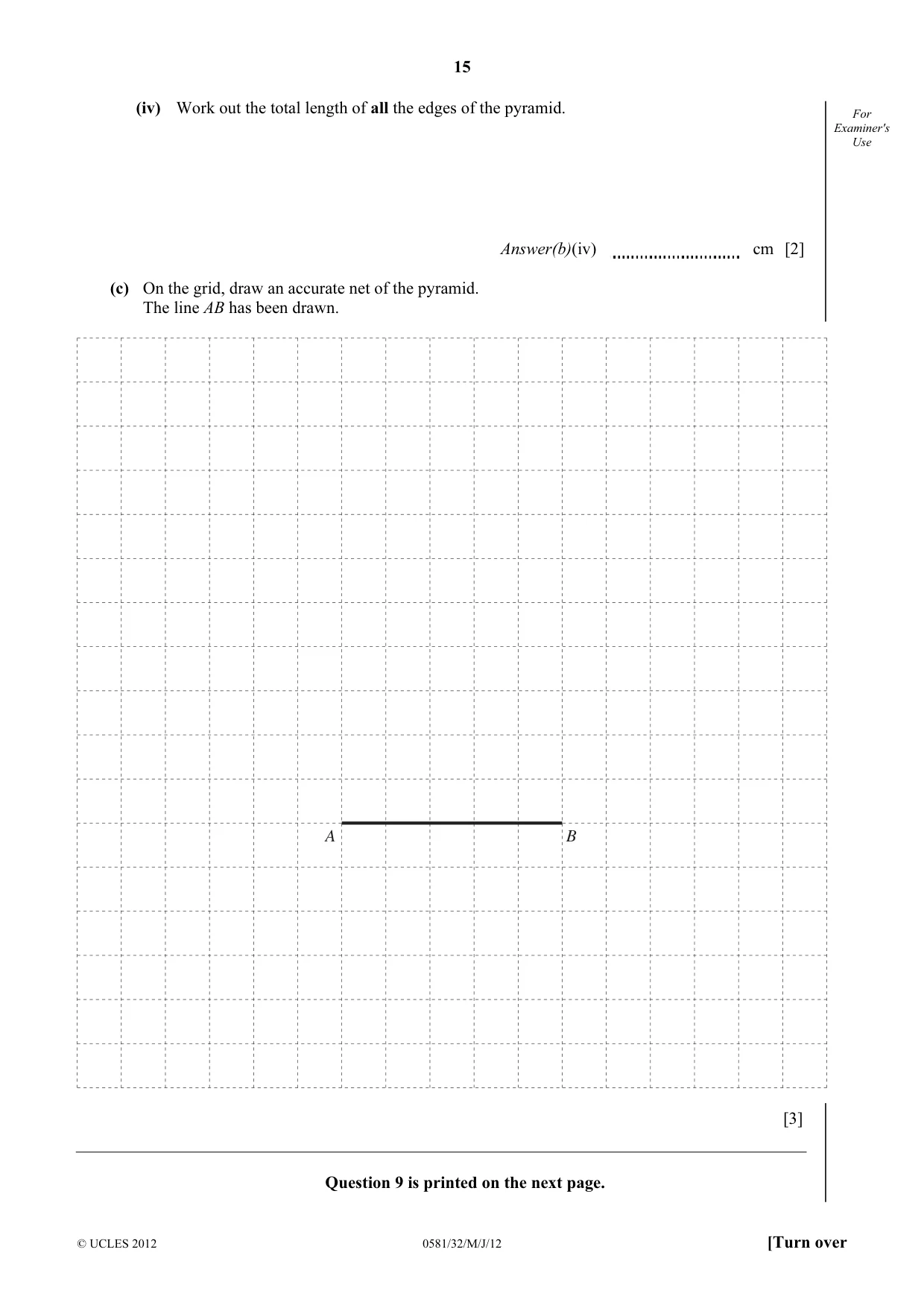
15 © UCLES 2012 0581/32/M/J/12 [Turn over For Examiner's Use (iv) Work out the total length of all the edges of the pyramid. Answer(b)(iv) cm [2] (c) On the grid, draw an accurate net of the pyramid. The line AB has been drawn. A B [3] Question 9 is printed on the next page.
Question paper, page 16
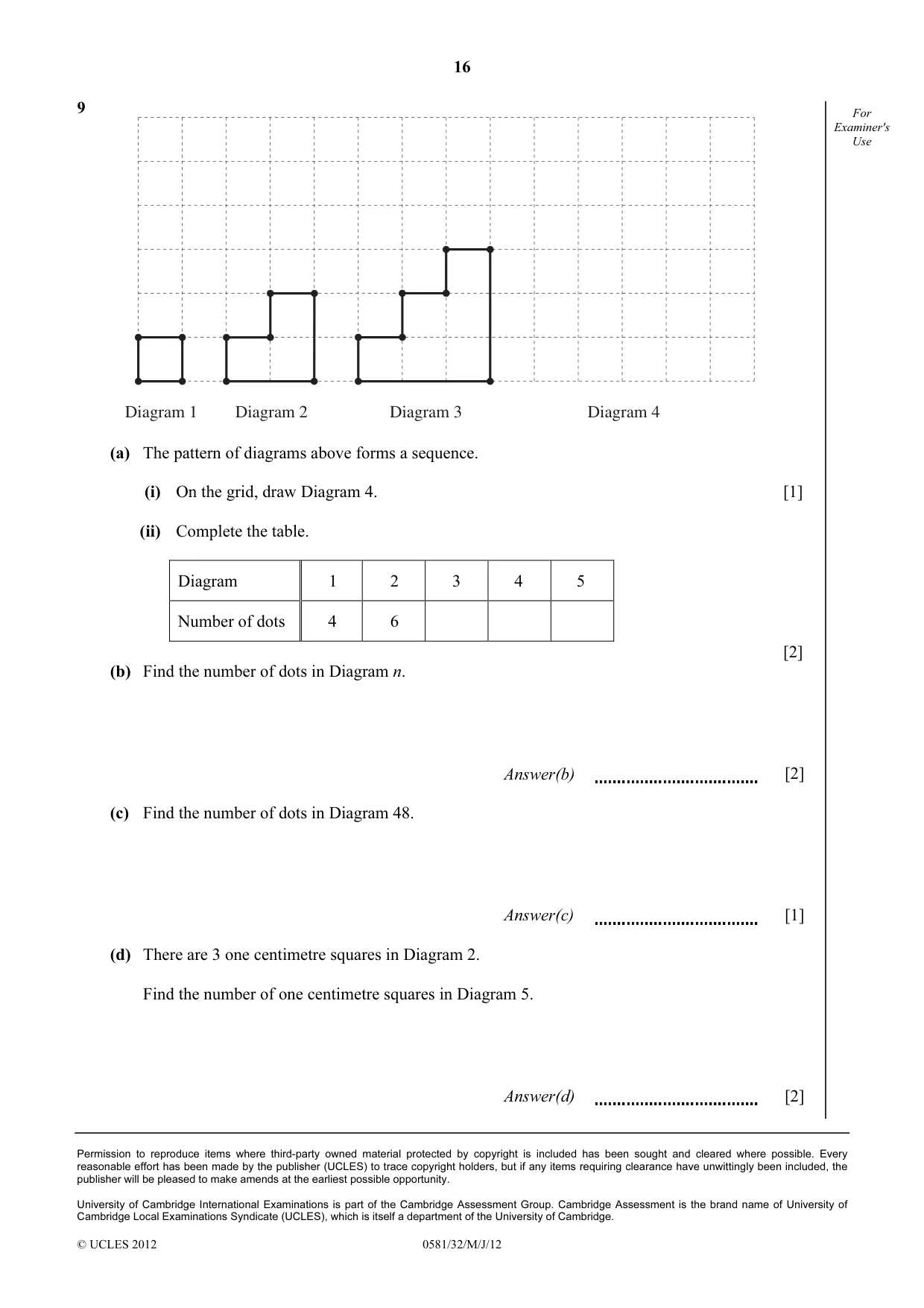
16 Permission to reproduce items where third-party owned material protected by copyright is included has been sought and cleared where possible. Every reasonable effort has been made by the publisher (UCLES) to trace copyright holders, but if any items requiring clearance have unwittingly been included, the publisher will be pleased to make amends at the earliest possible opportunity. University of Cambridge International Examinations is part of the Cambridge Assessment Group. Cambridge Assessment is the brand name of University of Cambridge Local Examinations Syndicate (UCLES), which is itself a department of the University of Cambridge. © UCLES 2012 0581/32/M/J/12 For Examiner's Use 9 Diagram 1 Diagram 2 Diagram 3 Diagram 4 (a) The pattern of diagrams above forms a sequence. (i) On the grid, draw Diagram 4. [1] (ii) Complete the table. Diagram 1 2 3 4 5 Number of dots 4 6 [2] (b) Find the number of dots in Diagram n. Answer(b) [2] (c) Find the number of dots in Diagram 48. Answer(c) [1] (d) There are 3 one centimetre squares in Diagram 2. Find the number of one centimetre squares in Diagram 5. Answer(d) [2]
Mark scheme, page 1
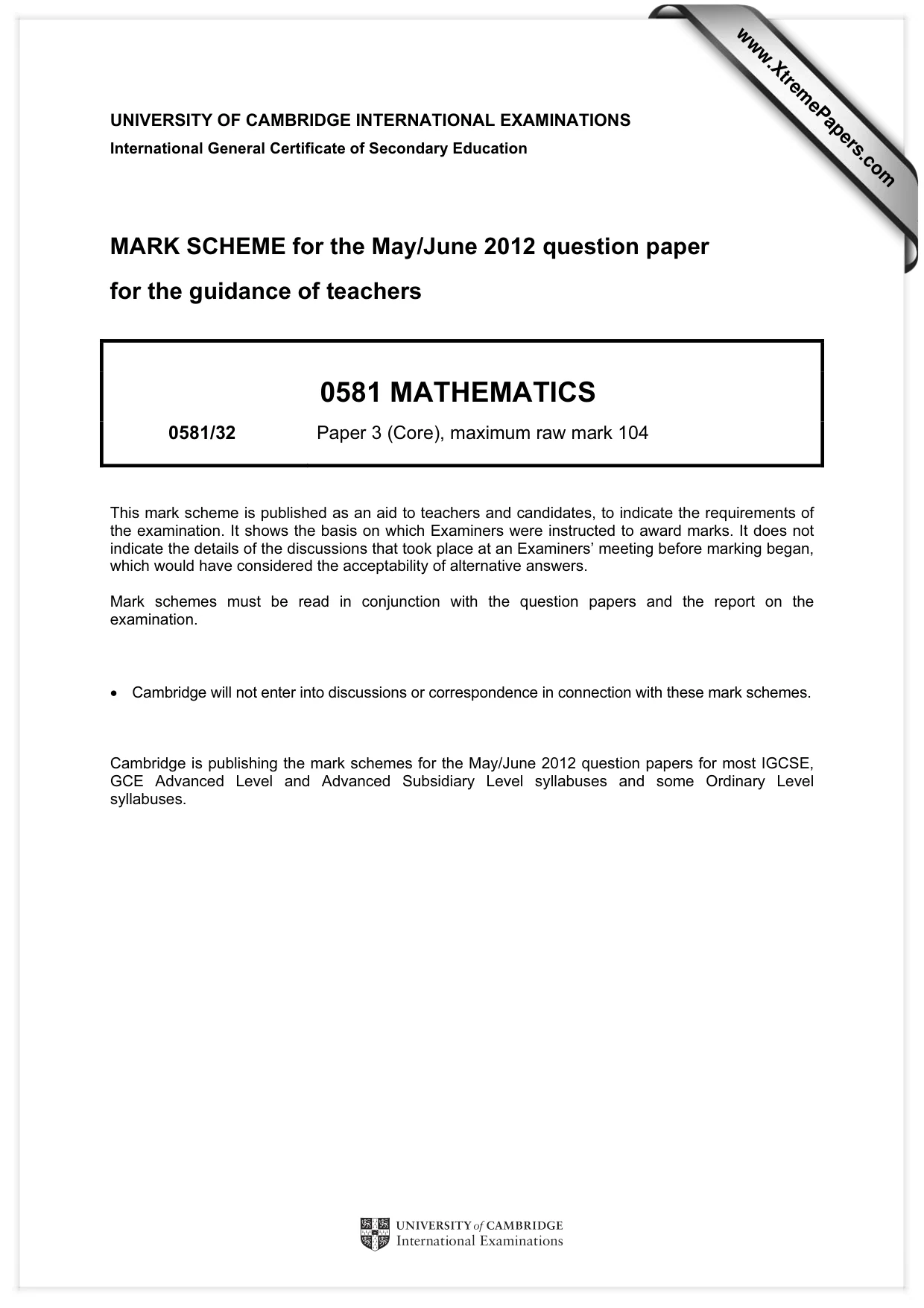
UNIVERSITY OF CAMBRIDGE INTERNATIONAL EXAMINATIONS International General Certificate of Secondary Education MARK SCHEME for the May/June 2012 question paper for the guidance of teachers 0581 MATHEMATICS 0581/32 Paper 3 (Core), maximum raw mark 104 This mark scheme is published as an aid to teachers and candidates, to indicate the requirements of the examination. It shows the basis on which Examiners were instructed to award marks. It does not indicate the details of the discussions that took place at an Examiners’ meeting before marking began, which would have considered the acceptability of alternative answers. Mark schemes must be read in conjunction with the question papers and the report on the examination. • Cambridge will not enter into discussions or correspondence in connection with these mark schemes. Cambridge is publishing the mark schemes for the May/June 2012 question papers for most IGCSE, GCE Advanced Level and Advanced Subsidiary Level syllabuses and some Ordinary Level syllabuses. www.XtremePapers.com
Mark scheme, page 2
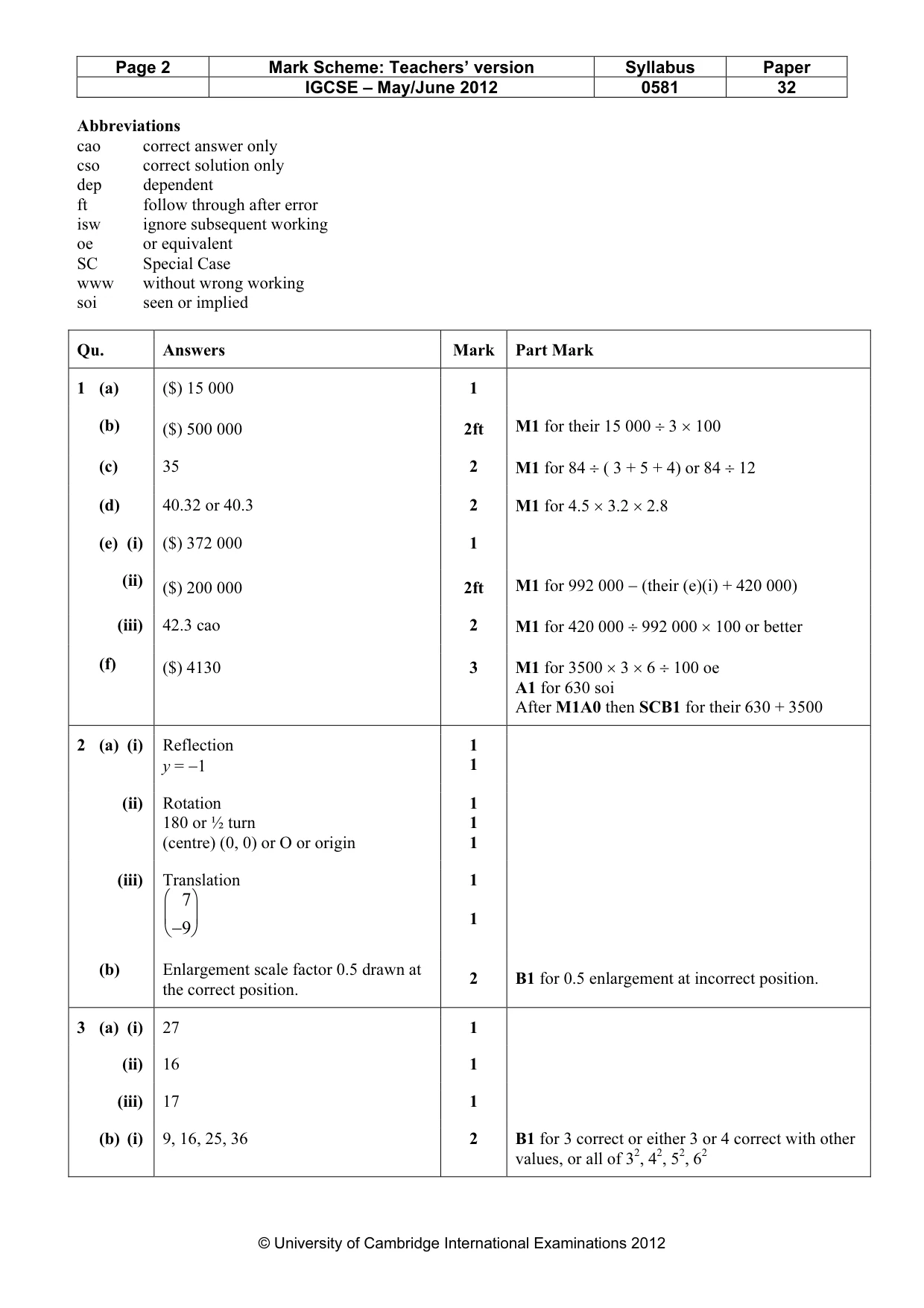
Page 2 Mark Scheme: Teachers’ version Syllabus Paper IGCSE – May/June 2012 0581 32 © University of Cambridge International Examinations 2012 Abbreviations cao correct answer only cso correct solution only dep dependent ft follow through after error isw ignore subsequent working oe or equivalent SC Special Case www without wrong working soi seen or implied Qu. Answers Mark Part Mark 1 (a) ($) 15 000 1 (b) ($) 500 000 2ft M1 for their 15 000 ÷ 3 × 100 (c) 35 2 M1 for 84 ÷ ( 3 + 5 + 4) or 84 ÷ 12 (d) 40.32 or 40.3 2 M1 for 4.5 × 3.2 × 2.8 (e) (i) ($) 372 000 1 (ii) ($) 200 000 2ft M1 for 992 000 − (their (e)(i) + 420 000) (iii) 42.3 cao 2 M1 for 420 000 ÷ 992 000 × 100 or better (f) ($) 4130 3 M1 for 3500 × 3 × 6 ÷ 100 oe A1 for 630 soi After M1A0 then SCB1 for their 630 + 3500 2 (a) (i) Reflection y = −1 1 1 (ii) Rotation 180 or ½ turn (centre) (0, 0) or O or origin 1 1 1 (iii) Translation 7 −9 1 1 (b) Enlargement scale factor 0.5 drawn at the correct position. 2 B1 for 0.5 enlargement at incorrect position. 3 (a) (i) 27 1 (ii) 16 1 (iii) 17 1 (b) (i) 9, 16, 25, 36 2 B1 for 3 correct or either 3 or 4 correct with other values, or all of 32, 42, 52, 62
Mark scheme, page 3
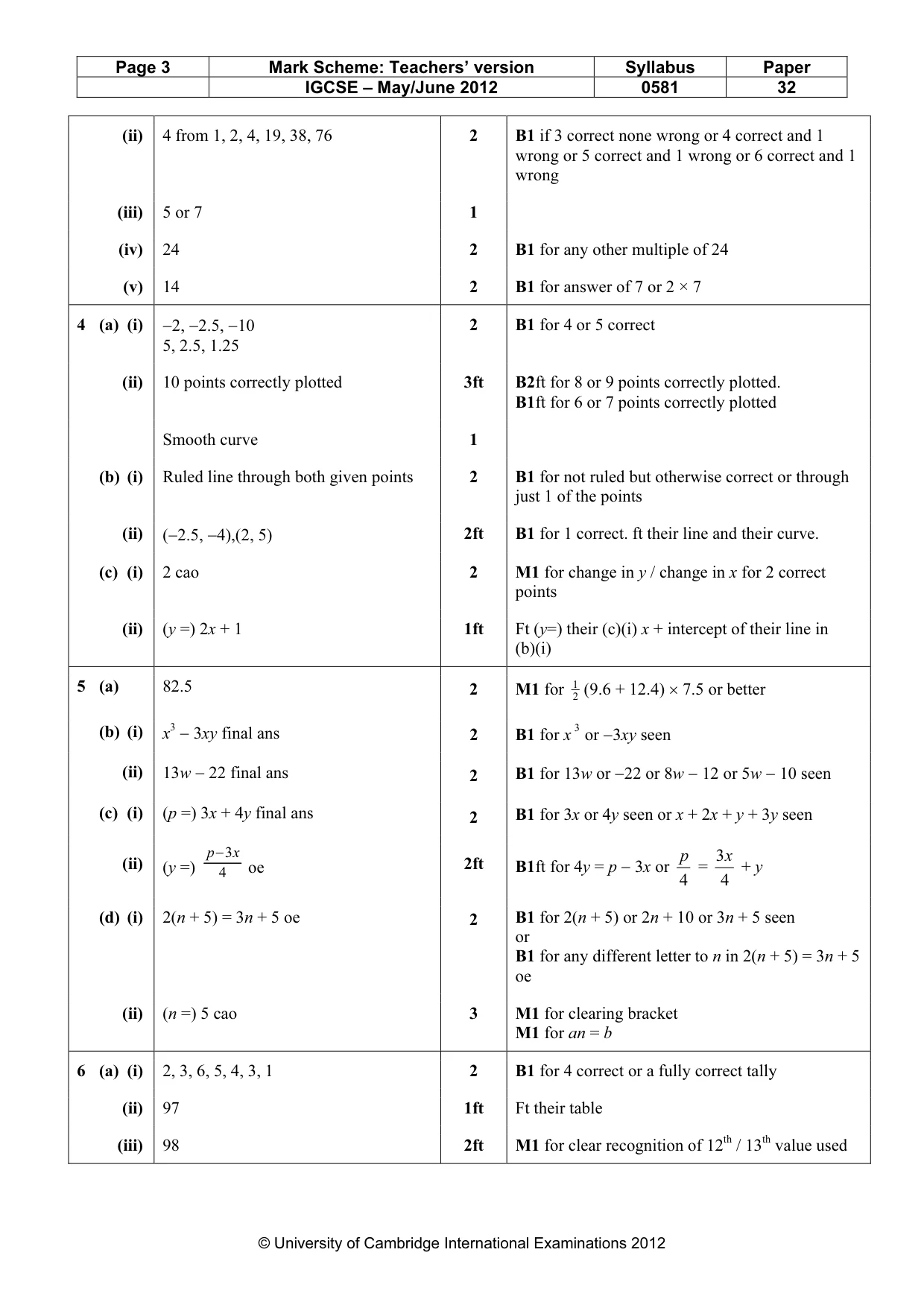
Page 3 Mark Scheme: Teachers’ version Syllabus Paper IGCSE – May/June 2012 0581 32 © University of Cambridge International Examinations 2012 (ii) 4 from 1, 2, 4, 19, 38, 76 2 B1 if 3 correct none wrong or 4 correct and 1 wrong or 5 correct and 1 wrong or 6 correct and 1 wrong (iii) 5 or 7 1 (iv) 24 2 B1 for any other multiple of 24 (v) 14 2 B1 for answer of 7 or 2 × 7 4 (a) (i) −2, −2.5, −10 5, 2.5, 1.25 2 B1 for 4 or 5 correct (ii) 10 points correctly plotted 3ft B2ft for 8 or 9 points correctly plotted. B1ft for 6 or 7 points correctly plotted Smooth curve 1 (b) (i) Ruled line through both given points 2 B1 for not ruled but otherwise correct or through just 1 of the points (ii) (−2.5, −4),(2, 5) 2ft B1 for 1 correct. ft their line and their curve. (c) (i) 2 cao 2 M1 for change in y / change in x for 2 correct points (ii) (y =) 2x + 1 1ft Ft (y=) their (c)(i) x + intercept of their line in (b)(i) 5 (a) 82.5 2 M1 for 2 1 (9.6 + 12.4) × 7.5 or better (b) (i) x3 − 3xy final ans 2 B1 for x 3 or −3xy seen (ii) 13w − 22 final ans 2 B1 for 13w or −22 or 8w − 12 or 5w − 10 seen (c) (i) (p =) 3x + 4y final ans 2 B1 for 3x or 4y seen or x + 2x + y + 3y seen (ii) (y =) p−3x 4 oe 2ft B1ft for 4y = p − 3x or 4 p = 3 4 x + y (d) (i) 2(n + 5) = 3n + 5 oe 2 B1 for 2(n + 5) or 2n + 10 or 3n + 5 seen or B1 for any different letter to n in 2(n + 5) = 3n + 5 oe (ii) (n =) 5 cao 3 M1 for clearing bracket M1 for an = b 6 (a) (i) 2, 3, 6, 5, 4, 3, 1 2 B1 for 4 correct or a fully correct tally (ii) 97 1ft Ft their table (iii) 98 2ft M1 for clear recognition of 12th / 13th value used
Mark scheme, page 4
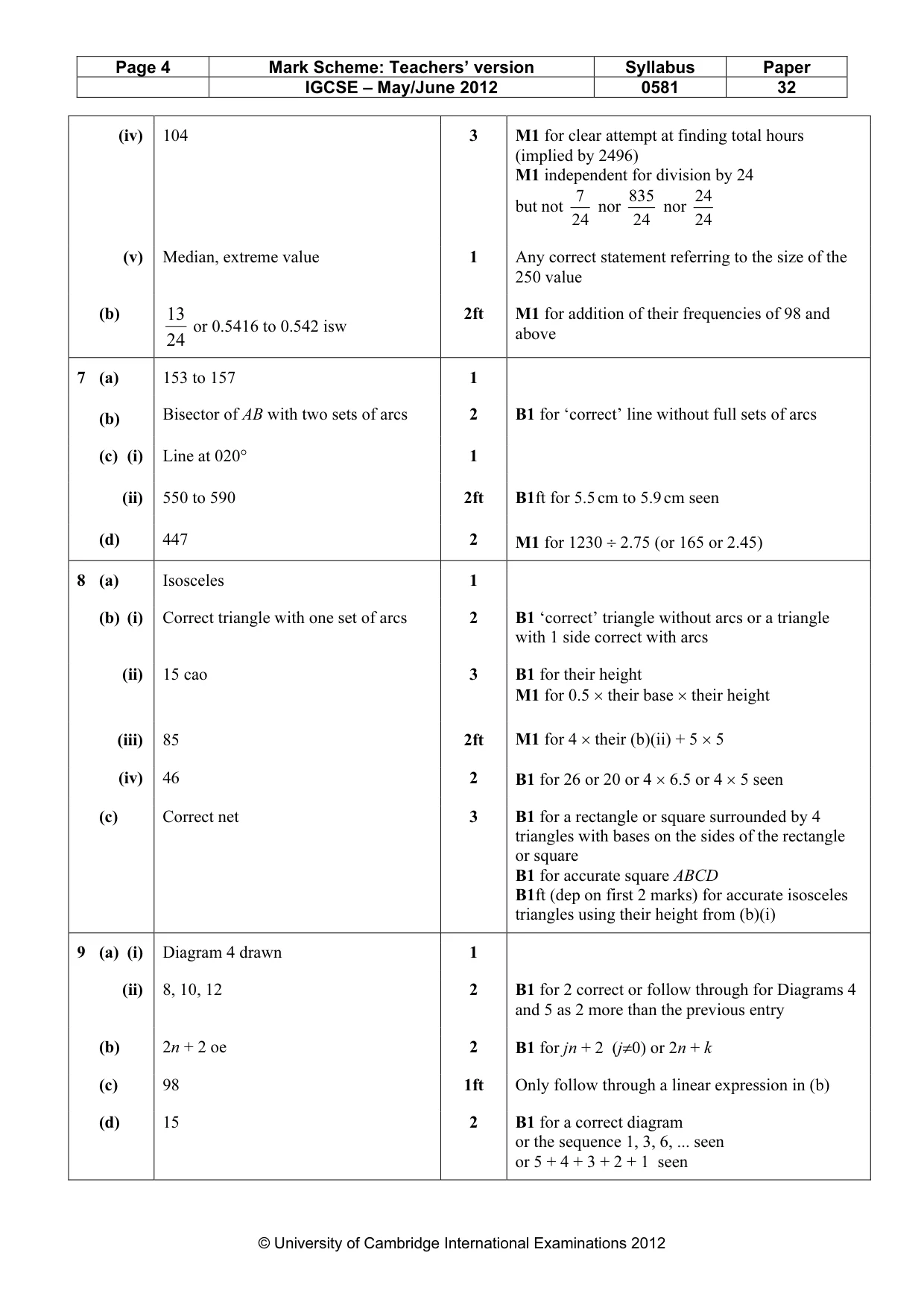
Page 4 Mark Scheme: Teachers’ version Syllabus Paper IGCSE – May/June 2012 0581 32 © University of Cambridge International Examinations 2012 (iv) 104 3 M1 for clear attempt at finding total hours (implied by 2496) M1 independent for division by 24 but not 7 24 nor 835 24 nor 24 24 (v) Median, extreme value 1 Any correct statement referring to the size of the 250 value (b) 13 24 or 0.5416 to 0.542 isw 2ft M1 for addition of their frequencies of 98 and above 7 (a) 153 to 157 1 (b) Bisector of AB with two sets of arcs 2 B1 for ‘correct’ line without full sets of arcs (c) (i) Line at 020° 1 (ii) 550 to 590 2ft B1ft for 5.5 cm to 5.9 cm seen (d) 447 2 M1 for 1230 ÷ 2.75 (or 165 or 2.45) 8 (a) Isosceles 1 (b) (i) Correct triangle with one set of arcs 2 B1 ‘correct’ triangle without arcs or a triangle with 1 side correct with arcs (ii) 15 cao 3 B1 for their height M1 for 0.5 × their base × their height (iii) 85 2ft M1 for 4 × their (b)(ii) + 5 × 5 (iv) 46 2 B1 for 26 or 20 or 4 × 6.5 or 4 × 5 seen (c) Correct net 3 B1 for a rectangle or square surrounded by 4 triangles with bases on the sides of the rectangle or square B1 for accurate square ABCD B1ft (dep on first 2 marks) for accurate isosceles triangles using their height from (b)(i) 9 (a) (i) Diagram 4 drawn 1 (ii) 8, 10, 12 2 B1 for 2 correct or follow through for Diagrams 4 and 5 as 2 more than the previous entry (b) 2n + 2 oe 2 B1 for jn + 2 (j≠0) or 2n + k (c) 98 1ft Only follow through a linear expression in (b) (d) 15 2 B1 for a correct diagram or the sequence 1, 3, 6, ... seen or 5 + 4 + 3 + 2 + 1 seen
What you needed in this session
Cambridge’s own grade thresholds for 2012 May/June, Paper 3 · Variant 2. A higher threshold means an easier paper — the bar moves with how the cohort did.