Cambridge IGCSE Mathematics (with coursework) 0581 — 2012 May/June Paper 3 · Variant 1
0581/31/M/J/12 · 104 marks · ≈117 min
The question paper and its mark scheme, free to read here and free to download. This is Cambridge’s own paper, exactly as it was sat.
Question paper16 pages
Mark scheme5 pages
Answers below. Sit the paper first if you are practising.
Paper as text
Question paper, page 1
This document consists of 15 printed pages and 1 blank page. IB12 06_0581_31/RP © UCLES 2012 [Turn over *9091124402* UNIVERSITY OF CAMBRIDGE INTERNATIONAL EXAMINATIONS International General Certificate of Secondary Education MATHEMATICS 0581/31 Paper 3 (Core) May/June 2012 2 hours Candidates answer on the Question Paper. Additional Materials: Electronic calculator Geometrical instruments Mathematical tables (optional) Tracing paper (optional) READ THESE INSTRUCTIONS FIRST Write your Centre number, candidate number and name on all the work you hand in. Write in dark blue or black pen. You may use a pencil for any diagrams or graphs. Do not use staples, paper clips, highlighters, glue or correction fluid. DO NOT WRITE IN ANY BARCODES. Answer all questions. If working is needed for any question it must be shown below that question. Electronic calculators should be used. If the degree of accuracy is not specified in the question, and if the answer is not exact, give the answer to three significant figures. Give answers in degrees to one decimal place. For π , use either your calculator value or 3.142. At the end of the examination, fasten all your work securely together. The number of marks is given in brackets [ ] at the end of each question or part question. The total of the marks for this paper is 104. www.XtremePapers.com
Question paper, page 2
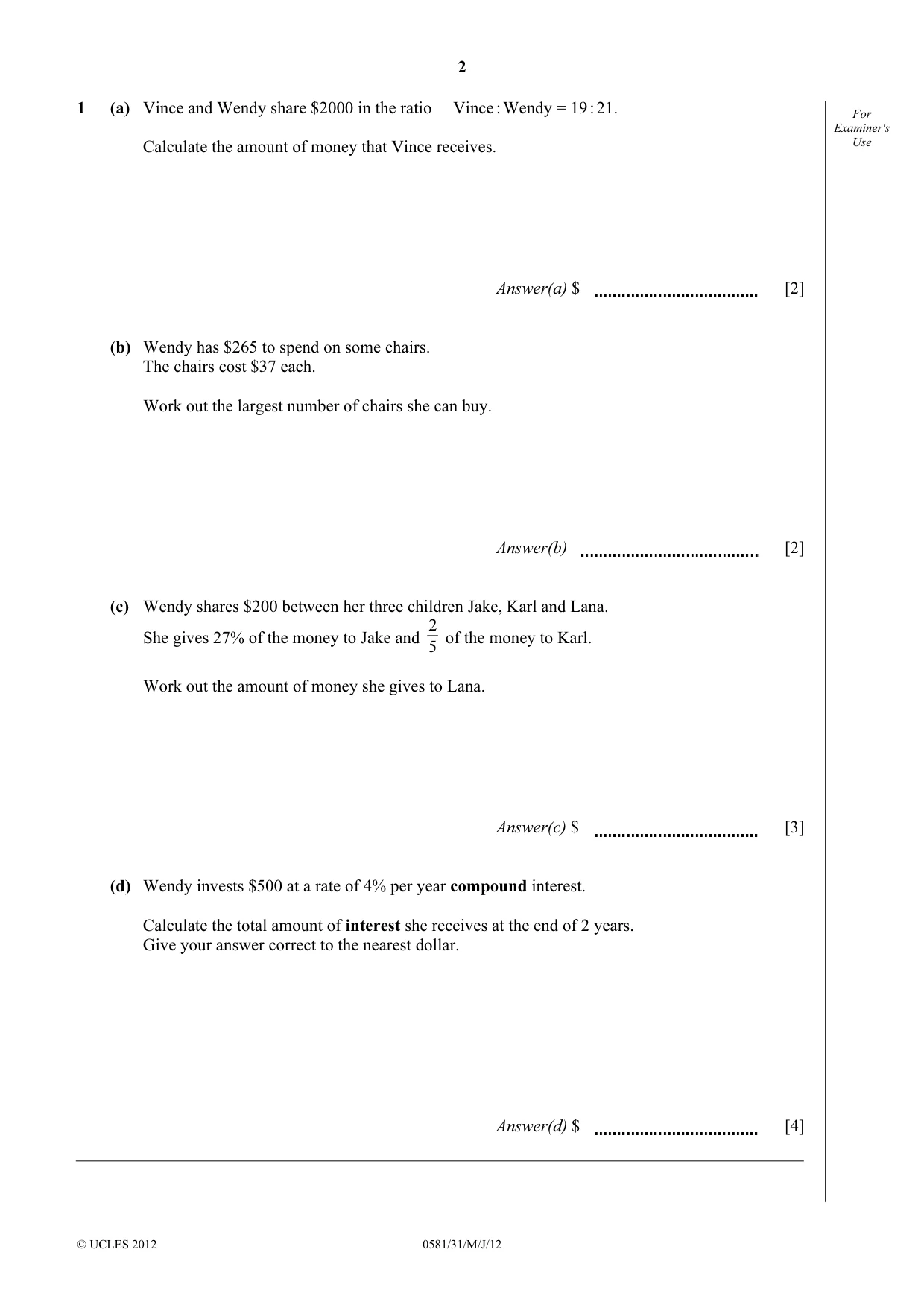
2 © UCLES 2012 0581/31/M/J/12 For Examiner's Use 1 (a) Vince and Wendy share $2000 in the ratio Vince : Wendy = 19 : 21. Calculate the amount of money that Vince receives. Answer(a) $ [2] (b) Wendy has $265 to spend on some chairs. The chairs cost $37 each. Work out the largest number of chairs she can buy. Answer(b) [2] (c) Wendy shares $200 between her three children Jake, Karl and Lana. She gives 27% of the money to Jake and 5 2 of the money to Karl. Work out the amount of money she gives to Lana. Answer(c) $ [3] (d) Wendy invests $500 at a rate of 4% per year compound interest. Calculate the total amount of interest she receives at the end of 2 years. Give your answer correct to the nearest dollar. Answer(d) $ [4]
Question paper, page 3
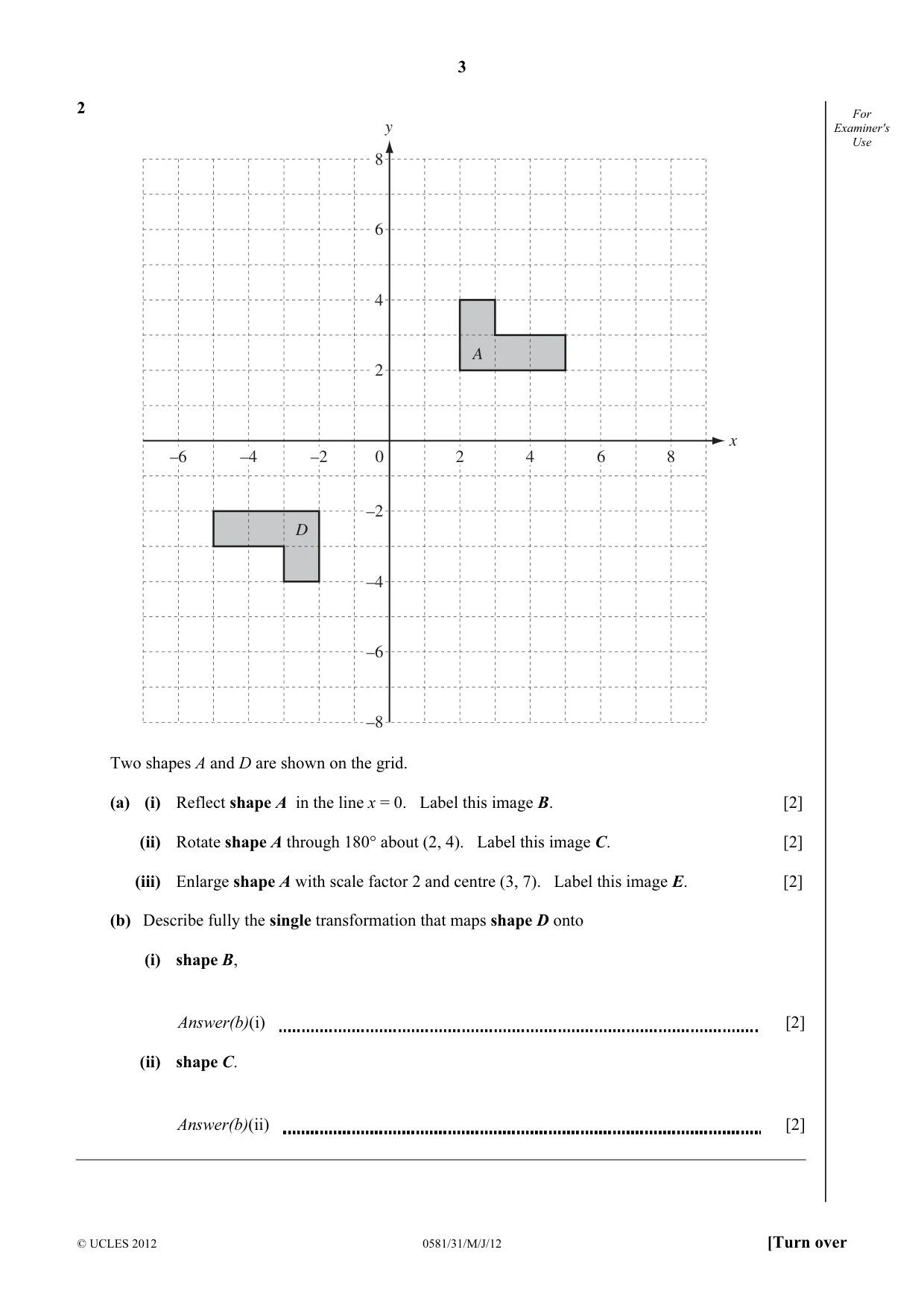
3 © UCLES 2012 0581/31/M/J/12 [Turn over For Examiner's Use 2 8 6 4 2 –2 –4 –6 –8 –2 2 0 4 6 8 –4 –6 A D y x Two shapes A and D are shown on the grid. (a) (i) Reflect shape A in the line x = 0. Label this image B. [2] (ii) Rotate shape A through 180° about (2, 4). Label this image C. [2] (iii) Enlarge shape A with scale factor 2 and centre (3, 7). Label this image E. [2] (b) Describe fully the single transformation that maps shape D onto (i) shape B, Answer(b)(i) [2] (ii) shape C. Answer(b)(ii) [2]
Question paper, page 4
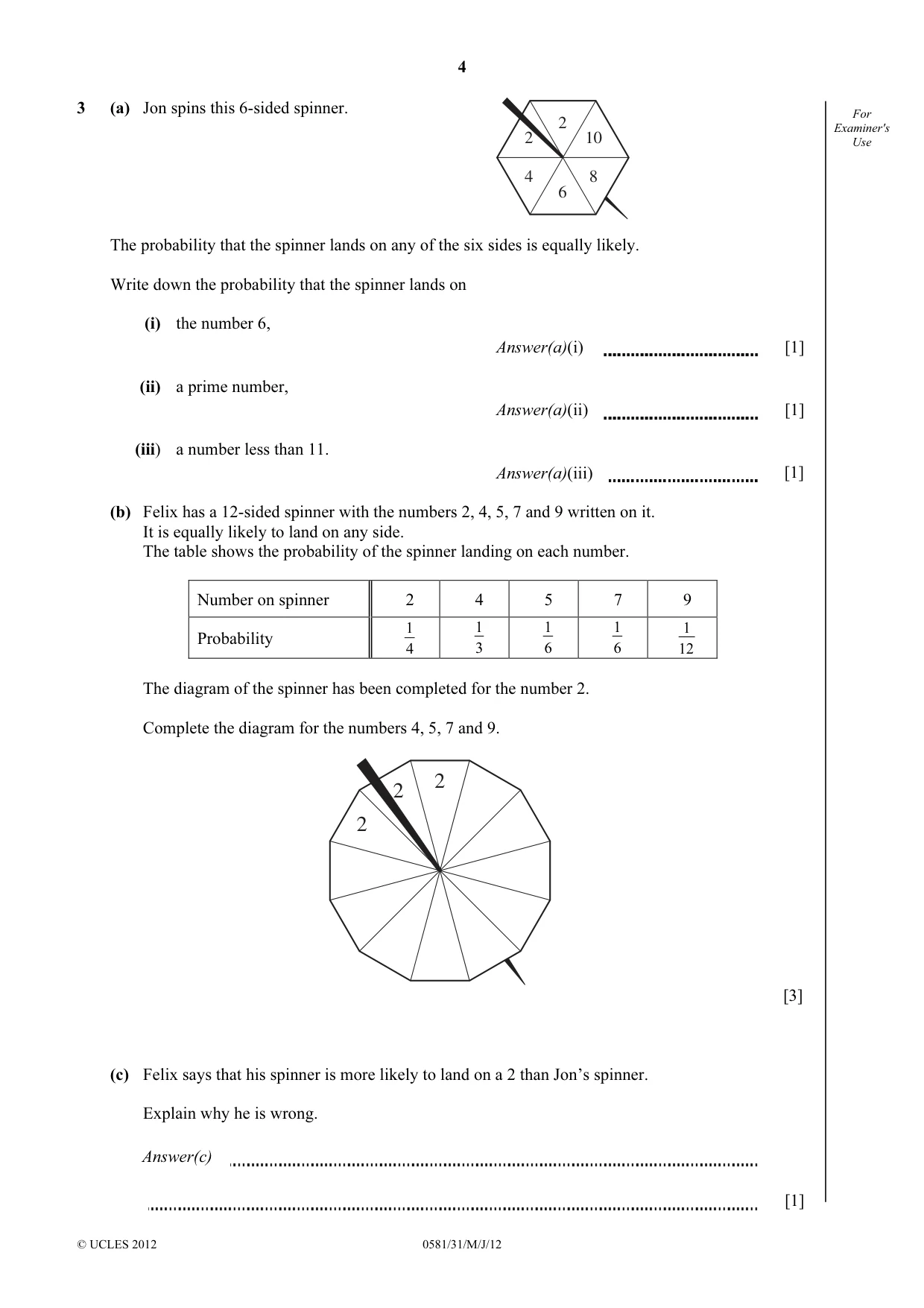
4 © UCLES 2012 0581/31/M/J/12 For Examiner's Use 3 (a) Jon spins this 6-sided spinner. The probability that the spinner lands on any of the six sides is equally likely. Write down the probability that the spinner lands on (i) the number 6, Answer(a)(i) [1] (ii) a prime number, Answer(a)(ii) [1] (iii) a number less than 11. Answer(a)(iii) [1] (b) Felix has a 12-sided spinner with the numbers 2, 4, 5, 7 and 9 written on it. It is equally likely to land on any side. The table shows the probability of the spinner landing on each number. Number on spinner 2 4 5 7 9 Probability 4 1 3 1 6 1 6 1 12 1 The diagram of the spinner has been completed for the number 2. Complete the diagram for the numbers 4, 5, 7 and 9. 2 2 2 [3] (c) Felix says that his spinner is more likely to land on a 2 than Jon’s spinner. Explain why he is wrong. Answer(c) [1] 2 6 8 10 4 2
Question paper, page 5
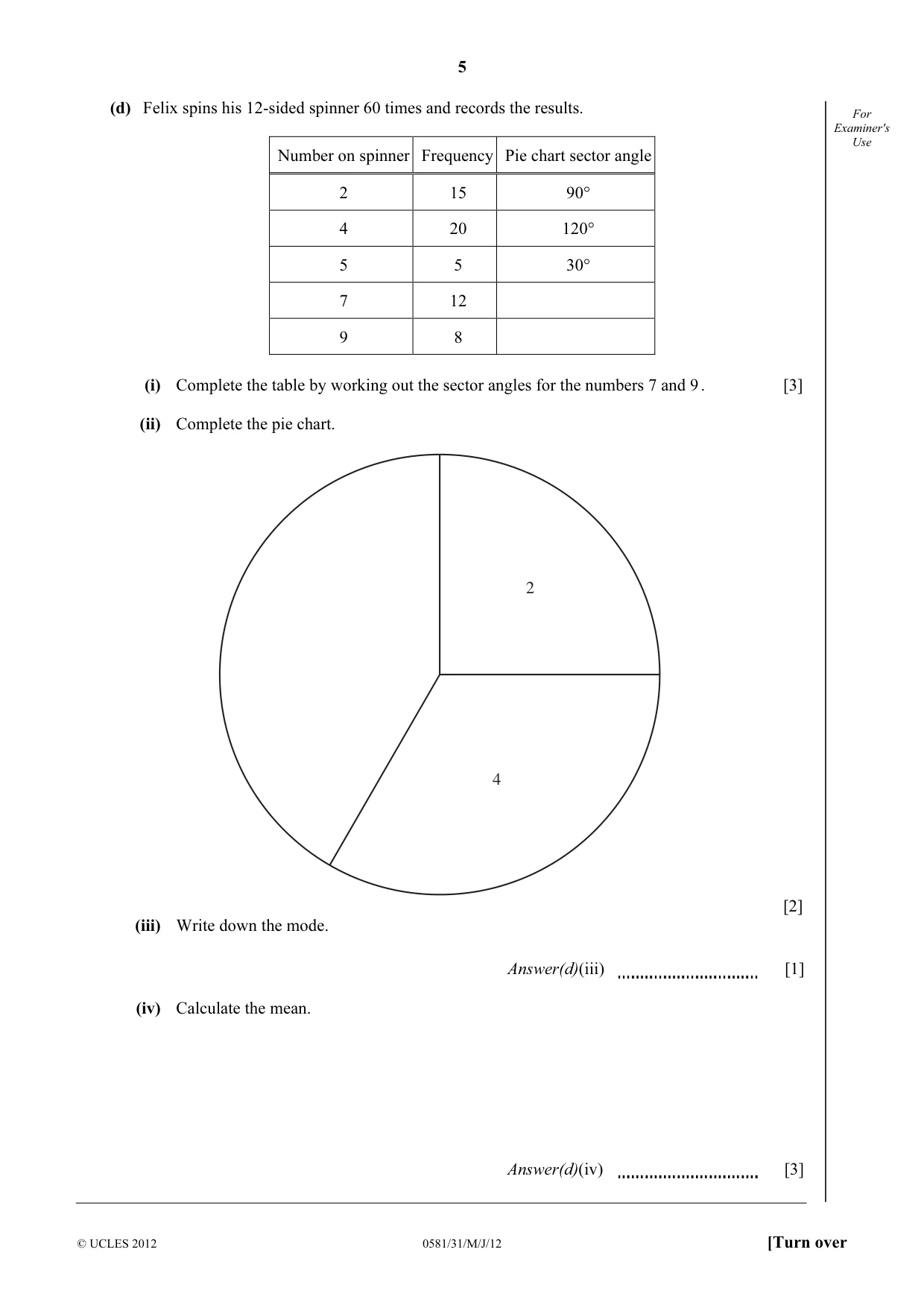
5 © UCLES 2012 0581/31/M/J/12 [Turn over For Examiner's Use (d) Felix spins his 12-sided spinner 60 times and records the results. Number on spinner Frequency Pie chart sector angle 2 15 90° 4 20 120° 5 5 30° 7 12 9 8 (i) Complete the table by working out the sector angles for the numbers 7 and 9 . [3] (ii) Complete the pie chart. 2 4 [2] (iii) Write down the mode. Answer(d)(iii) [1] (iv) Calculate the mean. Answer(d)(iv) [3]
Question paper, page 6
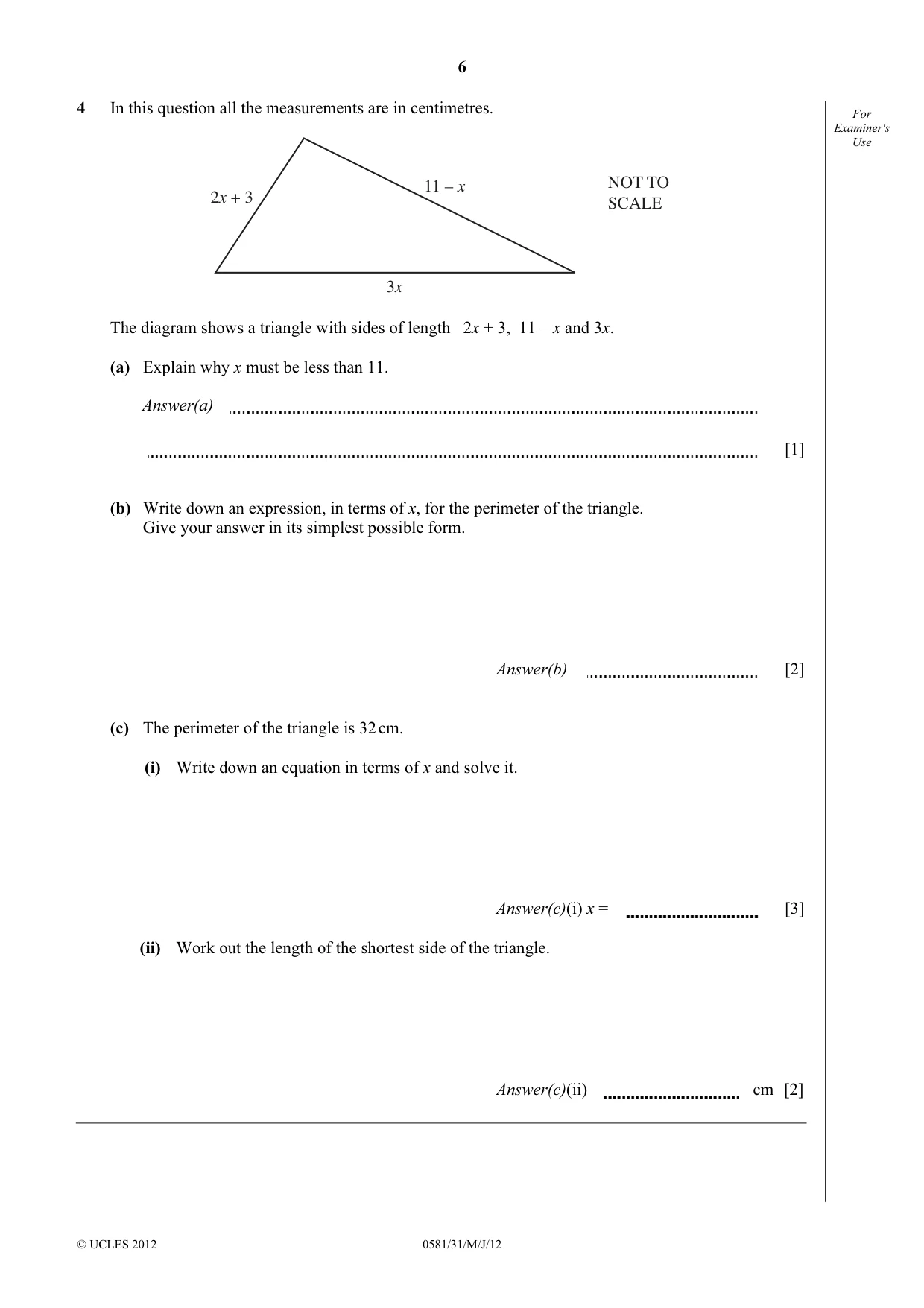
6 © UCLES 2012 0581/31/M/J/12 For Examiner's Use 4 In this question all the measurements are in centimetres. 2x + 3 3x 11 – x NOT TO SCALE The diagram shows a triangle with sides of length 2x + 3, 11 – x and 3x. (a) Explain why x must be less than 11. Answer(a) [1] (b) Write down an expression, in terms of x, for the perimeter of the triangle. Give your answer in its simplest possible form. Answer(b) [2] (c) The perimeter of the triangle is 32 cm. (i) Write down an equation in terms of x and solve it. Answer(c)(i) x = [3] (ii) Work out the length of the shortest side of the triangle. Answer(c)(ii) cm [2]
Question paper, page 7
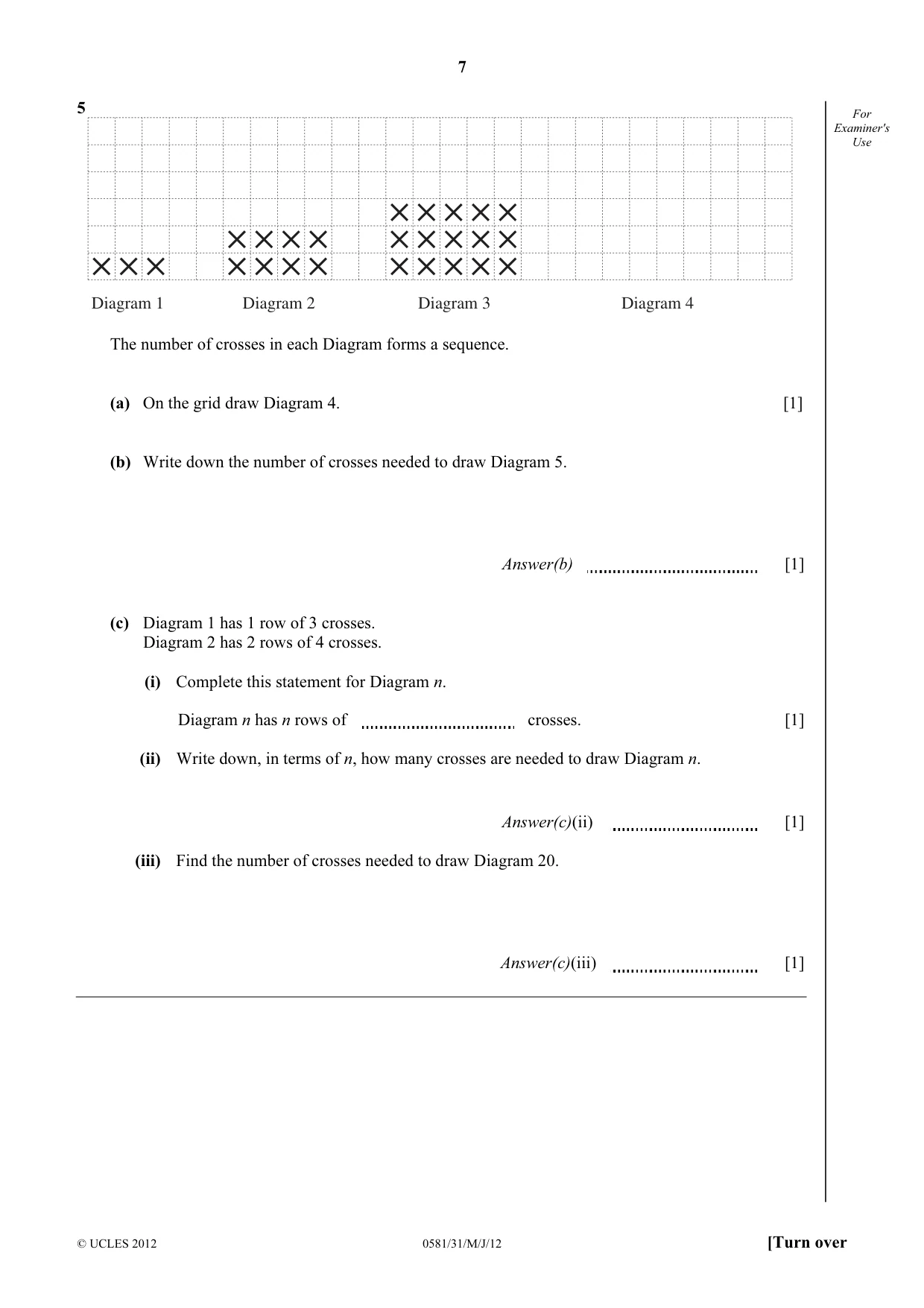
7 © UCLES 2012 0581/31/M/J/12 [Turn over For Examiner's Use 5 Diagram 1 Diagram 2 Diagram 3 Diagram 4 The number of crosses in each Diagram forms a sequence. (a) On the grid draw Diagram 4. [1] (b) Write down the number of crosses needed to draw Diagram 5. Answer(b) [1] (c) Diagram 1 has 1 row of 3 crosses. Diagram 2 has 2 rows of 4 crosses. (i) Complete this statement for Diagram n. Diagram n has n rows of crosses. [1] (ii) Write down, in terms of n, how many crosses are needed to draw Diagram n. Answer(c)(ii) [1] (iii) Find the number of crosses needed to draw Diagram 20. Answer(c)(iii) [1]
Question paper, page 8
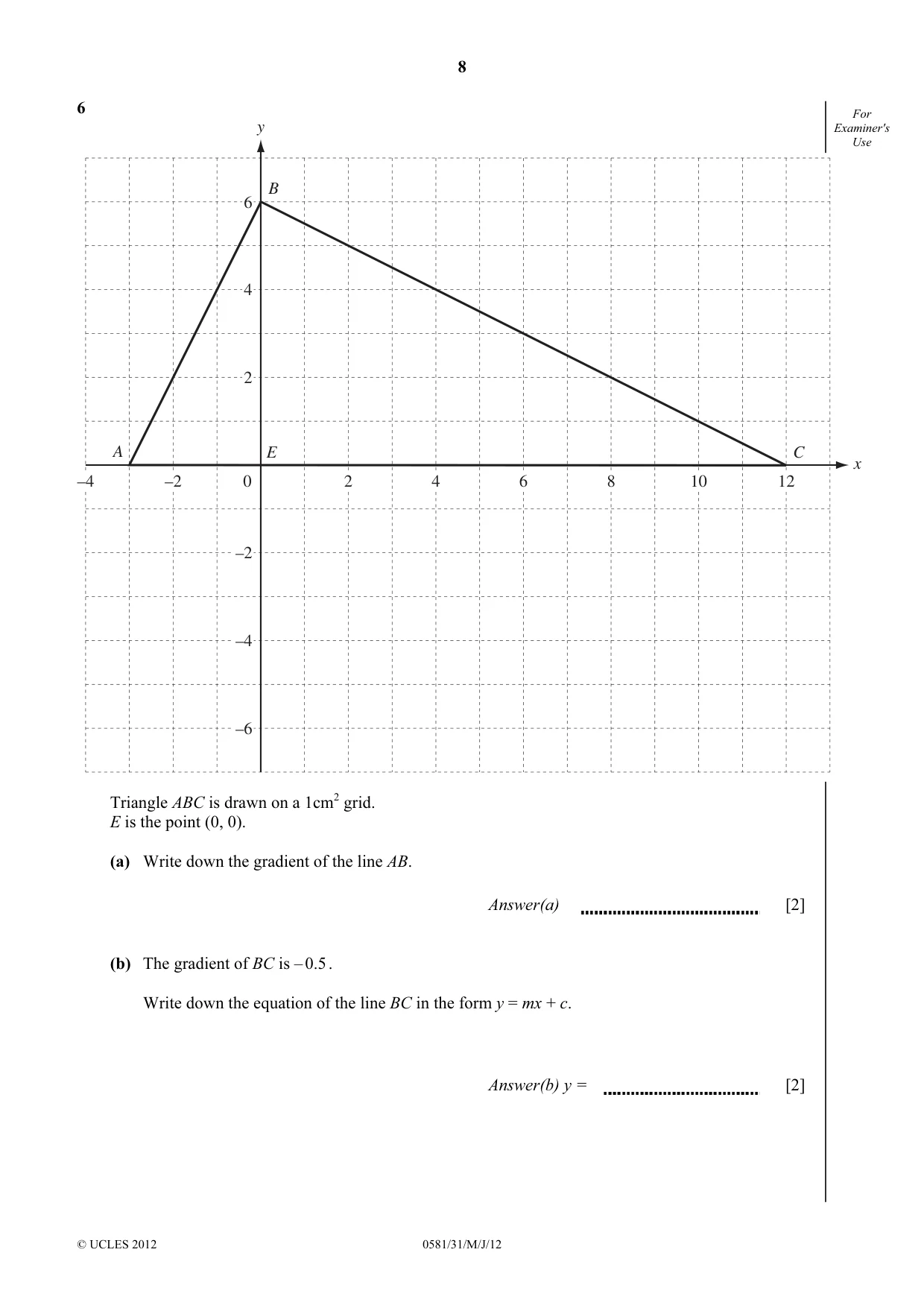
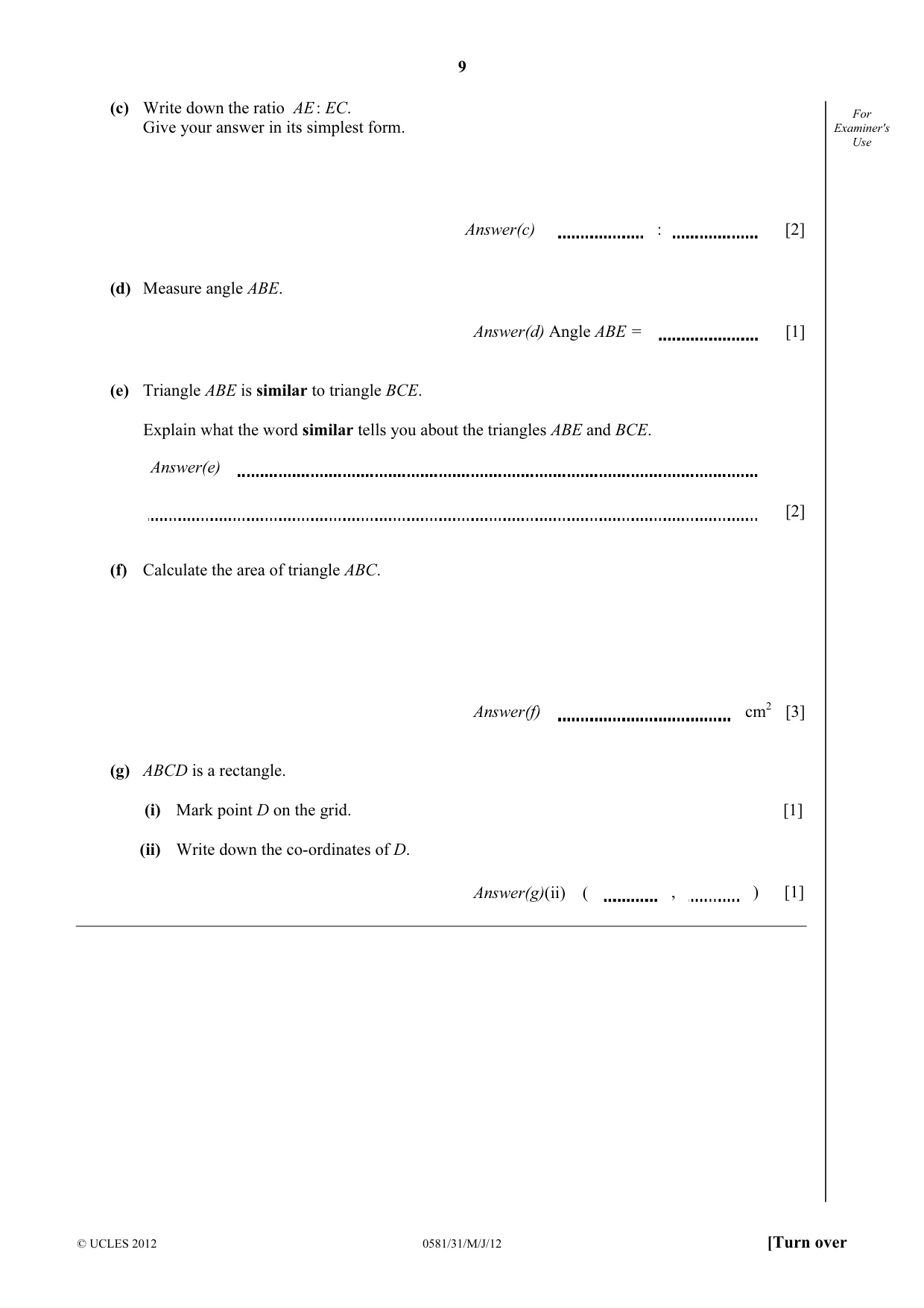
8 © UCLES 2012 0581/31/M/J/12 For Examiner's Use 6 6 4 2 –2 –4 –6 –2 2 0 4 6 8 10 12 –4 y x A E B C Triangle ABC is drawn on a 1cm2 grid. E is the point (0, 0). (a) Write down the gradient of the line AB. Answer(a) [2] (b) The gradient of BC is – 0.5 . Write down the equation of the line BC in the form y = mx + c. Answer(b) y = [2]
Question paper, page 9
9 © UCLES 2012 0581/31/M/J/12 [Turn over For Examiner's Use (c) Write down the ratio AE : EC. Give your answer in its simplest form. Answer(c) : [2] (d) Measure angle ABE. Answer(d) Angle ABE = [1] (e) Triangle ABE is similar to triangle BCE. Explain what the word similar tells you about the triangles ABE and BCE. Answer(e) [2] (f) Calculate the area of triangle ABC. Answer(f) cm2 [3] (g) ABCD is a rectangle. (i) Mark point D on the grid. [1] (ii) Write down the co-ordinates of D. Answer(g)(ii) ( , ) [1]
Question paper, page 10
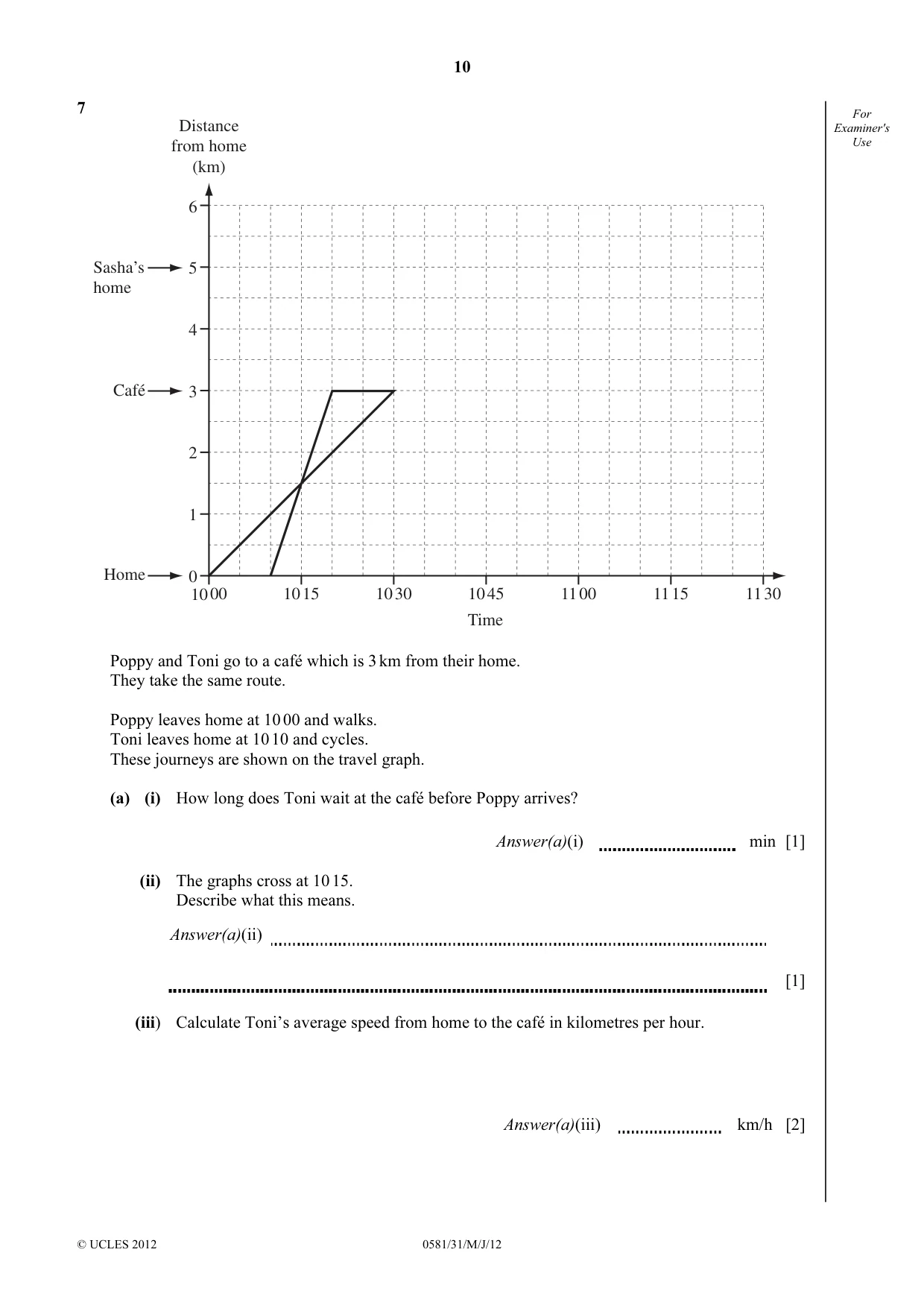
10 © UCLES 2012 0581/31/M/J/12 For Examiner's Use 7 6 5 4 3 2 1 0 10 00 10 15 10 30 10 45 11 00 11 15 11 30 Distance from home (km) Sasha’s home Café Home Time Poppy and Toni go to a café which is 3 km from their home. They take the same route. Poppy leaves home at 10 00 and walks. Toni leaves home at 10 10 and cycles. These journeys are shown on the travel graph. (a) (i) How long does Toni wait at the café before Poppy arrives? Answer(a)(i) min [1] (ii) The graphs cross at 10 15. Describe what this means. Answer(a)(ii) [1] (iii) Calculate Toni’s average speed from home to the café in kilometres per hour. Answer(a)(iii) km/h [2]
Question paper, page 11
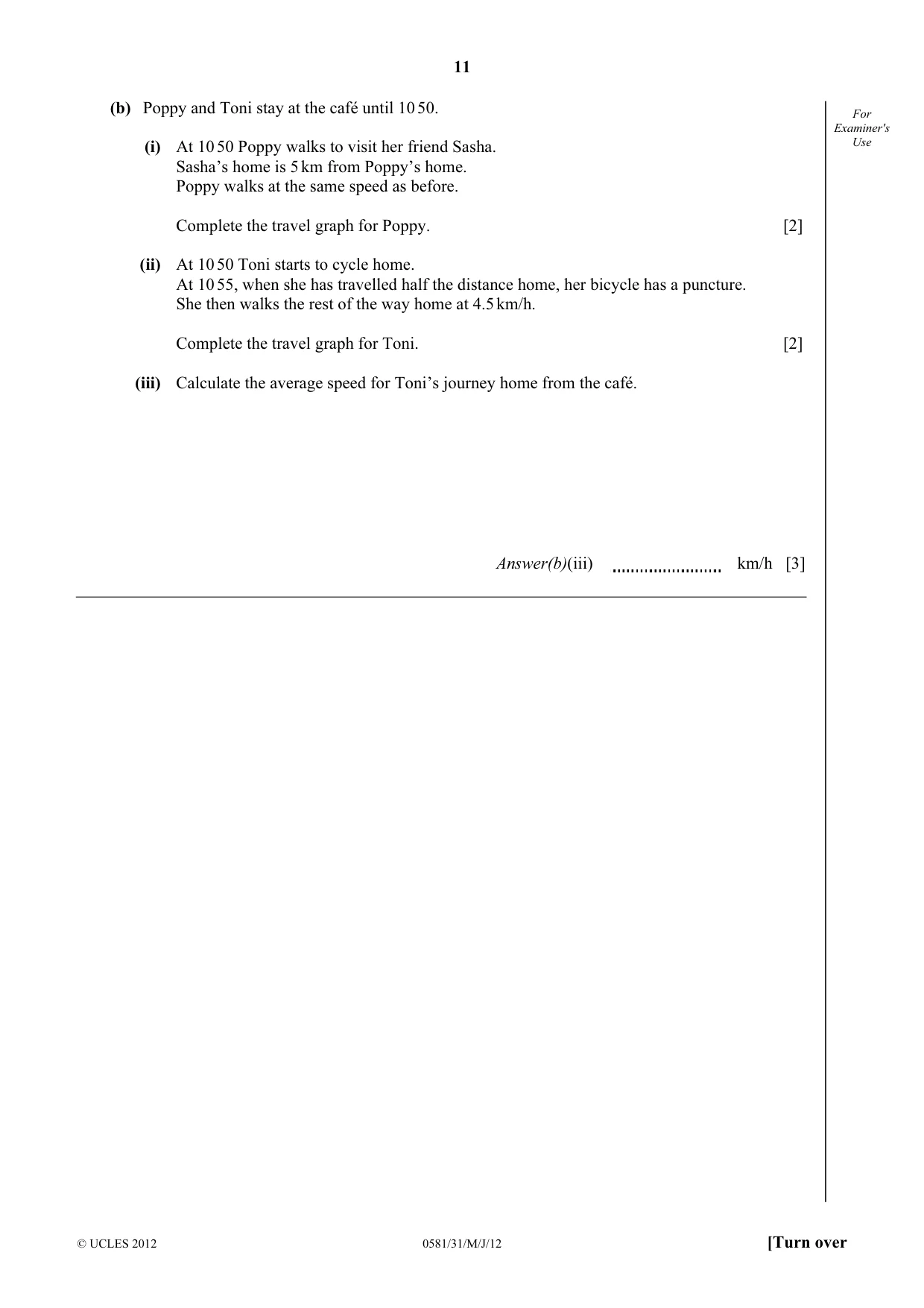
11 © UCLES 2012 0581/31/M/J/12 [Turn over For Examiner's Use (b) Poppy and Toni stay at the café until 10 50. (i) At 10 50 Poppy walks to visit her friend Sasha. Sasha’s home is 5 km from Poppy’s home. Poppy walks at the same speed as before. Complete the travel graph for Poppy. [2] (ii) At 10 50 Toni starts to cycle home. At 10 55, when she has travelled half the distance home, her bicycle has a puncture. She then walks the rest of the way home at 4.5 km/h. Complete the travel graph for Toni. [2] (iii) Calculate the average speed for Toni’s journey home from the café. Answer(b)(iii) km/h [3]
Question paper, page 12
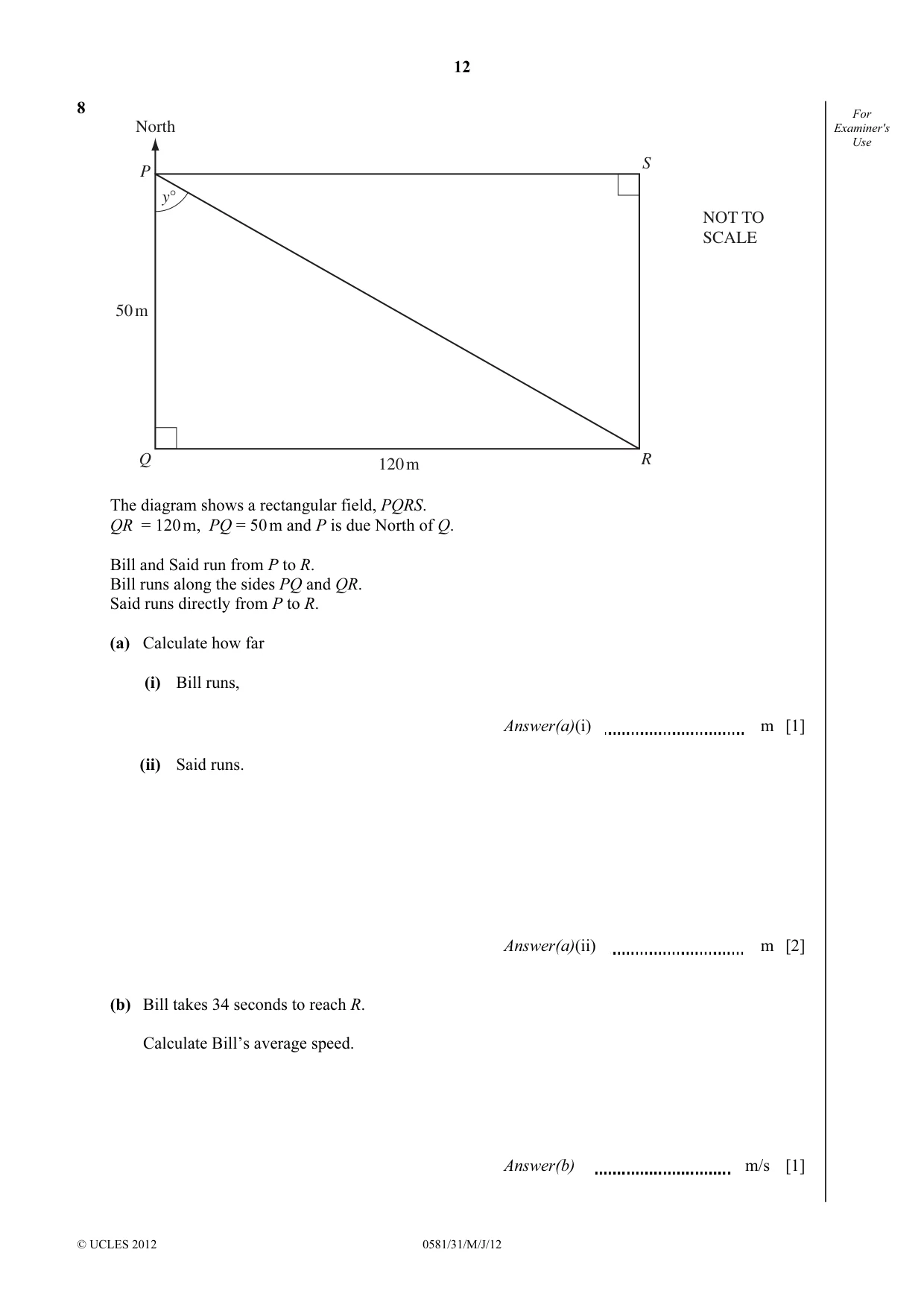
12 © UCLES 2012 0581/31/M/J/12 For Examiner's Use 8 North P Q R S y° 120 m 50 m NOT TO SCALE The diagram shows a rectangular field, PQRS. QR = 120 m, PQ = 50 m and P is due North of Q. Bill and Said run from P to R. Bill runs along the sides PQ and QR. Said runs directly from P to R. (a) Calculate how far (i) Bill runs, Answer(a)(i) m [1] (ii) Said runs. Answer(a)(ii) m [2] (b) Bill takes 34 seconds to reach R. Calculate Bill’s average speed. Answer(b) m/s [1]
Question paper, page 13
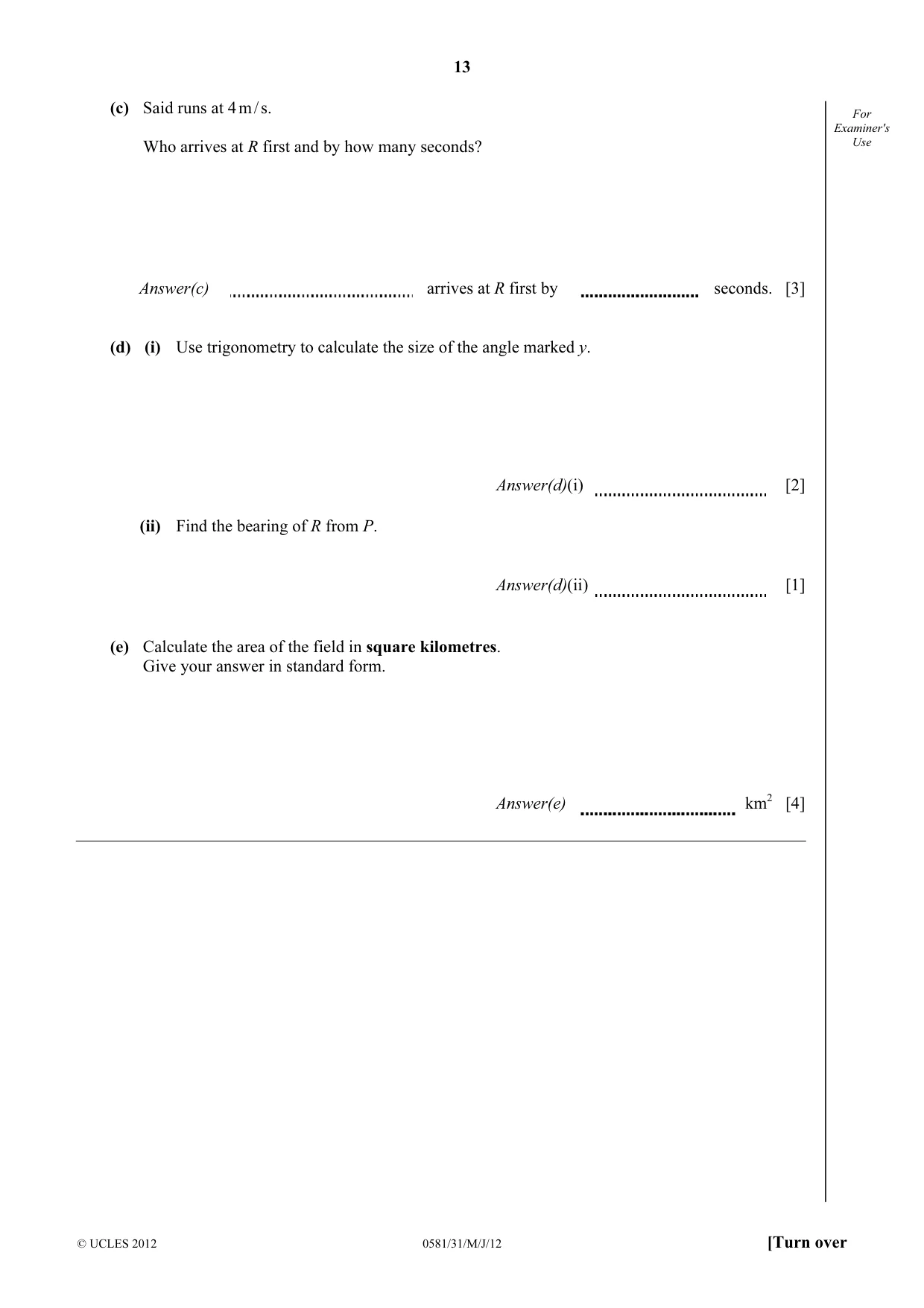
13 © UCLES 2012 0581/31/M/J/12 [Turn over For Examiner's Use (c) Said runs at 4 m / s. Who arrives at R first and by how many seconds? Answer(c) arrives at R first by seconds. [3] (d) (i) Use trigonometry to calculate the size of the angle marked y. Answer(d)(i) [2] (ii) Find the bearing of R from P. Answer(d)(ii) [1] (e) Calculate the area of the field in square kilometres. Give your answer in standard form. Answer(e) km2 [4]
Question paper, page 14
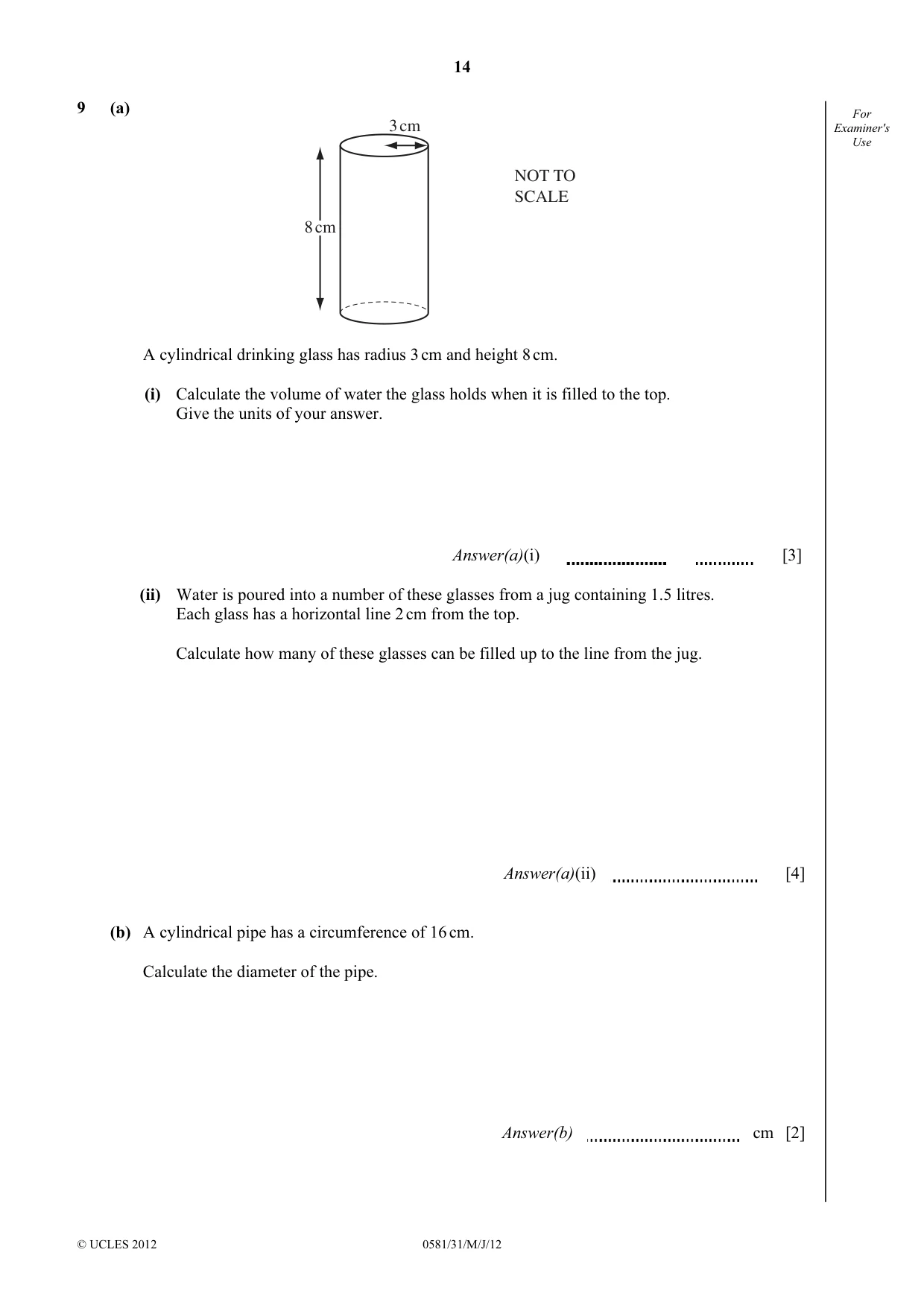
14 © UCLES 2012 0581/31/M/J/12 For Examiner's Use 9 (a) 3 cm 8 cm NOT TO SCALE A cylindrical drinking glass has radius 3 cm and height 8 cm. (i) Calculate the volume of water the glass holds when it is filled to the top. Give the units of your answer. Answer(a)(i) [3] (ii) Water is poured into a number of these glasses from a jug containing 1.5 litres. Each glass has a horizontal line 2 cm from the top. Calculate how many of these glasses can be filled up to the line from the jug. Answer(a)(ii) [4] (b) A cylindrical pipe has a circumference of 16 cm. Calculate the diameter of the pipe. Answer(b) cm [2]
Question paper, page 15
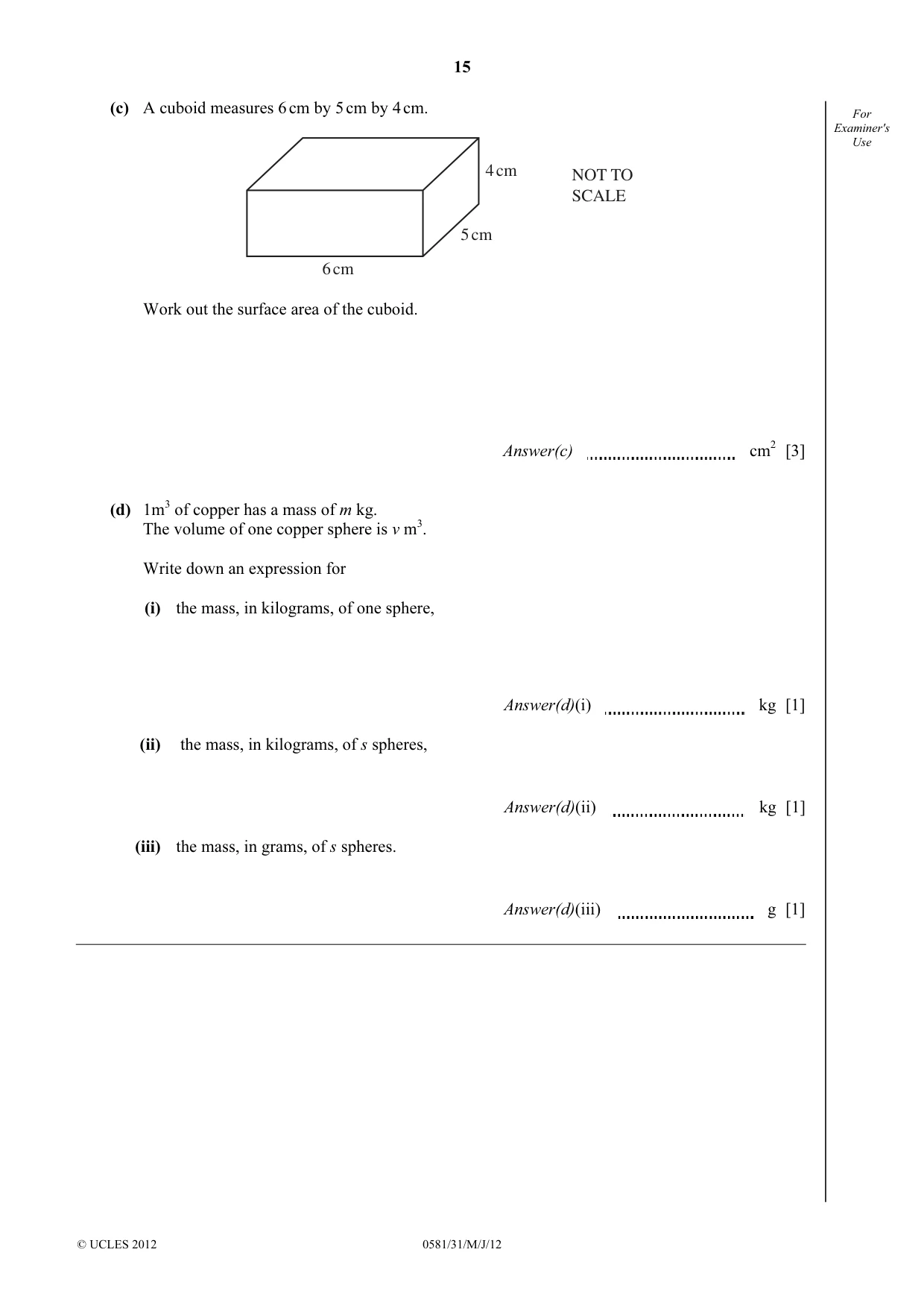
15 © UCLES 2012 0581/31/M/J/12 For Examiner's Use (c) A cuboid measures 6 cm by 5 cm by 4 cm. 4 cm 5 cm 6 cm NOT TO SCALE Work out the surface area of the cuboid. Answer(c) cm2 [3] (d) 1m3 of copper has a mass of m kg. The volume of one copper sphere is v m3. Write down an expression for (i) the mass, in kilograms, of one sphere, Answer(d)(i) kg [1] (ii) the mass, in kilograms, of s spheres, Answer(d)(ii) kg [1] (iii) the mass, in grams, of s spheres. Answer(d)(iii) g [1]
Question paper, page 16
16 Permission to reproduce items where third-party owned material protected by copyright is included has been sought and cleared where possible. Every reasonable effort has been made by the publisher (UCLES) to trace copyright holders, but if any items requiring clearance have unwittingly been included, the publisher will be pleased to make amends at the earliest possible opportunity. University of Cambridge International Examinations is part of the Cambridge Assessment Group. Cambridge Assessment is the brand name of University of Cambridge Local Examinations Syndicate (UCLES), which is itself a department of the University of Cambridge. © UCLES 2012 0581/31/M/J/12 BLANK PAGE
Mark scheme, page 1
UNIVERSITY OF CAMBRIDGE INTERNATIONAL EXAMINATIONS International General Certificate of Secondary Education MARK SCHEME for the May/June 2012 question paper for the guidance of teachers 0581 MATHEMATICS 0581/31 Paper 3 (Core), maximum raw mark 104 This mark scheme is published as an aid to teachers and candidates, to indicate the requirements of the examination. It shows the basis on which Examiners were instructed to award marks. It does not indicate the details of the discussions that took place at an Examiners’ meeting before marking began, which would have considered the acceptability of alternative answers. Mark schemes must be read in conjunction with the question papers and the report on the examination. • Cambridge will not enter into discussions or correspondence in connection with these mark schemes. Cambridge is publishing the mark schemes for the May/June 2012 question papers for most IGCSE, GCE Advanced Level and Advanced Subsidiary Level syllabuses and some Ordinary Level syllabuses. www.XtremePapers.com
Mark scheme, page 2
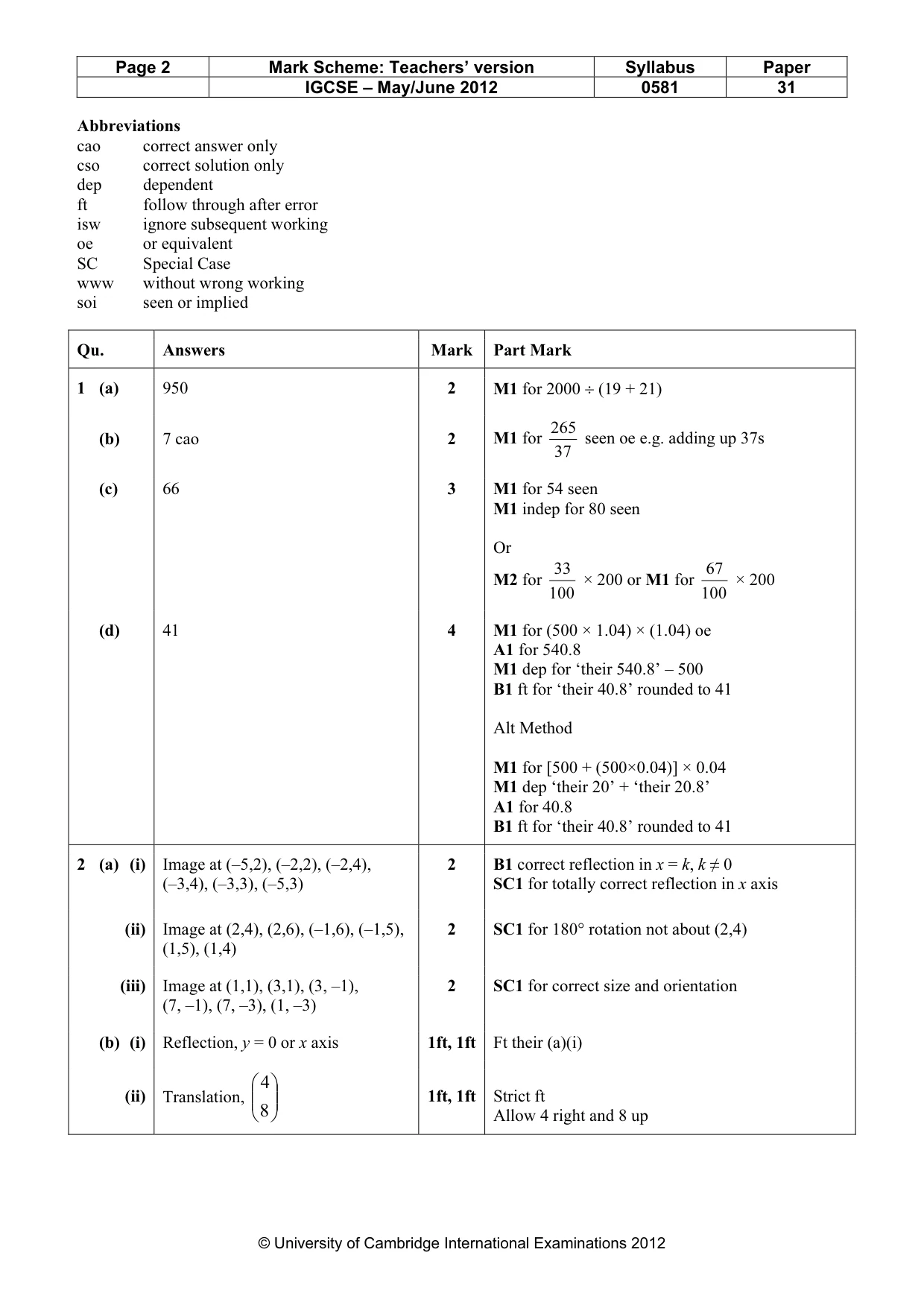
Page 2 Mark Scheme: Teachers’ version Syllabus Paper IGCSE – May/June 2012 0581 31 © University of Cambridge International Examinations 2012 Abbreviations cao correct answer only cso correct solution only dep dependent ft follow through after error isw ignore subsequent working oe or equivalent SC Special Case www without wrong working soi seen or implied Qu. Answers Mark Part Mark 1 (a) 950 2 M1 for 2000 ÷ (19 + 21) (b) 7 cao 2 M1 for 37 265 seen oe e.g. adding up 37s (c) 66 3 M1 for 54 seen M1 indep for 80 seen Or M2 for 100 33 × 200 or M1 for 100 67 × 200 (d) 41 4 M1 for (500 × 1.04) × (1.04) oe A1 for 540.8 M1 dep for ‘their 540.8’ – 500 B1 ft for ‘their 40.8’ rounded to 41 Alt Method M1 for [500 + (500×0.04)] × 0.04 M1 dep ‘their 20’ + ‘their 20.8’ A1 for 40.8 B1 ft for ‘their 40.8’ rounded to 41 2 (a) (i) Image at (–5,2), (–2,2), (–2,4), (–3,4), (–3,3), (–5,3) 2 B1 correct reflection in x = k, k ≠ 0 SC1 for totally correct reflection in x axis (ii) Image at (2,4), (2,6), (–1,6), (–1,5), (1,5), (1,4) 2 SC1 for 180° rotation not about (2,4) (iii) Image at (1,1), (3,1), (3, –1), (7, –1), (7, –3), (1, –3) 2 SC1 for correct size and orientation (b) (i) Reflection, y = 0 or x axis 1ft, 1ft Ft their (a)(i) (ii) Translation, 8 4 1ft, 1ft Strict ft Allow 4 right and 8 up
Mark scheme, page 3
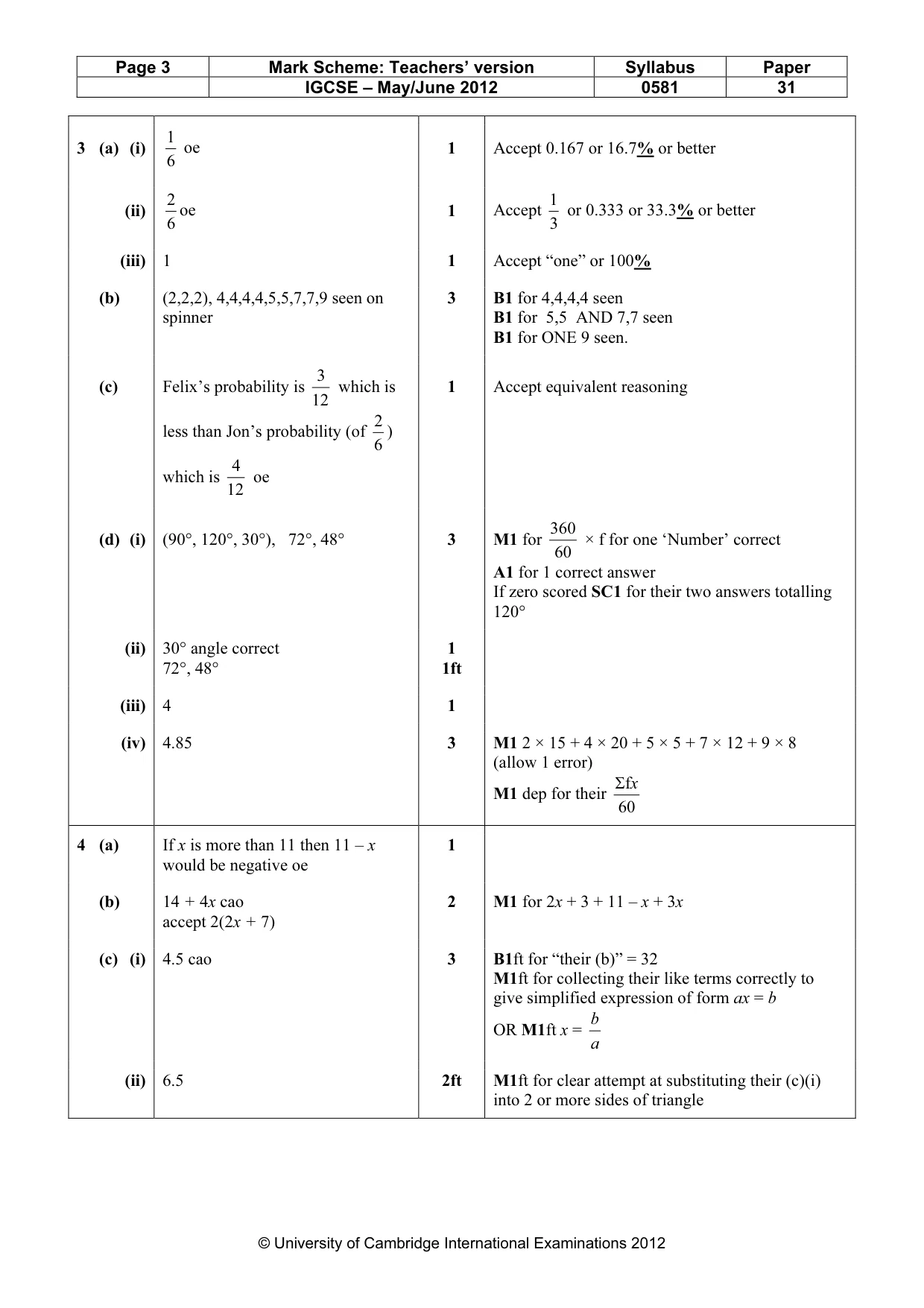
Page 3 Mark Scheme: Teachers’ version Syllabus Paper IGCSE – May/June 2012 0581 31 © University of Cambridge International Examinations 2012 3 (a) (i) 6 1 oe 1 Accept 0.167 or 16.7% or better (ii) 6 2 oe 1 Accept 3 1 or 0.333 or 33.3% or better (iii) 1 1 Accept “one” or 100% (b) (2,2,2), 4,4,4,4,5,5,7,7,9 seen on spinner 3 B1 for 4,4,4,4 seen B1 for 5,5 AND 7,7 seen B1 for ONE 9 seen. (c) Felix’s probability is 12 3 which is less than Jon’s probability (of 6 2 ) which is 12 4 oe 1 Accept equivalent reasoning (d) (i) (90°, 120°, 30°), 72°, 48° 3 M1 for 60 360 × f for one ‘Number’ correct A1 for 1 correct answer If zero scored SC1 for their two answers totalling 120° (ii) 30° angle correct 72°, 48° 1 1ft (iii) 4 1 (iv) 4.85 3 M1 2 × 15 + 4 × 20 + 5 × 5 + 7 × 12 + 9 × 8 (allow 1 error) M1 dep for their 60 fx Σ 4 (a) If x is more than 11 then 11 – x would be negative oe 1 (b) 14 + 4x cao accept 2(2x + 7) 2 M1 for 2x + 3 + 11 – x + 3x (c) (i) 4.5 cao 3 B1ft for “their (b)” = 32 M1ft for collecting their like terms correctly to give simplified expression of form ax = b OR M1ft x = a b (ii) 6.5 2ft M1ft for clear attempt at substituting their (c)(i) into 2 or more sides of triangle
Mark scheme, page 4
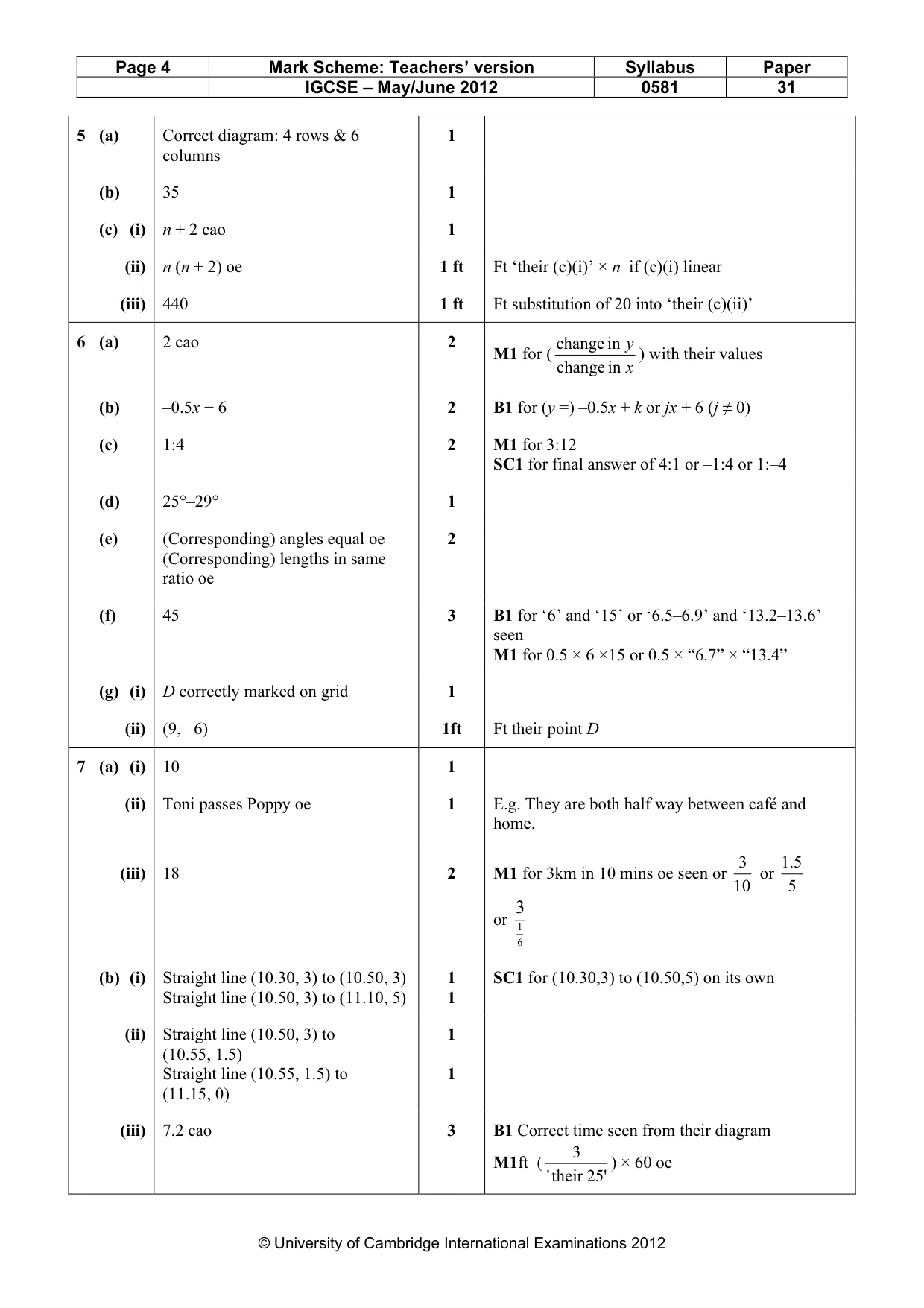
Page 4 Mark Scheme: Teachers’ version Syllabus Paper IGCSE – May/June 2012 0581 31 © University of Cambridge International Examinations 2012 5 (a) Correct diagram: 4 rows & 6 columns 1 (b) 35 1 (c) (i) n + 2 cao 1 (ii) n (n + 2) oe 1 ft Ft ‘their (c)(i)’ × n if (c)(i) linear (iii) 440 1 ft Ft substitution of 20 into ‘their (c)(ii)’ 6 (a) 2 cao 2 M1 for ( x y in change in change ) with their values (b) –0.5x + 6 2 B1 for (y =) –0.5x + k or jx + 6 (j ≠ 0) (c) 1:4 2 M1 for 3:12 SC1 for final answer of 4:1 or –1:4 or 1:–4 (d) 25°–29° 1 (e) (Corresponding) angles equal oe (Corresponding) lengths in same ratio oe 2 (f) 45 3 B1 for ‘6’ and ‘15’ or ‘6.5–6.9’ and ‘13.2–13.6’ seen M1 for 0.5 × 6 ×15 or 0.5 × “6.7” × “13.4” (g) (i) D correctly marked on grid 1 (ii) (9, –6) 1ft Ft their point D 7 (a) (i) 10 1 (ii) Toni passes Poppy oe 1 E.g. They are both half way between café and home. (iii) 18 2 M1 for 3km in 10 mins oe seen or 10 3 or 5 5.1 or 6 1 3 (b) (i) Straight line (10.30, 3) to (10.50, 3) Straight line (10.50, 3) to (11.10, 5) 1 1 SC1 for (10.30,3) to (10.50,5) on its own (ii) Straight line (10.50, 3) to (10.55, 1.5) Straight line (10.55, 1.5) to (11.15, 0) 1 1 (iii) 7.2 cao 3 B1 Correct time seen from their diagram M1ft ( 25' their ' 3 ) × 60 oe
Mark scheme, page 5
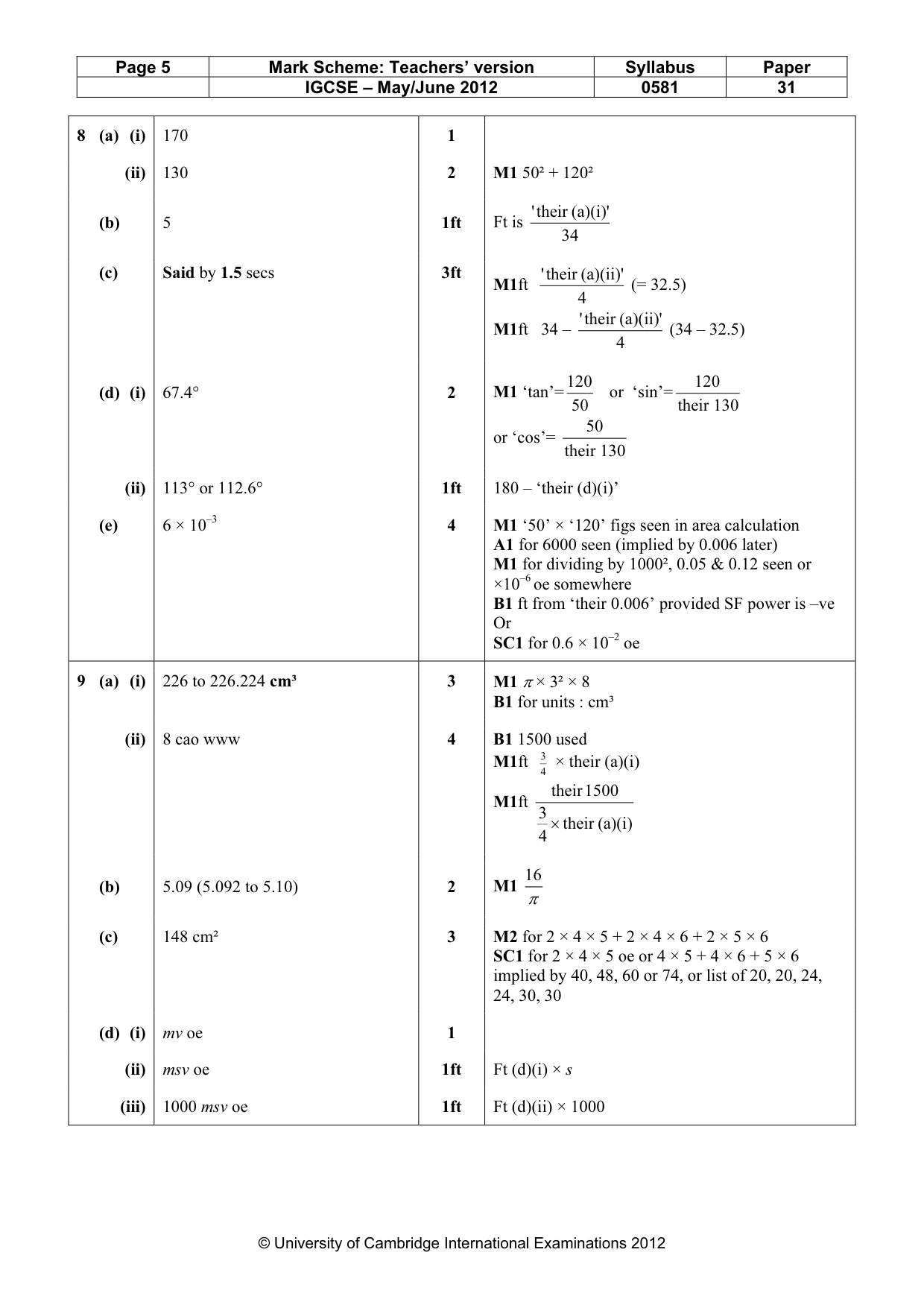
Page 5 Mark Scheme: Teachers’ version Syllabus Paper IGCSE – May/June 2012 0581 31 © University of Cambridge International Examinations 2012 8 (a) (i) 170 1 (ii) 130 2 M1 50² + 120² (b) 5 1ft Ft is 34 (a)(i)' their ' (c) Said by 1.5 secs 3ft M1ft 4 (a)(ii)' their ' (= 32.5) M1ft 34 – 4 (a)(ii)' their ' (34 – 32.5) (d) (i) 67.4° 2 M1 ‘tan’= 50 120 or ‘sin’= 120 their 130 or ‘cos’= 50 their 130 (ii) 113° or 112.6° 1ft 180 – ‘their (d)(i)’ (e) 6 × 10⁻³ 4 M1 ‘50’ × ‘120’ figs seen in area calculation A1 for 6000 seen (implied by 0.006 later) M1 for dividing by 1000², 0.05 & 0.12 seen or ×10–6 oe somewhere B1 ft from ‘their 0.006’ provided SF power is –ve Or SC1 for 0.6 × 10⁻² oe 9 (a) (i) 226 to 226.224 cm³ 3 M1 π × 3² × 8 B1 for units : cm³ (ii) 8 cao www 4 B1 1500 used M1ft 4 3 × their (a)(i) M1ft their 1500 3 their (a)(i) 4 × (b) 5.09 (5.092 to 5.10) 2 M1 π 16 (c) 148 cm² 3 M2 for 2 × 4 × 5 + 2 × 4 × 6 + 2 × 5 × 6 SC1 for 2 × 4 × 5 oe or 4 × 5 + 4 × 6 + 5 × 6 implied by 40, 48, 60 or 74, or list of 20, 20, 24, 24, 30, 30 (d) (i) mv oe 1 (ii) msv oe 1ft Ft (d)(i) × s (iii) 1000 msv oe 1ft Ft (d)(ii) × 1000
What you needed in this session
Cambridge’s own grade thresholds for 2012 May/June, Paper 3 · Variant 1. A higher threshold means an easier paper — the bar moves with how the cohort did.