Cambridge IGCSE Mathematics (with coursework) 0581 — 2012 May/June Paper 3 · Variant 3
0581/33/M/J/12 · 104 marks · ≈117 min
The question paper and its mark scheme, free to read here and free to download. This is Cambridge’s own paper, exactly as it was sat.
Question paper16 pages
Mark scheme5 pages
Answers below. Sit the paper first if you are practising.
Paper as text
Question paper, page 1
This document consists of 16 printed pages. IB12 06_0581_33/FP © UCLES 2012 [Turn over *3111126102* UNIVERSITY OF CAMBRIDGE INTERNATIONAL EXAMINATIONS International General Certificate of Secondary Education MATHEMATICS 0581/33 Paper 3 (Core) May/June 2012 2 hours Candidates answer on the Question Paper. Additional Materials: Electronic calculator Geometrical instruments Mathematical tables (optional) Tracing paper (optional) READ THESE INSTRUCTIONS FIRST Write your Centre number, candidate number and name on all the work you hand in. Write in dark blue or black pen. You may use a pencil for any diagrams or graphs. Do not use staples, paper clips, highlighters, glue or correction fluid. DO NOT WRITE IN ANY BARCODES. Answer all questions. If working is needed for any question it must be shown below that question. Electronic calculators should be used. If the degree of accuracy is not specified in the question, and if the answer is not exact, give the answer to three significant figures. Give answers in degrees to one decimal place. For π , use either your calculator value or 3.142. At the end of the examination, fasten all your work securely together. The number of marks is given in brackets [ ] at the end of each question or part question. The total of the marks for this paper is 104. www.XtremePapers.com
Question paper, page 2
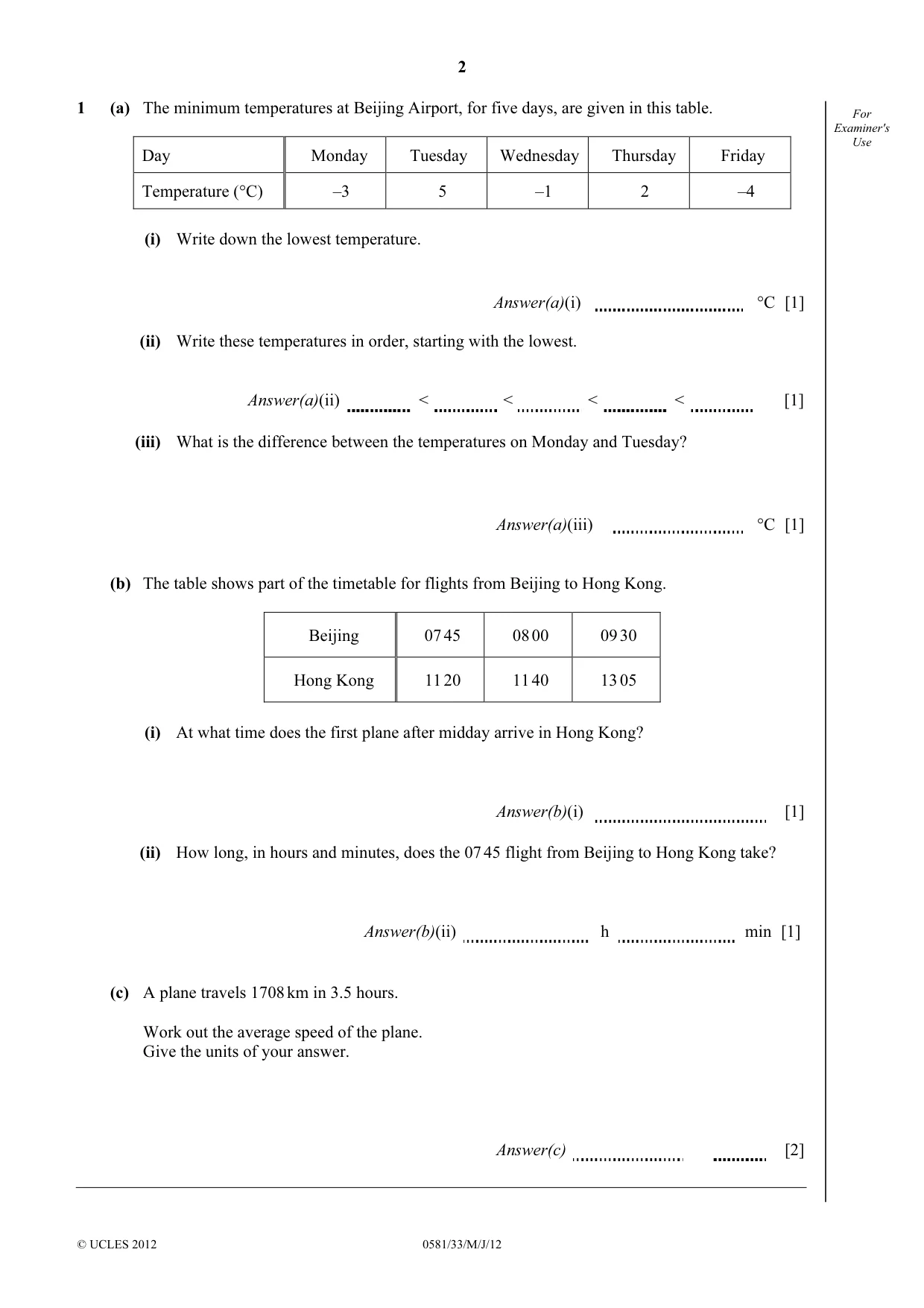
2 © UCLES 2012 0581/33/M/J/12 For Examiner's Use 1 (a) The minimum temperatures at Beijing Airport, for five days, are given in this table. Day Monday Tuesday Wednesday Thursday Friday Temperature (°C) –3 5 –1 2 –4 (i) Write down the lowest temperature. Answer(a)(i) °C [1] (ii) Write these temperatures in order, starting with the lowest. Answer(a)(ii) < < < < [1] (iii) What is the difference between the temperatures on Monday and Tuesday? Answer(a)(iii) °C [1] (b) The table shows part of the timetable for flights from Beijing to Hong Kong. Beijing 07 45 08 00 09 30 Hong Kong 11 20 11 40 13 05 (i) At what time does the first plane after midday arrive in Hong Kong? Answer(b)(i) [1] (ii) How long, in hours and minutes, does the 07 45 flight from Beijing to Hong Kong take? Answer(b)(ii) h min [1] (c) A plane travels 1708 km in 3.5 hours. Work out the average speed of the plane. Give the units of your answer. Answer(c) [2]
Question paper, page 3
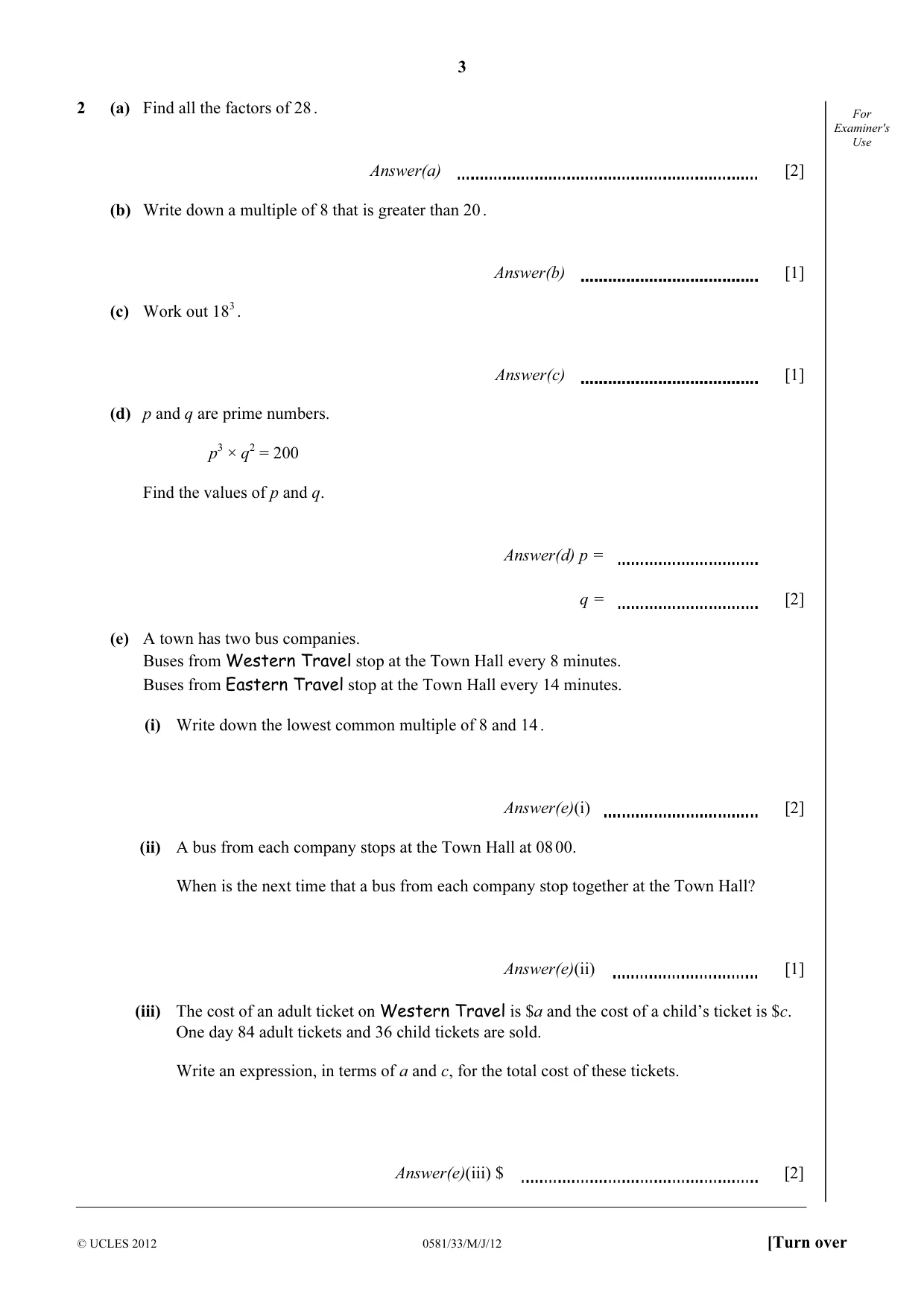
3 © UCLES 2012 0581/33/M/J/12 [Turn over For Examiner's Use 2 (a) Find all the factors of 28 . Answer(a) [2] (b) Write down a multiple of 8 that is greater than 20 . Answer(b) [1] (c) Work out 183 . Answer(c) [1] (d) p and q are prime numbers. p3 × q2 = 200 Find the values of p and q. Answer(d) p = q = [2] (e) A town has two bus companies. Buses from Western Travel stop at the Town Hall every 8 minutes. Buses from Eastern Travel stop at the Town Hall every 14 minutes. (i) Write down the lowest common multiple of 8 and 14 . Answer(e)(i) [2] (ii) A bus from each company stops at the Town Hall at 08 00. When is the next time that a bus from each company stop together at the Town Hall? Answer(e)(ii) [1] (iii) The cost of an adult ticket on Western Travel is $a and the cost of a child’s ticket is $c. One day 84 adult tickets and 36 child tickets are sold. Write an expression, in terms of a and c, for the total cost of these tickets. Answer(e)(iii) $ [2]
Question paper, page 4
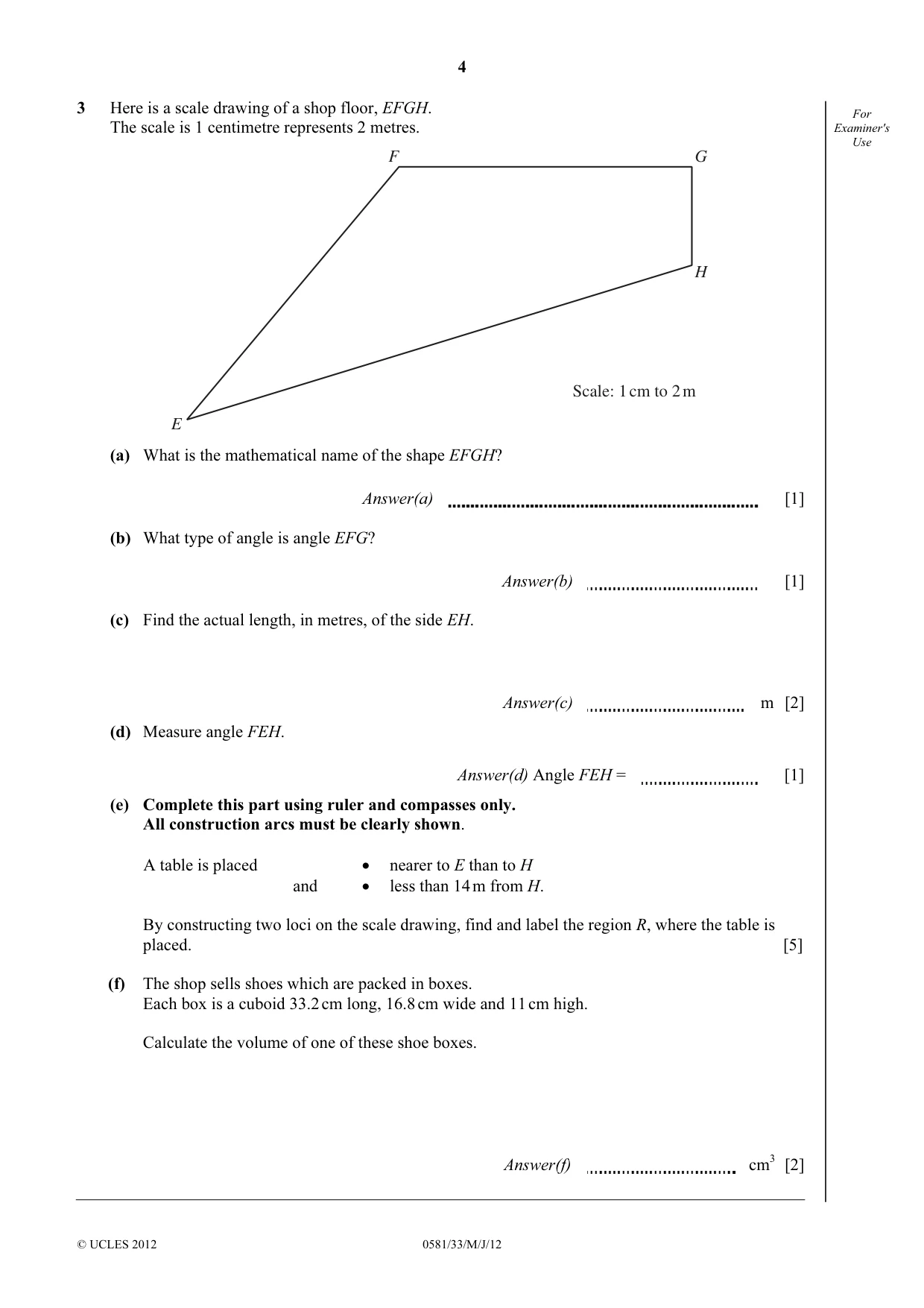
4 © UCLES 2012 0581/33/M/J/12 For Examiner's Use 3 Here is a scale drawing of a shop floor, EFGH. The scale is 1 centimetre represents 2 metres. E F G H Scale: 1 cm to 2 m (a) What is the mathematical name of the shape EFGH? Answer(a) [1] (b) What type of angle is angle EFG? Answer(b) [1] (c) Find the actual length, in metres, of the side EH. Answer(c) m [2] (d) Measure angle FEH. Answer(d) Angle FEH = [1] (e) Complete this part using ruler and compasses only. All construction arcs must be clearly shown. A table is placed • nearer to E than to H and • less than 14 m from H. By constructing two loci on the scale drawing, find and label the region R, where the table is placed. [5] (f) The shop sells shoes which are packed in boxes. Each box is a cuboid 33.2 cm long, 16.8 cm wide and 11 cm high. Calculate the volume of one of these shoe boxes. Answer(f) cm3 [2]
Question paper, page 5
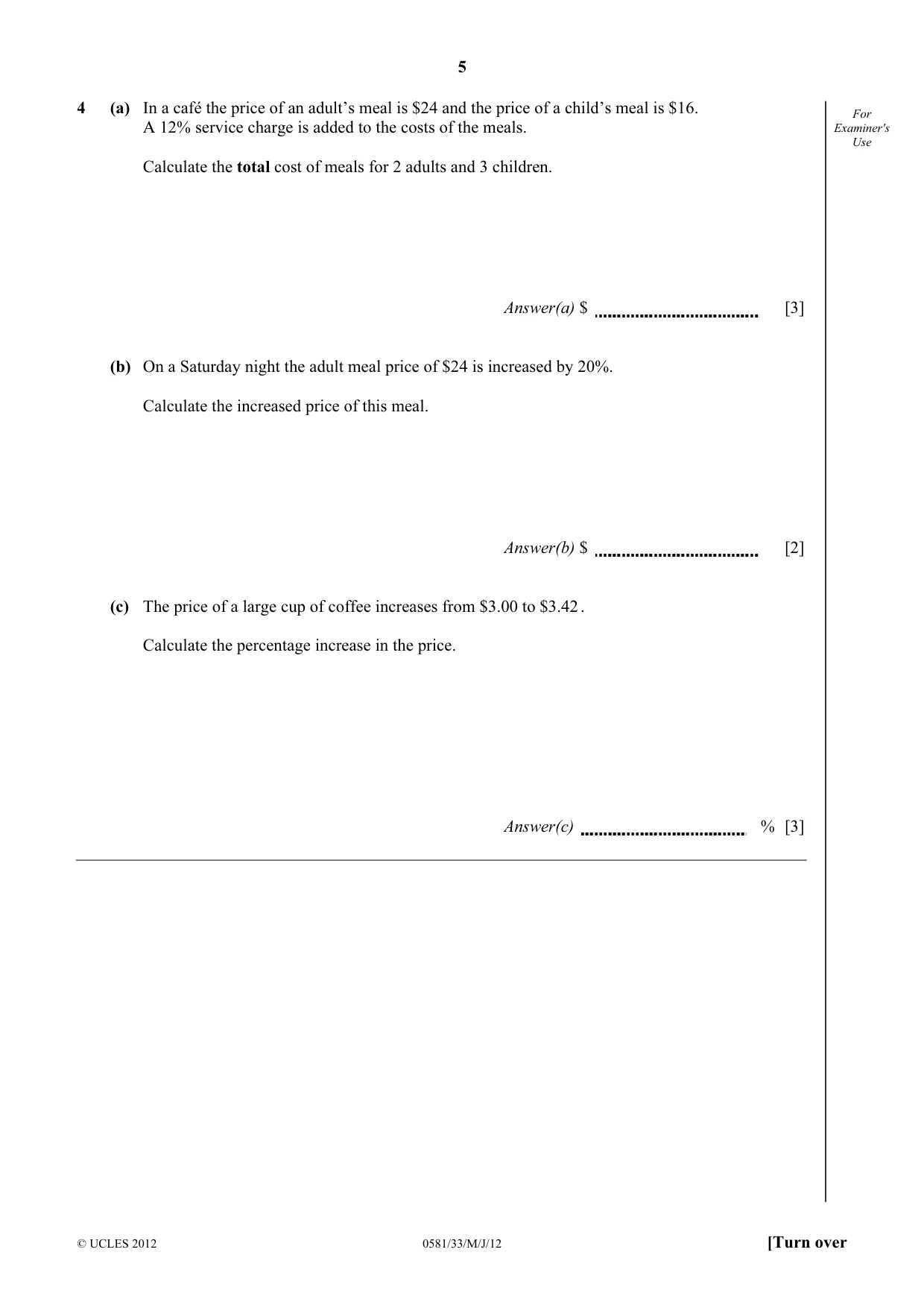
5 © UCLES 2012 0581/33/M/J/12 [Turn over For Examiner's Use 4 (a) In a café the price of an adult’s meal is $24 and the price of a child’s meal is $16. A 12% service charge is added to the costs of the meals. Calculate the total cost of meals for 2 adults and 3 children. Answer(a) $ [3] (b) On a Saturday night the adult meal price of $24 is increased by 20%. Calculate the increased price of this meal. Answer(b) $ [2] (c) The price of a large cup of coffee increases from $3.00 to $3.42 . Calculate the percentage increase in the price. Answer(c) % [3]
Question paper, page 6
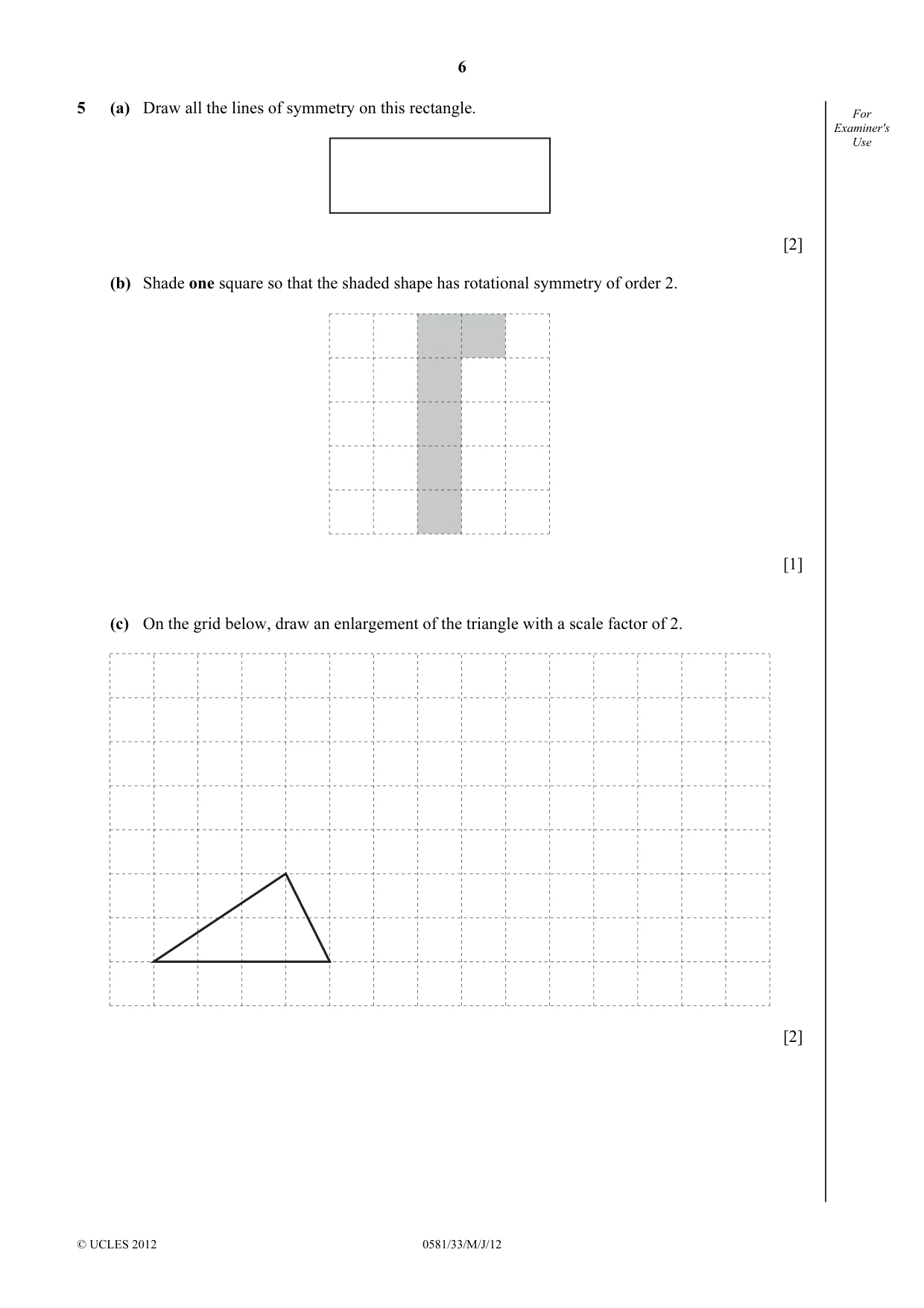
6 © UCLES 2012 0581/33/M/J/12 For Examiner's Use 5 (a) Draw all the lines of symmetry on this rectangle. [2] (b) Shade one square so that the shaded shape has rotational symmetry of order 2. [1] (c) On the grid below, draw an enlargement of the triangle with a scale factor of 2. [2]
Question paper, page 7
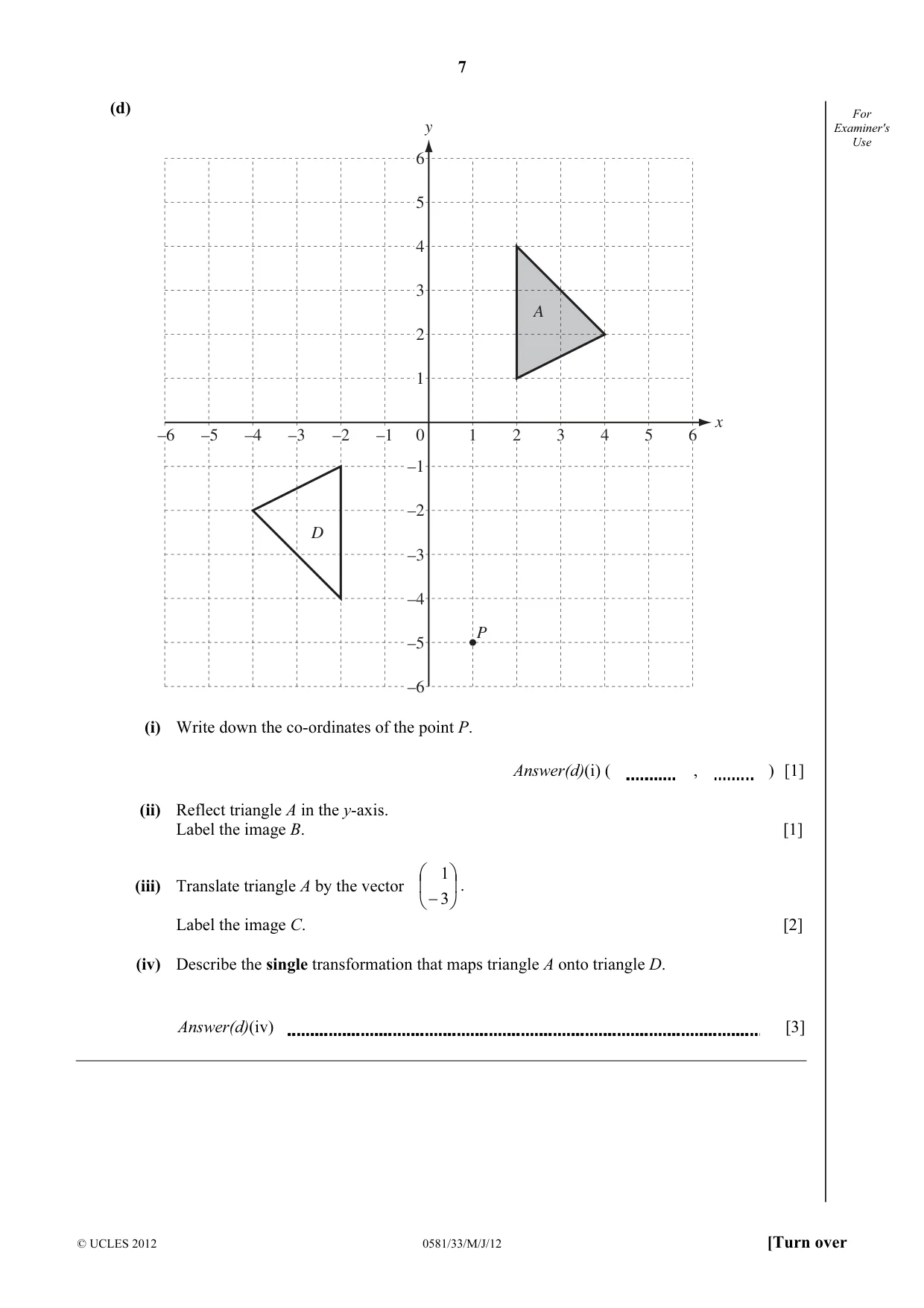
7 © UCLES 2012 0581/33/M/J/12 [Turn over For Examiner's Use (d) A D P y x 6 5 4 3 2 1 –1 –2 –3 –4 –5 –6 –3 –4 –5 –6 –2 –1 1 0 2 3 4 5 6 (i) Write down the co-ordinates of the point P. Answer(d)(i) ( , ) [1] (ii) Reflect triangle A in the y-axis. Label the image B. [1] (iii) Translate triangle A by the vector −3 1 . Label the image C. [2] (iv) Describe the single transformation that maps triangle A onto triangle D. Answer(d)(iv) [3]
Question paper, page 8
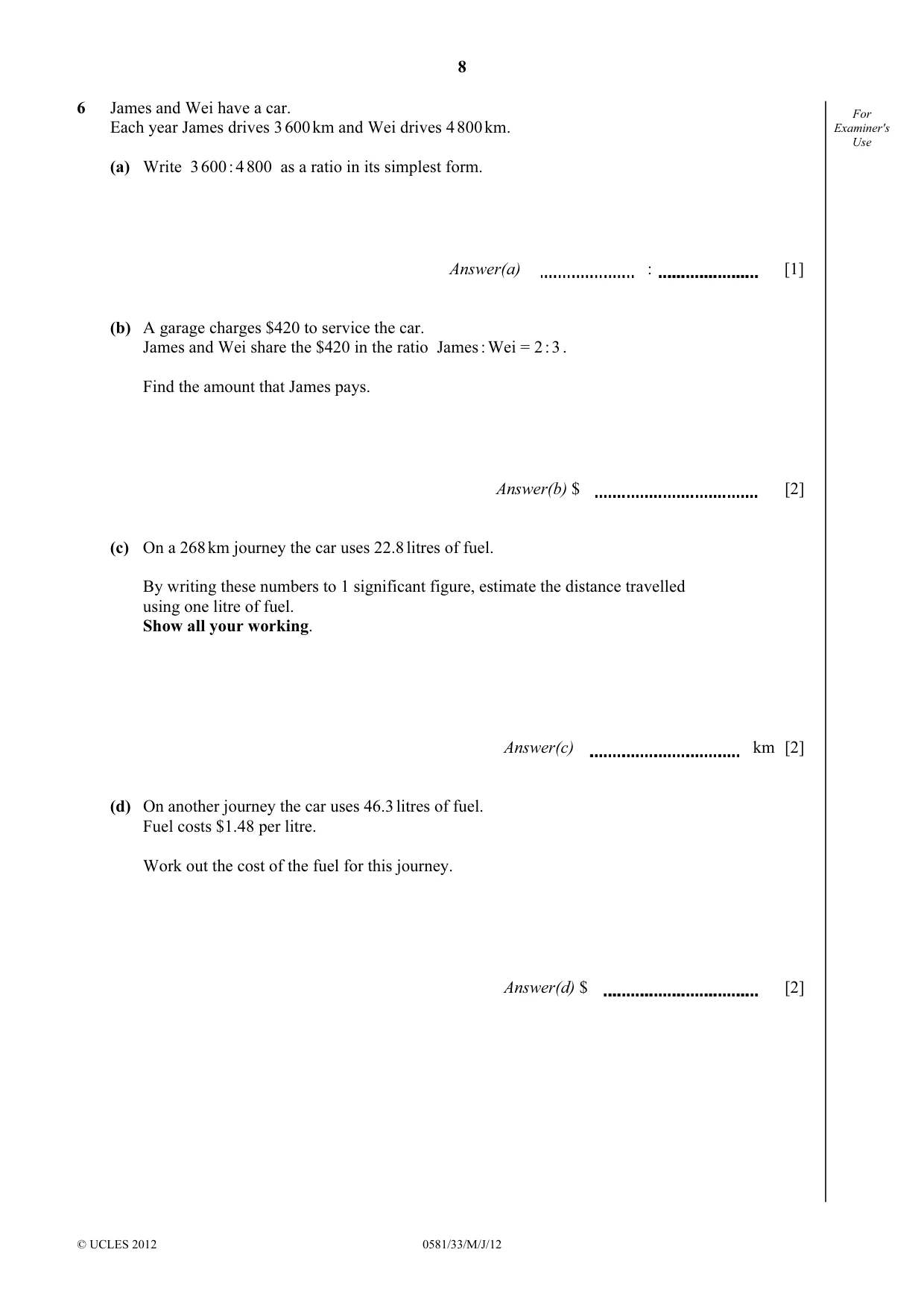
8 © UCLES 2012 0581/33/M/J/12 For Examiner's Use 6 James and Wei have a car. Each year James drives 3 600 km and Wei drives 4 800 km. (a) Write 3 600 : 4 800 as a ratio in its simplest form. Answer(a) : [1] (b) A garage charges $420 to service the car. James and Wei share the $420 in the ratio James : Wei = 2 : 3 . Find the amount that James pays. Answer(b) $ [2] (c) On a 268 km journey the car uses 22.8 litres of fuel. By writing these numbers to 1 significant figure, estimate the distance travelled using one litre of fuel. Show all your working. Answer(c) km [2] (d) On another journey the car uses 46.3 litres of fuel. Fuel costs $1.48 per litre. Work out the cost of the fuel for this journey. Answer(d) $ [2]
Question paper, page 9
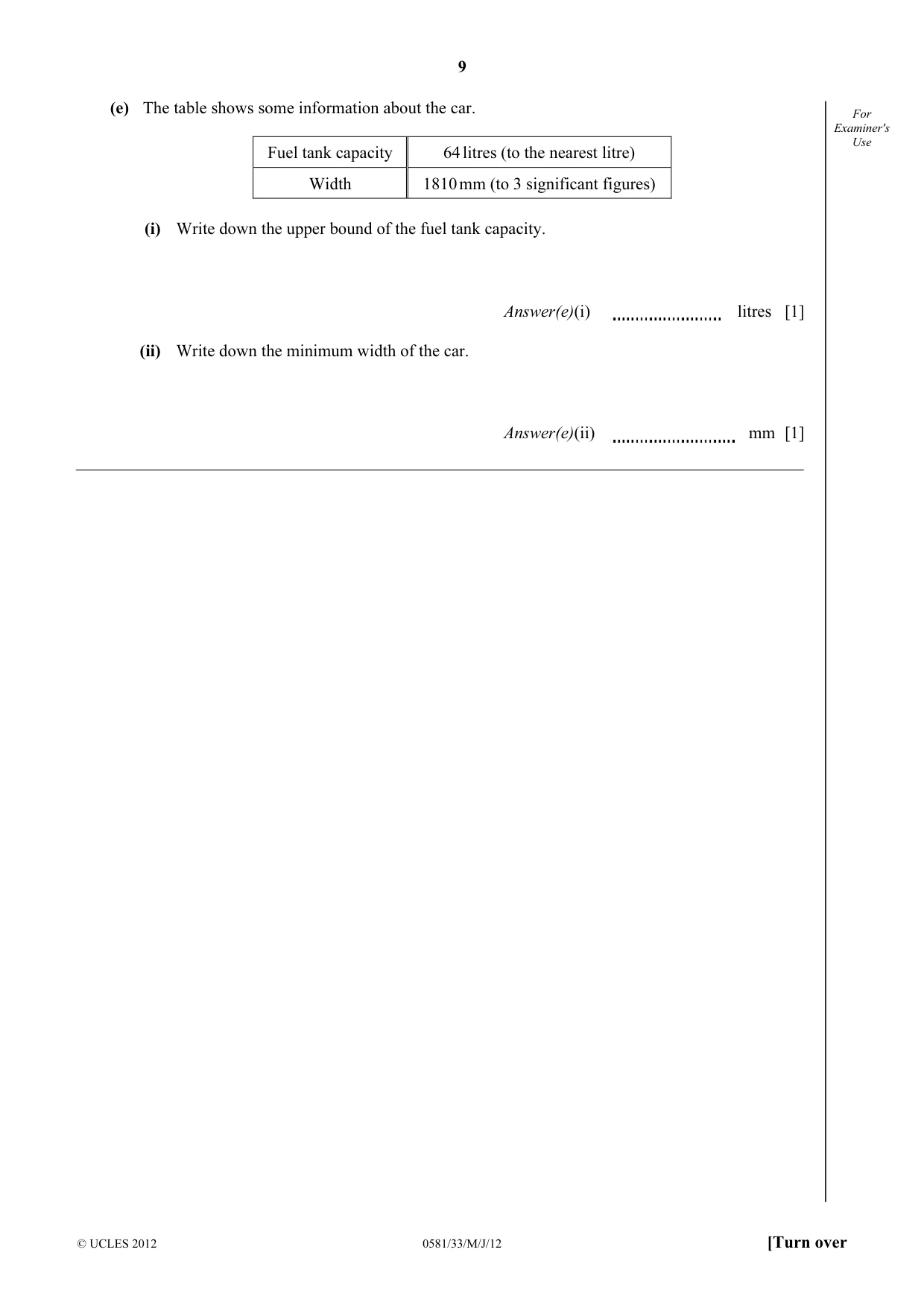
9 © UCLES 2012 0581/33/M/J/12 [Turn over For Examiner's Use (e) The table shows some information about the car. Fuel tank capacity 64 litres (to the nearest litre) Width 1810 mm (to 3 significant figures) (i) Write down the upper bound of the fuel tank capacity. Answer(e)(i) litres [1] (ii) Write down the minimum width of the car. Answer(e)(ii) mm [1]
Question paper, page 10
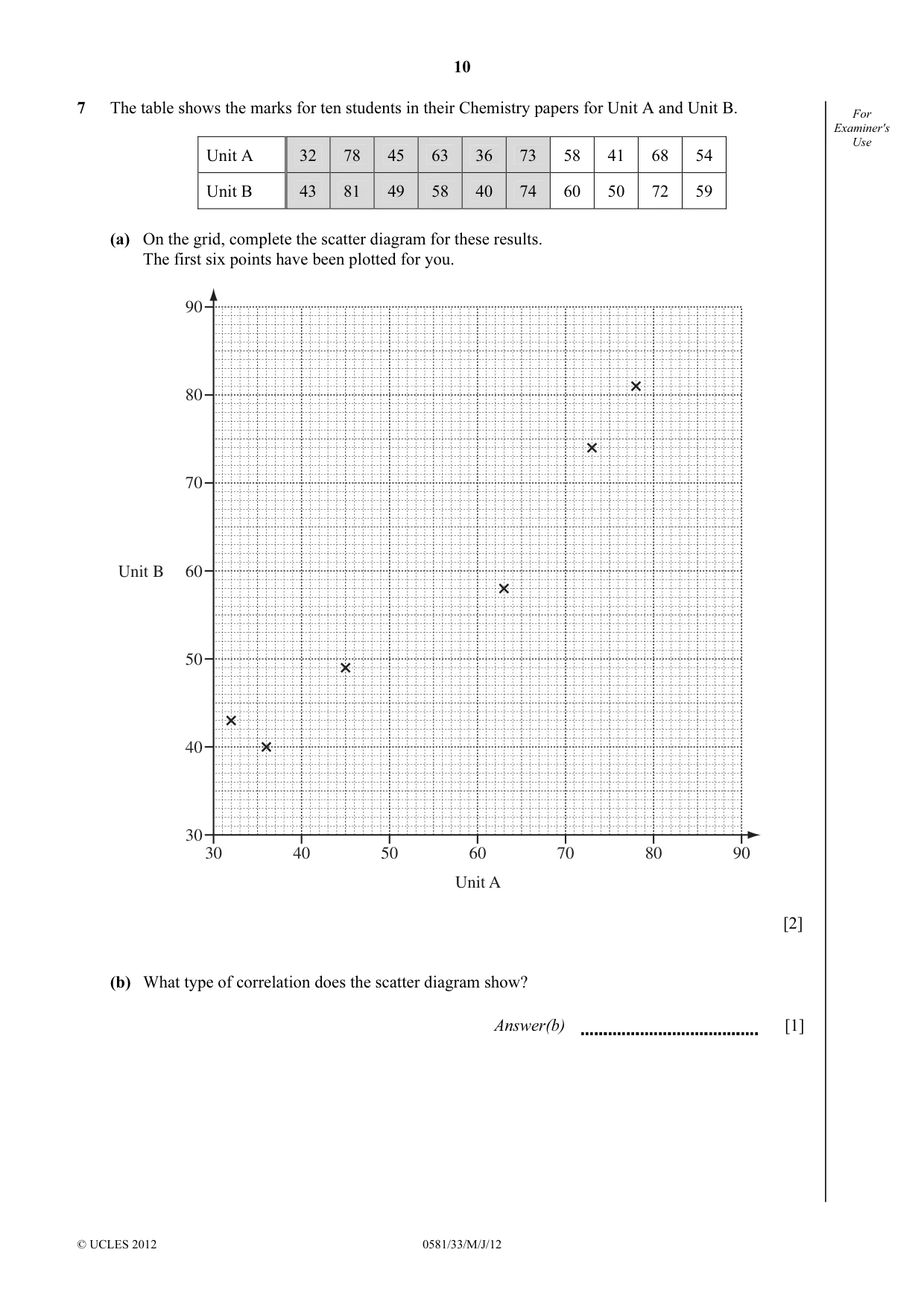
10 © UCLES 2012 0581/33/M/J/12 For Examiner's Use 7 The table shows the marks for ten students in their Chemistry papers for Unit A and Unit B. Unit A 32 78 45 63 36 73 58 41 68 54 Unit B 43 81 49 58 40 74 60 50 72 59 (a) On the grid, complete the scatter diagram for these results. The first six points have been plotted for you. 90 80 70 60 50 40 30 30 40 50 60 70 80 90 Unit A Unit B [2] (b) What type of correlation does the scatter diagram show? Answer(b) [1]
Question paper, page 11
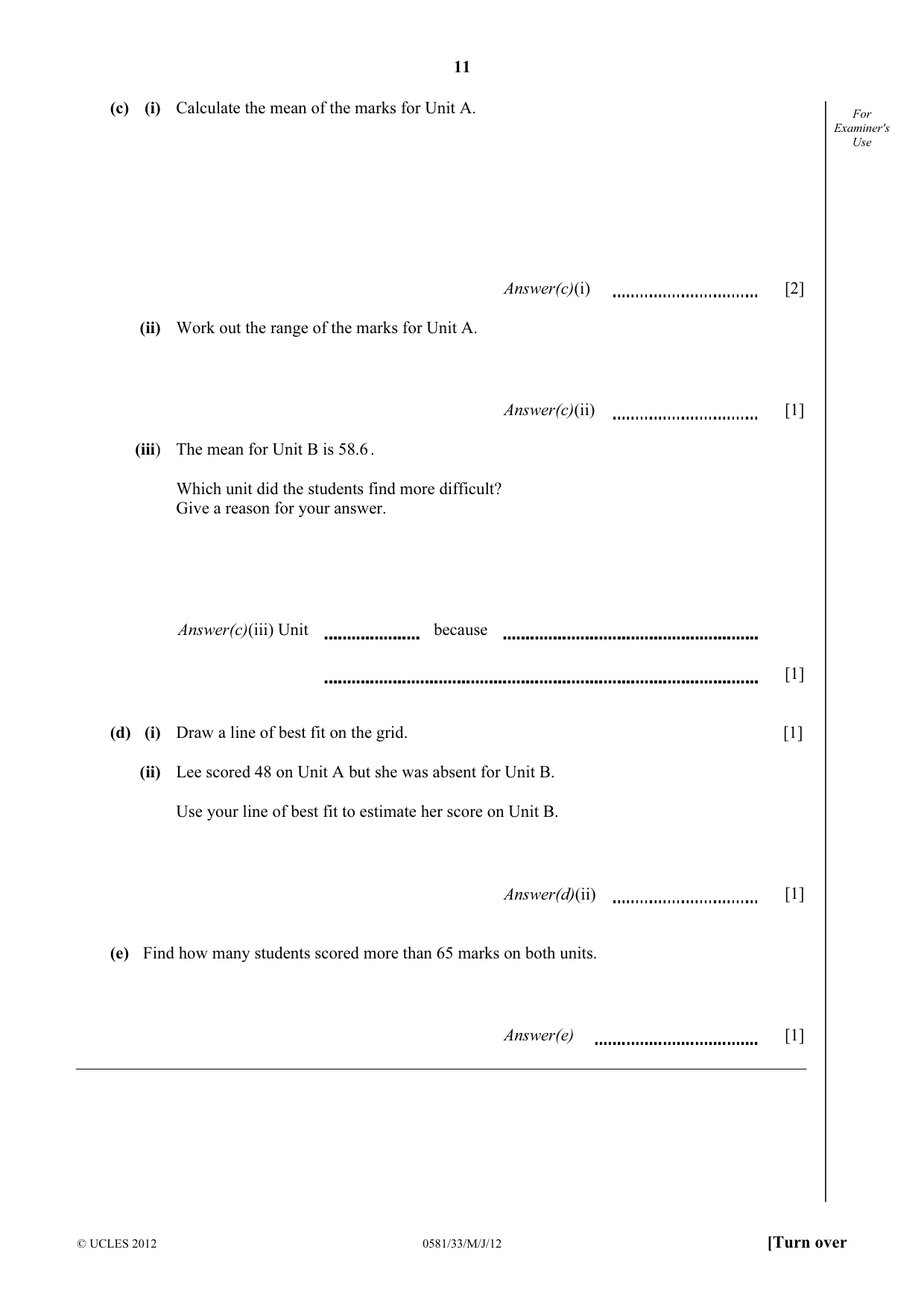
11 © UCLES 2012 0581/33/M/J/12 [Turn over For Examiner's Use (c) (i) Calculate the mean of the marks for Unit A. Answer(c)(i) [2] (ii) Work out the range of the marks for Unit A. Answer(c)(ii) [1] (iii) The mean for Unit B is 58.6 . Which unit did the students find more difficult? Give a reason for your answer. Answer(c)(iii) Unit because [1] (d) (i) Draw a line of best fit on the grid. [1] (ii) Lee scored 48 on Unit A but she was absent for Unit B. Use your line of best fit to estimate her score on Unit B. Answer(d)(ii) [1] (e) Find how many students scored more than 65 marks on both units. Answer(e) [1]
Question paper, page 12
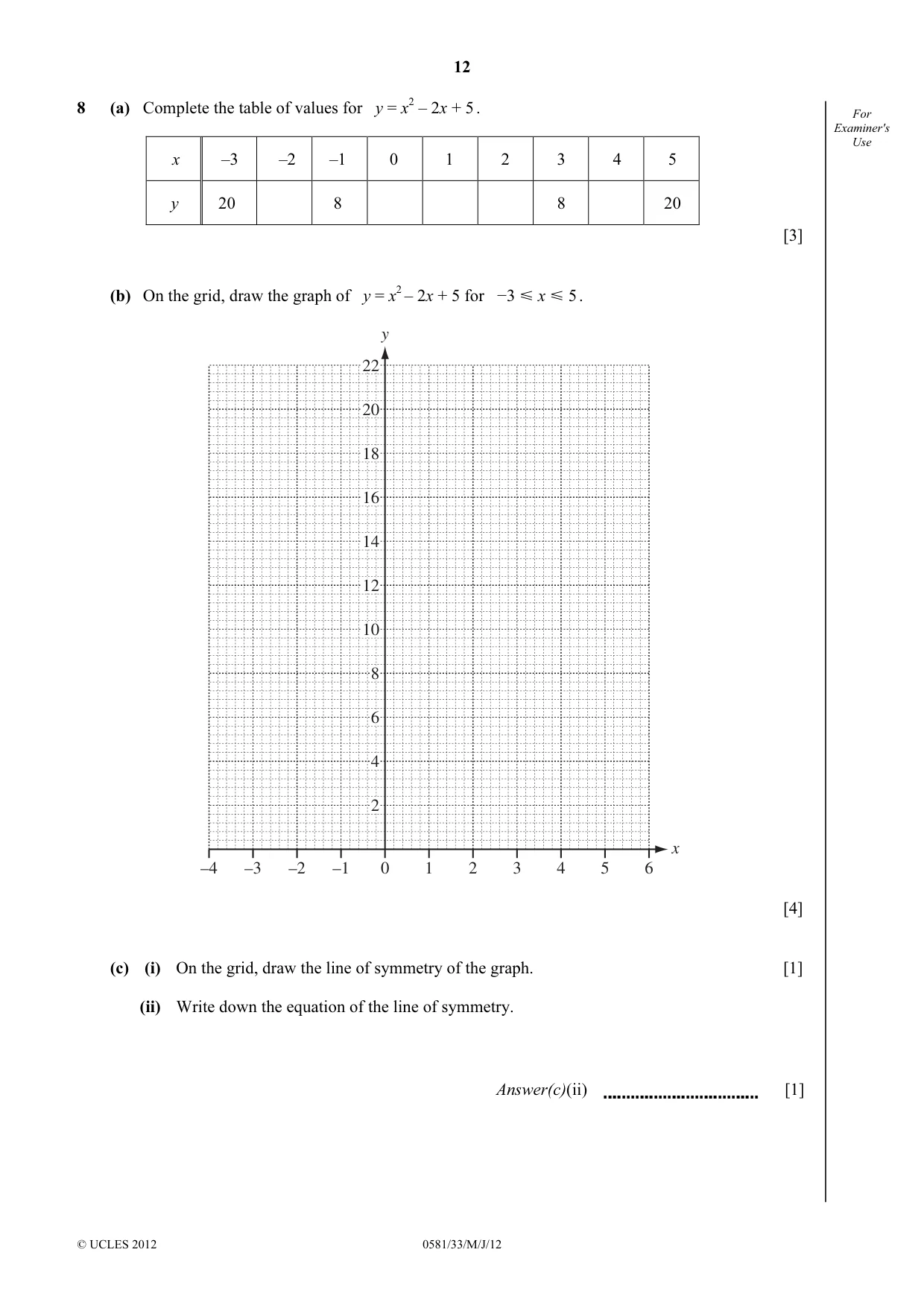
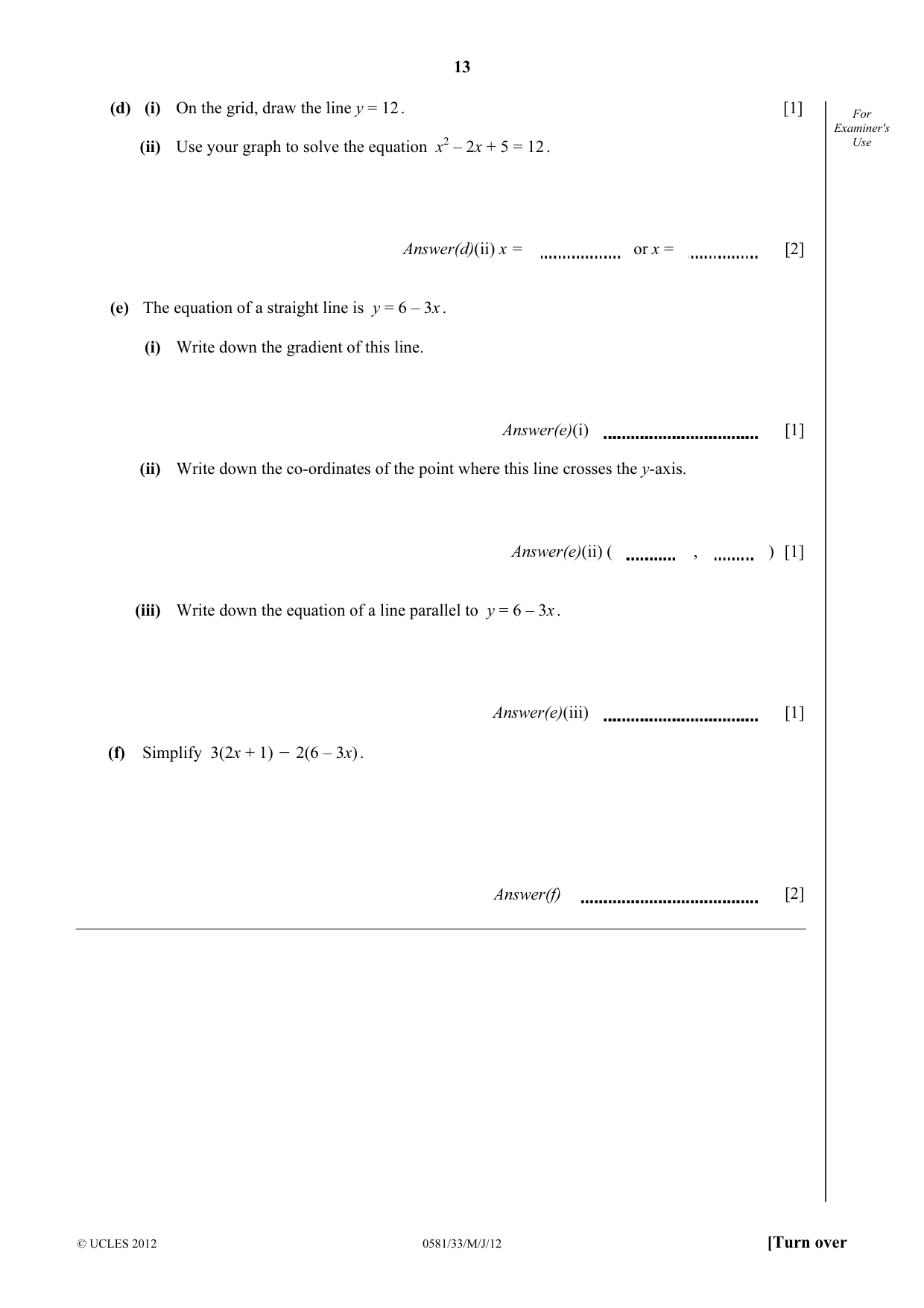
12 © UCLES 2012 0581/33/M/J/12 For Examiner's Use 8 (a) Complete the table of values for y = x2 – 2x + 5 . x –3 –2 –1 0 1 2 3 4 5 y 20 8 8 20 [3] (b) On the grid, draw the graph of y = x2 – 2x + 5 for −3 Y x Y 5 . –4 –2 0 2 4 6 –3 –1 1 3 5 y x 22 20 18 16 14 12 10 8 6 4 2 [4] (c) (i) On the grid, draw the line of symmetry of the graph. [1] (ii) Write down the equation of the line of symmetry. Answer(c)(ii) [1]
Question paper, page 13
13 © UCLES 2012 0581/33/M/J/12 [Turn over For Examiner's Use (d) (i) On the grid, draw the line y = 12 . [1] (ii) Use your graph to solve the equation x2 – 2x + 5 = 12 . Answer(d)(ii) x = or x = [2] (e) The equation of a straight line is y = 6 – 3x . (i) Write down the gradient of this line. Answer(e)(i) [1] (ii) Write down the co-ordinates of the point where this line crosses the y-axis. Answer(e)(ii) ( , ) [1] (iii) Write down the equation of a line parallel to y = 6 – 3x . Answer(e)(iii) [1] (f) Simplify 3(2x + 1) O=2(6 – 3x) . Answer(f) [2]
Question paper, page 14
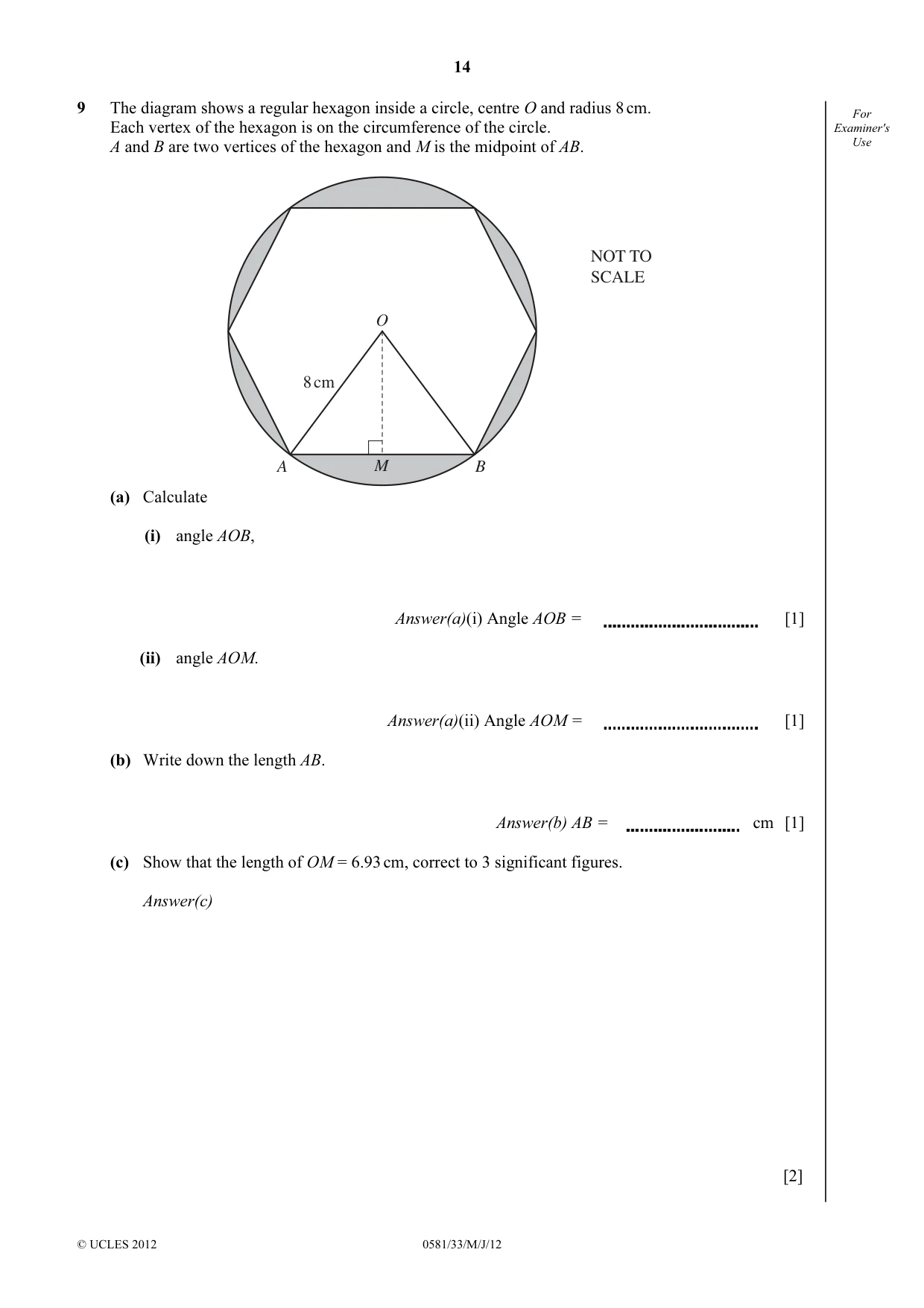
14 © UCLES 2012 0581/33/M/J/12 For Examiner's Use 9 The diagram shows a regular hexagon inside a circle, centre O and radius 8 cm. Each vertex of the hexagon is on the circumference of the circle. A and B are two vertices of the hexagon and M is the midpoint of AB. O A B M 8 cm NOT TO SCALE (a) Calculate (i) angle AOB, Answer(a)(i) Angle AOB = [1] (ii) angle AOM. Answer(a)(ii) Angle AOM = [1] (b) Write down the length AB. Answer(b) AB = cm [1] (c) Show that the length of OM = 6.93 cm, correct to 3 significant figures. Answer(c) [2]
Question paper, page 15
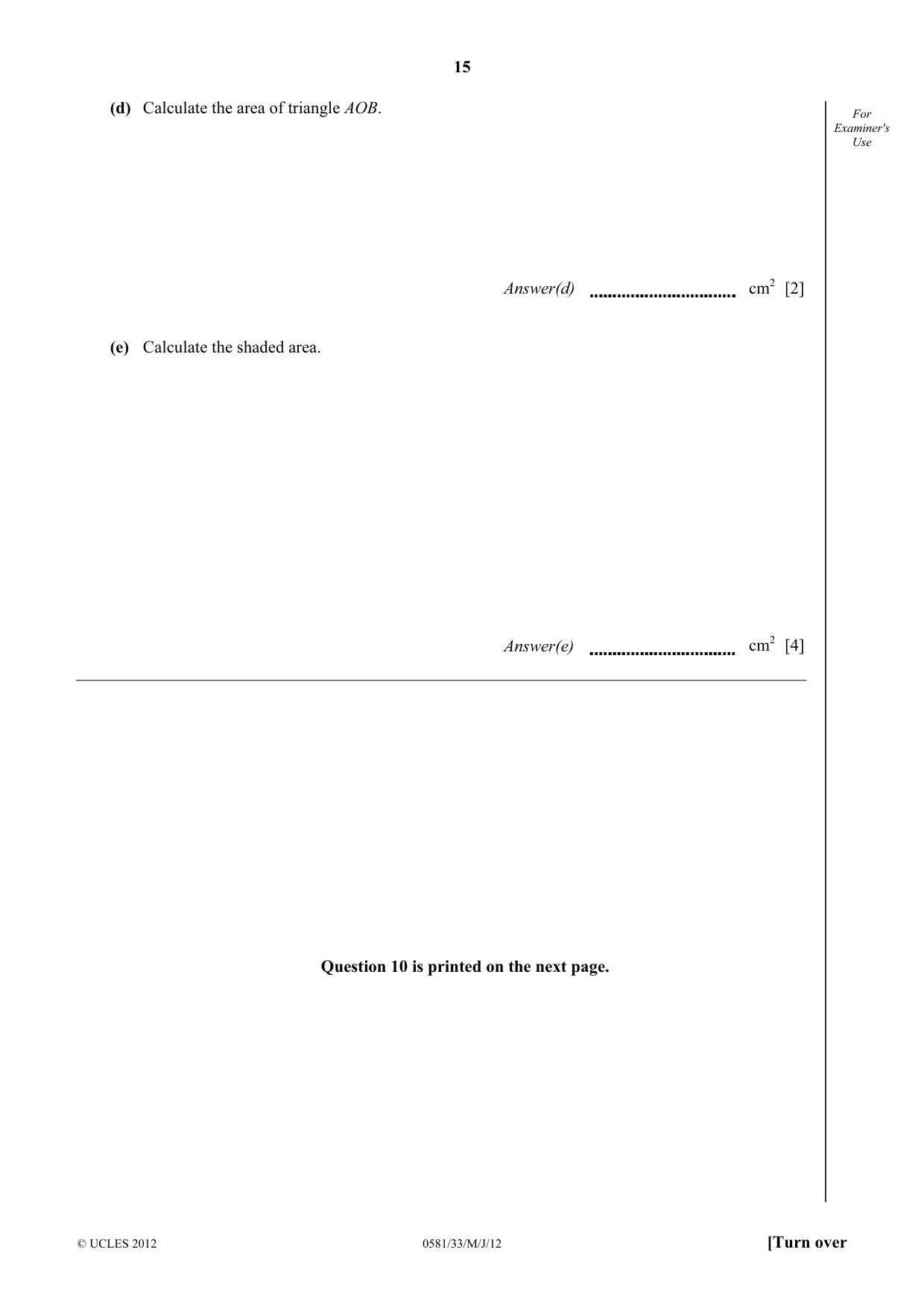
15 © UCLES 2012 0581/33/M/J/12 [Turn over For Examiner's Use (d) Calculate the area of triangle AOB. Answer(d) cm2 [2] (e) Calculate the shaded area. Answer(e) cm2 [4] Question 10 is printed on the next page.
Question paper, page 16
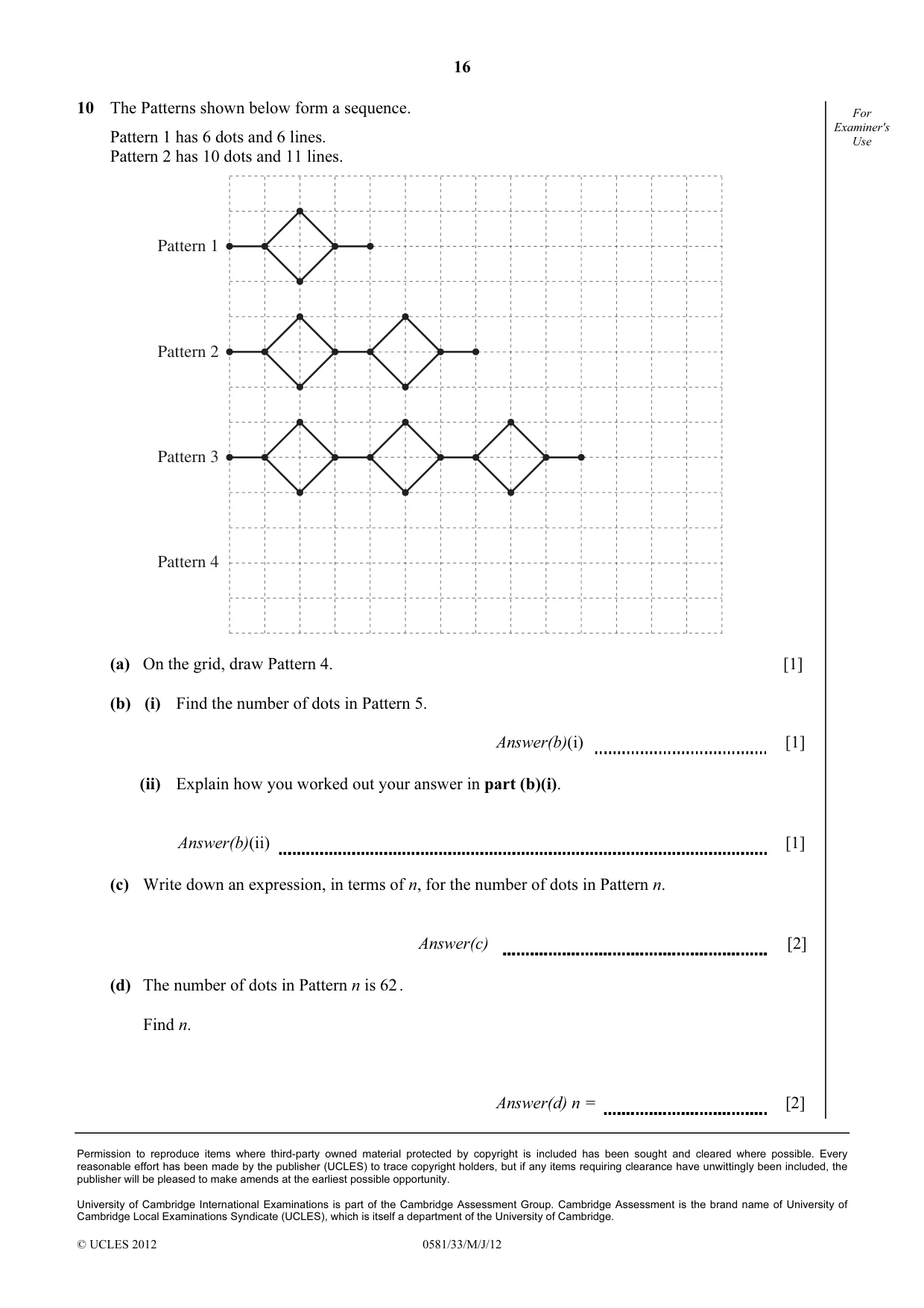
16 Permission to reproduce items where third-party owned material protected by copyright is included has been sought and cleared where possible. Every reasonable effort has been made by the publisher (UCLES) to trace copyright holders, but if any items requiring clearance have unwittingly been included, the publisher will be pleased to make amends at the earliest possible opportunity. University of Cambridge International Examinations is part of the Cambridge Assessment Group. Cambridge Assessment is the brand name of University of Cambridge Local Examinations Syndicate (UCLES), which is itself a department of the University of Cambridge. © UCLES 2012 0581/33/M/J/12 For Examiner's Use 10 The Patterns shown below form a sequence. Pattern 1 has 6 dots and 6 lines. Pattern 2 has 10 dots and 11 lines. Pattern 1 Pattern 2 Pattern 3 Pattern 4 (a) On the grid, draw Pattern 4. [1] (b) (i) Find the number of dots in Pattern 5. Answer(b)(i) [1] (ii) Explain how you worked out your answer in part (b)(i). Answer(b)(ii) [1] (c) Write down an expression, in terms of n, for the number of dots in Pattern n. Answer(c) [2] (d) The number of dots in Pattern n is 62 . Find n. Answer(d) n = [2]
Mark scheme, page 1
UNIVERSITY OF CAMBRIDGE INTERNATIONAL EXAMINATIONS International General Certificate of Secondary Education MARK SCHEME for the May/June 2012 question paper for the guidance of teachers 0581 MATHEMATICS 0581/33 Paper 3 (Core), maximum raw mark 104 This mark scheme is published as an aid to teachers and candidates, to indicate the requirements of the examination. It shows the basis on which Examiners were instructed to award marks. It does not indicate the details of the discussions that took place at an Examiners’ meeting before marking began, which would have considered the acceptability of alternative answers. Mark schemes must be read in conjunction with the question papers and the report on the examination. • Cambridge will not enter into discussions or correspondence in connection with these mark schemes. Cambridge is publishing the mark schemes for the May/June 2012 question papers for most IGCSE, GCE Advanced Level and Advanced Subsidiary Level syllabuses and some Ordinary Level syllabuses. www.XtremePapers.com
Mark scheme, page 2
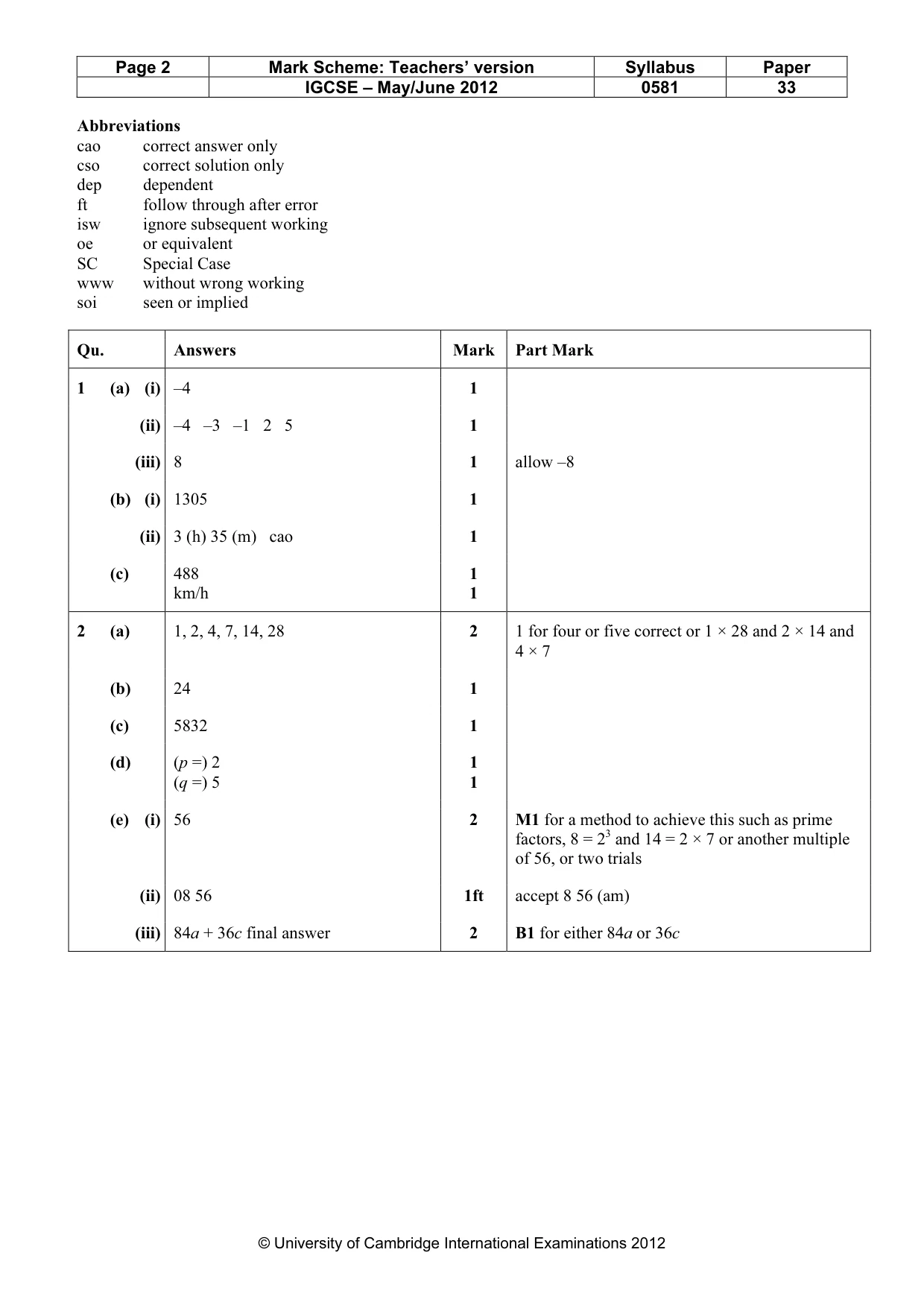
Page 2 Mark Scheme: Teachers’ version Syllabus Paper IGCSE – May/June 2012 0581 33 © University of Cambridge International Examinations 2012 Abbreviations cao correct answer only cso correct solution only dep dependent ft follow through after error isw ignore subsequent working oe or equivalent SC Special Case www without wrong working soi seen or implied Qu. Answers Mark Part Mark 1 (a) (i) –4 1 (ii) –4 –3 –1 2 5 1 (iii) 8 1 allow –8 (b) (i) 1305 1 (ii) 3 (h) 35 (m) cao 1 (c) 488 km/h 1 1 2 (a) 1, 2, 4, 7, 14, 28 2 1 for four or five correct or 1 × 28 and 2 × 14 and 4 × 7 (b) 24 1 (c) 5832 1 (d) (p =) 2 (q =) 5 1 1 (e) (i) 56 2 M1 for a method to achieve this such as prime factors, 8 = 23 and 14 = 2 × 7 or another multiple of 56, or two trials (ii) 08 56 1ft accept 8 56 (am) (iii) 84a + 36c final answer 2 B1 for either 84a or 36c
Mark scheme, page 3
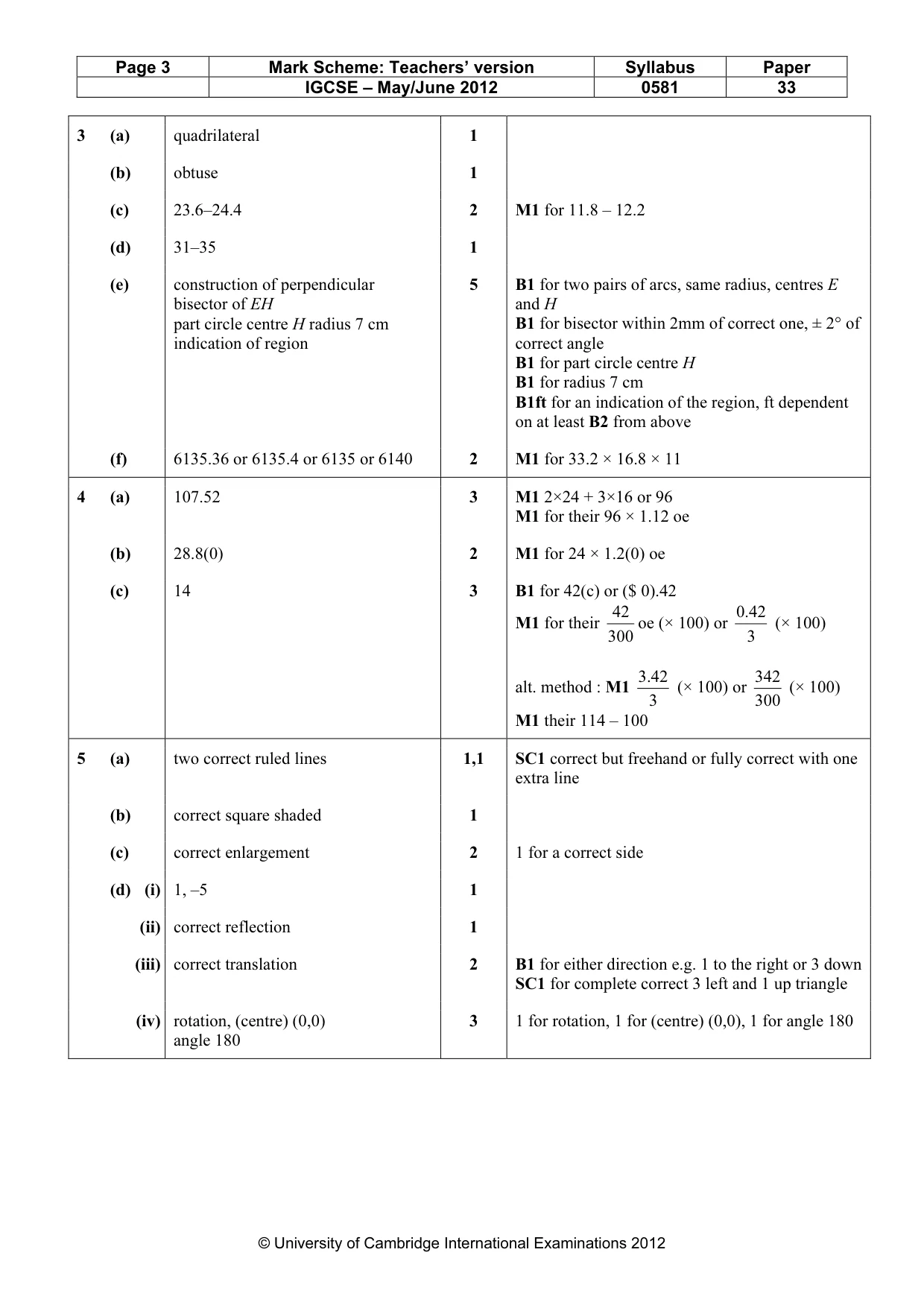
Page 3 Mark Scheme: Teachers’ version Syllabus Paper IGCSE – May/June 2012 0581 33 © University of Cambridge International Examinations 2012 3 (a) quadrilateral 1 (b) obtuse 1 (c) 23.6–24.4 2 M1 for 11.8 – 12.2 (d) 31–35 1 (e) construction of perpendicular bisector of EH part circle centre H radius 7 cm indication of region 5 B1 for two pairs of arcs, same radius, centres E and H B1 for bisector within 2mm of correct one, ± 2° of correct angle B1 for part circle centre H B1 for radius 7 cm B1ft for an indication of the region, ft dependent on at least B2 from above (f) 6135.36 or 6135.4 or 6135 or 6140 2 M1 for 33.2 × 16.8 × 11 4 (a) 107.52 3 M1 2×24 + 3×16 or 96 M1 for their 96 × 1.12 oe (b) 28.8(0) 2 M1 for 24 × 1.2(0) oe (c) 14 3 B1 for 42(c) or ($ 0).42 M1 for their 300 42 oe (× 100) or 3 42 .0 (× 100) alt. method : M1 3 42 .3 (× 100) or 300 342 (× 100) M1 their 114 – 100 5 (a) two correct ruled lines 1,1 SC1 correct but freehand or fully correct with one extra line (b) correct square shaded 1 (c) correct enlargement 2 1 for a correct side (d) (i) 1, –5 1 (ii) correct reflection 1 (iii) correct translation 2 B1 for either direction e.g. 1 to the right or 3 down SC1 for complete correct 3 left and 1 up triangle (iv) rotation, (centre) (0,0) angle 180 3 1 for rotation, 1 for (centre) (0,0), 1 for angle 180
Mark scheme, page 4
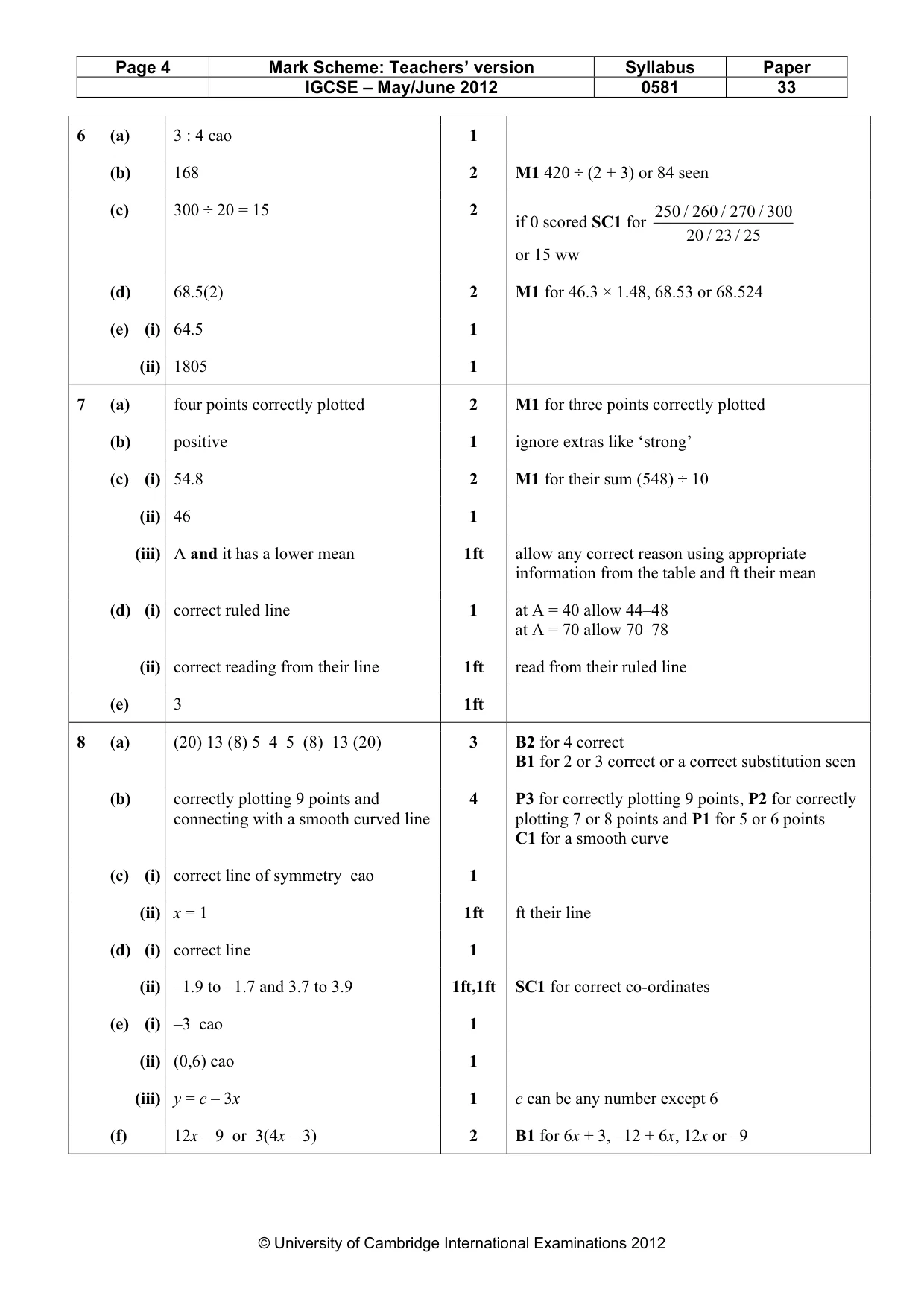
Page 4 Mark Scheme: Teachers’ version Syllabus Paper IGCSE – May/June 2012 0581 33 © University of Cambridge International Examinations 2012 6 (a) 3 : 4 cao 1 (b) 168 2 M1 420 ÷ (2 + 3) or 84 seen (c) 300 ÷ 20 = 15 2 if 0 scored SC1 for 250 / 260 / 270 / 300 20 / 23 / 25 or 15 ww (d) 68.5(2) 2 M1 for 46.3 × 1.48, 68.53 or 68.524 (e) (i) 64.5 1 (ii) 1805 1 7 (a) four points correctly plotted 2 M1 for three points correctly plotted (b) positive 1 ignore extras like ‘strong’ (c) (i) 54.8 2 M1 for their sum (548) ÷ 10 (ii) 46 1 (iii) A and it has a lower mean 1ft allow any correct reason using appropriate information from the table and ft their mean (d) (i) correct ruled line 1 at A = 40 allow 44–48 at A = 70 allow 70–78 (ii) correct reading from their line 1ft read from their ruled line (e) 3 1ft 8 (a) (20) 13 (8) 5 4 5 (8) 13 (20) 3 B2 for 4 correct B1 for 2 or 3 correct or a correct substitution seen (b) correctly plotting 9 points and connecting with a smooth curved line 4 P3 for correctly plotting 9 points, P2 for correctly plotting 7 or 8 points and P1 for 5 or 6 points C1 for a smooth curve (c) (i) correct line of symmetry cao 1 (ii) x = 1 1ft ft their line (d) (i) correct line 1 (ii) –1.9 to –1.7 and 3.7 to 3.9 1ft,1ft SC1 for correct co-ordinates (e) (i) –3 cao 1 (ii) (0,6) cao 1 (iii) y = c – 3x 1 c can be any number except 6 (f) 12x – 9 or 3(4x – 3) 2 B1 for 6x + 3, –12 + 6x, 12x or –9
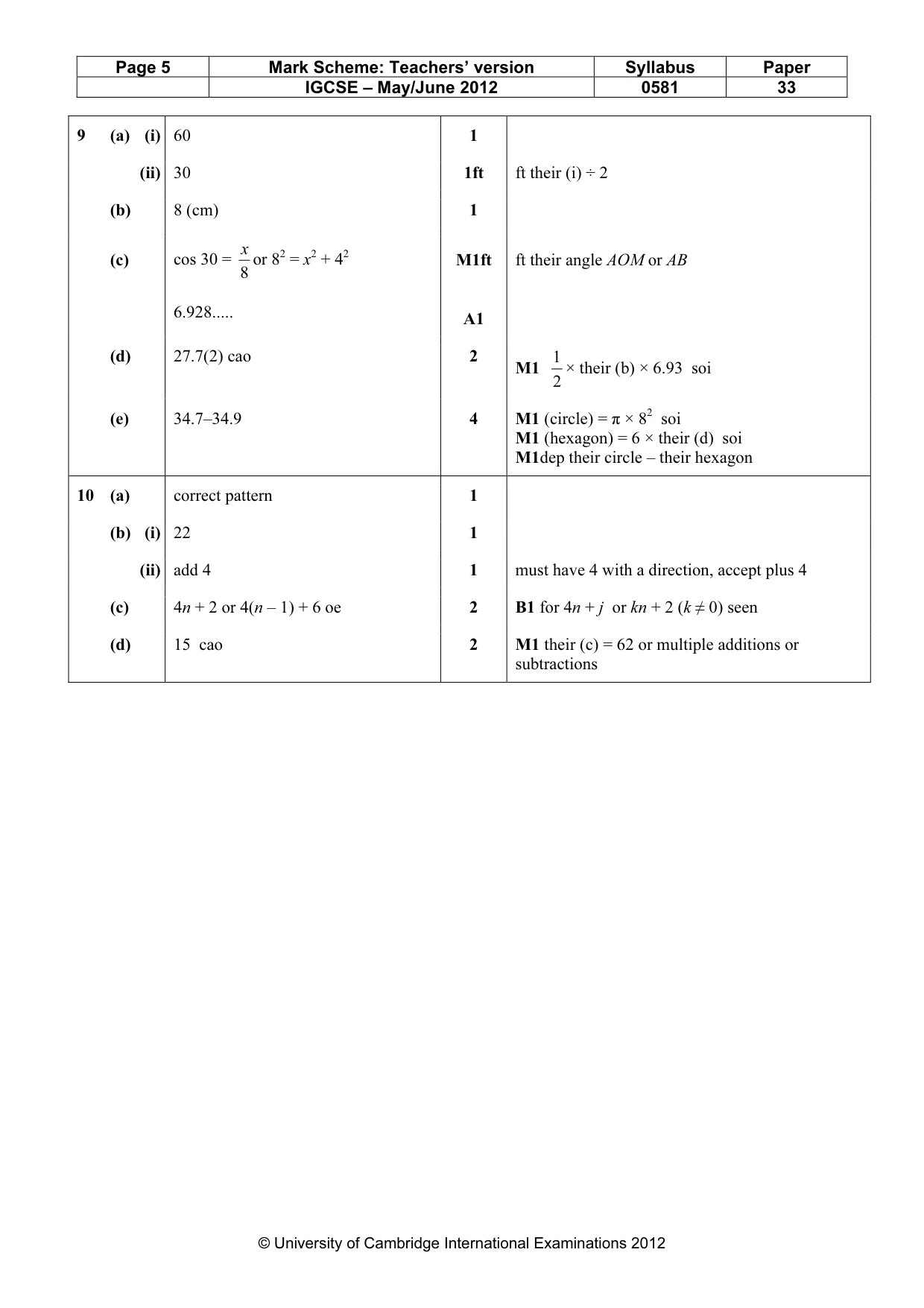
Mark scheme, page 5
Page 5 Mark Scheme: Teachers’ version Syllabus Paper IGCSE – May/June 2012 0581 33 © University of Cambridge International Examinations 2012 9 (a) (i) 60 1 (ii) 30 1ft ft their (i) ÷ 2 (b) 8 (cm) 1 (c) cos 30 = 8 x or 82 = x2 + 42 6.928… M1ft A1 ft their angle AOM or AB (d) 27.7(2) cao 2 M1 1 2 × their (b) × 6.93 soi (e) 34.7–34.9 4 M1 (circle) = π × 82 soi M1 (hexagon) = 6 × their (d) soi M1dep their circle – their hexagon 10 (a) correct pattern 1 (b) (i) 22 1 (ii) add 4 1 must have 4 with a direction, accept plus 4 (c) 4n + 2 or 4(n – 1) + 6 oe 2 B1 for 4n + j or kn + 2 (k ≠ 0) seen (d) 15 cao 2 M1 their (c) = 62 or multiple additions or subtractions
What you needed in this session
Cambridge’s own grade thresholds for 2012 May/June, Paper 3 · Variant 3. A higher threshold means an easier paper — the bar moves with how the cohort did.