Cambridge IGCSE Mathematics (with coursework) 0581 — 2011 May/June Paper 3 · Variant 2
0581/32/M/J/11 · 104 marks · ≈117 min
The question paper and its mark scheme, free to read here and free to download. This is Cambridge’s own paper, exactly as it was sat.
Question paper16 pages
Mark scheme5 pages
Answers below. Sit the paper first if you are practising.
Paper as text
Question paper, page 1
This document consists of 16 printed pages. IB11 06_0581_32/FP © UCLES 2011 [Turn over *3681151018* UNIVERSITY OF CAMBRIDGE INTERNATIONAL EXAMINATIONS International General Certificate of Secondary Education MATHEMATICS 0581/32 Paper 3 (Core) May/June 2011 2 hours Candidates answer on the Question Paper. Additional Materials: Electronic calculator Geometrical instruments Mathematical tables (optional) Tracing paper (optional) READ THESE INSTRUCTIONS FIRST Write your Centre number, candidate number and name on all the work you hand in. Write in dark blue or black pen. You may use a pencil for any diagrams or graphs. Do not use staples, paper clips, highlighters, glue or correction fluid. DO NOT WRITE IN ANY BARCODES. Answer all questions. If working is needed for any question it must be shown below that question. Electronic calculators should be used. If the degree of accuracy is not specified in the question, and if the answer is not exact, give the answer to three significant figures. Give answers in degrees to one decimal place. For π , use either your calculator value or 3.142. At the end of the examination, fasten all your work securely together. The number of marks is given in brackets [ ] at the end of each question or part question. The total of the marks for this paper is 104. www.XtremePapers.com
Question paper, page 2
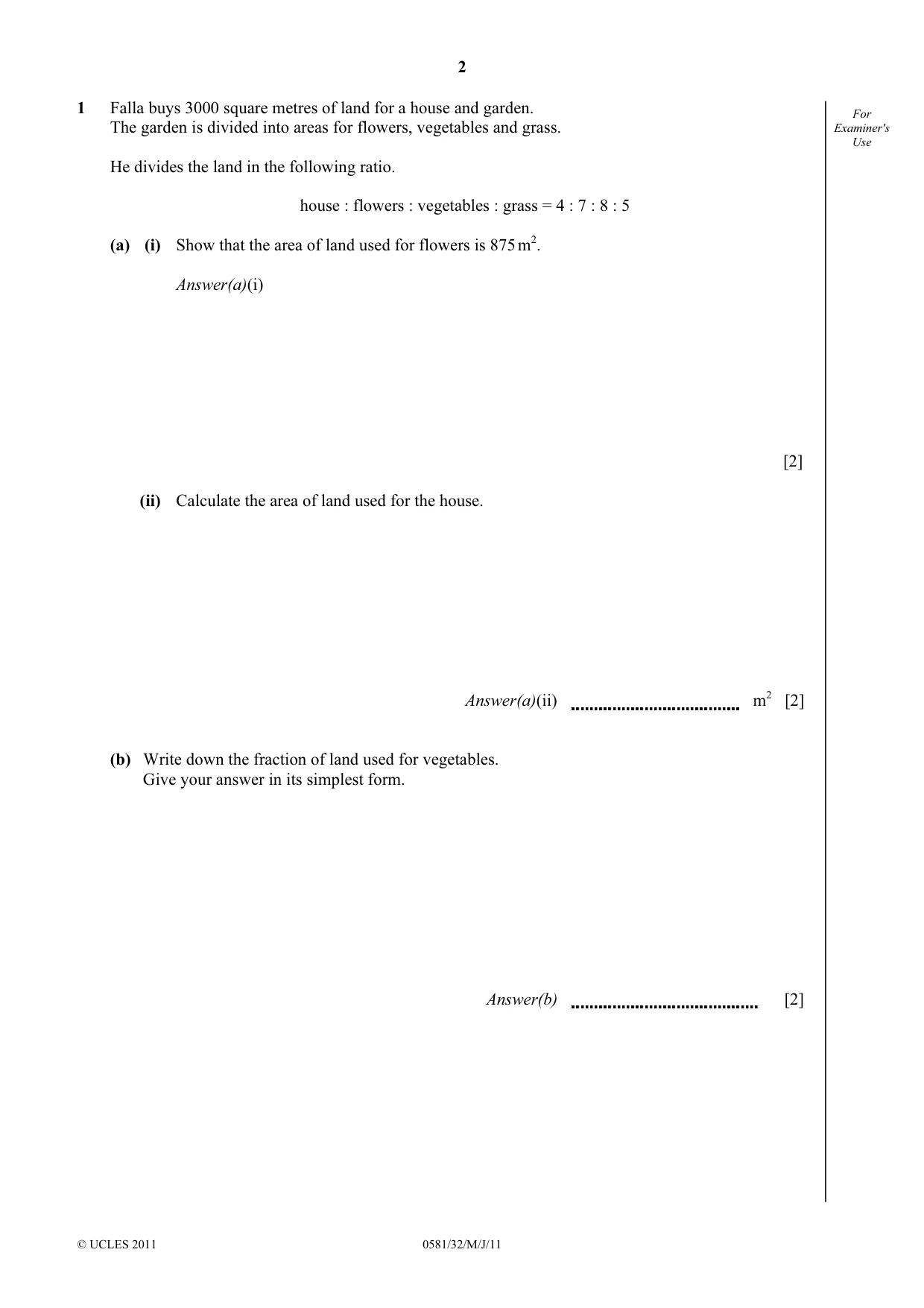
2 © UCLES 2011 0581/32/M/J/11 For Examiner's Use 1 Falla buys 3000 square metres of land for a house and garden. The garden is divided into areas for flowers, vegetables and grass. He divides the land in the following ratio. house : flowers : vegetables : grass = 4 : 7 : 8 : 5 (a) (i) Show that the area of land used for flowers is 875 m2. Answer(a)(i) [2] (ii) Calculate the area of land used for the house. Answer(a)(ii) m2 [2] (b) Write down the fraction of land used for vegetables. Give your answer in its simplest form. Answer(b) [2]
Question paper, page 3
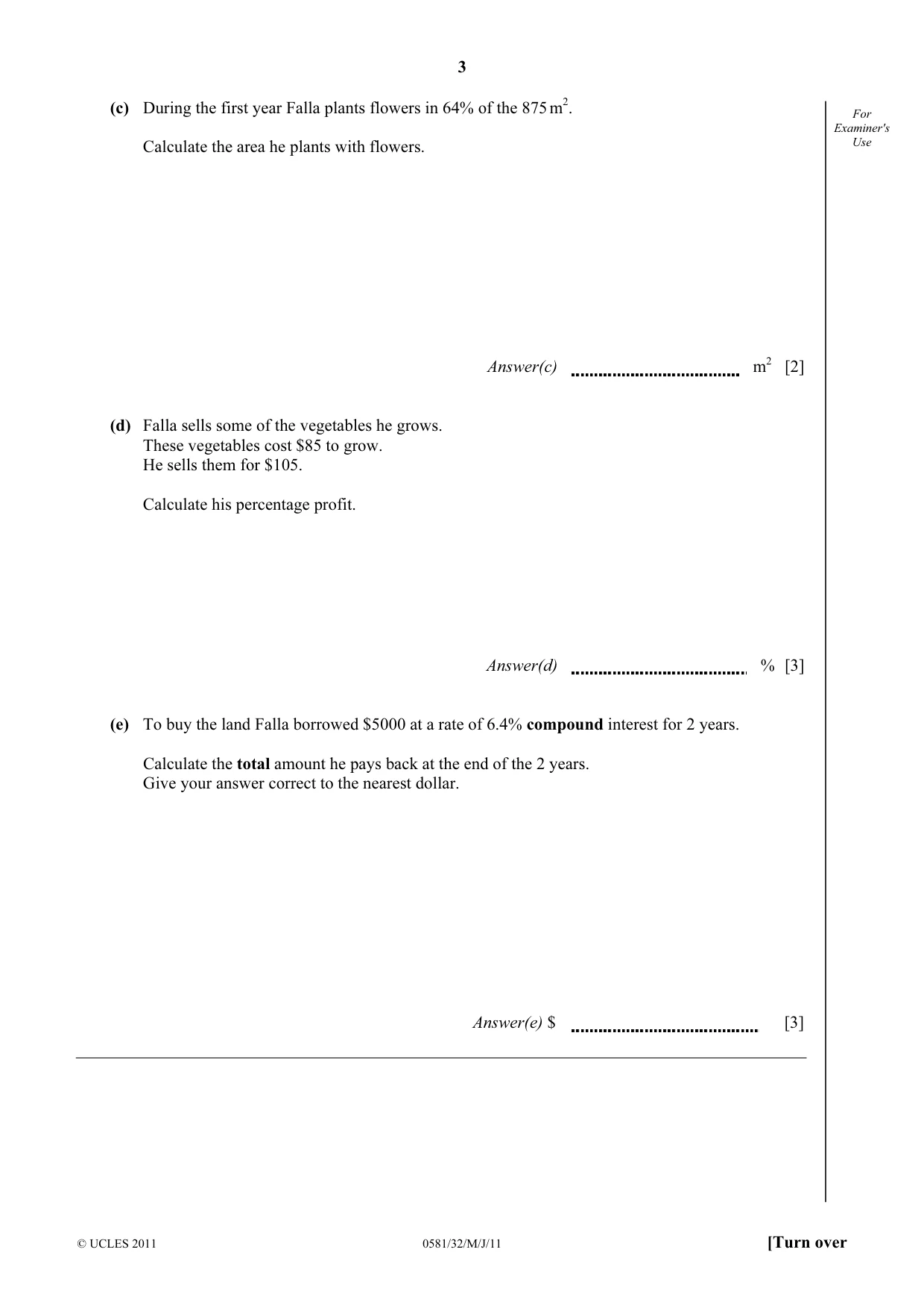
3 © UCLES 2011 0581/32/M/J/11 [Turn over For Examiner's Use (c) During the first year Falla plants flowers in 64% of the 875 m2. Calculate the area he plants with flowers. Answer(c) m2 [2] (d) Falla sells some of the vegetables he grows. These vegetables cost $85 to grow. He sells them for $105. Calculate his percentage profit. Answer(d) % [3] (e) To buy the land Falla borrowed $5000 at a rate of 6.4% compound interest for 2 years. Calculate the total amount he pays back at the end of the 2 years. Give your answer correct to the nearest dollar. Answer(e) $ [3]
Question paper, page 4
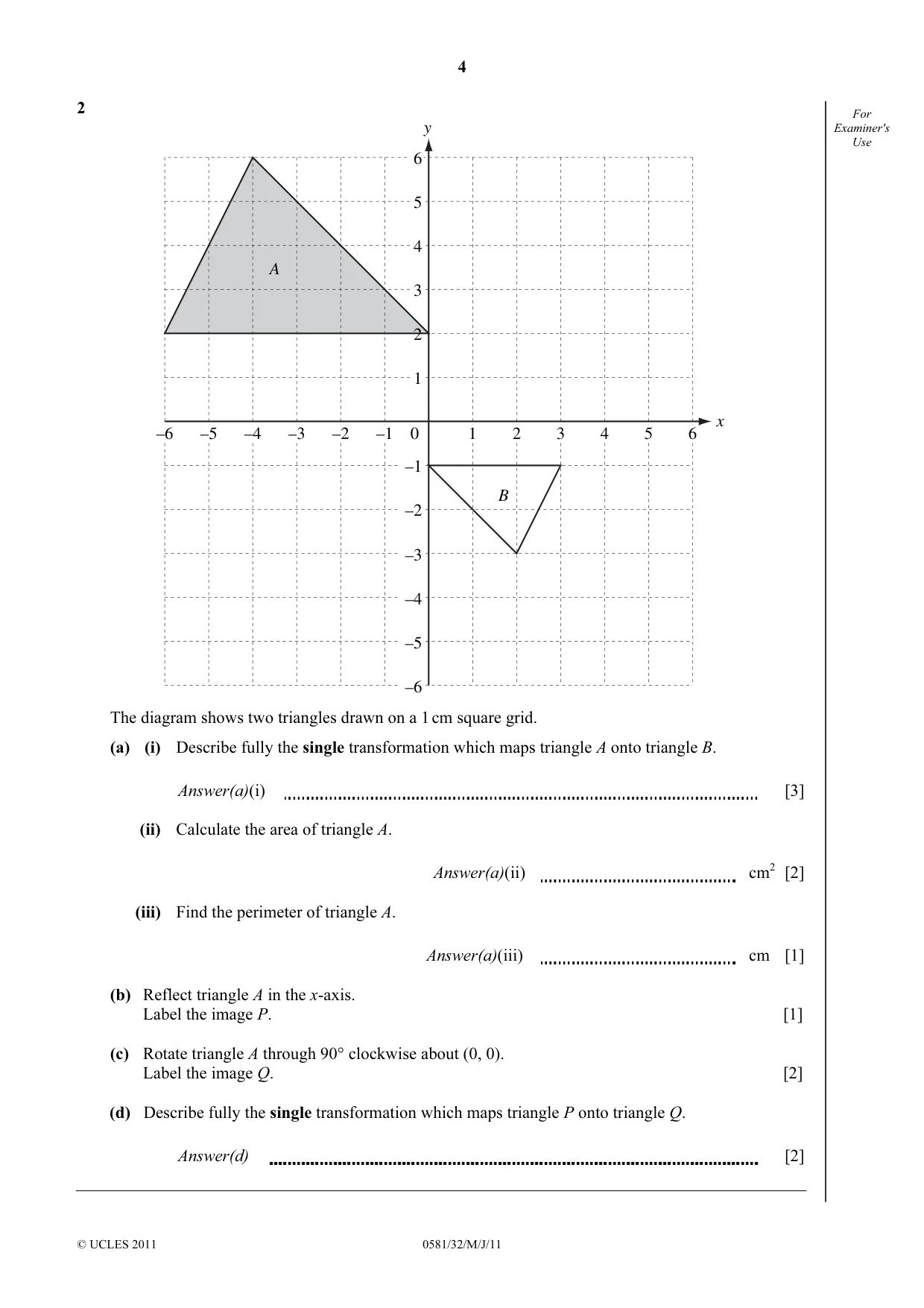
4 © UCLES 2011 0581/32/M/J/11 For Examiner's Use 2 A B 6 5 4 3 2 1 –1 –2 –3 –4 –5 –6 –5 –6 –4 –3 –2 –1 1 0 2 3 4 5 6 y x The diagram shows two triangles drawn on a 1 cm square grid. (a) (i) Describe fully the single transformation which maps triangle A onto triangle B. Answer(a)(i) [3] (ii) Calculate the area of triangle A. Answer(a)(ii) cm2 [2] (iii) Find the perimeter of triangle A. Answer(a)(iii) cm [1] (b) Reflect triangle A in the x-axis. Label the image P. [1] (c) Rotate triangle A through 90° clockwise about (0, 0). Label the image Q. [2] (d) Describe fully the single transformation which maps triangle P onto triangle Q. Answer(d) [2]
Question paper, page 5
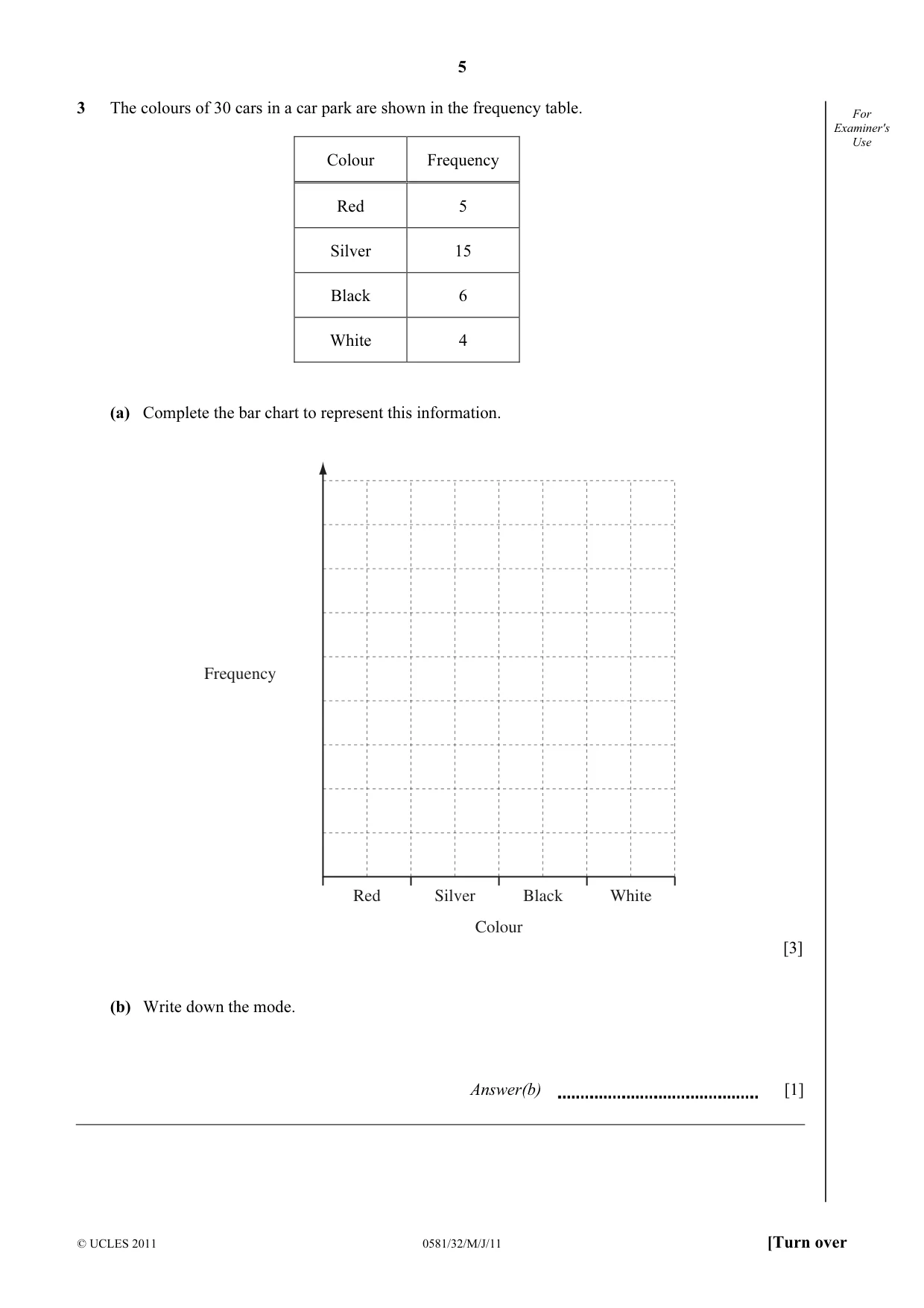
5 © UCLES 2011 0581/32/M/J/11 [Turn over For Examiner's Use 3 The colours of 30 cars in a car park are shown in the frequency table. Colour Frequency Red 5 Silver 15 Black 6 White 4 (a) Complete the bar chart to represent this information. Frequency Colour Red Silver Black White [3] (b) Write down the mode. Answer(b) [1]
Question paper, page 6
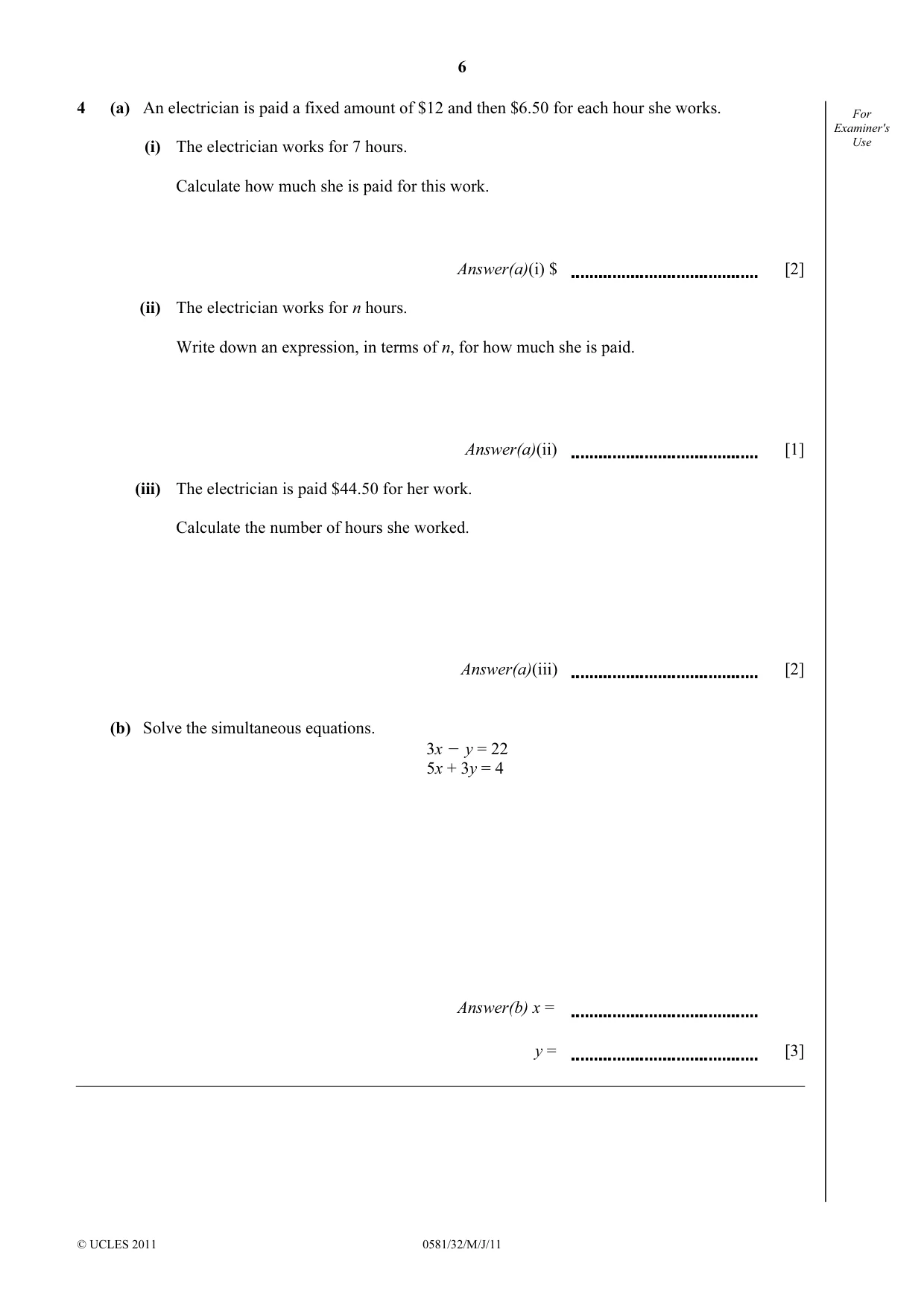
6 © UCLES 2011 0581/32/M/J/11 For Examiner's Use 4 (a) An electrician is paid a fixed amount of $12 and then $6.50 for each hour she works. (i) The electrician works for 7 hours. Calculate how much she is paid for this work. Answer(a)(i) $ [2] (ii) The electrician works for n hours. Write down an expression, in terms of n, for how much she is paid. Answer(a)(ii) [1] (iii) The electrician is paid $44.50 for her work. Calculate the number of hours she worked. Answer(a)(iii) [2] (b) Solve the simultaneous equations. 3x O y = 22 5x + 3y = 4 Answer(b) x = y = [3]
Question paper, page 7
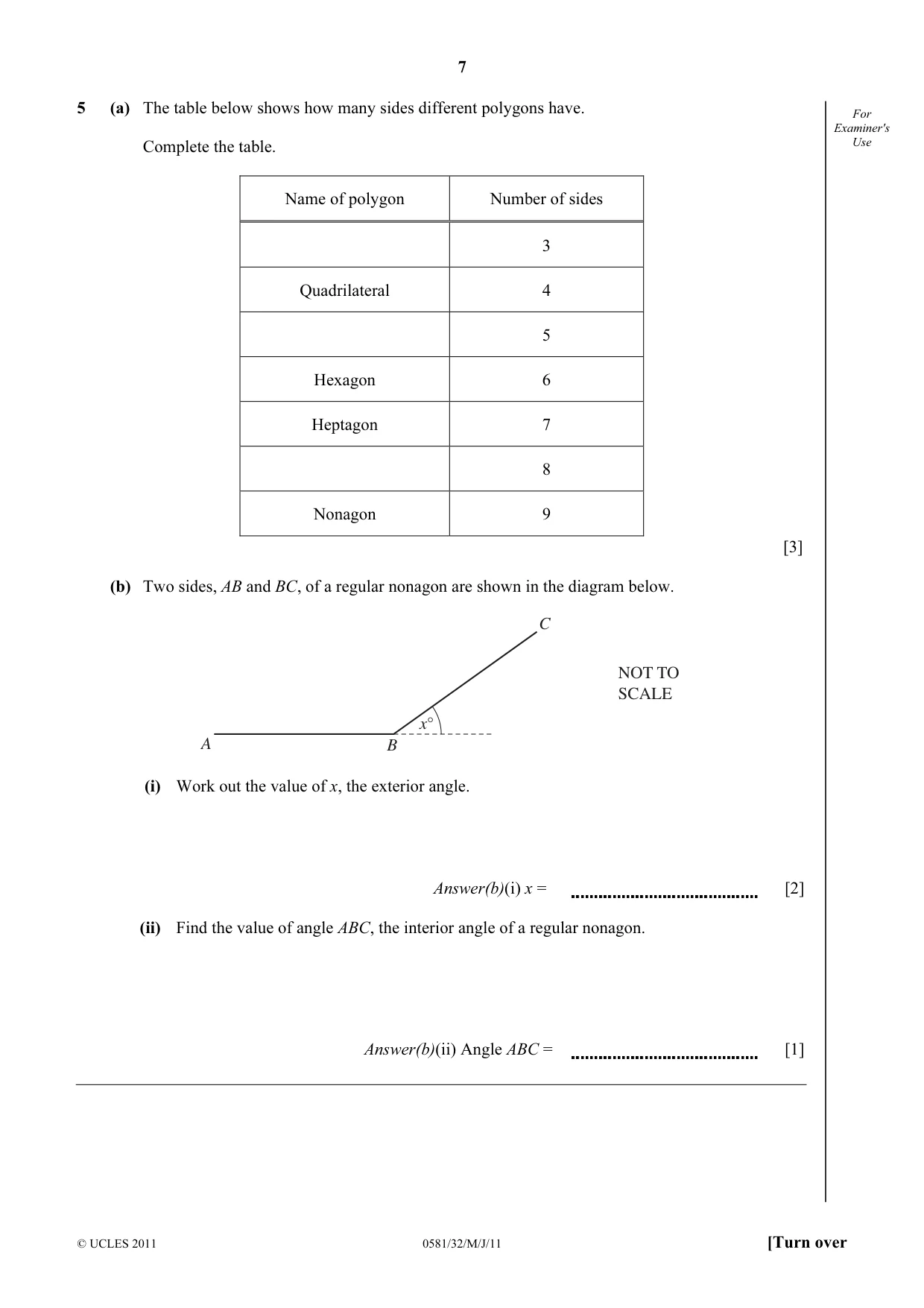
7 © UCLES 2011 0581/32/M/J/11 [Turn over For Examiner's Use 5 (a) The table below shows how many sides different polygons have. Complete the table. Name of polygon Number of sides 3 Quadrilateral 4 5 Hexagon 6 Heptagon 7 8 Nonagon 9 [3] (b) Two sides, AB and BC, of a regular nonagon are shown in the diagram below. x° A B C NOT TO SCALE (i) Work out the value of x, the exterior angle. Answer(b)(i) x = [2] (ii) Find the value of angle ABC, the interior angle of a regular nonagon. Answer(b)(ii) Angle ABC = [1]
Question paper, page 8
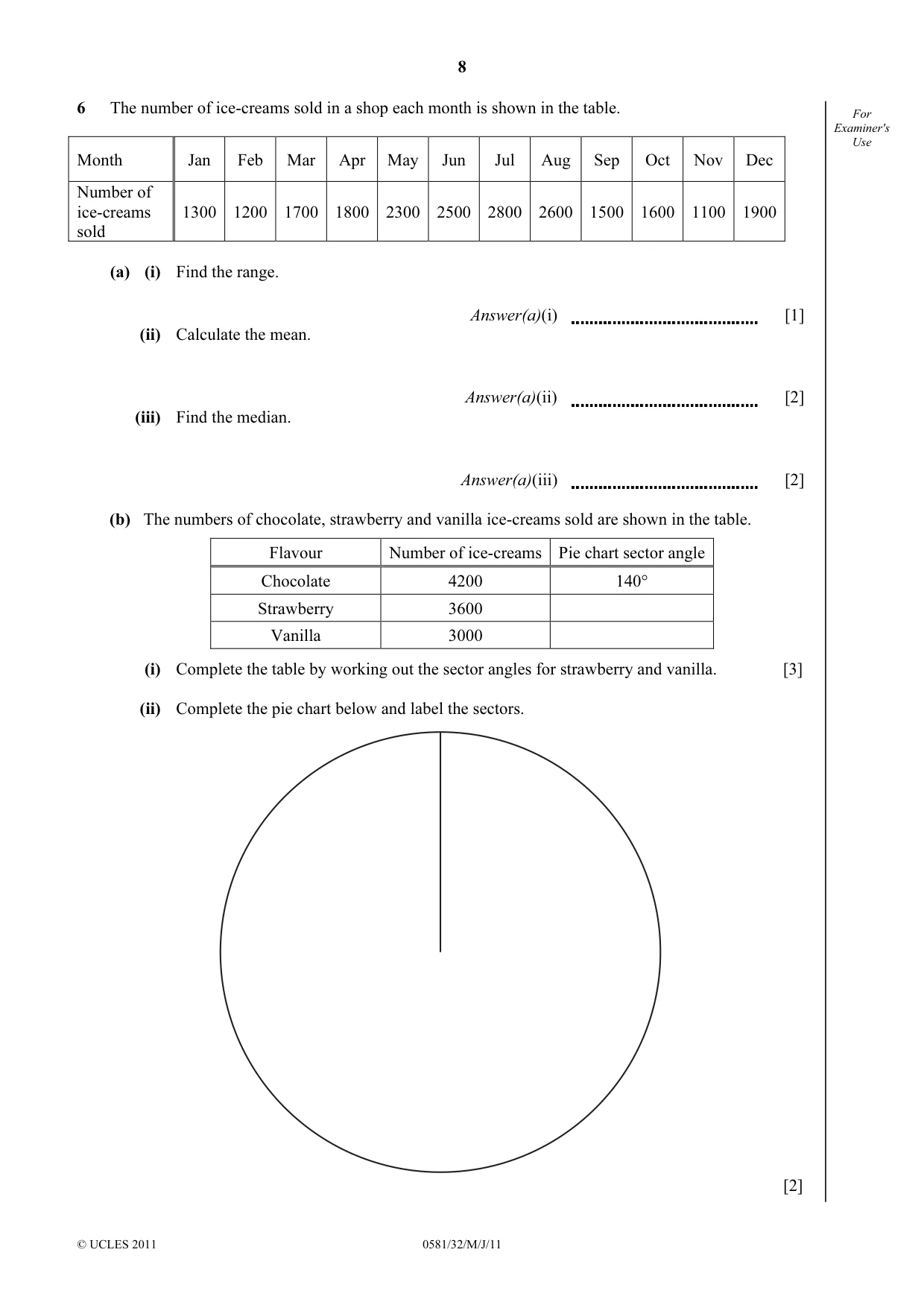
8 © UCLES 2011 0581/32/M/J/11 For Examiner's Use 6 The number of ice-creams sold in a shop each month is shown in the table. Month Jan Feb Mar Apr May Jun Jul Aug Sep Oct Nov Dec Number of ice-creams sold 1300 1200 1700 1800 2300 2500 2800 2600 1500 1600 1100 1900 (a) (i) Find the range. Answer(a)(i) [1] (ii) Calculate the mean. Answer(a)(ii) [2] (iii) Find the median. Answer(a)(iii) [2] (b) The numbers of chocolate, strawberry and vanilla ice-creams sold are shown in the table. Flavour Number of ice-creams Pie chart sector angle Chocolate 4200 140° Strawberry 3600 Vanilla 3000 (i) Complete the table by working out the sector angles for strawberry and vanilla. [3] (ii) Complete the pie chart below and label the sectors. [2]
Question paper, page 9
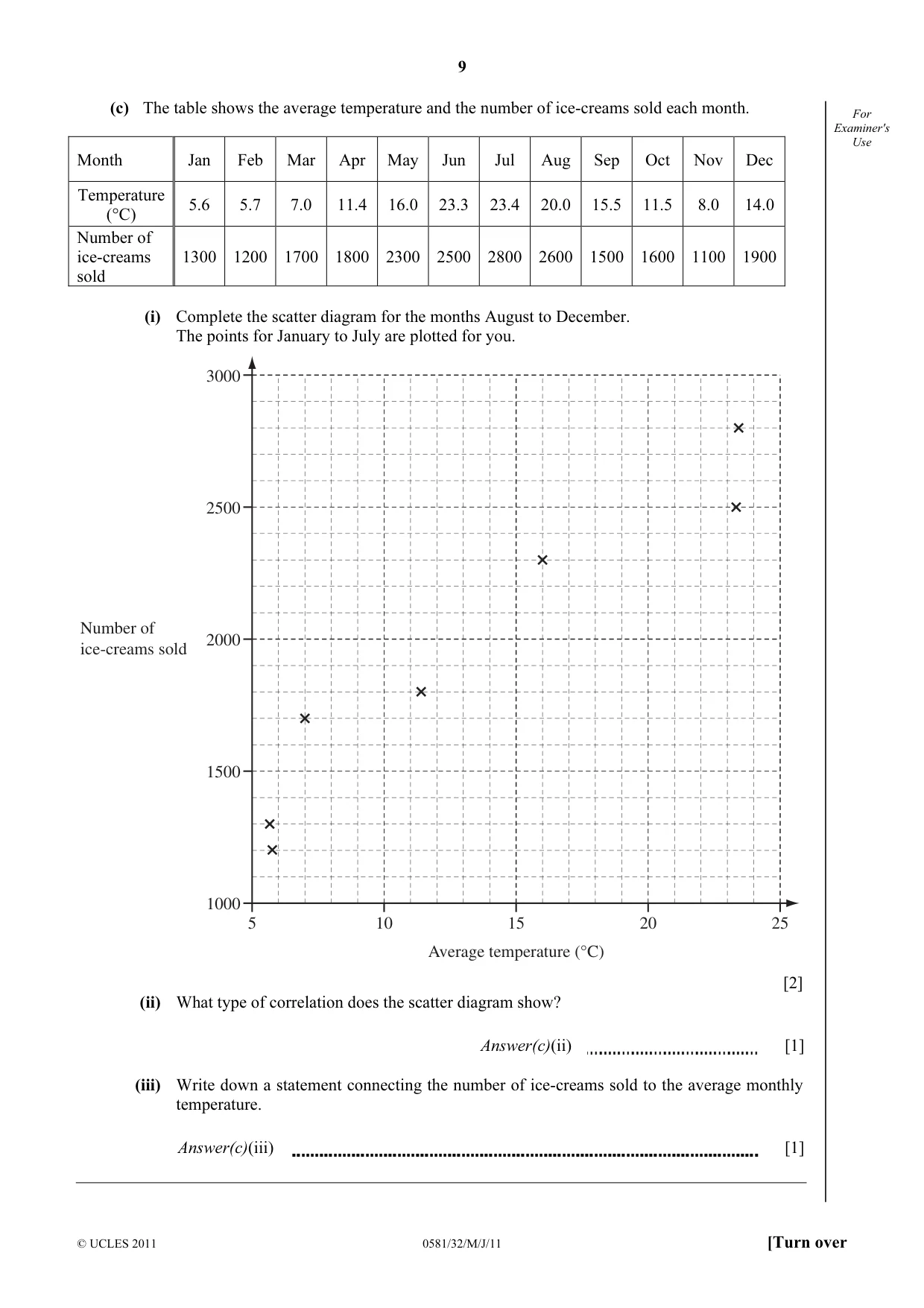
9 © UCLES 2011 0581/32/M/J/11 [Turn over For Examiner's Use (c) The table shows the average temperature and the number of ice-creams sold each month. Month Jan Feb Mar Apr May Jun Jul Aug Sep Oct Nov Dec Temperature (°C) 5.6 5.7 7.0 11.4 16.0 23.3 23.4 20.0 15.5 11.5 8.0 14.0 Number of ice-creams sold 1300 1200 1700 1800 2300 2500 2800 2600 1500 1600 1100 1900 (i) Complete the scatter diagram for the months August to December. The points for January to July are plotted for you. 3000 2500 2000 1500 1000 5 10 15 Average temperature (°C) 20 25 Number of ice-creams sold [2] (ii) What type of correlation does the scatter diagram show? Answer(c)(ii) [1] (iii) Write down a statement connecting the number of ice-creams sold to the average monthly temperature. Answer(c)(iii) [1]
Question paper, page 10
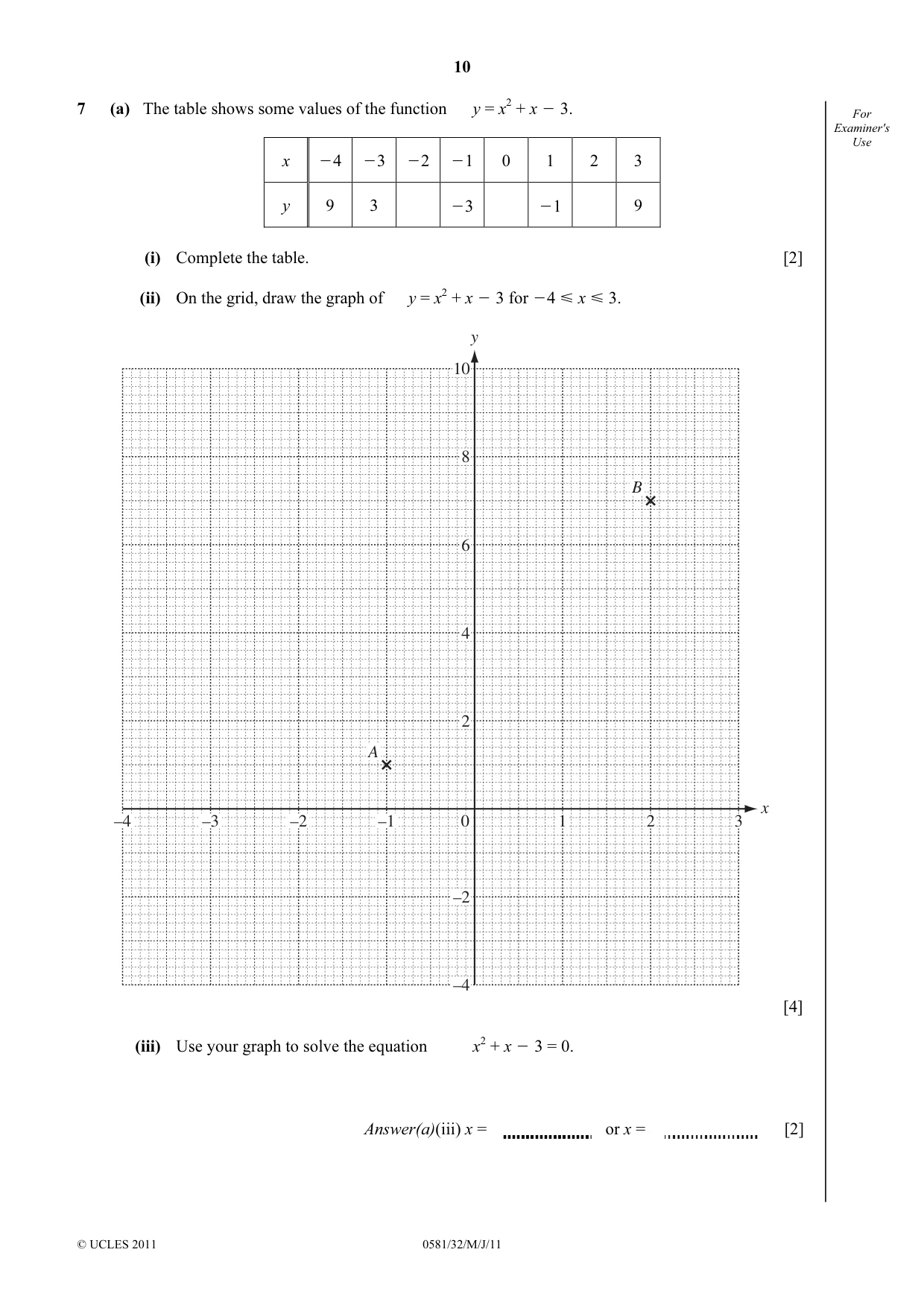
10 © UCLES 2011 0581/32/M/J/11 For Examiner's Use 7 (a) The table shows some values of the function y = x2 + x O 3. x O4 O3 O2 O1 0 1 2 3 y 9 3 O3 O1 9 (i) Complete the table. [2] (ii) On the grid, draw the graph of y = x2 + x O 3 for O4 Y x Y 3. y x 10 8 6 4 2 –2 –4 0 –1 1 2 3 –2 –3 –4 A B [4] (iii) Use your graph to solve the equation x2 + x O 3 = 0. Answer(a)(iii) x = or x = [2]
Question paper, page 11
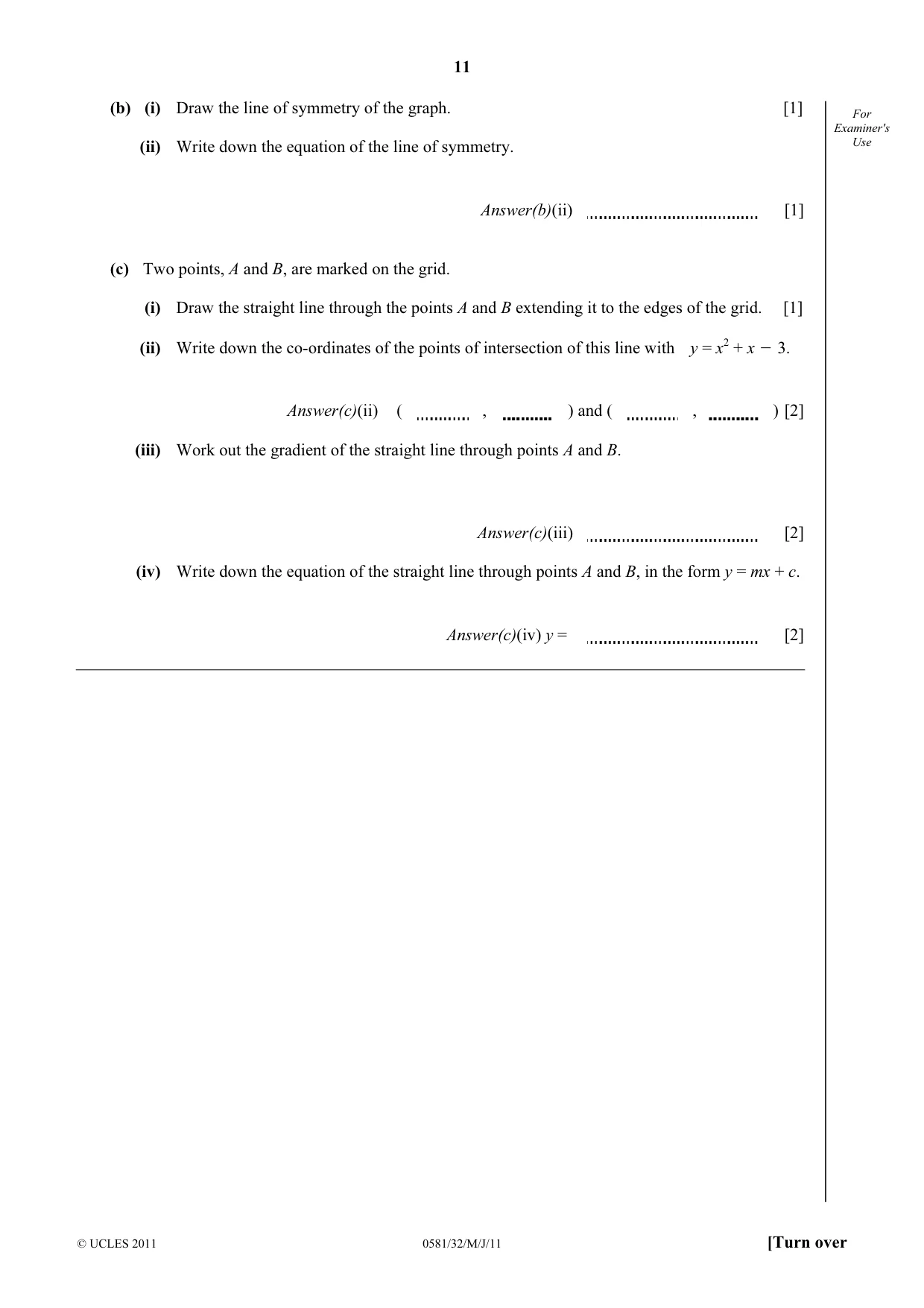
11 © UCLES 2011 0581/32/M/J/11 [Turn over For Examiner's Use (b) (i) Draw the line of symmetry of the graph. [1] (ii) Write down the equation of the line of symmetry. Answer(b)(ii) [1] (c) Two points, A and B, are marked on the grid. (i) Draw the straight line through the points A and B extending it to the edges of the grid. [1] (ii) Write down the co-ordinates of the points of intersection of this line with y = x2 + x O 3. Answer(c)(ii) ( , ) and ( , ) [2] (iii) Work out the gradient of the straight line through points A and B. Answer(c)(iii) [2] (iv) Write down the equation of the straight line through points A and B, in the form y = mx + c. Answer(c)(iv) y = [2]
Question paper, page 12
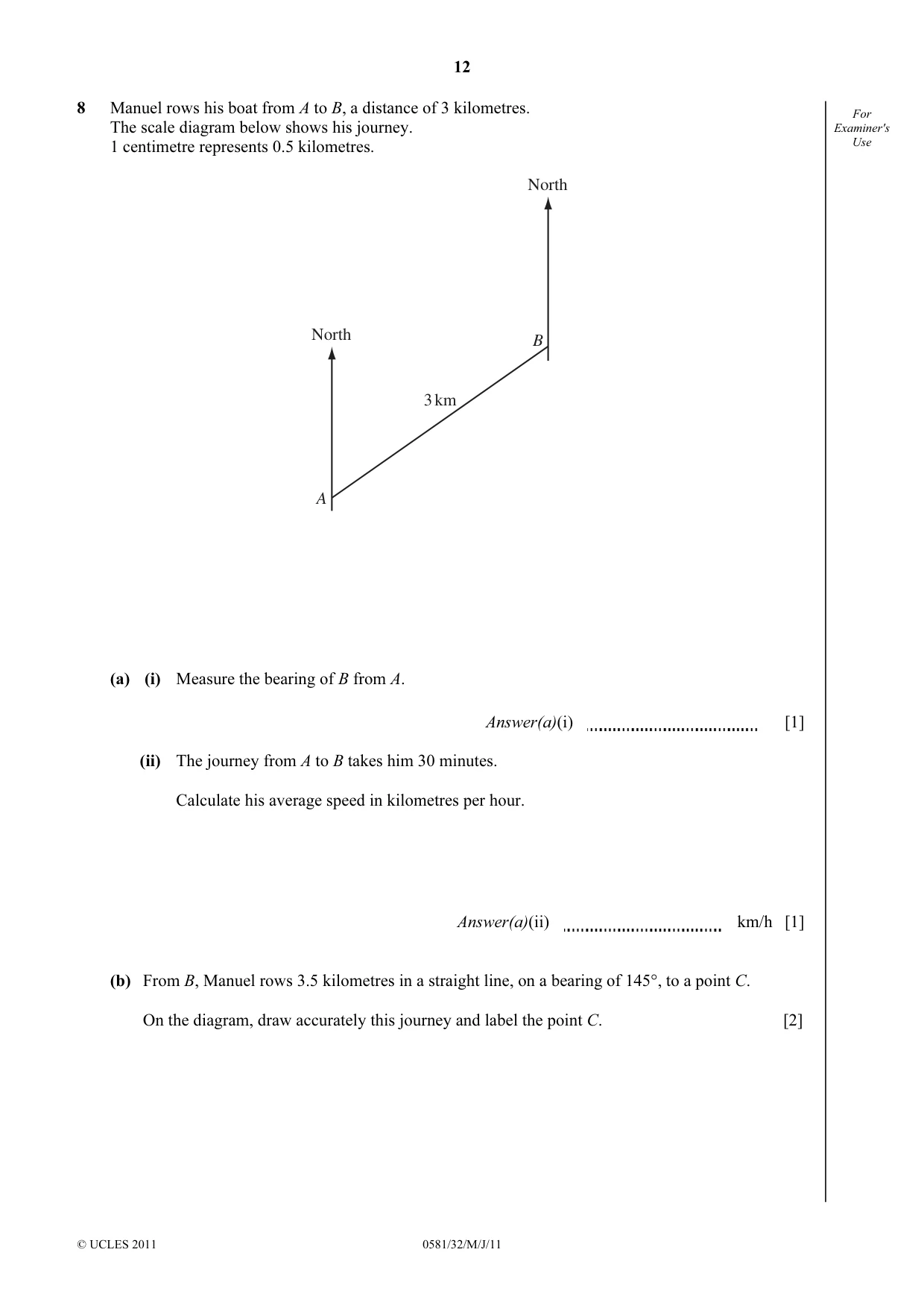
12 © UCLES 2011 0581/32/M/J/11 For Examiner's Use 8 Manuel rows his boat from A to B, a distance of 3 kilometres. The scale diagram below shows his journey. 1 centimetre represents 0.5 kilometres. North North A B 3 km (a) (i) Measure the bearing of B from A. Answer(a)(i) [1] (ii) The journey from A to B takes him 30 minutes. Calculate his average speed in kilometres per hour. Answer(a)(ii) km/h [1] (b) From B, Manuel rows 3.5 kilometres in a straight line, on a bearing of 145°, to a point C. On the diagram, draw accurately this journey and label the point C. [2]
Question paper, page 13
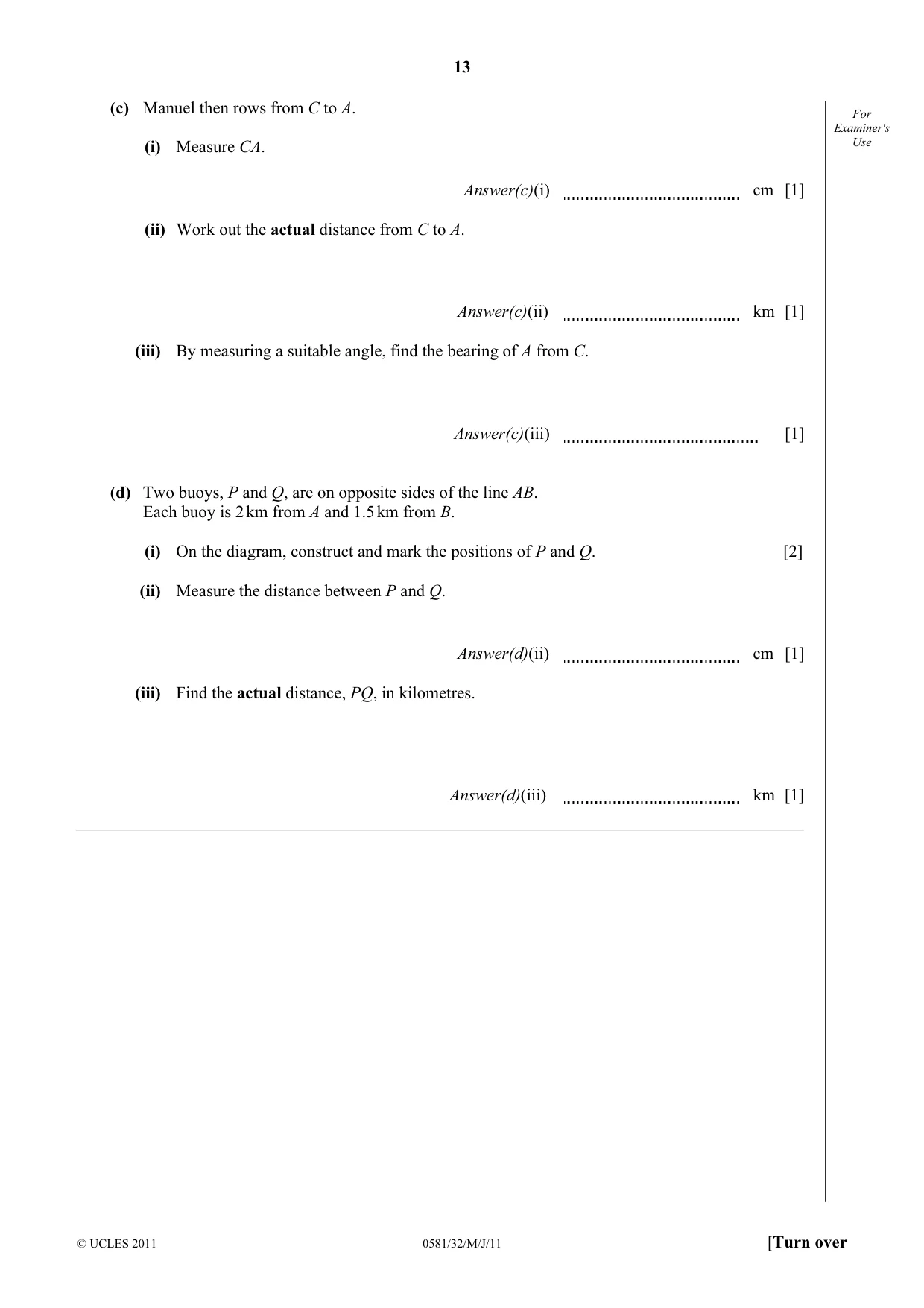
13 © UCLES 2011 0581/32/M/J/11 [Turn over For Examiner's Use (c) Manuel then rows from C to A. (i) Measure CA. Answer(c)(i) cm [1] (ii) Work out the actual distance from C to A. Answer(c)(ii) km [1] (iii) By measuring a suitable angle, find the bearing of A from C. Answer(c)(iii) [1] (d) Two buoys, P and Q, are on opposite sides of the line AB. Each buoy is 2 km from A and 1.5 km from B. (i) On the diagram, construct and mark the positions of P and Q. [2] (ii) Measure the distance between P and Q. Answer(d)(ii) cm [1] (iii) Find the actual distance, PQ, in kilometres. Answer(d)(iii) km [1]
Question paper, page 14
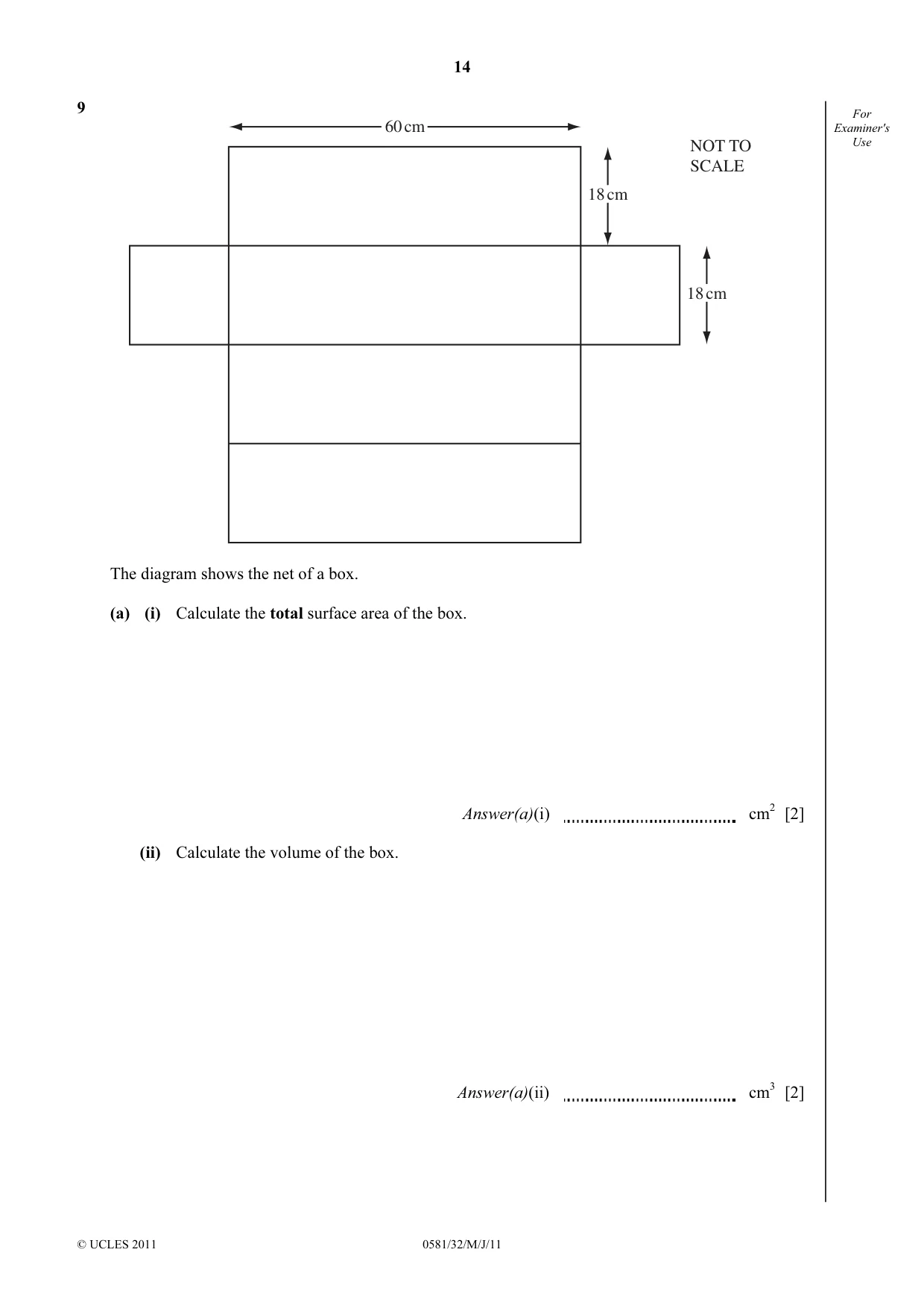
14 © UCLES 2011 0581/32/M/J/11 For Examiner's Use 9 60 cm 18 cm 18 cm NOT TO SCALE The diagram shows the net of a box. (a) (i) Calculate the total surface area of the box. Answer(a)(i) cm2 [2] (ii) Calculate the volume of the box. Answer(a)(ii) cm3 [2]
Question paper, page 15
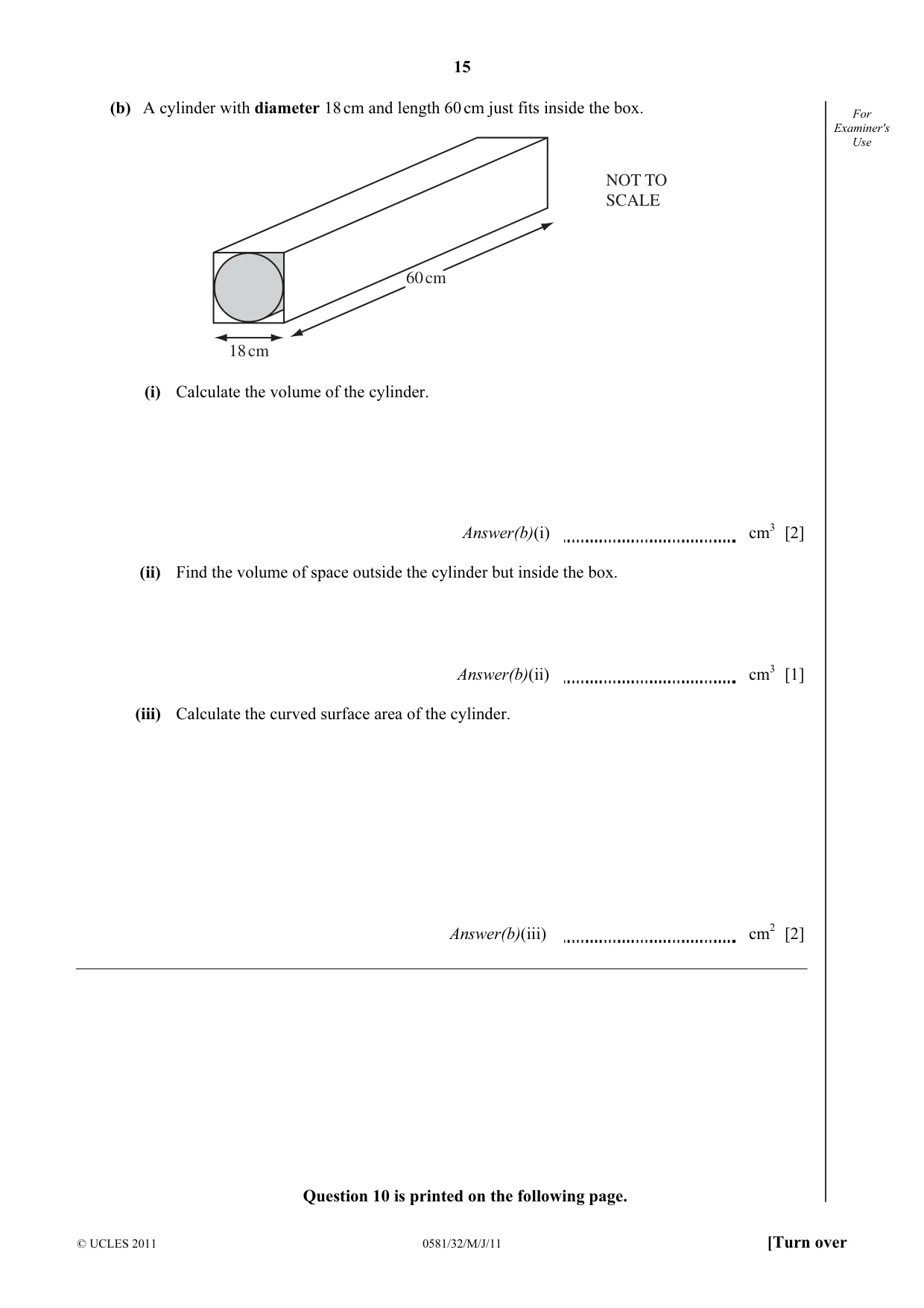
15 © UCLES 2011 0581/32/M/J/11 [Turn over For Examiner's Use (b) A cylinder with diameter 18 cm and length 60 cm just fits inside the box. 18 cm 60 cm NOT TO SCALE (i) Calculate the volume of the cylinder. Answer(b)(i) cm3 [2] (ii) Find the volume of space outside the cylinder but inside the box. Answer(b)(ii) cm3 [1] (iii) Calculate the curved surface area of the cylinder. Answer(b)(iii) cm2 [2] Question 10 is printed on the following page.
Question paper, page 16
16 Permission to reproduce items where third-party owned material protected by copyright is included has been sought and cleared where possible. Every reasonable effort has been made by the publisher (UCLES) to trace copyright holders, but if any items requiring clearance have unwittingly been included, the publisher will be pleased to make amends at the earliest possible opportunity. University of Cambridge International Examinations is part of the Cambridge Assessment Group. Cambridge Assessment is the brand name of University of Cambridge Local Examinations Syndicate (UCLES), which is itself a department of the University of Cambridge. © UCLES 2011 0581/32/M/J/11 For Examiner's Use 10 (a) Write down the next two terms in each of the following sequences. (i) 71, 64, 57, 50, , [1] (ii) O17, O13, O9, O5, , [2] (b) The nth term of the sequence in part (a)(i) is 78 O 7n. Find the value of the 15th term. Answer(b) [1] (c) Write down an expression for the nth term of the sequence in part (a)(ii). Answer(c) [2] (d) For one value of n, both sequences in part (a) have a term with the same value. Use parts (b) and (c) to find (i) the value of n, Answer(d)(i) n = [2] (ii) the value of this term. Answer(d)(ii) [2]
Mark scheme, page 1
UNIVERSITY OF CAMBRIDGE INTERNATIONAL EXAMINATIONS International General Certificate of Secondary Education MARK SCHEME for the May/June 2011 question paper for the guidance of teachers 0581 MATHEMATICS 0581/32 Paper 3 (Core), maximum raw mark 104 This mark scheme is published as an aid to teachers and candidates, to indicate the requirements of the examination. It shows the basis on which Examiners were instructed to award marks. It does not indicate the details of the discussions that took place at an Examiners’ meeting before marking began, which would have considered the acceptability of alternative answers. Mark schemes must be read in conjunction with the question papers and the report on the examination. • Cambridge will not enter into discussions or correspondence in connection with these mark schemes. Cambridge is publishing the mark schemes for the May/June 2011 question papers for most IGCSE, GCE Advanced Level and Advanced Subsidiary Level syllabuses and some Ordinary Level syllabuses. www.XtremePapers.com
Mark scheme, page 2
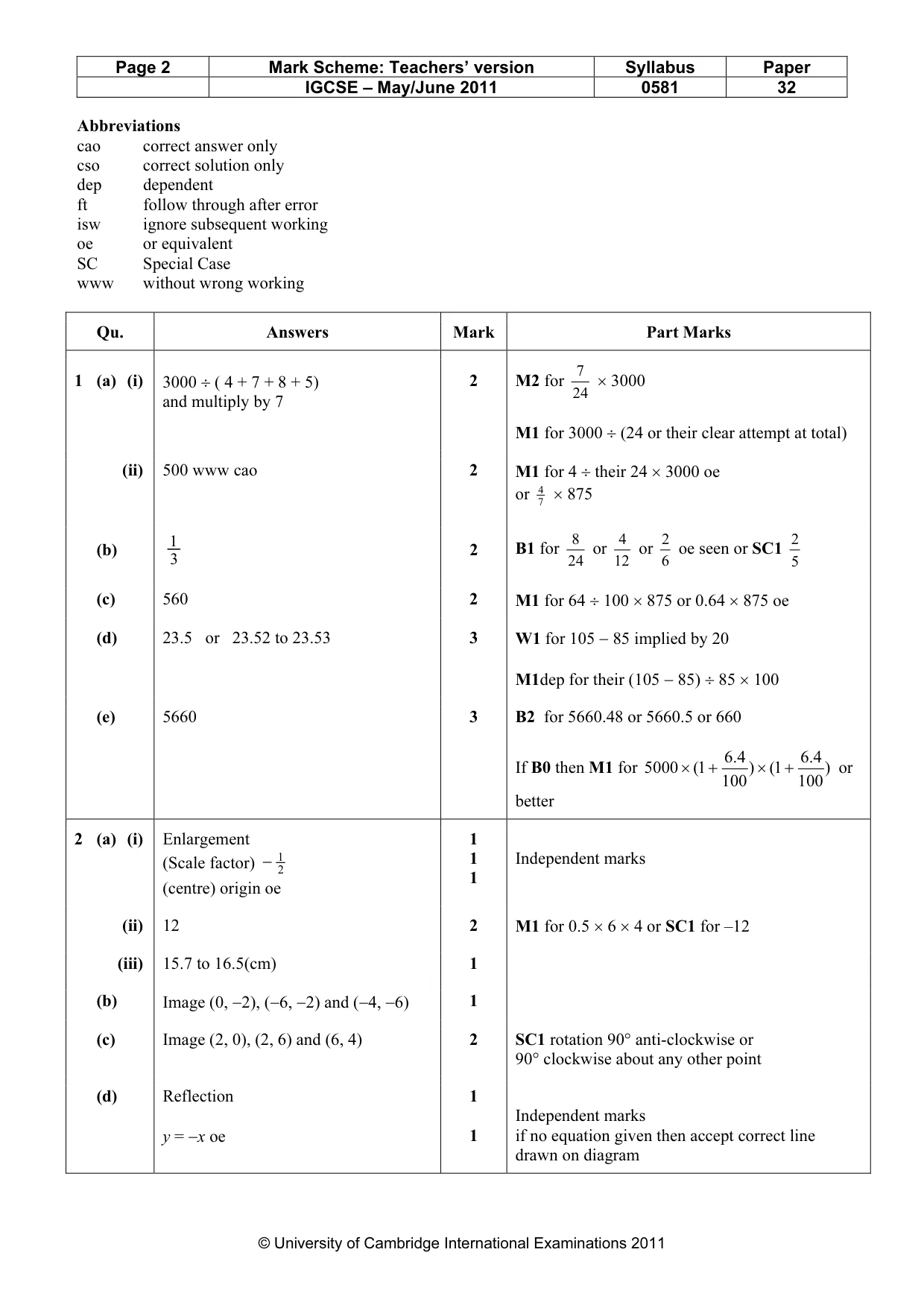
Page 2 Mark Scheme: Teachers’ version Syllabus Paper IGCSE – May/June 2011 0581 32 © University of Cambridge International Examinations 2011 Abbreviations cao correct answer only cso correct solution only dep dependent ft follow through after error isw ignore subsequent working oe or equivalent SC Special Case www without wrong working Qu. Answers Mark Part Marks 1 (a) (i) 3000 ÷ ( 4 + 7 + 8 + 5) and multiply by 7 2 M2 for 24 7 × 3000 M1 for 3000 ÷ (24 or their clear attempt at total) (ii) 500 www cao 2 M1 for 4 ÷ their 24 × 3000 oe or 7 4 × 875 (b) 1 3 2 B1 for 24 8 or 12 4 or 6 2 oe seen or SC1 5 2 (c) 560 2 M1 for 64 ÷ 100 × 875 or 0.64 × 875 oe (d) 23.5 or 23.52 to 23.53 3 W1 for 105 − 85 implied by 20 M1dep for their (105 − 85) ÷ 85 × 100 (e) 5660 3 B2 for 5660.48 or 5660.5 or 660 If B0 then M1 for ) 100 4.6 1( ) 100 4.6 1( 5000 + × + × or better 2 (a) (i) Enlargement (Scale factor) 2 1 − (centre) origin oe 1 1 1 Independent marks (ii) 12 2 M1 for 0.5 × 6 × 4 or SC1 for –12 (iii) 15.7 to 16.5(cm) 1 (b) Image (0, −2), (−6, −2) and (−4, −6) 1 (c) Image (2, 0), (2, 6) and (6, 4) 2 SC1 rotation 90° anti-clockwise or 90° clockwise about any other point (d) Reflection y = −x oe 1 1 Independent marks if no equation given then accept correct line drawn on diagram
Mark scheme, page 3
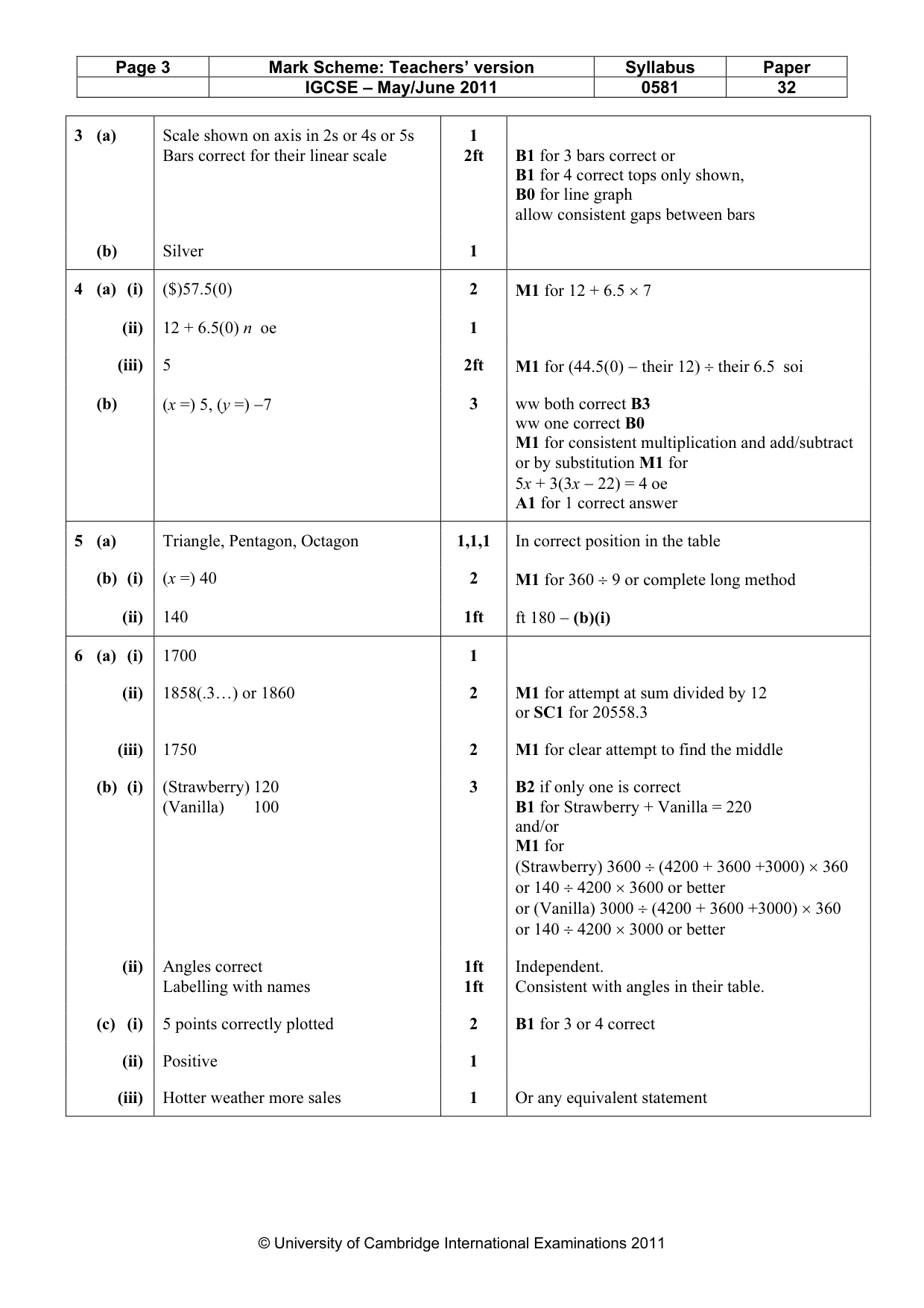
Page 3 Mark Scheme: Teachers’ version Syllabus Paper IGCSE – May/June 2011 0581 32 © University of Cambridge International Examinations 2011 3 (a) Scale shown on axis in 2s or 4s or 5s Bars correct for their linear scale 1 2ft B1 for 3 bars correct or B1 for 4 correct tops only shown, B0 for line graph allow consistent gaps between bars (b) Silver 1 4 (a) (i) ($)57.5(0) 2 M1 for 12 + 6.5 × 7 (ii) 12 + 6.5(0) n oe 1 (iii) 5 2ft M1 for (44.5(0) − their 12) ÷ their 6.5 soi (b) (x =) 5, (y =) −7 3 ww both correct B3 ww one correct B0 M1 for consistent multiplication and add/subtract or by substitution M1 for 5x + 3(3x − 22) = 4 oe A1 for 1 correct answer 5 (a) Triangle, Pentagon, Octagon 1,1,1 In correct position in the table (b) (i) (x =) 40 2 M1 for 360 ÷ 9 or complete long method (ii) 140 1ft ft 180 − (b)(i) 6 (a) (i) 1700 1 (ii) 1858(.3…) or 1860 2 M1 for attempt at sum divided by 12 or SC1 for 20558.3 (iii) 1750 2 M1 for clear attempt to find the middle (b) (i) (Strawberry) 120 (Vanilla) 100 3 B2 if only one is correct B1 for Strawberry + Vanilla = 220 and/or M1 for (Strawberry) 3600 ÷ (4200 + 3600 +3000) × 360 or 140 ÷ 4200 × 3600 or better or (Vanilla) 3000 ÷ (4200 + 3600 +3000) × 360 or 140 ÷ 4200 × 3000 or better (ii) Angles correct Labelling with names 1ft 1ft Independent. Consistent with angles in their table. (c) (i) 5 points correctly plotted 2 B1 for 3 or 4 correct (ii) Positive 1 (iii) Hotter weather more sales 1 Or any equivalent statement
Mark scheme, page 4
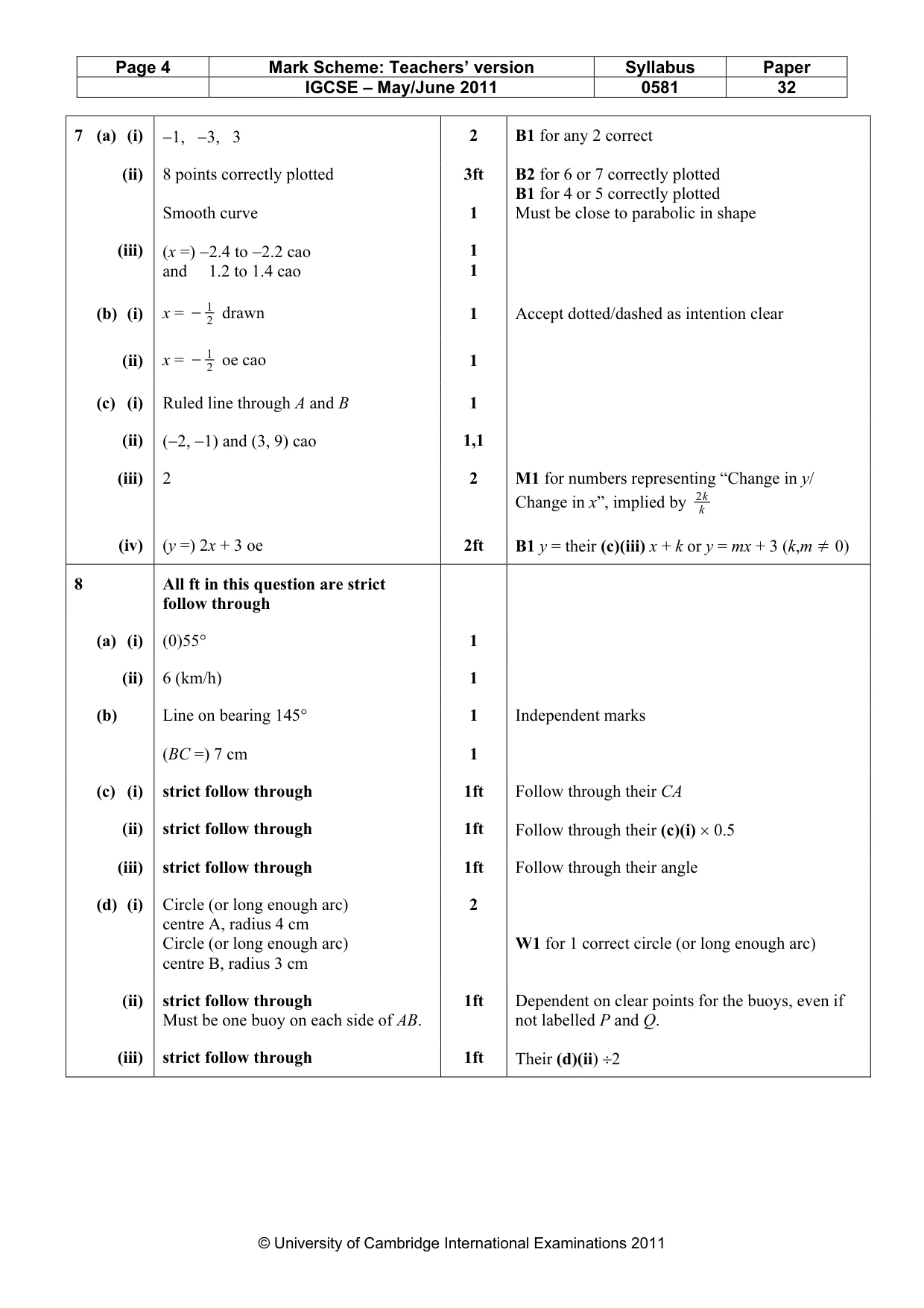
Page 4 Mark Scheme: Teachers’ version Syllabus Paper IGCSE – May/June 2011 0581 32 © University of Cambridge International Examinations 2011 7 (a) (i) −1, −3, 3 2 B1 for any 2 correct (ii) 8 points correctly plotted Smooth curve 3ft 1 B2 for 6 or 7 correctly plotted B1 for 4 or 5 correctly plotted Must be close to parabolic in shape (iii) (x =) −2.4 to −2.2 cao and 1.2 to 1.4 cao 1 1 (b) (i) x = 2 1 − drawn 1 Accept dotted/dashed as intention clear (ii) x = 2 1 − oe cao 1 (c) (i) Ruled line through A and B 1 (ii) (−2, −1) and (3, 9) cao 1,1 (iii) 2 2 M1 for numbers representing “Change in y/ Change in x”, implied by k k 2 (iv) (y =) 2x + 3 oe 2ft B1 y = their (c)(iii) x + k or y = mx + 3 (k,m ¸ 0) 8 All ft in this question are strict follow through (a) (i) (0)55° 1 (ii) 6 (km/h) 1 (b) Line on bearing 145° (BC =) 7 cm 1 1 Independent marks (c) (i) strict follow through 1ft Follow through their CA (ii) strict follow through 1ft Follow through their (c)(i) × 0.5 (iii) strict follow through 1ft Follow through their angle (d) (i) Circle (or long enough arc) centre A, radius 4 cm Circle (or long enough arc) centre B, radius 3 cm 2 W1 for 1 correct circle (or long enough arc) (ii) strict follow through Must be one buoy on each side of AB. 1ft Dependent on clear points for the buoys, even if not labelled P and Q. (iii) strict follow through 1ft Their (d)(ii) ÷2
Mark scheme, page 5
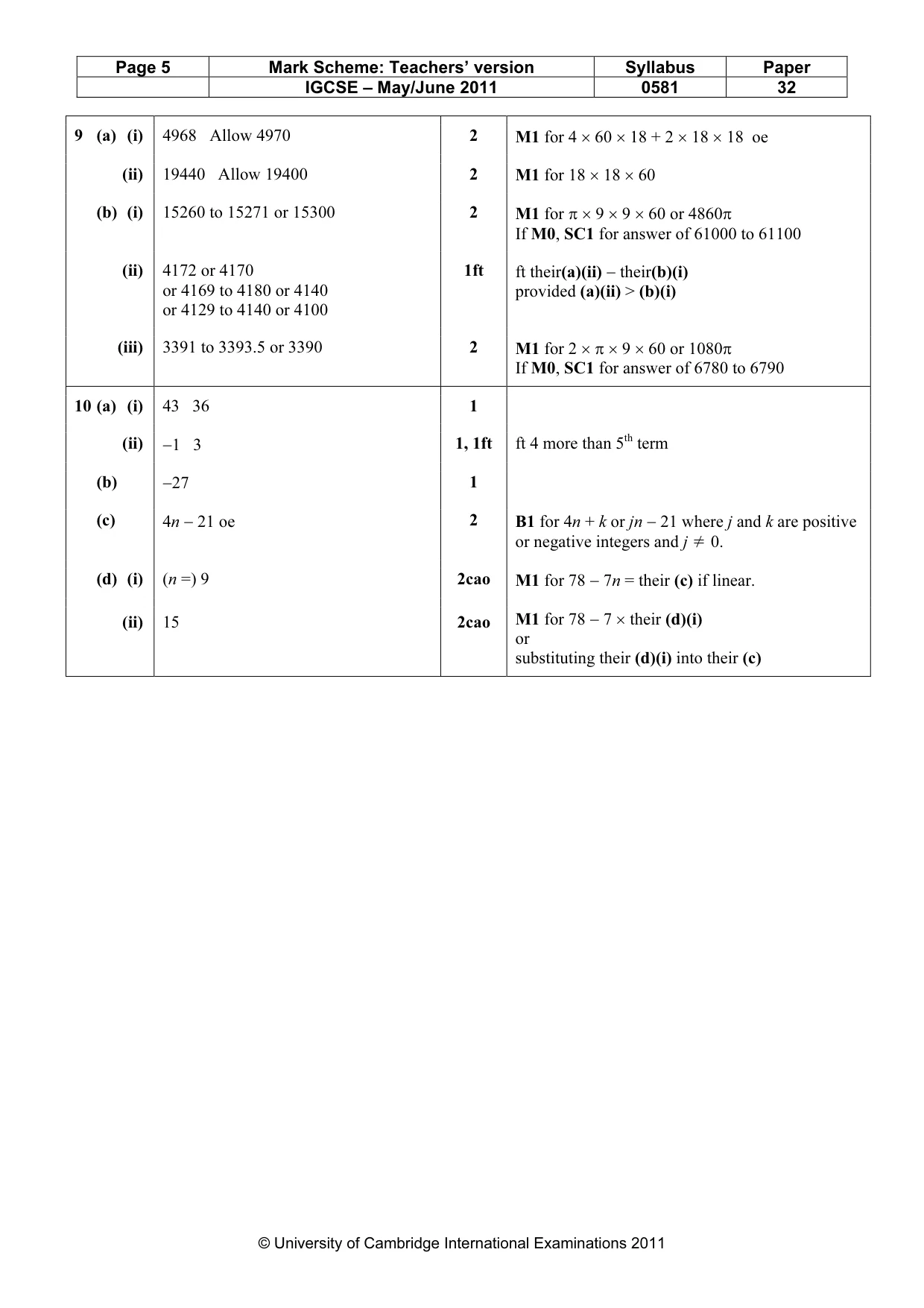
Page 5 Mark Scheme: Teachers’ version Syllabus Paper IGCSE – May/June 2011 0581 32 © University of Cambridge International Examinations 2011 9 (a) (i) 4968 Allow 4970 2 M1 for 4 × 60 × 18 + 2 × 18 × 18 oe (ii) 19440 Allow 19400 2 M1 for 18 × 18 × 60 (b) (i) 15260 to 15271 or 15300 2 M1 for π × 9 × 9 × 60 or 4860π If M0, SC1 for answer of 61000 to 61100 (ii) 4172 or 4170 or 4169 to 4180 or 4140 or 4129 to 4140 or 4100 1ft ft their(a)(ii) − their(b)(i) provided (a)(ii) > (b)(i) (iii) 3391 to 3393.5 or 3390 2 M1 for 2 × π × 9 × 60 or 1080π If M0, SC1 for answer of 6780 to 6790 10 (a) (i) 43 36 1 (ii) −1 3 1, 1ft ft 4 more than 5th term (b) −27 1 (c) 4n − 21 oe 2 B1 for 4n + k or jn − 21 where j and k are positive or negative integers and j ¸ 0. (d) (i) (n =) 9 2cao M1 for 78 − 7n = their (c) if linear. (ii) 15 2cao M1 for 78 − 7 × their (d)(i) or substituting their (d)(i) into their (c)
What you needed in this session
Cambridge’s own grade thresholds for 2011 May/June, Paper 3 · Variant 2. A higher threshold means an easier paper — the bar moves with how the cohort did.