Cambridge IGCSE Mathematics (with coursework) 0581 — 2014 Oct/Nov Paper 3 · Variant 2
0581/32/O/N/14 · 104 marks · ≈117 min
The question paper and its mark scheme, free to read here and free to download. This is Cambridge’s own paper, exactly as it was sat.
Question paper16 pages
Mark scheme5 pages
Answers below. Sit the paper first if you are practising.
Paper as text
Question paper, page 1
READ THESE INSTRUCTIONS FIRST Write your Centre number, candidate number and name on all the work you hand in. Write in dark blue or black pen. You may use an HB pencil for any diagrams or graphs. Do not use staples, paper clips, glue or correction fl uid. DO NOT WRITE IN ANY BARCODES. Answer all questions. If working is needed for any question it must be shown below that question. Electronic calculators should be used. If the degree of accuracy is not specifi ed in the question, and if the answer is not exact, give the answer to three signifi cant fi gures. Give answers in degrees to one decimal place. For π, use either your calculator value or 3.142. At the end of the examination, fasten all your work securely together. The number of marks is given in brackets [ ] at the end of each question or part question. The total of the marks for this paper is 104. MATHEMATICS 0581/32 Paper 3 (Core) October/November 2014 2 hours Candidates answer on the Question Paper. Additional Materials: Electronic calculator Geometrical instruments Tracing paper (optional) Cambridge International Examinations Cambridge International General Certifi cate of Secondary Education This document consists of 16 printed pages. [Turn over IB14 11_0581_32/RP © UCLES 2014 *1726906154* PAPA CAMBRIDGE
Question paper, page 2
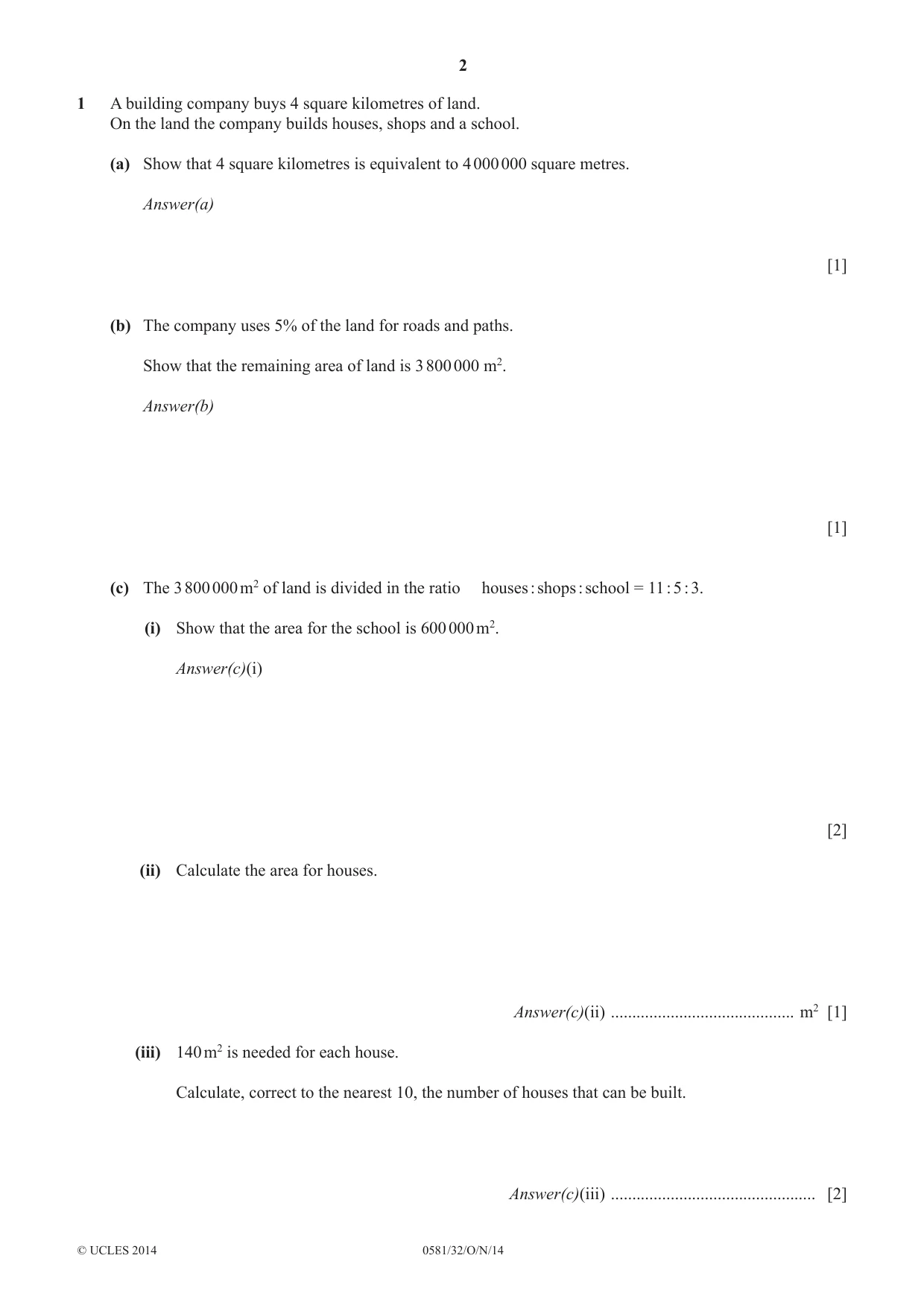
2 0581/32/O/N/14 © UCLES 2014 1 A building company buys 4 square kilometres of land. On the land the company builds houses, shops and a school. (a) Show that 4 square kilometres is equivalent to 4 000 000 square metres. Answer(a) [1] (b) The company uses 5% of the land for roads and paths. Show that the remaining area of land is 3 800 000 m2. Answer(b) [1] (c) The 3 800 000 m2 of land is divided in the ratio houses : shops : school = 11 : 5 : 3. (i) Show that the area for the school is 600 000 m2. Answer(c)(i) [2] (ii) Calculate the area for houses. Answer(c)(ii) … m2 [1] (iii) 140 m2 is needed for each house. Calculate, correct to the nearest 10, the number of houses that can be built. Answer(c)(iii) … [2]
Question paper, page 3
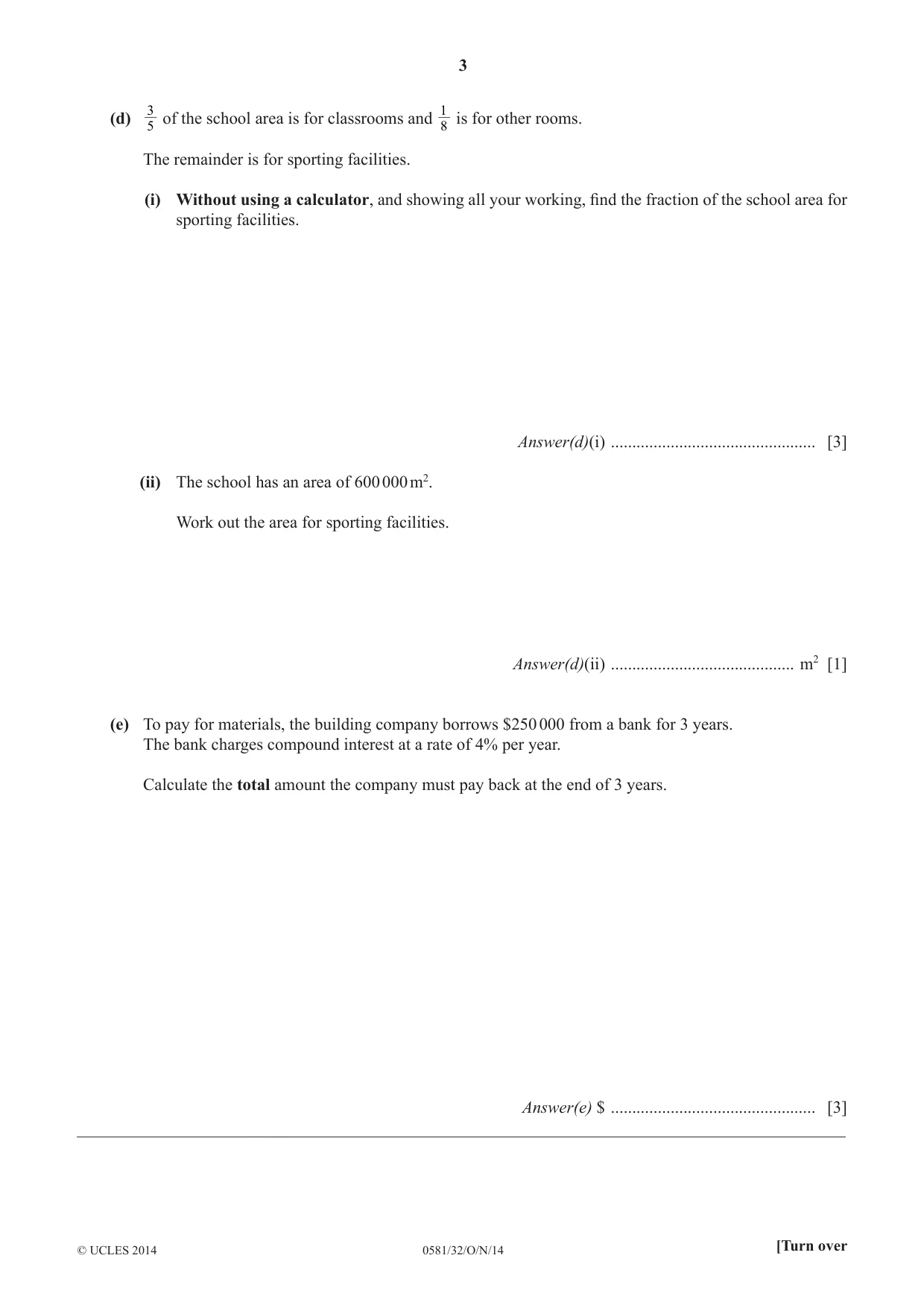
3 0581/32/O/N/14 © UCLES 2014 [Turn over (d) 5 3 of the school area is for classrooms and 8 1 is for other rooms. The remainder is for sporting facilities. (i) Without using a calculator, and showing all your working, fi nd the fraction of the school area for sporting facilities. Answer(d)(i) … [3] (ii) The school has an area of 600 000 m2. Work out the area for sporting facilities. Answer(d)(ii) … m2 [1] (e) To pay for materials, the building company borrows $250 000 from a bank for 3 years. The bank charges compound interest at a rate of 4% per year. Calculate the total amount the company must pay back at the end of 3 years. Answer(e) $ … [3] __________________________________________________________________________________________
Question paper, page 4
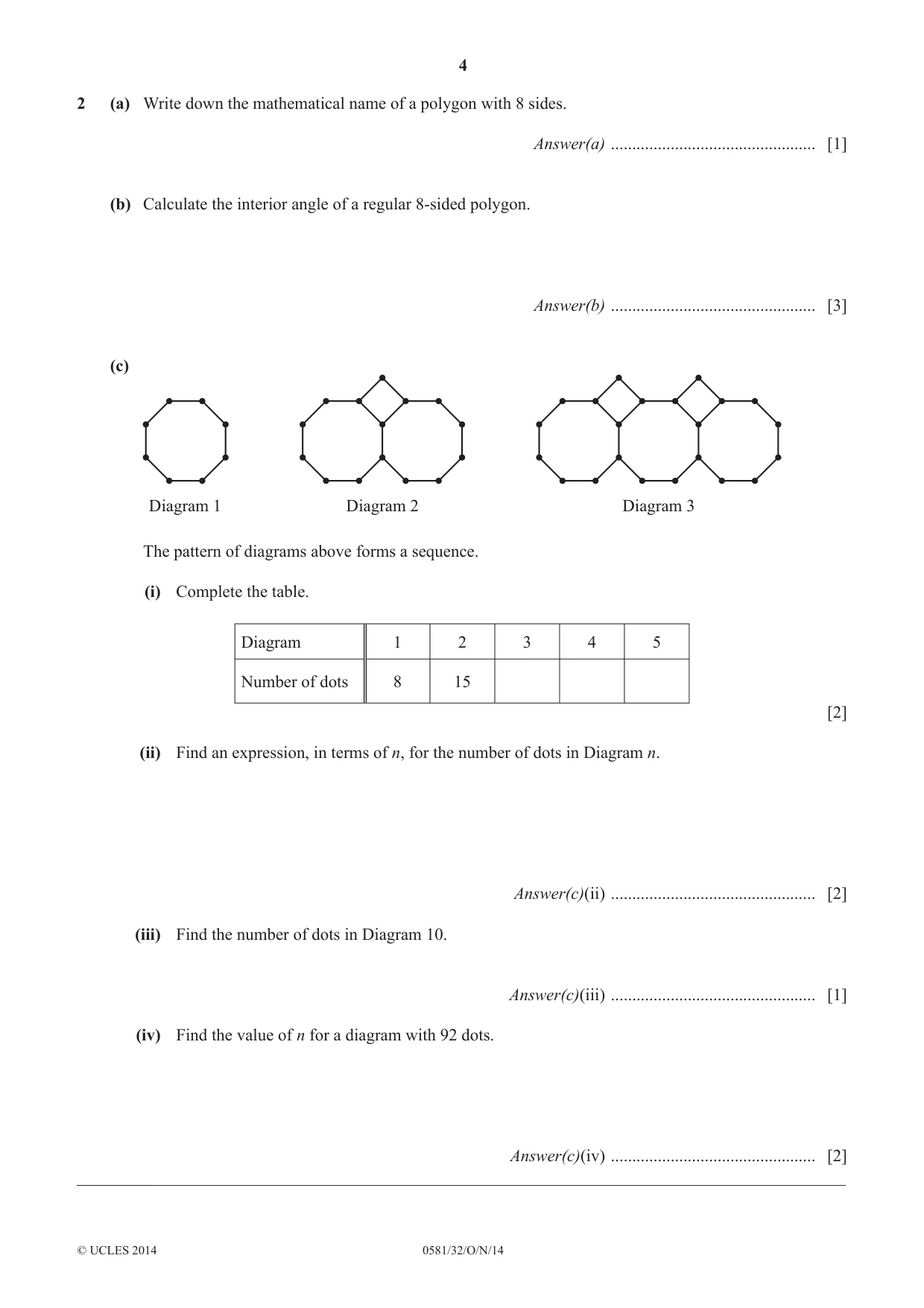
4 0581/32/O/N/14 © UCLES 2014 2 (a) Write down the mathematical name of a polygon with 8 sides. Answer(a) … [1] (b) Calculate the interior angle of a regular 8-sided polygon. Answer(b) … [3] (c) Diagram 1 Diagram 2 Diagram 3 The pattern of diagrams above forms a sequence. (i) Complete the table. Diagram 1 2 3 4 5 Number of dots 8 15 [2] (ii) Find an expression, in terms of n, for the number of dots in Diagram n. Answer(c)(ii) … [2] (iii) Find the number of dots in Diagram 10. Answer(c)(iii) … [1] (iv) Find the value of n for a diagram with 92 dots. Answer(c)(iv) … [2] __________________________________________________________________________________________
Question paper, page 5
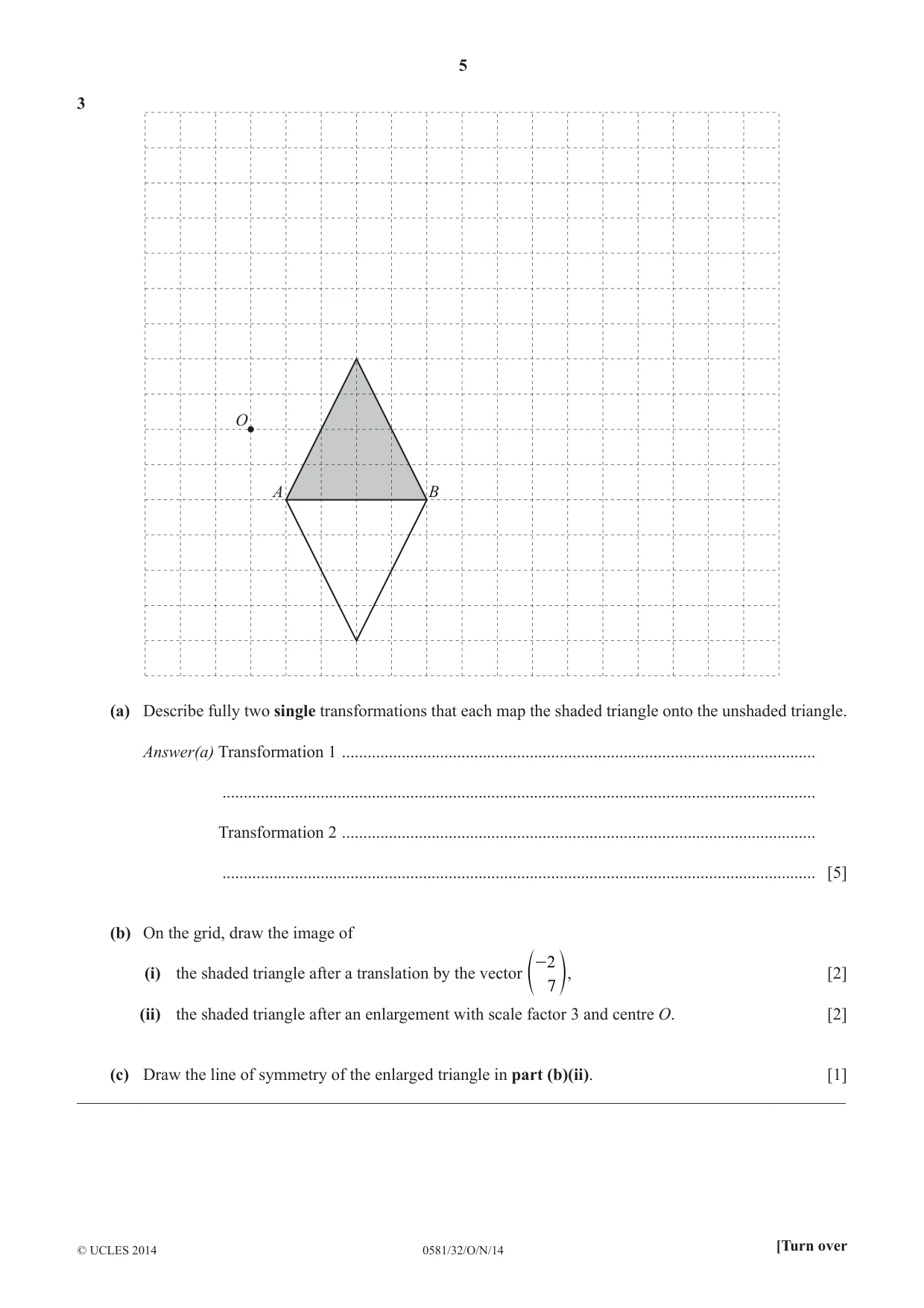
5 0581/32/O/N/14 © UCLES 2014 [Turn over 3 O A B (a) Describe fully two single transformations that each map the shaded triangle onto the unshaded triangle. Answer(a) Transformation 1 … … Transformation 2 … … [5] (b) On the grid, draw the image of (i) the shaded triangle after a translation by the vector 2 7 - e o, [2] (ii) the shaded triangle after an enlargement with scale factor 3 and centre O. [2] (c) Draw the line of symmetry of the enlarged triangle in part (b)(ii). [1] __________________________________________________________________________________________
Question paper, page 6
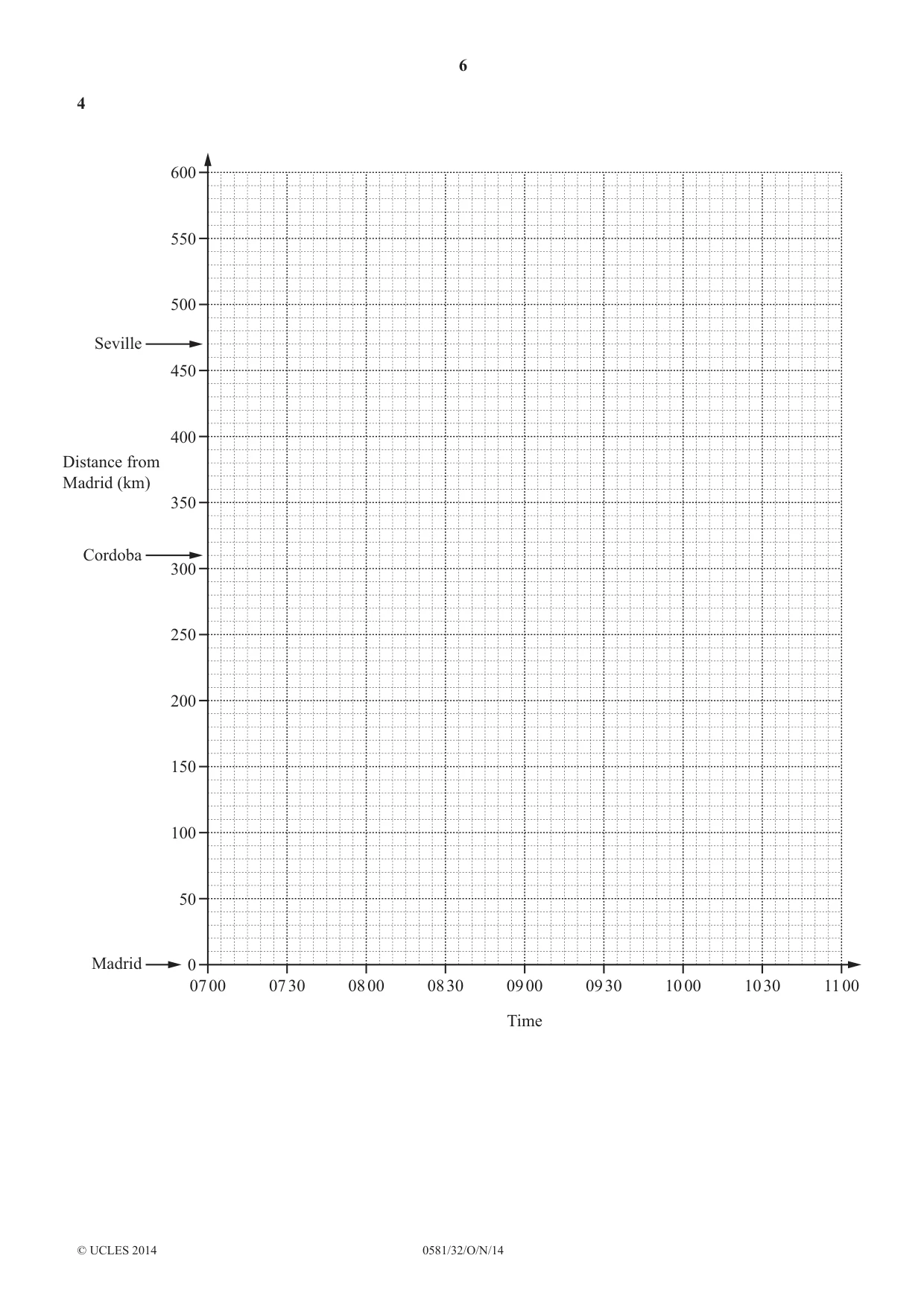
6 0581/32/O/N/14 © UCLES 2014 4 07 00 07 30 08 00 08 30 09 00 Time 09 30 10 00 10 30 11 00 600 550 500 450 400 350 300 250 200 150 100 50 0 Distance from Madrid (km) Seville Cordoba Madrid
Question paper, page 7
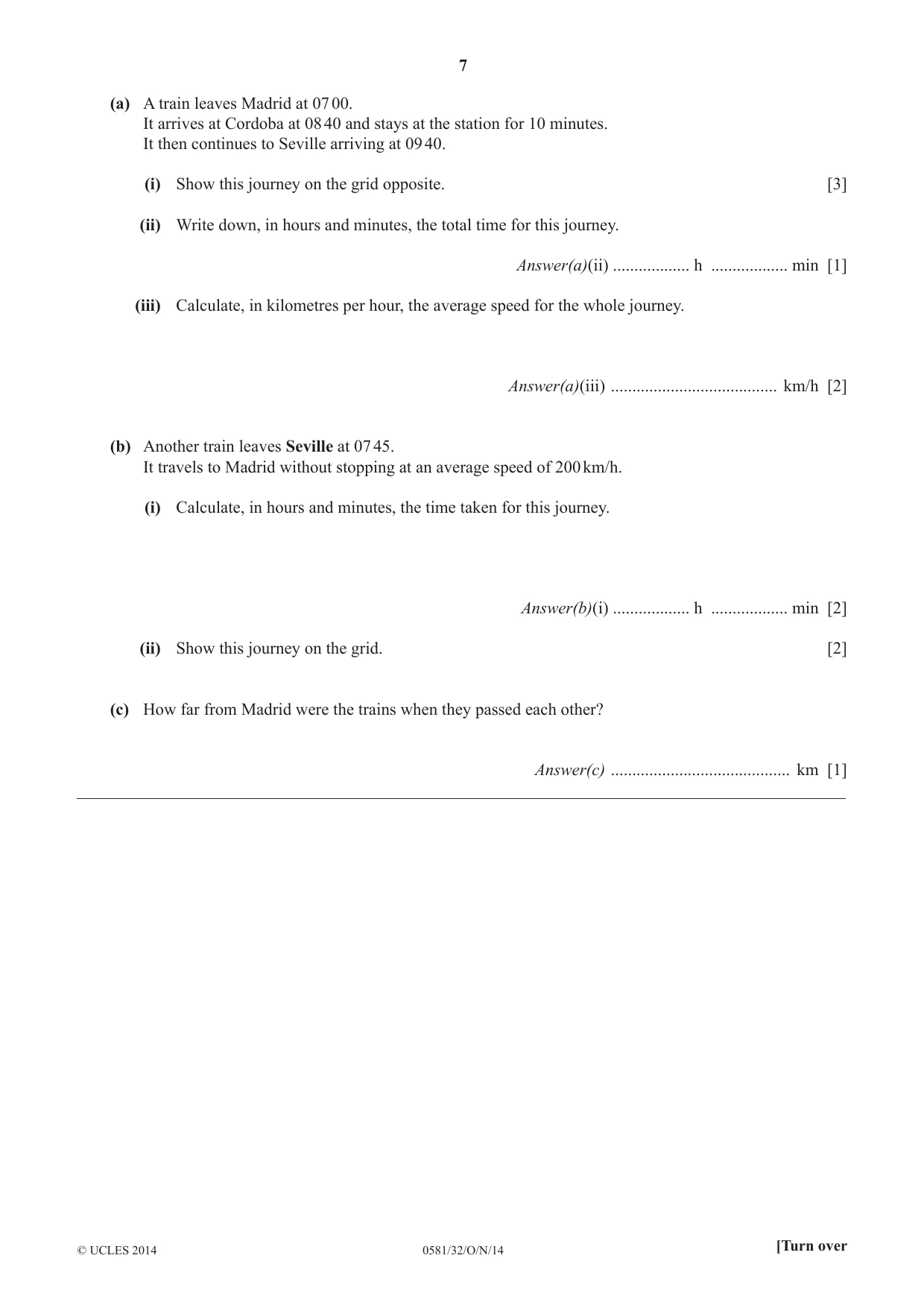
7 0581/32/O/N/14 © UCLES 2014 [Turn over (a) A train leaves Madrid at 07 00. It arrives at Cordoba at 08 40 and stays at the station for 10 minutes. It then continues to Seville arriving at 09 40. (i) Show this journey on the grid opposite. [3] (ii) Write down, in hours and minutes, the total time for this journey. Answer(a)(ii) … h … min [1] (iii) Calculate, in kilometres per hour, the average speed for the whole journey. Answer(a)(iii) … km/h [2] (b) Another train leaves Seville at 07 45. It travels to Madrid without stopping at an average speed of 200 km/h. (i) Calculate, in hours and minutes, the time taken for this journey. Answer(b)(i) … h … min [2] (ii) Show this journey on the grid. [2] (c) How far from Madrid were the trains when they passed each other? Answer(c) … km [1] __________________________________________________________________________________________
Question paper, page 8
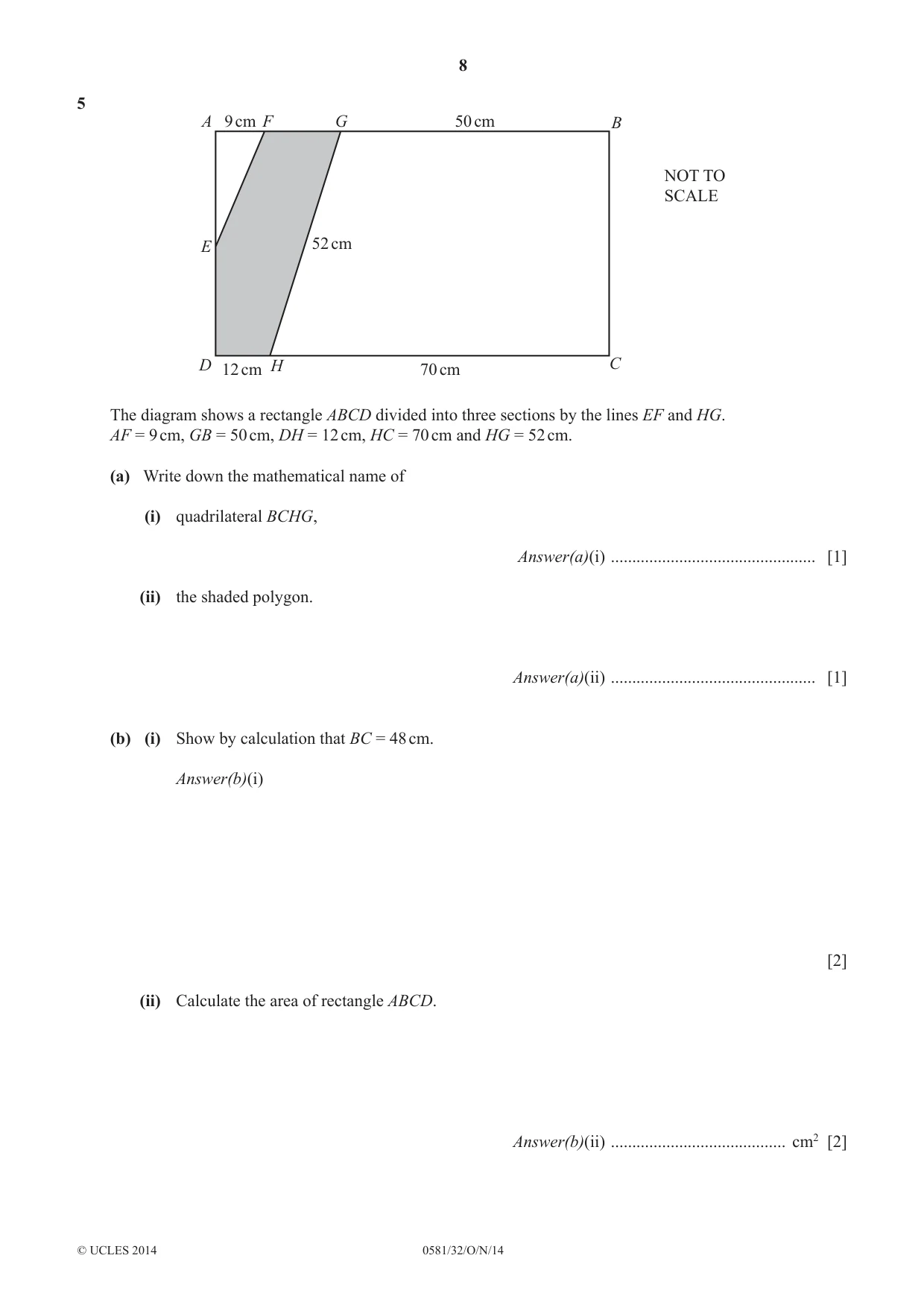
8 0581/32/O/N/14 © UCLES 2014 5 9 cm 50 cm 70 cm 12 cm 52 cm A E D H C B G F NOT TO SCALE The diagram shows a rectangle ABCD divided into three sections by the lines EF and HG. AF = 9 cm, GB = 50 cm, DH = 12 cm, HC = 70 cm and HG = 52 cm. (a) Write down the mathematical name of (i) quadrilateral BCHG, Answer(a)(i) … [1] (ii) the shaded polygon. Answer(a)(ii) … [1] (b) (i) Show by calculation that BC = 48 cm. Answer(b)(i) [2] (ii) Calculate the area of rectangle ABCD. Answer(b)(ii) … cm2 [2]
Question paper, page 9
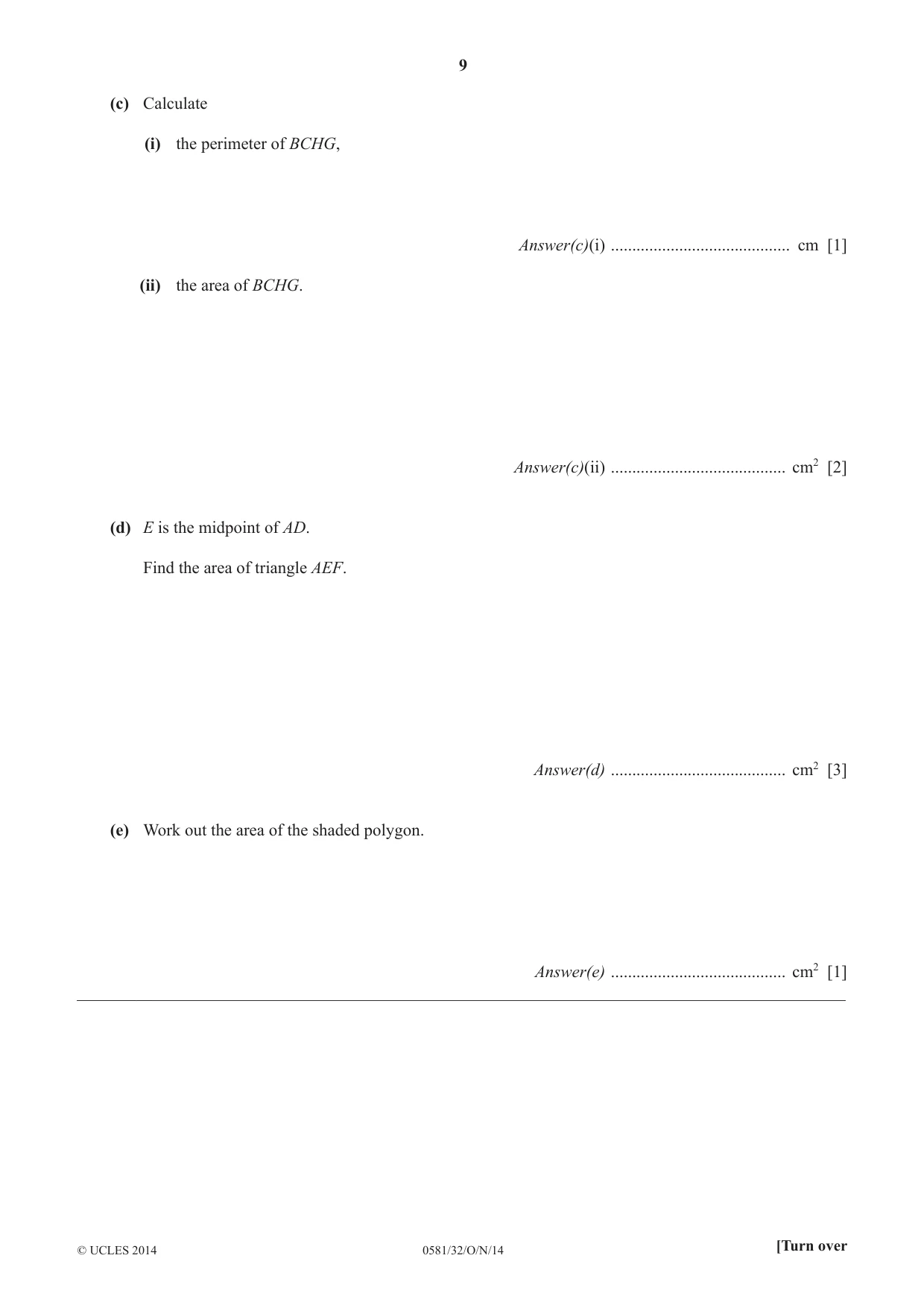
9 0581/32/O/N/14 © UCLES 2014 [Turn over (c) Calculate (i) the perimeter of BCHG, Answer(c)(i) … cm [1] (ii) the area of BCHG. Answer(c)(ii) … cm2 [2] (d) E is the midpoint of AD. Find the area of triangle AEF. Answer(d) … cm2 [3] (e) Work out the area of the shaded polygon. Answer(e) … cm2 [1] __________________________________________________________________________________________
Question paper, page 10
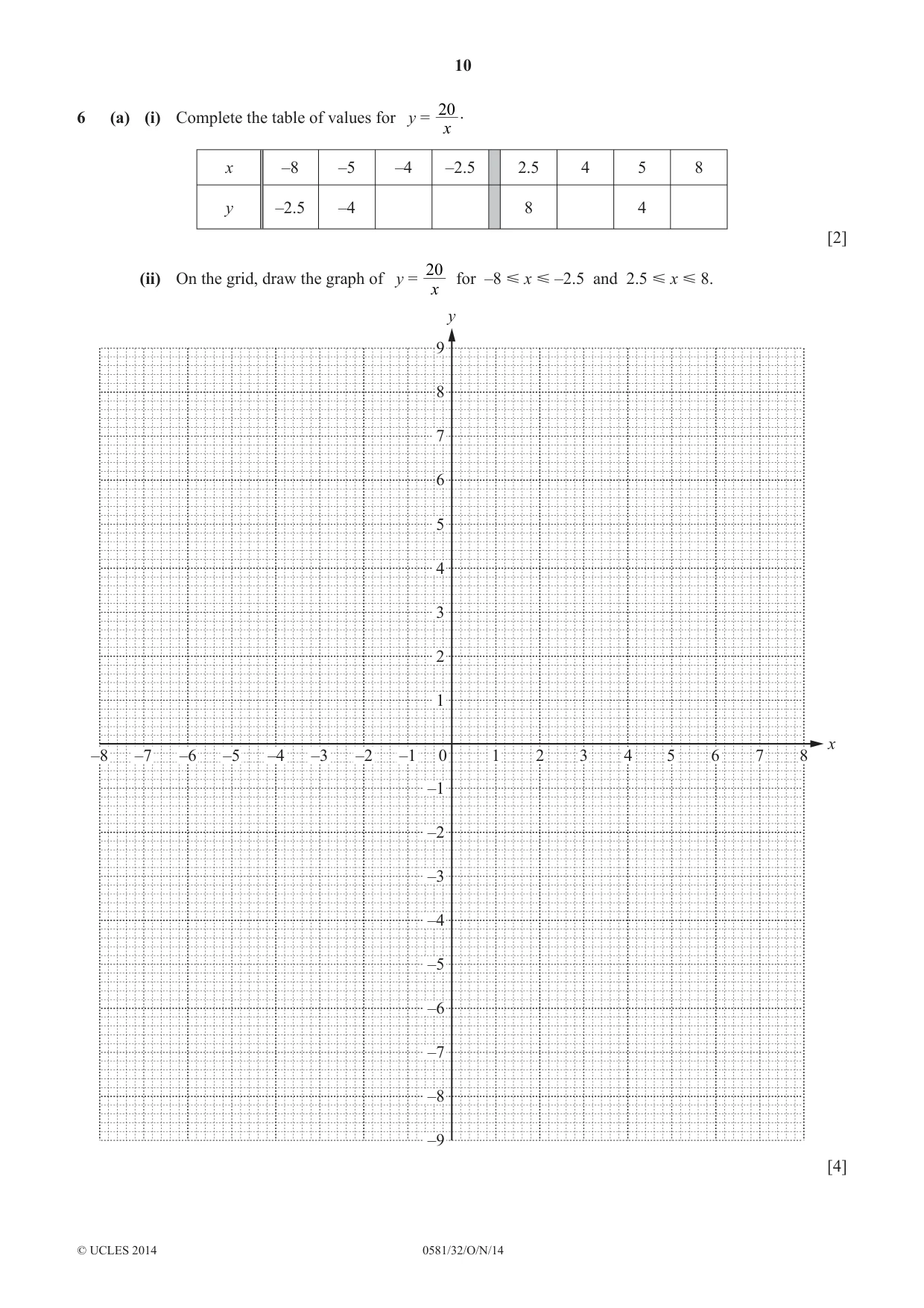
10 0581/32/O/N/14 © UCLES 2014 6 (a) (i) Complete the table of values for y = 20 x . x –8 –5 –4 –2.5 2.5 4 5 8 y –2.5 –4 8 4 [2] (ii) On the grid, draw the graph of y = 20 x for –8 Y x Y –2.5 and 2.5 Y x Y 8. y x 9 8 7 6 5 4 3 2 1 –1 –2 –3 –4 –5 –6 –7 –8 –9 0 –2 –4 –6 –8 –1 –3 –5 –7 6 8 4 2 5 7 3 1 [4]
Question paper, page 11
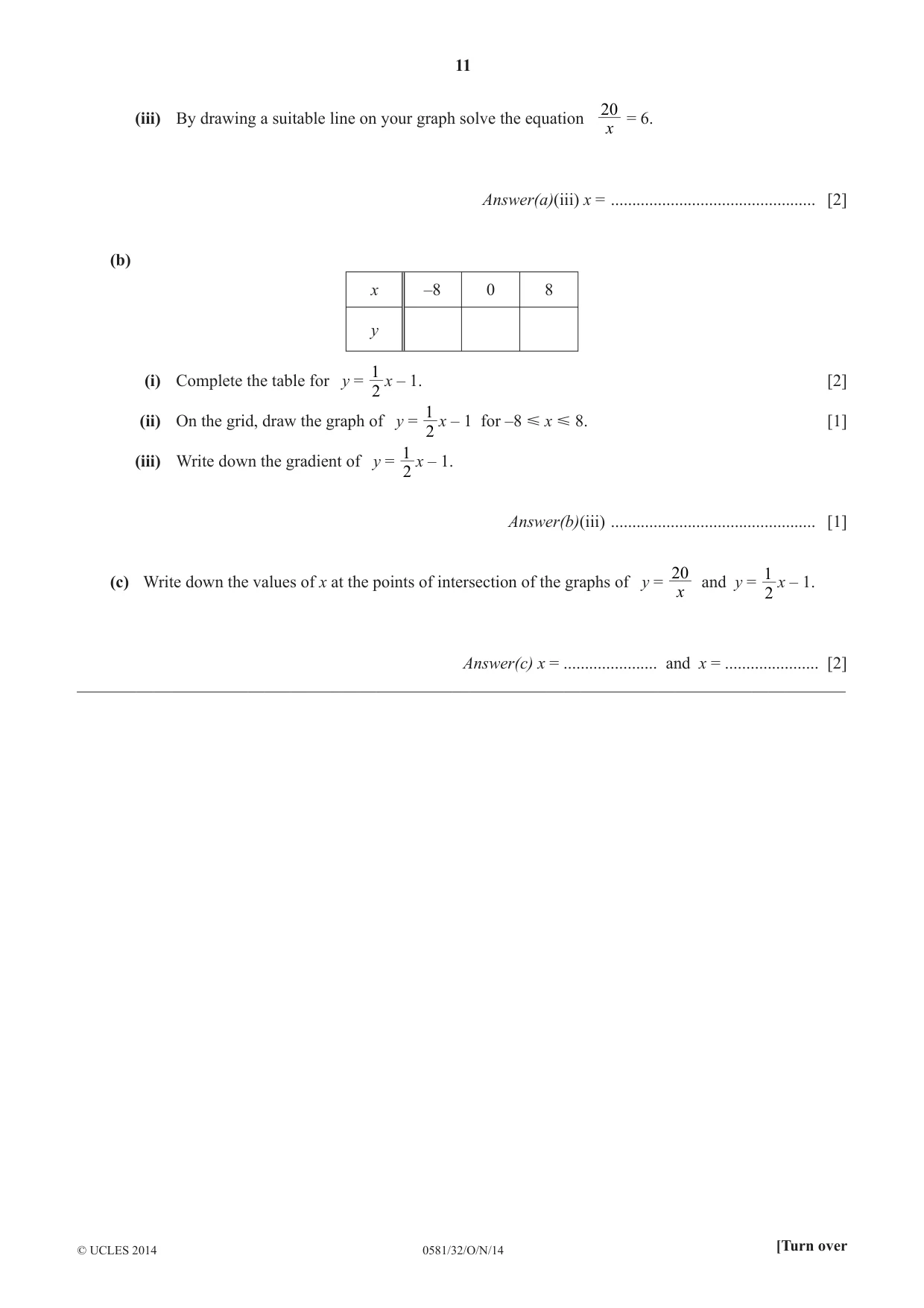
11 0581/32/O/N/14 © UCLES 2014 [Turn over (iii) By drawing a suitable line on your graph solve the equation 20 x = 6. Answer(a)(iii) x = … [2] (b) x –8 0 8 y (i) Complete the table for y = 2 1 x – 1. [2] (ii) On the grid, draw the graph of y = 2 1 x – 1 for –8 Y x Y 8. [1] (iii) Write down the gradient of y = 2 1 x – 1. Answer(b)(iii) … [1] (c) Write down the values of x at the points of intersection of the graphs of y = 20 x and y = 2 1 x – 1. Answer(c) x = … and x = … [2] __________________________________________________________________________________________
Question paper, page 12
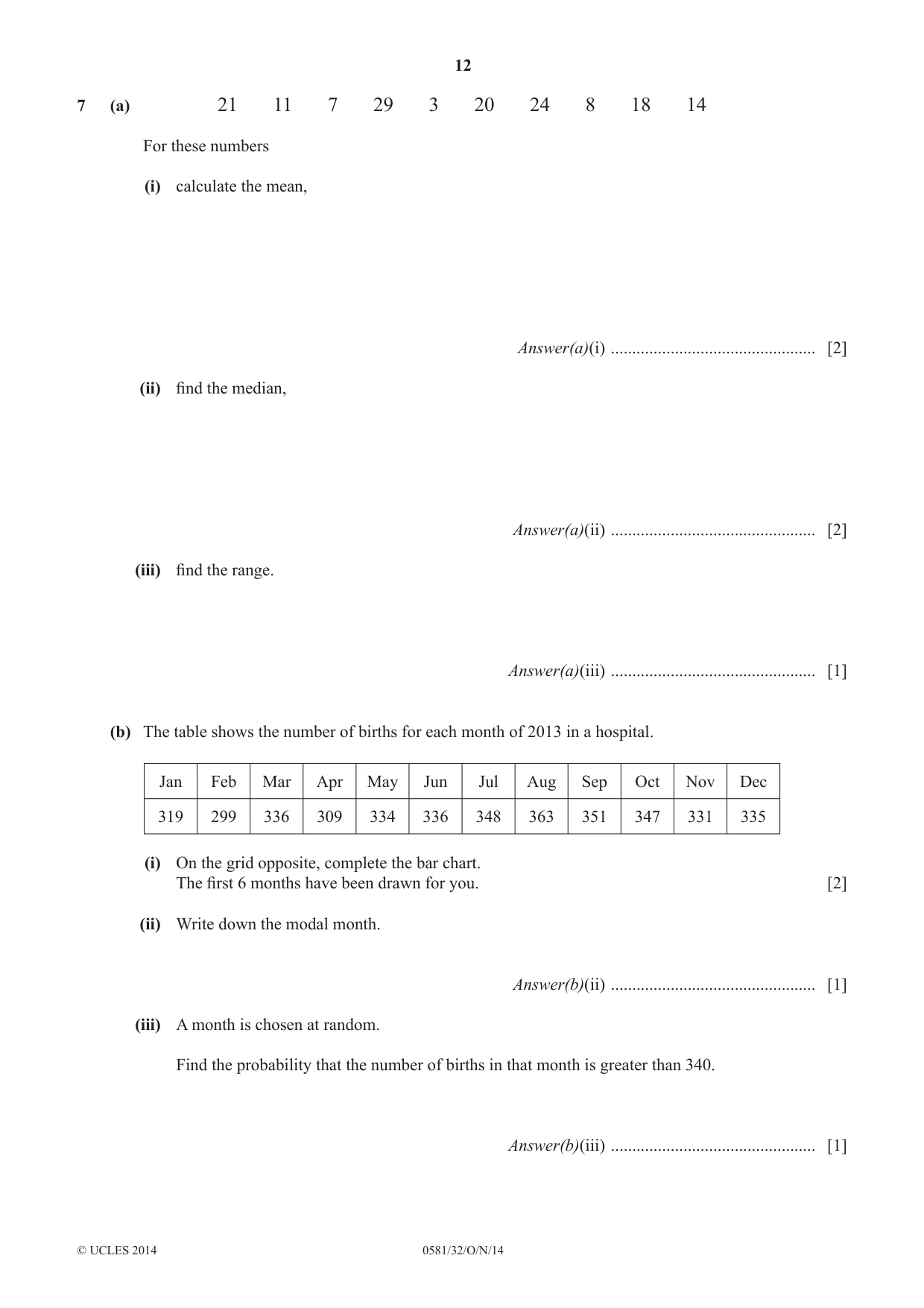
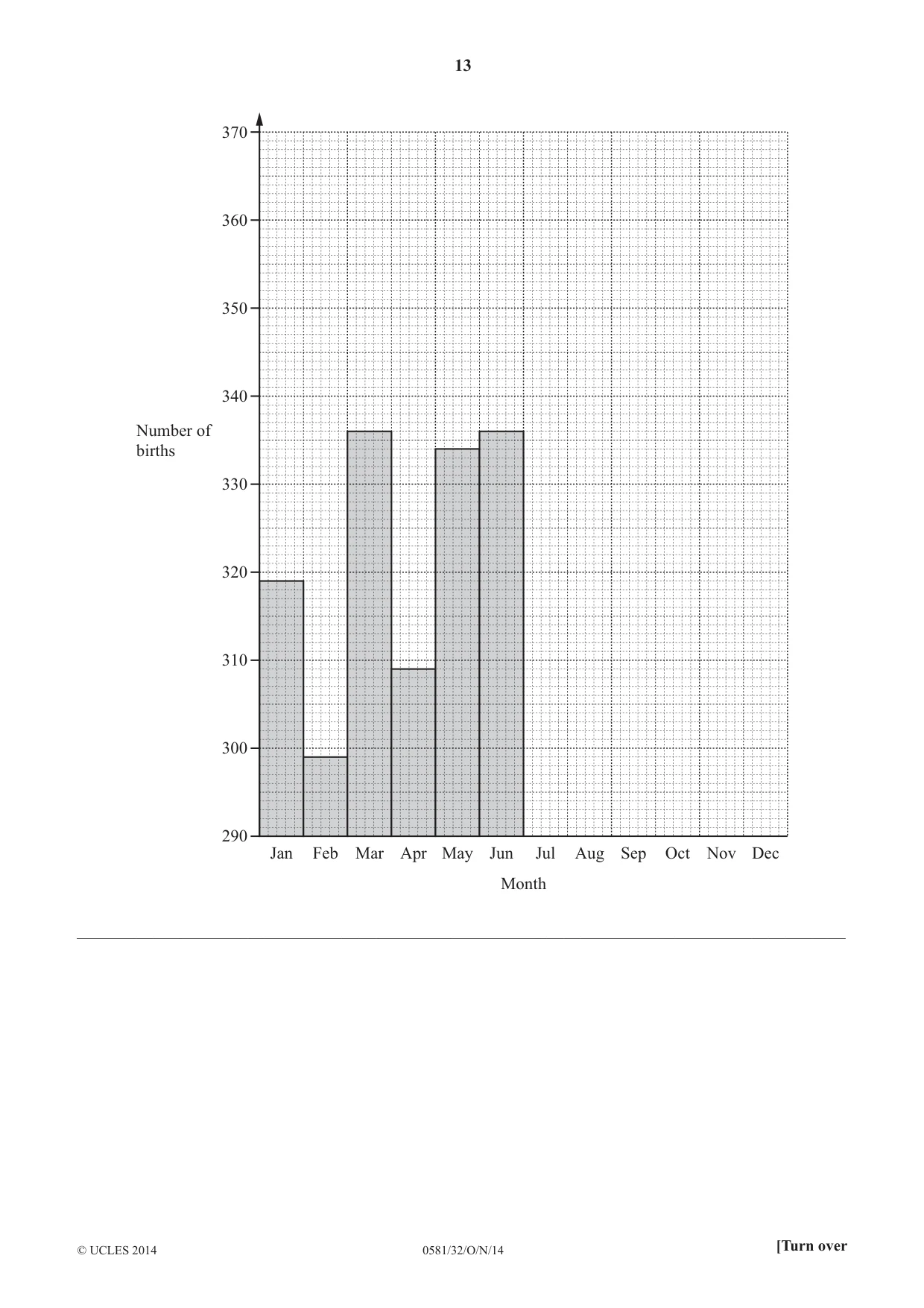
12 0581/32/O/N/14 © UCLES 2014 7 (a) 21 11 7 29 3 20 24 8 18 14 For these numbers (i) calculate the mean, Answer(a)(i) … [2] (ii) fi nd the median, Answer(a)(ii) … [2] (iii) fi nd the range. Answer(a)(iii) … [1] (b) The table shows the number of births for each month of 2013 in a hospital. Jan Feb Mar Apr May Jun Jul Aug Sep Oct Nov Dec 319 299 336 309 334 336 348 363 351 347 331 335 (i) On the grid opposite, complete the bar chart. The fi rst 6 months have been drawn for you. [2] (ii) Write down the modal month. Answer(b)(ii) … [1] (iii) A month is chosen at random. Find the probability that the number of births in that month is greater than 340. Answer(b)(iii) … [1]
Question paper, page 13
13 0581/32/O/N/14 © UCLES 2014 [Turn over 370 360 350 340 330 320 310 300 290 Number of births Jan Feb Mar Apr May Jun Month Jul Aug Sep Oct Nov Dec __________________________________________________________________________________________
Question paper, page 14
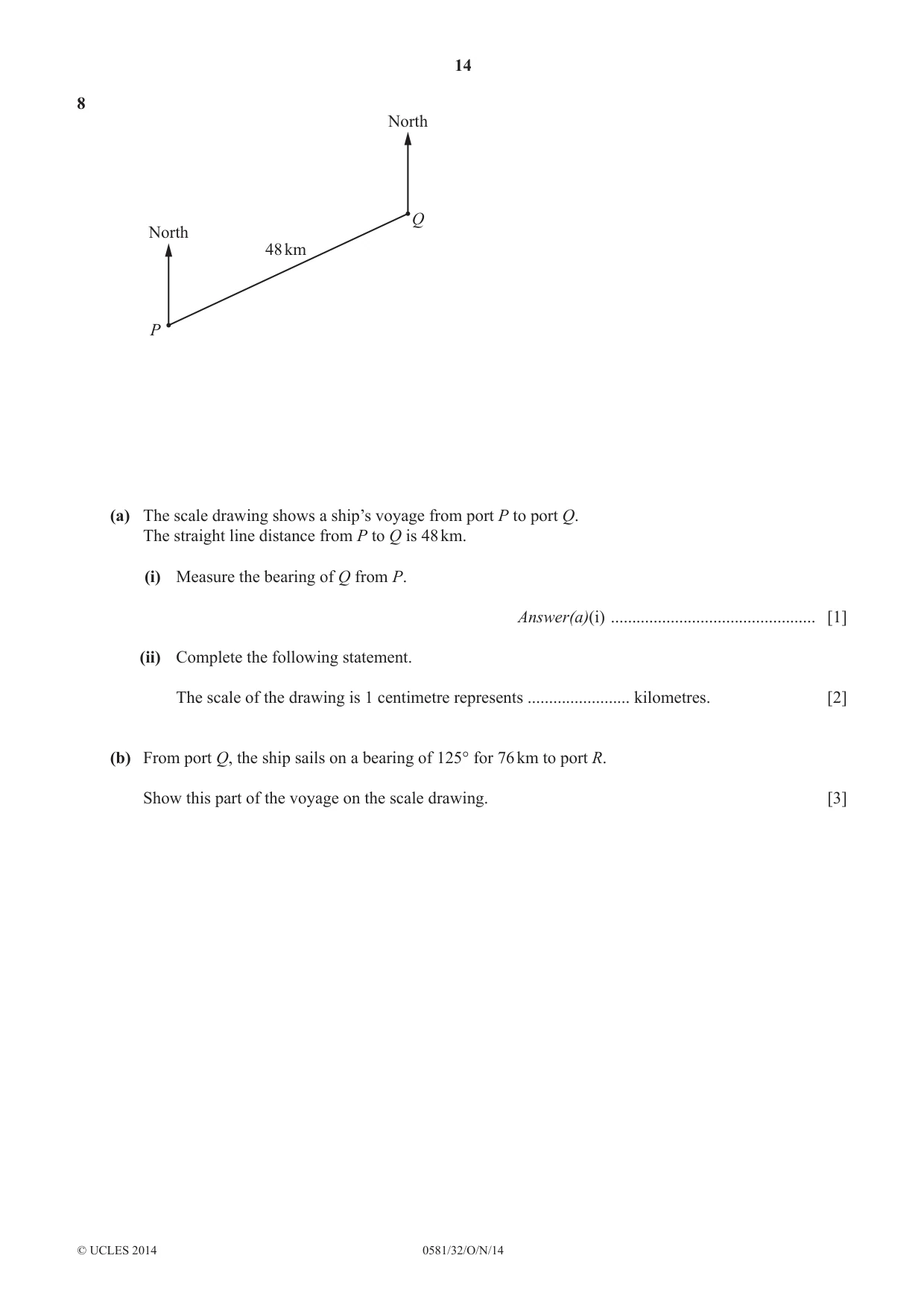
14 0581/32/O/N/14 © UCLES 2014 8 North North P Q 48 km (a) The scale drawing shows a ship’s voyage from port P to port Q. The straight line distance from P to Q is 48 km. (i) Measure the bearing of Q from P. Answer(a)(i) … [1] (ii) Complete the following statement. The scale of the drawing is 1 centimetre represents … kilometres. [2] (b) From port Q, the ship sails on a bearing of 125° for 76 km to port R. Show this part of the voyage on the scale drawing. [3]
Question paper, page 15
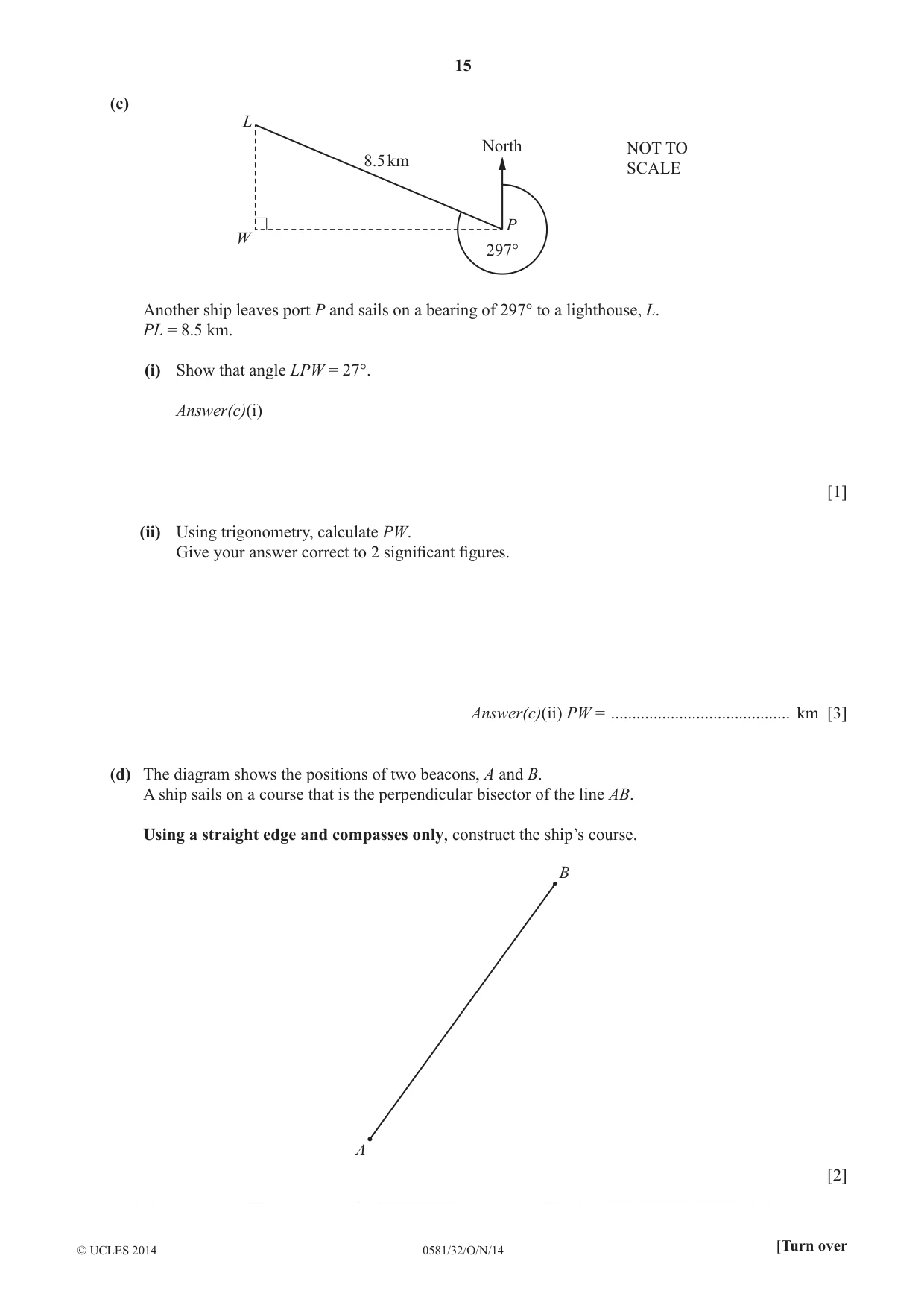
15 0581/32/O/N/14 © UCLES 2014 [Turn over (c) North 297° P L W 8.5 km NOT TO SCALE Another ship leaves port P and sails on a bearing of 297° to a lighthouse, L. PL = 8.5 km. (i) Show that angle LPW = 27°. Answer(c)(i) [1] (ii) Using trigonometry, calculate PW. Give your answer correct to 2 signifi cant fi gures. Answer(c)(ii) PW = … km [3] (d) The diagram shows the positions of two beacons, A and B. A ship sails on a course that is the perpendicular bisector of the line AB. Using a straight edge and compasses only, construct the ship’s course. A B [2] __________________________________________________________________________________________
Question paper, page 16
16 0581/32/O/N/14 © UCLES 2014 Permission to reproduce items where third-party owned material protected by copyright is included has been sought and cleared where possible. Every reasonable effort has been made by the publisher (UCLES) to trace copyright holders, but if any items requiring clearance have unwittingly been included the publisher will be pleased to make amends at the earliest possible opportunity. Cambridge International Examinations is part of the Cambridge Assessment Group. Cambridge Assessment is the brand name of University of Cambridge Local Examinations Syndicate (UCLES), which is itself a department of the University of Cambridge. 9 Adriano hires a car. The cost of hiring the car is $36 per day plus 24 cents for each kilometre travelled. He hires the car for 5 days and travels a total of 660 km. (a) (i) Calculate the cost to hire the car. Answer(a)(i) $ … [3] (ii) 15% tax is then added to this cost. Calculate the total cost of hiring the car including tax. Answer(a)(ii) $ … [2] (b) The car uses one litre of fuel to travel 11 km. Fuel costs $1.80 per litre. (i) Work out the number of litres used to travel the 660 km. Answer(b)(i) … litres [1] (ii) Work out the cost of this fuel. Answer(b)(ii) $ … [1] (iii) Find the total cost of hiring the car including tax and the fuel used. Answer(b)(iii) $ … [1] (c) During the 5 days Adriano earns $1600. What percentage of his earnings is your answer to part (b)(iii)? Give your answer correct to the nearest whole number. Answer(c) …% [2]
Mark scheme, page 1
® IGCSE is the registered trademark of Cambridge International Examinations. CAMBRIDGE INTERNATIONAL EXAMINATIONS Cambridge International General Certificate of Secondary Education MARK SCHEME for the October/November 2014 series 0581 MATHEMATICS 0581/32 Paper 3 (Core), maximum raw mark 104 This mark scheme is published as an aid to teachers and candidates, to indicate the requirements of the examination. It shows the basis on which Examiners were instructed to award marks. It does not indicate the details of the discussions that took place at an Examiners’ meeting before marking began, which would have considered the acceptability of alternative answers. Mark schemes should be read in conjunction with the question paper and the Principal Examiner Report for Teachers. Cambridge will not enter into discussions about these mark schemes. Cambridge is publishing the mark schemes for the October/November 2014 series for most Cambridge IGCSE®, Cambridge International A and AS Level components and some Cambridge O Level components. PAPA CAMBRIDGE
Mark scheme, page 2
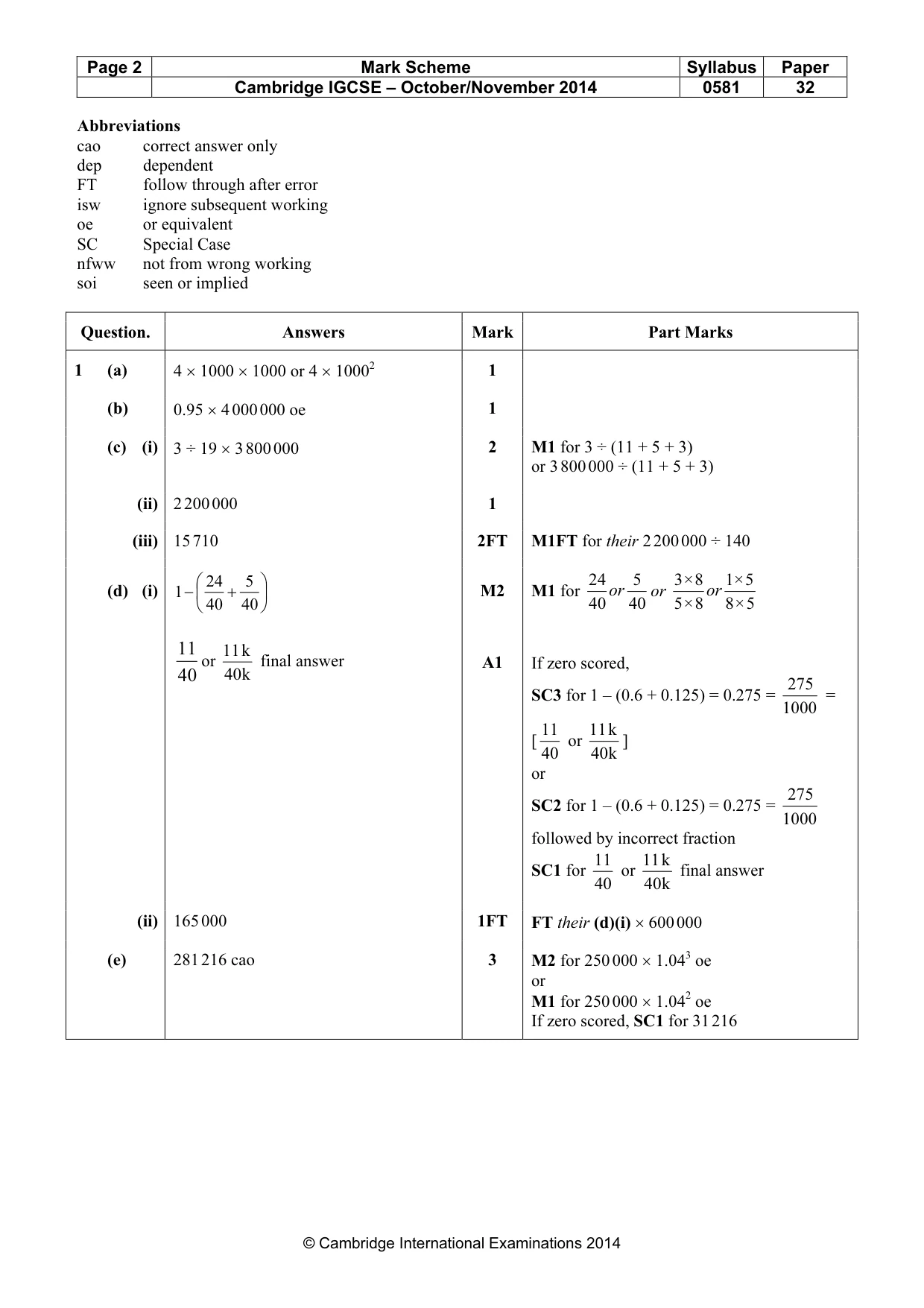
Page 2 Mark Scheme Syllabus Paper Cambridge IGCSE – October/November 2014 0581 32 © Cambridge International Examinations 2014 Abbreviations cao correct answer only dep dependent FT follow through after error isw ignore subsequent working oe or equivalent SC Special Case nfww not from wrong working soi seen or implied Question. Answers Mark Part Marks 1 (a) 4 × 1000 × 1000 or 4 × 10002 1 (b) 0.95 × 4 000 000 oe 1 (c) (i) 3 ÷ 19 × 3 800 000 2 M1 for 3 ÷ (11 + 5 + 3) or 3 800 000 ÷ (11 + 5 + 3) (ii) 2 200 000 1 (iii) 15 710 2FT M1FT for their 2 200 000 ÷ 140 (d) (i) + − 40 5 40 24 1 40 11 or k 40 k 11 final answer M2 A1 M1 for 40 5 40 24 or or 5 × 8 5 × 1 8 × 5 8 × 3 or If zero scored, SC3 for 1 – (0.6 + 0.125) = 0.275 = 1000 275 = [ 40 11 or k 40 k 11 ] or SC2 for 1 – (0.6 + 0.125) = 0.275 = 1000 275 followed by incorrect fraction SC1 for 40 11 or k 40 k 11 final answer (ii) 165 000 1FT FT their (d)(i) × 600 000 (e) 281 216 cao 3 M2 for 250 000 × 1.043 oe or M1 for 250 000 × 1.042 oe If zero scored, SC1 for 31 216
Mark scheme, page 3
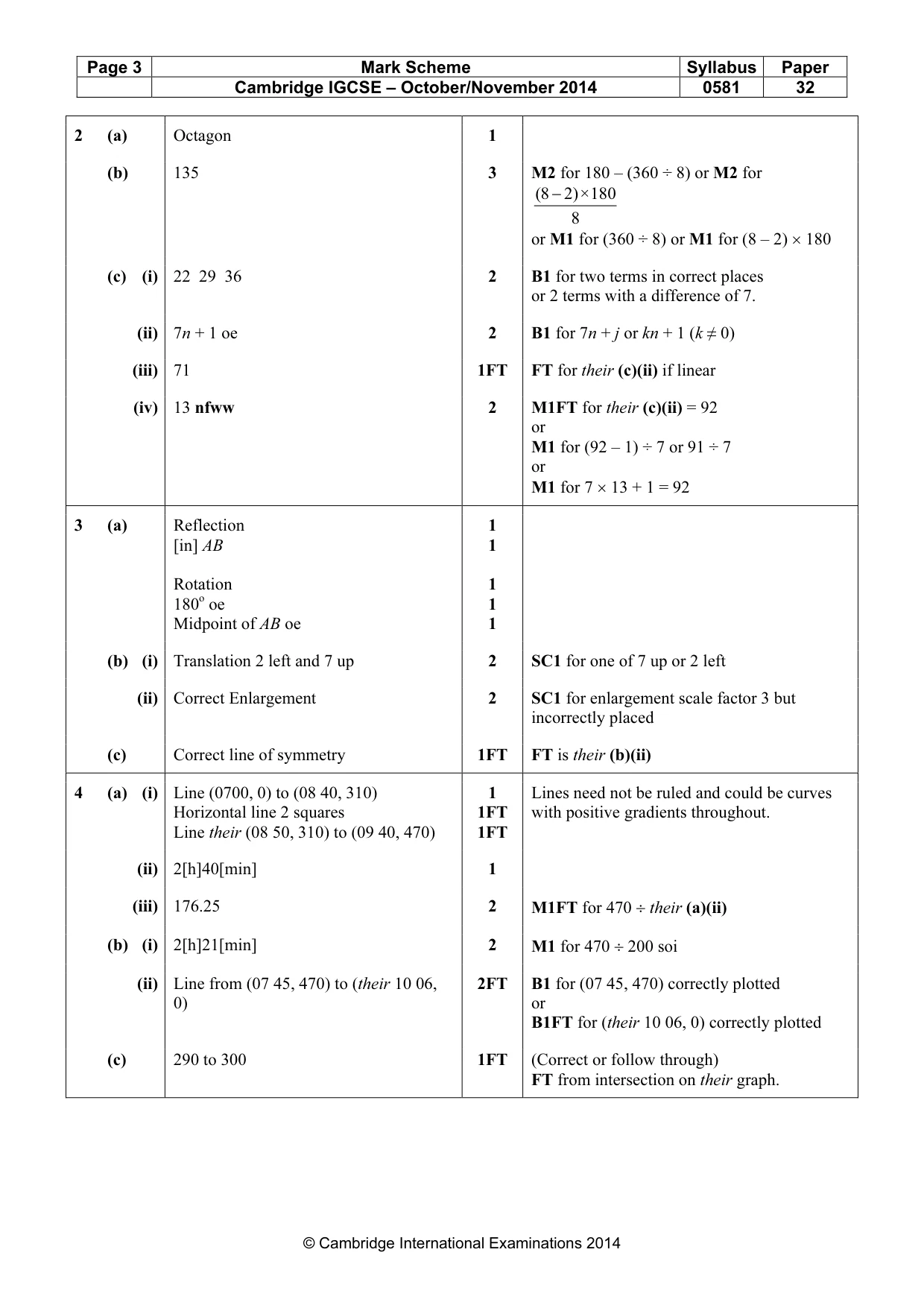
Page 3 Mark Scheme Syllabus Paper Cambridge IGCSE – October/November 2014 0581 32 © Cambridge International Examinations 2014 2 (a) Octagon 1 (b) 135 3 M2 for 180 – (360 ÷ 8) or M2 for 8 180 × ) 2 8 ( − or M1 for (360 ÷ 8) or M1 for (8 – 2) × 180 (c) (i) 22 29 36 2 B1 for two terms in correct places or 2 terms with a difference of 7. (ii) 7n + 1 oe 2 B1 for 7n + j or kn + 1 (k ≠ 0) (iii) 71 1FT FT for their (c)(ii) if linear (iv) 13 nfww 2 M1FT for their (c)(ii) = 92 or M1 for (92 – 1) ÷ 7 or 91 ÷ 7 or M1 for 7 × 13 + 1 = 92 3 (a) Reflection [in] AB Rotation 180o oe Midpoint of AB oe 1 1 1 1 1 (b) (i) Translation 2 left and 7 up 2 SC1 for one of 7 up or 2 left (ii) Correct Enlargement 2 SC1 for enlargement scale factor 3 but incorrectly placed (c) Correct line of symmetry 1FT FT is their (b)(ii) 4 (a) (i) Line (0700, 0) to (08 40, 310) Horizontal line 2 squares Line their (08 50, 310) to (09 40, 470) 1 1FT 1FT Lines need not be ruled and could be curves with positive gradients throughout. (ii) 2[h]40[min] 1 (iii) 176.25 2 M1FT for 470 ÷ their (a)(ii) (b) (i) 2[h]21[min] 2 M1 for 470 ÷ 200 soi (ii) Line from (07 45, 470) to (their 10 06, 0) 2FT B1 for (07 45, 470) correctly plotted or B1FT for (their 10 06, 0) correctly plotted (c) 290 to 300 1FT (Correct or follow through) FT from intersection on their graph.
Mark scheme, page 4
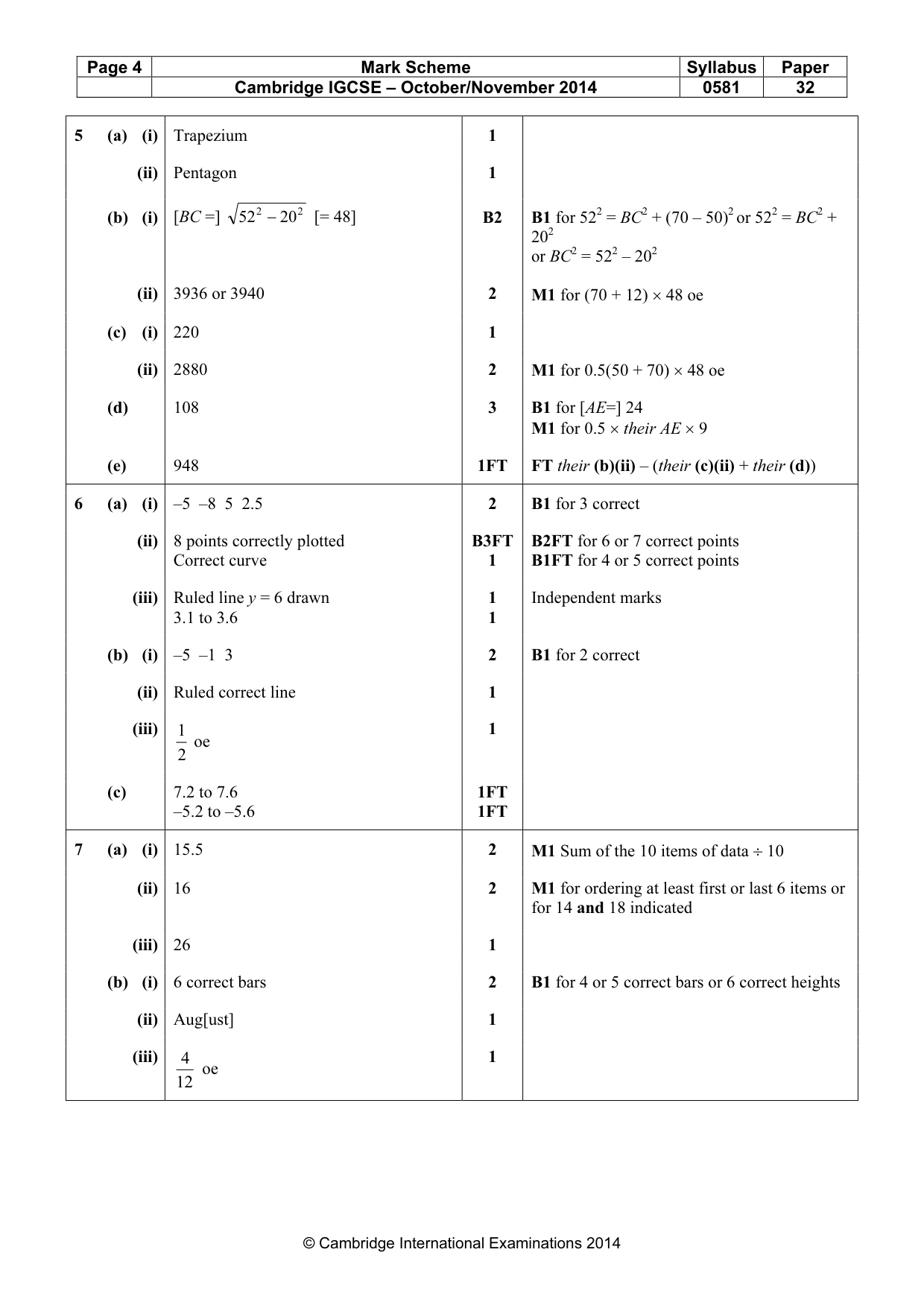
Page 4 Mark Scheme Syllabus Paper Cambridge IGCSE – October/November 2014 0581 32 © Cambridge International Examinations 2014 5 (a) (i) Trapezium 1 (ii) Pentagon 1 (b) (i) [BC =] 2 2 20 52 − [= 48] B2 B1 for 522 = BC2 + (70 – 50)2 or 522 = BC2 + 202 or BC2 = 522 – 202 (ii) 3936 or 3940 2 M1 for (70 + 12) × 48 oe (c) (i) 220 1 (ii) 2880 2 M1 for 0.5(50 + 70) × 48 oe (d) 108 3 B1 for [AE=] 24 M1 for 0.5 × their AE × 9 (e) 948 1FT FT their (b)(ii) – (their (c)(ii) + their (d)) 6 (a) (i) –5 –8 5 2.5 2 B1 for 3 correct (ii) 8 points correctly plotted Correct curve B3FT 1 B2FT for 6 or 7 correct points B1FT for 4 or 5 correct points (iii) Ruled line y = 6 drawn 3.1 to 3.6 1 1 Independent marks (b) (i) –5 –1 3 2 B1 for 2 correct (ii) Ruled correct line 1 (iii) 2 1 oe 1 (c) 7.2 to 7.6 –5.2 to –5.6 1FT 1FT 7 (a) (i) 15.5 2 M1 Sum of the 10 items of data ÷ 10 (ii) 16 2 M1 for ordering at least first or last 6 items or for 14 and 18 indicated (iii) 26 1 (b) (i) 6 correct bars 2 B1 for 4 or 5 correct bars or 6 correct heights (ii) Aug[ust] 1 (iii) 12 4 oe 1
Mark scheme, page 5
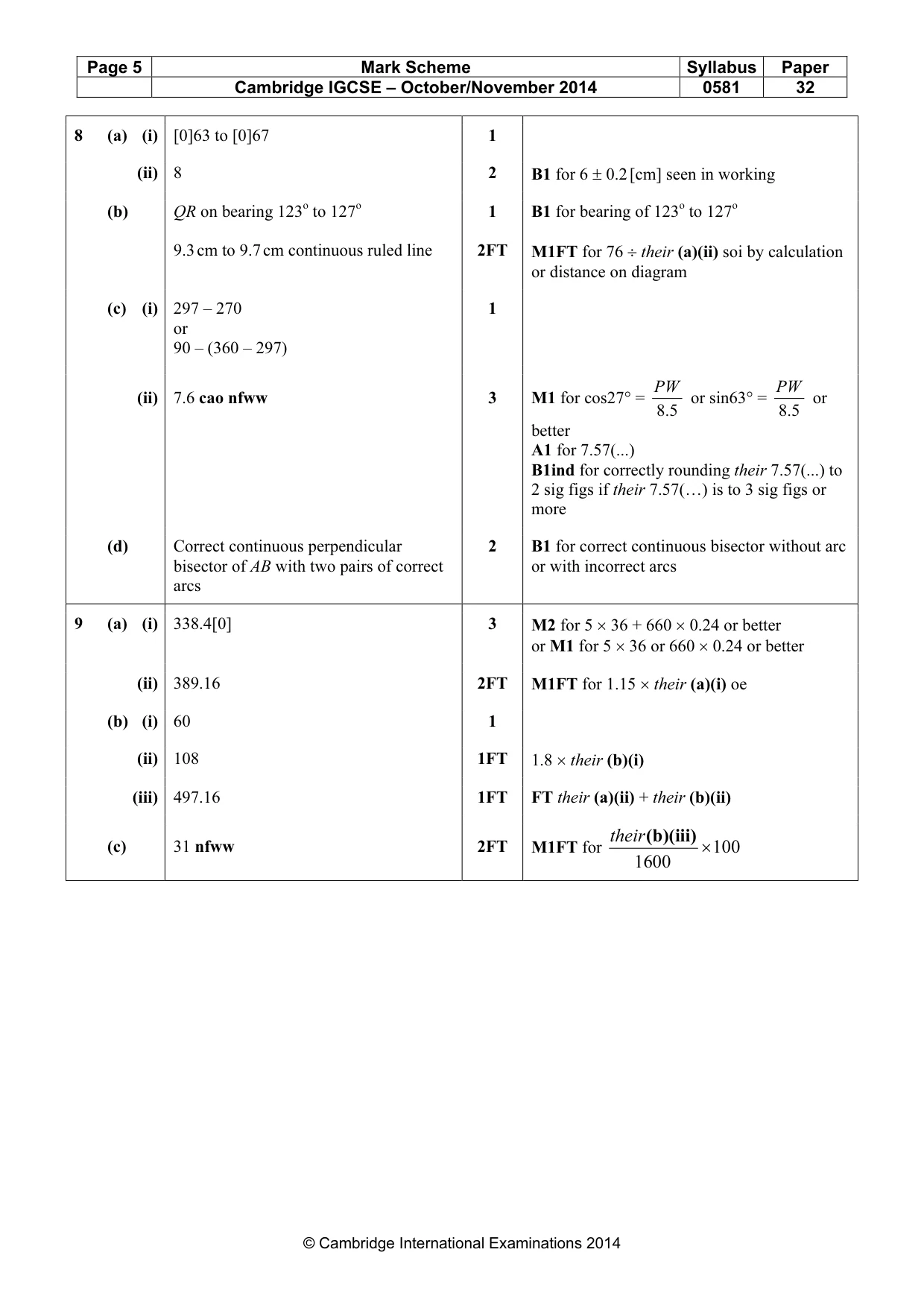
Page 5 Mark Scheme Syllabus Paper Cambridge IGCSE – October/November 2014 0581 32 © Cambridge International Examinations 2014 8 (a) (i) [0]63 to [0]67 1 (ii) 8 2 B1 for 6 ± 0.2 [cm] seen in working (b) QR on bearing 123o to 127o 9.3 cm to 9.7 cm continuous ruled line 1 2FT B1 for bearing of 123o to 127o M1FT for 76 ÷ their (a)(ii) soi by calculation or distance on diagram (c) (i) 297 – 270 or 90 – (360 – 297) 1 (ii) 7.6 cao nfww 3 M1 for cos27° = 5.8 PW or sin63° = 5.8 PW or better A1 for 7.57(...) B1ind for correctly rounding their 7.57(...) to 2 sig figs if their 7.57(…) is to 3 sig figs or more (d) Correct continuous perpendicular bisector of AB with two pairs of correct arcs 2 B1 for correct continuous bisector without arc or with incorrect arcs 9 (a) (i) 338.4[0] 3 M2 for 5 × 36 + 660 × 0.24 or better or M1 for 5 × 36 or 660 × 0.24 or better (ii) 389.16 2FT M1FT for 1.15 × their (a)(i) oe (b) (i) 60 1 (ii) 108 1FT 1.8 × their (b)(i) (iii) 497.16 1FT FT their (a)(ii) + their (b)(ii) (c) 31 nfww 2FT M1FT for 100 1600 × (b)(iii) their
What you needed in this session
Cambridge’s own grade thresholds for 2014 Oct/Nov, Paper 3 · Variant 2. A higher threshold means an easier paper — the bar moves with how the cohort did.