Questions as text
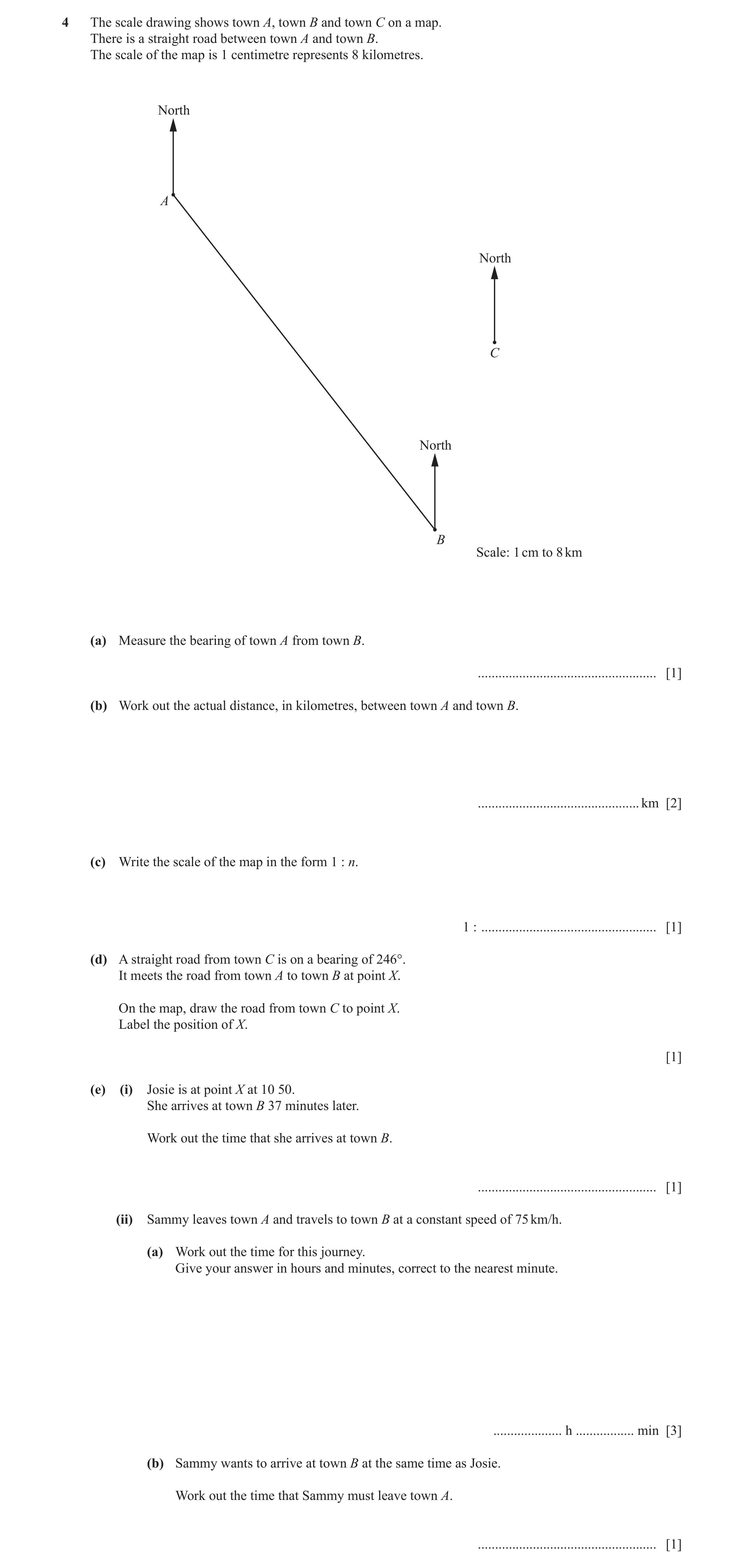
Q1 · The scale drawing shows town A, town B and town C on a map 0980/32 May/June 2019
4 The scale drawing shows town A, town B and town C on a map. There is a straight road between town A and town B. The scale of the map is 1 centimetre represents 8 kilometres. North A North C North B Scale: 1 cm to 8 km (a) Measure the bearing of town A from town B. … [1] (b) Work out the actual distance, in kilometres, between town A and town B. … km [2] (c) Write the scale of the map in the form 1 : n. 1 : … [1] (d) A straight road from town C is on a bearing of 246°. It meets the road from town A to town B at point X. On the map, draw the road from town C to point X. Label the position of X. [1] (e) (i) Josie is at point X at 10 50. She arrives at town B 37 minutes later. Work out the time that she arrives at town B. … [1] (ii) Sammy leaves town A and travels to town B at a constant speed of 75 km/h. (a) Work out the time for this journey. Give your answer in hours and minutes, correct to the nearest minute. … h … min [3] (b) Sammy wants to arrive at town B at the same time as Josie. Work out the time that Sammy must leave town A. … [1]
10 marks
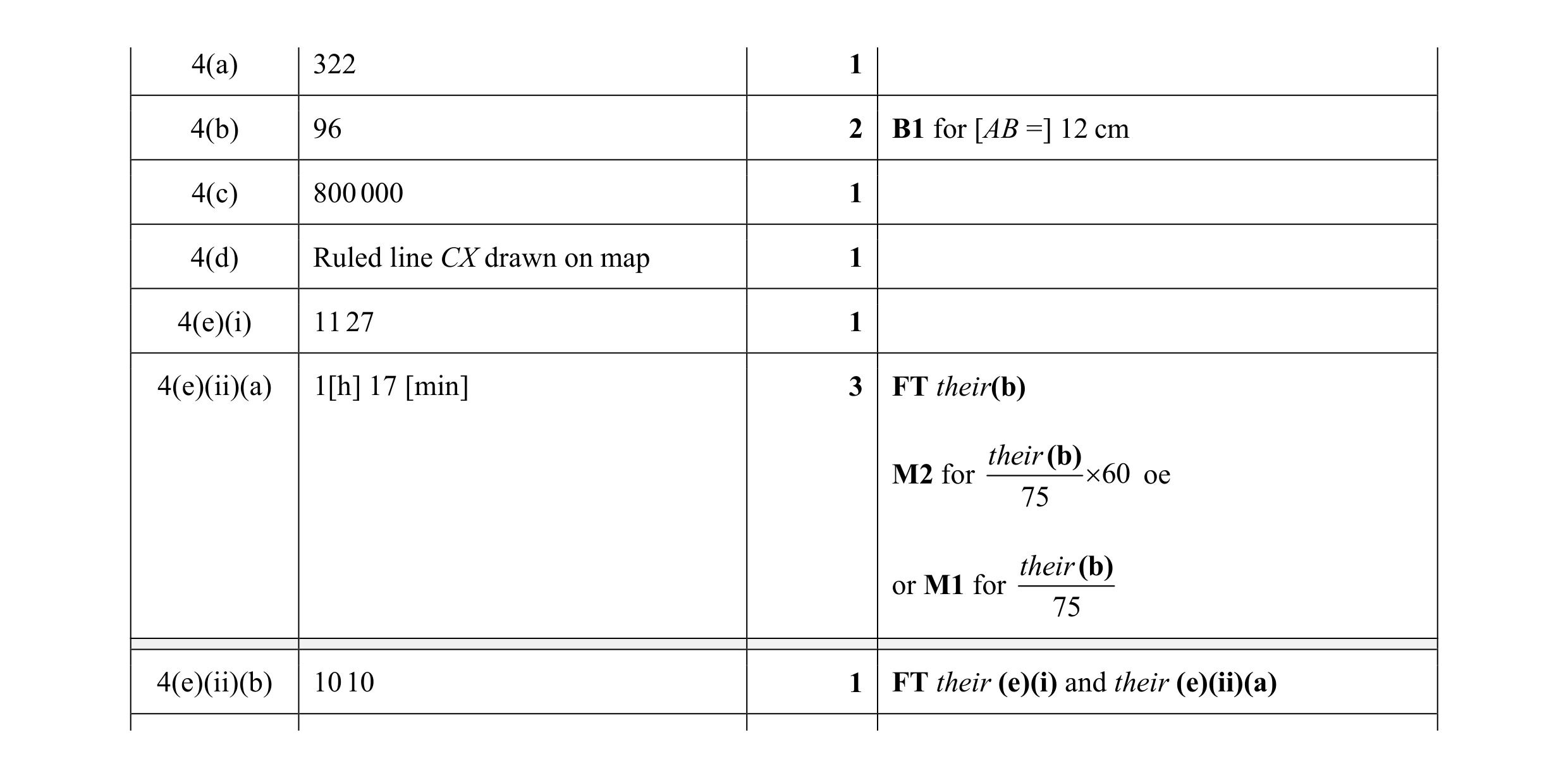
Mark scheme: 4(a) 322 1 4(b) 96 2 B1 for [AB =] 12 cm 4(c) 800 000 1 4(d) Ruled line CX drawn on map 1 4(e)(i) 11 27 1 4(e)(ii)(a) 1[h] 17 [min] 3 FT their(b) their (b) M2 for × 60 oe 75 their(b) or M1 for 75 4(e)(ii)(b) 10 10 1 FT their (e)(i) and their (e)(ii)(a)
This question in 0980/32 May/June 2019
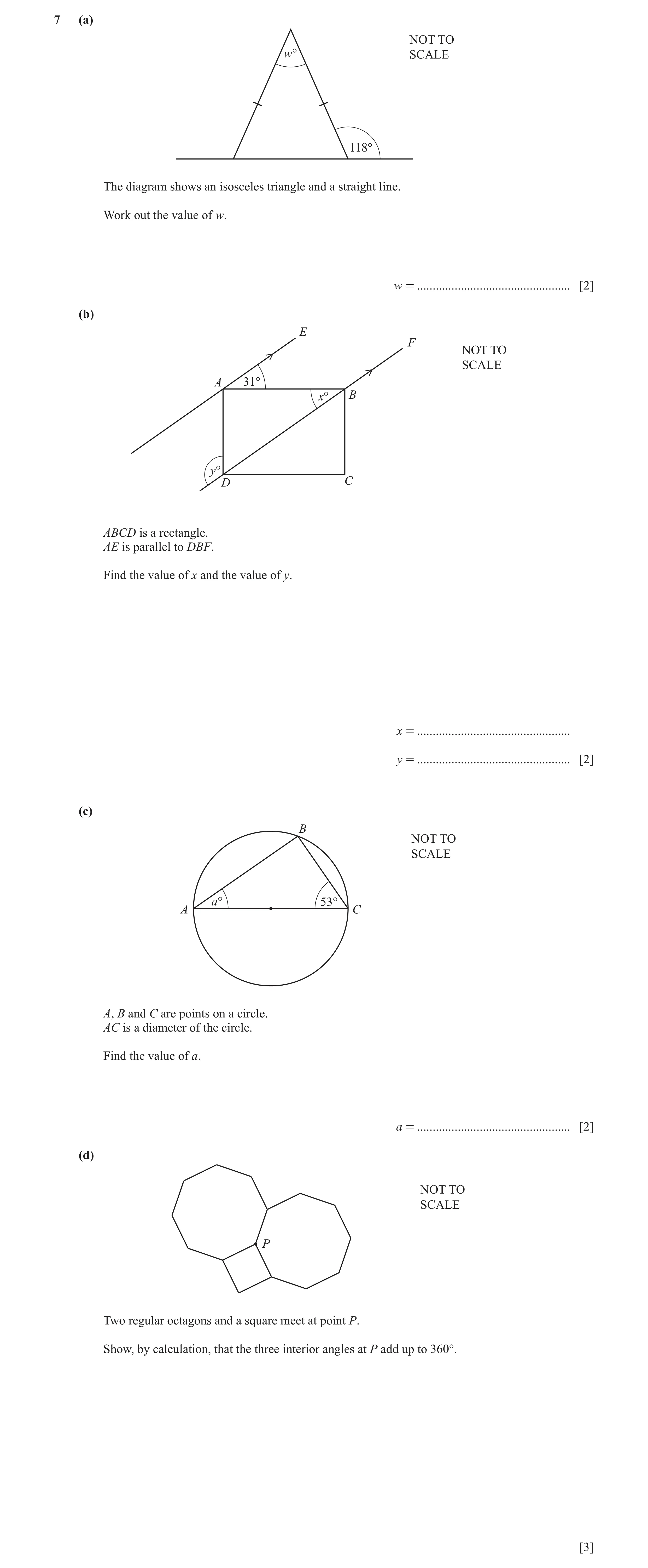
Q2 · NOT TO w° SCALE 118° The diagram shows an isosceles triangle and a straight line 0980/31 Oct/Nov 2020
7 (a) NOT TO w° SCALE 118° The diagram shows an isosceles triangle and a straight line. Work out the value of w. w = … [2] (b) E F NOT TO SCALE A 31° x° B y° D C ABCD is a rectangle. AE is parallel to DBF. Find the value of x and the value of y. x = … y = … [2] (c) B NOT TO SCALE a° 53° A C A, B and C are points on a circle. AC is a diameter of the circle. Find the value of a. a = … [2] (d) NOT TO SCALE P Two regular octagons and a square meet at point P. Show, by calculation, that the three interior angles at P add up to 360°. [3]
9 marks
Mark scheme: 7(a) 56 2 M1 for 180 – 118 oe or 180 – 2 × their 62 oe 7(b) [x =] 31 2 B1 for each [y =] 121 or M1 for their y = 90 + their x 7(c) 37 2 B1 for the angle ABC marked as 90 or M1 for 180 – (90 + 53) oe 7(d) 360 M2 360 180 – or (8 – 2) × 180 ÷ 8 M1 for or (8 – 2) × 180 8 8 135 + 135 + 90 [= 360] A1
This question in 0980/31 Oct/Nov 2020
Question 3 0980/32 May/June 2021
id. C (a) Write down the mathematical name of the shaded polygon. … [1] (b) Find the area of the shaded polygon. … cm2 [2] (c) Describe fully the single transformation that maps (i) the shaded polygon onto polygon A, … … [2] (ii) the shaded polygon onto polygon B, … … [3] (iii) the shaded polygon onto polygon C. … … [3] (d) On the grid, draw the image of the shaded polygon after a reflection in the line y = 0 . [2]
13 marks
Mark scheme: 2(a) Pentagon 1 2(b) 12 2 B1 for 10 to 14 2(c)(i) Translation 2 B1 for each 7 4 2(c)(ii) Rotation 3 B1 for each [centre] (0, 0) oe 180° 2(c)(iii) Enlargement 3 B1 for each [centre] (4, 2) [scale factor] 0.5 oe 2(d) Correct reflection 2 B1 for a correct reflection in x = 0 or in (−2, −2), (−1, −4), (−2, −6), (−4, −6) y = k k ≠ 0 or for 4 correct points (−6, −4)
This question in 0980/32 May/June 2021
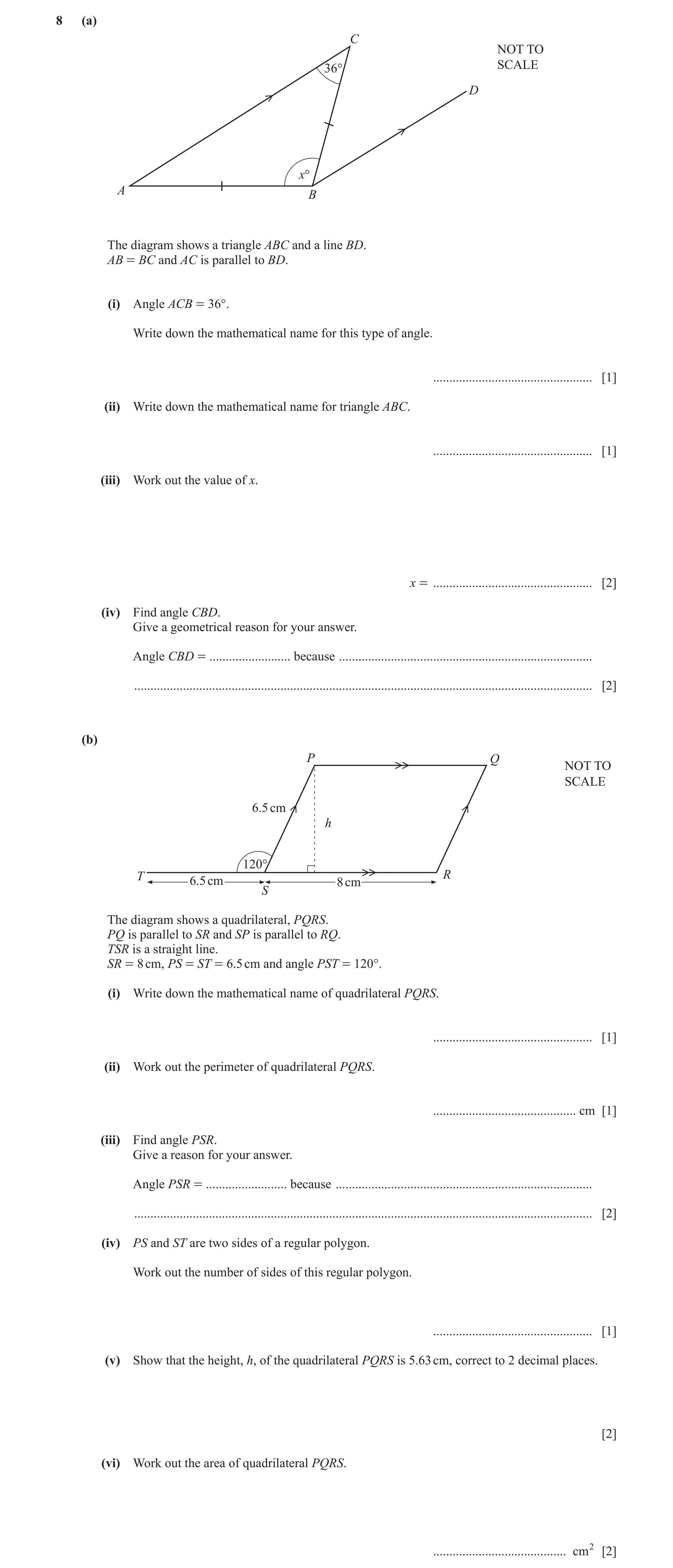
Q4 · C NOT TO SCALE 36° D x° A B The diagram shows a triangle ABC and a line BD 0980/32 May/June 2021
8 (a) C NOT TO SCALE 36° D x° A B The diagram shows a triangle ABC and a line BD. AB = BC and AC is parallel to BD. (i) Angle ACB = 36°. Write down the mathematical name for this type of angle. … [1] (ii) Write down the mathematical name for triangle ABC. … [1] (iii) Work out the value of x. x = … [2] (iv) Find angle CBD. Give a geometrical reason for your answer. Angle CBD = … because … … [2] (b) P Q NOT TO SCALE 6.5 cm h 120° T R 6.5 cm 8 cm S The diagram shows a quadrilateral, PQRS. PQ is parallel to SR and SP is parallel to RQ. TSR is a straight line. SR = 8 cm, PS = ST = 6.5 cm and angle PST = 120°. (i) Write down the mathematical name of quadrilateral PQRS. … [1] (ii) Work out the perimeter of quadrilateral PQRS. … cm [1] (iii) Find angle PSR. Give a reason for your answer. Angle PSR = … because … … [2] (iv) PS and ST are two sides of a regular polygon. Work out the number of sides of this regular polygon. … [1] (v) Show that the height, h, of the quadrilateral PQRS is 5.63 cm, correct to 2 decimal places. [2] (vi) Work out the area of quadrilateral PQRS. … cm2 [2]
15 marks
Mark scheme: 8(a)(i) Acute 1 8(a)(ii) Isosceles 1 8(a)(iii) 108 2 B1 for angle CAB = 36° or M1 for 180 – 2 × 36 or 180 – 72 oe 8(a)(iv) 36 2 B1 for each Alternate [angles] 8(b)(i) Parallelogram 1 8(b)(ii) 29 1 8(b)(iii) 60 2 B1 for each Angles [on a straight] line [add up to] 180 8(b)(iv) 6 1 8(b)(v) h M1 sin60 = or better 6.5 5.629 ... A1 8(b)(vi) 45.[0] or 45.03 to 45.04 2 M1 for 5.63 × 8 or 5.629…. × 8 oe
This question in 0980/32 May/June 2021
Q5 · A (i) Write down the mathematical name for the type of angle a 0980/32 May/June 2022
3 (a) a (i) Write down the mathematical name for the type of angle a. … [1] (ii) Measure angle a. … [1] (b) Kate describes a quadrilateral. • All the sides are the same length. • It has only two lines of symmetry. (i) Draw a sketch of this quadrilateral. [1] (ii) Write down the mathematical name for this quadrilateral. … [1] (iii) One of the interior angles of this quadrilateral is 70°. Work out the other three interior angles. … , … , … [2] (c) The diagrams show the angles in a triangle and two angles on a straight line. 2y° NOT TO SCALE 6y° x° x° x° (i) The triangle is used to write down an equation in terms of x and y. 2x + 2y = 180 Give the geometrical reason why this equation is correct. Reason … [1] (ii) Use the diagram with two angles on a straight line to write down another equation in terms of x and y. … [1] (iii) Solve these simultaneous equations. You must show all your working. x = … y = … [3]
11 marks
Mark scheme: 3(a)(i) Obtuse 1 3(a)(ii) 113 1 3(b)(i) Sketch of a rhombus 1 3(b)(ii) Rhombus cao 1 3(b)(iii) 70, 110, 110 2 B1 for 110 or M1 for (360 – 70 – 70 ) ÷ 2 oe or M1 for 70 70 x x 360 oe soi 3(c)(i) Angles [in a] triangle add to 1 180 3(c)(ii) x 6 y 180 oe 1 3(c)(iii) Correctly eliminating one M1 FT their (c)(ii), if linear in x and y variable [ x ] 72 A1 [ y ]1 8 A1 If M0 scored, SC1 for 2 values satisfying one of the original equations or their equations in (c)(ii) SC1 if no working shown but 2 correct answers given
This question in 0980/32 May/June 2022
Q6 · Show that the exterior angle of a regular octagon is 45° 0980/32 May/June 2022
8 (a) (i) Show that the exterior angle of a regular octagon is 45°. [1] (ii) Find the interior angle of a regular octagon. … [1] (b) North H A NOT TO G B SCALE F C E D The diagram shows the route of a boat race. The route is in the shape of a regular octagon, ABCDEFGH. H is due west of A. (i) Find the bearing of B from A. … [1] (ii) Complete this statement. The bearing of C from D is the same as the bearing of … from … [1] (iii) (a) Write down the mathematical name of triangle ABH. … [1] (b) Calculate angle ABH. Angle ABH = … [2] (c) Work out the bearing of H from B. … [2] (c) Each side of the octagon is 1.35 km. The average speed of a boat is 45 km/h. Work out the time it will take this boat to complete the race. Give your answer in minutes. … min [3] (d) Hetty wants to draw a scale drawing of the route. She chooses a scale of 1:500 000. Has Hetty chosen a suitable scale? Show all your working and explain your decision. … because … [2]
14 marks
Mark scheme: 8(a)(i) 360 1 45 8 8 2 180 or 180 [= 45] 8 8(a)(ii) 135 1 8(b)(i) 135 1 8(b)(ii) H, G or B, E or A, F 1 8(b)(iii)(a) Isosceles 1 8(b)(iii)(b) 22.5 2 180 their (a)(ii) M1 for oe 2 8(b)(iii)(c) 292.5 2 M1 for 360 (45 their (b)(iii)(b) ) oe or 270 their (b)(iii)(b) oe 8(c) 14.4 3 1.35 1.35 M2 for 60 8 or 8 60 45 45 1.35 or M1 for oe 45 If M0 scored, SC1 for (figs)144 as final answer 8(d) Correct calculation 2 e.g. 1 cm is 5 km B1 for 1 cm : 5 km or 0.27 cm is 1.35 km or 0.27 cm : 1.35 km or 2.16 cm is 10.8 km or 2.16 cm : 10.8 km leading to no [because] the scale drawing is too small
This question in 0980/32 May/June 2022
Q7 · Write down the mathematical name of this solid 0980/31 Oct/Nov 2022
6 (a) Write down the mathematical name of this solid. … [1] (b) B C A D 104° NOT TO SCALE x° E The diagram shows triangle BCE and a straight line ABCD. BE = CE and angle ABE = 104°. Find the value of x. x = … [2] (c) Work out the size of one interior angle of a regular polygon with 15 sides. … [2] (d) B y° O NOT TO A 38° SCALE C A, B and C are points on a circle, centre O. (i) Write down the mathematical name of the line BC. … [1] (ii) Draw a tangent to the circle at point B. [1] (iii) The area of the circle is 245.5 cm 2. Calculate AB. AB = … cm [3] (iv) Find the value of y. y = … [2]
12 marks
Mark scheme: 6(a) Cylinder 1 6(b) 28 2 M1 for 180 – 104 oe 6(c) 156 2 360 (15 − 2 )180 M1 for 180 – oe or oe 15 15 6(d)(i) Chord 1 6(d)(ii) Tangent drawn at point B 1 6(d)(iii) 17.7 or 17.67 to 17.68 3 M2 for [2] 245.5 π oe or M1 for 245.5 ÷ π oe 6(d)(iv) 52 2 M1 for 180 – 90 – 38 oe or B1 for [angle ACB =] 90 correctly identified
This question in 0980/31 Oct/Nov 2022
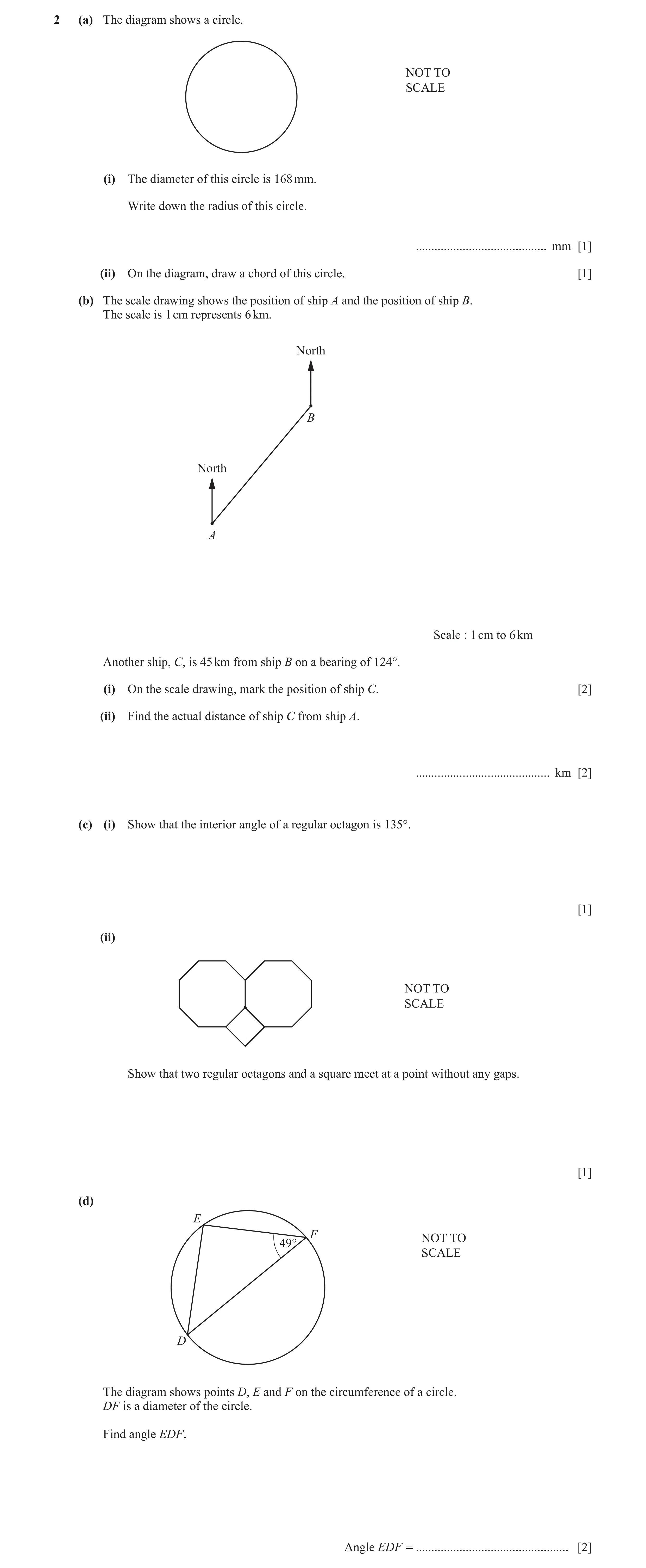
Q8 · The diagram shows a circle 0980/31 Oct/Nov 2023
2 (a) The diagram shows a circle. NOT TO SCALE (i) The diameter of this circle is 168 mm. Write down the radius of this circle. … mm [1] (ii) On the diagram, draw a chord of this circle. [1] (b) The scale drawing shows the position of ship A and the position of ship B. The scale is 1 cm represents 6 km. North B North A Scale : 1 cm to 6 km Another ship, C, is 45 km from ship B on a bearing of 124°. (i) On the scale drawing, mark the position of ship C. [2] (ii) Find the actual distance of ship C from ship A. … km [2] (c) (i) Show that the interior angle of a regular octagon is 135°. [1] (ii) NOT TO SCALE Show that two regular octagons and a square meet at a point without any gaps. [1] (d) E F NOT TO 49° SCALE D The diagram shows points D, E and F on the circumference of a circle. DF is a diameter of the circle. Find angle EDF. Angle EDF = … [2]
10 marks
Mark scheme: 2(a)(i) 84 1 2(a)(ii) Any chord 1 2(b)(i) Accurate position marked 2 B1 for accurate distance or accurate angle 2(b)(ii) 57 2 FT their diagram for 1 and 2 marks B1 for 9.2 to 9.6 seen or M1 for their length 6 2(c)(i) 360 ( 8 − 2 ) 180 M1 180 – or 8 8 2(c)(ii) 135 + 135 + 90 = 360 M1 2(d) 41 2 M1 for 180 – 90 – 49 oe or angle DEF identified as 90°
This question in 0980/31 Oct/Nov 2023
Q9 · Nd D (a) Write down the mathematical name of quadrilateral A 0980/32 May/June 2024
nd D (a) Write down the mathematical name of quadrilateral A. … [1] (b) (i) Find the area of quadrilateral A. … cm2 [1] (ii) Measure the perimeter of quadrilateral A. … cm [1] (c) Describe fully the single transformation that maps (i) quadrilateral A onto quadrilateral B … … [2] (ii) quadrilateral A onto quadrilateral C … … [2] (iii) quadrilateral A onto quadrilateral D. … … [3] (d) On the grid, enlarge quadrilateral A by scale factor 2, centre ( - 3, - 3) . [2]
12 marks
Mark scheme: 3(a) Trapezium 1 3(b)(i) 7.5 1 3(b)(ii) 11 to 11.4 1 3(c)(i) Translation 2 B1 for each 9 7 3(c)(ii) Reflection 2 B1 for each y = −3 oe 3(c)(iii) Rotation 3 B1 for each (0, 0) 90° clockwise 3(d) Trapezium drawn at 2 B1 for correct enlargement, scale factor (−1, 5),(−7, 5),(−7, 11),(−3, 11) 2, but in the wrong position.
This question in 0980/32 May/June 2024
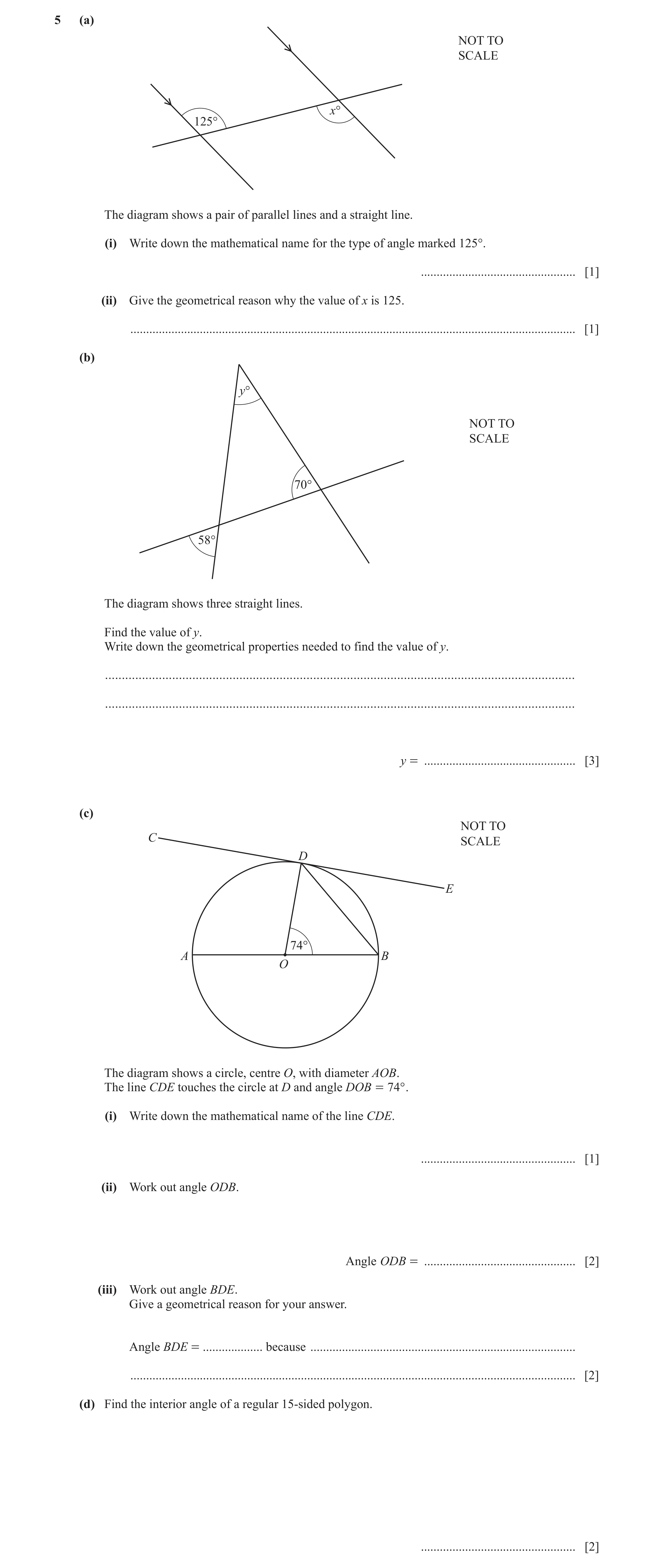
Q10 · NOT TO SCALE x° 125° The diagram shows a pair of parallel lines and a straight line 0980/32 May/June 2024
5 (a) NOT TO SCALE x° 125° The diagram shows a pair of parallel lines and a straight line. (i) Write down the mathematical name for the type of angle marked 125°. … [1] (ii) Give the geometrical reason why the value of x is 125. … [1] (b) y° NOT TO SCALE 70° 58° The diagram shows three straight lines. Find the value of y. Write down the geometrical properties needed to find the value of y. … … y = … [3] (c) NOT TO C SCALE D E 74° A B O The diagram shows a circle, centre O, with diameter AOB. The line CDE touches the circle at D and angle DOB = 74° . (i) Write down the mathematical name of the line CDE. … [1] (ii) Work out angle ODB. Angle ODB = … [2] (iii) Work out angle BDE. Give a geometrical reason for your answer. Angle BDE = … because … … [2] (d) Find the interior angle of a regular 15-sided polygon. … [2]
12 marks
Mark scheme: 5(a)(i) Obtuse 1 5(a)(ii) Alternate angles 1 5(b) Opposite angles 2 B1 for each angles in a triangle add to180 52 1 5(c)(i) Tangent 1 5(c)(ii) 53 2 M1 for (180 – 74) ÷ 2 5(c)(iii) 37 1 FT for 90 –their (c)(ii) Angle between tangent and 1 radius = 90° 5(d) 156 2 360 (15 2) 180 M1 for 180 − or oe 15 15
This question in 0980/32 May/June 2024
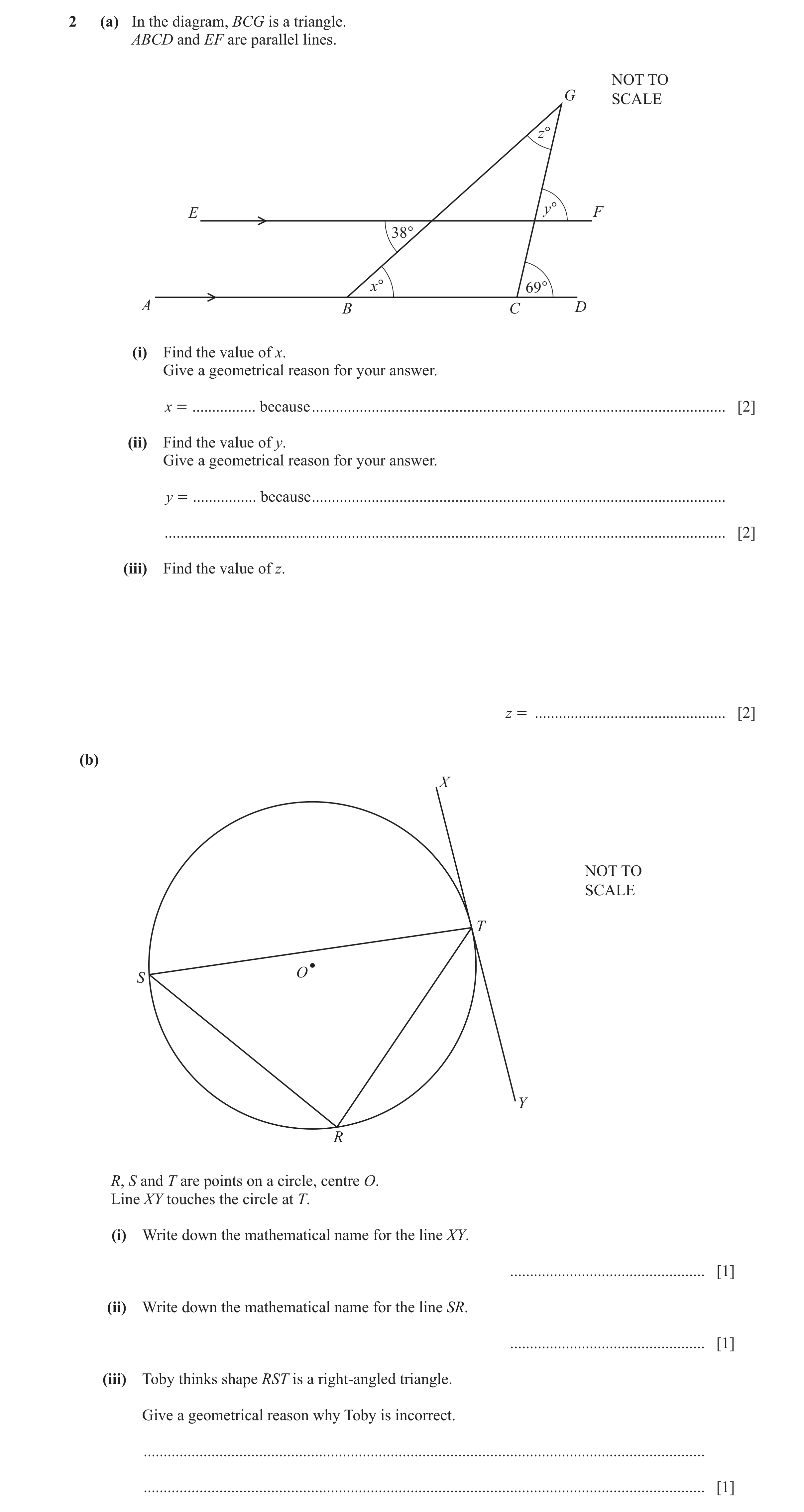
Q11 · In the diagram, BCG is a triangle 0980/31 Oct/Nov 2024
2 (a) In the diagram, BCG is a triangle. ABCD and EF are parallel lines. NOT TO G SCALE z° y° F E 38° x° 69° A B C D (i) Find the value of x. Give a geometrical reason for your answer. x = … because … [2] (ii) Find the value of y. Give a geometrical reason for your answer. y = … because … … [2] (iii) Find the value of z. z = … [2] (b) X NOT TO SCALE T O S Y R R, S and T are points on a circle, centre O. Line XY touches the circle at T. (i) Write down the mathematical name for the line XY. … [1] (ii) Write down the mathematical name for the line SR. … [1] (iii) Toby thinks shape RST is a right-angled triangle. Give a geometrical reason why Toby is incorrect. … … [1]
9 marks
Mark scheme: 2(a)(i) 38 2 B1 for each Alternate [angles] 2(a)(ii) 69 2 B1 for each Corresponding [angles] 2(a)(iii) 31 2 FT for their (a)(ii) – their (a)(i) or their (a)(ii) – 38 or 69 – their (a)(i) B1 for BCG = 111 or M1 for 180 – 69 oe or for 180 – their (a)(ii) oe or for 38 + 111 oe 2(b)(i) Tangent 1 2(b)(ii) Chord 1 2(b)(iii) None of the sides of the triangle is a 1 diameter of the circle oe
This question in 0980/31 Oct/Nov 2024
![Question 3: id. C (a) Write down the mathematical name of the shaded polygon. ................................................. [1] (b) Find the area o…](https://img.pastlit.com/crops/60683f78-ab7f-4ccb-a554-2e401335d16b/q2.webp)
![Question 5: (a) a (i) Write down the mathematical name for the type of angle a. ................................................. [1] (ii) Measure angl…](https://img.pastlit.com/crops/397834a0-a619-4d2f-a0c0-95330bbed3ee/q3.webp)
![Question 6: (a) (i) Show that the exterior angle of a regular octagon is 45°. [1] (ii) Find the interior angle of a regular octagon. ..................…](https://img.pastlit.com/crops/397834a0-a619-4d2f-a0c0-95330bbed3ee/q8.webp)
![Question 7: (a) Write down the mathematical name of this solid. ................................................. [1] (b) B C A D 104° NOT TO SCALE x° …](https://img.pastlit.com/crops/157d7bbd-429a-410a-baa8-eb8023a858b5/q6.webp)
![Question 9: nd D (a) Write down the mathematical name of quadrilateral A. ................................................. [1] (b) (i) Find the area o…](https://img.pastlit.com/crops/5b7ade42-4bcb-418e-a5e7-9f62dfdaf31c/q3.webp)
 10
10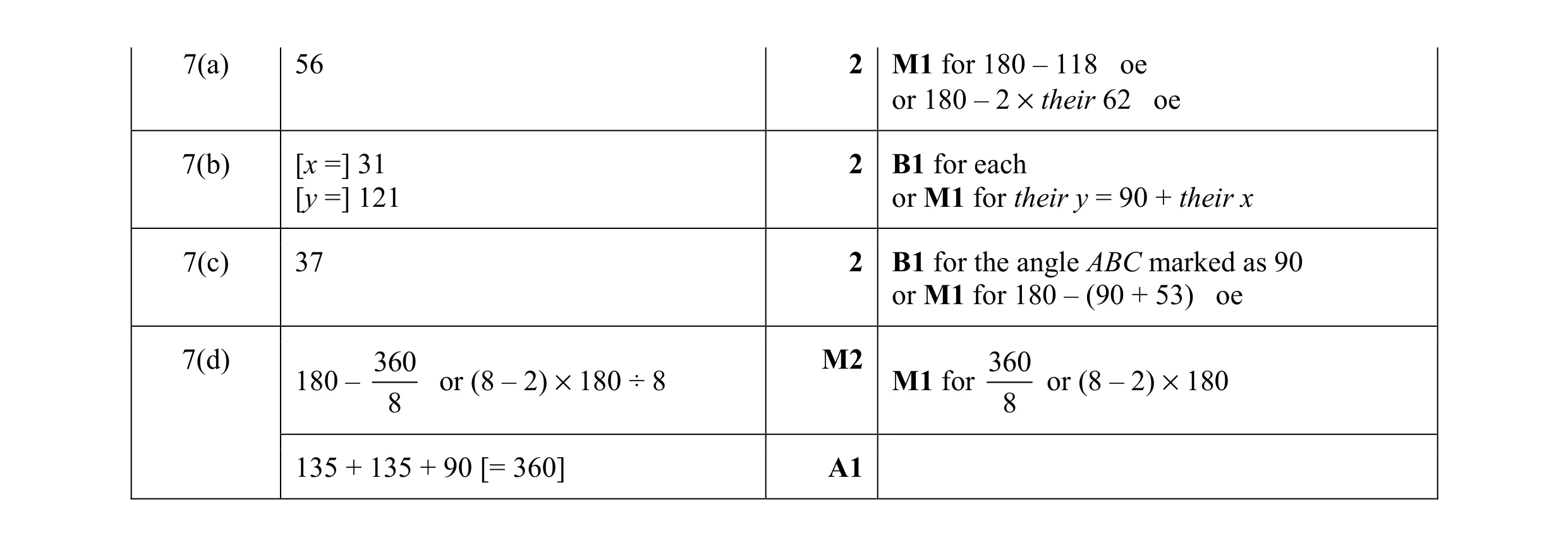 9
9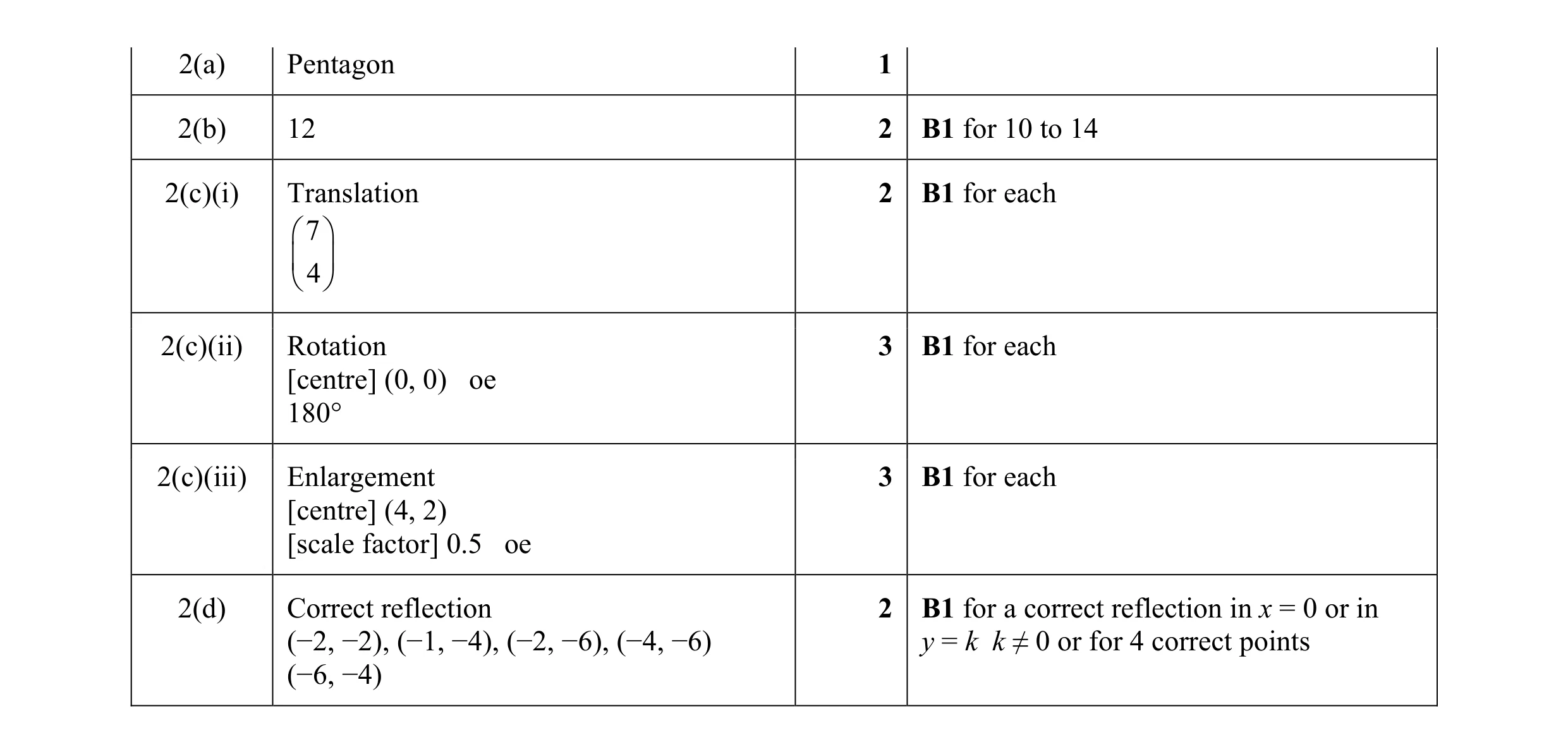 13
13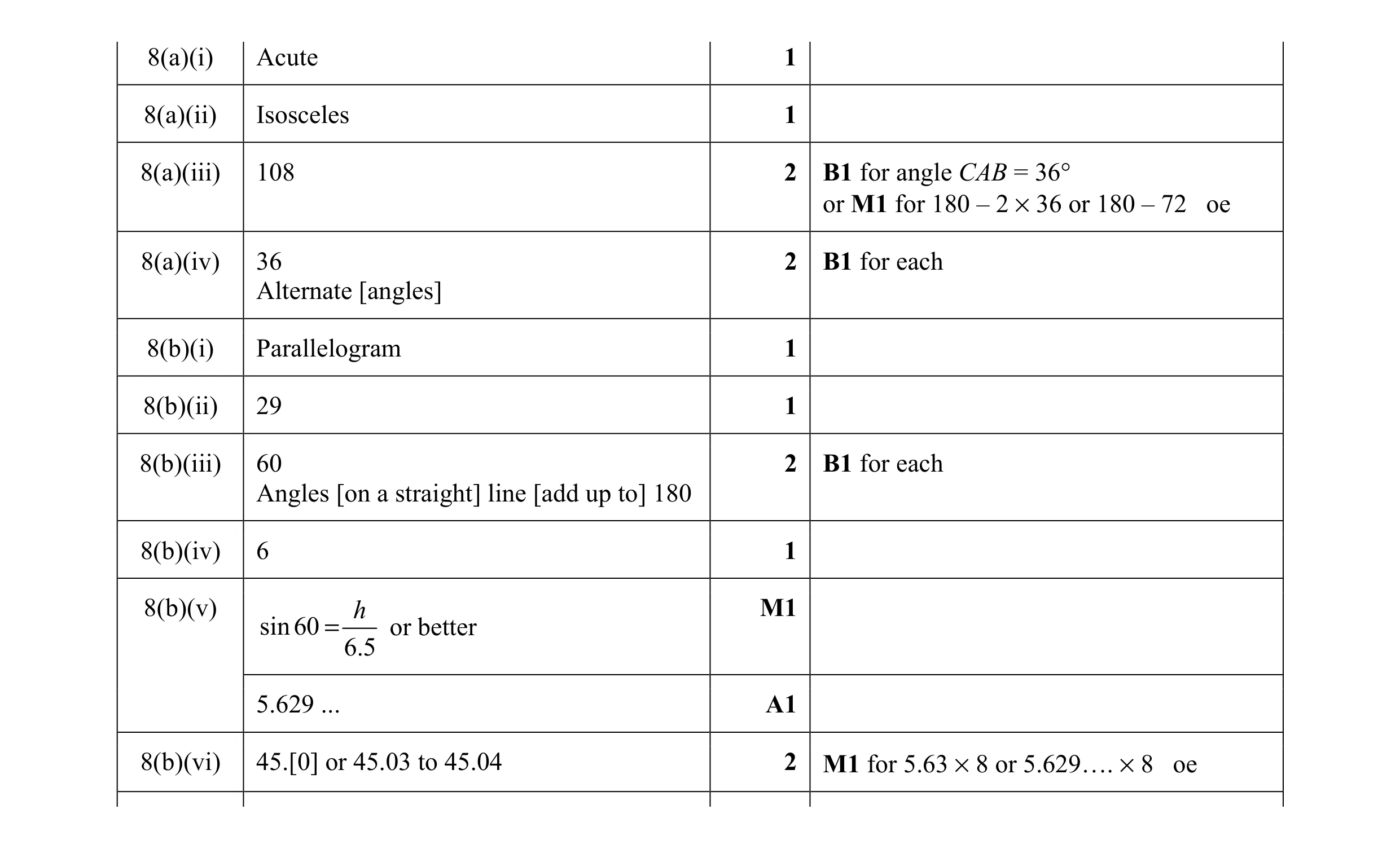 15
15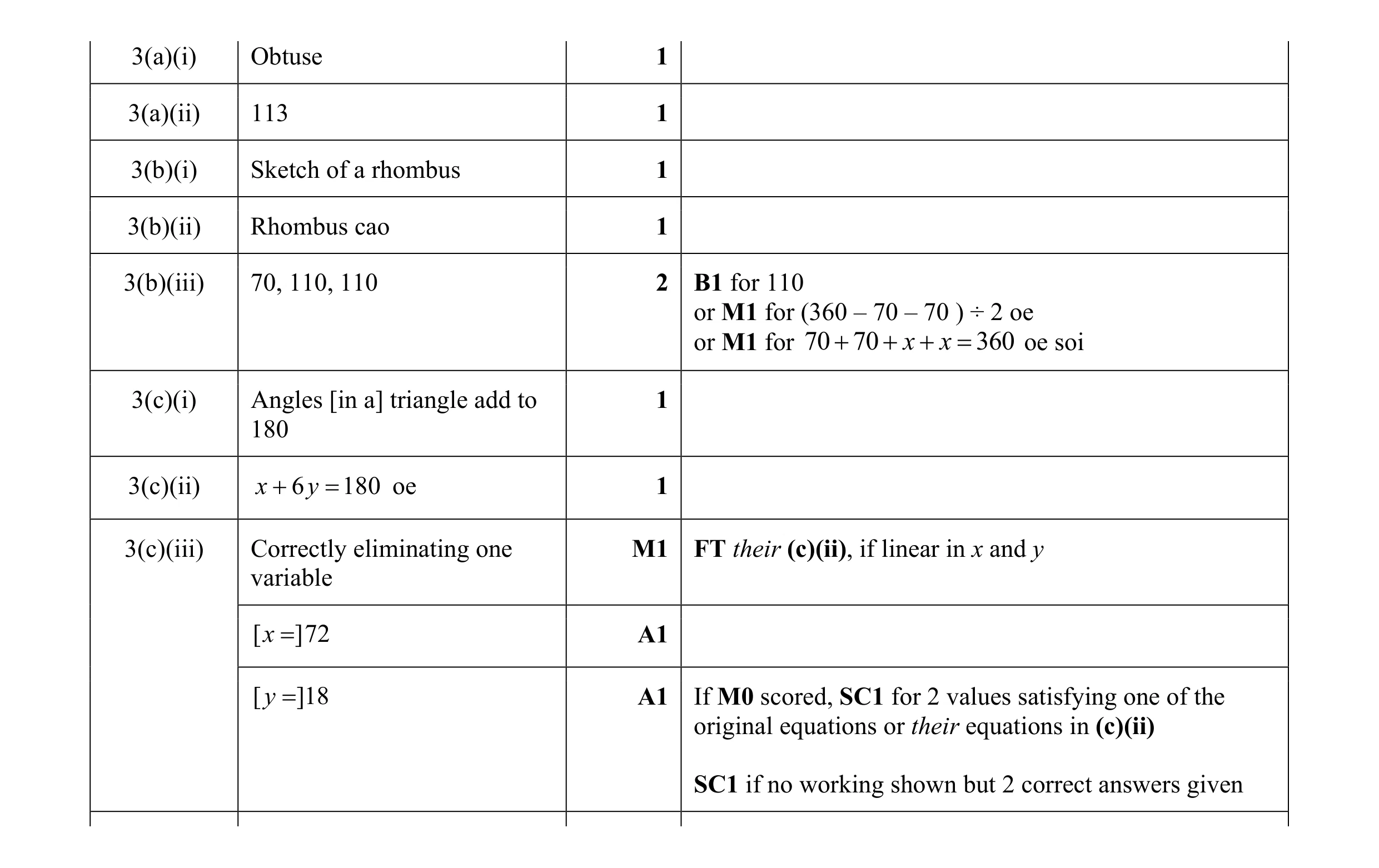 11
11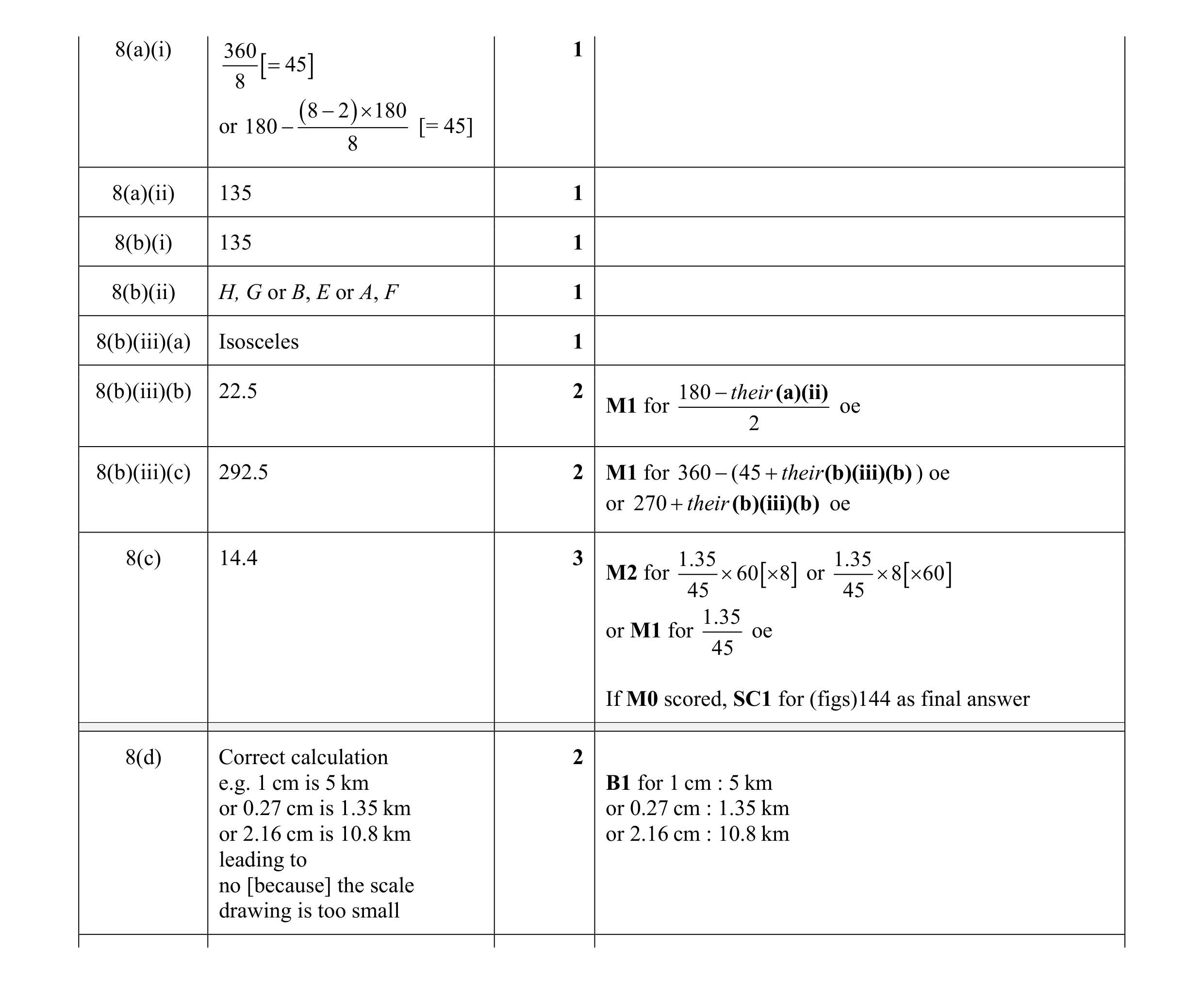 14
14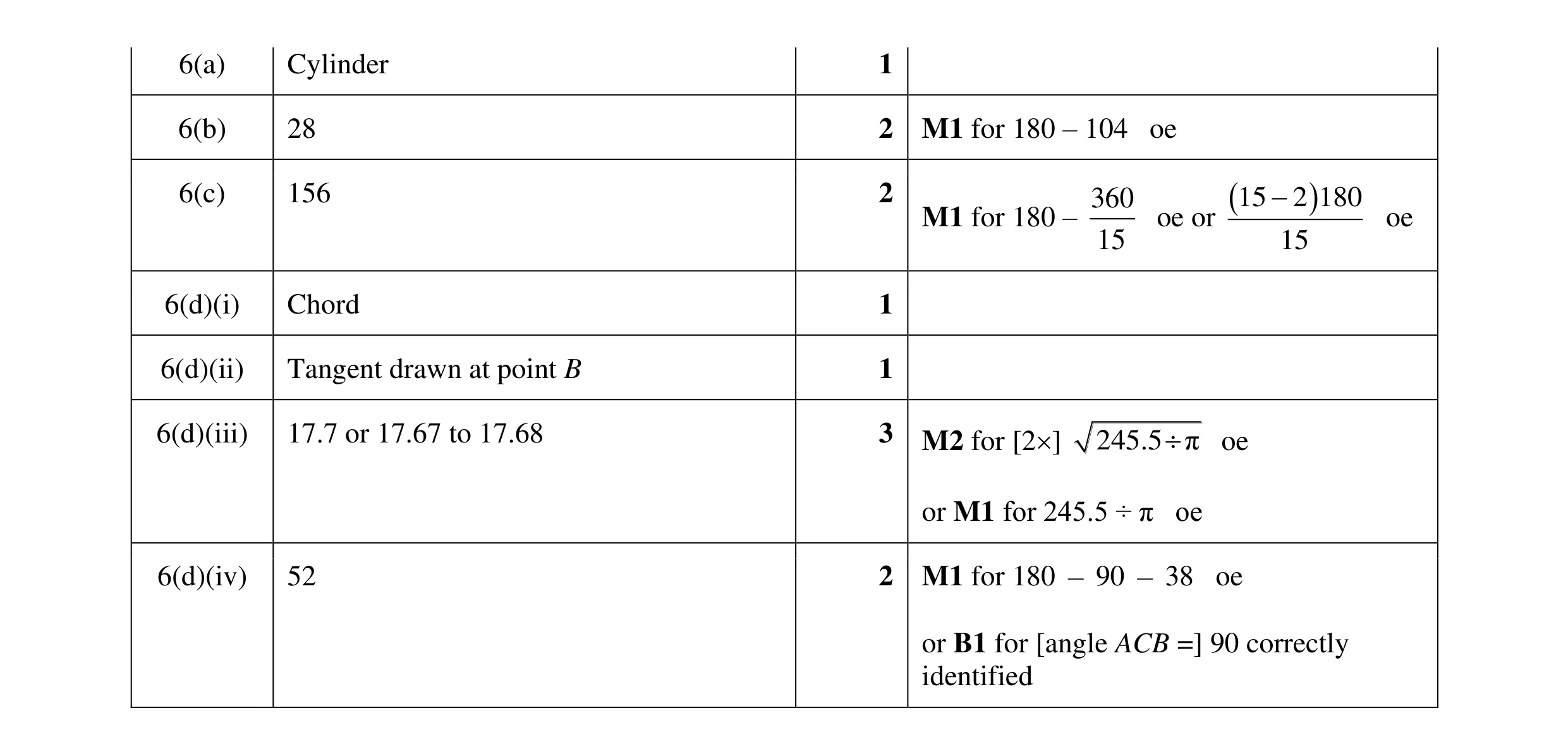 12
12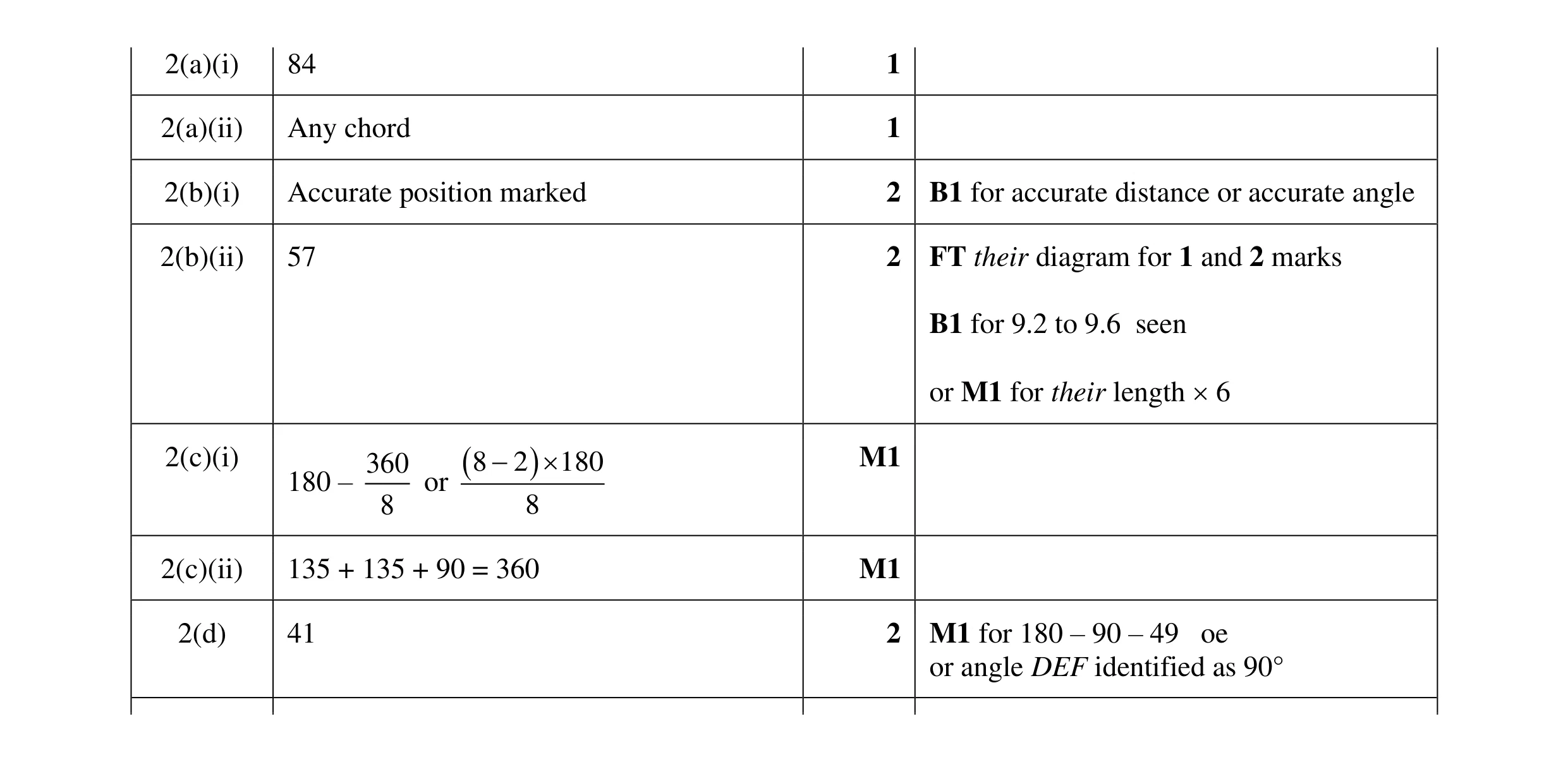 10
10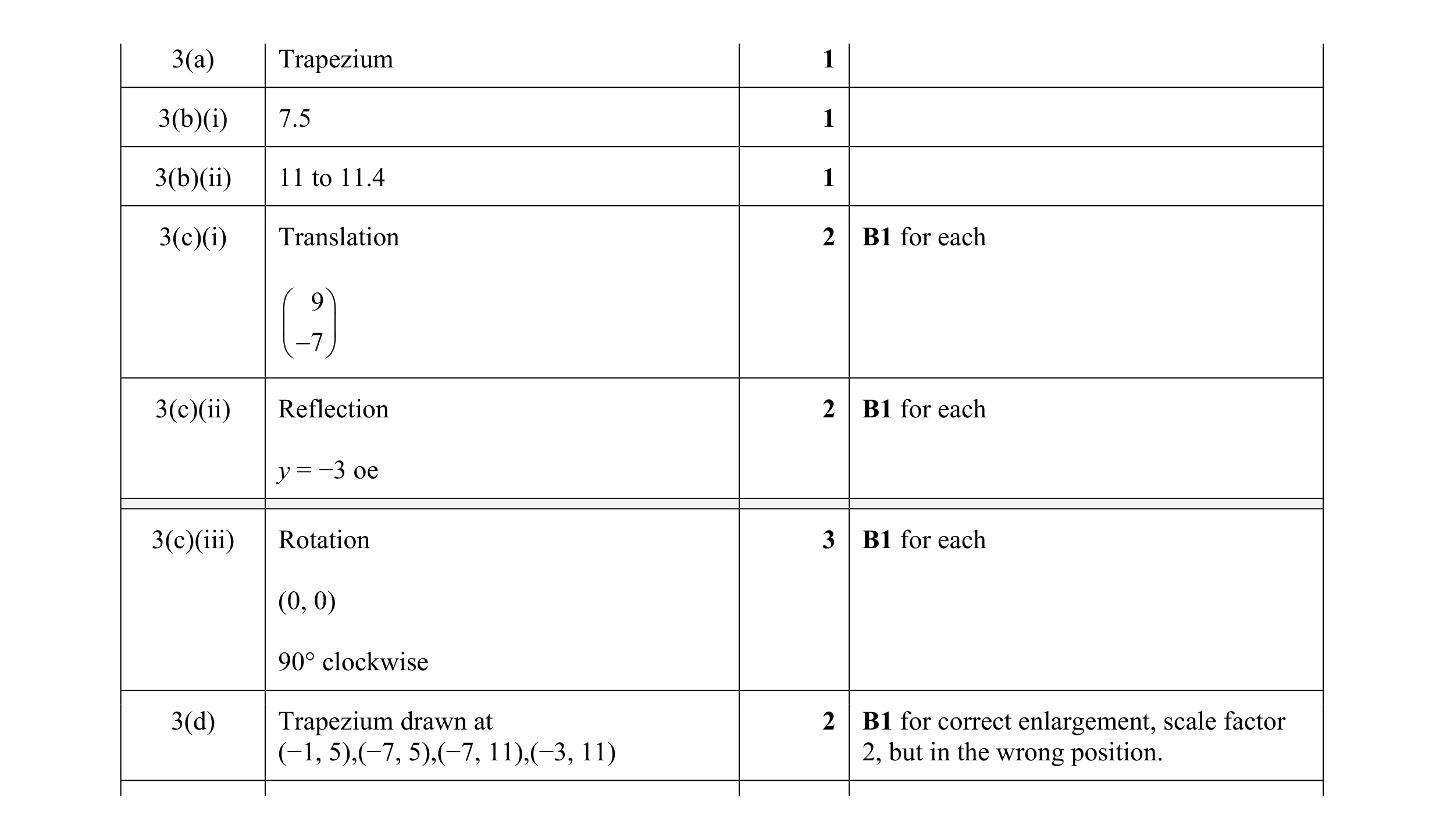 12
12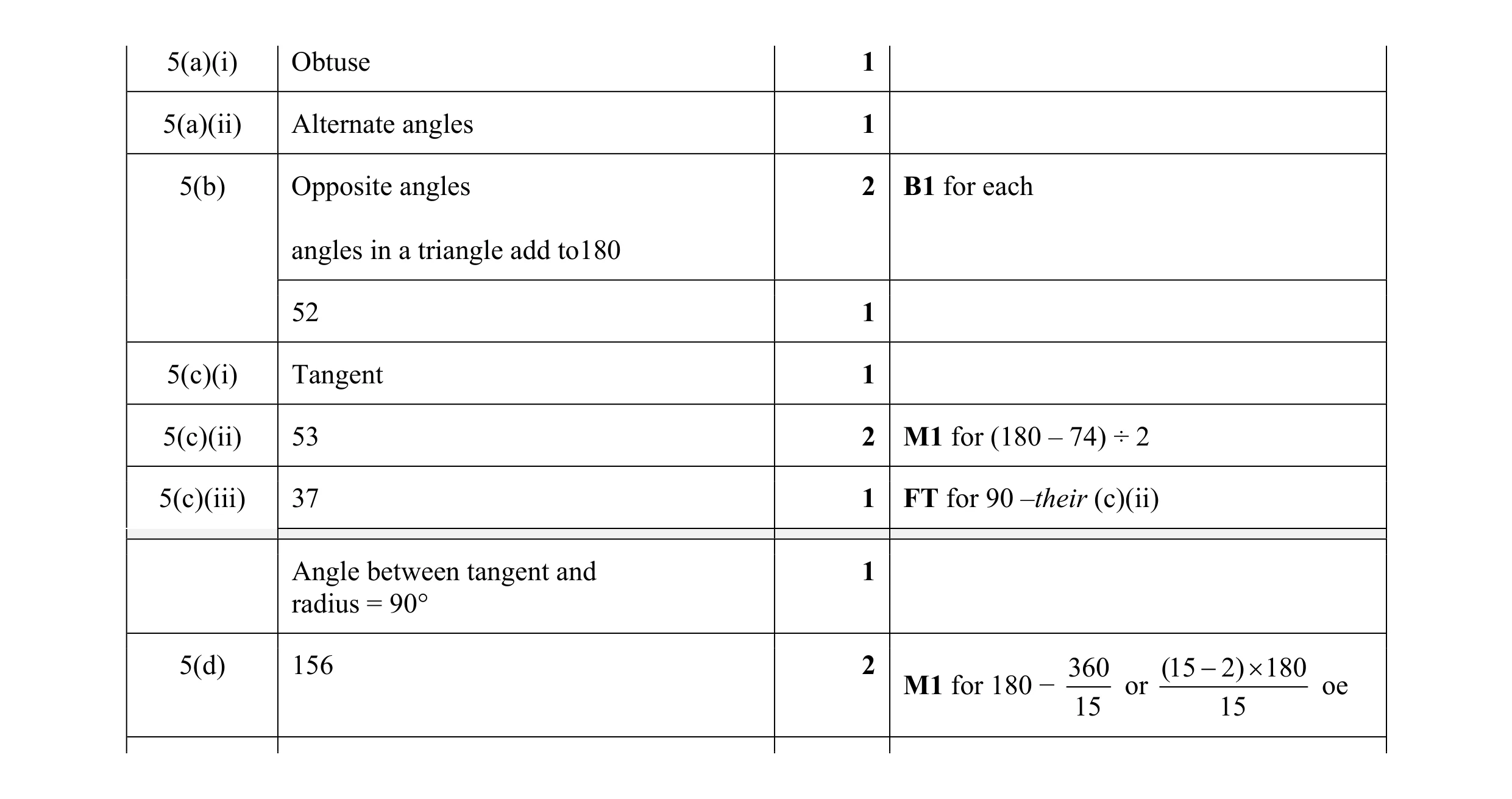 12
12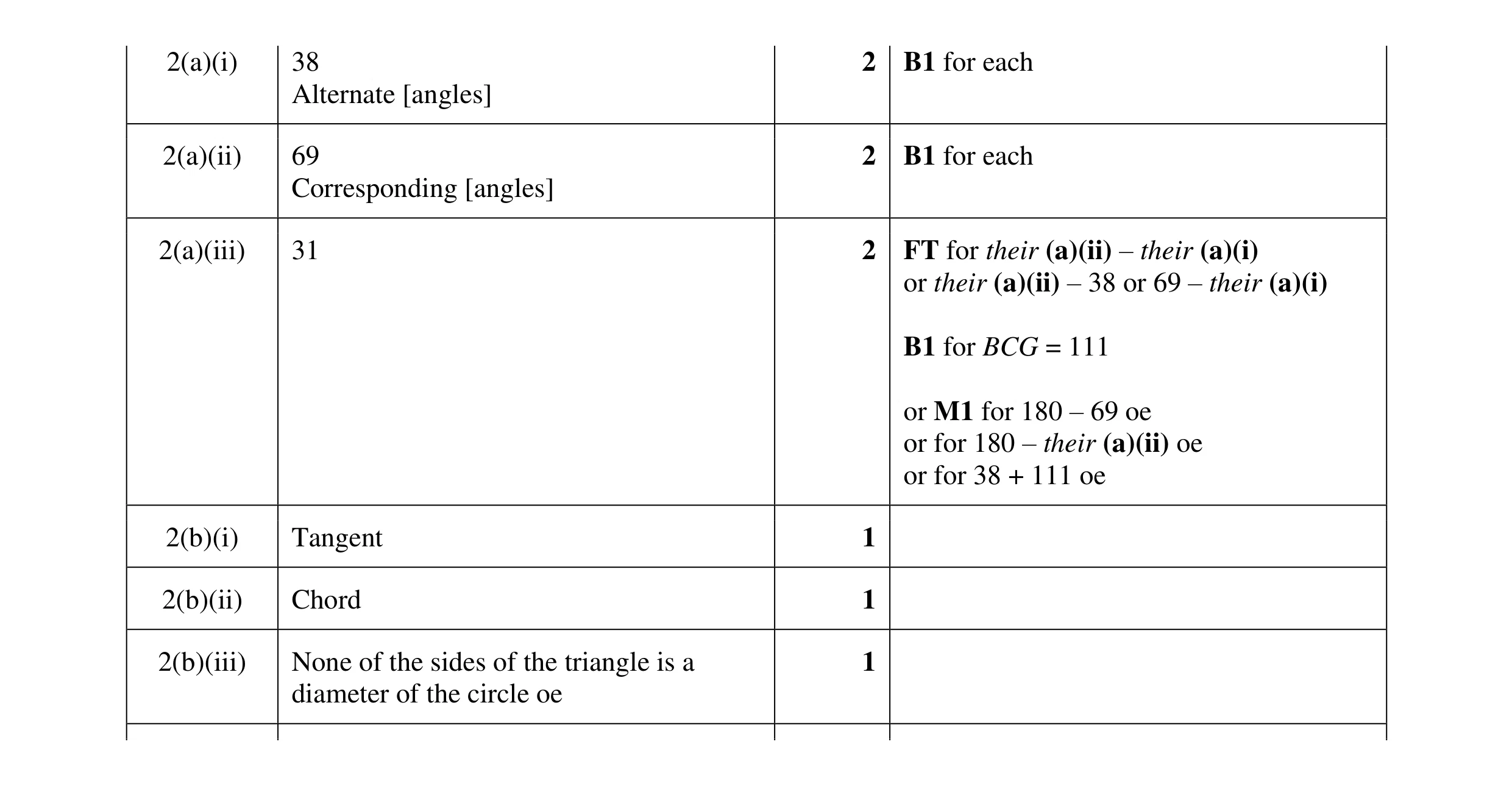 9
9