Cambridge IGCSE Mathematics (9-1) 0980 — 2021 May/June Paper 3 · Variant 2
0980/32/M/J/21 · 9 questions · 104 marks · ≈117 min
The question paper and its mark scheme, free to read here and free to download. This is Cambridge’s own paper, exactly as it was sat.
Question paper20 pages
Mark scheme7 pages
Answers below. Sit the paper first if you are practising.
Questions as text
Q1 · Alex is building a house
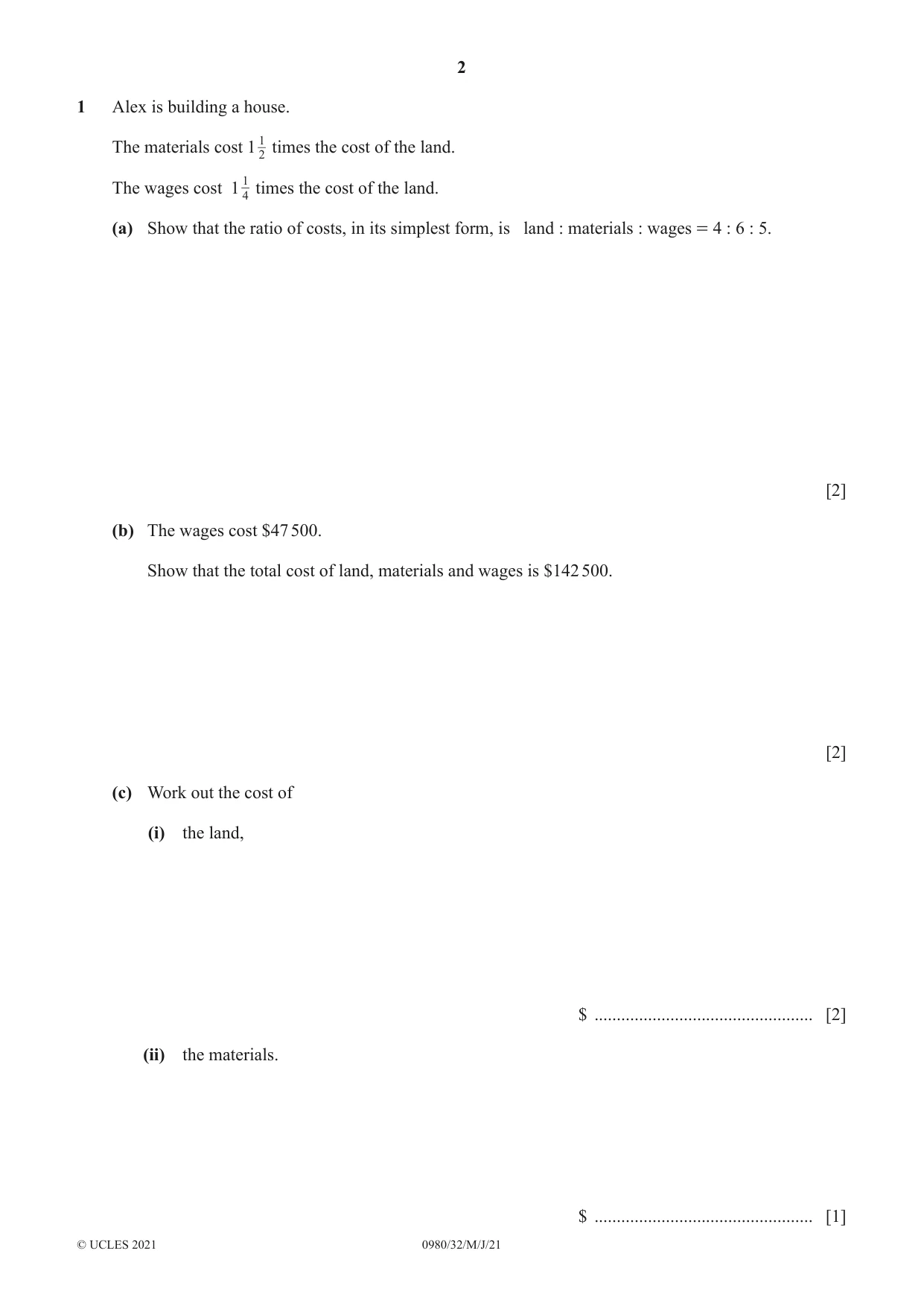
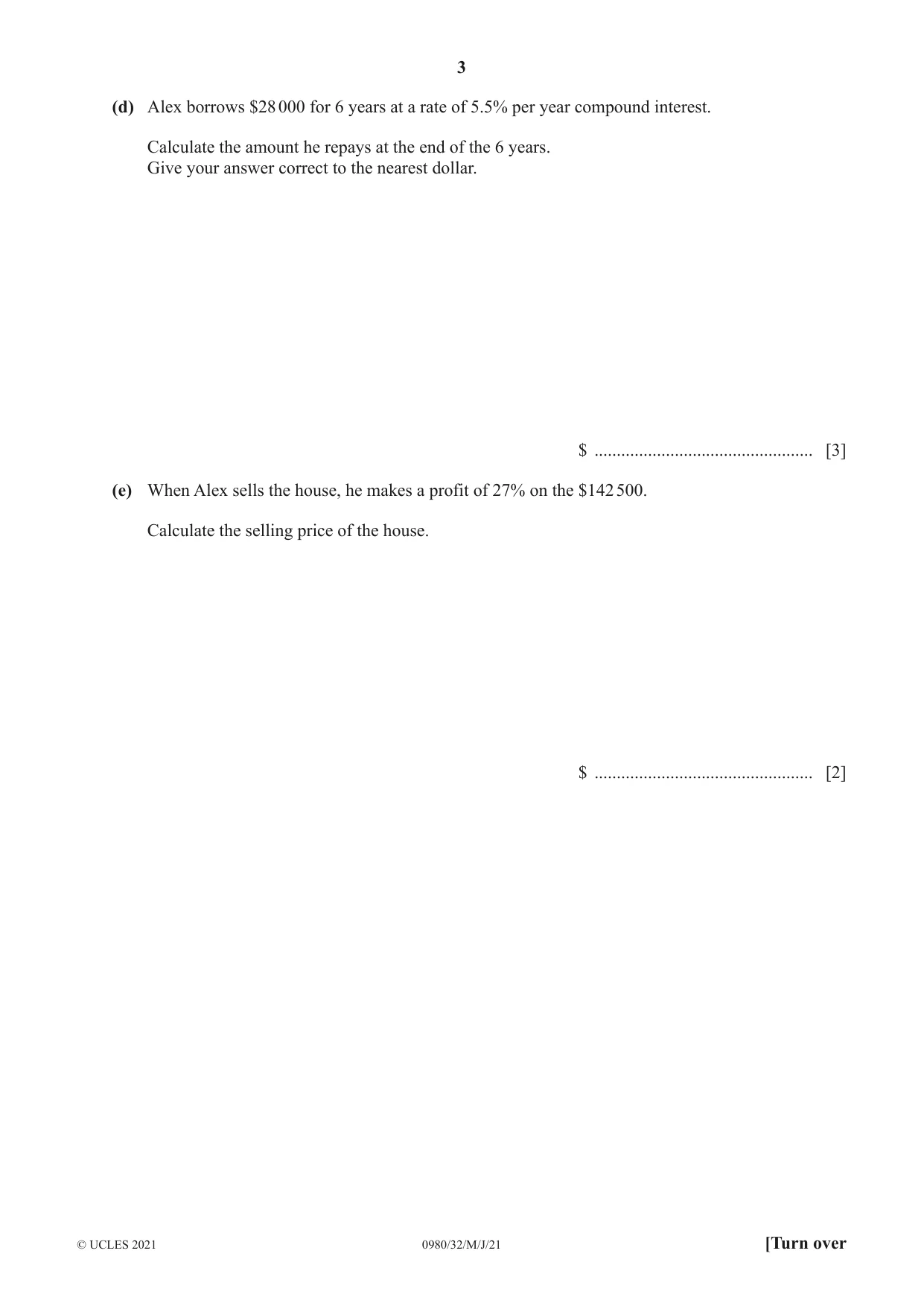
1 Alex is building a house. The materials cost 1 12 times the cost of the land. The wages cost 1 14 times the cost of the land. (a) Show that the ratio of costs, in its simplest form, is land : materials : wages = 4 : 6 : 5. [2] (b) The wages cost $47 500. Show that the total cost of land, materials and wages is $142 500. [2] (c) Work out the cost of (i) the land, $ ................................................. [2] (ii) the materials. $ ................................................. [1] (d) Alex borrows $28 000 for 6 years at a rate of 5.5% per year compound interest. Calculate the amount he repays at the end of the 6 years. Give your answer correct to the nearest dollar. $ ................................................. [3] (e) When Alex sells the house, he makes a profit of 27% on the $142 500. Calculate the selling price of the house. $ ................................................. [2]
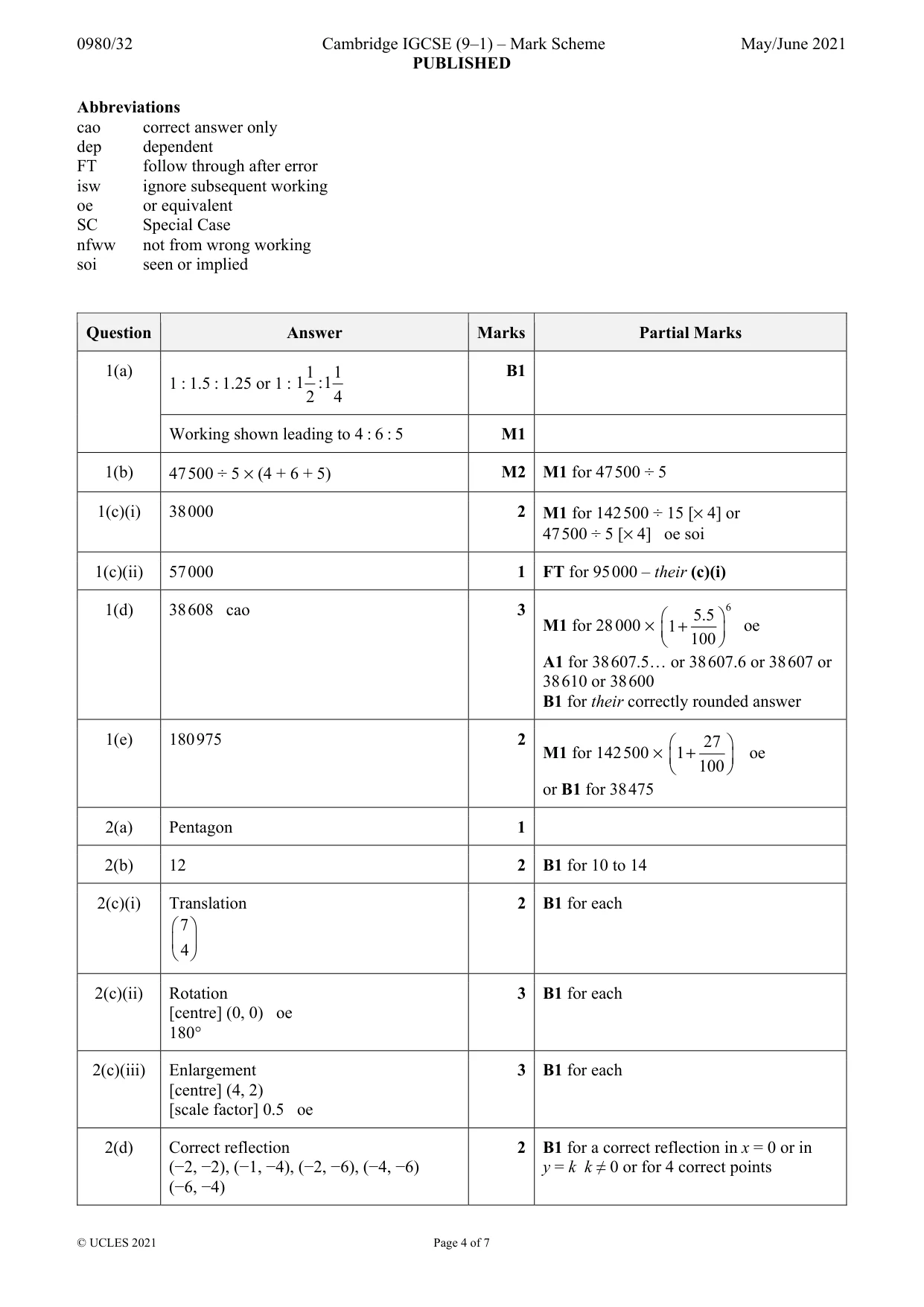
Mark scheme: Question Answer Marks Partial Marks 1(a) 1 1 B1 1 : 1.5 : 1.25 or 1 : 1 :1 2 4 Working shown leading to 4 : 6 : 5 M1 1(b) 47 500 ÷ 5 × (4 + 6 + 5) M2 M1 for 47 500 ÷ 5 1(c)(i) 38 000 2 M1 for 142 500 ÷ 15 [× 4] or 47 500 ÷ 5 [× 4] oe soi 1(c)(ii) 57 000 1 FT for 95 000 – their (c)(i) 1(d) 38 608 cao 3 6 5.5 M1 for 28 000 × 1 + oe 100 A1 for 38 607.5… or 38 607.6 or 38 607 or 38 610 or 38 600 B1 for their correctly rounded answer 1(e) 180 975 2 27 M1 for 142 500 × 1 + oe 100 or B1 for 38 475
Question 2
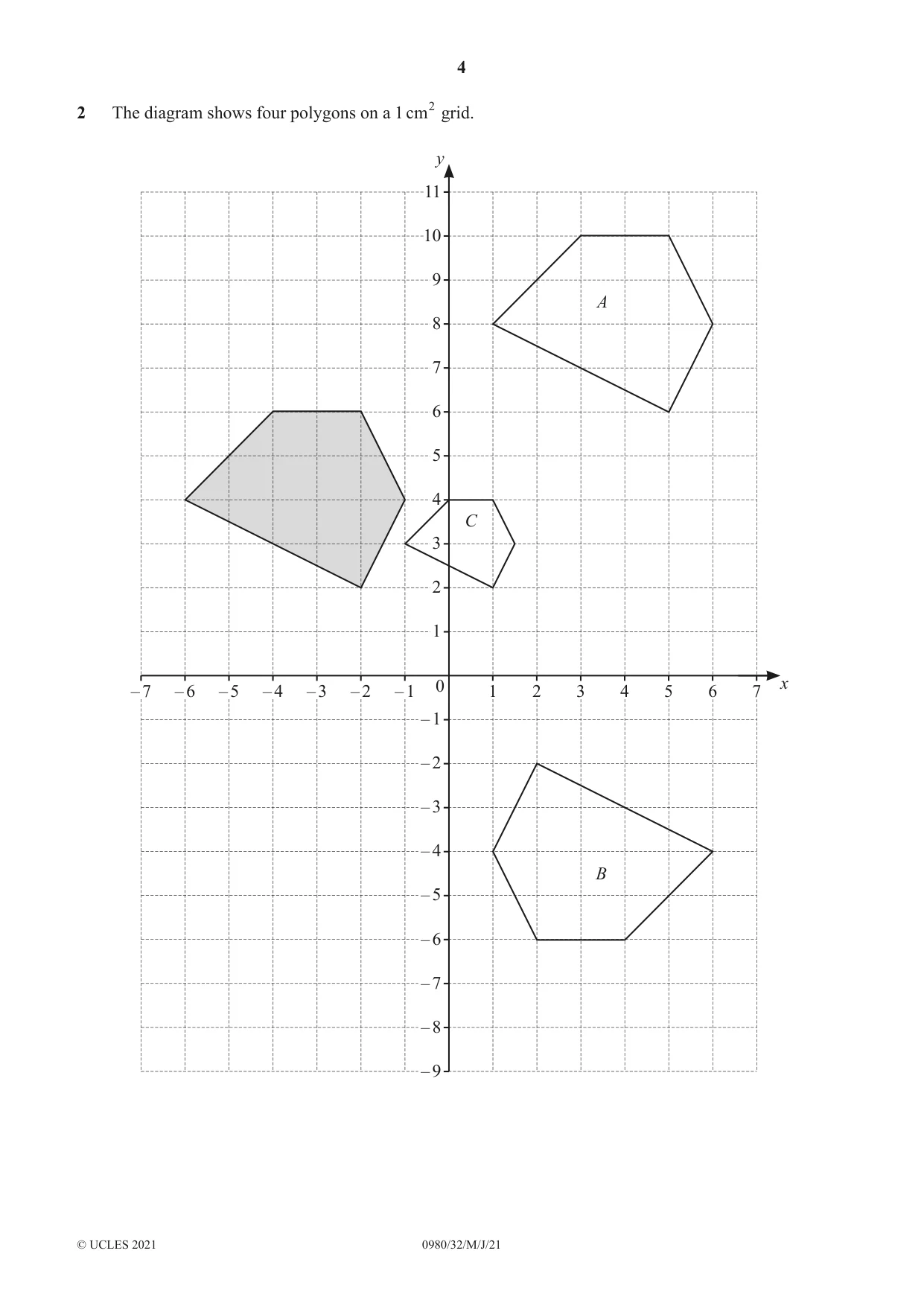
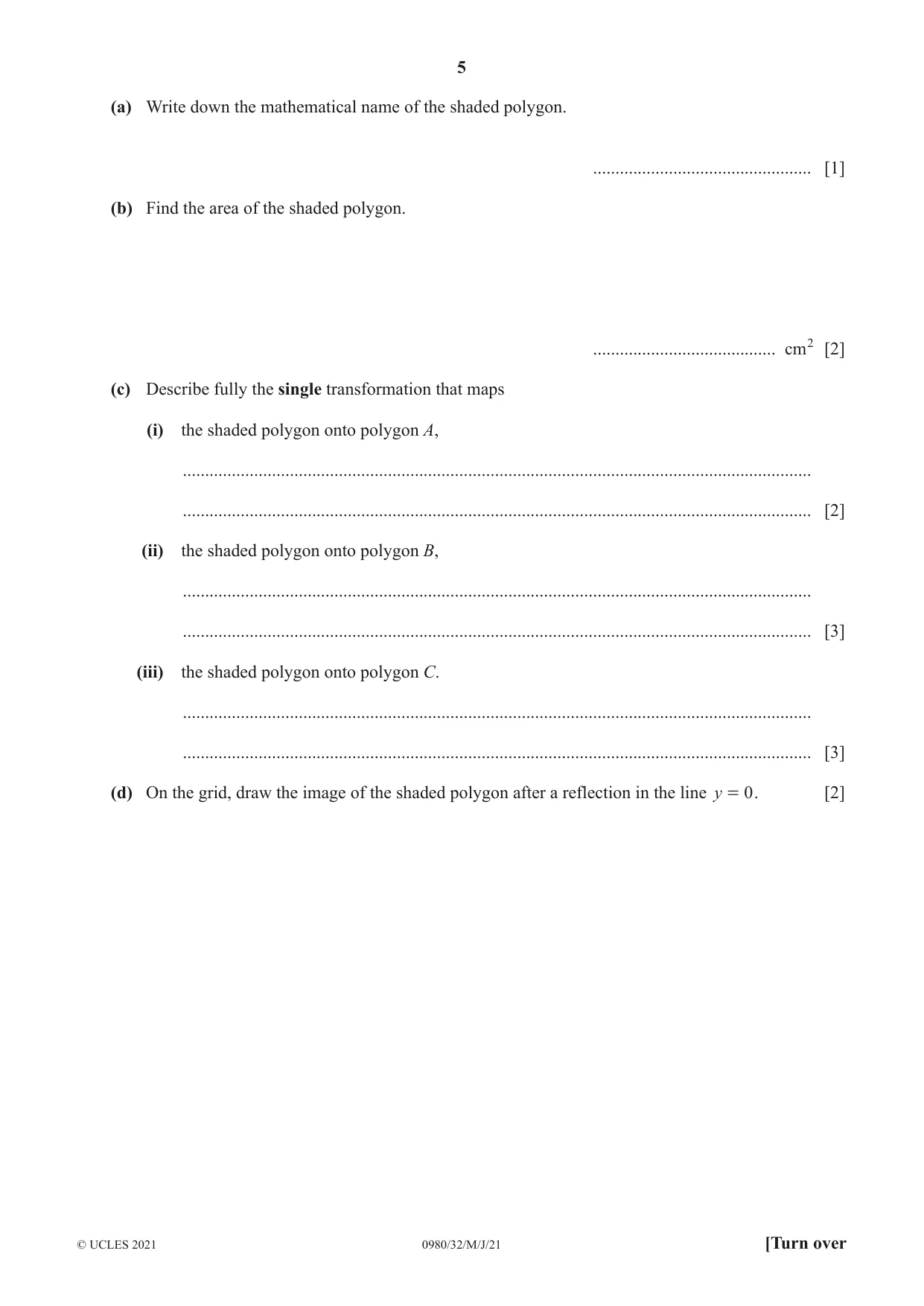
id. C (a) Write down the mathematical name of the shaded polygon. ................................................. [1] (b) Find the area of the shaded polygon. ......................................... cm2 [2] (c) Describe fully the single transformation that maps (i) the shaded polygon onto polygon A, ............................................................................................................................................. ............................................................................................................................................. [2] (ii) the shaded polygon onto polygon B, ............................................................................................................................................. ............................................................................................................................................. [3] (iii) the shaded polygon onto polygon C. ............................................................................................................................................. ............................................................................................................................................. [3] (d) On the grid, draw the image of the shaded polygon after a reflection in the line y = 0 . [2]
Mark scheme: 2(a) Pentagon 1 2(b) 12 2 B1 for 10 to 14 2(c)(i) Translation 2 B1 for each 7 4 2(c)(ii) Rotation 3 B1 for each [centre] (0, 0) oe 180° 2(c)(iii) Enlargement 3 B1 for each [centre] (4, 2) [scale factor] 0.5 oe 2(d) Correct reflection 2 B1 for a correct reflection in x = 0 or in (−2, −2), (−1, −4), (−2, −6), (−4, −6) y = k k ≠ 0 or for 4 correct points (−6, −4)
Q3 · Pierre travels from his home in Lyon to Singapore
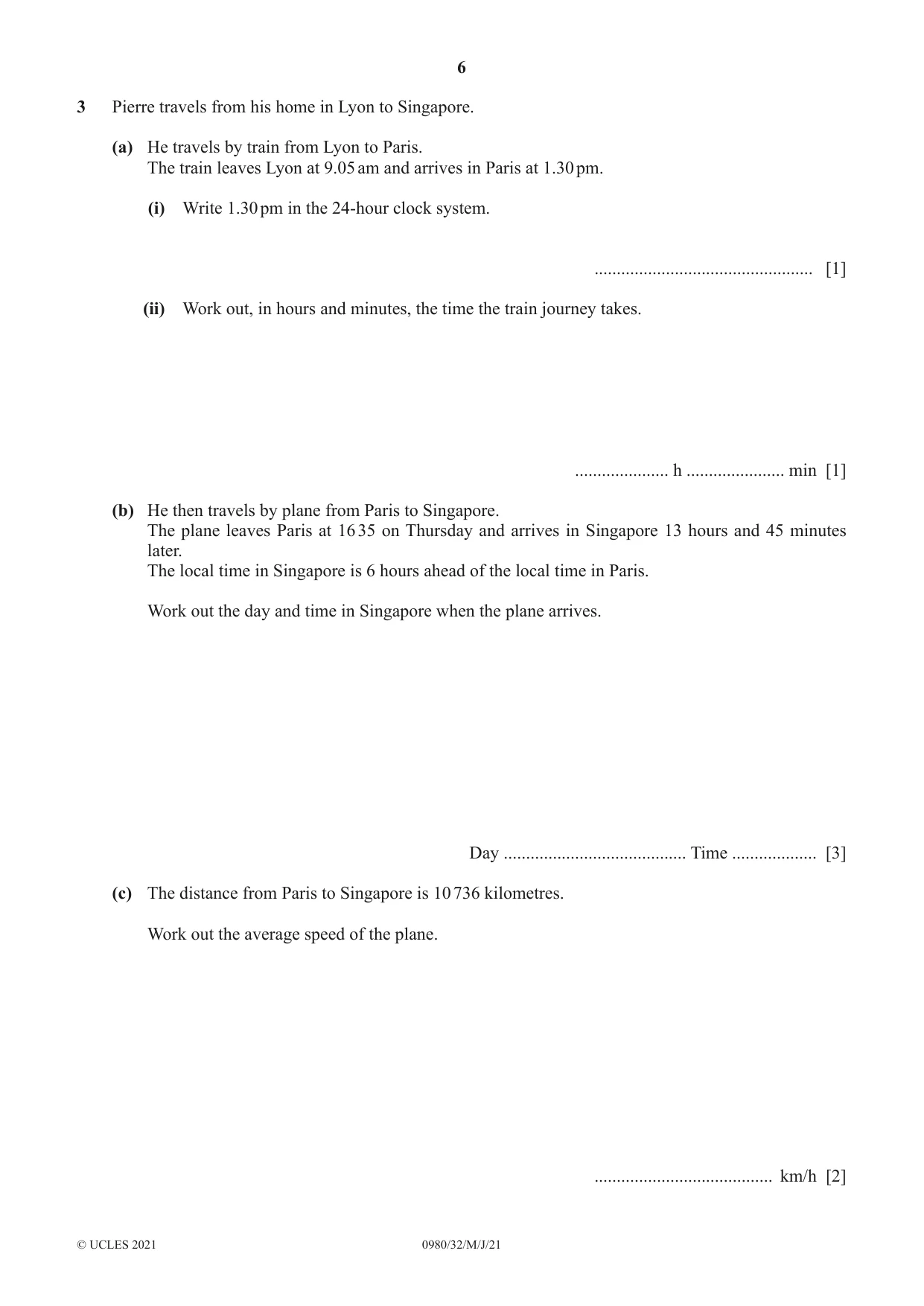
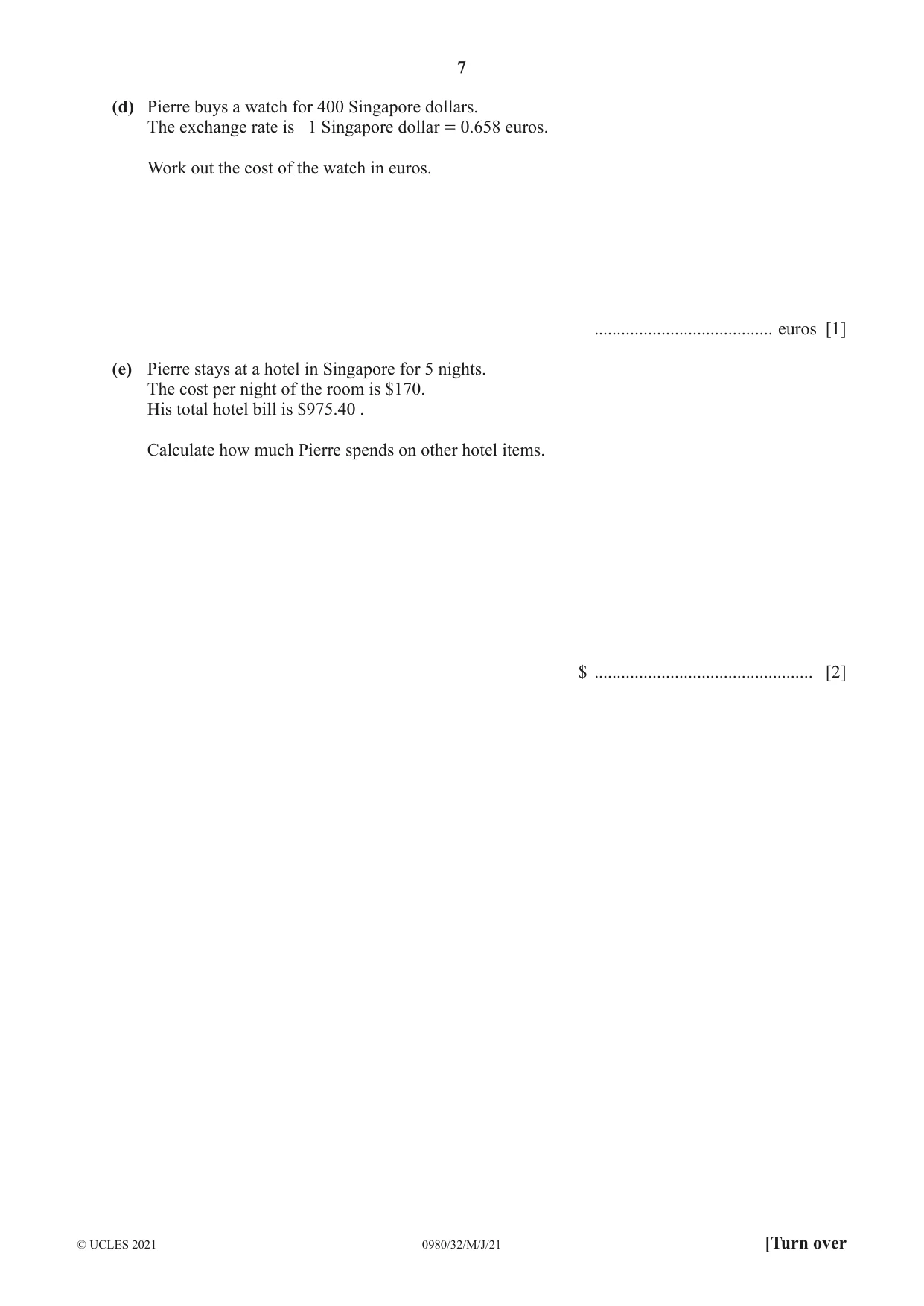
3 Pierre travels from his home in Lyon to Singapore. (a) He travels by train from Lyon to Paris. The train leaves Lyon at 9.05 am and arrives in Paris at 1.30 pm. (i) Write 1.30 pm in the 24-hour clock system. ................................................. [1] (ii) Work out, in hours and minutes, the time the train journey takes. ..................... h ...................... min [1] (b) He then travels by plane from Paris to Singapore. The plane leaves Paris at 16 35 on Thursday and arrives in Singapore 13 hours and 45 minutes later. The local time in Singapore is 6 hours ahead of the local time in Paris. Work out the day and time in Singapore when the plane arrives. Day ......................................... Time ................... [3] (c) The distance from Paris to Singapore is 10 736 kilometres. Work out the average speed of the plane. ........................................ km/h [2] (d) Pierre buys a watch for 400 Singapore dollars. The exchange rate is 1 Singapore dollar = 0.658 euros. Work out the cost of the watch in euros. ........................................ euros [1] (e) Pierre stays at a hotel in Singapore for 5 nights. The cost per night of the room is $170. His total hotel bill is $975.40 . Calculate how much Pierre spends on other hotel items. $ ................................................. [2]
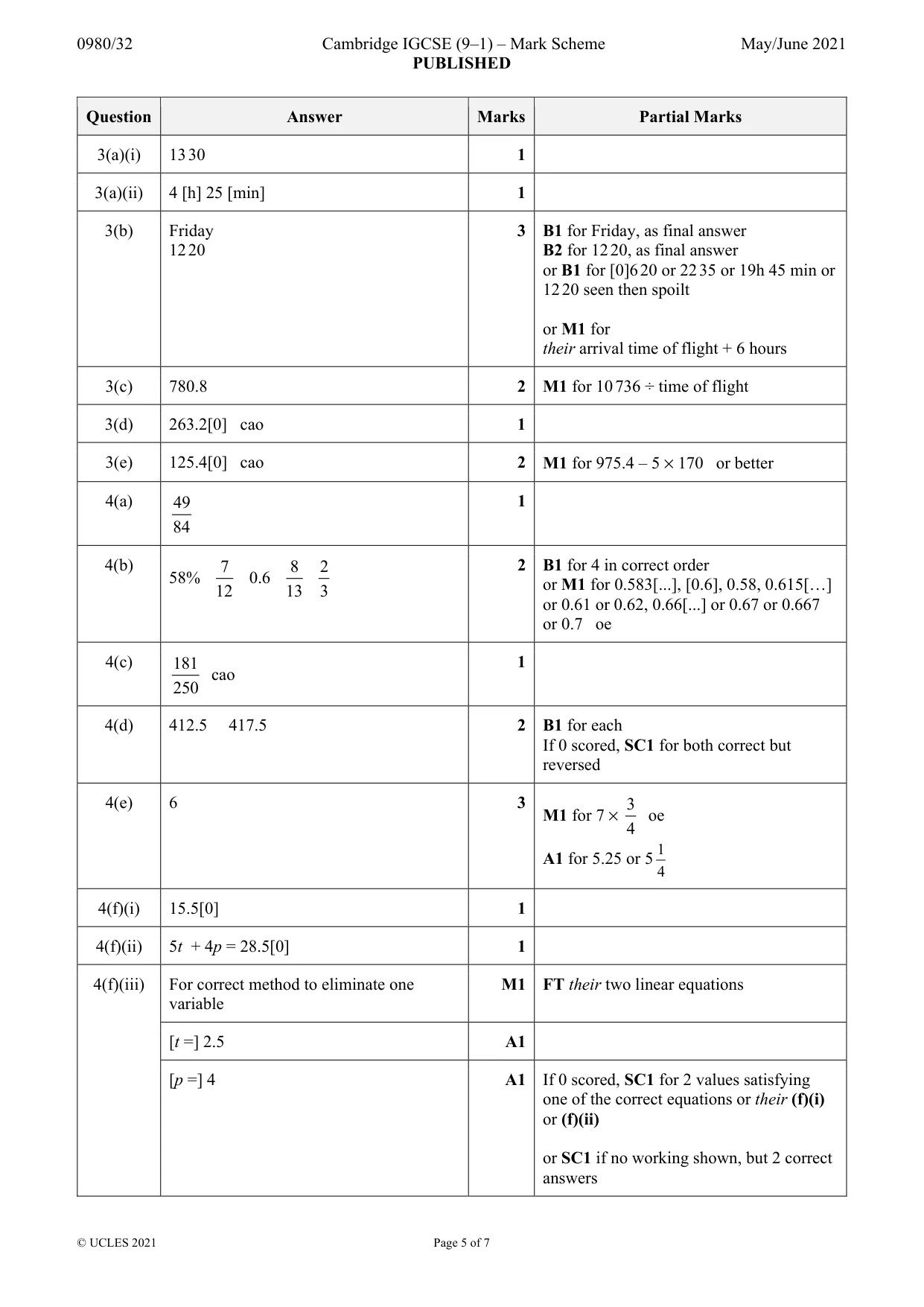
Mark scheme: 3(a)(i) 13 30 1 3(a)(ii) 4 [h] 25 [min] 1 3(b) Friday 3 B1 for Friday, as final answer 12 20 B2 for 12 20, as final answer or B1 for [0]6 20 or 22 35 or 19h 45 min or 12 20 seen then spoilt or M1 for their arrival time of flight + 6 hours 3(c) 780.8 2 M1 for 10 736 ÷ time of flight 3(d) 263.2[0] cao 1 3(e) 125.4[0] cao 2 M1 for 975.4 – 5 × 170 or better
Q4 · Put a ring around the fraction that is equivalent to
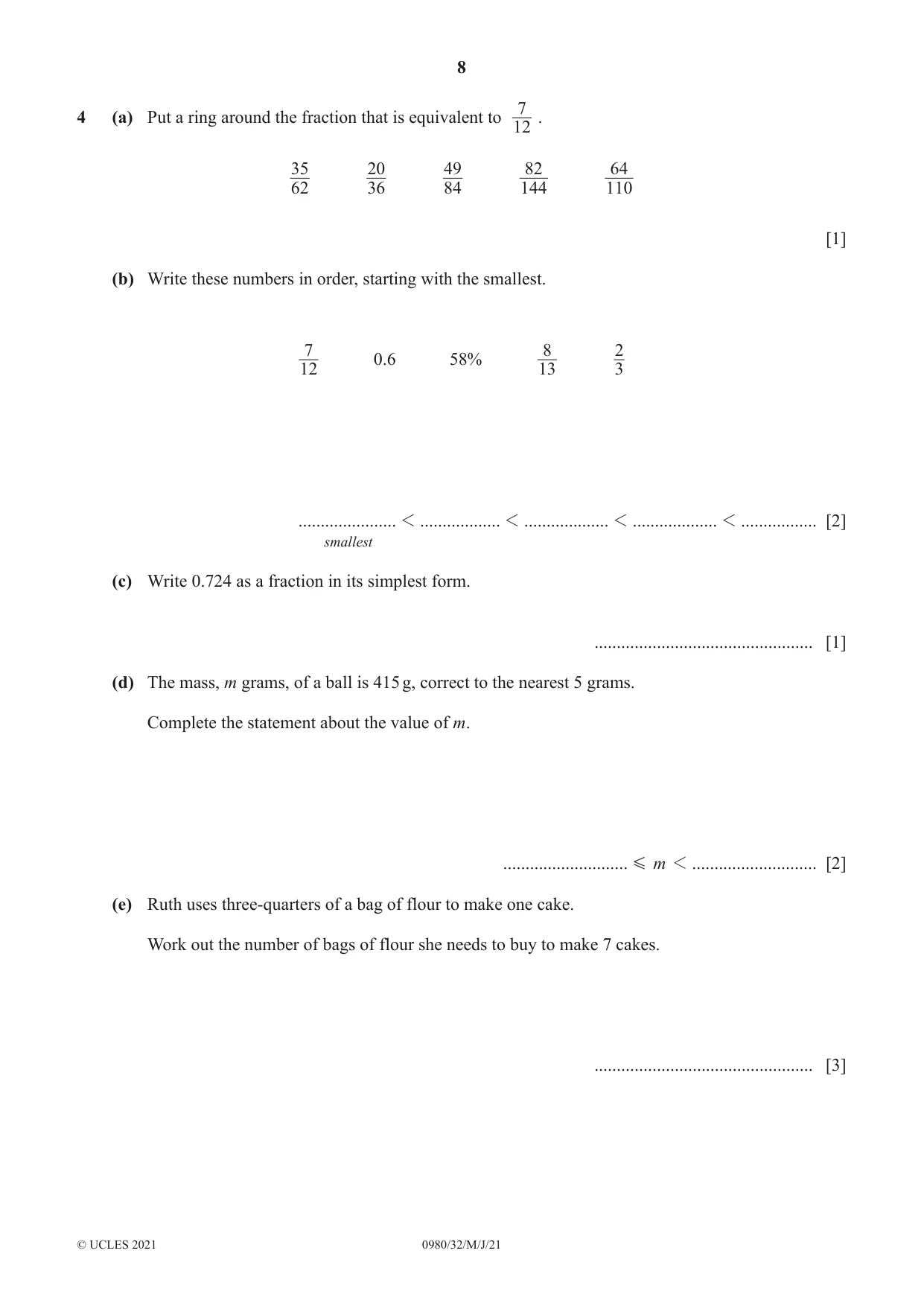
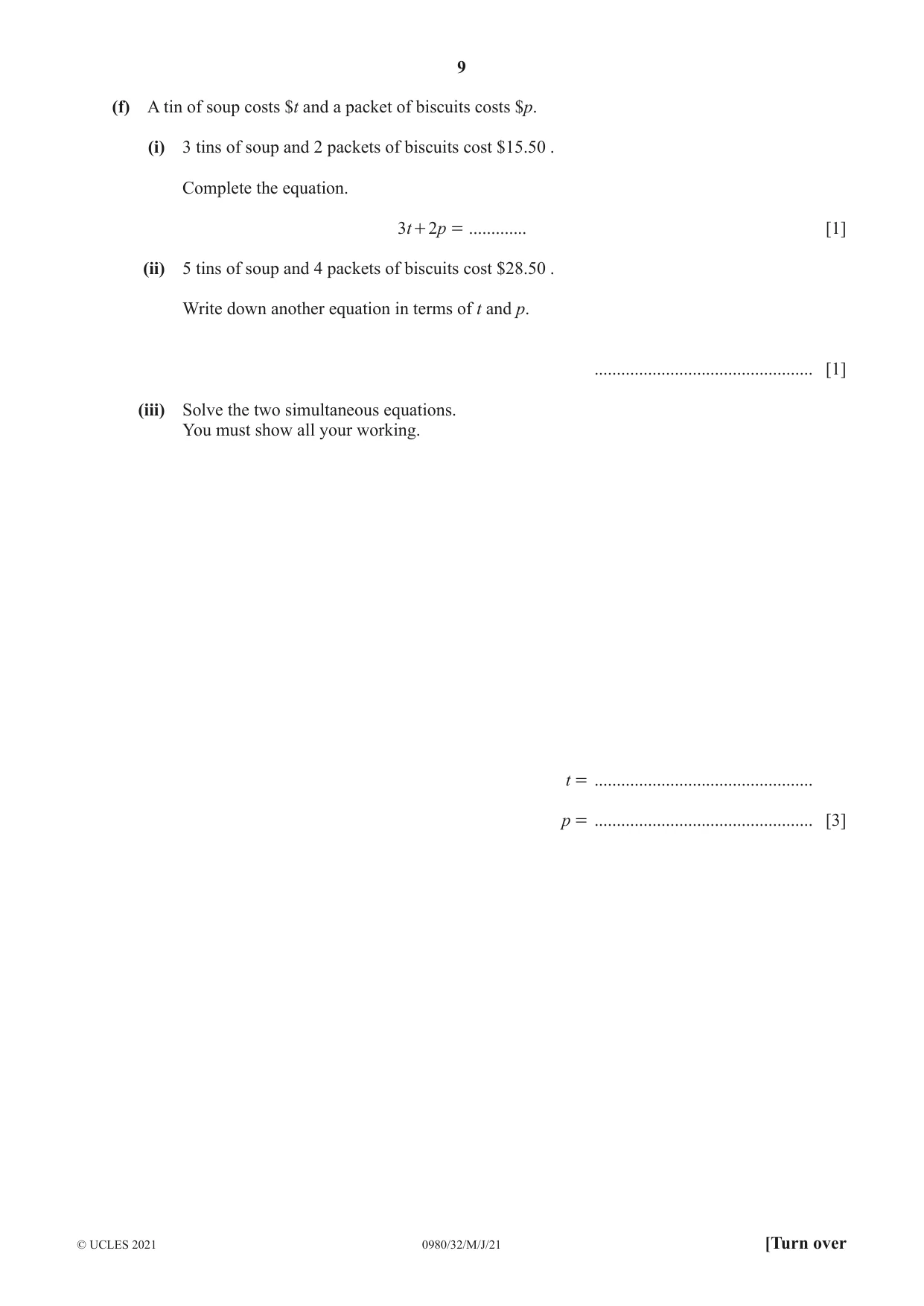
4 (a) Put a ring around the fraction that is equivalent to . 12 35 20 49 82 64 62 36 84 144 110 [1] (b) Write these numbers in order, starting with the smallest. 7 8 2 0.6 58% 12 13 3 ...................... 1 .................. 1 ................... 1 ................... 1 ................. [2] smallest (c) Write 0.724 as a fraction in its simplest form. ................................................. [1] (d) The mass, m grams, of a ball is 415 g, correct to the nearest 5 grams. Complete the statement about the value of m. ............................ G m 1 ............................ [2] (e) Ruth uses three-quarters of a bag of flour to make one cake. Work out the number of bags of flour she needs to buy to make 7 cakes. ................................................. [3] (f) A tin of soup costs $t and a packet of biscuits costs $p. (i) 3 tins of soup and 2 packets of biscuits cost $15.50 . Complete the equation. 3t + 2p = ............. [1] (ii) 5 tins of soup and 4 packets of biscuits cost $28.50 . Write down another equation in terms of t and p. ................................................. [1] (iii) Solve the two simultaneous equations. You must show all your working. t = ................................................. p = ................................................. [3]
Mark scheme: 4(a) 49 1 84 4(b) 7 8 2 2 B1 for 4 in correct order 58% 0.6 or M1 for 0.583[...], [0.6], 0.58, 0.615[…] 12 13 3 or 0.61 or 0.62, 0.66[...] or 0.67 or 0.667 or 0.7 oe 4(c) 181 1 cao 250 4(d) 412.5 417.5 2 B1 for each If 0 scored, SC1 for both correct but reversed 4(e) 6 3 3 M1 for 7 × oe 4 1 A1 for 5.25 or 5 4 4(f)(i) 15.5[0] 1 4(f)(ii) 5t + 4p = 28.5[0] 1 4(f)(iii) For correct method to eliminate one M1 FT their two linear equations variable [t =] 2.5 A1 [p =] 4 A1 If 0 scored, SC1 for 2 values satisfying one of the correct equations or their (f)(i) or (f)(ii) or SC1 if no working shown, but 2 correct answers
Q5 · Write down the order of rotational symmetry of the graph
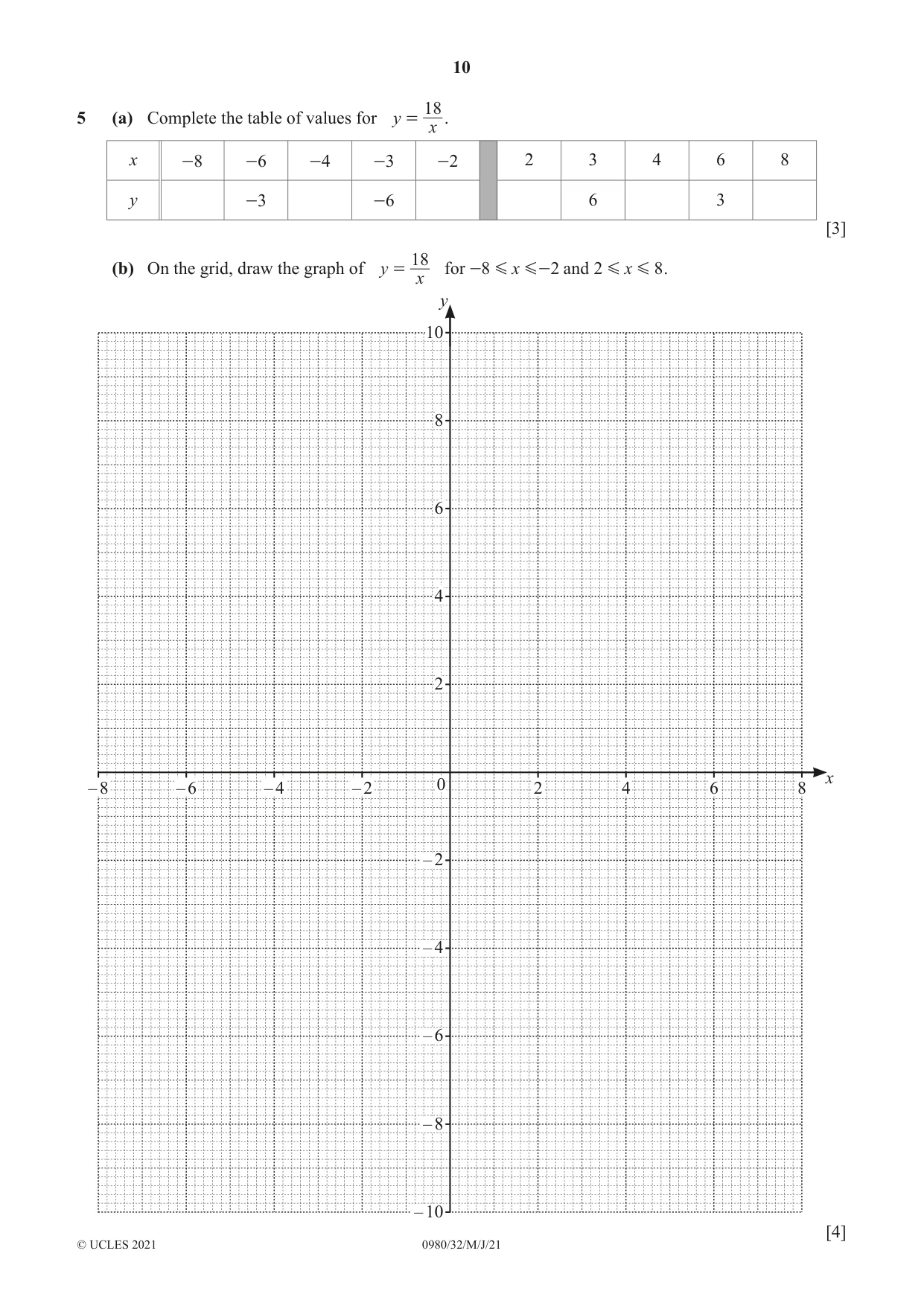
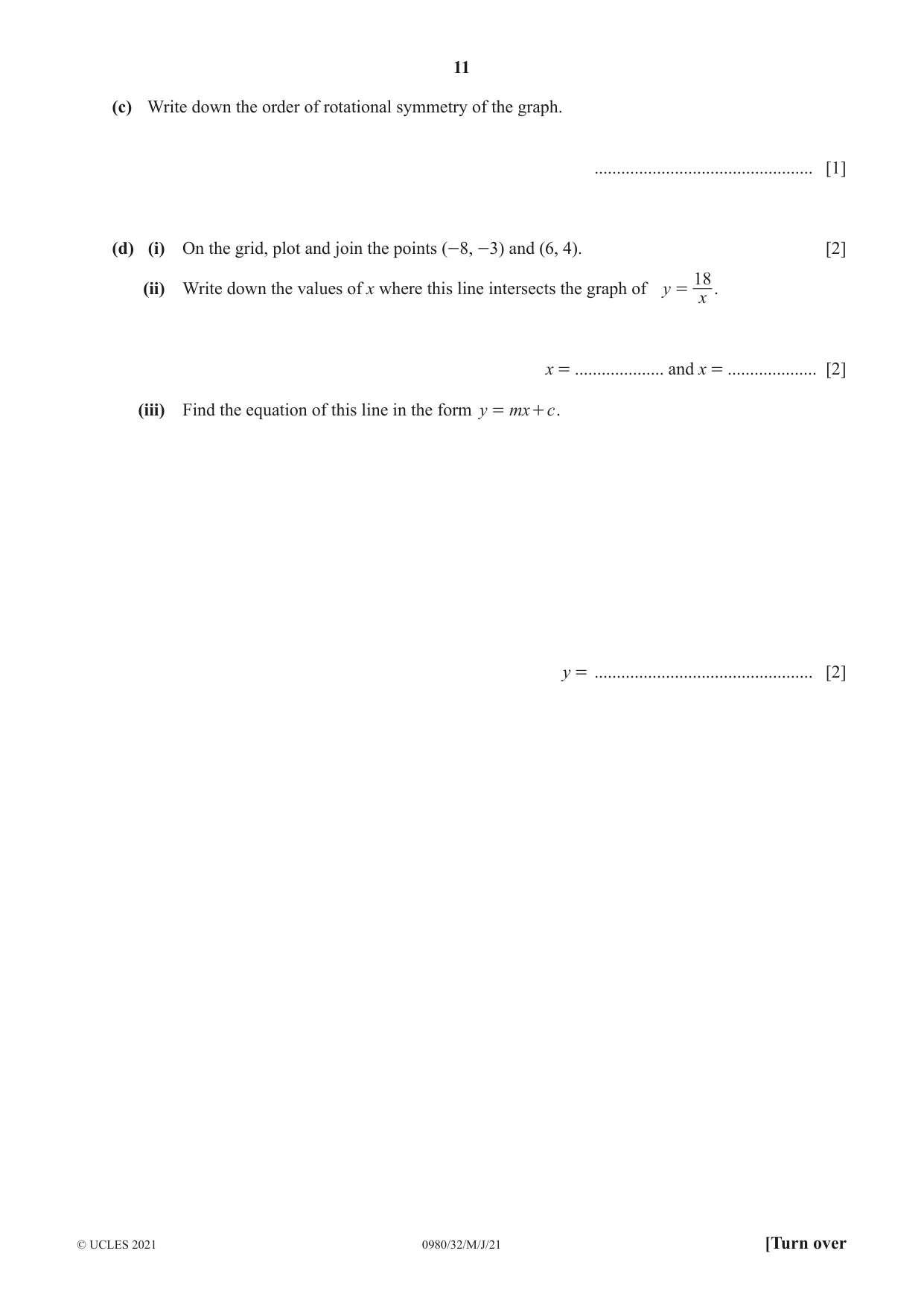
(c) Write down the order of rotational symmetry of the graph. ................................................. [1] (d) (i) On the grid, plot and join the points (-8, -3) and (6, 4). [2] 18 (ii) Write down the values of x where this line intersects the graph of y = . x x = .................... and x = .................... [2] (iii) Find the equation of this line in the form y = mx + c . y = ................................................. [2]
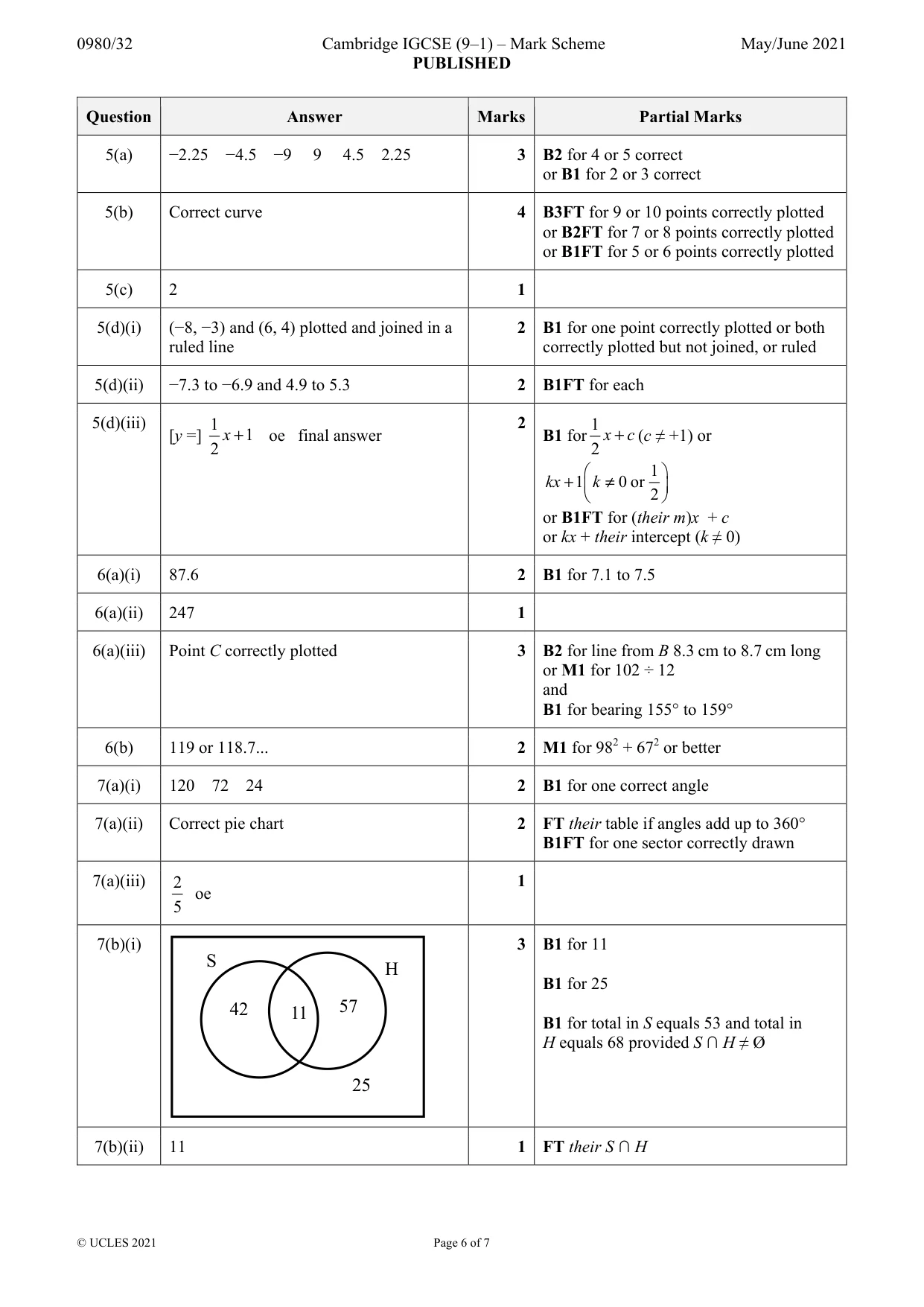
Mark scheme: 5(a) −2.25 −4.5 −9 9 4.5 2.25 3 B2 for 4 or 5 correct or B1 for 2 or 3 correct 5(b) Correct curve 4 B3FT for 9 or 10 points correctly plotted or B2FT for 7 or 8 points correctly plotted or B1FT for 5 or 6 points correctly plotted 5(c) 2 1 5(d)(i) (−8, −3) and (6, 4) plotted and joined in a 2 B1 for one point correctly plotted or both ruled line correctly plotted but not joined, or ruled 5(d)(ii) −7.3 to −6.9 and 4.9 to 5.3 2 B1FT for each 5(d)(iii) 1 2 1 [y =] x + 1 oe final answer B1 for x + c (c ≠ +1) or 2 2 1 kx + 1 k ≠ 0 or 2 or B1FT for (their m)x + c or kx + their intercept (k ≠ 0)
Q6 · The scale drawing shows the positions of house A and house B
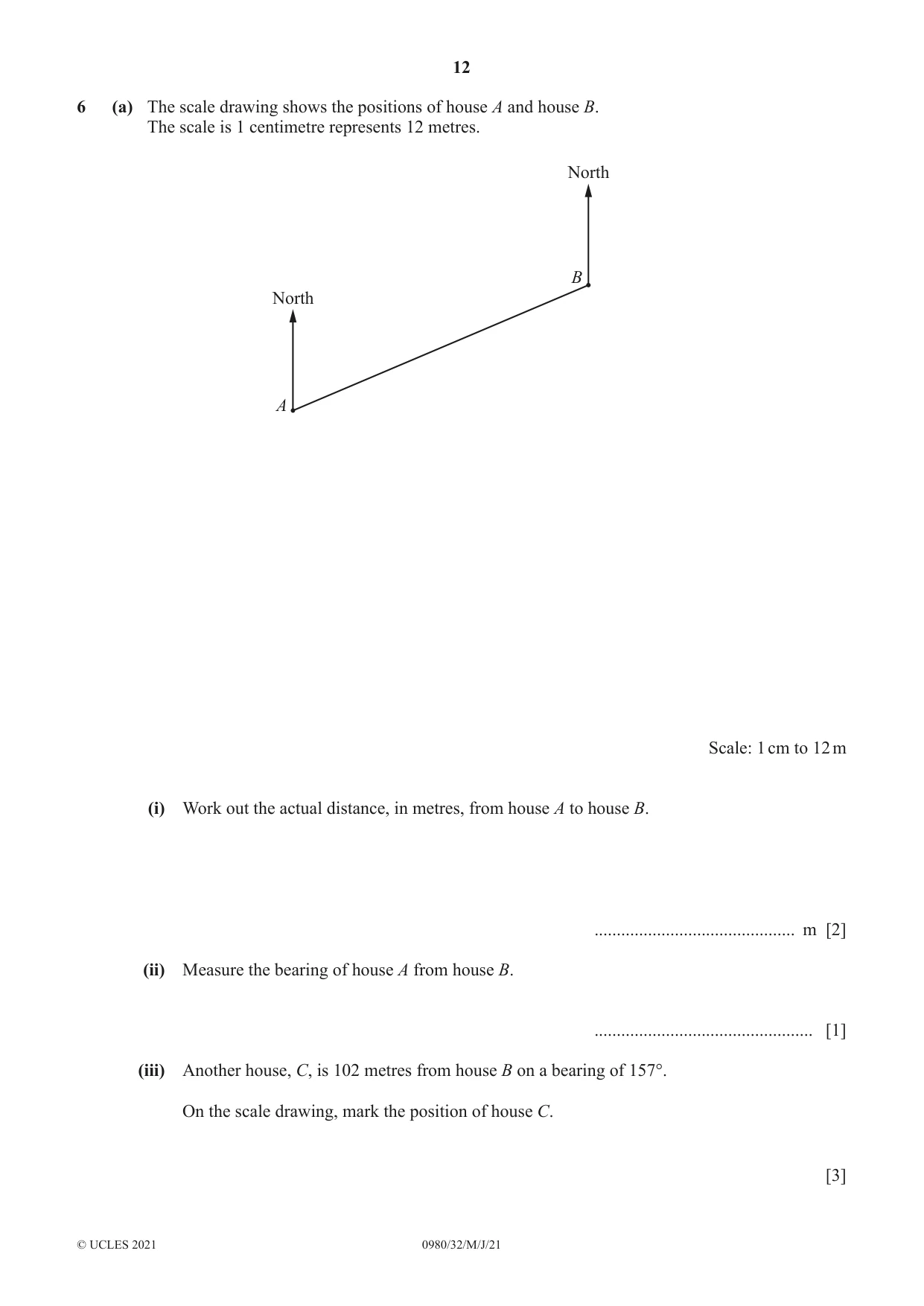
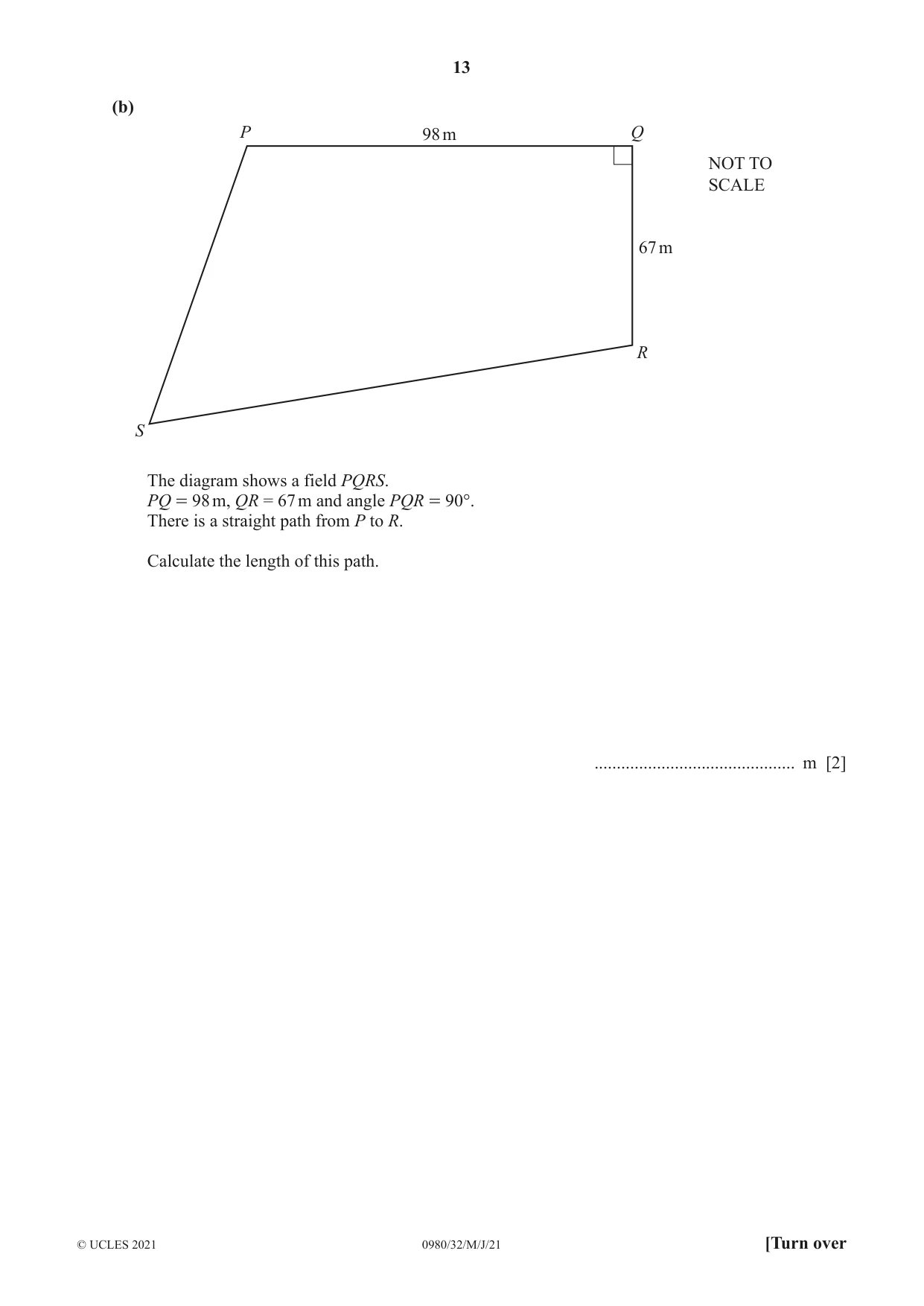
6 (a) The scale drawing shows the positions of house A and house B. The scale is 1 centimetre represents 12 metres. North B North A Scale: 1 cm to 12 m (i) Work out the actual distance, in metres, from house A to house B. ............................................. m [2] (ii) Measure the bearing of house A from house B. ................................................. [1] (iii) Another house, C, is 102 metres from house B on a bearing of 157°. On the scale drawing, mark the position of house C. [3] (b) P 98 m Q NOT TO SCALE 67 m R S The diagram shows a field PQRS. PQ = 98 m, QR = 67 m and angle PQR = 90°. There is a straight path from P to R. Calculate the length of this path. ............................................. m [2]
Mark scheme: 6(a)(i) 87.6 2 B1 for 7.1 to 7.5 6(a)(ii) 247 1 6(a)(iii) Point C correctly plotted 3 B2 for line from B 8.3 cm to 8.7 cm long or M1 for 102 ÷ 12 and B1 for bearing 155° to 159° 6(b) 119 or 118.7... 2 M1 for 982 + 672 or better
Q7 · The favourite sport of each of 135 boys is recorded in the table
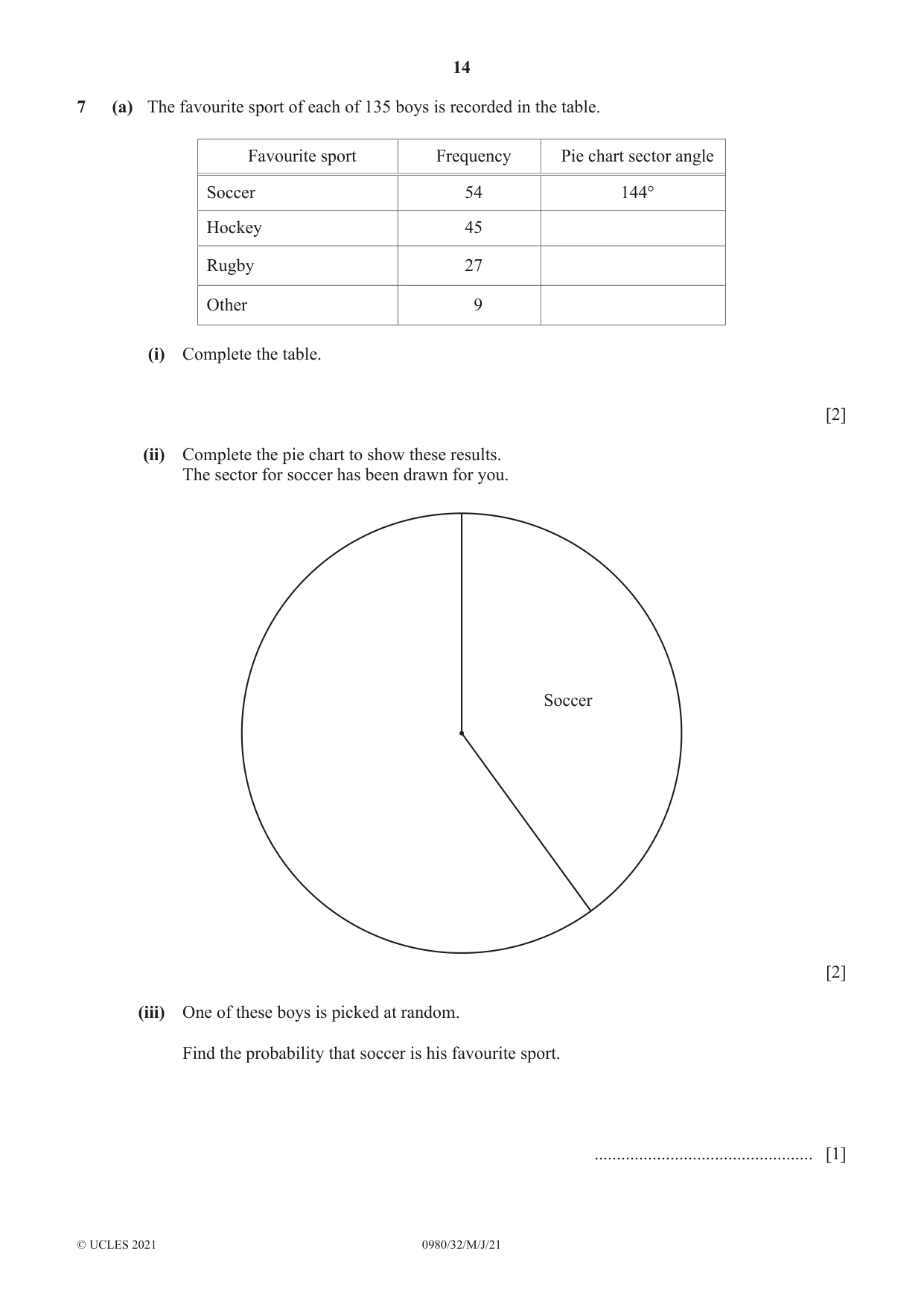
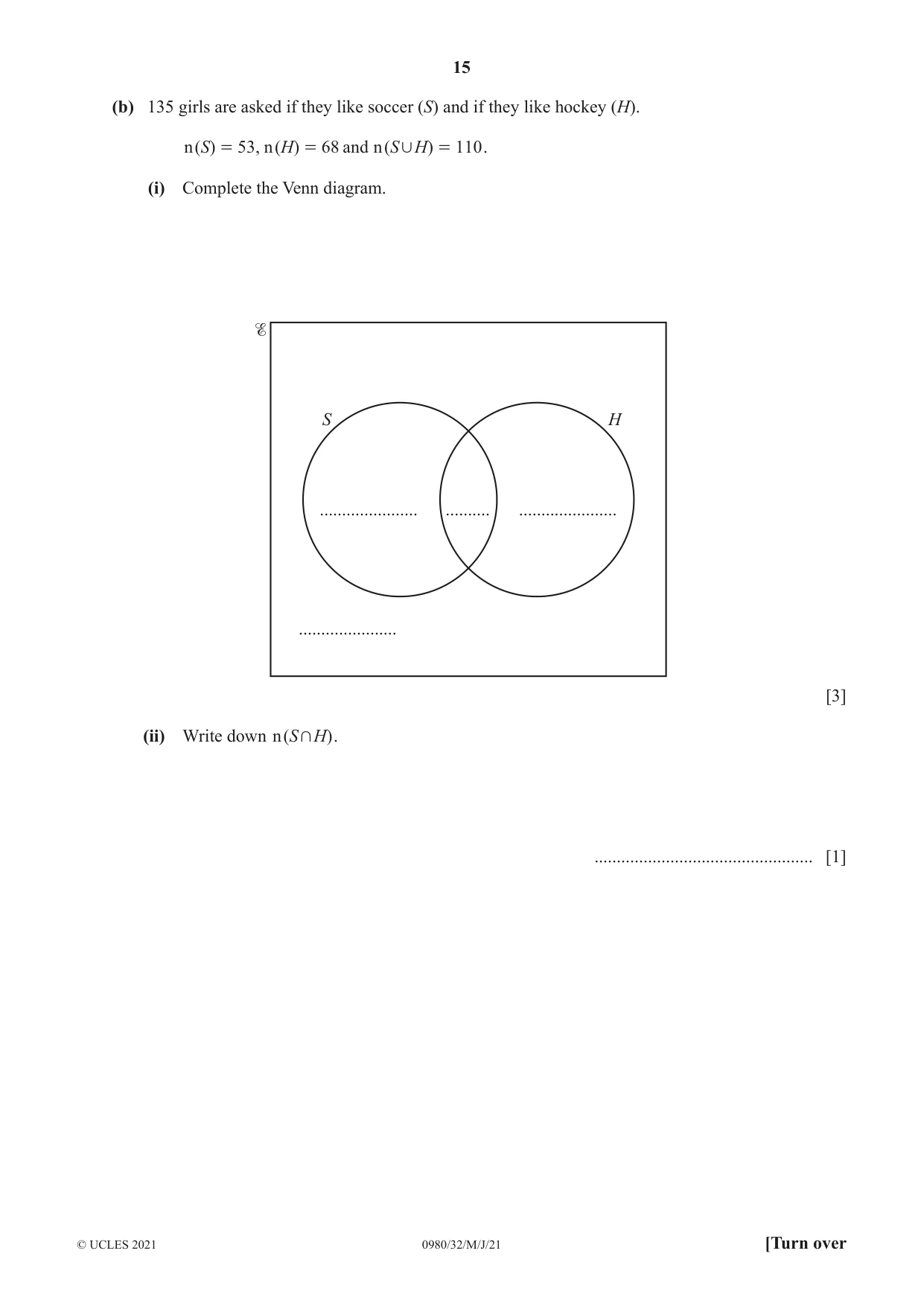
7 (a) The favourite sport of each of 135 boys is recorded in the table. Favourite sport Frequency Pie chart sector angle Soccer 54 144° Hockey 45 Rugby 27 Other 9 (i) Complete the table. [2] (ii) Complete the pie chart to show these results. The sector for soccer has been drawn for you. Soccer [2] (iii) One of these boys is picked at random. Find the probability that soccer is his favourite sport. ................................................. [1] (b) 135 girls are asked if they like soccer (S) and if they like hockey (H). n ( S) = 53, n ( H ) = 68 and n ( S , H) = 110 . (i) Complete the Venn diagram. S H ...................... .......... ...................... ...................... [3] (ii) Write down n ( S + H ) . ................................................. [1]
Mark scheme: 7(a)(i) 120 72 24 2 B1 for one correct angle 7(a)(ii) Correct pie chart 2 FT their table if angles add up to 360° B1FT for one sector correctly drawn 7(a)(iii) 2 1 oe 5 7(b)(i) 3 B1 for 11 S H B1 for 25 42 11 57 B1 for total in S equals 53 and total in H equals 68 provided S ∩ H ≠ Ø 25 7(b)(ii) 11 1 FT their S ∩ H
Q8 · C NOT TO SCALE 36° D x° A B The diagram shows a triangle ABC and a line BD
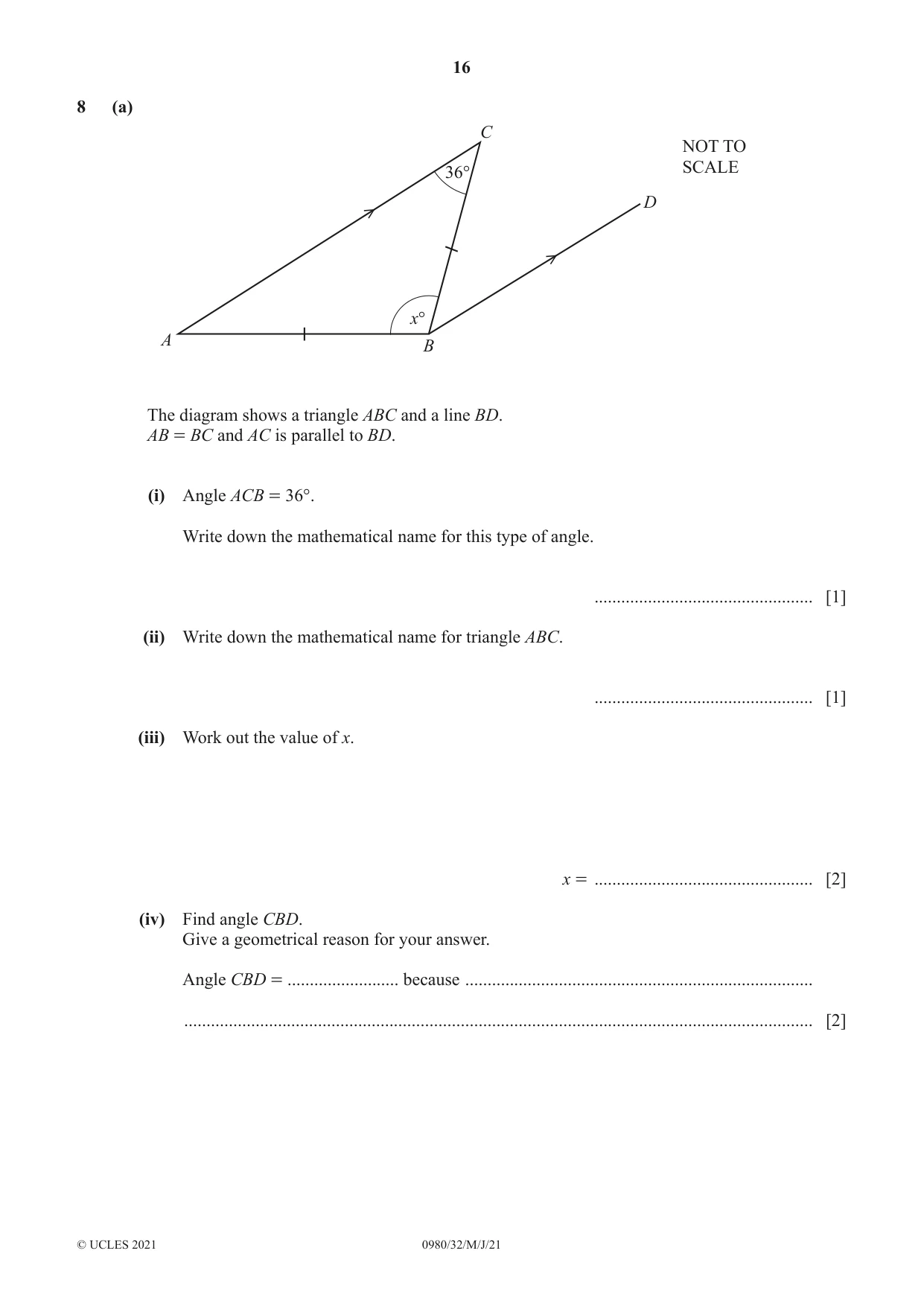
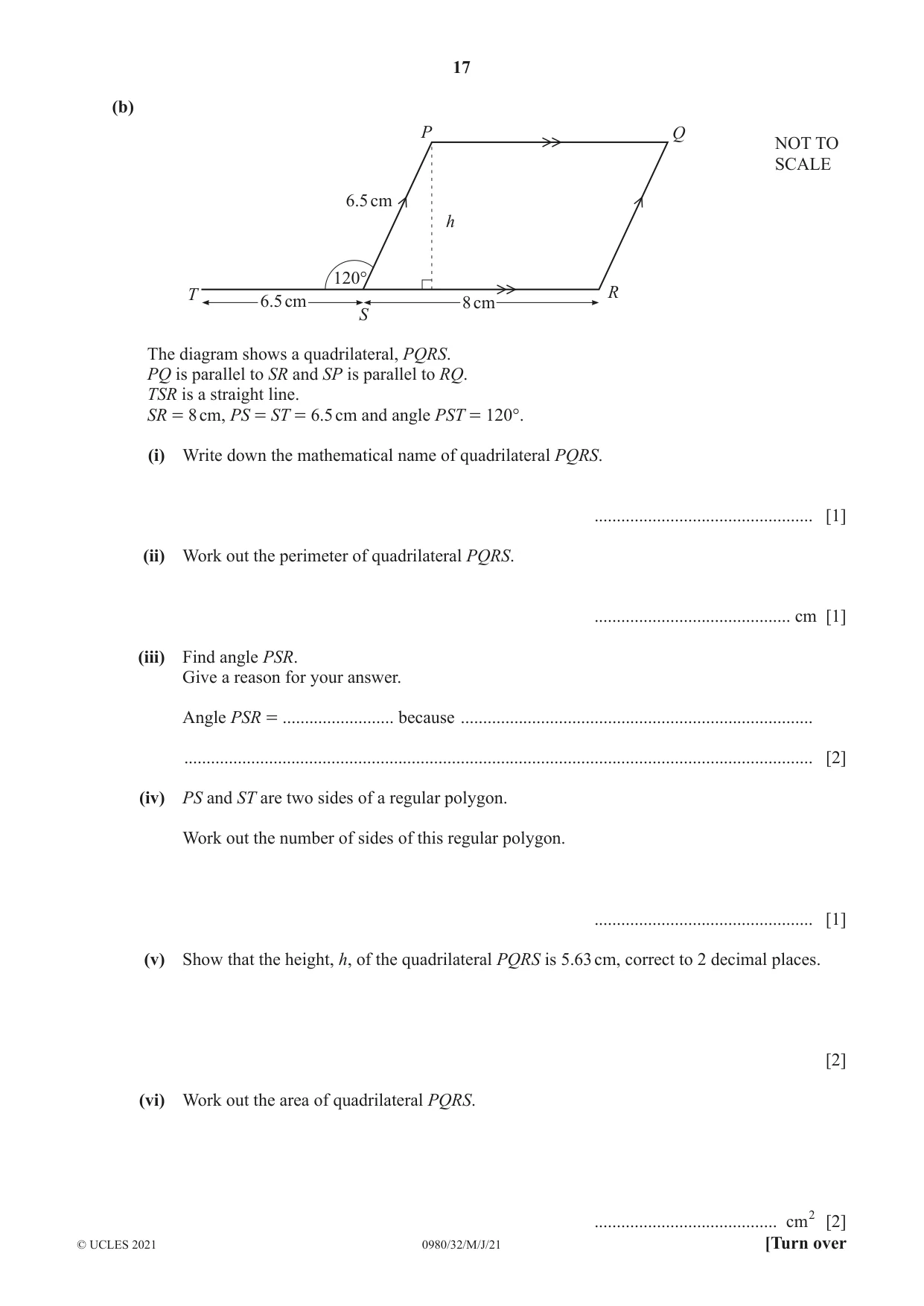
8 (a) C NOT TO SCALE 36° D x° A B The diagram shows a triangle ABC and a line BD. AB = BC and AC is parallel to BD. (i) Angle ACB = 36°. Write down the mathematical name for this type of angle. ................................................. [1] (ii) Write down the mathematical name for triangle ABC. ................................................. [1] (iii) Work out the value of x. x = ................................................. [2] (iv) Find angle CBD. Give a geometrical reason for your answer. Angle CBD = ......................... because .............................................................................. ............................................................................................................................................. [2] (b) P Q NOT TO SCALE 6.5 cm h 120° T R 6.5 cm 8 cm S The diagram shows a quadrilateral, PQRS. PQ is parallel to SR and SP is parallel to RQ. TSR is a straight line. SR = 8 cm, PS = ST = 6.5 cm and angle PST = 120°. (i) Write down the mathematical name of quadrilateral PQRS. ................................................. [1] (ii) Work out the perimeter of quadrilateral PQRS. ............................................ cm [1] (iii) Find angle PSR. Give a reason for your answer. Angle PSR = ......................... because ............................................................................... ............................................................................................................................................. [2] (iv) PS and ST are two sides of a regular polygon. Work out the number of sides of this regular polygon. ................................................. [1] (v) Show that the height, h, of the quadrilateral PQRS is 5.63 cm, correct to 2 decimal places. [2] (vi) Work out the area of quadrilateral PQRS. ......................................... cm2 [2]
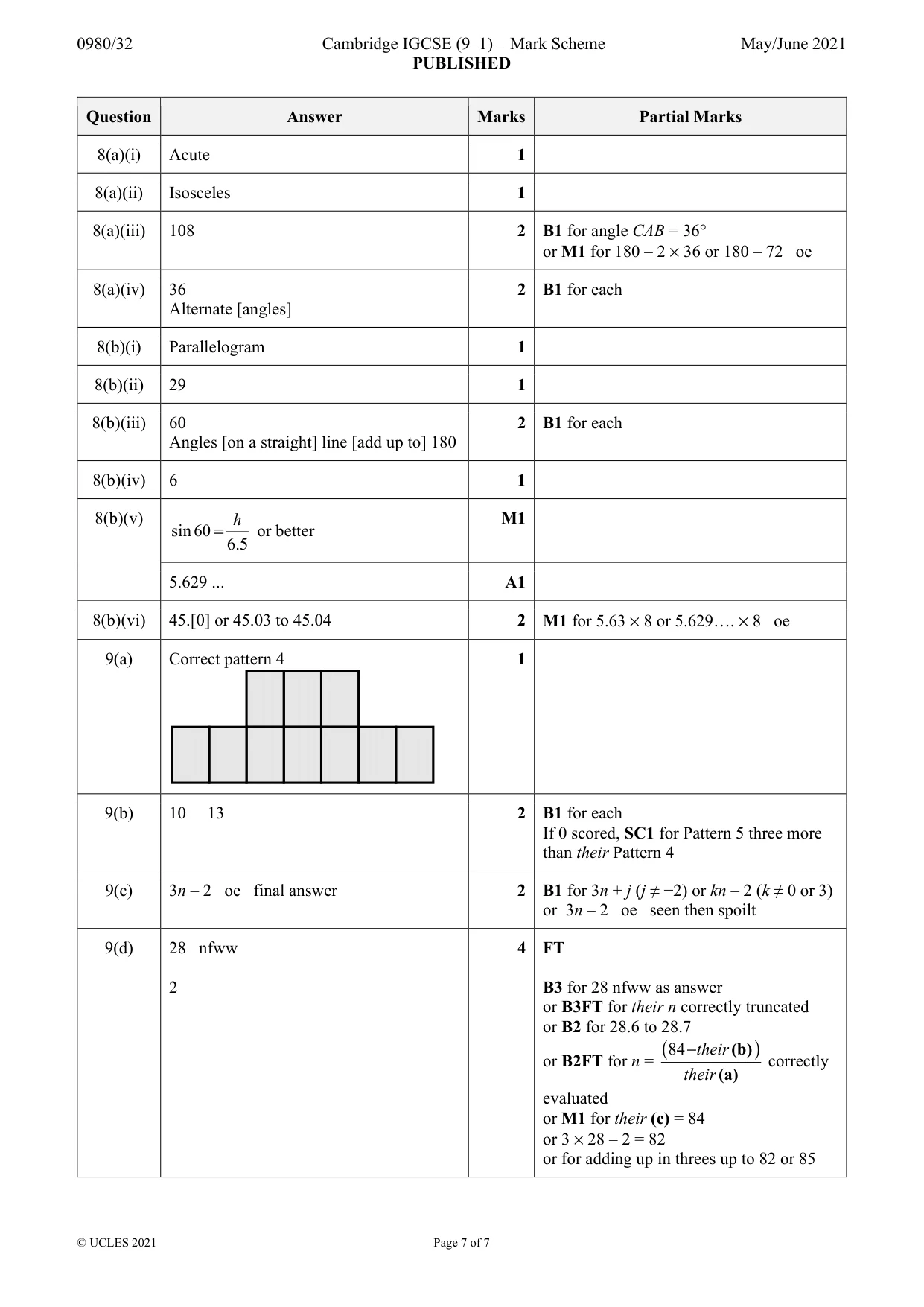
Mark scheme: 8(a)(i) Acute 1 8(a)(ii) Isosceles 1 8(a)(iii) 108 2 B1 for angle CAB = 36° or M1 for 180 – 2 × 36 or 180 – 72 oe 8(a)(iv) 36 2 B1 for each Alternate [angles] 8(b)(i) Parallelogram 1 8(b)(ii) 29 1 8(b)(iii) 60 2 B1 for each Angles [on a straight] line [add up to] 180 8(b)(iv) 6 1 8(b)(v) h M1 sin60 = or better 6.5 5.629 ... A1 8(b)(vi) 45.[0] or 45.03 to 45.04 2 M1 for 5.63 × 8 or 5.629…. × 8 oe
Q9 · A sequence of patterns is made using rectangular blocks
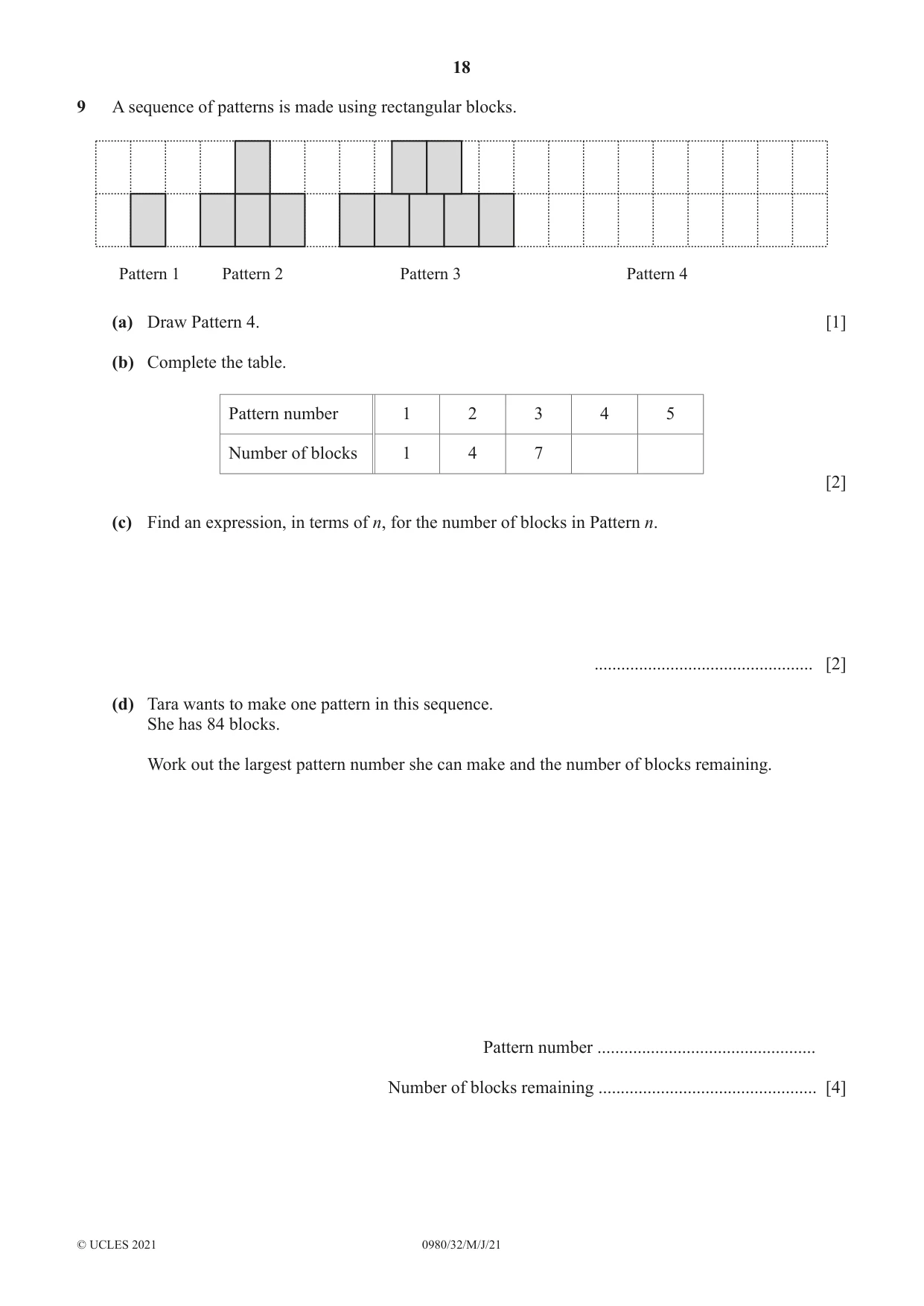
9 A sequence of patterns is made using rectangular blocks. Pattern 1 Pattern 2 Pattern 3 Pattern 4 (a) Draw Pattern 4. [1] (b) Complete the table. Pattern number 1 2 3 4 5 Number of blocks 1 4 7 [2] (c) Find an expression, in terms of n, for the number of blocks in Pattern n. ................................................. [2] (d) Tara wants to make one pattern in this sequence. She has 84 blocks. Work out the largest pattern number she can make and the number of blocks remaining. Pattern number ................................................. Number of blocks remaining ................................................. [4]
Mark scheme: 9(a) Correct pattern 4 1 9(b) 10 13 2 B1 for each If 0 scored, SC1 for Pattern 5 three more than their Pattern 4 9(c) 3n – 2 oe final answer 2 B1 for 3n + j (j ≠ −2) or kn – 2 (k ≠ 0 or 3) or 3n – 2 oe seen then spoilt 9(d) 28 nfww 4 FT 2 B3 for 28 nfww as answer or B3FT for their n correctly truncated or B2 for 28.6 to 28.7 ( 84 − their (b) ) or B2FT for n = correctly their (a) evaluated or M1 for their (c) = 84 or 3 × 28 – 2 = 82 or for adding up in threes up to 82 or 85
What was in this paper
The subtopics covered by these 9 questions, and how many questions each got. Open one in a new tab to see every Cambridge question on it.
What you needed in this session
Cambridge’s own grade thresholds for 2021 May/June, Paper 3 · Variant 2. A higher threshold means an easier paper — the bar moves with how the cohort did.