Cambridge IGCSE Mathematics (9-1) 0980 — 2022 May/June Paper 3 · Variant 2
0980/32/M/J/22 · 9 questions · 104 marks · ≈117 min
The question paper and its mark scheme, free to read here and free to download. This is Cambridge’s own paper, exactly as it was sat.
Question paper20 pages
Mark scheme8 pages
Answers below. Sit the paper first if you are practising.
Questions as text
Q1 · Antonio has a shop near the beach
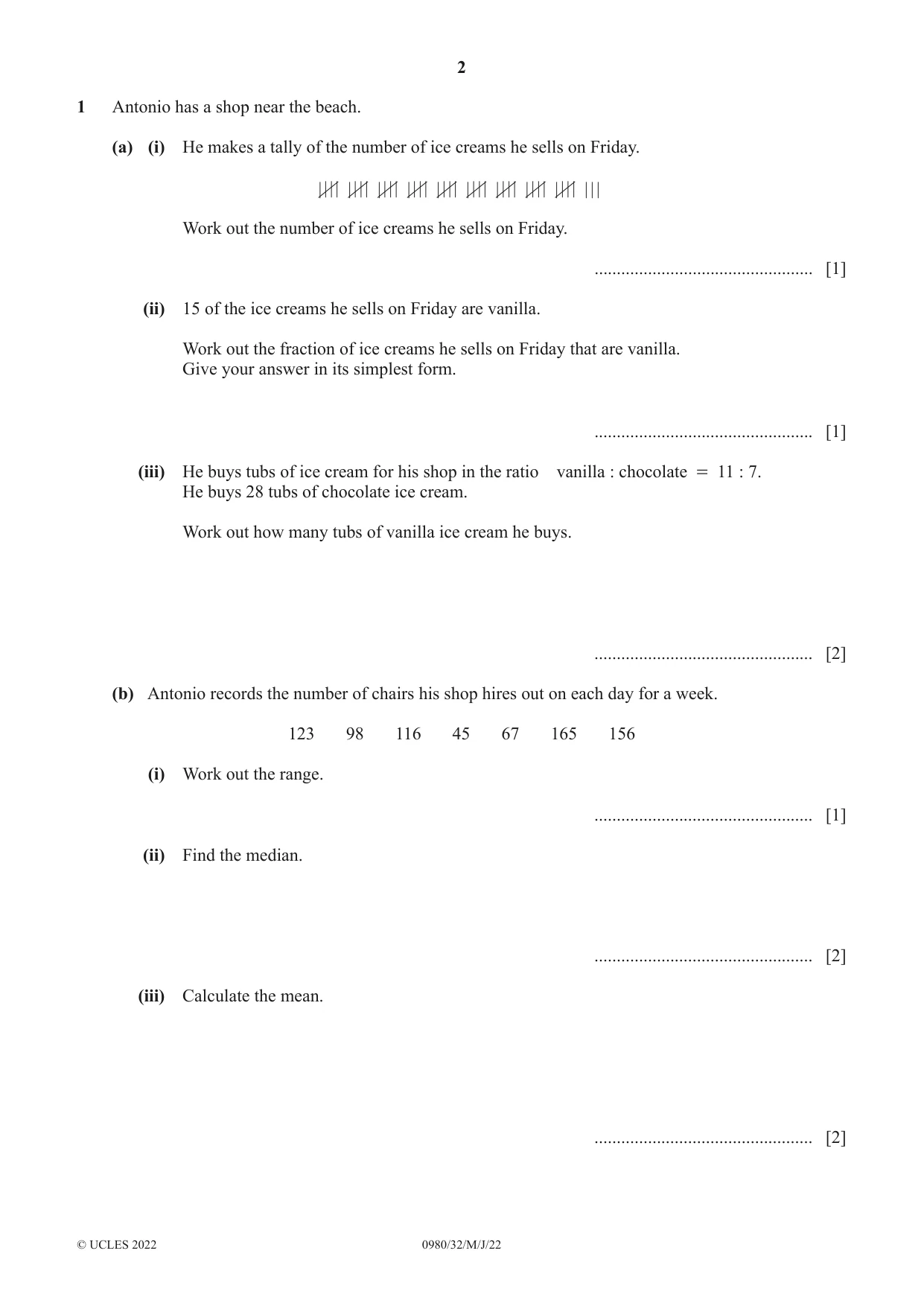
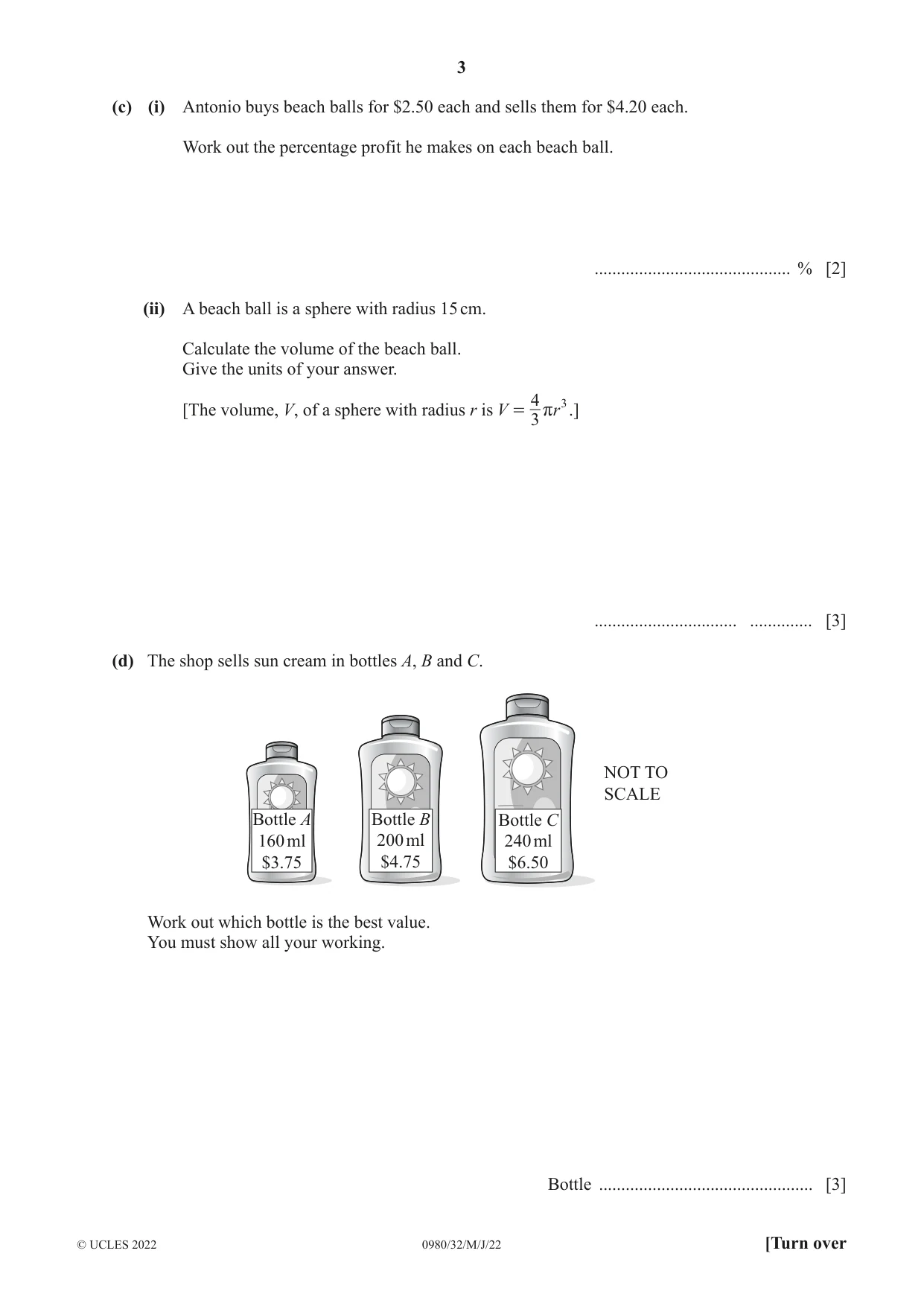
1 Antonio has a shop near the beach. (a) (i) He makes a tally of the number of ice creams he sells on Friday. | | | | | | | | | | | | | | | | | | | | | | | | | | | | | | | | | | | | | | | Work out the number of ice creams he sells on Friday. ................................................. [1] (ii) 15 of the ice creams he sells on Friday are vanilla. Work out the fraction of ice creams he sells on Friday that are vanilla. Give your answer in its simplest form. ................................................. [1] (iii) He buys tubs of ice cream for his shop in the ratio vanilla : chocolate = 11 : 7. He buys 28 tubs of chocolate ice cream. Work out how many tubs of vanilla ice cream he buys. ................................................. [2] (b) Antonio records the number of chairs his shop hires out on each day for a week. 123 98 116 45 67 165 156 (i) Work out the range. ................................................. [1] (ii) Find the median. ................................................. [2] (iii) Calculate the mean. ................................................. [2] (c) (i) Antonio buys beach balls for $2.50 each and sells them for $4.20 each. Work out the percentage profit he makes on each beach ball. ............................................ % [2] (ii) A beach ball is a sphere with radius 15 cm. Calculate the volume of the beach ball. Give the units of your answer. 4 3 [The volume, V, of a sphere with radius r is V = rr .] 3 ................................ .............. [3] (d) The shop sells sun cream in bottles A, B and C. NOT TO SCALE Bottle A Bottle B Bottle C 160 ml 200 ml 240 ml $3.75 $4.75 $6.50 Work out which bottle is the best value. You must show all your working. Bottle ................................................ [3]
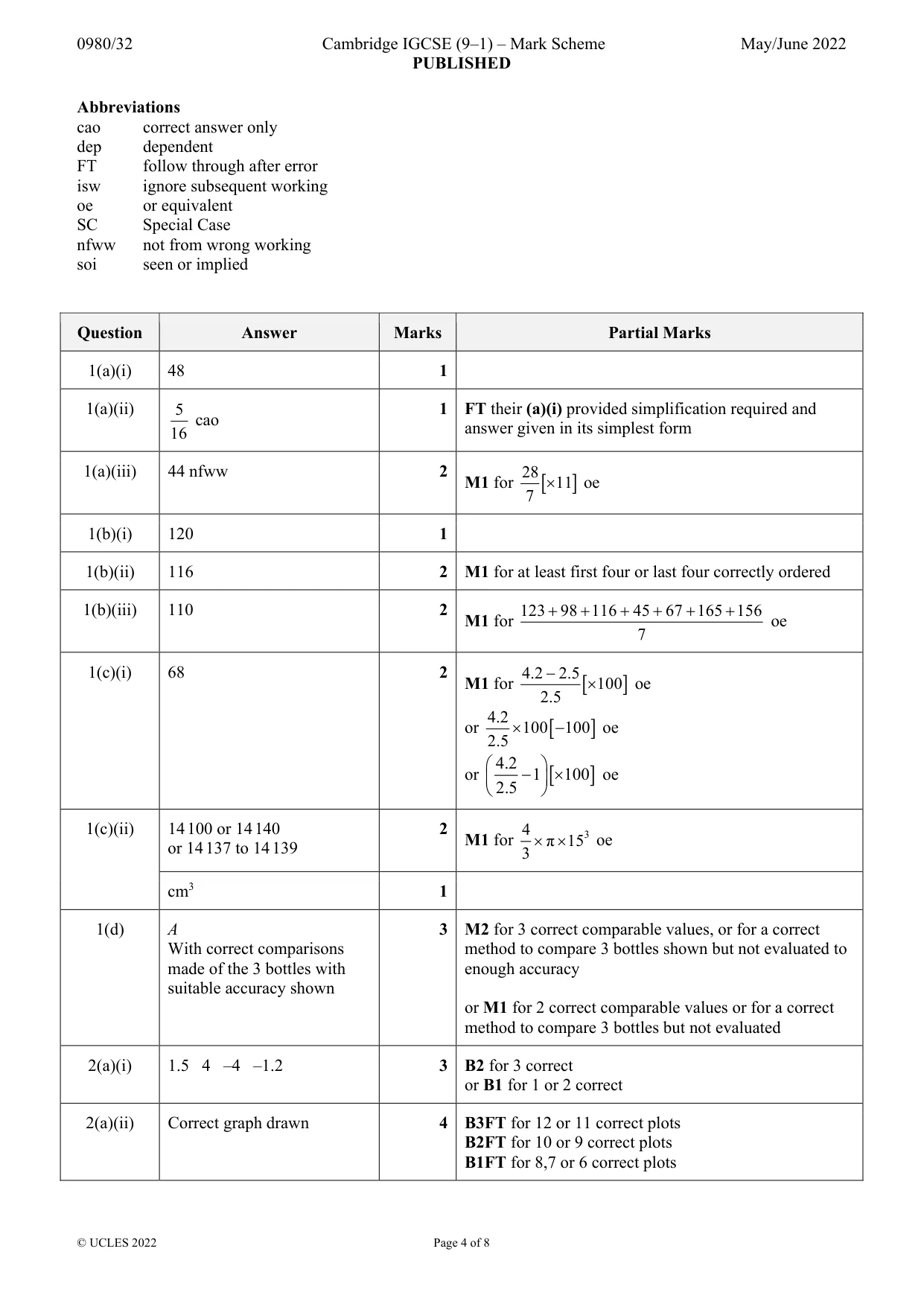
Mark scheme: Question Answer Marks Partial Marks 1(a)(i) 48 1 1(a)(ii) 5 1 FT their (a)(i) provided simplification required and cao answer given in its simplest form 16 1(a)(iii) 44 nfww 2 28 M1 for 11 oe 7 1(b)(i) 120 1 1(b)(ii) 116 2 M1 for at least first four or last four correctly ordered 1(b)(iii) 110 2 123 98 116 45 67 165 156 M1 for oe 7 1(c)(i) 68 2 4.2 2.5 M1 for 100 oe 2.5 4.2 or 100 100 oe 2.5 4.2 100 oe or 1 2.5 1(c)(ii) 14 100 or 14 140 2 4 3 M1 for π 15 oe or 14 137 to 14 139 3 cm3 1 1(d) A 3 M2 for 3 correct comparable values, or for a correct With correct comparisons method to compare 3 bottles shown but not evaluated to made of the 3 bottles with enough accuracy suitable accuracy shown or M1 for 2 correct comparable values or for a correct method to compare 3 bottles but not evaluated
Q2 · Complete the table of values for y =
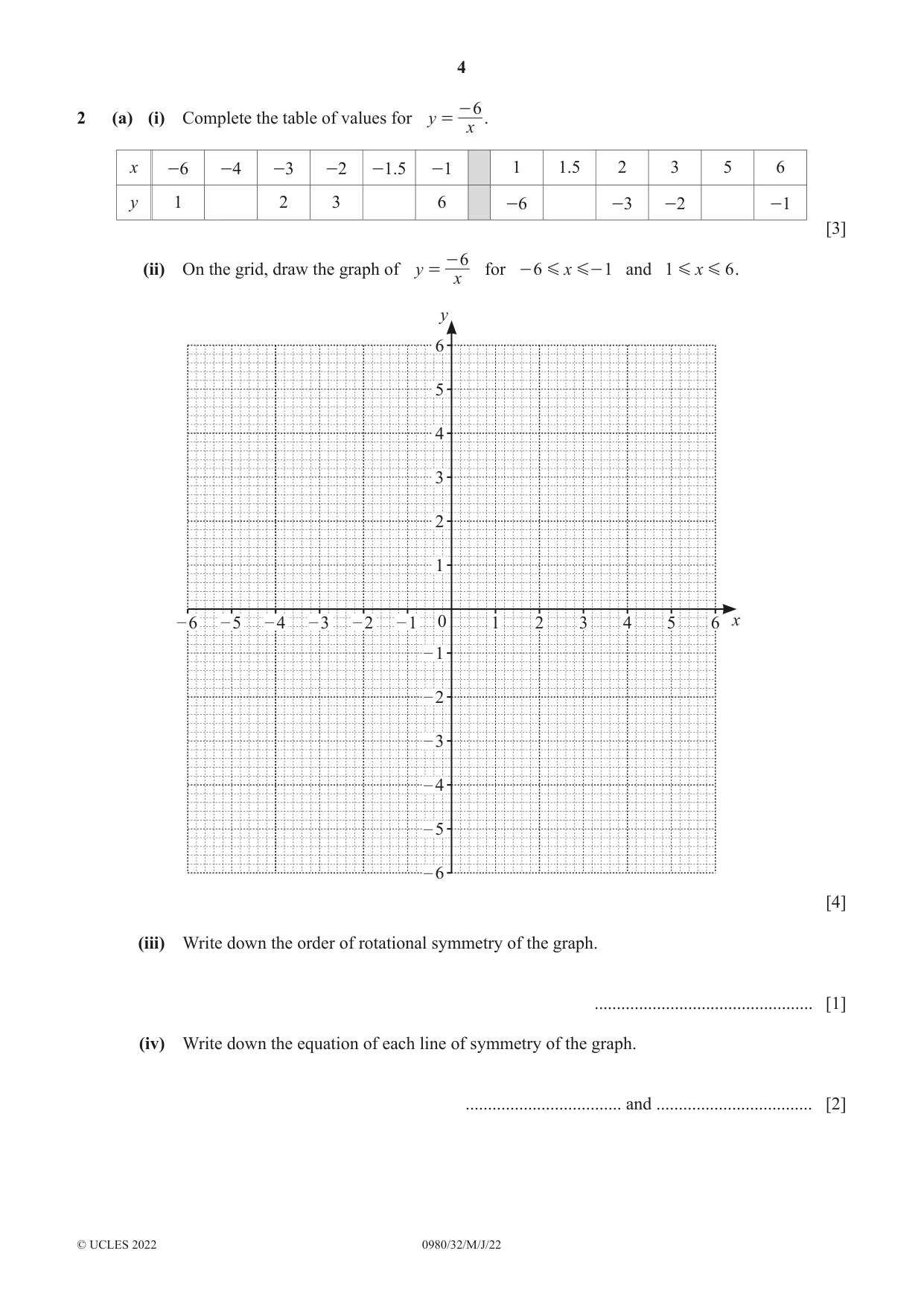
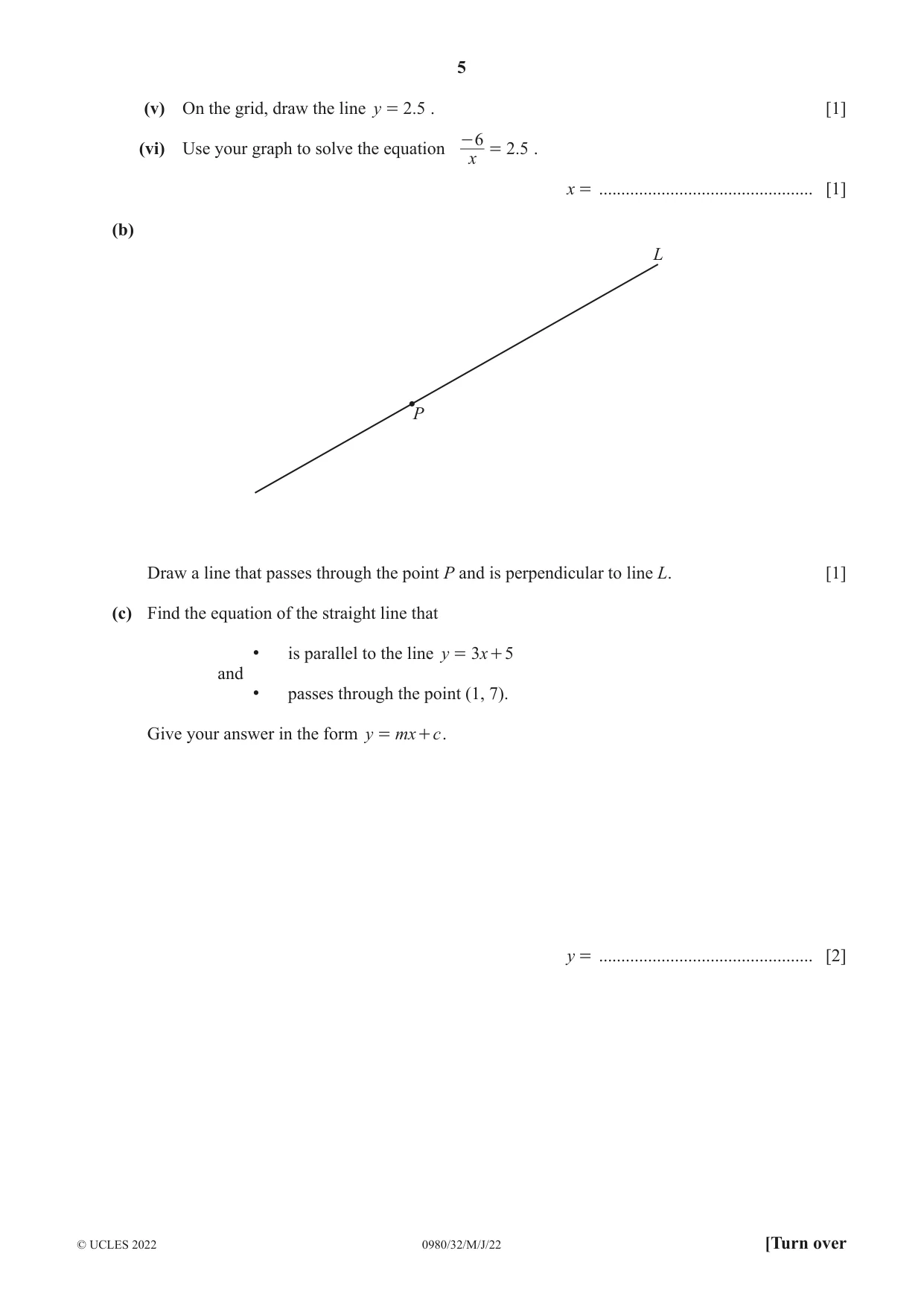
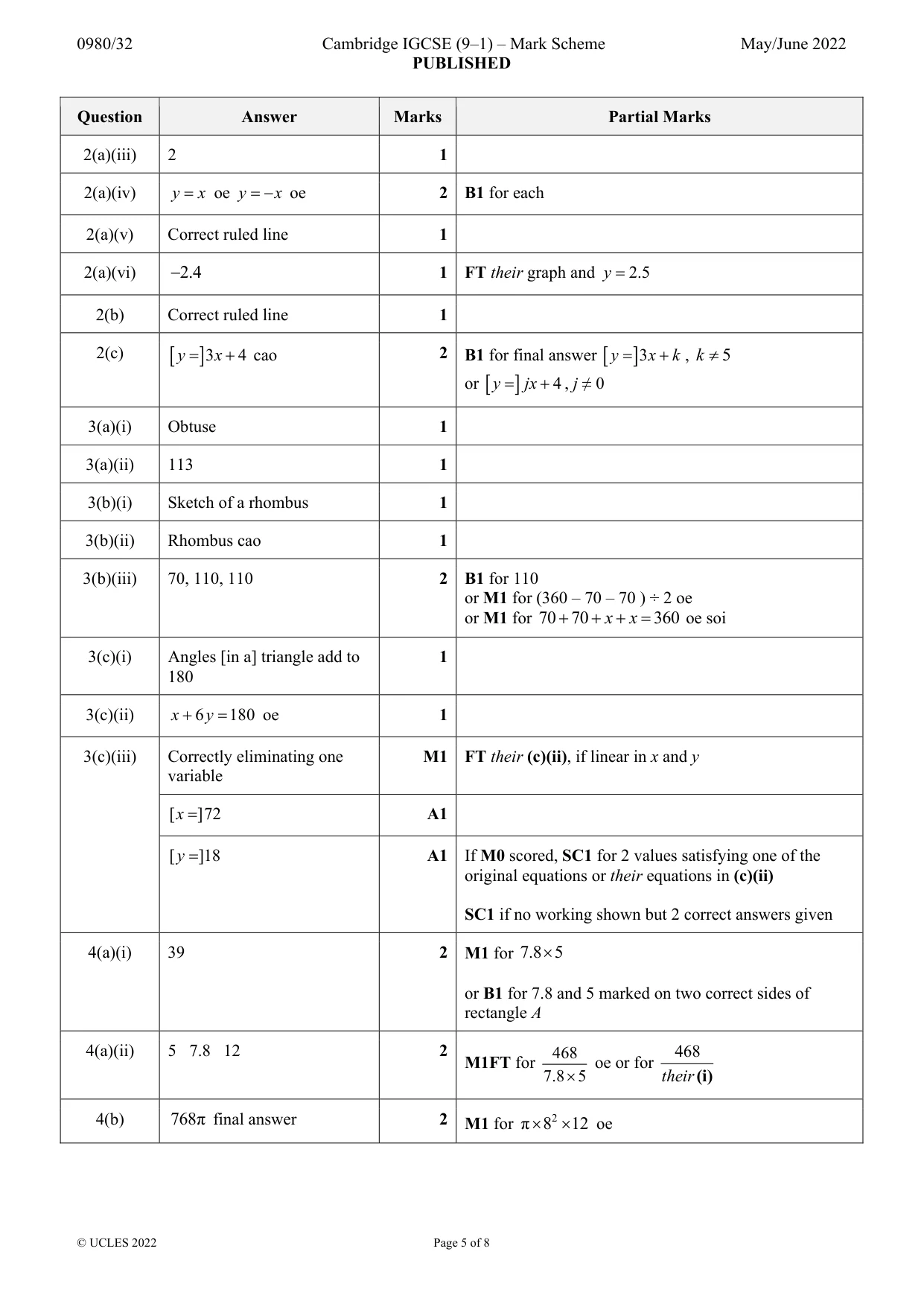
2 (a) (i) Complete the table of values for y = . x x -6 -4 -3 -2 -1.5 -1 1 1.5 2 3 5 6 y 1 2 3 6 -6 -3 -2 -1 [3] - 6 (ii) On the grid, draw the graph of y = for - 6 G x G - 1 and 1 G x G 6 . x y 6 5 4 3 2 1 – 6 – 5 – 4 – 3 – 2 – 1 0 1 2 3 4 5 6 x – 1 – 2 – 3 – 4 – 5 – 6 [4] (iii) Write down the order of rotational symmetry of the graph. ................................................. [1] (iv) Write down the equation of each line of symmetry of the graph. ................................... and ................................... [2] (v) On the grid, draw the line y = 2.5 . [1] - 6 (vi) Use your graph to solve the equation = 2 .5 . x x = ................................................ [1] (b) L P Draw a line that passes through the point P and is perpendicular to line L. [1] (c) Find the equation of the straight line that • is parallel to the line y = 3x + 5 and • passes through the point (1, 7). Give your answer in the form y = mx + c . y = ................................................ [2]
Mark scheme: 2(a)(i) 1.5 4 –4 –1.2 3 B2 for 3 correct or B1 for 1 or 2 correct 2(a)(ii) Correct graph drawn 4 B3FT for 12 or 11 correct plots B2FT for 10 or 9 correct plots B1FT for 8,7 or 6 correct plots 2(a)(iii) 2 1 2(a)(iv) y x oe y x oe 2 B1 for each 2(a)(v) Correct ruled line 1 2(a)(vi) 2.4 1 FT their graph and y 2.5 2(b) Correct ruled line 1 2(c) y 3 x 4 cao 2 B1 for final answer y 3 x k , k 5 or y jx 4 , j ≠ 0
Q3 · A (i) Write down the mathematical name for the type of angle a
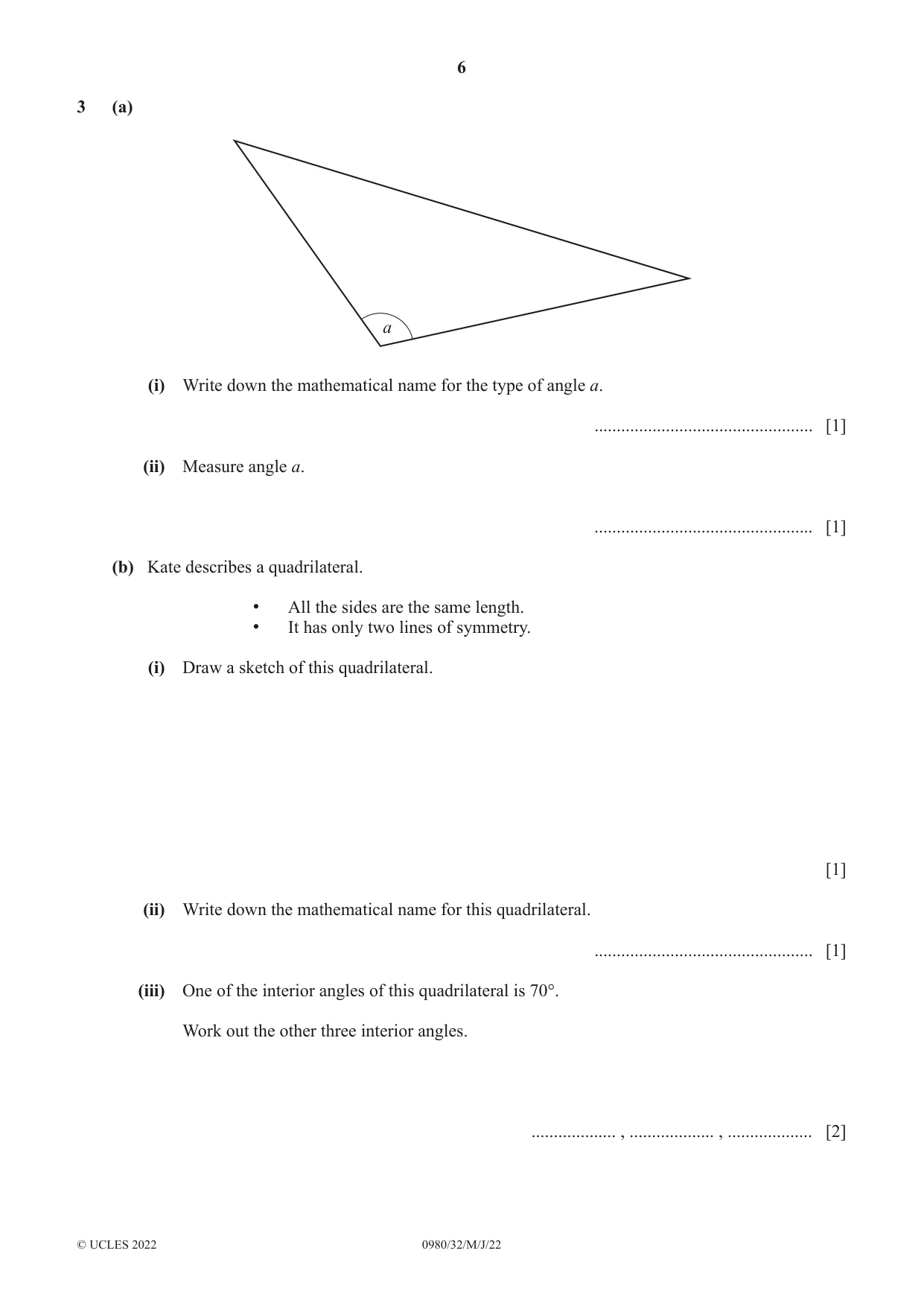
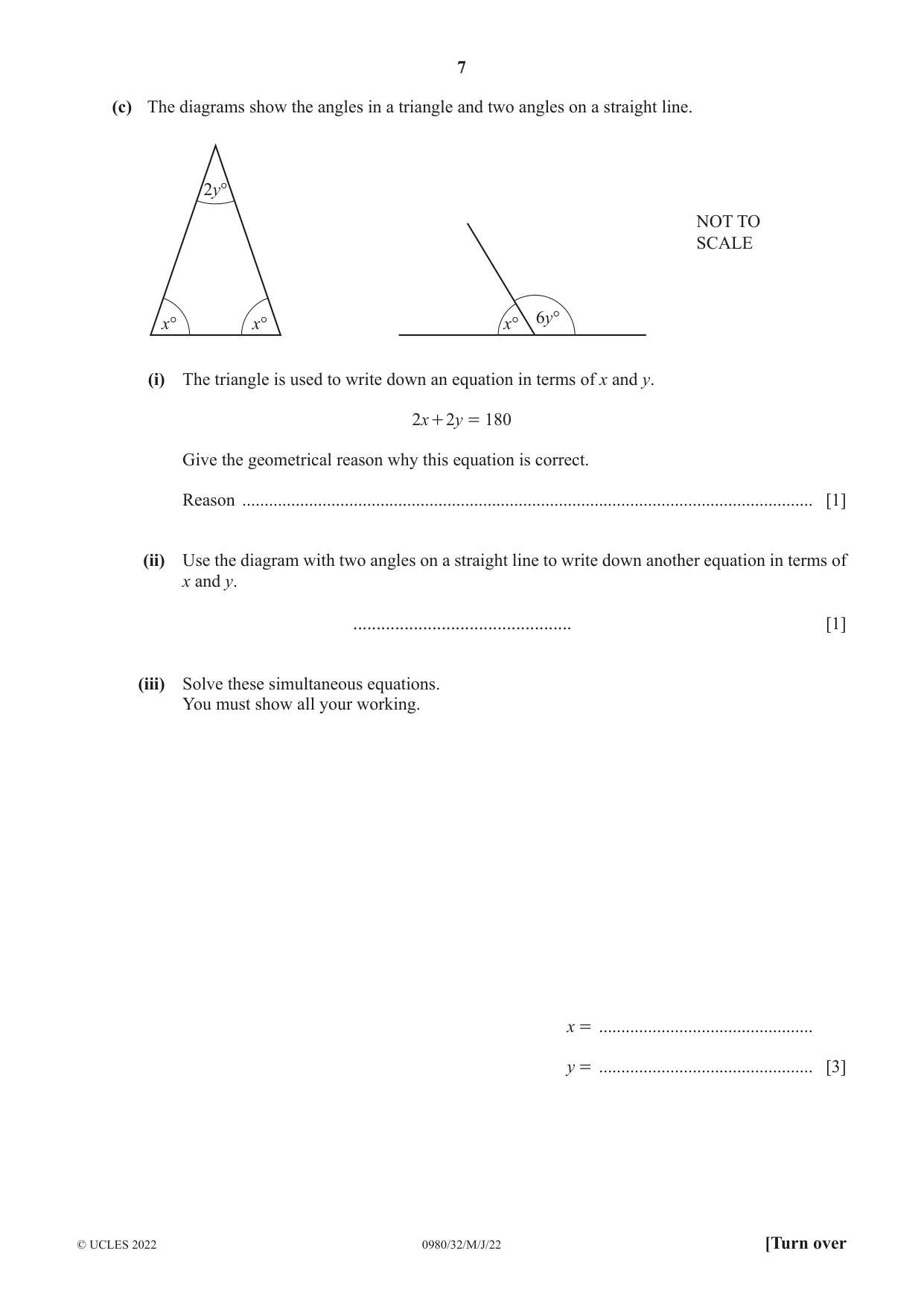
3 (a) a (i) Write down the mathematical name for the type of angle a. ................................................. [1] (ii) Measure angle a. ................................................. [1] (b) Kate describes a quadrilateral. • All the sides are the same length. • It has only two lines of symmetry. (i) Draw a sketch of this quadrilateral. [1] (ii) Write down the mathematical name for this quadrilateral. ................................................. [1] (iii) One of the interior angles of this quadrilateral is 70°. Work out the other three interior angles. ................... , ................... , ................... [2] (c) The diagrams show the angles in a triangle and two angles on a straight line. 2y° NOT TO SCALE 6y° x° x° x° (i) The triangle is used to write down an equation in terms of x and y. 2x + 2y = 180 Give the geometrical reason why this equation is correct. Reason ................................................................................................................................ [1] (ii) Use the diagram with two angles on a straight line to write down another equation in terms of x and y. ............................................... [1] (iii) Solve these simultaneous equations. You must show all your working. x = ................................................ y = ................................................ [3]
Mark scheme: 3(a)(i) Obtuse 1 3(a)(ii) 113 1 3(b)(i) Sketch of a rhombus 1 3(b)(ii) Rhombus cao 1 3(b)(iii) 70, 110, 110 2 B1 for 110 or M1 for (360 – 70 – 70 ) ÷ 2 oe or M1 for 70 70 x x 360 oe soi 3(c)(i) Angles [in a] triangle add to 1 180 3(c)(ii) x 6 y 180 oe 1 3(c)(iii) Correctly eliminating one M1 FT their (c)(ii), if linear in x and y variable [ x ] 72 A1 [ y ]1 8 A1 If M0 scored, SC1 for 2 values satisfying one of the original equations or their equations in (c)(ii) SC1 if no working shown but 2 correct answers given
Q4 · The diagram shows the net of a cuboid
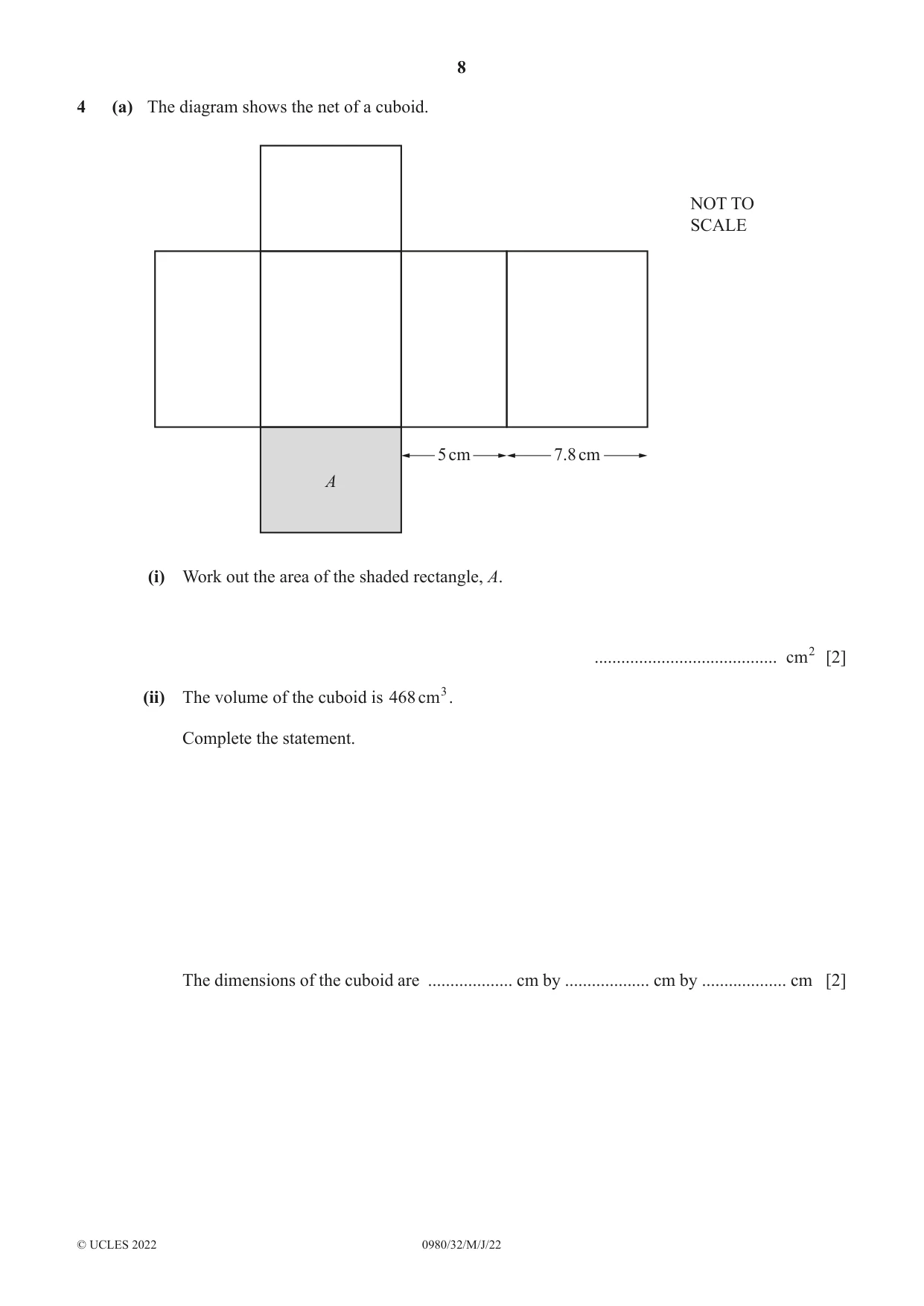
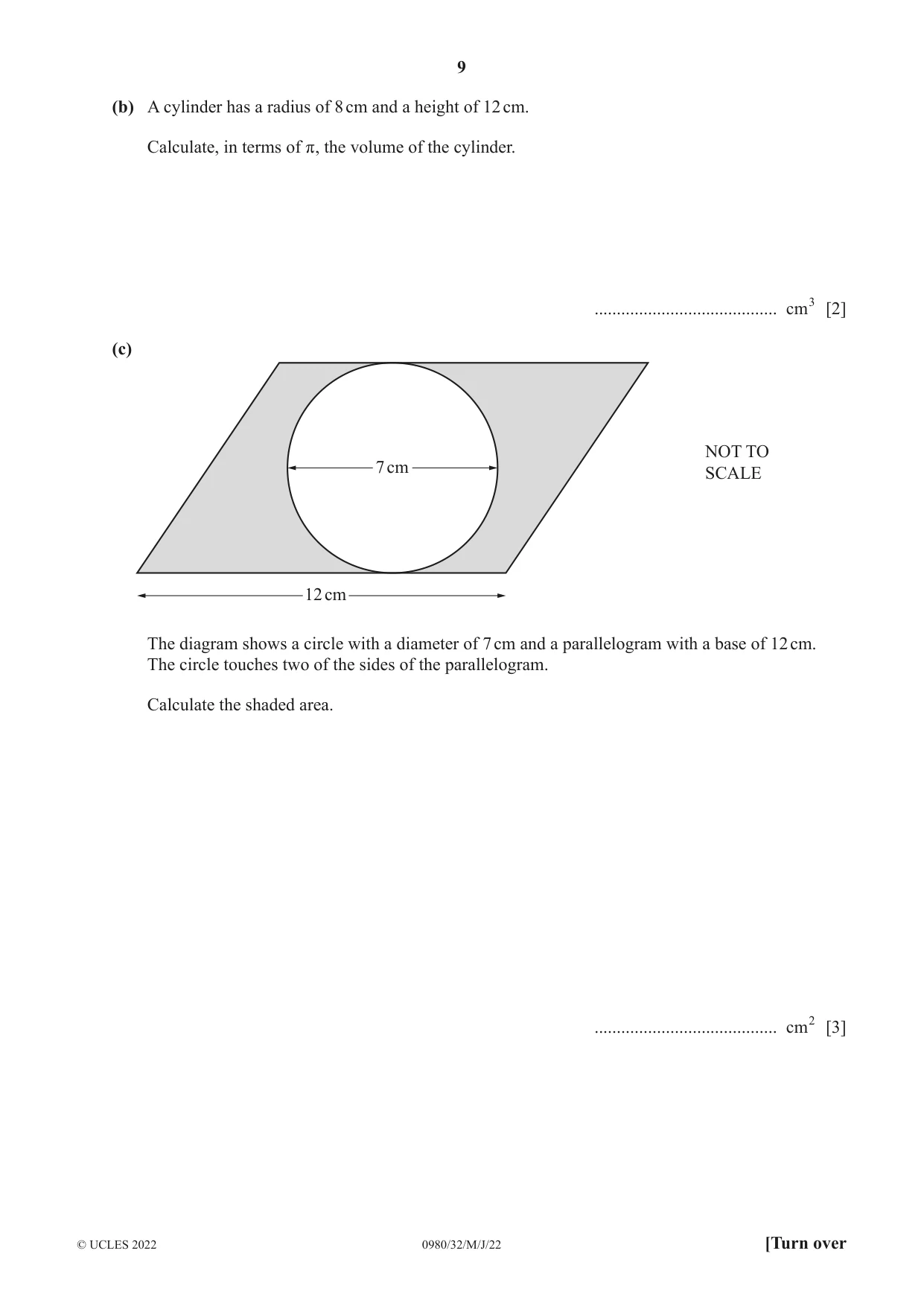
4 (a) The diagram shows the net of a cuboid. NOT TO SCALE 5 cm 7.8 cm A (i) Work out the area of the shaded rectangle, A. ......................................... cm2 [2] (ii) The volume of the cuboid is 468 cm 3. Complete the statement. The dimensions of the cuboid are ................... cm by ................... cm by ................... cm [2] (b) A cylinder has a radius of 8 cm and a height of 12 cm. Calculate, in terms of r, the volume of the cylinder. ......................................... cm3 [2] (c) NOT TO 7 cm SCALE 12 cm The diagram shows a circle with a diameter of 7 cm and a parallelogram with a base of 12 cm. The circle touches two of the sides of the parallelogram. Calculate the shaded area. ......................................... cm2 [3]
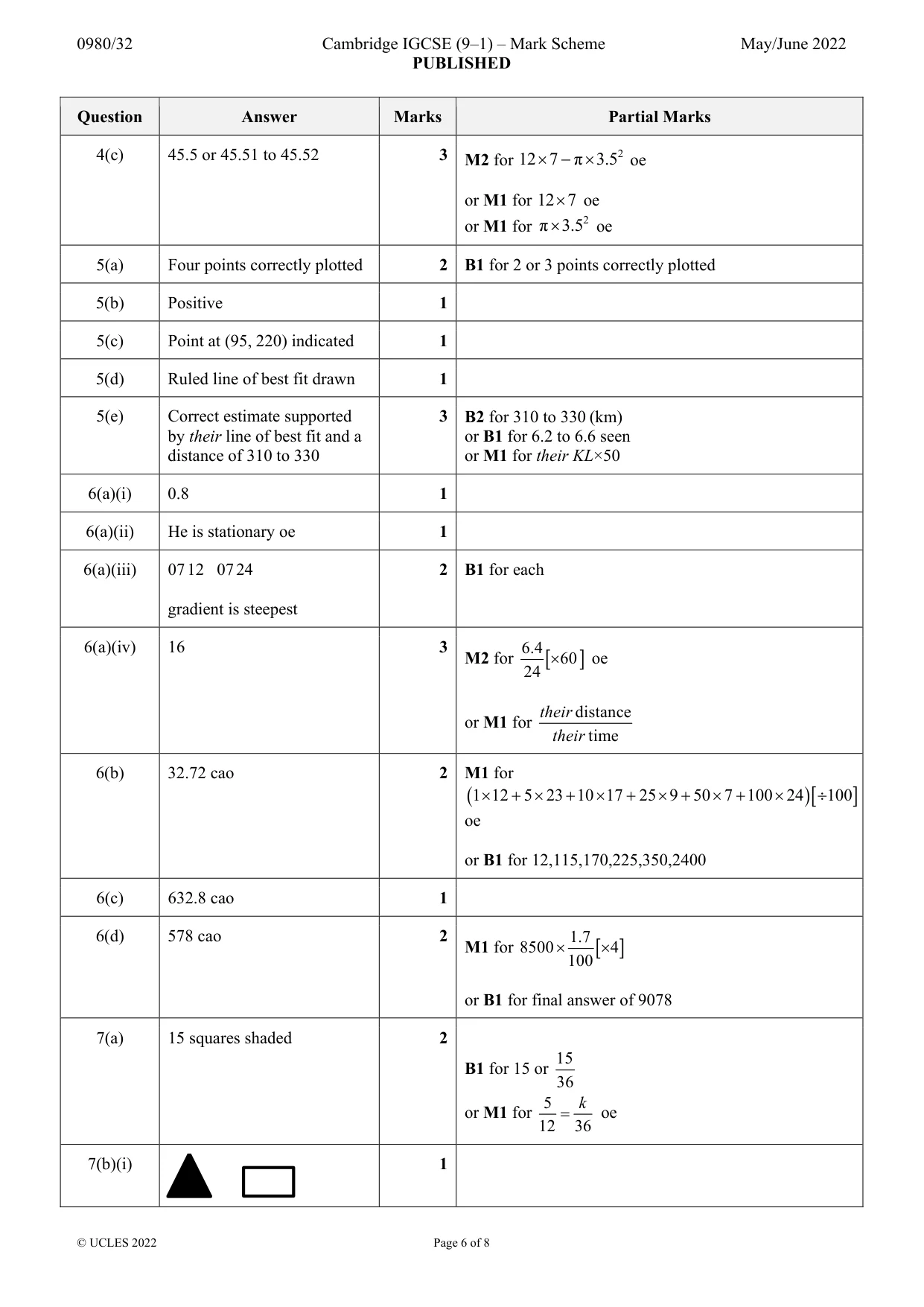
Mark scheme: 4(a)(i) 39 2 M1 for 7.8 5 or B1 for 7.8 and 5 marked on two correct sides of rectangle A 4(a)(ii) 5 7.8 12 2 468 468 M1FT for oe or for 7.8 5 their(i) 4(b) 768π final answer 2 M1 for π 82 12 oe 4(c) 45.5 or 45.51 to 45.52 3 M2 for 12 7 π 3.52 oe or M1 for 12 7 oe or M1 for π 3.52 oe
Q5 · Rebecca records the flight distance and the ticket price for each of her last 12 plane…
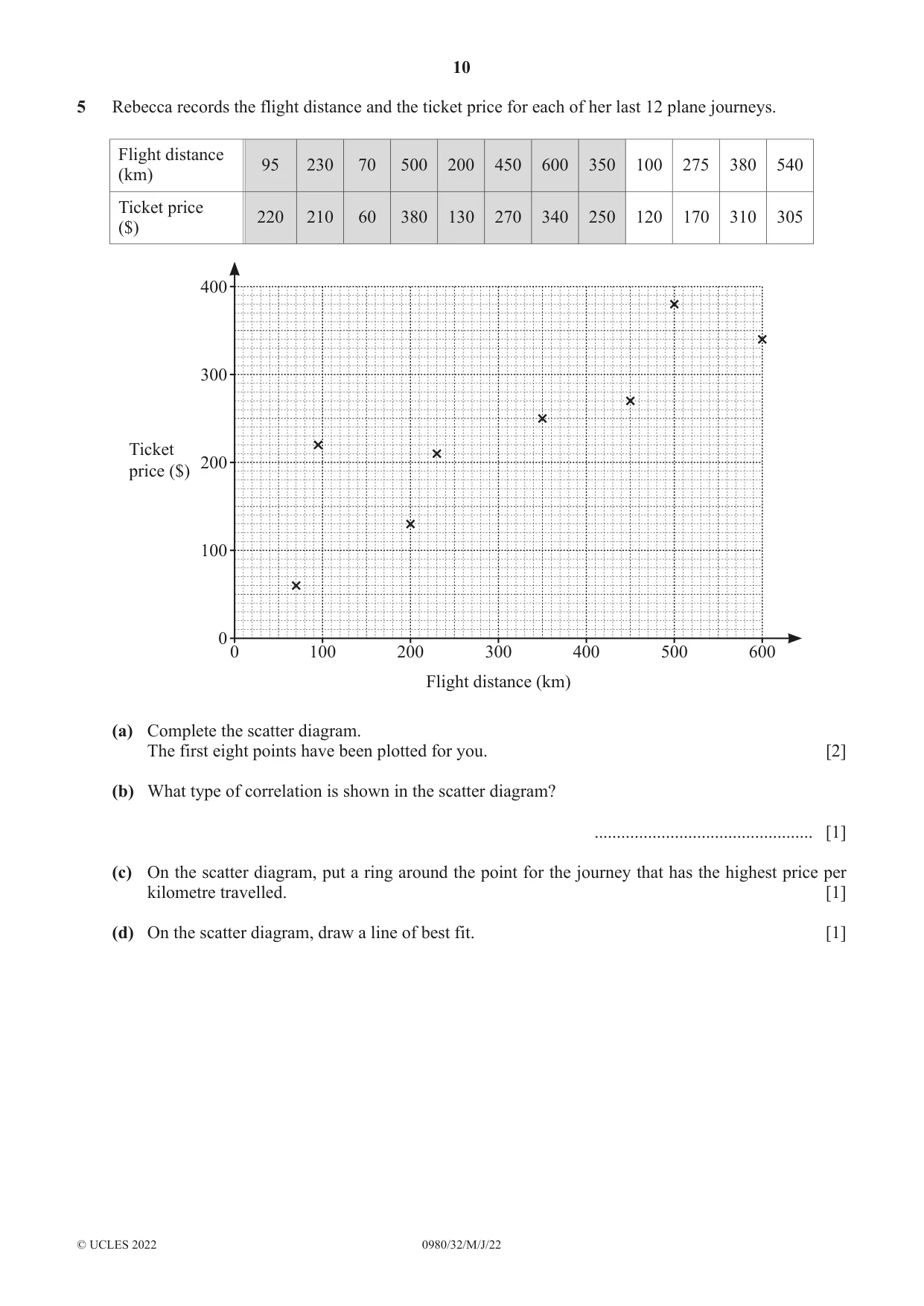
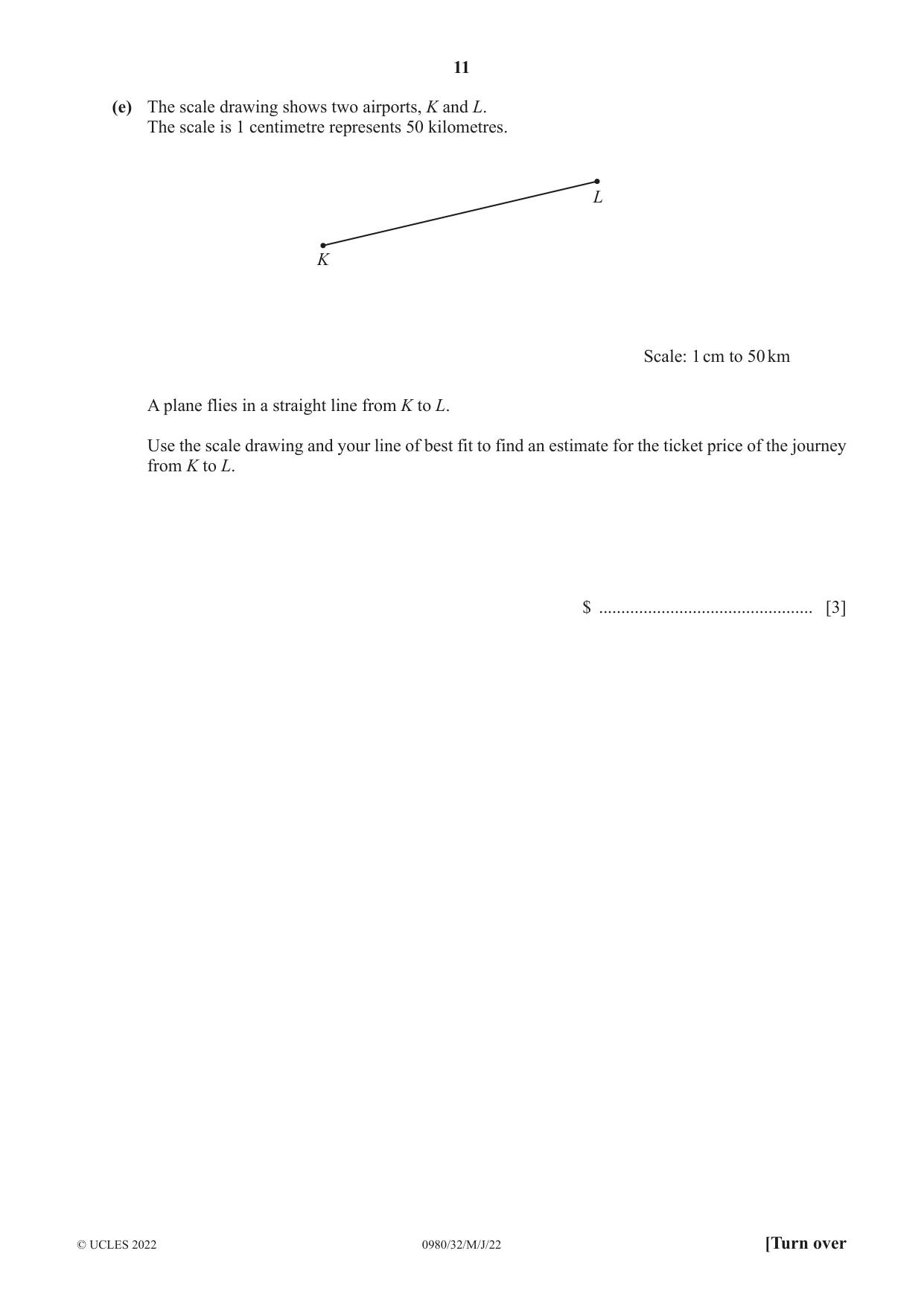
5 Rebecca records the flight distance and the ticket price for each of her last 12 plane journeys. Flight distance 95 230 70 500 200 450 600 350 100 275 380 540 (km) Ticket price 220 210 60 380 130 270 340 250 120 170 310 305 ($) 400 300 Ticket 200 price ($) 100 0 0 100 200 300 400 500 600 Flight distance (km) (a) Complete the scatter diagram. The first eight points have been plotted for you. [2] (b) What type of correlation is shown in the scatter diagram? ................................................. [1] (c) On the scatter diagram, put a ring around the point for the journey that has the highest price per kilometre travelled. [1] (d) On the scatter diagram, draw a line of best fit. [1] (e) The scale drawing shows two airports, K and L. The scale is 1 centimetre represents 50 kilometres. L K Scale: 1 cm to 50 km A plane flies in a straight line from K to L. Use the scale drawing and your line of best fit to find an estimate for the ticket price of the journey from K to L. $ ................................................ [3]
Mark scheme: 5(a) Four points correctly plotted 2 B1 for 2 or 3 points correctly plotted 5(b) Positive 1 5(c) Point at (95, 220) indicated 1 5(d) Ruled line of best fit drawn 1 5(e) Correct estimate supported 3 B2 for 310 to 330 (km) by their line of best fit and a or B1 for 6.2 to 6.6 seen distance of 310 to 330 or M1 for their KL×50
Q6 · Mr Vay works in a bank
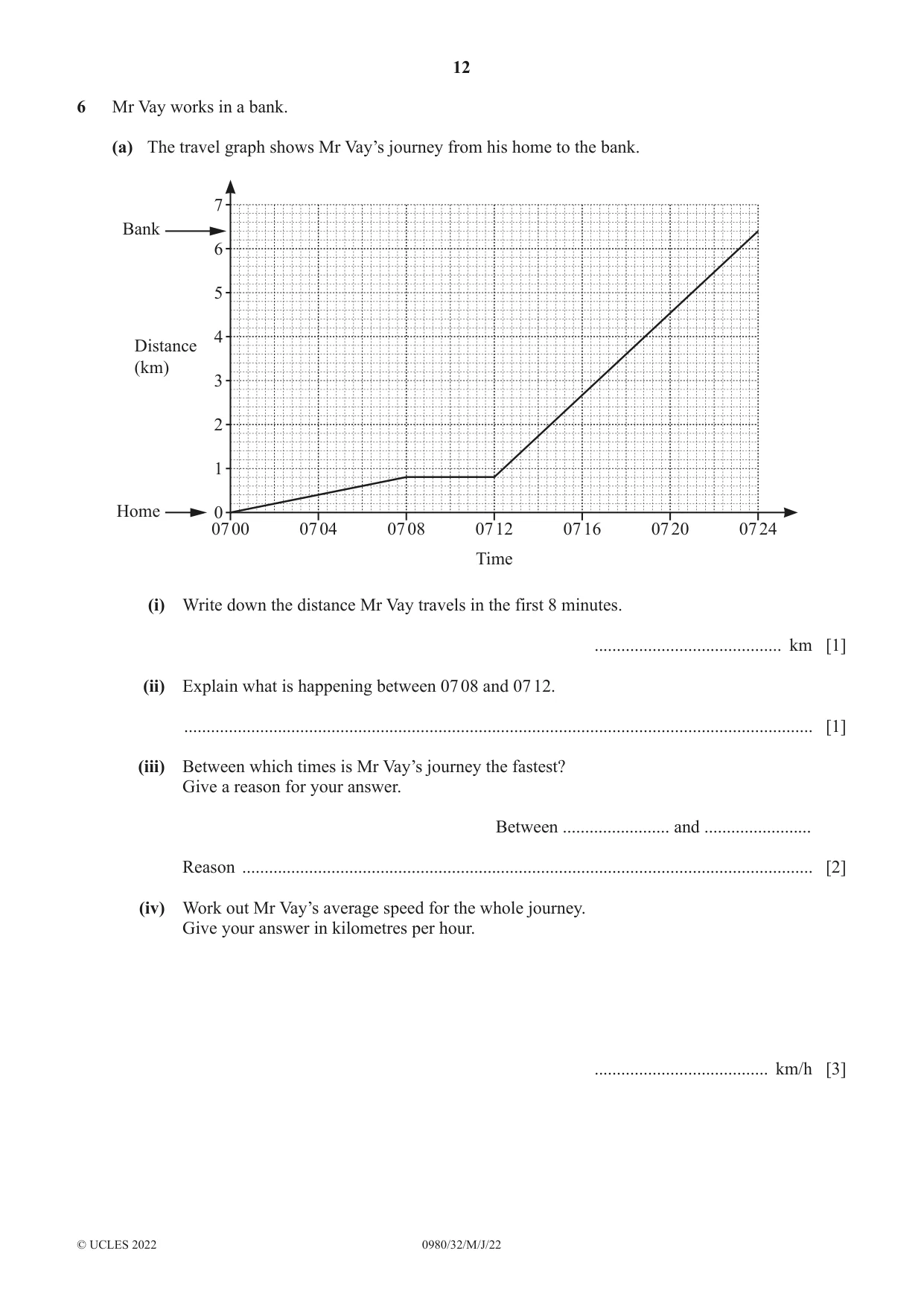
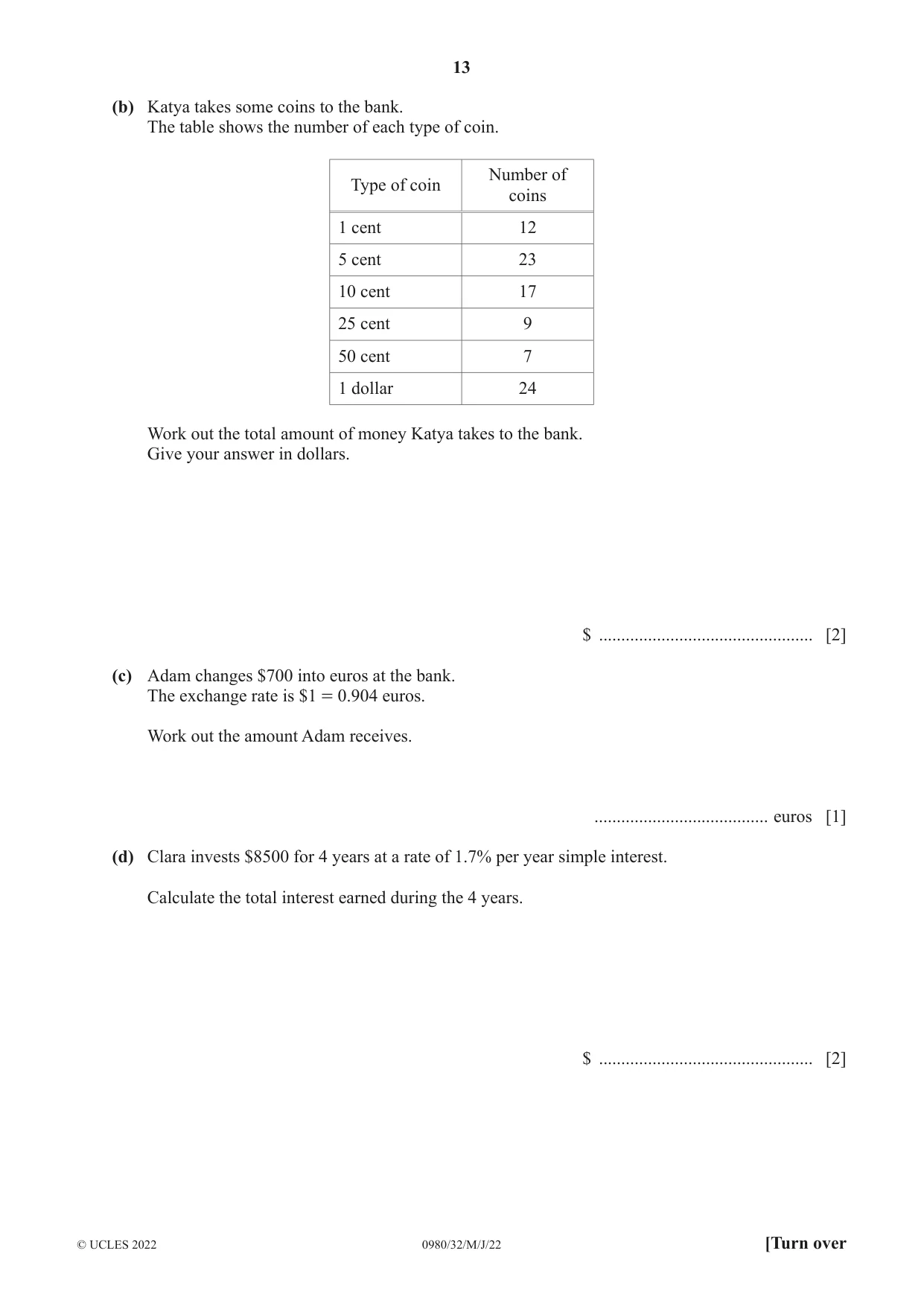
6 Mr Vay works in a bank. (a) The travel graph shows Mr Vay’s journey from his home to the bank. 7 Bank 6 5 4 Distance (km) 3 2 1 Home 0 07 00 07 04 07 08 07 12 07 16 07 20 07 24 Time (i) Write down the distance Mr Vay travels in the first 8 minutes. .......................................... km [1] (ii) Explain what is happening between 07 08 and 07 12. ............................................................................................................................................. [1] (iii) Between which times is Mr Vay’s journey the fastest? Give a reason for your answer. Between ........................ and ........................ Reason ................................................................................................................................ [2] (iv) Work out Mr Vay’s average speed for the whole journey. Give your answer in kilometres per hour. ....................................... km/h [3] (b) Katya takes some coins to the bank. The table shows the number of each type of coin. Number of Type of coin coins 1 cent 12 5 cent 23 10 cent 17 25 cent 9 50 cent 7 1 dollar 24 Work out the total amount of money Katya takes to the bank. Give your answer in dollars. $ ................................................ [2] (c) Adam changes $700 into euros at the bank. The exchange rate is $1 = 0.904 euros. Work out the amount Adam receives. ....................................... euros [1] (d) Clara invests $8500 for 4 years at a rate of 1.7% per year simple interest. Calculate the total interest earned during the 4 years. $ ................................................ [2]
Mark scheme: 6(a)(i) 0.8 1 6(a)(ii) He is stationary oe 1 6(a)(iii) 07 12 07 24 2 B1 for each gradient is steepest 6(a)(iv) 16 3 6.4 M2 for 60 oe 24 their distance or M1 for their time 6(b) 32.72 cao 2 M1 for 1 12 5 23 10 17 25 9 50 7 100 24 100 oe or B1 for 12,115,170,225,350,2400 6(c) 632.8 cao 1 6(d) 578 cao 2 1.7 M1 for 8500 4 100 or B1 for final answer of 9078
Q7 · Shade some squares so that both shapes have the same fraction shaded
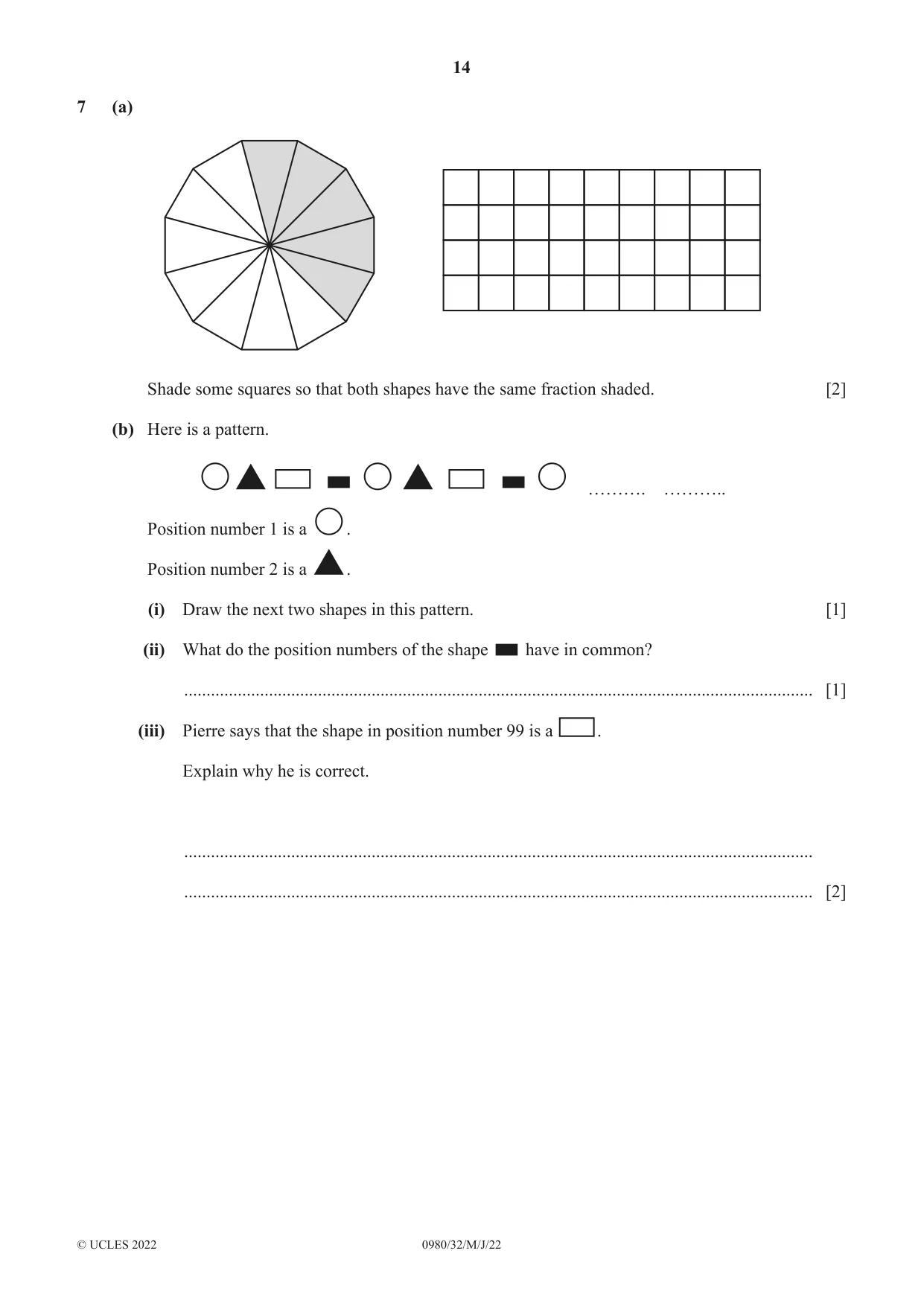
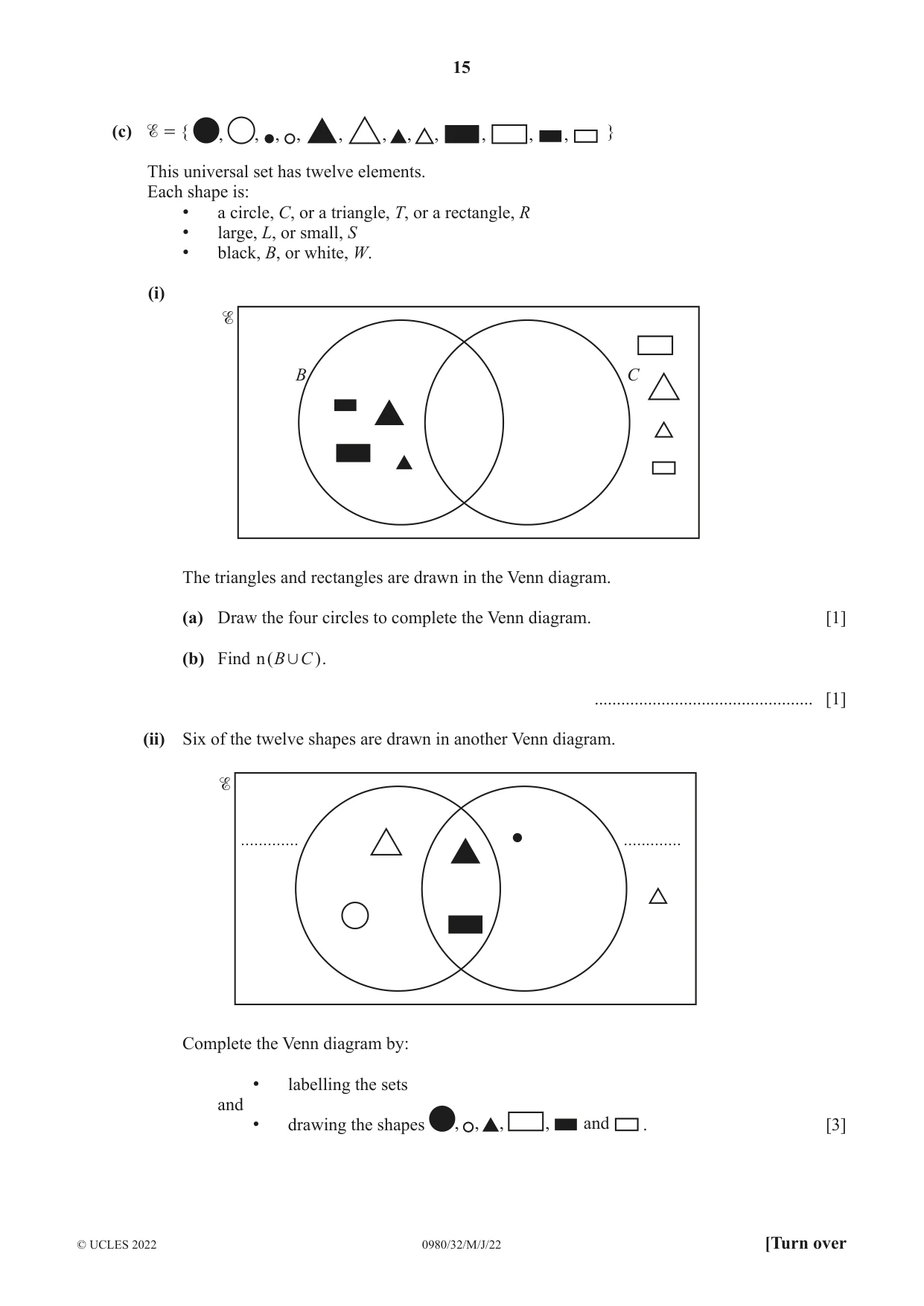
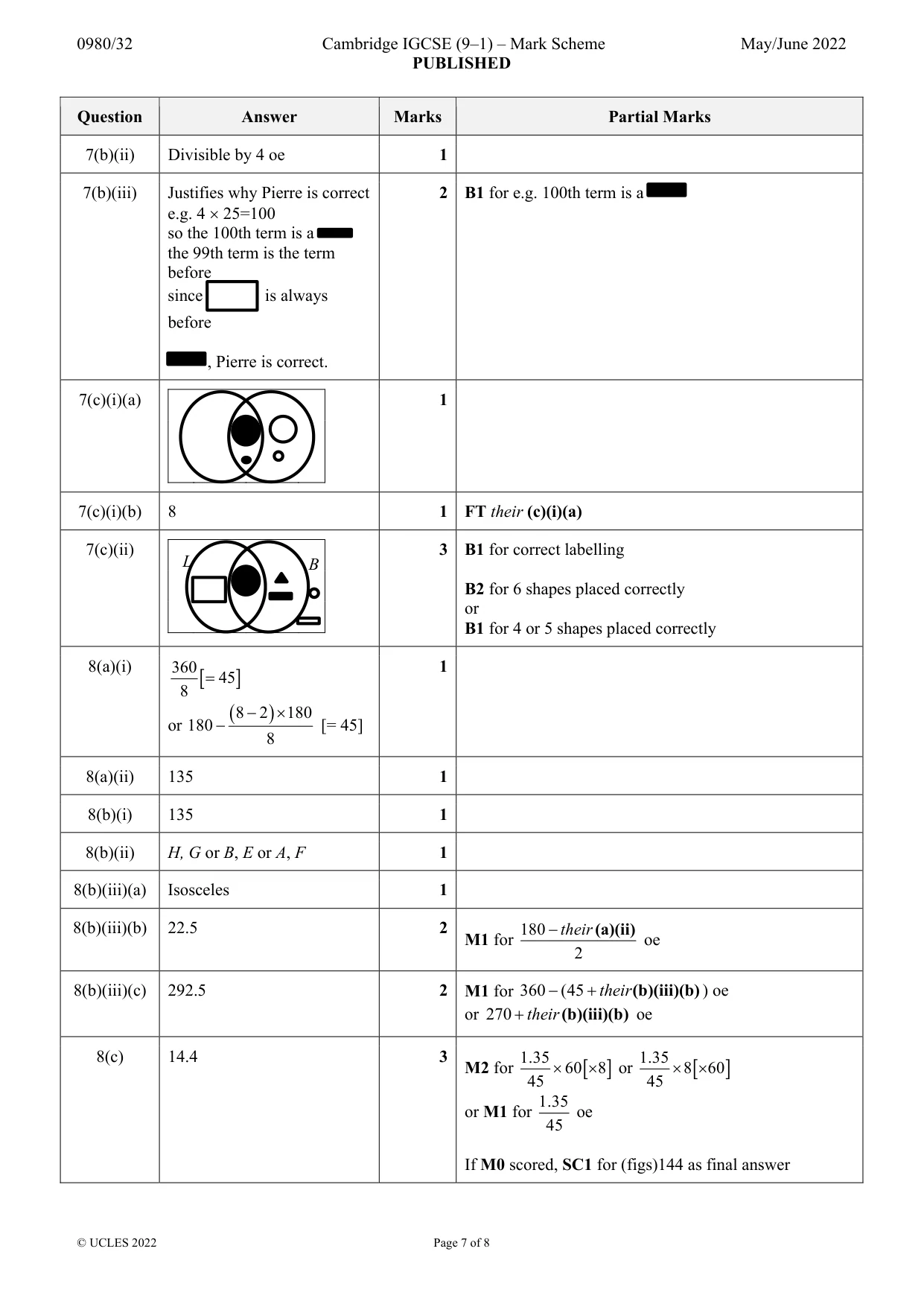
7 (a) Shade some squares so that both shapes have the same fraction shaded. [2] (b) Here is a pattern. ………. ……….. Position number 1 is a . Position number 2 is a . (i) Draw the next two shapes in this pattern. [1] (ii) What do the position numbers of the shape have in common? ............................................................................................................................................. [1] (iii) Pierre says that the shape in position number 99 is a . Explain why he is correct. ............................................................................................................................................. ............................................................................................................................................. [2] (c) = { , , , , , , , , , , , } This universal set has twelve elements. Each shape is: • a circle, C, or a triangle, T, or a rectangle, R • large, L, or small, S • black, B, or white, W. (i) B C The triangles and rectangles are drawn in the Venn diagram. (a) Draw the four circles to complete the Venn diagram. [1] (b) Find n ( B , C ) . ................................................. [1] (ii) Six of the twelve shapes are drawn in another Venn diagram. ............. ............. Complete the Venn diagram by: • labelling the sets and • drawing the shapes , , , , and . [3]
Mark scheme: 7(a) 15 squares shaded 2 15 B1 for 15 or 36 5 k or M1 for oe 12 36 7(b)(i) 1 7(b)(ii) Divisible by 4 oe 1 7(b)(iii) Justifies why Pierre is correct 2 B1 for e.g. 100th term is a e.g. 4 25=100 so the 100th term is a the 99th term is the term before since is always before , Pierre is correct. 7(c)(i)(a) 1 7(c)(i)(b) 8 1 FT their (c)(i)(a) 7(c)(ii) 3 B1 for correct labelling L B B2 for 6 shapes placed correctly or B1 for 4 or 5 shapes placed correctly
Q8 · Show that the exterior angle of a regular octagon is 45°
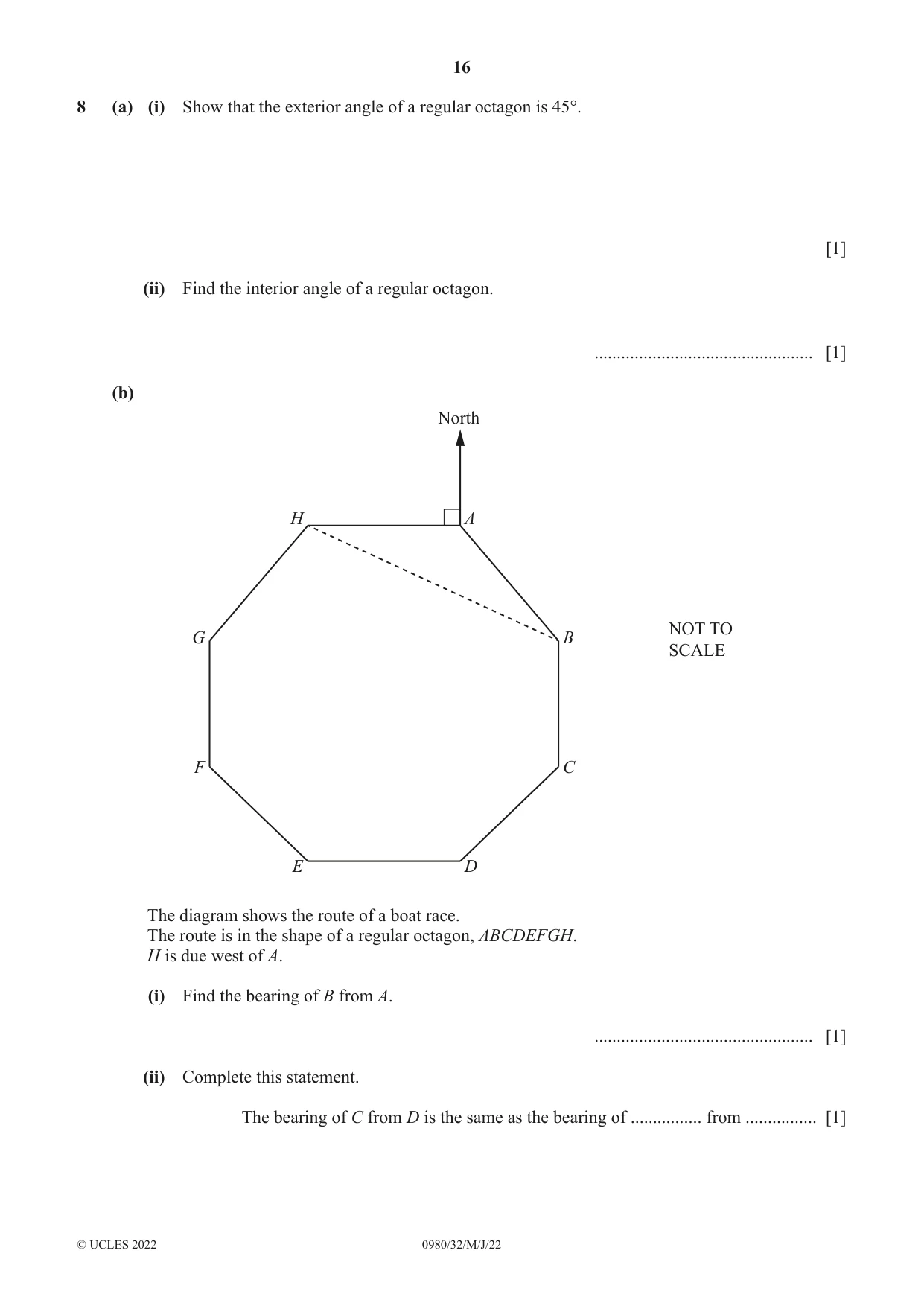
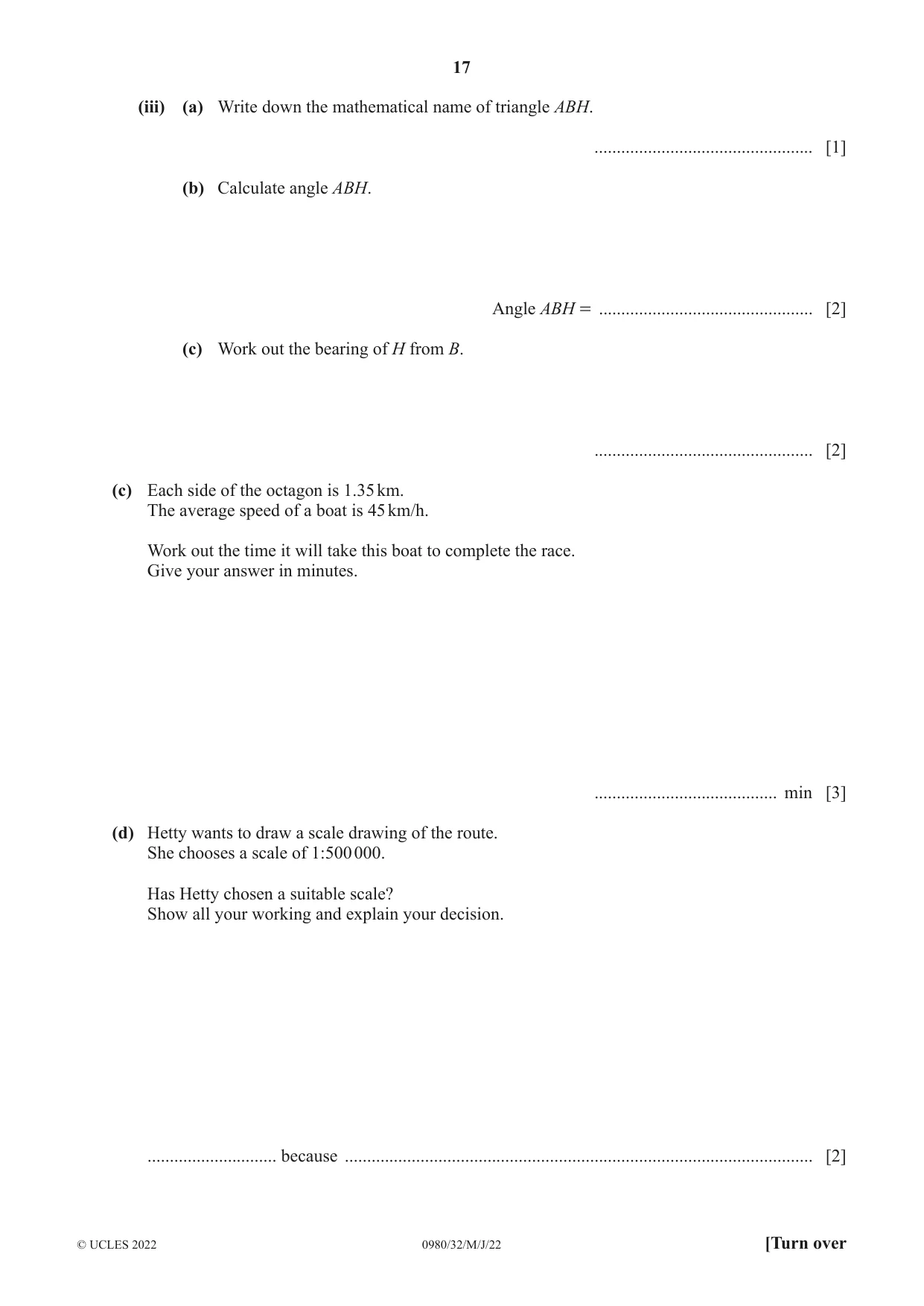
8 (a) (i) Show that the exterior angle of a regular octagon is 45°. [1] (ii) Find the interior angle of a regular octagon. ................................................. [1] (b) North H A NOT TO G B SCALE F C E D The diagram shows the route of a boat race. The route is in the shape of a regular octagon, ABCDEFGH. H is due west of A. (i) Find the bearing of B from A. ................................................. [1] (ii) Complete this statement. The bearing of C from D is the same as the bearing of ................ from ................ [1] (iii) (a) Write down the mathematical name of triangle ABH. ................................................. [1] (b) Calculate angle ABH. Angle ABH = ................................................ [2] (c) Work out the bearing of H from B. ................................................. [2] (c) Each side of the octagon is 1.35 km. The average speed of a boat is 45 km/h. Work out the time it will take this boat to complete the race. Give your answer in minutes. ......................................... min [3] (d) Hetty wants to draw a scale drawing of the route. She chooses a scale of 1:500 000. Has Hetty chosen a suitable scale? Show all your working and explain your decision. ............................. because ......................................................................................................... [2]
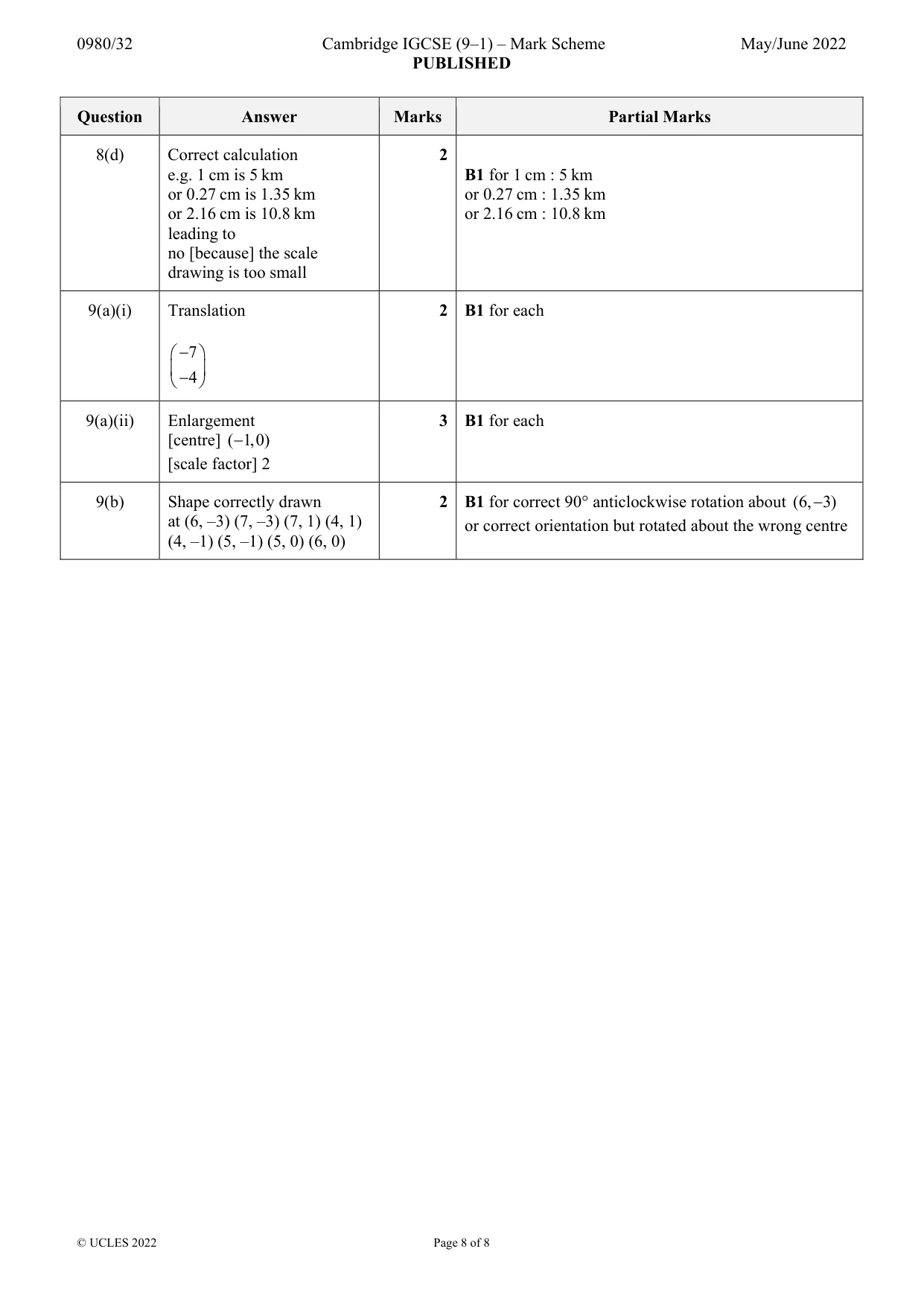
Mark scheme: 8(a)(i) 360 1 45 8 8 2 180 or 180 [= 45] 8 8(a)(ii) 135 1 8(b)(i) 135 1 8(b)(ii) H, G or B, E or A, F 1 8(b)(iii)(a) Isosceles 1 8(b)(iii)(b) 22.5 2 180 their (a)(ii) M1 for oe 2 8(b)(iii)(c) 292.5 2 M1 for 360 (45 their (b)(iii)(b) ) oe or 270 their (b)(iii)(b) oe 8(c) 14.4 3 1.35 1.35 M2 for 60 8 or 8 60 45 45 1.35 or M1 for oe 45 If M0 scored, SC1 for (figs)144 as final answer 8(d) Correct calculation 2 e.g. 1 cm is 5 km B1 for 1 cm : 5 km or 0.27 cm is 1.35 km or 0.27 cm : 1.35 km or 2.16 cm is 10.8 km or 2.16 cm : 10.8 km leading to no [because] the scale drawing is too small
Q9 · The grid shows three shapes, A, B and C
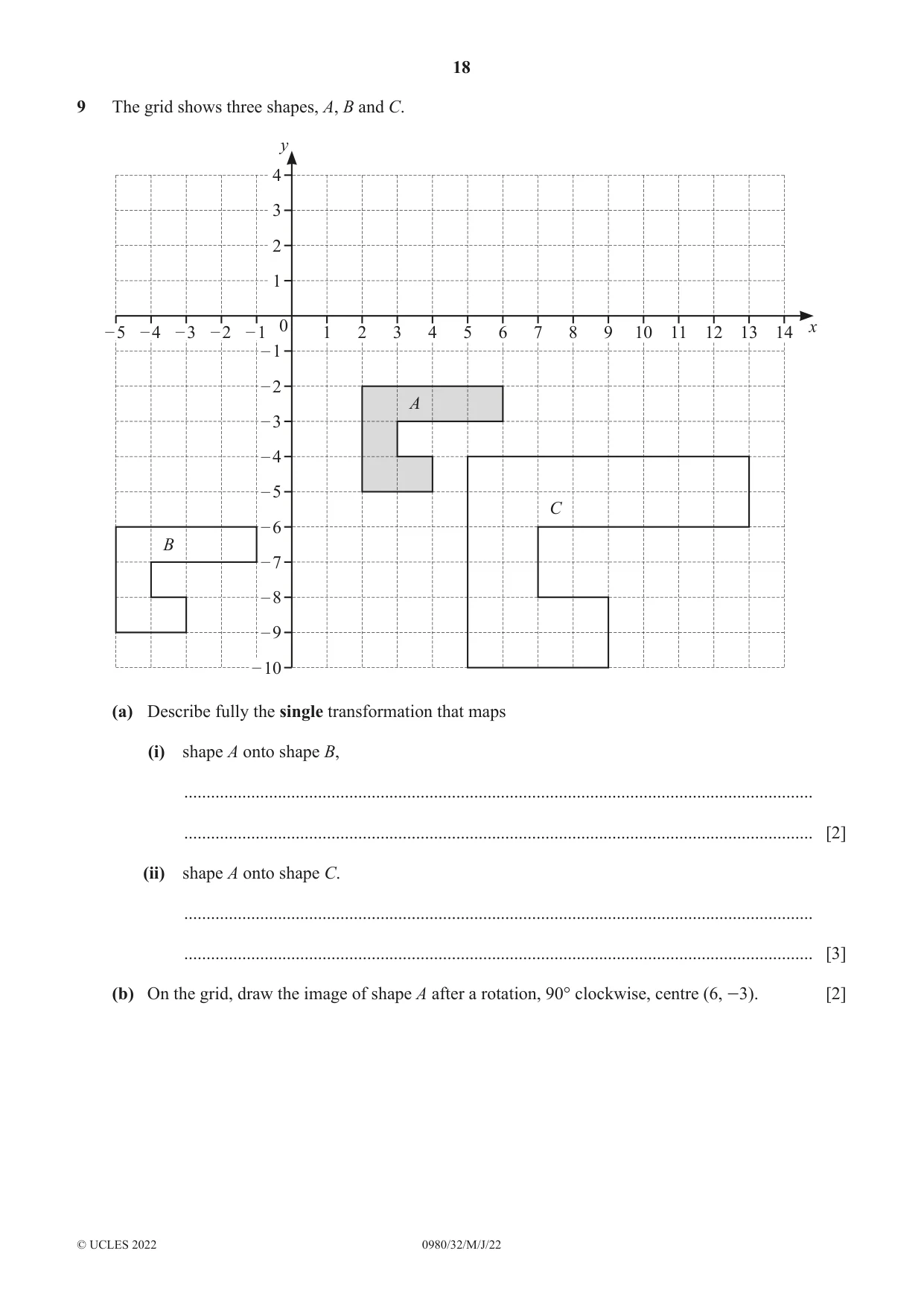
9 The grid shows three shapes, A, B and C. y 4 3 2 1 0 x – 5 – 4 – 3 – 2 – 1 1 2 3 4 5 6 7 8 9 10 11 12 13 14 – 1 – 2 A – 3 – 4 – 5 C – 6 B – 7 – 8 – 9 – 10 (a) Describe fully the single transformation that maps (i) shape A onto shape B, ............................................................................................................................................. ............................................................................................................................................. [2] (ii) shape A onto shape C. ............................................................................................................................................. ............................................................................................................................................. [3] (b) On the grid, draw the image of shape A after a rotation, 90° clockwise, centre (6, -3). [2]
Mark scheme: 9(a)(i) Translation 2 B1 for each 7 4 9(a)(ii) Enlargement 3 B1 for each [centre] ( 1,0) [scale factor] 2 9(b) Shape correctly drawn 2 B1 for correct 90° anticlockwise rotation about (6, 3) at (6, –3) (7, –3) (7, 1) (4, 1) or correct orientation but rotated about the wrong centre (4, –1) (5, –1) (5, 0) (6, 0)
What was in this paper
The subtopics covered by these 9 questions, and how many questions each got. Open one in a new tab to see every Cambridge question on it.
What you needed in this session
Cambridge’s own grade thresholds for 2022 May/June, Paper 3 · Variant 2. A higher threshold means an easier paper — the bar moves with how the cohort did.