Cambridge IGCSE Mathematics (9-1) 0980 — 2020 Oct/Nov Paper 3 · Variant 1
0980/31/O/N/20 · 10 questions · 104 marks · ≈117 min
The question paper and its mark scheme, free to read here and free to download. This is Cambridge’s own paper, exactly as it was sat.
Question paper20 pages
Mark scheme7 pages
Answers below. Sit the paper first if you are practising.
Questions as text
Q1 · Sean is the manager of a museum
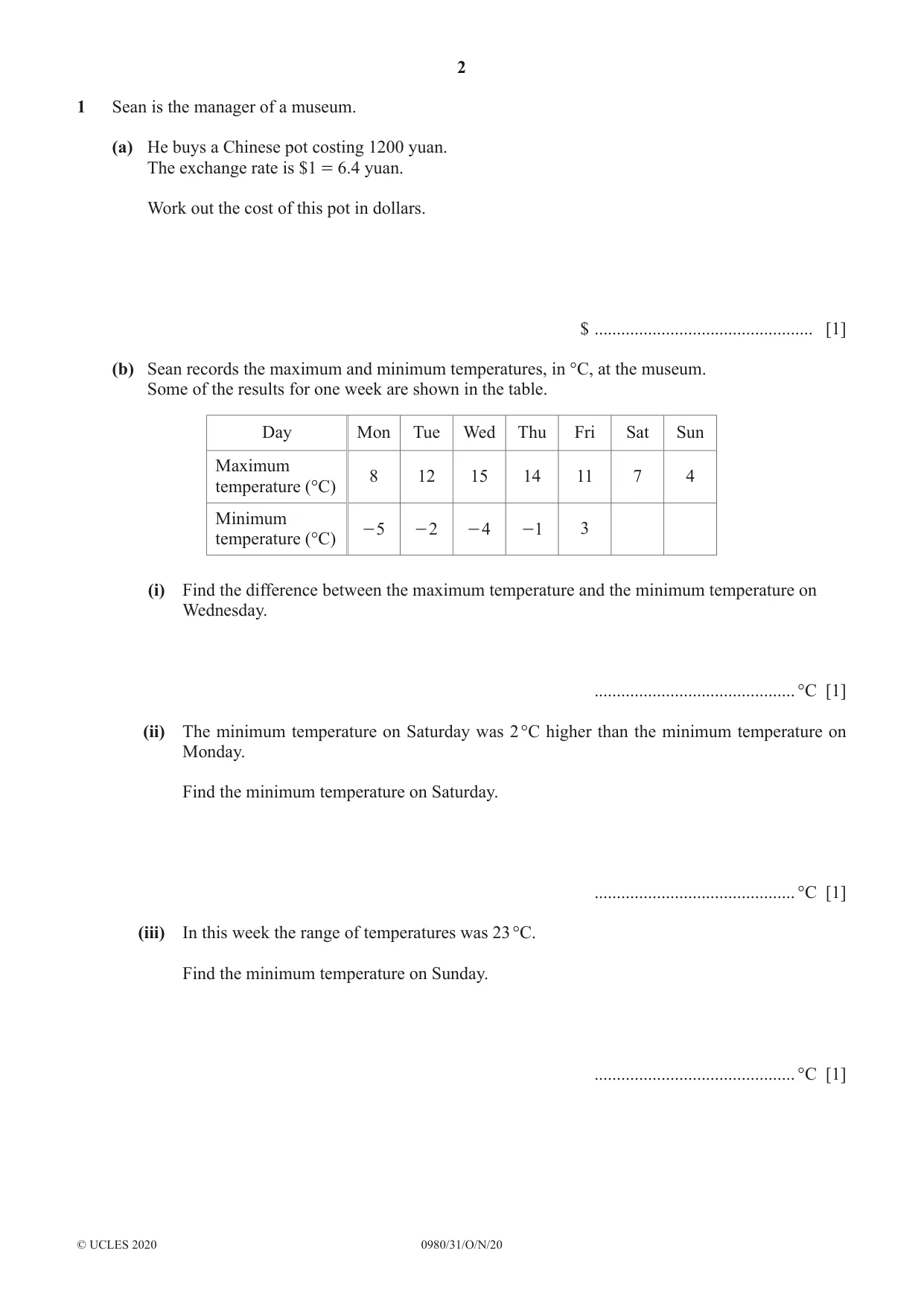
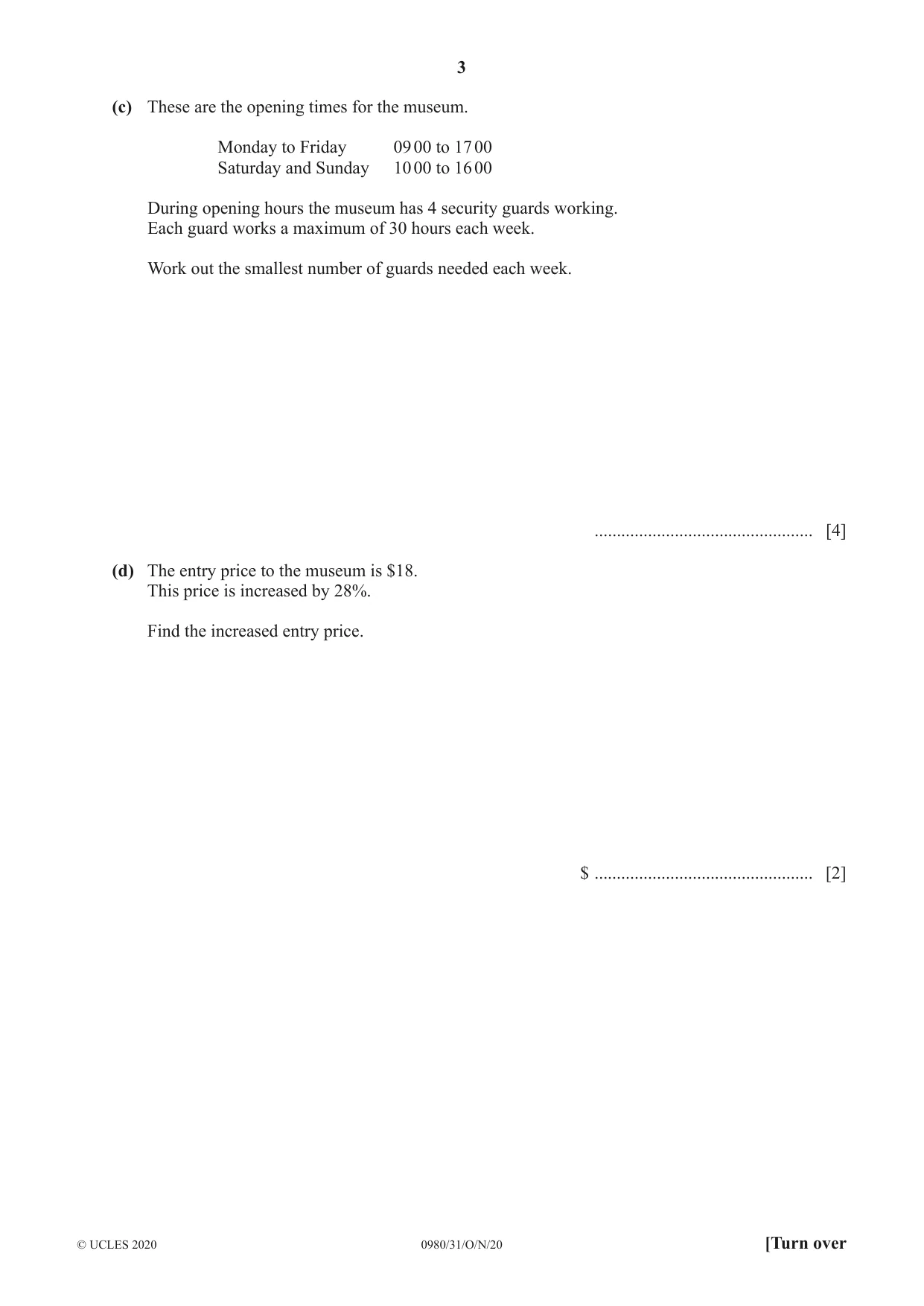
1 Sean is the manager of a museum. (a) He buys a Chinese pot costing 1200 yuan. The exchange rate is $1 = 6.4 yuan. Work out the cost of this pot in dollars. $ ................................................. [1] (b) Sean records the maximum and minimum temperatures, in °C, at the museum. Some of the results for one week are shown in the table. Day Mon Tue Wed Thu Fri Sat Sun Maximum 8 12 15 14 11 7 4 temperature (°C) Minimum - 5 - 2 - 4 - 1 3 temperature (°C) (i) Find the difference between the maximum temperature and the minimum temperature on Wednesday. ............................................. °C [1] (ii) The minimum temperature on Saturday was 2 °C higher than the minimum temperature on Monday. Find the minimum temperature on Saturday. ............................................. °C [1] (iii) In this week the range of temperatures was 23 °C. Find the minimum temperature on Sunday. ............................................. °C [1] (c) These are the opening times for the museum. Monday to Friday 09 00 to 17 00 Saturday and Sunday 10 00 to 16 00 During opening hours the museum has 4 security guards working. Each guard works a maximum of 30 hours each week. Work out the smallest number of guards needed each week. ................................................. [4] (d) The entry price to the museum is $18. This price is increased by 28%. Find the increased entry price. $ ................................................. [2]
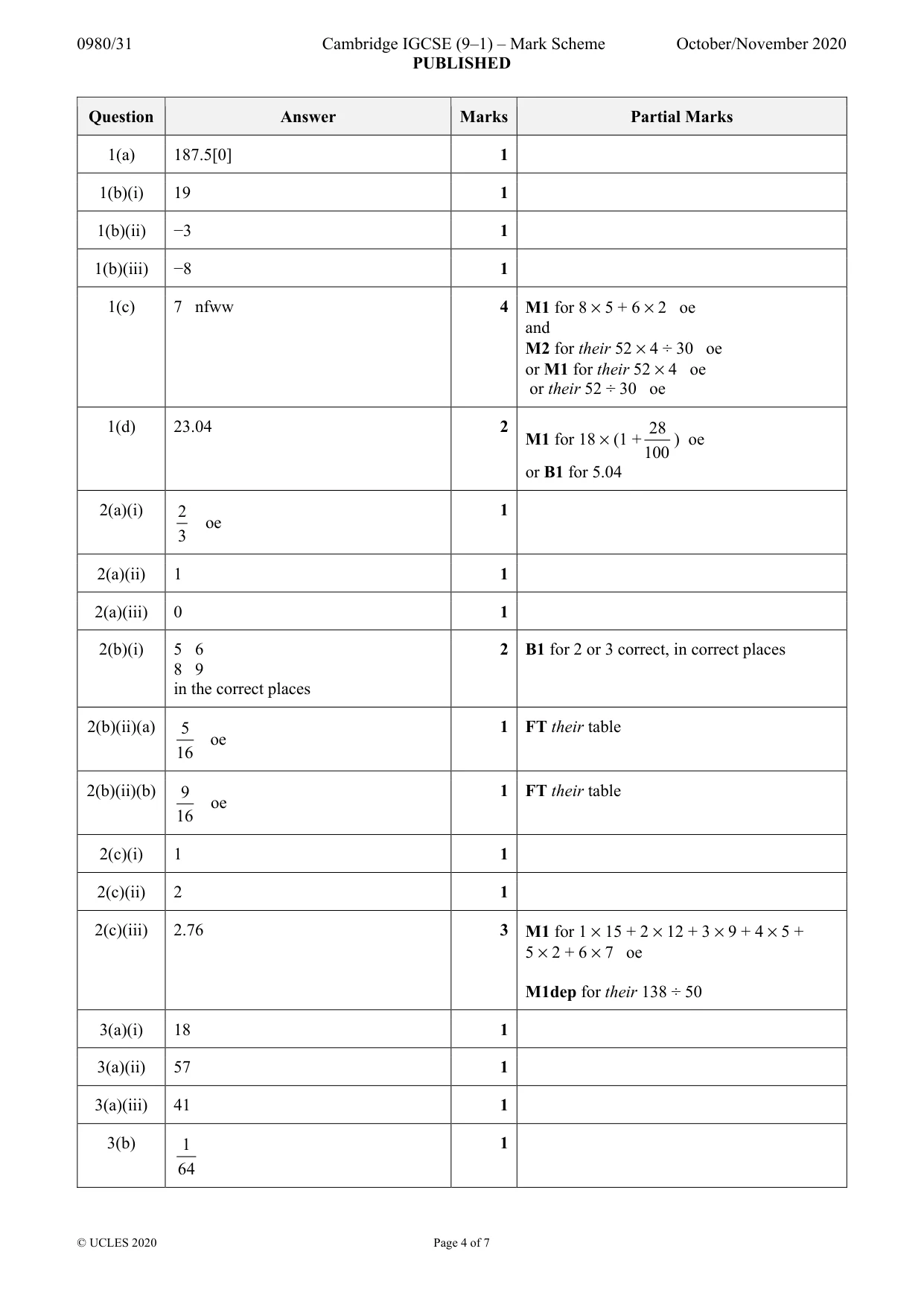
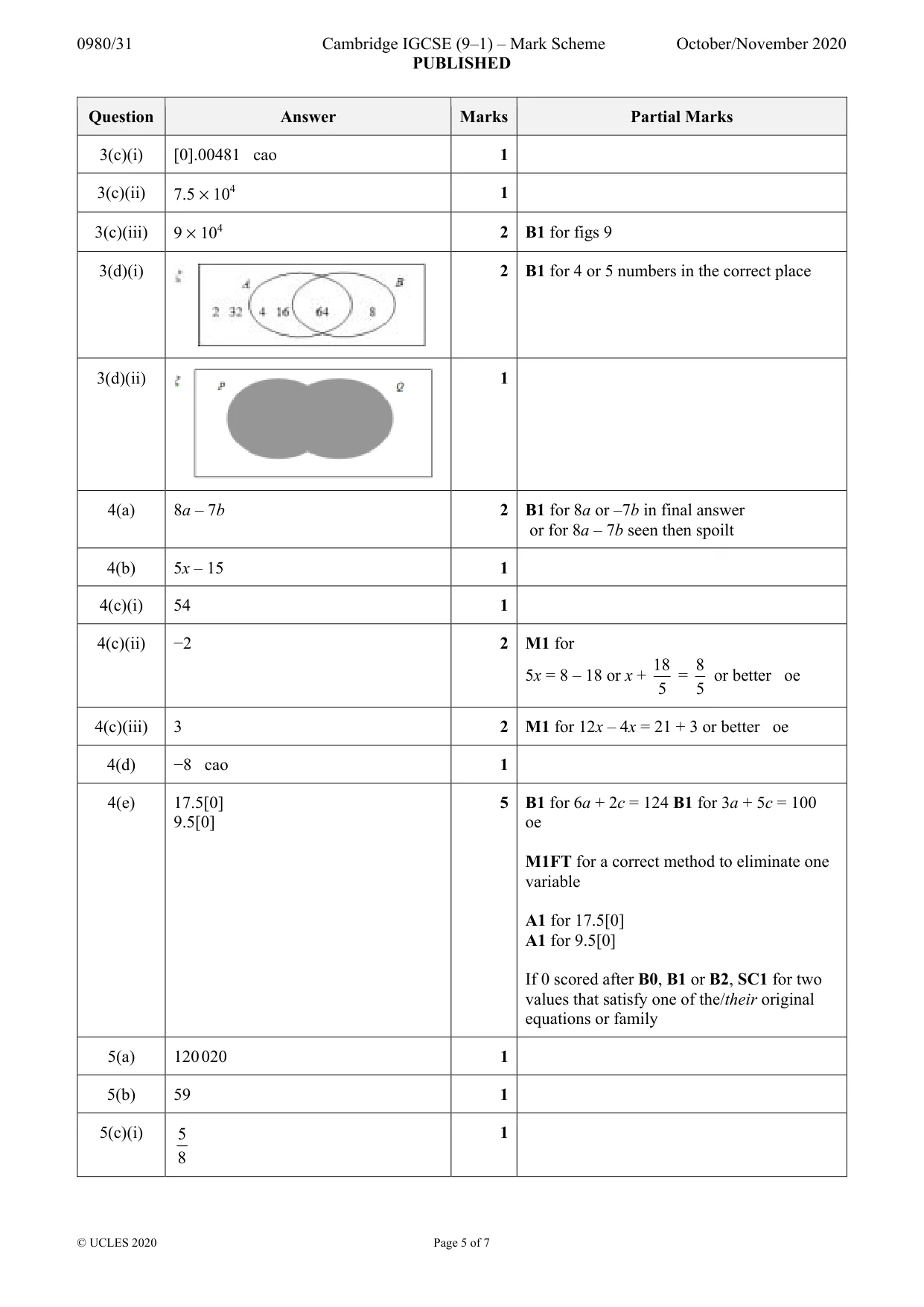
Mark scheme: Question Answer Marks Partial Marks 1(a) 187.5[0] 1 1(b)(i) 19 1 1(b)(ii) −3 1 1(b)(iii) −8 1 1(c) 7 nfww 4 M1 for 8 × 5 + 6 × 2 oe and M2 for their 52 × 4 ÷ 30 oe or M1 for their 52 × 4 oe or their 52 ÷ 30 oe 1(d) 23.04 2 28 M1 for 18 × (1 + ) oe 100 or B1 for 5.04
Q2 · Jian has a fair spinner in the shape of a regular hexagon
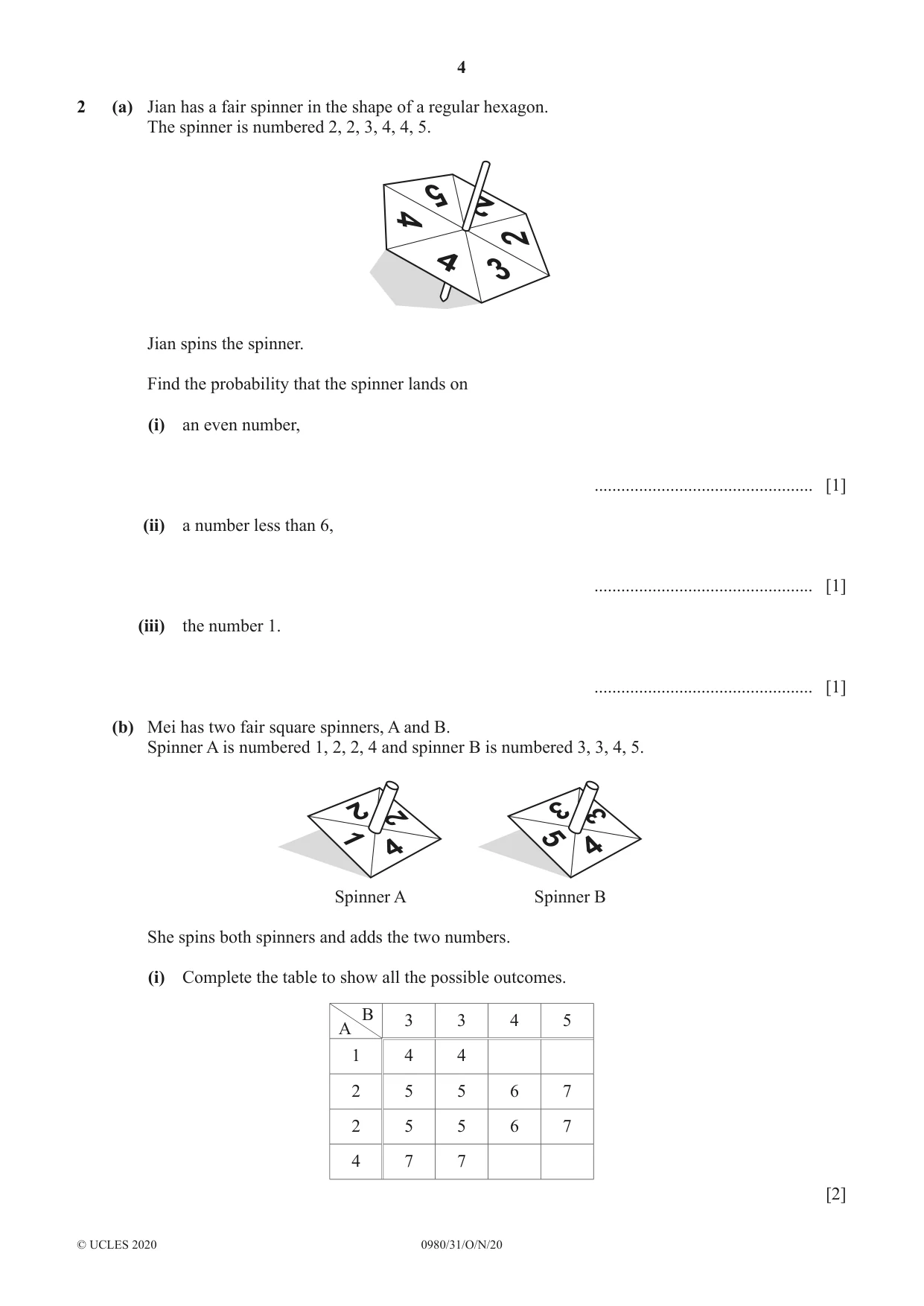
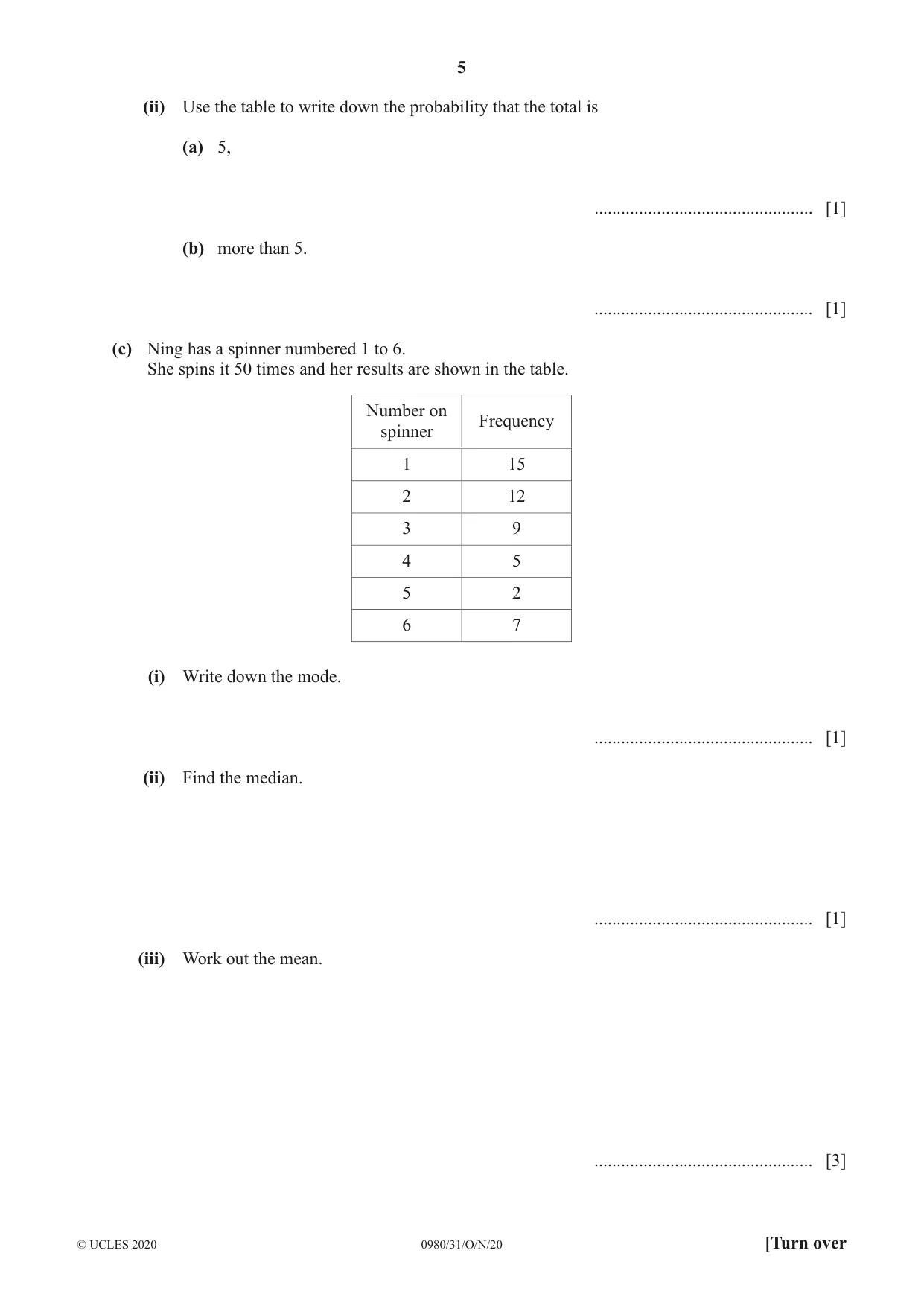
2 (a) Jian has a fair spinner in the shape of a regular hexagon. The spinner is numbered 2, 2, 3, 4, 4, 5. Jian spins the spinner. Find the probability that the spinner lands on (i) an even number, ................................................. [1] (ii) a number less than 6, ................................................. [1] (iii) the number 1. ................................................. [1] (b) Mei has two fair square spinners, A and B. Spinner A is numbered 1, 2, 2, 4 and spinner B is numbered 3, 3, 4, 5. Spinner A Spinner B She spins both spinners and adds the two numbers. (i) Complete the table to show all the possible outcomes. B 3 3 4 5 A 1 4 4 2 5 5 6 7 2 5 5 6 7 4 7 7 [2] (ii) Use the table to write down the probability that the total is (a) 5, ................................................. [1] (b) more than 5. ................................................. [1] (c) Ning has a spinner numbered 1 to 6. She spins it 50 times and her results are shown in the table. Number on Frequency spinner 1 15 2 12 3 9 4 5 5 2 6 7 (i) Write down the mode. ................................................. [1] (ii) Find the median. ................................................. [1] (iii) Work out the mean. ................................................. [3]
Mark scheme: 2(a)(i) 2 1 oe 3 2(a)(ii) 1 1 2(a)(iii) 0 1 2(b)(i) 5 6 2 B1 for 2 or 3 correct, in correct places 8 9 in the correct places 2(b)(ii)(a) 5 1 FT their table oe 16 2(b)(ii)(b) 9 1 FT their table oe 16 2(c)(i) 1 1 2(c)(ii) 2 1 2(c)(iii) 2.76 3 M1 for 1 × 15 + 2 × 12 + 3 × 9 + 4 × 5 + 5 × 2 + 6 × 7 oe M1dep for their 138 ÷ 50
Q3 · 8 15 18 33 39 41 51 57 60 81 From this list, write down (i) a factor of 54…
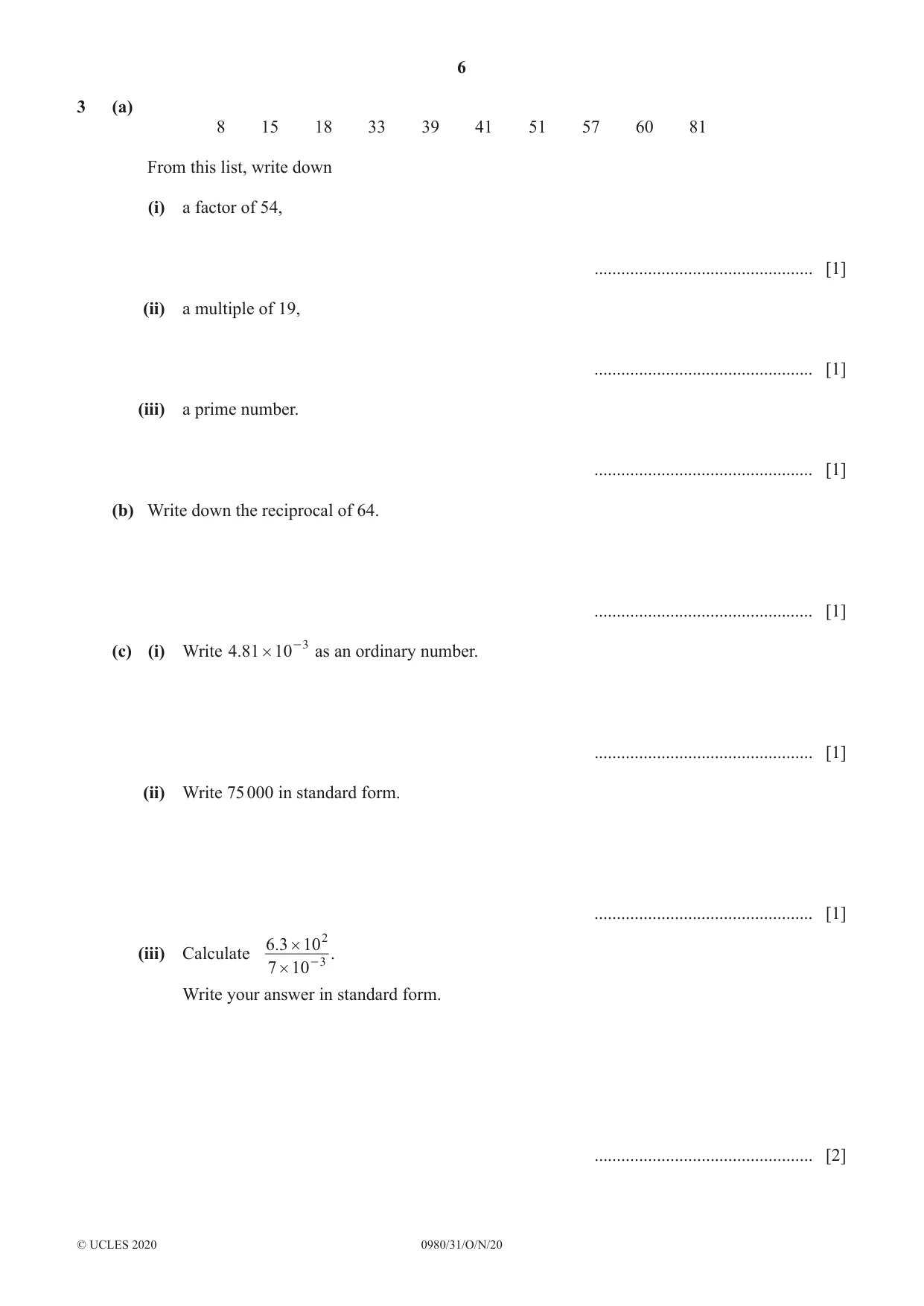
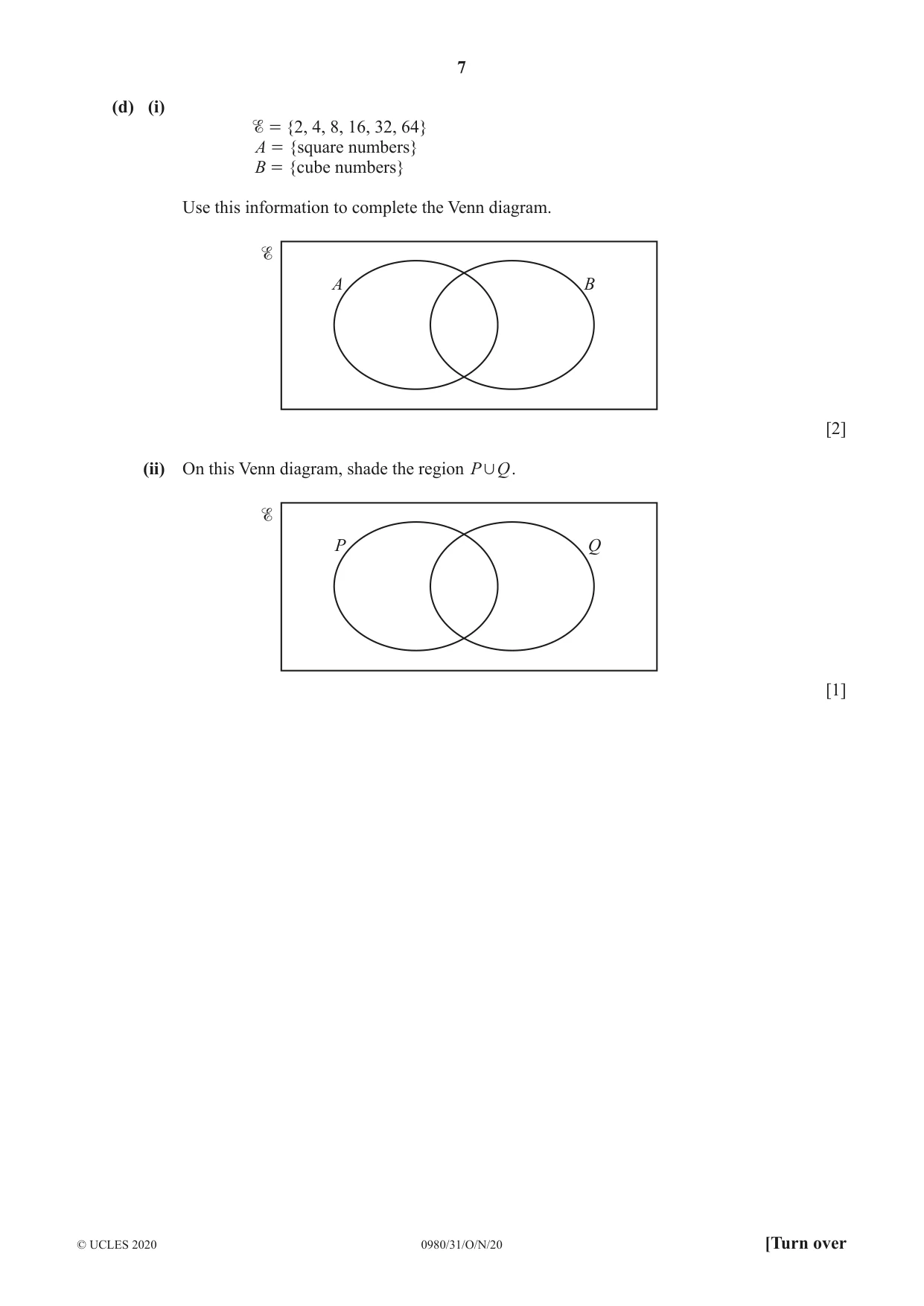
3 (a) 8 15 18 33 39 41 51 57 60 81 From this list, write down (i) a factor of 54, ................................................. [1] (ii) a multiple of 19, ................................................. [1] (iii) a prime number. ................................................. [1] (b) Write down the reciprocal of 64. ................................................. [1] (c) (i) Write .481 # 10 - 3 as an ordinary number. ................................................. [1] (ii) Write 75 000 in standard form. ................................................. [1] .63 # 10 2 (iii) Calculate - 3 . 7 # 10 Write your answer in standard form. ................................................. [2] (d) (i) = {2, 4, 8, 16, 32, 64} A = {square numbers} B = {cube numbers} Use this information to complete the Venn diagram. A B [2] (ii) On this Venn diagram, shade the region P , Q . P Q [1]
Mark scheme: 3(a)(i) 18 1 3(a)(ii) 57 1 3(a)(iii) 41 1 3(b) 1 1 64 3(c)(i) [0].00481 cao 1 3(c)(ii) 7.5 × 10⁴ 1 3(c)(iii) 9 × 10⁴ 2 B1 for figs 9 3(d)(i) 2 B1 for 4 or 5 numbers in the correct place 3(d)(ii) 1
Question 4
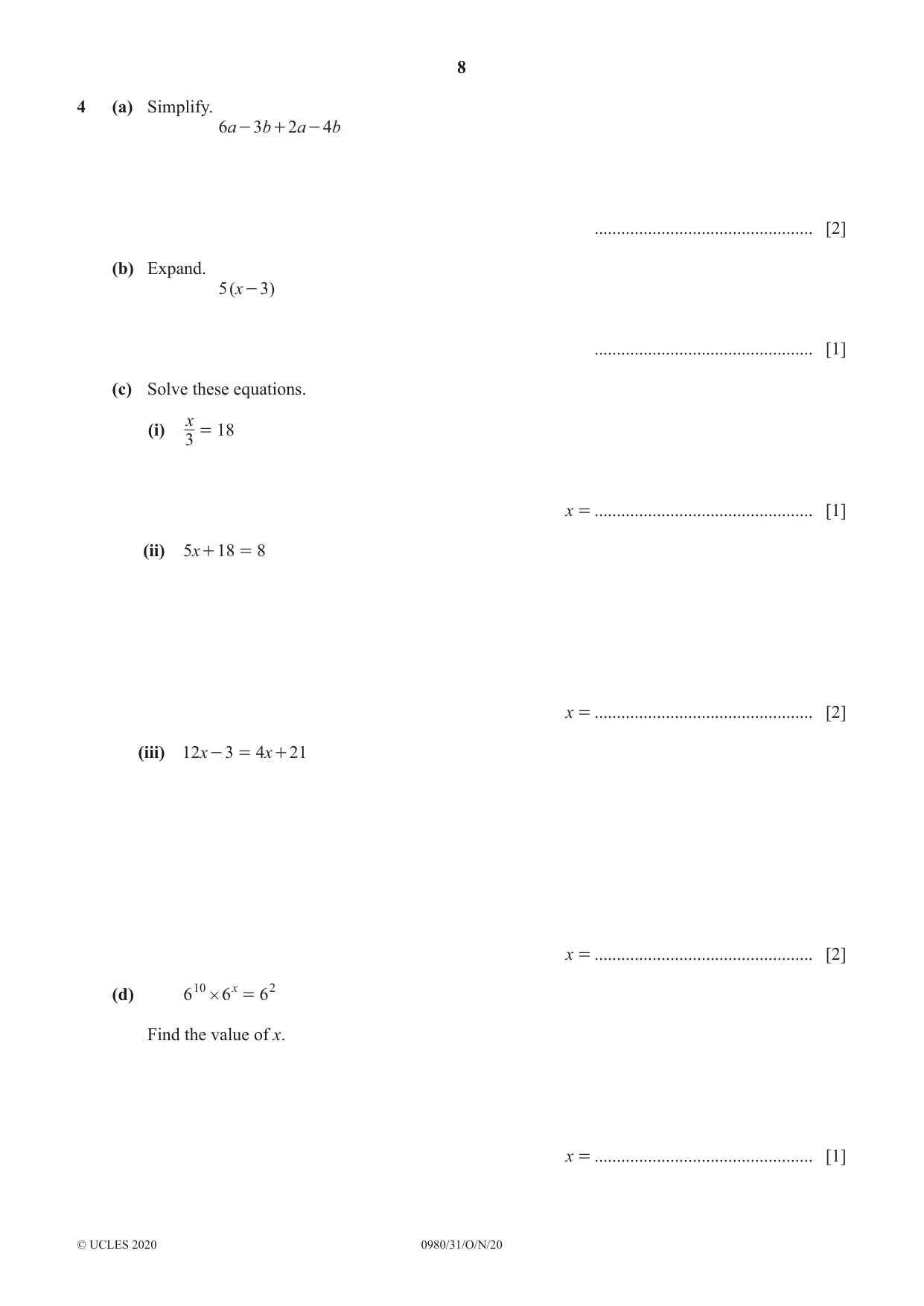
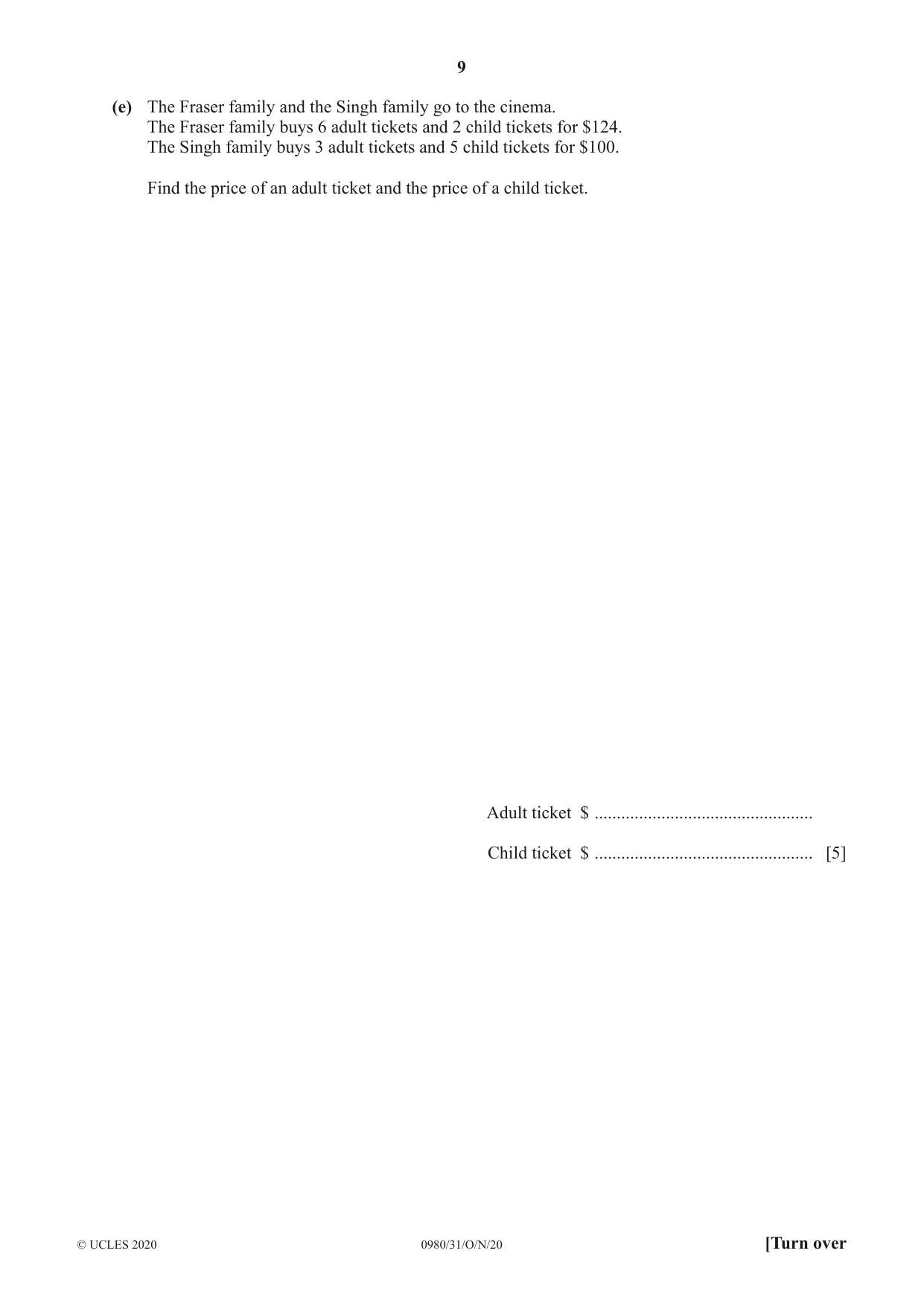
4 (a) Simplify. 6a - 3b + 2a - 4b ................................................. [2] (b) Expand. 5 ( x - 3) ................................................. [1] (c) Solve these equations. x (i) = 18 3 x = ................................................. [1] (ii) 5x + 18 = 8 x = ................................................. [2] (iii) 12x - 3 = 4x + 21 x = ................................................. [2] (d) 6 10 # 6 x = 6 2 Find the value of x. x = ................................................. [1] (e) The Fraser family and the Singh family go to the cinema. The Fraser family buys 6 adult tickets and 2 child tickets for $124. The Singh family buys 3 adult tickets and 5 child tickets for $100. Find the price of an adult ticket and the price of a child ticket. Adult ticket $ ................................................. Child ticket $ ................................................. [5]
Mark scheme: 4(a) 8a – 7b 2 B1 for 8a or –7b in final answer or for 8a – 7b seen then spoilt 4(b) 5x – 15 1 4(c)(i) 54 1 4(c)(ii) −2 2 M1 for 18 8 5x = 8 – 18 or x + = or better oe 5 5 4(c)(iii) 3 2 M1 for 12x – 4x = 21 + 3 or better oe 4(d) −8 cao 1 4(e) 17.5[0] 5 B1 for 6a + 2c = 124 B1 for 3a + 5c = 100 9.5[0] oe M1FT for a correct method to eliminate one variable A1 for 17.5[0] A1 for 9.5[0] If 0 scored after B0, B1 or B2, SC1 for two values that satisfy one of the/their original equations or family
Q5 · Write one hundred and twenty thousand and twenty in figures
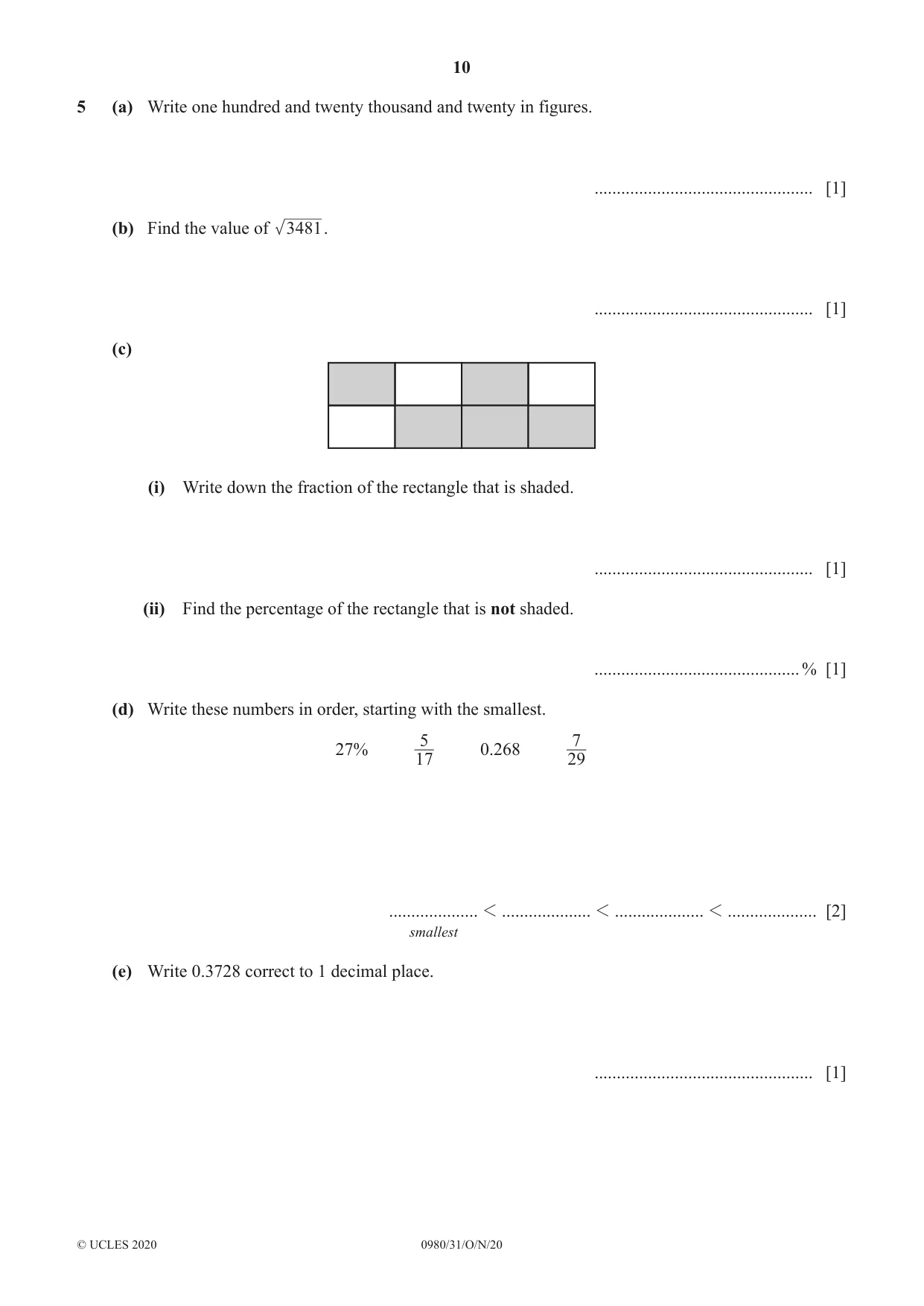
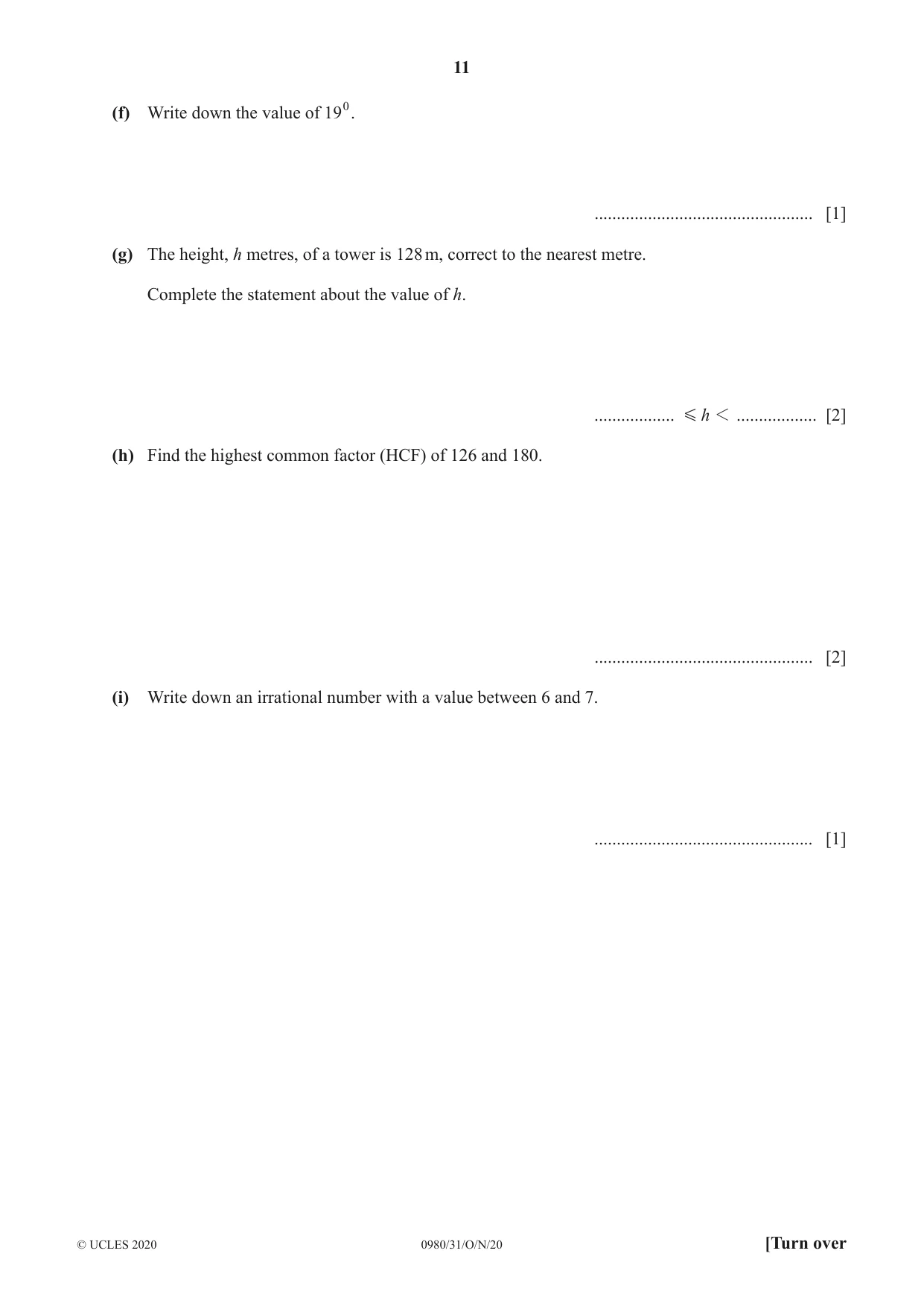
5 (a) Write one hundred and twenty thousand and twenty in figures. ................................................. [1] (b) Find the value of 3481. ................................................. [1] (c) (i) Write down the fraction of the rectangle that is shaded. ................................................. [1] (ii) Find the percentage of the rectangle that is not shaded. ..............................................% [1] (d) Write these numbers in order, starting with the smallest. 5 7 27% 0.268 17 29 .................... 1 .................... 1 .................... 1 .................... [2] smallest (e) Write 0.3728 correct to 1 decimal place. ................................................. [1] (f) Write down the value of 190. ................................................. [1] (g) The height, h metres, of a tower is 128 m, correct to the nearest metre. Complete the statement about the value of h. .................. G h 1 .................. [2] (h) Find the highest common factor (HCF) of 126 and 180. ................................................. [2] (i) Write down an irrational number with a value between 6 and 7. ................................................. [1]
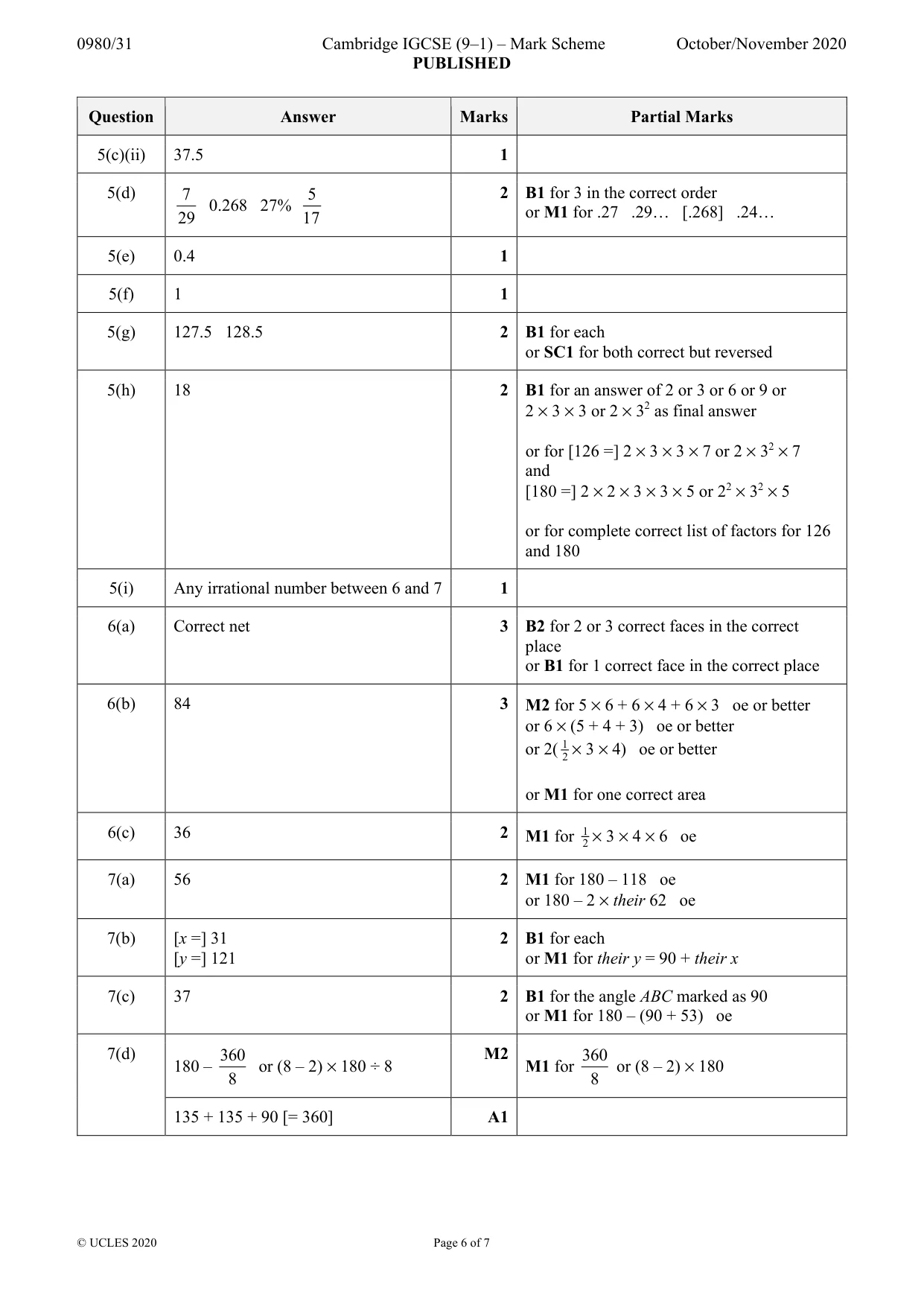
Mark scheme: 5(a) 120 020 1 5(b) 59 1 5(c)(i) 5 1 8 5(c)(ii) 37.5 1 5(d) 7 5 2 B1 for 3 in the correct order 0.268 27% or M1 for .27 .29… [.268] .24… 29 17 5(e) 0.4 1 5(f) 1 1 5(g) 127.5 128.5 2 B1 for each or SC1 for both correct but reversed 5(h) 18 2 B1 for an answer of 2 or 3 or 6 or 9 or 2 × 3 × 3 or 2 × 32 as final answer or for [126 =] 2 × 3 × 3 × 7 or 2 × 32 × 7 and [180 =] 2 × 2 × 3 × 3 × 5 or 22 × 32 × 5 or for complete correct list of factors for 126 and 180 5(i) Any irrational number between 6 and 7 1
Q6 · NOT TO SCALE 3 cm 6 cm 4 cm The diagram shows a right-angled triangular prism
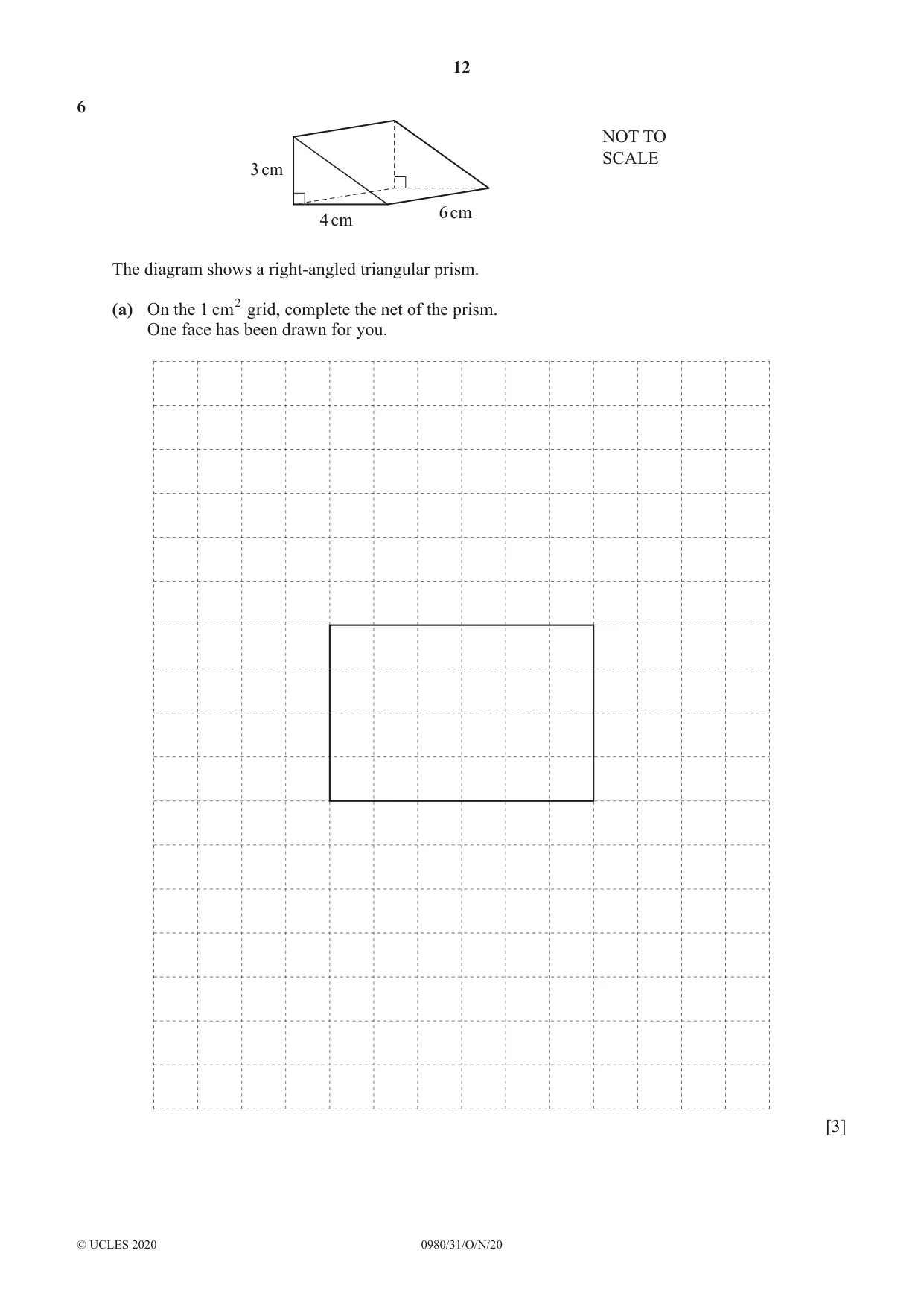
6 NOT TO SCALE 3 cm 6 cm 4 cm The diagram shows a right-angled triangular prism. (a) On the 1 cm2 grid, complete the net of the prism. One face has been drawn for you. [3] (b) Work out the surface area of the prism. .......................................... cm2 [3] (c) Work out the volume of the prism. .......................................... cm3 [2]
Mark scheme: 6(a) Correct net 3 B2 for 2 or 3 correct faces in the correct place or B1 for 1 correct face in the correct place 6(b) 84 3 M2 for 5 × 6 + 6 × 4 + 6 × 3 oe or better or 6 × (5 + 4 + 3) oe or better or 2( 12 × 3 × 4) oe or better or M1 for one correct area 6(c) 36 2 M1 for 12 × 3 × 4 × 6 oe
Q7 · NOT TO w° SCALE 118° The diagram shows an isosceles triangle and a straight line
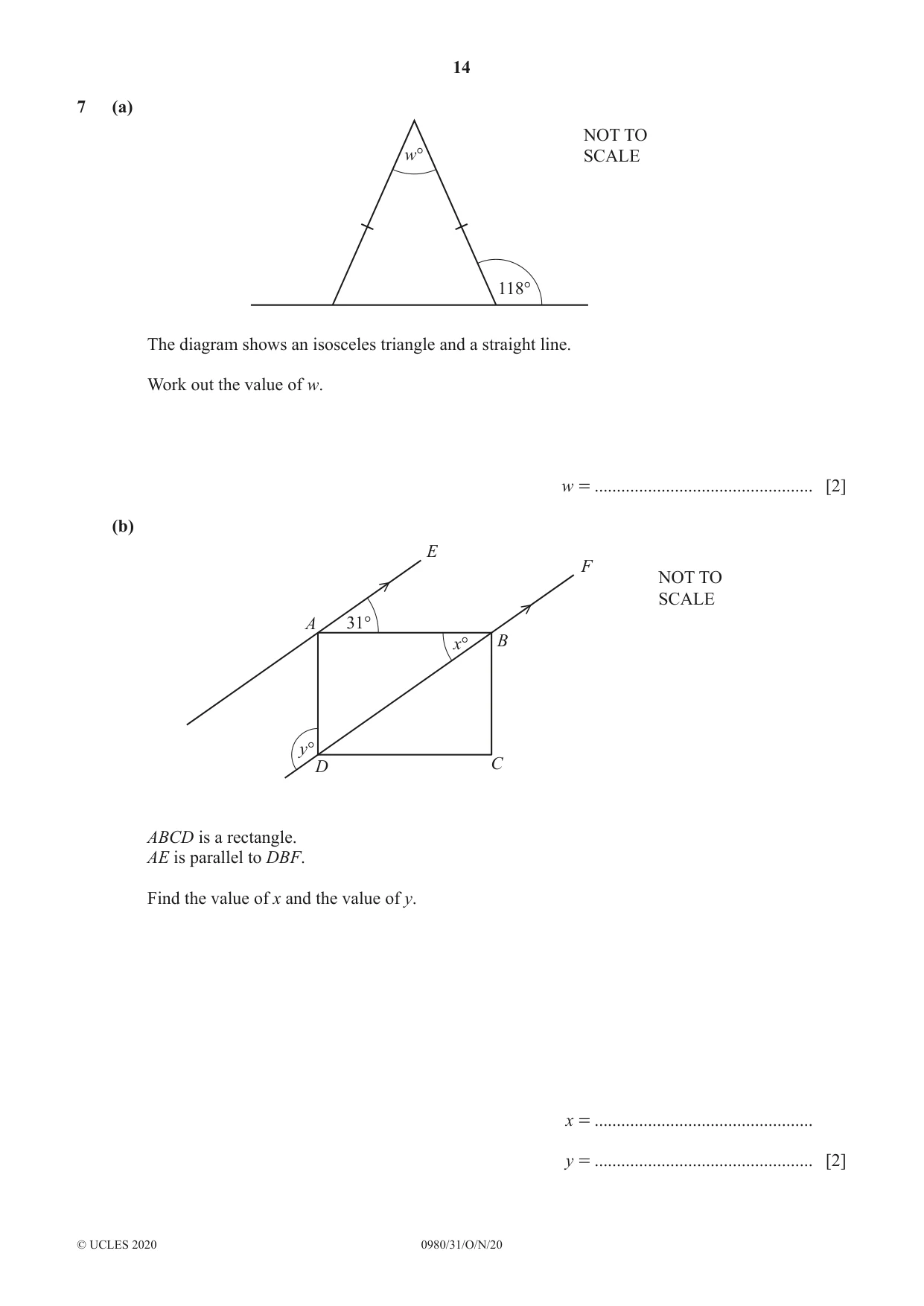
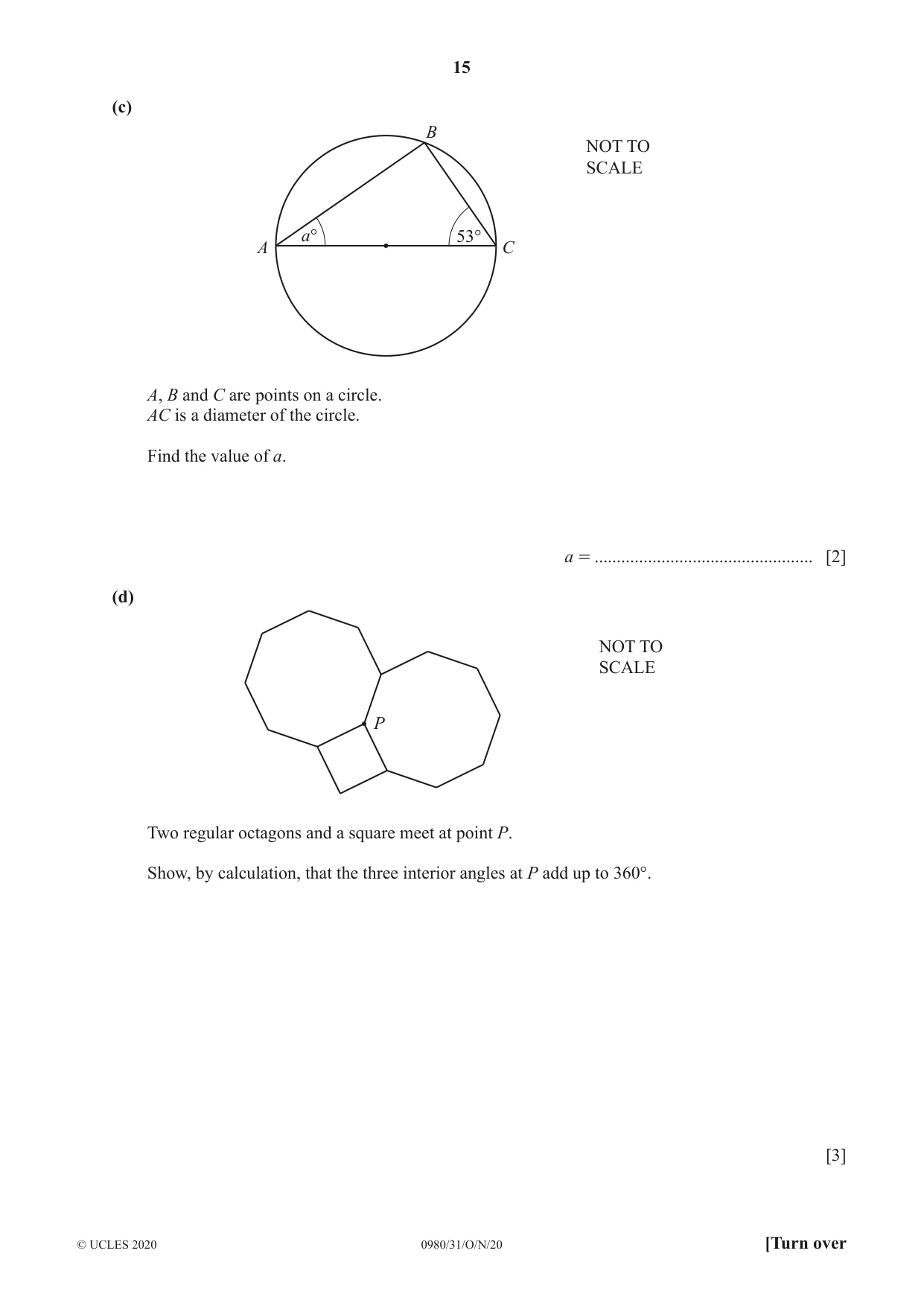
7 (a) NOT TO w° SCALE 118° The diagram shows an isosceles triangle and a straight line. Work out the value of w. w = ................................................. [2] (b) E F NOT TO SCALE A 31° x° B y° D C ABCD is a rectangle. AE is parallel to DBF. Find the value of x and the value of y. x = ................................................. y = ................................................. [2] (c) B NOT TO SCALE a° 53° A C A, B and C are points on a circle. AC is a diameter of the circle. Find the value of a. a = ................................................. [2] (d) NOT TO SCALE P Two regular octagons and a square meet at point P. Show, by calculation, that the three interior angles at P add up to 360°. [3]
Mark scheme: 7(a) 56 2 M1 for 180 – 118 oe or 180 – 2 × their 62 oe 7(b) [x =] 31 2 B1 for each [y =] 121 or M1 for their y = 90 + their x 7(c) 37 2 B1 for the angle ABC marked as 90 or M1 for 180 – (90 + 53) oe 7(d) 360 M2 360 180 – or (8 – 2) × 180 ÷ 8 M1 for or (8 – 2) × 180 8 8 135 + 135 + 90 [= 360] A1
Q8 · Y 6 5 4 3 D 2 C 1 0 x – 6 – 5 – 4 – 3 – 2 – 11 1 2 3 4 5 6 ––11 A ––22 – 3 – 4 B – 5 – 6…
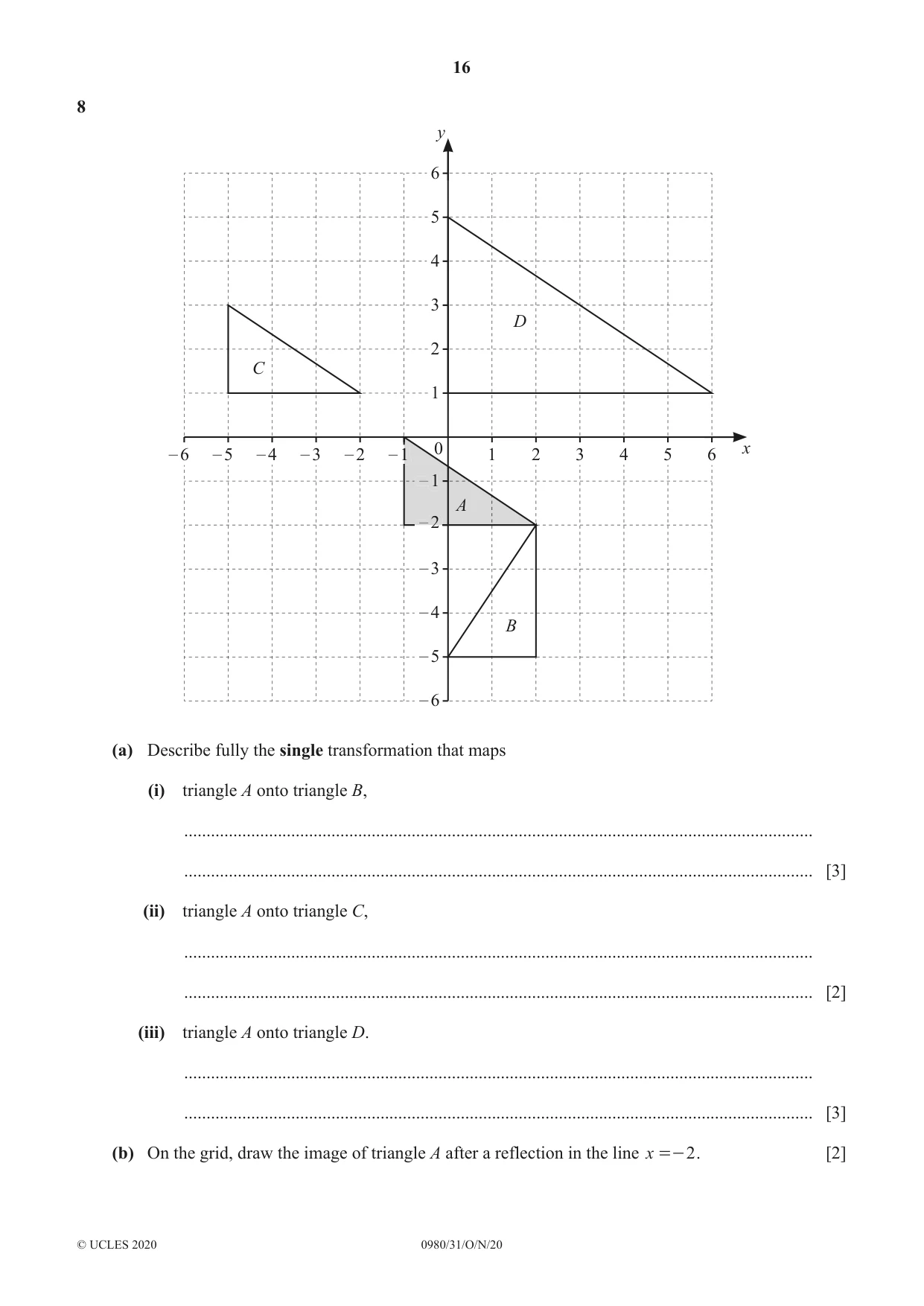
8 y 6 5 4 3 D 2 C 1 0 x – 6 – 5 – 4 – 3 – 2 – 11 1 2 3 4 5 6 ––11 A ––22 – 3 – 4 B – 5 – 6 (a) Describe fully the single transformation that maps (i) triangle A onto triangle B, ............................................................................................................................................. ............................................................................................................................................. [3] (ii) triangle A onto triangle C, ............................................................................................................................................. ............................................................................................................................................. [2] (iii) triangle A onto triangle D. ............................................................................................................................................. ............................................................................................................................................. [3] (b) On the grid, draw the image of triangle A after a reflection in the line x =- 2 . [2]
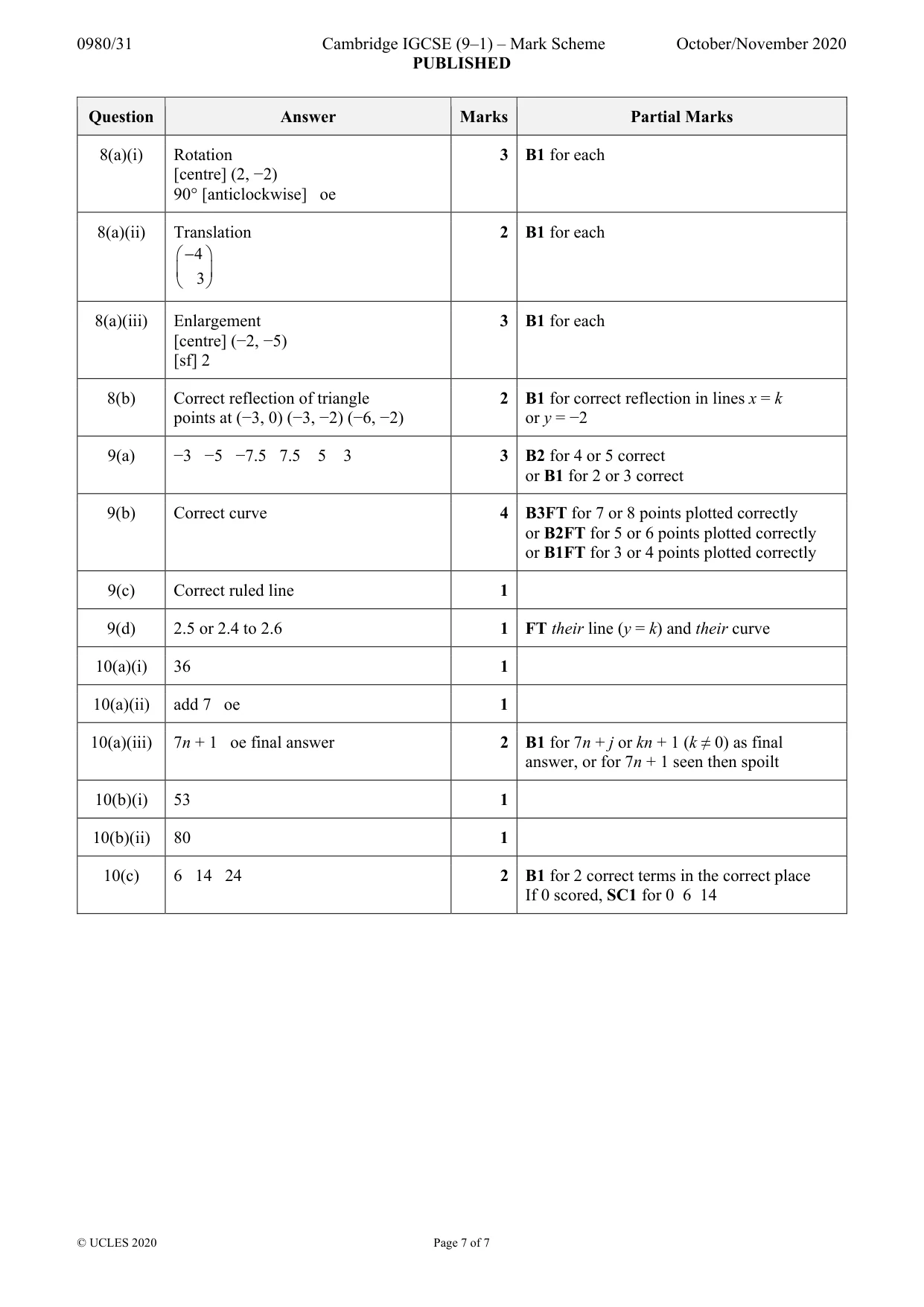
Mark scheme: 8(a)(i) Rotation 3 B1 for each [centre] (2, −2) 90° [anticlockwise] oe 8(a)(ii) Translation 2 B1 for each − 4 3 8(a)(iii) Enlargement 3 B1 for each [centre] (−2, −5) [sf] 2 8(b) Correct reflection of triangle 2 B1 for correct reflection in lines x = k points at (−3, 0) (−3, −2) (−6, −2) or y = −2
Q9 · Complete the table of values for y =
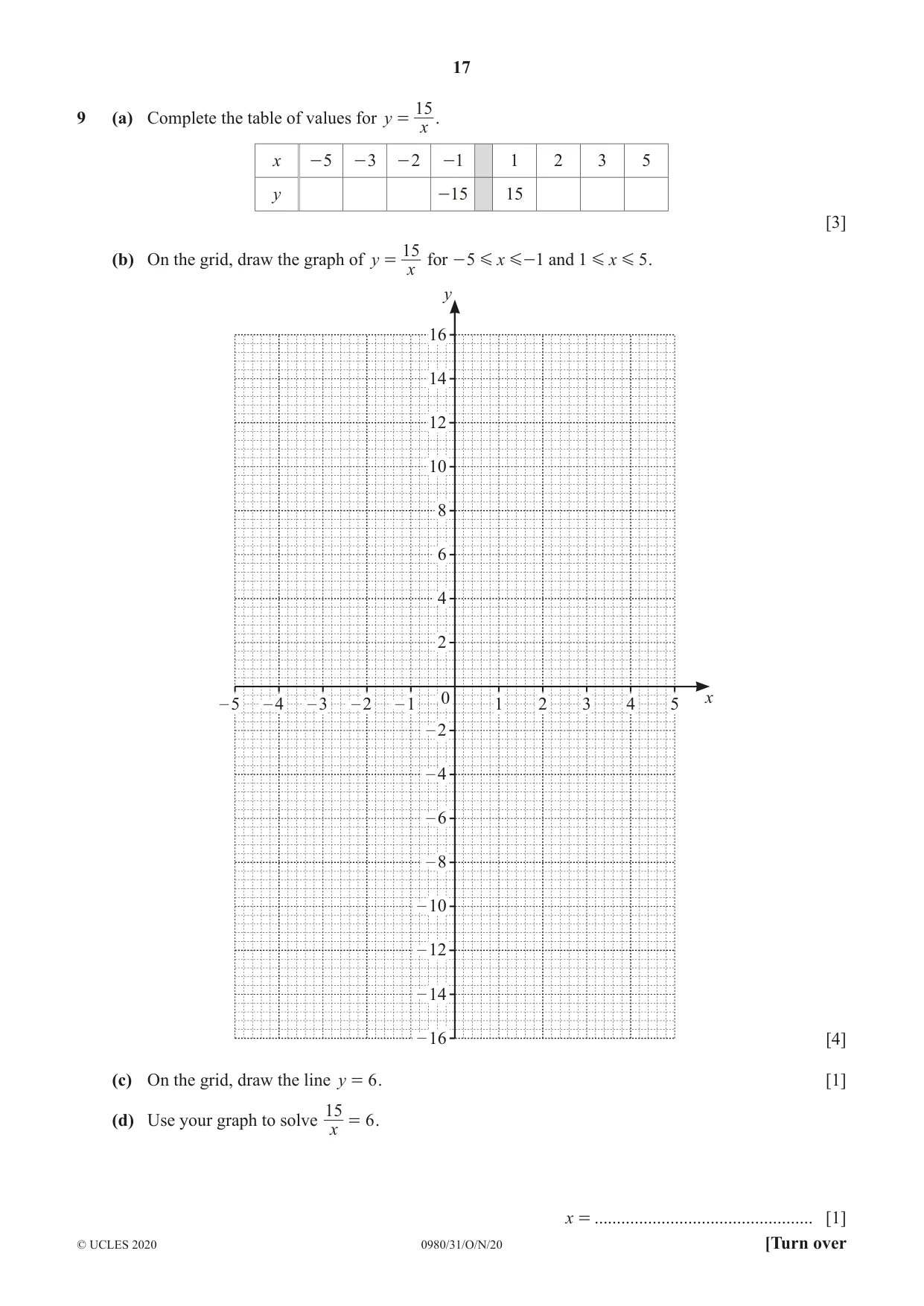
9 (a) Complete the table of values for y = . x x - 5 - 3 - 2 - 1 1 2 3 5 y - 15 15 [3] 15 (b) On the grid, draw the graph of y = for - 5 G x G - 1 and 1 G x G 5 . x y 16 14 12 10 8 6 4 2 0 x – 5 – 4 – 3 – 2 – 1 1 2 3 4 5 – 2 – 4 – 6 – 8 – 10 – 12 – 14 – 16 [4] (c) On the grid, draw the line y = 6 . [1] 15 (d) Use your graph to solve = 6 . x x = ................................................. [1]
Mark scheme: 9(a) −3 −5 −7.5 7.5 5 3 3 B2 for 4 or 5 correct or B1 for 2 or 3 correct 9(b) Correct curve 4 B3FT for 7 or 8 points plotted correctly or B2FT for 5 or 6 points plotted correctly or B1FT for 3 or 4 points plotted correctly 9(c) Correct ruled line 1 9(d) 2.5 or 2.4 to 2.6 1 FT their line (y = k) and their curve
Q10 · These are the first four terms of a sequence
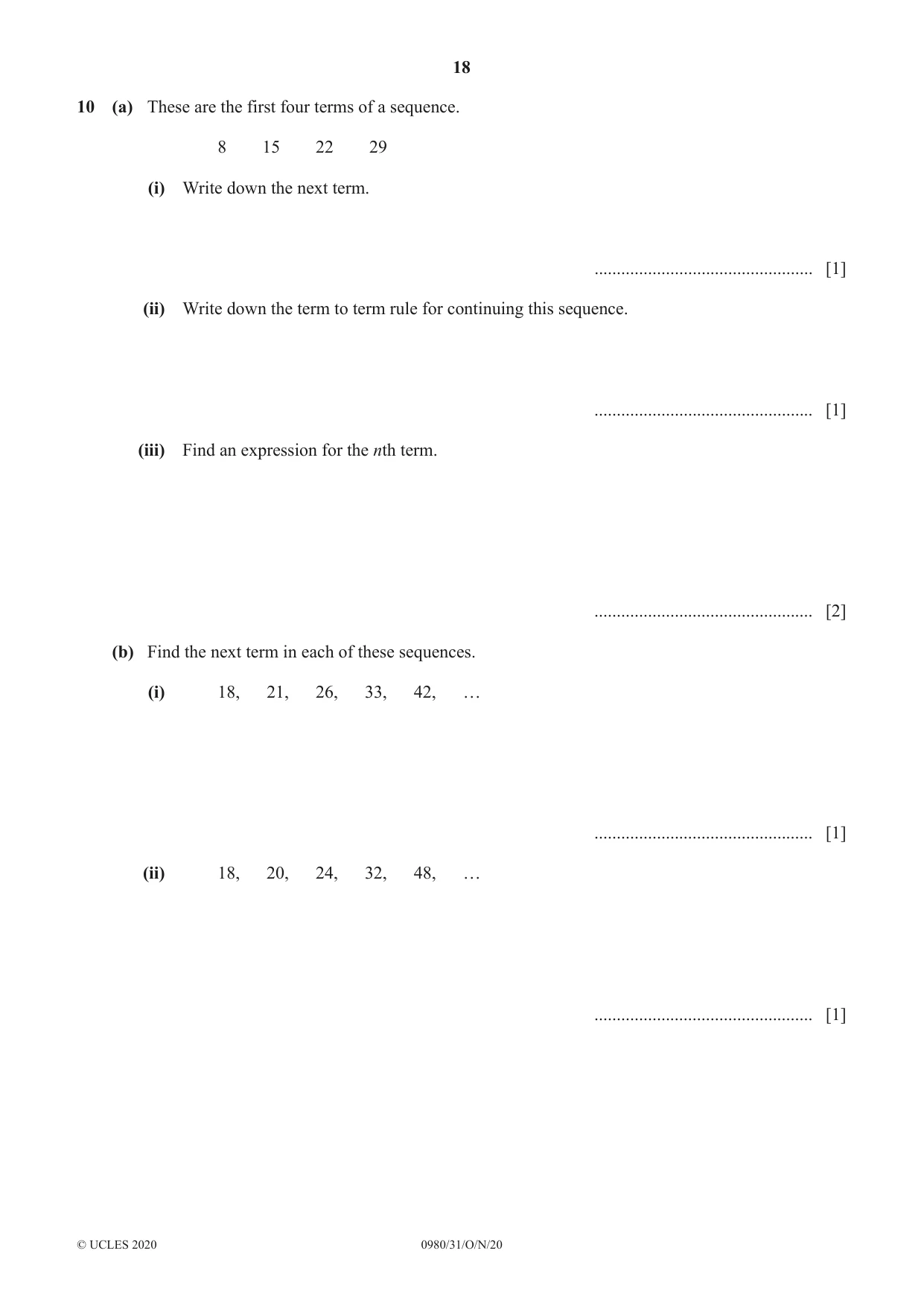
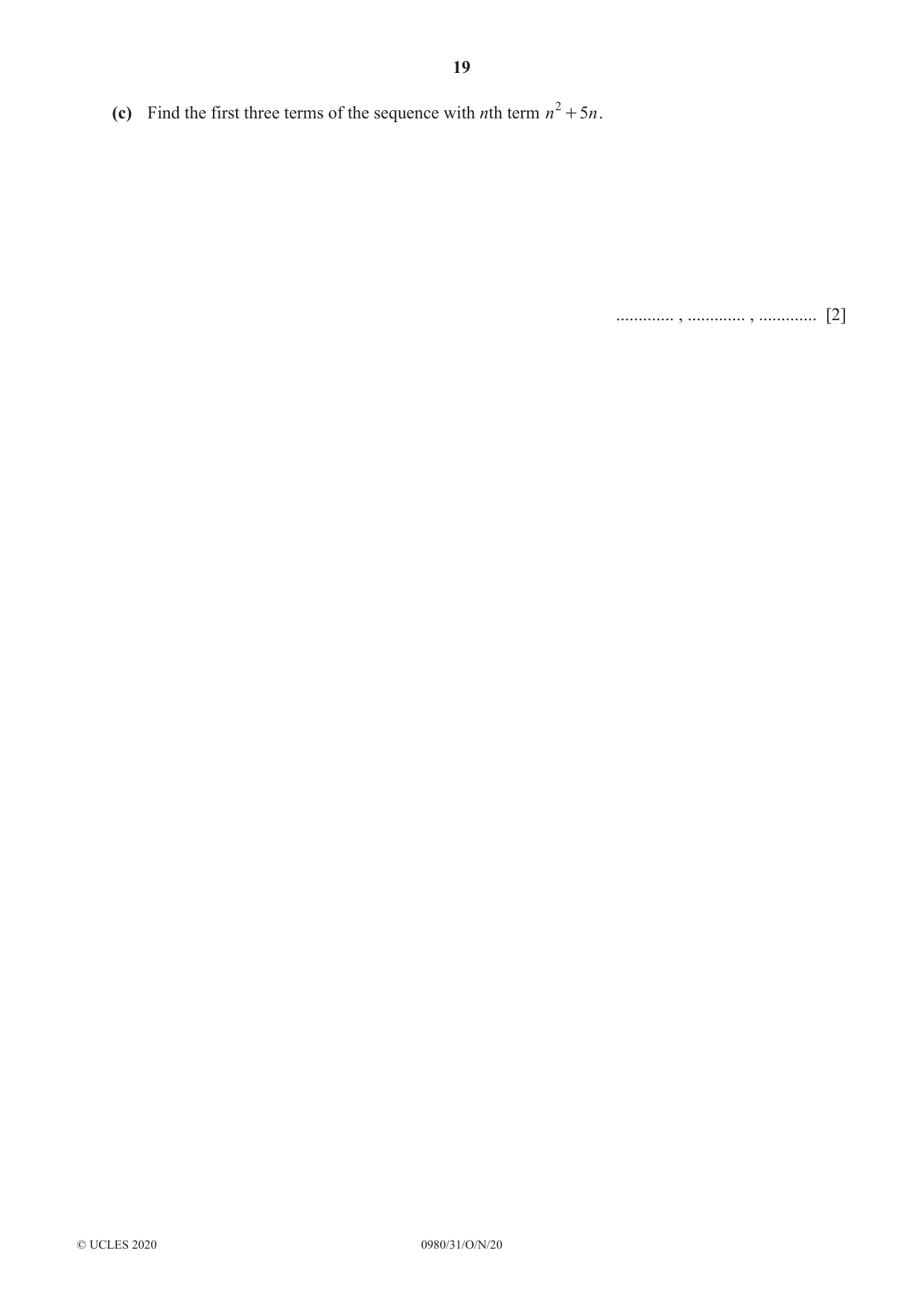
10 (a) These are the first four terms of a sequence. 8 15 22 29 (i) Write down the next term. ................................................. [1] (ii) Write down the term to term rule for continuing this sequence. ................................................. [1] (iii) Find an expression for the nth term. ................................................. [2] (b) Find the next term in each of these sequences. (i) 18, 21, 26, 33, 42, … ................................................. [1] (ii) 18, 20, 24, 32, 48, … ................................................. [1] (c) Find the first three terms of the sequence with nth term n 2 + 5n . ............. , ............. , ............. [2]
Mark scheme: 10(a)(i) 36 1 10(a)(ii) add 7 oe 1 10(a)(iii) 7n + 1 oe final answer 2 B1 for 7n + j or kn + 1 (k ≠ 0) as final answer, or for 7n + 1 seen then spoilt 10(b)(i) 53 1 10(b)(ii) 80 1 10(c) 6 14 24 2 B1 for 2 correct terms in the correct place If 0 scored, SC1 for 0 6 14
What was in this paper
The subtopics covered by these 10 questions, and how many questions each got. Open one in a new tab to see every Cambridge question on it.
What you needed in this session
Cambridge’s own grade thresholds for 2020 Oct/Nov, Paper 3 · Variant 1. A higher threshold means an easier paper — the bar moves with how the cohort did.