Cambridge IGCSE Mathematics (9-1) 0980 — 2024 Oct/Nov Paper 4 · Variant 1
0980/41/O/N/24 · 10 questions · 130 marks · ≈146 min
The question paper and its mark scheme, free to read here and free to download. This is Cambridge’s own paper, exactly as it was sat.
Question paper20 pages
Mark scheme11 pages
Answers below. Sit the paper first if you are practising.
Questions as text
Q1 · Write 70 as a product of its prime factors
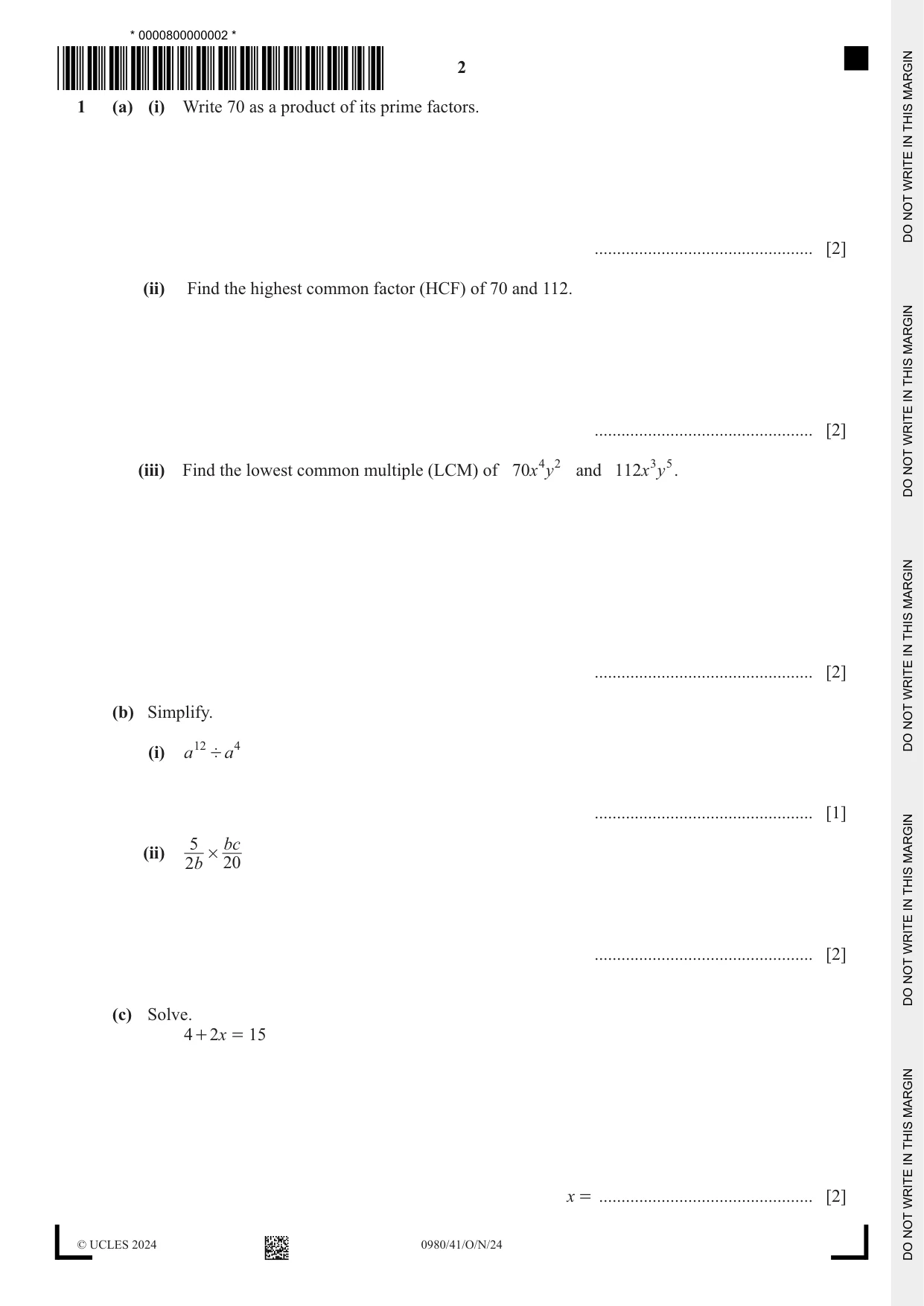
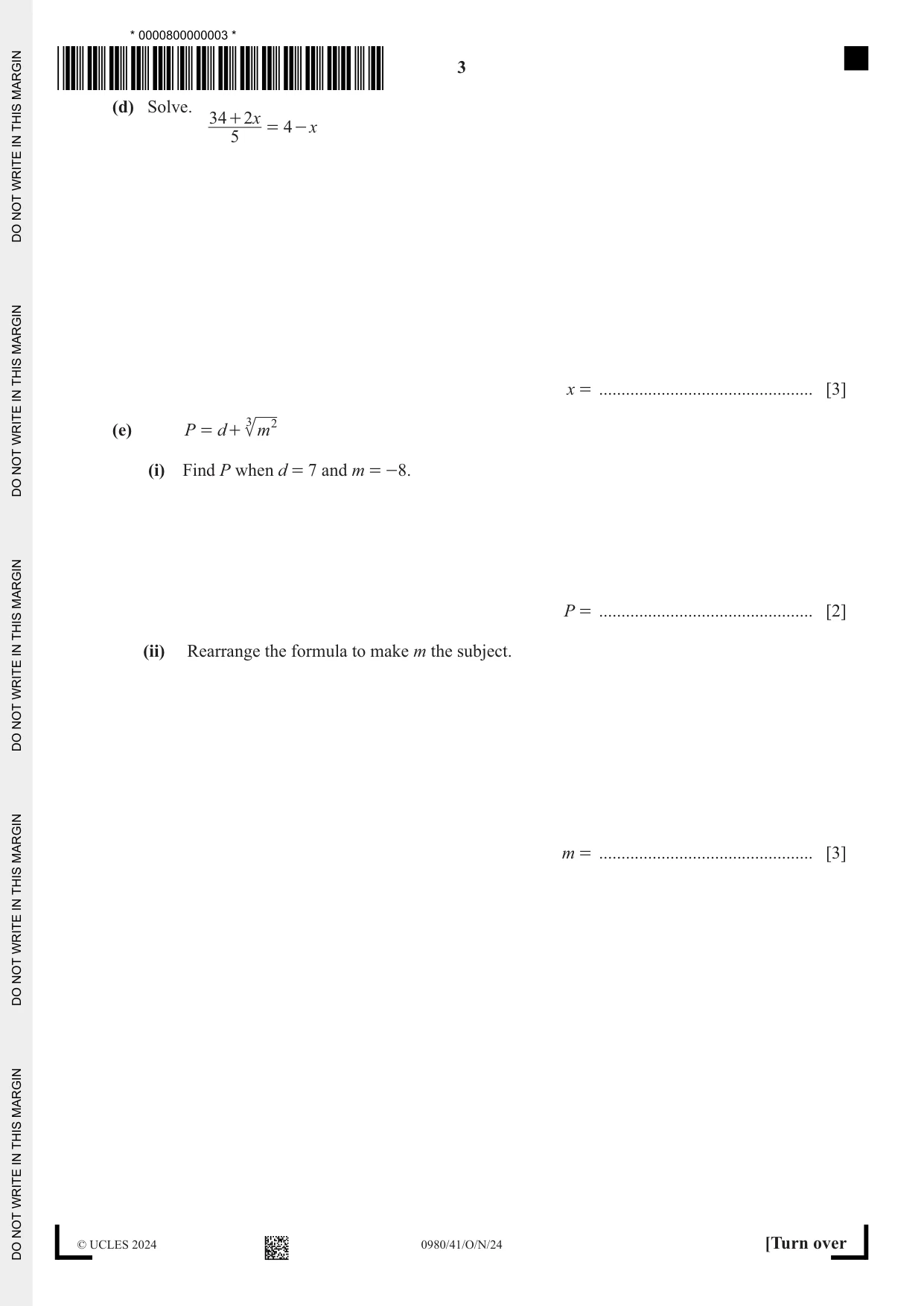
1 (a) (i) Write 70 as a product of its prime factors. ................................................. [2] (ii) Find the highest common factor (HCF) of 70 and 112. ................................................. [2] (iii) Find the lowest common multiple (LCM) of 70x 4 y 2 and 112x 3 y 5. ................................................. [2] (b) Simplify. (i) a 12 ' a 4 ................................................. [1] 5 bc (ii) # 2b 20 ................................................. [2] (c) Solve. 4 + 2x = 15 x = ................................................ [2] (d) Solve. 34 + 2x = 4 - x 5 x = ................................................ [3] 3(e) P = d + m2 (i) Find P when d = 7 and m = -8. P = ................................................ [2] (ii) Rearrange the formula to make m the subject. m = ................................................ [3]
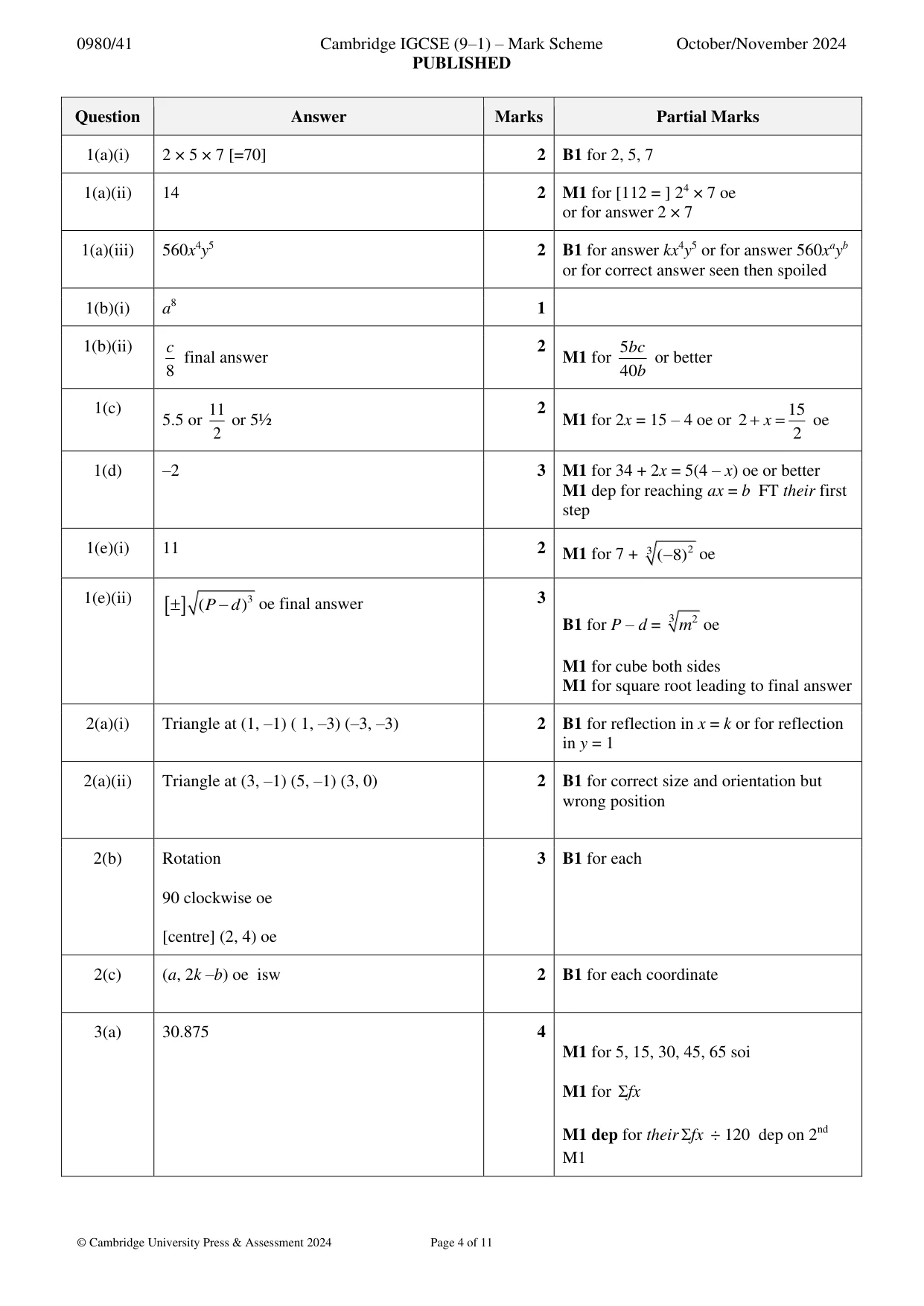
Mark scheme: Question Answer Marks Partial Marks 1(a)(i) 2 × 5 × 7 [=70] 2 B1 for 2, 5, 7 1(a)(ii) 14 2 M1 for [112 = ] 24 × 7 oe or for answer 2 × 7 1(a)(iii) 560x4y5 2 B1 for answer kx4y5 or for answer 560xayb or for correct answer seen then spoiled 1(b)(i) a8 1 1(b)(ii) c 2 5 bc final answer M1 for or better 8 40b 1(c) 11 2 15 5.5 or or 5½ M1 for 2x = 15 – 4 oe or 2 + x = oe 2 2 1(d) –2 3 M1 for 34 + 2x = 5(4 – x) oe or better M1 dep for reaching ax = b FT their first step 1(e)(i) 11 2 3 2 M1 for 7 + ( −8) oe 1(e)(ii) ( P − d )3 oe final answer 3 B1 for P – d = 3 m2 oe M1 for cube both sides M1 for square root leading to final answer
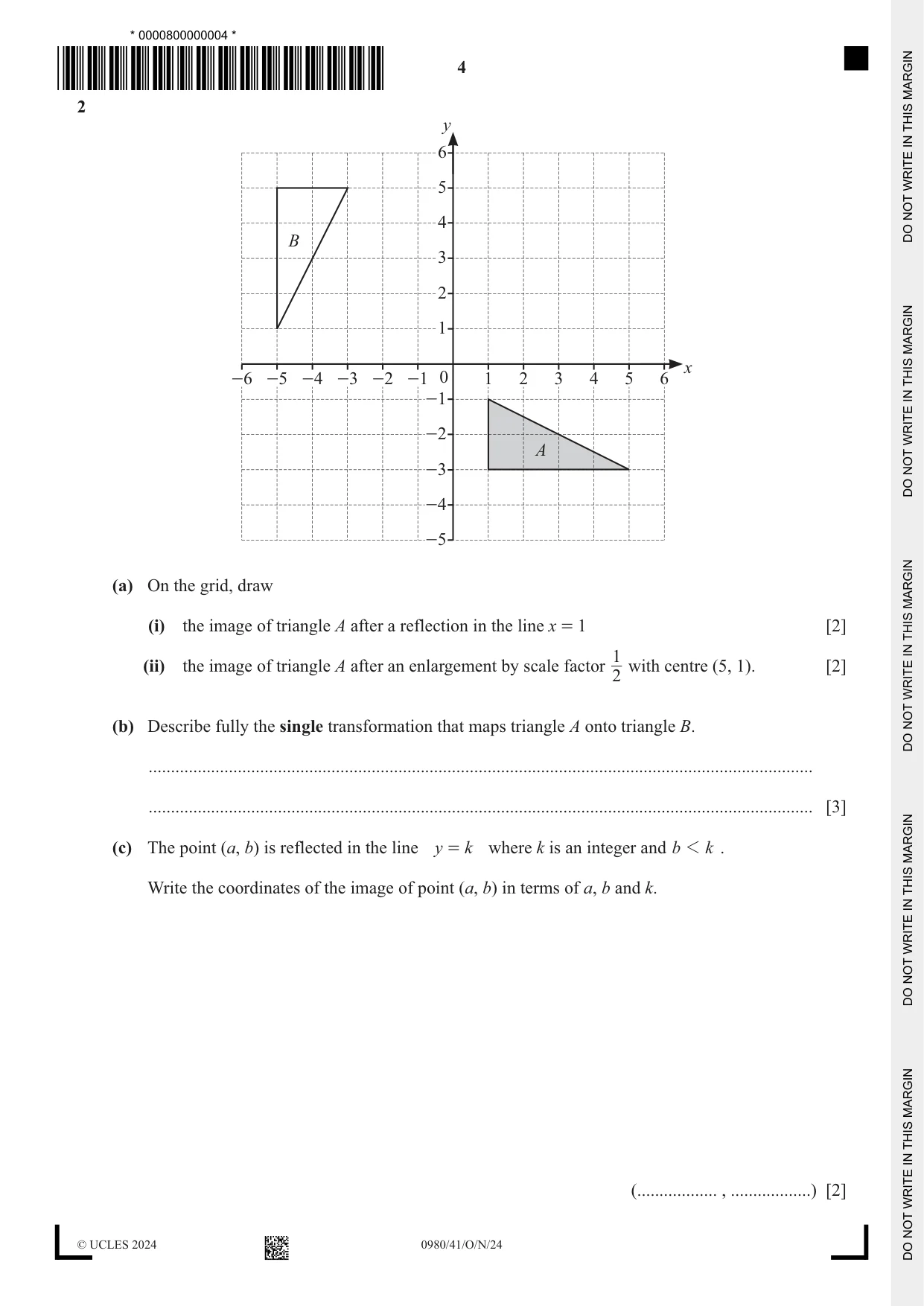
Q2 · Y 6 5 4 B 3 2 1 x -6 -5 -4 -3 -2 -1 0 1 2 3 4 5 6 -1 -2 A -3 -4 -5 (a) On the grid, draw…
2 y 6 5 4 B 3 2 1 x -6 -5 -4 -3 -2 -1 0 1 2 3 4 5 6 -1 -2 A -3 -4 -5 (a) On the grid, draw (i) the image of triangle A after a reflection in the line x = 1 [2] 1 (ii) the image of triangle A after an enlargement by scale factor with centre (5, 1). [2] 2 (b) Describe fully the single transformation that maps triangle A onto triangle B. ..................................................................................................................................................... ..................................................................................................................................................... [3] (c) The point (a, b) is reflected in the line y = k where k is an integer and b 1 k . Write the coordinates of the image of point (a, b) in terms of a, b and k. (.................. , ..................) [2]
Mark scheme: 2(a)(i) Triangle at (1, –1) ( 1, –3) (–3, –3) 2 B1 for reflection in x = k or for reflection in y = 1 2(a)(ii) Triangle at (3, –1) (5, –1) (3, 0) 2 B1 for correct size and orientation but wrong position 2(b) Rotation 3 B1 for each 90 clockwise oe [centre] (2, 4) oe 2(c) (a, 2k –b) oe isw 2 B1 for each coordinate
Q3 · The table shows the waiting times for 120 patients at a medical centre
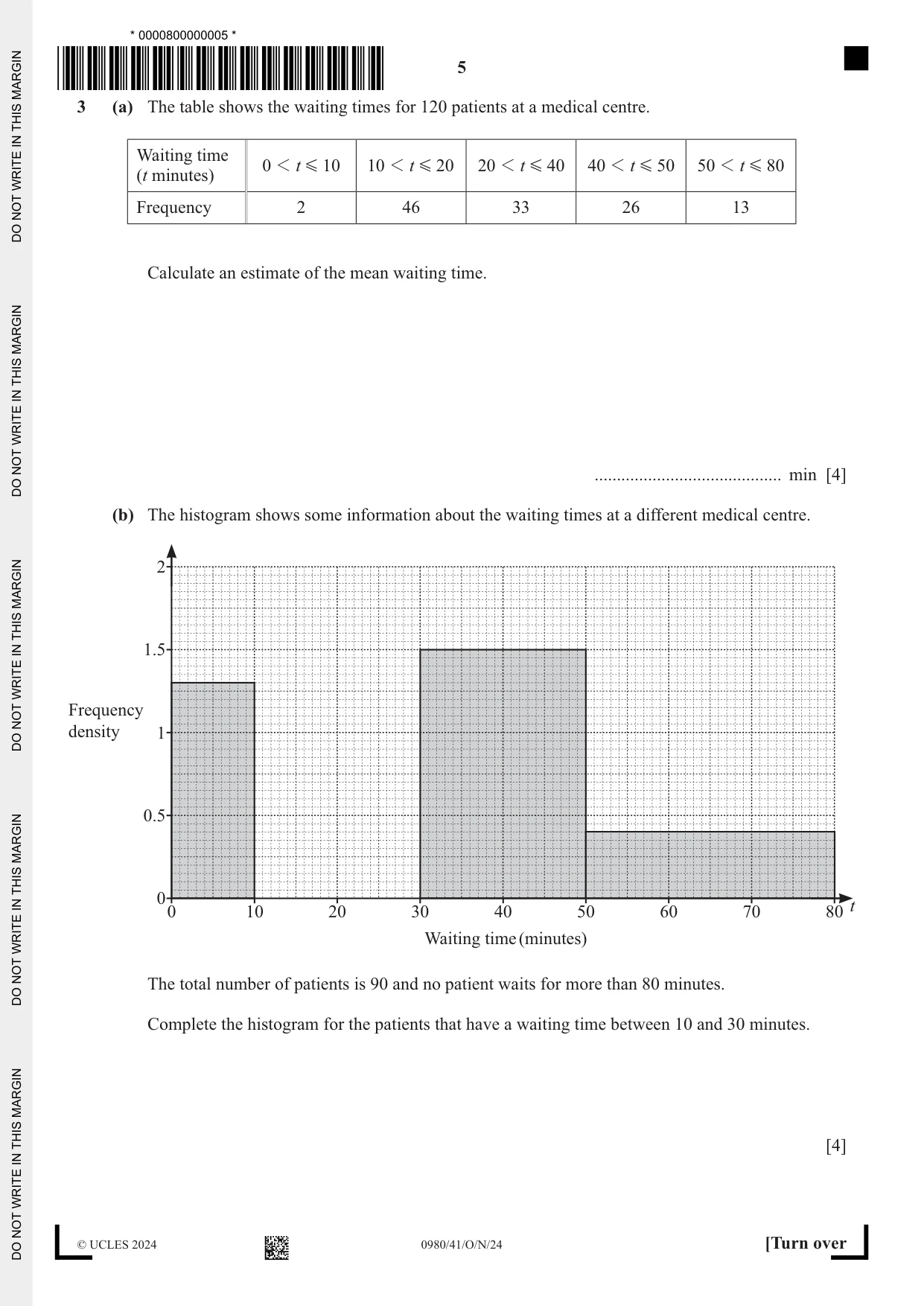
3 (a) The table shows the waiting times for 120 patients at a medical centre. Waiting time 0 1 t G 10 10 1 t G 20 20 1 t G 40 40 1 t G 50 50 1 t G 80 (t minutes) Frequency 2 46 33 26 13 Calculate an estimate of the mean waiting time. .......................................... min [4] (b) The histogram shows some information about the waiting times at a different medical centre. 2 1.5 Frequency density 1 0.5 0 t 0 10 20 30 40 50 60 70 80 Waiting time (minutes) The total number of patients is 90 and no patient waits for more than 80 minutes. Complete the histogram for the patients that have a waiting time between 10 and 30 minutes. [4]
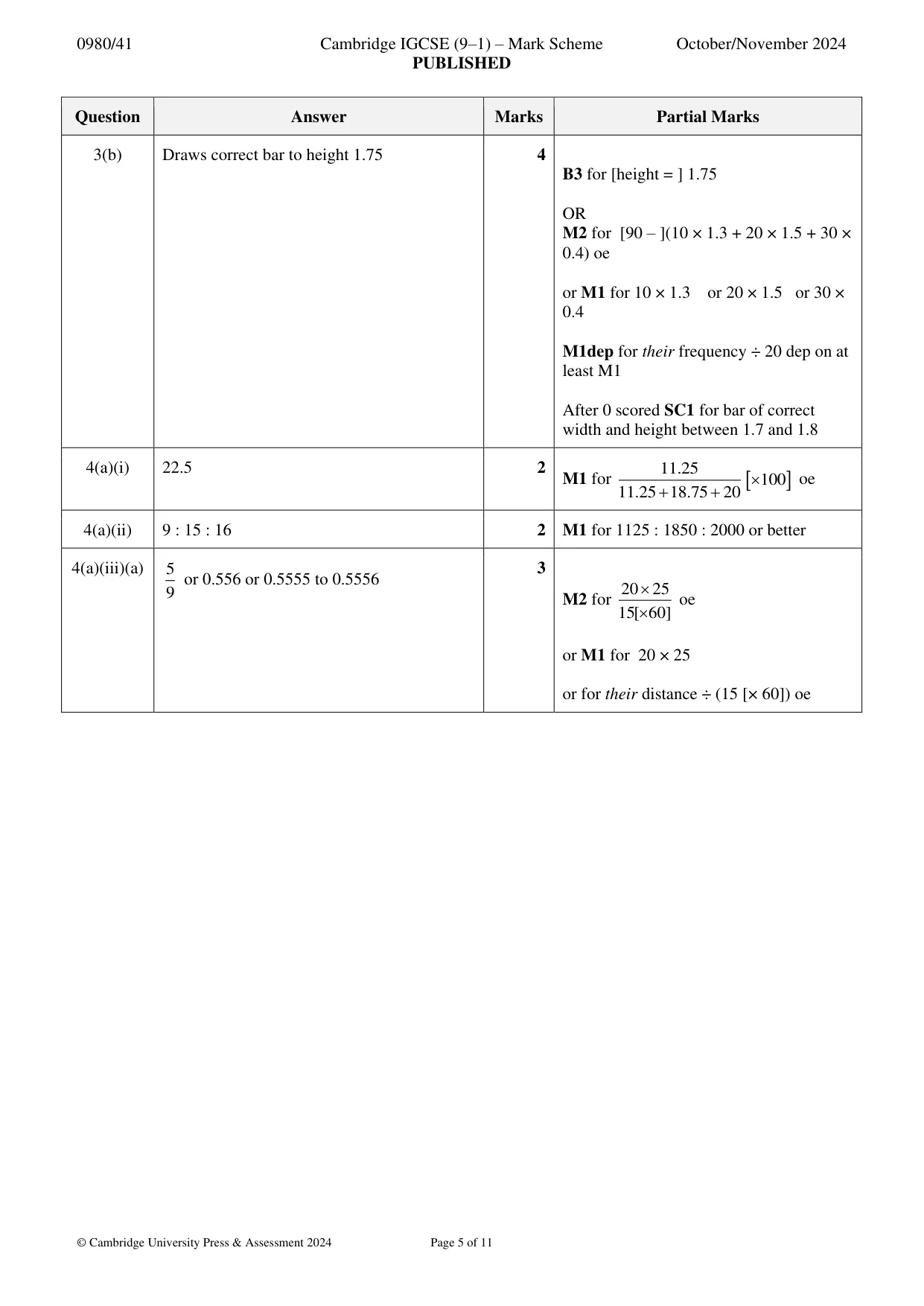
Mark scheme: 3(a) 30.875 4 M1 for 5, 15, 30, 45, 65 soi M1 for fx M1 dep for their fx ÷ 120 dep on 2nd M1 3(b) Draws correct bar to height 1.75 4 B3 for [height = ] 1.75 OR M2 for [90 – ](10 × 1.3 + 20 × 1.5 + 30 × 0.4) oe or M1 for 10 × 1.3 or 20 × 1.5 or 30 × 0.4 M1dep for their frequency ÷ 20 dep on at least M1 After 0 scored SC1 for bar of correct width and height between 1.7 and 1.8
Q4 · Enzo, Rashid and Blessy each swim as many lengths of a swimming pool as they can in 15…
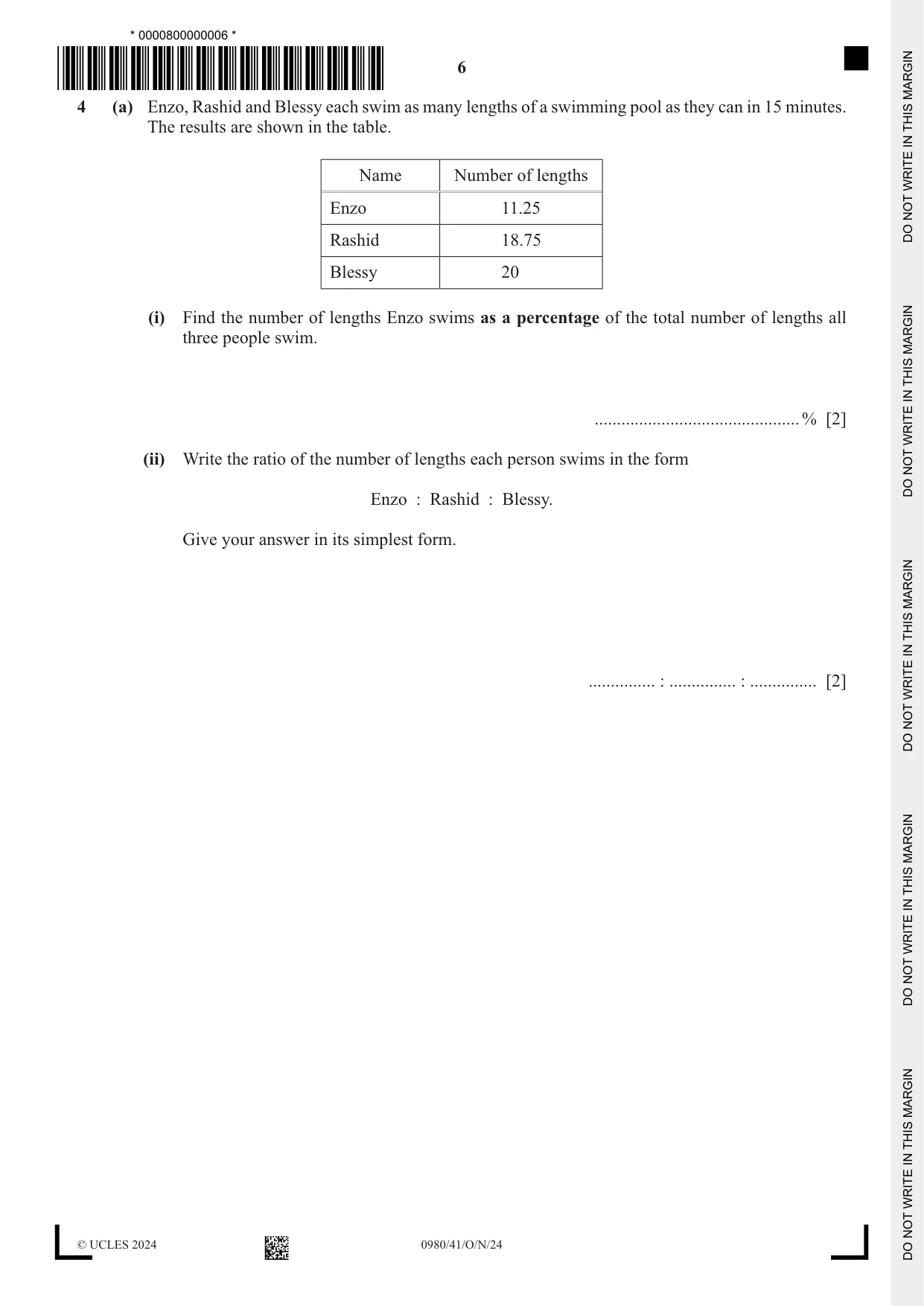
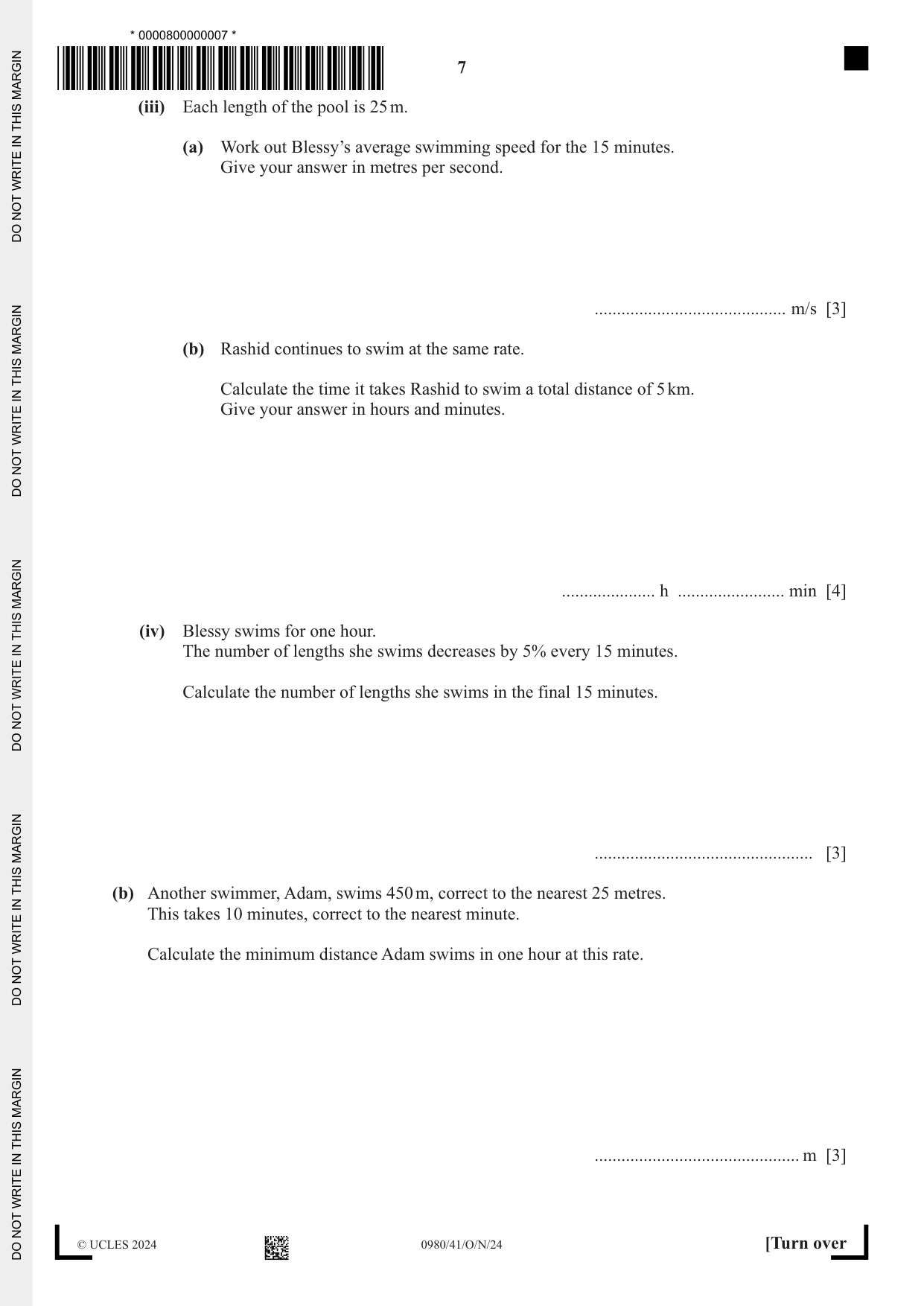
4 (a) Enzo, Rashid and Blessy each swim as many lengths of a swimming pool as they can in 15 minutes. The results are shown in the table. Name Number of lengths Enzo 11.25 Rashid 18.75 Blessy 20 (i) Find the number of lengths Enzo swims as a percentage of the total number of lengths all three people swim. ..............................................% [2] (ii) Write the ratio of the number of lengths each person swims in the form Enzo : Rashid : Blessy. Give your answer in its simplest form. ............... : ............... : ............... [2] (iii) Each length of the pool is 25 m. (a) Work out Blessy’s average swimming speed for the 15 minutes. Give your answer in metres per second. ........................................... m/s [3] (b) Rashid continues to swim at the same rate. Calculate the time it takes Rashid to swim a total distance of 5 km. Give your answer in hours and minutes. ..................... h ........................ min [4] (iv) Blessy swims for one hour. The number of lengths she swims decreases by 5% every 15 minutes. Calculate the number of lengths she swims in the final 15 minutes. ................................................. [3] (b) Another swimmer, Adam, swims 450 m, correct to the nearest 25 metres. This takes 10 minutes, correct to the nearest minute. Calculate the minimum distance Adam swims in one hour at this rate. .............................................. m [3]
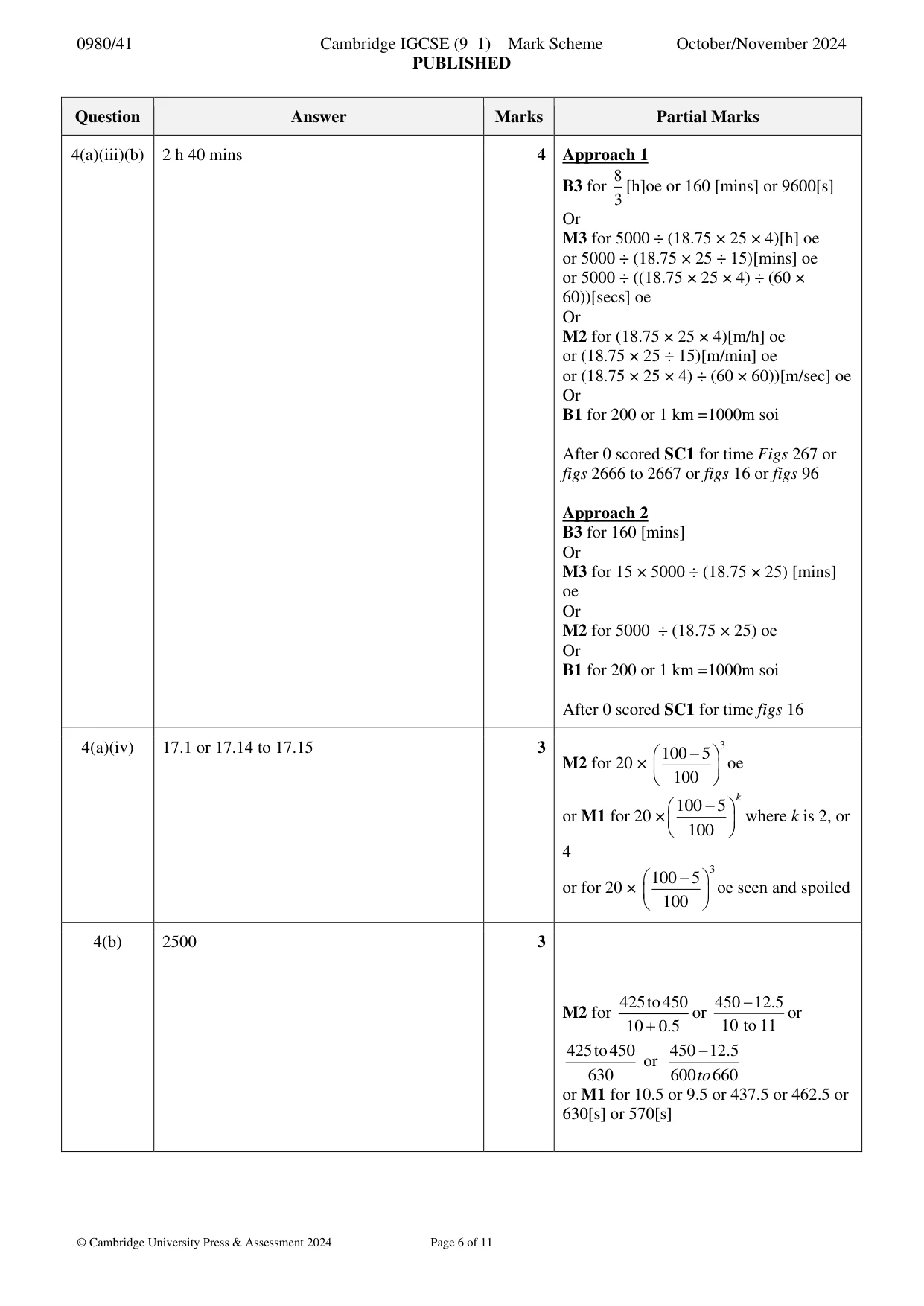
Mark scheme: 4(a)(i) 22.5 2 11.25 M1 for 100 oe 11.25 + 18.75 + 20 4(a)(ii) 9 : 15 : 16 2 M1 for 1125 : 1850 : 2000 or better 4(a)(iii)(a) 5 3 or 0.556 or 0.5555 to 0.5556 9 20 25 M2 for oe 15[ 60] or M1 for 20 × 25 or for their distance ÷ (15 [× 60]) oe 4(a)(iii)(b) 2 h 40 mins 4 Approach 1 8 B3 for [h]oe or 160 [mins] or 9600[s] 3 Or M3 for 5000 ÷ (18.75 × 25 × 4)[h] oe or 5000 ÷ (18.75 × 25 ÷ 15)[mins] oe or 5000 ÷ ((18.75 × 25 × 4) ÷ (60 × 60))[secs] oe Or M2 for (18.75 × 25 × 4)[m/h] oe or (18.75 × 25 ÷ 15)[m/min] oe or (18.75 × 25 × 4) ÷ (60 × 60))[m/sec] oe Or B1 for 200 or 1 km =1000m soi After 0 scored SC1 for time Figs 267 or figs 2666 to 2667 or figs 16 or figs 96 Approach 2 B3 for 160 [mins] Or M3 for 15 × 5000 ÷ (18.75 × 25) [mins] oe Or M2 for 5000 ÷ (18.75 × 25) oe Or B1 for 200 or 1 km =1000m soi After 0 scored SC1 for time figs 16 4(a)(iv) 17.1 or 17.14 to 17.15 3 3 100 − 5 M2 for 20 × oe 100 100 − 5 k or M1 for 20 × where k is 2, or 100 4 100 − 5 3 or for 20 × oe seen and spoiled 100 4(b) 2500 3 425to450 450 − 12.5 M2 for or or 10 + 0.5 10 to 11 425 to 450 450 − 12.5 or 630 600 to 660 or M1 for 10.5 or 9.5 or 437.5 or 462.5 or 630[s] or 570[s]
Q5 · A box contains 3 blue pens and 5 red pens
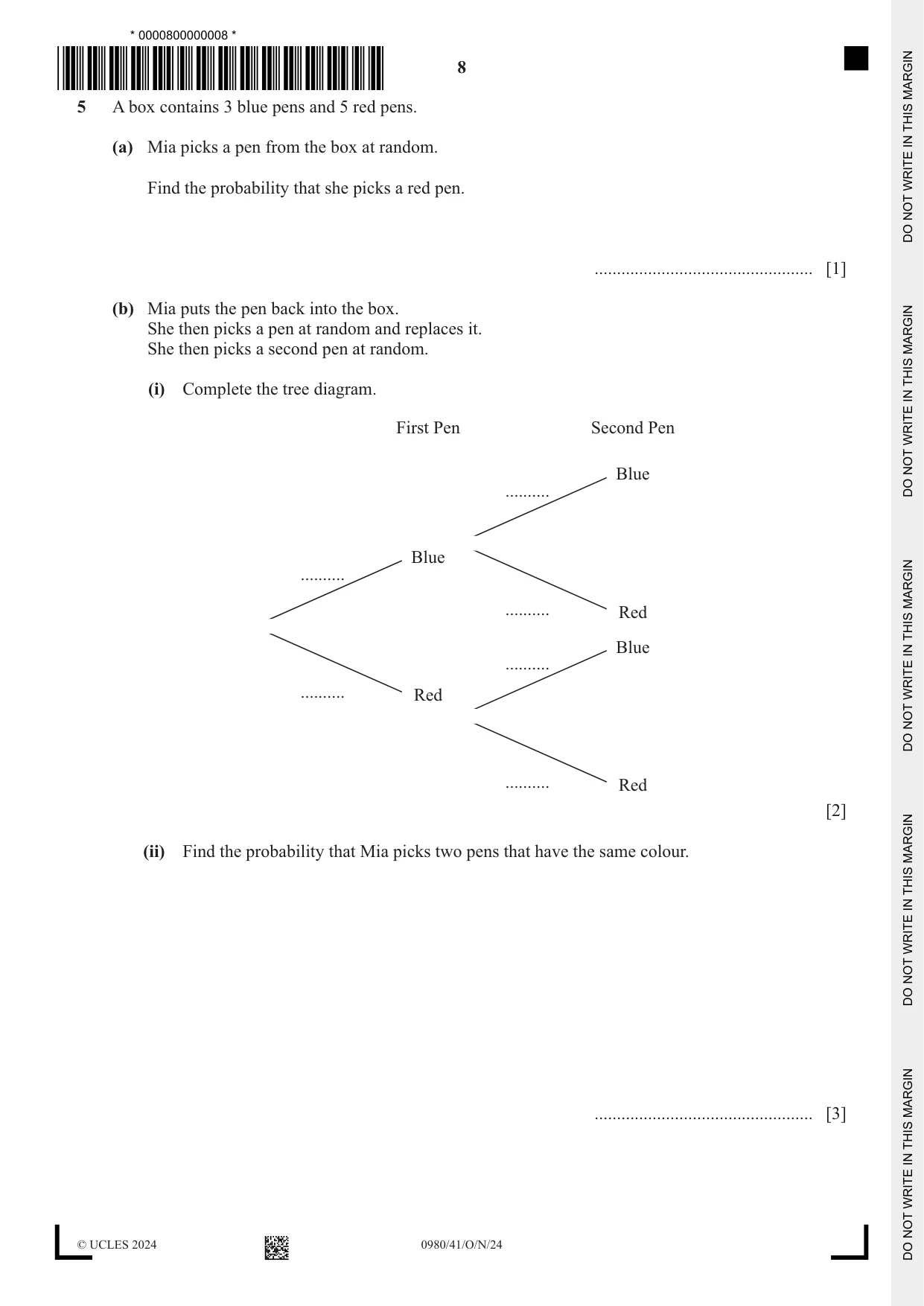
5 A box contains 3 blue pens and 5 red pens. (a) Mia picks a pen from the box at random. Find the probability that she picks a red pen. ................................................. [1] (b) Mia puts the pen back into the box. She then picks a pen at random and replaces it. She then picks a second pen at random. (i) Complete the tree diagram. First Pen Second Pen Blue .......... Blue .......... .......... Red Blue .......... .......... Red .......... Red [2] (ii) Find the probability that Mia picks two pens that have the same colour. ................................................. [3] (c) Mia now picks 3 of the 8 pens in the box at random without replacement. Find the probability that she picks 2 blue pens and 1 red pen. ................................................. [3]
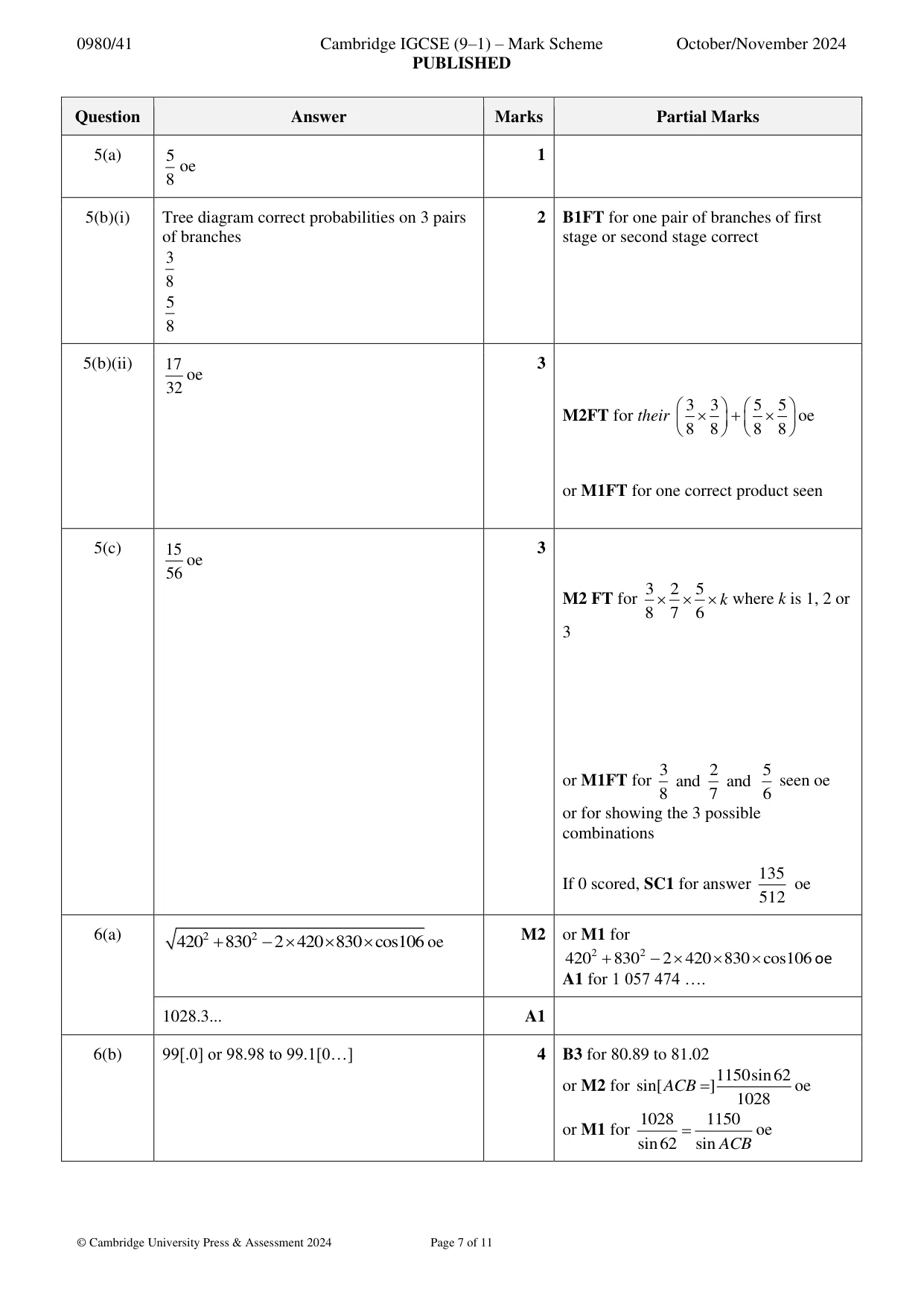
Mark scheme: 5(a) 5 1 oe 8 5(b)(i) Tree diagram correct probabilities on 3 pairs 2 B1FT for one pair of branches of first of branches stage or second stage correct 3 8 5 8 5(b)(ii) 17 3 oe 32 3 3 5 5 M2FT for their + oe 8 8 8 8 or M1FT for one correct product seen 5(c) 15 3 oe 56 3 2 5 M2 FT for k where k is 1, 2 or 8 7 6 3 3 2 5 or M1FT for and and seen oe 8 7 6 or for showing the 3 possible combinations 135 If 0 scored, SC1 for answer oe 512
Q6 · The diagram shows a field ABCD
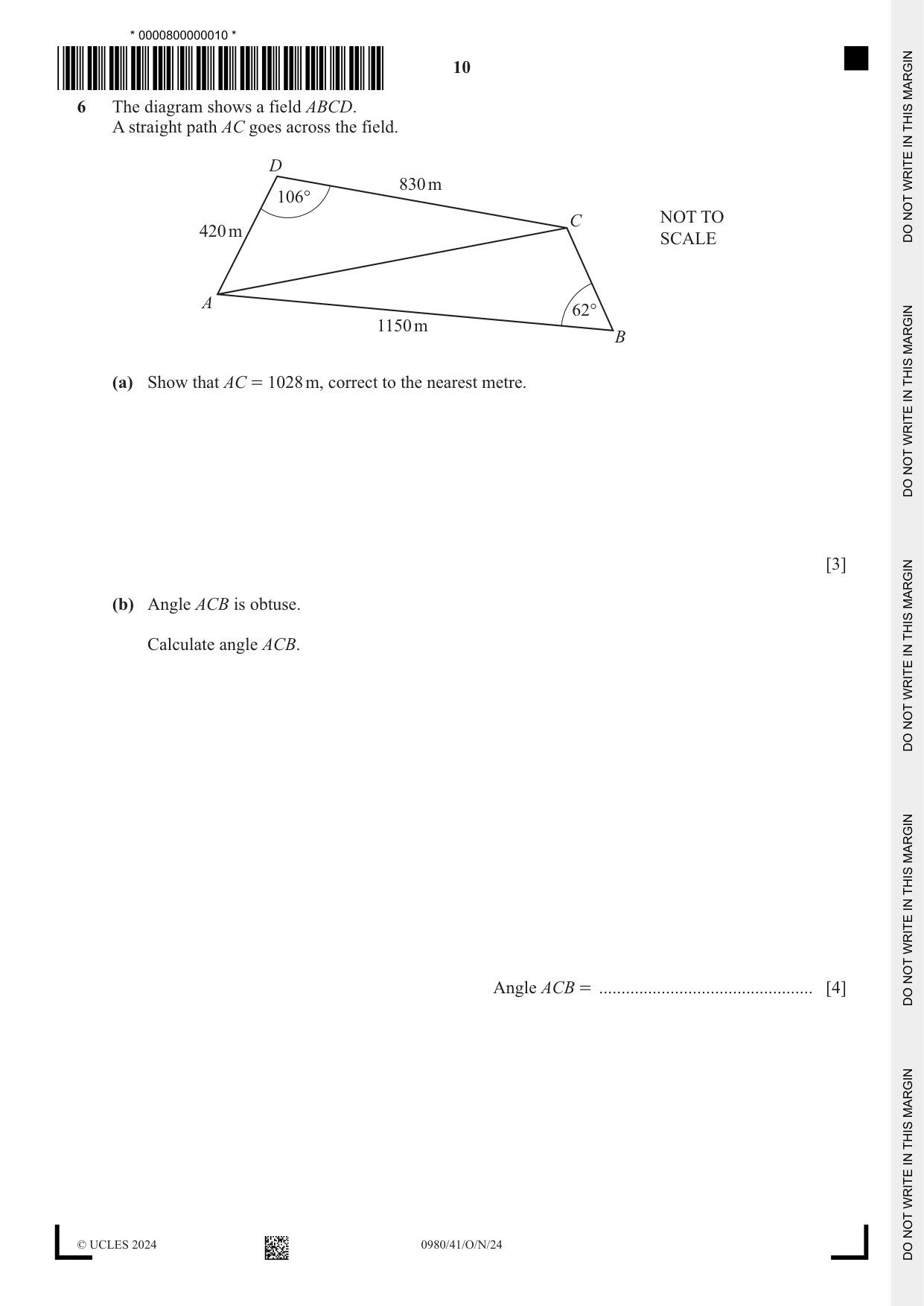
6 The diagram shows a field ABCD. A straight path AC goes across the field. D 830 m 106° C NOT TO 420 m SCALE A 62° 1150 m B (a) Show that AC = 1028 m, correct to the nearest metre. [3] (b) Angle ACB is obtuse. Calculate angle ACB. Angle ACB = ................................................ [4] (c) Part of the field, triangle ACD, is sold for $41 500. Calculate the cost of 1 hectare of this part of the field. Give your answer correct to the nearest dollar. [1 hectare = 10 000 m2] $ ................................................. [4]
Mark scheme: 6(a) 2 2 M2 or M1 for 420 + 830 −2 420 830 cos106 oe 420 2 + 830 2 −2 420 830 cos106 oe A1 for 1 057 474 …. 1028.3... A1 6(b) 99[.0] or 98.98 to 99.1[0…] 4 B3 for 80.89 to 81.02 1150sin62 or M2 for sin[ ACB =] oe 1028 1028 1150 or M1 for = oe sin62 sin ACB 6(c) 2477 cao nfww 4 B3 for answer 2476.9… or M2 for 1 P 420 830 sin106 = 41 500 2 10000 oe 1 or M1 for 420 830 sin106 oe 2
Q7 · A company makes scientific calculators and graphic calculators
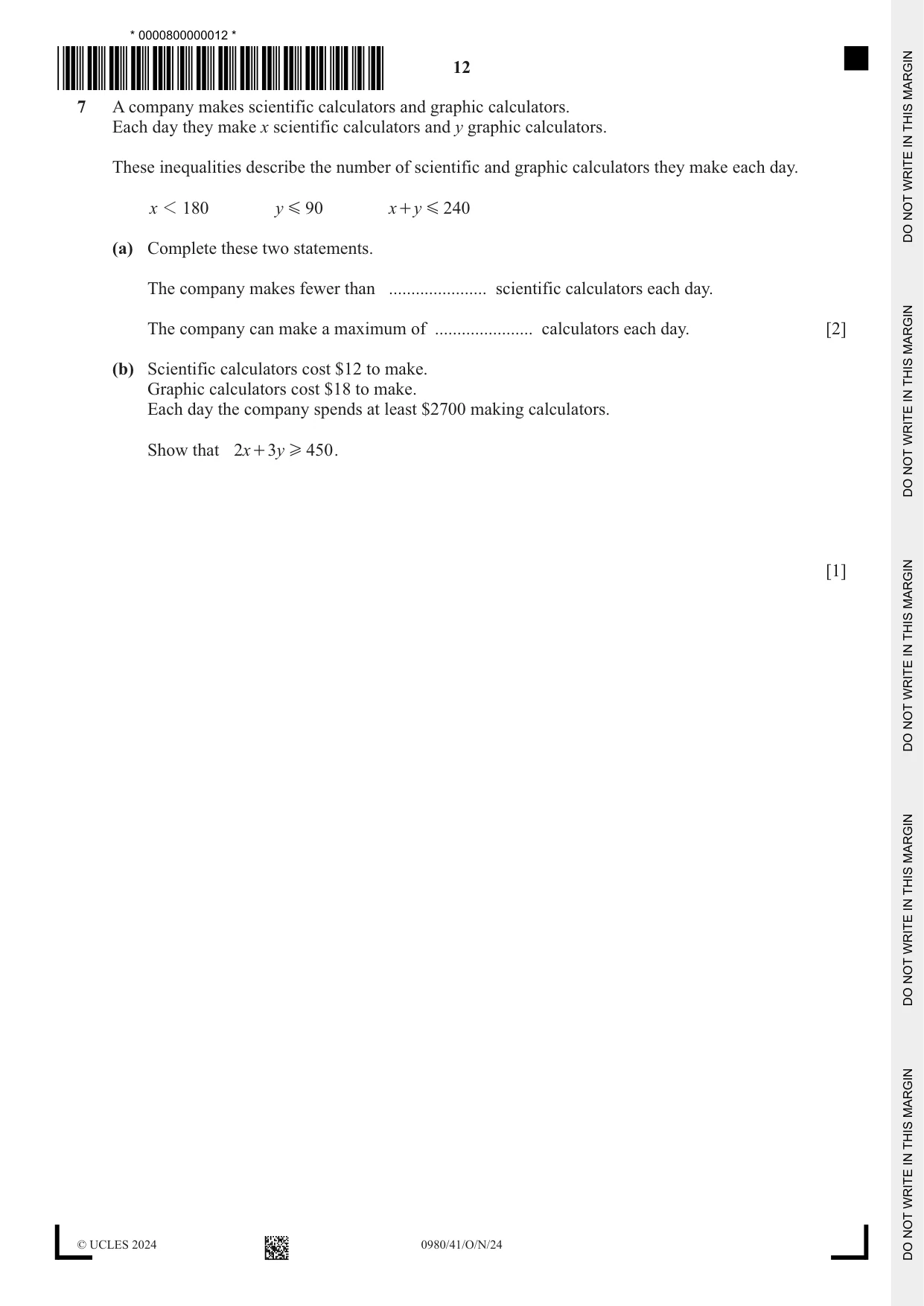
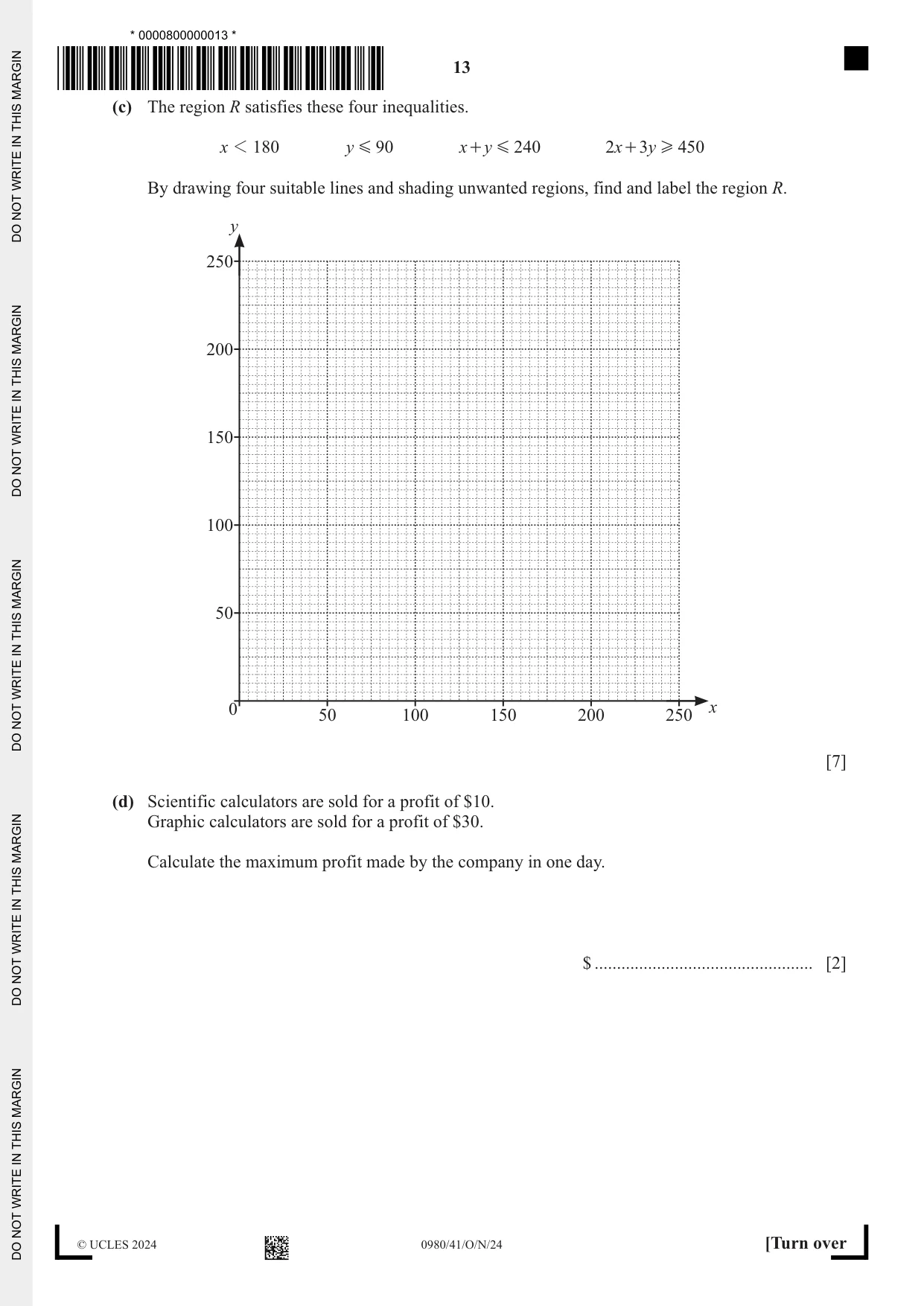
7 A company makes scientific calculators and graphic calculators. Each day they make x scientific calculators and y graphic calculators. These inequalities describe the number of scientific and graphic calculators they make each day. x 1 180 y G 90 x + y G 240 (a) Complete these two statements. The company makes fewer than ...................... scientific calculators each day. The company can make a maximum of ...................... calculators each day. [2] (b) Scientific calculators cost $12 to make. Graphic calculators cost $18 to make. Each day the company spends at least $2700 making calculators. Show that 2x + 3y H 450 . [1] (c) The region R satisfies these four inequalities. x 1 180 y G 90 x + y G 240 2x + 3y H 450 By drawing four suitable lines and shading unwanted regions, find and label the region R. y 250 200 150 100 50 0 x 50 100 150 200 250 [7] (d) Scientific calculators are sold for a profit of $10. Graphic calculators are sold for a profit of $30. Calculate the maximum profit made by the company in one day. $ ................................................. [2]
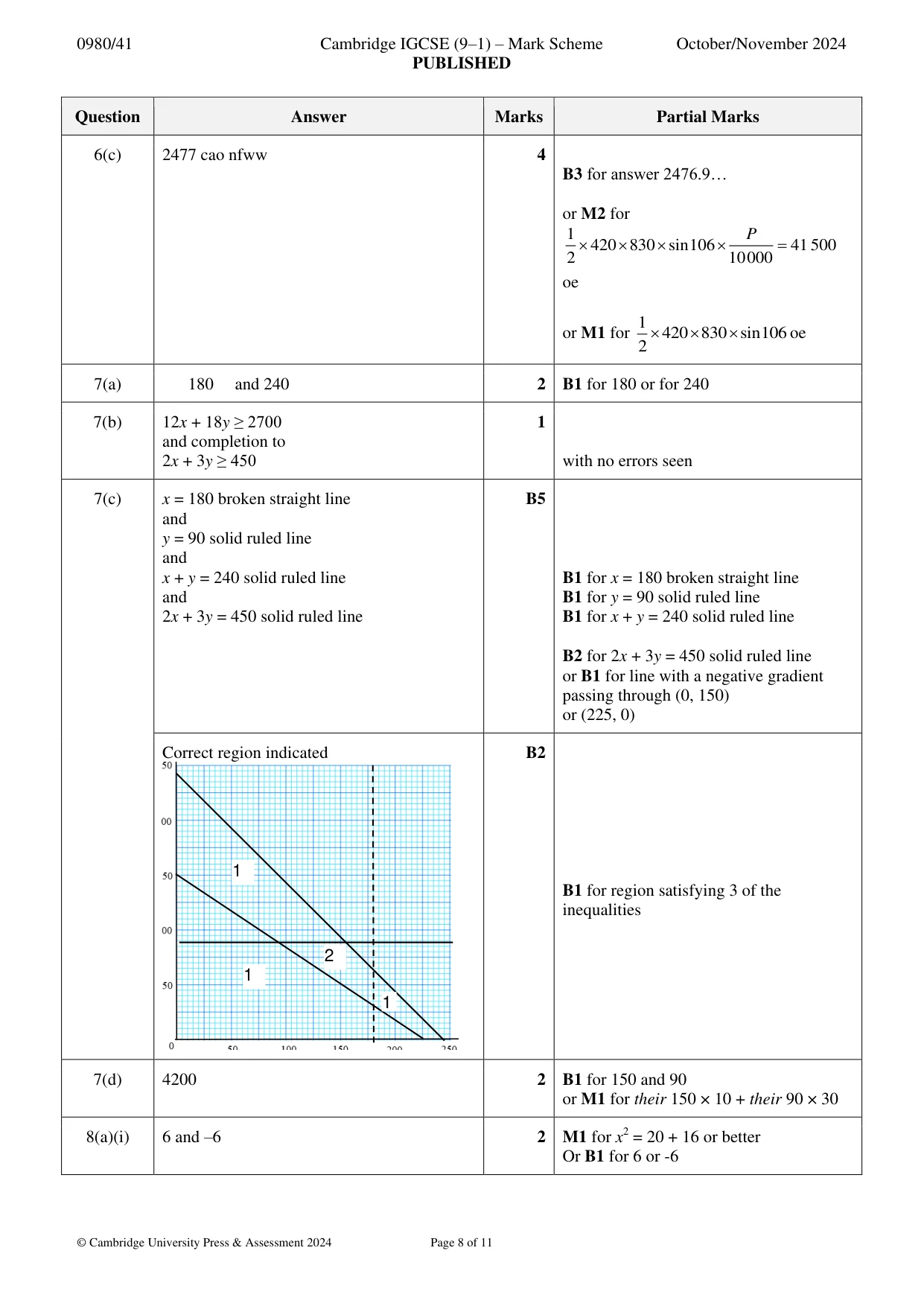
Mark scheme: 7(a) 180 and 240 2 B1 for 180 or for 240 7(b) 12x + 18y ≥ 2700 1 and completion to 2x + 3y ≥ 450 with no errors seen 7(c) x = 180 broken straight line B5 and y = 90 solid ruled line and x + y = 240 solid ruled line B1 for x = 180 broken straight line and B1 for y = 90 solid ruled line 2x + 3y = 450 solid ruled line B1 for x + y = 240 solid ruled line B2 for 2x + 3y = 450 solid ruled line or B1 for line with a negative gradient passing through (0, 150) or (225, 0) Correct region indicated B2 1 B1 for region satisfying 3 of the inequalities 2 1 1 7(d) 4200 2 B1 for 150 and 90 or M1 for their 150 × 10 + their 90 × 30
Q8 · F ( x) = 7 - 3 x g ( x) = x 2 - 16 (i) Find the values of x when g ( x) = 20
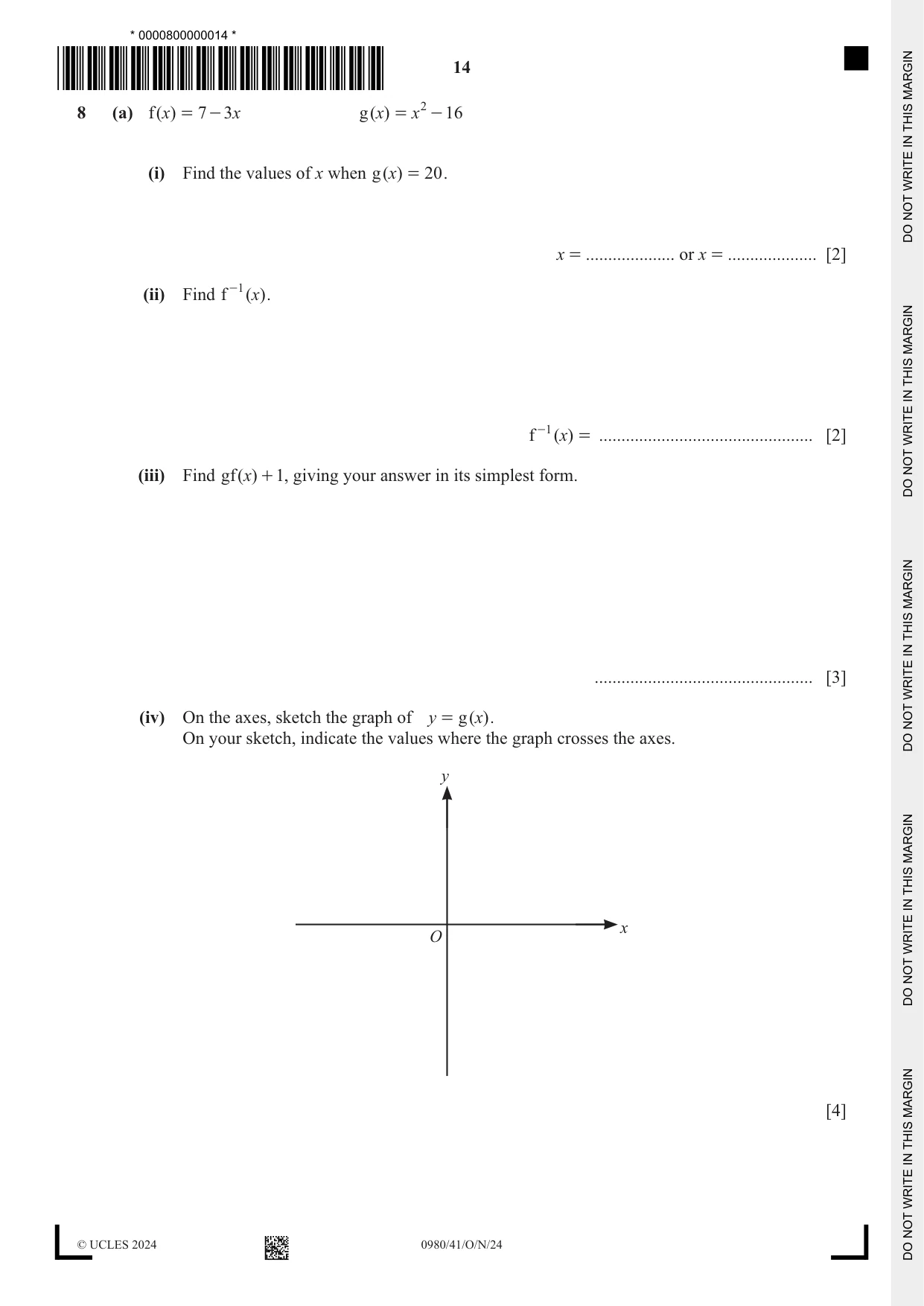
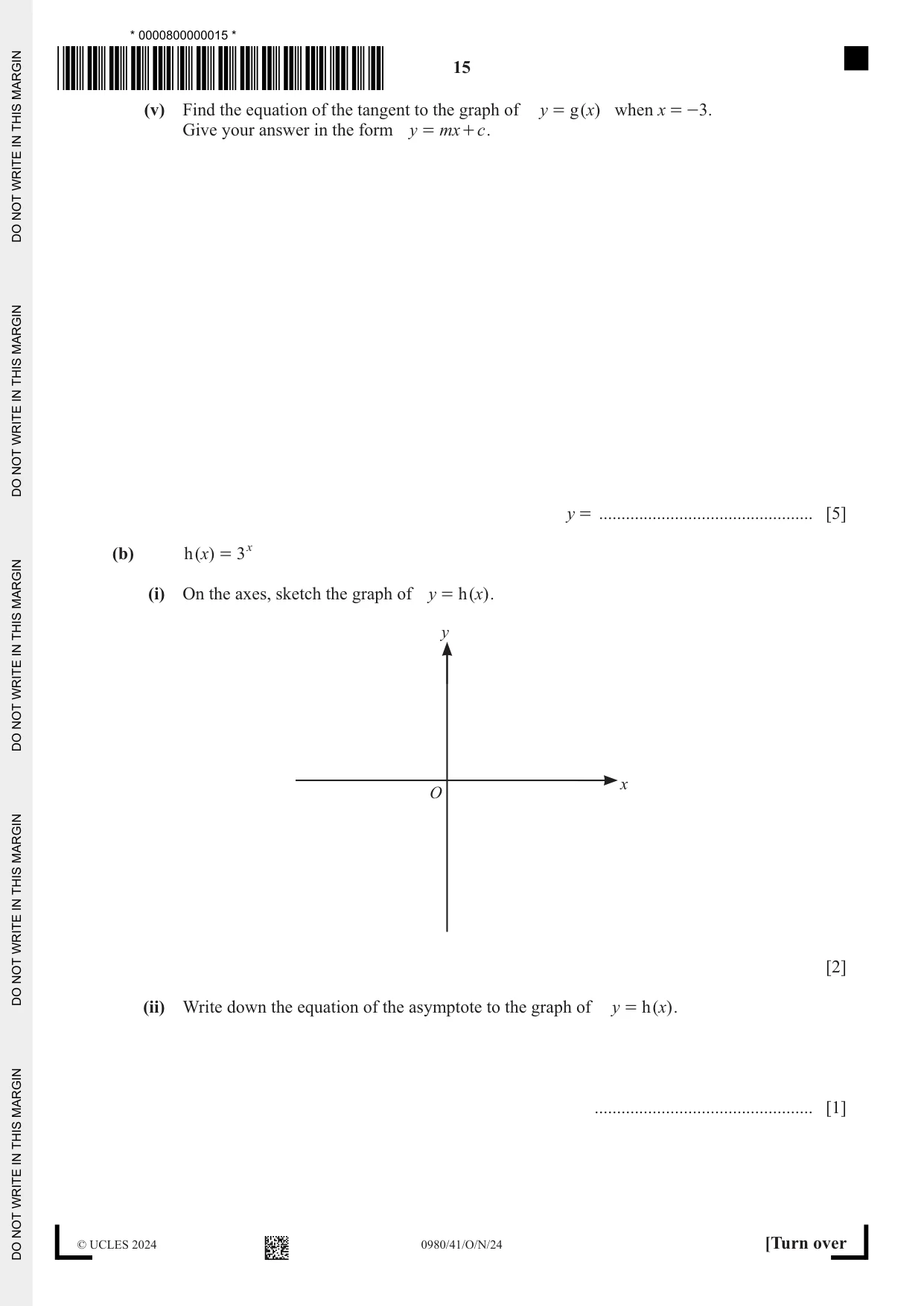
8 (a) f ( x) = 7 - 3 x g ( x) = x 2 - 16 (i) Find the values of x when g ( x) = 20 . x = .................... or x = .................... [2] (ii) Find f -1 ( )x . f -1 ( )x = ................................................ [2] (iii) Find gf ( x) + 1, giving your answer in its simplest form. ................................................. [3] (iv) On the axes, sketch the graph of y = g ( x) . On your sketch, indicate the values where the graph crosses the axes. y x O [4] (v) Find the equation of the tangent to the graph of y = g ( x) when x = -3. Give your answer in the form y = mx + c . y = ................................................ [5] (b) h ( x) = 3x (i) On the axes, sketch the graph of y = h ( x) . y x O [2] (ii) Write down the equation of the asymptote to the graph of y = h ( x) . ................................................. [1]
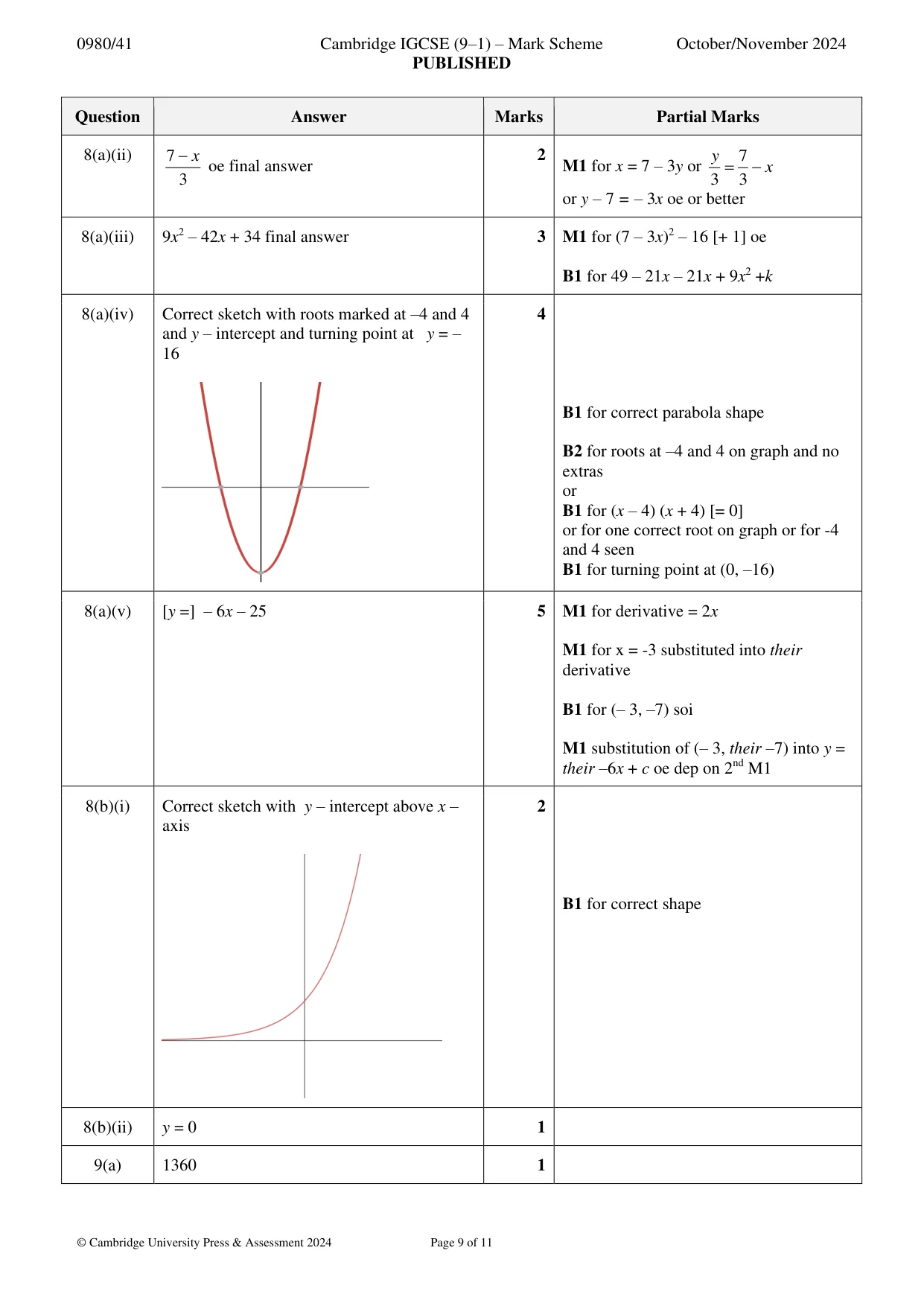
Mark scheme: 8(a)(i) 6 and –6 2 M1 for x2 = 20 + 16 or better Or B1 for 6 or -6 8(a)(ii) 7 − x 2 y 7 oe final answer M1 for x = 7 – 3y or = − x 3 3 3 or y – 7 = – 3x oe or better 8(a)(iii) 9x2 – 42x + 34 final answer 3 M1 for (7 – 3x)2 – 16 [+ 1] oe B1 for 49 – 21x – 21x + 9x2 +k 8(a)(iv) Correct sketch with roots marked at –4 and 4 4 and y – intercept and turning point at y = – 16 B1 for correct parabola shape B2 for roots at –4 and 4 on graph and no extras or B1 for (x – 4) (x + 4) [= 0] or for one correct root on graph or for -4 and 4 seen B1 for turning point at (0, –16) 8(a)(v) [y =] – 6x – 25 5 M1 for derivative = 2x M1 for x = -3 substituted into their derivative B1 for (– 3, –7) soi M1 substitution of (– 3, their –7) into y = their –6x + c oe dep on 2nd M1 8(b)(i) Correct sketch with y – intercept above x – 2 axis B1 for correct shape 8(b)(ii) y = 0 1
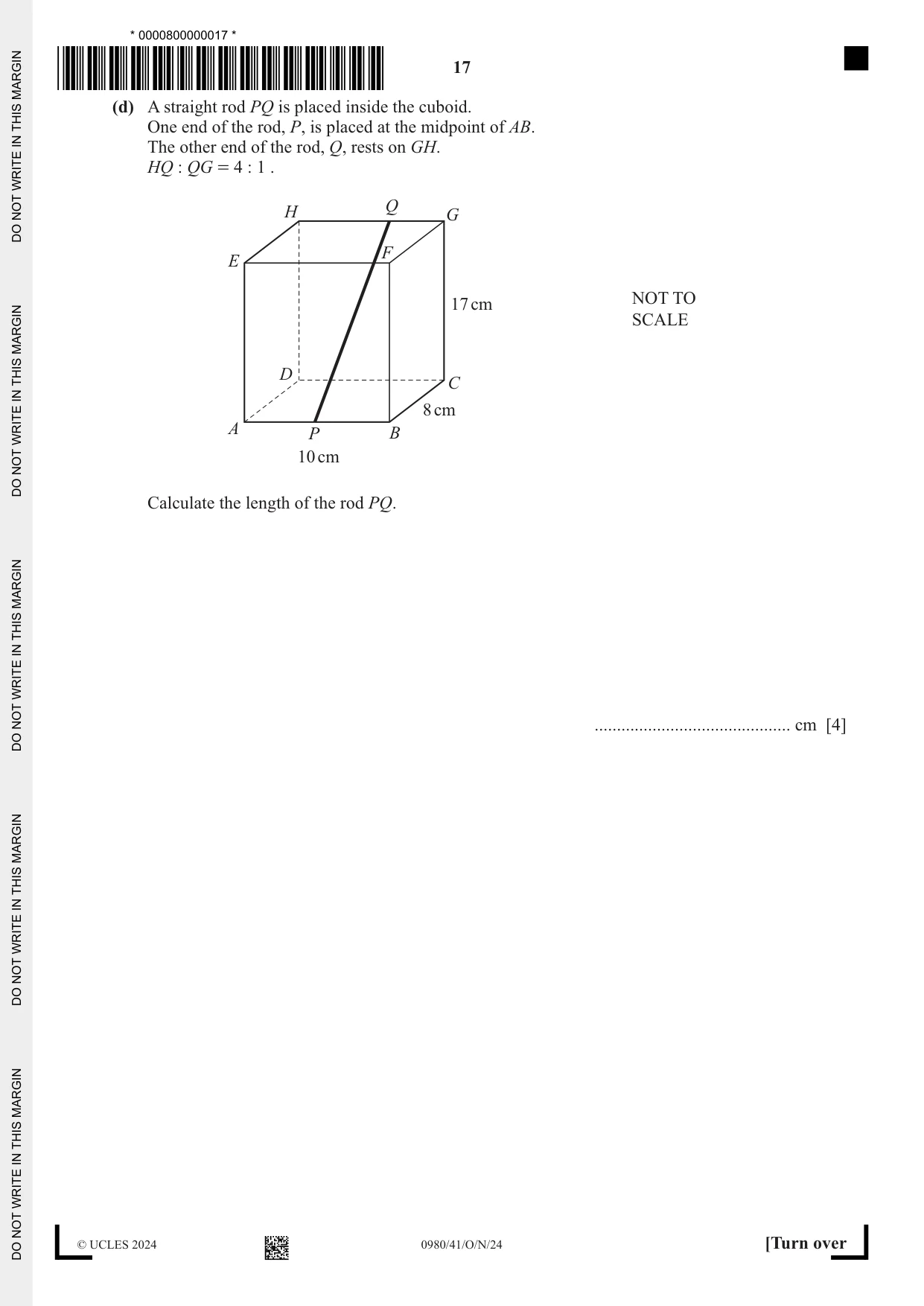
Q9 · H G F E NOT TO 17 cm SCALE D C 8 cm A 10 cm B ABCDEFGH is a solid cuboid
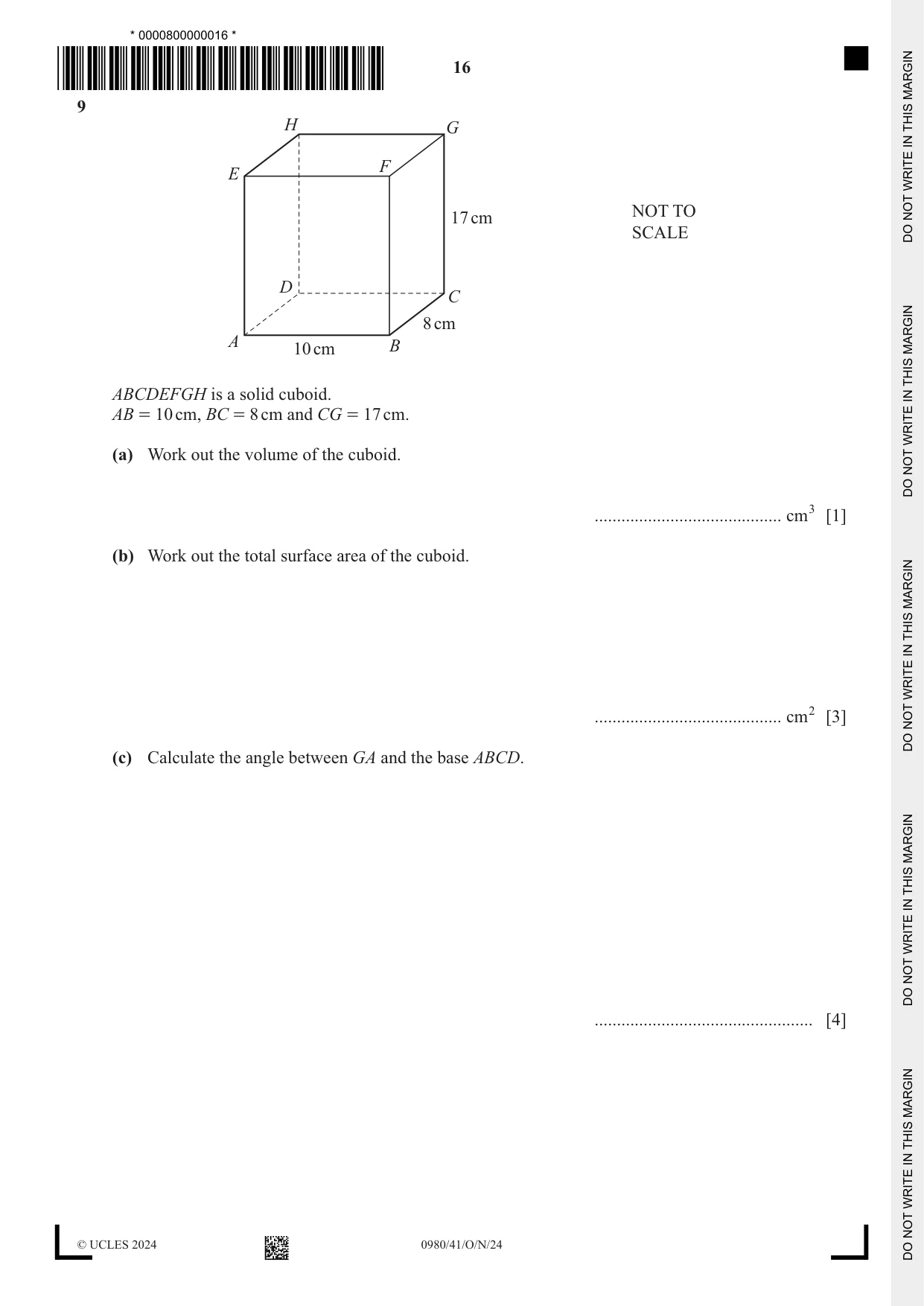
9 H G F E NOT TO 17 cm SCALE D C 8 cm A 10 cm B ABCDEFGH is a solid cuboid. AB = 10 cm, BC = 8 cm and CG = 17 cm. (a) Work out the volume of the cuboid. .......................................... cm3 [1] (b) Work out the total surface area of the cuboid. .......................................... cm2 [3] (c) Calculate the angle between GA and the base ABCD. ................................................. [4] (d) A straight rod PQ is placed inside the cuboid. One end of the rod, P, is placed at the midpoint of AB. The other end of the rod, Q, rests on GH. HQ : QG = 4 : 1 . Q H G F E NOT TO 17 cm SCALE D C 8 cm A P B 10 cm Calculate the length of the rod PQ. ............................................ cm [4]
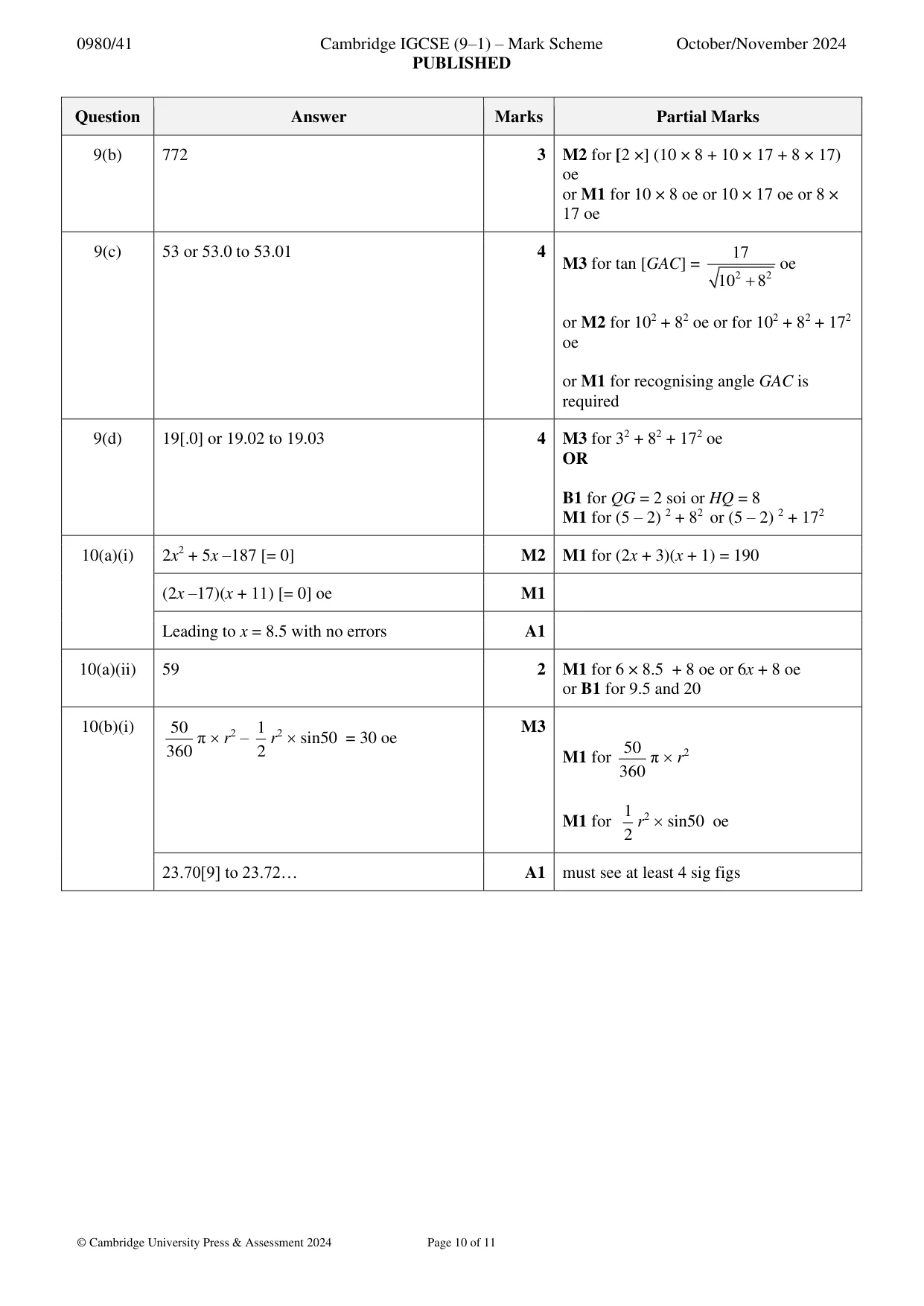
Mark scheme: 9(a) 1360 1 9(b) 772 3 M2 for [2 ×] (10 × 8 + 10 × 17 + 8 × 17) oe or M1 for 10 × 8 oe or 10 × 17 oe or 8 × 17 oe 9(c) 53 or 53.0 to 53.01 4 17 M3 for tan [GAC] = oe 10 2 + 8 2 or M2 for 102 + 82 oe or for 102 + 82 + 172 oe or M1 for recognising angle GAC is required 9(d) 19[.0] or 19.02 to 19.03 4 M3 for 32 + 82 + 172 oe OR B1 for QG = 2 soi or HQ = 8 M1 for (5 – 2) 2 + 82 or (5 – 2) 2 + 172
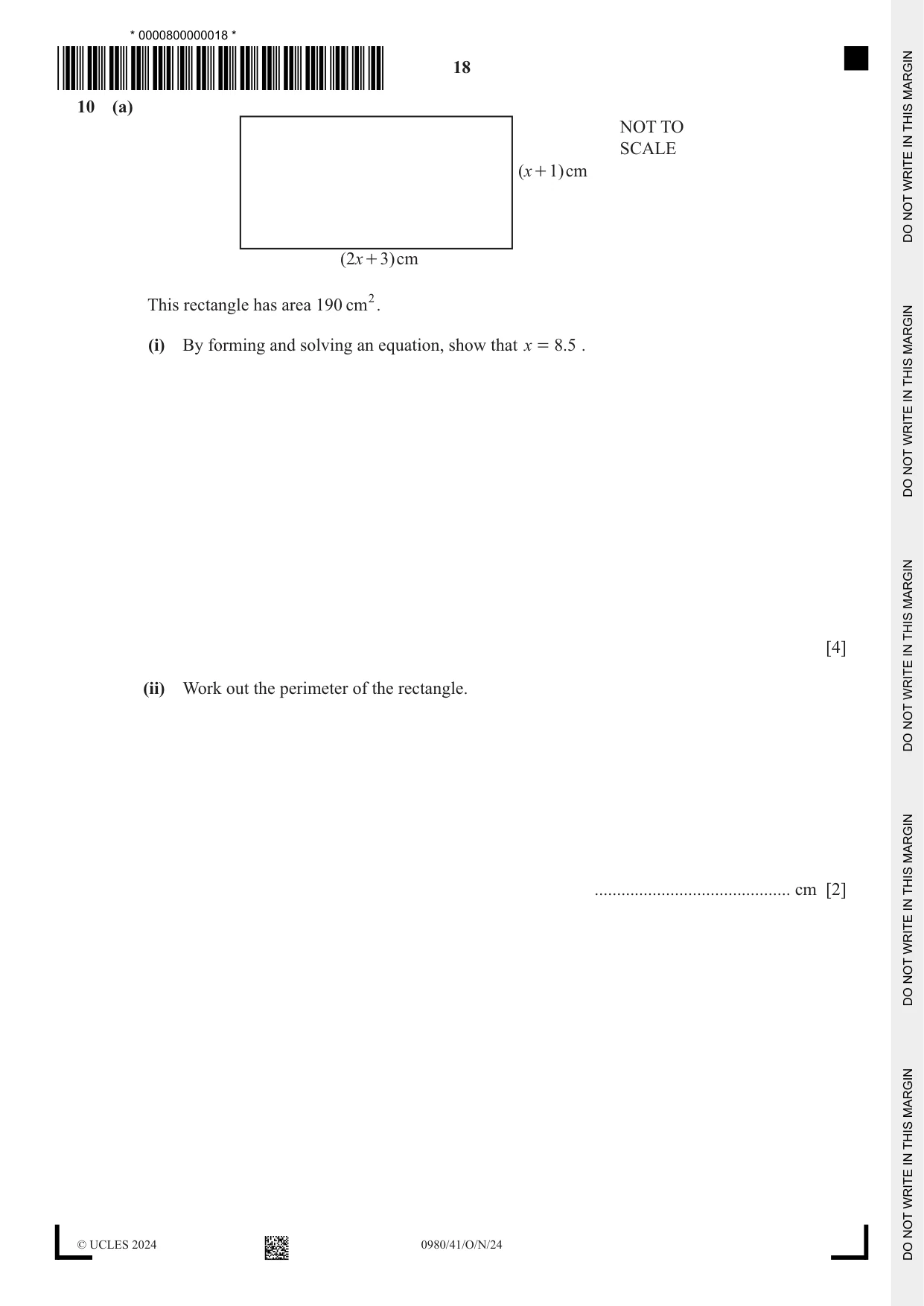
Q10 · NOT TO SCALE ( x + 1)cm ( 2x + 3)cm This rectangle has area 190 cm2
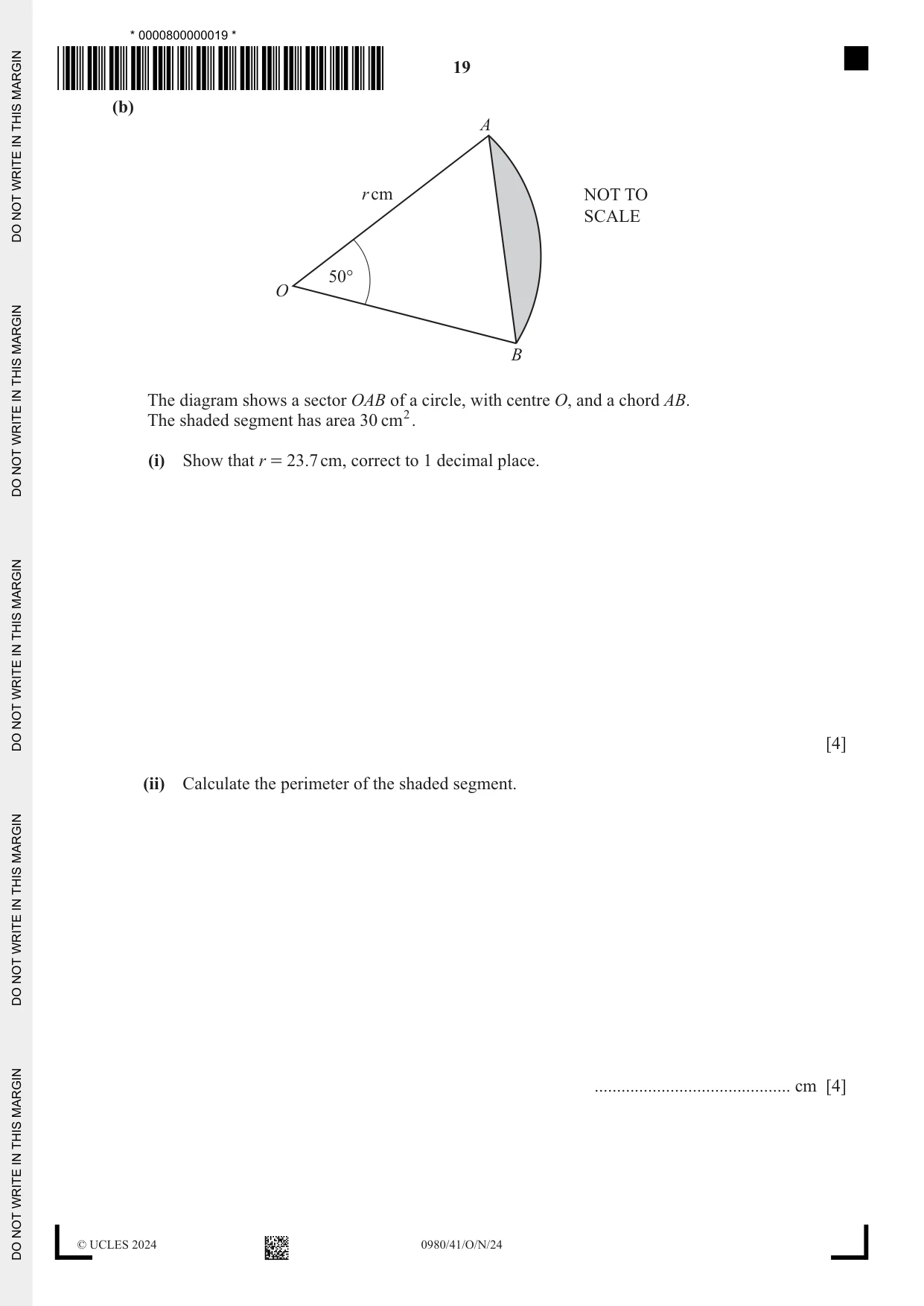
10 (a) NOT TO SCALE ( x + 1)cm ( 2x + 3)cm This rectangle has area 190 cm2. (i) By forming and solving an equation, show that x = 8.5 . [4] (ii) Work out the perimeter of the rectangle. ............................................ cm [2] (b) A r cm NOT TO SCALE 50° O B The diagram shows a sector OAB of a circle, with centre O, and a chord AB. The shaded segment has area 30 cm2. (i) Show that r = 23.7 cm, correct to 1 decimal place. [4] (ii) Calculate the perimeter of the shaded segment. ............................................ cm [4]
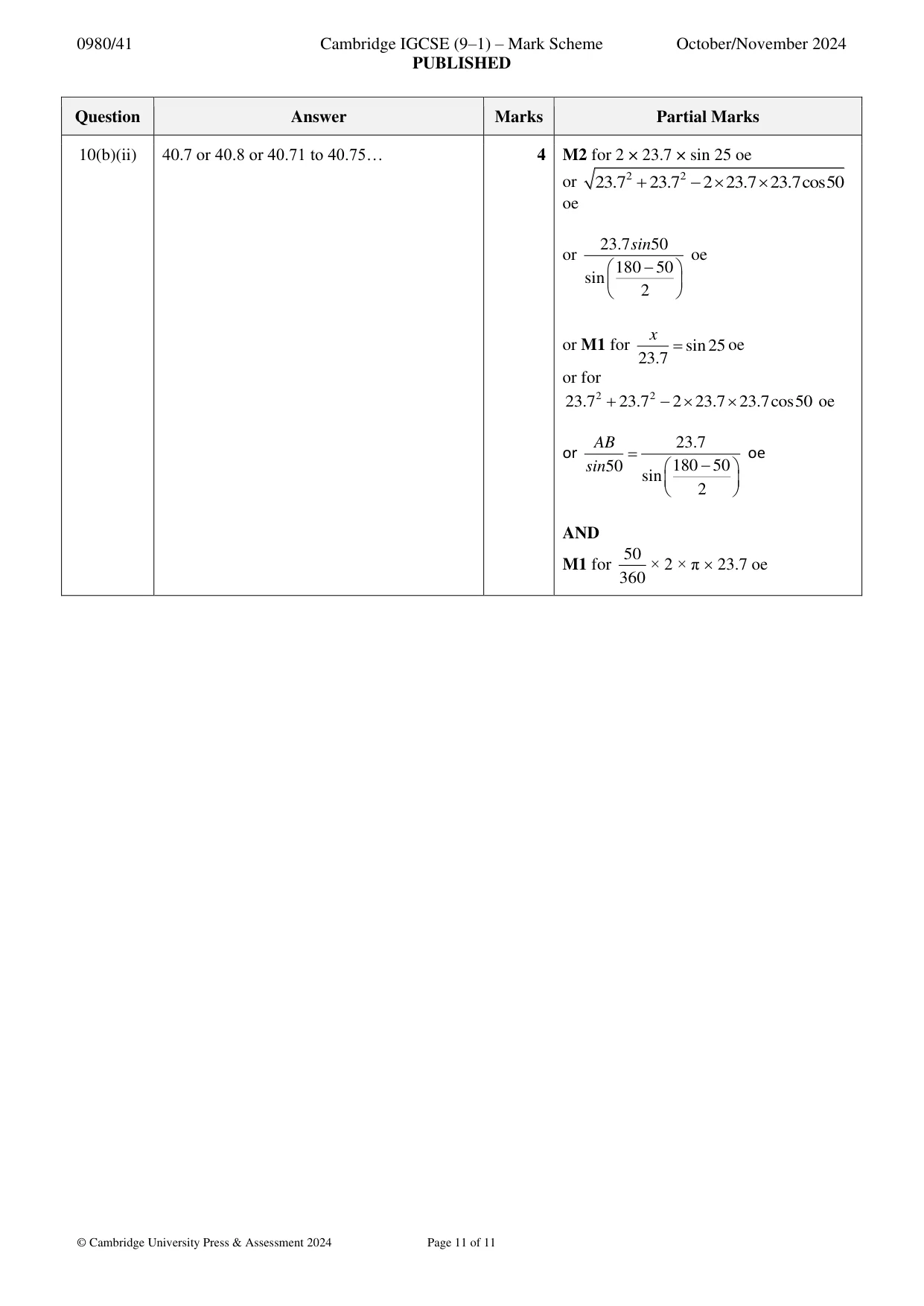
Mark scheme: 10(a)(i) 2x2 + 5x –187 [= 0] M2 M1 for (2x + 3)(x + 1) = 190 (2x –17)(x + 11) [= 0] oe M1 Leading to x = 8.5 with no errors A1 10(a)(ii) 59 2 M1 for 6 × 8.5 + 8 oe or 6x + 8 oe or B1 for 9.5 and 20 10(b)(i) 50 1 M3 π r2 – r2 sin50 = 30 oe 360 2 50 M1 for π r2 360 1 M1 for r2 sin50 oe 2 23.70[9] to 23.72… A1 must see at least 4 sig figs 10(b)(ii) 40.7 or 40.8 or 40.71 to 40.75… 4 M2 for 2 × 23.7 × sin 25 oe or 23.72 + 23.72 −2 23.7 23.7cos50 oe 23.7 sin 50 or oe 180 − 50 sin 2 x or M1 for = sin25 oe 23.7 or for 23.7 2 + 23.7 2 −2 23.7 23.7cos50 oe AB 23.7 or = oe sin 50 180 − 50 sin 2 AND 50 M1 for × 2 × π 23.7 oe 360
What was in this paper
The subtopics covered by these 10 questions, and how many questions each got. Open one in a new tab to see every Cambridge question on it.
What you needed in this session
Cambridge’s own grade thresholds for 2024 Oct/Nov, Paper 4 · Variant 1. A higher threshold means an easier paper — the bar moves with how the cohort did.