Cambridge IGCSE Mathematics (9-1) 0980 — 2021 Oct/Nov Paper 4 · Variant 1
0980/41/O/N/21 · 9 questions · 130 marks · ≈146 min
The question paper and its mark scheme, free to read here and free to download. This is Cambridge’s own paper, exactly as it was sat.
Question paper20 pages
Mark scheme9 pages
Answers below. Sit the paper first if you are practising.
Questions as text
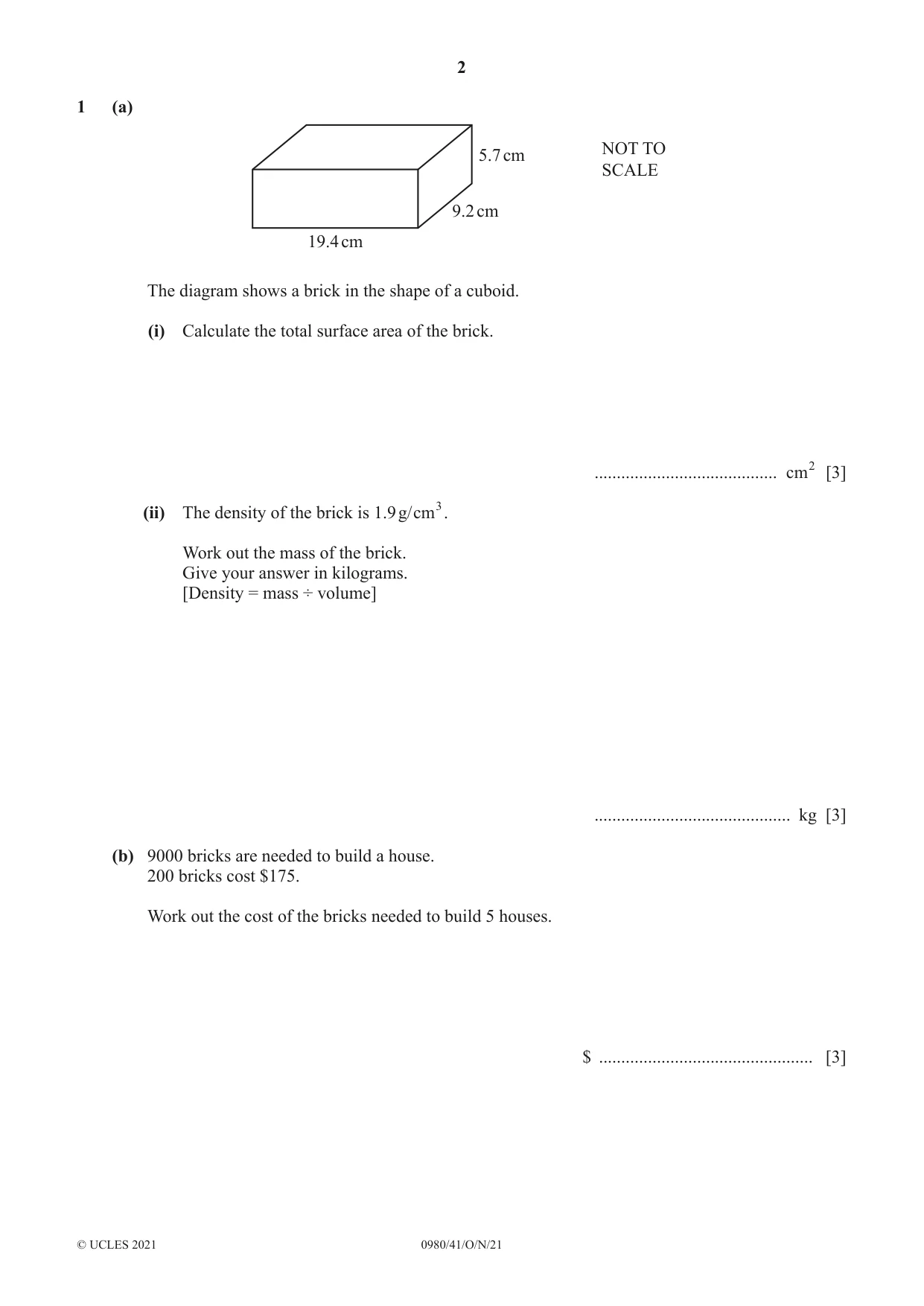
Q1 · NOT TO 5.7 cm SCALE 9.2 cm 19.4 cm The diagram shows a brick in the shape of a cuboid
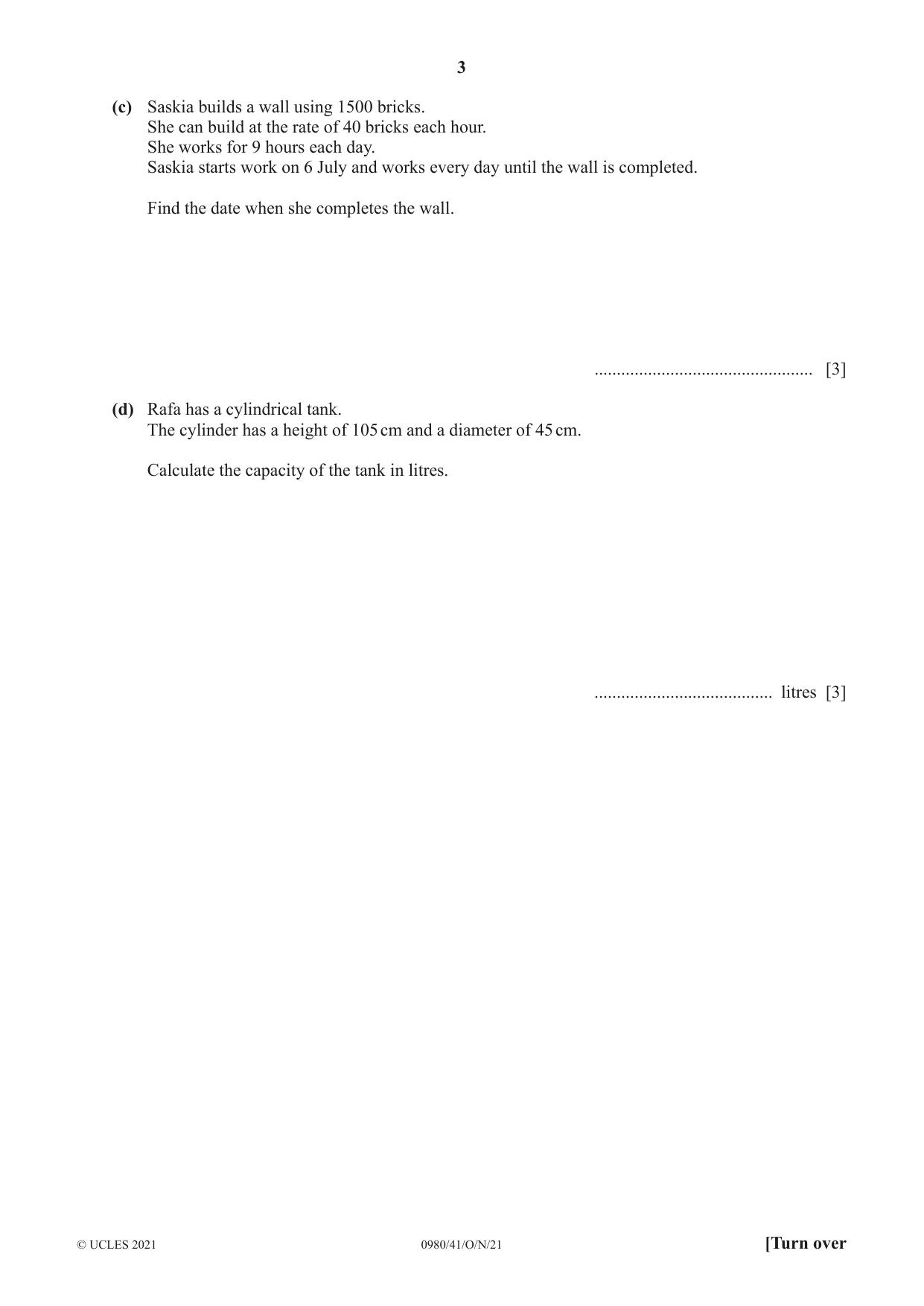
1 (a) NOT TO 5.7 cm SCALE 9.2 cm 19.4 cm The diagram shows a brick in the shape of a cuboid. (i) Calculate the total surface area of the brick. ......................................... cm2 [3] (ii) The density of the brick is 1.9 g/cm3. Work out the mass of the brick. Give your answer in kilograms. [Density = mass ÷ volume] ............................................ kg [3] (b) 9000 bricks are needed to build a house. 200 bricks cost $175. Work out the cost of the bricks needed to build 5 houses. $ ................................................ [3] (c) Saskia builds a wall using 1500 bricks. She can build at the rate of 40 bricks each hour. She works for 9 hours each day. Saskia starts work on 6 July and works every day until the wall is completed. Find the date when she completes the wall. ................................................. [3] (d) Rafa has a cylindrical tank. The cylinder has a height of 105 cm and a diameter of 45 cm. Calculate the capacity of the tank in litres. ........................................ litres [3]
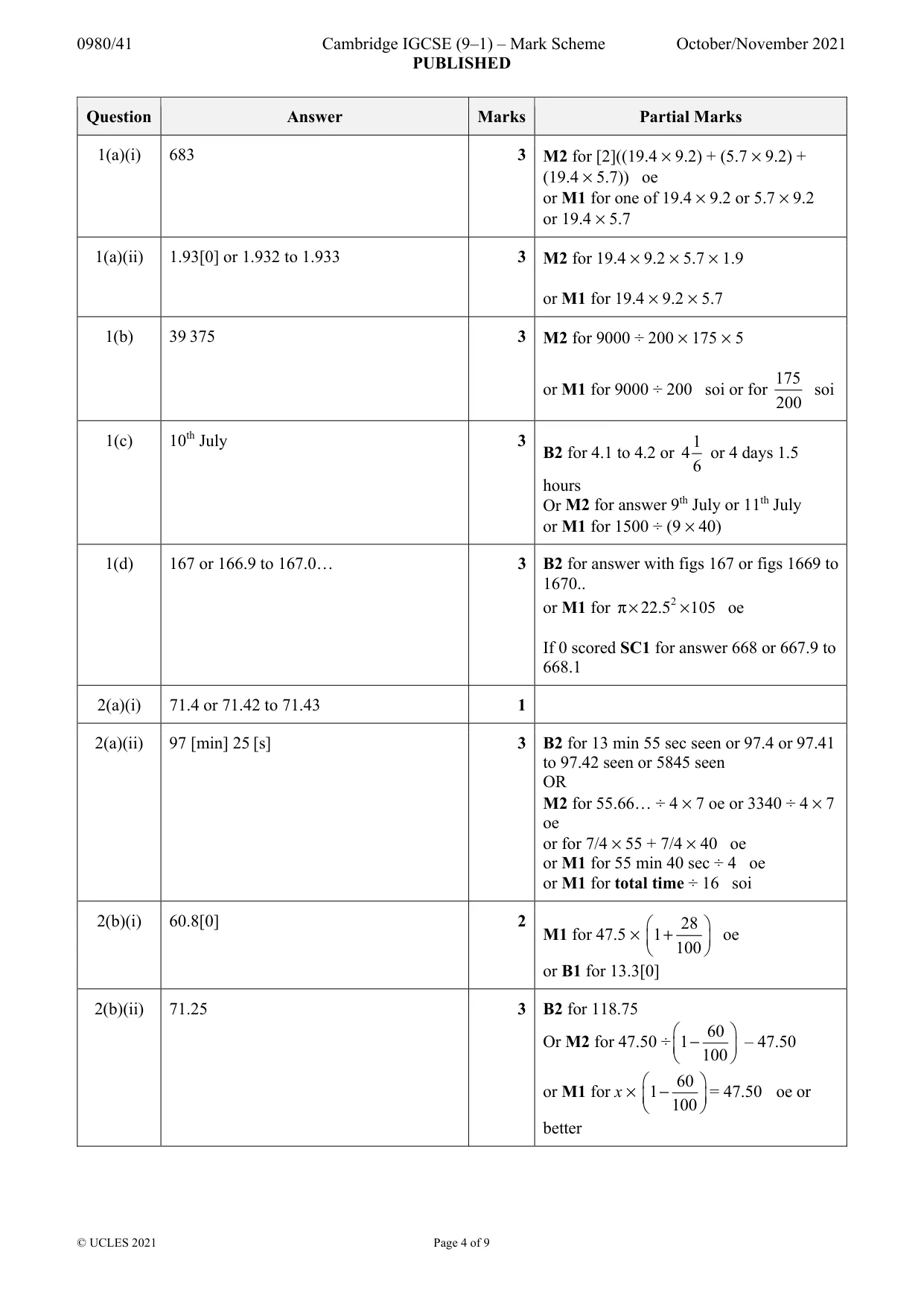
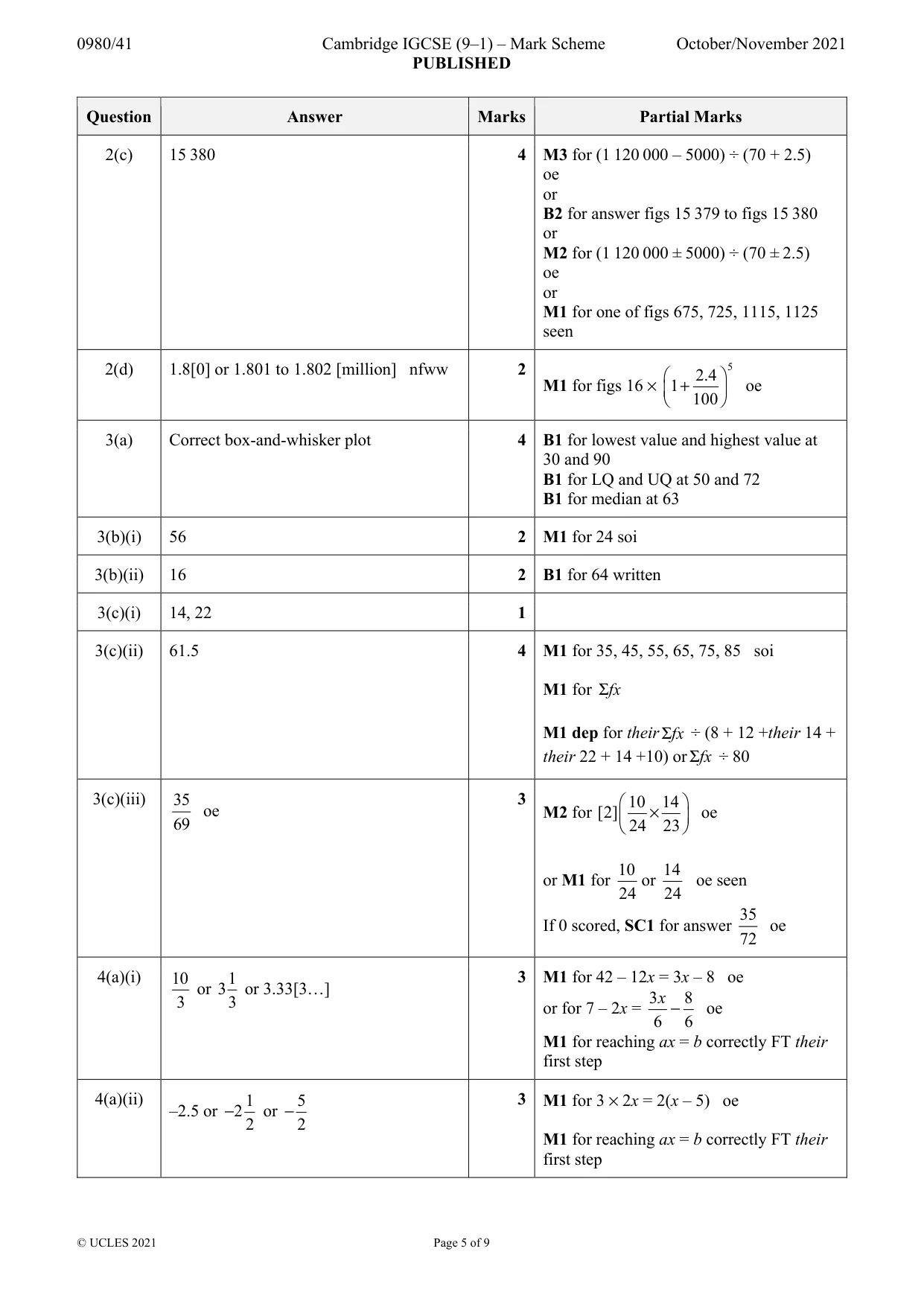
Mark scheme: Question Answer Marks Partial Marks 1(a)(i) 683 3 M2 for [2]((19.4 × 9.2) + (5.7 × 9.2) + (19.4 × 5.7)) oe or M1 for one of 19.4 × 9.2 or 5.7 × 9.2 or 19.4 × 5.7 1(a)(ii) 1.93[0] or 1.932 to 1.933 3 M2 for 19.4 × 9.2 × 5.7 × 1.9 or M1 for 19.4 × 9.2 × 5.7 1(b) 39 375 3 M2 for 9000 ÷ 200 × 175 × 5 175 or M1 for 9000 ÷ 200 soi or for soi 200 1(c) 10th July 3 1 B2 for 4.1 to 4.2 or 4 or 4 days 1.5 6 hours Or M2 for answer 9th July or 11th July or M1 for 1500 ÷ (9 × 40) 1(d) 167 or 166.9 to 167.0… 3 B2 for answer with figs 167 or figs 1669 to 1670.. or M1 for π× 22.5 2 × 10⁵ oe If 0 scored SC1 for answer 668 or 667.9 to 668.1
Q2 · Bob, Chao and Mei take part in a run for charity
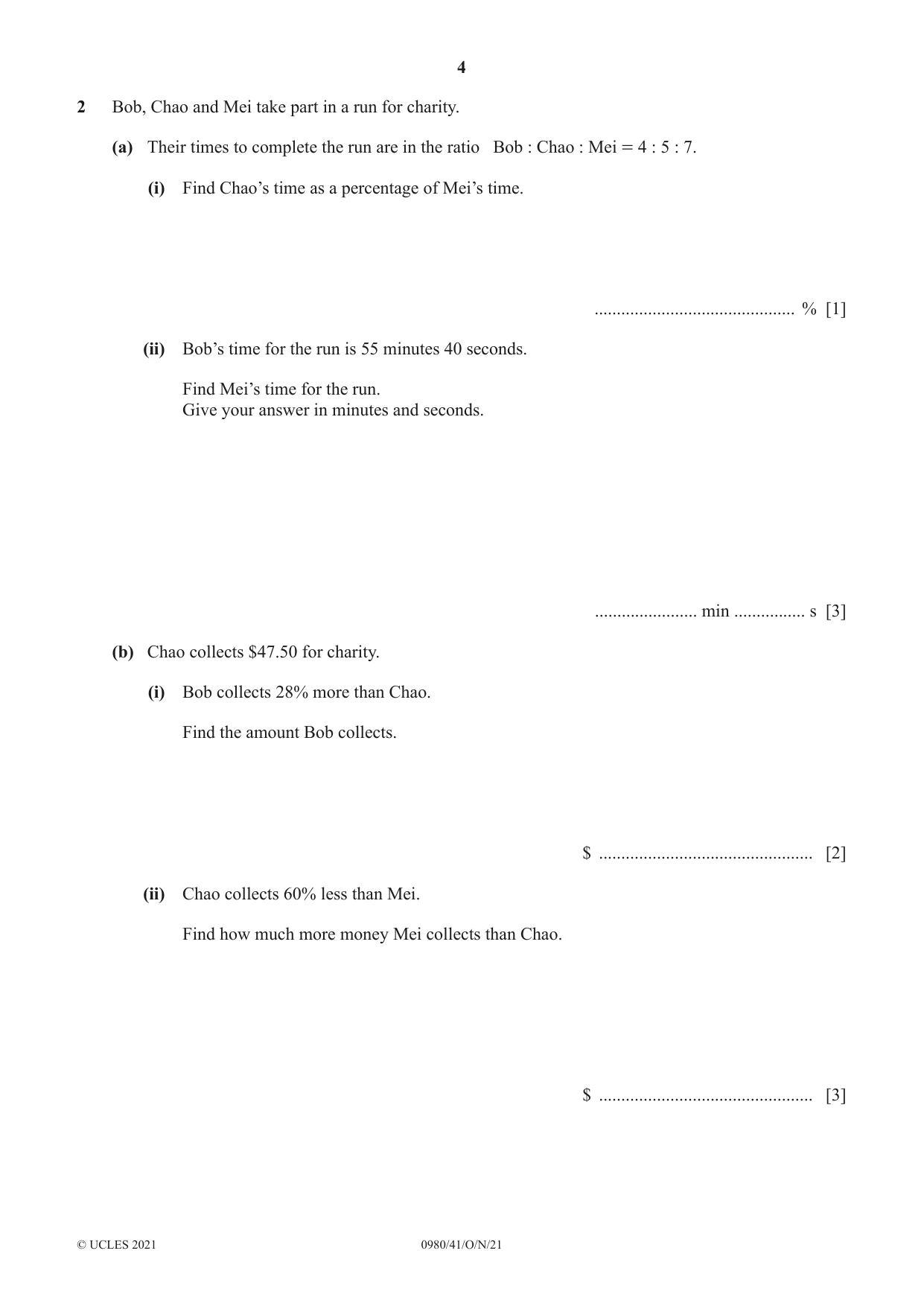
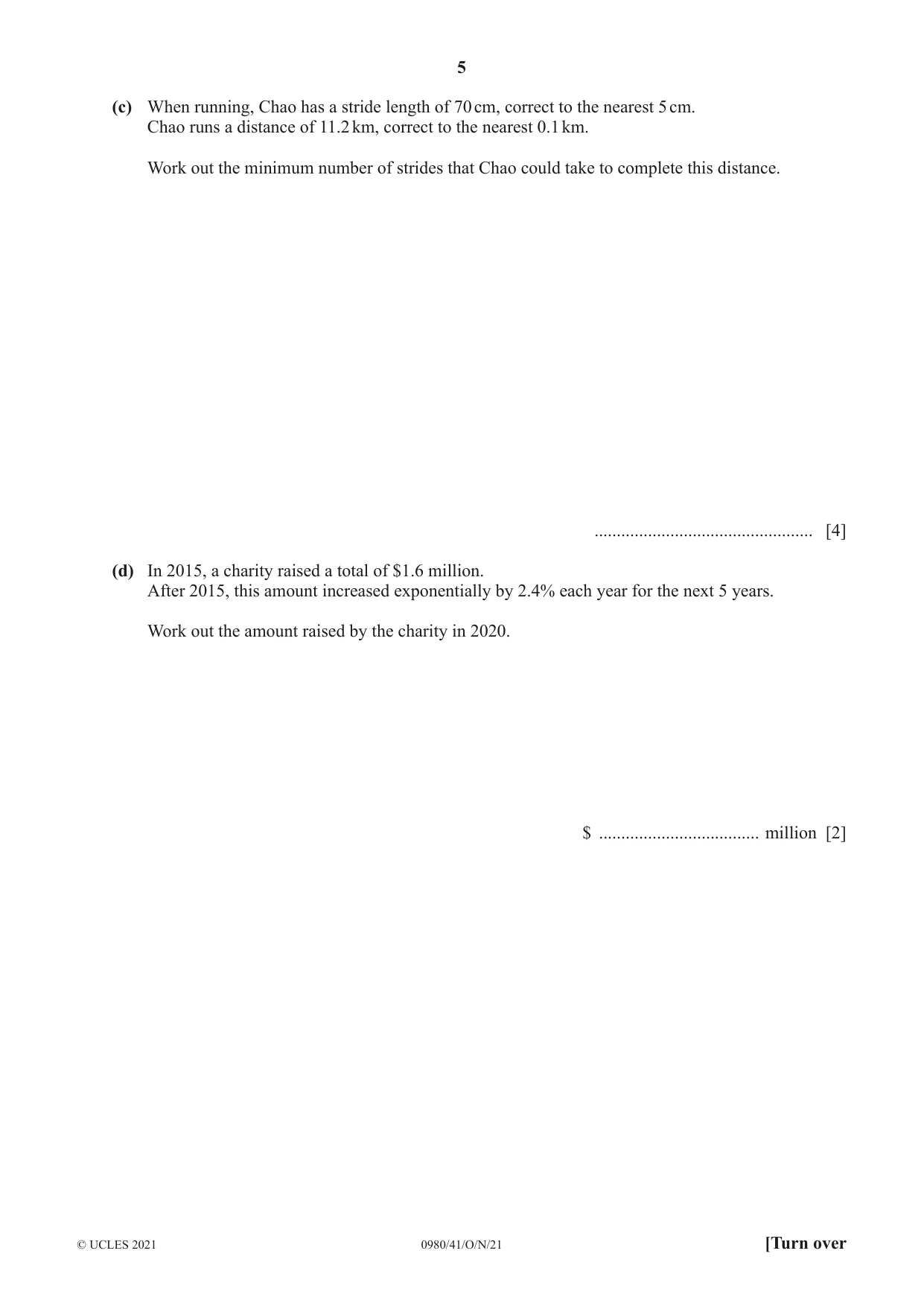
2 Bob, Chao and Mei take part in a run for charity. (a) Their times to complete the run are in the ratio Bob : Chao : Mei = 4 : 5 : 7. (i) Find Chao’s time as a percentage of Mei’s time. ............................................. % [1] (ii) Bob’s time for the run is 55 minutes 40 seconds. Find Mei’s time for the run. Give your answer in minutes and seconds. ....................... min ................ s [3] (b) Chao collects $47.50 for charity. (i) Bob collects 28% more than Chao. Find the amount Bob collects. $ ................................................ [2] (ii) Chao collects 60% less than Mei. Find how much more money Mei collects than Chao. $ ................................................ [3] (c) When running, Chao has a stride length of 70 cm, correct to the nearest 5 cm. Chao runs a distance of 11.2 km, correct to the nearest 0.1 km. Work out the minimum number of strides that Chao could take to complete this distance. ................................................. [4] (d) In 2015, a charity raised a total of $1.6 million. After 2015, this amount increased exponentially by 2.4% each year for the next 5 years. Work out the amount raised by the charity in 2020. $ .................................... million [2]
Mark scheme: 2(a)(i) 71.4 or 71.42 to 71.43 1 2(a)(ii) 97 [min] 25 [s] 3 B2 for 13 min 55 sec seen or 97.4 or 97.41 to 97.42 seen or 5845 seen OR M2 for 55.66… ÷ 4 × 7 oe or 3340 ÷ 4 × 7 oe or for 7/4 × 55 + 7/4 × 40 oe or M1 for 55 min 40 sec ÷ 4 oe or M1 for total time ÷ 16 soi 2(b)(i) 60.8[0] 2 28 M1 for 47.5 × 1 + oe 100 or B1 for 13.3[0] 2(b)(ii) 71.25 3 B2 for 118.75 60 Or M2 for 47.50 ÷ 1 − – 47.50 100 60 or M1 for x × 1 − = 47.50 oe or 100 better 2(c) 15 380 4 M3 for (1 120 000 – 5000) ÷ (70 + 2.5) oe or B2 for answer figs 15 379 to figs 15 380 or M2 for (1 120 000 ± 5000) ÷ (70 ± 2.5) oe or M1 for one of figs 675, 725, 1115, 1125 seen 2(d) 1.8[0] or 1.801 to 1.802 [million] nfww 2 5 2.4 M1 for figs 16 × 1 + oe 100
Q3 · The cumulative frequency diagram shows information about the mass, m kg, of each of 80…
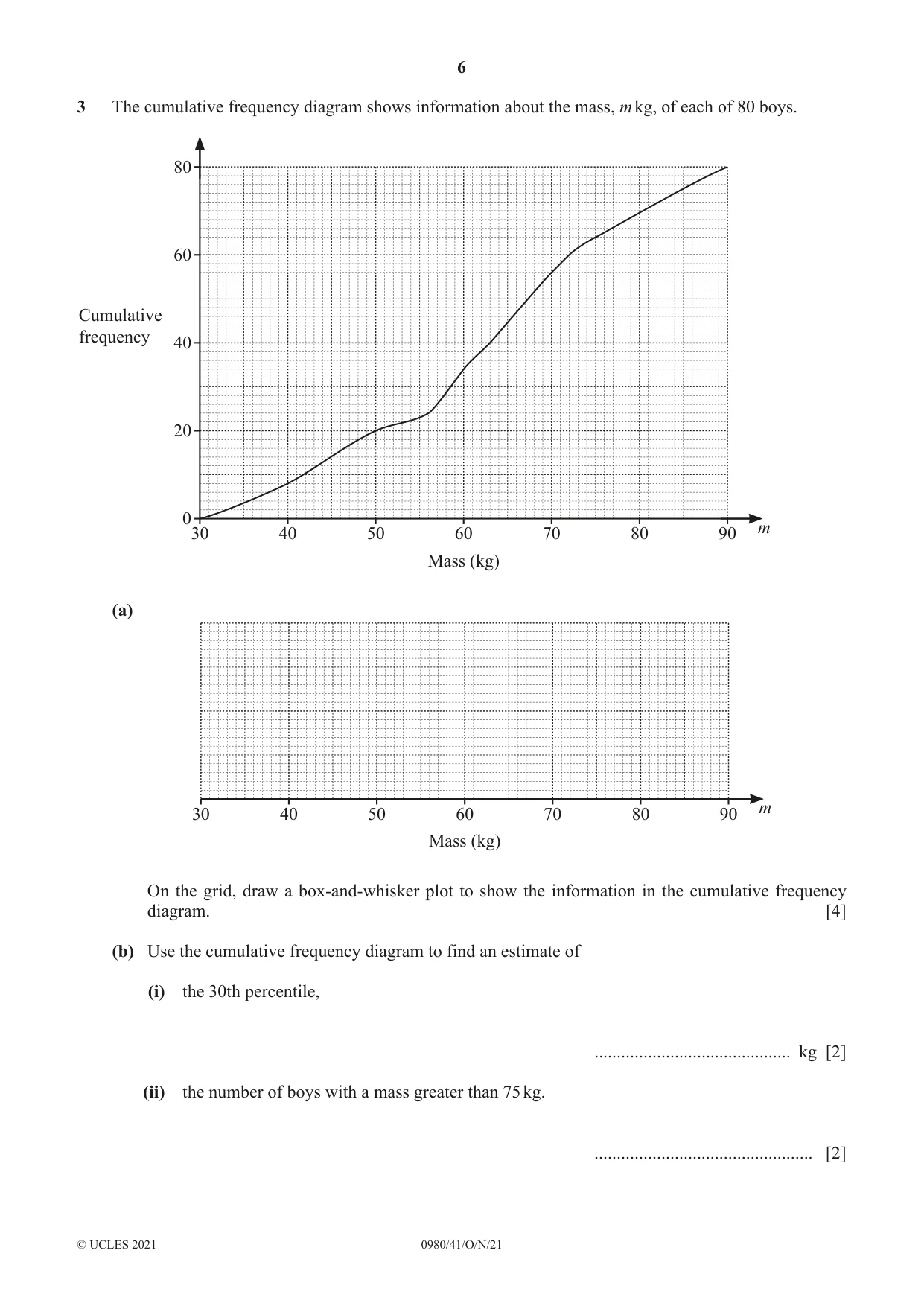
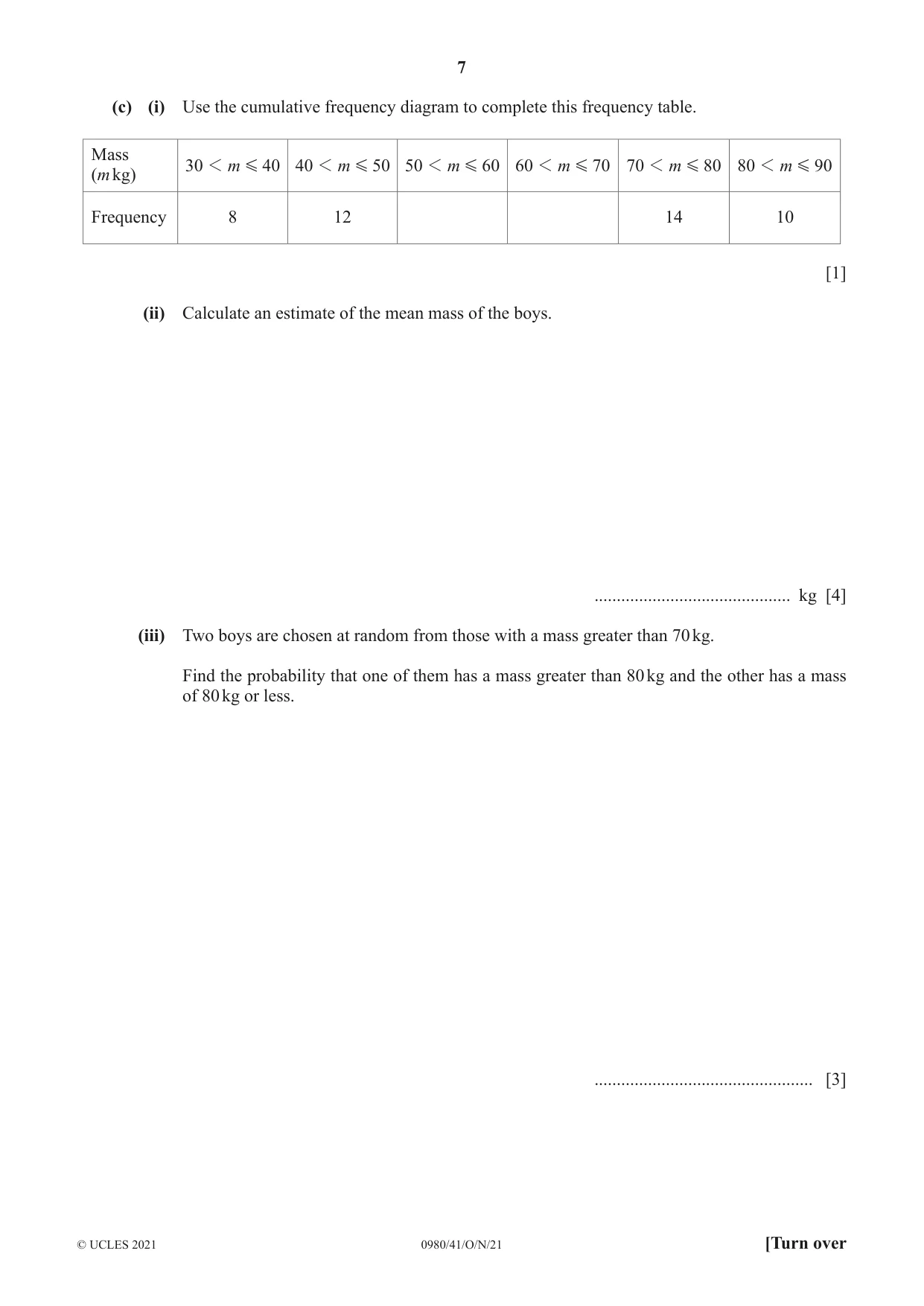
3 The cumulative frequency diagram shows information about the mass, m kg, of each of 80 boys. 80 60 Cumulative frequency 40 20 0 m 30 40 50 60 70 80 90 Mass (kg) (a) m 30 40 50 60 70 80 90 Mass (kg) On the grid, draw a box-and-whisker plot to show the information in the cumulative frequency diagram. [4] (b) Use the cumulative frequency diagram to find an estimate of (i) the 30th percentile, ............................................ kg [2] (ii) the number of boys with a mass greater than 75 kg. ................................................. [2] (c) (i) Use the cumulative frequency diagram to complete this frequency table. Mass 30 1 m G 40 40 1 m G 50 50 1 m G 60 60 1 m G 70 70 1 m G 80 80 1 m G 90(m kg) Frequency 8 12 14 10 [1] (ii) Calculate an estimate of the mean mass of the boys. ............................................ kg [4] (iii) Two boys are chosen at random from those with a mass greater than 70 kg. Find the probability that one of them has a mass greater than 80 kg and the other has a mass of 80 kg or less. ................................................. [3]
Mark scheme: 3(a) Correct box-and-whisker plot 4 B1 for lowest value and highest value at 30 and 90 B1 for LQ and UQ at 50 and 72 B1 for median at 63 3(b)(i) 56 2 M1 for 24 soi 3(b)(ii) 16 2 B1 for 64 written 3(c)(i) 14, 22 1 3(c)(ii) 61.5 4 M1 for 35, 45, 55, 65, 75, 85 soi M1 for Σ fx M1 dep for their Σ fx ÷ (8 + 12 +their 14 + their 22 + 14 +10) or Σ fx ÷ 80 3(c)(iii) 35 3 10 14 oe M2 for [2] × oe 69 24 23 10 14 or M1 for or oe seen 24 24 35 If 0 scored, SC1 for answer oe 72
Question 4
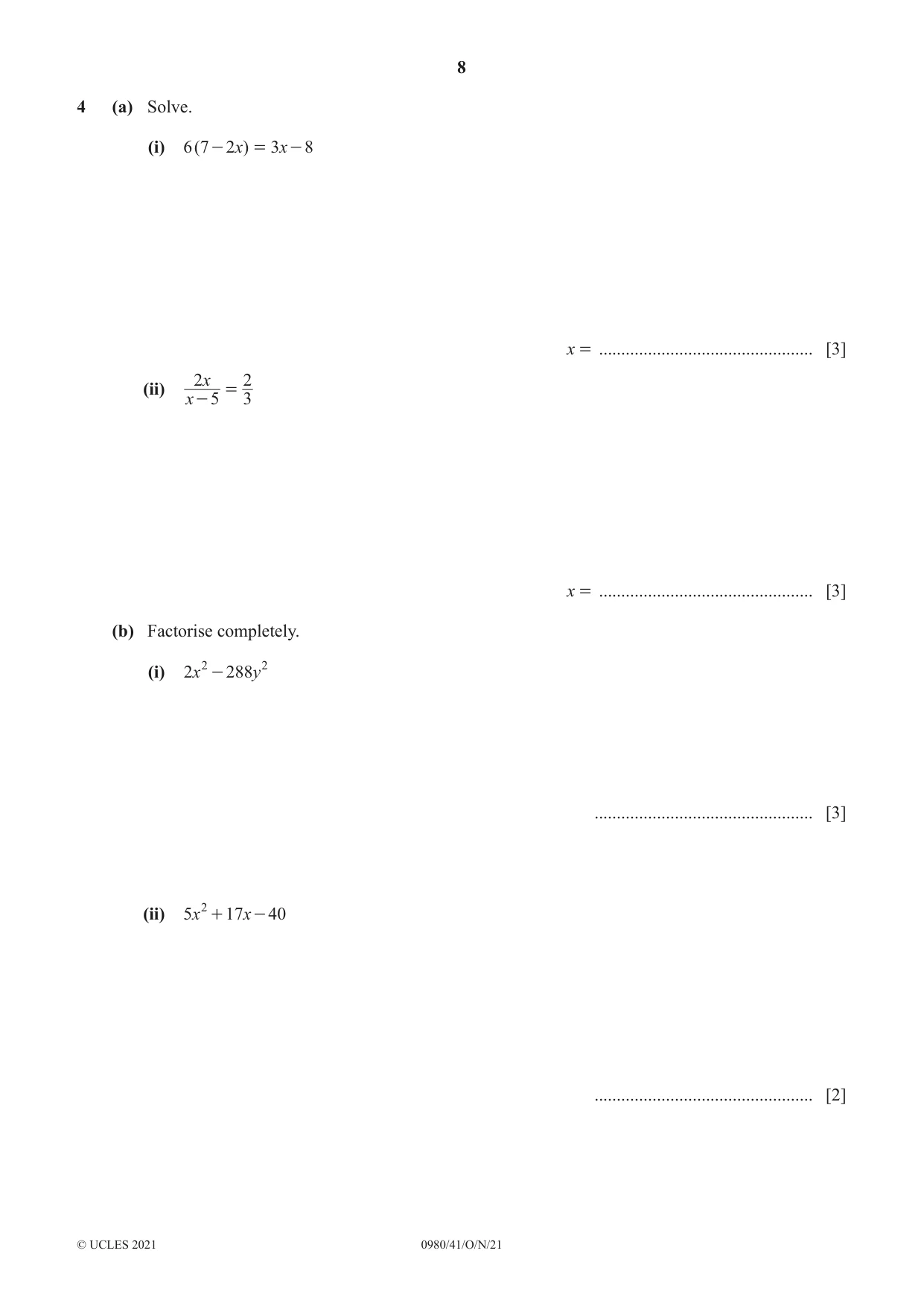
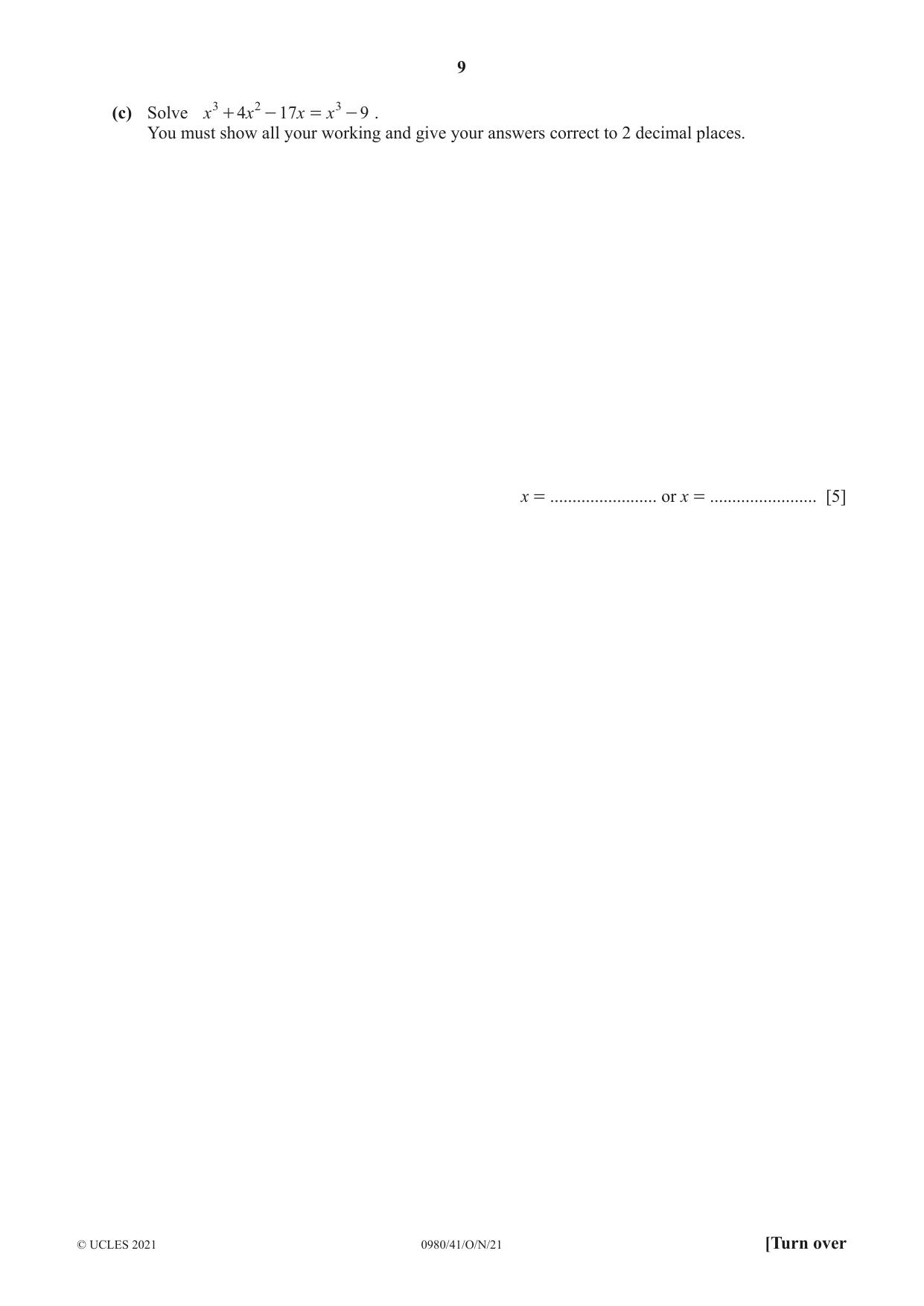
4 (a) Solve. (i) 6 ( 7 - 2)x = 3x - 8 x = ................................................ [3] 2x 2 (ii) = x - 5 3 x = ................................................ [3] (b) Factorise completely. (i) 2x 2 - 288y 2 ................................................. [3] (ii) 5x 2 + 17x - 40 ................................................. [2] (c) Solve x 3 + 4x 2 - 17x = x 3 - 9 . You must show all your working and give your answers correct to 2 decimal places. x = ........................ or x = ........................ [5]
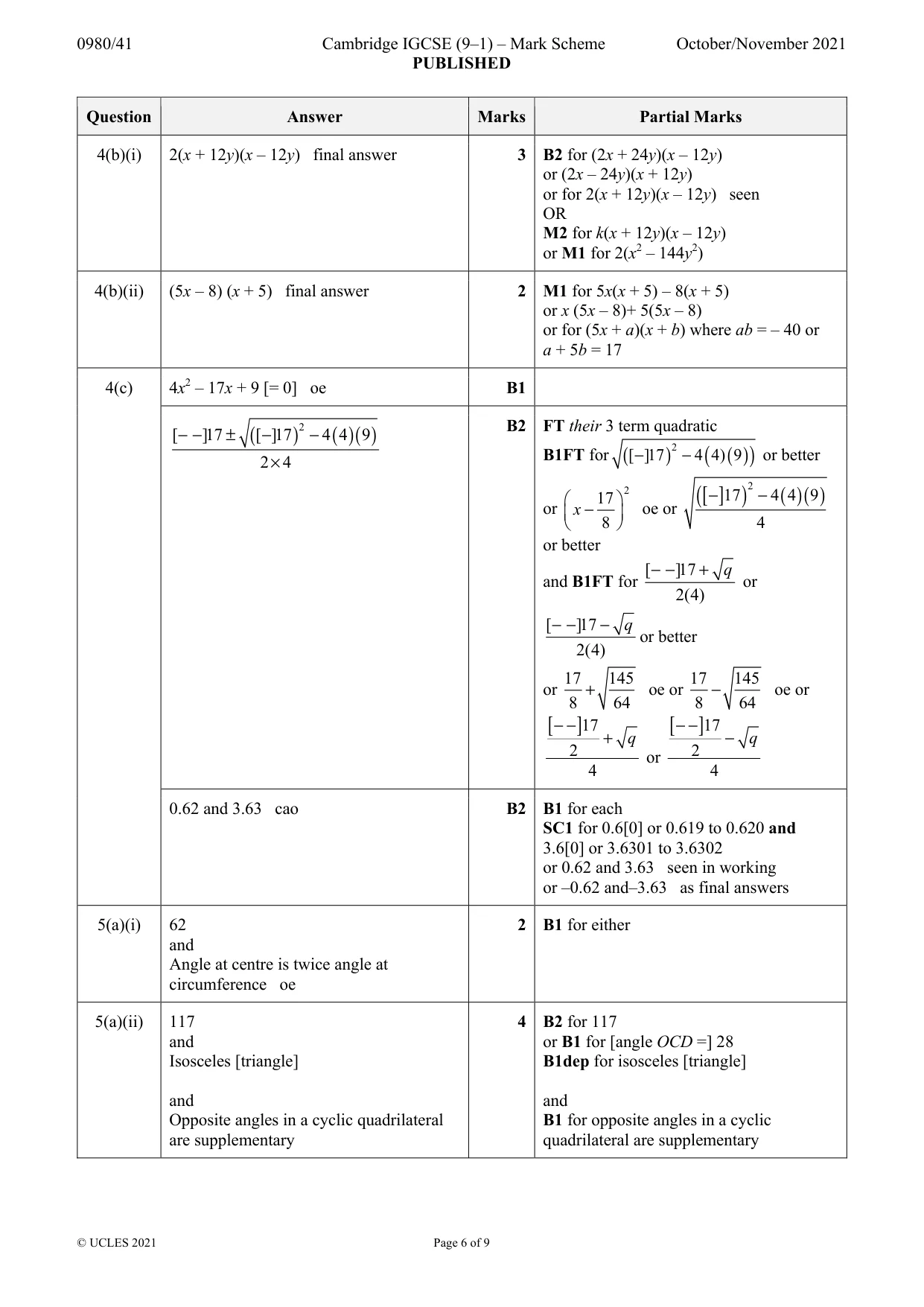
Mark scheme: 4(a)(i) 10 1 3 M1 for 42 – 12x = 3x – 8 oe or or 3.33[3…] 3 x 8 3 33 or for 7 – 2x = − oe 6 6 M1 for reaching ax = b correctly FT their first step 4(a)(ii) 1 5 3 M1 for 3 × 2x = 2(x – 5) oe –2.5 or −2 or − 2 2 M1 for reaching ax = b correctly FT their first step 4(b)(i) 2(x + 12y)(x – 12y) final answer 3 B2 for (2x + 24y)(x – 12y) or (2x – 24y)(x + 12y) or for 2(x + 12y)(x – 12y) seen OR M2 for k(x + 12y)(x – 12y) or M1 for 2(x2 – 144y2) 4(b)(ii) (5x – 8) (x + 5) final answer 2 M1 for 5x(x + 5) – 8(x + 5) or x (5x – 8)+ 5(5x – 8) or for (5x + a)(x + b) where ab = – 40 or a + 5b = 17 4(c) 4x2 – 17x + 9 [= 0] oe B1 2 B2 FT their 3 term quadratic [ −− ]17 ± ( [ − ]17 ) − 4 ( 4 )( 9 ) 2 B1FT for ( [ − ]17 ) − 4 ( 4) ( 9 ) ) or better 2 × 4 2 − ]17 ) − 4 ( 4 )( 9 ) 17 2 ( [ or x − oe or 8 4 or better [ −− ]17 + q and B1FT for or 2(4) [ −− ]17 − q or better 2(4) 17 145 17 145 or + oe or − oe or 8 64 8 64 [ −− ]17 [ −− ]17 + q − q 2 2 or 4 4 0.62 and 3.63 cao B2 B1 for each SC1 for 0.6[0] or 0.619 to 0.620 and 3.6[0] or 3.6301 to 3.6302 or 0.62 and 3.63 seen in working or –0.62 and–3.63 as final answers
Q5 · D A NOT TO SCALE O 124° B 35° C A, B, C and D are points on a circle, centre O
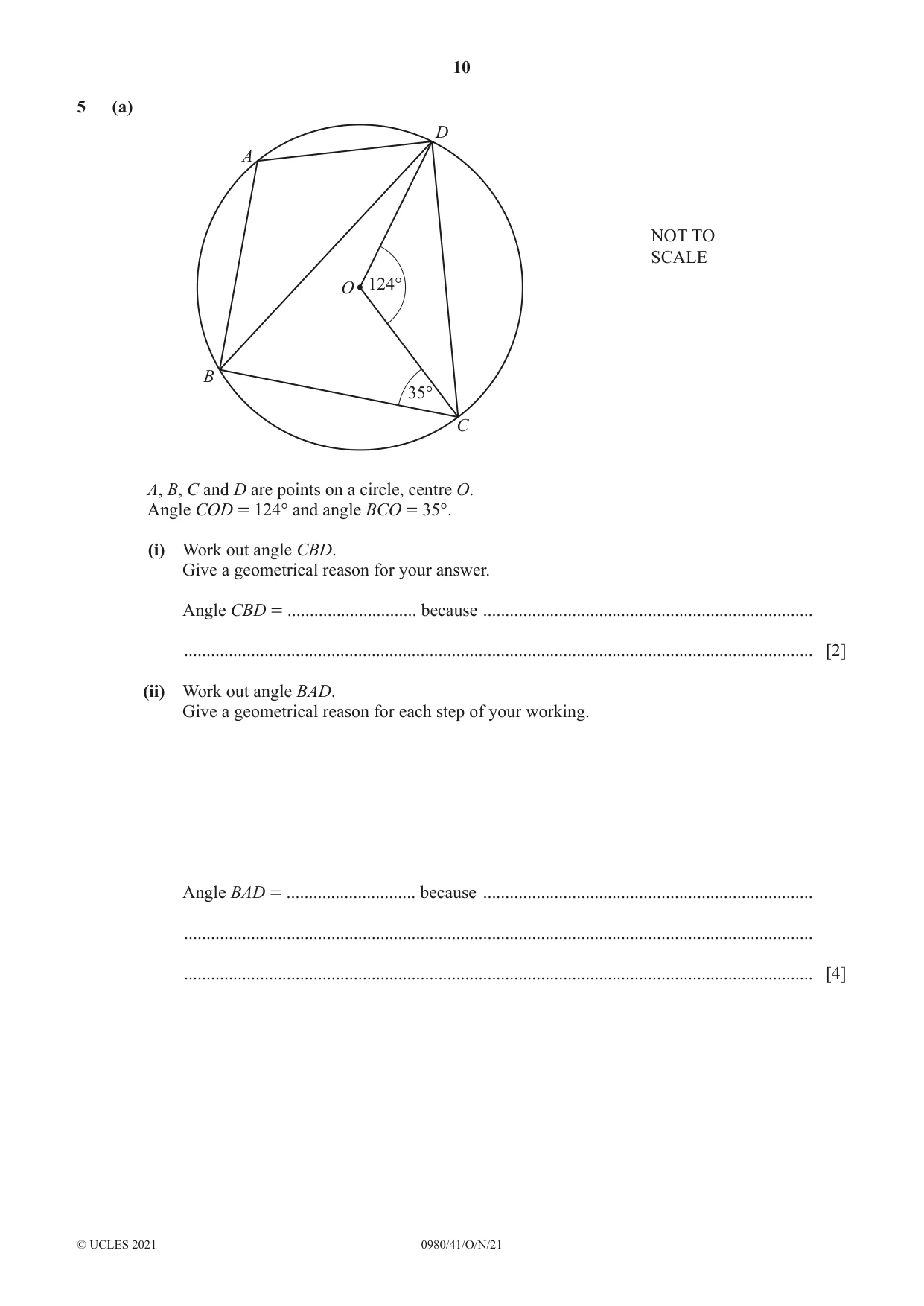
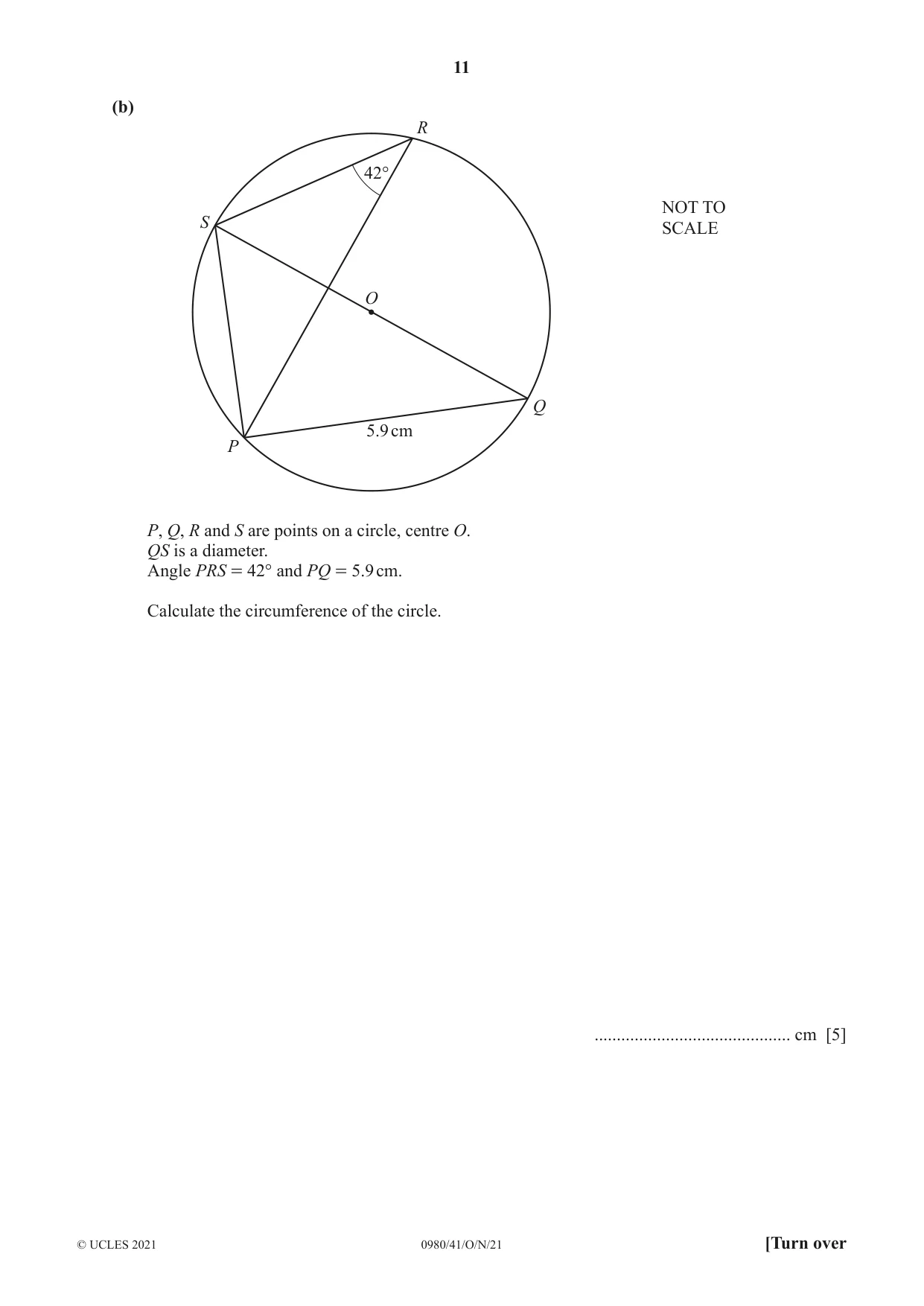
5 (a) D A NOT TO SCALE O 124° B 35° C A, B, C and D are points on a circle, centre O. Angle COD = 124° and angle BCO = 35°. (i) Work out angle CBD. Give a geometrical reason for your answer. Angle CBD = ............................. because .......................................................................... ............................................................................................................................................. [2] (ii) Work out angle BAD. Give a geometrical reason for each step of your working. Angle BAD = ............................. because .......................................................................... ............................................................................................................................................. ............................................................................................................................................. [4] (b) R 42° NOT TO S SCALE O Q 5.9 cm P P, Q, R and S are points on a circle, centre O. QS is a diameter. Angle PRS = 42° and PQ = 5.9 cm. Calculate the circumference of the circle. ............................................ cm [5]
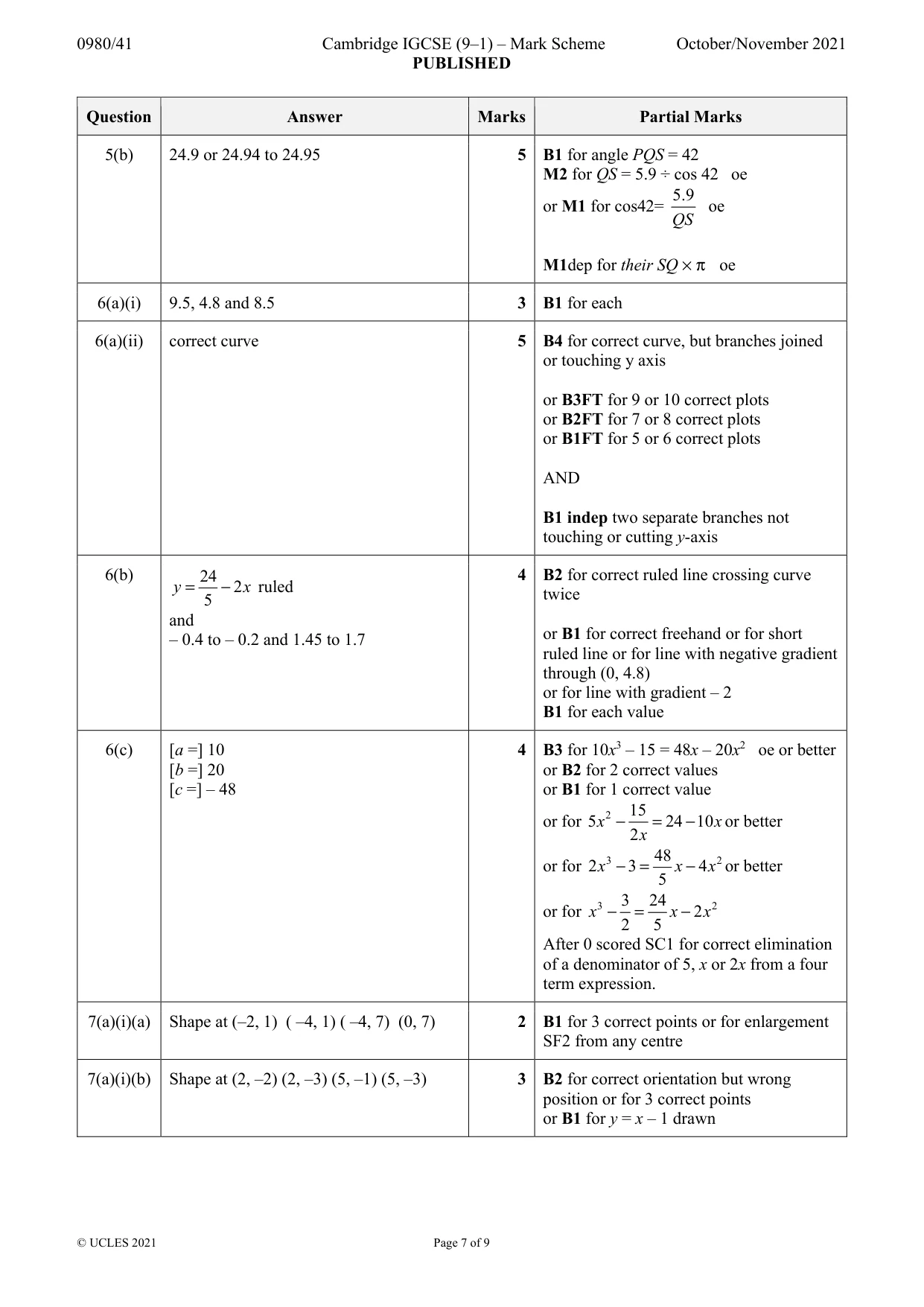
Mark scheme: 5(a)(i) 62 2 B1 for either and Angle at centre is twice angle at circumference oe 5(a)(ii) 117 4 B2 for 117 and or B1 for [angle OCD =] 28 Isosceles [triangle] B1dep for isosceles [triangle] and and Opposite angles in a cyclic quadrilateral B1 for opposite angles in a cyclic are supplementary quadrilateral are supplementary 5(b) 24.9 or 24.94 to 24.95 5 B1 for angle PQS = 42 M2 for QS = 5.9 ÷ cos 42 oe 5.9 or M1 for cos42= oe QS M1dep for their SQ × π oe
Q6 · 3 24(b) By drawing a suitable straight line on the grid, solve the equation x - = - 2x 2x…
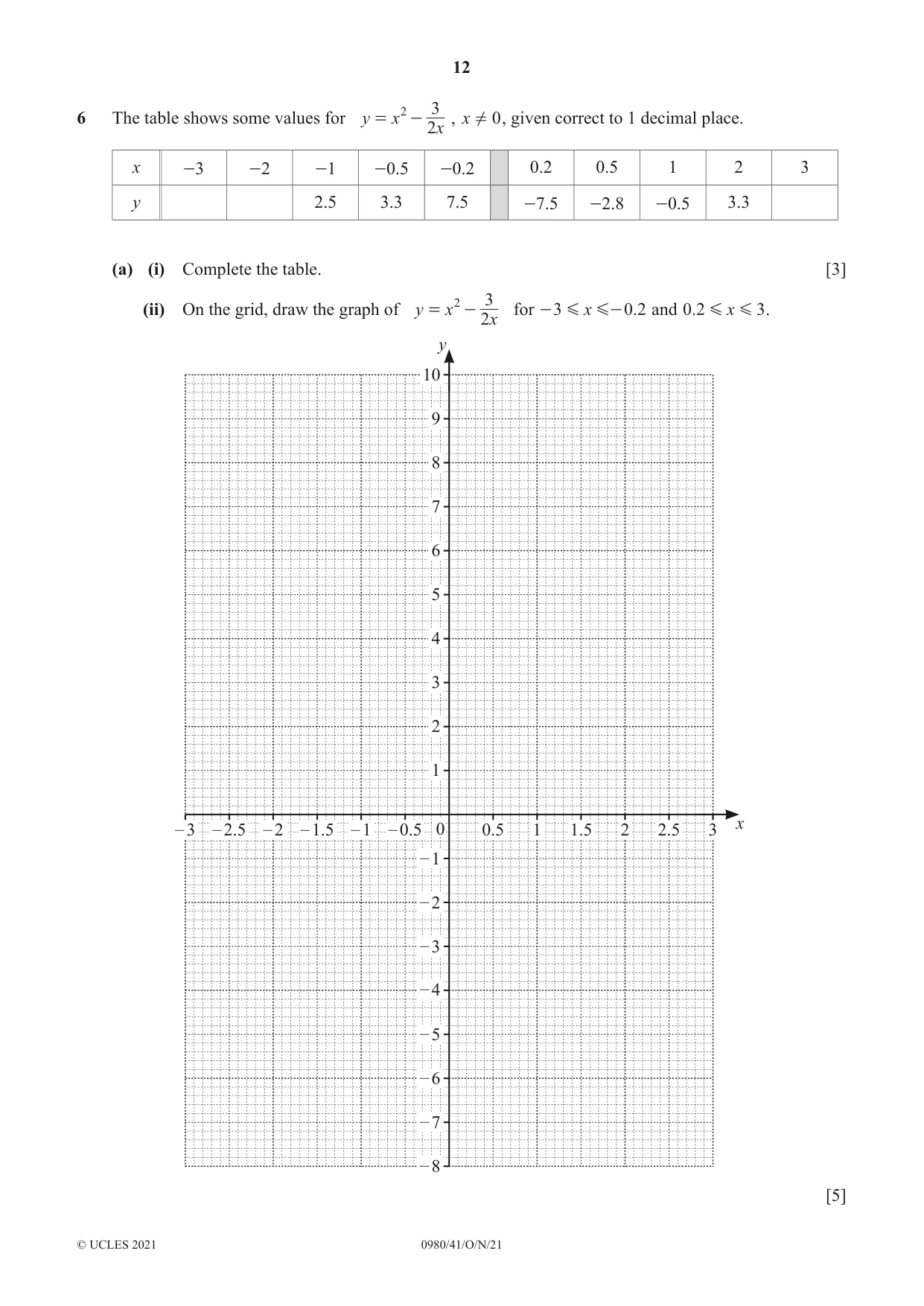
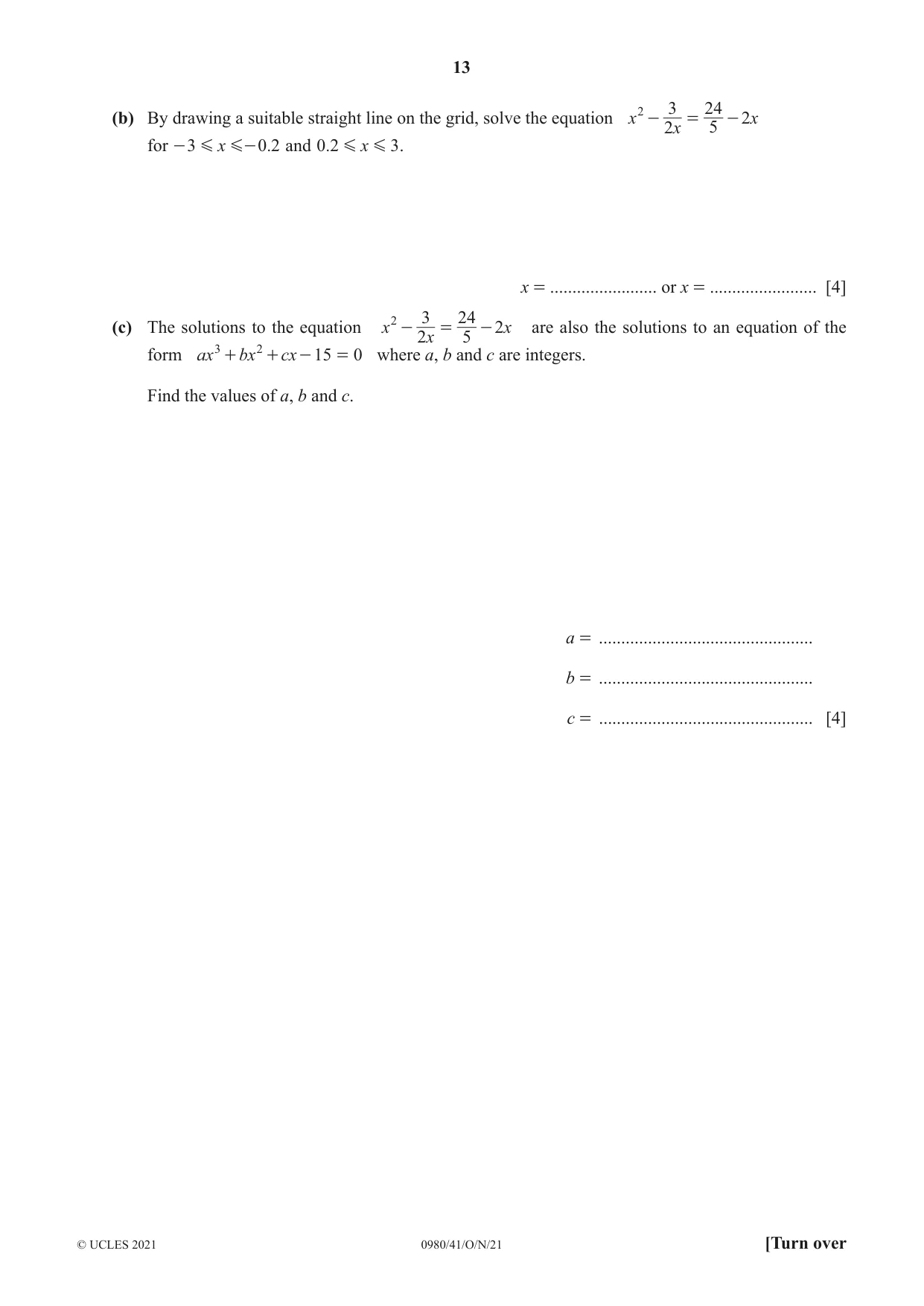
2 3 24(b) By drawing a suitable straight line on the grid, solve the equation x - = - 2x 2x 5 for - 3 G x G - 0.2 and 0.2 G x G 3 . x = ........................ or x = ........................ [4] 2 3 24(c) The solutions to the equation x - = - 2x are also the solutions to an equation of the 2x 5 form ax 3 + bx 2 + cx - 15 = 0 where a, b and c are integers. Find the values of a, b and c. a = ................................................ b = ................................................ c = ................................................ [4]
Mark scheme: 6(a)(i) 9.5, 4.8 and 8.5 3 B1 for each 6(a)(ii) correct curve 5 B4 for correct curve, but branches joined or touching y axis or B3FT for 9 or 10 correct plots or B2FT for 7 or 8 correct plots or B1FT for 5 or 6 correct plots AND B1 indep two separate branches not touching or cutting y-axis 6(b) 24 4 B2 for correct ruled line crossing curve y = − 2 x ruled twice 5 and or B1 for correct freehand or for short – 0.4 to – 0.2 and 1.45 to 1.7 ruled line or for line with negative gradient through (0, 4.8) or for line with gradient – 2 B1 for each value 6(c) [a =] 10 4 B3 for 10x3 – 15 = 48x – 20x2 oe or better [b =] 20 or B2 for 2 correct values [c =] – 48 or B1 for 1 correct value 2 15 or for 5 x − = 24 − 10 x or better 2 x 3 48 2 or for 2 x − 3 = x − 4 x or better 5 3 3 24 2 or for x − = x − 2 x 2 5 After 0 scored SC1 for correct elimination of a denominator of 5, x or 2x from a four term expression.
Q7 · Y 8 7 6 5 4 3 A 2 1 – 5 – 4 – 3 – 2 – 1 0 1 2 3 4 5 6 7 x – 1 B – 2 – 3 – 4 (i) On the…
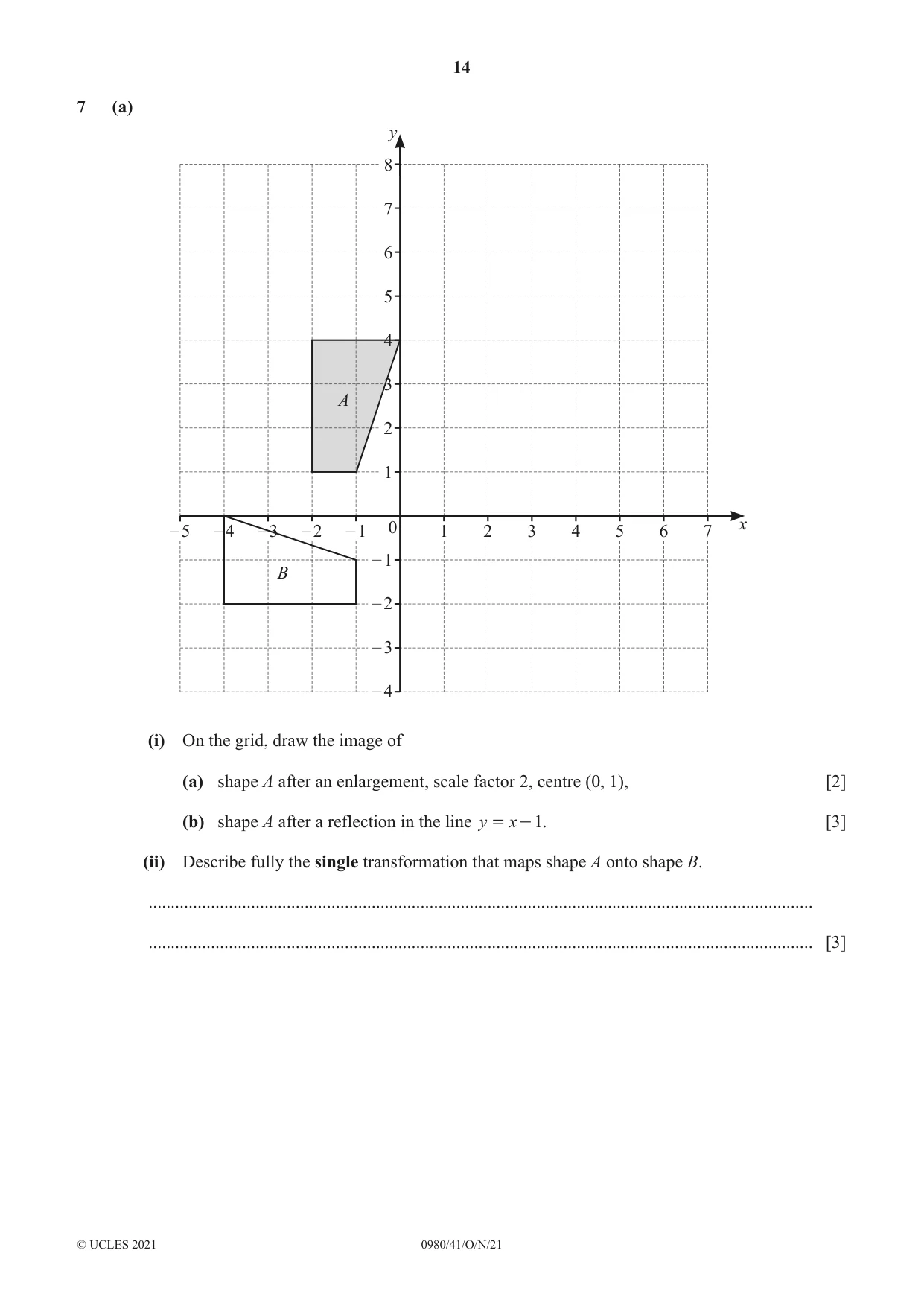
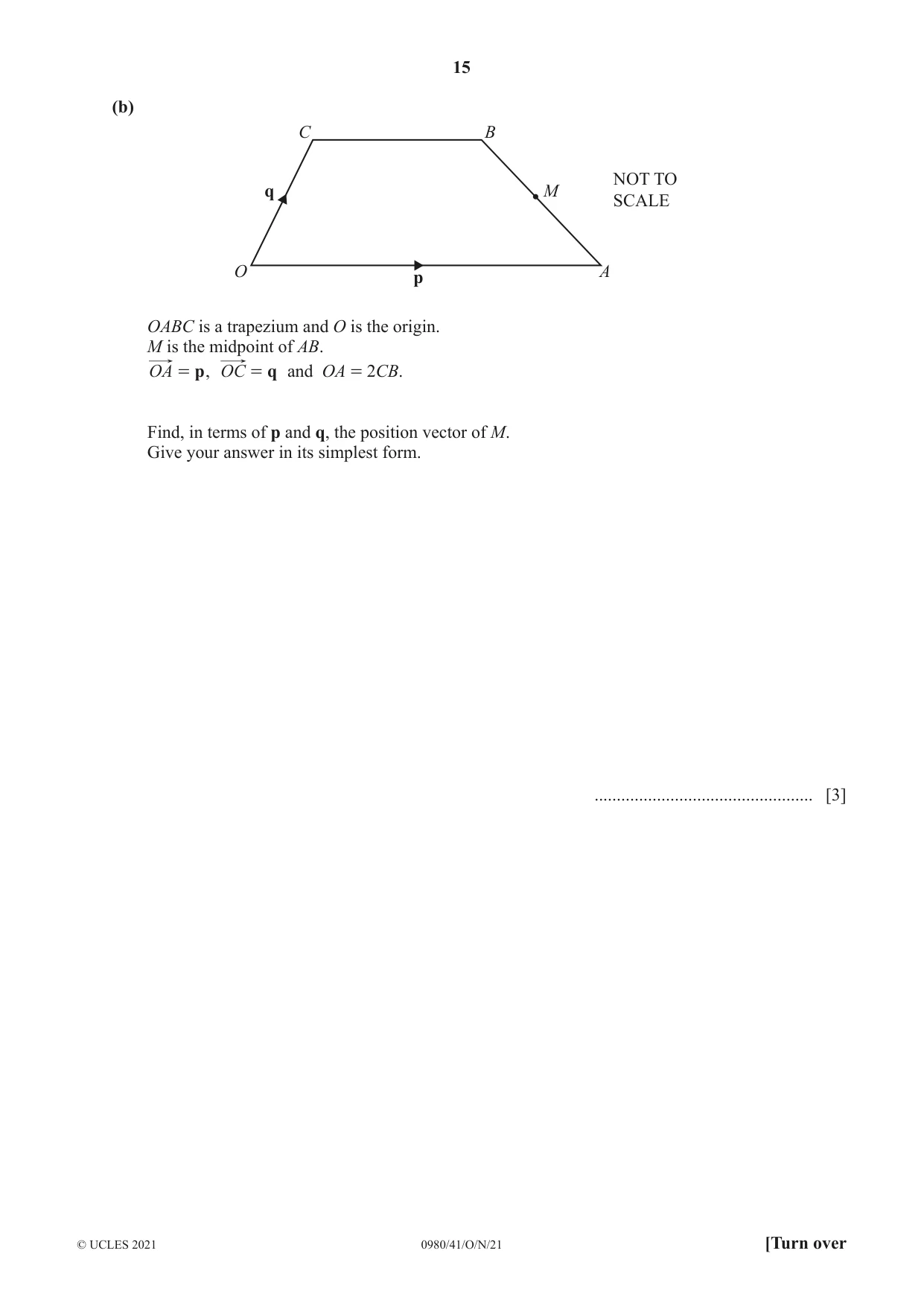
7 (a) y 8 7 6 5 4 3 A 2 1 – 5 – 4 – 3 – 2 – 1 0 1 2 3 4 5 6 7 x – 1 B – 2 – 3 – 4 (i) On the grid, draw the image of (a) shape A after an enlargement, scale factor 2, centre (0, 1), [2] (b) shape A after a reflection in the line y = x - 1. [3] (ii) Describe fully the single transformation that maps shape A onto shape B. ..................................................................................................................................................... ..................................................................................................................................................... [3] (b) C B NOT TO q M SCALE O A p OABC is a trapezium and O is the origin. M is the midpoint of AB. OA = p , OC = q and OA = 2CB. Find, in terms of p and q, the position vector of M. Give your answer in its simplest form. ................................................. [3]
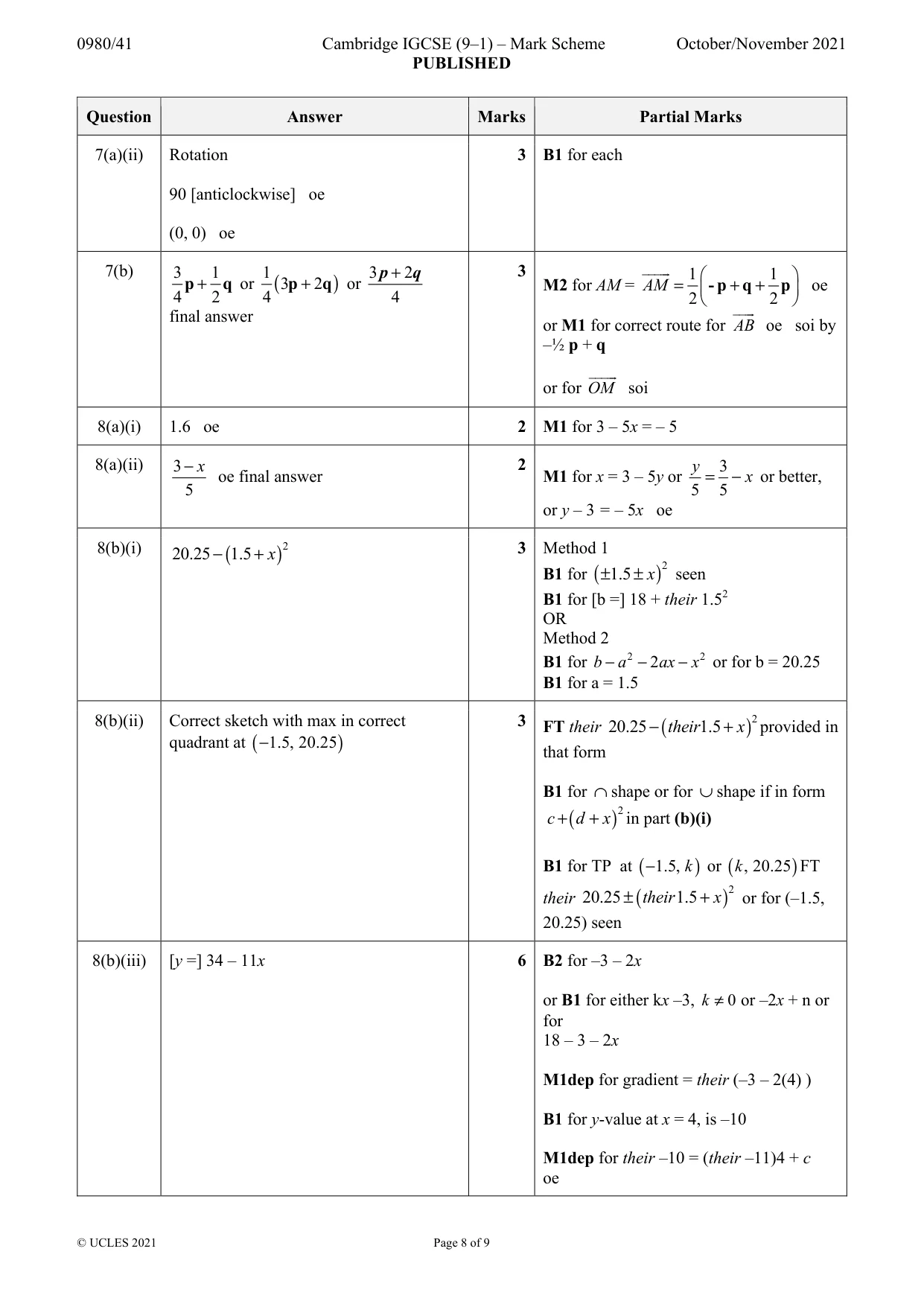
Mark scheme: 7(a)(i)(a) Shape at (–2, 1) ( –4, 1) ( –4, 7) (0, 7) 2 B1 for 3 correct points or for enlargement SF2 from any centre 7(a)(i)(b) Shape at (2, –2) (2, –3) (5, –1) (5, –3) 3 B2 for correct orientation but wrong position or for 3 correct points or B1 for y = x – 1 drawn 7(a)(ii) Rotation 3 B1 for each 90 [anticlockwise] oe (0, 0) oe 7(b) 3 1 1 3 p + 2q 3 1 1 p + q or ( 3p + 2q ) or M2 for AM = AM = - p + q + p oe 4 2 4 4 2 2 final answer or M1 for correct route for AB oe soi by –½ p + q or for OM soi
Q8 · F ( )x = 3 - 5 x (i) Find x when f ( )x =- 5
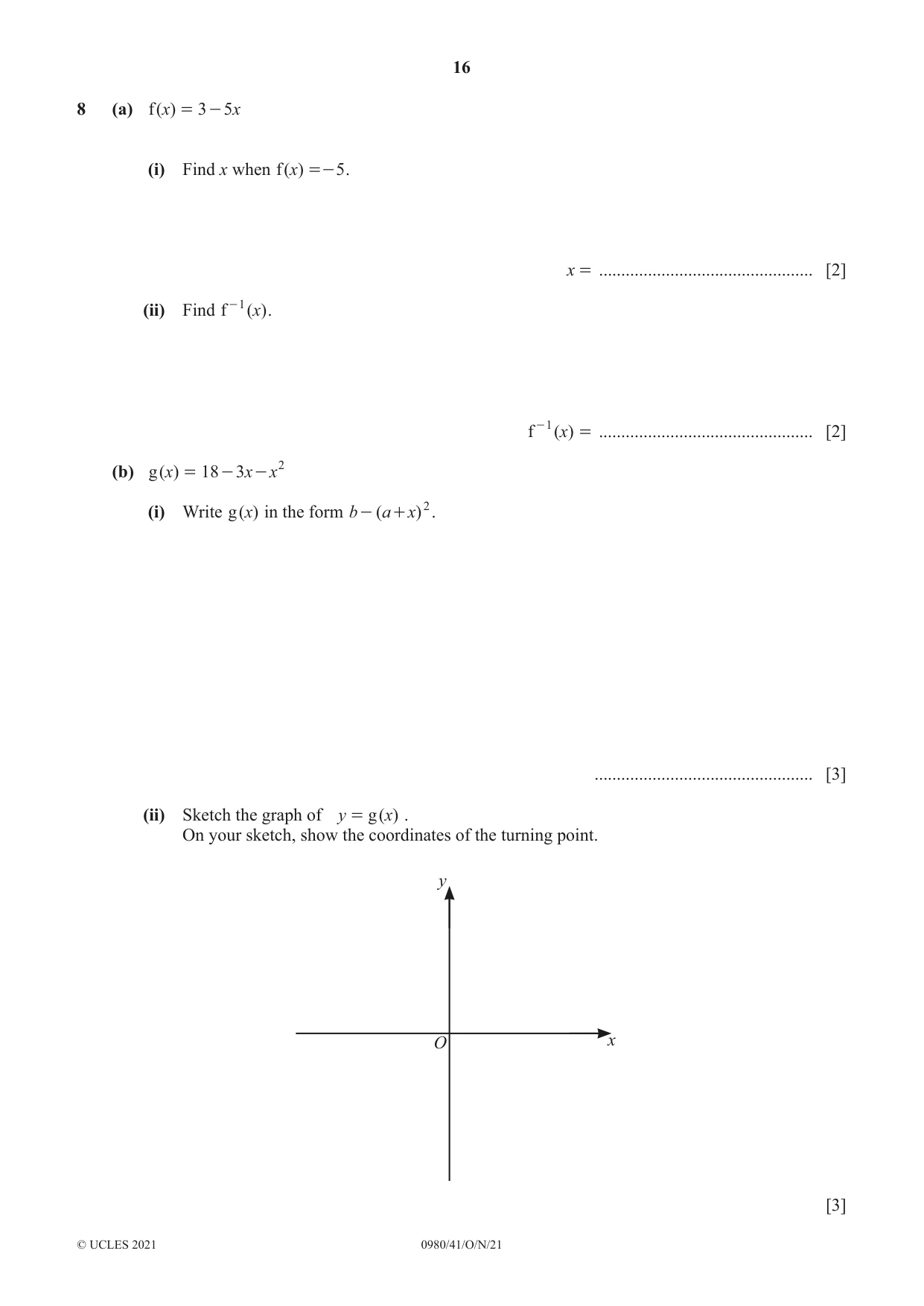
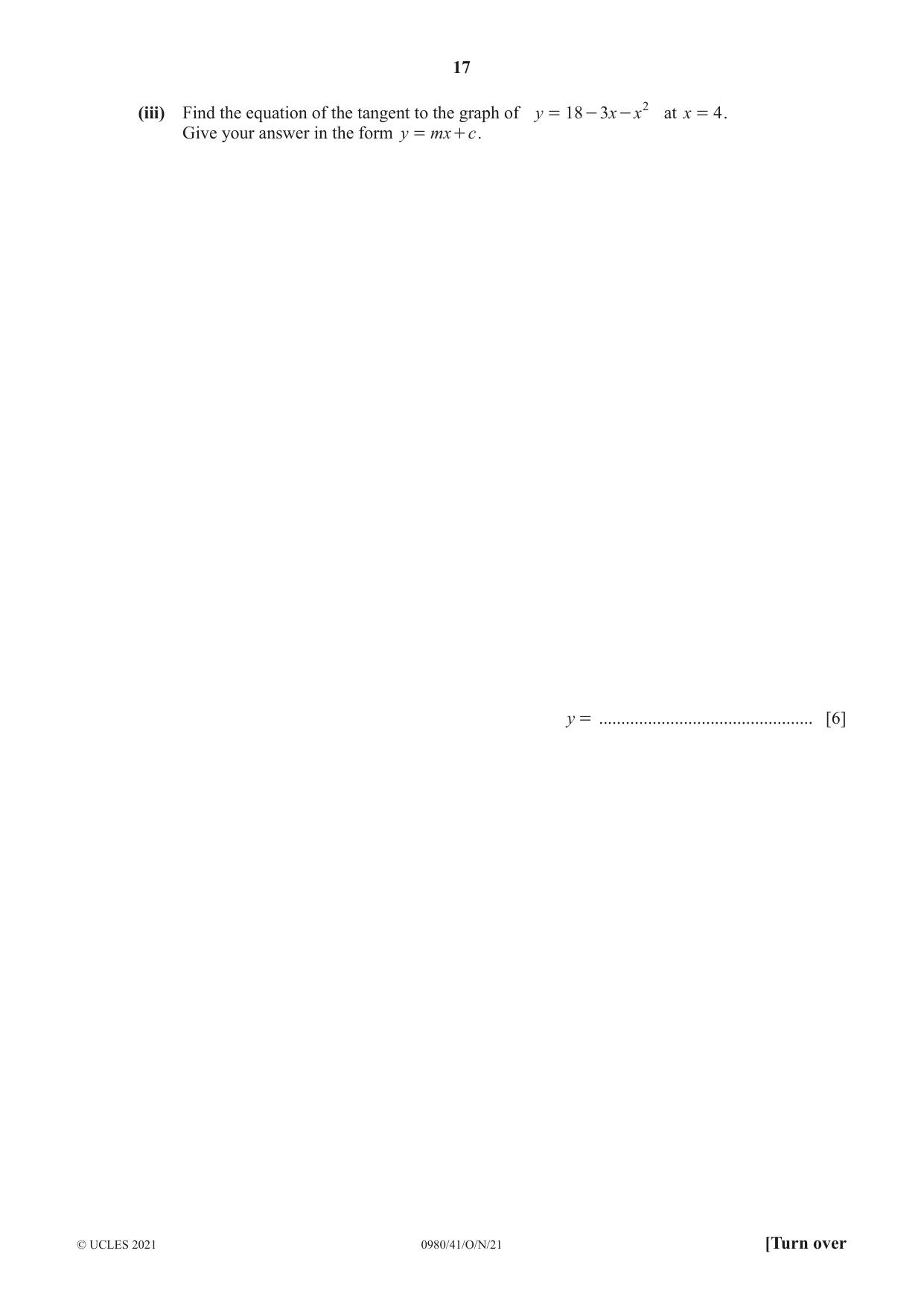
8 (a) f ( )x = 3 - 5 x (i) Find x when f ( )x =- 5 . x = ................................................ [2] (ii) Find f - 1 ( )x . f - 1 ( )x = ................................................ [2] (b) g ( )x = 18 - 3x - x 2 (i) Write g ( )x in the form b - ( a + x) 2 . ................................................. [3] (ii) Sketch the graph of y = g ( x) . On your sketch, show the coordinates of the turning point. y O x [3] (iii) Find the equation of the tangent to the graph of y = 18 - 3 x - x 2 at x = 4 . Give your answer in the form y = mx + c . y = ................................................ [6]
Mark scheme: 8(a)(i) 1.6 oe 2 M1 for 3 – 5x = – 5 8(a)(ii) 3 − x 2 y 3 oe final answer M1 for x = 3 – 5y or = − x or better, 5 5 5 or y – 3 = – 5x oe 8(b)(i) 2 3 Method 1 20.25 − (1.5 + x ) 2 B1 for ( ±1.5 ± x ) seen B1 for [b =] 18 + their 1.52 OR Method 2 B1 for b − a 2 − 2 ax − x 2 or for b = 20.25 B1 for a = 1.5 8(b)(ii) Correct sketch with max in correct 3 2 FT their 20.25 − ( their1.5 + x ) provided in quadrant at ( − 1.5, 20.25 ) that form B1 for ∩shape or for ∪shape if in form 2 c + ( d + x ) in part (b)(i) B1 for TP at ( − 1.5, k ) or ( k , 20.25 ) FT 2 their 20.25 ± ( their 1.5 + x ) or for (–1.5, 20.25) seen 8(b)(iii) [y =] 34 – 11x 6 B2 for –3 – 2x or B1 for either kx –3, k ≠ 0 or –2x + n or for 18 – 3 – 2x M1dep for gradient = their (–3 – 2(4) ) B1 for y-value at x = 4, is –10 M1dep for their –10 = (their –11)4 + c oe
Q9 · NOT TO x cm SCALE ( x + 3)cm This rectangle has perimeter 20 cm
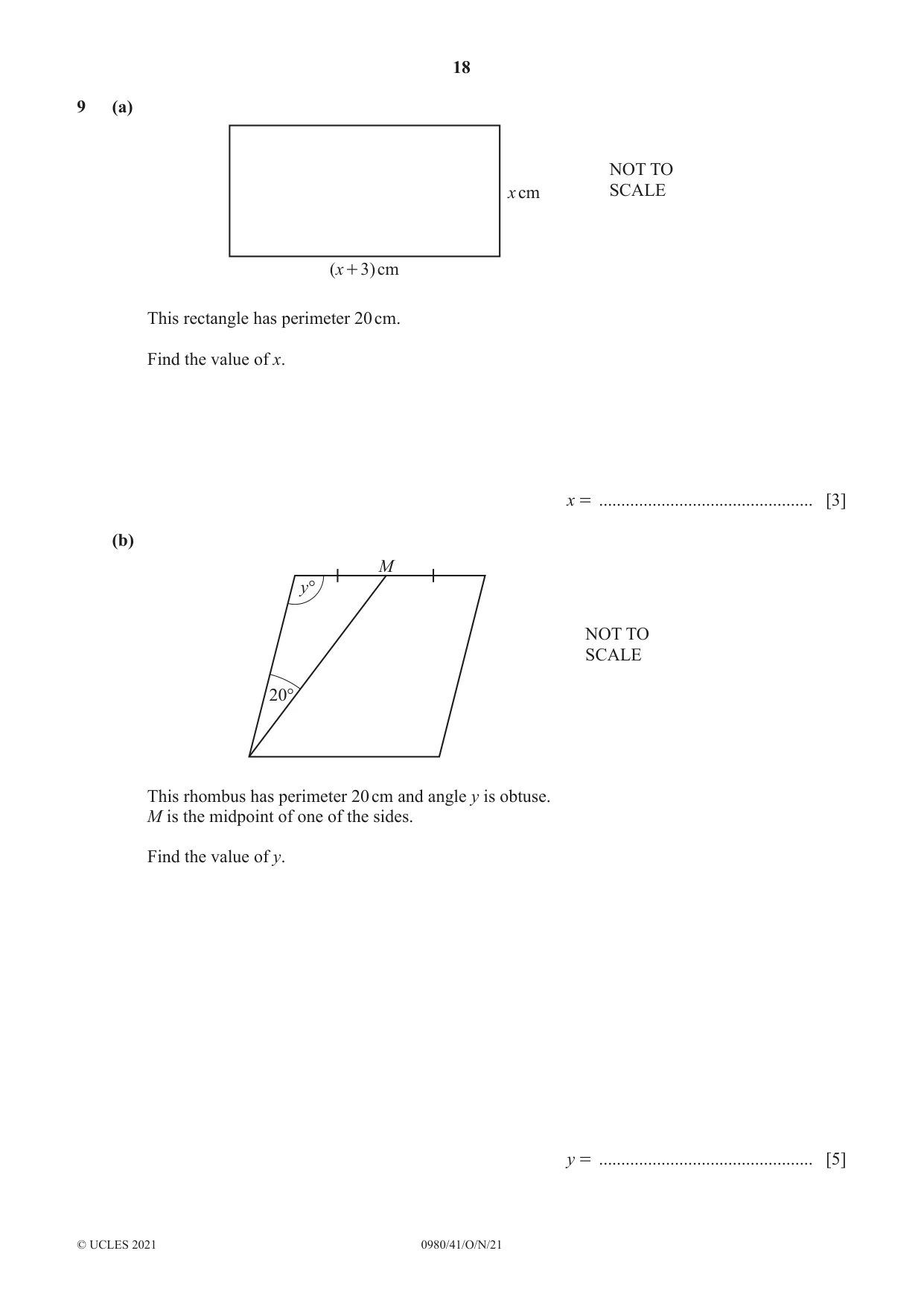
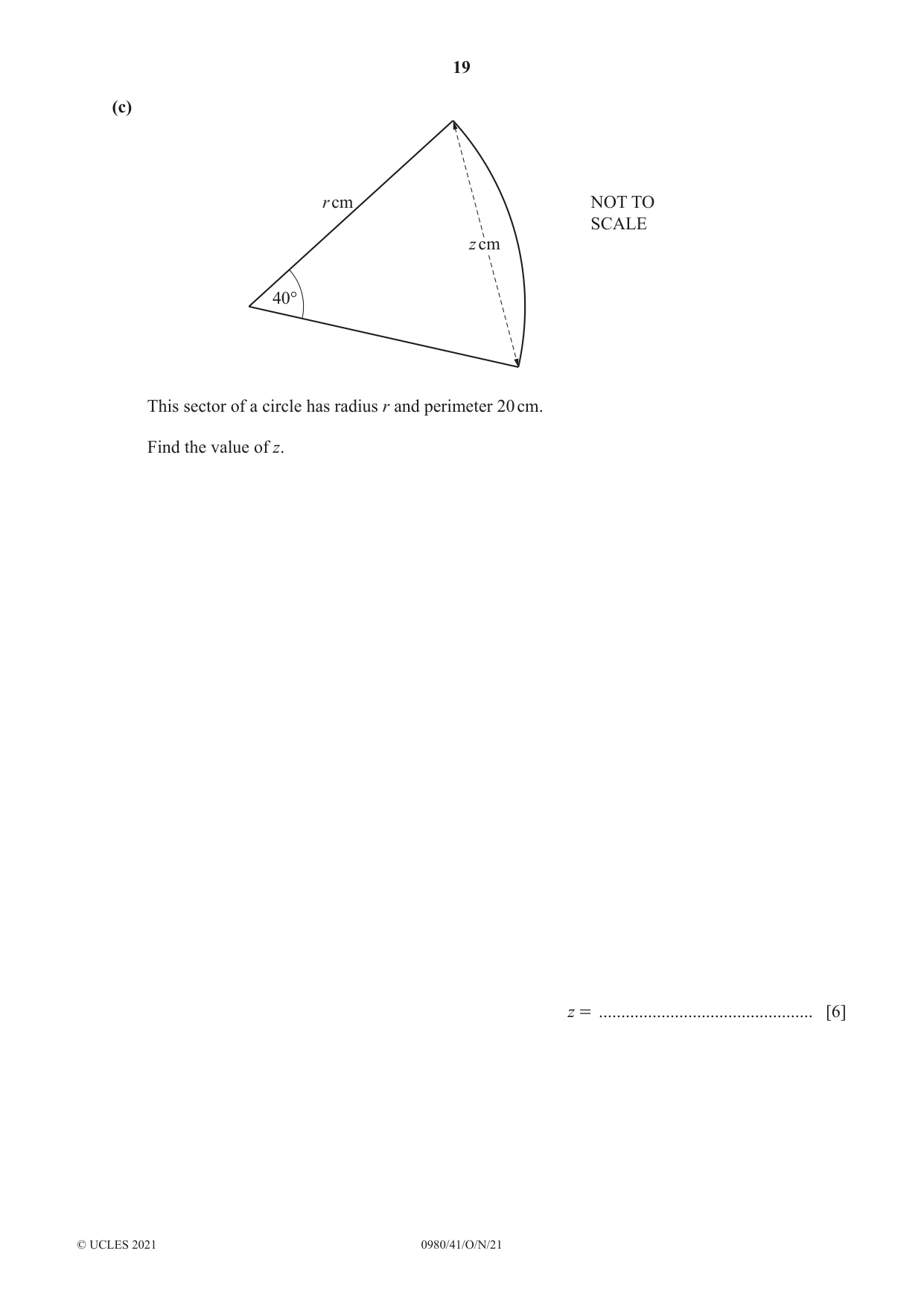
9 (a) NOT TO x cm SCALE ( x + 3)cm This rectangle has perimeter 20 cm. Find the value of x. x = ................................................ [3] (b) M y° NOT TO SCALE 20° This rhombus has perimeter 20 cm and angle y is obtuse. M is the midpoint of one of the sides. Find the value of y. y = ................................................ [5] (c) r cm NOT TO SCALE z cm 40° This sector of a circle has radius r and perimeter 20 cm. Find the value of z. z = ................................................ [6]
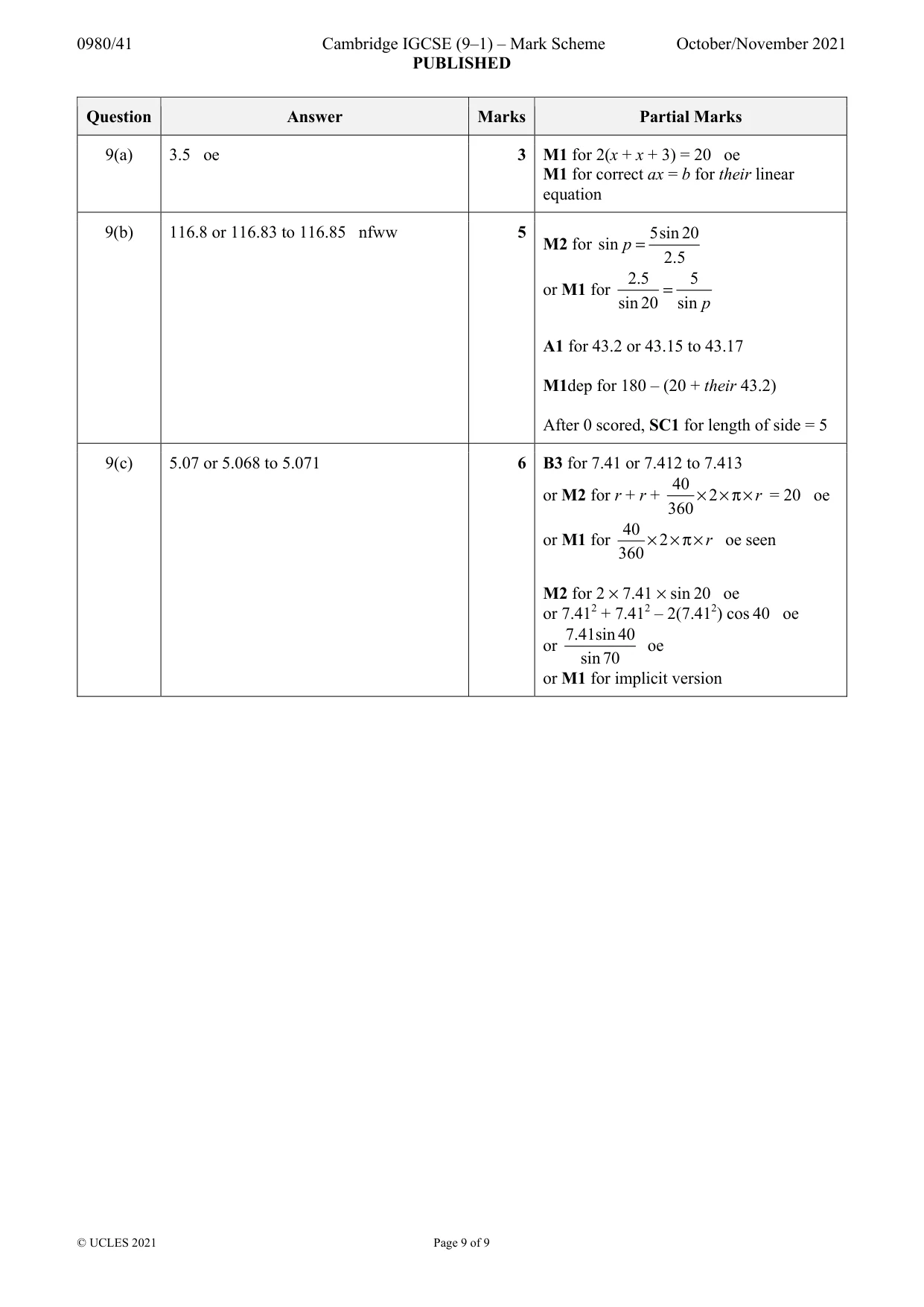
Mark scheme: 9(a) 3.5 oe 3 M1 for 2(x + x + 3) = 20 oe M1 for correct ax = b for their linear equation 9(b) 116.8 or 116.83 to 116.85 nfww 5 5sin 20 M2 for sin p = 2.5 2.5 5 or M1 for = sin 20 sin p A1 for 43.2 or 43.15 to 43.17 M1dep for 180 – (20 + their 43.2) After 0 scored, SC1 for length of side = 5 9(c) 5.07 or 5.068 to 5.071 6 B3 for 7.41 or 7.412 to 7.413 40 or M2 for r + r + × 2 × π× r = 20 oe 360 40 or M1 for × 2 × π× r oe seen 360 M2 for 2 × 7.41 × sin 20 oe or 7.412 + 7.412 – 2(7.412) cos 40 oe 7.41sin 40 or oe sin70 or M1 for implicit version
What was in this paper
The subtopics covered by these 9 questions, and how many questions each got. Open one in a new tab to see every Cambridge question on it.
What you needed in this session
Cambridge’s own grade thresholds for 2021 Oct/Nov, Paper 4 · Variant 1. A higher threshold means an easier paper — the bar moves with how the cohort did.