Cambridge IGCSE Mathematics (9-1) 0980 — 2020 Oct/Nov Paper 4 · Variant 1
0980/41/O/N/20 · 10 questions · 130 marks · ≈146 min
The question paper and its mark scheme, free to read here and free to download. This is Cambridge’s own paper, exactly as it was sat.
Question paper20 pages
Mark scheme11 pages
Answers below. Sit the paper first if you are practising.
Questions as text
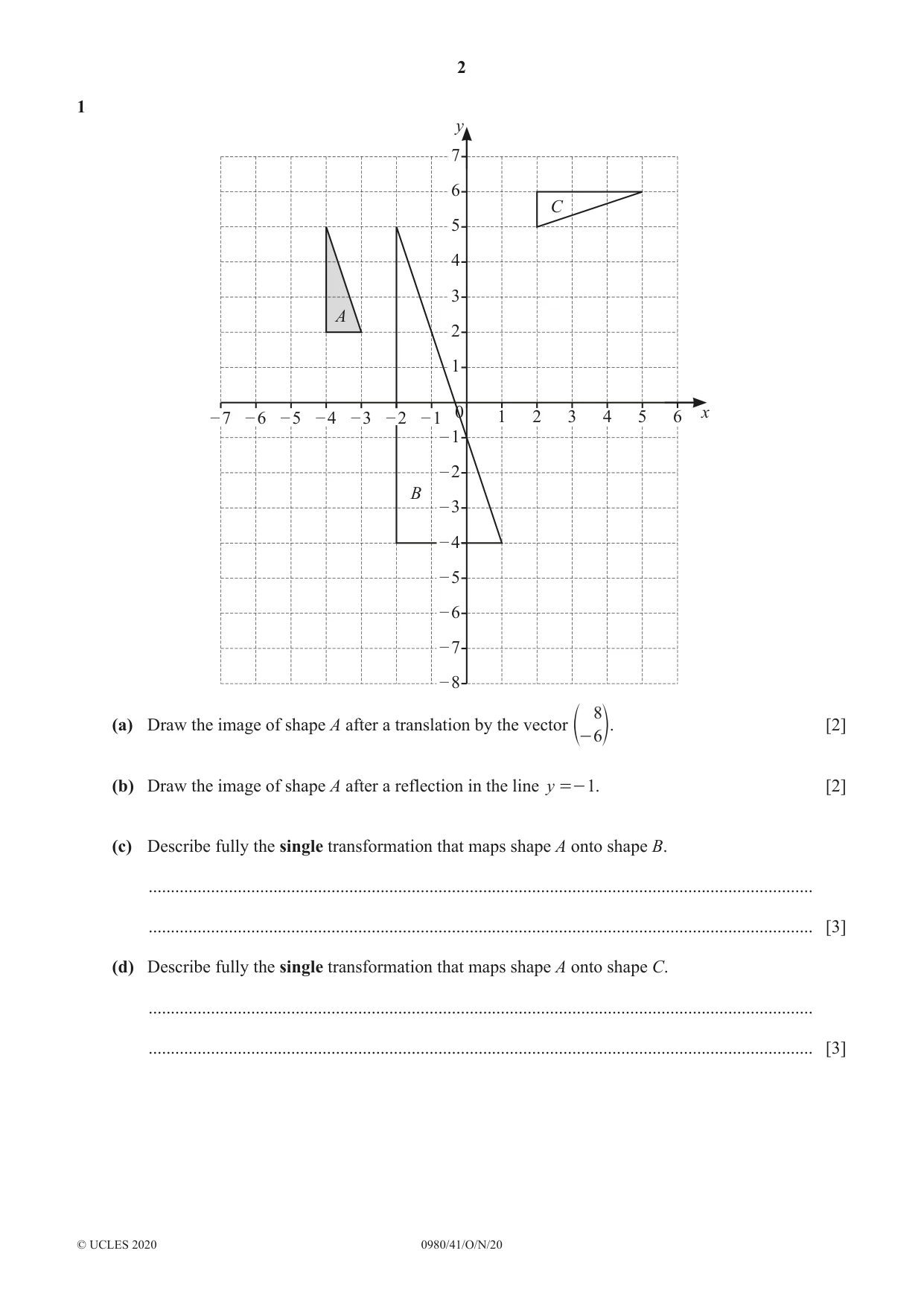
Q1 · Y 7 6 C 5 4 3 A 2 1 0 x – 7 – 6 – 5 – 4 – 3 – 2 – 1 1 2 3 4 5 6 – 1 – 2 B – 3 – 4 – 5 – 6…
1 y 7 6 C 5 4 3 A 2 1 0 x – 7 – 6 – 5 – 4 – 3 – 2 – 1 1 2 3 4 5 6 – 1 – 2 B – 3 – 4 – 5 – 6 – 7 – 8 8 (a) Draw the image of shape A after a translation by the vector [2] e- 6o. (b) Draw the image of shape A after a reflection in the line y =- 1. [2] (c) Describe fully the single transformation that maps shape A onto shape B. ..................................................................................................................................................... ..................................................................................................................................................... [3] (d) Describe fully the single transformation that maps shape A onto shape C. ..................................................................................................................................................... ..................................................................................................................................................... [3]
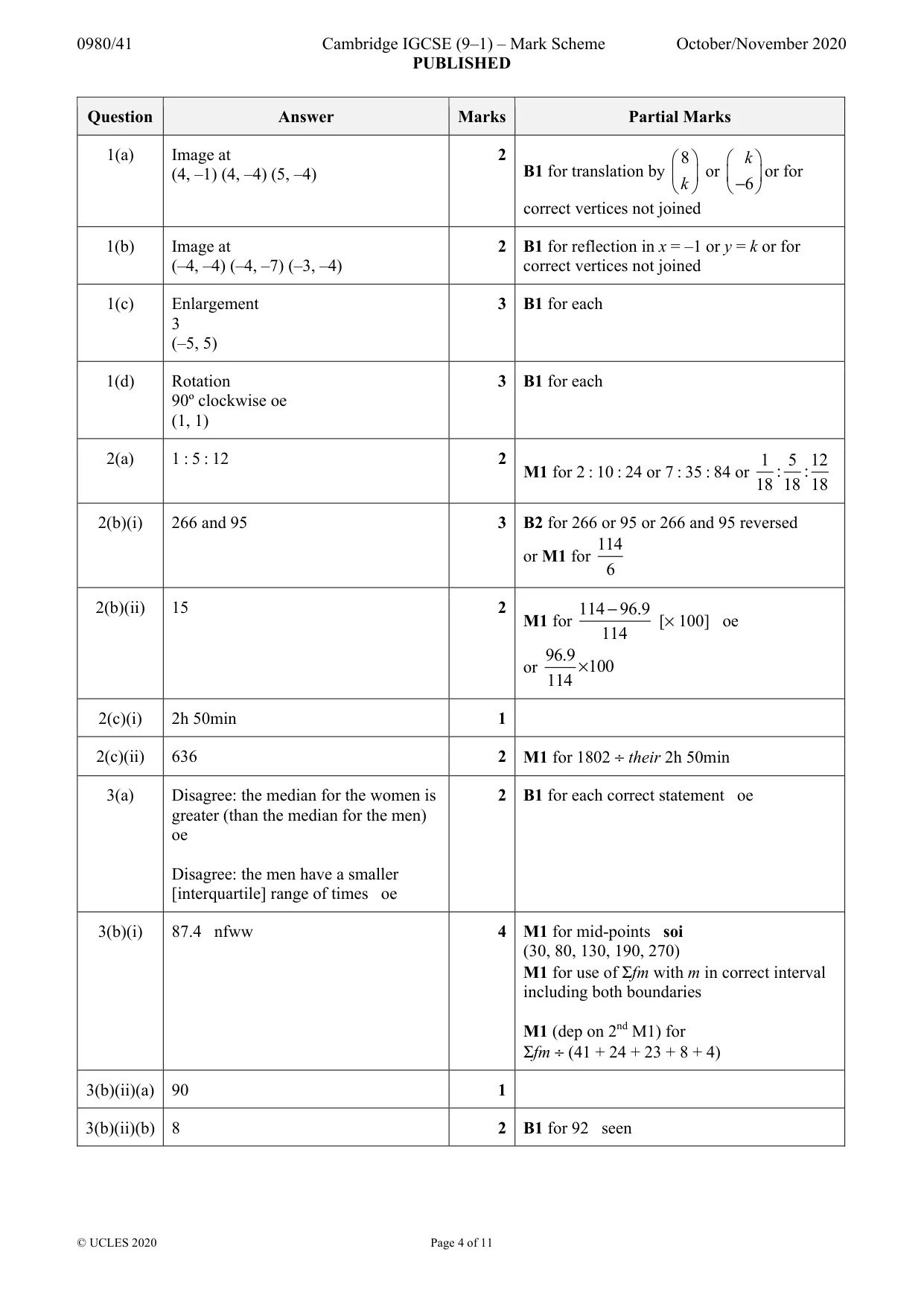
Mark scheme: Question Answer Marks Partial Marks 1(a) Image at 2 8 k (4, –1) (4, –4) (5, –4) B1 for translation by or or for k −6 correct vertices not joined 1(b) Image at 2 B1 for reflection in x = –1 or y = k or for (–4, –4) (–4, –7) (–3, –4) correct vertices not joined 1(c) Enlargement 3 B1 for each 3 (–5, 5) 1(d) Rotation 3 B1 for each 90º clockwise oe (1, 1)
Q2 · A plane has 14 First Class seats, 70 Premium seats and 168 Economy seats
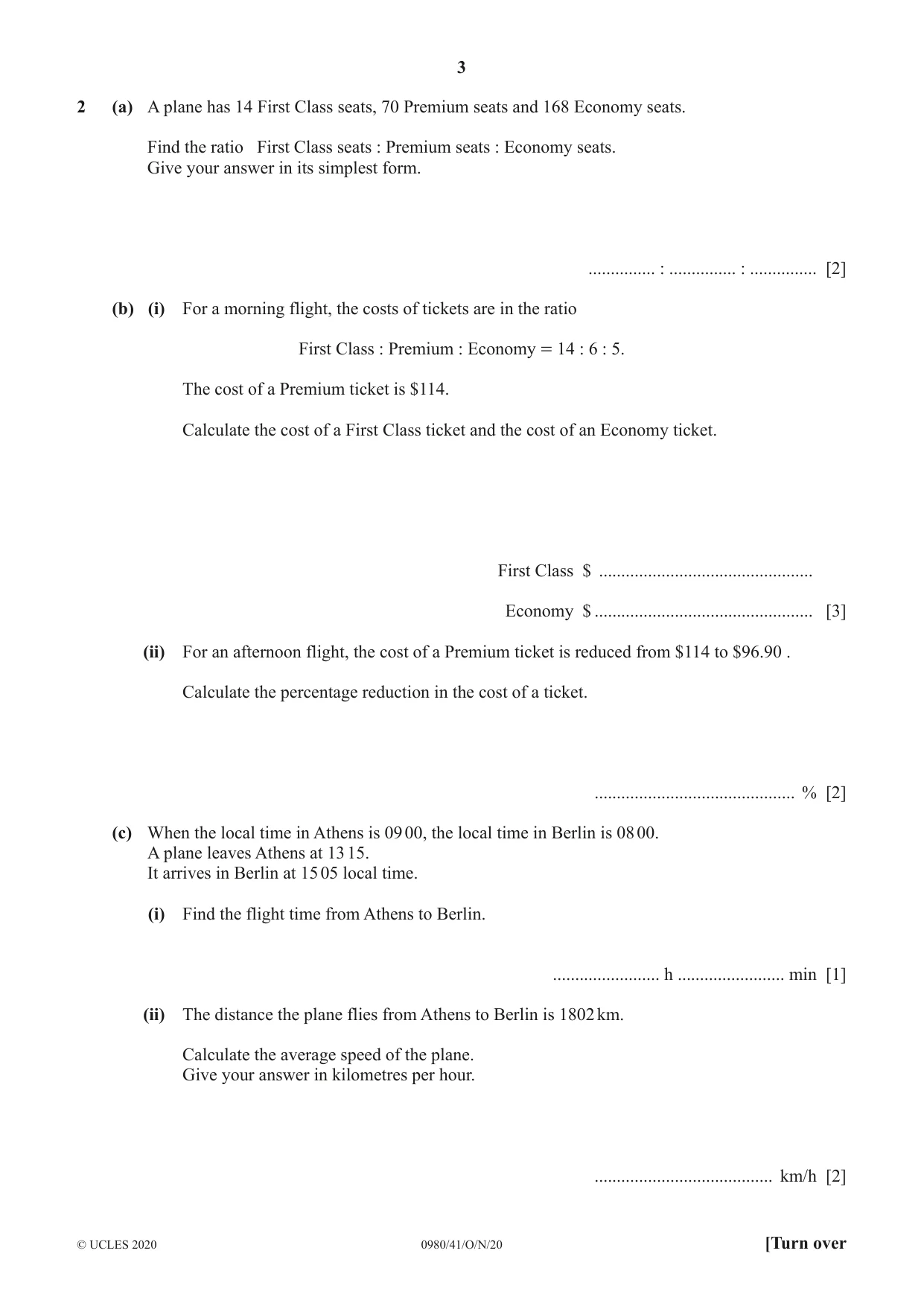
2 (a) A plane has 14 First Class seats, 70 Premium seats and 168 Economy seats. Find the ratio First Class seats : Premium seats : Economy seats. Give your answer in its simplest form. ............... : ............... : ............... [2] (b) (i) For a morning flight, the costs of tickets are in the ratio First Class : Premium : Economy = 14 : 6 : 5. The cost of a Premium ticket is $114. Calculate the cost of a First Class ticket and the cost of an Economy ticket. First Class $ ................................................ Economy $ ................................................. [3] (ii) For an afternoon flight, the cost of a Premium ticket is reduced from $114 to $96.90 . Calculate the percentage reduction in the cost of a ticket. ............................................. % [2] (c) When the local time in Athens is 09 00, the local time in Berlin is 08 00. A plane leaves Athens at 13 15. It arrives in Berlin at 15 05 local time. (i) Find the flight time from Athens to Berlin. ........................ h ........................ min [1] (ii) The distance the plane flies from Athens to Berlin is 1802 km. Calculate the average speed of the plane. Give your answer in kilometres per hour. ........................................ km/h [2]
Mark scheme: 2(a) 1 : 5 : 12 2 1 5 12 M1 for 2 : 10 : 24 or 7 : 35 : 84 or : : 18 18 18 2(b)(i) 266 and 95 3 B2 for 266 or 95 or 266 and 95 reversed 114 or M1 for 6 2(b)(ii) 15 2 114 − 96.9 M1 for [× 100] oe 114 96.9 or × 100 114 2(c)(i) 2h 50min 1 2(c)(ii) 636 2 M1 for 1802 ÷ their 2h 50min
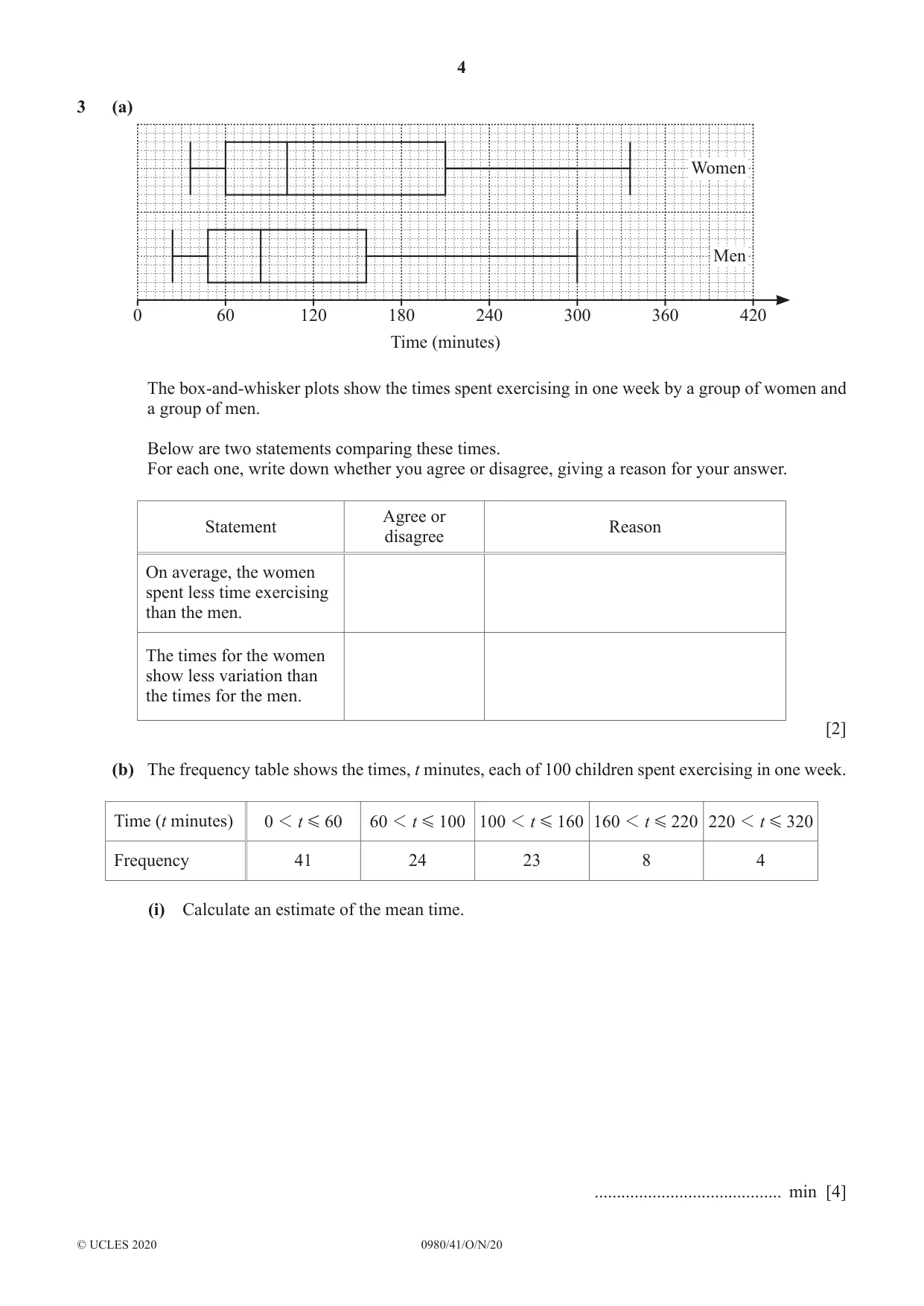
Q3 · Women Men 0 60 120 180 240 300 360 420 Time (minutes) The box-and-whisker plots show the…
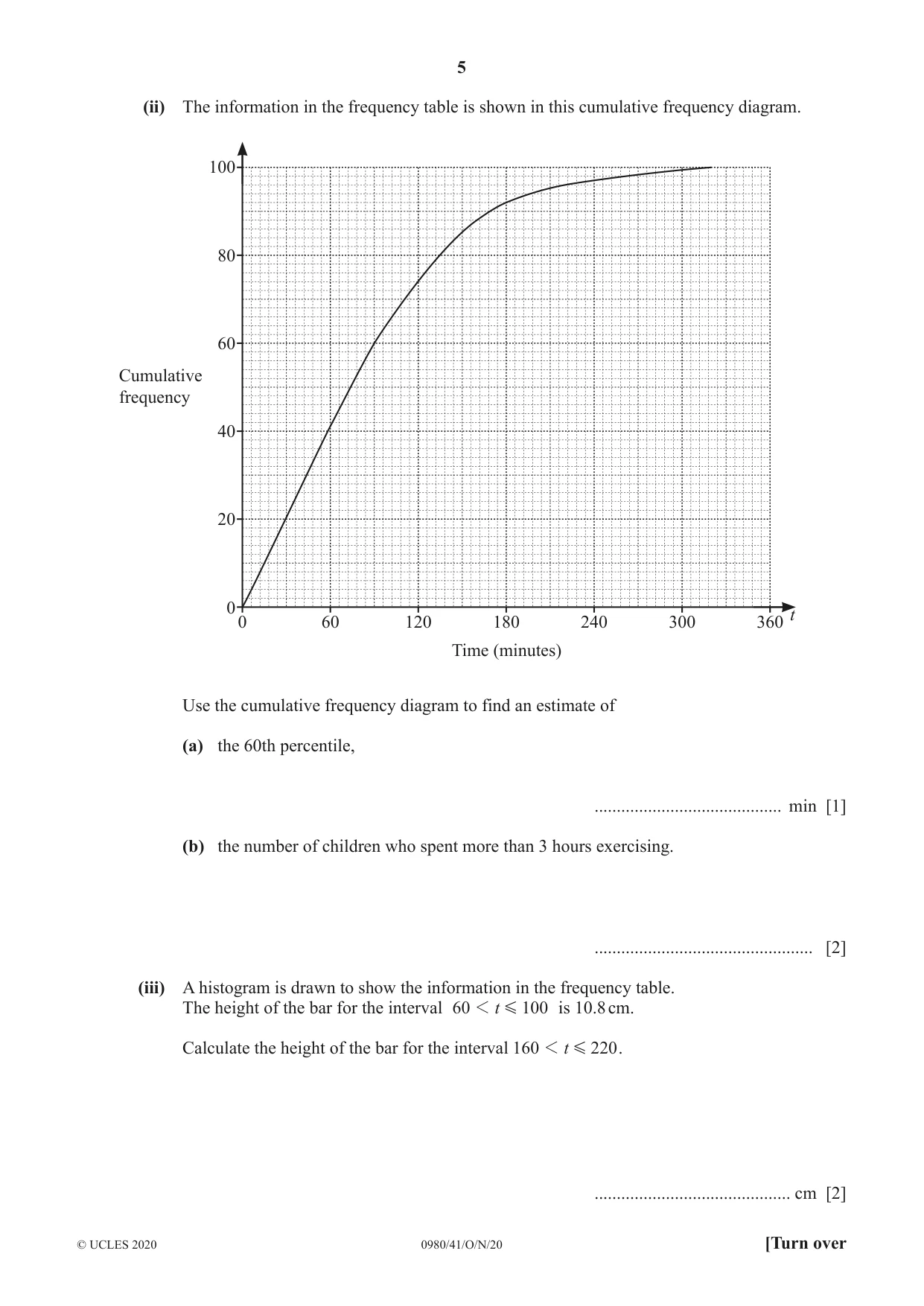
3 (a) Women Men 0 60 120 180 240 300 360 420 Time (minutes) The box-and-whisker plots show the times spent exercising in one week by a group of women and a group of men. Below are two statements comparing these times. For each one, write down whether you agree or disagree, giving a reason for your answer. Agree or Statement Reason disagree On average, the women spent less time exercising than the men. The times for the women show less variation than the times for the men. [2] (b) The frequency table shows the times, t minutes, each of 100 children spent exercising in one week. Time (t minutes) 0 1 t G 60 60 1 t G 100 100 1 t G 160 160 1 t G 220 220 1 t G 320 Frequency 41 24 23 8 4 (i) Calculate an estimate of the mean time. .......................................... min [4] (ii) The information in the frequency table is shown in this cumulative frequency diagram. 100 80 60 Cumulative frequency 40 20 0 t 0 60 120 180 240 300 360 Time (minutes) Use the cumulative frequency diagram to find an estimate of (a) the 60th percentile, .......................................... min [1] (b) the number of children who spent more than 3 hours exercising. ................................................. [2] (iii) A histogram is drawn to show the information in the frequency table. The height of the bar for the interval 60 1 t G 100 is 10.8 cm. Calculate the height of the bar for the interval 160 1 t G 220 . ............................................ cm [2]
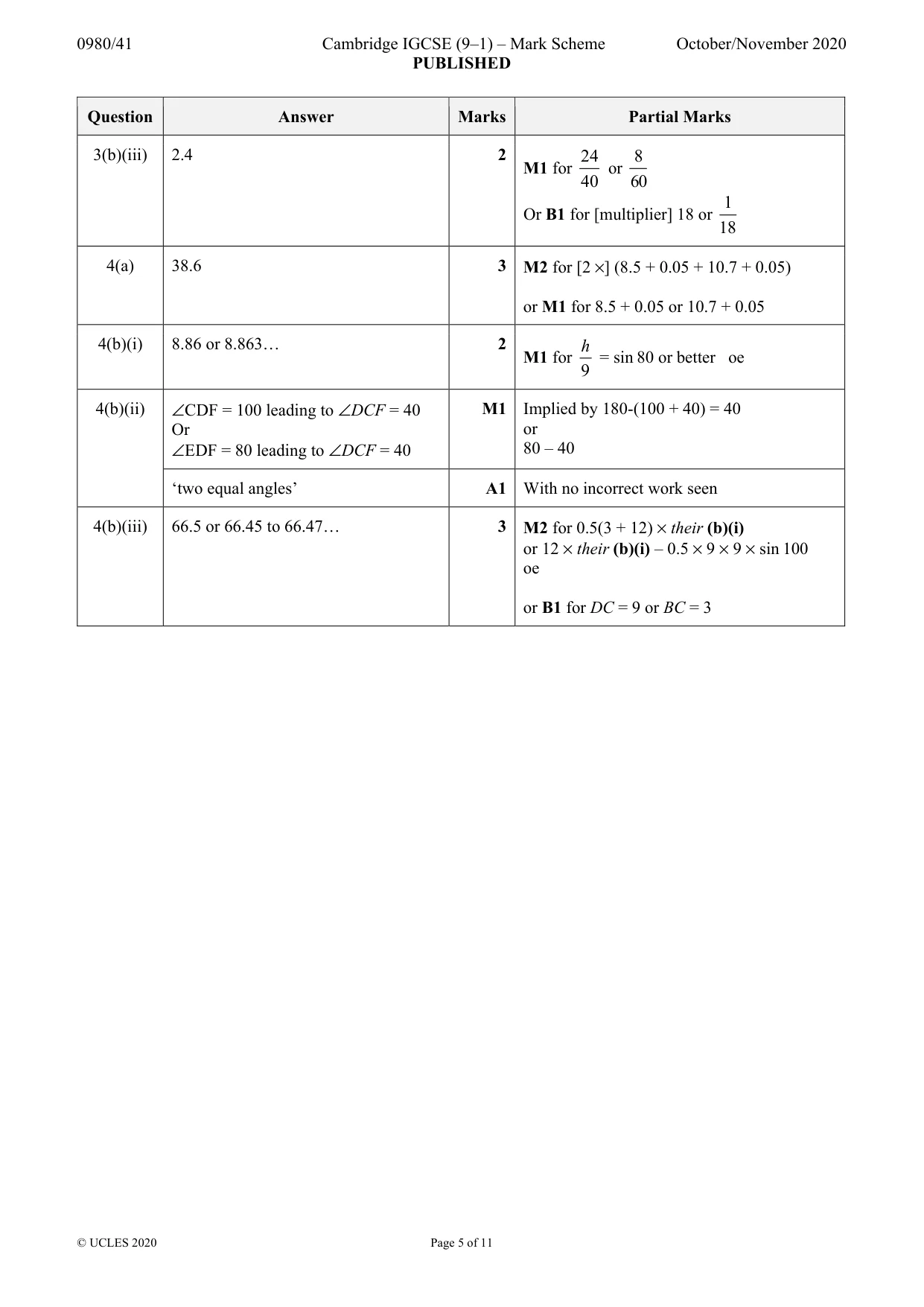
Mark scheme: 3(a) Disagree: the median for the women is 2 B1 for each correct statement oe greater (than the median for the men) oe Disagree: the men have a smaller [interquartile] range of times oe 3(b)(i) 87.4 nfww 4 M1 for mid-points soi (30, 80, 130, 190, 270) M1 for use of Σfm with m in correct interval including both boundaries M1 (dep on 2nd M1) for Σfm ÷ (41 + 24 + 23 + 8 + 4) 3(b)(ii)(a) 90 1 3(b)(ii)(b) 8 2 B1 for 92 seen 3(b)(iii) 2.4 2 24 8 M1 for or 40 60 1 Or B1 for [multiplier] 18 or 18
Q4 · A rectangle measures 8.5 cm by 10.7 cm, both correct to 1 decimal place
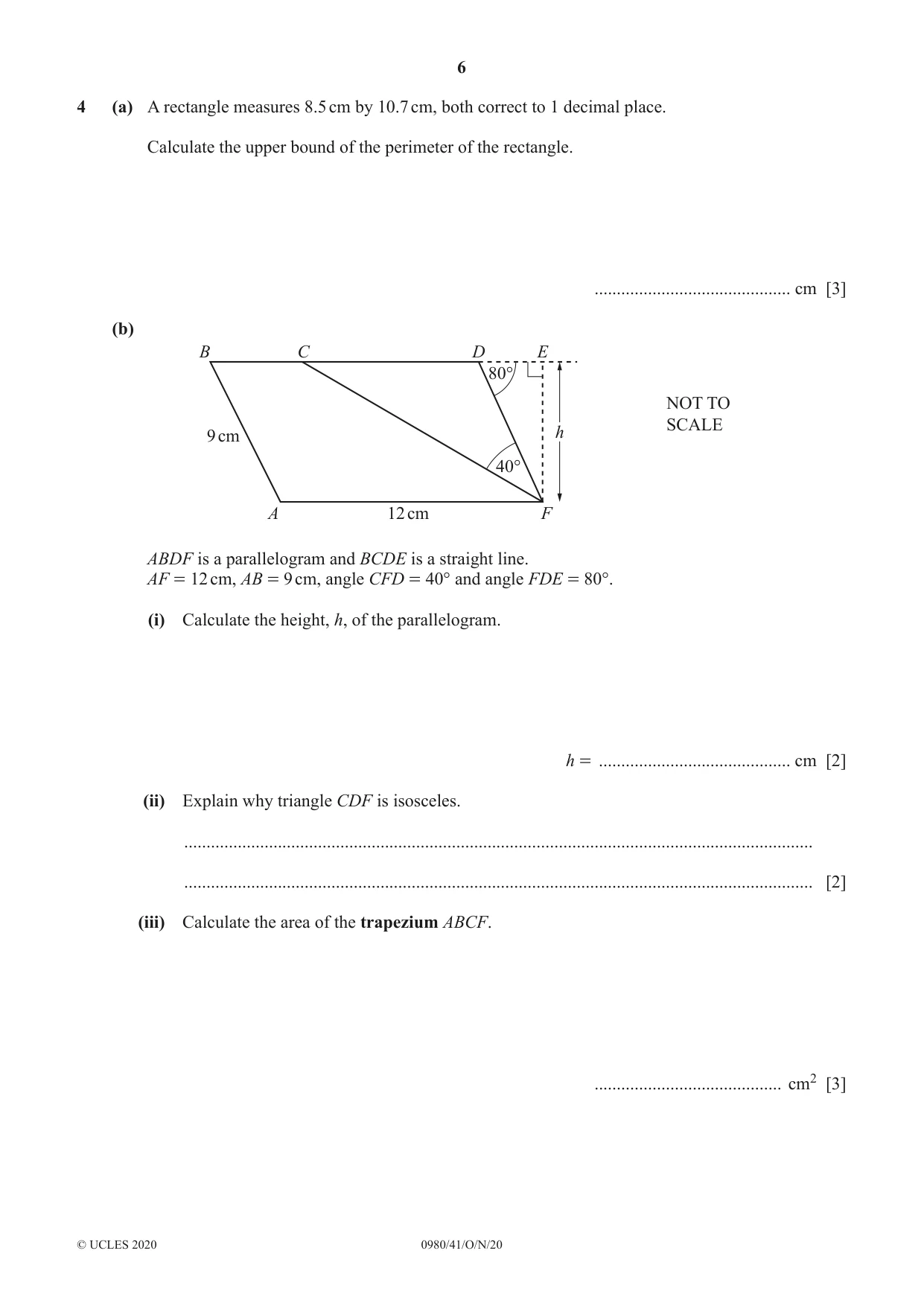
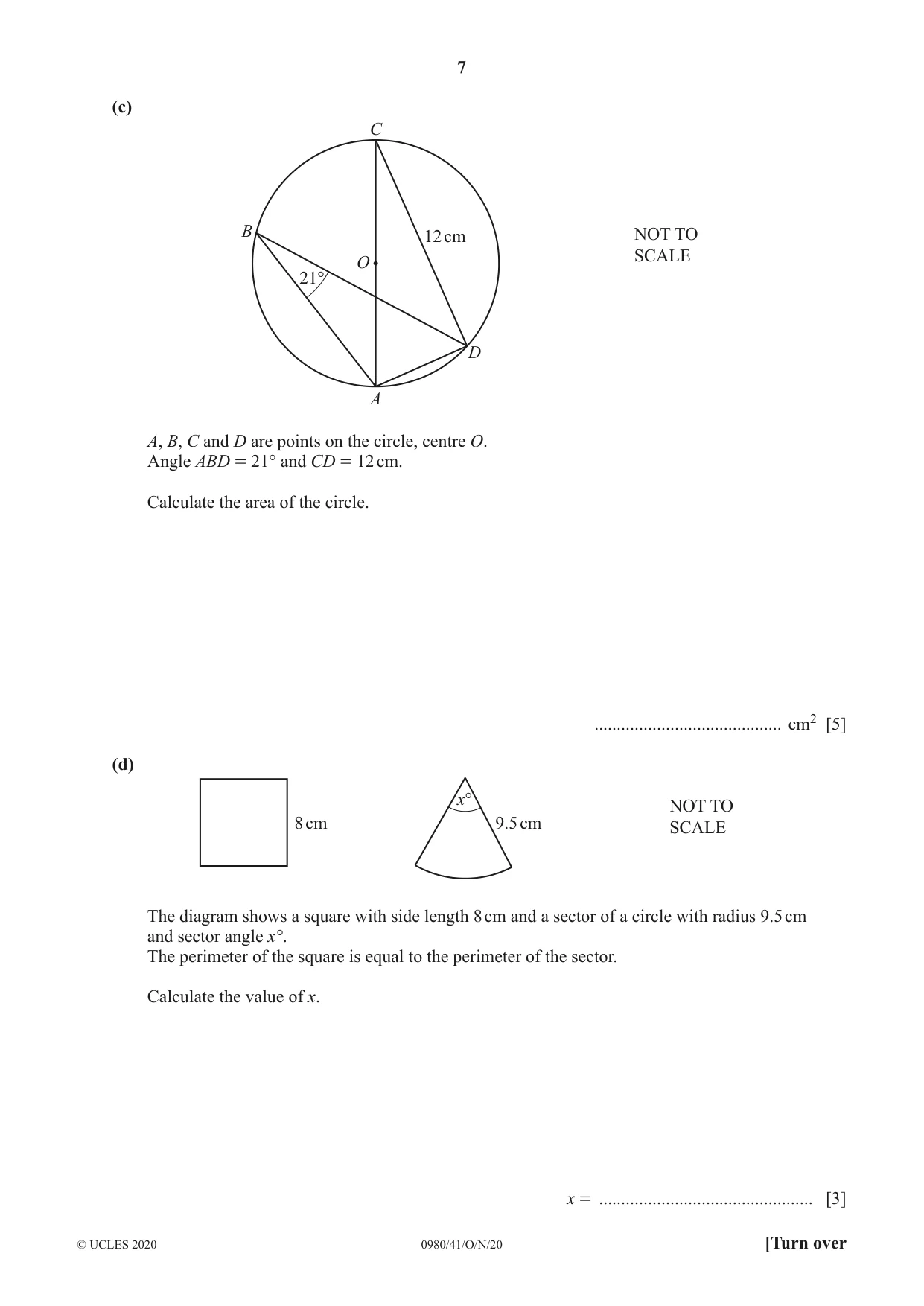
4 (a) A rectangle measures 8.5 cm by 10.7 cm, both correct to 1 decimal place. Calculate the upper bound of the perimeter of the rectangle. ............................................ cm [3] (b) B C D E 80° NOT TO SCALE 9 cm h 40° A 12 cm F ABDF is a parallelogram and BCDE is a straight line. AF = 12 cm, AB = 9 cm, angle CFD = 40° and angle FDE = 80°. (i) Calculate the height, h, of the parallelogram. h = ........................................... cm [2] (ii) Explain why triangle CDF is isosceles. ............................................................................................................................................. ............................................................................................................................................. [2] (iii) Calculate the area of the trapezium ABCF. .......................................... cm2 [3] (c) C B 12 cm NOT TO SCALE O 21° D A A, B, C and D are points on the circle, centre O. Angle ABD = 21° and CD = 12 cm. Calculate the area of the circle. .......................................... cm2 [5] (d) x° NOT TO 8 cm 9.5 cm SCALE The diagram shows a square with side length 8 cm and a sector of a circle with radius 9.5 cm and sector angle x°. The perimeter of the square is equal to the perimeter of the sector. Calculate the value of x. x = ................................................ [3]
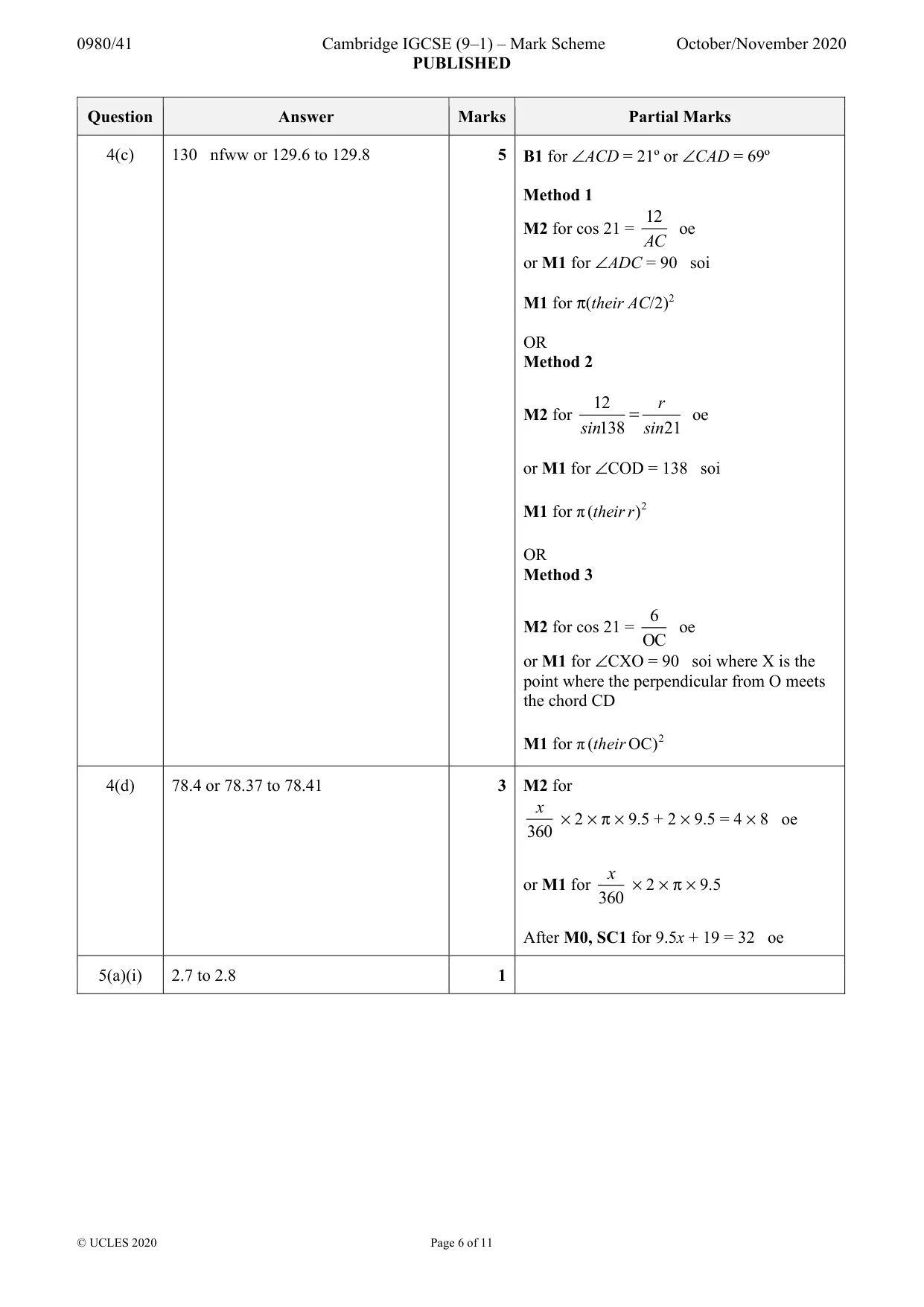
Mark scheme: 4(a) 38.6 3 M2 for [2 ×] (8.5 + 0.05 + 10.7 + 0.05) or M1 for 8.5 + 0.05 or 10.7 + 0.05 4(b)(i) 8.86 or 8.863… 2 h M1 for = sin 80 or better oe 9 4(b)(ii) ∠CDF = 100 leading to ∠DCF = 40 M1 Implied by 180-(100 + 40) = 40 Or or ∠EDF = 80 leading to ∠DCF = 40 80 – 40 ‘two equal angles’ A1 With no incorrect work seen 4(b)(iii) 66.5 or 66.45 to 66.47… 3 M2 for 0.5(3 + 12) × their (b)(i) or 12 × their (b)(i) – 0.5 × 9 × 9 × sin 100 oe or B1 for DC = 9 or BC = 3 4(c) 130 nfww or 129.6 to 129.8 5 B1 for ∠ACD = 21º or ∠CAD = 69º Method 1 12 M2 for cos 21 = oe AC or M1 for ∠ADC = 90 soi M1 for π(their AC/2)2 OR Method 2 12 r M2 for = oe sin138 sin 21 or M1 for ∠COD = 138 soi M1 for π (their r ) 2 OR Method 3 6 M2 for cos 21 = oe OC or M1 for ∠CXO = 90 soi where X is the point where the perpendicular from O meets the chord CD M1 for π ( their OC) 2 4(d) 78.4 or 78.37 to 78.41 3 M2 for x × 2 × π × 9.5 + 2 × 9.5 = 4 × 8 oe 360 x or M1 for × 2 × π × 9.5 360 After M0, SC1 for 9.5x + 19 = 32 oe
Q5 · The diagram shows the graph of y = f ( x) for - 3 G x G 3
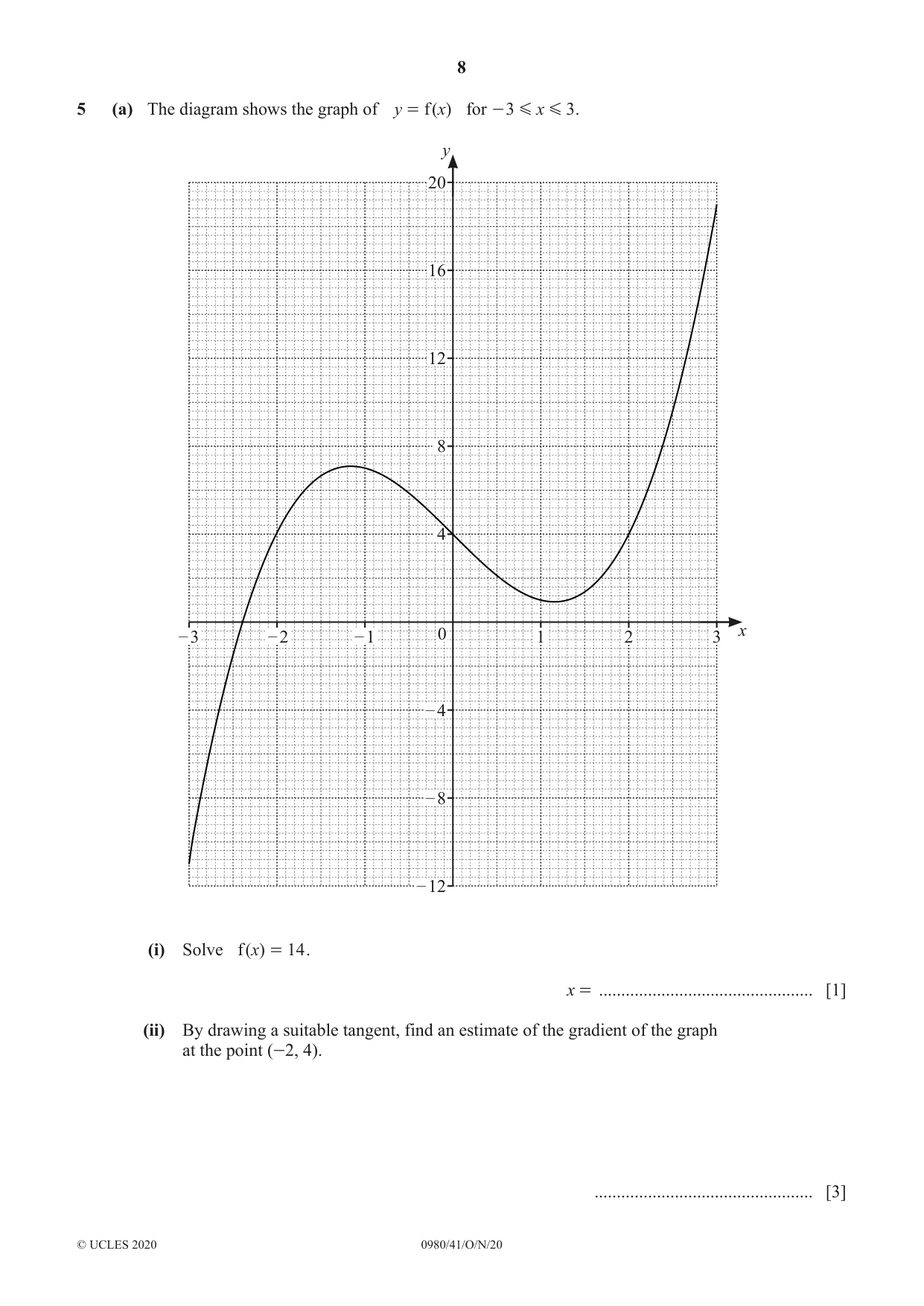
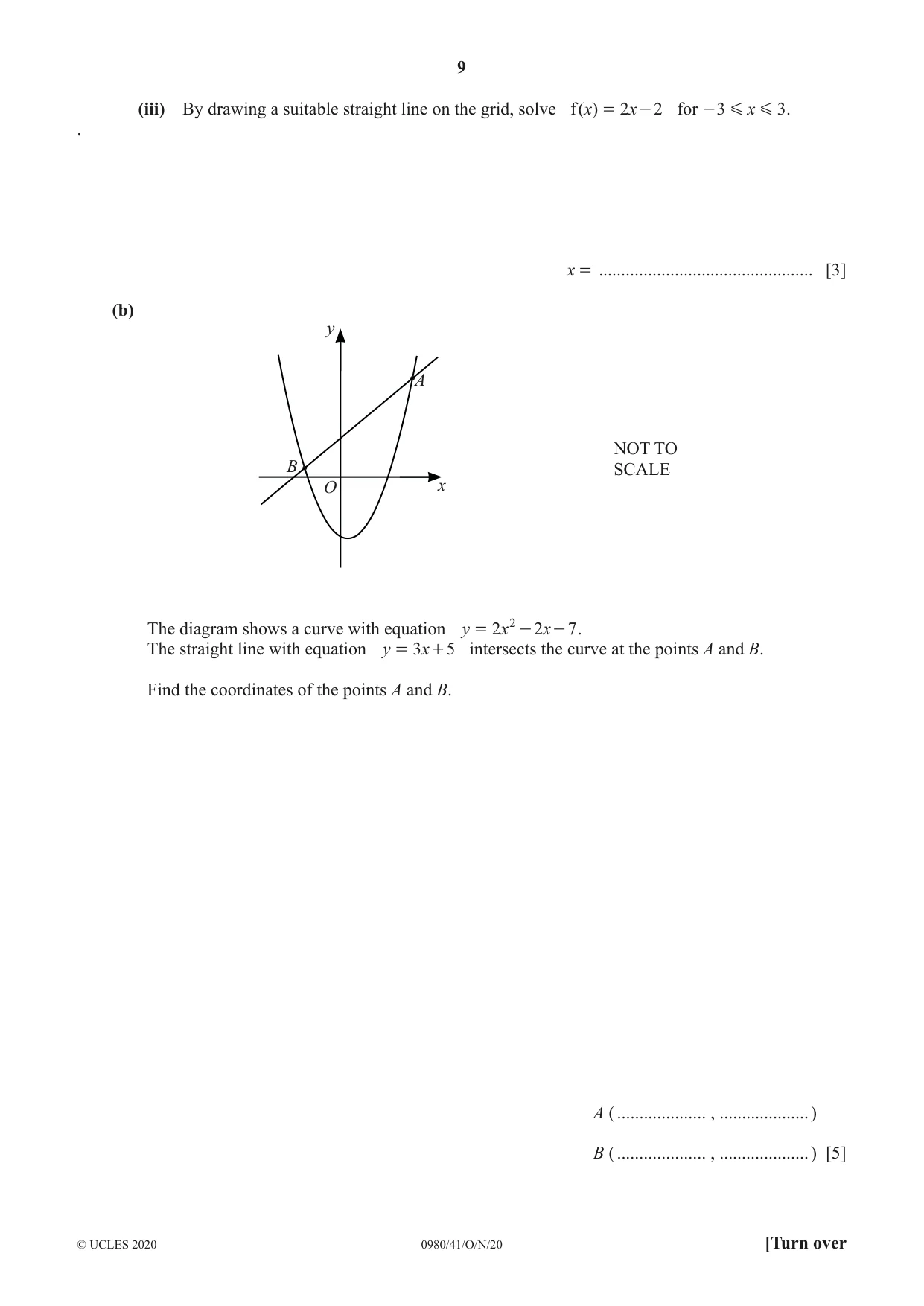
5 (a) The diagram shows the graph of y = f ( x) for - 3 G x G 3 . y 20 16 12 8 4 – 3 – 2 – 1 0 1 2 3 x – 4 – 8 – 12 (i) Solve f ( x) = 14 . x = ................................................ [1] (ii) By drawing a suitable tangent, find an estimate of the gradient of the graph at the point (-2, 4). ................................................. [3] (iii) By drawing a suitable straight line on the grid, solve f ( x) = 2 x - 2 for - 3 G x G 3 . . x = ................................................ [3] (b) y A NOT TO B SCALE O x The diagram shows a curve with equation y = 2x 2 - 2x - 7 . The straight line with equation y = 3x + 5 intersects the curve at the points A and B. Find the coordinates of the points A and B. A ( .................... , .................... ) B ( .................... , .................... ) [5]
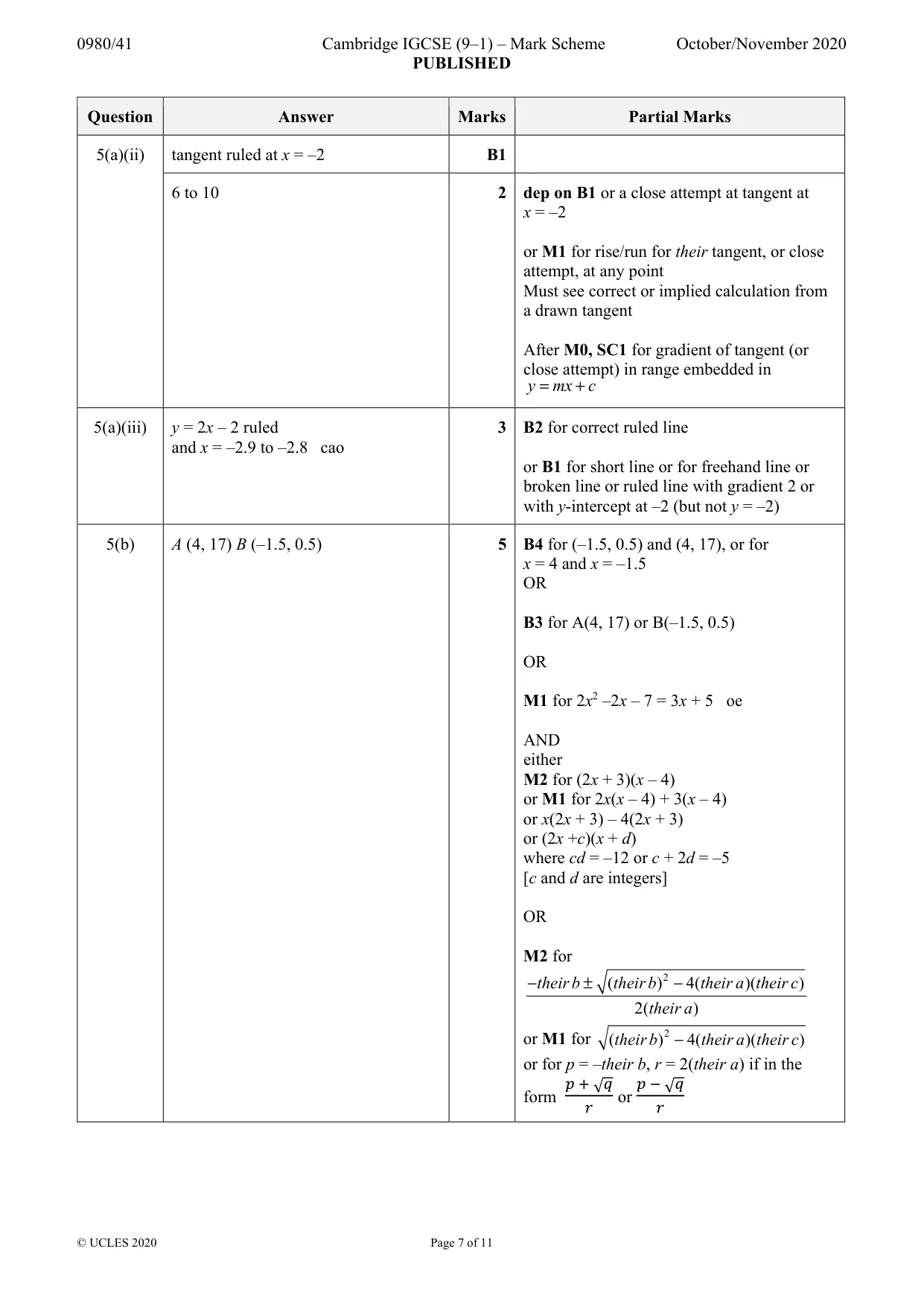
Mark scheme: 5(a)(i) 2.7 to 2.8 1 5(a)(ii) tangent ruled at x = –2 B1 6 to 10 2 dep on B1 or a close attempt at tangent at x = –2 or M1 for rise/run for their tangent, or close attempt, at any point Must see correct or implied calculation from a drawn tangent After M0, SC1 for gradient of tangent (or close attempt) in range embedded in y = mx + c 5(a)(iii) y = 2x – 2 ruled 3 B2 for correct ruled line and x = –2.9 to –2.8 cao or B1 for short line or for freehand line or broken line or ruled line with gradient 2 or with y-intercept at –2 (but not y = –2) 5(b) A (4, 17) B (–1.5, 0.5) 5 B4 for (–1.5, 0.5) and (4, 17), or for x = 4 and x = –1.5 OR B3 for A(4, 17) or B(–1.5, 0.5) OR M1 for 2x2 –2x – 7 = 3x + 5 oe AND either M2 for (2x + 3)(x – 4) or M1 for 2x(x – 4) + 3(x – 4) or x(2x + 3) – 4(2x + 3) or (2x +c)(x + d) where cd = –12 or c + 2d = –5 [c and d are integers] OR M2 for − their b ± (theirb ) 2 − 4( their a )( their c ) 2( their a ) or M1 for ( their b ) 2 − 4( their a )( their c ) or for p = –their b, r = 2(their a) if in the ା √ ି √ form or
Q6 · D 287.9 m North NOT TO 205.8 m SCALE C 168 m 38° 192 m A B The diagram shows a field…
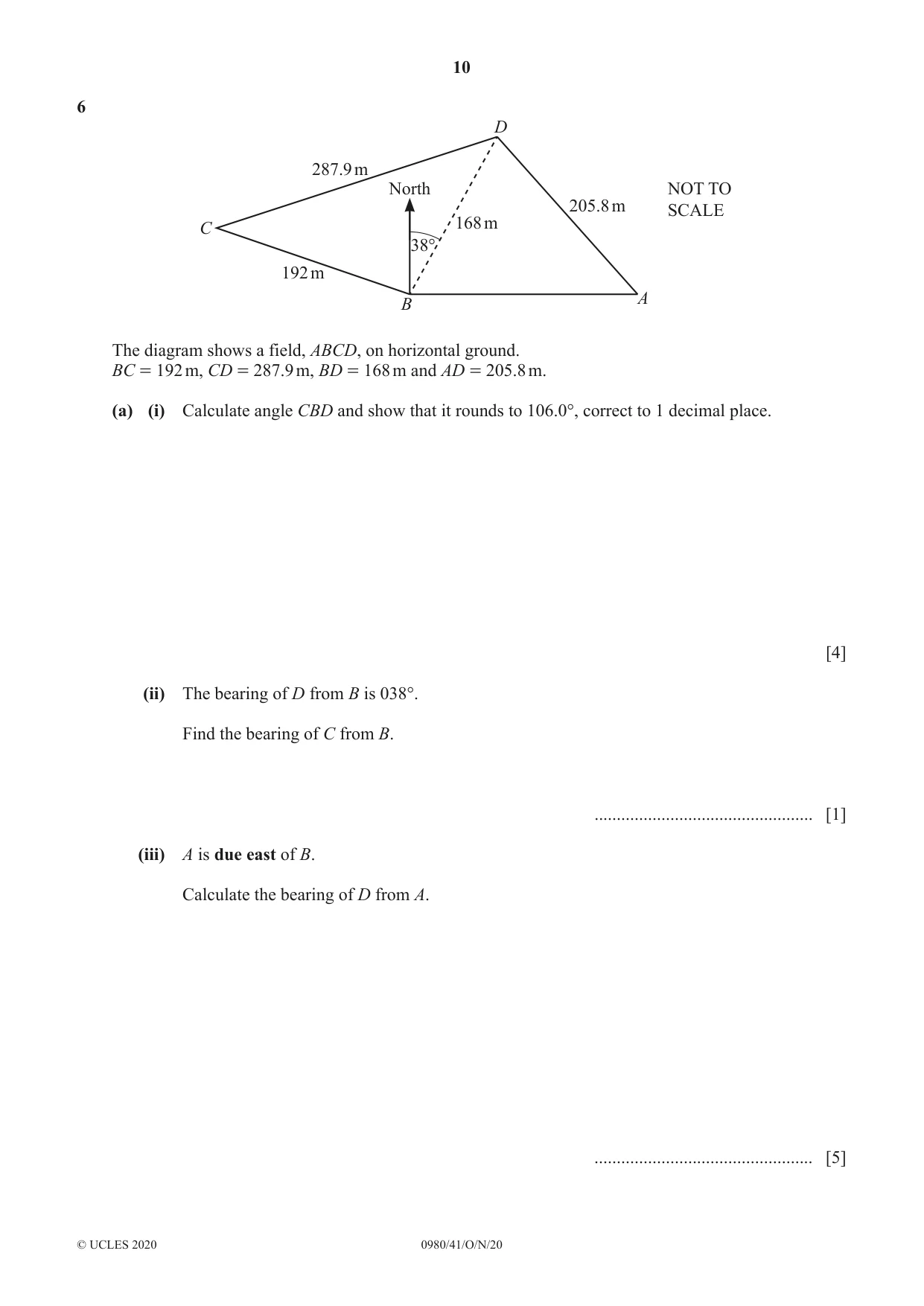
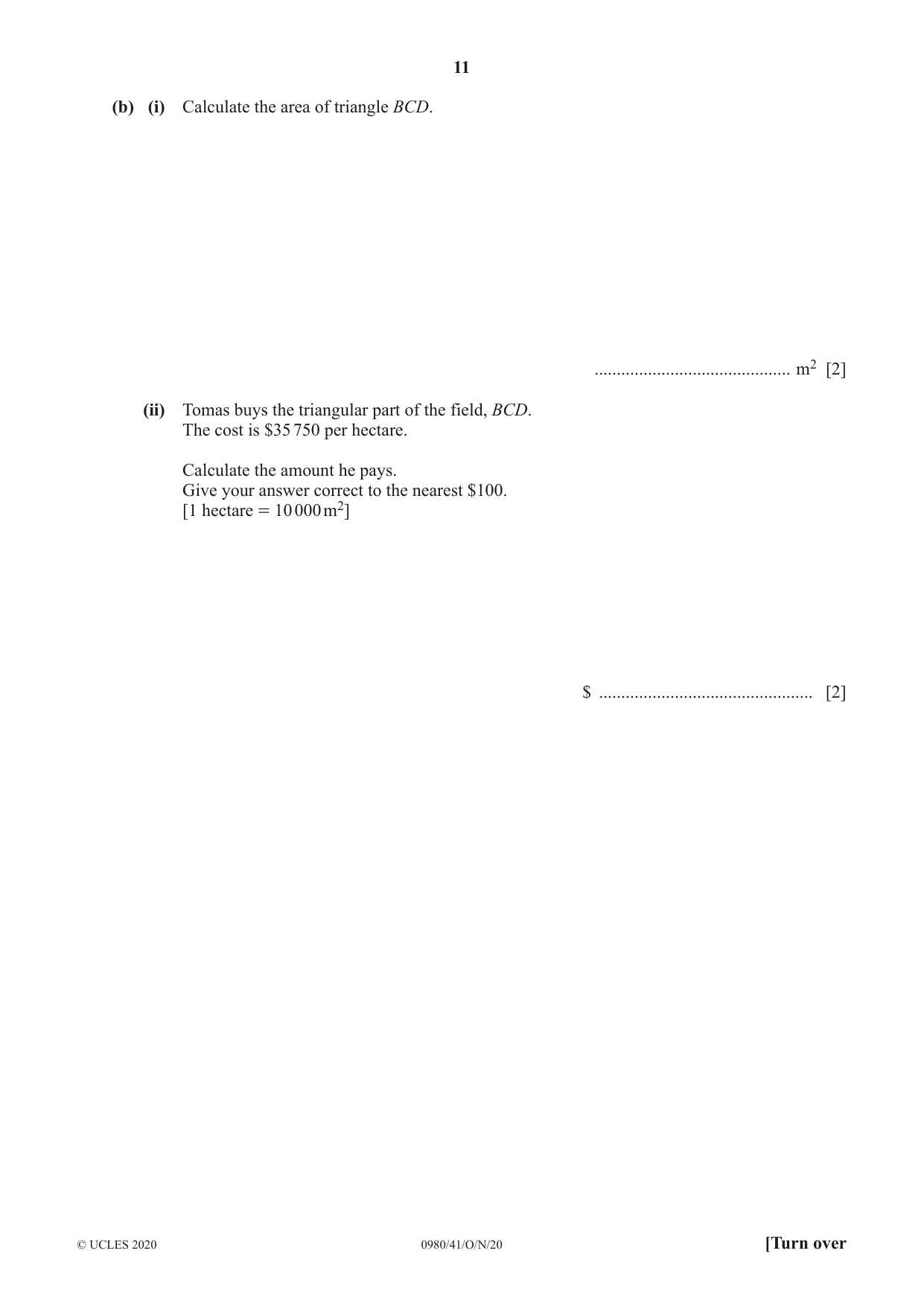
6 D 287.9 m North NOT TO 205.8 m SCALE C 168 m 38° 192 m A B The diagram shows a field, ABCD, on horizontal ground. BC = 192 m, CD = 287.9 m, BD = 168 m and AD = 205.8 m. (a) (i) Calculate angle CBD and show that it rounds to 106.0°, correct to 1 decimal place. [4] (ii) The bearing of D from B is 038°. Find the bearing of C from B. ................................................. [1] (iii) A is due east of B. Calculate the bearing of D from A. ................................................. [5] (b) (i) Calculate the area of triangle BCD. ............................................ m2 [2] (ii) Tomas buys the triangular part of the field, BCD. The cost is $35 750 per hectare. Calculate the amount he pays. Give your answer correct to the nearest $100. [1 hectare = 10 000 m2] $ ................................................ [2]
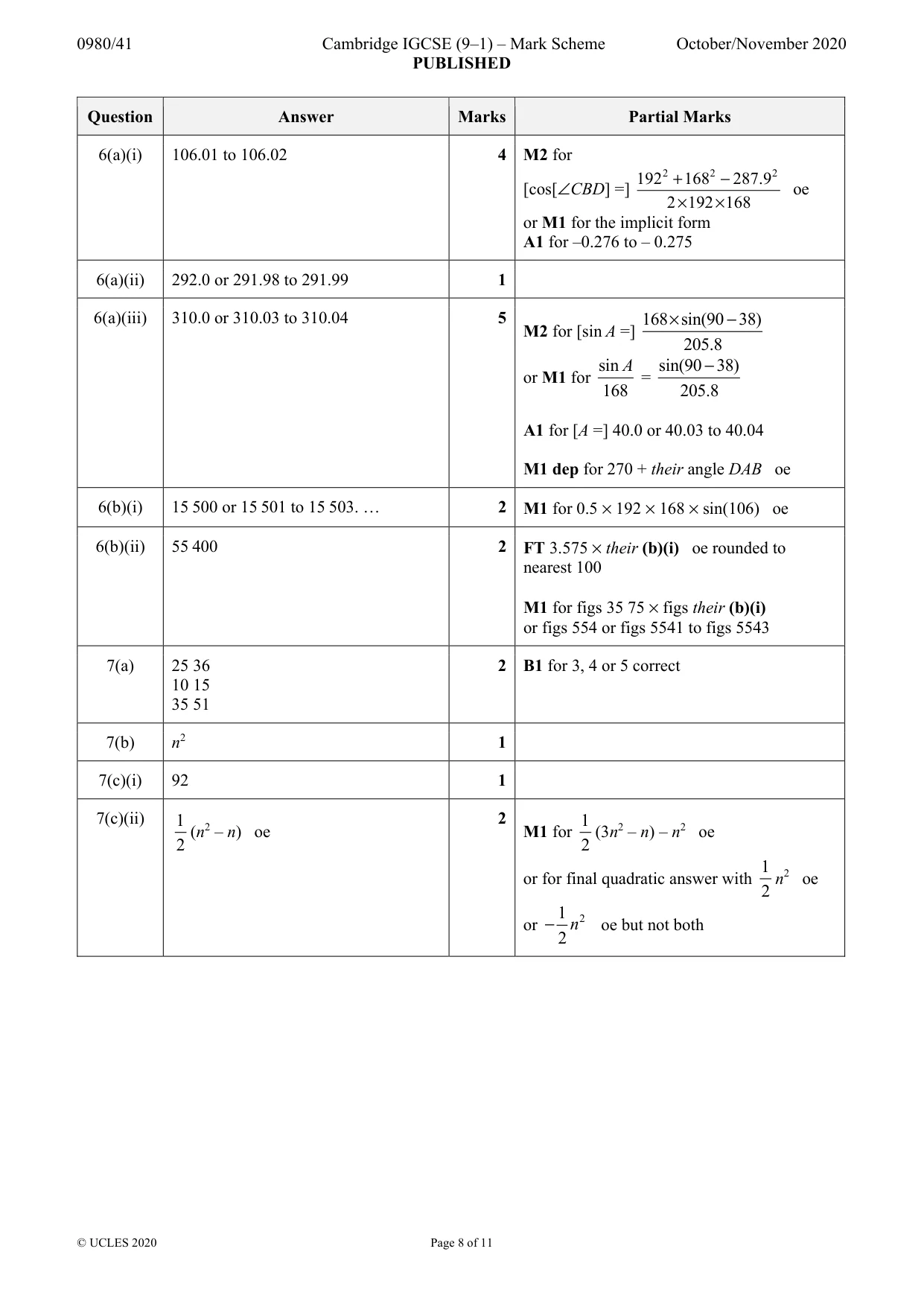
Mark scheme: 6(a)(i) 106.01 to 106.02 4 M2 for 192 2 + 168 2 − 287.9 2 [cos[∠CBD] =] oe 2 × 192 × 168 or M1 for the implicit form A1 for –0.276 to – 0.275 6(a)(ii) 292.0 or 291.98 to 291.99 1 6(a)(iii) 310.0 or 310.03 to 310.04 5 168 × sin(90 − 38) M2 for [sin A =] 205.8 sin A sin(90 − 38) or M1 for = 168 205.8 A1 for [A =] 40.0 or 40.03 to 40.04 M1 dep for 270 + their angle DAB oe 6(b)(i) 15 500 or 15 501 to 15 503. … 2 M1 for 0.5 × 192 × 168 × sin(106) oe 6(b)(ii) 55 400 2 FT 3.575 × their (b)(i) oe rounded to nearest 100 M1 for figs 35 75 × figs their (b)(i) or figs 554 or figs 5541 to figs 5543
Q7 · Diagram 1 Diagram 2 Diagram 3 Diagram 4 These are the first four diagrams of a sequence
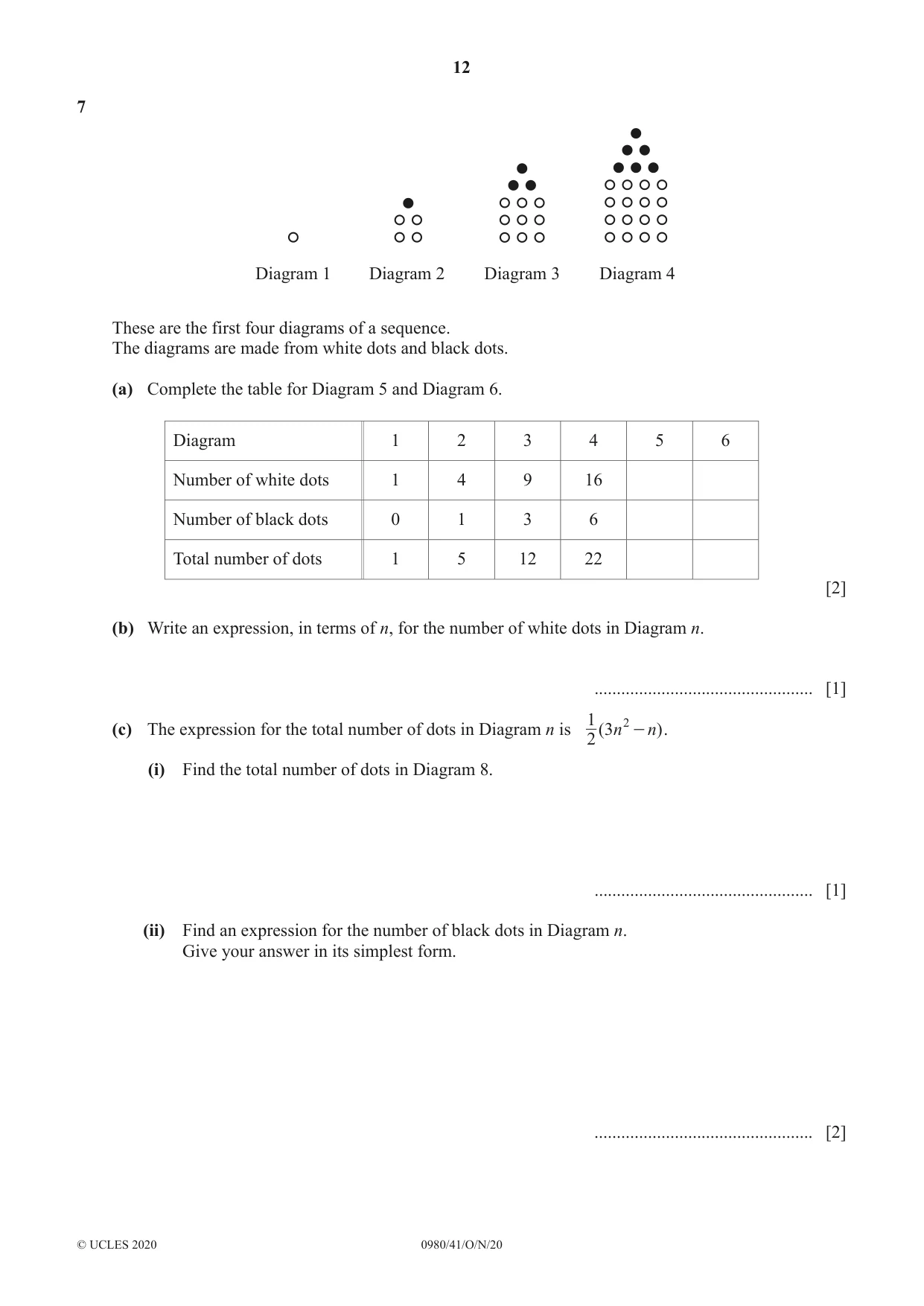
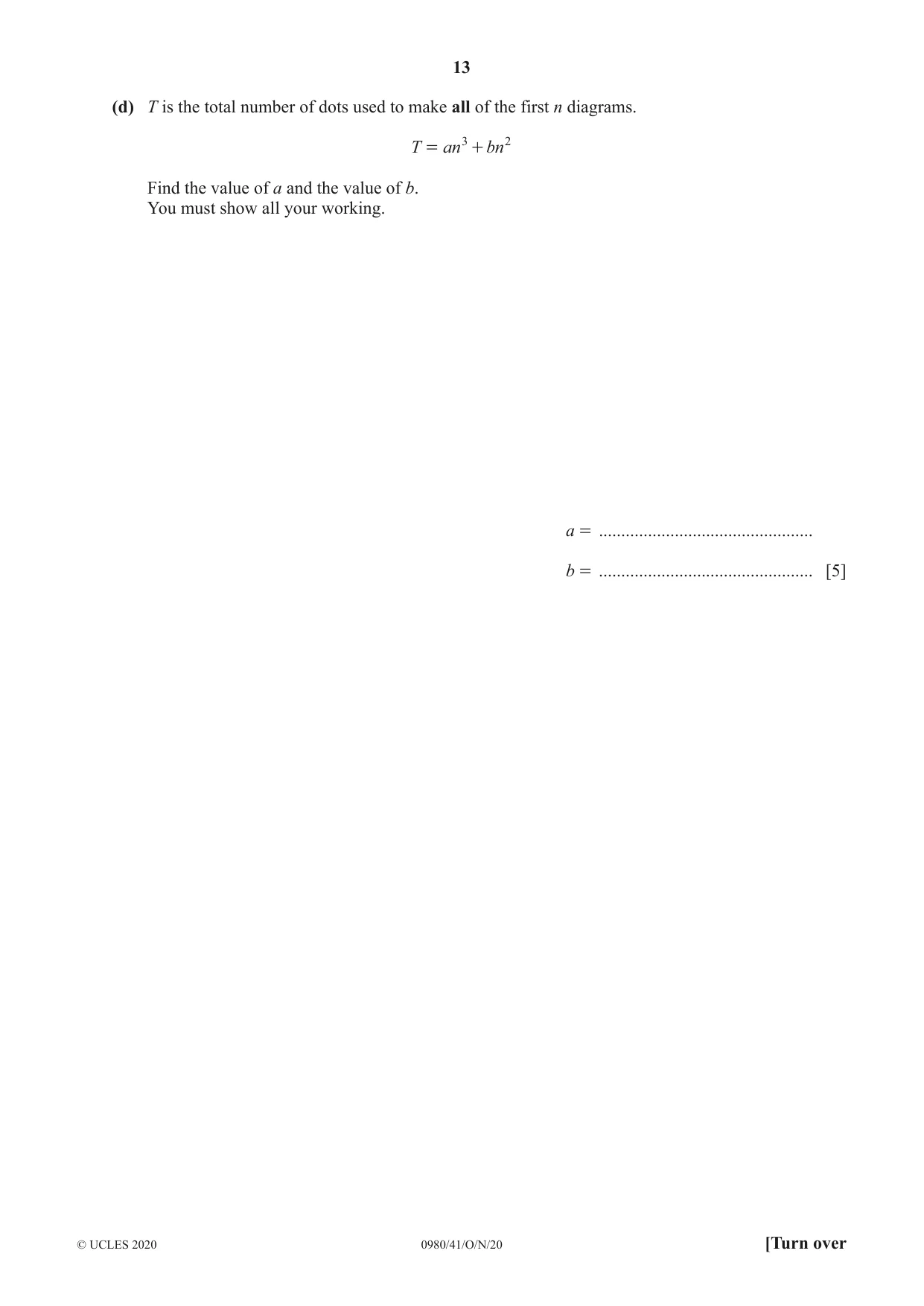
7 Diagram 1 Diagram 2 Diagram 3 Diagram 4 These are the first four diagrams of a sequence. The diagrams are made from white dots and black dots. (a) Complete the table for Diagram 5 and Diagram 6. Diagram 1 2 3 4 5 6 Number of white dots 1 4 9 16 Number of black dots 0 1 3 6 Total number of dots 1 5 12 22 [2] (b) Write an expression, in terms of n, for the number of white dots in Diagram n. ................................................. [1] 1 2 (c) The expression for the total number of dots in Diagram n is ( 3n - n ) . 2 (i) Find the total number of dots in Diagram 8. ................................................. [1] (ii) Find an expression for the number of black dots in Diagram n. Give your answer in its simplest form. ................................................. [2] (d) T is the total number of dots used to make all of the first n diagrams. T = an 3 + bn 2 Find the value of a and the value of b. You must show all your working. a = ................................................ b = ................................................ [5]
Mark scheme: 7(a) 25 36 2 B1 for 3, 4 or 5 correct 10 15 35 51 7(b) n2 1 7(c)(i) 92 1 7(c)(ii) 1 2 1 (n2 – n) oe M1 for (3n2 – n) – n2 oe 2 2 1 or for final quadratic answer with n2 oe 2 1 2 or − n oe but not both 2 7(d) 1 1 5 B2 for 2 correct equations eg a = , b = a + b = 1, 8a + 4b = 6 2 2 or B1 for 1 correct equation B2 for one correct value or M1 (dep on at least B1) for correctly eliminating one variable from two linear equations in a and b OR 1 B2 for a = 2 or B1 for 6a = 3 or for 3rd difference = 3 1 B2 for b = 2 or M1 for substituting their a into a correct equation of first differences
Question 8
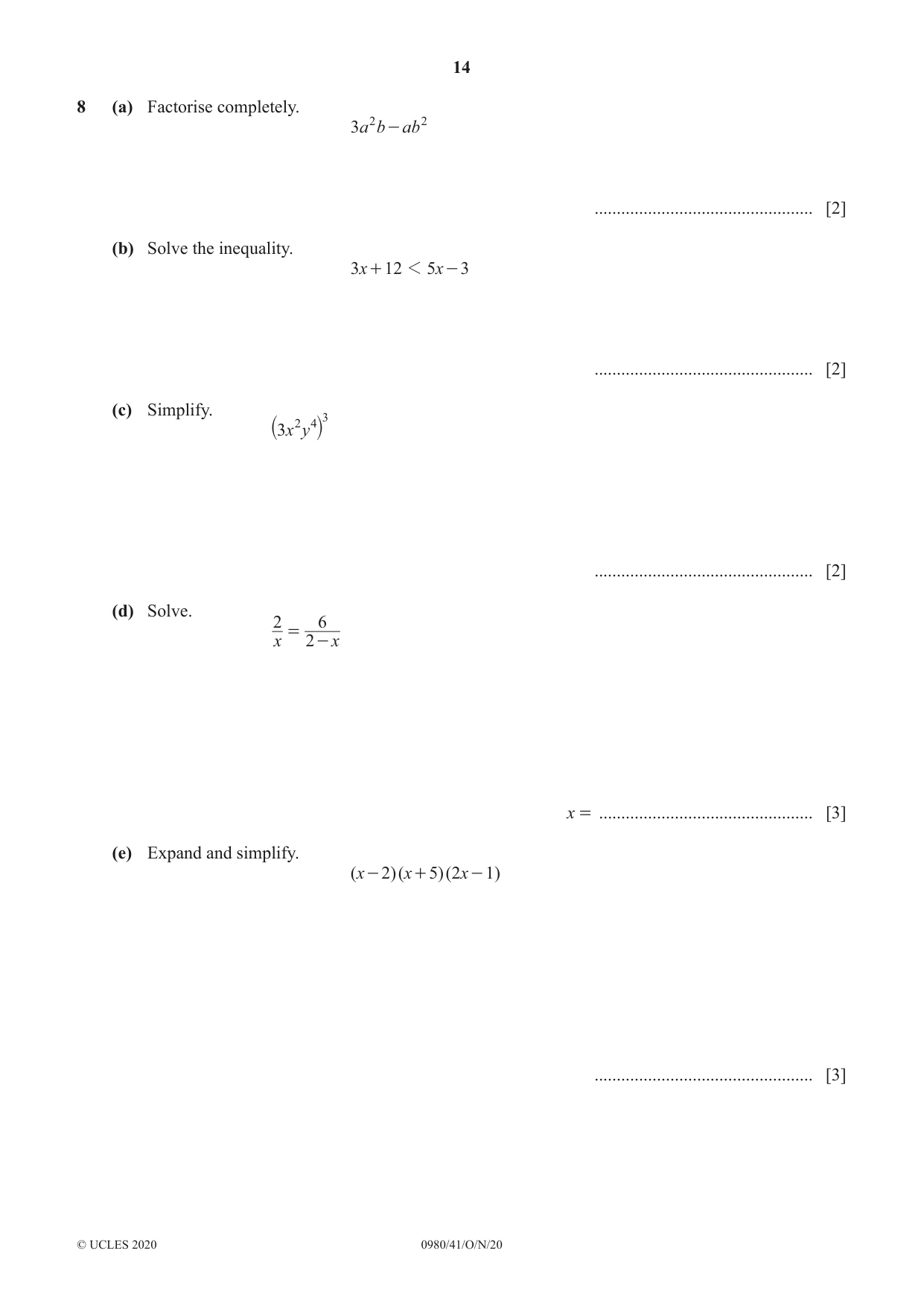
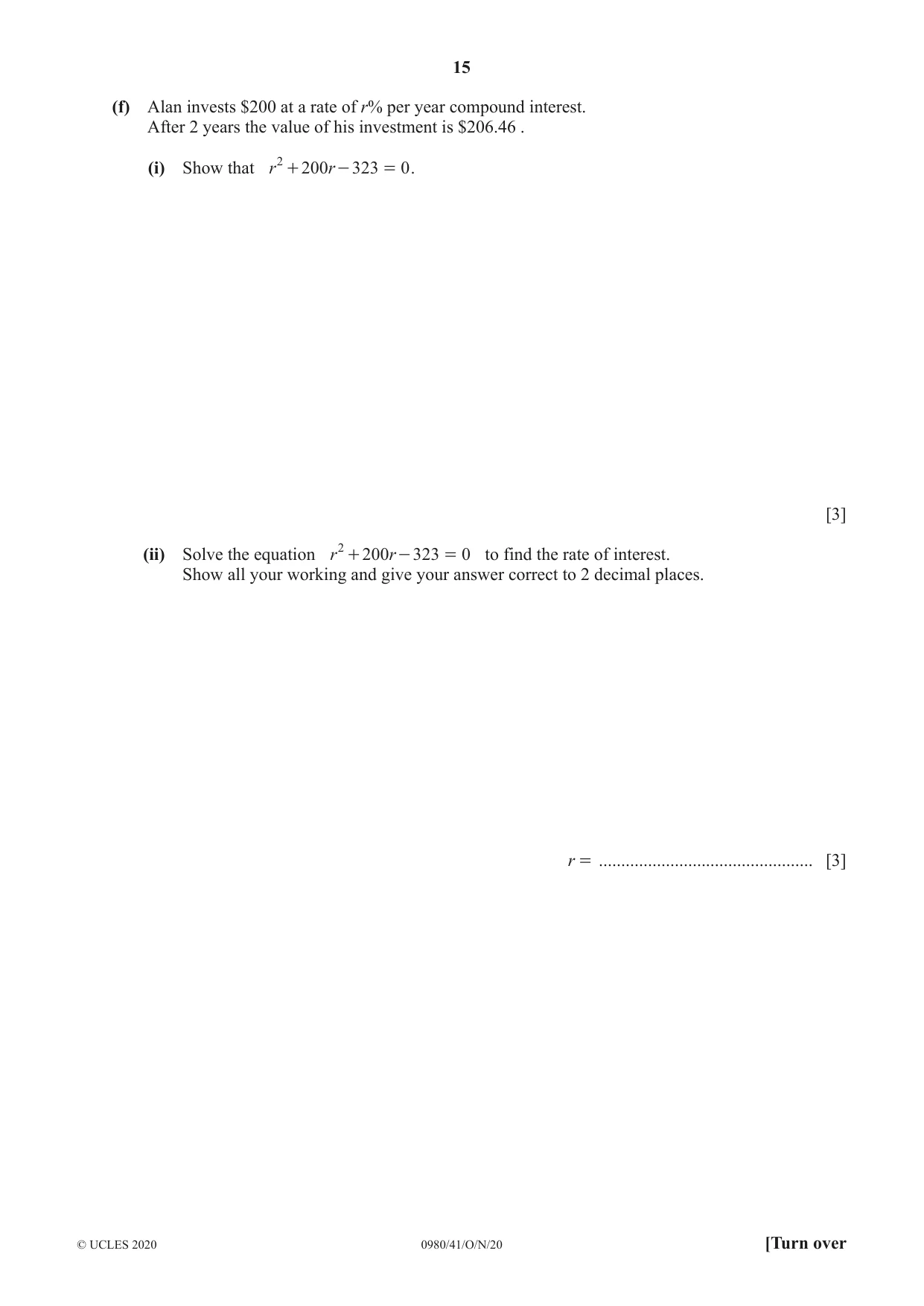
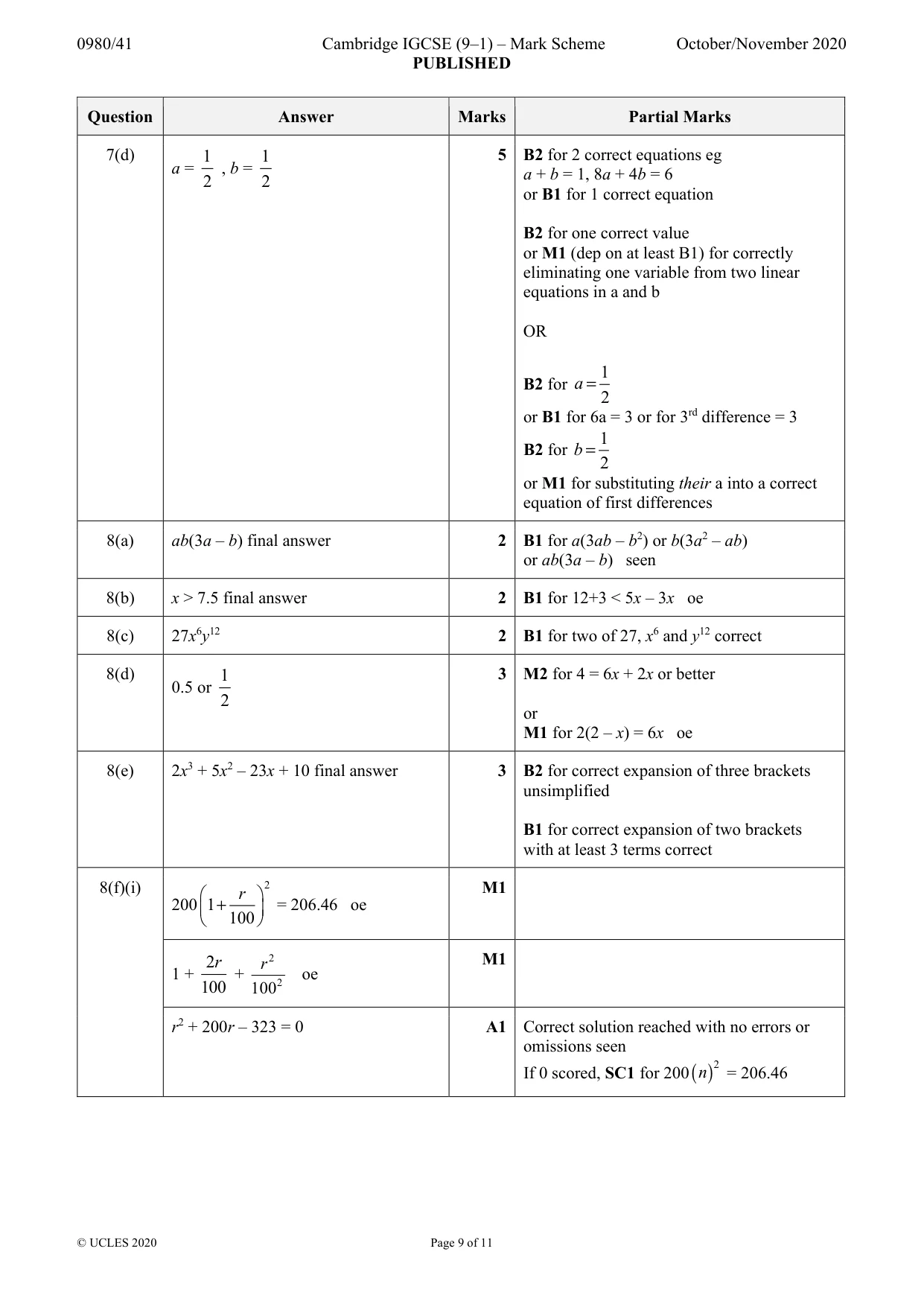
8 (a) Factorise completely. 3a 2 b - ab 2 ................................................. [2] (b) Solve the inequality. 3x + 12 1 5x - 3 ................................................. [2] (c) Simplify. 3 3x 2 y 4 ` j ................................................. [2] (d) Solve. 2 6 = x 2 - x x = ................................................ [3] (e) Expand and simplify. ( x - 2)( x + 5)( 2x - 1) ................................................. [3] (f) Alan invests $200 at a rate of r% per year compound interest. After 2 years the value of his investment is $206.46 . (i) Show that r 2 + 200r - 323 = 0 . [3] (ii) Solve the equation r 2 + 200r - 323 = 0 to find the rate of interest. Show all your working and give your answer correct to 2 decimal places. r = ................................................ [3]
Mark scheme: 8(a) ab(3a – b) final answer 2 B1 for a(3ab – b2) or b(3a2 – ab) or ab(3a – b) seen 8(b) x > 7.5 final answer 2 B1 for 12+3 < 5x – 3x oe 8(c) 27x6y12 2 B1 for two of 27, x6 and y12 correct 8(d) 1 3 M2 for 4 = 6x + 2x or better 0.5 or 2 or M1 for 2(2 – x) = 6x oe 8(e) 2x3 + 5x2 – 23x + 10 final answer 3 B2 for correct expansion of three brackets unsimplified B1 for correct expansion of two brackets with at least 3 terms correct 8(f)(i) 2 M1 r 200 1 + = 206.46 oe 100 2r r 2 M1 1 + + oe 100 100 2 r2 + 200r – 323 = 0 A1 Correct solution reached with no errors or omissions seen If 0 scored, SC1 for 200( n ) 2 = 206.46 8(f)(ii) 2 B2 2 −200 + 200 − 4(1)( −323) B1 for 200 − 4(1)( − 323) or (r + 100)2 2 × 1 −200 + q 2 B1 for or r = 323 + 100 – 100 2 × 1 OR 206.46 B2 for 100 − 1 200 206.46 or B1 for 200 1.60 cao final answer B1
Q9 · There are 32 students in a class
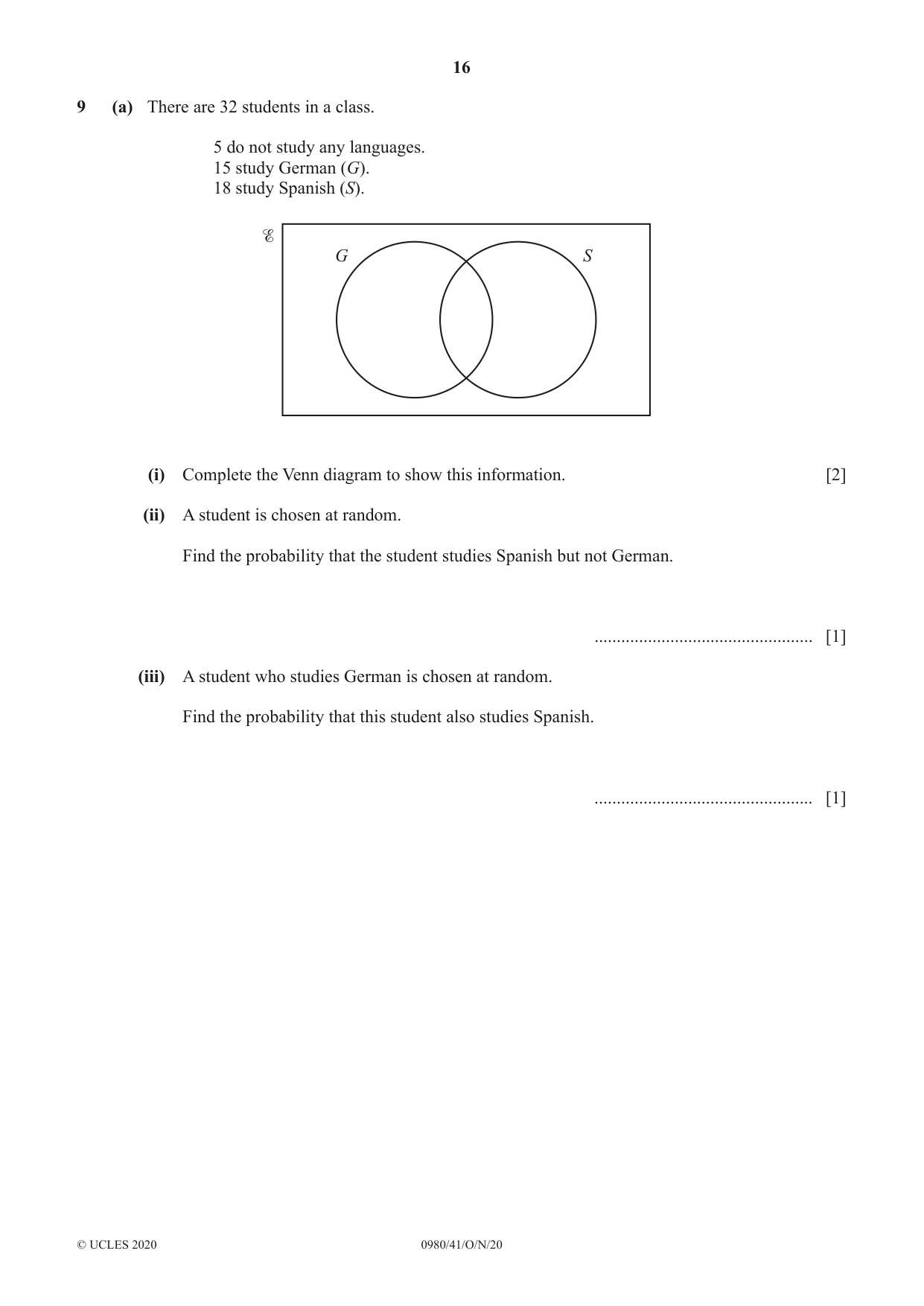
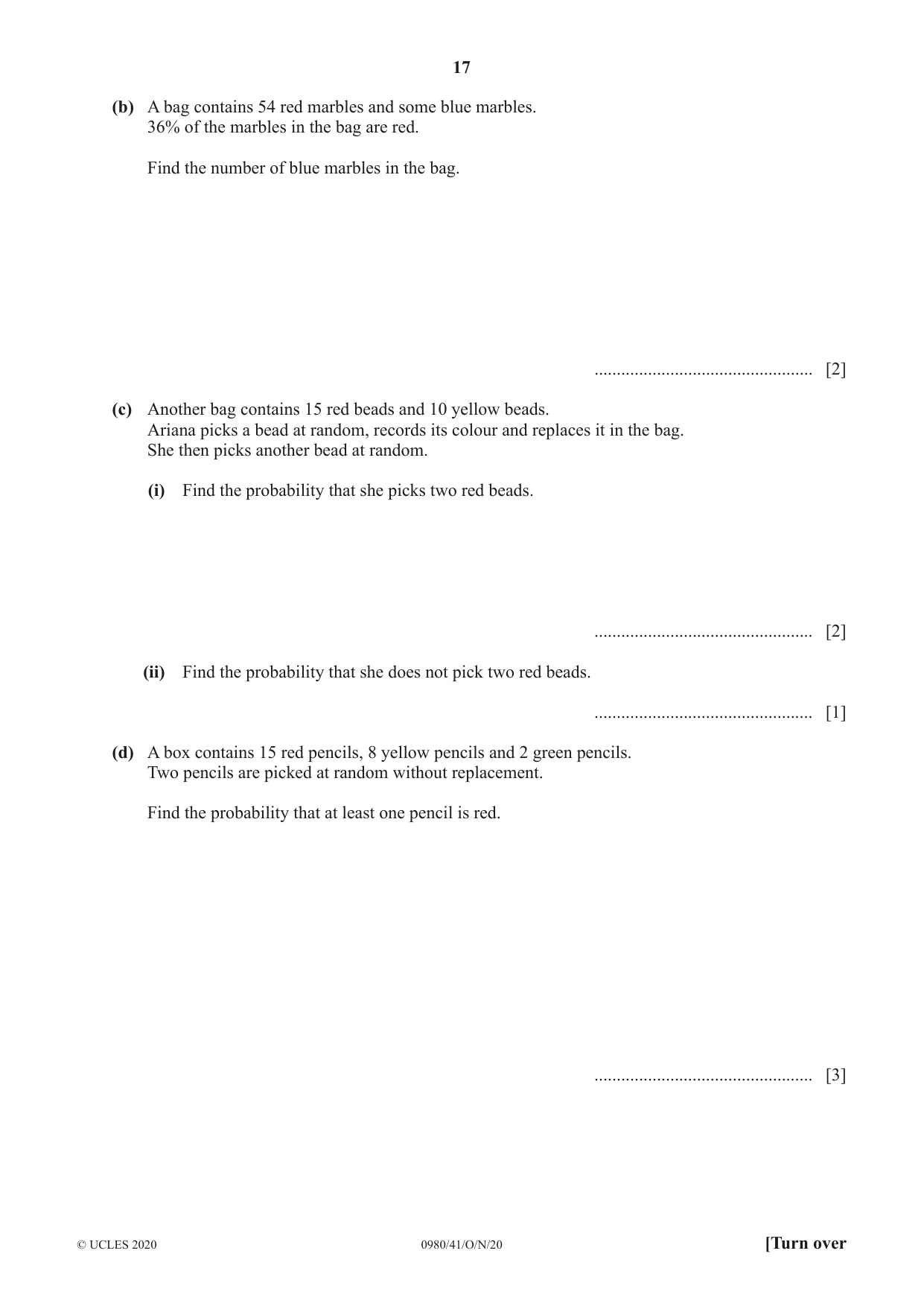
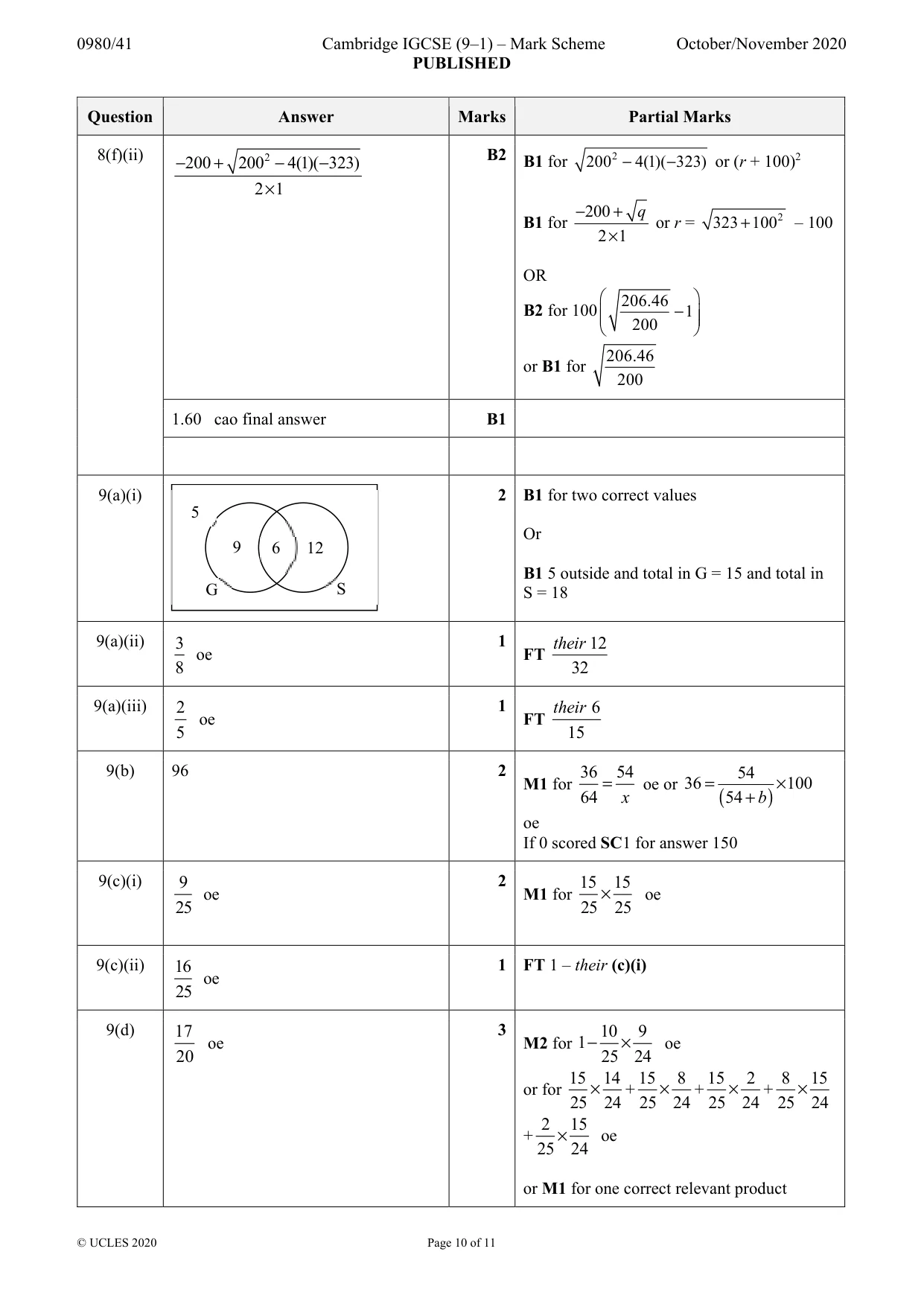
9 (a) There are 32 students in a class. 5 do not study any languages. 15 study German (G). 18 study Spanish (S). G S (i) Complete the Venn diagram to show this information. [2] (ii) A student is chosen at random. Find the probability that the student studies Spanish but not German. ................................................. [1] (iii) A student who studies German is chosen at random. Find the probability that this student also studies Spanish. ................................................. [1] (b) A bag contains 54 red marbles and some blue marbles. 36% of the marbles in the bag are red. Find the number of blue marbles in the bag. ................................................. [2] (c) Another bag contains 15 red beads and 10 yellow beads. Ariana picks a bead at random, records its colour and replaces it in the bag. She then picks another bead at random. (i) Find the probability that she picks two red beads. ................................................. [2] (ii) Find the probability that she does not pick two red beads. ................................................. [1] (d) A box contains 15 red pencils, 8 yellow pencils and 2 green pencils. Two pencils are picked at random without replacement. Find the probability that at least one pencil is red. ................................................. [3]
Mark scheme: 9(a)(i) 2 B1 for two correct values 5 Or 9 6 12 B1 5 outside and total in G = 15 and total in G S S = 18 9(a)(ii) 3 1 their 12 oe FT 8 32 9(a)(iii) 2 1 their 6 oe FT 5 15 9(b) 96 2 36 54 54 M1 for = oe or 36 = × 100 64 x ( 54 + b ) oe If 0 scored SC1 for answer 150 9(c)(i) 9 2 15 15 oe M1 for × oe 25 25 25 9(c)(ii) 16 1 FT 1 – their (c)(i) oe 25 9(d) 17 3 10 9 oe M2 for 1 − × oe 20 25 24 15 14 15 8 15 2 8 15 or for × + × + × + × 25 24 25 24 25 24 25 24 2 15 + × oe 25 24 or M1 for one correct relevant product
Q10 · Y NOT TO SCALE B A O x C The diagram shows a sketch of the curve y = x 2 + 3x - 4
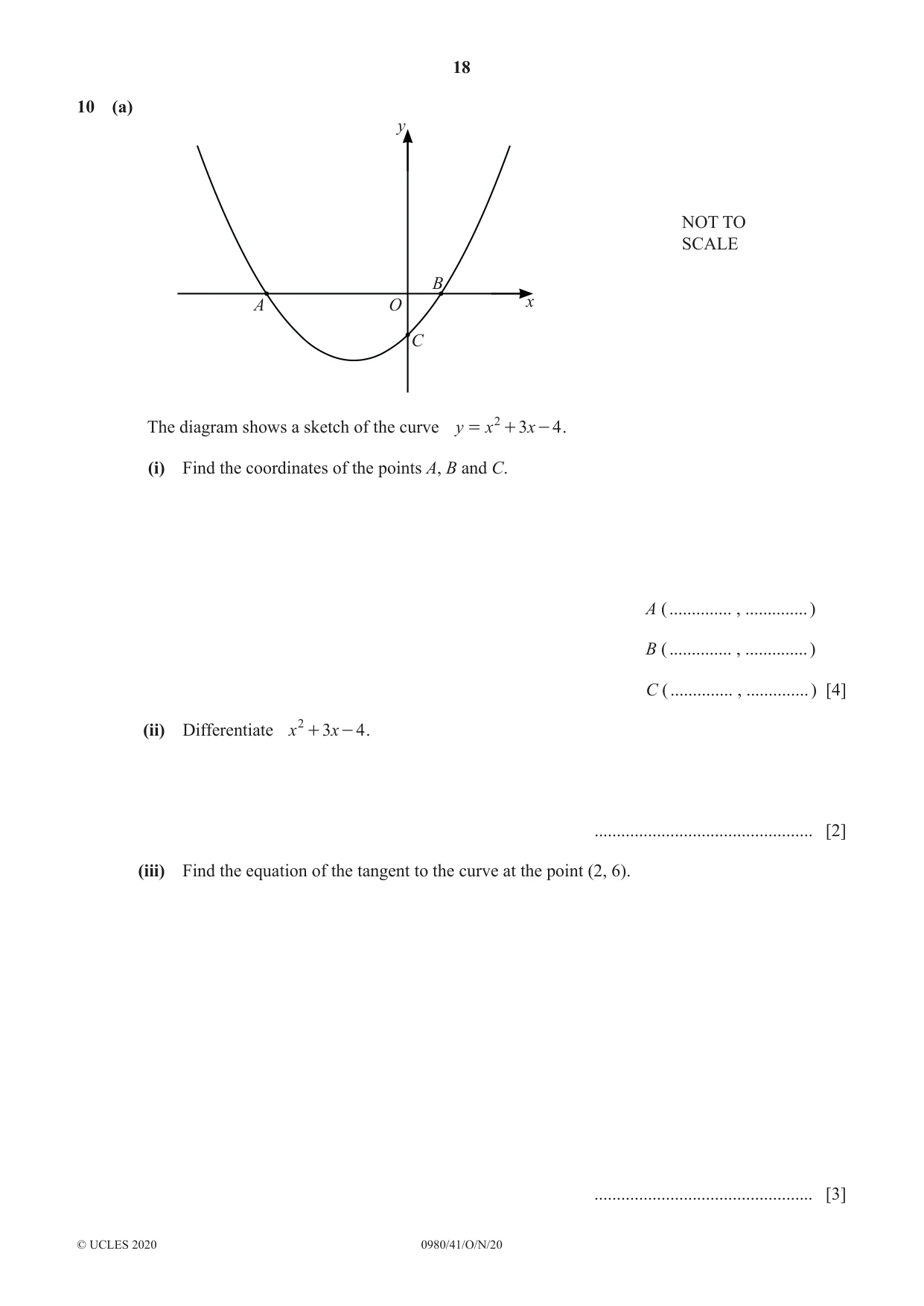
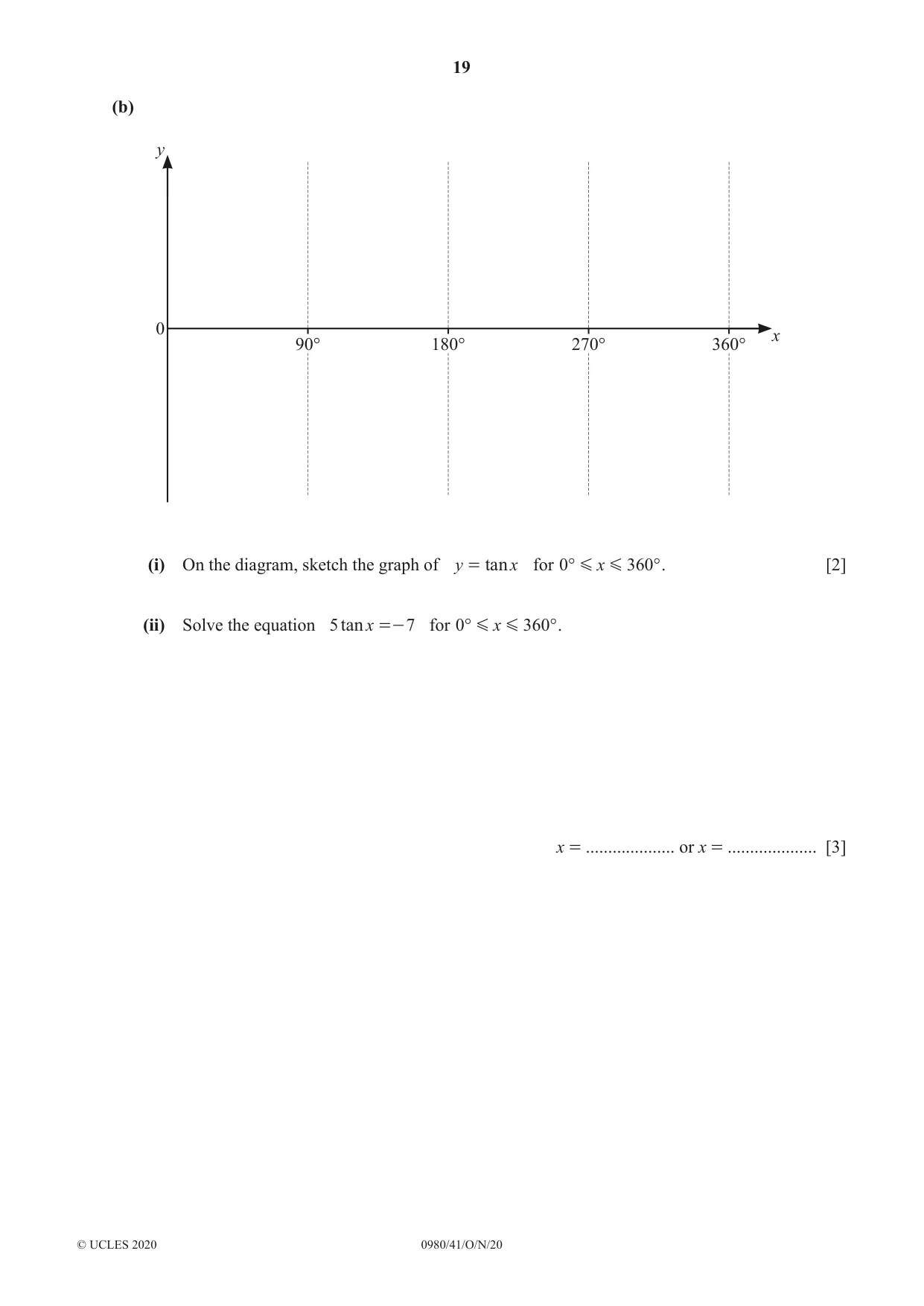
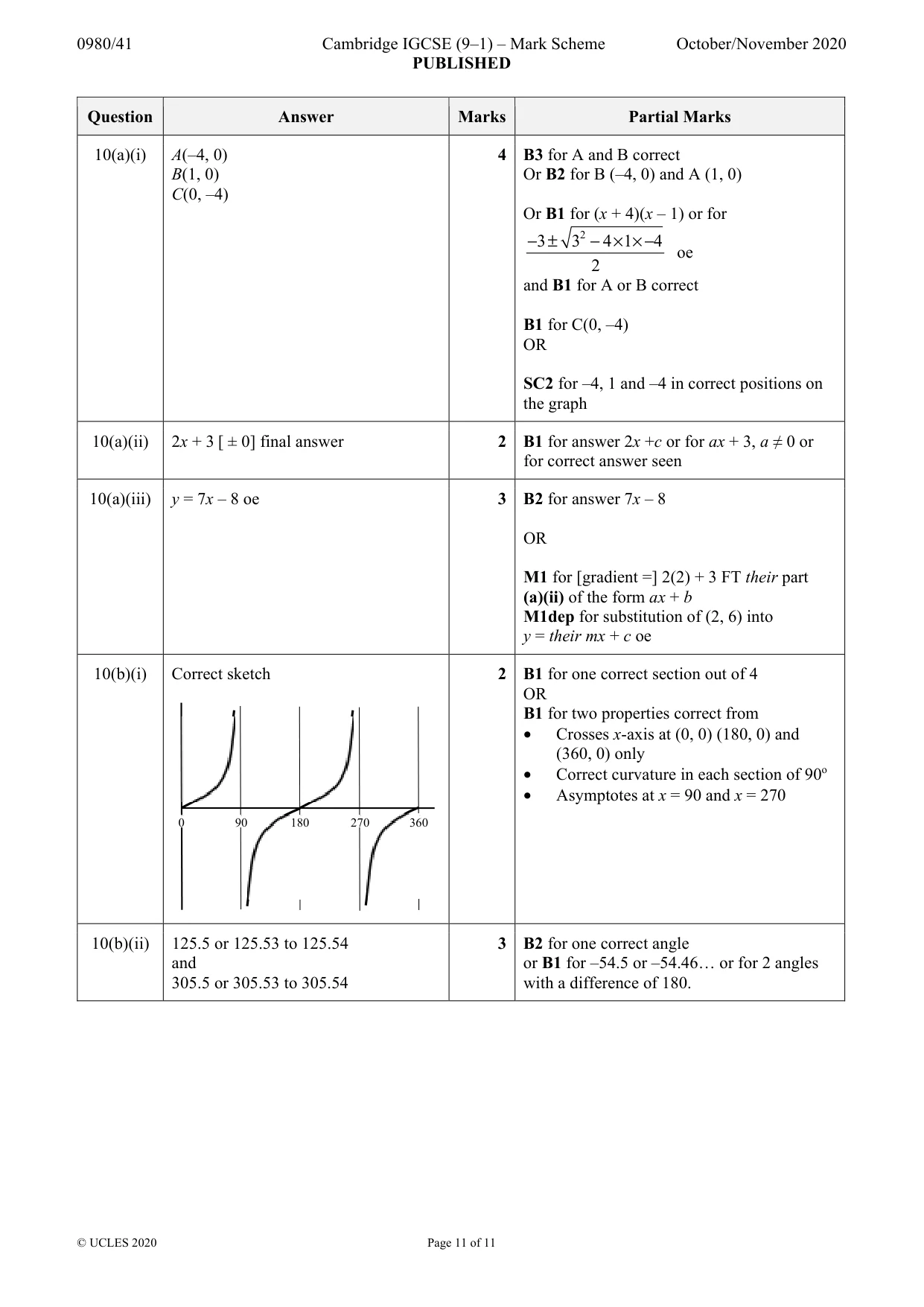
10 (a) y NOT TO SCALE B A O x C The diagram shows a sketch of the curve y = x 2 + 3x - 4 . (i) Find the coordinates of the points A, B and C. A ( .............. , .............. ) B ( .............. , .............. ) C ( .............. , .............. ) [4] (ii) Differentiate x 2 + 3x - 4 . ................................................. [2] (iii) Find the equation of the tangent to the curve at the point (2, 6). ................................................. [3] (b) y 0 x 90° 180° 270° 360° (i) On the diagram, sketch the graph of y = tan x for 0° G x G 360° . [2] (ii) Solve the equation 5 tanx =- 7 for 0° G x G 360° . x = .................... or x = .................... [3]
Mark scheme: 10(a)(i) A(–4, 0) 4 B3 for A and B correct B(1, 0) Or B2 for B (–4, 0) and A (1, 0) C(0, –4) Or B1 for (x + 4)(x – 1) or for −±3 32 −×4 1 ×−4 oe 2 and B1 for A or B correct B1 for C(0, –4) OR SC2 for –4, 1 and –4 in correct positions on the graph 10(a)(ii) 2x + 3 [ ± 0] final answer 2 B1 for answer 2x +c or for ax + 3, a ≠ 0 or for correct answer seen 10(a)(iii) y = 7x – 8 oe 3 B2 for answer 7x – 8 OR M1 for [gradient =] 2(2) + 3 FT their part (a)(ii) of the form ax + b M1dep for substitution of (2, 6) into y = their mx + c oe 10(b)(i) Correct sketch 2 B1 for one correct section out of 4 OR B1 for two properties correct from • Crosses x-axis at (0, 0) (180, 0) and (360, 0) only • Correct curvature in each section of 90o • Asymptotes at x = 90 and x = 270 0 90 180 270 360 10(b)(ii) 125.5 or 125.53 to 125.54 3 B2 for one correct angle and or B1 for –54.5 or –54.46… or for 2 angles 305.5 or 305.53 to 305.54 with a difference of 180.
What was in this paper
The subtopics covered by these 10 questions, and how many questions each got. Open one in a new tab to see every Cambridge question on it.
What you needed in this session
Cambridge’s own grade thresholds for 2020 Oct/Nov, Paper 4 · Variant 1. A higher threshold means an easier paper — the bar moves with how the cohort did.