Cambridge IGCSE Mathematics (9-1) 0980 — 2022 Oct/Nov Paper 4 · Variant 1
0980/41/O/N/22 · 10 questions · 130 marks · ≈146 min
The question paper and its mark scheme, free to read here and free to download. This is Cambridge’s own paper, exactly as it was sat.
Question paper20 pages
Mark scheme9 pages
Answers below. Sit the paper first if you are practising.
Questions as text
Q1 · Calculate the volume of (i) a solid cylinder with radius 6 cm and height 14 cm…
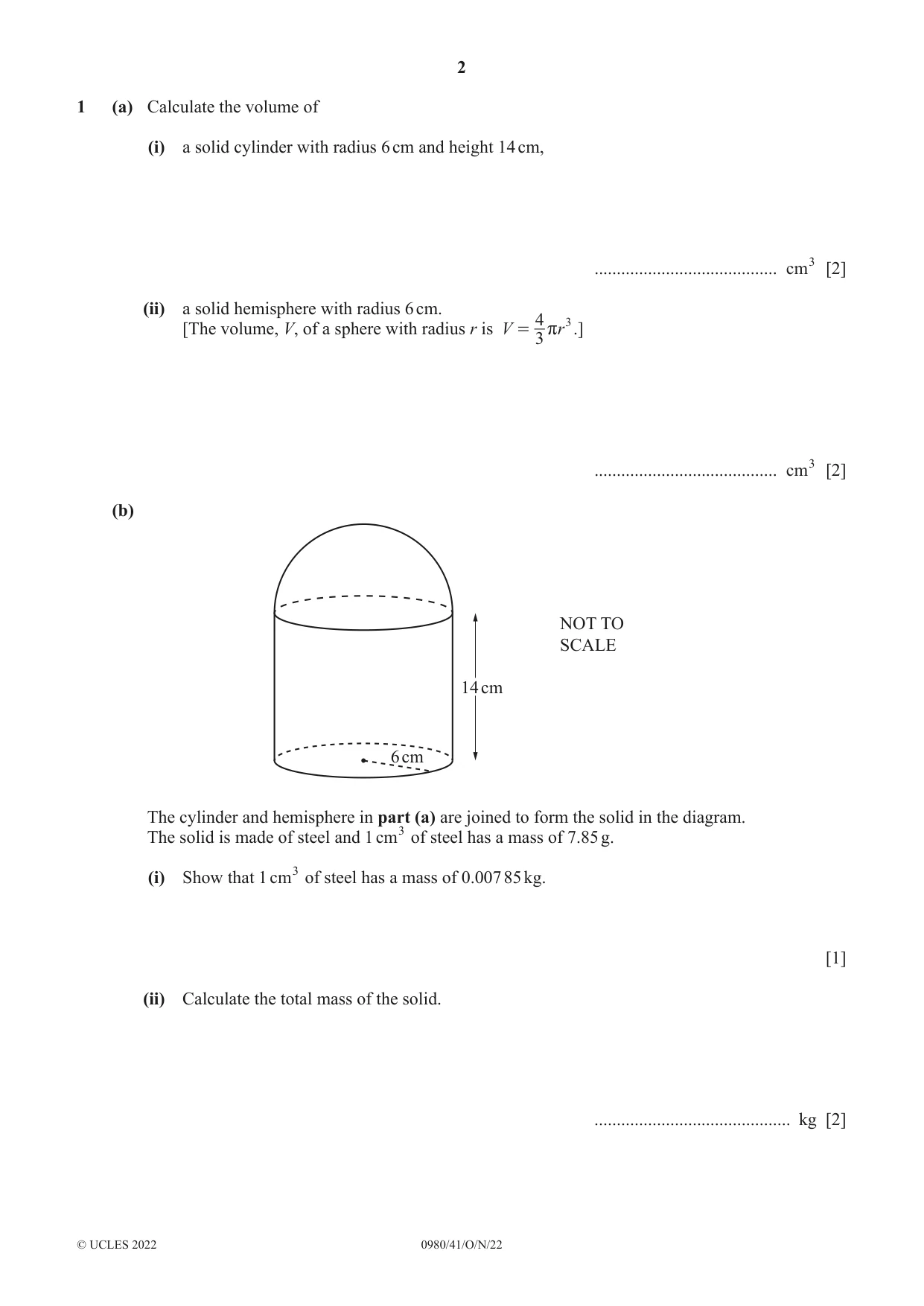
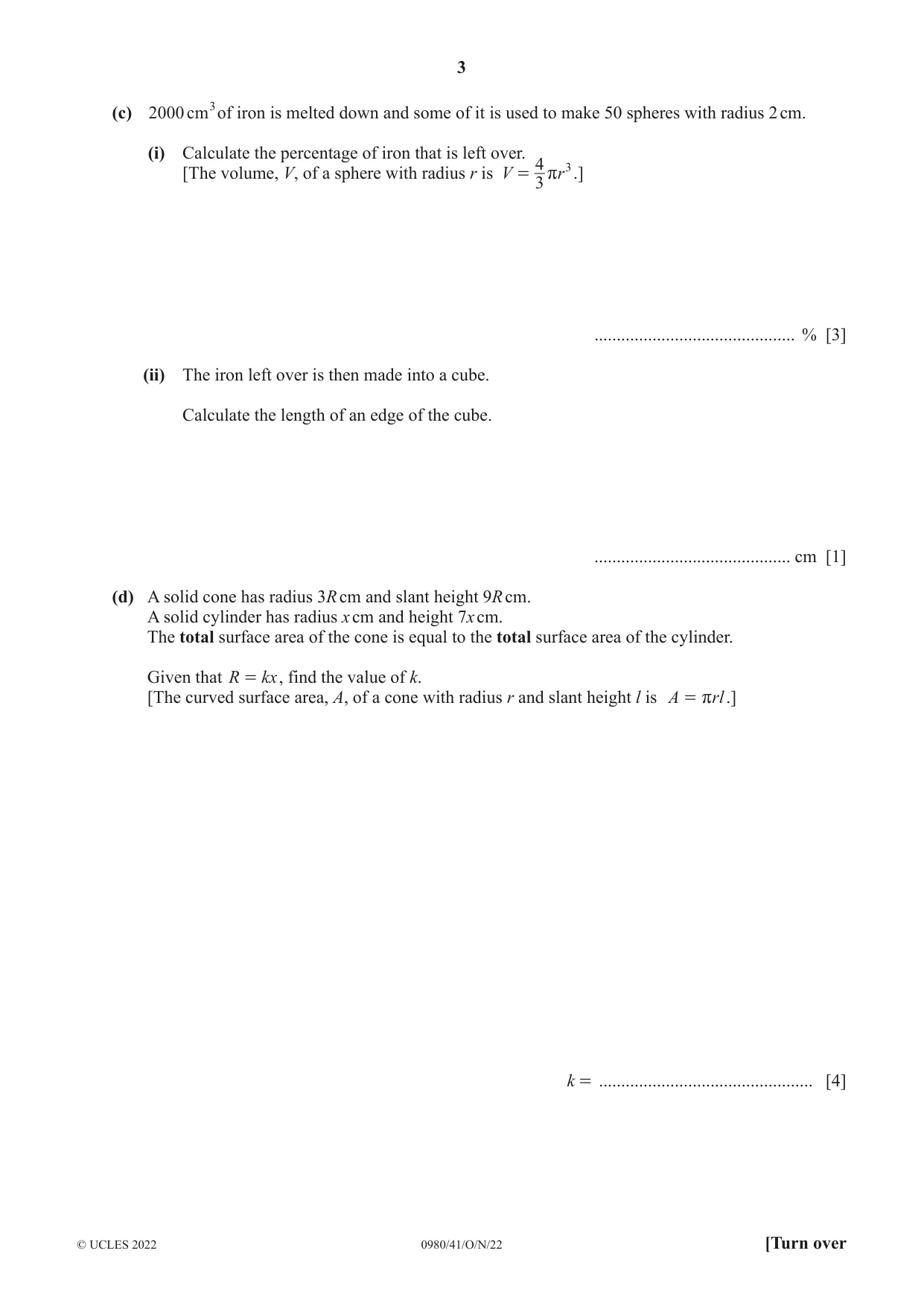
1 (a) Calculate the volume of (i) a solid cylinder with radius 6 cm and height 14 cm, ......................................... cm3 [2] (ii) a solid hemisphere with radius 6 cm. 4 3 [The volume, V, of a sphere with radius r is V = rr .] 3 ......................................... cm3 [2] (b) NOT TO SCALE 14 cm 6 cm The cylinder and hemisphere in part (a) are joined to form the solid in the diagram. The solid is made of steel and 1 cm 3 of steel has a mass of 7.85 g. (i) Show that 1 cm 3 of steel has a mass of 0.007 85 kg. [1] (ii) Calculate the total mass of the solid. ............................................ kg [2] (c) 2000 cm 3of iron is melted down and some of it is used to make 50 spheres with radius 2 cm. (i) Calculate the percentage of iron that is left over. 4 3 [The volume, V, of a sphere with radius r is V = rr .] 3 ............................................. % [3] (ii) The iron left over is then made into a cube. Calculate the length of an edge of the cube. ............................................ cm [1] (d) A solid cone has radius 3R cm and slant height 9R cm. A solid cylinder has radius x cm and height 7x cm. The total surface area of the cone is equal to the total surface area of the cylinder. Given that R = kx , find the value of k. [The curved surface area, A, of a cone with radius r and slant height l is A = rrl .] k = ................................................ [4]
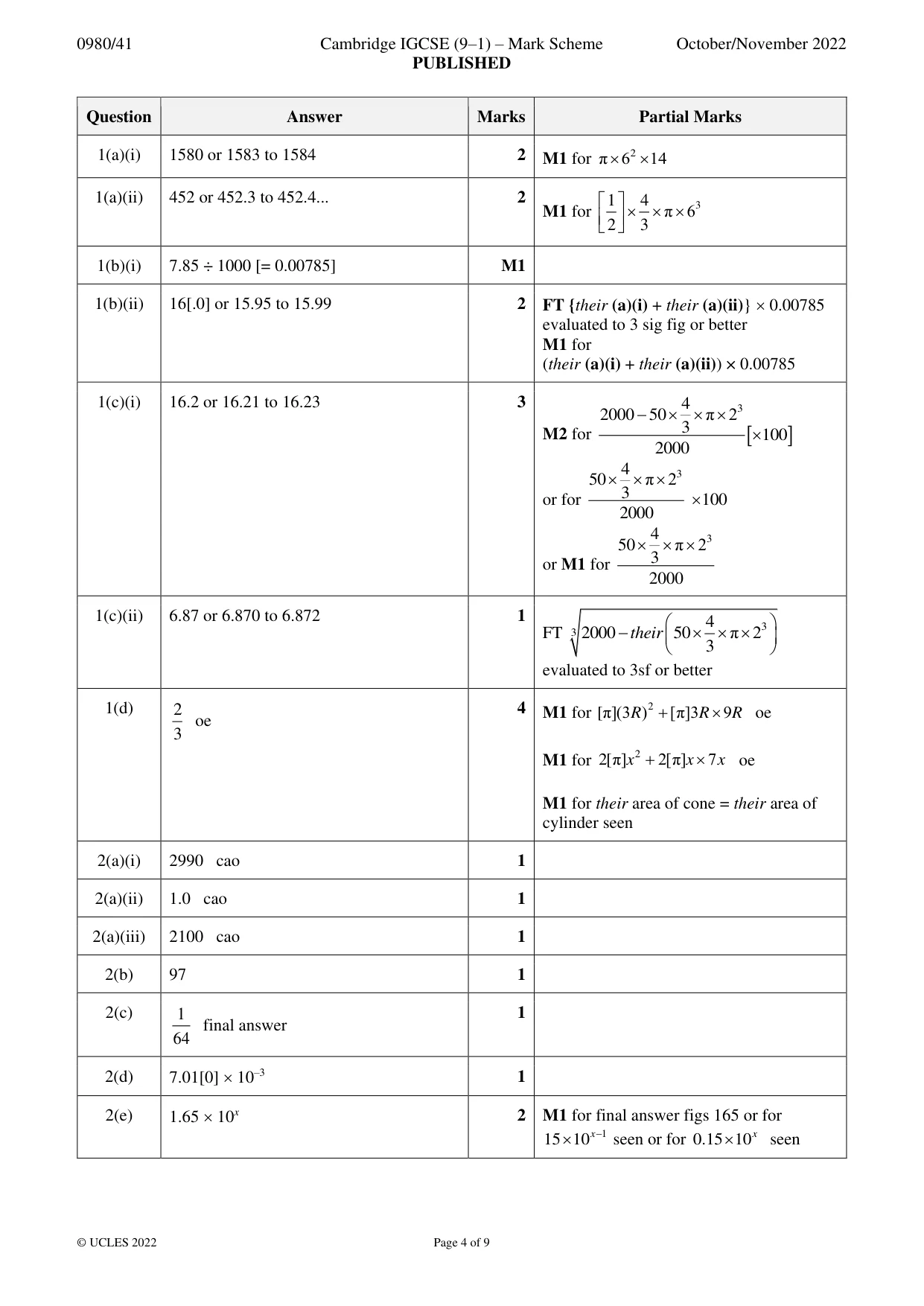
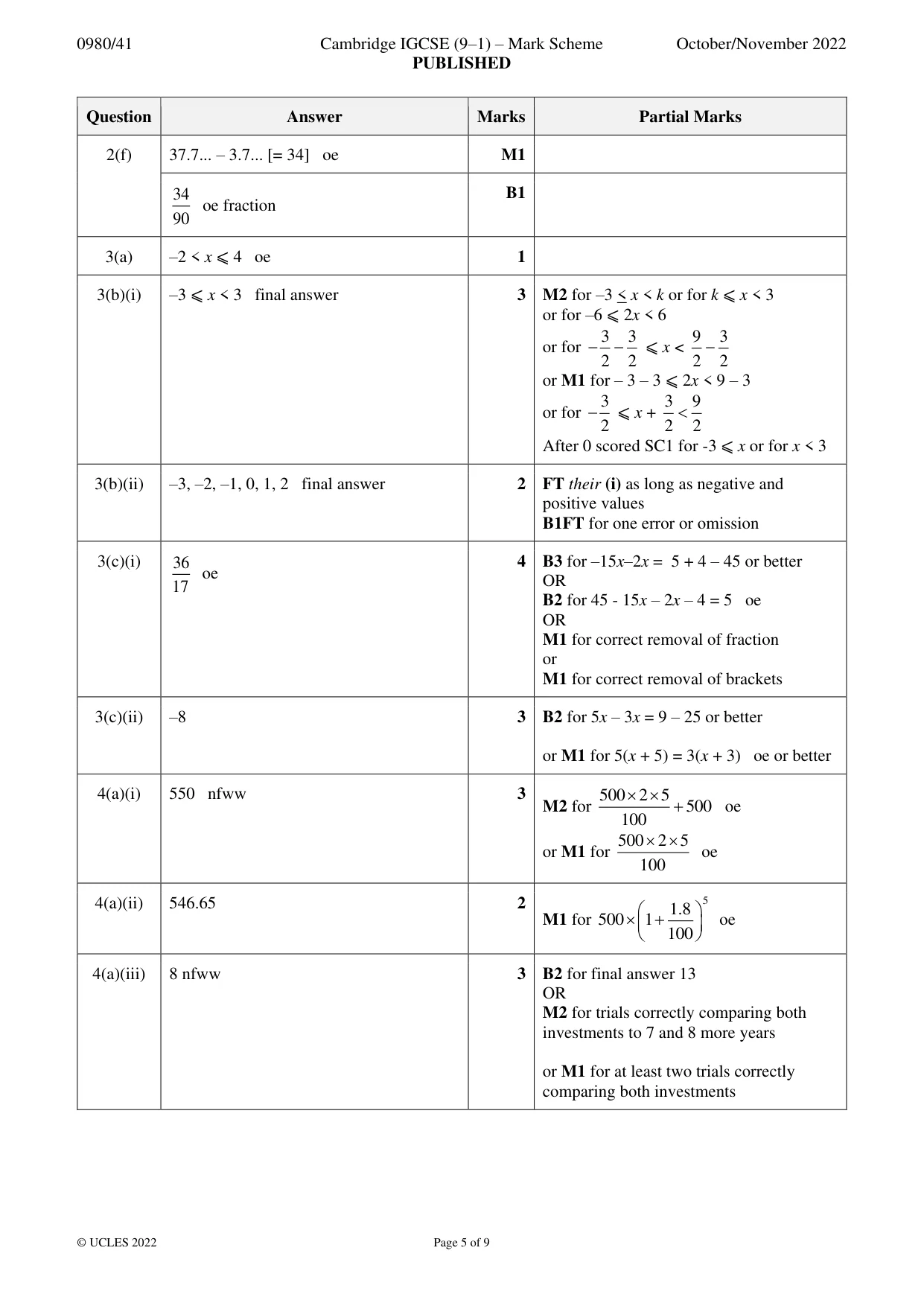
Mark scheme: Question Answer Marks Partial Marks 1(a)(i) 1580 or 1583 to 1584 2 M1 for π 6 2 14 1(a)(ii) 452 or 452.3 to 452.4... 2 3 M1 for 1 4 π 6 2 3 1(b)(i) 7.85 ÷ 1000 [= 0.00785] M1 1(b)(ii) 16[.0] or 15.95 to 15.99 2 FT {their (a)(i) + their (a)(ii)} 0.00785 evaluated to 3 sig fig or better M1 for (their (a)(i) + their (a)(ii)) × 0.00785 1(c)(i) 16.2 or 16.21 to 16.23 3 4 3 2000 − 50 π 2 3 M2 for 100 2000 4 3 50 π 2 3 or for 100 2000 4 3 50 π 2 3 or M1 for 2000 1(c)(ii) 6.87 or 6.870 to 6.872 1 4 3 FT 3 2000 − their 50 π 2 3 evaluated to 3sf or better 1(d) 2 4 M1 for [π](3 R ) 2 + [π]3 R 9 R oe oe 3 M1 for 2[π]x 2 + 2[π]x 7 x oe M1 for their area of cone = their area of cylinder seen
Q2 · Write (i) 2994.99 correct to the nearest 10…
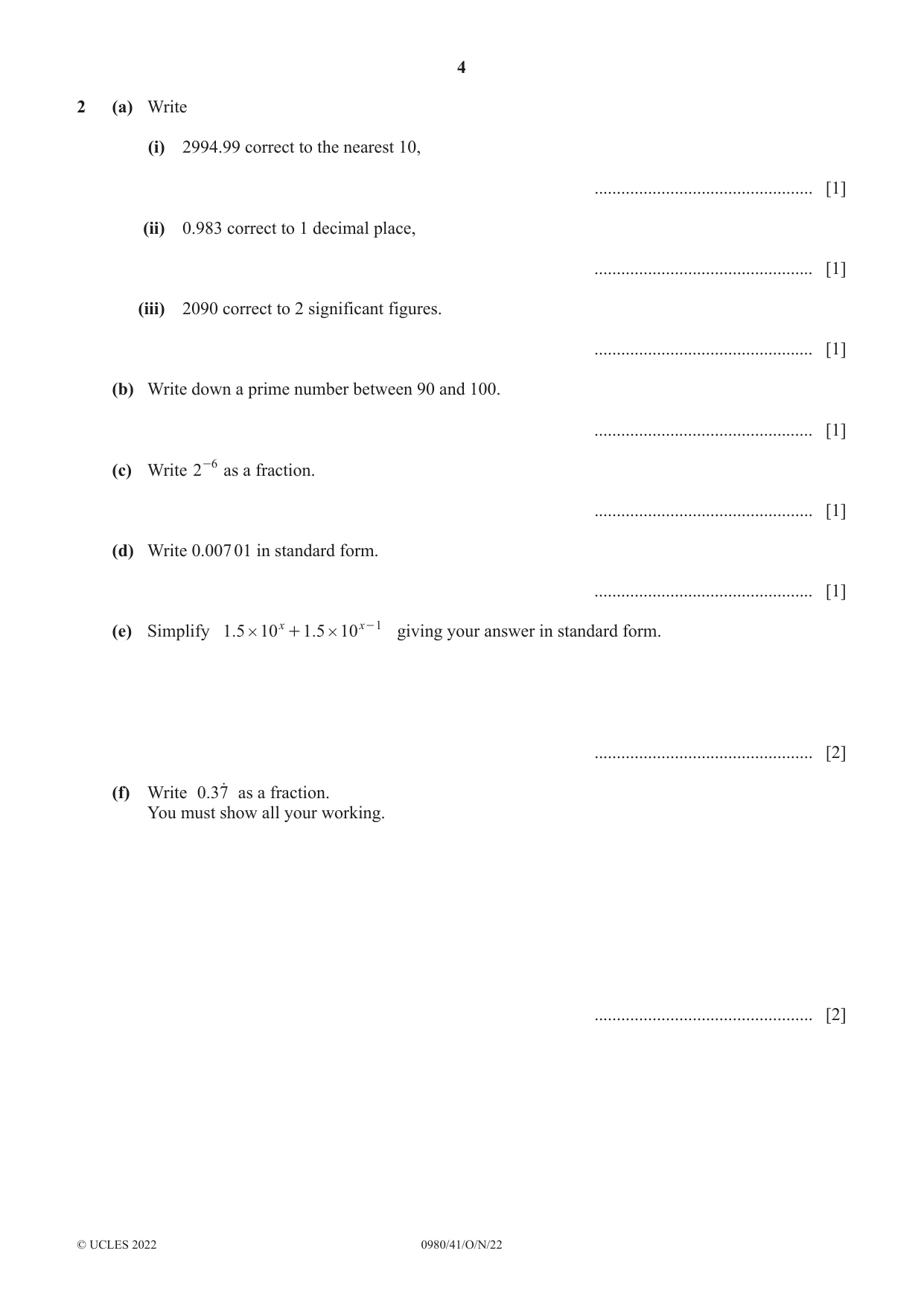
2 (a) Write (i) 2994.99 correct to the nearest 10, ................................................. [1] (ii) 0.983 correct to 1 decimal place, ................................................. [1] (iii) 2090 correct to 2 significant figures. ................................................. [1] (b) Write down a prime number between 90 and 100. ................................................. [1] (c) Write 2 -6 as a fraction. ................................................. [1] (d) Write 0.007 01 in standard form. ................................................. [1] (e) Simplify 1.5 # 10 x + 1 .5 # 10 x - 1 giving your answer in standard form. ................................................. [2] (f) Write .037o as a fraction. You must show all your working. ................................................. [2]
Mark scheme: 2(a)(i) 2990 cao 1 2(a)(ii) 1.0 cao 1 2(a)(iii) 2100 cao 1 2(b) 97 1 2(c) 1 1 final answer 64 2(d) 7.01[0] 10–3 1 2(e) 1.65 10x 2 M1 for final answer figs 165 or for 15 10 x −1 seen or for 0.15 10 x seen 2(f) 37.7... – 3.7... [= 34] oe M1 34 B1 oe fraction 90
Q3 · X – 2 4 Write down the inequality shown by the number line
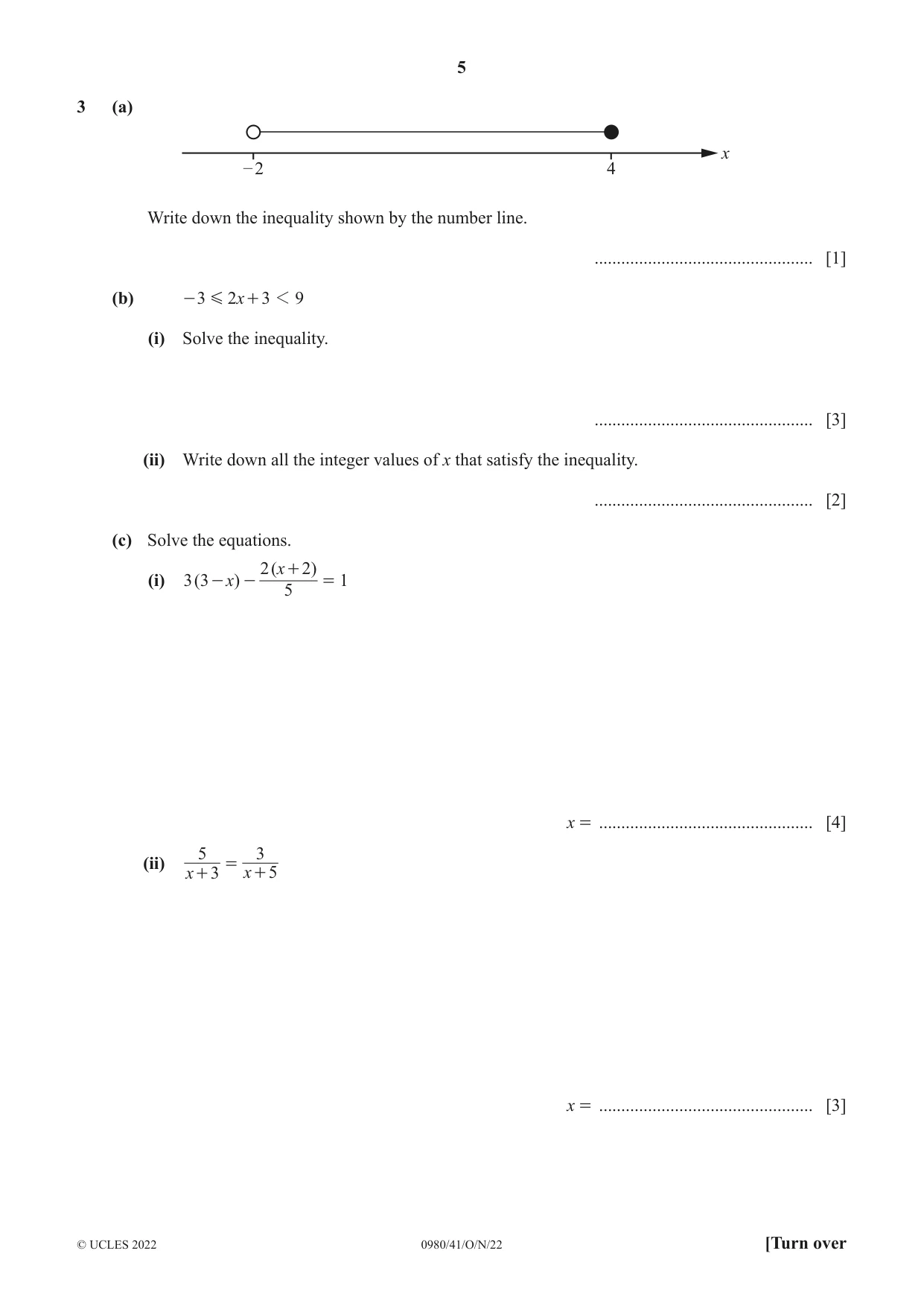
3 (a) x – 2 4 Write down the inequality shown by the number line. ................................................. [1] (b) - 3 G 2x + 3 1 9 (i) Solve the inequality. ................................................. [3] (ii) Write down all the integer values of x that satisfy the inequality. ................................................. [2] (c) Solve the equations. 2 ( x + 2) (i) 3 ( 3 - x) - = 1 5 x = ................................................ [4] 5 3 (ii) = x + 3 x + 5 x = ................................................ [3]
Mark scheme: 3(a) –2 < x ⩽ 4 oe 1 3(b)(i) –3 ⩽ x < 3 final answer 3 M2 for –3 < x < k or for k ⩽ x < 3 or for –6 ⩽ 2x < 6 3 3 9 3 or for − − ⩽ x < − 2 2 2 2 or M1 for – 3 – 3 ⩽ 2x < 9 – 3 3 3 9 or for − ⩽ x + 2 2 2 After 0 scored SC1 for -3 ⩽ x or for x < 3 3(b)(ii) –3, –2, –1, 0, 1, 2 final answer 2 FT their (i) as long as negative and positive values B1FT for one error or omission 3(c)(i) 36 4 B3 for –15x–2x = 5 + 4 – 45 or better oe OR 17 B2 for 45 - 15x – 2x – 4 = 5 oe OR M1 for correct removal of fraction or M1 for correct removal of brackets 3(c)(ii) –8 3 B2 for 5x – 3x = 9 – 25 or better or M1 for 5(x + 5) = 3(x + 3) oe or better
Q4 · Zak invests $500 at a rate of 2% per year simple interest
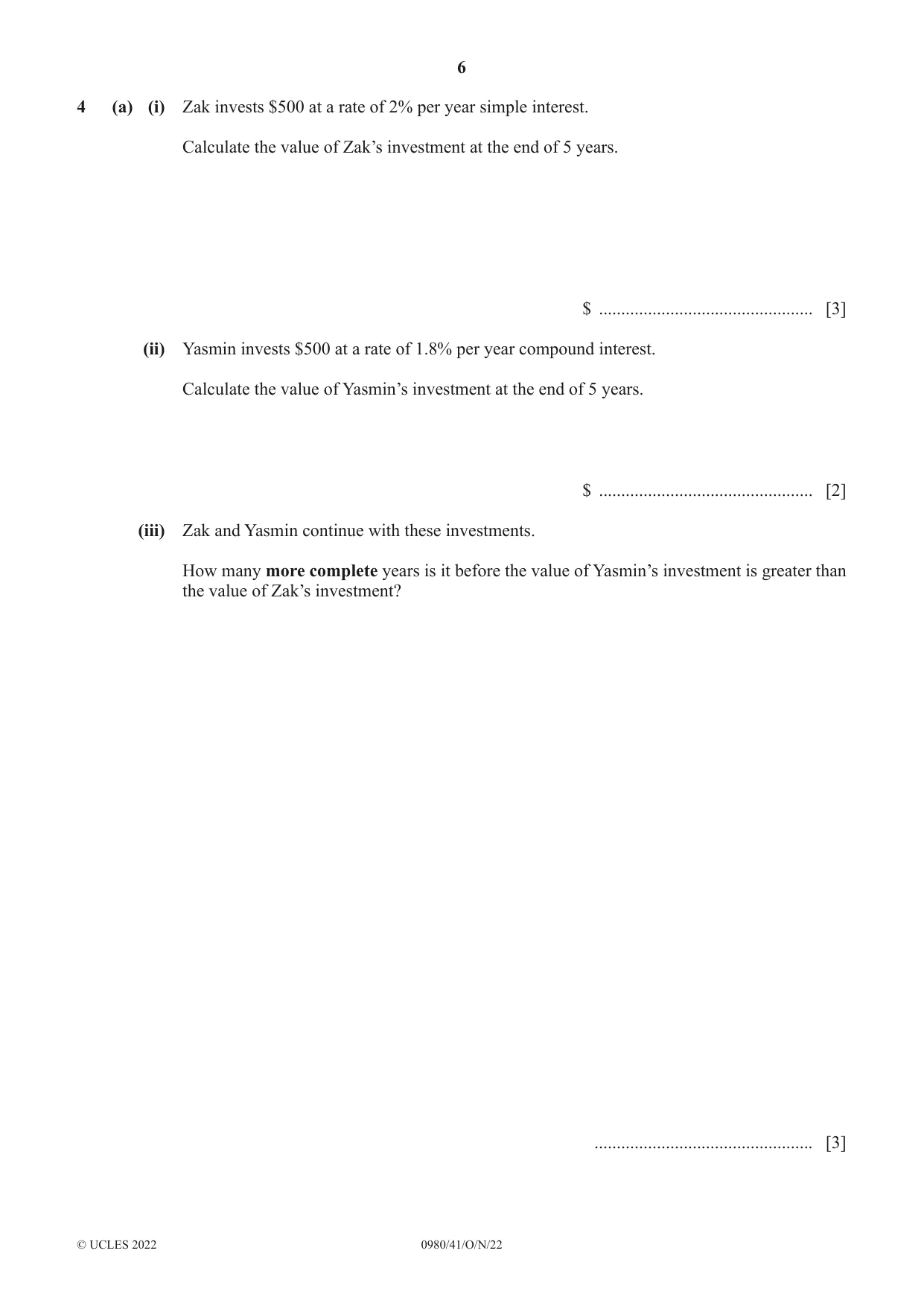
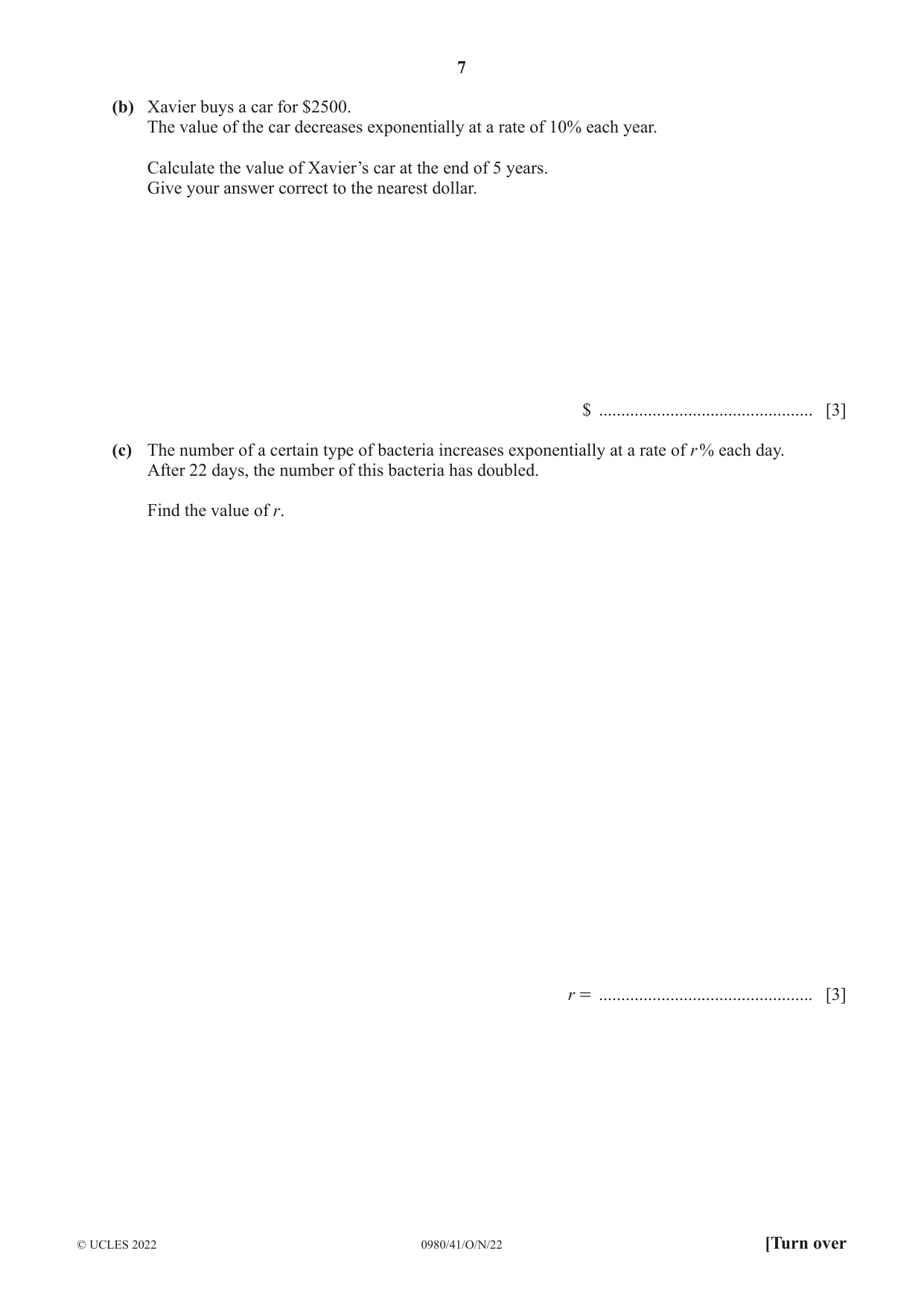
4 (a) (i) Zak invests $500 at a rate of 2% per year simple interest. Calculate the value of Zak’s investment at the end of 5 years. $ ................................................ [3] (ii) Yasmin invests $500 at a rate of 1.8% per year compound interest. Calculate the value of Yasmin’s investment at the end of 5 years. $ ................................................ [2] (iii) Zak and Yasmin continue with these investments. How many more complete years is it before the value of Yasmin’s investment is greater than the value of Zak’s investment? ................................................. [3] (b) Xavier buys a car for $2500. The value of the car decreases exponentially at a rate of 10% each year. Calculate the value of Xavier’s car at the end of 5 years. Give your answer correct to the nearest dollar. $ ................................................ [3] (c) The number of a certain type of bacteria increases exponentially at a rate of r % each day. After 22 days, the number of this bacteria has doubled. Find the value of r. r = ................................................ [3]
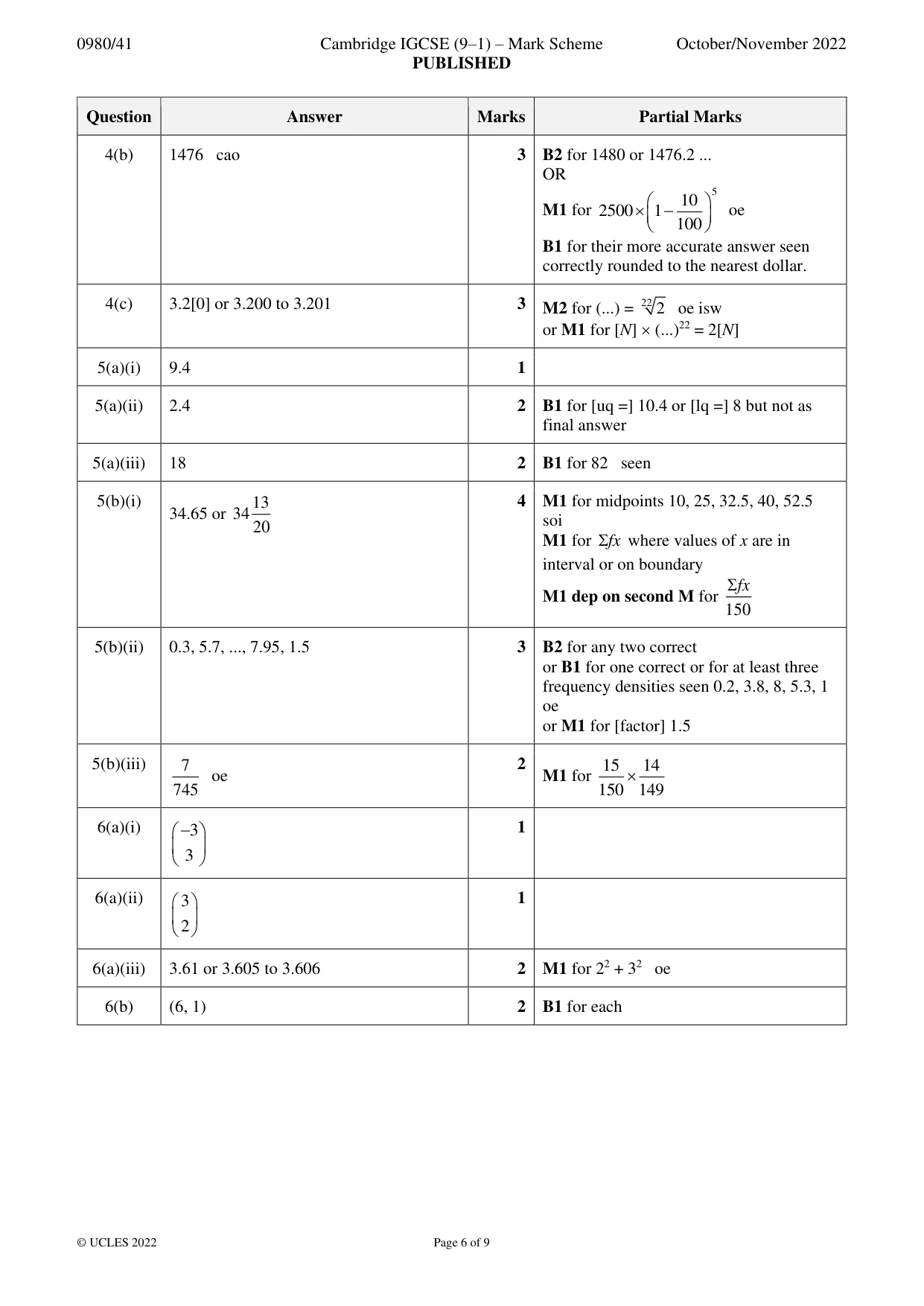
Mark scheme: 4(a)(i) 550 nfww 3 500 2 5 M2 for + 500 oe 100 500 2 5 or M1 for oe 100 4(a)(ii) 546.65 2 5 1.8 M1 for 500 1 + oe 100 4(a)(iii) 8 nfww 3 B2 for final answer 13 OR M2 for trials correctly comparing both investments to 7 and 8 more years or M1 for at least two trials correctly comparing both investments 4(b) 1476 cao 3 B2 for 1480 or 1476.2 ... OR 10 5 M1 for 2500 1 − oe 100 B1 for their more accurate answer seen correctly rounded to the nearest dollar. 4(c) 3.2[0] or 3.200 to 3.201 3 M2 for (...) = 22 2 oe isw or M1 for [N] (...)22 = 2[N]
Q5 · 100 students each record the time, t minutes, taken to eat a pizza
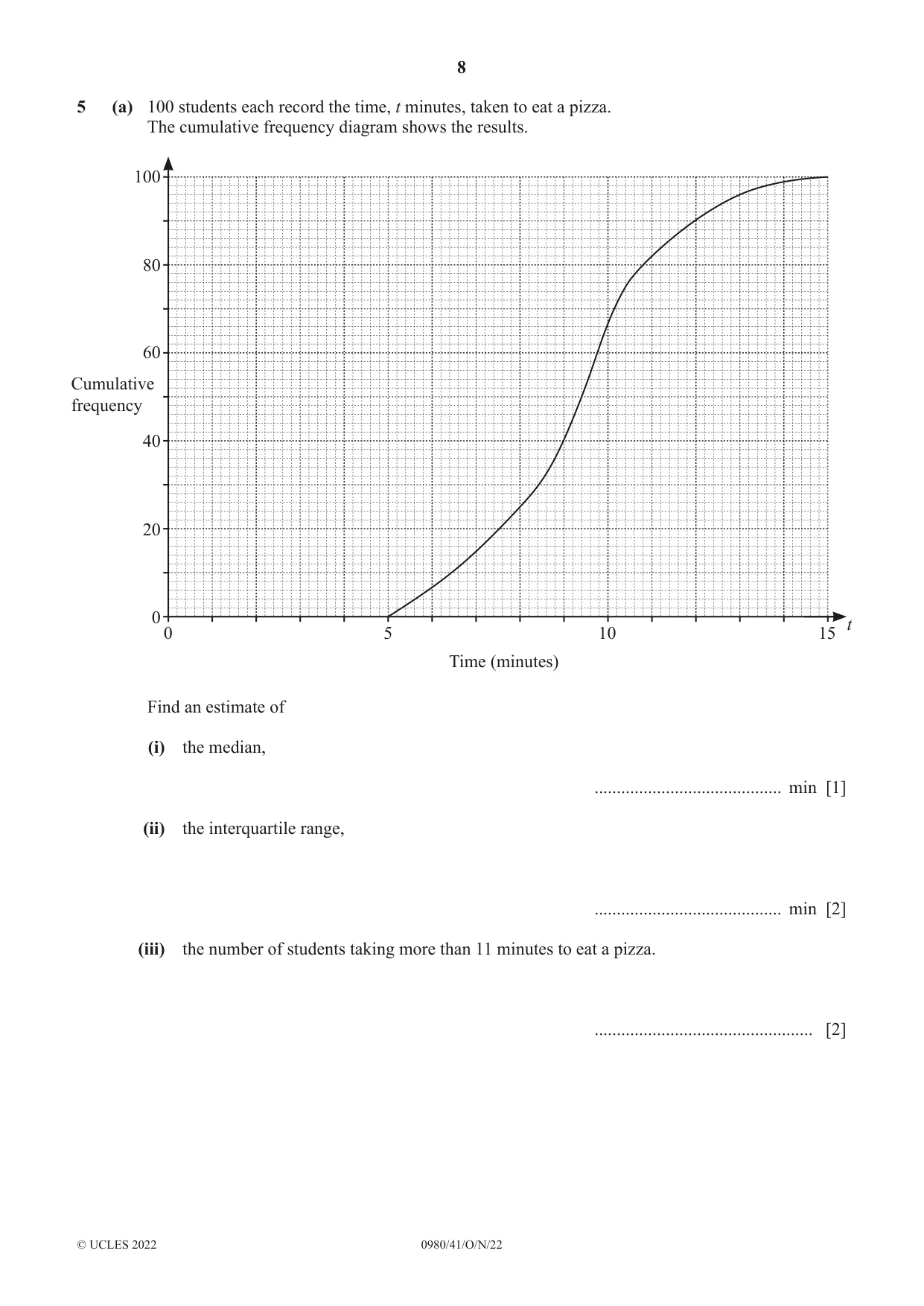
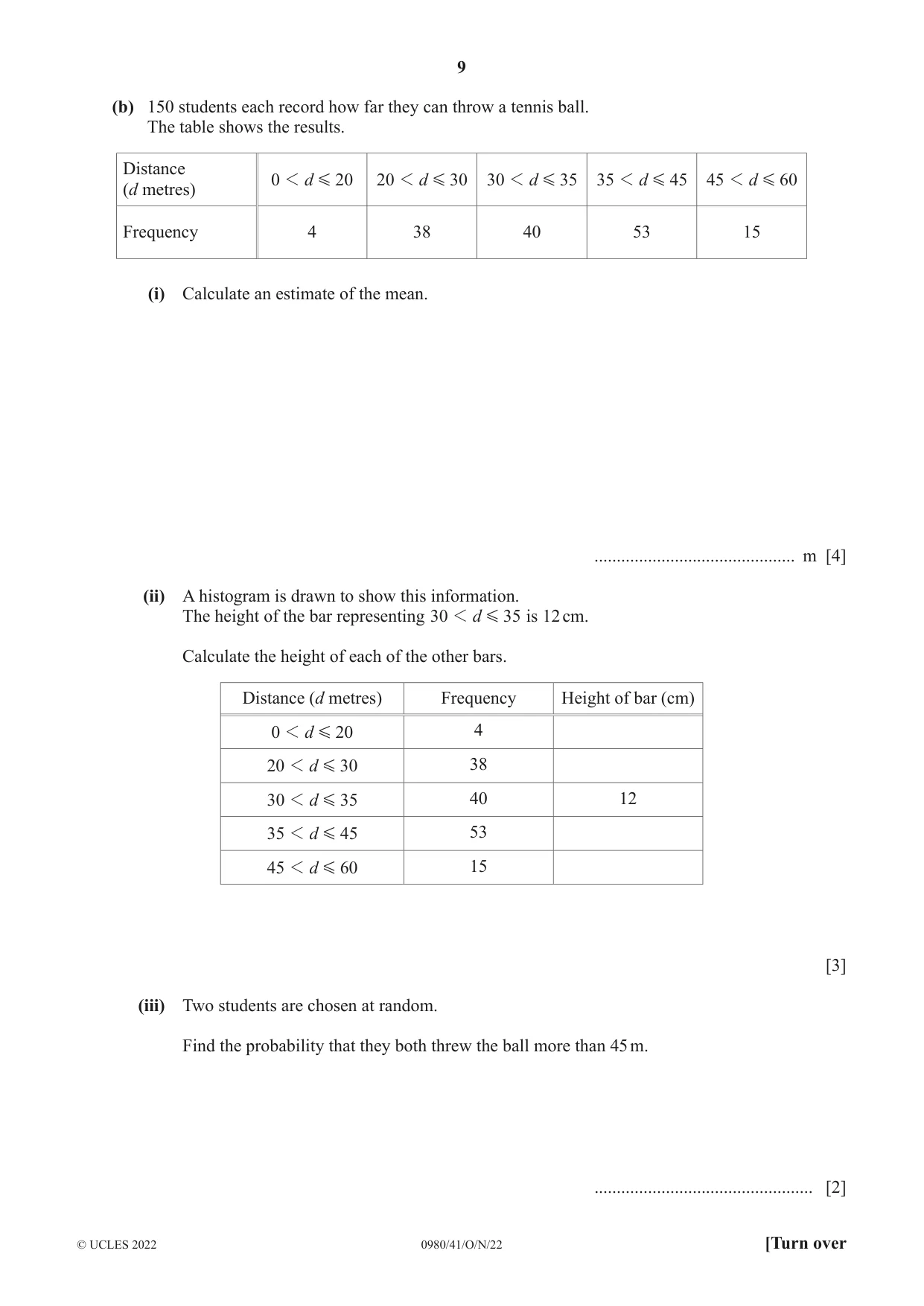
5 (a) 100 students each record the time, t minutes, taken to eat a pizza. The cumulative frequency diagram shows the results. 100 80 60 Cumulative frequency 40 20 0 t 0 5 10 15 Time (minutes) Find an estimate of (i) the median, .......................................... min [1] (ii) the interquartile range, .......................................... min [2] (iii) the number of students taking more than 11 minutes to eat a pizza. ................................................. [2] (b) 150 students each record how far they can throw a tennis ball. The table shows the results. Distance 0 1 d G 20 20 1 d G 30 30 1 d G 35 35 1 d G 45 45 1 d G 60 (d metres) Frequency 4 38 40 53 15 (i) Calculate an estimate of the mean. ............................................. m [4] (ii) A histogram is drawn to show this information. The height of the bar representing 30 1 d G 35 is 12 cm. Calculate the height of each of the other bars. Distance (d metres) Frequency Height of bar (cm) 0 1 d G 20 4 20 1 d G 30 38 30 1 d G 35 40 12 35 1 d G 45 53 45 1 d G 60 15 [3] (iii) Two students are chosen at random. Find the probability that they both threw the ball more than 45 m. ................................................. [2]
Mark scheme: 5(a)(i) 9.4 1 5(a)(ii) 2.4 2 B1 for [uq =] 10.4 or [lq =] 8 but not as final answer 5(a)(iii) 18 2 B1 for 82 seen 5(b)(i) 13 4 M1 for midpoints 10, 25, 32.5, 40, 52.5 34.65 or 34 soi 20 M1 for fx where values of x are in interval or on boundary fx M1 dep on second M for 150 5(b)(ii) 0.3, 5.7, ..., 7.95, 1.5 3 B2 for any two correct or B1 for one correct or for at least three frequency densities seen 0.2, 3.8, 8, 5.3, 1 oe or M1 for [factor] 1.5 5(b)(iii) 7 2 15 14 oe M1 for 745 150 149
Q6 · P = q = 3 1 Find (i) 3q, [1] f p (ii) p - q , [1] f p (iii) p
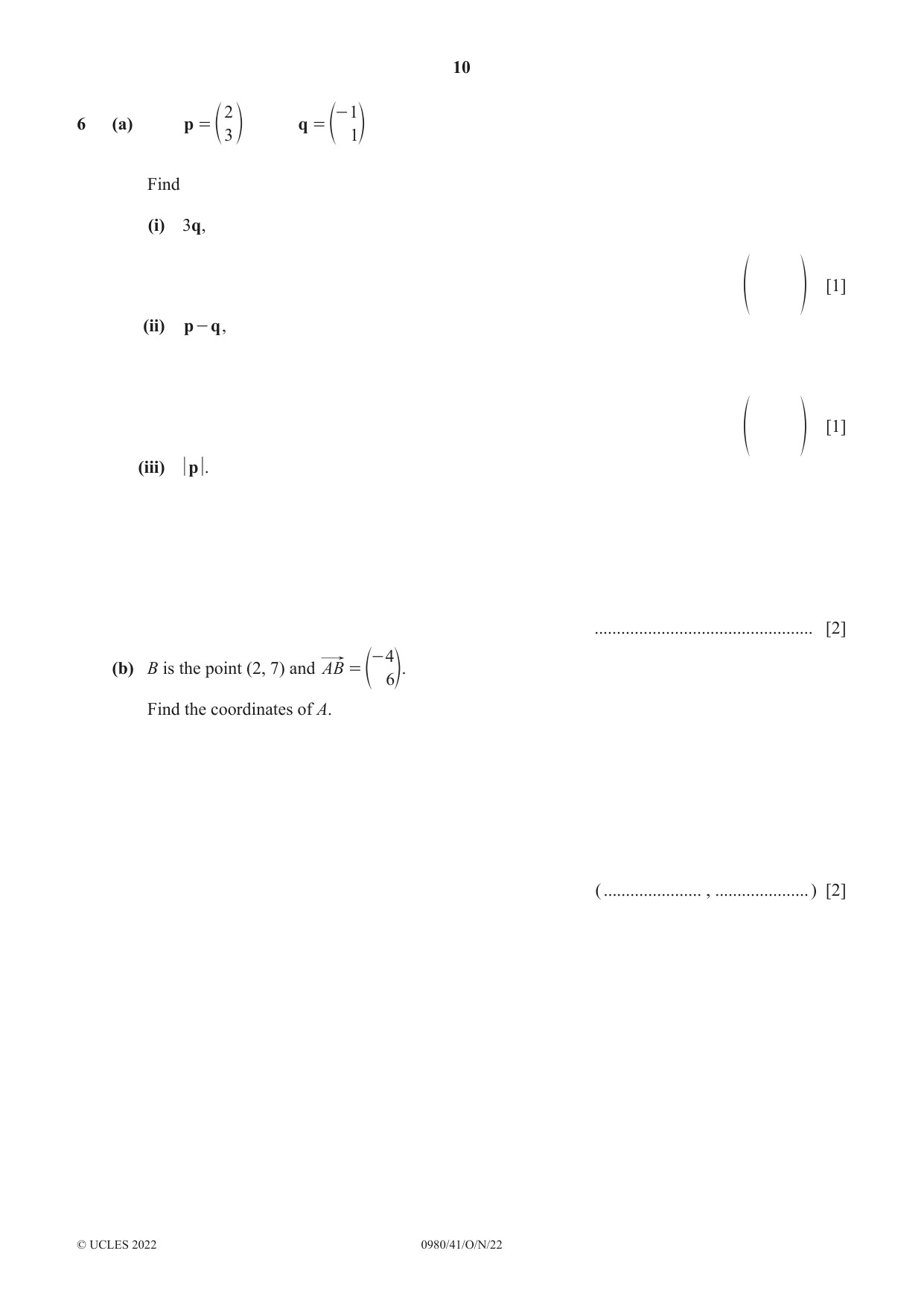
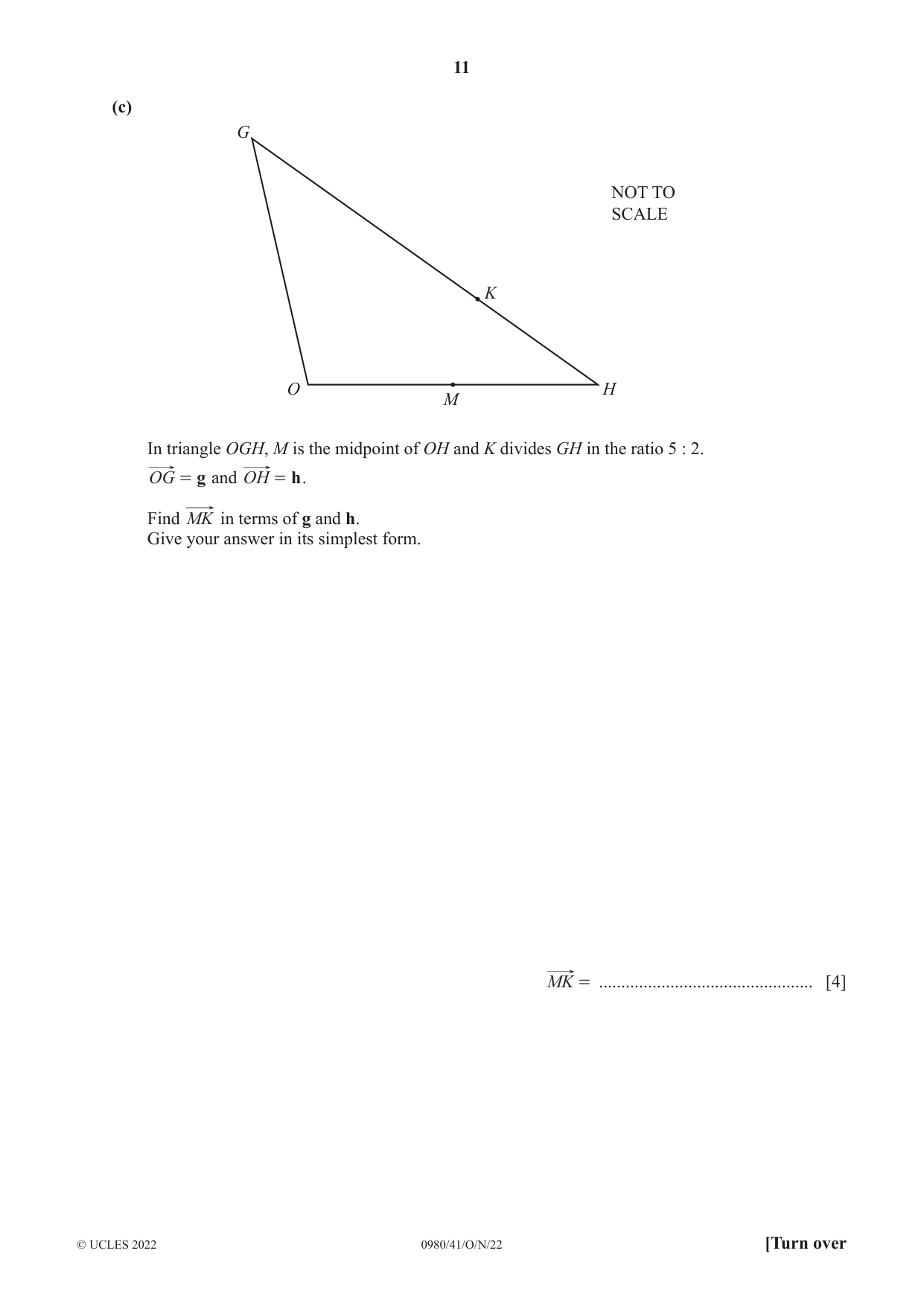
6 (a) p = q = 3 1 Find (i) 3q, [1] f p (ii) p - q , [1] f p (iii) p . ................................................. [2] - 4 (b) B is the point (2, 7) and AB = e 6o. Find the coordinates of A. ( ...................... , ..................... ) [2] (c) G NOT TO SCALE K O H M In triangle OGH, M is the midpoint of OH and K divides GH in the ratio 5 : 2. OG = g and OH = h . Find MK in terms of g and h. Give your answer in its simplest form. MK = ................................................ [4]
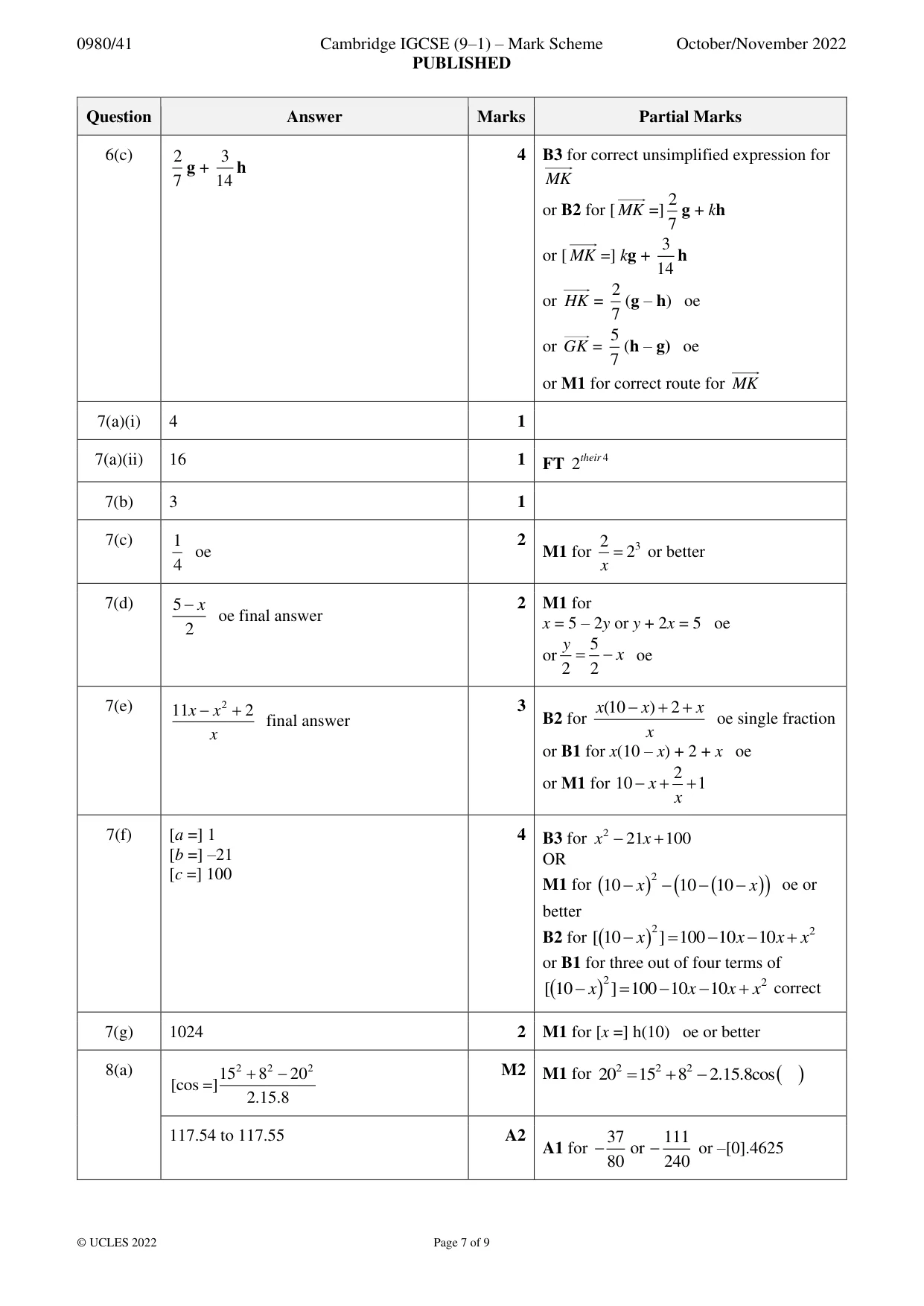
Mark scheme: 6(a)(i) −3 1 3 6(a)(ii) 3 1 2 6(a)(iii) 3.61 or 3.605 to 3.606 2 M1 for 22 + 32 oe 6(b) (6, 1) 2 B1 for each 6(c) 2 3 4 B3 for correct unsimplified expression for g + h 7 14 MK 2 or B2 for [ MK =] g + kh 7 3 or [ MK =] kg + h 14 2 or HK = (g – h) oe 7 5 or GK = (h – g) oe 7 or M1 for correct route for MK
Q7 · F ( x) = 10 - x g ( x) = , x !
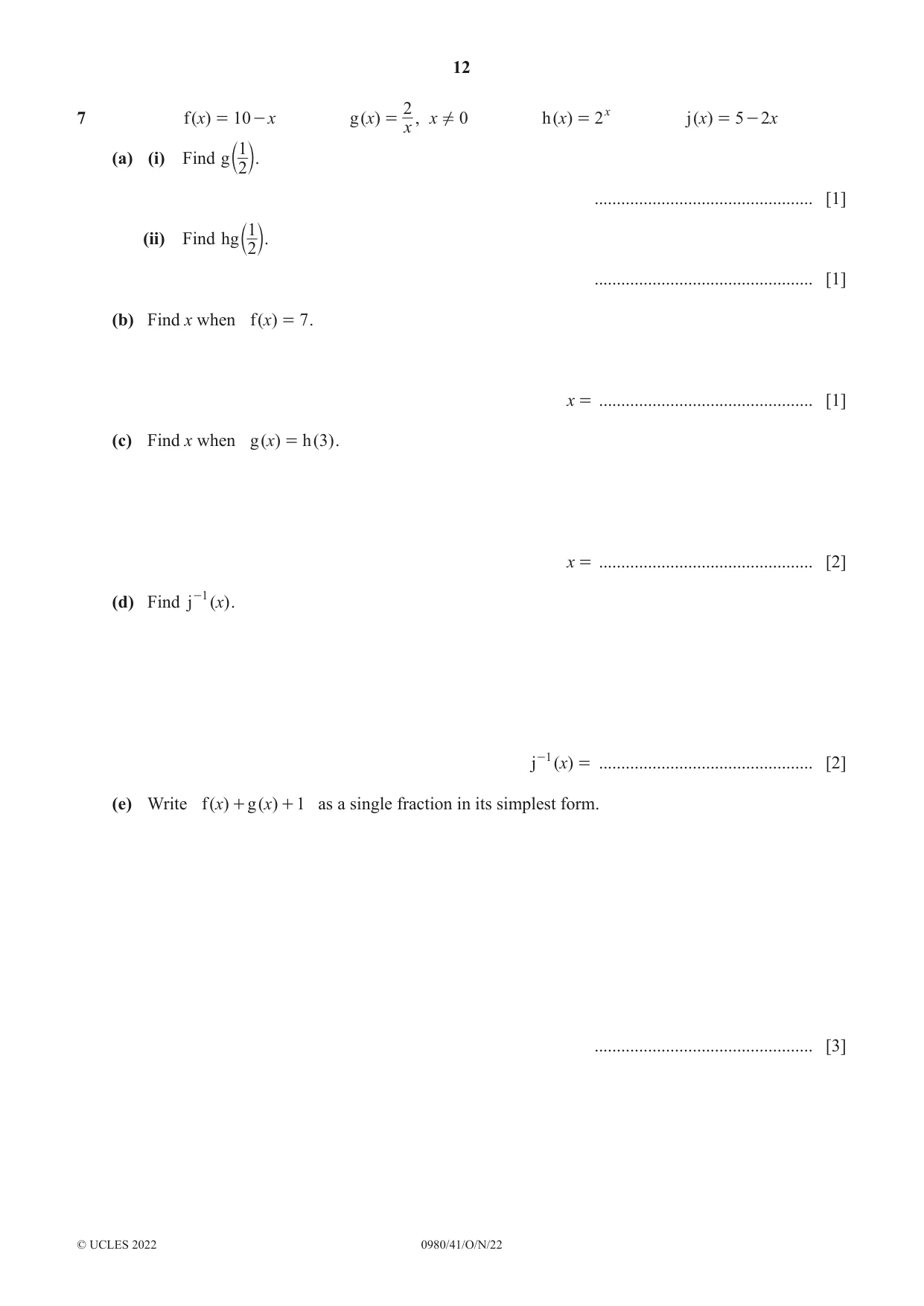
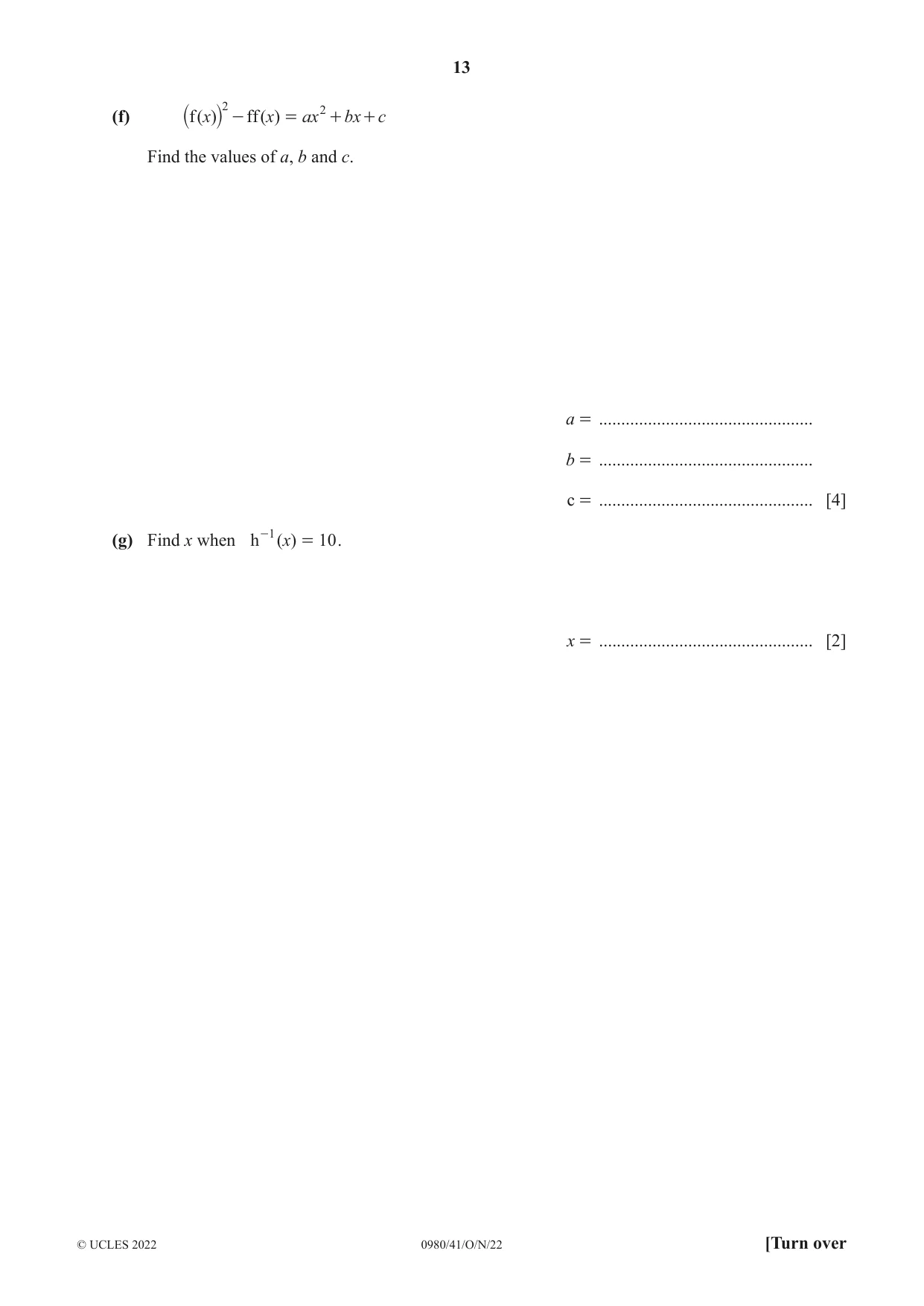
7 f ( x) = 10 - x g ( x) = , x ! 0 h ( x) = 2x j ( x) = 5 - 2 x x 1 (a) (i) Find g b 2 l. ................................................. [1] 1 (ii) Find hg b 2 l. ................................................. [1] (b) Find x when f ( x) = 7 . x = ................................................ [1] (c) Find x when g ( x) = h ( 3) . x = ................................................ [2] (d) Find j -1 ( x) . j -1 ( x) = ................................................ [2] (e) Write f ( x) + g ( x) + 1 as a single fraction in its simplest form. ................................................. [3] 2 2(f) f ( x) - ff ( x) = ax + bx + c ` j Find the values of a, b and c. a = ................................................ b = ................................................ c = ................................................ [4] (g) Find x when h -1 ( x) = 10 . x = ................................................ [2]
Mark scheme: 7(a)(i) 4 1 7(a)(ii) 16 1 FT 2their 4 7(b) 3 1 7(c) 1 2 2 3 oe M1 for = 2 or better 4 x 7(d) 5 −x 2 M1 for oe final answer x = 5 – 2y or y + 2x = 5 oe 2 y 5 or = − x oe 2 2 7(e) 11x − x 2 + 2 3 x (10 − x ) + 2 + x final answer B2 for oe single fraction x x or B1 for x(10 – x) + 2 + x oe 2 or M1 for 10 − x + + 1 x 7(f) [a =] 1 4 B3 for x 2 − 21x + 100 [b =] –21 OR [c =] 100 2 M1 for (10 − x ) − (10 − (10 − x ) ) oe or better 2 2 B2 for [(10 − x ) ] = 100 − 10 x − 10 x + x or B1 for three out of four terms of [(10 − x ) 2 ] = 100 − 10 x − 10 x + x 2 correct 7(g) 1024 2 M1 for [x =] h(10) oe or better
Q8 · Q NOT TO 4 m SCALE A 15 m C P 8 m 3 m 20 m B The diagram shows triangle ABC on horizontal…
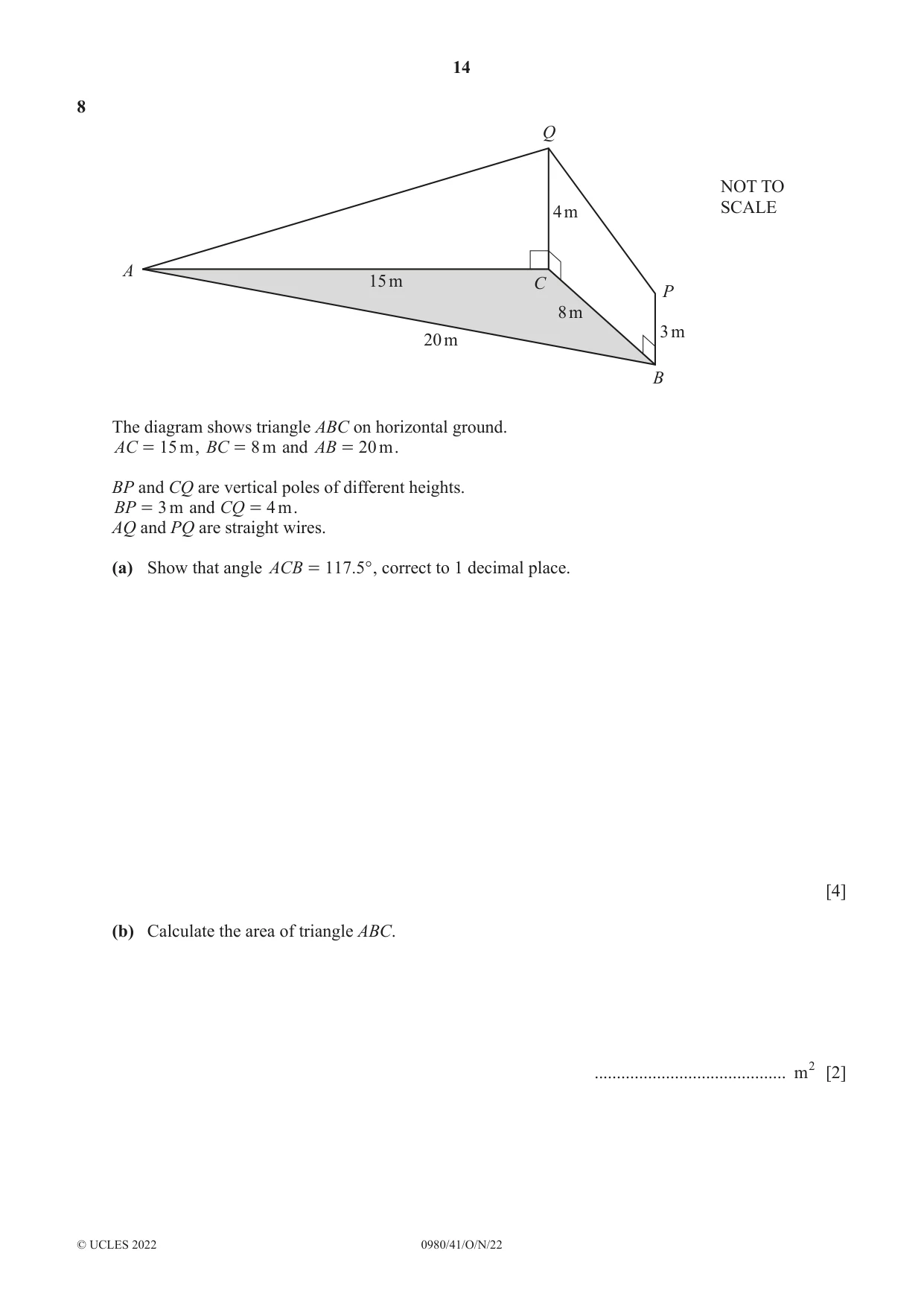
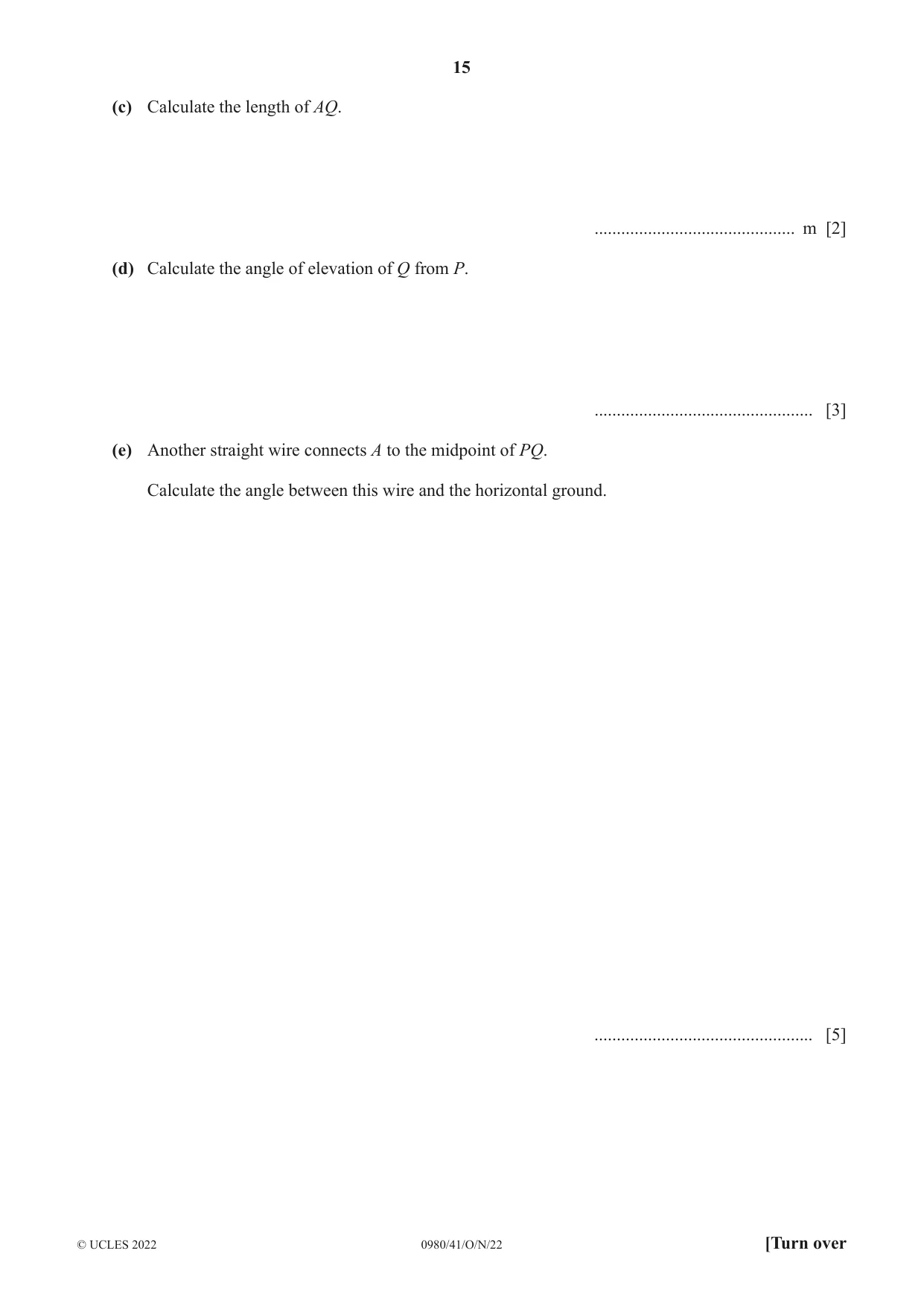
8 Q NOT TO 4 m SCALE A 15 m C P 8 m 3 m 20 m B The diagram shows triangle ABC on horizontal ground. AC = 15 m , BC = 8 m and AB = 20 m . BP and CQ are vertical poles of different heights. BP = 3 m and CQ = 4 m . AQ and PQ are straight wires. (a) Show that angle ACB = 117.5° , correct to 1 decimal place. [4] (b) Calculate the area of triangle ABC. ........................................... m2 [2] (c) Calculate the length of AQ. ............................................. m [2] (d) Calculate the angle of elevation of Q from P. ................................................. [3] (e) Another straight wire connects A to the midpoint of PQ. Calculate the angle between this wire and the horizontal ground. ................................................. [5]
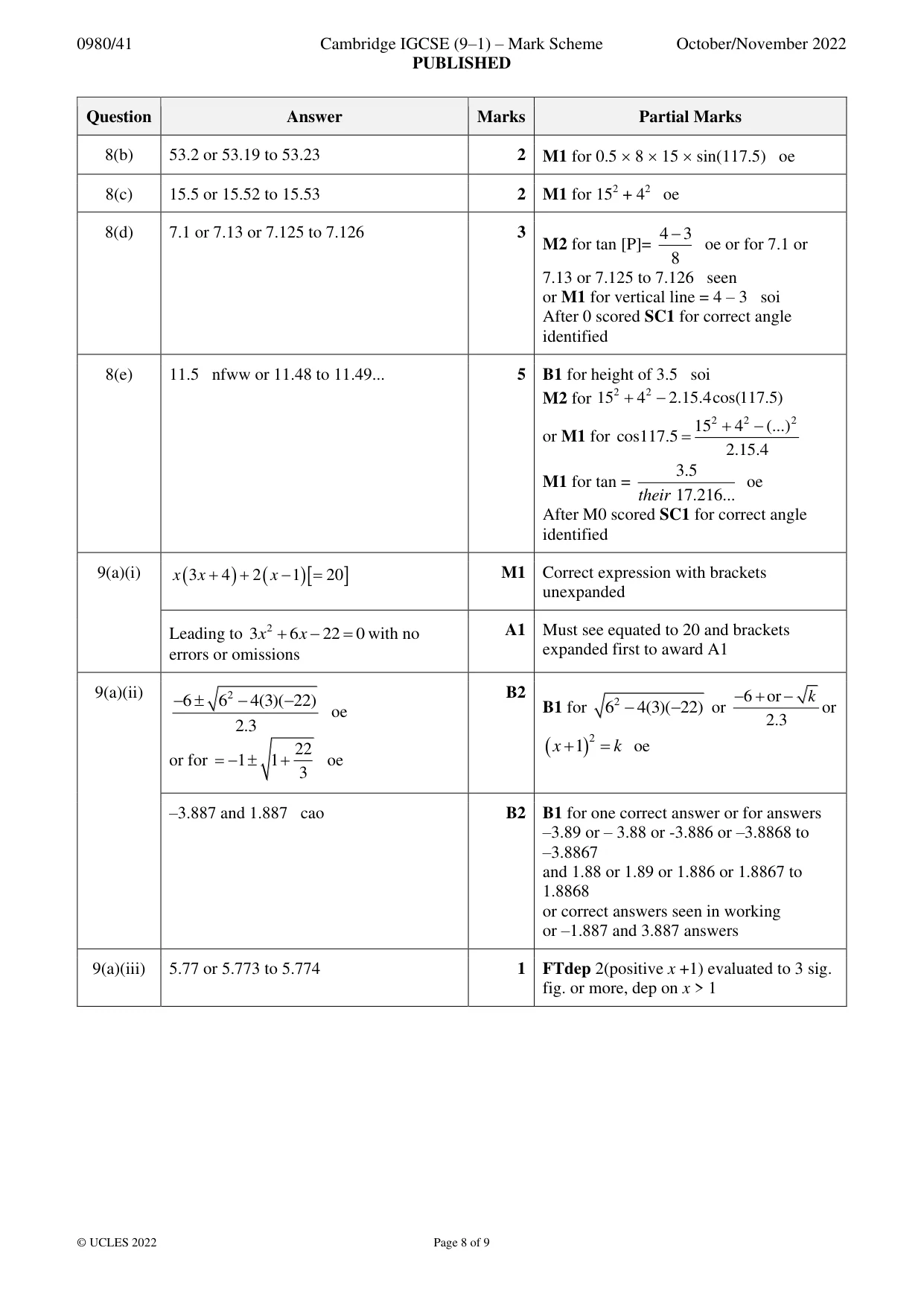
Mark scheme: 8(a) 15 2 + 8 2 − 20 2 M2 M1 for 202 = 152 + 82 − 2.15.8cos ( ) [cos = ] 2.15.8 117.54 to 117.55 A2 37 111 A1 for − or − or –[0].4625 80 240 8(b) 53.2 or 53.19 to 53.23 2 M1 for 0.5 8 15 sin(117.5) oe 8(c) 15.5 or 15.52 to 15.53 2 M1 for 152 + 42 oe 8(d) 7.1 or 7.13 or 7.125 to 7.126 3 4 − 3 M2 for tan [P]= oe or for 7.1 or 8 7.13 or 7.125 to 7.126 seen or M1 for vertical line = 4 – 3 soi After 0 scored SC1 for correct angle identified 8(e) 11.5 nfww or 11.48 to 11.49... 5 B1 for height of 3.5 soi M2 for 15 2 + 4 2 − 2.15.4cos(117.5) 15 2 + 4 2 − (...) 2 or M1 for cos117.5 = 2.15.4 3.5 M1 for tan = oe their 17.216... After M0 scored SC1 for correct angle identified
Q9 · NOT TO B 2 cm SCALE x cm A (x – 1) cm (3x + 4) cm The total of the areas of rectangles A…
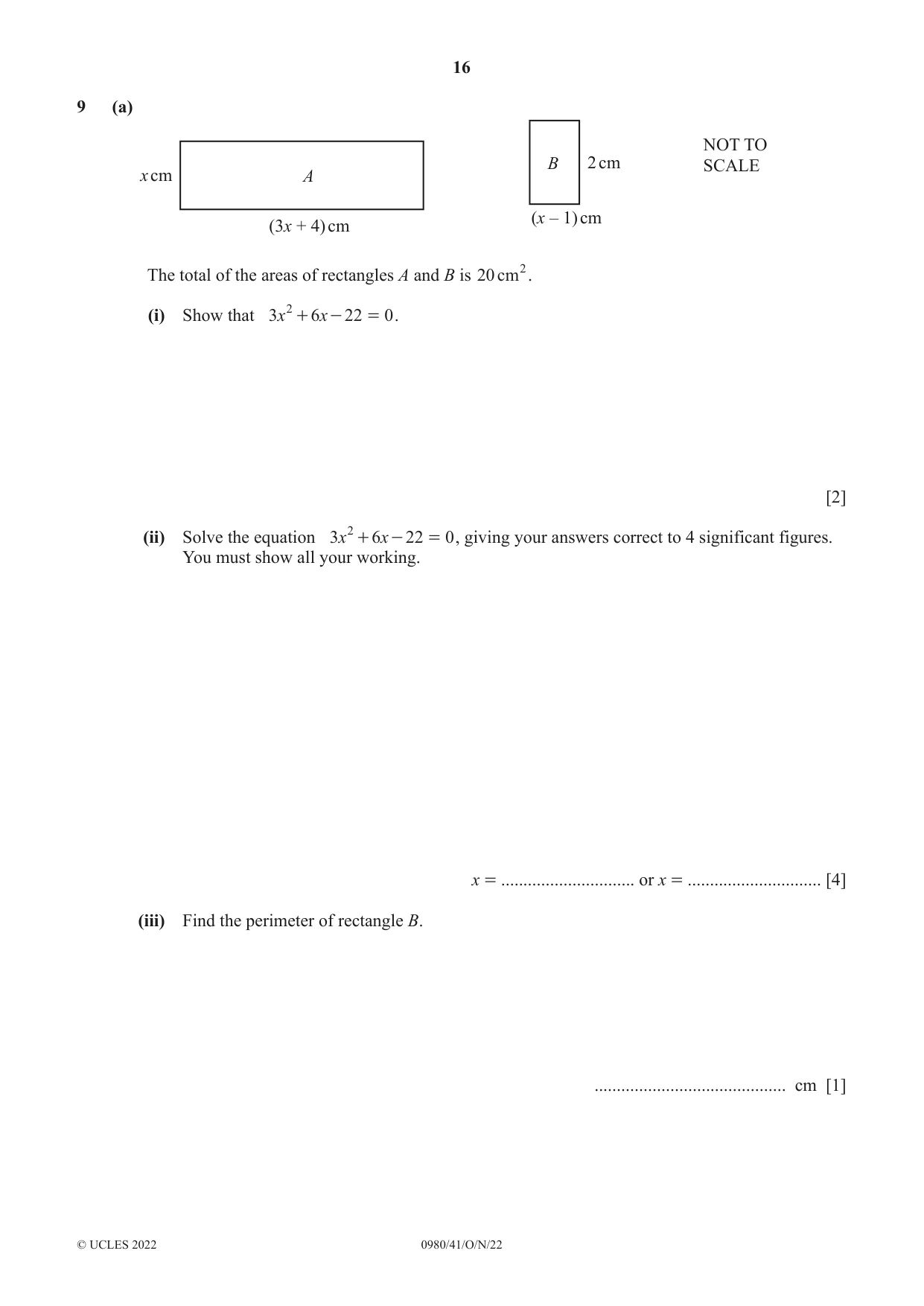
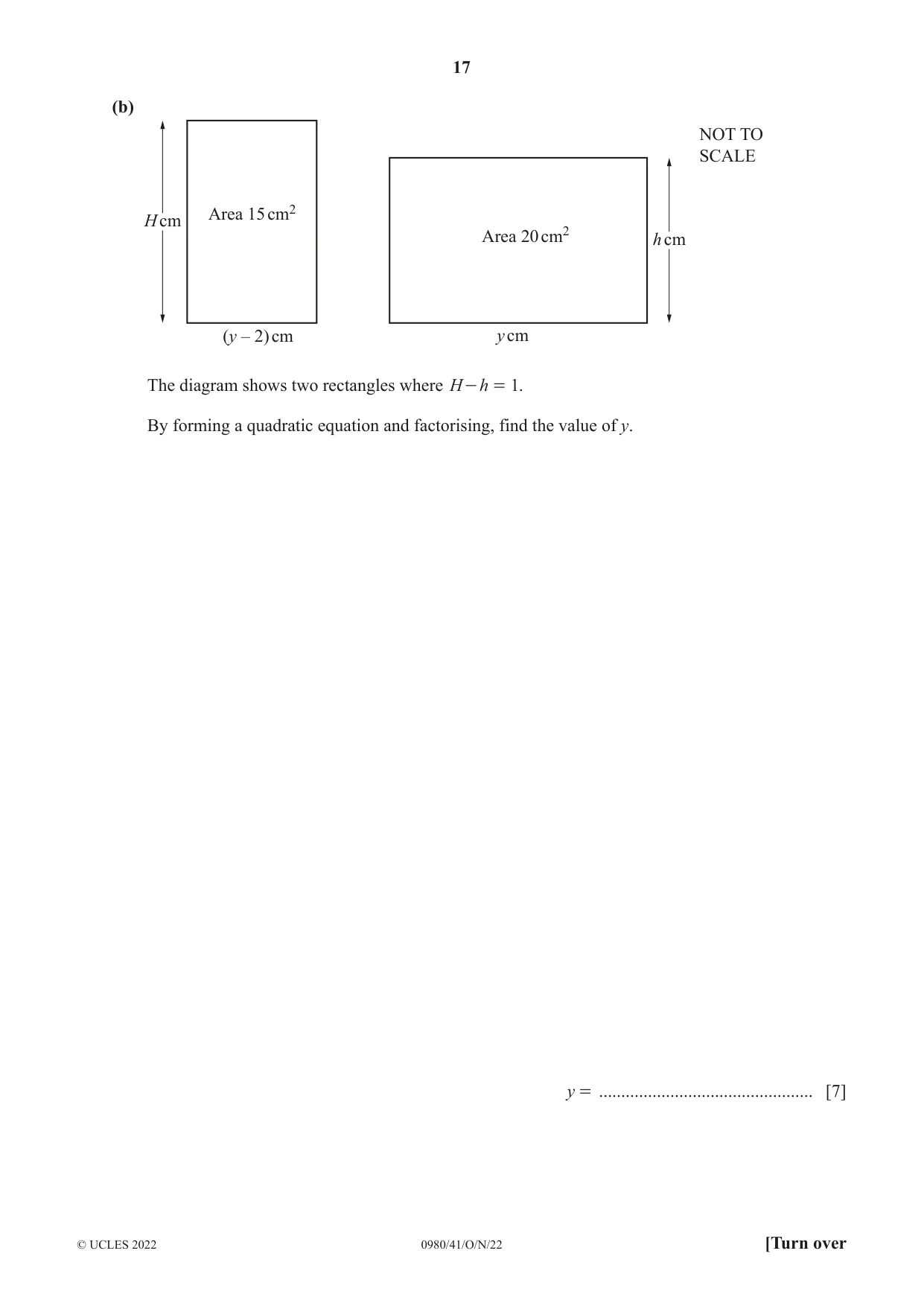
9 (a) NOT TO B 2 cm SCALE x cm A (x – 1) cm (3x + 4) cm The total of the areas of rectangles A and B is 20 cm 2. (i) Show that 3x 2 + 6x - 22 = 0 . [2] (ii) Solve the equation 3x 2 + 6x - 22 = 0 , giving your answers correct to 4 significant figures. You must show all your working. x = .............................. or x = .............................. [4] (iii) Find the perimeter of rectangle B. ........................................... cm [1] (b) NOT TO SCALE Area 15 cm2 H cm Area 20 cm2 h cm (y – 2) cm y cm The diagram shows two rectangles where H - h = 1. By forming a quadratic equation and factorising, find the value of y. y = ................................................ [7]
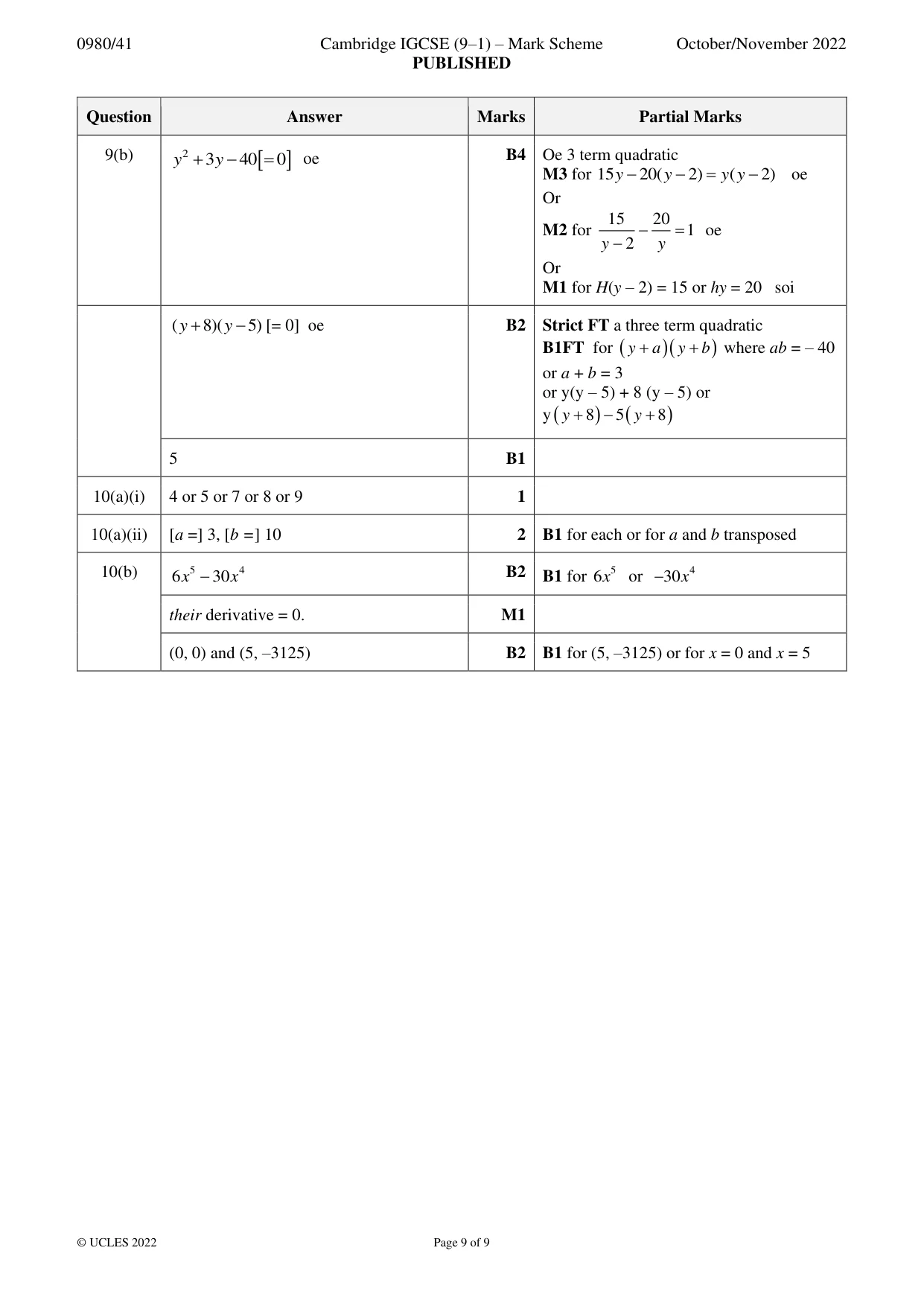
Mark scheme: 9(a)(i) x ( 3 x + 4 ) + 2 ( x − 1) = 20 M1 Correct expression with brackets unexpanded Leading to 3 x 2 + 6 x − 22 = 0 with no A1 Must see equated to 20 and brackets expanded first to award A1 errors or omissions 9(a)(ii) B2 2 −+6 or − k −6 6 2 − 4(3)( −22) oe B1 for 6 − 4(3)( −22) or or 2.3 2.3 2 22 ( x + 1) = k oe or for = −1 1 + oe 3 –3.887 and 1.887 cao B2 B1 for one correct answer or for answers –3.89 or – 3.88 or -3.886 or –3.8868 to –3.8867 and 1.88 or 1.89 or 1.886 or 1.8867 to 1.8868 or correct answers seen in working or –1.887 and 3.887 answers 9(a)(iii) 5.77 or 5.773 to 5.774 1 FTdep 2(positive x +1) evaluated to 3 sig. fig. or more, dep on x > 1 9(b) y 2 + 3 y − 40 = 0 oe B4 Oe 3 term quadratic M3 for 15 y − 20( y − 2) = y ( y − 2) oe Or 15 20 M2 for − = 1 oe y − 2 y Or M1 for H(y – 2) = 15 or hy = 20 soi ( y + 8)( y − 5) [= 0] oe B2 Strict FT a three term quadratic B1FT for ( y + a )( y + b ) where ab = – 40 or a + b = 3 or y(y – 5) + 8 (y – 5) or y( y + 8 ) − 5 ( y + 8 ) 5 B1
Q10 · Y C (1.2, 10) A (– 1.5, 7.9) B (– 1, 7) E (6, 5.5) NOT TO SCALE D (5, 3) 0 x The diagram…
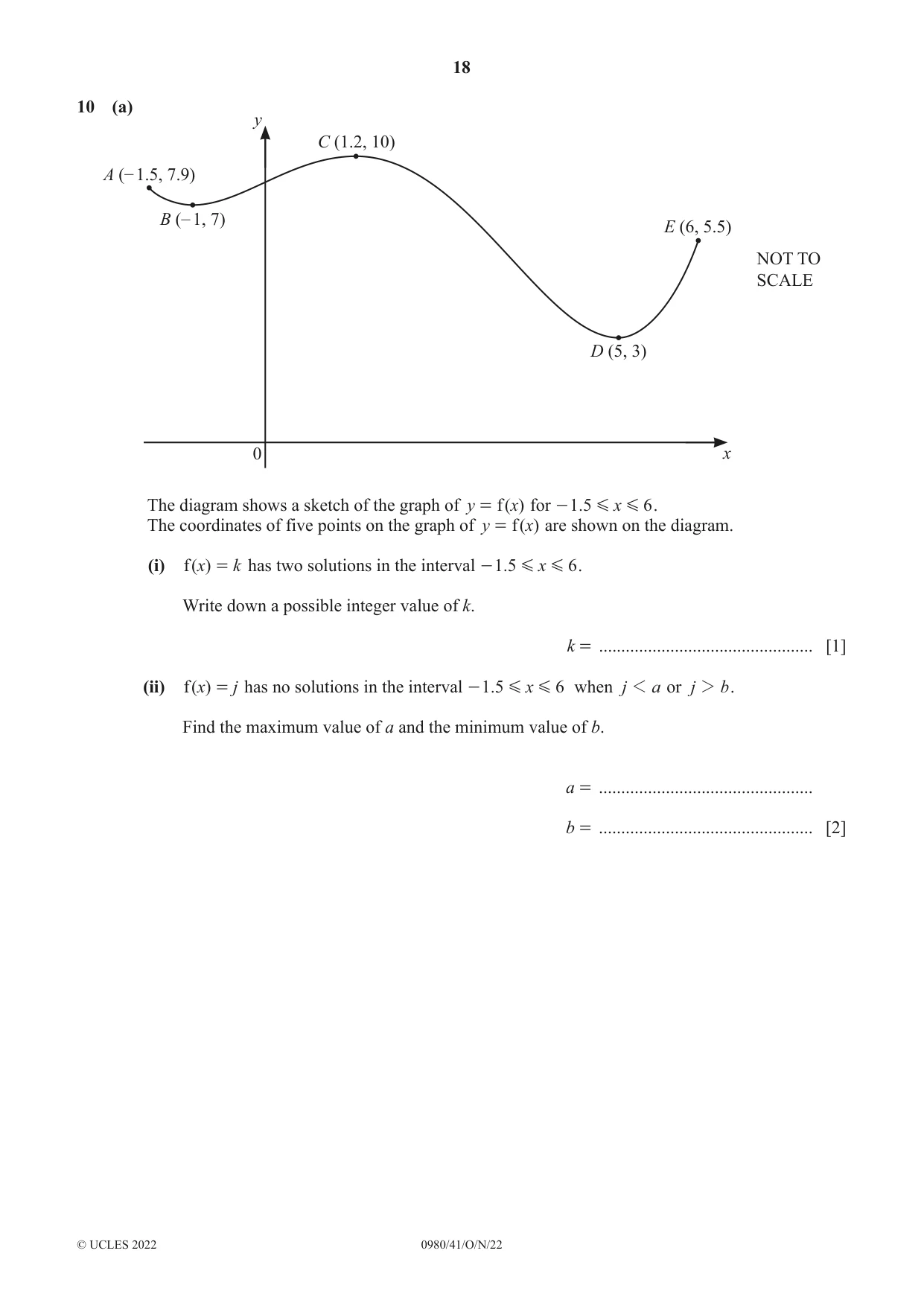
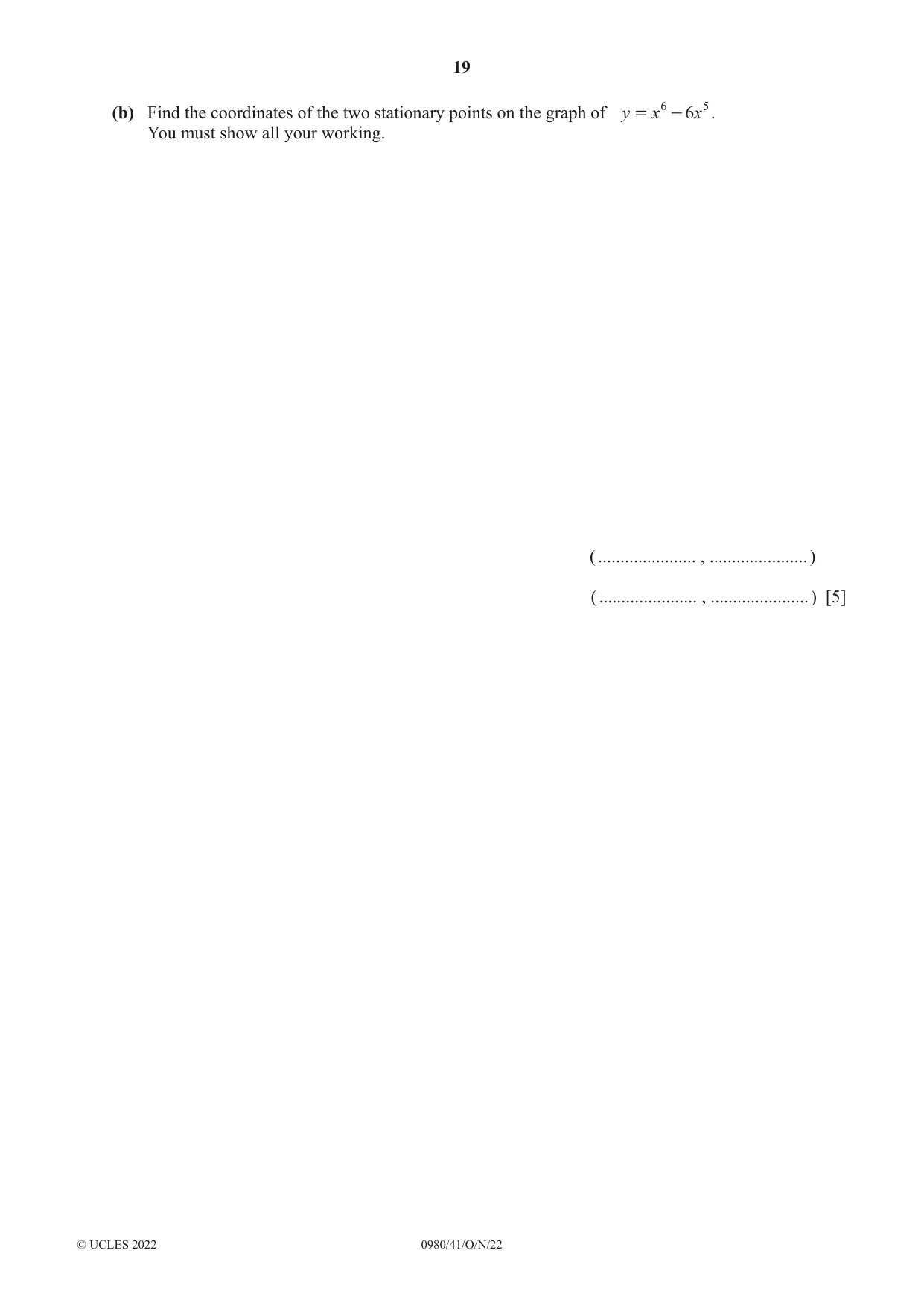
10 (a) y C (1.2, 10) A (– 1.5, 7.9) B (– 1, 7) E (6, 5.5) NOT TO SCALE D (5, 3) 0 x The diagram shows a sketch of the graph of y = f ( x) for - 1.5 G x G 6 . The coordinates of five points on the graph of y = f ( x) are shown on the diagram. (i) f ( x) = k has two solutions in the interval - 1.5 G x G 6 . Write down a possible integer value of k. k = ................................................ [1] (ii) f ( x) = j has no solutions in the interval - 1.5 G x G 6 when j 1 a or j 2 b . Find the maximum value of a and the minimum value of b. a = ................................................ b = ................................................ [2] (b) Find the coordinates of the two stationary points on the graph of y = x 6 - 6x 5 . You must show all your working. ( ...................... , ...................... ) ( ...................... , ...................... ) [5]
Mark scheme: 10(a)(i) 4 or 5 or 7 or 8 or 9 1 10(a)(ii) [a =] 3, [b =] 10 2 B1 for each or for a and b transposed 10(b) 6 x 5 − 30 x 4 B2 B1 for 6x 5 or −30 x 4 their derivative = 0. M1 (0, 0) and (5, –3125) B2 B1 for (5, –3125) or for x = 0 and x = 5
What was in this paper
The subtopics covered by these 10 questions, and how many questions each got. Open one in a new tab to see every Cambridge question on it.
What you needed in this session
Cambridge’s own grade thresholds for 2022 Oct/Nov, Paper 4 · Variant 1. A higher threshold means an easier paper — the bar moves with how the cohort did.