Cambridge IGCSE Mathematics (9-1) 0980 — 2023 Oct/Nov Paper 4 · Variant 1
0980/41/O/N/23 · 11 questions · 130 marks · ≈146 min
The question paper and its mark scheme, free to read here and free to download. This is Cambridge’s own paper, exactly as it was sat.
Question paper20 pages
Mark scheme11 pages
Answers below. Sit the paper first if you are practising.
Questions as text
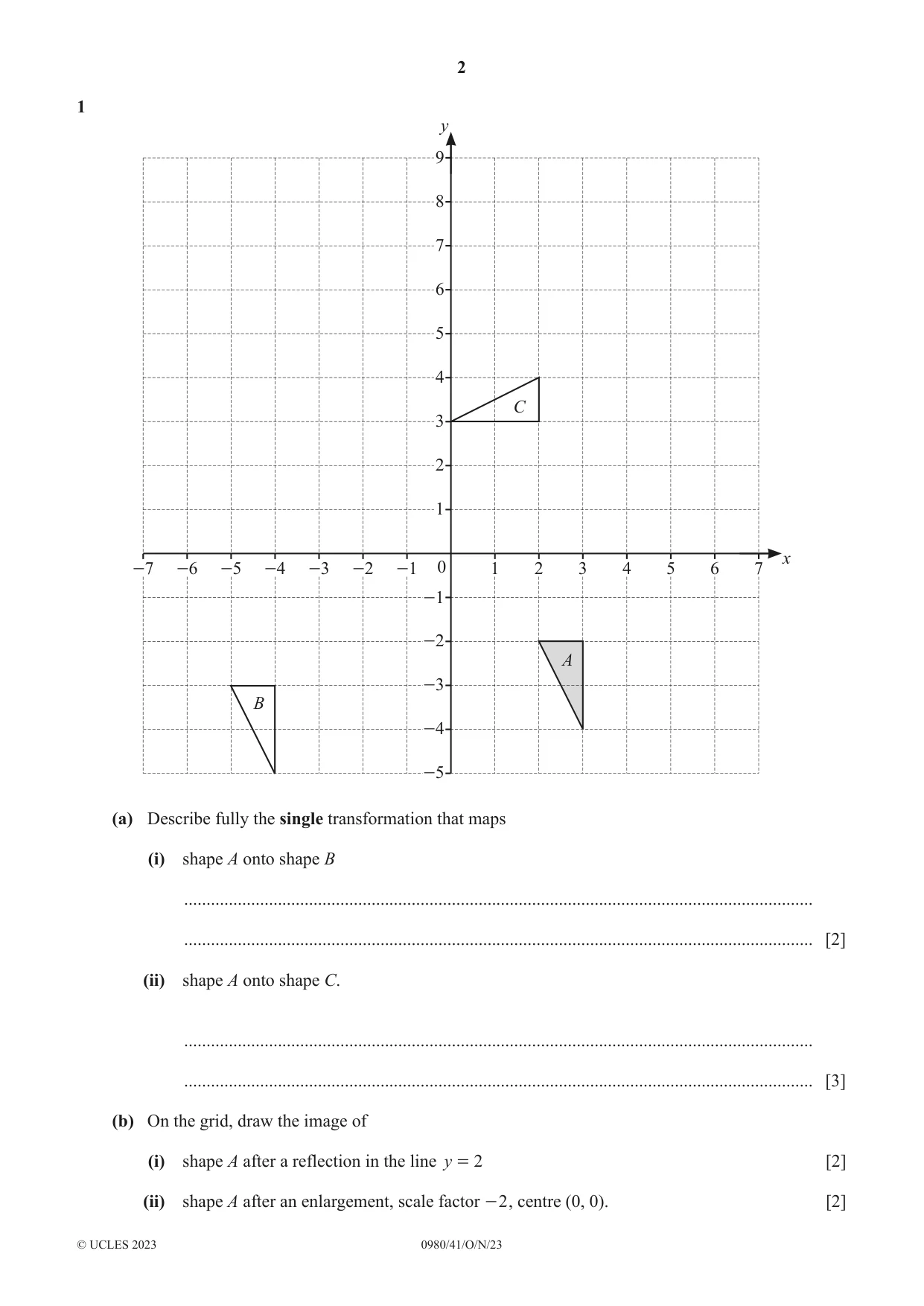
Q1 · Y 9 8 7 6 5 4 C 3 2 1 x -7 -6 -5 -4 -3 -2 -1 0 1 2 3 4 5 6 7 -1 -2 A -3 B -4 -5 (a)…
1 y 9 8 7 6 5 4 C 3 2 1 x -7 -6 -5 -4 -3 -2 -1 0 1 2 3 4 5 6 7 -1 -2 A -3 B -4 -5 (a) Describe fully the single transformation that maps (i) shape A onto shape B ............................................................................................................................................. ............................................................................................................................................. [2] (ii) shape A onto shape C. ............................................................................................................................................. ............................................................................................................................................. [3] (b) On the grid, draw the image of (i) shape A after a reflection in the line y = 2 [2] (ii) shape A after an enlargement, scale factor - 2 , centre (0, 0). [2]
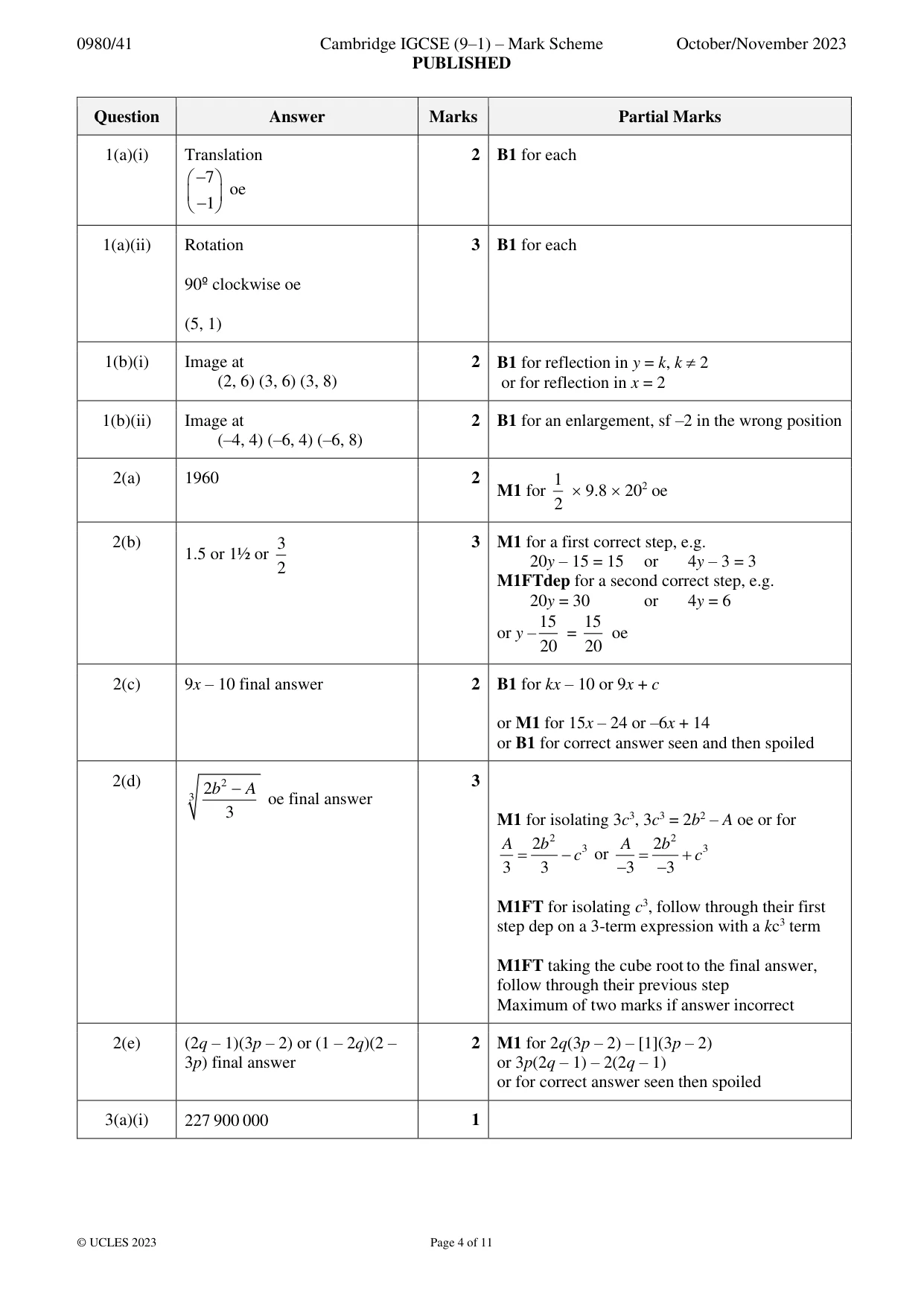
Mark scheme: Question Answer Marks Partial Marks 1(a)(i) Translation 2 B1 for each −7 oe −1 1(a)(ii) Rotation 3 B1 for each 90º clockwise oe (5, 1) 1(b)(i) Image at 2 B1 for reflection in y = k, k 2 (2, 6) (3, 6) (3, 8) or for reflection in x = 2 1(b)(ii) Image at 2 B1 for an enlargement, sf –2 in the wrong position (–4, 4) (–6, 4) (–6, 8)
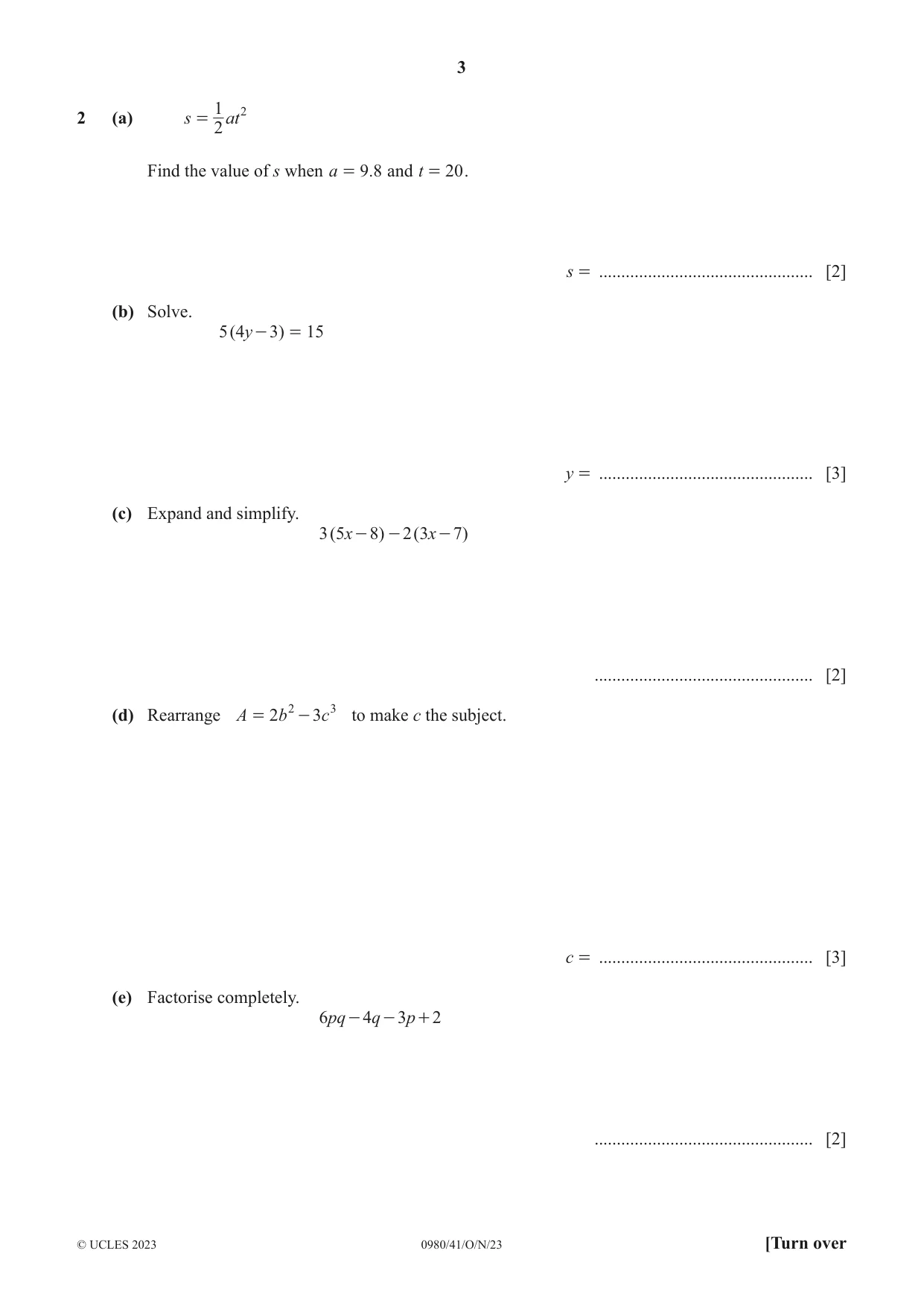
Q2 · S = at 2 2 Find the value of s when a = 9.8 and t = 20
2 (a) s = at 2 2 Find the value of s when a = 9.8 and t = 20 . s = ................................................ [2] (b) Solve. 5 ( 4y - 3) = 15 y = ................................................ [3] (c) Expand and simplify. 3 ( 5x - 8) - 2 ( 3x - 7) ................................................. [2] (d) Rearrange A = 2 b 2 - 3c 3 to make c the subject. c = ................................................ [3] (e) Factorise completely. 6pq - 4q - 3p + 2 ................................................. [2]
Mark scheme: 2(a) 1960 2 1 M1 for 9.8 202 oe 2 2(b) 3 3 M1 for a first correct step, e.g. 1.5 or 1½ or 20y – 15 = 15 or 4y – 3 = 3 2 M1FTdep for a second correct step, e.g. 20y = 30 or 4y = 6 15 15 or y – = oe 20 20 2(c) 9x – 10 final answer 2 B1 for kx – 10 or 9x + c or M1 for 15x – 24 or –6x + 14 or B1 for correct answer seen and then spoiled 2(d) 2 3 2b − A 3 oe final answer 3 M1 for isolating 3c3, 3c3 = 2b2 – A oe or for A 2b 2 3 A 2b 2 3 = − c or = + c 3 3 −3 −3 M1FT for isolating c3, follow through their first step dep on a 3-term expression with a kc3 term M1FT taking the cube root to the final answer, follow through their previous step Maximum of two marks if answer incorrect 2(e) (2q – 1)(3p – 2) or (1 – 2q)(2 – 2 M1 for 2q(3p – 2) – [1](3p – 2) 3p) final answer or 3p(2q – 1) – 2(2q – 1) or for correct answer seen then spoiled
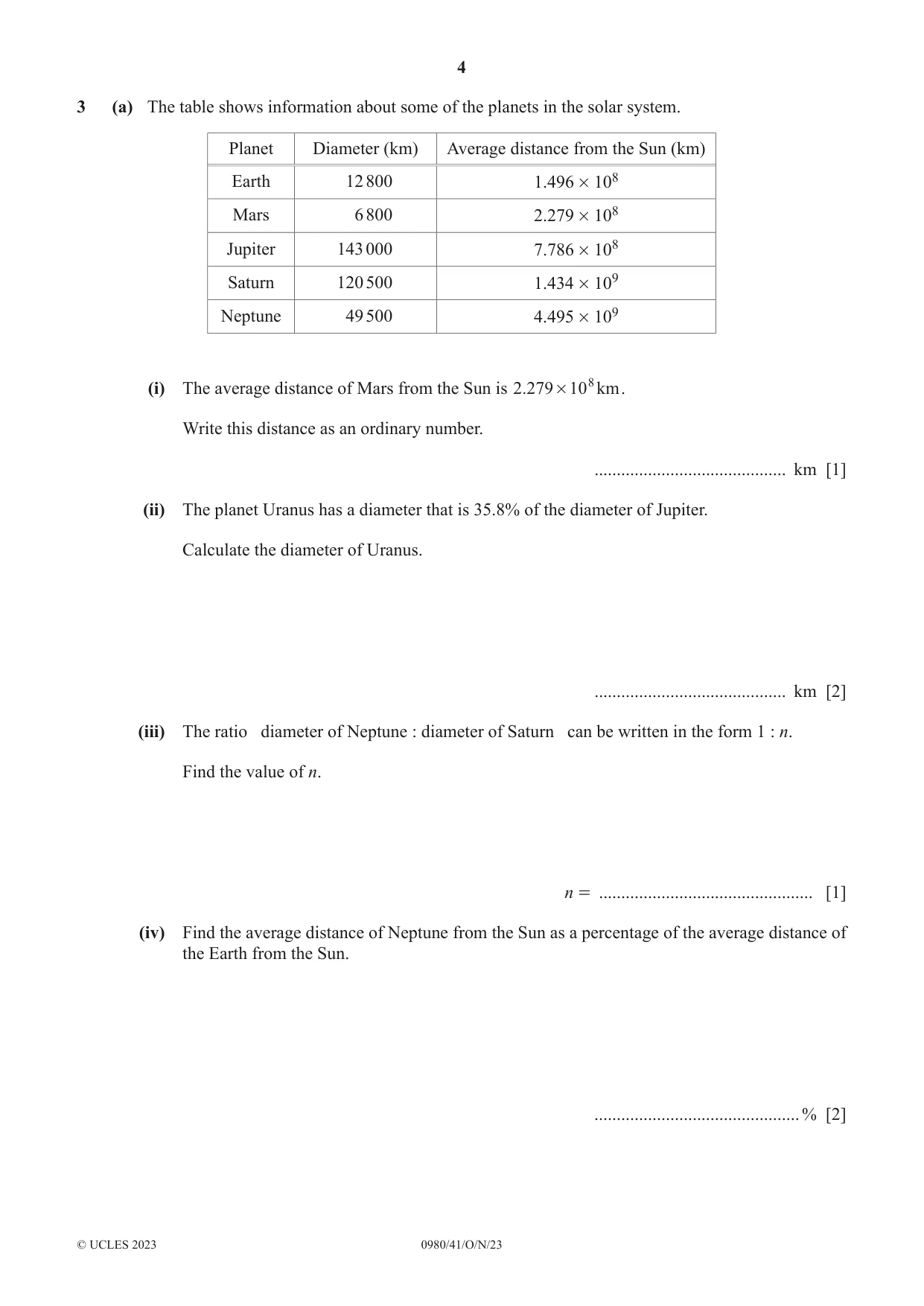
Q3 · The table shows information about some of the planets in the solar system
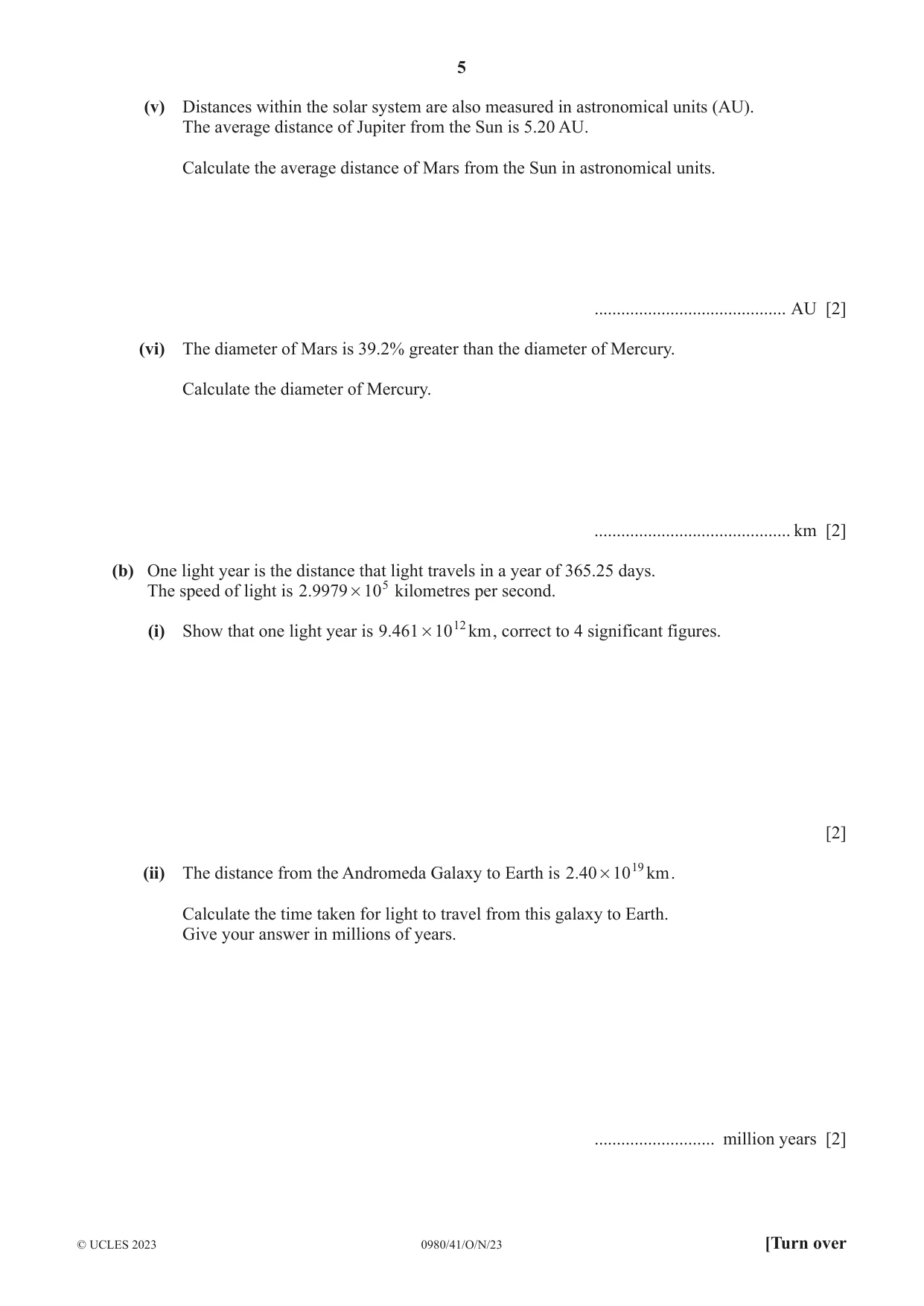
3 (a) The table shows information about some of the planets in the solar system. Planet Diameter (km) Average distance from the Sun (km) Earth 12 800 1.496 # 108 Mars 6 800 2.279 # 108 Jupiter 143 000 7.786 # 108 Saturn 120 500 1.434 # 109 Neptune 49 500 4.495 # 109 (i) The average distance of Mars from the Sun is 2.279 # 108 km . Write this distance as an ordinary number. ........................................... km [1] (ii) The planet Uranus has a diameter that is 35.8% of the diameter of Jupiter. Calculate the diameter of Uranus. ........................................... km [2] (iii) The ratio diameter of Neptune : diameter of Saturn can be written in the form 1 : n. Find the value of n. n = ................................................ [1] (iv) Find the average distance of Neptune from the Sun as a percentage of the average distance of the Earth from the Sun. ..............................................% [2] (v) Distances within the solar system are also measured in astronomical units (AU). The average distance of Jupiter from the Sun is 5.20 AU. Calculate the average distance of Mars from the Sun in astronomical units. ........................................... AU [2] (vi) The diameter of Mars is 39.2% greater than the diameter of Mercury. Calculate the diameter of Mercury. ............................................ km [2] (b) One light year is the distance that light travels in a year of 365.25 days. The speed of light is .29979 # 105 kilometres per second. (i) Show that one light year is 9.461 # 1012 km , correct to 4 significant figures. [2] (ii) The distance from the Andromeda Galaxy to Earth is 2.40 # 1019 km . Calculate the time taken for light to travel from this galaxy to Earth. Give your answer in millions of years. ........................... million years [2]
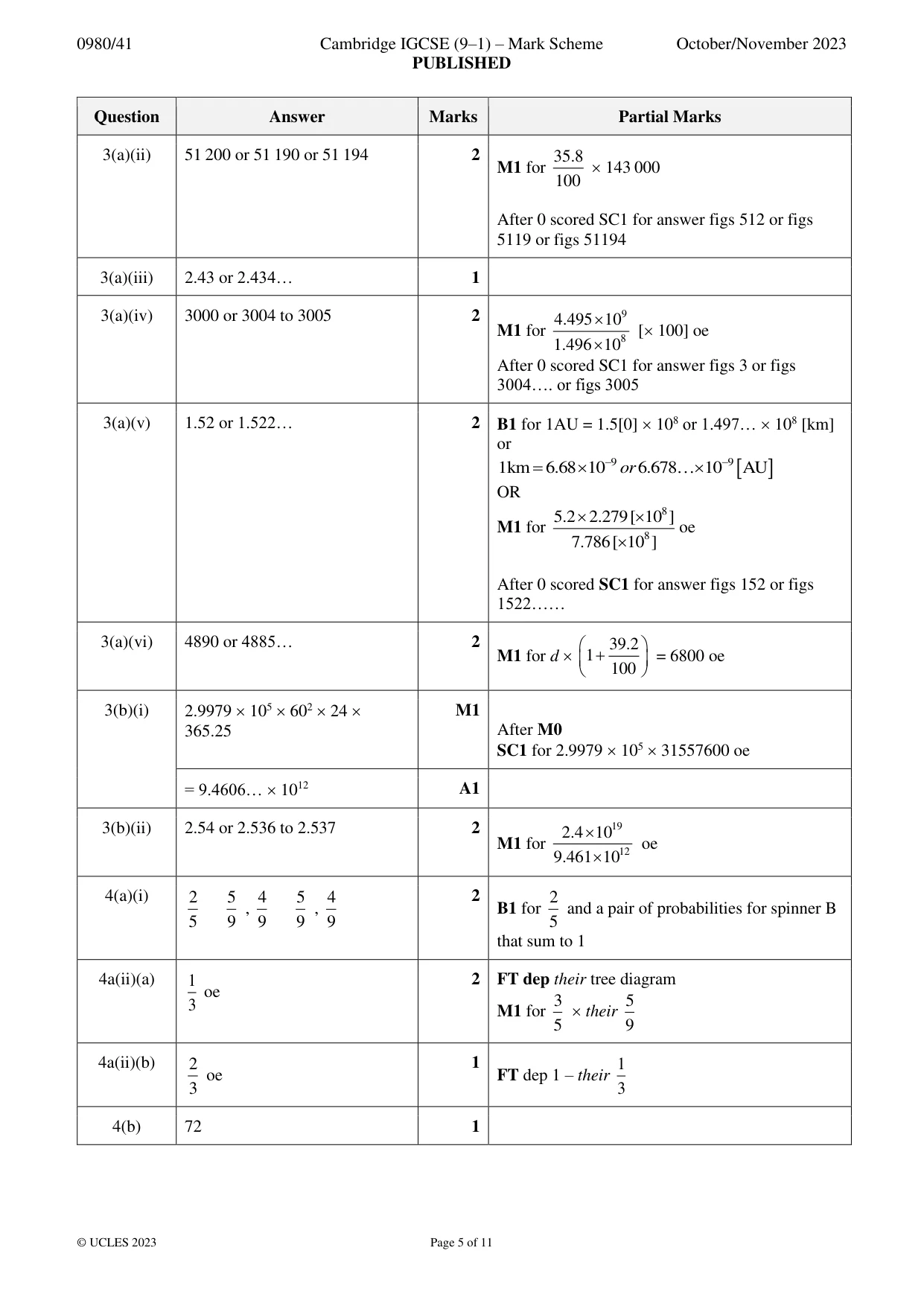
Mark scheme: 3(a)(i) 227 900 000 1 3(a)(ii) 51 200 or 51 190 or 51 194 2 35.8 M1 for 143 000 100 After 0 scored SC1 for answer figs 512 or figs 5119 or figs 51194 3(a)(iii) 2.43 or 2.434… 1 3(a)(iv) 3000 or 3004 to 3005 2 4.495 10 9 M1 for [ 100] oe 1.496 108 After 0 scored SC1 for answer figs 3 or figs 3004…. or figs 3005 3(a)(v) 1.52 or 1.522… 2 B1 for 1AU = 1.5[0] 108 or 1.497… 108 [km] or 1km = 6.68 10−9 or 6.678 10−9 AU OR 5.2 2.279[108 ] M1 for oe 7.786[108 ] After 0 scored SC1 for answer figs 152 or figs 1522…… 3(a)(vi) 4890 or 4885… 2 39.2 M1 for d 1 + = 6800 oe 100 3(b)(i) 2.9979 105 602 24 M1 365.25 After M0 SC1 for 2.9979 105 31557600 oe = 9.4606… 1012 A1 3(b)(ii) 2.54 or 2.536 to 2.537 2 2.4 1019 M1 for 12 oe 9.461 10
Q4 · Lucia has two fair spinners
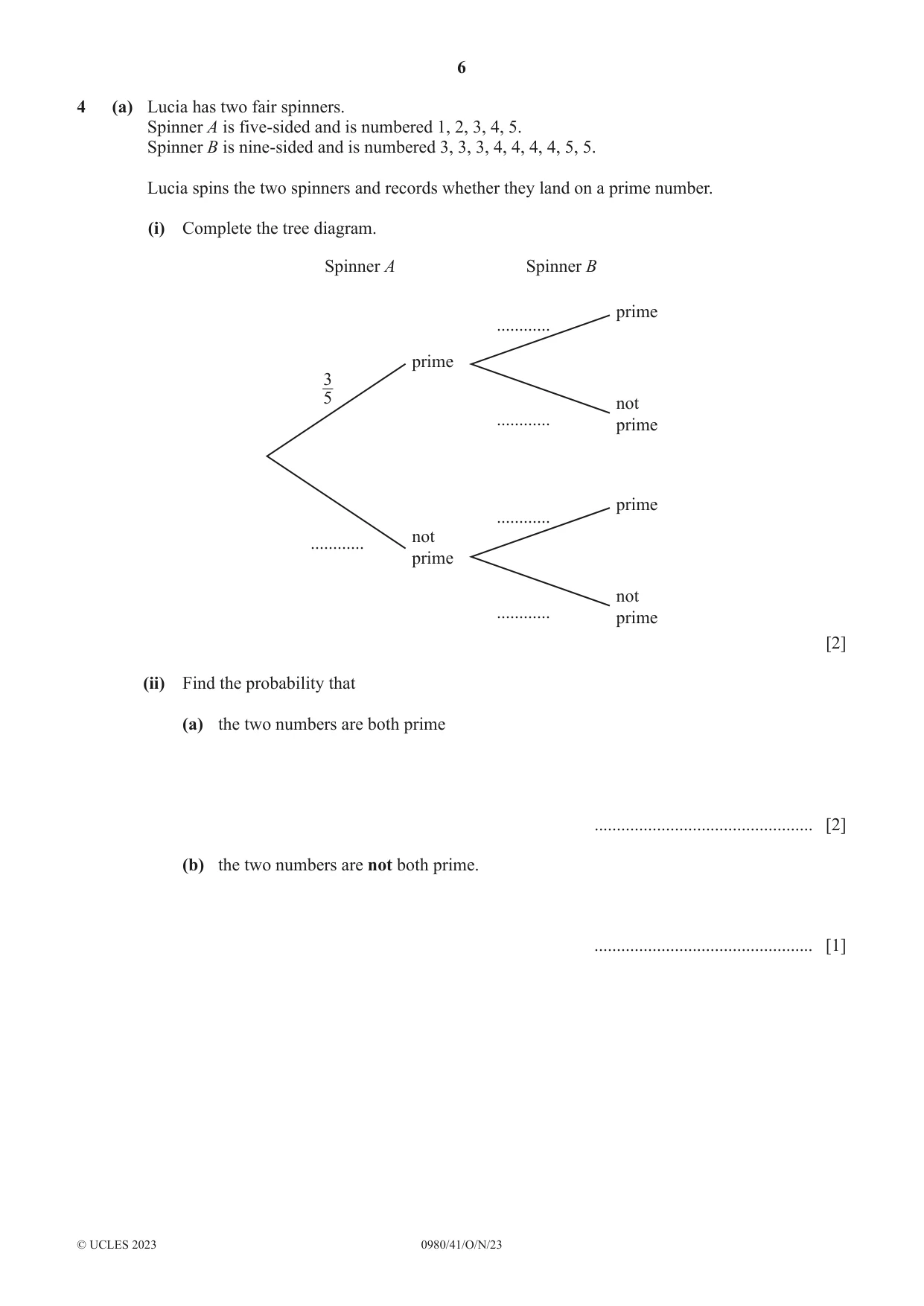
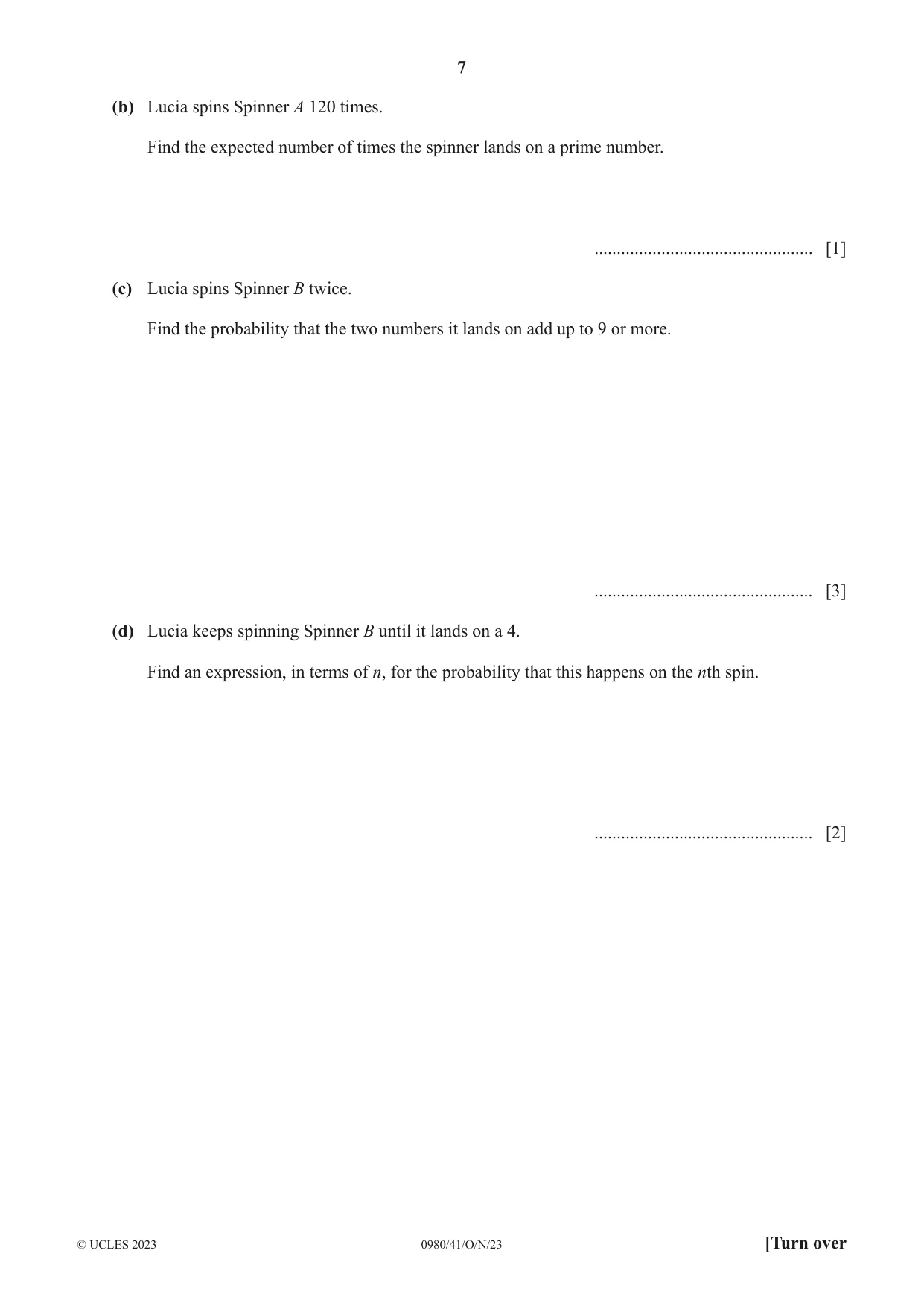
4 (a) Lucia has two fair spinners. Spinner A is five-sided and is numbered 1, 2, 3, 4, 5. Spinner B is nine-sided and is numbered 3, 3, 3, 4, 4, 4, 4, 5, 5. Lucia spins the two spinners and records whether they land on a prime number. (i) Complete the tree diagram. Spinner A Spinner B prime ............ prime 3 5 not ............ prime prime ............ not ............ prime not ............ prime [2] (ii) Find the probability that (a) the two numbers are both prime ................................................. [2] (b) the two numbers are not both prime. ................................................. [1] (b) Lucia spins Spinner A 120 times. Find the expected number of times the spinner lands on a prime number. ................................................. [1] (c) Lucia spins Spinner B twice. Find the probability that the two numbers it lands on add up to 9 or more. ................................................. [3] (d) Lucia keeps spinning Spinner B until it lands on a 4. Find an expression, in terms of n, for the probability that this happens on the nth spin. ................................................. [2]
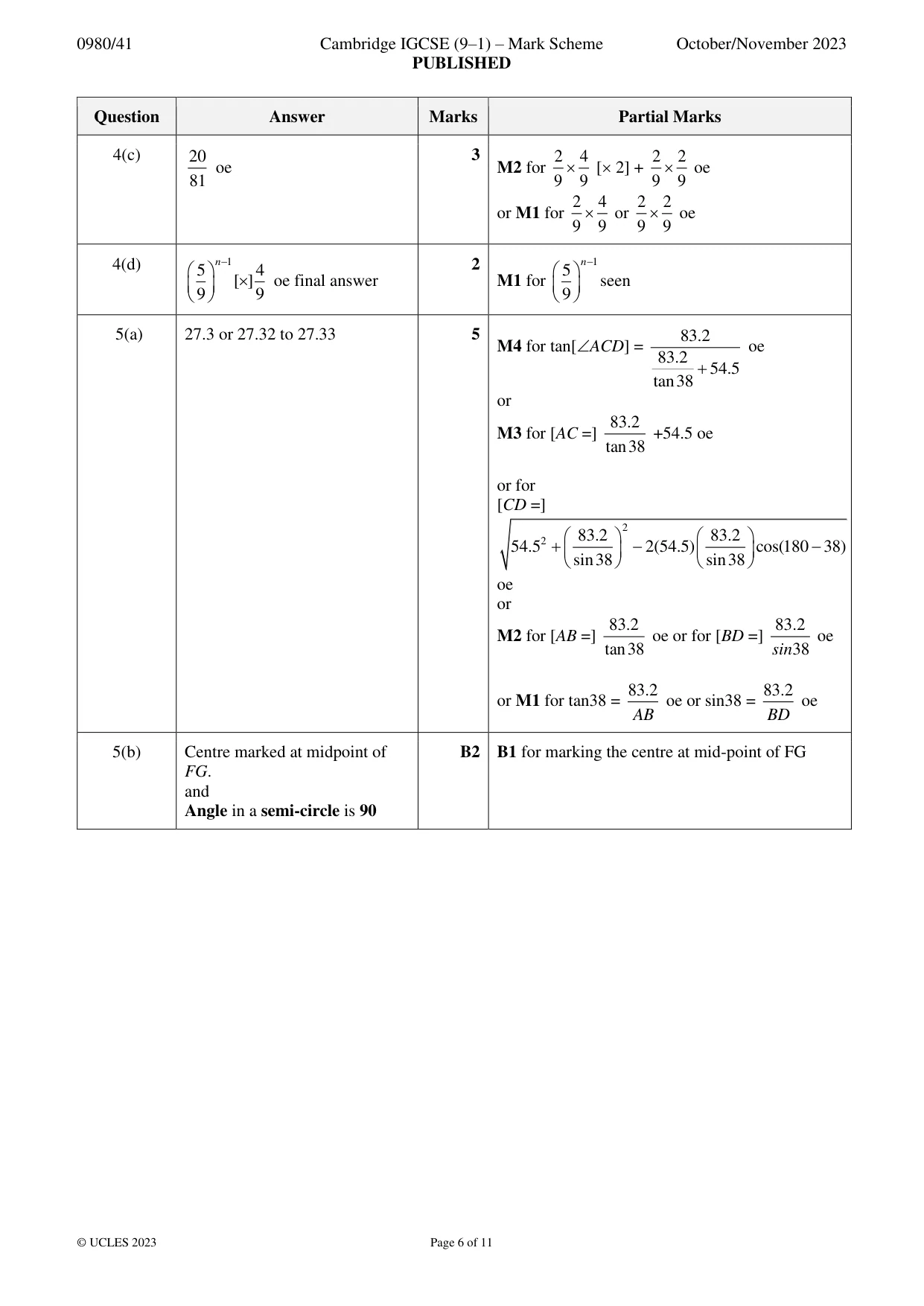
Mark scheme: 4(a)(i) 2 5 4 5 4 2 2 , , B1 for and a pair of probabilities for spinner B 5 9 9 9 9 5 that sum to 1 4a(ii)(a) 1 2 FT dep their tree diagram oe 3 5 3 M1 for their 5 9 4a(ii)(b) 2 1 1 oe FT dep 1 – their 3 3 4(b) 72 1 4(c) 20 3 2 4 2 2 oe M2 for [ 2] + oe 81 9 9 9 9 2 4 2 2 or M1 for or oe 9 9 9 9 4(d) n−1 2 n−1 5 4 5 [] oe final answer M1 for seen 9 9 9
Q5 · D NOT TO 83.2 m SCALE 38° C B A 54.5 m ACD is a right-angled triangle
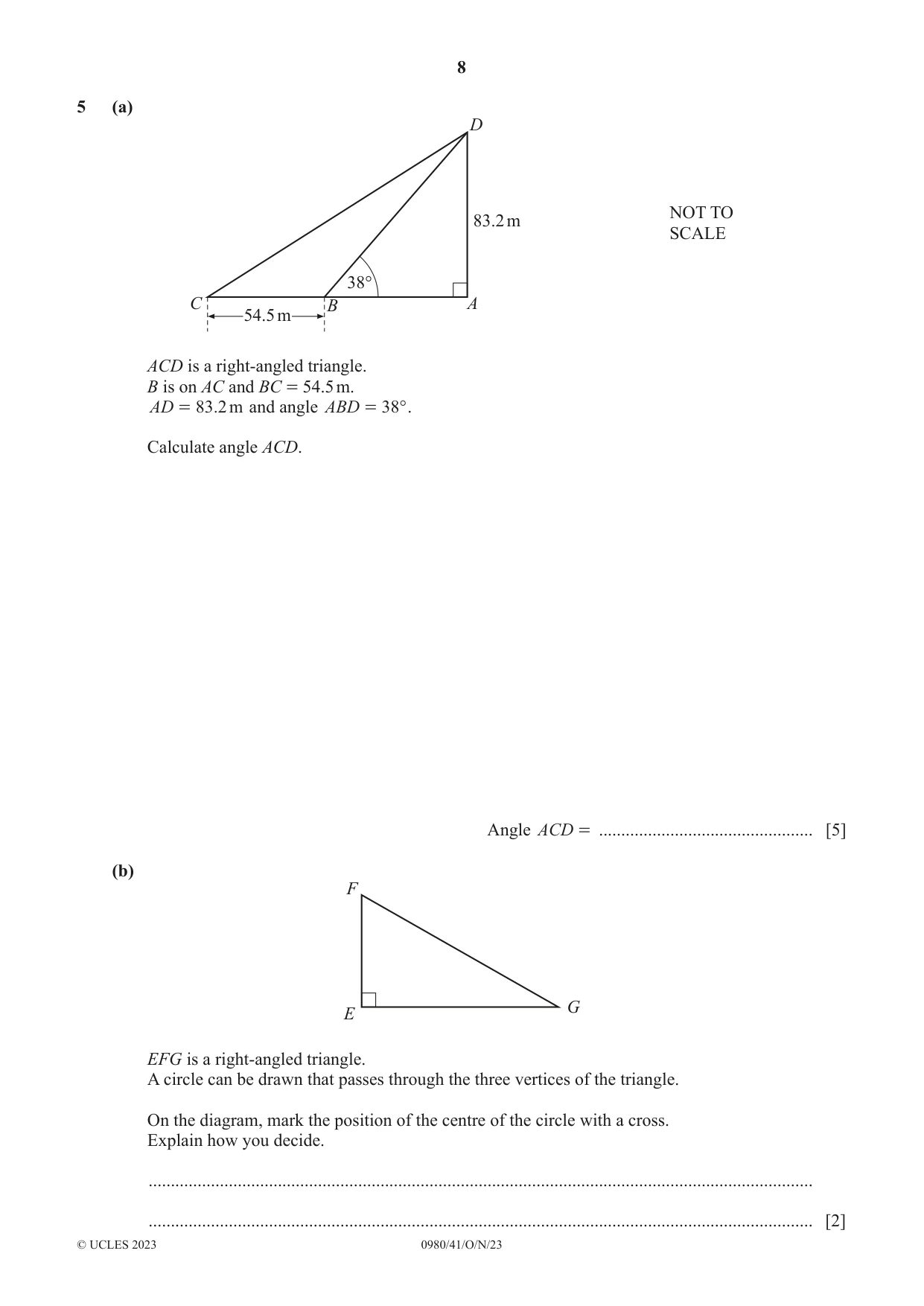
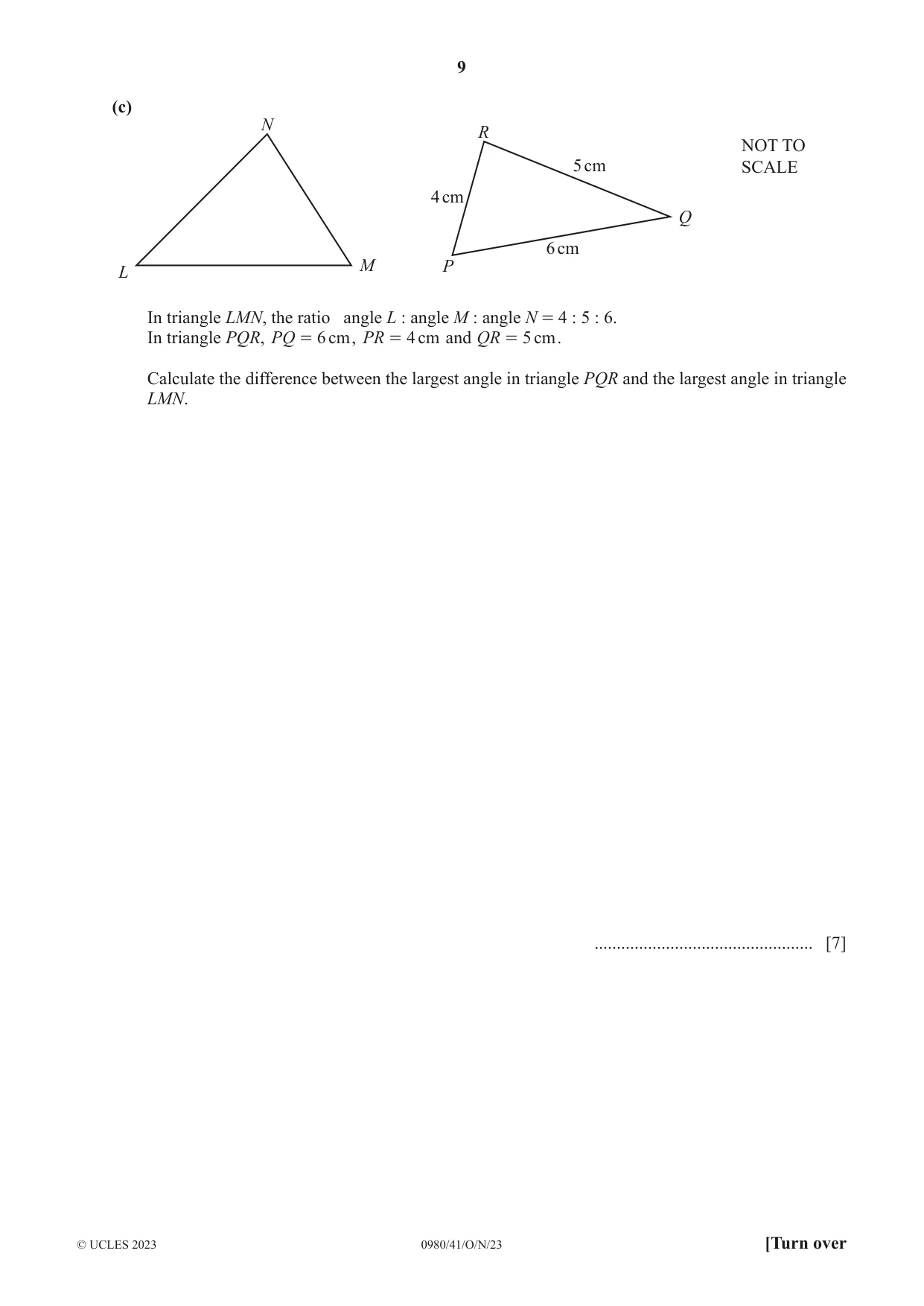
5 (a) D NOT TO 83.2 m SCALE 38° C B A 54.5 m ACD is a right-angled triangle. B is on AC and BC = 54.5 m. AD = 83.2 m and angle ABD = 38° . Calculate angle ACD. Angle ACD = ................................................ [5] (b) F G E EFG is a right-angled triangle. A circle can be drawn that passes through the three vertices of the triangle. On the diagram, mark the position of the centre of the circle with a cross. Explain how you decide. ..................................................................................................................................................... ..................................................................................................................................................... [2] (c) N R NOT TO 5 cm SCALE 4 cm Q 6 cm M P L In triangle LMN, the ratio angle L : angle M : angle N = 4 : 5 : 6. In triangle PQR, PQ = 6 cm , PR = 4 cm and QR = 5 cm . Calculate the difference between the largest angle in triangle PQR and the largest angle in triangle LMN. ................................................. [7]
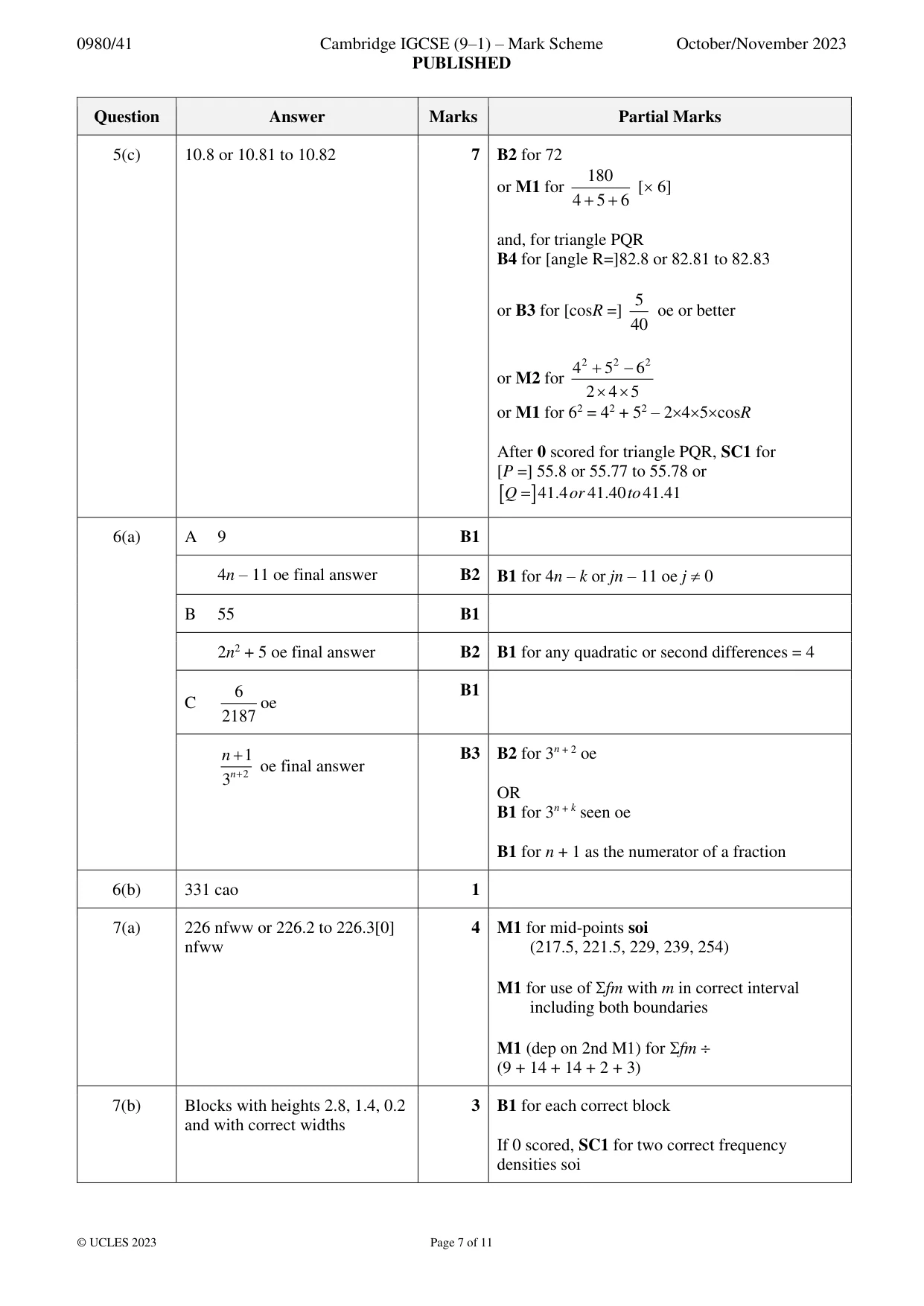
Mark scheme: 5(a) 27.3 or 27.32 to 27.33 5 83.2 M4 for tan[ACD] = oe 83.2 + 54.5 tan38 or 83.2 M3 for [AC =] +54.5 oe tan38 or for [CD =] 2 83.2 2 83.2 54.5 + − 2(54.5) cos(180 − 38) sin38 sin38 oe or 83.2 83.2 M2 for [AB =] oe or for [BD =] oe tan38 sin 38 83.2 83.2 or M1 for tan38 = oe or sin38 = oe AB BD 5(b) Centre marked at midpoint of B2 B1 for marking the centre at mid-point of FG FG. and Angle in a semi-circle is 90 5(c) 10.8 or 10.81 to 10.82 7 B2 for 72 180 or M1 for [ 6] 4 + 5 + 6 and, for triangle PQR B4 for [angle R=]82.8 or 82.81 to 82.83 5 or B3 for [cosR =] oe or better 40 4 2 + 5 2 − 6 2 or M2 for 2 4 5 or M1 for 62 = 42 + 52 – 245cosR After 0 scored for triangle PQR, SC1 for [P =] 55.8 or 55.77 to 55.78 or Q = 41.4 or 41.40 to 41.41
Q6 · Sequence 1st term 2nd term 3rd term 4th term 5th term nth term A -7 -3 1 5 B 7 13 23 37 C…
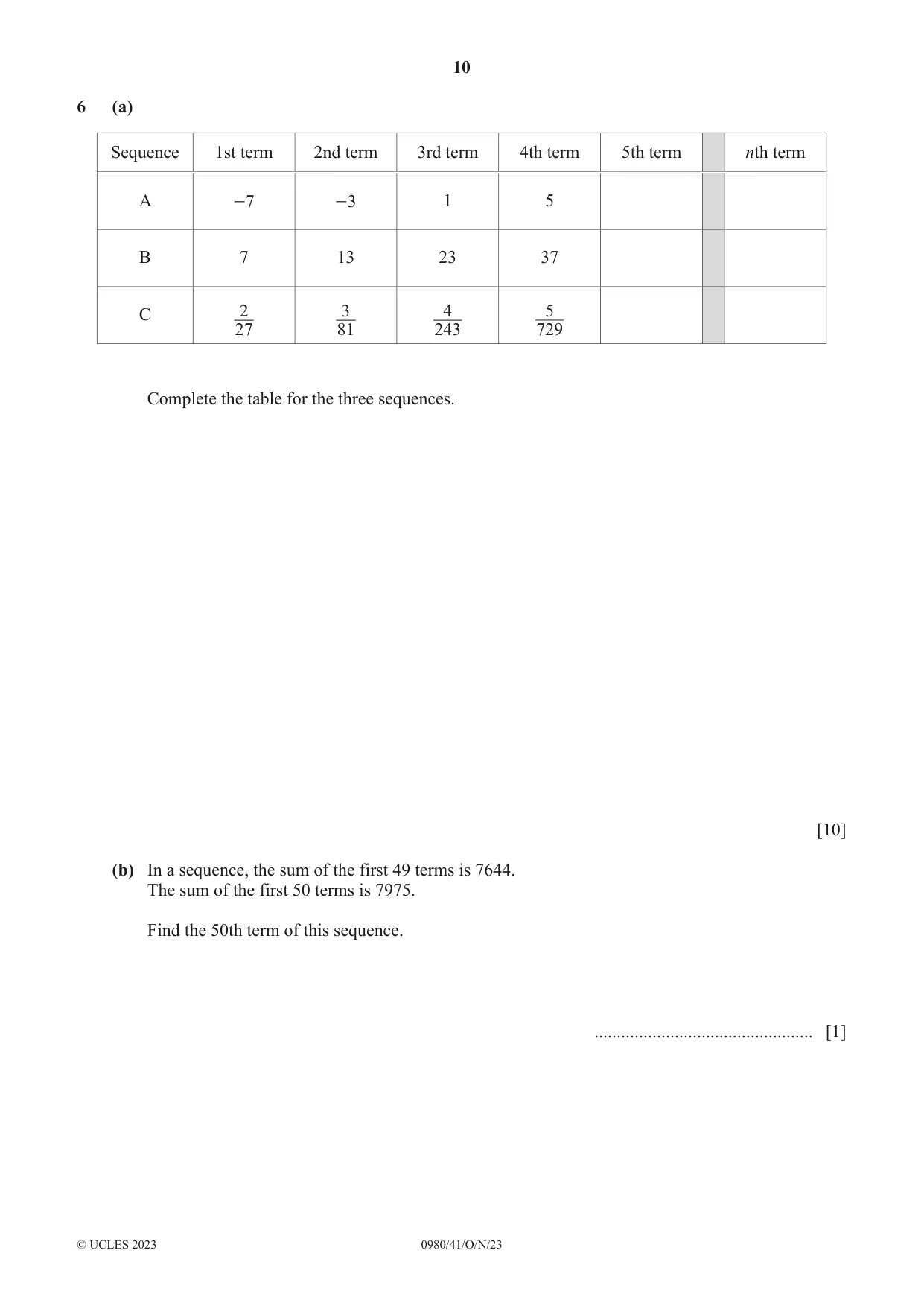
6 (a) Sequence 1st term 2nd term 3rd term 4th term 5th term nth term A -7 -3 1 5 B 7 13 23 37 C 2 3 4 5 27 81 243 729 Complete the table for the three sequences. [10] (b) In a sequence, the sum of the first 49 terms is 7644. The sum of the first 50 terms is 7975. Find the 50th term of this sequence. ................................................. [1]
Mark scheme: 6(a) A 9 B1 4n – 11 oe final answer B2 B1 for 4n – k or jn – 11 oe j 0 B 55 B1 2n2 + 5 oe final answer B2 B1 for any quadratic or second differences = 4 6 B1 C oe 2187 n + 1 B3 B2 for 3n + 2 oe oe final answer 3n + 2 OR B1 for 3n + k seen oe B1 for n + 1 as the numerator of a fraction 6(b) 331 cao 1
Q7 · The frequency table shows the time of each of 42 athletes in a race
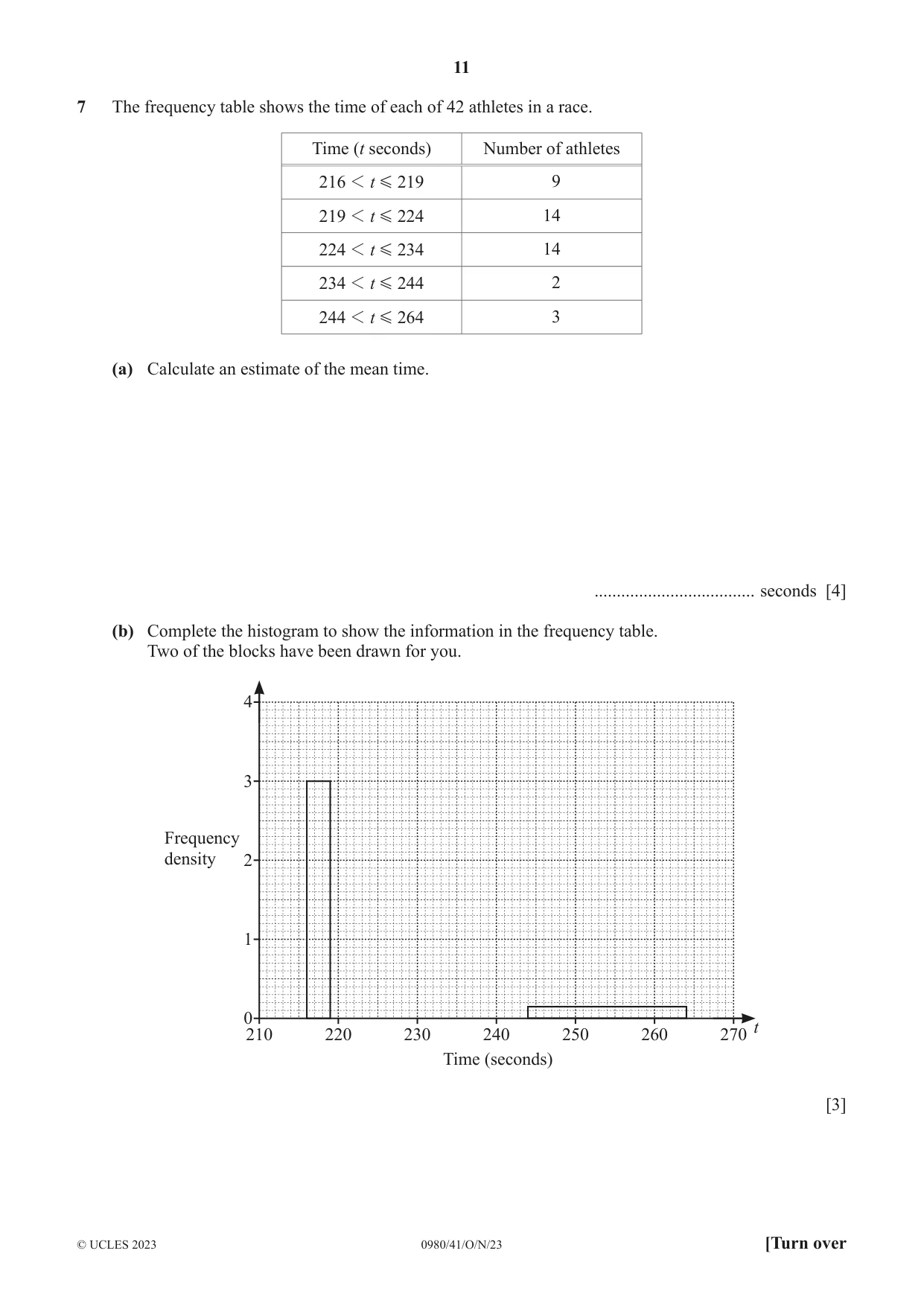
7 The frequency table shows the time of each of 42 athletes in a race. Time (t seconds) Number of athletes 216 1 t G 219 9 219 1 t G 224 14 224 1 t G 234 14 234 1 t G 244 2 244 1 t G 264 3 (a) Calculate an estimate of the mean time. .................................... seconds [4] (b) Complete the histogram to show the information in the frequency table. Two of the blocks have been drawn for you. 4 3 Frequency density 2 1 0 t 210 220 230 240 250 260 270 Time (seconds) [3]
Mark scheme: 7(a) 226 nfww or 226.2 to 226.3[0] 4 M1 for mid-points soi nfww (217.5, 221.5, 229, 239, 254) M1 for use of fm with m in correct interval including both boundaries M1 (dep on 2nd M1) for fm (9 + 14 + 14 + 2 + 3) 7(b) Blocks with heights 2.8, 1.4, 0.2 3 B1 for each correct block and with correct widths If 0 scored, SC1 for two correct frequency densities soi
Q8 · 3.63.6 cmcm 6.5 cm NOT TO SCALE 5.4 cm The diagram shows a solid formed by joining two…
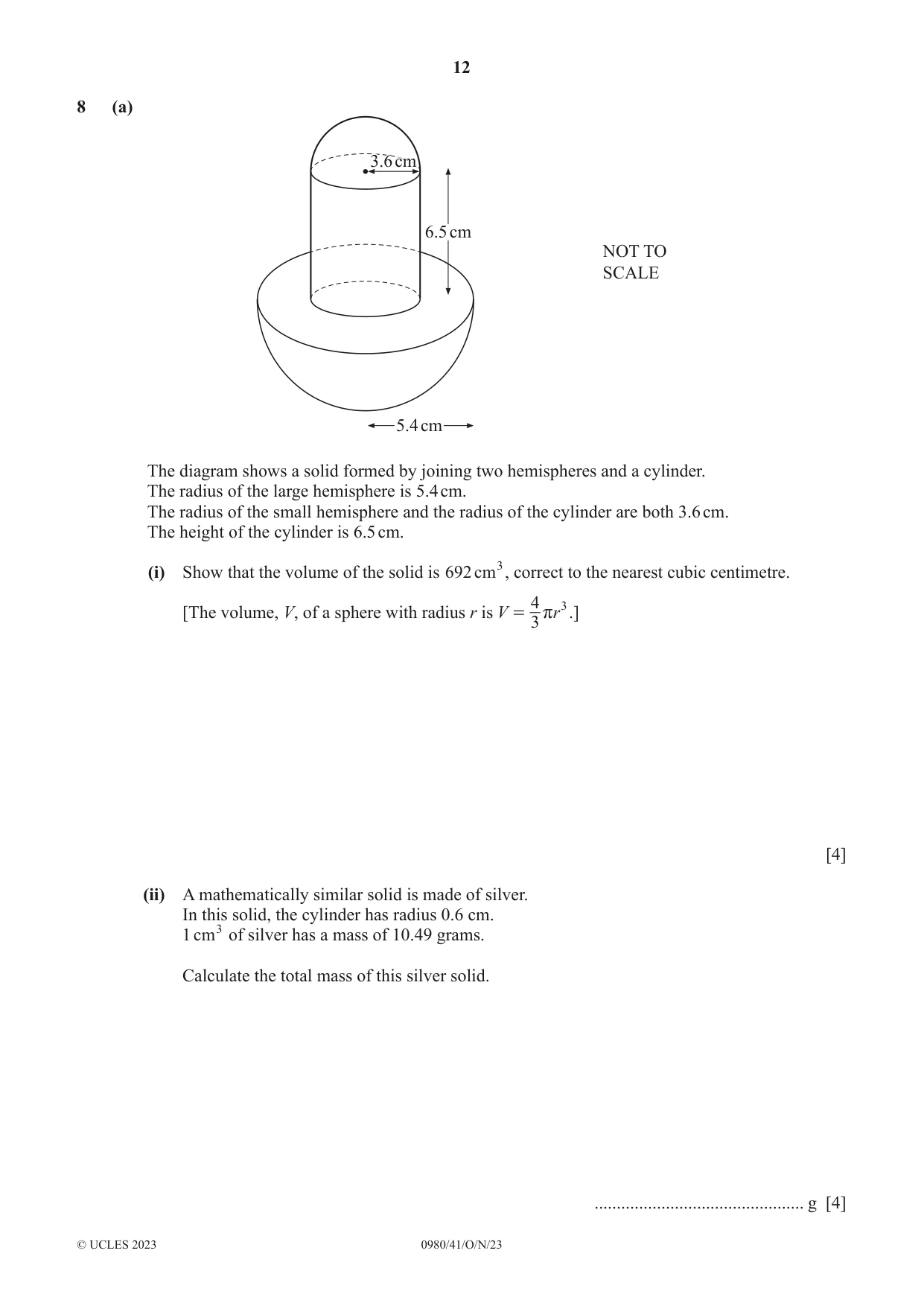
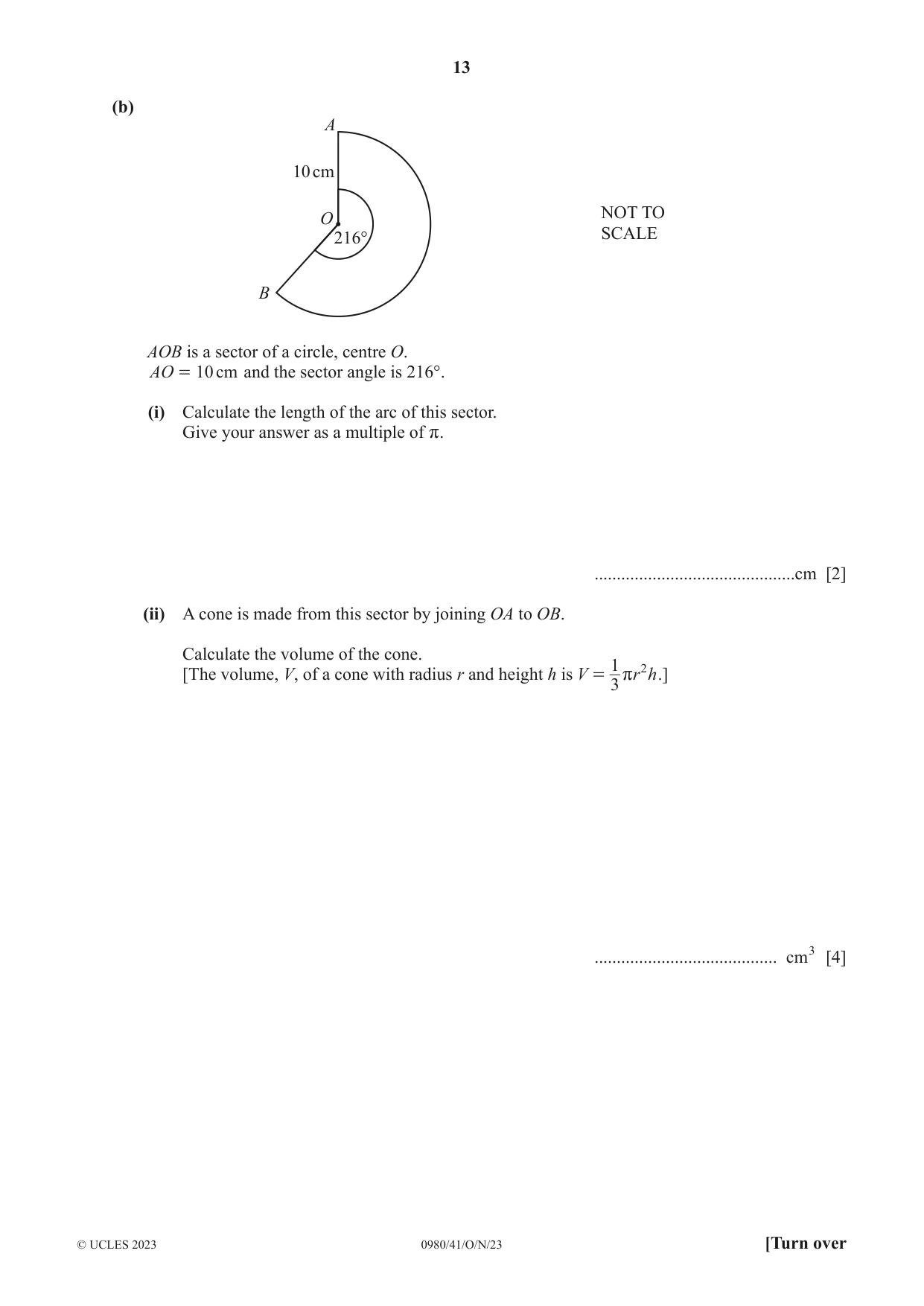
8 (a) 3.63.6 cmcm 6.5 cm NOT TO SCALE 5.4 cm The diagram shows a solid formed by joining two hemispheres and a cylinder. The radius of the large hemisphere is 5.4 cm. The radius of the small hemisphere and the radius of the cylinder are both 3.6 cm. The height of the cylinder is 6.5 cm. (i) Show that the volume of the solid is 692 cm 3, correct to the nearest cubic centimetre. 4 3 [The volume, V, of a sphere with radius r is V = rr .] 3 [4] (ii) A mathematically similar solid is made of silver. In this solid, the cylinder has radius 0.6 cm. 1 cm 3 of silver has a mass of 10.49 grams. Calculate the total mass of this silver solid. ............................................... g [4] (b) A 10 cm NOT TO O 216° SCALE B AOB is a sector of a circle, centre O. AO = 10 cm and the sector angle is 216°. (i) Calculate the length of the arc of this sector. Give your answer as a multiple of r. .............................................cm [2] (ii) A cone is made from this sector by joining OA to OB. Calculate the volume of the cone. 1 2 [The volume, V, of a cone with radius r and height h is V = rr h .] 3 ......................................... cm3 [4]
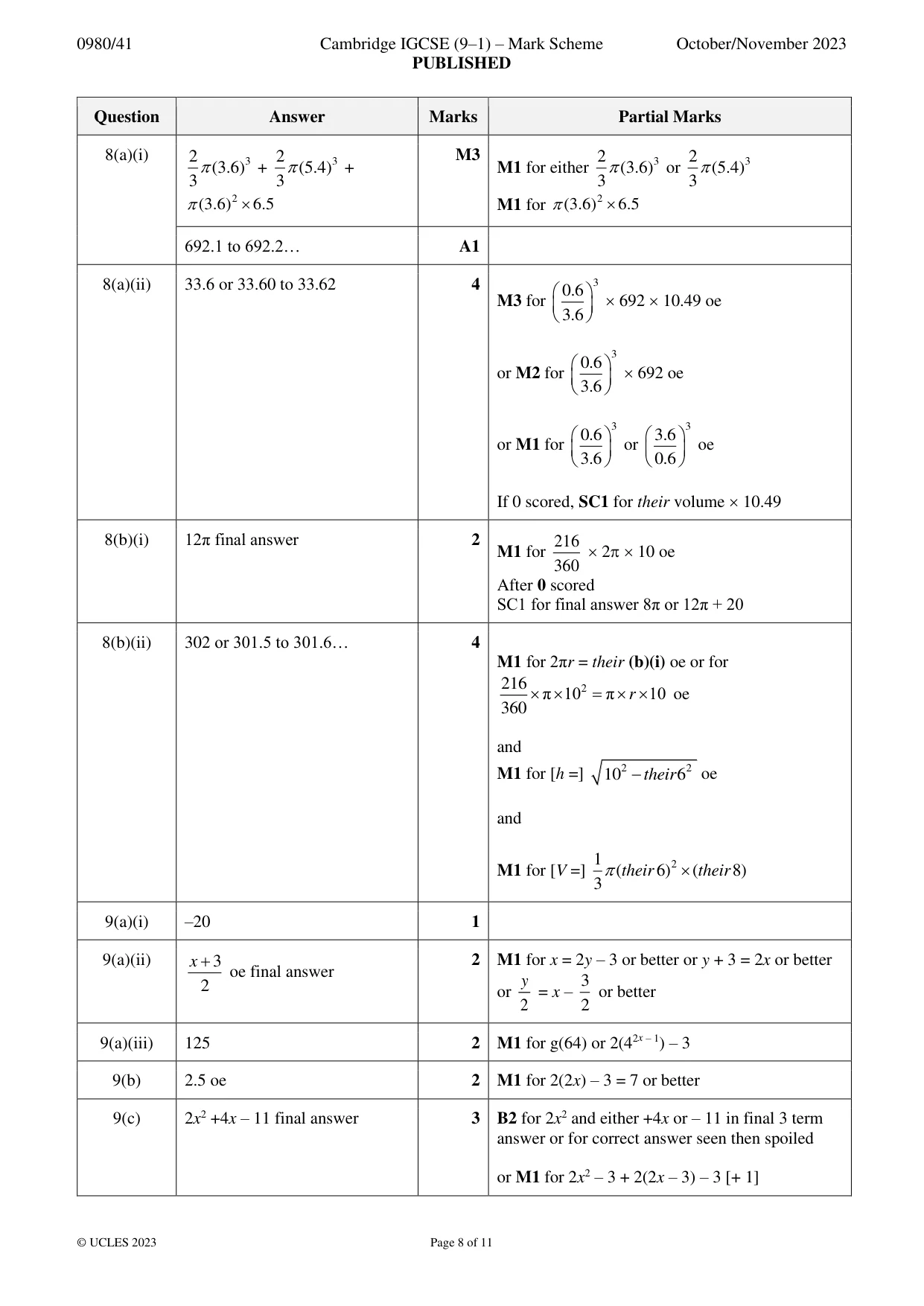
Mark scheme: 8(a)(i) 2 3 2 3 M3 2 3 2 3 3(3.6) + 3(5.4) + M1 for either 3(3.6) or 3(5.4) (3.6) 2 6.5 M1 for (3.6) 2 6.5 692.1 to 692.2… A1 8(a)(ii) 33.6 or 33.60 to 33.62 4 3 0.6 M3 for 692 10.49 oe 3.6 0.6 3 or M2 for 692 oe 3.6 0.6 3 3.6 3 or M1 for or oe 3.6 0.6 If 0 scored, SC1 for their volume 10.49 8(b)(i) 12π final answer 2 216 M1 for 2 10 oe 360 After 0 scored SC1 for final answer 8π or 12π + 20 8(b)(ii) 302 or 301.5 to 301.6… 4 M1 for 2πr = their (b)(i) oe or for 216 2 π 10 = π r 10 oe 360 and M1 for [h =] 10 2 − their 6 2 oe and 1 2 M1 for [V =] (their 6) (their 8) 3
Q9 · F ( x) = ( 3 x + 1)( x + 5)( x - 4) g ( x) = 2x - 3 h ( x) = 4 2 x - 1 (a) Find (i) f (…
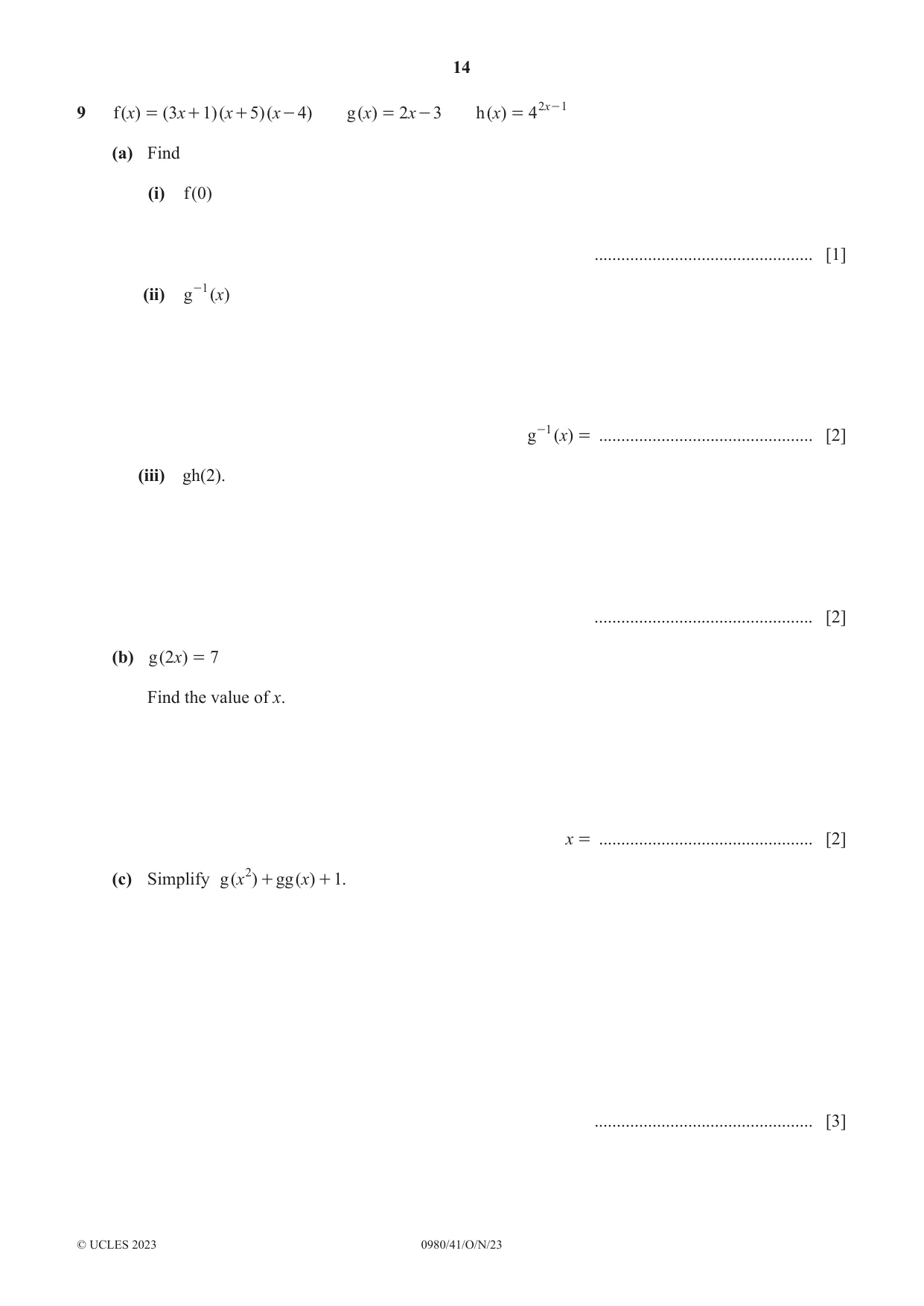
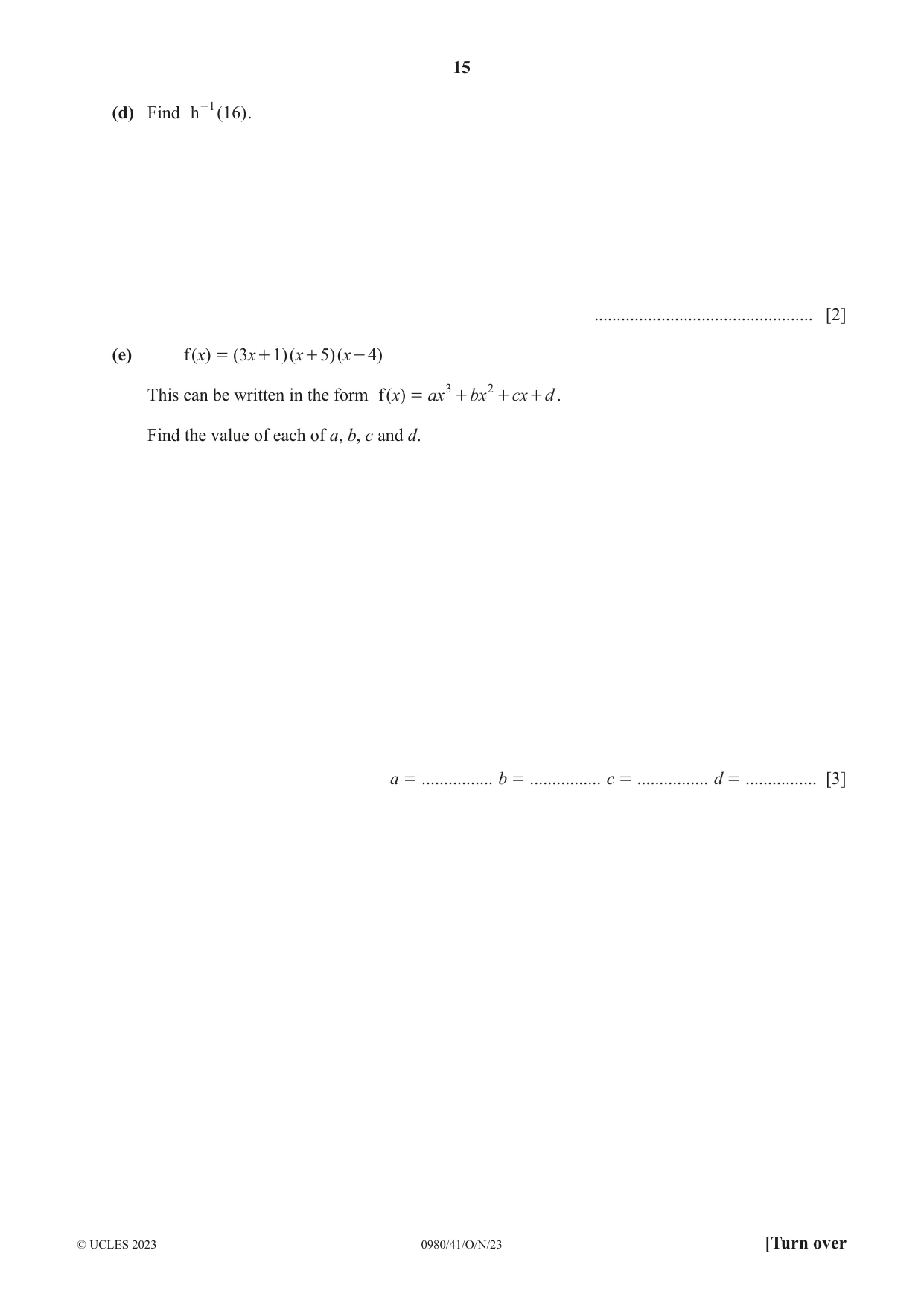
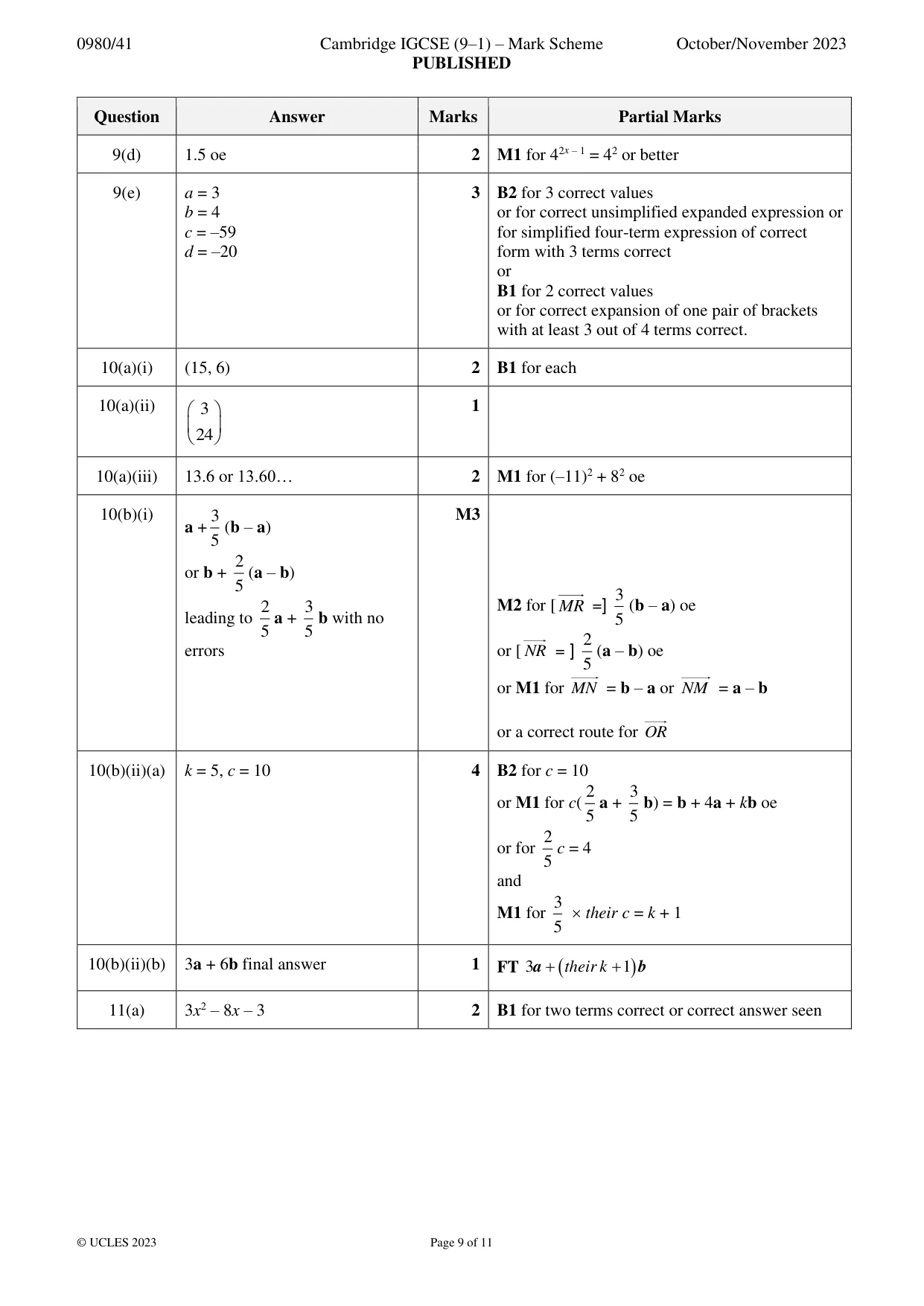
9 f ( x) = ( 3 x + 1)( x + 5)( x - 4) g ( x) = 2x - 3 h ( x) = 4 2 x - 1 (a) Find (i) f ( 0) ................................................. [1] (ii) g -1 ( )x g -1 ( )x = ................................................ [2] (iii) gh(2). ................................................. [2] (b) g( 2)x = 7 Find the value of x. x = ................................................ [2] (c) Simplify g ( x 2 ) + gg ( x) + 1. ................................................. [3] (d) Find h -1 ( 16) . ................................................. [2] (e) f ( x) = ( 3 x + 1)( x + 5)( x - 4) This can be written in the form f ( x) = ax 3 + bx 2 + cx + d . Find the value of each of a, b, c and d. a = ................ b = ................ c = ................ d = ................ [3]
Mark scheme: 9(a)(i) –20 1 9(a)(ii) x + 3 2 M1 for x = 2y – 3 or better or y + 3 = 2x or better oe final answer y 3 2 or = x – or better 2 2 9(a)(iii) 125 2 M1 for g(64) or 2(42x – 1) – 3 9(b) 2.5 oe 2 M1 for 2(2x) – 3 = 7 or better 9(c) 2x2 +4x – 11 final answer 3 B2 for 2x2 and either +4x or – 11 in final 3 term answer or for correct answer seen then spoiled or M1 for 2x2 – 3 + 2(2x – 3) – 3 [+ 1] 9(d) 1.5 oe 2 M1 for 42x – 1 = 42 or better 9(e) a = 3 3 B2 for 3 correct values b = 4 or for correct unsimplified expanded expression or c = –59 for simplified four-term expression of correct d = –20 form with 3 terms correct or B1 for 2 correct values or for correct expansion of one pair of brackets with at least 3 out of 4 terms correct.
Q10 · ABC is a triangle
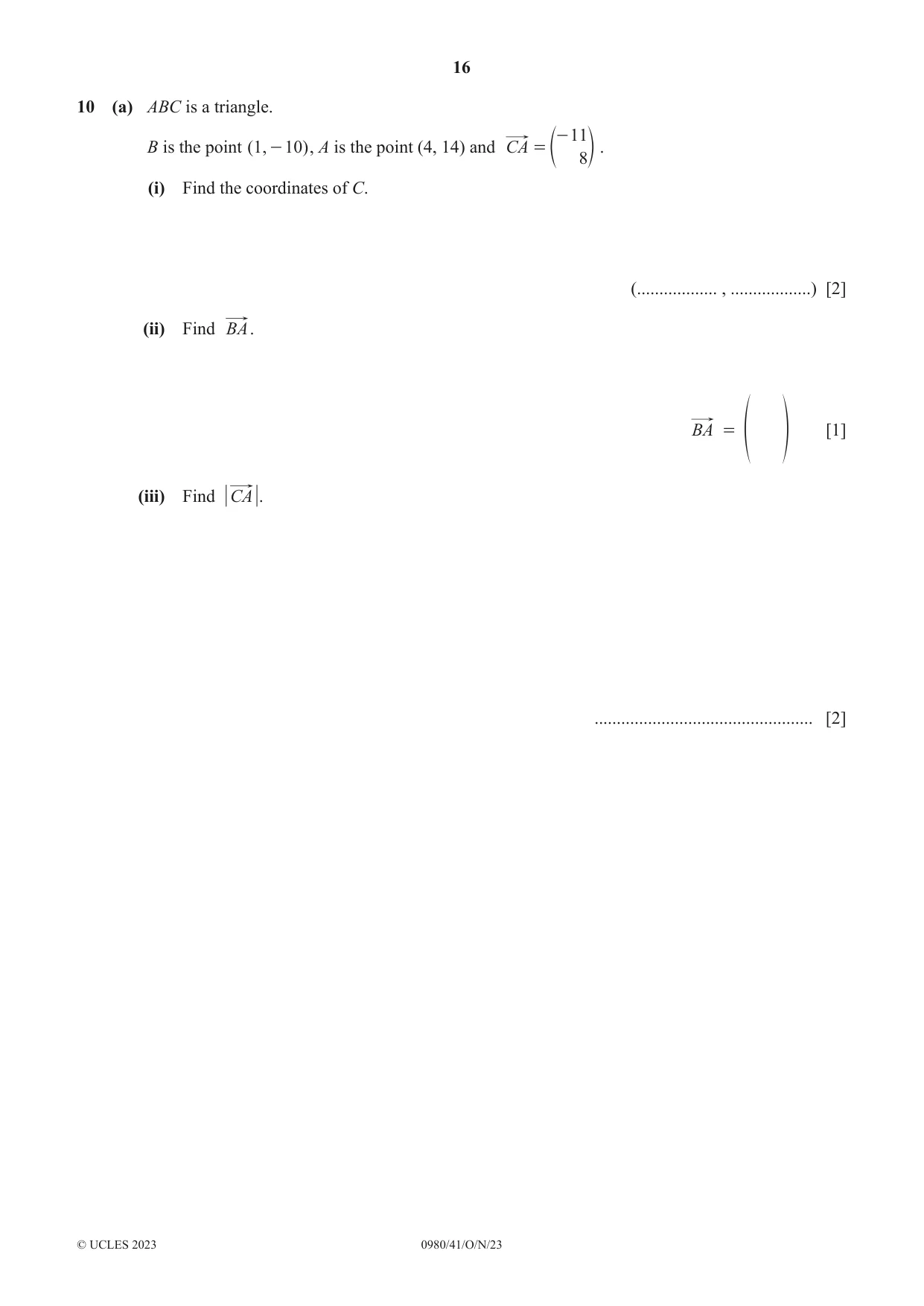
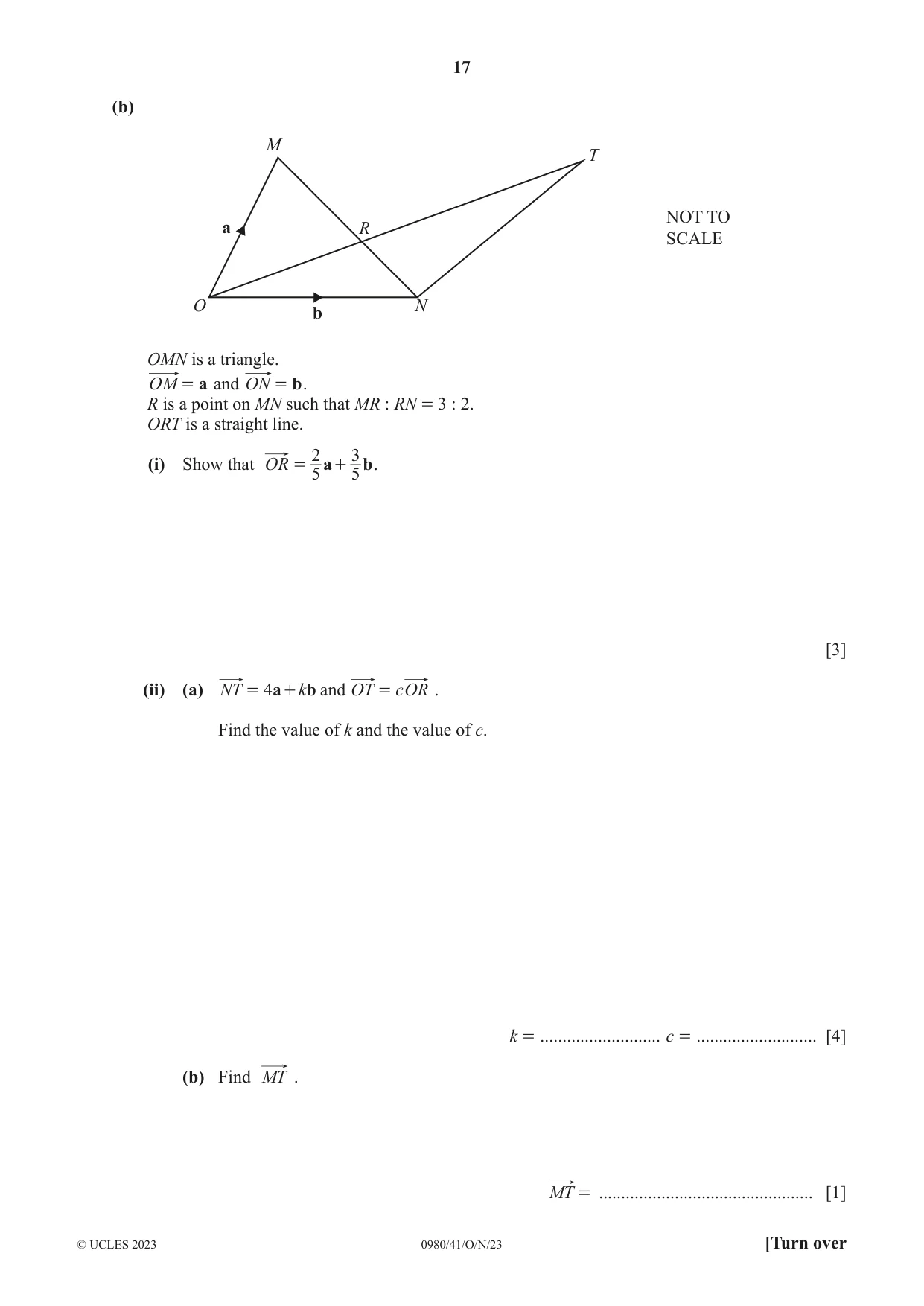
10 (a) ABC is a triangle. - 11 B is the point ( 1, - 10) , A is the point (4, 14) and CA = . e 8o (i) Find the coordinates of C. (.................. , ..................) [2] (ii) Find BA. BA = [1] f p (iii) Find CA . ................................................. [2] (b) M T NOT TO a R SCALE O N b OMN is a triangle. OM = a and ON = b . R is a point on MN such that MR : RN = 3 : 2. ORT is a straight line. 2 3 (i) Show that OR = a + b . 5 5 [3] (ii) (a) NT = 4a + kb and OT = c OR . Find the value of k and the value of c. k = ........................... c = ........................... [4] (b) Find MT . MT = ................................................ [1]
Mark scheme: 10(a)(i) (15, 6) 2 B1 for each 10(a)(ii) 3 1 24 10(a)(iii) 13.6 or 13.60… 2 M1 for (–11)2 + 82 oe 10(b)(i) 3 M3 a + (b – a) 5 2 or b + (a – b) 5 3 2 3 M2 for [ MR =] (b – a) oe leading to a + b with no 5 5 5 2 errors or [ NR = ] (a – b) oe 5 or M1 for MN = b – a or NM = a – b or a correct route for OR 10(b)(ii)(a) k = 5, c = 10 4 B2 for c = 10 2 3 or M1 for c( a + b) = b + 4a + kb oe 5 5 2 or for c = 4 5 and 3 M1 for their c = k + 1 5 10(b)(ii)(b) 3a + 6b final answer 1 FT 3a + ( their k + 1) b
Q11 · Differentiate x 3 - 4 x 2 - 3x
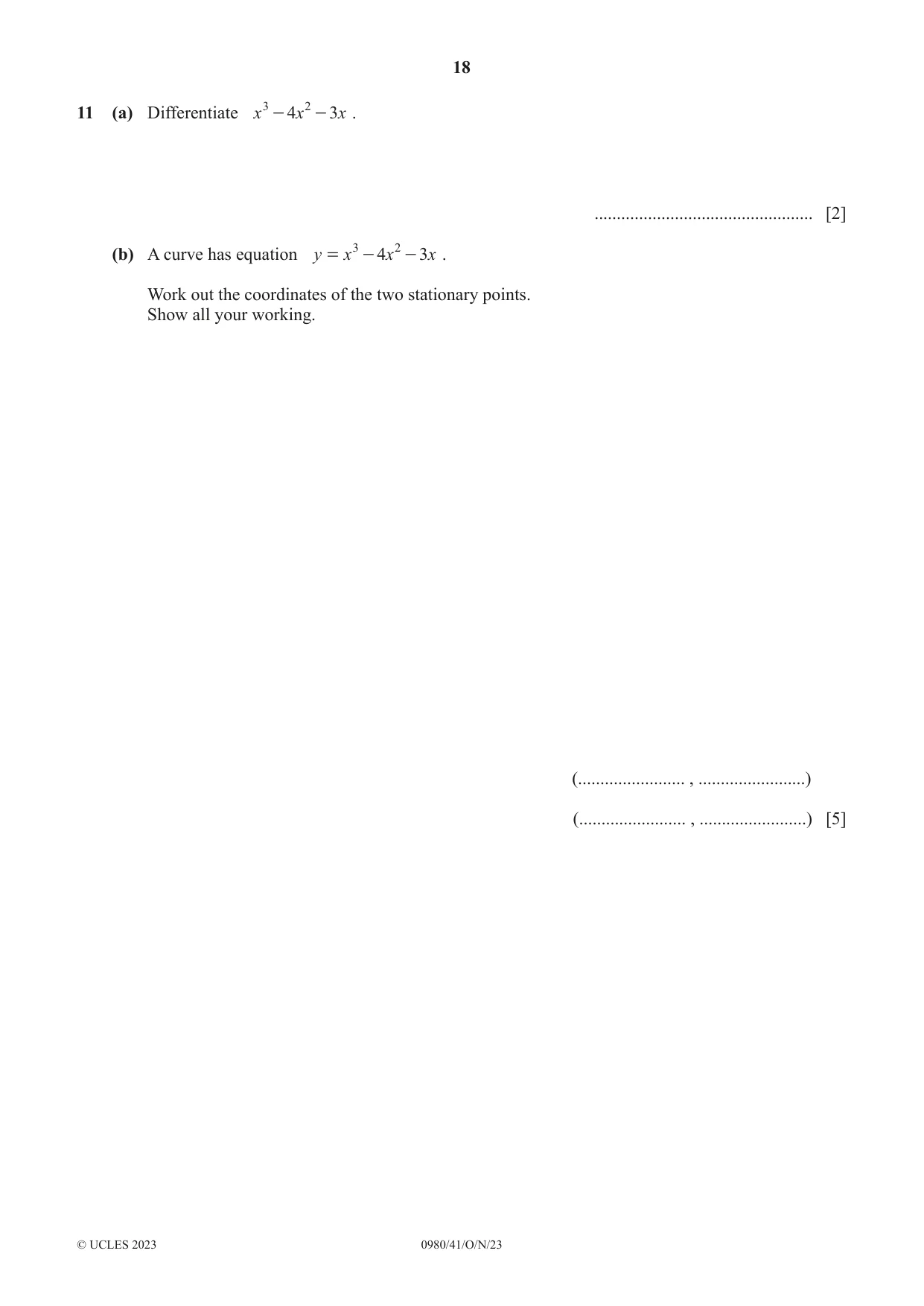
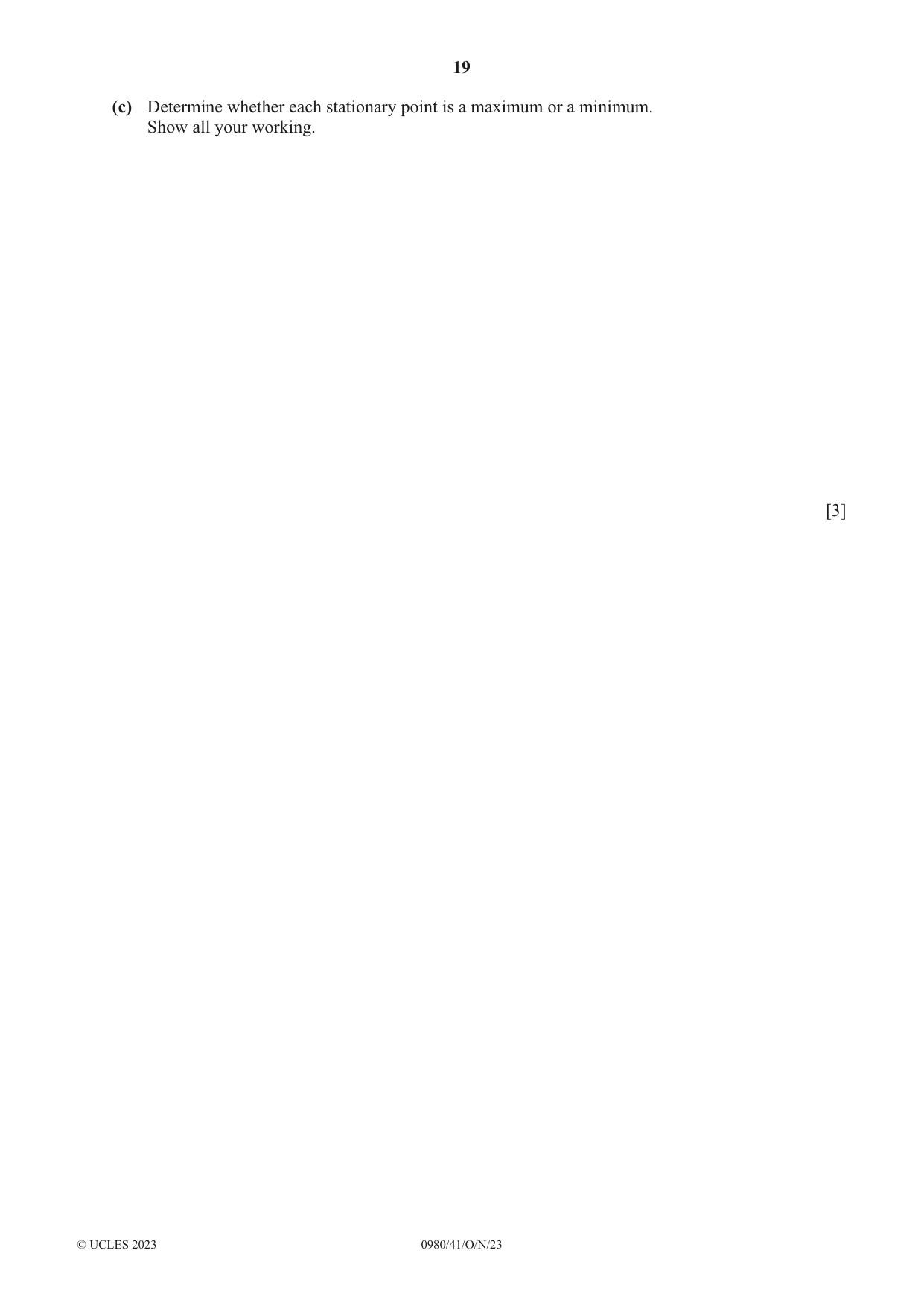
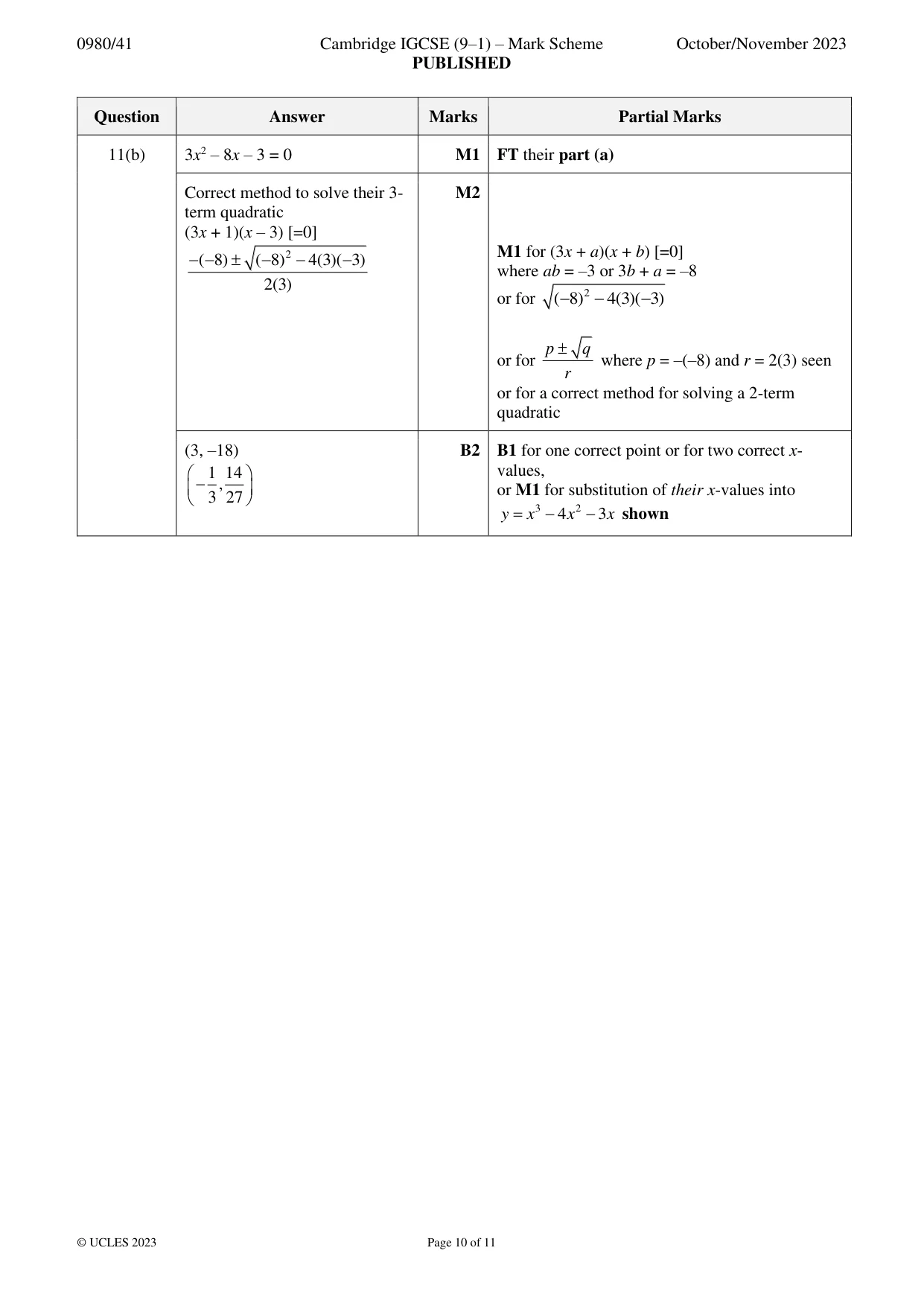
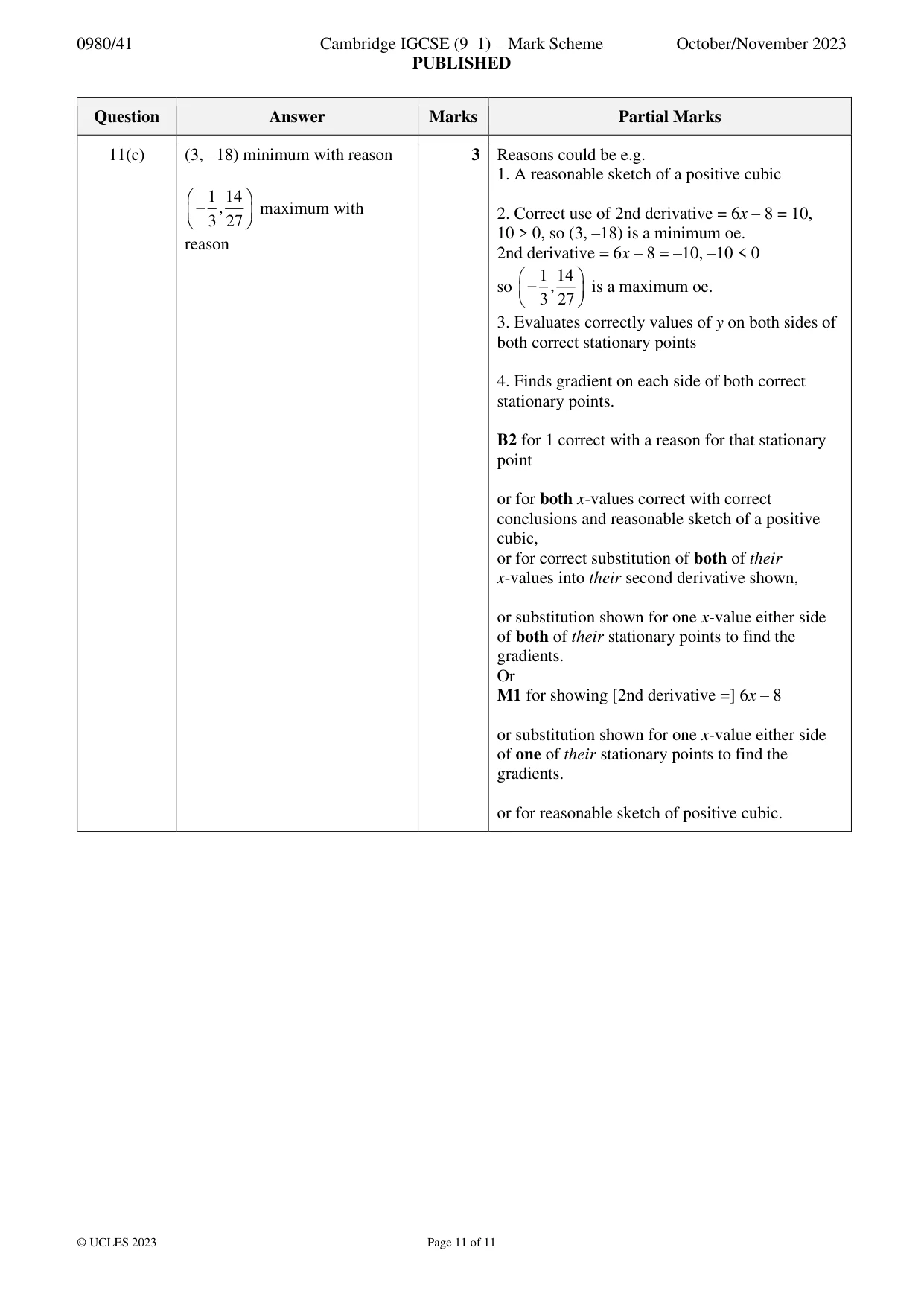
11 (a) Differentiate x 3 - 4 x 2 - 3x . ................................................. [2] (b) A curve has equation y = x 3 - 4x 2 - 3x . Work out the coordinates of the two stationary points. Show all your working. (........................ , ........................) (........................ , ........................) [5] (c) Determine whether each stationary point is a maximum or a minimum. Show all your working. [3]
Mark scheme: 11(a) 3x2 – 8x – 3 2 B1 for two terms correct or correct answer seen 11(b) 3x2 – 8x – 3 = 0 M1 FT their part (a) Correct method to solve their 3- M2 term quadratic (3x + 1)(x – 3) [=0] 2 M1 for (3x + a)(x + b) [=0] −−( 8) ( −8) − 4(3)( −3) where ab = –3 or 3b + a = –8 2(3) or for ( −8) 2 − 4(3)( −3) p q or for where p = –(–8) and r = 2(3) seen r or for a correct method for solving a 2-term quadratic (3, –18) B2 B1 for one correct point or for two correct x- 1 14 values, − , or M1 for substitution of their x-values into 3 27 y = x 3 − 4 x 2 − 3 x shown 11(c) (3, –18) minimum with reason 3 Reasons could be e.g. 1. A reasonable sketch of a positive cubic 1 14 − , maximum with 2. Correct use of 2nd derivative = 6x – 8 = 10, 3 27 10 > 0, so (3, –18) is a minimum oe. reason 2nd derivative = 6x – 8 = –10, –10 < 0 1 14 so − , is a maximum oe. 3 27 3. Evaluates correctly values of y on both sides of both correct stationary points 4. Finds gradient on each side of both correct stationary points. B2 for 1 correct with a reason for that stationary point or for both x-values correct with correct conclusions and reasonable sketch of a positive cubic, or for correct substitution of both of their x-values into their second derivative shown, or substitution shown for one x-value either side of both of their stationary points to find the gradients. Or M1 for showing [2nd derivative =] 6x – 8 or substitution shown for one x-value either side of one of their stationary points to find the gradients. or for reasonable sketch of positive cubic.
What was in this paper
The subtopics covered by these 11 questions, and how many questions each got. Open one in a new tab to see every Cambridge question on it.
What you needed in this session
Cambridge’s own grade thresholds for 2023 Oct/Nov, Paper 4 · Variant 1. A higher threshold means an easier paper — the bar moves with how the cohort did.