Cambridge IGCSE Mathematics 0580 — 2023 Feb/March Paper 3 · Variant 2
0580/32/F/M/23 · 9 questions · 104 marks · ≈117 min
The question paper and its mark scheme, free to read here and free to download. This is Cambridge’s own paper, exactly as it was sat.
Question paper16 pages
Mark scheme8 pages
Answers below. Sit the paper first if you are practising.
Questions as text
Q1 · The table shows some information about the opening hours of a café
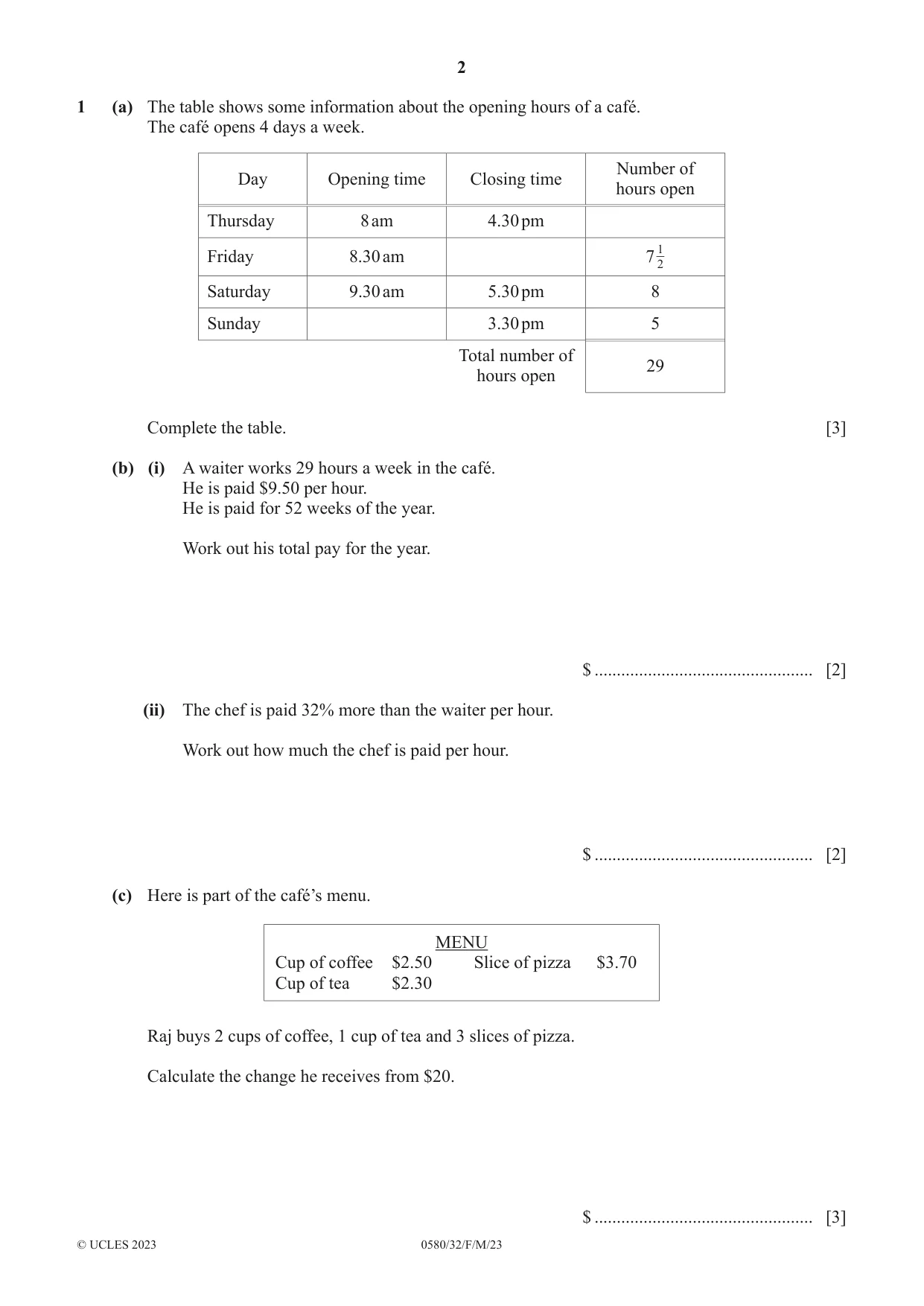
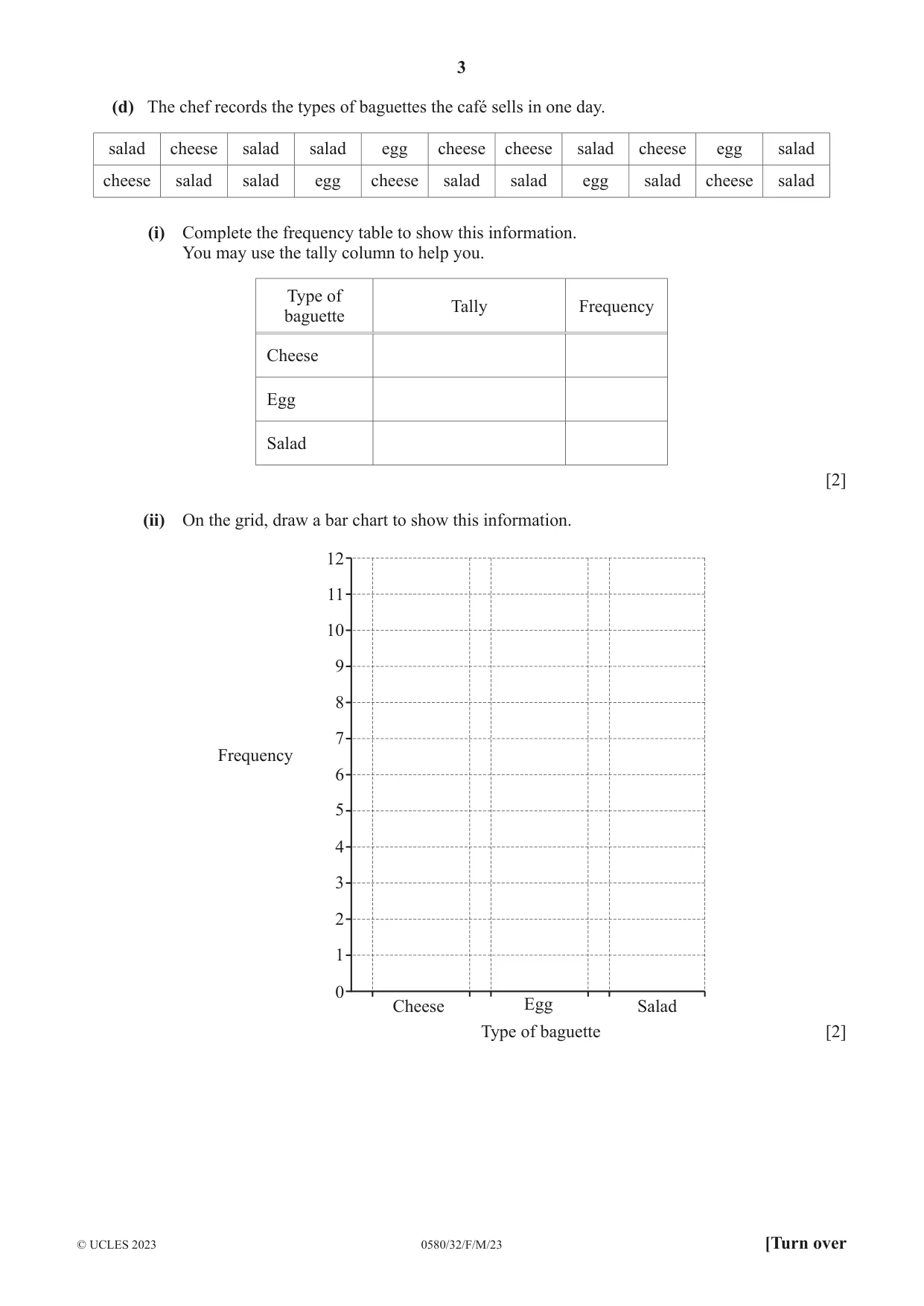
1 (a) The table shows some information about the opening hours of a café. The café opens 4 days a week. Number of Day Opening time Closing time hours open Thursday 8 am 4.30 pm Friday 8.30 am 7 12 Saturday 9.30 am 5.30 pm 8 Sunday 3.30 pm 5 Total number of 29 hours open Complete the table. [3] (b) (i) A waiter works 29 hours a week in the café. He is paid $9.50 per hour. He is paid for 52 weeks of the year. Work out his total pay for the year. $ ................................................. [2] (ii) The chef is paid 32% more than the waiter per hour. Work out how much the chef is paid per hour. $ ................................................. [2] (c) Here is part of the café’s menu. MENU Cup of coffee $2.50 Slice of pizza $3.70 Cup of tea $2.30 Raj buys 2 cups of coffee, 1 cup of tea and 3 slices of pizza. Calculate the change he receives from $20. $ ................................................. [3] (d) The chef records the types of baguettes the café sells in one day. salad cheese salad salad egg cheese cheese salad cheese egg salad cheese salad salad egg cheese salad salad egg salad cheese salad (i) Complete the frequency table to show this information. You may use the tally column to help you. Type of Tally Frequency baguette Cheese Egg Salad [2] (ii) On the grid, draw a bar chart to show this information. 12 11 10 9 8 7 Frequency 6 5 4 3 2 1 0 Cheese Egg Salad Type of baguette [2]
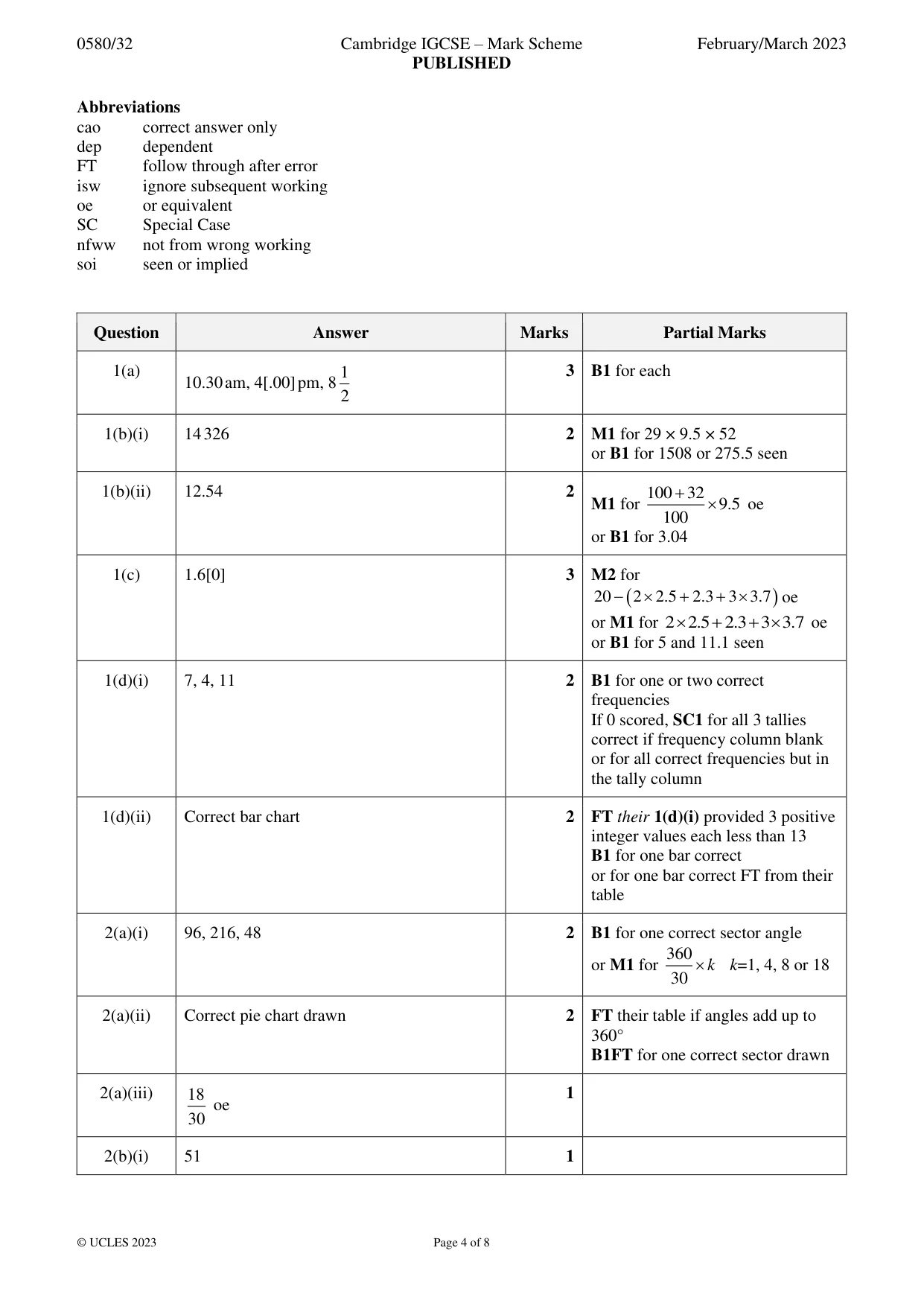
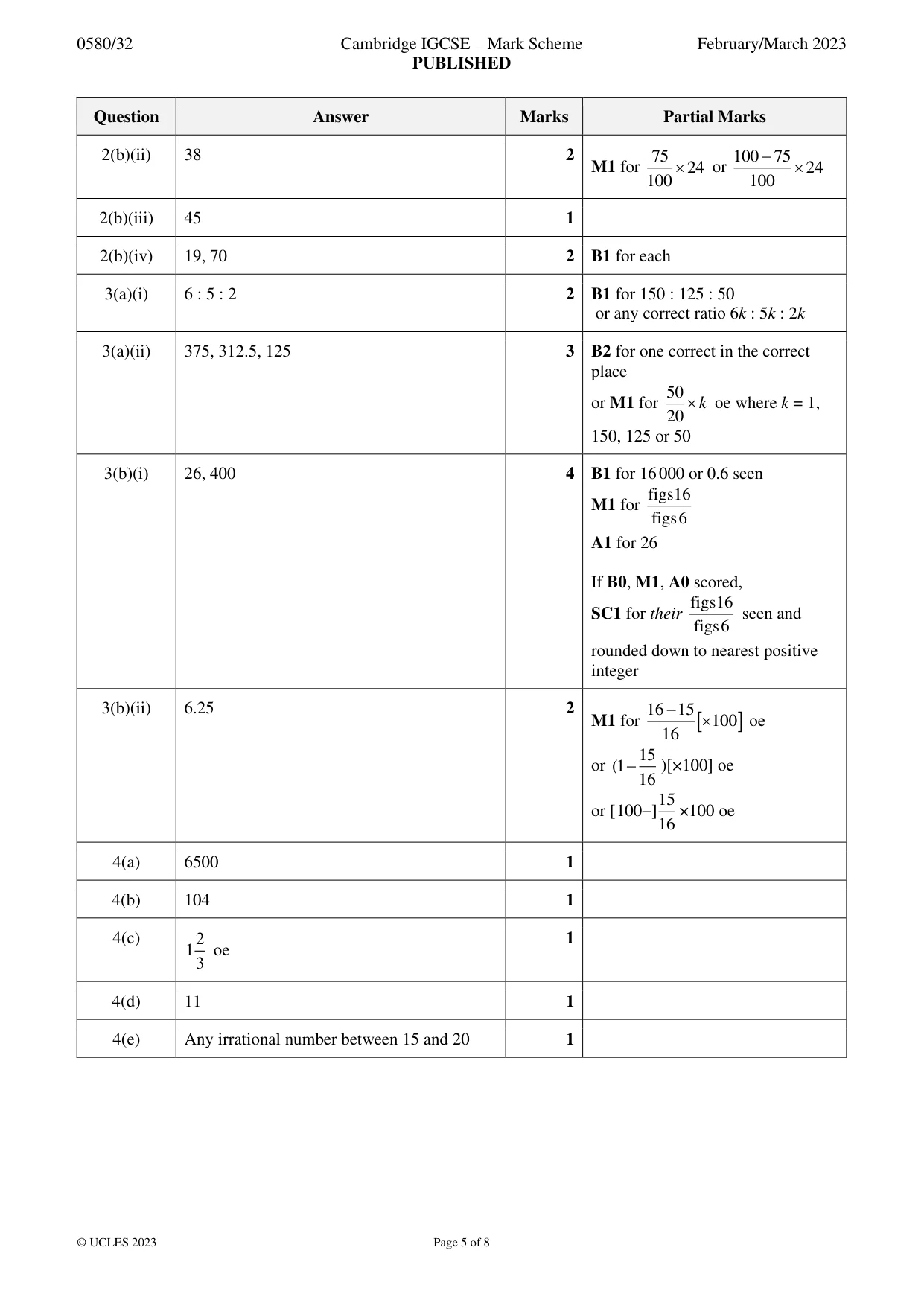
Mark scheme: Question Answer Marks Partial Marks 1(a) 1 3 B1 for each 10.30 am, 4[.00] pm, 8 2 1(b)(i) 14 326 2 M1 for 29 × 9.5 × 52 or B1 for 1508 or 275.5 seen 1(b)(ii) 12.54 2 100 + 32 M1 for 9.5 oe 100 or B1 for 3.04 1(c) 1.6[0] 3 M2 for 20 − ( 2 2.5 + 2.3 + 3 3.7 ) oe or M1 for 2 2.5 + 2.3 + 3 3.7 oe or B1 for 5 and 11.1 seen 1(d)(i) 7, 4, 11 2 B1 for one or two correct frequencies If 0 scored, SC1 for all 3 tallies correct if frequency column blank or for all correct frequencies but in the tally column 1(d)(ii) Correct bar chart 2 FT their 1(d)(i) provided 3 positive integer values each less than 13 B1 for one bar correct or for one bar correct FT from their table
Q2 · Manjit asks 30 students whether they prefer joke books, puzzle books or poetry books
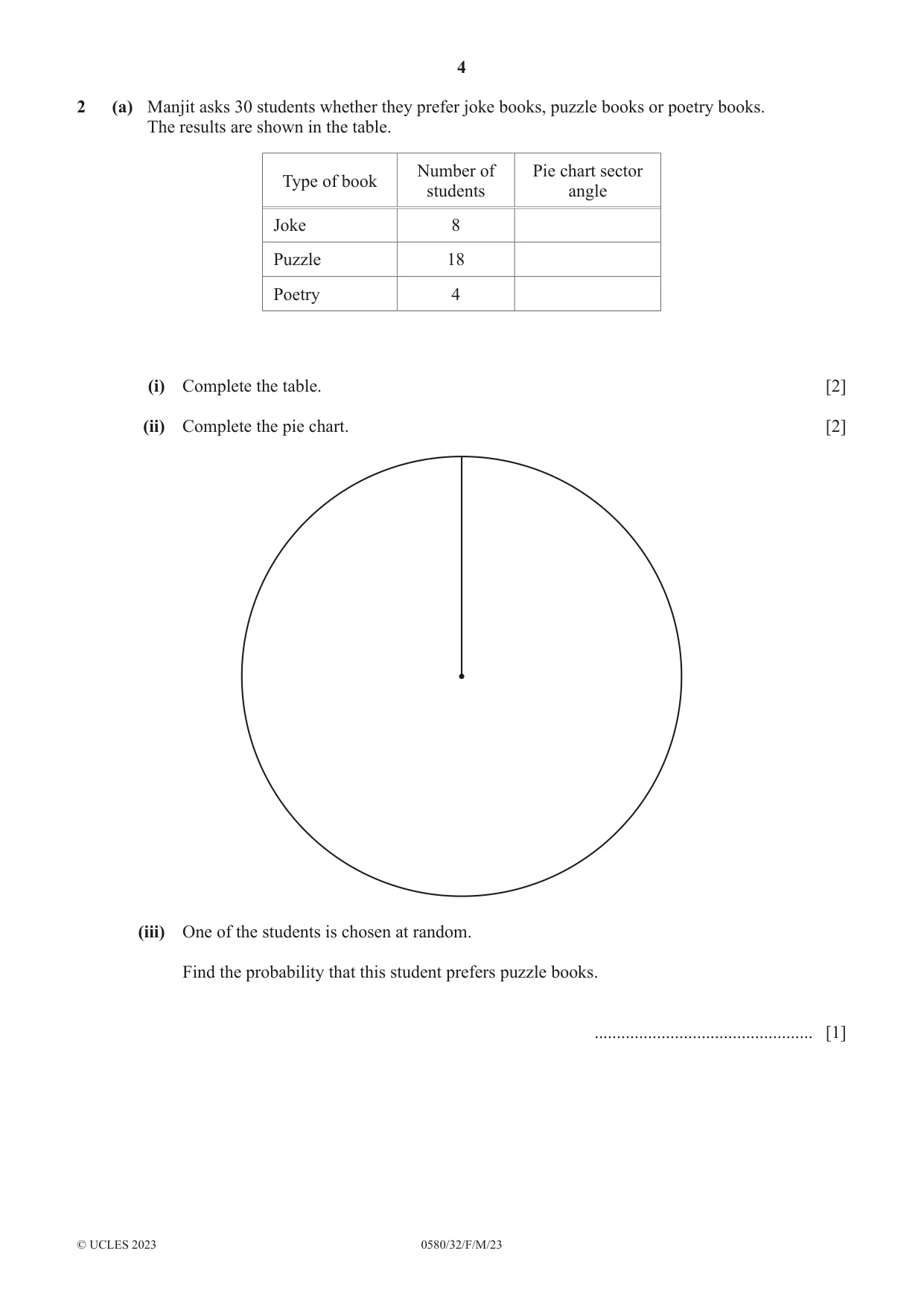
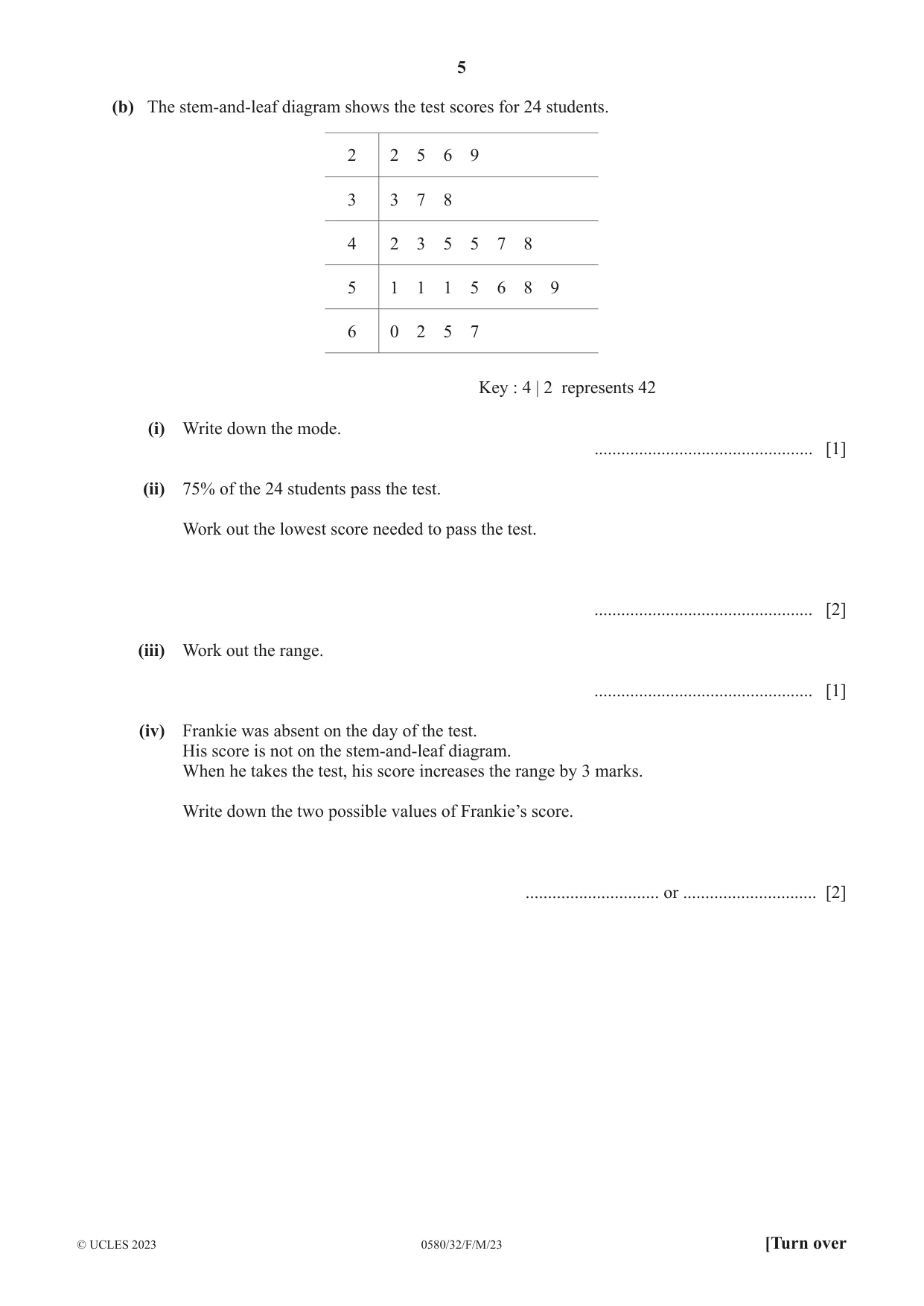
2 (a) Manjit asks 30 students whether they prefer joke books, puzzle books or poetry books. The results are shown in the table. Number of Pie chart sector Type of book students angle Joke 8 Puzzle 18 Poetry 4 (i) Complete the table. [2] (ii) Complete the pie chart. [2] (iii) One of the students is chosen at random. Find the probability that this student prefers puzzle books. ................................................. [1] (b) The stem-and-leaf diagram shows the test scores for 24 students. 2 2 5 6 9 3 3 7 8 4 2 3 5 5 7 8 5 1 1 1 5 6 8 9 6 0 2 5 7 Key : 4 | 2 represents 42 (i) Write down the mode. ................................................. [1] (ii) 75% of the 24 students pass the test. Work out the lowest score needed to pass the test. ................................................. [2] (iii) Work out the range. ................................................. [1] (iv) Frankie was absent on the day of the test. His score is not on the stem-and-leaf diagram. When he takes the test, his score increases the range by 3 marks. Write down the two possible values of Frankie’s score. .............................. or .............................. [2]
Mark scheme: 2(a)(i) 96, 216, 48 2 B1 for one correct sector angle 360 or M1 for k k=1, 4, 8 or 18 30 2(a)(ii) Correct pie chart drawn 2 FT their table if angles add up to 360° B1FT for one correct sector drawn 2(a)(iii) 18 1 oe 30 2(b)(i) 51 1 2(b)(ii) 38 2 75 100 − 75 M1 for 24 or 24 100 100 2(b)(iii) 45 1 2(b)(iv) 19, 70 2 B1 for each
Q3 · A recipe for making 20 biscuits uses 150 g flour, 125 g butter and 50 g sugar
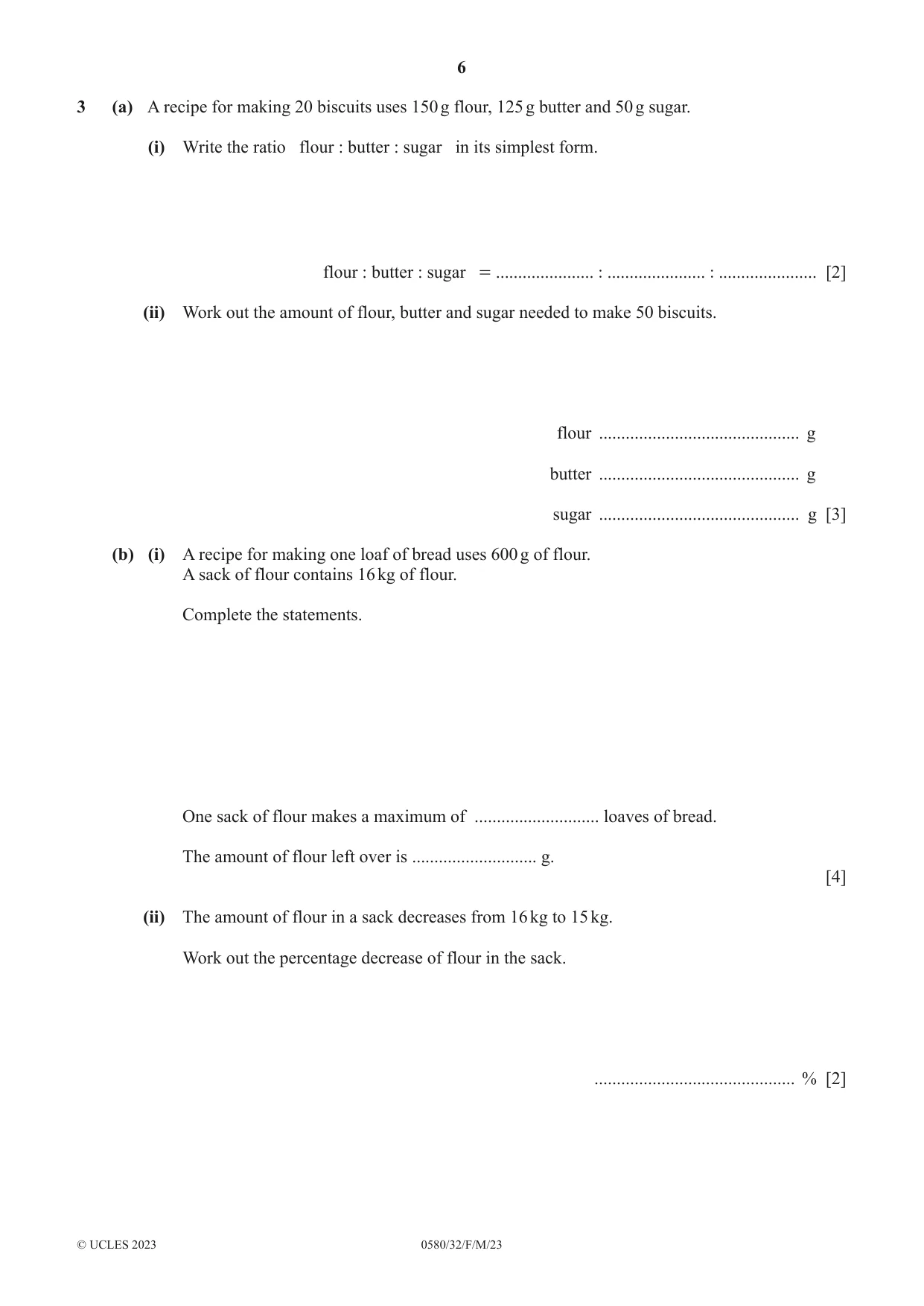
3 (a) A recipe for making 20 biscuits uses 150 g flour, 125 g butter and 50 g sugar. (i) Write the ratio flour : butter : sugar in its simplest form. flour : butter : sugar = ...................... : ...................... : ...................... [2] (ii) Work out the amount of flour, butter and sugar needed to make 50 biscuits. flour ............................................. g butter ............................................. g sugar ............................................. g [3] (b) (i) A recipe for making one loaf of bread uses 600 g of flour. A sack of flour contains 16 kg of flour. Complete the statements. One sack of flour makes a maximum of ............................ loaves of bread. The amount of flour left over is ............................ g. [4] (ii) The amount of flour in a sack decreases from 16 kg to 15 kg. Work out the percentage decrease of flour in the sack. ............................................. % [2]
Mark scheme: 3(a)(i) 6 : 5 : 2 2 B1 for 150 : 125 : 50 or any correct ratio 6k : 5k : 2k 3(a)(ii) 375, 312.5, 125 3 B2 for one correct in the correct place 50 or M1 for k oe where k = 1, 20 150, 125 or 50 3(b)(i) 26, 400 4 B1 for 16 000 or 0.6 seen figs16 M1 for figs6 A1 for 26 If B0, M1, A0 scored, figs16 SC1 for their seen and figs6 rounded down to nearest positive integer 3(b)(ii) 6.25 2 16 − 15 M1 for 100 oe 16 15 or (1 − )[×100] oe 16 15 or [ 100−]16 ×100 oe
Q4 · Write 6479 correct to the nearest 100
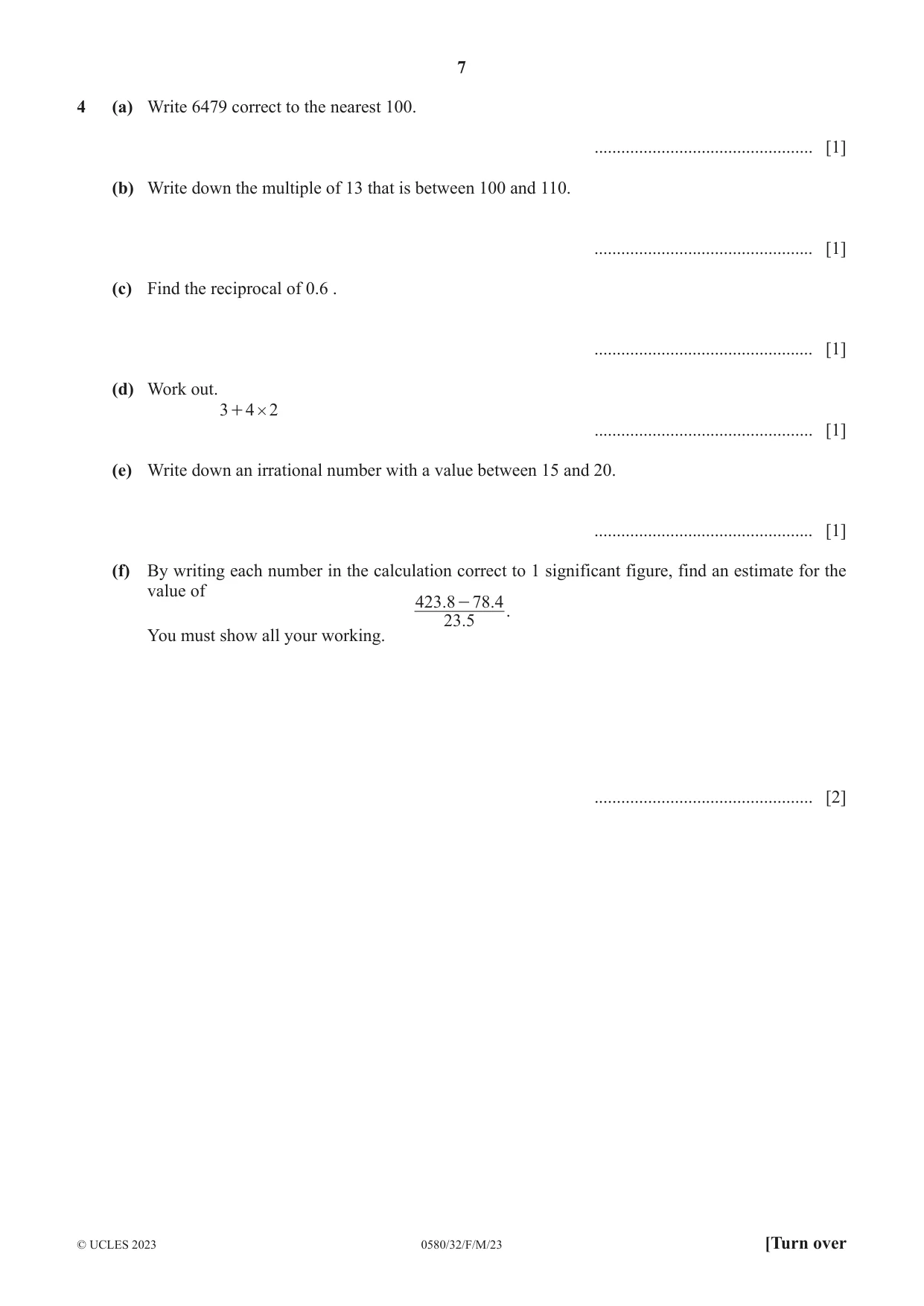
4 (a) Write 6479 correct to the nearest 100. ................................................. [1] (b) Write down the multiple of 13 that is between 100 and 110. ................................................. [1] (c) Find the reciprocal of 0.6 . ................................................. [1] (d) Work out. 3 + 4 # 2 ................................................. [1] (e) Write down an irrational number with a value between 15 and 20. ................................................. [1] (f) By writing each number in the calculation correct to 1 significant figure, find an estimate for the value of 423.8 - 78.4 . 23.5 You must show all your working. ................................................. [2]
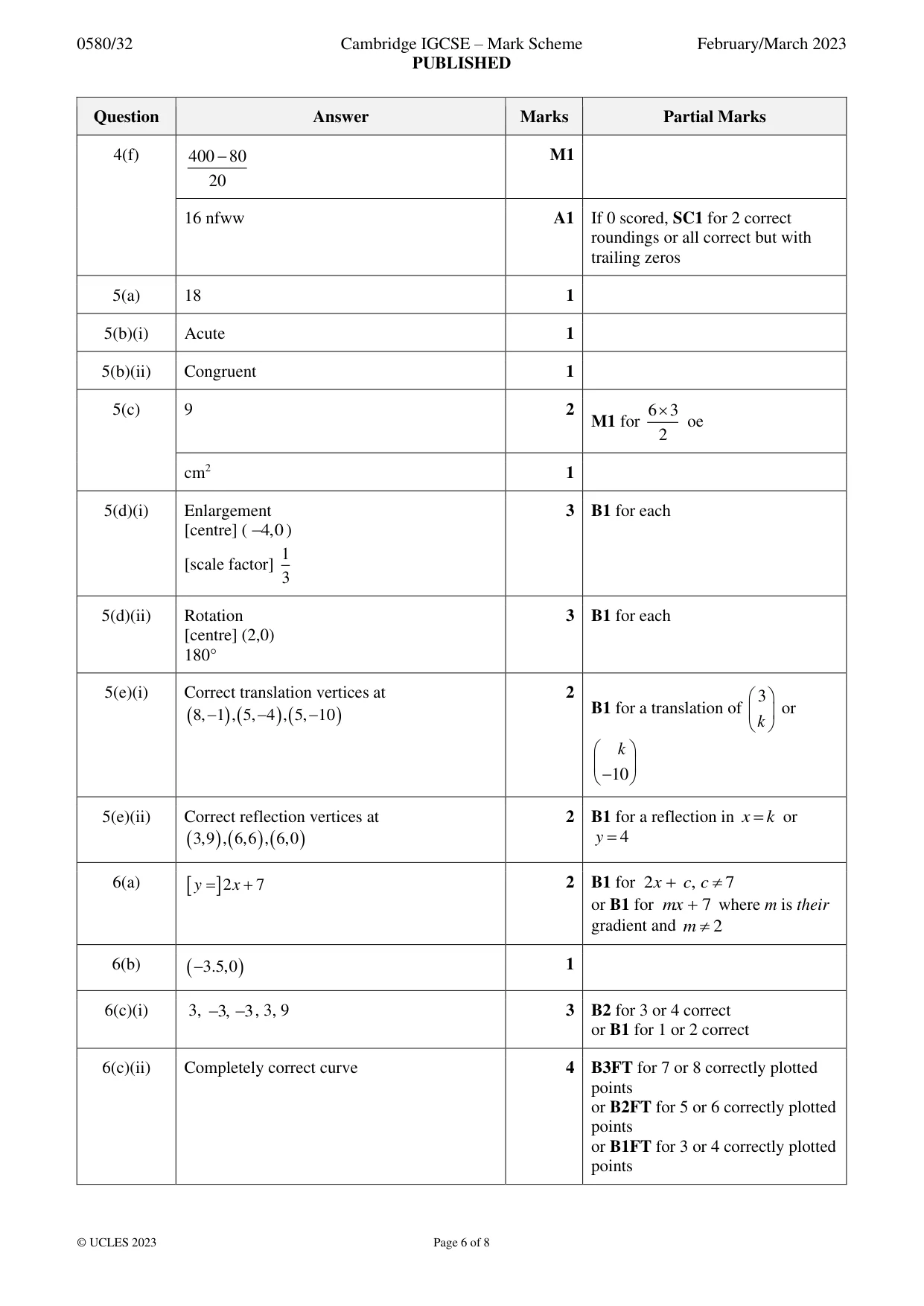
Mark scheme: 4(a) 6500 1 4(b) 104 1 4(c) 2 1 13 oe 4(d) 11 1 4(e) Any irrational number between 15 and 20 1 4(f) 400 − 80 M1 20 16 nfww A1 If 0 scored, SC1 for 2 correct roundings or all correct but with trailing zeros
Q5 · The diagram shows three triangles, A, B and C, on a 1 cm 2 grid
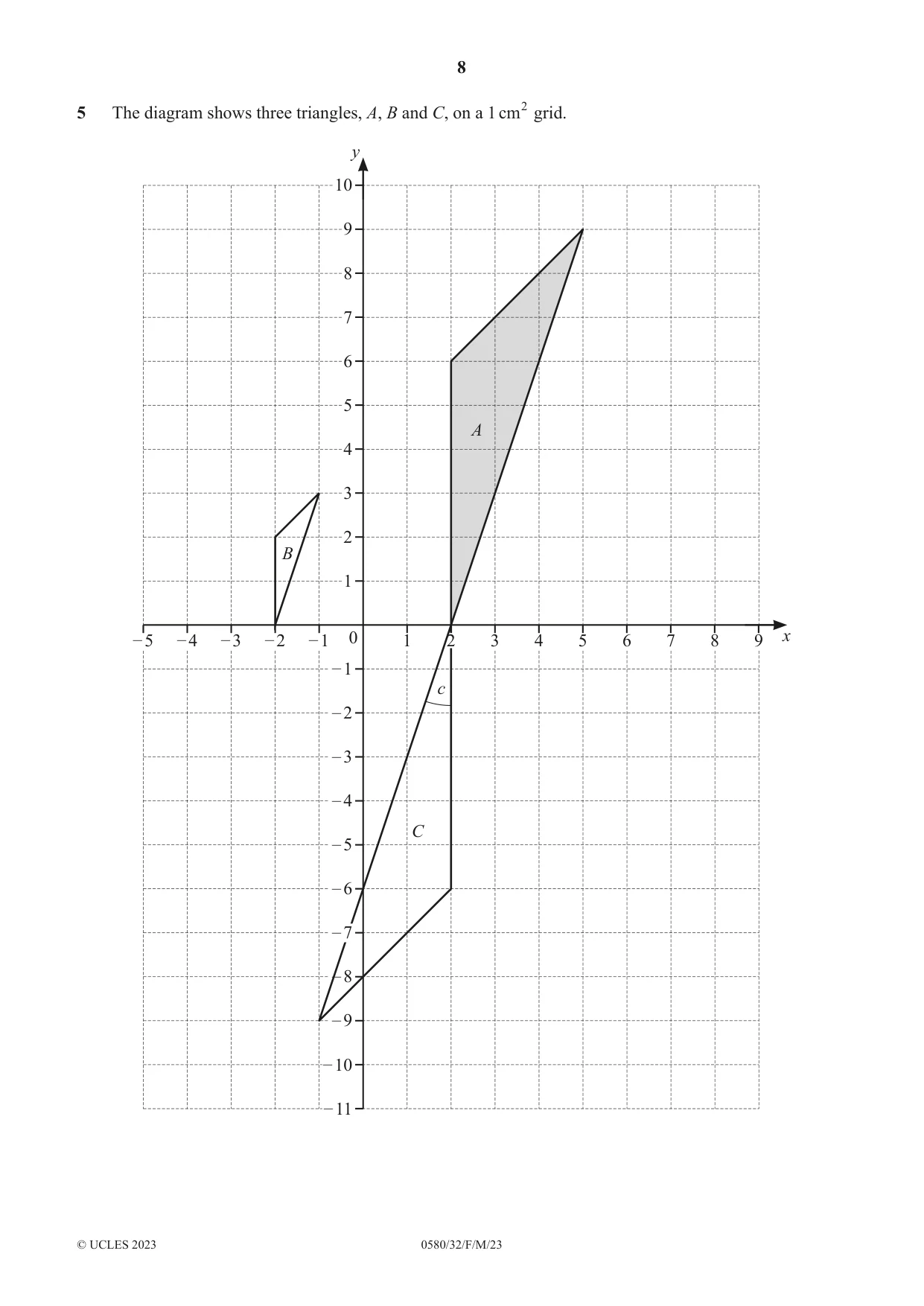
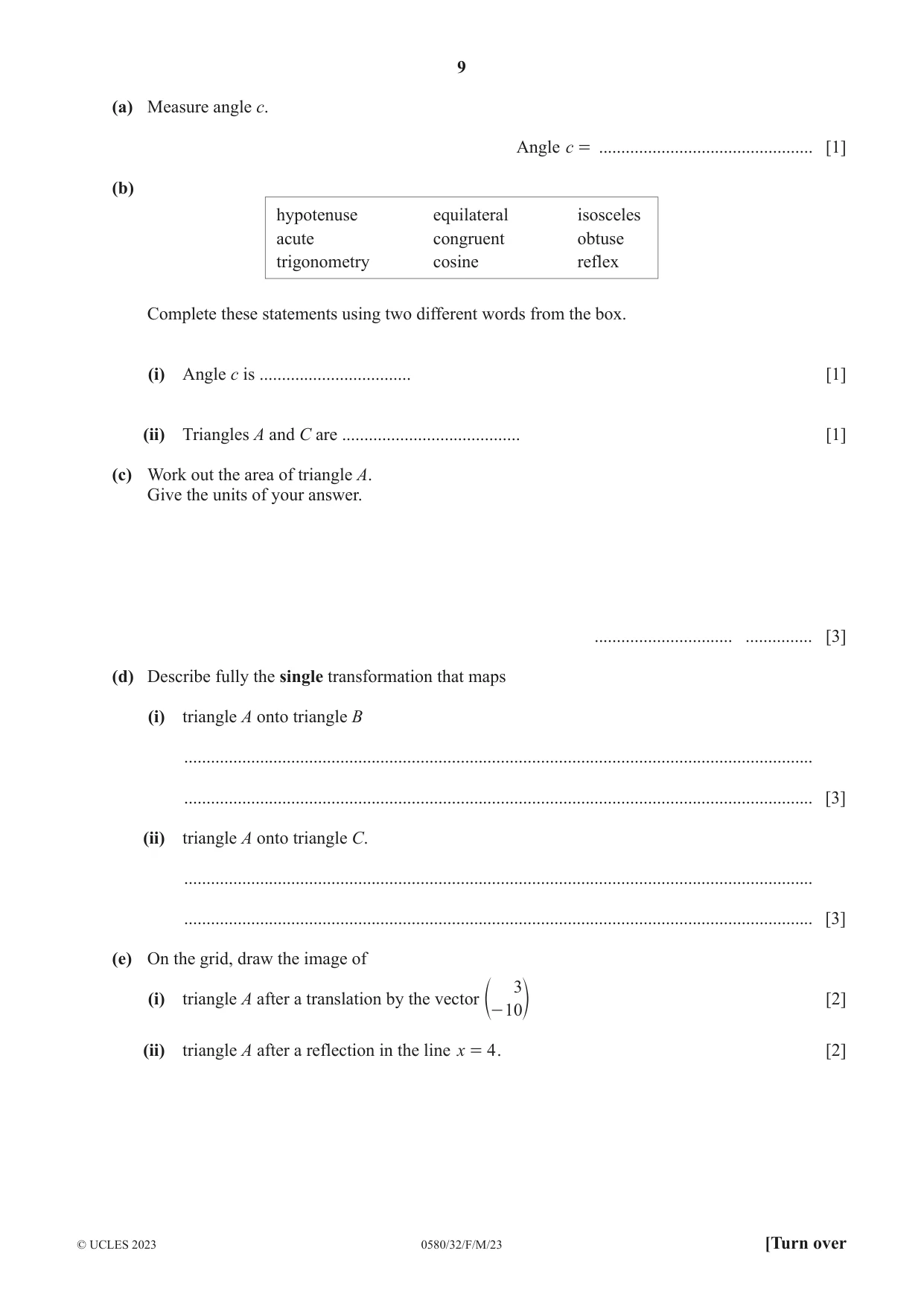
5 The diagram shows three triangles, A, B and C, on a 1 cm 2 grid. y 10 9 8 7 6 5 A 4 3 2 B 1 – 5 – 4 – 3 – 2 – 1 0 1 2 3 4 5 6 7 8 9 x – 1 c – 2 – 3 – 4 C – 5 – 6 – 7 – 8 – 9 – 10 – 11 (a) Measure angle c. Angle c = ................................................ [1] (b) hypotenuse equilateral isosceles acute congruent obtuse trigonometry cosine reflex Complete these statements using two different words from the box. (i) Angle c is .................................. [1] (ii) Triangles A and C are ........................................ [1] (c) Work out the area of triangle A. Give the units of your answer. ............................... ............... [3] (d) Describe fully the single transformation that maps (i) triangle A onto triangle B ............................................................................................................................................. ............................................................................................................................................. [3] (ii) triangle A onto triangle C. ............................................................................................................................................. ............................................................................................................................................. [3] (e) On the grid, draw the image of 3 (i) triangle A after a translation by the vector [2] e- 10o (ii) triangle A after a reflection in the line x = 4 . [2]
Mark scheme: 5(a) 18 1 5(b)(i) Acute 1 5(b)(ii) Congruent 1 5(c) 9 2 6 3 M1 for oe 2 cm2 1 5(d)(i) Enlargement 3 B1 for each [centre] ( −4, 0 ) 1 [scale factor] 3 5(d)(ii) Rotation 3 B1 for each [centre] (2,0) 180° 5(e)(i) Correct translation vertices at 2 3 ( 8, −1) , ( 5, −4 ) , ( 5, −10 ) B1 for a translation of or k k −10 5(e)(ii) Correct reflection vertices at 2 B1 for a reflection in x = k or ( 3, 9 ) , ( 6, 6 ) , ( 6, 0 ) y = 4
Q6 · Y 10 L 9 8 7 6 5 4 3 2 1 – 6 – 5 – 4 – 3 – 2 – 1 0 1 2 x – 1 – 2 – 3 – 4 (a) Find the…
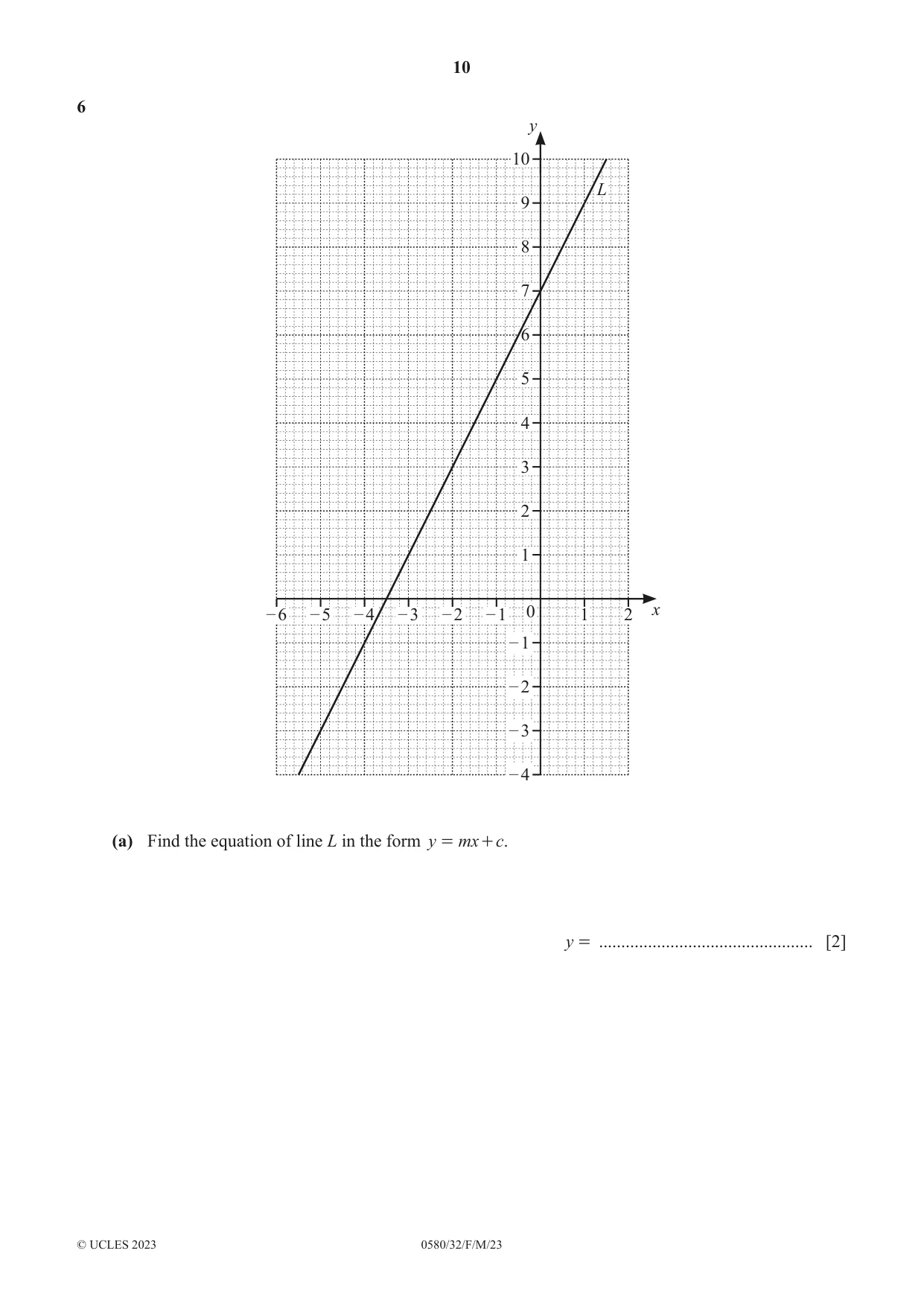
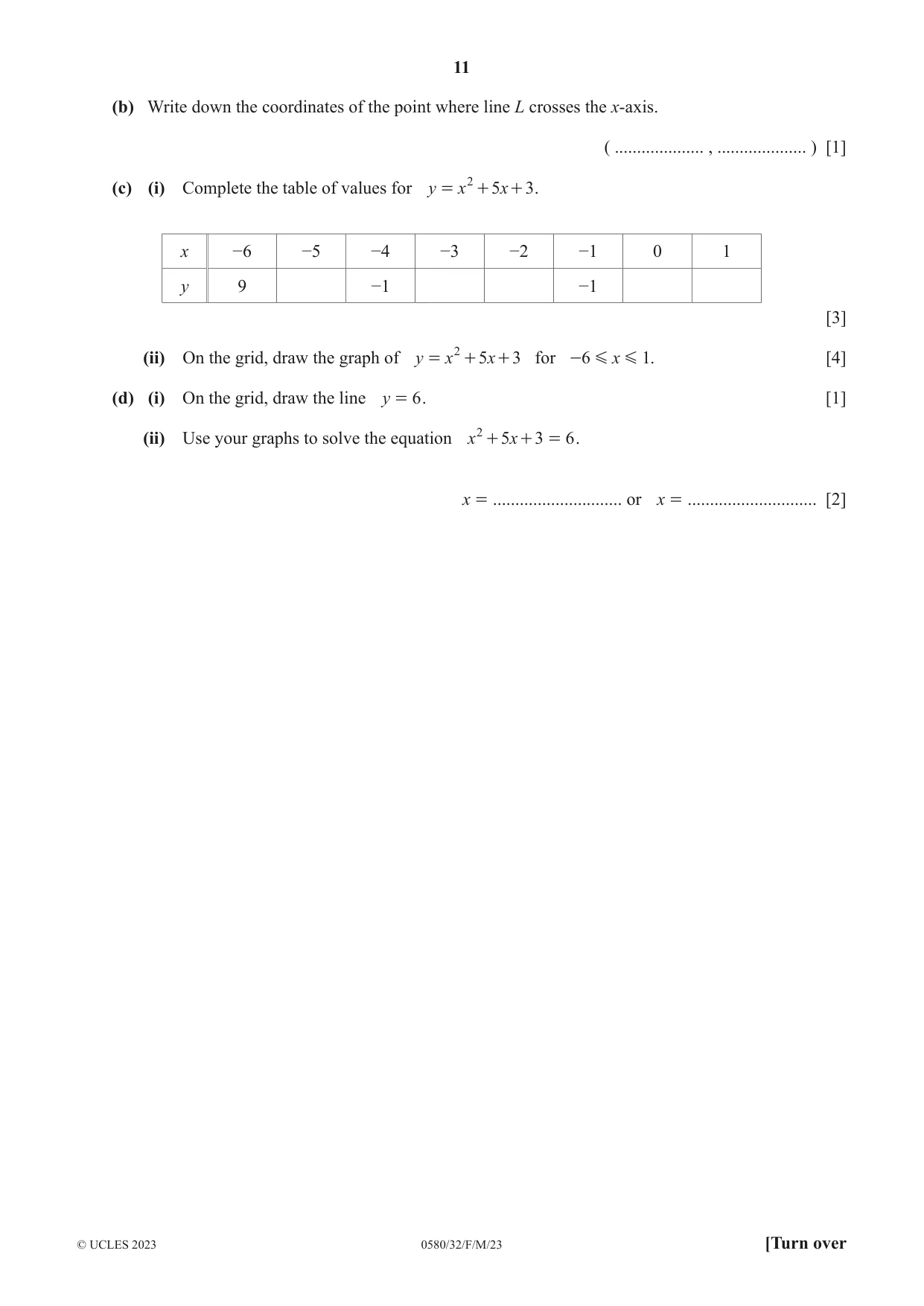
6 y 10 L 9 8 7 6 5 4 3 2 1 – 6 – 5 – 4 – 3 – 2 – 1 0 1 2 x – 1 – 2 – 3 – 4 (a) Find the equation of line L in the form y = mx + c. y = ................................................ [2] (b) Write down the coordinates of the point where line L crosses the x-axis. ( .................... , .................... ) [1] (c) (i) Complete the table of values for y = x 2 + 5x + 3 . x −6 −5 −4 −3 −2 −1 0 1 y 9 −1 −1 [3] (ii) On the grid, draw the graph of y = x 2 + 5x + 3 for -6 G x G 1. [4] (d) (i) On the grid, draw the line y = 6 . [1] (ii) Use your graphs to solve the equation x 2 + 5x + 3 = 6 . x = ............................. or x = ............................. [2]
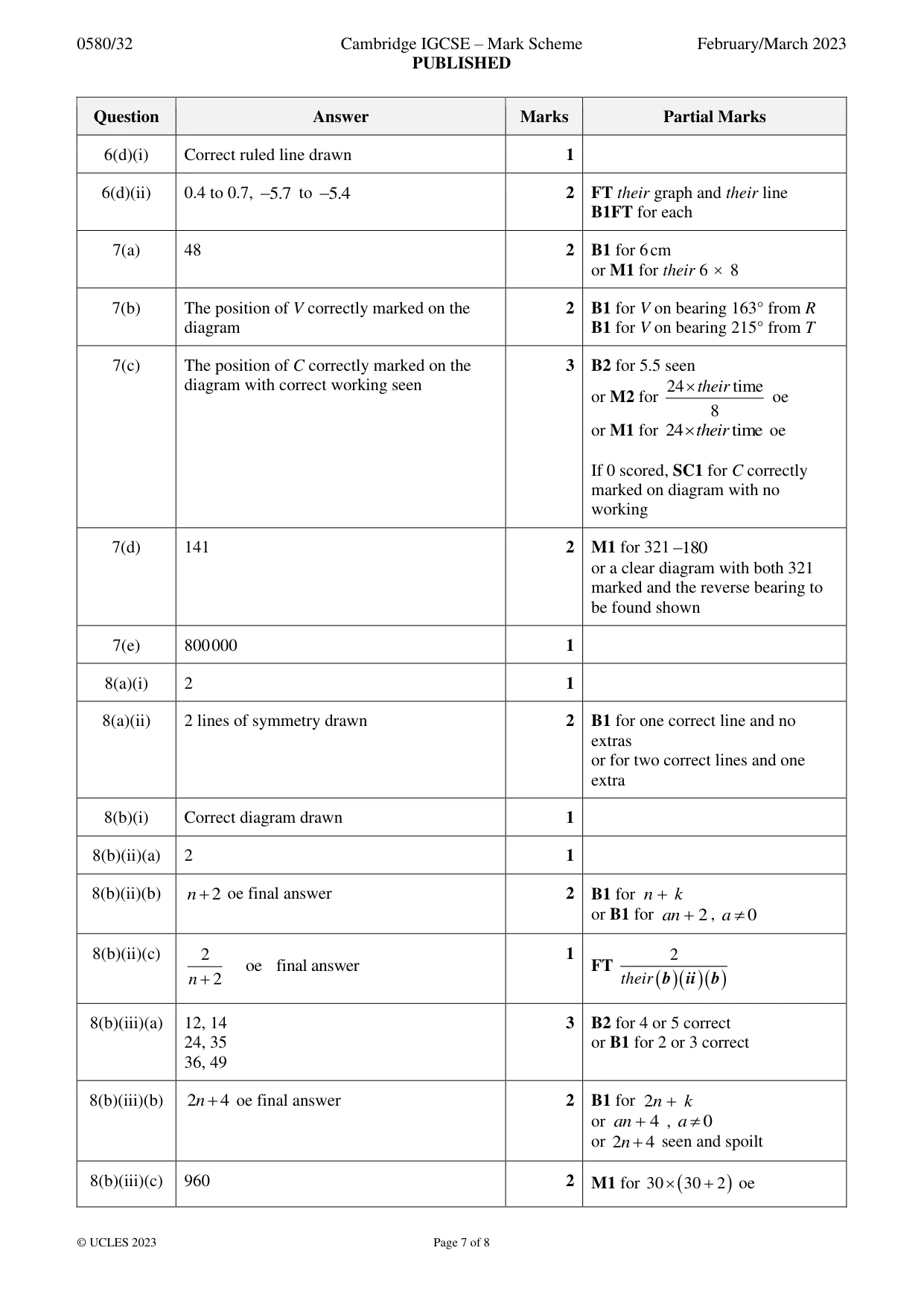
Mark scheme: 6(a) y = 2 x + 7 2 B1 for 2 x + c, c 7 or B1 for mx + 7 where m is their gradient and m 2 6(b) ( −3.5, 0 ) 1 6(c)(i) 3, −3, −,3 3, 9 3 B2 for 3 or 4 correct or B1 for 1 or 2 correct 6(c)(ii) Completely correct curve 4 B3FT for 7 or 8 correctly plotted points or B2FT for 5 or 6 correctly plotted points or B1FT for 3 or 4 correctly plotted points 6(d)(i) Correct ruled line drawn 1 6(d)(ii) 0.4 to 0.7, −5.7 to −5.4 2 FT their graph and their line B1FT for each
Q7 · The scale drawing shows the positions of three towns, R, S and T, on a map
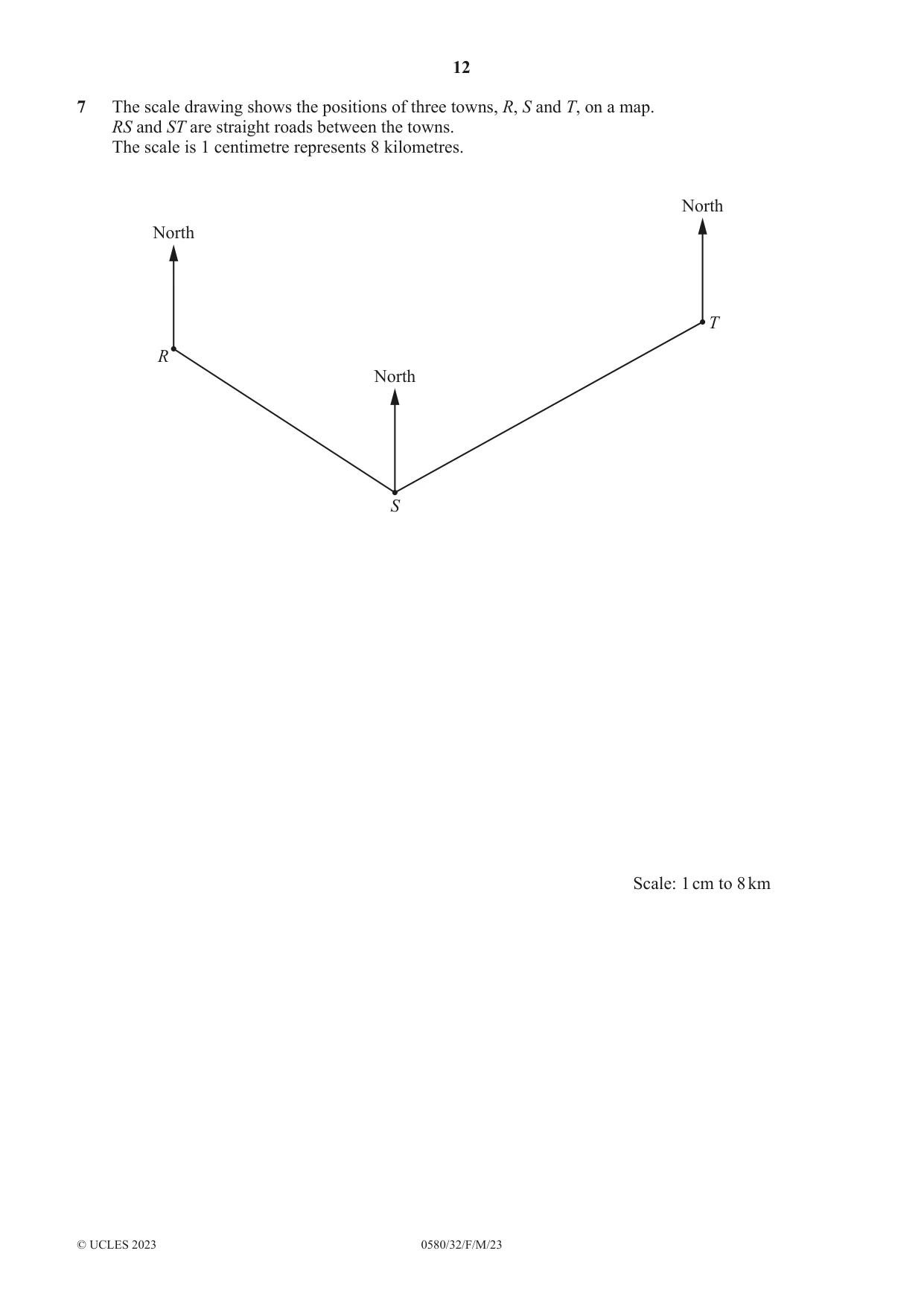
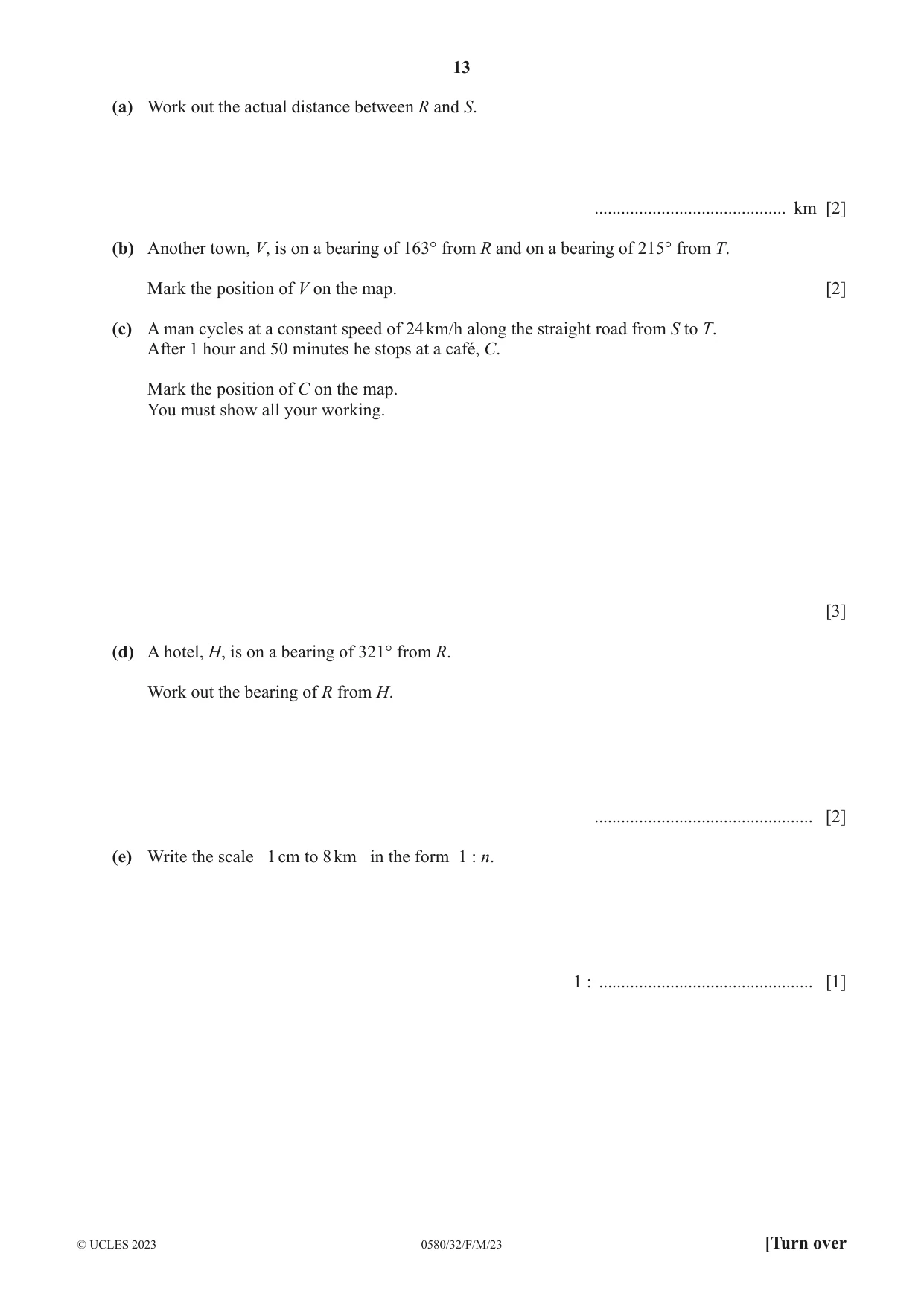
7 The scale drawing shows the positions of three towns, R, S and T, on a map. RS and ST are straight roads between the towns. The scale is 1 centimetre represents 8 kilometres. North North T R North S Scale: 1 cm to 8 km (a) Work out the actual distance between R and S. ........................................... km [2] (b) Another town, V, is on a bearing of 163° from R and on a bearing of 215° from T. Mark the position of V on the map. [2] (c) A man cycles at a constant speed of 24 km/h along the straight road from S to T. After 1 hour and 50 minutes he stops at a café, C. Mark the position of C on the map. You must show all your working. [3] (d) A hotel, H, is on a bearing of 321° from R. Work out the bearing of R from H. ................................................. [2] (e) Write the scale 1 cm to 8 km in the form 1 : n. 1 : ................................................ [1]
Mark scheme: 7(a) 48 2 B1 for 6 cm or M1 for their 6 8 7(b) The position of V correctly marked on the 2 B1 for V on bearing 163° from R diagram B1 for V on bearing 215° from T 7(c) The position of C correctly marked on the 3 B2 for 5.5 seen diagram with correct working seen 24 their time or M2 for oe 8 or M1 for 24 their time oe If 0 scored, SC1 for C correctly marked on diagram with no working 7(d) 141 2 M1 for 321 −180 or a clear diagram with both 321 marked and the reverse bearing to be found shown 7(e) 800 000 1
Q8 · Write down the order of rotational symmetry of the diagram
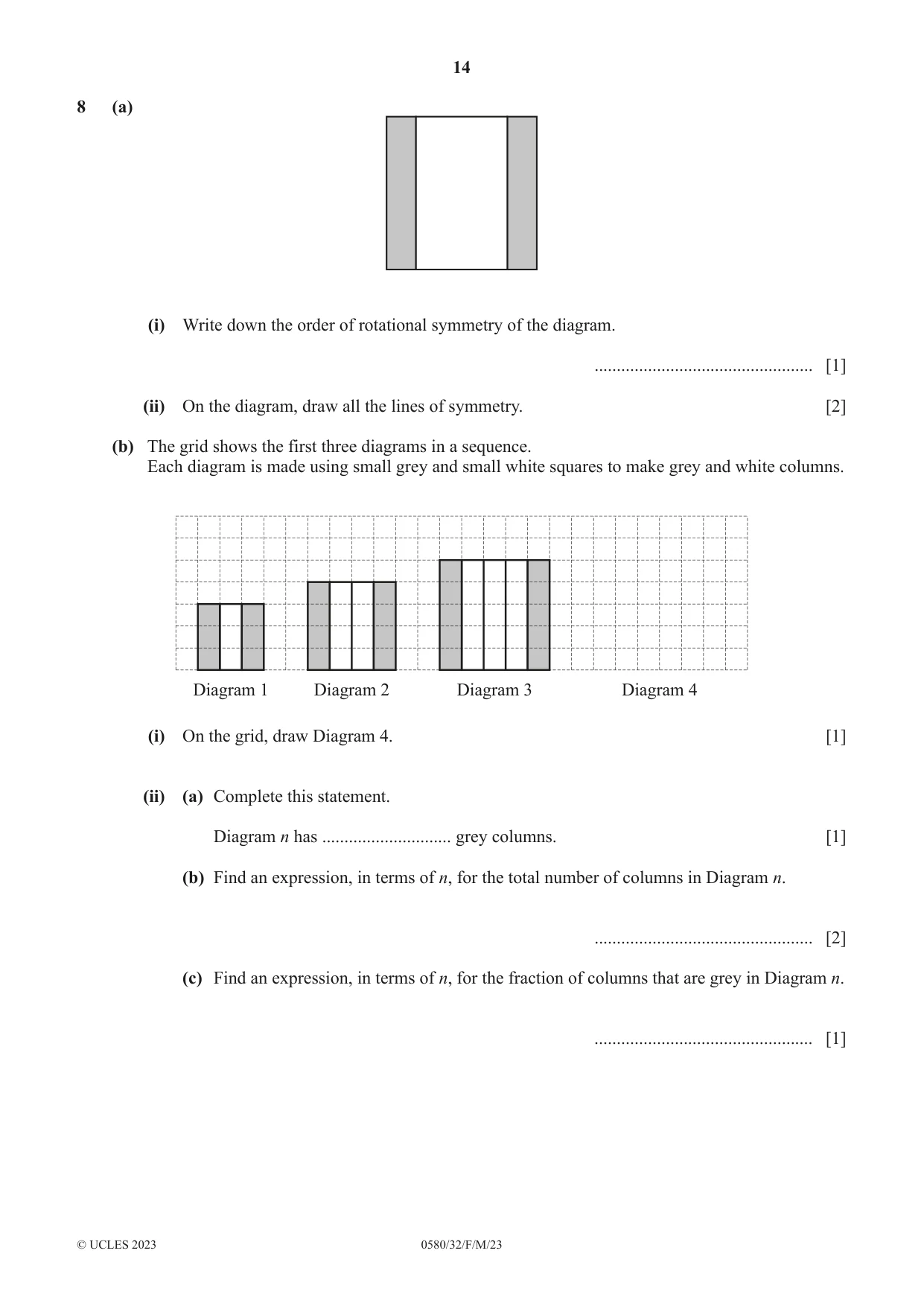
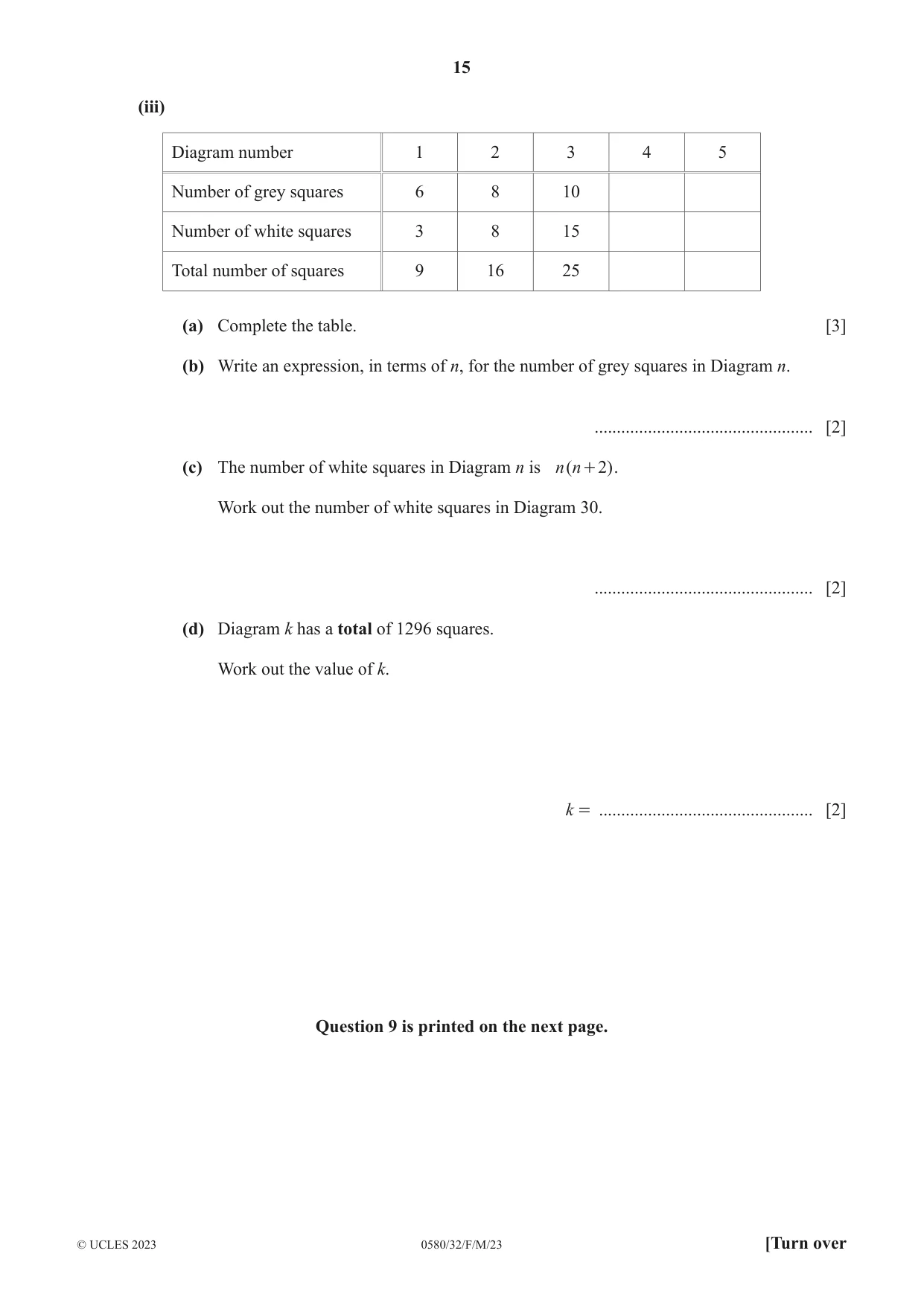
8 (a) (i) Write down the order of rotational symmetry of the diagram. ................................................. [1] (ii) On the diagram, draw all the lines of symmetry. [2] (b) The grid shows the first three diagrams in a sequence. Each diagram is made using small grey and small white squares to make grey and white columns. Diagram 1 Diagram 2 Diagram 3 Diagram 4 (i) On the grid, draw Diagram 4. [1] (ii) (a) Complete this statement. Diagram n has ............................. grey columns. [1] (b) Find an expression, in terms of n, for the total number of columns in Diagram n. ................................................. [2] (c) Find an expression, in terms of n, for the fraction of columns that are grey in Diagram n. ................................................. [1] (iii) Diagram number 1 2 3 4 5 Number of grey squares 6 8 10 Number of white squares 3 8 15 Total number of squares 9 16 25 (a) Complete the table. [3] (b) Write an expression, in terms of n, for the number of grey squares in Diagram n. ................................................. [2] (c) The number of white squares in Diagram n is n ( n + 2) . Work out the number of white squares in Diagram 30. ................................................. [2] (d) Diagram k has a total of 1296 squares. Work out the value of k. k = ................................................ [2] Question 9 is printed on the next page.
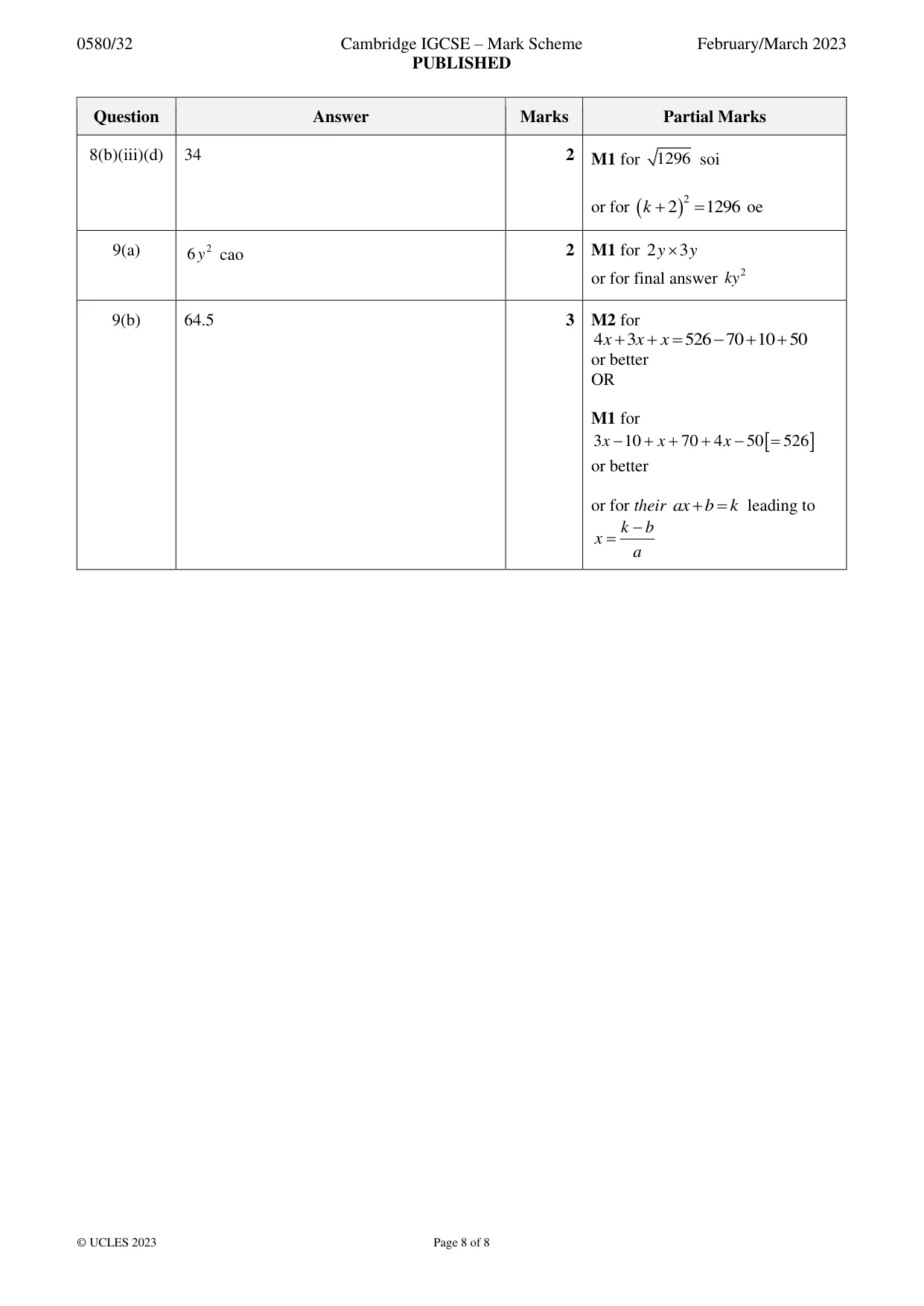
Mark scheme: 8(a)(i) 2 1 8(a)(ii) 2 lines of symmetry drawn 2 B1 for one correct line and no extras or for two correct lines and one extra 8(b)(i) Correct diagram drawn 1 8(b)(ii)(a) 2 1 8(b)(ii)(b) n + 2 oe final answer 2 B1 for n + k or B1 for an + 2 , a 0 8(b)(ii)(c) 2 1 2 oe final answer FT n + 2 their ( b )( ii )( b ) 8(b)(iii)(a) 12, 14 3 B2 for 4 or 5 correct 24, 35 or B1 for 2 or 3 correct 36, 49 8(b)(iii)(b) 2n + 4 oe final answer 2 B1 for 2n + k or an + 4 , a 0 or 2n + 4 seen and spoilt 8(b)(iii)(c) 960 2 M1 for 30 ( 30 + 2 ) oe 8(b)(iii)(d) 34 2 M1 for 1296 soi or for ( k + 2 ) 2 = 1296 oe
Q9 · NOT TO 2y SCALE 3y Write down an expression for the area of this rectangle
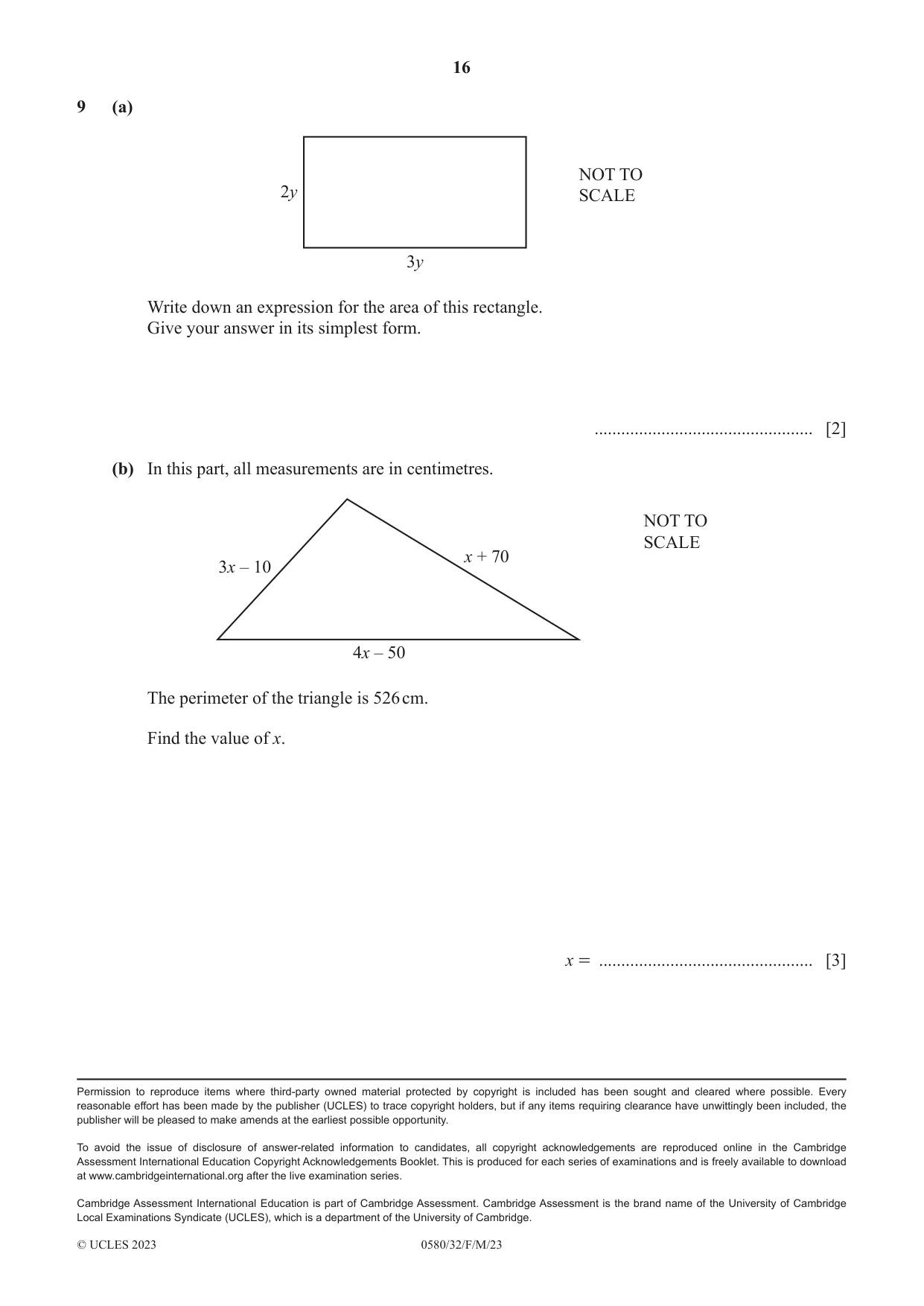
9 (a) NOT TO 2y SCALE 3y Write down an expression for the area of this rectangle. Give your answer in its simplest form. ................................................. [2] (b) In this part, all measurements are in centimetres. NOT TO SCALE x + 70 3x – 10 4x – 50 The perimeter of the triangle is 526 cm. Find the value of x. x = ................................................ [3]
Mark scheme: 9(a) 6y 2 cao 2 M1 for 2 y 3 y or for final answer ky 2 9(b) 64.5 3 M2 for 4 x + 3x + x = 526 − 70 + 10 + 50 or better OR M1 for 3 x − 10 + x + 70 + 4 x − 50 = 526 or better or for their ax + b = k leading to k − b x = a
What was in this paper
The subtopics covered by these 9 questions, and how many questions each got. Open one in a new tab to see every Cambridge question on it.
What you needed in this session
Cambridge’s own grade thresholds for 2023 Feb/March, Paper 3 · Variant 2. A higher threshold means an easier paper — the bar moves with how the cohort did.