Cambridge IGCSE Mathematics 0580 — 2021 May/June Paper 3 · Variant 1
0580/31/M/J/21 · 9 questions · 104 marks · ≈117 min
The question paper and its mark scheme, free to read here and free to download. This is Cambridge’s own paper, exactly as it was sat.
Question paper16 pages
Mark scheme8 pages
Answers below. Sit the paper first if you are practising.
Questions as text
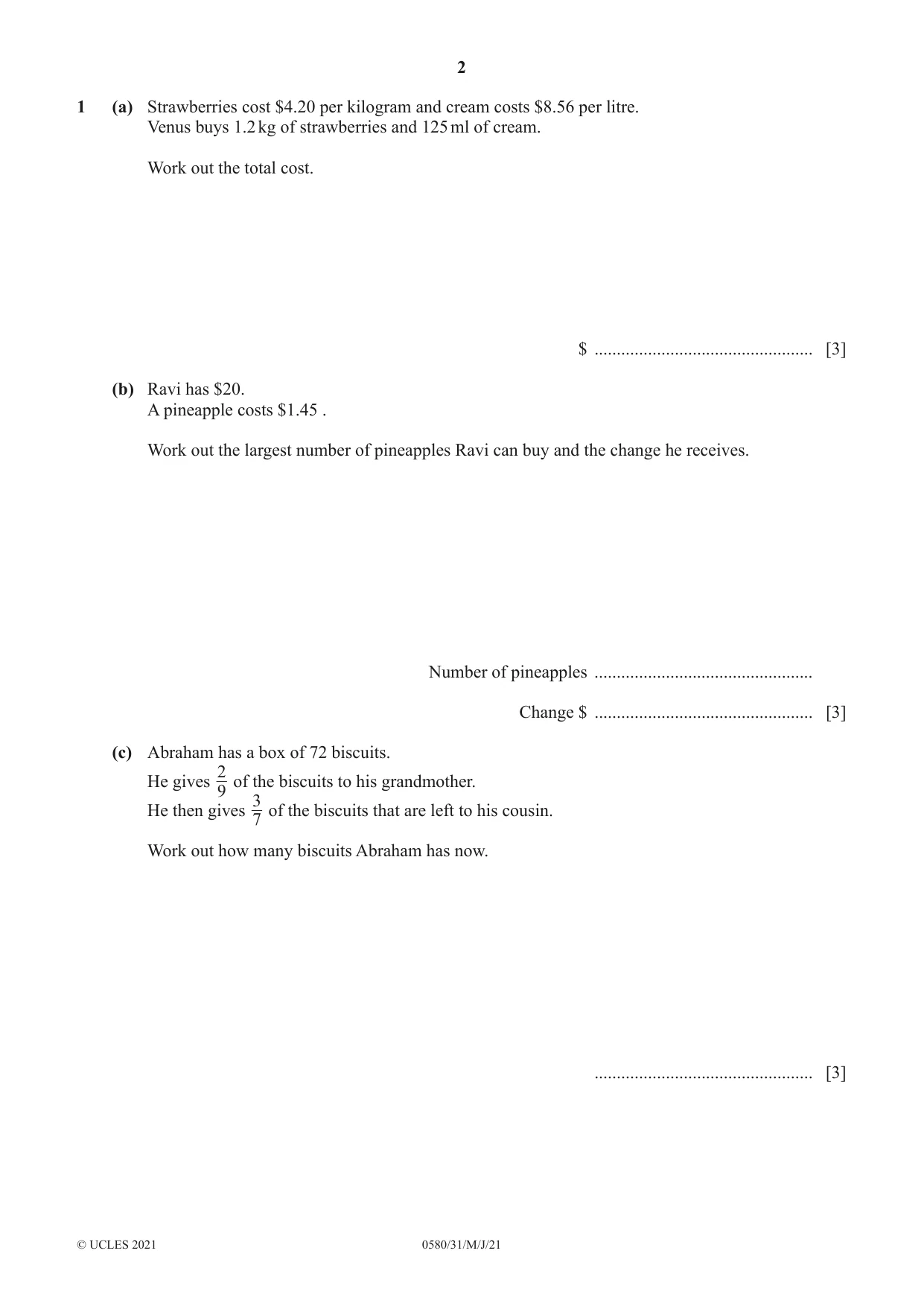
Q1 · Strawberries cost $4.20 per kilogram and cream costs $8.56 per litre
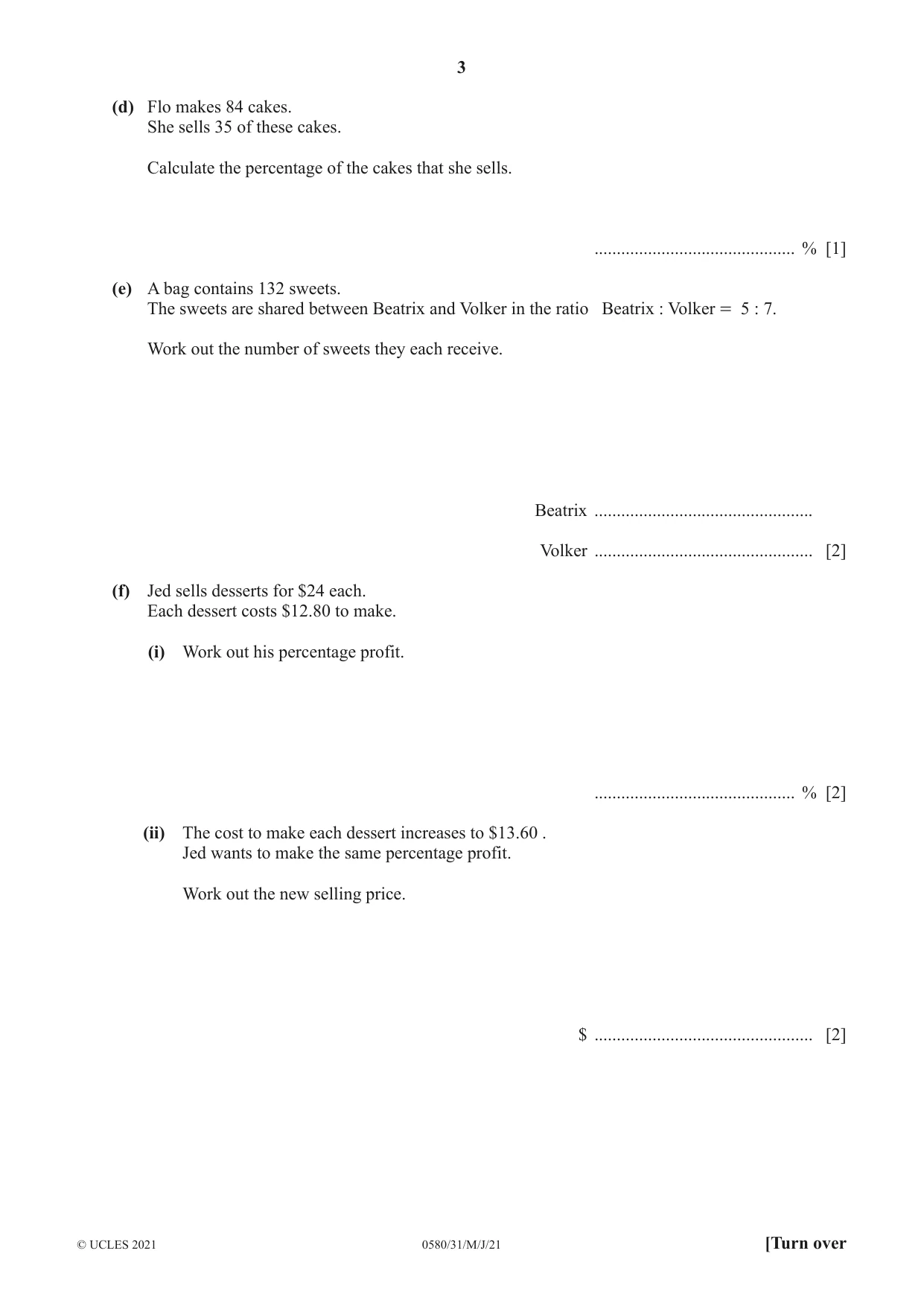
1 (a) Strawberries cost $4.20 per kilogram and cream costs $8.56 per litre. Venus buys 1.2 kg of strawberries and 125 ml of cream. Work out the total cost. $ ................................................. [3] (b) Ravi has $20. A pineapple costs $1.45 . Work out the largest number of pineapples Ravi can buy and the change he receives. Number of pineapples ................................................. Change $ ................................................. [3] (c) Abraham has a box of 72 biscuits. 2 He gives of the biscuits to his grandmother. 9 3 He then gives of the biscuits that are left to his cousin. 7 Work out how many biscuits Abraham has now. ................................................. [3] (d) Flo makes 84 cakes. She sells 35 of these cakes. Calculate the percentage of the cakes that she sells. ............................................. % [1] (e) A bag contains 132 sweets. The sweets are shared between Beatrix and Volker in the ratio Beatrix : Volker = 5 : 7. Work out the number of sweets they each receive. Beatrix ................................................. Volker ................................................. [2] (f) Jed sells desserts for $24 each. Each dessert costs $12.80 to make. (i) Work out his percentage profit. ............................................. % [2] (ii) The cost to make each dessert increases to $13.60 . Jed wants to make the same percentage profit. Work out the new selling price. $ ................................................. [2]
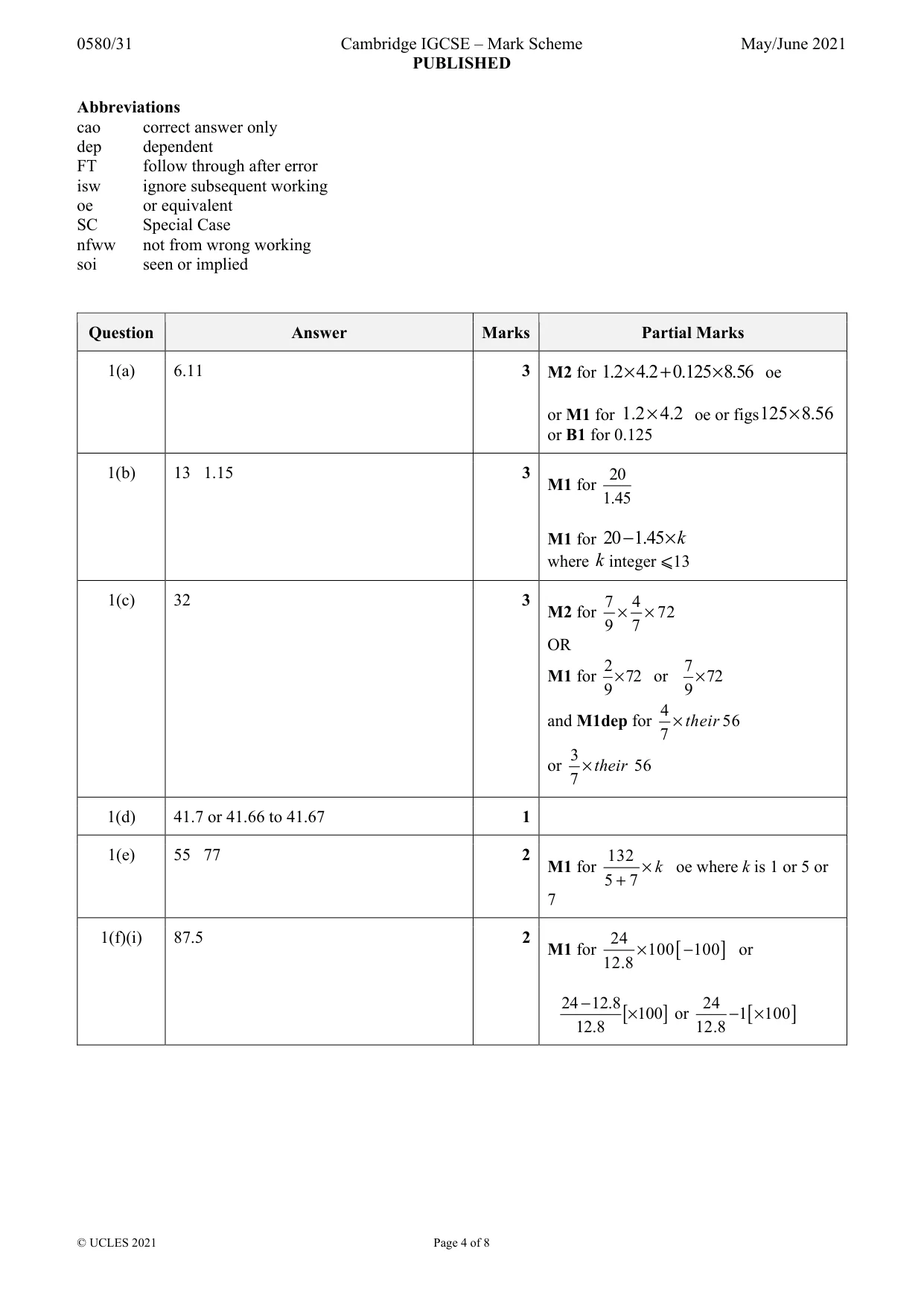
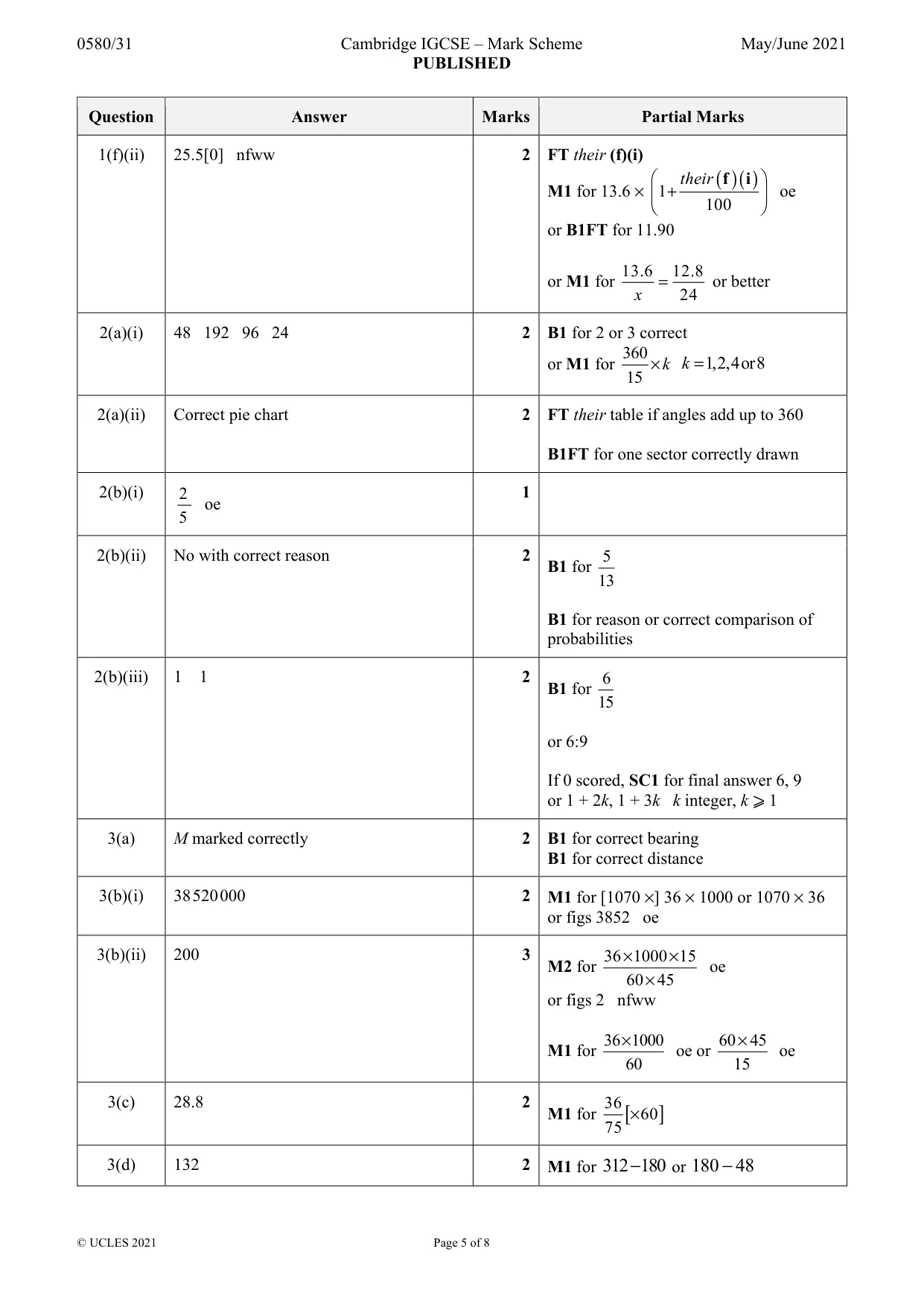
Mark scheme: Question Answer Marks Partial Marks 1(a) 6.11 3 M2 for 1.2 × 4.2 + 0.125 × 8.56 oe or M1 for 1.2 × 4.2 oe or figs125 × 8.56 or B1 for 0.125 1(b) 13 1.15 3 20 M1 for 1.45 M1 for 20 − 1.45 × k where k integer ⩽13 1(c) 32 3 7 4 M2 for × × 72 9 7 OR 2 7 M1 for 9× 72 or 9 × 72 4 and M1dep for × their 56 7 3 or × their 56 7 1(d) 41.7 or 41.66 to 41.67 1 1(e) 55 77 2 132 M1 for × k oe where k is 1 or 5 or 5 + 7 7 1(f)(i) 87.5 2 24 M1 for × 100 [ − 100 ] or 12.8 24 − 12.8 24 [× 100 ] or − 1[ × 100 ] 12.8 12.8 1(f)(ii) 25.5[0] nfww 2 FT their (f)(i) their ( f )( i ) M1 for 13.6 × 1 + oe 100 or B1FT for 11.90 13.6 12.8 or M1 for = or better x 24
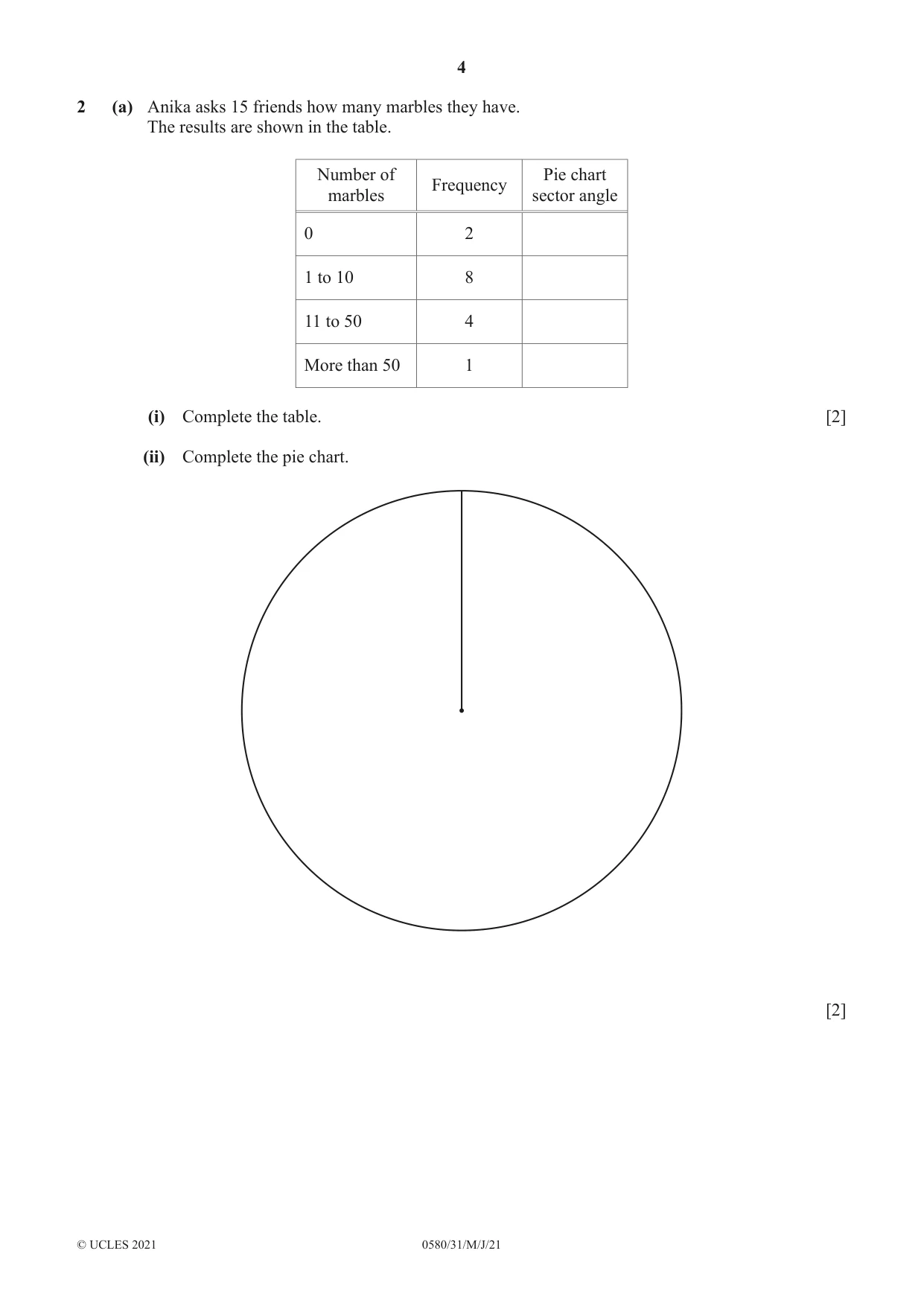
Q2 · Anika asks 15 friends how many marbles they have
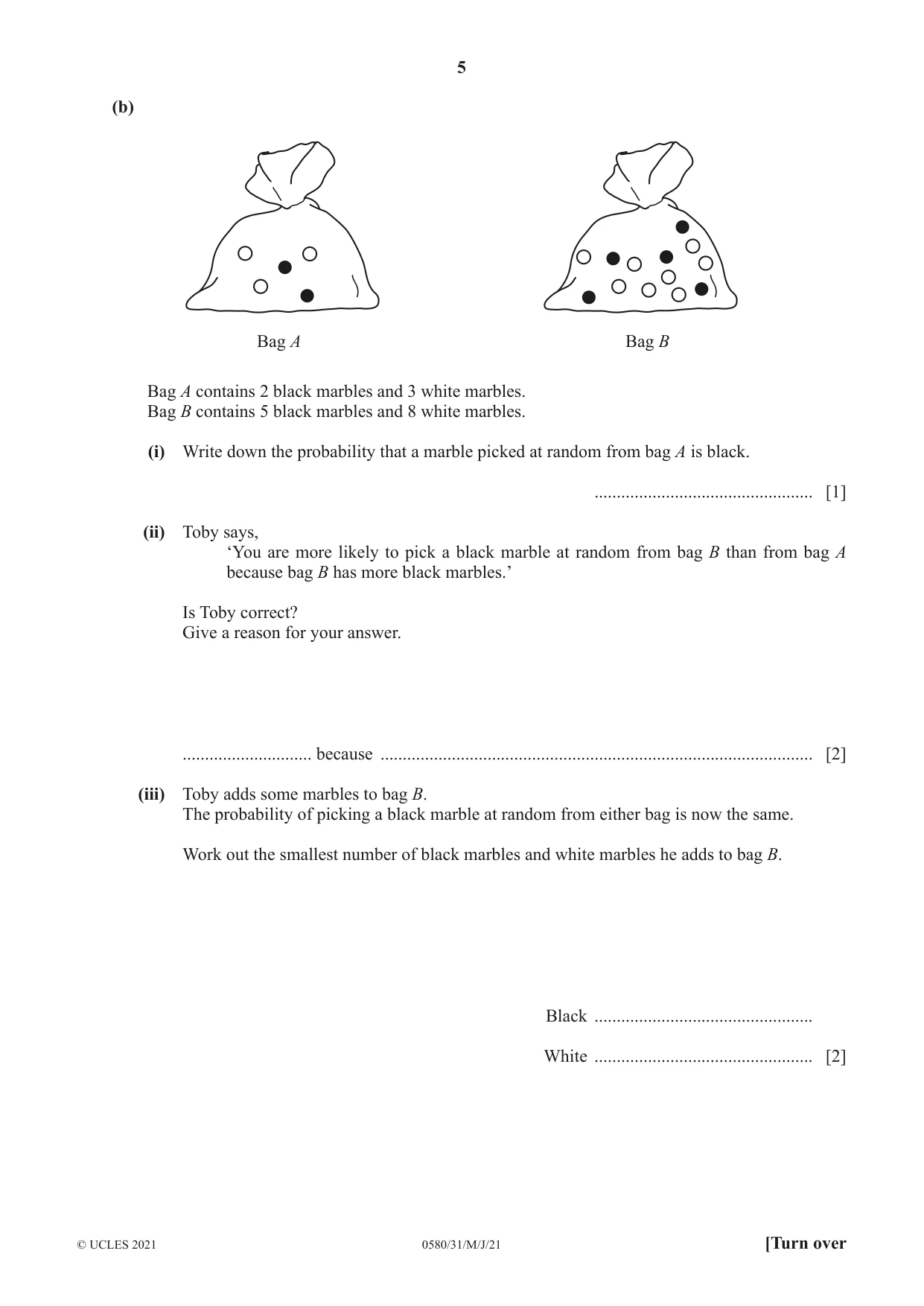
2 (a) Anika asks 15 friends how many marbles they have. The results are shown in the table. Number of Pie chart Frequency marbles sector angle 0 2 1 to 10 8 11 to 50 4 More than 50 1 (i) Complete the table. [2] (ii) Complete the pie chart. [2] (b) Bag A Bag B Bag A contains 2 black marbles and 3 white marbles. Bag B contains 5 black marbles and 8 white marbles. (i) Write down the probability that a marble picked at random from bag A is black. ................................................. [1] (ii) Toby says, ‘You are more likely to pick a black marble at random from bag B than from bag A because bag B has more black marbles.’ Is Toby correct? Give a reason for your answer. ............................. because ................................................................................................. [2] (iii) Toby adds some marbles to bag B. The probability of picking a black marble at random from either bag is now the same. Work out the smallest number of black marbles and white marbles he adds to bag B. Black ................................................. White ................................................. [2]
Mark scheme: 2(a)(i) 48 192 96 24 2 B1 for 2 or 3 correct 360 or M1 for × k k = 1, 2, 4 or 8 15 2(a)(ii) Correct pie chart 2 FT their table if angles add up to 360 B1FT for one sector correctly drawn 2(b)(i) 2 1 oe 5 2(b)(ii) No with correct reason 2 5 B1 for 13 B1 for reason or correct comparison of probabilities 2(b)(iii) 1 1 2 6 B1 for 15 or 6:9 If 0 scored, SC1 for final answer 6, 9 or 1 + 2k, 1 + 3k k integer, k ⩾ 1
Q3 · The scale drawing shows the position of town R on a map
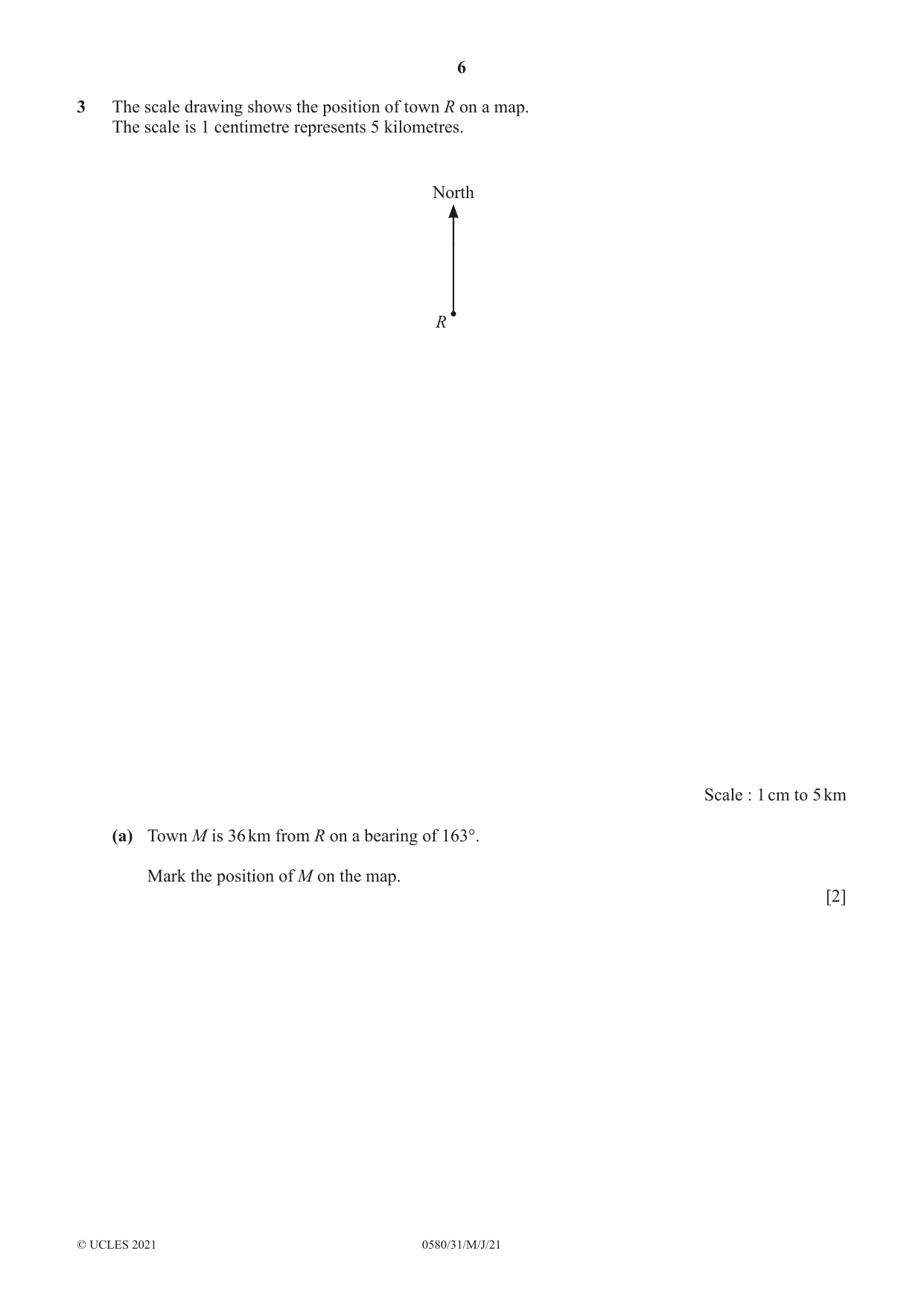
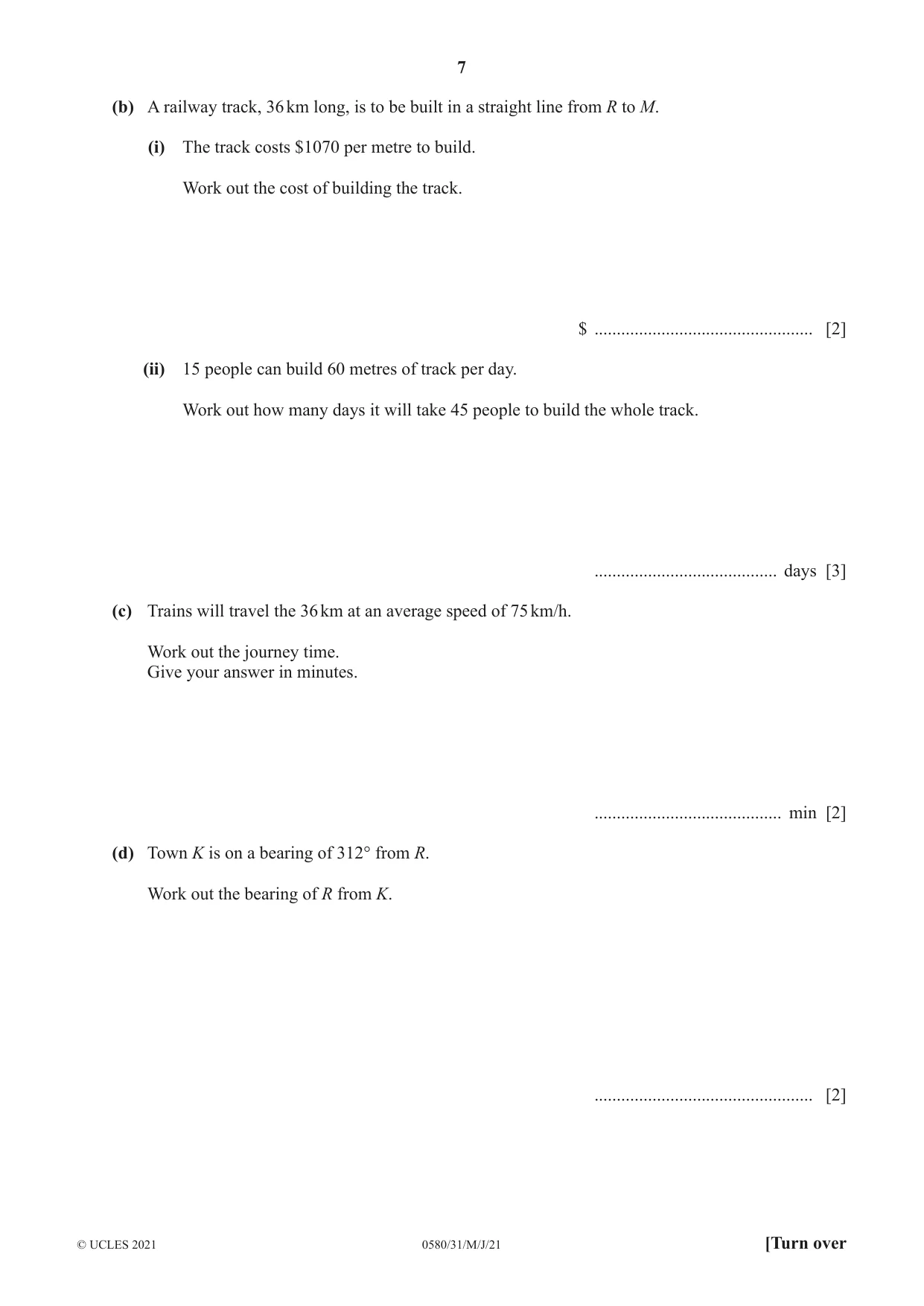
3 The scale drawing shows the position of town R on a map. The scale is 1 centimetre represents 5 kilometres. North R Scale : 1 cm to 5 km (a) Town M is 36 km from R on a bearing of 163°. Mark the position of M on the map. [2] (b) A railway track, 36 km long, is to be built in a straight line from R to M. (i) The track costs $1070 per metre to build. Work out the cost of building the track. $ ................................................. [2] (ii) 15 people can build 60 metres of track per day. Work out how many days it will take 45 people to build the whole track. ......................................... days [3] (c) Trains will travel the 36 km at an average speed of 75 km/h. Work out the journey time. Give your answer in minutes. .......................................... min [2] (d) Town K is on a bearing of 312° from R. Work out the bearing of R from K. ................................................. [2]
Mark scheme: 3(a) M marked correctly 2 B1 for correct bearing B1 for correct distance 3(b)(i) 38 520 000 2 M1 for [1070 ×] 36 × 1000 or 1070 × 36 or figs 3852 oe 3(b)(ii) 200 3 36 × 1000 × 15 M2 for oe 60 × 45 or figs 2 nfww 36 × 1000 60 × 45 M1 for oe or oe 60 15 3(c) 28.8 2 36 M1 for [× 60 ] 75 3(d) 132 2 M1 for 312 −180 or 180 − 48
Q4 · The diagram shows a line L and two points, A and B, on a grid
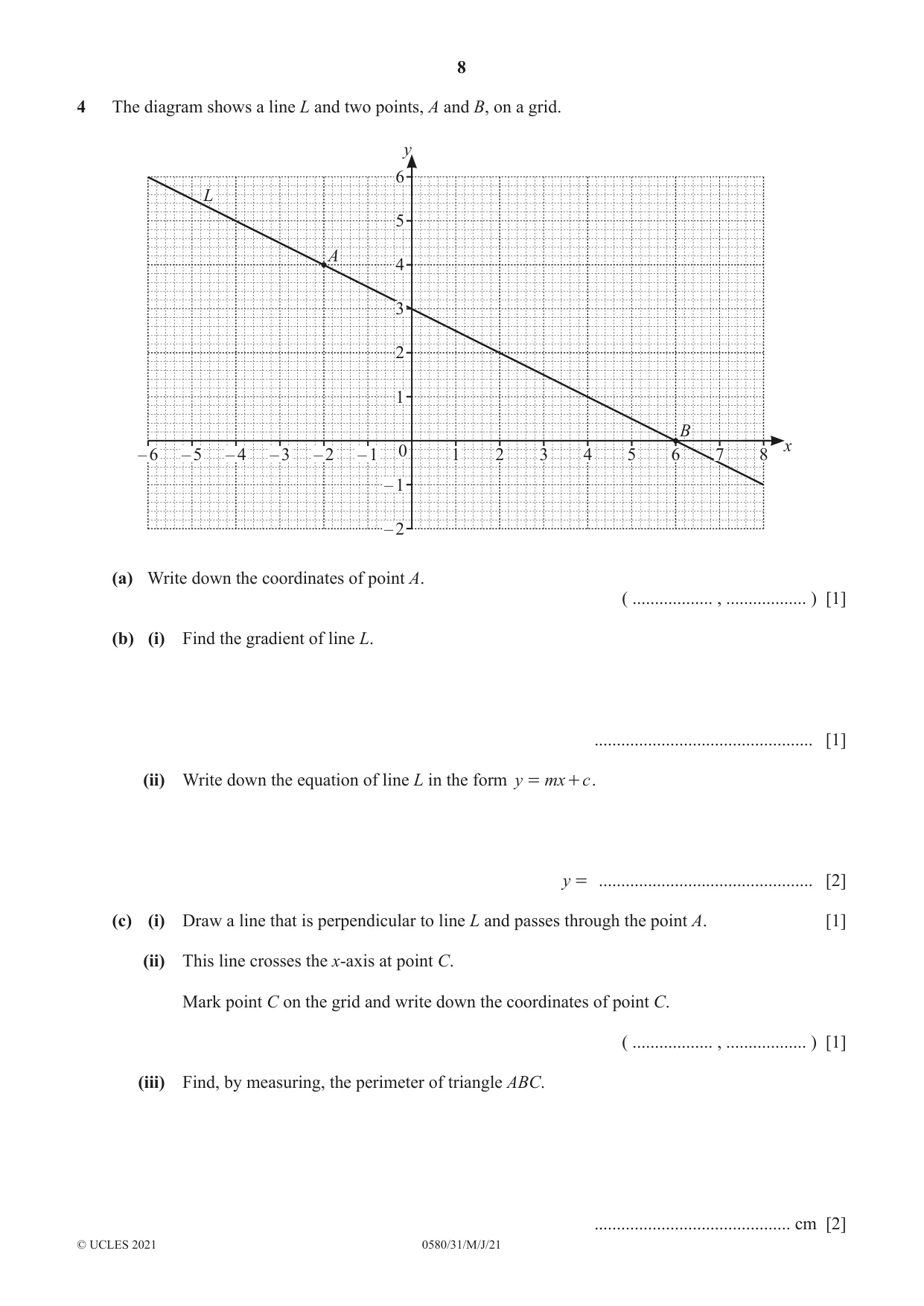
4 The diagram shows a line L and two points, A and B, on a grid. y 66 L 5 A 44 3 2 1 B x – 6 – 5 – 4 – 3 – 2 – 1 00 1 2 3 4 5 6 7 88 – 1 – 2 (a) Write down the coordinates of point A. ( .................. , .................. ) [1] (b) (i) Find the gradient of line L. ................................................. [1] (ii) Write down the equation of line L in the form y = mx + c . y = ................................................ [2] (c) (i) Draw a line that is perpendicular to line L and passes through the point A. [1] (ii) This line crosses the x-axis at point C. Mark point C on the grid and write down the coordinates of point C. ( .................. , .................. ) [1] (iii) Find, by measuring, the perimeter of triangle ABC. ............................................ cm [2]
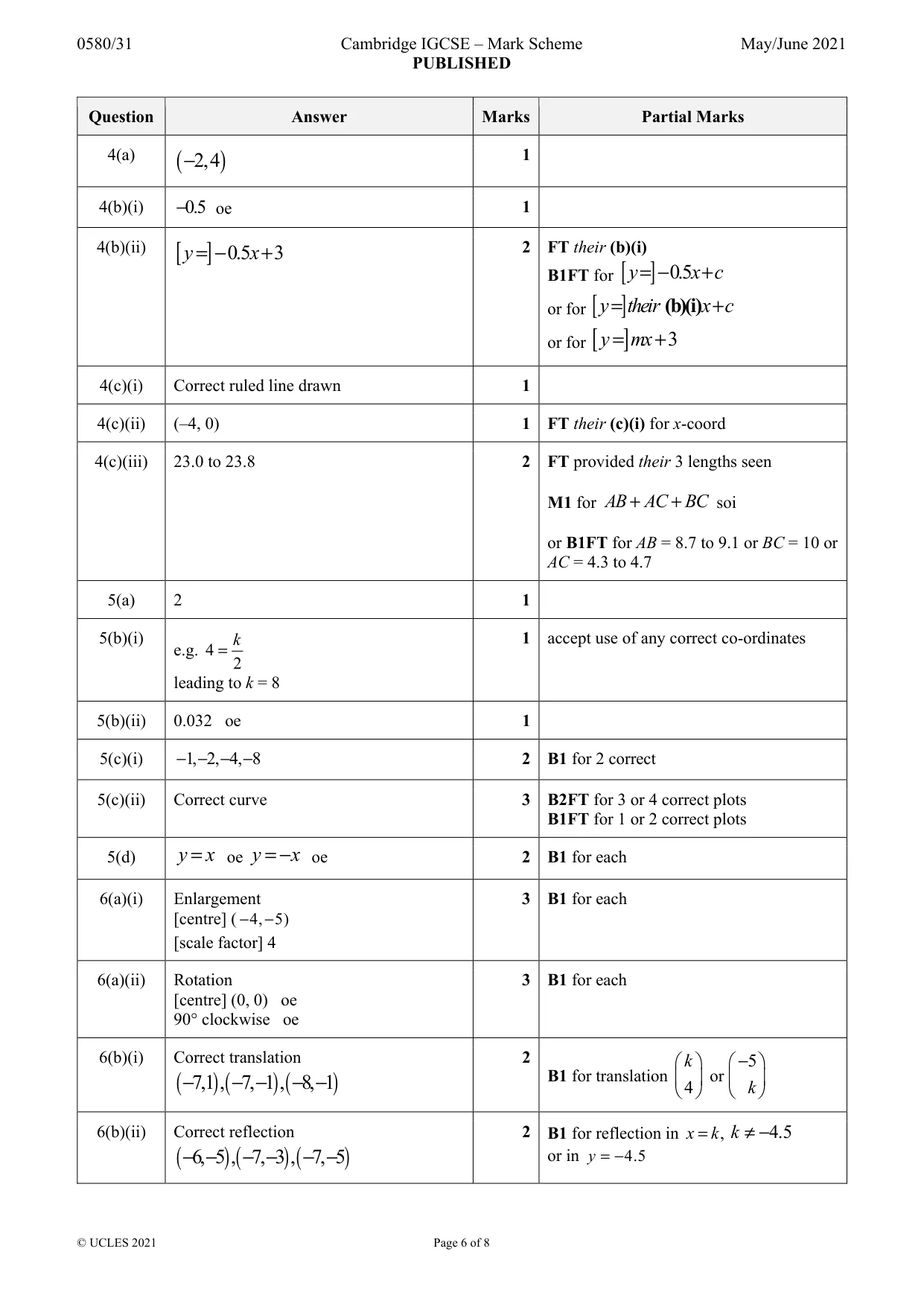
Mark scheme: 4(a) ( −2,4) 1 4(b)(i) −0.5 oe 1 4(b)(ii) [ y =] − 0.5x + 3 2 FT their (b)(i) B1FT for [ y =] − 0.5x + c or for [ y =] their (b)(i)x + c or for [ y =] mx + 3 4(c)(i) Correct ruled line drawn 1 4(c)(ii) (–4, 0) 1 FT their (c)(i) for x-coord 4(c)(iii) 23.0 to 23.8 2 FT provided their 3 lengths seen M1 for AB + AC + BC soi or B1FT for AB = 8.7 to 9.1 or BC = 10 or AC = 4.3 to 4.7
Q5 · Y 88 66 44 22 x –– 88 –– 66 –– 44 –– 22 0 22 44 66 88 –– 22 –– 44 –– 66 –– 88 k The…
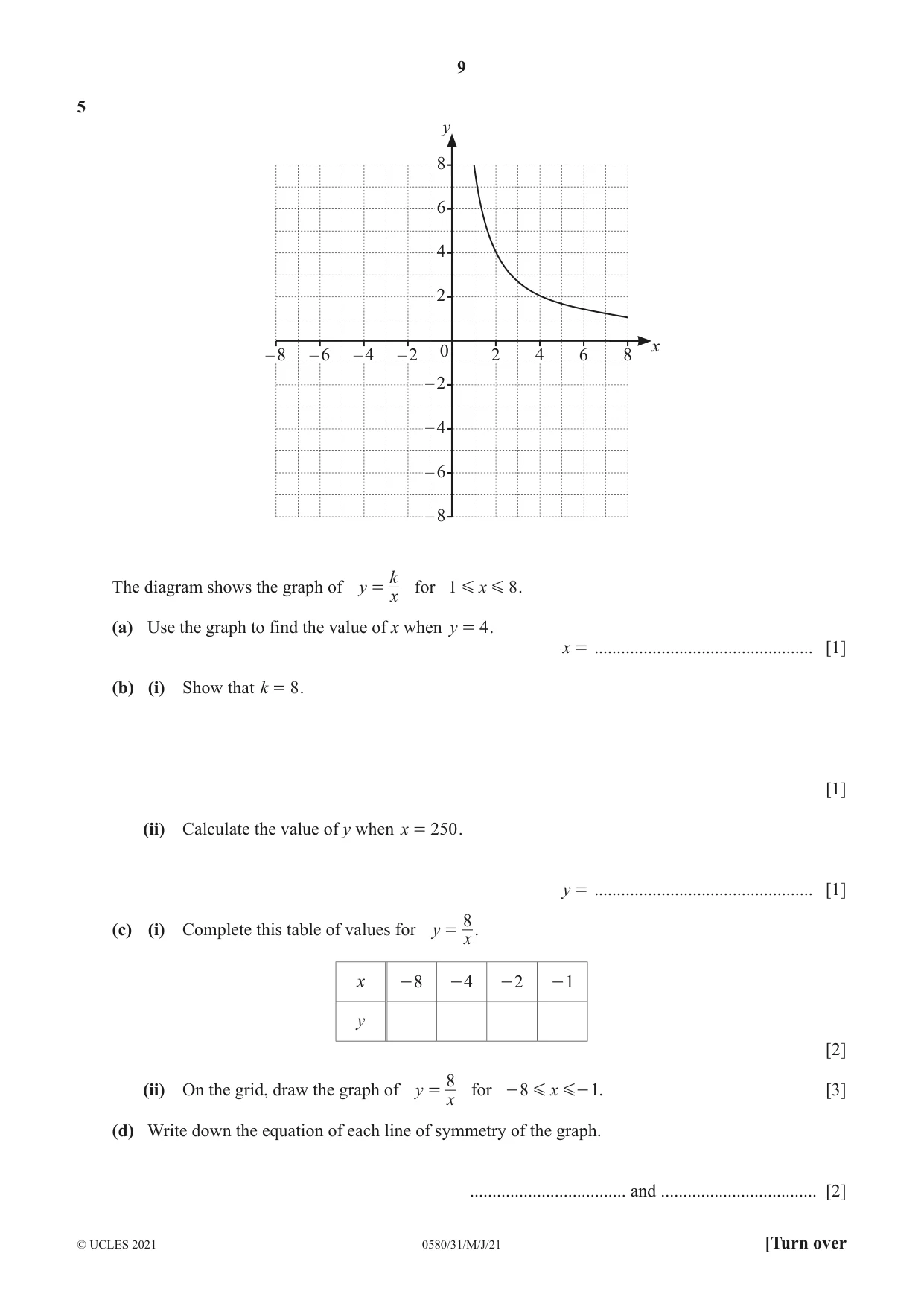
5 y 88 66 44 22 x –– 88 –– 66 –– 44 –– 22 0 22 44 66 88 –– 22 –– 44 –– 66 –– 88 k The diagram shows the graph of y = for 1 G x G 8 . x (a) Use the graph to find the value of x when y = 4 . x = ................................................. [1] (b) (i) Show that k = 8 . [1] (ii) Calculate the value of y when x = 250 . y = ................................................. [1] 8 (c) (i) Complete this table of values for y = . x x - 8 - 4 - 2 - 1 y [2] 8 (ii) On the grid, draw the graph of y = for - 8 G x G - 1. [3] x (d) Write down the equation of each line of symmetry of the graph. ................................... and ................................... [2]
Mark scheme: 5(a) 2 1 5(b)(i) k 1 accept use of any correct co-ordinates e.g. 4 = 2 leading to k = 8 5(b)(ii) 0.032 oe 1 5(c)(i) −−−−1, 2, 4, 8 2 B1 for 2 correct 5(c)(ii) Correct curve 3 B2FT for 3 or 4 correct plots B1FT for 1 or 2 correct plots 5(d) y = x oe y = − x oe 2 B1 for each
Q6 · The diagram shows three triangles, A, B and C, on a 1 cm2 grid
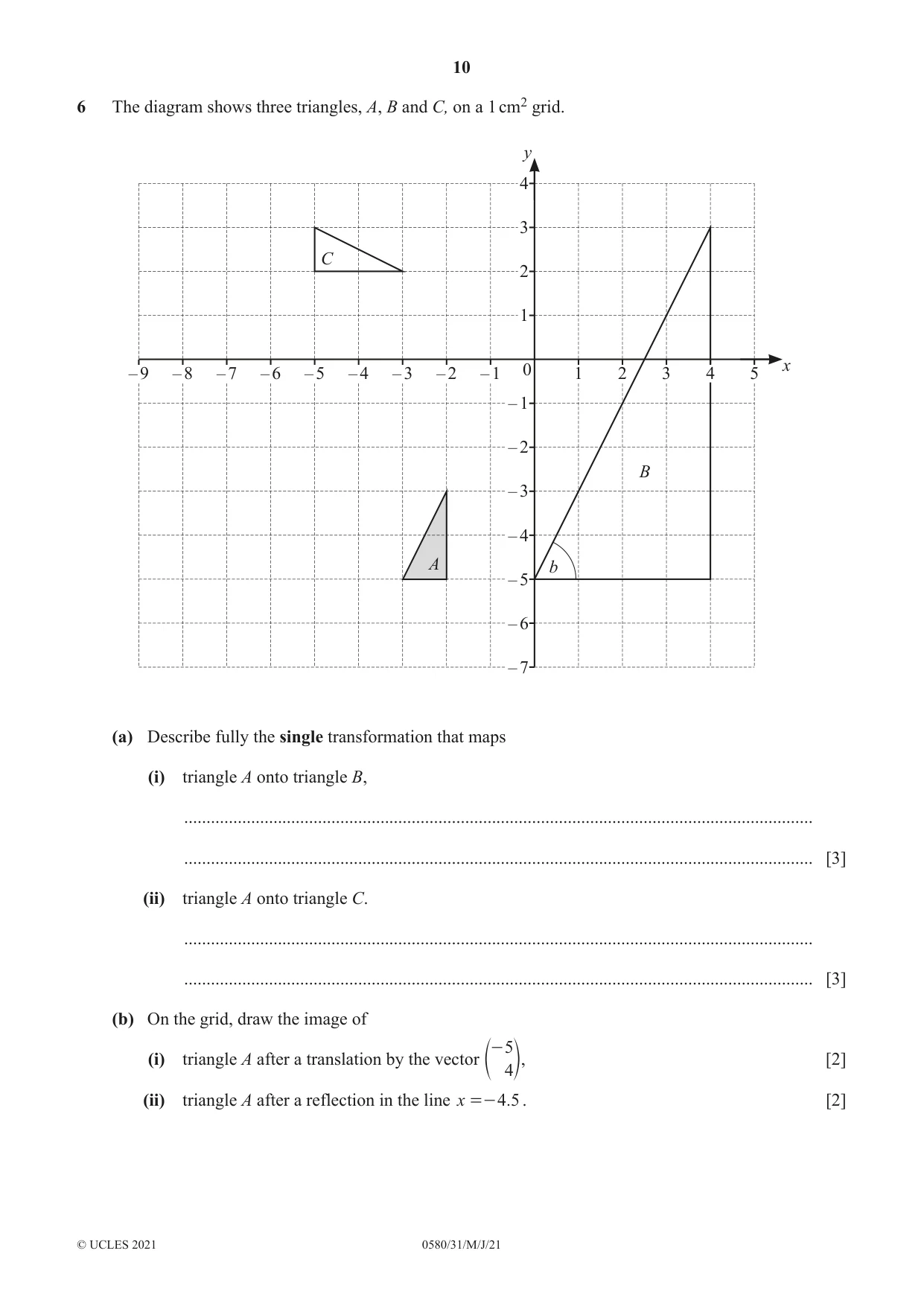
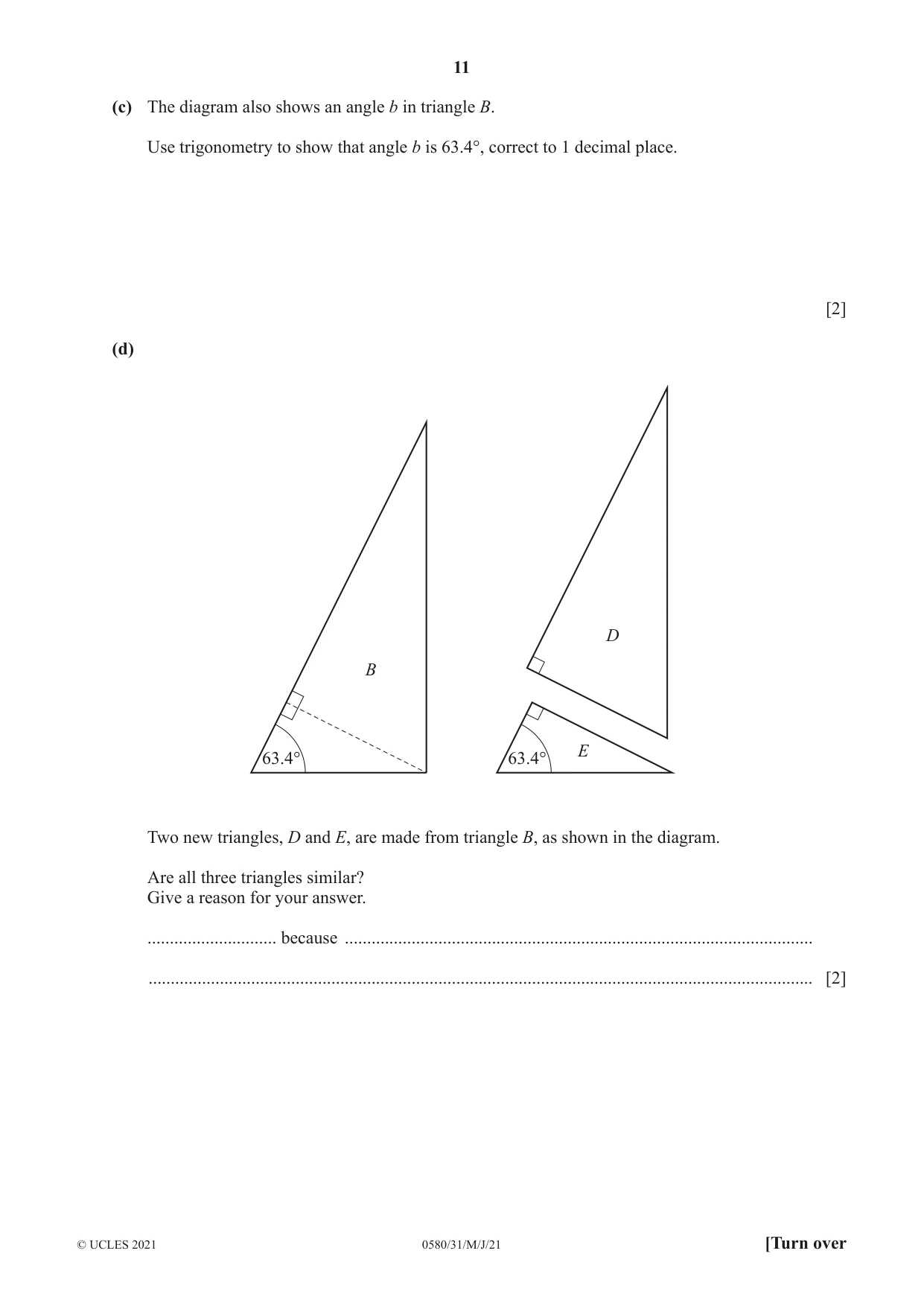
6 The diagram shows three triangles, A, B and C, on a 1 cm2 grid. y 44 33 C 22 11 x –– 99 –– 88 –– 77 –– 66 –– 55 –– 44 –– 33 –– 22 –– 11 0 11 22 33 44 55 –– 11 –– 22 B –– 33 –– 44 A b –– 55 –– 66 –– 77 (a) Describe fully the single transformation that maps (i) triangle A onto triangle B, ............................................................................................................................................. ............................................................................................................................................. [3] (ii) triangle A onto triangle C. ............................................................................................................................................. ............................................................................................................................................. [3] (b) On the grid, draw the image of - 5 (i) triangle A after a translation by the vector [2] e 4o, (ii) triangle A after a reflection in the line x =- 4.5 . [2] (c) The diagram also shows an angle b in triangle B. Use trigonometry to show that angle b is 63.4°, correct to 1 decimal place. [2] (d) D B E 63.4° 63.4° Two new triangles, D and E, are made from triangle B, as shown in the diagram. Are all three triangles similar? Give a reason for your answer. ............................. because ......................................................................................................... ..................................................................................................................................................... [2]
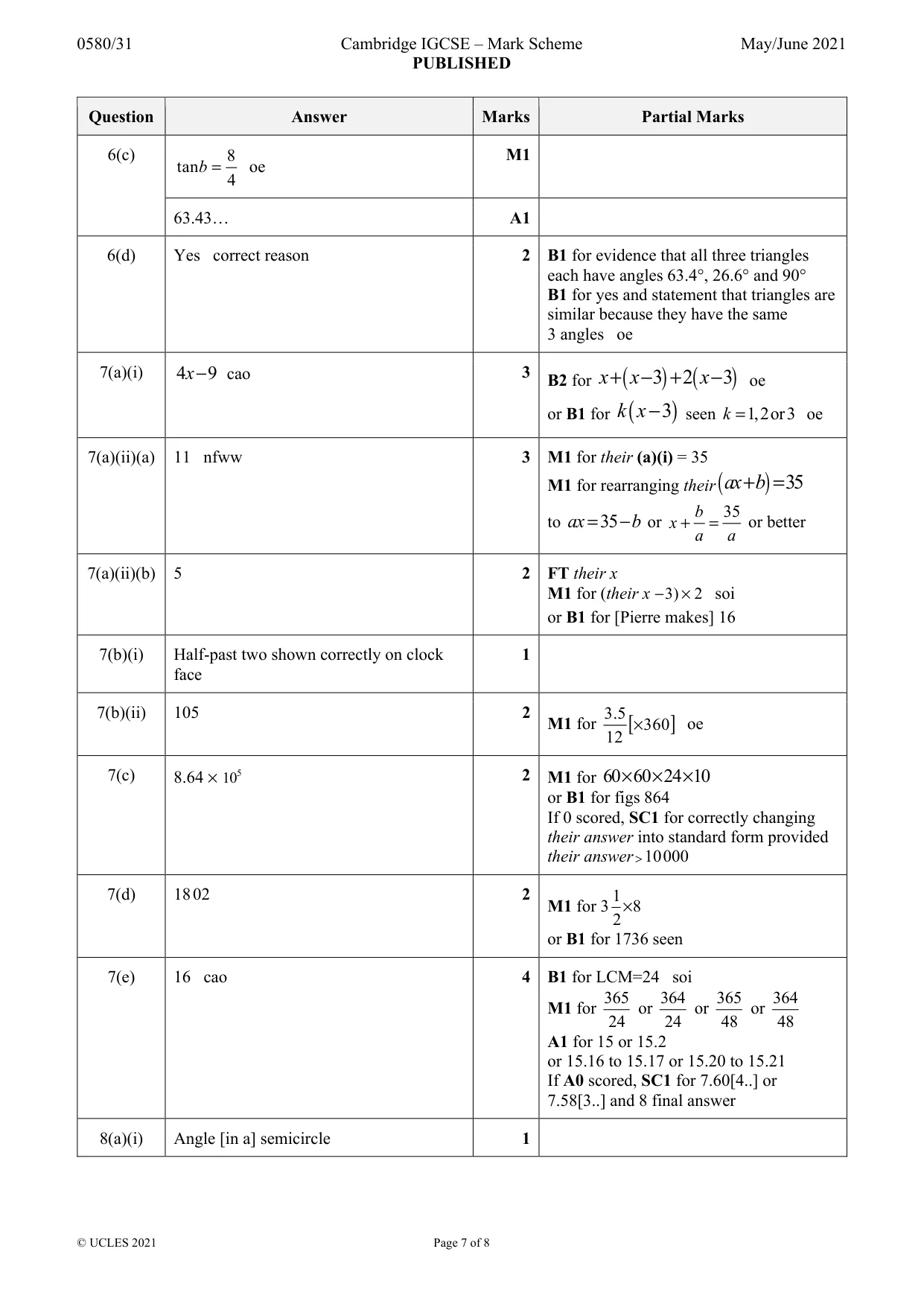
Mark scheme: 6(a)(i) Enlargement 3 B1 for each [centre] ( − 4, − 5) [scale factor] 4 6(a)(ii) Rotation 3 B1 for each [centre] (0, 0) oe 90° clockwise oe 6(b)(i) Correct translation 2 k −5 ( −7,1) ,( −−7, 1) , ( −−8, 1) B1 for translation or 4 k 6(b)(ii) Correct reflection 2 B1 for reflection in x = k , k ≠−4.5 = − 4.5 ( −−6, 5) ,( −−7, 3) , ( −−7, 5) or in y 6(c) 8 M1 tan b = oe 4 63.43… A1 6(d) Yes correct reason 2 B1 for evidence that all three triangles each have angles 63.4°, 26.6° and 90° B1 for yes and statement that triangles are similar because they have the same 3 angles oe
Q7 · Martin, Suki and Pierre make clocks
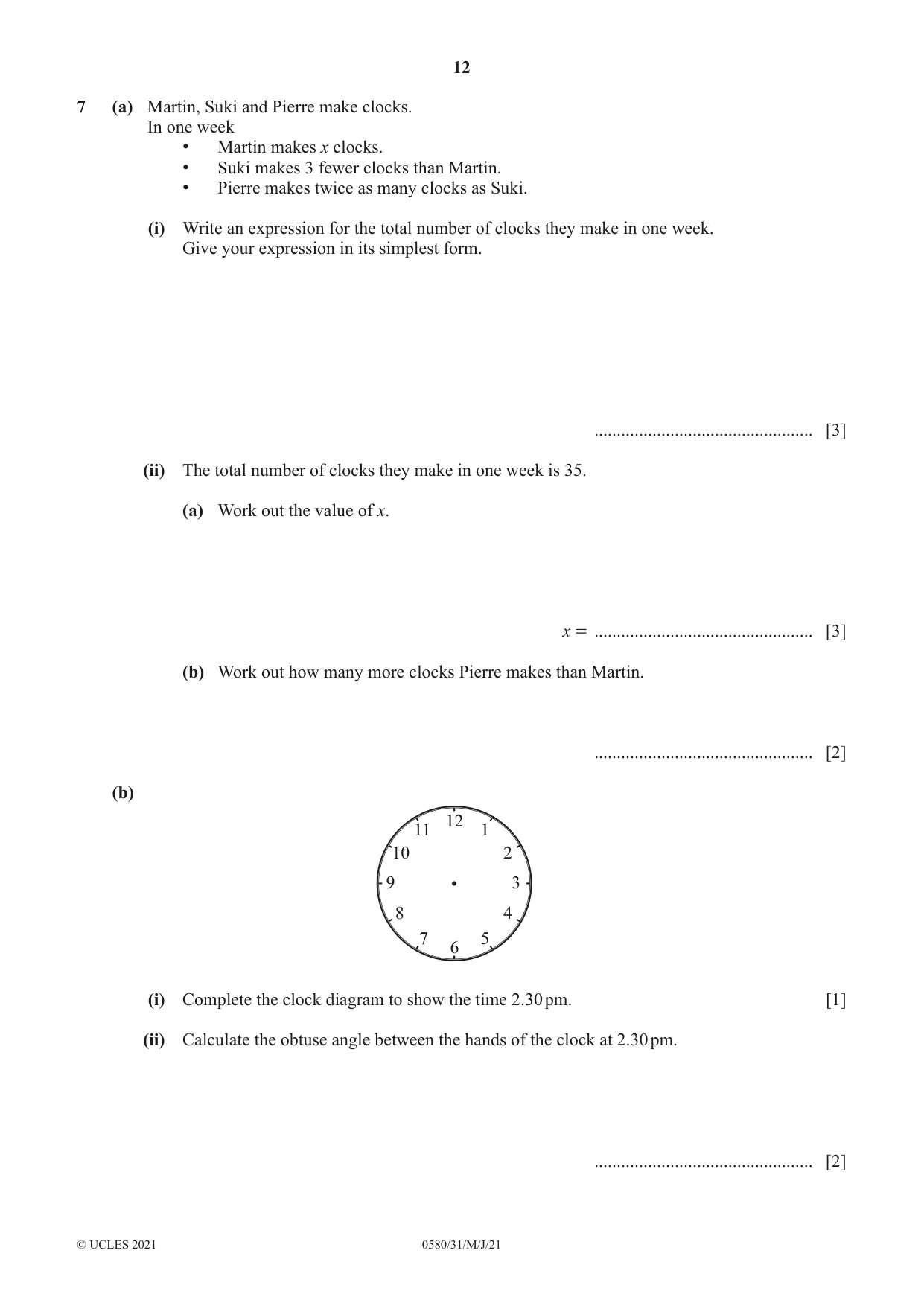
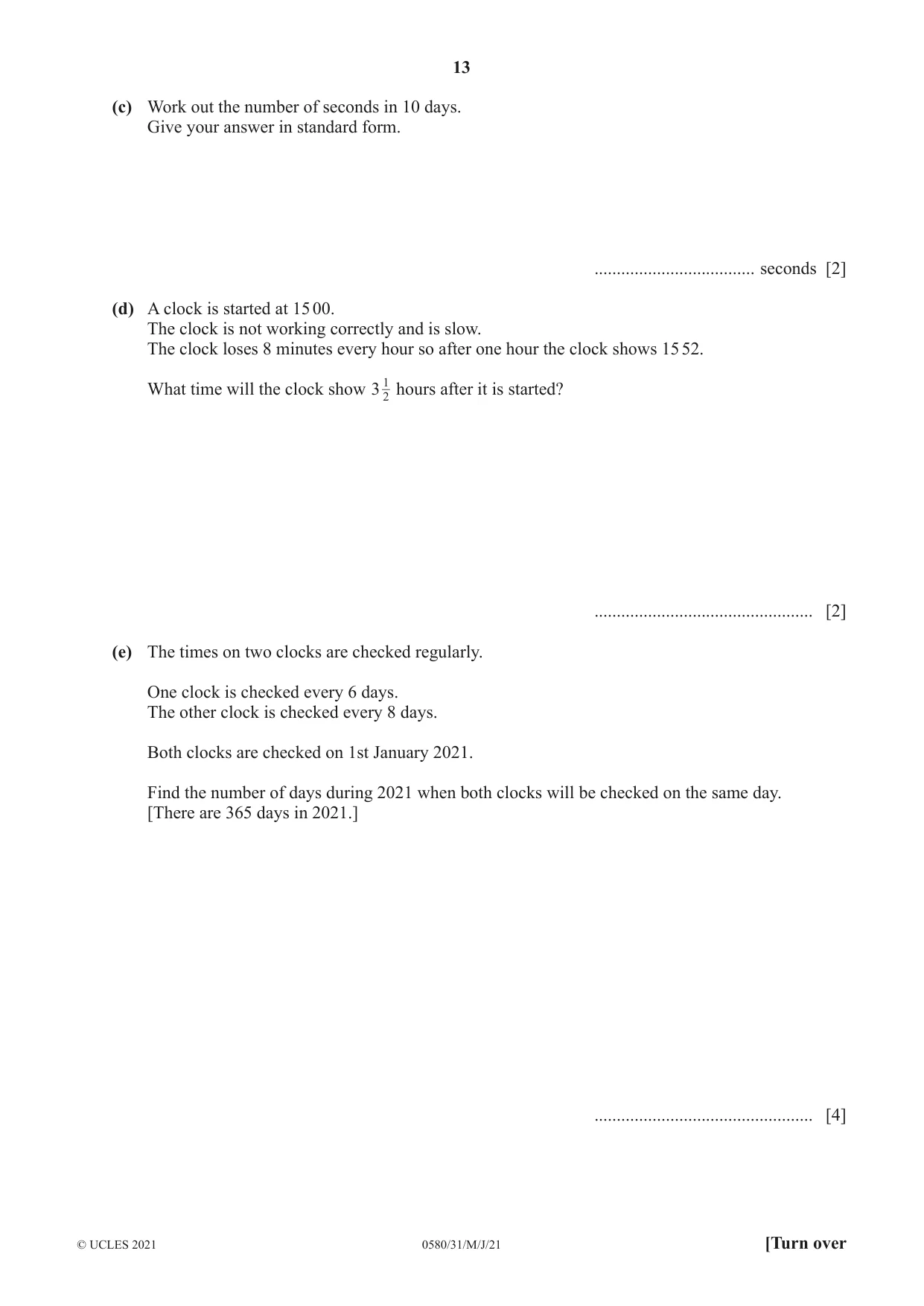
7 (a) Martin, Suki and Pierre make clocks. In one week • Martin makes x clocks. • Suki makes 3 fewer clocks than Martin. • Pierre makes twice as many clocks as Suki. (i) Write an expression for the total number of clocks they make in one week. Give your expression in its simplest form. ................................................. [3] (ii) The total number of clocks they make in one week is 35. (a) Work out the value of x. x = ................................................. [3] (b) Work out how many more clocks Pierre makes than Martin. ................................................. [2] (b) 12 11 1 10 2 9 3 8 4 7 5 6 (i) Complete the clock diagram to show the time 2.30 pm. [1] (ii) Calculate the obtuse angle between the hands of the clock at 2.30 pm. ................................................. [2] (c) Work out the number of seconds in 10 days. Give your answer in standard form. .................................... seconds [2] (d) A clock is started at 15 00. The clock is not working correctly and is slow. The clock loses 8 minutes every hour so after one hour the clock shows 15 52. What time will the clock show 3 12 hours after it is started? ................................................. [2] (e) The times on two clocks are checked regularly. One clock is checked every 6 days. The other clock is checked every 8 days. Both clocks are checked on 1st January 2021. Find the number of days during 2021 when both clocks will be checked on the same day. [There are 365 days in 2021.] ................................................. [4]
Mark scheme: 7(a)(i) 4x− 9 cao 3 B2 for x + ( x − 3) + 2( x − 3) oe or B1 for k ( x− )3 seen k = 1,2 or 3 oe 7(a)(ii)(a) 11 nfww 3 M1 for their (a)(i) = 35 M1 for rearranging their( ax + b) = 35 b 35 to ax = 35 − b or x + = or better a a 7(a)(ii)(b) 5 2 FT their x M1 for (their x − 3) × 2 soi or B1 for [Pierre makes] 16 7(b)(i) Half-past two shown correctly on clock 1 face 7(b)(ii) 105 2 3.5 M1 for [× 360 ] oe 12 7(c) 8.64 × 10⁵ 2 M1 for 60 × 60 × 24 ×10 or B1 for figs 864 If 0 scored, SC1 for correctly changing their answer into standard form provided their answer >10 000 7(d) 18 02 2 1 M1 for 3 2× 8 or B1 for 1736 seen 7(e) 16 cao 4 B1 for LCM=24 soi 365 364 365 364 M1 for or or or 24 24 48 48 A1 for 15 or 15.2 or 15.16 to 15.17 or 15.20 to 15.21 If A0 scored, SC1 for 7.60[4..] or 7.58[3..] and 8 final answer
Q8 · B NOT TO 6 cm SCALE A 10 cm O C A, B and C lie on a circle, centre O, diameter AC
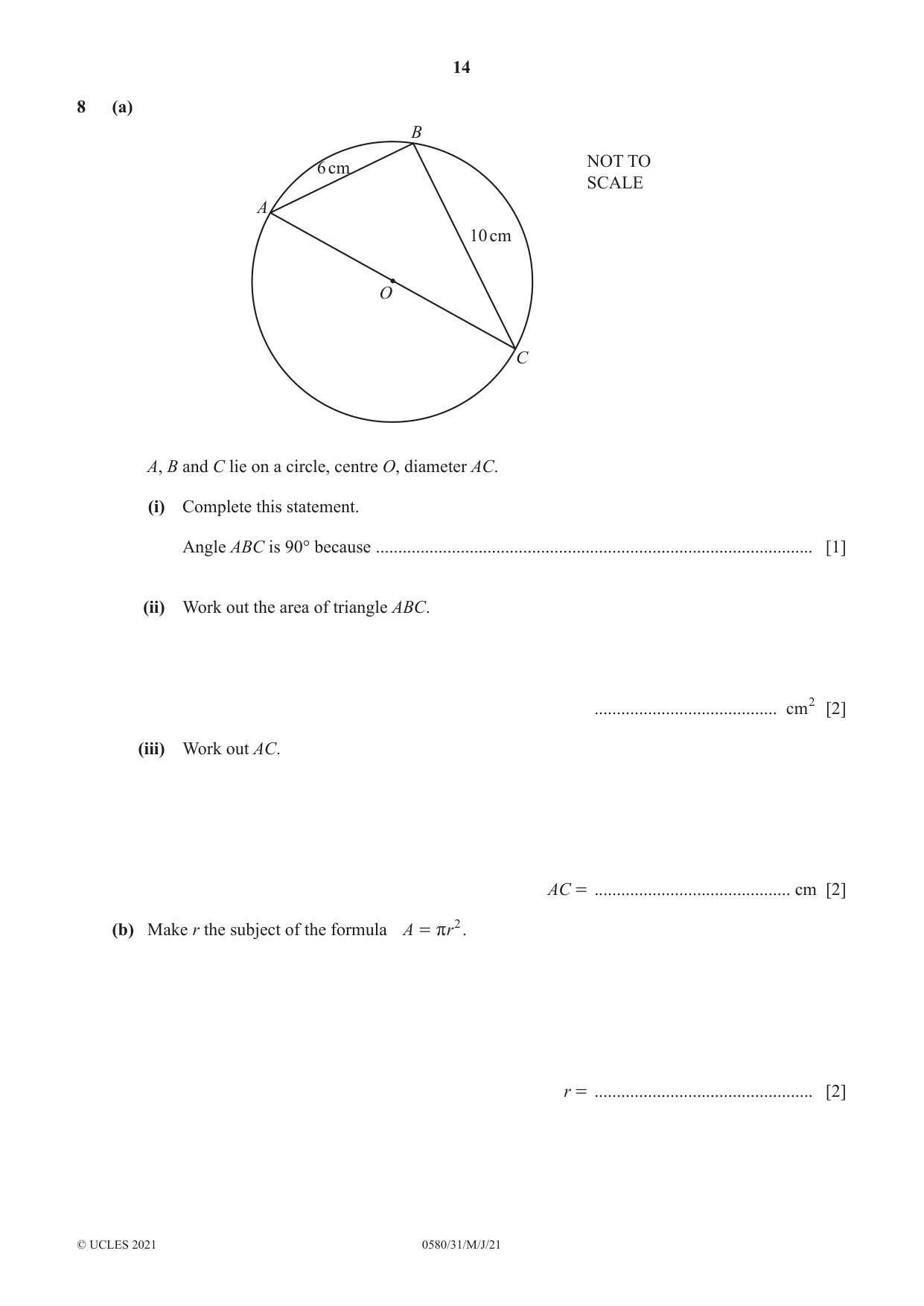
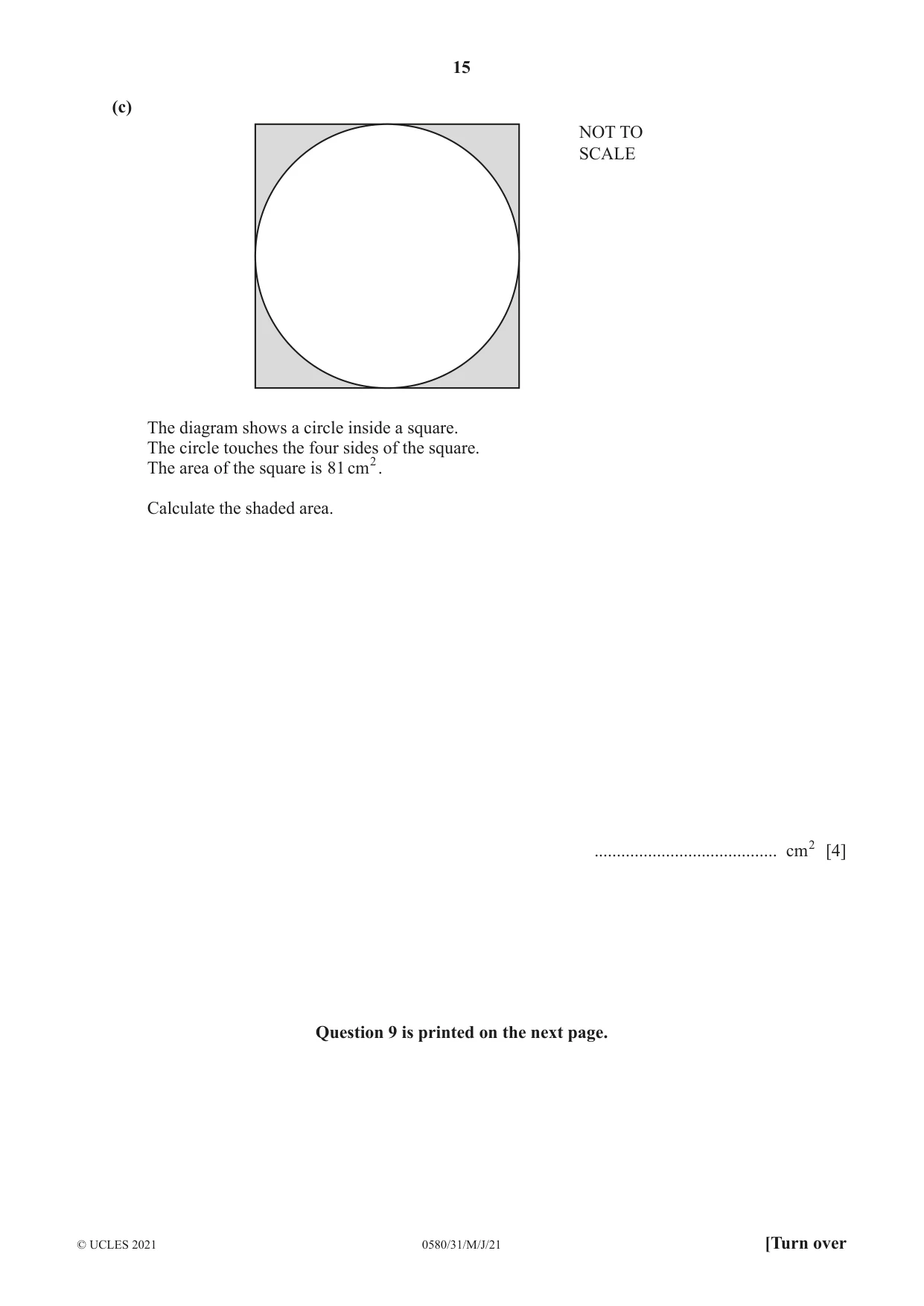
8 (a) B NOT TO 6 cm SCALE A 10 cm O C A, B and C lie on a circle, centre O, diameter AC. (i) Complete this statement. Angle ABC is 90° because .................................................................................................. [1] (ii) Work out the area of triangle ABC. ......................................... cm2 [2] (iii) Work out AC. AC = ............................................ cm [2] (b) Make r the subject of the formula A = rr2 . r = ................................................. [2] (c) NOT TO SCALE The diagram shows a circle inside a square. The circle touches the four sides of the square. The area of the square is 81 cm 2. Calculate the shaded area. ......................................... cm2 [4] Question 9 is printed on the next page.
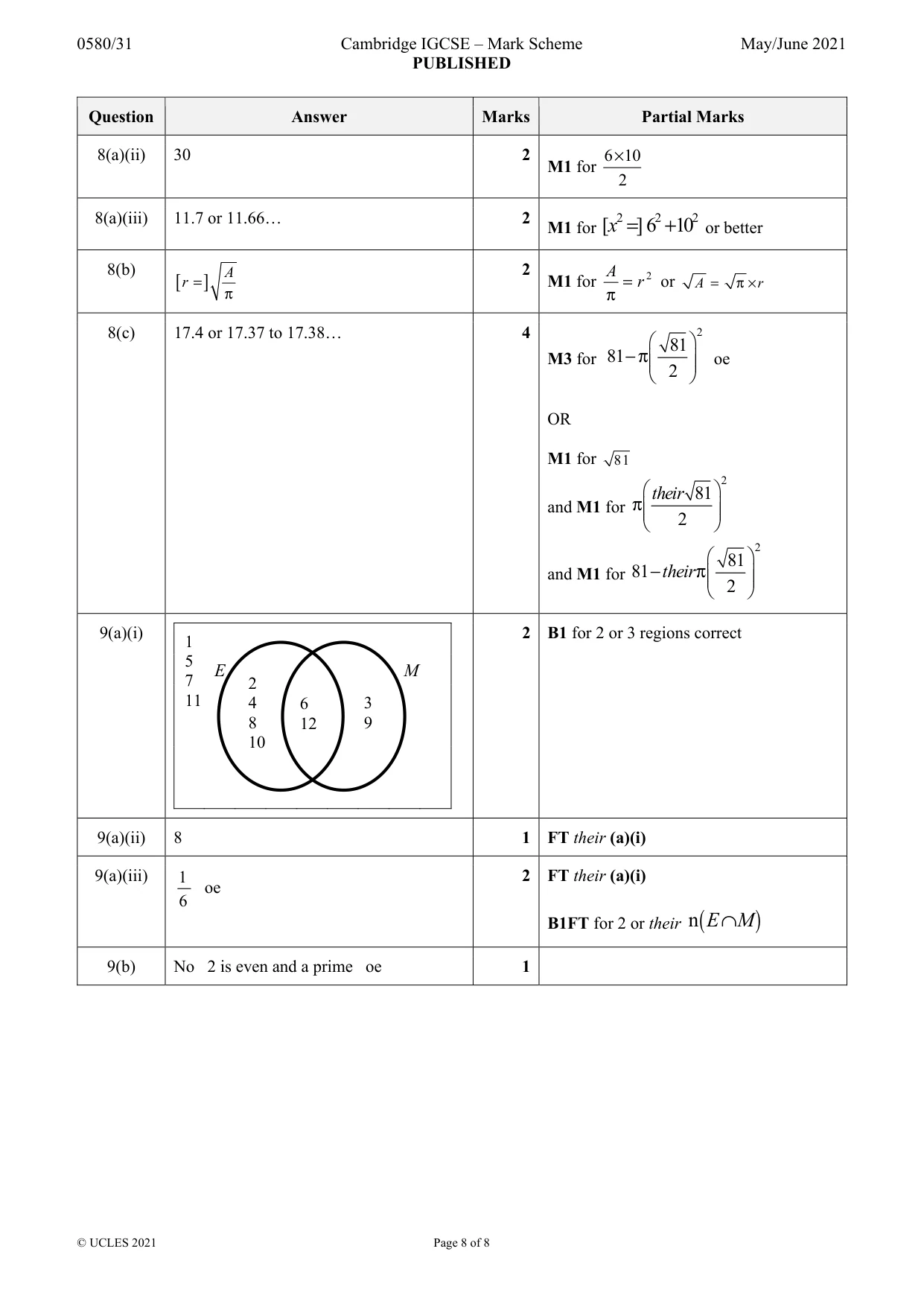
Mark scheme: 8(a)(i) Angle [in a] semicircle 1 8(a)(ii) 30 2 6 × 10 M1 for 2 8(a)(iii) 11.7 or 11.66… 2 2 2 2 M1 for [x =] 6 +10 or better 8(b) A 2 A 2 [ r = ] M1 for = r or A = π × r π π 8(c) 17.4 or 17.37 to 17.38… 4 2 81 M3 for 81 −π oe 2 OR M1 for 81 their 81 2 and M1 for π 2 81 2 and M1 for 81 − their π 2
Q9 · = {1, 2, 3, 4, 5, 6, 7, 8, 9, 10, 11, 12} E = {x: x is an even number} M = {x: x is a…
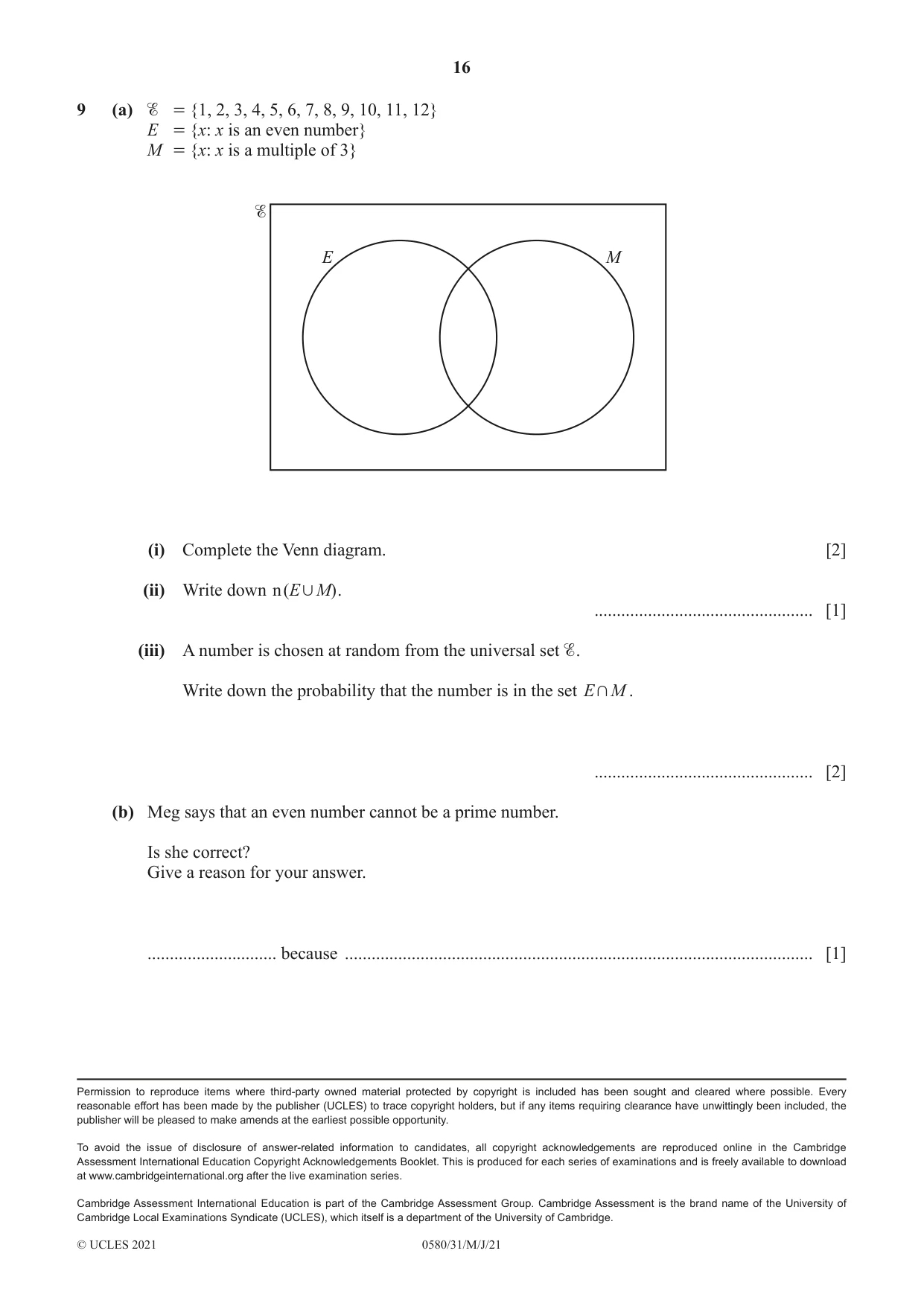
9 (a) = {1, 2, 3, 4, 5, 6, 7, 8, 9, 10, 11, 12} E = {x: x is an even number} M = {x: x is a multiple of 3} E M (i) Complete the Venn diagram. [2] (ii) Write down n ( E , M ) . ................................................. [1] (iii) A number is chosen at random from the universal set . Write down the probability that the number is in the set E + M . ................................................. [2] (b) Meg says that an even number cannot be a prime number. Is she correct? Give a reason for your answer. ............................. because ......................................................................................................... [1]
Mark scheme: 9(a)(i) 2 B1 for 2 or 3 regions correct 1 5 E M 7 2 11 4 6 3 8 12 9 10 9(a)(ii) 8 1 FT their (a)(i) 9(a)(iii) 1 2 FT their (a)(i) oe 6 B1FT for 2 or their n ( E ∩ M ) 9(b) No 2 is even and a prime oe 1
What was in this paper
The subtopics covered by these 9 questions, and how many questions each got. Open one in a new tab to see every Cambridge question on it.
What you needed in this session
Cambridge’s own grade thresholds for 2021 May/June, Paper 3 · Variant 1. A higher threshold means an easier paper — the bar moves with how the cohort did.