Cambridge IGCSE Mathematics 0580 — 2019 Oct/Nov Paper 3 · Variant 2
0580/32/O/N/19 · 9 questions · 104 marks · ≈117 min
The question paper and its mark scheme, free to read here and free to download. This is Cambridge’s own paper, exactly as it was sat.
Question paper16 pages
Mark scheme6 pages
Answers below. Sit the paper first if you are practising.
Questions as text
Q1 · Nadira owns a clothes shop
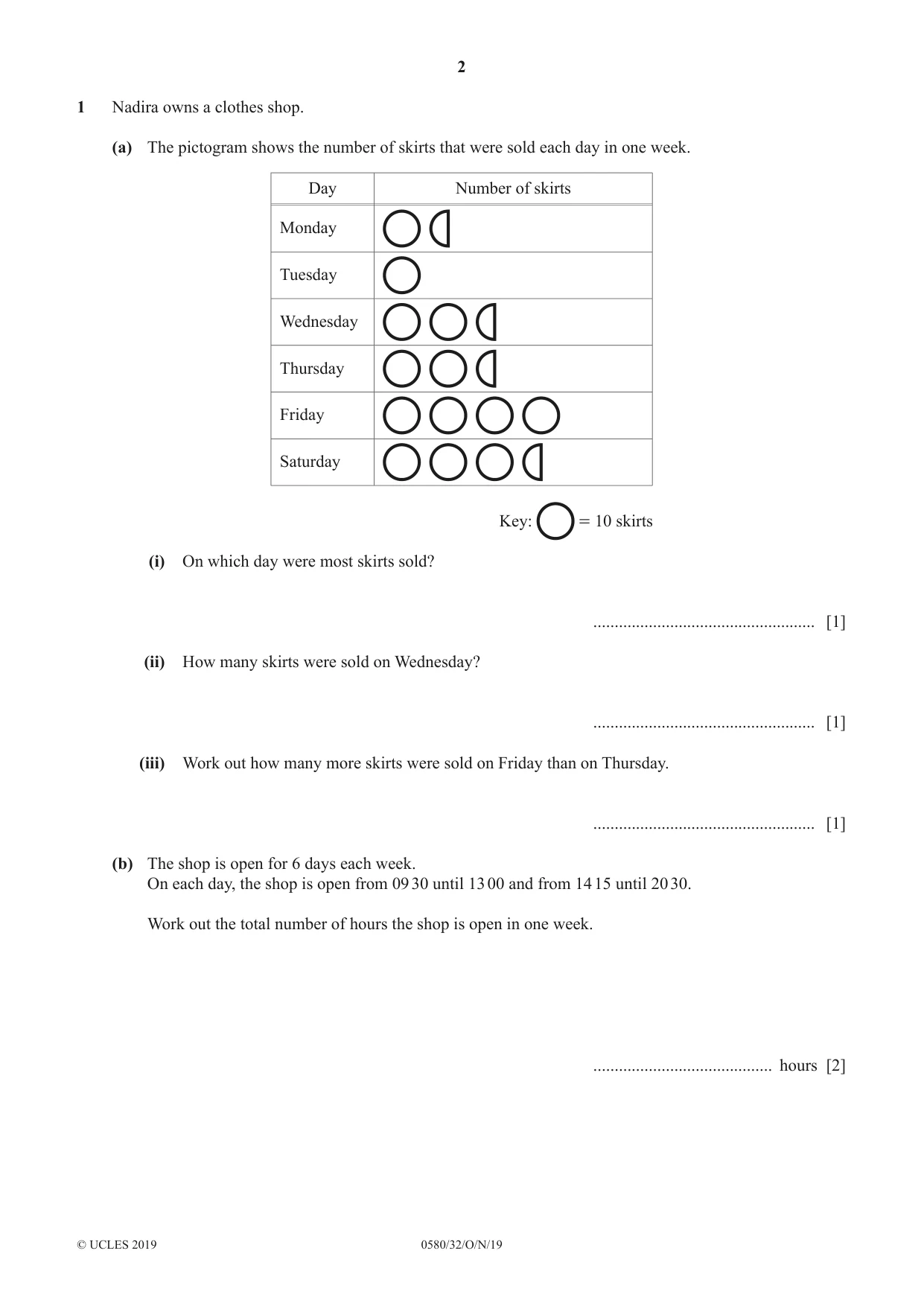
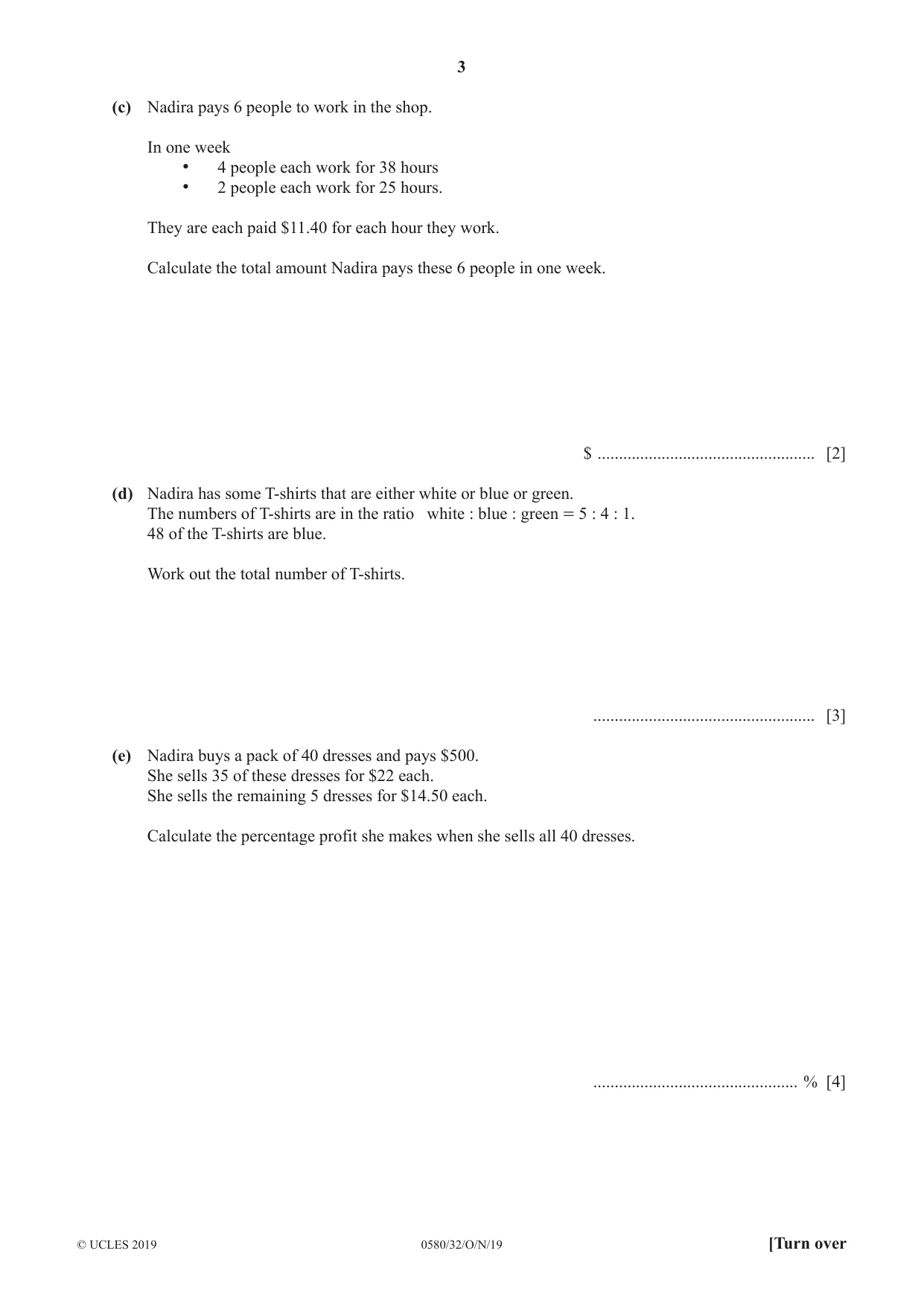
1 Nadira owns a clothes shop. (a) The pictogram shows the number of skirts that were sold each day in one week. Day Number of skirts Monday Tuesday Wednesday Thursday Friday Saturday Key: = 10 skirts (i) On which day were most skirts sold? .................................................... [1] (ii) How many skirts were sold on Wednesday? .................................................... [1] (iii) Work out how many more skirts were sold on Friday than on Thursday. .................................................... [1] (b) The shop is open for 6 days each week. On each day, the shop is open from 09 30 until 13 00 and from 14 15 until 20 30. Work out the total number of hours the shop is open in one week. .......................................... hours [2] (c) Nadira pays 6 people to work in the shop. In one week • 4 people each work for 38 hours • 2 people each work for 25 hours. They are each paid $11.40 for each hour they work. Calculate the total amount Nadira pays these 6 people in one week. $ ................................................... [2] (d) Nadira has some T-shirts that are either white or blue or green. The numbers of T-shirts are in the ratio white : blue : green = 5 : 4 : 1. 48 of the T-shirts are blue. Work out the total number of T-shirts. .................................................... [3] (e) Nadira buys a pack of 40 dresses and pays $500. She sells 35 of these dresses for $22 each. She sells the remaining 5 dresses for $14.50 each. Calculate the percentage profit she makes when she sells all 40 dresses. ................................................ % [4]
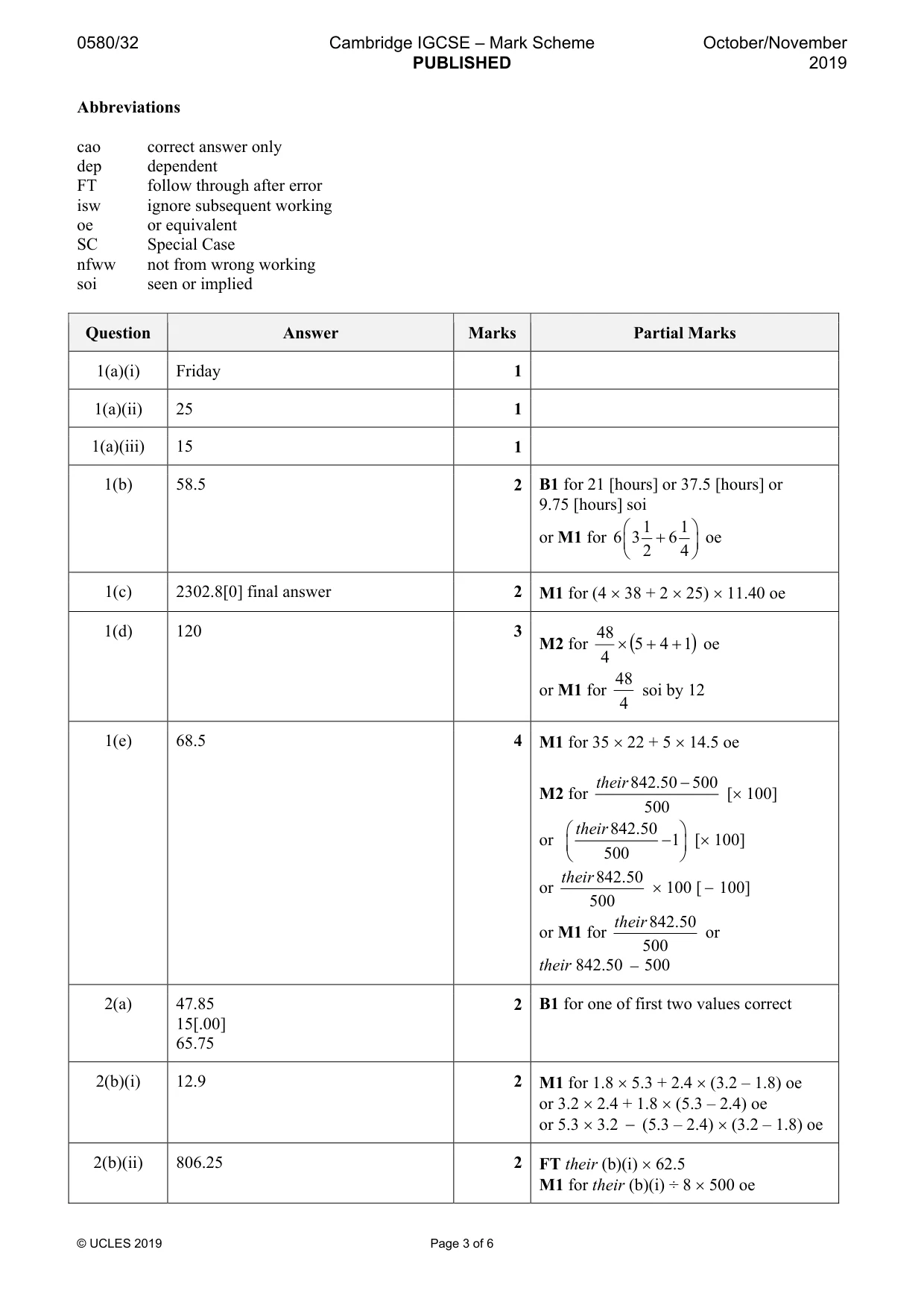
Mark scheme: Question Answer Marks Partial Marks 1(a)(i) Friday 1 1(a)(ii) 25 1 1(a)(iii) 15 1 1(b) 58.5 2 B1 for 21 [hours] or 37.5 [hours] or 9.75 [hours] soi 1 1 or M1 for 6 3 + 6 oe 2 4 1(c) 2302.8[0] final answer 2 M1 for (4 × 38 + 2 × 25) × 11.40 oe 1(d) 120 3 48 M2 for × (5 + 4 + )1 oe 4 48 or M1 for soi by 12 4 1(e) 68.5 4 M1 for 35 × 22 + 5 × 14.5 oe their 842.50 − 500 M2 for [× 100] 500 their 842.50 or − 1 [× 100] 500 their 842.50 or × 100 [ −100] 500 their 842.50 or M1 for or 500 their 842.50 −500
Q2 · Henry decorates a room
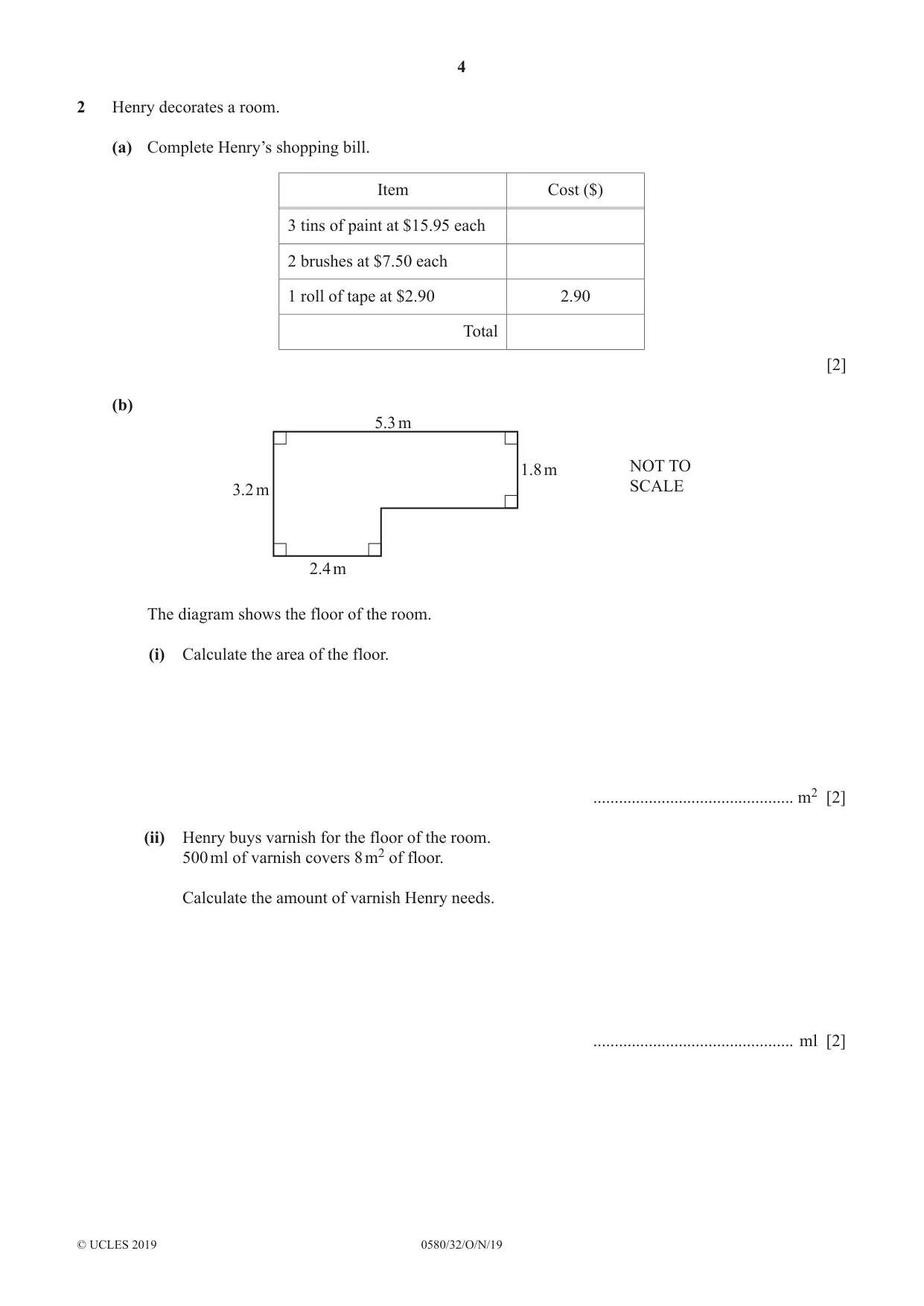
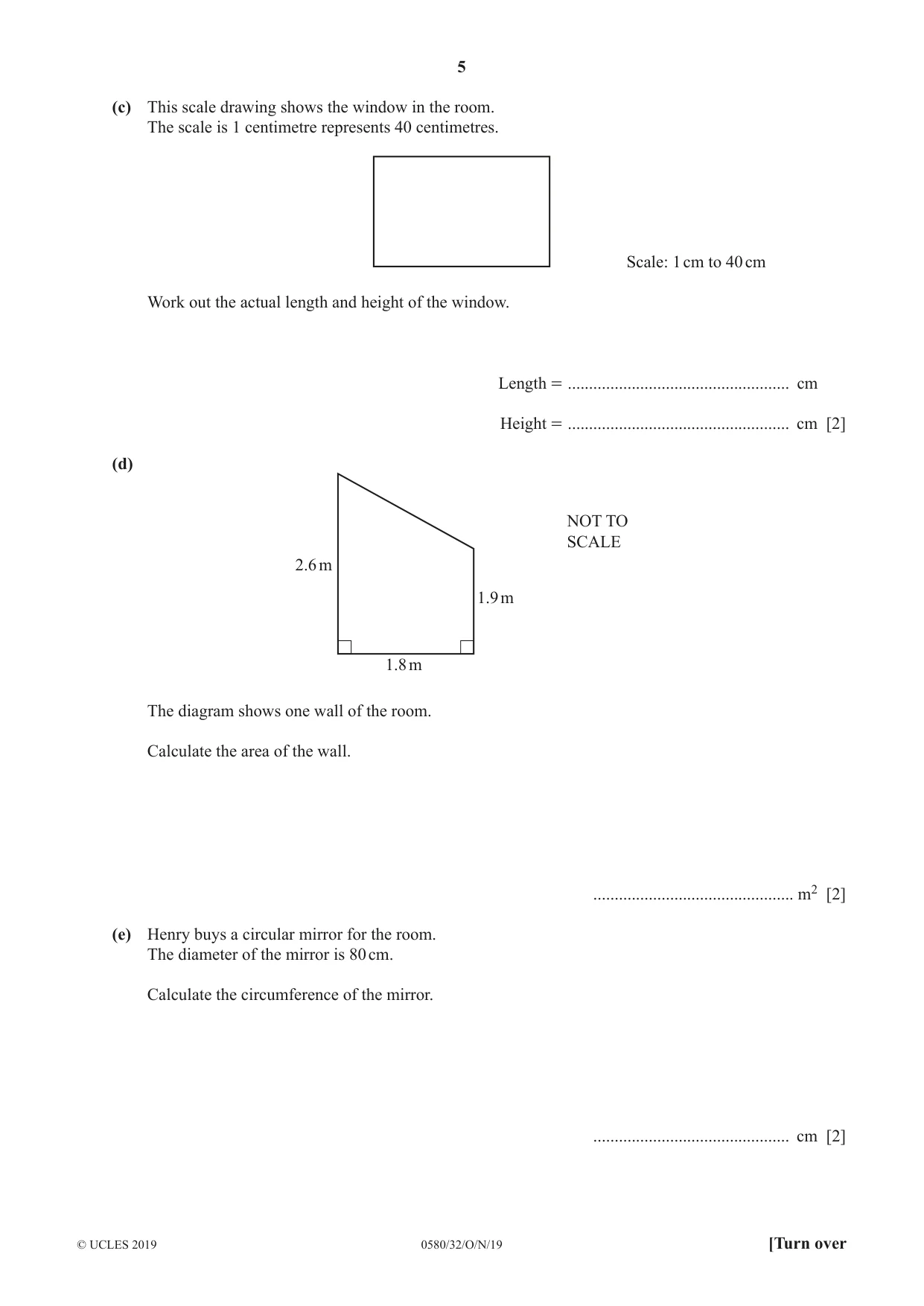
2 Henry decorates a room. (a) Complete Henry’s shopping bill. Item Cost ($) 3 tins of paint at $15.95 each 2 brushes at $7.50 each 1 roll of tape at $2.90 2.90 Total [2] (b) 5.3 m 1.8 m NOT TO 3.2 m SCALE 2.4 m The diagram shows the floor of the room. (i) Calculate the area of the floor. ............................................... m2 [2] (ii) Henry buys varnish for the floor of the room. 500 ml of varnish covers 8 m2 of floor. Calculate the amount of varnish Henry needs. ............................................... ml [2] (c) This scale drawing shows the window in the room. The scale is 1 centimetre represents 40 centimetres. Scale: 1 cm to 40 cm Work out the actual length and height of the window. Length = .................................................... cm Height = .................................................... cm [2] (d) NOT TO SCALE 2.6 m 1.9 m 1.8 m The diagram shows one wall of the room. Calculate the area of the wall. ............................................... m2 [2] (e) Henry buys a circular mirror for the room. The diameter of the mirror is 80 cm. Calculate the circumference of the mirror. .............................................. cm [2]
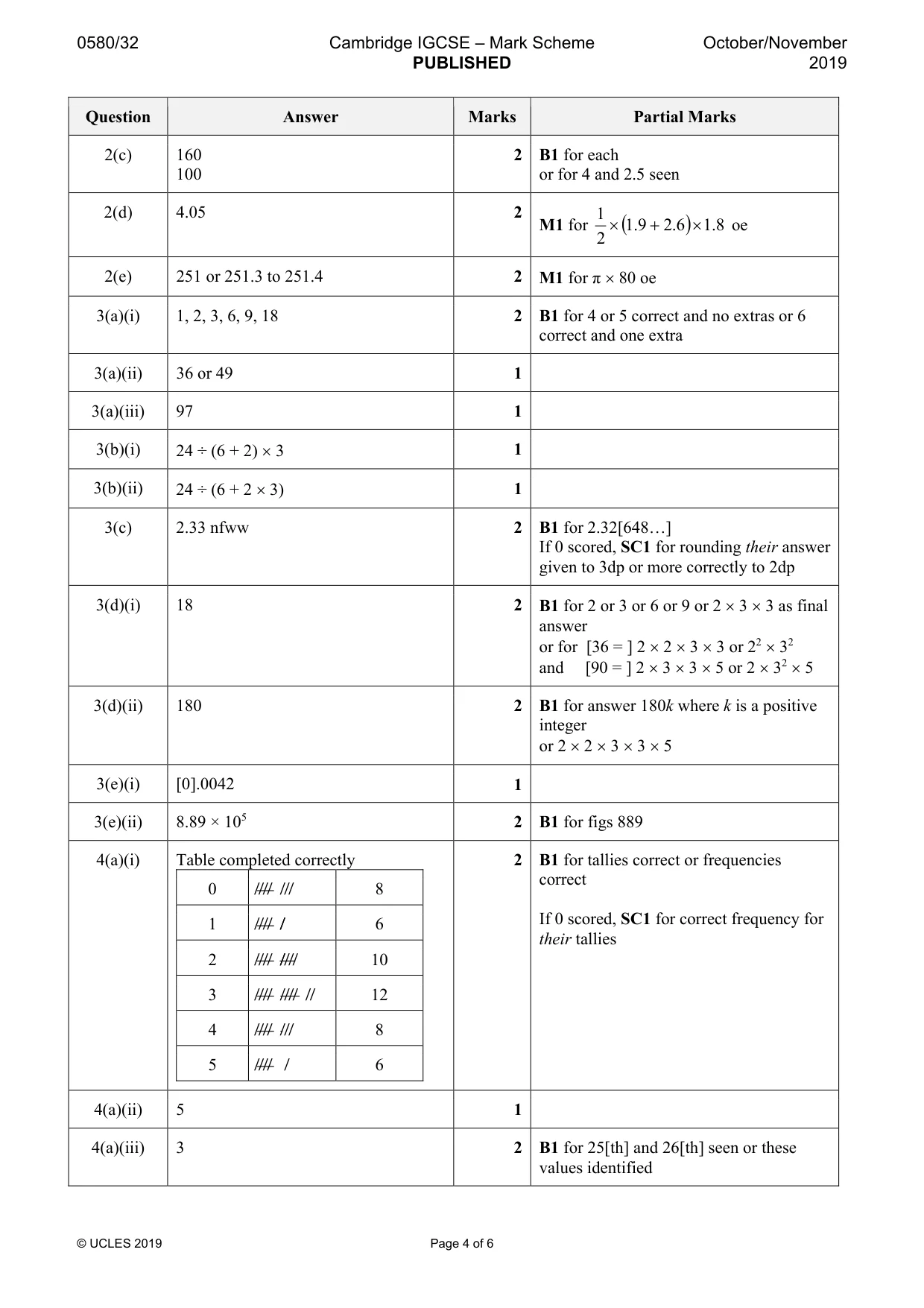
Mark scheme: 2(a) 47.85 2 B1 for one of first two values correct 15[.00] 65.75 2(b)(i) 12.9 2 M1 for 1.8 × 5.3 + 2.4 × (3.2 – 1.8) oe or 3.2 × 2.4 + 1.8 × (5.3 – 2.4) oe or 5.3 × 3.2 − (5.3 – 2.4) × (3.2 – 1.8) oe 2(b)(ii) 806.25 2 FT their (b)(i) × 62.5 M1 for their (b)(i) ÷ 8 × 500 oe 2(c) 160 2 B1 for each 100 or for 4 and 2.5 seen 2(d) 4.05 2 1 M1 for × (9.1 + 6.2 ) × 8.1 oe 2 2(e) 251 or 251.3 to 251.4 2 M1 for π × 80 oe
Q3 · Write down (i) all the factors of 18, ...................................................
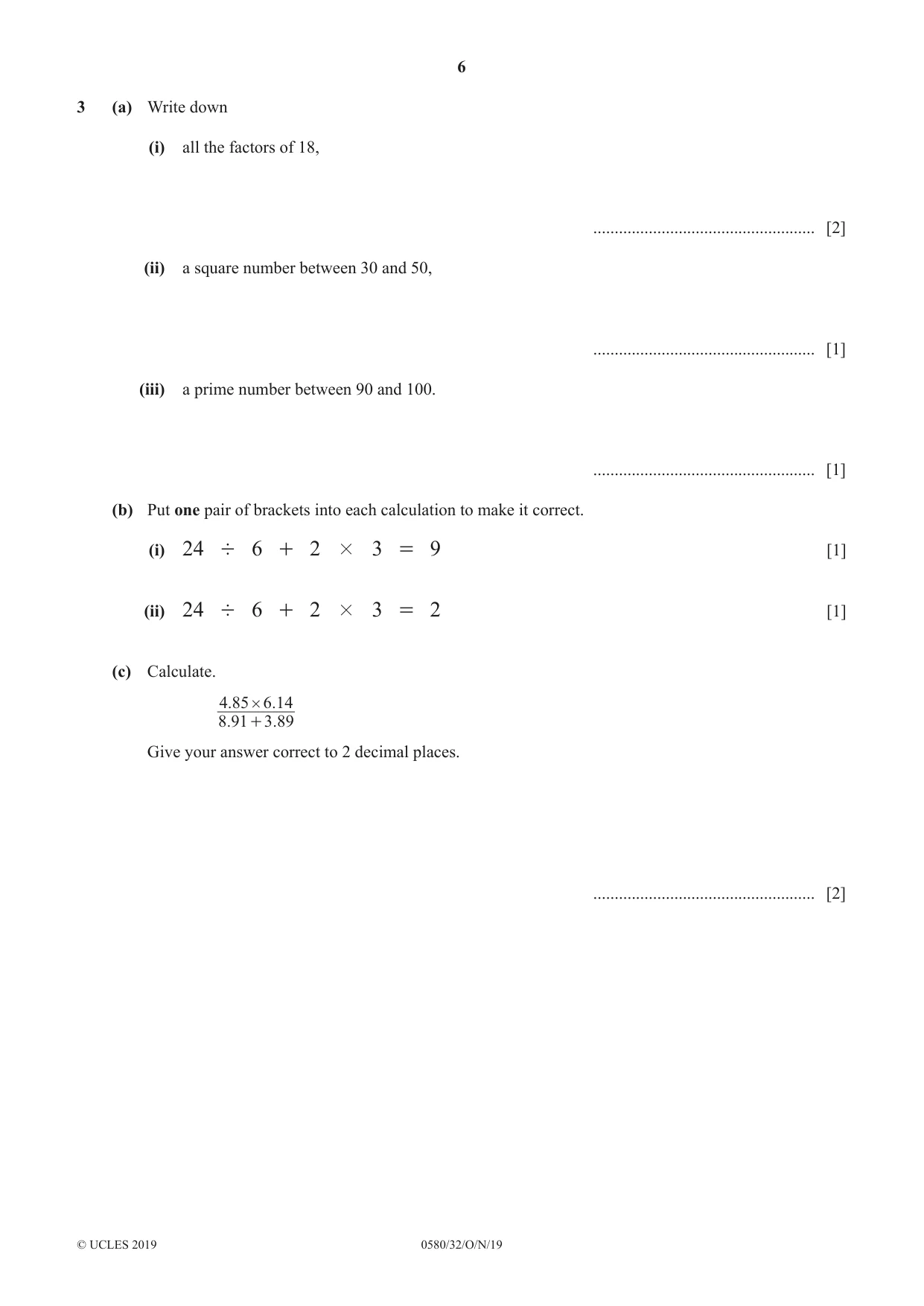
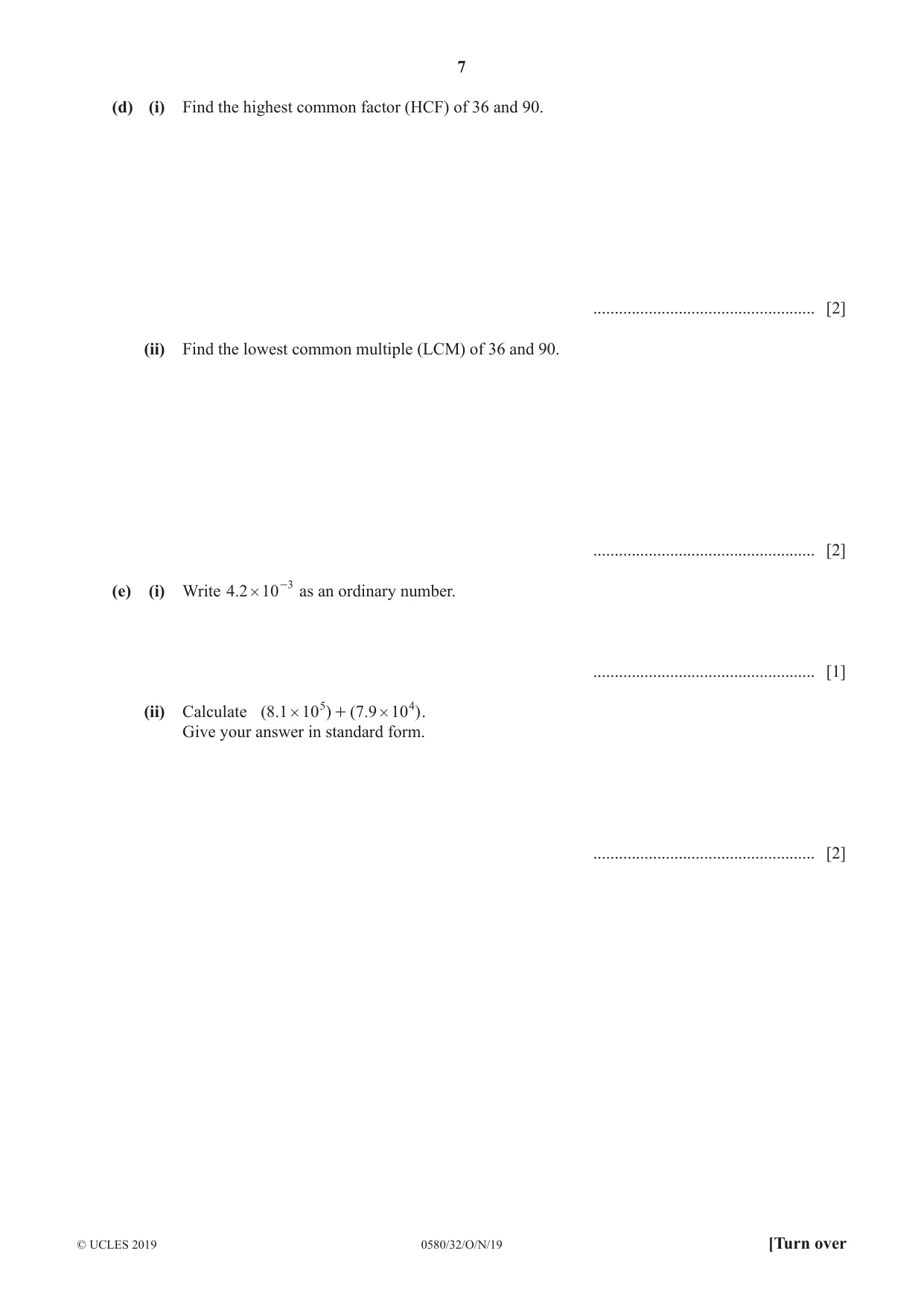
3 (a) Write down (i) all the factors of 18, .................................................... [2] (ii) a square number between 30 and 50, .................................................... [1] (iii) a prime number between 90 and 100. .................................................... [1] (b) Put one pair of brackets into each calculation to make it correct. (i) 24 ' 6 + 2 # 3 = 9 [1] (ii) 24 ' 6 + 2 # 3 = 2 [1] (c) Calculate. 4.85 # 6.14 8.91 + 3.89 Give your answer correct to 2 decimal places. .................................................... [2] (d) (i) Find the highest common factor (HCF) of 36 and 90. .................................................... [2] (ii) Find the lowest common multiple (LCM) of 36 and 90. .................................................... [2] (e) (i) Write .42 # 10 -3 as an ordinary number. .................................................... [1] (ii) Calculate (8. 1 # 10 5 ) + ( 7. 9 # 10 4 ) . Give your answer in standard form. .................................................... [2]
Mark scheme: 3(a)(i) 1, 2, 3, 6, 9, 18 2 B1 for 4 or 5 correct and no extras or 6 correct and one extra 3(a)(ii) 36 or 49 1 3(a)(iii) 97 1 3(b)(i) 24 ÷ (6 + 2) × 3 1 3(b)(ii) 24 ÷ (6 + 2 × 3) 1 3(c) 2.33 nfww 2 B1 for 2.32[648…] If 0 scored, SC1 for rounding their answer given to 3dp or more correctly to 2dp 3(d)(i) 18 2 B1 for 2 or 3 or 6 or 9 or 2 × 3 × 3 as final answer or for [36 = ] 2 × 2 × 3 × 3 or 22 × 32 and [90 = ] 2 × 3 × 3 × 5 or 2 × 32 × 5 3(d)(ii) 180 2 B1 for answer 180k where k is a positive integer or 2 × 2 × 3 × 3 × 5 3(e)(i) [0].0042 1 3(e)(ii) 8.89 × 10⁵ 2 B1 for figs 889
Q4 · 50 students each record the number of glasses of water they drink in one day
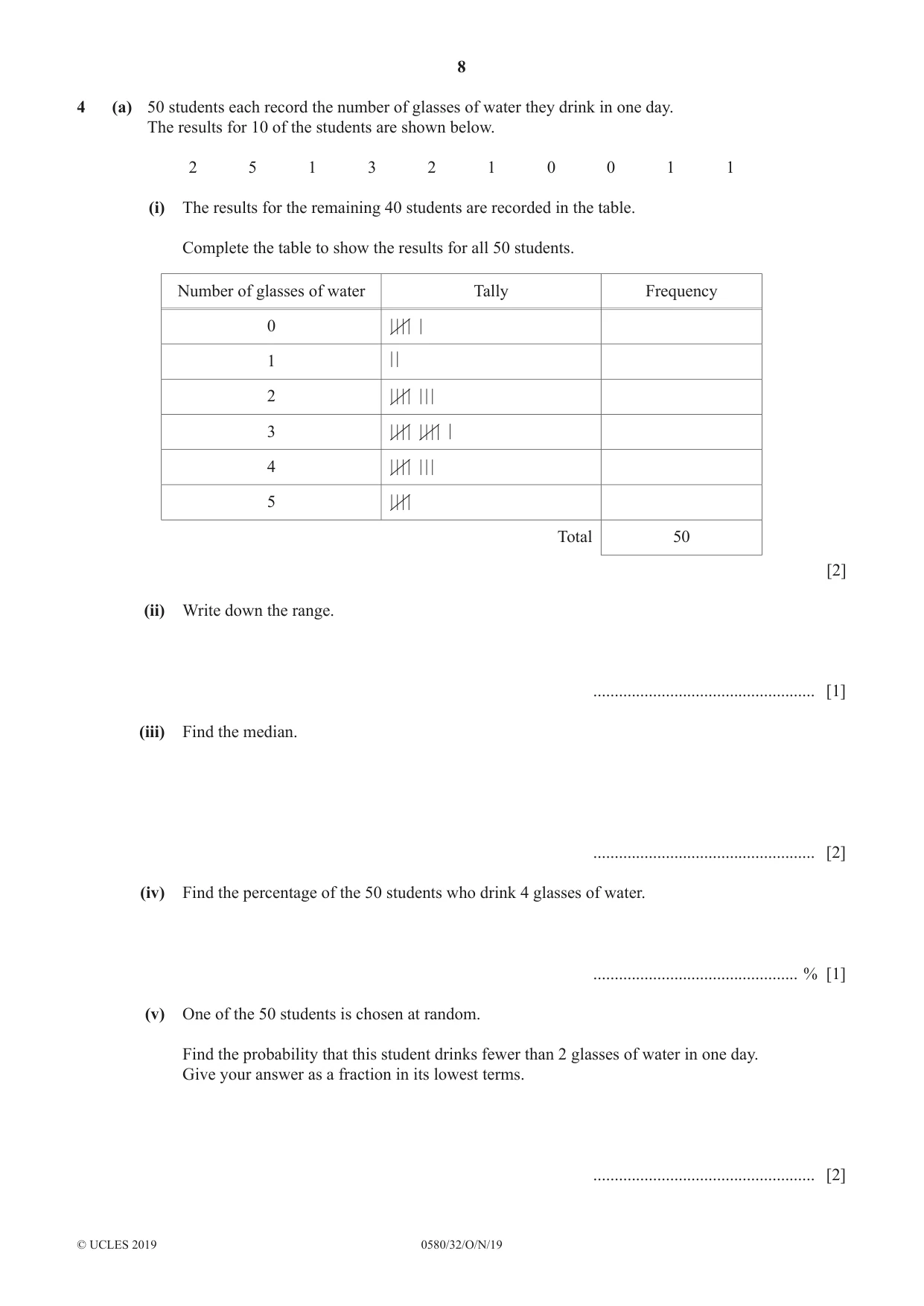
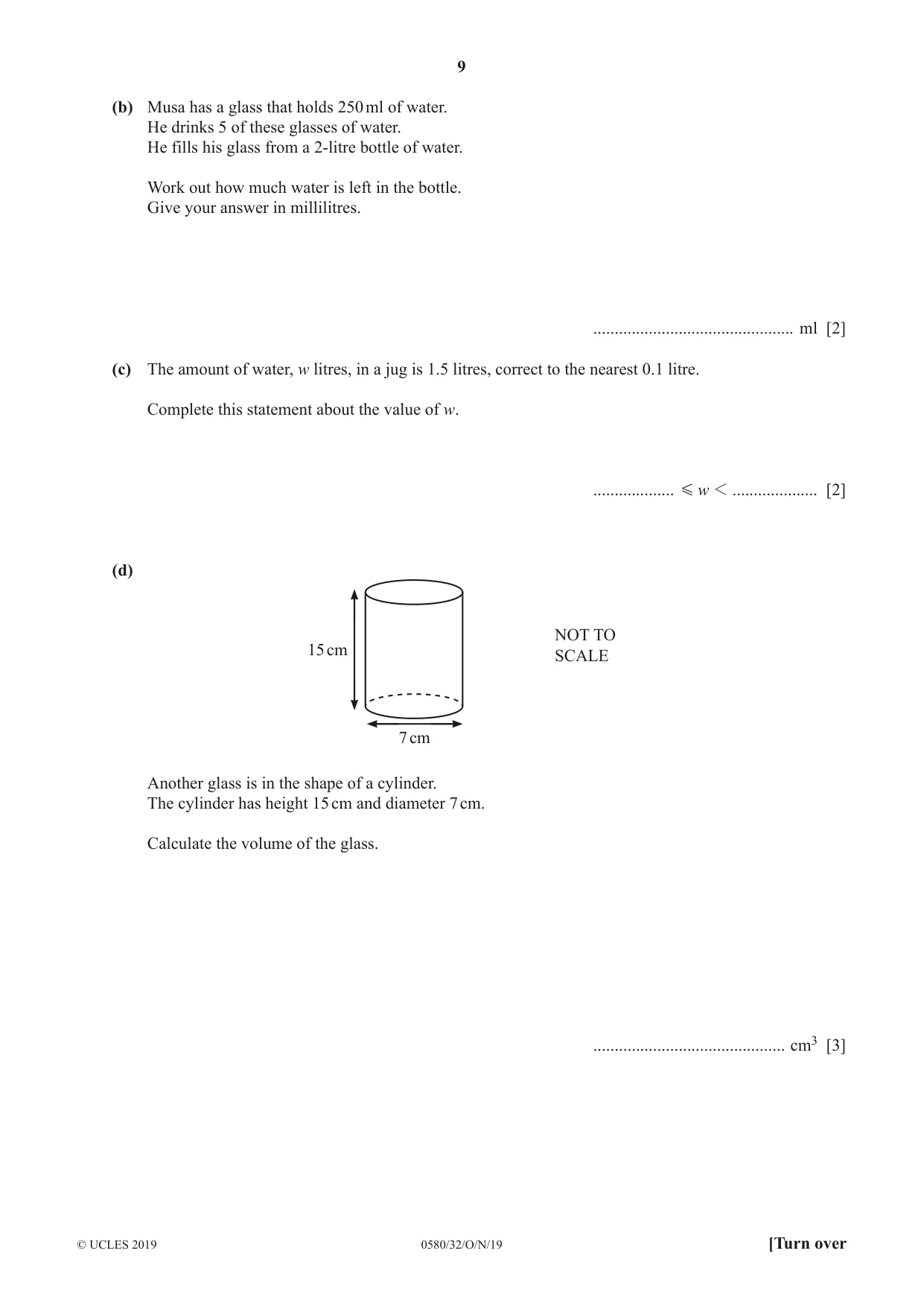
4 (a) 50 students each record the number of glasses of water they drink in one day. The results for 10 of the students are shown below. 2 5 1 3 2 1 0 0 1 1 (i) The results for the remaining 40 students are recorded in the table. Complete the table to show the results for all 50 students. Number of glasses of water Tally Frequency 0 | | | | | 1 | | 2 | | | | | | | 3 | | | | | | | | | 4 | | | | | | | 5 | | | | Total 50 [2] (ii) Write down the range. .................................................... [1] (iii) Find the median. .................................................... [2] (iv) Find the percentage of the 50 students who drink 4 glasses of water. ................................................ % [1] (v) One of the 50 students is chosen at random. Find the probability that this student drinks fewer than 2 glasses of water in one day. Give your answer as a fraction in its lowest terms. .................................................... [2] (b) Musa has a glass that holds 250 ml of water. He drinks 5 of these glasses of water. He fills his glass from a 2-litre bottle of water. Work out how much water is left in the bottle. Give your answer in millilitres. ............................................... ml [2] (c) The amount of water, w litres, in a jug is 1.5 litres, correct to the nearest 0.1 litre. Complete this statement about the value of w. ................... G w 1 .................... [2] (d) NOT TO 15 cm SCALE 7 cm Another glass is in the shape of a cylinder. The cylinder has height 15 cm and diameter 7 cm. Calculate the volume of the glass. ............................................. cm3 [3]
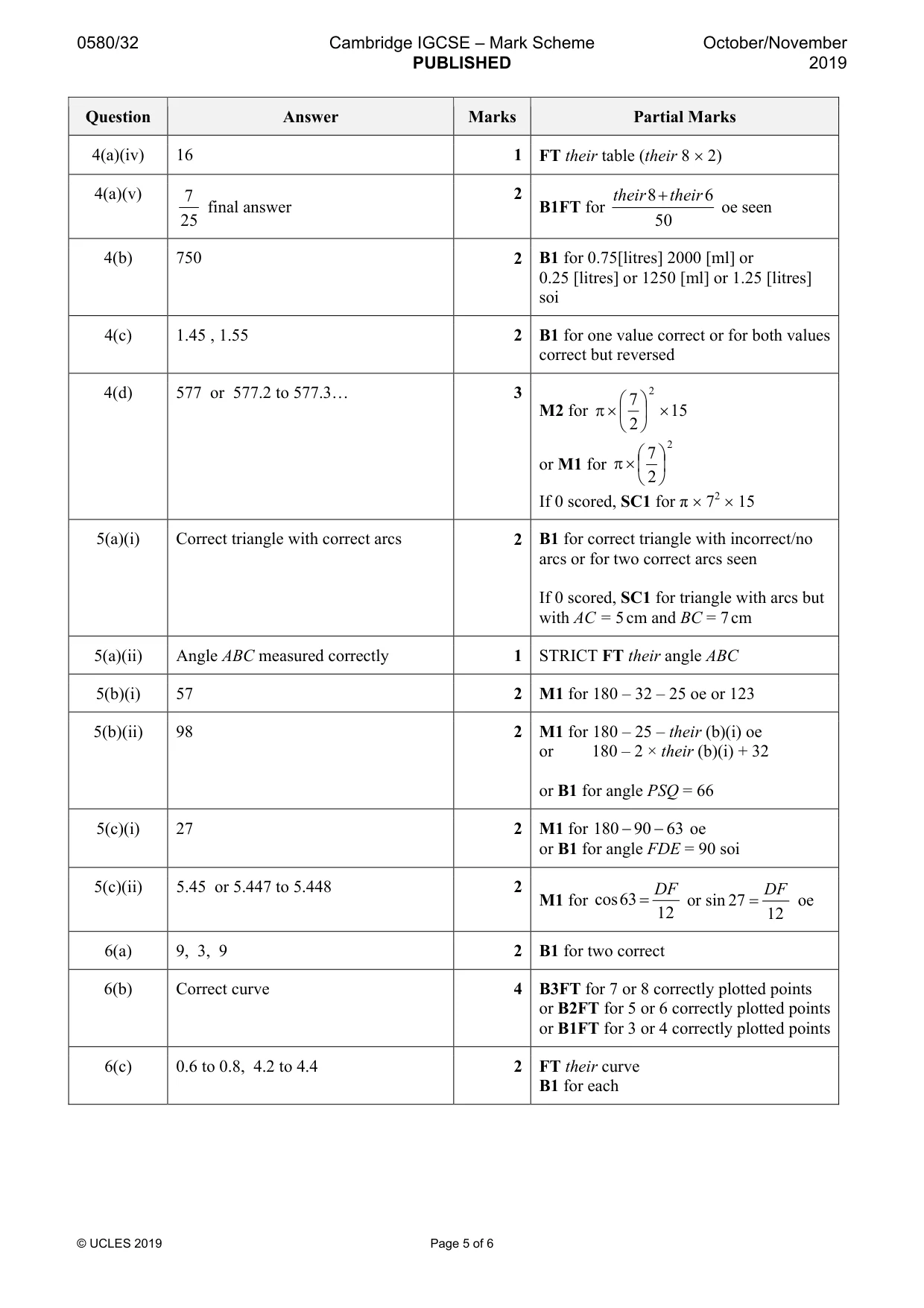
Mark scheme: 4(a)(i) Table completed correctly 2 B1 for tallies correct or frequencies correct 0 ̸ ̸ ̸ 8 If 0 scored, SC1 for correct frequency for 1 ̸ ̸ 6 their tallies 2 ̸ ̸ ̸ ̸ 10 3 ̸ ̸ ̸ ̸ ̸ 12 4 ̸ ̸ ̸ 8 5 ̸ ̸ 6 4(a)(ii) 5 1 4(a)(iii) 3 2 B1 for 25[th] and 26[th] seen or these values identified 4(a)(iv) 16 1 FT their table (their 8 × 2) 4(a)(v) 7 2 their 8 + their 6 final answer B1FT for oe seen 25 50 4(b) 750 2 B1 for 0.75[litres] 2000 [ml] or 0.25 [litres] or 1250 [ml] or 1.25 [litres] soi 4(c) 1.45 , 1.55 2 B1 for one value correct or for both values correct but reversed 4(d) 577 or 577.2 to 577.3… 3 2 7 M2 for π × × 15 2 7 2 or M1 for π × 2 If 0 scored, SC1 for π × 72 × 15
Q5 · In triangle ABC, AC = 7 cm and BC = 5 cm
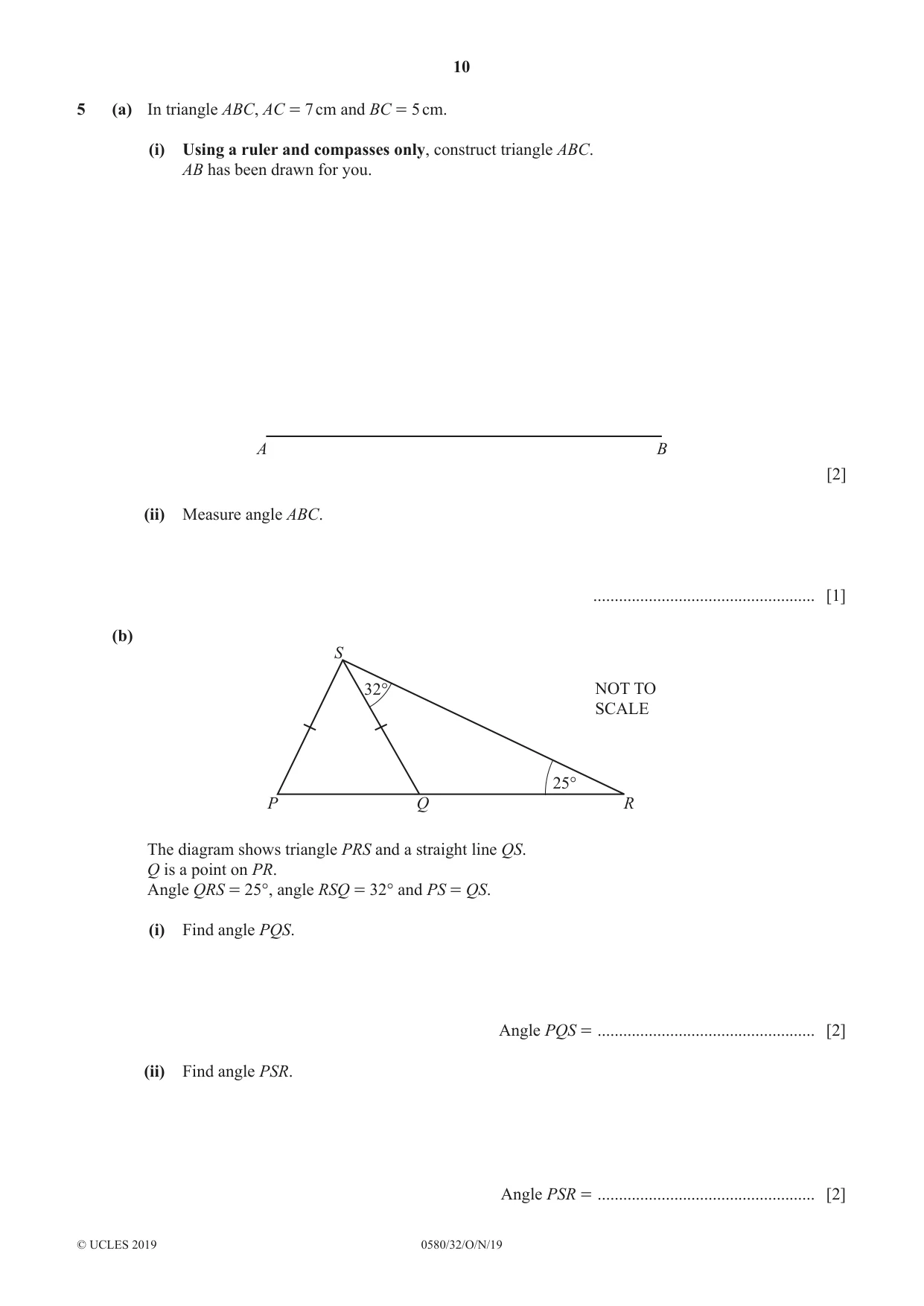
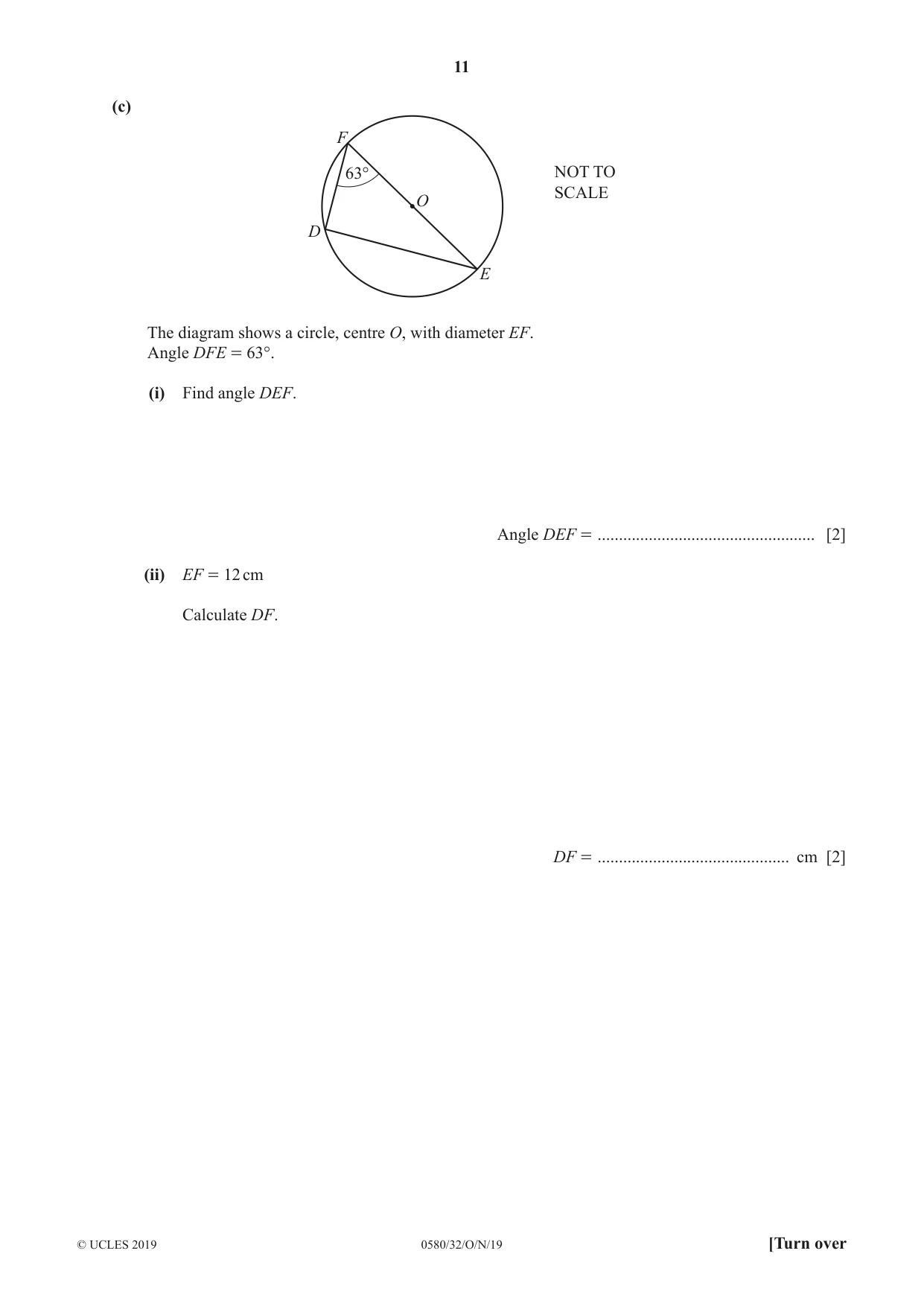
5 (a) In triangle ABC, AC = 7 cm and BC = 5 cm. (i) Using a ruler and compasses only, construct triangle ABC. AB has been drawn for you. A B [2] (ii) Measure angle ABC. .................................................... [1] (b) S 32° NOT TO SCALE 25° P Q R The diagram shows triangle PRS and a straight line QS. Q is a point on PR. Angle QRS = 25°, angle RSQ = 32° and PS = QS. (i) Find angle PQS. Angle PQS = ................................................... [2] (ii) Find angle PSR. Angle PSR = ................................................... [2] (c) F 63° NOT TO SCALE O D E The diagram shows a circle, centre O, with diameter EF. Angle DFE = 63°. (i) Find angle DEF. Angle DEF = ................................................... [2] (ii) EF = 12 cm Calculate DF. DF = ............................................. cm [2]
Mark scheme: 5(a)(i) Correct triangle with correct arcs 2 B1 for correct triangle with incorrect/no arcs or for two correct arcs seen If 0 scored, SC1 for triangle with arcs but with AC = 5 cm and BC = 7 cm 5(a)(ii) Angle ABC measured correctly 1 STRICT FT their angle ABC 5(b)(i) 57 2 M1 for 180 – 32 – 25 oe or 123 5(b)(ii) 98 2 M1 for 180 – 25 – their (b)(i) oe or 180 – 2 × their (b)(i) + 32 or B1 for angle PSQ = 66 5(c)(i) 27 2 M1 for 180 − 90 − 63 oe or B1 for angle FDE = 90 soi 5(c)(ii) 5.45 or 5.447 to 5.448 2 DF DF M1 for cos 63 = or sin 27 = oe 12 12
Q6 · Complete the table of values for y = x 2 - 5x + 3
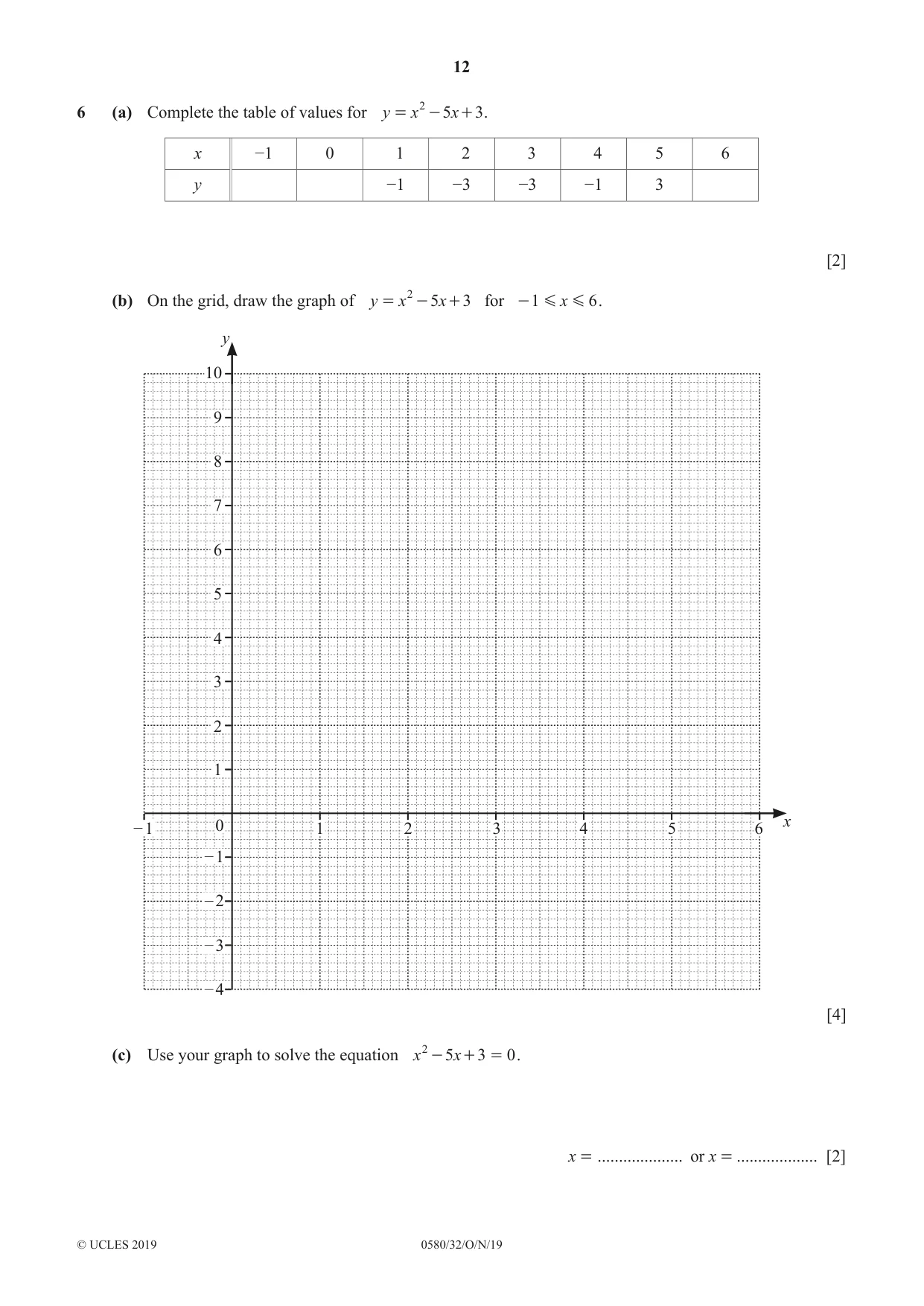
6 (a) Complete the table of values for y = x 2 - 5x + 3 . x −1 0 1 2 3 4 5 6 y −1 −3 −3 −1 3 [2] (b) On the grid, draw the graph of y = x 2 - 5x + 3 for - 1 G x G 6 . y 10 9 8 7 6 5 4 3 2 1 x – 1 0 1 2 3 4 5 6 – 1 – 2 – 3 – 4 [4] (c) Use your graph to solve the equation x 2 - 5x + 3 = 0 . x = .................... or x = ................... [2]
Mark scheme: 6(a) 9, 3, 9 2 B1 for two correct 6(b) Correct curve 4 B3FT for 7 or 8 correctly plotted points or B2FT for 5 or 6 correctly plotted points or B1FT for 3 or 4 correctly plotted points 6(c) 0.6 to 0.8, 4.2 to 4.4 2 FT their curve B1 for each
Q7 · Here are the first four terms of a sequence
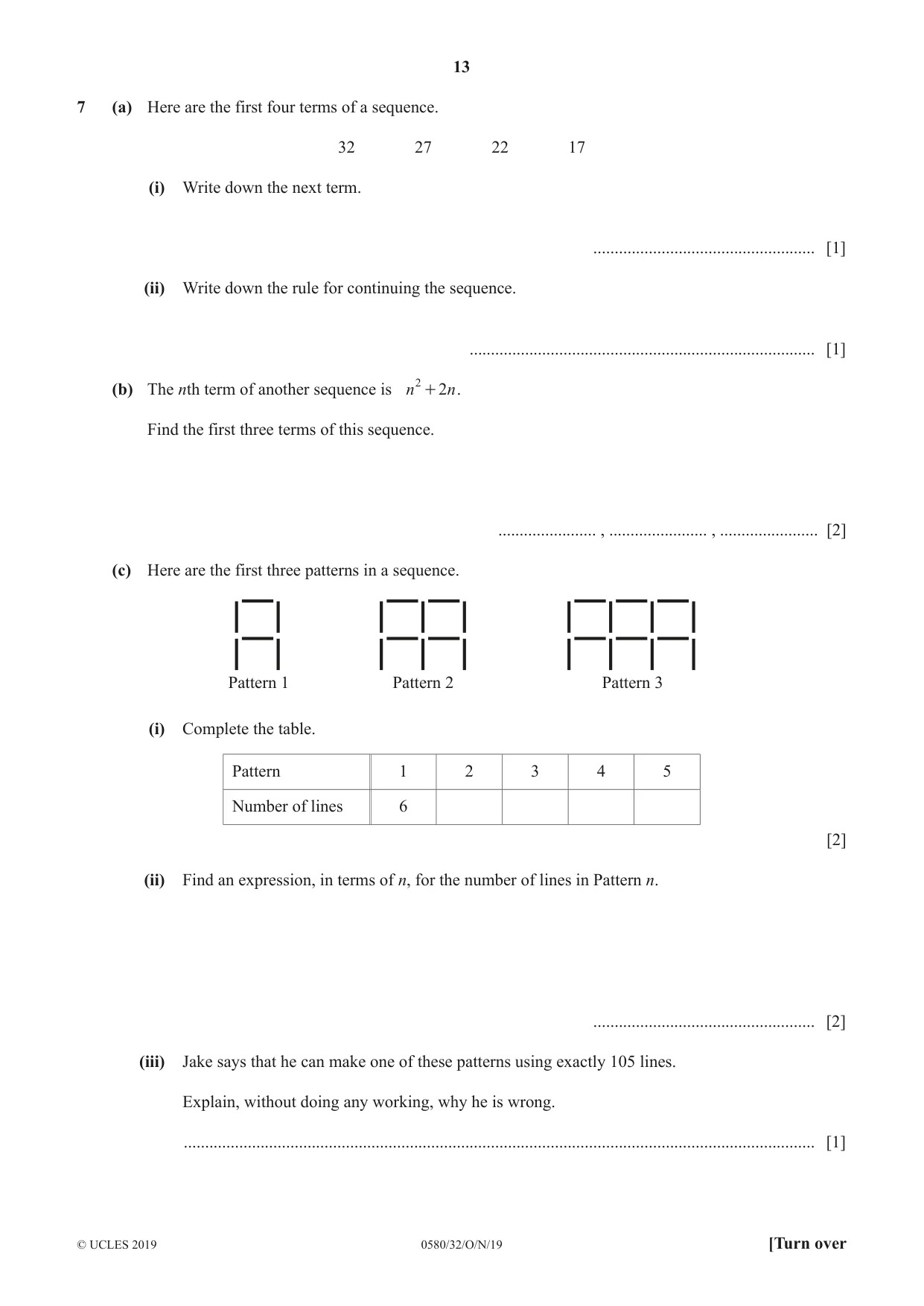
7 (a) Here are the first four terms of a sequence. 32 27 22 17 (i) Write down the next term. .................................................... [1] (ii) Write down the rule for continuing the sequence. ................................................................................. [1] (b) The nth term of another sequence is n 2 + 2 n . Find the first three terms of this sequence. ....................... , ....................... , ....................... [2] (c) Here are the first three patterns in a sequence. Pattern 1 Pattern 2 Pattern 3 (i) Complete the table. Pattern 1 2 3 4 5 Number of lines 6 [2] (ii) Find an expression, in terms of n, for the number of lines in Pattern n. .................................................... [2] (iii) Jake says that he can make one of these patterns using exactly 105 lines. Explain, without doing any working, why he is wrong. .................................................................................................................................................... [1]
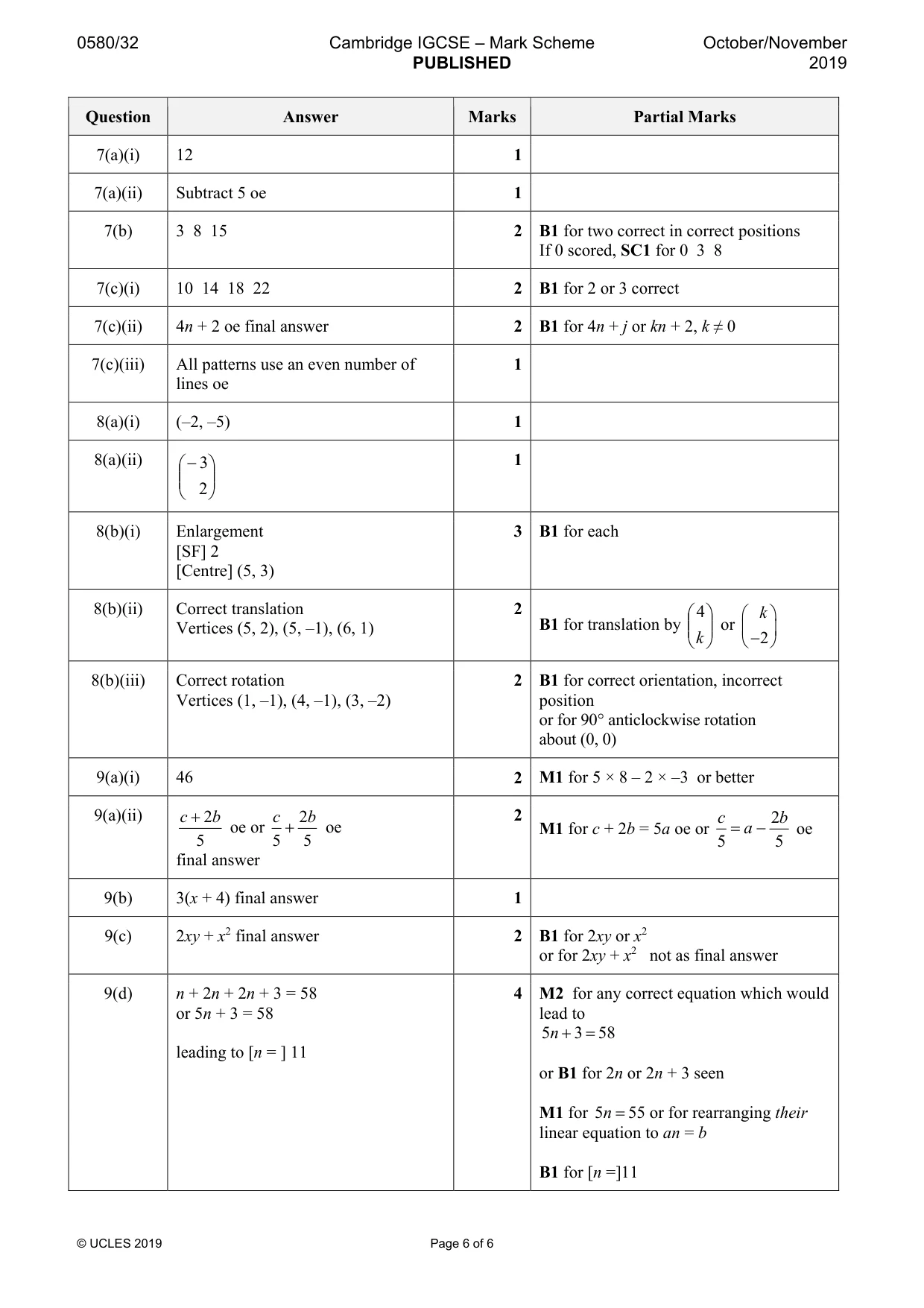
Mark scheme: 7(a)(i) 12 1 7(a)(ii) Subtract 5 oe 1 7(b) 3 8 15 2 B1 for two correct in correct positions If 0 scored, SC1 for 0 3 8 7(c)(i) 10 14 18 22 2 B1 for 2 or 3 correct 7(c)(ii) 4n + 2 oe final answer 2 B1 for 4n + j or kn + 2, k ≠ 0 7(c)(iii) All patterns use an even number of 1 lines oe
Q8 · The diagram shows two triangles, A and B, and two points P and Q
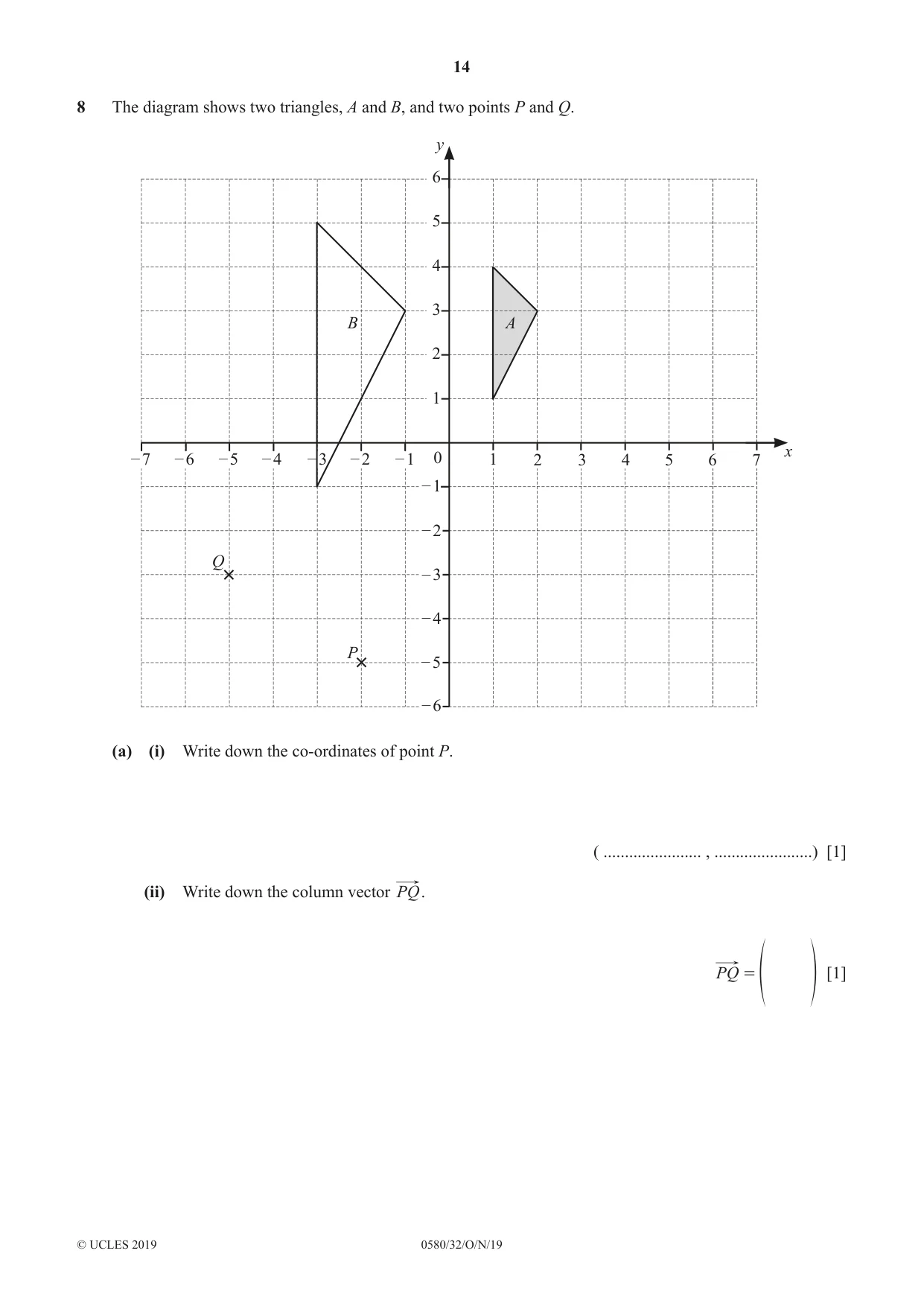
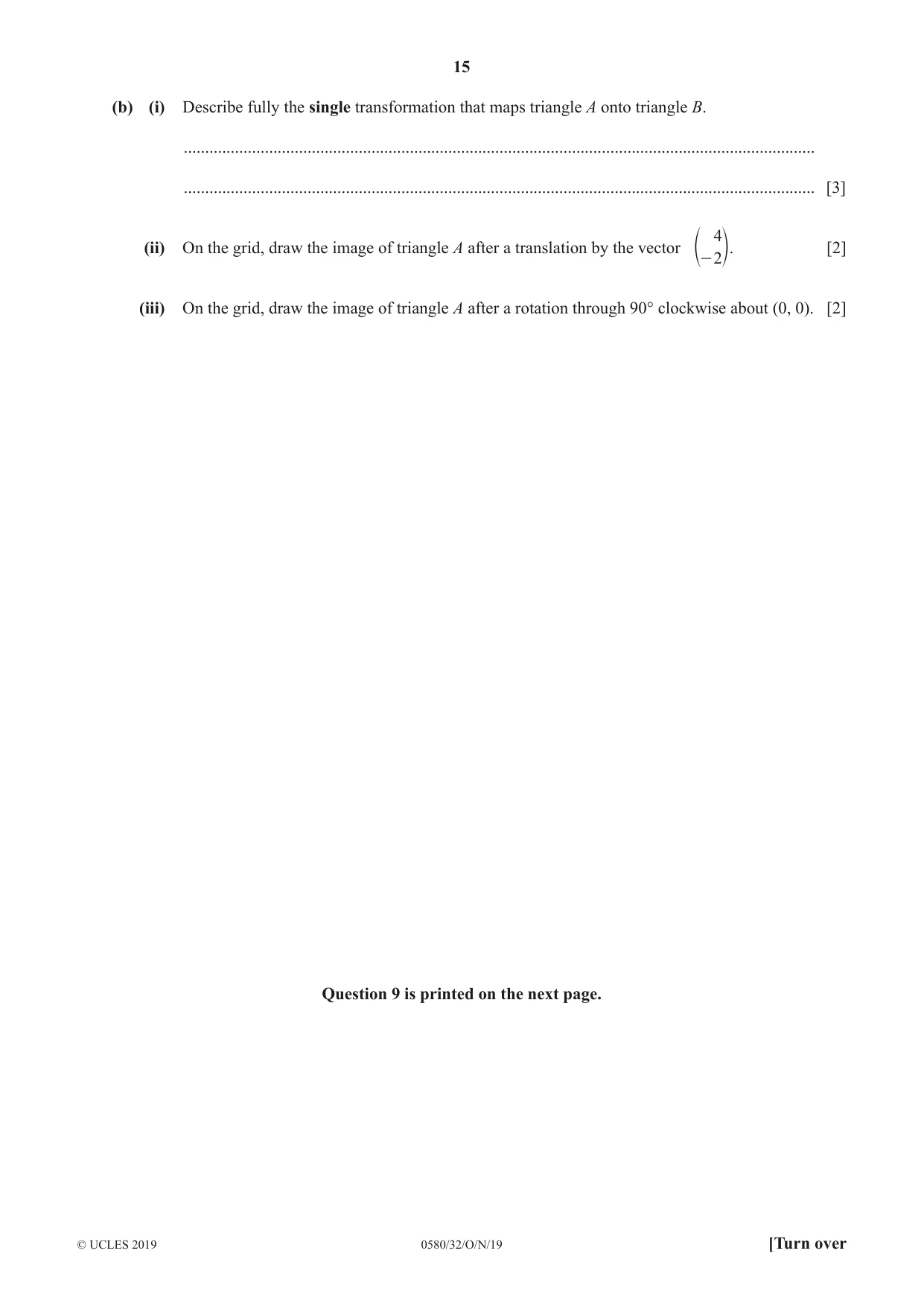
8 The diagram shows two triangles, A and B, and two points P and Q. y 6 5 4 3 B A 2 1 x – 7 – 6 – 5 – 4 – 3 – 2 – 1 0 1 2 3 4 5 6 7 – 1 – 2 Q – 3 – 4 P – 5 – 6 (a) (i) Write down the co-ordinates of point P. ( ....................... , .......................) [1] (ii) Write down the column vector PQ. PQ = [1] f p (b) (i) Describe fully the single transformation that maps triangle A onto triangle B. .................................................................................................................................................... .................................................................................................................................................... [3] 4 (ii) On the grid, draw the image of triangle A after a translation by the vector [2] e- 2o. (iii) On the grid, draw the image of triangle A after a rotation through 90° clockwise about (0, 0). [2] Question 9 is printed on the next page.
Mark scheme: 8(a)(i) (–2, –5) 1 8(a)(ii) − 3 1 2 8(b)(i) Enlargement 3 B1 for each [SF] 2 [Centre] (5, 3) 8(b)(ii) Correct translation 2 4 k Vertices (5, 2), (5, –1), (6, 1) B1 for translation by or k − 2 8(b)(iii) Correct rotation 2 B1 for correct orientation, incorrect Vertices (1, –1), (4, –1), (3, –2) position or for 90° anticlockwise rotation about (0, 0)
Q9 · C = 5 a - 2b (i) Find the value of c when a = 8 and b = −3
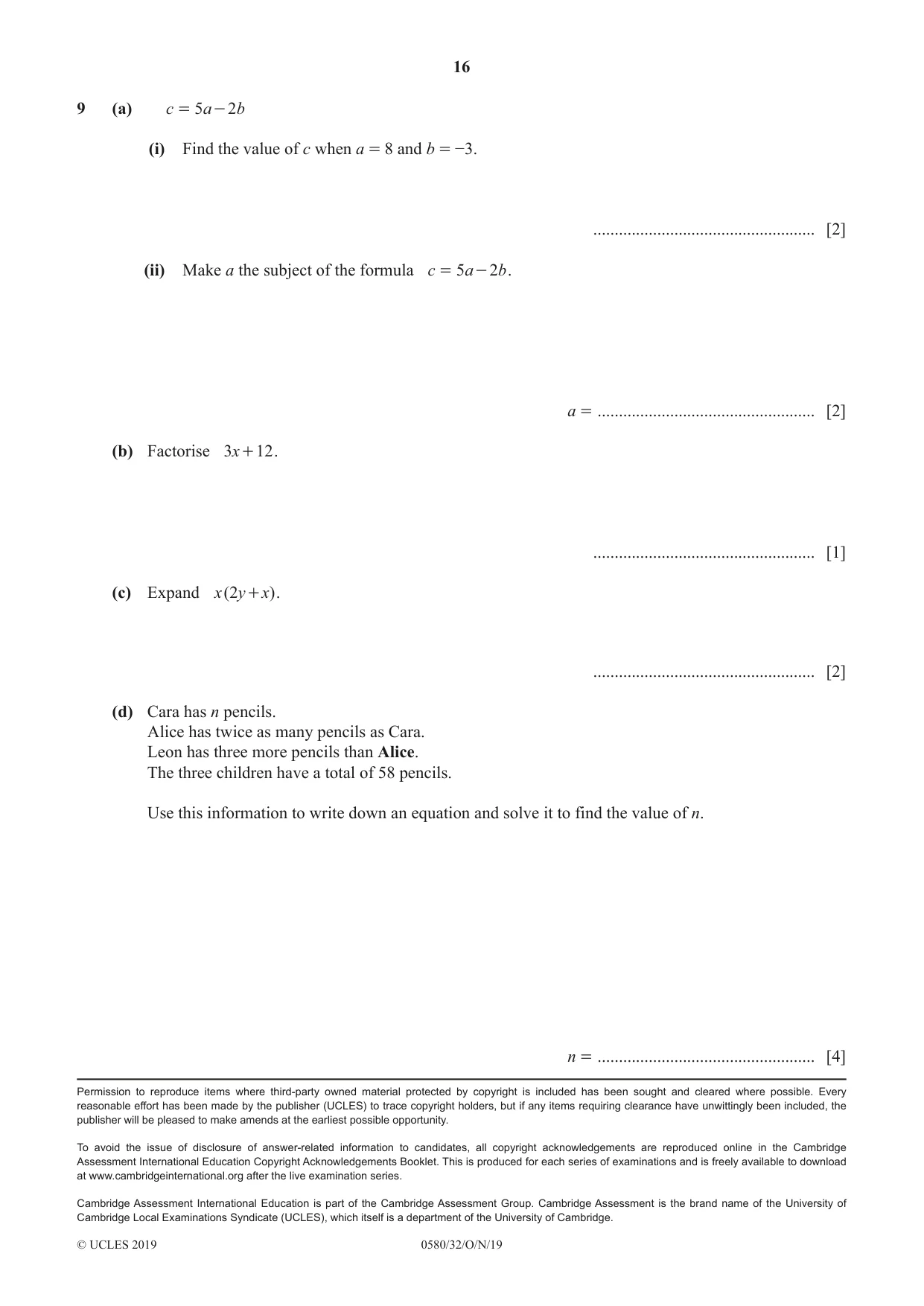
9 (a) c = 5 a - 2b (i) Find the value of c when a = 8 and b = −3. .................................................... [2] (ii) Make a the subject of the formula c = 5 a - 2 b . a = ................................................... [2] (b) Factorise 3x + 12 . .................................................... [1] (c) Expand x (2 y + x) . .................................................... [2] (d) Cara has n pencils. Alice has twice as many pencils as Cara. Leon has three more pencils than Alice. The three children have a total of 58 pencils. Use this information to write down an equation and solve it to find the value of n. n = ................................................... [4]
Mark scheme: 9(a)(i) 46 2 M1 for 5 × 8 – 2 × –3 or better 9(a)(ii) c + 2b c 2b 2 c 2b oe or + oe M1 for c + 2b = 5a oe or = a − oe 5 5 5 5 5 final answer 9(b) 3(x + 4) final answer 1 9(c) 2xy + x2 final answer 2 B1 for 2xy or x2 or for 2xy + x2 not as final answer 9(d) n + 2n + 2n + 3 = 58 4 M2 for any correct equation which would or 5n + 3 = 58 lead to 5n + 3 = 58 leading to [n = ] 11 or B1 for 2n or 2n + 3 seen M1 for 5n = 55 or for rearranging their linear equation to an = b B1 for [n =]11
What was in this paper
The subtopics covered by these 9 questions, and how many questions each got. Open one in a new tab to see every Cambridge question on it.
What you needed in this session
Cambridge’s own grade thresholds for 2019 Oct/Nov, Paper 3 · Variant 2. A higher threshold means an easier paper — the bar moves with how the cohort did.