Cambridge IGCSE Mathematics 0580 — 2019 Oct/Nov Paper 3 · Variant 3
0580/33/O/N/19 · 9 questions · 104 marks · ≈117 min
The question paper and its mark scheme, free to read here and free to download. This is Cambridge’s own paper, exactly as it was sat.
Question paper16 pages
Mark scheme7 pages
Answers below. Sit the paper first if you are practising.
Questions as text
Q1 · Write as a decimal
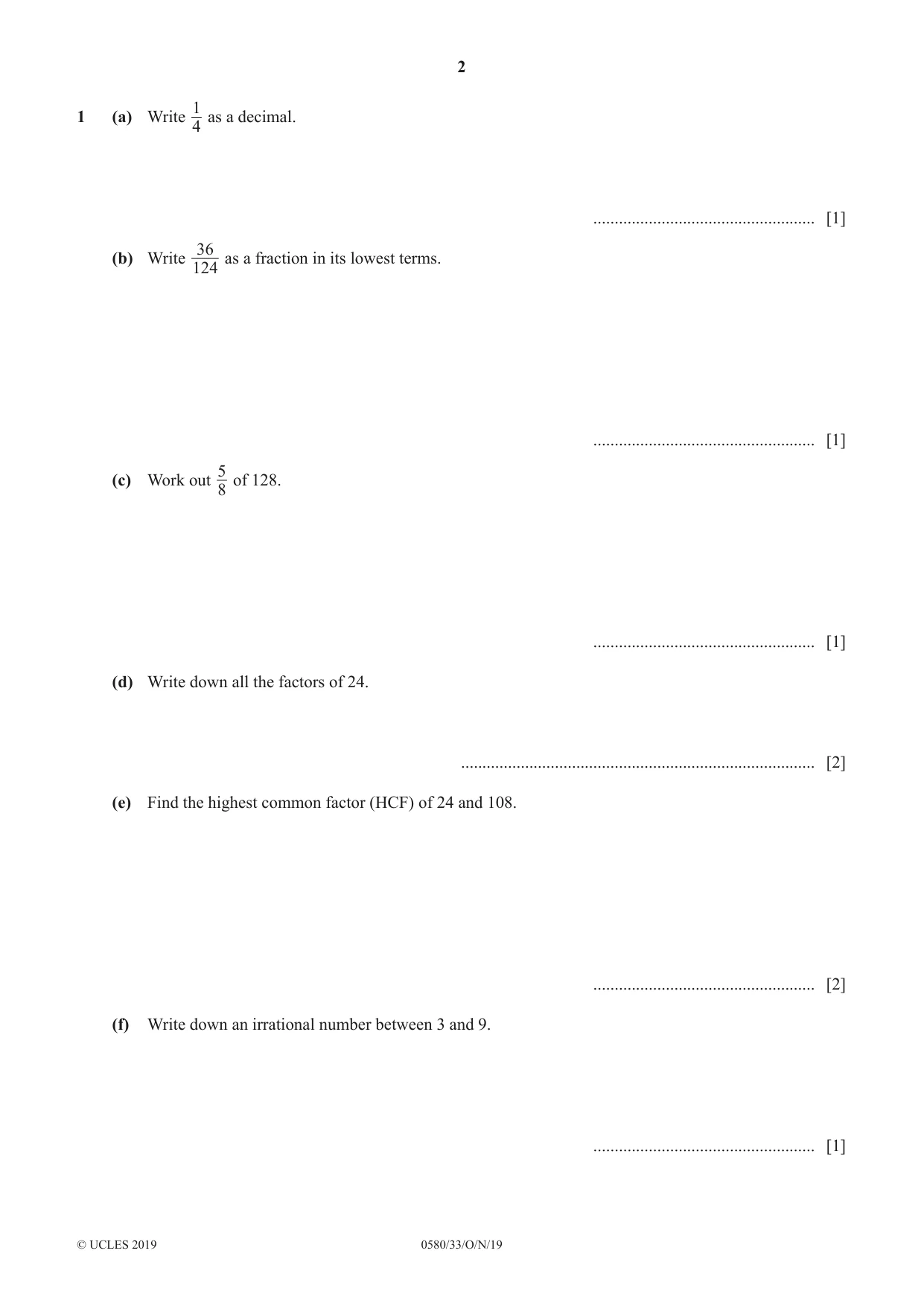
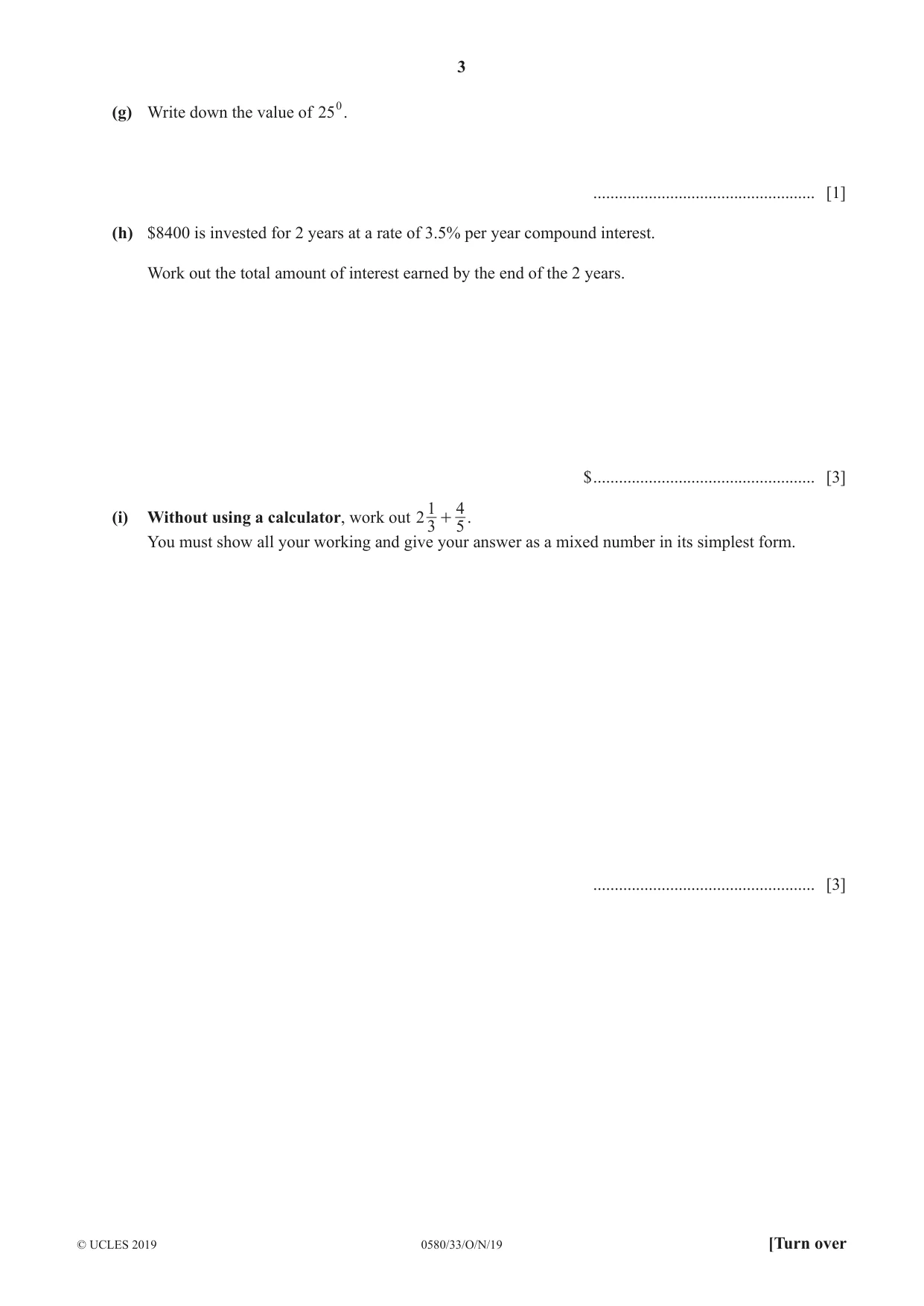
11 (a) Write as a decimal. 4 .................................................... [1] 36 (b) Write as a fraction in its lowest terms. 124 .................................................... [1] 5 (c) Work out of 128. 8 .................................................... [1] (d) Write down all the factors of 24. ................................................................................... [2] (e) Find the highest common factor (HCF) of 24 and 108. .................................................... [2] (f) Write down an irrational number between 3 and 9. .................................................... [1] (g) Write down the value of 250. .................................................... [1] (h) $8400 is invested for 2 years at a rate of 3.5% per year compound interest. Work out the total amount of interest earned by the end of the 2 years. $ .................................................... [3] 1 4(i) Without using a calculator, work out 2 + . 3 5 You must show all your working and give your answer as a mixed number in its simplest form. .................................................... [3]
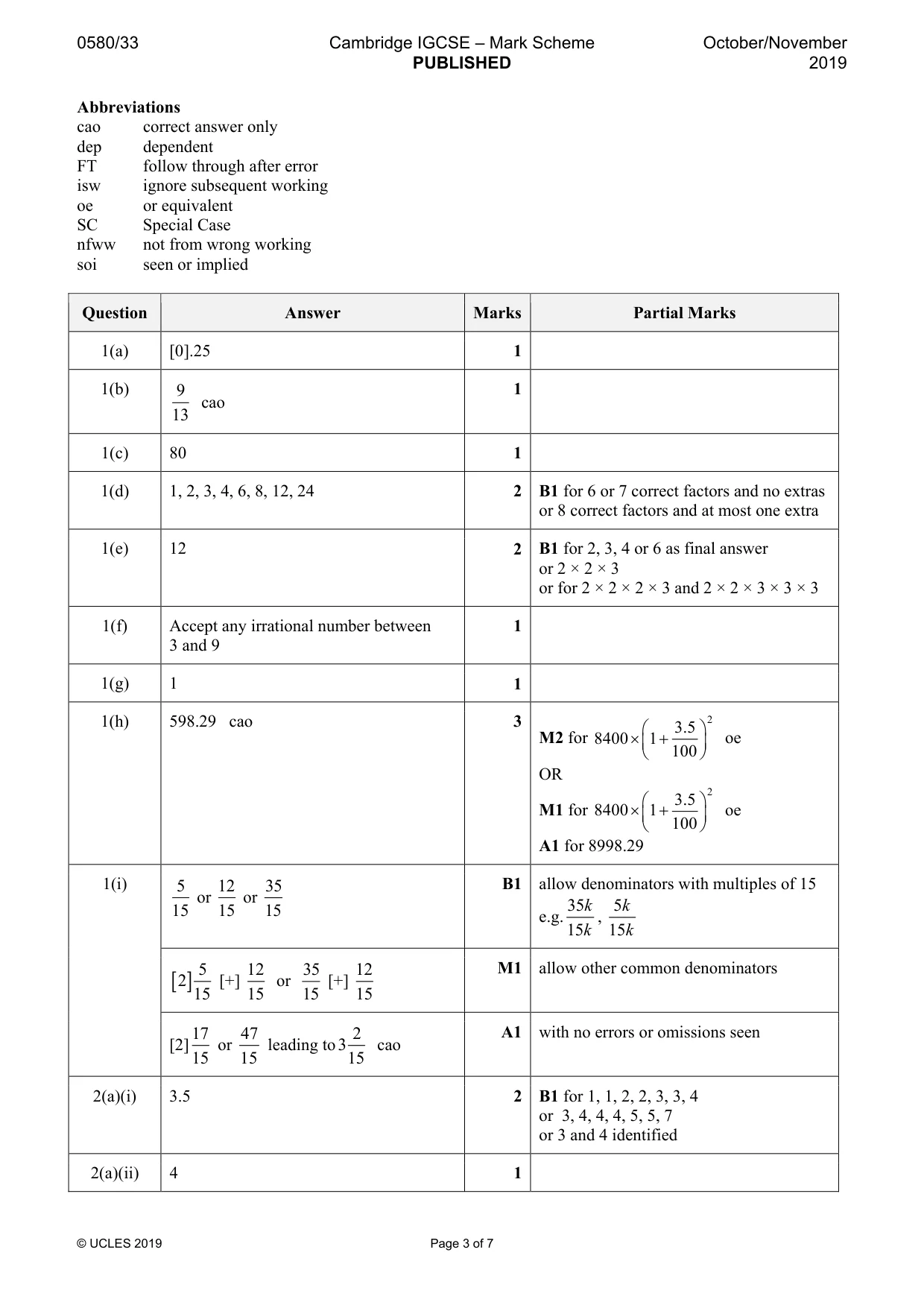
Mark scheme: Question Answer Marks Partial Marks 1(a) [0].25 1 1(b) 9 1 cao 13 1(c) 80 1 1(d) 1, 2, 3, 4, 6, 8, 12, 24 2 B1 for 6 or 7 correct factors and no extras or 8 correct factors and at most one extra 1(e) 12 2 B1 for 2, 3, 4 or 6 as final answer or 2 × 2 × 3 or for 2 × 2 × 2 × 3 and 2 × 2 × 3 × 3 × 3 1(f) Accept any irrational number between 1 3 and 9 1(g) 1 1 1(h) 598.29 cao 3 2 3.5 M2 for 8400 × 1 + oe 100 OR 3.5 2 M1 for 8400 × 1 + oe 100 A1 for 8998.29 1(i) 5 12 35 B1 allow denominators with multiples of 15 or or 35k 5 k 15 15 15 e.g. , 15k 15 k 5 12 35 12 M1 allow other common denominators [ 2 ] [+] or [+] 15 15 15 15 [2]17 or 47 leading to 2 cao A1 with no errors or omissions seen 15 15 315
Q2 · Emma records the number of letters in each word in a sentence
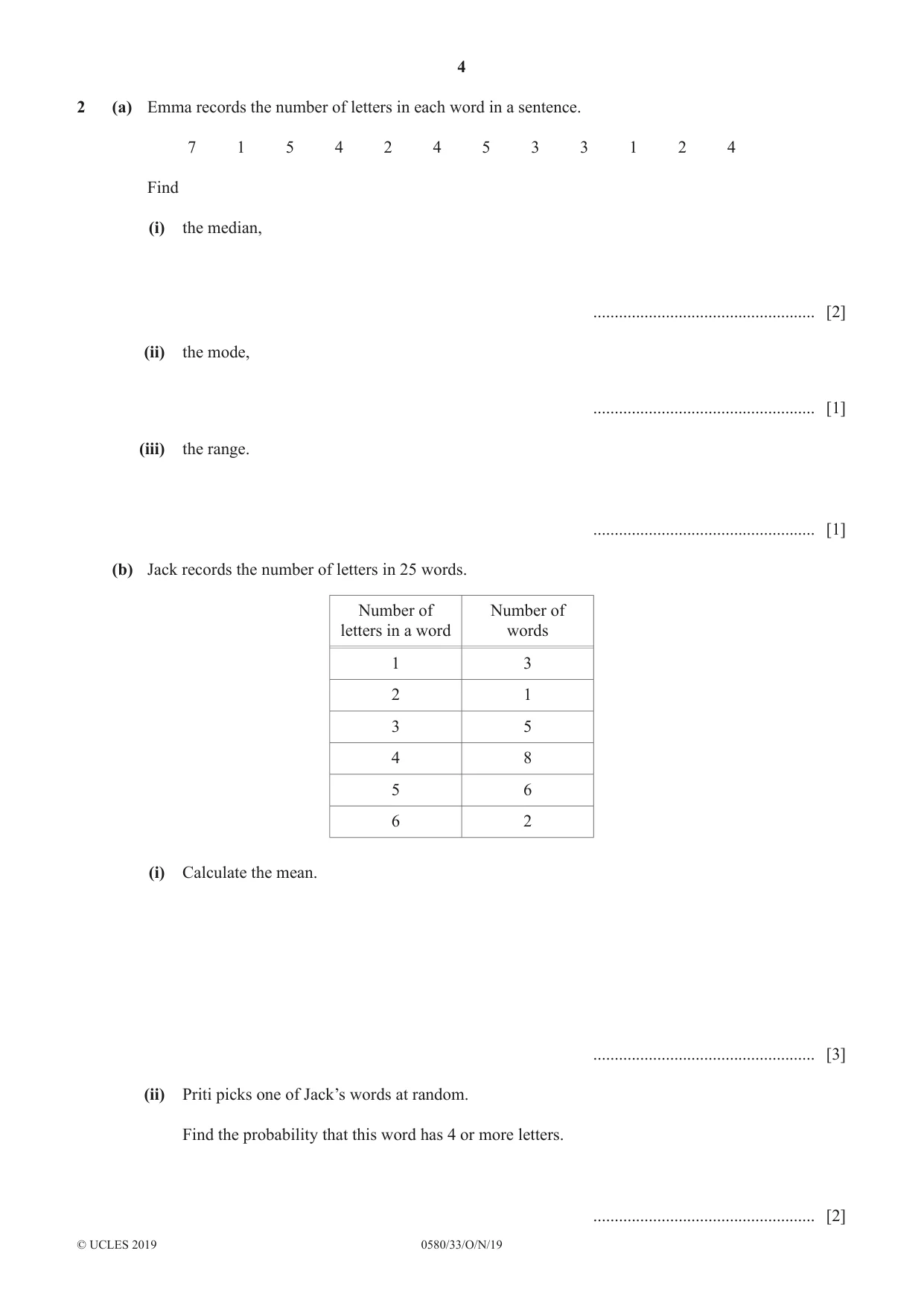
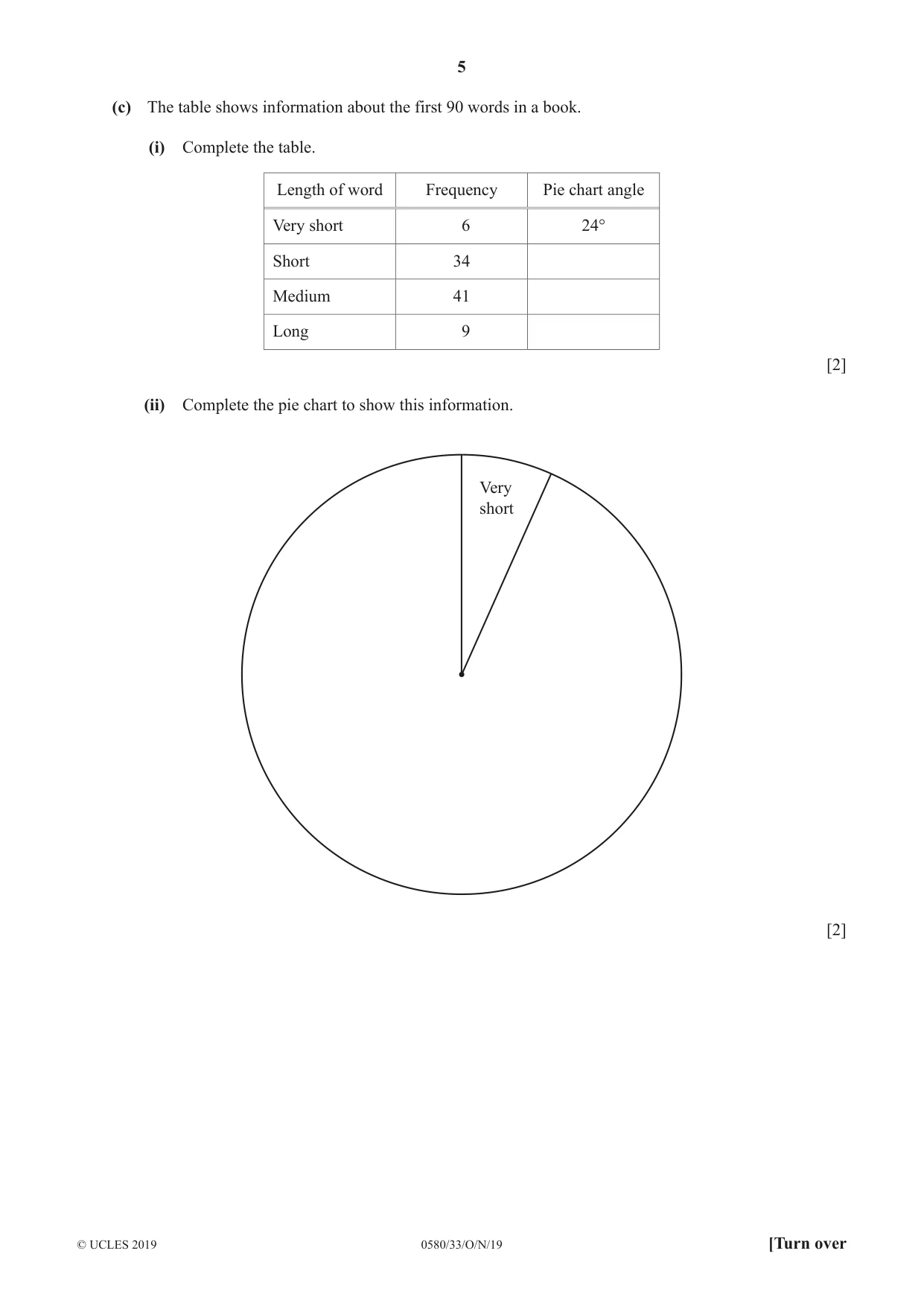
2 (a) Emma records the number of letters in each word in a sentence. 7 1 5 4 2 4 5 3 3 1 2 4 Find (i) the median, .................................................... [2] (ii) the mode, .................................................... [1] (iii) the range. .................................................... [1] (b) Jack records the number of letters in 25 words. Number of Number of letters in a word words 1 3 2 1 3 5 4 8 5 6 6 2 (i) Calculate the mean. .................................................... [3] (ii) Priti picks one of Jack’s words at random. Find the probability that this word has 4 or more letters. .................................................... [2] (c) The table shows information about the first 90 words in a book. (i) Complete the table. Length of word Frequency Pie chart angle Very short 6 24° Short 34 Medium 41 Long 9 [2] (ii) Complete the pie chart to show this information. Very short [2]
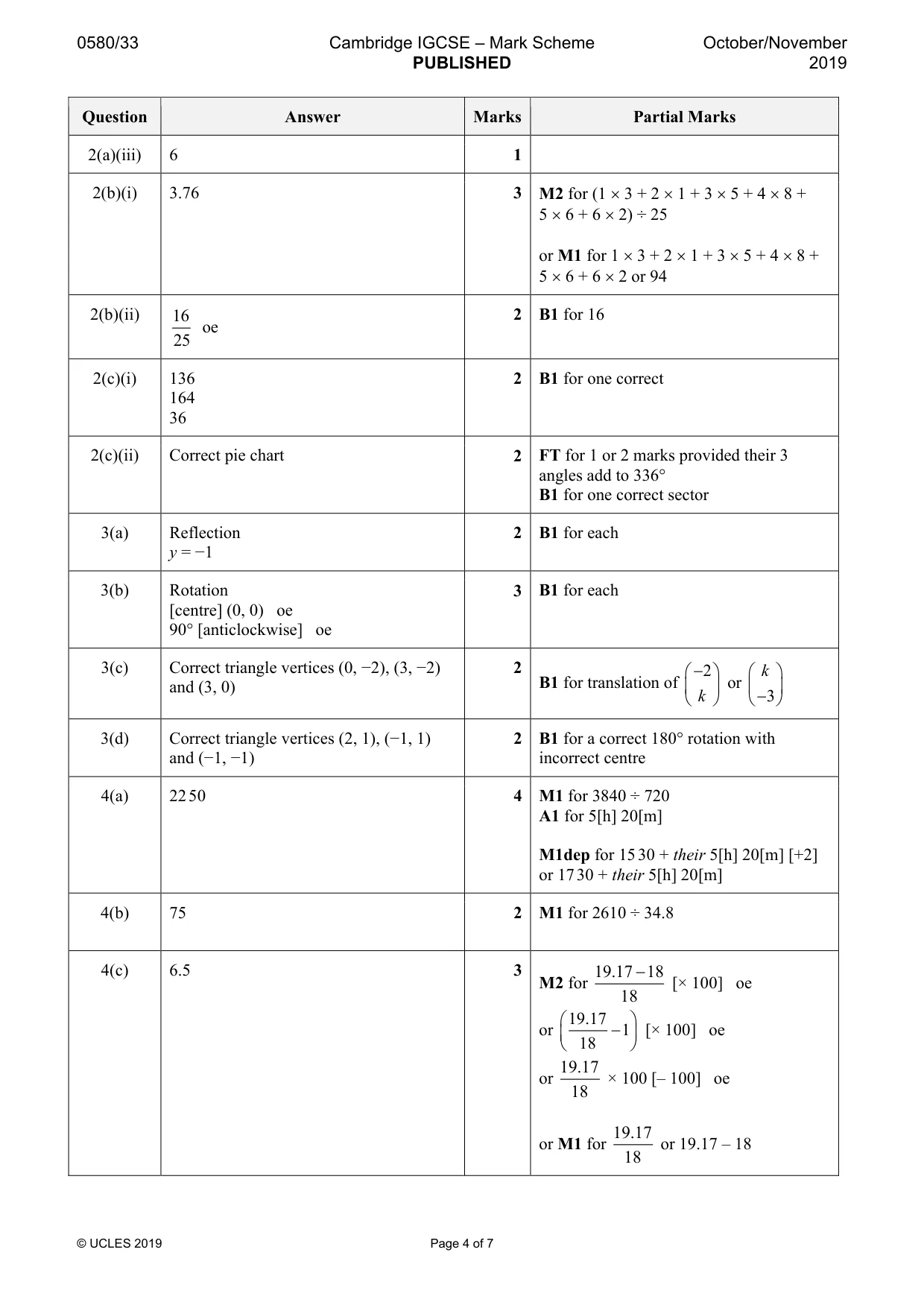
Mark scheme: 2(a)(i) 3.5 2 B1 for 1, 1, 2, 2, 3, 3, 4 or 3, 4, 4, 4, 5, 5, 7 or 3 and 4 identified 2(a)(ii) 4 1 2(a)(iii) 6 1 2(b)(i) 3.76 3 M2 for (1 × 3 + 2 × 1 + 3 × 5 + 4 × 8 + 5 × 6 + 6 × 2) ÷ 25 or M1 for 1 × 3 + 2 × 1 + 3 × 5 + 4 × 8 + 5 × 6 + 6 × 2 or 94 2(b)(ii) 16 2 B1 for 16 oe 25 2(c)(i) 136 2 B1 for one correct 164 36 2(c)(ii) Correct pie chart 2 FT for 1 or 2 marks provided their 3 angles add to 336° B1 for one correct sector
Q3 · Y 6 5 C 4 3 2 A 1 x – 6 – 5 – 4 – 3 – 2 – 1 0 1 2 3 4 5 6 – 1 – 2 – 3 B – 4 – 5 – 6 (a)…
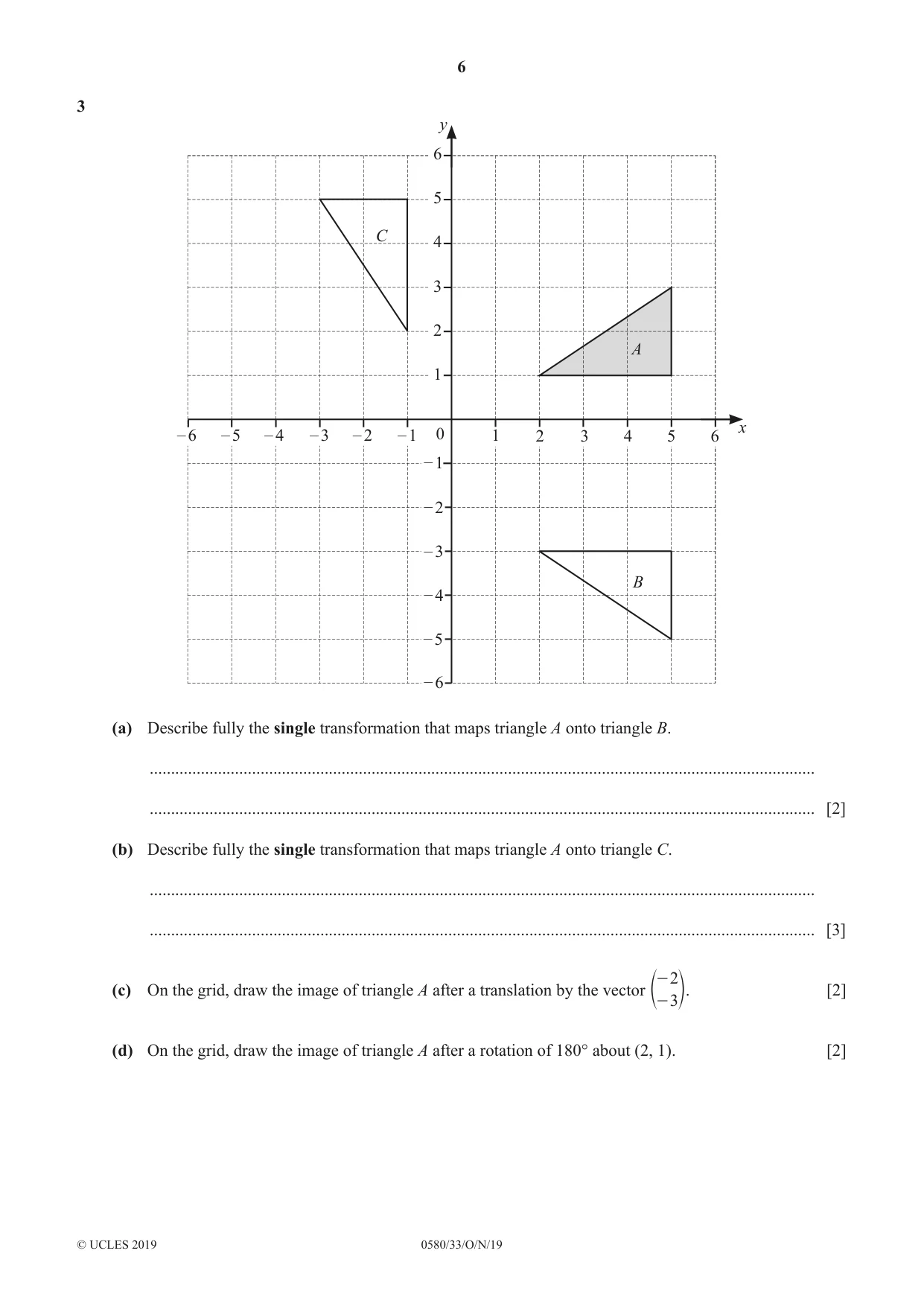
3 y 6 5 C 4 3 2 A 1 x – 6 – 5 – 4 – 3 – 2 – 1 0 1 2 3 4 5 6 – 1 – 2 – 3 B – 4 – 5 – 6 (a) Describe fully the single transformation that maps triangle A onto triangle B. ............................................................................................................................................................ ............................................................................................................................................................ [2] (b) Describe fully the single transformation that maps triangle A onto triangle C. ............................................................................................................................................................ ............................................................................................................................................................ [3] - 2 (c) On the grid, draw the image of triangle A after a translation by the vector [2] e- 3o. (d) On the grid, draw the image of triangle A after a rotation of 180° about (2, 1). [2]
Mark scheme: 3(a) Reflection 2 B1 for each y = −1 3(b) Rotation 3 B1 for each [centre] (0, 0) oe 90° [anticlockwise] oe 3(c) Correct triangle vertices (0, −2), (3, −2) 2 − 2 k and (3, 0) B1 for translation of or k − 3 3(d) Correct triangle vertices (2, 1), (−1, 1) 2 B1 for a correct 180° rotation with and (−1, −1) incorrect centre
Q4 · A plane leaves Karachi at 15 30 to fly to Bangkok
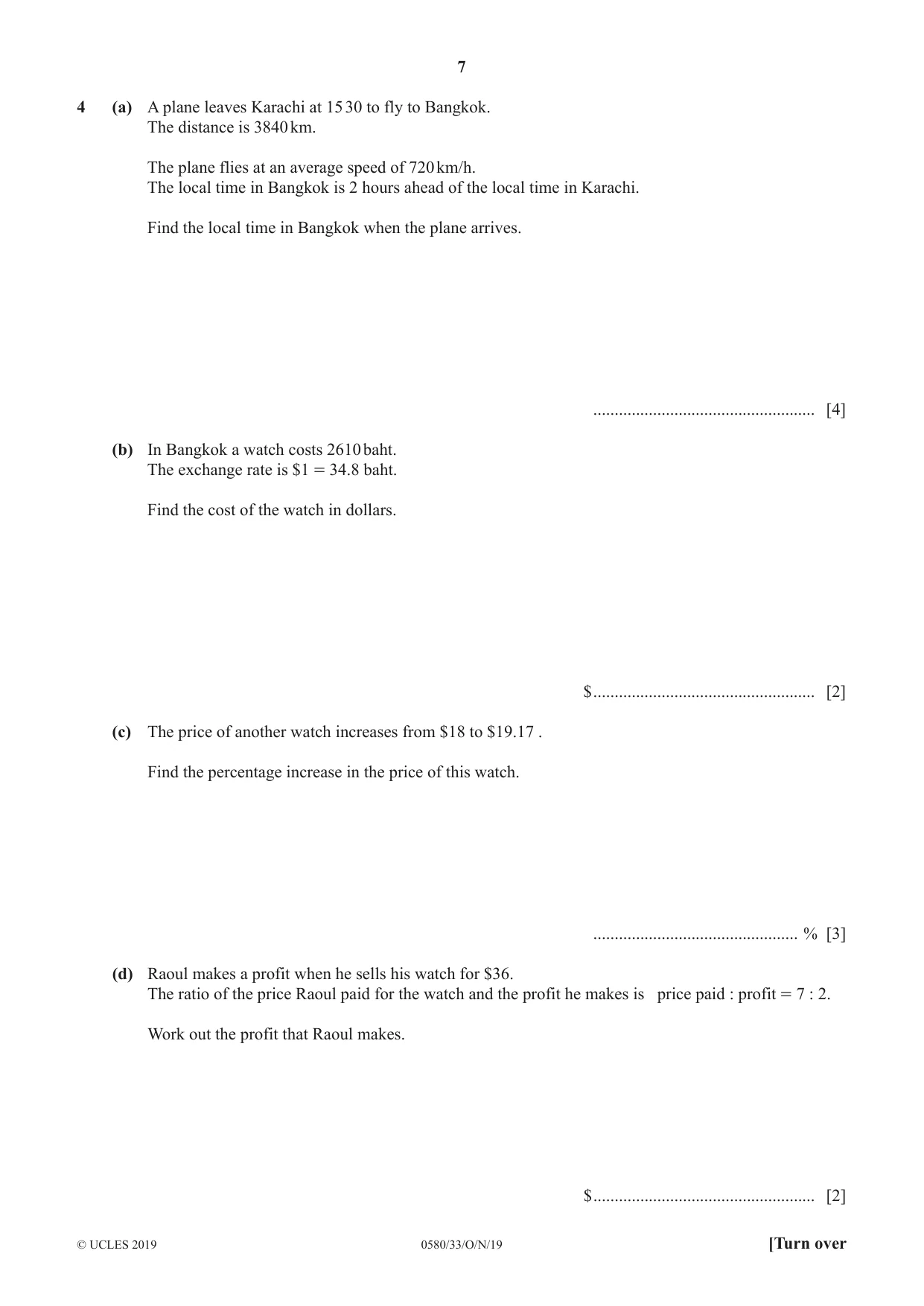
4 (a) A plane leaves Karachi at 15 30 to fly to Bangkok. The distance is 3840 km. The plane flies at an average speed of 720 km/h. The local time in Bangkok is 2 hours ahead of the local time in Karachi. Find the local time in Bangkok when the plane arrives. .................................................... [4] (b) In Bangkok a watch costs 2610 baht. The exchange rate is $1 = 34.8 baht. Find the cost of the watch in dollars. $ .................................................... [2] (c) The price of another watch increases from $18 to $19.17 . Find the percentage increase in the price of this watch. ................................................ % [3] (d) Raoul makes a profit when he sells his watch for $36. The ratio of the price Raoul paid for the watch and the profit he makes is price paid : profit = 7 : 2. Work out the profit that Raoul makes. $ .................................................... [2]
Mark scheme: 4(a) 22 50 4 M1 for 3840 ÷ 720 A1 for 5[h] 20[m] M1dep for 15 30 + their 5[h] 20[m] [+2] or 17 30 + their 5[h] 20[m] 4(b) 75 2 M1 for 2610 ÷ 34.8 4(c) 6.5 3 19.17 − 18 M2 for [× 100] oe 18 19.17 or − 1 [× 100] oe 18 19.17 or × 100 [– 100] oe 18 19.17 or M1 for or 19.17 – 18 18 4(d) 8 2 36 M1 for 2 + 7
Question 5
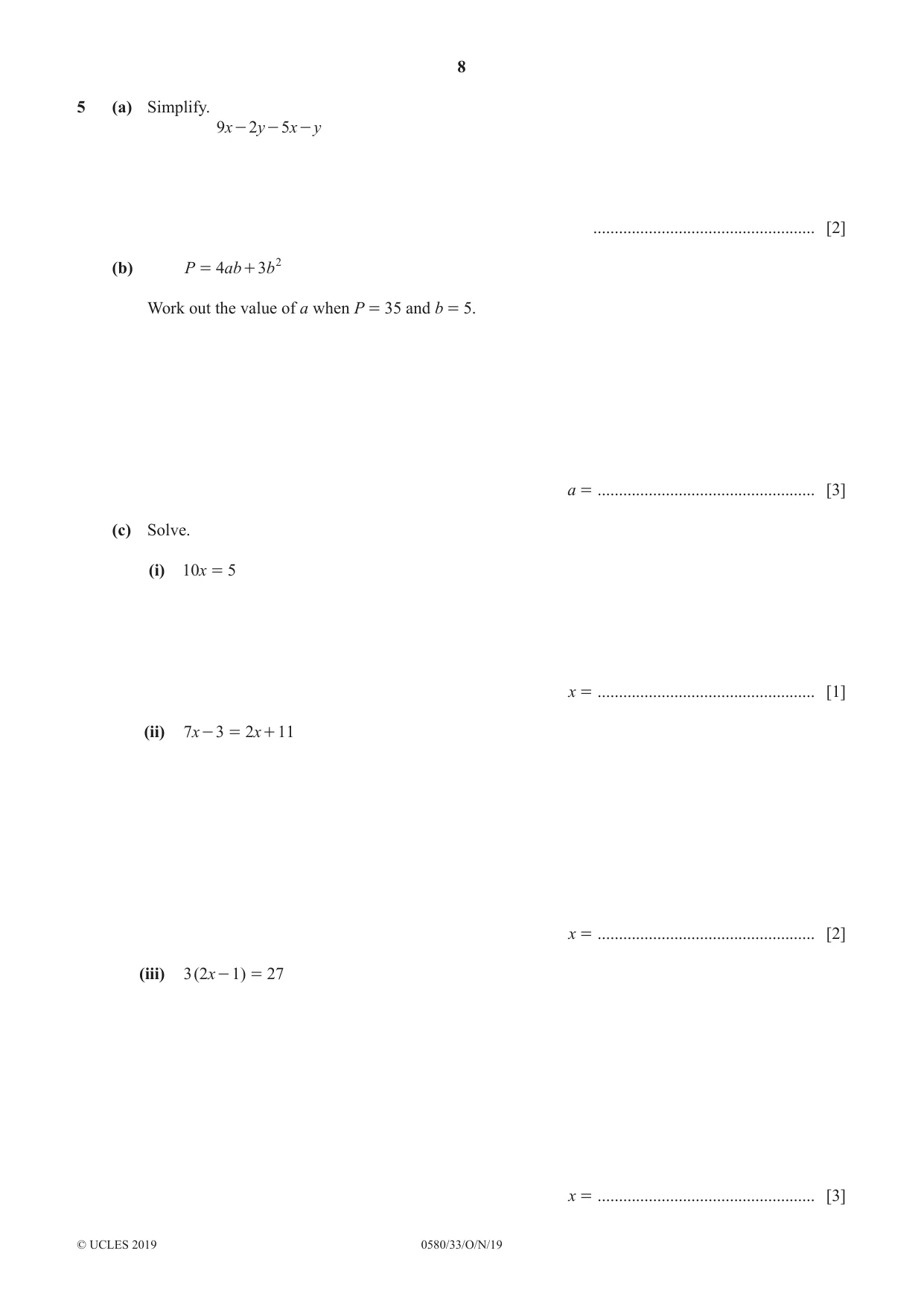
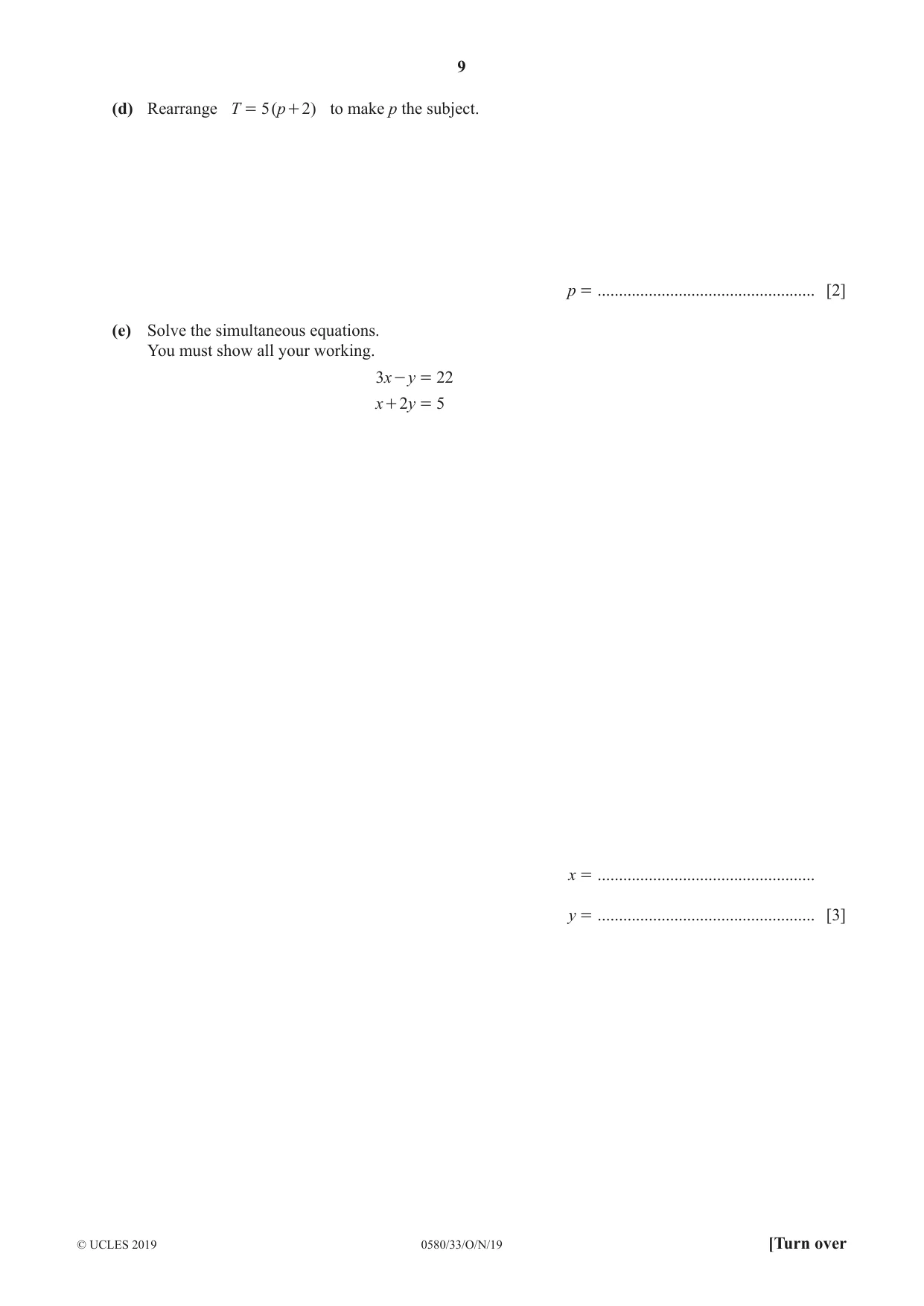
5 (a) Simplify. 9x - 2y - 5x - y .................................................... [2] (b) P = 4ab + 3b 2 Work out the value of a when P = 35 and b = 5. a = ................................................... [3] (c) Solve. (i) 10x = 5 x = ................................................... [1] (ii) 7x - 3 = 2x + 11 x = ................................................... [2] (iii) 3 (2 x - 1) = 27 x = ................................................... [3] (d) Rearrange T = 5 (p + 2 ) to make p the subject. p = ................................................... [2] (e) Solve the simultaneous equations. You must show all your working. 3x - y = 22 x + 2 y = 5 x = ................................................... y = ................................................... [3]
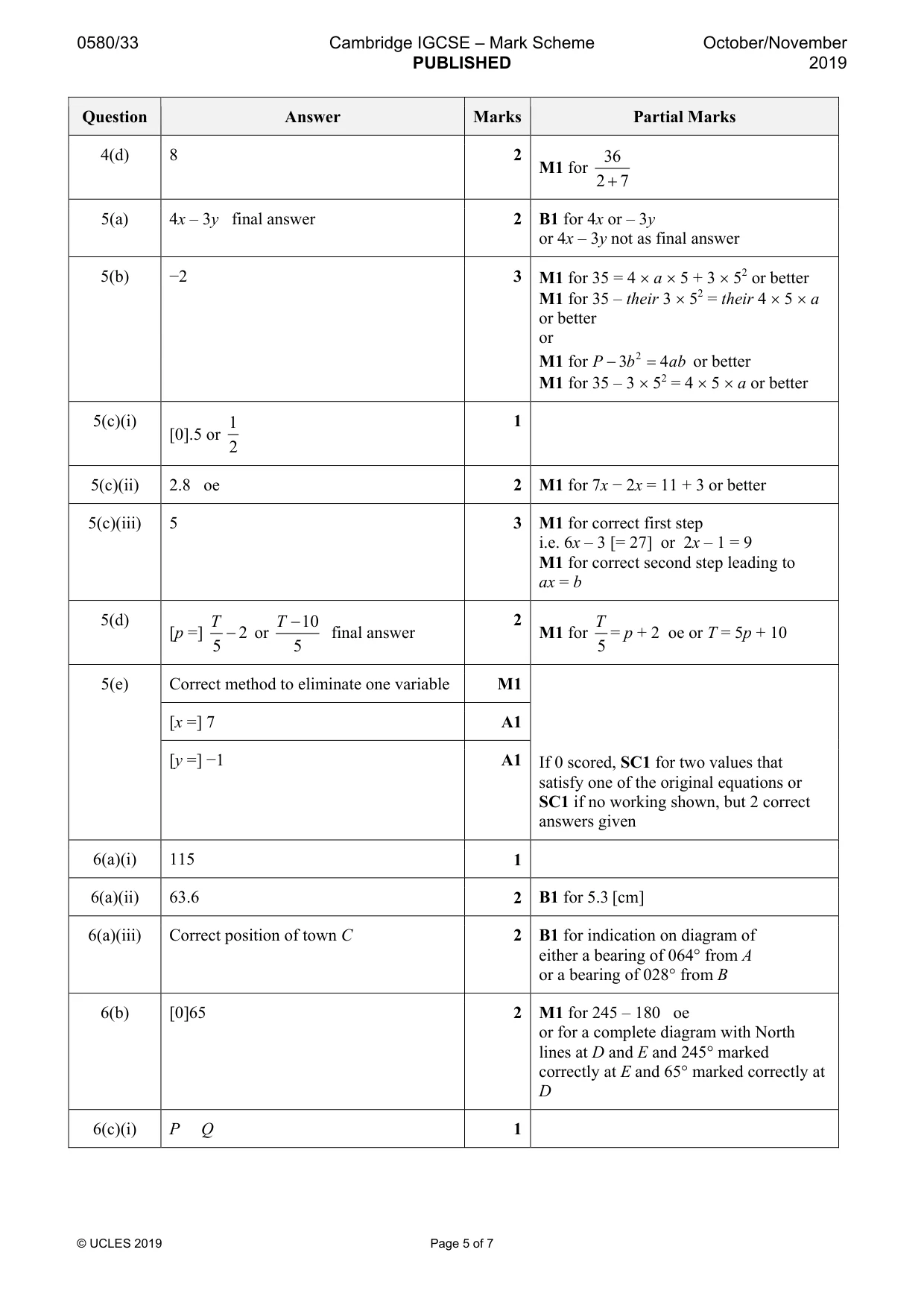
Mark scheme: 5(a) 4x – 3y final answer 2 B1 for 4x or – 3y or 4x – 3y not as final answer 5(b) −2 3 M1 for 35 = 4 × a × 5 + 3 × 52 or better M1 for 35 – their 3 × 52 = their 4 × 5 × a or better or M1 for P − 3b 2 = 4 ab or better M1 for 35 – 3 × 52 = 4 × 5 × a or better 5(c)(i) 1 1 [0].5 or 2 5(c)(ii) 2.8 oe 2 M1 for 7x − 2x = 11 + 3 or better 5(c)(iii) 5 3 M1 for correct first step i.e. 6x – 3 [= 27] or 2x – 1 = 9 M1 for correct second step leading to ax = b 5(d) T T − 10 2 T [p =] − 2 or final answer M1 for = p + 2 oe or T = 5p + 10 5 5 5 5(e) Correct method to eliminate one variable M1 [x =] 7 A1 [y =] −1 A1 If 0 scored, SC1 for two values that satisfy one of the original equations or SC1 if no working shown, but 2 correct answers given
Q6 · The scale drawing shows the positions of town A and town B
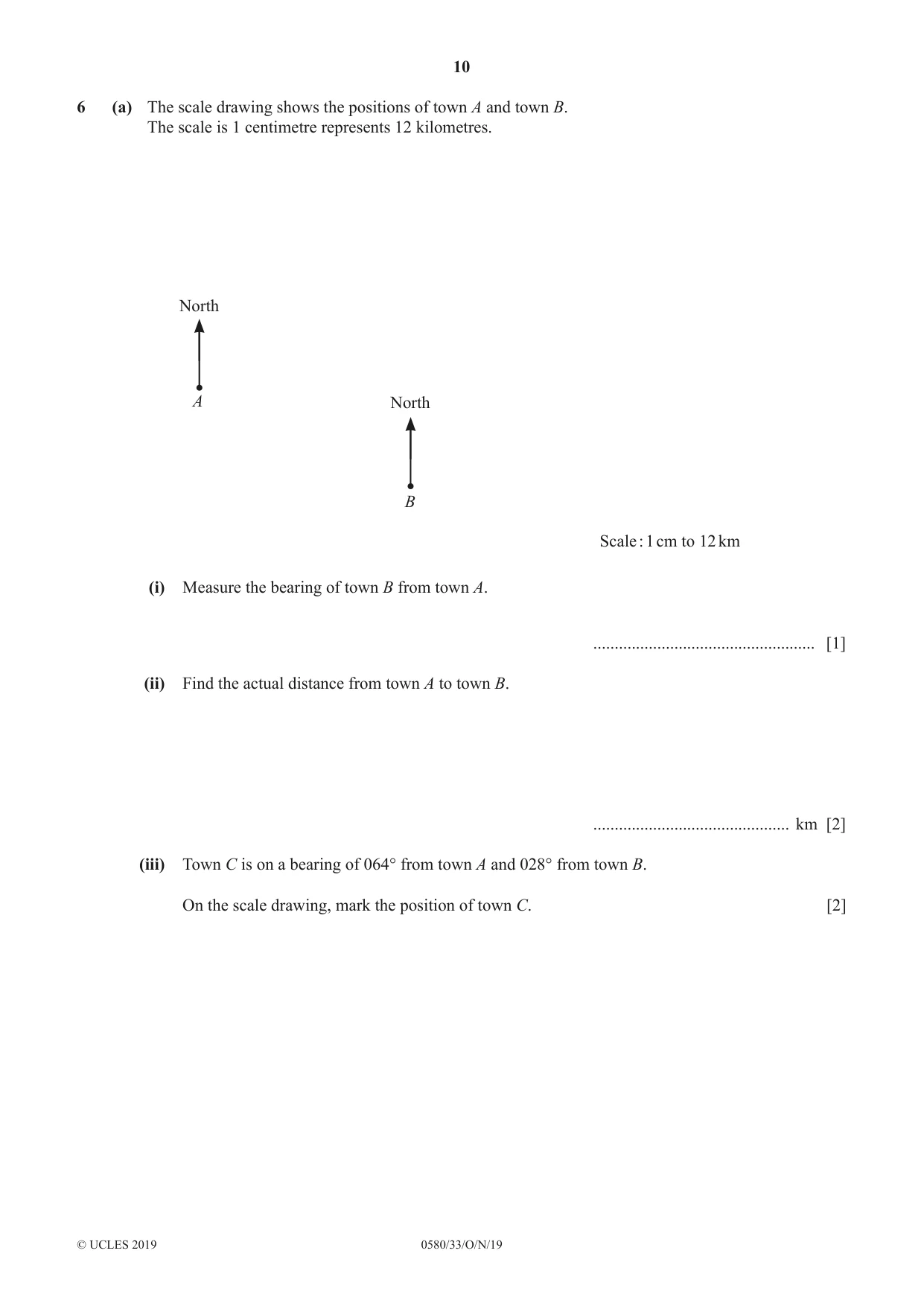
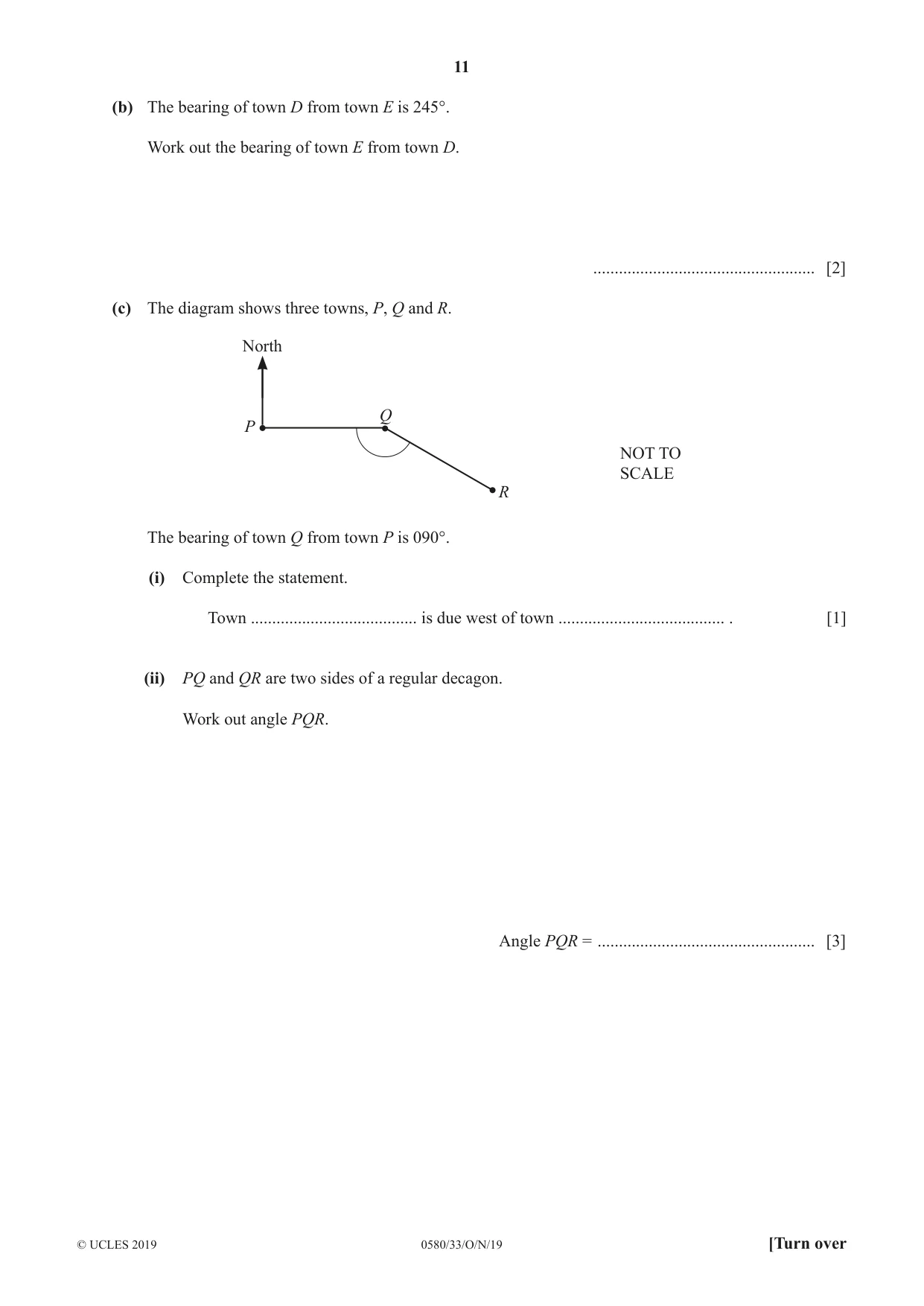
6 (a) The scale drawing shows the positions of town A and town B. The scale is 1 centimetre represents 12 kilometres. North A North B Scale : 1 cm to 12 km (i) Measure the bearing of town B from town A. .................................................... [1] (ii) Find the actual distance from town A to town B. .............................................. km [2] (iii) Town C is on a bearing of 064° from town A and 028° from town B. On the scale drawing, mark the position of town C. [2] (b) The bearing of town D from town E is 245°. Work out the bearing of town E from town D. .................................................... [2] (c) The diagram shows three towns, P, Q and R. North Q P NOT TO SCALE R The bearing of town Q from town P is 090°. (i) Complete the statement. Town ....................................... is due west of town ....................................... . [1] (ii) PQ and QR are two sides of a regular decagon. Work out angle PQR. Angle PQR = ................................................... [3]
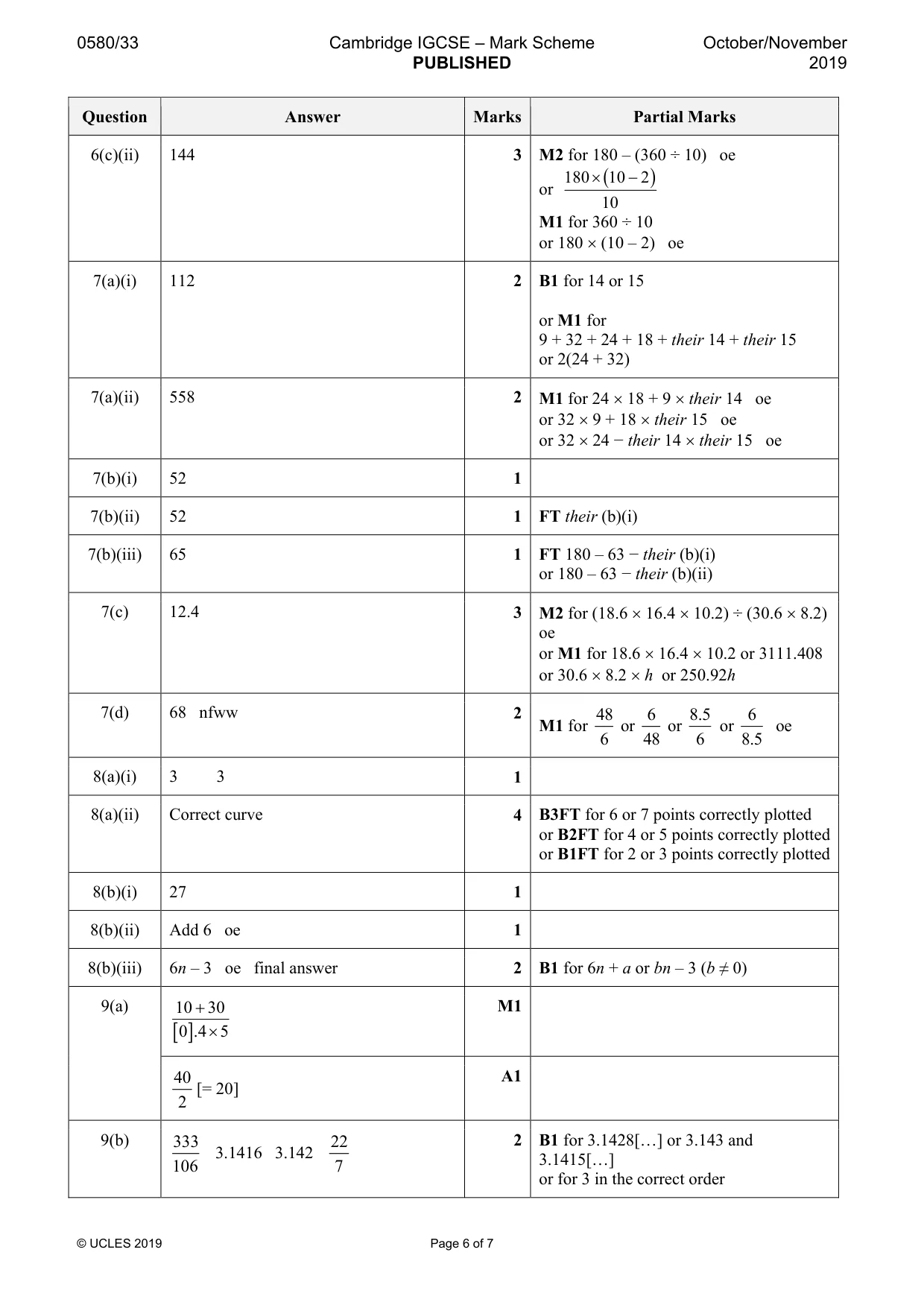
Mark scheme: 6(a)(i) 115 1 6(a)(ii) 63.6 2 B1 for 5.3 [cm] 6(a)(iii) Correct position of town C 2 B1 for indication on diagram of either a bearing of 064° from A or a bearing of 028° from B 6(b) [0]65 2 M1 for 245 – 180 oe or for a complete diagram with North lines at D and E and 245° marked correctly at E and 65° marked correctly at D 6(c)(i) P Q 1 6(c)(ii) 144 3 M2 for 180 – (360 ÷ 10) oe 180 × (10 − 2 ) or 10 M1 for 360 ÷ 10 or 180 × (10 – 2) oe
Q7 · The diagram shows a shape made from two rectangles
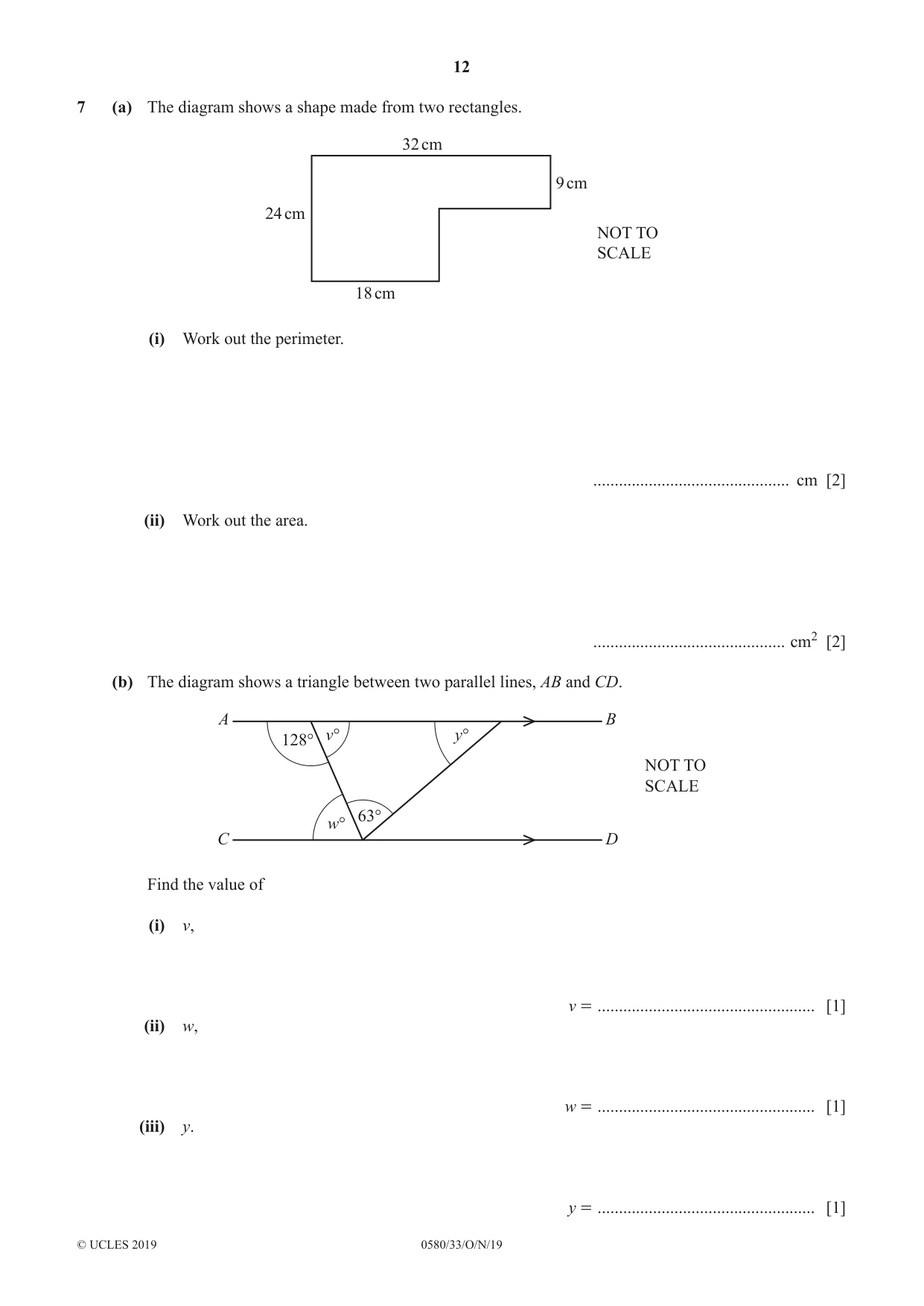
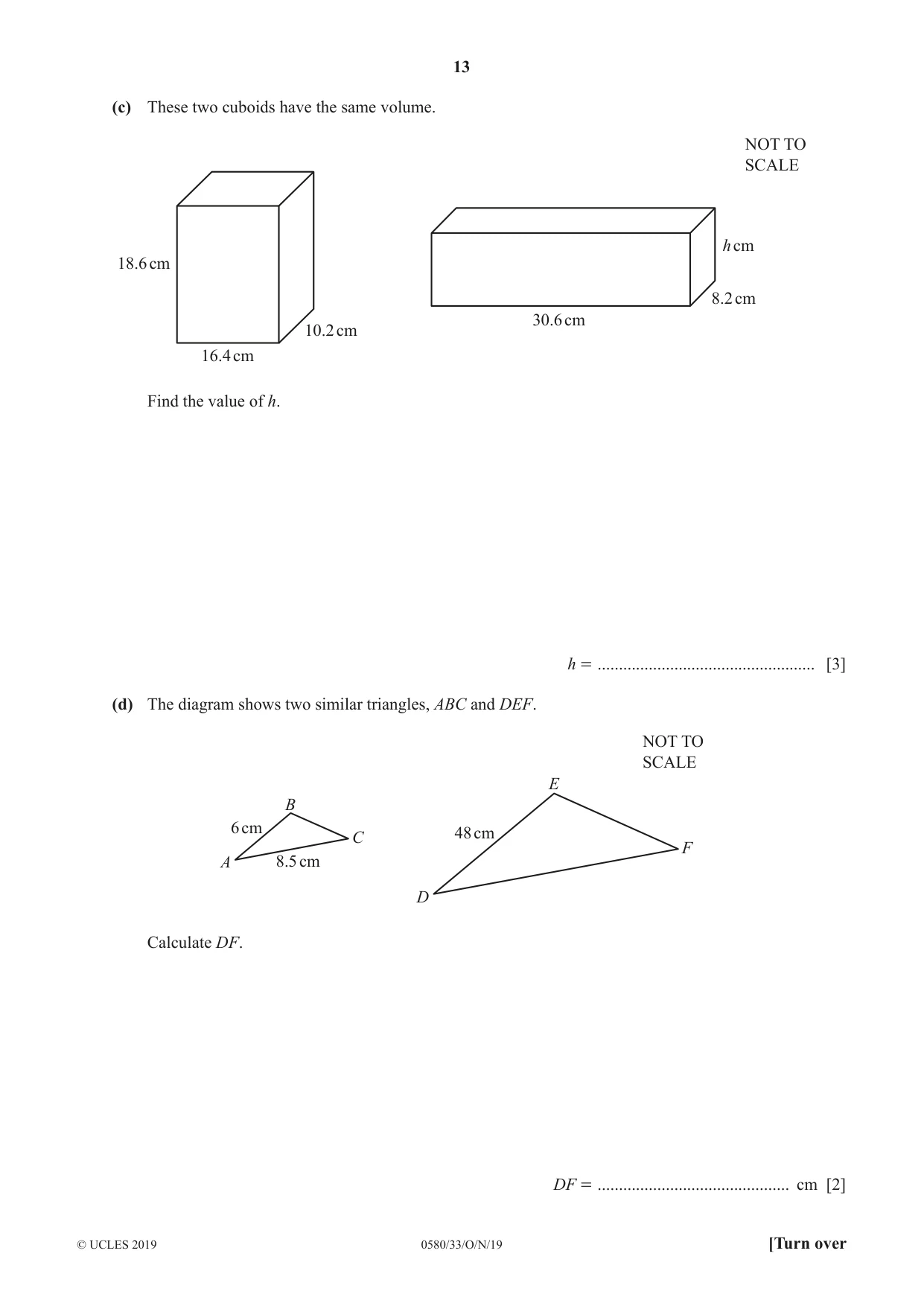
7 (a) The diagram shows a shape made from two rectangles. 32 cm 9 cm 24 cm NOT TO SCALE 18 cm (i) Work out the perimeter. .............................................. cm [2] (ii) Work out the area. ............................................. cm2 [2] (b) The diagram shows a triangle between two parallel lines, AB and CD. A B v° y° 128° NOT TO SCALE 63° w° C D Find the value of (i) v, v = ................................................... [1] (ii) w, w = ................................................... [1] (iii) y. y = ................................................... [1] (c) These two cuboids have the same volume. NOT TO SCALE h cm 18.6 cm 8.2 cm 30.6 cm 10.2 cm 16.4 cm Find the value of h. h = ................................................... [3] (d) The diagram shows two similar triangles, ABC and DEF. NOT TO SCALE E B 6 cm C 48 cm F A 8.5 cm D Calculate DF. DF = ............................................. cm [2]
Mark scheme: 7(a)(i) 112 2 B1 for 14 or 15 or M1 for 9 + 32 + 24 + 18 + their 14 + their 15 or 2(24 + 32) 7(a)(ii) 558 2 M1 for 24 × 18 + 9 × their 14 oe or 32 × 9 + 18 × their 15 oe or 32 × 24 − their 14 × their 15 oe 7(b)(i) 52 1 7(b)(ii) 52 1 FT their (b)(i) 7(b)(iii) 65 1 FT 180 – 63 − their (b)(i) or 180 – 63 − their (b)(ii) 7(c) 12.4 3 M2 for (18.6 × 16.4 × 10.2) ÷ (30.6 × 8.2) oe or M1 for 18.6 × 16.4 × 10.2 or 3111.408 or 30.6 × 8.2 × h or 250.92h 7(d) 68 nfww 2 48 6 8.5 6 M1 for or or or oe 6 48 6 8.5
Q8 · Complete the table of values for y = x 2 - 2x
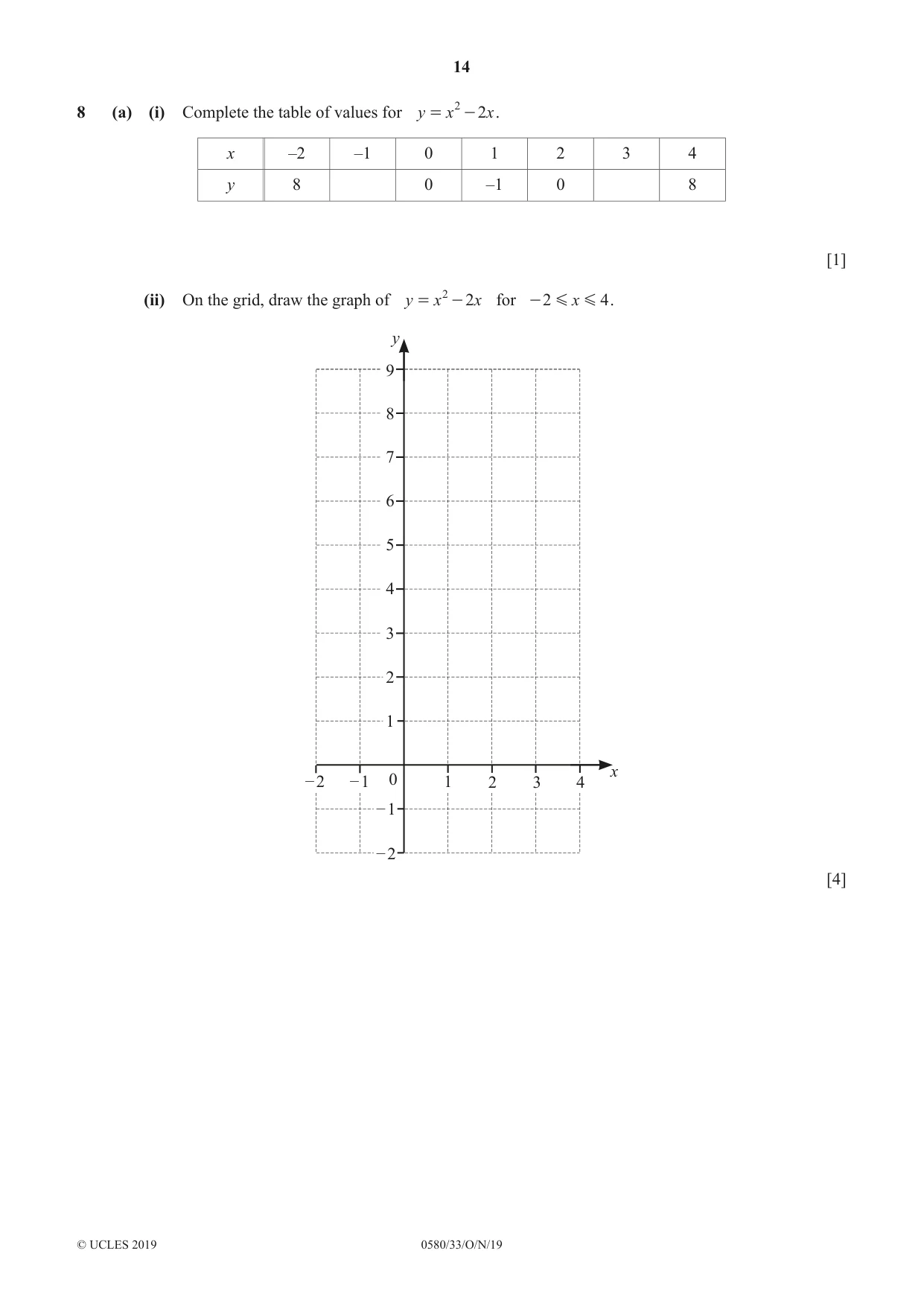
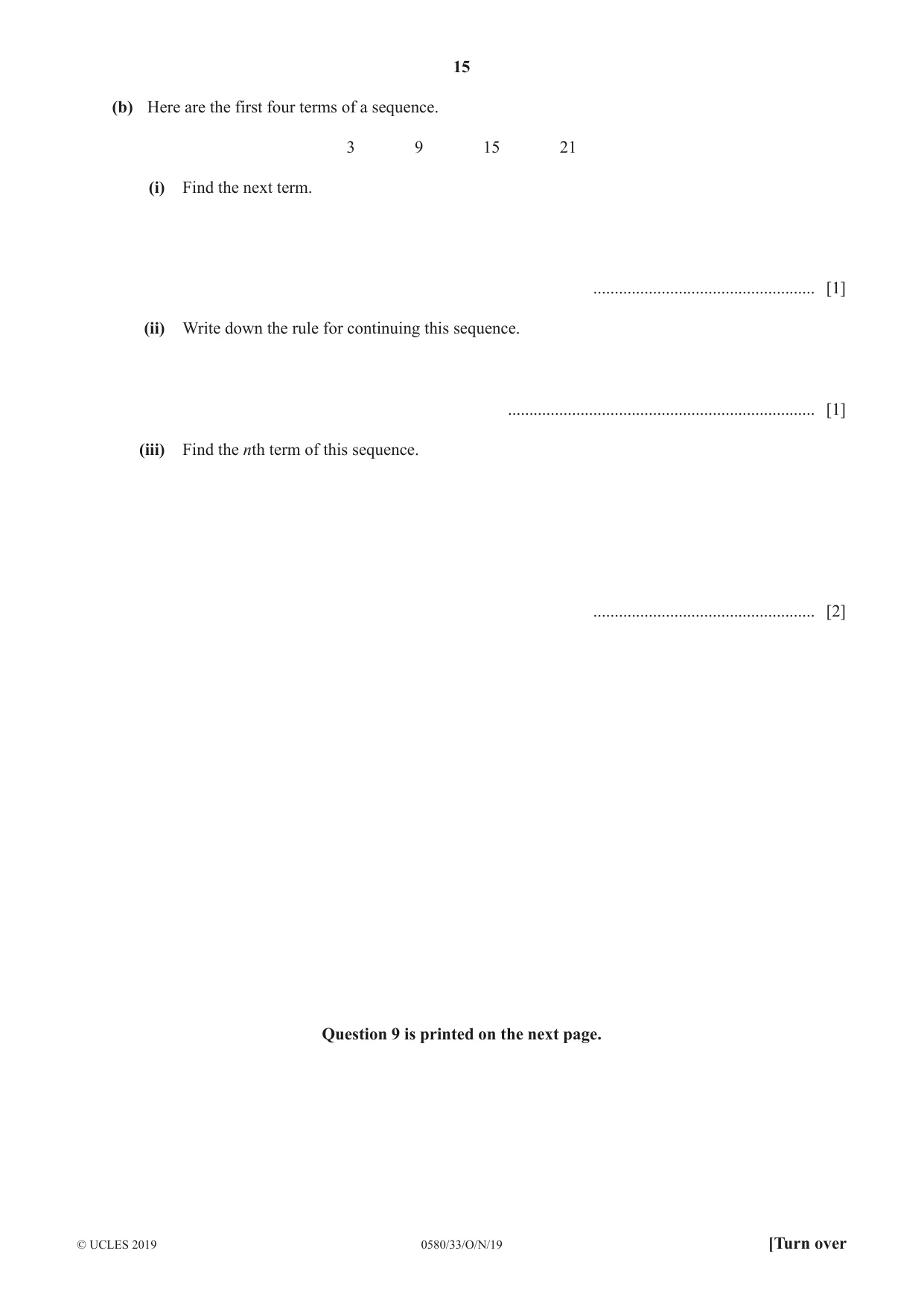
8 (a) (i) Complete the table of values for y = x 2 - 2x . x –2 –1 0 1 2 3 4 y 8 0 –1 0 8 [1] (ii) On the grid, draw the graph of y = x 2 - 2x for - 2 G x G 4 . y 9 8 7 6 5 4 3 2 1 x – 2 – 1 0 1 2 3 4 – 1 – 2 [4] (b) Here are the first four terms of a sequence. 3 9 15 21 (i) Find the next term. .................................................... [1] (ii) Write down the rule for continuing this sequence. ........................................................................ [1] (iii) Find the nth term of this sequence. .................................................... [2] Question 9 is printed on the next page.
Mark scheme: 8(a)(i) 3 3 1 8(a)(ii) Correct curve 4 B3FT for 6 or 7 points correctly plotted or B2FT for 4 or 5 points correctly plotted or B1FT for 2 or 3 points correctly plotted 8(b)(i) 27 1 8(b)(ii) Add 6 oe 1 8(b)(iii) 6n – 3 oe final answer 2 B1 for 6n + a or bn – 3 (b ≠ 0)
Q9 · By rounding each number correct to 1 significant figure, show that an estimate for this…
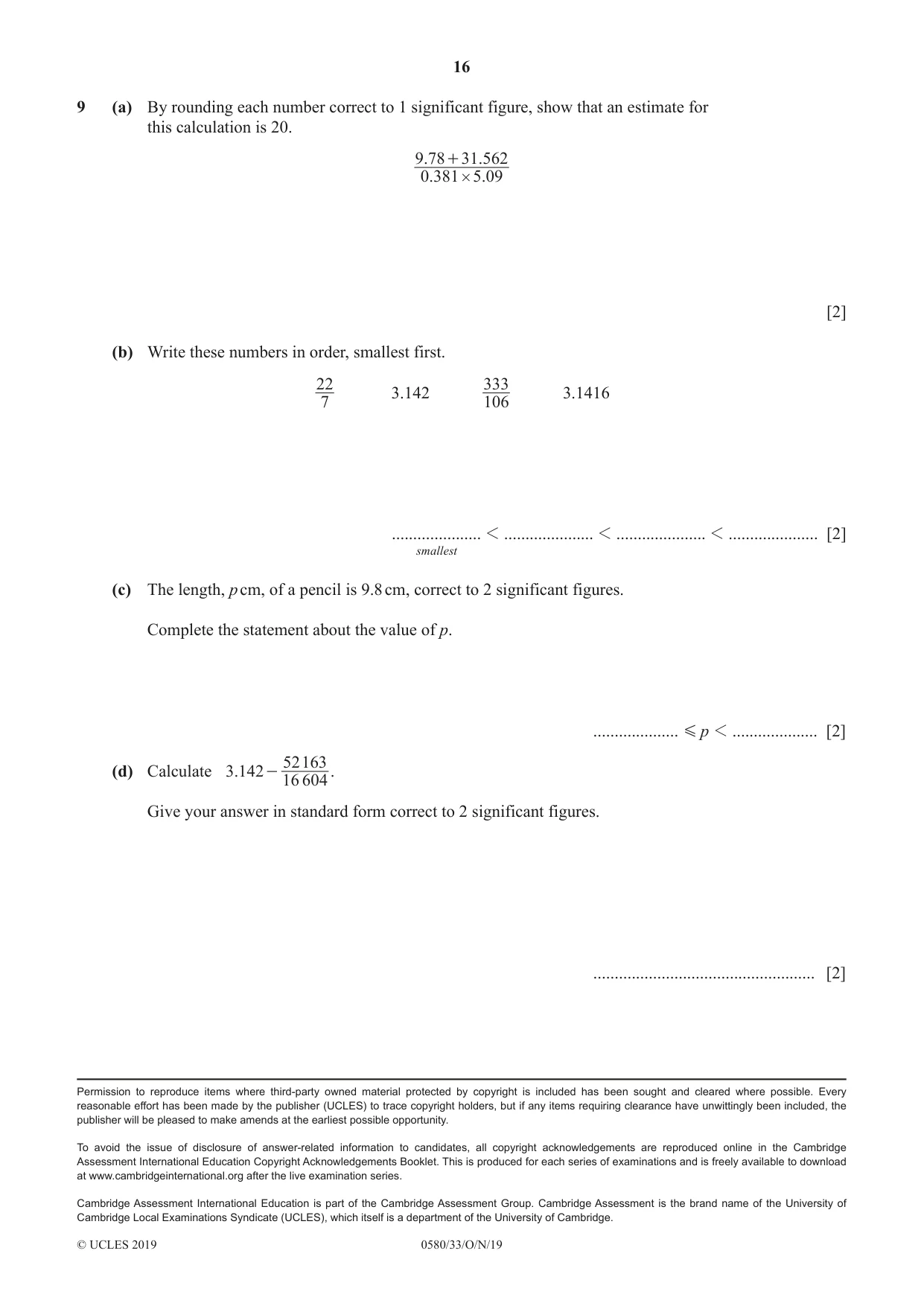
9 (a) By rounding each number correct to 1 significant figure, show that an estimate for this calculation is 20. 9. 78 + 31. 562 0.381 # 5 .09 [2] (b) Write these numbers in order, smallest first. 22 333 3.142 3.1416 7 106 ..................... 1 ..................... 1 ..................... 1 ..................... [2] smallest (c) The length, p cm, of a pencil is 9.8 cm, correct to 2 significant figures. Complete the statement about the value of p. .................... G p 1 .................... [2] 5 2163 (d) Calculate .3142 - . 16 604 Give your answer in standard form correct to 2 significant figures. .................................................... [2]
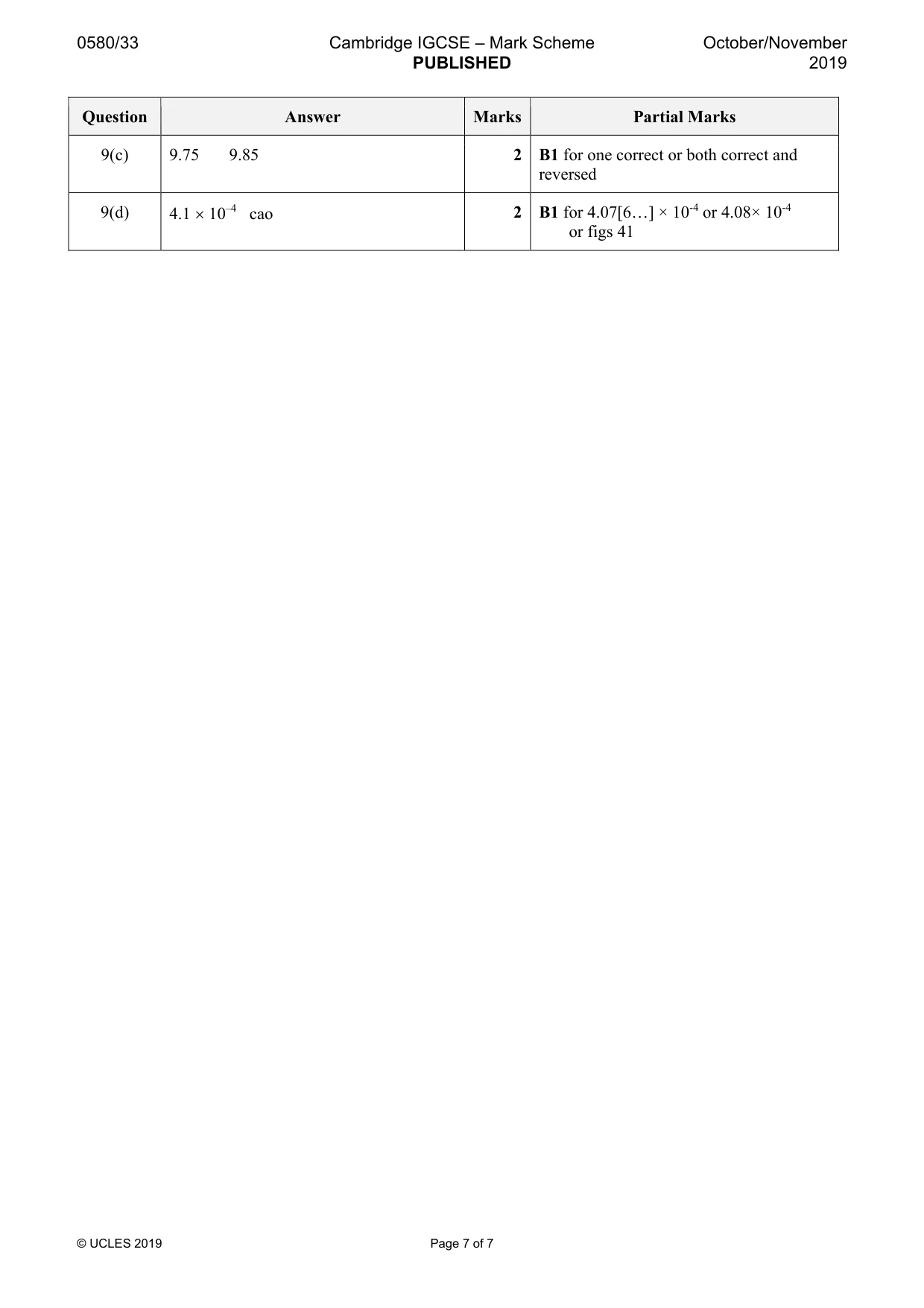
Mark scheme: 9(a) 10 + 30 M1 [ 0 ] .4 × 5 40 A1 [= 20] 2 9(b) 333 22 2 B1 for 3.1428[…] or 3.143 and 3.1416 3.142 3.1415[…] 106 7 or for 3 in the correct order 9(c) 9.75 9.85 2 B1 for one correct or both correct and reversed 9(d) 4.1 × 10⁻⁴ cao 2 B1 for 4.07[6…] × 10-4 or 4.08× 10⁻⁴ or figs 41
What was in this paper
The subtopics covered by these 9 questions, and how many questions each got. Open one in a new tab to see every Cambridge question on it.
What you needed in this session
Cambridge’s own grade thresholds for 2019 Oct/Nov, Paper 3 · Variant 3. A higher threshold means an easier paper — the bar moves with how the cohort did.