Cambridge IGCSE Mathematics 0580 — 2016 Oct/Nov Paper 3 · Variant 2
0580/32/O/N/16 · 9 questions · 104 marks · ≈117 min
The question paper and its mark scheme, free to read here and free to download. This is Cambridge’s own paper, exactly as it was sat.
Question paper16 pages
Mark scheme6 pages
Answers below. Sit the paper first if you are practising.
Questions as text
Q1 · A group of 50 children were each asked which type of book they most like to read
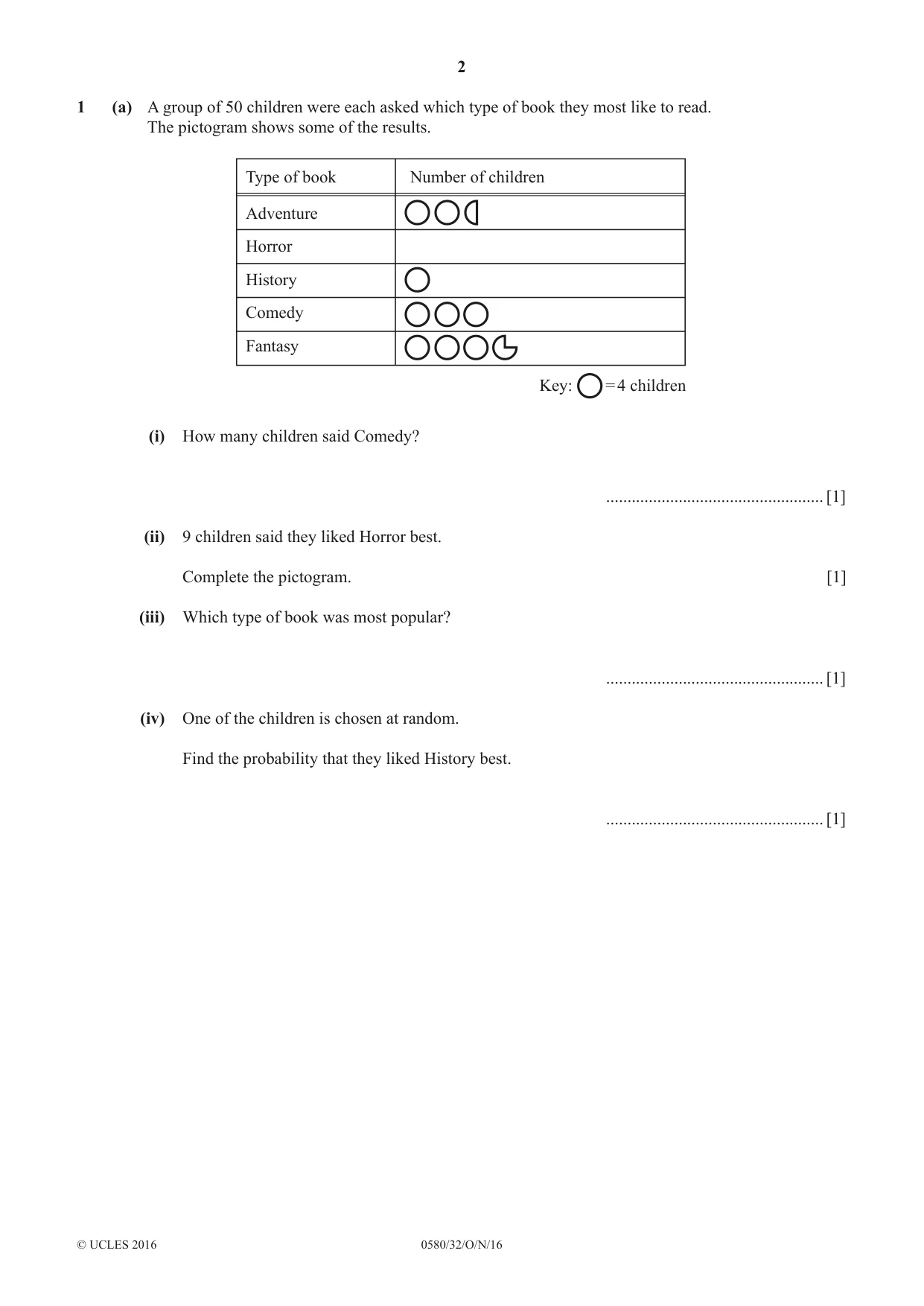
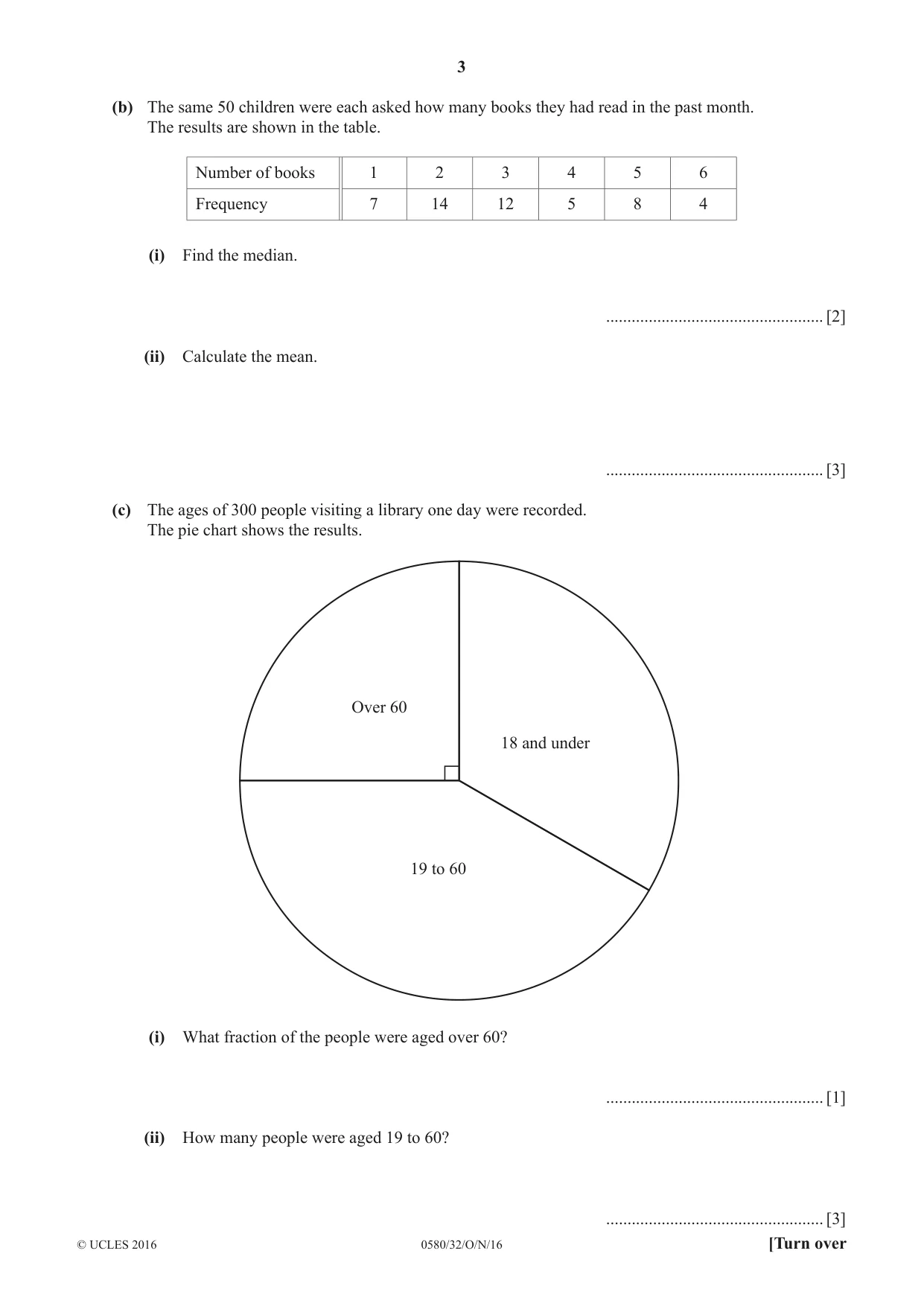
1 (a) A group of 50 children were each asked which type of book they most like to read. The pictogram shows some of the results. Type of book Number of children Adventure Horror History Comedy Fantasy Key: = 4 children (i) How many children said Comedy? ................................................... [1] (ii) 9 children said they liked Horror best. Complete the pictogram. [1] (iii) Which type of book was most popular? ................................................... [1] (iv) One of the children is chosen at random. Find the probability that they liked History best. ................................................... [1] (b) The same 50 children were each asked how many books they had read in the past month. The results are shown in the table. Number of books 1 2 3 4 5 6 Frequency 7 14 12 5 8 4 (i) Find the median. ................................................... [2] (ii) Calculate the mean. ................................................... [3] (c) The ages of 300 people visiting a library one day were recorded. The pie chart shows the results. Over 60 18 and under 19 to 60 (i) What fraction of the people were aged over 60? ................................................... [1] (ii) How many people were aged 19 to 60? ................................................... [3]
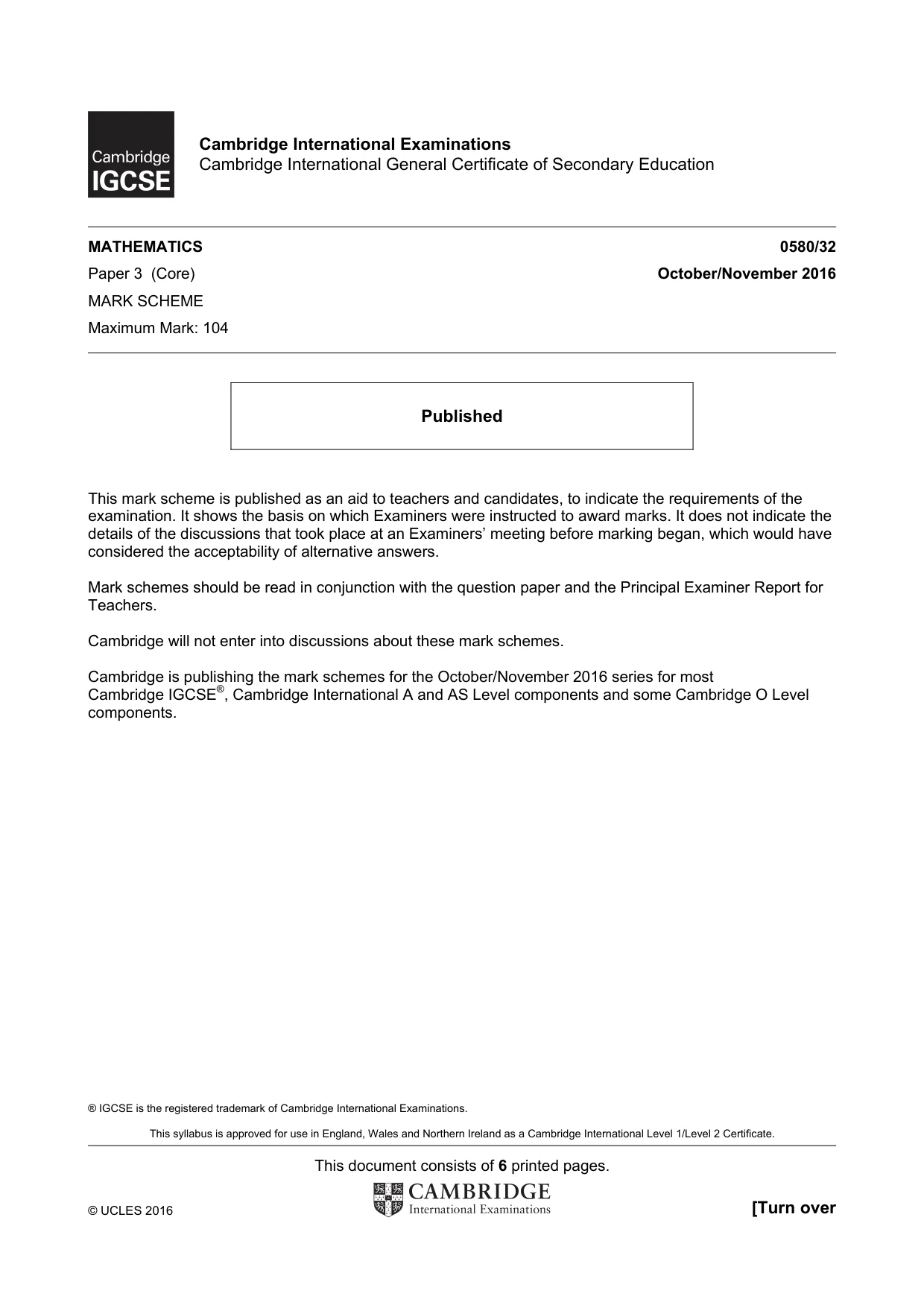
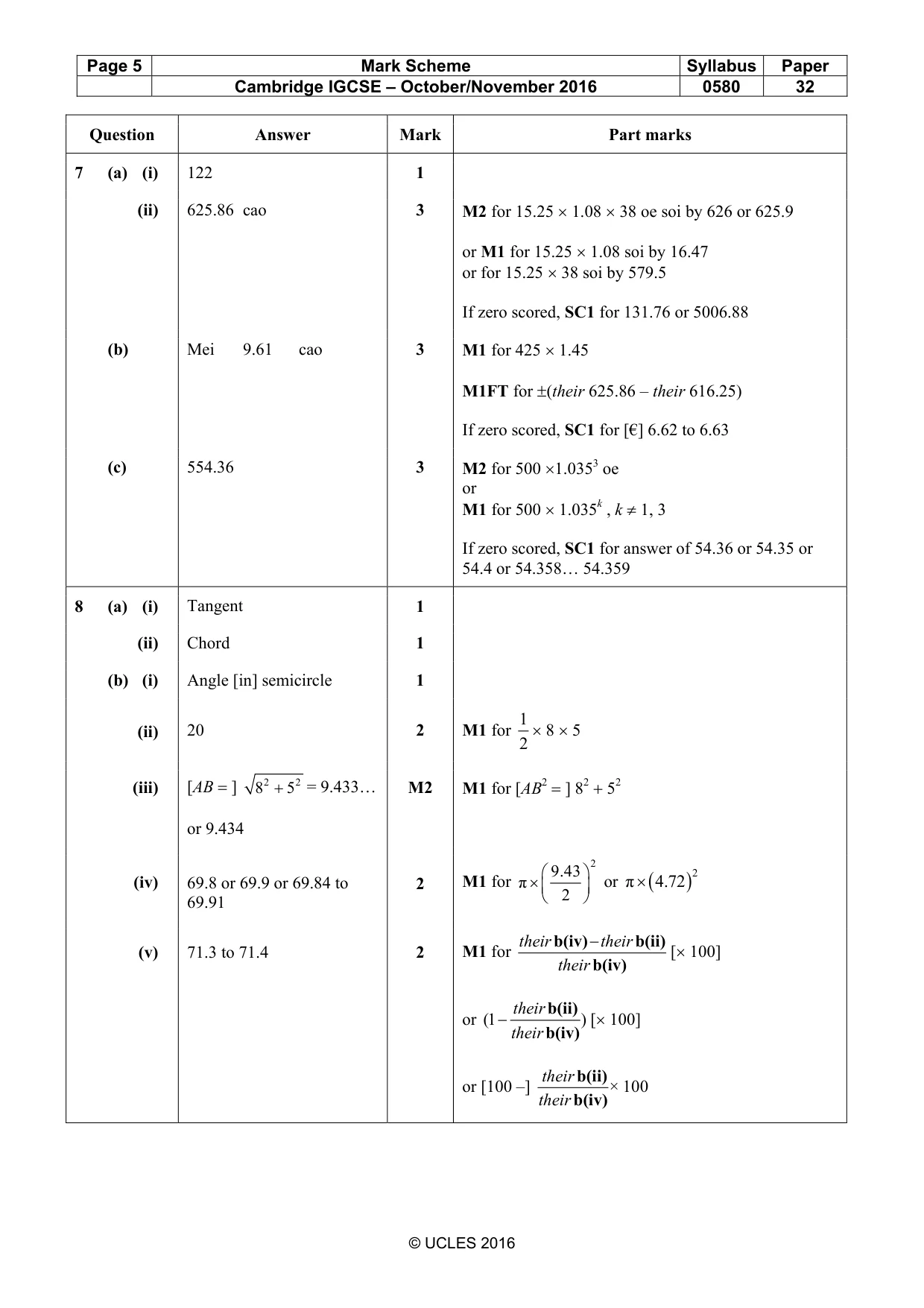
Mark scheme: Question Answer Mark Part marks 1 (a) (i) 12 1 (ii) 1 (iii) Fantasy 1 4 (iv) oe isw 1 50 (b) (i) 3 2 M1 for 25th and 26th value or list of at least first or last 26 values (ii) 3.1 nfww 3 M1 for 7 × 1 + 2 × 14 + 3 × 12 + 4 × 5 + 5 × 8 + 6 × 4 or better M1 dep for their 155 ÷ 50 (c) (i) 90 1 oe 360 (ii) 125 3 B1 150 soi their150 M1 for × 300 oe 360
Q2 · Polygon A is shown on the grid
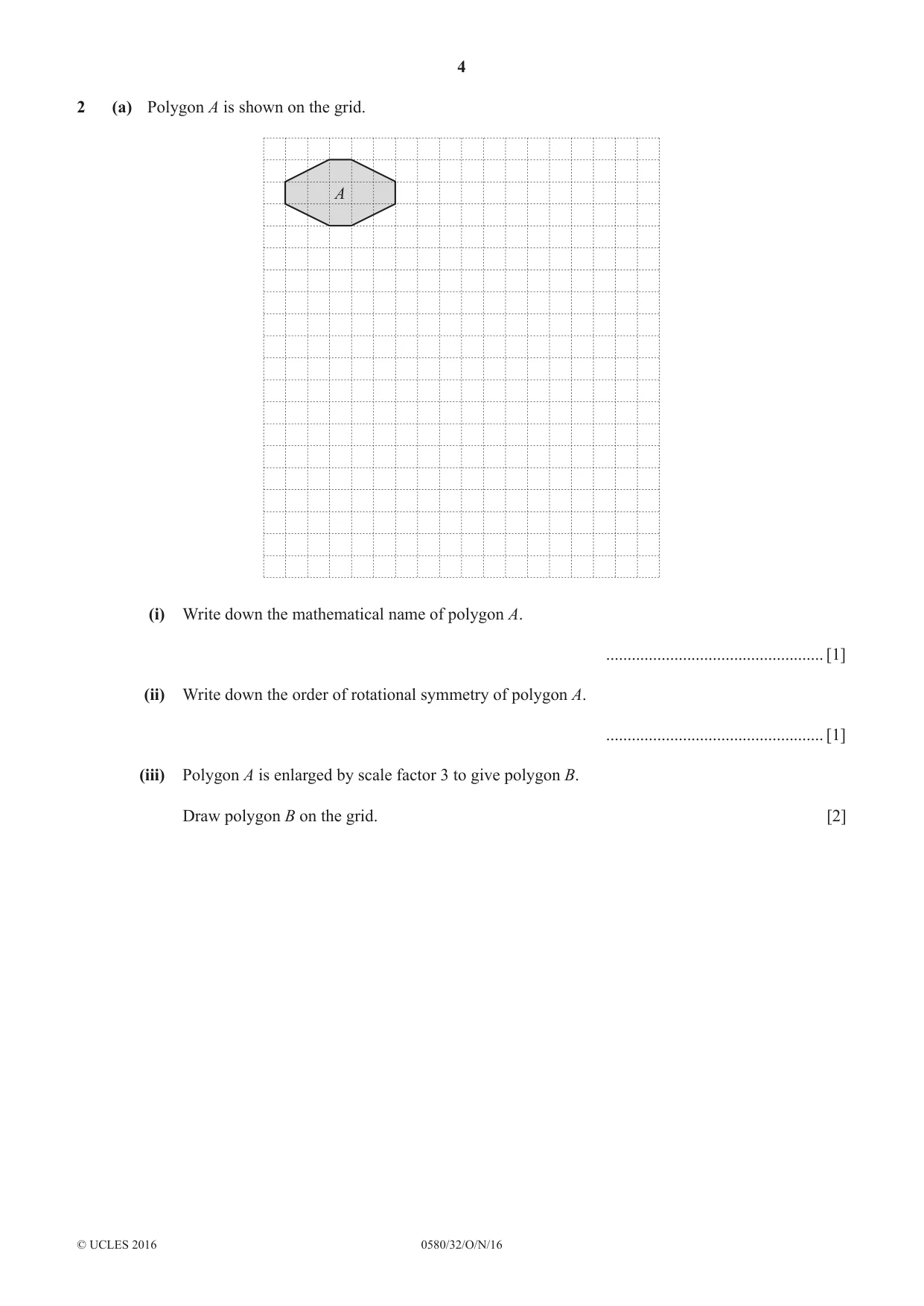
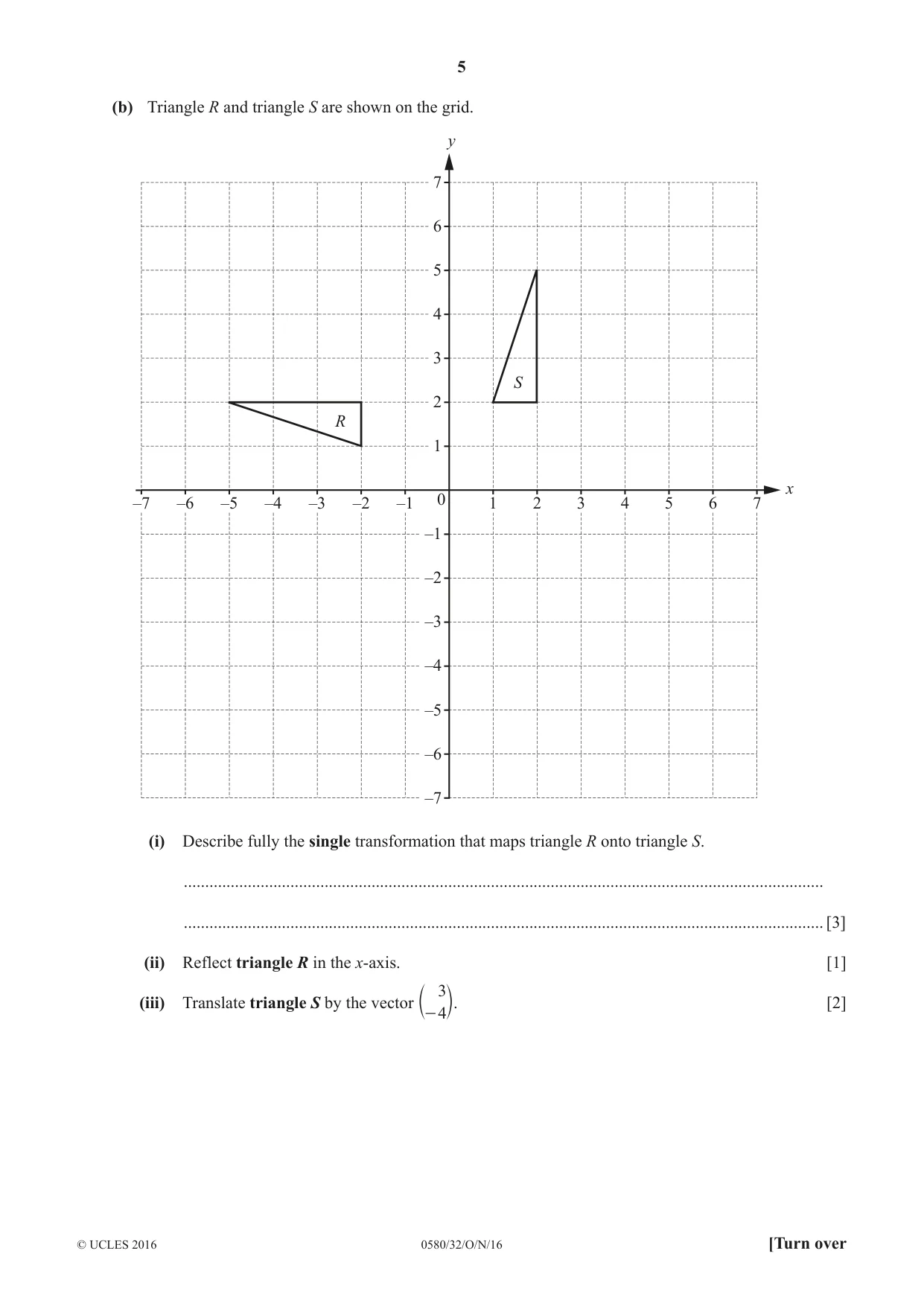
2 (a) Polygon A is shown on the grid. A (i) Write down the mathematical name of polygon A. ................................................... [1] (ii) Write down the order of rotational symmetry of polygon A. ................................................... [1] (iii) Polygon A is enlarged by scale factor 3 to give polygon B. Draw polygon B on the grid. [2] (b) Triangle R and triangle S are shown on the grid. y 7 6 5 4 3 S 2 R 1 x –7 –6 –5 –4 –3 –2 –1 0 1 2 3 4 5 6 7 –1 –2 –3 –4 –5 –6 –7 (i) Describe fully the single transformation that maps triangle R onto triangle S. ...................................................................................................................................................... ...................................................................................................................................................... [3] (ii) Reflect triangle R in the x-axis. [1] 3 (iii) Translate triangle S by the vector [2] c- 4m.
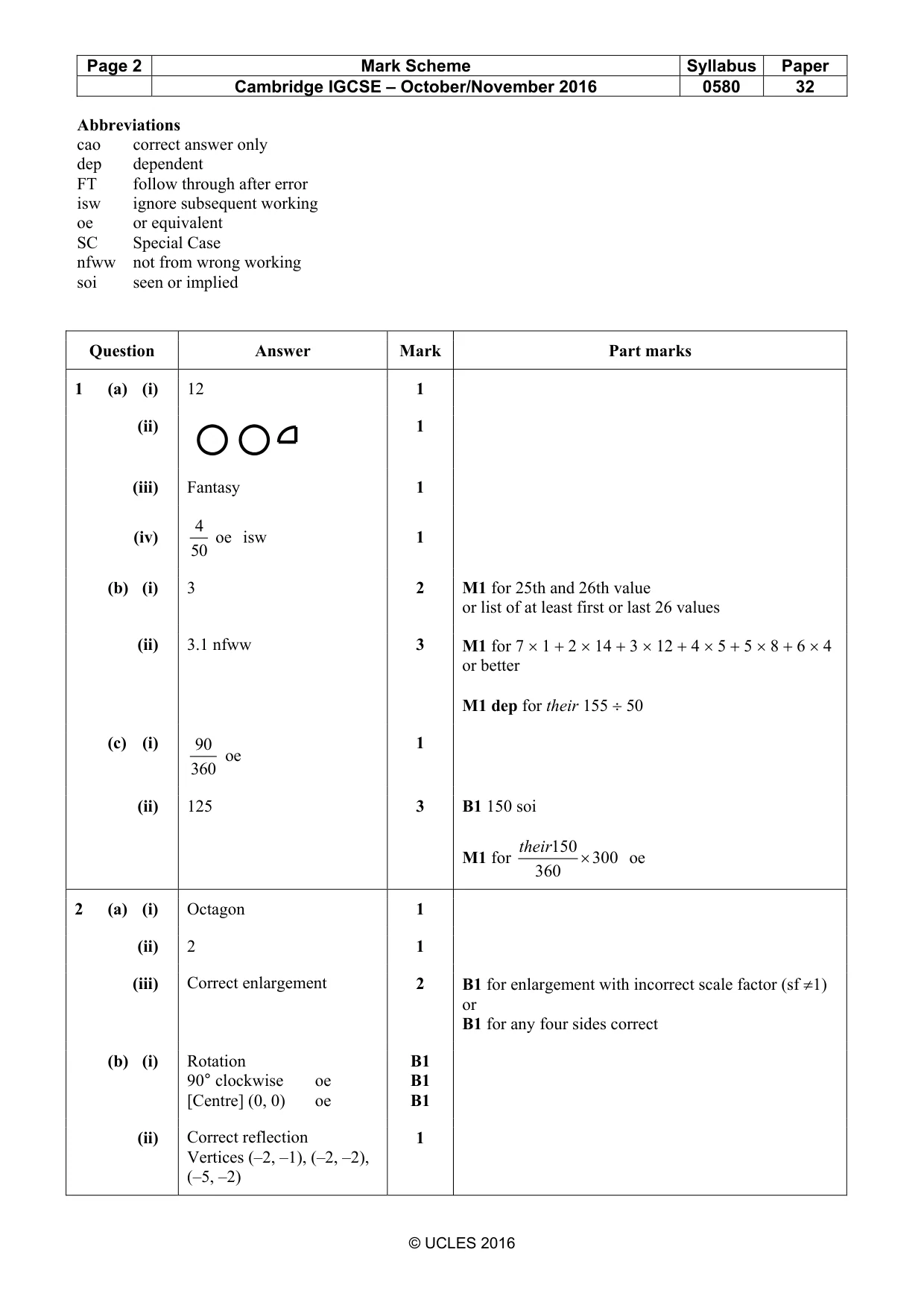
Mark scheme: 2 (a) (i) Octagon 1 (ii) 2 1 (iii) Correct enlargement 2 B1 for enlargement with incorrect scale factor (sf ≠1) or B1 for any four sides correct (b) (i) Rotation B1 90° clockwise oe B1 [Centre] (0, 0) oe B1 (ii) Correct reflection 1 Vertices (–2, –1), (–2, –2), (–5, –2)
Q3 · Tariq wants to buy some orange juice
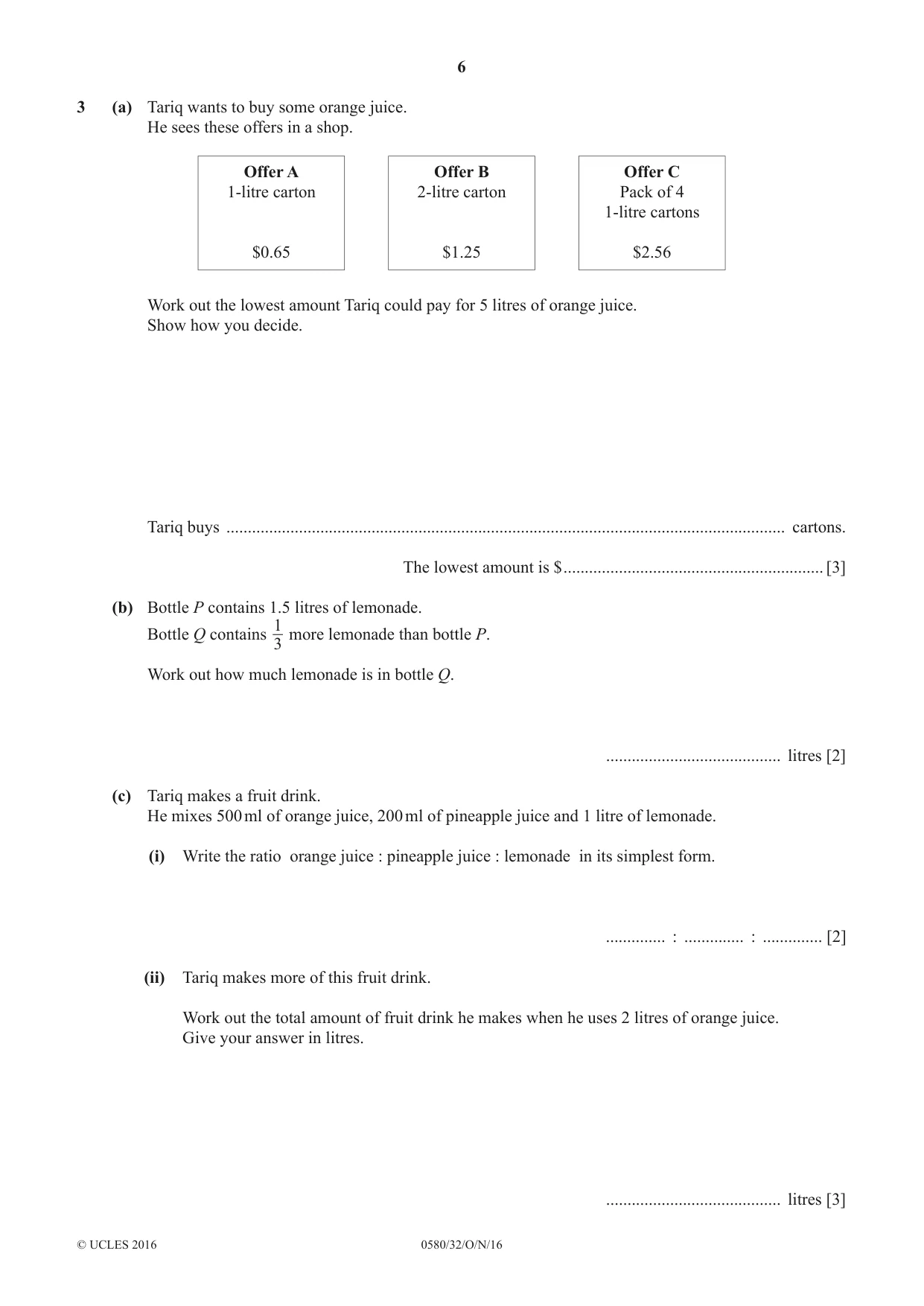
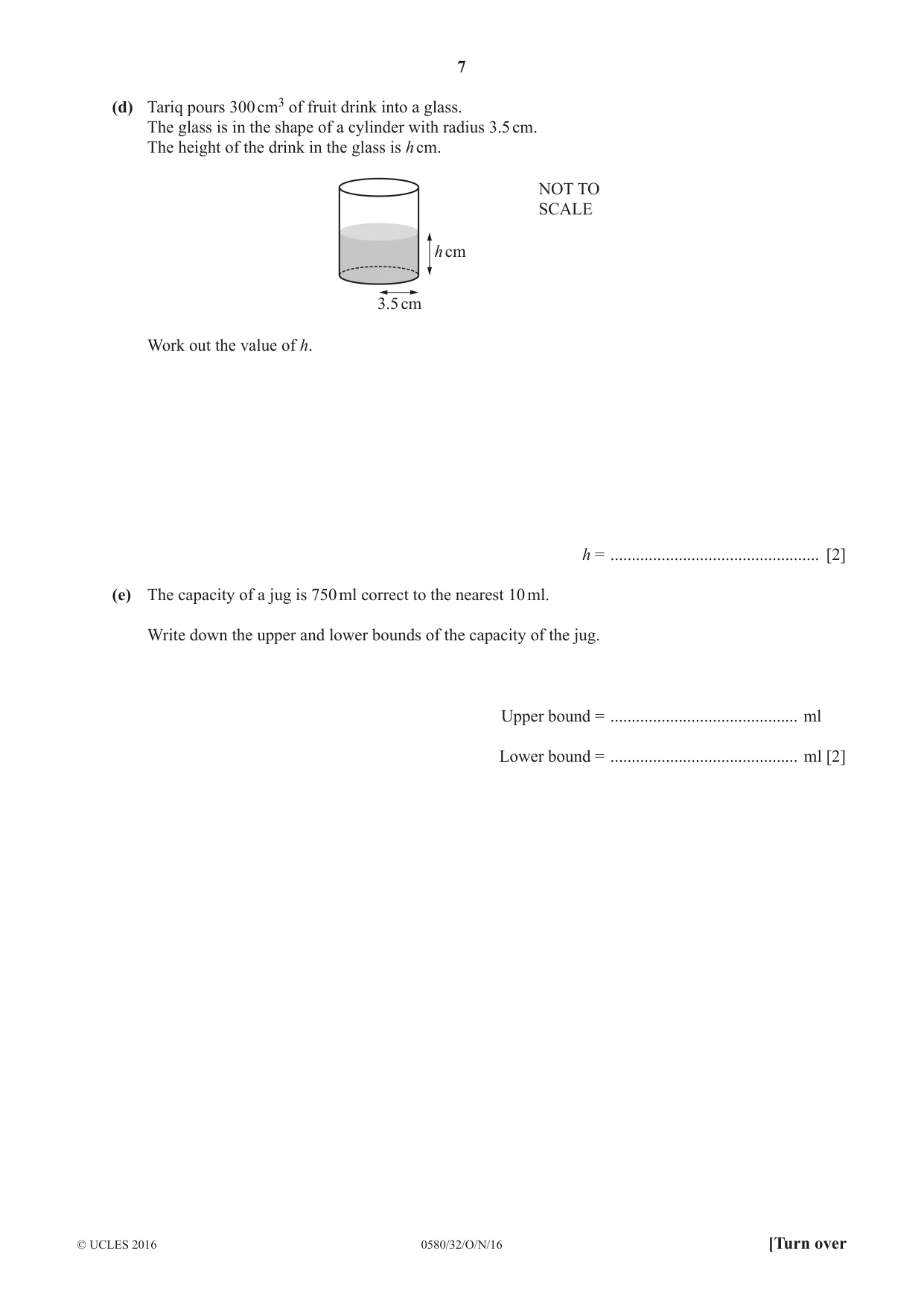
3 (a) Tariq wants to buy some orange juice. He sees these offers in a shop. Offer A Offer B Offer C 1-litre carton 2-litre carton Pack of 4 1-litre cartons $0.65 $1.25 $2.56 Work out the lowest amount Tariq could pay for 5 litres of orange juice. Show how you decide. Tariq buys ................................................................................................................................... cartons. The lowest amount is $ ............................................................. [3] (b) Bottle P contains 1.5 litres of lemonade. 1 Bottle Q contains 3 more lemonade than bottle P. Work out how much lemonade is in bottle Q. ......................................... litres [2] (c) Tariq makes a fruit drink. He mixes 500 ml of orange juice, 200 ml of pineapple juice and 1 litre of lemonade. (i) Write the ratio orange juice : pineapple juice : lemonade in its simplest form. .............. : .............. : .............. [2] (ii) Tariq makes more of this fruit drink. Work out the total amount of fruit drink he makes when he uses 2 litres of orange juice. Give your answer in litres. ......................................... litres [3] (d) Tariq pours 300 cm3 of fruit drink into a glass. The glass is in the shape of a cylinder with radius 3.5 cm. The height of the drink in the glass is h cm. NOT TO SCALE h cm 3.5 cm Work out the value of h. h = ................................................. [2] (e) The capacity of a jug is 750 ml correct to the nearest 10 ml. Write down the upper and lower bounds of the capacity of the jug. Upper bound = ............................................ ml Lower bound = ............................................ ml [2]
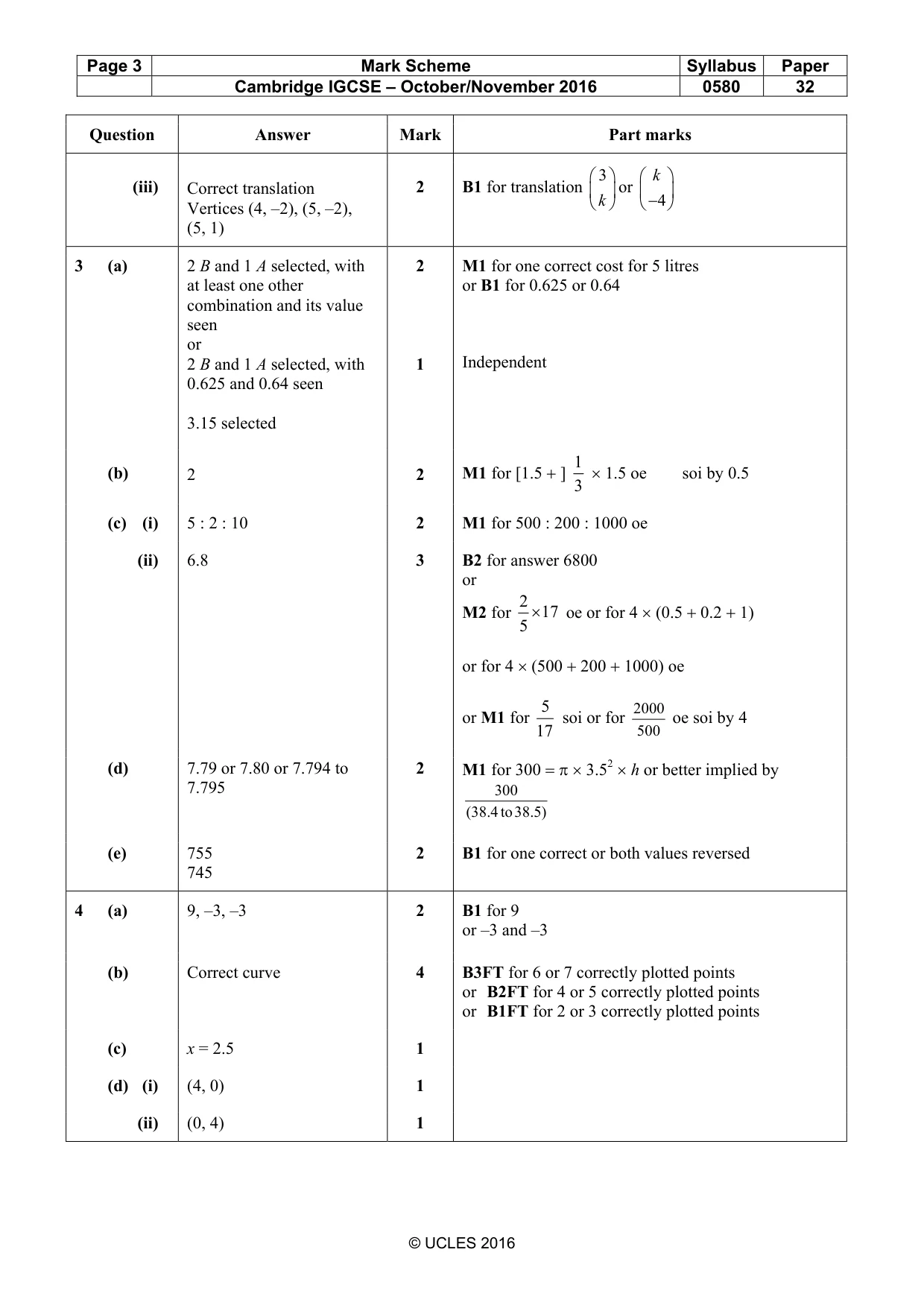
Mark scheme: 3 (a) 2 B and 1 A selected, with 2 M1 for one correct cost for 5 litres at least one other or B1 for 0.625 or 0.64 combination and its value seen or 2 B and 1 A selected, with 1 Independent 0.625 and 0.64 seen 3.15 selected 1 (b) 2 2 M1 for [1.5 + ] × 1.5 oe soi by 0.5 3 (c) (i) 5 : 2 : 10 2 M1 for 500 : 200 : 1000 oe (ii) 6.8 3 B2 for answer 6800 or 2 M2 for × 17 oe or for 4 × (0.5 + 0.2 + 1) 5 or for 4 × (500 + 200 + 1000) oe 5 2000 or M1 for soi or for oe soi by 4 17 500 (d) 7.79 or 7.80 or 7.794 to 2 M1 for 300 = π × 3.52 × h or better implied by 7.795 300 (38.4to38.5) (e) 755 2 B1 for one correct or both values reversed 745
Q4 · Complete the table of values for y = x 2 - 5x + 3
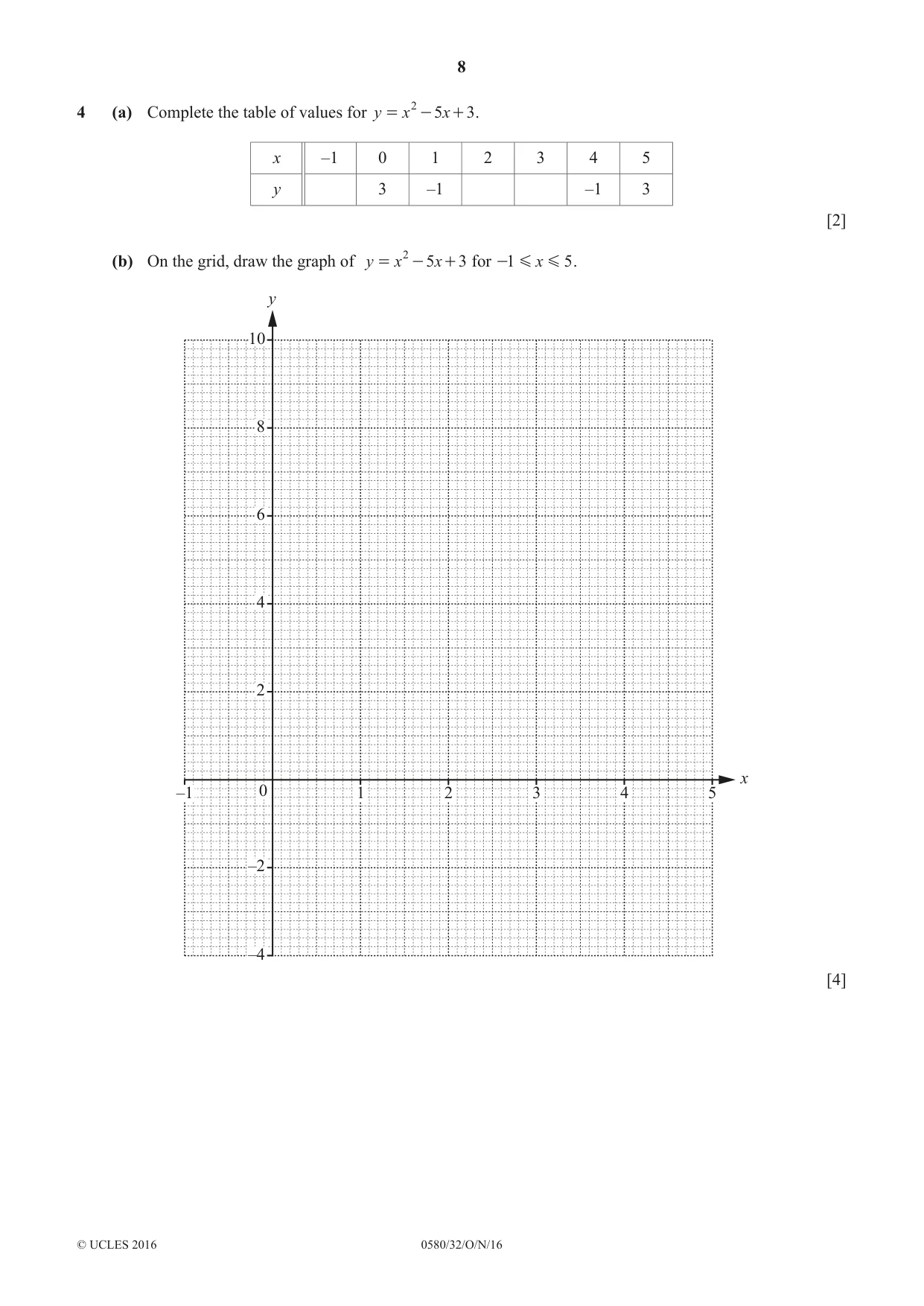
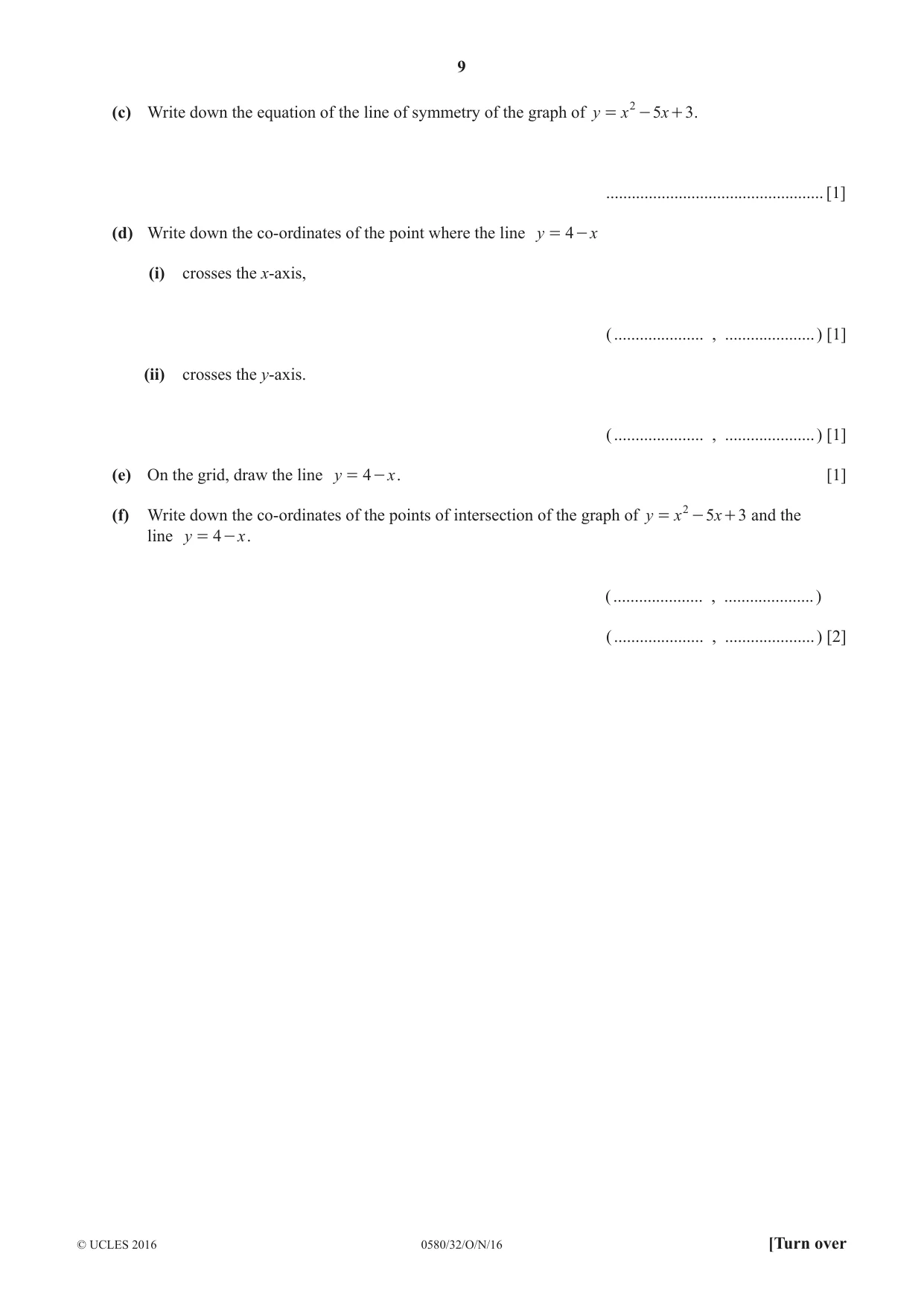
4 (a) Complete the table of values for y = x 2 - 5x + 3 . x –1 0 1 2 3 4 5 y 3 –1 –1 3 [2] (b) On the grid, draw the graph of y = x 2 - 5x + 3 for -1 G x G 5 . y 10 8 6 4 2 x –1 0 1 2 3 4 5 –2 –4 [4] (c) Write down the equation of the line of symmetry of the graph of y = x 2 - 5x + 3 . ................................................... [1] (d) Write down the co-ordinates of the point where the line y = 4 - x (i) crosses the x-axis, ( ..................... , ..................... ) [1] (ii) crosses the y-axis. ( ..................... , ..................... ) [1] (e) On the grid, draw the line y = 4 - x . [1] (f) Write down the co-ordinates of the points of intersection of the graph of y = x 2 - 5x + 3 and the line y = 4 - x . ( ..................... , ..................... ) ( ..................... , ..................... ) [2]
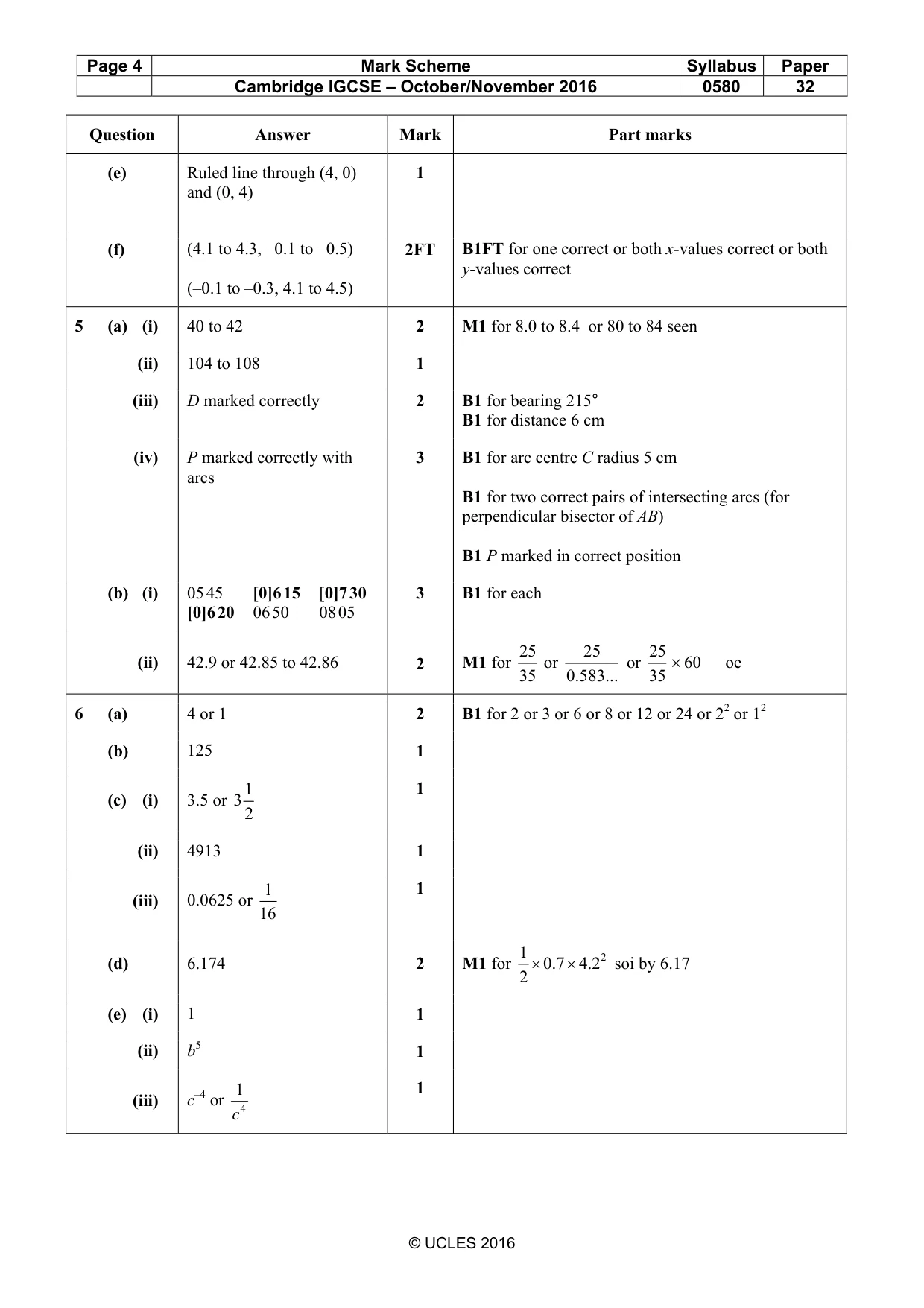
Mark scheme: 4 (a) 9, –3, –3 2 B1 for 9 or –3 and –3 (b) Correct curve 4 B3FT for 6 or 7 correctly plotted points or B2FT for 4 or 5 correctly plotted points or B1FT for 2 or 3 correctly plotted points (c) x = 2.5 1 (d) (i) (4, 0) 1 (ii) (0, 4) 1
Q5 · The scale drawing shows the positions of three villages, A, B and C
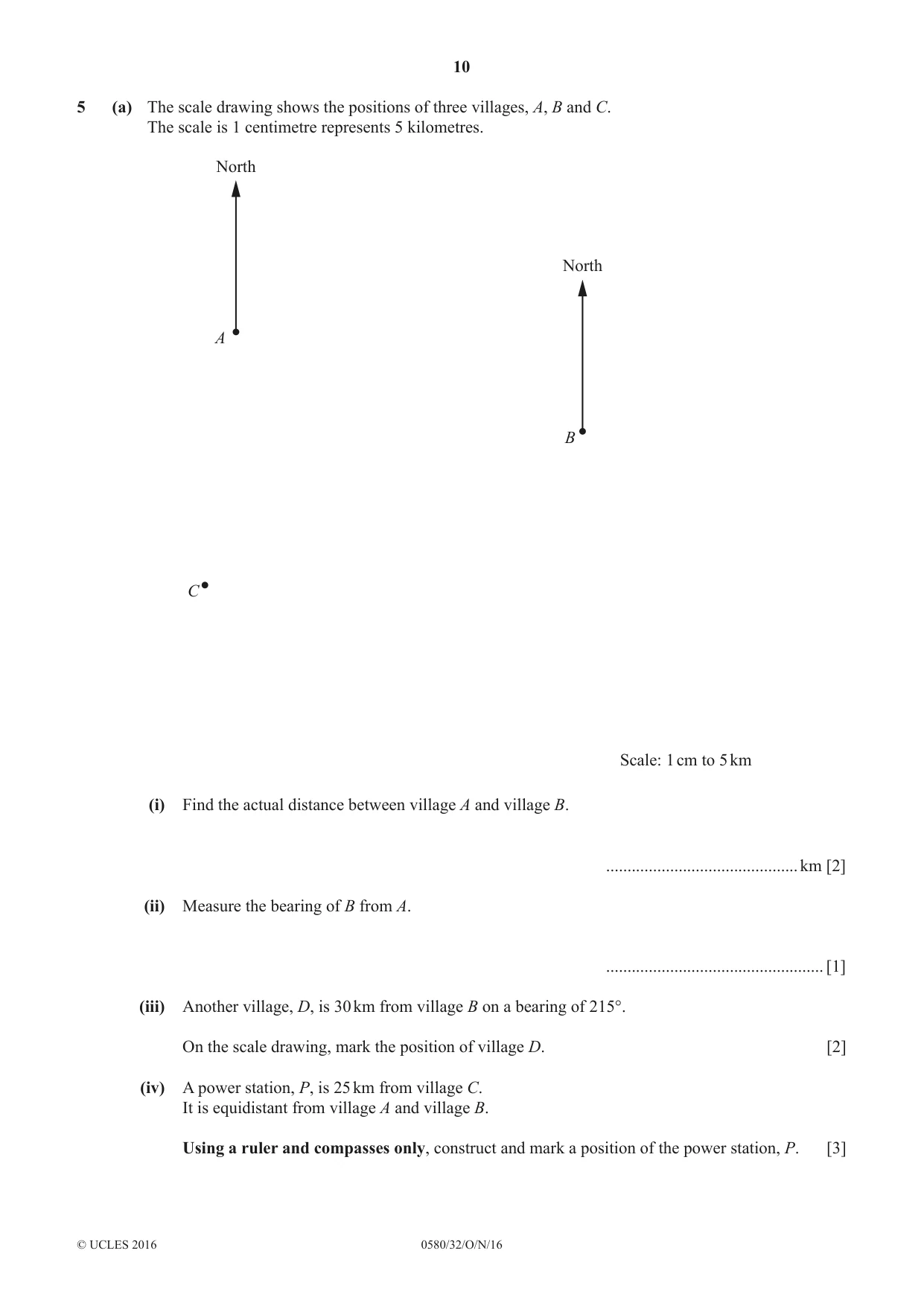
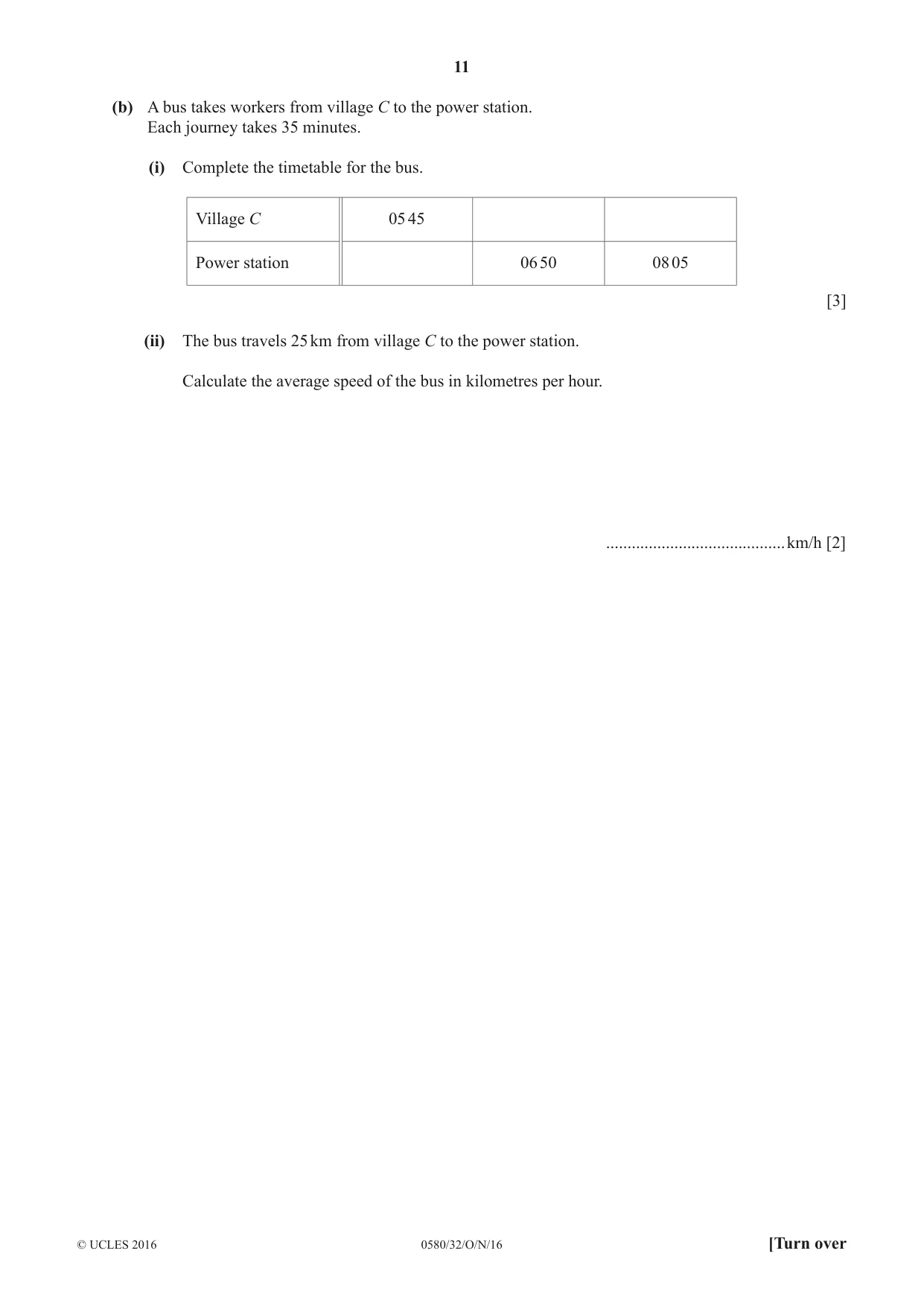
5 (a) The scale drawing shows the positions of three villages, A, B and C. The scale is 1 centimetre represents 5 kilometres. North North A B C Scale: 1 cm to 5 km (i) Find the actual distance between village A and village B. .............................................km [2] (ii) Measure the bearing of B from A. ................................................... [1] (iii) Another village, D, is 30 km from village B on a bearing of 215°. On the scale drawing, mark the position of village D. [2] (iv) A power station, P, is 25 km from village C. It is equidistant from village A and village B. Using a ruler and compasses only, construct and mark a position of the power station, P. [3] (b) A bus takes workers from village C to the power station. Each journey takes 35 minutes. (i) Complete the timetable for the bus. Village C 05 45 Power station 06 50 08 05 [3] (ii) The bus travels 25 km from village C to the power station. Calculate the average speed of the bus in kilometres per hour. ..........................................km/h [2]
Mark scheme: 5 (a) (i) 40 to 42 2 M1 for 8.0 to 8.4 or 80 to 84 seen (ii) 104 to 108 1 (iii) D marked correctly 2 B1 for bearing 215° B1 for distance 6 cm (iv) P marked correctly with 3 B1 for arc centre C radius 5 cm arcs B1 for two correct pairs of intersecting arcs (for perpendicular bisector of AB) B1 P marked in correct position (b) (i) 05 45 [0]6 15 [0]7 30 3 B1 for each [0]6 20 06 50 08 05 25 25 25 (ii) 42.9 or 42.85 to 42.86 2 M1 for or or × 60 oe 35 0.583... 35 2 2
Q6 · Write down a factor of 24 that is a square number
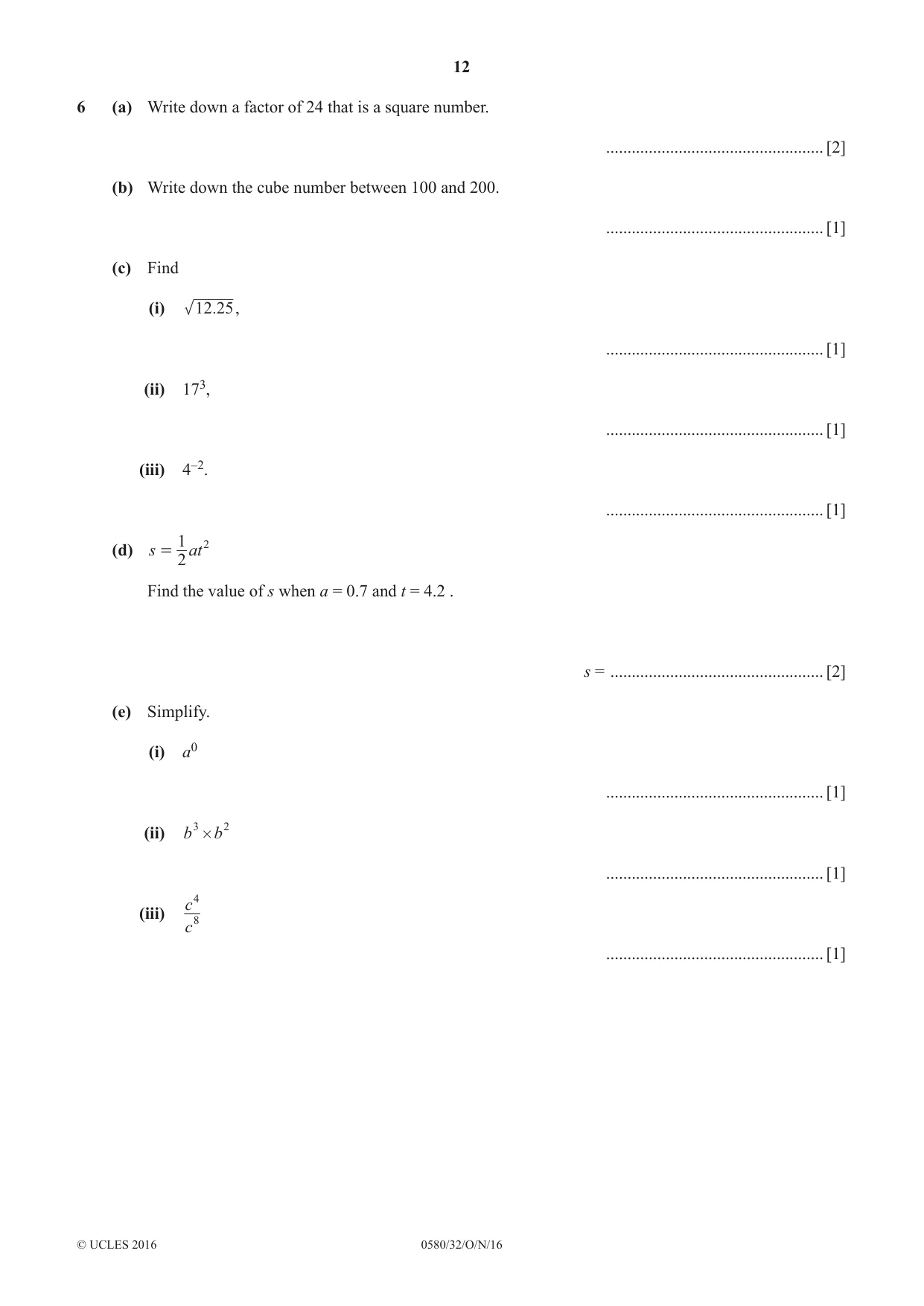
6 (a) Write down a factor of 24 that is a square number. ................................................... [2] (b) Write down the cube number between 100 and 200. ................................................... [1] (c) Find (i) 12.25, ................................................... [1] (ii) 173, ................................................... [1] (iii) 4–2. ................................................... [1] 1 2 (d) s = 2 at Find the value of s when a = 0.7 and t = 4.2 . s = .................................................. [2] (e) Simplify. (i) a0 ................................................... [1] (ii) b 3 # b 2 ................................................... [1] c 4 (iii) 8 c ................................................... [1]
Mark scheme: 6 (a) 4 or 1 2 B1 for 2 or 3 or 6 or 8 or 12 or 24 or 22 or 12 (b) 125 1 1 1 (c) (i) 3.5 or 32 (ii) 4913 1 1 1 (iii) 0.0625 or 16 1 2 (d) 6.174 2 M1 for × 0.7 × 4.2 soi by 6.17 2 (e) (i) 1 1 (ii) b5 1 1 1 (iii) c–4 or 4 c
Q7 · Mei is paid $15.25 for each hour she works
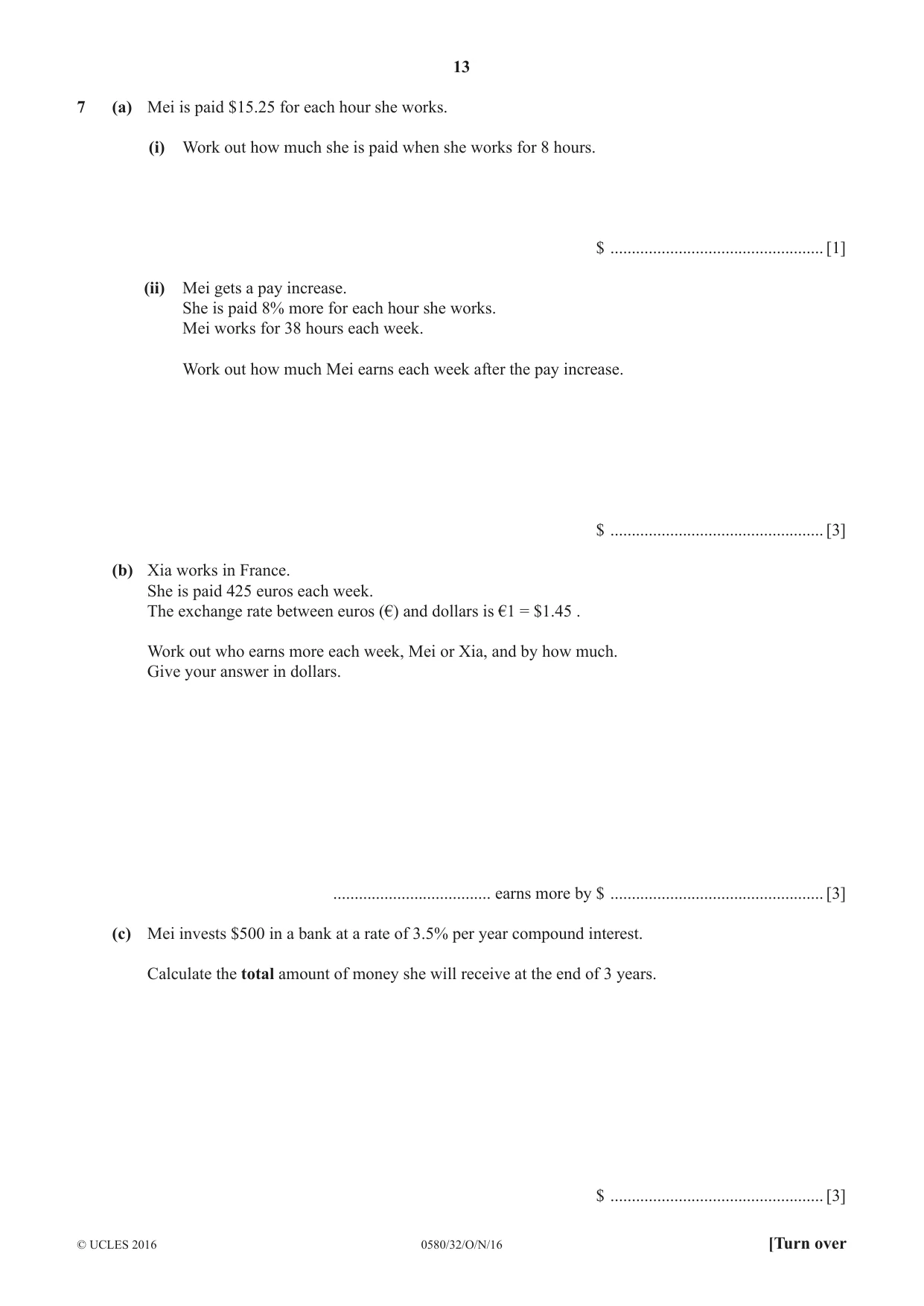
7 (a) Mei is paid $15.25 for each hour she works. (i) Work out how much she is paid when she works for 8 hours. $ .................................................. [1] (ii) Mei gets a pay increase. She is paid 8% more for each hour she works. Mei works for 38 hours each week. Work out how much Mei earns each week after the pay increase. $ .................................................. [3] (b) Xia works in France. She is paid 425 euros each week. The exchange rate between euros (€) and dollars is €1 = $1.45 . Work out who earns more each week, Mei or Xia, and by how much. Give your answer in dollars. ..................................... earns more by $ .................................................. [3] (c) Mei invests $500 in a bank at a rate of 3.5% per year compound interest. Calculate the total amount of money she will receive at the end of 3 years. $ .................................................. [3]
Mark scheme: 7 (a) (i) 122 1 (ii) 625.86 cao 3 M2 for 15.25 × 1.08 × 38 oe soi by 626 or 625.9 or M1 for 15.25 × 1.08 soi by 16.47 or for 15.25 × 38 soi by 579.5 If zero scored, SC1 for 131.76 or 5006.88 (b) Mei 9.61 cao 3 M1 for 425 × 1.45 M1FT for ±(their 625.86 – their 616.25) If zero scored, SC1 for [€] 6.62 to 6.63 (c) 554.36 3 M2 for 500 ×1.0353 oe or M1 for 500 × 1.035k , k ≠ 1, 3 If zero scored, SC1 for answer of 54.36 or 54.35 or 54.4 or 54.358… 54.359
Q8 · P NOT TO SCALE O Q R S The diagram shows a circle, centre O, and lines PQ and RS
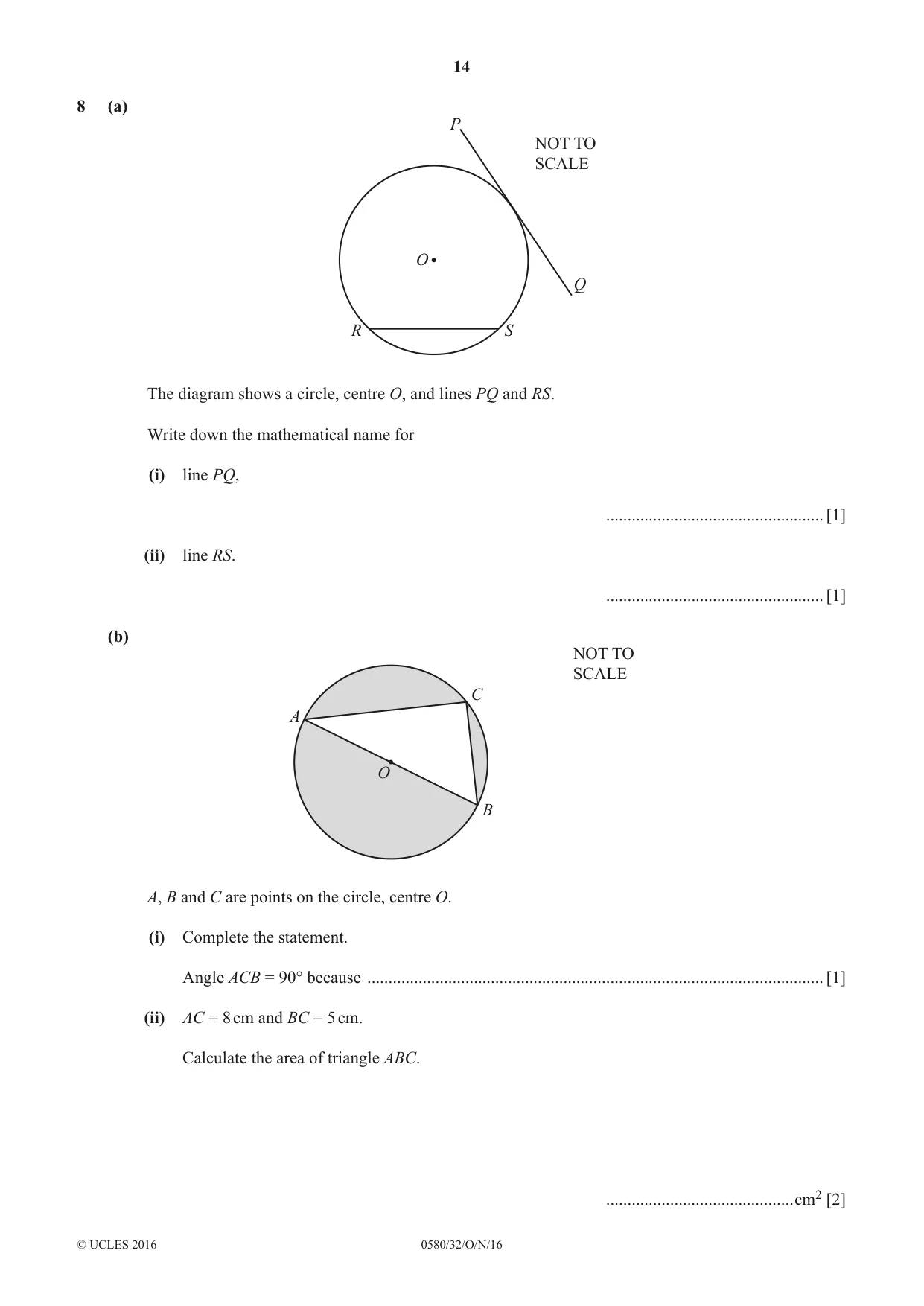
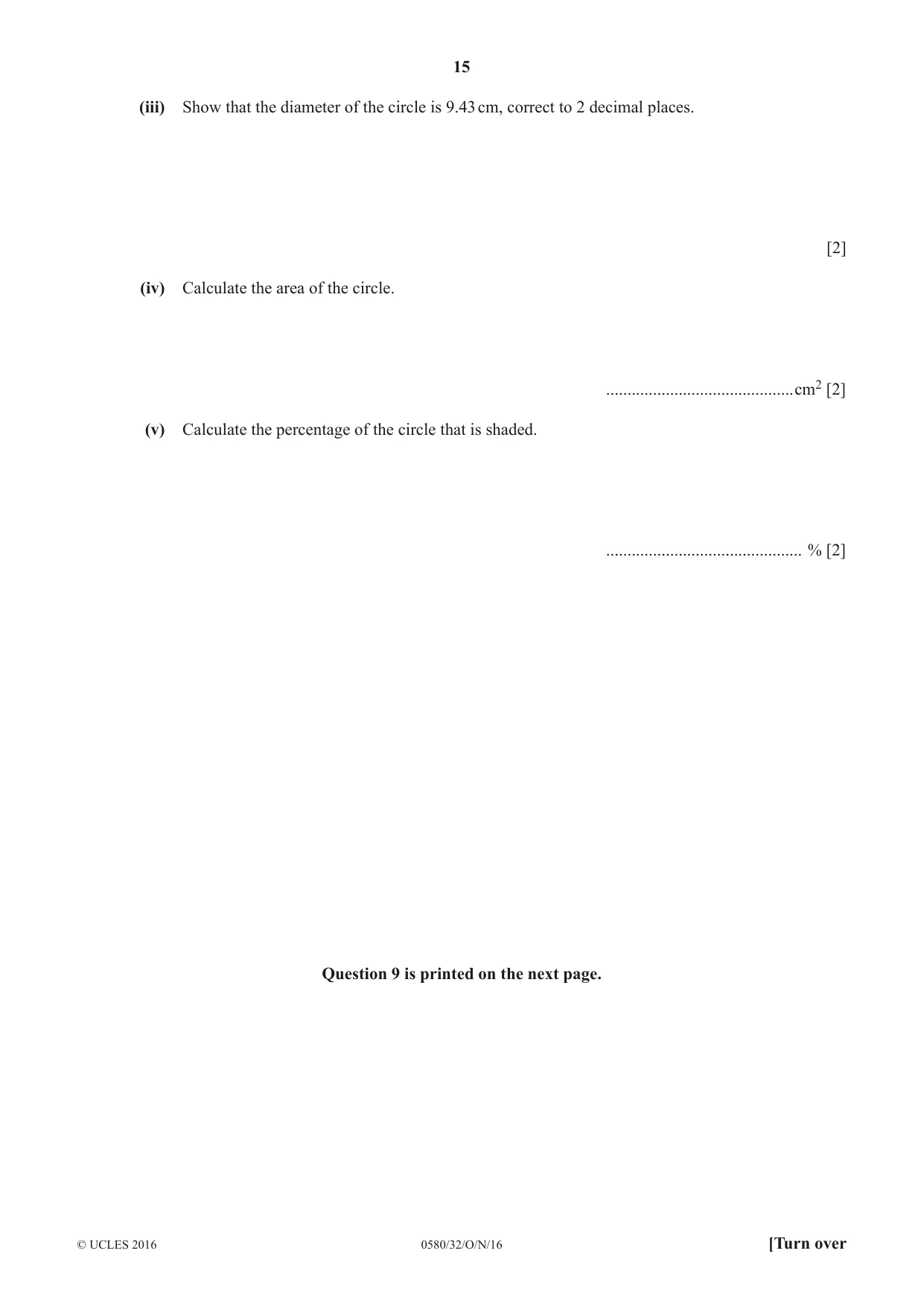
8 (a) P NOT TO SCALE O Q R S The diagram shows a circle, centre O, and lines PQ and RS. Write down the mathematical name for (i) line PQ, ................................................... [1] (ii) line RS. ................................................... [1] (b) NOT TO SCALE C A O B A, B and C are points on the circle, centre O. (i) Complete the statement. Angle ACB = 90° because ........................................................................................................... [1] (ii) AC = 8 cm and BC = 5 cm. Calculate the area of triangle ABC. ............................................cm2 [2] (iii) Show that the diameter of the circle is 9.43 cm, correct to 2 decimal places. [2] (iv) Calculate the area of the circle. ............................................cm2 [2] (v) Calculate the percentage of the circle that is shaded. .............................................. % [2] Question 9 is printed on the next page.
Mark scheme: 8 (a) (i) Tangent 1 (ii) Chord 1 (b) (i) Angle [in] semicircle 1 1 (ii) 20 2 M1 for × 8 × 5 2 (iii) [AB = ] 8 2 + 5 2 = 9.433… M2 M1 for [AB2 = ] 82 + 52 or 9.434 9.43 2 2 4.72 ) (iv) 69.8 or 69.9 or 69.84 to 2 M1 for π × or π × ( 2 69.91 their b(iv) − their b(ii) (v) 71.3 to 71.4 2 M1 for [× 100] their b(iv) their b(ii) or (1 − ) [× 100] their b(iv) their b(ii) or [100 –] × 100 their b(iv)
Q9 · A sequence of patterns is made from lines and dots
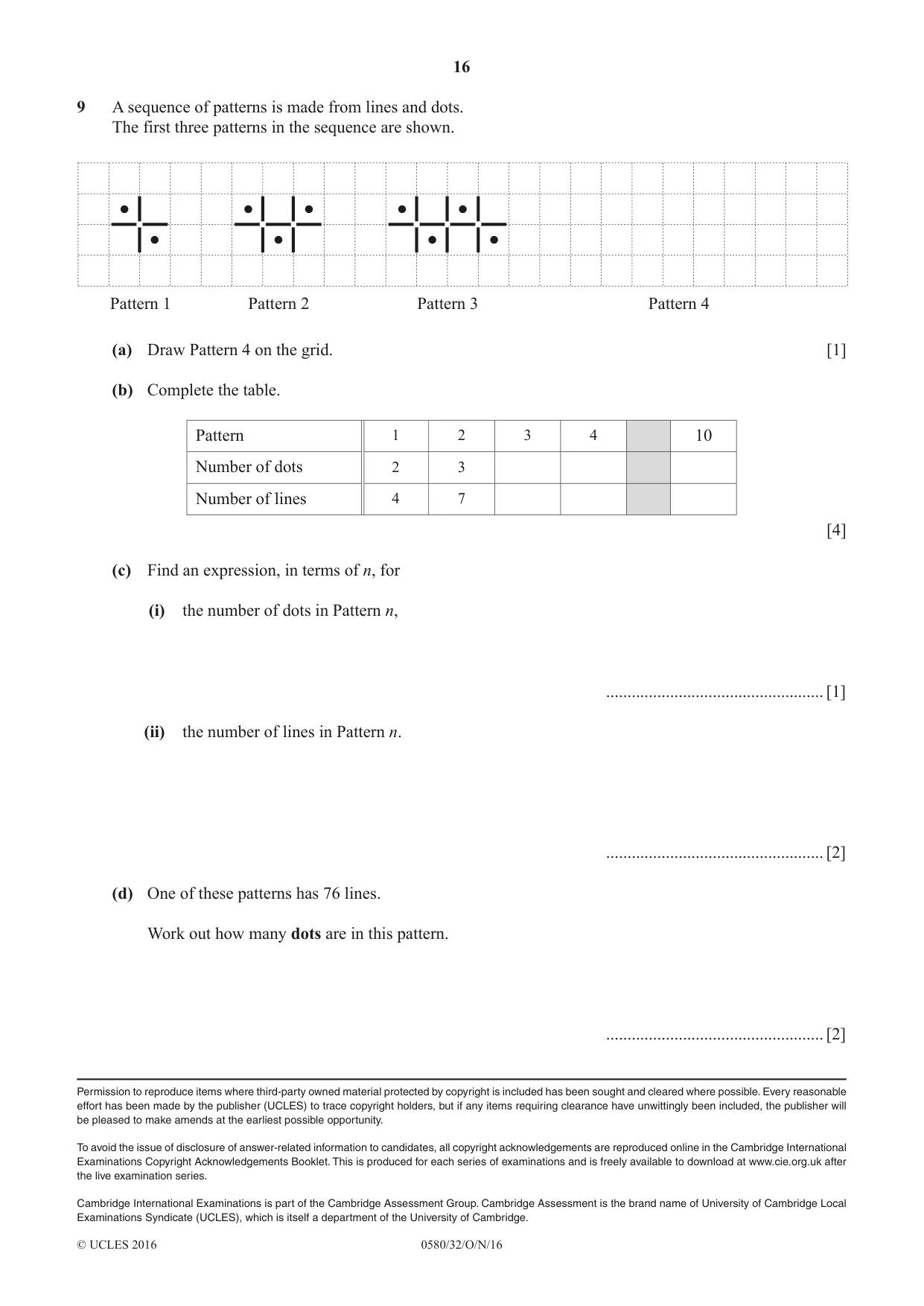
9 A sequence of patterns is made from lines and dots. The first three patterns in the sequence are shown. Pattern 1 Pattern 2 Pattern 3 Pattern 4 (a) Draw Pattern 4 on the grid. [1] (b) Complete the table. Pattern 1 2 3 4 10 Number of dots 2 3 Number of lines 4 7 [4] (c) Find an expression, in terms of n, for (i) the number of dots in Pattern n, ................................................... [1] (ii) the number of lines in Pattern n. ................................................... [2] (d) One of these patterns has 76 lines. Work out how many dots are in this pattern. ................................................... [2]
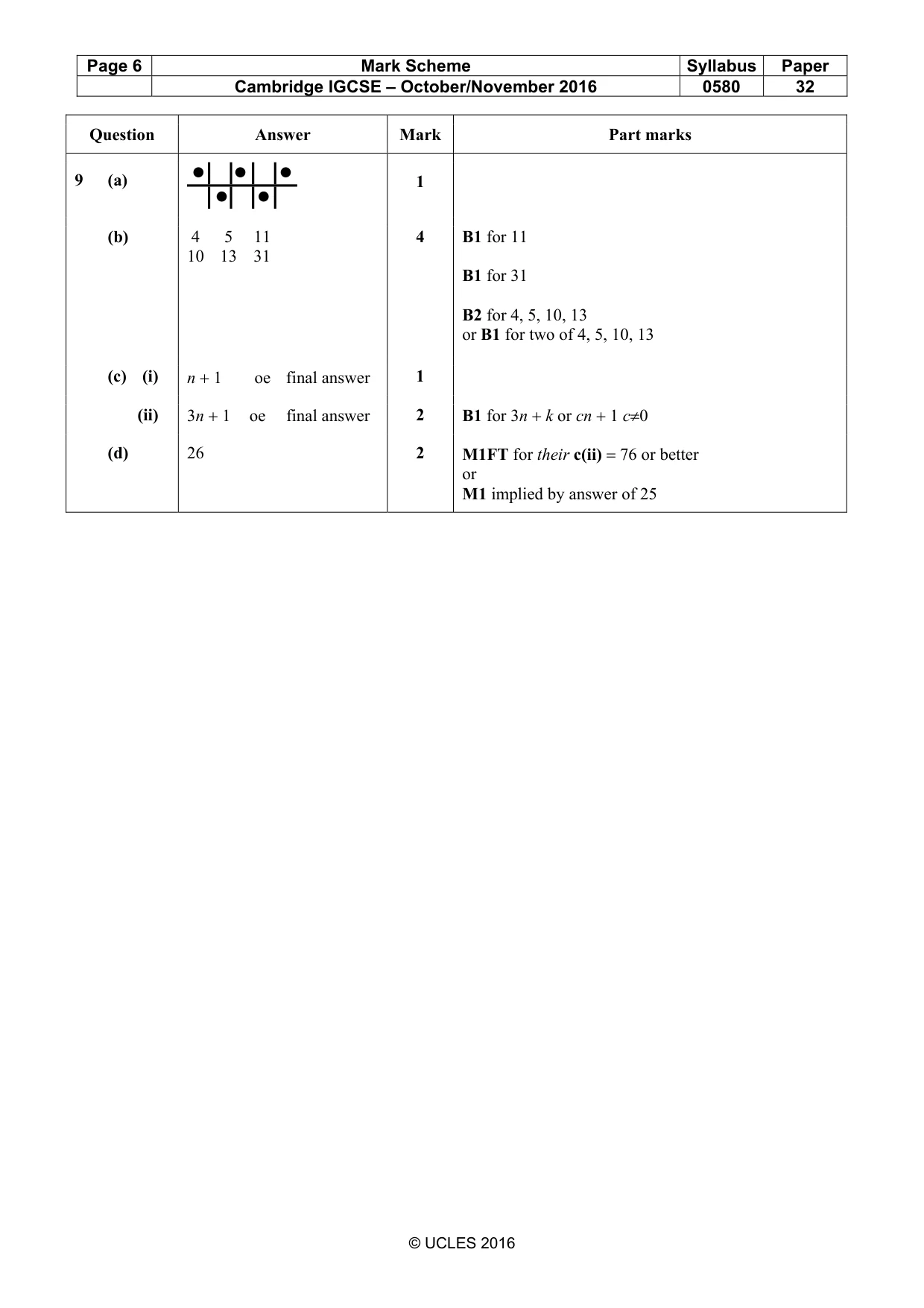
Mark scheme: 9 (a) 1 (b) 4 5 11 4 B1 for 11 10 13 31 B1 for 31 B2 for 4, 5, 10, 13 or B1 for two of 4, 5, 10, 13 (c) (i) n + 1 oe final answer 1 (ii) 3n + 1 oe final answer 2 B1 for 3n + k or cn + 1 c≠0 (d) 26 2 M1FT for their c(ii) = 76 or better or M1 implied by answer of 25
What was in this paper
The subtopics covered by these 9 questions, and how many questions each got. Open one in a new tab to see every Cambridge question on it.
What you needed in this session
Cambridge’s own grade thresholds for 2016 Oct/Nov, Paper 3 · Variant 2. A higher threshold means an easier paper — the bar moves with how the cohort did.