Cambridge IGCSE Mathematics 0580 — 2016 Oct/Nov Paper 3 · Variant 3
0580/33/O/N/16 · 9 questions · 104 marks · ≈117 min
The question paper and its mark scheme, free to read here and free to download. This is Cambridge’s own paper, exactly as it was sat.
Question paper16 pages
Mark scheme5 pages
Answers below. Sit the paper first if you are practising.
Questions as text
Q1 · Juan takes his car to a garage for repairs
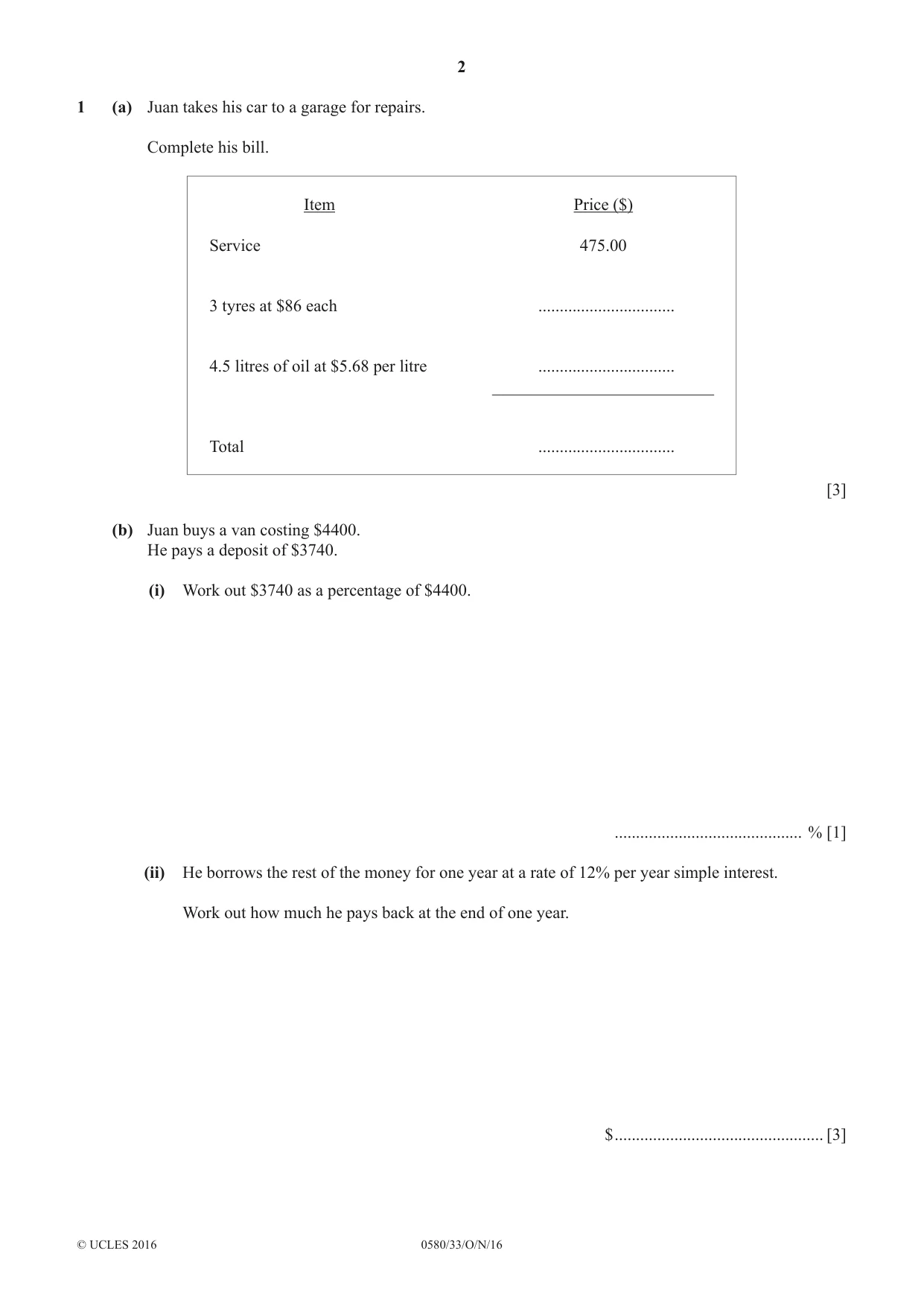
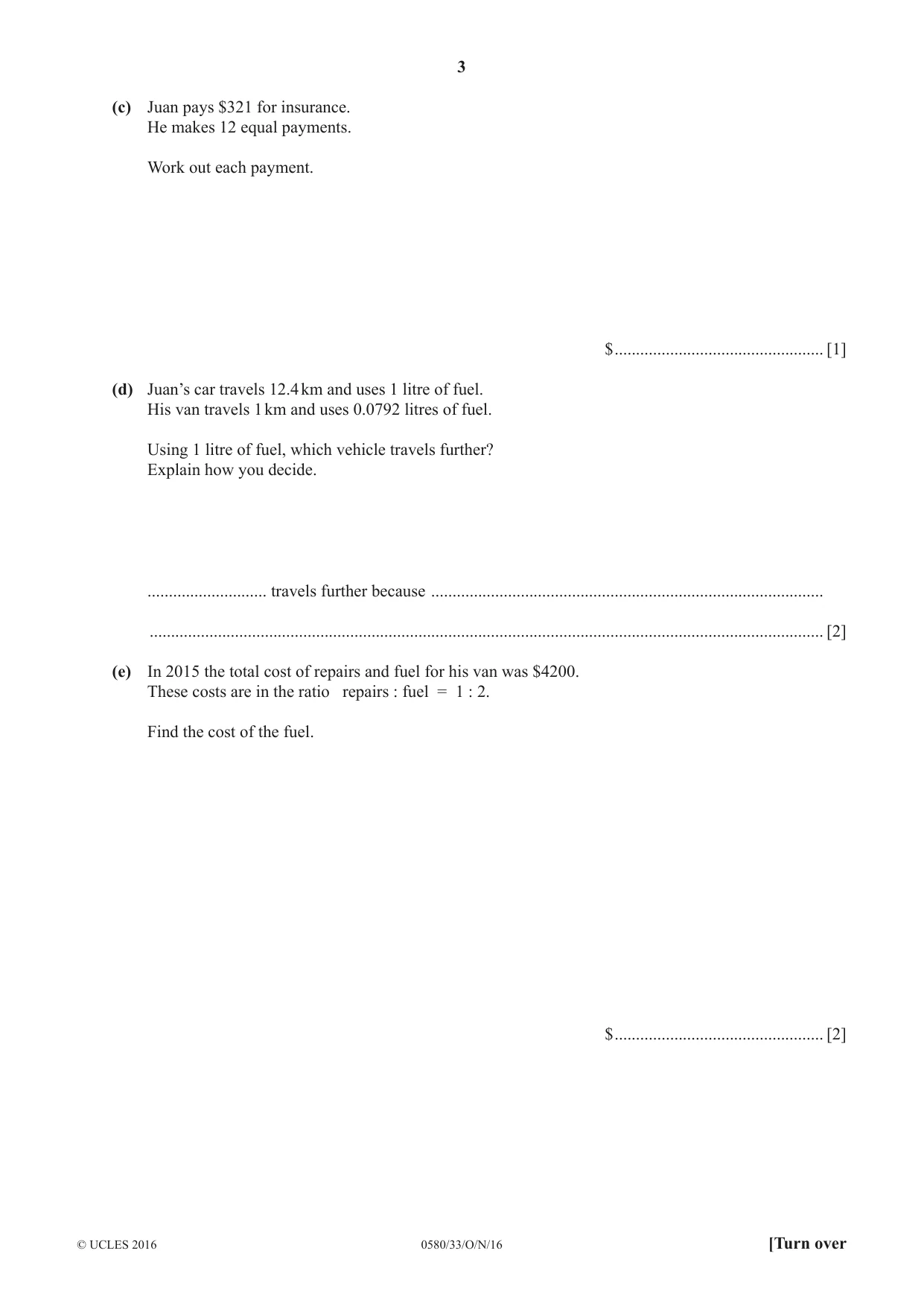
1 (a) Juan takes his car to a garage for repairs. Complete his bill. Item Price ($) Service 475.00 3 tyres at $86 each ................................ 4.5 litres of oil at $5.68 per litre ................................ __________________________ Total ................................ [3] (b) Juan buys a van costing $4400. He pays a deposit of $3740. (i) Work out $3740 as a percentage of $4400. ............................................ % [1] (ii) He borrows the rest of the money for one year at a rate of 12% per year simple interest. Work out how much he pays back at the end of one year. $ ................................................. [3] (c) Juan pays $321 for insurance. He makes 12 equal payments. Work out each payment. $ ................................................. [1] (d) Juan’s car travels 12.4 km and uses 1 litre of fuel. His van travels 1 km and uses 0.0792 litres of fuel. Using 1 litre of fuel, which vehicle travels further? Explain how you decide. ............................ travels further because ............................................................................................ .............................................................................................................................................................. [2] (e) In 2015 the total cost of repairs and fuel for his van was $4200. These costs are in the ratio repairs : fuel = 1 : 2. Find the cost of the fuel. $ ................................................. [2]
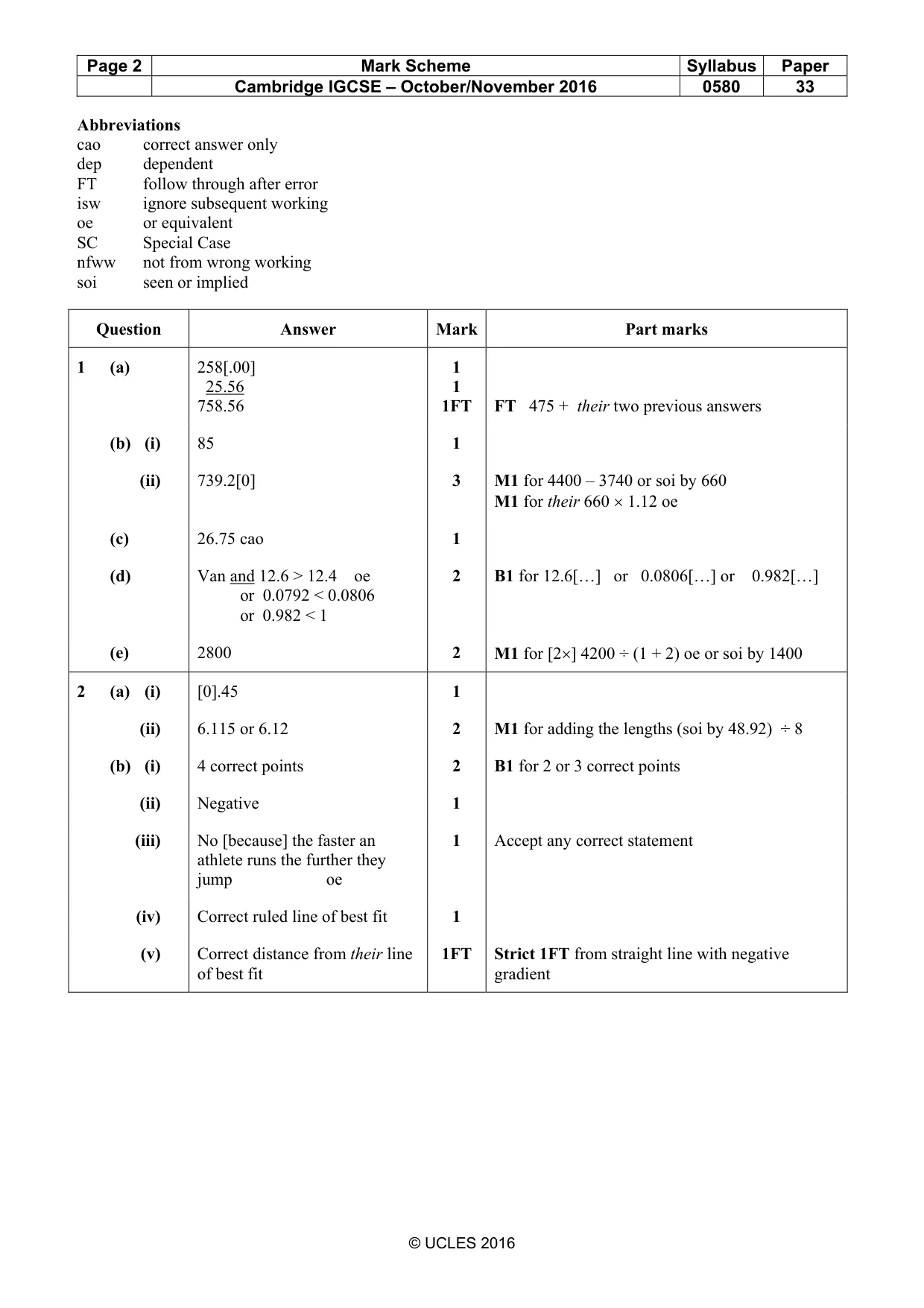
Mark scheme: Question Answer Mark Part marks 1 (a) 258[.00] 1 25.56 1 758.56 1FT FT 475 + their two previous answers (b) (i) 85 1 (ii) 739.2[0] 3 M1 for 4400 – 3740 or soi by 660 M1 for their 660 × 1.12 oe (c) 26.75 cao 1 (d) Van and 12.6 > 12.4 oe 2 B1 for 12.6[…] or 0.0806[…] or 0.982[…] or 0.0792 < 0.0806 or 0.982 < 1 (e) 2800 2 M1 for [2×] 4200 ÷ (1 + 2) oe or soi by 1400
Q2 · Eight athletes compete in both the 200 metre race and the long jump
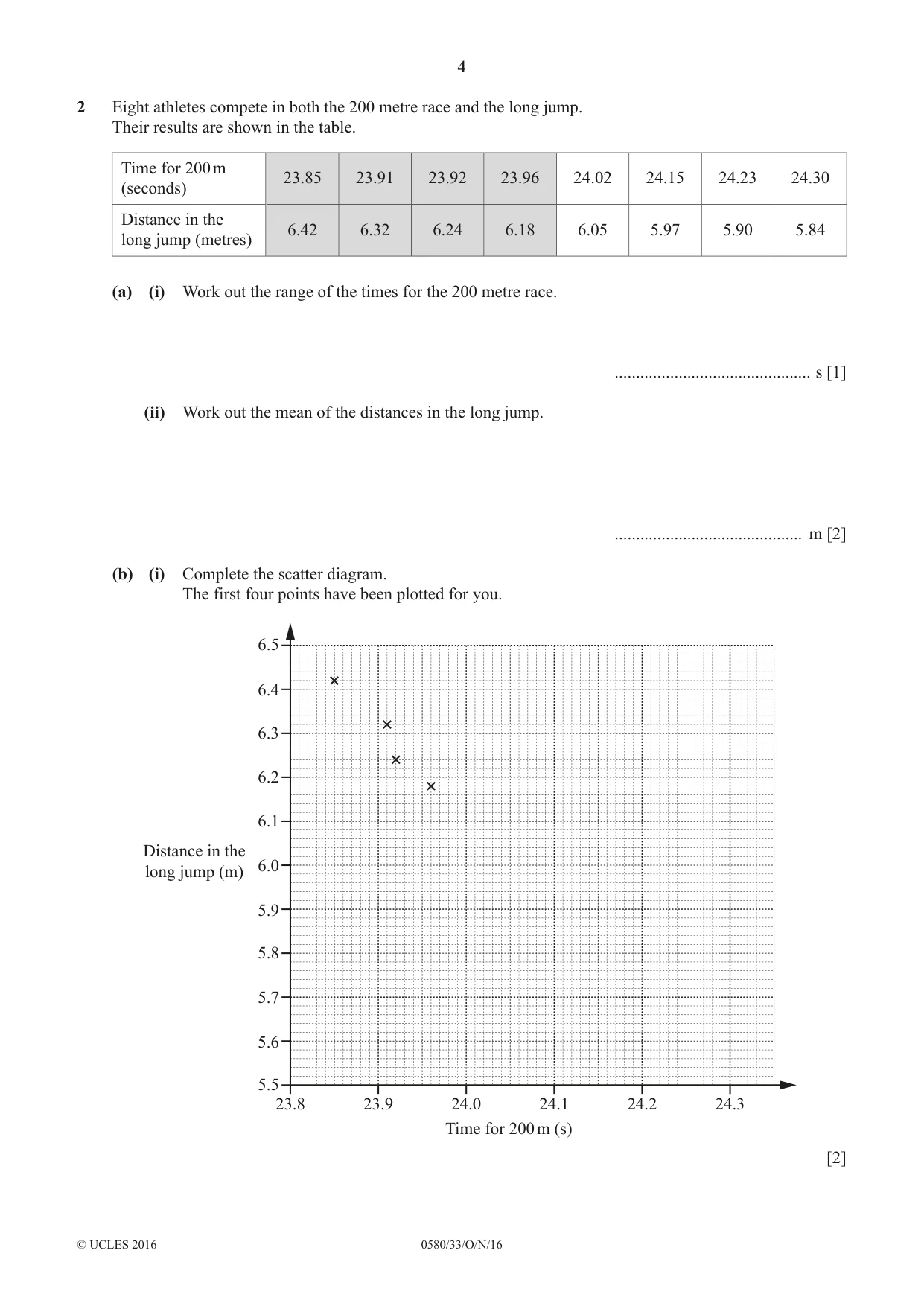
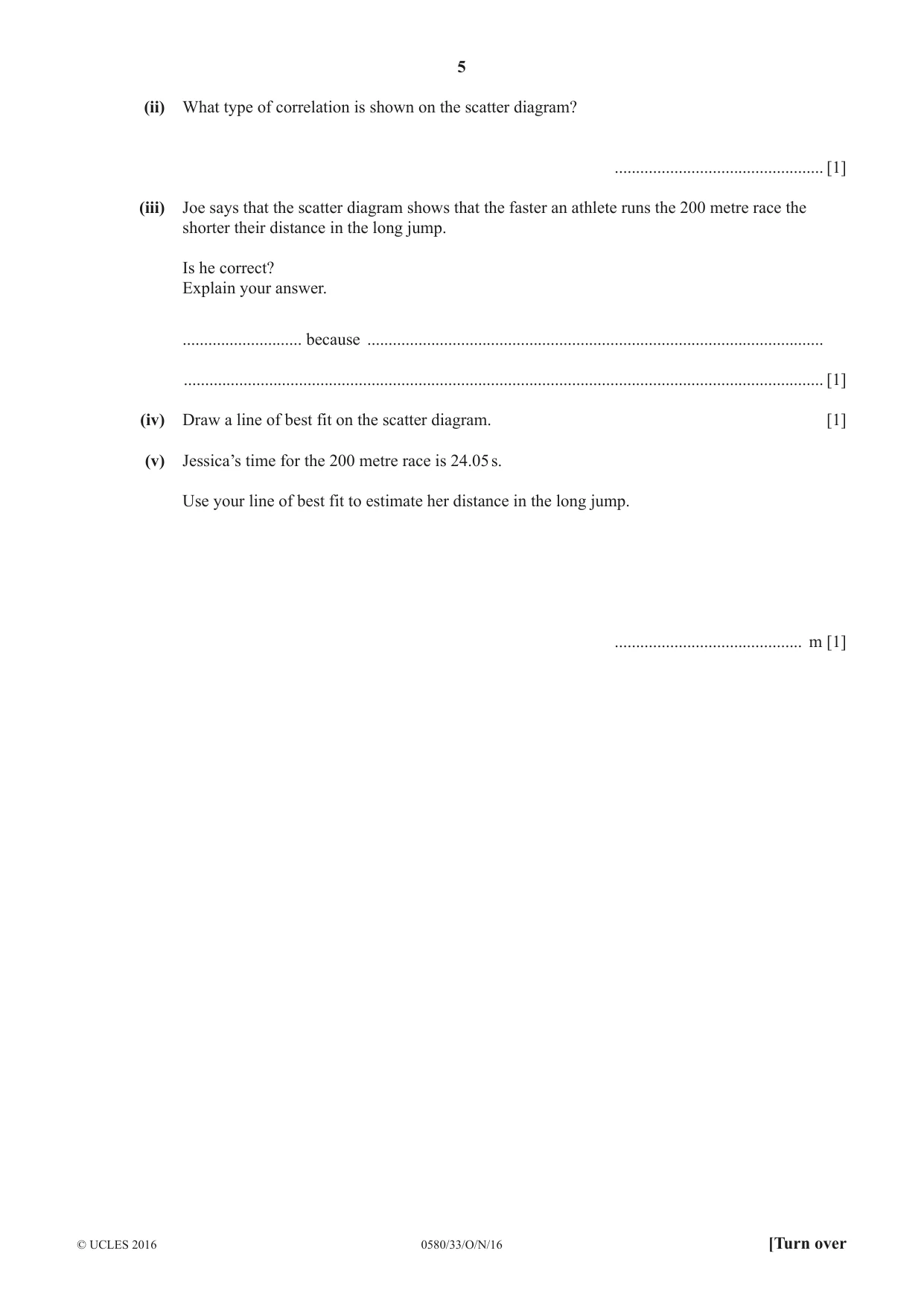
2 Eight athletes compete in both the 200 metre race and the long jump. Their results are shown in the table. Time for 200 m 23.85 23.91 23.92 23.96 24.02 24.15 24.23 24.30 (seconds) Distance in the 6.42 6.32 6.24 6.18 6.05 5.97 5.90 5.84 long jump (metres) (a) (i) Work out the range of the times for the 200 metre race. .............................................. s [1] (ii) Work out the mean of the distances in the long jump. ............................................ m [2] (b) (i) Complete the scatter diagram. The first four points have been plotted for you. 6.5 6.4 6.3 6.2 6.1 Distance in the 6.0 long jump (m) 5.9 5.8 5.7 5.6 5.5 23.8 23.9 24.0 24.1 24.2 24.3 Time for 200 m (s) [2] (ii) What type of correlation is shown on the scatter diagram? ................................................. [1] (iii) Joe says that the scatter diagram shows that the faster an athlete runs the 200 metre race the shorter their distance in the long jump. Is he correct? Explain your answer. ............................ because ........................................................................................................... ...................................................................................................................................................... [1] (iv) Draw a line of best fit on the scatter diagram. [1] (v) Jessica’s time for the 200 metre race is 24.05 s. Use your line of best fit to estimate her distance in the long jump. ............................................ m [1]
Mark scheme: 2 (a) (i) [0].45 1 (ii) 6.115 or 6.12 2 M1 for adding the lengths (soi by 48.92) ÷ 8 (b) (i) 4 correct points 2 B1 for 2 or 3 correct points (ii) Negative 1 (iii) No [because] the faster an 1 Accept any correct statement athlete runs the further they jump oe (iv) Correct ruled line of best fit 1 (v) Correct distance from their line 1FT Strict 1FT from straight line with negative of best fit gradient
Q3 · X° NOT TO SCALE 74° 71° y° Work out the value of (i) x, x =…
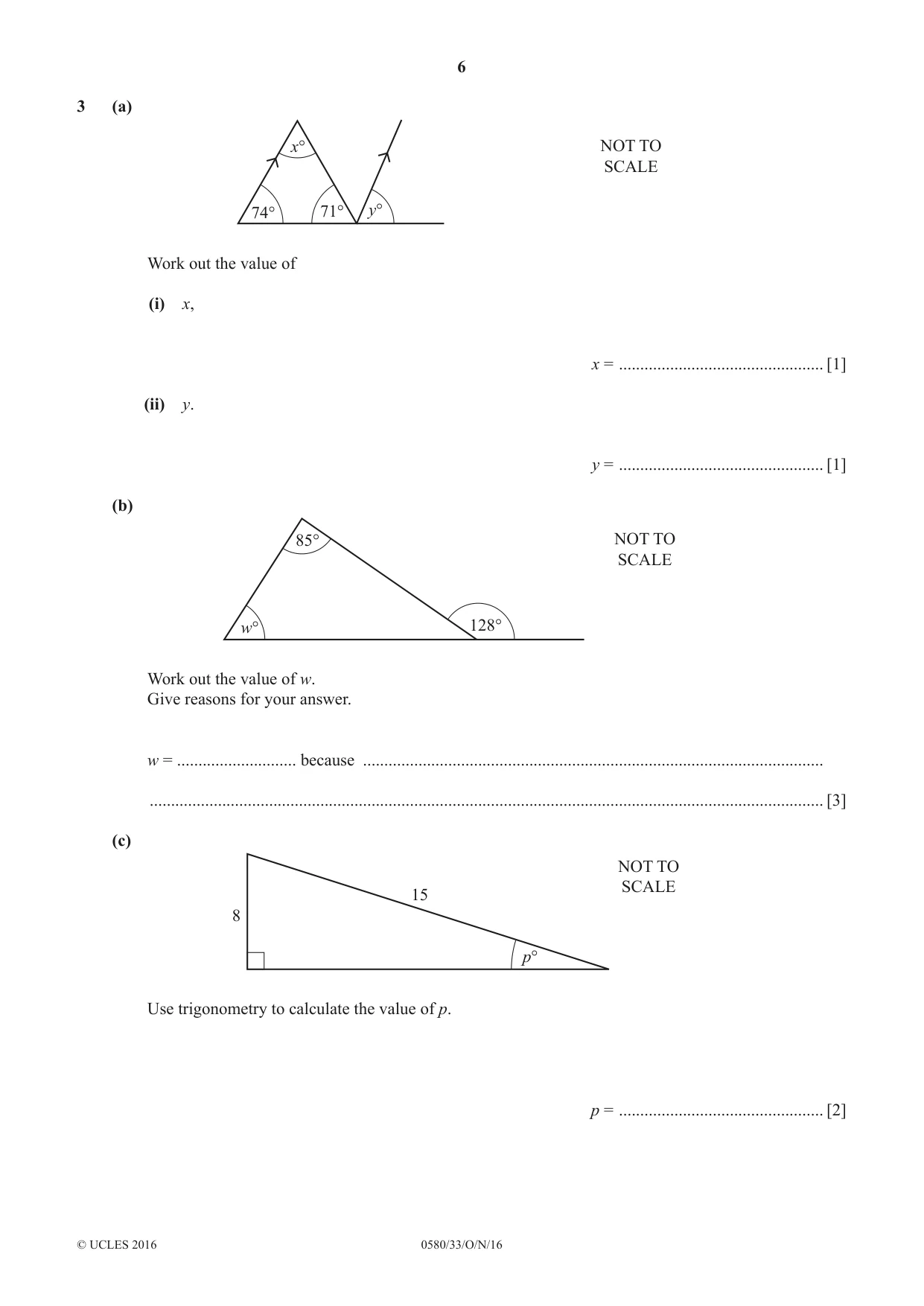
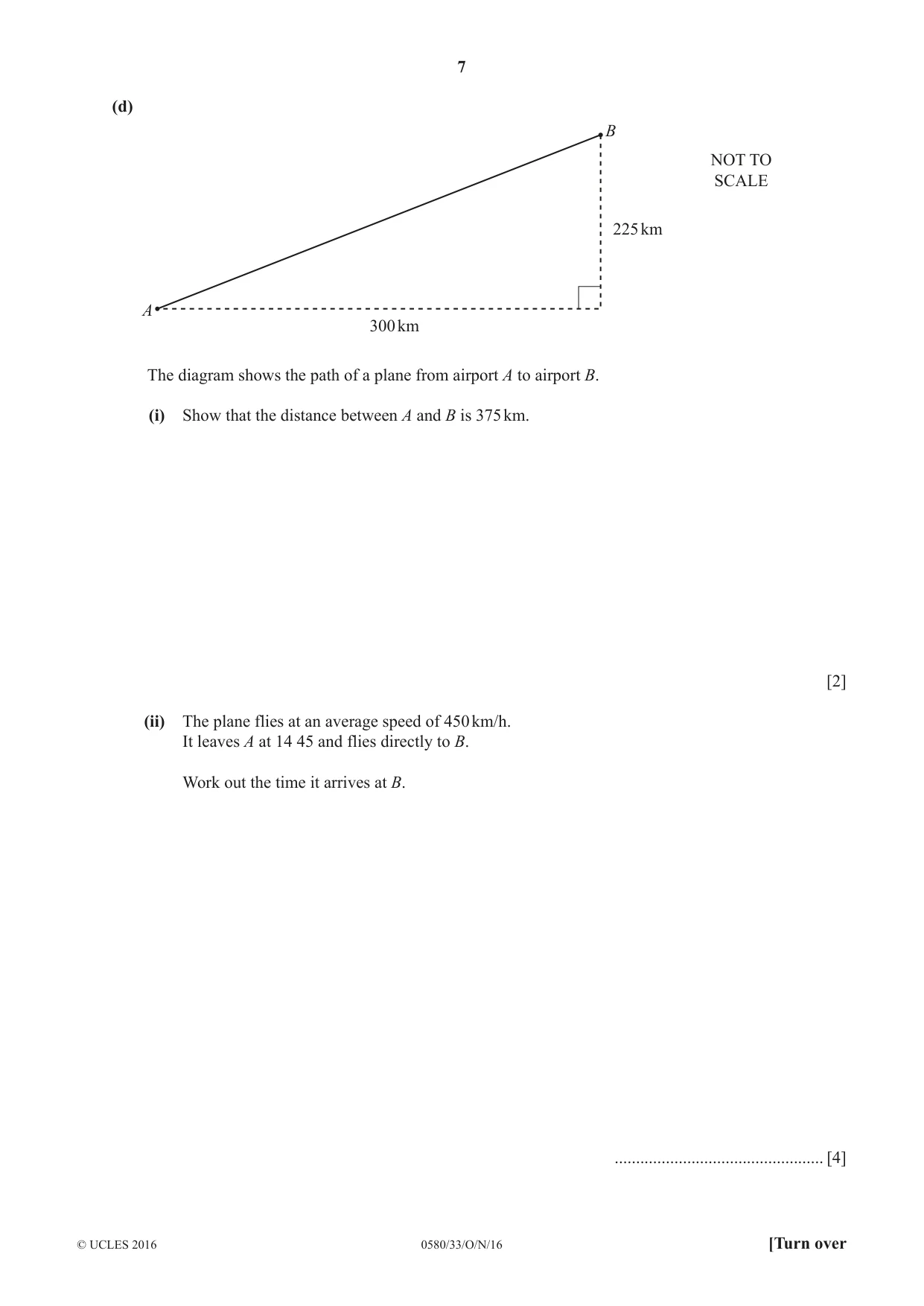
3 (a) x° NOT TO SCALE 74° 71° y° Work out the value of (i) x, x = ................................................ [1] (ii) y. y = ................................................ [1] (b) 85° NOT TO SCALE w° 128° Work out the value of w. Give reasons for your answer. w = ............................ because ............................................................................................................ .............................................................................................................................................................. [3] (c) NOT TO SCALE 15 8 p° Use trigonometry to calculate the value of p. p = ................................................ [2] (d) B NOT TO SCALE 225 km A 300 km The diagram shows the path of a plane from airport A to airport B. (i) Show that the distance between A and B is 375 km. [2] (ii) The plane flies at an average speed of 450 km/h. It leaves A at 14 45 and flies directly to B. Work out the time it arrives at B. ................................................. [4]
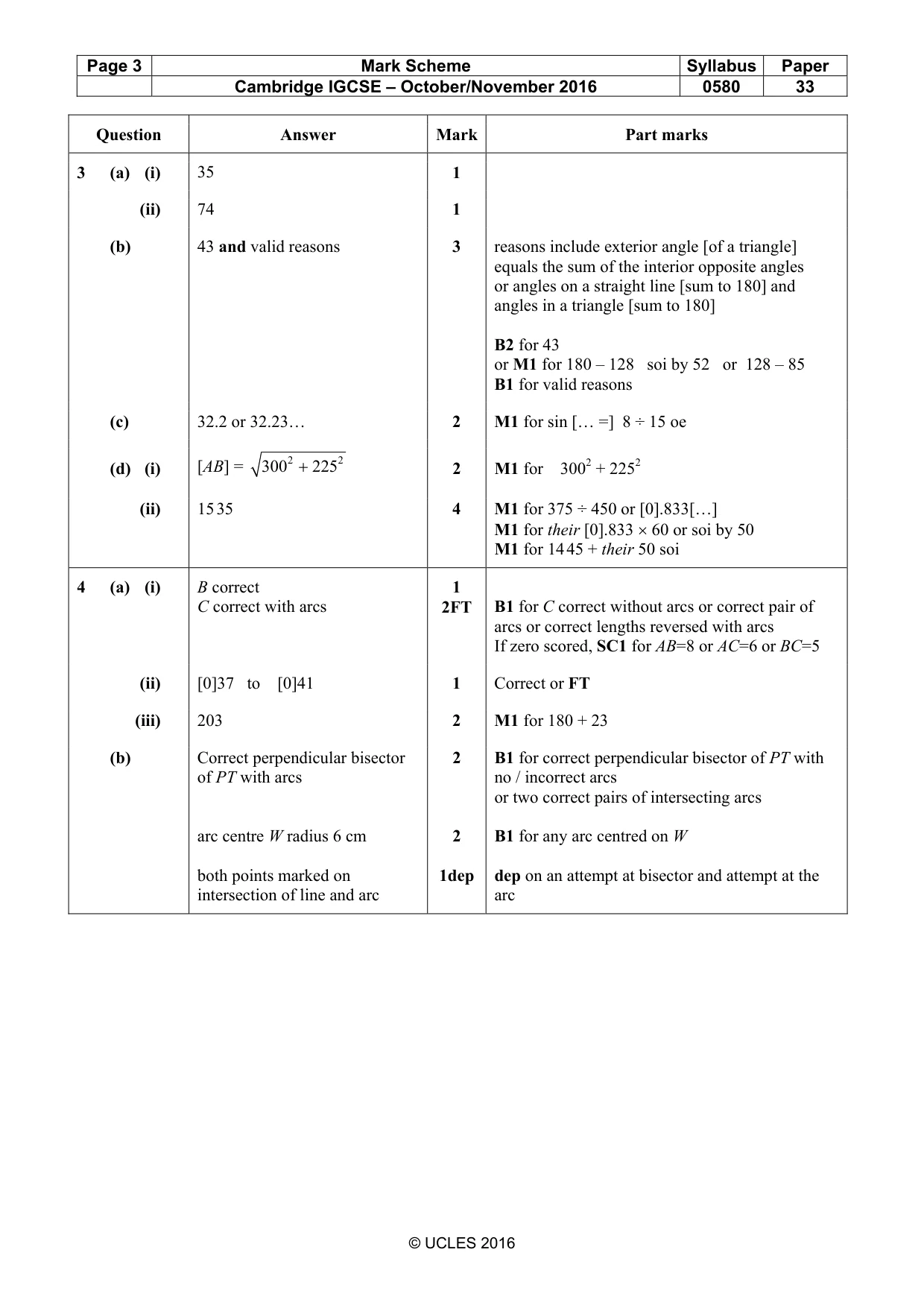
Mark scheme: 3 (a) (i) 35 1 (ii) 74 1 (b) 43 and valid reasons 3 reasons include exterior angle [of a triangle] equals the sum of the interior opposite angles or angles on a straight line [sum to 180] and angles in a triangle [sum to 180] B2 for 43 or M1 for 180 – 128 soi by 52 or 128 – 85 B1 for valid reasons (c) 32.2 or 32.23… 2 M1 for sin [… =] 8 ÷ 15 oe (d) (i) [AB] = 300 2 + 225 2 2 M1 for 3002 + 2252 (ii) 15 35 4 M1 for 375 ÷ 450 or [0].833[…] M1 for their [0].833 × 60 or soi by 50 M1 for 14 45 + their 50 soi
Q4 · The diagram shows the positions of three towns, A, B and C
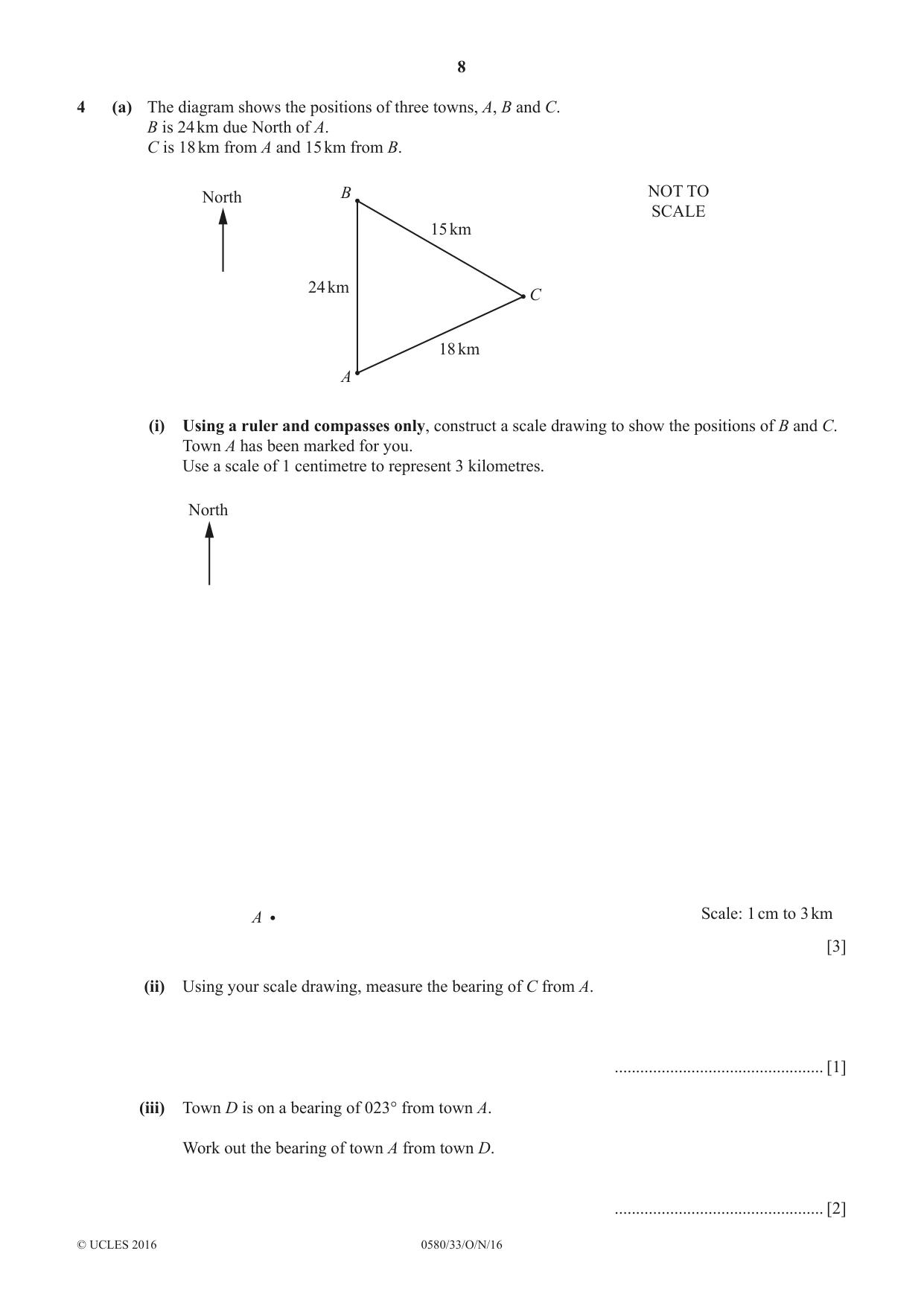
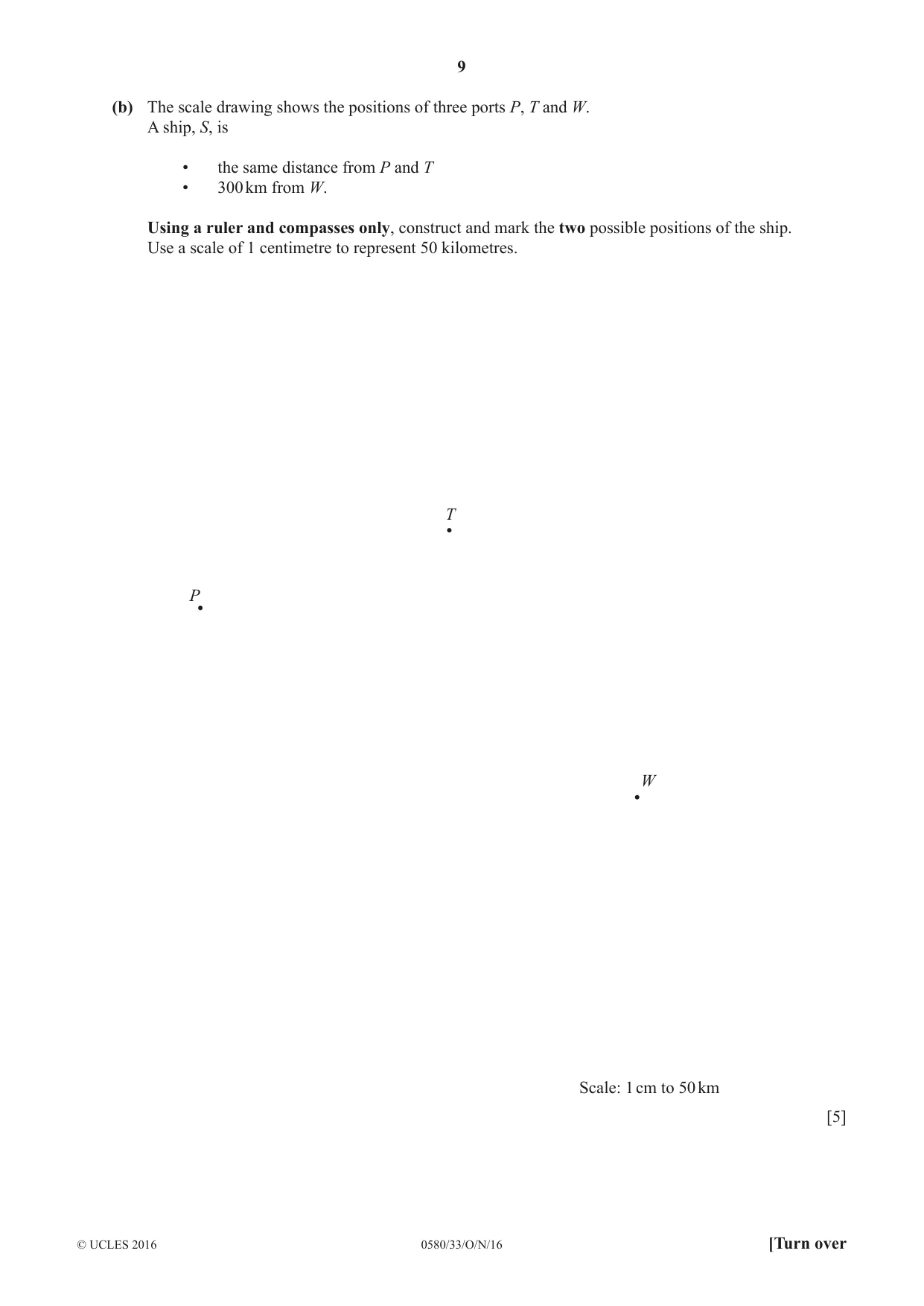
4 (a) The diagram shows the positions of three towns, A, B and C. B is 24 km due North of A. C is 18 km from A and 15 km from B. North B NOT TO SCALE 15 km 24 km C 18 km A (i) Using a ruler and compasses only, construct a scale drawing to show the positions of B and C. Town A has been marked for you. Use a scale of 1 centimetre to represent 3 kilometres. North A Scale: 1 cm to 3 km [3] (ii) Using your scale drawing, measure the bearing of C from A. ................................................. [1] (iii) Town D is on a bearing of 023° from town A. Work out the bearing of town A from town D. ................................................. [2] (b) The scale drawing shows the positions of three ports P, T and W. A ship, S, is • the same distance from P and T • 300 km from W. Using a ruler and compasses only, construct and mark the two possible positions of the ship. Use a scale of 1 centimetre to represent 50 kilometres. T P W Scale: 1 cm to 50 km [5]
Mark scheme: 4 (a) (i) B correct 1 C correct with arcs 2FT B1 for C correct without arcs or correct pair of arcs or correct lengths reversed with arcs If zero scored, SC1 for AB=8 or AC=6 or BC=5 (ii) [0]37 to [0]41 1 Correct or FT (iii) 203 2 M1 for 180 + 23 (b) Correct perpendicular bisector 2 B1 for correct perpendicular bisector of PT with of PT with arcs no / incorrect arcs or two correct pairs of intersecting arcs arc centre W radius 6 cm 2 B1 for any arc centred on W both points marked on 1dep dep on an attempt at bisector and attempt at the intersection of line and arc arc
Q5 · Write down the two square numbers between 50 and 99
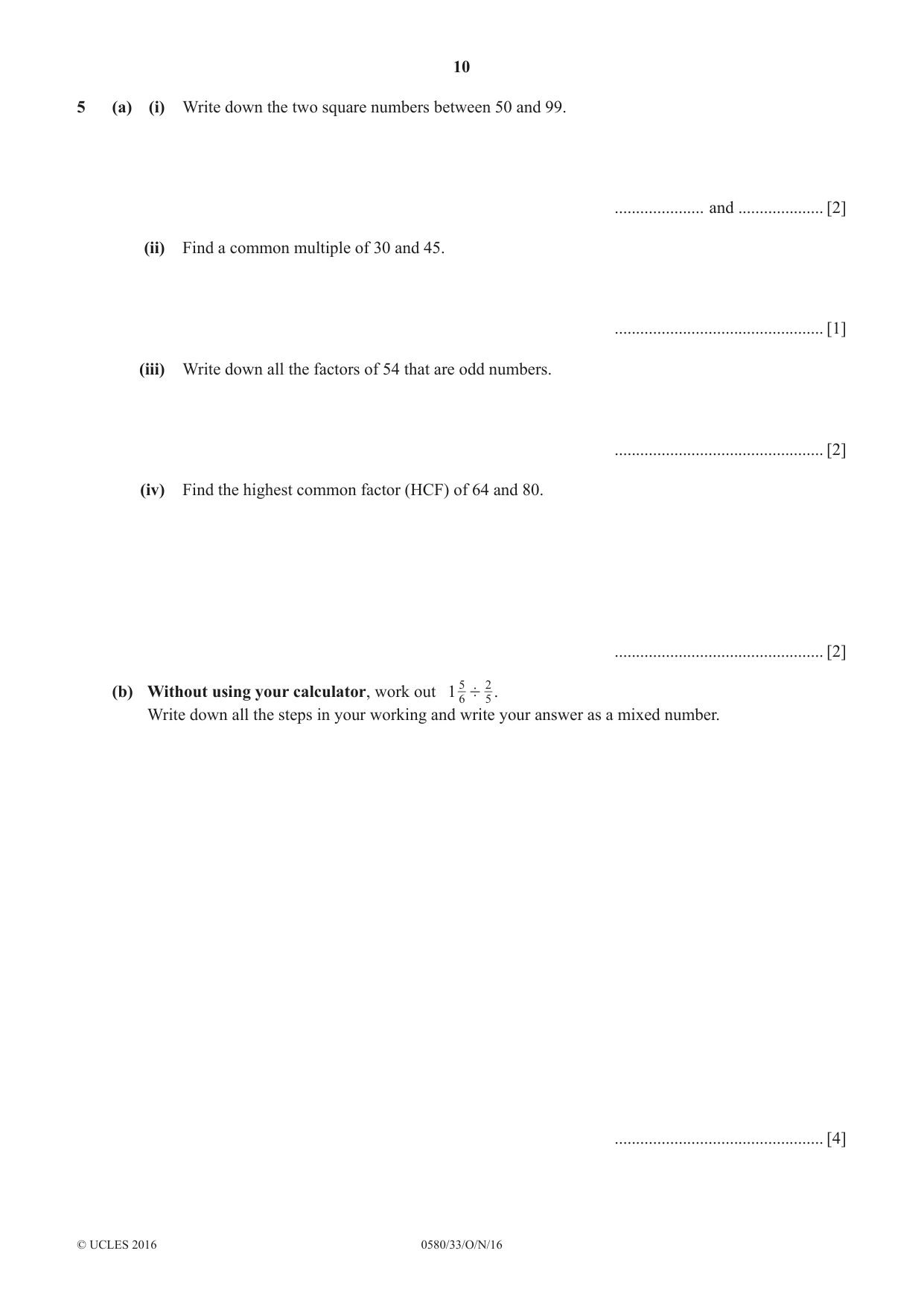
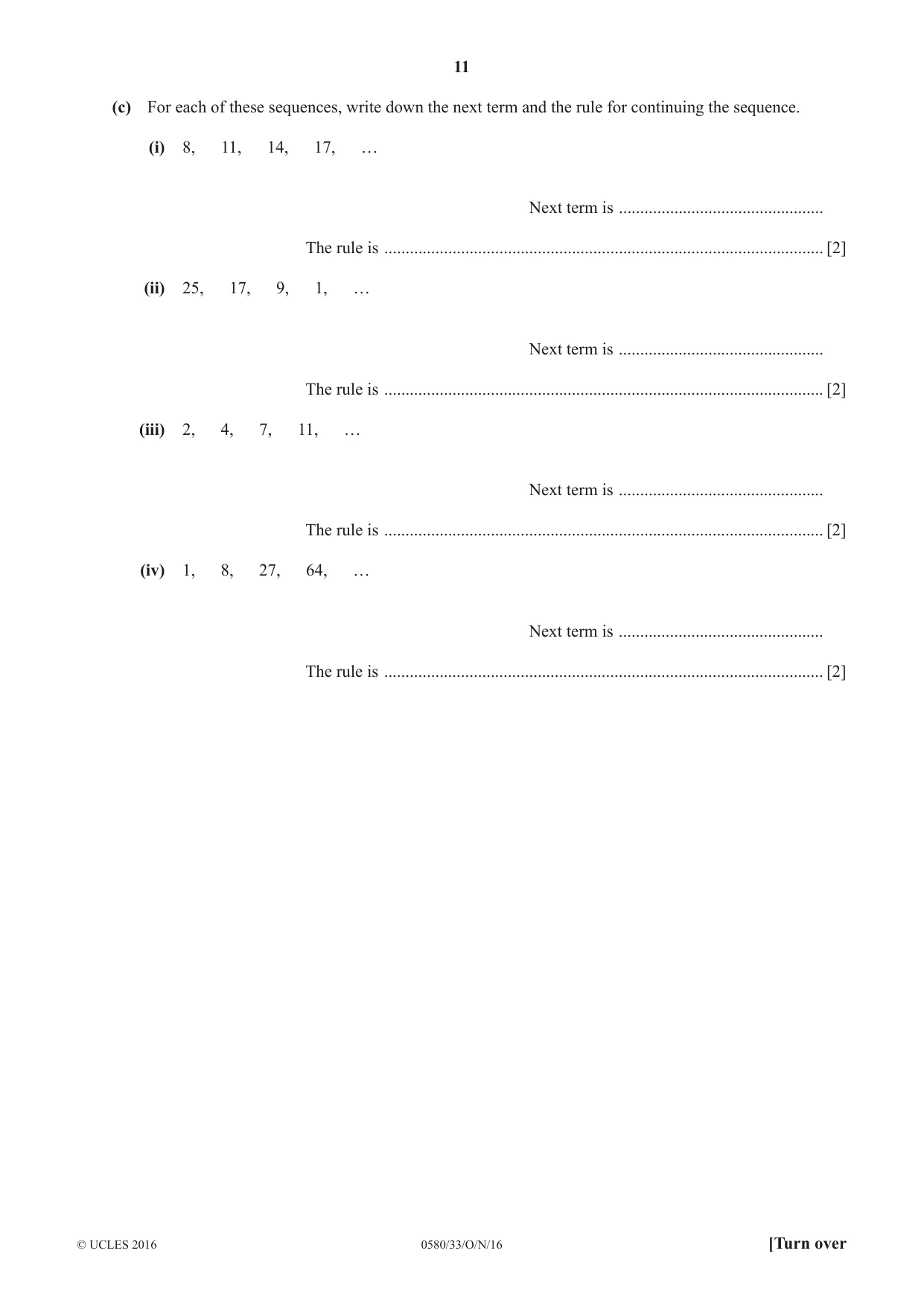
5 (a) (i) Write down the two square numbers between 50 and 99. ..................... and .................... [2] (ii) Find a common multiple of 30 and 45. ................................................. [1] (iii) Write down all the factors of 54 that are odd numbers. ................................................. [2] (iv) Find the highest common factor (HCF) of 64 and 80. ................................................. [2] (b) Without using your calculator, work out 1 56 ' 25 . Write down all the steps in your working and write your answer as a mixed number. ................................................. [4] (c) For each of these sequences, write down the next term and the rule for continuing the sequence. (i) 8, 11, 14, 17, … Next term is ................................................ The rule is ....................................................................................................... [2] (ii) 25, 17, 9, 1, … Next term is ................................................ The rule is ....................................................................................................... [2] (iii) 2, 4, 7, 11, … Next term is ................................................ The rule is ....................................................................................................... [2] (iv) 1, 8, 27, 64, … Next term is ................................................ The rule is ....................................................................................................... [2]
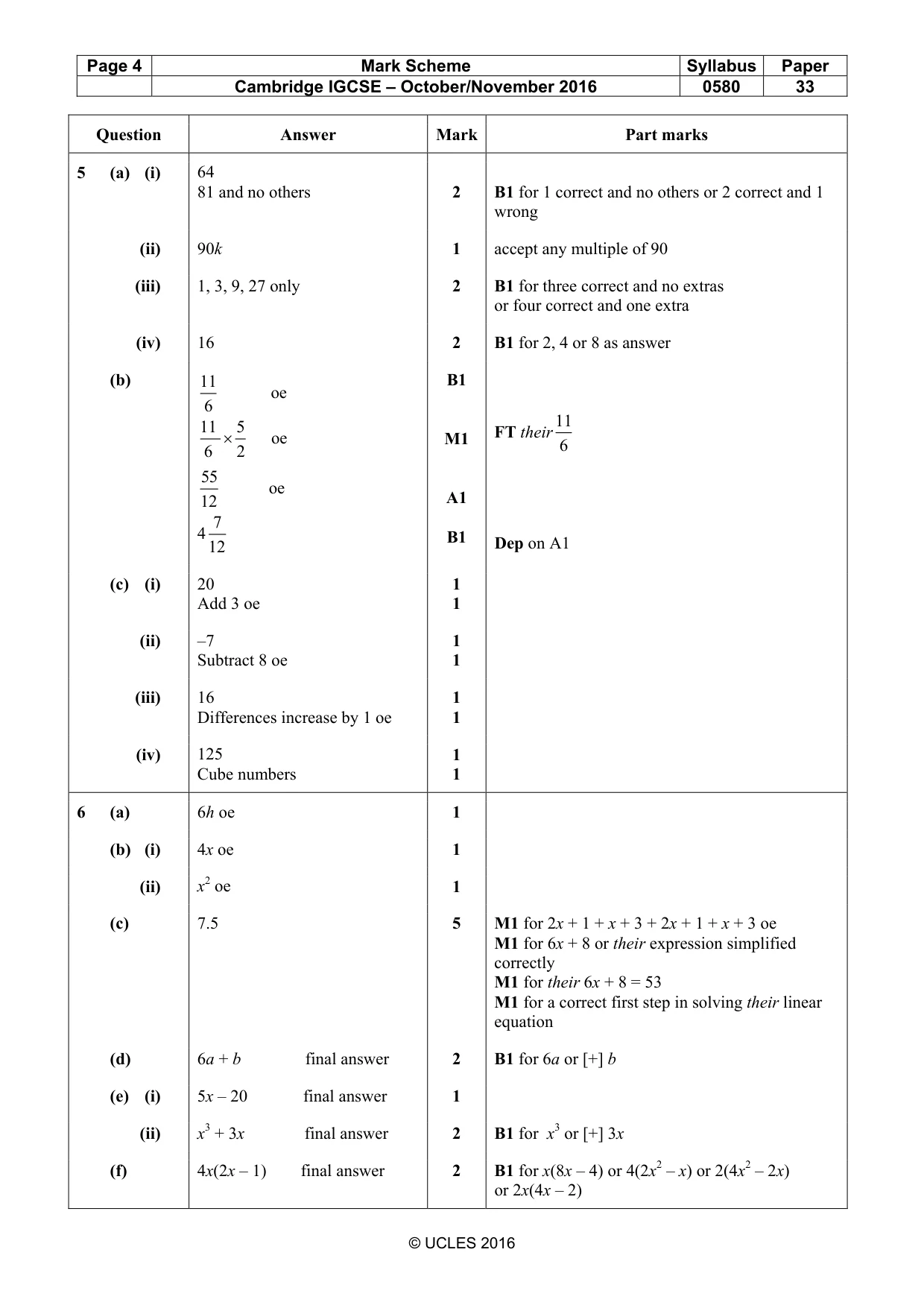
Mark scheme: 5 (a) (i) 64 81 and no others 2 B1 for 1 correct and no others or 2 correct and 1 wrong (ii) 90k 1 accept any multiple of 90 (iii) 1, 3, 9, 27 only 2 B1 for three correct and no extras or four correct and one extra (iv) 16 2 B1 for 2, 4 or 8 as answer (b) 11 B1 oe 6 11 5 FT their11 × oe M1 6 6 2 55 oe 12 A1 7 4 B1 12 Dep on A1 (c) (i) 20 1 Add 3 oe 1 (ii) –7 1 Subtract 8 oe 1 (iii) 16 1 Differences increase by 1 oe 1 (iv) 125 1 Cube numbers 1
Q6 · A regular hexagon has side length h
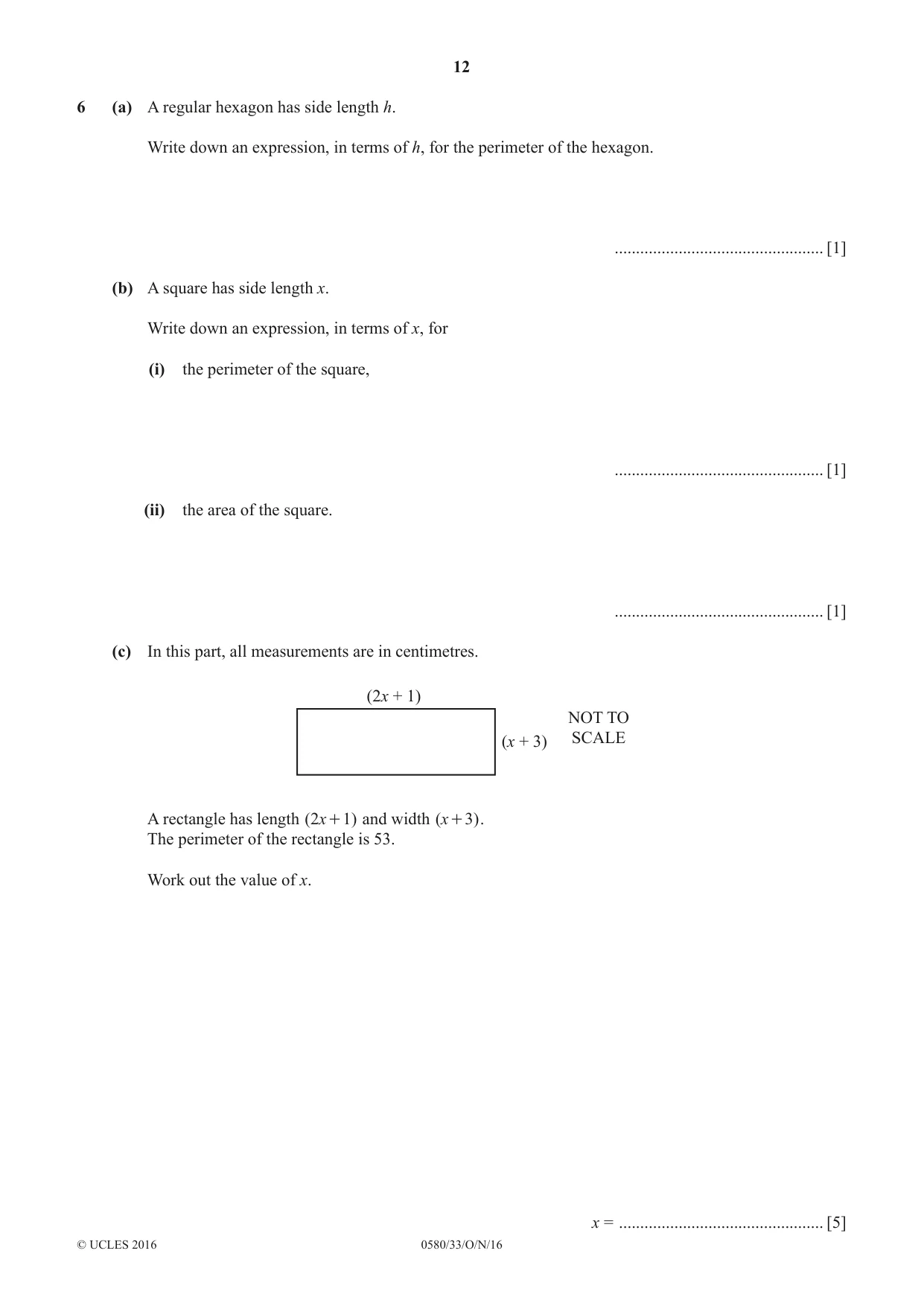
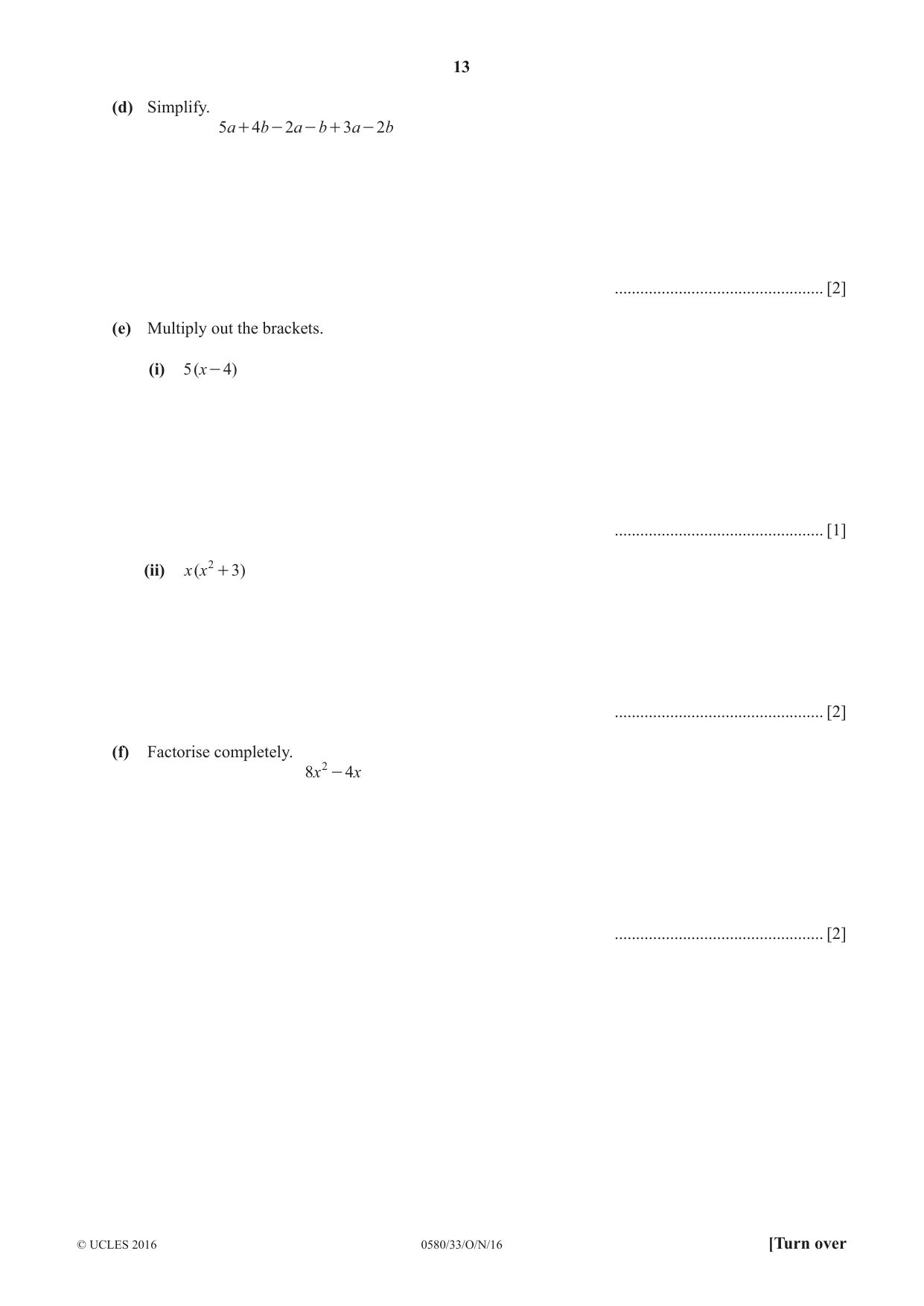
6 (a) A regular hexagon has side length h. Write down an expression, in terms of h, for the perimeter of the hexagon. ................................................. [1] (b) A square has side length x. Write down an expression, in terms of x, for (i) the perimeter of the square, ................................................. [1] (ii) the area of the square. ................................................. [1] (c) In this part, all measurements are in centimetres. (2x + 1) NOT TO (x + 3) SCALE A rectangle has length (2x + 1) and width (x + 3 ) . The perimeter of the rectangle is 53. Work out the value of x. x = ................................................ [5] (d) Simplify. 5a + 4b - 2a - b + 3a - 2b ................................................. [2] (e) Multiply out the brackets. (i) 5 (x - 4) ................................................. [1] (ii) x (x 2 + 3) ................................................. [2] (f) Factorise completely. 8x 2 - 4x ................................................. [2]
Mark scheme: 6 (a) 6h oe 1 (b) (i) 4x oe 1 (ii) x2 oe 1 (c) 7.5 5 M1 for 2x + 1 + x + 3 + 2x + 1 + x + 3 oe M1 for 6x + 8 or their expression simplified correctly M1 for their 6x + 8 = 53 M1 for a correct first step in solving their linear equation (d) 6a + b final answer 2 B1 for 6a or [+] b (e) (i) 5x – 20 final answer 1 (ii) x3 + 3x final answer 2 B1 for x3 or [+] 3x (f) 4x(2x – 1) final answer 2 B1 for x(8x – 4) or 4(2x2 – x) or 2(4x2 – 2x) or 2x(4x – 2)
Q7 · Y 6 5 H 4 3 G 2 F 1 x –6 –5 –4 –3 –2 –1 0 1 2 3 4 5 6 –1 –2 –3 –4 –5 –6 (a) Reflect flag…
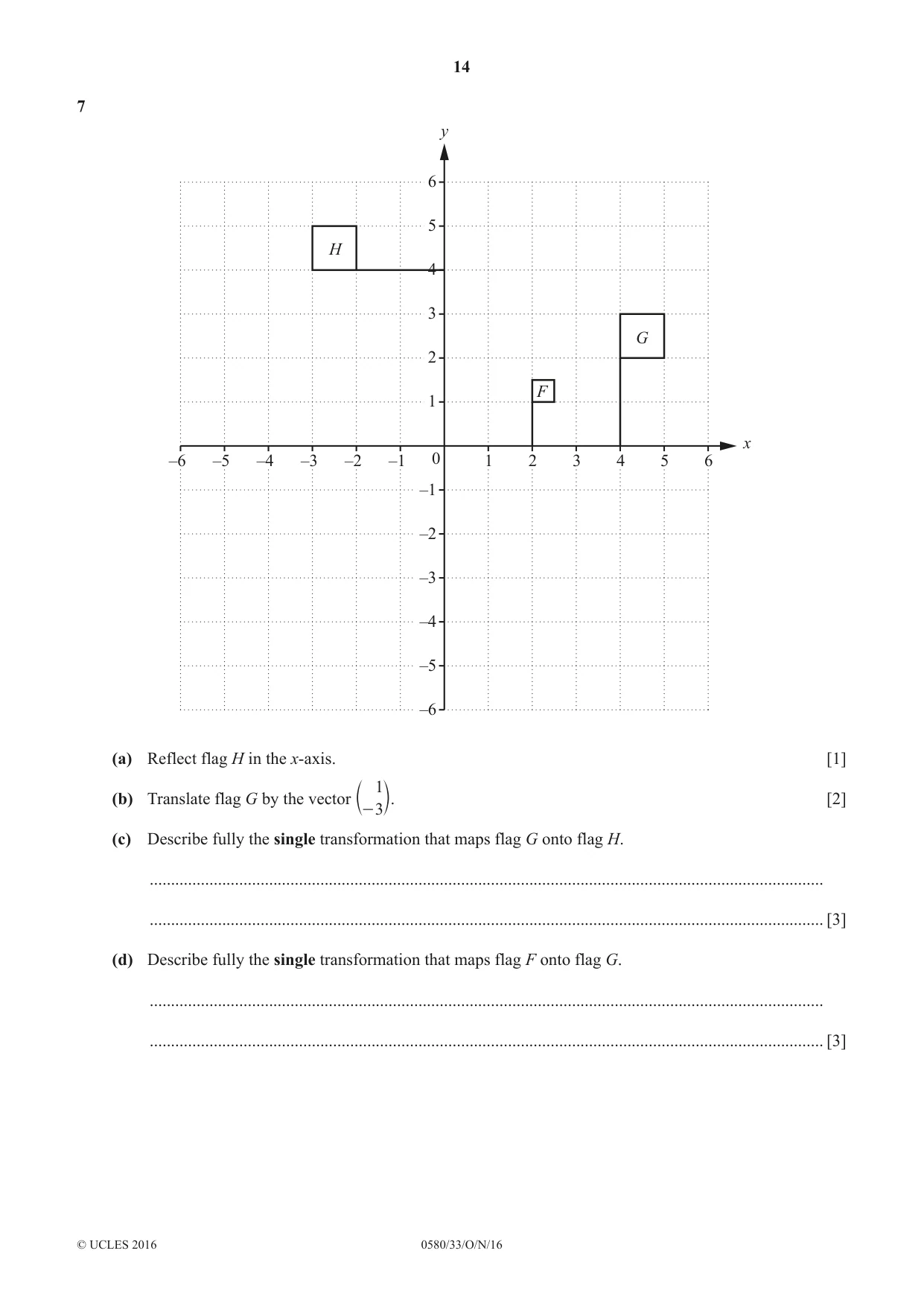
7 y 6 5 H 4 3 G 2 F 1 x –6 –5 –4 –3 –2 –1 0 1 2 3 4 5 6 –1 –2 –3 –4 –5 –6 (a) Reflect flag H in the x-axis. [1] 1 (b) Translate flag G by the vector [2] c- 3m. (c) Describe fully the single transformation that maps flag G onto flag H. .............................................................................................................................................................. .............................................................................................................................................................. [3] (d) Describe fully the single transformation that maps flag F onto flag G. .............................................................................................................................................................. .............................................................................................................................................................. [3]
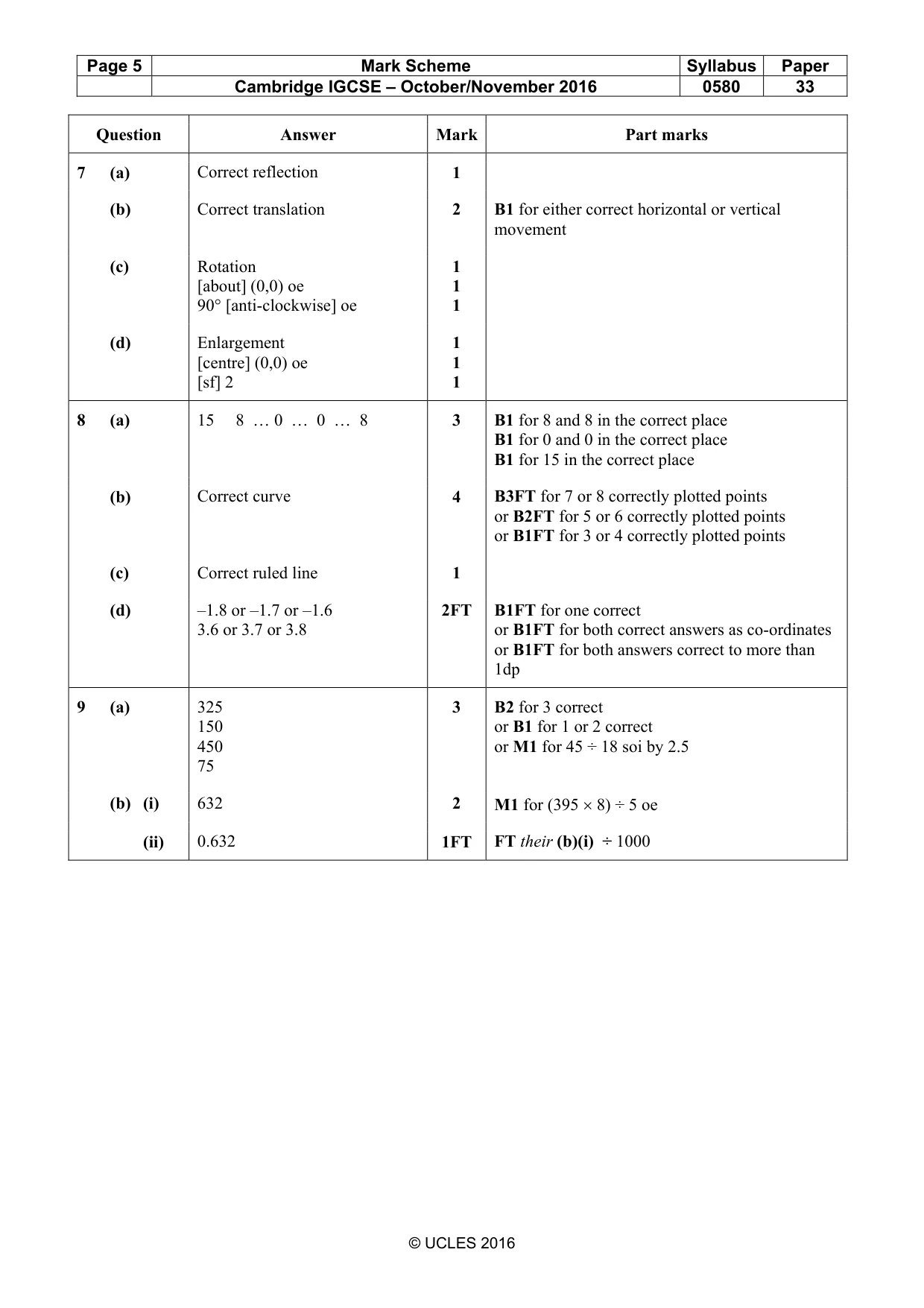
Mark scheme: 7 (a) Correct reflection 1 (b) Correct translation 2 B1 for either correct horizontal or vertical movement (c) Rotation 1 [about] (0,0) oe 1 90° [anti-clockwise] oe 1 (d) Enlargement 1 [centre] (0,0) oe 1 [sf] 2 1
Q8 · Complete the table of values for y = x 2 - 2x
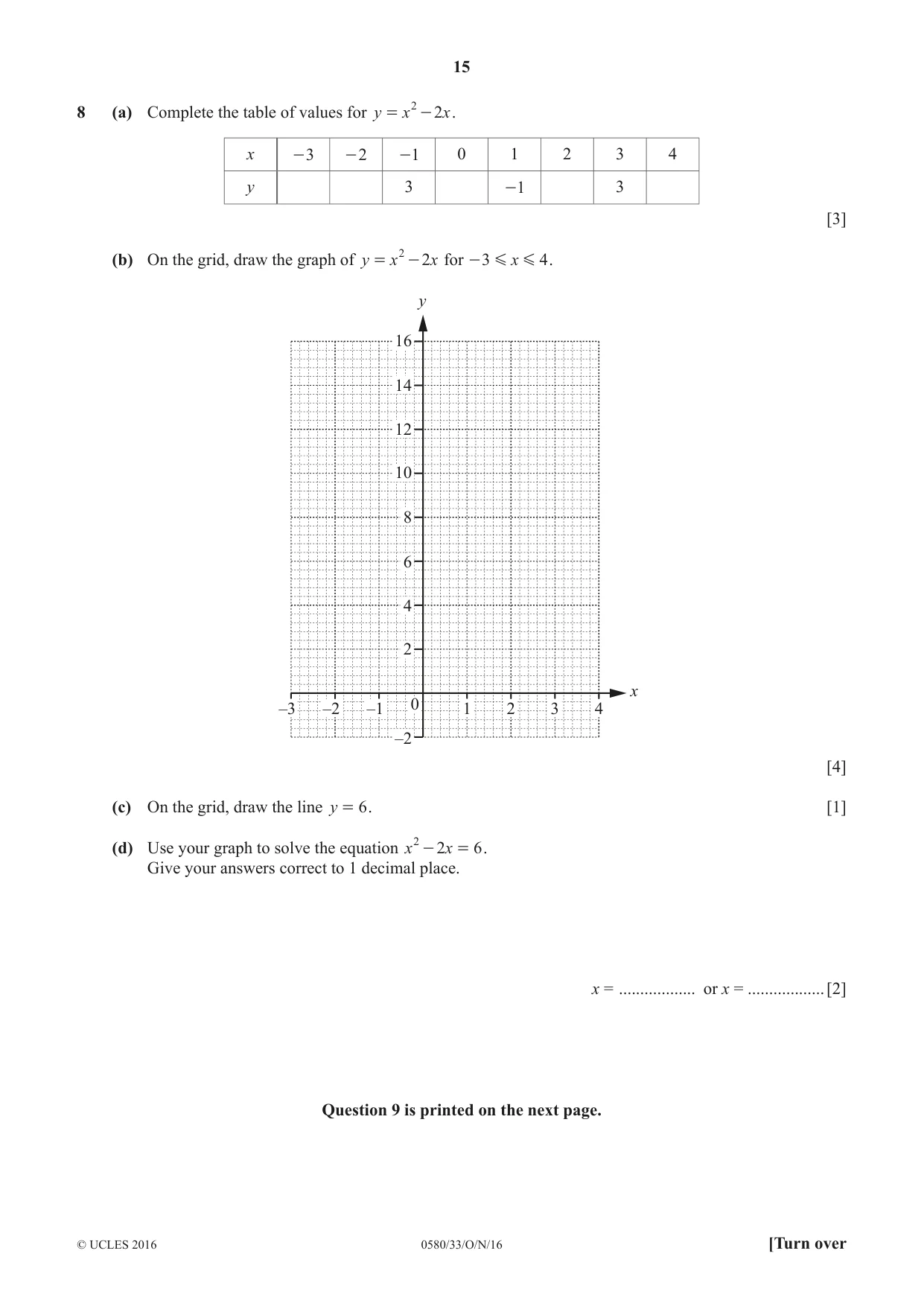
8 (a) Complete the table of values for y = x 2 - 2x . x - 3 - 2 - 1 0 1 2 3 4 y 3 - 1 3 [3] (b) On the grid, draw the graph of y = x 2 - 2x for - 3 G x G 4 . y 16 14 12 10 8 6 4 2 x 0 –3 –2 –1 1 2 3 4 –2 [4] (c) On the grid, draw the line y = 6 . [1] (d) Use your graph to solve the equation x 2 - 2x = 6 . Give your answers correct to 1 decimal place. x = .................. or x = .................. [2] Question 9 is printed on the next page.
Mark scheme: 8 (a) 15 8 … 0 … 0 … 8 3 B1 for 8 and 8 in the correct place B1 for 0 and 0 in the correct place B1 for 15 in the correct place (b) Correct curve 4 B3FT for 7 or 8 correctly plotted points or B2FT for 5 or 6 correctly plotted points or B1FT for 3 or 4 correctly plotted points (c) Correct ruled line 1 (d) –1.8 or –1.7 or –1.6 2FT B1FT for one correct 3.6 or 3.7 or 3.8 or B1FT for both correct answers as co-ordinates or B1FT for both answers correct to more than 1dp
Q9 · Here is a list of ingredients to make 18 chocolate chip biscuits
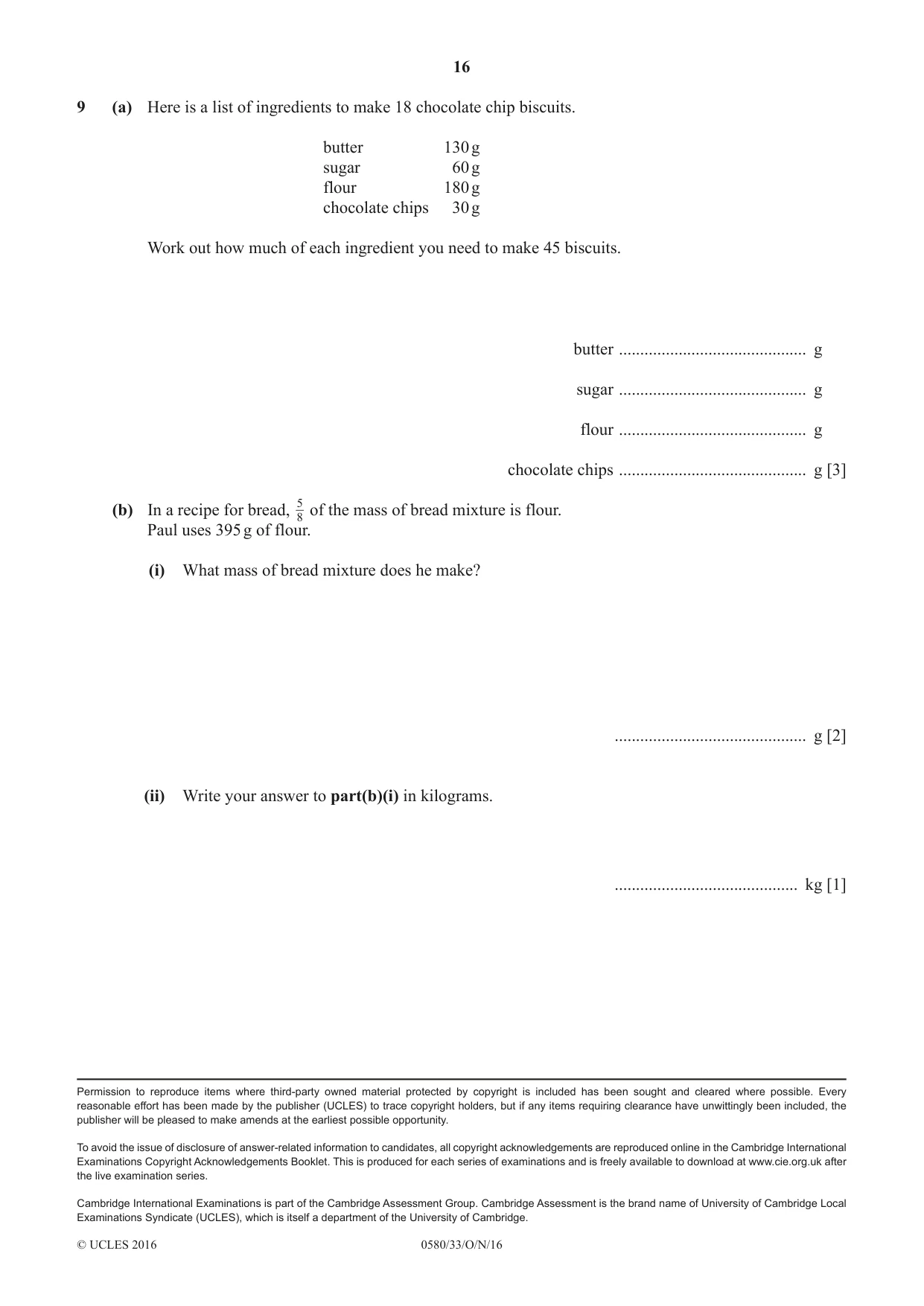
9 (a) Here is a list of ingredients to make 18 chocolate chip biscuits. butter 130 g sugar 60 g flour 180 g chocolate chips 30 g Work out how much of each ingredient you need to make 45 biscuits. butter ............................................ g sugar ............................................ g flour ............................................ g chocolate chips ............................................ g [3] (b) In a recipe for bread, 58 of the mass of bread mixture is flour. Paul uses 395 g of flour. (i) What mass of bread mixture does he make? ............................................. g [2] (ii) Write your answer to part(b)(i) in kilograms. ........................................... kg [1]
Mark scheme: 9 (a) 325 3 B2 for 3 correct 150 or B1 for 1 or 2 correct 450 or M1 for 45 ÷ 18 soi by 2.5 75 (b) (i) 632 2 M1 for (395 × 8) ÷ 5 oe (ii) 0.632 1FT FT their (b)(i) ÷ 1000
What was in this paper
The subtopics covered by these 9 questions, and how many questions each got. Open one in a new tab to see every Cambridge question on it.
What you needed in this session
Cambridge’s own grade thresholds for 2016 Oct/Nov, Paper 3 · Variant 3. A higher threshold means an easier paper — the bar moves with how the cohort did.