Cambridge IGCSE Mathematics 0580 — 2016 May/June Paper 3 · Variant 2
0580/32/M/J/16 · 9 questions · 104 marks · ≈117 min
The question paper and its mark scheme, free to read here and free to download. This is Cambridge’s own paper, exactly as it was sat.
Question paper20 pages

Mark scheme5 pages
Answers below. Sit the paper first if you are practising.
Questions as text
Q1 · A group of 20 children were asked to choose their favourite type of fruit juice
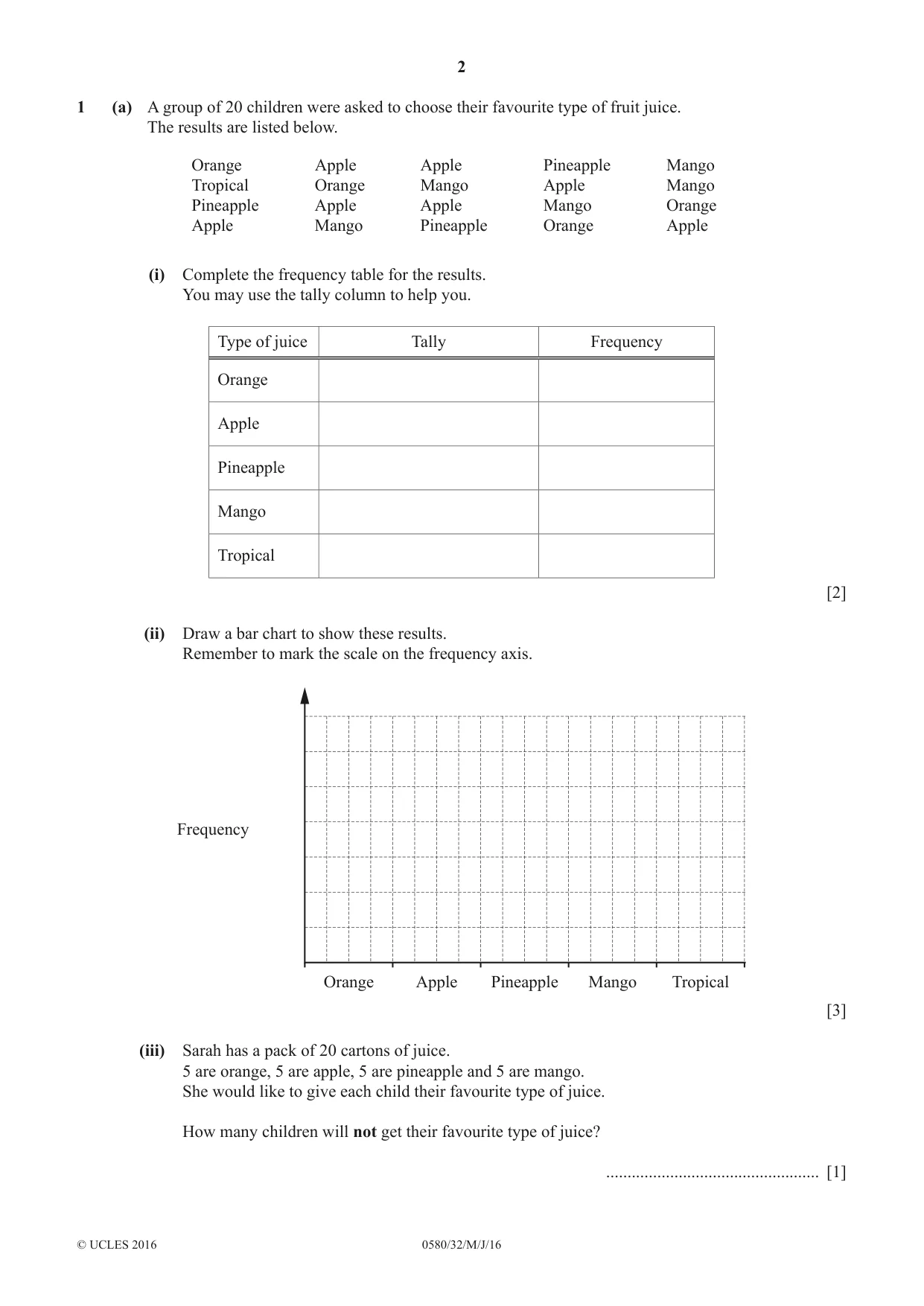
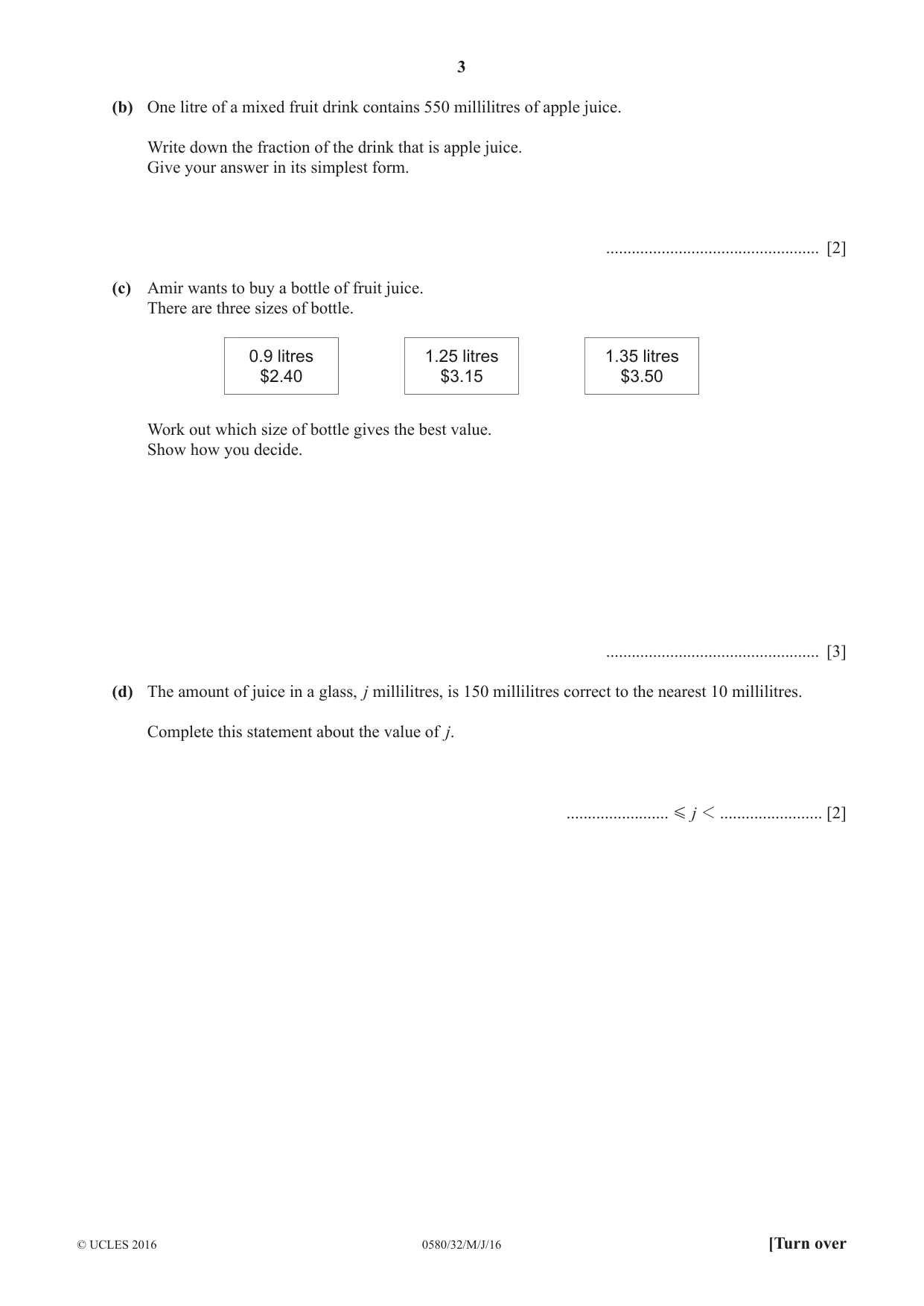
1 (a) A group of 20 children were asked to choose their favourite type of fruit juice. The results are listed below. Orange Apple Apple Pineapple Mango Tropical Orange Mango Apple Mango Pineapple Apple Apple Mango Orange Apple Mango Pineapple Orange Apple (i) Complete the frequency table for the results. You may use the tally column to help you. Type of juice Tally Frequency Orange Apple Pineapple Mango Tropical [2] (ii) Draw a bar chart to show these results. Remember to mark the scale on the frequency axis. Frequency Orange Apple Pineapple Mango Tropical [3] (iii) Sarah has a pack of 20 cartons of juice. 5 are orange, 5 are apple, 5 are pineapple and 5 are mango. She would like to give each child their favourite type of juice. How many children will not get their favourite type of juice? .................................................. [1] (b) One litre of a mixed fruit drink contains 550 millilitres of apple juice. Write down the fraction of the drink that is apple juice. Give your answer in its simplest form. .................................................. [2] (c) Amir wants to buy a bottle of fruit juice. There are three sizes of bottle. 0.9 litres 1.25 litres 1.35 litres $2.40 $3.15 $3.50 Work out which size of bottle gives the best value. Show how you decide. .................................................. [3] (d) The amount of juice in a glass, j millilitres, is 150 millilitres correct to the nearest 10 millilitres. Complete this statement about the value of j. ........................ G j 1 ........................ [2]
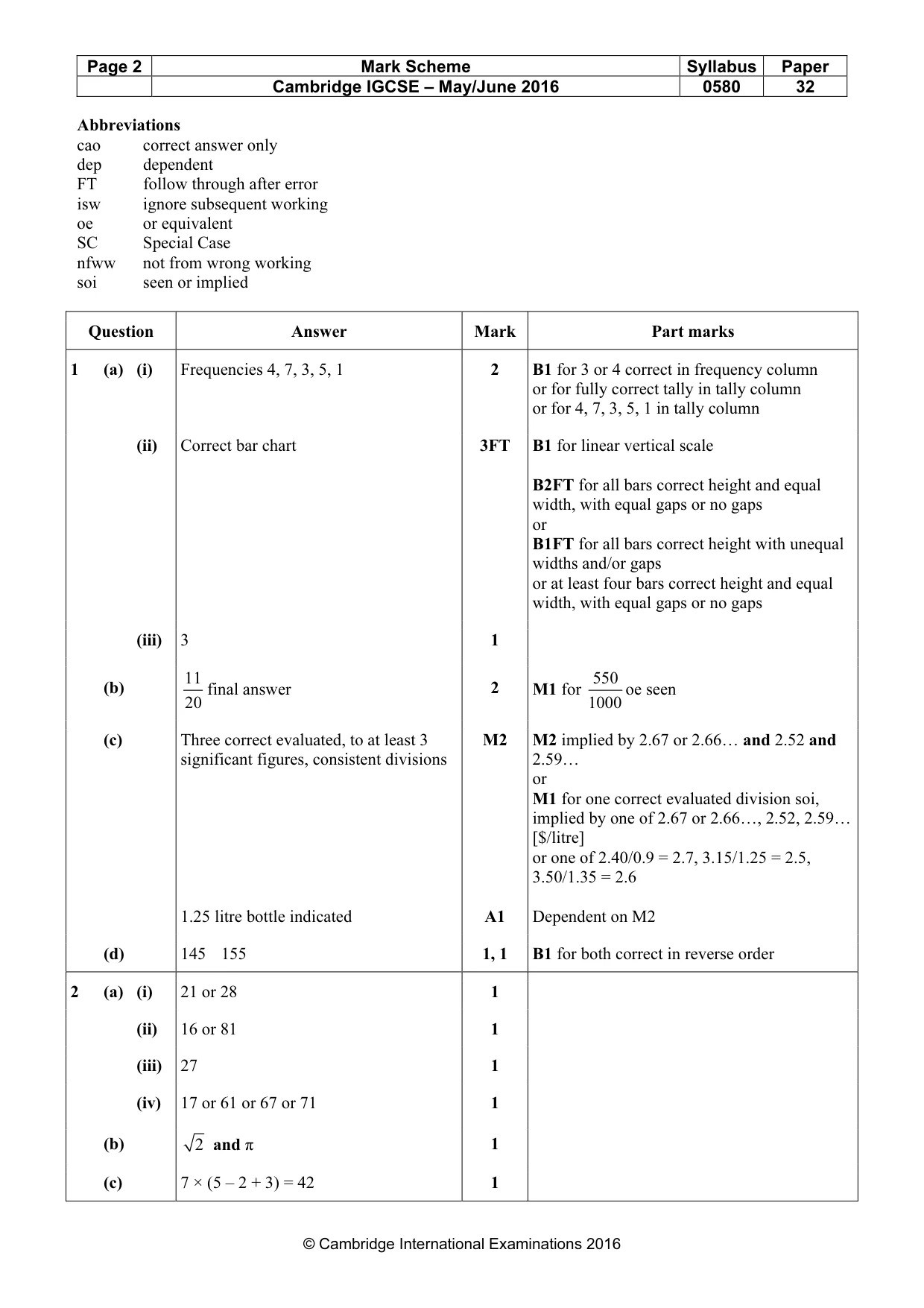
Mark scheme: Question Answer Mark Part marks 1 (a) (i) Frequencies 4, 7, 3, 5, 1 2 B1 for 3 or 4 correct in frequency column or for fully correct tally in tally column or for 4, 7, 3, 5, 1 in tally column (ii) Correct bar chart 3FT B1 for linear vertical scale B2FT for all bars correct height and equal width, with equal gaps or no gaps or B1FT for all bars correct height with unequal widths and/or gaps or at least four bars correct height and equal width, with equal gaps or no gaps (iii) 3 1 11 550 (b) final answer 2 M1 for oe seen 20 1000 (c) Three correct evaluated, to at least 3 M2 M2 implied by 2.67 or 2.66… and 2.52 and significant figures, consistent divisions 2.59… or M1 for one correct evaluated division soi, implied by one of 2.67 or 2.66…, 2.52, 2.59… [$/litre] or one of 2.40/0.9 = 2.7, 3.15/1.25 = 2.5, 3.50/1.35 = 2.6 1.25 litre bottle indicated A1 Dependent on M2 (d) 145 155 1, 1 B1 for both correct in reverse order
Q2 · Here are five number cards
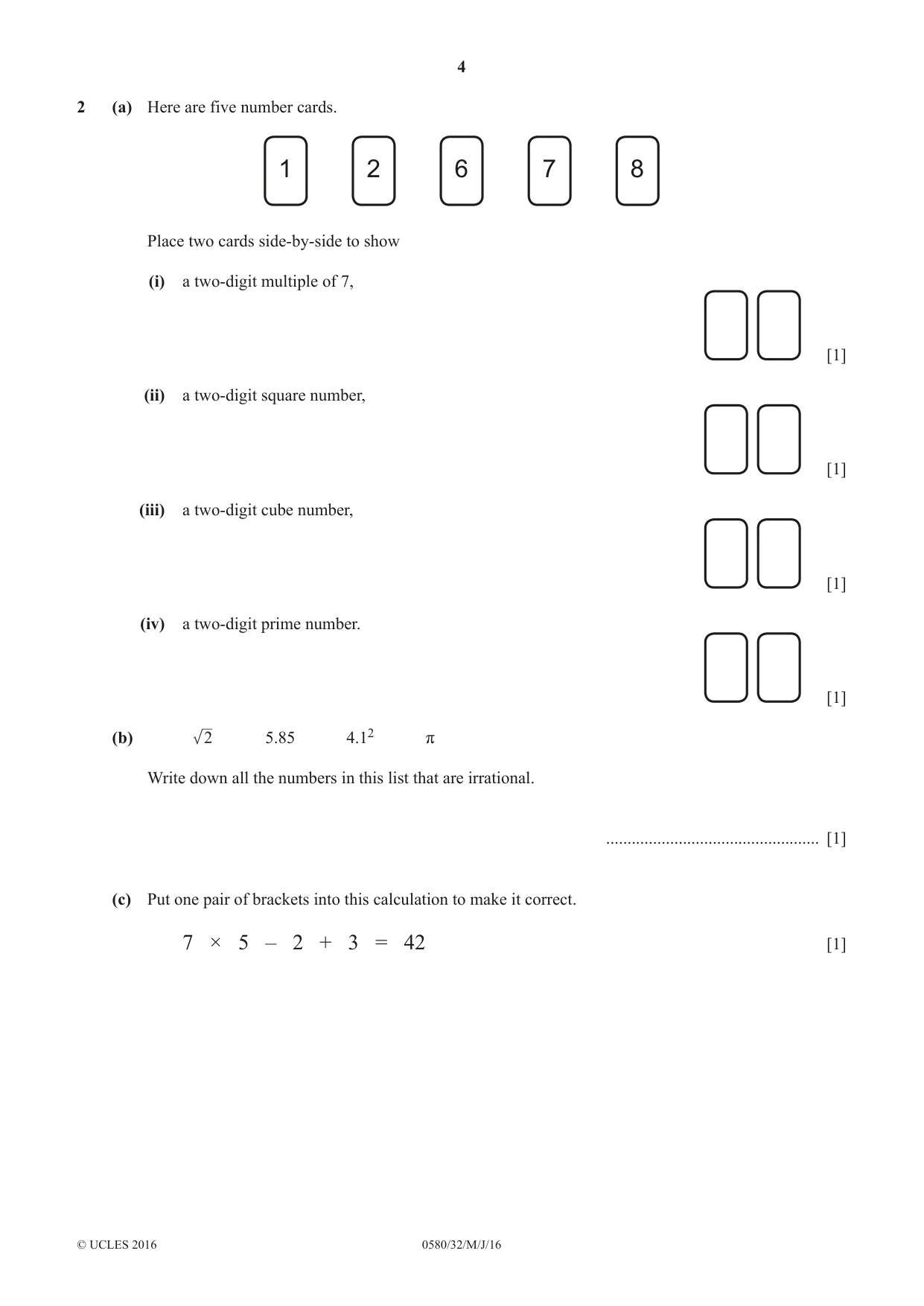
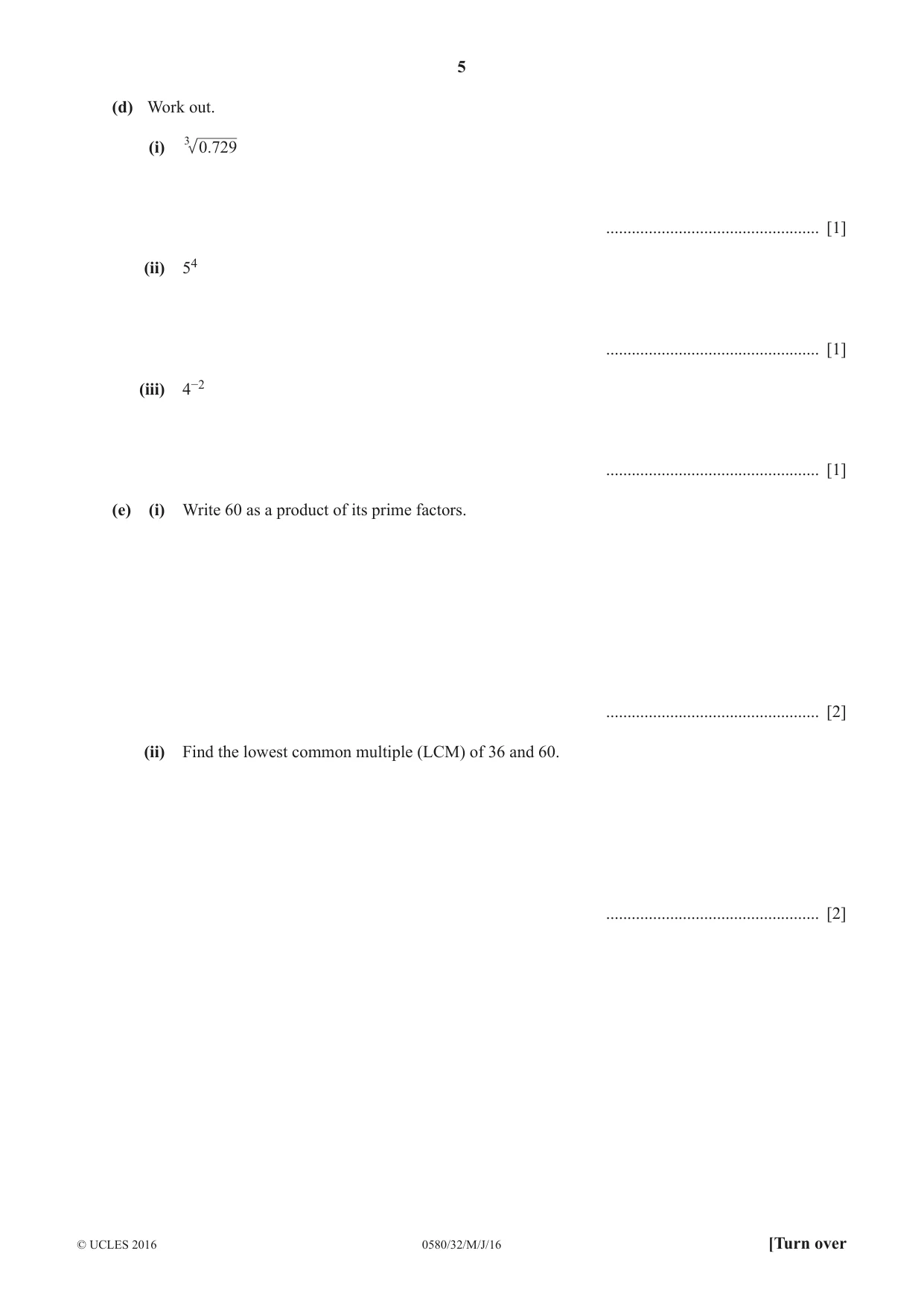
2 (a) Here are five number cards. 1 2 6 7 8 Place two cards side-by-side to show (i) a two-digit multiple of 7, [1] (ii) a two-digit square number, [1] (iii) a two-digit cube number, [1] (iv) a two-digit prime number. [1] (b) 2 5.85 4.12 r Write down all the numbers in this list that are irrational. .................................................. [1] (c) Put one pair of brackets into this calculation to make it correct. 7 × 5 – 2 + 3 = 42 [1] (d) Work out. (i) 3 .0729 .................................................. [1] (ii) 54 .................................................. [1] (iii) 4−2 .................................................. [1] (e) (i) Write 60 as a product of its prime factors. .................................................. [2] (ii) Find the lowest common multiple (LCM) of 36 and 60. .................................................. [2]
Mark scheme: 2 (a) (i) 21 or 28 1 (ii) 16 or 81 1 (iii) 27 1 (iv) 17 or 61 or 67 or 71 1 (b) 2 and π 1 (c) 7 × (5 – 2 + 3) = 42 1
Q3 · Here is part of a bus timetable
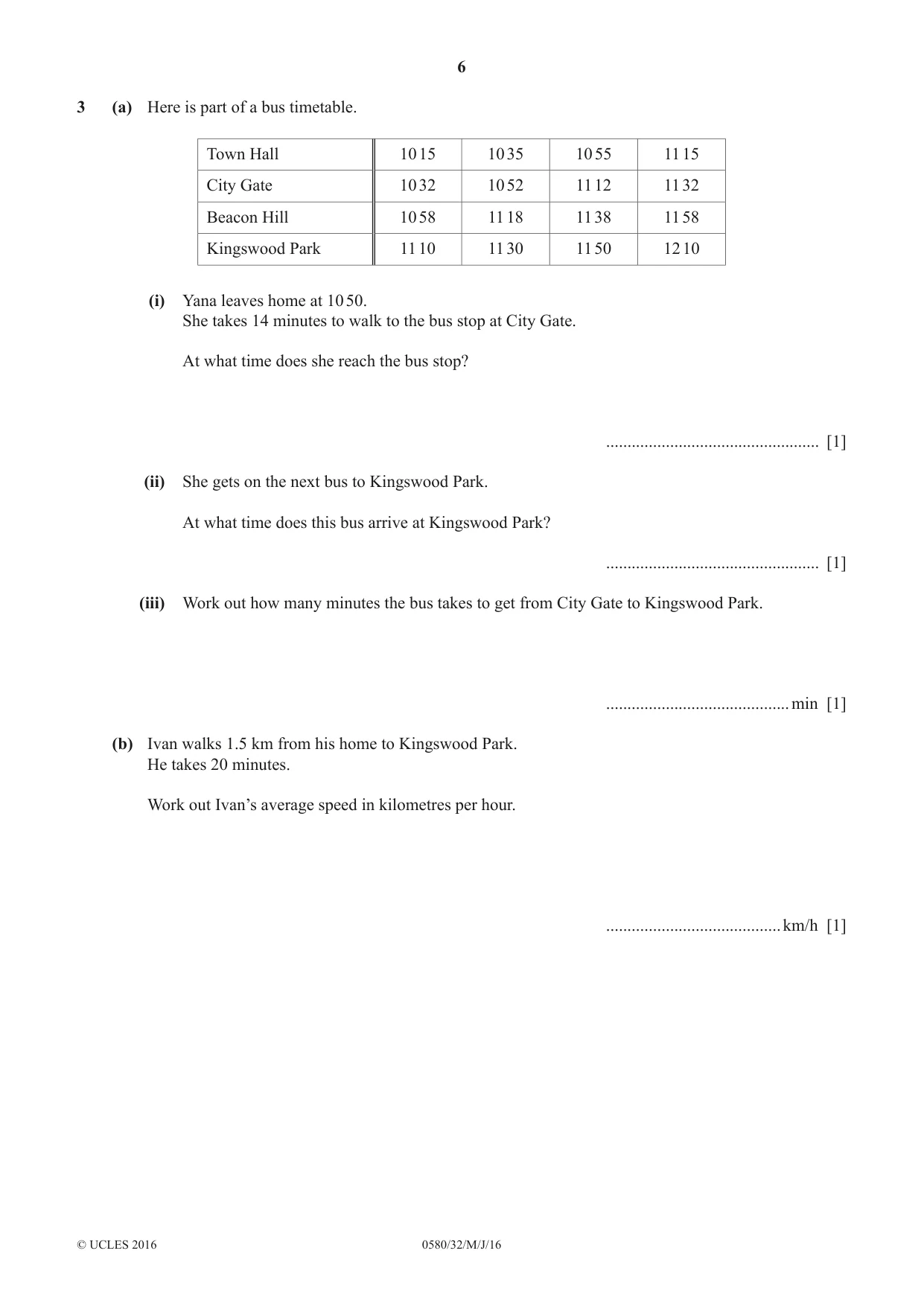
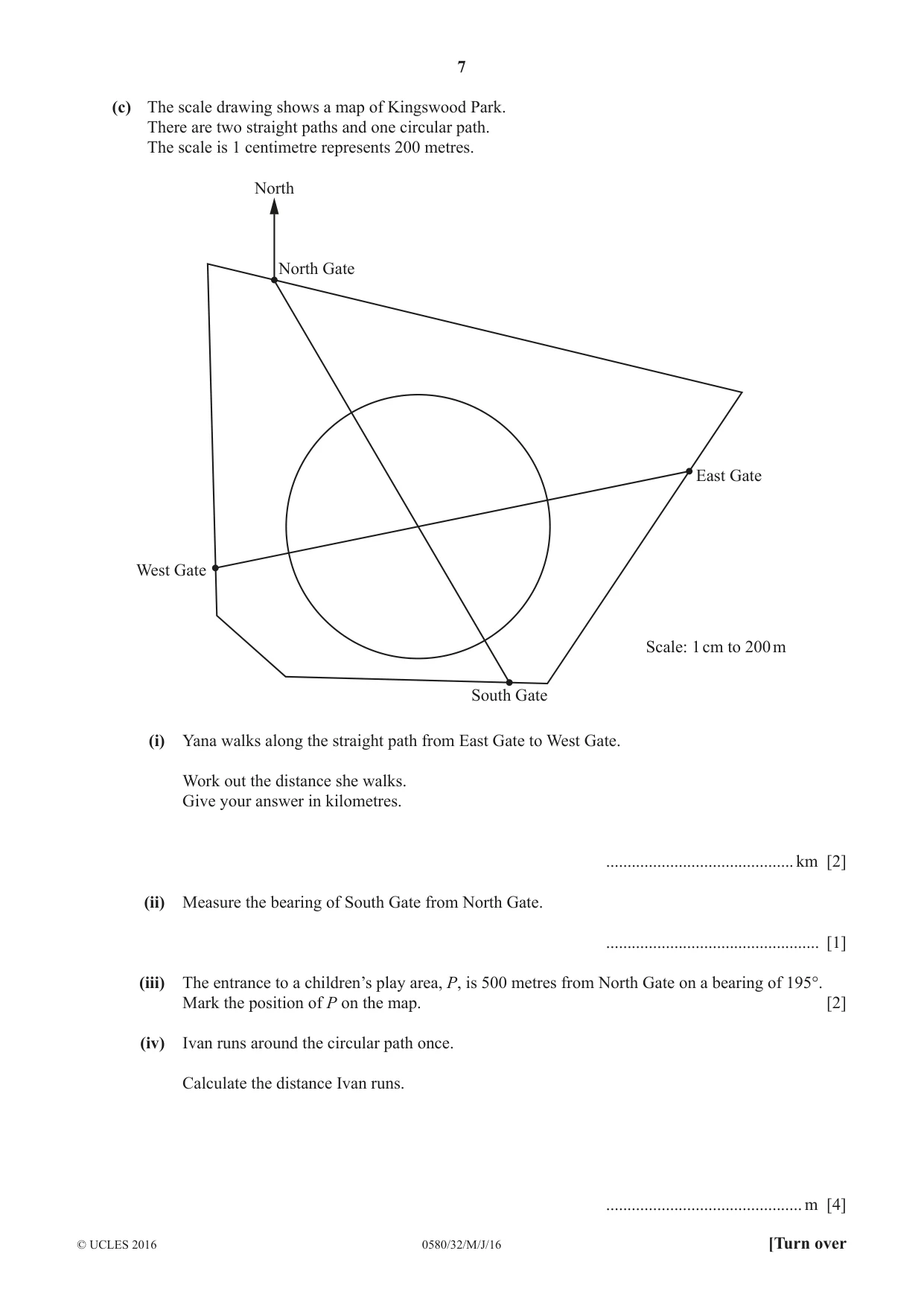
3 (a) Here is part of a bus timetable. Town Hall 10 15 10 35 10 55 11 15 City Gate 10 32 10 52 11 12 11 32 Beacon Hill 10 58 11 18 11 38 11 58 Kingswood Park 11 10 11 30 11 50 12 10 (i) Yana leaves home at 10 50. She takes 14 minutes to walk to the bus stop at City Gate. At what time does she reach the bus stop? .................................................. [1] (ii) She gets on the next bus to Kingswood Park. At what time does this bus arrive at Kingswood Park? .................................................. [1] (iii) Work out how many minutes the bus takes to get from City Gate to Kingswood Park. ........................................... min [1] (b) Ivan walks 1.5 km from his home to Kingswood Park. He takes 20 minutes. Work out Ivan’s average speed in kilometres per hour. ......................................... km/h [1] (c) The scale drawing shows a map of Kingswood Park. There are two straight paths and one circular path. The scale is 1 centimetre represents 200 metres. North North Gate East Gate West Gate Scale: 1 cm to 200 m South Gate (i) Yana walks along the straight path from East Gate to West Gate. Work out the distance she walks. Give your answer in kilometres. ............................................ km [2] (ii) Measure the bearing of South Gate from North Gate. .................................................. [1] (iii) The entrance to a children’s play area, P, is 500 metres from North Gate on a bearing of 195°. Mark the position of P on the map. [2] (iv) Ivan runs around the circular path once. Calculate the distance Ivan runs. .............................................. m [4]
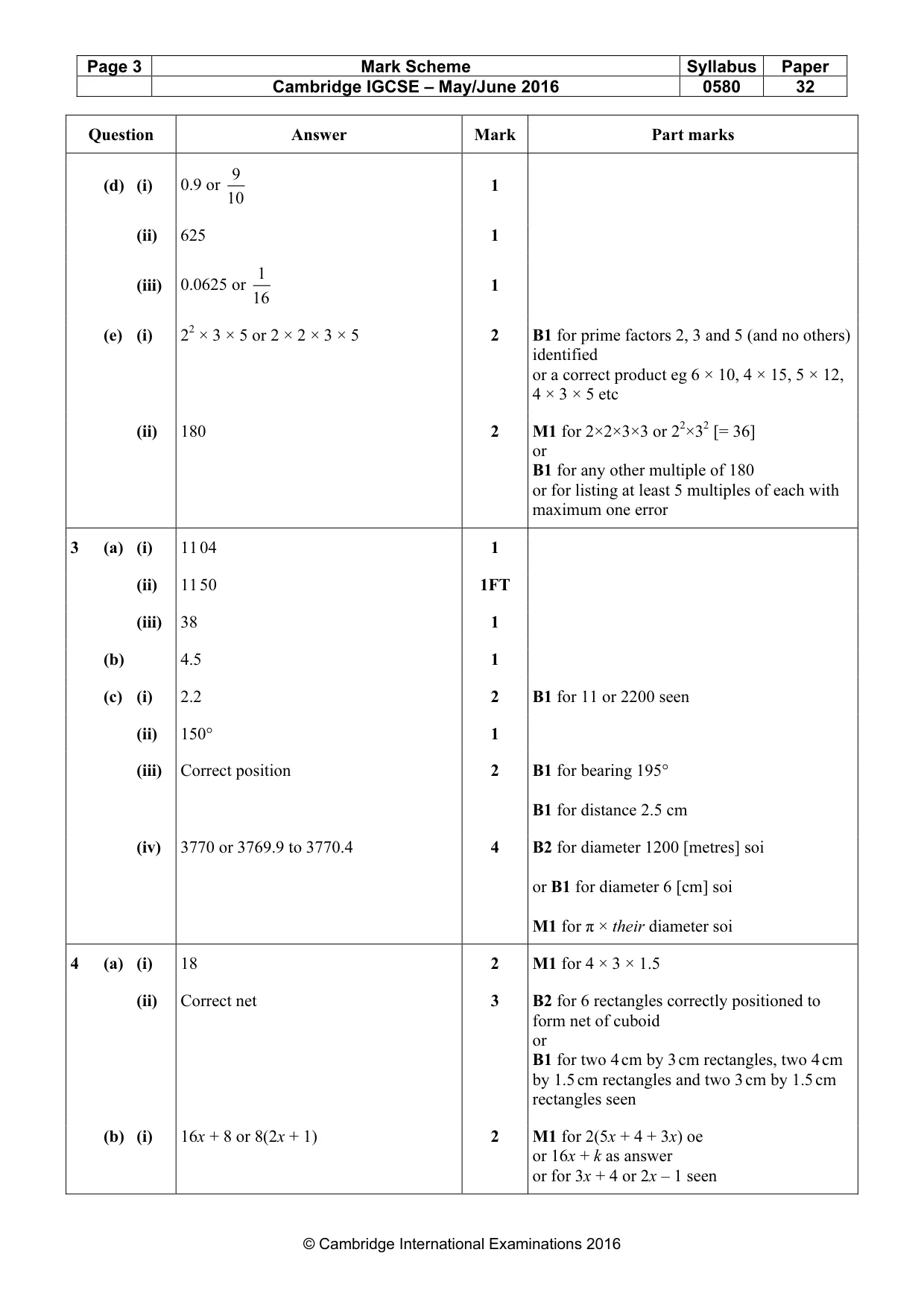
Mark scheme: 3 (a) (i) 11 04 1 (ii) 11 50 1FT (iii) 38 1 (b) 4.5 1 (c) (i) 2.2 2 B1 for 11 or 2200 seen (ii) 150° 1 (iii) Correct position 2 B1 for bearing 195° B1 for distance 2.5 cm (iv) 3770 or 3769.9 to 3770.4 4 B2 for diameter 1200 [metres] soi or B1 for diameter 6 [cm] soi M1 for π × their diameter soi
Q4 · A cuboid has length 4 cm, width 3 cm and height 1.5 cm
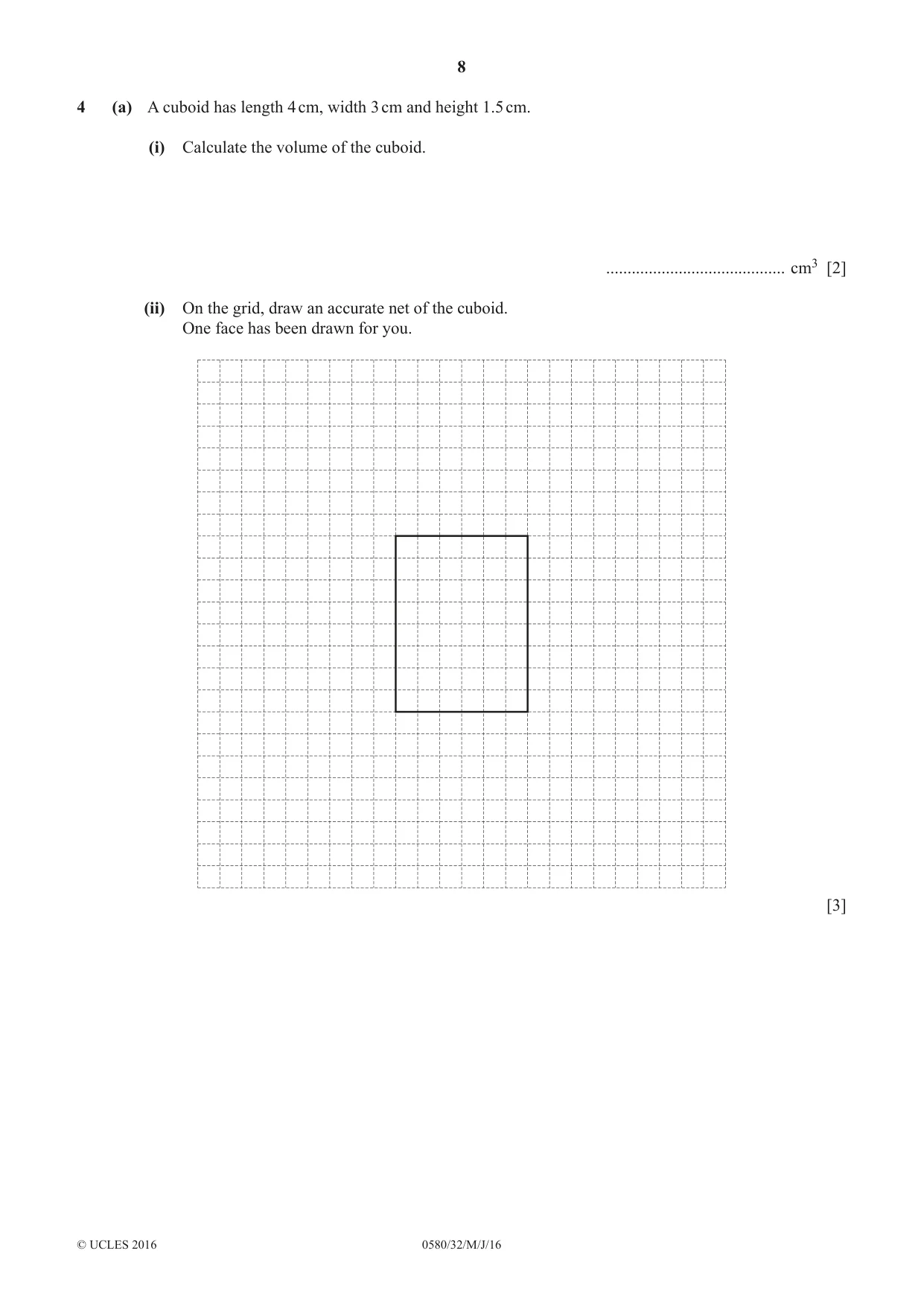
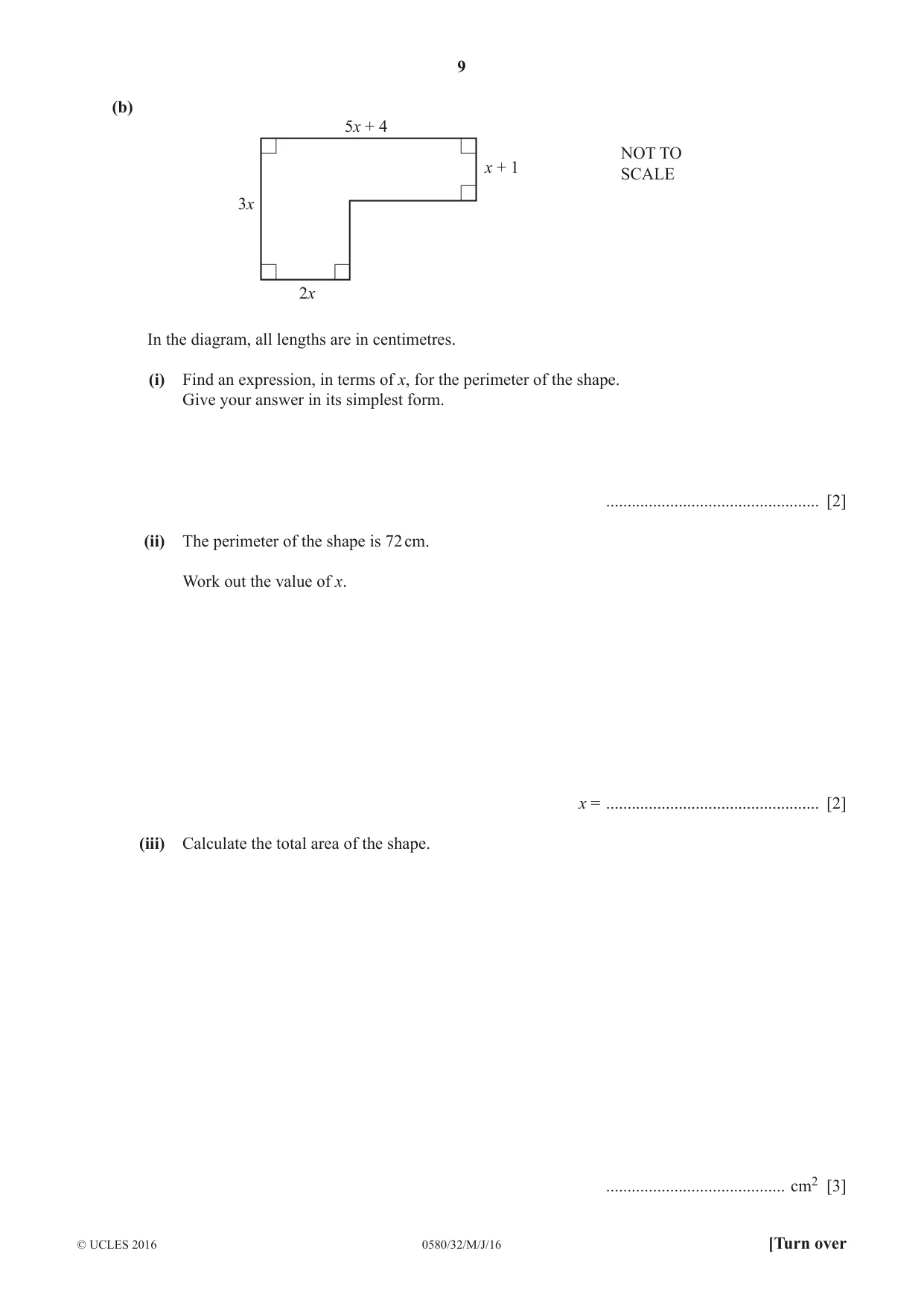
4 (a) A cuboid has length 4 cm, width 3 cm and height 1.5 cm. (i) Calculate the volume of the cuboid. .......................................... cm3 [2] (ii) On the grid, draw an accurate net of the cuboid. One face has been drawn for you. [3] (b) 5x + 4 NOT TO x + 1 SCALE 3x 2x In the diagram, all lengths are in centimetres. (i) Find an expression, in terms of x, for the perimeter of the shape. Give your answer in its simplest form. .................................................. [2] (ii) The perimeter of the shape is 72 cm. Work out the value of x. x = .................................................. [2] (iii) Calculate the total area of the shape. .......................................... cm2 [3]
Mark scheme: 4 (a) (i) 18 2 M1 for 4 × 3 × 1.5 (ii) Correct net 3 B2 for 6 rectangles correctly positioned to form net of cuboid or B1 for two 4 cm by 3 cm rectangles, two 4 cm by 1.5 cm rectangles and two 3 cm by 1.5 cm rectangles seen (b) (i) 16x + 8 or 8(2x + 1) 2 M1 for 2(5x + 4 + 3x) oe or 16x + k as answer or for 3x + 4 or 2x – 1 seen
Q5 · The table shows the age and the total distance travelled for 10 cars
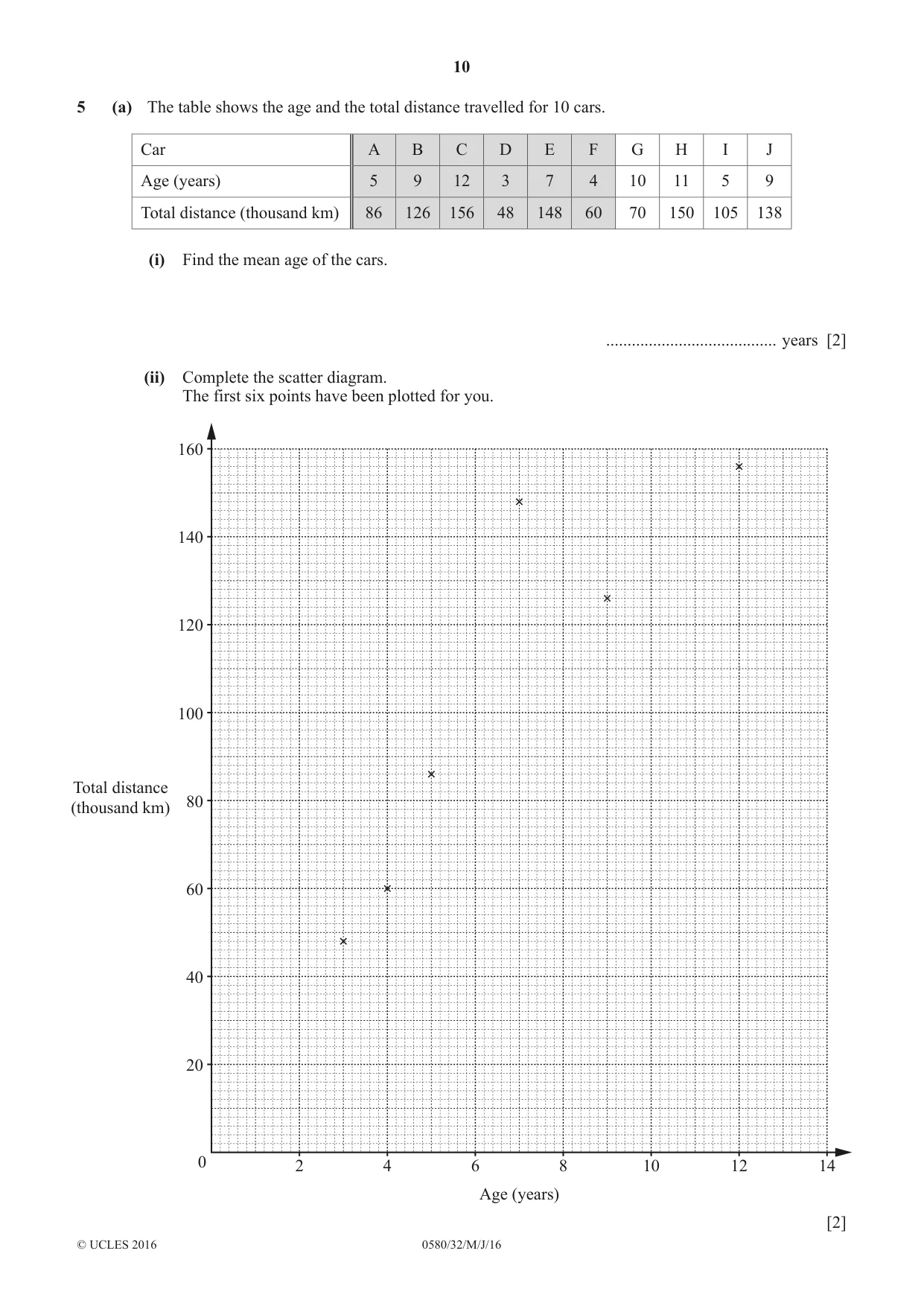
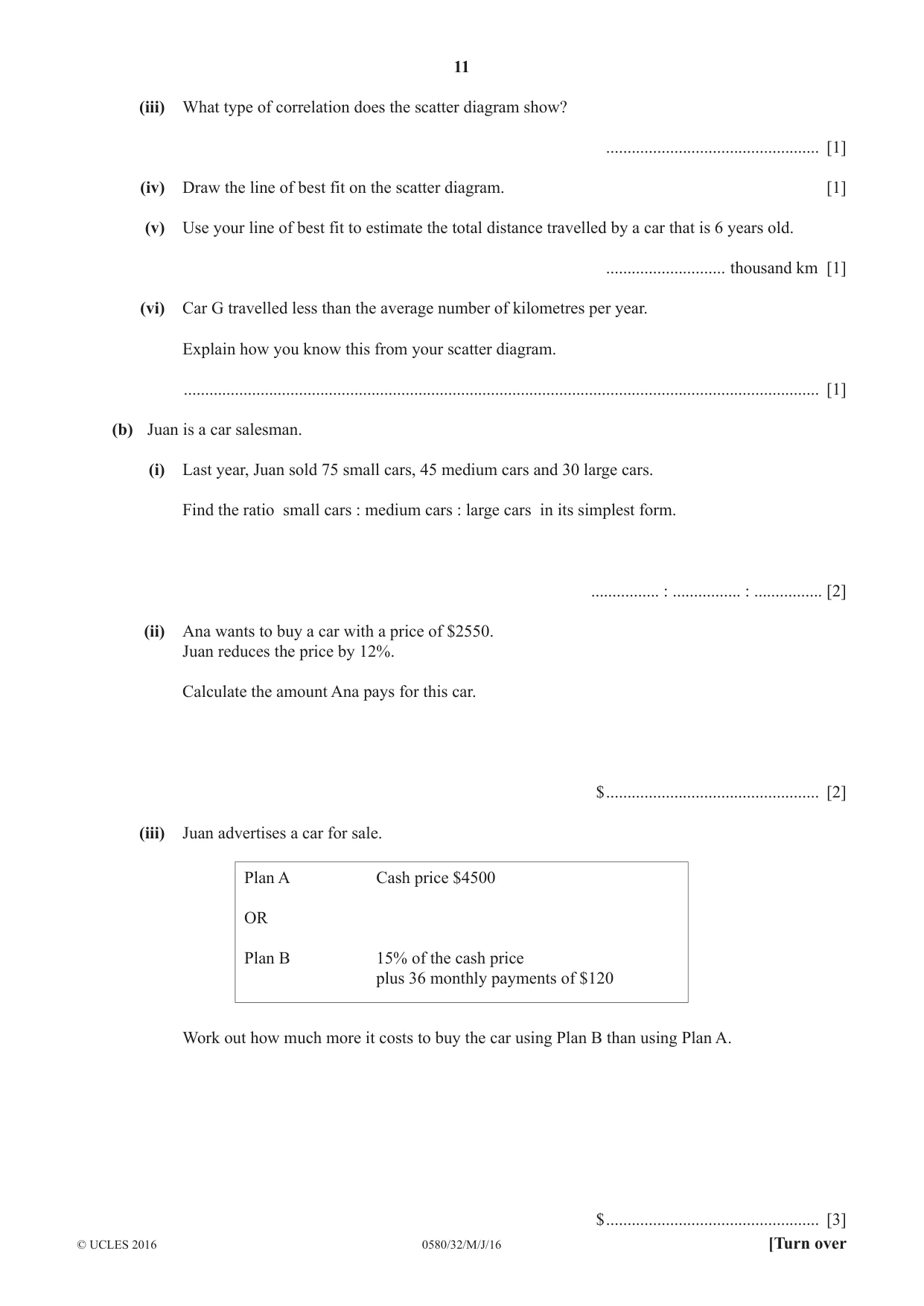
5 (a) The table shows the age and the total distance travelled for 10 cars. Car A B C D E F G H I J Age (years) 5 9 12 3 7 4 10 11 5 9 Total distance (thousand km) 86 126 156 48 148 60 70 150 105 138 (i) Find the mean age of the cars. ........................................ years [2] (ii) Complete the scatter diagram. The first six points have been plotted for you. 160 140 120 100 Total distance 80(thousand km) 60 40 20 0 2 4 6 8 10 12 14 Age (years) [2] (iii) What type of correlation does the scatter diagram show? .................................................. [1] (iv) Draw the line of best fit on the scatter diagram. [1] (v) Use your line of best fit to estimate the total distance travelled by a car that is 6 years old. ............................ thousand km [1] (vi) Car G travelled less than the average number of kilometres per year. Explain how you know this from your scatter diagram. ..................................................................................................................................................... [1] (b) Juan is a car salesman. (i) Last year, Juan sold 75 small cars, 45 medium cars and 30 large cars. Find the ratio small cars : medium cars : large cars in its simplest form. ................ : ................ : ................ [2] (ii) Ana wants to buy a car with a price of $2550. Juan reduces the price by 12%. Calculate the amount Ana pays for this car. $ .................................................. [2] (iii) Juan advertises a car for sale. Plan A Cash price $4500 OR Plan B 15% of the cash price plus 36 monthly payments of $120 Work out how much more it costs to buy the car using Plan B than using Plan A. $ .................................................. [3]
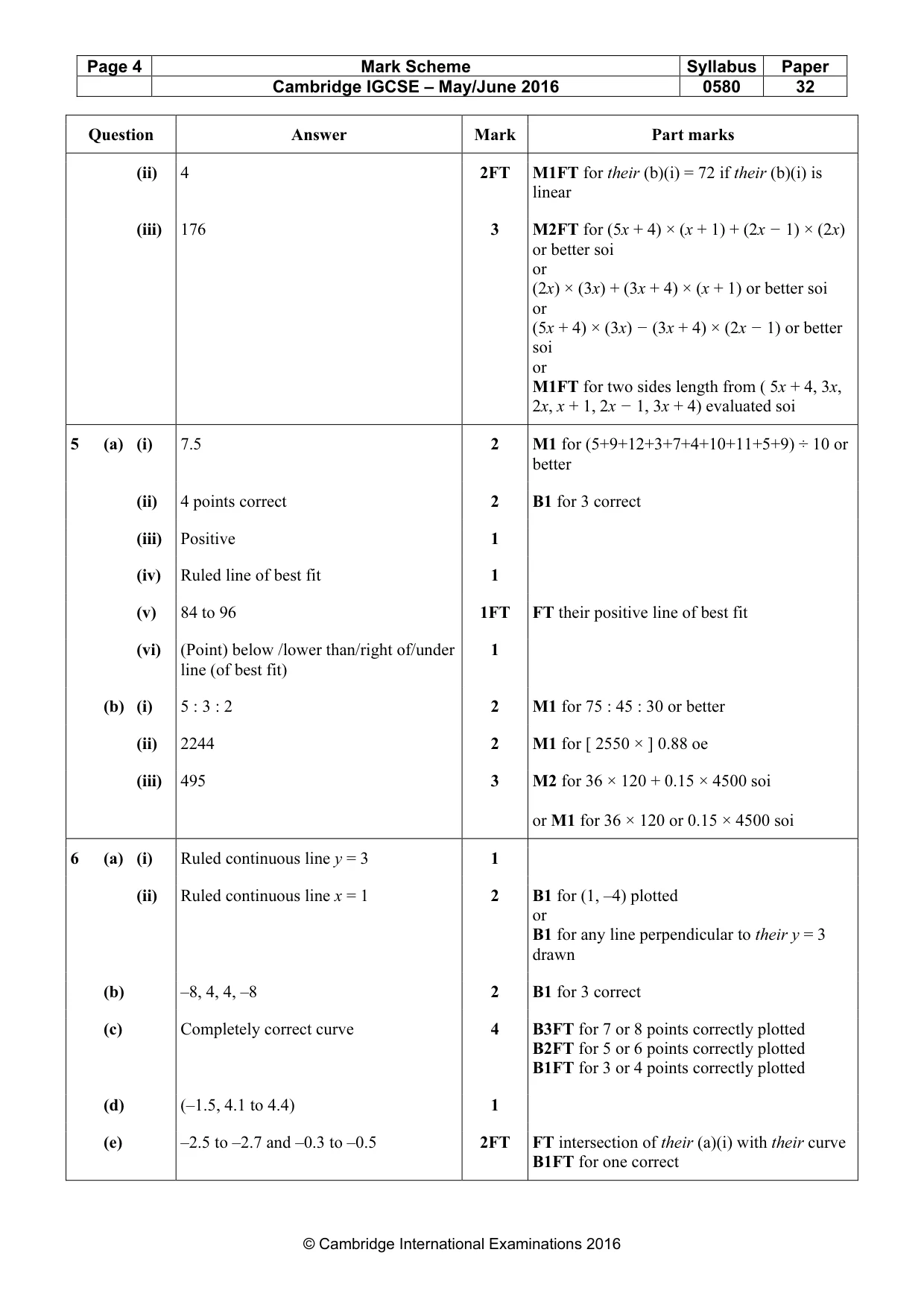
Mark scheme: 5 (a) (i) 7.5 2 M1 for (5+9+12+3+7+4+10+11+5+9) ÷ 10 or better (ii) 4 points correct 2 B1 for 3 correct (iii) Positive 1 (iv) Ruled line of best fit 1 (v) 84 to 96 1FT FT their positive line of best fit (vi) (Point) below /lower than/right of/under 1 line (of best fit) (b) (i) 5 : 3 : 2 2 M1 for 75 : 45 : 30 or better (ii) 2244 2 M1 for [ 2550 × ] 0.88 oe (iii) 495 3 M2 for 36 × 120 + 0.15 × 4500 soi or M1 for 36 × 120 or 0.15 × 4500 soi
Q6 · Y 6 4 2 x 0 –5 –4 –3 –2 –1 1 2 –2 –4 –6 –8 –10 (a) On the grid, (i) draw the line y = 3…
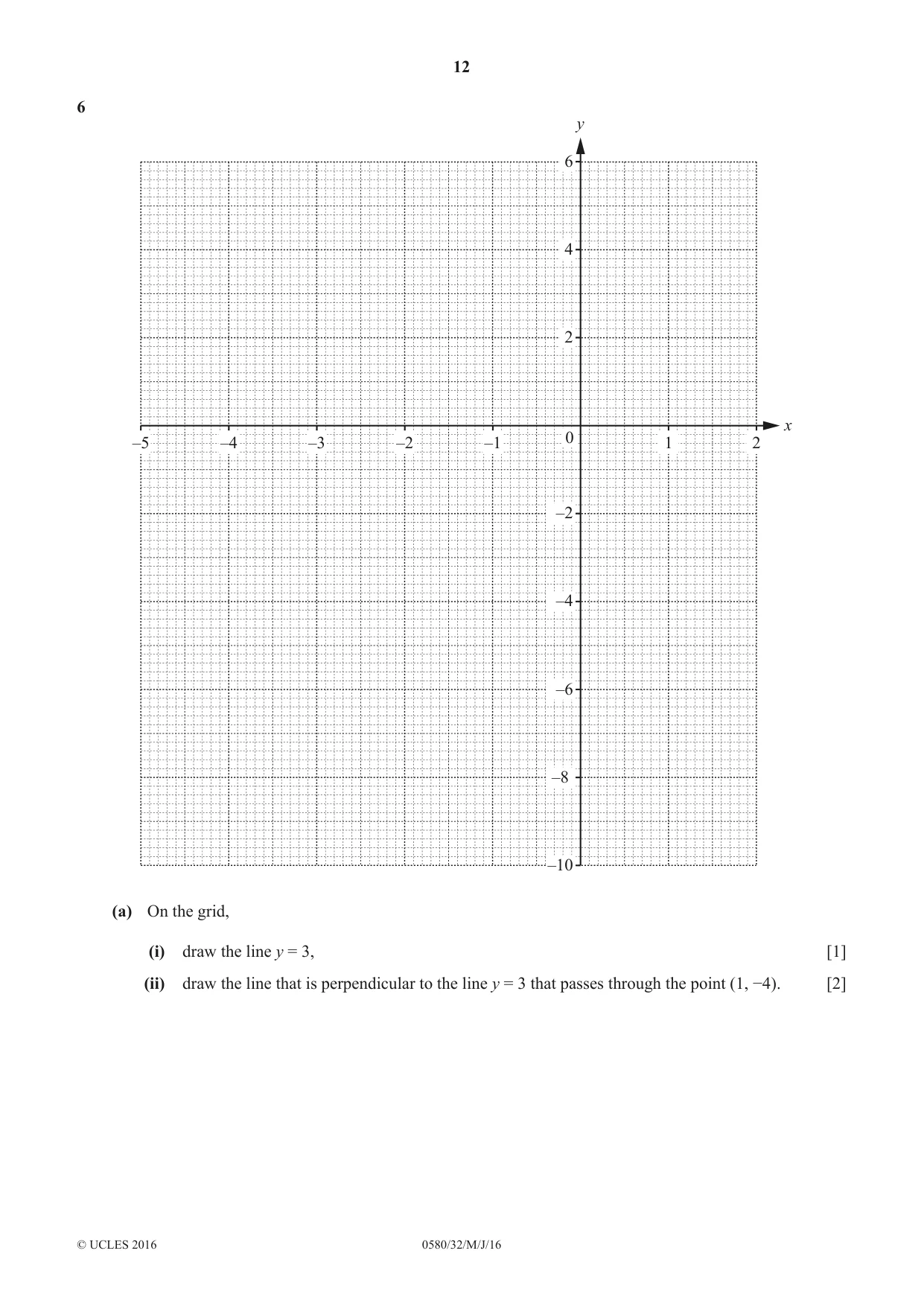
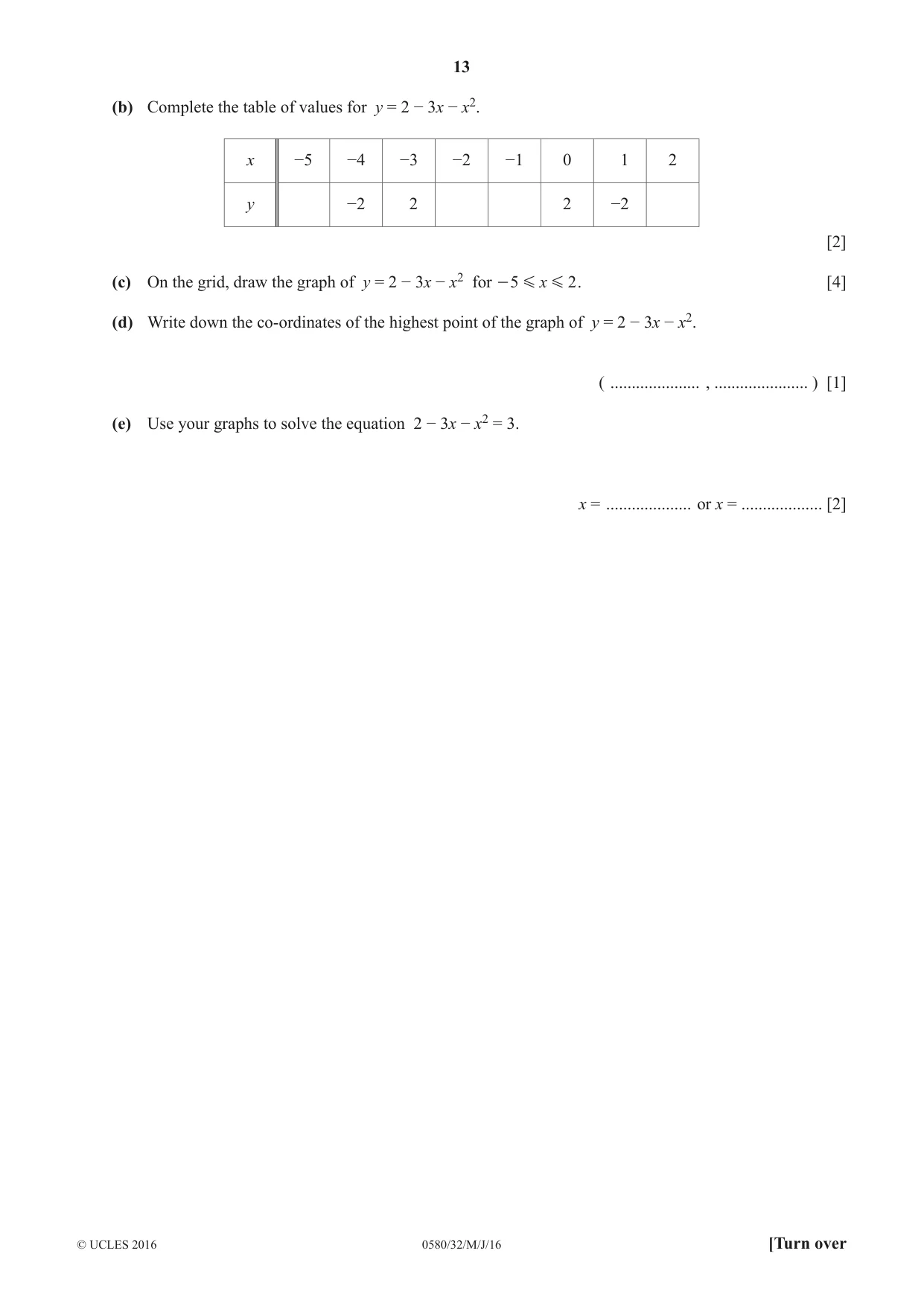
6 y 6 4 2 x 0 –5 –4 –3 –2 –1 1 2 –2 –4 –6 –8 –10 (a) On the grid, (i) draw the line y = 3, [1] (ii) draw the line that is perpendicular to the line y = 3 that passes through the point (1, −4). [2] (b) Complete the table of values for y = 2 − 3x − x2. x −5 −4 −3 −2 −1 0 1 2 y −2 2 2 −2 [2] (c) On the grid, draw the graph of y = 2 − 3x − x2 for - 5 G x G 2 . [4] (d) Write down the co-ordinates of the highest point of the graph of y = 2 − 3x − x2. ( ..................... , ...................... ) [1] (e) Use your graphs to solve the equation 2 − 3x − x2 = 3. x = .................... or x = ................... [2]
Mark scheme: 6 (a) (i) Ruled continuous line y = 3 1 (ii) Ruled continuous line x = 1 2 B1 for (1, –4) plotted or B1 for any line perpendicular to their y = 3 drawn (b) –8, 4, 4, –8 2 B1 for 3 correct (c) Completely correct curve 4 B3FT for 7 or 8 points correctly plotted B2FT for 5 or 6 points correctly plotted B1FT for 3 or 4 points correctly plotted (d) (–1.5, 4.1 to 4.4) 1 (e) –2.5 to –2.7 and –0.3 to –0.5 2FT FT intersection of their (a)(i) with their curve B1FT for one correct
Q7 · 25° 98° NOT TO SCALE y° x° The diagram shows three straight lines crossing at a point
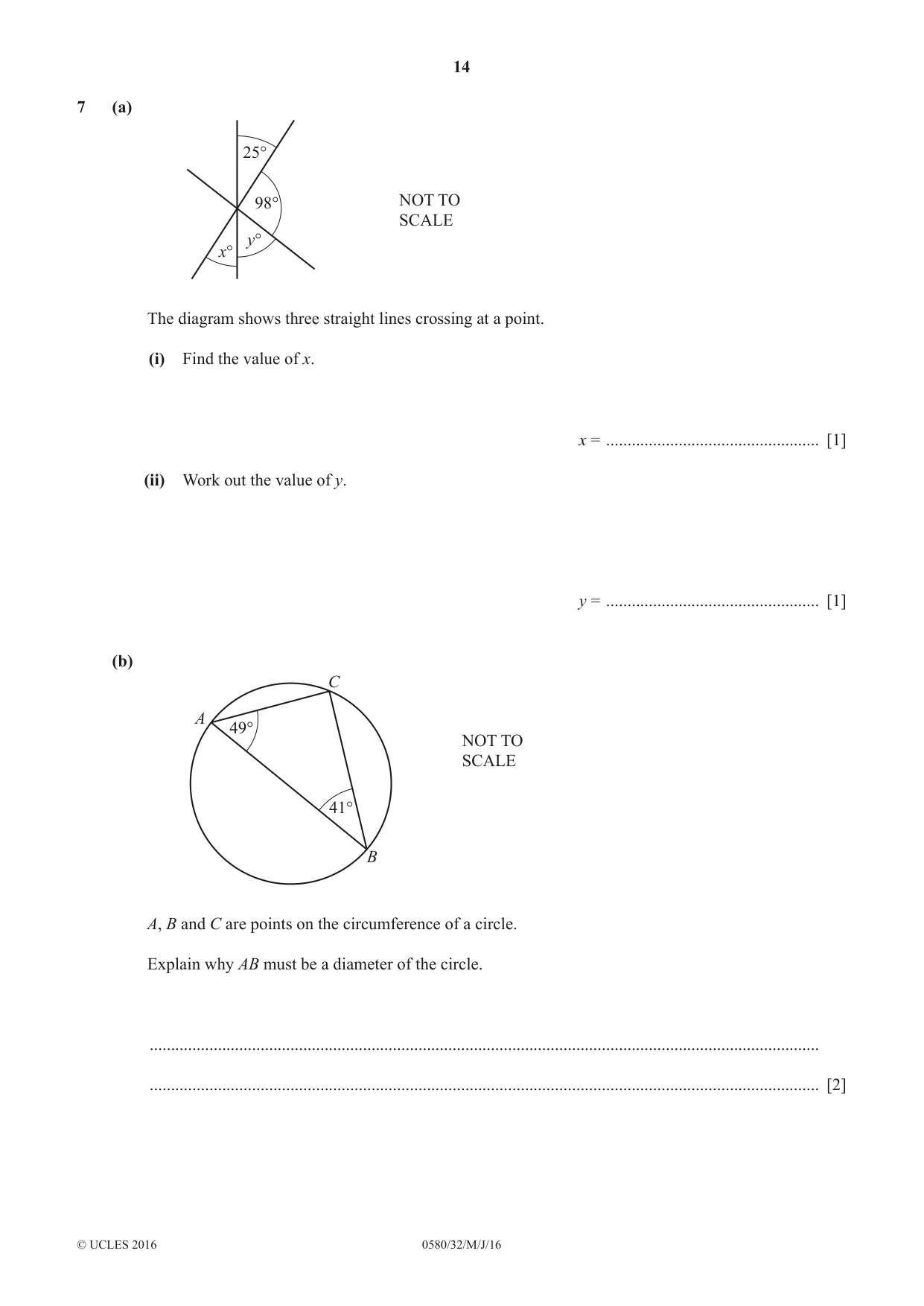
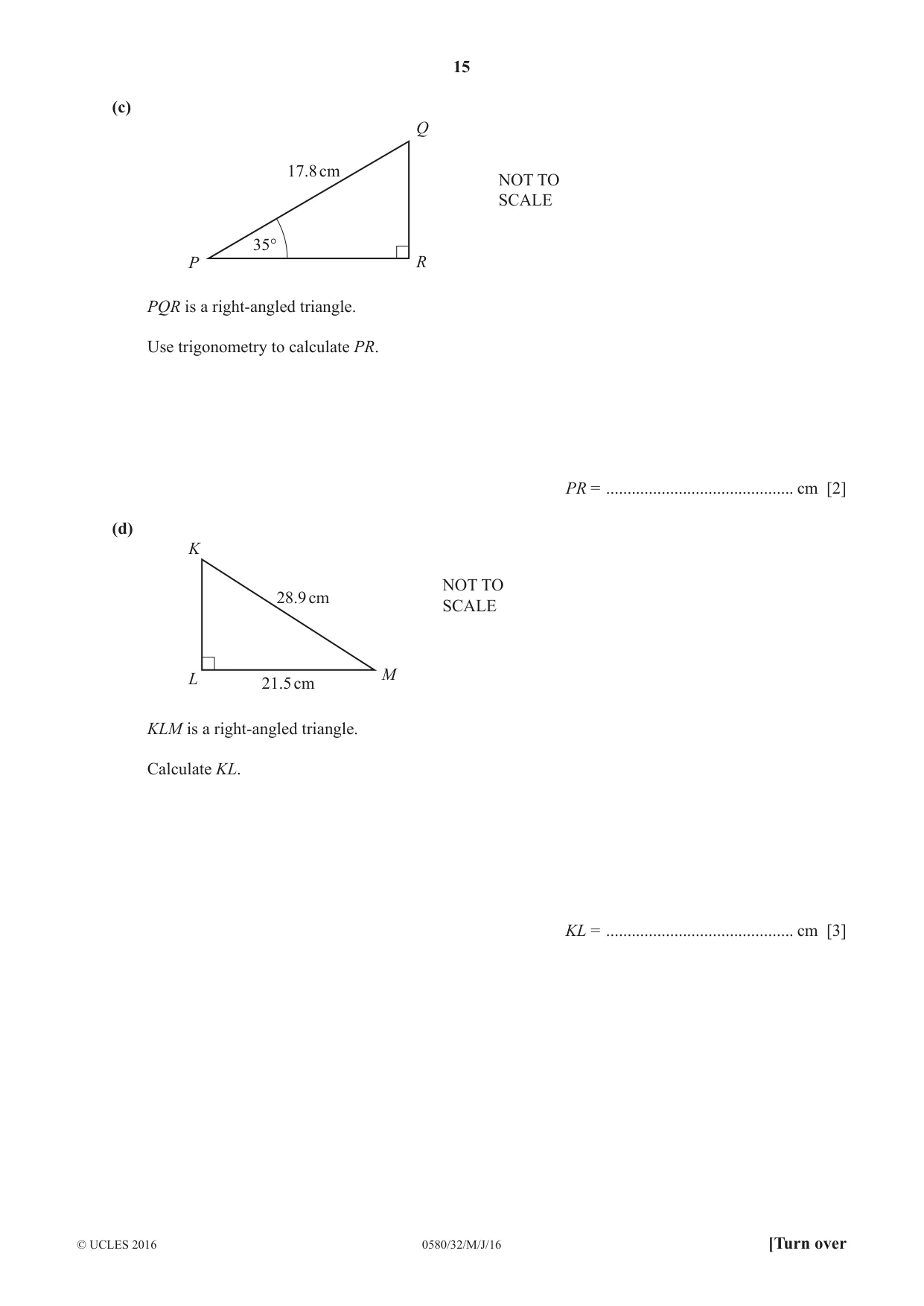
7 (a) 25° 98° NOT TO SCALE y° x° The diagram shows three straight lines crossing at a point. (i) Find the value of x. x = .................................................. [1] (ii) Work out the value of y. y = .................................................. [1] (b) C A 49° NOT TO SCALE 41° B A, B and C are points on the circumference of a circle. Explain why AB must be a diameter of the circle. ............................................................................................................................................................. ............................................................................................................................................................. [2] (c) Q 17.8 cm NOT TO SCALE 35° P R PQR is a right-angled triangle. Use trigonometry to calculate PR. PR = ............................................ cm [2] (d) K NOT TO 28.9 cm SCALE M L 21.5 cm KLM is a right-angled triangle. Calculate KL. KL = ............................................ cm [3]
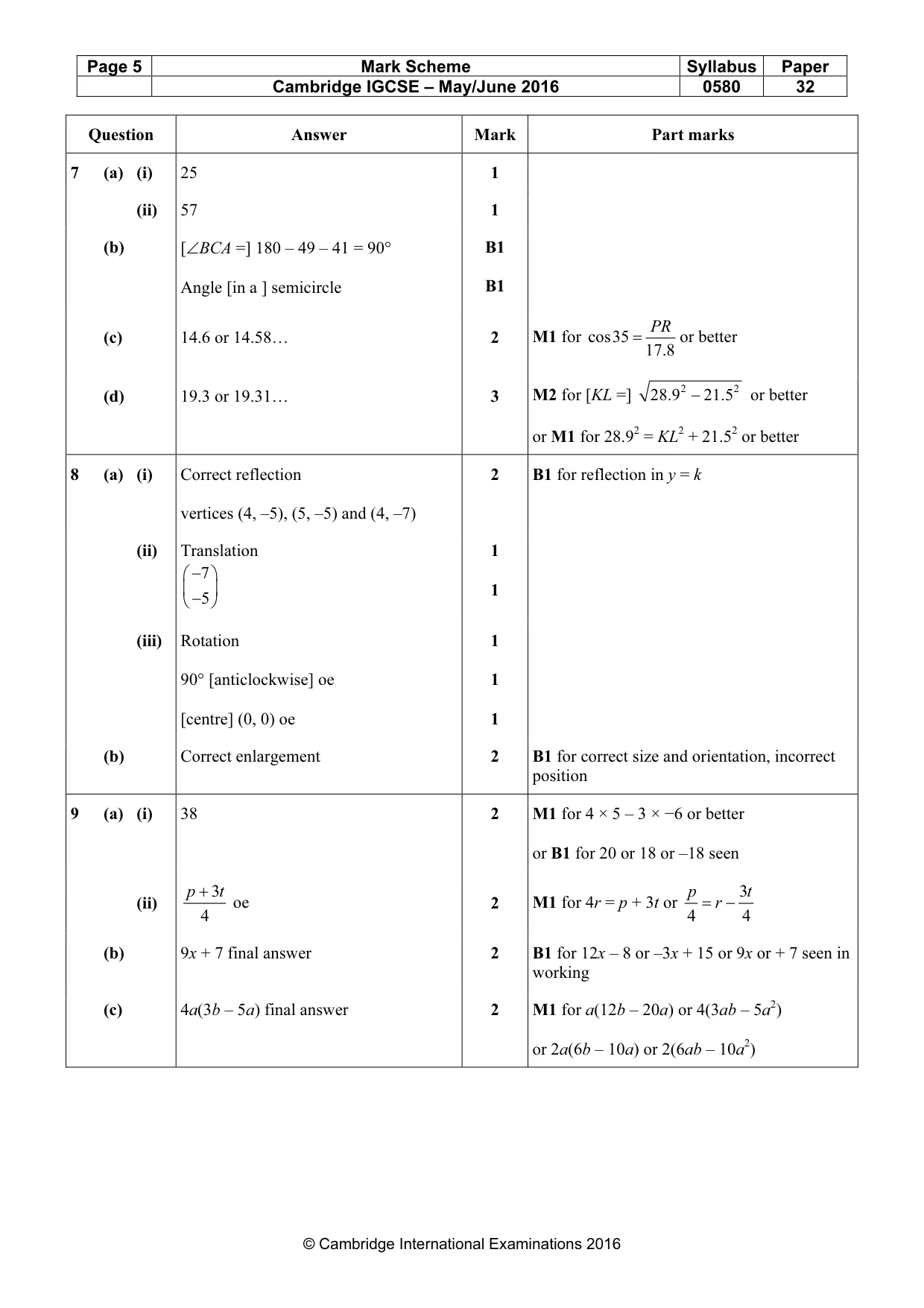
Mark scheme: 7 (a) (i) 25 1 (ii) 57 1 (b) [∠BCA =] 180 – 49 – 41 = 90° B1 B1 Angle [in a ] semicircle PR (c) 14.6 or 14.58… 2 M1 for cos35 = or better 17.8 (d) 19.3 or 19.31… 3 M2 for [KL =] 28.9 2 − 21.5 2 or better or M1 for 28.92 = KL2 + 21.52 or better
Q8 · Y 6 5 C 4 3 2 A 1 x 0 –7 –6 –5 –4 –3 –2 –1 1 2 3 4 5 6 7 –1 –2 –3 B –4 –5 –6 –7 –8 (i) On…
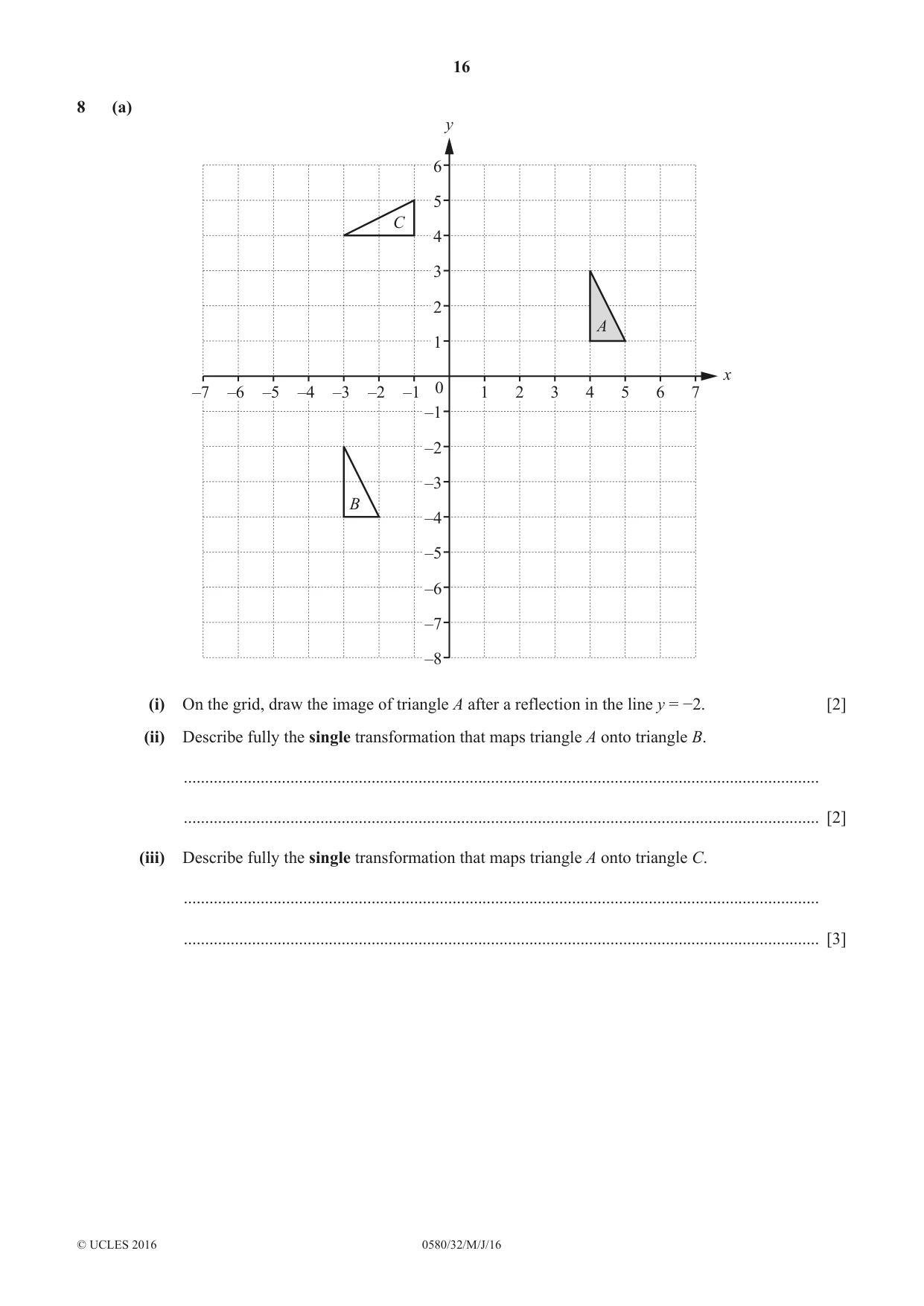
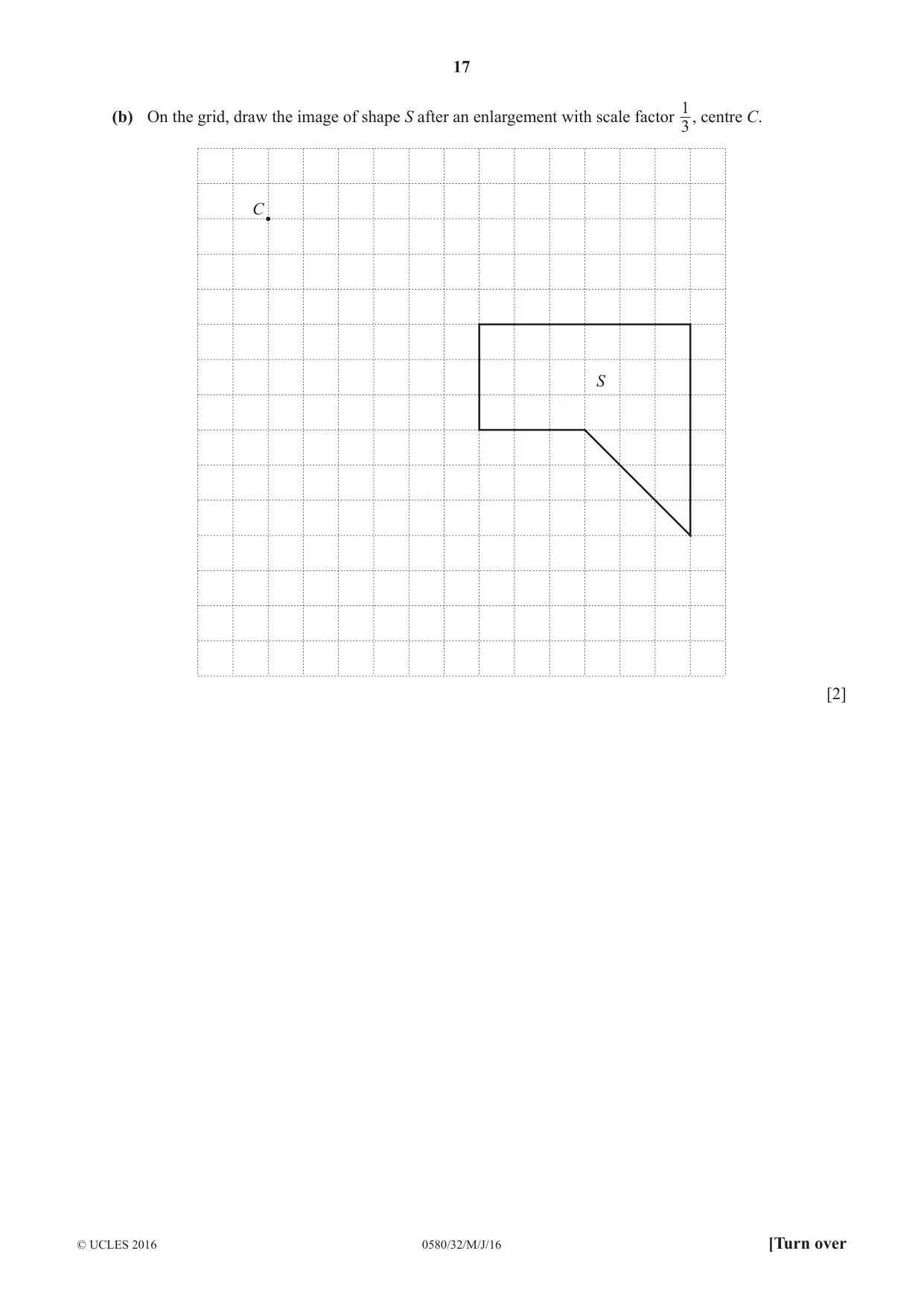
8 (a) y 6 5 C 4 3 2 A 1 x 0 –7 –6 –5 –4 –3 –2 –1 1 2 3 4 5 6 7 –1 –2 –3 B –4 –5 –6 –7 –8 (i) On the grid, draw the image of triangle A after a reflection in the line y = −2. [2] (ii) Describe fully the single transformation that maps triangle A onto triangle B. ..................................................................................................................................................... ..................................................................................................................................................... [2] (iii) Describe fully the single transformation that maps triangle A onto triangle C. ..................................................................................................................................................... ..................................................................................................................................................... [3] 1 (b) On the grid, draw the image of shape S after an enlargement with scale factor 3 , centre C. C S [2]
Mark scheme: 8 (a) (i) Correct reflection 2 B1 for reflection in y = k vertices (4, –5), (5, –5) and (4, –7) (ii) Translation 1 −7 1 −5 (iii) Rotation 1 90° [anticlockwise] oe 1 [centre] (0, 0) oe 1 (b) Correct enlargement 2 B1 for correct size and orientation, incorrect position
Q9 · P = 4r − 3t (i) Calculate the value of p when r = 5 and t = −6
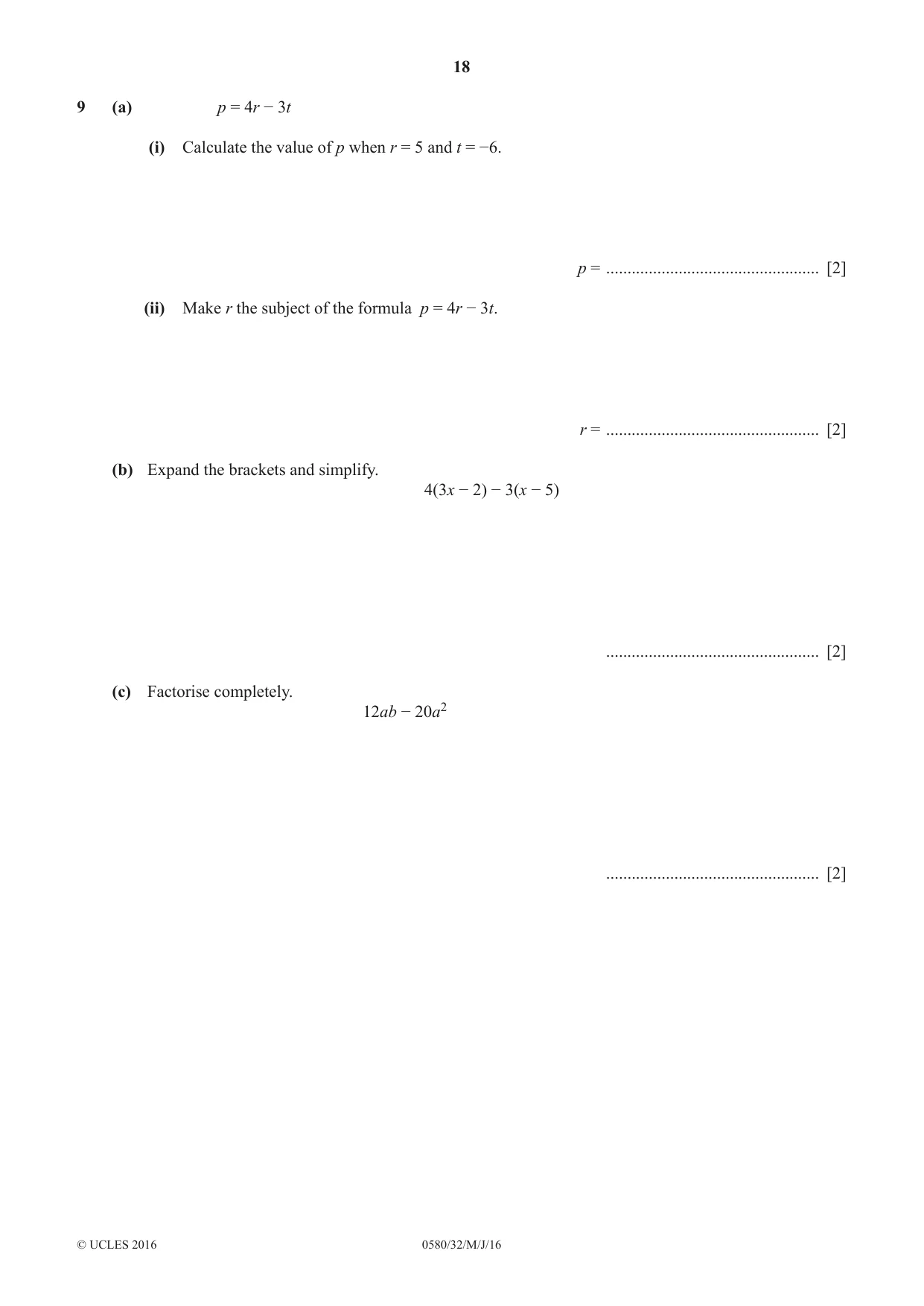
9 (a) p = 4r − 3t (i) Calculate the value of p when r = 5 and t = −6. p = .................................................. [2] (ii) Make r the subject of the formula p = 4r − 3t. r = .................................................. [2] (b) Expand the brackets and simplify. 4(3x − 2) − 3(x − 5) .................................................. [2] (c) Factorise completely. 12ab − 20a2 .................................................. [2]
Mark scheme: 9 (a) (i) 38 2 M1 for 4 × 5 – 3 × −6 or better or B1 for 20 or 18 or –18 seen p + 3t p 3t (ii) oe 2 M1 for 4r = p + 3t or = r − 4 4 4 (b) 9x + 7 final answer 2 B1 for 12x – 8 or –3x + 15 or 9x or + 7 seen in working (c) 4a(3b – 5a) final answer 2 M1 for a(12b – 20a) or 4(3ab – 5a2) or 2a(6b – 10a) or 2(6ab – 10a2)
What was in this paper
The subtopics covered by these 9 questions, and how many questions each got. Open one in a new tab to see every Cambridge question on it.
What you needed in this session
Cambridge’s own grade thresholds for 2016 May/June, Paper 3 · Variant 2. A higher threshold means an easier paper — the bar moves with how the cohort did.