Cambridge IGCSE Mathematics 0580 — 2016 May/June Paper 3 · Variant 3
0580/33/M/J/16 · 9 questions · 104 marks · ≈117 min
The question paper and its mark scheme, free to read here and free to download. This is Cambridge’s own paper, exactly as it was sat.
Question paper16 pages
Mark scheme6 pages
Answers below. Sit the paper first if you are practising.
Questions as text
Q1 · A wildlife park covers an area of 18 hectares
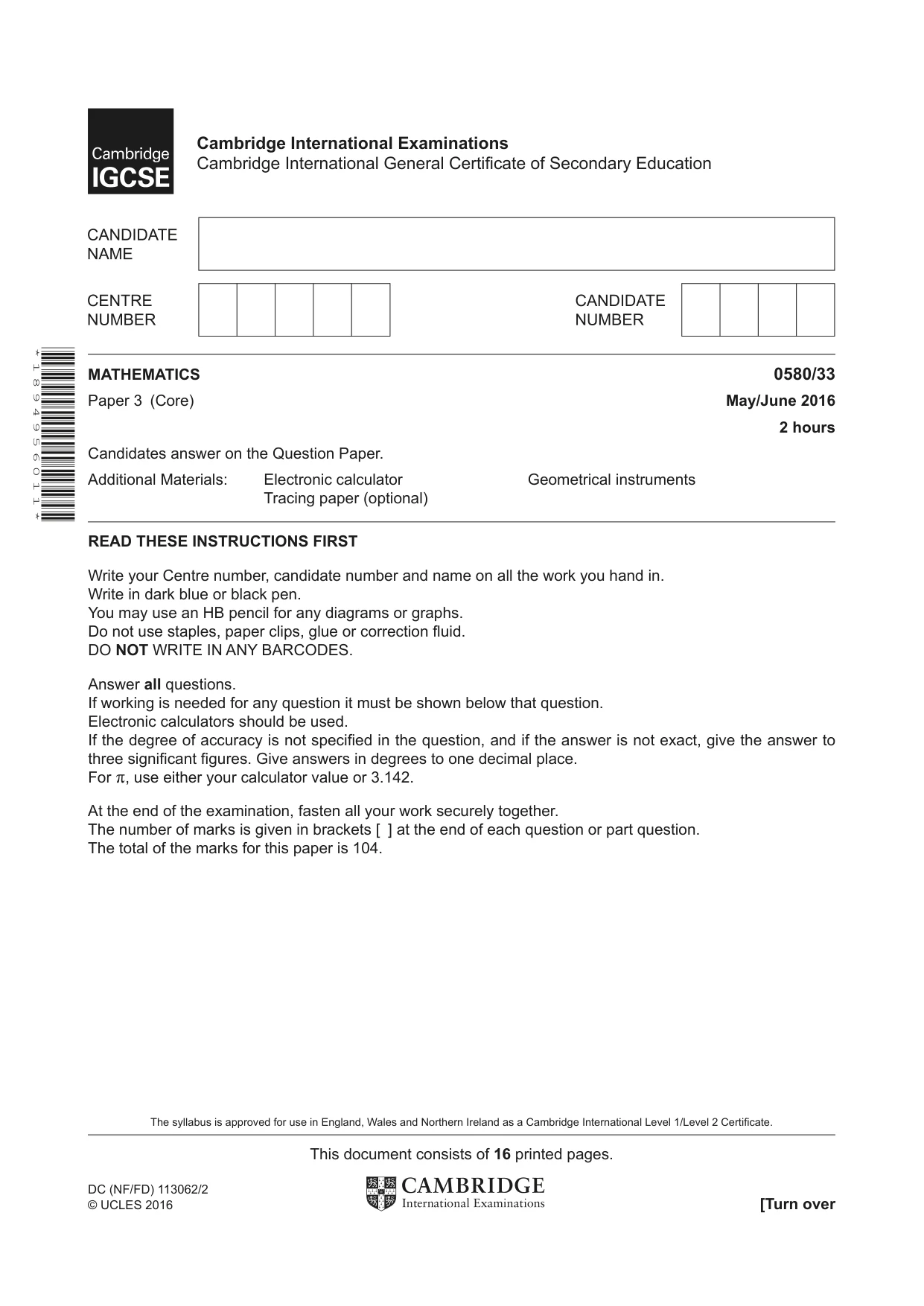
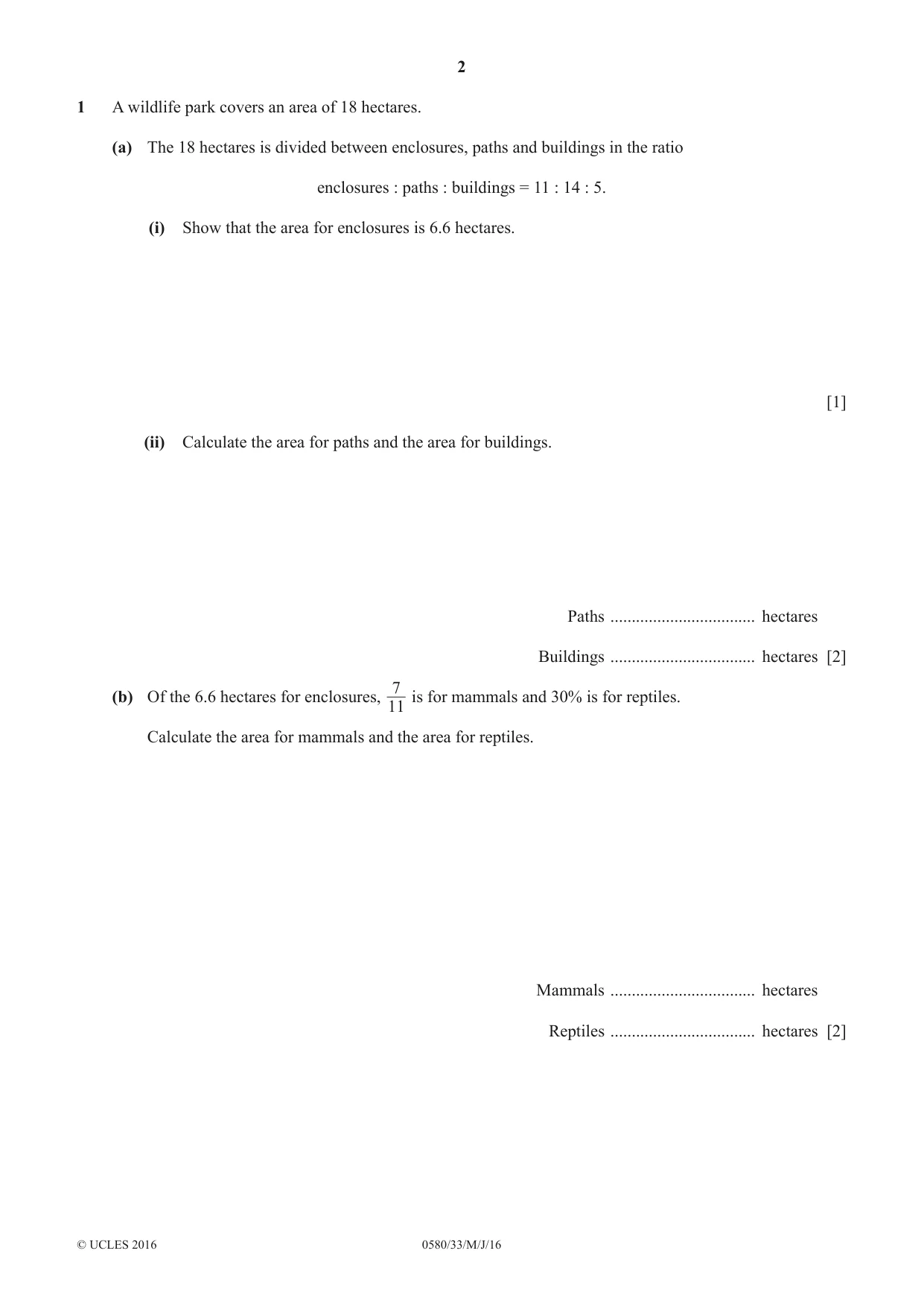
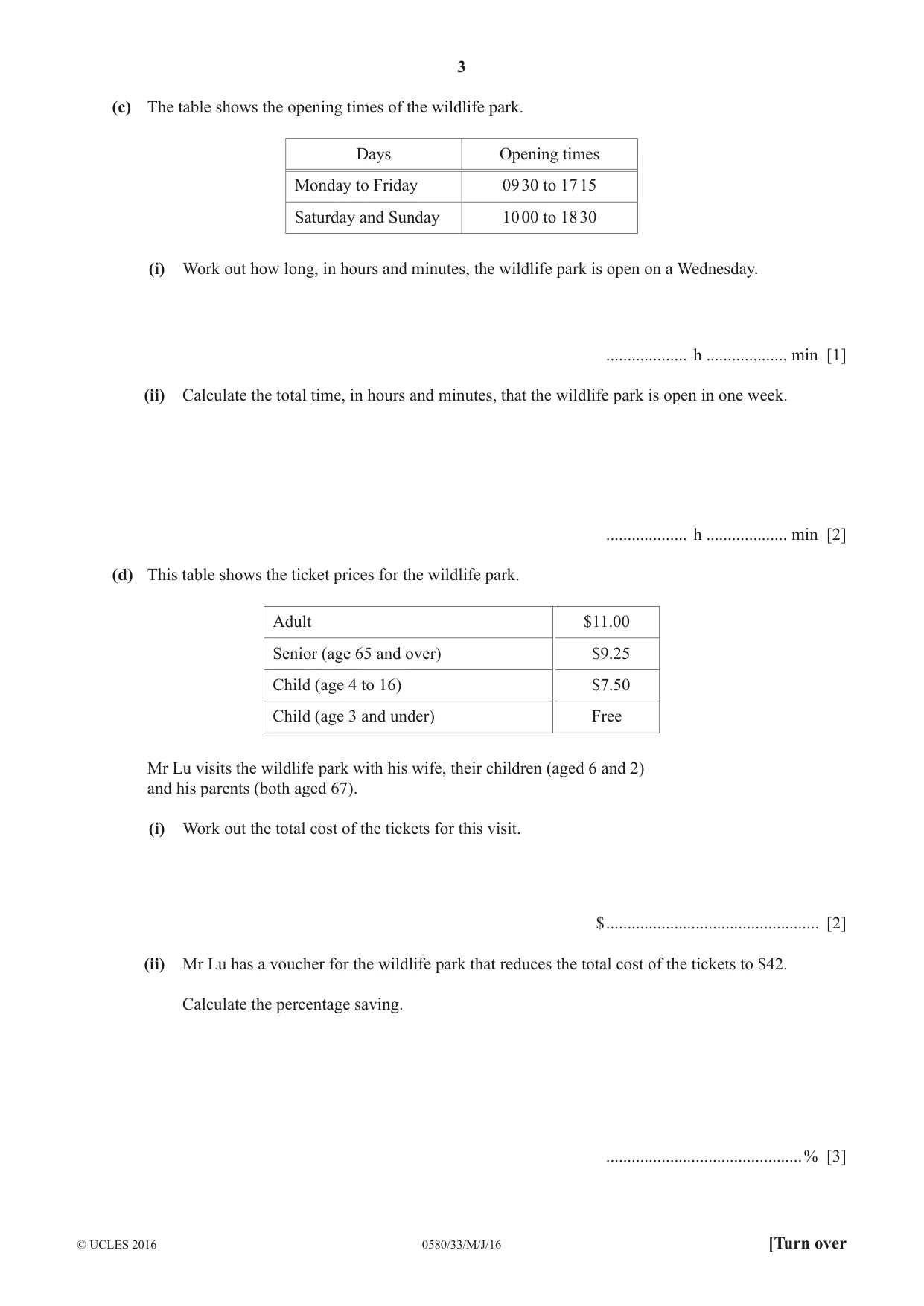
1 A wildlife park covers an area of 18 hectares. (a) The 18 hectares is divided between enclosures, paths and buildings in the ratio enclosures : paths : buildings = 11 : 14 : 5. (i) Show that the area for enclosures is 6.6 hectares. [1] (ii) Calculate the area for paths and the area for buildings. Paths .................................. hectares Buildings .................................. hectares [2] 7 (b) Of the 6.6 hectares for enclosures, 11 is for mammals and 30% is for reptiles. Calculate the area for mammals and the area for reptiles. Mammals .................................. hectares Reptiles .................................. hectares [2] (c) The table shows the opening times of the wildlife park. Days Opening times Monday to Friday 09 30 to 17 15 Saturday and Sunday 10 00 to 18 30 (i) Work out how long, in hours and minutes, the wildlife park is open on a Wednesday. ................... h ................... min [1] (ii) Calculate the total time, in hours and minutes, that the wildlife park is open in one week. ................... h ................... min [2] (d) This table shows the ticket prices for the wildlife park. Adult $11.00 Senior (age 65 and over) $9.25 Child (age 4 to 16) $7.50 Child (age 3 and under) Free Mr Lu visits the wildlife park with his wife, their children (aged 6 and 2) and his parents (both aged 67). (i) Work out the total cost of the tickets for this visit. $ .................................................. [2] (ii) Mr Lu has a voucher for the wildlife park that reduces the total cost of the tickets to $42. Calculate the percentage saving. ..............................................% [3]
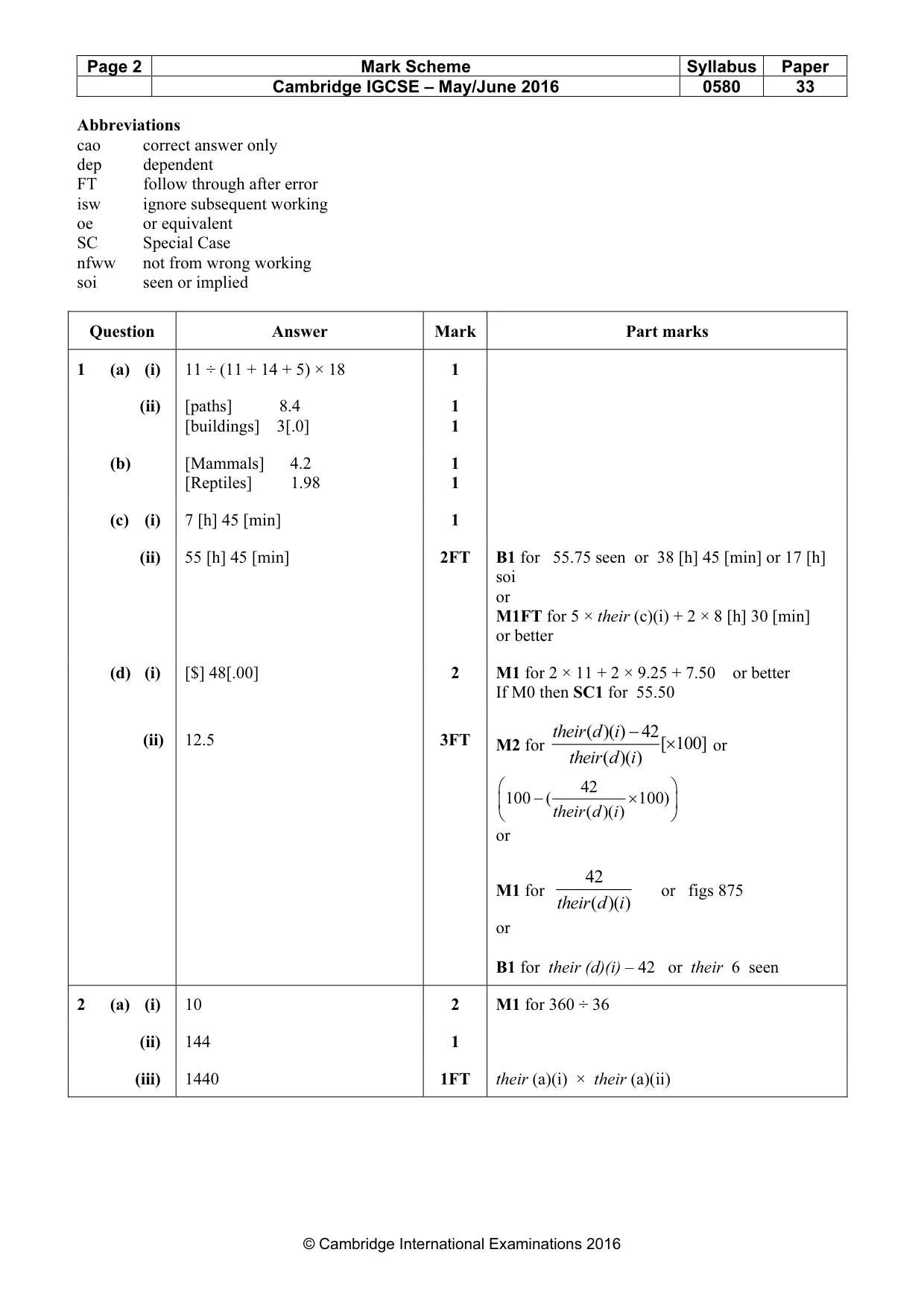
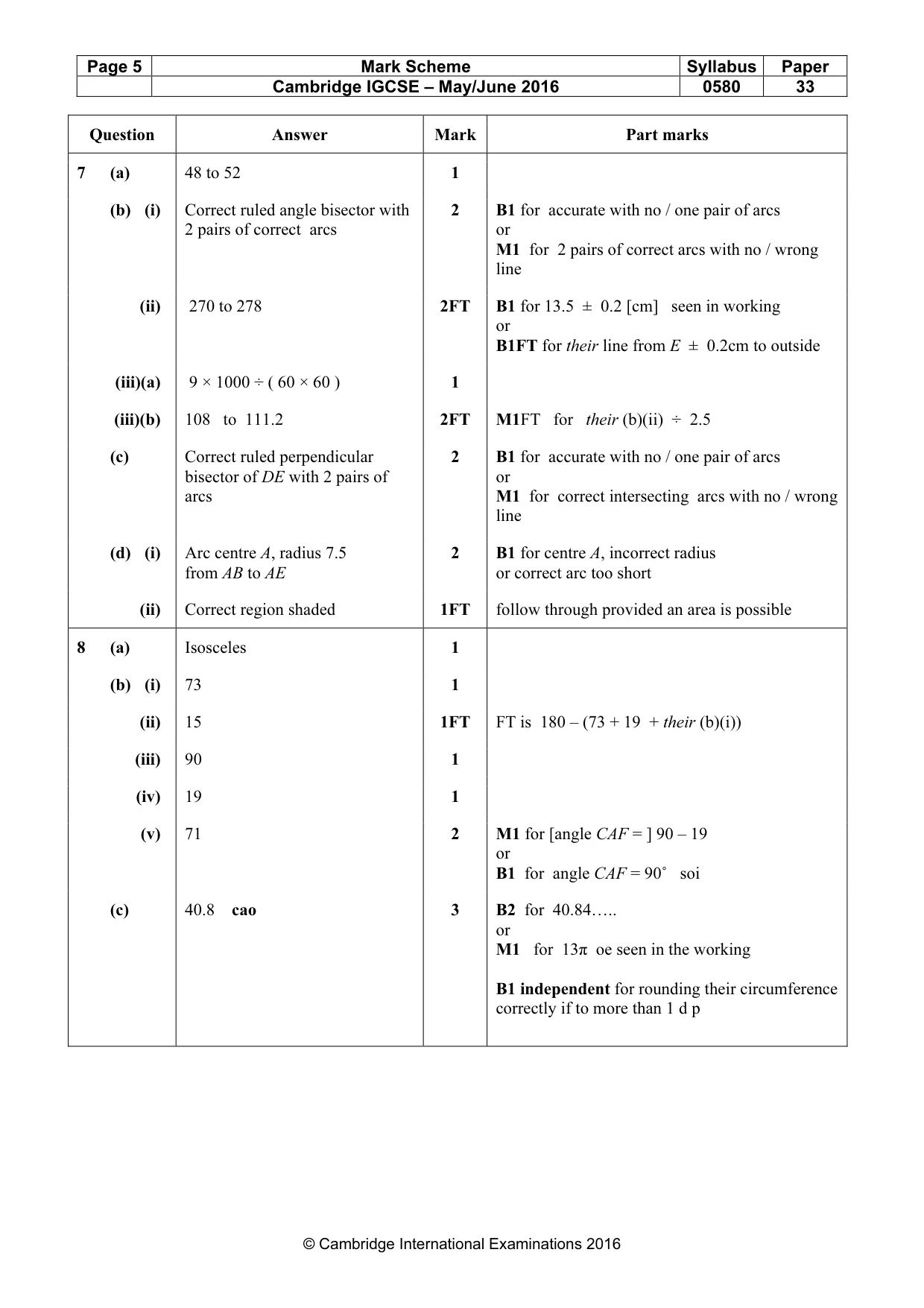
Mark scheme: Question Answer Mark Part marks 1 (a) (i) 11 ÷ (11 + 14 + 5) × 18 1 (ii) [paths] 8.4 1 [buildings] 3[.0] 1 (b) [Mammals] 4.2 1 [Reptiles] 1.98 1 (c) (i) 7 [h] 45 [min] 1 (ii) 55 [h] 45 [min] 2FT B1 for 55.75 seen or 38 [h] 45 [min] or 17 [h] soi or M1FT for 5 × their (c)(i) + 2 × 8 [h] 30 [min] or better (d) (i) [$] 48[.00] 2 M1 for 2 × 11 + 2 × 9.25 + 7.50 or better If M0 then SC1 for 55.50 (ii) 12.5 3FT M2 for their ( d )(i ) − 42[×100] or their ( d )(i ) 42 100 − ( × 100) their ( d )(i ) or 42 M1 for or figs 875 their ( d )(i ) or B1 for their (d)(i) – 42 or their 6 seen
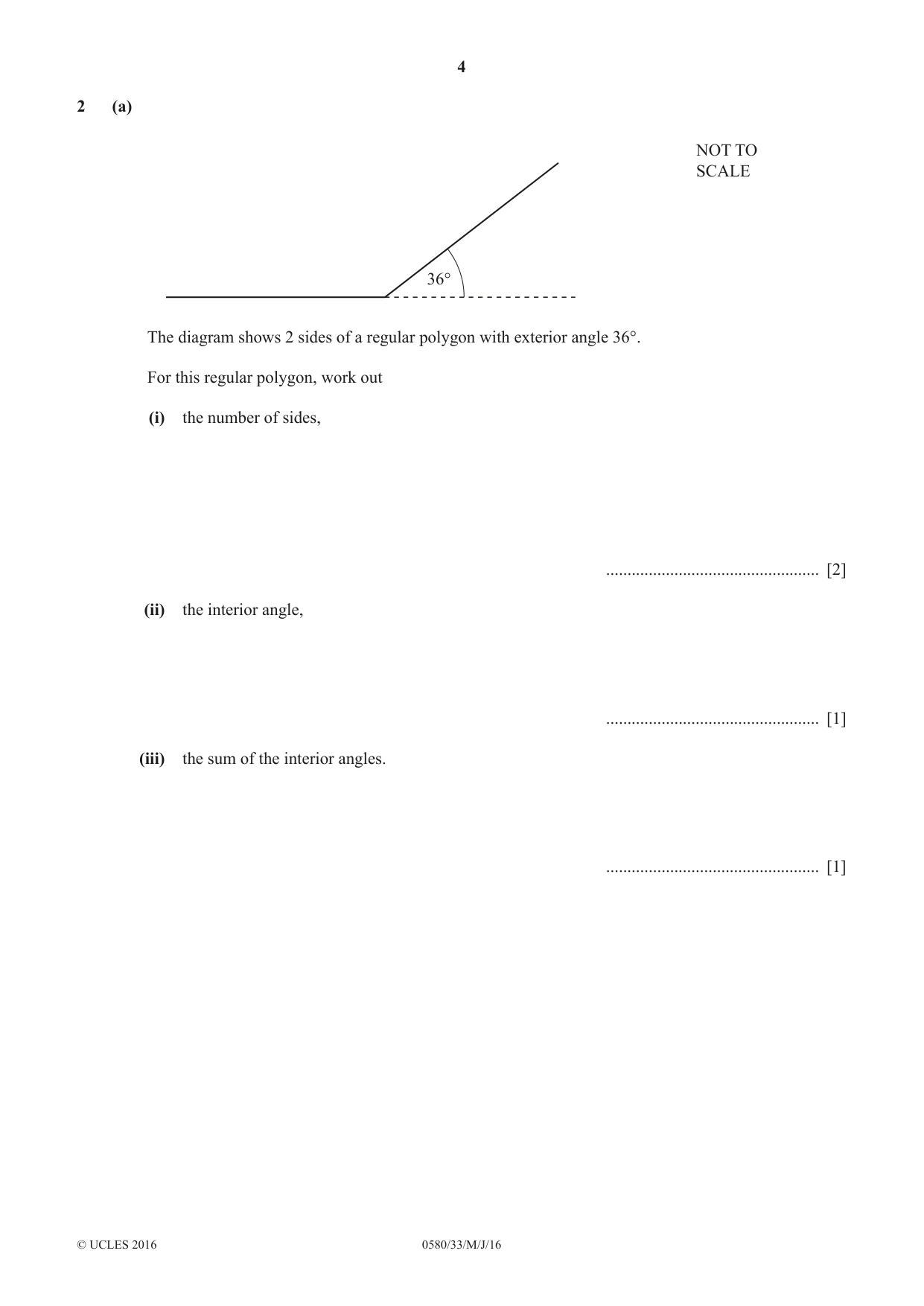
Q2 · NOT TO SCALE 36° The diagram shows 2 sides of a regular polygon with exterior angle 36°
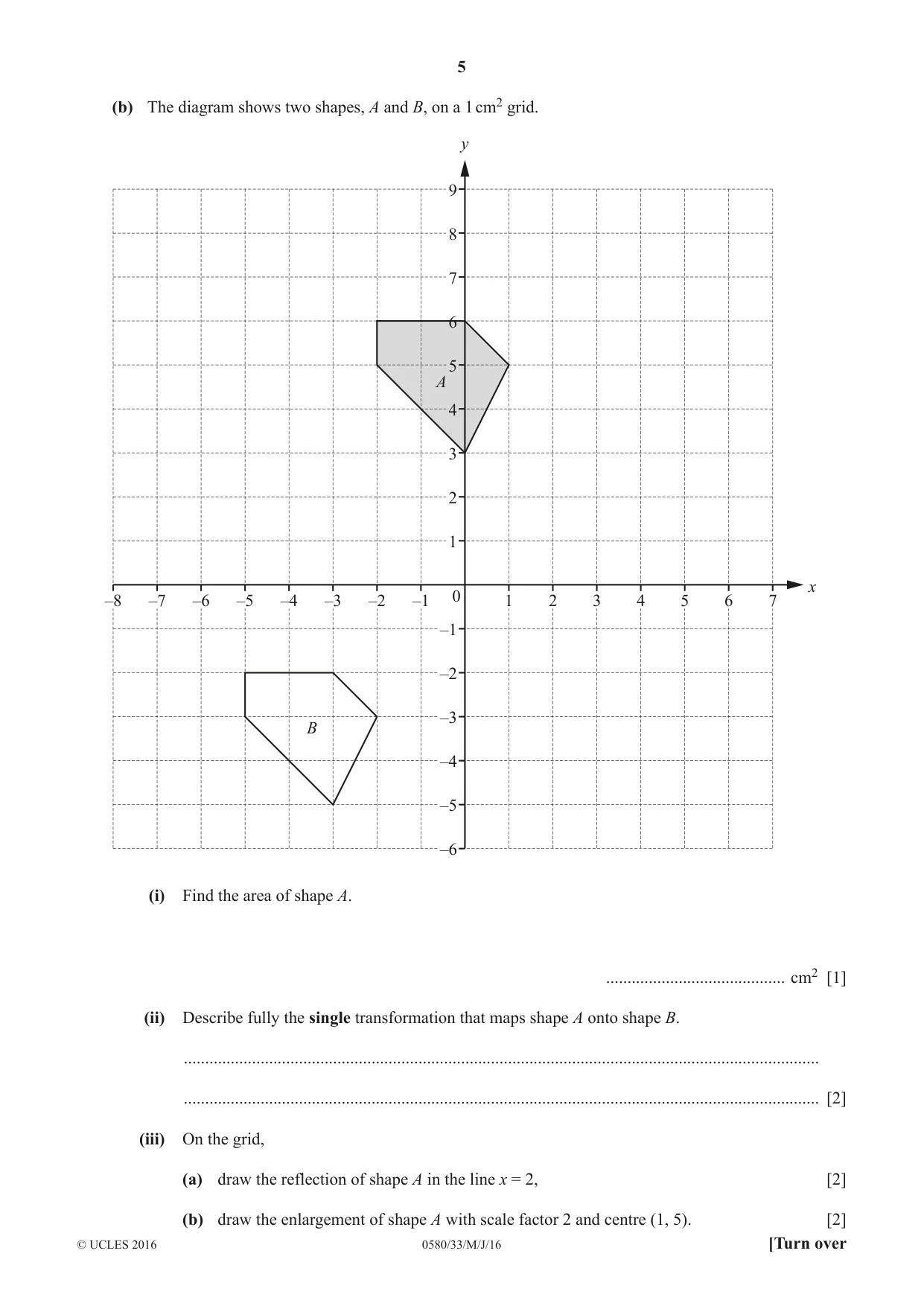
2 (a) NOT TO SCALE 36° The diagram shows 2 sides of a regular polygon with exterior angle 36°. For this regular polygon, work out (i) the number of sides, .................................................. [2] (ii) the interior angle, .................................................. [1] (iii) the sum of the interior angles. .................................................. [1] (b) The diagram shows two shapes, A and B, on a 1 cm2 grid. y 9 8 7 6 5 A 4 3 2 1 x –8 –7 –6 –5 –4 –3 –2 –1 0 1 2 3 4 5 6 7 –1 –2 –3 B –4 –5 –6 (i) Find the area of shape A. .......................................... cm2 [1] (ii) Describe fully the single transformation that maps shape A onto shape B. ..................................................................................................................................................... ..................................................................................................................................................... [2] (iii) On the grid, (a) draw the reflection of shape A in the line x = 2, [2] (b) draw the enlargement of shape A with scale factor 2 and centre (1, 5). [2]
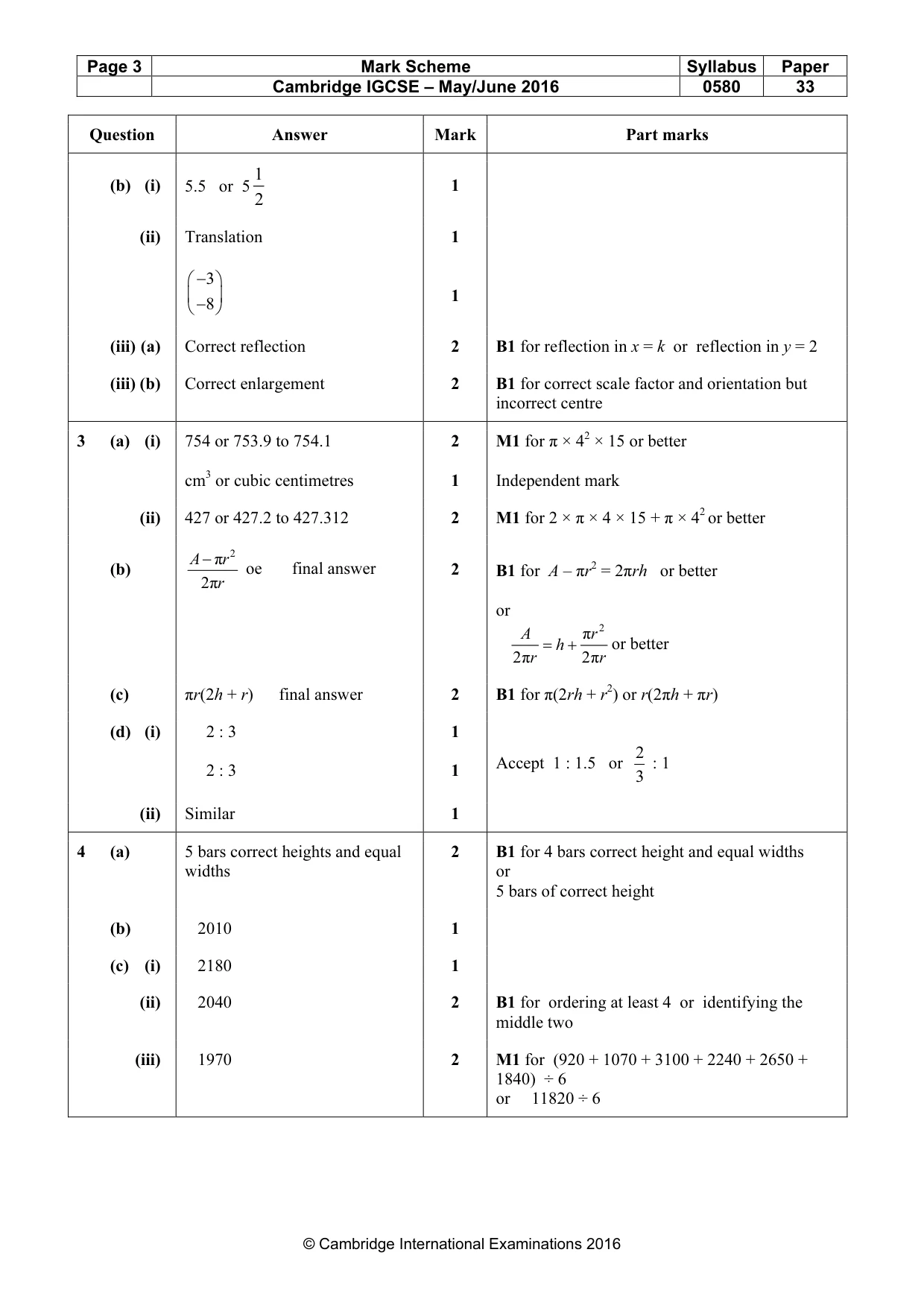
Mark scheme: 2 (a) (i) 10 2 M1 for 360 ÷ 36 (ii) 144 1 (iii) 1440 1FT their (a)(i) × their (a)(ii)
Q3 · The diagram shows a cylindrical flower vase with radius, r, and height, h
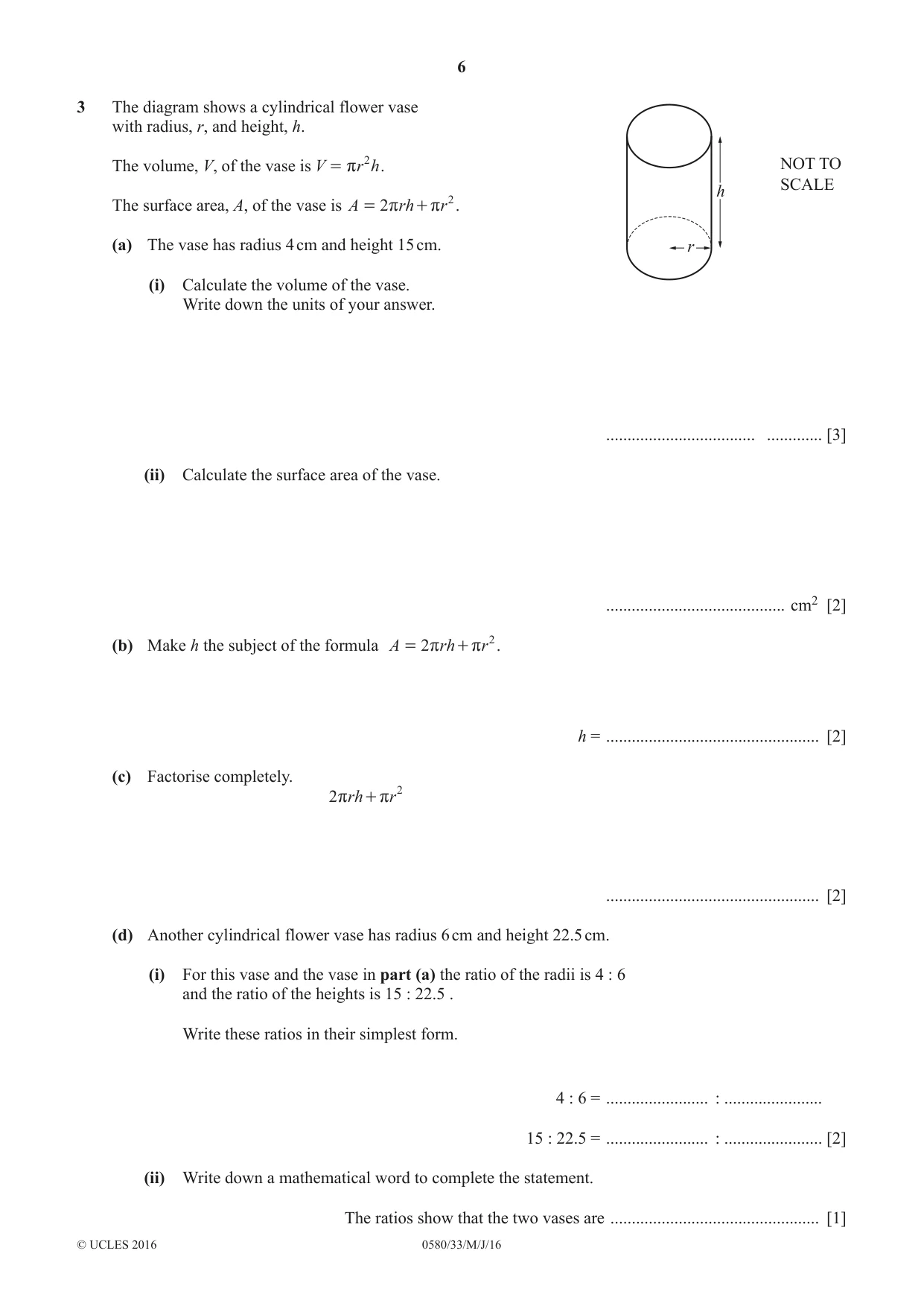
3 The diagram shows a cylindrical flower vase with radius, r, and height, h. The volume, V, of the vase is V = r r 2 h . NOT TO SCALE h The surface area, A, of the vase is A = 2 r rh + r r 2 . (a) The vase has radius 4 cm and height 15 cm. r (i) Calculate the volume of the vase. Write down the units of your answer. ................................... ............. [3] (ii) Calculate the surface area of the vase. .......................................... cm2 [2] (b) Make h the subject of the formula A = 2 r rh + r r 2 . h = .................................................. [2] (c) Factorise completely. 2r rh + r r 2 .................................................. [2] (d) Another cylindrical flower vase has radius 6 cm and height 22.5 cm. (i) For this vase and the vase in part (a) the ratio of the radii is 4 : 6 and the ratio of the heights is 15 : 22.5 . Write these ratios in their simplest form. 4 : 6 = ........................ : ....................... 15 : 22.5 = ........................ : ....................... [2] (ii) Write down a mathematical word to complete the statement. The ratios show that the two vases are ................................................. [1]
Mark scheme: 3 (a) (i) 754 or 753.9 to 754.1 2 M1 for π × 42 × 15 or better cm3 or cubic centimetres 1 Independent mark (ii) 427 or 427.2 to 427.312 2 M1 for 2 × π × 4 × 15 + π × 42 or better A − πr 2 (b) oe final answer 2 B1 for A – πr2 = 2πrh or better 2πr or A π r 2 = h + or better 2π r 2π r (c) πr(2h + r) final answer 2 B1 for π(2rh + r2) or r(2πh + πr) (d) (i) 2 : 3 1 2 2 : 3 1 Accept 1 : 1.5 or : 1 3 (ii) Similar 1
Q4 · A garage sells second-hand cars
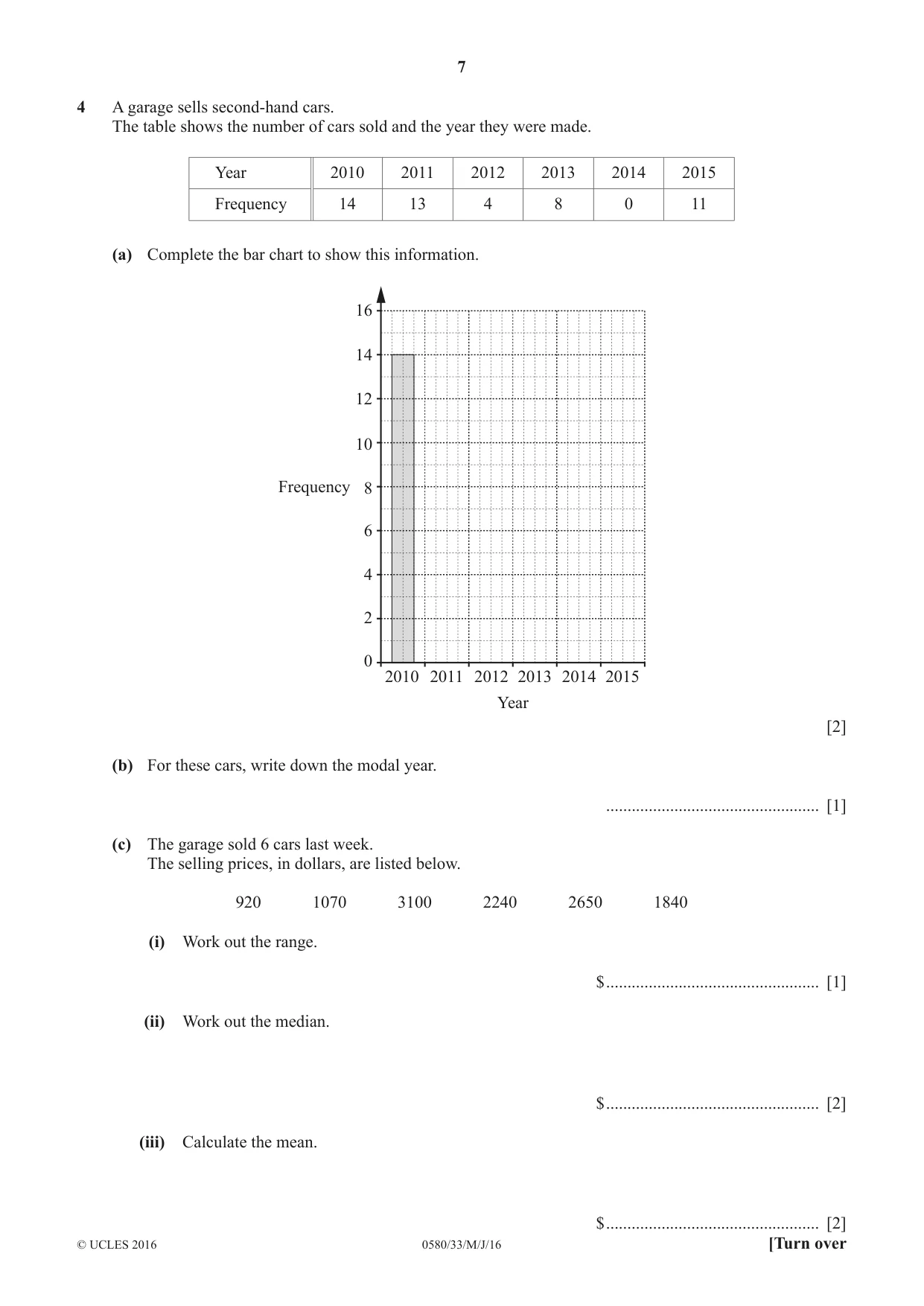
4 A garage sells second-hand cars. The table shows the number of cars sold and the year they were made. Year 2010 2011 2012 2013 2014 2015 Frequency 14 13 4 8 0 11 (a) Complete the bar chart to show this information. 16 14 12 10 Frequency 8 6 4 2 0 2010 2011 2012 2013 2014 2015 Year [2] (b) For these cars, write down the modal year. .................................................. [1] (c) The garage sold 6 cars last week. The selling prices, in dollars, are listed below. 920 1070 3100 2240 2650 1840 (i) Work out the range. $ .................................................. [1] (ii) Work out the median. $ .................................................. [2] (iii) Calculate the mean. $ .................................................. [2]
Mark scheme: 4 (a) 5 bars correct heights and equal 2 B1 for 4 bars correct height and equal widths widths or 5 bars of correct height (b) 2010 1 (c) (i) 2180 1 (ii) 2040 2 B1 for ordering at least 4 or identifying the middle two (iii) 1970 2 M1 for (920 + 1070 + 3100 + 2240 + 2650 + 1840) ÷ 6 or 11820 ÷ 6
Q5 · 5 (a) (i) Complete the table of values for y = , x !
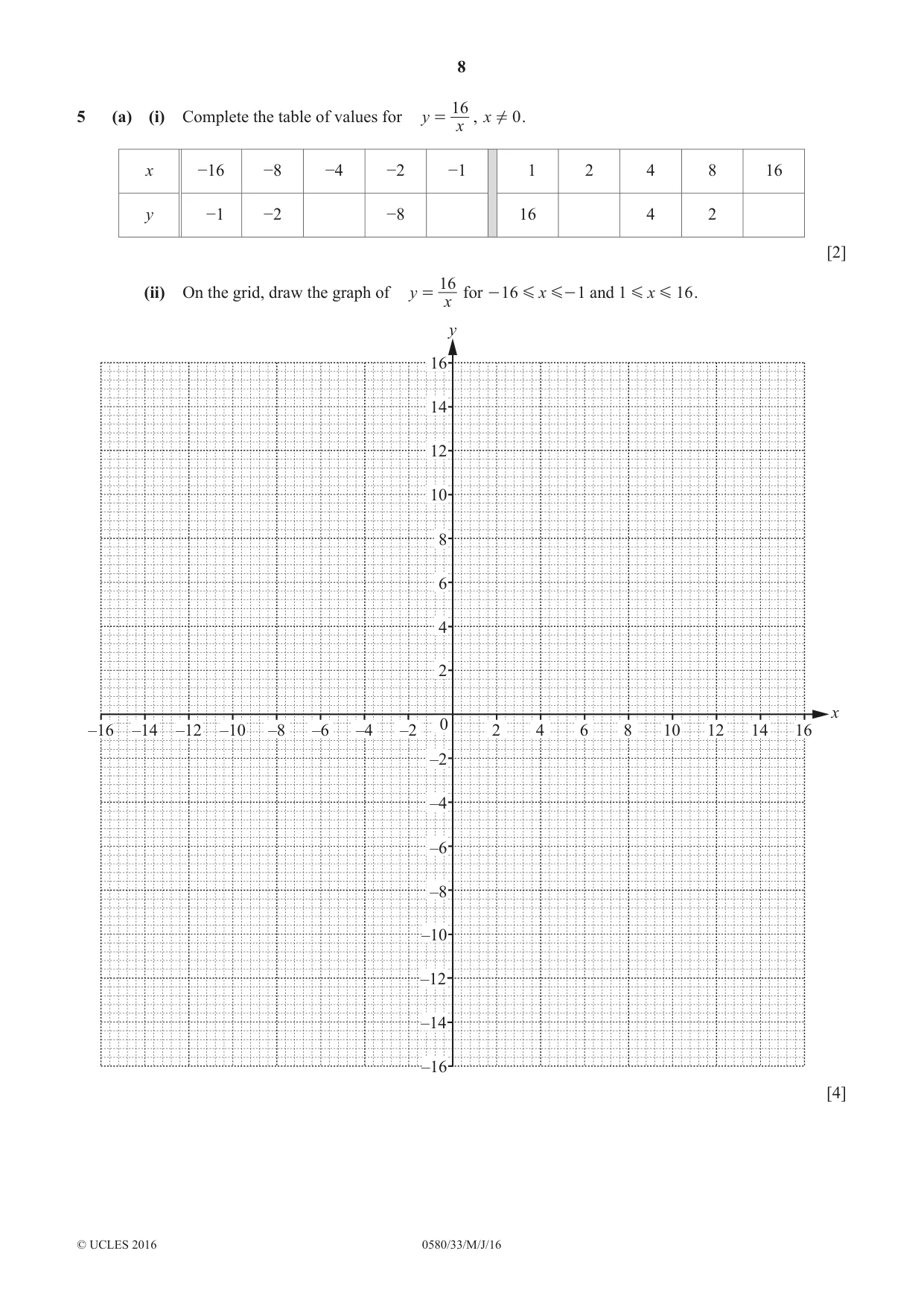
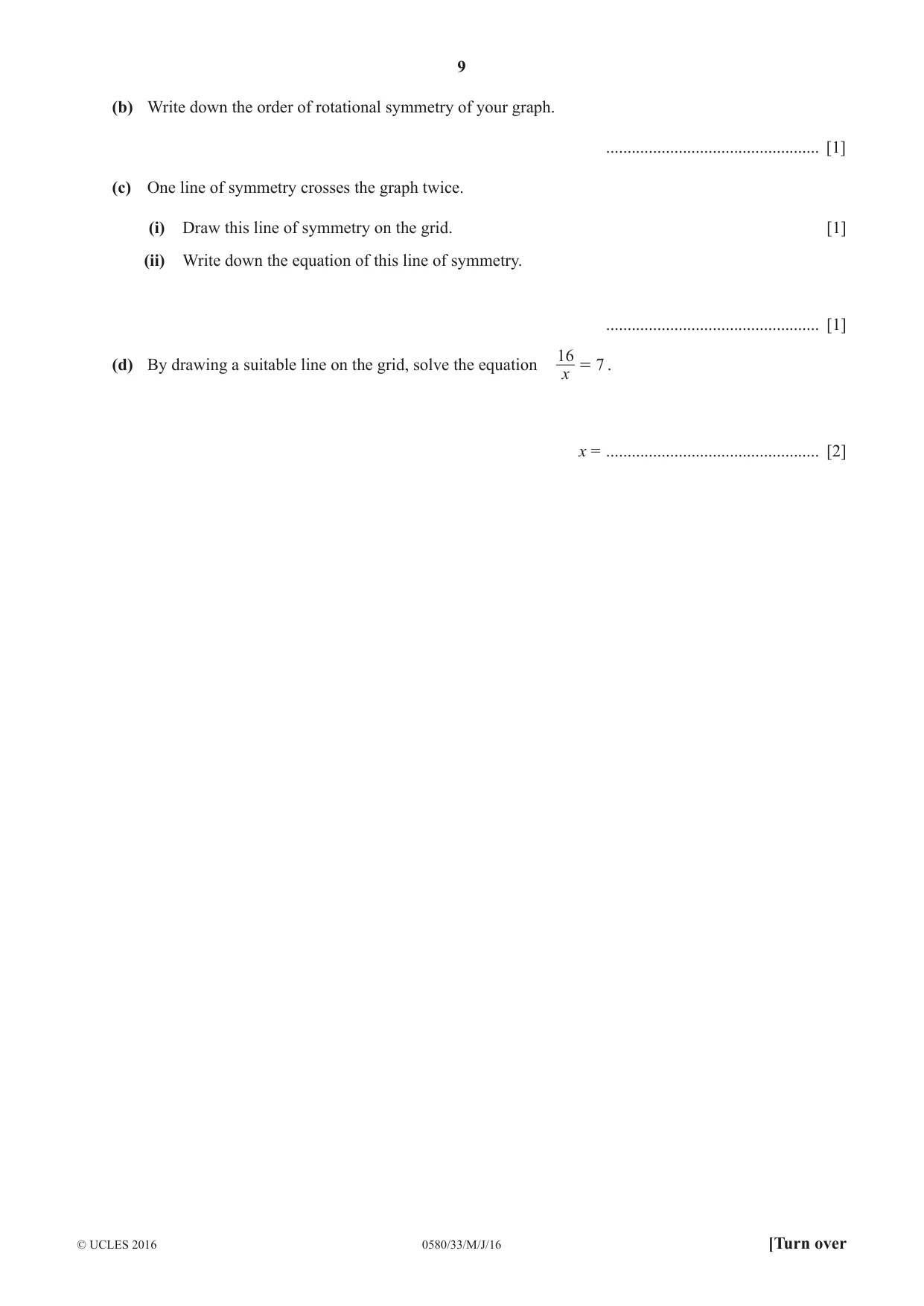
16 5 (a) (i) Complete the table of values for y = , x ! 0 . x x −16 −8 −4 −2 −1 1 2 4 8 16 y −1 −2 −8 16 4 2 [2] 16 (ii) On the grid, draw the graph of y = for - 16 G x G - 1 and 1 G x G 16 . x y 16 14 12 10 8 6 4 2 x 0 –16 –14 –12 –10 –8 –6 –4 –2 2 4 6 8 10 12 14 16 –2 –4 –6 –8 –10 –12 –14 –16 [4] (b) Write down the order of rotational symmetry of your graph. .................................................. [1] (c) One line of symmetry crosses the graph twice. (i) Draw this line of symmetry on the grid. [1] (ii) Write down the equation of this line of symmetry. .................................................. [1] 16 (d) By drawing a suitable line on the grid, solve the equation = 7 . x x = .................................................. [2]
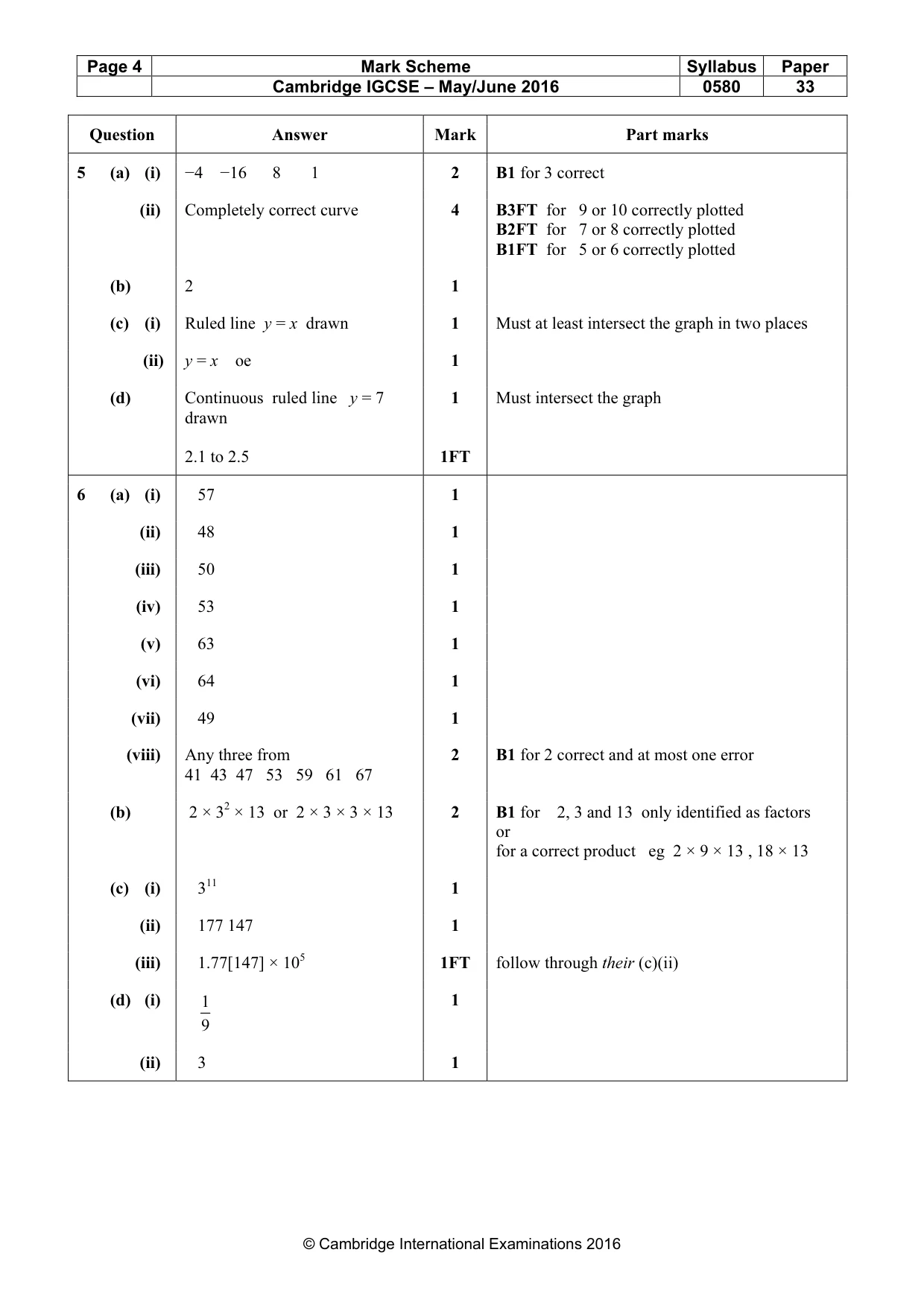
Mark scheme: 5 (a) (i) −4 −16 8 1 2 B1 for 3 correct (ii) Completely correct curve 4 B3FT for 9 or 10 correctly plotted B2FT for 7 or 8 correctly plotted B1FT for 5 or 6 correctly plotted (b) 2 1 (c) (i) Ruled line y = x drawn 1 Must at least intersect the graph in two places (ii) y = x oe 1 (d) Continuous ruled line y = 7 1 Must intersect the graph drawn 2.1 to 2.5 1FT
Q6 · For the integers from 40 to 70, write down (i) a multiple of 19…
6 (a) For the integers from 40 to 70, write down (i) a multiple of 19, .................................................. [1] (ii) a common multiple of 6 and 8, .................................................. [1] (iii) the square root of 2500, .................................................. [1] (iv) a factor of 106, .................................................. [1] (v) an odd number where the tens digit is double the units digit, .................................................. [1] (vi) a number that is both a square number and a cube number, .................................................. [1] (vii) a number that has exactly 3 factors, .................................................. [1] (viii) three prime numbers. ................ , ................ , ................ [2] (b) Write 234 as a product of its prime factors. .................................................. [2] (c) Write the answer to 34 × 37 (i) in the form 3x, .................................................. [1] (ii) as an integer, .................................................. [1] (iii) in standard form. .................................................. [1] (d) (i) Write 3−2 as a fraction. .................................................. [1] (ii) Find the value of 3x0 when x = 5. .................................................. [1]
Mark scheme: 6 (a) (i) 57 1 (ii) 48 1 (iii) 50 1 (iv) 53 1 (v) 63 1 (vi) 64 1 (vii) 49 1 (viii) Any three from 2 B1 for 2 correct and at most one error 41 43 47 53 59 61 67 (b) 2 × 32 × 13 or 2 × 3 × 3 × 13 2 B1 for 2, 3 and 13 only identified as factors or for a correct product eg 2 × 9 × 13 , 18 × 13 (c) (i) 311 1 (ii) 177 147 1 (iii) 1.77[147] × 105 1FT follow through their (c)(ii) (d) (i) 1 1 9 (ii) 3 1
Q7 · The scale drawing shows a park, ABCDE
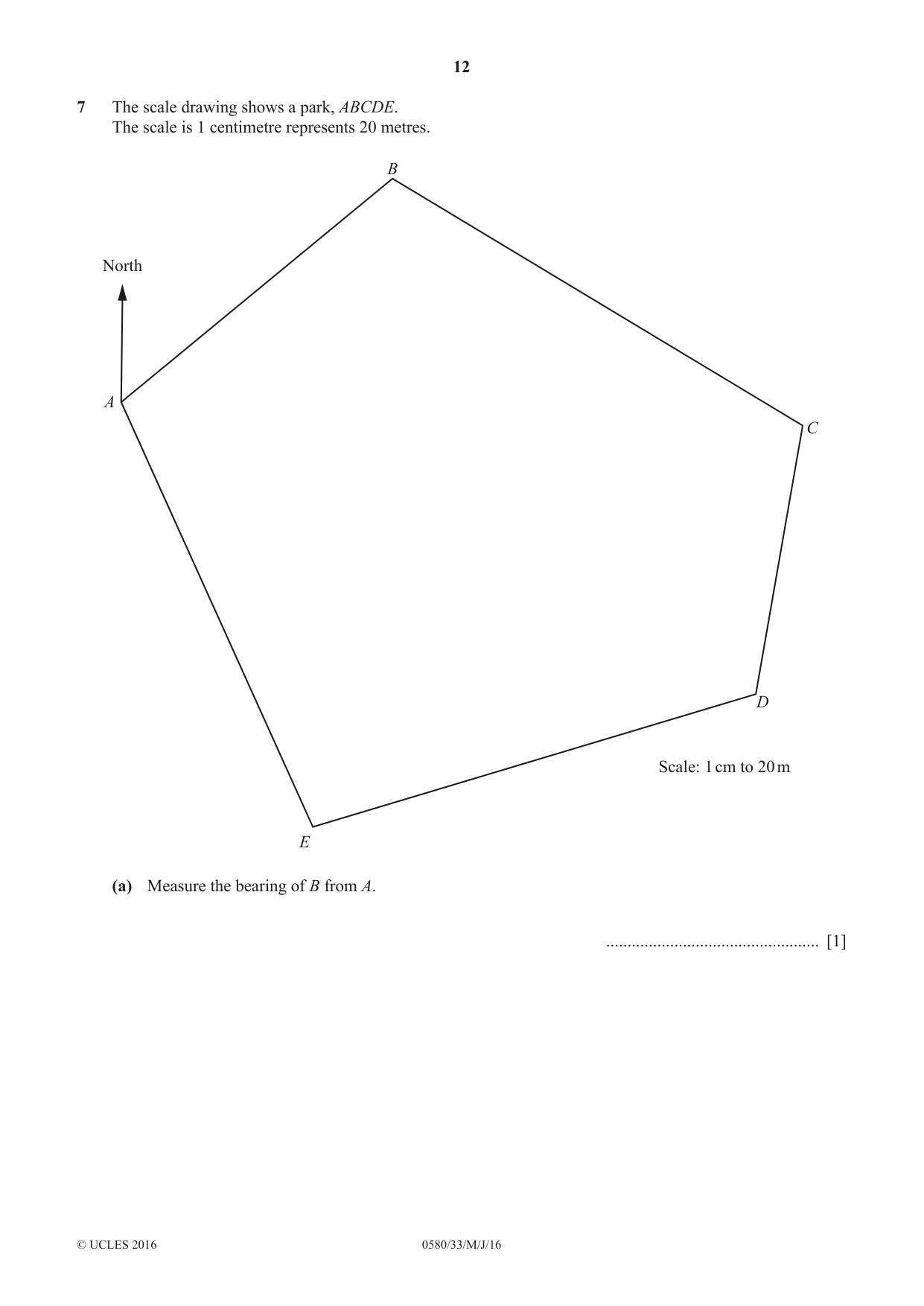
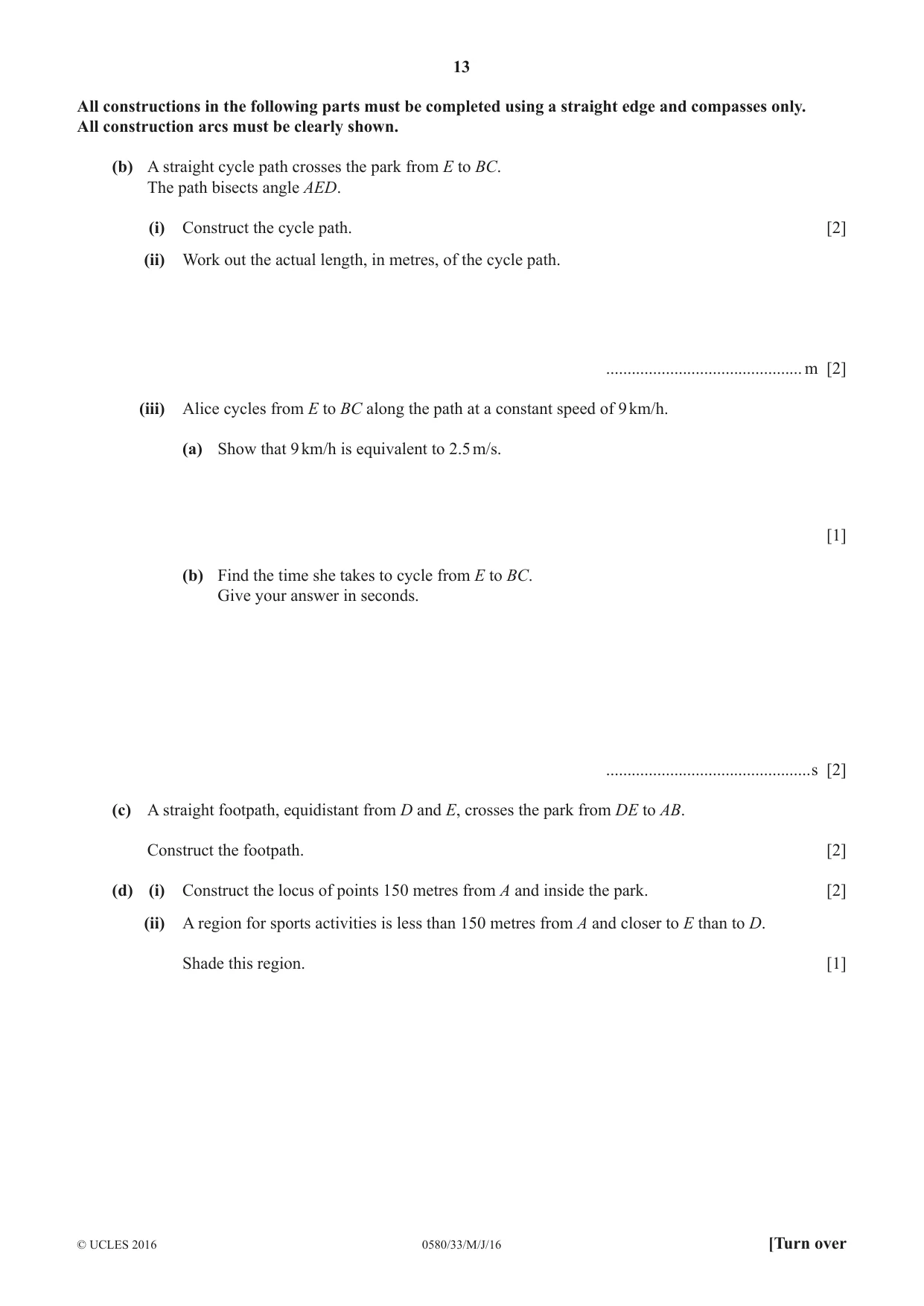
7 The scale drawing shows a park, ABCDE. The scale is 1 centimetre represents 20 metres. B North A C D Scale: 1 cm to 20 m E (a) Measure the bearing of B from A. .................................................. [1] All constructions in the following parts must be completed using a straight edge and compasses only. All construction arcs must be clearly shown. (b) A straight cycle path crosses the park from E to BC. The path bisects angle AED. (i) Construct the cycle path. [2] (ii) Work out the actual length, in metres, of the cycle path. .............................................. m [2] (iii) Alice cycles from E to BC along the path at a constant speed of 9 km/h. (a) Show that 9 km/h is equivalent to 2.5 m/s. [1] (b) Find the time she takes to cycle from E to BC. Give your answer in seconds. ................................................s [2] (c) A straight footpath, equidistant from D and E, crosses the park from DE to AB. Construct the footpath. [2] (d) (i) Construct the locus of points 150 metres from A and inside the park. [2] (ii) A region for sports activities is less than 150 metres from A and closer to E than to D. Shade this region. [1]
Mark scheme: 7 (a) 48 to 52 1 (b) (i) Correct ruled angle bisector with 2 B1 for accurate with no / one pair of arcs 2 pairs of correct arcs or M1 for 2 pairs of correct arcs with no / wrong line (ii) 270 to 278 2FT B1 for 13.5 ± 0.2 [cm] seen in working or B1FT for their line from E ± 0.2cm to outside (iii)(a) 9 × 1000 ÷ ( 60 × 60 ) 1 (iii)(b) 108 to 111.2 2FT M1FT for their (b)(ii) ÷ 2.5 (c) Correct ruled perpendicular 2 B1 for accurate with no / one pair of arcs bisector of DE with 2 pairs of or arcs M1 for correct intersecting arcs with no / wrong line (d) (i) Arc centre A, radius 7.5 2 B1 for centre A, incorrect radius from AB to AE or correct arc too short (ii) Correct region shaded 1FT follow through provided an area is possible
Q8 · B 73° NOT TO SCALE C F d° O 19° e° b° a° A D c° G E A, B, C, D and E are points on the…
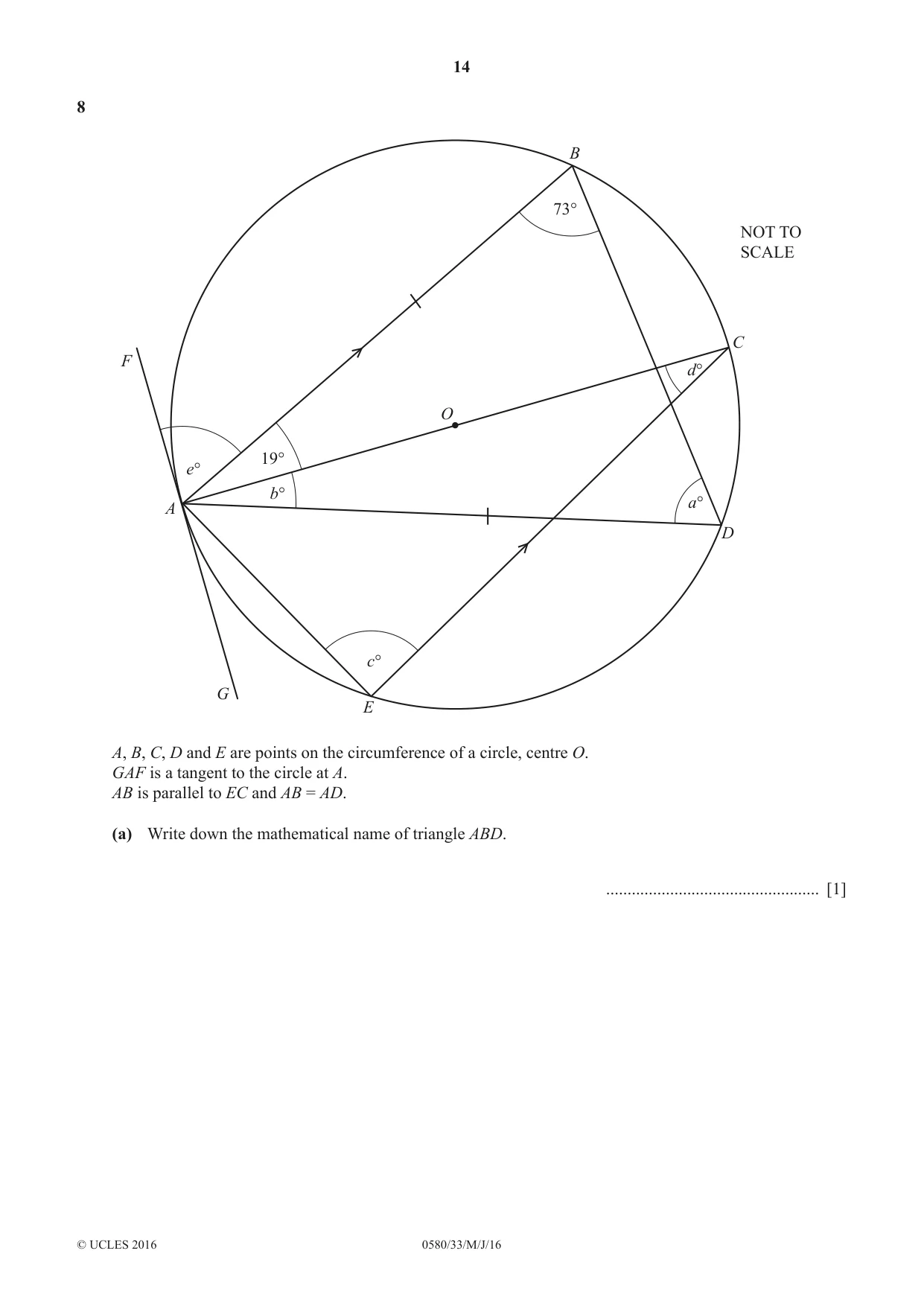
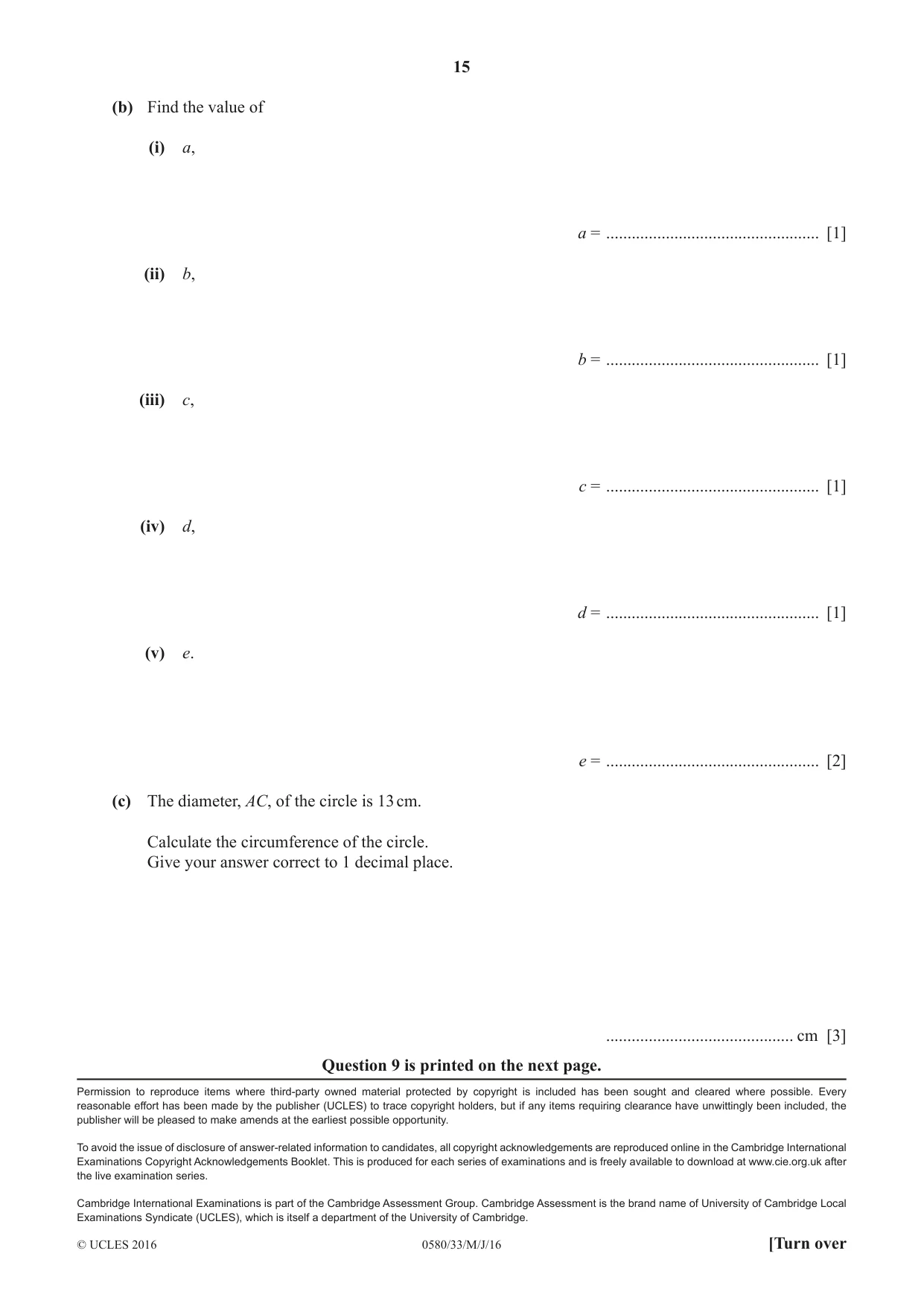
8 B 73° NOT TO SCALE C F d° O 19° e° b° a° A D c° G E A, B, C, D and E are points on the circumference of a circle, centre O. GAF is a tangent to the circle at A. AB is parallel to EC and AB = AD. (a) Write down the mathematical name of triangle ABD. .................................................. [1] (b) Find the value of (i) a, a = .................................................. [1] (ii) b, b = .................................................. [1] (iii) c, c = .................................................. [1] (iv) d, d = .................................................. [1] (v) e. e = .................................................. [2] (c) The diameter, AC, of the circle is 13 cm. Calculate the circumference of the circle. Give your answer correct to 1 decimal place. ............................................ cm [3] Question 9 is printed on the next page.
Mark scheme: 8 (a) Isosceles 1 (b) (i) 73 1 (ii) 15 1FT FT is 180 – (73 + 19 + their (b)(i)) (iii) 90 1 (iv) 19 1 (v) 71 2 M1 for [angle CAF = ] 90 – 19 or B1 for angle CAF = 90˚ soi (c) 40.8 cao 3 B2 for 40.84….. or M1 for 13π oe seen in the working B1 independent for rounding their circumference correctly if to more than 1 d p
Q9 · A solid has 6 faces, 8 vertices and 12 edges
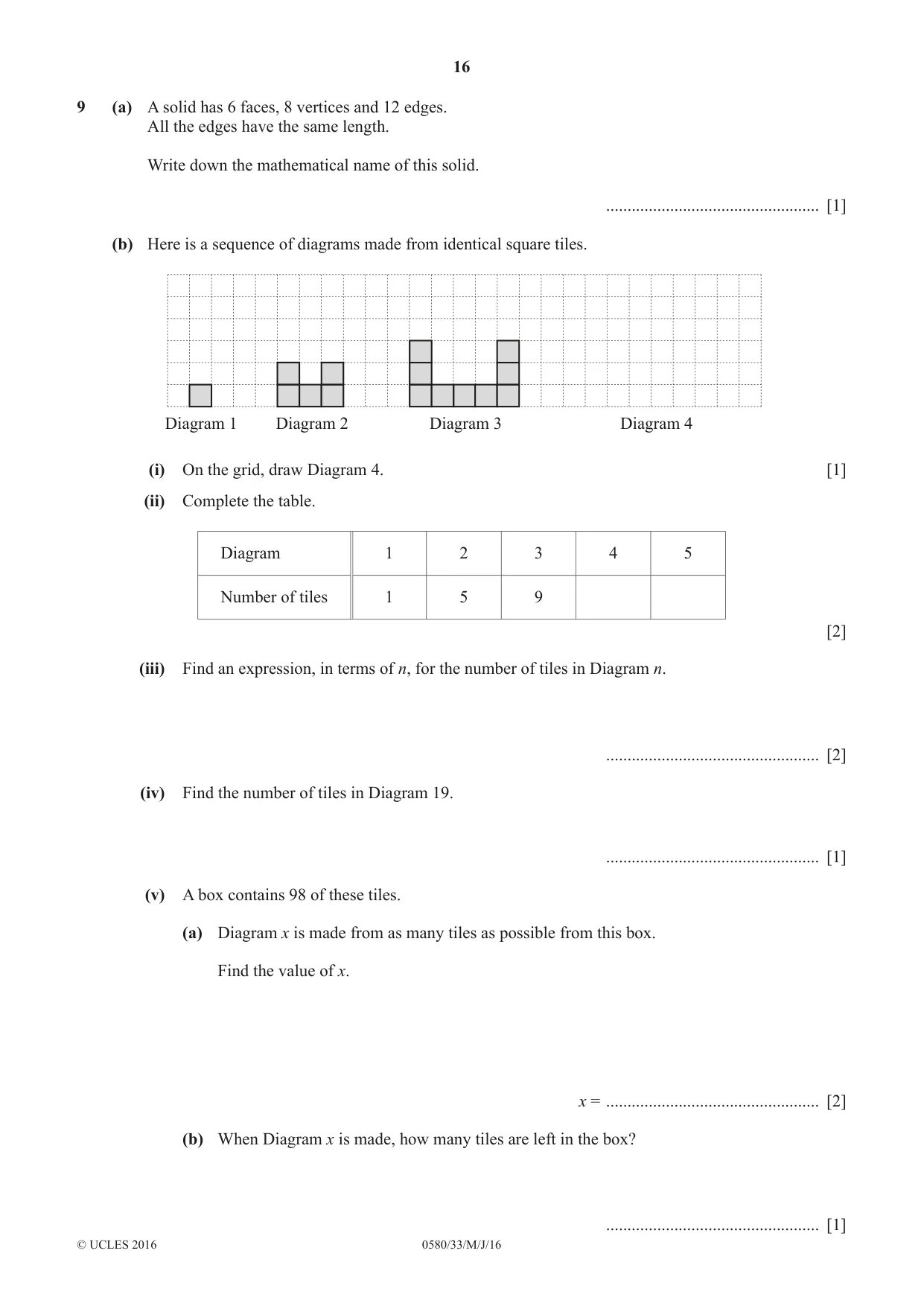
9 (a) A solid has 6 faces, 8 vertices and 12 edges. All the edges have the same length. Write down the mathematical name of this solid. .................................................. [1] (b) Here is a sequence of diagrams made from identical square tiles. Diagram 1 Diagram 2 Diagram 3 Diagram 4 (i) On the grid, draw Diagram 4. [1] (ii) Complete the table. Diagram 1 2 3 4 5 Number of tiles 1 5 9 [2] (iii) Find an expression, in terms of n, for the number of tiles in Diagram n. .................................................. [2] (iv) Find the number of tiles in Diagram 19. .................................................. [1] (v) A box contains 98 of these tiles. (a) Diagram x is made from as many tiles as possible from this box. Find the value of x. x = .................................................. [2] (b) When Diagram x is made, how many tiles are left in the box?
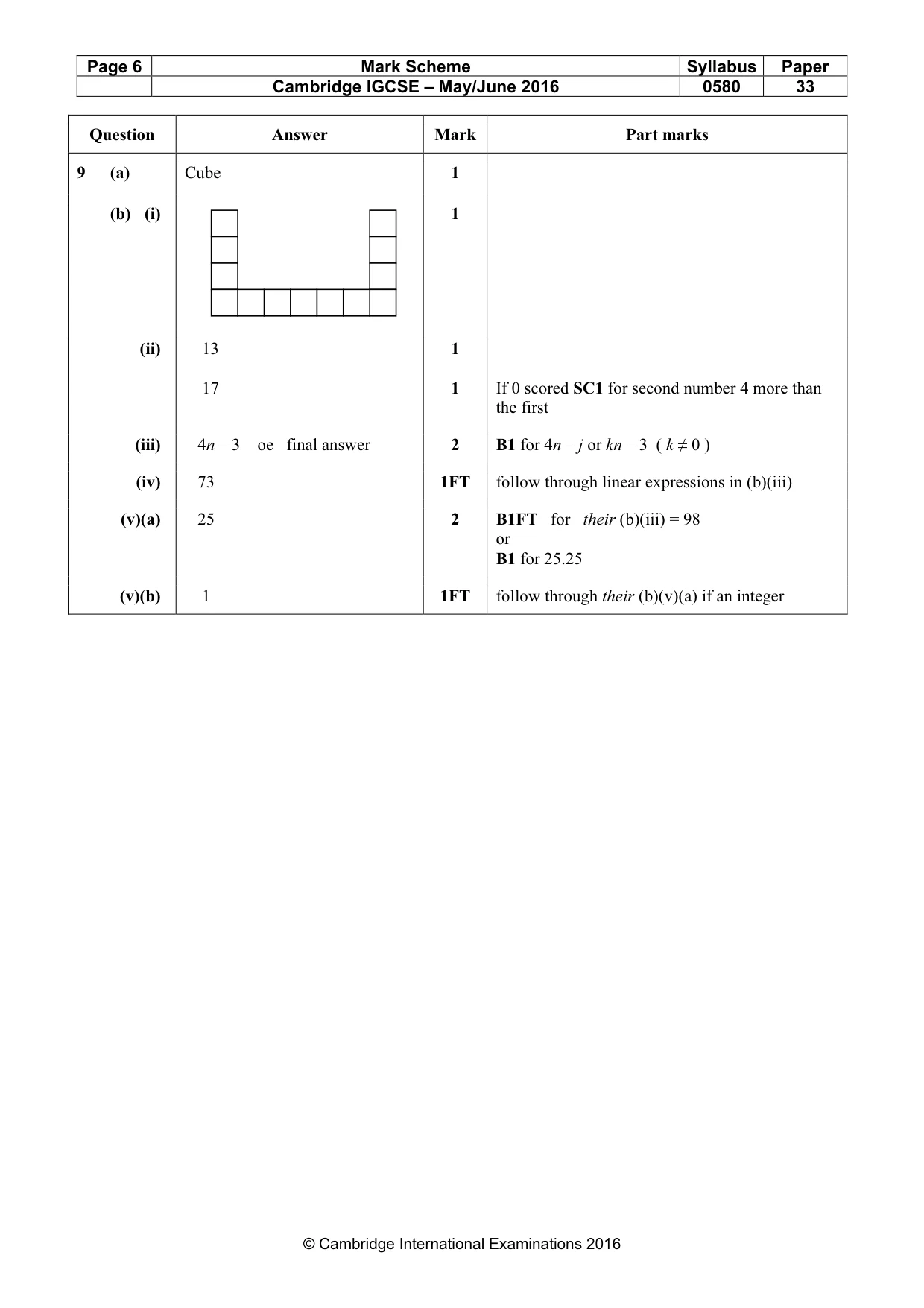
Mark scheme: 9 (a) Cube 1 (b) (i) 1 (ii) 13 1 17 1 If 0 scored SC1 for second number 4 more than the first (iii) 4n – 3 oe final answer 2 B1 for 4n – j or kn – 3 ( k ≠ 0 ) (iv) 73 1FT follow through linear expressions in (b)(iii) (v)(a) 25 2 B1FT for their (b)(iii) = 98 or B1 for 25.25 (v)(b) 1 1FT follow through their (b)(v)(a) if an integer
What was in this paper
The subtopics covered by these 9 questions, and how many questions each got. Open one in a new tab to see every Cambridge question on it.
What you needed in this session
Cambridge’s own grade thresholds for 2016 May/June, Paper 3 · Variant 3. A higher threshold means an easier paper — the bar moves with how the cohort did.