Cambridge IGCSE Mathematics 0580 — 2015 Oct/Nov Paper 3 · Variant 2
0580/32/O/N/15 · 10 questions · 104 marks · ≈117 min
The question paper and its mark scheme, free to read here and free to download. This is Cambridge’s own paper, exactly as it was sat.
Question paper16 pages

Mark scheme6 pages
Answers below. Sit the paper first if you are practising.
Questions as text
Q1 · Write down in figures the number twenty one million
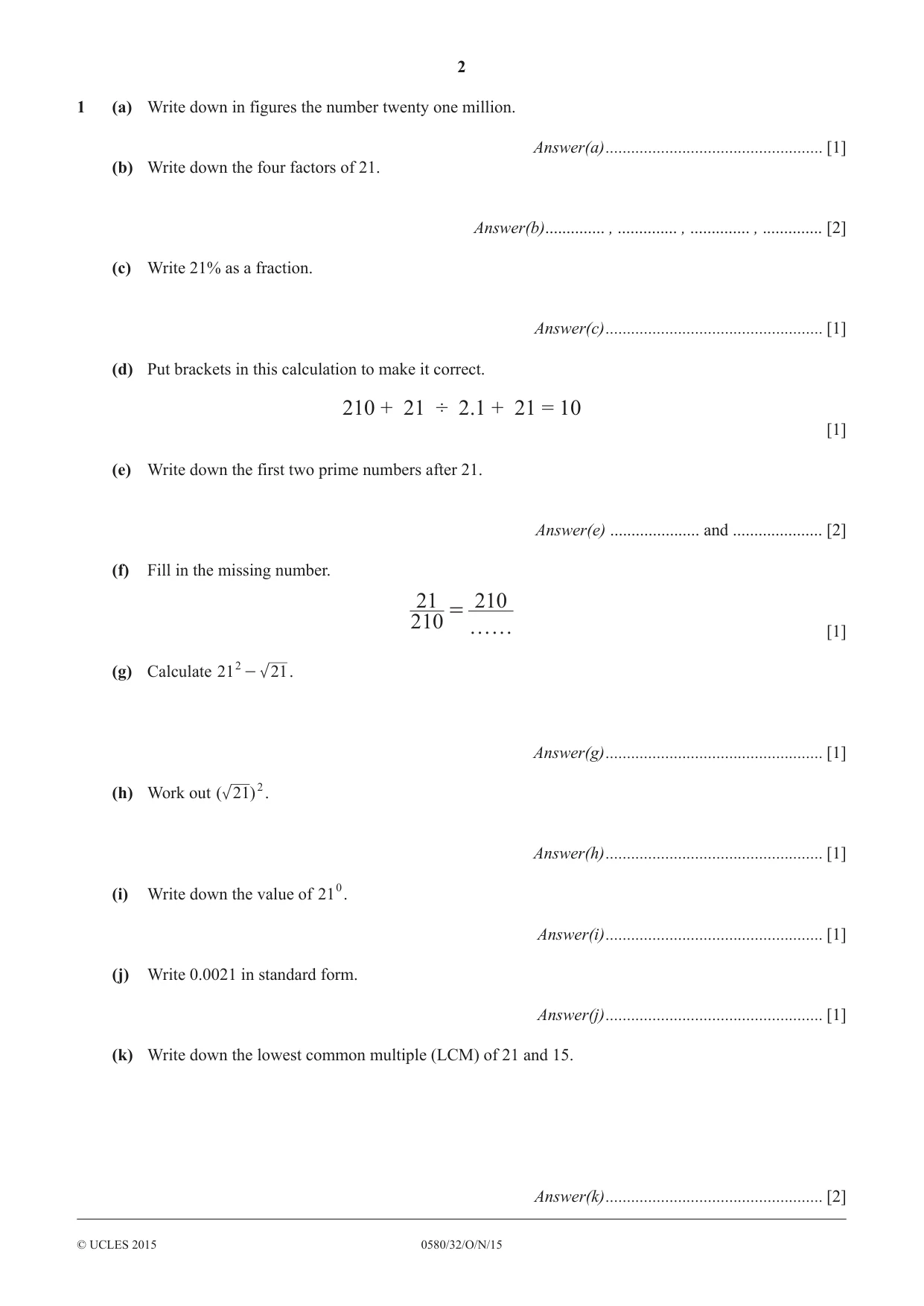
1 (a) Write down in figures the number twenty one million. Answer(a) ................................................... [1] (b) Write down the four factors of 21. Answer(b).............. , .............. , .............. , .............. [2] (c) Write 21% as a fraction. Answer(c) ................................................... [1] (d) Put brackets in this calculation to make it correct. 210 + 21 ÷ 2.1 + 21 = 10 [1] (e) Write down the first two prime numbers after 21. Answer(e) ..................... and ..................... [2] (f) Fill in the missing number. 21 210 = 210 ff [1] (g) Calculate 21 2 - 21 . Answer(g) ................................................... [1] (h) Work out ( 21 ) 2. Answer(h) ................................................... [1] (i) Write down the value of 210. Answer(i) ................................................... [1] (j) Write 0.0021 in standard form. Answer(j) ................................................... [1] (k) Write down the lowest common multiple (LCM) of 21 and 15. Answer(k) ................................................... [2]
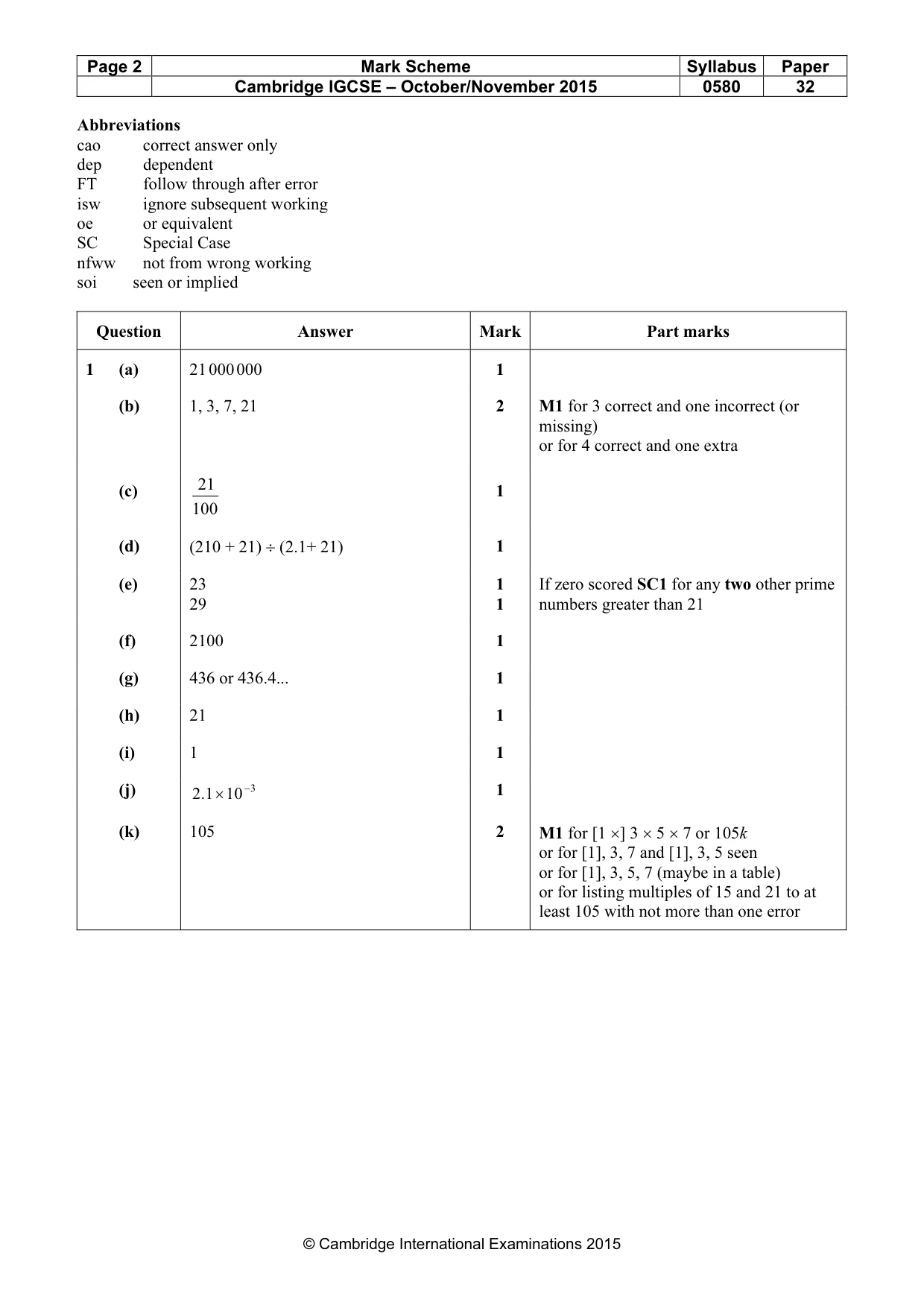
Mark scheme: Question Answer Mark Part marks 1 (a) 21 000 000 1 (b) 1, 3, 7, 21 2 M1 for 3 correct and one incorrect (or missing) or for 4 correct and one extra 21 (c) 1 100 (d) (210 + 21) ÷ (2.1+ 21) 1 (e) 23 1 If zero scored SC1 for any two other prime 29 1 numbers greater than 21 (f) 2100 1 (g) 436 or 436.4... 1 (h) 21 1 (i) 1 1 (j) 1.2 × 10 − 3 1 (k) 105 2 M1 for [1 ×] 3 × 5 × 7 or 105k or for [1], 3, 7 and [1], 3, 5 seen or for [1], 3, 5, 7 (maybe in a table) or for listing multiples of 15 and 21 to at least 105 with not more than one error
Q2 · Here are the first four diagrams in a sequence
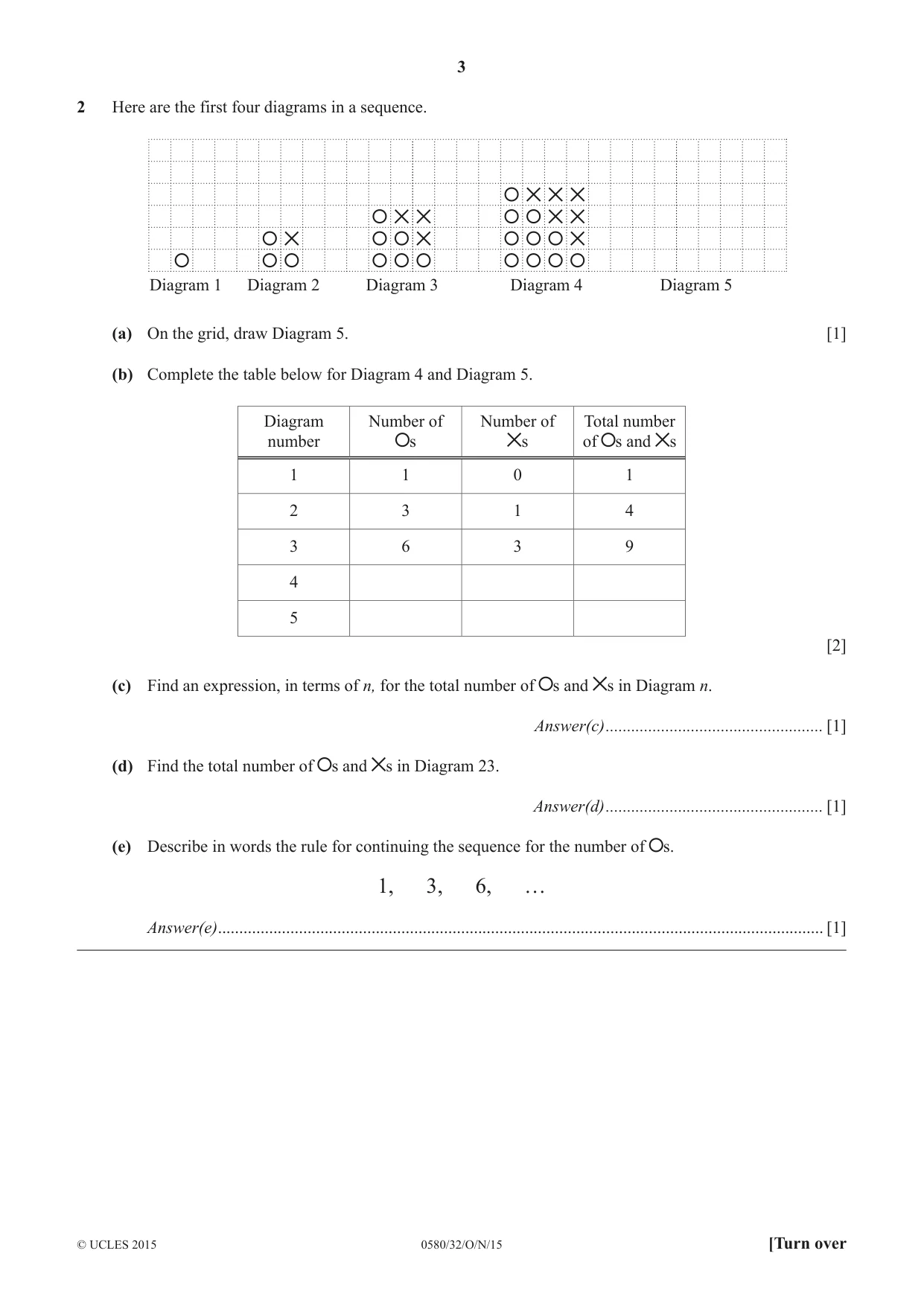
2 Here are the first four diagrams in a sequence. Diagram 1 Diagram 2 Diagram 3 Diagram 4 Diagram 5 (a) On the grid, draw Diagram 5. [1] (b) Complete the table below for Diagram 4 and Diagram 5. Diagram Number of Number of Total number number s s of s and s 1 1 0 1 2 3 1 4 3 6 3 9 4 5 [2] (c) Find an expression, in terms of n, for the total number of s and s in Diagram n. Answer(c) ................................................... [1] (d) Find the total number of s and s in Diagram 23. Answer(d) ................................................... [1] (e) Describe in words the rule for continuing the sequence for the number of s. 1, 3, 6, … Answer(e) .............................................................................................................................................. [1]
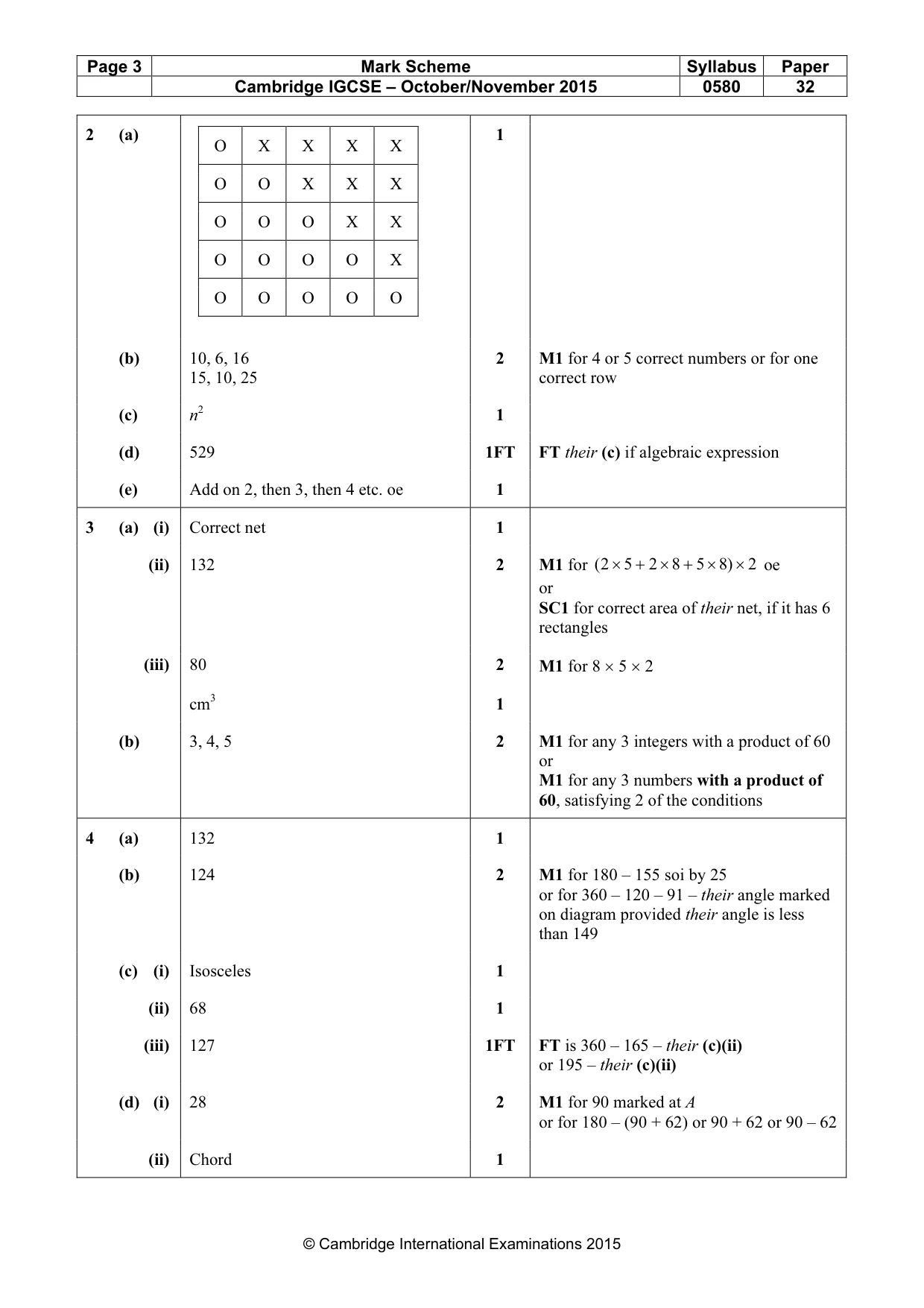
Mark scheme: 2 (a) 1 O X X X X O O X X X O O O X X O O O O X O O O O O (b) 10, 6, 16 2 M1 for 4 or 5 correct numbers or for one 15, 10, 25 correct row (c) n2 1 (d) 529 1FT FT their (c) if algebraic expression (e) Add on 2, then 3, then 4 etc. oe 1
Q3 · The diagram shows part of a net for a cuboid drawn on a 1 cm2 grid
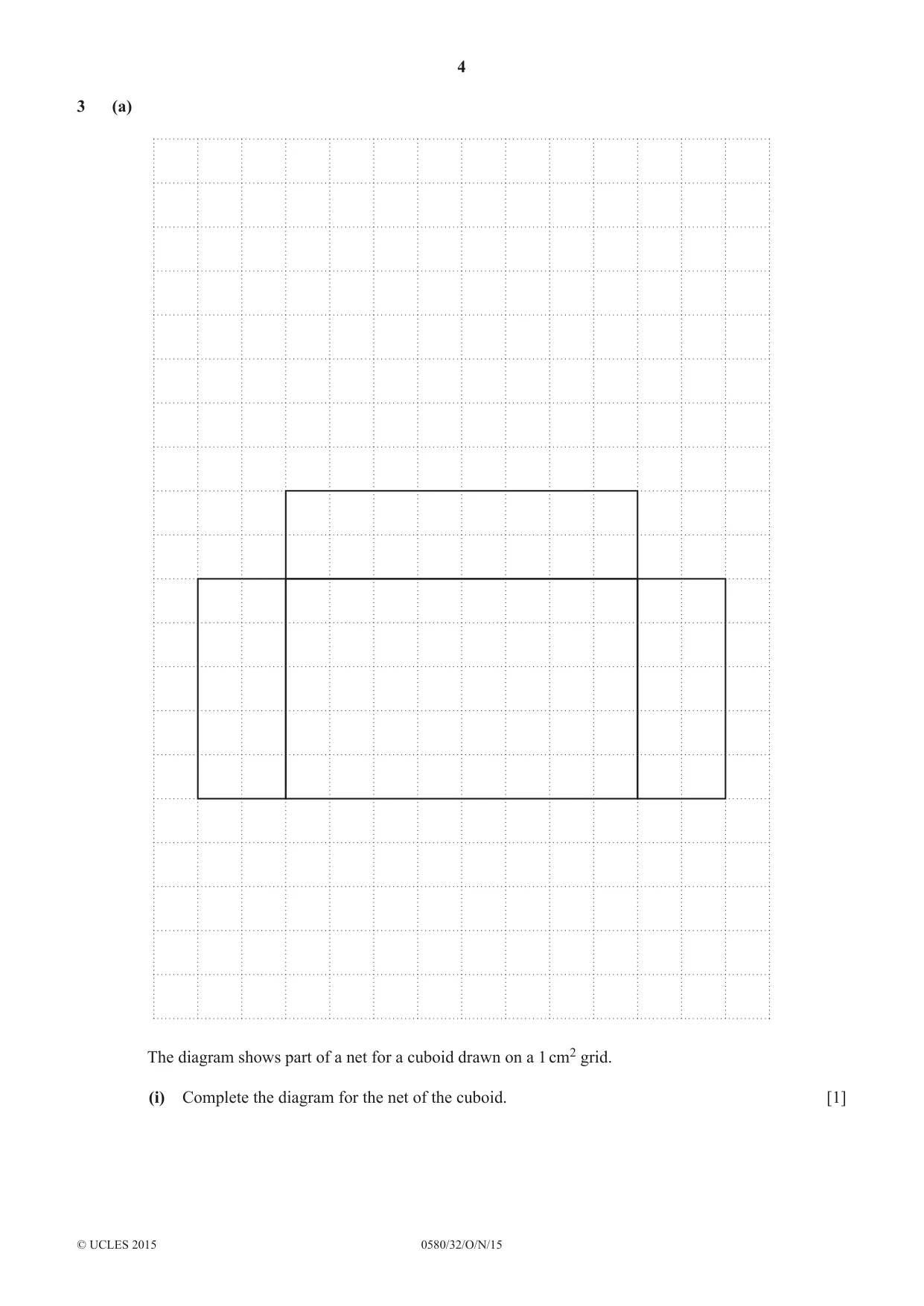
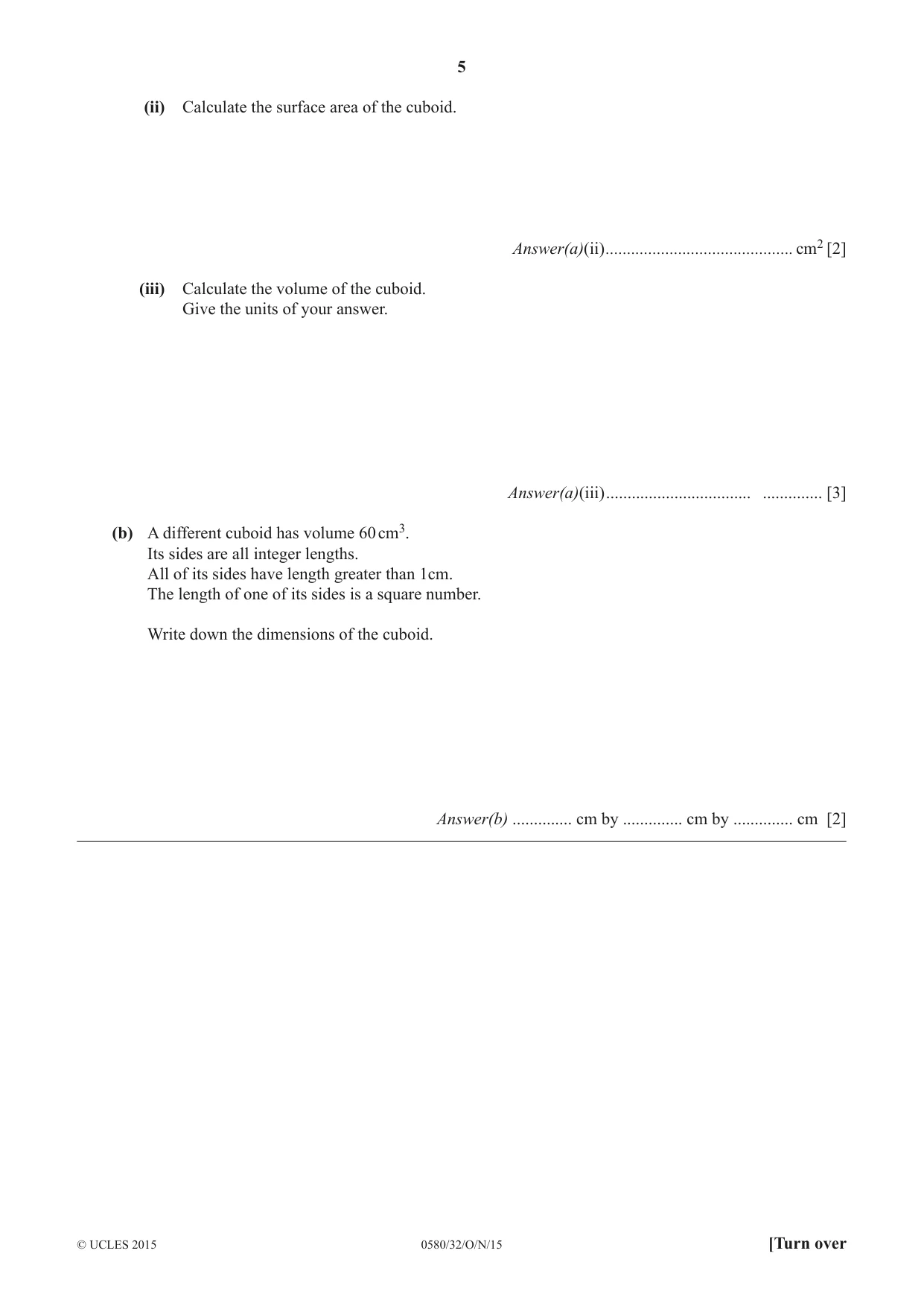
3 (a) The diagram shows part of a net for a cuboid drawn on a 1 cm2 grid. (i) Complete the diagram for the net of the cuboid. [1] (ii) Calculate the surface area of the cuboid. Answer(a)(ii) ............................................ cm2 [2] (iii) Calculate the volume of the cuboid. Give the units of your answer. Answer(a)(iii) .................................. .............. [3] (b) A different cuboid has volume 60 cm3. Its sides are all integer lengths. All of its sides have length greater than 1cm. The length of one of its sides is a square number. Write down the dimensions of the cuboid. Answer(b) .............. cm by .............. cm by .............. cm [2]
Mark scheme: 3 (a) (i) Correct net 1 (ii) 132 2 M1 for ( 2 × 5 + 2 × 8 + 5 × 8) × 2 oe or SC1 for correct area of their net, if it has 6 rectangles (iii) 80 2 M1 for 8 × 5 × 2 cm3 1 (b) 3, 4, 5 2 M1 for any 3 integers with a product of 60 or M1 for any 3 numbers with a product of 60, satisfying 2 of the conditions
Q4 · U° NOT TO 132° SCALE Find the value of u
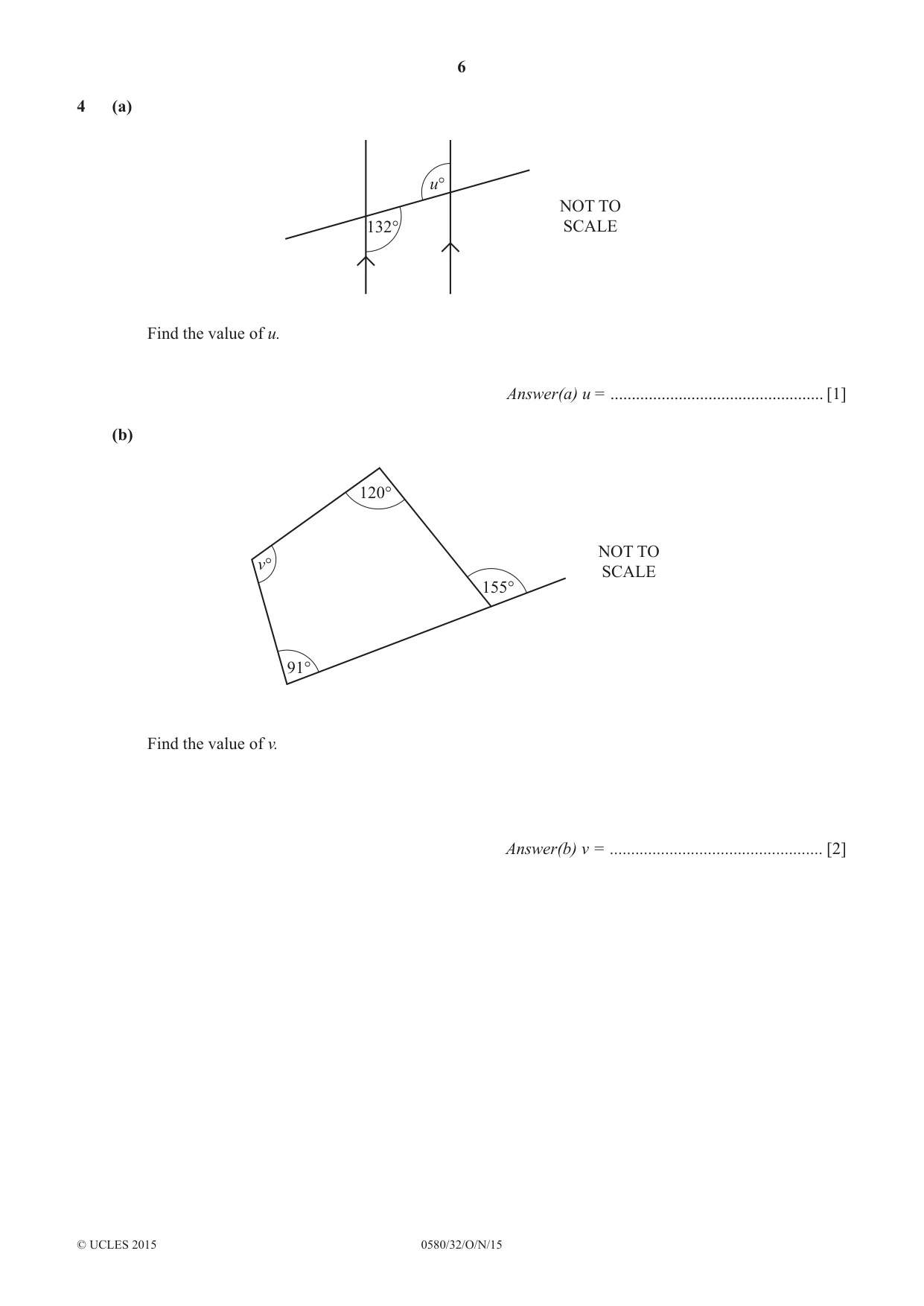
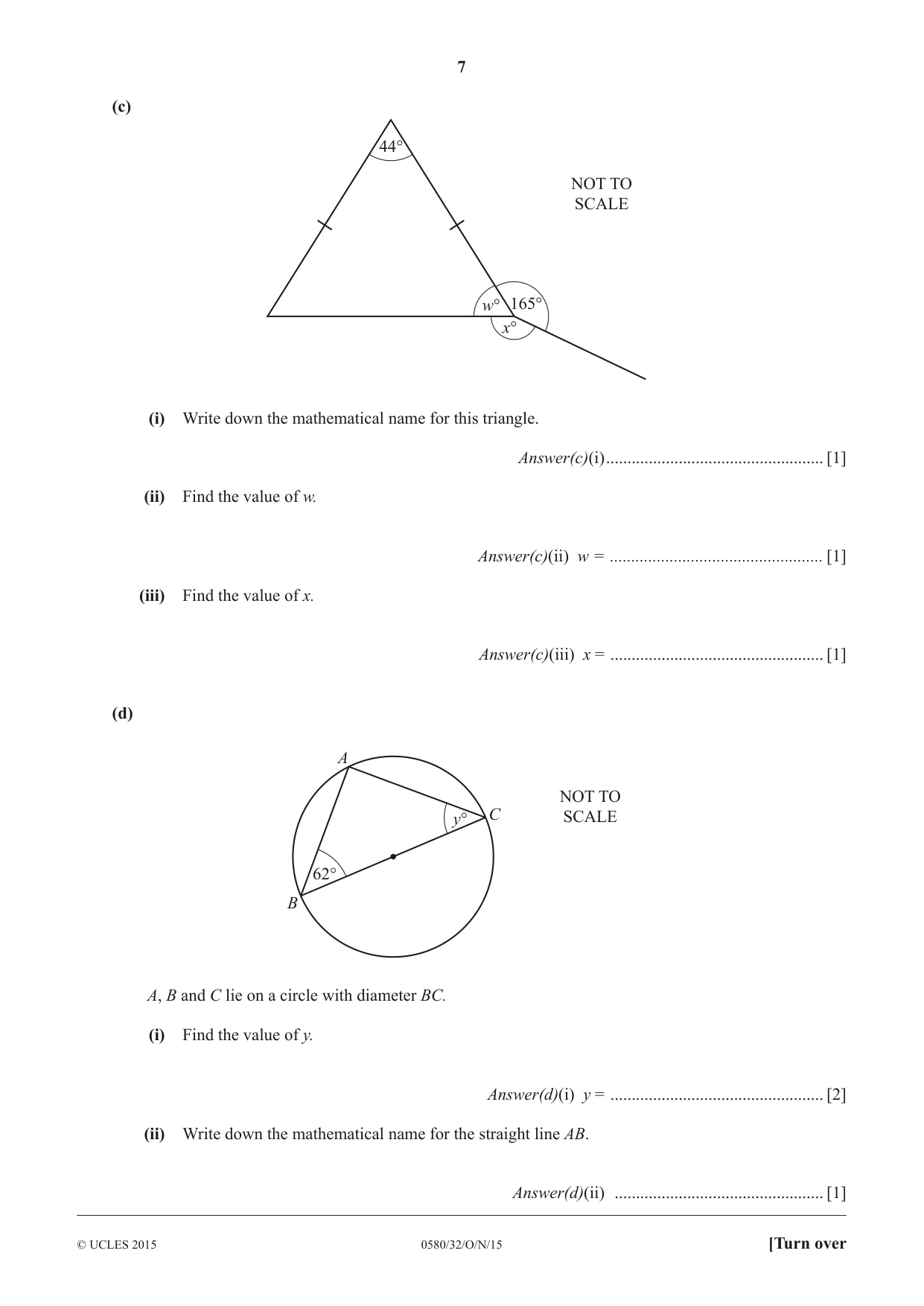
4 (a) u° NOT TO 132° SCALE Find the value of u. Answer(a) u = .................................................. [1] (b) 120° NOT TO v° SCALE 155° 91° Find the value of v. Answer(b) v = .................................................. [2] (c) 44° NOT TO SCALE w° 165° x° (i) Write down the mathematical name for this triangle. Answer(c)(i) ................................................... [1] (ii) Find the value of w. Answer(c)(ii) w = .................................................. [1] (iii) Find the value of x. Answer(c)(iii) x = .................................................. [1] (d) A NOT TO y° C SCALE 62° B A, B and C lie on a circle with diameter BC. (i) Find the value of y. Answer(d)(i) y = .................................................. [2] (ii) Write down the mathematical name for the straight line AB. Answer(d)(ii) ................................................. [1]
Mark scheme: 4 (a) 132 1 (b) 124 2 M1 for 180 – 155 soi by 25 or for 360 – 120 – 91 – their angle marked on diagram provided their angle is less than 149 (c) (i) Isosceles 1 (ii) 68 1 (iii) 127 1FT FT is 360 – 165 – their (c)(ii) or 195 – their (c)(ii) (d) (i) 28 2 M1 for 90 marked at A or for 180 – (90 + 62) or 90 + 62 or 90 – 62 (ii) Chord 1
Q5 · Some children are asked what their favourite sport is
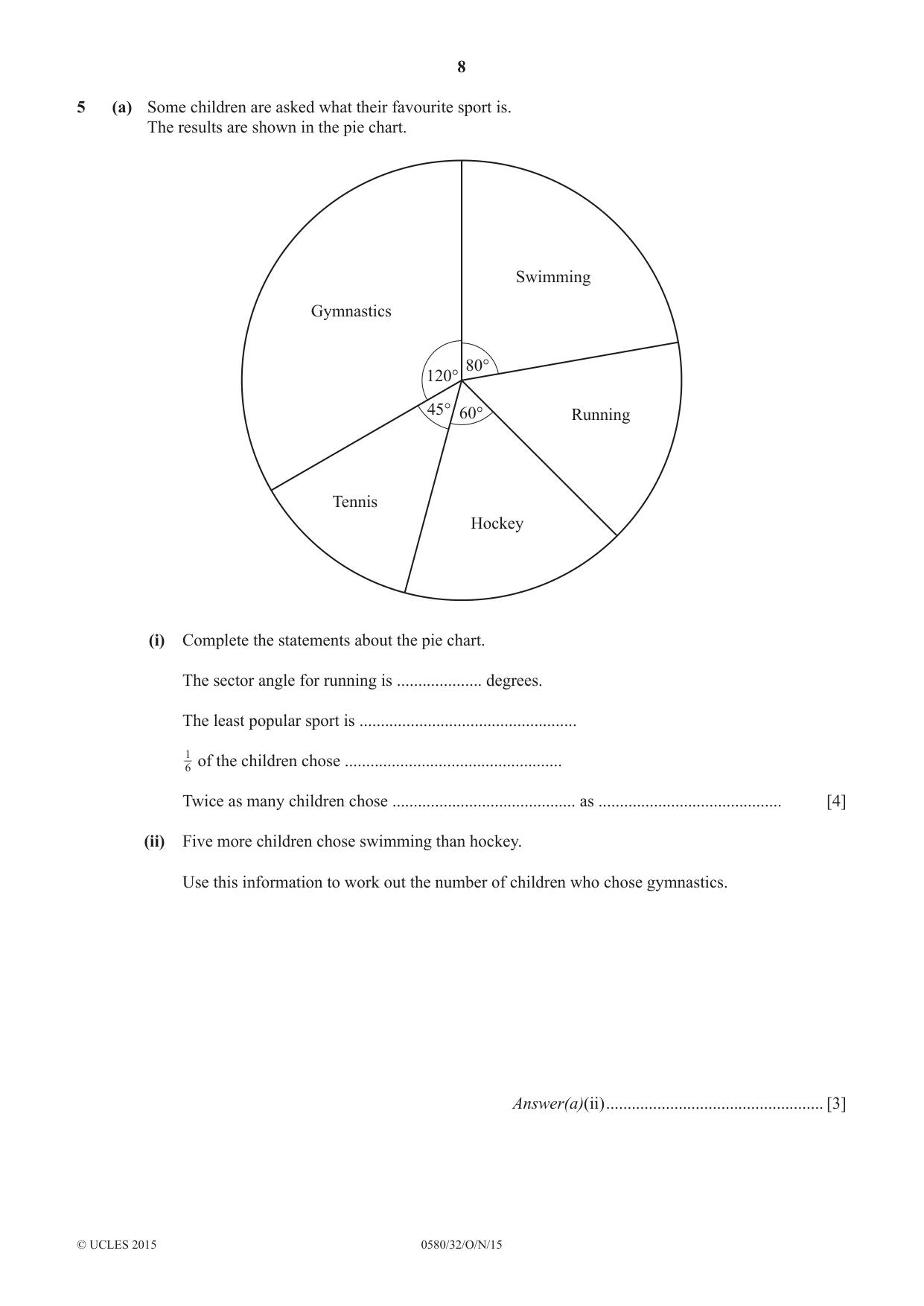
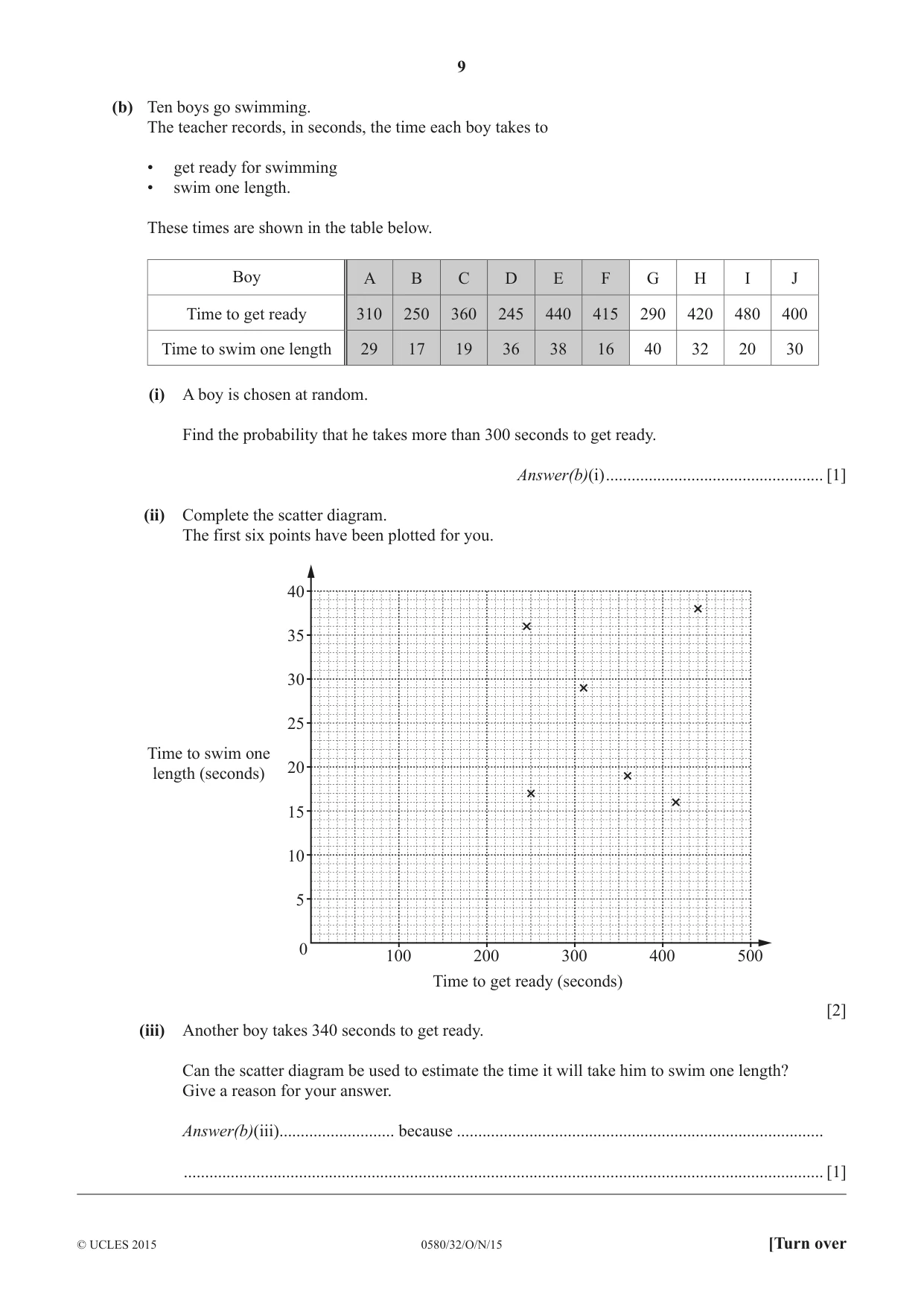
5 (a) Some children are asked what their favourite sport is. The results are shown in the pie chart. Swimming Gymnastics 80° 120° 45° 60° Running Tennis Hockey (i) Complete the statements about the pie chart. The sector angle for running is .................... degrees. The least popular sport is ................................................... 1 6 of the children chose ................................................... Twice as many children chose ........................................... as ........................................... [4] (ii) Five more children chose swimming than hockey. Use this information to work out the number of children who chose gymnastics. Answer(a)(ii) ................................................... [3] (b) Ten boys go swimming. The teacher records, in seconds, the time each boy takes to • get ready for swimming • swim one length. These times are shown in the table below. Boy A B C D E F G H I J Time to get ready 310 250 360 245 440 415 290 420 480 400 Time to swim one length 29 17 19 36 38 16 40 32 20 30 (i) A boy is chosen at random. Find the probability that he takes more than 300 seconds to get ready. Answer(b)(i) ................................................... [1] (ii) Complete the scatter diagram. The first six points have been plotted for you. 40 35 30 25 Time to swim one 20 length (seconds) 15 10 5 0 100 200 300 400 500 Time to get ready (seconds) [2] (iii) Another boy takes 340 seconds to get ready. Can the scatter diagram be used to estimate the time it will take him to swim one length? Give a reason for your answer. Answer(b)(iii)........................... because ...................................................................................... ...................................................................................................................................................... [1]
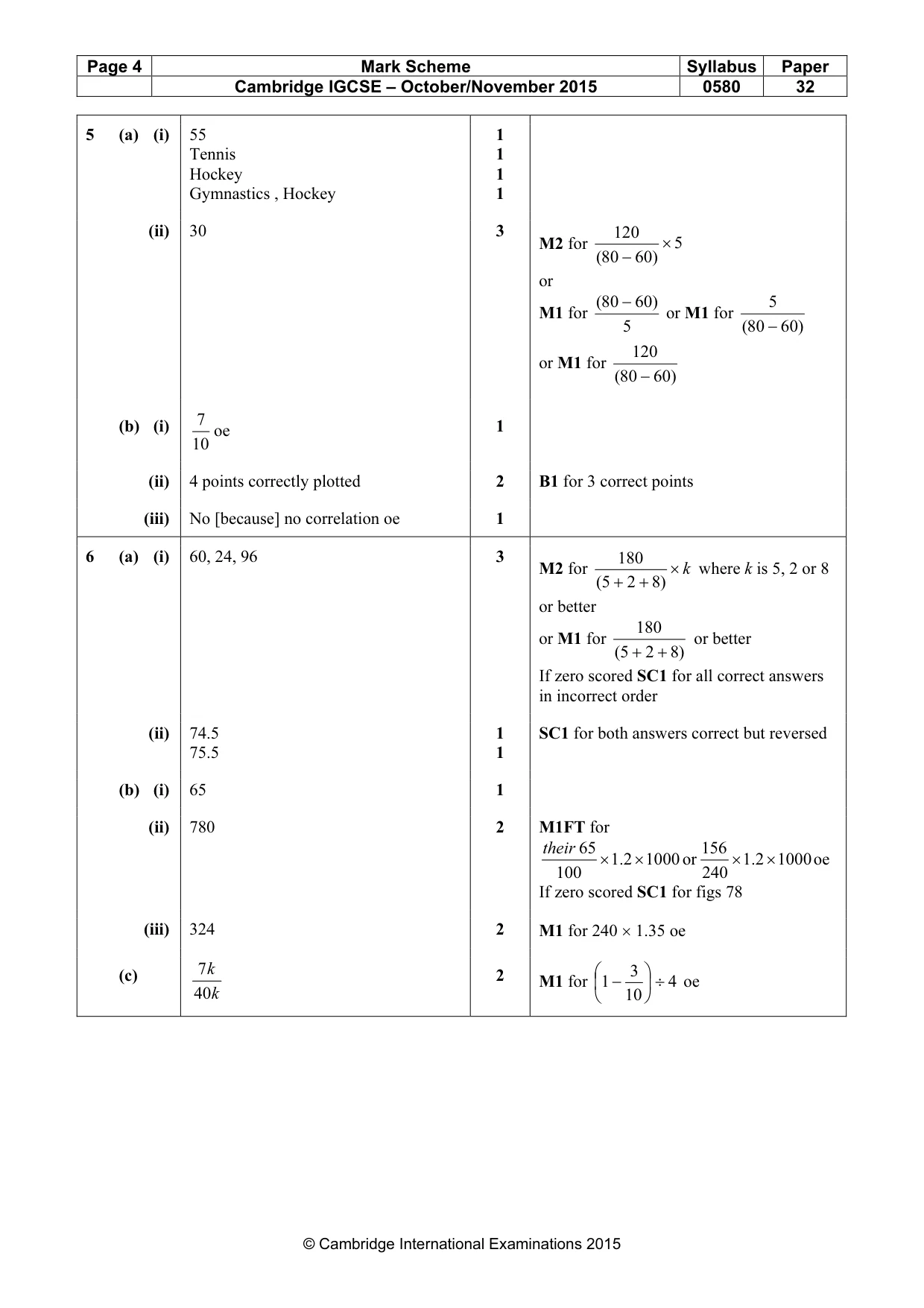
Mark scheme: 5 (a) (i) 55 1 Tennis 1 Hockey 1 Gymnastics , Hockey 1 (ii) 30 3 120 M2 for × 5 (80 − 60) or (80 − 60) 5 M1 for or M1 for 5 (80 − 60) 120 or M1 for (80 − 60) 7 (b) (i) oe 1 10 (ii) 4 points correctly plotted 2 B1 for 3 correct points (iii) No [because] no correlation oe 1
Q6 · A sweet shop sells lots of different types of sweets
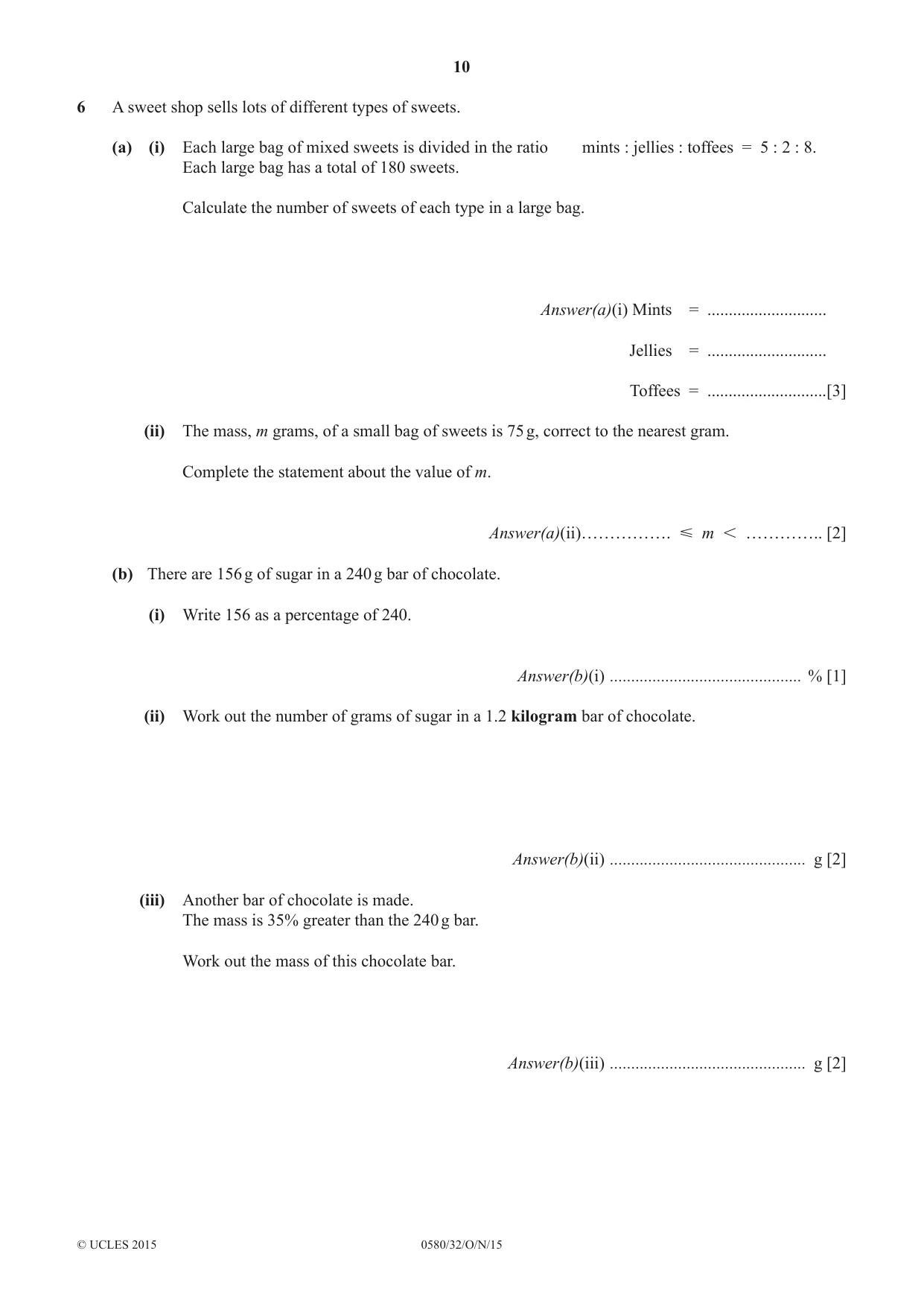
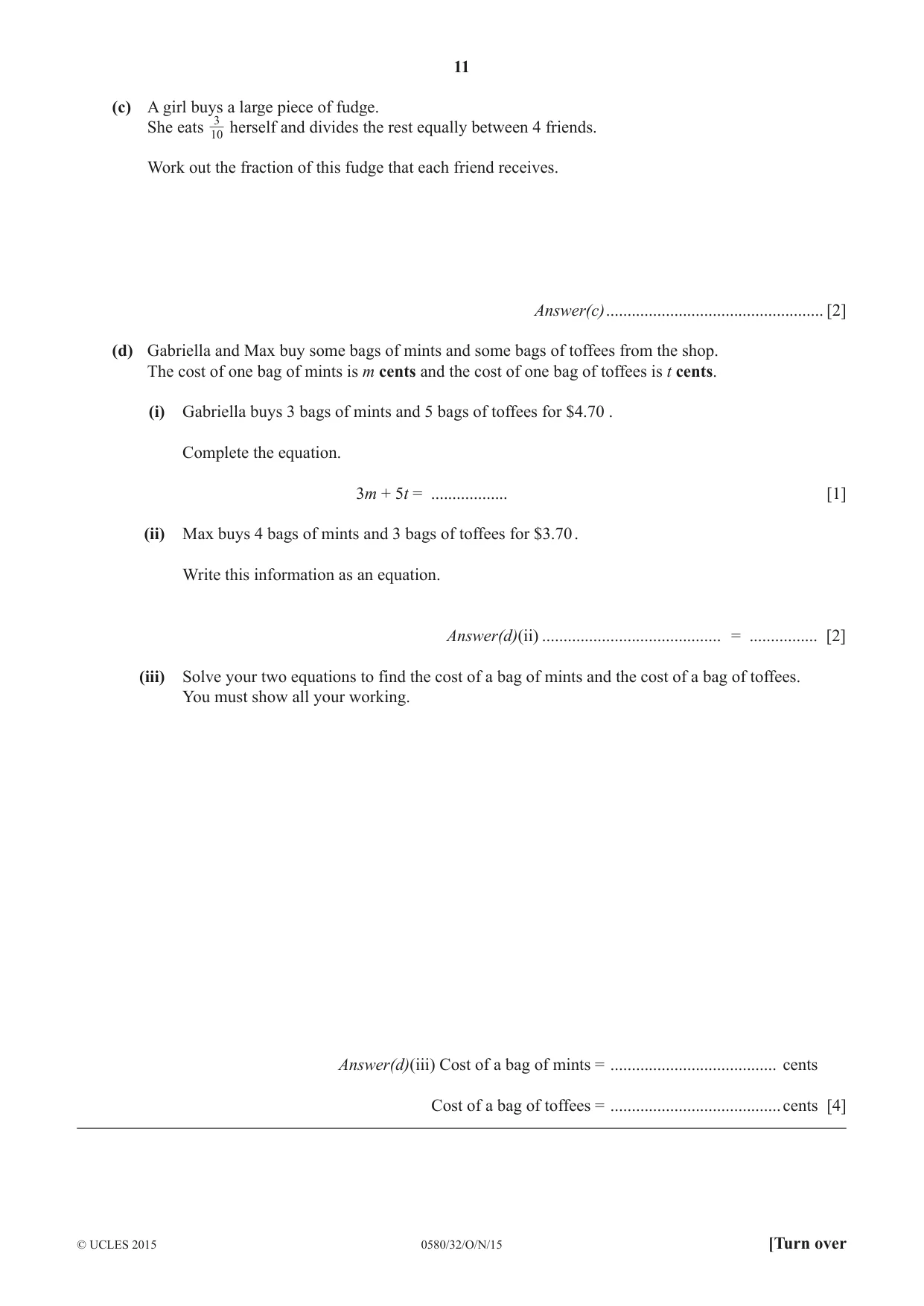
6 A sweet shop sells lots of different types of sweets. (a) (i) Each large bag of mixed sweets is divided in the ratio mints : jellies : toffees = 5 : 2 : 8. Each large bag has a total of 180 sweets. Calculate the number of sweets of each type in a large bag. Answer(a)(i) Mints = ............................ Jellies = ............................ Toffees = ............................[3] (ii) The mass, m grams, of a small bag of sweets is 75 g, correct to the nearest gram. Complete the statement about the value of m. Answer(a)(ii)……………. m ………….. [2] (b) There are 156 g of sugar in a 240 g bar of chocolate. (i) Write 156 as a percentage of 240. Answer(b)(i) ............................................. % [1] (ii) Work out the number of grams of sugar in a 1.2 kilogram bar of chocolate. Answer(b)(ii) .............................................. g [2] (iii) Another bar of chocolate is made. The mass is 35% greater than the 240 g bar. Work out the mass of this chocolate bar. Answer(b)(iii) .............................................. g [2] (c) A girl buys a large piece of fudge. She eats 103 herself and divides the rest equally between 4 friends. Work out the fraction of this fudge that each friend receives. Answer(c) ................................................... [2] (d) Gabriella and Max buy some bags of mints and some bags of toffees from the shop. The cost of one bag of mints is m cents and the cost of one bag of toffees is t cents. (i) Gabriella buys 3 bags of mints and 5 bags of toffees for $4.70 . Complete the equation. 3m + 5t = .................. [1] (ii) Max buys 4 bags of mints and 3 bags of toffees for $3.70 . Write this information as an equation. Answer(d)(ii) .......................................... = ................ [2] (iii) Solve your two equations to find the cost of a bag of mints and the cost of a bag of toffees. You must show all your working. Answer(d)(iii) Cost of a bag of mints = ....................................... cents Cost of a bag of toffees = ........................................cents [4]
Mark scheme: 6 (a) (i) 60, 24, 96 3 180 M2 for × k where k is 5, 2 or 8 (5 + 2 + 8) or better 180 or M1 for or better (5 + 2 + 8) If zero scored SC1 for all correct answers in incorrect order (ii) 74.5 1 SC1 for both answers correct but reversed 75.5 1 (b) (i) 65 1 (ii) 780 2 M1FT for their 65 156 × 2.1 × 1000 or × 2.1 × 1000 oe 100 240 If zero scored SC1 for figs 78 (iii) 324 2 M1 for 240 × 1.35 oe 7 k 3 (c) 2 M1 for − 1 ÷ 4 oe 40 k 10 (d) (i) 470 1 (ii) 4m + 3t = 370 2 B1 for 4m + 3t seen (iii) Correct working and 4 M1FT for correctly equating one set of [m] 40 coefficients [t] 70 M1FT for correct method to eliminate one variable A1 for m = 40 A1 for t = 70 If zero scored SC1 for either: 2 correct answers given or 2 values satisfying one of their original equations
Q7 · Fintown 16 14 12 Emley 10 Distance 8 from Dexford (km) 6 4 2 Dexford 0 09 00 09 10 09 20…
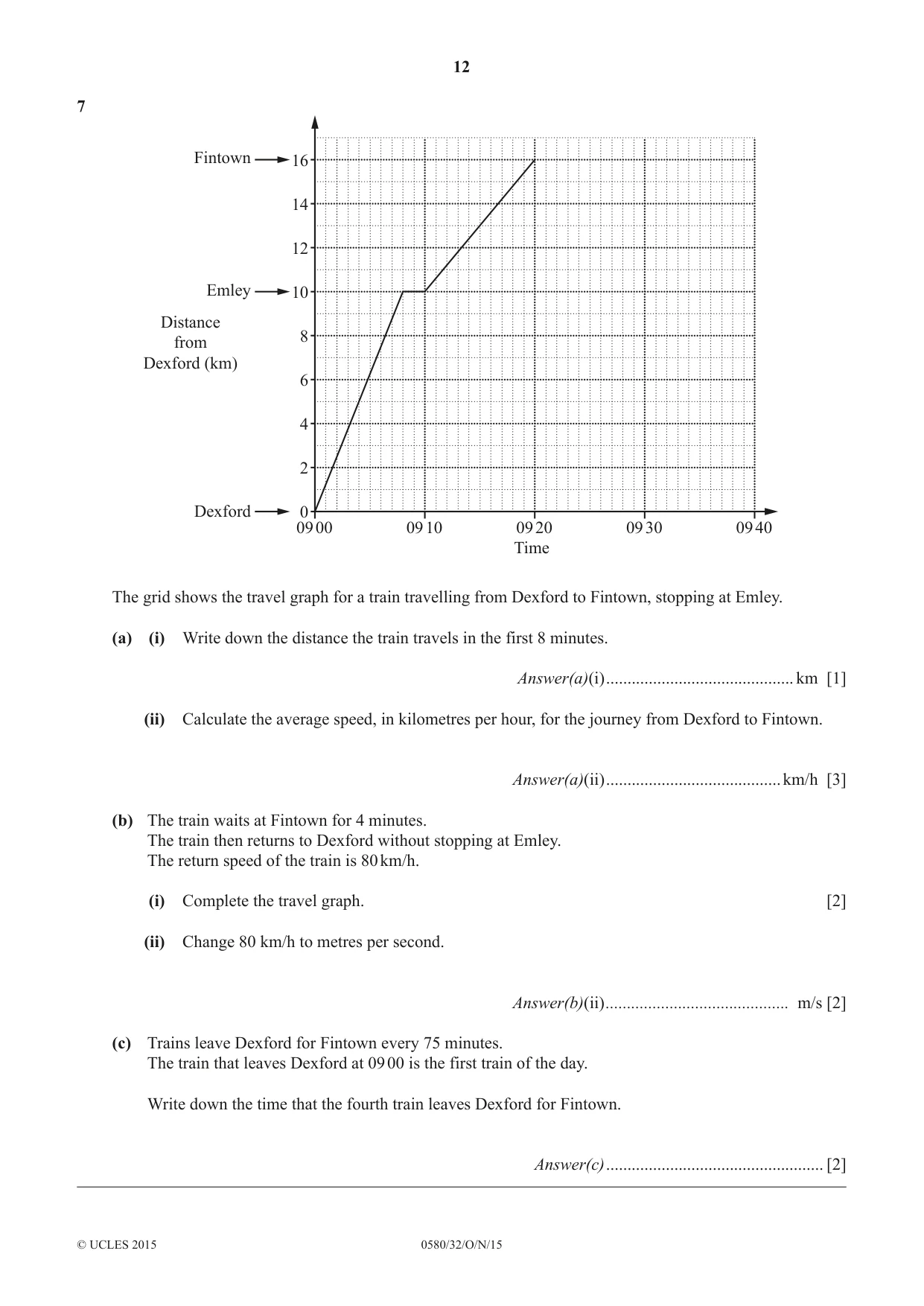
7 Fintown 16 14 12 Emley 10 Distance 8 from Dexford (km) 6 4 2 Dexford 0 09 00 09 10 09 20 09 30 09 40 Time The grid shows the travel graph for a train travelling from Dexford to Fintown, stopping at Emley. (a) (i) Write down the distance the train travels in the first 8 minutes. Answer(a)(i) ............................................ km [1] (ii) Calculate the average speed, in kilometres per hour, for the journey from Dexford to Fintown. Answer(a)(ii) .........................................km/h [3] (b) The train waits at Fintown for 4 minutes. The train then returns to Dexford without stopping at Emley. The return speed of the train is 80 km/h. (i) Complete the travel graph. [2] (ii) Change 80 km/h to metres per second. Answer(b)(ii) ........................................... m/s [2] (c) Trains leave Dexford for Fintown every 75 minutes. The train that leaves Dexford at 09 00 is the first train of the day. Write down the time that the fourth train leaves Dexford for Fintown. Answer(c) ................................................... [2]
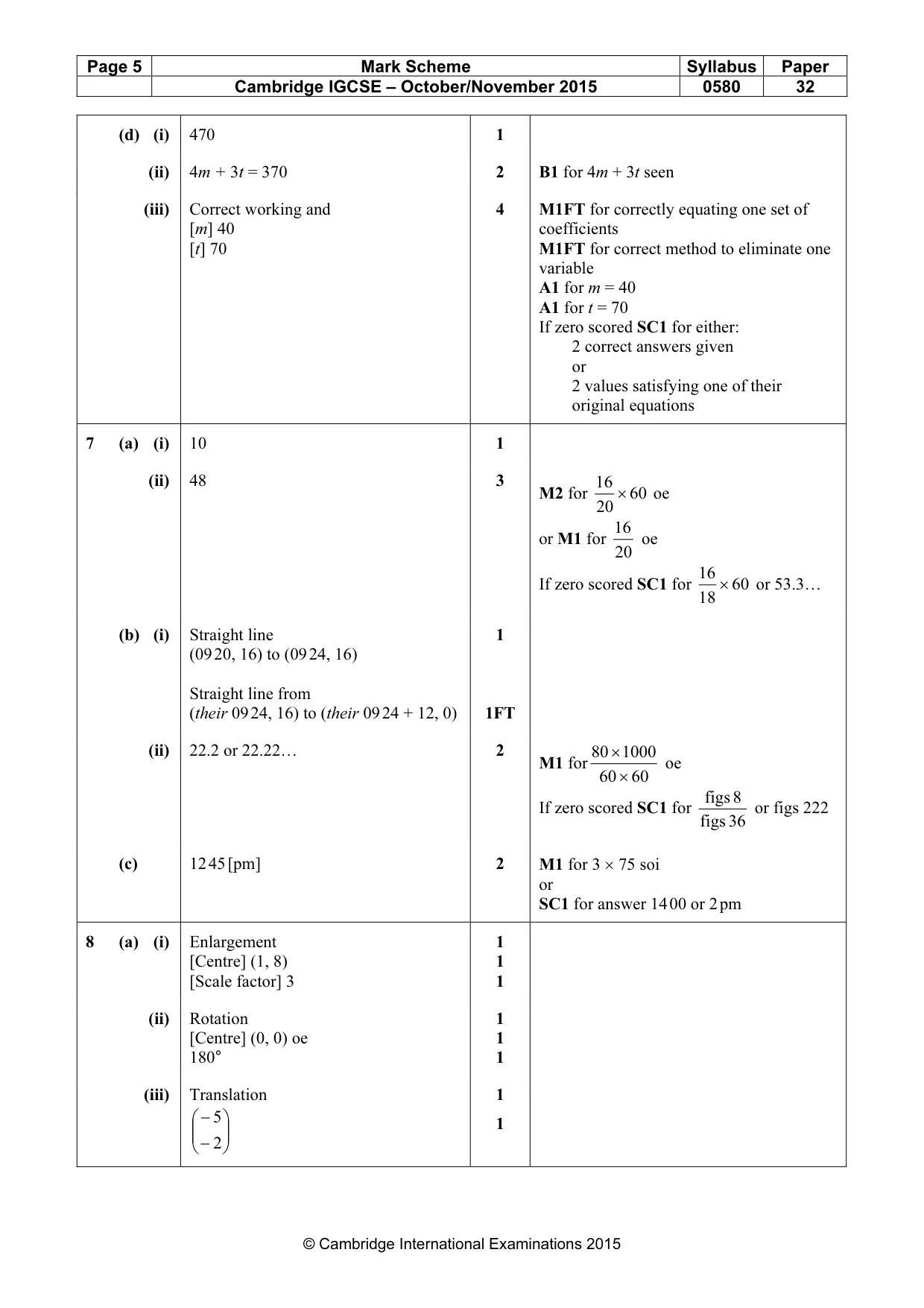
Mark scheme: 7 (a) (i) 10 1 (ii) 48 3 16 M2 for × 60 oe 20 16 or M1 for oe 20 16 If zero scored SC1 for × 60 or 53.3… 18 (b) (i) Straight line 1 (09 20, 16) to (09 24, 16) Straight line from (their 09 24, 16) to (their 09 24 + 12, 0) 1FT (ii) 22.2 or 22.22… 2 80 × 1000 M1 for oe 60 × 60 figs 8 If zero scored SC1 for or figs 222 figs 36 (c) 12 45 [pm] 2 M1 for 3 × 75 soi or SC1 for answer 14 00 or 2 pm
Q8 · Y 9 8 7 6 5 4 A 3 2 D 1 x –5 –4 –3 –2 –1 0 1 2 3 4 5 6 7 8 9 10 11 –1 –2 –3 C –4 B –5 –6…
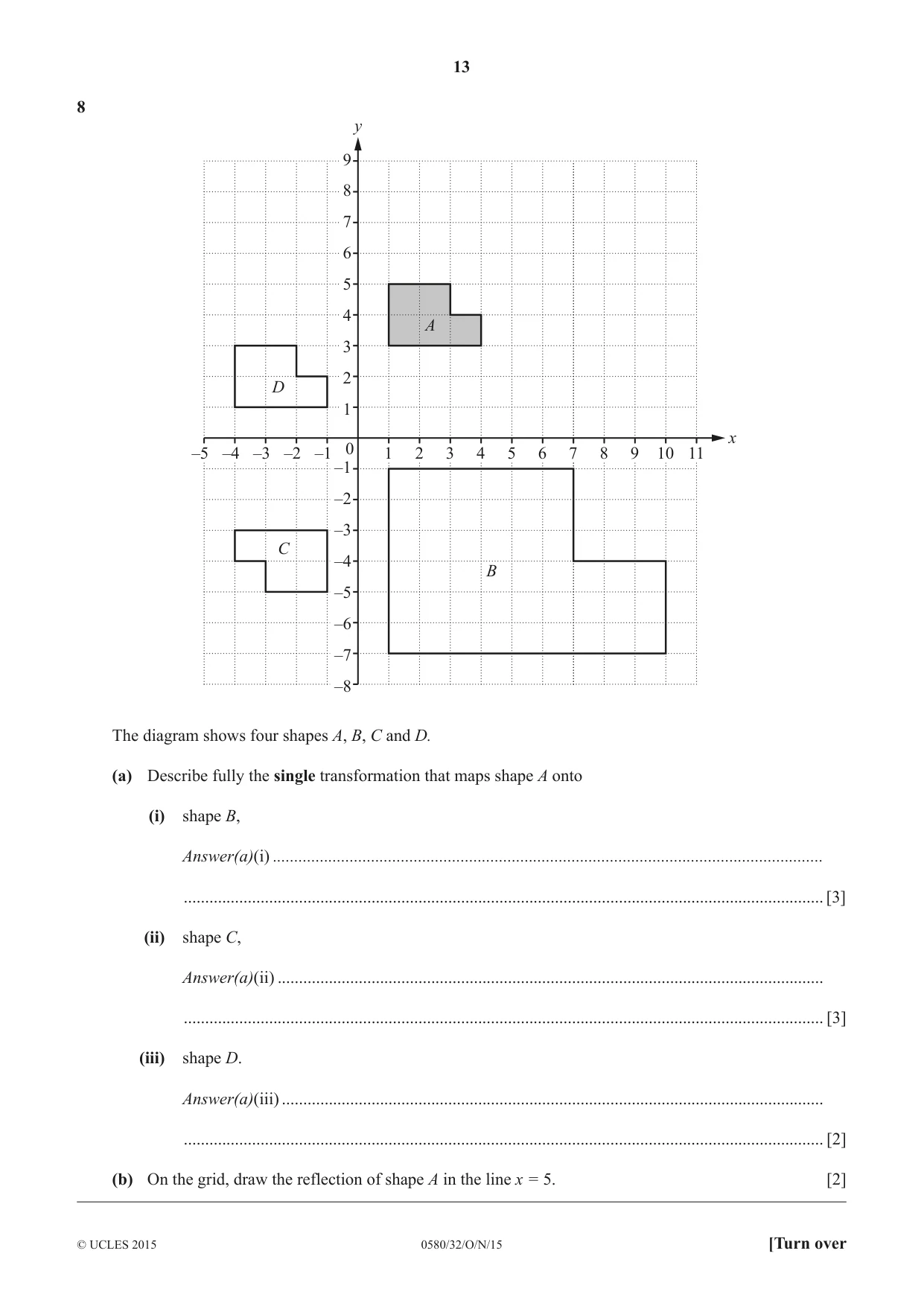
8 y 9 8 7 6 5 4 A 3 2 D 1 x –5 –4 –3 –2 –1 0 1 2 3 4 5 6 7 8 9 10 11 –1 –2 –3 C –4 B –5 –6 –7 –8 The diagram shows four shapes A, B, C and D. (a) Describe fully the single transformation that maps shape A onto (i) shape B, Answer(a)(i) ................................................................................................................................. ...................................................................................................................................................... [3] (ii) shape C, Answer(a)(ii) ................................................................................................................................ ...................................................................................................................................................... [3] (iii) shape D. Answer(a)(iii) ............................................................................................................................... ...................................................................................................................................................... [2] (b) On the grid, draw the reflection of shape A in the line x = 5. [2]
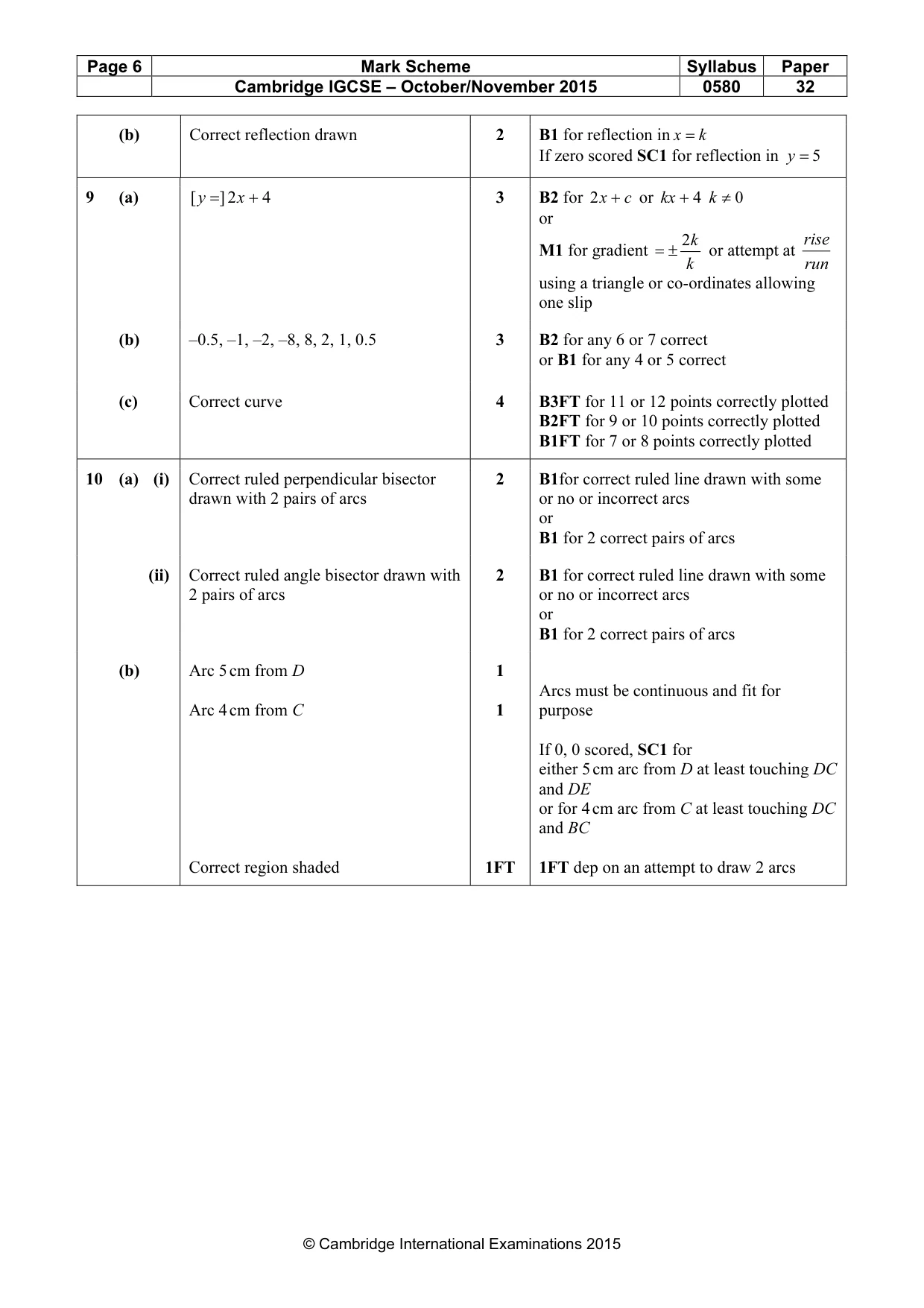
Mark scheme: 8 (a) (i) Enlargement 1 [Centre] (1, 8) 1 [Scale factor] 3 1 (ii) Rotation 1 [Centre] (0, 0) oe 1 180° 1 (iii) Translation 1 − 5 1 − 2 (b) Correct reflection drawn 2 B1 for reflection in x = k If zero scored SC1 for reflection in y = 5
Q9 · Y l 8 7 6 5 4 3 2 1 x –4 –3 –2 –1 0 1 2 3 4 –1 –2 –3 –4 –5 –6 –7 –8 (a) Write down the…
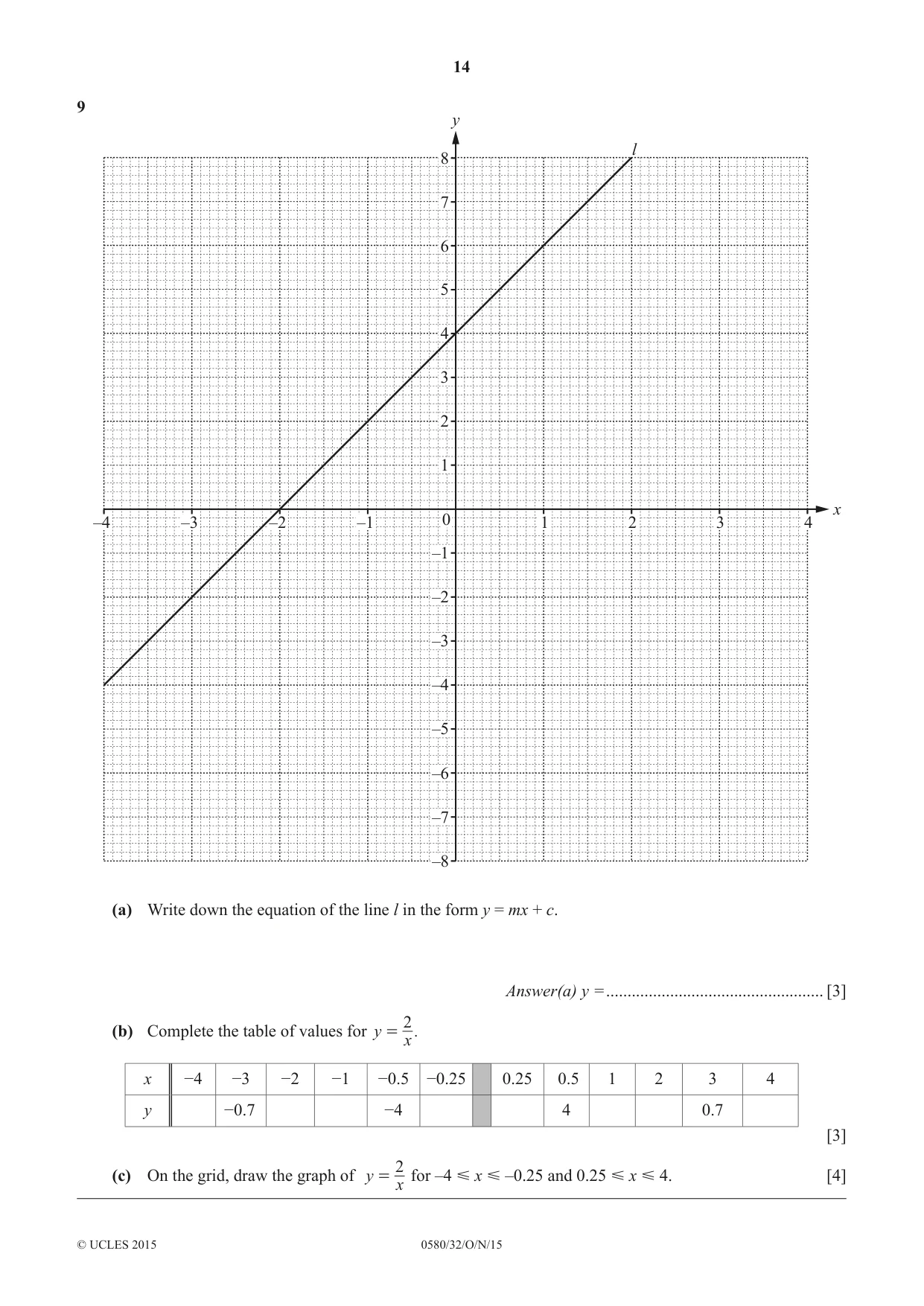
9 y l 8 7 6 5 4 3 2 1 x –4 –3 –2 –1 0 1 2 3 4 –1 –2 –3 –4 –5 –6 –7 –8 (a) Write down the equation of the line l in the form y = mx + c. Answer(a) y = ................................................... [3] 2 (b) Complete the table of values for y = . x x −4 −3 −2 −1 −0.5 −0.25 0.25 0.5 1 2 3 4 y −0.7 −4 4 0.7 [3] 2 (c) On the grid, draw the graph of y = for –4 x –0.25 and 0.25 x 4. [4] x
Mark scheme: 9 (a) [ y = ] 2 x + 4 3 B2 for 2 x + c or kx + 4 k ≠ 0 or 2 k rise M1 for gradient = ± or attempt at k run using a triangle or co-ordinates allowing one slip (b) –0.5, –1, –2, –8, 8, 2, 1, 0.5 3 B2 for any 6 or 7 correct or B1 for any 4 or 5 correct (c) Correct curve 4 B3FT for 11 or 12 points correctly plotted B2FT for 9 or 10 points correctly plotted B1FT for 7 or 8 points correctly plotted
Q10 · A F B E C D (a) Complete this part of the question using a straight edge and compasses…
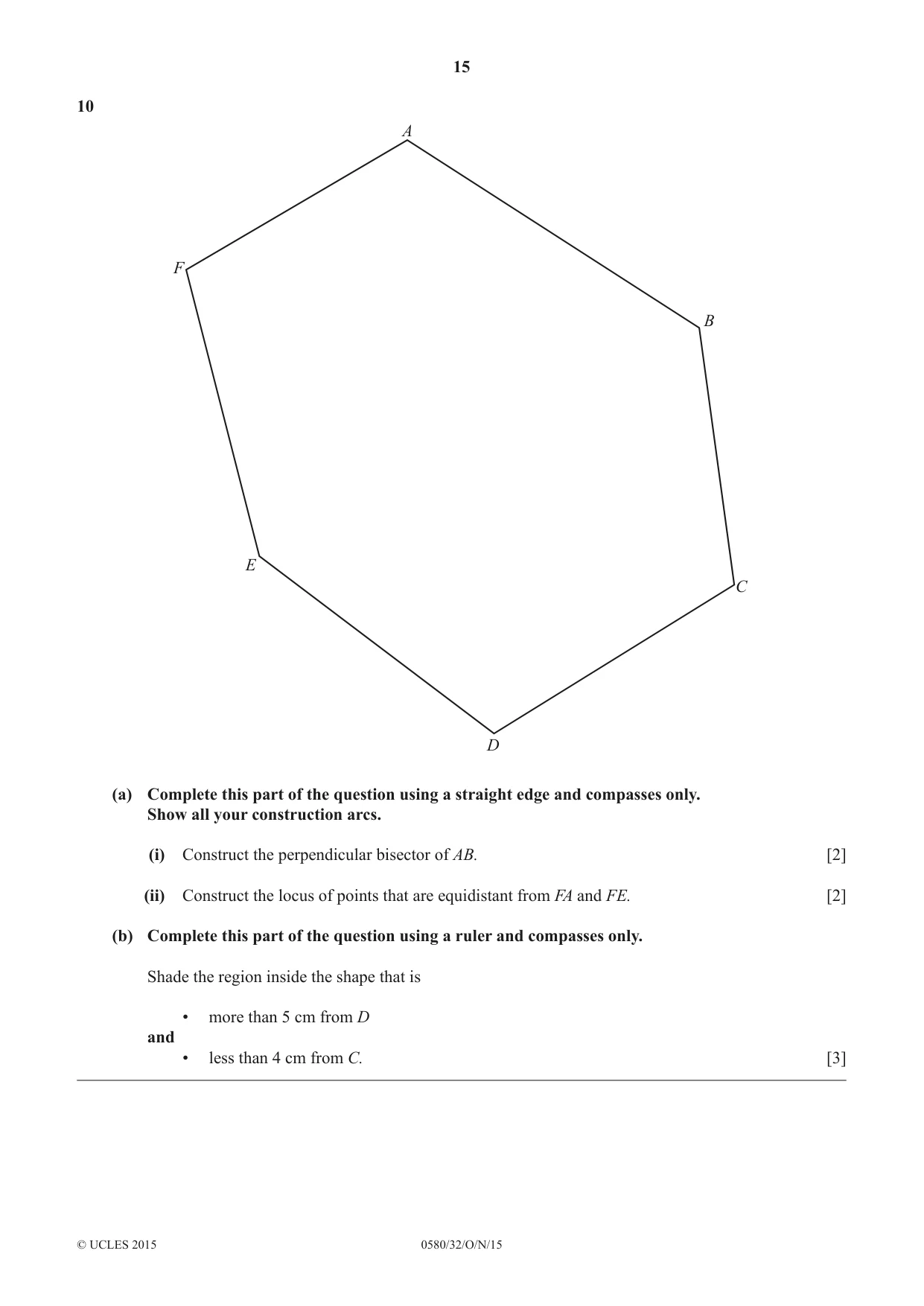
10 A F B E C D (a) Complete this part of the question using a straight edge and compasses only. Show all your construction arcs. (i) Construct the perpendicular bisector of AB. [2] (ii) Construct the locus of points that are equidistant from FA and FE. [2] (b) Complete this part of the question using a ruler and compasses only. Shade the region inside the shape that is • more than 5 cm from D and • less than 4 cm from C. [3]
Mark scheme: 10 (a) (i) Correct ruled perpendicular bisector 2 B1for correct ruled line drawn with some drawn with 2 pairs of arcs or no or incorrect arcs or B1 for 2 correct pairs of arcs (ii) Correct ruled angle bisector drawn with 2 B1 for correct ruled line drawn with some 2 pairs of arcs or no or incorrect arcs or B1 for 2 correct pairs of arcs (b) Arc 5 cm from D 1 Arcs must be continuous and fit for Arc 4 cm from C 1 purpose If 0, 0 scored, SC1 for either 5 cm arc from D at least touching DC and DE or for 4 cm arc from C at least touching DC and BC Correct region shaded 1FT 1FT dep on an attempt to draw 2 arcs
What was in this paper
The subtopics covered by these 10 questions, and how many questions each got. Open one in a new tab to see every Cambridge question on it.
What you needed in this session
Cambridge’s own grade thresholds for 2015 Oct/Nov, Paper 3 · Variant 2. A higher threshold means an easier paper — the bar moves with how the cohort did.