Cambridge IGCSE Mathematics 0580 — 2011 Oct/Nov Paper 3 · Variant 1
0580/31/O/N/11 · 11 questions · 104 marks · ≈117 min
The question paper and its mark scheme, free to read here and free to download. This is Cambridge’s own paper, exactly as it was sat.
Question paper16 pages
Mark scheme4 pages
Answers below. Sit the paper first if you are practising.
Questions as text
Q1 · Write twenty five million in figures
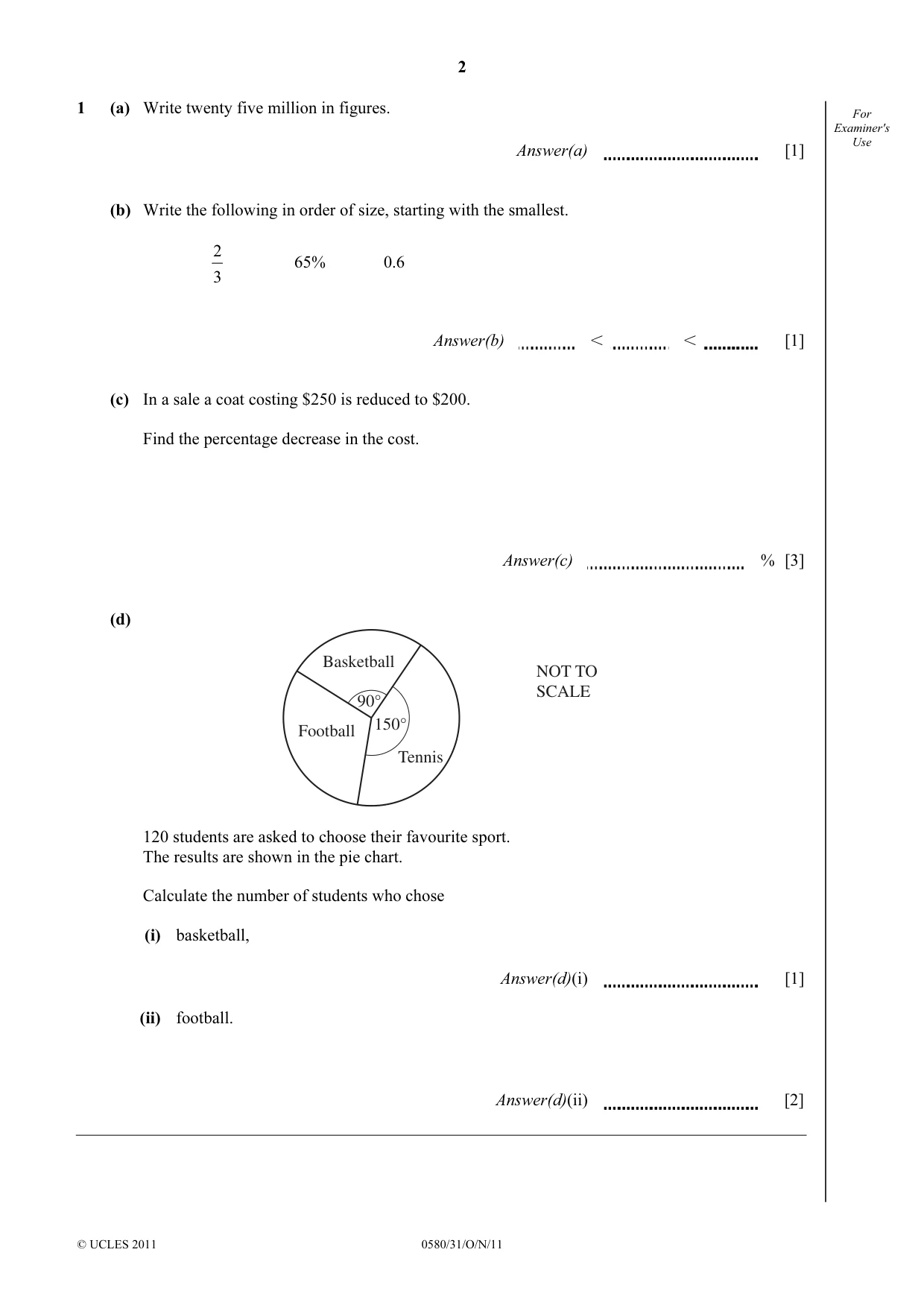
1 (a) Write twenty five million in figures. For Examiner's Answer(a) [1] Use (b) Write the following in order of size, starting with the smallest. 2 65% 0.6 3 Answer(b) I I [1] (c) In a sale a coat costing $250 is reduced to $200. Find the percentage decrease in the cost. Answer(c) % [3] (d) Basketball NOT TO SCALE 90° 150° Football Tennis 120 students are asked to choose their favourite sport. The results are shown in the pie chart. Calculate the number of students who chose (i) basketball, Answer(d)(i) [1] (ii) football. Answer(d)(ii) [2]
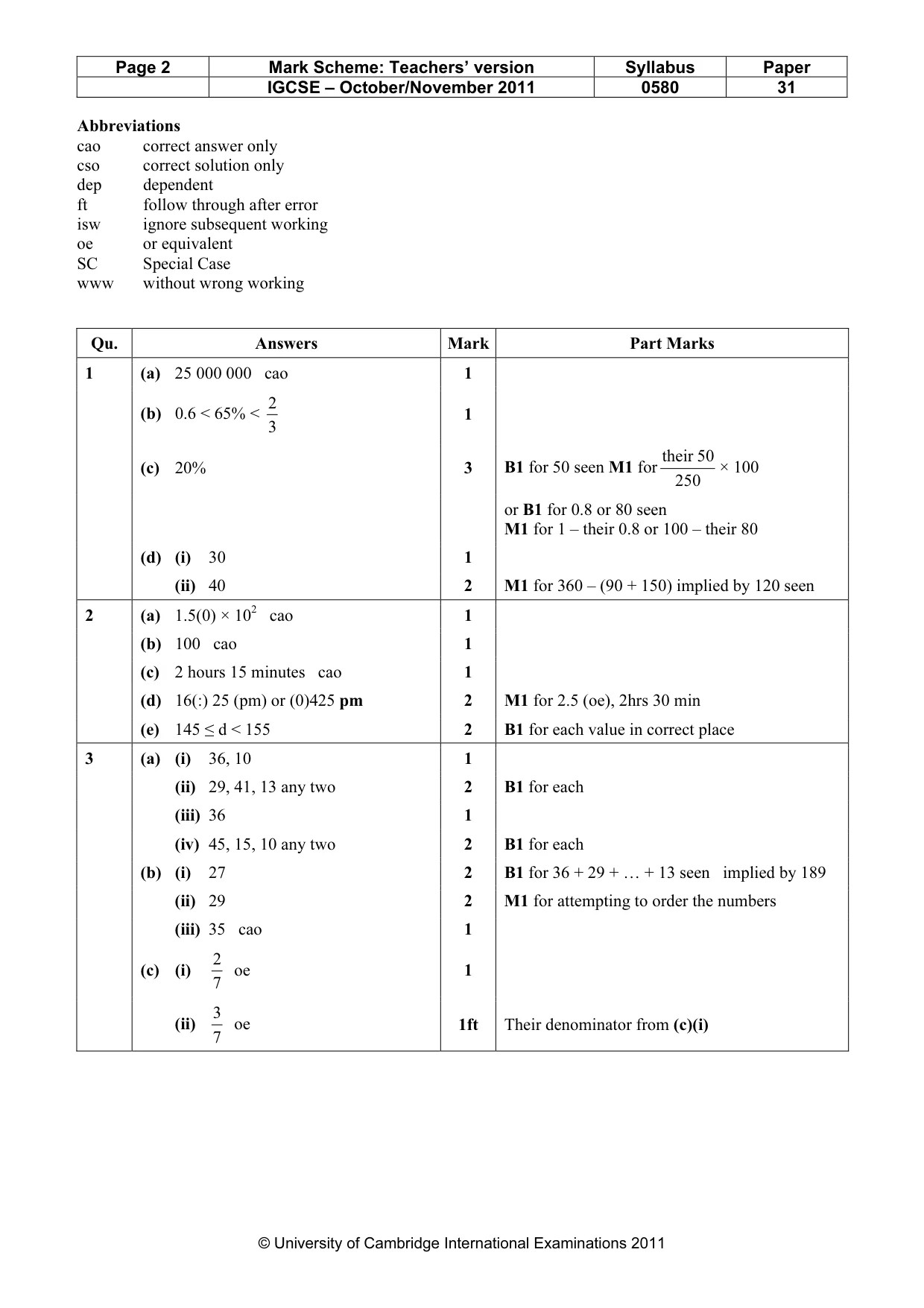
Mark scheme: Qu. Answers Mark Part Marks 1 (a) 25 000 000 cao 1 2 (b) 0.6 < 65% < 1 3 their 50 (c) 20% 3 B1 for 50 seen M1 for × 100 250 or B1 for 0.8 or 80 seen M1 for 1 – their 0.8 or 100 – their 80 (d) (i) 30 1 (ii) 40 2 M1 for 360 – (90 + 150) implied by 120 seen
Q2 · The distance between Geneva and Gstaad is 150 km
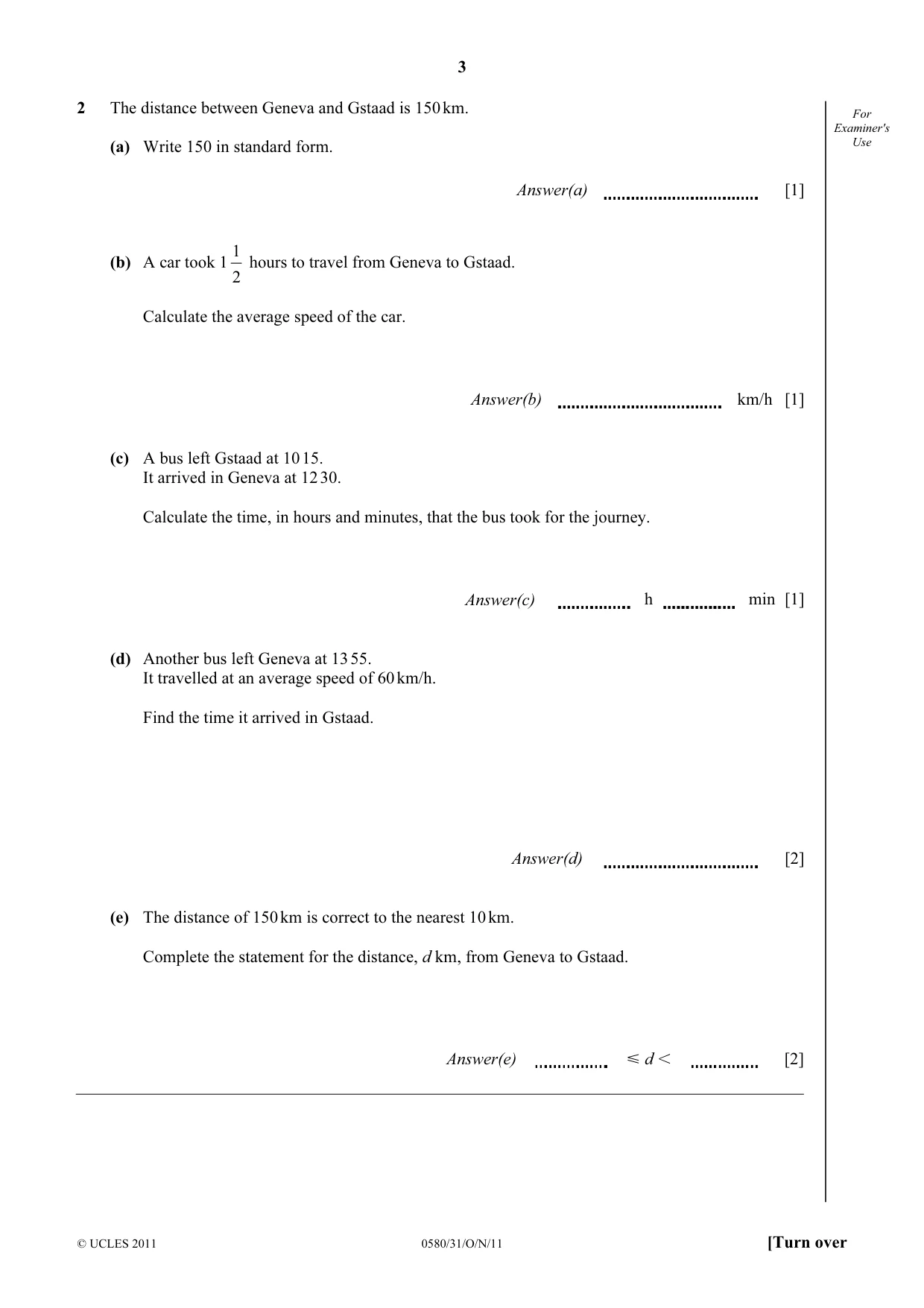
2 The distance between Geneva and Gstaad is 150 km. For Examiner's (a) Write 150 in standard form. Use Answer(a) [1] 1 (b) A car took 1 hours to travel from Geneva to Gstaad. 2 Calculate the average speed of the car. Answer(b) km/h [1] (c) A bus left Gstaad at 10 15. It arrived in Geneva at 12 30. Calculate the time, in hours and minutes, that the bus took for the journey. Answer(c) h min [1] (d) Another bus left Geneva at 13 55. It travelled at an average speed of 60 km/h. Find the time it arrived in Gstaad. Answer(d) [2] (e) The distance of 150 km is correct to the nearest 10 km. Complete the statement for the distance, d km, from Geneva to Gstaad. Answer(e) Y d I [2]
Mark scheme: 2 (a) 1.5(0) × 102 cao 1 (b) 100 cao 1 (c) 2 hours 15 minutes cao 1 (d) 16(:) 25 (pm) or (0)425 pm 2 M1 for 2.5 (oe), 2hrs 30 min (e) 145 ≤ d < 155 2 B1 for each value in correct place
Q3 · 36 29 41 45 15 10 13 Examiner's Use Use the numbers in the list above to answer all the…
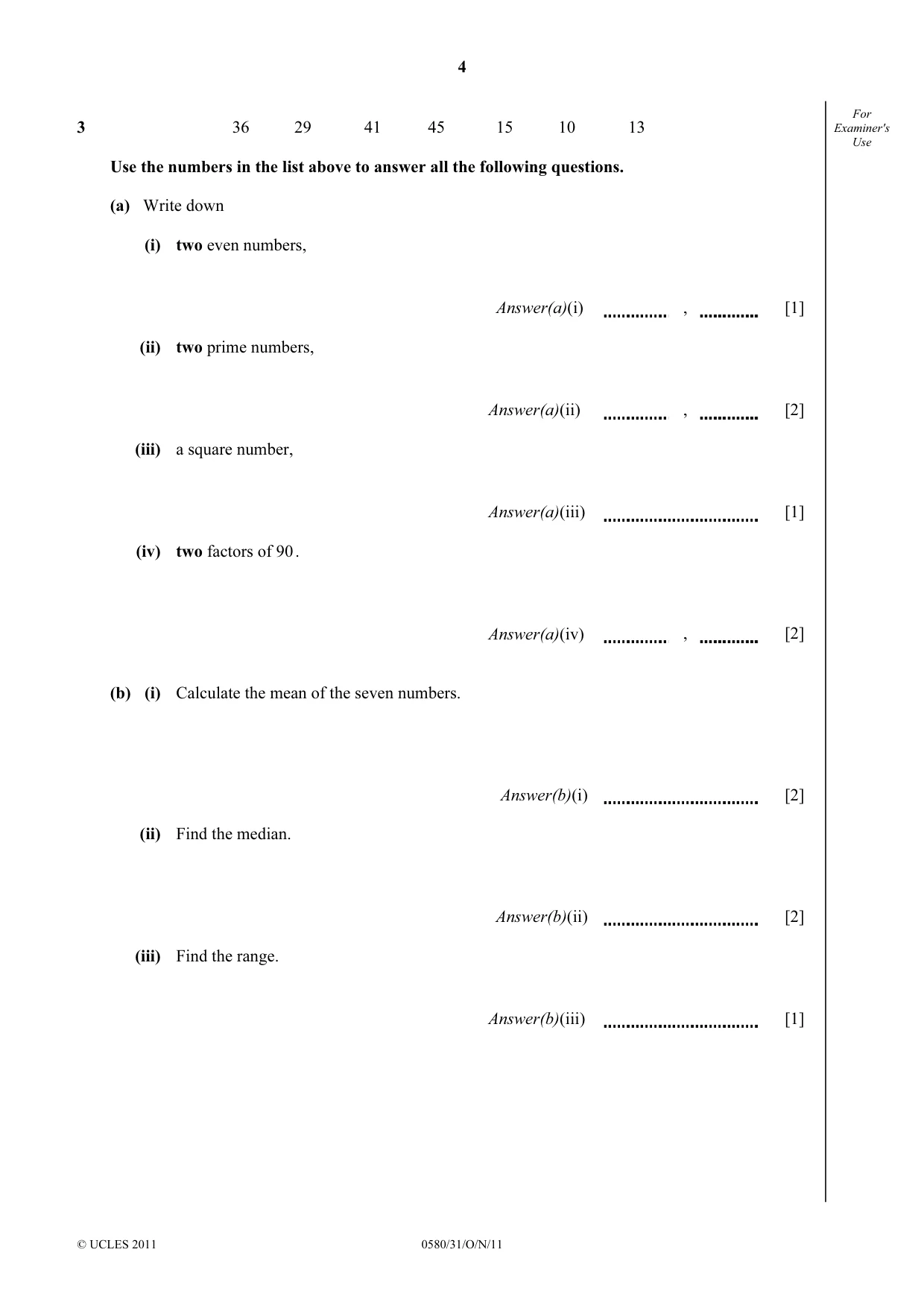
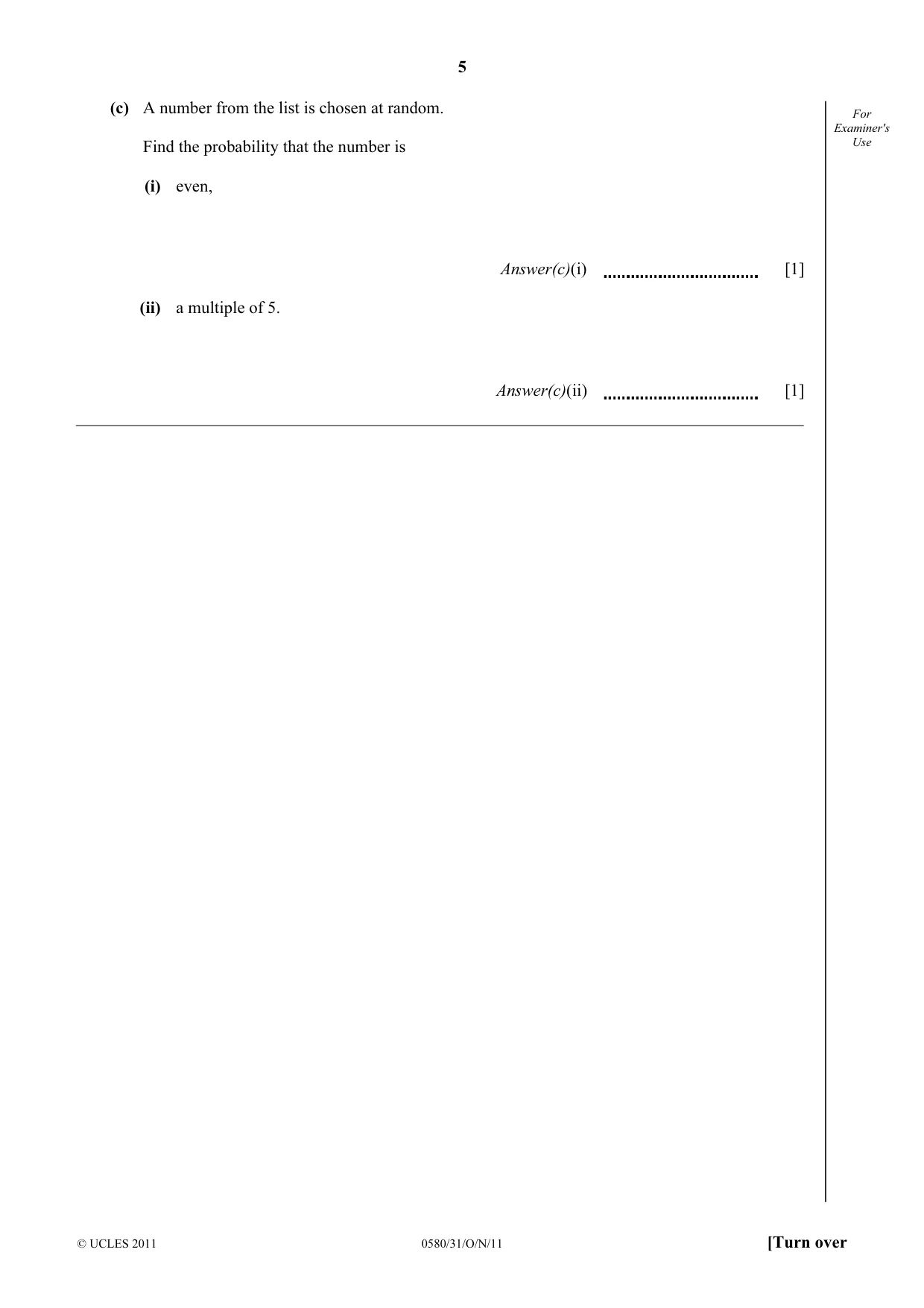
3 36 29 41 45 15 10 13 Examiner's Use Use the numbers in the list above to answer all the following questions. (a) Write down (i) two even numbers, Answer(a)(i) , [1] (ii) two prime numbers, Answer(a)(ii) , [2] (iii) a square number, Answer(a)(iii) [1] (iv) two factors of 90 . Answer(a)(iv) , [2] (b) (i) Calculate the mean of the seven numbers. Answer(b)(i) [2] (ii) Find the median. Answer(b)(ii) [2] (iii) Find the range. Answer(b)(iii) [1] (c) A number from the list is chosen at random. For Examiner's Find the probability that the number is Use (i) even, Answer(c)(i) [1] (ii) a multiple of 5. Answer(c)(ii) [1]
Mark scheme: 3 (a) (i) 36, 10 1 (ii) 29, 41, 13 any two 2 B1 for each (iii) 36 1 (iv) 45, 15, 10 any two 2 B1 for each (b) (i) 27 2 B1 for 36 + 29 + … + 13 seen implied by 189 (ii) 29 2 M1 for attempting to order the numbers (iii) 35 cao 1 2 (c) (i) oe 1 7 3 (ii) oe 1ft Their denominator from (c)(i) 7 IGCSE – October/November 2011 0580 31
Q4 · Using the exchange rates For Examiner's $1 = 0.70 Euros and $1 = 90 Yen Use change (i)…
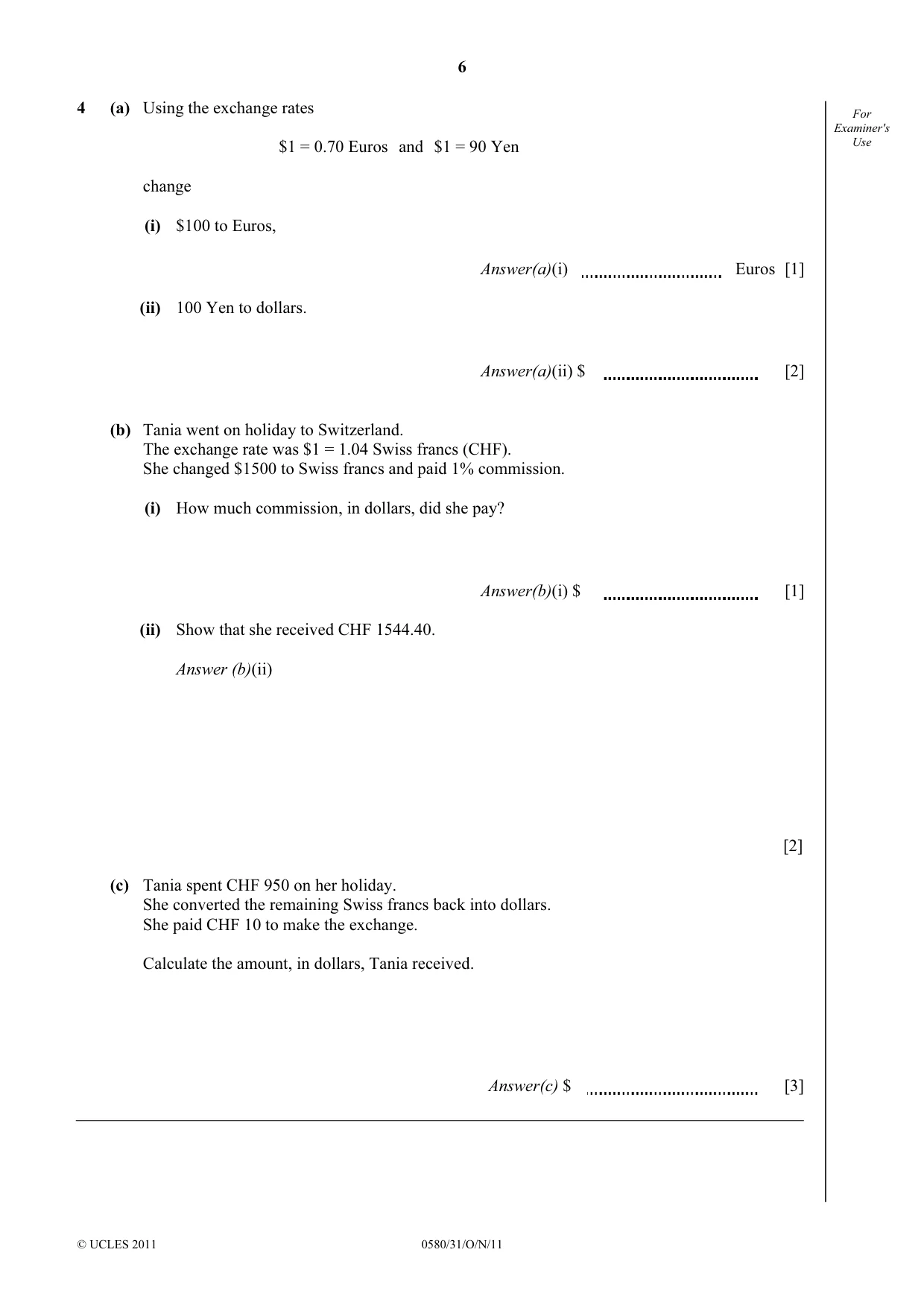
4 (a) Using the exchange rates For Examiner's $1 = 0.70 Euros and $1 = 90 Yen Use change (i) $100 to Euros, Answer(a)(i) Euros [1] (ii) 100 Yen to dollars. Answer(a)(ii) $ [2] (b) Tania went on holiday to Switzerland. The exchange rate was $1 = 1.04 Swiss francs (CHF). She changed $1500 to Swiss francs and paid 1% commission. (i) How much commission, in dollars, did she pay? Answer(b)(i) $ [1] (ii) Show that she received CHF 1544.40. Answer (b)(ii) [2] (c) Tania spent CHF 950 on her holiday. She converted the remaining Swiss francs back into dollars. She paid CHF 10 to make the exchange. Calculate the amount, in dollars, Tania received. Answer(c) $ [3]
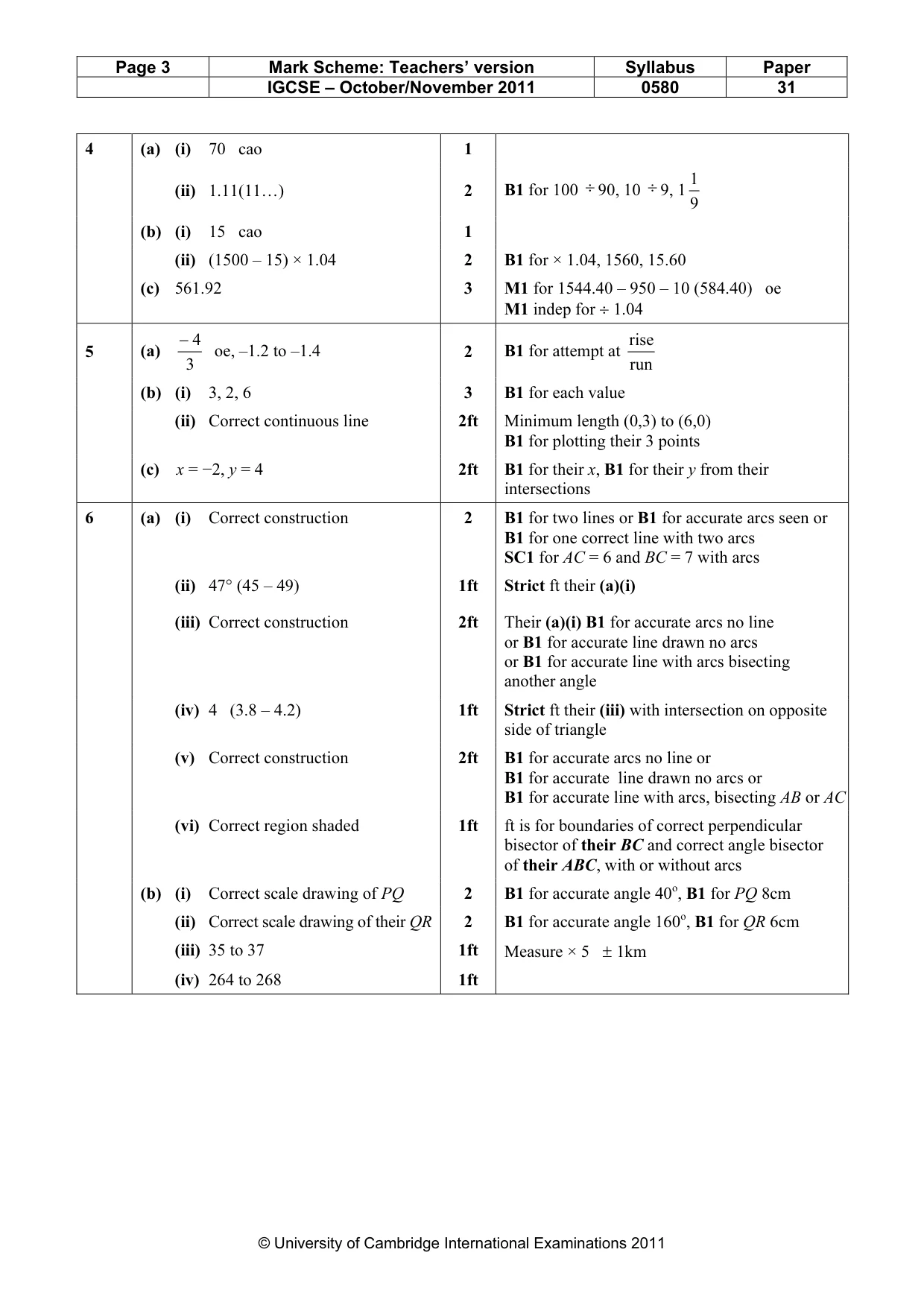
Mark scheme: 4 (a) (i) 70 cao 1 1 (ii) 1.11(11…) 2 B1 for 100 ÷ 90, 10 ÷ 9, 1 9 (b) (i) 15 cao 1 (ii) (1500 – 15) × 1.04 2 B1 for × 1.04, 1560, 15.60 (c) 561.92 3 M1 for 1544.40 – 950 – 10 (584.40) oe M1 indep for ÷ 1.04 4 rise
Q5 · For y Examiner's Use 6 5 4 3 2 1 x –4 –3 –2 –1 0 1 2 3 4 5 6 –1 –2 l –3 (a) Find the…
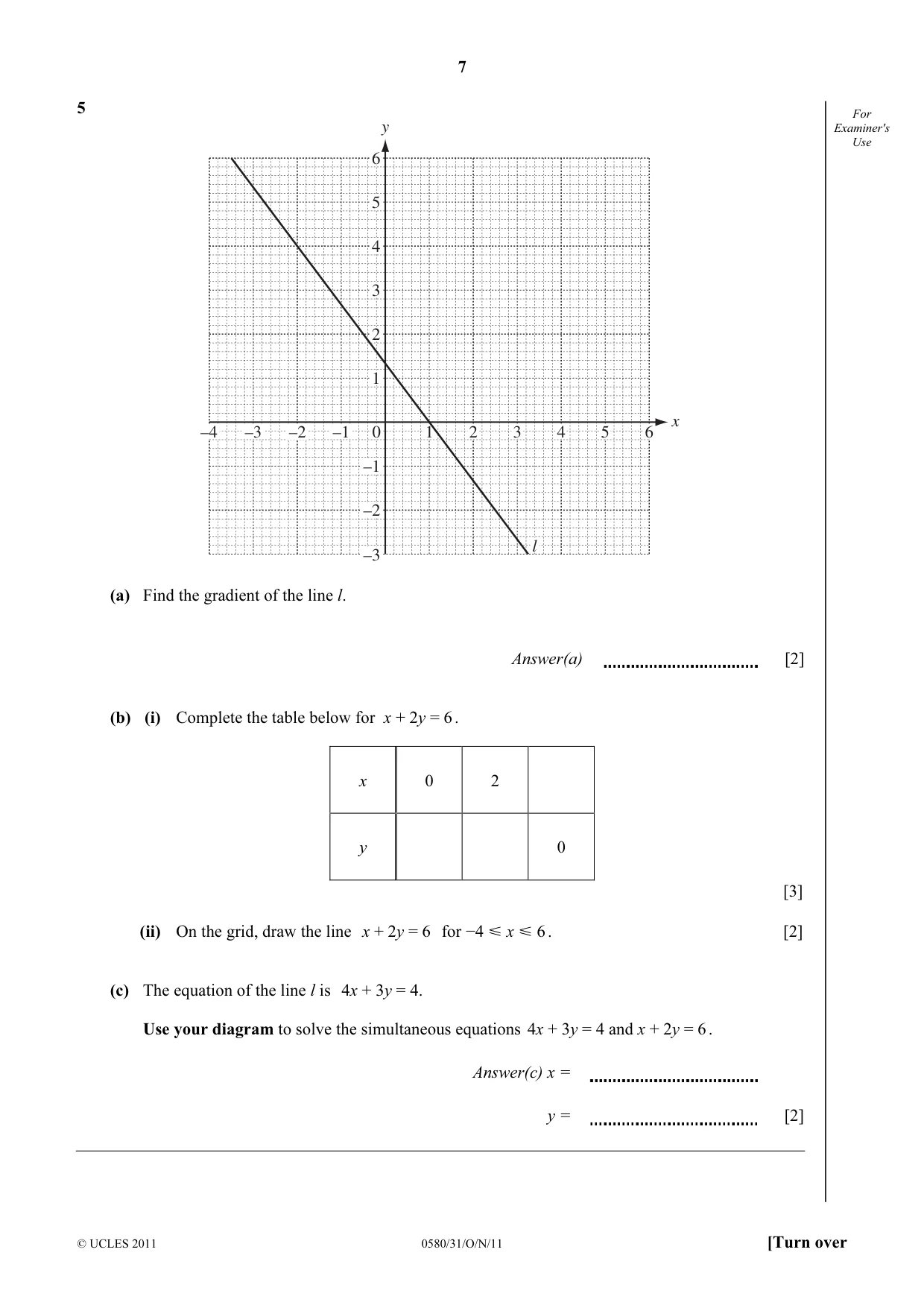
5 For y Examiner's Use 6 5 4 3 2 1 x –4 –3 –2 –1 0 1 2 3 4 5 6 –1 –2 l –3 (a) Find the gradient of the line l. Answer(a) [2] (b) (i) Complete the table below for x + 2y = 6 . x 0 2 y 0 [3] (ii) On the grid, draw the line x + 2y = 6 for −4 Y x Y 6 . [2] (c) The equation of the line l is 4x + 3y = 4. Use your diagram to solve the simultaneous equations 4x + 3y = 4 and x + 2y = 6 . Answer(c) x = y = [2]
Mark scheme: − 4 rise 5 (a) oe, –1.2 to –1.4 2 B1 for attempt at 3 run (b) (i) 3, 2, 6 3 B1 for each value (ii) Correct continuous line 2ft Minimum length (0,3) to (6,0) B1 for plotting their 3 points (c) x = −2, y = 4 2ft B1 for their x, B1 for their y from their intersections
Q6 · For Examiner's Use A B The line AB is drawn above
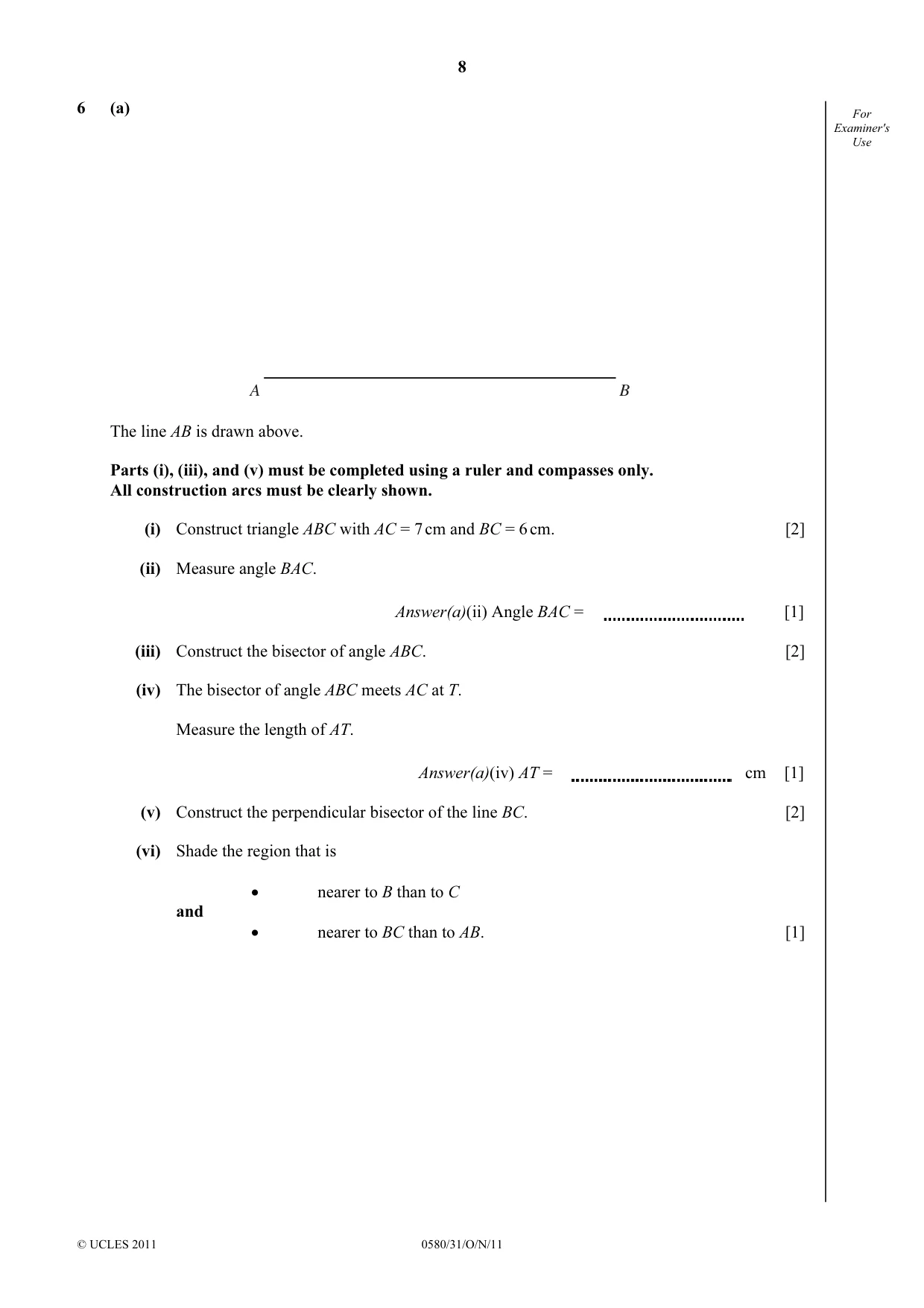
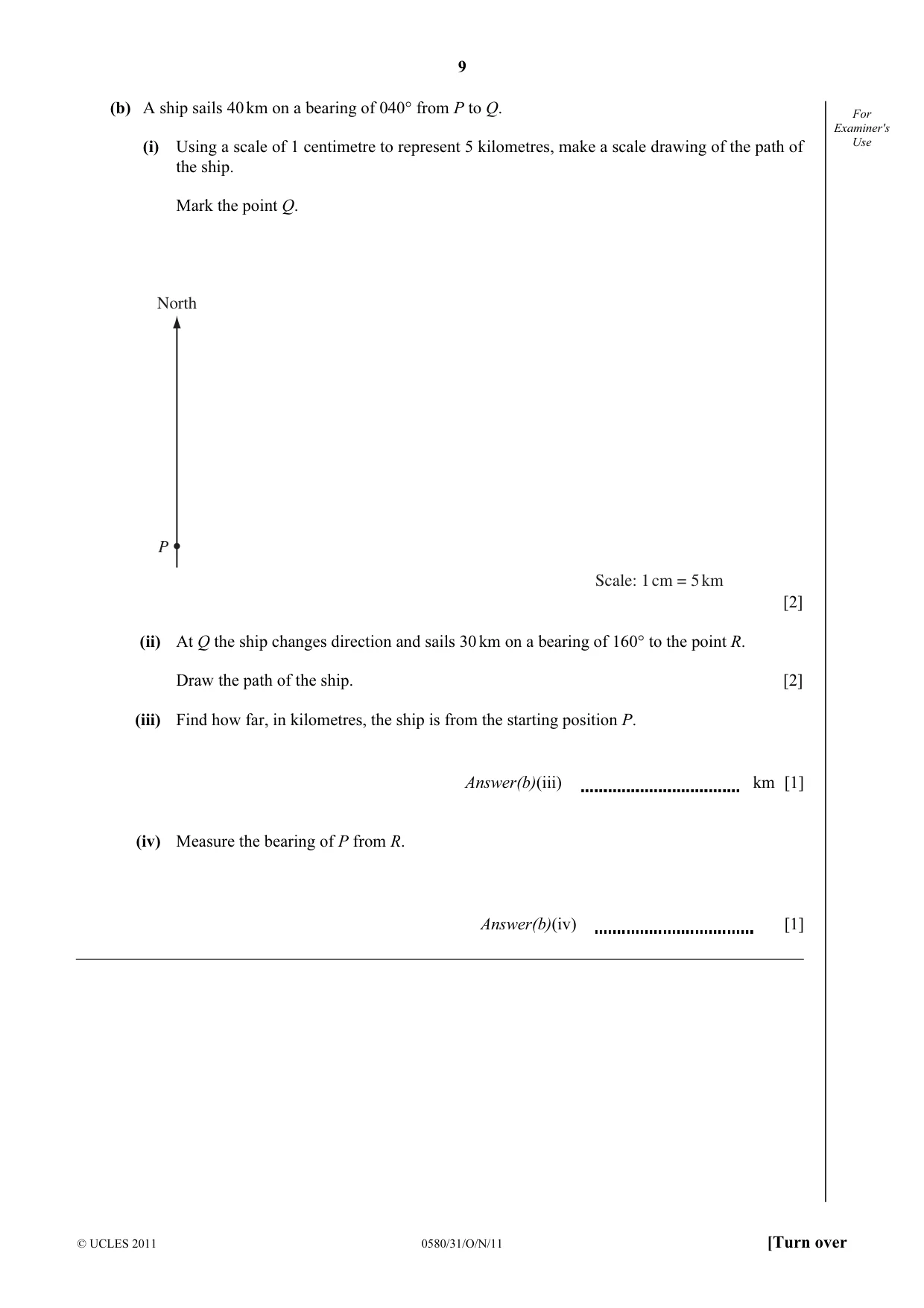
6 (a) For Examiner's Use A B The line AB is drawn above. Parts (i), (iii), and (v) must be completed using a ruler and compasses only. All construction arcs must be clearly shown. (i) Construct triangle ABC with AC = 7 cm and BC = 6 cm. [2] (ii) Measure angle BAC. Answer(a)(ii) Angle BAC = [1] (iii) Construct the bisector of angle ABC. [2] (iv) The bisector of angle ABC meets AC at T. Measure the length of AT. Answer(a)(iv) AT = cm [1] (v) Construct the perpendicular bisector of the line BC. [2] (vi) Shade the region that is • nearer to B than to C and • nearer to BC than to AB. [1] (b) A ship sails 40 km on a bearing of 040° from P to Q. For Examiner's (i) Using a scale of 1 centimetre to represent 5 kilometres, make a scale drawing of the path of Use the ship. Mark the point Q. North P Scale: 1 cm = 5 km [2] (ii) At Q the ship changes direction and sails 30 km on a bearing of 160° to the point R. Draw the path of the ship. [2] (iii) Find how far, in kilometres, the ship is from the starting position P. Answer(b)(iii) km [1] (iv) Measure the bearing of P from R. Answer(b)(iv) [1]
Mark scheme: 6 (a) (i) Correct construction 2 B1 for two lines or B1 for accurate arcs seen or B1 for one correct line with two arcs SC1 for AC = 6 and BC = 7 with arcs (ii) 47° (45 – 49) 1ft Strict ft their (a)(i) (iii) Correct construction 2ft Their (a)(i) B1 for accurate arcs no line or B1 for accurate line drawn no arcs or B1 for accurate line with arcs bisecting another angle (iv) 4 (3.8 – 4.2) 1ft Strict ft their (iii) with intersection on opposite side of triangle (v) Correct construction 2ft B1 for accurate arcs no line or B1 for accurate line drawn no arcs or B1 for accurate line with arcs, bisecting AB or AC (vi) Correct region shaded 1ft ft is for boundaries of correct perpendicular bisector of their BC and correct angle bisector of their ABC, with or without arcs (b) (i) Correct scale drawing of PQ 2 B1 for accurate angle 40o, B1 for PQ 8cm (ii) Correct scale drawing of their QR 2 B1 for accurate angle 160o, B1 for QR 6cm (iii) 35 to 37 1ft Measure × 5 ± 1km (iv) 264 to 268 1ft IGCSE – October/November 2011 0580 31
Q7 · Solve the equation 2(x + 4) = 3(x + 2) + 8
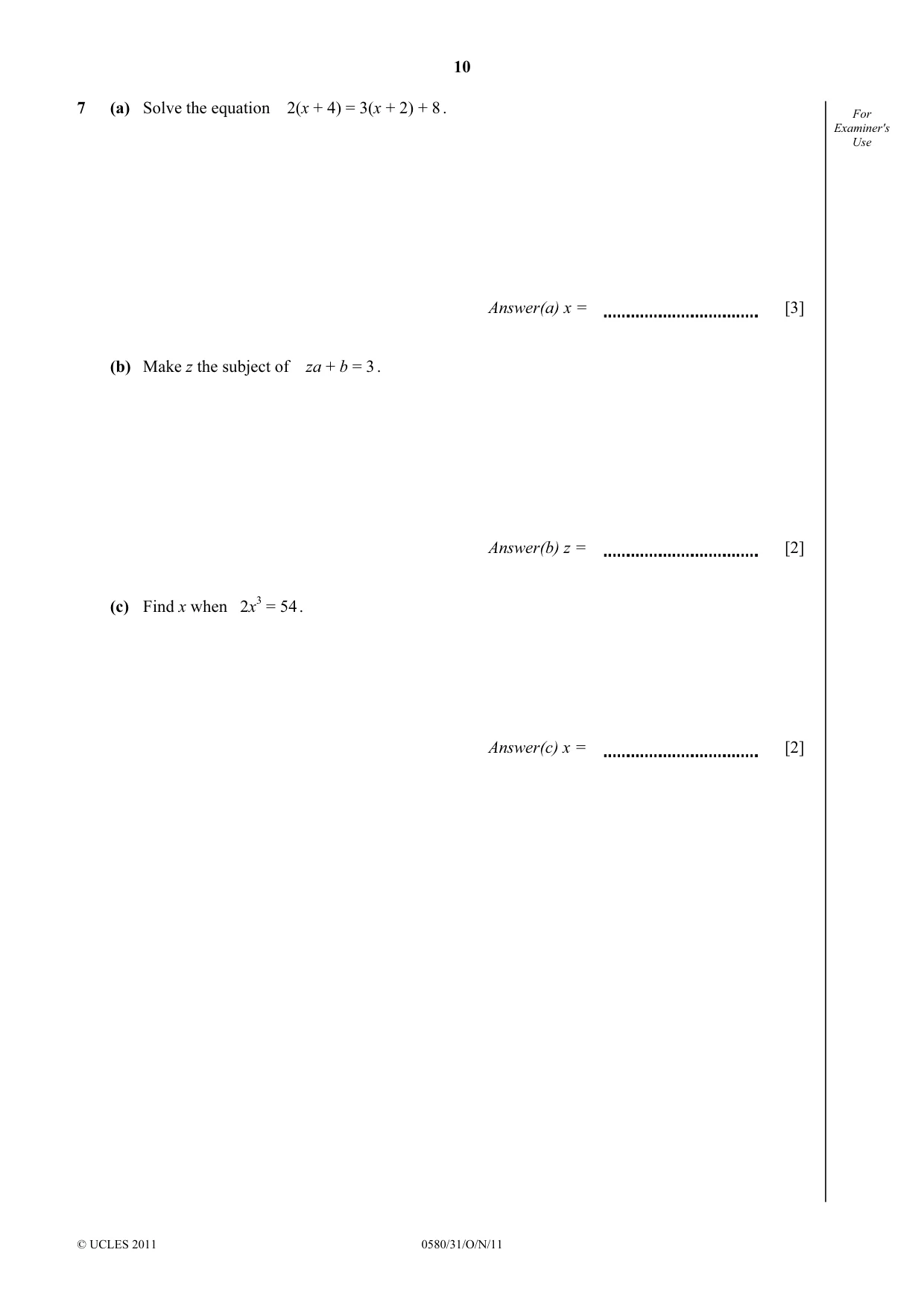
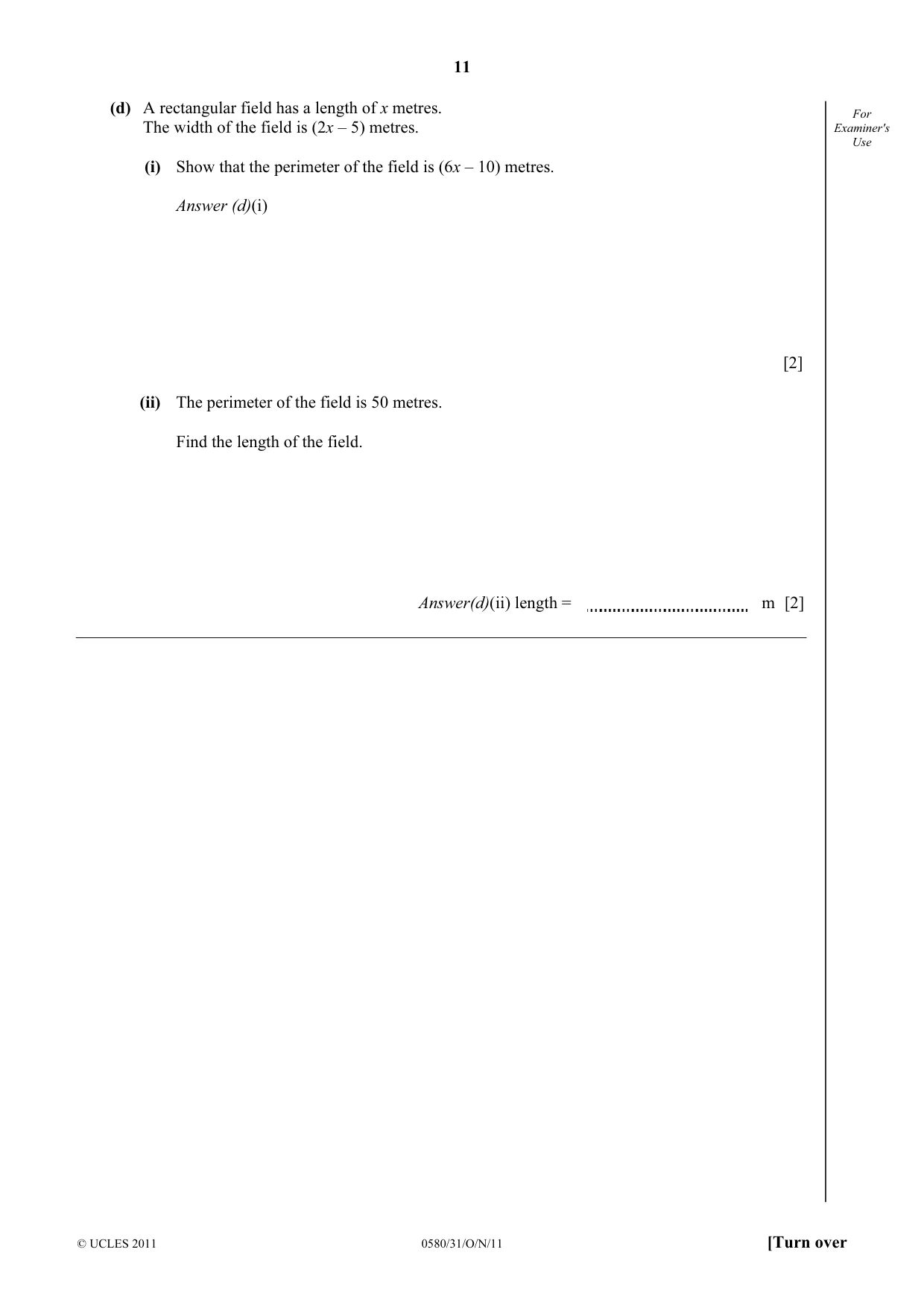
7 (a) Solve the equation 2(x + 4) = 3(x + 2) + 8 . For Examiner's Use Answer(a) x = [3] (b) Make z the subject of za + b = 3 . Answer(b) z = [2] (c) Find x when 2x3 = 54 . Answer(c) x = [2] (d) A rectangular field has a length of x metres. For The width of the field is (2x – 5) metres. Examiner's Use (i) Show that the perimeter of the field is (6x – 10) metres. Answer (d)(i) [2] (ii) The perimeter of the field is 50 metres. Find the length of the field. Answer(d)(ii) length = m [2]
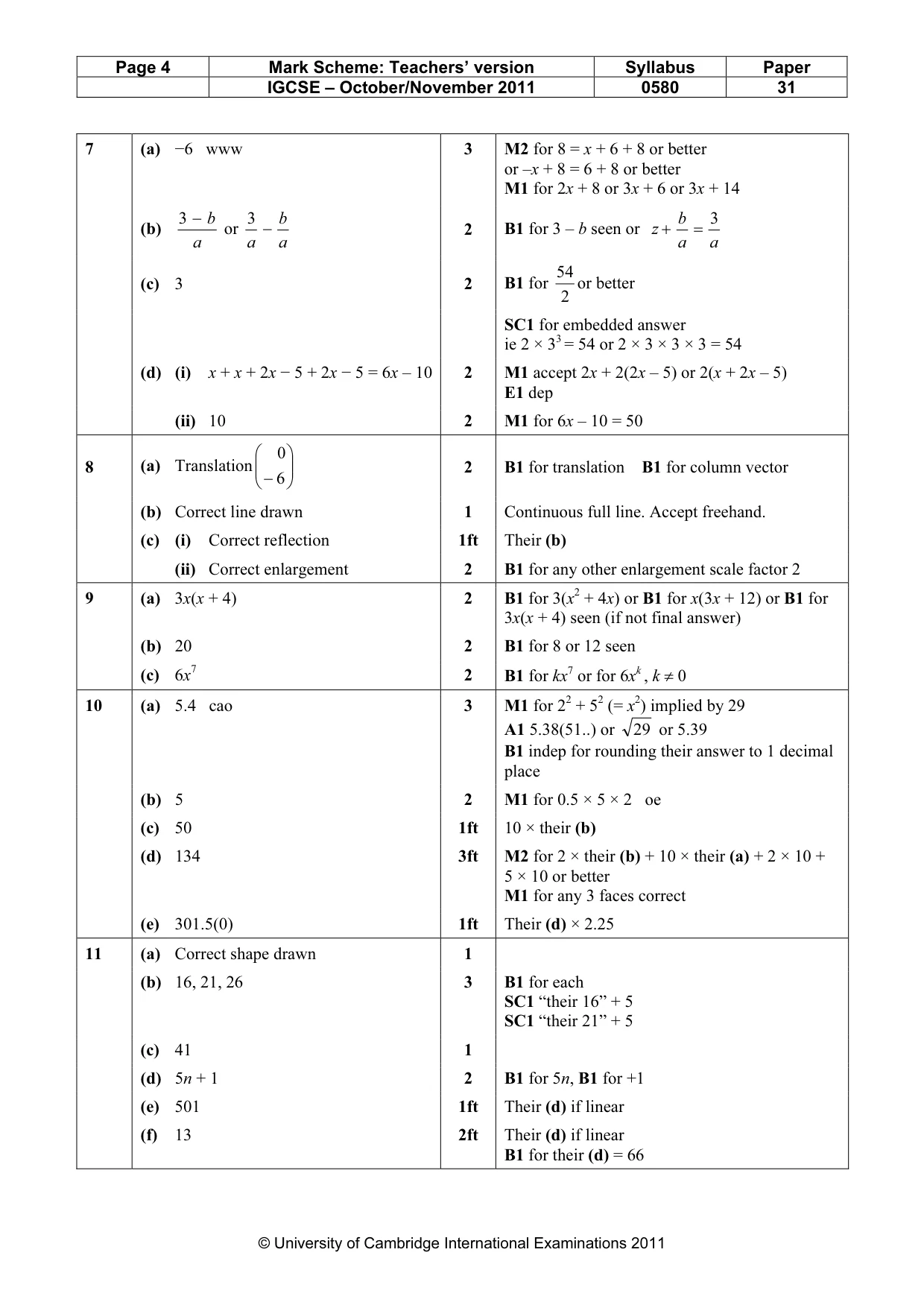
Mark scheme: 7 (a) −6 www 3 M2 for 8 = x + 6 + 8 or better or –x + 8 = 6 + 8 or better M1 for 2x + 8 or 3x + 6 or 3x + 14 3 − b 3 b b 3 (b) or − 2 B1 for 3 – b seen or z + = a a a a a 54 (c) 3 2 B1 for or better 2 SC1 for embedded answer ie 2 × 33 = 54 or 2 × 3 × 3 × 3 = 54 (d) (i) x + x + 2x − 5 + 2x − 5 = 6x – 10 2 M1 accept 2x + 2(2x – 5) or 2(x + 2x – 5) E1 dep (ii) 10 2 M1 for 6x – 10 = 50 0
Q8 · For y Examiner's Use 6 5 4 3 A 2 1 x –6 –5 –4 –3 –2 –1 0 1 2 3 4 5 6 –1 –2 –3 B –4 –5 –6…
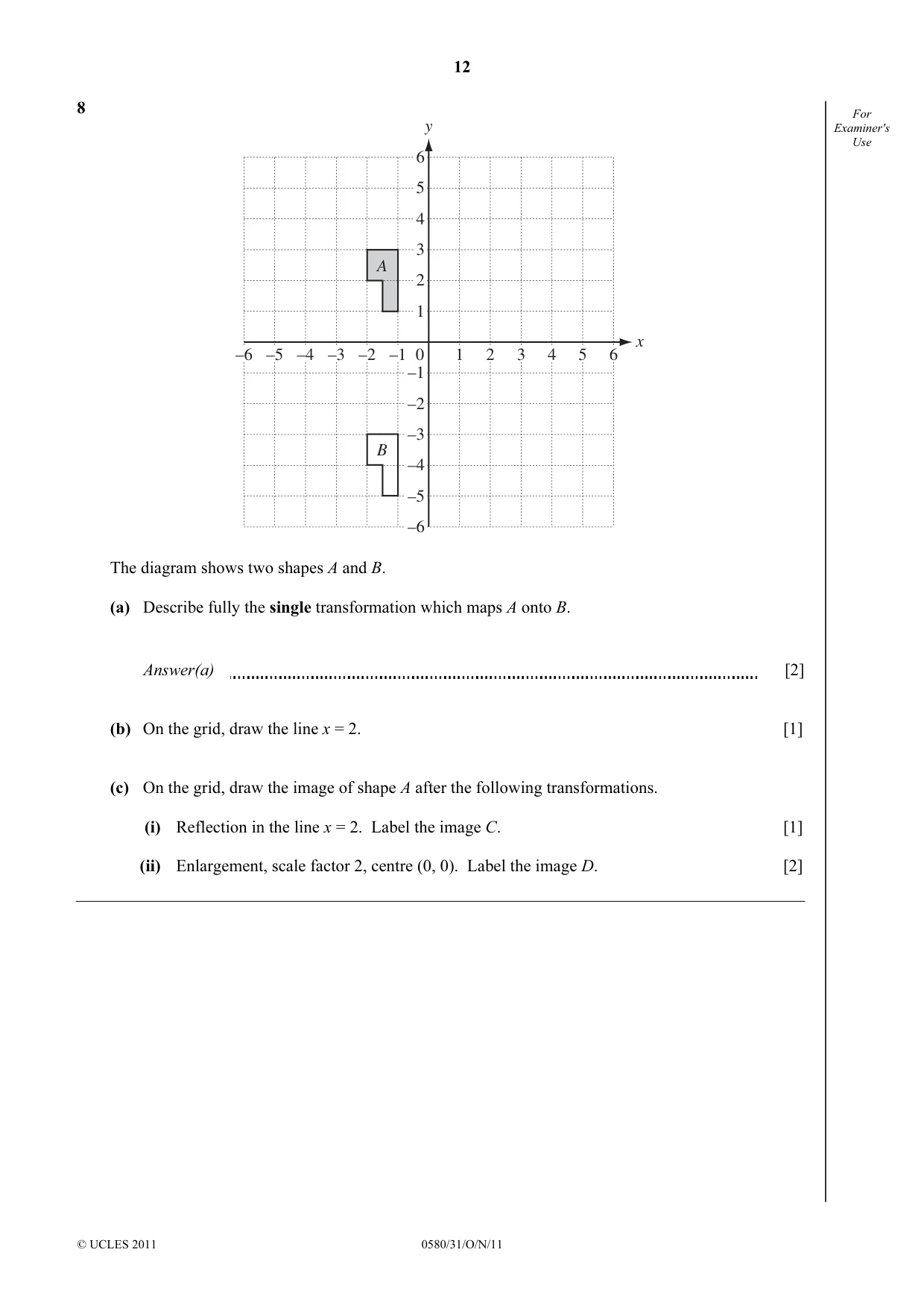
8 For y Examiner's Use 6 5 4 3 A 2 1 x –6 –5 –4 –3 –2 –1 0 1 2 3 4 5 6 –1 –2 –3 B –4 –5 –6 The diagram shows two shapes A and B. (a) Describe fully the single transformation which maps A onto B. Answer(a) [2] (b) On the grid, draw the line x = 2. [1] (c) On the grid, draw the image of shape A after the following transformations. (i) Reflection in the line x = 2. Label the image C. [1] (ii) Enlargement, scale factor 2, centre (0, 0). Label the image D. [2]
Mark scheme: 0 8 (a) Translation 2 B1 for translation B1 for column vector −6 (b) Correct line drawn 1 Continuous full line. Accept freehand. (c) (i) Correct reflection 1ft Their (b) (ii) Correct enlargement 2 B1 for any other enlargement scale factor 2
Q9 · Factorise completely 3x2 + 12x
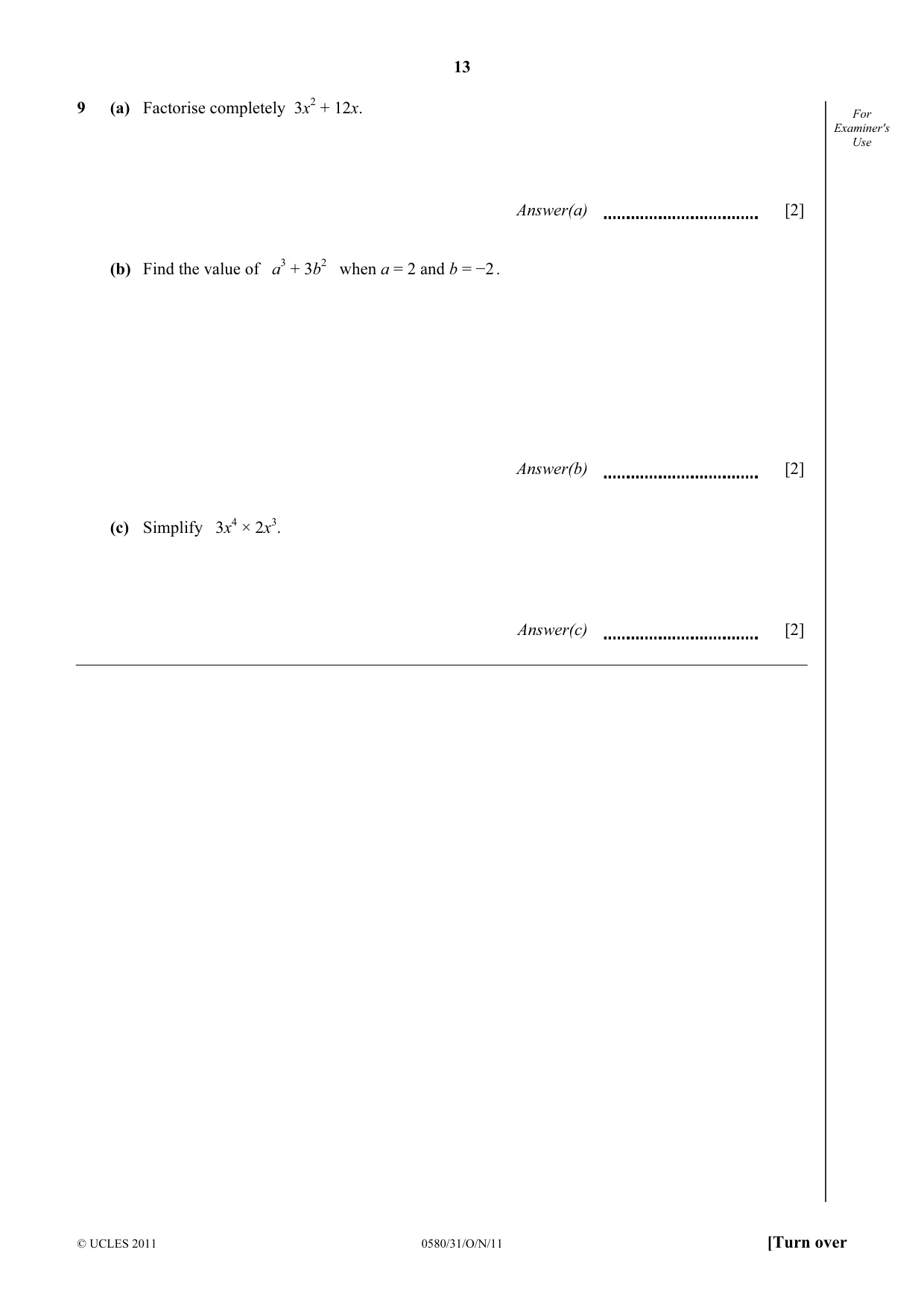
9 (a) Factorise completely 3x2 + 12x. For Examiner's Use Answer(a) [2] (b) Find the value of a3 + 3b2 when a = 2 and b = −2 . Answer(b) [2] (c) Simplify 3x4 × 2x3. Answer(c) [2]
Mark scheme: 9 (a) 3x(x + 4) 2 B1 for 3(x2 + 4x) or B1 for x(3x + 12) or B1 for 3x(x + 4) seen (if not final answer) (b) 20 2 B1 for 8 or 12 seen (c) 6x7 2 B1 for kx7 or for 6xk , k ≠ 0
Q10 · For Examiner's Use x m 2 m 10 m NOT TO SCALE 5 m The diagram shows a ramp in the form of…
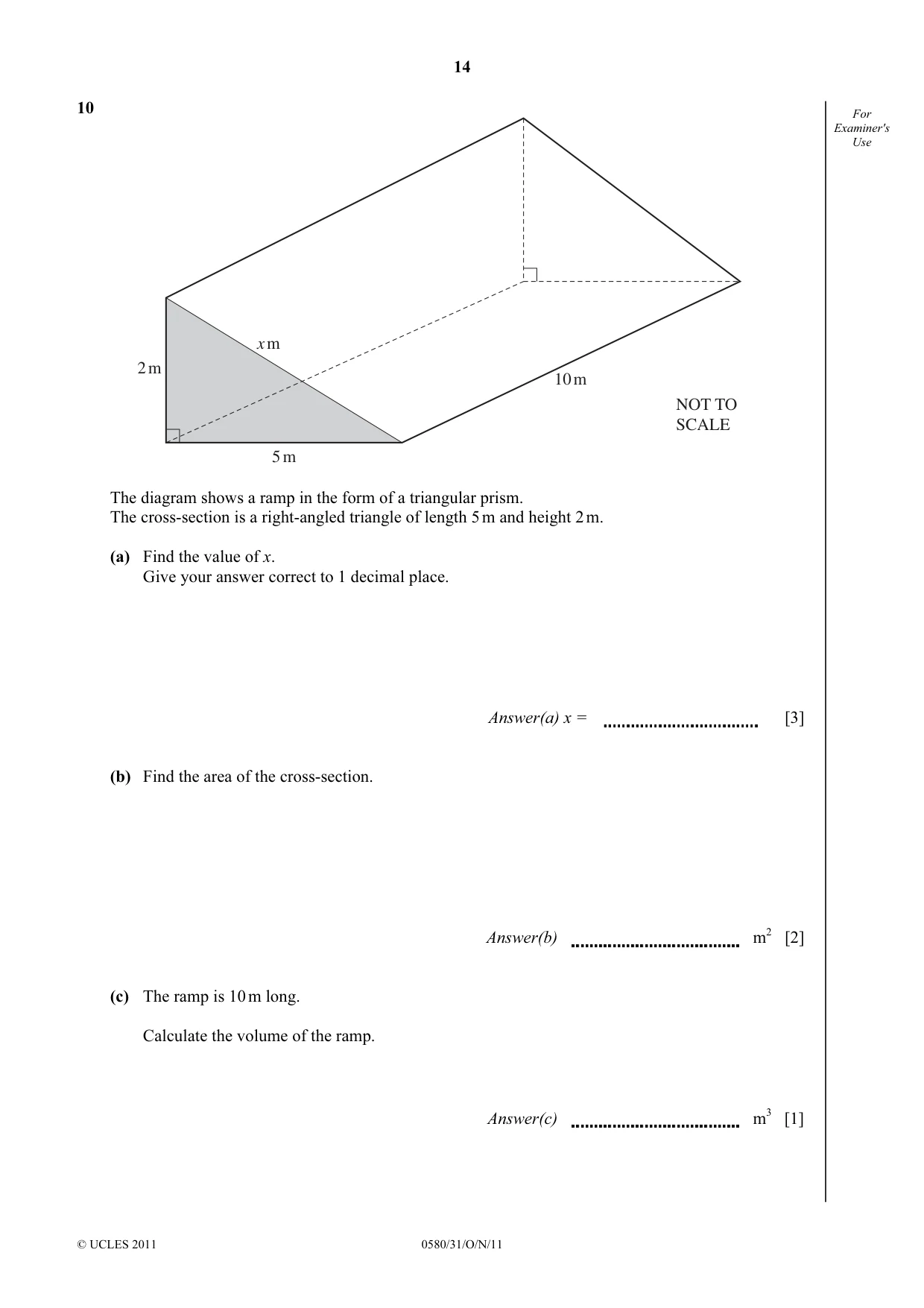
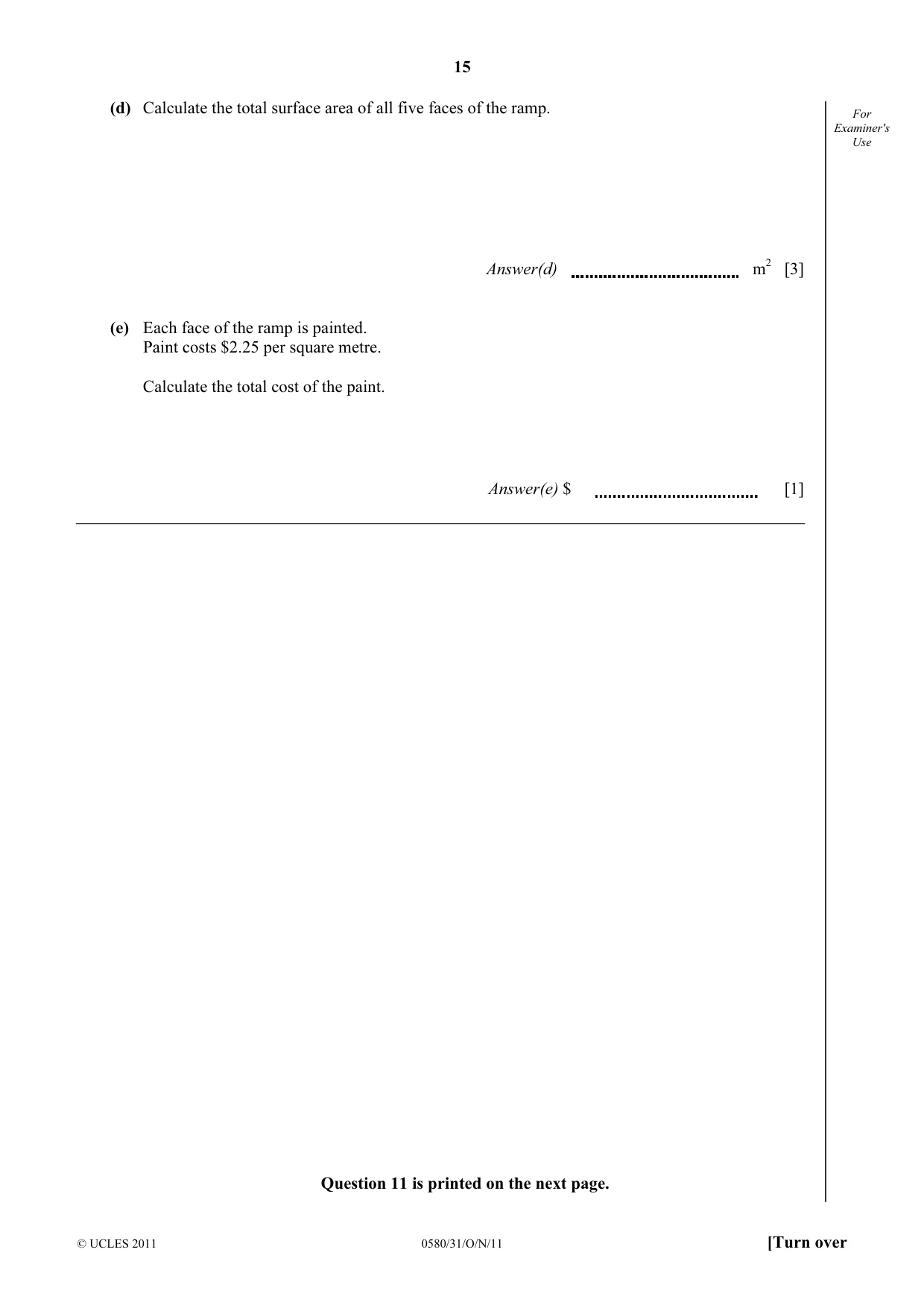
10 For Examiner's Use x m 2 m 10 m NOT TO SCALE 5 m The diagram shows a ramp in the form of a triangular prism. The cross-section is a right-angled triangle of length 5 m and height 2 m. (a) Find the value of x. Give your answer correct to 1 decimal place. Answer(a) x = [3] (b) Find the area of the cross-section. Answer(b) m2 [2] (c) The ramp is 10 m long. Calculate the volume of the ramp. Answer(c) m3 [1] (d) Calculate the total surface area of all five faces of the ramp. For Examiner's Use Answer(d) m2 [3] (e) Each face of the ramp is painted. Paint costs $2.25 per square metre. Calculate the total cost of the paint. Answer(e) $ [1] Question 11 is printed on the next page.
Mark scheme: 10 (a) 5.4 cao 3 M1 for 22 + 52 (= x2) implied by 29 A1 5.38(51..) or 29 or 5.39 B1 indep for rounding their answer to 1 decimal place (b) 5 2 M1 for 0.5 × 5 × 2 oe (c) 50 1ft 10 × their (b) (d) 134 3ft M2 for 2 × their (b) + 10 × their (a) + 2 × 10 + 5 × 10 or better M1 for any 3 faces correct (e) 301.5(0) 1ft Their (d) × 2.25
Q11 · For Examiner's Use Diagram 1 Diagram 2 Diagram 3 The diagrams show a sequence of shapes
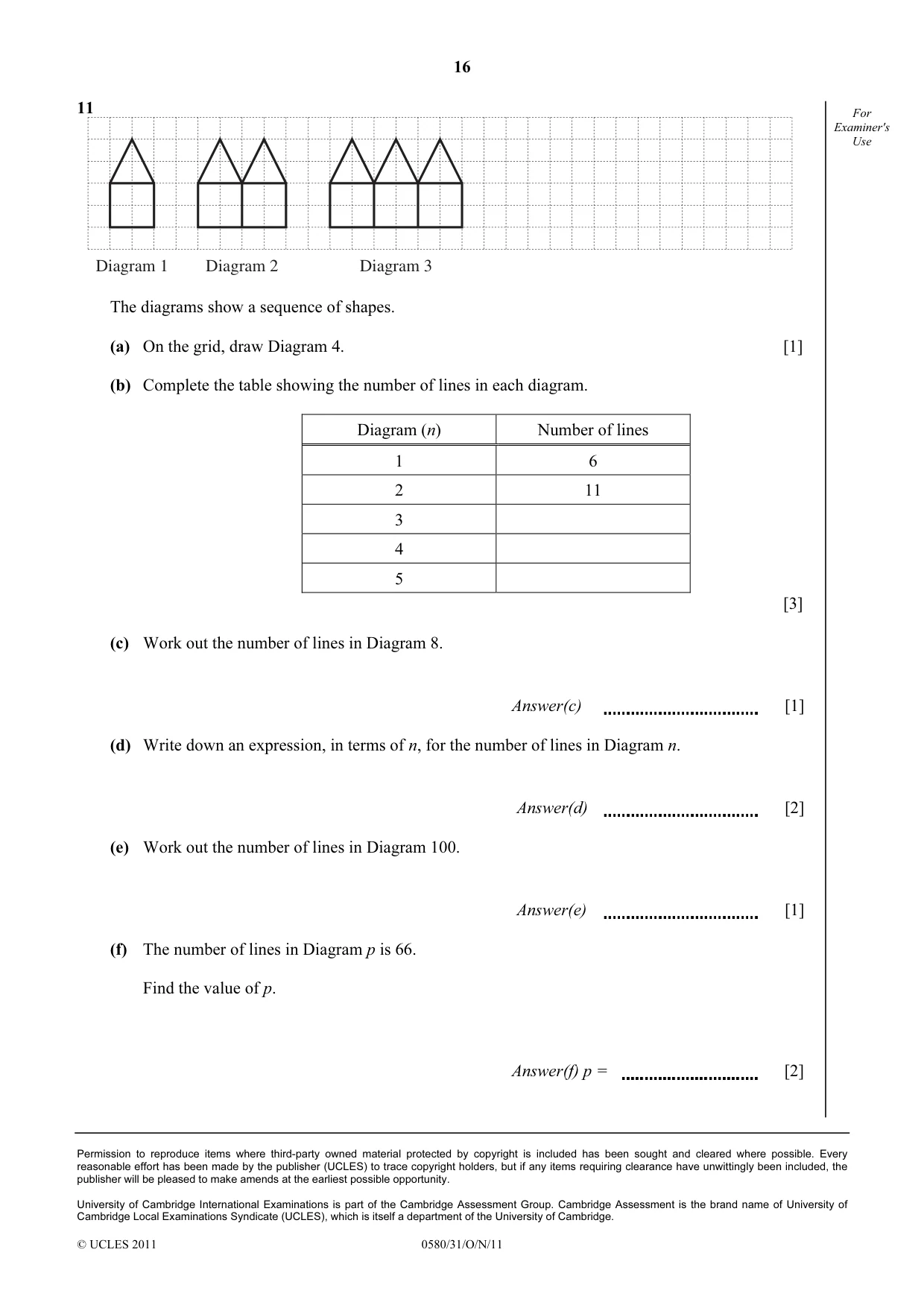
11 For Examiner's Use Diagram 1 Diagram 2 Diagram 3 The diagrams show a sequence of shapes. (a) On the grid, draw Diagram 4. [1] (b) Complete the table showing the number of lines in each diagram. Diagram (n) Number of lines 1 6 2 11 3 4 5 [3] (c) Work out the number of lines in Diagram 8. Answer(c) [1] (d) Write down an expression, in terms of n, for the number of lines in Diagram n. Answer(d) [2] (e) Work out the number of lines in Diagram 100. Answer(e) [1] (f) The number of lines in Diagram p is 66. Find the value of p. Answer(f) p = [2]
Mark scheme: 11 (a) Correct shape drawn 1 (b) 16, 21, 26 3 B1 for each SC1 “their 16” + 5 SC1 “their 21” + 5 (c) 41 1 (d) 5n + 1 2 B1 for 5n, B1 for +1 (e) 501 1ft Their (d) if linear (f) 13 2ft Their (d) if linear B1 for their (d) = 66
What was in this paper
The subtopics covered by these 11 questions, and how many questions each got. Open one in a new tab to see every Cambridge question on it.
What you needed in this session
Cambridge’s own grade thresholds for 2011 Oct/Nov, Paper 3 · Variant 1. A higher threshold means an easier paper — the bar moves with how the cohort did.