Cambridge IGCSE Mathematics 0580 — 2011 May/June Paper 3 · Variant 2
0580/32/M/J/11 · 6 questions · 104 marks · ≈117 min
The question paper and its mark scheme, free to read here and free to download. This is Cambridge’s own paper, exactly as it was sat.
Question paper16 pages
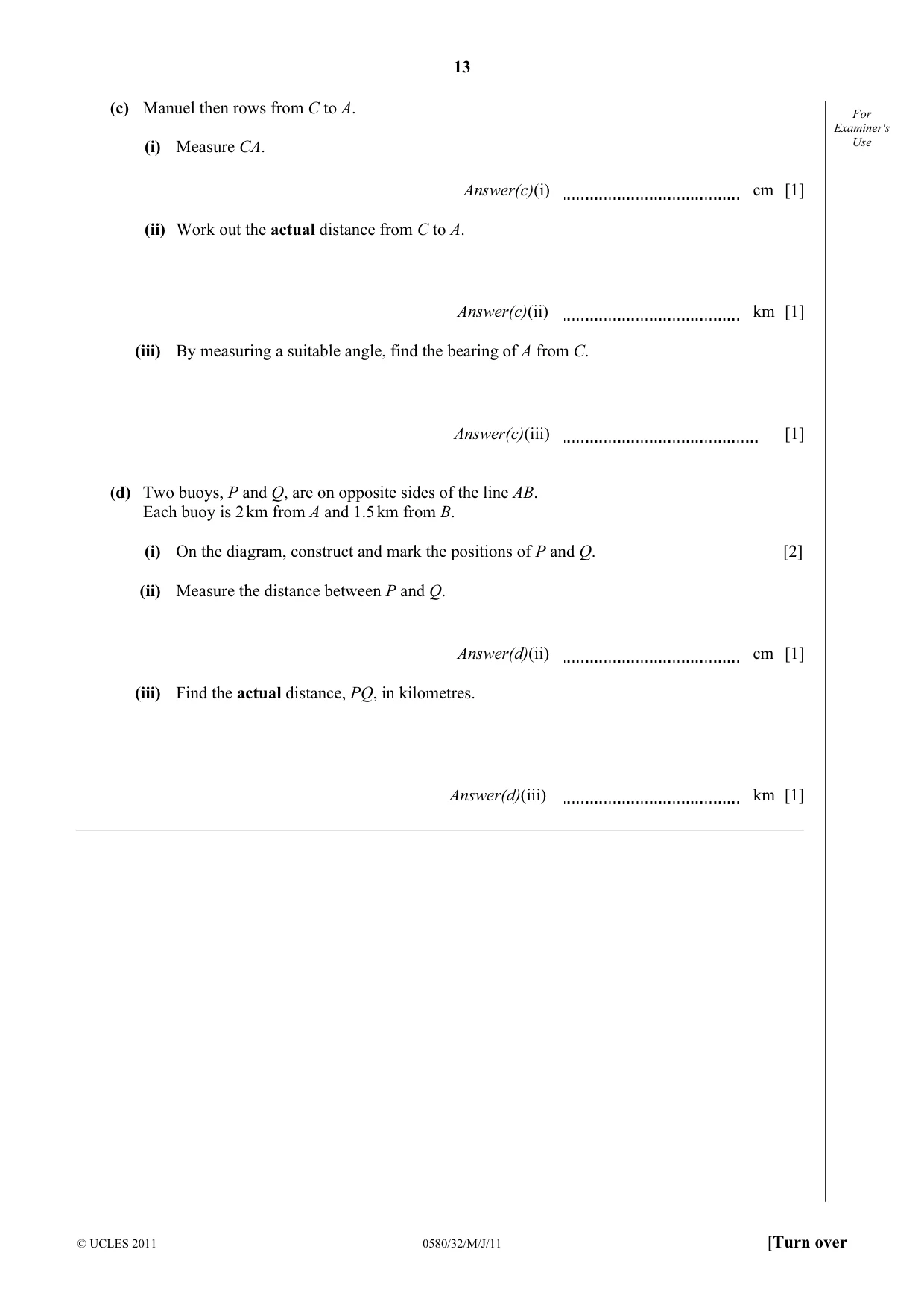
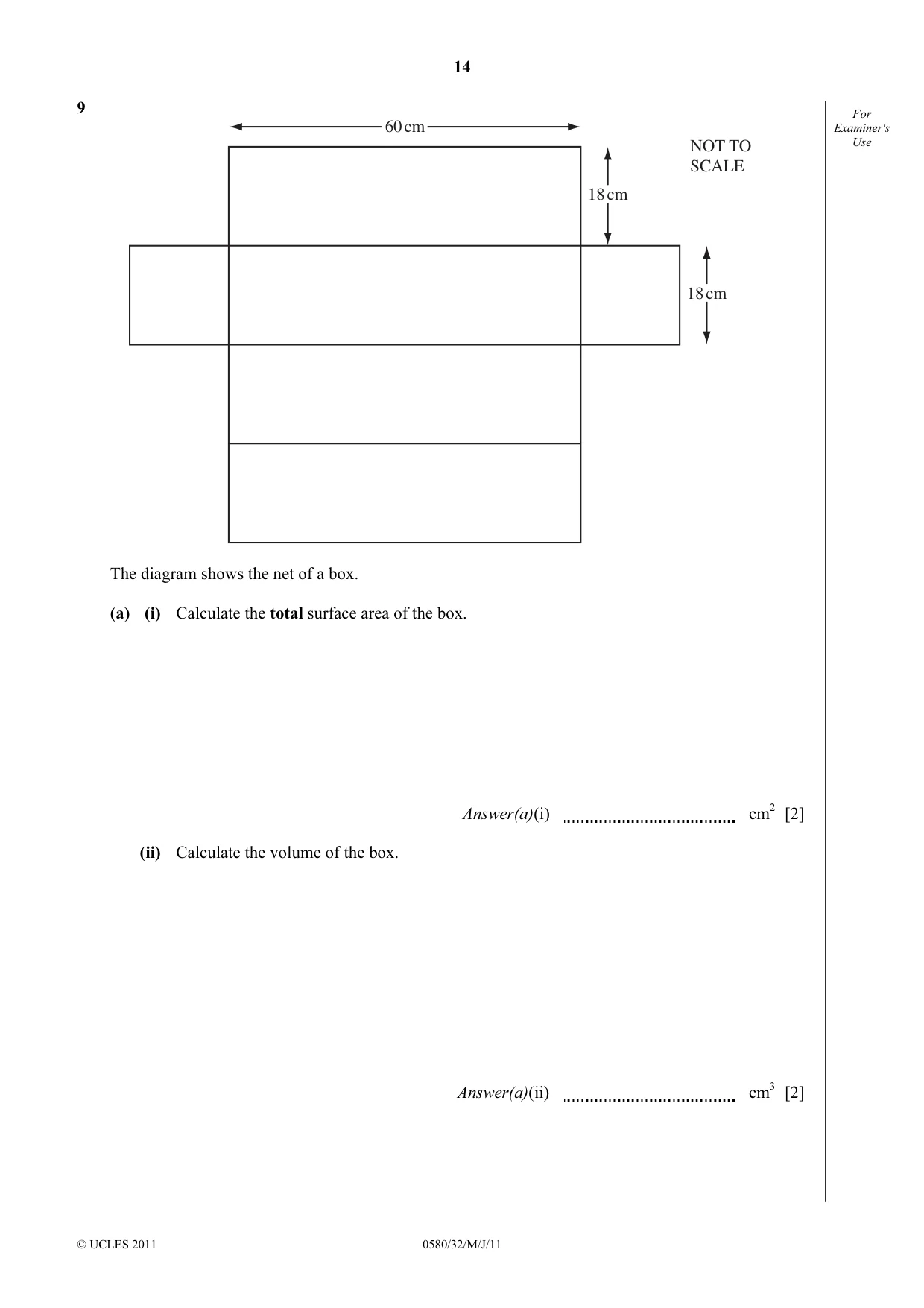
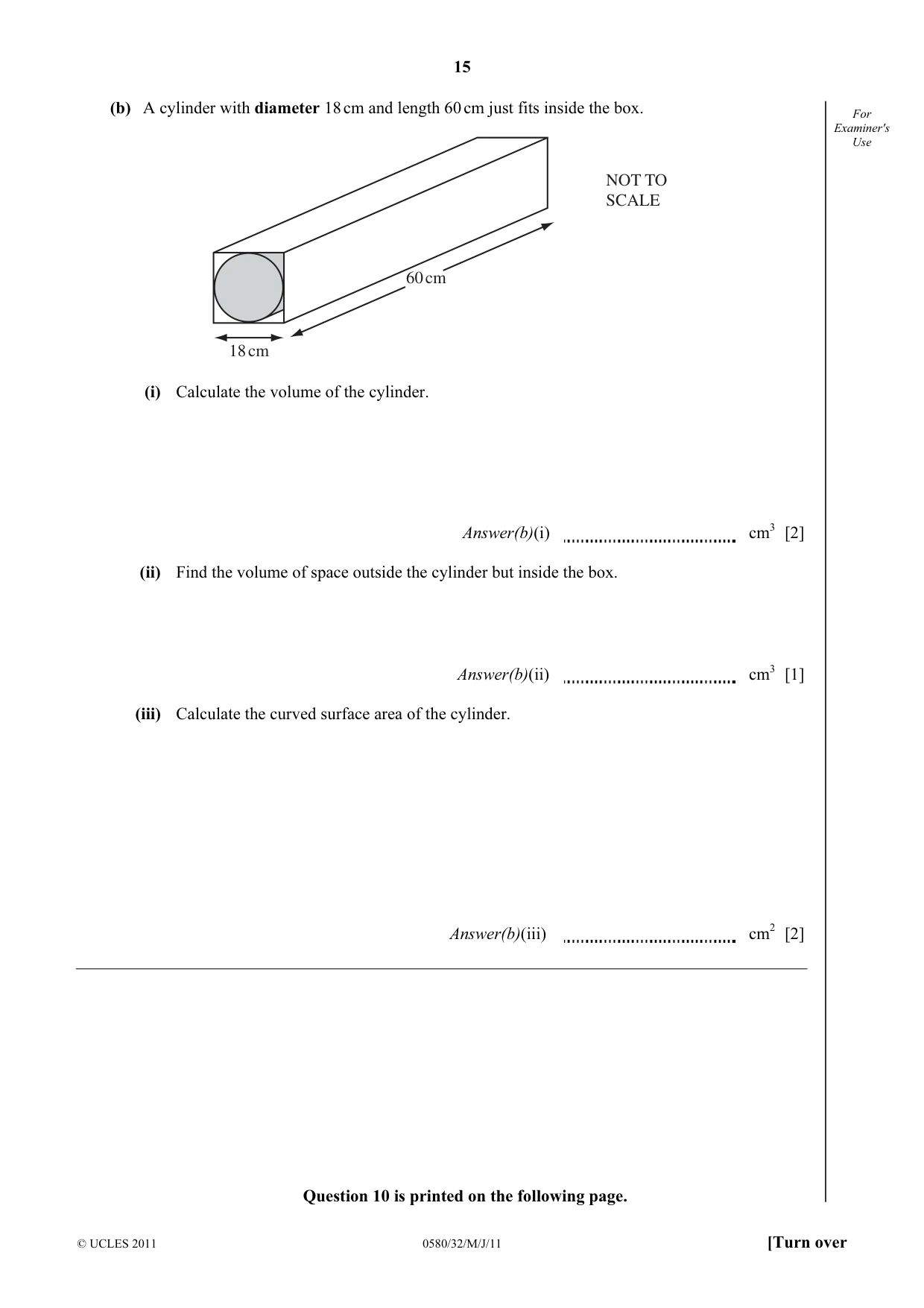
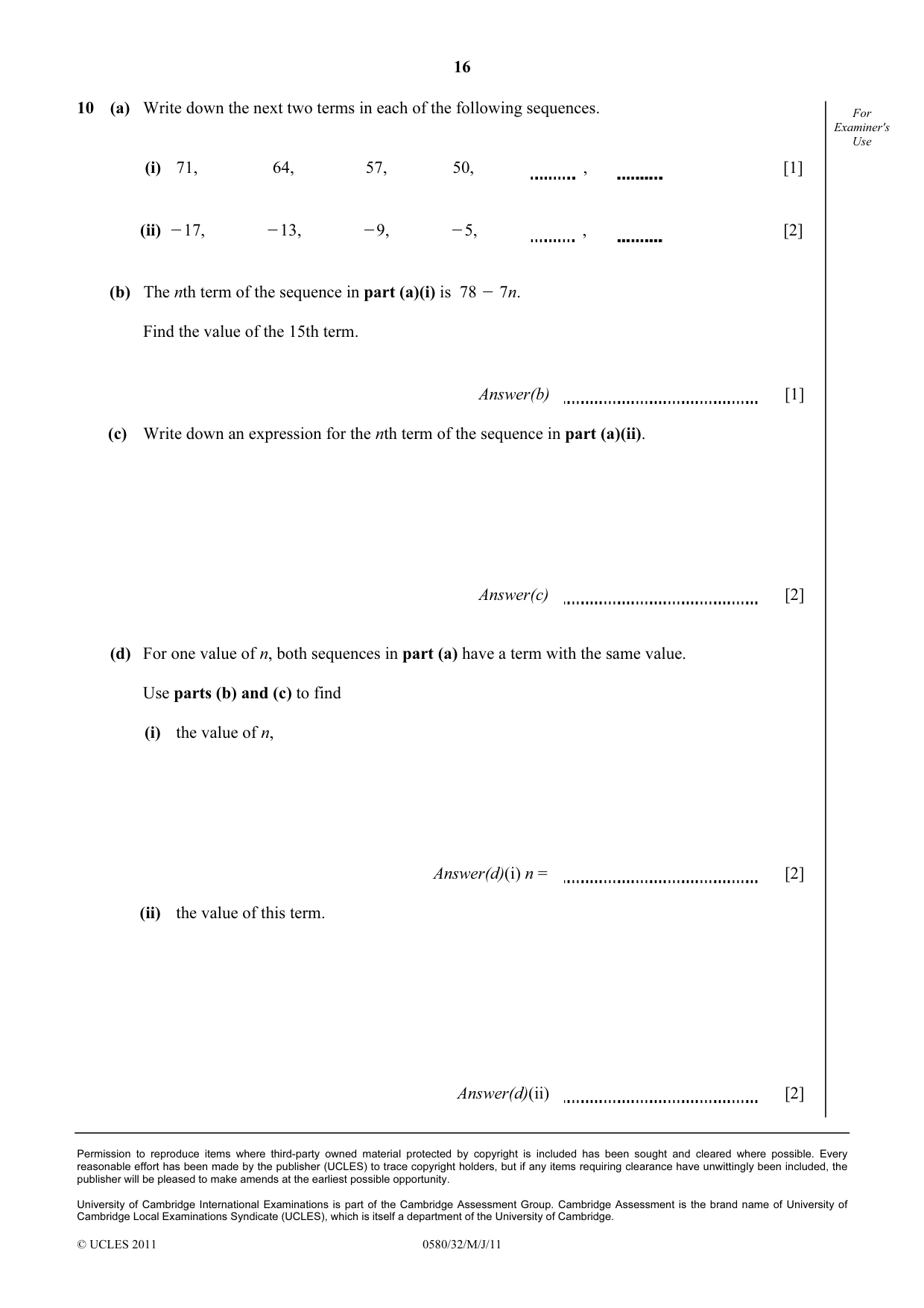
Mark scheme5 pages
Answers below. Sit the paper first if you are practising.
Questions as text
Q1 · Falla buys 3000 square metres of land for a house and garden
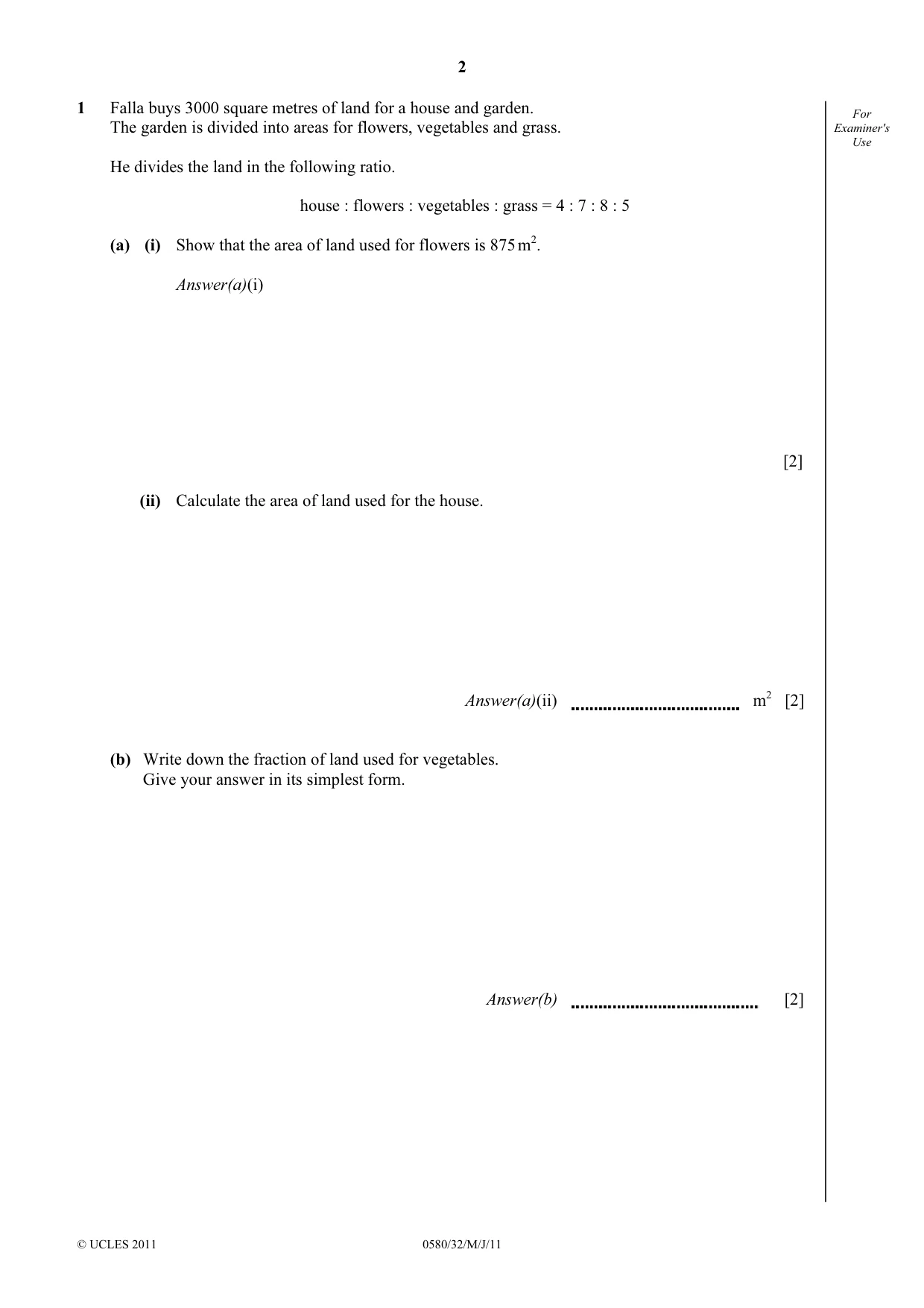
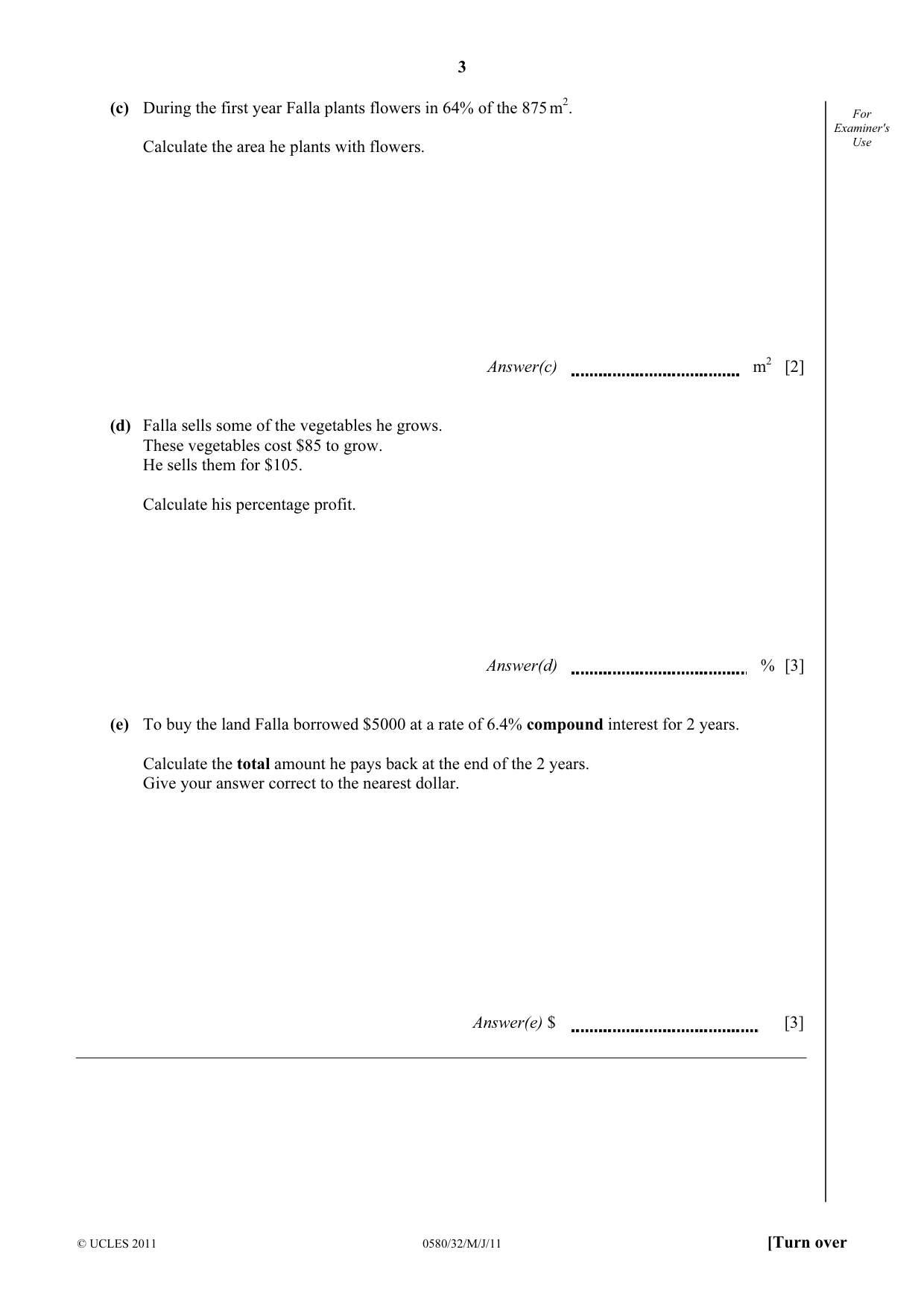
1 Falla buys 3000 square metres of land for a house and garden. For The garden is divided into areas for flowers, vegetables and grass. Examiner's Use He divides the land in the following ratio. house : flowers : vegetables : grass = 4 : 7 : 8 : 5 (a) (i) Show that the area of land used for flowers is 875 m2. Answer(a)(i) [2] (ii) Calculate the area of land used for the house. Answer(a)(ii) m2 [2] (b) Write down the fraction of land used for vegetables. Give your answer in its simplest form. Answer(b) [2] (c) During the first year Falla plants flowers in 64% of the 875 m2. For Examiner's Calculate the area he plants with flowers. Use Answer(c) m2 [2] (d) Falla sells some of the vegetables he grows. These vegetables cost $85 to grow. He sells them for $105. Calculate his percentage profit. Answer(d) % [3] (e) To buy the land Falla borrowed $5000 at a rate of 6.4% compound interest for 2 years. Calculate the total amount he pays back at the end of the 2 years. Give your answer correct to the nearest dollar. Answer(e) $ [3]
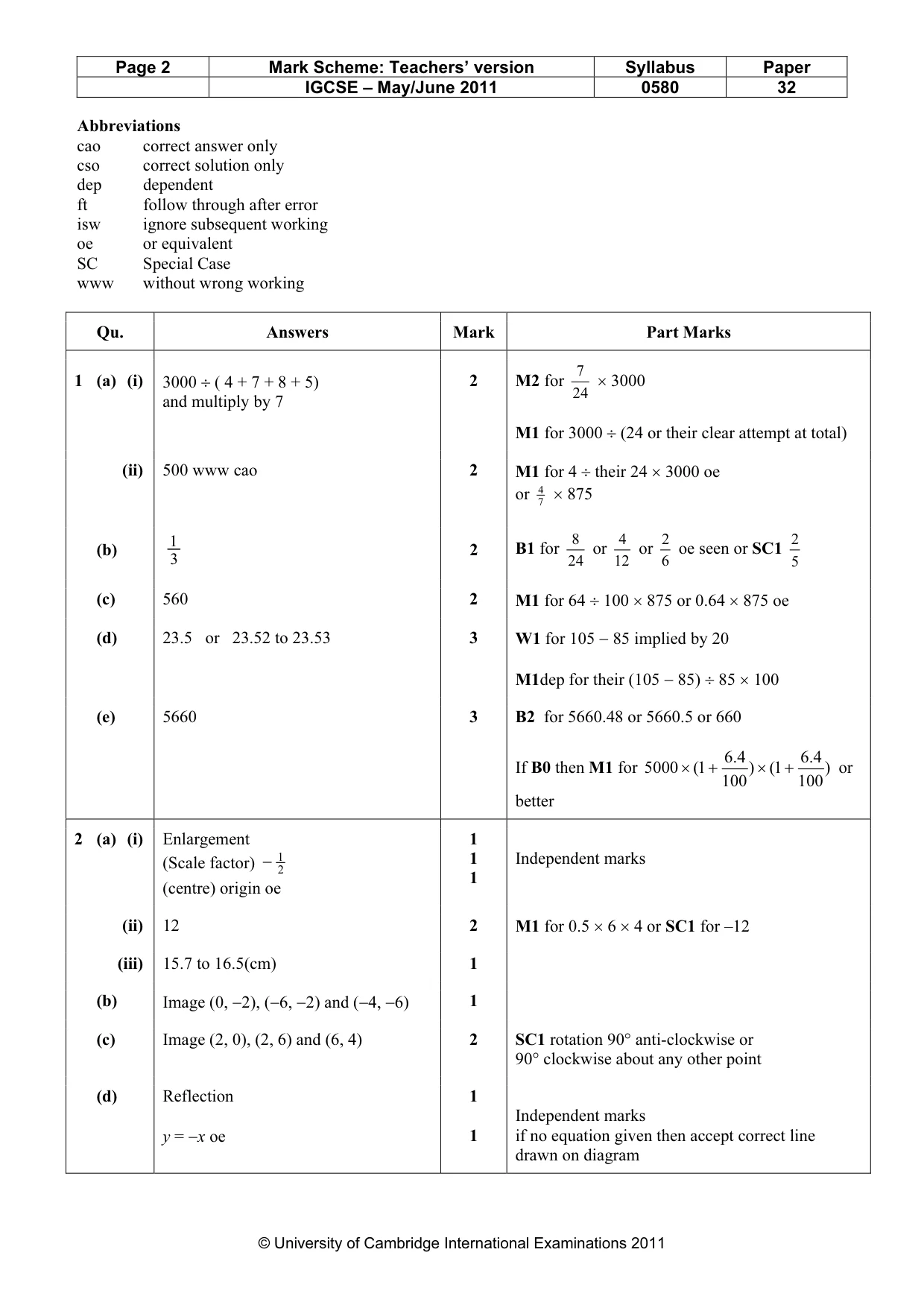
Mark scheme: Qu. Answers Mark Part Marks 77 1 (a) (i) 3000 ÷ ( 4 + 7 + 8 + 5) 2 M2 for × 3000 24 and multiply by 7 M1 for 3000 ÷ (24 or their clear attempt at total) (ii) 500 www cao 2 M1 for 4 ÷ their 24 × 3000 oe or 74 × 875 1 8 4 2 2 (b) 2 B1 for or or oe seen or SC1 3 24 12 6 5 (c) 560 2 M1 for 64 ÷ 100 × 875 or 0.64 × 875 oe (d) 23.5 or 23.52 to 23.53 3 W1 for 105 − 85 implied by 20 M1dep for their (105 − 85) ÷ 85 × 100 (e) 5660 3 B2 for 5660.48 or 5660.5 or 660 4.6 4.6 If B0 then M1 for 5000 × 1( + ) × 1( + ) or 100 100 better
Q2 · For y Examiner's Use 6 5 4 A 3 2 1 x –6 –5 –4 –3 –2 –1 0 1 2 3 4 5 6 –1 B –2 –3 –4 –5 –6…
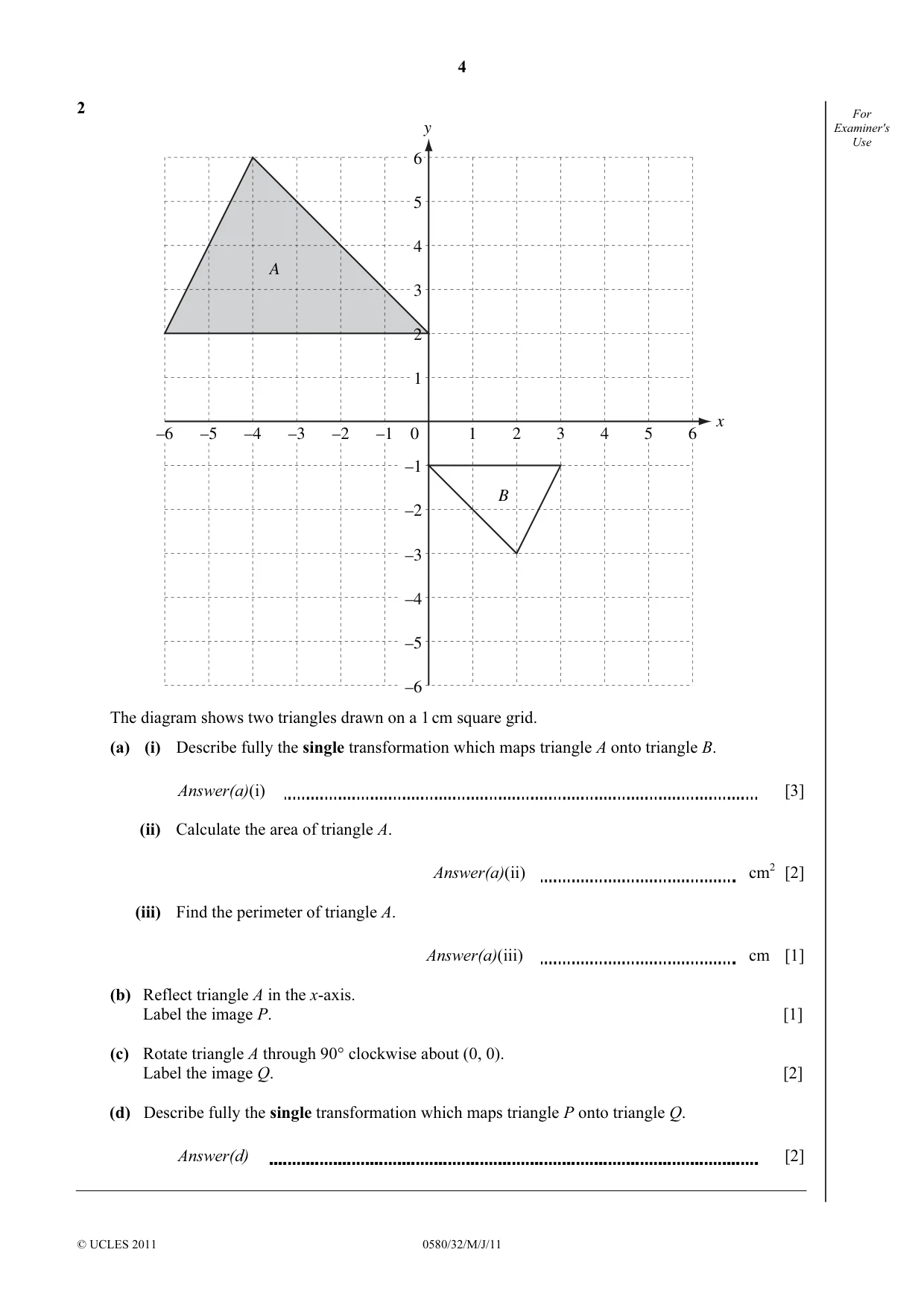
2 For y Examiner's Use 6 5 4 A 3 2 1 x –6 –5 –4 –3 –2 –1 0 1 2 3 4 5 6 –1 B –2 –3 –4 –5 –6 The diagram shows two triangles drawn on a 1 cm square grid. (a) (i) Describe fully the single transformation which maps triangle A onto triangle B. Answer(a)(i) [3] (ii) Calculate the area of triangle A. Answer(a)(ii) cm2 [2] (iii) Find the perimeter of triangle A. Answer(a)(iii) cm [1] (b) Reflect triangle A in the x-axis. Label the image P. [1] (c) Rotate triangle A through 90° clockwise about (0, 0). Label the image Q. [2] (d) Describe fully the single transformation which maps triangle P onto triangle Q. Answer(d) [2]
Mark scheme: 2 (a) (i) Enlargement 1 (Scale factor) − 12 1 Independent marks 1 (centre) origin oe (ii) 12 2 M1 for 0.5 × 6 × 4 or SC1 for –12 (iii) 15.7 to 16.5(cm) 1 (b) Image (0, −2), (−6, −2) and (−4, −6) 1 (c) Image (2, 0), (2, 6) and (6, 4) 2 SC1 rotation 90° anti-clockwise or 90° clockwise about any other point (d) Reflection 1 Independent marks y = −x oe 1 if no equation given then accept correct line drawn on diagram IGCSE – May/June 2011 0580 32
Q3 · The colours of 30 cars in a car park are shown in the frequency table
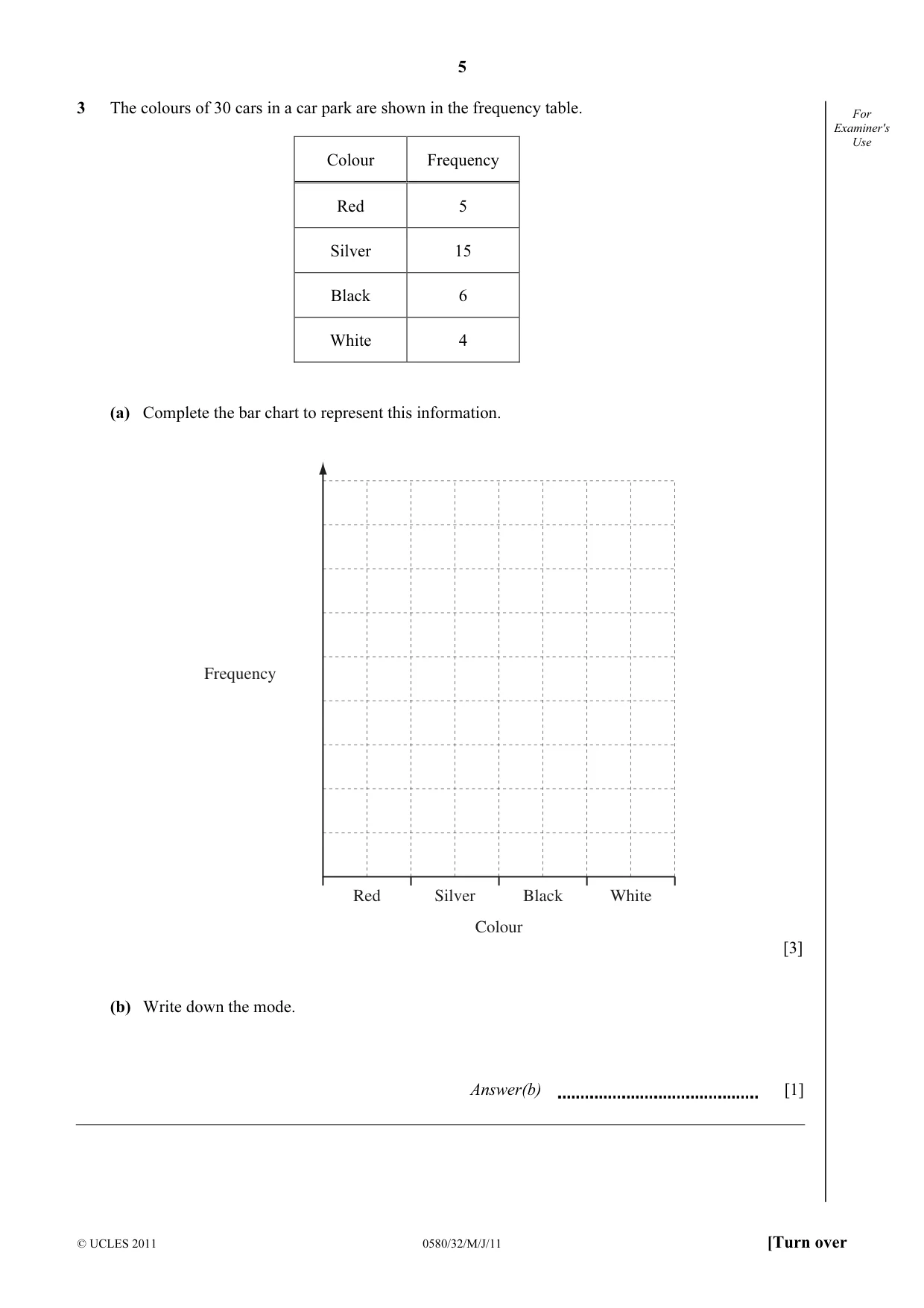
3 The colours of 30 cars in a car park are shown in the frequency table. For Examiner's Use Colour Frequency Red 5 Silver 15 Black 6 White 4 (a) Complete the bar chart to represent this information. Frequency Red Silver Black White Colour [3] (b) Write down the mode. Answer(b) [1]
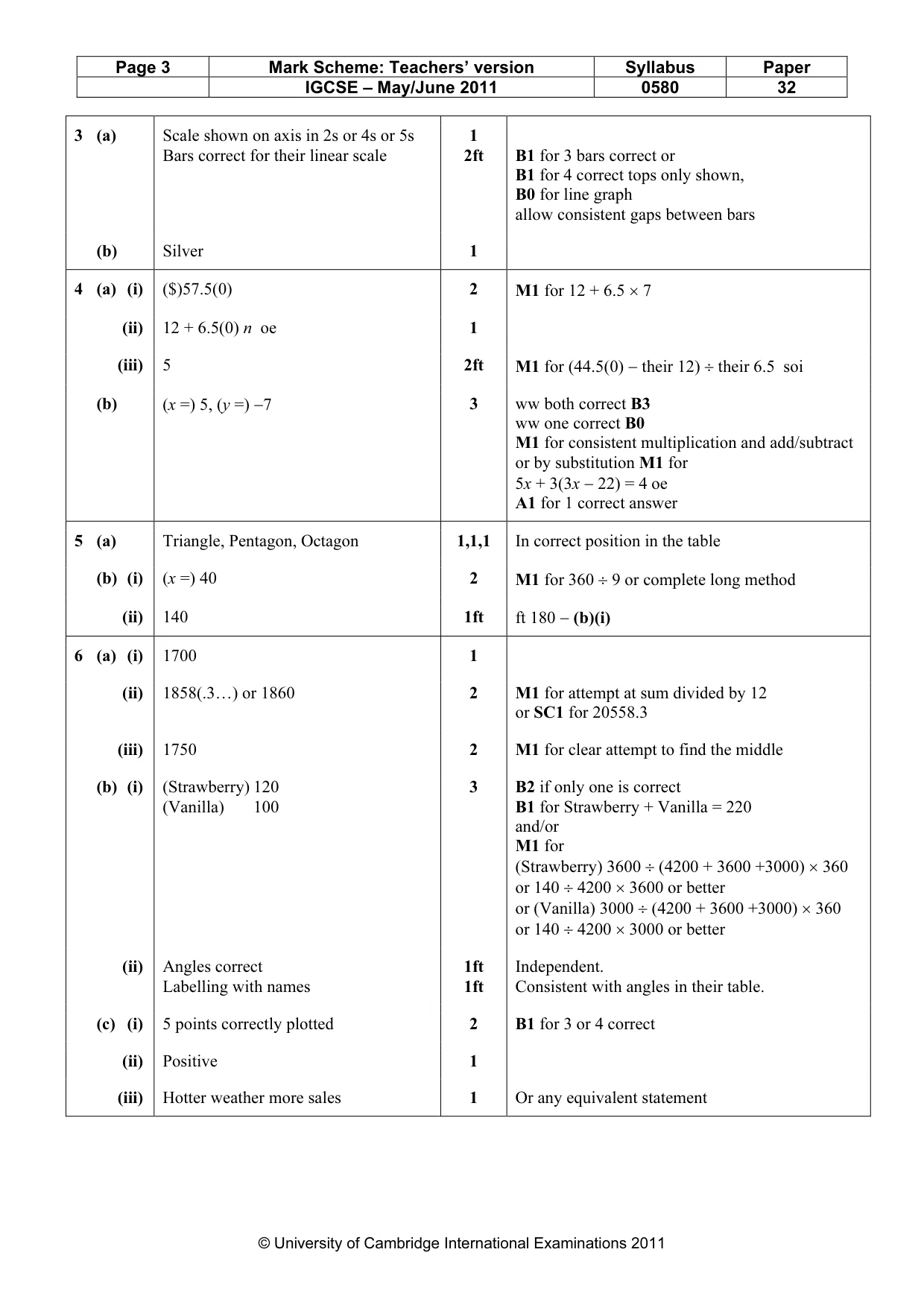
Mark scheme: 3 (a) Scale shown on axis in 2s or 4s or 5s 1 Bars correct for their linear scale 2ft B1 for 3 bars correct or B1 for 4 correct tops only shown, B0 for line graph allow consistent gaps between bars (b) Silver 1
Q4 · An electrician is paid a fixed amount of $12 and then $6.50 for each hour she works
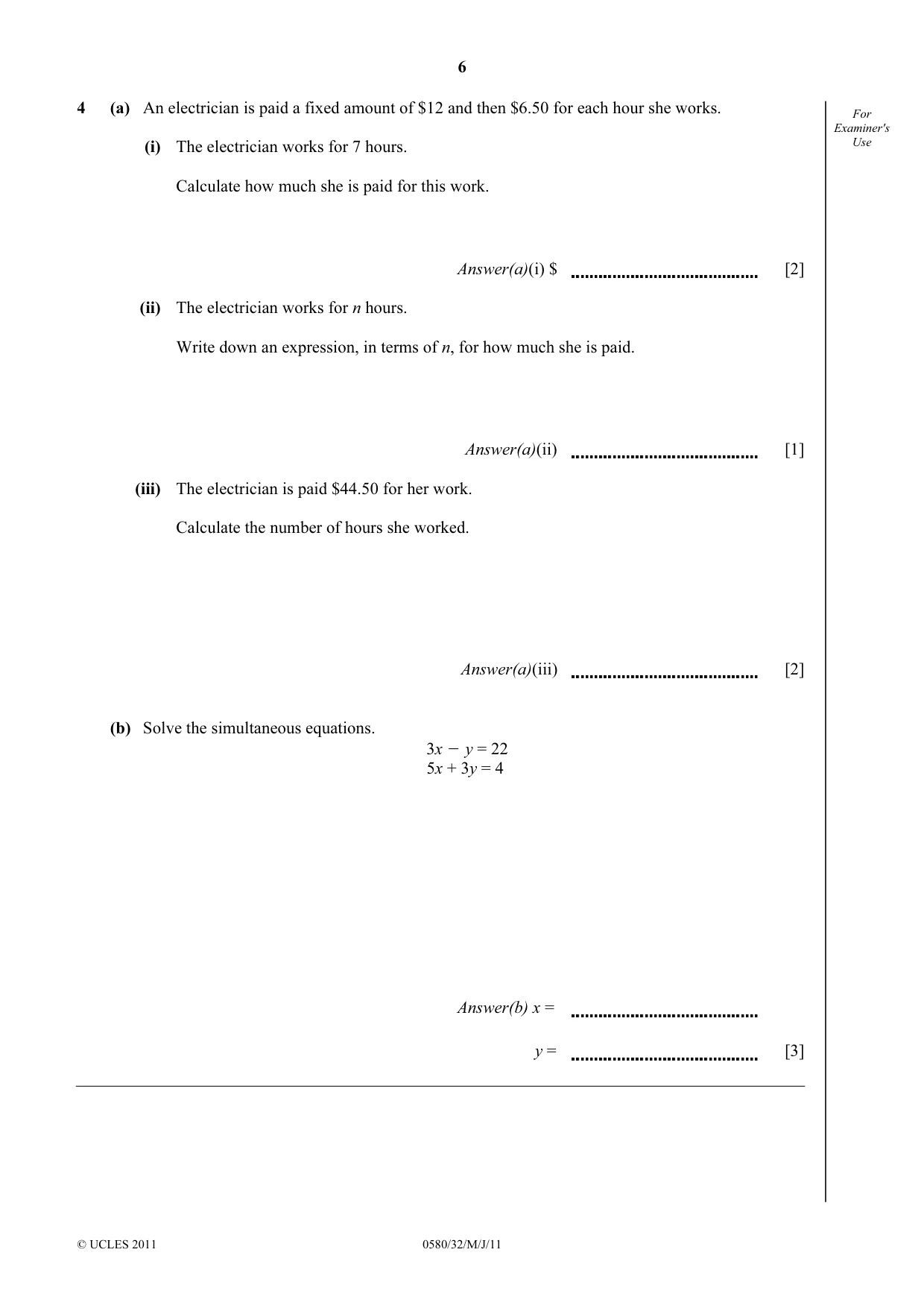
4 (a) An electrician is paid a fixed amount of $12 and then $6.50 for each hour she works. For Examiner's (i) The electrician works for 7 hours. Use Calculate how much she is paid for this work. Answer(a)(i) $ [2] (ii) The electrician works for n hours. Write down an expression, in terms of n, for how much she is paid. Answer(a)(ii) [1] (iii) The electrician is paid $44.50 for her work. Calculate the number of hours she worked. Answer(a)(iii) [2] (b) Solve the simultaneous equations. 3x O y = 22 5x + 3y = 4 Answer(b) x = y = [3]
Mark scheme: 4 (a) (i) ($)57.5(0) 2 M1 for 12 + 6.5 × 7 (ii) 12 + 6.5(0) n oe 1 (iii) 5 2ft M1 for (44.5(0) − their 12) ÷ their 6.5 soi (b) (x =) 5, (y =) −7 3 ww both correct B3 ww one correct B0 M1 for consistent multiplication and add/subtract or by substitution M1 for 5x + 3(3x − 22) = 4 oe A1 for 1 correct answer
Q5 · The table below shows how many sides different polygons have
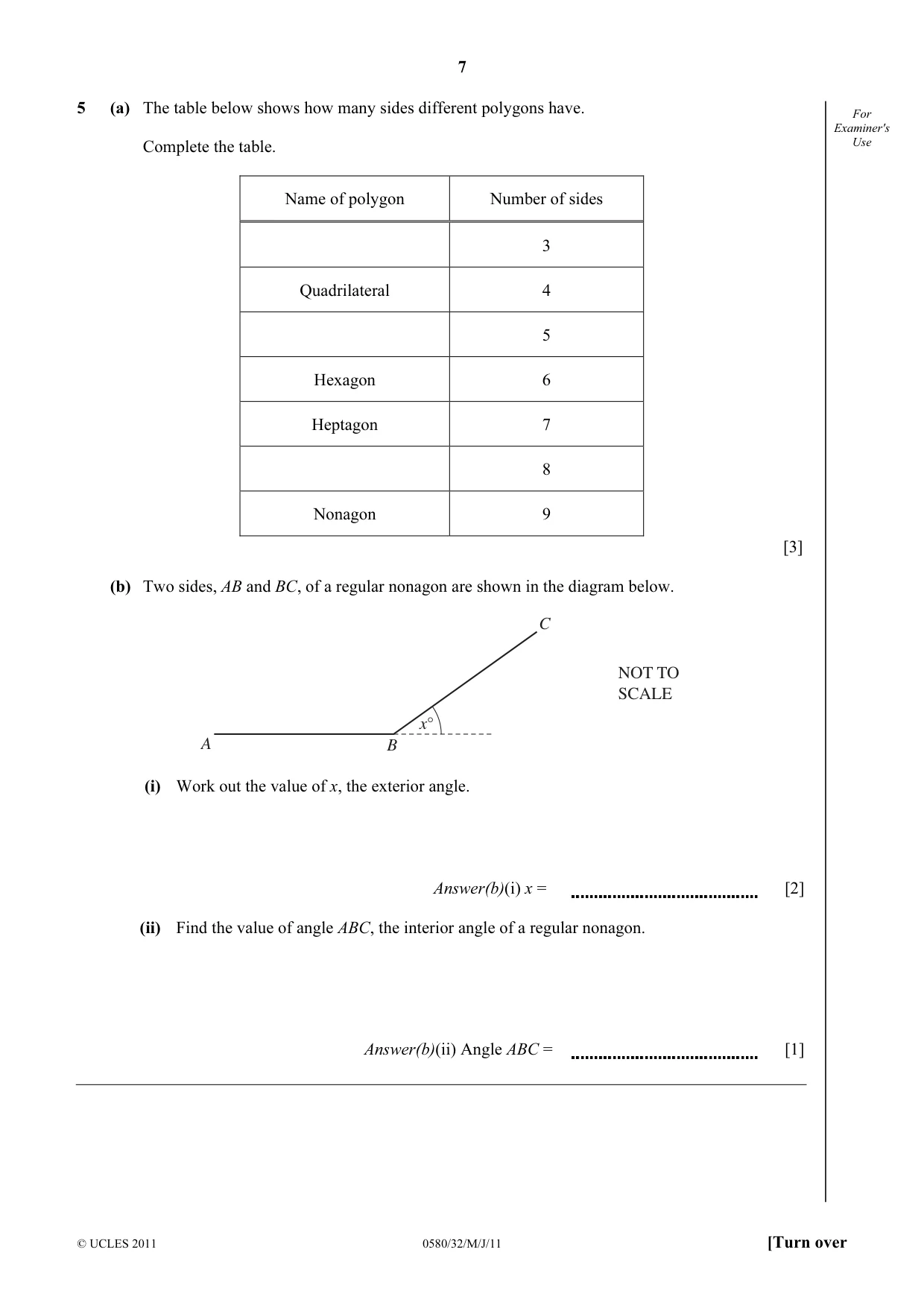
5 (a) The table below shows how many sides different polygons have. For Examiner's Complete the table. Use Name of polygon Number of sides 3 Quadrilateral 4 5 Hexagon 6 Heptagon 7 8 Nonagon 9 [3] (b) Two sides, AB and BC, of a regular nonagon are shown in the diagram below. C NOT TO SCALE x° A B (i) Work out the value of x, the exterior angle. Answer(b)(i) x = [2] (ii) Find the value of angle ABC, the interior angle of a regular nonagon. Answer(b)(ii) Angle ABC = [1]
Mark scheme: 5 (a) Triangle, Pentagon, Octagon 1,1,1 In correct position in the table (b) (i) (x =) 40 2 M1 for 360 ÷ 9 or complete long method (ii) 140 1ft ft 180 − (b)(i)
Q6 · The number of ice-creams sold in a shop each month is shown in the table
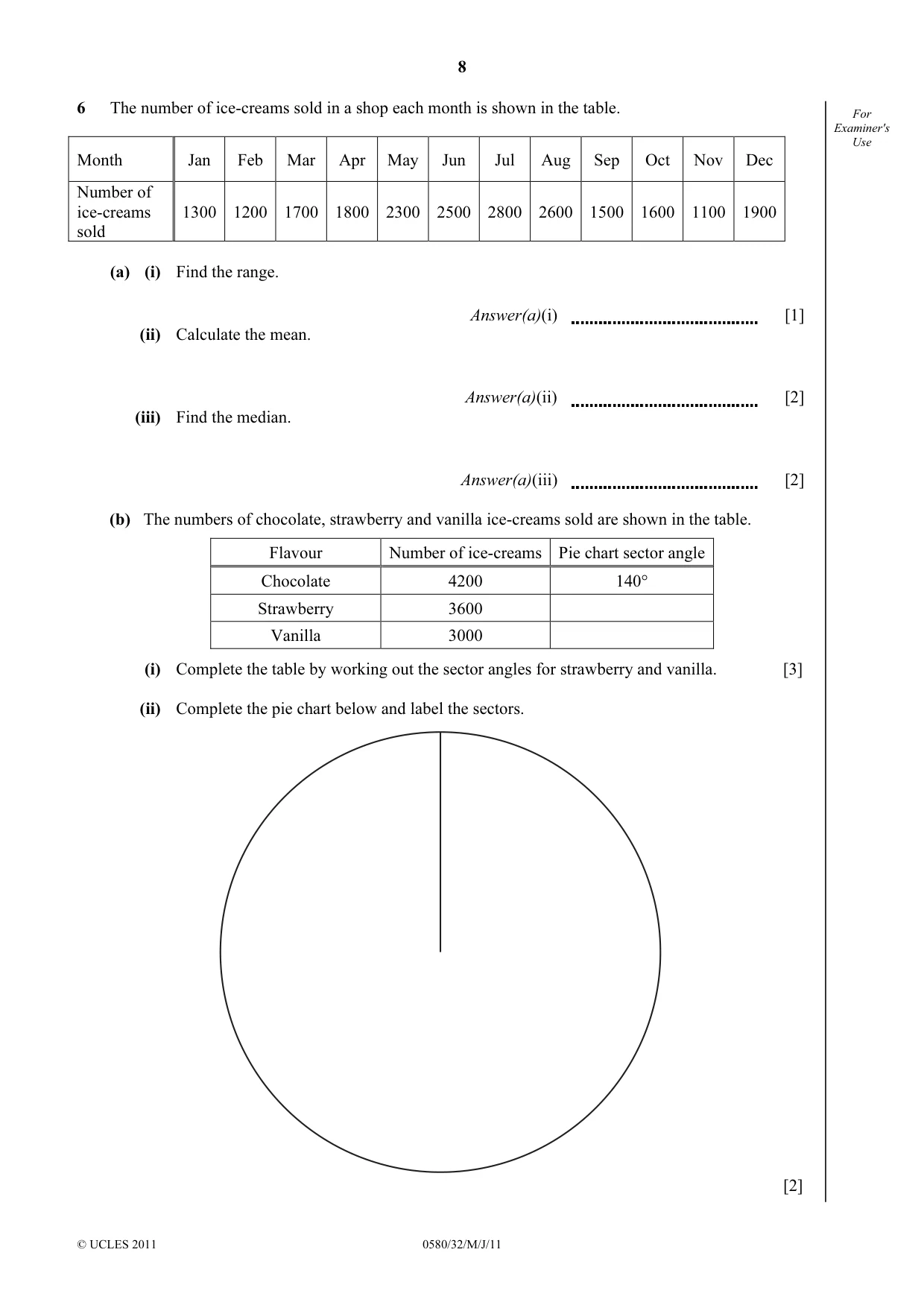
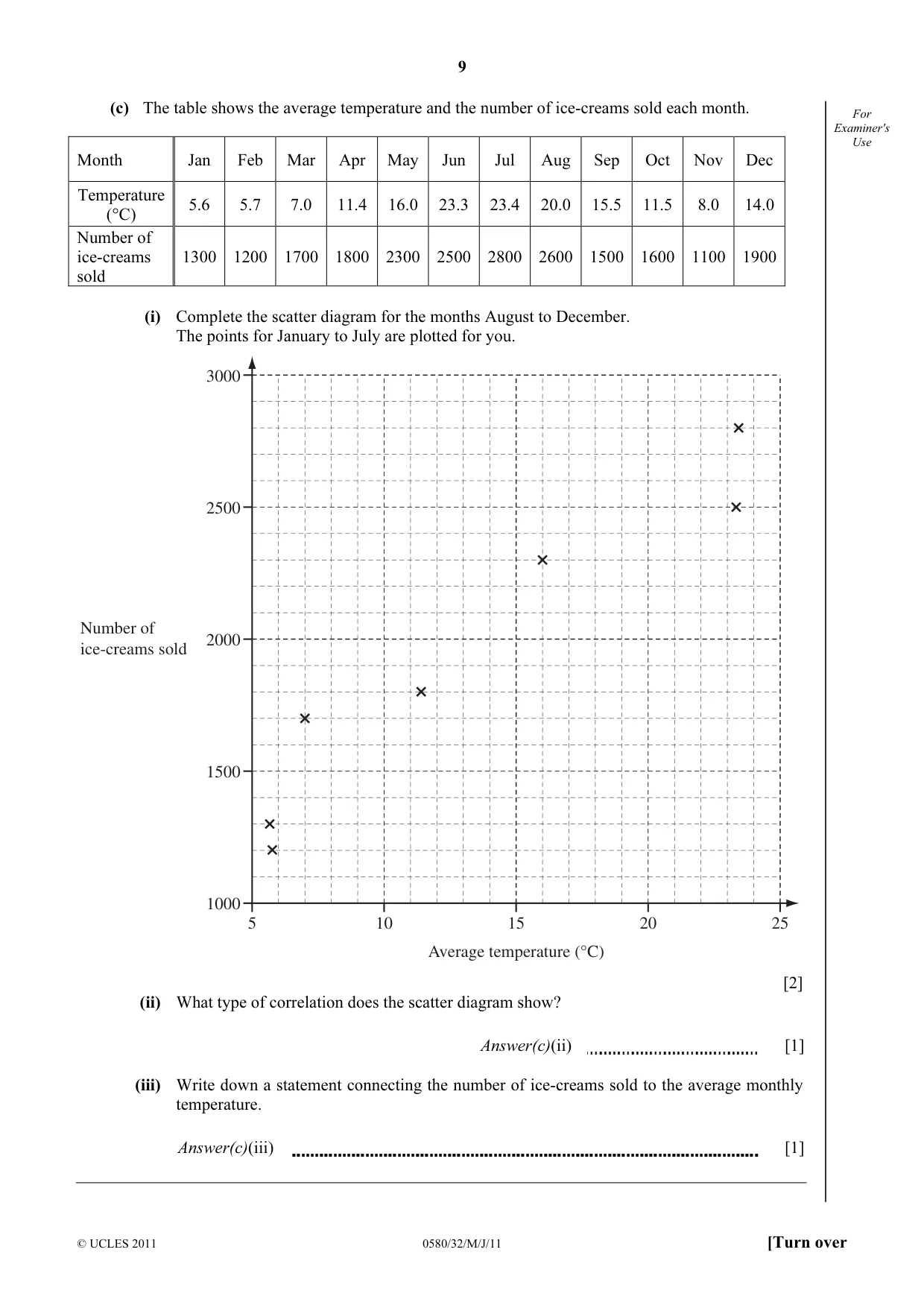
6 The number of ice-creams sold in a shop each month is shown in the table. For Examiner's Use Month Jan Feb Mar Apr May Jun Jul Aug Sep Oct Nov Dec Number of ice-creams 1300 1200 1700 1800 2300 2500 2800 2600 1500 1600 1100 1900 sold (a) (i) Find the range. Answer(a)(i) [1] (ii) Calculate the mean. Answer(a)(ii) [2] (iii) Find the median. Answer(a)(iii) [2] (b) The numbers of chocolate, strawberry and vanilla ice-creams sold are shown in the table. Flavour Number of ice-creams Pie chart sector angle Chocolate 4200 140° Strawberry 3600 Vanilla 3000 (i) Complete the table by working out the sector angles for strawberry and vanilla. [3] (ii) Complete the pie chart below and label the sectors. [2] (c) The table shows the average temperature and the number of ice-creams sold each month. For Examiner's Use Month Jan Feb Mar Apr May Jun Jul Aug Sep Oct Nov Dec Temperature 5.6 5.7 7.0 11.4 16.0 23.3 23.4 20.0 15.5 11.5 8.0 14.0 (°C) Number of ice-creams 1300 1200 1700 1800 2300 2500 2800 2600 1500 1600 1100 1900 sold (i) Complete the scatter diagram for the months August to December. The points for January to July are plotted for you. 3000 2500 Number of 2000 ice-creams sold 1500 1000 5 10 15 20 25 Average temperature (°C) [2] (ii) What type of correlation does the scatter diagram show? Answer(c)(ii) [1] (iii) Write down a statement connecting the number of ice-creams sold to the average monthly temperature. Answer(c)(iii) [1]
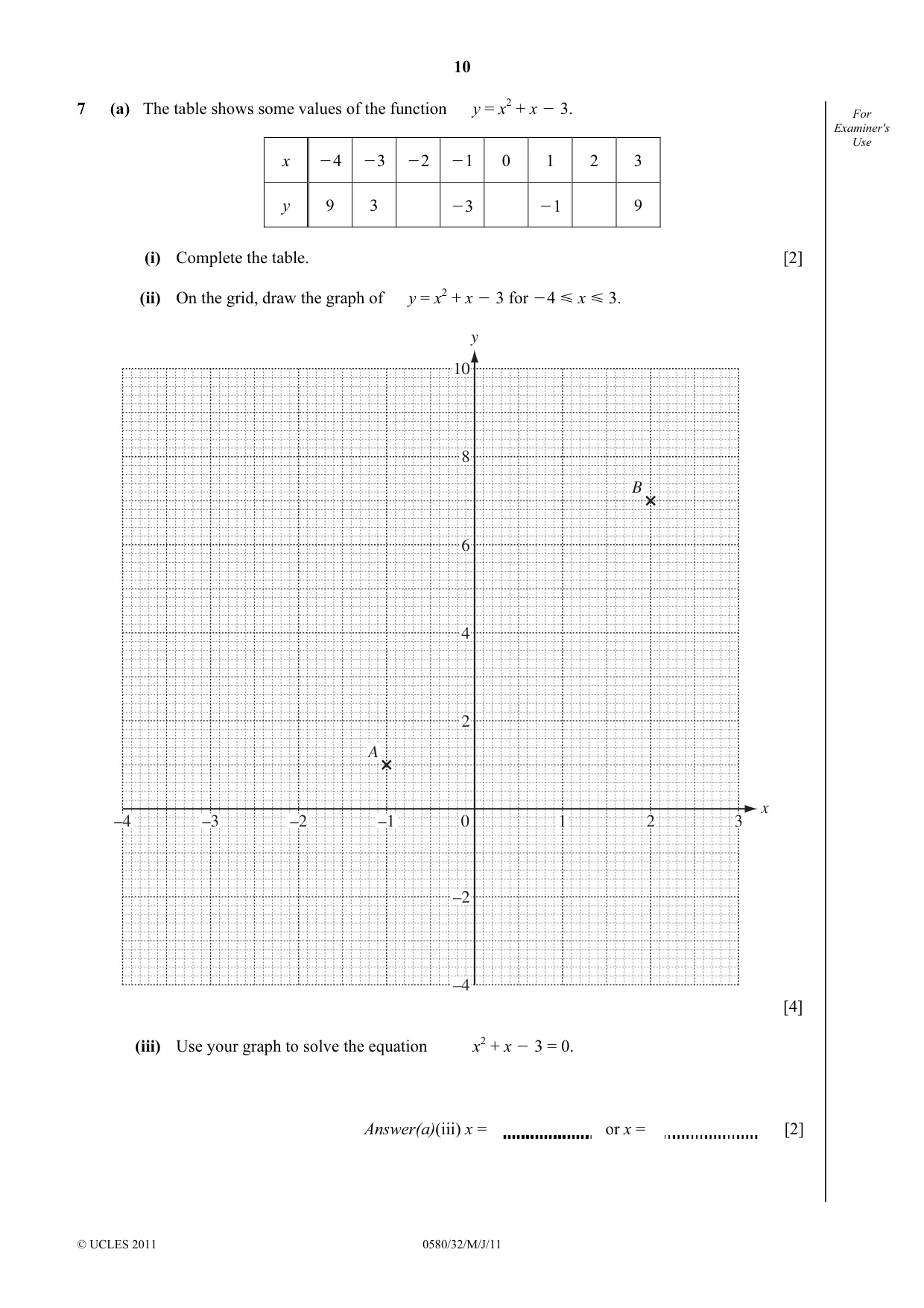
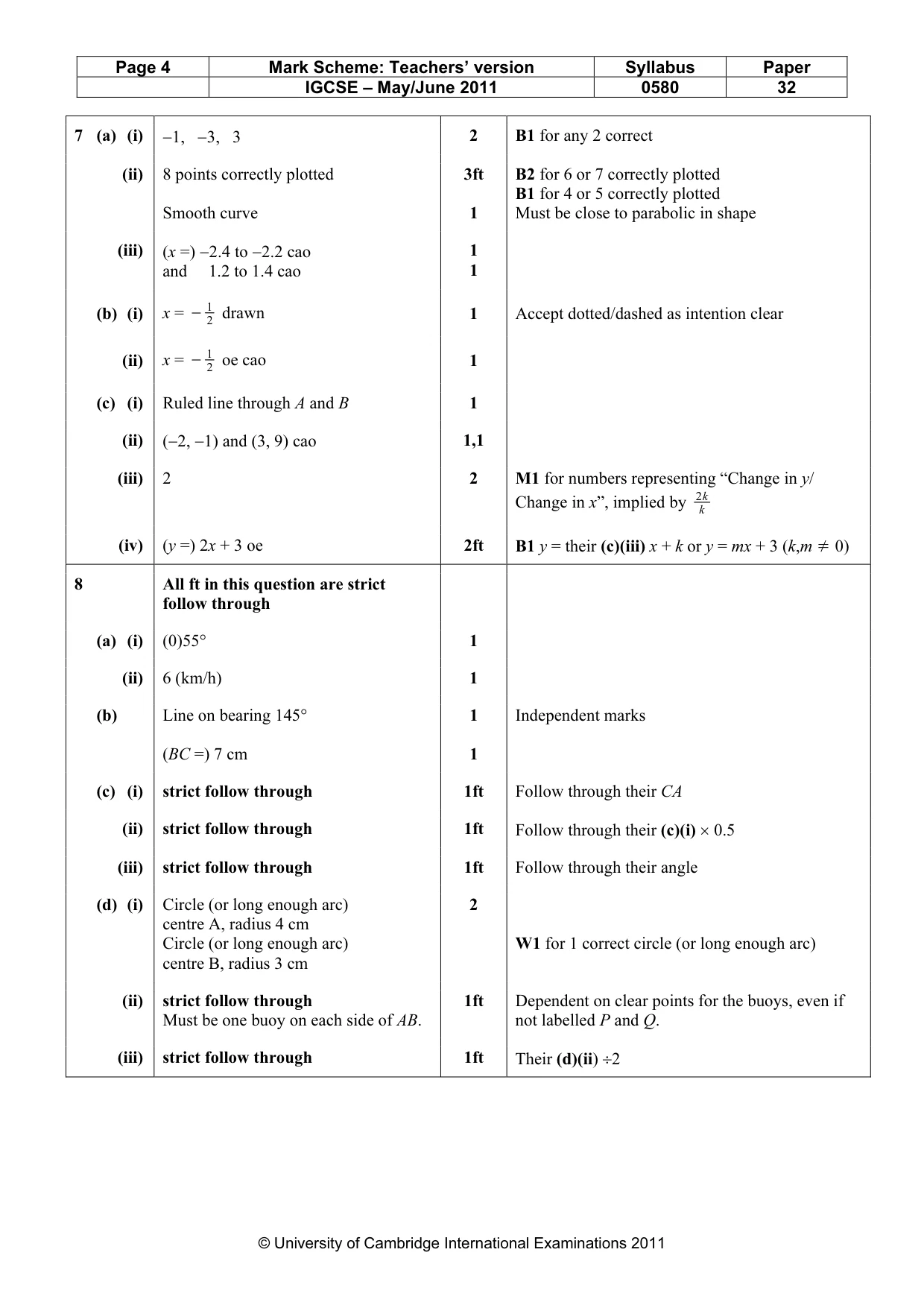
Mark scheme: 6 (a) (i) 1700 1 (ii) 1858(.3…) or 1860 2 M1 for attempt at sum divided by 12 or SC1 for 20558.3 (iii) 1750 2 M1 for clear attempt to find the middle (b) (i) (Strawberry) 120 3 B2 if only one is correct (Vanilla) 100 B1 for Strawberry + Vanilla = 220 and/or M1 for (Strawberry) 3600 ÷ (4200 + 3600 +3000) × 360 or 140 ÷ 4200 × 3600 or better or (Vanilla) 3000 ÷ (4200 + 3600 +3000) × 360 or 140 ÷ 4200 × 3000 or better (ii) Angles correct 1ft Independent. Labelling with names 1ft Consistent with angles in their table. (c) (i) 5 points correctly plotted 2 B1 for 3 or 4 correct (ii) Positive 1 (iii) Hotter weather more sales 1 Or any equivalent statement IGCSE – May/June 2011 0580 32 7 (a) (i) −1, −3, 3 2 B1 for any 2 correct
What was in this paper
The subtopics covered by these 6 questions, and how many questions each got. Open one in a new tab to see every Cambridge question on it.
What you needed in this session
Cambridge’s own grade thresholds for 2011 May/June, Paper 3 · Variant 2. A higher threshold means an easier paper — the bar moves with how the cohort did.