Cambridge IGCSE Mathematics 0580 — 2011 May/June Paper 3 · Variant 3
0580/33/M/J/11 · 3 questions · 104 marks · ≈117 min
The question paper and its mark scheme, free to read here and free to download. This is Cambridge’s own paper, exactly as it was sat.
Question paper16 pages
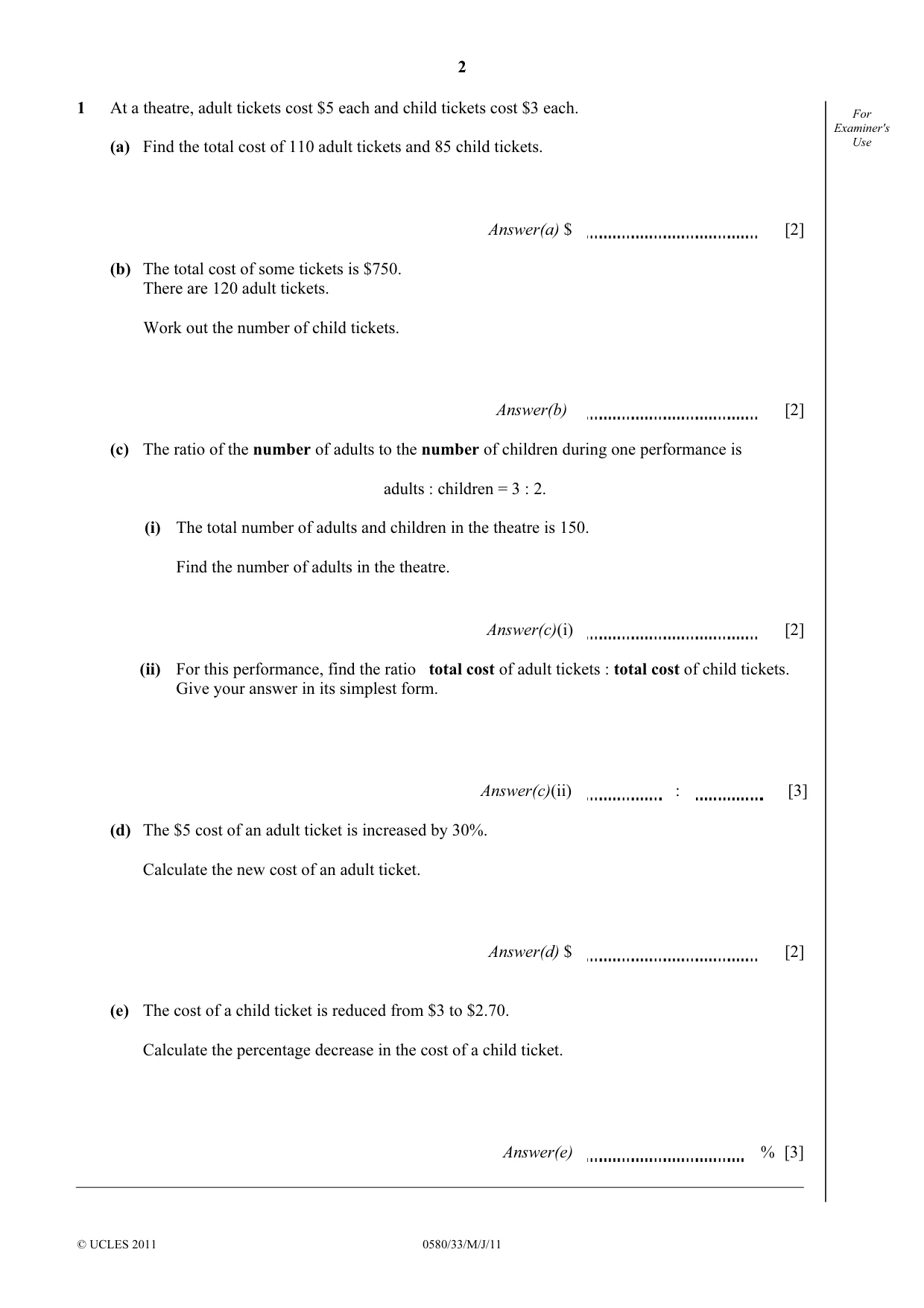
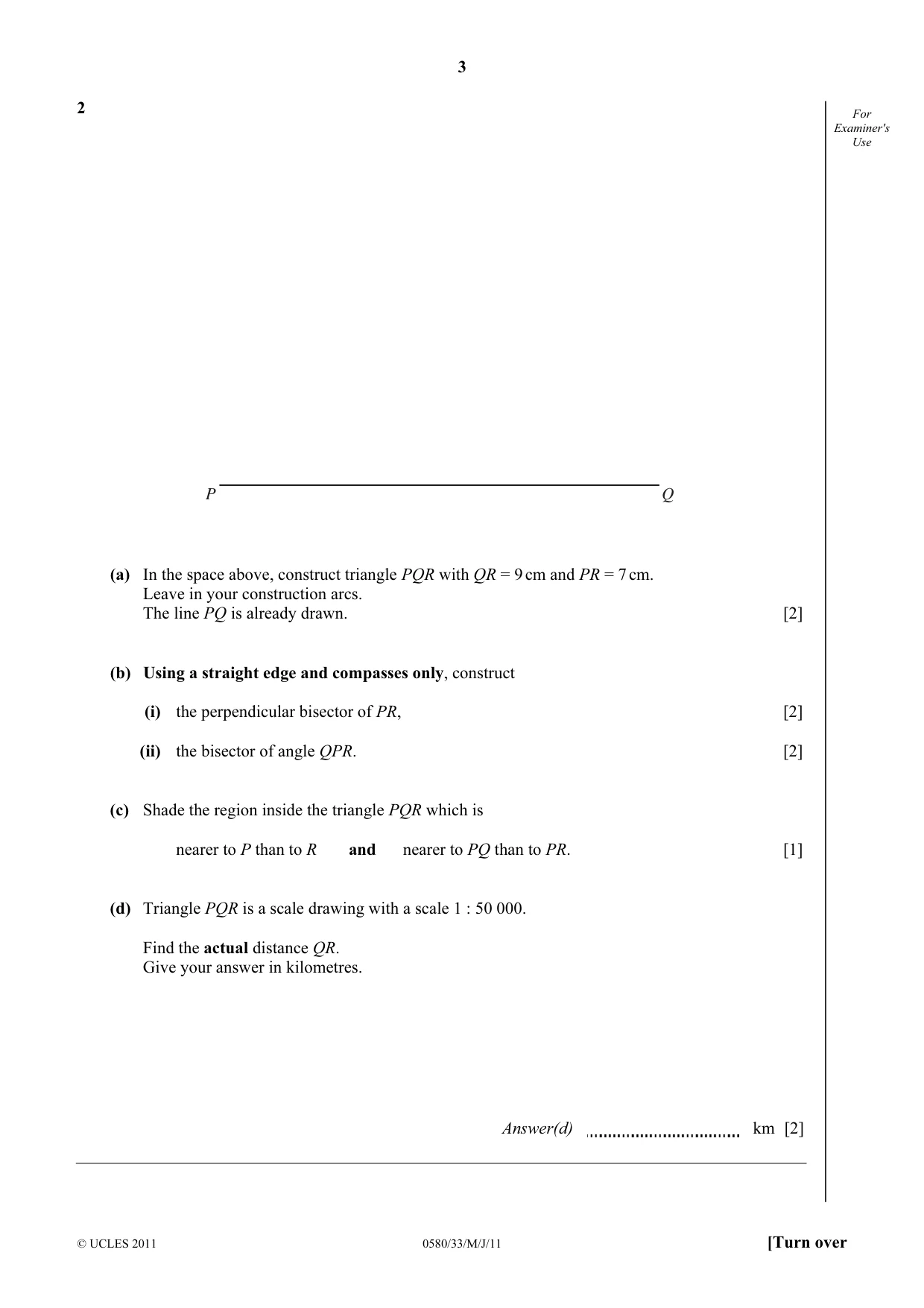
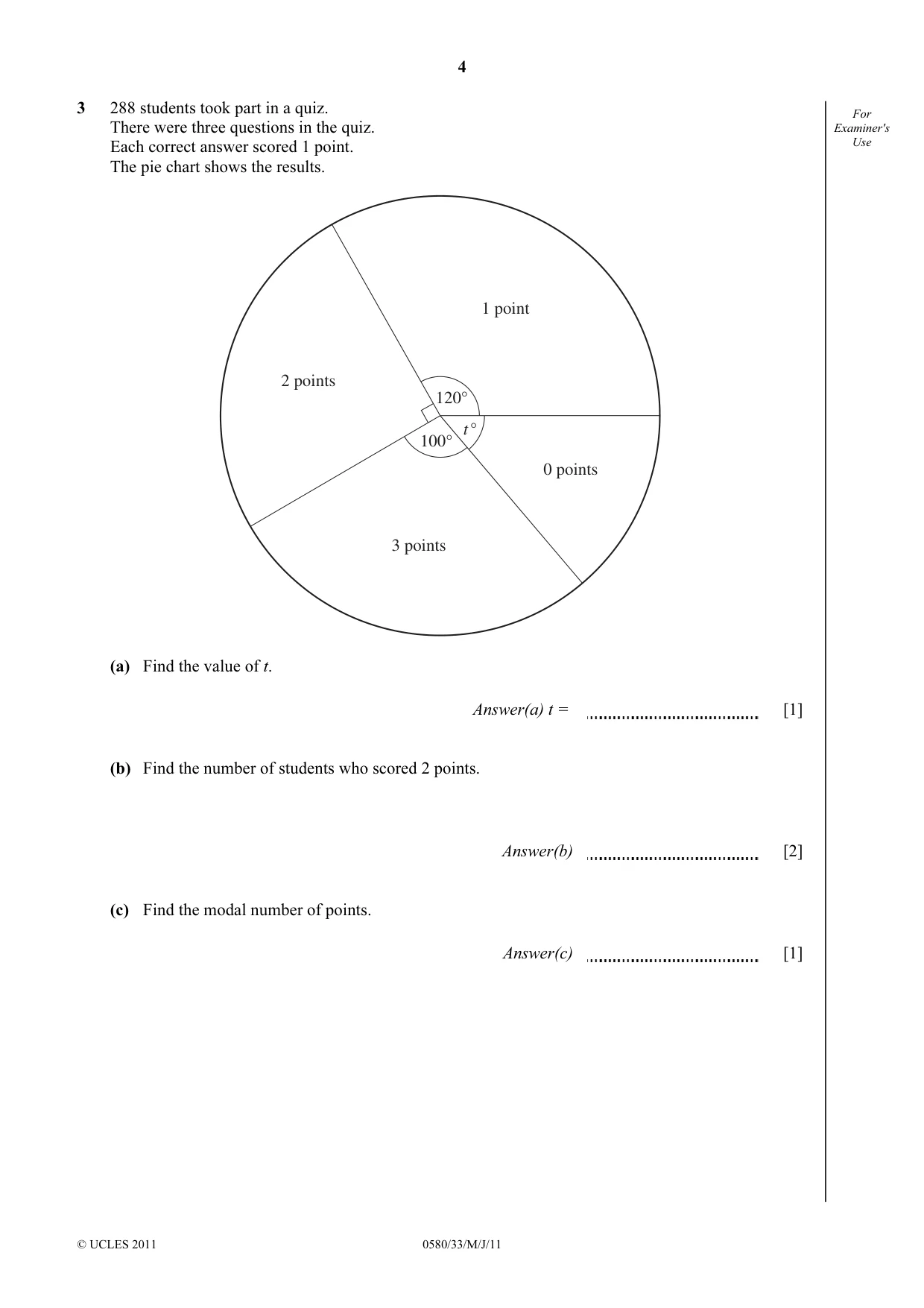
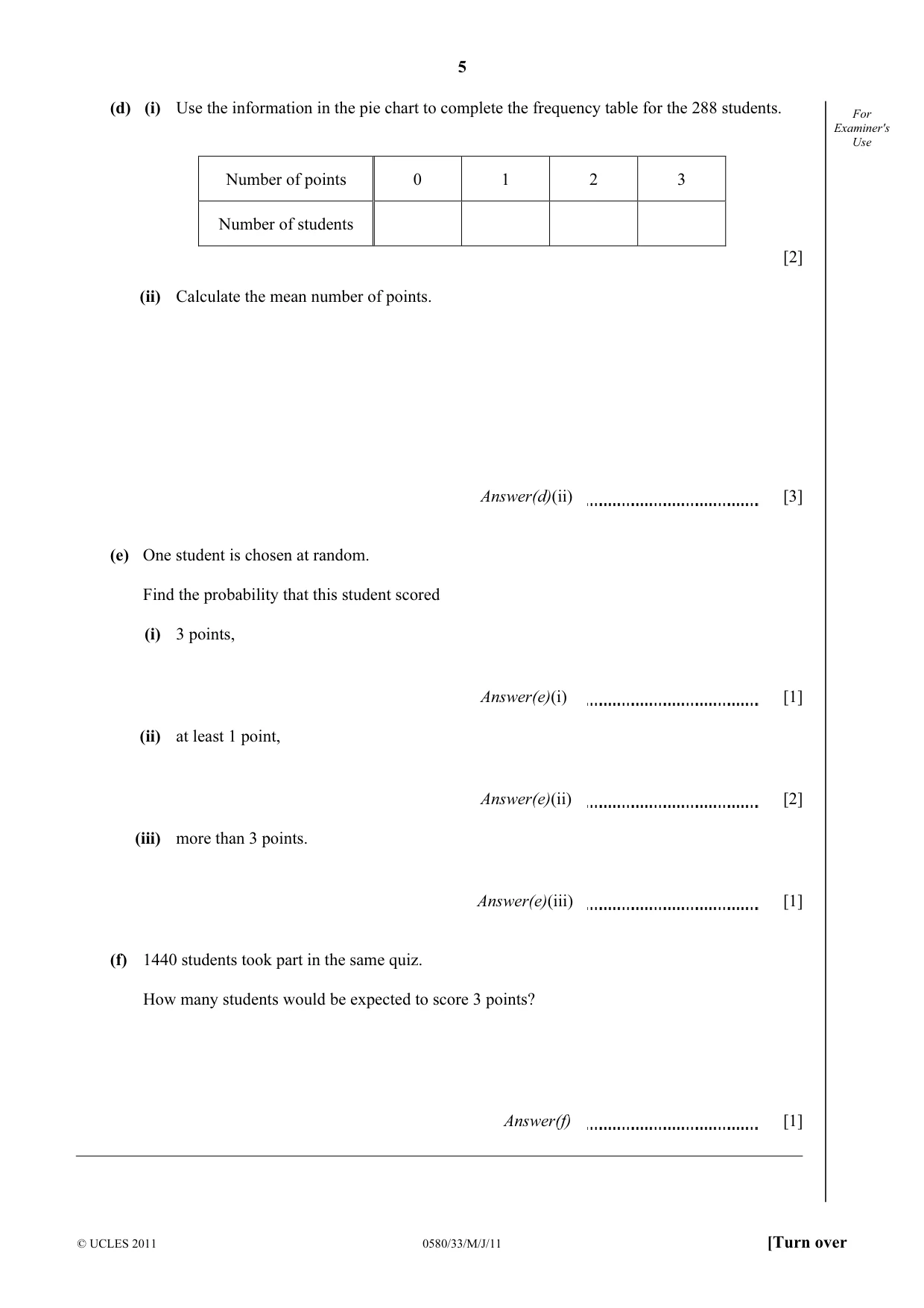
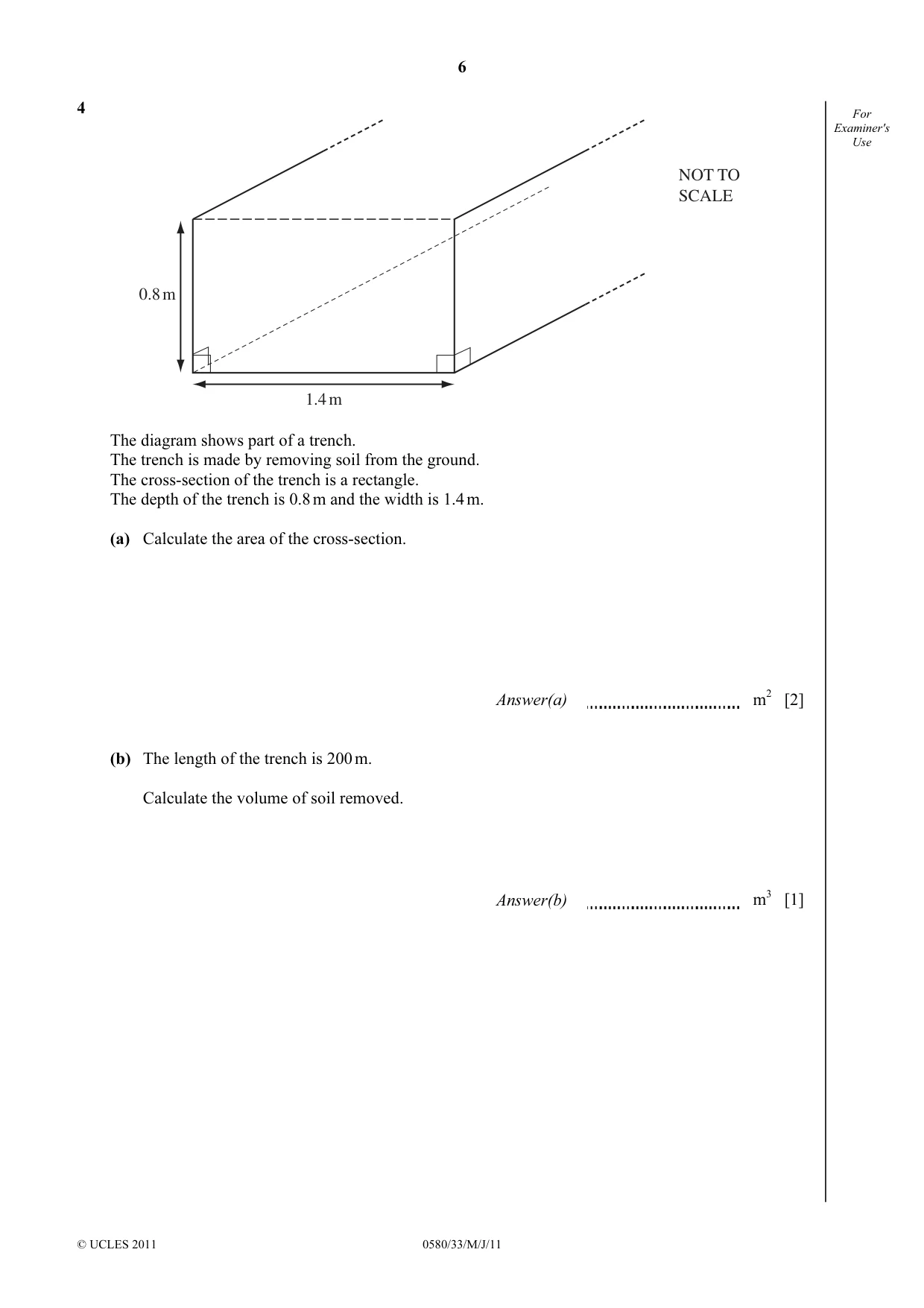
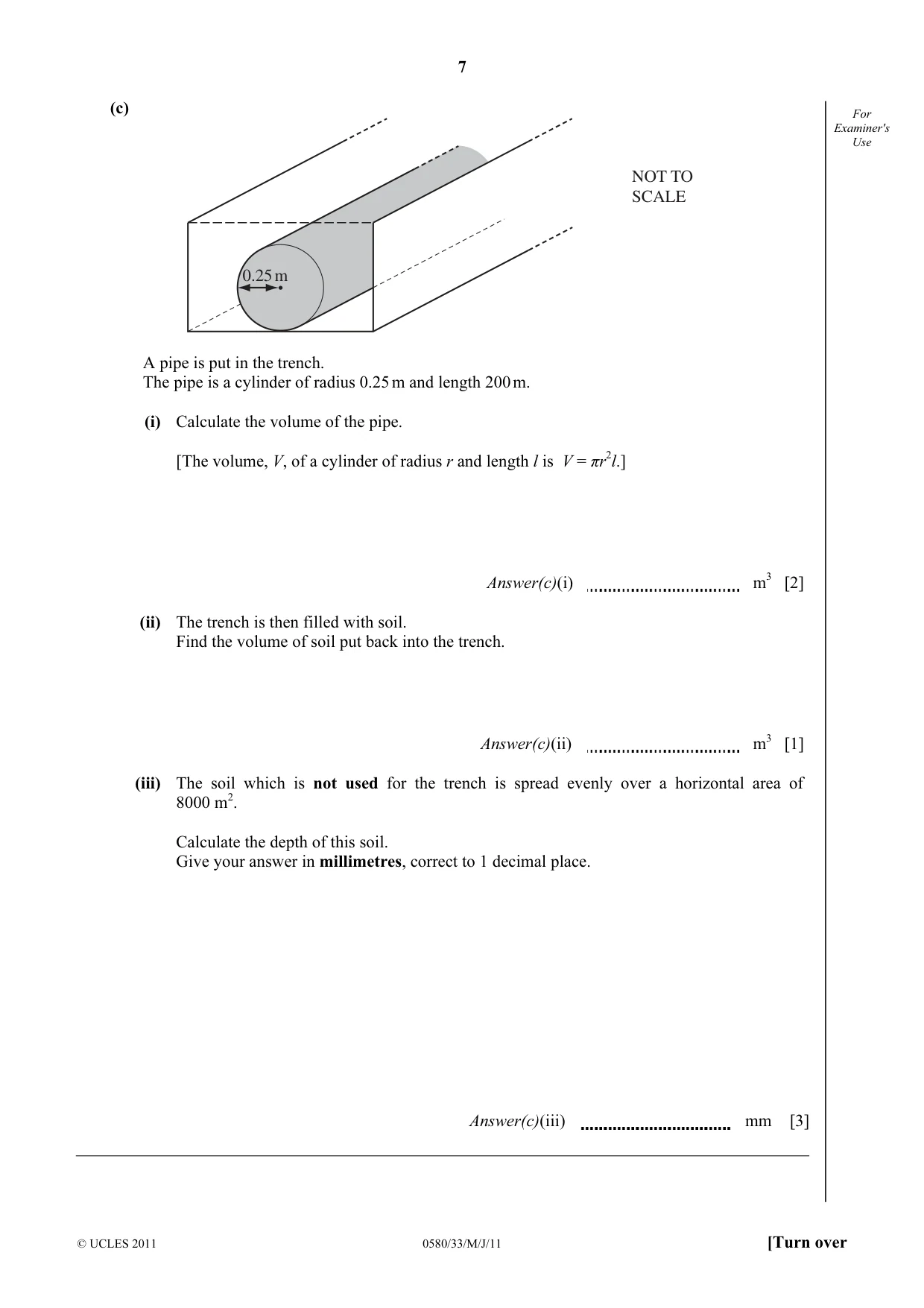
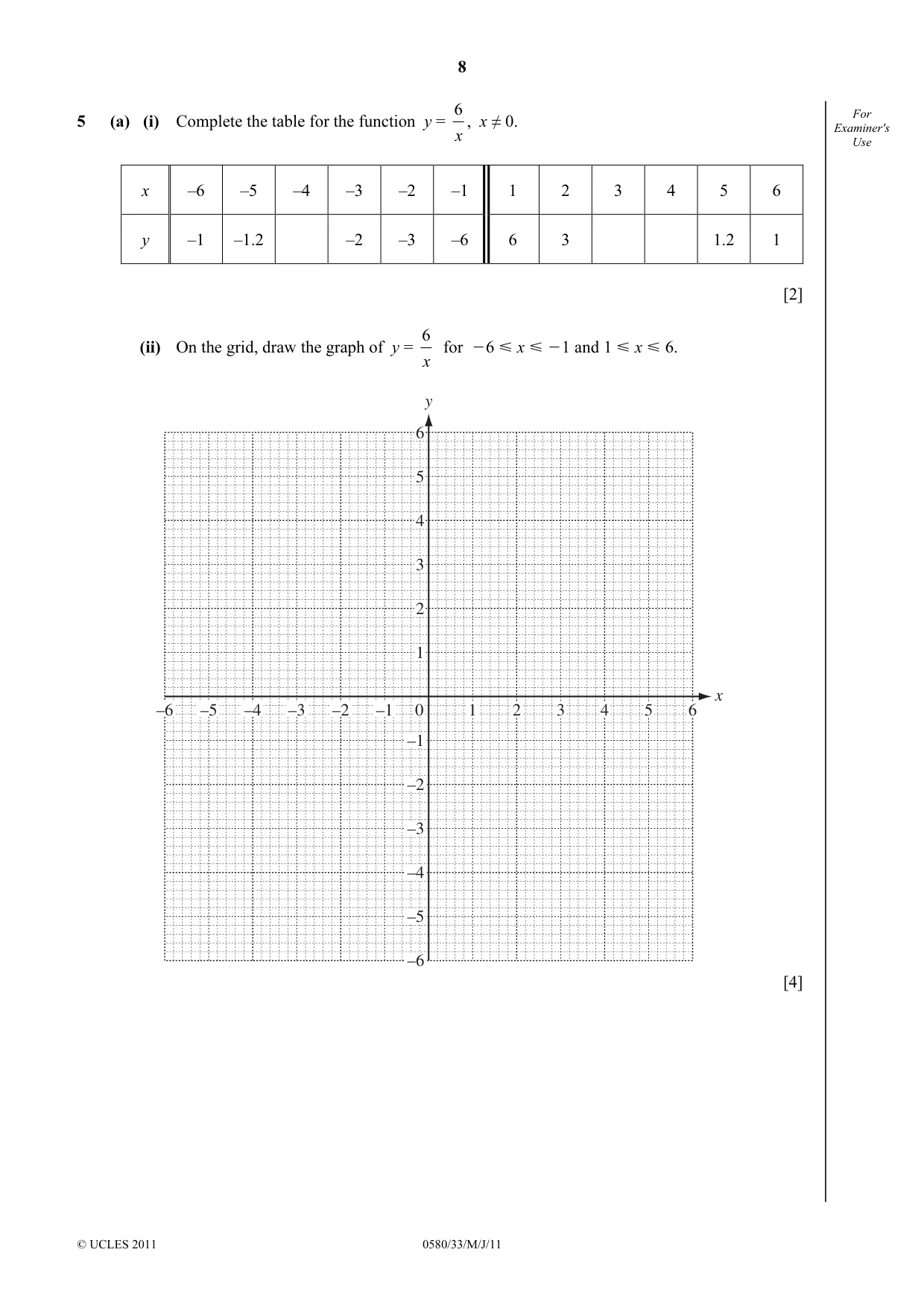
Mark scheme4 pages
Answers below. Sit the paper first if you are practising.
Questions as text
Question 7
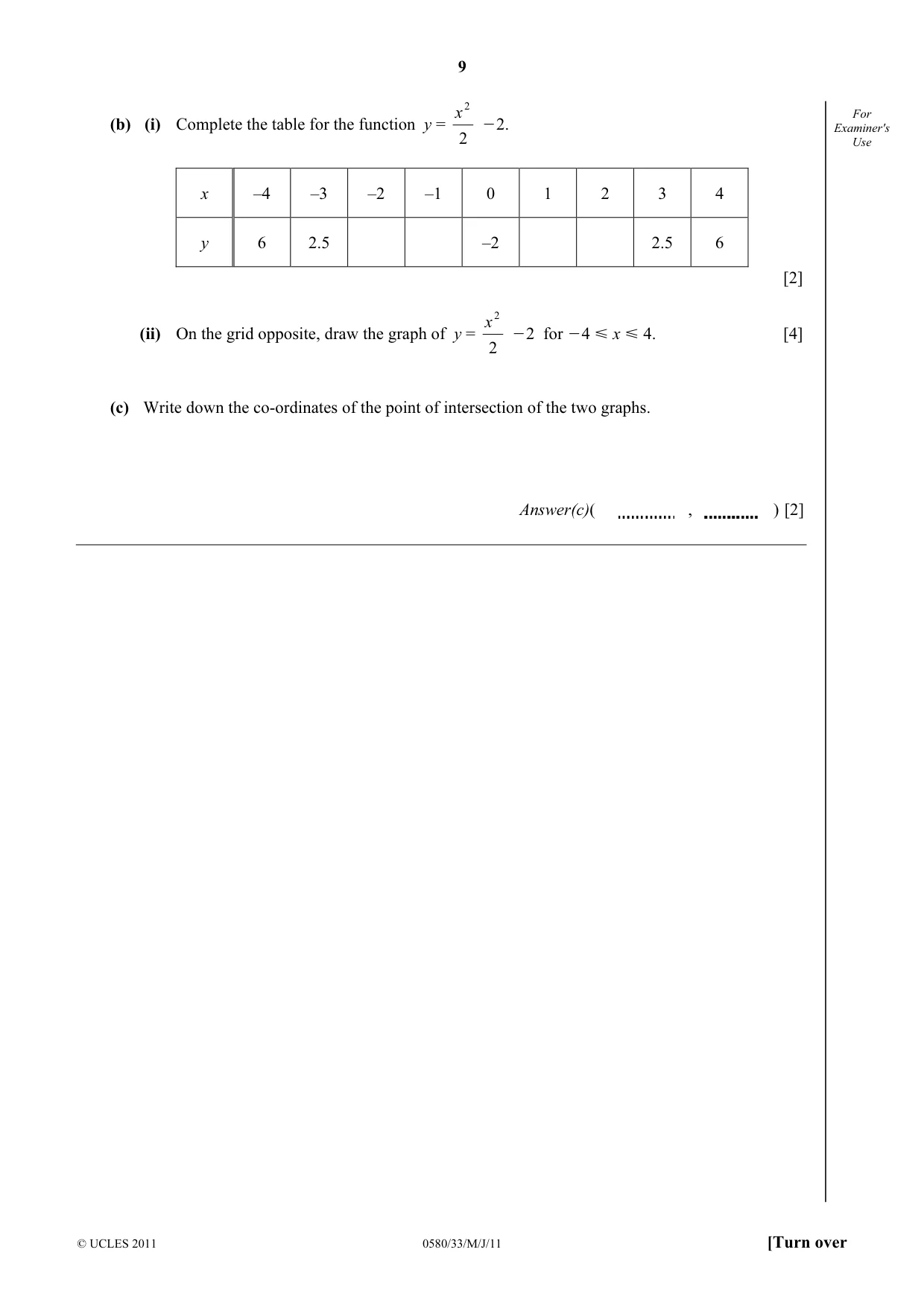
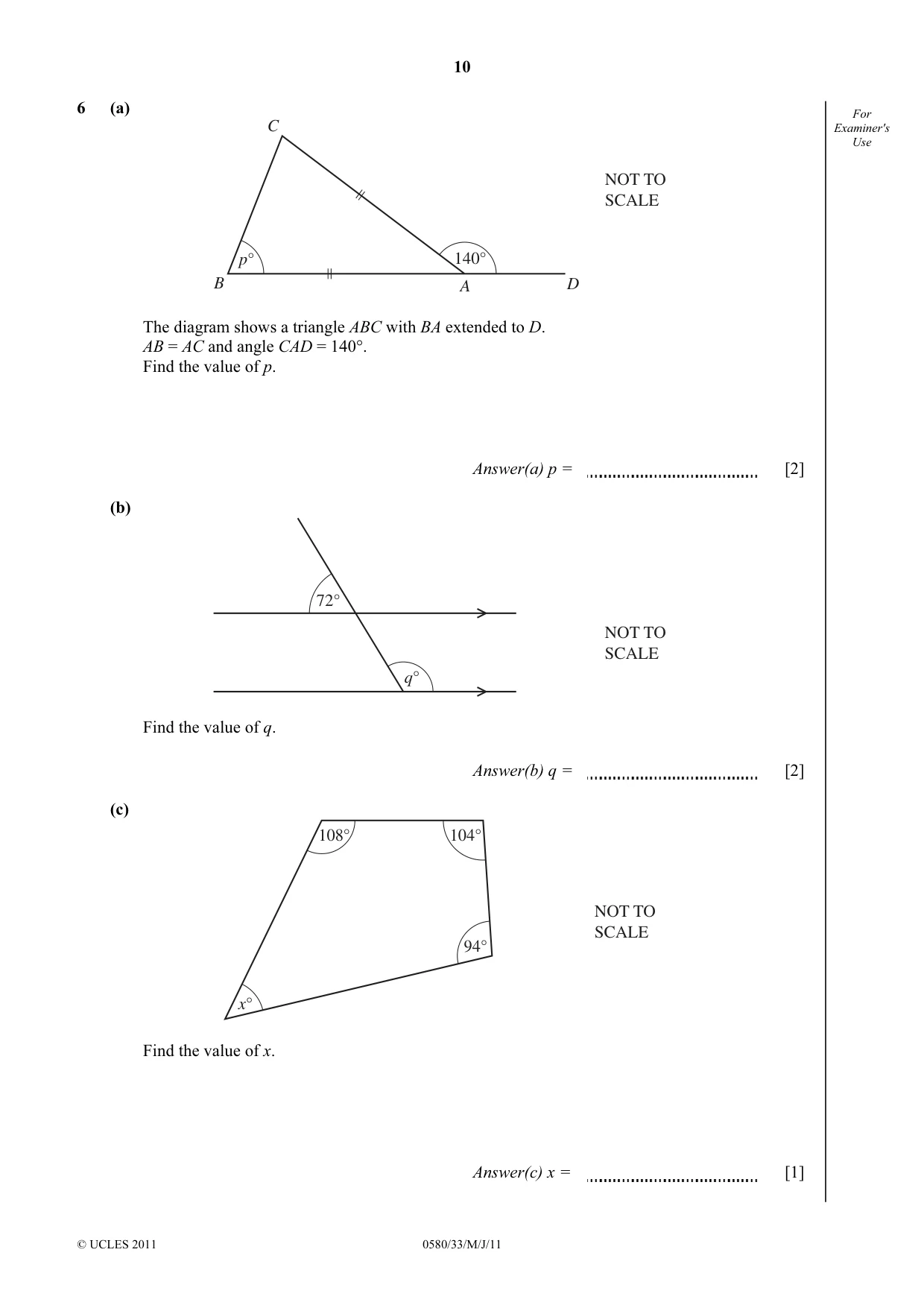
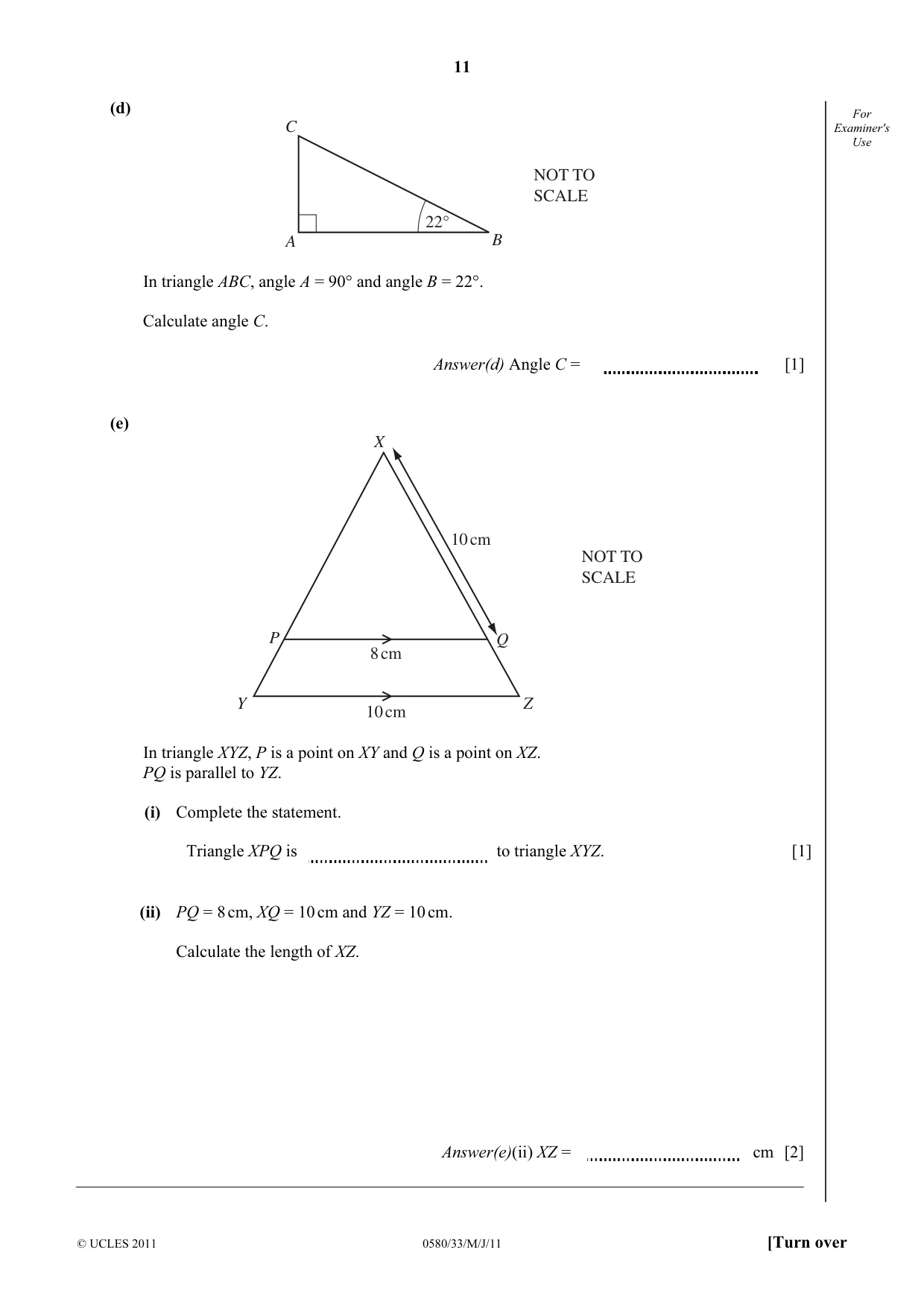
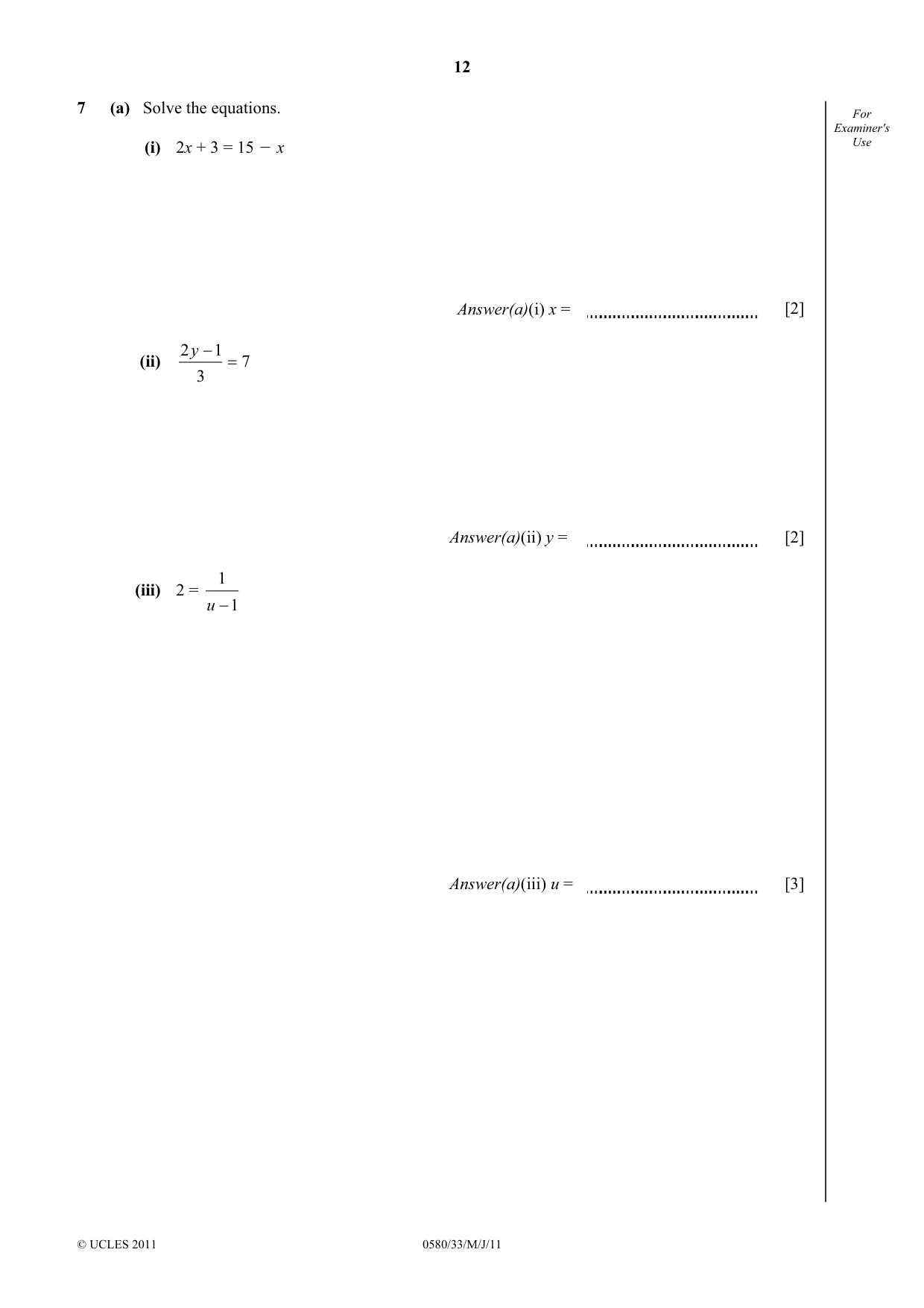
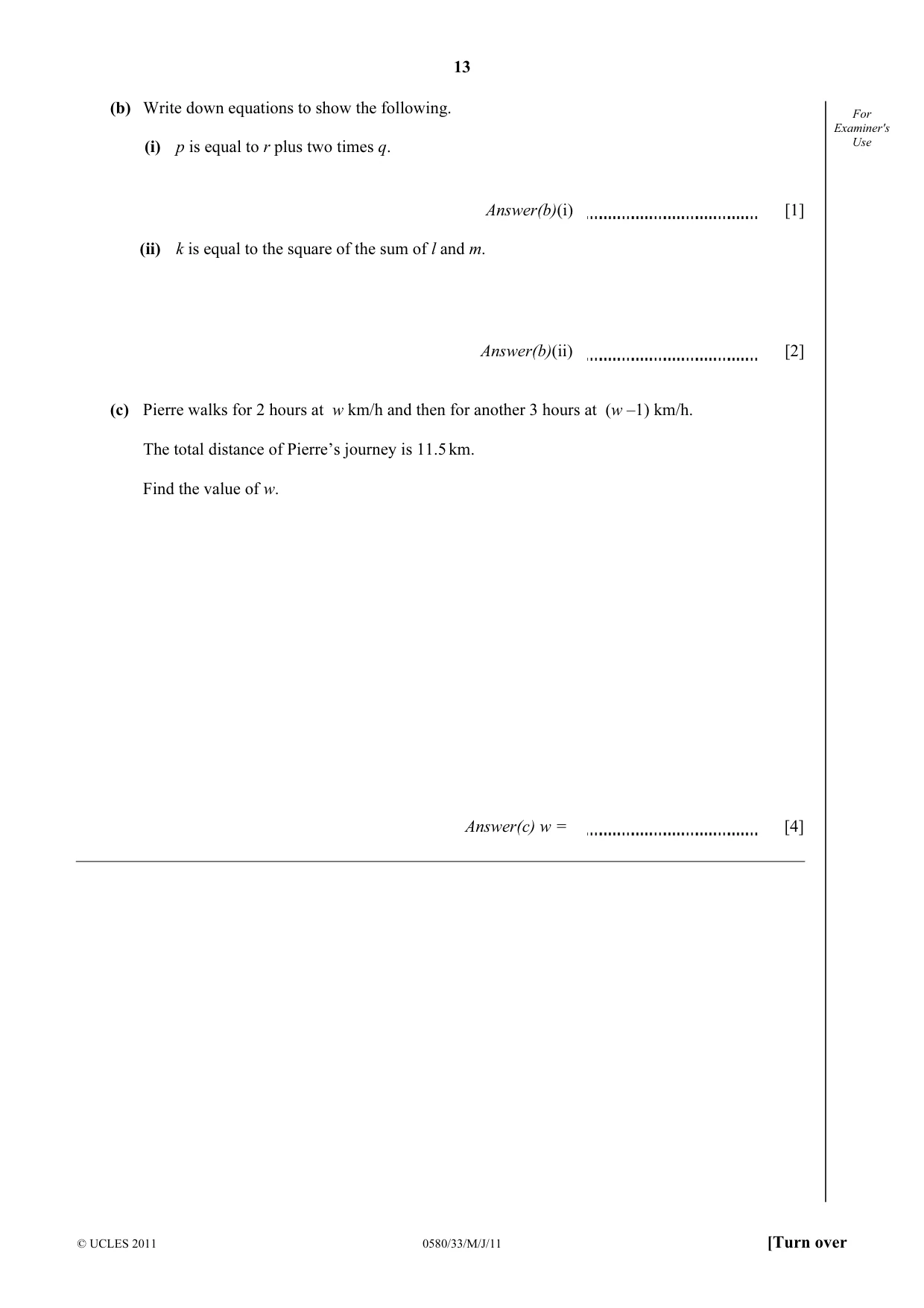
7 (a) Solve the equations. For Examiner's (i) 2x + 3 = 15 O x Use Answer(a)(i) x = [2] 2 y − 1 (ii) = 7 3 Answer(a)(ii) y = [2] 1 (iii) 2 = u − 1 Answer(a)(iii) u = [3] (b) Write down equations to show the following. For Examiner's (i) p is equal to r plus two times q. Use Answer(b)(i) [1] (ii) k is equal to the square of the sum of l and m. Answer(b)(ii) [2] (c) Pierre walks for 2 hours at w km/h and then for another 3 hours at (w –1) km/h. The total distance of Pierre’s journey is 11.5 km. Find the value of w. Answer(c) w = [4]
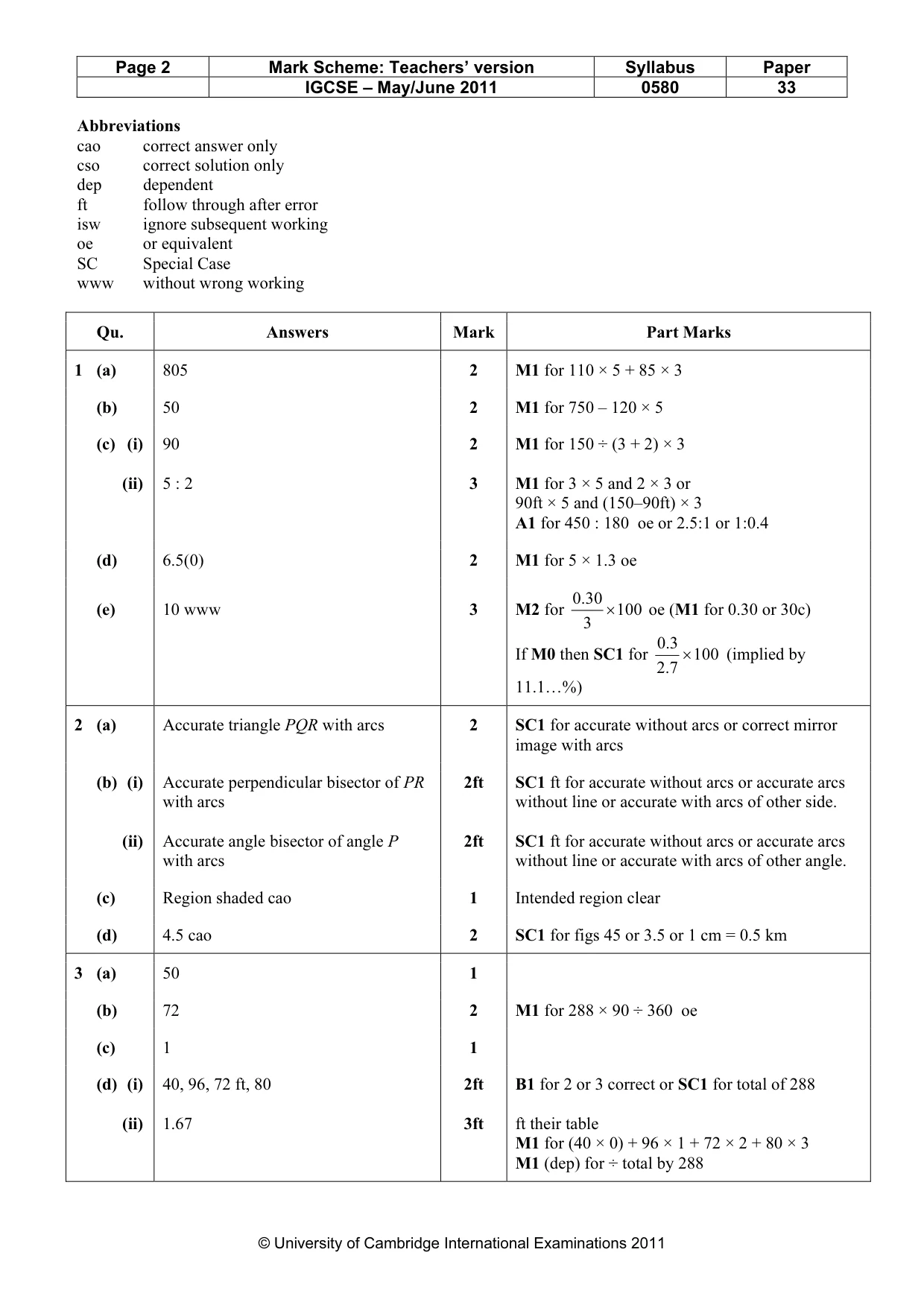
Mark scheme: 7 (a) (i) 4 2 M1 for 2 x + x = 15 − 3 or better (ii) 11 2 M1 for 2 y − 1 = 7 × 3 or 23y = 7 + 13 or better (iii) 1.5 oe 3 M1 for 2(u − )1 = 1 A1 for 2u – 2 = 1 (b) (i) p = 2q + r or p = r + 2q oe 1 (ii) k = (l + m)2 2 SC1 for (l + m 2) or for k = l + m (c) 2.9 cao www 4 4 M1 for 2w or 3(w – 1) M1 for 2w + 3(w – 1) = 11.5 A1 for 2w + 3w = 11.5 + 3 or better
Q8 · For y Examiner's Use 8 7 6 5 4 C 3 2 B A 1 x –8 –7 –6 –5 –4 –3 –2 –1 0 1 2 3 4 5 6 7 8 9…
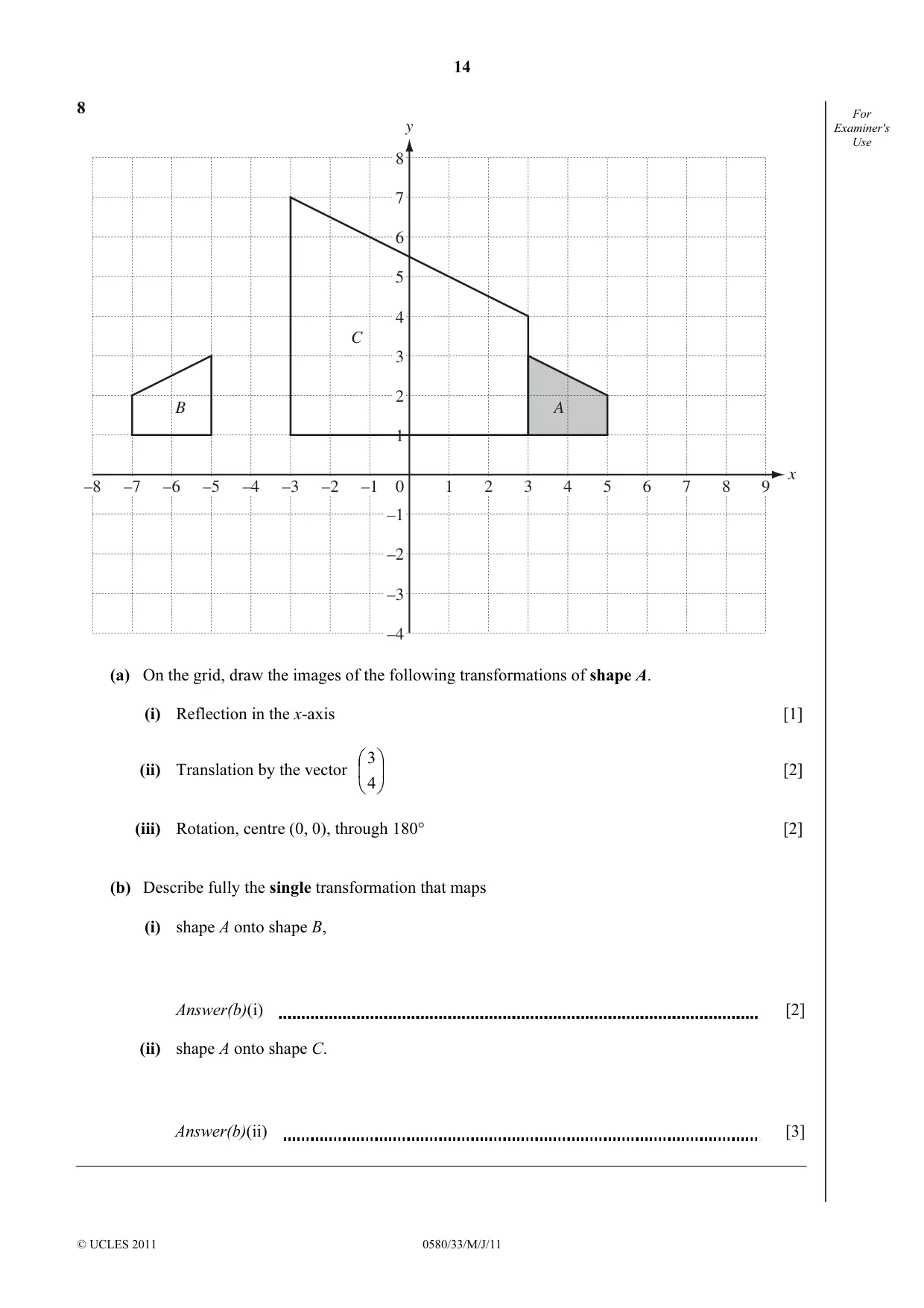
8 For y Examiner's Use 8 7 6 5 4 C 3 2 B A 1 x –8 –7 –6 –5 –4 –3 –2 –1 0 1 2 3 4 5 6 7 8 9 –1 –2 –3 –4 (a) On the grid, draw the images of the following transformations of shape A. (i) Reflection in the x-axis [1] 3 (ii) Translation by the vector [2] 4 (iii) Rotation, centre (0, 0), through 180° [2] (b) Describe fully the single transformation that maps (i) shape A onto shape B, Answer(b)(i) [2] (ii) shape A onto shape C. Answer(b)(ii) [3]
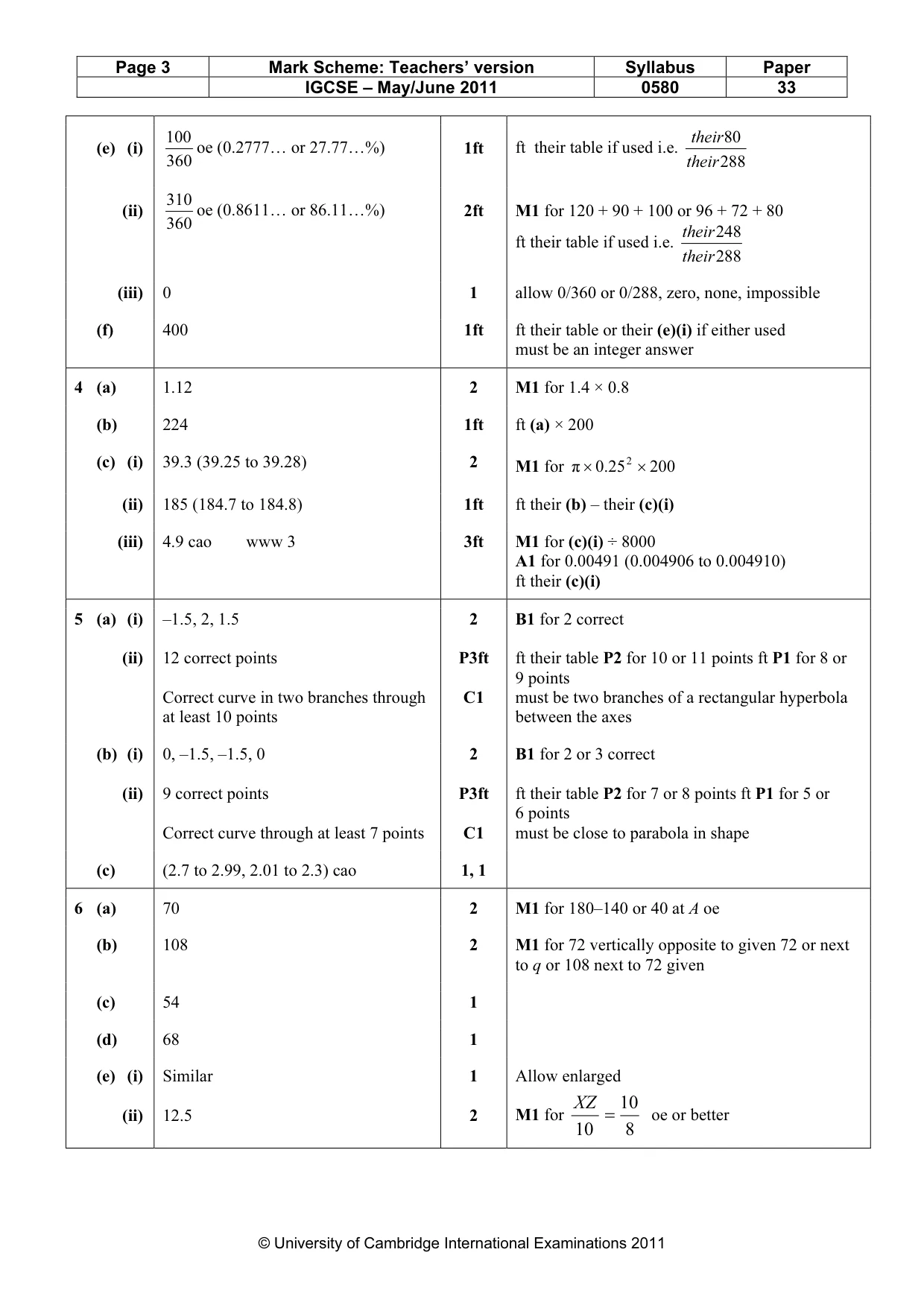
Mark scheme: 8 (a) (i) Image at (3, –1), (5, –1), (5, –2), (3, –3) 1 3 k − 3 (ii) Image at (6, 5), (8, 5), (8, 6), (6,7) 2 SC1 for translation by or or k 4 − 4 (iii) Image at (–3, –1), (–5, –1), (–5, –2), 2 SC1 for 180° rotation not about (0, 0) (–3, –3) (b) (i) Reflection, x = –1 1, 1 Allow clearly labelled line in place of x = –1 (ii) Enlargement, (factor) 3, (centre) (6, 1) 1, 1, 1 Allow centre clearly labelled
Q9 · For Examiner's Use Diagram 1 Diagram 2 Diagram 3 Diagram 4 Diagram 5 The Diagrams above…
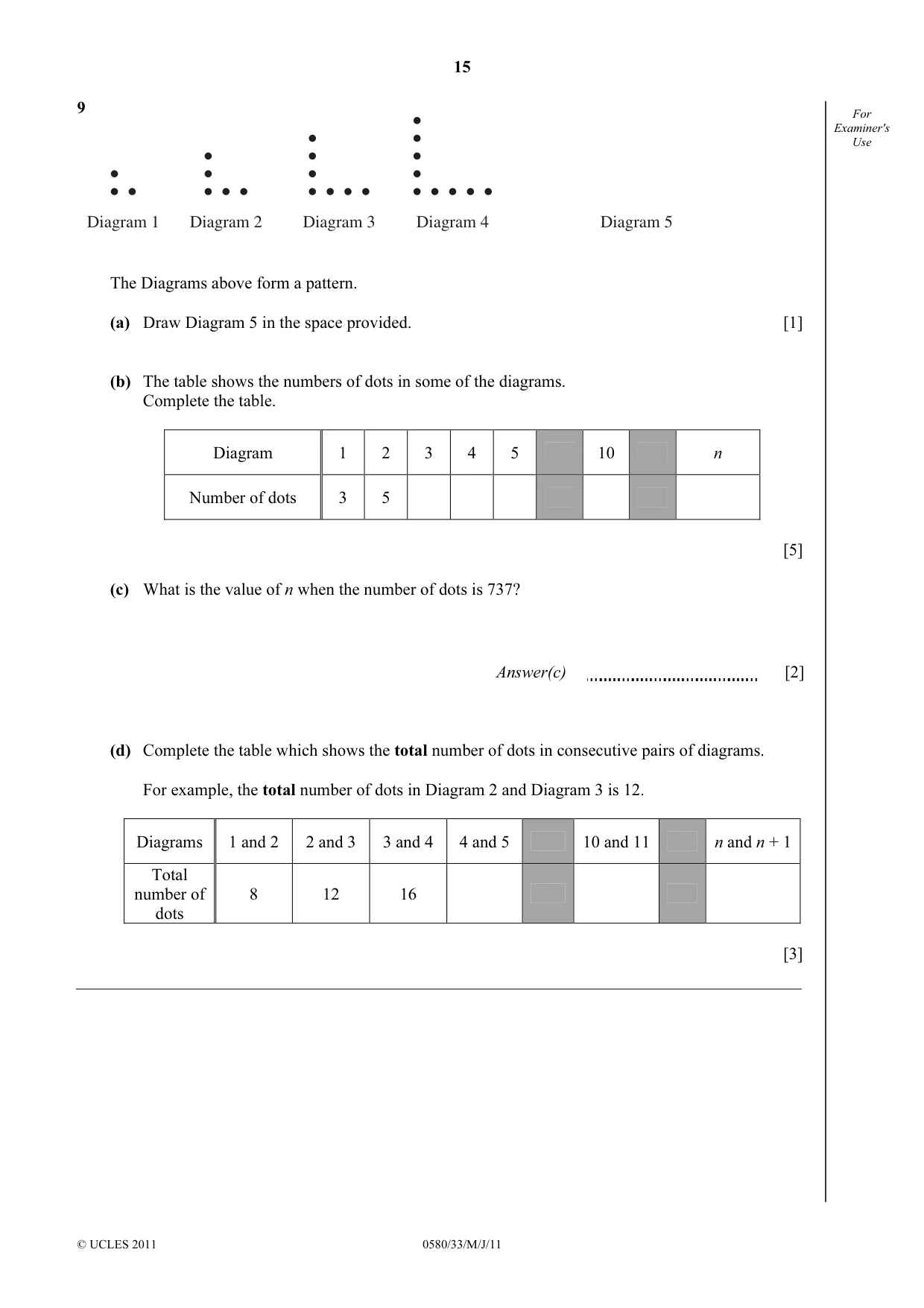
9 For Examiner's Use Diagram 1 Diagram 2 Diagram 3 Diagram 4 Diagram 5 The Diagrams above form a pattern. (a) Draw Diagram 5 in the space provided. [1] (b) The table shows the numbers of dots in some of the diagrams. Complete the table. Diagram 1 2 3 4 5 10 n Number of dots 3 5 [5] (c) What is the value of n when the number of dots is 737? Answer(c) [2] (d) Complete the table which shows the total number of dots in consecutive pairs of diagrams. For example, the total number of dots in Diagram 2 and Diagram 3 is 12. Diagrams 1 and 2 2 and 3 3 and 4 4 and 5 10 and 11 n and n + 1 Total number of 8 12 16 dots [3]
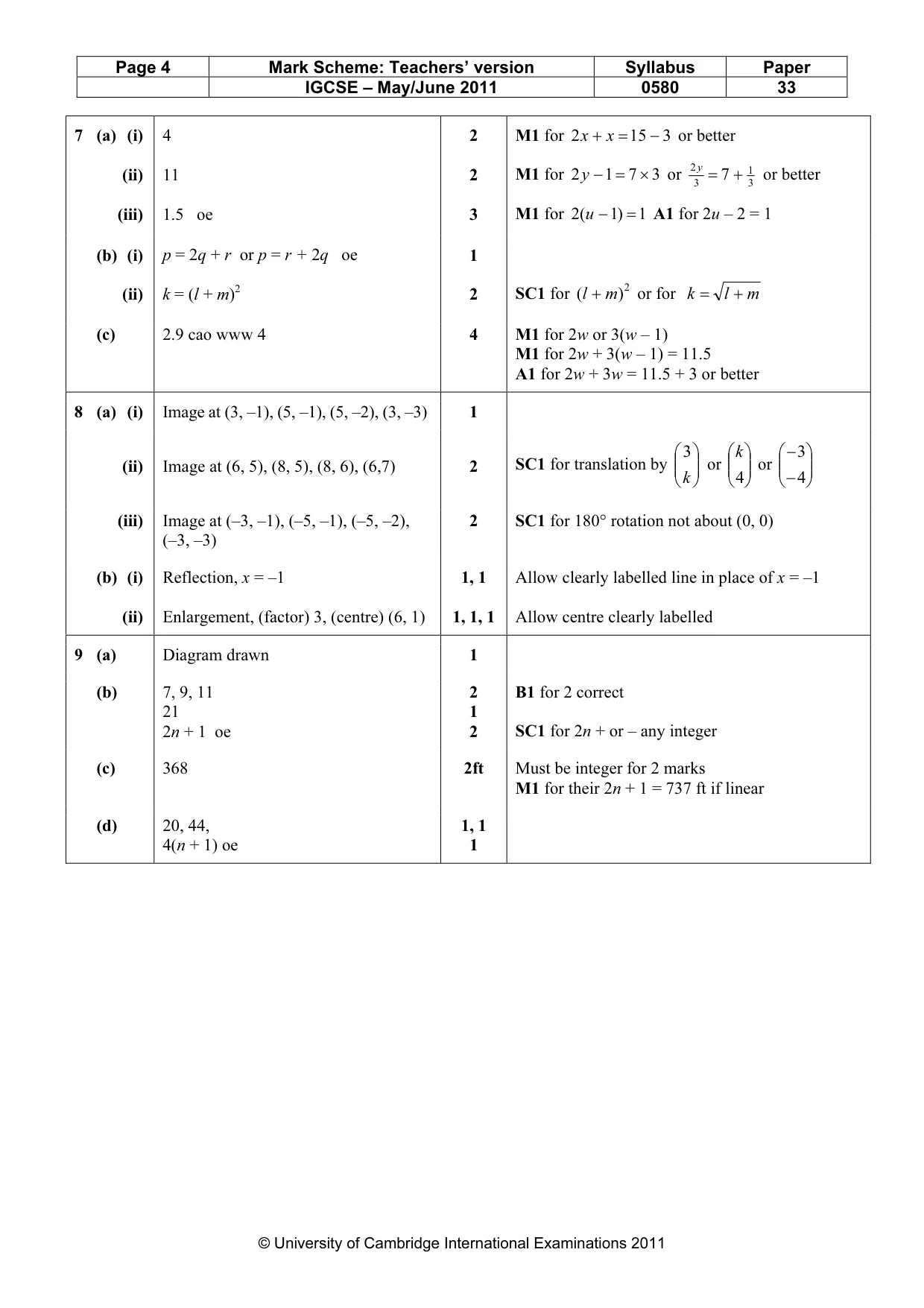
Mark scheme: 9 (a) Diagram drawn 1 (b) 7, 9, 11 2 B1 for 2 correct 21 1 2n + 1 oe 2 SC1 for 2n + or – any integer (c) 368 2ft Must be integer for 2 marks M1 for their 2n + 1 = 737 ft if linear (d) 20, 44, 1, 1 4(n + 1) oe 1
What was in this paper
The subtopics covered by these 3 questions, and how many questions each got. Open one in a new tab to see every Cambridge question on it.
What you needed in this session
Cambridge’s own grade thresholds for 2011 May/June, Paper 3 · Variant 3. A higher threshold means an easier paper — the bar moves with how the cohort did.