Cambridge IGCSE Mathematics 0580 — 2010 May/June Paper 3 · Variant 1
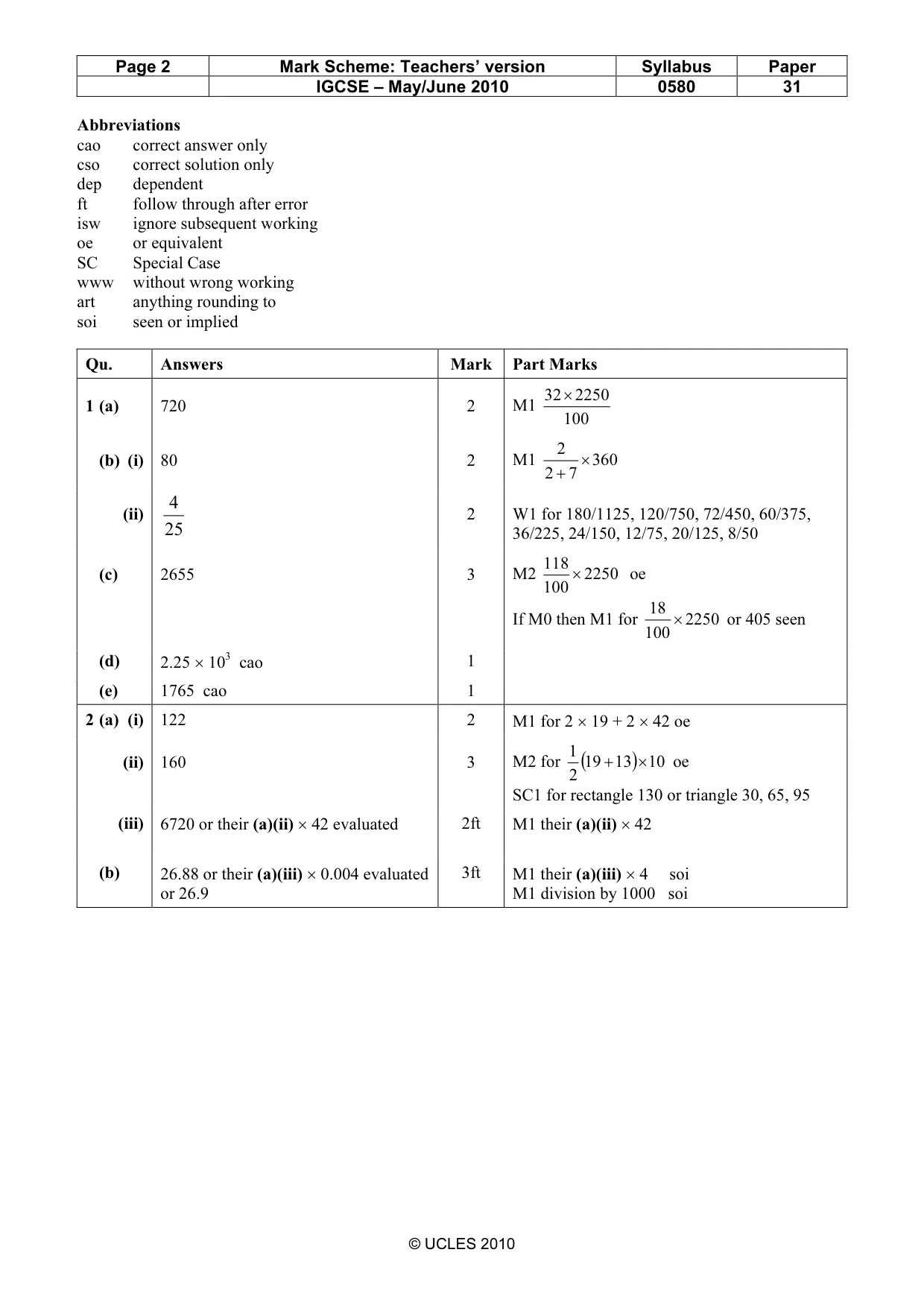
0580/31/M/J/10 · 8 questions · 83 marks · ≈93 min
The question paper and its mark scheme, free to read here and free to download. This is Cambridge’s own paper, exactly as it was sat.
Question paper12 pages
Mark scheme5 pages
Answers below. Sit the paper first if you are practising.
Questions as text
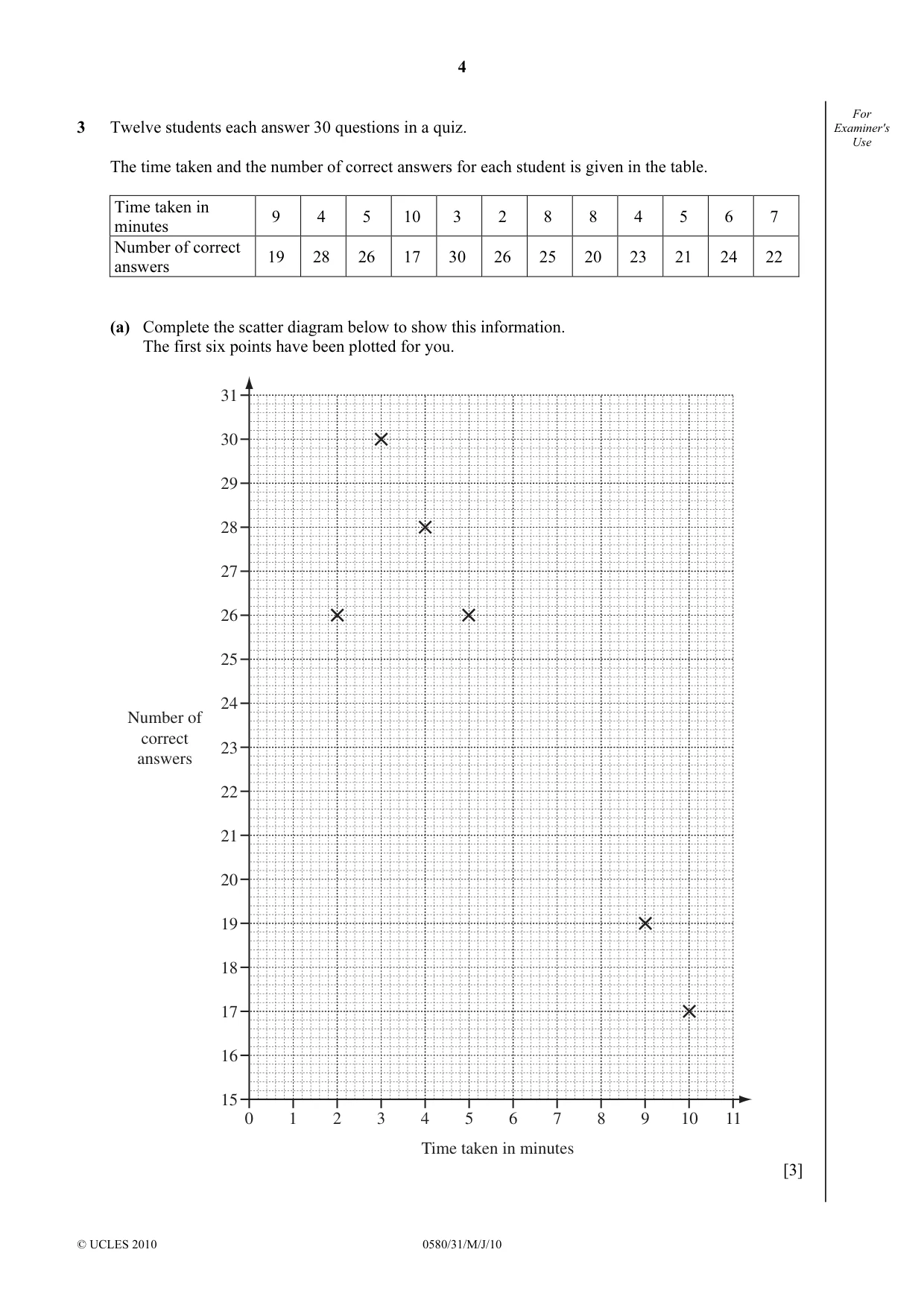
Q3 · Twelve students each answer 30 questions in a quiz
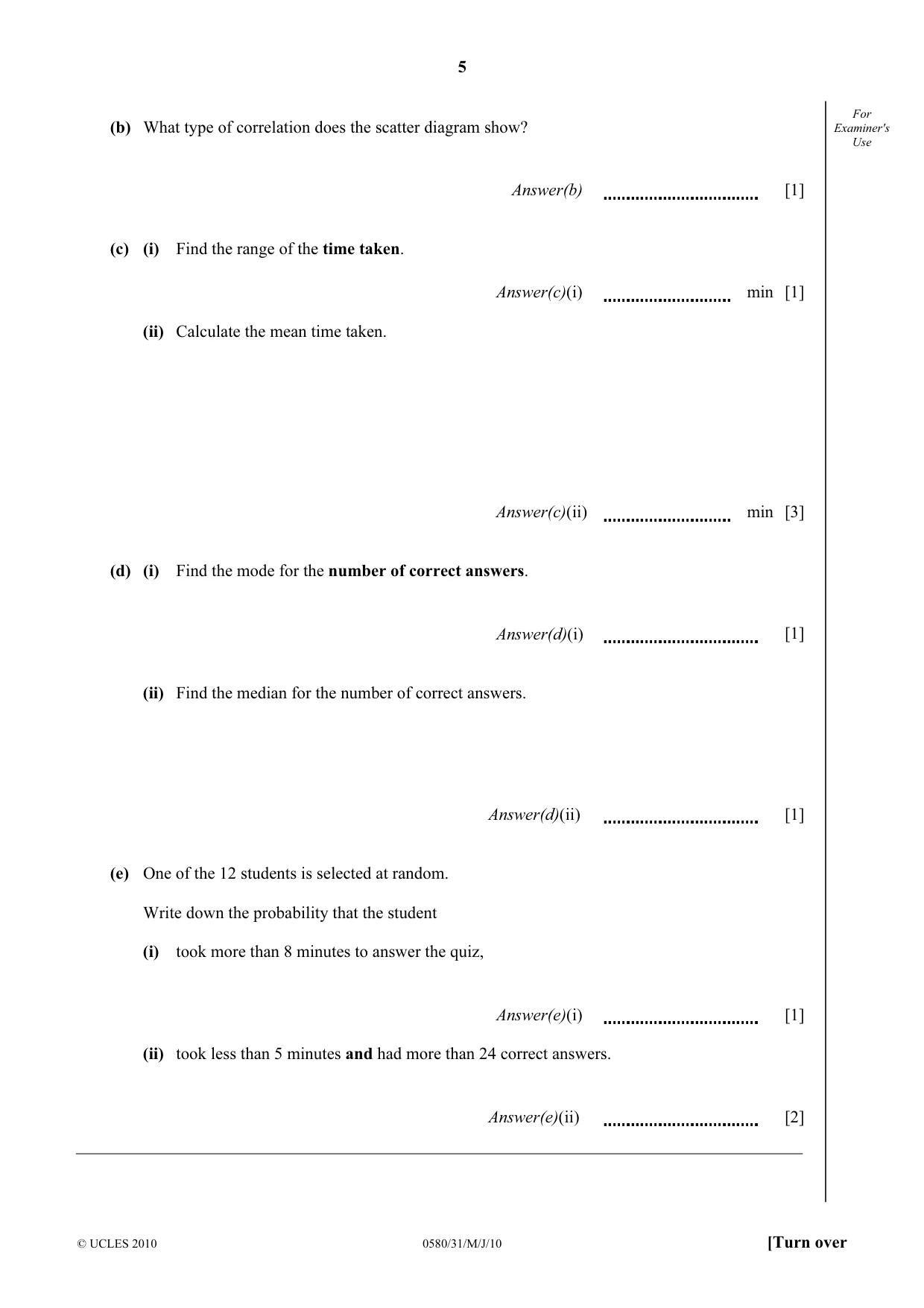
3 Twelve students each answer 30 questions in a quiz. Examiner's Use The time taken and the number of correct answers for each student is given in the table. Time taken in 9 4 5 10 3 2 8 8 4 5 6 7 minutes Number of correct 19 28 26 17 30 26 25 20 23 21 24 22 answers (a) Complete the scatter diagram below to show this information. The first six points have been plotted for you. 31 30 29 28 27 26 25 24 Number of correct 23 answers 22 21 20 19 18 17 16 15 0 1 2 3 4 5 6 7 8 9 10 11 Time taken in minutes [3] For (b) What type of correlation does the scatter diagram show? Examiner's Use Answer(b) [1] (c) (i) Find the range of the time taken. Answer(c)(i) min [1] (ii) Calculate the mean time taken. Answer(c)(ii) min [3] (d) (i) Find the mode for the number of correct answers. Answer(d)(i) [1] (ii) Find the median for the number of correct answers. Answer(d)(ii) [1] (e) One of the 12 students is selected at random. Write down the probability that the student (i) took more than 8 minutes to answer the quiz, Answer(e)(i) [1] (ii) took less than 5 minutes and had more than 24 correct answers. Answer(e)(ii) [2]
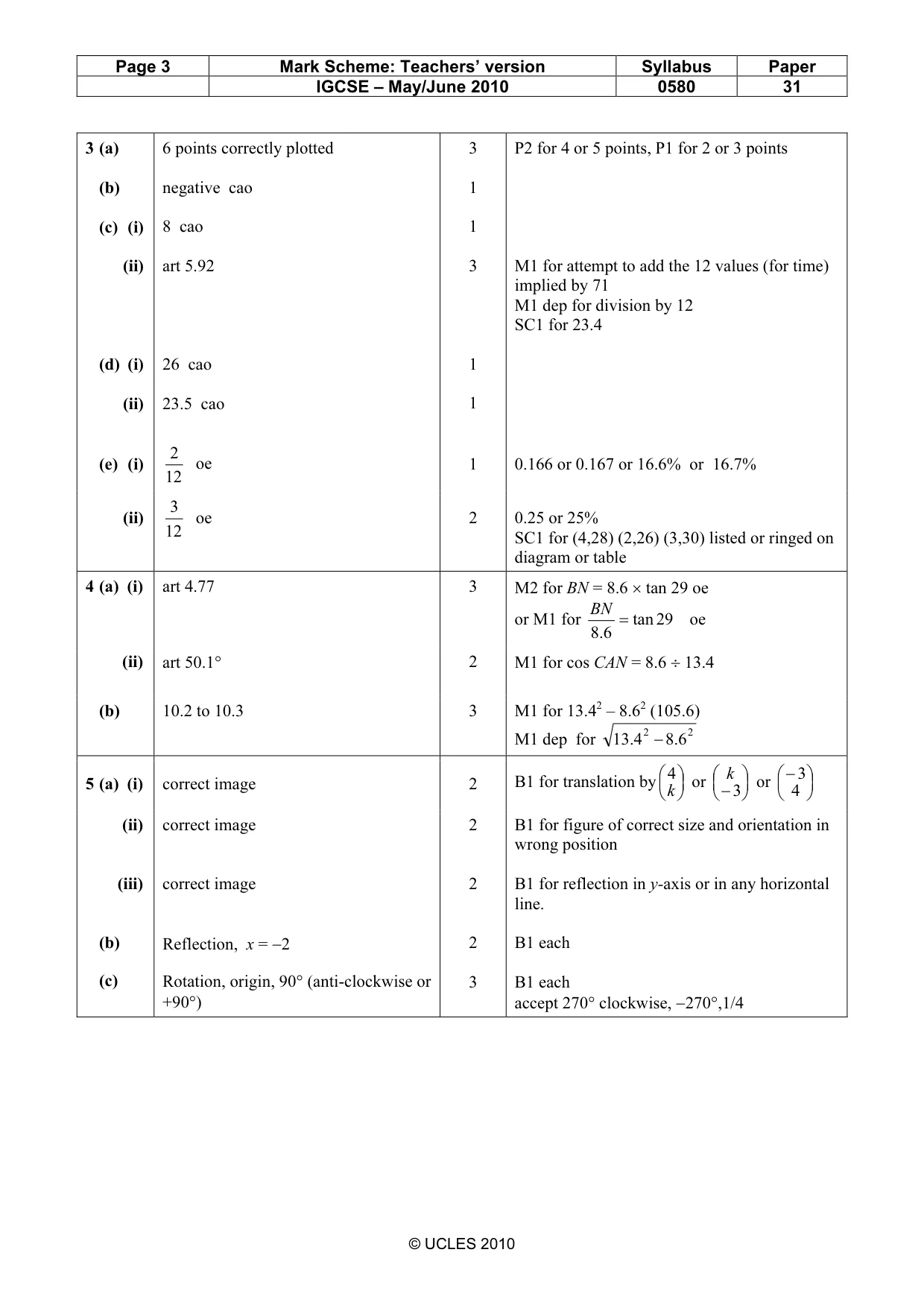
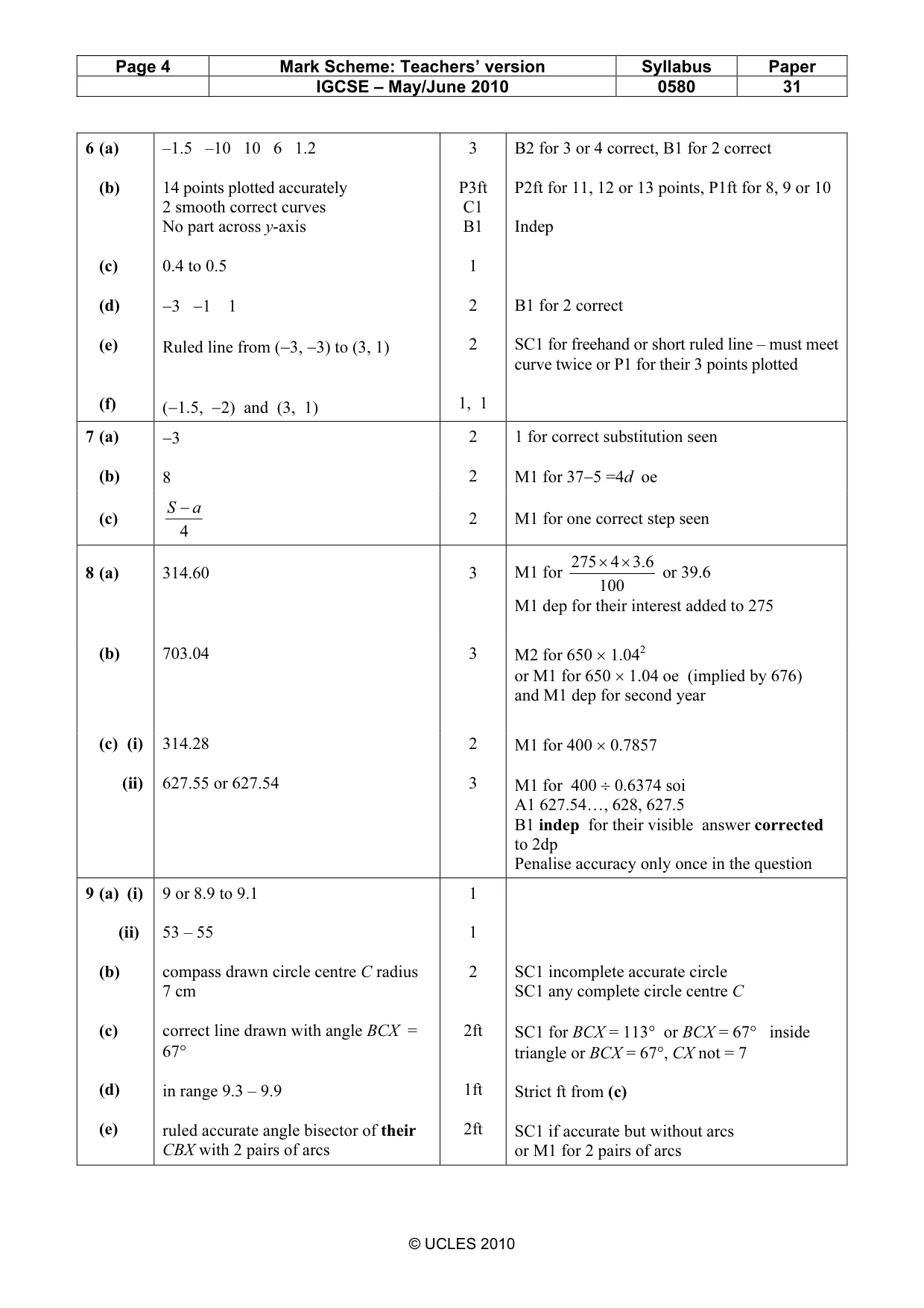
Mark scheme: 3 (a) 6 points correctly plotted 3 P2 for 4 or 5 points, P1 for 2 or 3 points (b) negative cao 1 (c) (i) 8 cao 1 (ii) art 5.92 3 M1 for attempt to add the 12 values (for time) implied by 71 M1 dep for division by 12 SC1 for 23.4 (d) (i) 26 cao 1 (ii) 23.5 cao 1 2 (e) (i) oe 1 0.166 or 0.167 or 16.6% or 16.7% 12 3 (ii) oe 2 0.25 or 25% 12 SC1 for (4,28) (2,26) (3,30) listed or ringed on diagram or table
Q4 · Examiner's A Use NOT TO SCALE 29° 13.4 cm 8.6 cm B N C In triangle ABC, AN = 8.6 cm and…
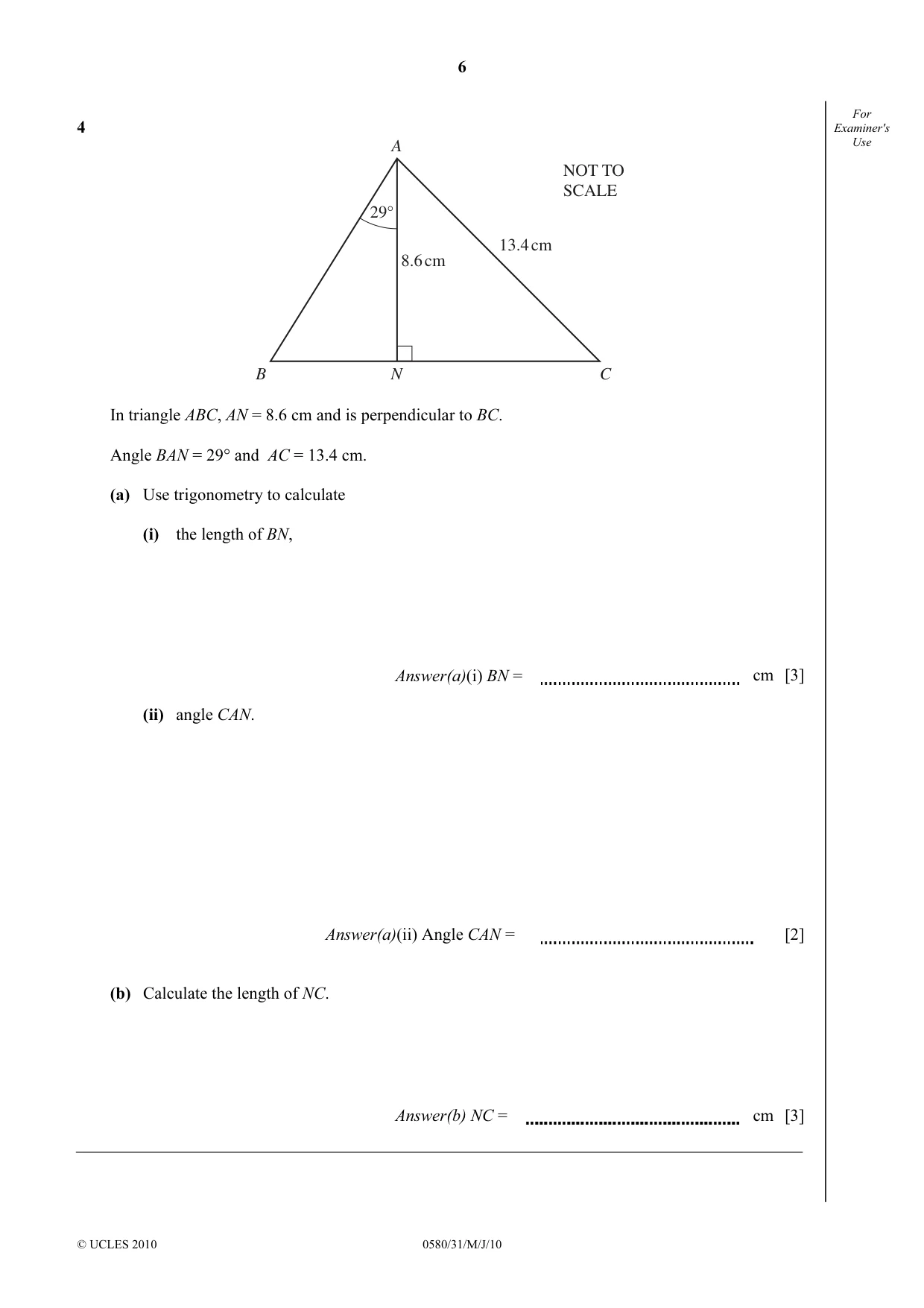
4 Examiner's A Use NOT TO SCALE 29° 13.4 cm 8.6 cm B N C In triangle ABC, AN = 8.6 cm and is perpendicular to BC. Angle BAN = 29° and AC = 13.4 cm. (a) Use trigonometry to calculate (i) the length of BN, Answer(a)(i) BN = cm [3] (ii) angle CAN. Answer(a)(ii) Angle CAN = [2] (b) Calculate the length of NC. Answer(b) NC = cm [3]
Mark scheme: 4 (a) (i) art 4.77 3 M2 for BN = 8.6 × tan 29 oe BN or M1 for = tan 29 oe 6.8 (ii) art 50.1° 2 M1 for cos CAN = 8.6 ÷ 13.4 (b) 10.2 to 10.3 3 M1 for 13.42 – 8.62 (105.6) M1 dep for 134. 2 − 6.8 2 4 k 3
Q5 · Examiner's y Use 7 6 5 4 S R C D 3 W Q 2 B 1 P V U T A x –7 –6 –5 –4 –3 –2 –1 0 1 2 3 4 5…
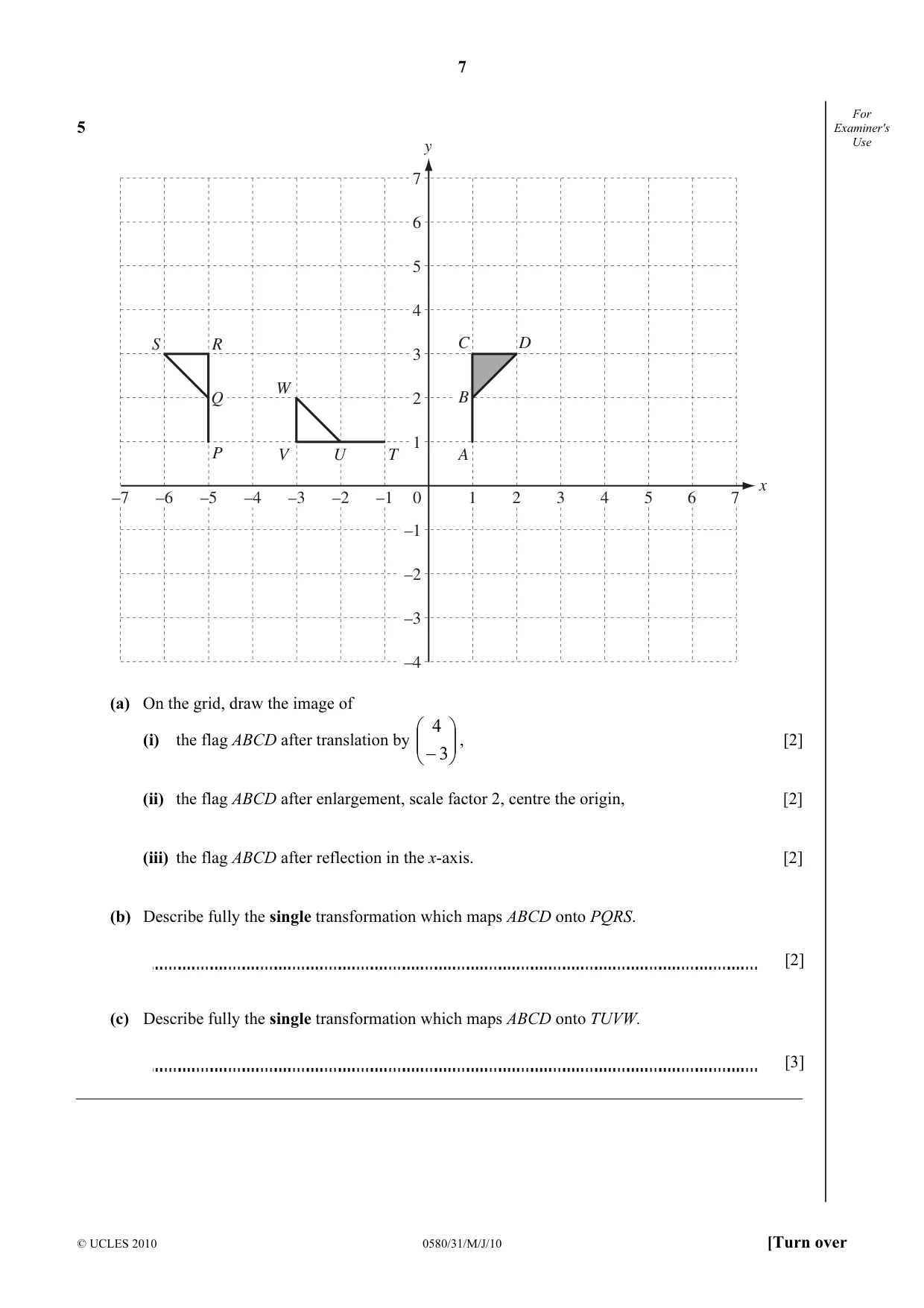
5 Examiner's y Use 7 6 5 4 S R C D 3 W Q 2 B 1 P V U T A x –7 –6 –5 –4 –3 –2 –1 0 1 2 3 4 5 6 7 –1 –2 –3 –4 (a) On the grid, draw the image of 4 (i) the flag ABCD after translation by , [2] −3 (ii) the flag ABCD after enlargement, scale factor 2, centre the origin, [2] (iii) the flag ABCD after reflection in the x-axis. [2] (b) Describe fully the single transformation which maps ABCD onto PQRS. [2] (c) Describe fully the single transformation which maps ABCD onto TUVW. [3]
Mark scheme: 4 k − 3 5 (a) (i) correct image 2 B1 for translation by k or −3 or 4 (ii) correct image 2 B1 for figure of correct size and orientation in wrong position (iii) correct image 2 B1 for reflection in y-axis or in any horizontal line. (b) Reflection, x = −2 2 B1 each (c) Rotation, origin, 90° (anti-clockwise or 3 B1 each +90°) accept 270° clockwise, −270°,1/4 IGCSE – May/June 2010 0580 31
Q6 · For 6 (a) Complete the table of values for the function y = , x ≠ 0
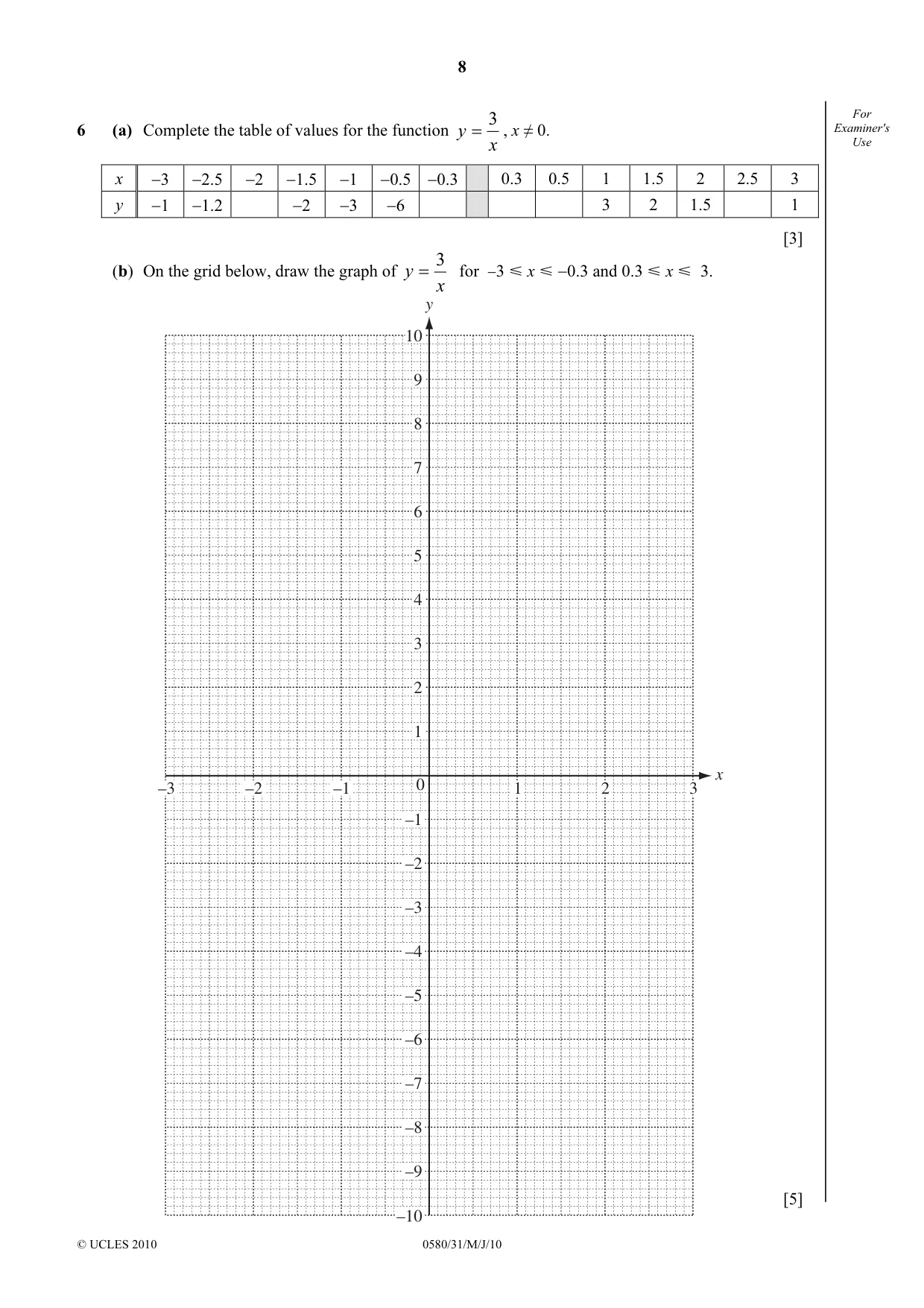
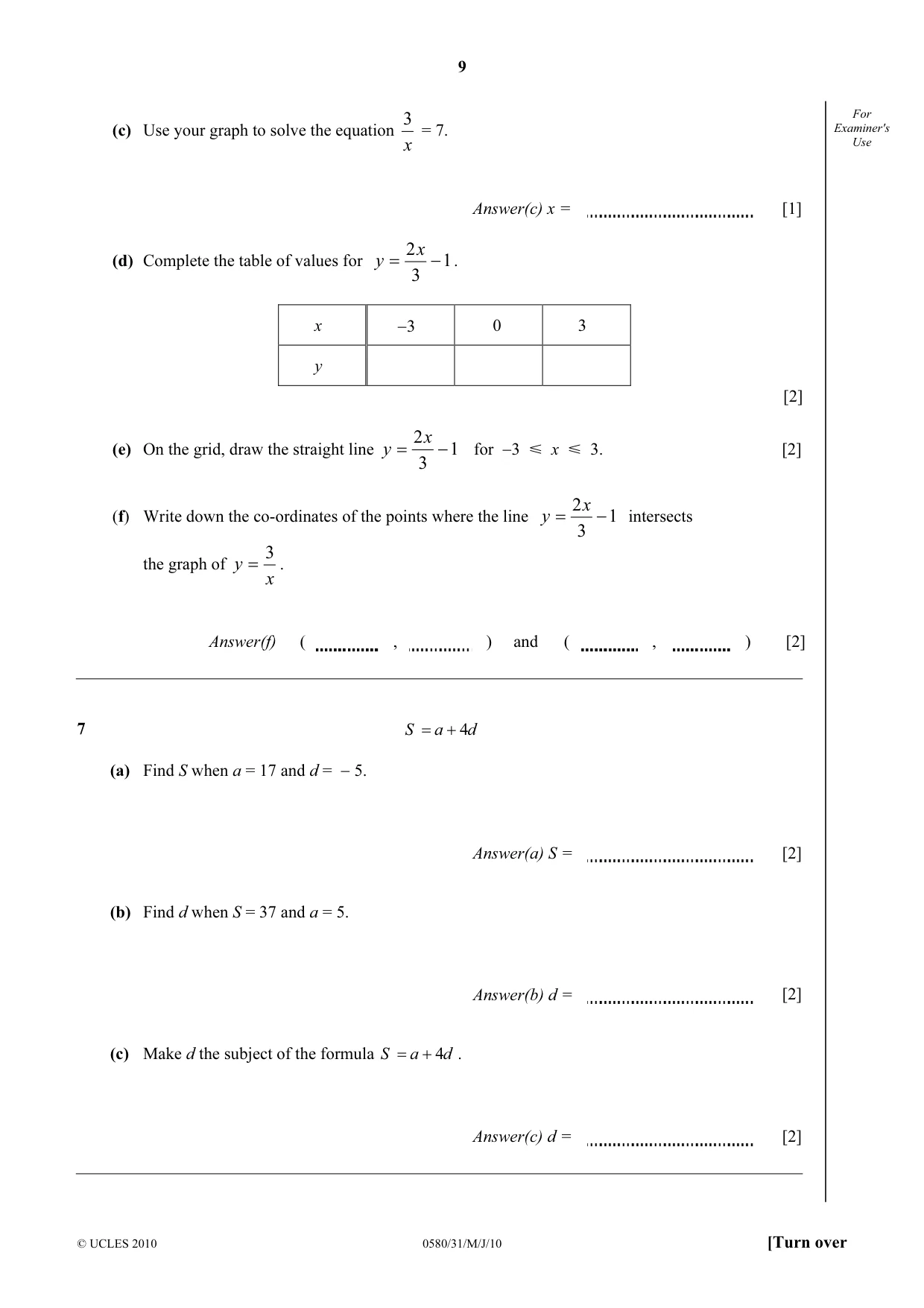
3 For 6 (a) Complete the table of values for the function y = , x ≠ 0. Examiner's x Use x −3 −2.5 −2 −1.5 −1 −0.5 −0.3 0.3 0.5 1 1.5 2 2.5 3 y −1 −1.2 −2 −3 −6 3 2 1.5 1 [3] 3 (b) On the grid below, draw the graph of y = for −3 Y x Y −0.3 and 0.3 Y x Y 3. x y 10 9 8 7 6 5 4 3 2 1 x –3 –2 –1 0 1 2 3 –1 –2 –3 –4 –5 –6 –7 –8 –9 [5] –10 3 For (c) Use your graph to solve the equation = 7. Examiner's x Use Answer(c) x = [1] 2 x (d) Complete the table of values for y = − 1 . 3 x −3 0 3 y [2] 2 x (e) On the grid, draw the straight line y = − 1 for −3 Y x Y 3. [2] 3 2 x (f) Write down the co-ordinates of the points where the line y = − 1 intersects 3 3 the graph of y = . x Answer(f) ( , ) and ( , ) [2]
Mark scheme: 6 (a) –1.5 –10 10 6 1.2 3 B2 for 3 or 4 correct, B1 for 2 correct (b) 14 points plotted accurately P3ft P2ft for 11, 12 or 13 points, P1ft for 8, 9 or 10 2 smooth correct curves C1 No part across y-axis B1 Indep (c) 0.4 to 0.5 1 (d) −3 −1 1 2 B1 for 2 correct (e) Ruled line from (−3, −3) to (3, 1) 2 SC1 for freehand or short ruled line – must meet curve twice or P1 for their 3 points plotted (f) (−1.5, −2) and (3, 1) 1, 1
Q7 · S = a + 4d (a) Find S when a = 17 and d = − 5
7 S = a + 4d (a) Find S when a = 17 and d = − 5. Answer(a) S = [2] (b) Find d when S = 37 and a = 5. Answer(b) d = [2] (c) Make d the subject of the formula S = a + 4d . Answer(c) d = [2]
Mark scheme: 7 (a) −3 2 1 for correct substitution seen (b) 8 2 M1 for 37−5 =4d oe S − a (c) 2 M1 for one correct step seen 4 275 × 4 × 3 6
Q8 · In this question give all your answers to 2 decimal places
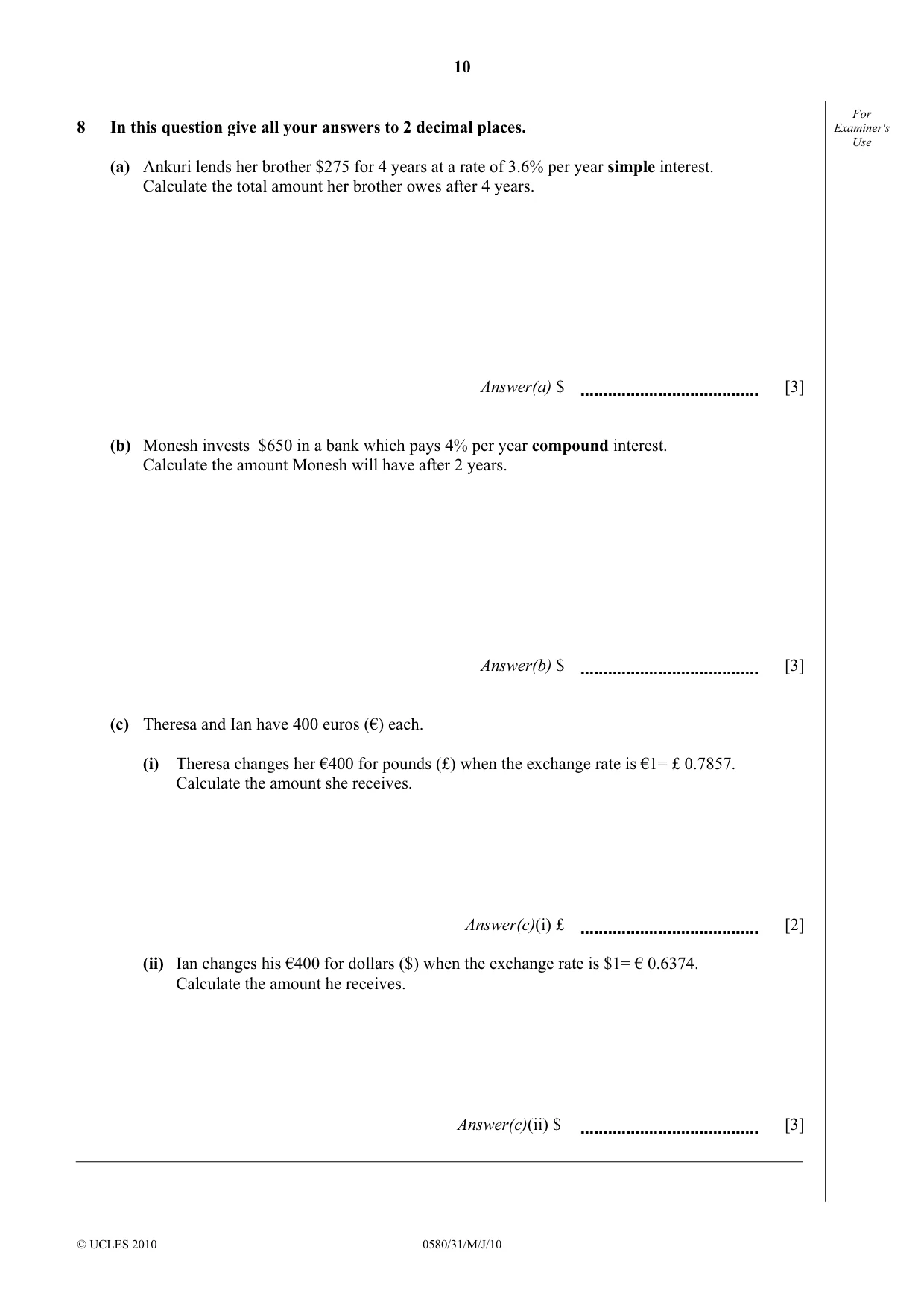
8 In this question give all your answers to 2 decimal places. Examiner's Use (a) Ankuri lends her brother $275 for 4 years at a rate of 3.6% per year simple interest. Calculate the total amount her brother owes after 4 years. Answer(a) $ [3] (b) Monesh invests $650 in a bank which pays 4% per year compound interest. Calculate the amount Monesh will have after 2 years. Answer(b) $ [3] (c) Theresa and Ian have 400 euros (€) each. (i) Theresa changes her €400 for pounds (£) when the exchange rate is €1= £ 0.7857. Calculate the amount she receives. Answer(c)(i) £ [2] (ii) Ian changes his €400 for dollars ($) when the exchange rate is $1= € 0.6374. Calculate the amount he receives. Answer(c)(ii) $ [3]
Mark scheme: 275 × 4 × 6.3 8 (a) 314.60 3 M1 for or 39.6 100 M1 dep for their interest added to 275 (b) 703.04 3 M2 for 650 × 1.042 or M1 for 650 × 1.04 oe (implied by 676) and M1 dep for second year (c) (i) 314.28 2 M1 for 400 × 0.7857 (ii) 627.55 or 627.54 3 M1 for 400 ÷ 0.6374 soi A1 627.54…, 628, 627.5 B1 indep for their visible answer corrected to 2dp Penalise accuracy only once in the question
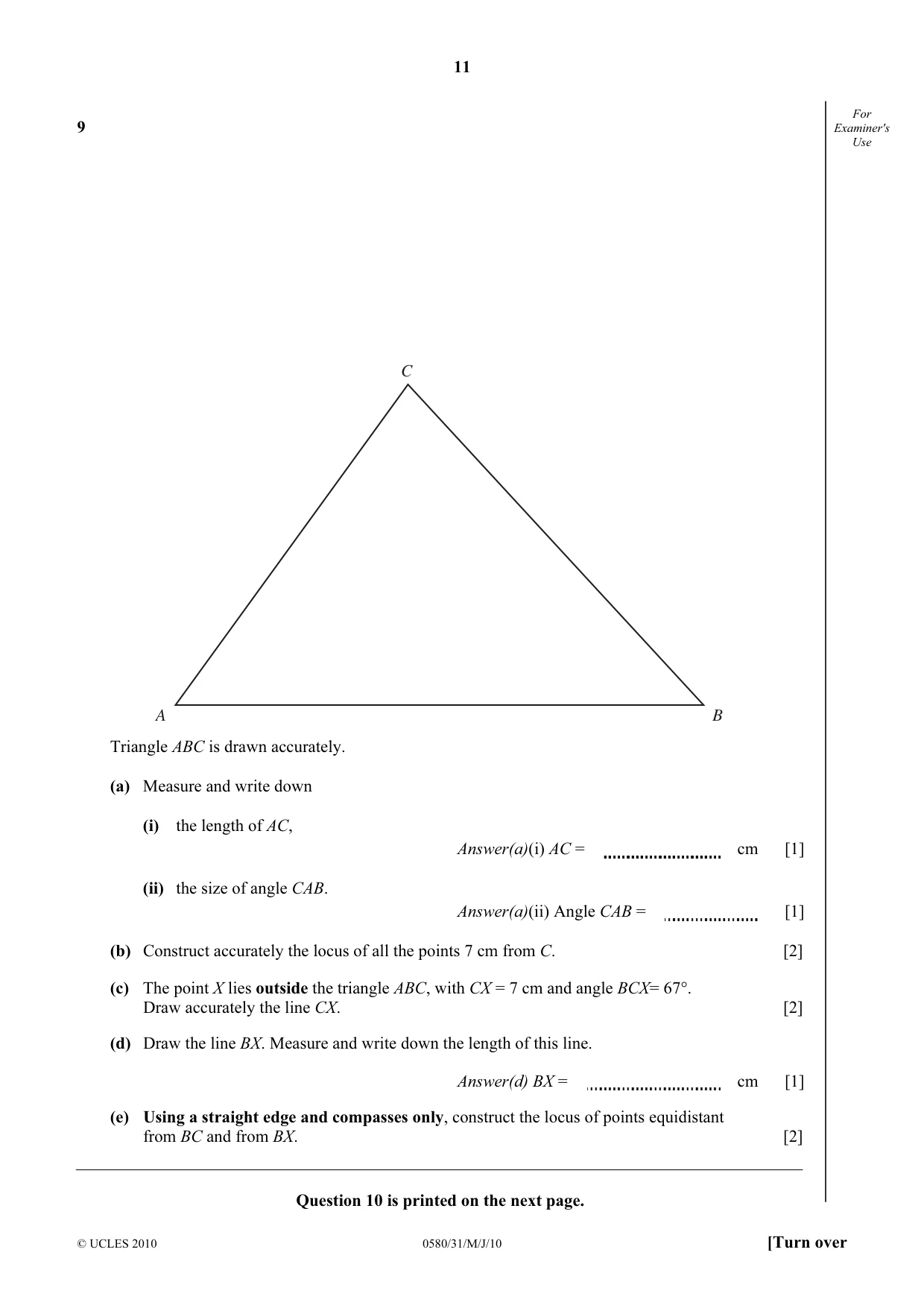
Q9 · Examiner's Use C A B Triangle ABC is drawn accurately
9 Examiner's Use C A B Triangle ABC is drawn accurately. (a) Measure and write down (i) the length of AC, Answer(a)(i) AC = cm [1] (ii) the size of angle CAB. Answer(a)(ii) Angle CAB = [1] (b) Construct accurately the locus of all the points 7 cm from C. [2] (c) The point X lies outside the triangle ABC, with CX = 7 cm and angle BCX= 67°. Draw accurately the line CX. [2] (d) Draw the line BX. Measure and write down the length of this line. Answer(d) BX = cm [1] (e) Using a straight edge and compasses only, construct the locus of points equidistant from BC and from BX. [2] Question 10 is printed on the next page.
Mark scheme: 9 (a) (i) 9 or 8.9 to 9.1 1 (ii) 53 – 55 1 (b) compass drawn circle centre C radius 2 SC1 incomplete accurate circle 7 cm SC1 any complete circle centre C (c) correct line drawn with angle BCX = 2ft SC1 for BCX = 113° or BCX = 67° inside 67° triangle or BCX = 67°, CX not = 7 (d) in range 9.3 – 9.9 1ft Strict ft from (c) (e) ruled accurate angle bisector of their 2ft SC1 if accurate but without arcs CBX with 2 pairs of arcs or M1 for 2 pairs of arcs IGCSE – May/June 2010 0580 31
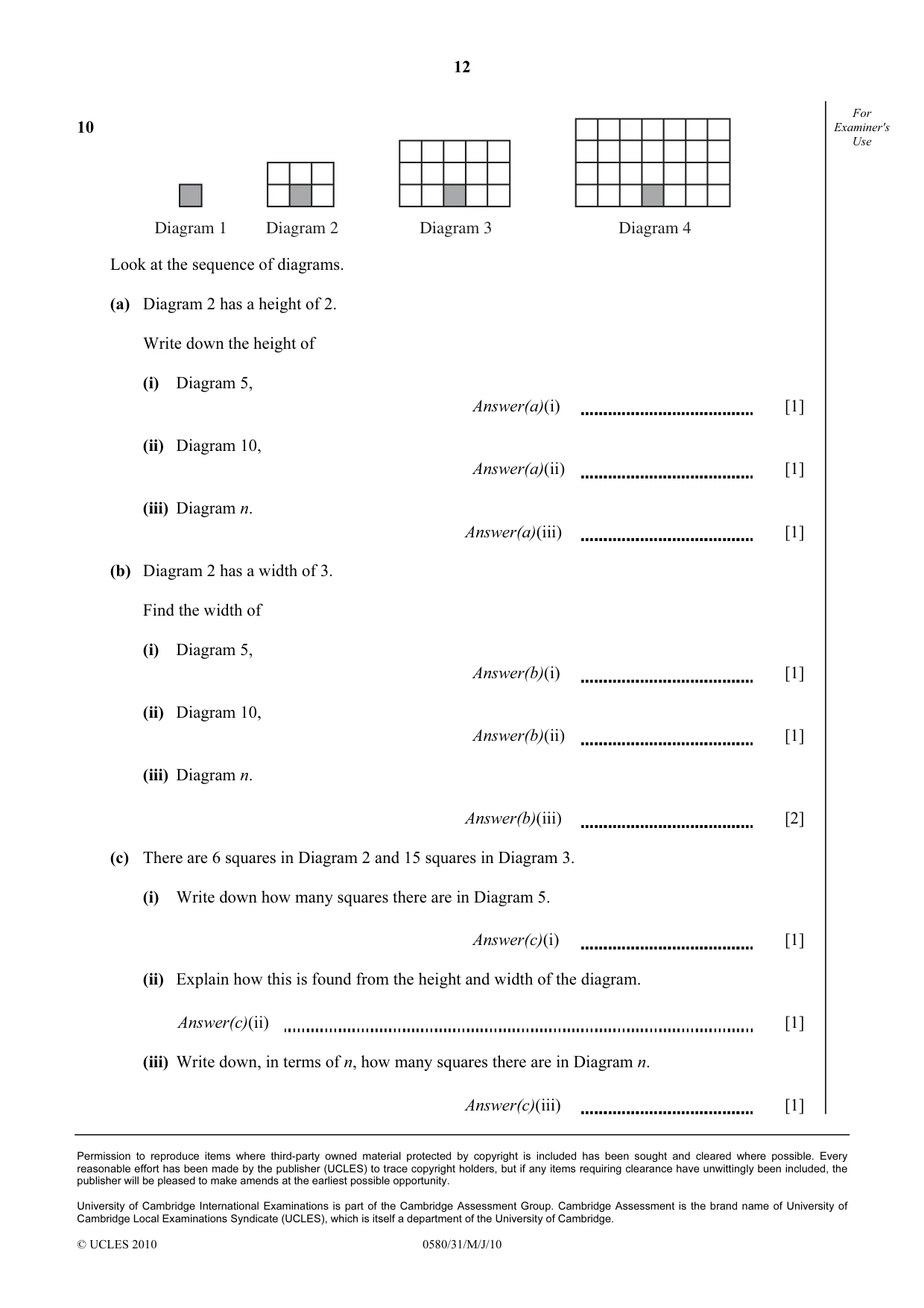
Q10 · Examiner's Use Diagram 1 Diagram 2 Diagram 3 Diagram 4 Look at the sequence of diagrams
10 Examiner's Use Diagram 1 Diagram 2 Diagram 3 Diagram 4 Look at the sequence of diagrams. (a) Diagram 2 has a height of 2. Write down the height of (i) Diagram 5, Answer(a)(i) [1] (ii) Diagram 10, Answer(a)(ii) [1] (iii) Diagram n. Answer(a)(iii) [1] (b) Diagram 2 has a width of 3. Find the width of (i) Diagram 5, Answer(b)(i) [1] (ii) Diagram 10, Answer(b)(ii) [1] (iii) Diagram n. Answer(b)(iii) [2] (c) There are 6 squares in Diagram 2 and 15 squares in Diagram 3. (i) Write down how many squares there are in Diagram 5. Answer(c)(i) [1] (ii) Explain how this is found from the height and width of the diagram. Answer(c)(ii) [1] (iii) Write down, in terms of n, how many squares there are in Diagram n. Answer(c)(iii) [1]
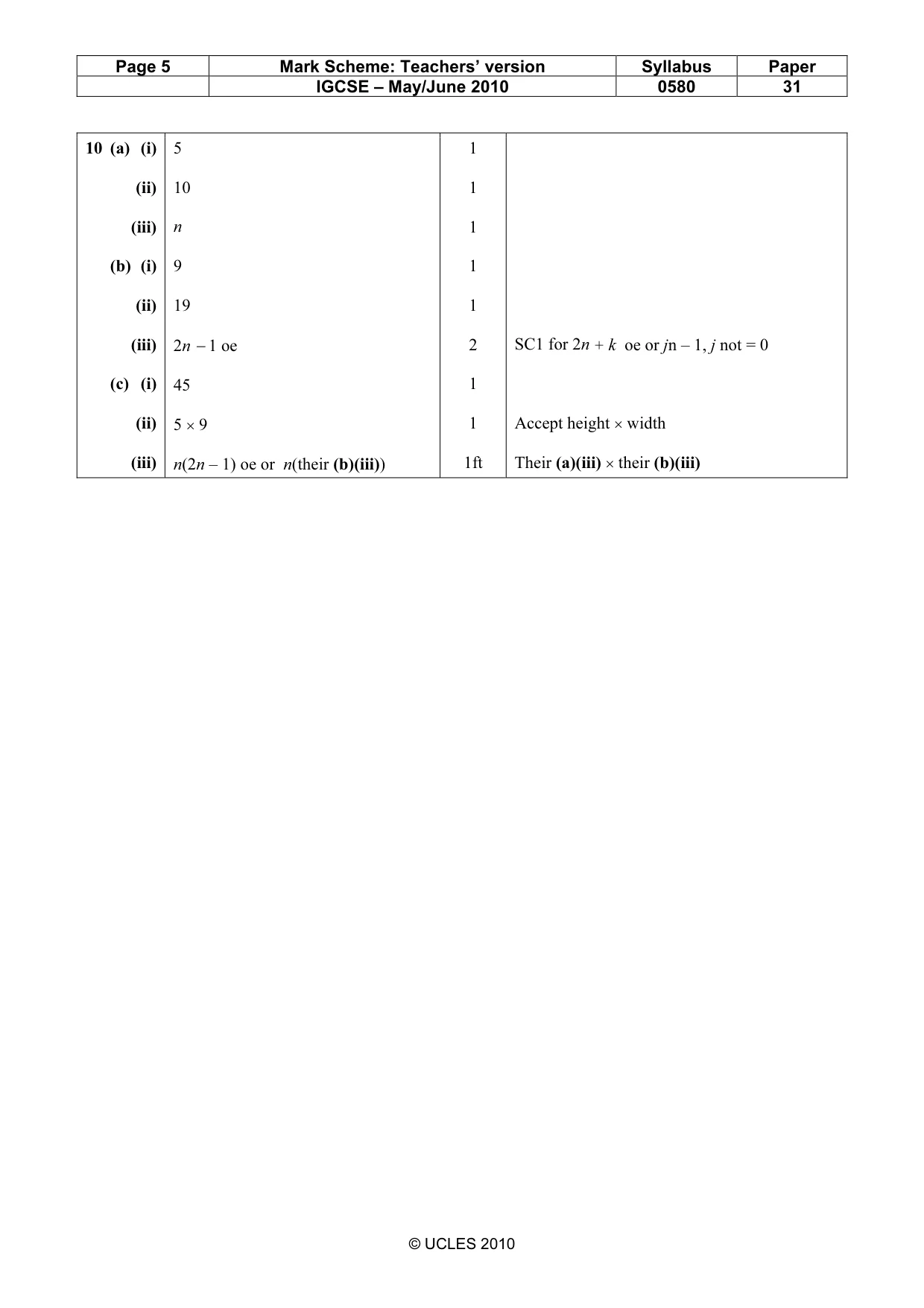
Mark scheme: 10 (a) (i) 5 1 (ii) 10 1 (iii) n 1 (b) (i) 9 1 (ii) 19 1 (iii) 2n − 1 oe 2 SC1 for 2n + k oe or jn – 1, j not = 0 (c) (i) 45 1 (ii) 5 × 9 1 Accept height × width (iii) n(2n – 1) oe or n(their (b)(iii)) 1ft Their (a)(iii) × their (b)(iii)
What was in this paper
The subtopics covered by these 8 questions, and how many questions each got. Open one in a new tab to see every Cambridge question on it.