Cambridge IGCSE Mathematics 0580 — 2009 Oct/Nov Paper 3 · Variant 1
0580/31/O/N/09 · 104 marks · ≈117 min
The question paper and its mark scheme, free to read here and free to download. This is Cambridge’s own paper, exactly as it was sat.
Question paper12 pages
Mark scheme5 pages
Answers below. Sit the paper first if you are practising.
Paper as text
Question paper, page 1
This document consists of 12 printed pages. IB09 11_0580_03/5RP © UCLES 2009 [Turn over *7953581407* UNIVERSITY OF CAMBRIDGE INTERNATIONAL EXAMINATIONS International General Certificate of Secondary Education MATHEMATICS 0580/03 Paper 3 (Core) October/November 2009 2 hours Candidates answer on the Question Paper. Additional Materials: Electronic calculator Geometrical instruments Mathematical tables (optional) Tracing paper (optional) READ THESE INSTRUCTIONS FIRST Write your Centre number, candidate number and name on all the work you hand in. Write in dark blue or black pen. You may use a soft pencil for any diagrams or graphs. Do not use staples, paper clips, highlighters, glue or correction fluid. Answer all questions. If working is needed for any question it must be shown below that question. Electronic calculators should be used. If the degree of accuracy is not specified in the question, and if the answer is not exact, give the answer to three significant figures. Give answers in degrees to one decimal place. For π , use either your calculator value or 3.142. At the end of the examination, fasten all your work securely together. The number of marks is given in brackets [ ] at the end of each question or part question. The total of the marks for this paper is 104. www.XtremePapers.com
Question paper, page 2
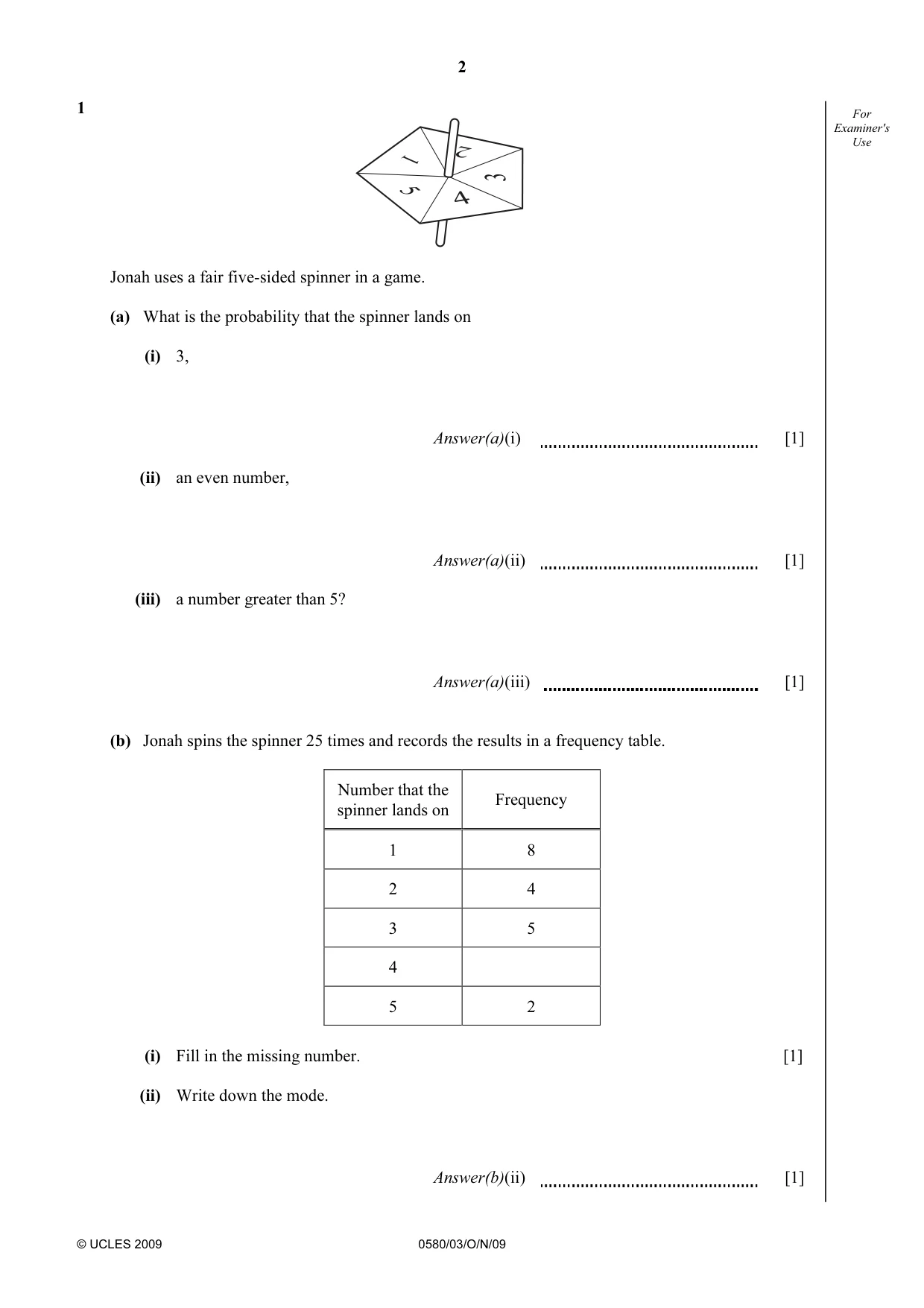
2 © UCLES 2009 0580/03/O/N/09 For Examiner's Use 1 Jonah uses a fair five-sided spinner in a game. (a) What is the probability that the spinner lands on (i) 3, Answer(a)(i) [1] (ii) an even number, Answer(a)(ii) [1] (iii) a number greater than 5? Answer(a)(iii) [1] (b) Jonah spins the spinner 25 times and records the results in a frequency table. Number that the spinner lands on Frequency 1 8 2 4 3 5 4 5 2 (i) Fill in the missing number. [1] (ii) Write down the mode. Answer(b)(ii) [1]
Question paper, page 3
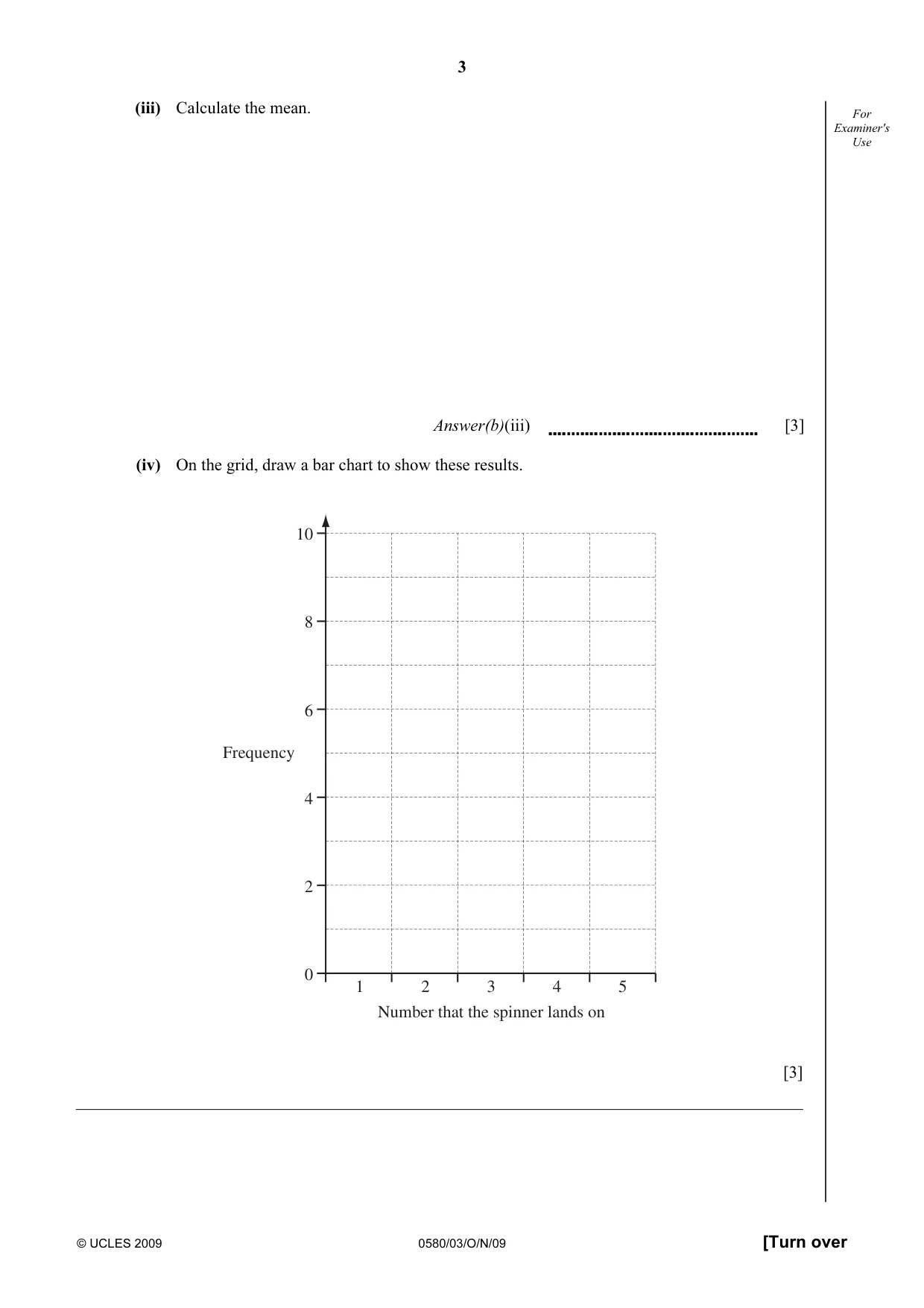
3 © UCLES 2009 0580/03/O/N/09 [Turn over For Examiner's Use (iii) Calculate the mean. Answer(b)(iii) [3] (iv) On the grid, draw a bar chart to show these results. 10 8 6 4 2 0 Number that the spinner lands on Frequency 1 2 3 4 5 [3]
Question paper, page 4
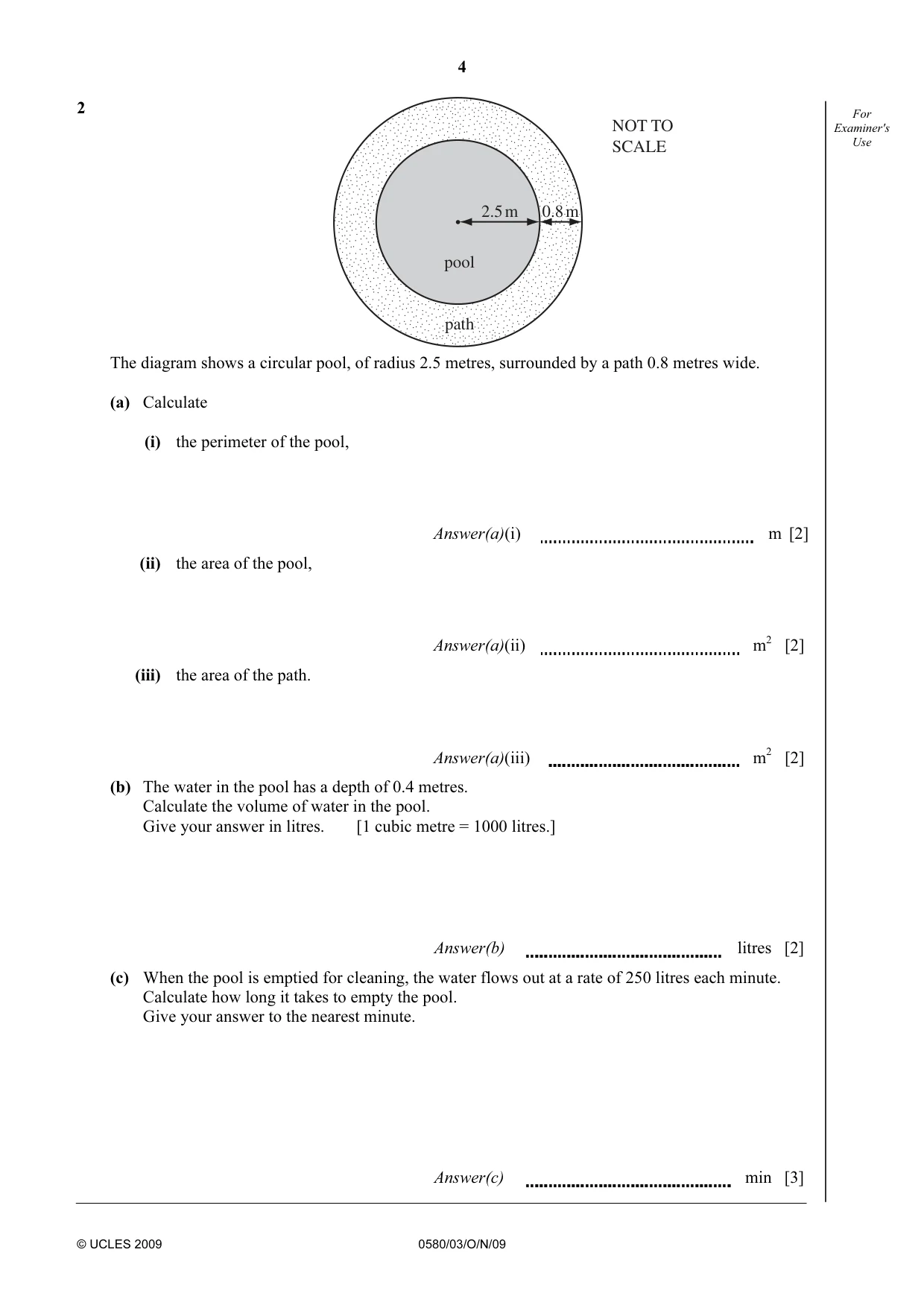
4 © UCLES 2009 0580/03/O/N/09 For Examiner's Use 2 The diagram shows a circular pool, of radius 2.5 metres, surrounded by a path 0.8 metres wide. (a) Calculate (i) the perimeter of the pool, Answer(a)(i) m [2] (ii) the area of the pool, Answer(a)(ii) m2 [2] (iii) the area of the path. Answer(a)(iii) m2 [2] (b) The water in the pool has a depth of 0.4 metres. Calculate the volume of water in the pool. Give your answer in litres. [1 cubic metre = 1000 litres.] Answer(b) litres [2] (c) When the pool is emptied for cleaning, the water flows out at a rate of 250 litres each minute. Calculate how long it takes to empty the pool. Give your answer to the nearest minute. Answer(c) min [3] 2.5 m 0.8 0.8 m 0.8 m path path path pool NOT TO SCALE
Question paper, page 5
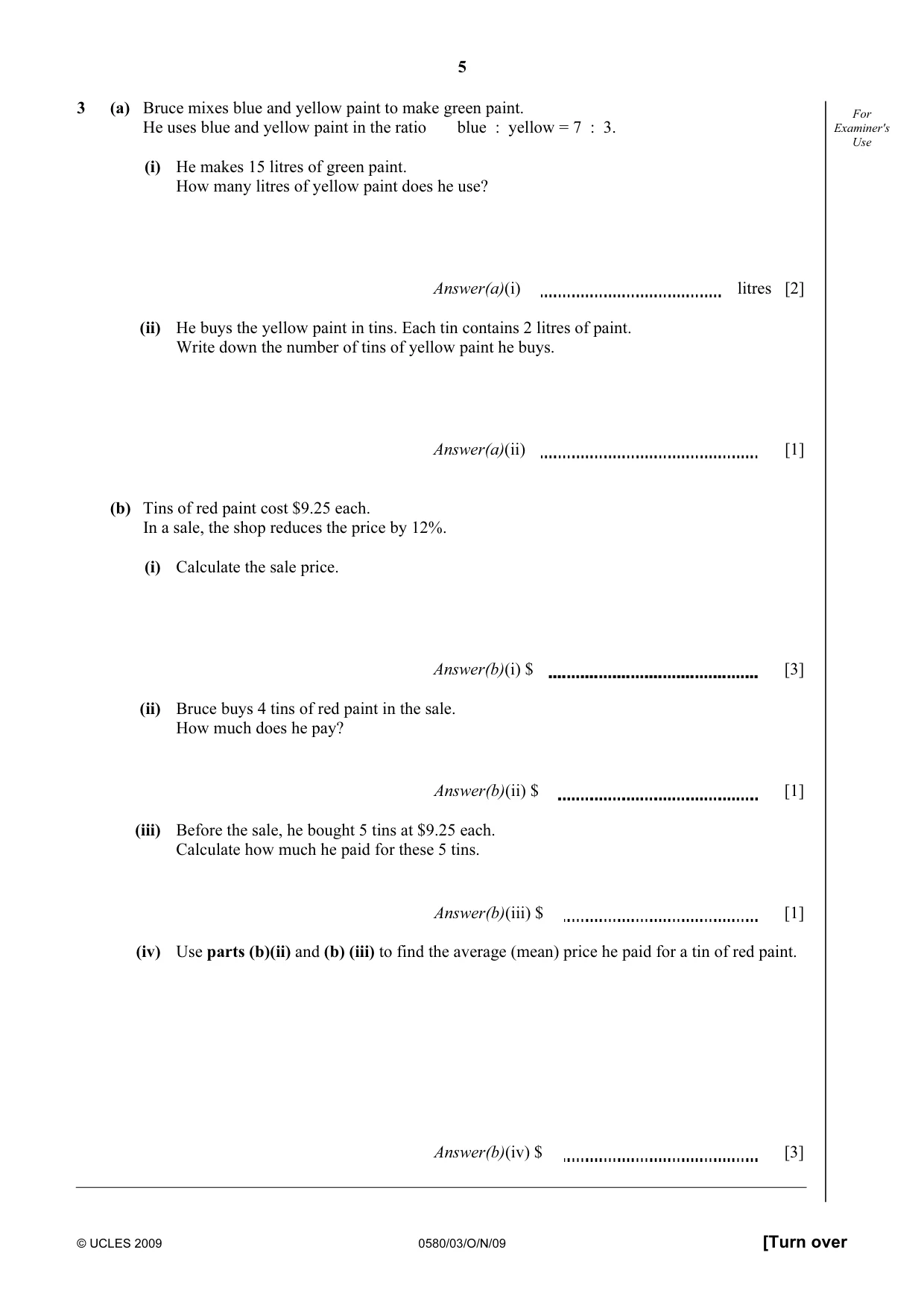
5 © UCLES 2009 0580/03/O/N/09 [Turn over For Examiner's Use 3 (a) Bruce mixes blue and yellow paint to make green paint. He uses blue and yellow paint in the ratio blue : yellow = 7 : 3. (i) He makes 15 litres of green paint. How many litres of yellow paint does he use? Answer(a)(i) litres [2] (ii) He buys the yellow paint in tins. Each tin contains 2 litres of paint. Write down the number of tins of yellow paint he buys. Answer(a)(ii) [1] (b) Tins of red paint cost $9.25 each. In a sale, the shop reduces the price by 12%. (i) Calculate the sale price. Answer(b)(i) $ [3] (ii) Bruce buys 4 tins of red paint in the sale. How much does he pay? Answer(b)(ii) $ [1] (iii) Before the sale, he bought 5 tins at $9.25 each. Calculate how much he paid for these 5 tins. Answer(b)(iii) $ [1] (iv) Use parts (b)(ii) and (b) (iii) to find the average (mean) price he paid for a tin of red paint. Answer(b)(iv) $ [3]
Question paper, page 6
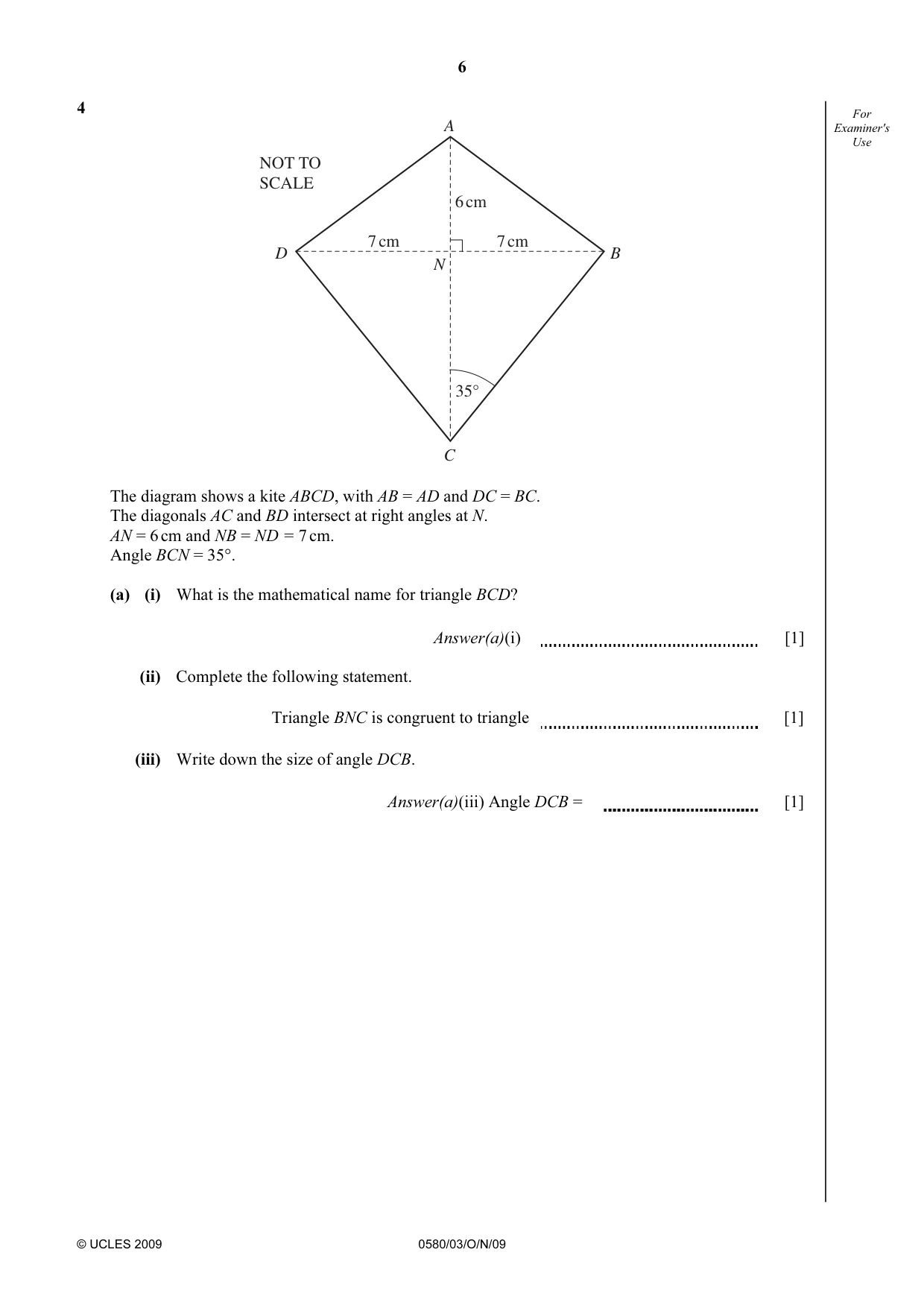
6 © UCLES 2009 0580/03/O/N/09 For Examiner's Use 4 A C B N D 35° 7 cm 7 cm 6 cm NOT TO SCALE The diagram shows a kite ABCD, with AB = AD and DC = BC. The diagonals AC and BD intersect at right angles at N. AN = 6 cm and NB = ND = 7 cm. Angle BCN = 35°. (a) (i) What is the mathematical name for triangle BCD? Answer(a)(i) [1] (ii) Complete the following statement. Triangle BNC is congruent to triangle [1] (iii) Write down the size of angle DCB. Answer(a)(iii) Angle DCB = [1]
Question paper, page 7
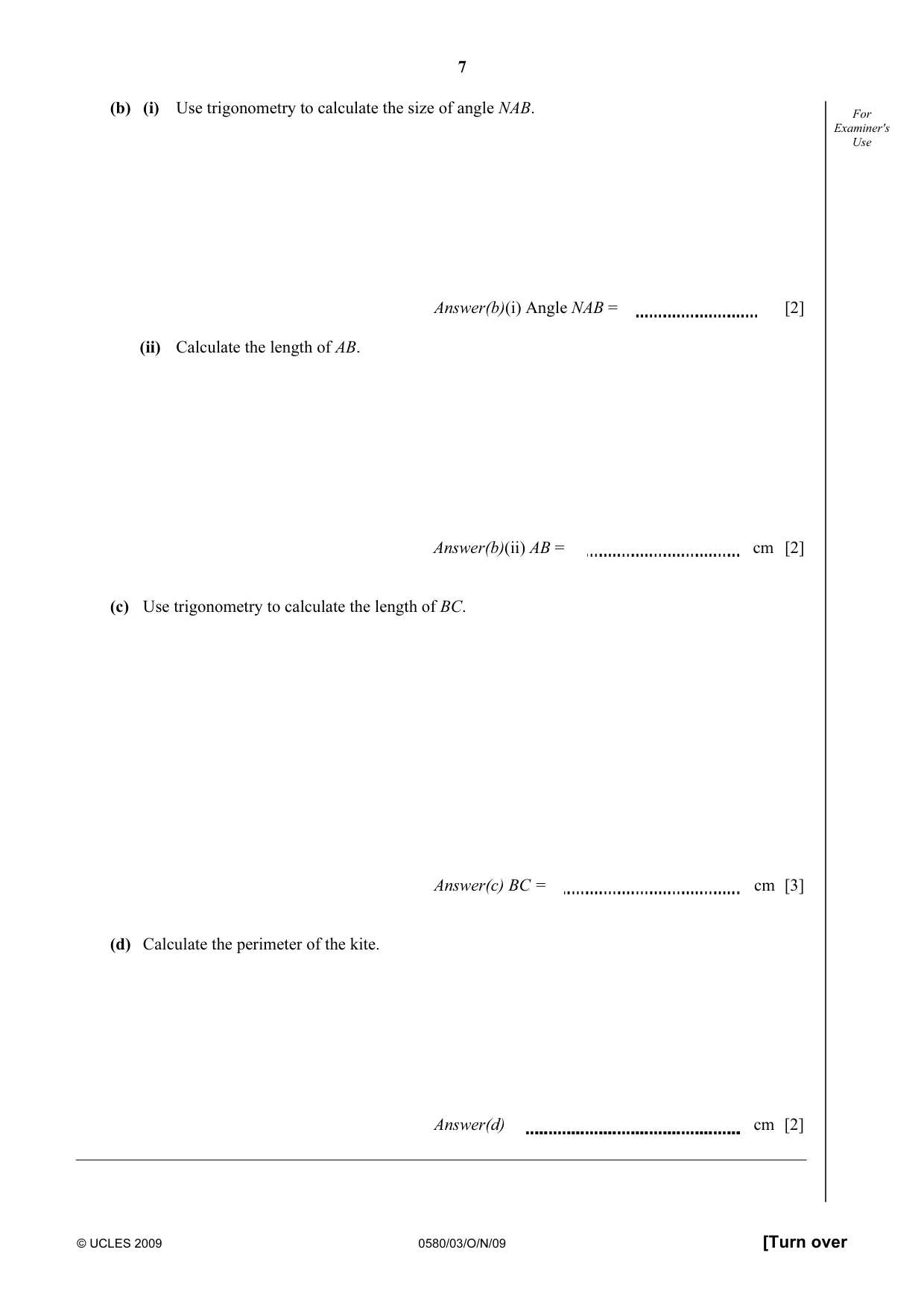
7 © UCLES 2009 0580/03/O/N/09 [Turn over For Examiner's Use (b) (i) Use trigonometry to calculate the size of angle NAB. Answer(b)(i) Angle NAB = [2] (ii) Calculate the length of AB. Answer(b)(ii) AB = cm [2] (c) Use trigonometry to calculate the length of BC. Answer(c) BC = cm [3] (d) Calculate the perimeter of the kite. Answer(d) cm [2]
Question paper, page 8
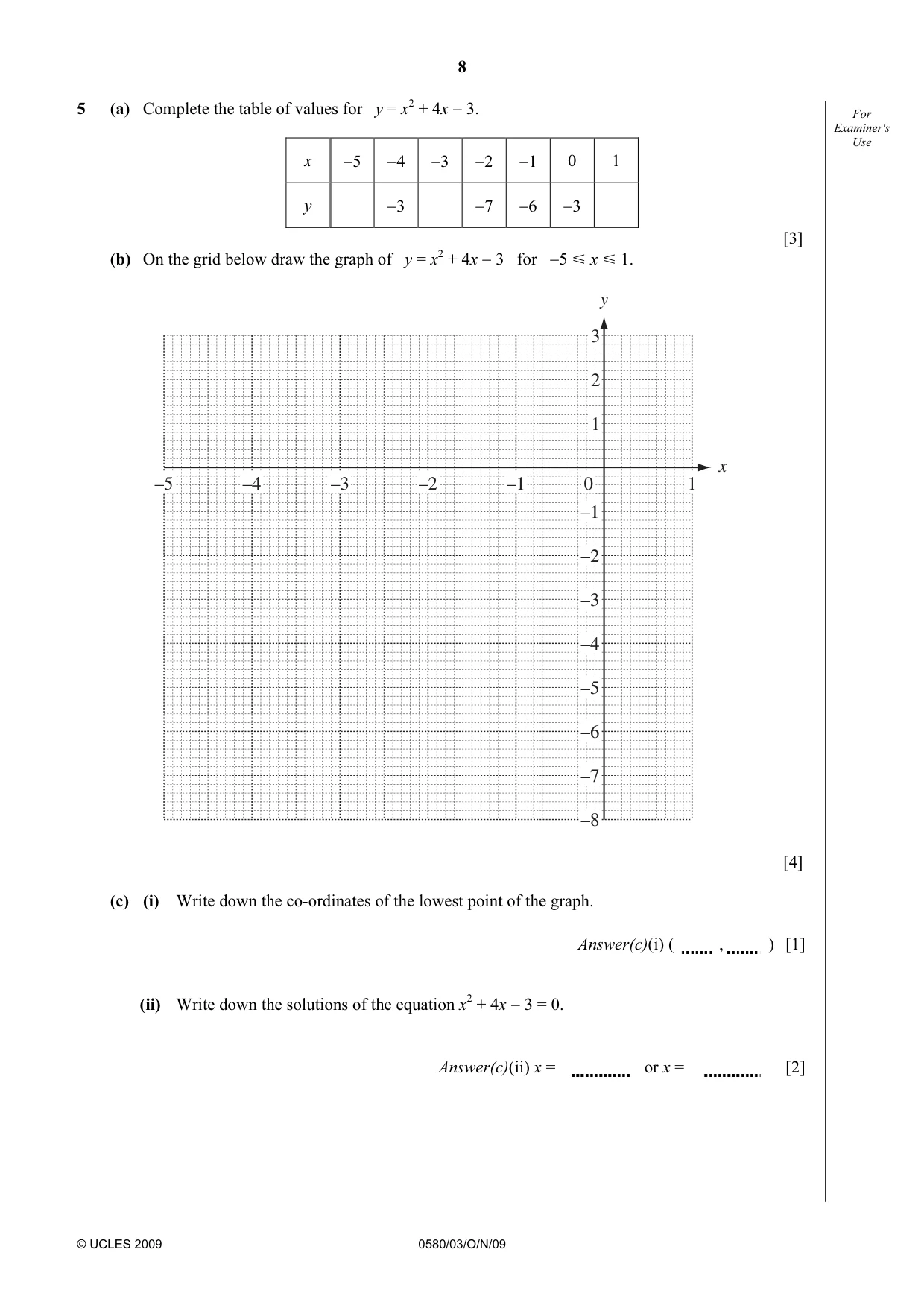
8 © UCLES 2009 0580/03/O/N/09 For Examiner's Use 5 (a) Complete the table of values for y = x2 + 4x − 3. x −5 −4 −3 −2 −1 0 1 y −3 −7 −6 −3 [3] (b) On the grid below draw the graph of y = x2 + 4x − 3 for −5 Y x Y 1. y x 3 –1 –1 1 2 –2 –3 –4 –5 –6 –7 –8 0 –2 –3 –4 –5 1 [4] (c) (i) Write down the co-ordinates of the lowest point of the graph. Answer(c)(i) ( , ) [1] (ii) Write down the solutions of the equation x2 + 4x − 3 = 0. Answer(c)(ii) x = or x = [2]
Question paper, page 9
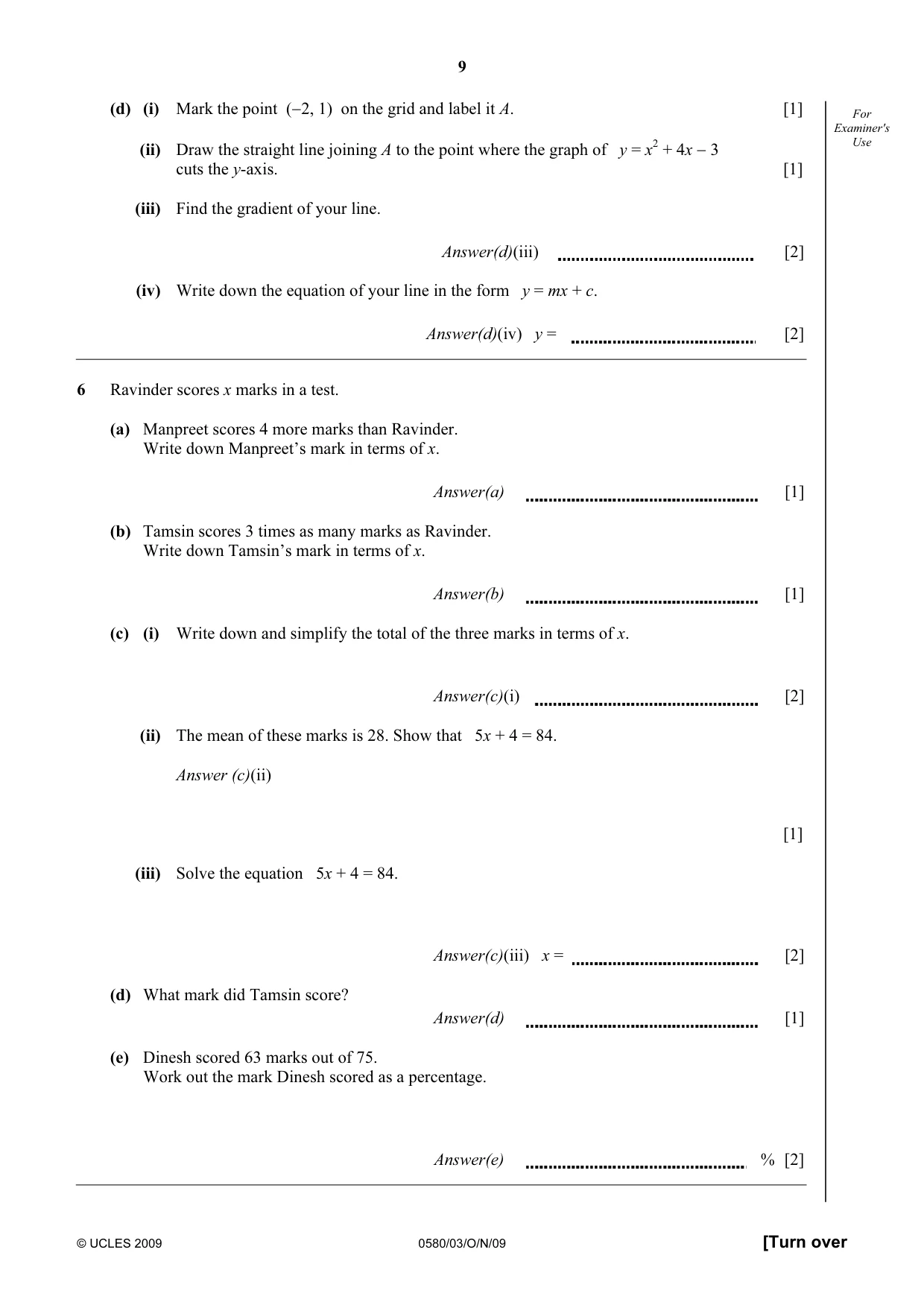
9 © UCLES 2009 0580/03/O/N/09 [Turn over For Examiner's Use (d) (i) Mark the point (−2, 1) on the grid and label it A. [1] (ii) Draw the straight line joining A to the point where the graph of y = x2 + 4x − 3 cuts the y-axis. [1] (iii) Find the gradient of your line. Answer(d)(iii) [2] (iv) Write down the equation of your line in the form y = mx + c. Answer(d)(iv) y = [2] 6 Ravinder scores x marks in a test. (a) Manpreet scores 4 more marks than Ravinder. Write down Manpreet’s mark in terms of x. Answer(a) [1] (b) Tamsin scores 3 times as many marks as Ravinder. Write down Tamsin’s mark in terms of x. Answer(b) [1] (c) (i) Write down and simplify the total of the three marks in terms of x. Answer(c)(i) [2] (ii) The mean of these marks is 28. Show that 5x + 4 = 84. Answer (c)(ii) [1] (iii) Solve the equation 5x + 4 = 84. Answer(c)(iii) x = [2] (d) What mark did Tamsin score? Answer(d) [1] (e) Dinesh scored 63 marks out of 75. Work out the mark Dinesh scored as a percentage. Answer(e) % [2]
Question paper, page 10
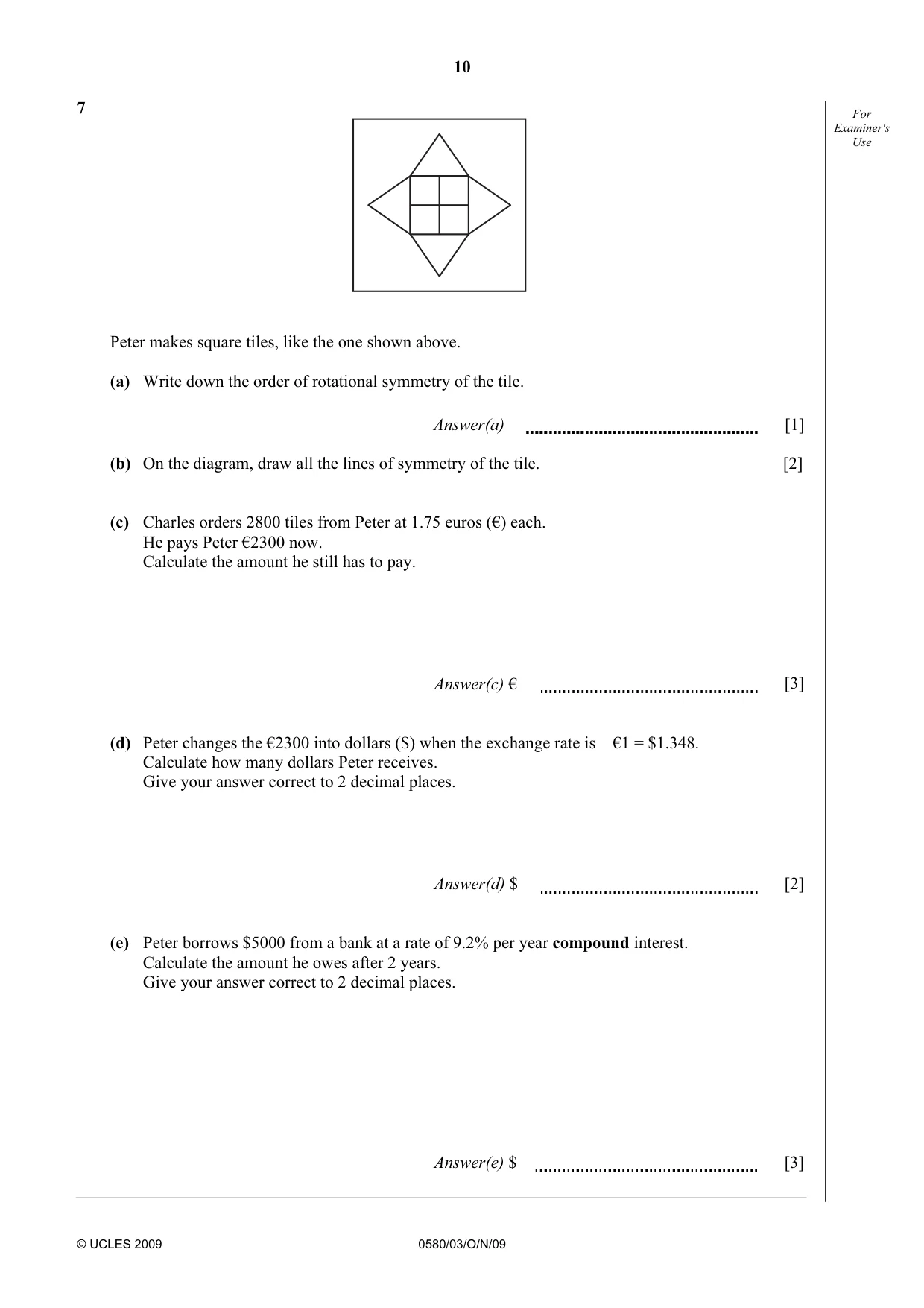
10 © UCLES 2009 0580/03/O/N/09 For Examiner's Use 7 Peter makes square tiles, like the one shown above. (a) Write down the order of rotational symmetry of the tile. Answer(a) [1] (b) On the diagram, draw all the lines of symmetry of the tile. [2] (c) Charles orders 2800 tiles from Peter at 1.75 euros (€) each. He pays Peter €2300 now. Calculate the amount he still has to pay. Answer(c) € [3] (d) Peter changes the €2300 into dollars ($) when the exchange rate is €1 = $1.348. Calculate how many dollars Peter receives. Give your answer correct to 2 decimal places. Answer(d) $ [2] (e) Peter borrows $5000 from a bank at a rate of 9.2% per year compound interest. Calculate the amount he owes after 2 years. Give your answer correct to 2 decimal places. Answer(e) $ [3]
Question paper, page 11
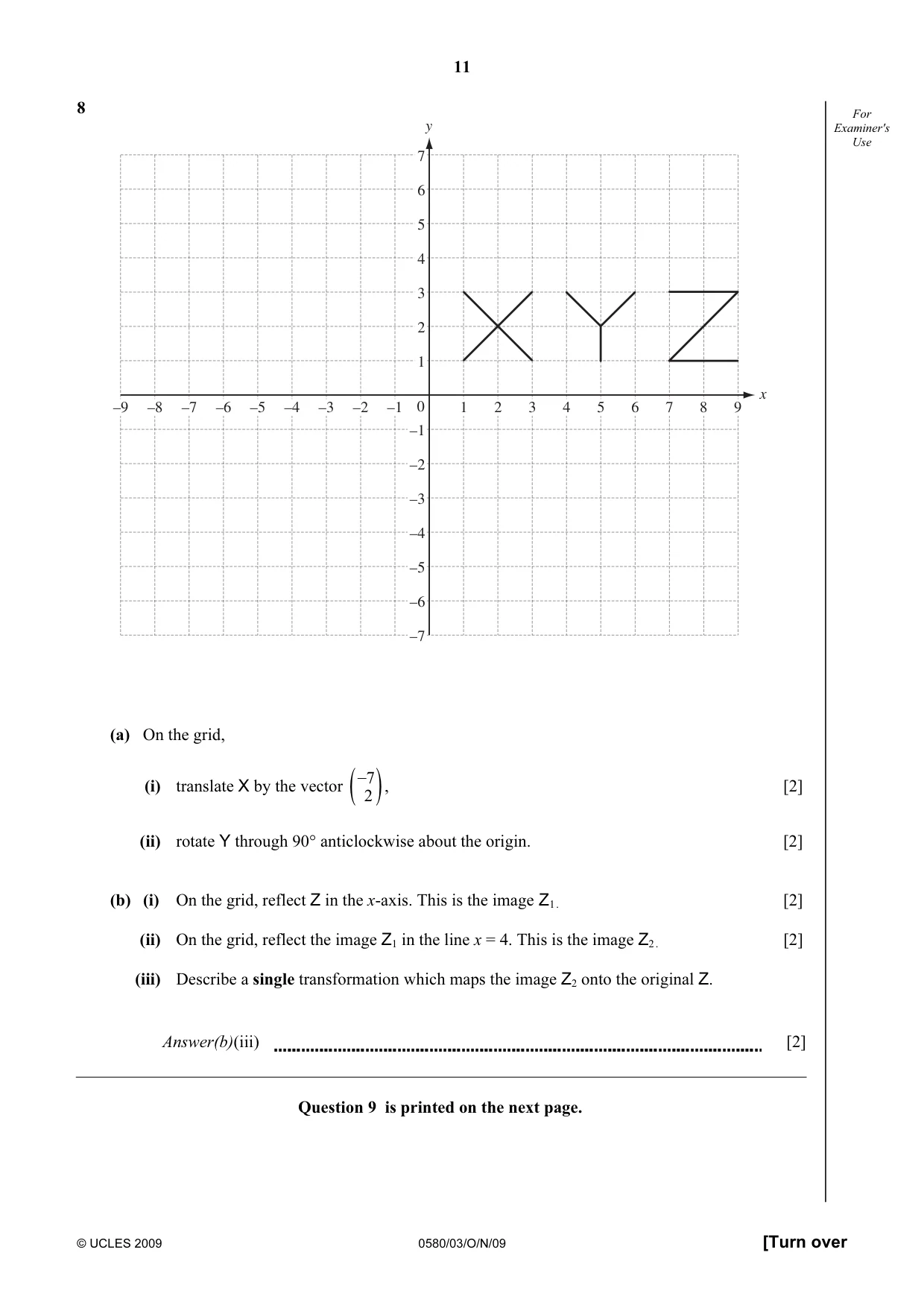
11 © UCLES 2009 0580/03/O/N/09 [Turn over For Examiner's Use 8 7 6 5 4 3 2 1 –1 –2 –3 –4 –5 –6 –7 0 –1 –2 –3 –4 –5 –6 –7 –8 –9 9 8 7 6 5 4 3 2 1 y x (a) On the grid, (i) translate Х by the vector ( ) _7 2 , [2] (ii) rotate Υ through 90° anticlockwise about the origin. [2] (b) (i) On the grid, reflect Ζ in the x-axis. This is the image Ζ1 . [2] (ii) On the grid, reflect the image Ζ1 in the line x = 4. This is the image Ζ2 . [2] (iii) Describe a single transformation which maps the image Ζ2 onto the original Ζ. Answer(b)(iii) [2] Question 9 is printed on the next page.
Question paper, page 12
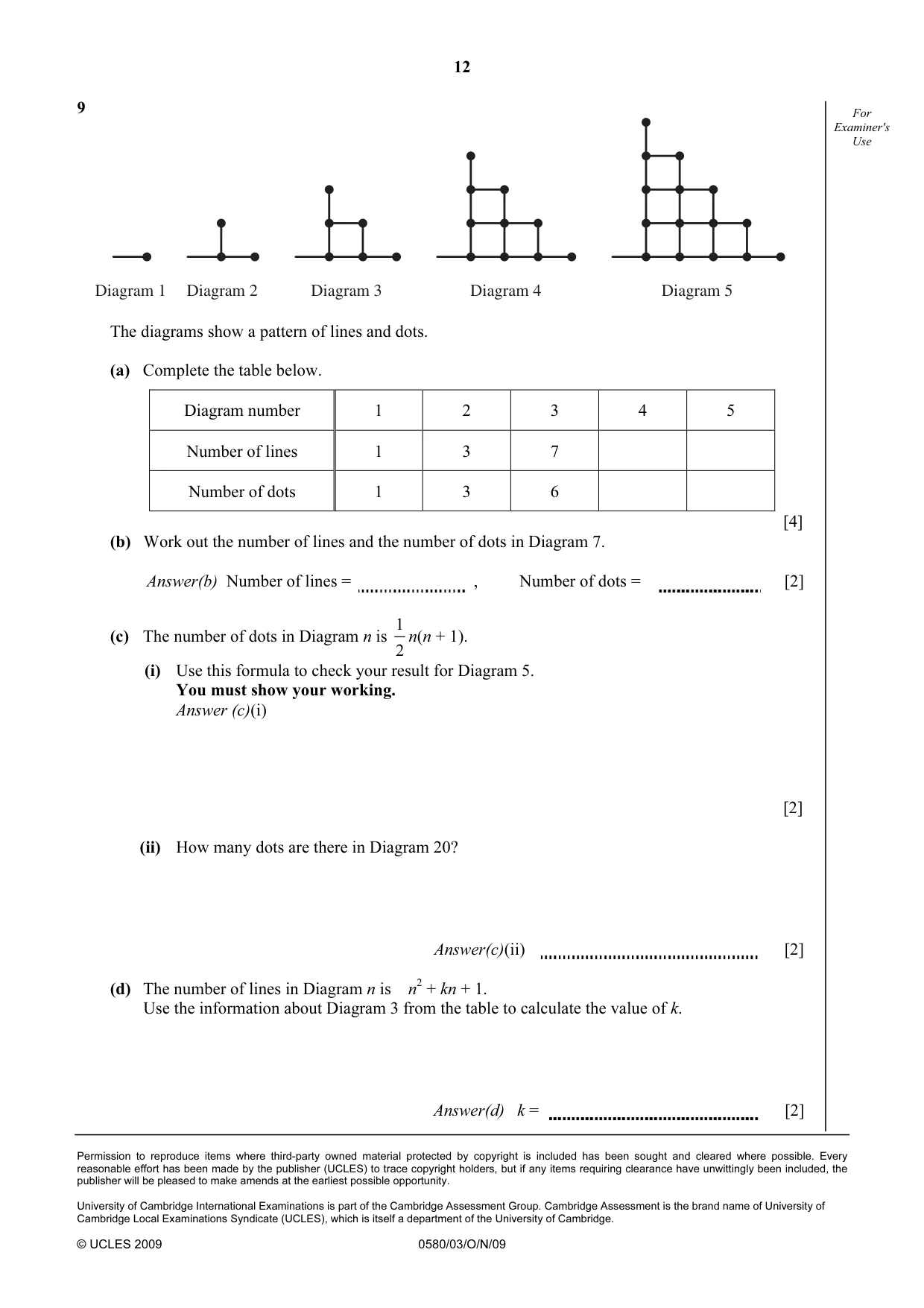
12 Permission to reproduce items where third-party owned material protected by copyright is included has been sought and cleared where possible. Every reasonable effort has been made by the publisher (UCLES) to trace copyright holders, but if any items requiring clearance have unwittingly been included, the publisher will be pleased to make amends at the earliest possible opportunity. University of Cambridge International Examinations is part of the Cambridge Assessment Group. Cambridge Assessment is the brand name of University of Cambridge Local Examinations Syndicate (UCLES), which is itself a department of the University of Cambridge. © UCLES 2009 0580/03/O/N/09 For Examiner's Use 9 Diagram 1 Diagram 2 Diagram 3 Diagram 4 Diagram 5 The diagrams show a pattern of lines and dots. (a) Complete the table below. Diagram number 1 2 3 4 5 Number of lines 1 3 7 Number of dots 1 3 6 [4] (b) Work out the number of lines and the number of dots in Diagram 7. Answer(b) Number of lines = , Number of dots = [2] (c) The number of dots in Diagram n is 1 2 n(n + 1). (i) Use this formula to check your result for Diagram 5. You must show your working. Answer (c)(i) [2] (ii) How many dots are there in Diagram 20? Answer(c)(ii) [2] (d) The number of lines in Diagram n is n2 + kn + 1. Use the information about Diagram 3 from the table to calculate the value of k. Answer(d) k = [2]
Mark scheme, page 1
UNIVERSITY OF CAMBRIDGE INTERNATIONAL EXAMINATIONS International General Certificate of Secondary Education MARK SCHEME for the October/November 2009 question paper for the guidance of teachers 0580 MATHEMATICS 0580/03 Paper 3 (Core), maximum raw mark 104 This mark scheme is published as an aid to teachers and candidates, to indicate the requirements of the examination. It shows the basis on which Examiners were instructed to award marks. It does not indicate the details of the discussions that took place at an Examiners’ meeting before marking began, which would have considered the acceptability of alternative answers. Mark schemes must be read in conjunction with the question papers and the report on the examination. • CIE will not enter into discussions or correspondence in connection with these mark schemes. CIE is publishing the mark schemes for the October/November 2009 question papers for most IGCSE, GCE Advanced Level and Advanced Subsidiary Level syllabuses and some Ordinary Level syllabuses. www.XtremePapers.com
Mark scheme, page 2
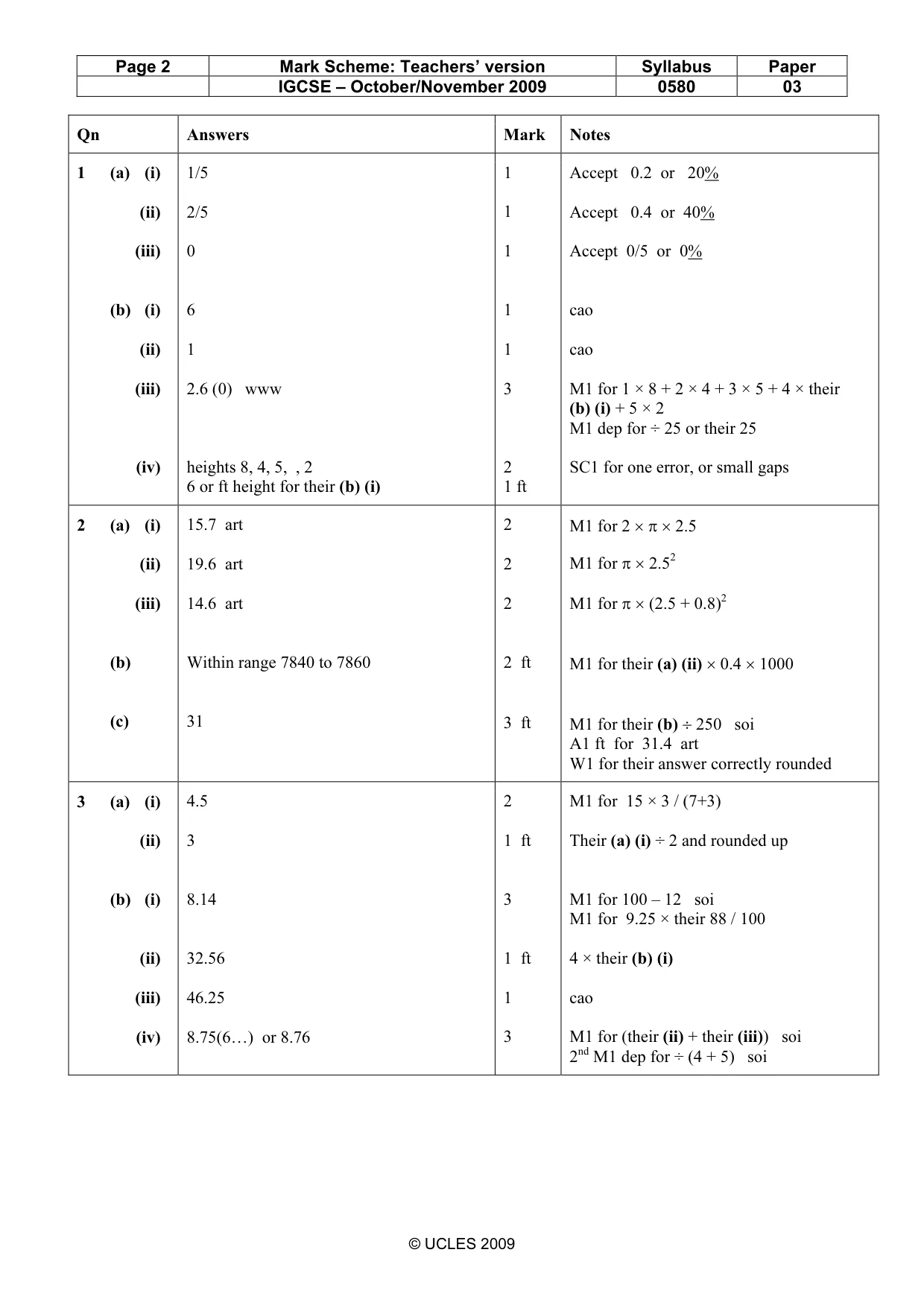
Page 2 Mark Scheme: Teachers’ version Syllabus Paper IGCSE – October/November 2009 0580 03 © UCLES 2009 Qn Answers Mark Notes 1 (a) (i) (ii) (iii) (b) (i) (ii) (iii) (iv) 1/5 2/5 0 6 1 2.6 (0) www heights 8, 4, 5, , 2 6 or ft height for their (b) (i) 1 1 1 1 1 3 2 1 ft Accept 0.2 or 20% Accept 0.4 or 40% Accept 0/5 or 0% cao cao M1 for 1 × 8 + 2 × 4 + 3 × 5 + 4 × their (b) (i) + 5 × 2 M1 dep for ÷ 25 or their 25 SC1 for one error, or small gaps 2 (a) (i) (ii) (iii) (b) (c) 15.7 art 19.6 art 14.6 art Within range 7840 to 7860 31 2 2 2 2 ft 3 ft M1 for 2 × π × 2.5 M1 for π × 2.52 M1 for π × (2.5 + 0.8)2 M1 for their (a) (ii) × 0.4 × 1000 M1 for their (b) ÷ 250 soi A1 ft for 31.4 art W1 for their answer correctly rounded 3 (a) (i) (ii) (b) (i) (ii) (iii) (iv) 4.5 3 8.14 32.56 46.25 8.75(6…) or 8.76 2 1 ft 3 1 ft 1 3 M1 for 15 × 3 / (7+3) Their (a) (i) ÷ 2 and rounded up M1 for 100 – 12 soi M1 for 9.25 × their 88 / 100 4 × their (b) (i) cao M1 for (their (ii) + their (iii)) soi 2nd M1 dep for ÷ (4 + 5) soi
Mark scheme, page 3
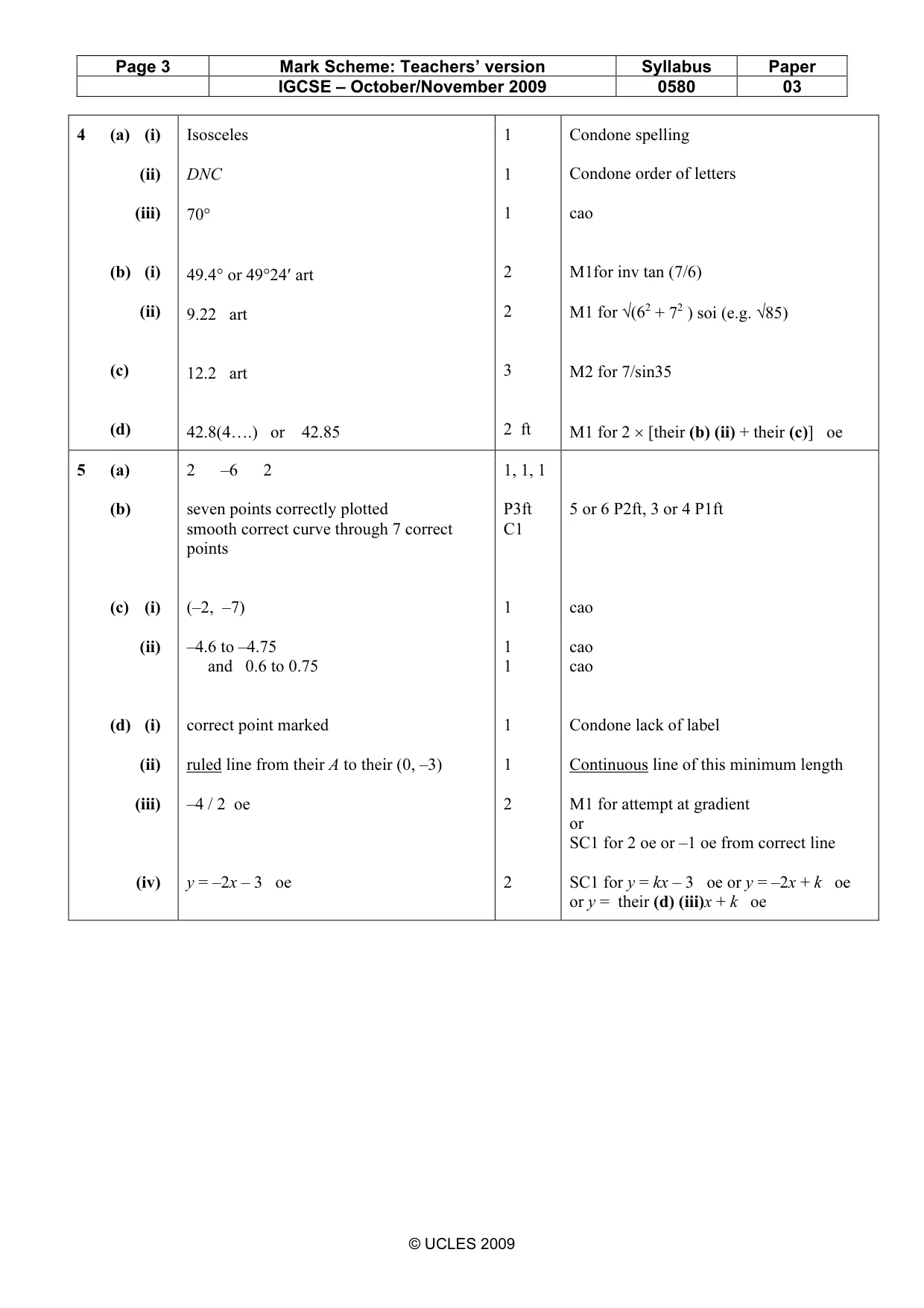
Page 3 Mark Scheme: Teachers’ version Syllabus Paper IGCSE – October/November 2009 0580 03 © UCLES 2009 4 (a) (i) (ii) (iii) (b) (i) (ii) (c) (d) Isosceles DNC 70° 49.4° or 49°24′ art 9.22 art 12.2 art 42.8(4….) or 42.85 1 1 1 2 2 3 2 ft Condone spelling Condone order of letters cao M1for inv tan (7/6) M1 for √(62 + 72 ) soi (e.g. √85) M2 for 7/sin35 M1 for 2 × [their (b) (ii) + their (c)] oe 5 (a) (b) (c) (i) (ii) (d) (i) (ii) (iii) (iv) 2 –6 2 seven points correctly plotted smooth correct curve through 7 correct points (–2, –7) –4.6 to –4.75 and 0.6 to 0.75 correct point marked ruled line from their A to their (0, –3) –4 / 2 oe y = –2x – 3 oe 1, 1, 1 P3ft C1 1 1 1 1 1 2 2 5 or 6 P2ft, 3 or 4 P1ft cao cao cao Condone lack of label Continuous line of this minimum length M1 for attempt at gradient or SC1 for 2 oe or –1 oe from correct line SC1 for y = kx – 3 oe or y = –2x + k oe or y = their (d) (iii)x + k oe
Mark scheme, page 4
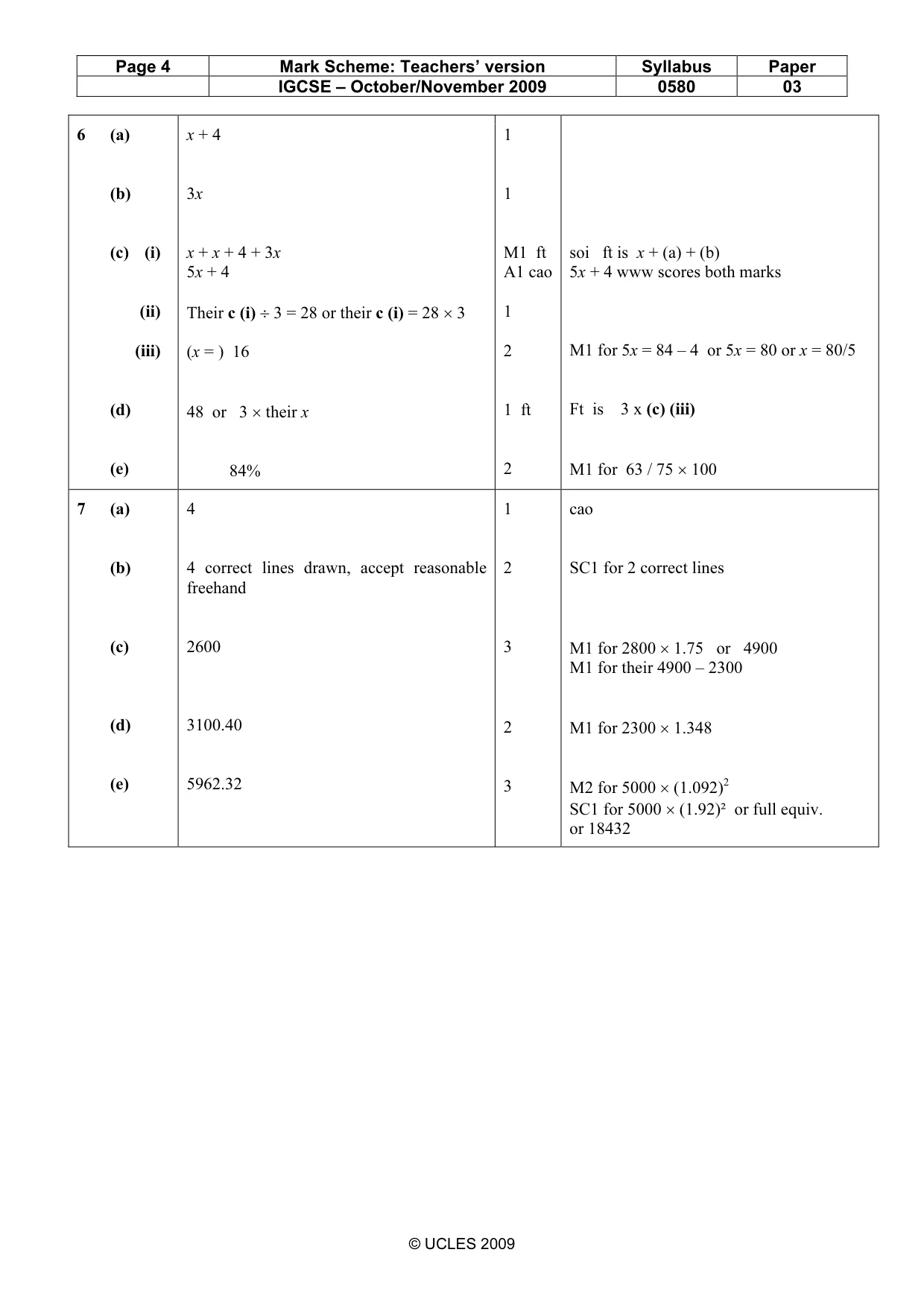
Page 4 Mark Scheme: Teachers’ version Syllabus Paper IGCSE – October/November 2009 0580 03 © UCLES 2009 6 (a) (b) (c) (i) (ii) (iii) (d) (e) x + 4 3x x + x + 4 + 3x 5x + 4 Their c (i) ÷ 3 = 28 or their c (i) = 28 × 3 (x = ) 16 48 or 3 × their x 84% 1 1 M1 ft A1 cao 1 2 1 ft 2 soi ft is x + (a) + (b) 5x + 4 www scores both marks M1 for 5x = 84 – 4 or 5x = 80 or x = 80/5 Ft is 3 x (c) (iii) M1 for 63 / 75 × 100 7 (a) (b) (c) (d) (e) 4 4 correct lines drawn, accept reasonable freehand 2600 3100.40 5962.32 1 2 3 2 3 cao SC1 for 2 correct lines M1 for 2800 × 1.75 or 4900 M1 for their 4900 – 2300 M1 for 2300 × 1.348 M2 for 5000 × (1.092)2 SC1 for 5000 × (1.92)² or full equiv. or 18432
Mark scheme, page 5
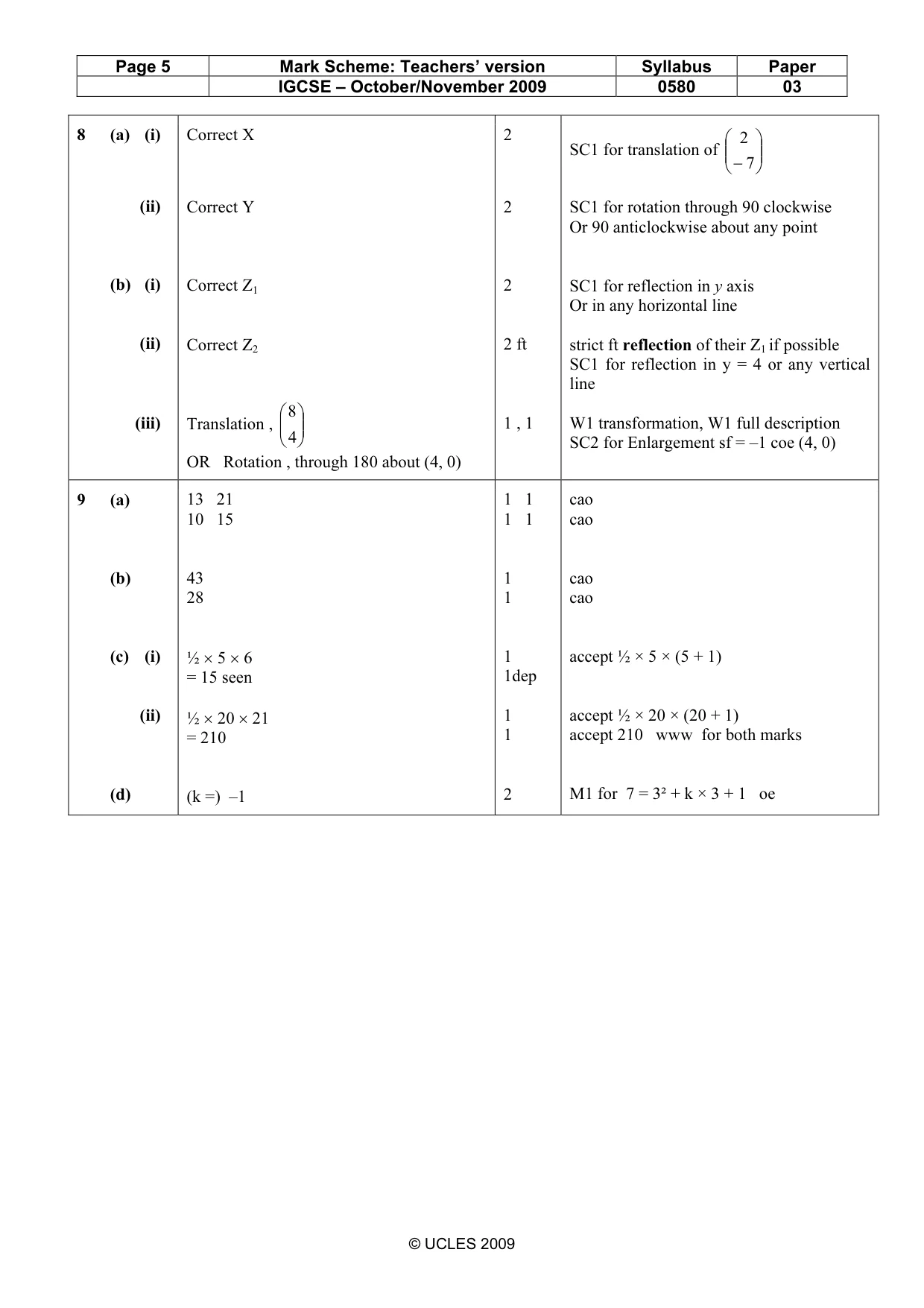
Page 5 Mark Scheme: Teachers’ version Syllabus Paper IGCSE – October/November 2009 0580 03 © UCLES 2009 8 (a) (i) (ii) (b) (i) (ii) (iii) Correct X Correct Y Correct Z1 Correct Z2 Translation , 4 8 OR Rotation , through 180 about (4, 0) 2 2 2 2 ft 1 , 1 SC1 for translation of −7 2 SC1 for rotation through 90 clockwise Or 90 anticlockwise about any point SC1 for reflection in y axis Or in any horizontal line strict ft reflection of their Z1 if possible SC1 for reflection in y = 4 or any vertical line W1 transformation, W1 full description SC2 for Enlargement sf = –1 coe (4, 0) 9 (a) (b) (c) (i) (ii) (d) 13 21 10 15 43 28 ½ × 5 × 6 = 15 seen ½ × 20 × 21 = 210 (k =) –1 1 1 1 1 1 1 1 1dep 1 1 2 cao cao cao cao accept ½ × 5 × (5 + 1) accept ½ × 20 × (20 + 1) accept 210 www for both marks M1 for 7 = 3² + k × 3 + 1 oe
What you needed in this session
Cambridge’s own grade thresholds for 2009 Oct/Nov, Paper 3 · Variant 1. A higher threshold means an easier paper — the bar moves with how the cohort did.