Cambridge IGCSE Mathematics 0580 — 2009 Oct/Nov Paper 2 · Variant 2
0580/22/O/N/09 · 8 questions · 70 marks · ≈79 min
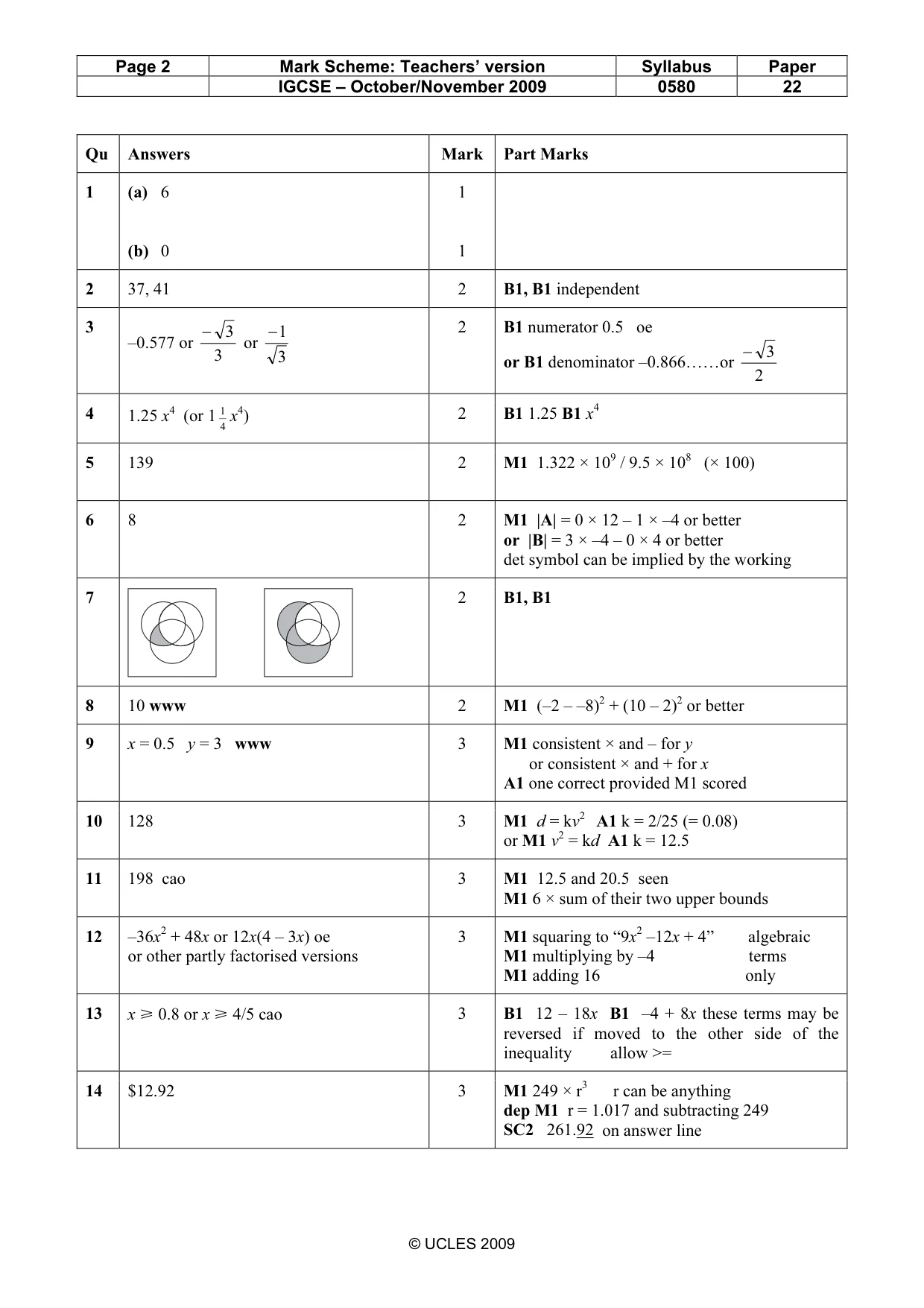
The question paper and its mark scheme, free to read here and free to download. This is Cambridge’s own paper, exactly as it was sat.
Question paper12 pages
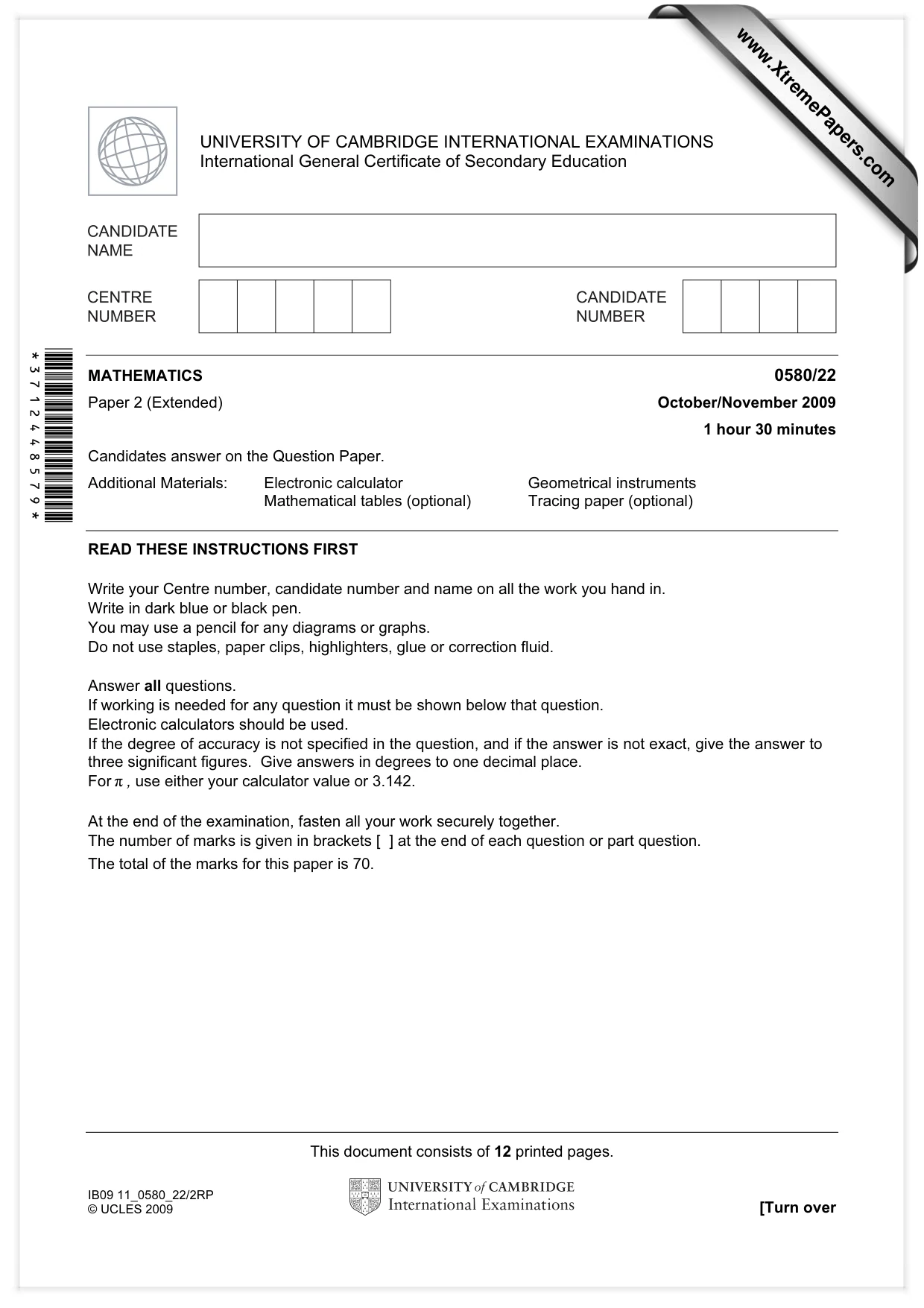
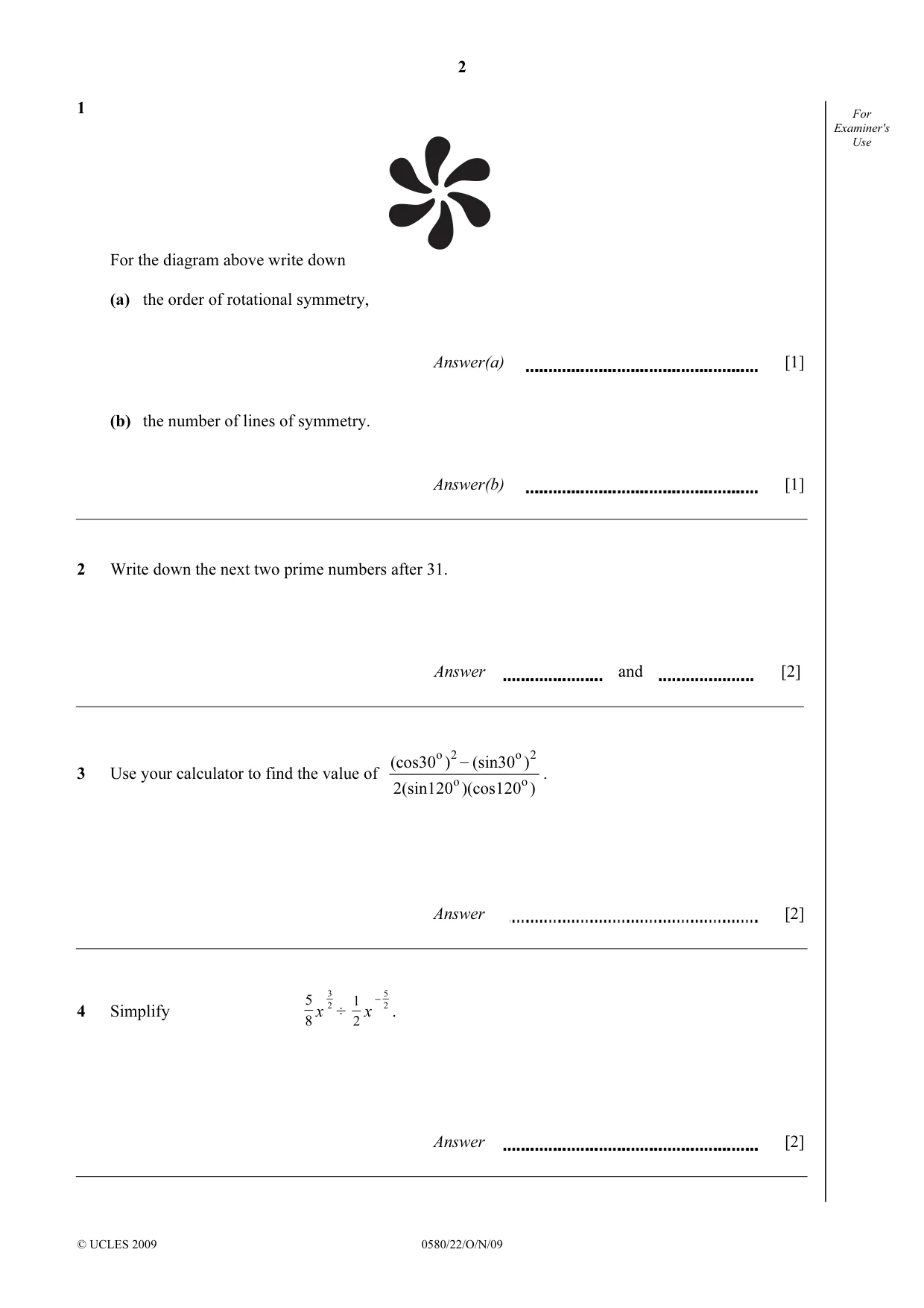
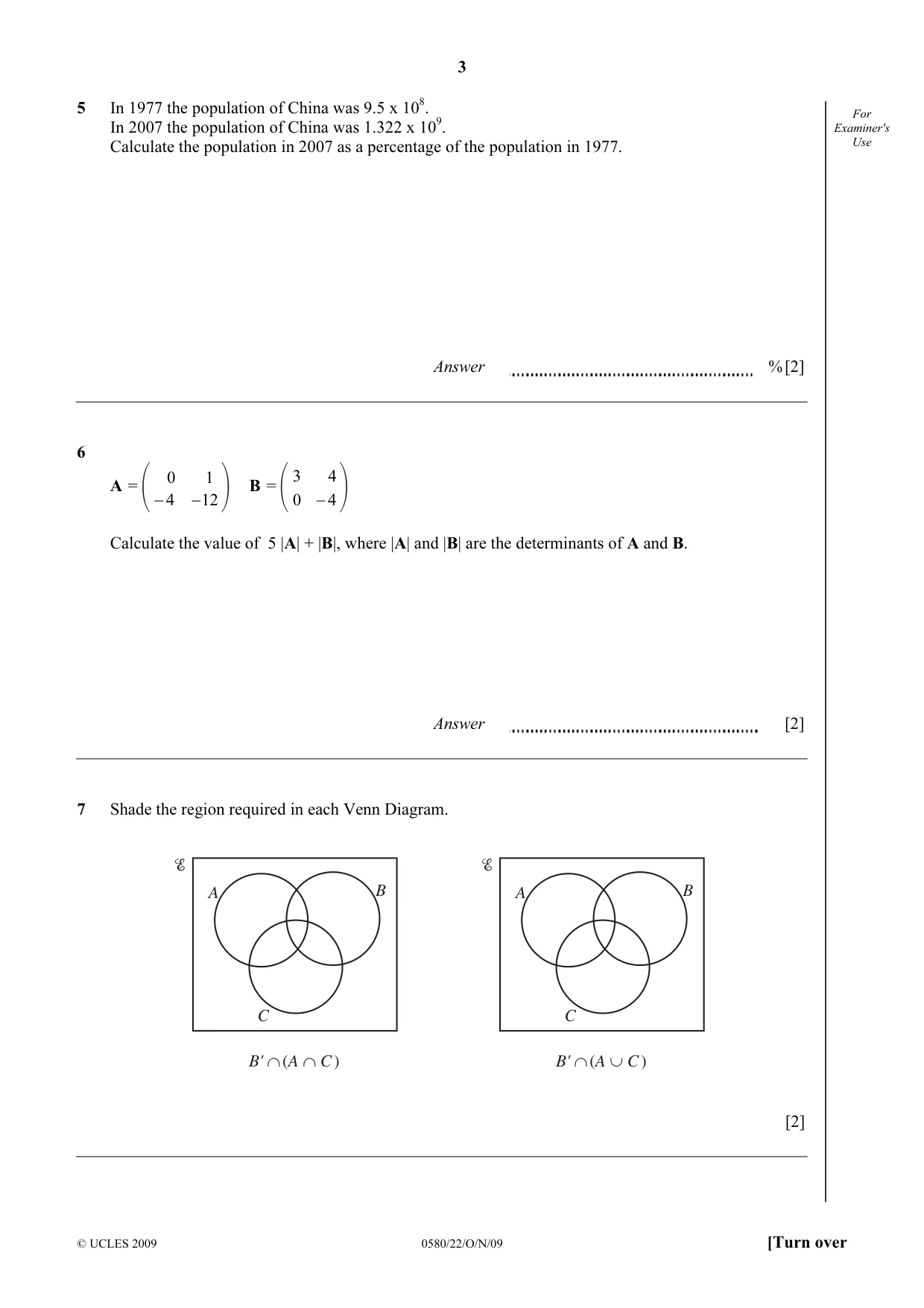
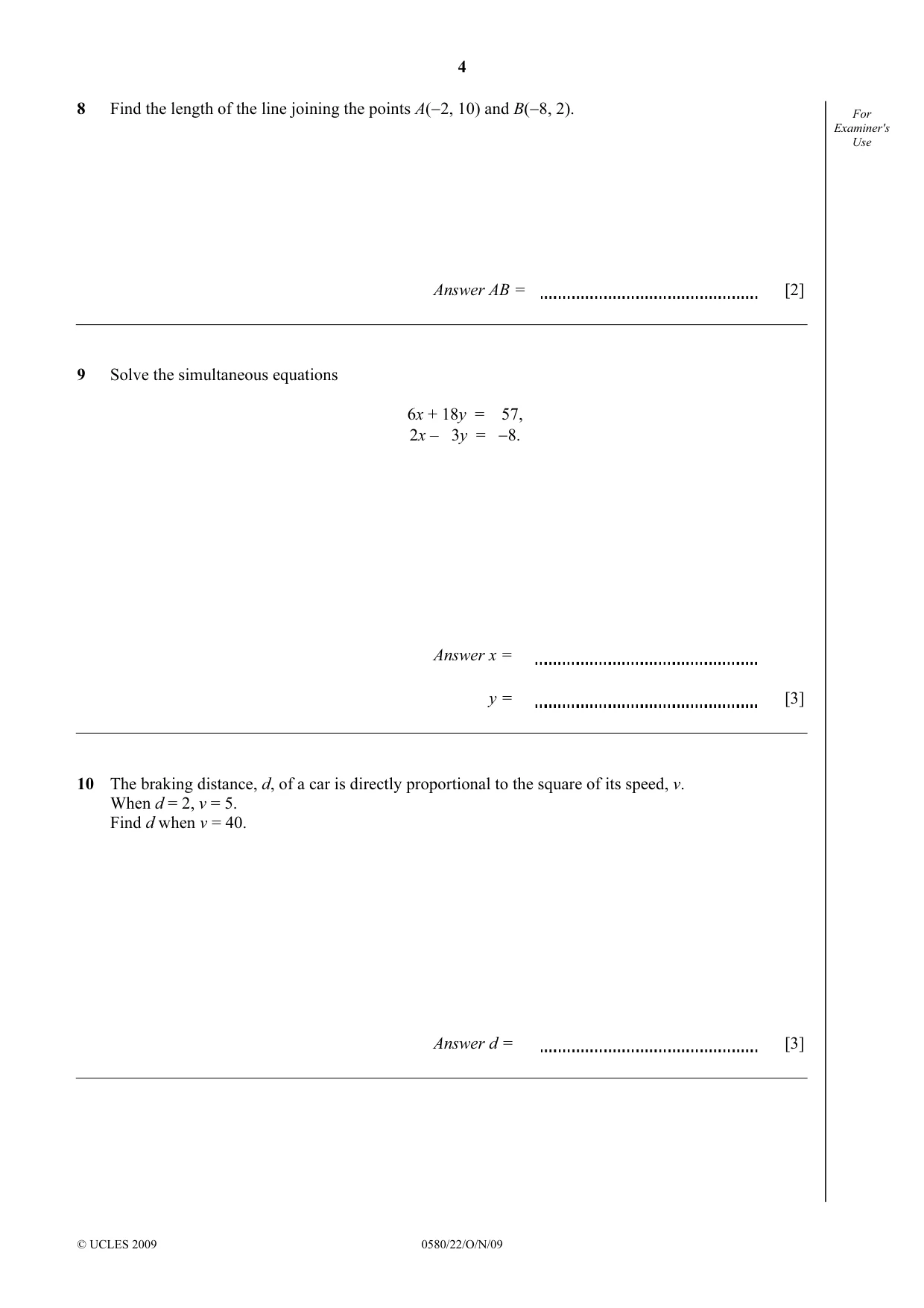
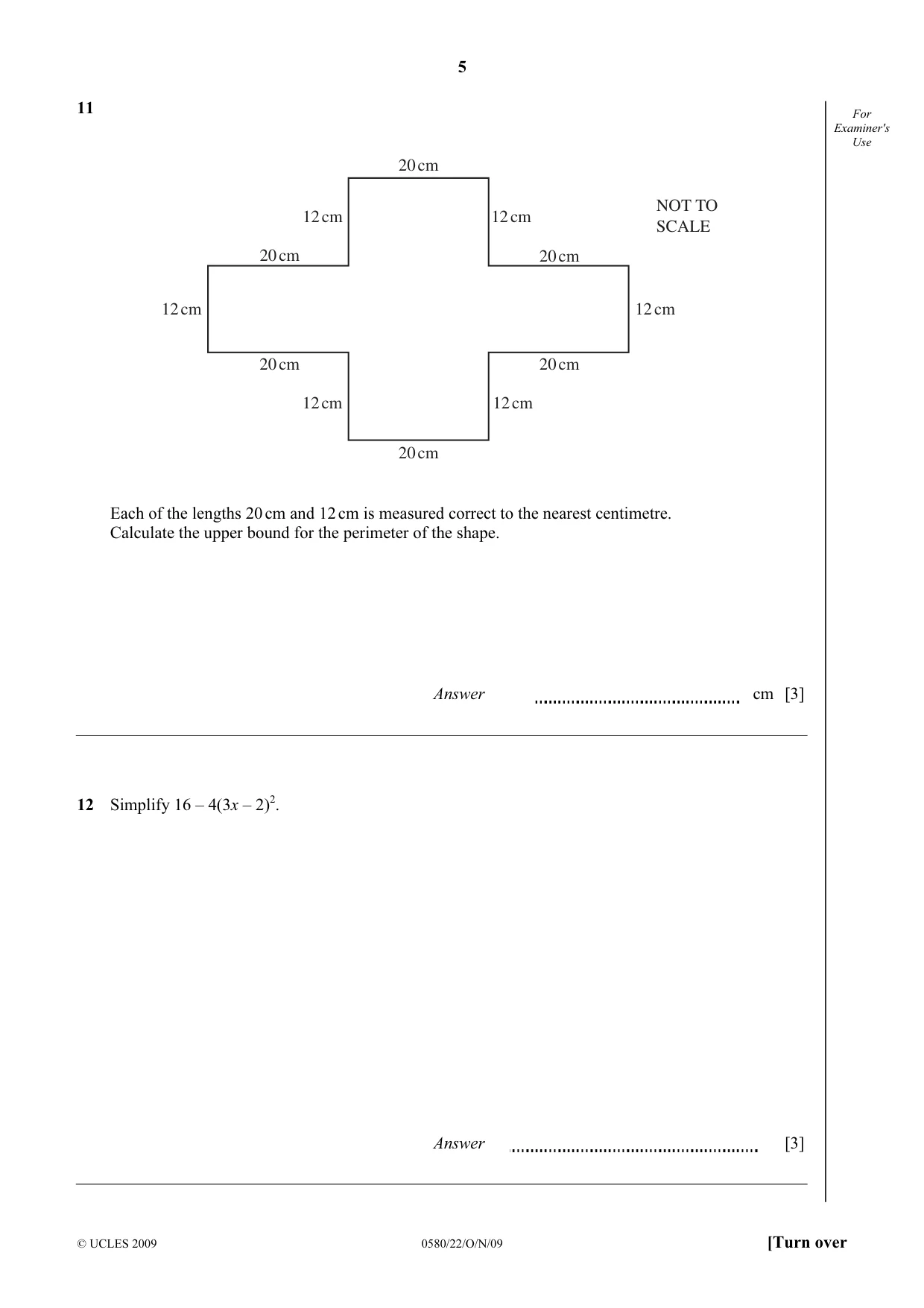
Mark scheme4 pages
Answers below. Sit the paper first if you are practising.
Questions as text
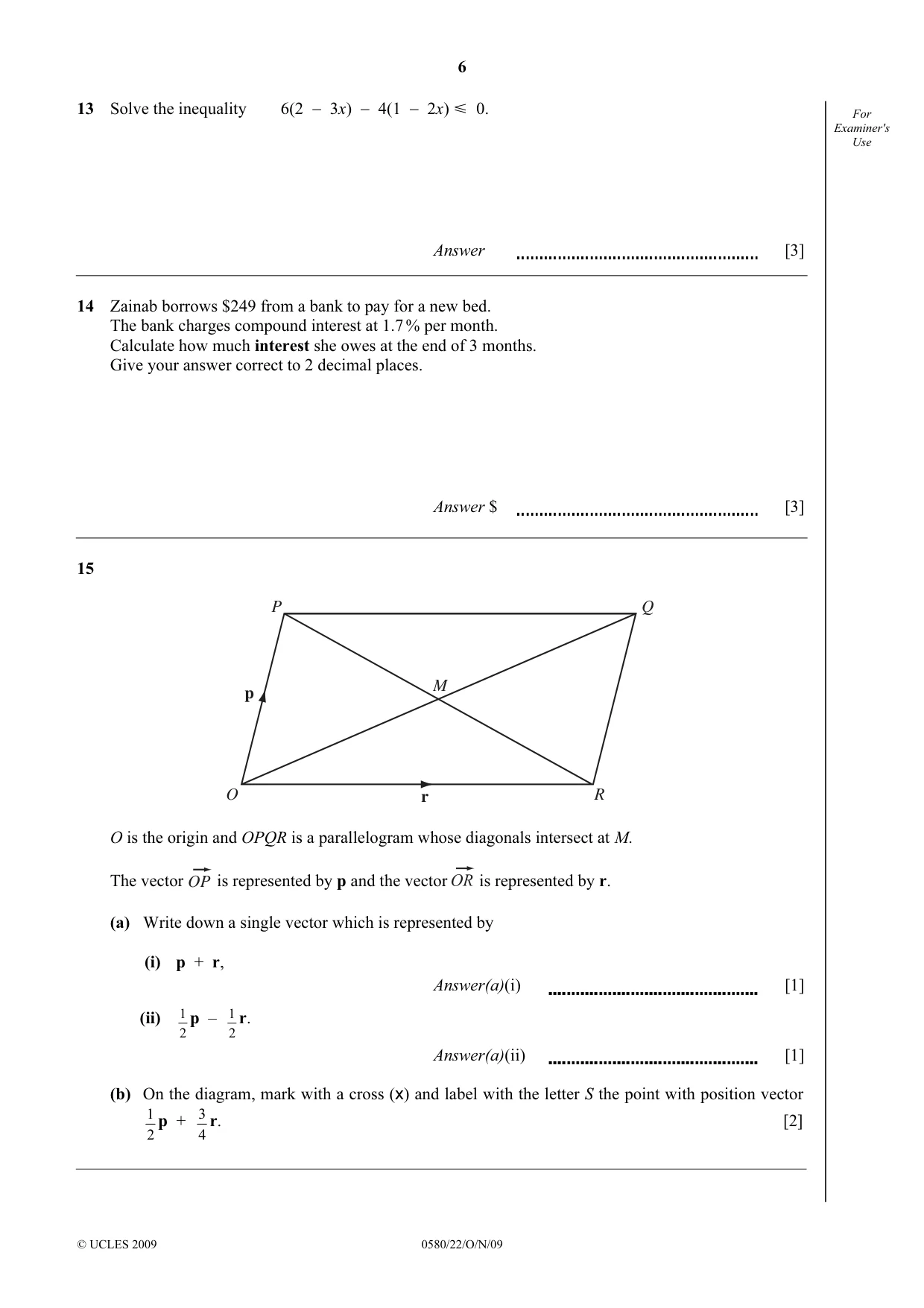
Q15 · P Q M p O r R O is the origin and OPQR is a parallelogram whose diagonals intersect at M
15 P Q M p O r R O is the origin and OPQR is a parallelogram whose diagonals intersect at M. The vector OP is represented by p and the vector is represented by r. (a) Write down a single vector which is represented by (i) p + r, Answer(a)(i) [1] (ii) 1 p – 1 r. 2 2 Answer(a)(ii) [1] (b) On the diagram, mark with a cross (x) and label with the letter S the point with position vector 1 3 p + r. [2] 2 4
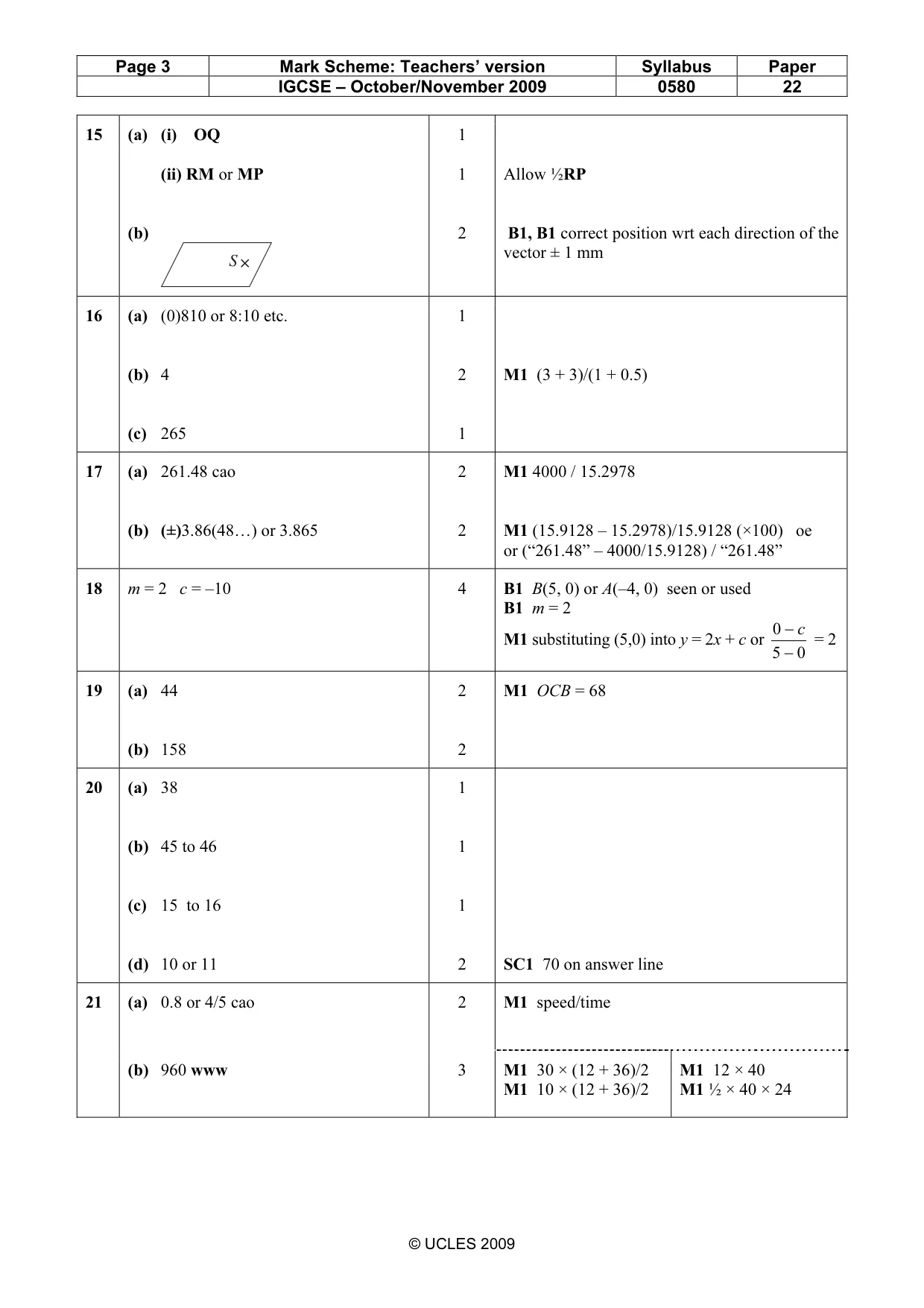
Mark scheme: 15 (a) (i) OQ 1 (ii) RM or MP 1 Allow ½RP (b) 2 B1, B1 correct position wrt each direction of the vector ± 1 mm S ×
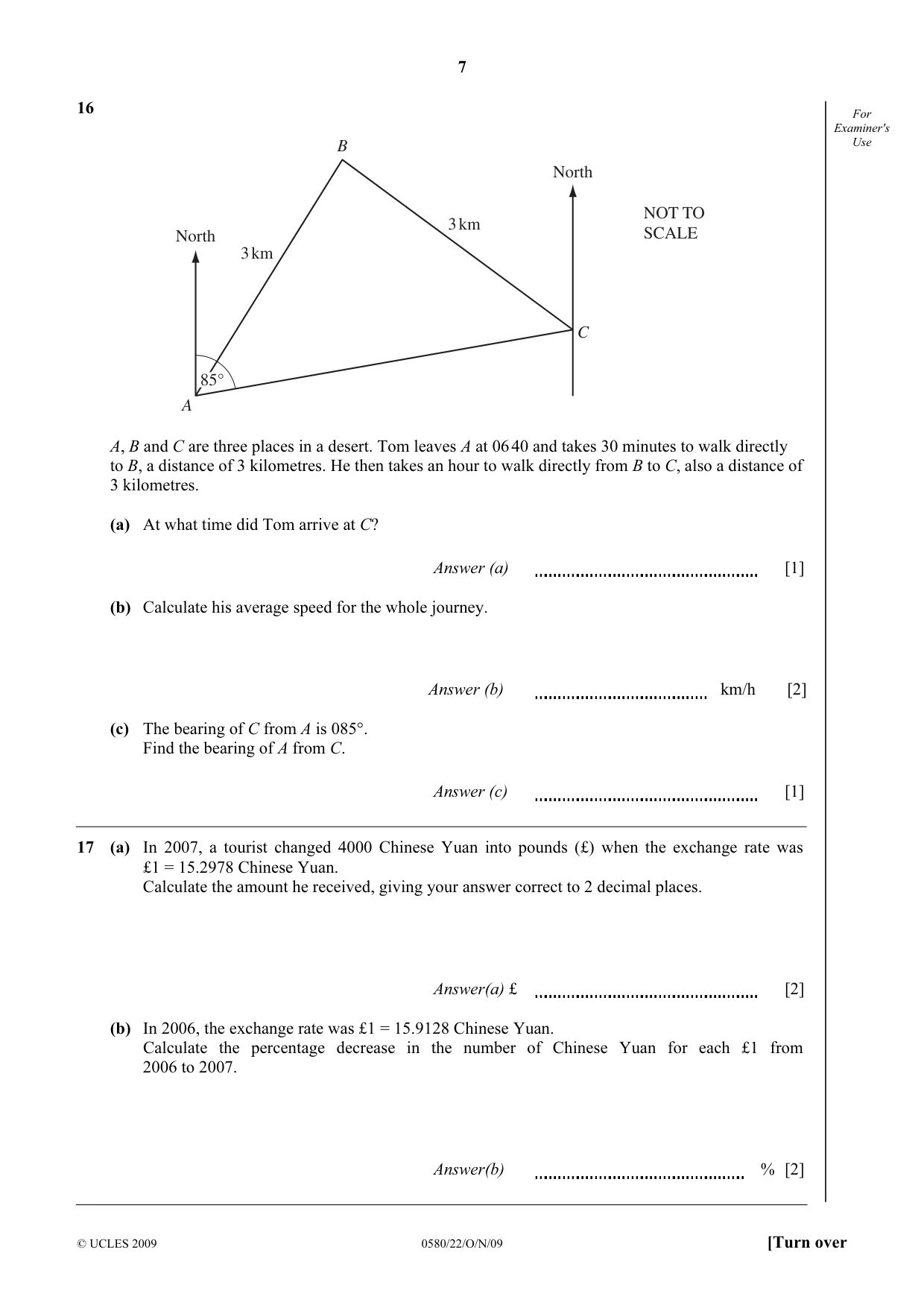
Q16 · For Examiner's B Use North NOT TO 3 km North SCALE 3 km C 85° A A, B and C are three…
16 For Examiner's B Use North NOT TO 3 km North SCALE 3 km C 85° A A, B and C are three places in a desert. Tom leaves A at 06 40 and takes 30 minutes to walk directly to B, a distance of 3 kilometres. He then takes an hour to walk directly from B to C, also a distance of 3 kilometres. (a) At what time did Tom arrive at C? Answer (a) [1] (b) Calculate his average speed for the whole journey. Answer (b) km/h [2] (c) The bearing of C from A is 085°. Find the bearing of A from C. Answer (c) [1]
Mark scheme: 16 (a) (0)810 or 8:10 etc. 1 (b) 4 2 M1 (3 + 3)/(1 + 0.5) (c) 265 1
Q17 · In 2007, a tourist changed 4000 Chinese Yuan into pounds (£) when the exchange rate was…
17 (a) In 2007, a tourist changed 4000 Chinese Yuan into pounds (£) when the exchange rate was £1 = 15.2978 Chinese Yuan. Calculate the amount he received, giving your answer correct to 2 decimal places. Answer(a) £ [2] (b) In 2006, the exchange rate was £1 = 15.9128 Chinese Yuan. Calculate the percentage decrease in the number of Chinese Yuan for each £1 from 2006 to 2007. Answer(b) % [2]
Mark scheme: 17 (a) 261.48 cao 2 M1 4000 / 15.2978 (b) (±)3.86(48…) or 3.865 2 M1 (15.9128 – 15.2978)/15.9128 (×100) oe or (“261.48” – 4000/15.9128) / “261.48”
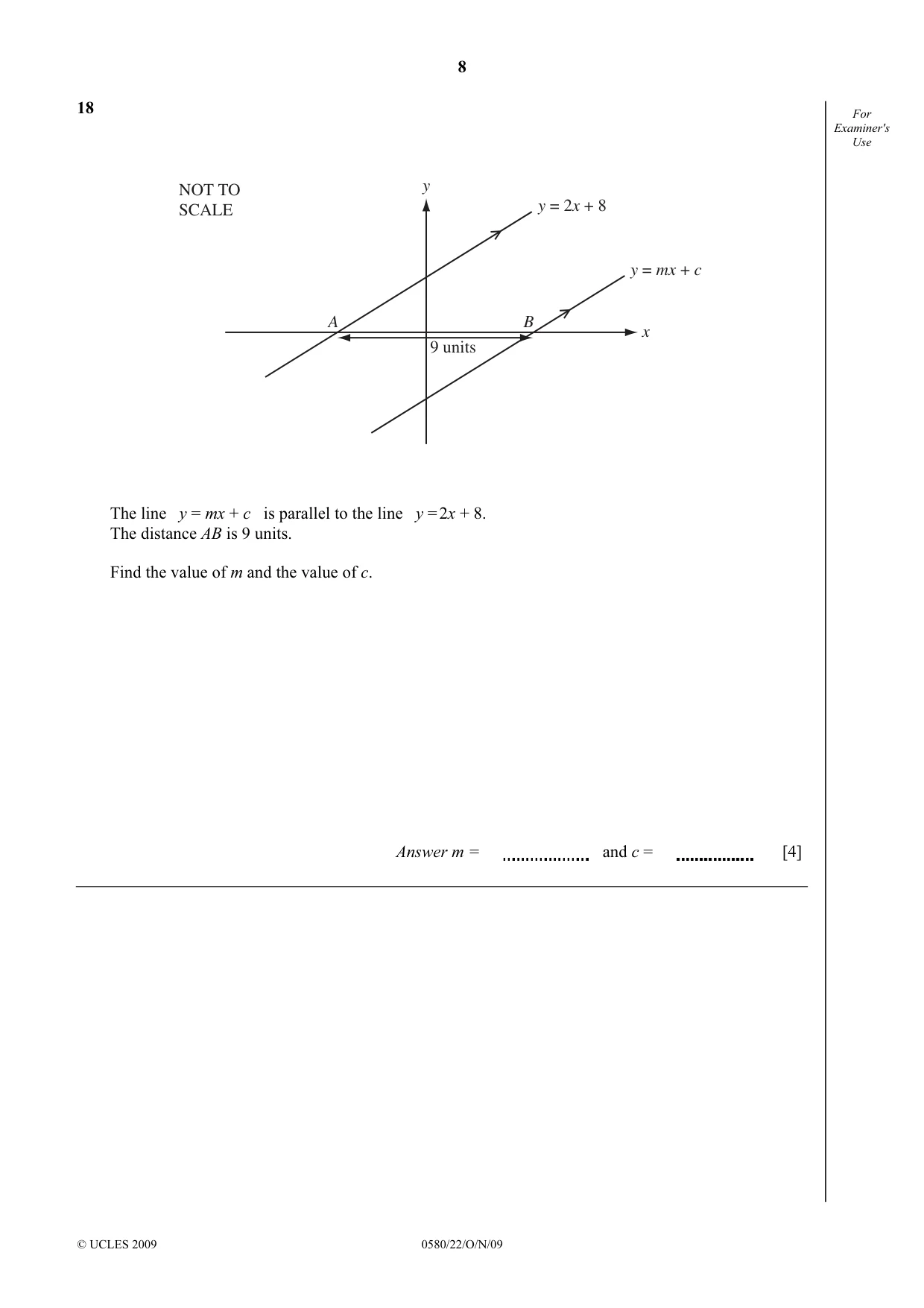
Q18 · For Examiner's Use NOT TO y SCALE y = 2x + 8 y = mx + c A B x 9 units The line y = mx + c…
18 For Examiner's Use NOT TO y SCALE y = 2x + 8 y = mx + c A B x 9 units The line y = mx + c is parallel to the line y = 2x + 8. The distance AB is 9 units. Find the value of m and the value of c. Answer m = and c = [4]
Mark scheme: 18 m = 2 c = –10 4 B1 B(5, 0) or A(–4, 0) seen or used B1 m = 2 0 −c M1 substituting (5,0) into y = 2x + c or = 2 5 − 0
Q19 · For Examiner's Use NOT TO B D 68° SCALE O C E F A Points A, B and C lie on a circle…
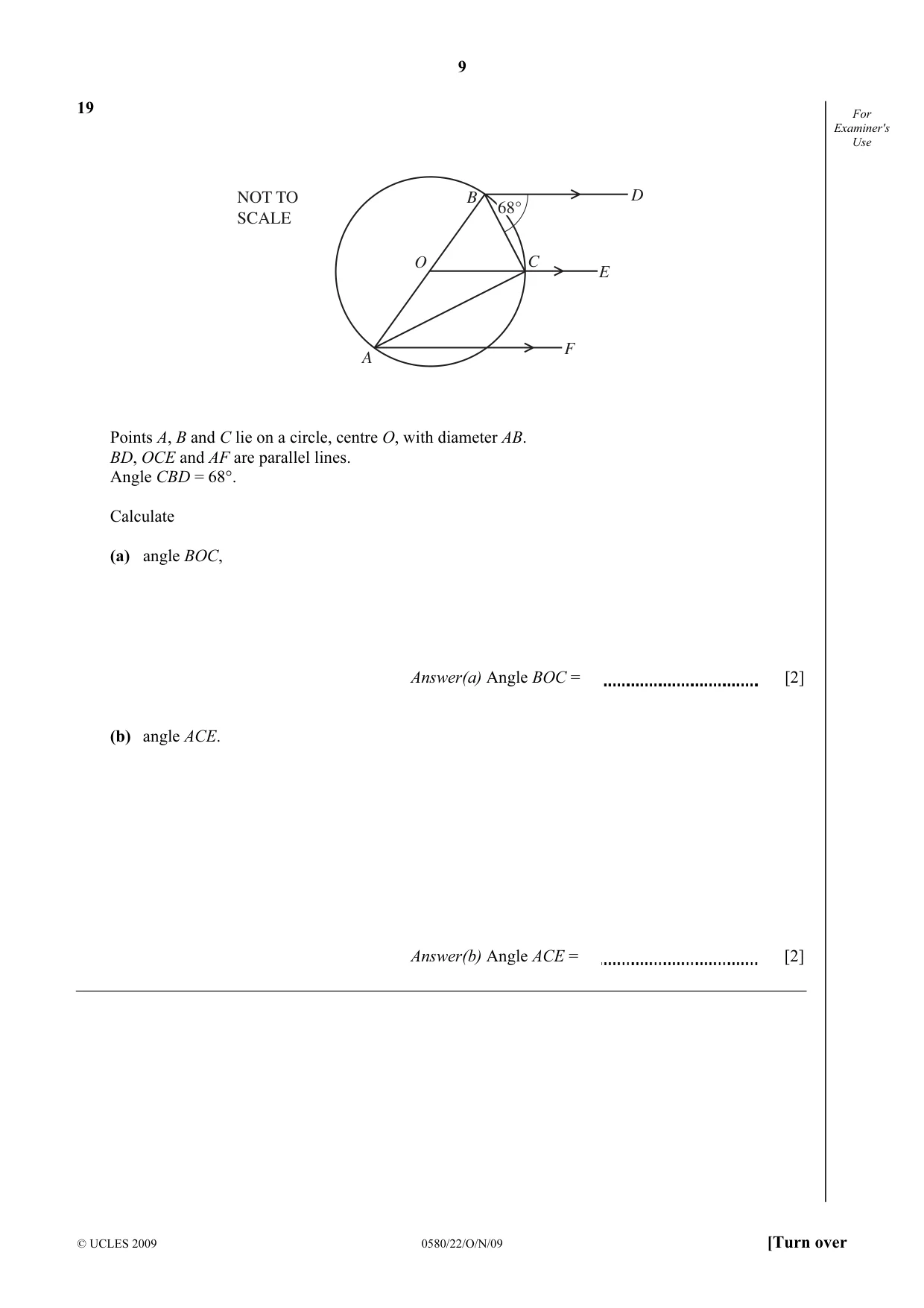
19 For Examiner's Use NOT TO B D 68° SCALE O C E F A Points A, B and C lie on a circle, centre O, with diameter AB. BD, OCE and AF are parallel lines. Angle CBD = 68°. Calculate (a) angle BOC, Answer(a) Angle BOC = [2] (b) angle ACE. Answer(b) Angle ACE = [2]
Mark scheme: 19 (a) 44 2 M1 OCB = 68 (b) 158 2
Q20 · The number of hours that a group of 80 students spent using a computer in a week was…
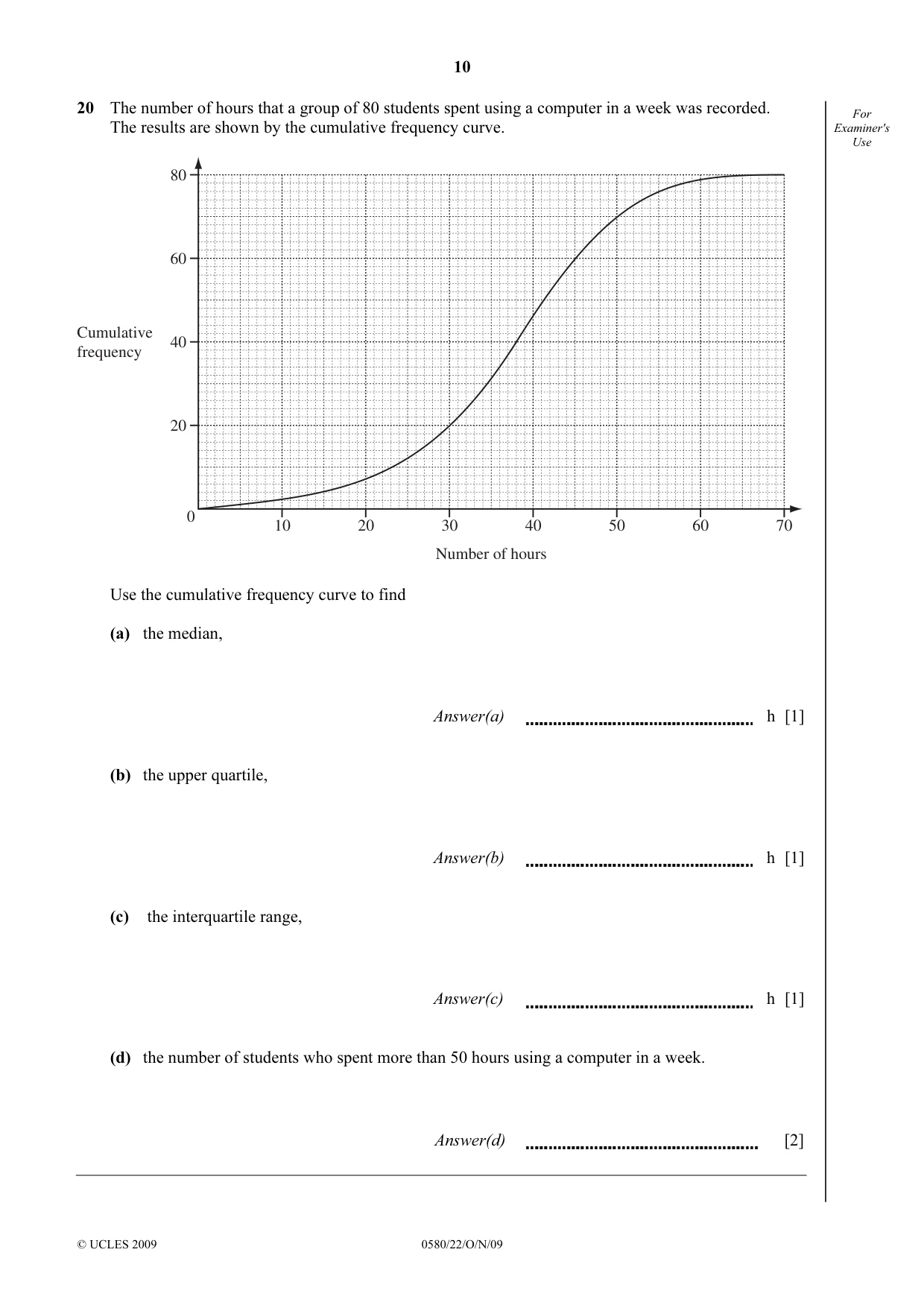
20 The number of hours that a group of 80 students spent using a computer in a week was recorded. For The results are shown by the cumulative frequency curve. Examiner's Use 80 60 Cumulative 40 frequency 20 0 10 20 30 40 50 60 70 Number of hours Use the cumulative frequency curve to find (a) the median, Answer(a) h [1] (b) the upper quartile, Answer(b) h [1] (c) the interquartile range, Answer(c) h [1] (d) the number of students who spent more than 50 hours using a computer in a week. Answer(d) [2]
Mark scheme: 20 (a) 38 1 (b) 45 to 46 1 (c) 15 to 16 1 (d) 10 or 11 2 SC1 70 on answer line
Q21 · For Examiner's Use 40 30 Speed car 20 (m / s) truck 10 0 10 20 30 40 50 60 Time (seconds)…
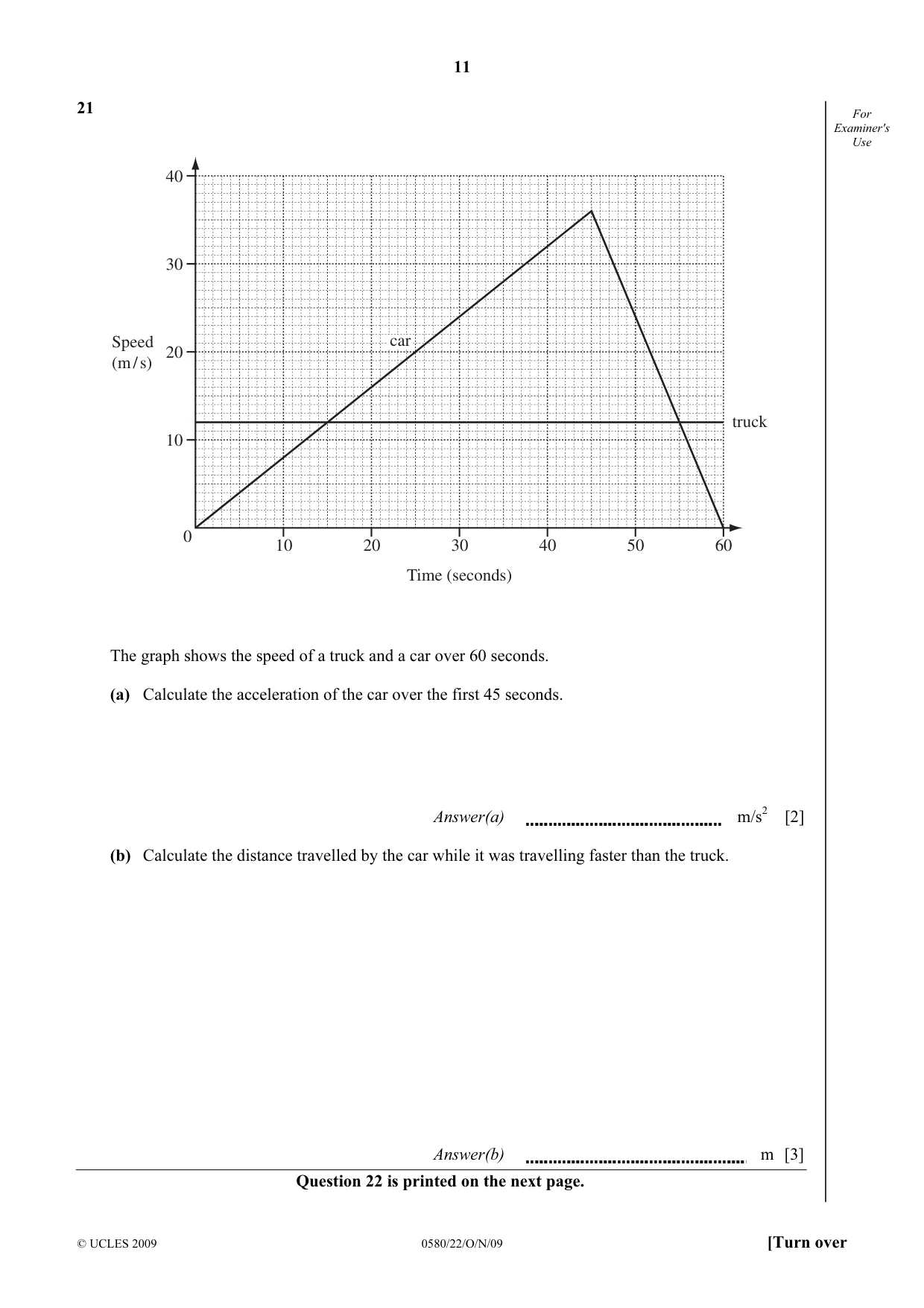
21 For Examiner's Use 40 30 Speed car 20 (m / s) truck 10 0 10 20 30 40 50 60 Time (seconds) The graph shows the speed of a truck and a car over 60 seconds. (a) Calculate the acceleration of the car over the first 45 seconds. Answer(a) m/s2 [2] (b) Calculate the distance travelled by the car while it was travelling faster than the truck. Answer(b) m [3] Question 22 is printed on the next page.
Mark scheme: 21 (a) 0.8 or 4/5 cao 2 M1 speed/time (b) 960 www 3 M1 30 × (12 + 36)/2 M1 12 × 40 M1 10 × (12 + 36)/2 M1 ½ × 40 × 24 IGCSE – October/November 2009 0580 22
Q22 · X + 1 For 22 f(x) = 4x + 1 g(x) = x3 + 1 h(x) = Examiner's 3 Use (a) Find the value of…
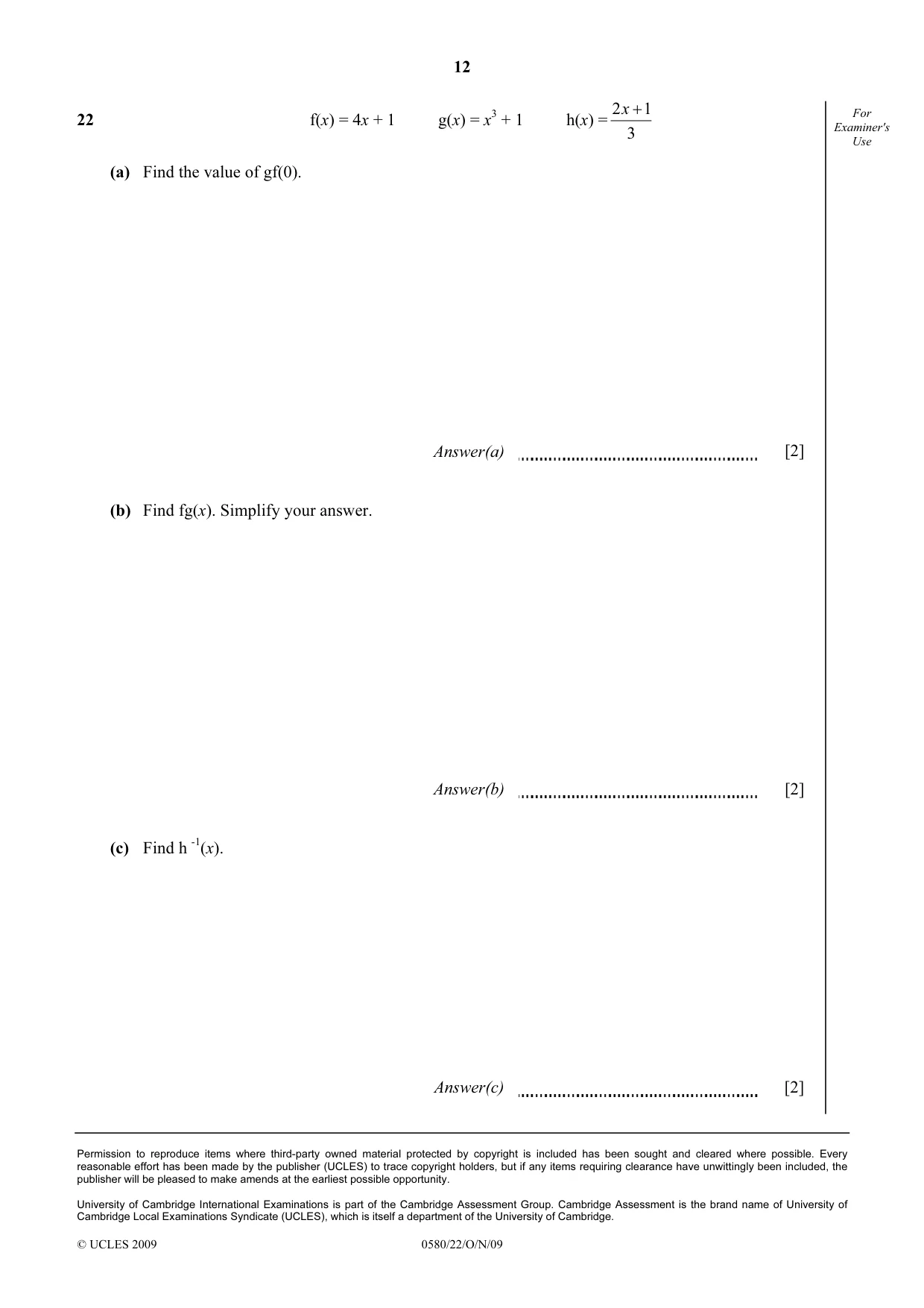
2 x + 1 For 22 f(x) = 4x + 1 g(x) = x3 + 1 h(x) = Examiner's 3 Use (a) Find the value of gf(0). Answer(a) [2] (b) Find fg(x). Simplify your answer. Answer(b) [2] (c) Find h -1(x). Answer(c) [2]
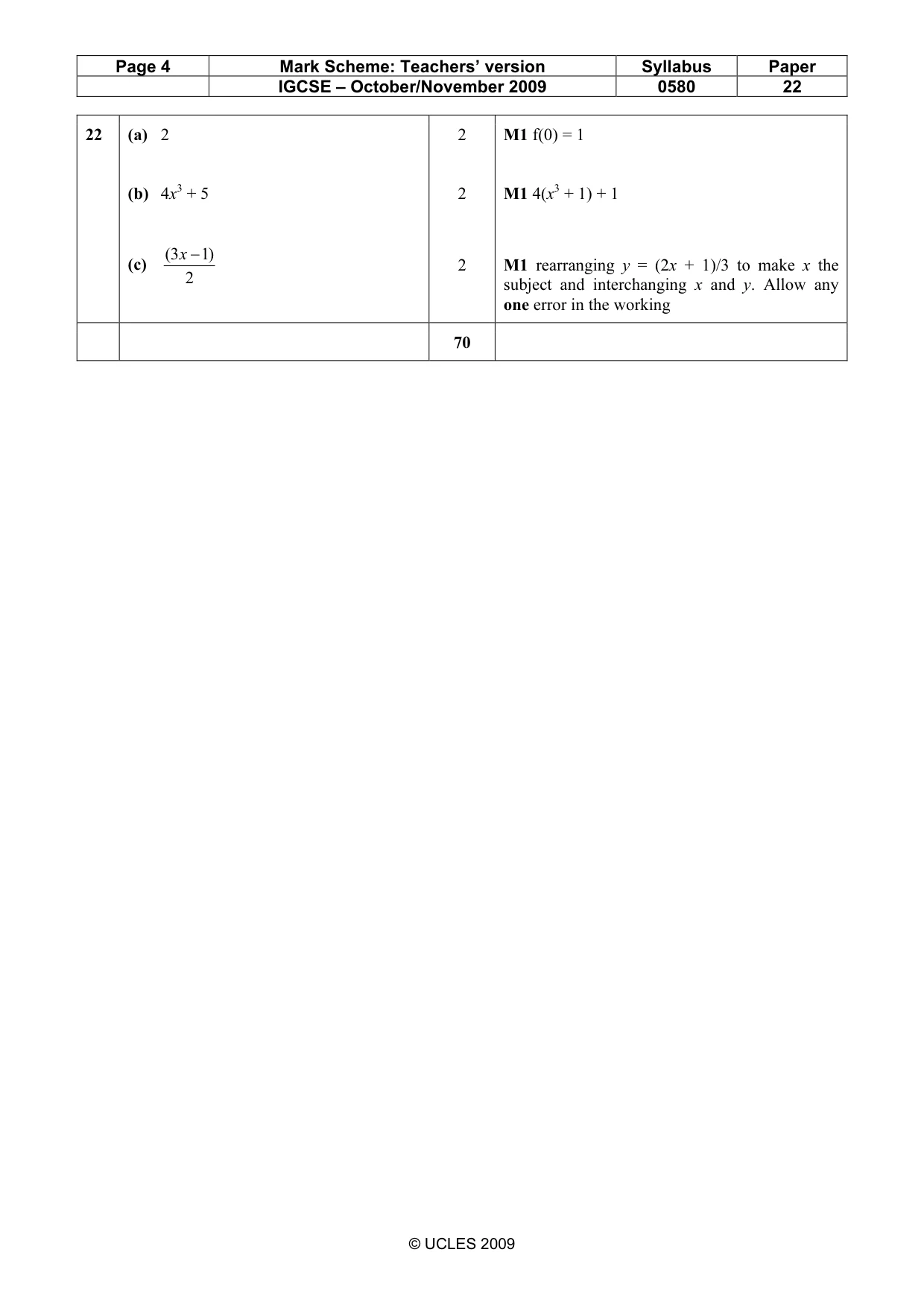
Mark scheme: 22 (a) 2 2 M1 f(0) = 1 (b) 4x3 + 5 2 M1 4(x3 + 1) + 1 (3 x − )1 (c) 2 M1 rearranging y = (2x + 1)/3 to make x the 2 subject and interchanging x and y. Allow any one error in the working 70
What was in this paper
The subtopics covered by these 8 questions, and how many questions each got. Open one in a new tab to see every Cambridge question on it.
What you needed in this session
Cambridge’s own grade thresholds for 2009 Oct/Nov, Paper 2 · Variant 2. A higher threshold means an easier paper — the bar moves with how the cohort did.