Cambridge IGCSE Mathematics 0580 — 2009 May/June Paper 3 · Variant 1
0580/31/M/J/09 · 7 questions · 104 marks · ≈117 min
The question paper and its mark scheme, free to read here and free to download. This is Cambridge’s own paper, exactly as it was sat.
Question paper16 pages
Mark scheme6 pages
Answers below. Sit the paper first if you are practising.
Questions as text
Q1 · Roberto owns 6000 square metres of land
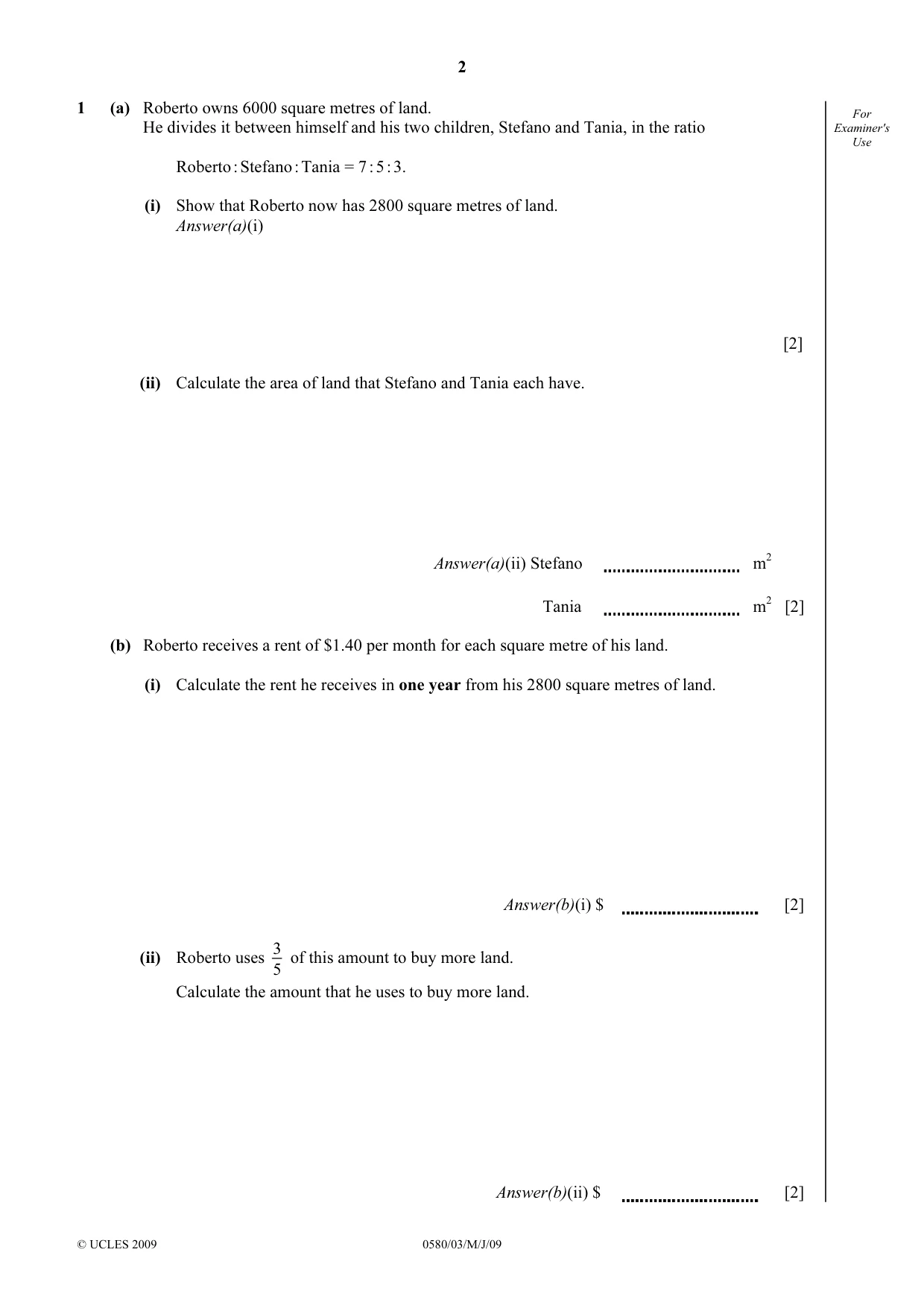
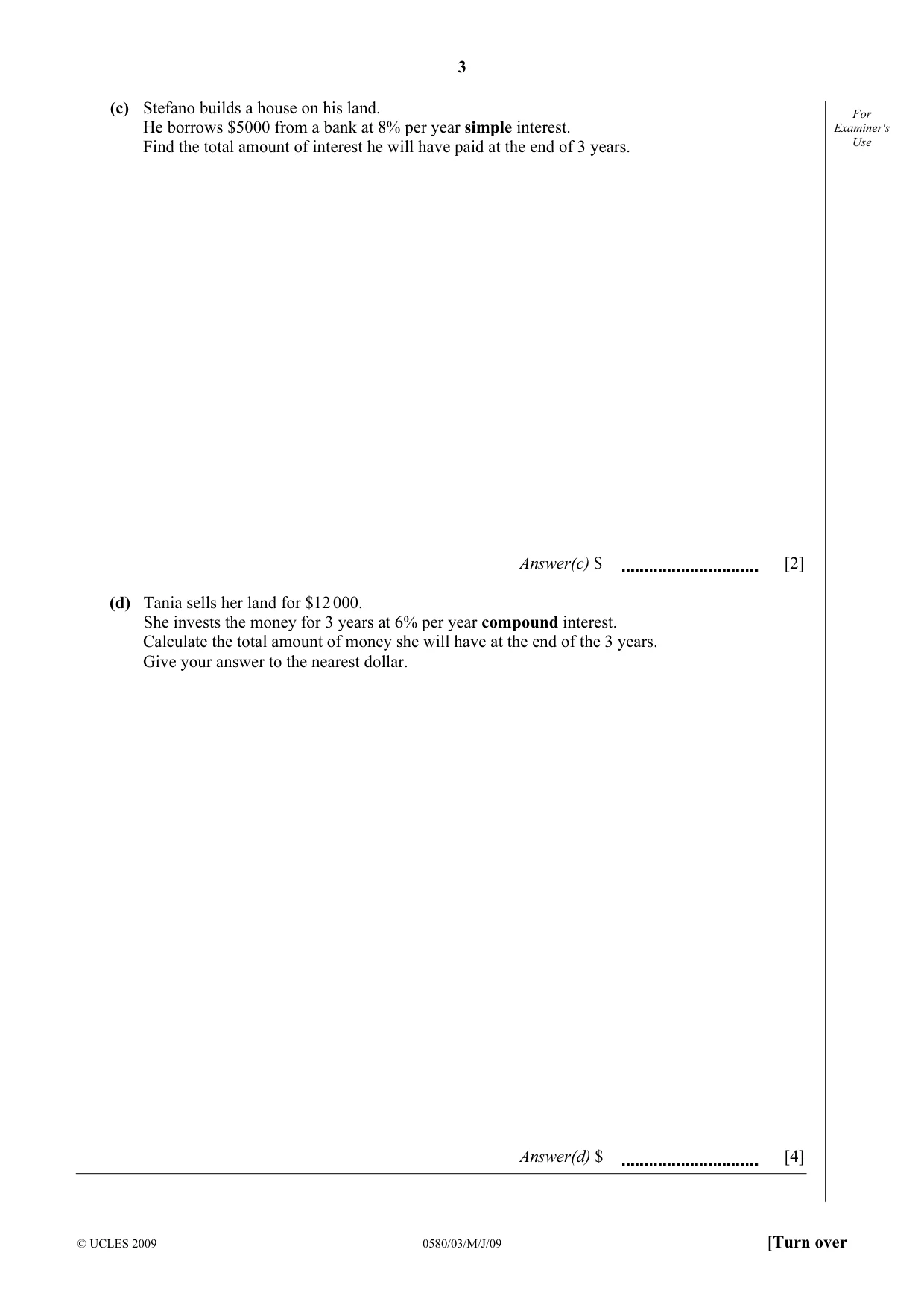
1 (a) Roberto owns 6000 square metres of land. For He divides it between himself and his two children, Stefano and Tania, in the ratio Examiner's Use Roberto : Stefano : Tania = 7 : 5 : 3. (i) Show that Roberto now has 2800 square metres of land. Answer(a)(i) [2] (ii) Calculate the area of land that Stefano and Tania each have. Answer(a)(ii) Stefano m2 Tania m2 [2] (b) Roberto receives a rent of $1.40 per month for each square metre of his land. (i) Calculate the rent he receives in one year from his 2800 square metres of land. Answer(b)(i) $ [2] 3 (ii) Roberto uses of this amount to buy more land. 5 Calculate the amount that he uses to buy more land. Answer(b)(ii) $ [2] (c) Stefano builds a house on his land. For He borrows $5000 from a bank at 8% per year simple interest. Examiner's Find the total amount of interest he will have paid at the end of 3 years. Use Answer(c) $ [2] (d) Tania sells her land for $12 000. She invests the money for 3 years at 6% per year compound interest. Calculate the total amount of money she will have at the end of the 3 years. Give your answer to the nearest dollar. Answer(d) $ [4]
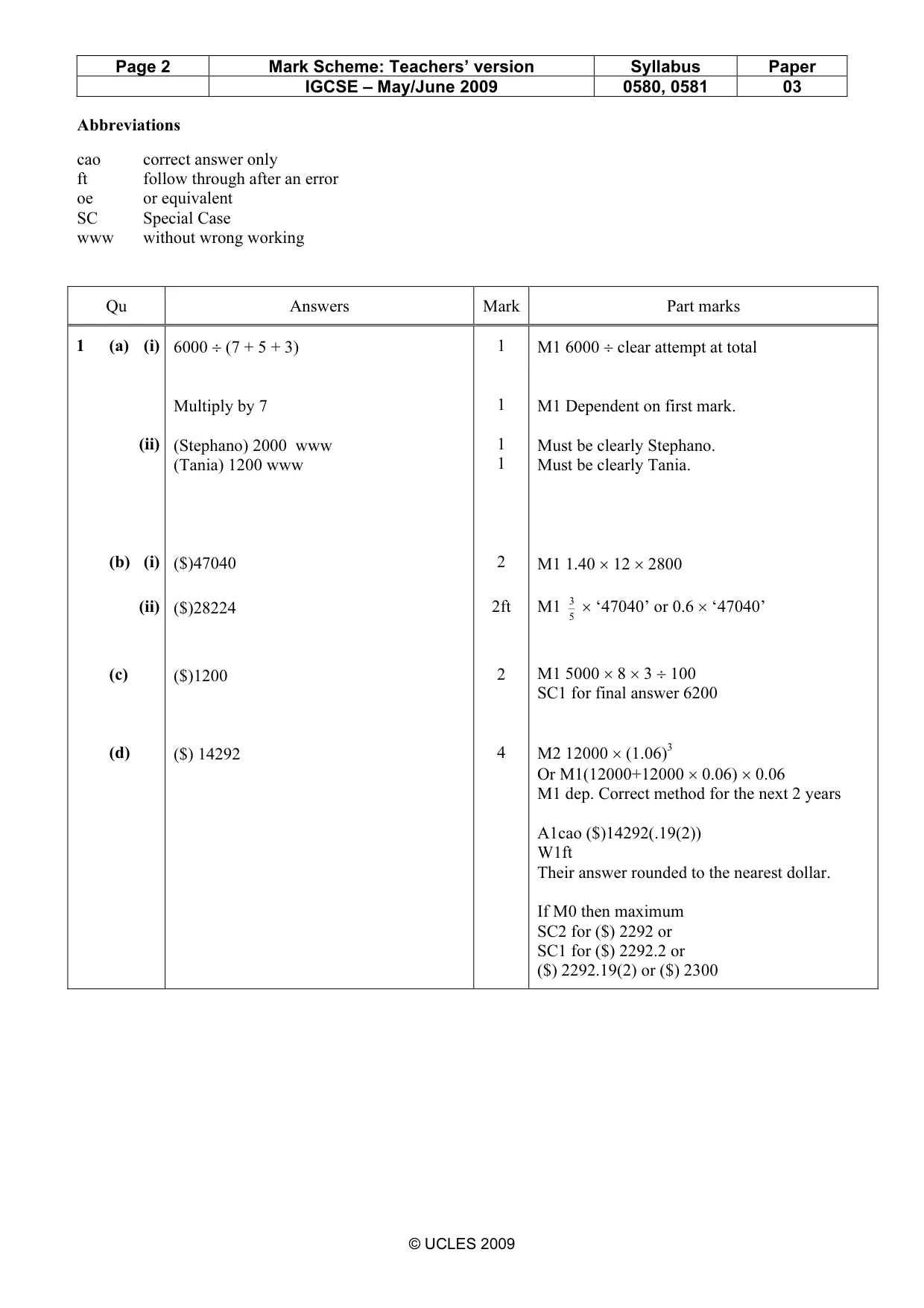
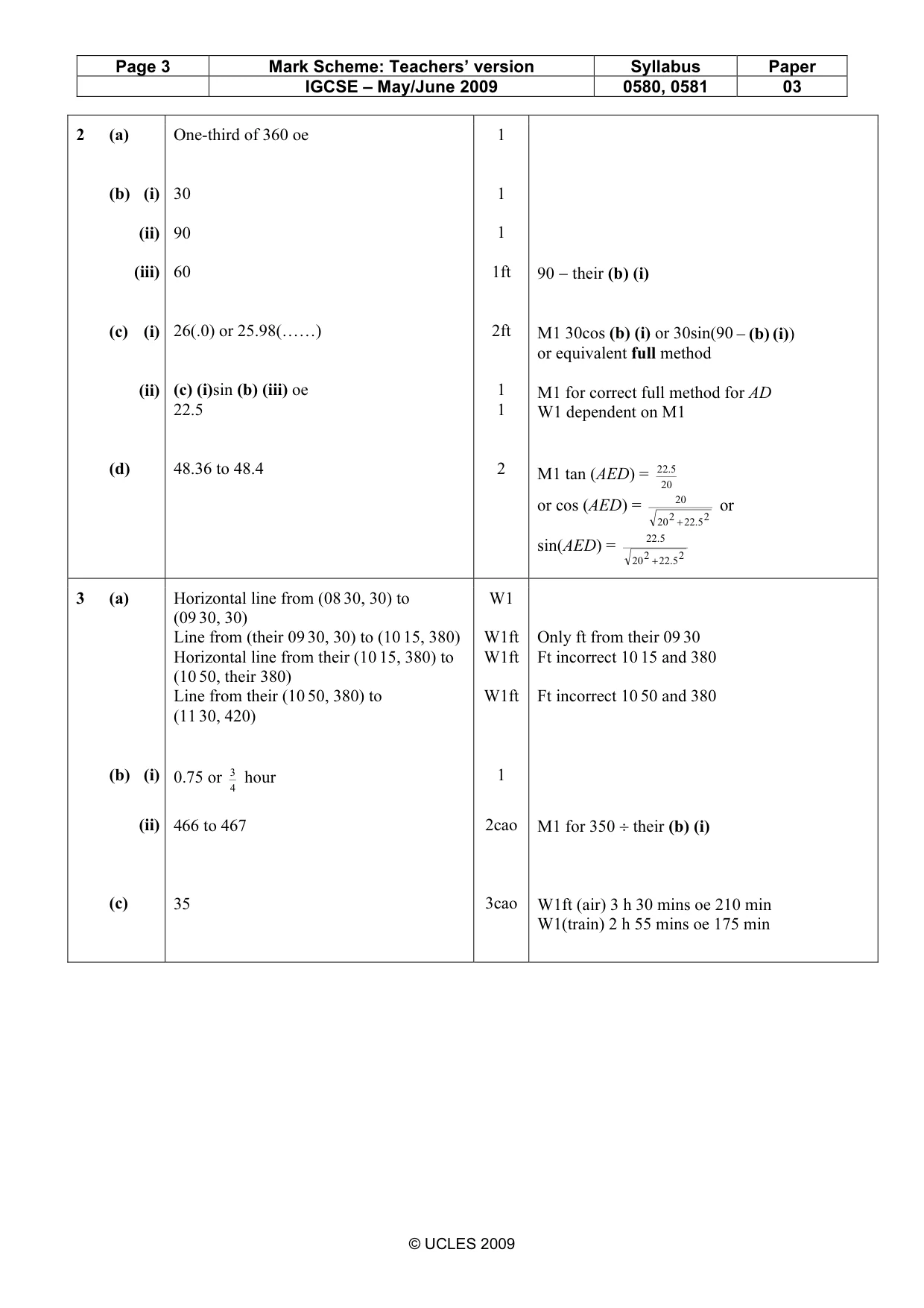
Mark scheme: Qu Answers Mark Part marks 1 (a) (i) 6000 ÷ (7 + 5 + 3) 1 M1 6000 ÷ clear attempt at total Multiply by 7 1 M1 Dependent on first mark. (ii) (Stephano) 2000 www 1 Must be clearly Stephano. (Tania) 1200 www 1 Must be clearly Tania. (b) (i) ($)47040 2 M1 1.40 × 12 × 2800 (ii) ($)28224 2ft M1 3 × ‘47040’ or 0.6 × ‘47040’ 5 (c) ($)1200 2 M1 5000 × 8 × 3 ÷ 100 SC1 for final answer 6200 (d) ($) 14292 4 M2 12000 × (1.06)3 Or M1(12000+12000 × 0.06) × 0.06 M1 dep. Correct method for the next 2 years A1cao ($)14292(.19(2)) W1ft Their answer rounded to the nearest dollar. If M0 then maximum SC2 for ($) 2292 or SC1 for ($) 2292.2 or ($) 2292.19(2) or ($) 2300 IGCSE – May/June 2009 0580, 0581 03 2 (a) One-third of 360 oe 1
Q4 · Garcia and Elena are each given x dollars
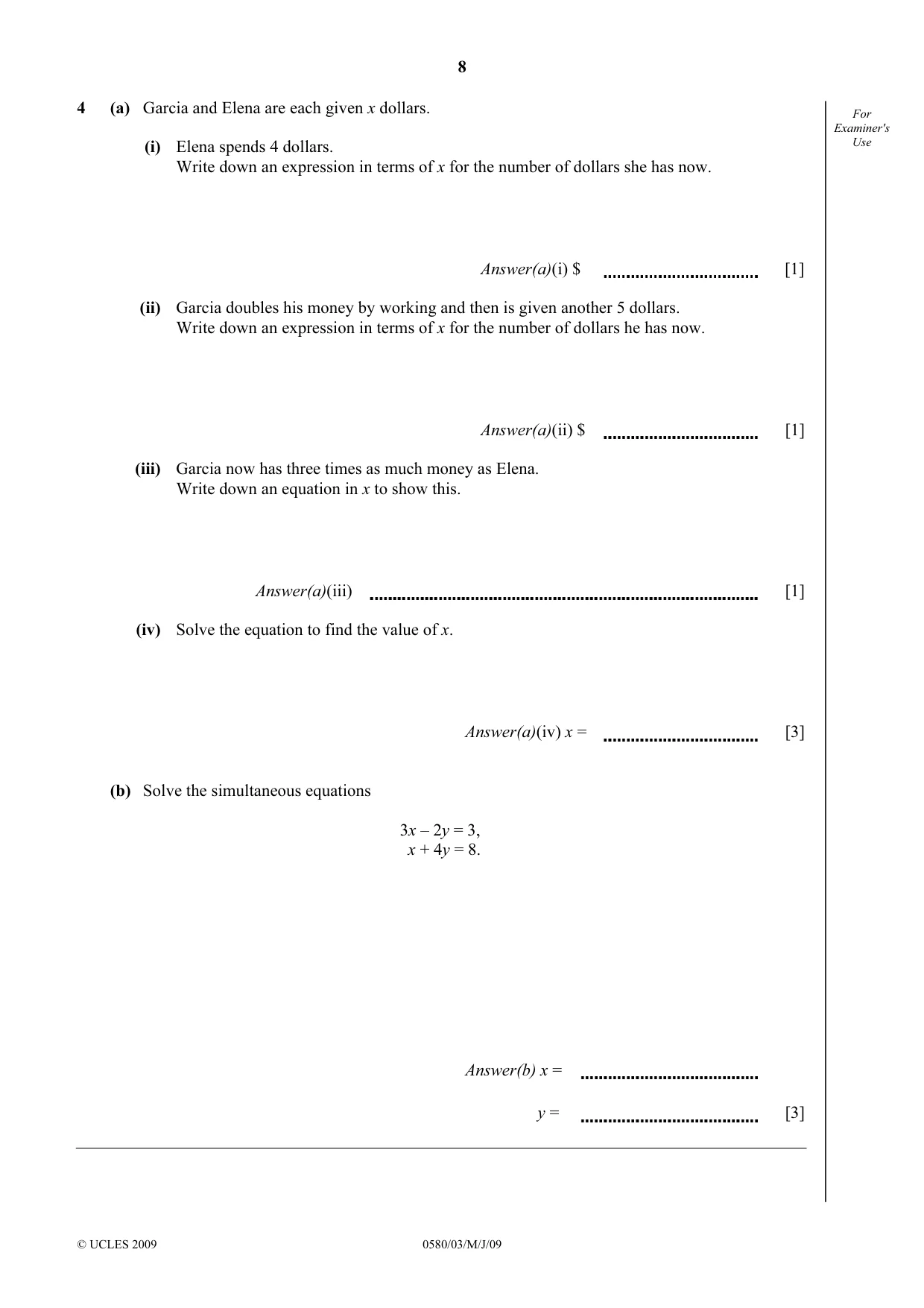
4 (a) Garcia and Elena are each given x dollars. For Examiner's (i) Elena spends 4 dollars. Use Write down an expression in terms of x for the number of dollars she has now. Answer(a)(i) $ [1] (ii) Garcia doubles his money by working and then is given another 5 dollars. Write down an expression in terms of x for the number of dollars he has now. Answer(a)(ii) $ [1] (iii) Garcia now has three times as much money as Elena. Write down an equation in x to show this. Answer(a)(iii) [1] (iv) Solve the equation to find the value of x. Answer(a)(iv) x = [3] (b) Solve the simultaneous equations 3x – 2y = 3, x + 4y = 8. Answer(b) x = y = [3]
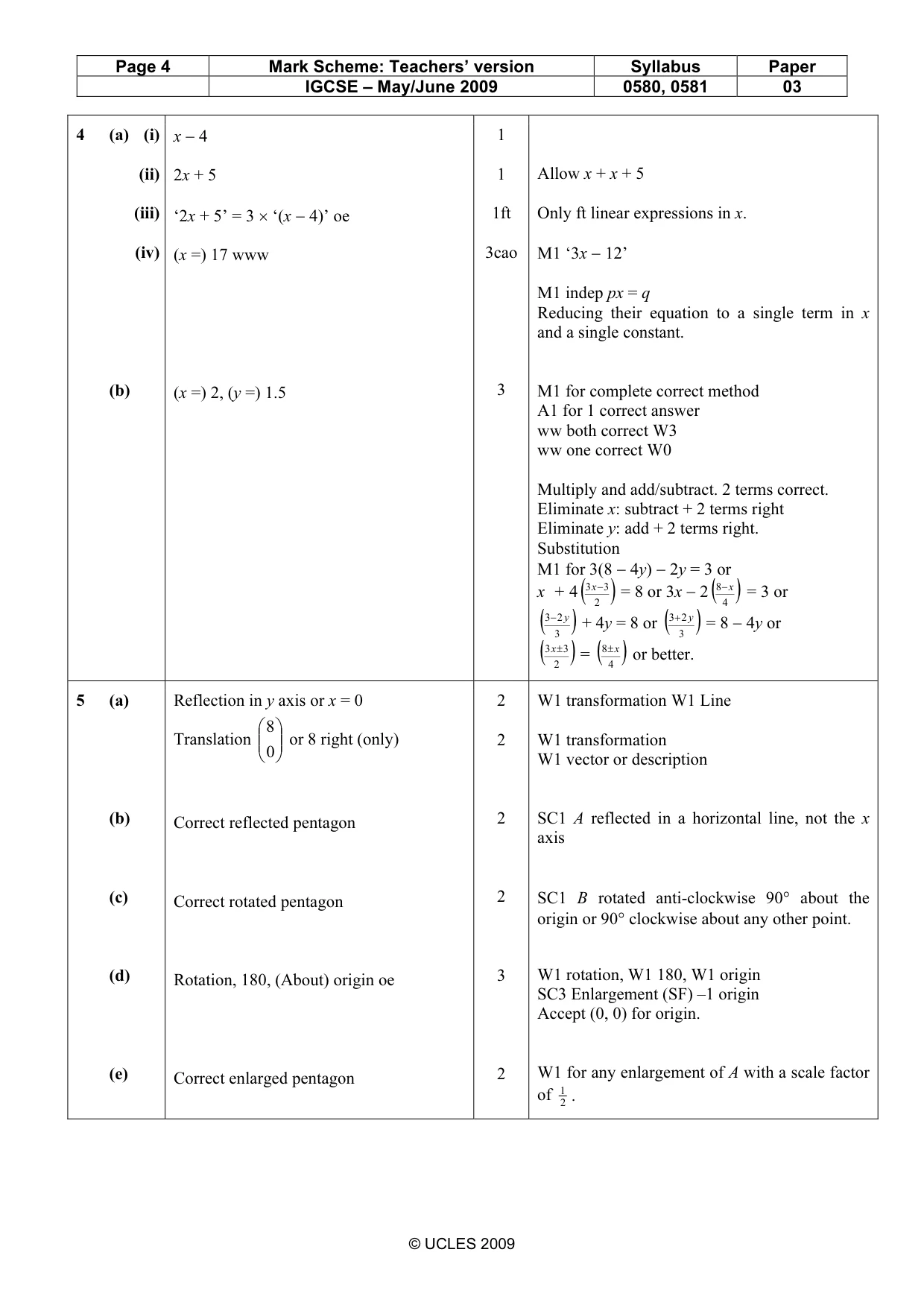
Mark scheme: 4 (a) (i) x − 4 1 (ii) 2x + 5 1 Allow x + x + 5 (iii) ‘2x + 5’ = 3 × ‘(x − 4)’ oe 1ft Only ft linear expressions in x. (iv) (x =) 17 www 3cao M1 ‘3x − 12’ M1 indep px = q Reducing their equation to a single term in x and a single constant. (b) (x =) 2, (y =) 1.5 3 M1 for complete correct method A1 for 1 correct answer ww both correct W3 ww one correct W0 Multiply and add/subtract. 2 terms correct. Eliminate x: subtract + 2 terms right Eliminate y: add + 2 terms right. Substitution M1 for 3(8 − 4y) − 2y = 3 or 3 x − 3 8 − x ) = 3 or x + 4( ) = 8 or 3x − 2( 2 4 3 − 2 y 3 + 2 y ( ) + 4y = 8 or ( ) = 8 − 4y or 3 3 3 x ± 3 8 ± x ( ) = ( ) or better. 2 4
Q5 · For Examiner's y Use 10 A B 8 6 4 2 x –10 –8 –6 –4 –2 0 2 4 6 8 10 –2 –4 –6 –8 –10 (a)…
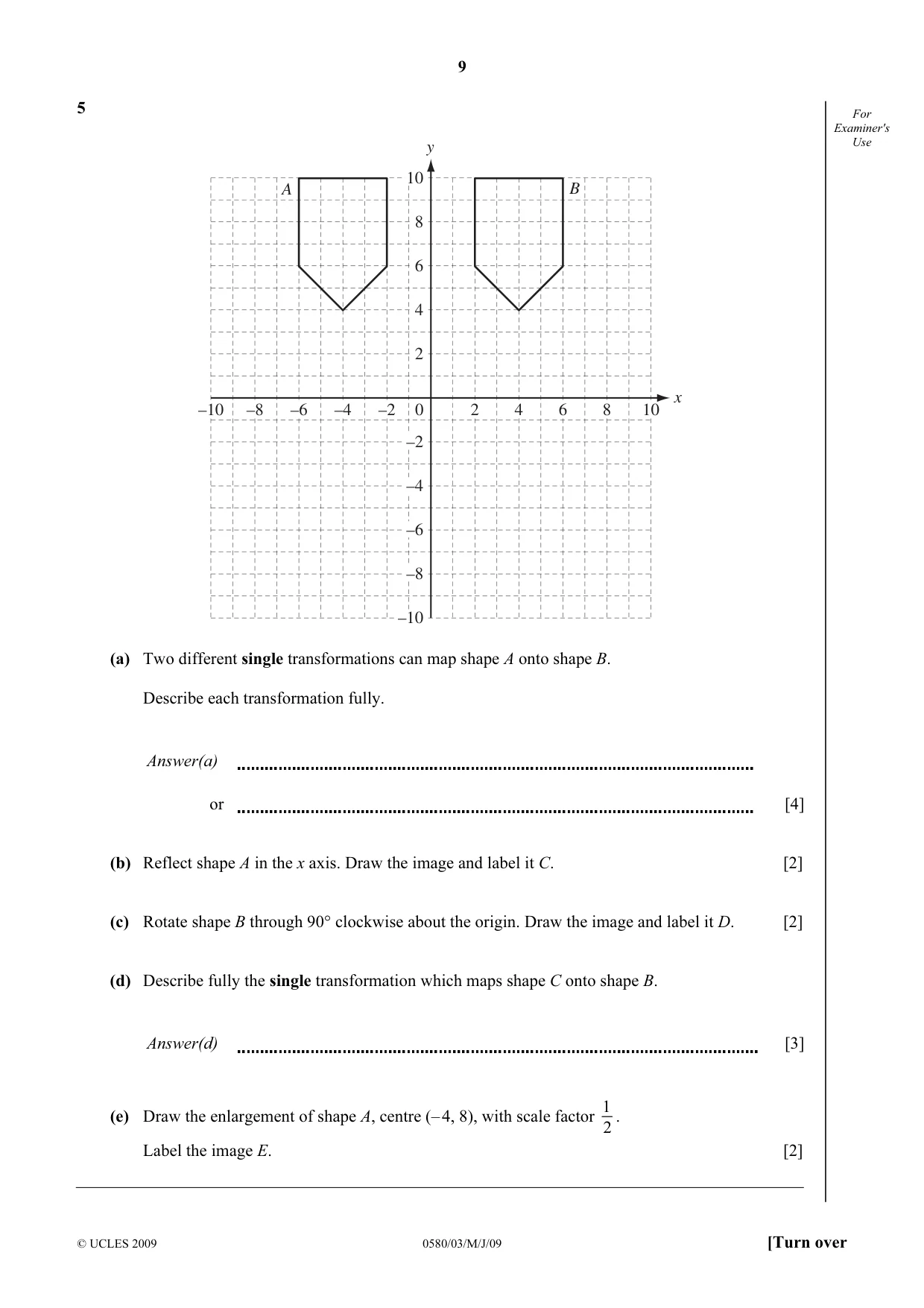
5 For Examiner's y Use 10 A B 8 6 4 2 x –10 –8 –6 –4 –2 0 2 4 6 8 10 –2 –4 –6 –8 –10 (a) Two different single transformations can map shape A onto shape B. Describe each transformation fully. Answer(a) or [4] (b) Reflect shape A in the x axis. Draw the image and label it C. [2] (c) Rotate shape B through 90° clockwise about the origin. Draw the image and label it D. [2] (d) Describe fully the single transformation which maps shape C onto shape B. Answer(d) [3] 1 (e) Draw the enlargement of shape A, centre (– 4, 8), with scale factor . 2 Label the image E. [2]
Mark scheme: 5 (a) Reflection in y axis or x = 0 2 W1 transformation W1 Line 8 Translation or 8 right (only) 2 W1 transformation 0 W1 vector or description (b) 2 SC1 A reflected in a horizontal line, not the x Correct reflected pentagon axis (c) 2 SC1 B rotated anti-clockwise 90° about the Correct rotated pentagon origin or 90° clockwise about any other point. (d) 3 W1 rotation, W1 180, W1 origin Rotation, 180, (About) origin oe SC3 Enlargement (SF) –1 origin Accept (0, 0) for origin. (e) 2 W1 for any enlargement of A with a scale factor Correct enlarged pentagon of 12 . IGCSE – May/June 2009 0580, 0581 03
Q6 · Write down the name of a polygon with 8 sides
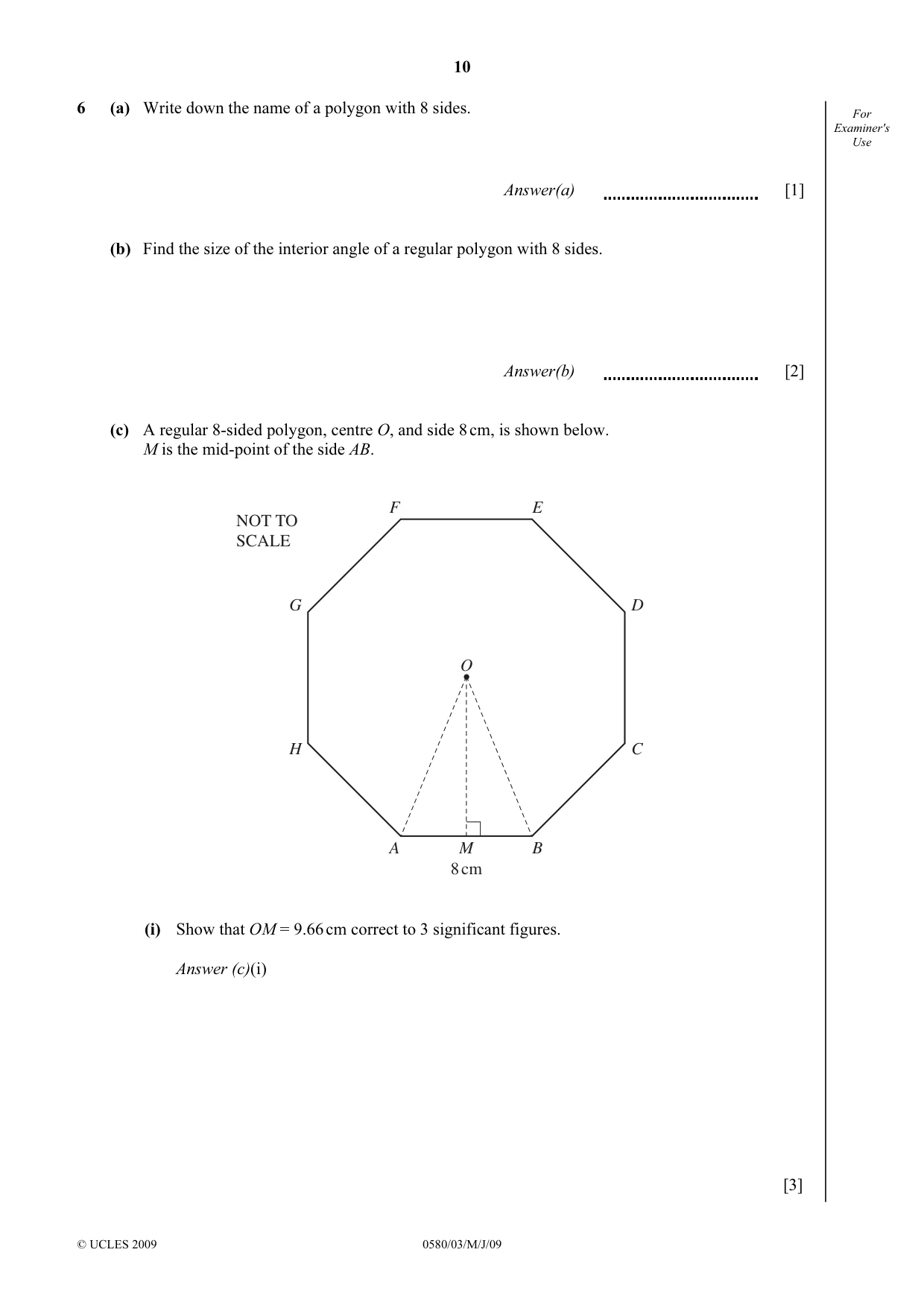
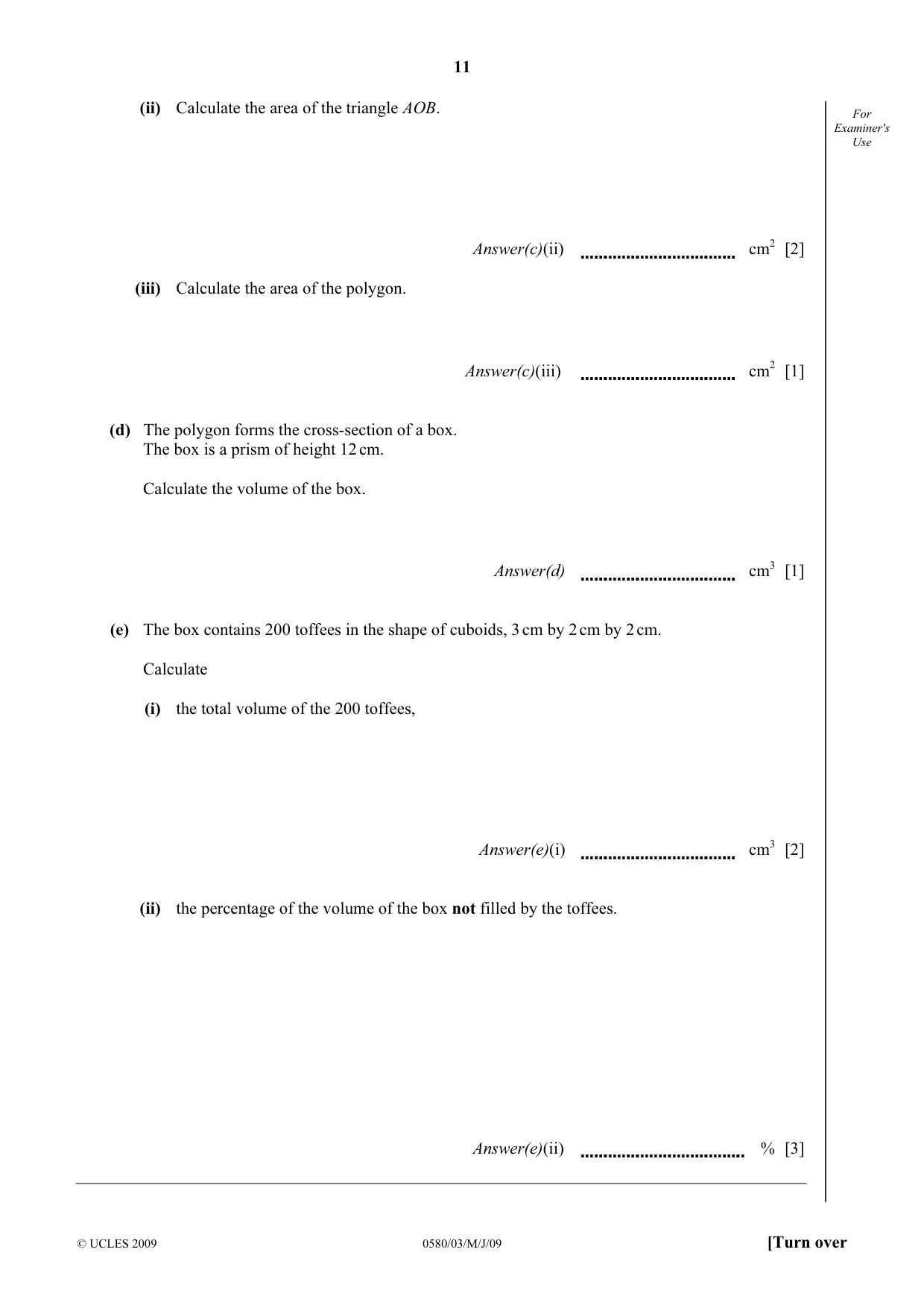
6 (a) Write down the name of a polygon with 8 sides. For Examiner's Use Answer(a) [1] (b) Find the size of the interior angle of a regular polygon with 8 sides. Answer(b) [2] (c) A regular 8-sided polygon, centre O, and side 8 cm, is shown below. M is the mid-point of the side AB. F E NOT TO SCALE G D O H C A M B 8 cm (i) Show that OM = 9.66 cm correct to 3 significant figures. Answer (c)(i) [3] (ii) Calculate the area of the triangle AOB. For Examiner's Use Answer(c)(ii) cm2 [2] (iii) Calculate the area of the polygon. Answer(c)(iii) cm2 [1] (d) The polygon forms the cross-section of a box. The box is a prism of height 12 cm. Calculate the volume of the box. Answer(d) cm3 [1] (e) The box contains 200 toffees in the shape of cuboids, 3 cm by 2 cm by 2 cm. Calculate (i) the total volume of the 200 toffees, Answer(e)(i) cm3 [2] (ii) the percentage of the volume of the box not filled by the toffees. Answer(e)(ii) % [3]
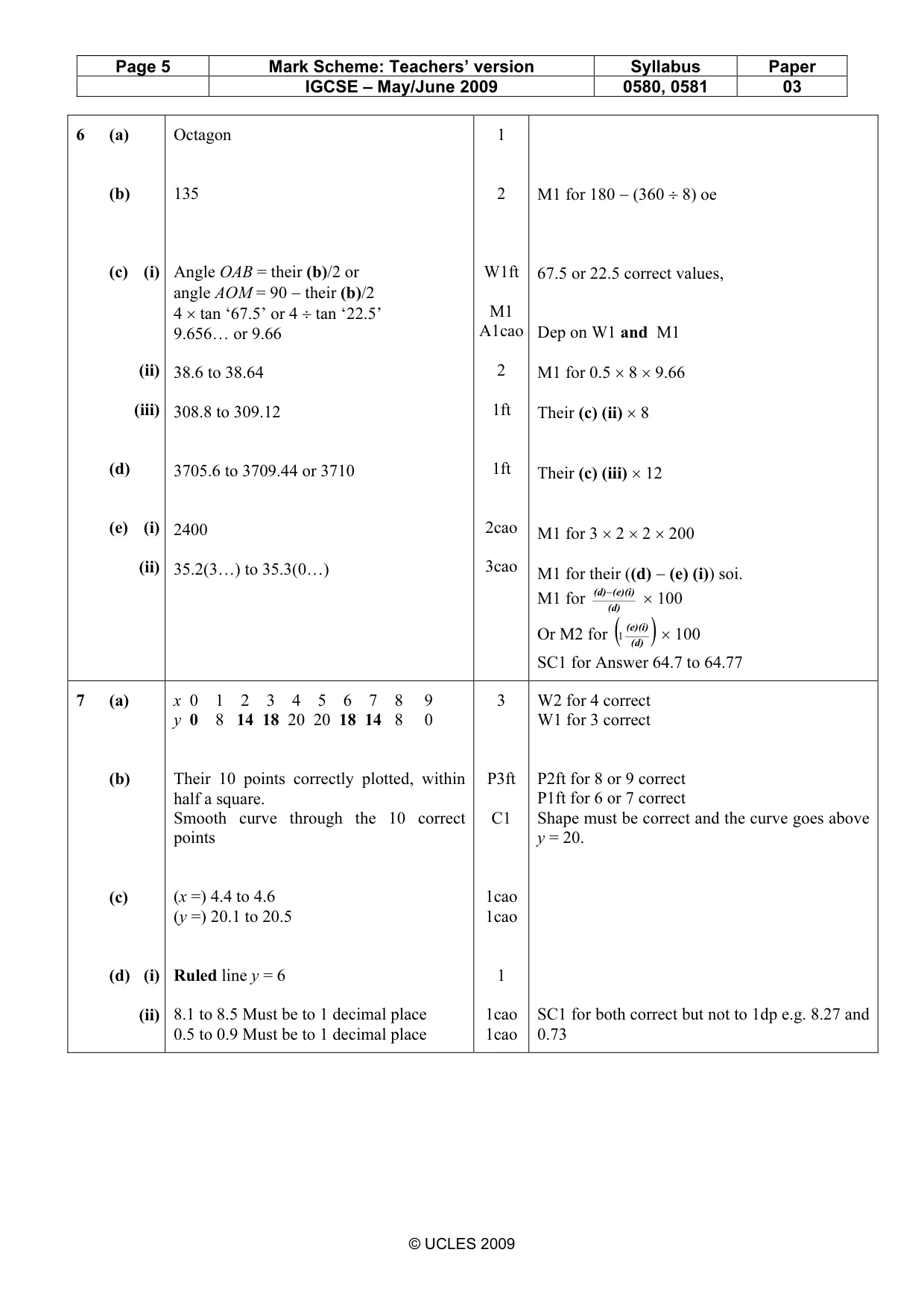
Mark scheme: 6 (a) Octagon 1 (b) 135 2 M1 for 180 − (360 ÷ 8) oe (c) (i) Angle OAB = their (b)/2 or W1ft 67.5 or 22.5 correct values, angle AOM = 90 − their (b)/2 4 × tan ‘67.5’ or 4 ÷ tan ‘22.5’ M1 9.656… or 9.66 A1cao Dep on W1 and M1 (ii) 38.6 to 38.64 2 M1 for 0.5 × 8 × 9.66 (iii) 308.8 to 309.12 1ft Their (c) (ii) × 8 (d) 3705.6 to 3709.44 or 3710 1ft Their (c) (iii) × 12 (e) (i) 2400 2cao M1 for 3 × 2 × 2 × 200 (ii) 35.2(3…) to 35.3(0…) 3cao M1 for their ((d) − (e) (i)) soi. (d)− (e)(i) M1 for (d) × 100 (e)(i) Or M2 for (1 (d) ) × 100 SC1 for Answer 64.7 to 64.77
Q7 · Y = 9x – x2
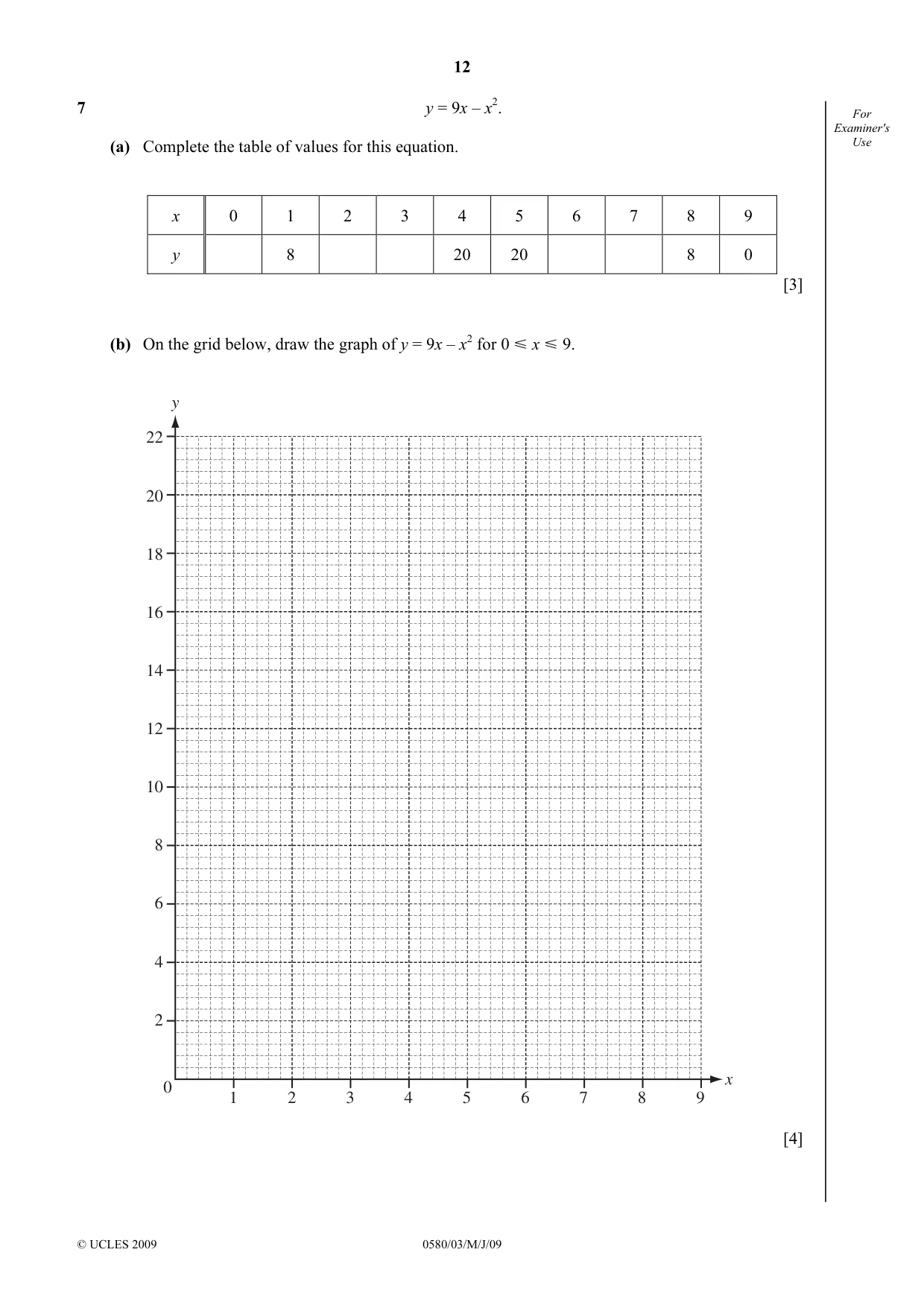
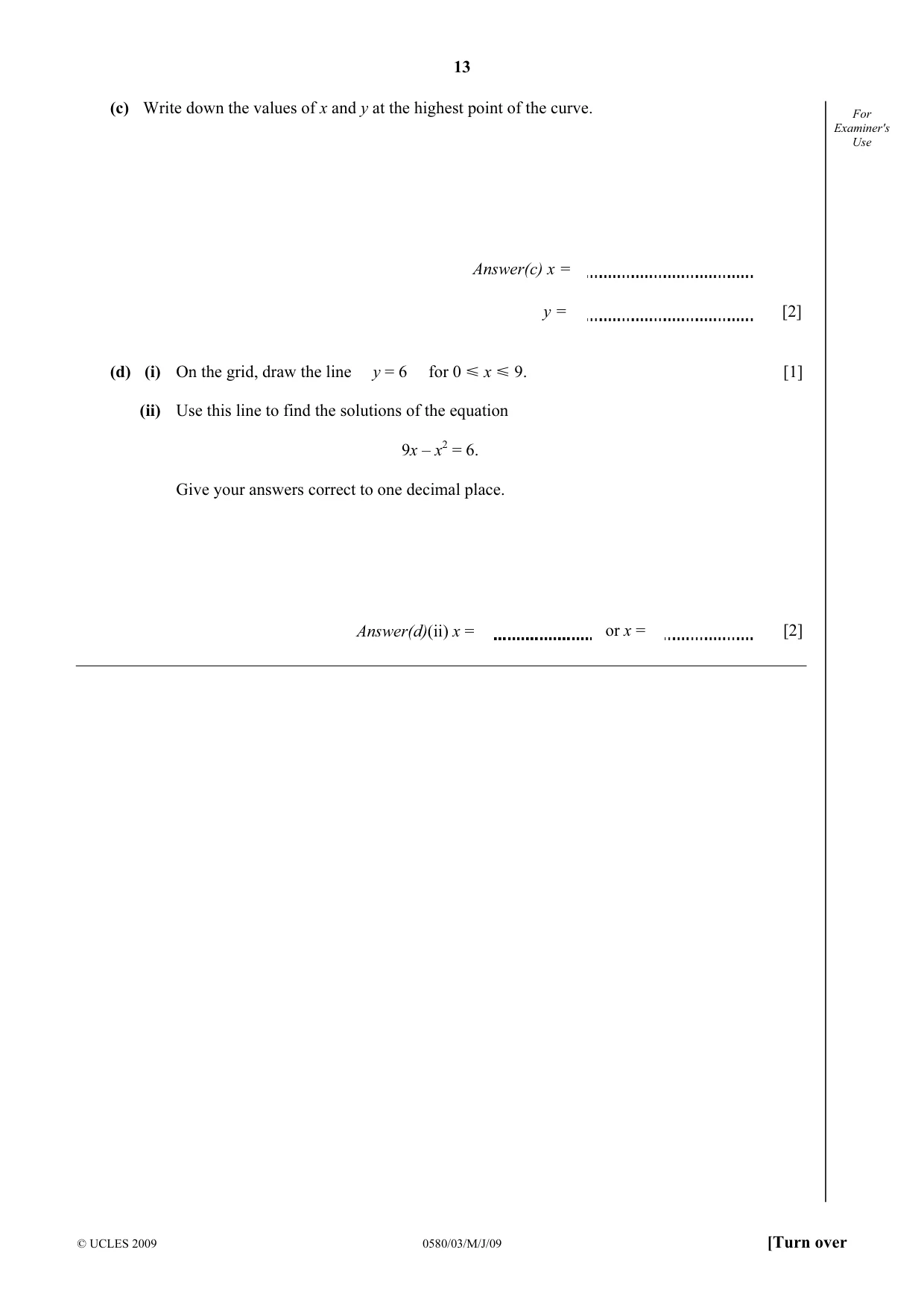
7 y = 9x – x2. For Examiner's (a) Complete the table of values for this equation. Use x 0 1 2 3 4 5 6 7 8 9 y 8 20 20 8 0 [3] (b) On the grid below, draw the graph of y = 9x – x2 for 0 Y x Y 9. y 22 20 18 16 14 12 10 8 6 4 2 x 0 1 2 3 4 5 6 7 8 9 [4] (c) Write down the values of x and y at the highest point of the curve. For Examiner's Use Answer(c) x = y = [2] (d) (i) On the grid, draw the line y = 6 for 0 Y x Y 9. [1] (ii) Use this line to find the solutions of the equation 9x – x2 = 6. Give your answers correct to one decimal place. Answer(d)(ii) x = or x = [2]
Mark scheme: 7 (a) x 0 1 2 3 4 5 6 7 8 9 3 W2 for 4 correct y 0 8 14 18 20 20 18 14 8 0 W1 for 3 correct (b) Their 10 points correctly plotted, within P3ft P2ft for 8 or 9 correct half a square. P1ft for 6 or 7 correct Smooth curve through the 10 correct C1 Shape must be correct and the curve goes above points y = 20. (c) (x =) 4.4 to 4.6 1cao (y =) 20.1 to 20.5 1cao (d) (i) Ruled line y = 6 1 (ii) 8.1 to 8.5 Must be to 1 decimal place 1cao SC1 for both correct but not to 1dp e.g. 8.27 and 0.5 to 0.9 Must be to 1 decimal place 1cao 0.73 IGCSE – May/June 2009 0580, 0581 03
Q8 · The table below shows the age and price of 20 used cars in a showroom
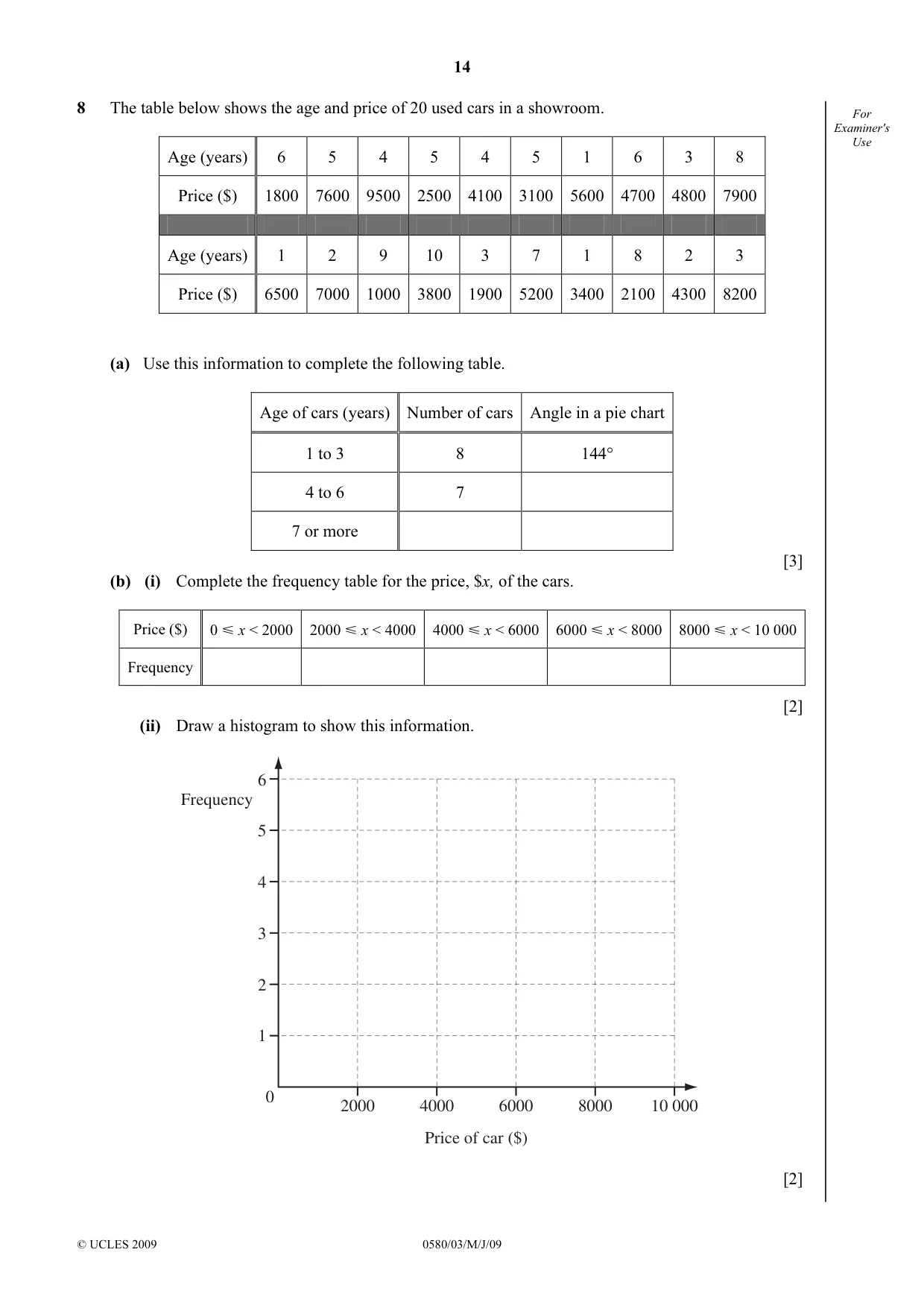
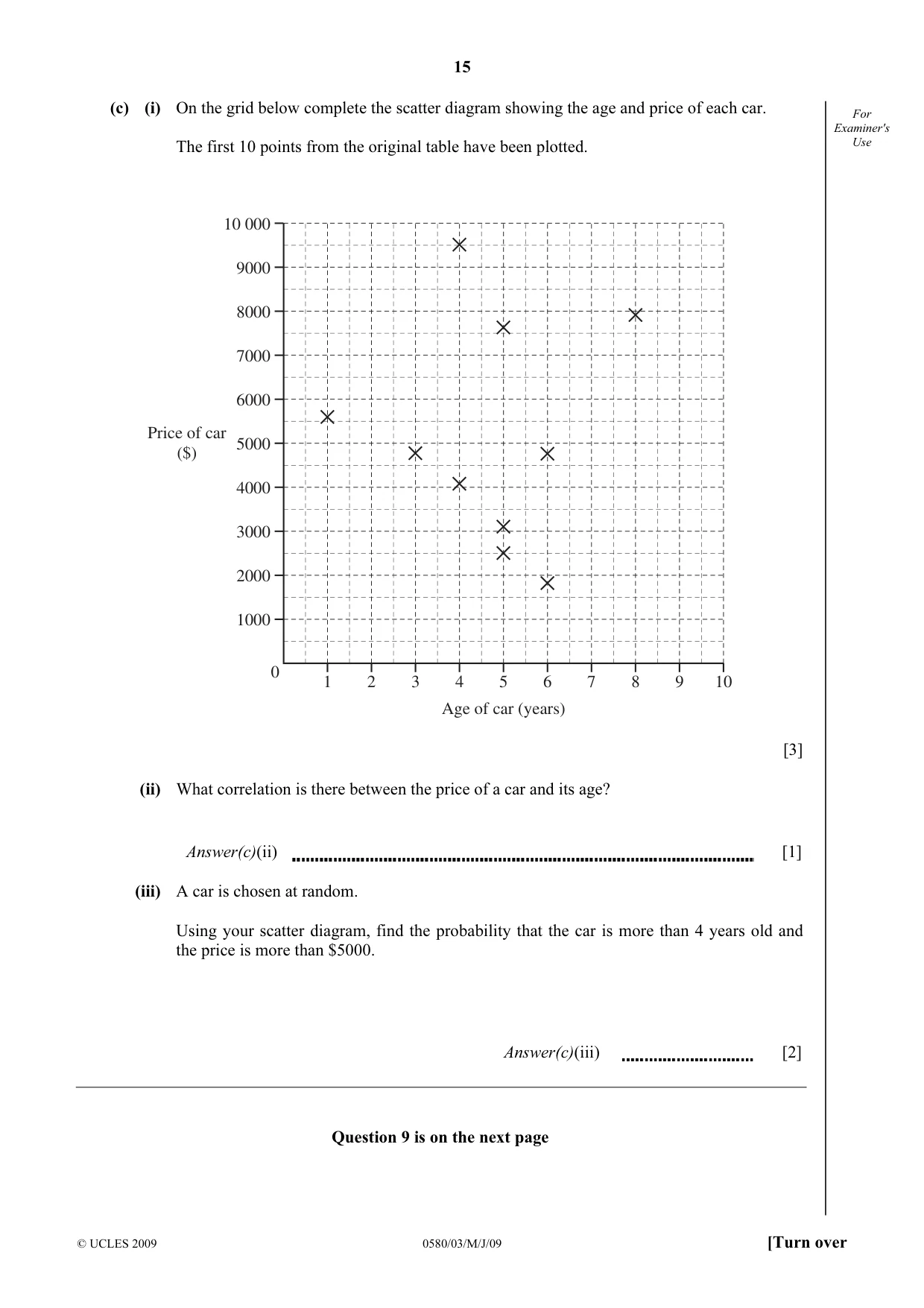
8 The table below shows the age and price of 20 used cars in a showroom. For Examiner's Use Age (years) 6 5 4 5 4 5 1 6 3 8 Price ($) 1800 7600 9500 2500 4100 3100 5600 4700 4800 7900 Age (years) 1 2 9 10 3 7 1 8 2 3 Price ($) 6500 7000 1000 3800 1900 5200 3400 2100 4300 8200 (a) Use this information to complete the following table. Age of cars (years) Number of cars Angle in a pie chart 1 to 3 8 144° 4 to 6 7 7 or more [3] (b) (i) Complete the frequency table for the price, $x, of the cars. Price ($) 0 Y x < 2000 2000 Y x < 4000 4000 Y x < 6000 6000 Y x < 8000 8000 Y x < 10 000 Frequency [2] (ii) Draw a histogram to show this information. 6 Frequency 5 4 3 2 1 0 2000 4000 6000 8000 10 000 Price of car ($) [2] (c) (i) On the grid below complete the scatter diagram showing the age and price of each car. For Examiner's The first 10 points from the original table have been plotted. Use 10 000 9000 8000 7000 6000 Price of car 5000 ($) 4000 3000 2000 1000 0 1 2 3 4 5 6 7 8 9 10 Age of car (years) [3] (ii) What correlation is there between the price of a car and its age? Answer(c)(ii) [1] (iii) A car is chosen at random. Using your scatter diagram, find the probability that the car is more than 4 years old and the price is more than $5000. Answer(c)(iii) [2] Question 9 is on the next page
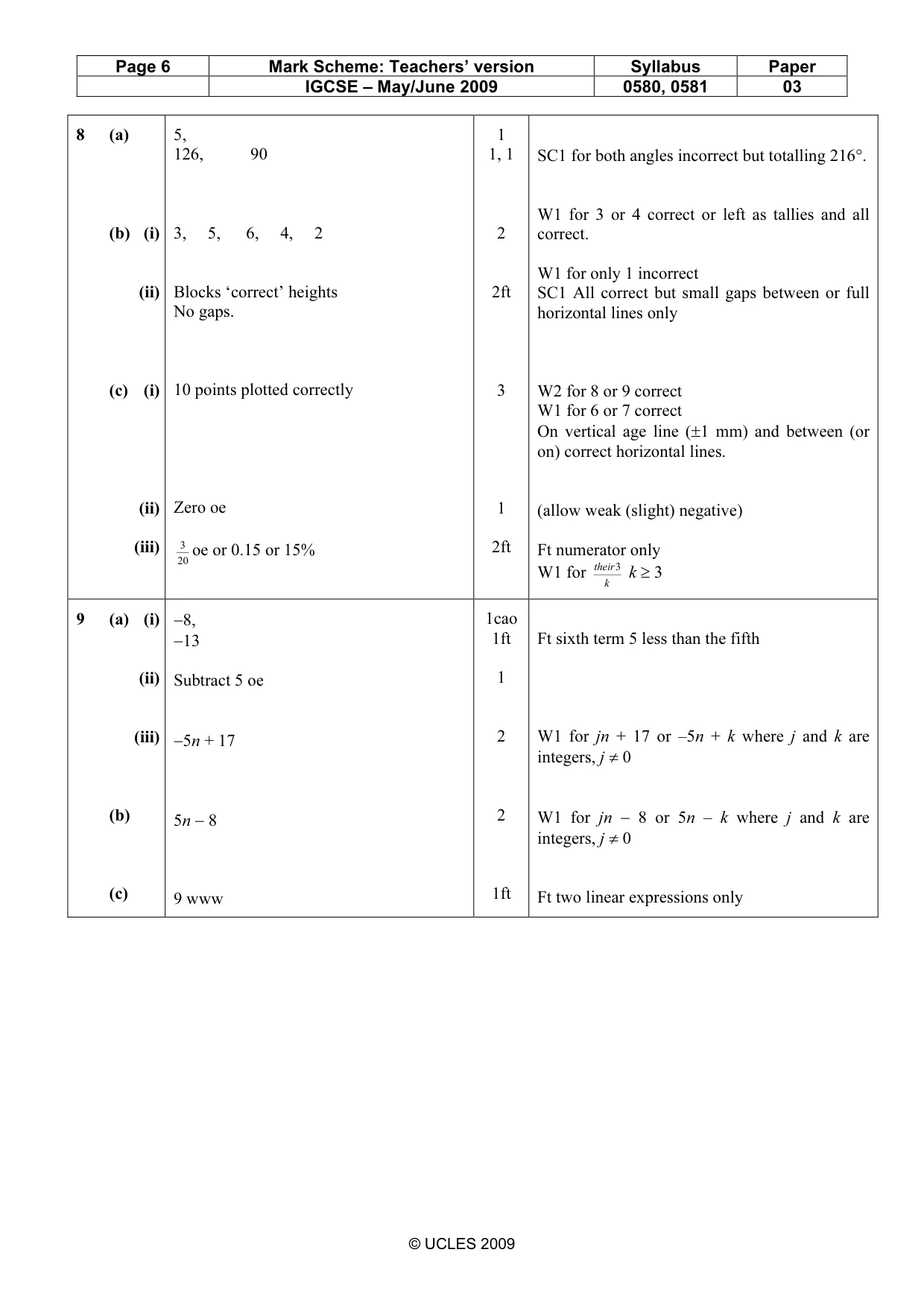
Mark scheme: 8 (a) 5, 1 126, 90 1, 1 SC1 for both angles incorrect but totalling 216°. W1 for 3 or 4 correct or left as tallies and all (b) (i) 3, 5, 6, 4, 2 2 correct. W1 for only 1 incorrect (ii) Blocks ‘correct’ heights 2ft SC1 All correct but small gaps between or full No gaps. horizontal lines only (c) (i) 10 points plotted correctly 3 W2 for 8 or 9 correct W1 for 6 or 7 correct On vertical age line (±1 mm) and between (or on) correct horizontal lines. (ii) Zero oe 1 (allow weak (slight) negative) (iii) 3 oe or 0.15 or 15% 2ft Ft numerator only 20 W1 for their3 k ≥ 3 k
Q9 · The first four terms of a sequence are 12, 7, 2, –3
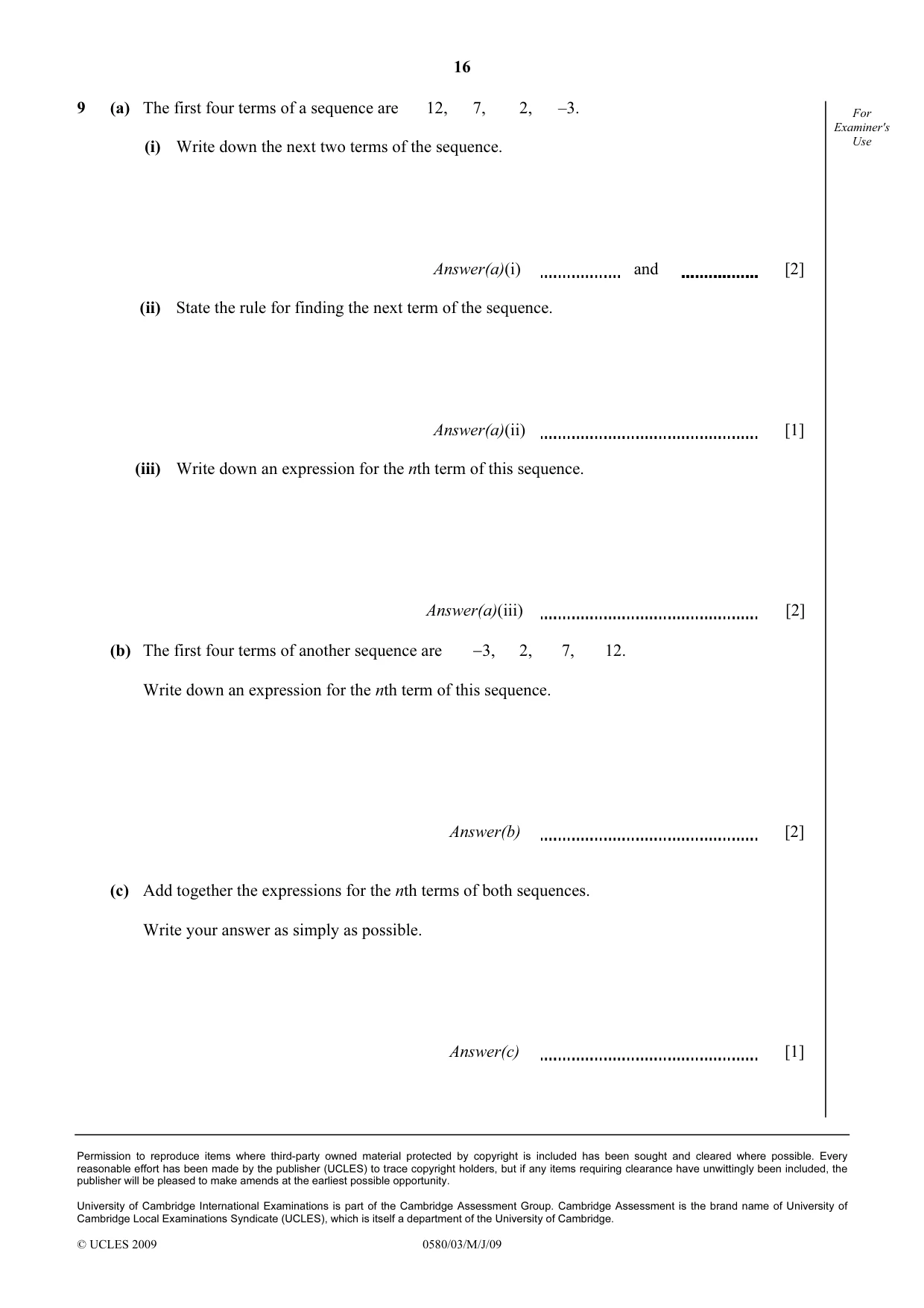
9 (a) The first four terms of a sequence are 12, 7, 2, –3. For Examiner's (i) Write down the next two terms of the sequence. Use Answer(a)(i) and [2] (ii) State the rule for finding the next term of the sequence. Answer(a)(ii) [1] (iii) Write down an expression for the nth term of this sequence. Answer(a)(iii) [2] (b) The first four terms of another sequence are −3, 2, 7, 12. Write down an expression for the nth term of this sequence. Answer(b) [2] (c) Add together the expressions for the nth terms of both sequences. Write your answer as simply as possible. Answer(c) [1]
Mark scheme: 9 (a) (i) −8, 1cao −13 1ft Ft sixth term 5 less than the fifth (ii) Subtract 5 oe 1 (iii) −5n + 17 2 W1 for jn + 17 or –5n + k where j and k are integers, j ≠ 0 (b) 5n − 8 2 W1 for jn − 8 or 5n – k where j and k are integers, j ≠ 0 (c) 1ft Ft two linear expressions only 9 www
What was in this paper
The subtopics covered by these 7 questions, and how many questions each got. Open one in a new tab to see every Cambridge question on it.
What you needed in this session
Cambridge’s own grade thresholds for 2009 May/June, Paper 3 · Variant 1. A higher threshold means an easier paper — the bar moves with how the cohort did.