Cambridge IGCSE Mathematics 0580 — 2006 Oct/Nov Paper 3 · Variant 1
0580/31/O/N/06 · 9 questions · 104 marks · ≈117 min
The question paper and its mark scheme, free to read here and free to download. This is Cambridge’s own paper, exactly as it was sat.
Question paper16 pages
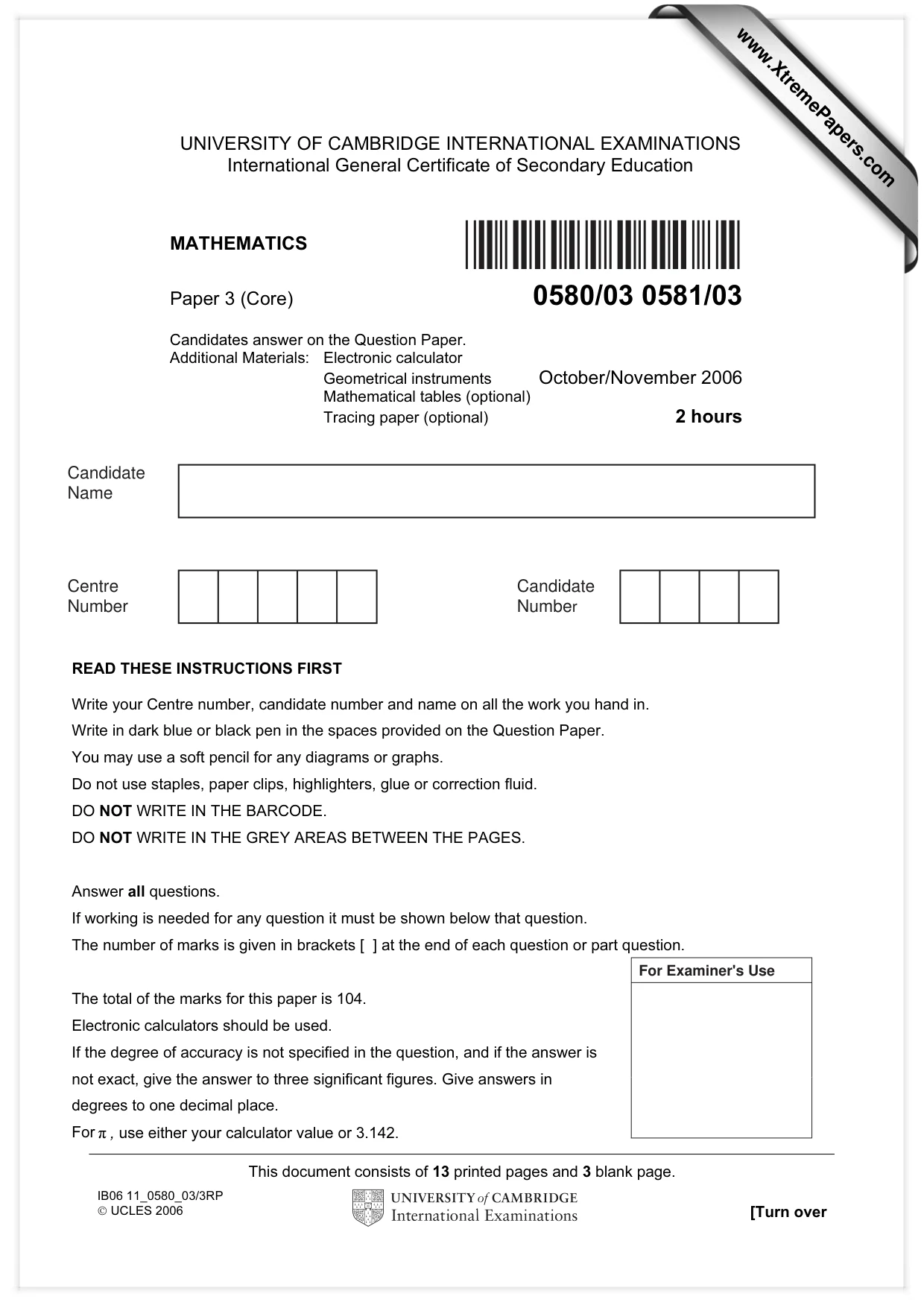
Mark scheme4 pages
Answers below. Sit the paper first if you are practising.
Questions as text
Q1 · For Examiner's 2 Use 2 3 3.14 35 10 24 37 45 88 3 From the list of numbers above choose…
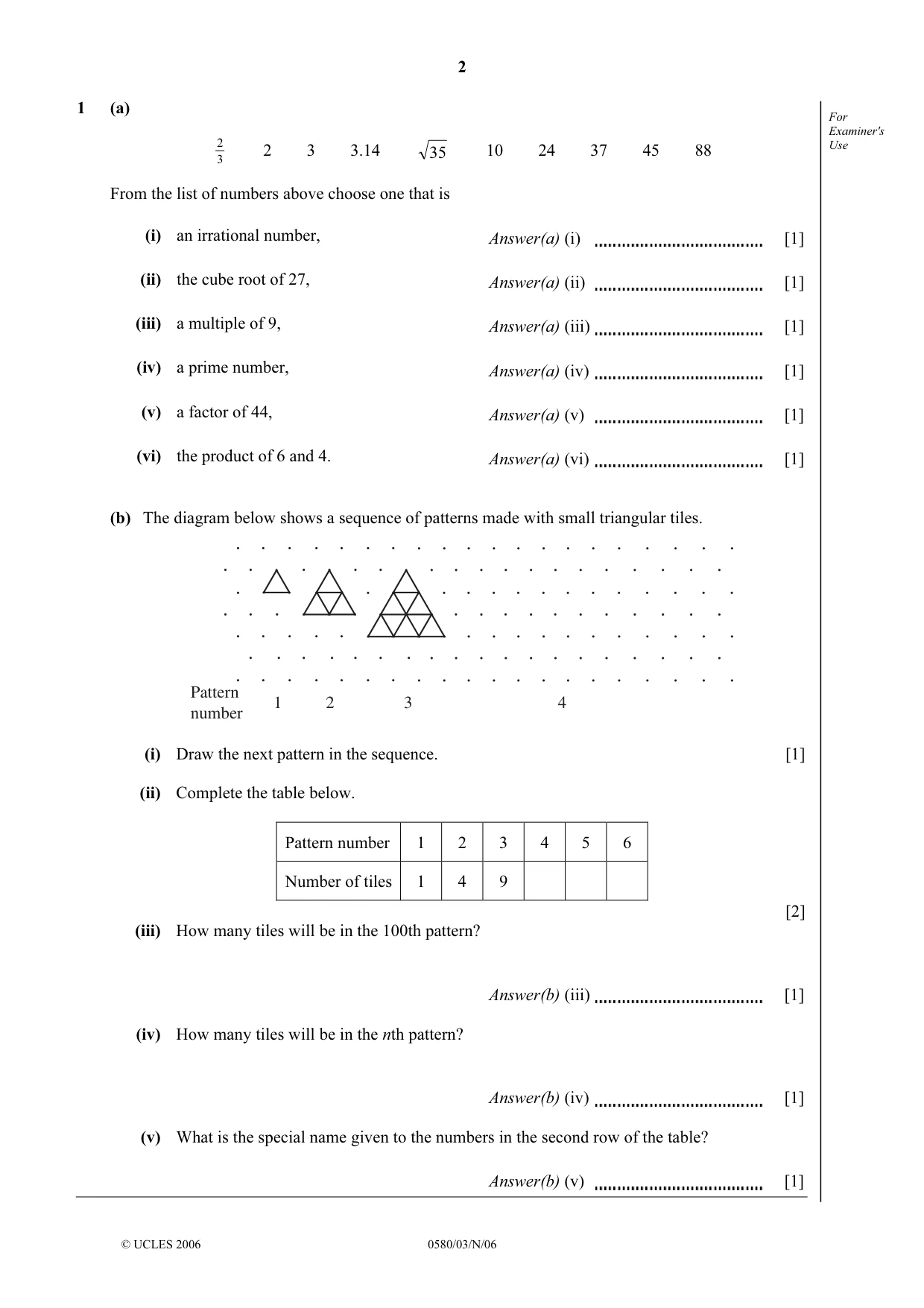
1 (a) For Examiner's 2 Use 2 3 3.14 35 10 24 37 45 88 3 From the list of numbers above choose one that is (i) an irrational number, Answer(a) (i) [1] (ii) the cube root of 27, Answer(a) (ii) [1] (iii) a multiple of 9, Answer(a) (iii) [1] (iv) a prime number, Answer(a) (iv) [1] (v) a factor of 44, Answer(a) (v) [1] (vi) the product of 6 and 4. Answer(a) (vi) [1] (b) The diagram below shows a sequence of patterns made with small triangular tiles. Pattern 1 2 3 4 number (i) Draw the next pattern in the sequence. [1] (ii) Complete the table below. Pattern number 1 2 3 4 5 6 Number of tiles 1 4 9 [2] (iii) How many tiles will be in the 100th pattern? Answer(b) (iii) [1] (iv) How many tiles will be in the nth pattern? Answer(b) (iv) [1] (v) What is the special name given to the numbers in the second row of the table? Answer(b) (v) [1]
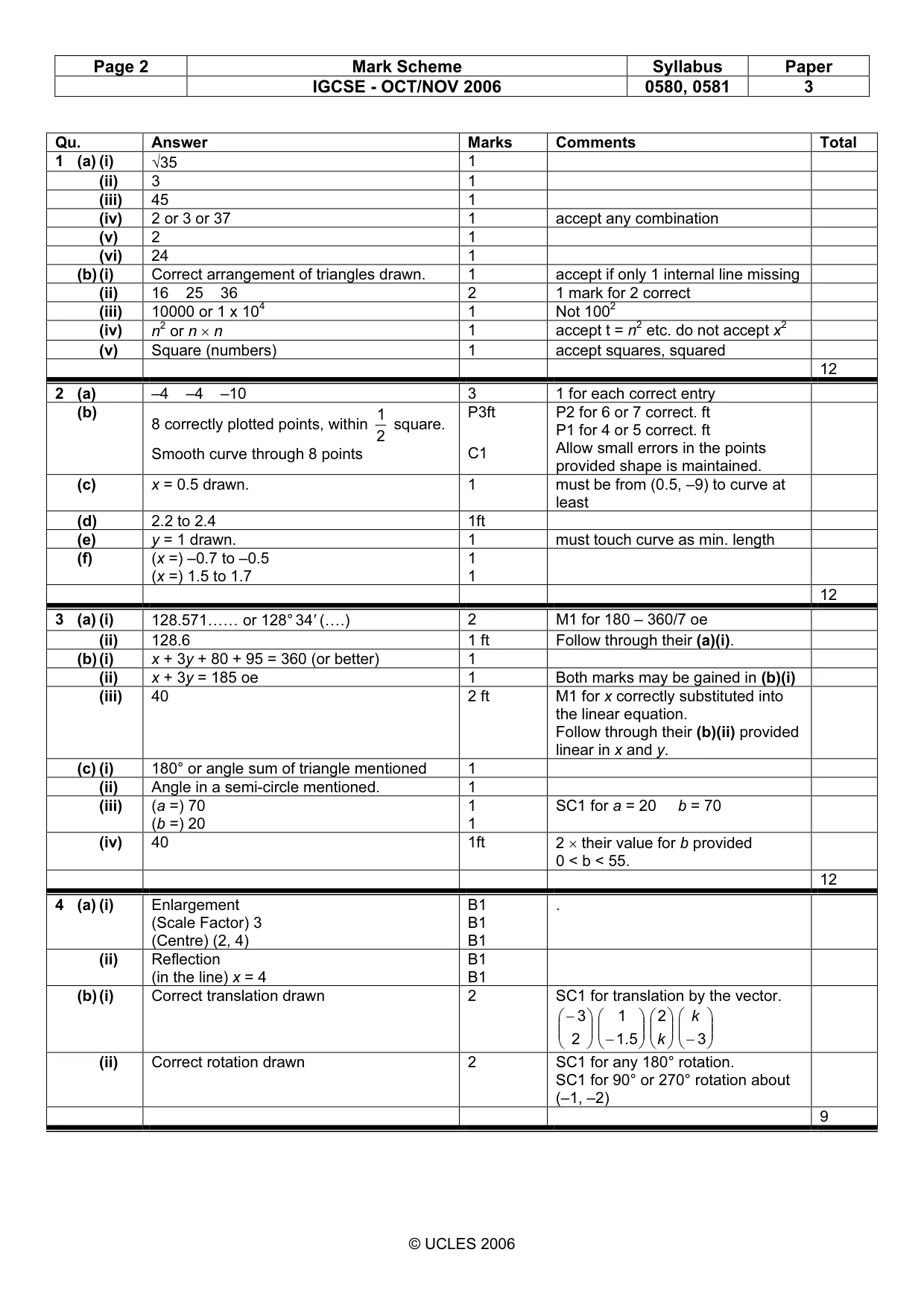
Mark scheme: 1 (a) (i) √35 1 (ii) 3 1 (iii) 45 1 (iv) 2 or 3 or 37 1 accept any combination (v) 2 1 (vi) 24 1 (b) (i) Correct arrangement of triangles drawn. 1 accept if only 1 internal line missing (ii) 16 25 36 2 1 mark for 2 correct (iii) 10000 or 1 x 10⁴ 1 Not 1002 (iv) n2 or n × n 1 accept t = n2 etc. do not accept x2 (v) Square (numbers) 1 accept squares, squared 12
Q2 · Complete the table for the equation y = − x2 + x + 2
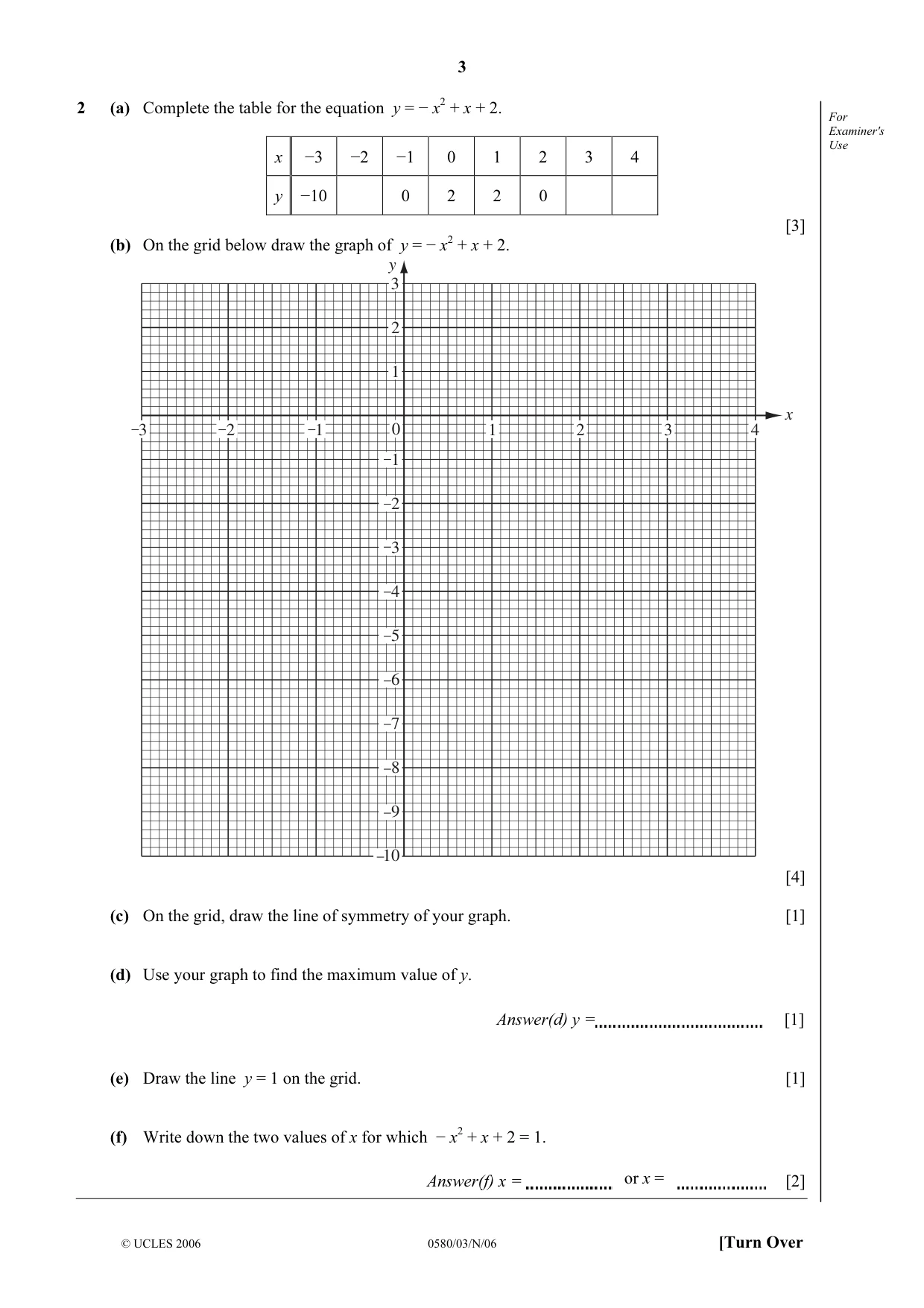
2 (a) Complete the table for the equation y = − x2 + x + 2. For Examiner's Use x −3 −2 −1 0 1 2 3 4 y −10 0 2 2 0 [3] (b) On the grid below draw the graph of y = − x2 + x + 2. y 3 2 1 x 3 2 1 0 1 2 3 4 1 2 3 4 5 6 7 8 9 10 [4] (c) On the grid, draw the line of symmetry of your graph. [1] (d) Use your graph to find the maximum value of y. Answer(d) y = [1] (e) Draw the line y = 1 on the grid. [1] (f) Write down the two values of x for which − x2 + x + 2 = 1. Answer(f) x = or x = [2]
Mark scheme: 2 (a) –4 –4 –10 3 1 for each correct entry (b) 1 P3ft P2 for 6 or 7 correct. ft 8 correctly plotted points, within square. P1 for 4 or 5 correct. ft 2 Allow small errors in the points Smooth curve through 8 points C1 provided shape is maintained. (c) x = 0.5 drawn. 1 must be from (0.5, –9) to curve at least (d) 2.2 to 2.4 1ft (e) y = 1 drawn. 1 must touch curve as min. length (f) (x =) –0.7 to –0.5 1 (x =) 1.5 to 1.7 1 12
Q3 · Calculate the interior angle of a regular heptagon (seven-sided polygon)
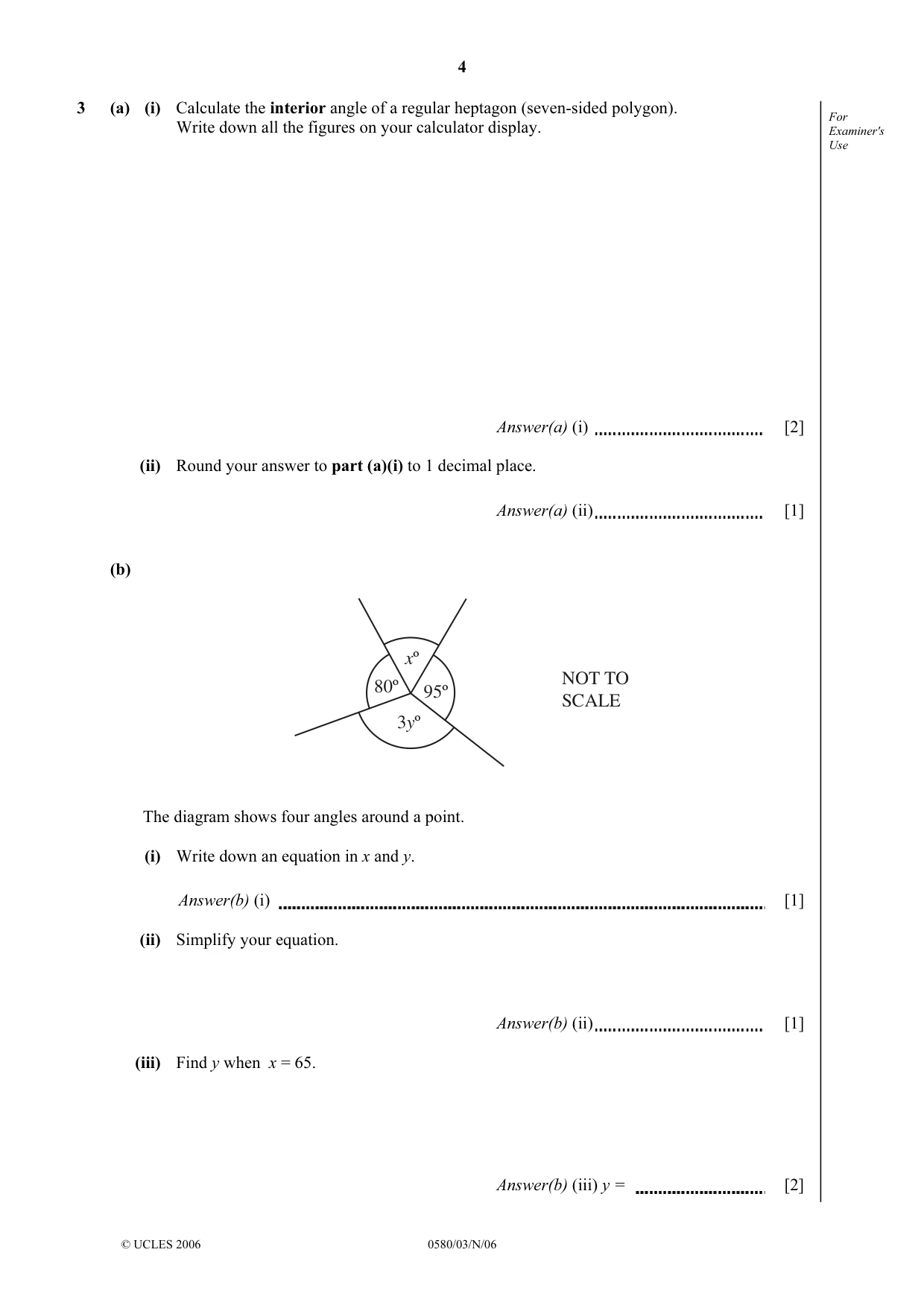
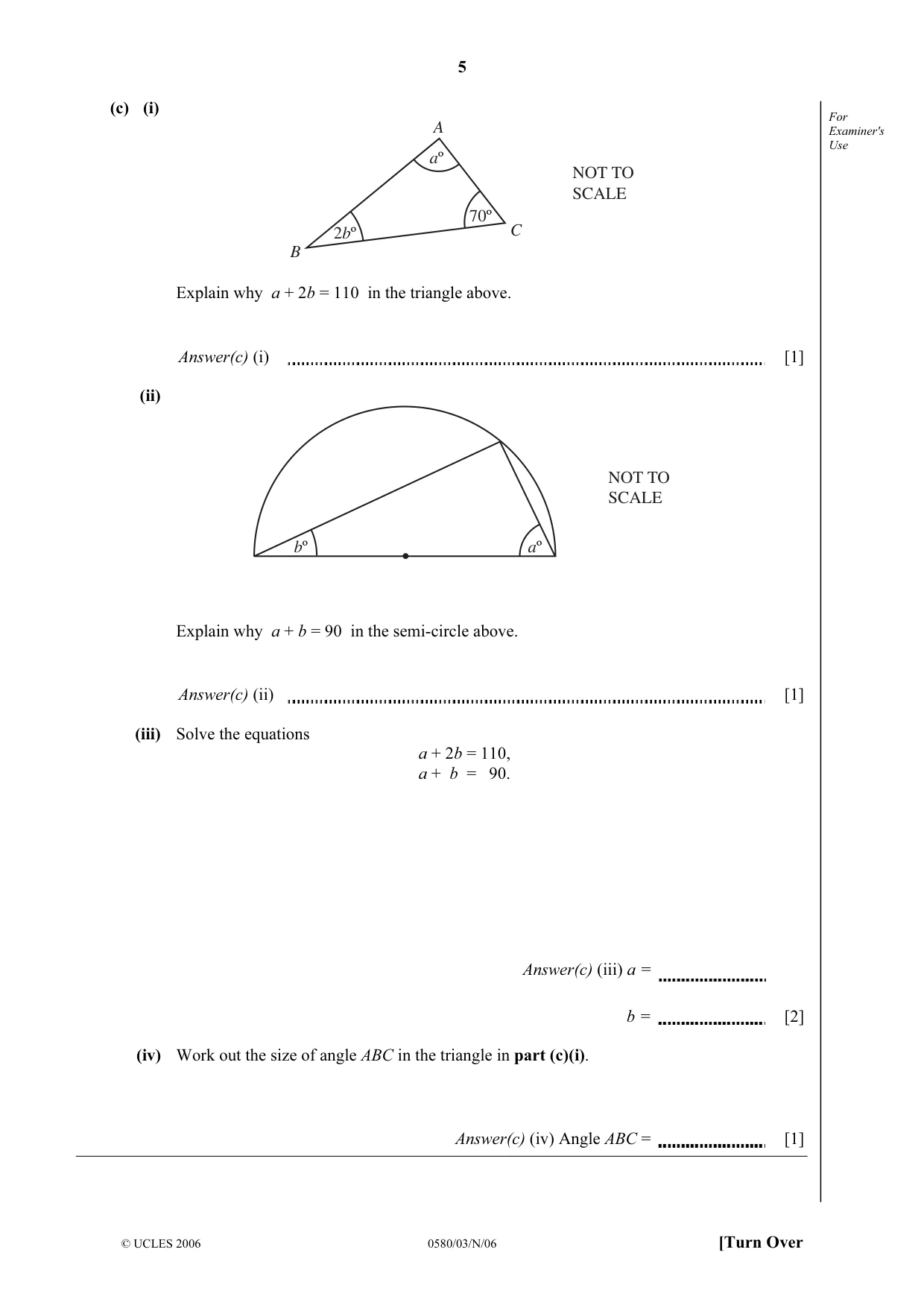
3 (a) (i) Calculate the interior angle of a regular heptagon (seven-sided polygon). For Write down all the figures on your calculator display. Examiner's Use Answer(a) (i) [2] (ii) Round your answer to part (a)(i) to 1 decimal place. Answer(a) (ii) [1] (b) xº NOT TO 80º 95º SCALE 3yº The diagram shows four angles around a point. (i) Write down an equation in x and y. Answer(b) (i) [1] (ii) Simplify your equation. Answer(b) (ii) [1] (iii) Find y when x = 65. Answer(b) (iii) y = [2] (c) (i) For A Examiner's Use aº NOT TO SCALE 70º 2bº C B Explain why a + 2b = 110 in the triangle above. Answer(c) (i) [1] (ii) NOT TO SCALE bº aº Explain why a + b = 90 in the semi-circle above. Answer(c) (ii) [1] (iii) Solve the equations a + 2b = 110, a + b = 90. Answer(c) (iii) a = b = [2] (iv) Work out the size of angle ABC in the triangle in part (c)(i). Answer(c) (iv) Angle ABC = [1]
Mark scheme: 3 (a) (i) 128.571…… or 128° 3 4 ′ (….) 2 M1 for 180 – 360/7 oe (ii) 128.6 1 ft Follow through their (a)(i). (b) (i) x + 3y + 80 + 95 = 360 (or better) 1 (ii) x + 3y = 185 oe 1 Both marks may be gained in (b)(i) (iii) 40 2 ft M1 for x correctly substituted into the linear equation. Follow through their (b)(ii) provided linear in x and y. (c) (i) 180° or angle sum of triangle mentioned 1 (ii) Angle in a semi-circle mentioned. 1 (iii) (a =) 70 1 SC1 for a = 20 b = 70 (b =) 20 1 (iv) 40 1ft 2 × their value for b provided 0 < b < 55. 12
Q4 · For y Examiner's Use 5 4 3 2 A C 1 x 4 3 2 1 0 1 2 3 4 5 6 7 8 1 2 3 B 4 5 (a) Describe…
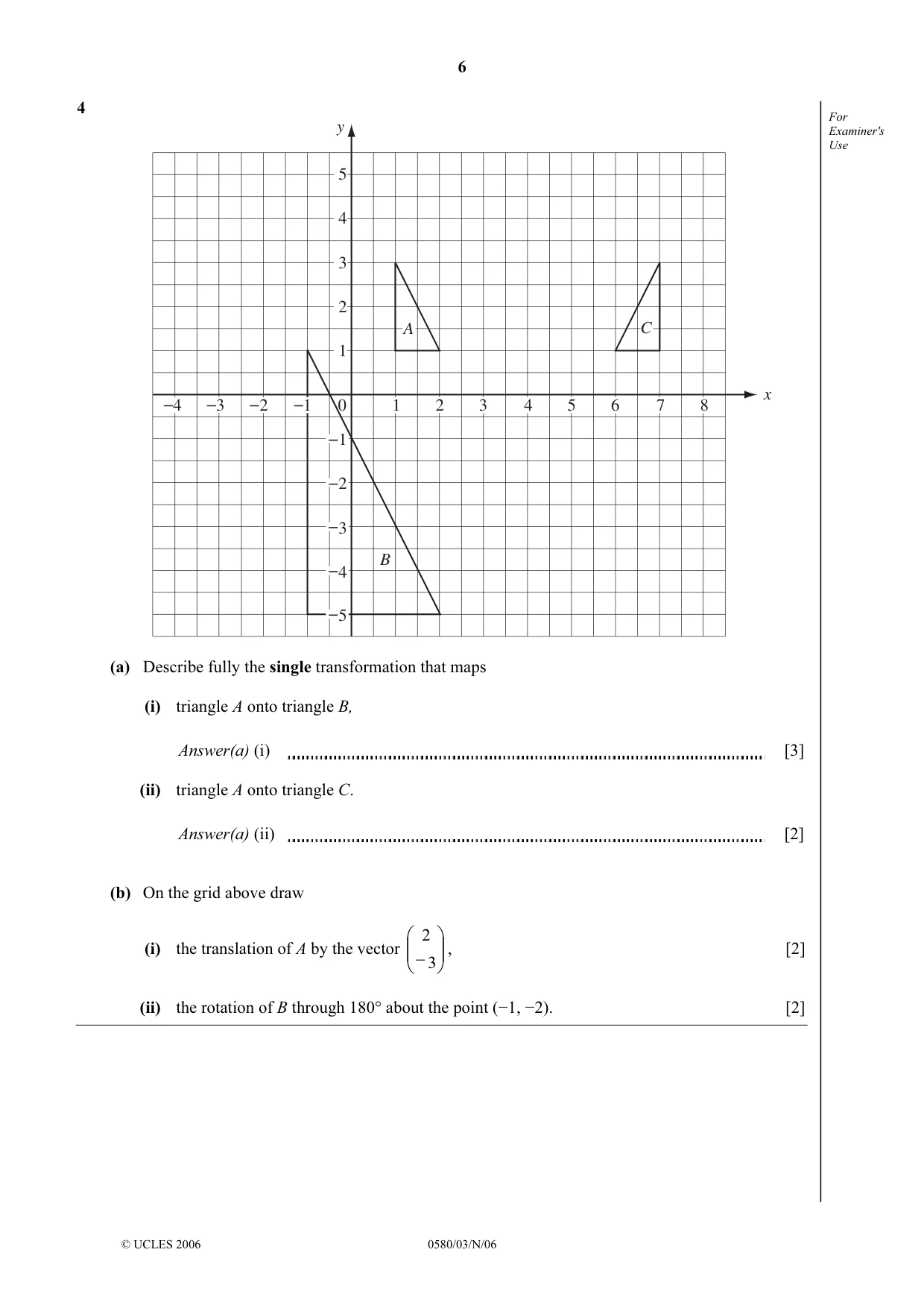
4 For y Examiner's Use 5 4 3 2 A C 1 x 4 3 2 1 0 1 2 3 4 5 6 7 8 1 2 3 B 4 5 (a) Describe fully the single transformation that maps (i) triangle A onto triangle B, Answer(a) (i) [3] (ii) triangle A onto triangle C. Answer(a) (ii) [2] (b) On the grid above draw 2 (i) the translation of A by the vector , [2] −3 (ii) the rotation of B through 180° about the point (−1, −2). [2]
Mark scheme: 4 (a) (i) Enlargement B1 . (Scale Factor) 3 B1 (Centre) (2, 4) B1 (ii) Reflection B1 (in the line) x = 4 B1 (b) (i) Correct translation drawn 2 SC1 for translation by the vector. − 3 1 2 k 2 − 1 . 5 k − 3 (ii) Correct rotation drawn 2 SC1 for any 180° rotation. SC1 for 90° or 270° rotation about (–1, –2) 9 IGCSE - OCT/NOV 2006 0580, 0581 3
Q5 · For A X B Examiner's Use NOT TO 10 cm SCALE 55º D 18 cm C The diagram shows a rectangular…
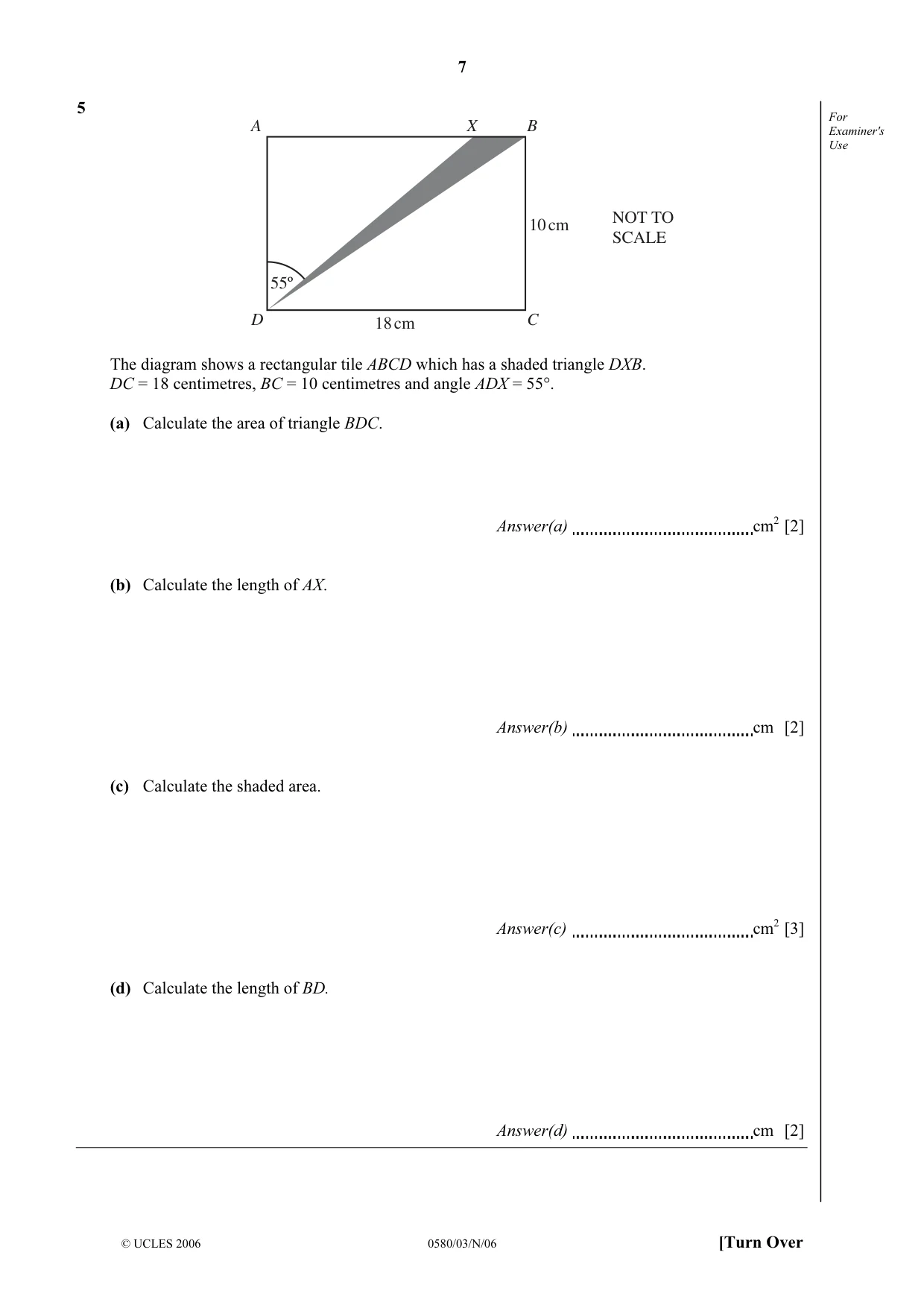
5 For A X B Examiner's Use NOT TO 10 cm SCALE 55º D 18 cm C The diagram shows a rectangular tile ABCD which has a shaded triangle DXB. DC = 18 centimetres, BC = 10 centimetres and angle ADX = 55°. (a) Calculate the area of triangle BDC. Answer(a) cm2 [2] (b) Calculate the length of AX. Answer(b) cm [2] (c) Calculate the shaded area. Answer(c) cm2 [3] (d) Calculate the length of BD. Answer(d) cm [2]
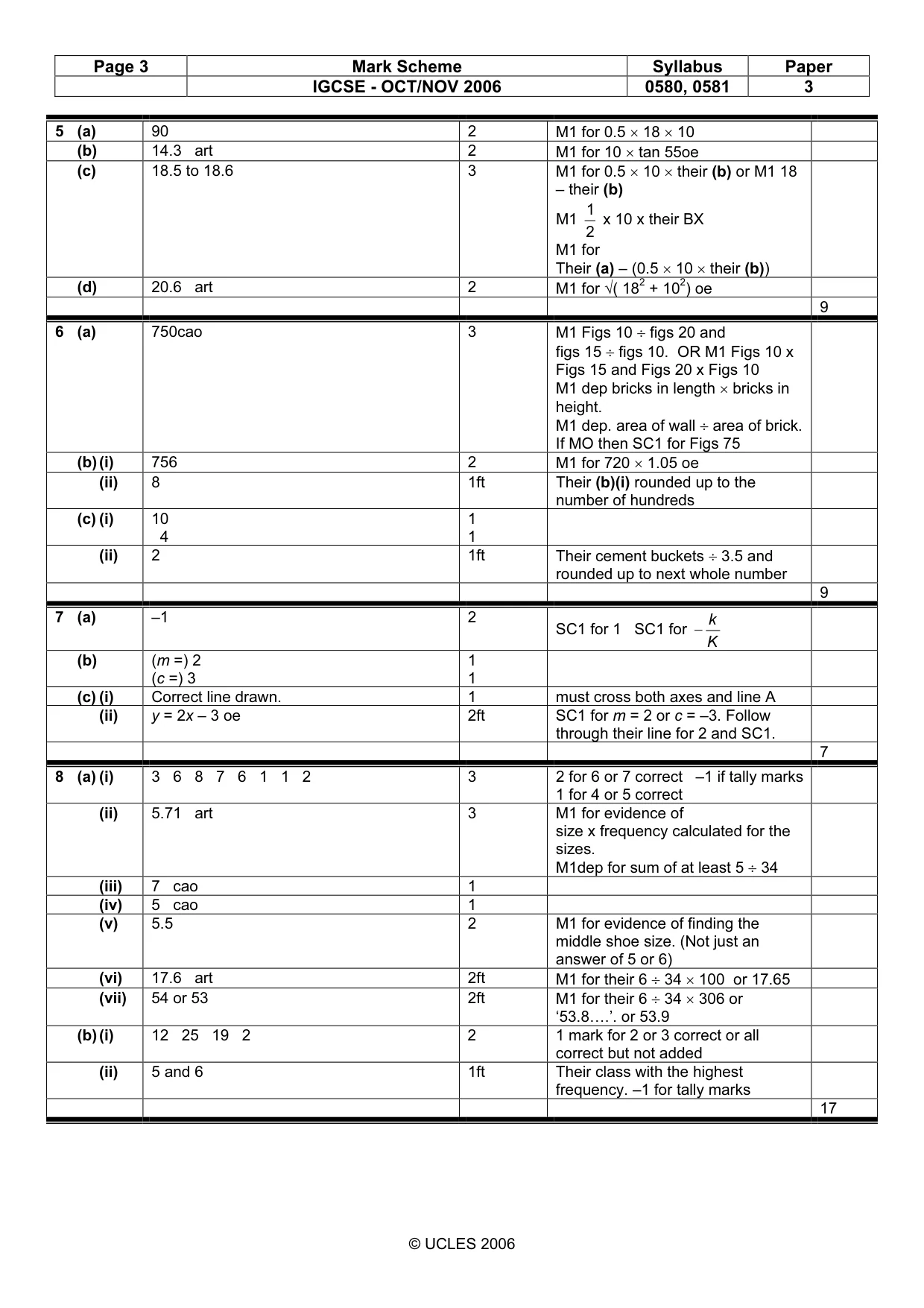
Mark scheme: 5 (a) 90 2 M1 for 0.5 × 18 × 10 (b) 14.3 art 2 M1 for 10 × tan 55oe (c) 18.5 to 18.6 3 M1 for 0.5 × 10 × their (b) or M1 18 – their (b) 1 M1 x 10 x their BX 2 M1 for Their (a) – (0.5 × 10 × their (b)) (d) 20.6 art 2 M1 for √( 182 + 102) oe 9
Q6 · For Examiner's 20 cm Use NOT TO 10 cm SCALE brick face Part of the wall (a) A builder…
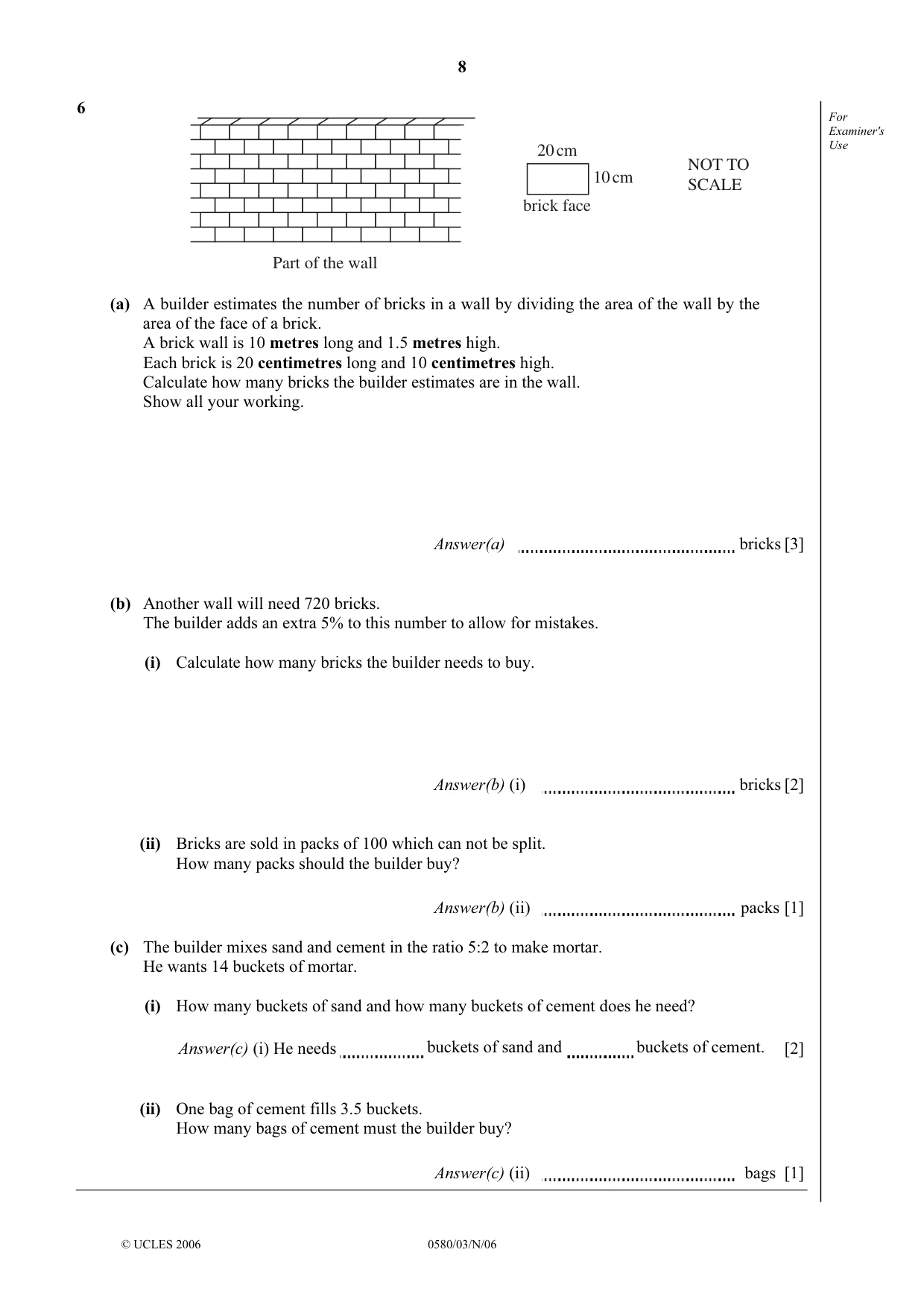
6 For Examiner's 20 cm Use NOT TO 10 cm SCALE brick face Part of the wall (a) A builder estimates the number of bricks in a wall by dividing the area of the wall by the area of the face of a brick. A brick wall is 10 metres long and 1.5 metres high. Each brick is 20 centimetres long and 10 centimetres high. Calculate how many bricks the builder estimates are in the wall. Show all your working. Answer(a) bricks [3] (b) Another wall will need 720 bricks. The builder adds an extra 5% to this number to allow for mistakes. (i) Calculate how many bricks the builder needs to buy. Answer(b) (i) bricks [2] (ii) Bricks are sold in packs of 100 which can not be split. How many packs should the builder buy? Answer(b) (ii) packs [1] (c) The builder mixes sand and cement in the ratio 5:2 to make mortar. He wants 14 buckets of mortar. (i) How many buckets of sand and how many buckets of cement does he need? Answer(c) (i) He needs buckets of sand and buckets of cement. [2] (ii) One bag of cement fills 3.5 buckets. How many bags of cement must the builder buy? Answer(c) (ii) bags [1]
Mark scheme: 6 (a) 750cao 3 M1 Figs 10 ÷ figs 20 and figs 15 ÷ figs 10. OR M1 Figs 10 x Figs 15 and Figs 20 x Figs 10 M1 dep bricks in length × bricks in height. M1 dep. area of wall ÷ area of brick. If MO then SC1 for Figs 75 (b) (i) 756 2 M1 for 720 × 1.05 oe (ii) 8 1ft Their (b)(i) rounded up to the number of hundreds (c) (i) 10 1 4 1 (ii) 2 1ft Their cement buckets ÷ 3.5 and rounded up to next whole number 9
Q7 · For y Examiner's Use B A 6 5 4 3 2 1 x 3 2 1 0 1 2 3 4 5 6 7 8 1 2 3 4 Two straight lines…
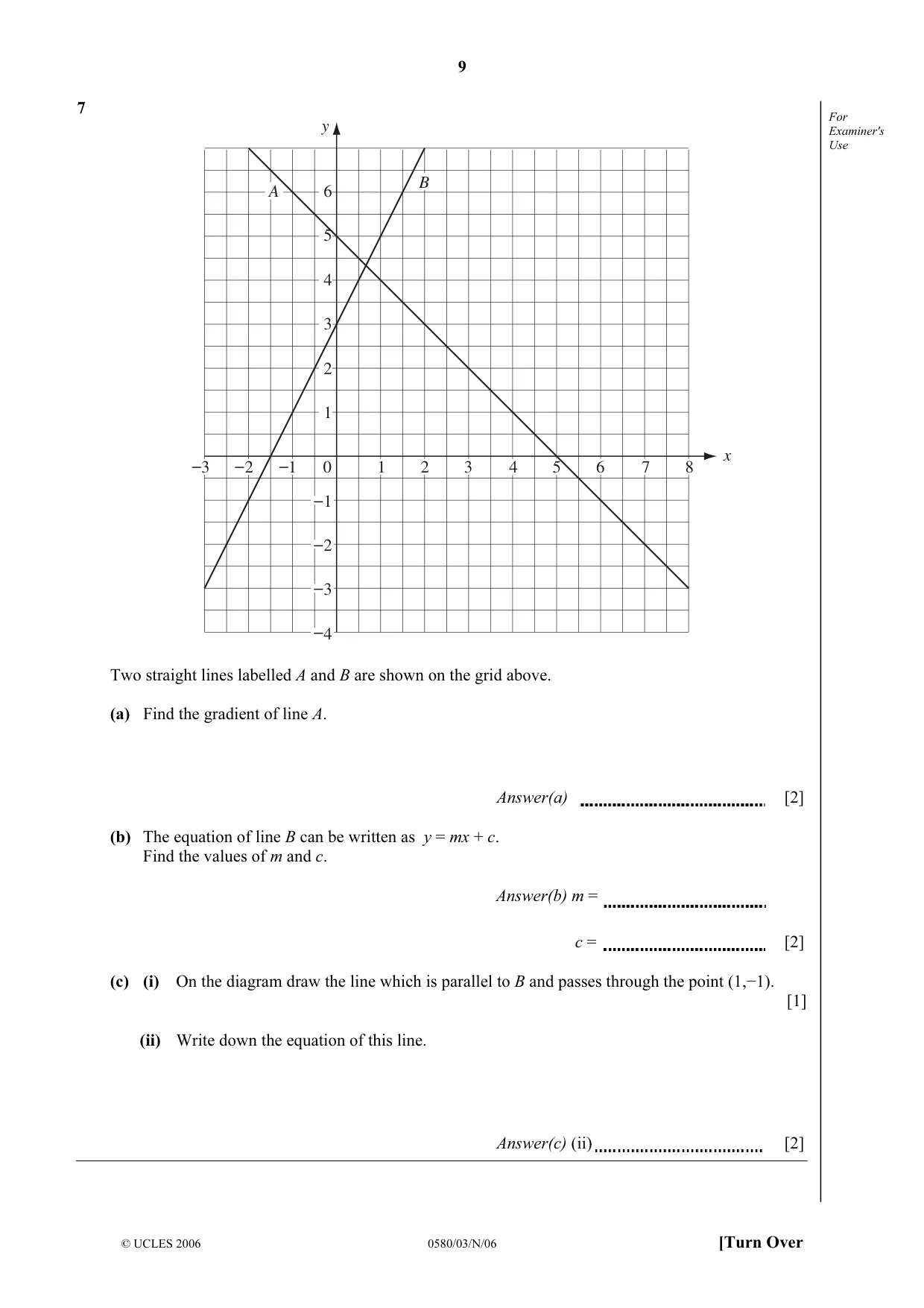
7 For y Examiner's Use B A 6 5 4 3 2 1 x 3 2 1 0 1 2 3 4 5 6 7 8 1 2 3 4 Two straight lines labelled A and B are shown on the grid above. (a) Find the gradient of line A. Answer(a) [2] (b) The equation of line B can be written as y = mx + c. Find the values of m and c. Answer(b) m = c = [2] (c) (i) On the diagram draw the line which is parallel to B and passes through the point (1,−1). [1] (ii) Write down the equation of this line. Answer(c) (ii) [2]
Mark scheme: 7 (a) –1 2 k SC1 for 1 SC1 for − K (b) (m =) 2 1 (c =) 3 1 (c) (i) Correct line drawn. 1 must cross both axes and line A (ii) y = 2x – 3 oe 2ft SC1 for m = 2 or c = –3. Follow through their line for 2 and SC1. 7
Q8 · Naomi records the sizes of the 34 pairs of shoes that her shop sells in one day
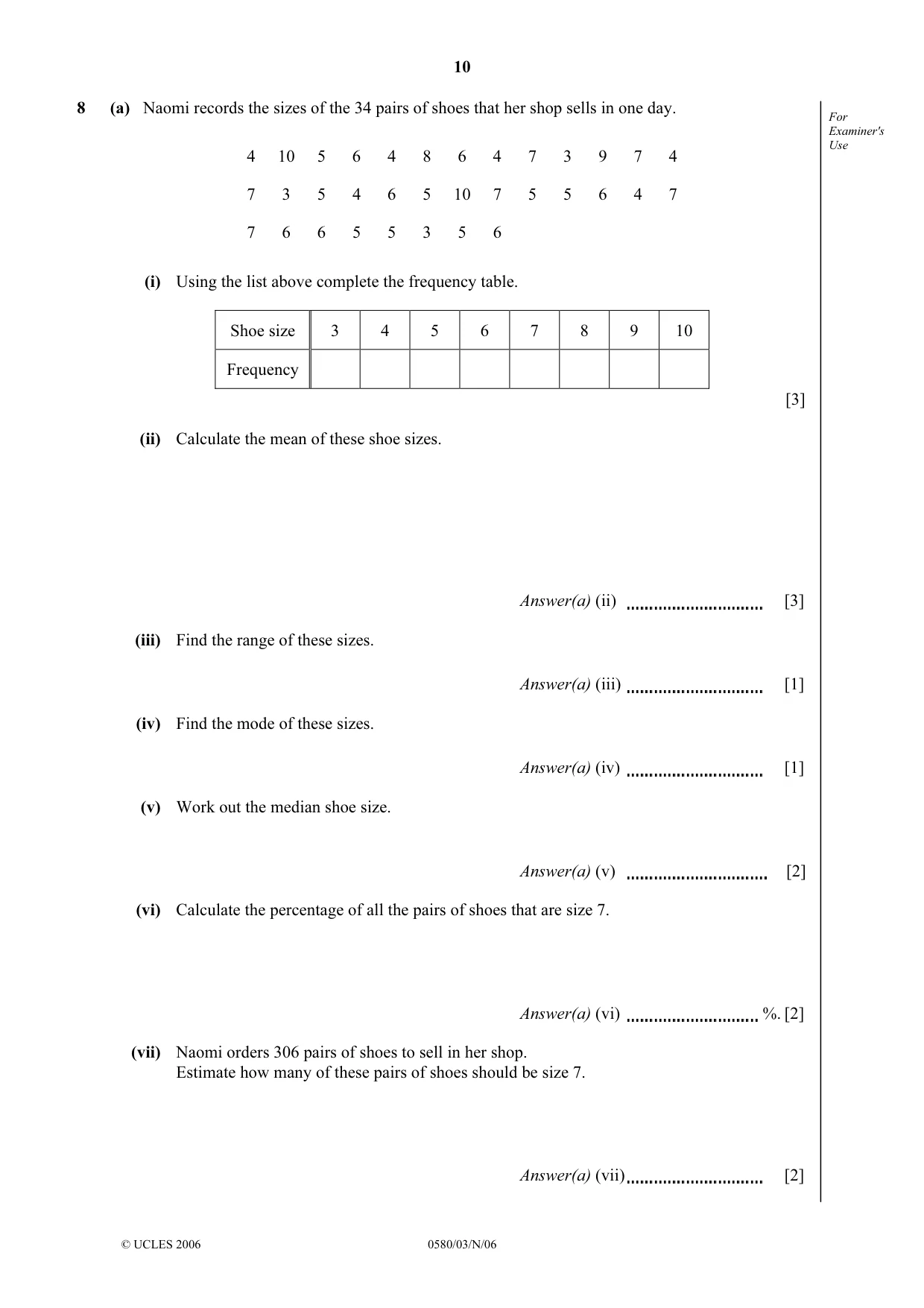
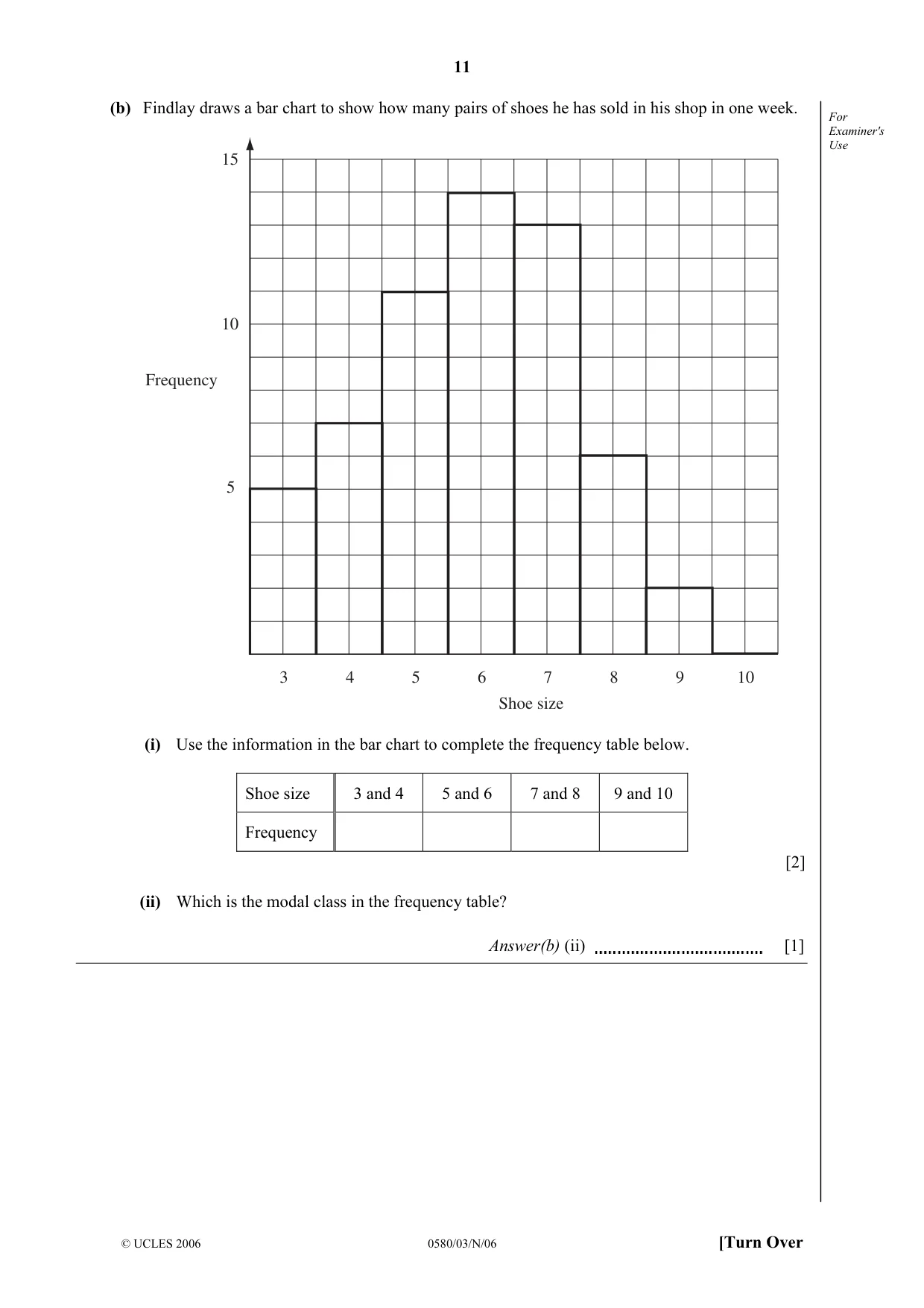
8 (a) Naomi records the sizes of the 34 pairs of shoes that her shop sells in one day. For Examiner's Use 4 10 5 6 4 8 6 4 7 3 9 7 4 7 3 5 4 6 5 10 7 5 5 6 4 7 7 6 6 5 5 3 5 6 (i) Using the list above complete the frequency table. Shoe size 3 4 5 6 7 8 9 10 Frequency [3] (ii) Calculate the mean of these shoe sizes. Answer(a) (ii) [3] (iii) Find the range of these sizes. Answer(a) (iii) [1] (iv) Find the mode of these sizes. Answer(a) (iv) [1] (v) Work out the median shoe size. Answer(a) (v) [2] (vi) Calculate the percentage of all the pairs of shoes that are size 7. Answer(a) (vi) %. [2] (vii) Naomi orders 306 pairs of shoes to sell in her shop. Estimate how many of these pairs of shoes should be size 7. Answer(a) (vii) [2] (b) Findlay draws a bar chart to show how many pairs of shoes he has sold in his shop in one week. For Examiner's Use 15 10 Frequency 5 3 4 5 6 7 8 9 10 Shoe size (i) Use the information in the bar chart to complete the frequency table below. Shoe size 3 and 4 5 and 6 7 and 8 9 and 10 Frequency [2] (ii) Which is the modal class in the frequency table? Answer(b) (ii) [1]
Mark scheme: 8 (a) (i) 3 6 8 7 6 1 1 2 3 2 for 6 or 7 correct –1 if tally marks 1 for 4 or 5 correct (ii) 5.71 art 3 M1 for evidence of size x frequency calculated for the sizes. M1dep for sum of at least 5 ÷ 34 (iii) 7 cao 1 (iv) 5 cao 1 (v) 5.5 2 M1 for evidence of finding the middle shoe size. (Not just an answer of 5 or 6) (vi) 17.6 art 2ft M1 for their 6 ÷ 34 × 100 or 17.65 (vii) 54 or 53 2ft M1 for their 6 ÷ 34 × 306 or ‘53.8….’. or 53.9 (b) (i) 12 25 19 2 2 1 mark for 2 or 3 correct or all correct but not added (ii) 5 and 6 1ft Their class with the highest frequency. –1 for tally marks 17 IGCSE - OCT/NOV 2006 0580, 0581 3
Q9 · The sketch shows the positions of three islands A, B and C
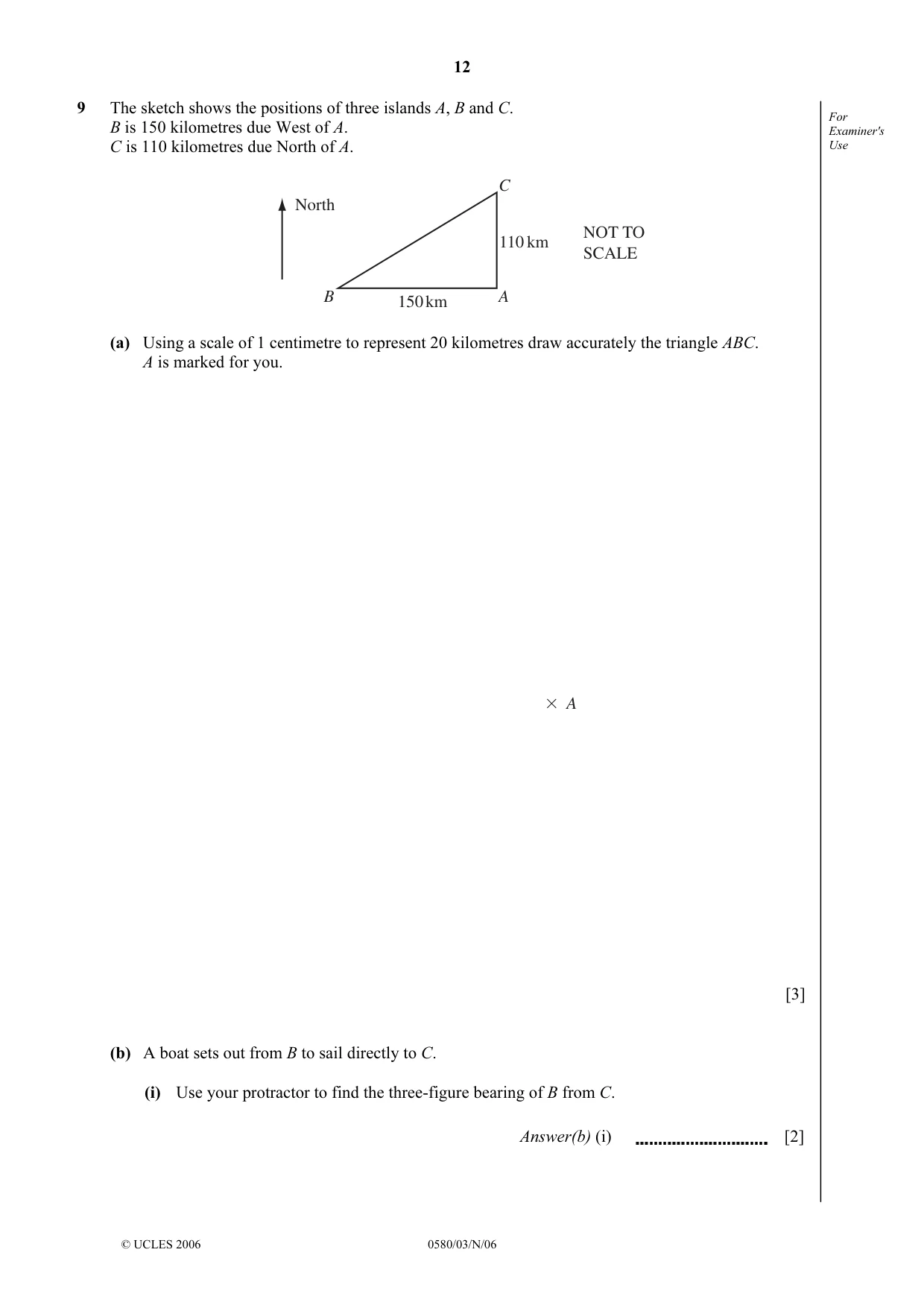
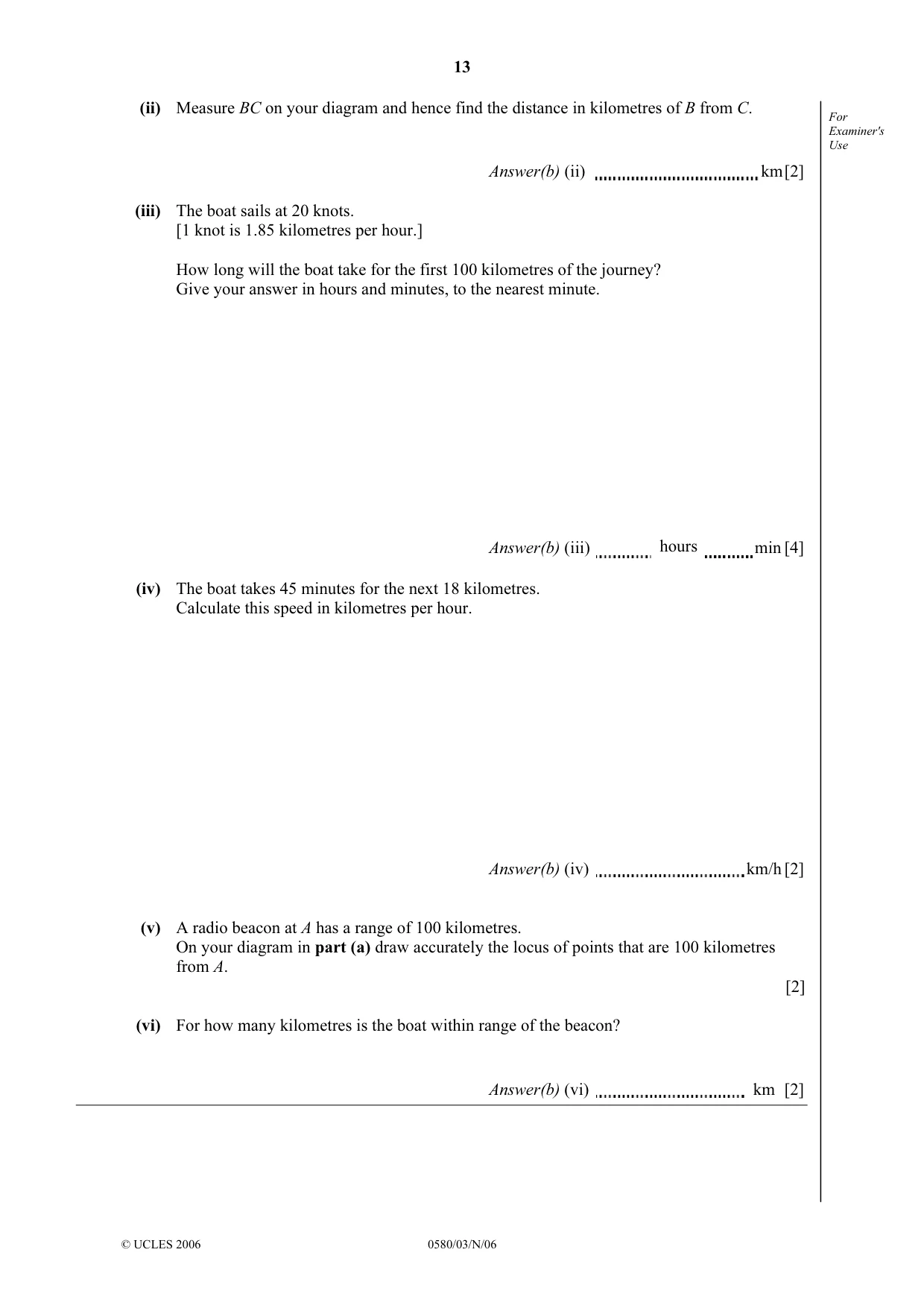
9 The sketch shows the positions of three islands A, B and C. For B is 150 kilometres due West of A. Examiner's C is 110 kilometres due North of A. Use C North NOT TO 110 km SCALE B A 150 km (a) Using a scale of 1 centimetre to represent 20 kilometres draw accurately the triangle ABC. A is marked for you. A [3] (b) A boat sets out from B to sail directly to C. (i) Use your protractor to find the three-figure bearing of B from C. Answer(b) (i) [2] (ii) Measure BC on your diagram and hence find the distance in kilometres of B from C. For Examiner's Use Answer(b) (ii) km [2] (iii) The boat sails at 20 knots. [1 knot is 1.85 kilometres per hour.] How long will the boat take for the first 100 kilometres of the journey? Give your answer in hours and minutes, to the nearest minute. Answer(b) (iii) hours min [4] (iv) The boat takes 45 minutes for the next 18 kilometres. Calculate this speed in kilometres per hour. Answer(b) (iv) km/h [2] (v) A radio beacon at A has a range of 100 kilometres. On your diagram in part (a) draw accurately the locus of points that are 100 kilometres from A. [2] (vi) For how many kilometres is the boat within range of the beacon? Answer(b) (vi) km [2]
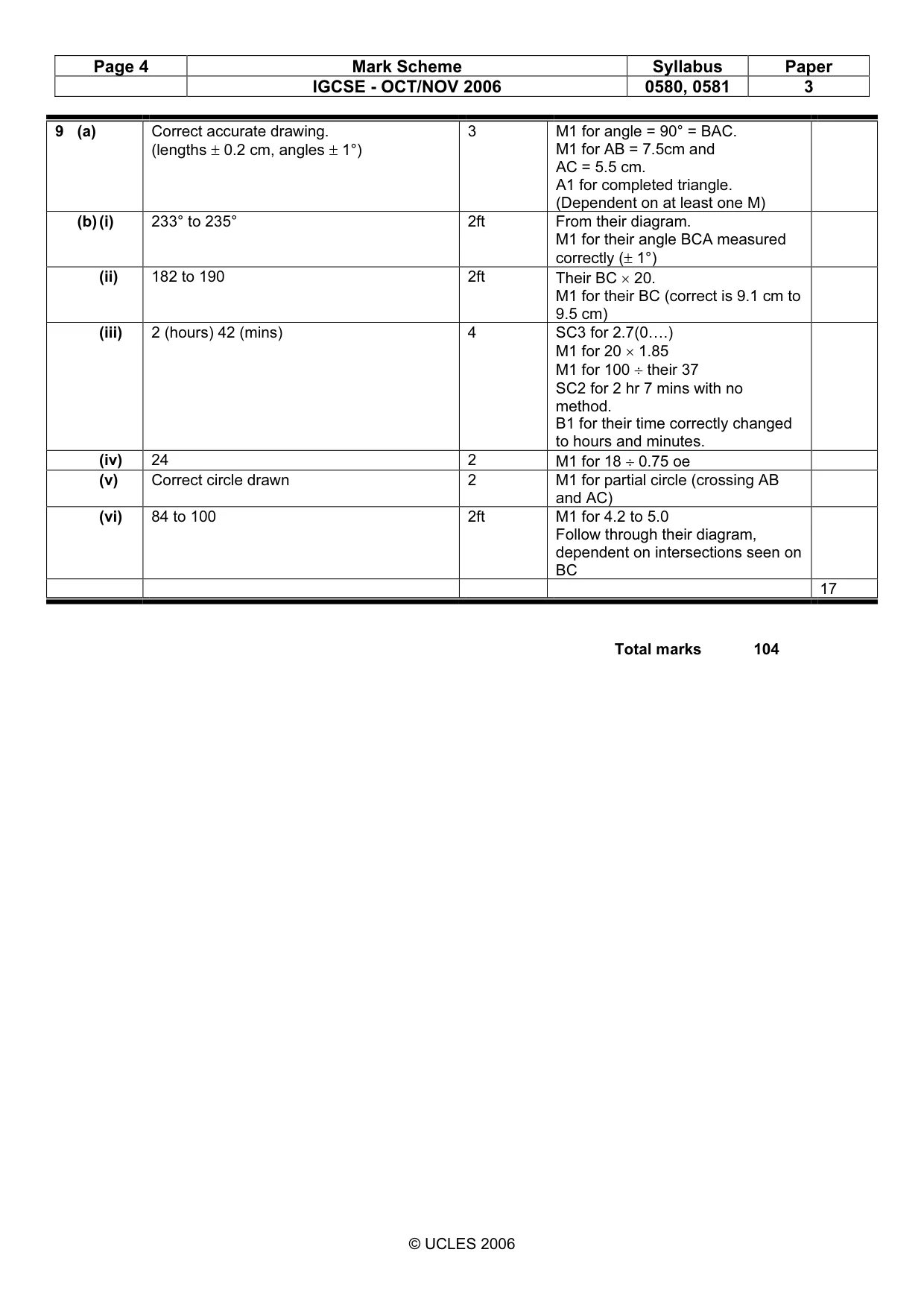
Mark scheme: 9 (a) Correct accurate drawing. 3 M1 for angle = 90° = BAC. (lengths ± 0.2 cm, angles ± 1°) M1 for AB = 7.5cm and AC = 5.5 cm. A1 for completed triangle. (Dependent on at least one M) (b) (i) 233° to 235° 2ft From their diagram. M1 for their angle BCA measured correctly (± 1°) (ii) 182 to 190 2ft Their BC × 20. M1 for their BC (correct is 9.1 cm to 9.5 cm) (iii) 2 (hours) 42 (mins) 4 SC3 for 2.7(0….) M1 for 20 × 1.85 M1 for 100 ÷ their 37 SC2 for 2 hr 7 mins with no method. B1 for their time correctly changed to hours and minutes. (iv) 24 2 M1 for 18 ÷ 0.75 oe (v) Correct circle drawn 2 M1 for partial circle (crossing AB and AC) (vi) 84 to 100 2ft M1 for 4.2 to 5.0 Follow through their diagram, dependent on intersections seen on BC 17 Total marks 104
What was in this paper
The subtopics covered by these 9 questions, and how many questions each got. Open one in a new tab to see every Cambridge question on it.
What you needed in this session
Cambridge’s own grade thresholds for 2006 Oct/Nov, Paper 3 · Variant 1. A higher threshold means an easier paper — the bar moves with how the cohort did.