Cambridge IGCSE Mathematics 0580 — 2006 May/June Paper 3 · Variant 1
0580/31/M/J/06 · 104 marks · ≈117 min
The question paper and its mark scheme, free to read here and free to download. This is Cambridge’s own paper, exactly as it was sat.
Question paper12 pages
Mark scheme11 pages
Answers below. Sit the paper first if you are practising.
Paper as text
Question paper, page 1
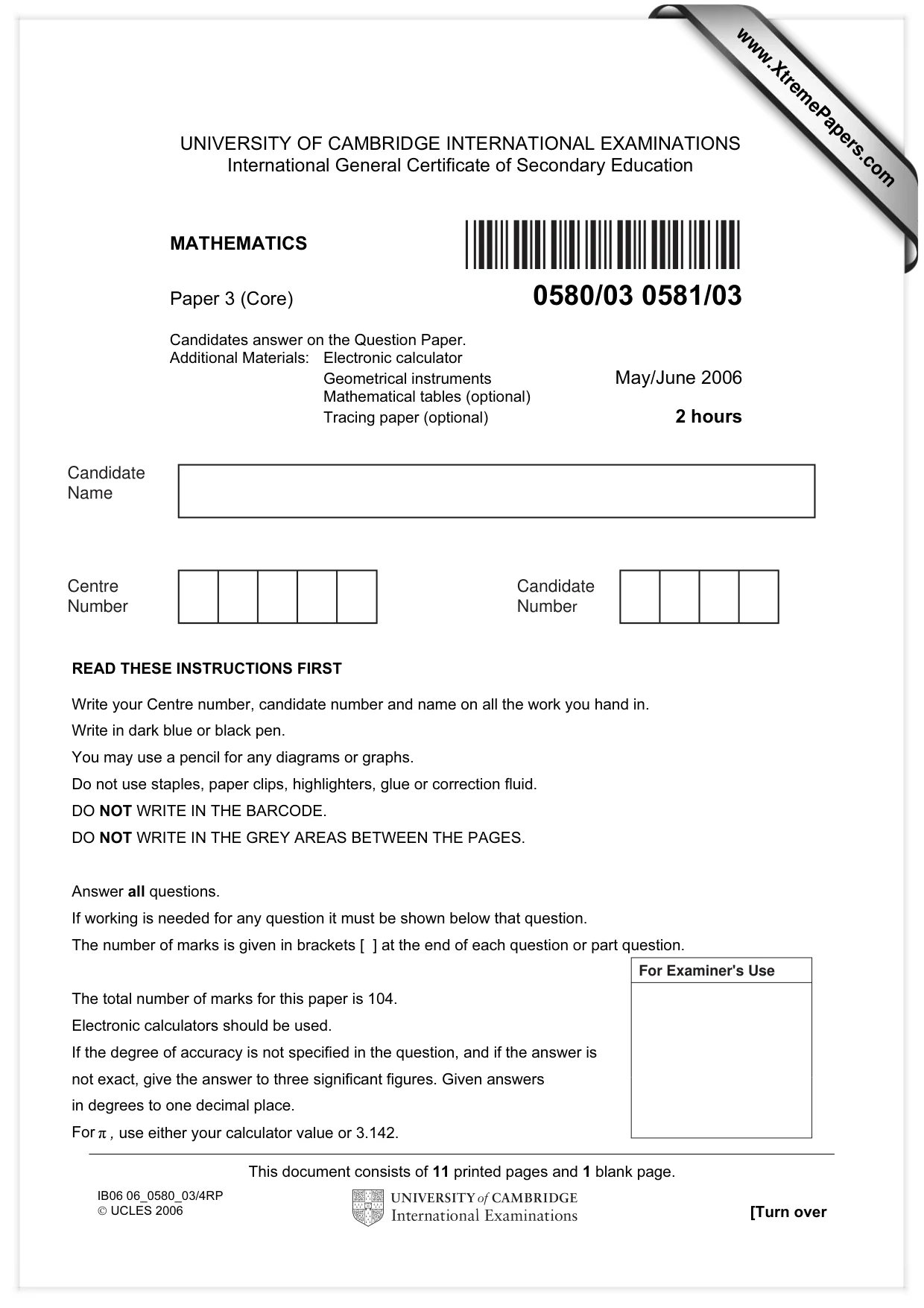
This document consists of 11 printed pages and 1 blank page. IB06 06_0580_03/4RP UCLES 2006 [Turn over UNIVERSITY OF CAMBRIDGE INTERNATIONAL EXAMINATIONS International General Certificate of Secondary Education MATHEMATICS Paper 3 (Core) 0580/03 0581/03 Candidates answer on the Question Paper. Additional Materials: Electronic calculator Geometrical instruments May/June 2006 Mathematical tables (optional) Tracing paper (optional) 2 hours READ THESE INSTRUCTIONS FIRST Write your Centre number, candidate number and name on all the work you hand in. Write in dark blue or black pen. You may use a pencil for any diagrams or graphs. Do not use staples, paper clips, highlighters, glue or correction fluid. DO NOT WRITE IN THE BARCODE. DO NOT WRITE IN THE GREY AREAS BETWEEN THE PAGES. Answer all questions. If working is needed for any question it must be shown below that question. The number of marks is given in brackets [ ] at the end of each question or part question. The total number of marks for this paper is 104. Electronic calculators should be used. If the degree of accuracy is not specified in the question, and if the answer is not exact, give the answer to three significant figures. Given answers in degrees to one decimal place. For π , use either your calculator value or 3.142. Candidate Name Centre Number Candidate Number *058001* For Examiner's Use www.XtremePapers.com
Question paper, page 2
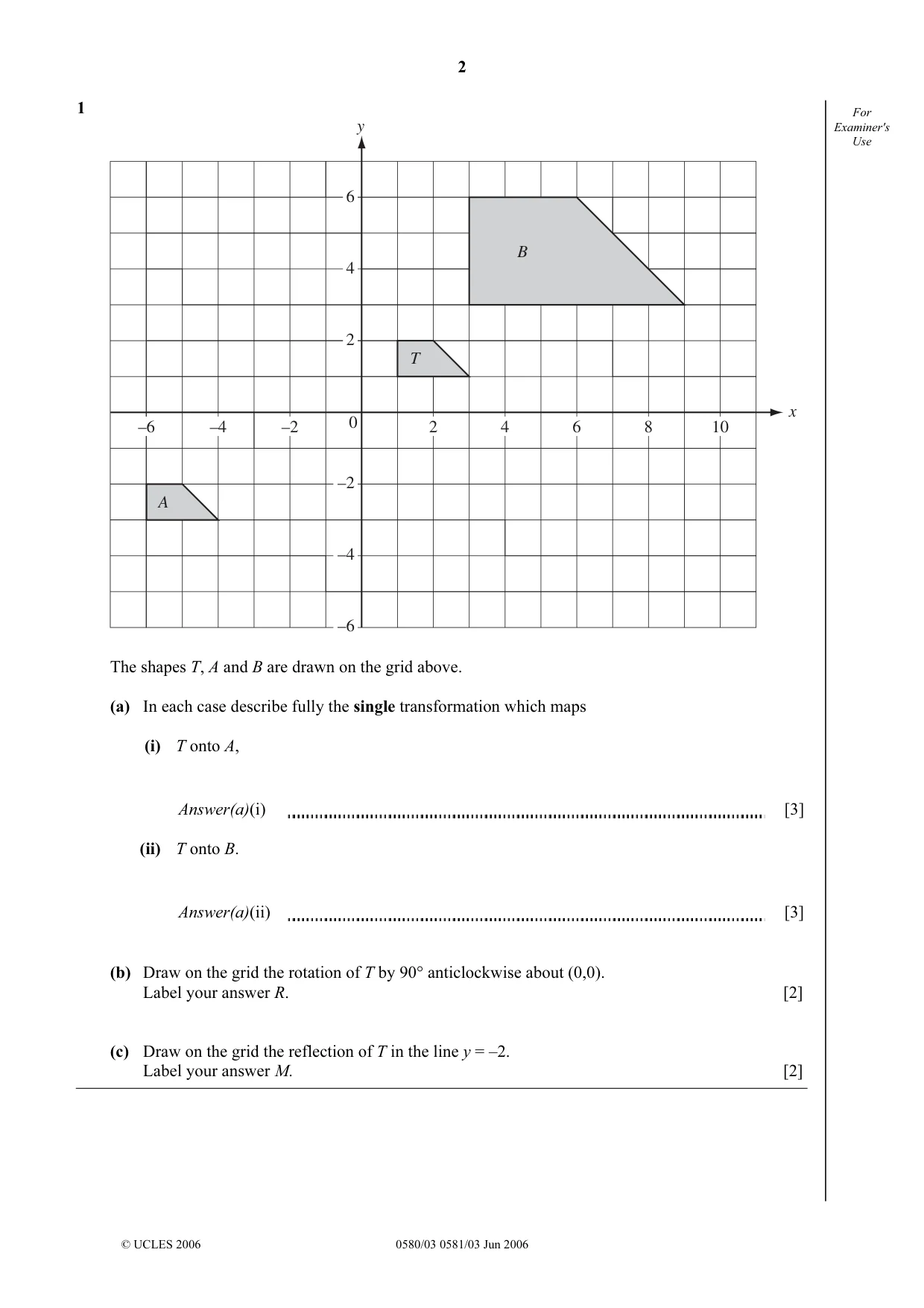
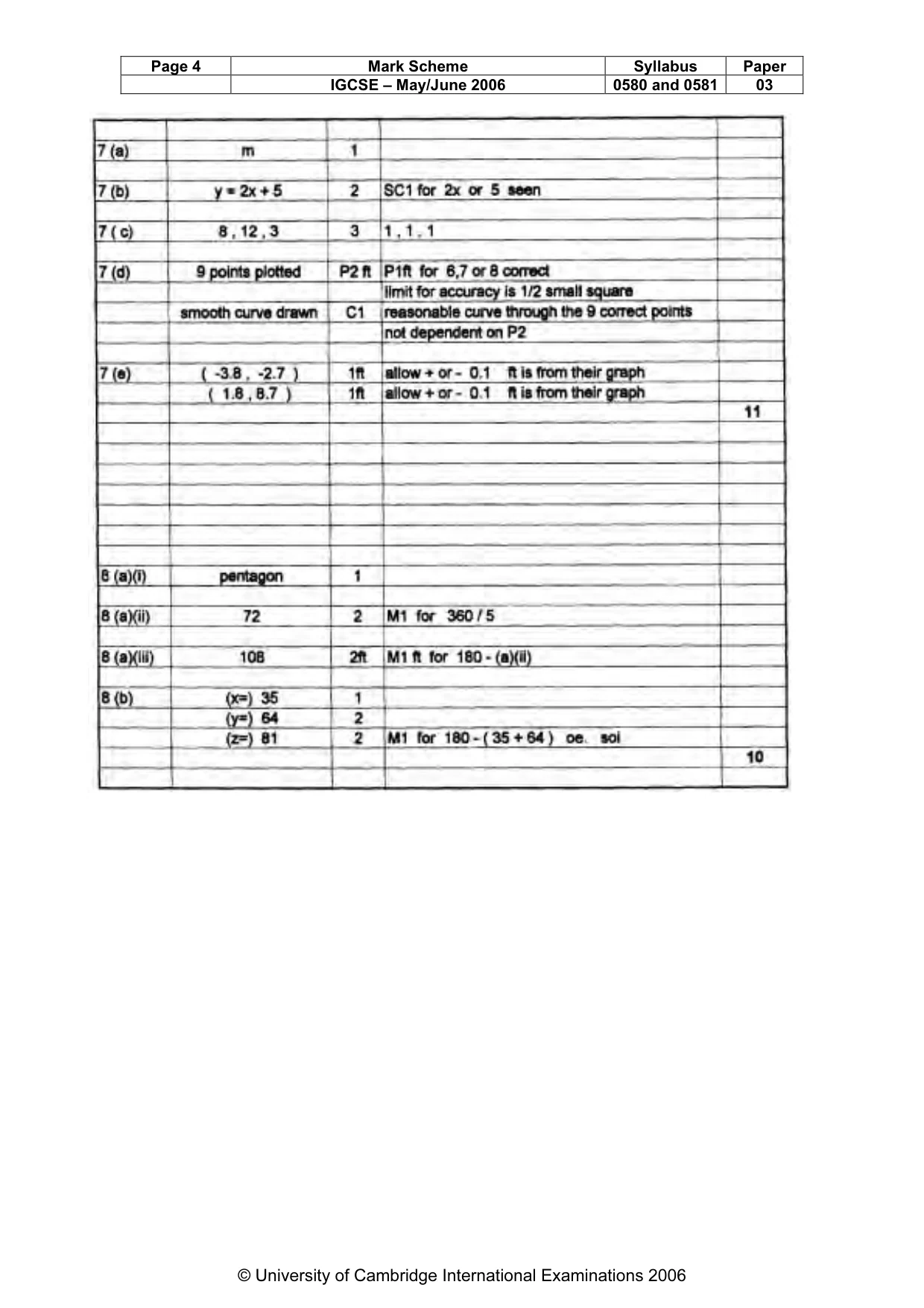
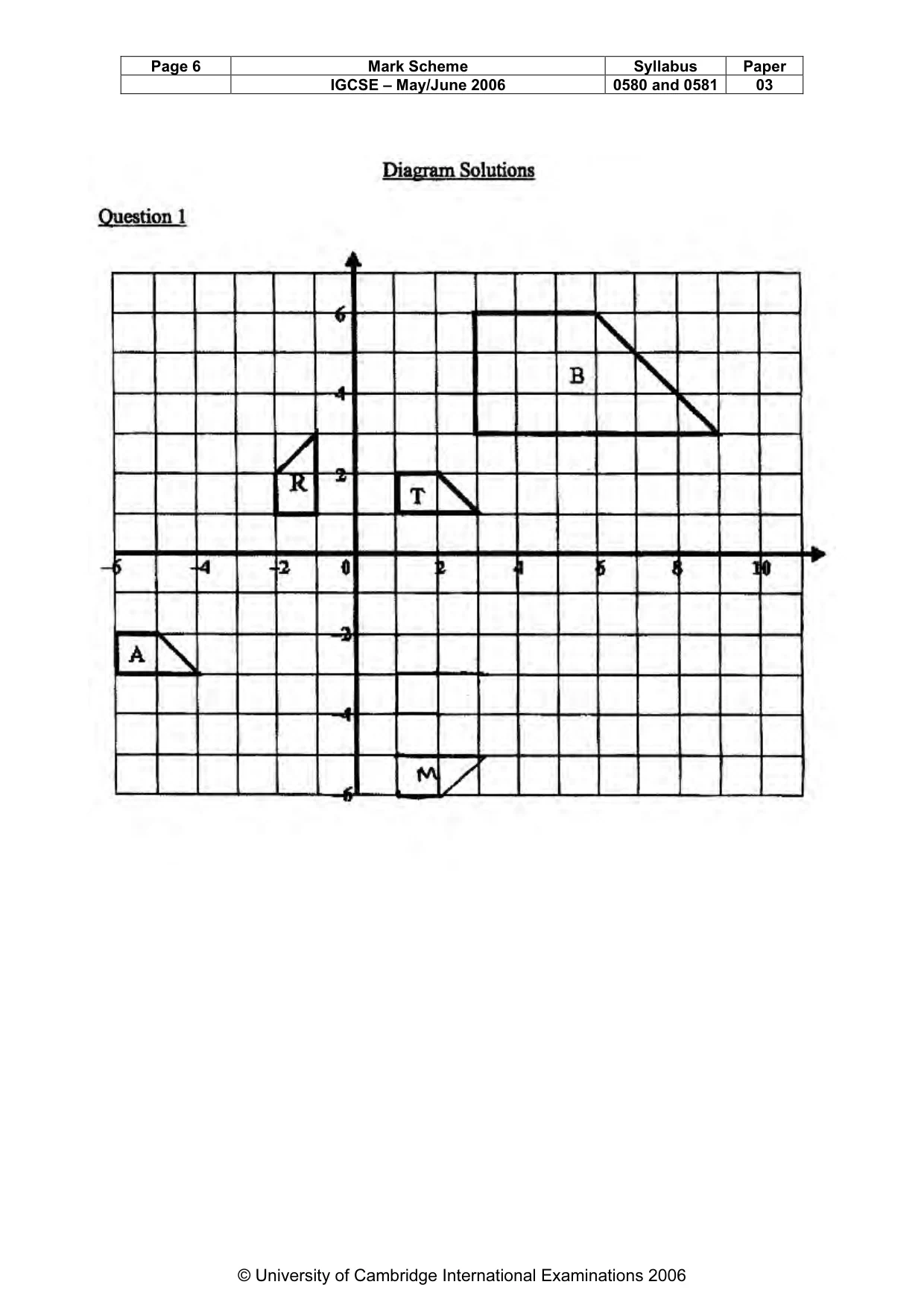
2 © UCLES 2006 0580/03 0581/03 Jun 2006 For Examiner's Use 1 x y 0 10 8 6 4 2 –2 –4 –6 6 4 2 –2 –4 –6 B T A The shapes T, A and B are drawn on the grid above. (a) In each case describe fully the single transformation which maps (i) T onto A, Answer(a)(i) [3] (ii) T onto B. Answer(a)(ii) [3] (b) Draw on the grid the rotation of T by 90° anticlockwise about (0,0). Label your answer R. [2] (c) Draw on the grid the reflection of T in the line y = –2. Label your answer M. [2]
Question paper, page 3
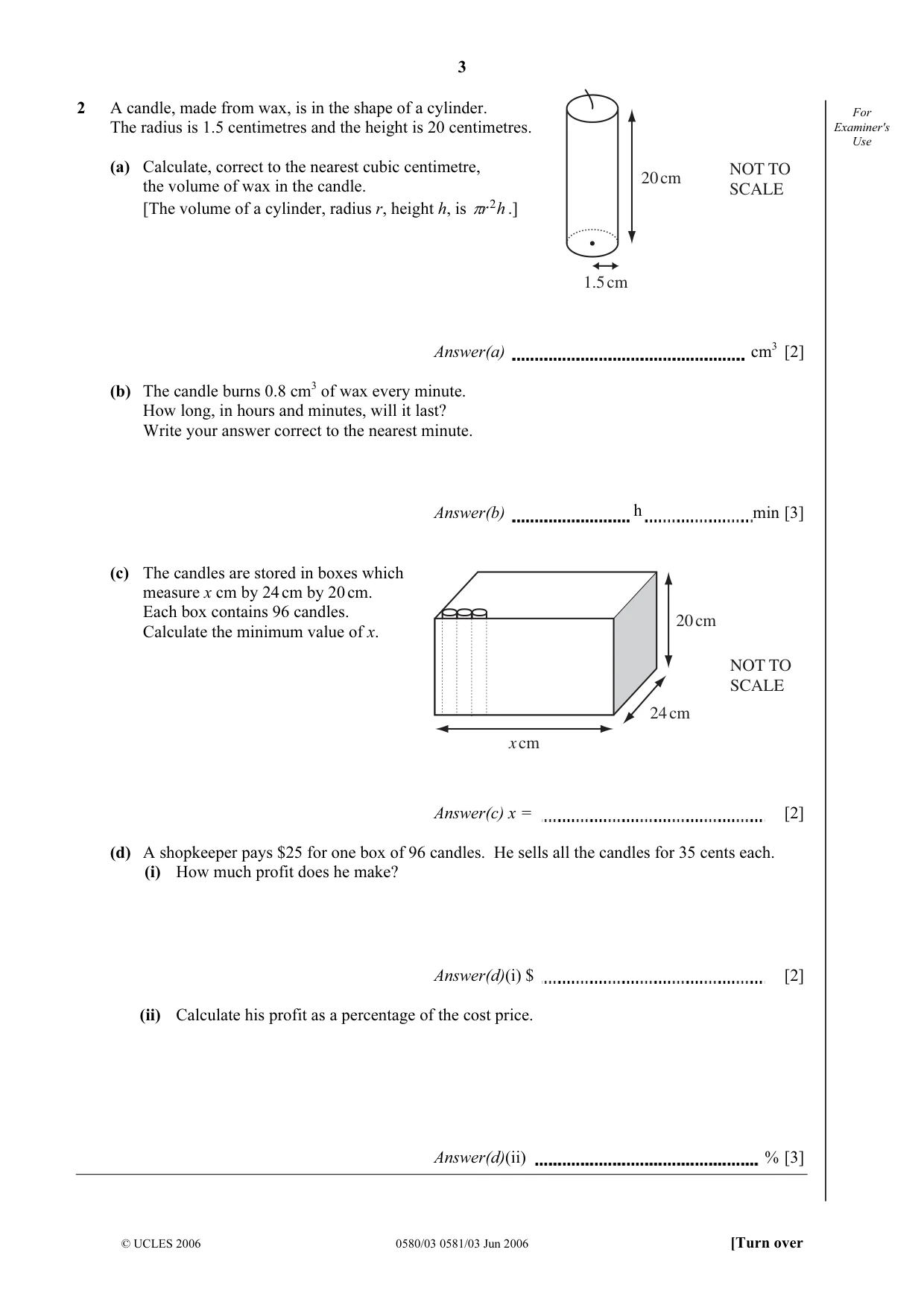
3 © UCLES 2006 0580/03 0581/03 Jun 2006 [Turn over For Examiner's Use 2 A candle, made from wax, is in the shape of a cylinder. The radius is 1.5 centimetres and the height is 20 centimetres. (a) Calculate, correct to the nearest cubic centimetre, the volume of wax in the candle. [The volume of a cylinder, radius r, height h, is h r2 π .] Answer(a) cm3 [2] (b) The candle burns 0.8 cm3 of wax every minute. How long, in hours and minutes, will it last? Write your answer correct to the nearest minute. h Answer(b) min [3] (c) The candles are stored in boxes which measure x cm by 24 cm by 20 cm. Each box contains 96 candles. Calculate the minimum value of x. Answer(c) x = [2] (d) A shopkeeper pays $25 for one box of 96 candles. He sells all the candles for 35 cents each. (i) How much profit does he make? Answer(d)(i) $ [2] (ii) Calculate his profit as a percentage of the cost price. Answer(d)(ii) % [3] 20 cm 1.5 cm NOT TO SCALE 20 cm 24 cm x cm NOT TO SCALE
Question paper, page 4
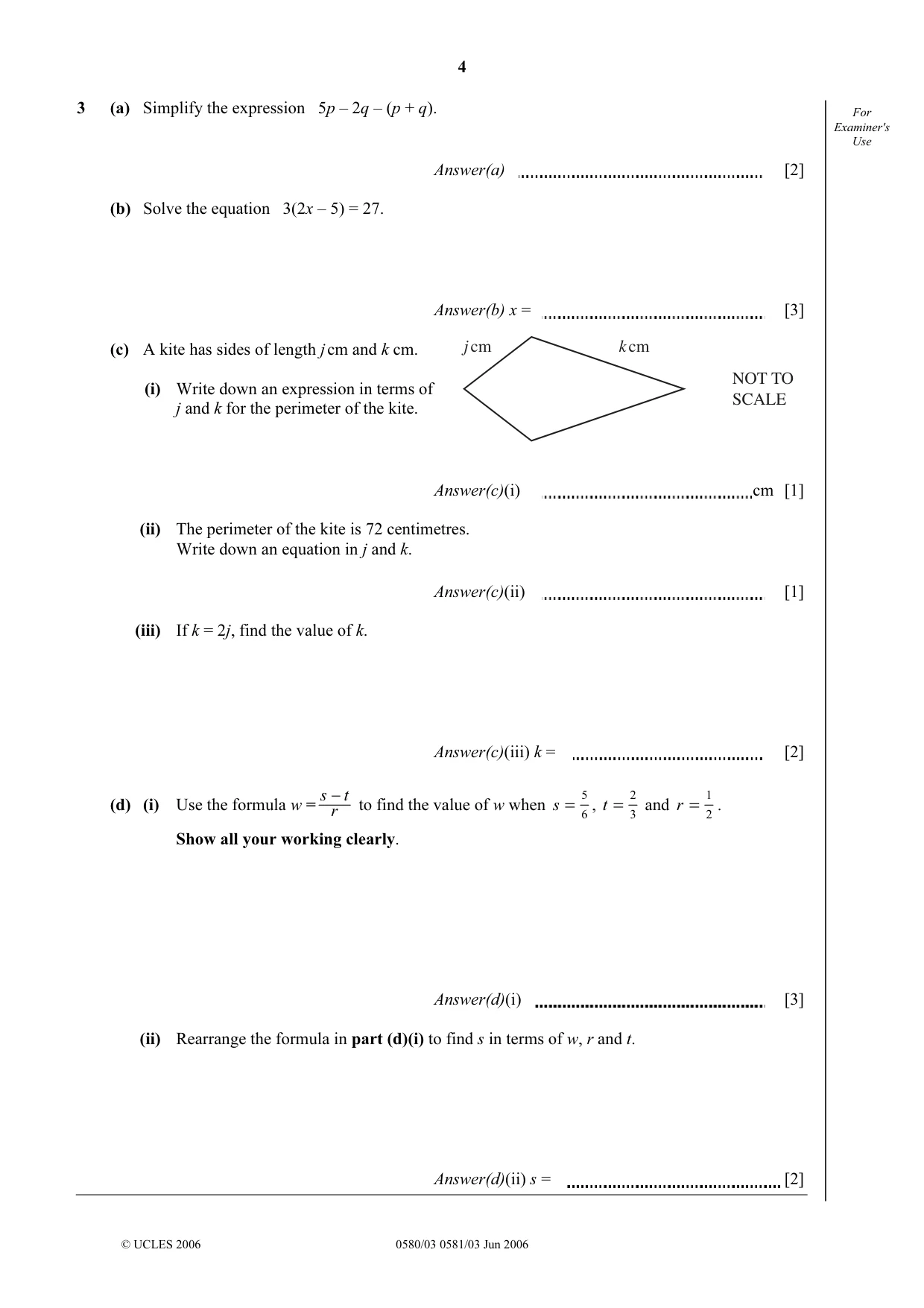
4 © UCLES 2006 0580/03 0581/03 Jun 2006 For Examiner's Use 3 (a) Simplify the expression 5p – 2q – (p + q). Answer(a) [2] (b) Solve the equation 3(2x – 5) = 27. Answer(b) x = [3] (c) A kite has sides of length j cm and k cm. (i) Write down an expression in terms of j and k for the perimeter of the kite. Answer(c)(i) cm [1] (ii) The perimeter of the kite is 72 centimetres. Write down an equation in j and k. Answer(c)(ii) [1] (iii) If k = 2j, find the value of k. Answer(c)(iii) k = [2] (d) (i) Use the formula w = r t s − to find the value of w when 6 5 = s , 3 2 = t and 2 1 = r . Show all your working clearly. Answer(d)(i) [3] (ii) Rearrange the formula in part (d)(i) to find s in terms of w, r and t. Answer(d)(ii) s = [2] j cm k cm NOT TO SCALE
Question paper, page 5
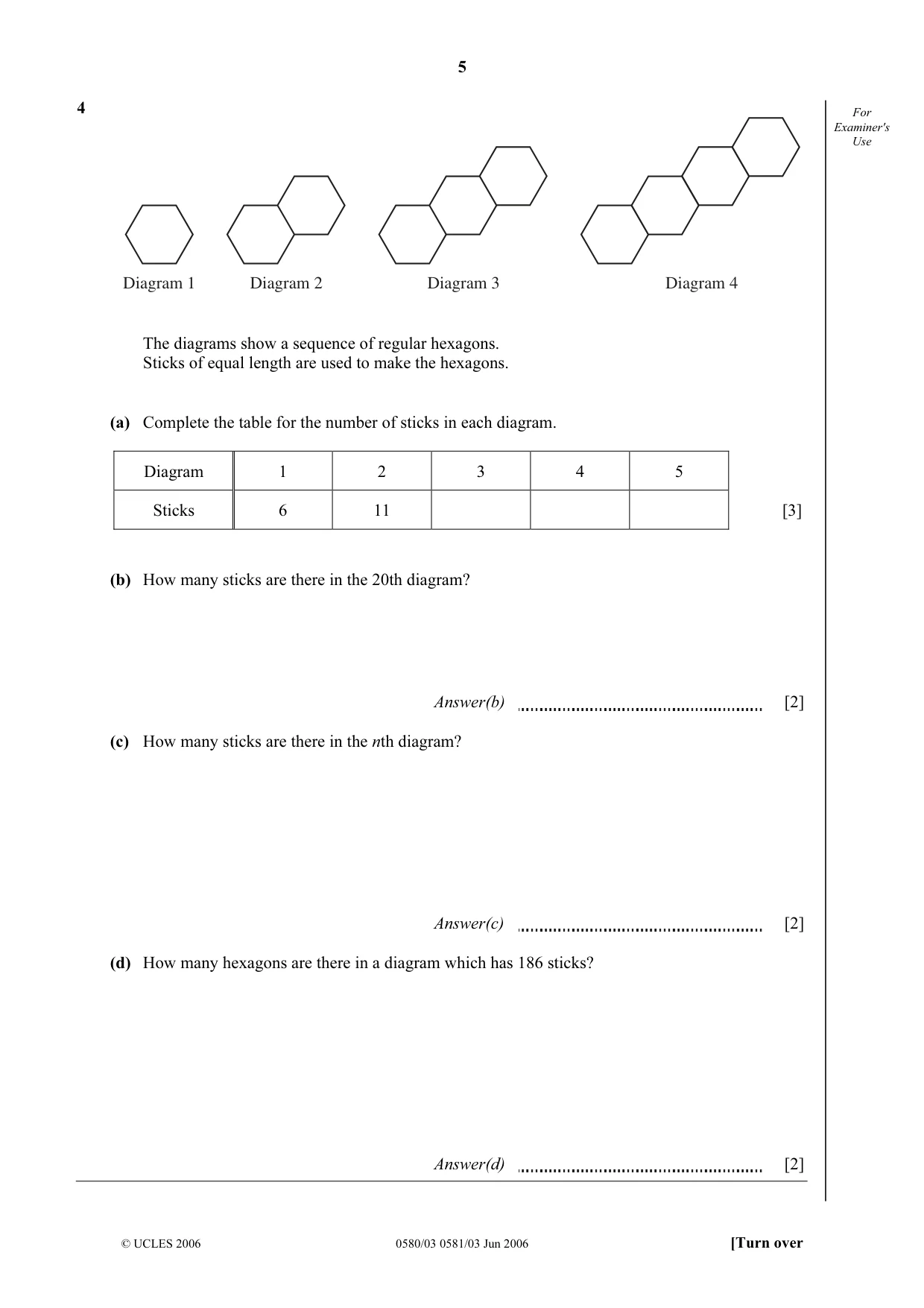
5 © UCLES 2006 0580/03 0581/03 Jun 2006 [Turn over For Examiner's Use 4 Diagram 1 Diagram 3 Diagram 4 Diagram 2 The diagrams show a sequence of regular hexagons. Sticks of equal length are used to make the hexagons. (a) Complete the table for the number of sticks in each diagram. Diagram 1 2 3 4 5 Sticks 6 11 [3] (b) How many sticks are there in the 20th diagram? Answer(b) [2] (c) How many sticks are there in the nth diagram? Answer(c) [2] (d) How many hexagons are there in a diagram which has 186 sticks? Answer(d) [2]
Question paper, page 6
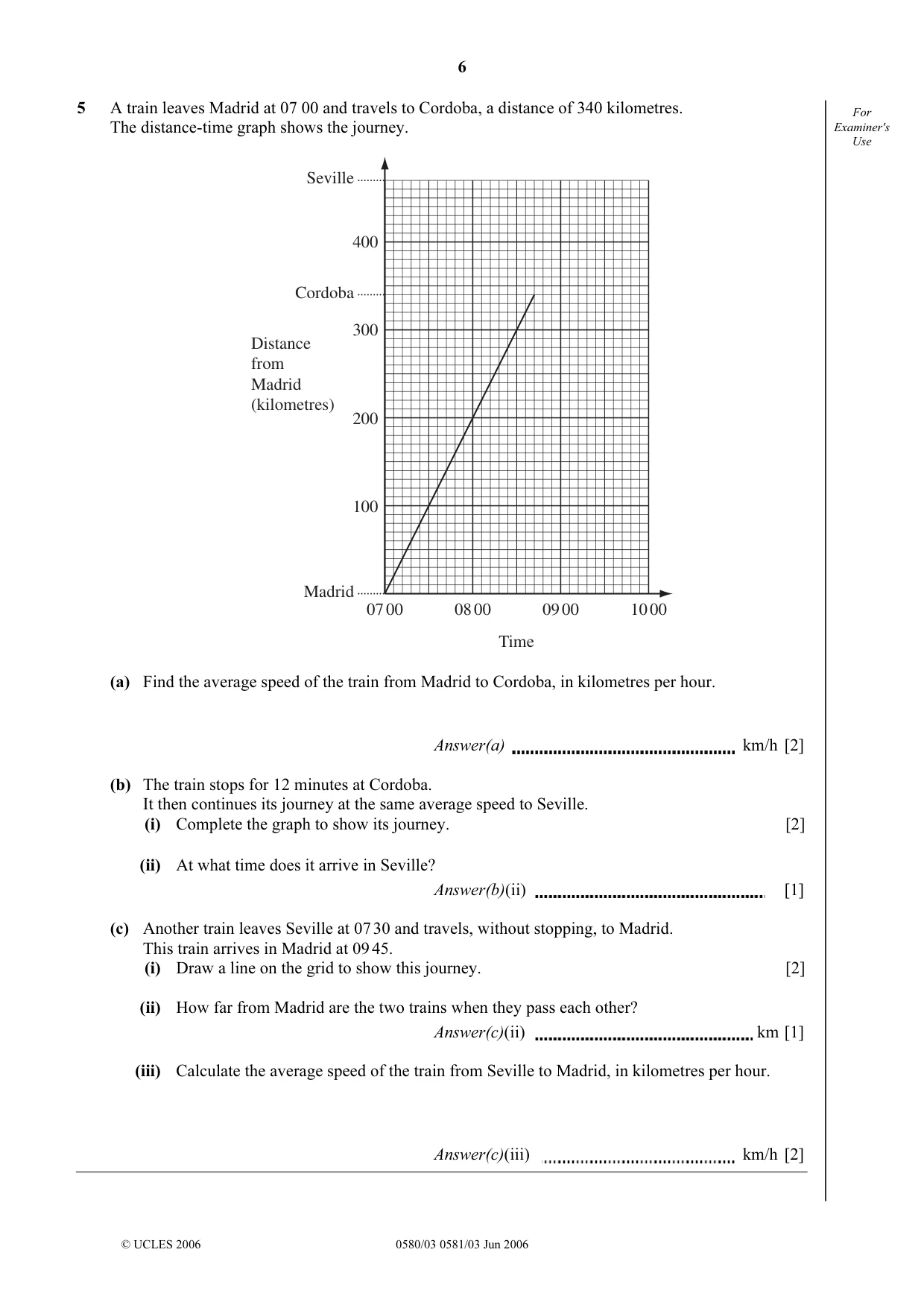
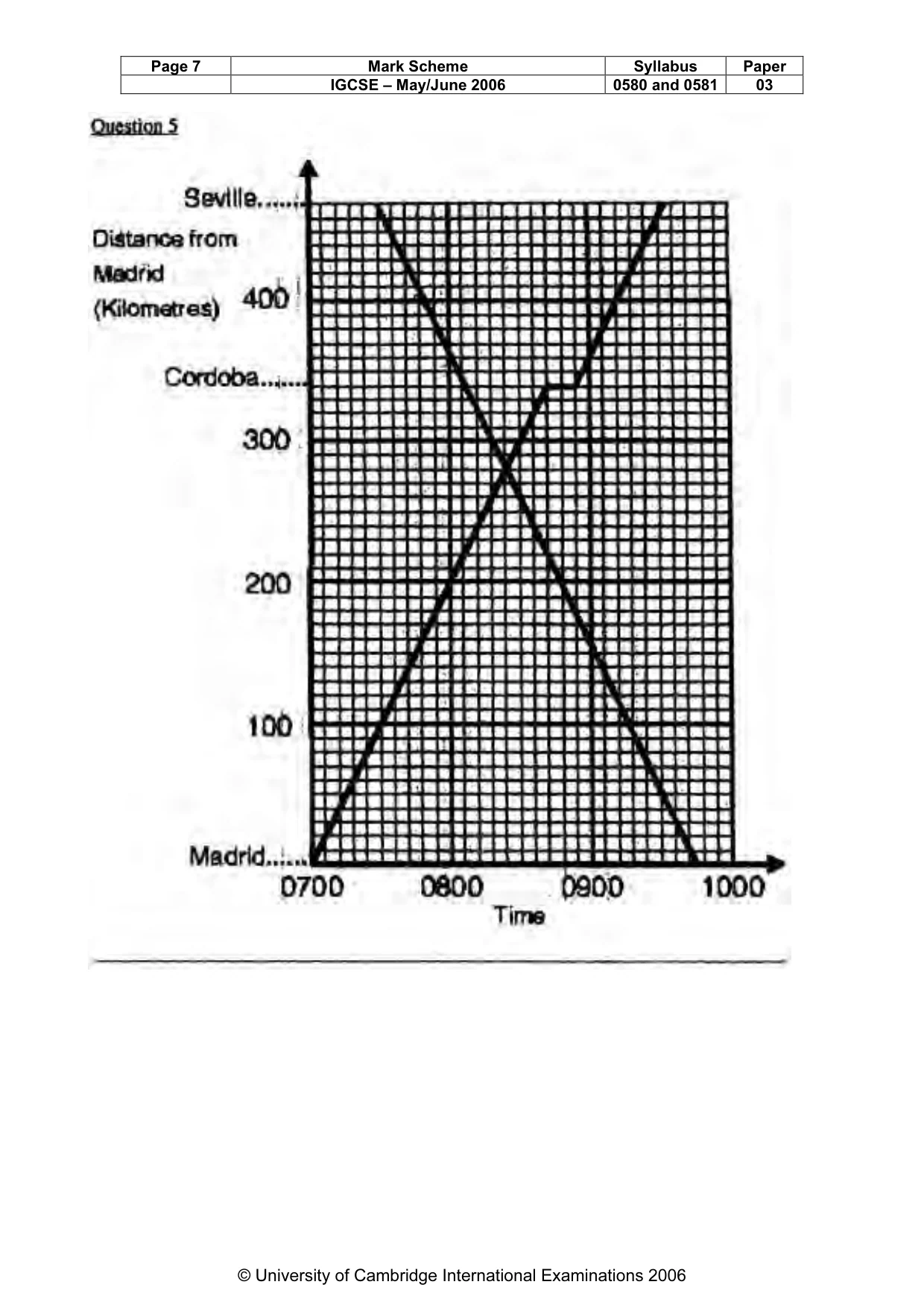
6 © UCLES 2006 0580/03 0581/03 Jun 2006 For Examiner's Use 5 A train leaves Madrid at 07 00 and travels to Cordoba, a distance of 340 kilometres. The distance-time graph shows the journey. 07 00 08 00 09 00 10 00 Madrid Cordoba Seville 400 300 200 100 Time Distance from Madrid (kilometres) (a) Find the average speed of the train from Madrid to Cordoba, in kilometres per hour. Answer(a) km/h [2] (b) The train stops for 12 minutes at Cordoba. It then continues its journey at the same average speed to Seville. (i) Complete the graph to show its journey. [2] (ii) At what time does it arrive in Seville? Answer(b)(ii) [1] (c) Another train leaves Seville at 07 30 and travels, without stopping, to Madrid. This train arrives in Madrid at 09 45. (i) Draw a line on the grid to show this journey. [2] (ii) How far from Madrid are the two trains when they pass each other? Answer(c)(ii) km [1] (iii) Calculate the average speed of the train from Seville to Madrid, in kilometres per hour. Answer(c)(iii) km/h [2]
Question paper, page 7
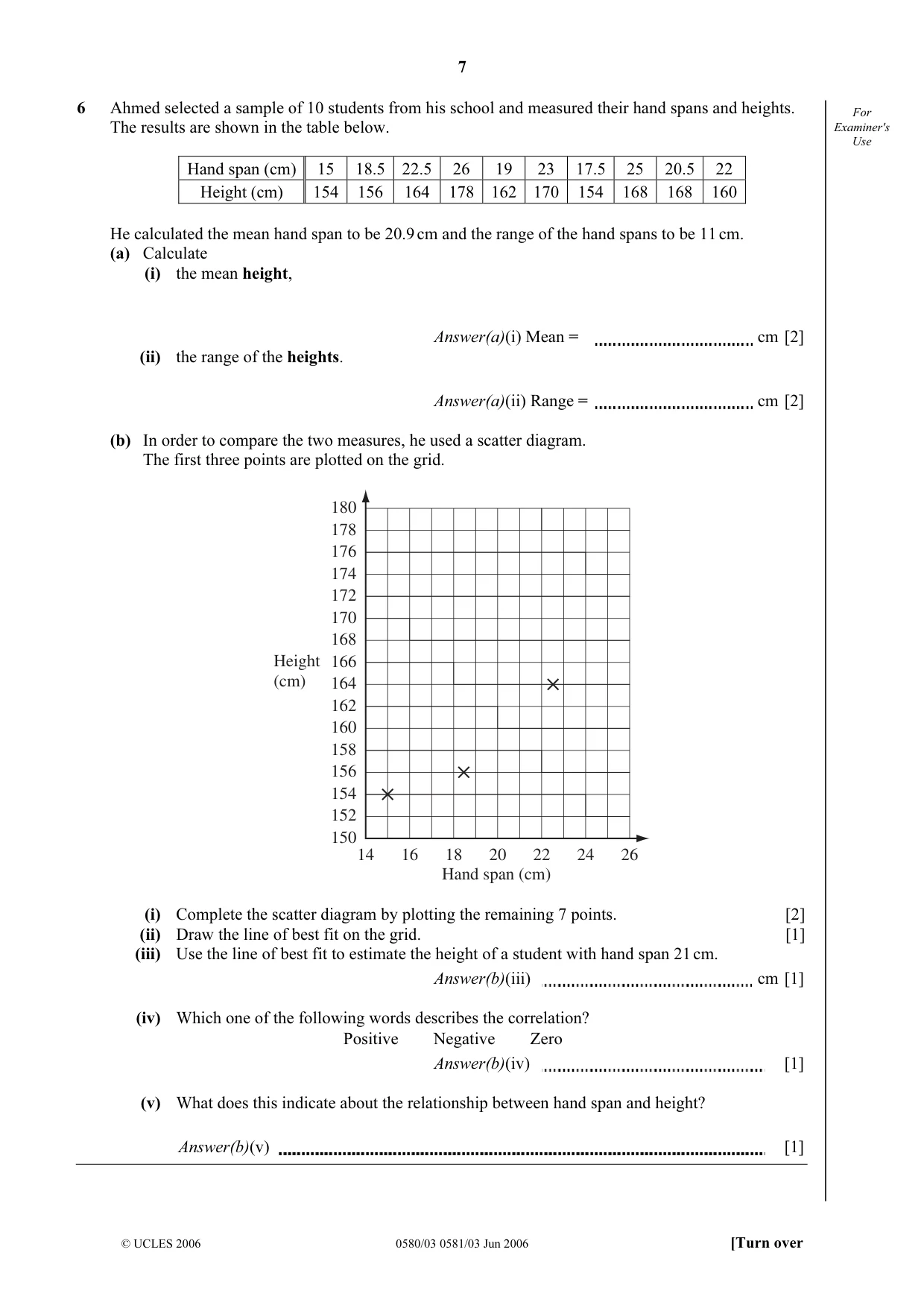
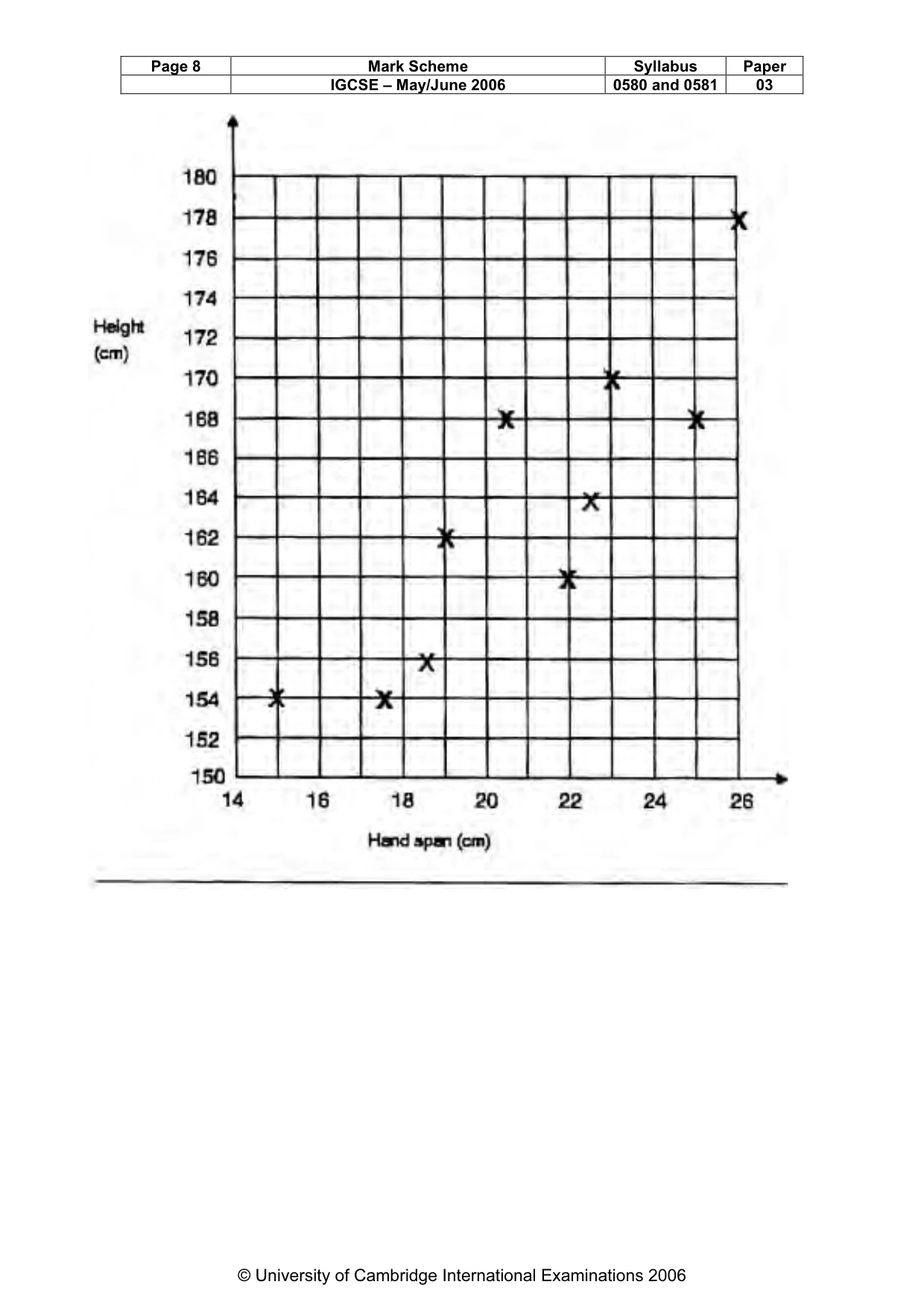
7 © UCLES 2006 0580/03 0581/03 Jun 2006 [Turn over For Examiner's Use 6 Ahmed selected a sample of 10 students from his school and measured their hand spans and heights. The results are shown in the table below. Hand span (cm) 15 18.5 22.5 26 19 23 17.5 25 20.5 22 Height (cm) 154 156 164 178 162 170 154 168 168 160 He calculated the mean hand span to be 20.9 cm and the range of the hand spans to be 11 cm. (a) Calculate (i) the mean height, Answer(a)(i) Mean = cm [2] (ii) the range of the heights. Answer(a)(ii) Range = cm [2] (b) In order to compare the two measures, he used a scatter diagram. The first three points are plotted on the grid. 150 152 154 156 158 160 162 164 166 168 170 172 174 176 178 180 14 16 18 20 22 24 26 Height (cm) Hand span (cm) (i) Complete the scatter diagram by plotting the remaining 7 points. [2] (ii) Draw the line of best fit on the grid. [1] (iii) Use the line of best fit to estimate the height of a student with hand span 21 cm. Answer(b)(iii) cm [1] (iv) Which one of the following words describes the correlation? Positive Negative Zero Answer(b)(iv) [1] (v) What does this indicate about the relationship between hand span and height? Answer(b)(v) [1]
Question paper, page 8
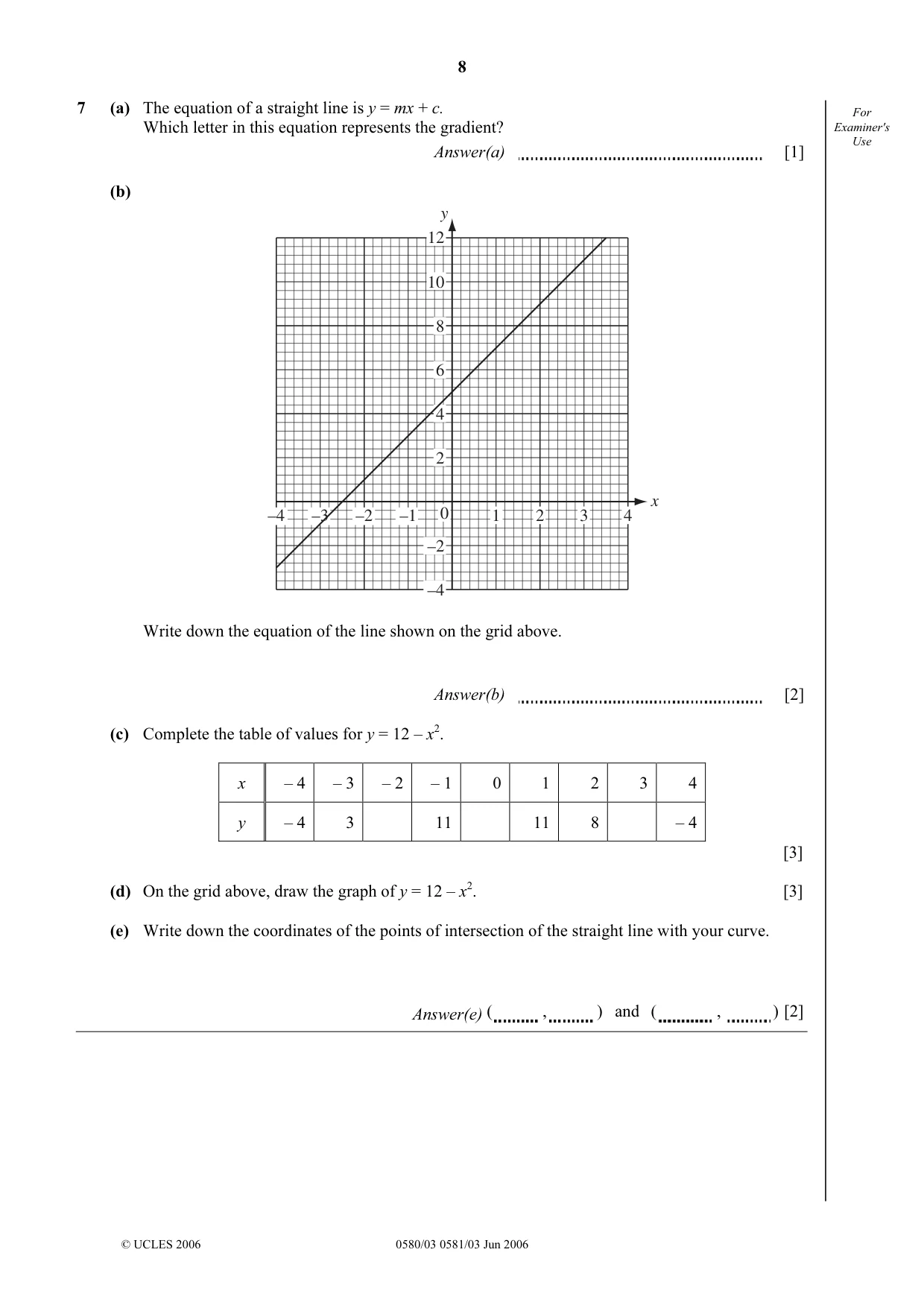
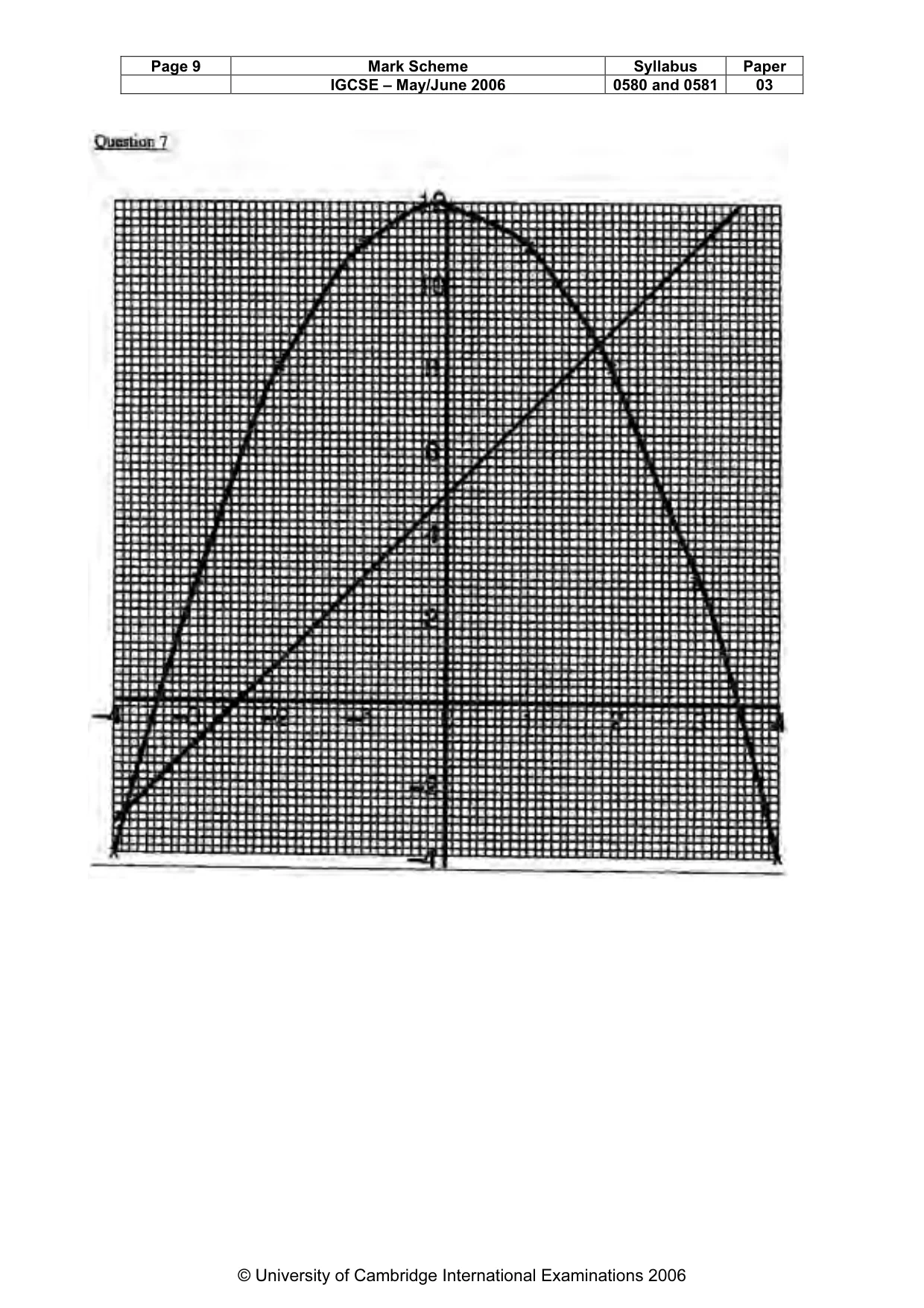
8 © UCLES 2006 0580/03 0581/03 Jun 2006 For Examiner's Use 7 (a) The equation of a straight line is y = mx + c. Which letter in this equation represents the gradient? Answer(a) [1] (b) 12 10 8 6 4 2 –2 –4 4 3 2 1 –1 –2 –3 –4 0 y x Write down the equation of the line shown on the grid above. Answer(b) [2] (c) Complete the table of values for y = 12 – x2. x – 4 – 3 – 2 – 1 0 1 2 3 4 y – 4 3 11 11 8 – 4 [3] (d) On the grid above, draw the graph of y = 12 – x2. [3] (e) Write down the coordinates of the points of intersection of the straight line with your curve. , ) and ( , ) [2] Answer(e) (
Question paper, page 9
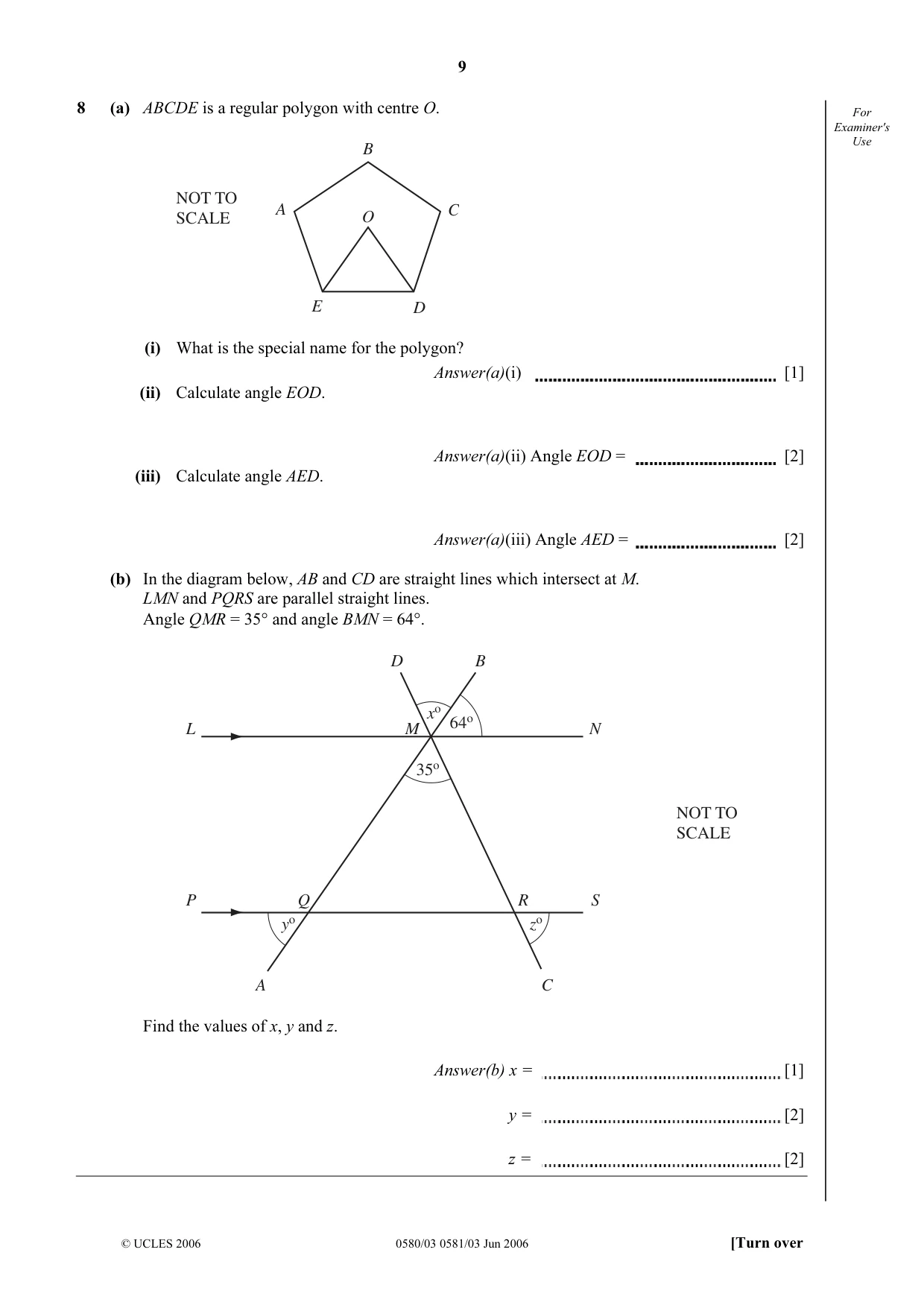
9 © UCLES 2006 0580/03 0581/03 Jun 2006 [Turn over For Examiner's Use 8 (a) ABCDE is a regular polygon with centre O. A B C D E O NOT TO SCALE (i) What is the special name for the polygon? Answer(a)(i) [1] (ii) Calculate angle EOD. Answer(a)(ii) Angle EOD = [2] (iii) Calculate angle AED. Answer(a)(iii) Angle AED = [2] (b) In the diagram below, AB and CD are straight lines which intersect at M. LMN and PQRS are parallel straight lines. Angle QMR = 35° and angle BMN = 64°. 64o 35o xo yo zo P Q R S L N D B A C NOT TO SCALE M Find the values of x, y and z. Answer(b) x = [1] y = [2] z = [2]
Question paper, page 10
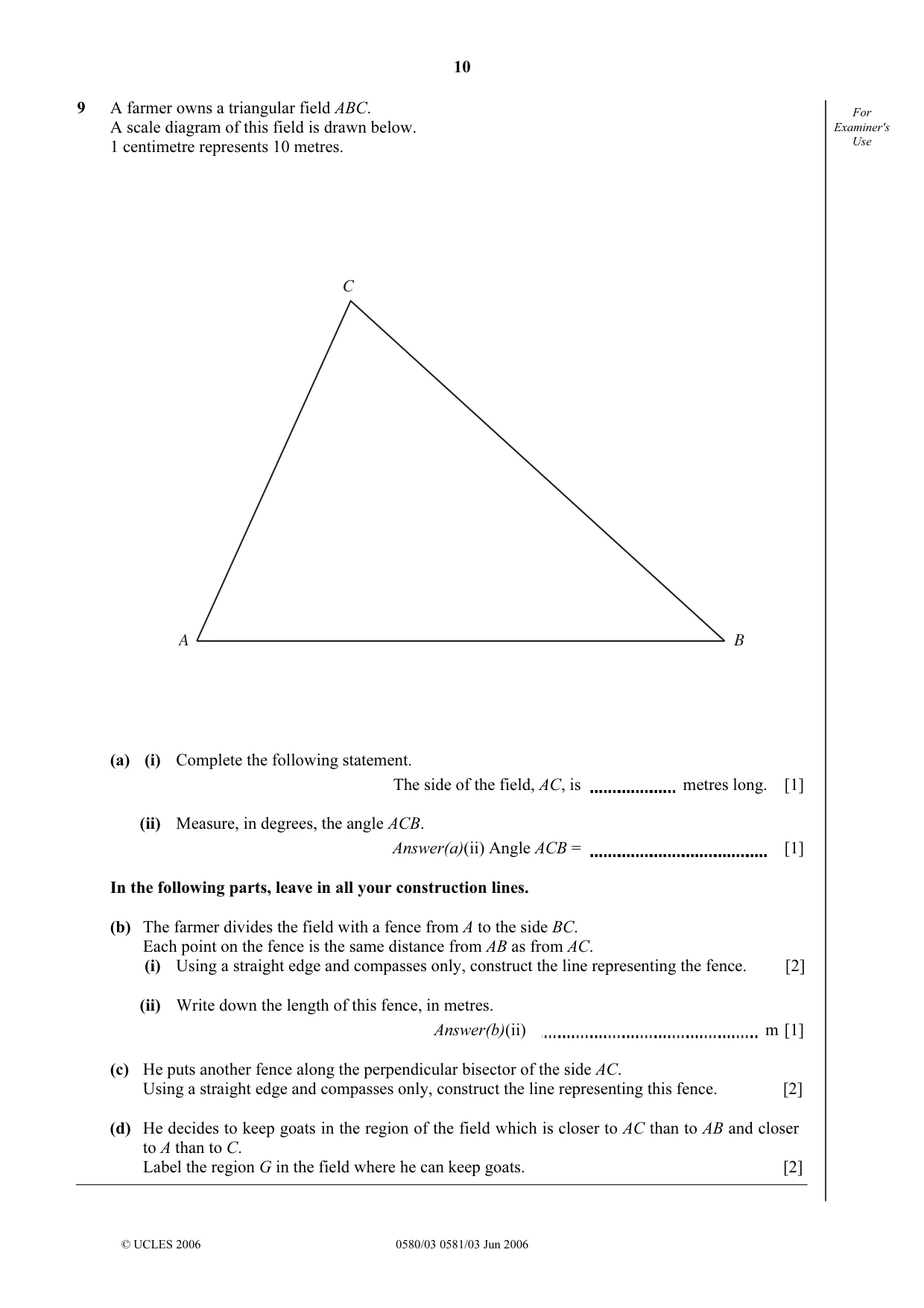
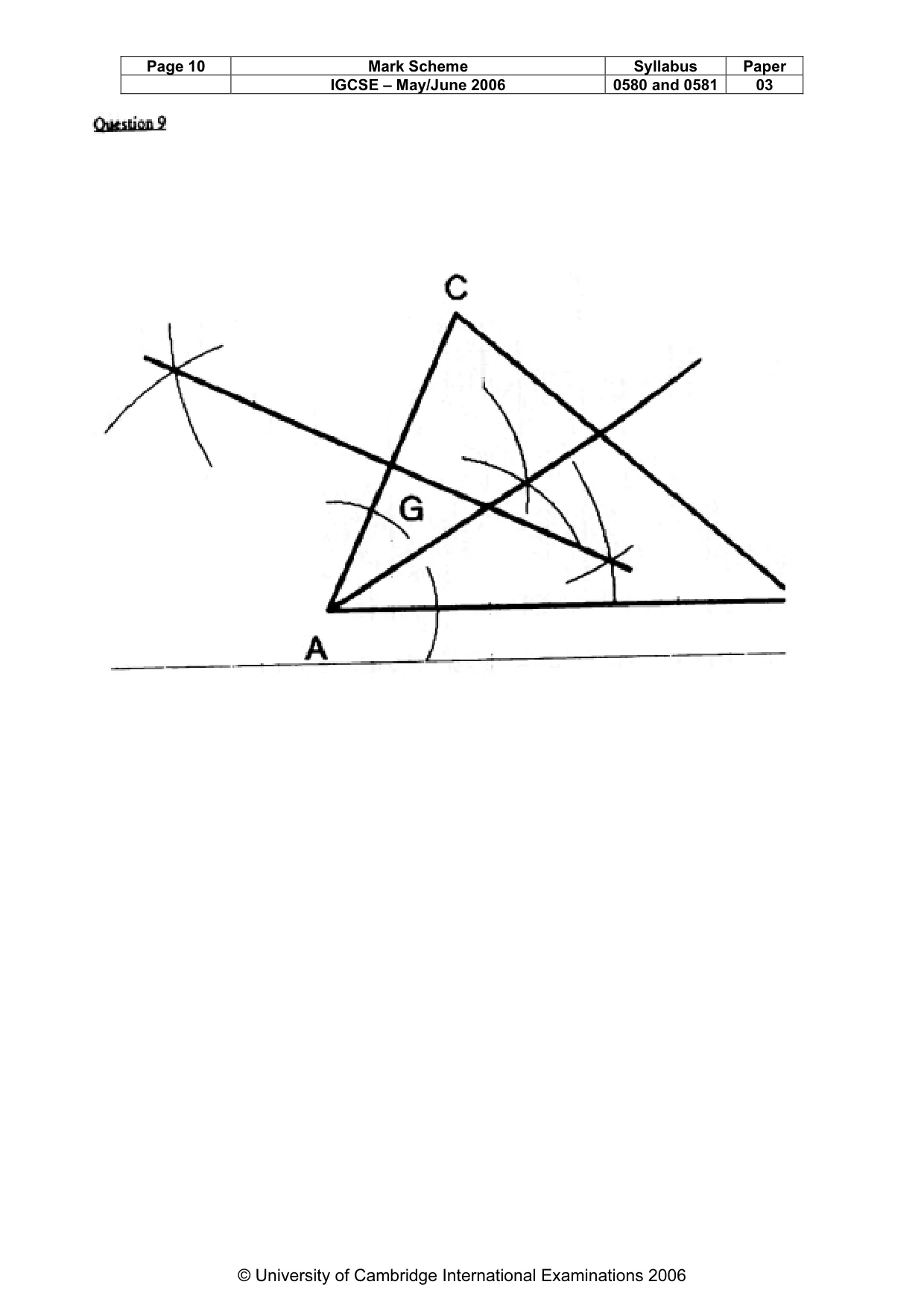
10 © UCLES 2006 0580/03 0581/03 Jun 2006 For Examiner's Use 9 A farmer owns a triangular field ABC. A scale diagram of this field is drawn below. 1 centimetre represents 10 metres. A B C (a) (i) Complete the following statement. The side of the field, AC, is metres long. [1] (ii) Measure, in degrees, the angle ACB. Answer(a)(ii) Angle ACB = [1] In the following parts, leave in all your construction lines. (b) The farmer divides the field with a fence from A to the side BC. Each point on the fence is the same distance from AB as from AC. (i) Using a straight edge and compasses only, construct the line representing the fence. [2] (ii) Write down the length of this fence, in metres. Answer(b)(ii) m [1] (c) He puts another fence along the perpendicular bisector of the side AC. Using a straight edge and compasses only, construct the line representing this fence. [2] (d) He decides to keep goats in the region of the field which is closer to AC than to AB and closer to A than to C. Label the region G in the field where he can keep goats. [2]
Question paper, page 11
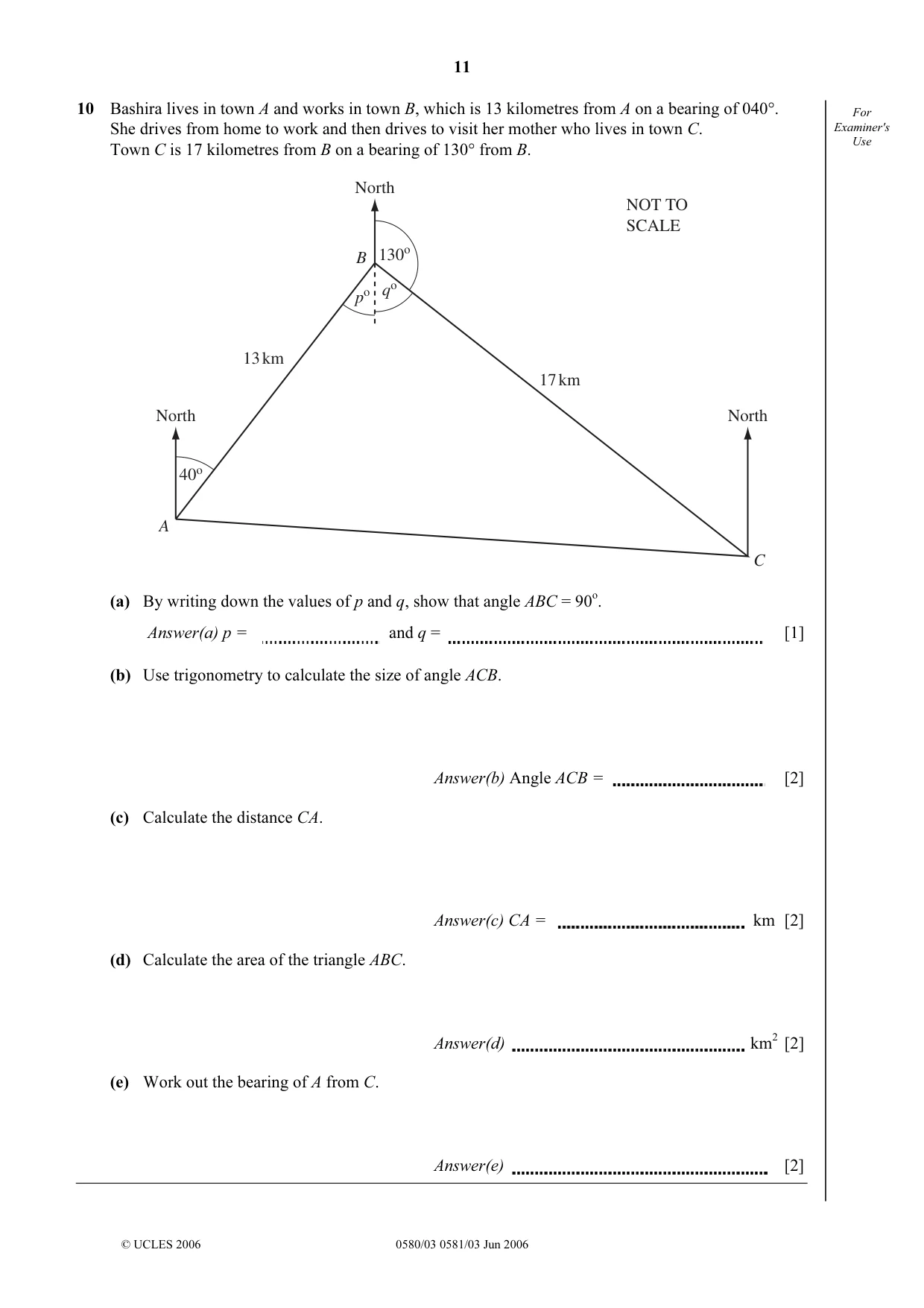
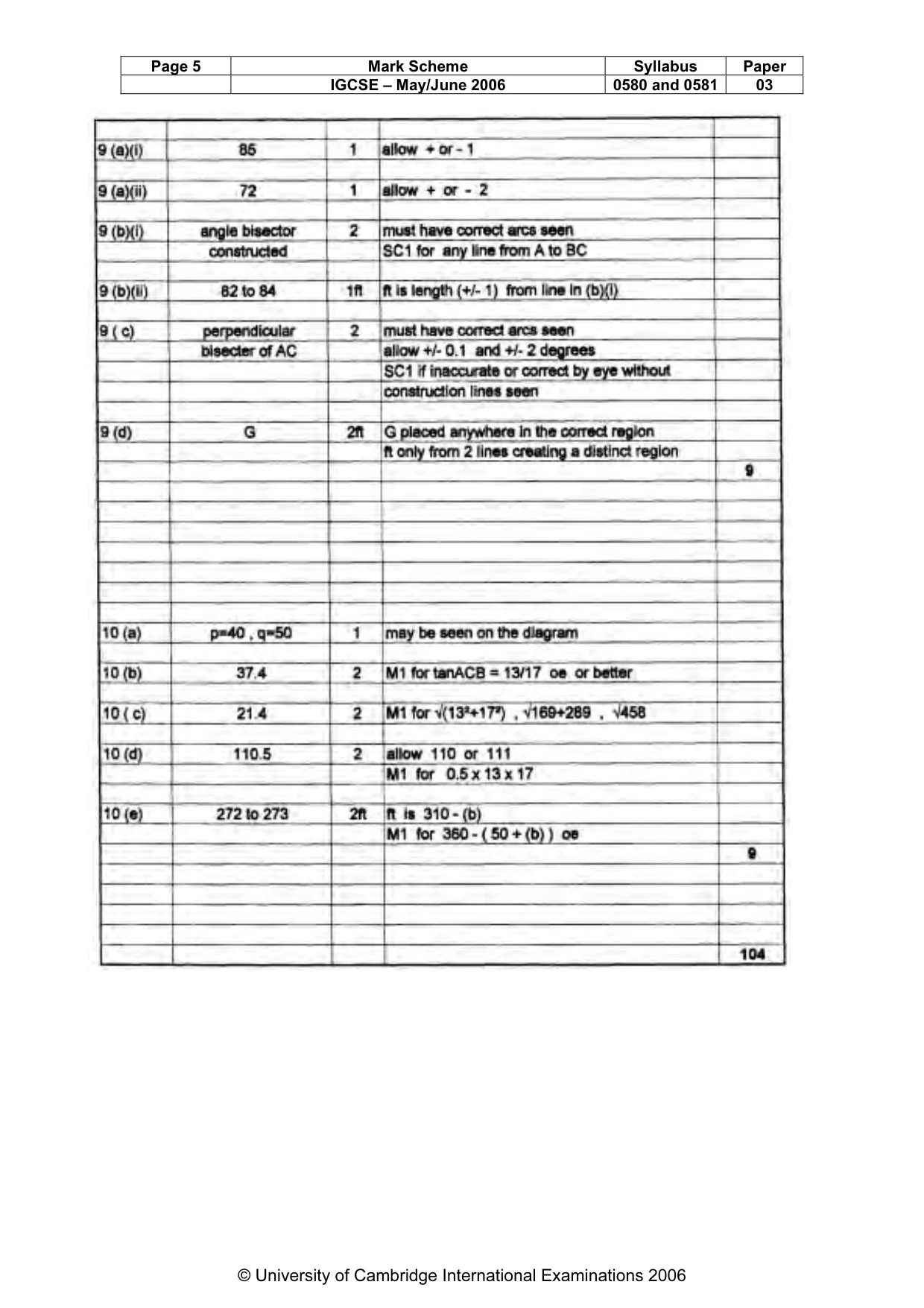
11 © UCLES 2006 0580/03 0581/03 Jun 2006 For Examiner's Use 10 Bashira lives in town A and works in town B, which is 13 kilometres from A on a bearing of 040°. She drives from home to work and then drives to visit her mother who lives in town C. Town C is 17 kilometres from B on a bearing of 130° from B. 40o qo po 130o 13 km 17 km A B C North North North NOT TO SCALE (a) By writing down the values of p and q, show that angle ABC = 90o. and q = Answer(a) p = [1] (b) Use trigonometry to calculate the size of angle ACB. Answer(b) Angle ACB = [2] (c) Calculate the distance CA. Answer(c) CA = km [2] (d) Calculate the area of the triangle ABC. Answer(d) km2 [2] (e) Work out the bearing of A from C. Answer(e) [2]
Question paper, page 12
12 Permission to reproduce items where third-party owned material protected by copyright is included has been sought and cleared where possible. Every reasonable effort has been made by the publisher (UCLES) to trace copyright holders, but if any items requiring clearance have unwittingly been included, the publisher will be pleased to make amends at the earliest possible opportunity. University of Cambridge International Examinations is part of the University of Cambridge Local Examinations Syndicate (UCLES), which is itself a department of the University of Cambridge. 0580/03 0581/03 Jun 2006 BLANK PAGE
Mark scheme, page 1
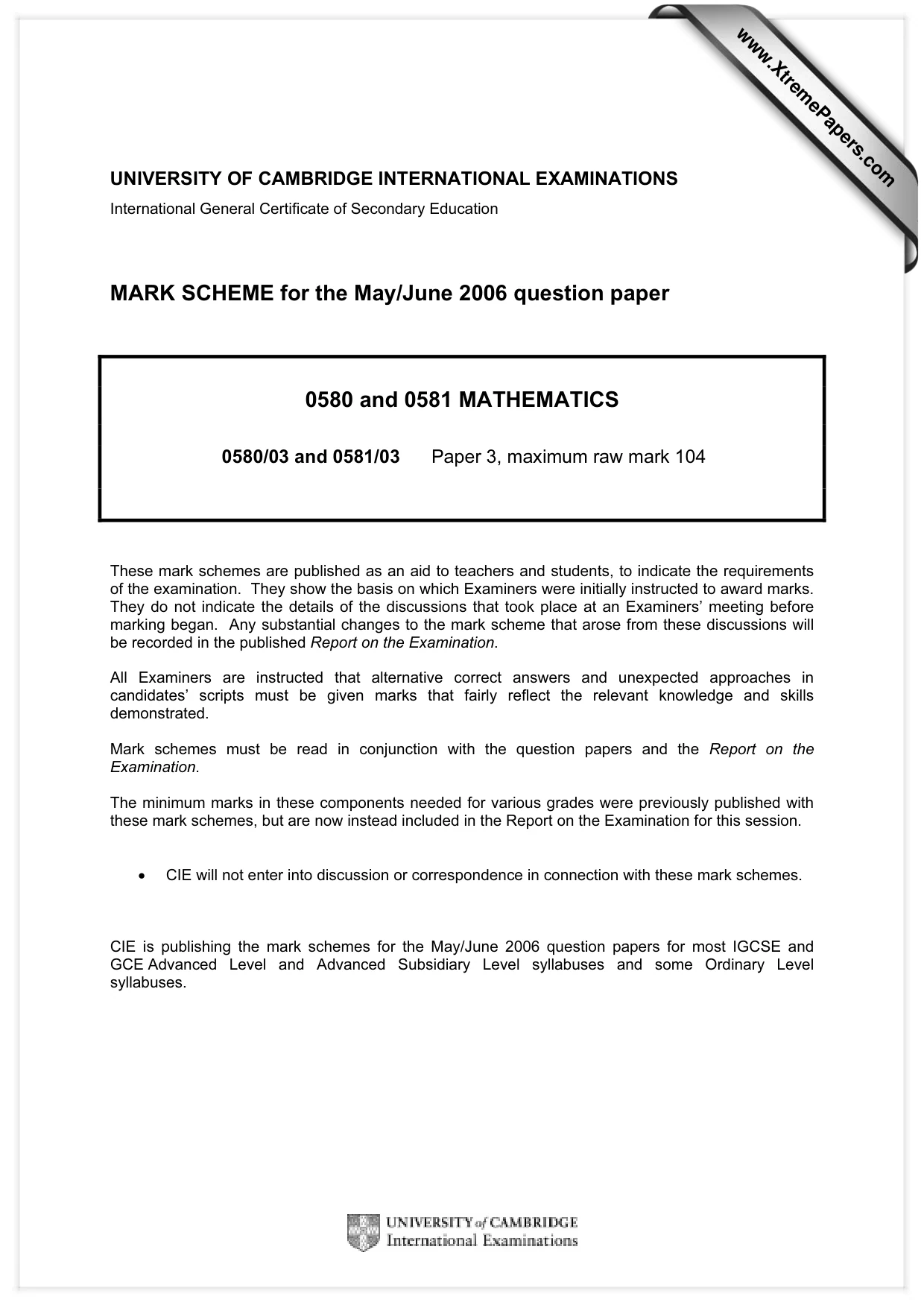
UNIVERSITY OF CAMBRIDGE INTERNATIONAL EXAMINATIONS International General Certificate of Secondary Education MARK SCHEME for the May/June 2006 question paper 0580 and 0581 MATHEMATICS 0580/03 and 0581/03 Paper 3, maximum raw mark 104 These mark schemes are published as an aid to teachers and students, to indicate the requirements of the examination. They show the basis on which Examiners were initially instructed to award marks. They do not indicate the details of the discussions that took place at an Examiners’ meeting before marking began. Any substantial changes to the mark scheme that arose from these discussions will be recorded in the published Report on the Examination. All Examiners are instructed that alternative correct answers and unexpected approaches in candidates’ scripts must be given marks that fairly reflect the relevant knowledge and skills demonstrated. Mark schemes must be read in conjunction with the question papers and the Report on the Examination. The minimum marks in these components needed for various grades were previously published with these mark schemes, but are now instead included in the Report on the Examination for this session. • CIE will not enter into discussion or correspondence in connection with these mark schemes. CIE is publishing the mark schemes for the May/June 2006 question papers for most IGCSE and GCE Advanced Level and Advanced Subsidiary Level syllabuses and some Ordinary Level syllabuses. www.XtremePapers.com
Mark scheme, page 2
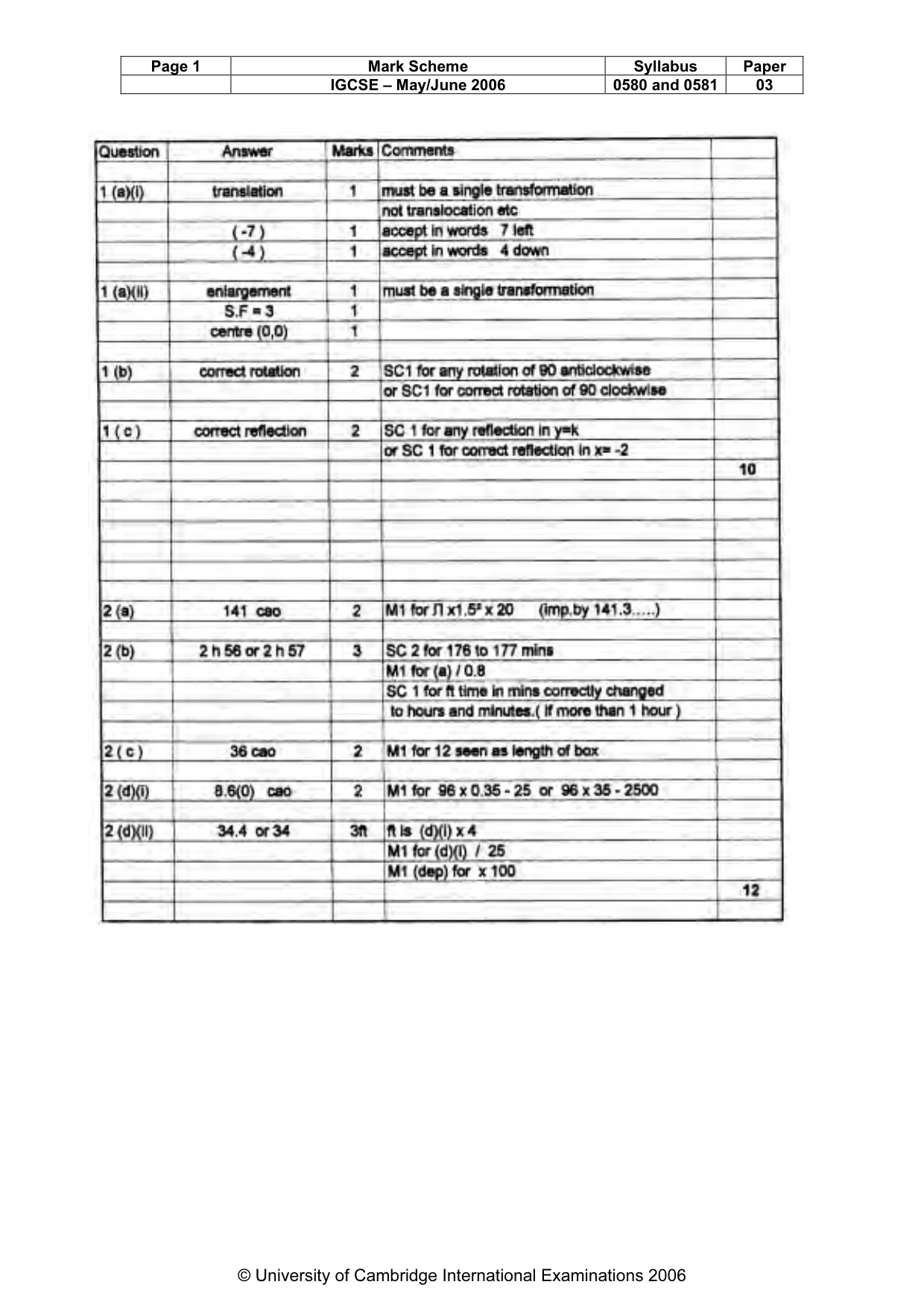
Page 1 Mark Scheme Syllabus Paper IGCSE – May/June 2006 0580 and 0581 03 © University of Cambridge International Examinations 2006
Mark scheme, page 3
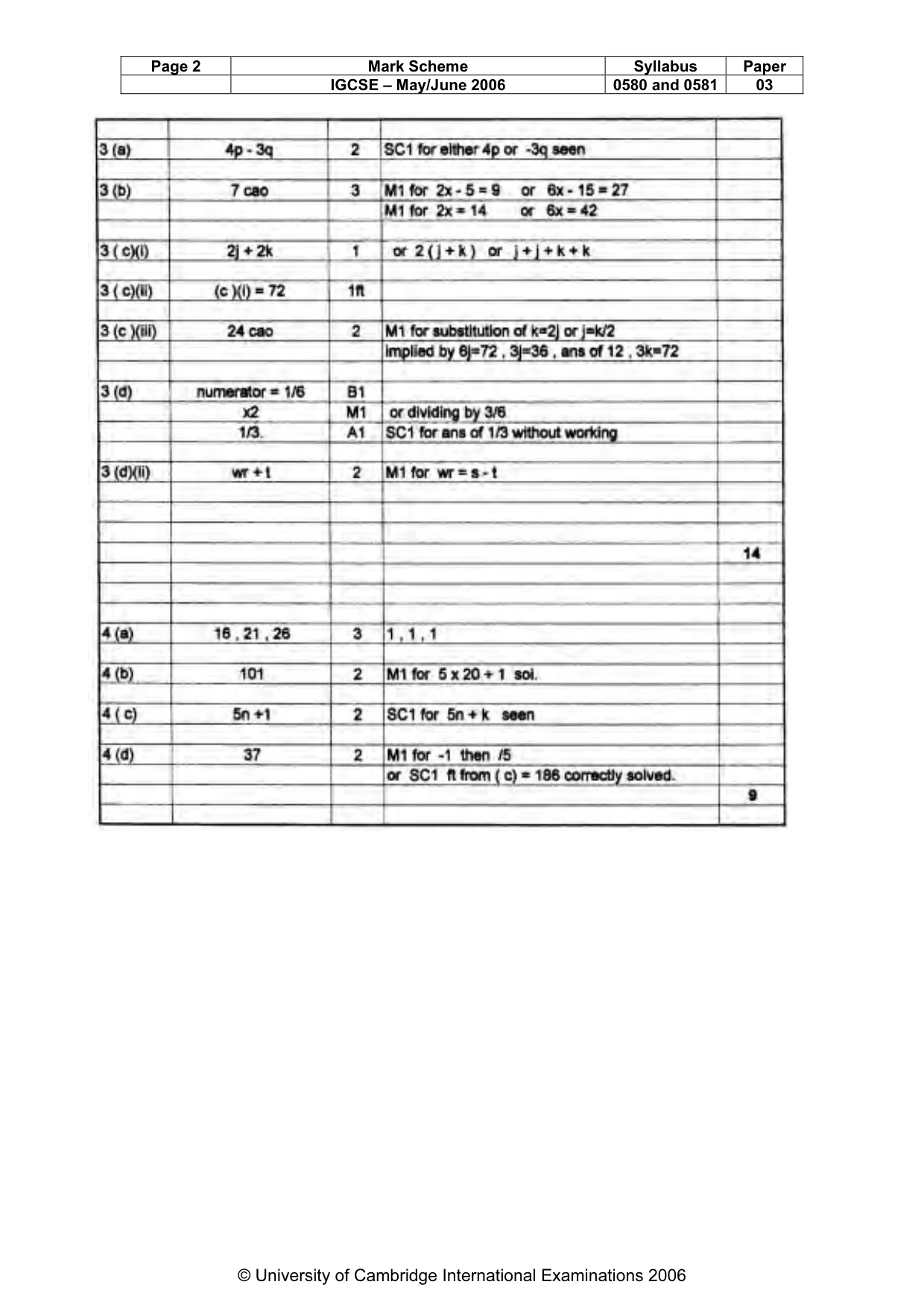
Page 2 Mark Scheme Syllabus Paper IGCSE – May/June 2006 0580 and 0581 03 © University of Cambridge International Examinations 2006
Mark scheme, page 4
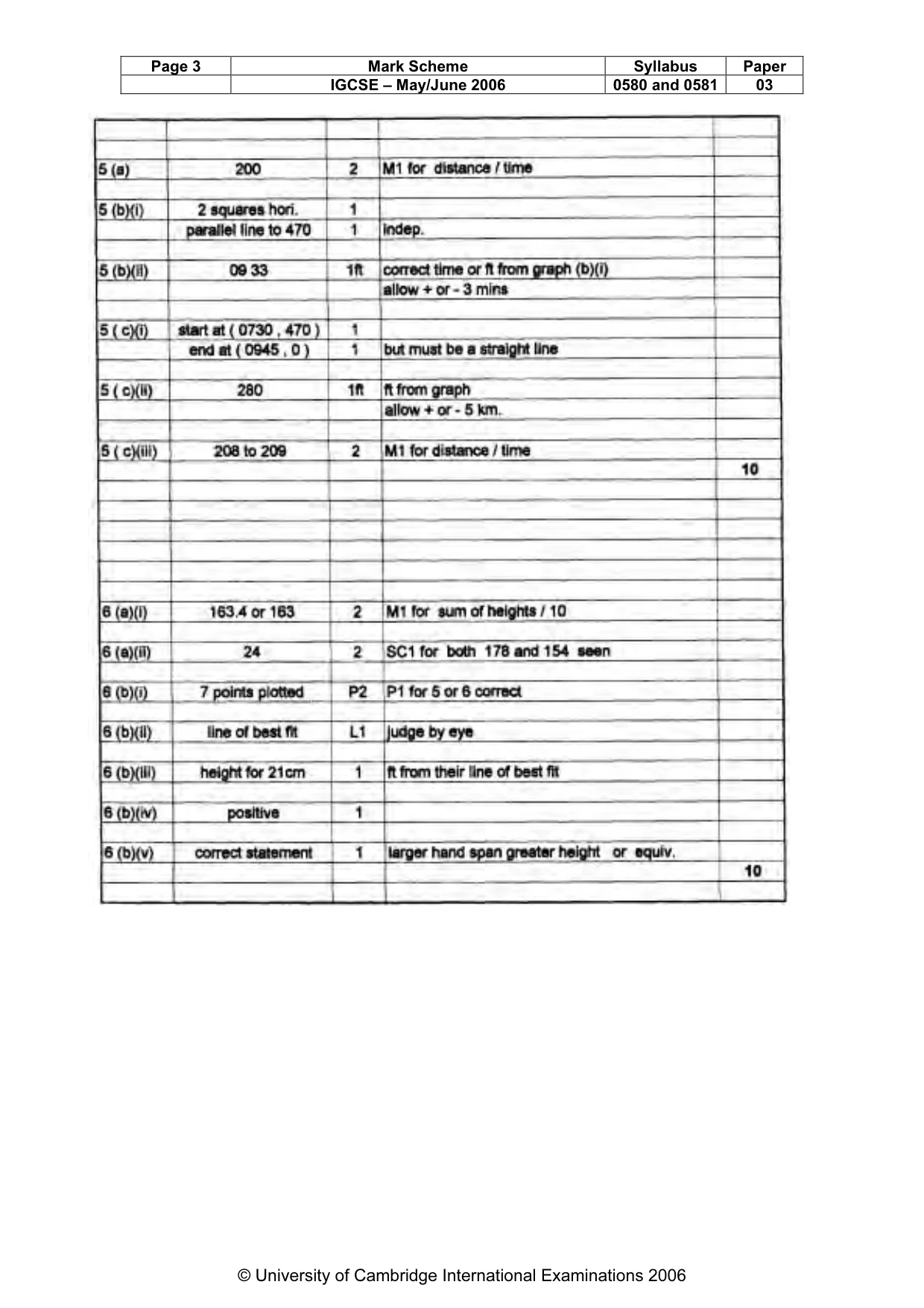
Page 3 Mark Scheme Syllabus Paper IGCSE – May/June 2006 0580 and 0581 03 © University of Cambridge International Examinations 2006
Mark scheme, page 5
Page 4 Mark Scheme Syllabus Paper IGCSE – May/June 2006 0580 and 0581 03 © University of Cambridge International Examinations 2006
Mark scheme, page 6
Page 5 Mark Scheme Syllabus Paper IGCSE – May/June 2006 0580 and 0581 03 © University of Cambridge International Examinations 2006
Mark scheme, page 7
Page 6 Mark Scheme Syllabus Paper IGCSE – May/June 2006 0580 and 0581 03 © University of Cambridge International Examinations 2006
Mark scheme, page 8
Page 7 Mark Scheme Syllabus Paper IGCSE – May/June 2006 0580 and 0581 03 © University of Cambridge International Examinations 2006
Mark scheme, page 9
Page 8 Mark Scheme Syllabus Paper IGCSE – May/June 2006 0580 and 0581 03 © University of Cambridge International Examinations 2006
Mark scheme, page 10
Page 9 Mark Scheme Syllabus Paper IGCSE – May/June 2006 0580 and 0581 03 © University of Cambridge International Examinations 2006
Mark scheme, page 11
Page 10 Mark Scheme Syllabus Paper IGCSE – May/June 2006 0580 and 0581 03 © University of Cambridge International Examinations 2006
What you needed in this session
Cambridge’s own grade thresholds for 2006 May/June, Paper 3 · Variant 1. A higher threshold means an easier paper — the bar moves with how the cohort did.