Cambridge IGCSE Mathematics 0580 — 2005 Oct/Nov Paper 3 · Variant 1
0580/31/O/N/05 · 9 questions · 104 marks · ≈117 min
The question paper and its mark scheme, free to read here and free to download. This is Cambridge’s own paper, exactly as it was sat.
Question paper12 pages
Mark scheme6 pages
Answers below. Sit the paper first if you are practising.
Questions as text
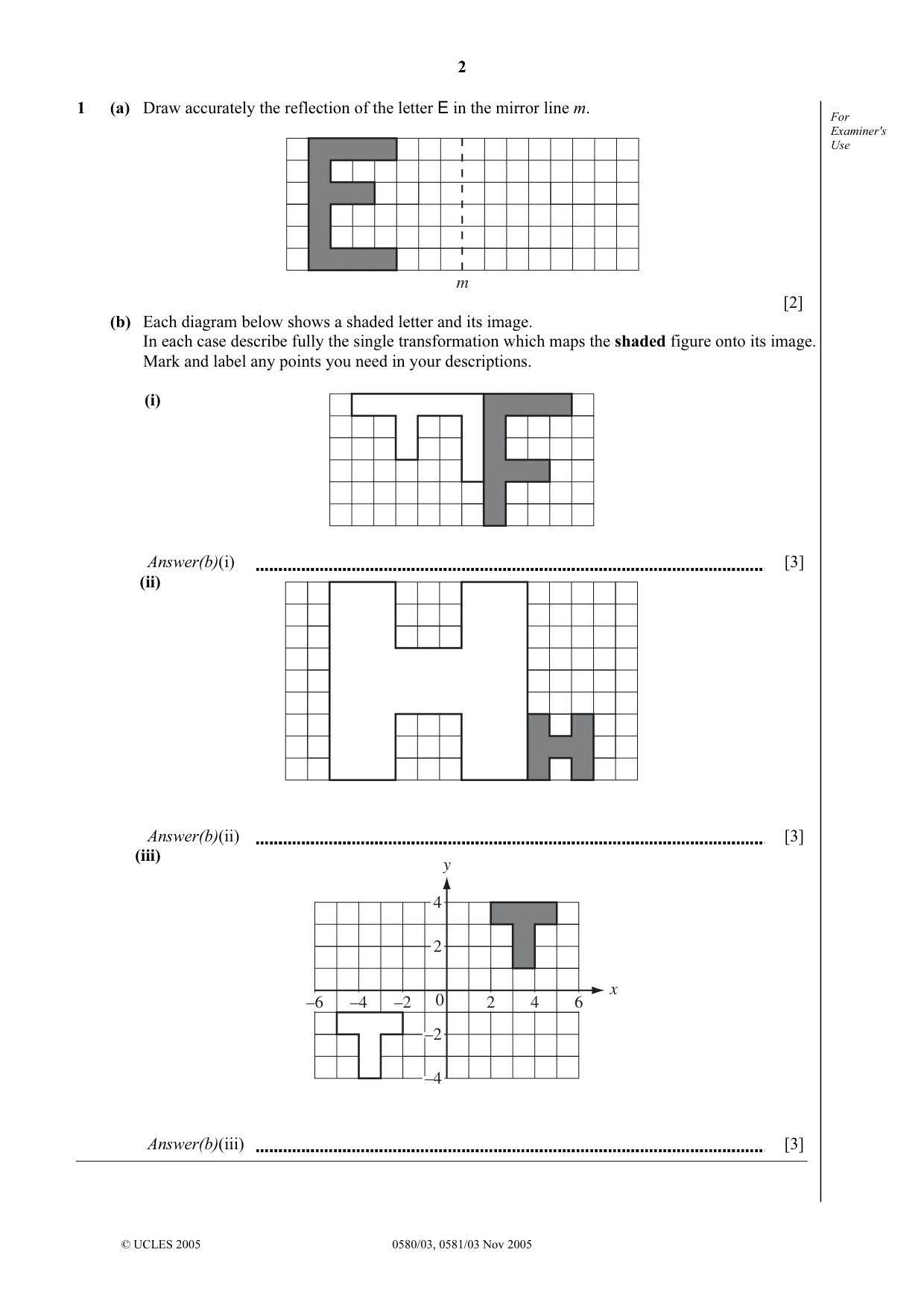
Q1 · Draw accurately the reflection of the letter E in the mirror line m
1 (a) Draw accurately the reflection of the letter E in the mirror line m. For Examiner's Use m [2] (b) Each diagram below shows a shaded letter and its image. In each case describe fully the single transformation which maps the shaded figure onto its image. Mark and label any points you need in your descriptions. (i) Answer(b)(i) [3] (ii) Answer(b)(ii) [3] (iii) y 4 2 x –6 –4 –2 0 2 4 6 –2 –4 Answer(b)(iii) [3]
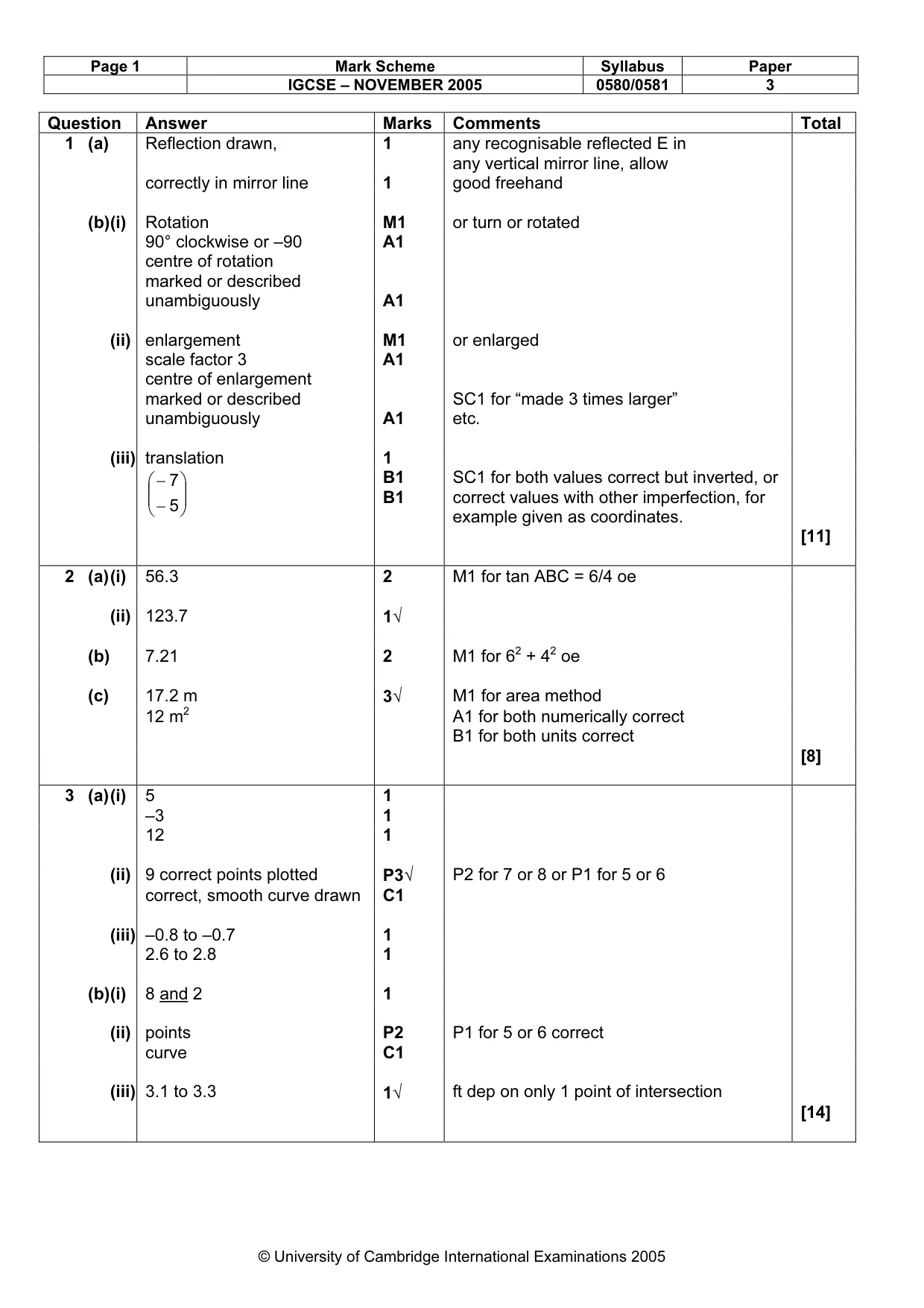
Mark scheme: IGCSE NOVEMBER 2005 0580/0581 3 Question Answer Marks Comments Total 1 (a) Reflection drawn, 1 any recognisable reflected E in any vertical mirror line, allow correctly in mirror line 1 good freehand (b) (i) Rotation M1 or turn or rotated 90° clockwise or –90 A1 centre of rotation marked or described unambiguously A1 (ii) enlargement M1 or enlarged scale factor 3 A1 centre of enlargement marked or described SC1 for “made 3 times larger” unambiguously A1 etc. (iii) translation 1 B1 SC1 for both values correct but inverted, or − 7 B1 correct values with other imperfection, for − 5 example given as coordinates. [11]
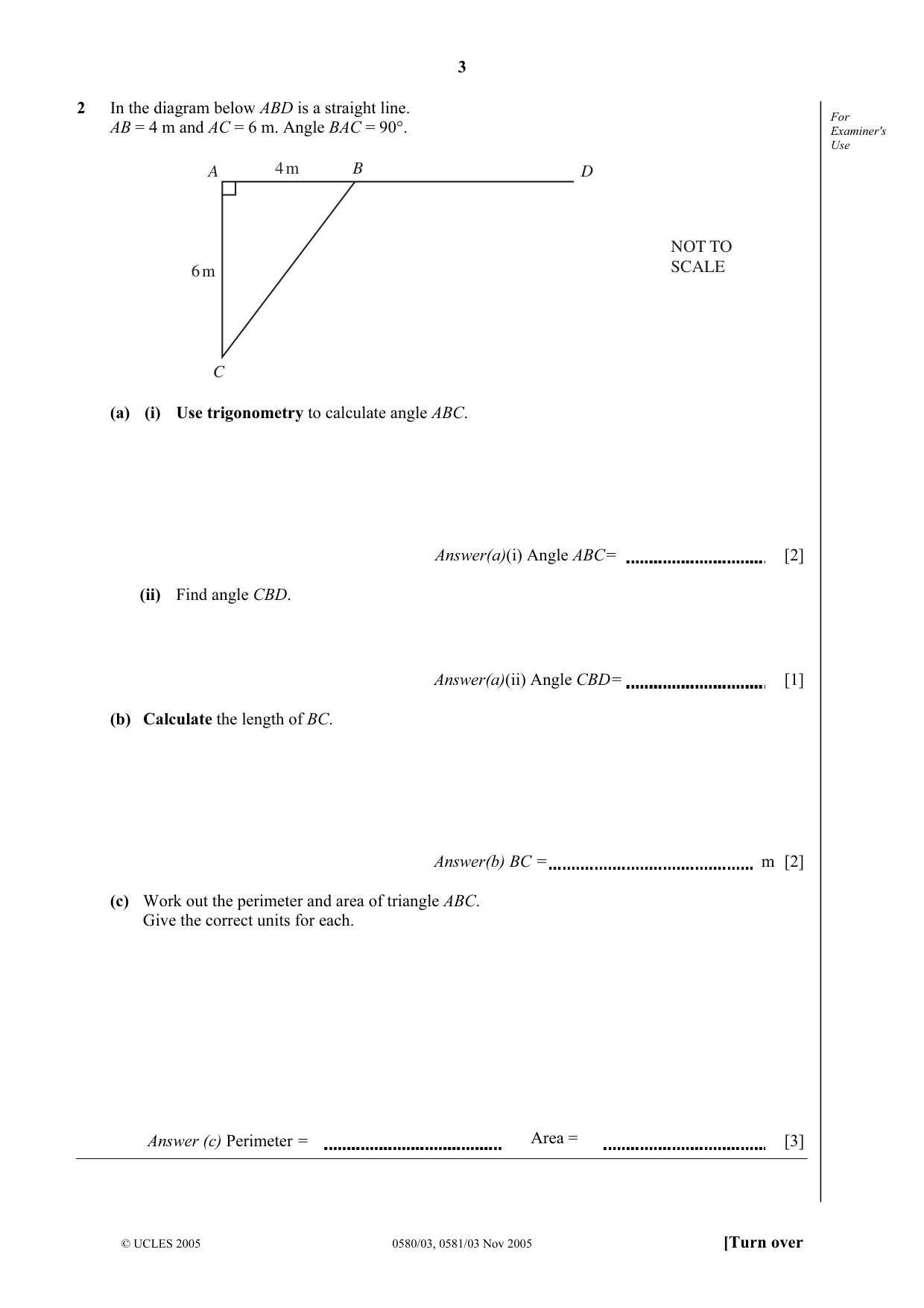
Q2 · In the diagram below ABD is a straight line
2 In the diagram below ABD is a straight line. For AB = 4 m and AC = 6 m. Angle BAC = 90°. Examiner's Use A 4 m B D NOT TO 6 m SCALE C (a) (i) Use trigonometry to calculate angle ABC. Answer(a)(i) Angle ABC= [2] (ii) Find angle CBD. Answer(a)(ii) Angle CBD= [1] (b) Calculate the length of BC. Answer(b) BC = m [2] (c) Work out the perimeter and area of triangle ABC. Give the correct units for each. Answer (c) Perimeter = Area = [3]
Mark scheme: 2 (a) (i) 56.3 2 M1 for tan ABC = 6/4 oe (ii) 123.7 1√ (b) 7.21 2 M1 for 62 + 42 oe (c) 17.2 m 3√ M1 for area method 12 m2 A1 for both numerically correct B1 for both units correct [8]
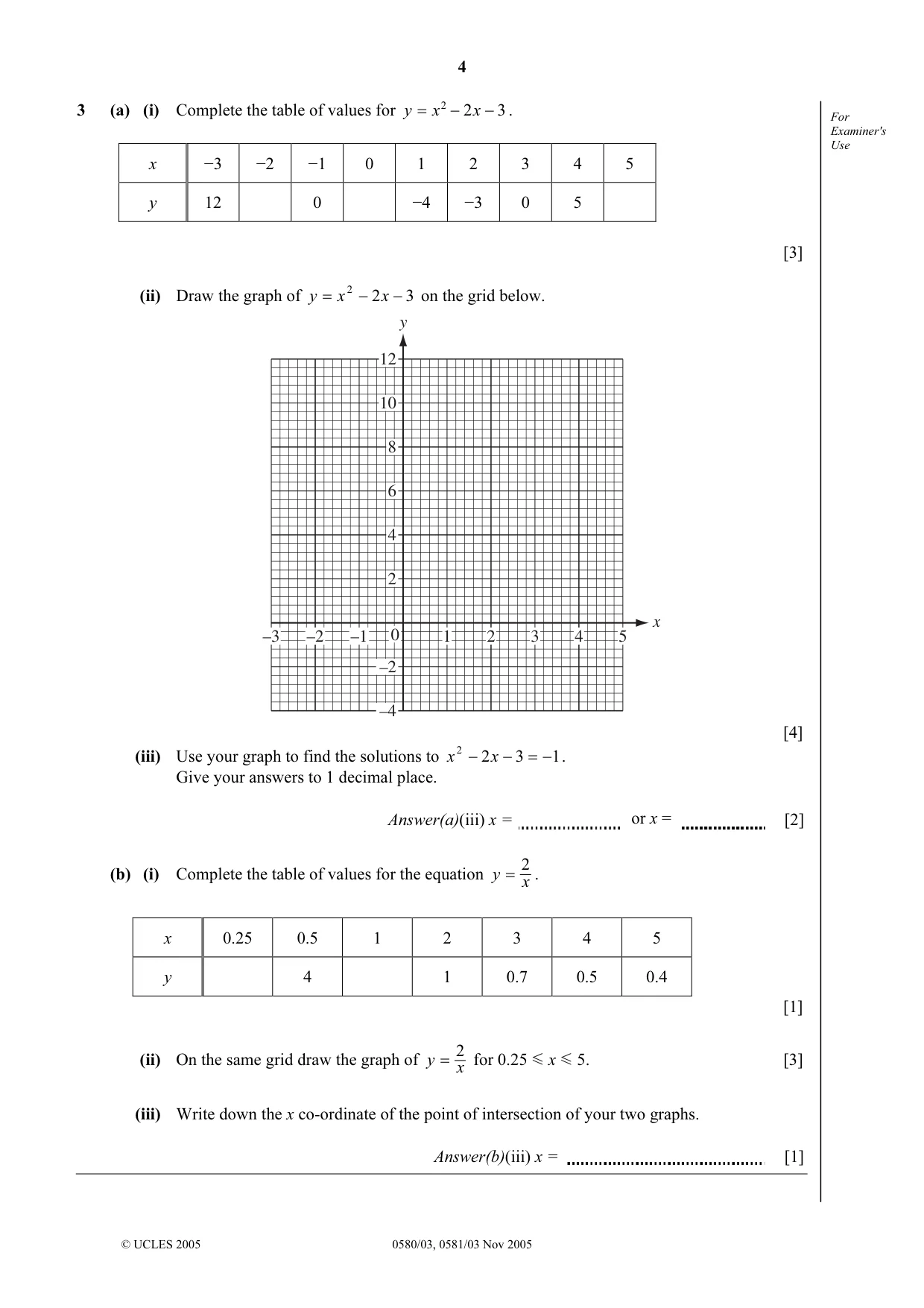
Q3 · Complete the table of values for y = x 2 − 2 x − 3
3 (a) (i) Complete the table of values for y = x 2 − 2 x − 3 . For Examiner's Use x −3 −2 −1 0 1 2 3 4 5 y 12 0 −4 −3 0 5 [3] (ii) Draw the graph of y = x 2 − 2 x − 3 on the grid below. y 12 10 8 6 4 2 x –3 –2 –1 0 1 2 3 4 5 –2 –4 [4] (iii) Use your graph to find the solutions to x 2 −x2 − 3 = −1 . Give your answers to 1 decimal place. Answer(a)(iii) x = or x = [2] 2 (b) (i) Complete the table of values for the equation y = . x x 0.25 0.5 1 2 3 4 5 y 4 1 0.7 0.5 0.4 [1] 2 (ii) On the same grid draw the graph of y = for 0.25 x 5. [3] x (iii) Write down the x co-ordinate of the point of intersection of your two graphs. Answer(b)(iii) x = [1]
Mark scheme: 3 (a) (i) 5 1 –3 1 12 1 (ii) 9 correct points plotted P3√ P2 for 7 or 8 or P1 for 5 or 6 correct, smooth curve drawn C1 (iii) –0.8 to –0.7 1 2.6 to 2.8 1 (b) (i) 8 and 2 1 (ii) points P2 P1 for 5 or 6 correct curve C1 (iii) 3.1 to 3.3 1√ ft dep on only 1 point of intersection [14] IGCSE – NOVEMBER 2005 0580/0581 3
Q4 · Jane records the number of telephone calls she receives each day for two weeks
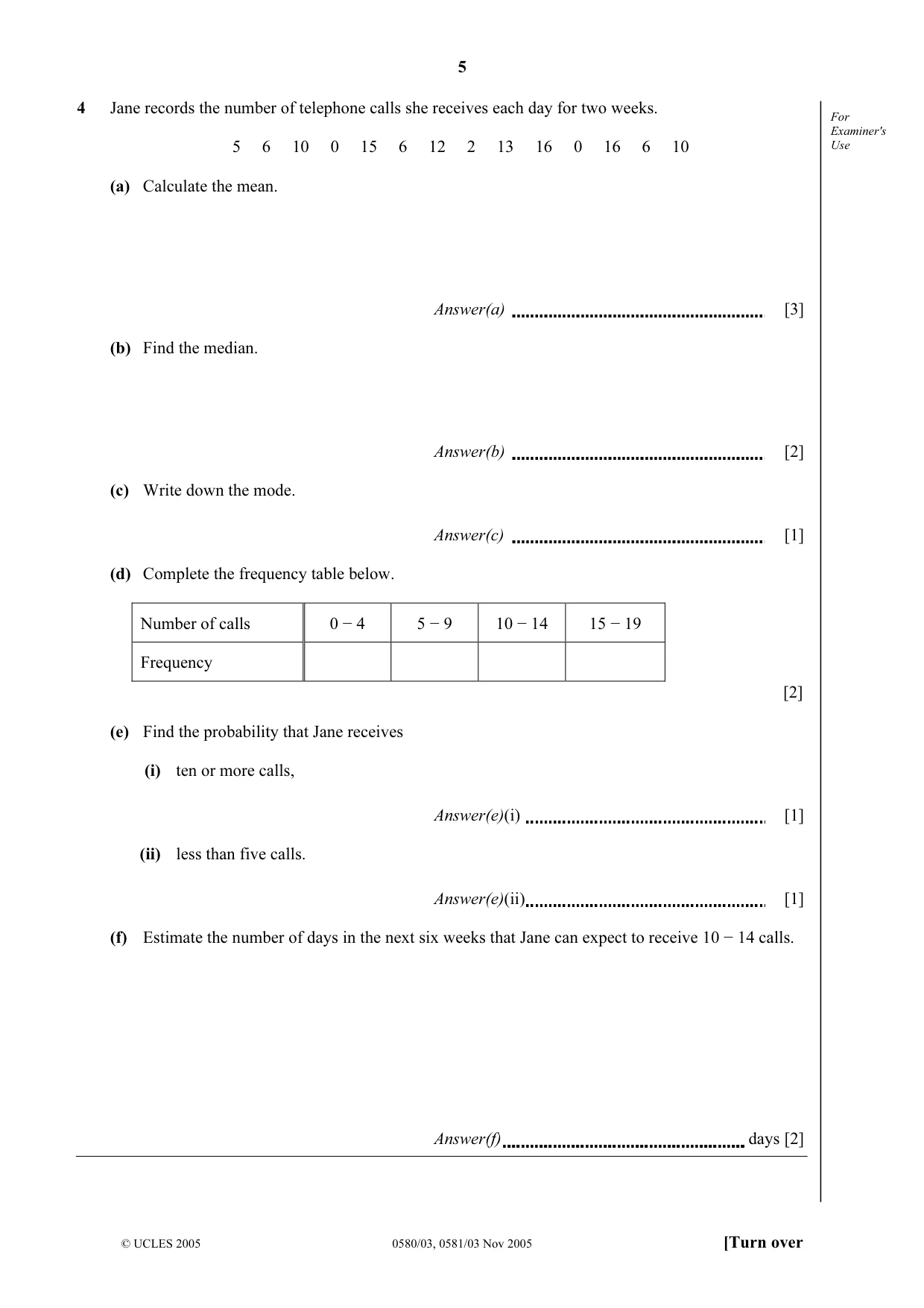
4 Jane records the number of telephone calls she receives each day for two weeks. For Examiner's 5 6 10 0 15 6 12 2 13 16 0 16 6 10 Use (a) Calculate the mean. Answer(a) [3] (b) Find the median. Answer(b) [2] (c) Write down the mode. Answer(c) [1] (d) Complete the frequency table below. Number of calls 0 − 4 5 − 9 10 − 14 15 − 19 Frequency [2] (e) Find the probability that Jane receives (i) ten or more calls, Answer(e)(i) [1] (ii) less than five calls. Answer(e)(ii) [1] (f) Estimate the number of days in the next six weeks that Jane can expect to receive 10 − 14 calls. Answer(f) days [2]
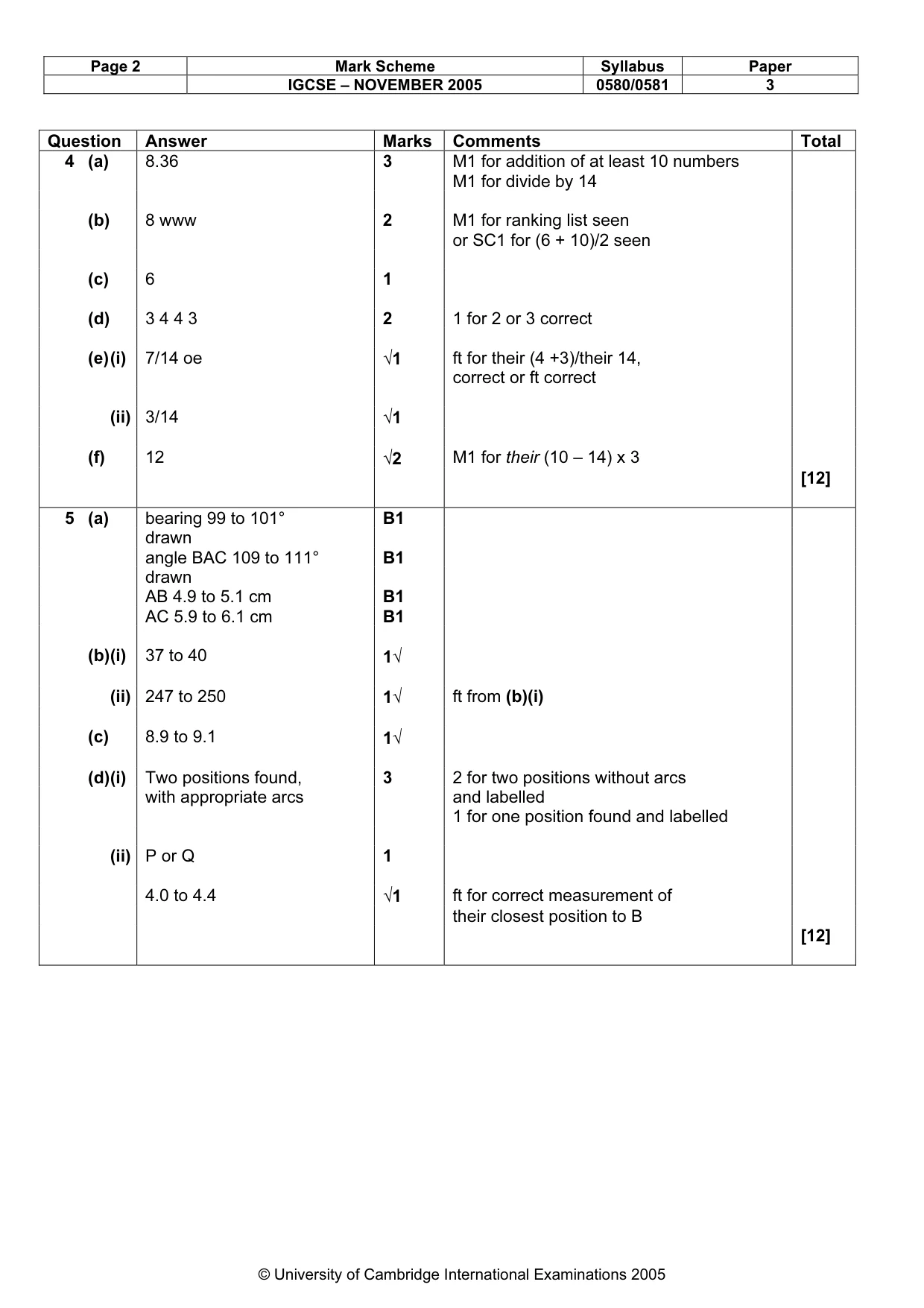
Mark scheme: 4 (a) 8.36 3 M1 for addition of at least 10 numbers M1 for divide by 14 (b) 8 www 2 M1 for ranking list seen or SC1 for (6 + 10)/2 seen (c) 6 1 (d) 3 4 4 3 2 1 for 2 or 3 correct (e) (i) 7/14 oe √1 ft for their (4 +3)/their 14, correct or ft correct (ii) 3/14 √1 (f) 12 √2 M1 for their (10 – 14) x 3 [12]
Q5 · For North Examiner's Use A 110o 6 km 5 km NOT TO C SCALE B In triangle ABC, AB = 5 km, AC…
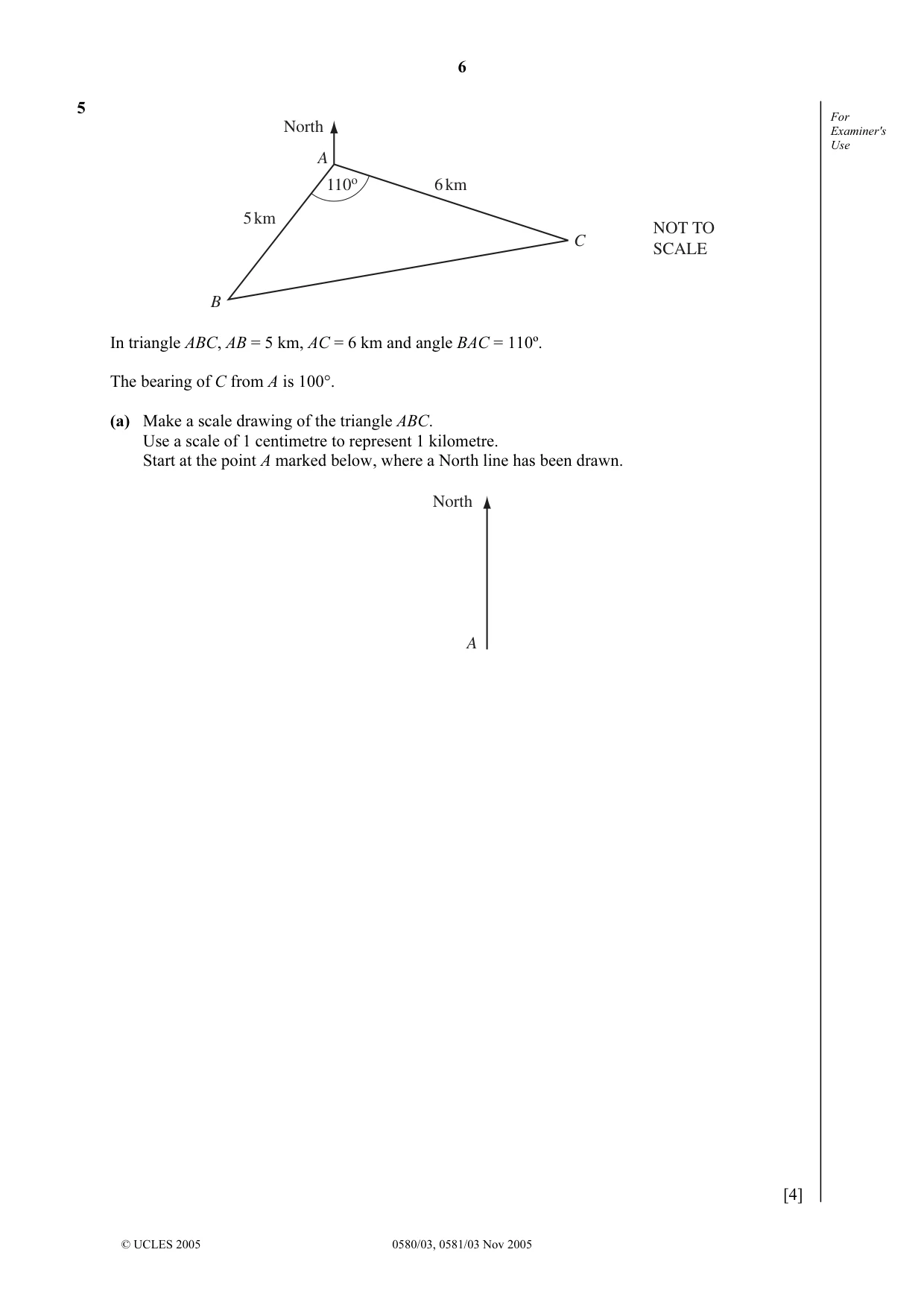
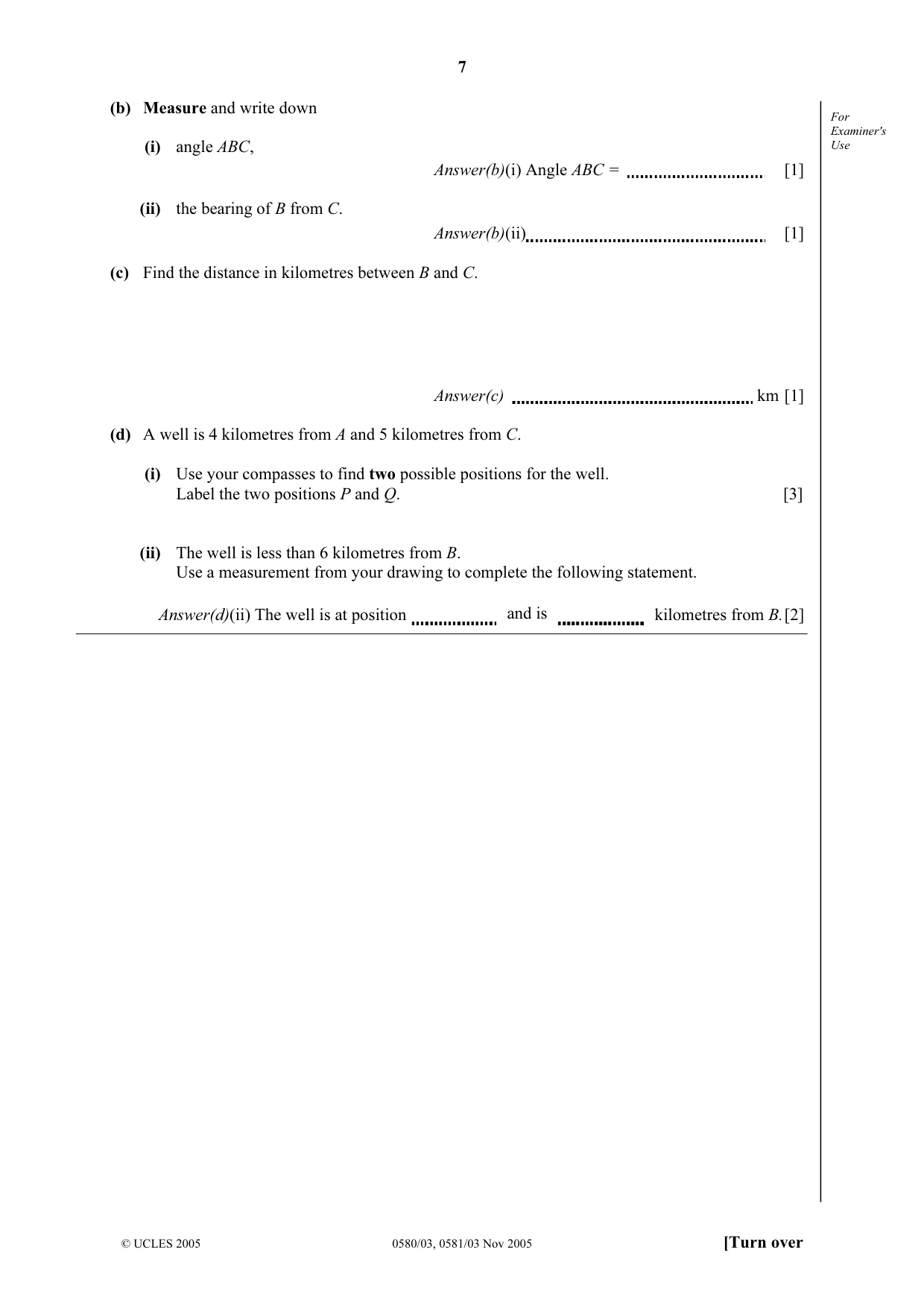
5 For North Examiner's Use A 110o 6 km 5 km NOT TO C SCALE B In triangle ABC, AB = 5 km, AC = 6 km and angle BAC = 110º. The bearing of C from A is 100°. (a) Make a scale drawing of the triangle ABC. Use a scale of 1 centimetre to represent 1 kilometre. Start at the point A marked below, where a North line has been drawn. North A [4] (b) Measure and write down For Examiner's (i) angle ABC, Use Answer(b)(i) Angle ABC = [1] (ii) the bearing of B from C. Answer(b)(ii) [1] (c) Find the distance in kilometres between B and C. Answer(c) km [1] (d) A well is 4 kilometres from A and 5 kilometres from C. (i) Use your compasses to find two possible positions for the well. Label the two positions P and Q. [3] (ii) The well is less than 6 kilometres from B. Use a measurement from your drawing to complete the following statement. Answer(d)(ii) The well is at position and is kilometres from B.[2]
Mark scheme: 5 (a) bearing 99 to 101° B1 drawn angle BAC 109 to 111° B1 drawn AB 4.9 to 5.1 cm B1 AC 5.9 to 6.1 cm B1 (b) (i) 37 to 40 1√ (ii) 247 to 250 1√ ft from (b)(i) (c) 8.9 to 9.1 1√ (d) (i) Two positions found, 3 2 for two positions without arcs with appropriate arcs and labelled 1 for one position found and labelled (ii) P or Q 1 4.0 to 4.4 √1 ft for correct measurement of their closest position to B [12] IGCSE – NOVEMBER 2005 0580/0581 3
Q6 · The diagram shows a swimming pool with cross-section ABCDE
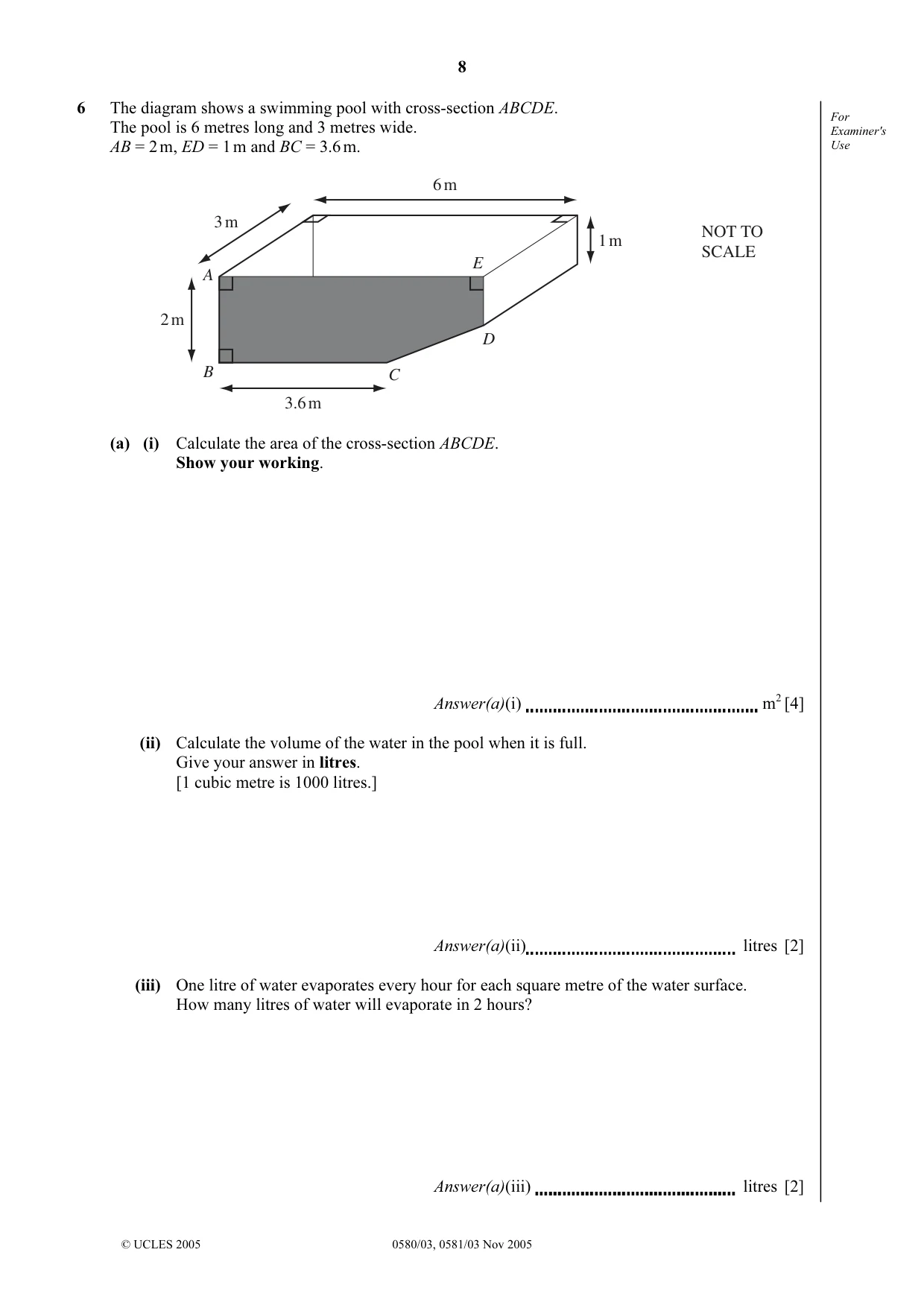
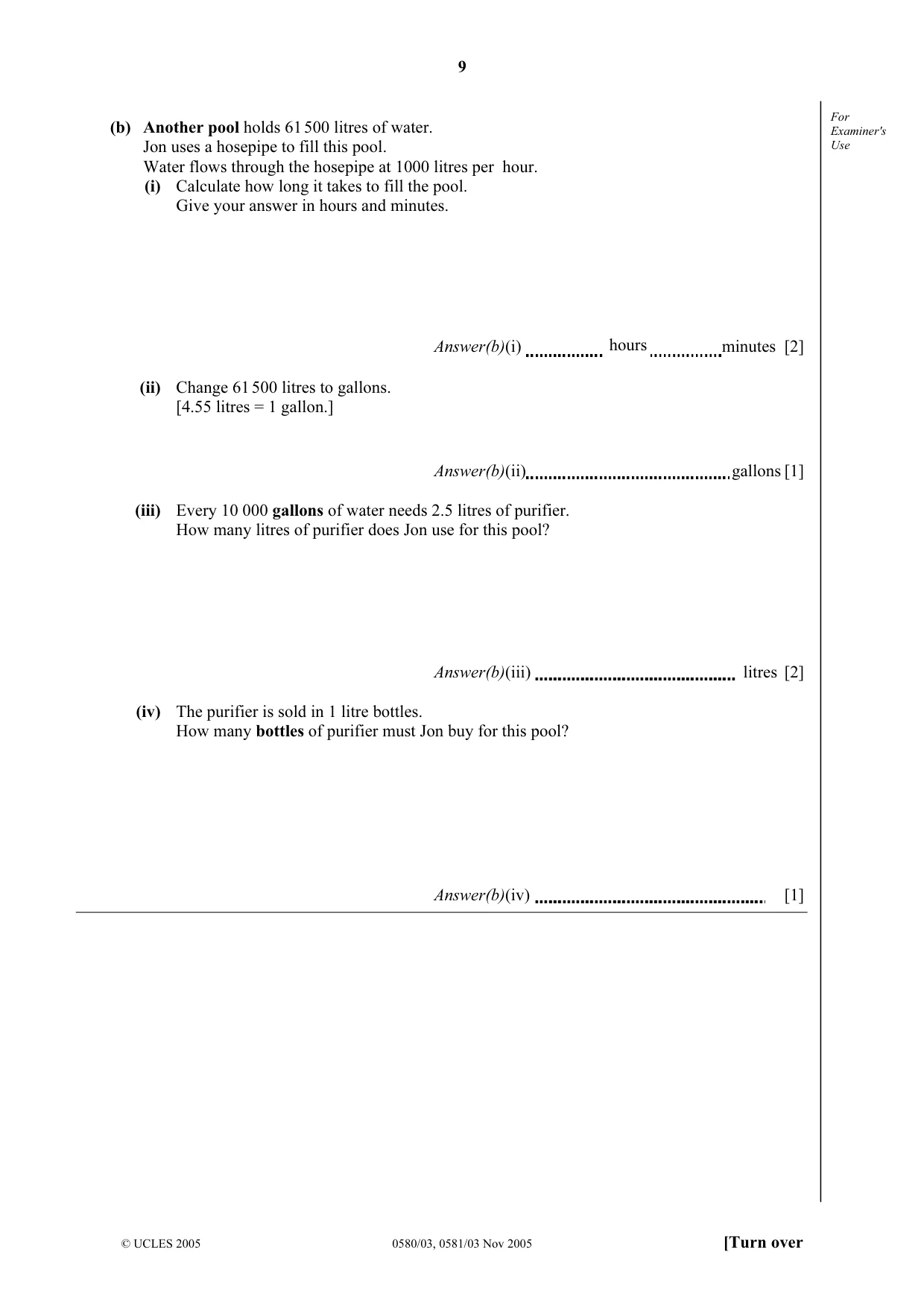
6 The diagram shows a swimming pool with cross-section ABCDE. For The pool is 6 metres long and 3 metres wide. Examiner's AB = 2 m, ED = 1 m and BC = 3.6 m. Use 6 m 3 m NOT TO 1 m SCALE E A 2 m D B C 3.6 m (a) (i) Calculate the area of the cross-section ABCDE. Show your working. Answer(a)(i) m2 [4] (ii) Calculate the volume of the water in the pool when it is full. Give your answer in litres. [1 cubic metre is 1000 litres.] Answer(a)(ii) litres [2] (iii) One litre of water evaporates every hour for each square metre of the water surface. How many litres of water will evaporate in 2 hours? Answer(a)(iii) litres [2] For (b) Another pool holds 61 500 litres of water. Examiner's Jon uses a hosepipe to fill this pool. Use Water flows through the hosepipe at 1000 litres per hour. (i) Calculate how long it takes to fill the pool. Give your answer in hours and minutes. Answer(b)(i) hours minutes [2] (ii) Change 61 500 litres to gallons. [4.55 litres = 1 gallon.] Answer(b)(ii) gallons [1] (iii) Every 10 000 gallons of water needs 2.5 litres of purifier. How many litres of purifier does Jon use for this pool? Answer(b)(iii) litres [2] (iv) The purifier is sold in 1 litre bottles. How many bottles of purifier must Jon buy for this pool? Answer(b)(iv) [1]
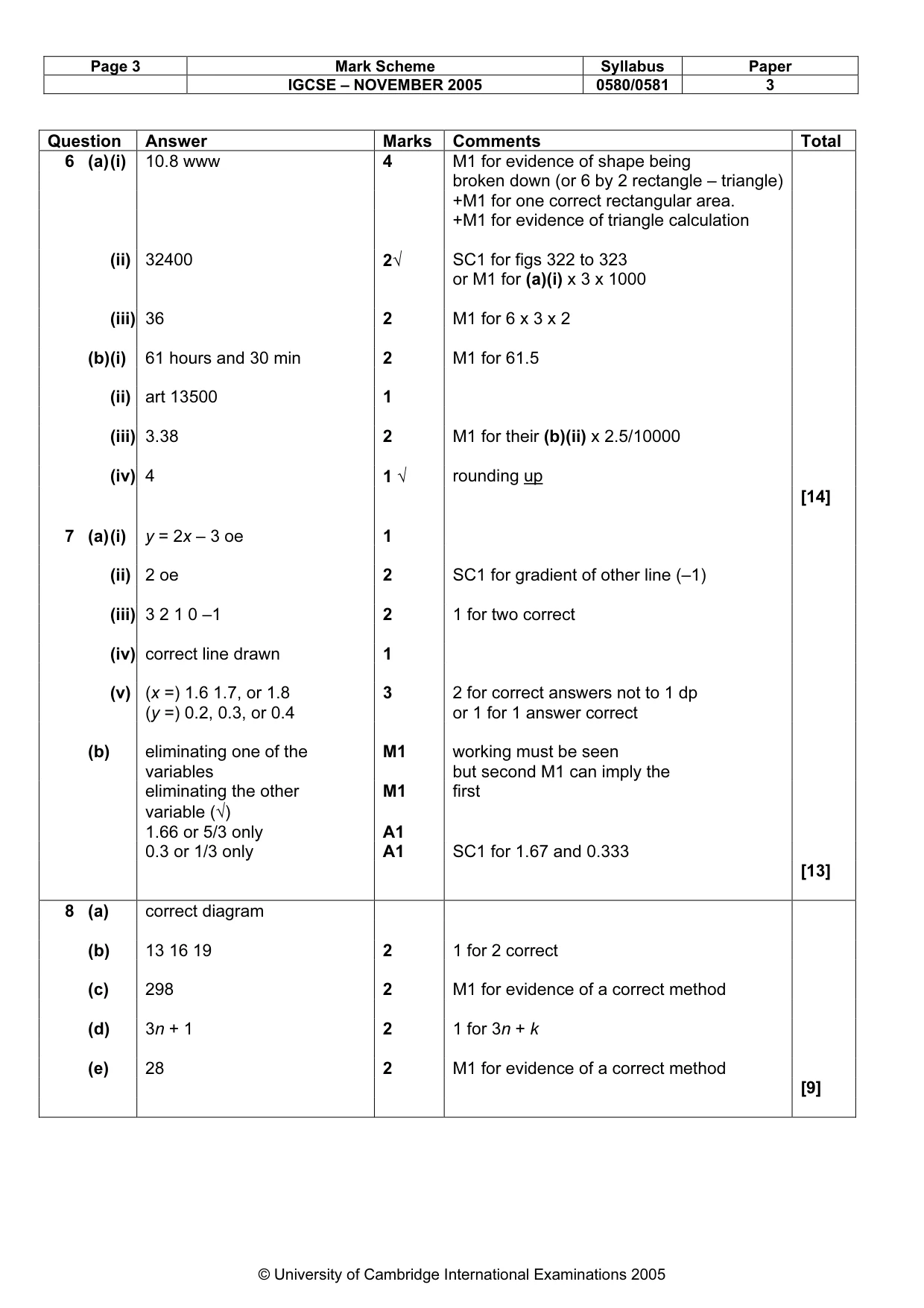
Mark scheme: 6 (a) (i) 10.8 www 4 M1 for evidence of shape being broken down (or 6 by 2 rectangle – triangle) +M1 for one correct rectangular area. +M1 for evidence of triangle calculation (ii) 32400 2√ SC1 for figs 322 to 323 or M1 for (a)(i) x 3 x 1000 (iii) 36 2 M1 for 6 x 3 x 2 (b) (i) 61 hours and 30 min 2 M1 for 61.5 (ii) art 13500 1 (iii) 3.38 2 M1 for their (b)(ii) x 2.5/10000 (iv) 4 1 √ rounding up [14]
Q7 · For y Examiner's Use 3 2 1 x –3 –2 –1 0 1 2 3 4 5 –1 –2 –3 –4 –5 The simultaneous…
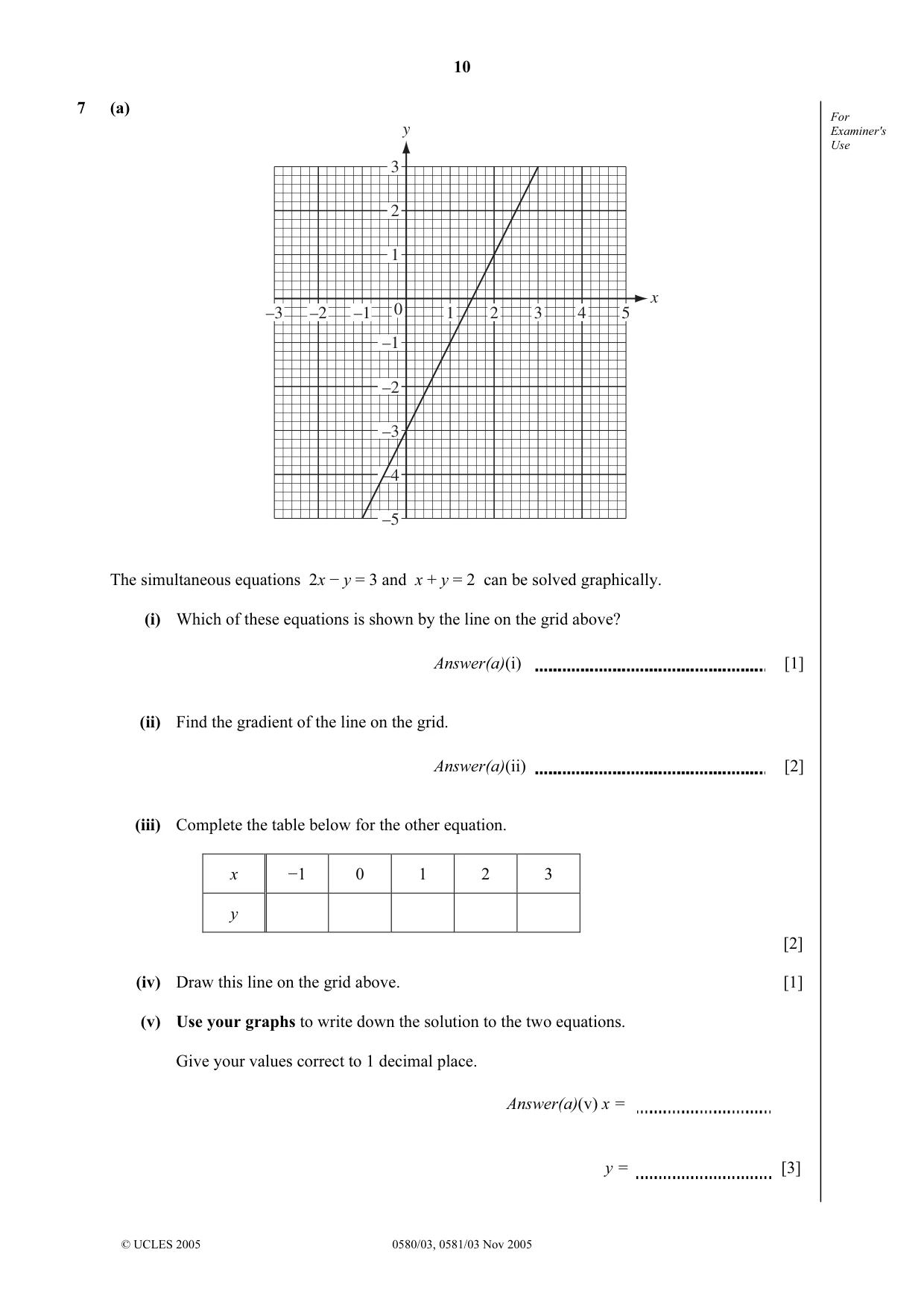
7 (a) For y Examiner's Use 3 2 1 x –3 –2 –1 0 1 2 3 4 5 –1 –2 –3 –4 –5 The simultaneous equations 2x − y = 3 and x + y = 2 can be solved graphically. (i) Which of these equations is shown by the line on the grid above? Answer(a)(i) [1] (ii) Find the gradient of the line on the grid. Answer(a)(ii) [2] (iii) Complete the table below for the other equation. x −1 0 1 2 3 y [2] (iv) Draw this line on the grid above. [1] (v) Use your graphs to write down the solution to the two equations. Give your values correct to 1 decimal place. Answer(a)(v) x = y = [3] (b) Use algebra to solve the following simultaneous equations exactly. For Show all your working. Examiner's Use 2x − y = 3, x + y = 2. Answer(b) x = y = [4]
Mark scheme: 7 (a) (i) y = 2x – 3 oe 1 (ii) 2 oe 2 SC1 for gradient of other line (–1) (iii) 3 2 1 0 –1 2 1 for two correct (iv) correct line drawn 1 (v) (x =) 1.6 1.7, or 1.8 3 2 for correct answers not to 1 dp (y =) 0.2, 0.3, or 0.4 or 1 for 1 answer correct (b) eliminating one of the M1 working must be seen variables but second M1 can imply the eliminating the other M1 first variable (√) 1.66 or 5/3 only A1 0.3 or 1/3 only A1 SC1 for 1.67 and 0.333 [13]
Q8 · The diagram below shows a sequence of patterns made from dots and lines
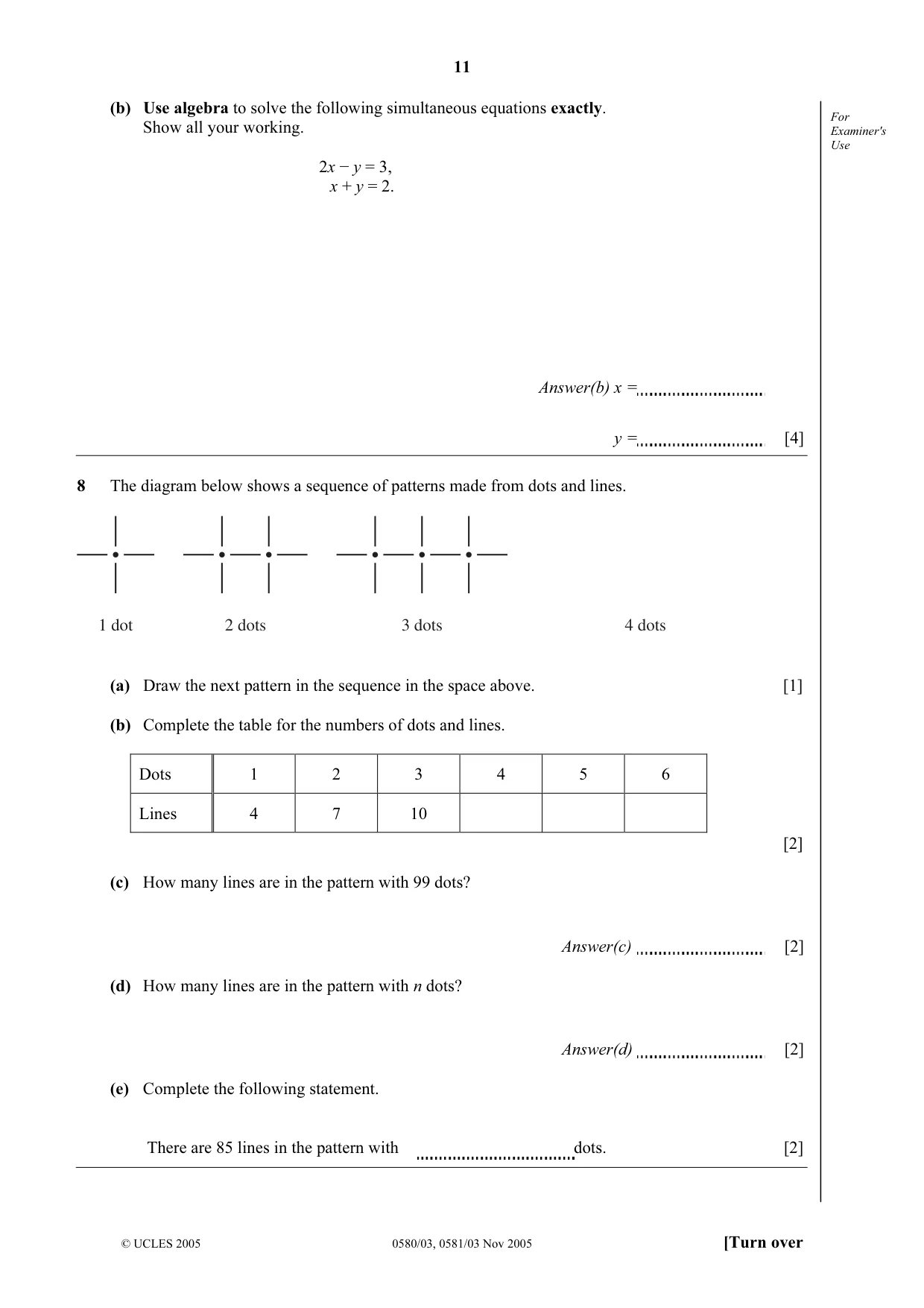
8 The diagram below shows a sequence of patterns made from dots and lines. 1 dot 2 dots 3 dots 4 dots (a) Draw the next pattern in the sequence in the space above. [1] (b) Complete the table for the numbers of dots and lines. Dots 1 2 3 4 5 6 Lines 4 7 10 [2] (c) How many lines are in the pattern with 99 dots? Answer(c) [2] (d) How many lines are in the pattern with n dots? Answer(d) [2] (e) Complete the following statement. There are 85 lines in the pattern with dots. [2]
Mark scheme: 8 (a) correct diagram (b) 13 16 19 2 1 for 2 correct (c) 298 2 M1 for evidence of a correct method (d) 3n + 1 2 1 for 3n + k (e) 28 2 M1 for evidence of a correct method [9] IGCSE – NOVEMBER 2005 0580/0581 3
Q9 · Calculate the size of one exterior angle of a regular heptagon (seven-sided polygon)
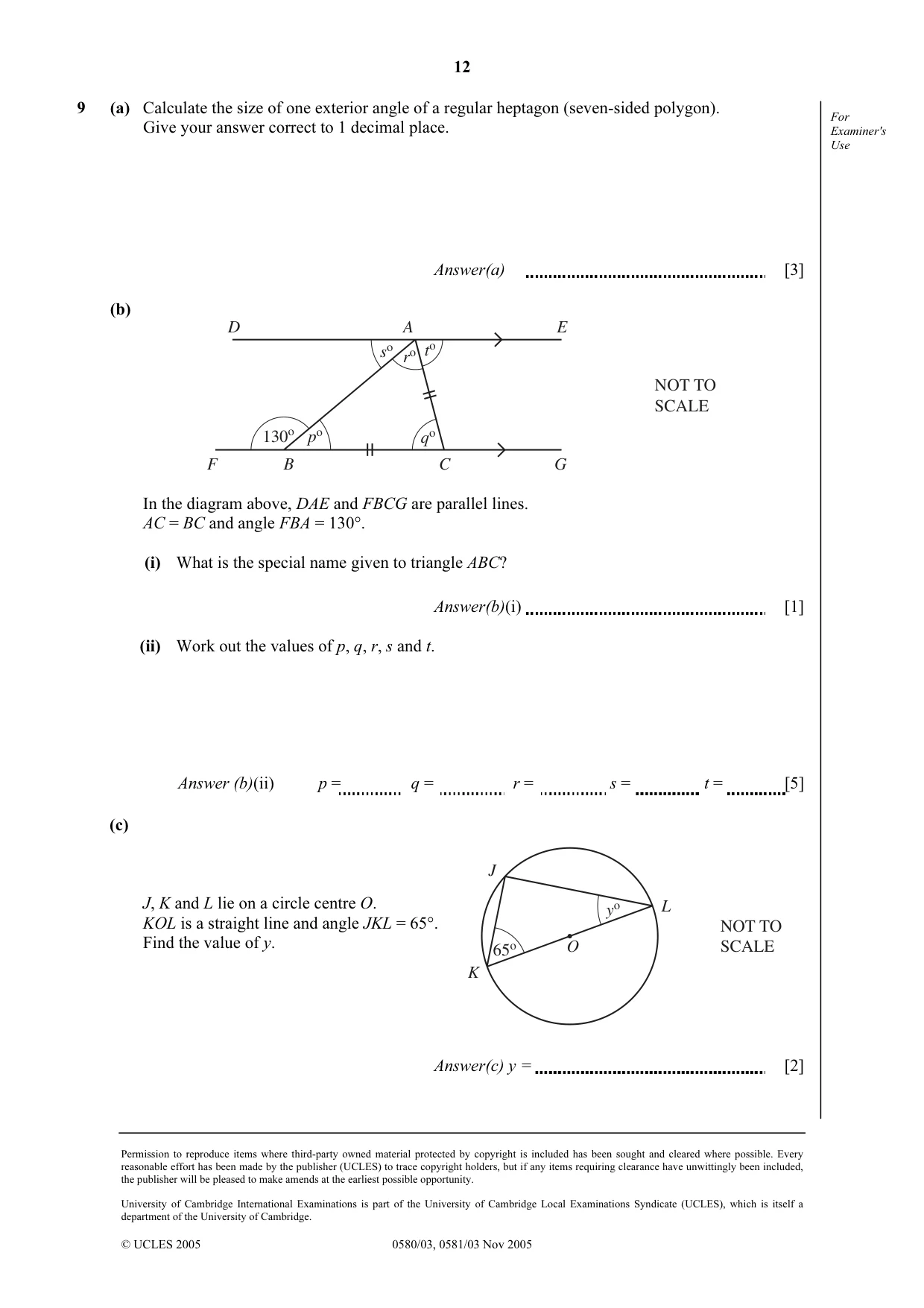
9 (a) Calculate the size of one exterior angle of a regular heptagon (seven-sided polygon). For Give your answer correct to 1 decimal place. Examiner's Use Answer(a) [3] (b) D A E so to ro NOT TO SCALE 130o po qo F B C G In the diagram above, DAE and FBCG are parallel lines. AC = BC and angle FBA = 130°. (i) What is the special name given to triangle ABC? Answer(b)(i) [1] (ii) Work out the values of p, q, r, s and t. Answer (b)(ii) p = q = r = s = t = [5] (c) J J, K and L lie on a circle centre O. yo L KOL is a straight line and angle JKL = 65°. NOT TO Find the value of y. 65o O SCALE K Answer(c) y = [2]
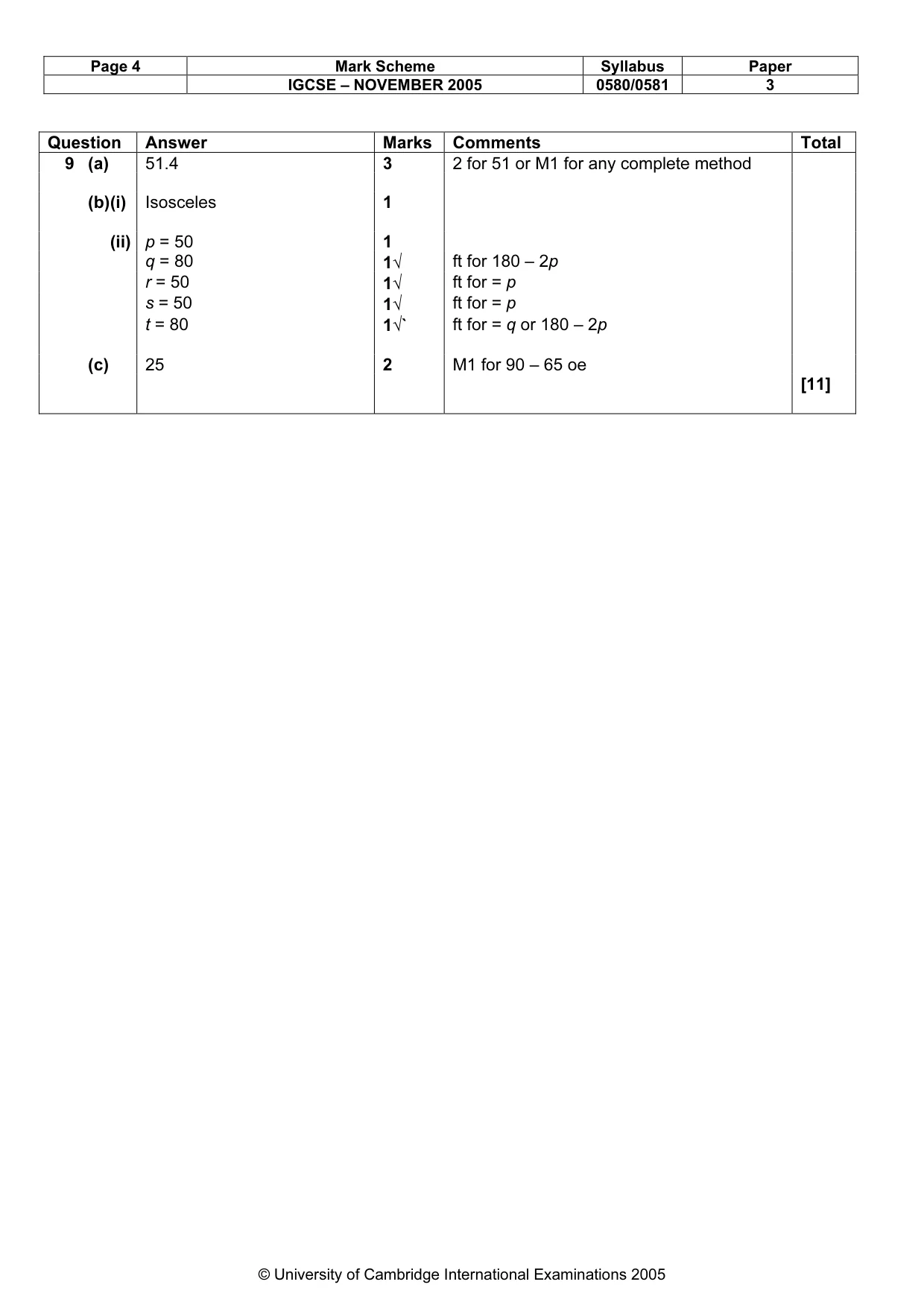
Mark scheme: 9 (a) 51.4 3 2 for 51 or M1 for any complete method (b) (i) Isosceles 1 (ii) p = 50 1 q = 80 1√ ft for 180 – 2p r = 50 1√ ft for = p s = 50 1√ ft for = p t = 80 1√` ft for = q or 180 – 2p (c) 25 2 M1 for 90 – 65 oe [11]
What was in this paper
The subtopics covered by these 9 questions, and how many questions each got. Open one in a new tab to see every Cambridge question on it.