Cambridge IGCSE Mathematics 0580 — 2005 May/June Paper 3 · Variant 1
0580/31/M/J/05 · 8 questions · 104 marks · ≈117 min
The question paper and its mark scheme, free to read here and free to download. This is Cambridge’s own paper, exactly as it was sat.
Question paper16 pages
Mark scheme8 pages
Answers below. Sit the paper first if you are practising.
Questions as text
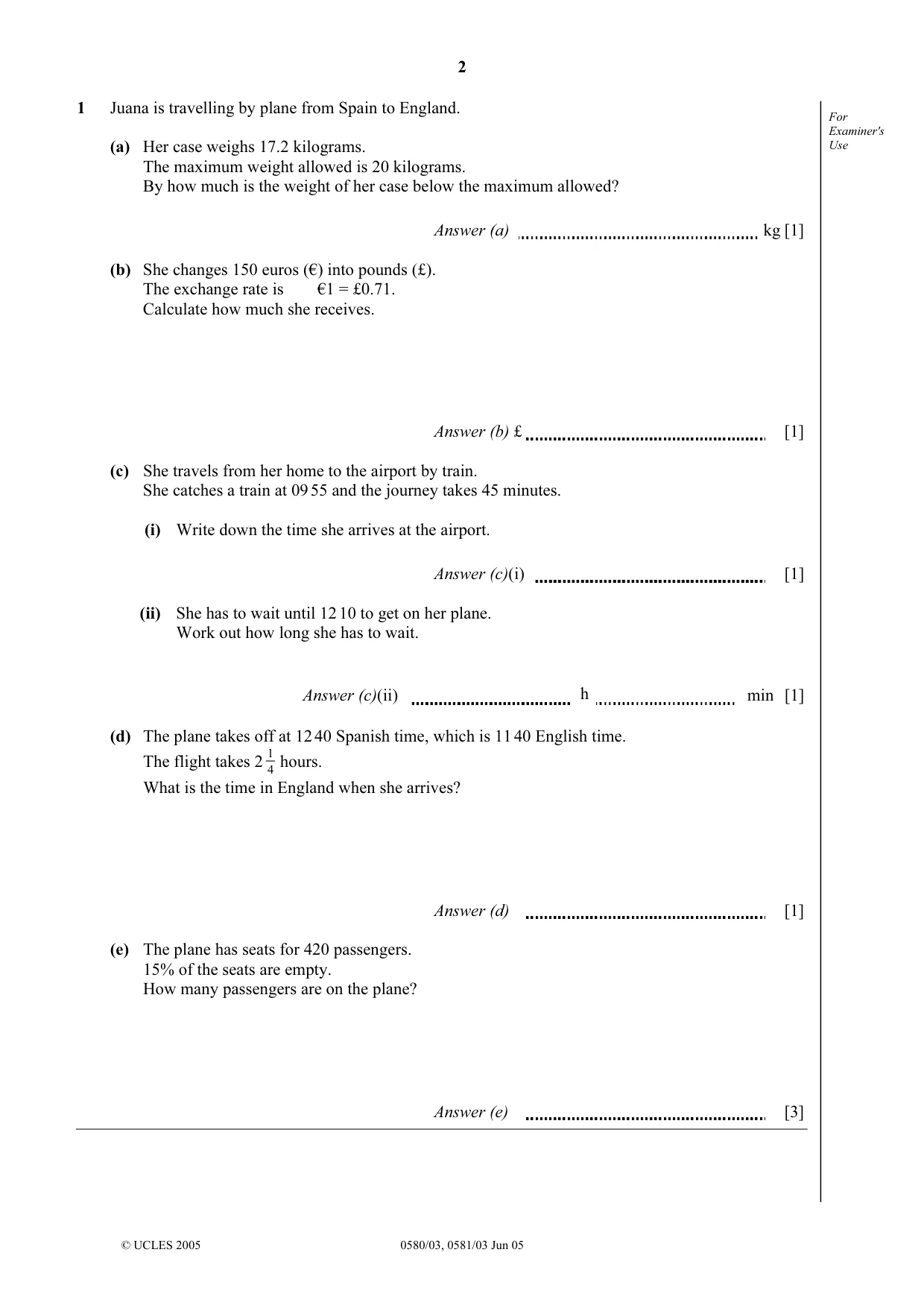
Q1 · Juana is travelling by plane from Spain to England
1 Juana is travelling by plane from Spain to England. For Examiner's (a) Her case weighs 17.2 kilograms. Use The maximum weight allowed is 20 kilograms. By how much is the weight of her case below the maximum allowed? Answer (a) kg [1] (b) She changes 150 euros (€) into pounds (£). The exchange rate is €1 = £0.71. Calculate how much she receives. Answer (b) £ [1] (c) She travels from her home to the airport by train. She catches a train at 09 55 and the journey takes 45 minutes. (i) Write down the time she arrives at the airport. Answer (c)(i) [1] (ii) She has to wait until 12 10 to get on her plane. Work out how long she has to wait. Answer (c)(ii) h min [1] (d) The plane takes off at 12 40 Spanish time, which is 11 40 English time. 1 The flight takes 2 4 hours. What is the time in England when she arrives? Answer (d) [1] (e) The plane has seats for 420 passengers. 15% of the seats are empty. How many passengers are on the plane? Answer (e) [3]
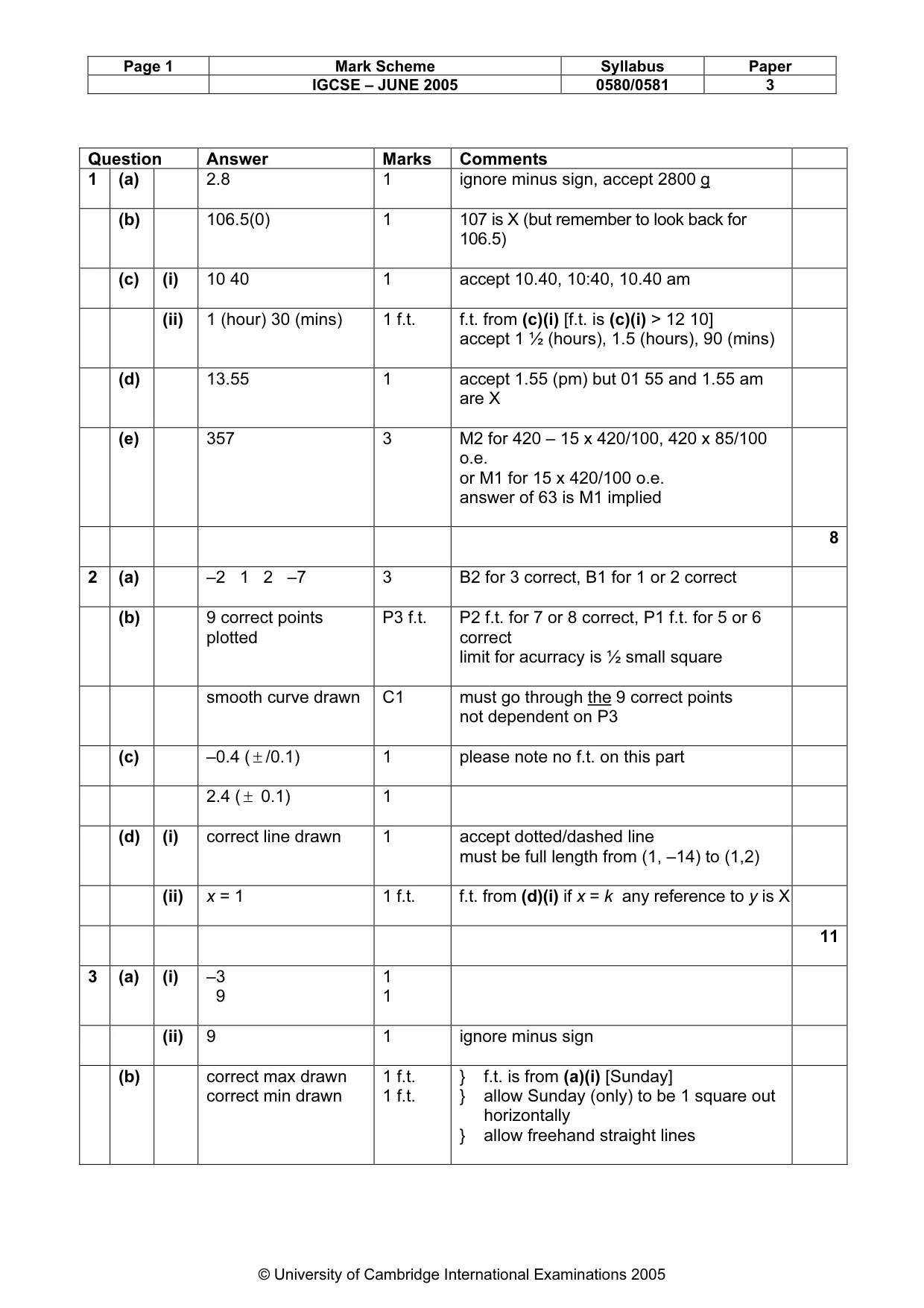
Mark scheme: Question Answer Marks Comments 1 (a) 2.8 1 ignore minus sign, accept 2800 g (b) 106.5(0) 1 107 is X (but remember to look back for 106.5) (c) (i) 10 40 1 accept 10.40, 10:40, 10.40 am (ii) 1 (hour) 30 (mins) 1 f.t. f.t. from (c)(i) [f.t. is (c)(i) > 12 10] accept 1 ½ (hours), 1.5 (hours), 90 (mins) (d) 13.55 1 accept 1.55 (pm) but 01 55 and 1.55 am are X (e) 357 3 M2 for 420 – 15 x 420/100, 420 x 85/100 o.e. or M1 for 15 x 420/100 o.e. answer of 63 is M1 implied 8
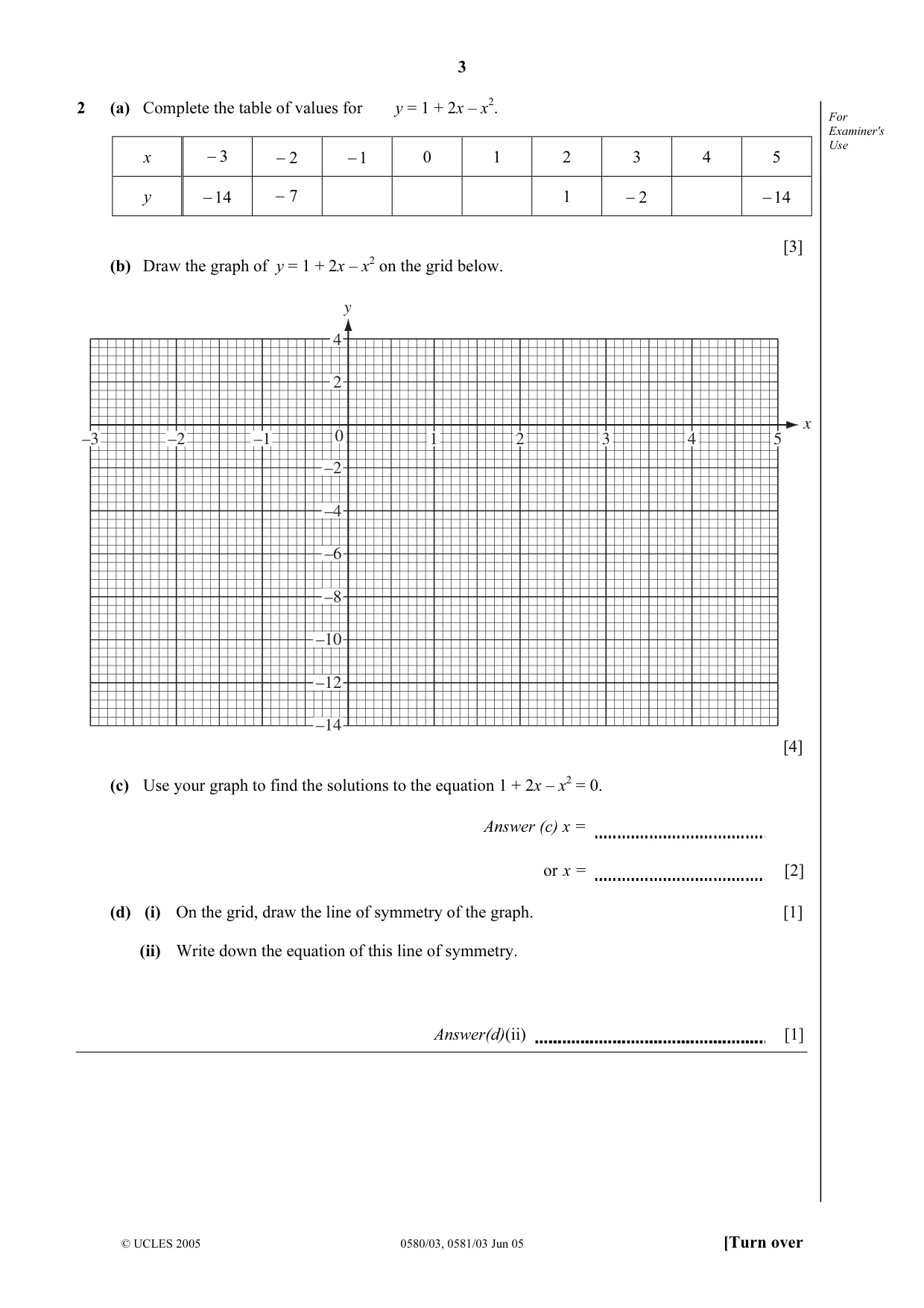
Q2 · Complete the table of values for y = 1 + 2x – x2
2 (a) Complete the table of values for y = 1 + 2x – x2. For Examiner's Use x − 3 − 2 − 1 0 1 2 3 4 5 y − 14 − 7 1 − 2 − 14 [3] (b) Draw the graph of y = 1 + 2x – x2 on the grid below. y 4 2 x –3 –2 –1 0 1 2 3 4 5 –2 –4 –6 –8 –10 –12 –14 [4] (c) Use your graph to find the solutions to the equation 1 + 2x – x2 = 0. Answer (c) x = or x = [2] (d) (i) On the grid, draw the line of symmetry of the graph. [1] (ii) Write down the equation of this line of symmetry. Answer(d)(ii) [1]
Mark scheme: 2 (a) –2 1 2 –7 3 B2 for 3 correct, B1 for 1 or 2 correct (b) 9 correct points P3 f.t. P2 f.t. for 7 or 8 correct, P1 f.t. for 5 or 6 plotted correct limit for acurracy is ½ small square smooth curve drawn C1 must go through the 9 correct points not dependent on P3 (c) –0.4 ( ± /0.1) 1 please note no f.t. on this part 2.4 ( ± 0.1) 1 (d) (i) correct line drawn 1 accept dotted/dashed line must be full length from (1, –14) to (1,2) (ii) x = 1 1 f.t. f.t. from (d)(i) if x = k any reference to y is X 11
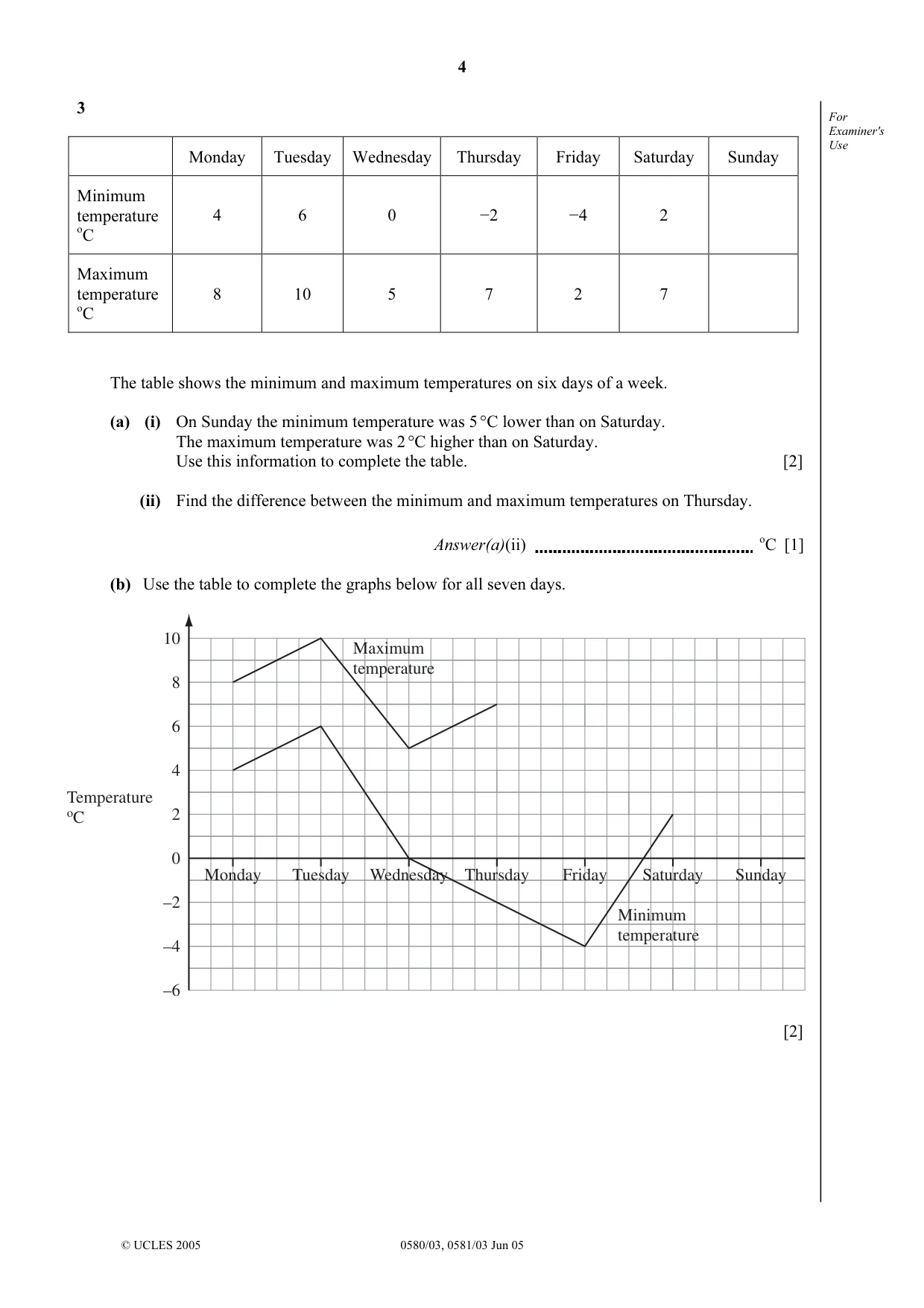
Q3 · For Examiner's Use Monday Tuesday Wednesday Thursday Friday Saturday Sunday Minimum…
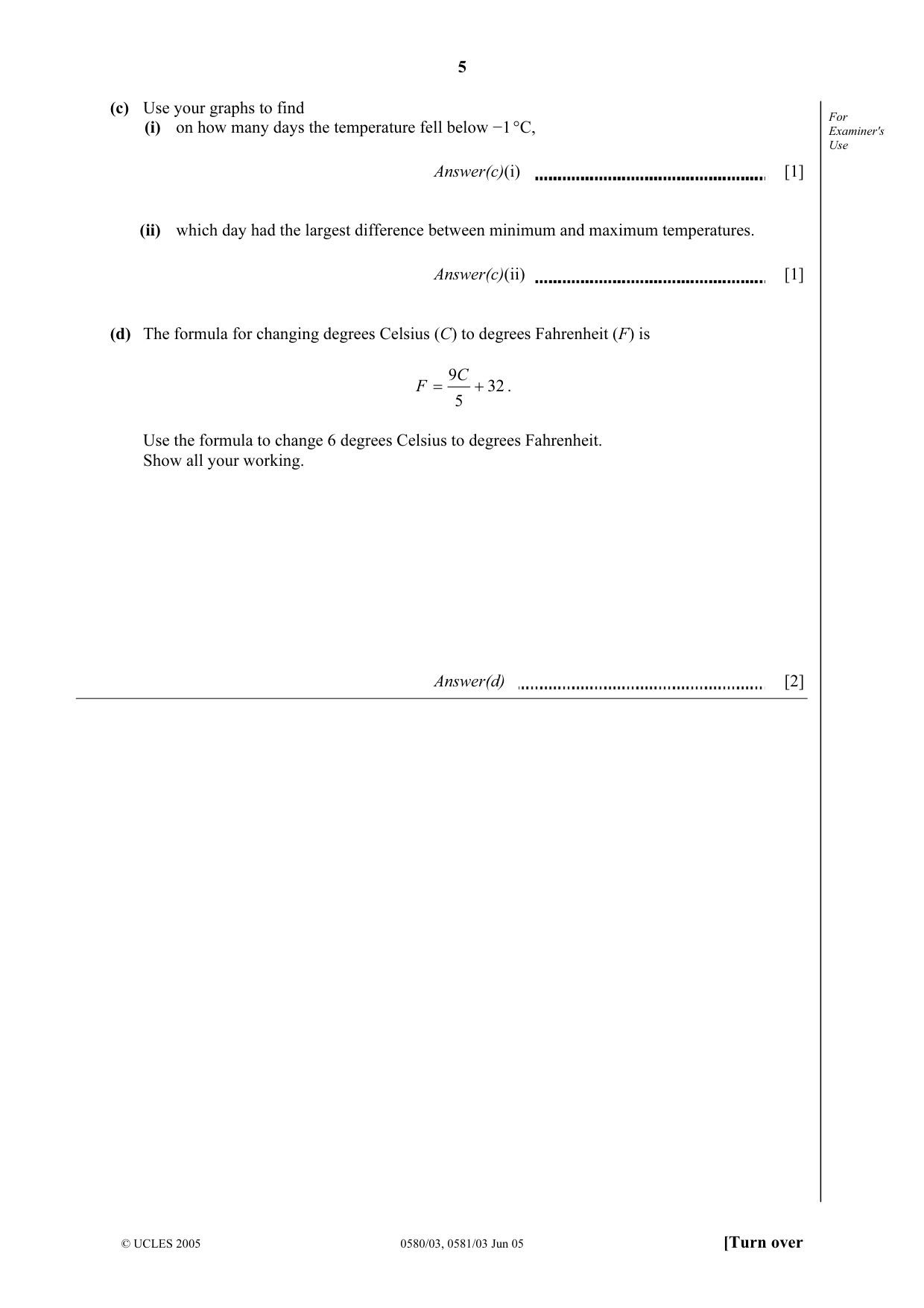
3 For Examiner's Use Monday Tuesday Wednesday Thursday Friday Saturday Sunday Minimum temperature 4 6 0 −2 −4 2 oC Maximum temperature 8 10 5 7 2 7 oC The table shows the minimum and maximum temperatures on six days of a week. (a) (i) On Sunday the minimum temperature was 5 °C lower than on Saturday. The maximum temperature was 2 °C higher than on Saturday. Use this information to complete the table. [2] (ii) Find the difference between the minimum and maximum temperatures on Thursday. Answer(a)(ii) oC [1] (b) Use the table to complete the graphs below for all seven days. 10 Maximum temperature 8 6 4 Temperature oC 2 0 Monday Tuesday Wednesday Thursday Friday Saturday Sunday –2 Minimum temperature –4 –6 [2] (c) Use your graphs to find For (i) on how many days the temperature fell below −1 °C, Examiner's Use Answer(c)(i) [1] (ii) which day had the largest difference between minimum and maximum temperatures. Answer(c)(ii) [1] (d) The formula for changing degrees Celsius (C) to degrees Fahrenheit (F) is 9C F = + 32 . 5 Use the formula to change 6 degrees Celsius to degrees Fahrenheit. Show all your working. Answer(d) [2]
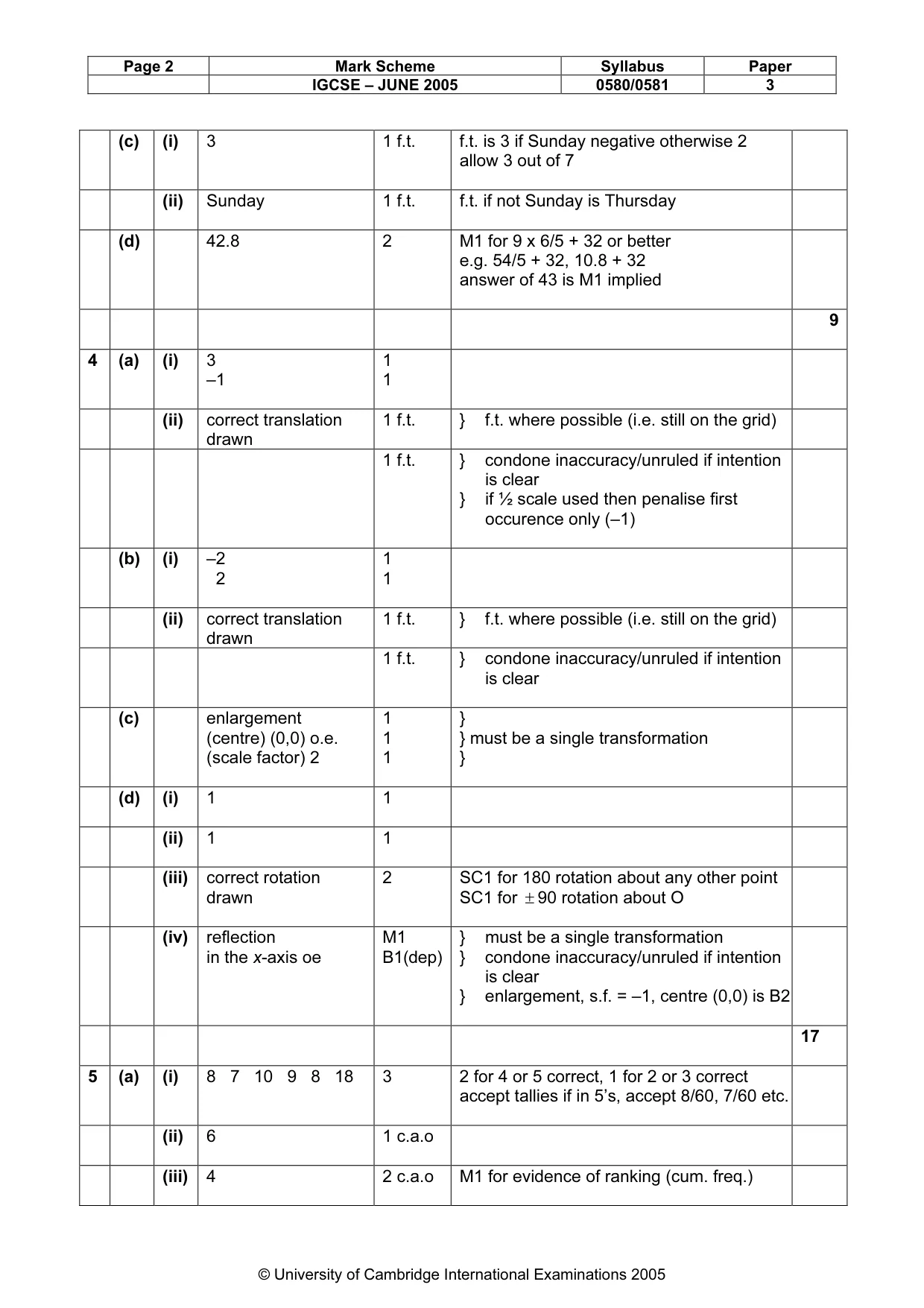
Mark scheme: 3 (a) (i) –3 1 9 1 (ii) 9 1 ignore minus sign (b) correct max drawn 1 f.t. } f.t. is from (a)(i) [Sunday] correct min drawn 1 f.t. } allow Sunday (only) to be 1 square out horizontally } allow freehand straight lines IGCSE – JUNE 2005 0580/0581 3 (c) (i) 3 1 f.t. f.t. is 3 if Sunday negative otherwise 2 allow 3 out of 7 (ii) Sunday 1 f.t. f.t. if not Sunday is Thursday (d) 42.8 2 M1 for 9 x 6/5 + 32 or better e.g. 54/5 + 32, 10.8 + 32 answer of 43 is M1 implied 9
Q4 · For y Examiner's Use 4 3 A 2 1 B –5 –4 –3 –2 –1 0 1 2 3 4 5 6 x –1 C –2 –3 D –4 6 − 3 (a)…
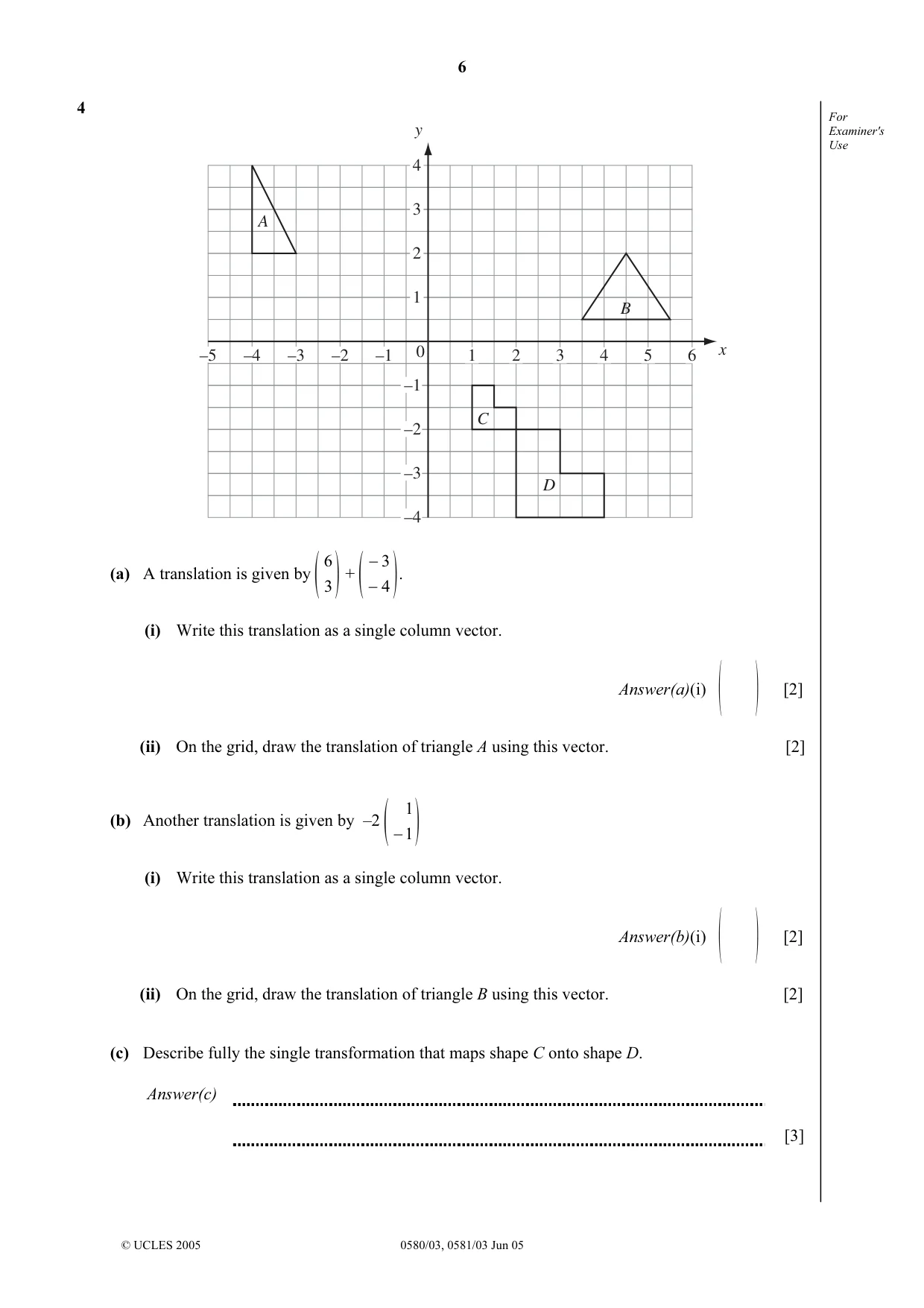
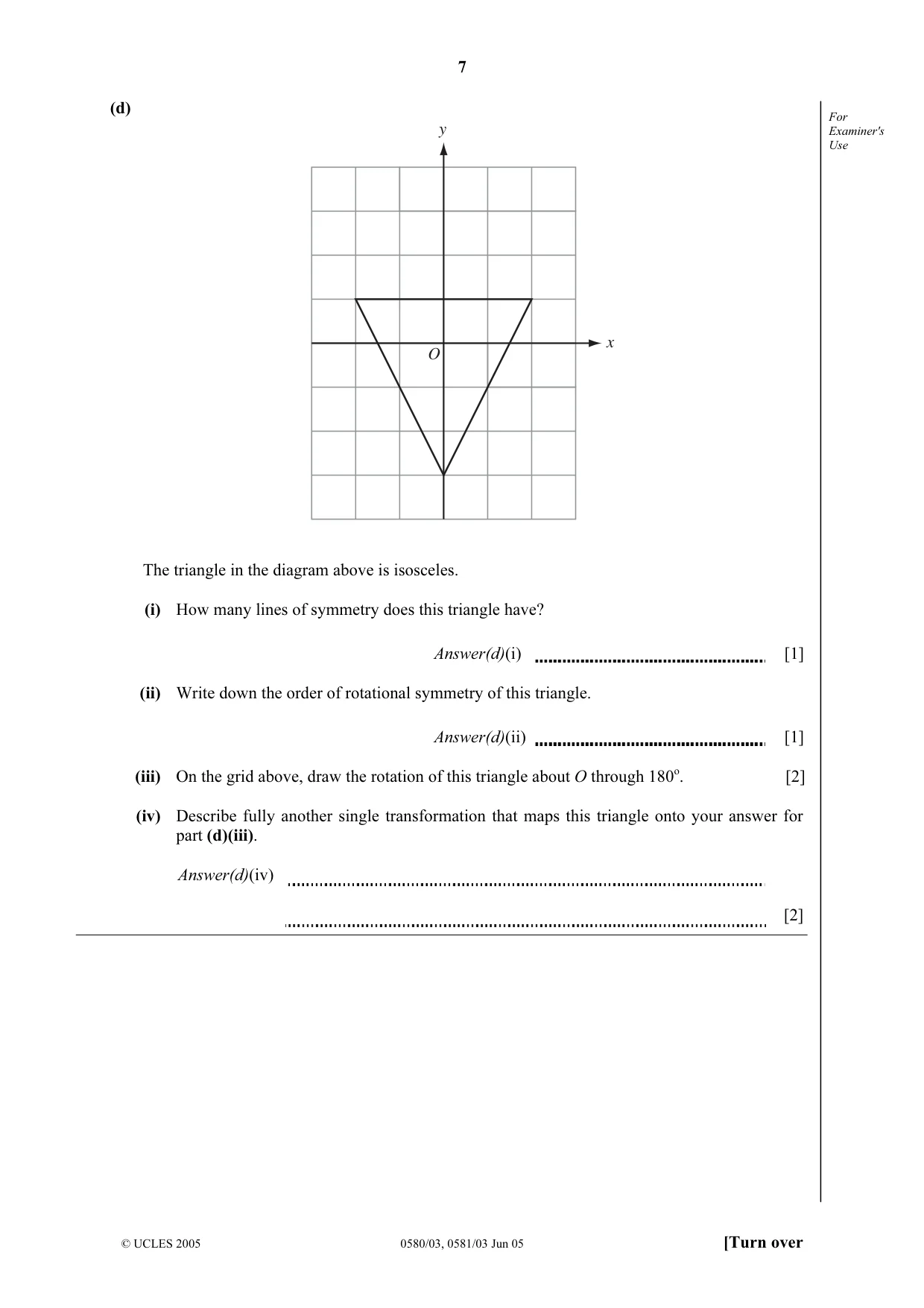
4 For y Examiner's Use 4 3 A 2 1 B –5 –4 –3 –2 –1 0 1 2 3 4 5 6 x –1 C –2 –3 D –4 6 − 3 (a) A translation is given by + . 3 − 4 (i) Write this translation as a single column vector. Answer(a)(i) [2] (ii) On the grid, draw the translation of triangle A using this vector. [2] 1 (b) Another translation is given by –2 − 1 (i) Write this translation as a single column vector. Answer(b)(i) [2] (ii) On the grid, draw the translation of triangle B using this vector. [2] (c) Describe fully the single transformation that maps shape C onto shape D. Answer(c) [3] (d) For y Examiner's Use x O The triangle in the diagram above is isosceles. (i) How many lines of symmetry does this triangle have? Answer(d)(i) [1] (ii) Write down the order of rotational symmetry of this triangle. Answer(d)(ii) [1] (iii) On the grid above, draw the rotation of this triangle about O through 180o. [2] (iv) Describe fully another single transformation that maps this triangle onto your answer for part (d)(iii). Answer(d)(iv) [2]
Mark scheme: 4 (a) (i) 3 1 –1 1 (ii) correct translation 1 f.t. } f.t. where possible (i.e. still on the grid) drawn 1 f.t. } condone inaccuracy/unruled if intention is clear } if ½ scale used then penalise first occurence only (–1) (b) (i) –2 1 2 1 (ii) correct translation 1 f.t. } f.t. where possible (i.e. still on the grid) drawn 1 f.t. } condone inaccuracy/unruled if intention is clear (c) enlargement 1 } (centre) (0,0) o.e. 1 } must be a single transformation (scale factor) 2 1 } (d) (i) 1 1 (ii) 1 1 (iii) correct rotation 2 SC1 for 180 rotation about any other point drawn SC1 for ± 90 rotation about O (iv) reflection M1 } must be a single transformation in the x-axis oe B1(dep) } condone inaccuracy/unruled if intention is clear } enlargement, s.f. = –1, centre (0,0) is B2 17
Q5 · For Examiner's 6 Use 1 5 2 4 3 (a) Asif tests a six-sided spinner
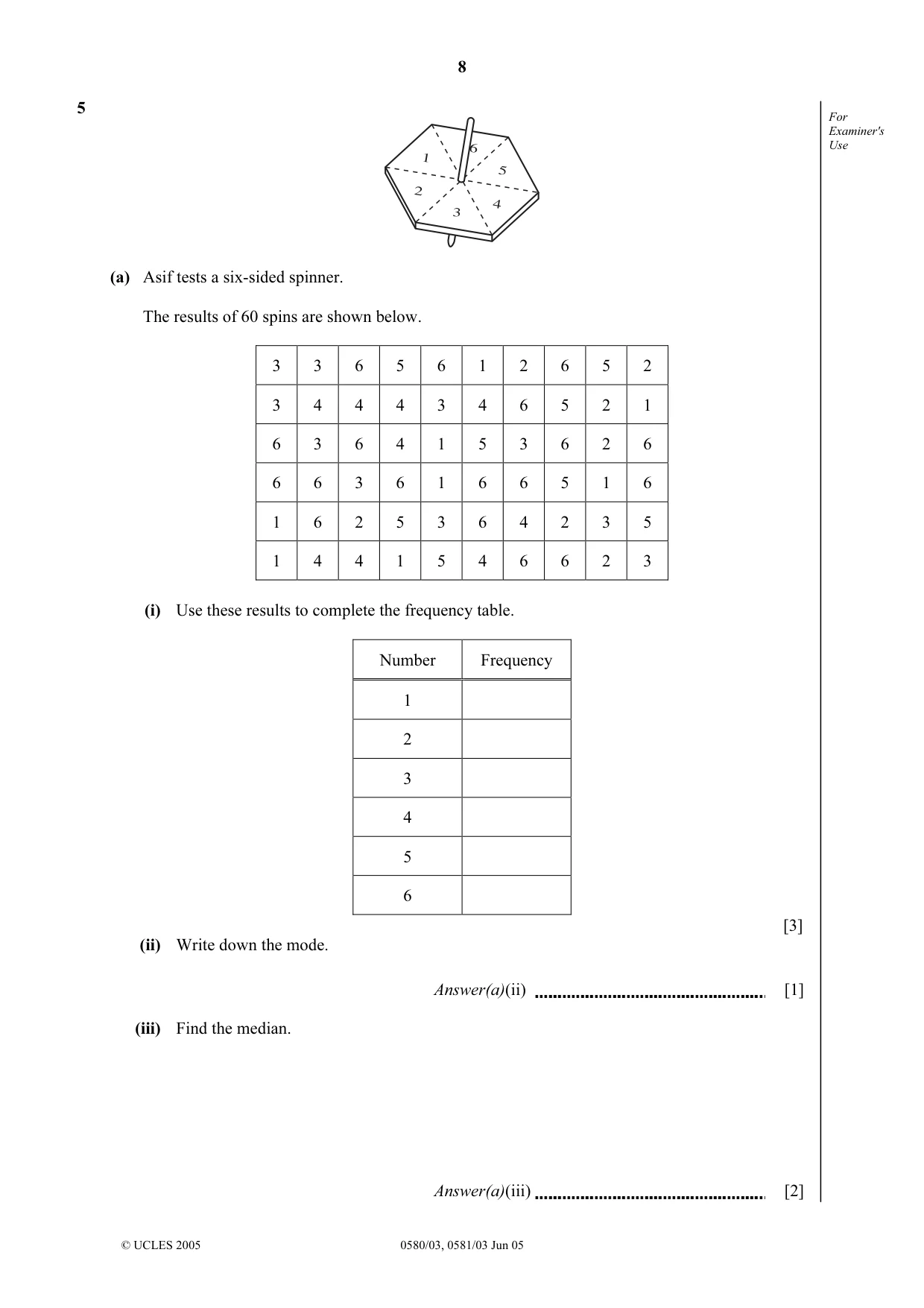
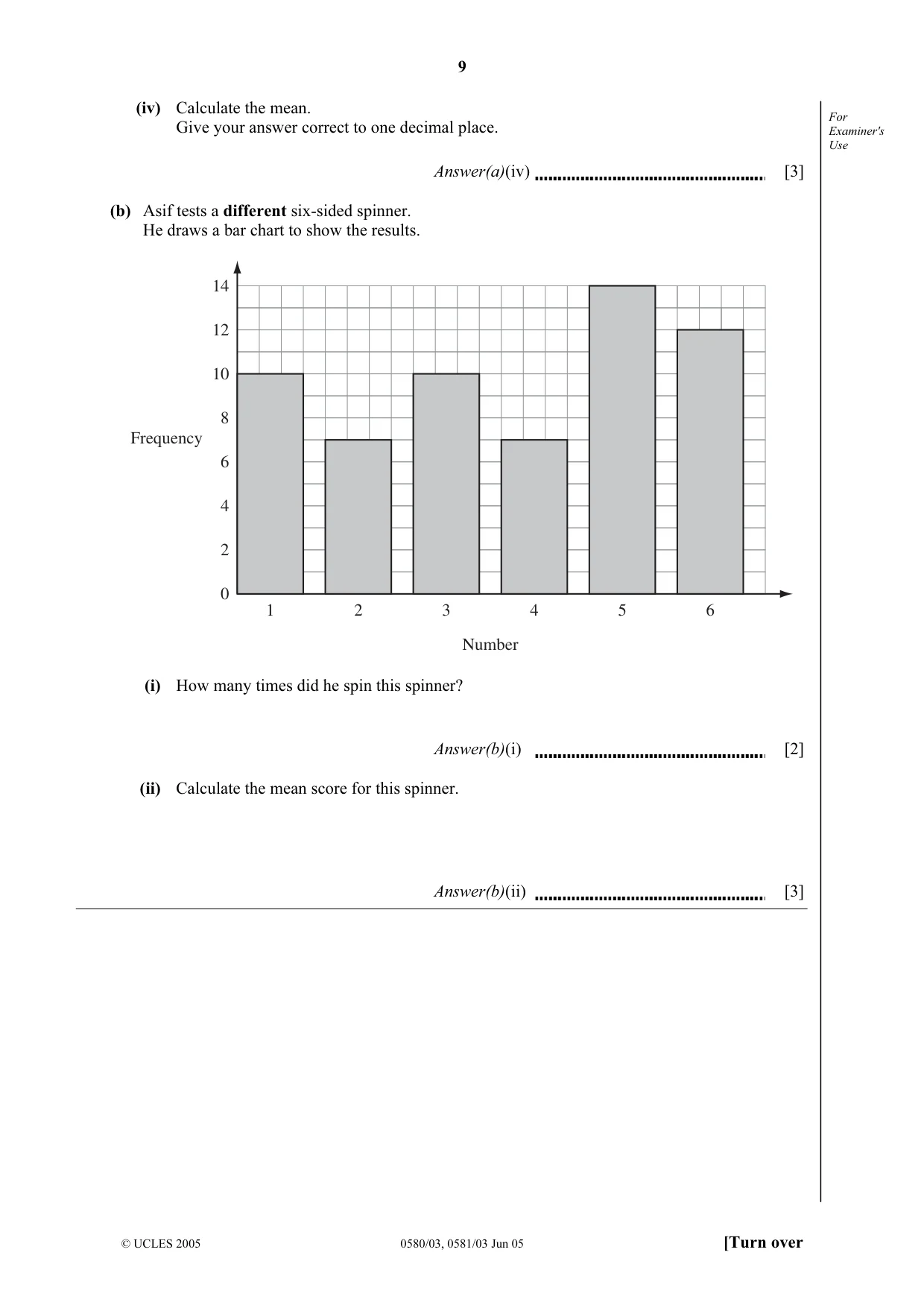
5 For Examiner's 6 Use 1 5 2 4 3 (a) Asif tests a six-sided spinner. The results of 60 spins are shown below. 3 3 6 5 6 1 2 6 5 2 3 4 4 4 3 4 6 5 2 1 6 3 6 4 1 5 3 6 2 6 6 6 3 6 1 6 6 5 1 6 1 6 2 5 3 6 4 2 3 5 1 4 4 1 5 4 6 6 2 3 (i) Use these results to complete the frequency table. Number Frequency 1 2 3 4 5 6 [3] (ii) Write down the mode. Answer(a)(ii) [1] (iii) Find the median. Answer(a)(iii) [2] (iv) Calculate the mean. For Give your answer correct to one decimal place. Examiner's Use Answer(a)(iv) [3] (b) Asif tests a different six-sided spinner. He draws a bar chart to show the results. 14 12 10 8 Frequency 6 4 2 0 1 2 3 4 5 6 Number (i) How many times did he spin this spinner? Answer(b)(i) [2] (ii) Calculate the mean score for this spinner. Answer(b)(ii) [3]
Mark scheme: 5 (a) (i) 8 7 10 9 8 18 3 2 for 4 or 5 correct, 1 for 2 or 3 correct accept tallies if in 5’s, accept 8/60, 7/60 etc. (ii) 6 1 c.a.o (iii) 4 2 c.a.o M1 for evidence of ranking (cum. freq.) IGCSE – JUNE 2005 0580/0581 3 (iv) 3.9 3 c.a.o M1 (f.t.) for 8 x 1 + 7 x 2 + 10 x 3 or 8 +14 +30 (min 3) M1 (f.t.) dep. for /60 [both M marks may be by the table] answer of 3.93(3333) is M2 implied 39.3(33...) is M1 implied (b) (i) 60 2 M1 for 10 + 7 + 10 + 7 + 14 + 12 (min 3) (ii) 3.7(3333 ) 3 M1 (f.t.) for 10 x 1 + 7 x 2 + 10 x 3..... or 10 +14 + 30...... (min 3) M1 (f.t.) dep. for /(b)(i) 14
Q6 · For Examiner's NOT TO Use x cm SCALE 2x cm The perimeter of the rectangle in the diagram…
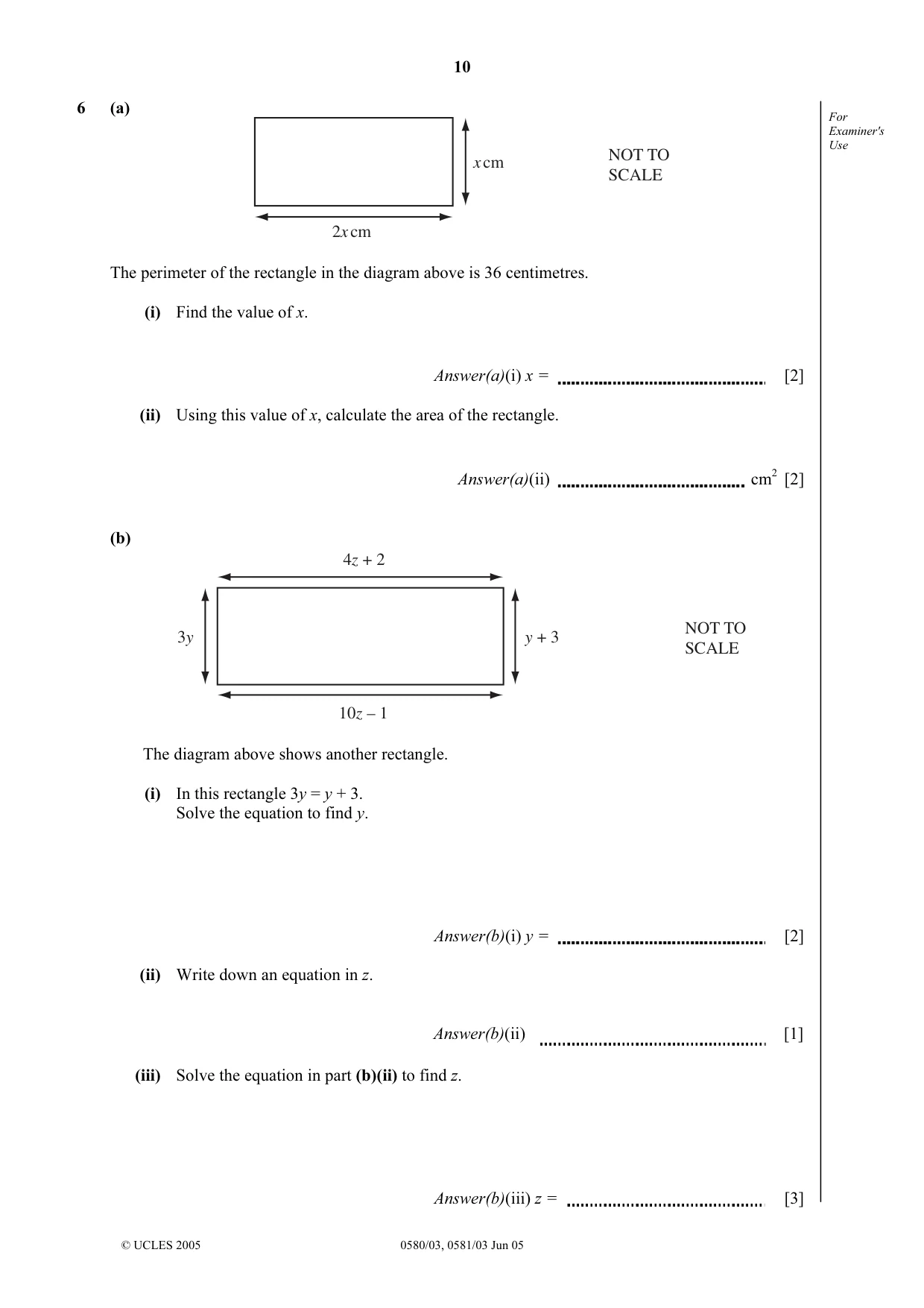
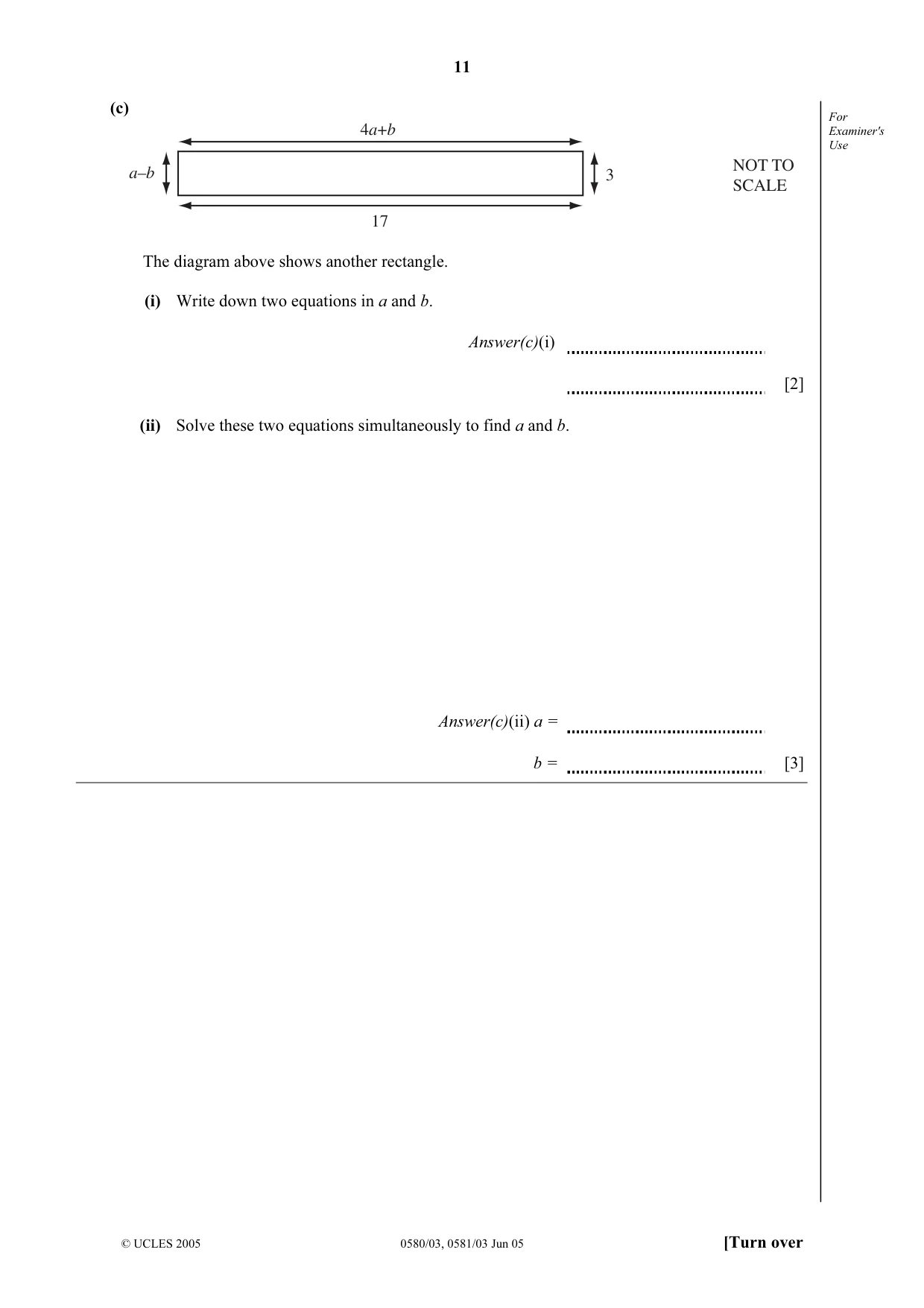
6 (a) For Examiner's NOT TO Use x cm SCALE 2x cm The perimeter of the rectangle in the diagram above is 36 centimetres. (i) Find the value of x. Answer(a)(i) x = [2] (ii) Using this value of x, calculate the area of the rectangle. Answer(a)(ii) cm2 [2] (b) 4z + 2 NOT TO 3y y + 3 SCALE 10z – 1 The diagram above shows another rectangle. (i) In this rectangle 3y = y + 3. Solve the equation to find y. Answer(b)(i) y = [2] (ii) Write down an equation in z. Answer(b)(ii) [1] (iii) Solve the equation in part (b)(ii) to find z. Answer(b)(iii) z = [3] (c) For 4a+b Examiner's Use NOT TO a–b 3 SCALE 17 The diagram above shows another rectangle. (i) Write down two equations in a and b. Answer(c)(i) [2] (ii) Solve these two equations simultaneously to find a and b. Answer(c)(ii) a = b = [3]
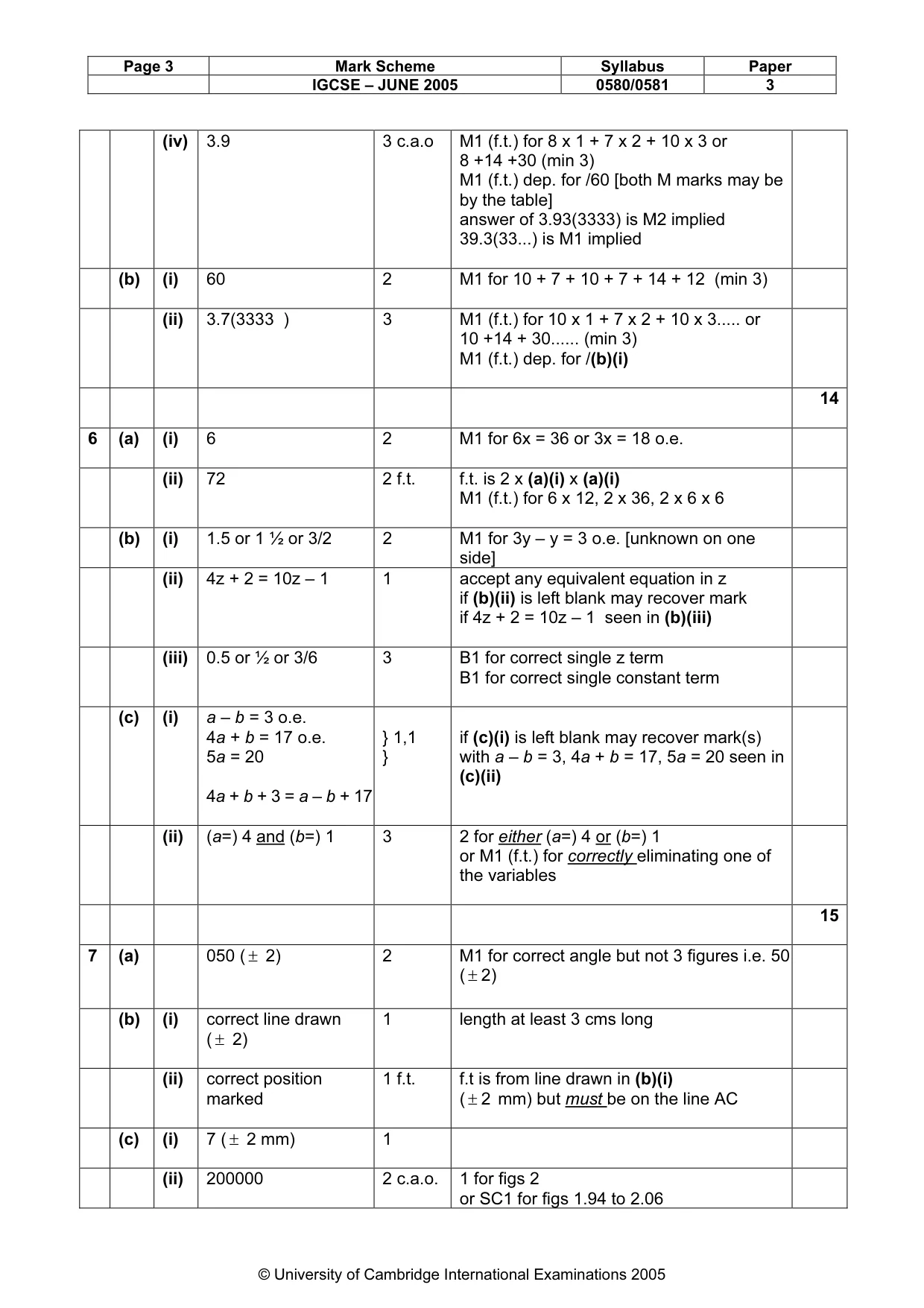
Mark scheme: 6 (a) (i) 6 2 M1 for 6x = 36 or 3x = 18 o.e. (ii) 72 2 f.t. f.t. is 2 x (a)(i) x (a)(i) M1 (f.t.) for 6 x 12, 2 x 36, 2 x 6 x 6 (b) (i) 1.5 or 1 ½ or 3/2 2 M1 for 3y – y = 3 o.e. [unknown on one side] (ii) 4z + 2 = 10z – 1 1 accept any equivalent equation in z if (b)(ii) is left blank may recover mark if 4z + 2 = 10z – 1 seen in (b)(iii) (iii) 0.5 or ½ or 3/6 3 B1 for correct single z term B1 for correct single constant term (c) (i) a – b = 3 o.e. 4a + b = 17 o.e. } 1,1 if (c)(i) is left blank may recover mark(s) 5a = 20 } with a – b = 3, 4a + b = 17, 5a = 20 seen in (c)(ii) 4a + b + 3 = a – b + 17 (ii) (a=) 4 and (b=) 1 3 2 for either (a=) 4 or (b=) 1 or M1 (f.t.) for correctly eliminating one of the variables 15
Q7 · For C Examiner's Use R Sea North North Land 14 km A B At midday, a ship is somewhere…
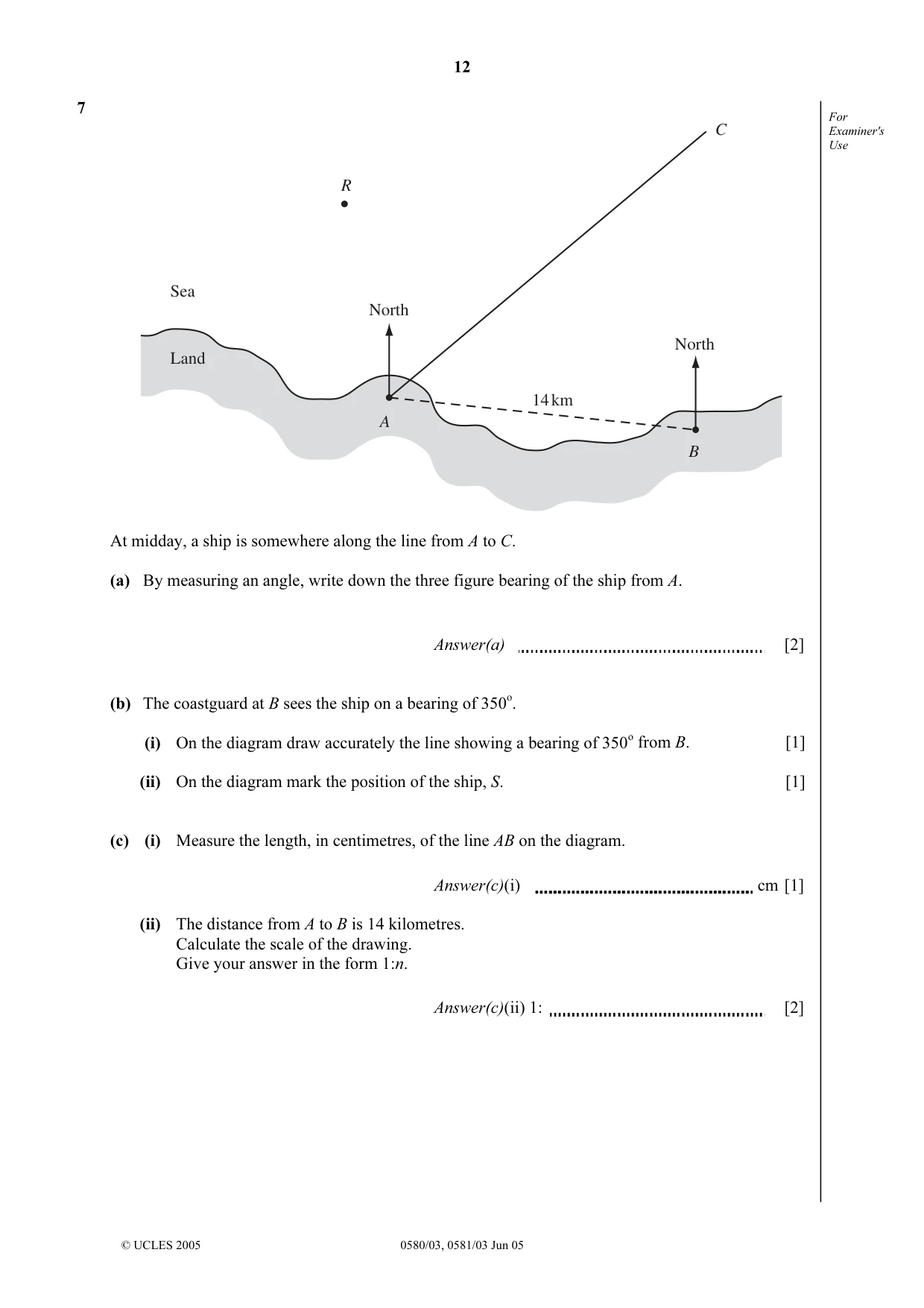
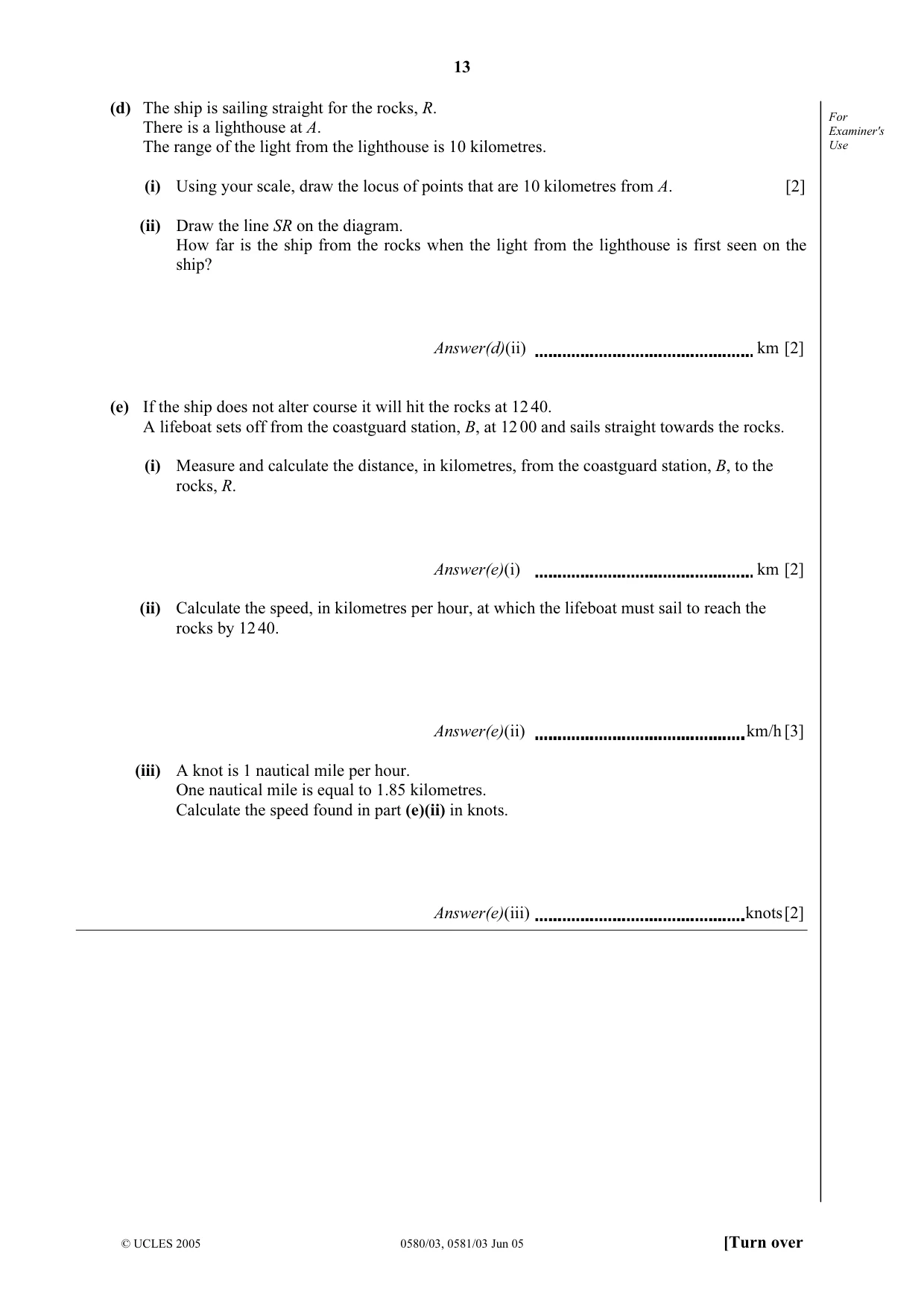
7 For C Examiner's Use R Sea North North Land 14 km A B At midday, a ship is somewhere along the line from A to C. (a) By measuring an angle, write down the three figure bearing of the ship from A. Answer(a) [2] (b) The coastguard at B sees the ship on a bearing of 350o. (i) On the diagram draw accurately the line showing a bearing of 350o from B. [1] (ii) On the diagram mark the position of the ship, S. [1] (c) (i) Measure the length, in centimetres, of the line AB on the diagram. Answer(c)(i) cm [1] (ii) The distance from A to B is 14 kilometres. Calculate the scale of the drawing. Give your answer in the form 1:n. Answer(c)(ii) 1: [2] (d) The ship is sailing straight for the rocks, R. For There is a lighthouse at A. Examiner's The range of the light from the lighthouse is 10 kilometres. Use (i) Using your scale, draw the locus of points that are 10 kilometres from A. [2] (ii) Draw the line SR on the diagram. How far is the ship from the rocks when the light from the lighthouse is first seen on the ship? Answer(d)(ii) km [2] (e) If the ship does not alter course it will hit the rocks at 12 40. A lifeboat sets off from the coastguard station, B, at 12 00 and sails straight towards the rocks. (i) Measure and calculate the distance, in kilometres, from the coastguard station, B, to the rocks, R. Answer(e)(i) km [2] (ii) Calculate the speed, in kilometres per hour, at which the lifeboat must sail to reach the rocks by 12 40. Answer(e)(ii) km/h [3] (iii) A knot is 1 nautical mile per hour. One nautical mile is equal to 1.85 kilometres. Calculate the speed found in part (e)(ii) in knots. Answer(e)(iii) knots [2]
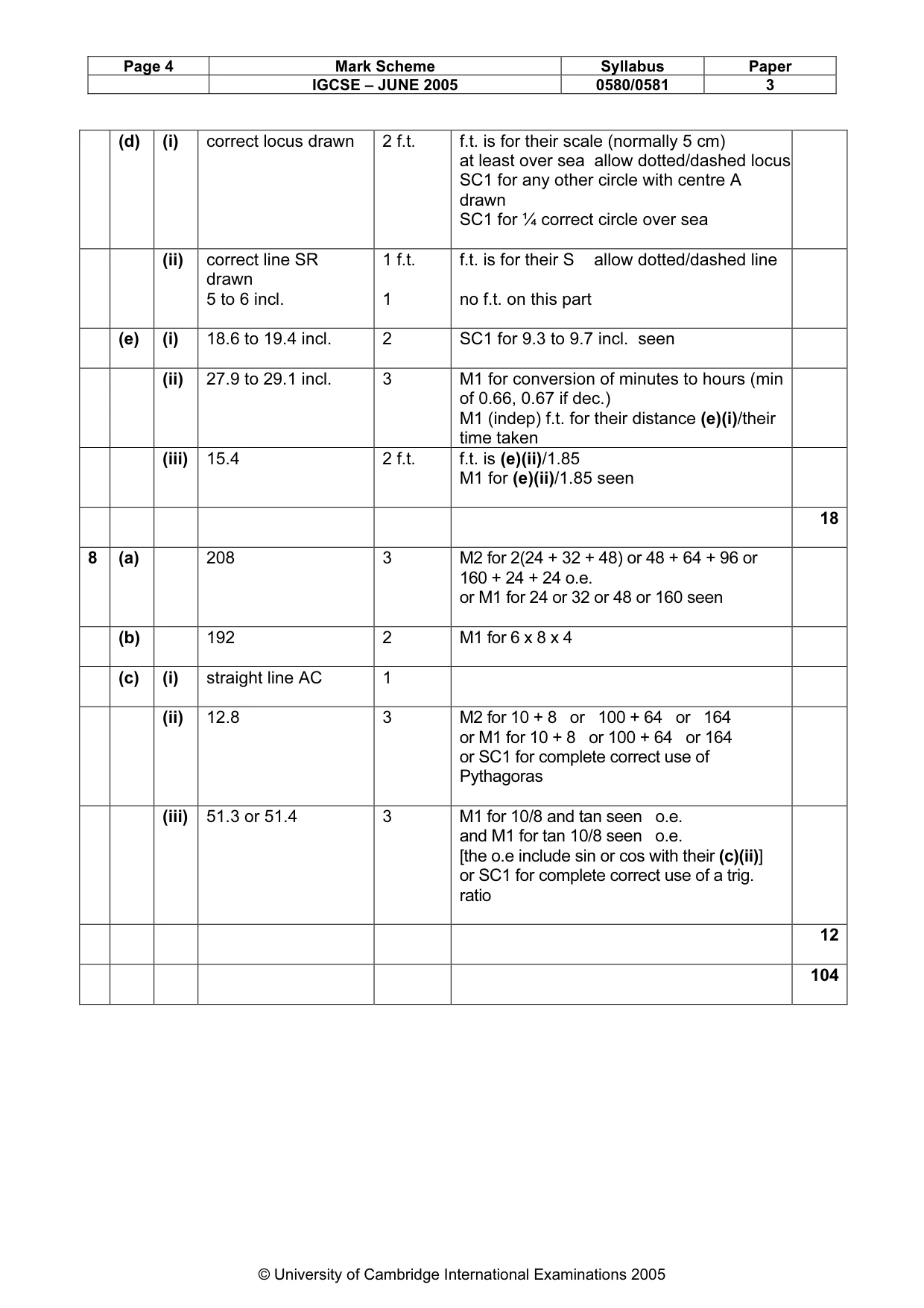
Mark scheme: 7 (a) 050 ( ± 2) 2 M1 for correct angle but not 3 figures i.e. 50 ( ± 2 ) (b) (i) correct line drawn 1 length at least 3 cms long ( ± 2) (ii) correct position 1 f.t. f.t is from line drawn in (b)(i) marked ( ± 2 mm) but must be on the line AC (c) (i) 7 ( ± 2 mm) 1 (ii) 200000 2 c.a.o. 1 for figs 2 or SC1 for figs 1.94 to 2.06 IGCSE – JUNE 2005 0580/0581 3 (d) (i) correct locus drawn 2 f.t. f.t. is for their scale (normally 5 cm) at least over sea allow dotted/dashed locus SC1 for any other circle with centre A drawn SC1 for ¼ correct circle over sea (ii) correct line SR 1 f.t. f.t. is for their S allow dotted/dashed line drawn 5 to 6 incl. 1 no f.t. on this part (e) (i) 18.6 to 19.4 incl. 2 SC1 for 9.3 to 9.7 incl. seen (ii) 27.9 to 29.1 incl. 3 M1 for conversion of minutes to hours (min of 0.66, 0.67 if dec.) M1 (indep) f.t. for their distance (e)(i)/their time taken (iii) 15.4 2 f.t. f.t. is (e)(ii)/1.85 M1 for (e)(ii)/1.85 seen 18
Q8 · For C Examiner's Use NOT TO SCALE A B 6 cm C 4 cm NOT TO SCALE B A 8 cm The diagram above…
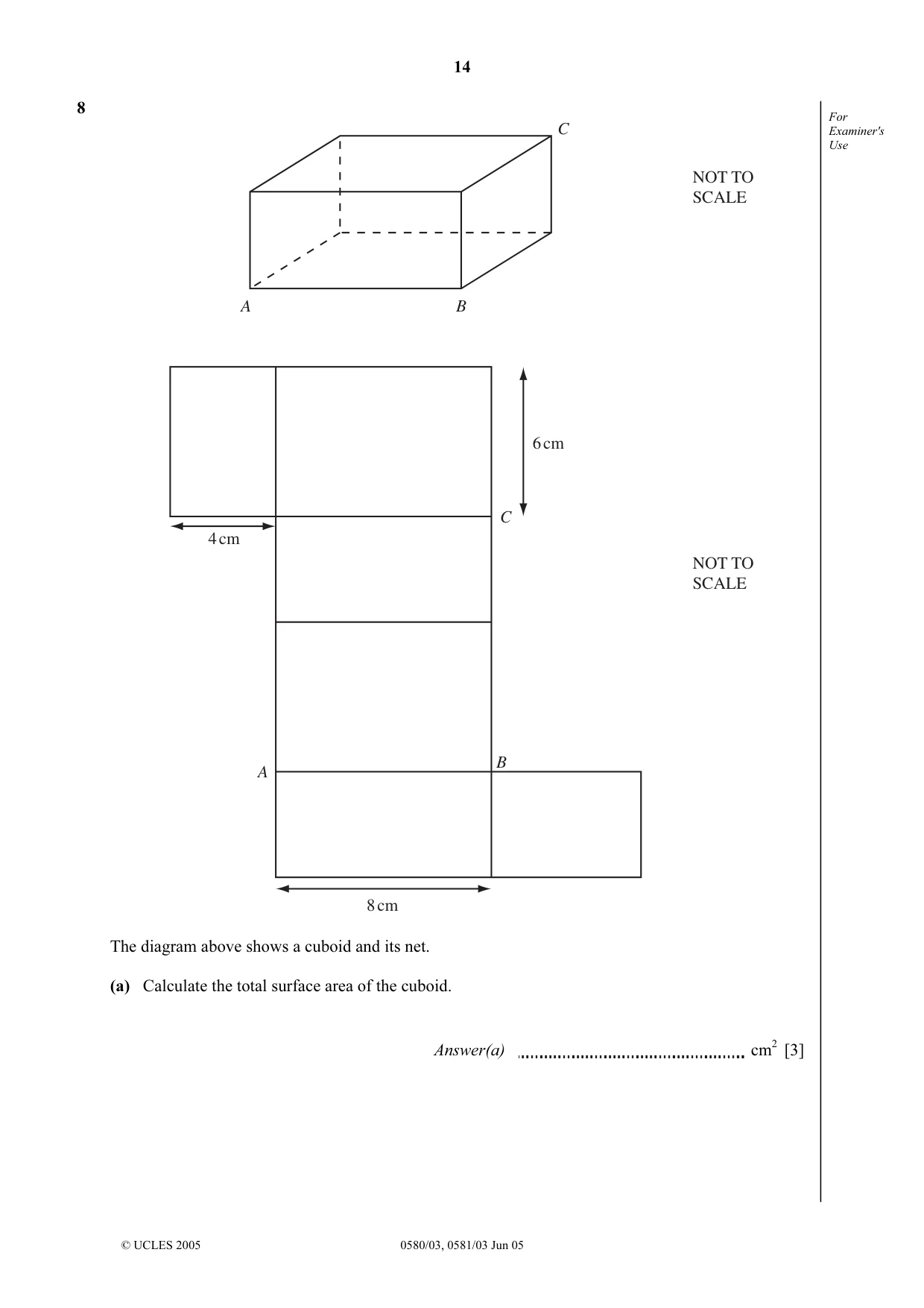
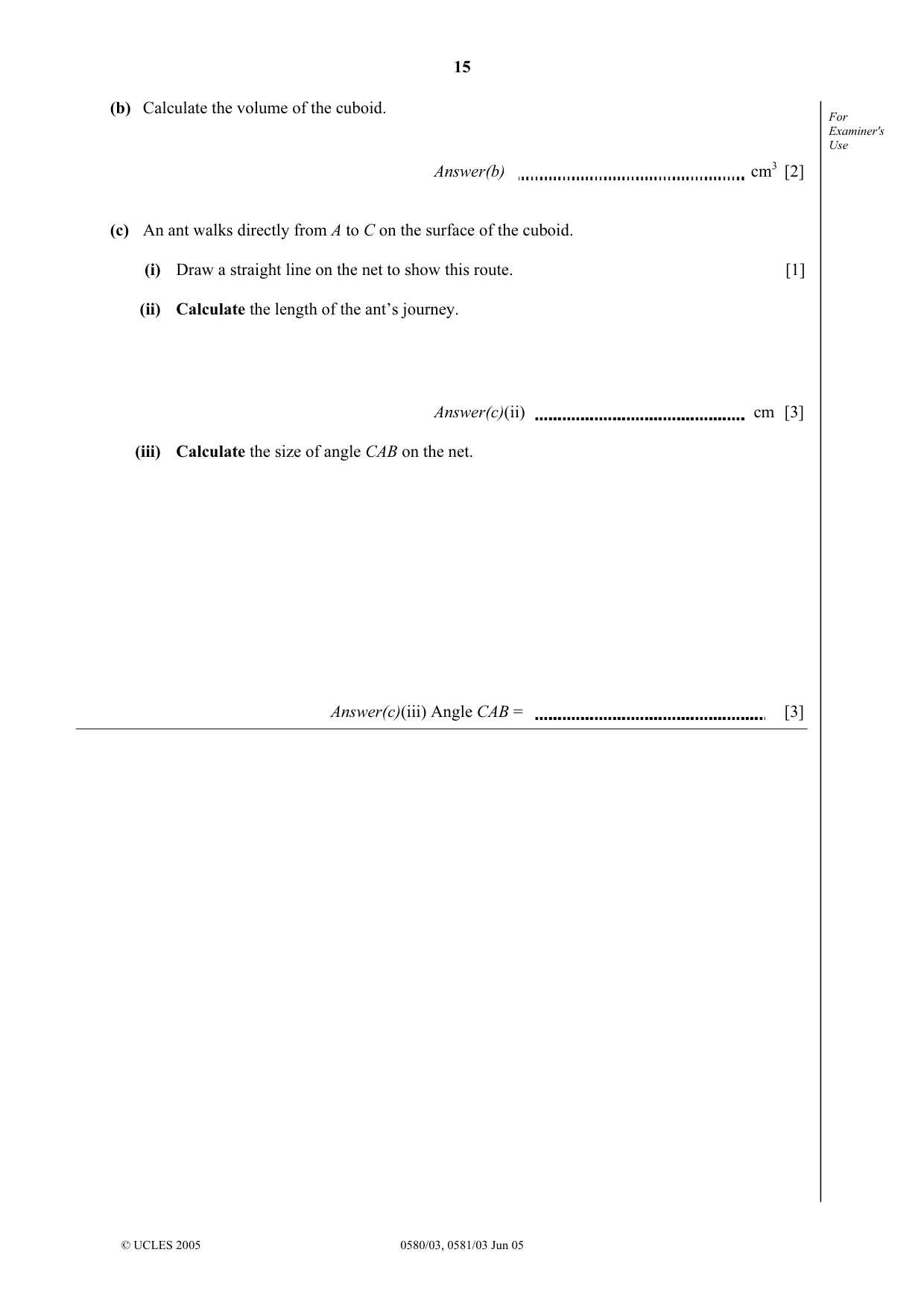
8 For C Examiner's Use NOT TO SCALE A B 6 cm C 4 cm NOT TO SCALE B A 8 cm The diagram above shows a cuboid and its net. (a) Calculate the total surface area of the cuboid. Answer(a) cm2 [3] (b) Calculate the volume of the cuboid. For Examiner's Use Answer(b) cm3 [2] (c) An ant walks directly from A to C on the surface of the cuboid. (i) Draw a straight line on the net to show this route. [1] (ii) Calculate the length of the ant’s journey. Answer(c)(ii) cm [3] (iii) Calculate the size of angle CAB on the net. Answer(c)(iii) Angle CAB = [3]
Mark scheme: 8 (a) 208 3 M2 for 2(24 + 32 + 48) or 48 + 64 + 96 or 160 + 24 + 24 o.e. or M1 for 24 or 32 or 48 or 160 seen (b) 192 2 M1 for 6 x 8 x 4 (c) (i) straight line AC 1 (ii) 12.8 3 M2 for 10 + 8 or 100 + 64 or 164 or M1 for 10 + 8 or 100 + 64 or 164 or SC1 for complete correct use of Pythagoras (iii) 51.3 or 51.4 3 M1 for 10/8 and tan seen o.e. and M1 for tan 10/8 seen o.e. [the o.e include sin or cos with their (c)(ii)] or SC1 for complete correct use of a trig. ratio 12 104
What was in this paper
The subtopics covered by these 8 questions, and how many questions each got. Open one in a new tab to see every Cambridge question on it.